Introduction
                    Research design
                            Results
                         Conclusion


 Value Added From Money Managers in Private Markets?
An Examination of Pension Fund Investments in Real Estate

      Aleksandar Andonov, Piet Eichholtz and Nils Kok


                Rotman ICPM Discussion Forum
                        June 6, 2012


                                                            1 / 25
Introduction
                               Research design   Motivation
                                       Results   Research questions
                                    Conclusion


Context
 Real estate is the most significant alternative asset class:
     2010 PREA survey: real estate represents 10% of assets fiduciary managers.
 Pension fund assets in real estate have grown substantially...
     All properties in the NCREIF Property Index have been acquired on behalf of
     tax-exempt institutional investors ($273 billion).
     Bond and Mitchell (2010): pension funds constitute more than 60% of the
     investors in the IPD UK database during the 1987-2006 period.
      What determines the variations in real estate allocations?
      How high are the investment costs? Which size justifies internal management?
 ...but performance has been volatile:
     Pensions & Investments’ survey: real estate holdings of tax-exempted institutions
     peaked in June 2008 at $1 trillion and plunged to $677 billion in June 2010.
     Pension funds generated much of the decline by greater allocation to opportunistic
     and value-added strategies and increased usage of leverage.
      Dependent on internal management or outsourcing to external managers?
      Can smaller funds manage complicated investments?
      Speculative behavior?

                                                                                    2 / 25
Introduction
                                  Research design   Motivation
                                          Results   Research questions
                                       Conclusion


Research questions
1   Which pension funds decide to invest in real estate?
2   How do pension funds invest in real estate?
        Subcategory: direct (private) real estate or in public (listed) real estate?
        Approach: internal selection of properties and REITs, or outsource this
        responsibility to external managers and fund-of-funds?

3   What is the effect of the selected investment subcategory and approach on
    investment costs and performance?
4   Do economies of scale and persistence effects play a role in explaining costs and
    performance?


    Understudied in finance (and real estate) literature
    Comparable to research on private equity and hedge funds (Lerner et al. (2007))

                                                                                       3 / 25
Introduction
                    Research design   Institutional marketplace
                            Results   Data
                         Conclusion


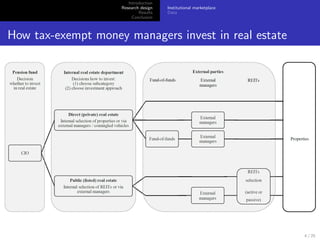
How tax-exempt money managers invest in real estate


                                                                  4 / 25
Introduction
                                   Research design   Institutional marketplace
                                           Results   Data
                                        Conclusion


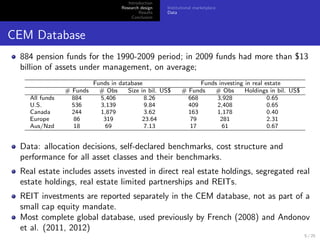
CEM Database
 884 pension funds for the 1990-2009 period; in 2009 funds had more than $13
 billion of assets under management, on average;
                         Funds in database                        Funds investing in real estate
               # Funds     # Obs     Size in bil. US$       # Funds   # Obs       Holdings in bil. US$
   All funds     884       5,406           8.26               668      3,928               0.65
   U.S.          536       3,139           9.84               409      2,408               0.65
   Canada        244       1,879           3.62               163      1,178               0.40
   Europe         86        319            23.64               79        281               2.31
   Aus/Nzd        18         69            7.13                17         61               0.67


 Data: allocation decisions, self-declared benchmarks, cost structure and
 performance for all asset classes and their benchmarks.
 Real estate includes assets invested in direct real estate holdings, segregated real
 estate holdings, real estate limited partnerships and REITs.
 REIT investments are reported separately in the CEM database, not as part of a
 small cap equity mandate.
 Most complete global database, used previously by French (2008) and Andonov
 et al. (2011, 2012)
                                                                                                         5 / 25
Introduction
                             Research design   Institutional marketplace
                                     Results   Data
                                  Conclusion


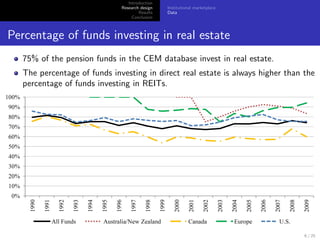
Percentage of funds investing in real estate
  75% of the pension funds in the CEM database invest in real estate.
  The percentage of funds investing in direct real estate is always higher than the
  percentage of funds investing in REITs.


                                                                                6 / 25
Introduction
                           Research design   Institutional marketplace
                                   Results   Data
                                Conclusion


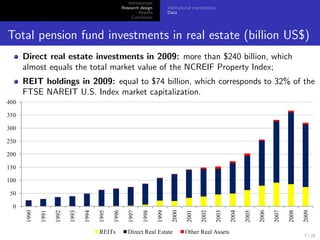
Total pension fund investments in real estate (billion US$)
  Direct real estate investments in 2009: more than $240 billion, which
  almost equals the total market value of the NCREIF Property Index;
  REIT holdings in 2009: equal to $74 billion, which corresponds to 32% of the
  FTSE NAREIT U.S. Index market capitalization.


                                                                           7 / 25
Introduction
                            Research design   Institutional marketplace
                                    Results   Data
                                 Conclusion


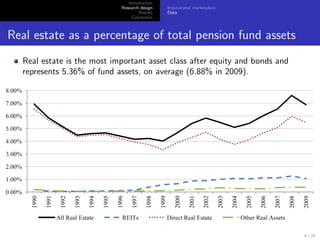
Real estate as a percentage of total pension fund assets
  Real estate is the most important asset class after equity and bonds and
  represents 5.36% of fund assets, on average (6.88% in 2009).


                                                                             8 / 25
Introduction
                                                Allocation to real estate
                              Research design
                                                Investment costs
                                      Results
                                                Performance
                                   Conclusion


Pension fund allocation to real estate


     1   Which pension funds decide to invest in real estate?

     2   How do pension funds invest in real estate?
             Subcategory: direct real estate or in public (listed) real estate?
             Approach: internal selection of properties and REITs, or outsource
             this responsibility to external managers and fund-of-funds?


                                                                                  9 / 25
Introduction
                                                    Allocation to real estate
                                  Research design
                                                    Investment costs
                                          Results
                                                    Performance
                                       Conclusion


Which pension funds invest in real estate?
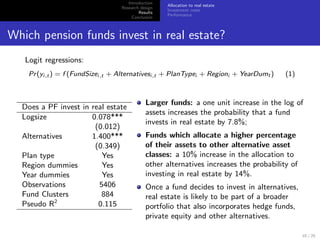
   Logit regressions:
    Pr (yi,t ) = f (FundSizei,t + Alternativesi,t + PlanTypei + Regioni + YearDumt )    (1)


                                             Larger funds: a one unit increase in the log of
  Does a PF invest in real estate
                                             assets increases the probability that a fund
  Logsize             0.078***
                                             invests in real estate by 7.8%;
                       (0.012)
  Alternatives        1.400***               Funds which allocate a higher percentage
                       (0.349)               of their assets to other alternative asset
  Plan type              Yes                 classes: a 10% increase in the allocation to
  Region dummies         Yes                 other alternatives increases the probability of
  Year dummies           Yes                 investing in real estate by 14%.
  Observations          5406                 Once a fund decides to invest in alternatives,
  Fund Clusters          884                 real estate is likely to be part of a broader
  Pseudo R2             0.115                portfolio that also incorporates hedge funds,
                                             private equity and other alternatives.

                                                                                               10 / 25
Introduction
                                                 Allocation to real estate
                               Research design
                                                 Investment costs
                                       Results
                                                 Performance
                                    Conclusion


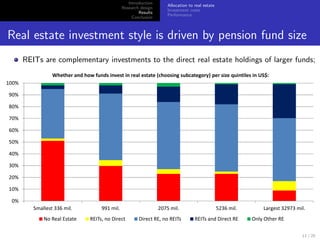
Real estate investment style is driven by pension fund size
  REITs are complementary investments to the direct real estate holdings of larger funds;


                                                                                    11 / 25
Introduction
                                                      Allocation to real estate
                                    Research design
                                                      Investment costs
                                            Results
                                                      Performance
                                         Conclusion


How pension funds invest in real estate - approach
  Larger funds are more likely to invest internally; smaller funds are more likely to invest
  externally and via fund-of-funds;
  Funds with greater allocation to other alternative assets are more likely to invest
  externally in real estate.
                        Logit regressions: choosing an investment approach
                      Internal       Internal    External     External        FoF       FoF
     Fund size       0.075***      0.100***        -0.015     -0.026**    -0.005*    -0.005**
                      [0.013]        [0.016]      [0.010]      [0.010]     [0.003]    [0.002]
     Alternatives    -1.200***        -0.397     1.064***     0.507**       0.033      0.015
                       [0.309]        [0.279]     [0.280]      [0.215]     [0.024]    [0.015]
     %REITs           0.138**       0.192***     -0.104**    -0.123***      -0.016    -0.016*
                       [0.055]        [0.050]     [0.046]      [0.033]     [0.016]    [0.010]
     Canada                         0.467***                 -0.284***               -0.018**
                                      [0.062]                  [0.050]                [0.008]
     Europe                         0.409***                 -0.232***                 0.021
                                      [0.101]                  [0.087]                [0.017]
     Aus/Nzd                           0.180                    0.018                  0.027
                                      [0.137]                  [0.071]                [0.028]
     Plan type           No             Yes          No          Yes          No        Yes
     Year dummies        Yes            Yes          Yes         Yes          Yes       Yes
     Observations       3928           3928         3928        3928         3928      3928
     Fund clusters       668            668          668         668          668       668
     Pseudo R2          0.093          0.253        0.042       0.160        0.109     0.215
                                                                                                12 / 25
Introduction
                                               Allocation to real estate
                             Research design
                                               Investment costs
                                     Results
                                               Performance
                                  Conclusion


The cost of pension fund real estate investments


    1   Regional differences in investment costs

    2   Investment costs and fund characteristics


                                                                           13 / 25
Introduction
                                                  Allocation to real estate
                                Research design
                                                  Investment costs
                                        Results
                                                  Performance
                                     Conclusion


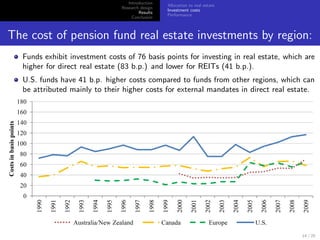
The cost of pension fund real estate investments by region:
  Funds exhibit investment costs of 76 basis points for investing in real estate, which are
  higher for direct real estate (83 b.p.) and lower for REITs (41 b.p.).
  U.S. funds have 41 b.p. higher costs compared to funds from other regions, which can
  be attributed mainly to their higher costs for external mandates in direct real estate.


                                                                                       14 / 25
Introduction
                                                        Allocation to real estate
                                      Research design
                                                        Investment costs
                                              Results
                                                        Performance
                                           Conclusion


Regression results: real estate investment costs

       yi,t = βMandatei,t + γInvApproachi,t + δYearDumt + ci + ui,t ,               t = 1, 2, ..., 20         (2)

                 Cons.        Mandate        %Ext       %Act             %FoF             %LP           FE    R2
  Panel A: Costs regressions for all funds and by region
  All funds   185.96***       -32.25**      21.36**                   122.03***                         Yes   0.25
                [65.96]        [14.24]       [9.31]                    [41.95]
  U.S.         222.76**       -41.51**       30.87                    151.48***                         Yes   0.20
                [97.62]         [20.91]     [21.15]                     [52.75]
  Canada       71.57***      -10.71***      23.43**                     -28.31                          Yes   0.43
                [16.73]          [3.93]     [11.09]                     [26.81]
  Europe        154.03          -20.04      15.85**                    72.79**                          Yes   0.76
               [133.85]         [22.10]      [6.76]                     [35.82]
  Aus/Nzd       -10.65            1.79       23.75                    131.28***                         Yes   0.83
                [27.83]          [4.59]     [16.53]                     [35.60]
  Panel B: Costs regressions by real estate subcategory
  REITs         185.22          -32.99      33.27**     10.88                                           Yes   0.47
               [151.45]        [27.44]      [16.07]    [17.58]
  Direct      164.89***        -25.82*      17.76**                   135.81***         111.42*         Yes   0.61
                [62.37]        [13.33]       [8.82]                    [44.68]          [62.76]
  Panel C: Costs regressions by investment approach
  Internal     58.34***        -6.84**                                                                  Yes   0.65
                [16.43]          [3.06]
  External    218.12***       -34.92**                                                                  Yes   0.21
                [63.15]        [15.68]
                                                                                                                     15 / 25
Introduction
                                                Allocation to real estate
                              Research design
                                                Investment costs
                                      Results
                                                Performance
                                   Conclusion


Summary: real estate investment costs

  Real estate investment costs are significantly lower than private equity and
  hedge fund costs (see Phalippou (2009) and French (2008)).
  Greater external management and allocation to fund-of-funds considerably
  increase the overall investment costs.
  Pension funds allocating more assets to real estate realize strong scale
  advantages in their investment costs.
  Larger funds can not only organize internal mandates more efficiently, but also
  negotiate lower fees for their external investments in real estate. This points at
  ”bargaining power” with external money managers.
  The higher costs of U.S. funds for external investments in direct real estate
  could be due to a worse relative negotiating position of U.S. funds, as the vast
  majority of the pension funds do not consider the option to invest internally (no
  competitive pressure on the external real estate asset management industry).

                                                                                 16 / 25
Introduction
                                               Allocation to real estate
                             Research design
                                               Investment costs
                                     Results
                                               Performance
                                  Conclusion


Pension fund performance in real estate


    1   Benchmark-adjusted returns

    2   Performance and characteristics

    3   Persistence


                                                                           17 / 25
Introduction
                                                     Allocation to real estate
                                   Research design
                                                     Investment costs
                                           Results
                                                     Performance
                                        Conclusion


Benchmark-adjusted returns


  Self-declared benchmarks (usually market indexes); random coefficient model;
                    All Assets  REITs      Direct RE    Internal             External      FoF
        Panel A: Gross benchmark-adjusted returns (percent)
        All funds     -0.10     1.13**       -0.18       1.08**                  -0.20      -1.71
                      [0.26]     [0.52]      [0.30]      [0.49]                  [0.31]    [3.21]
        U.S.          -0.38       1.06       -0.47         0.47                  -0.38    -2.08**
                      [0.34]     [0.67]      [0.40]      [0.90]                  [0.38]    [0.91]
        Canada         0.40       1.92        0.31        1.20*                   0.28        -
                      [0.50]     [1.48]      [0.50]      [0.72]                  [0.61]       -
        Europe         0.42       1.56        0.40       1.75**                  -0.25        -
                      [0.75]     [1.23]      [1.10]      [0.89]                  [1.43]       -
        Aus/Nzd        0.02       -0.06      -0.04           -                    0.14        -
                      [1.45]     [0.35]      [1.58]          -                   [1.64]       -


                                                                                                    18 / 25
Introduction
                                                     Allocation to real estate
                                   Research design
                                                     Investment costs
                                           Results
                                                     Performance
                                        Conclusion


Benchmark-adjusted returns
  Self-declared benchmarks (usually market indexes); random coefficient model;
                   All Assets  REITs      Direct RE    Internal              External       FoF
       Panel A: Gross benchmark-adjusted returns (percent)
       All funds      -0.10    1.13**        -0.18      1.08**                   -0.20      -1.71
                      [0.26]    [0.52]       [0.30]      [0.49]                  [0.31]    [3.21]
       U.S.           -0.38       1.06       -0.47        0.47                   -0.38    -2.08**
                      [0.34]    [0.67]       [0.40]      [0.90]                  [0.38]    [0.91]
       Canada          0.40       1.92        0.31       1.20*                    0.28        -
                      [0.50]    [1.48]       [0.50]      [0.72]                  [0.61]       -
       Europe          0.42       1.56        0.40      1.75**                   -0.25        -
                      [0.75]    [1.23]       [1.10]      [0.89]                  [1.43]       -
       Aus/Nzd         0.02      -0.06       -0.04          -                     0.14        -
                      [1.45]    [0.35]       [1.58]         -                    [1.64]       -
       Panel B: Net benchmark-adjusted returns (percent)
       All funds   -0.86***       0.70     -0.98***      0.81*              -1.05***         -3.90
                     [0.27]     [0.52]       [0.30]      [0.49]               [0.32]        [3.39]
       U.S.         -1.27***      0.56    -1.43***        0.21              -1.29***      -3.76***
                      [0.35]    [0.66]      [0.41]       [0.90]               [0.39]        [0.92]
       Canada         -0.17       1.59       -0.28        0.89                 -0.45           -
                      [0.51]    [1.52]       [0.51]      [0.72]               [0.62]           -
       Europe          0.00       1.33       -0.10       1.55*                 -0.98           -
                      [0.78]    [1.23]       [1.12]      [0.90]               [1.45]           -
       Aus/Nzd        -0.41      -0.31       -0.59          -                  -0.30           -
                      [1.47]    [0.33]       [1.61]         -                 [1.66]           -
                                                                                                     19 / 25
Introduction
                                                  Allocation to real estate
                                Research design
                                                  Investment costs
                                        Results
                                                  Performance
                                     Conclusion


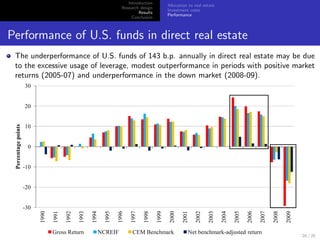
Performance of U.S. funds in direct real estate
 The underperformance of U.S. funds of 143 b.p. annually in direct real estate may be due
 to the excessive usage of leverage, modest outperformance in periods with positive market
 returns (2005-07) and underperformance in the down market (2008-09).


                                                                                      20 / 25
Introduction
                                                        Allocation to real estate
                                      Research design
                                                        Investment costs
                                              Results
                                                        Performance
                                           Conclusion


Performance and fund characteristics
  We use Fama and MacBeth regressions on the net benchmark-adjusted returns and
  correct for autocorrelation and heteroskedasticity using Newey-West with three lags.
                    Cons.     Mandate        Costs         %Ext     %Act       %FoF     %LP
      Panel A: Performance   and characteristics for all funds and by region
      All funds     -0.28      0.32**      -1.03***       -1.02**            -2.02***
                    [0.97]      [0.15]       [0.36]        [0.48]              [0.69]
      U.S.         -2.27*       0.40**       -0.66          -0.10               -0.38
                    [1.30]      [0.20]       [1.01]        [0.50]              [0.99]
      Canada        -0.70      0.59***     -1.74***         -0.40                3.17
                    [1.42]      [0.20]       [0.66]        [0.32]              [3.08]
      Europe       -4.49*       1.05**       -6.16          -0.45               0.66
                    [2.34]      [0.41]       [5.20]        [1.07]              [0.87]
      Panel B: Performance   and characteristics by real estate subcategory
      REITs        -6.38*      0.70**         0.13           2.42    1.61
                    [3.21]      [0.32]       [1.22]        [1.47]   [1.57]
      Direct RE     -0.02     0.31***      -1.11***       -1.22**            -2.63***    1.00
                    [1.05]      [0.12]       [0.34]        [0.56]              [0.78]   [1.50]
      Panel C: Performance   and characteristics by investment approach
      Internal      -0.71        0.43        -2.56
                    [2.09]      [0.28]       [2.96]
      External      -1.07      0.30**      -1.13***
                    [0.70]      [0.14]       [0.41]

                                                                                                 21 / 25
Introduction
                                                   Allocation to real estate
                                 Research design
                                                   Investment costs
                                         Results
                                                   Performance
                                      Conclusion


Persistence in pension fund real estate performance


  Methodology: five quintiles based on their net benchmark-adjusted returns; transition
  matrixes and difference in returns (see Carpenter and Lynch (1999) and Tonks (2005));

  We also address the persistence in pension fund performance in direct real estate by
  using a two-year horizon, when the appraisal smoothing effect has lapsed.

  Funds are more likely to end up in a better performing quintile next year if they also
  outperform this year.

  Certain pension funds are persistently more likely to outperform their direct real estate
  benchmarks, while that is not the case for REIT investors.

  Direct real estate markets are illiquid and not very transparent, which may give insiders
  an edge. The higher transparency makes the REIT market more efficient and
  outperformance more difficult.


                                                                                        22 / 25
Introduction
                                  Research design   Conclusion
                                          Results   Practical implications
                                       Conclusion


Conclusions and discussion

1   Costs and performance of pension funds in real estate are driven by three main
    variables: size, the choice to invest internally or externally, and geography.
         Larger funds can access the best investment opportunities at lower costs; larger
         funds have better monitoring capabilities, or even establish internal divisions,
         which improves their performance;
         Smaller funds focus on selecting external managers and fund-of-funds in direct
         real estate, while ignoring REITs; this increases their costs significantly, exposes
         them to agency problems and reduces their returns.
         U.S. pension funds perform relatively poor, compared to global peers.
2   Similar to Lerner, Schoar and Wongsunwai (2007): information gaps and agency
    problems lead to performance differences within one class of institutional investors.
3   Especially smaller pension funds do not seem to recognize that REITs provide exposure
    to property returns comparable to external managers that invest in direct real estate,
    and much better than fund-of-funds managers, but with lower investment costs.

                                                                                           23 / 25
Introduction
                                   Research design   Conclusion
                                           Results   Practical implications
                                        Conclusion


Conclusions and discussion

4   Fund-of-funds in direct real estate perform worse than REIT mutual funds and funds
    investing in hedge funds.
         REIT mutual funds do not underperform (see Cici, Corgel and Gibson (2011),
         Kallberg, Liu and Trzcinka (2000), Chiang, Kozhevnikov, Lee and Wisen (2008)
         and Hartzell, M¨hlhofer and Titman (2010));
                         u
         Funds investing in hedge funds deliver small alphas, albeit sporadically (Fung,
         Hsieh, Naik and Ramadorai (2008)).
5   It is surprising that small pension funds increasingly use fund-of-funds services.
    Consistent behavior with the Lakonishok, Shleifer and Vishny (1992) model of pension
    fund portfolio management: despite higher costs and lower returns, pension funds will
    maintain a preference for external management and fund-of-funds, as a way to shift
    responsibility for potentially poor performance, and even to shift the responsibility for
    poor selection of managers to the fund-of-funds.


                                                                                           24 / 25
Introduction
                                 Research design   Conclusion
                                         Results   Practical implications
                                      Conclusion


Practical implications


1   Pension funds should consider the full range of potential investment approaches and
    avoid extended investment chains.

2   Smaller funds should consider using more REITs and should re-evaluate their extensive
    use of fund-of-funds to gain exposure to direct real estate.

3   Smaller pension funds can also implement more passive strategies in REIT investments
    in order to remain cost-competitive with larger funds.


                                                                                      25 / 25

The Performance of Pension Funds Investments in Real Estate

  • 1.
    Introduction Research design Results Conclusion Value Added From Money Managers in Private Markets? An Examination of Pension Fund Investments in Real Estate Aleksandar Andonov, Piet Eichholtz and Nils Kok Rotman ICPM Discussion Forum June 6, 2012 1 / 25
  • 2.
    Introduction Research design Motivation Results Research questions Conclusion Context Real estate is the most significant alternative asset class: 2010 PREA survey: real estate represents 10% of assets fiduciary managers. Pension fund assets in real estate have grown substantially... All properties in the NCREIF Property Index have been acquired on behalf of tax-exempt institutional investors ($273 billion). Bond and Mitchell (2010): pension funds constitute more than 60% of the investors in the IPD UK database during the 1987-2006 period. What determines the variations in real estate allocations? How high are the investment costs? Which size justifies internal management? ...but performance has been volatile: Pensions & Investments’ survey: real estate holdings of tax-exempted institutions peaked in June 2008 at $1 trillion and plunged to $677 billion in June 2010. Pension funds generated much of the decline by greater allocation to opportunistic and value-added strategies and increased usage of leverage. Dependent on internal management or outsourcing to external managers? Can smaller funds manage complicated investments? Speculative behavior? 2 / 25
  • 3.
    Introduction Research design Motivation Results Research questions Conclusion Research questions 1 Which pension funds decide to invest in real estate? 2 How do pension funds invest in real estate? Subcategory: direct (private) real estate or in public (listed) real estate? Approach: internal selection of properties and REITs, or outsource this responsibility to external managers and fund-of-funds? 3 What is the effect of the selected investment subcategory and approach on investment costs and performance? 4 Do economies of scale and persistence effects play a role in explaining costs and performance? Understudied in finance (and real estate) literature Comparable to research on private equity and hedge funds (Lerner et al. (2007)) 3 / 25
  • 4.
    Introduction Research design Institutional marketplace Results Data Conclusion How tax-exempt money managers invest in real estate 4 / 25
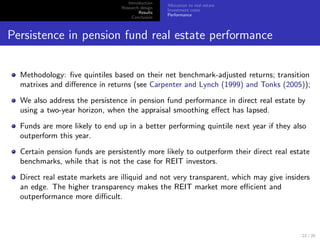
  • 5.
    Introduction Research design Institutional marketplace Results Data Conclusion CEM Database 884 pension funds for the 1990-2009 period; in 2009 funds had more than $13 billion of assets under management, on average; Funds in database Funds investing in real estate # Funds # Obs Size in bil. US$ # Funds # Obs Holdings in bil. US$ All funds 884 5,406 8.26 668 3,928 0.65 U.S. 536 3,139 9.84 409 2,408 0.65 Canada 244 1,879 3.62 163 1,178 0.40 Europe 86 319 23.64 79 281 2.31 Aus/Nzd 18 69 7.13 17 61 0.67 Data: allocation decisions, self-declared benchmarks, cost structure and performance for all asset classes and their benchmarks. Real estate includes assets invested in direct real estate holdings, segregated real estate holdings, real estate limited partnerships and REITs. REIT investments are reported separately in the CEM database, not as part of a small cap equity mandate. Most complete global database, used previously by French (2008) and Andonov et al. (2011, 2012) 5 / 25
  • 6.
    Introduction Research design Institutional marketplace Results Data Conclusion Percentage of funds investing in real estate 75% of the pension funds in the CEM database invest in real estate. The percentage of funds investing in direct real estate is always higher than the percentage of funds investing in REITs. 6 / 25
  • 7.
    Introduction Research design Institutional marketplace Results Data Conclusion Total pension fund investments in real estate (billion US$) Direct real estate investments in 2009: more than $240 billion, which almost equals the total market value of the NCREIF Property Index; REIT holdings in 2009: equal to $74 billion, which corresponds to 32% of the FTSE NAREIT U.S. Index market capitalization. 7 / 25
  • 8.
    Introduction Research design Institutional marketplace Results Data Conclusion Real estate as a percentage of total pension fund assets Real estate is the most important asset class after equity and bonds and represents 5.36% of fund assets, on average (6.88% in 2009). 8 / 25
  • 9.
    Introduction Allocation to real estate Research design Investment costs Results Performance Conclusion Pension fund allocation to real estate 1 Which pension funds decide to invest in real estate? 2 How do pension funds invest in real estate? Subcategory: direct real estate or in public (listed) real estate? Approach: internal selection of properties and REITs, or outsource this responsibility to external managers and fund-of-funds? 9 / 25
  • 10.
    Introduction Allocation to real estate Research design Investment costs Results Performance Conclusion Which pension funds invest in real estate? Logit regressions: Pr (yi,t ) = f (FundSizei,t + Alternativesi,t + PlanTypei + Regioni + YearDumt ) (1) Larger funds: a one unit increase in the log of Does a PF invest in real estate assets increases the probability that a fund Logsize 0.078*** invests in real estate by 7.8%; (0.012) Alternatives 1.400*** Funds which allocate a higher percentage (0.349) of their assets to other alternative asset Plan type Yes classes: a 10% increase in the allocation to Region dummies Yes other alternatives increases the probability of Year dummies Yes investing in real estate by 14%. Observations 5406 Once a fund decides to invest in alternatives, Fund Clusters 884 real estate is likely to be part of a broader Pseudo R2 0.115 portfolio that also incorporates hedge funds, private equity and other alternatives. 10 / 25
  • 11.
    Introduction Allocation to real estate Research design Investment costs Results Performance Conclusion Real estate investment style is driven by pension fund size REITs are complementary investments to the direct real estate holdings of larger funds; 11 / 25
  • 12.
    Introduction Allocation to real estate Research design Investment costs Results Performance Conclusion How pension funds invest in real estate - approach Larger funds are more likely to invest internally; smaller funds are more likely to invest externally and via fund-of-funds; Funds with greater allocation to other alternative assets are more likely to invest externally in real estate. Logit regressions: choosing an investment approach Internal Internal External External FoF FoF Fund size 0.075*** 0.100*** -0.015 -0.026** -0.005* -0.005** [0.013] [0.016] [0.010] [0.010] [0.003] [0.002] Alternatives -1.200*** -0.397 1.064*** 0.507** 0.033 0.015 [0.309] [0.279] [0.280] [0.215] [0.024] [0.015] %REITs 0.138** 0.192*** -0.104** -0.123*** -0.016 -0.016* [0.055] [0.050] [0.046] [0.033] [0.016] [0.010] Canada 0.467*** -0.284*** -0.018** [0.062] [0.050] [0.008] Europe 0.409*** -0.232*** 0.021 [0.101] [0.087] [0.017] Aus/Nzd 0.180 0.018 0.027 [0.137] [0.071] [0.028] Plan type No Yes No Yes No Yes Year dummies Yes Yes Yes Yes Yes Yes Observations 3928 3928 3928 3928 3928 3928 Fund clusters 668 668 668 668 668 668 Pseudo R2 0.093 0.253 0.042 0.160 0.109 0.215 12 / 25
  • 13.
    Introduction Allocation to real estate Research design Investment costs Results Performance Conclusion The cost of pension fund real estate investments 1 Regional differences in investment costs 2 Investment costs and fund characteristics 13 / 25
  • 14.
    Introduction Allocation to real estate Research design Investment costs Results Performance Conclusion The cost of pension fund real estate investments by region: Funds exhibit investment costs of 76 basis points for investing in real estate, which are higher for direct real estate (83 b.p.) and lower for REITs (41 b.p.). U.S. funds have 41 b.p. higher costs compared to funds from other regions, which can be attributed mainly to their higher costs for external mandates in direct real estate. 14 / 25
  • 15.
    Introduction Allocation to real estate Research design Investment costs Results Performance Conclusion Regression results: real estate investment costs yi,t = βMandatei,t + γInvApproachi,t + δYearDumt + ci + ui,t , t = 1, 2, ..., 20 (2) Cons. Mandate %Ext %Act %FoF %LP FE R2 Panel A: Costs regressions for all funds and by region All funds 185.96*** -32.25** 21.36** 122.03*** Yes 0.25 [65.96] [14.24] [9.31] [41.95] U.S. 222.76** -41.51** 30.87 151.48*** Yes 0.20 [97.62] [20.91] [21.15] [52.75] Canada 71.57*** -10.71*** 23.43** -28.31 Yes 0.43 [16.73] [3.93] [11.09] [26.81] Europe 154.03 -20.04 15.85** 72.79** Yes 0.76 [133.85] [22.10] [6.76] [35.82] Aus/Nzd -10.65 1.79 23.75 131.28*** Yes 0.83 [27.83] [4.59] [16.53] [35.60] Panel B: Costs regressions by real estate subcategory REITs 185.22 -32.99 33.27** 10.88 Yes 0.47 [151.45] [27.44] [16.07] [17.58] Direct 164.89*** -25.82* 17.76** 135.81*** 111.42* Yes 0.61 [62.37] [13.33] [8.82] [44.68] [62.76] Panel C: Costs regressions by investment approach Internal 58.34*** -6.84** Yes 0.65 [16.43] [3.06] External 218.12*** -34.92** Yes 0.21 [63.15] [15.68] 15 / 25
  • 16.
    Introduction Allocation to real estate Research design Investment costs Results Performance Conclusion Summary: real estate investment costs Real estate investment costs are significantly lower than private equity and hedge fund costs (see Phalippou (2009) and French (2008)). Greater external management and allocation to fund-of-funds considerably increase the overall investment costs. Pension funds allocating more assets to real estate realize strong scale advantages in their investment costs. Larger funds can not only organize internal mandates more efficiently, but also negotiate lower fees for their external investments in real estate. This points at ”bargaining power” with external money managers. The higher costs of U.S. funds for external investments in direct real estate could be due to a worse relative negotiating position of U.S. funds, as the vast majority of the pension funds do not consider the option to invest internally (no competitive pressure on the external real estate asset management industry). 16 / 25
  • 17.
    Introduction Allocation to real estate Research design Investment costs Results Performance Conclusion Pension fund performance in real estate 1 Benchmark-adjusted returns 2 Performance and characteristics 3 Persistence 17 / 25
  • 18.
    Introduction Allocation to real estate Research design Investment costs Results Performance Conclusion Benchmark-adjusted returns Self-declared benchmarks (usually market indexes); random coefficient model; All Assets REITs Direct RE Internal External FoF Panel A: Gross benchmark-adjusted returns (percent) All funds -0.10 1.13** -0.18 1.08** -0.20 -1.71 [0.26] [0.52] [0.30] [0.49] [0.31] [3.21] U.S. -0.38 1.06 -0.47 0.47 -0.38 -2.08** [0.34] [0.67] [0.40] [0.90] [0.38] [0.91] Canada 0.40 1.92 0.31 1.20* 0.28 - [0.50] [1.48] [0.50] [0.72] [0.61] - Europe 0.42 1.56 0.40 1.75** -0.25 - [0.75] [1.23] [1.10] [0.89] [1.43] - Aus/Nzd 0.02 -0.06 -0.04 - 0.14 - [1.45] [0.35] [1.58] - [1.64] - 18 / 25
  • 19.
    Introduction Allocation to real estate Research design Investment costs Results Performance Conclusion Benchmark-adjusted returns Self-declared benchmarks (usually market indexes); random coefficient model; All Assets REITs Direct RE Internal External FoF Panel A: Gross benchmark-adjusted returns (percent) All funds -0.10 1.13** -0.18 1.08** -0.20 -1.71 [0.26] [0.52] [0.30] [0.49] [0.31] [3.21] U.S. -0.38 1.06 -0.47 0.47 -0.38 -2.08** [0.34] [0.67] [0.40] [0.90] [0.38] [0.91] Canada 0.40 1.92 0.31 1.20* 0.28 - [0.50] [1.48] [0.50] [0.72] [0.61] - Europe 0.42 1.56 0.40 1.75** -0.25 - [0.75] [1.23] [1.10] [0.89] [1.43] - Aus/Nzd 0.02 -0.06 -0.04 - 0.14 - [1.45] [0.35] [1.58] - [1.64] - Panel B: Net benchmark-adjusted returns (percent) All funds -0.86*** 0.70 -0.98*** 0.81* -1.05*** -3.90 [0.27] [0.52] [0.30] [0.49] [0.32] [3.39] U.S. -1.27*** 0.56 -1.43*** 0.21 -1.29*** -3.76*** [0.35] [0.66] [0.41] [0.90] [0.39] [0.92] Canada -0.17 1.59 -0.28 0.89 -0.45 - [0.51] [1.52] [0.51] [0.72] [0.62] - Europe 0.00 1.33 -0.10 1.55* -0.98 - [0.78] [1.23] [1.12] [0.90] [1.45] - Aus/Nzd -0.41 -0.31 -0.59 - -0.30 - [1.47] [0.33] [1.61] - [1.66] - 19 / 25
  • 20.
    Introduction Allocation to real estate Research design Investment costs Results Performance Conclusion Performance of U.S. funds in direct real estate The underperformance of U.S. funds of 143 b.p. annually in direct real estate may be due to the excessive usage of leverage, modest outperformance in periods with positive market returns (2005-07) and underperformance in the down market (2008-09). 20 / 25
  • 21.
    Introduction Allocation to real estate Research design Investment costs Results Performance Conclusion Performance and fund characteristics We use Fama and MacBeth regressions on the net benchmark-adjusted returns and correct for autocorrelation and heteroskedasticity using Newey-West with three lags. Cons. Mandate Costs %Ext %Act %FoF %LP Panel A: Performance and characteristics for all funds and by region All funds -0.28 0.32** -1.03*** -1.02** -2.02*** [0.97] [0.15] [0.36] [0.48] [0.69] U.S. -2.27* 0.40** -0.66 -0.10 -0.38 [1.30] [0.20] [1.01] [0.50] [0.99] Canada -0.70 0.59*** -1.74*** -0.40 3.17 [1.42] [0.20] [0.66] [0.32] [3.08] Europe -4.49* 1.05** -6.16 -0.45 0.66 [2.34] [0.41] [5.20] [1.07] [0.87] Panel B: Performance and characteristics by real estate subcategory REITs -6.38* 0.70** 0.13 2.42 1.61 [3.21] [0.32] [1.22] [1.47] [1.57] Direct RE -0.02 0.31*** -1.11*** -1.22** -2.63*** 1.00 [1.05] [0.12] [0.34] [0.56] [0.78] [1.50] Panel C: Performance and characteristics by investment approach Internal -0.71 0.43 -2.56 [2.09] [0.28] [2.96] External -1.07 0.30** -1.13*** [0.70] [0.14] [0.41] 21 / 25
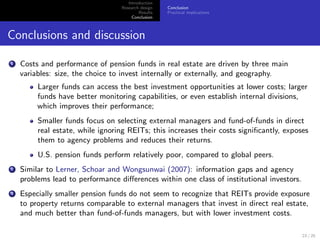
  • 22.
    Introduction Allocation to real estate Research design Investment costs Results Performance Conclusion Persistence in pension fund real estate performance Methodology: five quintiles based on their net benchmark-adjusted returns; transition matrixes and difference in returns (see Carpenter and Lynch (1999) and Tonks (2005)); We also address the persistence in pension fund performance in direct real estate by using a two-year horizon, when the appraisal smoothing effect has lapsed. Funds are more likely to end up in a better performing quintile next year if they also outperform this year. Certain pension funds are persistently more likely to outperform their direct real estate benchmarks, while that is not the case for REIT investors. Direct real estate markets are illiquid and not very transparent, which may give insiders an edge. The higher transparency makes the REIT market more efficient and outperformance more difficult. 22 / 25
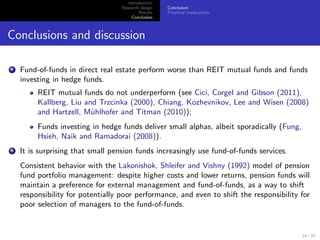
  • 23.
    Introduction Research design Conclusion Results Practical implications Conclusion Conclusions and discussion 1 Costs and performance of pension funds in real estate are driven by three main variables: size, the choice to invest internally or externally, and geography. Larger funds can access the best investment opportunities at lower costs; larger funds have better monitoring capabilities, or even establish internal divisions, which improves their performance; Smaller funds focus on selecting external managers and fund-of-funds in direct real estate, while ignoring REITs; this increases their costs significantly, exposes them to agency problems and reduces their returns. U.S. pension funds perform relatively poor, compared to global peers. 2 Similar to Lerner, Schoar and Wongsunwai (2007): information gaps and agency problems lead to performance differences within one class of institutional investors. 3 Especially smaller pension funds do not seem to recognize that REITs provide exposure to property returns comparable to external managers that invest in direct real estate, and much better than fund-of-funds managers, but with lower investment costs. 23 / 25
  • 24.
    Introduction Research design Conclusion Results Practical implications Conclusion Conclusions and discussion 4 Fund-of-funds in direct real estate perform worse than REIT mutual funds and funds investing in hedge funds. REIT mutual funds do not underperform (see Cici, Corgel and Gibson (2011), Kallberg, Liu and Trzcinka (2000), Chiang, Kozhevnikov, Lee and Wisen (2008) and Hartzell, M¨hlhofer and Titman (2010)); u Funds investing in hedge funds deliver small alphas, albeit sporadically (Fung, Hsieh, Naik and Ramadorai (2008)). 5 It is surprising that small pension funds increasingly use fund-of-funds services. Consistent behavior with the Lakonishok, Shleifer and Vishny (1992) model of pension fund portfolio management: despite higher costs and lower returns, pension funds will maintain a preference for external management and fund-of-funds, as a way to shift responsibility for potentially poor performance, and even to shift the responsibility for poor selection of managers to the fund-of-funds. 24 / 25
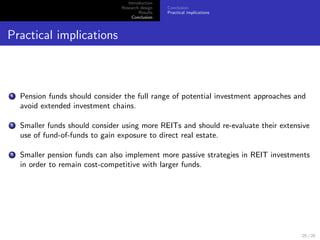
  • 25.
    Introduction Research design Conclusion Results Practical implications Conclusion Practical implications 1 Pension funds should consider the full range of potential investment approaches and avoid extended investment chains. 2 Smaller funds should consider using more REITs and should re-evaluate their extensive use of fund-of-funds to gain exposure to direct real estate. 3 Smaller pension funds can also implement more passive strategies in REIT investments in order to remain cost-competitive with larger funds. 25 / 25