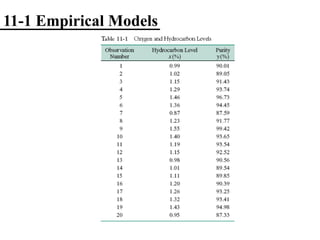
11-1 Empirical Models
• Many problems in engineering and science involve
exploring the relationships between two or more variables.
• Regression analysis is a statistical technique that is
very useful for these types of problems.
• For example, in a chemical process, suppose that the
yield of the product is related to the process-operating
temperature.
• Regression analysis can be used to build a model to
predict yield at a given temperature level.
11-1 Empirical Models
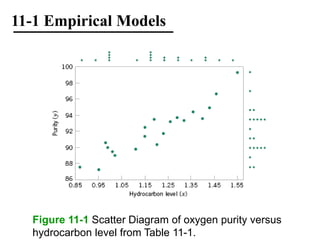
Figure 11-1 Scatter Diagram of oxygen purity versus
hydrocarbon level from Table 11-1.
11-1 Empirical Models
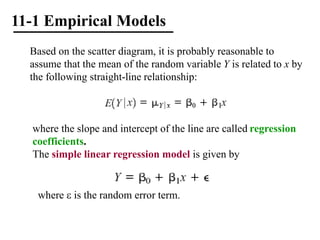
Based on the scatter diagram, it is probably reasonable to
assume that the mean of the random variable Y is related to x by
the following straight-line relationship:
where the slope and intercept of the line are called regression
coefficients.
The simple linear regression model is given by
where  is the random error term.
11-1 Empirical Models
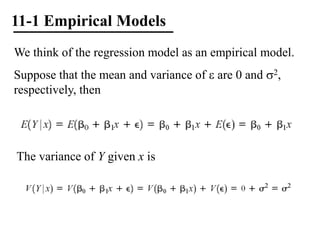
We think of the regression model as an empirical model.
Suppose that the mean and variance of  are 0 and 2,
respectively, then
The variance of Y given x is
11-1 Empirical Models
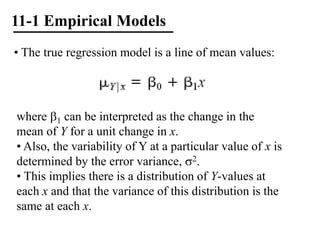
• The true regression model is a line of mean values:
where 1 can be interpreted as the change in the
mean of Y for a unit change in x.
• Also, the variability of Y at a particular value of x is
determined by the error variance, 2.
• This implies there is a distribution of Y-values at
each x and that the variance of this distribution is the
same at each x.
11-1 Empirical Models
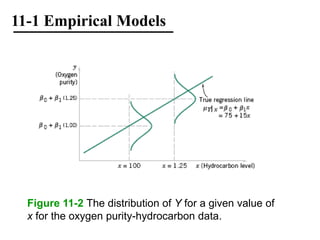
Figure 11-2 The distribution of Y for a given value of
x for the oxygen purity-hydrocarbon data.
11-2 Simple Linear Regression
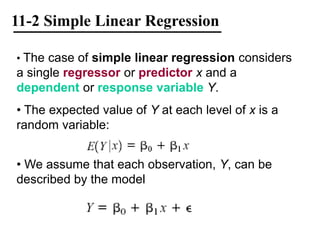
• The case of simple linear regression considers
a single regressor or predictor x and a
dependent or response variable Y.
• The expected value of Y at each level of x is a
random variable:
• We assume that each observation, Y, can be
described by the model
11-2 Simple Linear Regression
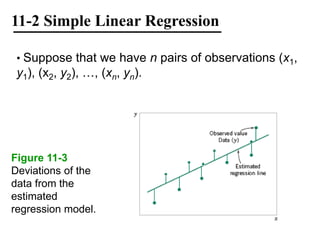
• Suppose that we have n pairs of observations (x1,
y1), (x2, y2), …, (xn, yn).
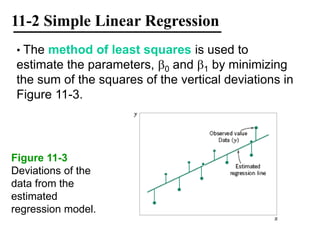
Figure 11-3
Deviations of the
data from the
estimated
regression model.
11-2 Simple Linear Regression
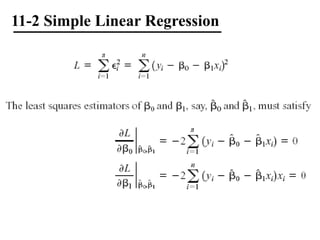
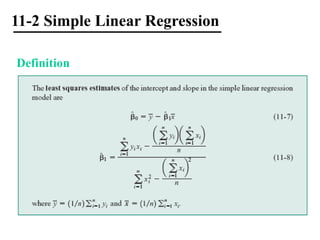
• The method of least squares is used to
estimate the parameters, 0 and 1 by minimizing
the sum of the squares of the vertical deviations in
Figure 11-3.
Figure 11-3
Deviations of the
data from the
estimated
regression model.
11-2 Simple Linear Regression
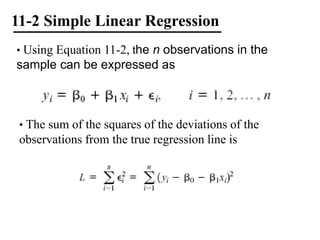
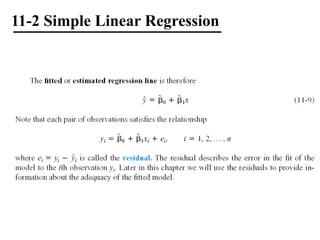
• Using Equation 11-2, the n observations in the
sample can be expressed as
• The sum of the squares of the deviations of the
observations from the true regression line is
11-2 Simple Linear Regression
Definition
11-2 Simple Linear Regression
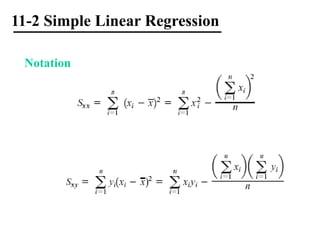
Notation
11-2 Simple Linear Regression
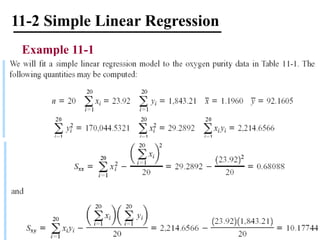
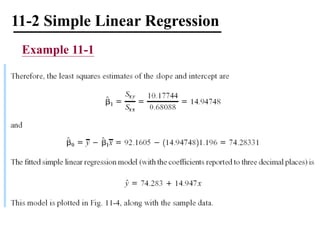
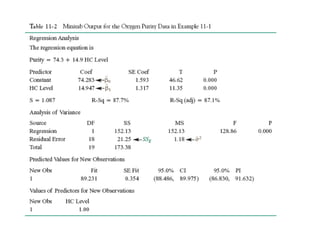
Example 11-1
11-2 Simple Linear Regression
Example 11-1
11-2 Simple Linear Regression
Example 11-1
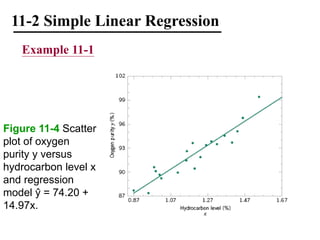
Figure 11-4 Scatter
plot of oxygen
purity y versus
hydrocarbon level x
and regression
model ŷ = 74.20 +
14.97x.
11-2 Simple Linear Regression
Example 11-1
11-2 Simple Linear Regression
Estimating 2
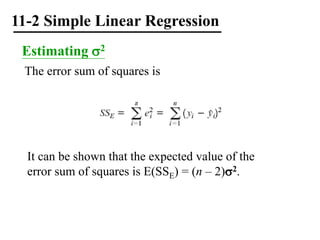
The error sum of squares is
It can be shown that the expected value of the
error sum of squares is E(SSE) = (n – 2)2.
11-2 Simple Linear Regression
Estimating 2
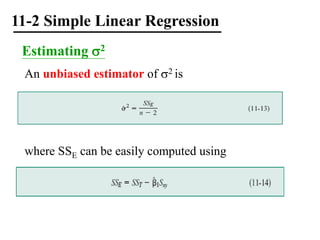
An unbiased estimator of 2 is
where SSE can be easily computed using
11-3 Properties of the Least Squares
Estimators
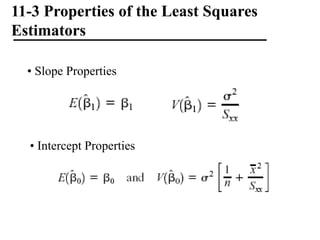
• Slope Properties
• Intercept Properties
11-4 Hypothesis Tests in Simple Linear
Regression
11-4.1 Use of t-Tests
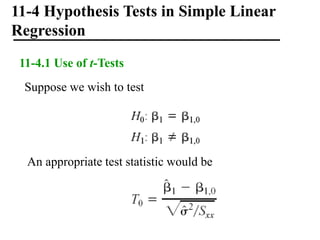
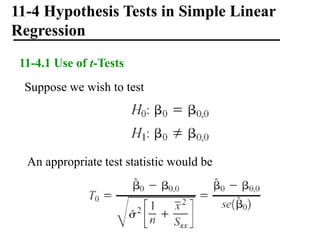
Suppose we wish to test
An appropriate test statistic would be
11-4 Hypothesis Tests in Simple Linear
Regression
11-4.1 Use of t-Tests
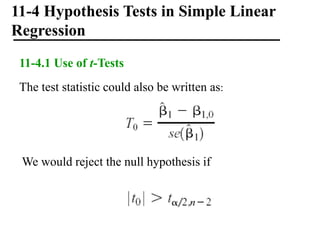
We would reject the null hypothesis if
The test statistic could also be written as:
11-4 Hypothesis Tests in Simple Linear
Regression
11-4.1 Use of t-Tests
Suppose we wish to test
An appropriate test statistic would be
11-4 Hypothesis Tests in Simple Linear
Regression
11-4.1 Use of t-Tests
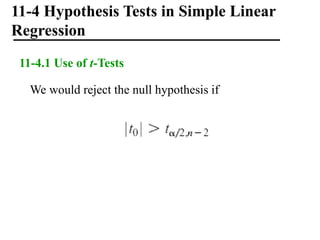
We would reject the null hypothesis if
11-4 Hypothesis Tests in Simple Linear
Regression
11-4.1 Use of t-Tests
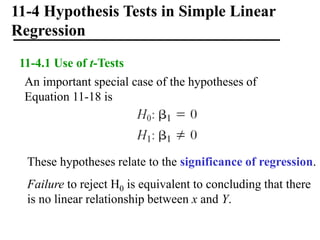
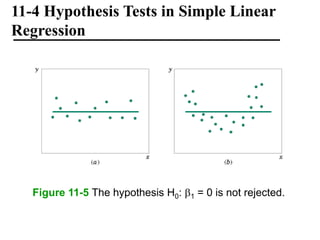
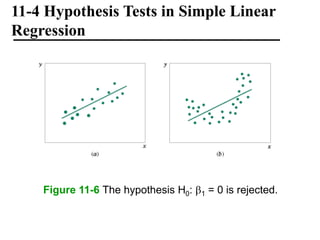
An important special case of the hypotheses of
Equation 11-18 is
These hypotheses relate to the significance of regression.
Failure to reject H0 is equivalent to concluding that there
is no linear relationship between x and Y.
11-4 Hypothesis Tests in Simple Linear
Regression
Figure 11-5 The hypothesis H0: 1 = 0 is not rejected.
11-4 Hypothesis Tests in Simple Linear
Regression
Figure 11-6 The hypothesis H0: 1 = 0 is rejected.
11-4 Hypothesis Tests in Simple Linear
Regression
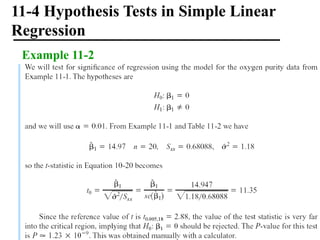
Example 11-2
11-4 Hypothesis Tests in Simple Linear
Regression
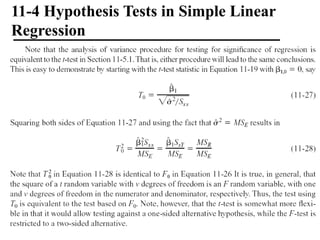
11-4.2 Analysis of Variance Approach to Test
Significance of Regression
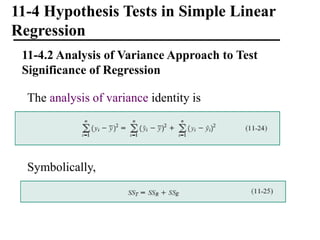
The analysis of variance identity is
Symbolically,
11-4 Hypothesis Tests in Simple Linear
Regression
11-4.2 Analysis of Variance Approach to Test
Significance of Regression
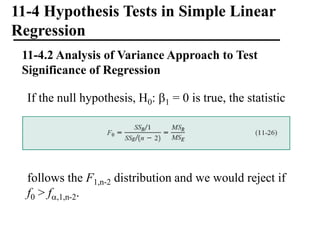
If the null hypothesis, H0: 1 = 0 is true, the statistic
follows the F1,n-2 distribution and we would reject if
f0 > f,1,n-2.
11-4 Hypothesis Tests in Simple Linear
Regression
11-4.2 Analysis of Variance Approach to Test
Significance of Regression
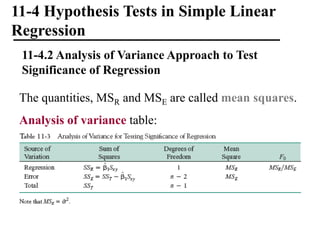
The quantities, MSR and MSE are called mean squares.
Analysis of variance table:
11-4 Hypothesis Tests in Simple Linear
Regression
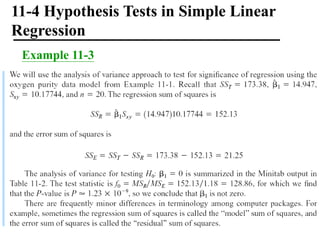
Example 11-3
11-4 Hypothesis Tests in Simple Linear
Regression
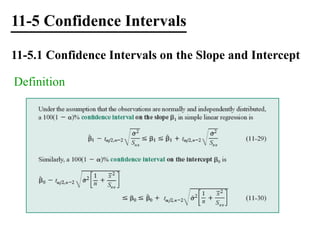
11-5 Confidence Intervals
11-5.1 Confidence Intervals on the Slope and Intercept
Definition
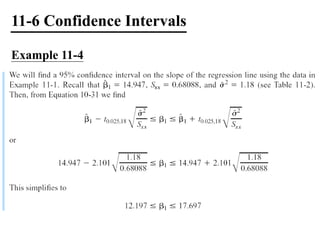
11-6 Confidence Intervals
Example 11-4
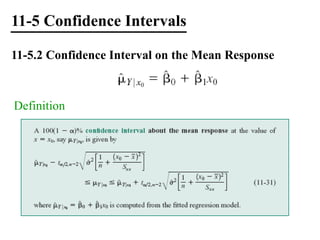
11-5 Confidence Intervals
11-5.2 Confidence Interval on the Mean Response
Definition
11-5 Confidence Intervals
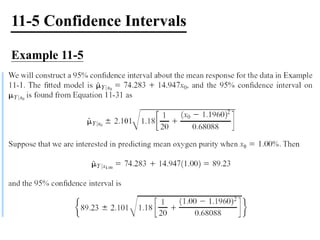
Example 11-5
11-5 Confidence Intervals
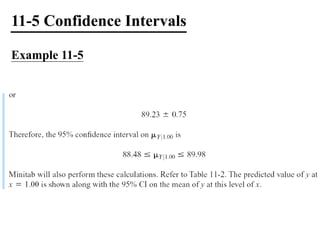
Example 11-5
11-5 Confidence Intervals
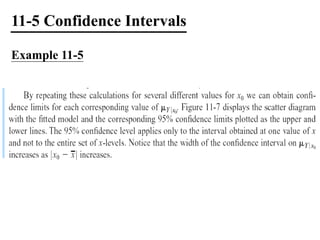
Example 11-5
11-5 Confidence Intervals
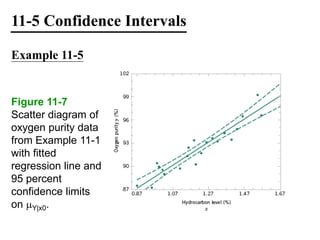
Example 11-5
Figure 11-7
Scatter diagram of
oxygen purity data
from Example 11-1
with fitted
regression line and
95 percent
confidence limits
on Y|x0.
11-6 Prediction of New Observations
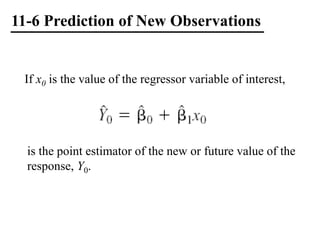
If x0 is the value of the regressor variable of interest,
is the point estimator of the new or future value of the
response, Y0.
11-6 Prediction of New Observations
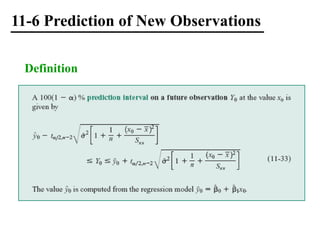
Definition
11-6 Prediction of New Observations
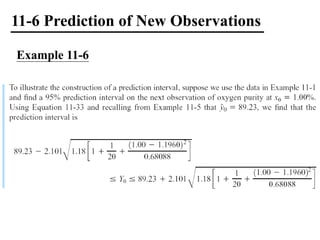
Example 11-6
11-6 Prediction of New Observations
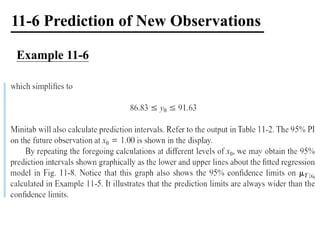
Example 11-6
11-6 Prediction of New Observations
Example 11-6
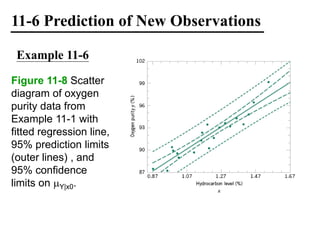
Figure 11-8 Scatter
diagram of oxygen
purity data from
Example 11-1 with
fitted regression line,
95% prediction limits
(outer lines) , and
95% confidence
limits on Y|x0.
11-7 Adequacy of the Regression Model
• Fitting a regression model requires several
assumptions.
1. Errors are uncorrelated random variables with
mean zero;
2. Errors have constant variance; and,
3. Errors be normally distributed.
• The analyst should always consider the validity of
these assumptions to be doubtful and conduct
analyses to examine the adequacy of the model
11-7 Adequacy of the Regression Model
11-7.1 Residual Analysis
• The residuals from a regression model are ei = yi - ŷi , where yi
is an actual observation and ŷi is the corresponding fitted value
from the regression model.
• Analysis of the residuals is frequently helpful in checking the
assumption that the errors are approximately normally distributed
with constant variance, and in determining whether additional
terms in the model would be useful.
11-7 Adequacy of the Regression Model
11-7.1 Residual Analysis
Figure 11-9 Patterns
for residual plots. (a)
satisfactory, (b)
funnel, (c) double
bow, (d) nonlinear.
[Adapted from
Montgomery, Peck,
and Vining (2001).]
11-7 Adequacy of the Regression Model
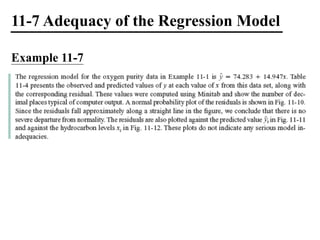
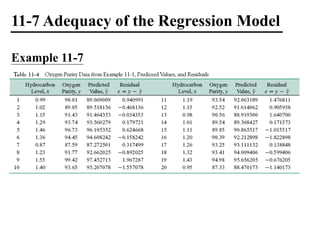
Example 11-7
11-7 Adequacy of the Regression Model
Example 11-7
11-7 Adequacy of the Regression Model
Example 11-7
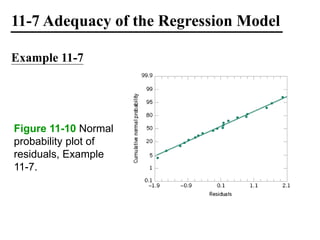
Figure 11-10 Normal
probability plot of
residuals, Example
11-7.
11-7 Adequacy of the Regression Model
Example 11-7
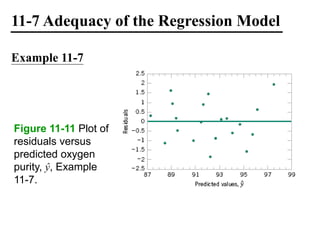
Figure 11-11 Plot of
residuals versus
predicted oxygen
purity, ŷ, Example
11-7.
11-7 Adequacy of the Regression Model
11-7.2 Coefficient of Determination (R2)
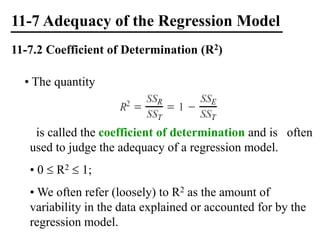
• The quantity
is called the coefficient of determination and is often
used to judge the adequacy of a regression model.
• 0  R2  1;
• We often refer (loosely) to R2 as the amount of
variability in the data explained or accounted for by the
regression model.
11-7 Adequacy of the Regression Model
11-7.2 Coefficient of Determination (R2)
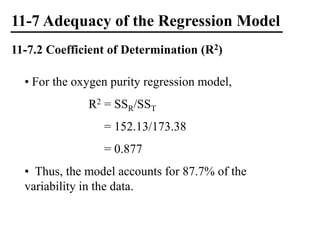
• For the oxygen purity regression model,
R2 = SSR/SST
= 152.13/173.38
= 0.877
• Thus, the model accounts for 87.7% of the
variability in the data.
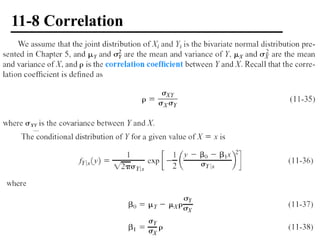
11-8 Correlation
11-8 Correlation
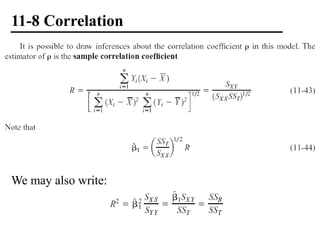
We may also write:
11-8 Correlation
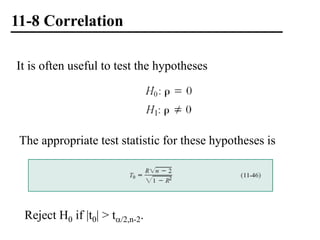
It is often useful to test the hypotheses
The appropriate test statistic for these hypotheses is
Reject H0 if |t0| > t/2,n-2.
11-8 Correlation
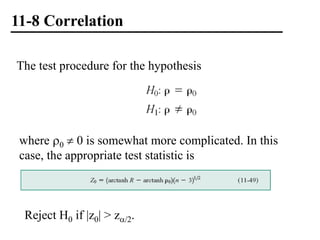
The test procedure for the hypothesis
where 0  0 is somewhat more complicated. In this
case, the appropriate test statistic is
Reject H0 if |z0| > z/2.
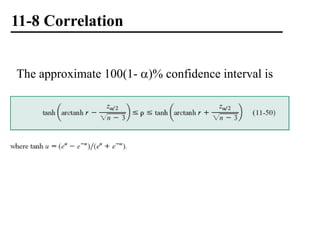
11-8 Correlation
The approximate 100(1- )% confidence interval is
11-8 Correlation
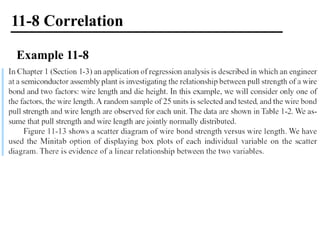
Example 11-8
11-8 Correlation
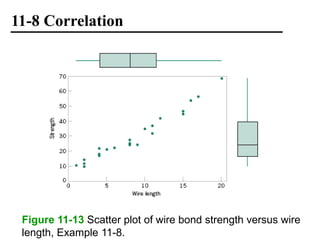
Figure 11-13 Scatter plot of wire bond strength versus wire
length, Example 11-8.
11-8 Correlation
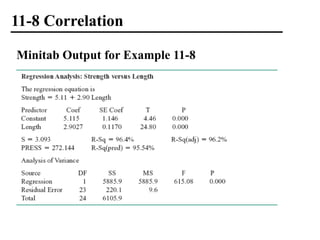
Minitab Output for Example 11-8
11-8 Correlation
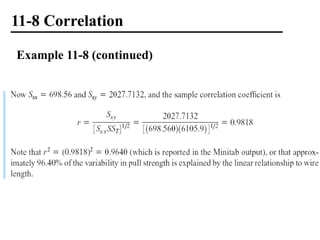
Example 11-8 (continued)
11-8 Correlation
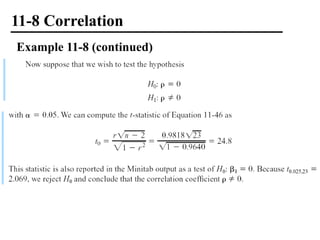
Example 11-8 (continued)
11-8 Correlation
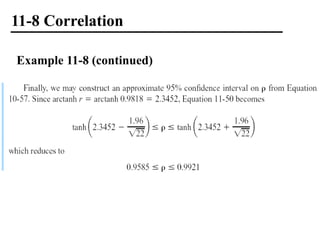
Example 11-8 (continued)
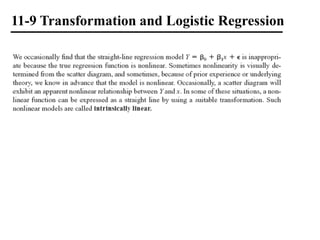
11-9 Transformation and Logistic Regression
11-9 Transformation and Logistic
Regression
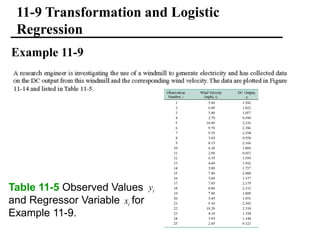
Example 11-9
Table 11-5 Observed Values
and Regressor Variable for
Example 11-9.
i
y
i
x
11-9 Transformation and Logistic
Regression
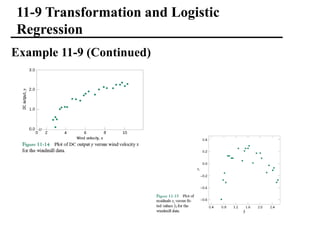
Example 11-9 (Continued)
11-9 Transformation and Logistic
Regression
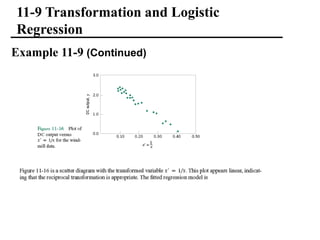
Example 11-9 (Continued)
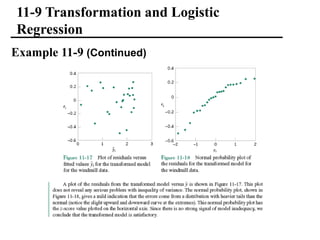
11-9 Transformation and Logistic
Regression
Example 11-9 (Continued)
Advanced_Statistical_Methods_Correlation.ppt

Advanced_Statistical_Methods_Correlation.ppt

  • 4.
    11-1 Empirical Models •Many problems in engineering and science involve exploring the relationships between two or more variables. • Regression analysis is a statistical technique that is very useful for these types of problems. • For example, in a chemical process, suppose that the yield of the product is related to the process-operating temperature. • Regression analysis can be used to build a model to predict yield at a given temperature level.
  • 5.
  • 6.
    11-1 Empirical Models Figure11-1 Scatter Diagram of oxygen purity versus hydrocarbon level from Table 11-1.
  • 7.
    11-1 Empirical Models Basedon the scatter diagram, it is probably reasonable to assume that the mean of the random variable Y is related to x by the following straight-line relationship: where the slope and intercept of the line are called regression coefficients. The simple linear regression model is given by where  is the random error term.
  • 8.
    11-1 Empirical Models Wethink of the regression model as an empirical model. Suppose that the mean and variance of  are 0 and 2, respectively, then The variance of Y given x is
  • 9.
    11-1 Empirical Models •The true regression model is a line of mean values: where 1 can be interpreted as the change in the mean of Y for a unit change in x. • Also, the variability of Y at a particular value of x is determined by the error variance, 2. • This implies there is a distribution of Y-values at each x and that the variance of this distribution is the same at each x.
  • 10.
    11-1 Empirical Models Figure11-2 The distribution of Y for a given value of x for the oxygen purity-hydrocarbon data.
  • 11.
    11-2 Simple LinearRegression • The case of simple linear regression considers a single regressor or predictor x and a dependent or response variable Y. • The expected value of Y at each level of x is a random variable: • We assume that each observation, Y, can be described by the model
  • 12.
    11-2 Simple LinearRegression • Suppose that we have n pairs of observations (x1, y1), (x2, y2), …, (xn, yn). Figure 11-3 Deviations of the data from the estimated regression model.
  • 13.
    11-2 Simple LinearRegression • The method of least squares is used to estimate the parameters, 0 and 1 by minimizing the sum of the squares of the vertical deviations in Figure 11-3. Figure 11-3 Deviations of the data from the estimated regression model.
  • 14.
    11-2 Simple LinearRegression • Using Equation 11-2, the n observations in the sample can be expressed as • The sum of the squares of the deviations of the observations from the true regression line is
  • 15.
  • 16.
  • 17.
    11-2 Simple LinearRegression Definition
  • 18.
  • 19.
    11-2 Simple LinearRegression Notation
  • 20.
    11-2 Simple LinearRegression Example 11-1
  • 21.
    11-2 Simple LinearRegression Example 11-1
  • 22.
    11-2 Simple LinearRegression Example 11-1 Figure 11-4 Scatter plot of oxygen purity y versus hydrocarbon level x and regression model ŷ = 74.20 + 14.97x.
  • 23.
    11-2 Simple LinearRegression Example 11-1
  • 25.
    11-2 Simple LinearRegression Estimating 2 The error sum of squares is It can be shown that the expected value of the error sum of squares is E(SSE) = (n – 2)2.
  • 26.
    11-2 Simple LinearRegression Estimating 2 An unbiased estimator of 2 is where SSE can be easily computed using
  • 27.
    11-3 Properties ofthe Least Squares Estimators • Slope Properties • Intercept Properties
  • 28.
    11-4 Hypothesis Testsin Simple Linear Regression 11-4.1 Use of t-Tests Suppose we wish to test An appropriate test statistic would be
  • 29.
    11-4 Hypothesis Testsin Simple Linear Regression 11-4.1 Use of t-Tests We would reject the null hypothesis if The test statistic could also be written as:
  • 30.
    11-4 Hypothesis Testsin Simple Linear Regression 11-4.1 Use of t-Tests Suppose we wish to test An appropriate test statistic would be
  • 31.
    11-4 Hypothesis Testsin Simple Linear Regression 11-4.1 Use of t-Tests We would reject the null hypothesis if
  • 32.
    11-4 Hypothesis Testsin Simple Linear Regression 11-4.1 Use of t-Tests An important special case of the hypotheses of Equation 11-18 is These hypotheses relate to the significance of regression. Failure to reject H0 is equivalent to concluding that there is no linear relationship between x and Y.
  • 33.
    11-4 Hypothesis Testsin Simple Linear Regression Figure 11-5 The hypothesis H0: 1 = 0 is not rejected.
  • 34.
    11-4 Hypothesis Testsin Simple Linear Regression Figure 11-6 The hypothesis H0: 1 = 0 is rejected.
  • 35.
    11-4 Hypothesis Testsin Simple Linear Regression Example 11-2
  • 36.
    11-4 Hypothesis Testsin Simple Linear Regression 11-4.2 Analysis of Variance Approach to Test Significance of Regression The analysis of variance identity is Symbolically,
  • 37.
    11-4 Hypothesis Testsin Simple Linear Regression 11-4.2 Analysis of Variance Approach to Test Significance of Regression If the null hypothesis, H0: 1 = 0 is true, the statistic follows the F1,n-2 distribution and we would reject if f0 > f,1,n-2.
  • 38.
    11-4 Hypothesis Testsin Simple Linear Regression 11-4.2 Analysis of Variance Approach to Test Significance of Regression The quantities, MSR and MSE are called mean squares. Analysis of variance table:
  • 39.
    11-4 Hypothesis Testsin Simple Linear Regression Example 11-3
  • 40.
    11-4 Hypothesis Testsin Simple Linear Regression
  • 41.
    11-5 Confidence Intervals 11-5.1Confidence Intervals on the Slope and Intercept Definition
  • 42.
  • 43.
    11-5 Confidence Intervals 11-5.2Confidence Interval on the Mean Response Definition
  • 44.
  • 45.
  • 46.
  • 47.
    11-5 Confidence Intervals Example11-5 Figure 11-7 Scatter diagram of oxygen purity data from Example 11-1 with fitted regression line and 95 percent confidence limits on Y|x0.
  • 48.
    11-6 Prediction ofNew Observations If x0 is the value of the regressor variable of interest, is the point estimator of the new or future value of the response, Y0.
  • 49.
    11-6 Prediction ofNew Observations Definition
  • 50.
    11-6 Prediction ofNew Observations Example 11-6
  • 51.
    11-6 Prediction ofNew Observations Example 11-6
  • 52.
    11-6 Prediction ofNew Observations Example 11-6 Figure 11-8 Scatter diagram of oxygen purity data from Example 11-1 with fitted regression line, 95% prediction limits (outer lines) , and 95% confidence limits on Y|x0.
  • 53.
    11-7 Adequacy ofthe Regression Model • Fitting a regression model requires several assumptions. 1. Errors are uncorrelated random variables with mean zero; 2. Errors have constant variance; and, 3. Errors be normally distributed. • The analyst should always consider the validity of these assumptions to be doubtful and conduct analyses to examine the adequacy of the model
  • 54.
    11-7 Adequacy ofthe Regression Model 11-7.1 Residual Analysis • The residuals from a regression model are ei = yi - ŷi , where yi is an actual observation and ŷi is the corresponding fitted value from the regression model. • Analysis of the residuals is frequently helpful in checking the assumption that the errors are approximately normally distributed with constant variance, and in determining whether additional terms in the model would be useful.
  • 55.
    11-7 Adequacy ofthe Regression Model 11-7.1 Residual Analysis Figure 11-9 Patterns for residual plots. (a) satisfactory, (b) funnel, (c) double bow, (d) nonlinear. [Adapted from Montgomery, Peck, and Vining (2001).]
  • 56.
    11-7 Adequacy ofthe Regression Model Example 11-7
  • 57.
    11-7 Adequacy ofthe Regression Model Example 11-7
  • 58.
    11-7 Adequacy ofthe Regression Model Example 11-7 Figure 11-10 Normal probability plot of residuals, Example 11-7.
  • 59.
    11-7 Adequacy ofthe Regression Model Example 11-7 Figure 11-11 Plot of residuals versus predicted oxygen purity, ŷ, Example 11-7.
  • 60.
    11-7 Adequacy ofthe Regression Model 11-7.2 Coefficient of Determination (R2) • The quantity is called the coefficient of determination and is often used to judge the adequacy of a regression model. • 0  R2  1; • We often refer (loosely) to R2 as the amount of variability in the data explained or accounted for by the regression model.
  • 61.
    11-7 Adequacy ofthe Regression Model 11-7.2 Coefficient of Determination (R2) • For the oxygen purity regression model, R2 = SSR/SST = 152.13/173.38 = 0.877 • Thus, the model accounts for 87.7% of the variability in the data.
  • 62.
  • 63.
  • 64.
    11-8 Correlation It isoften useful to test the hypotheses The appropriate test statistic for these hypotheses is Reject H0 if |t0| > t/2,n-2.
  • 65.
    11-8 Correlation The testprocedure for the hypothesis where 0  0 is somewhat more complicated. In this case, the appropriate test statistic is Reject H0 if |z0| > z/2.
  • 66.
    11-8 Correlation The approximate100(1- )% confidence interval is
  • 67.
  • 68.
    11-8 Correlation Figure 11-13Scatter plot of wire bond strength versus wire length, Example 11-8.
  • 69.
  • 70.
  • 71.
  • 72.
  • 73.
    11-9 Transformation andLogistic Regression
  • 74.
    11-9 Transformation andLogistic Regression Example 11-9 Table 11-5 Observed Values and Regressor Variable for Example 11-9. i y i x
  • 75.
    11-9 Transformation andLogistic Regression Example 11-9 (Continued)
  • 76.
    11-9 Transformation andLogistic Regression Example 11-9 (Continued)
  • 77.
    11-9 Transformation andLogistic Regression Example 11-9 (Continued)