Advanced Resuscitation Course Perth: Book advanced resuscitation HLTAID015 training in Perth with us. The course provides skills to use specialised equipment. Call us. https://westcoastfirstaid.au/course/hltaid015-provide-advanced-resuscitation/
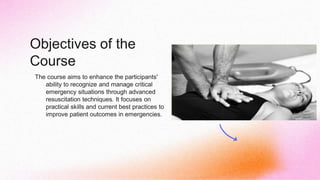
Objectives of the
Course
Thecourse aims to enhance the participants'
ability to recognize and manage critical
emergency situations through advanced
resuscitation techniques. It focuses on
practical skills and current best practices to
improve patient outcomes in emergencies.
5.
Target
Audience
This course isdesigned for healthcare providers, including
paramedics, nurses, and doctors, who are involved in emergency
care. Participants should have foundational knowledge in basic life
support and a desire to enhance their skills in advanced
resuscitation.
6.
Prerequisites for Enrollment
Participantsmust have completed a basic life support training course and possess a valid
certification. A foundational understanding of human anatomy, basic medical terminology,
and emergency procedures is also required to maximize the learning experience of
advanced resuscitation techniques.
Cardiac Arrest
Management
This modulefocuses on techniques to assess and manage cardiac
arrest, including the importance of early defibrillation, high-quality chest
compressions, and establishing a rhythm with effective communication
in a team. Participants will practice real-life scenarios to prepare for
critical emergencies.
9.
Airway
Management
Strategies
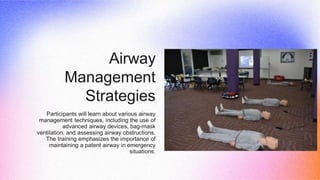
Participants will learnabout various airway
management techniques, including the use of
advanced airway devices, bag-mask
ventilation, and assessing airway obstructions.
The training emphasizes the importance of
maintaining a patent airway in emergency
situations.
10.
Drug Administration
Protocols
This sectioncovers the medications commonly used during resuscitation, including
dosages, routes of administration, and indications. Participants will learn how to quickly
assess a patient's condition and make informed decisions regarding drug administration
during emergencies.
11.
Conclusions
The Advanced ResuscitationCourse equips healthcare providers with
essential skills for managing critical emergencies. Through engaging
training in techniques such as cardiac arrest management, airway
strategies, and drug protocols, participants will be better prepared to
save lives.