Resource Person:
Urmila Kar,
Prof., E&M,
NITTTR, Kolkata
Date of Discussion:
11th December 2024
Morning Session
Advanced Pedagogy
1
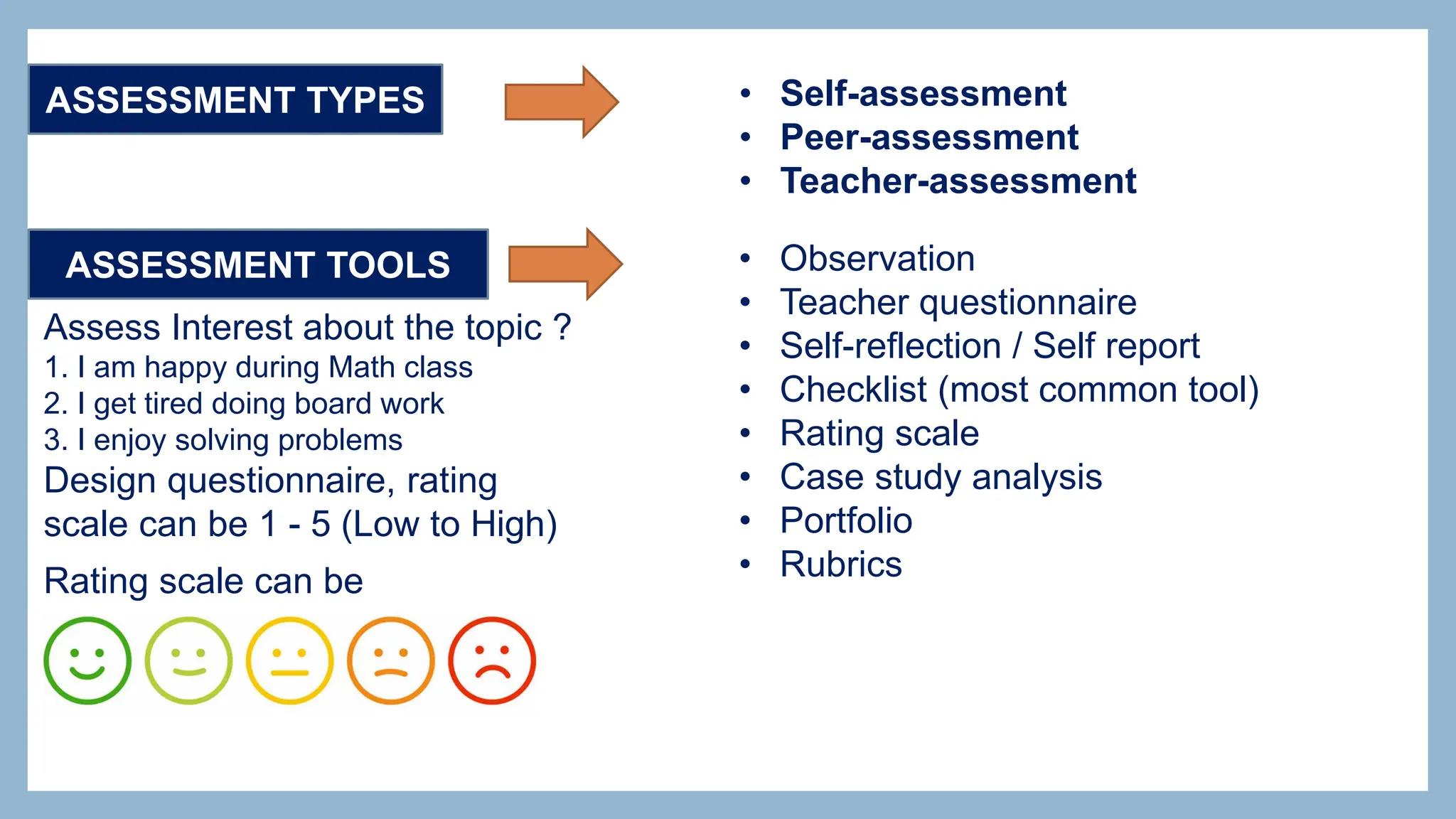
ASSESSMENT TYPES
ASSESSMENT TOOLS
• Self-assessment
• Peer-assessment
• Teacher-assessment
• Observation
• Teacher questionnaire
• Self-reflection / Self report
• Checklist (most common tool)
• Rating scale
• Case study analysis
• Portfolio
• Rubrics
Assess Interest about the topic ?
1. I am happy during Math class
2. I get tired doing board work
3. I enjoy solving problems
Design questionnaire, rating
scale can be 1 - 5 (Low to High)
Rating scale can be
3
HOLISTIC APPROACH OF EDUCATION
The separation of the
head from the heart
has contributed to a
fractured education
system that produces
minds that do not
know how to feel and
hearts that do not
know how to think.
~Parker Palmer
4
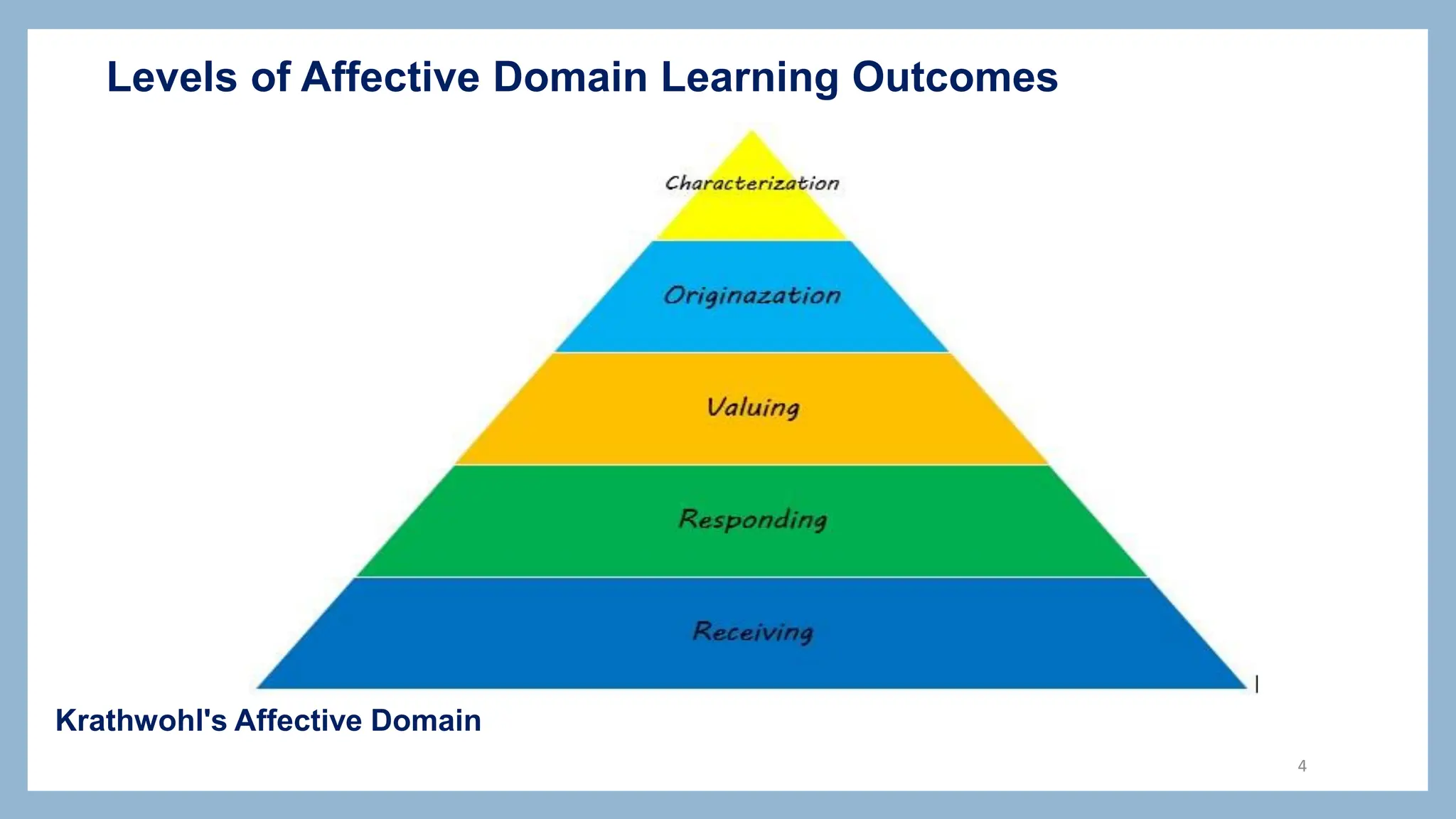
Levels of Affective Domain Learning Outcomes
Krathwohl's Affective Domain
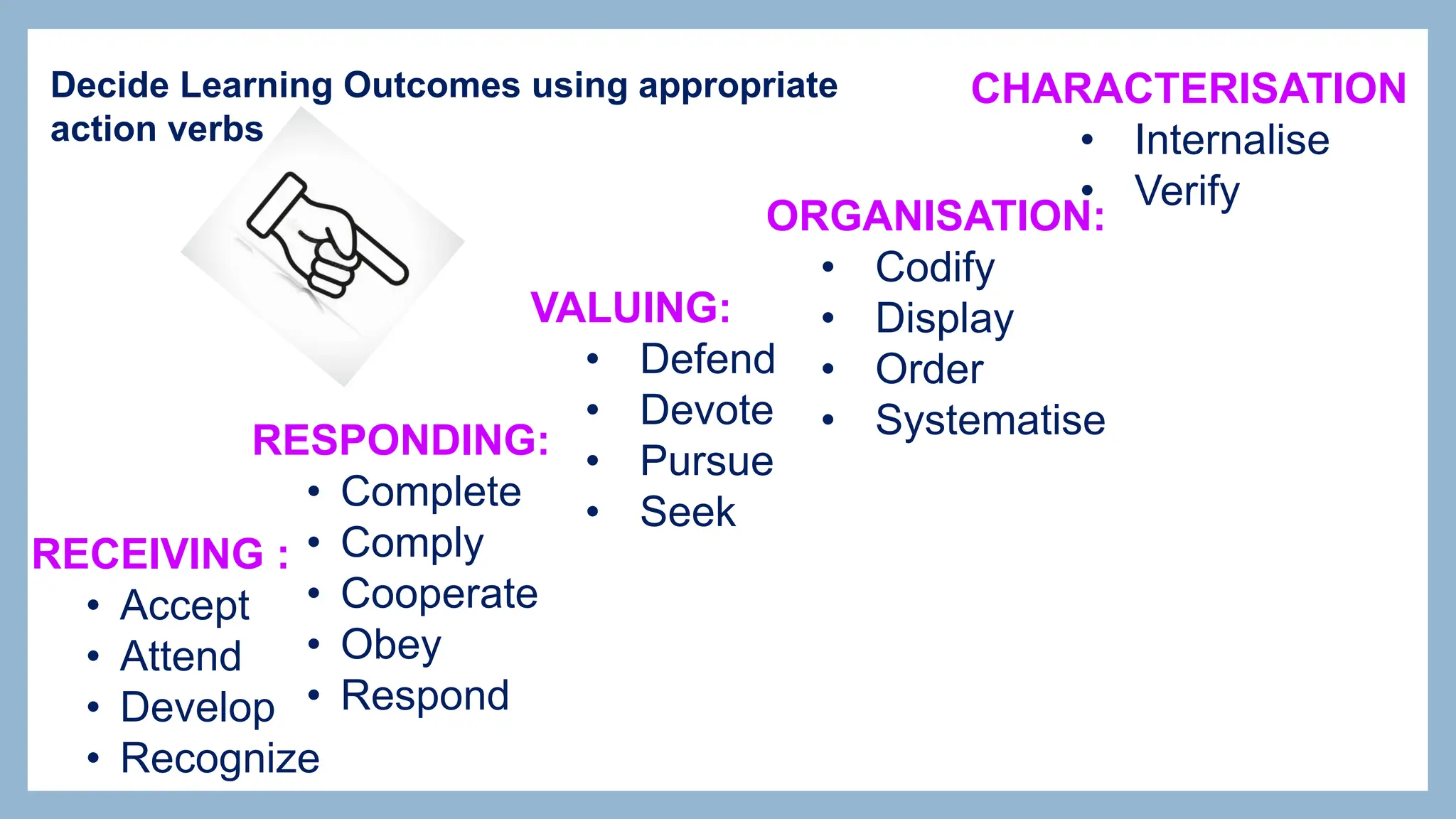
RECEIVING :
• Accept
• Attend
• Develop
• Recognize
RESPONDING:
• Complete
• Comply
• Cooperate
• Obey
• Respond
VALUING:
• Defend
• Devote
• Pursue
• Seek
ORGANISATION:
• Codify
• Display
• Order
• Systematise
CHARACTERISATION
• Internalise
• Verify
Decide Learning Outcomes using appropriate
action verbs
In technical/engineering education, what do
we want to assess in affective domain?
7
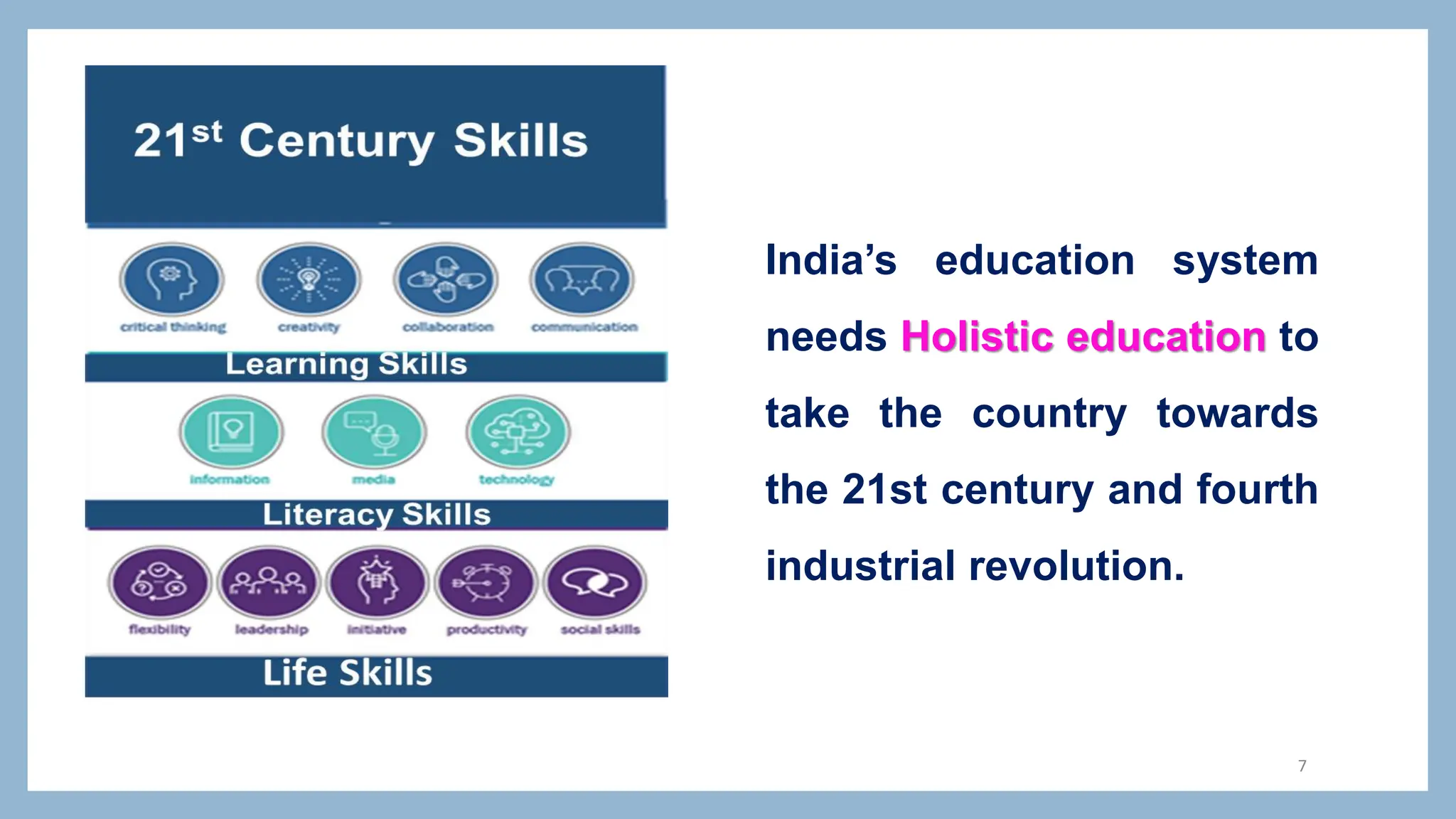
India’s education system
needs Holistic education to
take the country towards
the 21st century and fourth
industrial revolution.
8
It focuses on developing care for other and respect for the
environment.
Holistic Education
Holistic Education:
Through…. direct engagement with the environment
Holistic development essentially means the development of intellectual,
mental, physical, emotional, and social abilities so that he / she is
capable of facing the demands and challenges of everyday life.
Holistic education demands Affective Learning
Affective learning is demonstrated by behaviours indicating
attitudes of awareness, interest, attention, responsibility, ability to
listen and the way of interacting with others etc.
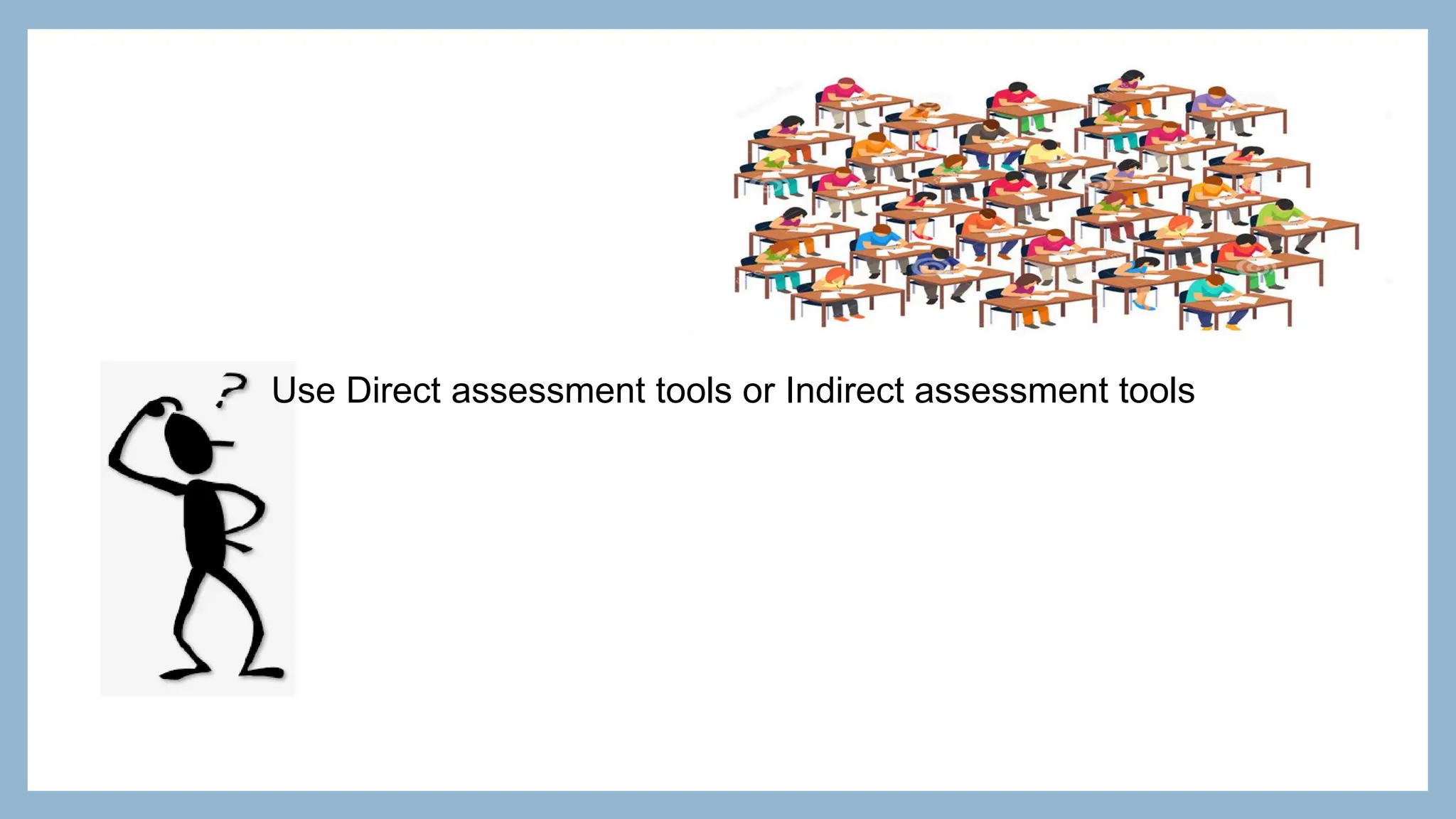
Use Direct assessment tools or Indirect assessment tools
Who creates the learning environment?
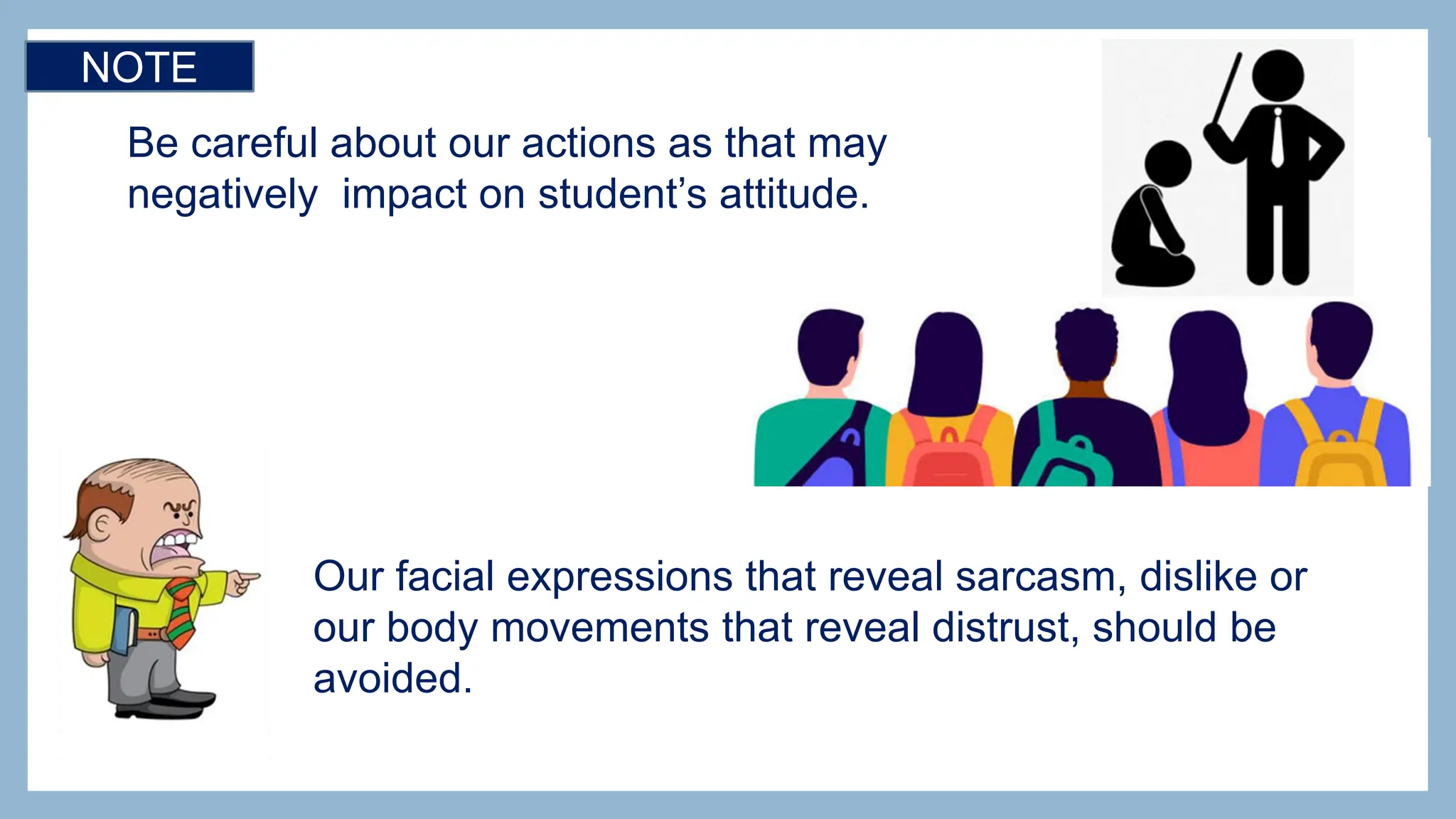
Our facial expressions that reveal sarcasm, dislike or
our body movements that reveal distrust, should be
avoided.
NOTE
Be careful about our actions as that may
negatively impact on student’s attitude.
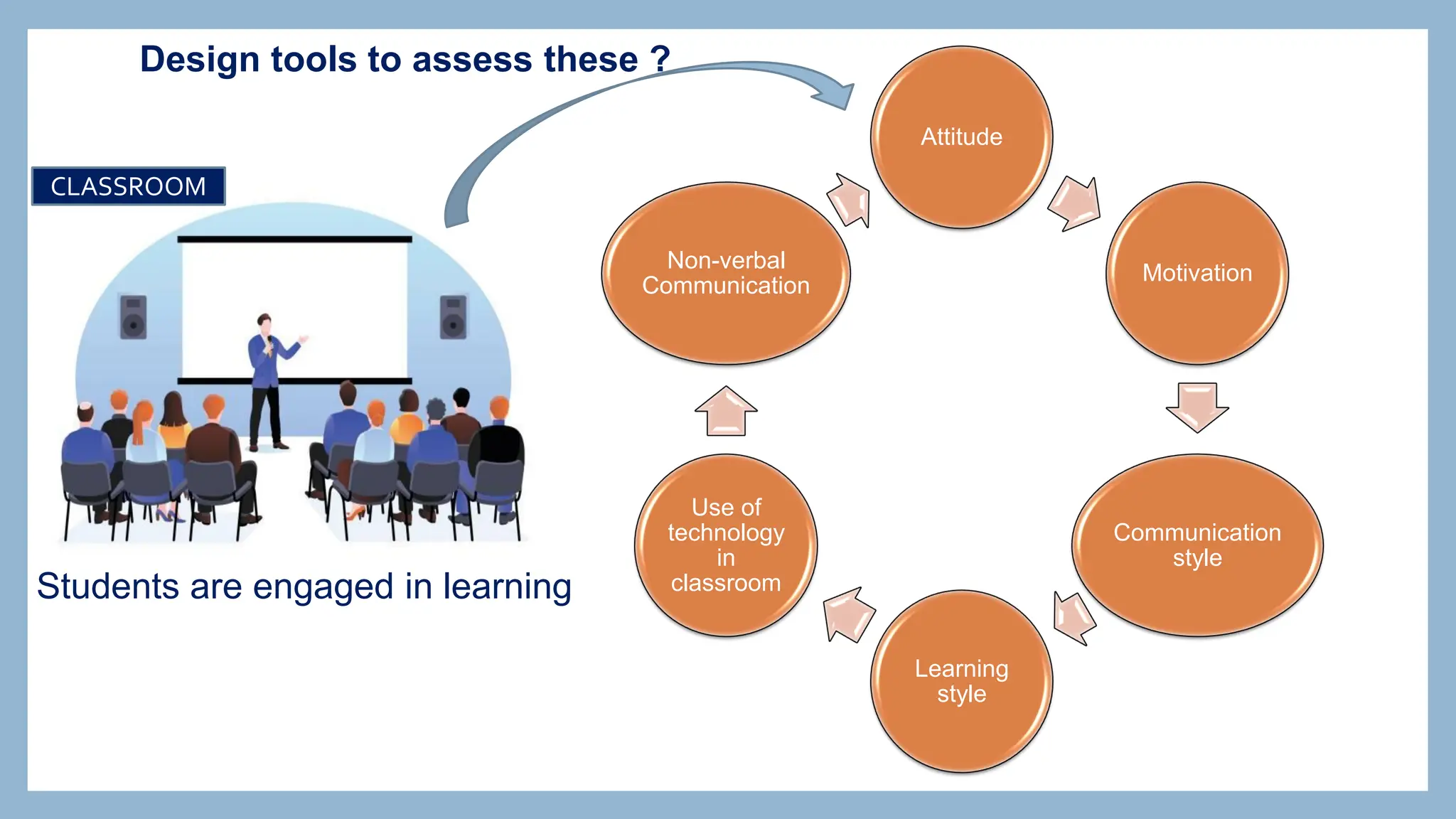
Attitude
Motivation
Communication
style
Learning
style
Use of
technology
in
classroom
Non-verbal
Communication
Students are engaged in learning
CLASSROOM
Design tools to assess these ?
Topic: Direct Assessment Tools (Psychomotor domain)
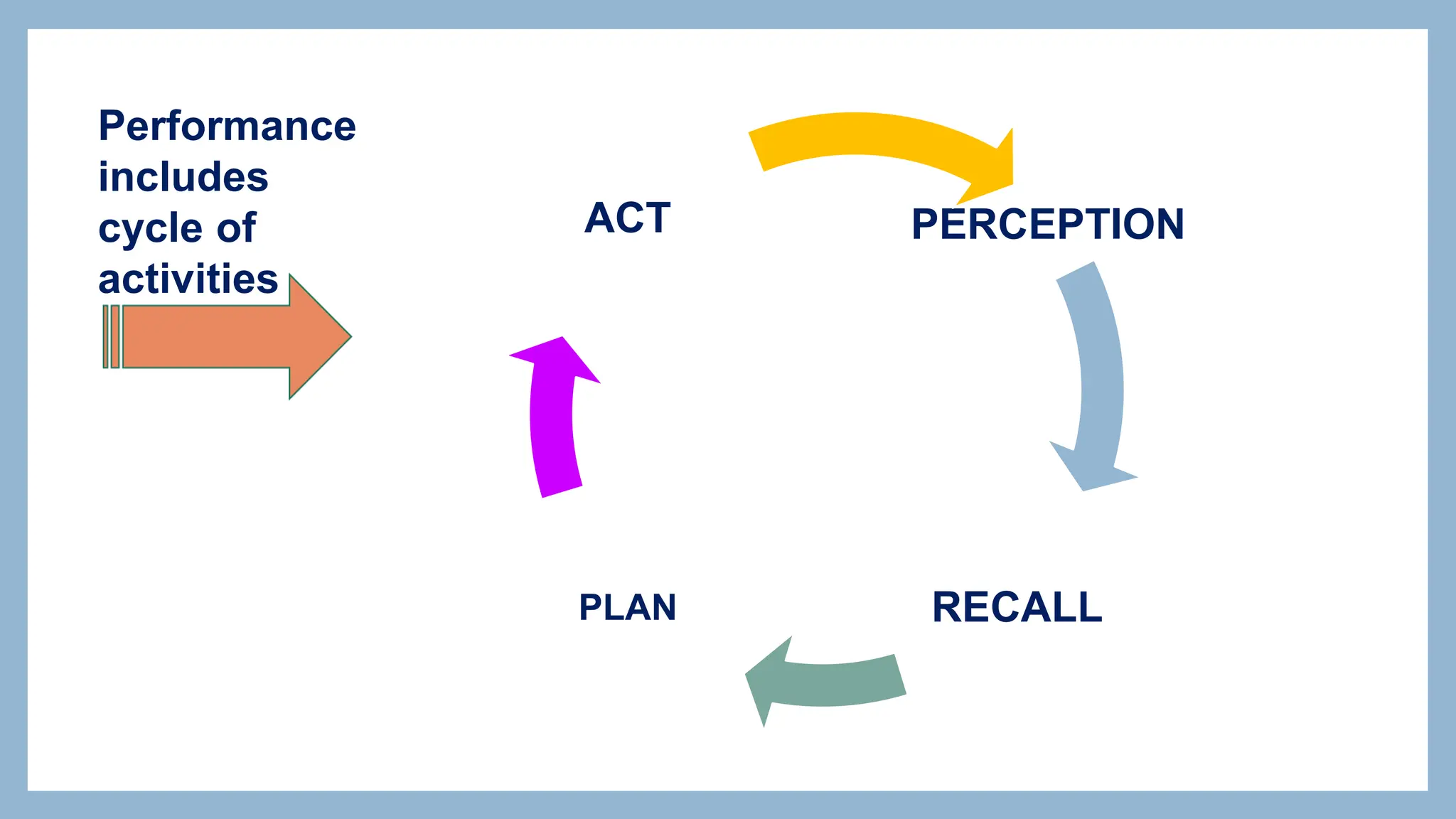
PERCEPTION
RECALL
PLAN
ACT
Performance
includes
cycle of
activities
When we prepare assessment format, it must
include the measurement of all the activities
related to the particular performance.
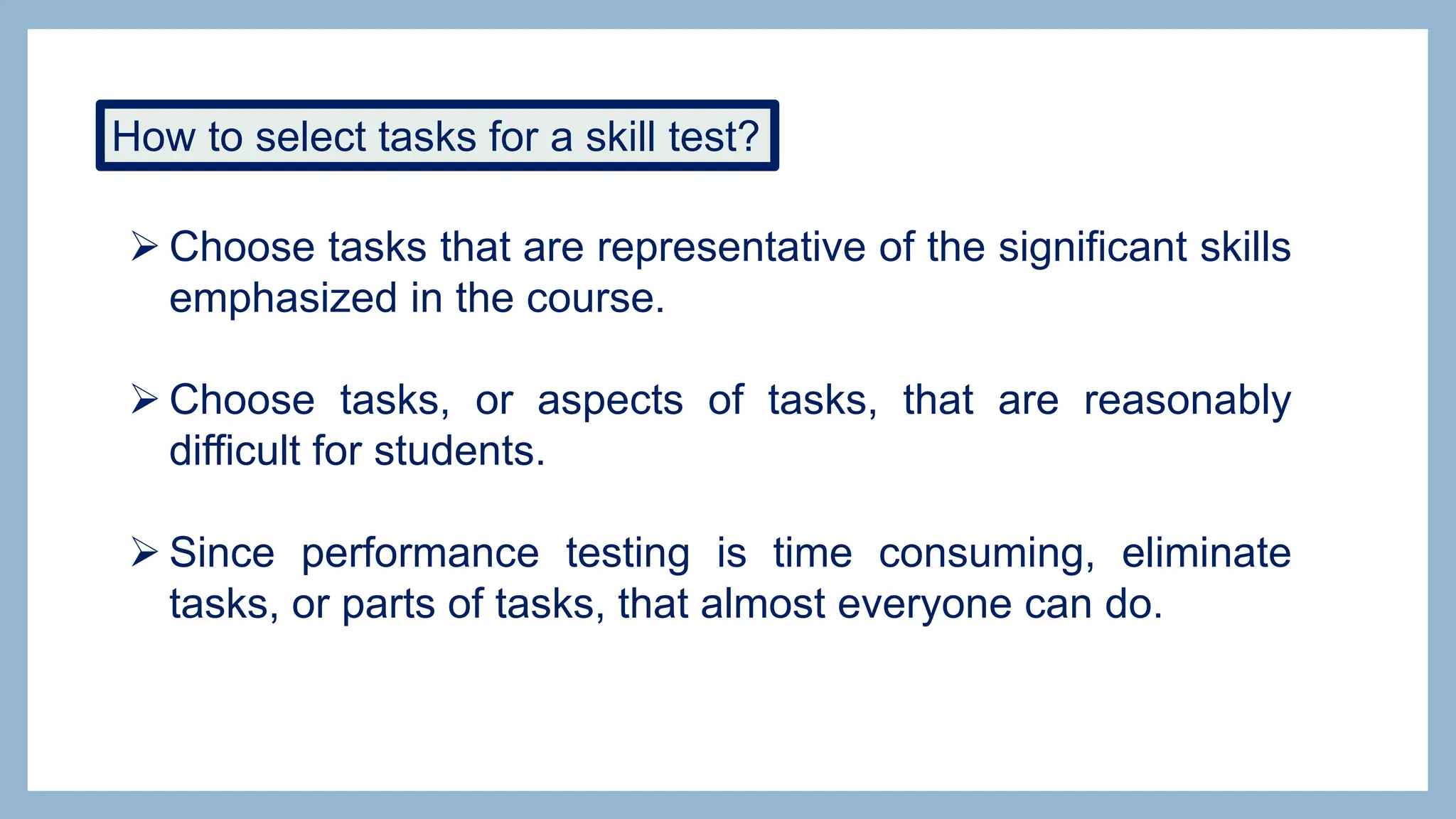
How to select tasks for a skill test?
 Choose tasks that are representative of the significant skills
emphasized in the course.
 Choose tasks, or aspects of tasks, that are reasonably
difficult for students.
 Since performance testing is time consuming, eliminate
tasks, or parts of tasks, that almost everyone can do.
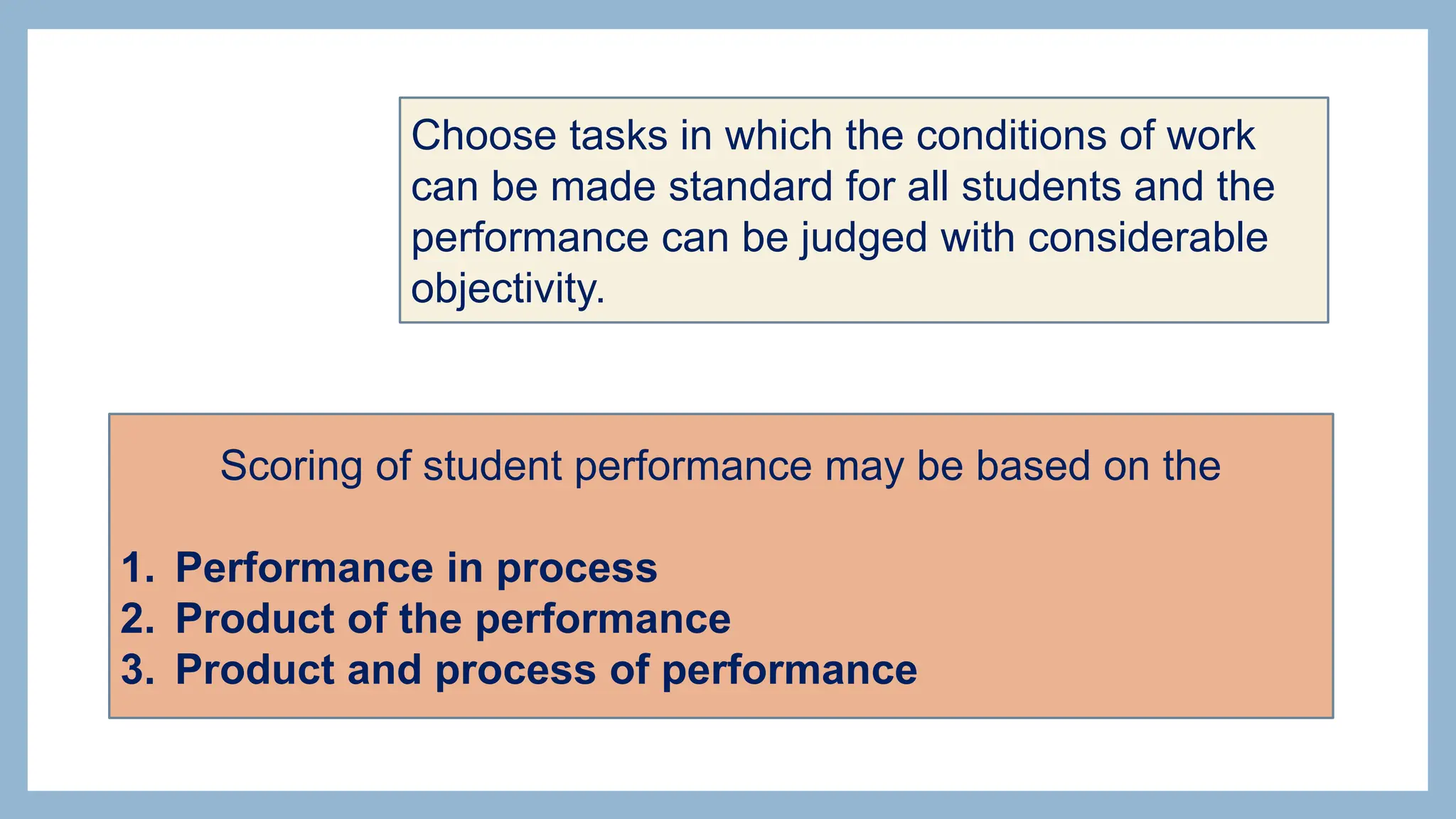
Choose tasks in which the conditions of work
can be made standard for all students and the
performance can be judged with considerable
objectivity.
Scoring of student performance may be based on the
1. Performance in process
2. Product of the performance
3. Product and process of performance
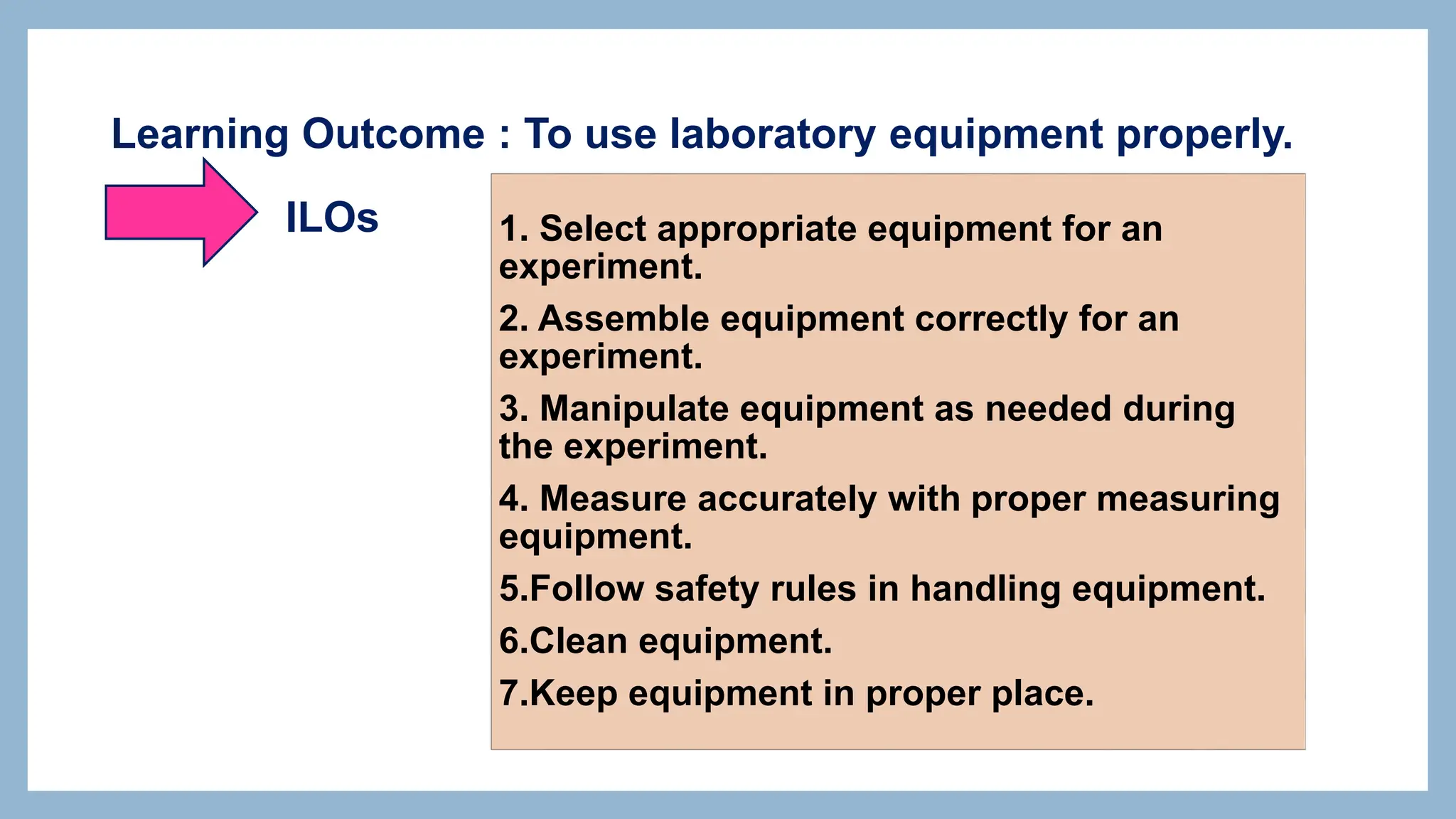
1. Select appropriate equipment for an
experiment.
2. Assemble equipment correctly for an
experiment.
3. Manipulate equipment as needed during
the experiment.
4. Measure accurately with proper measuring
equipment.
5.Follow safety rules in handling equipment.
6.Clean equipment.
7.Keep equipment in proper place.
Learning Outcome : To use laboratory equipment properly.
ILOs
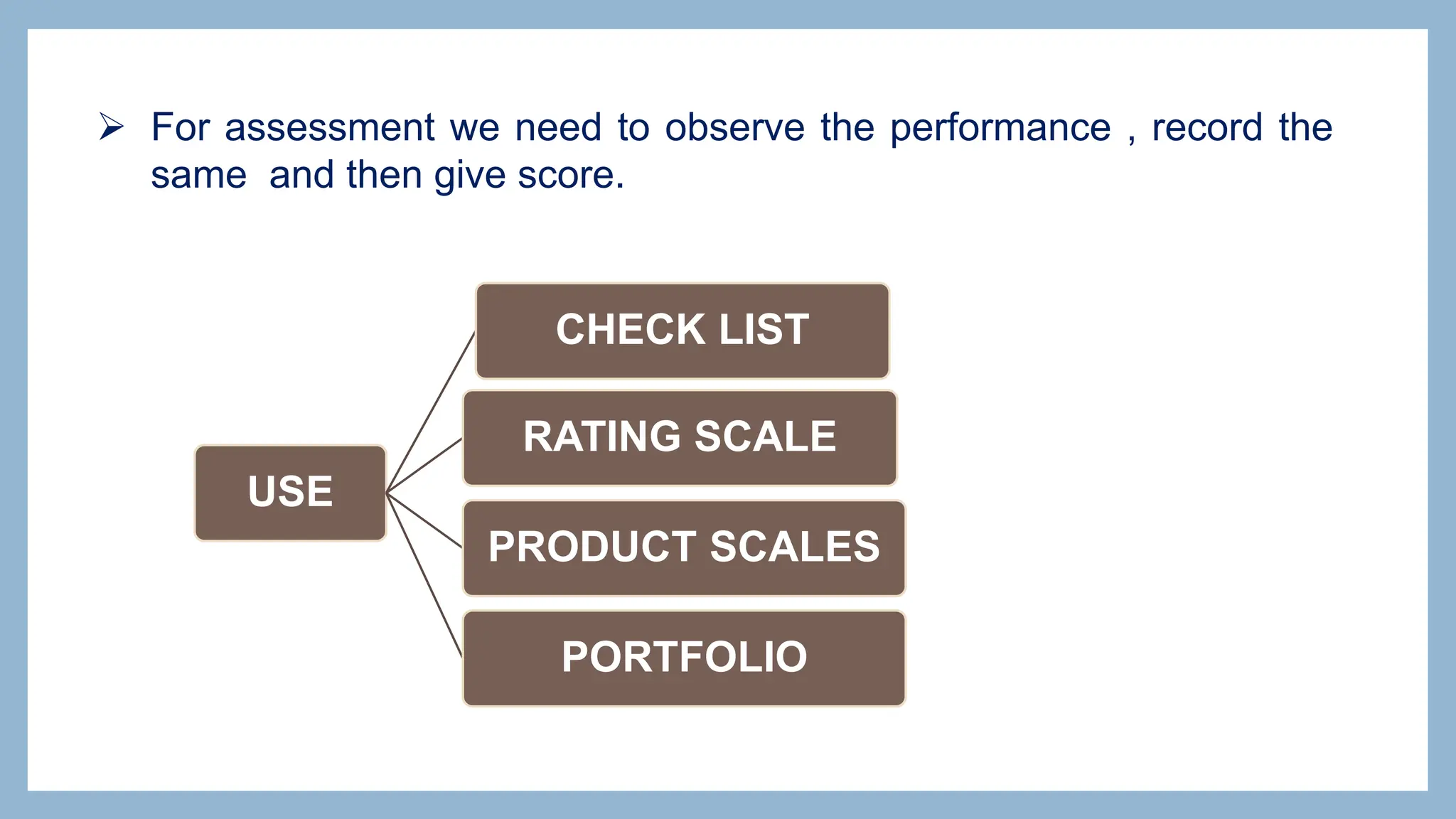
 For assessment we need to observe the performance , record the
same and then give score.
USE
CHECK LIST
RATING SCALE
PRODUCT SCALES
PORTFOLIO
21
05/05/2016
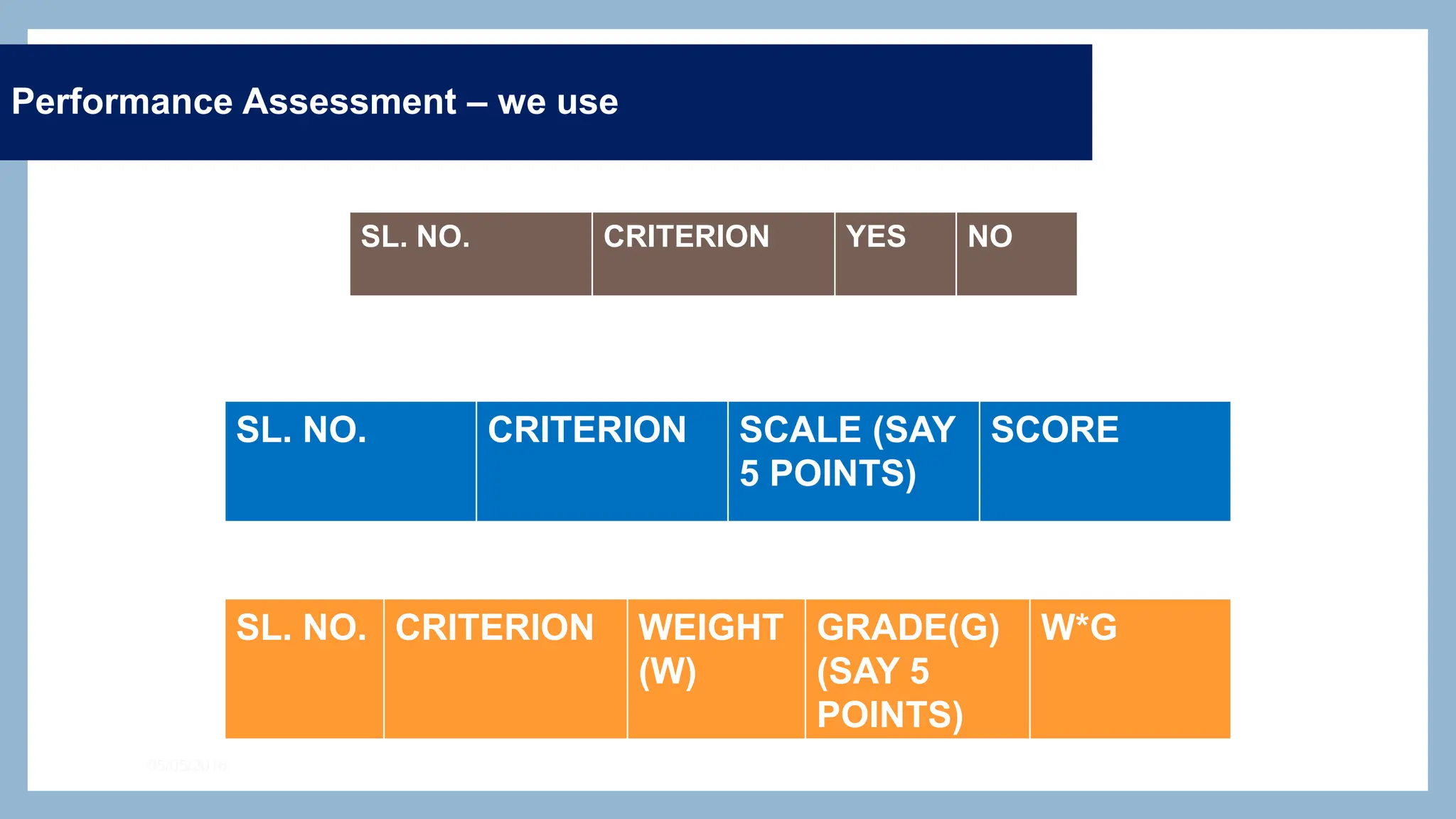
Performance Assessment – we use
SL. NO. CRITERION SCALE (SAY
5 POINTS)
SCORE
SL. NO. CRITERION YES NO
SL. NO. CRITERION WEIGHT
(W)
GRADE(G)
(SAY 5
POINTS)
W*G
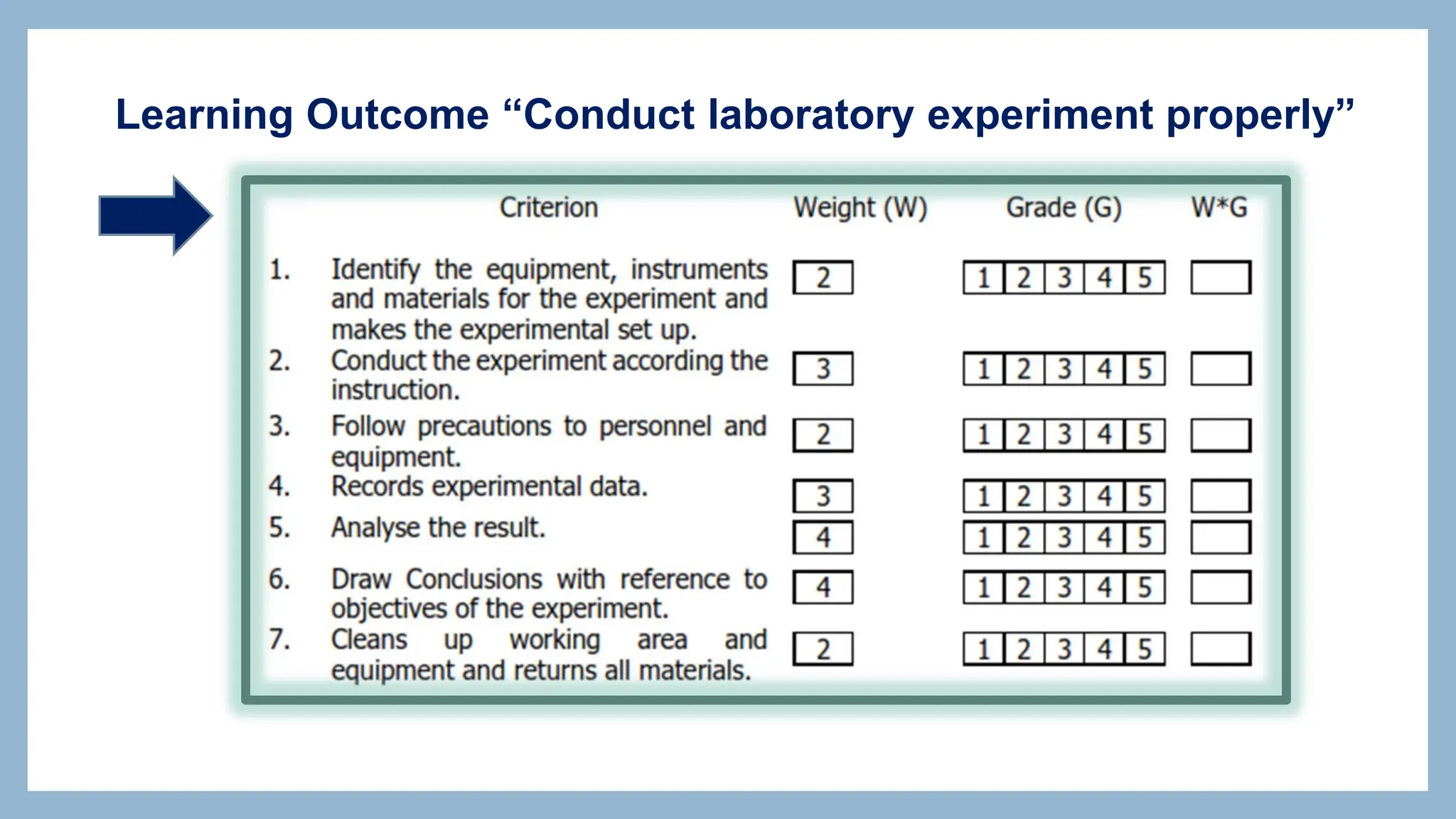
Learning Outcome “Conduct laboratory experiment properly”
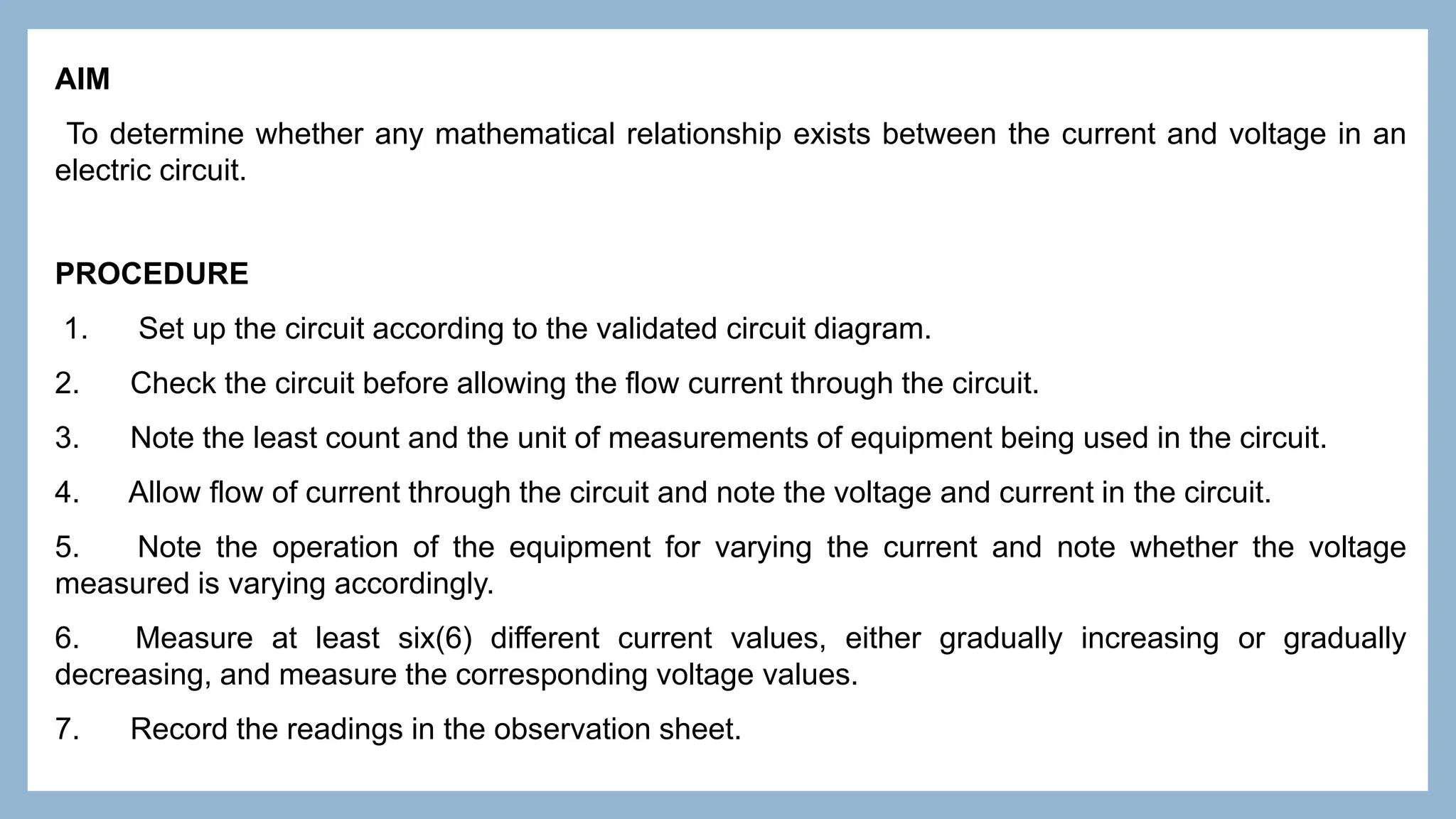
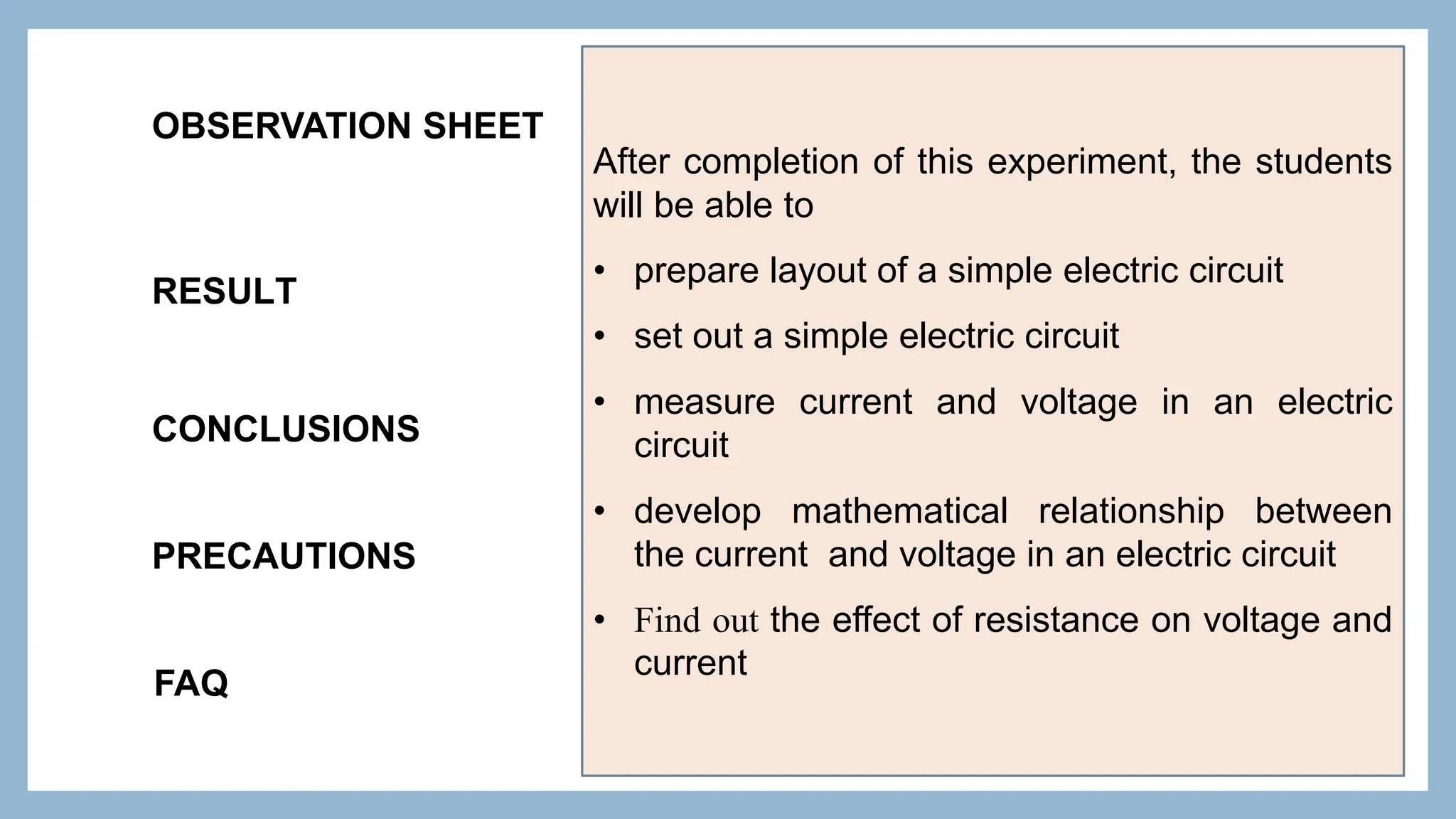
AIM
To determine whether any mathematical relationship exists between the current and voltage in an
electric circuit.
PROCEDURE
1. Set up the circuit according to the validated circuit diagram.
2. Check the circuit before allowing the flow current through the circuit.
3. Note the least count and the unit of measurements of equipment being used in the circuit.
4. Allow flow of current through the circuit and note the voltage and current in the circuit.
5. Note the operation of the equipment for varying the current and note whether the voltage
measured is varying accordingly.
6. Measure at least six(6) different current values, either gradually increasing or gradually
decreasing, and measure the corresponding voltage values.
7. Record the readings in the observation sheet.
OBSERVATION SHEET
RESULT
CONCLUSIONS
PRECAUTIONS
FAQ
After completion of this experiment, the students
will be able to
• prepare layout of a simple electric circuit
• set out a simple electric circuit
• measure current and voltage in an electric
circuit
• develop mathematical relationship between
the current and voltage in an electric circuit
• Find out the effect of resistance on voltage and
current
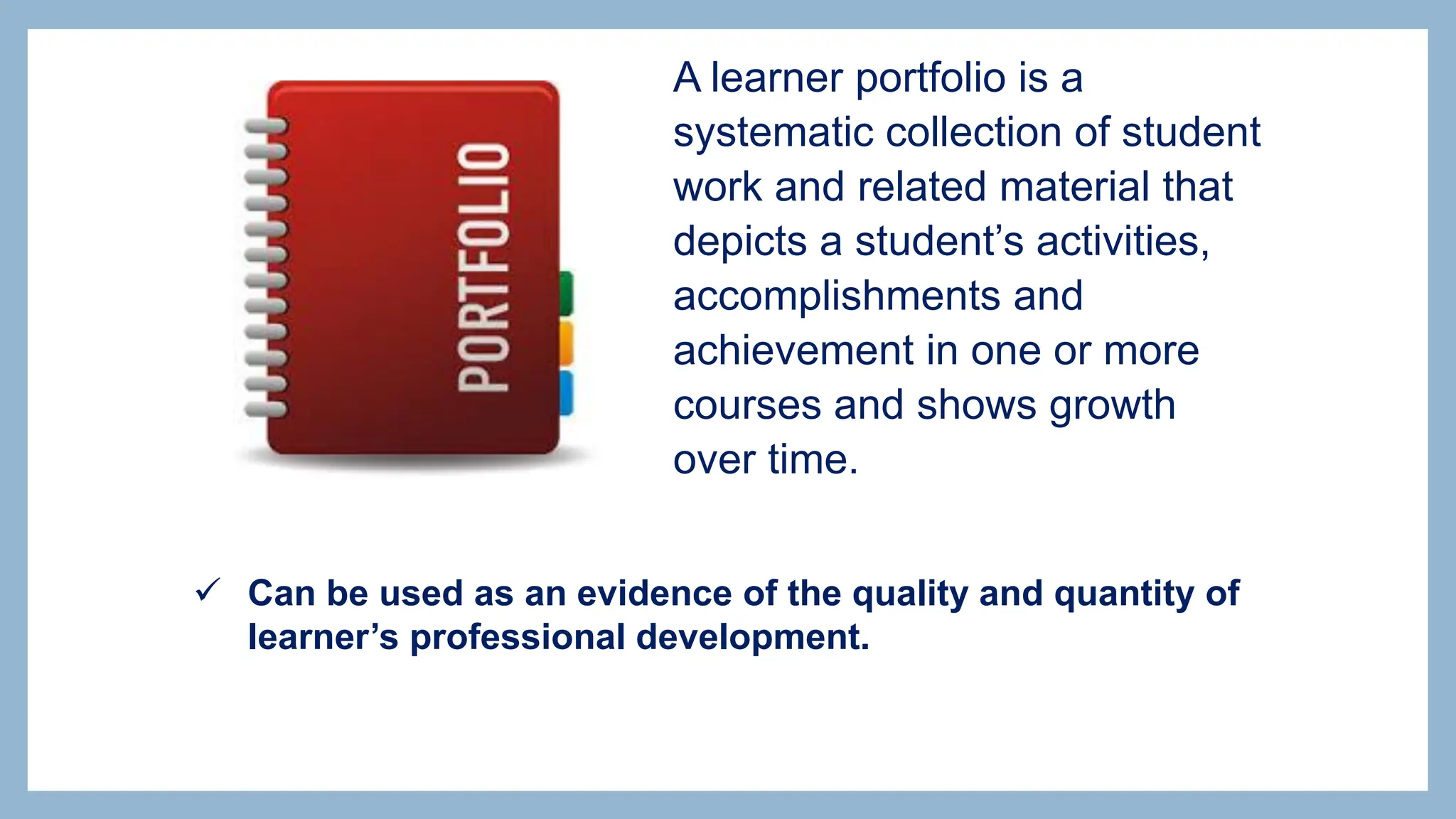
 Can be used as an evidence of the quality and quantity of
learner’s professional development.
A learner portfolio is a
systematic collection of student
work and related material that
depicts a student’s activities,
accomplishments and
achievement in one or more
courses and shows growth
over time.
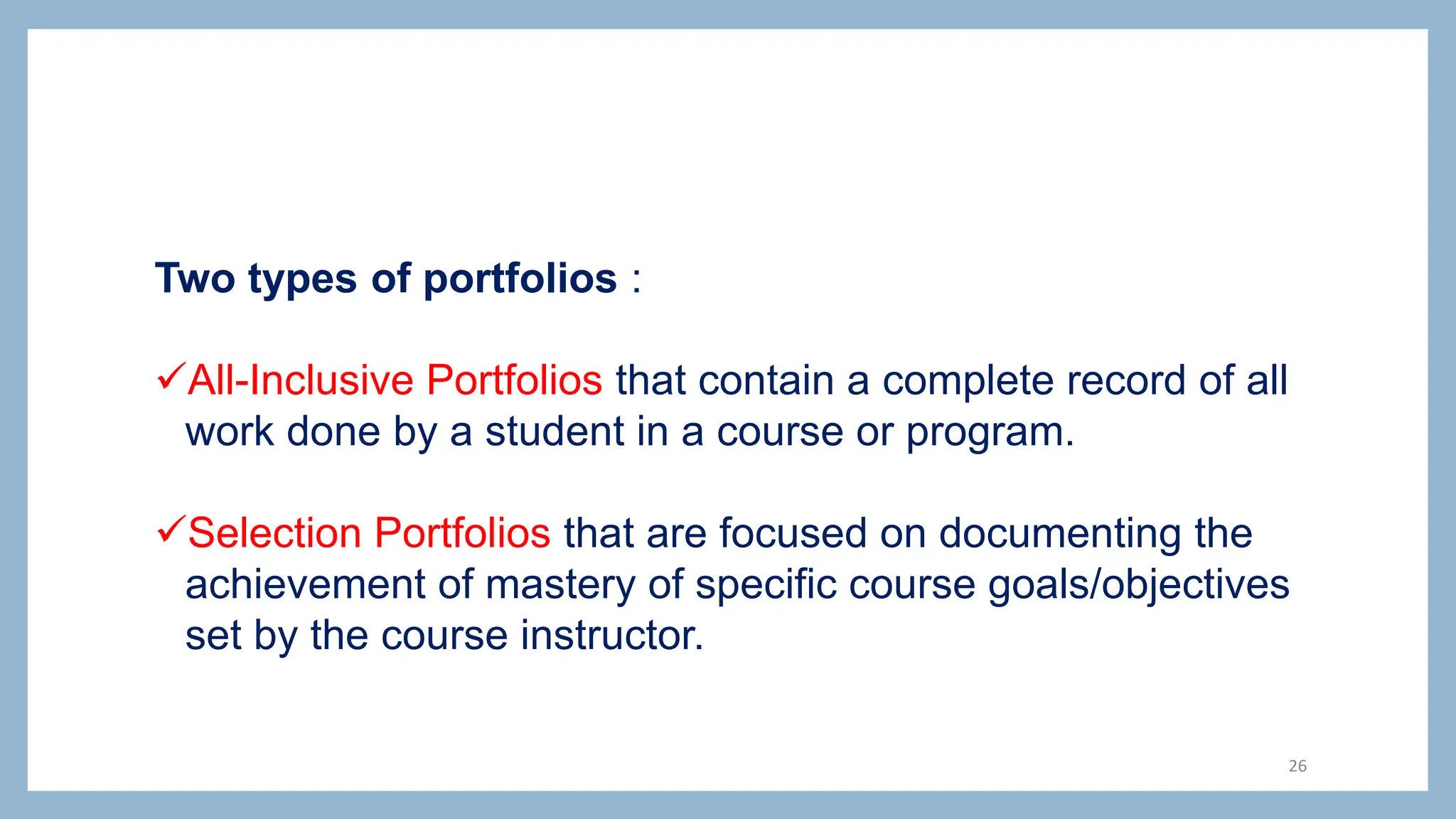
Two types of portfolios :
All-Inclusive Portfolios that contain a complete record of all
work done by a student in a course or program.
Selection Portfolios that are focused on documenting the
achievement of mastery of specific course goals/objectives
set by the course instructor.
26
We also use Rubric –
an authentic assessment tool in criterion-referenced
evaluation system.
Use scoring rubric ( either holistic
or analytic) for assessment of any
specific skill.
Rubrics for assessment of active
learning.
Rubrics for Assessment under
OBE.
COMPONENTS OF RUBRIC
Criteria UNSATISFACTORY POOR SATISFACTORY GOOD EXCELLENT
1 2 3 4 5
PERFORMANCE
CRITERION 1
PERFORMANCE
CRITERION 2
PERFORMANCE
CRITERION 3
PERFORMANCE
CRITERION 4
LoP/
Score
SCALES
DIMENSIONS
DESCRIPTORS
29
05/05/2016
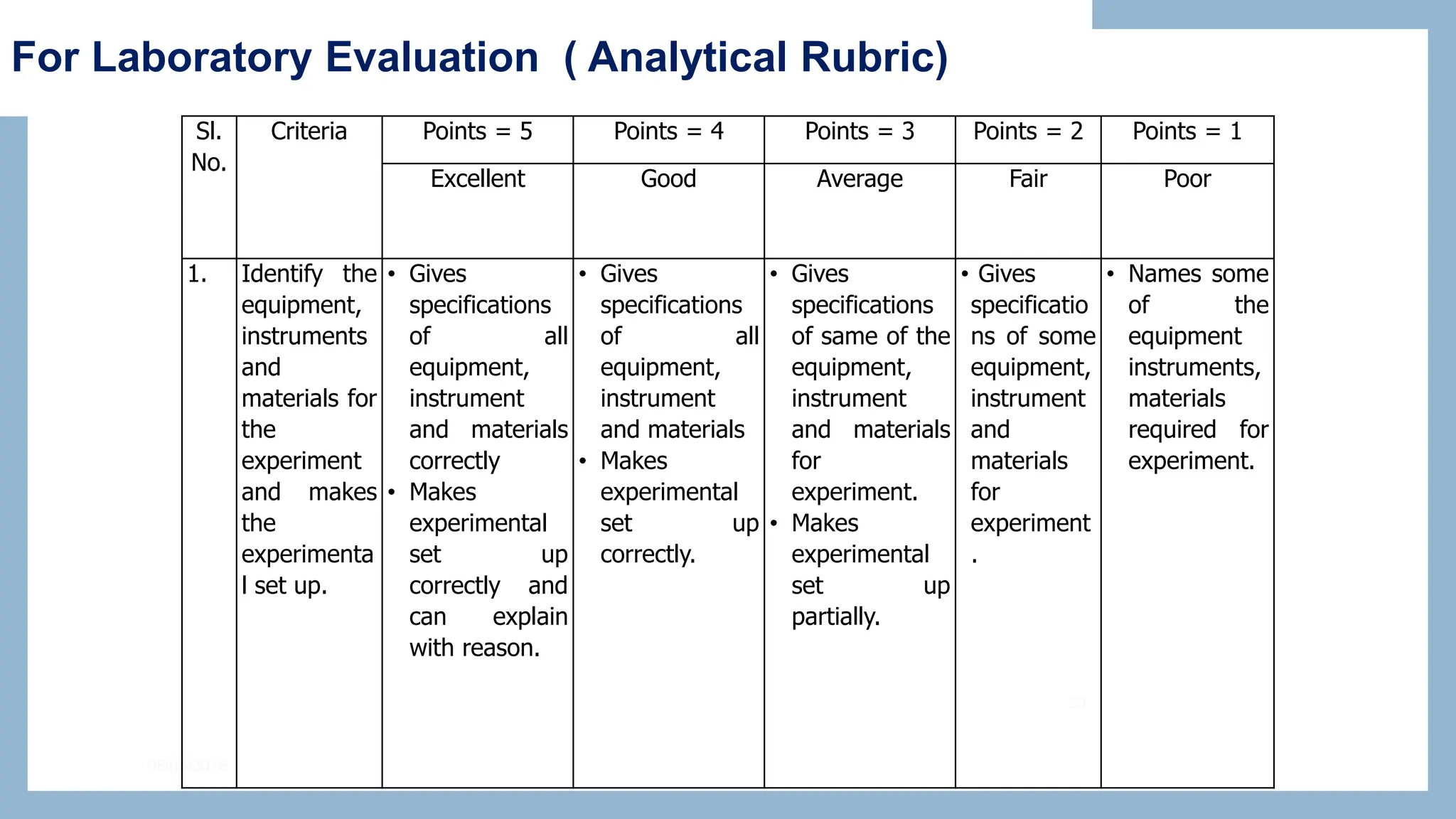
For Laboratory Evaluation ( Analytical Rubric)
Sl.
No.
Criteria Points = 5 Points = 4 Points = 3 Points = 2 Points = 1
Excellent Good Average Fair Poor
1. Identify the
equipment,
instruments
and
materials for
the
experiment
and makes
the
experimenta
l set up.
• Gives
specifications
of all
equipment,
instrument
and materials
correctly
• Makes
experimental
set up
correctly and
can explain
with reason.
• Gives
specifications
of all
equipment,
instrument
and materials
• Makes
experimental
set up
correctly.
• Gives
specifications
of same of the
equipment,
instrument
and materials
for
experiment.
• Makes
experimental
set up
partially.
• Gives
specificatio
ns of some
equipment,
instrument
and
materials
for
experiment
.
• Names some
of the
equipment
instruments,
materials
required for
experiment.
30
05/05/2016
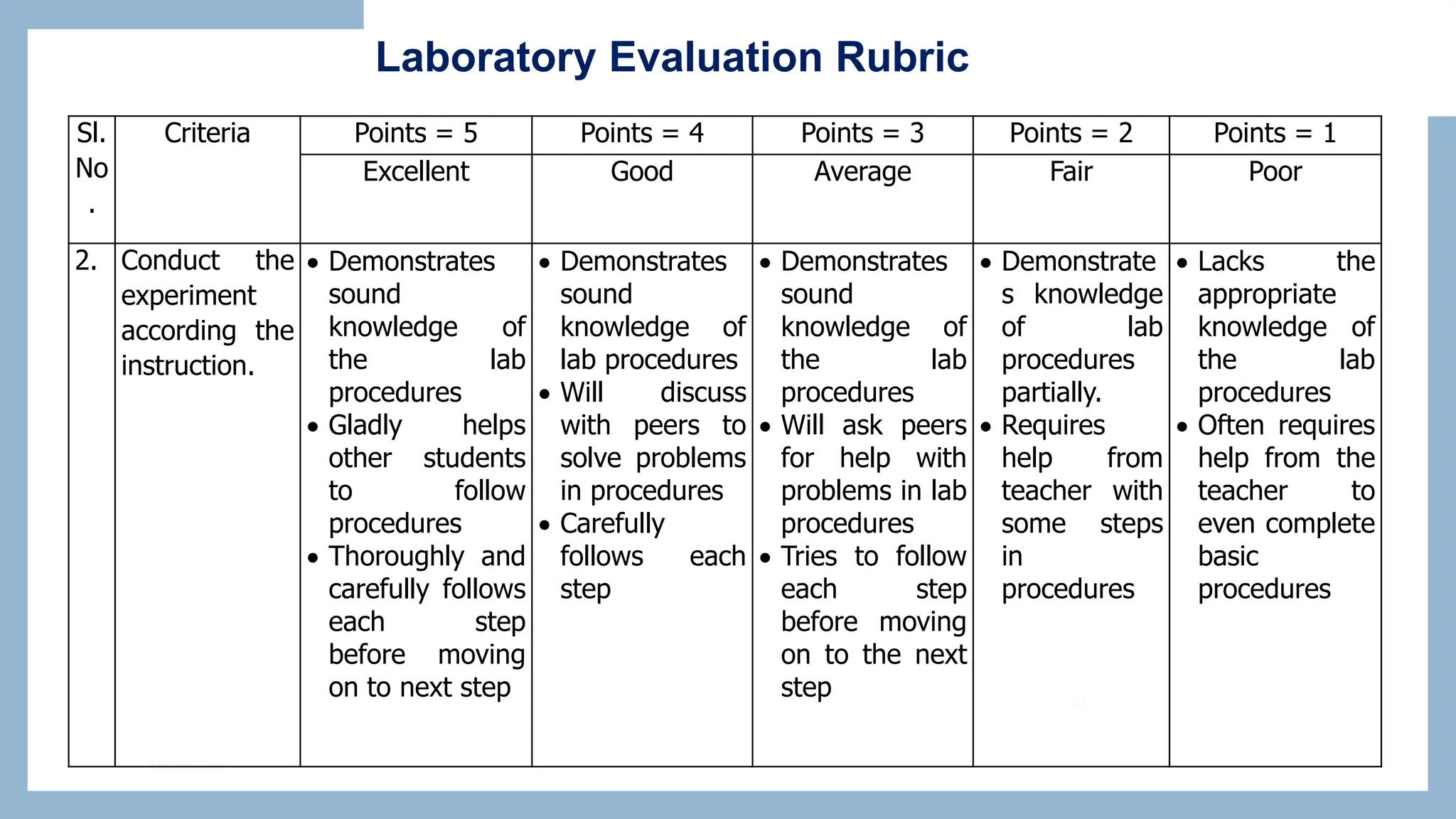
Laboratory Evaluation Rubric
Sl.
No
.
Criteria Points = 5 Points = 4 Points = 3 Points = 2 Points = 1
Excellent Good Average Fair Poor
2. Conduct the
experiment
according the
instruction.
 Demonstrates
sound
knowledge of
the lab
procedures
 Gladly helps
other students
to follow
procedures
 Thoroughly and
carefully follows
each step
before moving
on to next step
 Demonstrates
sound
knowledge of
lab procedures
 Will discuss
with peers to
solve problems
in procedures
 Carefully
follows each
step
 Demonstrates
sound
knowledge of
the lab
procedures
 Will ask peers
for help with
problems in lab
procedures
 Tries to follow
each step
before moving
on to the next
step
 Demonstrate
s knowledge
of lab
procedures
partially.
 Requires
help from
teacher with
some steps
in
procedures
 Lacks the
appropriate
knowledge of
the lab
procedures
 Often requires
help from the
teacher to
even complete
basic
procedures
Displays ethical behaviour and positive attitudes according to
professional value systems.
I. Maintains regularity, punctuality and sincerity in routine working.
II. Does not undertake any other employment such as tuitions/coaching etc. which
may affect normal working.
III. Does not engage in antic academic activities such as publishing important
questions and guides/keys for them.
IV. Acknowledges work done by others and does not engage in plagiarism.
V. Does not use the professional relationship with students for taking private
advantage or personal relationship with students for giving them professional
advantage.
VI. Maintains privacy of students’ data (Marks, weaknesses, complaints etc.)
VII. Does not allow malpractices by students (copying of assignments/ copying during
exam/proxy attendance etc.)
VIII. Does not give any student/colleague undue advantage /disadvantage due to
his/her religion, race, cast, gender, sexual orientation, economic/ social status etc.
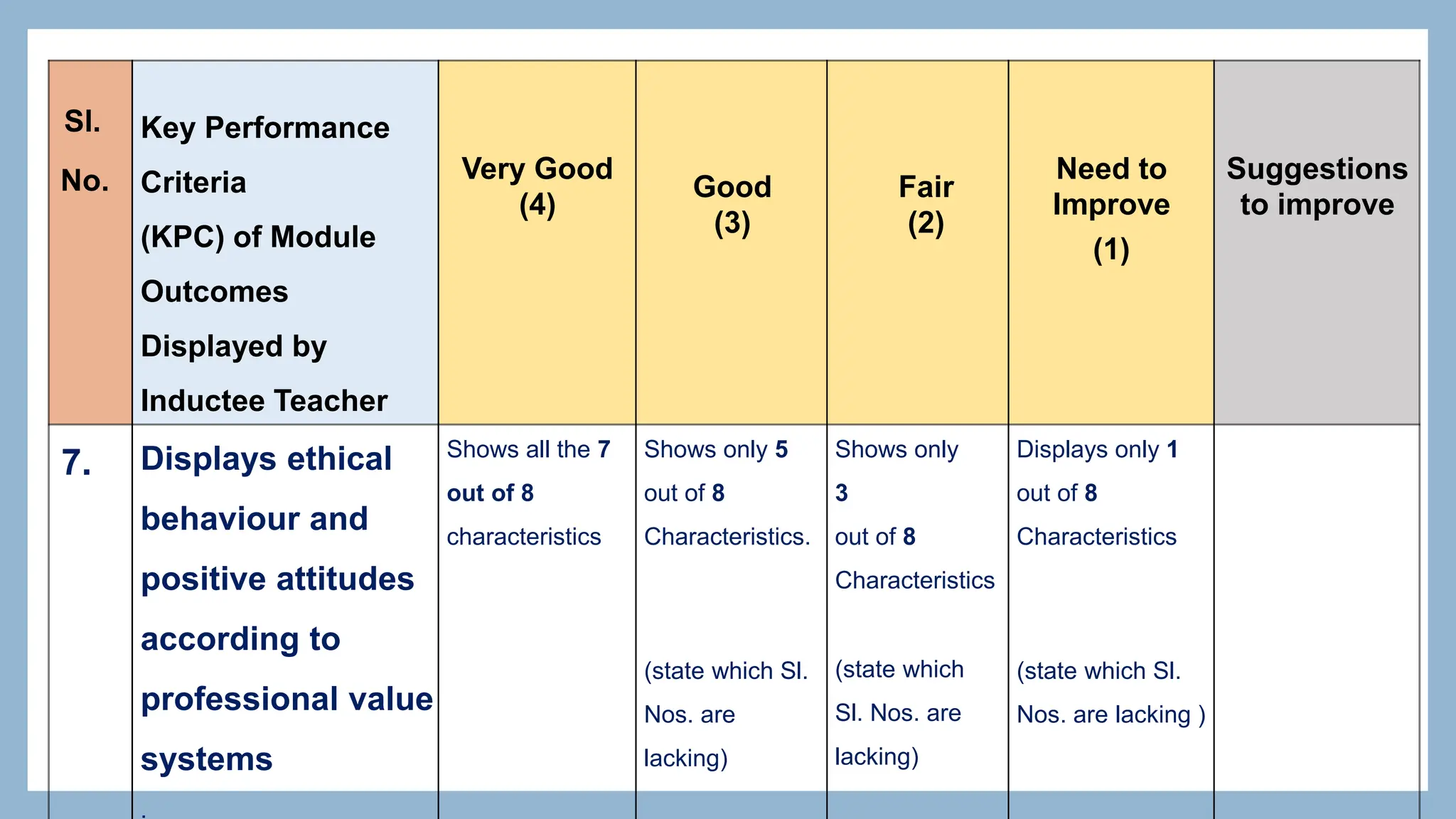
CRITERION ( for teacher assessment):
Sl.
No.
Key Performance
Criteria
(KPC) of Module
Outcomes
Displayed by
Inductee Teacher
Very Good
(4)
Good
(3)
Fair
(2)
Need to
Improve
(1)
Suggestions
to improve
7. Displays ethical
behaviour and
positive attitudes
according to
professional value
systems
.
Shows all the 7
out of 8
characteristics
Shows only 5
out of 8
Characteristics.
(state which Sl.
Nos. are
lacking)
Shows only
3
out of 8
Characteristics
(state which
Sl. Nos. are
lacking)
Displays only 1
out of 8
Characteristics
(state which Sl.
Nos. are lacking )
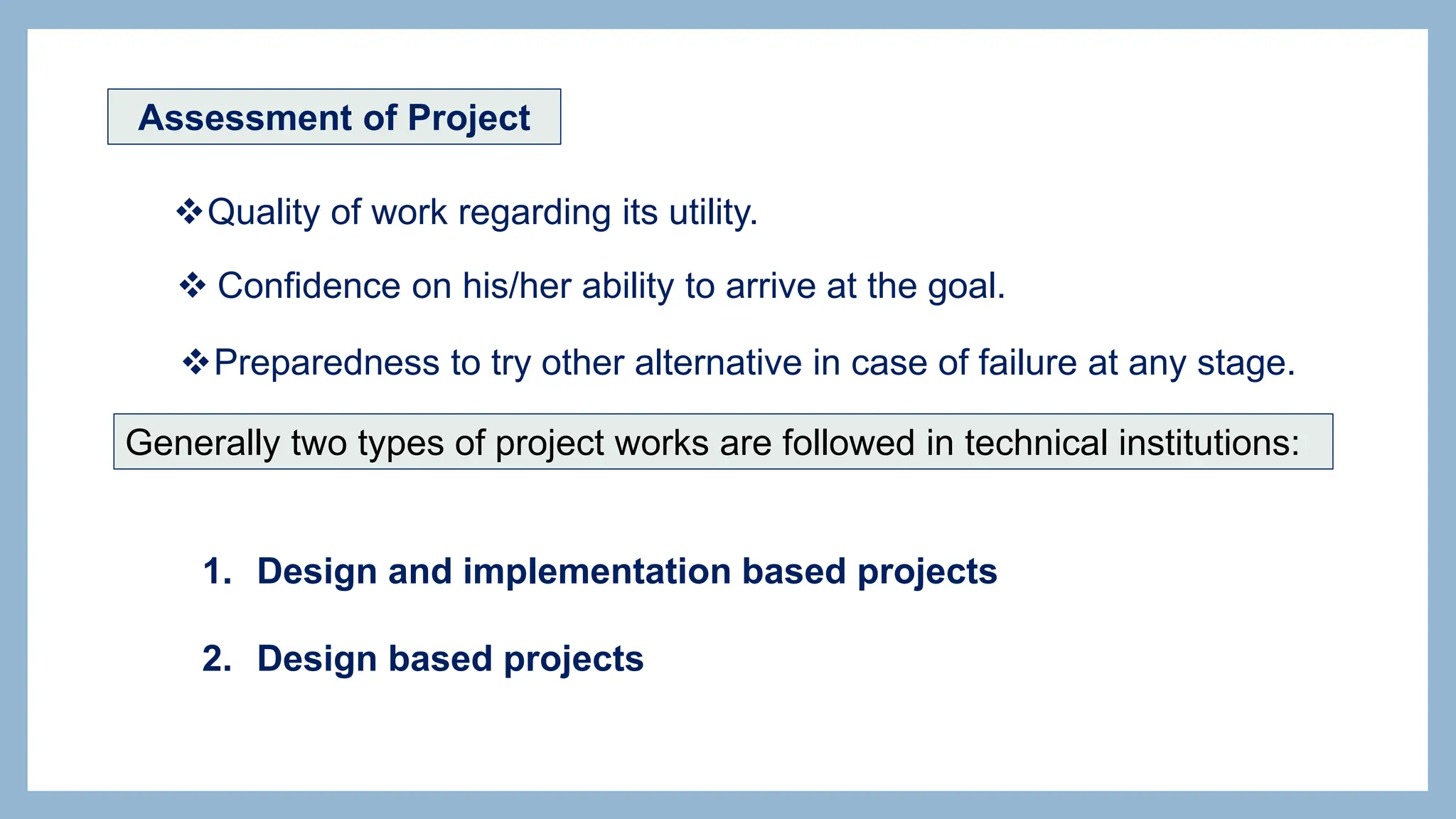
Assessment of Project
Quality of work regarding its utility.
 Confidence on his/her ability to arrive at the goal.
Preparedness to try other alternative in case of failure at any stage.
Generally two types of project works are followed in technical institutions:
1. Design and implementation based projects
2. Design based projects
Programme must have mechanisms for
evidence generating, collecting, and
evaluating in the complete project duration.
Assessment criteria to be decided based on
the type of project.
Criterion 1 (Attitude) - Learners should show interest
and participate actively in the project related activities,
should show strong commitment and sense of
responsibility.
Criterion 2 (Initiative) - Learners should look for ways
and means to solve project related issues and problems.
Criterion 3 (Knowledge) - Learners should reflect their
understanding about the project scope, should be able to
apply relevant knowledge already acquired and show
competency in solving project related problems.
Criterion 4 (Product) - Learners should design and
implement a product, service, process or an application
that is functional, reliable and practical and meets
predefined specifications.
Criterion 5 (Documentation). Learner’s project report
should reflect their ability to express ideas and
concepts, to organise the same logically and should
display technical specifications and achievements
clearly.
Criterion 6 (Presentation) - Learners should display
their achievements through well organised,
comprehensive presentation.
For Collection of Evidence
• Preparation of written documents
• Oral presentations
• Poster presentations
• Documentation of group work
• feedback on student performance
• Interview
• Meeting facilitation
• Appearing examinations (institutional,
state, or national level)
 Project assessment strategy can include both
Self-assessment and Peer-assessment.
 Peer assessment is effective in promoting the development
of teamwork and other professional skills in students.
 Develop a sense of ownership of their learning.
NOTE
THANK YOU

Advanced Pedagogy on different training policy

  • 1.
    Resource Person: Urmila Kar, Prof.,E&M, NITTTR, Kolkata Date of Discussion: 11th December 2024 Morning Session Advanced Pedagogy 1
  • 2.
    ASSESSMENT TYPES ASSESSMENT TOOLS •Self-assessment • Peer-assessment • Teacher-assessment • Observation • Teacher questionnaire • Self-reflection / Self report • Checklist (most common tool) • Rating scale • Case study analysis • Portfolio • Rubrics Assess Interest about the topic ? 1. I am happy during Math class 2. I get tired doing board work 3. I enjoy solving problems Design questionnaire, rating scale can be 1 - 5 (Low to High) Rating scale can be
  • 3.
    3 HOLISTIC APPROACH OFEDUCATION The separation of the head from the heart has contributed to a fractured education system that produces minds that do not know how to feel and hearts that do not know how to think. ~Parker Palmer
  • 4.
    4 Levels of AffectiveDomain Learning Outcomes Krathwohl's Affective Domain
  • 5.
    RECEIVING : • Accept •Attend • Develop • Recognize RESPONDING: • Complete • Comply • Cooperate • Obey • Respond VALUING: • Defend • Devote • Pursue • Seek ORGANISATION: • Codify • Display • Order • Systematise CHARACTERISATION • Internalise • Verify Decide Learning Outcomes using appropriate action verbs
  • 6.
    In technical/engineering education,what do we want to assess in affective domain?
  • 7.
    7 India’s education system needsHolistic education to take the country towards the 21st century and fourth industrial revolution.
  • 8.
    8 It focuses ondeveloping care for other and respect for the environment. Holistic Education Holistic Education: Through…. direct engagement with the environment Holistic development essentially means the development of intellectual, mental, physical, emotional, and social abilities so that he / she is capable of facing the demands and challenges of everyday life. Holistic education demands Affective Learning
  • 9.
    Affective learning isdemonstrated by behaviours indicating attitudes of awareness, interest, attention, responsibility, ability to listen and the way of interacting with others etc.
  • 10.
    Use Direct assessmenttools or Indirect assessment tools
  • 11.
    Who creates thelearning environment?
  • 12.
    Our facial expressionsthat reveal sarcasm, dislike or our body movements that reveal distrust, should be avoided. NOTE Be careful about our actions as that may negatively impact on student’s attitude.
  • 13.
  • 14.
    Topic: Direct AssessmentTools (Psychomotor domain)
  • 15.
  • 16.
    When we prepareassessment format, it must include the measurement of all the activities related to the particular performance.
  • 17.
    How to selecttasks for a skill test?  Choose tasks that are representative of the significant skills emphasized in the course.  Choose tasks, or aspects of tasks, that are reasonably difficult for students.  Since performance testing is time consuming, eliminate tasks, or parts of tasks, that almost everyone can do.
  • 18.
    Choose tasks inwhich the conditions of work can be made standard for all students and the performance can be judged with considerable objectivity. Scoring of student performance may be based on the 1. Performance in process 2. Product of the performance 3. Product and process of performance
  • 19.
    1. Select appropriateequipment for an experiment. 2. Assemble equipment correctly for an experiment. 3. Manipulate equipment as needed during the experiment. 4. Measure accurately with proper measuring equipment. 5.Follow safety rules in handling equipment. 6.Clean equipment. 7.Keep equipment in proper place. Learning Outcome : To use laboratory equipment properly. ILOs
  • 20.
     For assessmentwe need to observe the performance , record the same and then give score. USE CHECK LIST RATING SCALE PRODUCT SCALES PORTFOLIO
  • 21.
    21 05/05/2016 Performance Assessment –we use SL. NO. CRITERION SCALE (SAY 5 POINTS) SCORE SL. NO. CRITERION YES NO SL. NO. CRITERION WEIGHT (W) GRADE(G) (SAY 5 POINTS) W*G
  • 22.
    Learning Outcome “Conductlaboratory experiment properly”
  • 23.
    AIM To determine whetherany mathematical relationship exists between the current and voltage in an electric circuit. PROCEDURE 1. Set up the circuit according to the validated circuit diagram. 2. Check the circuit before allowing the flow current through the circuit. 3. Note the least count and the unit of measurements of equipment being used in the circuit. 4. Allow flow of current through the circuit and note the voltage and current in the circuit. 5. Note the operation of the equipment for varying the current and note whether the voltage measured is varying accordingly. 6. Measure at least six(6) different current values, either gradually increasing or gradually decreasing, and measure the corresponding voltage values. 7. Record the readings in the observation sheet.
  • 24.
    OBSERVATION SHEET RESULT CONCLUSIONS PRECAUTIONS FAQ After completionof this experiment, the students will be able to • prepare layout of a simple electric circuit • set out a simple electric circuit • measure current and voltage in an electric circuit • develop mathematical relationship between the current and voltage in an electric circuit • Find out the effect of resistance on voltage and current
  • 25.
     Can beused as an evidence of the quality and quantity of learner’s professional development. A learner portfolio is a systematic collection of student work and related material that depicts a student’s activities, accomplishments and achievement in one or more courses and shows growth over time.
  • 26.
    Two types ofportfolios : All-Inclusive Portfolios that contain a complete record of all work done by a student in a course or program. Selection Portfolios that are focused on documenting the achievement of mastery of specific course goals/objectives set by the course instructor. 26
  • 27.
    We also useRubric – an authentic assessment tool in criterion-referenced evaluation system. Use scoring rubric ( either holistic or analytic) for assessment of any specific skill. Rubrics for assessment of active learning. Rubrics for Assessment under OBE.
  • 28.
    COMPONENTS OF RUBRIC CriteriaUNSATISFACTORY POOR SATISFACTORY GOOD EXCELLENT 1 2 3 4 5 PERFORMANCE CRITERION 1 PERFORMANCE CRITERION 2 PERFORMANCE CRITERION 3 PERFORMANCE CRITERION 4 LoP/ Score SCALES DIMENSIONS DESCRIPTORS
  • 29.
    29 05/05/2016 For Laboratory Evaluation( Analytical Rubric) Sl. No. Criteria Points = 5 Points = 4 Points = 3 Points = 2 Points = 1 Excellent Good Average Fair Poor 1. Identify the equipment, instruments and materials for the experiment and makes the experimenta l set up. • Gives specifications of all equipment, instrument and materials correctly • Makes experimental set up correctly and can explain with reason. • Gives specifications of all equipment, instrument and materials • Makes experimental set up correctly. • Gives specifications of same of the equipment, instrument and materials for experiment. • Makes experimental set up partially. • Gives specificatio ns of some equipment, instrument and materials for experiment . • Names some of the equipment instruments, materials required for experiment.
  • 30.
    30 05/05/2016 Laboratory Evaluation Rubric Sl. No . CriteriaPoints = 5 Points = 4 Points = 3 Points = 2 Points = 1 Excellent Good Average Fair Poor 2. Conduct the experiment according the instruction.  Demonstrates sound knowledge of the lab procedures  Gladly helps other students to follow procedures  Thoroughly and carefully follows each step before moving on to next step  Demonstrates sound knowledge of lab procedures  Will discuss with peers to solve problems in procedures  Carefully follows each step  Demonstrates sound knowledge of the lab procedures  Will ask peers for help with problems in lab procedures  Tries to follow each step before moving on to the next step  Demonstrate s knowledge of lab procedures partially.  Requires help from teacher with some steps in procedures  Lacks the appropriate knowledge of the lab procedures  Often requires help from the teacher to even complete basic procedures
  • 31.
    Displays ethical behaviourand positive attitudes according to professional value systems. I. Maintains regularity, punctuality and sincerity in routine working. II. Does not undertake any other employment such as tuitions/coaching etc. which may affect normal working. III. Does not engage in antic academic activities such as publishing important questions and guides/keys for them. IV. Acknowledges work done by others and does not engage in plagiarism. V. Does not use the professional relationship with students for taking private advantage or personal relationship with students for giving them professional advantage. VI. Maintains privacy of students’ data (Marks, weaknesses, complaints etc.) VII. Does not allow malpractices by students (copying of assignments/ copying during exam/proxy attendance etc.) VIII. Does not give any student/colleague undue advantage /disadvantage due to his/her religion, race, cast, gender, sexual orientation, economic/ social status etc. CRITERION ( for teacher assessment):
  • 32.
    Sl. No. Key Performance Criteria (KPC) ofModule Outcomes Displayed by Inductee Teacher Very Good (4) Good (3) Fair (2) Need to Improve (1) Suggestions to improve 7. Displays ethical behaviour and positive attitudes according to professional value systems . Shows all the 7 out of 8 characteristics Shows only 5 out of 8 Characteristics. (state which Sl. Nos. are lacking) Shows only 3 out of 8 Characteristics (state which Sl. Nos. are lacking) Displays only 1 out of 8 Characteristics (state which Sl. Nos. are lacking )
  • 33.
    Assessment of Project Qualityof work regarding its utility.  Confidence on his/her ability to arrive at the goal. Preparedness to try other alternative in case of failure at any stage. Generally two types of project works are followed in technical institutions: 1. Design and implementation based projects 2. Design based projects
  • 34.
    Programme must havemechanisms for evidence generating, collecting, and evaluating in the complete project duration. Assessment criteria to be decided based on the type of project.
  • 35.
    Criterion 1 (Attitude)- Learners should show interest and participate actively in the project related activities, should show strong commitment and sense of responsibility. Criterion 2 (Initiative) - Learners should look for ways and means to solve project related issues and problems.
  • 36.
    Criterion 3 (Knowledge)- Learners should reflect their understanding about the project scope, should be able to apply relevant knowledge already acquired and show competency in solving project related problems. Criterion 4 (Product) - Learners should design and implement a product, service, process or an application that is functional, reliable and practical and meets predefined specifications.
  • 37.
    Criterion 5 (Documentation).Learner’s project report should reflect their ability to express ideas and concepts, to organise the same logically and should display technical specifications and achievements clearly. Criterion 6 (Presentation) - Learners should display their achievements through well organised, comprehensive presentation.
  • 38.
    For Collection ofEvidence • Preparation of written documents • Oral presentations • Poster presentations • Documentation of group work • feedback on student performance • Interview • Meeting facilitation • Appearing examinations (institutional, state, or national level)
  • 39.
     Project assessmentstrategy can include both Self-assessment and Peer-assessment.  Peer assessment is effective in promoting the development of teamwork and other professional skills in students.  Develop a sense of ownership of their learning. NOTE
  • 40.