ADVANCI~D
PIATH[~ATICAL
PI[THOD5
IN
5CI[NC[
AND
ADVANC[D
PIATHt
MATICAL
PI[TNODS
IN
SCI[NC[
AND
[NGIN[[RING
S. I. Hayek
ThePennsylvania
StateUniversity
UniversityPark,Pennsylvania
MARCEL
DEKKER
MARCEL DEKKER, INC. NEw
YOR~<
¯ BAser.
ISBN: 0-8247-0466-5
Thisbookis printed on acid-flee paper.
Headquarters
MarcelDekker,Inc.
270 Madison Avenue, NewYork, NY10016
tel: 212-696-9000;fax: 212-685-6540
Eastern Hemisphere
Distribution
Marcel Dekker AG
Hutgasse4, Postfach 812, CH-4001
Basel, Switzerland
tel: 41-61-261-8482;fax: 41-61-261-8896
World Wide Web
http://www.dekker.com
Thepublisher offers discounts on this bookwhenordered in bulk quantities. For moreinformation,
write to Special Sales/ProfessionalMarketingat the headquartersaddressabove.
Copyright©2001 by MarcelDekker,Inc. All Rights Reserved.
Neither this booknor anypart maybe reproducedor transmitted in anyform or by any means,elec-
tronic or mechanical, including photocopying,microfilming, and recording, or by any information
storageandretrieval system,withoutpermissionin writing fromthe publisher.
Current
printing(last digit):
1098765432
PRINTED IN THE UNITED STATES OF AMERICA
PREFACE
This bookis intended to cover manytopics in mathematicsat a level moreadvancedthan
a junior level course in differential equations. Thebookevolvedfroma set of notes for a
three-semester course in the application of mathematical methodsto scientific and
engineering problems. The courses attract graduate students majoring in engineering
mechanics,engineering science, mechanical, petroleum, electrical, nuclear, civil and
aeronautical engineering, as well as physics, meteorology,geologyand geophysics.
The book assumes knowledgeof differential and integral calculus and an
introductory level of ordinary differential equations. Thus, the bookis intended for
advancedsenior and graduate students. Each chapter of the text contains manysolved
examples and manyproblems with answers. Those chapters which cover boundaryvalue
problems and partial differential equations also include derivation of the governing
differential equations in manyfields of applied physics and engineering such as wave
mechanics,acoustics, heat flowin solids, diffusion of liquids and gassesandfluid flow.
Chapter 1 briefly reviews methods of integration of ordinary differential
equations. Chapter2 covers series solutions of ordinary differential equations. This is
followed by methodsof solution of singular differential equations. Chapter 3 covers
Bessel functions and Legendrefunctions in detail, including recurrence relations, series
expansion,integrals, integral representations andgeneratingfunctions.
Chapter4 covers the derivation and methodsof solution of linear boundaryvalue
problemsfor physical systemsin one spatial dimensiongovernedby ordinary differential
equations. Theconcepts of eigenfunctions, orthogonality and eigenfunction expansions
are introduced, followedby an extensive treatment of adjoint and self-adjoint systems.
This is followed by coverageof the Sturm-Liouville systemfor secondand fourth order
ordinary differential equations. Thechapter concludeswith methodsof solution of non-
homogeneous
boundary value problems.
Chapter 5 covers complexvariables, calculus, and integrals. The methodof
residues is fully applied to proper and improperintegrals, followed by integration of
multi-valued functions. Examplesare drawnfrom Fourier sine, cosine and exponential
transformsas well as the Laplacetransform.
Chapter6 covers linear partial differential equations in classical physics and
engineering. Thechapter covers derivation of the governingpartial differential equations
for waveequations in acoustics, membranes,
plates and beams;strength of materials; heat
flow in solids and diffusion of gasses; temperature distribution in solids and flow of
incompressibleideal fluids. Theseequations are then shownto obey partial differential
equations of the type: Laplace, Poisson, Helmholtz, waveand diffusion equations.
Uniquenesstheoremsfor these equations are then developed. Solutions by eigenfunction
expansions are explored fully. These are followed by special methods for non-
homogeneous
partial differential equations with temporaland spatial source fields.
Chapter7 covers the derivation of integral transforms such as Fourier complex,
sine and cosine, Generalized Fourier, Laplace and Hankeltransforms. Thecalculus of
each of these transforms is then presented together with special methodsfor inverse
transformations. Each transform also includes applications to solutions of partial
differential equations for engineeringand physical systems.
111
PREFACE iv
Chapter 8 covers Green’s functions for ordinary and partial diffi~rential
equations. The Green’s functions for adjoint and self-adjoint systems of ordinary
differential equations are then presented by use of generalized functions or by
construction. Thesemethodsare applied to physical examplesin the samefields c, overed
in Chapter 6. These are then followed by derivation of fundamental sohitions for the
Laplace, Helmholtz, waveand diffusion equations in one-, two-, and three-dimensional
space. Finally, the Green’s functions for boundedand semi-infinite mediasuch as half
and quarter spaces, in cartesian, cylindrical and spherical geometryare developedby the
methodof imageswith examplesin physical systems.
Chapter9 covers asymptoticmethodsaimedat the evaluation of integrals as well
as the asymptotic solution of ordinary differential equations. This chapter covers
asymptoticseries and convergence.This is then followedby asymptoticseries evaluation
of definite and improper integrals. These include the stationary phase method, the
steepest descent method,the modified saddle point method, methodof the subtraction of
poles and Ott’s and Jones’ methods. Thechapter then covers asymptotic solutions of
ordinary differential equations, formalsolutions, normaland sub-normalsolutions and the
WKBJmethod.
There are four appendices in the book. AppendixA covers infinite series and
convergencecriteria. AppendixB presents a compendium
of special functions such as
Beta, Gamma,
Zeta, Laguerre, Hermite, Hypergeometric, Chebychevand Fresnel. These
include differential equations, series solutions, integrals, recurrenceformulaeand integral
representations. Appendix C presents a compendiumof formulae for spherical,
cylindrical, ellipsoidal, oblate and prolate spheroidal coordinate systemssuch as the
divergence, gradient, Laplacian and scalar and vector waveoperators. Appendix D
covers calculus of generalized functions such as the Dirac delta functions in n-
dimensional space of zero and higher ranks. Appendix E presents plots of special
functions.
Theaim of this book is to present methodsof applied mathematicsthat are
particularly suited for the application of mathematicsto physical problemsin science and
engineering, with numerousexamples that illustrate the methods of solution being
explored. Theproblemshaveanswerslisted at the end of the book.
Thebookis used in a three-semester course sequence. The author reconamends
Chapters 1, 2, 3, and 4 and AppendixA in the first course, with emphasison ordinary
differential equations. The second semester wouldinclude Chapters 5, 6, and 7 with
emphasison partial differential equations. Thethird course wouldinclude AppendixD,
and Chapters8 and 9.
ACKNOWLEDGMENTS
This bookevolvedfromcourse notes written in the early 1970sfor a two-semestercourse
at PennState University. It wascompletely revampedand retyped in the mid-1980s.The
course notes wererewritten in the formatof a manuscriptfor a bookfor the last twoyears.
I wouldlike to acknowledgethe manypeople whohad profound influence on meover the
last 40years.
I amindebted to myformer teachers whoinstilled inme the love of applied
mathematics. In particular, I wouldlike to mentionProfessors MortonFriedman,Melvin
Barron, RaymondMindlin, Mario Salvadori, and Frank DiMaggio, all of Columbia
University’s Department of Engineering Mechanics. I amalso indebted to the many
PREFACE v
graduate students whomadesuggestions on improvingthe course-notes over the last 25
years.
I amalso indebted to Professor Richard McNitt, head of the Department of
EngineeringScience and Mechanics,PennState University, for his support on this project
during the last twoyears. I amalso grateful to Ms. KathyJoseph, whoseknowledge
of the
subject matter led to manyinvaluable technical suggestions while typing the final
manuscript. I amalso grateful for the encouragementand support of Mr. B. J. Clark,
ExecutiveAcquisitions Editor at MarcelDekker,Inc.
I amgrateful to mywife, Guler, for her moral support during the writing of the
first draft of the course-notes, and for freeing mefrommany
responsibilities at home
to
allow meto workon the first manuscriptand tworewrites over the last 25years. I amalso
grateful to mychildren, Emil and Dina, for their moralsupport whenI could not be there
for themduring the first and secondrewrite of the course-notes, and for myson Emil who
proofreadparts of the secondcourse-notes manuscript.
S. I. Hayek
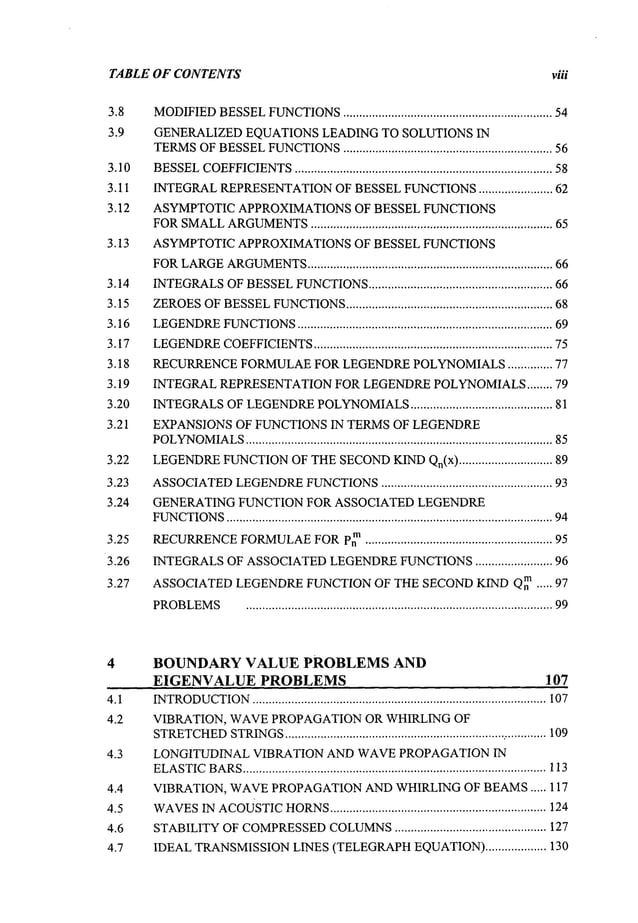
TABLE OF CONTENTS
preface iii
1.I
1.2
1.3
1.4
1.5
1.6
1.7
1.8
1.9
ORDINARY DIFFERENTIAL EQUATIONS 1
DEFINITIONS
..................................................................................................... 1
LINEAR
DIFFERENTIAL
EQUATIONS
OFFIRSTORDER
.......................... 2
LINEAR
INDEPENDENCE
AND
THEWRONSKIAN
............................ i.......3
LINEAR HOMOGENEOUS
DIFFERENTIAL EQUATION OF ORDER
n WITH
CONSTANT
COEFFICIENTS
.............................................................. 4
EULER’S
EQUATION
............... : .........................................................................6
PARTICULAR SOLUTIONS BY METHODOF UNDETERMINED
COEFFICIENTS
.................................................................................................. 7
PARTICULAR SOLUTIONS BY THE METHODOF VARIATIONS OF
PARAMETERS
.................................................................................................... 9
ABEL’S
FORMULA
FOR
THE
WRONSKIAN
............................................... 12
INITIAL
VALUE
PROBLEMS
......................................................................... 13
PROBLEMS
............................................................................................... 15
2.1
2.2
2.3
2.4
SERIES SOLUTIONS OF ORDINARY
DIFFERENTIAL EQUATIONS 19
INTRODUCTION
.............................................................................................. 19
POWER
SERIES
SOLUTIONS
......................................................................... 20
CLASSIFICATION
OFSINGULARITIES
....................................................... 23
FROBENIUS
SOLUTION
................................................................................. 25
PROBLEMS
............................................................................................... 40
3 SPECIAL FUNCTIONS 43
3.1
3.2
3.3
3.4
3.5
3.6
3.7
BESSEL
FUNCTIONS
...................................................................................... 43
BESSEL
FUNCTION
OFORDER
ZERO
......................................................... 45
BESSEL
FUNCTION
OFAN
INTEGER
ORDER
n ........................................ 47
RECURRENCE
RELATIONS
FORBESSEL
FUNCTIONS
........................... 49
BESSEL
FUNCTIONS
OFHALF
ORDERS
.................................................... 51
SPHERICAL
BESSEL
FUNCTIONS
........................... ’.....................................
52
HANKEL.FUNCTIONS
.................................................................................... 53
vii
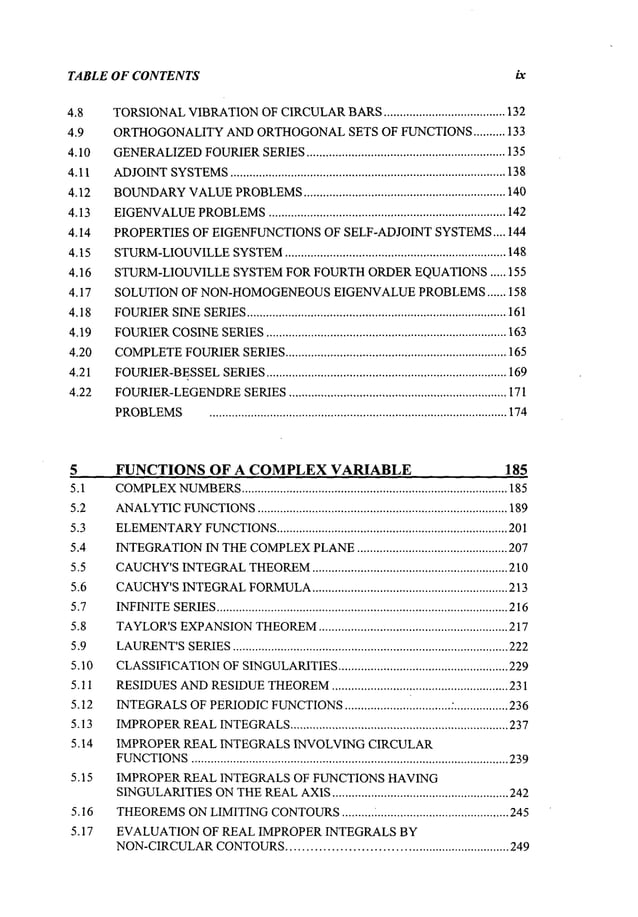
TABLE OF CONTENTS viii
3.8
3.9
3.10
3.11
3.12
3.13
3.14
3.15
3.16
3.17
3.18
3.19
3.20
3.21
3.22
3.23
3.24
3.25
3.26
3.27
MODIFIED
BESSEL
FUNCTIONS
.................................................................. 54
GENERALIZEDEQUATIONSLEADING TO SOLUTIONS IN
TERMS
OF
BESSEL
FUNCTIONS
................................................................. 56
BESSEL
COEFFICIENTS
................................................................................ 58
INTEGRAL
REPRESENTATION
OFBESSEL
FUNCTIONS
........................ 62
ASYMPTOTIC APPROXIMATIONSOF BESSEL FUNCTIONS
FOR
SMALL
ARGUMENTS
........................................................................... 65
ASYMPTOTICAPPROXIMATIONS OF BESSEL FUNCTIONS
FOR
LARGE
ARGUMENTS
............................................................................ 66
INTEGRALS
OFBESSEL
FUNCTIONS
......................................................... 66
ZEROES
OF
BESSEL
FUNCTIONS
................................................................ 68
LEGENDRE
FUNCTIONS
............................................................................... 69
LEGENDRE
COEFFICIENTS
........................................................................... 75
RECURRENCE
FORMULAE
FOR LEGENDRE
POLYNOMIALS
.............. 77
INTEGRALREPRESENTATION
FOR LEGENDRE
POLYNOMIALS
........ 79
INTEGRALS
OFLEGENDRE
POLYNOMIALS
............................................ 81
EXPANSIONS OF FUNCTIONS IN TERMS OF LEGENDRE
POLYNOMIALS
............................................................................................... 85
LEGENDRE
FUNCTION
OFTHE
SECOND
KIND
Qn(x) ............................. 89
ASSOCIATED
LEGENDRE
FUNCTIONS
...................................................... 93
GENERATING FUNCTION FOR ASSOCIATED LEGENDRE
FUNCTIONS
..................................................................................................... 94
RECURRENCE
FORMULAE
FOR
p~n.......................................................... 95
INTEGRALS
OF ASSOCIATED
LEGENDRE
FUNCTIONS
........................ 96
ASSOCIATED
LEGENDRE
FUNCTIONOF THE SECONDKIND Qnm ..... 97
PROBLEMS
............................................................................................... 99
BOUNDARY VALUE PROBLEMS AND
EIGENVALUE PROBLEMS 107
4.1
4.2
4.3
4.4
4.5
4.6
4.7
INTRODUCTION
........................................................................................... 107
VIBRATION, WAVEPROPAGATIONOR WHIRLING OF
STRETCHED
STRINGS
.................................................................... ..............109
LONGITUDINAL VIBRATION AND WAVEPROPAGATIONIN
ELASTIC
BARS
.............................................................................................. 113
VIBRATION, WAVEPROPAGATION
ANDWHIRLINGOF BEAMS..... 117
WAVES
INAcousTIC
HORNS
................................................................... 124
STABILITY
OFCOMPRESSED
COLUMNS
............................................... 127
IDEALTRANSMISSION
LINES(TELEGRAPH
EQUATION)
................... 130
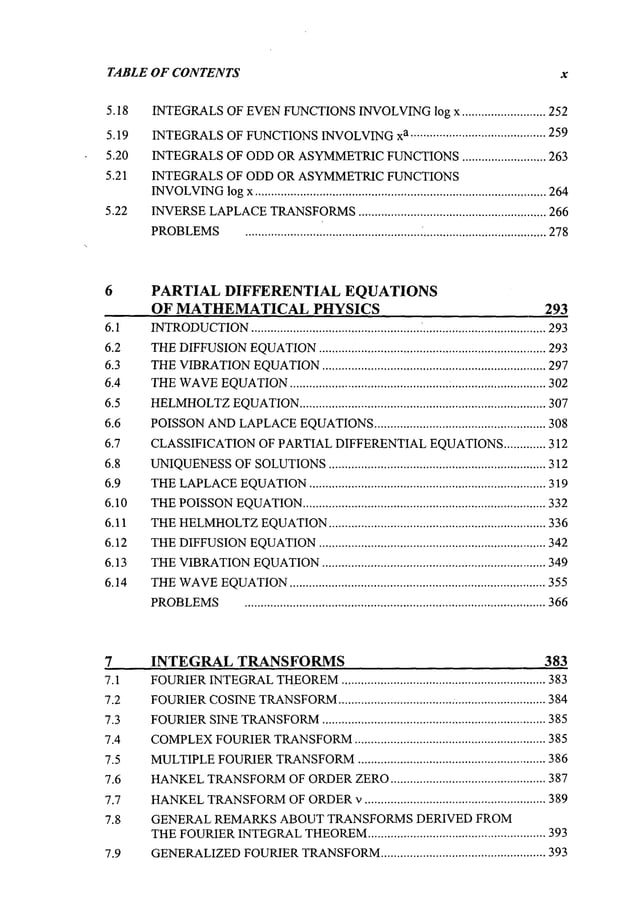
TABLE OF CONTENTS ix
4.8
4.9
4.10
4.11
4.12
4.13
4.14
4.15
4.16
4.17
4.18
4.19
4.20
4.21
4.22
TORSIONAL
VIBRATION
OFCIRCULAR
BARS
...................................... 132
ORTHOGONALITY
ANDORTHOGONAL
SETS OF FUNCTIONS
.......... 133
GENERALIZED
FOURIER
SERIES
.............................................................. 135
ADJOINT
SYSTEMS
...................................................................................... 138
BOUNDARY
VALUE
PROBLEMS
............................................................... 140
EIGENVALUE
PROBLEMS
.......................................................................... 142
PROPERTIESOF EIGENFUNCTIONS
OF SELF-ADJOINTSYSTEMS
.... 144
STURM-LIOUVILLE
SYSTEM
..................................................................... 148
STURM-LIOUVILLESYSTEMFOR FOURTHORDEREQUATIONS..... 155
SOLUTION OF NON-HOMOGENEOUS
EIGENVALUEPROBLEMS...... 158
FOURIER
SINE
SERIES
................................................................................. 161
FOURIER
COSINE
SERIES
........................................................................... 163
COMPLETE
FOURIER
SERIES
..................................................................... 165
FOURIER-BESSEL
SERIES
........................................................................... 169
FOURIER-LEGENDRE
SERIES
.................................................................... 171
PROBLEMS
............................................................................................. 174
5 FUNCTIONSOF A COMPLEX
VARIABLE 185
5.1 COMPLEX
NUMBERS
................................................................................... 185
5.2 ANALYTIC
FUNCTIONS
.............................................................................. 189
5.3 ELEMENTARY
FUNCTIONS
........................................................................ 201
5.4 INTEGRATION
INTHE
COMPLEX
PLANE
............................................... 207
5.5 CAUCHY’S
INTEGRAL
THEOREM
............................................................. 210
5.6 CAUCHY’S
INTEGRAL
FORMULA
............................................................. 213
5.7 INFINITE
SERIES
........................................................................................... 216
5.8 TAYLOR’S
EXPANSION
THEOREM
........................................................... 217
5.9 LAURENT’S
SERIES
...................................................................................... 222
5.10 CLASSIFICATION
OFSINGULARITIES
..................................................... 229
5.11 RESIDUES
AND
RESIDUE
THEOREM
....................................................... 231
5.12 INTEGRALS
OFPERIODIC
FUNCTIONS
................................. .’.................
236
5.13 IMPROPER
REAL
INTEGRALS
.................................................................... 237
5.14 IMPROPER REAL INTEGRALS INVOLVING CIRCULAR
FUNCTIONS
................................................................................................... 239
5.15 IMPROPER REAL INTEGRALS OF FUNCTIONS HAVING
SINGULARITIES
ON
THE
REAL
AXIS
....................................................... 242
5.16 THEOREMS
ONLIMITINGCONTOURS
.......... i .........................................245
5.17 EVALUATIONOF REAL IMPROPER INTEGRALS BY
NON-CIRCULAR
CONTOURS
............................................................ 249
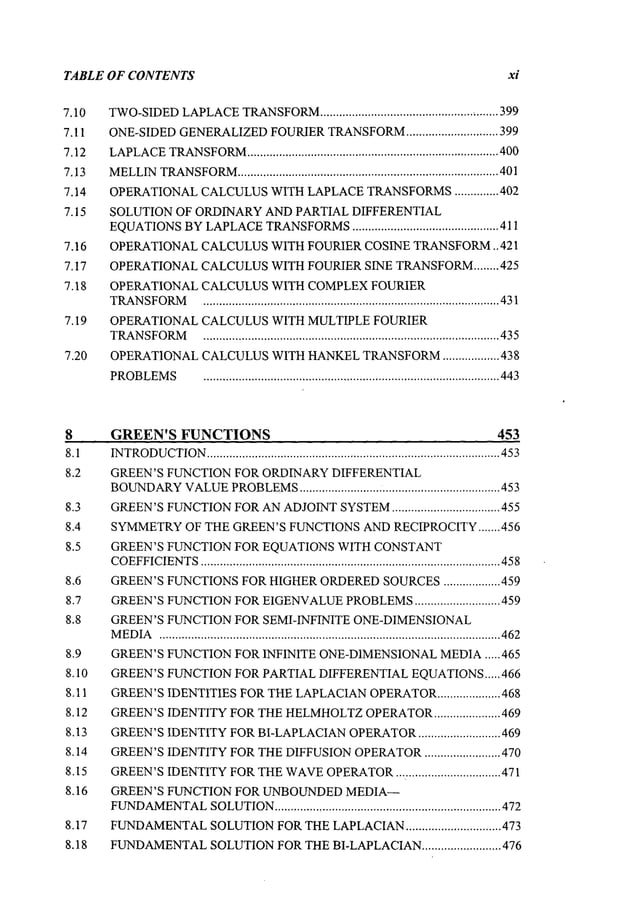
TABLE OF CONTENTS x
5.18 INTEGRALS
OFEVEN
FUNCTIONS
INVOLVING
log x .......................... 252
5.19 INTEGRALS
OFFUNCTIONS
INVOLVING
xa ........................................... 259
5.20 INTEGRALS
OFODD
ORASYMMETRIC
FUNCTIONS
.......................... 263
5.21 INTEGRALS OF ODD OR ASYMMETRICFUNCTIONS
INVOLVING
logx.......................................................................................... 264
5.22 INVERSE
LAPLACE
TRANSFORMS
.......................................................... 266
PROBLEMS
...................................................... . ......................................278
6 PARTIAL DIFFERENTIAL EQUATIONS
OF MATHEMATICALPHYSICS 293
6.1
6.2
6.3
6.4
6.5
6.6
6.7
6.8
6.9
6.10
6.11
6.12
6.13
6.14
INTRODUCTION
.................................................... .’.......................................
293
THE
DIFFUSION
EQUATION
...................................................................... 293
THE
VIBRATION
EQUATION
..................................................................... 297
THE
WAVE
EQUATION
................................................. : .............................302
HELMHOLTZ
EQUATION
............................................................................ 307
POISSON
AND
LAPLACE
EQUATIONS
..................................................... 308
CLASSIFICATION
OF PARTIAL
DIFFERENTIAL
EQUATIONS
............. 312
UNIQUENESS
OF
SOLUTIONS
................................................................... 312
THE
LAPLACE
EQUATION
......................................................................... 319
THE
POISSON
EQUATION
........................................................................... 332
THE
HELMHOLTZ
EQUATION
.................................................................... 336
THE
DIFFUSION
EQUATION
....................................................................... 342
THE
VIBRATION
EQUATION
..................................................................... 349
THE
WAVE
EQUATION
............................................................................... 355
PROBLEMS
............................................................................................. 366
7 INTEGRAL TRANSFORMS 383
7.1
7.2
7.3
7.4
7.5
7.6
7.7
7.8
7.9
FOURIER
INTEGRAL
THEOREM
............................................................... 383
FOURIER
COSINE
TRANSFORM
.................................... ............................ 384
FOURIER
SINE
TRANSFORM
...................................................................... 385
COMPLEX
FOURIER
TRANSFORM
............................................................ 385
MULTIPLE
FOURIER
TRANSFORM
.......................................................... 386
HANKEL
TRANSFORM
OFORDER
ZERO
................................................ 387
HANKEL
TRANSFORM
OFORDER
v ........................................................ 389
GENERAL REMARKS ABOUT TRANSFORMS DERIVED FROM
THE
FOURIER
INTEGRAL
THEOREM
....................................................... 393
GENERALIZED
FOURIER
TRANSFORM
................................................... 393
TABLE OF CONTENTS xi
7.10 TWO-SIDED
LAPLACE
TRANSFORM
........................................................ 399
7.l 1 ONE-SIDED
GENERALIZED
FOURIER
TRANSFORM
............................. 399
7.12 LAPLACE
TRANSFORM
............................................................................... 400
7.13 MELLIN
TRANSFORM
.................................................................................. 401
7.14 OPERATIONAL
CALCULUS
WITHLAPLACE
TRANSFORMS
.............. 402
7.15 SOLUTION OF ORDINARY ANDPARTIAL DIFFERENTIAL
EQUATIONS
BYLAPLACE
TRANSFORMS
.............................................. 411
7.16 OPERATIONALCALCULUS
WITH FOURIER COSINE TRANSFORM
.. 421
7.17 OPERATIONAL
CALCULUS
WITHFOURIERSINE TRANSFORM
........ 425
7.18 OPERATIONAL CALCULUSWITH COMPLEXFOURIER
TRANSFORM
............................................................................................. 431
7.19 OPERATIONAL CALCULUSWITH MULTIPLE FOURIER
TRANSFORM
............................................................................................. 435
7.20 OPERATIONAL
CALCULUS
WITHHANKEL
TRANSFORM
.................. 438
PROBLEMS
............................................................................................. 443
8 GREEN’S FUNCTIONS 453
8.1
8.2
8.3
8.4
8.5
8.6
8.7
8.8
8.9
8.10
8.11
8.12
8.13
8.14
8.15
8.16
8.17
8.18
INTRODUCTION
............................................................................................ 453
GREEN’S FUNCTION FOR ORDINARYDIFFERENTIAL
BOUNDARY
VALUE
PROBLEMS
............................................................... 453
GREEN’S
FUNCTION
FOR
AN
ADJOINT
SYSTEM
.................................. 455
SYMMETRY
OF THE GREEN’SFUNCTIONS
ANDRECIPROCITY....... 456
GREEN’S FUNCTION FOR EQUATIONS WITH CONSTANT
COEFFICIENTS
.............................................................................................. 458
GREEN’S
FUNCTIONS
FORHIGHER
ORDERED
SOURCES
.................. 459
GREEN’S
FUNCTION
FOREIGENVALUE
PROBLEMS
........................... 459
GREEN’S FUNCTIONFOR SEMI-INFINITE ONE-DIMENSIONAL
MEDIA
........................................................................................................... 462
GREEN’SFUNCTION
FOR INFINITE ONE-DIMENSIONAL
MEDIA..... 465
GREEN’SFUNCTION
FOR PARTIALDIFFERENTIALEQUATIONS
..... 466
GREEN’S
IDENTITIES
FORTHELAPLACIAN
OPERATOR
.................... 468
GREEN’S
IDENTITY
FORTHEHELMHOLTZ
OPERATOR
..................... 469
GREEN’S
IDENTITY
FORBI-LAPLACIAN
OPERATOR
.......................... 469
GREEN’S
IDENTITY
FORTHEDIFFUSION
OPERATOR
........................ 470
GREEN’S
IDENTITY
FOR
THE
WAVE
OPERATOR
................................. 471
GREEN’S FUNCTION FOR UNBOUNDED
MEDIA--
FUNDAMENTAL
SOLUTION
....................................................................... 472
FUNDAMENTAL
SOLUTION
FORTHELAPLACIAN
.............................. 473
FUNDAMENTAL
SOLUTION
FORTHEBI-LAPLACIAN
......................... 476
TABLE OF CONTENTS xii
8.19
8.20
8.21
8.22
8.23
8.24
8.25
8.26
8.27
8.28
8.29
8.30
8.31
8.32
8.33
8.34
8.35
FUNDAMENTAL
SOLUTIONFOR THE HELMHOLTZ
OPERATOR
....... 477
FUNDAMENTAL
SOLUTION
FORTHEOPERATOR,
- V
2 + ~t2 .............. 479
CAUSAL FUNDAMENTAL
SOLUTION FOR THE DIFFUSION
OPERATOR
.................................................................................................... 480
CAUSAL FUNDAMENTALSOLUTION FOR THE WAVE
OPERATOR
.................................................................................................... 482
FUNDAMENTAL
SOLUTIONS FOR THE BI-LAPLACIAN
HELMHOLTZ
OPERATOR
........................................................................... 484
GREEN’S FUNCTION FOR THE LAPLACIAN OPERATORFOR
BOUNDED
MEDIA
...................... ~................................................................. 485
CONSTRUCTION OF THE AUXILIARY FUNCTION--METHOD
OF
IMAGES
..................................................................................................... 488
GREEN’SFUNCTION
FOR THE LAPLACIAN
FOR HALF-SPACE
......... 488
GREEN’S FUNCTION FOR THE LAPLACIAN BY EIGENFUNCTION
EXPANSION
FOR
BOUNDED
MEDIA
........................................................ 492
GREEN’S FUNCTION FOR A CIRCULAR AREA FOR THE
LAPLACIAN
................................................................................................... 493
GREEN’S FUNCTION FOR SPHERICAL GEOMETRY
FOR THE
LAPLACIAN
................................................................................................... 500
GREEN’S FUNCTION FOR THE HELMHOLTZOPERATORFOR
BOUNDED
MEDIA
........................................................................................ 503
GREEN’S FUNCTION FOR THE HELMHOLTZOPERATORFOR
HALF-SPACE
.................................................................................................. 503
GREEN’S FUNCTION FOR A HELMHOLTZ
OPERATORIN
QUARTER-SPACE
......................................................................................... 507
CAUSAL GREEN’S FUNCTION FOR THE WAVEOPERATORIN
BOUNDED
MEDIA
........................................................................................ 510
CAUSALGREEN’S FUNCTION FOR THE DIFFUSION OPERATOR
FOR
BOUNDED
MEDIA
............................................................................... 515
METHODOF SUMMATION
OF SER/ES SOLUTIONS 1N
TWO-DIMENSIONAL
MEDIA
..................................................................... 519
PROBLEMS
.............................................................................................. 528
9 ASYMPTOTIC METHODS 537
9.1
9.2
9.3
9.4
9.5
9.6
9.7
INTRODUCTION
........................................................................................... 537
METHOD
OFINTEGRATION
BY
PARTS
................................................... 537
LAPLACE’S
INTEGRAL
............................................................................... 538
STEEPEST
DESCENT
METHOD
.................................................................. 539
DEBYE’S
FIRST
ORDER
APPROXIMATION
............................................. 543
ASYMPTOTIC
SERIES
APPROXIMATION
................................................. 548
METHOD
OFSTATIONARY
PHASE
.......................................................... 552
TABLE OF CONTENTS xiii
9.8 STEEPEST
DESCENT
METHOD
IN TWO
DIMENSIONS
......................... 553
9.9 MODIFIED SADDLE POINT METHOD--SUBTRACTIONOF A
SIMPLE
POLE
................................................................................................. 554
9.10 MODIFIED SADDLEPOINT METHOD:SUBTRACTIONOF POLE
OF
ORDER
N.................................................................................................. 558
9.11 SOLUTION OF ORDINARYDIFFERENTIAL EQUATIONS FOR
LARGE
ARGUMENTS
............................... , ...................................................559
9.12 CLASSIFICATION
OFPOINTS
ATINFINITY
............................................ 559
9.13 SOLUTIONS OF ORDINARYDIFFERENTIAL EQUATIONSWITH
REGULAR
SINGULAR
POINTS
................................................................... 561
9.14 . ASYMPTOTICSOLUTIONSOF ORDINARYDIFFERENTIAL
EQUATIONSWITH IRREGULAR SINGULARPOINTS OF
RANK
ONE
..................................................................................................... 563
9.15 THE PHASE INTEGRAL ANDWKBJ METHODFOR AN
IRREGULAR
SINGULAR
POINT
OFRANK
ONE
...................................... 568
9.16 ASYMPTOTIC SOLUTIONS OF ORDINARYDIFFERENTIAL
EQUATIONS WITH IRREGULAR SINGULAR POINTS OF RANK
HIGHER
THAN
ONE
...................................................................................... 571
9.17 ASYMPTOTICSOLUTIONS OF ORDINARYDIFFERENTIAL
EQUATIONS
WITH
LARGE
PARAMETERS
.............................................. 574
PROBLEMS
............................................................................................. 581
APPENDIXA INFINITE SERIES 585
A.1
A.2
A.3
A.4
INTRODUCTION
........................................................................................... 585
CONVERGENCE
TESTS
............................................................................... 586
INFINITE
SERIES
OFFUNCTIONS
OFONE
VARIABLE
......................... 591
POWER
SERIES
.............................................................................................. 594
PROBLEMS
............................................................................................. 597
APPENDIX B SPECIAL FUNCTIONS 599
B.1
B.2
B.3
B.4
B.5
B.6
B.7
B.8
THE
GAMMA
FUNCTION
F(x).................................................................... 599
PSI
FUNCTION
t~(x)
....................................................................................... 600
INCOMPLETE
GAMMA
FUNCTION
3’ (x,y) ................................................ 602
BETA
FUNCTION
B(x,y)
............................................................................... 603
ERROR
FUNCTION
erf(x)............................................................................. 604
FRESNEL
FUNCTIONS
C(x),S(x)AND
F(x)............................................... 606
EXPONENTIAL
INTEGRALS
El(x) AND
En(x).......................................... 608
SINE
AND
COSINE
INTEGRALS
Si(x) AND
Ci(x) ..................................... 610
TABLE OF CONTENTS xiv
B.9
B.10
B.II
B.12
B.13
B.14
B.15
TCHEBYSHEV
POLYNOMIALS
Tn(x
) AND
Un(x).................................... 612
LAGUERRE
POLYNOMIALS
Ln(x
) .............................................................. 6! 3
ASSOCIATED LAGUERRE POLYNOMIALSrn
Ln(x
) ................................... 614
HERMITE
POLYNOMIALS
Hn(x)
................................................................ 615
HYPERGEOMETRIC
FUNCTIONS
F(a, b; c; x) .......................................... 617
CONFLUENTHYPERGEOMETRIC
FUNCTIONS M(a,c,s)
AND
U(a,c,x)
................................................................................................... 618
KELVIN
FUNCTIONS
(berv (x), beiv(x), kerv(x), kei(x)) .......................... 620
APPENDIX C ORTHOGONAL COORDINATE SYSTEMS 625
C.1
C.2
C.3
C.4
C.5
C.6
C.7
C.8
INTRODUCTION
.................................................... .".......................................
625
GENERALIZED
ORTHOGONAL
COORDINATE
SYSTEMS
.................... 625
CARTESIAN
COORDINATES
...................................................................... 627
CIRCULAR
CYLINDRICAL
COORDINATES
............................................ 627
ELLIPTIC-CYLINDRICAL
COORDINATES
............................................... 628
SPHERICAL
COORDINATES
....................................................................... 629
PROLATE
SPHEROIDAL
COORDINATES
................................................. 630
OBLATE
SPHEROIDAL
COORDINATES
................................................... 632
APPENDIX D DIRAC DELTA FUNCTIONS 635
D.1
D.2
D.3
D.4
D.5
D.6
D.7
DIRAC
DELTA
FUNCTION
.......................................................................... 635
DIRAC
DELTA
FUNCTION
OFORDER
ONE
............................................ 641
DIRAC
DELTA
FUNCTION
OFORDER
N.................................................. 641
EQUIVALENTREPRESENTATIONS OF DISTRIBUTED
FUNCTIONS
.................................................................................................. 642
DIRAC
DELTA
FUNCTIONS
IN n-DIMENSIONAL
SPACE
..................... 643
SPHERICALLY SYMMETRICDIRAC DELTA FUNCTION
REPRESENTATION
....................................................................................... 645
DIRAC DELTAFUNCTIONOF ORDERN IN
n-DIMENSIONAL
SPACE
.............................................................................. 646
PROBLEMS
............................................................................................. 648
APPENDIX E PLOTS OF SPECIAL FUNCTIONS 651
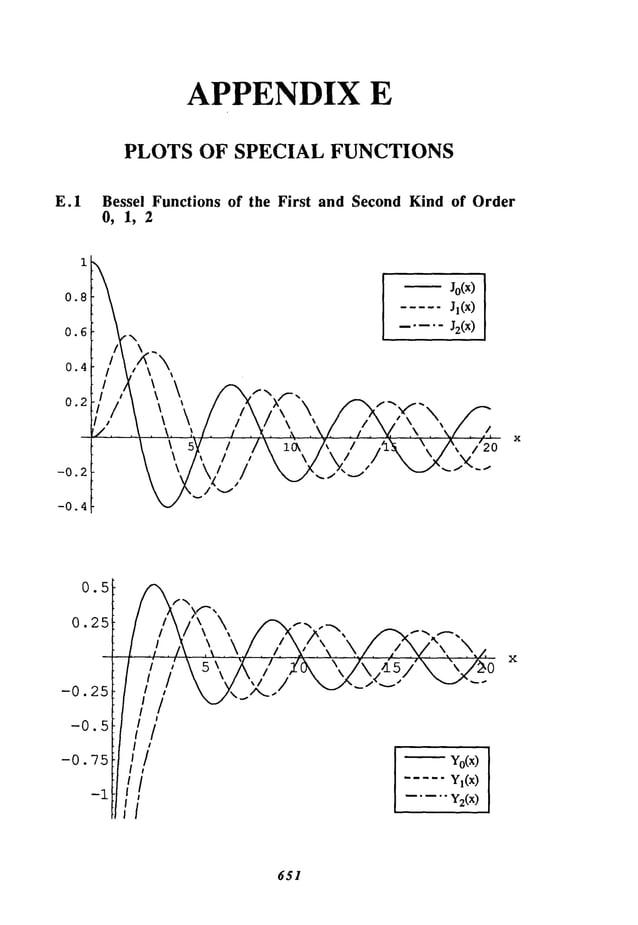
BESSEL FUNCTIONSOF THE FIRST ANDSECONDKIND OF
ORDER
0,1,2................................................................................................. 651
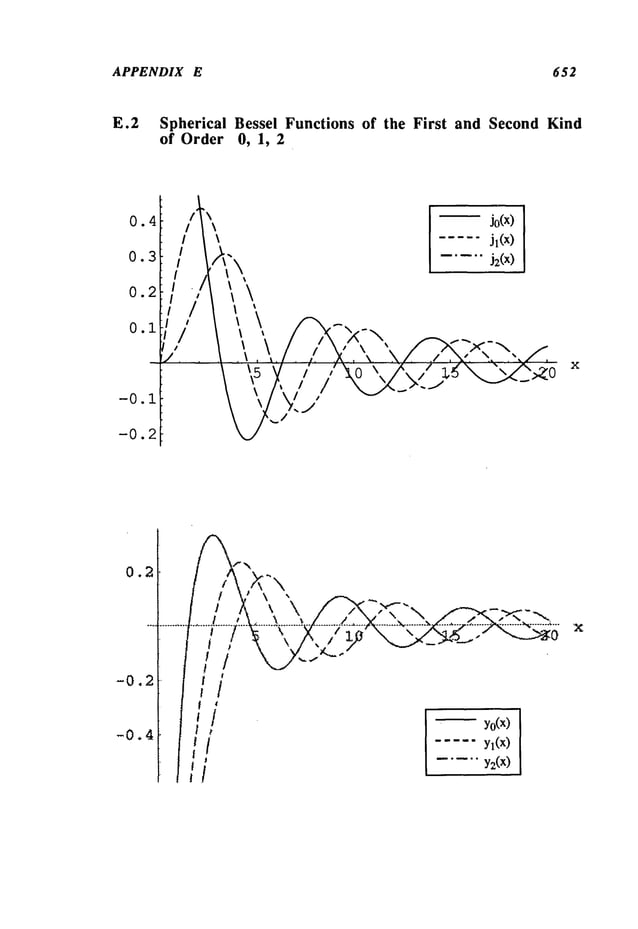
SPHERICAL BESSEL FUNCTIONS OF THE FIRST ANDSECOND
KIND
OF
ORDER
0,1, 2............................................................................... 652
TABLE OF CONTENTS xv
E.3
E.4
E.5
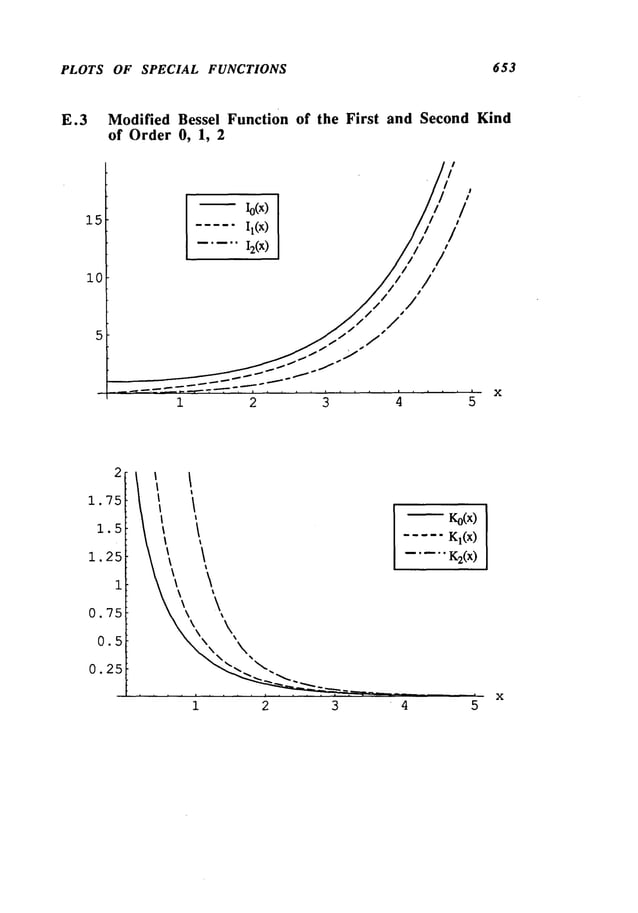
MODIFIED BESSEL FUNCTIONOF THE FIRST ANDSECOND
KIND
OF
ORDER
0,1,2................................................................................ 653
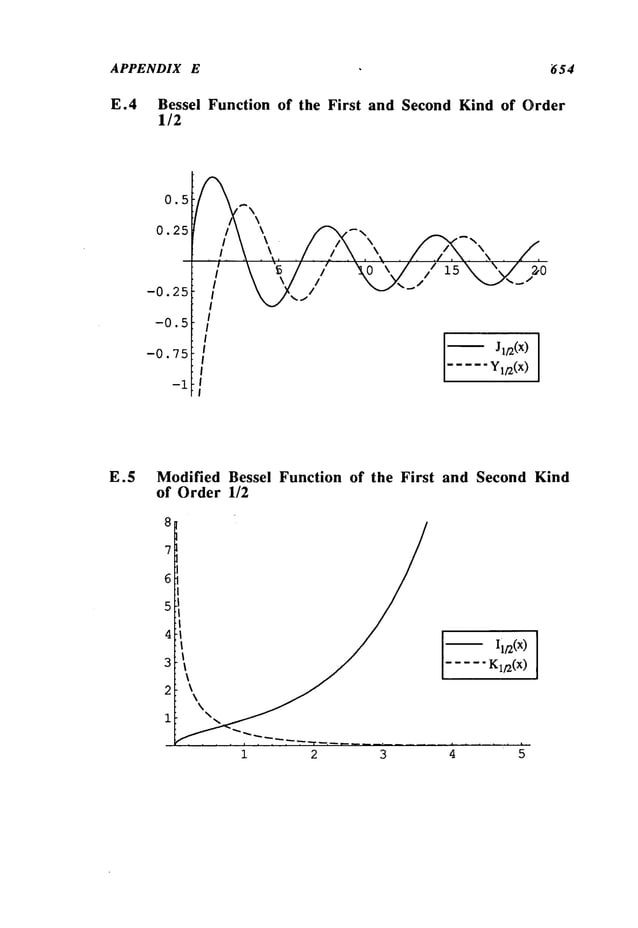
BESSEL FUNCTIONOF THE FIRST ANDSECONDKIND OF
ORDER
1/2.................................................................................................... 654
MODIFIED BESSEL FUNCTIONOF THE FIRST ANDSECOND
KIND
OF
ORDER
1/2.: ................................................................................... 654
REFERENCES 655
ANSWERS 663
CHAPTER
1................................................................................................................... 663
CHAPTER
2................................................................................................................... 665
CHAPTER
3................................................................................................................... 669
CHAPTER
4................................................................................................................... 670
CHAPTER
5...................................................... 2............................................................683
CHAPTER
6................................................................................................................... 690
CHAPTER
7................................................................................................................... 705
CHAPTER
8................................................................................................................... 710
CHAPTER
9................................................................................................................... 719
APPENDIX
A
................................................................................................................. 722
Index 723
1
ORDINARYDIFFERENTIAL EQUATIONS
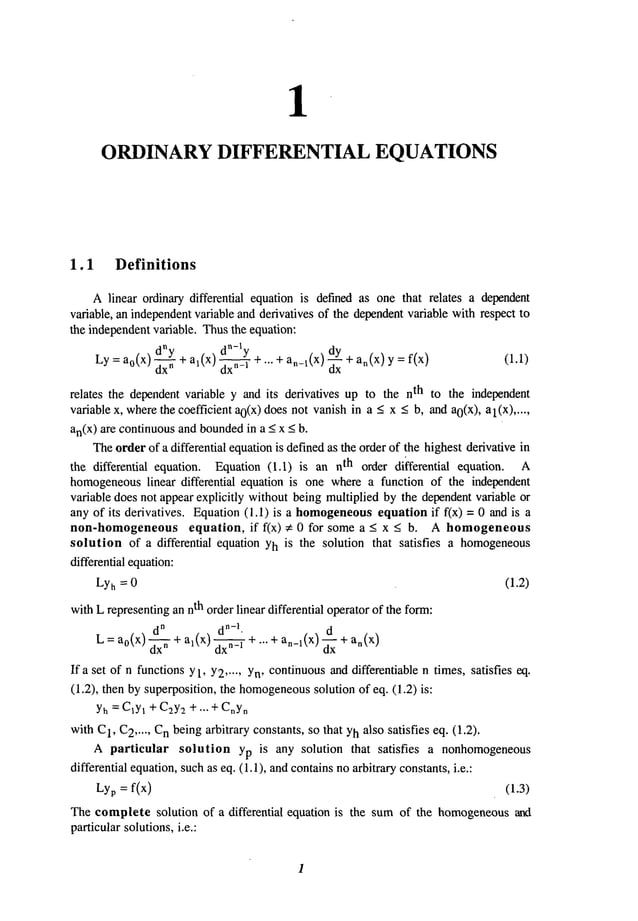
1.1 Definitions
Alinear ordinary differential equation is defined as one that relates a dependent
variable, an independentvariable and derivatives of the dependent
variable with respect to
the independentvariable. Thusthe equation:
Ly ao(x )
d"y da-~Y ~ + an(x) y = f(x) (1.1)
= -- + a~(x) d--~ + ... + an_~(x
)
dx
n ox
relates the dependentvariable y and its derivatives up to the nth to the independent
variable x, wherethe coefficient a0(x) doesnot vanishin < x <b,and
a0(x), al(x ) ....
an(X)are continuousand bounded
in < x < b.
Theorder of a differential equationis definedas the order of the highest derivative in
the differential equation. Equation (1.1) is an th order d ifferential e quation. A
homogeneous
linear differential equation is one where a function of the independent
variable does not appearexplicitly withoutbeing multiplied by the dependentvariable or
any of its derivatives. Equation (1.1) is a homogeneous
equation if f(x) = 0 and
non-homogeneous equation, if f(x) ~ 0 for some a _< < b. A hom
ogeneous
solution of a differential equation Yhis the solution that satisfies a homogeneous
differential equation:
Ly
h = 0 (1.2)
with Lrepresentingan nth order linear differential operator of the form:
dn dn-l’
~x
L = a0(x) d---~- + al(x) d--~ + ... + an_l(X)
If a set of n functionsy 1, Y2..... Yn,continuousand differentiable n times, satisfies eq.
(1.2), then by superposition, the homogeneous
solution of eq. (1.2)
yh = Cly
t + C2y2+ ... + Cny
n
withC
1, C
2 ..... C
n beingarbitrary constants, so that Yhalso satisfies eq. (1.2).
A particular solution yp is any solution that satisfies a nonhomogeneous
differential equation,suchas eq. (1.1), andcontainsnoarbitrary constants,i.e.:
Lyp = f(x) (1.3)
The complete solution of a differential equation is the sumof the homogeneous
and
particular solutions,i.e.:
CHAPTER 1 2
Y =Yh + Yp
Example1.1
Thelinear differential equation:
d2y
dx’--" ~ +4y=2x
2 +1
has a homogeneoussolution Yh = C1 sin 2x + C2 cos 2x and a particular solution
yp = x2/2. Each of the functions Yl = sin 2x and Y2 = cos 2x satisfy the equation
(d2y)/(dx2) + 4y = 0, and the constants C
1 and C
2 are arbitrary.
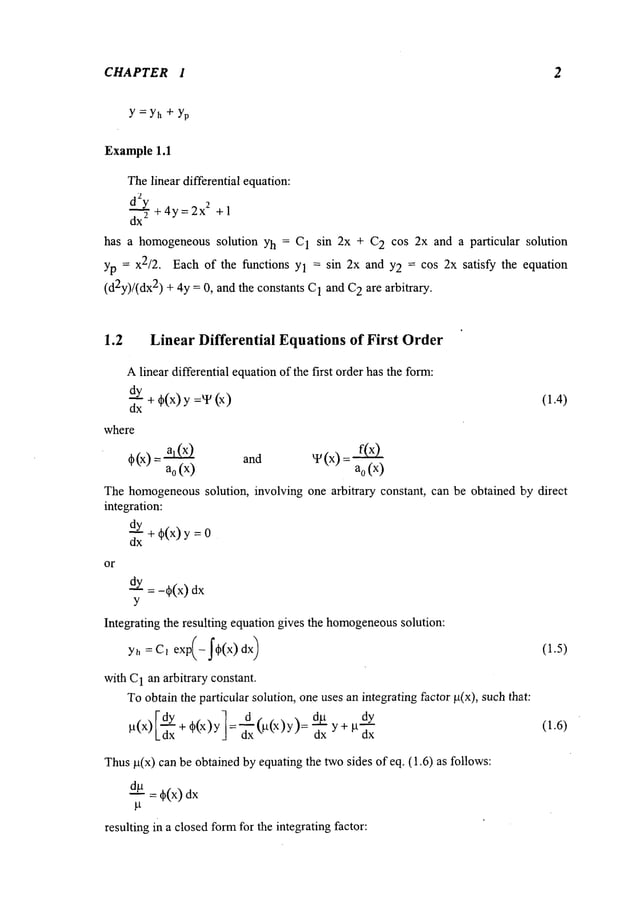
1.2 LinearDifferential Equations
of First Order
Alinear differential equationof the first order has the form:
~Y
÷~(x)
:v(x)
dx
where
~b(x) and ~ (x)
(×) (×)
a
o a
0
(1.4)
Thehomogeneous
solution, involving one arbitrary constant, can be obtained by direct
integration:
dy
-- + ~b(x) y =
dx
or
dy : -qb(x)
Y
Integrating the resulting equation gives the homogeneous
solution:
with C
1 an arbitrary constant.
Toobtain the particular solution, oneuses an integrating factor g(x), suchthat:
g(x) [~x + ~b(x) y I = _~x @(x)y): E dy
dx y+ ~
Thus~(x) can be obtained by equating the ~o sides of eq. (1.6) as follows:
~ = +(x)
resulting in a closedfo~for the integrating factor:
(1.5)
(1.6)
ORDINARY DIFFERENTIAL EQUATIONS 3
/.t(X) = exp(~¢(x)
Usingthe integrating factor, eq, (1.4) canbe rewritten in the form:
Thus,the completesolution of (1.4) can be written as:
Y=C1 exp(-~ ~(x)dx)+ exp(-~ ¢(x)dx)~ ~(x)/~(x)dx
(1.7)
(:.8)
(1.9)
1.3 Linear Independence and the Wronskian
Consider
a set of functions[yi(x)], i = 1, 2 ..... n. Aset of functionsare termed
linearly independenton(a, b) if there is no nonvanishing
set of constants 1, C
2 ..... C
n
whichsatisfies the followingequationidentically:
ClYl(X
) + C2yz(x)+ ... + CnYn(X) (1.10)
If Yl’Y2
..... Ynsatisfy (I.1), andif there exists a set of constantssuchthat (1.10)
satisfied, thenderivativesof eq. (1.10)are also satisfied, i.e.:
Cly ~ +C2Y ~ +...+CnY ~ =0
Cly ~" +C2Y~ +...+Cny ~ =0
(1.11)
-~c’ ~,(n-O_
CIY~
n-l) + C2Y(2
n-l) + ..... n-n -
For a non-zeroset of constants [Ci] of the homogeneous
algebraic eqs. (1.10) and (1.11),
the determinantof the coefficients of C
1, C
2 ..... Cn must vanish. Thedeterminant,
generallyreferred to as the Wronskian
of Yl, Y2..... Yn, becomes:
W(yl,y:~
.....
yn)=lyyin_l ) y~ ... y~n
I
(1.12)
yl°-1)... y~-’)[
If the Wronskian
of a set of functionsis not identically zero, the set of functions[Yi] is a
linearly independentset. Thenon-vanishingof the Wronskian
is a necessary and
sufficient conditionfor linear independence
of [Yi] for all x.
Example 1.2
If Yl =sin 2x, Y2= cos 2x:
CHAPTER 1 4
sin2x cos2x 1=
W(Yt,Y2)= 2 cos 2x -2 sin 2x
I -2 ~ 0
Thus,YlandY2are linearly independent.
If theset [Yi]is linearlyindependent,
thenanother
set [zi] which
is a linear
combination
of [Yi] is definedas:
zl = °q~Yt
+/~12Y2
+ ,.. + aqnY.
z2 = ~21Yl + (~22Y2 + ..- + (X2nYn
Zn = ~nlYl + ~n2Y2 + "’" + °t~Yn
with¢xij beingconstants,is alsolinearlyindependent
provided
that:
det[otij] ~ 0, because
W(zl)=
det[otij]- W(Yi)
1.4 Linear Homogeneous Differential Equation of Order n
with Constant Coefficients
Differentialequations
of ordern withconstantcoefficientshaving
the form:
Ly= a0Y
(n) + aly(n-0 + ... + an_~y’
+ any= 0 (1.13)
whereao, a1 ..... an are constants,witha0 ~ 0, canbereadilysolved.
Sincefunctionsemxcan bedifferentiated many
timeswithouta change
of its
functionaldependence
onx, thenonemay
try:
y= e
mx
wheremis a constant, as a possiblesolution of the homogeneous
equation.Thus,
operating
onywiththe differentialoperator
L, results:
Ly = (aomn+ aim
n-~ +... + an_~m
+ an)e
mx (1.14)
which
is satisfied bysetting the coefficientof emxto zero. Theresultingpoly~tomial
equationof degreen:
ao
mn+ aim
n-~ + ... + a,_lm+ an = 0 (1.-15)
is called the characteristic equation.
If the polynomial
in eq. (1.15)hasn distinct roots, 1, m
2 ..... m
n, thenthere are n
solutionsof the form:
Yi= emiX,
i =1,2..... n (1.16)
eachof whichsatisfies eq. (1.13). Thegeneralsolutionof the homogeneous
equation
(1.13)canbewrittenin termsof the n independent
solutionsof (1.16):
Yh= C1emlx + C2em2x + ". + Cn
em*x (1.17)
where
C
i are arbitraryconstants.
Thedifferential operatorLof eq. (1.13)canbewrittenin anexpanded
formin terms
of thecharacteristicrootsof eq. (1.15)as follows:
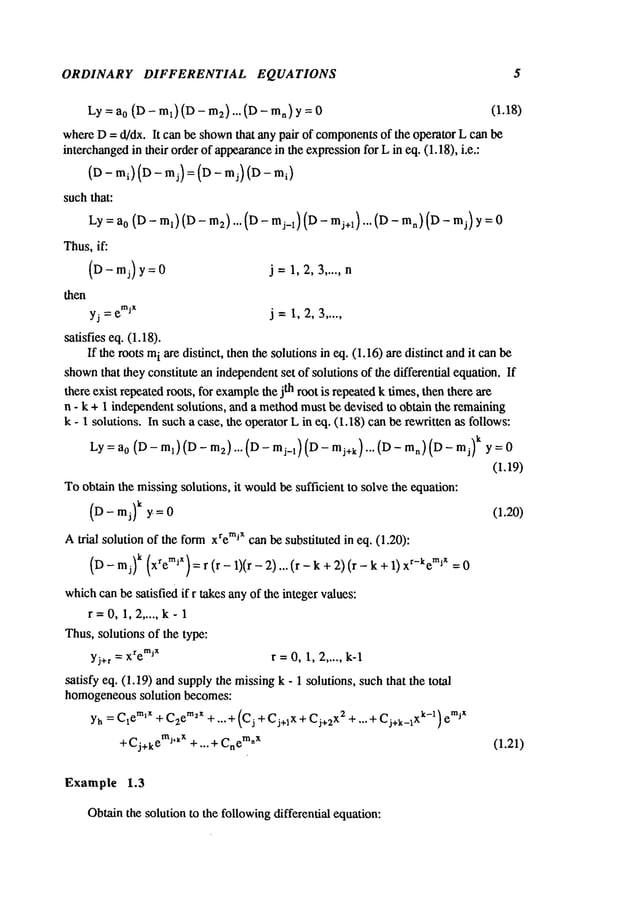
ORDINARY DIFFERENTIAL EQUATIONS 5
Ly:a0 (D- ml) (D- m2)...(D- ran) (1.18)
whereD= d/dx. It can be shown
that any pair of components
of the operator L can be
interchangedin their order of appearance
in the expressionfor L in eq. (1.18), i.e.:
(D- mi) (D- mj) = (D- m j) (D-
suchthat:
Ly=ao (D- ml) (D- m2)... (D- mj_1) (D- mj+l)... (D- mn) (D-
Thus,if:
(D-mj) y:0 j= 1,2,3 ..... n
then
yj = e
’~jx j =I, 2, 3 .....
satisfies eq. (1.18).
If the roots m
i are distinct, then the solutions in eq. (I. 16) are distinct andit can
shown
that they constitute an independentset of solutions of the differential equation. If
there exist repeatedroots, for example
the jth root is repeatedk times, then there are
n - k + 1 independentsolutions, and a method
must be devised to obtain the remaining
k - 1 solutions. In such a case, the operator L in eq. (1.18) can be rewritten as follows:
Ly=a 0 (D-ml)(D-m2)...(D-mj_l)(D-mj+k)...(D-m~)(D-mj) k y=0
(1.19)
Toobtain the missingsolutions, it wouldbe sufficient to solve the equation:
(D- mj) k y = 0 (1.20)
Atrial solution of the formxremixcan be substituted in eq. (1.20):
(D- mj)k (xremjX)=r (r- 1)(r- 2)... (r- k + 2)(r-k xr-keml
x
whichcanbe satisfied if r takes anyof the integer values:
r=0, 1,2 ..... k-1
Thus,solutions of the type:
Yj+r = xremjX r =0,1, 2 ..... k-1
satisfy eq. (1.19) and supplythe missingk - 1 solutions, suchthat the total
homogeneoussolution becomes:
Yh= C1emlx + C2em2x + ---+ (Cj + Cj+Ix + C j+2 X2 q- ...--t- Cj+k_lxk-1) e
mJx
+ C j+ k emJ÷kx
+... +Cn
em
*x (1.21)
Example 1.3
Obtainthe solution to the followingdifferential equation:
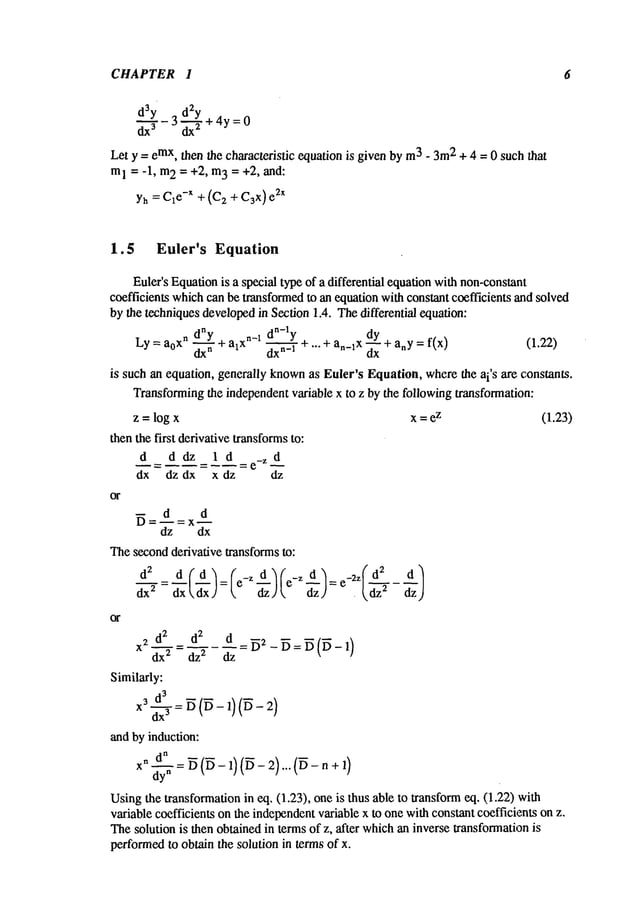
CHAPTER I
d3y 3 d2y
dx 3 ~-~+4y = 0
Let y = emx,then the characteristic equation is given by m
3 - 3m
2 + 4 = 0 such that
m
1 = -1, m
2 = +2, m
3 = +2, and:
Yh= C1
e-x + (C2 + C3x)e2X
6
1.5 Euler’s Equation
Euler’s Equationis a special type of a differential equationwithnon-constant
coefficients whichcan be transformedto an equation with constant coefficients and solved
by the techniquesdevelopedin Section 1.4. Thedifferential equation:
dny dn-ly
+ an_ix ~ + anY= f(x) (1.22)
Ly=aoxndx---~- +alxn-~dxn-
1 + ...
~lx
is such an equation, generally known
as Euler’s Equation, wherethe ai’s are constants.
Transformingthe independentvariable x to z by the following transformation:
z = log x x = e
z (1.23)
then the first derivative transformsto:
d d dz 1 d =e_Z
d
-- d d
dz dx
Thesecondderivative transformsto:
d 2 d d
d-~ = ~xx (~x) = (e-Z ~d~) (e-Z ~z) = e-2Z(~z2
X
2 _
""-~ = ~’2 dz
Similarly:
~d by induction:
x 2)... +,)
dy
n
Using the ~ansfo~afion in ~. (1.23), one is thus able to ~ansform~. (1.22)
v~able coefficienm on ~e inde~ndent v~able x to one wi~ cons~t coefficienm on z.
~e solution is ~en obtained in terms of z, ~ter which~ inverse ~ansfo~ation is
peffo~ to ob~n the solution in mrmsof x.
ORDINARY DIFFERENTIAL EQUATIONS
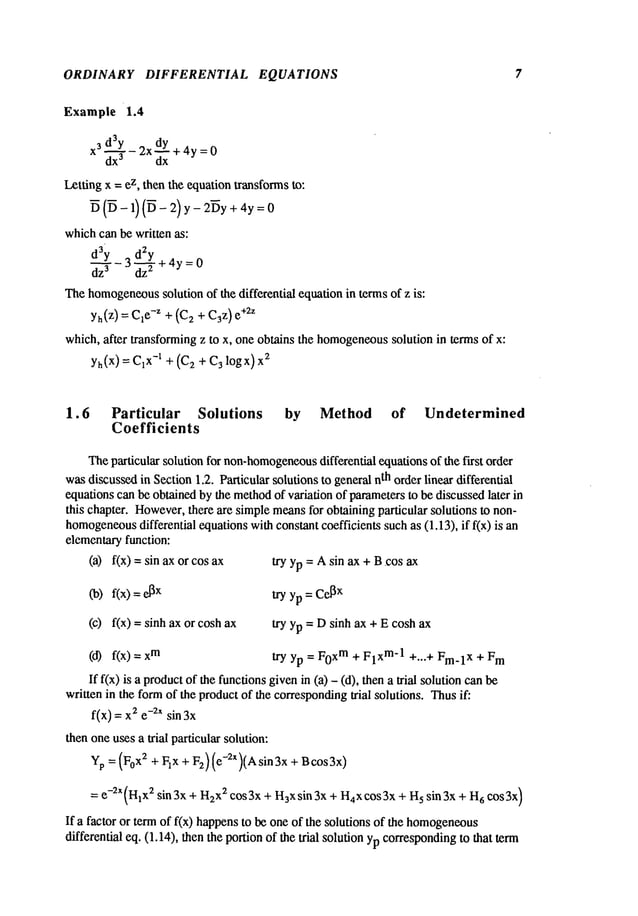
Example 1.4
3d3y 2xdY+4y=0
x dx~ Y- dx
Letting x =ez, then the equationtransformsto:
~ (~ - 1)(~ - 2) y - 2~y + 4y
whichcan be written as:
d3Y 3 d2y
dz---- ~- -~+4y=O
Thehomogeneous
solution of the differential equationin terms of z is:
yh(z) = Cle-z +(C
2 + C3z)e
+2z
which, after transformingz to x, one obtains the homogeneous
solution in terms of x:
yh(x)= x-x q-(C
2-I- C
3 logx
) x2
7
1.6 Particular Solutions by Method of Undetermined
Coefficients
Theparticular solution for non-homogeneous
differential equationsof the first order
wasdiscussedin Section1.2. Particular solutions to general nth order linear differential
equations can be obtained by the method
of variation of parametersto be discussed later in
this chapter. However,
there are simplemeansfor obtaining particular solutions to non-
homogeneous
differential equations withconstant coefficients such as (1.13), if f(x) is
elementaryfunction:
(a) f(x) = sin ax or cos
Co)
f(x)=
(c) f(x) = sinh ax or cosh
(d) f(x) m
try yp = Asin ax +B.cos ax
try yp = Ce[
~x
try yp = Dsinh ax + E cosh ax
try yp = F0xm+ FlXm-1+...+ Fm.lX + F
m
If f(x) is a productof the functionsgivenin (a) - (d), then a trial solution
written in the formof the productof the corresponding
trial solutions. Thusif:
f(x) = 2 e-~xsin 3x
then oneuses a trial particular solution:
Yp =(F0x2 + Fix + F2) (e-2X)(Asin3x + Bcos3x)
= e-2x (H1
X2sin 3x + H2
x2 cos 3x + H3xsin 3x + H4xcos 3x + H
5 sin 3x + H
6 cos 3x)
If a factor or term of f(x) happensto be one of the solutions of the homogeneous
differential eq. (1.14), then the portion of the trial solution ypcorresponding
to that term
CHAPTER 1 8
or factor of f(x) mustbe multiplied by k, w
here an i nteger kischo
sen such that the
portion of the trial solution is one powerof x higher than any of the homogeneous
solutions of (1.13).
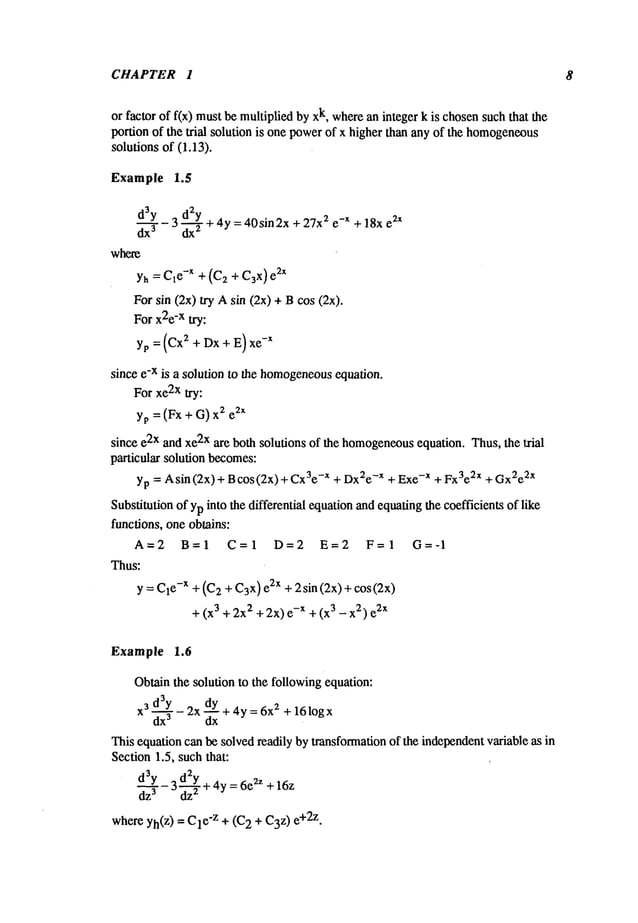
Example 1.5
d3y 3 d2y
dx3 ~’T+4Y
= 40sin2x + 27x2 e-x + 18x e2x
where
Yh= Cle-x + (C2 + C3x)2x
For sin (2x) try Asin (2x) + Bcos (2x).
For x2e
-x try:
yp = (Cx
2 + Dx+ E) xe
-x
since e-x is a solution to the homogeneous
equation.
For xe2x try:
yp = (Fx + G) 2 e2x
since e2x and xe2x are both solutions of the homogeneous
equation. Thus, the Ixial
particular solution becomes:
yp = A sin (2x) + B cos (2x) + -x + Dx
2e-x + Ex
e- x + Fx3e2x + Gx
2e2x
Substitution ofyp into the differential equationandequating the coefficients of like
functions, one obtains:
A=2 B=I C=I D=2 E=2 F=I G=-I
Thus:
y = C1
e-x + (C
2 + C3
x) e2x + 2 sin (2x) + cos (2x)
+ (x3 + 2x
2 + 2x) -x +(x3 - x2) e2x
Example 1.6
Obtainthe solution to the followingequation:
3
x3 d~Y- 2x dy + 4y = 6x2 + 161ogx
dx
3 dx
This equation can be solvedreadily by transformationof the independentvariable as in
Section 1.5, suchthat:
d~33Y
- 3 d~22Y
+ 4y=6e2Z+16z
whereyh(z) -- e’z + (C2 + C3
z) e +2z.
ORDINARY DIFFERENTIAL EQUATIONS 9
For e2z try Az2e
2z since e2z and ze2z are solutions of the homogeneous
equation,
and for z try Bz+ C. Substituting in the equation on z, one obtains:
A=I B=4 C=0
yp(z) : z2e2z + 4z
yp(X) : (logx) 2 x2 + 41ogx
y=C,x-1 +(C2 + C3 logx) 2 +x2(logx) 2 + 41ogx
1.7 Particular Solutions by the Method of Variations of
Parameters
Exceptfor differential equationswithconstantcoefficients, .it is verydifficult to
guess at the formof the particular solution. This section gives a treatmentof a general
method
by whicha particular solution can be obtained.
Thehomogeneous
differential equation (1.2) has n independentsolutions, i.e.:
Yh= Clyl + C2Y2
+ ... + CnYn
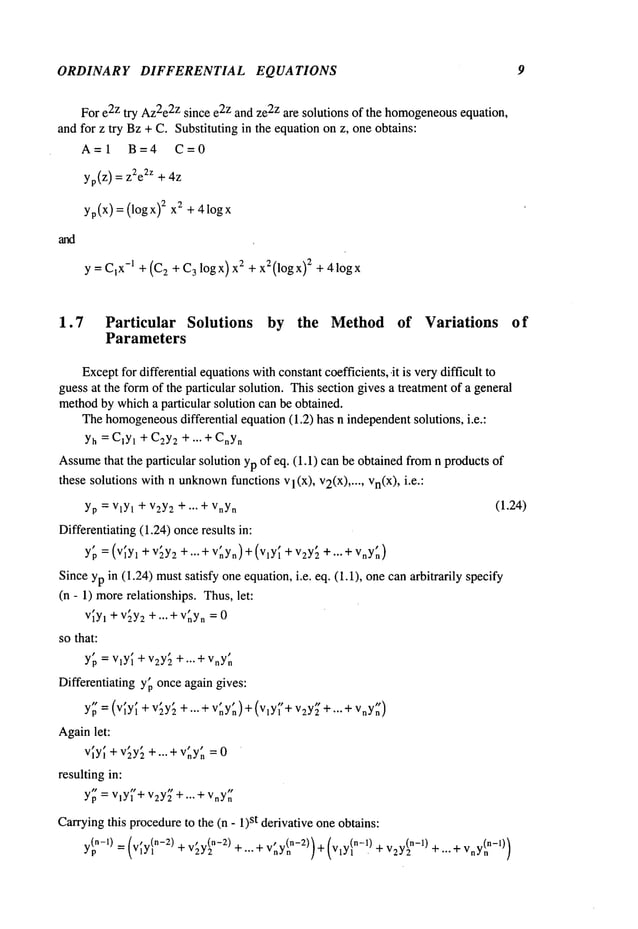
Assume
that the particular solution yp of eq. (1.1) can be obtained fromn products
these solutions with n unknown
functions Vl(X), v2(x) ..... Vn(X),
i.e.:
yp = vly~ + v2y
2 + ... + Vny
n (1.24)
Differentiating (1.24) onceresults in:
yp= v l+v2Y2+...+VnYn + vlyl+v 2 +...+VnY
~
Sinceyp in (1.24) mustsatisfy oneequation, i.e. eq. (1.1), one canarbitrarily specify
(n - 1) morerelationships. Thus,let:
v~y~+v~y~+ ... + v~y
n =0
so that:
’ ’ + v~y~ ’
yp = v~yl +... + Vny
n
Differentiating yp onceagain gives:
,, ( ...... )( ...... )
yp = v~y~+ v~y
2 +... + Vny
n + vlY
1 + v2y
2 + ... + Vny
n
Againlet:
v~y~
+v~y~
+... +v;y;=0
resulting in:
v~yl + +
Yp= ,,
,, ,,
v2y2+... Vny
n
Carryingthis procedureto the (n - 1)st derivative oneobtains:
v~y(2
n-2) ¯ (n-~) / (n-~). v2y(~n-1)(n-1)~
=~v~yin-2)+ +...+Vny n )+~VlYl . ~" +...+Vny
n
Yp
CHAPTER I 1 0
andletting:
’ (~-2)
(2~-2)’
’ @-2)
v~ y~ + v2 y + ... + v~Yn = 0
then
y(pn-1)=vlyln-1)+ v2Y(2n-1)
+ Vny(nn-1)
Thusfar (n - 1) conditionshavebeenspecified onthe functions 1, v2 ..... vn. The n
th
derivative is obtainedin the form:
y(p") : v~yln-1)+v~y(2n-1)+¯ , (,-i)
... + Vny
n -I-Vlyln)+v2Y(2
n) +... +VnY(n
n)
Substitution of the solution y andits derivatives into eq. (1.1), andgroupingtogether
derivatives of each solution, one obtains:
v~ [aoYl
~) +axyl~-O
+ ... +anY~
]+ v2 [aoY~)+
a~y(~-O
+ ... +anY
2]+...
¯ (~-1)1
+v.[aoy(n’~)+
aly(n"-l’ +... + anYn
] +aO[v~ylr’-l’+v~Y(2n-"
+ .., +vnYn
] : l:’(X)
Theterms in the square brackets whichhavethe formLyvanish since each Yi is a
solution of Ly
i =0, resulting in:
v;yl,~_,) +v~y(2n_l)
.. . +v:y(nn-1) :f(
a0(x)
Thesystemof algebraic equations on the unknown
functions v~, v~ ..... v~ can nowbe
written as follows:
v~yi + v~Y2
Vly1 + v2Y
2
+... +vny
n = 0
+... +vny
n = 0
...... (1.25)
vyl°-2/+°-2/+...+
v:y
v~yln_,)
+ v~y(zn_l)
+... + v:y(nn_,)=
a0(x)
Thedeterminantof the coefficients of the unknown
functions [v~] is the Wronskian
of
the system, whichdoes not vanish for a set of independentsolutions [Yi]" Equationsin
(1.25) give a uniqueset of functions [v~], whichcan be integrated to give [vii, thereby
givinga particular solution yp.
Themethod
of variation of the parametersis nowapplied to a general 2nd order
differential equation.Let:
a0(x) y’+at(x) y¯+ a2(x) y = f(x)
such that the homogeneous
solution is given by:
Yh= C~Yl(X)+ C2Y2(X)
and a particular solution can be foundin the form:
yp = v~yl + vZy
2
wherethe functions v1 and v2 are solutions of the twoalgebraic equations:
ORDINARY DIFFERENTIAL EQUATIONS 11
and
vt.y~ + v2y
2 =0
_ f(x)
v~y~ +v~y[ a0(x
)
Solvingfor v~ and v2, one obtains:
. -Y2 f(x)/a0(x) y2
V|~
y~y~ - y~y~_ ao(x) W(x)
and
, y, f(x)/ao(x ) =-~ y~ f(x)
V
2
--
y~y;_ - y~y~ ao(x ) W(x)
Direct integration of these twoexpressionsgives:
and
x
v, =-I y:(r/) f(r/) dr/
ao(r/)
x
v2= +j" yl(r/) f(r/) dr/
Theunknown
functions v I and v2 are then substituted into yp to give:
X
yp =_y,(x) I yz(r/)f(r/) dr~+y_9(x) f Yl(rl)f(r])
a0(r~) W(O) J a~(~ W---~) dr/
x~y~(r/)y~_(x)-yl(x)Y2(r/)f(r/)
dr/
w(.) ,,0(7)
Example 1.7
Obtainthe completesolution to the followingequation:
y" - 4y = e
x
Thehomogeneous
solution is given by:
Yh = CIe2x + C2
e-2x
wherey~ = eZ
x, yg_= e-~-x, ao(x) = 1, and the Wronskian
is given by:
W(x)=y~y~ -y~y2 =-4
Theparticular solution is thus givenby the followingintegral:
CHAPTER 1 12
Xe2r/ e_2x
_ e2
x e-Zn
yp = J
(-4)
!
dr/= --" e
x
3
Thecomplete solution becomes:
y = C1
e2x + C2e
-2x _ -~ e
x
1.8 Abel’s Formula for the Wronskian
TheWronskian
for a set of functions [Yi] can be evaluatedby using eq. (1.12).
However,
one can obtain the Wronskian
in a closed formwhenthe set of functions [Yi]
are solutions of an ordinarydifferential equation.Differentiating the determinantin (1.12)
is equivalent to summing
n-determinantswhereonly one rowis differentiated in each
determinanti.e.:
dW
dx
~,~.-2)
¢I
n-l)
y[
y(2
n-2)
Y~
Y~
Y:
y(n
n-2)
y(n
n-l)
Yl
+ y~’
y~n-1)
y~n-1)
Y2 ." Yn
Y~ ." Yn
Y~ "" Yn
y(n-1) y(nn-1)
y(n-l) y(nn-l)
Yl Y2 --. Yn
"" Y.
+
yl
n-2)
yl
n)
y(2n -2) ... y(~n-2)
Sincethere are twoidentical rowsin the first (n - 1) determinants,eachof these
determinantsvanish, thereby leaving only the non-vanishinglast determinant:
dW
Yl Y2 ... Yn
Yl Y[ ... Y~
In-2)
yl n) y(2 n) ...
Substitutionof (1.2) for yl
")
, i.e.:
y(n-2)
11
y!n) =- al(x...~)" (n-l) a2(x).
an-l(X)., an(x)
a0(x) Yi
- ~ Yi -
a0(x
)
...-~Yi ao(x ) Yi
(1.26)
(].27)
ORDINARY DIFFERENTIAL EQUATIONS 13
into the determinantof (dW)/(dx),and manipulatingthe determinant, by successively
multiplyingthe first rowby an/a0, the secondrowby an_l/a0, etc., and addingthemto
the last row,one obtains:
d__~_W:
_a,(x_~)
dx a0(x)
whichcan be integrated to give a closed formformulafor the Wronsldan:
( I" a~(x)
W(x) = 0 exp~j- a --~ a x~ (1.28)
with W
0 = constant. This is knownas Abel’s Formula.
It should be noted that W(x)cannotvanish in a region < x < b unless W
0van
ishes
identically, al(x) --> ~ or ao(x) ---> 0 at some
point in a _<< b.Since thelasttwo a
re
ruled out, then W(x)cannot vanish.
Example 1.8
Considerthe differential equation of Example
1.3. TheWronskian
is given by:
W(x) = W0exp(~-3 dx) e-3x
whichis the Wronskian
of the solutions of the differential equation. Toevaluate the
constant W
0, one can determinethe dominantterm(s) of each solutions’ Taylorseries,
find the leading termof the resulting Wronskian
and then take a limit as x --> 0 in this
special case, resulting in W
0 = 9 and W(x)
= -3x.
1.9 Initial Value Problems
Fora uniquesolution of an ordinary differential equationof order n, whose
complete
solution contains n arbitrary constants, a set of n-conditionson the dependent
variable is
required. Theset of n-conditionsonthe dependent
variable is a set of the valuesthat the
dependent
variable andits first (n - 1) derivatives take at a point x = 0, w
hich can be
givenas:
y(x0) = cz0
y’(x0) =1
: a < x,x0 < b (1.29)
y(n-’)(x0) = 1
Auniquesolution for the set of constants [Ci] in the homogeneous
solution Yhcan be
obtained. Such problems are knownas Initial Value Problems. To prove
uniqueness,let there exist twosolutions YIandYlI satisfying the system(1.29) suchthat:
YI = C~y~+ C2y
2 + ,.. + CnY
n + yp
YlI = B~y~
+ B2y
2 + ... + Bny
n + yp
CHAPTER 1 14
then, the difference of the twosolutions also satisfies the samehomogeneous
equalion:
L(yi- yn)=0
Yl (Xo)- Yi~(Xo)
= 0
(Xo)-
y (xo
)--
y~n-l)(xo)- y(n
n-l) (xo)= 0
whichresults in the following homogeneous
algebraic equations:
Aly~(Xo)+ A2y2(xo)+ ...+ A,~Y,~(Xo)
A,y~(Xo)+ A2y[(xo) +...+ Any~(Xo)
:
(1.30)
AlYln-1)(Xo)
+ Azy~n-1)(Xo)
+... + Any(~n-1)(Xo)
wherethe constants A
i are definedby:
A
i---Ci-Bi i=1,2,3 ..... n
Since the determinantof the coefficients of [A
i] is the Wronskian
of the system, which
does not vanish for the independentset [Yi], then A
i =0, and the twosolutions YIand YlI,
satisfying the system(1.29), mustbe identical.
Example 1.9
Obtain the solution of the following system:
y"+4y=0
y(O)= x _>0
y’(0) =
y = Clsin (2x) + 2 cos (2x)
y(0) = 2 =1
y’(0) = 1 = 4 C
1 = 2
suchthat:
y = 2 sin (2x) + cos (2x)
ORDINARY DIFFERENTIAL EQUATIONS 15
PROBLEMS
Section 1.2
1. Solvethe followingdifferential equations:
(a) d-~Y+xy:e-X~/2 (b) xdY+2y=x
2
ax dx
(c) dY+2ycotanx=cosx (d) dy+ytanhx=eX
dx dx
¯ dy
_~
(e) sin x cos x-- + y = sin (f) + y = e
-x
dx
Section 1.3
2. Examine
the following sets for linear independence:
(a) u](x) = ix u2(x
) = e
-i x
(b) ul(x) = -x uz(x) = e
x
(c) u1(x)=l+x
2 u2(x
)=l-x
2
vl(x)
=ul- v(x) +
2 2
u~(x)andu2(x)are definedin
Section 1.4
3. Obtain the homogeneous
solution to the
(a) dzy dy 2y=0 (b)
dx z dx
d3Y-3dY+2y=0 (d)
(c)
dx
d4y
(e) ~-T- 16y= (f)
day
(g) d--~- + 16y= (h)
(i) d3--~-Y
+8a3y= (j)
dx
3
d4y ~
(k) ~-~- + 2 +a4y=O (1)
I13=sin x
followingdifferential equations:
d3y d2y 1 dy
dx
3 dx2 4 dx ÷ Y = 0
d4y
8 d2y
d-’~-- ~x~+ 16y=0
d~y
d---~ + iy =0
i = ~Z-~
dSY d4Y dd~-~Y3 2 d~y + dy
dx
5
dx4 2_.. + dx--- T ~--y=0
d3Y d2Y+ 2a3y = 0
~x
3 - a dx---
T
d~6Y+ 64y = 0
CHAPTER 1 16
4. If a third orderdifferential equation,withconstantcoefficients, has three repeated
roots = m, showthat emx, xemx, and x2emx makeup a linearly independentset.
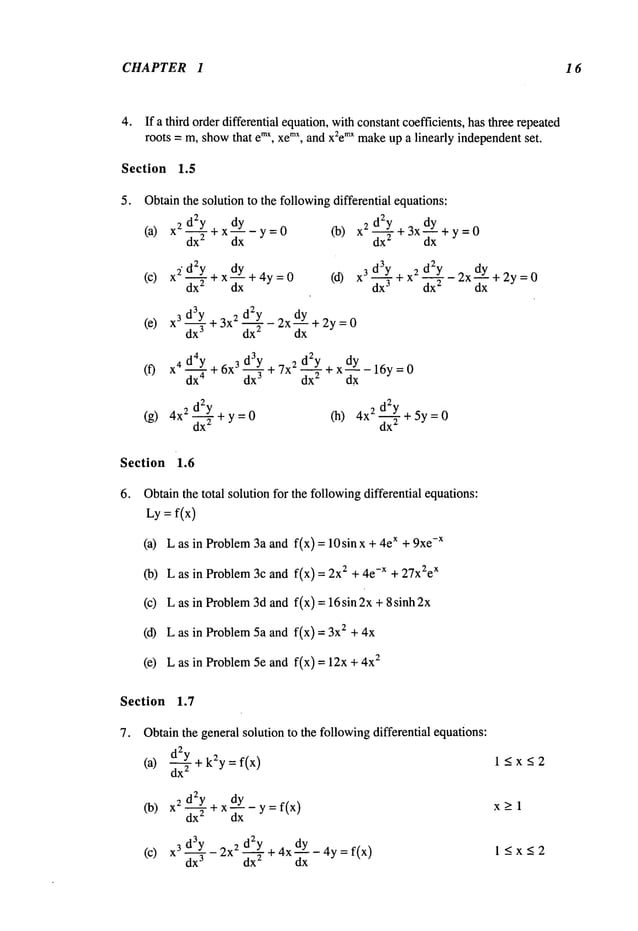
Section 1.5
5. Obtainthe solution to the followingdifferential equations:
(a) x2d2y+xd-~-Y-y=O (b) x2d2Y+3xdy+y=O
dx~ dx dx2 dx
(c) ~ +xdY+4y=O (d)
dx
x3 d3y + x2 d2Y -2x dy + 2y =0
~ dx
-’-’T dx
(e) x3 d3-~-y+3x
2 d2-~-y- 2xdy+ 2y=0
dx
3 dx2 dx
(f) X4
dx
"~’~-d4y
+6x3~dx+7x
~ ~ d2y+x
dydx- 16y= 0
(g) 4x~ d2Y+ --
dx-- 5- y=O (h) 2dx
2
d2y+5y=O
Section 1.6
6. Obtainthe total solution for the followingdifferential equations:
Ly-- f(x)
(a) L as in Problem3a and f(x) = lOsinx ÷ x + 9xe
-x
(b) L as in Problem3c and f(x) = 2 ÷ 4e-x + 27xEe
x
(c) L as in Problem3d and f(x) = 16sin2x ÷ 8sinh2x
(d) L as in Problem5a and f(x) = 2 ÷ 4x
(e) L as in Problem5e and f(x) = 12x ÷ 4x
2
Section 1.7
7. Obtainthe general solution to the followingdifferential equations:
(a)
d2--~-y
+kEy
=f(x)
dx
2
(b) 2 d2-~-y +xdy - y = f(x)
dx 2 dx
(c)x3
d3y
-2x2-~-~-+ax
dy- - 4y =f(x)
dx30x- dx
l<x-<2
x_>l
l<x<2
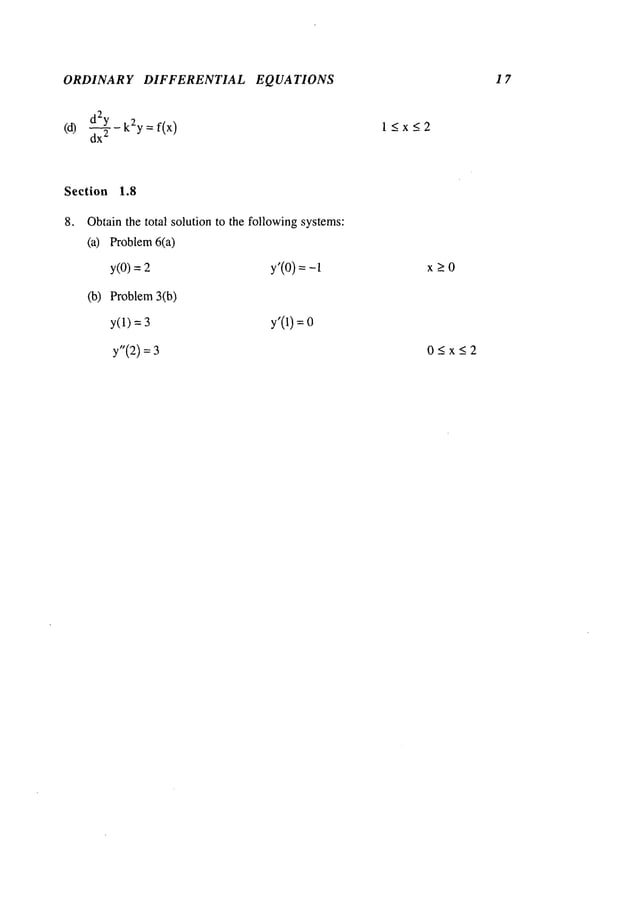
ORDINAR Y DIFFERENTIAL
(d)
d2~y- k2y= f(x)
dx
2
EQ UA TIONS
l~x~2
17
Section 1.8
8. Obtainthe total solution to the followingsystems:
(a) Problem6(a)
y(O)= y’(O)=-
(b) Problem3(b)
y(1) = y’(1) =
y’(2)
x>O
05x52
2
SERIES SOLUTIONS OF ORDINARY
DIFFERENTIAL EQUATIONS
2.1 Introduction
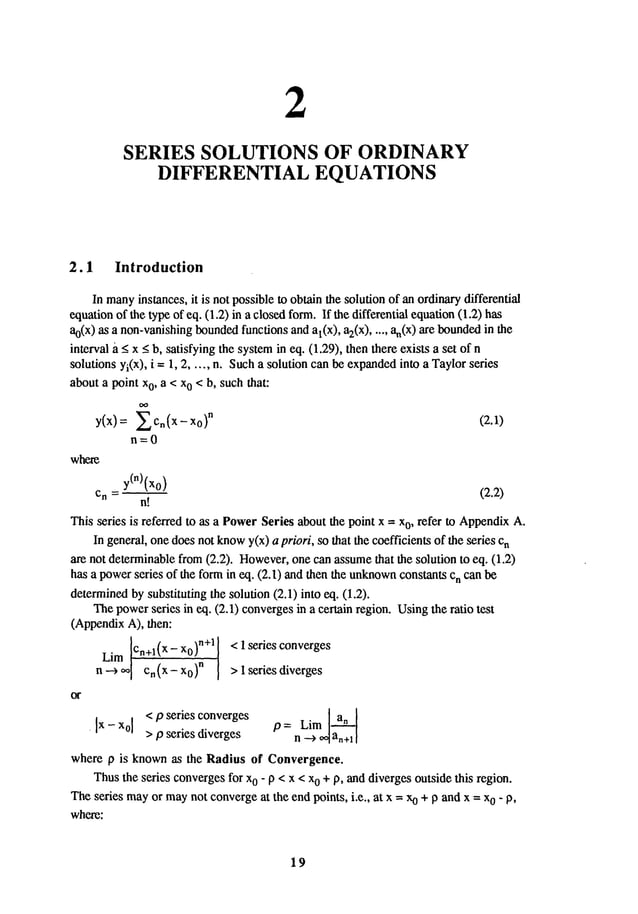
In many
instances, it is not possible to obtain the solution of an ordinarydifferential
equationof the type of eq. (1.2) in a closedform.If the differential equation(1.2)
ao(x) as a non-vanishing
bounded
functions and al(x), a2(x) ..... ) are boun
ded in the
interval a <x < b, satisfying the systemin eq. (1.29), then there exists a set of
solutions yi(x), i =1, 2 ..... n. Sucha solution can be expanded
into a Taylorseries
about a point xo, a < x0 < b, such that:
y(x): 2Cn(X-X0)
n
(2.1)
n=O
where
c. : Y<n)’x°" (2.2)
n!
This series is referred to as a PowerSeries about the point x = xo, refer to Appendix
A.
In general, onedoes not know
y(x) a priori, so that the coefficients of the series c
n
are not determinablefrom(2.2). However,
one can assumethat the solution to eq. (1.2)
has a powerseries of the formin eq. (2.1) and then the unknown
constants n can be
determined
by substituting the solution (2.1) into eq. (1.2).
Thepowerseries in eq. (2.1) convergesin a certain region. Usingthe ratio test
(AppendixA), then:
xn+l
Lim Cn+l[x - x0)
n-~ ~ Cn(X-X0)
n
< 1 series converges
>I series diverges
< p series converges
¯ Ix - x°l > p series diverges
where p is knownas the Radius of Convergence.
Thusthe series convergesfor x0 - p < x < xo + p, anddiverges outside this region.
Theseries may
or maynot convergeat the end points, i.e., at x = x0 + p and x = x0 - p,
where:
19
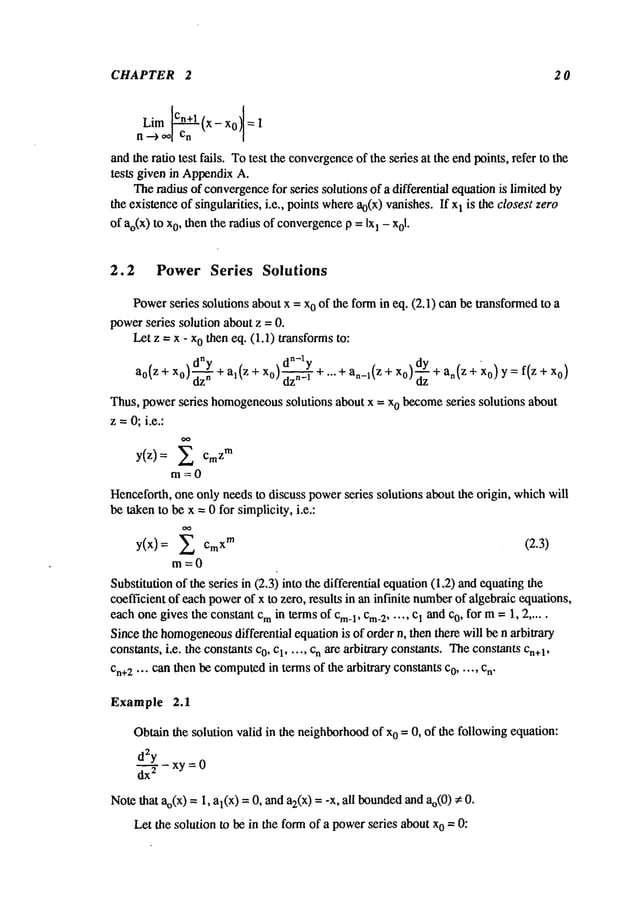
CHAPTER 2 20
n.-> oo[Cn
andthe ratio test fails. Totest the convergence
of the series at the end points, refer to the
tests given in Appendix
A.
Theradius of convergence
for series solutions of a differential equationis limited by
the existenceof singularities, i.e., points whereao(x) vanishes.If 1 is t he closest z ero
of ao(X)to 0, then the radius of c onvergence p
= IxI - x01.
2.2 Power Series Solutions
Powerseries solutions about x = xo of the formin eq. (2.1) can be transformedto
powerseries solution about z = 0.
Let z = x - xo then eq. (1.1) transformsto:
a0(z + Xo/~y + a,(z + Xo)~:-i- + ... + an_l(z + Xo)dY+ an(z + Xo)y = f(z
dn-ly
Thus, powerseries homogeneous
solutions about x = xo becomeseries solutions about
z =0; i.e.:
y(z)= ~ cruz
TM
rn=O
Henceforth,one only needsto discuss powerseries solutions about the origin, whichwill
be tokento be x =0 for simplicity, i.e.:
y(x)= ~ xm (2.3)
m=0
Substitution of the series in (2.3) into the differential equation(1.2) and equating
coefficient 0f each powerof x to zero, results in an infinite number
of algebraic equations,
eachone gives the constant cmin terms of Cm_
1, cm_
2 ..... c1 andc0, for m= 1, 2 .....
Sincethe homogeneous
differential equation is of order n, then there will be n arbitrary
constants, i.e. the constants c0, c1 ..... cn are arbitrary constants. TheconstantsCn+l,
Cn+
2 ... canthen be computed
in termsof the arbilrary constants co ..... c
n.
Example 2.1
Obtainthe solution valid in the neighborhood
of x0 -- 0, of the followingequation:
d2Y- xy = 0
dx
2
Notethat ao(X
) = I, al(x) = 0, anda2(x) = -x, all bounded
and ao(0)
Let the solution to be in the formof a powerseries about x0 = 0:
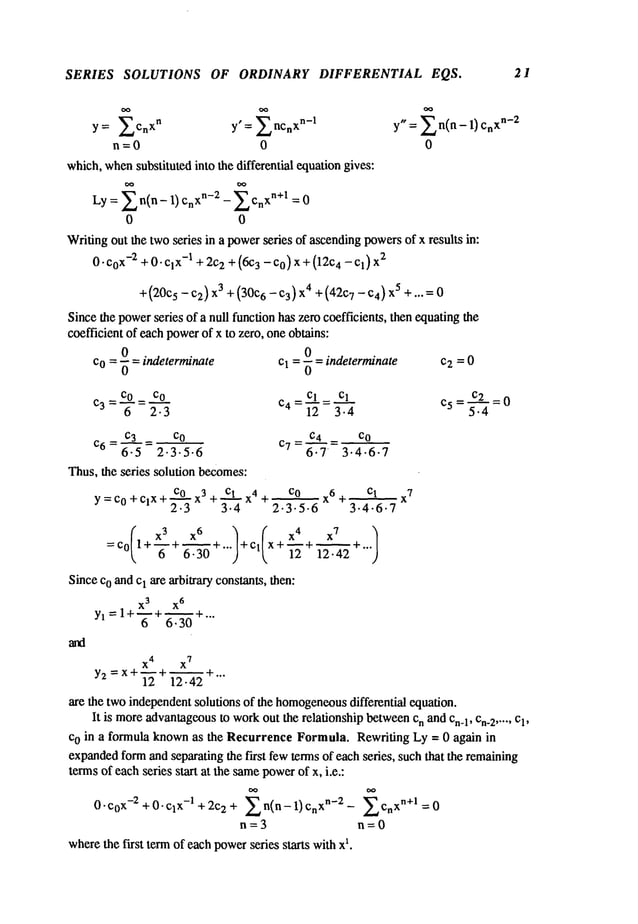
SERIES SOLUTIONS OF ORDINARY DIFFERENTIAL EQS. 21
y= ~Cn
xn y’=~nCn
xn-1
n=0 0
which,whensubstituted into the differential equationgives:
Ly = X n(n - 1) CnXn-2 -- Cnxn+l = 0
0 0
Writingout the twoseries in a powerseries of ascendingpowersof x results in:
0.C0x-2 +0.Clx-1 + 2C
2 +(6C
3 -Co)X + (12C4 -Cl) 2
+(20C5- C2) 3 +(30C6 -C
3) X4+(42C7- C4)
5 +...= 0
Sincethe powerseries of a null function has zero coefficients, then equatingthe
coefficient of each powerof x to zero, oneobtains:
0 0
Co 0 indeterminate Cl -6 indeterminate c2 = 0
C3- COC----Q-0 - Cl Cl C5- C2 =0
- Y = 2- 3
c4 - 1"~ = 3 .’~"
- 5"--~
c._~_3 = Co
c6=6-5 2.3.5.6
Thus,the series solution becomes:
C0 x3 + Cl x
4
Y=C0+ClX+
~ +
2.3 3.4
C4 _ CO
c7=~’.-3.4.6.
7
CO x 6 + Cl x
7
2.3.5.6 3.4-6.7
=Co 1+--~-+ 6.3"~"~+... +cl x+~+~+...12.42
Sinceco andcI are arbitrary constants, then:
X
3
X
6
Yl = 1+--+~+...
6 6.30
x4 x
7
Y2 = x+--+~+...
12 12-42
are the two independentsolutions of the homogeneous
differential equation.
It is moreadvantageous
to workout the relationship betweencn and Cn.1,Cn_
2 ..... Cl,
co in a formula knownas the Recurrence Formula. Rewriting Ly = 0 again in
expanded
formand separating the fh’st fewterms of each series, such that the remaining
termsof eachseries start at the samepowerof x, i.e.:
~’~ C X
n+l
0"c0x-2+0"Clx-l+2c2 + n(n-1)Cn xn-2- ~ n =0
n=3 n=0
wherethe first termof eachpowerseries starts withx
1.
CHAPTER 2 2 2
Letting n = m+ 3 in the first series and n = min the secondseries, so that the two
series start with the sameindex m= 0 and the powerof x is the samefor both series, one
obtains:
Co= indeterminate Cl = indeterminate c2 =: 0
Z[(m+ 2)(m+ 3)Cm+3--Cm]X m+l :0
m=0
Equatingthe coefficient of x’~’1 to zero gives the recurrenceformula:
= Cm
Cm+3(m + 2)(m + m= 0, 1, 2 ....
whichrelates Cm+
3 to cmand results in the sameconstants evaluated earlier. The
recurrence formulareducesthe amount
of algebraic manipulationsneededfor evaluating
the coefficients c
m.
Note: Henceforth,the coefficient of the powerseries cn will be replaced by an, which
are not to be confusedwith a,(x).
Example 2.2
Solvethe followingordinary differential equation aboutxo = 0:
dZy dy
X-d--~-x~
+ 3~-+xy= 0
y= an
xn
n=0
Note that ao(x) = x, al(x) =1, and a~(x) = x and %(0)= 0, whichmeansthat the equation
is singular at x = 0. Attemptinga powerseries solution by substituting into the
differential equationand combining
the three series gives:
OO
Z
~’~a x
Ly= n(n+2) anx n-l+ z~ n =0
n=0 n=0
oo
’~ a x
~+1
= 0. a0x-1 + 3a1 + n(n + 2) anxn-1 + z_, n = 0
n=2 n=0
Substituting n = m+ 2 in the first and n = min the secondseries, one obtains:
=0.ao x-1 +3al + Z[(m+2)(m+a)am+2 +am]X m+l =0
m=0
Thus,equating the coefficient of each powerof x to zero gives:
a0 = indeterminate aI = 0
as well as the recurrenceformula:
am m=0,1,2 ....
a~+2 = (m +2)(m
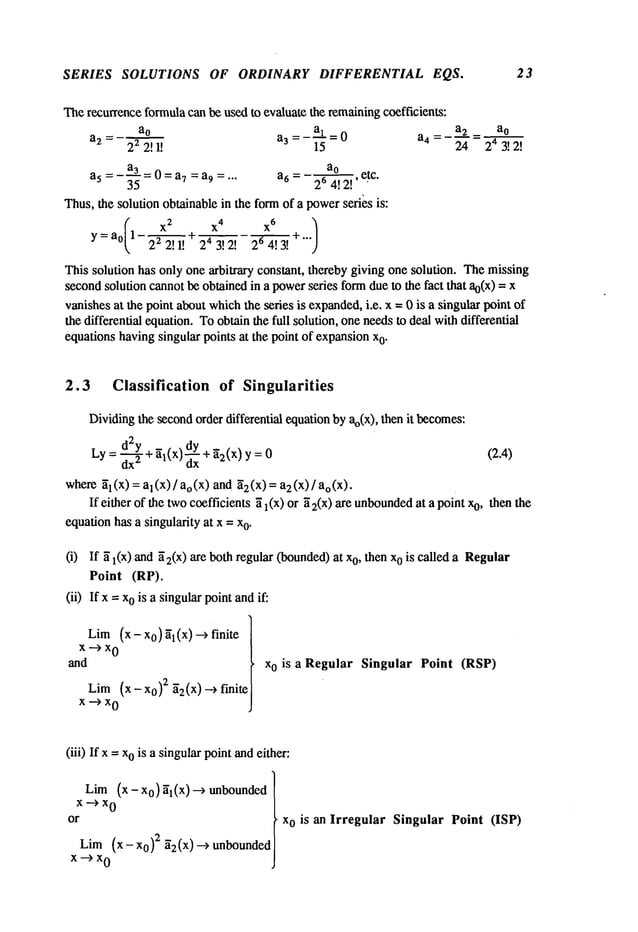
SERIES SOLUTIONS OF ORDINARY DIFFERENTIAL EQS. 23
Therecurrence
formula
canbeusedto evaluatethe remaining
coefficients:
_ a._~.~= ao
ao =- a-L= 0 a4 =
24
a2 = 22 2! I! aa 15 24 3!2!
ao
- a3-0=a7 =a9 .... a6- 264!2!’etc"
a5- - 3"~- "
Thus,the solutionobtainablein theformof a power
seri~sis:
(X
2
X
4 X
6
)
y= a0 122 2! 1! + 24 3! 2! 24g~.~3.
~ +’’"
Thissolutionhasonlyonearbitrary constant,therebygivingonesolution. Themissing
second
solutioncannotbeobtainedin a power
series form
dueto the fact that ao(x)=
vanishes
at the pointaboutwhich
the series is expanded,
i.e. x = 0 is a singularpointof
thedifferentialequation.
Toobtainthefull solution,oneneedsto deal withdifferential
equationshavingsingularpointsat the pointof expansion
x
0.
2.3 Classification of Singularities
Dividing
the second
orderdifferential equation
byao(x),thenit becomes:
Ly: d2~
y + El(X)
dy+ [2(x) y = (2.4)
dx
z dx
where~l(X)= al(x)/ao(X)and [2(x)= a2(x)/ao(X).
If either of the twocoefficients~1 (x) or 52(x)are unbounded
at a pointo, then t
he
equation
hasa singularityat x = x
o.
(i) If ~ l(X) ~2(X) are both
regul
ar (boun
ded) at xo, thenxo iscalleda Regul
ar
Point (RP).
(ii) If x =ois asingular po
int an
d if:
Lim(x- x0)~I(X)~ finite
x--)x
0
and
Lim
(x- x0)2 ~2(x) --) finite
x--)x
0
xo is a Regular Singular Point (RSP)
(iii) If x-- ois asingular po
int an
d either:
Lim (x- Xo)~l(X)~ unbounded
x--)x
0
or
Lim(x - Xo)
2 ~2(x) --) unbounded
x--)x
0
xo is an Irregular Singular Point (ISP)
CHAPTER 2 2 4
Example 2.3
Classify the behaviorof each of the followingdifferential equationsat x = 0 and at all
the singular points of each equation.
d2y . dy
(a) x d--~+ s~nX~x+ x2y =
Here, ~l(x) = slnx and ~2(X) ---- X
x
Bothcoefficients are regular at x = 0, thus x = 0 is a RP.
d2y 3
dy+x y=0
(b) Xdx----~-+
~l(x)=--3 ~2(x) =
X
Here, x = 0 is the only singular point¯ Classifying the singularity at x = 0:
Lim x(3/=3 Lim x2(1)=0
x-->O kx] x-->O
Thus x = 0 is a RSP.
(c) x2(x2 - 1 +(x-l)2 dY +
(x-l) 1
~l(X) = x2(x + 1) ~2(x) = (x - m)(x
Here, there are three singular points; x = -1, 0, and +1. Examining
each singularity:
Lim (x+l) (x-l)
x --~ -1 xZ(x+ 1)
Lim(x + 1)
2
1
x --> -1 (x - 1)(x +
xo = -1 is a RSP.
-0
Lim x (x - 1)
’ x--~0 x2(x+l)
¯ Lim x2 1
x-->O (x-1)(x+
=0
xo = 0 is an ISP
SERIES SOLUTIONS OF ORDINARY DIFFERENTIAL EQS. 25
X_o
= +1
Lim(x-1)(T)~ -- 1!,
x--~l x ix+l)
Lim(x - 1)
2
1
x--~1 (x - 1)(x+
=0
x0 = +1 is a RSP
,2.4 Frobenius Solution
If the differential equation(2.4) has a RegularSingularPoint at 0, then o
ne or both
solution(s) maynot be obtainable by the powerseries expansion(2.3). If the equation
has a singularity at x = x0, one canperforma linear transformation(discussedin Section
2.2), z =x - 0, and seek asolution about z = 0.Forsimp
licity, a so lution vali d in t he
neighborhood
of x = 0 is presented.
For equations that havea RSPat x = x0, a solution of the form:
y(x)= E an(x- n+a (2.5)
n=0
can be used, wh’ere~ is an unknown
constant. If x0 is a RSP,then the constant ~ cannot
be a positive integer or zero for at least one solution of the homogeneous
equation. This
solution is knownas the Frobenius Solution.
Since~ l(X) and~2(x)can, at most,be singular to the order of (x-x0)-~ and(x-x0)
2,
then:
(x-x0)2
2(x/
are regular functions in the neighborhood
of x = x0. Thus,expandingthe abovefunctions
into a powerseries aboutx =x0 results in:
(X - X0) ~l(X) : ~0 + £Zl(X - X0) + ~2(X- X0)2 = E~k(X- X0)k(2.6)
k=0
and
(X--X0) 2 ~2(X)=~0 +[~I(X--X0)+~2(X--X0)2+ E[~k(X-X0)
k
k=0
Transforming
the equation by z = x - x0 and replacing z by x, one can discuss solutions
about x0 = 0. TheFrobeniussolution in eq. (2.5) and the series expansionsof al(x)
a2(x) about0 =0 ofeq.(2.6) are subs
tituted into the differential equation (2.4), such
that:
~o
[ ~O~kxk-I ~ ~(n+O’)anxn+~r-1
Ly= E(n+cr-1)(n+o’)anxn+a-2
n = 0 Lk =0 ]Ln =0
CHAPTER 2 26
k-2 n+ff
+ kX anX =
Lk = 0 JLn= 0 J
Thesecondterm in (2.7) can be written in a Taylorseries formas follows:
where
(72.7)
Lk = 0 .JLn= 0
k=n
+((~a°(~2 +((~+ 1) ax(~l +((~+ 2) a2c~°) x2 +"’+I X((~+
k,k =0
O0
= ~ C X
n+ O’ -2
L, n
n=0
= xO-2[oo~0a0
+ (ga0oq + (~ + 1) al,x0)
X
n +...]
k=n
Cn = ~_~((r+k)a k C~n-
k
k=0
Thethird term in eq. (2.7) can be expressedin a Taylorseries formin a similar manner:
~k
xk-2 anXn+a
= Z-~
~dnxn+°’-2
Ln=O JLn=O J n=O
whem
k=n
X ak ~n-k
k=0
Eq. (2.7) then becomes:
Ly = x
°-2
(n + o" - 1)(n + o’) n + cnx n + d~x" (2.8)
Ln=0 n=0 n=0
=x(~-z{[(~((~-
1) + (~C~o
+J~o]ao +[((~(~r + 1)+o +I~o) a, + ((~oq
+[],)
+ [((o" +1)(o" +2) +((r o + Po)
az+(((r + 1)oq
+1 + (o’~x~ + f
la) ao] xz
+...+ [((n+ (~- 1)(n+ (~) + ((~+ o +l~o) a~ +((( ~+
n-1)al+ I~) a
+(((r + n- 2)ctz + j~) a._z +... +(((r + 1) o~._~+/~._~) al +((ran + j~.)
Definingthe quantifies:
f(cr) =(r(o" - 1) +o + flo
SERIES SOLUTIONS OF ORDINARY DIFFERENTIAL EQS. 27
then eq. (2.8) can be rewritten in a condensed
form:
Ly: x
°-2 {f(ff)a0 +[f(ff + 1)aI + fl(ff)ao] x +[f(ff + 2)a2+ fl(6 +
+f2 (ff)ao2 +.. . + [f(ff + n)n + fl(ff + n- 1)an
1 + ...+fn (ff)]xn + ...}
=x°-2 f(~r) 0+ ~f( ff+n) a n+
(~+n-k) an_ k x
~ (2.9)
n=lL
Eachof the cons~ts a~, a~ ..... ~ .... c~ ~ written ~ te~s of %, by equating the
c~fficien~of x, x
~ .... to zero as follows:
a~(a) : f~(a)
f(a+1)
a2(a) = f~(a + 1) a~ + f2(a)
-fl(ff) f(ff+l) + f2(ff) f(ff+l)at g2(ff)
= f(6 + 1) f(6 + f(’~ ~) a°
a3(6) f~(6 + 2)a2 + f2(6 + 1) al + f3(
.... -":: .... f(6 +3) ~
and by induction:
gn
(6)
n > 1
a n (6) = - ~ -
= f(6+3) a0
(2.10)
Substitutionof an(o
) n = 1, 2, 3 .... in termsof the coefficient ao into eq. (2.9) results
the followingexpressionfor the differential equation:
Ly = xa-2f(o") a
o (2.11)
and consequentlythe series solution can be written in terms of an(a), whichis a function
of 6 and a0:
y(x,6) = x° + Ean(6) Xn +O (2.12)
n=l
Fora non-trivial solution; ao ¢ 0~eq. (2.7) is satisfied if:
f(o-) = a(o- - 1) o"+/3
0 = 0 (2.13)
Eq. (2.13) is called the Characteristic Equation, whichhas two roots I and . o
2.
Depending
on the relationship of the tworoots, there are three different cases.
Case(a): Tworoots are distinct anddo not differ by an integer.
If 61 ¢ 02 and61 - 02 ¢ integer, then there exists twosolutions to eq. (2.7) of the form:
CHAPTER 2 2 8
yl(x) = 2an(or,) xn+~rl
n=0
and (2.14)
y2(x) = ~a.(~r2)
n=0
Example 2.4
Obtainthe solutions of the followingdifferential equationabout x0 = O:
Since x = 0 is a RSP,use a Frobenius solution about x0 = 0:
y = ~an
xn+~r
n=0
such that when
substituted into the differential equationresults in:
~ [(n+~)~-~]an xn+~’:2+ 2anxn+°=O
n=0 n=0
Extractingthe first two-lowestpowered
termsof the first series, such that each of the
remainingseries starts with x~ one obtains:
+ (n+~)2_~ ~"a x
anxn+~-2
+’9
"~ L,n =0
n=0
Changingthe indices n to m+ 2 inthe first series and to min the secondand combining
the tworesulting series:
m=0
Equatingthe coefficients of x~-l and xm+~
to zero and assumingao ~ 0, there results
the followingrecurrence formulae:
am m=0, 1,2 ....
a~÷~=(m+~+:z)2_
N
andthe characteristic equation:
SERIES SOLUTIONS OF ORDINARY DIFFERENTIAL EQS. 29
Thetworoots arc ~l = 1/3 and o2 = - 1/3. Notethat 01 ~: O
2 and o! - if2 is not an
integer.
Sinceo = +_1/3, then (o+1)
2 - 1/9 ~ 0 so that the oddcoefficients vanish:
a1 =a3 = a5 =...=0
a
m
m=0,2,4 ....
am+2=(m +~ + 5/~)(m + ~r +7~)
with
a2(o"
) = ao
_ a
2 ao
a4(ff)= (a + 1~3)(<7+ =~(~r +5/~)(~+ 7~)(¢y
+ 11~)(
7 + 13/~)
and by induction:
(_l)m ao
11~ ( 6m-l’~ ( 7~( 13~ (
a2m(Cr) = (o + ~)Io
6m~+1)
-rj...t<,
+--r-).
L<,
+~jt<,
+-rj...t<,
Thesecoefficients are substituted in the Frobeniusseries:
y(x,~r)= Xa2m(~r) 2m+a
m=O
Forthe first solution corresponding
to the larger root o1 -- 1/3:
a2m"~" = (-1)
m
2mm!(2~)m
.4.7.10.....(3m +
Letting ~ = o2 = - 1/3 gives the secondsolution:
~’ 1
Y2(X) = aox-l/3 + Xa2m(-~) x2m-l/3
m=l
2m
m!
(~A)
~
¯2.5.8....-(3m
m_>l
CHAPTER 2 30
The final solution y(x), setting 0 =
1 ineach series gives:
Y(X)=clyl(x)+c2Y2(X)
Case(b): Twoidentical roots O-1=¢r2 = O-~
If ~l = or2 = Cro, then only one possible solution can be obtained by the methodof
Case(a), eq. (2.14), i.e.:
yl(x) = E an(o-o) xn+~r°
n=O
wherea0 =1.
Toobtain the secondsolution, one mustutilize’eqs. (2.11) and(2.12). If ~1 = ~r2
co, then the characteristic equationhas the form:
f(o-) : (o-- O-o)
2
and eq. (2.11) becomes:
Ly(x,o-) = xa-2(o- - O-o)2ao (Z.15)
wherey(x,o) is givenin eq. (2.12). First differentiate eq. (2.15) partially with
~Ly= L °aY(X’o-) : ao[2(a - ao) + (a- ao)2 logx] ~r-2
where
~d xa=x
alo gx
If O-= O-o,then:
--o
L 00- do-=o-0
Thus,
the
second
solution
satisfying
the
homogeneous
differential
equation
isgiven
by:
y(x)
Usingthe form of the Frobenius solution:
y(x,o-)= xa + Ean(°’) xn +a
n=l
then differentiating the expressionfor y(x,~) withff results in:
ay(x,cr)a
oo
=a0x~ log x + Ea~(~) n÷~ +an(o ) xn+~ lo gx
n=l n=l
SERIES SOLUTIONS OF ORDINARY DIFFERENTIAL EQS. 31
--logx Xan(o) xn÷°
n=O n=l
Thus,the secondsolution for the case of equal roots takes the formwith a0 = 1:
yz(x) = logx Xan(O0)xn+’~°
n=O n=l
= yl(x)logx+ ~" a’ to ~ x
n+°°
Z_, n~, o/
n=|
(2.16)
am+1 =
where
Example 2.5
Solvethe followingaifferential equation about x
o = 0:
2dZY 3xdY+(4_x)y=0
x dx-- ~- dx
Since xo = 0 is a RSP,then assumea Frobeniusseries solution which, whensubstituted
into this differential equationresults in:
X(n + ~_ 2)2 a.x’+a-2 ~ax
- z~n =0
n=0 n=0
or, uponremoving
the first term and substituting n = m+ 1 in the first series and n = m
in the secondseries results in the followingequation:
~o-2/z
a0x
°-z
+~[~m
+o-
1)
2am+, -am
.]x
m+°-~ --0
m=0
Equatingthe coefficient of x
~2 to zero, oneobtains withao # 0:
(o"- 2)2 = 0 or cr~ = a2 = 2 = ao
Equatingthe coefficient of xm÷ox
to zero, one obtains the recurrence formulain the form:
am
m=0,1,2 ....
(m
+~r-1)
2
and by induction:
a.(a)
ao
_ al ao
(a- I)2o’2(o
. +1)2...(o
. +n- 2)
2
Thus,the first solution correspondingto o = o0 becomes:
n=l,2 ....
CHAPTER 2 3 2
a0 xn+2
Yx(x) °-o) = o0 = 2 = a0x2 + 12.22..... n
2
n=l
~ xn+2
n=O
~ .~
where
0! = 1 andao wasset = I.
Toobtainthe secondsolution, in the form(2.16), oneneedsa~(0):
da.(0-)= -2a0 [ 1 + 1 1
do- (0- - 1)20"2...(0 - + n- 2)2L~-0" + ~0"+I+ "’" ÷ 0-+n-2
a~(°)[0"=o0 =2 12.22.....n 2 +~+~+"’+
Defining
g(n)= 1 + 1/2 + ... + I/n, withg(0) = 0, then:
2a0
a~(o0)=-~-n.~-
~ g(n) n=I, 2....
Thus,setting ao = 1, the second
solutionof the differentialequation
takestheform:
,~ xn+~
Y2(X) = Yx(x)l°gx-2 Z ~
n=1In.)
Case
(c): Distinctrootsthat differ byaninteger.
If o1- o2 =k, a positiveinteger, thenthecharacteristicequation
becomes:
f(0")=(0- - 0-1X0-
- 0-2)=(0- -
First, onecanobtainthe solutioncorresponding
to the larger root o1 in the formgivenin
eq. (2.14). Thesecondsolutioncorresponding
to o = 0-2 may
havethe constantak(o2)
unbounded,
because,
fromeq. (2.10), the expression
for ak(o:z
) is:
ak(o2)=f(o + o : 02
wherethe denominator
vanishesat 0 = 02:
f(f + k)lcr = 0"2= (0 + k- 02- k)(f + k- 02)lff 2
Thus,unlessthe numerator
gk(ff2) also vanishes,the coefficientak(02)becomes
SERIES SOLUTIONS OF ORDINARY DIFFERENTIAL EQS. 33
If gk(ff2) vanishes, then ak(~z)is indeterminateandone maystart a newinfinite
series withak, i.e.:
k-lor~ an(a2) xn+~r2 +ak
Y2(X) : a0
n=0 ~ / n=k~" ak
k-1 or ~, 
=a 0 y, [an(~2)] n÷~2 ÷ ak m~ (.am~2)) xm+~ (2.1"/)
n----0 =0
It can be shown
that the solution precededbythe constant ak is identical to Yl(X),thus
one can set ak = 0 and ao = 1. Thefirst part of the solution withao maybe a finite
polynomialor an infinite series, dependingon the order of the recurrenceformulaand on
the integer k.
If gk(O2)does not vanish, then one mustfind another methodto obtain the second
solution. Anewsolution similar to Case (b) is developednext by removingthe constant
o - o~ fromthe demoninator
of an(o). Sincethe characteristic equationin eq. (2.11)
given by:
Ly(x,0.) = a0xa-2f(0.) = aoxa-Z(~r - 0.~)(0. - ¢rz)
then multiplyingeq. (2.18) by (o - 02) and differentiating partially witho, oneobtains:
-~ [(0.-0.2)Ly]= ~-~ [L(0.- 0.~) y(x,0.)] = L[-~(0.- 0.:~)
= ao x~’-2 0. - 0.1 0. - 0"2
Thus,the function that satisfies the homogenous
differential equation:
0" =0"2
gives an expressionfor the secondsolution, i.e.:
y~(x)
=--~
(0.-0.~)y(x,0")[
a =0.2
(2A9)
TheFrobeniussolution can be divided into twoparts:
n=k-1
y(x,0.)= ~a.(alx"+~r= ~a.(0.lx"+a+ ~a.(0")x
n=0 n=0 n=k
so that the coefficient ak is the first termof the secondseries. Differentiating the
expressionas given in eq. (2.19) one obtains:
CHAPTER 2 34
~--~[(~- if2) Y(X,~)]
n=k-1 n=k-1
=logx, E(ff-ff2)an(ff)xn+ff+ ~(ff-ff2)a~(ff)x
n+ff+
n=0 n=0
+ 2[(~-~2)a~(ff)l ~+~ +logx
n=k n=k
It shouldbe no~d~t ~(ff) = - (gn(ff))/(ffff+n)) does not con~n~e te~ (if’if2)
denominatoruntil n = k, ~us:
~d for n=0, 1,2 ..... k-1
(~- ~2)a~ (")[~ =
~er¢fore, ~ s~ond solution ~ ~e fo~:
n=k-1
y2(x)= (~- ~2) y(x,~)~ = ~2 2a~(~2)x
n=O
X [( ] x ~+~’ +logx ~-ff~)a~(~ x
~+~’
+
n=k n=k
(2.20)
It c~ ~ shown~at ~e l~t infinite ~fies is pro~onal my~(x).
E(o-~2)anCo)xn+° + E(c~-c)2)an(O)X
n+O
n=O n=k
n=k--1
E an(~) xn+°
n=0
Example 2.6
Obtainthe solutions of the followingdifferential equationabout x0 = O:
2
9
Since xo -- 0 is a RSP,then substituting the Frobeniussolution into the differential
equationresults in:
- ~’ a X
n+ff
n+ff)2 an xn+°-2+ ~_~ n =0
= n=0
which, uponextracting the two terms with the lowest powersof x, gives:
SERIES SOLUTIONS OF ORDINARY DIFFERENTIAL EQS. 35
(~r
2 --~] a0
x°-2 +[(o+1)
2 --~] alx°-I +
m=0
Thus,equatingthe coefficient of each powerof x to zero; one obtains:
and the recurrence formula:
a
m am
a,=*2= (m+2+tr)=_9~ = (m+a+~)(m+a+7//2)
Solvingfor the roots of the characteristic equationgives:
3 3
ax =2 ~2 =-’~ al - 02=3 = k
Usingthe recurrenceformulato evaluate higher orderedcoefficients, one obtains:
a0
m=0,1,2 ....
al
a3=
(o-+ 3/2Xo.+9/2
)
a2 ao
a,~=(0. +5/Z2XO.
+ ;~) = (0. +~,~)(0. +5~2){0.+7~2X0.
a3 al
Thus,the oddand evencoefficients a,, canbe written in termsof ao andaI by inductionas
follows:
ao
a2,~ =(-1)’~ (or +l~)(cr + 5~)... (¢r + 2m-3~). (tr + 7~)(o- +1~/~1... (o-
a2m+l ’ ’ ’3 7
al
for
Toobtain the first solution corresponding
to the larger root ~1= 3/2:
ao = indeterminate ¯
m=1,2,3 ....
CHAPTER 2 3 6
a1 =a3 =a5 =...=0
a2m(3/2) = (_l)m 3ao(2m+ 2)
(2m+ 3)!
and by setting 6ao = 1:
m=1,2,3 ....
y~(x)=g z_,, ,
(2m+3)! ~( -1)m(m+
m= 1 m= 0
(2m+ 3)
Toobtain the solution co~esponding
to the smaller root:
3
ff2 = -- ~, whe~ ff~ - ~ = 3 = k
a0 = indete~nate
a1 =0
a2m(_3/2) = (_l)m (-a0)(2m-
Thecoefficient ak = a3 mustbe calculated to decide whetherto use ~e secondfo~ of the ~
solution (2.20). Using the recu~encefo~ula for ~ = -3/2 gives:
0
a3 0 (indete~nate)
Sothat the coefficient a3 is not unbounded
and can be used to st~ a newseries:
(-1) m+la3 " )l]
a~m+~= (~+~)...(o+2m-~).(ff+.l~)...(~+2~+~
(1)
~*~ 6a3m
= - ,m=2, 3,4 ....
Thus,the secondsolution is obtained in the form:
(2m- 1) x2m-3/2
m= 1
(2m) + a3x3/2
~
m X
2m-1/2
+6a
(2m+
l
m=2 "
m=0---- . 6%m=0~(-1)~ (2m+3)~
Notethat the solution sta~ing with ak = a3 is Yl(X), whichis extraneous. Letting ao=
and a3 = 0, the secondsolution becomes:
SERIES SOLUTIONS OF ORDINARY DIFFERENTIAL EQS. 37
y2(x) = 2(-1) TM
(2m-l)
x2m-3/2
m= 0
(2m)!
Example 2.7
Obtainthe solutions of the differential equationaboutx0 =0:
2
2dy , +2)
~x d-~- ~x y=
Since xo = 0 is a RSP,then substituting the Frobeniussolution in the differential
equation gives:
(a-2)(0.+l)ao xa-2 + 2{(m+o’-l)(m+a+ 2)am+l-a~} m+’~-I =0
m=0
Equatingthe twoterms to zero gives the characteristic equation:
(a - 2)(0. + 1) o =0
with roots
0.1= 2 0"
2 = -1
and the recurrenceformula:
am
m=0,1,2 ....
am+l = (m +0.- 1)(m+0.+2)
Usingthe recurrence formula, one obtains:
a0
al - (0. - 1)(0"+
al a0
a2=0"(0"
+3)=(0"-
1)0"(0"
+2)(0"
a2 ao
a3 =(0" +1)(0"+=(0"
- 1)¢r(0"+ 1
)(0"+2)(0"+3)(0"
and by induction:
an(o) =
ao
(g- 1) ~r... (g +n- 2). (g +2)(~+ (g + n
+ 1
)
Thesolution corresponding
to the larger root 0"1-- 2:
an(2 ) = 6ao
n!(n+3)
so that the first solution corresponding
to the larger root is:
oo xn+2
Yl(x)
_A.~,n! (n + 3)!
o’1 -0.2 = 3 = k
n-- 1,2,3 ....
CHAPTER 2 38 .
where
6a
o wasset equalto 1.
Thesolutioncorresponding
to the smallerroot 02= -1 canbeobtainedafter checking
a3(-1):
a3(-1) oo
Using
the expression
for the second
solutionin (2.20)oneobtains:
n=2 oo ,
YzCX)=EahC-l) xn-l+ E[(~+l)a~(~)]
x=-x
n=O n=3
+ logx E[(O+ 1) an(O)]Oxn-1
n=3
Substitutingfor an(o
) andperforming
differentiationwithoresults in:
(~r+1) an(~r) a°
(o- 1)~r(cr+2)... (or+n- 2)(~r
+2)(~r
+3)... (o"
a0 = a0
(o"+ 1) n(o’)lcr =
-1= (-2)(-1) 1.2..... (n - 3) 1.2.3..... n 2 (n
{( 1) ()}’ -a°
.~__~__I+i+~l + 1 1
Lo-1 o 0+2 ""+--+--
o+n-2 0+2
[(0+1) an (0) =
o=-1 -2-- 1.1.2.....(n- 3) 1.2.....
[_~ 1 1 ~ ~]
" - -1+1+--+’"+’~-3 +1+2 +’"+
_ a0 [-~+ g(n- 3)+ g(n)]
2(n- 3)
where
g(n) = 1 + 1/2 + 1/3 +...+ 1/n andg(0)
Thesecondsolutioncanthus bewrittenin the form:
Y2(X) = 1 1 + x 1 E° ° xn-I r 3
--’~ ~’--’~ (n--_~!n!L-’~+g(n-3)+g(n)
n=3
oo
xn_l
+½logXn~=
3n, (--h-S-_
3)
t
which,
uponshiftingtheindicesin theinfinite series gives:
(o - 1) 0(0+ 2)... (o +n - 2)(0+2)(0+ 3) ... (0
1 1
+~+...+ -
0+3 o+n+l
n=3,4,5 ....
SERIES SOLUTIONS OF ORDINARY DIFFERENTIAL EQS. 39
Y2(X)=X-I 1X____+ ....
1 ~_~
xn+2[ __3
2
]
2 4 2 n! (n + 3) ! + g(n)+ g(n
n=O
n=0(n+3)
!n!
Thefirst series can be shown
to be 3Y1(X)/4
whichcan be deleted fromthe second
solution, resulting in a final formfor Y2(X)
as:
y2(x)=x_l__+___l x 1 xn+2
2 4 2 n!(n+3)![g(n)+g(n+3)]+ log(x)yl(x)
n=0
CHAPTER 2 4 0
PROBLEMS
Section 2.1
Determine
the region of convergence
for each of the followinginfinite series, and
determinewhetherthey will convergeor diverge at the twoend points.
.oo
n
(a) Z (-1)n ~.I CO) Z (-1)n X2n
n = 0 " n = 0
(2n)!
n
(c) Z(-1)nnxn (d) Z(-1)n~
n=l n=l
oo
X2
n
oo
X
n
(e)
n2+n+
2
(f) Z(-1)
nn
2
n
n=0 n=l
(g)
Z n+3 xn
~
CO) Z(-1) n (n!)2xn
(2n)!
n=l n=0
(i) Z(-I) n n(x-l)n Z(-I) n (x+l)n
2
n (n+1) ’ (j)
3
n n
z
n=l n=l
Section 2.2
2. Obtainthe solution to the followingdifferential equations,valid near x =0.
d2y . zdY4xy=O
(a)
dx-~-+x d--~ "
d:Y dy_y=O
(c) dx-
~- - x dx
dZy dy ,
(e) d-~-- X~xx-tx+2) y
(g) (x2+l +6xdY +6y=0
dx
(i) (x-l) d~Y+y
(d) d2---~-Y-4xdY-(x2 +2) y=0
dx2 dx x
(f) d3-~’Y + x2 d2-~Y+ 3xdy+ Y= 0
dx3 dx 2 dx
d2y dy
(j) x d---X-T
- d--~+4x3y
=
SERIES SOLUTIONS OF ORDINARY DIFFERENTIAL EQS. 41
Obtainthe general solution to the followingdifferential equationsabout x = Xoas
indicated:
(a)
d--~--
(x-d2y
1)d~Yux
+y =0 aboutXo=: 1
d2y
Co) d--~--(x-1)2y=O aboutxo= 1
(c) x(x "d2y 6(x 1)d-~-Y+6y=O aboutxo 1
-2 Grx + -.x =
(d) x(x + 2) ~-~2Y+8(x + 1)--~+ about xo=-1
Section 2.3
4. Classifyall the finite singularities, if any, of the followingdifferential equations:
(a) 2 d2y dy
d--~- + X~x+(x:Z-4) y = (b)
(c) (1- x21 d~ --2x dY +6y (d’)
x ~ dx" dx
¯ d2y dy
(e) s~nx d-~+coSX~xx+y = (f)
(g) (x- 1)z d2~Y+ (x2-1) dY+ x2y
dx ~ ~ ~ dx
Oa)
x2 d~Y+(l+x) dY +y =
dx" dx
2
x
2~ d~Y
- 2x d-~-Y+(1+ x)Zy=
x(1-
! dx
2 (Ix
d2y dy
xz tan x~-+ x~ + 3y =0
Section 2.4
Obtainthe solution of the followingdifferential equations, valid in the neighborhood
of x =O:
(a) x2(x + 2)y" + x(x- 3) y’+ 3y
d~2
y 2x~] dY-3y= 0
CO) 2X
2
+ [3x + idx
@
(c) x
2
+[x+ Jdx L 4 2J
y= O
CHAPTER 2 42
3
SPECIAL FUNCTIONS
3.1 Bessel Functions
Besselfunctions
are solutionsto the second
orderdifferentialequation:
x2 d’~"2+xdy+(xz-pz)y=Odx
’ (3.1)
where
x = 0 is a regularsingularpointandpis a real constant.
Substituting
a Frobenius
solutioninto the differentialequation
results in theseries:
+ E{[(m +2 + 6)2 - p2]am+2+ am}Xm+°
:
m=0
Fora0 v 0, 62- p2= 0, 6t = p, 62= -p and6t - 62= 2p:
[(0"+1)a-p:~]a~=
a
m
am+z= (m +2+o._ pXm+2+o.+ ) m=O,1,2 .... (3.2)
Thesolutioncorresponding
to the larger root 61 = p canbeobtainedfirst. Excluding
thecaseof p= -1/2, then:
a1= a3 =a5= ... 0
a
m
am+2 = (m+2)(m+2+2p) m=0, 1, 2....
ao
a2 = 2Zl!(p+l)
a2 a0
a,~= 4(4+2p)=242!(p+l)(p+2)
ao
a6 = 263!(p+lXp+2)(p+3)
43
CHAPTER 3 44
and, by induction:
a
o
a2m = (-1)m 22mm!(p + 1)(p + 2)... (p
Thus, the solution correspondingto ~1 = P becomes:
oo
x2m+
p
Yl(x) ~Z_~
(-1)m2amm!
(p + 1)(p + 2)... (p
a0
xp + a0
m=l
Usingthe definition of the Gamma
function in Appendix
B. 1, then one can rewrite the
expression
for y I(X) as:
Yl(X):ao xp+a
0 E(-1)
m
m=l
r(p +1) X
2m+p
22m m! F(p + m+ 1)
= a0F(P + 1)2 p ] (x~2)p ¢¢ (x~2)2m+p
F(---~"~ + E (-1)mm!F(p+m+l)
[ m--1
Definethe bracketedseries as:
Jp(x)= ~ (-1)~m~F(p+m+l) (3.3)
m=0
wherea0 F(p+l) 2Pwasset equal to 1 in Yl(X). Thesolution Jp(x) in eq. (3.3)
as the Bessel fu~efi~ ~f ~he first ~ ~f ~rder p.
Thesolution co~esponding
to the smaller root ~2 = -P can be obtained by
substituting -p for +pin eq. (3.3) resulting in:
~
(X]2)2m-p
(3.4)
y2(x)=J-p(x) = ~ (-1)~m~F(_p+m+l)
m=0
J_p(x) is known as the Bessel f~eti~ ~f t~e seeing ~nd ~f ~rder
If p e integer, then:
y~ = c~Jp(x) + c~J_p(x)
Theexpression for the Wronskian
can be obtained from the fo~ given in eq. (1.28):
W(x) = 0 ex - = W0
e -l°gx = w0
x
W(Jp(X),J_p(X)) = Jp(X)J’_.p(x) - J~(x) wO
x
Thus:
Lim x W(x) -~ o
x---)
SPECIAL FUNCTIONS 45
Tocalculate W
0, it is necessaryto accountfor the leading termsonly, since the formof
W- 1/x. Thus:
p/:
JP r(p+l) J[ r(p+l)
J-P r0- P) J’P r(1- p)
-2p = 2
Lim x W(Jp,J_p) = Wo= F(p+ 1) F(I_
r(p)r(1-p)
x.->o
Since:
r(p) r(1- p) = ~r (AppendixB1)
sin
then, the Wronskian
is given,by:
-2 sin p~
W(Jp,J_p) = (3.5)
Anothersolution that also satisfies (3.1), first introducedby Weber,takes the form:
cosp~ Jp(x) - J_p(x)
p ~ integer
Yp(x)
sin p~r
such that the general solution can be written in the form known
as Weberfunction:
y = Cl Jp(x) + 2 Y
p(x) p ~ integer
Usingthe linear transformation formula, the Wronskian
becomes:
W(Jp,Yp)= det[aij] W(Jp, J-p)
as given by eq. (1.13), where:
t~ll =1 0[12 = 0
a22= - 1/sin det[aij ] ="1/sin p~
0~21 = COt pzr
so that:
(3.6)
( ) , ,__2 (3.7)
WJp,Yp = JpYp - JpYp = ~x
whichis independentof p. ~,
3.2 Bessei Function of Order Zero
If p =0 then ~l = (52 = 0 (repeated roo0, whichresults in a solution of the form:
m= 0 (m!)2
CHAPTER 3 4 6
Toobtainthe second
solution, the methods
developed
in Section(2.4) axeapplied.
From
the recurrence
formula,eq. (3.2), oneobtainsthe following
bysetting p =
am
am+2 = m=0, 1, 2....
(m
+a+2)
z
Again,byinduction,onecanshow
that the evenindexed
coefficientsare:
a2m= (-1)
m at m=1,2....
(0-+ 2)z(0-+2.. . (0- + 2m
z
y(x,0-)
atxa + atZ(-1)m
m=l
x2m+a
(0-+ 2)2(0
. +4)~ ... (0-+ 2m)
2
Using
the formfor the second
solutiongivenin eq. (2.16), oneobtains:
y2(x)=°~Y(X’0-) = atxa logx +ao logx ~ (-1)mx2m+a
c90- 0-0 = 0
m
=1 (0-+2)2(a--’-~"~-~
+2m)z
-2a0 E(-I) m (0- + 2)2(0. + z "" (0. + 2m
)2 ,0 . +~ +~ +. .. +~
m=l
0.+4 o’+2m 0.=0
which
results in the second
solutionY2as:
oo
y2(x) = logx Jo(x)+ E(--1)m+l [~’2)2rn
g(m)
Ixl~
m= 0 (m!)~
Define:
Vo(X) (r-log2)J0(x)]
m= 0 (m!)2
wherethe EulerConstant7 = Lim
(g(n) - logn) = 0.5772......
SinceYo(x)
is a linear combination
of Jo(x)andY2(X),
it is also a solutionof the
(3.1) as wasdiscussedin Sec. (1.1). Yo(x)is known
as the Besselfunction
second kind of order zero or the Neumann
function of order zero.
Thus,the complete
solution of the homogeneous
equationis:
Yh= cl J0(x) + c2 Y0(x) if p =0
(3.9)
SPECIAL FUNCTIONS 4 7
3.3 Bessel Function of an Integer Order n
If p = n = integer ~ 0 then ~1 " ~2 = 2n is an eveninteger. ThesoIution
correspondingto ~l = + n can be obtained from(3.3) by substituting p = n, resulting in:
E(-1)(½12m÷o (3.10)
m!(m+ n)!
m=0
Toobtain the secondsolution for ~2= -n, it is necessaryto checka2n(-n
) for
boundedness.Substituting p = n in the recurrence formula(3.2) gives:
am m=0,1,2 ....
am+2=(m +2+o’- n)(m+2+o’+n)
a1 = a3 ..... 0
so that the evenindexedcoefficients are givenby:
(-1) ma
0 m=1,2,3 ....
a2m= (~ + 2- n)... (~ + 2m-n). (~ + 2 + n)... (~ + 2m
It is seen that the coefficient a2n(~= -n) becomes
unbounded,
so that the methods
solution outlined in Section (2.4) mustnowbe followed.
oo
x2m+
o.
y(x,~r) a0
xa ~"’~zLA-1)m
(or + 2 - n)... (~r +2m- n). ((r +2 +n)... (~r
+ a0
m=l
Then,the secondsolution for the case of an integer differencek = 2nis:
y2(x) : ~-{(~r-if2)y(x, ff)}o=a2 = ~{(ff + n)y(x,~)},___
n
Usingthe formulafor Y2(X)
in eq. (2.20), an expressionfor Y2results:
m=~ ~n- 1
x2m_
n
y2(x) zLA-1)m
(2- 2n)(4- 2n)... (2m- 2n). 2.4-...
a0
m=0
+ a0
’(o + 2 - n) ... (o + 2m- n): ~-’+"~+n) ... (o +2m
:n ~=-n
r m
]
n)
+ ao logx ~ ! x
2m-n
m~__n
L (~ + 2- n)...(~ + 2m-n)-(a + 2 + n)...(~ +
---- ~ ---- -n
Thus, the solution correspondingto the secondroot ~ = -n becomes:
CHAPTER 3 48
Y2(X) = -’~
m=O
(n - m- 1)! +log x Jn(x)+ ~ g(n- 1)
] oo (X/2)2m+n [g(m)+ g(m +
-~" ~ (-1)m m! (m +
m=0
ao 2
-n+l
where - wasset equal to one.
(n
Thesecondsolution includes the first solution given in eq. (3.10) multiplied by1/2
g(n - 1), whichis a superfluouspart of the secondsolution, thus, removing
this
component
results in an expressionfor the secondsolution:
m-~.~- (x~ (n- m,1),
y2(x)=logxJn(x)_l.~ -n
"--’ m!
m=0
__.1 ~ (_l)m (x//2)2m+" [g(m)+g(m+n)]
2 m! (m + n)!
m=0
Define:
Yn(x) = ~[(~’- log2)JnCx) Y2
Cx)]
~f
[
m= n-1 (x~)2m-"
= ~’ + log(~)] J,~(x)--~
m=O
(n - m- 1)
_1 ~(_l)m (~)2m+. [g(m)+g(m+n)]
(3.11)
2 m!(m+n)!
m=0
where Yn(X) is knownas the Bessei function of the second kind of order n,
the Neumann
funetlon of order n. Thus. the solutions for p = n is:
Yh= ClJn(x) + C2Yn(x) if p =n =integer
Thesolutions of eq. (3.1) are also knownas Cylindrical Bessel functions.
Thesecond solution Yn(x) as given by Neumann
corresponds to that given by Weber
for non-integerordersdefinedin (3.6). Sincesin prr -~ 0 as p --> n =integer, cos (tin)
(-1)n as p -~ n, and:
J_n(x) = (-1)nJn(x)
then the form(3.6) results in an indeterminatefunction. Thus:
Y,(x)= Lim c°sPnJl’(x)-J-l’(x)
p -~ n sin pn
SPECIAL FUNCTIONS 49
=-~Zsin P~JP (x) +cos P/t ~/¢9pJP(X)-/~/cgPJ-P
ffcospTr !
= ;{~ Jp(x)-(-1)~ J_p(X)}p n (3.12)
It can be shown~at ~is ~lufion is M~a ~lufion to eq. (3.1). It c~ ~ shown~m
expression in (3. ]2) gives ~e =meexpression given by ¢q. (3.11). ~e fo~ given
We~ris most u~ful in ob~ing ~ expression for ~e Wronski~, which is idenfi~l to
the expressiongiven in (3.7).
3.4 Recurrence Relations for Bessel Functions
Recurrencerelations betweenBessel functions of various orders are of importance
becauseof their use in numericalcomputationsof high orderedBessel functions.
Starting withthe definition of Jp(x) in eq. (3.3), then differentiating the expression
givenin (3.3) one obtains:
1 E (_l)m [2(m + P)- P] (x~)2m+~’-’
J~’(x) = ~’m0 m!F(m+p+l)
(x~)2m+p-l(m+P) P E (-1)m
+1)
~ (--1)m m!F(m+p+l)
2 m!F(p+m
m=0 m=0
Using F (m + p + 1) = (m + p) F (m+ p), (AppendixB1)
J(x)=Jp_:(x)-
Jp(x)
Anotherformof eq. (3:13) can be obtained, again starting with J~,(x):
J;(x): ~ (-1)
TM
E (-m)m
(m-l)! I’(m +p+l) m!F(p+m+l)
m=0 m=0
Since (m- 1)! ~ oo for m= 0. Then:
00
(X//2)2m+p-1 +~ Jp(x)
J~(x)= (- 1)m(m_l)!F(m+p+l)
m=l
(-1)
m÷1
m=O
m!F(m+ p + 2)
J~(x)=Jp+l(X)+~Jp(x)
(3.13)
(3.14)
CHAPTER 3 5 0
Combining
eqs. (3.13) and(3.14), one obtains another expressionfor the derivative:
J;(x) = ~[Jp_l(X)- Jp+l(x)] (3.15)
Equating(3.13) to (3.14) one obtains a recurrence formulafor Bessel functions of order
(p +1) in termsof orders p and p -
Jp+l(X ) = 2p Jp(X)- Jp_l(X) (3.16)
x
Multiplyingeq. (3.14) by xP, and rearranging the resulting expression, one obtains:
1 d
x dx [x-p Jp(x)] : -(p+~) Jp+l(x)
(3.17)
If p is substituted byp + 1 in the formgivenin (3.17) this results in:
1 d [x_(P+l) Jp+l]=x-(P+2 ) Jp+2
x dx
then uponsubstitution of eq. (3.17) one obtains:
(--1)2(~X/2[ X-p Jp] = X-(p+2) Jp+2
Thus,by induction, one obtains a recurrence formulafor Bessel Functions:
~.X dx.J [X-p Jp] = x-(P+r)Jp+r
r > 0 (3.18)
Substitution ofp by -p in eq. (3.18) results in another recurrenceformula:
(-1) xpJ_p
; x
p-rJ-(p+r/ r_>
0 (3.19)
Substitution of p by -p in eq. (3.13) one obtains:
J" X
-1 (3.20)
-p - P J-p = J-(p+l)
Multiplyingeq. (3.20) by xP, one obtains a newrecurrence formula:
1 d
X dx [X-p J_p(X)] = -(p+I) J_(p+l)(X)
(3.21)
Substitution of p +1 for p in eq. (3.20) results in the followingequation:
xldxd
[x-(p+1)
j_(p+l)]
=x-(P+2) J-(p+2)
or uponsubstitution of eq. (3.21) one gets:
~XX) tX J-P] = x-(P+2) J-(p+2)
and, by induction, a recurrenceformulafor negativeorderedBesselfunctions is obtained:
1 d r v-p
r >0 (3.22)
Substitution of p by -p in eq. (3.22) results in the followingequation:
SPECIAL FUNCTIONS 51
’~X dxJ [Xp Jp] = xP-r Jp-r r > 0 (3.23)
Toobtain the recurrencerelationships for the Yp(x),it is sufficient to use the form
Yp(x)givenin (3.6) and the recurrenceequationsgivenin eqs. (3.18, 19, 22, and
Starting with eqs. (3.18) and(3.22) and setting r =1, oneobtains:
1
1 ~x [X-p Jp ]= x-(P+I) Jp+l
~x [X-p J-p ]= x-(P+I)J-(p+l)
x x
Then,usingthe formin eq. (3.6) for Yp(x):
x1
~x’[X-P
YP]
=~~x
[x-P/c°s
(P~Z)
JP
["J-P/q ~,sin(p~z)
= _x_(p+l) [ COS((p +_ 1)7~) 15 J-( p+l) 1=
’L
sin((p+l)~:) J -x-(P+I)yP+I
suchthat:
xv;-pYp
---x
Similarly, use of eqs. (3.19) and(3.23) results in the followingrecurrenceformula:
xV;+pVp
Combining
the preceding formulae, the following recurrence formulaecan be derived:
x
Therecurrencerelationships developed
for Ypare also valid for integer valuesof p, since
Yn(X)
can be obtained fromYp(X)
by the expressiongiven in eq. (3.12).
Therecurrence formulaedevelopedin this section can be summarized
as follows:
Zp =-Zp÷ 1+ Zp (3.24)
¯ --P zp (3.25)
Zp = Zp_ 1 x
1 Z
Z; = ~-( p_,- Zp+~) (3.26)
Zp+~= -Zp_~ + 2p Zp (3.27)
x
whereZp(X)denotesJp(X), J.p(X) or Yp(x)for all values
3.5 Bessel Functions of Half Orders
If the parameterp in eq. (3.1) happensto be an oddmultiple of 1/2, then it
possible to obtain a closed formof Besselfunctions of half orders.
Starting withthe lowest half order, i.e. p = 1/2, then usingthe formin eq. (3.3) one
obtains:
CHAPTER 3 52
J’/2 m:O
whichcan be shown
to result in the followingclosed form:
x
2m
J~(x)-- --~(-0
m
m=O
Similarly, it can be shown
that:
(2m+ 1)! =
sin x (3.28)
(3.29)
Toobtain the higherorderedhalf-order Besselfunctions Jn+l/2 andJ-(n+l/2), one can
use the recurrence formulaein eqs. (3.24 - 3.27). Onecan also obtain these expressions
by using (3.18) and (3.22) bysetting p = 1/2, resulting in the followingexpressions:
J"+’/~-
=’-"
~’.... LTXJ
[-7-)
(3.30)
J-(n+l/2)=%2/2/2~xn+1/2(-~
d/n¢cOSx/dx)
k. XJ
(3.31)
3.6 Spherical Bessel Functions
Besselfunctions of half-order often show
up as part of solutions of Laplace,
Helmholtz
or the waveequations in the radial spherical coordinate. Definethe following
functions, knownas the spherical Bessel functions of the first and second
kind of order v:
Jv = Jr+l/2
Yv = J-(v+
1/2)
(3.32)
Thesefunctionssatisfy a different differential equationthan Bessel’shavingthe form:
x
2 d2-~-Y
+ 2xdy +(x2 _ v2 _ V)y = 0 (3.33)
dx2 dx
For v = integer = n, the first tWO
functions Jn and Ynhavethe followingform:
j0
-sinx jl = lfsinx _cosx/
x x "2
(co )
Y0-
x Y~=- -x +sinx
Recurrence
relations for the spherical Bessel functions can be easily developedfrom
those developed
for the cylindrical Besselfunctions in eqs. (3.24) to (3.27) by setting
p = v + 1/2 and -v - 1/2. Thus,the followingrecurrence formulaecan be obtained:
SPECIAL FUNCTIONS 53
V
zv = -Zv+
l + -- z
v (3.34)
x
v+l
zv = zv_1 - -- z~ (3.35)
x
(2v +1) z~, = VZv_
~ - (v + 1) Zv+
1
(3.36)
2v+l
Zv+1 = -Zv_ l +-- z
v (3.37)
x
wherezv representsJv or Yv"
TheWronskian
of the spherical Bessel functions Yvand Jv takes the following form:
W(jv,Yv) = -2
3.7 Hankel Functions
Hankelfunctions are complexlinear combinationsof Bessel functions of the form:
H~0(x)= Jp(x)+ iYp(x) (3.38)
H~2)(x) = Jp(x)- iYp(x) (3.39)
where i 2 =-1. H~)(x) and H(p2)(x) are respectively knownas the functions
of first and secondkind of order p.
(3.1), since, (see Section1.3):
0~11=1
0~21= 1
Theyare also independent solutions of eq.
Ctl2=i
O~22 =-i
and the determinantof the transformationmatrix does not vanish:
aij= ~ ii =-2i¢0
so that the Wronskian
of the Hankelfunctions can be found fromthe Wronskian
of Jp and
Ypin the form:
Theform of H~0(x)and H~2)(x), given in eqs. (3.38) and (3.39) respectively,
written in termsof Jp and J_pby the use of the expressionfor Ypgivenin eq. (3.6), thus:
cos (p~) J p - J_p J_p - e-ipn J p
H~
1) = Jp + i
sin(pTz) = i sin(p~t)
H~2)- e ipx Jp-J_p
i sin (pn)
Thegeneral solution of eq. (3.1) then maybe written in the form:
CHAPTER 3 54
y = cIH~
I)+ c~H~
2)
Recurrenceformulaefor Hankelfunctions take the sameformsgiven in eqs. (13.24)
through(3.27), since they are linear combinationsof Jp and Yp.
Similar expressionfor the spherical Hankelfunctions can be written in the following
form:
h~
) =Jv + iyv= ~f~2x
H(0v+~/2,
tx~ (3.40)
h~)=jv-iYv= ~2x H(:) Cx’
v+l/2~ ~ (3.41)
These are known as the spherical Hankel function of first and second kind of
order v.
3.8 Modified Bessel Functions
Modified
Besselfunctions are solutions to a differential equationdifferent fromthat
givenin eq. (3.1), specifically they are solutions to the followingdifferential equation:
x2 d2Y p:) y = (3.42)
Performingthe transformation:
z=ix
then the differential equation(3.42) tranformsto:
2 d2y dy
z d-~-+z d-~+(z2 -p:) y =
whichhas twosolutions of the formgiven in eqs. (3.3) and (3.4) if p ¢ 0 andp ;~ integer.
Usingthe formin eq. (3.3) one obtains:
.
Jp(z)= ~(-1)mm~F(m+p+l) p*0,1,2 ....
m=0
,x,
(ix//2)2m+p
,x,
Jp(iX) = E(-1)
m
E
m!r(m+p+l) =(i)p
m=O m=O
J-P (ix)=(i)-p E m,F(m-p+l)
m=O
- (i) -p Jp(iX)
Define:
oo (X~)2m+p
Ip(x)= E m!F(m+p+l)
m=O
m,F(m+p+l)
(3.43)
SPECIAL FUNCTIONS 55
I_p(X)= ~ m!r(m_p+l)=(i)PJ_p(iX) " p*0,1,2 ....
m=0
Ip(X) and I.p(X) are known,respectively, as the modified Bessel function
first and second kind of order p.
Thegeneral solution of eq. (3.42) takes the followingform:
y = clip(x) + Cfl_p(X)
If p takesthe valuezero or an integer n, then:
(3.44)
of the
p,Kp x
Following the developmentof the recurrence formulae for Jp
Section 3.4, one can obtain the followingformulaefor Ip and Kp:
Ip = Ip+ 1 + p Ip
x
(3.50)
and Ypdetailed in
(3.51)
~’~ n =0, 1, 2 .... (3.45)
In(x)
m~’~=
0 m!(m+n)!
is the first solution. The second solution must be obtained in a similar manneras
describedin Sections(3.2) and (3.3) giving:
Kn (x)__. (_l)n+l[log(X//2) + ~/] in(X)+ ~ m~-i_l)n-t (n-m-1)’
m=0
~, [x/~
+(-1)"2 ~ m~/m+n)! [g(m)+g(m+n)] n=0, 1,2,.. (3.46)
m=0
Thesecondsolution can also be obtained froma definition given by Macdonald:
(3.47)
2 Lsin (p~)
Kpis knownas the Maedoualdfunction. If p is an integer equal to n, then taking the
limit p --~ n:
0P p;n
TheWronskian
of the various solutions for the modifiedBessel’s equation can be obtained
in a similar mannerto the methodof obtaining the Wronskiansof the modified Bessel
functionsin eqs. (3.5) and(3.7):
W(Ip,I_p) 2 si n (p r0 (3.49)
CHAPTER 3 56
- PIp (3.52)
I~ =Ip_
I x
I
I~, =~ (I,+1 + I,_1) (3.53)
Ip+1 = Ip_1 - ~ I~ (3.54)
¯
+---PKp (3.55)
Kp =-Kp+ 1 x
¯
- P-- Kp (3.56)
Kp =-Kp_ 1 x
1 K
K; =-~( p+l +Kp_l) (3.57)
Kp+~= Kp_~+ ~-~ Kp (3.58)
If p is 1/2, then the modifiedBessel functions of half-orders can be developedin a
similar manneras presentedin Section 3.2, resulting in:
i~/2 = 2~ sinh x
(3.59)
I_ w = 2~ cosh x
(3.60)
3.9 Generalized Equations Leading to Solutions in Terms of
Bessel Functions
Thedifferential equationgivenin (3.1) leads to solutions Zp(x), with Zp(x)
H~
0, and H~
2). Onecan obtain the solutions of different and
representing Yp,
morecomplicatedequations in terms of Bessel functions.
Starting with an equation of the form:
X
2 d2~y+ (1_ 2a) x dY+ (k2x2 _ r2) y
dx
~ dx ~
a solution of the form:
y =xvu(x)
canbe tried, resulting in the followingdifferential equation:
~ d~u . du
wherev wasset equal to a.
Furthermore, if one lets z = kx, then--=d k d and:
dx dz
(3.61)
SPECIAL FUNCTIONS 5 7
Furthermore, if one lets z = kx, then d = k d and:
dx dz
z2dZu . du ./ 2 p2 r 2 a
2
-~-zZ + z-~-z + ~z-p2)u=0 with = +
whosesolution becomes:
u:c, c2
Thus,the solution to (3.61) becomes:
y(x)= xa{Cl Jp(kx)+c2 Yp(kx)} (3.62)
wherep2= r2 + a
2.
Amorecomplicatedequation can be developedfromeq. (3.61) by assumingthat:
2
z2 -~-~+ (1 - 2a)’ z dYdz
+(z2’-ra) y =0 (3.63)
whichhas solutions of the form:
y : za{cl Jp(z)+c2 Yp(z}} (3.64)
withp2 =r2 + a
2.
If onelets z = f(x), then eq. (3.63) transforms
I dy + (f)
d2Y ~-(1-2a) f" f"]
dx 2 7--~J~x --~-~ -rZ)y=0 (3.65)
whosesolutions can be written as:
y = fa(x)[cI Jp(f(x))+ 2 Y
p(f(x))]
withp2 =r2 + a
2.
Eq. (3.65) mayhavemany
solutions dependingon the desired formof fix), e.g.:
(i) If f(x) b,then the differential equation may b
e writt en as:
X2 + (1-2ab) x dY + b2(k2xZb - r2) y (3.66)
dx
whosesolutions are given by:
y: xab{Cl Jp(kxb)+c2 Yp(kXb)} (3.67)
(ii) If f(x) bx
, then
the differential equation may b
e wr
itt en as:
dZY2ab dY+ b2(k2e2bx- r2) y = (3.68)
dx
2 dx
whosesolutions are given by:
y = eabX{Cl Jp(kebX)+c2 Yp(kebX)} (3.69)
Anothertype of a differential equationthat leads to Besselfunction type solutions can
be obtained fromthe formdevelopedin eq. (3.65).
If onelets y to be transformedas follows:
CHAPTER 3 58
then
d2u [ f’ f" 2L]du
dx ~ + (1-2a) f f, g] dx
+~(f’)~/f2/ g- g[(1- 2a) f" --~ - 2gll u
(3.70)
[ f2 [ -r2, - g g[_ f f gjj
whose
solutions
aregiven
inthe
form:
with
p2= r
2 + a
2.Ifone
lets:
g(x)
=cx f(x)
kx
b
then
the
differential
equation
has
the
form:
x
2 (3.7;)
dx
~ dx t ~
whosesolutions are expressed in the form:
3.10 Bessei Coefficients
In the precedingsections, Bessel functions weredevelopedas solutions of second
order linear differential equations. Two
other methodsof development
are available, one
is the Generating Function representation and the other is the Integral
Representation. In this section the Generating Function representation will be
discussed.
Thegeneratingfunction of the Besselcoefficients is representedby:
f(x, t) =X(t-1/t)# (3.74)
Expanding
the function in eq. (3.74) in a Laurent’sseries of powersof t, one obtains:
f(x,t)= n Jn(x) (3.75)
Expanding
the exponentialext/2 about t = 0 results in:
eXt/2= ~(x~)k k
~ k!
k=0
Expanding
the exponentiale-x/2t about t = ~ results in:
e-~/2t= E(-x/62t~-) : (-1)m ( x~)’~t-m
m! m!
m=0 m=0
Thus,the productof the twoseries gives the desired expansion:
SPECIAL FUNCTIONS 59
m= -o~ = 0 J
Theterm that is the coefficient of tn is the one wherek - m= n, with k and mranging
from0 to oo. Thusthe coefficient of tn becomes:
m
~ .x2rn+n
J~(x) = ~ m!(m+
m=0
havingthe sameformgiven in eq. (3.10).
Thegenerating function can be used to advantagewhenone needs to obtain recurrence
formulae.Differentiating eq. (3.74) with respect to t, one obtains:
df(x’ t) = eX(t-1/t)/2fx / 2 (1 + t-2)] = x / 2 ~tnJn +x/2 n
dt
n=-~o n = --~o
= ~ntn-lJn(x)
n -= -~:~
Theaboveexpression can be rewritten in the following way:
½ t°Jo÷ 2tojn+2-
-
n = -~ n = -~ n =-~
wherethe coefficient of tn canbe factoredout, suchthat:
x~2Jn + x~Jn+2=(n + I) Jn+i
or, letting n-1 replacen, oneobtains:
~Jn-l+~Jn+l=~Jn
whichis the recu~encerelation given in eq. (3.16).
Theother recu~encefo~ulae given in Section 3.4 can be derived also by
manipulatingthe generating function in a similar manner.
If onesubstitutes t = - lly, then:
eX(y-1/Y)/2= ~(-1)~y-nJn(x)= ~(-1)ny~j_n(x)
n = -~ n = -~
also
eX(y-1/y)/2 : ~ynJn(x
)
then, equatingthe twoexpressions, onegets the relationship:
(-l)nJ_n(X) = Jn(x)
Rewritingthe series for the generatingfunction (3.75) into twoparts:
CHAPTER 3 60
eX(t-1/t)/2
~tnJn( x)= ~tnJn+J0 + ~tnJn(x)
n=-~ n=-oo n=l
= ~t-nJ-n+J0 + ~tnJn = ~t-n(-1)nJn +J0 + ~tnJn
n=l n=l n=l n=l
=J0+ ~[tn +(--1)nt-n] n
n=l
If t =e-+i0:
eX(e±~°-e~°)/2 = e-+ixsin0 = j0 + ~[e-+in0 +(-1)ne+in°] )
n=l
(3.76)
:J0+2 ~cos(n0) Jn(X) + 2i ~sin(n0) )
n = 2,4,6 .... n =1,3,5 ....
= ~¢2nCOS(2n0) J2n(X)-+i ~2n+lsin((2n+l)0)J2n+l(X)
n=0 n=0
where en, generally knownas the Neumann
Factor, is defined as:
{12
n=0
En =
n>l
Replacing0 by 0 + ~z/2 in eq. (3.77) results in the followingexpansion:
e-+ixc°sO = ~(+-.i)nen cosn0Jn(X) (3.78)
n=0
Further manipulationof eq. (3.78) results in the followingtwoexpressions:
cos (x sin 0) =132n COS (2 n0) J2 (X) (3.79a)
n=0
sin (x sin 0) =~32n+1 sin ((2n +1)0) J2n+l (x) (3.79b)
n=0
Onecanalso obtain a Bessel function series for any powerof x. If 0 is set to zero in
the formgiven in eq. (3.79a) one obtains the expressionfor a unity:
1= ~/?2nJ2n(X) (3.80)
n=0
Again,differentiating eq. (3.79b) withrespect to
SPECIAL FUNCTIONS 61
(xcos0)cos(xsin0) = 2 Z(2n + 1)cos((2n + 1)0) )
n=0
Setting 0 = 0 one obtains an expansionfor x whichresults in:
x = 2 E(2n +1)J2n+l(X) (3.81)
n=0
Differentiating eq. (3o79a)twicewithrespect to 0 results in the followingexpression
for x2 bysetting 0 =0:
X2=4 ZE2nn2J2n(X)=8 Zn2J2n(X) (3.82)
n =0 n =1
Thus,a similar procedurecan be followedto showthat all powersof x can be expandedin
a series of Besselfunctions. It shouldbe noted that even(odd)powersof x are represented
by even(odd) orderedBessel functions.
Setting 0 = r~/2 in eqs. (3.79a) and (3.79b), the followingBesselfunction series
representationsfor sin x andcos x results:
( 1)"j
( (383)
COSX: E2n -- 2n X .
n=0
sinx= 2 Z(-1)nJ2n+~(x) (3.84)
n=0
Differentiating eqs. (3.79a) and (3.79b) twicewith respect to 0 andsetting 0 =
results in the followingBesselseries representationsfor x sin x and x cos x:
xsinx = 8 2 (-1)nn2J2n(x) (3.85)
n=l
x cosx : 2 Z (-l)"(2n + 1)2J2n+l(X) (3.86)
n=0
Thegeneratingfunctions can also be utilized to obtain formulaein termsof products or
squares of Bessel functions, usually knownas the Addition Theorem.Starting with
the formsgivenin eq. (3.75):
eX/(2(t-t/t))ez/(z(t-t/t)) =e(x+z)/(2(t-1/t))=~ tnJn(x +z)
= tkJk(x) t/J/(z)
CHAPTER 3 62
= t
°
n=-~ l =.-.oo
= tn Jn-/ x J, z
n= -,,* l =
Thus,the coefficientof tn results in therepresentation
for the Besselfunctionof sum
arguments, knownas the Addition Theorem:
Jn(x+z)= ~J/(x) Jn_l(z)= ~J/(z) Jn_/(x ) (3.87)
l =--~o l--’-’~
Manipulating
the termsin the expressionin eq. (3.87) which
haveBesselfunctions
negativeordersoneobtains:
n oo
Jn(X+Z)= ~J/(x) Jn_/(z)+ ~..~(-1)l[Jl(x)Jn+l(Z)+Jn+l(X)Jt(z)] (3.88)
/=0 /=1
Specialcasesof the form
of the additiontheorem
givenin eq. (3.88)canbeutilized
to giveexpansions
in termsof products
of Besselfunctions.If x = z:
Jn(2x)= ~J/(x)Jn_/(x)+ 2 ~.~(-1)tJt(x)Jn+l(X) (3.89)
/=0 /=1
If onesets z = -x in eq. (3.88), oneobtainsnew
series expansions
in termsof squares
Besselfunctions:
/=1
2n+ 1
0= ~.a(-1)l-ljl(x)J2n+l_t(x)
/=0
2n
0= ~.~(-1)lJl(x)J2n_t(x)+ 2 ~J/(x) J2n+t(X
)
/=0 /=1
n--0 i3.90)
n=0, 1, 2.... (3.91)
n=0, 1, 2.... (3.92)
3.11 Integral Representation of Bessel Functions
Another
formof representation
of Besselfunctionsis anintegral representation.This
representation
is usefulin obtainingasymptotic
expansions
of Besselfunctionsandin
integral tranforms
as wellas sourcerepresentations.
Toobtainanintegralrepresentation,
it is usefulto usetheresultsof Section
(3.9).
Integratingeq. (3.79a)on0 over(0,2r0, oneobtains:
SPECIAL FUNCTIONS 63
oo 2~
f cos(xsin O) dO = ~ E2n J2n(X) f ¢OS(2nO) dO = 2~ Jo(x) (3.93)
0 n=O 0
Multiplication of the expressionin eq. (3.79a) by cos 2too and then integrating on
over(0,2~) results:
2~ oo 2~
~cos(xsinO)cos(2mO)dO: ~e2n J2n ~cos(2nO)cos(2mO)dO= 2~J2m(X
)
0 n=O 0
m=O,1, 2 .... (3.94)
Multiplication of eq. (3.79b) by sin (2m+ 1) 0 and integrating on 0, one obtains:
2g
~
sin (x sin 0) sin((2m+ 1)0)d0= 2~ J2m÷l(x) m; 0, 1, (3.95)
0
Theformsgiven in eqs. (3.93) to (3.95) can thus be transformedman integral
representation of Besselfunctions:
1 ~cos(x sin O) cos(mO)dO= ~ ~cos(xsin O) cos(mO) m= even
Jrn =’~
-g 0
and since the followingintegral vanishes:
~
cos(x sin 0) cos(m0)d0 m odd
0
then an integral representationfor the Besselfunctionresults as:
Jm = ~sin(xsin O) sin (mO)
0
and since the followingintegral vanishes:
~sin(xsin 0) sin (m0) m-- even
d0 0
0
then, one can combine
the twodefinitions for oddand evenorderedBessel functions Jmas
a real integral representation:
Jm= ~cos(x sin O) cos(mO)dO+ ~sin (xsin O) sin (mO)
0 0
cos(xsinO-mO)
2~
(3.96)
CHAPTER 3 64
Sincethe followingintegral vanishesidentically:
Isin (x sin 0 - mO)
dO;
then one can also find a complex
formof the Bessel integral representation:
i I sin (x sin 0 - mO)
1 Icos(xsinO _ toO) dO+ ~.~
Jrn --’~
--~
= ~ I exp(i(xsin0-m0))dO (3.97)
0
Anotherintegral representation of Bessel functions, similar to those givenin eq.
(3.96) wasdevelopedby Poisson. Notingthat the Taylor expansionof the trigonometric
function:
COS(XCOS0)= E(-i) m (XCOS0)2m = E(-1)
mx2m(cOs0)2m
m=0
(2m)! (2m)!
m=0
has termsx2m,similar to Bessel functions, one can integrate this trigonometric functions
over 0 to give another integral representation of Bessel functions. Multiplyingthis
expressionby (sin 0)2n andintegrating on 0:
Icos(xcos0)(sin0)2n I E(--1)m (--~m).~ (co
2m(sin0) 2n dO
0 0m=0
oo 2m
E
m X I
(sinO) 2n dO
= (-1) (-~m). ~ (COS 0)
2m
m=0 0
Theintegration and summation
operations can be exchanged,since the Taylor expansion
of cos (x cos 0) is uniformlyconvergent
for all valuesof the argument
x cos 0 (refer
AppendixA), Theintegral in the summation
can be evaluated as:
(2m- 1)! (2n-l)!
I (COS0)2m (sin0)2n dO 2m-1 (m-l)! n-I ( n-|)!2 m+n ( ma
t-n)!
0
and hence
~:(2n-1)! ~--~. x2m (2m-l)!
i cos (x cos 0)(sin 0)2n d0 = 2n----i ~_-1-)!m~__
-1) (2m)! (m_ 1
)! ( m +
n)! 22
0
n:(2n-1)! Jn(X
)
2n-lxn(n -1)!
Thus,from this expressiona newintegral representation can be developedin the form:
SPECIAL FUNCTIONS 65
2(X/2)
n r~i2COS(XCOS0)
r(n+ 1/2) r(1/2)
(sin 0)
2n
Jn(X) dO
O
Transforming
0 by~/2- 0 in the representation
of eq. (3.98), oneobtainsa new
representation:
Jn(X) 2( x/2) n n] 2
r(n+ 1/2) r(1/2) ~ cos(x sin 0) (cos0)
2ndO
0
(3.98)
(3.99)
Sincethe. following
integralvanishes:
~sin(xcos0)(sin0)2n dO= 0 (3.100)
0
dueto thefact that sin (x cos0) is anoddfunctionof 0 in theinterval< ~ <n,the
n
adding
eqs. (3.98)andi timeseq. (3.100)results in thefollowing
integralrepresentation:
(x/2)n ~
Jn(x) = F(n+ 1/2)F(1/2)eixc°s0(sin 0) 2n dO
(3.101)
0
Theintegral representations
of eqs. (3.98)to (3.101)canalso beshown
to betrue
non-integer
valuesof p > -1/2.
Performing
the followingtransformation
on eq. (3.101):
COS0 = t
thereresultsa new
integralrepresentation
for Jn(x) as follows:
+1
(x/Z) p ~ p-1/2
Jp(X)=F(p+l/2)F(1/2) eiXt(1-t 2) dt p>-l/2 (3.102)
-1
Theintegralrepresentations
givenin this sectioncanalsobeutilized to develop
the
recurrence
relationships
already
derivedin Section
(3.4).
3.12 Asymptotic Approximations of Bessel Functions for
Small Arguments
Asymptotic
approximation
of the variousBesselfunctionsfor smallarguments
can
bedeveloped
fromtheir ascending
powers
infinite series representations.Thusletting
x <<1, the following
approximations
are obtained:
JP r(p+l)’ J-P r(-p+l)
Yo ~210g
x, Yp~-~-F(P) (~)
-p
CHAPTER 3 6 6
H~
)(2) - +i 2 log x,
(xA)p
Ip r(p+1)’ K
o - - log x
Kpr(p) x
~
- , 1.3.5...(2n+1)
1-3.5... (2n- 1)
h(~
2)(1)- _+i1.3.5... (2n- 1)
Yn
xn+l
,
xn+l
3.13 Asymptotic Approximationsof Bessel Functions for
Large Arguments
Asymptoticapproximations for large argumentscan be obtained by asymptotic
techniques using their integral representation. Theseare enumeratedbelow:
Jp(x)-2~cos(x_~4_P~2
)
x>> 1
Yp(x) ~ 2~ sin(x- ~/~4-
x>>l
H(pl)(Z)(x) _ 2~ exp(+i (x - ~ -p ~/~2))
x>>l
Kp(x) ~ ~ -x
x>>l
Jn (x) ~ ~x sin(x ~),
x>> 1
e±iX
(x)_
x>>l x
yn(x)--~/x c°s(x- n~/~)
x>>l
3.14 Integrals of Bessel Functions
Integrals of Bessel functions can be developedfromthe various recurrence formulaein
eqs. (3.13) to (3.27). Alist of useful indefinite integrals are givenbelow:
Ix
p+l dx = x
l’+ l
(3.103)
Jp Jp+l
~x
-p+l dx = -x
-p+ l
Jp Jp-1 (3.104)
SPECIAL FUNCTIONS 6 7
fxr+l Jp dx = xr+l Jp+l +(r- p) Xr Jp -(r2 -p2) fxr-I Jp
J’[(O~ 2- fl2)X P:~ ;r2 ]Jp((ZX)Jr(~x)dx = X[Jp(~X)dJr~ff
x)
If ~ andI~ are set = 1 in eq. (3.106)oneobtains:
~(
dJr) Jp+ Jr
~ JP(X)Jr(x)-~
= Jr-~--JP--~x = p+r
p -
If onesets p =r in eq. (3.106), one obtains:
(O~2 -]~2)f X Jp(O~x)Jp(flx)dx = X[Jp(O~X)dJ~-x~X)
(3.105)
(3.106)
x
p2 _r2 (Jp+l Jr - Jp Jr+l
)
(3.107)
(3.108)
If onelets c~--) I~ in eq. (3.108)oneobtainsthe integral of the squaredBesselfunction:
~XJ2p(x) dx= (x2-p2)j2p ~T)
Afewother integrals of products of Bessel functions and polynomialsare presented
here:
x-r-p+2
~ x-r-P+l Jr (x) Jp(x) dx = 2(r + p_ 1) [Jr_l(X) Jp_l(X)+ Jr(x) (3.110)
If onesubstitutes p and r by -p and-r respectively in eq. (3.110), oneobtains a new
integral:
~ xr+P+l Jr(x)Jp(x)dx xr+p+2
2(r + p +1) [Jr+l(X)Jp+l(x)+Jr(X)
(3.111)
If onelets r = -p in eq. (3.110)the followingindefinite integral results:
f X j2p(X)dx= ~-~ [j2p (x)-Jp_l(X) Jp+l(X)] (3.112)
If onesets r = p in eqs. (3.110) and(3.111), oneobtains the followingindefinite
integrals:
-- [ (3.113)
f x-;p+I J~(x) dx 2(2p- 1)
x2p+2
__ 2 2
f X2p+I j2p(X) dx 2(2p+ 1)
[ JP+I(X) + Jp(X)]
(3.114)
CHAPTER 3 68
3.15 Zeroes of Bessel Functions
Bessel functions Jp(X)and Yp(x)have infinite number
of zeroes. Denotingthe th
root of Jp(x), Yp(x),J~(x)andY~(x)
by Jp,s, Yp,s,J’~,~, Y~,,, thenall the :zeroes
functions havethe followingproperties:
1. Thatall the zeroesof theseBess~lfunctionsare real if p is real andpositive.
2. Thereare no repeatedroots, exceptat the origin.
3. Jp.0=0forp>0
4. Theroots of Jp and Ypinterlace, such that:
P <Jp., <Jp+z.,<Jp.2<Jp+~.2
<Jp.~< "-
P<Yp,1<Yp+i,1
<Yp,2<Yp+l,2
< Yp,3<...
P- Jp,1 < Yp,1 < Yp,1 < Jp,1 < Jp,2 < Yp,2 < Yp,2 < Jp,2 < ...
5. Theroots Jp,1 and jp,1 can be bracketedsuch that:
~ <Jp,1 <42(p+l)(P
+3)
(3.115)
6. Thelarge roots of Bessel functions for a fixed order p take the followingasymptotic
form:
#,, s+7-
2
2
(3.116)
Theroots as given in these expressionsare spacedat an interval = ~. Theroots of
Jp, Yp, and J~ and Y~are also well tabulated, Ref. [Abramowitz
and Stegun]. All roots
of H(p
1), H~
z), Ip, I_p, andKpare complex
for real andpositive orders p.
Theroots of products of Bessel functions, usually appearingin boundaryvalue
problemsof the following form:
Jp(x) Yp(aX)-Jp(aX) Yp(x)
J~,(x) Y~(ax)-J~,(ax) Y;(x)= (3.117)
Jp(X) Y~(ax)- Sp(aX) Y;(x)
can be obtained from published tables, Ref. [Abramowitz
and Stegun].
Thelarge zeroes of the spherical Bessel functions of order n are the sameas the zeroes
of Jp, Yp, J~ and Y~with p = n + 1/2. Spherical Hankelfunctions have no real zeroes.
SPECIAL FUNCTIONS 69
TABLE OF ZEROES OF BESSEL FUNCTIONS
s=l s=2 s--3 s=4
J0,s 2.405 5.520 8.654 11.79
Jl,s 3.832 7.016 10.17 13.32
J2,s 5.136 8.417 11.62 14.80
YO,
s 0.894 3.958 7.086 10.22
Yl,
s 2.197 5.430 8.596 11.75
Y2,s 3.384 6.794 10.02 13.21
J~,s 0.000 3.832 7.016 10.17
Ji.s 1.841 5.331 8.536 11.71
J½,s 3.054 6.706 9.970 13.17
Y~,s 2.197 5.430 8.596 11.75
Y~,s 3.683 6.941 10.12 13.29
Y~,s 5.003 8.351 11.57 14.76
3.16 Legendre Functions
Legendre
functions are solutions to the followingordinarydifferential equation:
(1- z) dZY-2x d
-~-Y +r(r + 1) (3.118)
d-~ ux Y
where
r is a real constant.
Thedifferential equation (3.118) has tworegular singular points located at x = +1and
x = -1. Sincethe point x = 0 is classified as a regular point, then an expansionof the
solution y(x) into an infinite series of the type (2.3) can be made.Suchan expansion
results in the followingrecurrencerelationship:
(r - m)(r+ m+
am+z = (m + 1)(m + 2) m=0, 1, 2 ....
with ao and al being indeterminate.
Therecurrencerelation results in the followingexpressionfor the coefficients am:
a~ =(-1)m(r - 2m+ 2)(r - 2m+4)(r - 2m+ 6)...r. (r + 1)(r + 3)...(r
(2m)!
a0
m=1,2,3 ....
CHAPTER 3 70
a2m÷l
= (_l)m(r-2m+ 1)(r-2m+ 3) ... (r -1) . + 2)(+ 4)... (r + 2m)
(2m+ 1)!
m=1,2,3 ....
Thus,the two solutions of eq. (3.118) become:
pr(X)= 1 r(r+l) x2 (r-Z)r(r+l)(r+3) X4
2! 4!
(r- 4)(r- 2)r(r +l)(r + 3)(r x6+
6~
+... +(_1)m[r - (2m- 2)]Jr - (2m- 4)]... r. (r +1)...(r + 2m- x2
m
+...
(2m)!
(3.119)
(r- 1)(r + 2) x3 (r- 3)(r- 1)(r + 2)(r 4)x5
qr(X):X +
3! 5!
_ (r-5)(r-3)(r-1)(r + 2)(r + 4)(r 6)7
7!
+...+(_l)m (r-2m+l)(r-2m-1)...(r- 1).(r + 2)...(r x2m+
1+... (3.120)
(2m+l)!
andthe final solution is givenas:
y = C,Pr(X)+ c2qr(x)
Theinfinite series solutions havea radius of convergence
p =1, such that Pr(X)and
qr(X) convergein -1 < x < 1. At the twoend points x = +1, both series diverge.
If r is an eveninteger = 2n, the infinite series in (3.119) becomes
a polynomial
degree2n, having the form:
22n(n!)
2
P2n(X)=(-1)n (2n)!
where
(4n - 1)(4n- 3)... 5.3.1 [ (2n)(2n-
Pzn(X)
(2n)! Lx2n 2(4n-1) x2n-2
((2n)!)2
1
n =0, 1, 2 .... (3.121)
+"" + (-1)n 2Zn(n!)Z(4n_
1)...5.3
Thesecondsolution q2nis an infinite series, whichdivergesat x = +1.
If r is an oddinteger =2n +1, then it canbe shown
that the infinite series (3.120)
becomesa polynomialof degree 2n+l, having the form:
22"(n!)
2
q2n+l= (-1)n (2n + 1)! P2~+~(x)
where
SPECIAL FUNCTIONS 71
P2n+l(X)
(4n +1)
(4n- 1)
"’3"11(2n
+1) x2n+l (2n
+1)(2n)
x2n-12(4n
+1)
+
(2n + 1)(2n)(2n- 1)(2n- 2) _...+ (_1)n ((2n +1)!) 2x
-~ 2-4(4n + 1)(an- 22n(n!)2(4n
+ 1)...5.3
n=0, 1,2 ....
(3.122)
The first solution P2n+lis still an infinite series, which
is divergentat x = +1.
If onedefines:
22n(n!)
2
q2n(x)=(-l)n (2n)! n =0, 1, 2 .... (3.123)
Pn (0) = (-1) n/2 (n)!
2n((n/2)!)
2
if n =eveninteger
= 0 if n = oddinteger
Alist of the first fewLegendrepolynomialsis given below:
e0(x)
=
e4/x/=
(35x4-
3012
+3)/8
el(X)=X
P3(x) = (5x3 - 3x)/2
Ps(X) = (63x5- 70x
3 + 15x)/8
Pn(-1) = (--1)
n
Q2n+l(X) = (_1) n+l 22n (n!)
2
(2n + 1)! P2n+l(x)
n=O,1, 2 .... (3.124)
then the solution to (3.118) for all integer valuesof r becomes:
y=ClPn +C2Qn(x
) n=0, 1, 2 ....
wherethe infinite series expansionfor Qn(x)is convergentin the regionIxl<1,and Pnis
a polynomialof degreen.
Ageneral formfor Pm(X)
can be developedfor all integer values mby setting 2n =
in (3.121) and 2n + 1 = min (3.122), giving the following polynomialexpression
Pm(x):
Pm(x
) _(2m-
1)(2m-
3)...3.lm!
[xm- 2.m(m
- 1)(2m
- 1)xm-2ar m(m-
1)(m-
2)(m-
3)2.4.
(2m
- 1)(2m
- 3)
m(m
- 1)(m- 2)(m- 3)(m- 4)(mxrn_
6
2.4.6.(2m-1)(2m-3)(2m-5)
+... m= 0, 1, 2 .... (3.125)
Thefunctions Pn(x) and Qn(X)
are known
as Legendrefunctions of the first
secondkind of degreen.
TheLegendrepolynomialsPn(x) take the following special values:
P~(1)=
CHAPTER 3 72
Notingthat:
dn (x2n~= (2n)(2n - 1)(2n - 2)...(n ~
dxn ~ /
dn (X2n-21 = (2n - 2)(2n - 3)...(n + n-2
dX
n ~,
then the polynomialform of Pn(X)in (3.125) becomes:
1 dn [ X2n--2 n(n-1) x2.-4
]
Pn 2~n! dxn X2n n 1!
2!
Examination
of the terms inside the square brackets showsthat they represent the
binomialexpansionof (x2 - 1)n. Thus,Pn(x) can be defined by the formula:
On(X)=
1 n
2On!
dx
n(x
2-1)° (3.126)
This representation of Pn(x) is knownas Rodrigues’ formula.
Theinfinite series expansionfor Qn(x)can be written in a closed formin terms
Pn(x). Assuming
that the secondsolution Qn(x)= Z(x) Pn(X),
z"2xPolx)-2(1-
x2)P:
z’
resulting in an indefinite integral for Z(x), such that the secondsolution Qn(x)becomes:
x
Qn(x): Pn(X)f(1-- ~12)P~2 (3.127)
SincePn(rl) is a polynomial
of degreen, then Pn(rl) canbe factored such that:
Pn(rl): (rl- rll Xrl
- ~2)...(rl - ~ln)
Thus,the integrandin (3.127) can be factored to give:
a o + bo + cl
+
c
n d~ d
2 d
n
... + ~-I. I- ~-...+
1-rl l+rl TI - 1"~1 1~- Tin (1~ - 1’11) 2 (1~- ~2)
2
where
1 1
ao= -~ bo = ~
d (1~- 11i)
2 d 1 2(’qRi - (1-1~2) R0I
ci=~rl(1-rl2)p~2<rl)rl=rli =~(1-~)Ri~ (1 -r12)2R~
where
Ri(rl) = Pn(rl).
rl-~h
SPECIAL FUNCTIONS 73
Substitution of Pn(~)=(~ "/qi) Ri(~l) into (3.118),
(1-1)2) p~,_2nP~+ n(n + 1) Pnlrl
= (1)_ rh)[(1- 1)2)R~’-21)R~]+ 2[(1-1)2) R~-1)Ri]lrl = 1)i
Thus,R
i satisfies the differential equation:
=0
(1- .qZ) R;- nRilrl = ~1
i
hence:
Ci --0
1
(1-1)21P
11)=
i
Thus,the closed formsolution for Qn(x):
Qn(x): P,(x)-½1og(1-~l)+:’l log(l+rl)~ di ]
2
i__-~l1)-rh jrl :
=0
n
--’- Zx_x
2 Pn (x) log
i=l
Thus,the first few Legendrefunctions of the secondkind haveclosed form:
1 . . l+x
Qo="~ Po(x) l°g 1_-
~"
1 - - l+x
Q1 = "~ P1 (x)log ~
~ . l+x 3
Q2
= P2(x) log l_i~- ~
(3.128)
Q3=x.1p3(x)log.l+~X-~x :z 2
+--
l-x z 3
Thefunctions Qn(x)convergein the region Ixl < 1..
Anothersolution of (3.118), for integer valuesof r, whichis valid in the regionIxl >
canbe developed.Starting withthe recurrencerelationship withr =n, n = 0, 1, 2 ....
(n - m)(n+ m+
am+2= (m + 1)(m + 2) am m = 0, 1, 2
am+
2, am+
4, am+
6 .... can be madeto vanishif m= n or -n - 1 with the coefficient am# 0
to be takenas the arbitrary constant. For the integer value r = n, the recurrence
relationship can be rewritten as follows:
CHAPTER 3 74
mCm-1)
(n-m+2)(n+m-1) am
thus
-(m-2)(m- 3)am_2 =
am-4= (n - m+ 4)(n + rn -
Setting m= n:
n(n-1)
an-2 = 2.(2n- 1)
m(m-1)(m- 2)(m- m
(n - rn+ 2)(n- m+ 4)(n+ m- 1)(n
n(n- 1)(n- 2)(n-
an-4 = ÷ ~~)(’~n_-~
Thus,thefirst solutioncanbewrittenas:
a.[x. n(n- 1)
Yl(x)
2. (2n- 1)
where
an canbeset to:
(2n- l)(2n- 3)...5.3.1
n~
n(n- 1)(n - 2)(n- xn_
, ]
xn-2q" 2" 4. (2n- 1)(2n- 3) -
suchthat yl(x) becomes
Pn(X),Settingrn = -n - 1, then:
(n +1)(n+
a_,_3 = ~ (2n + 3).2
(n+ 1)(n+ 2)(n+3)(n
a_n_5 = (2n+3)(2n+5).2~4 a_~_l
suchthat:
y~(x) = a_n_lLX-n-1
Settingthecoefficient:
n!
a_~_l= (2n+1)(2n- 1)... 5.3.1
(n + 1)(n +2) x_._3
2.(2n+3)
(n + 1)(n + 2)(n + 3)(n x_,_s]
q 2-4. (2n + 3)(2n + +""
thenthe second
solutionQn(x) can bewrittenin aninfinite series formwithdescending
powers
of x as follows:
n!
[
(n + 1)(n+ x_,_3
Qn(x)=,(2n+l)(2~--1)...5.3.1,x-n-~+ 2.(2n+3)
(n+l)(n+2)(n+3)(n+4) x_._s +...
1 Ixl >1 (3.129)
+ 2.4.(2n- 3)(2n +
TheWronskian
of Pn(x
) andQn(x)
can beevaluatedfromthe differential equation
(3.118).
SPECIAL FUNCTIONS 75
W(Pn,Qn) = PnQ~- P~Qn: Woexp = l_x2W°
Usingthe form for Qnin (3.128), the following expressionapproachesunity as x --> +1:
W0
= Lim (1-x2)[P~Q:-P~Qn]-->l
x--~ +1
1
W(Pn’Qn ) 1-x2
3.17 Legendre Coefficients
Expanding
the following generating function by the binomialseries:
1.3 22
1 1
=l+l(2x-t)t+~--------~ (2x-t)2 t +
(1-2tX+ t2) 1/2 [1- t(2x- t)]
1/2
1-3-5...(2n- 1)
+~(2x- t)3t 3 +...+ (2x- t)nt n +... (3.130)
z.’~.t~ 2.4.6...2n
then onecan extract the coefficient of tn havingthe form:
1"3"5""(2n-
1) [xn~ [ 2(2n-
1)n(n-1)~~ ~
" 4 :~-’~n(n-
1)(n-
2)(n-xn_
4 +... ]
whichis the representation for Pn(x) given in eq. (3.125). Thus, the binomialexpansion
gives:
= ~t" Pn(x) (3.131)
1
(1-2tx+ t~) 1/~ n=0
Thegenerating function can be used to evaluate the Legendrepolynomialsat special
values. At x = 1:
1
1 l+t+t2+... = EtnPn(l) = Et
n
(l_2t+t2)~/z = 1_---~-= n=0 n=0
whichgives the value:
Pn(1) =
At x = -1:
1
(l+2t+t~)
1/~
1 1-t+t z t3+ ....
t" P~(-1) -1)"t
n
l+t
n=O n=O
whichgives the value:
Pn(-1)= (-1)
n
CHAPTER 3 76
At x = 0, the generating function gives:
1
[
It2 + 1.3 t4 +...+ (_l)n
0÷t2),,2= 2.4
whichresults in a formulafor Pn(O):
Pn(0/-- (-1/"/21-3"5... (n- 1
/ = (_1/./2
2.4.6...n
1.3.5... (2n- 1) t2n +...1
2.4.6...2n
n~
2n[(n/2)!]
2
n : even
= 0 n=odd
Substituting t by -t in eq. (3.131) one obtains:
1
(l+2tx+t2)
l/2=n=~)Z(-1)nt"P"(x)=n=OZt"Pn(-x)
whichresults in the followingidentity:
en (-x)= (--1) n Pn(x)
Other forms of Legendrepolynomialscan be obtained by manipulatingeq. (3.131).
Letting x = cos 0, then:
1 1
(1-2tcosO+t2) 1/2 =(l_tei°f/2(1-te-i°f/2
1.3.5 t3e3iO 1.3...(2n- 1) tneni0
t ei o + 1.3 t2e2i0 + __
+...-~ ,...
= 1+ 2
2.4 2-4.6 2.4...2n
¯ I1 +t e_iO
+1 .__~3
t2e_2i
0 +1.3.5t3e_3i
0 +... +
2 2.4 2.4-6
1¯ 3...(2n
2¯ 4...2n-1)
tne_ni
o+...}
=l+t
{ ei° + e-i° } {~(
2 t- t2 e2iO -2i0,+"~+ ...
Thus,the coefficient of tn mustbe the Legendrepolynomial,the first fewof whichare
listed below:
Po= 1, P1(cos0) = cos
P2(cos 0) = ¼13cos20+ 1], P3(cos0) = -~ [5 cos30 + 3cos0]
and the Legendrepolynomialwith cosine argumentsis defined by:
SPECIAL FUNCTIONS 7 7
(cos O) = 21.3.5...(2n - 1) Icos nO+ 1. n cos(n - 2)
v.
2.4.6...2n[ 1.(2n-l)
1-3. n(n - 1) cos(n - 4) 0 + (3.i32)
* 1.2-(2n - 1)(2n -
Expansionsof Pn(X)about x = _+1 can be developedfromthe generating function.
Thegenerating function is rewritten in the followingform:
1 1
(1- 2Xt + t2)1/2 (l-t)1+~
Expandingthe newform by the binomial theoremthere results:
=1---~ ~-7~:~=~ (1-t~*l
m=l
Expanding
each of the terms (1 - t) "2m-1 by the binomialtheoremand collecting the
coefficients of tn, whichmust, by definition, be the Legendrepolynomials,one obtains
the followinginfinite series expansionabout x = 1:
(n+ 1)! (n+ (~_)a (n+3)! (1 ~2~x)~
Pn(x) = I (I!)=~-_ i)! (~-~)
(a!)’(n- - (3!)
2(n-
3)!
(3.133)
Since Pn(-X)= (-I) n Pn(X),then an expansionabout x = -I can be obtained from(3.133)
by substituting x by -x:
[ (n+1), (l+x)q (n+2)’ (.~_~.)2_
Pn(x) =(-1)n 1- (l!)2(n_l) ! ~,-~-) (2!)2(n_2)
!
(3!)2(n - 3)!
(3.134)
3.18 Recurrence Formulae for Legendre Polynomials
Recurrenceformulaefor Legendrepolynomialscan be developedfromthe generating
function expansion.Differentiating the generating function with respect to x, one
obtains:
t
P(x)
Differentiating the generatingfunction withrespect to t, oneobtains:
(1- 2xt + t2) 3/z = n t"-’ P.(x)
n=O
(3.135)
(3.136)
CHAPTER 3 78
Multiplying
eq. (3.135)by(x - t) andeq. (3.136)byt, equating
the resultingexpressions
andpickingout thecoefficientof tn, a recurrence
formula
is obtained:
~(x-t) tn P~(x)= ~n tn Pn(X)
n’=O n=O
x P~- P,~-I=n Pn n > 1 (3.137)
with
P~=O n=O
Multiplying
eq. (3.136)by1 - 2xt + 2, another r
ecurrence f
ormula i
s developed, b
y
pickingoutthecoefficientof tn, as follows:
x-t =(x-t) ~tnPn(X)=(1-2xt+t 2) ntn-lPn(x
)
(1- 2xt+ 2)1/2
n = 0 n = 0
x Pn- P,-1 =(n + 1) P~+I
- 2nxPn+ (n - 1)
or, rewritingthelast equalitygivesa recurrence
formula
for the Lcgcndrc
polynomials:
(n + 1) P,+l(x)= (2n+ 1) x P,(x)- n n_>1 (3.138)
with
Pl =XPo
Differentiating
eq. (3.138)withrespectto xandsubtracting(2n+ 1) timeseq. (3.137)
fromthe resultingexpression,oneobtains:
P~+1
- P~-I= (2n+1) n > 1 (3.139)
with
P(=Po
Eliminating
Pnfromeqs. (3.138)and(3.139)results in the followingrecurrence
formula:
x(P~+l
(x) - P~-l(x))=(n +1) P~+l(x)
+ (3.140)
"Elimination
of P~-Ifromeqs. (3.137)and(3.139), oneobtains:
P~+~(x)
- x P~(x)= (n + 1) (3.141)
Substitutingn byn - 1 in eq. (3.141),multiplying
eq. (3.137)byx, andeliminating
x P,~_~
fromthe resultingexpression,the following
recurrence
formula
is developed:
(1- z) P~(x) =
n P~
_l(x)- n x P~
: -(n + 1)[P~+~(x)-
x P~ (3.142)
SPECIAL FUNCTIONS 79
3.19 Integral Representation for LegendrePolynomials
Notingthat the definite integral:
~ = (3.143)
du
a+bcosu ~
0
then, bysetting:
a =1 - xt, b = +tx~~-- 1 then
~1! tcosdU
1
= u
9/-’~7-7
"~/x--! =tn Pn(x)
(3.144)
(1-2xt+t2)
1/2 1-xt+
- n=0
Expanding
the integrand of (3.144) by the binomial theorem:
=l+t x+cosu +t 2 x+cosu +...
1-t(x_+ cosu x2~- 1)
thus
Pn (x) : ~f[x + cos u x2~’~- 1In (3.145)
0
The last integral is knownas Laplace’s First Integral.
If one substitutes -n - 1 for n in the differential equation(3.118), the equadon
does
notchange,thus giving rise to the followingidentity:
P. (x) = P_,_l (x) (3.146)
Substituting -n - 1 for n in eq, (3.145), anotherintegral representationresults, generally
knownas Laplace’s SecondIntegral, which has the form:
Pn(x)=~ ~ Ix + cos u x2~’~-1 l-n-1 (3.147,
0
Substitution of x = cos 0 in eq. (3.145) results in the followingintegral representationfor
Pn(COS
0):
1 n
Pn(cos 0) = ~ ~ (cos+ i sin 0 co
s u)du
0
Anotherintegral representation can be obtained fromthe generating function. Setting
t =eiu andx = cos 0 in the generatingfunction, then:
CHAPTER 3 8 0
1 -- 2COSO
eiu + e2iU]
1/2
~’~ ,~inu
= eiu/2(cos--~-~_ cos0)l/2 u < 0
Pn(cosO)
nfg
ei(u-x)/2 (cos u - cos 0)
1/2 u > 0
Equatingthe real and imaginaryparts, one obtains:
[ cos(u/2)
~ . r~/(cos
u- cos0)~2
u<o
2 cos(n u) Pn (cos0) = ,qz 1 sin(u/2)
n=O
[~
u>O
[ - sin(u/2)
.... r=/(cos u_cos0)~/2
u<0
2 ~ sin(n u)rn[cost0 = ~/z~ cos(u/2)
n=O
[~
u>O
(3.148)
(3.149)
Multiplyingeq. (3.148) by cos (n u) and eq. (3.149) by sin (n u) and integrating
on(0, rt), there results twointegrals for Pn(cos
-~ 0 cos(u/2)cos(n u)du+~ sin(u/2)cos(n u)dul
Po(cos
0)=
(cos
u-cos0)
1/2 ~ i
(3.15o)
0
¯
xf~ 0 sin(u/2)sin(n f cos(u/2)sin(n u)
Pn(COS0)=’-~’- - (COSU_COS0)I/2
(COS0_COSU)I/2
(3.151)
0
The integral representations of (3.150) and (3.151) are due to Dirichlet.
Addingand subtracting eqs. (3.150) and (3.151) one obtains:
1 0 cos(n + 1/2) u f sin(n + 1/2)
Po(cos0)=~--~
(cosu_cos0)l/2 (cos0_cosu)l/~
(3.15~)
0
0 cos(n - 1/2) u
sin(n - 1/2)
0 =~0(cos u - cos 0)1/~ du - ! (cos 0 - cos u)1/2 du (3.153)
Replacingn by n + 1 in the identity (3.153), and substituting the resulting identity in eq.
(3.152) one obtains:
pn(cosO) x/~ cos(n+l/2)u ~_~_.2~ sin(n+l/2)u
=’-~’o0 (cosu-cosO)~/2 du = /t ~0 (c°sO-c°su)~/2
(3.154)
SPECIAL FUNCTIONS 81
Theintegral representations in eqs. (3.153) and (3,154) are due to Mehler.
3.20 Integrals of Legendre Polynomials
Oneof the most important properties of the Legendrepolynomialsis the
orthogon~lityproperty. Thefirst integral to be evaluatedis an integral of productsof
Legendrepolynomials.
Theintegral of products of Legendrepolynomialscan be evaluated by the use of
Rodrigues’formula(3.126):
+1 +1
Pn Pmdx = 2n+mn,m, dx----~- (x2 - 1) n x2 --1)m dx n>_m
-1 -1
wheren is assumedto be larger than m.
Integrating by parts, one can showthat:
+1
fPn Pm = n ;~ m (3.155)
dx 0
-1
If n = m, then the last integral becomes:
+1 +1
f Pn
2 dx=(-1)n(2n)’22n(n!)2
f(x2-1)ndx
-1 -1
Integratingthe last integral by parts, oneobtains:
+1
dx--2
2n + 1
(3.156)
-1
Theorthogonalitypropertycan also be provenby integrating the differential
equation. Thedifferential equationthat P,~ and Pm
satisfy for n ~ mcan be written in the
following form:
d--d~[(1- x2) P:] +n(n + 1) Pn
d-~-£ [(1- x2)P~] + m(m+ 1)Pm
Multiplyingthe first equationby Pro, the secondby Pn, and subtracting and integrating
the resulting equations, one obtains:
CHAPTER 3 82
(3.157)
x
2
+ [n(n+l)-m(m+l)] fPn Pm dx=O
x
1
Integrating
eq. (3.157)byparts, thefollowing
expression
results:
x2
t
x2
[m(m+l)-n(n+l)] Prn dx=( 1-x2XPm P~-P,~ Pn (3.158)
Xl x
1
If onesets x1 = -1, x2 = +1,thenoneobtainsanotherproofof eq. (3.155).Substituting
eq. (3.142)into eq. (3.158),oneobtains:
x
2
jf PnPmdx = nPm
Pn-1- mPnPm-1+ (m- n) n Pm
(m-n)(m+ n+l)
x
1
Settingx
I = -1 andx:z = xin eq. (3.159)oneobtains:
x
~Pn nPmPn-I - mPn
Pro-1+ (m- n) n Pm
Pm
dx
(m- n)(m+ n +
-1
which
canbe evaluatedat x = 0 as follows:
0
fPndx =0 ifn is oddandis odd,
Pm in n in
-1
x2
In, n
x
1
(3.159)
m, n (3.160)
=0 if n is evenandmis even,n;~ rn
1 (-1)(n+m+l)/2
n! m!
= (m- n)(m+ n + 1) 2m+n-l[(m/2)!
((n - 2
if n is oddandmis even,n, m
1 (’1)(~+m+l)/~
n! m!
= (m-n)(m+n+l) 2m+n-~[(n/2)!((m_l)/2)!]
2
if n is evenandmis odd, n, m
SettingxI = x andx2 = 1 in ¢q. (3.159)oneobtains:
1
f 1 [mPnPro-1 - nPmPn-l-(m- n) xPn Pro}
jP. Pm
dx=(m-n)(m+n+l)
x
which
canbeevaluatedat x = 0 byusingthe results givenin eq. (3.161)since:
(3.161)
(3.162)
SPECIAL FUNCTIONS 83
1 0
~P~ Pm dx =-~P, Pm dx n+m=odd, n~m (3.163)
0 -1
=0 n + m= even, n~m
Theintegral of xmtimes the LegendrepolynomialPn vanishes if the integer mtakes
values in the range 0 <_m_<n - 1. UsingRodrigues’formula(3.126):
+1 +1
2n n! dx
n
-1 -1
which, on integration by parts mtimes, one obtains:
+1
~
XmPn 1, ..... n -
dx=0 m=0, 2 1 (3.164)
-1
Theintegral of products of powersof x and Pncan be evaluated by the use of
Rodrigues’formula(3.126):
1 1
~ f xm dn(x2-1)n
J’xm
2
n n! ,~ d-~
~
dx
0 0
Integration of the integral by parts n timesresults in the followingexpression:
1
m(m-1)(m- 2)...(m- n
_J xm Pn dx= (m+n+l)(m+n-l)...(m-n+3) > n
(3.165)
0
Theprecedingintegrals could be transformedto the 0 coordinate since Pn(COS
0)
showsup in problemswith spherical geometries. Thus, the orthogonality property in eq.
(3.155) becomes:
~ Pn(cos0) Prn(cos0) sin 0 dO
0
2
2n+l
If 0 < m< n -1, then the integral in (3.164) becomes:
f Pn(cos 0)(cos msin 0 dO
= 0
0
After transformation eq. (3.165) becomes:
n/2
m(m-1)...(m- n
f Pn(cos 0) cosm
0 sin 0 dO= (m+ n + 1)(m+n - 1)... (m-
0
Usingthe trigonometricidentity:
n, m (3.166)
n=m
m=0, 1, 2 ..... n-1 (3.167)
m*n (3.168)
CHAPTER 3 84
m(m-1)(m- sin2 0cosm_
3 0 +.. .. ]
sin (mO)-- sin 0 Imcosm-10
3!
then one can evaluate the followingintegral:
f Pn(cos0)sin (m0)d0 = f Pn(c.os0)Im cosm-1
0 0
m(m- 1)(m - 2) sine 0 cosm_
3 0
3!
m(m- 1)(m- 2)(m-
+ 5!
sin4 0 c0s
m-50 - ... sin 0 dO
If m< n, ~henthe highest powerof cos 0 is n - 1, thus usingthe integral of (3.167), each
term vanishesidentically, suchthat:
Pn(cos0) sin = 0
(m0)
0
Ifm >
hence,
f Pn(cos 0)sin (m0)dO
0
Ifm >
m=0, 1, 2 ..... n (3.169)
n and m+ n = eveninteger, then the integrandis an oddfunction in (0, ~), and
the followingintegral vanishes:
m+ n = even
n and m+ n = odd integer, then the integral becomes:
f Pn(cos 0) sin (m0)dO(m
- n +1)(m
- n + 3). .. (m
+ n -
(m-n)(m- n +2)...(m+
0’
Similarly one can showthat the integral:
~Pn(cos 0) cos (toO)sin 0
0
(3.170)
(3.171)
=0 m=0,1,2 ..... n-1
=0 m- n = odd integer > 0 (3.172)
-2
(m- 1) (m+
n = 0, m= even integer > 0
-2m(m- n + 2)(m - n + 4)...(m + n n >1
(m- n - 1)(m- n + 1)...(m + n m- n =eveninteger _>0
Thefollowingintegral can be evaluated by the use of the expressionfor Pn(cos 0)
terms of cos m0,given in eq. (3.132) as follows:
SPECIAL FUNCTIONS 85
I Pn(cos O)cos (me)
0
=0 m<n
= 0 m + n = odd
r(m
+k+1/2)r(k+ 1/2)
= n=m+2k, k=O, 1,2 ....
r(k
+I)
r(m
++ 1)
Thefollowingintegral can be obtained by using the integral in (3.173):
I P" (cos0)sin m0sin0 dO: 91- I Pn(cos 0)[cos(m-1)0-cos(m+
0 0
(3.173)
=0 m>n+l
= 0 n - m= 0 or an eveninteger
mr(m+k - 1/2)r(k-1/2)
= n-m=2k-1, k=0,1,2 .... (3.174)
4 r(k+l)r(m +k+l)
Integrals involving products of derivatives of Legendrepolynomialscan be evaluated.
Starting withthe integral:
+1 +1
¯ I+1 ’
I(1-x2)P: P: dx:(1-x2)P: P~]_, - IPm{(1-xZ)P:}
-1 -1
+1
=n(n+l) IP~ P. dx=O
-1
n~m
_ 2n(n + 1) n=m
2n+l
Theprecedingintegral is an orthogonalityrelationship for P’n.
(3.175)
3.21 Expansions of Functions in Termsof Legendre
Polynomials
Thefirst function that can be expanded
in finite series of Legendrepolynomials
is
Pn(x). Starting with the recurrenceformula(3.138) for n, n-2, n-4 ..... one gets:
nPn= (2n- 1) x Pn- (n - 1)
(n - 2) P.-2 = (2n- 5) x P.-3 - (n - en-4
(n - 4) Pn-4= (2n - 9) x Pn-5-- (n - 5) P.-6
Thus,substituting Pn-2, Pn-4, into the expressionfor Pn, one obtains:
CHAPTER 3 8 6
(n 1)
Pn
=x Pn-x n(n-2)
(n - 1)(n- (2n
-!9)P~-5-...1
n(n-2)(n-4)
(3.176)
Usingthe recurrenceformula(3.139)for P~:
P~= P,~-2+(2n- 1) P,~_~
P~-2 = P~-4 + (2n - 5)
V~-4 = P~-6 + (2n- 9)
andsubstitutingfor P~-2,P~-4
..... oneobtainsthefollowing
finite series for P~:
P~= (2n- 1) P,-1 + (2n - 5) P,-3 + (2n - 9) P,-s + ... (3.177)
Adifferent expansion
for P~canbedeveloped
fromthe recurrenceformula
(3.140):
xv~=xP~-2
+n
vo+(n-
1)P._2
xP~_~
=xP~-4
+(n-2)P.-2
+(n-
xP~-4
=xP~-6
+(n-4)P._,
+(n- 5)
Thus,a finite expansion
for x P~results:
x P,~=n Pn+ (2n-3) Pn-z+ (2n- 7) P,-4+ --- (3.178)
Differentiating
eq. (3.177)andsubstitutingfor P~_I,P~-z..... from(3.177) one
obtainsanexpansion
for P~’,havingthe followingform:
P~’= (2n- 3)(2n- 1.1) Pn-2+ (2n- 7)(4n- 2-3)
O.179)
+(2n- 11)(6n- 3-5) Pn-6+
Usingthe recurrenceformula
givenin (3.138):
(2n
+1)xV.(x)
=(n+1)Po+x(x)
+n
(2n+ 1) yPn(Y)= (n +1) Pn+~
(y) +n
andmultiplying
the first equationbyPn(Y)
andthe second
byPn(x),andsubtracting
resultingequalities,oneobtains:
(z.+1)(x
- y)P.
(x)P.
(y)=
(. +1)[Po
(y)Po+,
(x)-
P.
+n[P.(y)v._,(~)-
P.(x)Po_1(y)]
Thus,summing
this equationNtimes, there results:
N
(x-y) E(2n+ 1) P~(x) Pn(y)
n=0
N
= E (n + 1) [Pn (y) Pn+l(X)-Pn(x)P~+I(y}]-n[P~_l
(y)P~(x)-Pn-l(X)
n=0
SPECIAL FUNCTIONS 8 7
The preceding summation formula is knownas Christoffel’s First Summation.
Toobtain an expansionin terms of squares of Legendrepolynomials,the formgiven
in (3.180) for x = y gives a trivial identity. Dividing(3.180) by x - y andtaking
limit as y -~ x, oneobtains:
N
Z(2n+I) Pn~(X)=(N+I) PN(Y
) PN÷~(x)--PN(X)PN÷~(Y)
n=0
y--~x x-y
= (N + 1)[PN(X
) P{~+l(X)-P~(x)PN+I(X)] (3.181)
Since LegendrepolynomialsPn(X)are polynomialsof degree n, then it stands
reason that one can obtain a finite sumof a finite number
of Legendrepolynomialsto
give xm. Expanding
xminto an infinite series:
xm---- Z ak Pk(x)
k=0
then multiplyingbothsides by Pl(X) and integrating both sides, one obtains:
+1
2/+1
j’x mPt(x) l =0, 1, 2.... (3.182)
al =T
-1
Examination
of the precedingintegral showsthat the constants aI for l < mdo not vanish
while aI = 0 for I > m(see 3.164). Ifm - l is an oddinteger in (3.182), then
integrandis an oddfunction of x, then:
al =0 if m- l =oddinteger
If m- l is an eveninteger, then using(3.165) oneobtains:
+1 1
212 + 1f Pl
1)f x mPl (x)
- j xTM
(x) dx = (2/+
a
I
-1 0
= (2/÷ 1). m(m- 1)(m- 2)...(m-l+ (3.183)
(m+ l +1)(m+l- l)...(m- /
Fromthe preceding argument,it is obviousthat only the LegendrepolynomialsPro,
Pm-2,Pm-4,’", do enter into the expansionof xm. Thus:
xm----
m!
~
~ (2m+1)t
,
1.3.5...(2m + 1)[(2m+ 1)Pm+ (2m- ~ 2-’~i~.~
+ (2m- 7) (2m+ 1)(2m- _ 1)(2m- 1)(2m- 3) Prn-6 + ...}
~.~ m-4 +(2m 11)(2m+ 23.3!
(3.184)
Thefirst fewexpansionsare listed below:
l=P0
’ x=P1
’
x2 2 1
=-~ P: +’~ Po
CHAPTER 3 8 8
X3 = 2
3 Pl, x4 = 8
--47 -F!
~ P3 +~ 3--~ P4 + P2 5P0 (3.185)
Expansionsof functions in terms of 0 instead of x can be formulatedfromthe
definition ofPn(cos0) and fromthe integrals developedin Section (3.20). Onecan first
start bygetting an expansionof Pn(cOs0) in termsof Fourier sine series, in the region
0 < 0 < ~t, of the followingform:
P.(cosO) = k si n kO
k=l
Multiplyingthe preceding expansionby sin mO
and integrating the resulting expression
on(O,n), one obtains:
am = -~ Pn (cos 0) sin m0d0 m:l, 2 ....
0
Examination
of the preceding integral and the integrals in (3.169) through (3.171) shows
that:
am=0 m<n
= 0 m- n = eveninteger
= 4 (m - n + 1)(m- n + 3),. (m + n - 1) m> n + 1 and m+ n = oddinteger
n (m- n)(m- n + 2)...(m
Thus, one obtains an expansionof Legendrepolynomialin terms of sine arguments:
Pn(c°s0)=22n+2g
(2n(n’)2+
1),[sin(n
+1)0+1(n---~+
1)sin(n+3)0ll, 2n +
3
0 < 0 < ~ (3.186)
Expansion
of cos m0in an infinite series of Pn(cos0) can be developedfromthe integrals
(3.166) and (3.172). Assuming
an expansion for cos m0of the following form:
cos(m0) = k Pk(COS0)
k=0
and multiplyingboth sides of the equality by Pr(cOs0) sin 0, integrating both sides
(0,g) and usingeq. (3.166), one obtains an expressionfor the constants of expansionr as
follows:
2r+lf
a r = "~ Pr (COS0) COS
m0sin 0
0
Usingthe integrals developedin (3.172) one obtains:
at=0 r>m
SPECIAL FUNCTIONS 89
(m- 1)(m
+
r = 0 and meveninteger
(m-r + 2)(m-r + 4)...(m +
= -(2r + 1) m- r =eveninteger,r >_1
(m- r - 1)(m
- r +1)...(m+r
Thus:
cos(m0)= 22m-l(m!)2 I
(2m+ 1)![(2m
+ m+ (2m
- 3)(-1)2
2m-22m + 1
Pro-2+
+ (2m- 7) (-I). (2m +I)(2m- ~)
2-4 (2m- 2)(2m Pro-4 +
(-1)-1-3 (2m + 1)(2m- 1)(2m- 3)
+(2m-11)~-.4.~’2-~--~- 2)(-~--m-~-~-~ Pm-~
m= 1, 2, 3... (3.187)
l=P0 m=0
Thefh’st fewexpansions
of cos(m0)in termsof Legendre
polynomials
are listed
below:
l=Po cosO= P~ cos(20) =-~(P2 - ¼
cos(30)= -~ P3- g cos(40) = P4-~ l~Z
Thedevelopment
of anexpansion
of sin (m0)followsa similarprocedure
to that
cos(m0).Expanding
sin m0in aninfinite series, onecanshow
that:
sin m0= ---
8
k=0
(.2m+ 4k - 1) r(m+ k- 1/2) r(k- Pm÷2k
-l(COS 0)
k!
(m+k)!
(3.188)
3.22 Legendre Function of the Second Kind Qn(x)
TheLegendre
functionsof the second
kindQn(x)weredeveloped
in Section(3.16)
the tworegionsIxl < 1 andIxl > 1. Theinfinite series expansions
for Qn(x)
givenin eq.
(3.123)andeq.(3.124)
arelimitedto theregionIxl <1, whiletheinfinite series
expansion
givenin eq. (3.129)is limited to the regionIxl > 1. Amoreconvenient
closedformfor Qn(x),valid in the regionIxl < 1, wasgivenin eq. (3.128).Since
expression
for Qn(×) in eq. (3.128)hasa logarithmic
termin additionto a polynomial
degree
(n - 1), onecanreplacethesummation
termsbya series of Pk(X),k = 0 to n - 1,
canbeseenfromeq. (3.184).Startingwiththe expression
in eq. (3.128):
CHAPTER 3 90
Qn(x) = ½ p,(x)
log~_--~-
w._l
and substituting Qn(x)into the differential equation(3.118), one obtains after
simplification:
t" - ax j dx
Usingthe expansionfor (d Pn)/(dx) fromeq. (3.177), the right side of eq. (3.189)
becomes:
2[(2n- I) P.-I + (2n - 5) P.-3 +(2n - 9) P.-5 + -.-]
Assumingthat:
k<(n-l)/2
k=0
and substituting Wn.
I into eq. (3.189) and equating the coefficients of Pk, one obtains
expressionfor ak as follows:
2n - 4k - I
ak = (n - k)(2k + k = 0, I, 2 .... k < (n-l)/2
Thus,the function Wn.
I can be expressedin terms of a finite series of Legendre
polynomials as:
2n-7
2n-I p + 2n-5 P.-3 ~
P.-5 +... (3.190)
w.-,=
~.--i--
~-.-i 3-(n-I) 5.(n-2)
Aformula, similar to Roddgues’
formulafor Pn(X), can be developedfor Qn(x).
Starting with the binomialexpansionof (x2 - l), one obtains:
1 I n+1 I n+2 1
(x,-_1)n÷’--x
1!2o-’’2t x2°-°÷’’"
Integrating the precedingseries n + l times, the followingexpressionresults:
.~.~"".~
(5-’-~÷~
=(n+1)(n+2)... (2n- 1)(2n)(2n
xrlrl ~1~
q
[ (n+l)(n+2)x-"-~ (n+l)(n+2)(n+3)(n+4)x-n-’
¯ x-"-i + 2(2n +3) + 2.4-(2n +3)(2n+ +""
Comparison
of the precedinginfinite series with the series expansionfor Qn(x)for Ixl >
in eq. (3.129) results in the followingformfor Qn(X):
SPECIAL FUNCTIONS 91
n!(n +1)(n +2)...(2n- 1)(2n)(2n ’~’~’ ’~ (drl)
n+l
xrlrl
(3.191)
xrl
Anotherexpressionfor Qn(x)that is similar to the one given in (3.191) can
developedfromthe solution to the followingdifferential equation:
(1-x 2d2u -" 1) x du +2nu:0 (3.192)
) d-~ + z~n - dx
oneof its solutions being:
u, =(xZ-1)
n
Thesecondsolution of (3.192) can be obtained fromul(x) by multiplication of ut(x)
an unknown
function v(x) as follows:
Then,the unknown
function v satisfies the followingdifferential equation:
2(n
+I)x
X
2 - 1
whichcanbe integrated to give:
2 n+l
so that the secondsolution is given by:
x
Differentiating eq. (3.192) n times, then the resulting differential equationbecomes:
111+2
1 - x
a
whichis the Legendre
differential equationon (dnu)/(dxn), havingthe solution Pn(x)
Qn(X).Thus, the solutions Pn(x) and Qn(X)
can be written in the following
1 dnu~ = 1 d
n
dx n (ran), n X2 - l) n f (~ 2 ~)
x
IxI >1(3.193)
CHAPTER 3 92
Theconstants were adjusted such that ul") and u~
n) become
Pnand Qn,respectively.
Anintegral for Qn(x)valid in Ixl< 1 canbe obtainedfrom(3.193), resulting in the
¯ following
integral:
(-1)’n2nn, dn
n! dr
I
Qn(x)= (2n)! dx" l-x2) (1_TI2)
n+l
A generating function representation can be formulatedfrom the following binomial
expansion:
1 i t + __ + x~ +""
valid for < 1
x_t=~’+x ~- x3 +...
Substituting for tn by a series of Legendrepolynomialshaving the form(see eq.
3.184):
2n(n!)2 f 2n+l p "t’+
tn = ~ l(2n + 1) Pn (t) + (2n -
+(2n- 7) (2n2.41)(2n
-1)en-4 (t)+ ..
Then:
(3.194)
1 r’o r,, 1 re +L +3_ ] lr8r, 4 +± ]
3Po -F P3 5P1 "F’~L ~" 4+~’P2 5Po
xn ’ [(2n +I)!L
collectingtheterms
that multiplyP0, P1, P2..... Pn, then the coefficient of’Pn becomes:
(2n + 1) 2n(n[)2
I (n + 1)(n +2)x-n-3 ]= (2n +1) Qn(x
)
(2n+1)!
x-"-x ÷ 2. (2n + / +""
Thus:
OO
1= E(2n. +l) po(t)Qn(x)
Ixl >1 (3.195)
x--t
n---0
Theexpansiongiven in (3.195) leads tO an integral representation for Qn(X).
Multiplyingboth sides by Pm(t)and integrating on (-I, 1) one obtains:
+1
Q.(x) --1 f P.(t) Ixl >1 (3.196)
-2 Jx-t
-I
Thelast integral is knownas the Neumann
Integral.
SPECIAL FUNCTIONS 93
3.23 Associated Legendr,e Functions
AssociatedLegendrefunctions are solutions to the followingdifferential equation:
2 m2 1
(I- x2~d’Y- 2x d-~-Y + [n(n + 1)- 1_--~ y=0 (3.197)
] dx2 Ox L
wheremand n are both ~ntegers.
Substituting:
i~ eq. (3.197)results in a newdifferential equation:
~d2u_
(1- 2(m
÷1)x~÷I"
-re)In
÷m
÷~)u
x
2
/ dx
2
Differentiating Legendre’seq. (3.118) mtimes, one obtains:
m+2 Jm+l
Equations(3.198) and (3.199) are identical, thus, the solutions of (3.198) are ~h
derivative of the solutions of (3.118). Thus,the solution of eq. (3.197) becomes:
1)~[.-z-r
dm~’n
~Qn
]
y={x
a-
Define:
~’2
-- (~-1)
~dm~’~ ~~1
dx
TM
Q~m
=(x2-1)m/~"" d~Q" Ixl >1 (3.201)
dx
TM
as the associated Legendre functions of the first and second kind of degree
n and order m, respectively.
Define:
T~
m= (-1)m(1- x2)’~ droP" Ixl <1 (3.202)
dx
m
as Ferret’s function of the first kind of degree n and order m. It may be
convenientto define Pn
mand Q~in the region Ixl < 1 as follows:
P.~ =T.
m, Ixl <l
dx
~
Ixl <1 (3.203)
Usingthe expression for Pn(x) given by Rodrigues’formula, then:
CHAPTER 3 94
2n n! dxm ÷n
Ixl >1 (3.2o4)
(2n)! _ m~[x
n-m (n-m)(n-m-l)
2n n! (n - m- 1)! (xz 1)
xn-m.-2
2(2n-1)
+ (n - m)(n - m- 1)(n - m- 2)(n - 3)n- m-4]
2.4-(2n-- 1)(2n-3)
x -...
It can be seen from(3.205) that p,m= 0 if m>_n - 1. Theterms containedin the
brackets of (3.214) represent a finite polynomial
of degreen -
Alisting of the first fewAssociatedLegendrefunctions is given below:
=(x2-1) P?--0
(3.205)
P~ = 3x(xZ-1)
~2 P~ =3(x2-1) P~=O
p33=15x(x2- 1)
3/2
P~ = ~(7x~ - 3x)(x2-1)
~
If n = m,then:
. _ (2n)! .1)9/2
P~- 2nn-~.(x
2 Ixl >1
Anotherexpression for P~, similar to (3.200), can be developedin the form:
1 (x-lh~ ¢ r,
PZ=2
ln_m)!(777+
)
] 1
(3.206)
(-1)" (1-x)~/~ ~
2" (n - m)! kl-’-~x J d-’~-[(x- 1)"-’~(x + 1)"+m]
(3.207)
3.24 Generating Function for Associated Legendre Functions
Usingthe generating function for Pm(X)
given in (3.131)
1
= ~tnPn(x)
(1-2xt+@n=O
anddifferentiating the equality mtimes, one obtains:
1.3.5....(2m- 1) m d~P.
(1-2xt+t2) m+~ =n=m Ztn dxm
SPECIAL FUNCTIONS 95
1 2TM
m! -~)/z E t P~ (x)
(1-2xt+t2) m+~ =(-1)m~(1-x2)n=mn-m
Ixl < 1 (3.208)
3.25 Recurrence Formulae for P~
Recurrence
formulae
for Pn
mandQ~m
canbe developed
fromthose for PnandQn"
Startingwitheq. (3.197)andnotingthe definitionfor P~in (3.200),theneq. (3.200)
becomes:
+(n-m)(n+m+l x2-1 :0
2(m+ 1)xp~m+l
_ (n - m)(n+ m+ 1) P~
Ixl >1 (3,209)
p~+22(m+ l)x p~+l+ (n - m)(n+ m+ 1) p~m Ixl <1
which
relates associated
Legendre
functionsof differentorders.
Differentiatingthe recurrence
formula
on Pn,givenin (3.138)mtimesand
differentiating(3.139)(m- 1) times,results in a recurrence
formula
relating
Associated
Legendre
functionsof different degrees,which
hasthe form:
(n - m+ 1) P~I- (2n+ 1) x P~+ (n + m)Pn~_l forall x (3.210)
Differentiating
andthenmultiplying
equation(3.139)by2 - 1)mtz,on
e ob
tains:
p~n~l
_ p.m._l
=(2n
+1)(x
2- 1))~P.
~-
~ ixl >1 (3.211)
=-(2n
+1)(1-x@v~
-1 ~x~
<1
Otherrecurrence
formulae
are listed below
for completeness:
(2n+ 1) ~ P~= (n + m)(n+ mP2..~ 1 - (n - m +
1)(n- m + 2
) ~’"~ Xn+l
Ixl <1 (3.212)
(x
~- 1~~=nxVZ
-(n+m)
V~
/ dx n-~ (3.213)
(x - 1)--~-x - -(n + 1) x P,~+ (n - m+ 1)
(3.214)
CHAPTER 3 96
Dm+l = x(n_m+l)p~+l _(n+m+l)p
~ Ixl> 1 (3.215)
~x
2-1 . n+l
(n+ m) ~x~_ 1 p~-I _
m
- P~+a
- x P~ Ixl>1 (3.216)
(n - m+ 1) ~ - 1 P~
-I = x P~
- P,~-I Ixl >1 (3.217)
More
recurrenceformulae
can befoundin Prasad,Volume
II.
3.26 Integrals of Associated Legendre Functions
Integralsof products
of associated
Legendre
functionsarepresented
in this section.
Startingwiththedifferential equation
that associated
Legendre
functions
of different
degreesandthe sameorderp.mandP~satisfy, andmultiplying
the first equationbyp~m,
the secondequationby P~,subtractingthe resulting equationsandintegratingthe
resultingequationon(-1, +1),oneobtains:
+1
[r(r +1)- n(n+1)] J" prmpn
TM dx=
-1
= , L .x It xj
-~- ’L’ --~x-v"~ =0 n,r
-I
Starting
withthedifferentialequations
thatassociated
l.~gendre
of thesame
degree
and
differentorders
P~and
P~satisfy, and
multiplying
thefirst equation
byP~,the
second
equation
byP~,subtracting
theresultingequations
and
integrating
theresultant
equality,one
obtains:
(m~-V)f~,_x~X=
~xk’ ’ ~x~
" dx=O
--1 --
m~k
The
integralof squares
of associated
Legendre
functions
canbeobtained
byusingthe
+1
~(p~)2 dx= (n+m)~. ~p.mp~,.
(n m)!
+1
(n + m)! ~+’~ d~’’~ (x
2
(n-m)!22n(n!) 2 ~ d~X--~(X2--1}"~-m~ -1)ndx
--1 ’
Inte~afing~eNst integral by pros mtimes gives:
definition of P~.
+1
SPECIAL FUNCTIONS 97
(n + m)!
(n-m)!
2n
+
Summarizing
the results of theseintegrals:
+1
[ v?vdx=o
-1
r~n
+1
-1
k,m
+1
ff(p~)Zdx=(_l)~. (n+m),
(n - m)!2n+
-1
It canbeshown
that Ferrer’sfunctionsgivethefollowing
integral:
+1
(n +m),
T~)
2 dx= (n- m)! 2n+
-1
(3.218)
(3.219)
(3.220)
(3.221)
3.27 Associated Legendre Function of the Second Kind Q~
TheAssociated
Legendre
functionsof the secondkindQ~can
be derivedfromthe
definitiongivenin (3.120)as follows:
2"n!(n+m)! _1)~/~
Q: :(x2-1) m~zdmQn
=(-11
m (x
~
dx TM
(2n+ 1)
.~x_n_,._l÷ (n + m+ 1)(n + m+ 2)
2. (2n+ 3)
+ (n + m+ 1)(n + m+ 2)(n + m+ 3)(n + x_
n_
m_
5+ ...~ Ixl > 1 (3.222)
2-4.(2n+3)(2n+5)
SinceQn(x)
wasdefinedbyanintegralonPn(t) givenin (3.196),thendifferentiating
(3.195)mtimesresults in anintegraldefinitionfor Q~m
as follows:
Q: : (_l)m _~(XZ_ 1)m/~+~
1 Pn(t)
(x- t)m+idt
Ixl >1 (3.223)
-1
Thedefinitionof Qn
min (3.223)canbeutilized to advantage
when
recurrence
formulae
for Q~m
are to be developed.
Therecurrenceformulaedeveloped
for P~in
Section3.25turn out to bevalidfor Q~m
also.
Usingthe definition of P~in (3.223)
CHAPTER 3 98
Qn
m(_l)mm!(x2_l)m~+j.1
d
n
¯ 1
= 2n+In! (x-t)
m+’ dx" (t2-1)"dt Ixl>1
-I
andintegratingthe preceding
integralbypartsn times,results in the following
integral:
+1 (t2 _ 1)
n
m(-l)’~+"(n+m)! (x2_l)m~ -- ~’n~’~m+l dt (3.224)
Q. = 2n+ln!
_l(X-t)
whichafter many
manipulationsbecomes:
23m-l(n
+ m)!(m- ~--------n-m-~
Q**
=(_l)~m
(n
-m)!
(2m-
l)!
(x2-1)m/~(
x+ X/x2
+I)
1
¯ f Bm-’~(1- tl)n-m(l-
0
(3.225)
SPECIAL FUNCTIONS 99
PROBLEMS
Section 3.3
1, Show
that the definition for Yn(x),as det-medby (3.12), results in the
expressiongiven in eq. (3.11).
Section 3.4
2. Usingthe expressions for the Wronskian
and the recurrence formulae,prove that:
2
Co) JpJ_p-J_pJp =q" 2sinpn
(a) JpYp+l - Jp+lYp= --~
-
~X
2
(C) I d~p r~ J_p(x) I dx g
= 2sinp~ Jr(x)
(d) ~=
X J pJ_p 2 sin pn
(e) I d-~-2~= ~ Yp(x)
2 Jp(x)
(f) ~ ~x--vo
(g) I d~p
2=--~Jp(x)2Yp(x) (h) Equations(3.103) and (3.104)
Section 3.6
o Showthat:
~[ ( ~3
m<n // 2
(n+2m)~
j.(x) sin x- E(-1)
"~
m = 0 (2m)!(n _ 2m,!,2x,
~
.m _</l~(n-1)
(n+2m+l)!
- os
m=O
(Hint: Usethe form given in (3.30).)
o Showthat:
y.(x)(-1)"÷~
x
in
m=O
(n
(2m)!(n - 2m)!2m
CHAPTER 3 I00
o
m_<1//2(n-1
)
(n~) Z(_l)m
(n+2m+l)!
-sin x + -~-
(2m+ 1)!(n - 2m- 1)!(2x)
m=O
(Hint: Usethe form given in (3.31).)
Obtainthe formsgiven in Problems3 and 4 by using (e-+t’)/x, instead of the
sinusoidal functions that appearin eqs. (3.30) and(3.31).
Obtainthe expressionfor the Wronskian
W(j,, y~) given in Section (3.5).
(Hint: Usethe definition ofj, and y, in terms of Besselfunctions of half orders).
Section 3.8
7. Obtain the expression for the Wronskiansgiven in (3.49) and (3.50).
8. Obtainthe recurrencerelationships (3.51) and (3.52) for the ModifiedBessel
functions.
Section 3.9
9. Obtainthe solution to the followingdifferential equations in the formof Bessel
functions:
(a) x2y " +(k2x2-n2-n)y=O
(b)x2y"- xy’+ (k~x~ + ~) y =
(c) x2y"+ xy’+ 4x4y =
(d) xy"- y" + 4x3y =
(e) x2y"+(5+2x)xy’+(9kzx6 +x~ +5x-5)y=0
(f) x~y"+7xy’+(36kZxt-27)y=0
(g) x2y"+~xy’+(k2x
4-~)y:O
(h) x~y"+ 5xy + (kZx4 - 12) y
(i) y"- 2y’+ (e:~X - 3) y
(j) xZy"-2xZy" +2(xZ-1) y=0
SPECIAL FUNCTIONS I01
(k) xEy"+(4-x) xy’+/4kZx4 +xZ-2X+5/y=04
(1) xEy"-(2X E +x) y’+xy=O
(m) xEy" +(2xE-x)y’+ xEy=O
(n) xZy"+(2xE +x) y’+(5x z +x-4) y=O
10. Show
that the substitution for g(x) in eq. (3.70) by the followingexpression:
g(x) =(f(x))
b-a
results in the followingdifferential equation.
d~u+F(l-2b) f’ f"ldU-IE rE+b E aE~) 2 0
dx" L f - f’ J dx
t f -
- u =
whosesolution becomes:
U= (f(x))b Zp(f(x))
where
p2 = r2 + a
2
11. Show
that the substitution for g(x) in eq. (3.70) by the followingexpression:
g(x) = 7
results in the followingdifferential equation:
dx
EdEu2a f_.’ du +I(f_~(fE -r E +1 + a)-
f dx L f k. 4
whosesolution becomes:
U = ~ faZp(f)
withp2=r2 +a
2.
f" 3(f")
E lf"’l
a f 4 (f,)2 ~-~7-]
u=O
Section 3.10
12. Show
that the BesselCoefficientsJ,(x) givenin eq. (3.75) satisfy Bessel’s
differential equation
(3.1).
13. Obtainthe recurrenceformulaegivenin eqs. (3.13) to (3.16) by utilizing
generating function.
CHAPTER 3 102
14. Show,by induction, that:
X2m = ~22m_ I (n ÷’m- 1)!
~-’~-~r~)~J2n(x)
m=1, 2, :3 ....
n.=m
(n+m)!
x2na+l = E22m+~(2n + 1)~ J2n+~(x) m= 0, 1, 2 ....
n=m
Hint: Followthe proceduresu~edin obtaining the formsin eqs. (3.80) to (13.82).
Section 3.11
15. Show
that the integral representationfor J,(x) givenin eq. (3.97) satisfies Bessel’s
differential equation.
16. Obtainthe recurrenceformulaegivenin eqs. (3.13) to (3.16) by using the integral
representationof J,(x) givenin (3.97).
17. Show
that the integral representationfor Jn(x) givenin eq. (3.102)satisfies Bessel’s
differential equation.
18. Obtainthe recurrence formulaegivenin eqs, (3.13) to (3.16) by using the integral
representationof Jo(x) givenin (3.102).
Section 3.12
19. Usethe asymptoticbehavior of the Bessel functions for small argumentsto obtain
the limit of the followingexpressionsas x -~ 0:
(a) Co)
x-PJo(x)
(c) XVo(X)
(e)
.x3h(21) (f)
Section 3.14
20. Provethe equality given in eq. (3.105).
21. Provethe equality given in (3.106).
(Hint: Usethe differential equationsof Jp(x) andJr(x).)
22. Provethe equality given in (3.110).
(Hint: Usethe integrals given in (3.103) and (3.104).)
SPECIAL FUNCTIONS 103
Section 3.16
23. Assuming
a trial solution for Legendre’sequation, having the following form:
~’ a x
Y= L, n
n=O
obtain the twosolutions of Legendre’sequationvalid in the regionIxl > I (see eq.
3.129).
24. Showthat:
P~(1) = n(n+l) and p~(_l) = (_l)n_l n(n+
2 2
25. Obtainthe first three Qn(x)by utilizing the formgivenin (3.128).
Section 3.17
26. Showthat:
Pzn
(0)
=(-1)
n
=0
(2n)!
n=O,1,2 ....
n=O,1,2 ....
by the use of the generating function.
27. Provethat the Legendrecoefficients of the expansionof the generating function
satisfy Legendre’s
equation.
Section 3.18
28. Showthat:
(2n + 1)(1- 2) P~ =
n(n + l)(Pn_
1 - P~
+I )
29. Showthat:
(1- x2)(P~)2= ~xx [(1-x2)P~P~] + n(n+ 1)Pn
2
Section 3.19
30. Provethe first equality in (3.142) byusingthe integral representationfor P~(x)
(3.145).
CHAPTER 3 104
31. Provethesecond
equality(3.142)byusingthe integral representation
for Pn(x)
(3.147).
Section 3.20
32. Show
that:
+1
~ (~--~ 2 ~ ~:
~
~=I ~n( n + 1)1(2n + 1
-1
33. Show
that:
+1
2n
~ x PnPn_~ dx = ~
-1
34. Show
that:
+1
J
x2r,.+~r,~_~
dx=
-1
2n(n+ 1)
(4n2 -1X2n+3
)
35. Show
that:
+1
-1
-2n(n+ 1)
(2n+ 1)(2n+
Section 3.21
36. Provethat:
+1
~
(1 - 2) P
~ P
n+~ d
x =
-1
-2n(n+ 1)
(2n+ 1)(2n+
37. Provethat:
V~.+~
= (2n+1) P2.+ 2nxP2n-I+(2n- I) 2 P2.-2+
(2n - 2)~ P2._
s + .. .
38. Provethat:
P~+~
+P~=(2n+ I) P. +(2n- I) P._~+ (2n- 3) P.-2
SPECIAL FUNCTIONS 105
Section 3.22
39. Showthat:
(n + 1)[QnPn+
~ - Qn+IP,,]= n[Qn_~P
n -QnPn_~
]
40. Showthat:
2n +1
Pn+lQn-~- Pn-~Qn+ln(n + 1)
41. Showthat:
~ ....
1)2[pnQn- Pn+aQn+l]
(1-x)[P,~+,Qn+a- P:Q,~] : (n
42. Showthat:
¯
[
2n+l
+ 1)(2n + 3)Qn+4
+ ...]
x-~-I = 1.3.5 ...(2n - 1) (2n + 1)Q
n - (2n + 5) ~ Q~+z+ (2n + 9) (2n
n!
(Hint: Differentiate (3.195) n timeswithrespect to t and set t--
4
BOUNDARY VALUE PROBLEMS AND
EIGENVALUE PROBLEMS
4.1 Introduction
Solutionsof linear differential equationsof order n togetherwith n conditions
specified on the dependent
variable and its first (n - 1) derivatives at an initial point
were discussed in Section (1.8) and were referred to as Initial ValueProblems.
wasshown
that the solutions to such problemsare uniqueand valid over the range of all
values of the independent
variable. If the differential equationas well as the Initial
Conditionare homogeneous,
then it can be shownthat the solutions to such problems
vanishidentically. In this chapter, solutions to linear differential equationsof ordern
with n conditions specified on twoend points of a boundedregion valid in the closed
region betweenthe two end points, will be explored. Thesepoints are called Boundary
Points, andthe conditionson the dependent
variable and its derivatives upto the (n - 1)
’t
are called BoundaryConditions (BC). Such problems are referred to as Boundary
Value Problems (BVP).
Toillustrate the primarydifference betweenthe twotypes of problems,the solution
of two simple problems are shown:
Example 4.1
Obtainthe solution to the followinginitial value problem:
Differential Equation(DE): y" + 4y = f(x) =
Initial Conditions(IC): y(~/4) = y’(~/4) =
Thecompletesolution to the differential equation becomes:
y = C~sin 2x + C2 cos2x+ x
Thetwoarbitrary constants can be evaluatedfromthe specified twoinitial conditions
at the pointx0 = ~c/4, resulting in:
C1=2 - n/4 and C2 = -1
and the completesolution to the problembecomes:
y = (2- ~/4) sin 2x - cos 2x + x for all
If the differential equationis homogeneous,
i.e., if f(x) = 0, andthe initial conditions
are non-homogeneous,
then the solution becomes:
= 2sin2x -_-3 cos2x for all
Y X
2
107
CHAPTER 4 108
If the differential equationandthe initial conditionsare homogeneous,
then the
solutionvanishesidentically, i.e.:
y-=0
Example 4.2
Obtainthe solution to the following boundaryvalue problem:
Differential Equation(DE): y" + 4y = f(x) = 0 < x <~t/4
BoundaryConditions (BC): y(0) =
y(zr/4) =
Thecompletesolution to the differential equationis again:
y = C
1 ~sin 2x + C
2 cos2x+ x
Thetwoarbitrary constants can be evaluated fromthe twoboundaryconditions, one at
eachof the endpoints at x = 0 andx =rt/4:
y(0) = 2 =2
sin~t +C2 ~t r~
COS---t--- = 3 C 1 =3
-~
y(~/4) = C1
2 4 4
Thus,the final solution becomes:
y = (3 - ~t/4) sin 2x+2 cos2x+ 0 <x < ~t/4
If the differential equationis homogeneous,
i.e., if fix) = 0, but the boundary
conditions are not, then the completesolution satisfying these boundaryconditions
becomes:
y =3 sin 2x+ 2 cos 2x 0 < x < n/4
If the differential equationand the boundaryconditions are both homogeneous,
the
solution vanishesidentically:
y--0 0<x<w’4
Aspecial type of a homogeneous
boundaryvalue problemthat has a non-trivial
solution is one whosedifferential equation has an undetermined
parameter. Anon-trivial
solution exists for such problemsif the parametertakes on certain values. Such
problems are knownas Eigenvalue Problems, whosenon-trivial solutions are referred
to as Eigenfunctions wheneverthe undeterminedparameter takes on certain values,
known as Eigenvalues.
Example 4.3
Obtain the solution to the following homogeneous
boundaryvalue problem:
DE: y" +~.y =0
BC: y(0) = y(Tz/4)=
Thecompletesolution of the differential equation becomes:
BOUNDARY VALUE AND EIGENVALUE PROBLEMS 109
y = C1sin.~- x + C2cos~]~ x 3.;~0
Yo= C~x+ C4 3. =0
Satisfying the boundary
conditions at the twoend points yields:
y(O) = 2 =0 an d C 4= 0
y(n/4) = C1 sin~- ~ = 0 and C3=0
Thelast equation on C1leads to twopossible solutions:
yo=O
For a non-trivial solution, i.e., C1~ 0, then sin ~/~ ~/4 = 0, whichcanbe satisfied
if the undetermined
parameter3. takes anyone of the followinginfinite discrete
number
of possible values, i.e.:
3.1 = 16.12, 3.2 = 16.22, 3.3 = 16- 32 ....
In other words,Xn= 16n
2 n = 1, 2, 3 .... are the Eigenvalues which satisfy the
following Characteristic Equation:
sin ~ { = 0
Thus,the solution, whichis nontrivial if 3. takes any oneof these special values, has
the following form:
y = C
1 sin4nx n=1, 2, 3 ....
whichis non-unique,since the constant C1is undeterminable.
The functions ¢, = sin 4nx are knownas Eigenfunctions. Thevalue ~ = 0 gives
a trivial solution, thus it is not an Eigenvalue.
(ii) If 3. doesnot takeanyoneof those values,i.e., if:
3., 16n
2 n =1, 2 ....
then
C1 =0
andthe solution vanishesidentically.
4.2 Vibration, WavePropagation or Whirling of Stretched
Strings
Considera stretched loadedthin string of length L andmassdensity per unit length p
in its undeformed
state. Thesiring is stretched at its endby a force To,loadedby a
distributed force f(x) andis beingrotated about its axis byan angularspeed= to, as shown
in Fig. 4.1.
CHAPTER 4 110
Y
f(x)
x=O x=L
x
Figure 4.1: Stretched String in Undeformed State
Consider
anelement
of lengthdxof the string in the deformed
state, suchthat its
centerof gravityis deformed
laterally a distancey as shown
in Fig. 4.2. Theforcesat
eachendof the elementare also shown
in Fig. 4.2. Theequationsof equilibrium
onthe
tensionTin thex-direction
state that:
Tx+ax
cOS0x+ax
-Tx cos0x = 0
If oneassumes
that themotion
is small,suchthat 0<<1, thenbothcos0x÷a~
~-cos0x--- 1,
resultingin:
Tx+dx
= Tx= constant= To
Theequation
of equilibrium
in the y-directioncanthenbewrittenas follows:
x+dx
T
Osin 0~+dx
- Tosin 0x+ ~f(rl) I + po
~2y dx
= 0
X
Y ~ ~~0x+dx
x x+dx
Fig. 4.2: Element of Vibrating, Stretched String in DeformedState
BOUNDARY VALUE AND EIGENVALUE PROBLEMS 111
Since:
sin0x=d._~_y
ds
(dy) _dy+ d(dy~ d2 (dy’~(dx)
2
sin0x+dx= ~’S x+dx-d--~- ~xx~sjdX+d--~,-~sJ-~---+""
Substituting these into the equilibriumequation, and replacing the integral by its average
value at x, and neglectinghigher order termsof (dx), the linearized equationbecomes:
d-~(T0 ~s) + f(x) + 0fo2 =0
Since dy/dx < 1 wasassumed
in the derivation of the equation of motion,then:
dy _ dy/dx = dy
ds 41 + (dy/dx) 2 dx
and the differential equation of motionbecomes:
d2y + p~02 f(x)
(4.1a)
dx---y "-~--o Y=--~-o
or, if p is constant=Po, then:
~0
2 f(x)
d~-~-Y+ ~ y = where c2 = To/Po (4.1b)
dx
2 T
O
wherec is known
as the soundspeedof wavesin the stretched string.
In the caseof a vibratingstretched string, theny =y*(x, t), f = f*(x, t), and
substitutes -p(~2y*[~t2) dxfor the centrifugal force suchthat the waveequationfor the
string becomes:
~2y, 1 ~2y, f* (x,t)
(4.2)
~X: = C~ ~t
2 T
O
If one assumes
that the applied force field and the displacement
are periodic in time, such
that:
y*(x,t) =y(x) sin
f*(x, t) =f(x) sin
where~0 is the circular frequency, then eq. (4.2) becomes
the sameas (4.1b), whichcan
rewritten as:
__ f(x)
d2Y + k2 y-
dx
2 T
O
wherek = o~/c is the wavenumber.
Thenatural (physical) boundary
conditionsare of three types:
(i) fixed end: y(0) or y(L) =
(ii) free end: y’(0) = 0 or y’(L)
CHAPTER 4 112
(iii) elastically supportedend(spring)
leftend: T
o dy(0)
-~x 7 y(0) = right end:
wherey = spring constant = force/unit displacement.
y(L)
T dy(L)
+ 7 y(L)
o dx
Example4.4 Vibration of Fixed Stretched String
Obtainthe natural frequencies(or the critical angularspeeds)of a fixed-fixed stretched
string whoselength is L:
DE: dZY+ k
2
dx
2
y 0 0<x_<L
BC:y(O)
= y(L)
0
Thesolution of the homogeneous
differential equation is given by:
y = Ca sin kx + C2coskx
Theabovesolution mustsatisfy the boundaryconditions:
y(O)
= C~= 0
y(L) = 1 sinkL =0
For a non-trivial solution:
sin kL= 0 (Characteristic equation)
whichis satisfied if lq takes the followingvalues:
kn=~ n= 1,2,3 ....
L
n2~
2
~’n = kn
~ = L
~ n=1, 2, 3.... (Eigenvalues)
and the correspondingsolution:
nn
~n(x) = sinknx = sin-- n =1, 2, 3 .... (Eigenfunctions)
L
Alsofor k = 0, it canbe shown
that y -- 0.
Thenatural frequencies(or the critical angularspeeds)are givenby:
BOUNDARY VALUE AND EIGENVALUE PROBLEMS 113
cn~
COn= Ckn = ~ n=1, 2, 3....
L
AstheangularspeeA
(or forcingfrequency)
cois increased
fromzero,thedeflection
stayssmalluntil the angular
speed(or frequency)
re.achesoan,thus:
y=O O<co<co~
y = Al~b I = A:sin--~ x co~= ~
L L
y=O col < f’O < CO2
y = A2~
2 = A
2 sin 2__~
X CO2
2gC
L L
It should
benotedthat eacheigenfunction
satisfies all the boundary
conditionsand
the eigenfunction
of ordern hasonemore
null thanthe preceding
one,i.e. (n-l)
~
eigenfunction.
4.3 Longitudinal Vibration and Wave Propagation in Elastic
Bars
Considera bar of cross section A, Young’s
modulus
E andmassdensityp, as shown
in Fig. 4.3. Consider
anelement
of the bar of lengthdxshown
in Fig. 4.4~
Y
x=O x=L
Fig. 4.3: Elastic Bar
CHAPTER 4 114
x x+dx
Ax [~d×-----~ A
Undeformed State: ~~
~"l’:: U x+dx
DefonnedState: Fx~f’:~ ~-’ £!i~:Ii::ii ~ Fx+dx
Fig 4.4: Element of a Vibrating Elastic Bar in Longitudinal Motion
Eachcross section is assumedto deformby u*(x,t) along the axis of the rod as shown
Fig. 4.4. Let u*(x,t) be the deformationat location x and at time t, then the deformation
at location x+dxandt is:
u~+dx--- u~ + -~- dx
then the elastic strain as definedby:
deformation u~ + (o~u */o~x) dx -
strain e = _=
original length dx o~x
and the correspondingelastic stress using Hooke’slaw becomes:
stress o" = E 030*
Thetotal elastic force F on a cross-section canbe computed
as:
&*
F=Aa=AE--
Theequation of equilibrium of forces on an elementsatisfies Newton’ssecondlaw:
F,÷d,- F~+ f * (x,t):ctx = mT~-
dX
x (A u*]10x)2+
_ A*
3xl~ ~x ) +~-’~, "-~x )’~"- ""-P ~-~-~-dx-f*(x,t)dx
BOUNDARY VALUE AND EIGENVALUE PROBLEMS 115
wheref*(x,t) is the distributed load per unit length. Linearizingthe equation, oneobtains
the wave
equationfor an elastic bar:
a (EA °~u *~ " a2u *
-~ ---~---j : pA--~ - f *
(4.3a)
If the material of the bar is homogeneous,
then the Young’smodulusE is constant,
and (4.3a) becomes:
~ ~A~U*~-LA~U* f*
(4.3b)
~ 3x ) - ~ ~ t z E
wherethe soundspeedof longitudinal wavesin the b~ c is:
c~ = E/p
If the cross sectional area is constant(independent
of the shapeof the area alongthe
leng~of the bar), then the wave
equation (4.3b) simplifies
~Zu* 1 ~u* f*
~ = (4.4)
~x2 c 2 ~t
2 AE
For a b~ that is vibrating with a circul~ frequency~, under~e influence of a time-
ha~onicload ~, i.e. f * (x, t)= f(x)sin ~, u * (x, t)= u(x)sin ~, eq. (4.5)
d2~ + kau = f k = ~ (4.5)
dx
2 AE c
~e natural (physical) bounda~conditions can be any of the following types:
(i) Fixed end u* = 0
(ii) Freeend AE0u*/~x = 0
(iii) Elastically supported
bya linear spring:
Left end: AE3u*/~x- yu* = 0
Right end: AE~u*/3x + ~/u* = 0
wherey is the elastic constantof the spring.
Example4.5 Longitudinal Vibration of a Bar
Obtainthe natural frequencies andthe mode
shapesof a longitudinally vibrating
uniformhomogeneous
rod of constant cross-section. Therod is fixed at x = 0 and
elastically supportedat x = L.
DE:
d2u +k2u=0
0 < x < L
dx
2 - _
CHAPTER 4 116
BC: u(0) = and AE du +
d--~" ~l :0
x=L
The solution to the homogeneous
equation is:
u = C~sin kx + C
2 cos kx
whichis substituted in the two homogeneous
boundaryconditions:
u(0)=o=
For non-trivial solution, the bracketedexpressionmustvanish resulting in the following
characteristic equation:
tan a = - m a where a = kL
Theroots of the transcendental equation on tx~ can only be obtained numerically. An
estimate of the location of the roots can be obtainedby plotting the twoparts of the
equation as shown
in Fig. 4.5. Thereis an infinite number
of roots al, a2 ..... cq.....
Notethat the roots for large valuesof n approach:
2n+ 1
n>>l
2
Thus,the resonantfrequenciesof the finite rod are givenby:
o~n =ckn =c
an n =1, 2, 3 ....
L
the eigenvaluesare given in termsof the roots o~:
2
~.n =k~
2 =~-~" n =1, 2, 3 ....
and the correspondingeigenfunctions (modeshapes) are given by:
x
t~n = sin knx= sin an ~ n =1, 2, 3 ....
Theroot ~ = 0 correspondsto a trivial solution, thus, it is not an eigenvalue.
BOUNDARY VALUE AND EIGENVALUE PROBLEMS 117
Y
Fig. 4.5
It shouldbenotedthat the eigenfunctions
~bn(x)haven nulls, which
makes
sketching
themeasier.
4.4 Vibration, WavePropagation and Whirling of Beams
Thevibrationof beams
or the whirlingof shafts canbeconsidered
as a similar
dynamic
systemto the vibration or whirlingof strings. Consider
a beam
of massdensity
p, cross-sectional
area Aandcross-sectional
area moment
of inertia I, which
is actedupon
bydistributedforcesf(x), andis rotatedaboutits axisbyanangularspeedo~, as shown
Fig. 4.6. If the beam
deforms
fromits straight line configuration,thenoneconsidersan
elementof the deformed
beam,wherethe shear Vandthe moment
Mexertedby the other
parts of the beam
onthe elementare shown
in Fig. 4.7.
CHAPTER 4 118
Y
A
o
x=0
f(x)
x=L
Fig 4.6: Undeformed Beam
x
Theequation of equilibriumof forces in the y-direction becomes:
x+dx
V
x + p(o2yAdx + f f(~l) d~l - Vx+dx
Expanding
the shear at x+dxby a Taylor series about x:
+
v,÷,~--- v~--~- ~+...
then an equilibriumequation results of the form:
dV._.~.~
=pm2Ay
+f(x)
f(x)
’~i~i !i~ oAo~ydx= centrifugal f°rce
dx x+~x ,~ x
Fig. 4.7: Element of a Deformed Beam in Flexure
BOUNDARY VALUE AND EIGENVALUE PROBLEMS 119
Takingthe equilibriumof the moment
about the left end of the element, one obtains:
x+dx
Vx+dxdX+Mx-Mx+dx- f f(~)(~q - x) d~- p~02Ay(~
X
Again, expandingVx+dxand Mx+dx
by a Taylor’s series about x and using the mean
valuefor the integral as dx--> 0, results in the followingrelationship between
the
moment
and the shear:
Vx = dMx
dx
Thus, the equation of motion becomes:
d2Mx= p~02Ay+ f(x)
dx
2
Theconstitutive relations for the beamunderthe action of moments
Mxand Mx+~x
can be
developedby considering the elementin Fig. 4.8 of length s. Theelement’stwo cross
sections at its endsundergoes
a rotation aboutthe neutral axis, so that the element
subtendsan angle (dO)and has a radius of curvature R. Theelementundergoesrotation
(dO)and elongationAat a location
ds A
----d0=--
R z
Thus,the local strain, definedas the longitudinal deformation
at z per unit length is given
by:
ds
Fig. 4.8: Element of a Beam Deformed in Flexure
CHAPTER 4 12 0
A z
strain e = h = _
ds R
and the local stress is given by Hooke’sLaw:
Ez
strain o = Ee = --
R
Integrating the moment
of the stress, due to the stress field at z overthe cross-sectional
area of the beamgives:
MomentMx=fCyzdA=_~fz2d A E1
R
A A
whereI = f z2dAis the moment
of inertia of the cross-sectional area A.
A
Sincethe radius of curvatureis definedby:
1 dO d2y
R ds dx
2
for small slopes, then the moment
is obtained in terms of the secondderivative of the
displacement
y, i.e.:
M
x = El dzy
dx
2
and the equation of motionfor the beambecomes:
dx2 E1
= p052Ay+f(x) (4.6)
If the functions EI and Aare constants, then the equation of motionfor the beameq. (4.6)
simplifies to:
d4y l~4y = f(x) (4.7)
dx 4 EI
wherethe wavenumber
I~ is defined by:
64 = p.~A 052
EI
Thewave
equation
for a timedependent
displacement
of a vibrating beam
y*(x,t) can
be obtained by replacing the centrifugal force by the inertial force (-9A ~2" dx
/¯
Replacingd/dx by 0/3x such that eq. (4.6) becomesthe waveequation for a beam:
02 (EI 02y*~
~-~’T ~, 0-~-) + PA~2*= f* x’t
)
(4.8)
wherey*= y*(x,t) and f* = f*(x;t).
If the motionas well as the applied force are time-harmonic,
i.e.:
y*=y(x)sin tot
BOUNDARY VALUE AND EIGENVALUE PROBLEMS 121
f* =f(x) sin cot
then the ordinarydifferential equation governingharmonicvibration of the beam
reduces
to the sameequation for whirling of beams(4.6).
Thenatural boundaryconditions for the beamstakes any one of the followingnine
pairs:
(i) fixed end:
d~Y=
0
y=O
dx
(ii) simply supported:
d2y
y =0 EI d---~= 0
(iii) freeend:
El--=
d2y 0
dx
2
(iv) free-fixedend:
d--Y=o d-J
--°
dx
(v) elastically supportedendbytransverseelastic springof stiffness
The+and - signs refer to the left andright ends, respectively.
(vi) free-fixed endwitha transverseelastic springof stiffness
d(EI dZ_Y/+vv = dY_o
dx~ dxeJ
-’J
d"~"-
Thesign conventionas in (v) above.
(vii)free endelastically supportedbya helical elastic springof stiffness
CHAPTER 4 122
The+ and- signsrefer to the left andright endsrespectively.
(viii) hingedandelastically supportedby a helical elastic spring of stiffness
EI d2y -~
d-~--T- a =0 y=O
Thesign conventionas in (vii).
(ix) elastically supprtedendbytransverse andhelical springsof stiffnesses ~/and
xt x:J
-’"
Thesign conventionis the sameas in (vi) &(vii).
Example 4.6 Whirling of a Fixed Shaft
Obtainthe critical speedsof a rotating shaft whoselength is Land endsare fixed:
DE: d4y ~4y=0
dx
4
BC: y(0) = y’(0) =
y(L)
= y’(L)
:
The
solution
ofthe
ordinary
differential
equation
with
constant
coefficients
takes
the
form:
y = Asin ~x +Bcos ~x+ Csinh [3x +Dcosh~x
Satisfying the four boundaryconditions:
y(0) =
y’(0) =
y(L) =
y’(L) =
B+D=0
A+C=0
Asin I~L+ Bcos IlL + Csinh ~L+Dcosh ~L= 0
Acos~L
- Bsin ~L+ Ccosh~L+ Dsinh ~L= 0
BOUNDARY VALUE AND EIGENVALUE PROBLEMS 123
Y
c~os~
For a non-trivial solution, the determinantof the arbitrary constants A, B, Cand Dmust
vanish,i.e.:
0 1 0
1 0 1
sin ~L cos ~L sinh ~L
cos[~L -sinl]L cosh~L
1
0
=0
cosh
sinh ~L
Thedeterminantreducesto the followingtranscendental equation:
coshIXcosI.t = 1 (CharacteristicEquation) where I.t = [~L
The roots can be obtained numericallyby rewriting the equation:
cosIX=1/coshIX
wherethe twosides of the equality can be sketchedas shown
in Fig. 4.9.
Theroots can be estimated from the sketch aboveand obtained numericallythrough
the use of numerical methodssuch as the Newton-Raphson
Method.Thefirst four roots
of the transcendentalequationare listed below:
I.to=0 IX1= 111L
= 4.730
IX2= ~2
L = 7.853 IX3= 113
L = 10.966
Denoting
the roots byI~, then I]n = l-tn/L, n =0, 1, 2 .... andthe eigenvaluesbecome:
~,, =l]~
4 =~tn~/L
4 n=1, 2, 3 ....
Onecan obtain the constants in terms of ratios by using any three of the four equations
representing the boundaryconditions. Thus, the constants B, C, and Dcan be found in
terms of Aas follows:
B sinh~t~- sinl.t, D
~"=cosh~t. - cosIX~
=-’X=~
C
A
which,whensubstituted in the solution, results in the eigenfunctions:
CHAPTER 4 124
%(x)
Fig. 4.10: First Three Eigenfunctions
(~. (x) = sin bt. E- sinh~n+ ~nCOS
~n X~.L- coshgn ~
Therootgo= 0is dropped,
sinceit leadsto thetrivial solution~0= 0.
~e cfific~ speeds~. canbe ev~uated
as:
E~ ~
~=
L2
n=1,2,3 ....
Aplot of the first three eigenfunctions
is shown
in Fig. &10.
4.$ Waves i~ Acoustic Horns
n=l, 2 ....
Consider
a tube(horn)of cross-sectional
area A,filled witha compressible
fluid,
having
a density9*(x,t). Letv*(x,t)andp*(x,t)represent
the particle velocityand
pressureat a cross-section
x, respectively.Consider
anelement
of thefluid of lengthdx
anda unit cross-section,shown
in Fig. 4.11.
Then,the equationof motionfor the elementbecomes:
x +dx
, , d fp.
px - px+dx= ~-~~ (r/,t) v*(r/,t)
x
Y
Vx
Vx+dx
P x+dx
x x+dx
Ax+dx
Fig. 4.11: Element of an Acoustic Mediumin a Horn
X
BOUNDARY VALUE AND EIGENVALUE PROBLEMS 125
Expanding
the pressure P~+dxby Taylor’s series about x and obtaining the meanvalue of
the integral as dx--> 0, oneobtains:
Ox dt ~,-’~- +v *
=
.... ax ) P0 -~-
where
0v* >> v ~
and po(x)is the quasi-static density. This is knownas Euler’s Equation.
Themassof an elementdx inside the tube, as in Fig. 4.11, is conserved,such that:
d
* dx) *
-Z’.
(Ap poAxv~- p0Ax+dxVx+dx
AdP*d..~_
-- Aap*~
=-P°
~x(Av
*)
The
constitutive
cquation
relating
the
pressure
inthe
fluid
toits
density
isgiven
by:
p*=p*(p*)
sothat
the
time
rate
ofchange
ofthe
pressure
isgiven
by:
dp..~.*
=dp*dp*_-c2dp*
dt dp* dt dt
where
c isthe
spccd
ofsound
inthe
acoustic
medium
dp.~.*
~.
c’
dp*
and
the
pressure
isgiven
by:
P*--- Po
c2 +Po
with Po being the ambientpressure. Thus, the continuity equation becomes:
A0p * Aoap
*
"=~-=~=~ ~" =-Po-~(Av*)
Differentiating the last equationwithrespect to t, it becomes:
A a~p* a ( av*’~
MultiplyingEulcr’s equation by Aanddifferentiating it with respect to x, one obtains:
a A
= Po
c
z
ax axk at .) at’
which,uponrearranging, gives the waveequation for an acoustic horn:
I A"-~-x c’
A ~xx = at’
Itcan
bcshown
that
ifv*=- a~b
*/0x,
where
~b*
isa velocity
potential,
then:
(4.9)
CHAPTER 4 126
P*=P0~--~- ’
suchthat velocity potential ~* satisfies the followingdifferential equation:
A ~x [, ~x ) 2 ~t
2
If the motionis harmonicin time, such that:
p*(x,t) = p(x) i°t alxi v* (x,t) = v(x) i°~t
then the waveequation for an acoustic horn becomes:
1 d (AdP~+k2p=0
k=o~/c
Adx dxJ
1 dp
V=
k0Odx
Thenatural boundaryconditions take one of the two following forms:
(i) open end p = 0
(ii) rigid end v = 0 or dp/dx= 0
(4.10)
(4.11)
(4.12)
Example4.7 Resonances of an Acoustic Hornof Variable Cross-section
Obtainthe natural frequenciesof an acoustic horn, havinga length L and a cross-
sectional area varyingaccordingto the followinglaw:
A(x)=aox/L
Aobeing a reference area andthe end x = Lis rigidly closed.
---- x +k~p=0 k=m/c
x dx
or
x~p" +xp’ + k2x2p= 0
Theendx = L has a zero particle velocity:
BC:
dp(L)
dx
Theacoustic pressure is boundedin the horn, so that p(0) mustbe bounded.Thesolution
to the differential equationis givenby:
p(x) = C,Jo(kX
) + C#0(kx)
Since Yo(kx)becomesunbounded
at x = 0, then one must set C2--- 0. Theboundary
conditionat x =L is then satisfied:
v(L) = 0 -= dp(L) = C,k dJ°(kL) = l(kL) = 0 ( Ch
aracteristic equat ion)
dx dkL
BOUNDARY VALUE AND EIGENVALUE PROBLEMS 127
Y
y=l
x=O
I
Oo(X)
Fig. 4.12: First Three Eigenfunctions
Theroots of the characteristic equation(Section 3.15) and the corresponding
eigenfunctions become:
k0L = 0
klL = 3,832
k2L = 7.016
k3L = 10.17
*0 =1
*1 =J0 (3.832x/L)
’2 =J0 (7.016x/L)
*3 :J0 (10.17x/L)
Aplot of the first three modes
is shown
in Figure 4.12.
X
4.6 Stability of Compressed Columns
Consider a columnof length L, havinga cross-sectional area A, and moment
of
inertia I, being compressed
by a force P as shown
in Fig. 4.13.
If the beamis displacedlaterally fromout of its straight shape, then the moment
at
any cross-section becomes:
M
x =-py
which, whensubstituting Mxin Section (4.4) gives the following equation governingthe
stability of a compressed
column:
d2 (" dZy "] d2y_
d--~-/El d--~-/ + P ~ - f(x)
(4.13)
Equation(4.13) can be integrated twiceto give the followingdifferential equation:
EI d2~y+ Py= ff f(rl) drl drl +1 +C2
x (4.14)
dx
2
CHAPTER 4 128
f(x)
Po Po
Undeformed: ~ x
fix)
Deformed:
Po .-’""°’
......... ’ .... ’~-~ Po x
Fig. 4.13. Column Under Po Load
Example4.8 Stability of an Elastic Column
Obtainthe critical loads and the correspondingbucklingshapesof a compressed
column
fixed at x = 0 and elastically supportedfree-fixed end at x = L. Thecolumnhas a
constant cross-section. Theequation of the compressed
columnis:
DE:
d2y P
dx2 + ~- y = C~ + C2x
with boundaryconditions specified as:
BC: y(0) =
y’(O)
=
~-~3Y
(L)- E~Iy(L)
y’(L) =
Thesolution becomes:
y = C
1 +CEX
+ C
a sin rx + C
4 cos rx
y(0) =
y’(O)
=
y’(L)
y"(L)- ~3 y(L)
where r2 = P/EI
C1 q- C4 = 0
C2 + rC 3 = 0
C2 + IC3 cos rE - 1~4 sin rL= 0
~ C~ ~ C2L+C3(-r3cosrL-~sinrL)
+ C4(r3 sin rL- ~-TcosrL) :
BOUNDARY VALUE AND EIGENVALUE PROBLEMS 129
where
EI
Fora non-trivialsolution,the determinant
of the coefficientsof C~,C
2, C~,andC, must
vanish,resultingin thefollowing
characteristicequation:
COStX
+ t~---~J slnix = 1 whereIx= rL
Thecharacteristicequation
canbesimplified
further as follows:
.
All possible
rootsaretherootsof eitherone
of thefollowing
twocharacl~ristic
extuations:
¯ iX
(i) sln~= where
~z. = 2nz n---0,1,2....
iX ~x ~x3 ~x 4(ixh
3
Theroots of the second
equationare sketched
in Fig.4.14.
Y
i i !
~ c~/2
Fig. 4.14
CHAPTER 4 13 0
o~= 0, ohfalls between
~/~andanintegernumber
of 2x, etc., and
Lim
c~--> (2n- 1) n >>1
For example,
if ~= 4, thenthe rootsare:
ao= 0, a~= 4.74, a2= 9.52~- 3~
Thus,the roots resulting fromthe twoequationscanbe arranged
in ascending
valuesas
follows:
0, 4.74, 6.28,9.52, 12.50...
Theeigenfunctions
corresponding
to theseeigenvalues
are:
(i) Cn =l-cos2nnx/L n-- 1,2, 3....
for oq~
being
therootsof (i)
(ii) Cn= 1 - cos(a
n x/L) - cot(an[2Xa
n x/L - sin anx/L)
where
~are theroots of (ii).
Notethat if an-->(2n- 1) n for n >>1, then:
~n --> 1-cosan x/L n >>1
Alsonotethat ~-- 0 givesa trivial solutionin either case.
4.7 Ideal Transmission Lines (Telegraph Equation)
Consider
a losslesstransmission
line carryinganelectric current,havingan
inductance
per unit lengthLanda capacitance
per unit lengthC. Consider
anelementof
the wireof lengthdxshown
in Fig. 4.15, withI andVrepresenting
the currentandthe
voltage, respectively.Thus:
V
x - Vx+d~
= voltagedrop= (Ldx)3I/0t
also
I~ - I~+~= decreasein current = (Cdx)0V/Ot
Thus,the twoequationscanbelinearizedas follows:
OV__LOI
0x Ot
BOUNDARY VALUE AND EIGENVALUE PROBLEMS 131
x x+dx
~ .4----- Ix+dx
L dx
vxI
Fig. 4.15: Element
of anElectrical Transmission
Line
Bothequations combine
to give differential equations on Vand I as follows:
o~2V= LC
°32V
t~2I
-~--r=
LC
If the time dependence
of the voltage and current is harmonicas follows:
V(x,t)
=V(x)
i~
I(x,t) =~(x)i°x
then eqs. (4.15) and (4.16) become:
d2V
dx~ ~ c
2
d2~ +
0
dx---~- --~-I=
whereLC= 1/c
2.
Thenatural boundaryconditions for transmission lines can be one of the two
following types:
(i) shorted end V=0 or --=0
dx
(ii) open end i=0 --=dV0
dx
(4.15)
(4.16)
(4.17)
(4.18)
CHAPTER 4 132
Y
x x+dx
Mx+dx
Fig. 4.16: Element of a Circular Bar Twisted in Torsion
4.8 Torsional Vibration of Circular Bars
Considera bar of cross sectional area A, polar area moment
of inertia J, massdensity
p and shear modulus
G. Thebar is twisted about its axis by torque Mtwisting the bar
cross section by an angle 0*(x,t) at a station x as shown
in Fig. 4.16.
r 0*(x+dx, t)-r 0*(x,t) 30*
Shearstrain at r = = r ~
dx bx
30*
Shear stress at r = Gr ~
3x
f (G 30* ~ r2dA = GJ 30*
TorqueM=d~ 3x ) 3x
A
wherethe polar moment
of inertia J is given by:
J = ~r2dA
Theequilibrium equation of the twisting elementbecomes:
M,+dx- M
x + f* (x,t) ax = (pdx) 2
Thus:
= ~--~-(GJ 30"~ "320* f* (4.19)
3--; 3x ~ 3x ) = pJ-~-
where
f*(x,0 is the distributed external torque. If Gis constant, then the torsional wave
equation becomes:
13,Cj
30., 1320
*f* (4.20)
~xxk, "-~’-x )=~ -T 3t 2 GJ
BOUNDARY VALUE AND EIGENVALUE PROBLEMS 133
wherec is the shear soundspeedin the bar def’medby:
cm= G/p
If t’*(x,t) = f(x) sin tot and0*(x, t) =0(x) sin tot, theneq. (4.20)
ld(j d0)+k20= f
J dxk dxJ GJ
If the polar moment
of inertia J is constant, then:
d20 + k20 = f
dx
2 GJ
Thenatural boundaryconditions take one of the following forms:
(i) fixed end 0=0
(ii) flee end = GJ-~ = 0 ~
(iii) elastically supportedendbyhelical spring
The+ and- signs refer to the BC’sat the right andleft sides.
(4.21)
(4.22)
4.9 Orthogonality and Orthogonal Sets of Functions
Theconceptof orthogonalityof a pair of functions fl(x) and f2(x) can be defined
throughan integral over a range [a,b]:
b
(f,(:,), f2(x))=~ f, (x)
a
If thefunctions
fl(x)andf2(x)areorthogonal,
then:
Definethe norm
of f(x) as:
b
N(f(x)) =J" [f(x)]2dx
a
Aset of orthogonal
functions{fi(x))i =1, 2 .... is one whereevery pair of functions
of the set is orthogonal,i.e. a set {f,~(x)i is an orthogonal
set if:
CHAPTER 4 134
b
~fm(X)fn(X) dx
If onedefines:
man
= N(fm(X))
fo(x)
go(x)=
then the orthogonal set {gn(x)} is called an Orthonormalset, since:
b
fgn(X) gm(X)dx =
a
wherethe Kronecker
delta 8too= 1 n = m
= 0 n~m
In somecases, a set of functions {fn(x)} is orthogonal with respect to a "Weighting
Function" w(x) if:
b
(fn, fm)= ~ W(X)fn(X)fm(X)dx m ¢ n
a
wherethe normof fn(x) is definedas:
b
N(fn (x))= ~ w(x)~ (x)dx
a
Amoreformaldefinition of orthogonality, one that can be applied to real as well as
complexfunctions, takes the following form:
b
~ fn(z) ~m(Z)dz n*m
a
where~" is the complex
conjugatefunction of f. Thenormis then defined as:
b b
N(fn(z))= f fn (Z)?n(Z)dz= 2 dz
Example 4.9
(i) The set gn(X)= n=l, 2,3,...in0~x~L
constitutes an orthonormalset, where:
BOUNDARY VALUE AND EIGENVALUE PROBLEMS 135
L
2 f sin (n~x)sin (rn~x) dx~m
n
LJ L L
0
Jo(Oq~
x/L)
(ii) Theset g,(x)= Ljx(ctn)/~]~ n = 1, 2, 3,...in < x < L
constitutesanorthonormal
set, where
{gn(x)}
is orthogonal
withw(x)
L
2 ~x Jo(Ctn x]L)J0(ct mx]L)dx = 8nm
L2J12(~n)
where
~aretherootsof J0(ct,) --
e~X
(iii) Theset gn (x) n-- 0, 1,2.... in -r~ <x < ~
constitutesanorthonormal
set where:
1 fe~X~ 1 ~e~Xe-~mx
~
ei~xdx = ~-n dx = 8m~
4.10 Generalized Fourier Series
Consider
an infinite orthonormal
set {go(x)}orthogonal
over[a,b]. Then
onecan
approximate
anyarbitraryfunctionF(x)definedon[a,b] in termsof a finite series of the
functionsgin(x).Let:
N
F(x) = clg~c2g2 + .. . + c~
qgN= 2 Cm
gm(x) (4.23)
m=l
thenmultiplying
the equalitybygn(x),n beinganyinteger number
1 _<< N,
andintegratingon[a,b], oneobtains:
b N b
~F(x) gn(x)dx: 2cmfgm(x) gn(x)dx=cn
a m=la
sinceeverytermvanishes
because
of the orthogonality
of the set {g~(x)},exceptfor the
termm= n. Thusthe coefficient of the expansion,called the FourierCoefficient,
becomes:
b
Cm
=JF<x)
gin(x)
dx
a
andF(x)canberepresented
bya series of orthonormal
functionsas follows:
CHAPTER 4 13 6
F(x)- ~’~, gm(x) F(~l) gm(~l) a<x<b (4.24)
m=l
Theseries representationof (4.24) is called the Generalized
FourierSeries
corresponding
to F(x). Thesymbol
~, usedfor the representation
insleadof anCxluality,
refers to the possibilitythat the series may
not converge
to F(x)at some
pointor points
in [a,b]. If anorthonormal
set {gn}extendsto aninfinite dimensional
space,thenN
extendsto infmity.
TheGeneralizedFourier Series is the best approximationin the meanto a
functionF(x). Consider
a finite number
of an orthonormal
set as follows:
n
~kmgm(x)
m=l
thenonecanshow
that the best least squareapproximation
to F(x) is that where
cm= k~.
Thesquareof the errorJ between
thefunctionF(x)andits representation,
definedas:
hi n q2
j=I/F<x)-
Ekmg
<x)
/ ax_>0
a/ m=l /
mustbe minimized.
Thesquareof the error is expanded
as:
J=~F2 dx-2 Ekm~F(x) gm(x)dx+ kmgm(X) ) dx
a m=l a al_m = 1 J/r=l J
Sincethe set {g~.}is anorthonormal
set, thenJ becomes:
b n n
J=~F2dx-2 ~Cmkm+ 2k2m->O
a m=l m=l
b n
a
b n n
a m=l m=l
Tominimize
J, whichis poSitive, thenonemustchooselq~= cm.
n
~., Cmgm(X)
m=l
is the best approximationin the meanto the function F(x).
b n
~F2 dx> ~c2~
a m=l
Thus,theseries:
SinceJ ~ 0, then:
BOUNDARY VALUE AND EIGENVALUE PROBLEMS 137
Theaboveinequality is not restricted to a specific number
n, thus:
b ~
~ F 2 dx > ~cZ~ (4.25)
a m=l
b
Since J-Fz dx is finite, then the Fourier Coefficients Cmmust constitute a
a
convergent
series, i.e.:
m~
A necessaryandsufficient conditionfor an orthonorrnalset { g,(x)} to be completeis
that:
b ~
~F2(x) : ~C~m
a m=l
Thegeneralized Fourier series representing a function F(x) is unique. Thustwo
functionsrepresentedbythe samegeneralizedFourier series mustbe equal, if the set { g. }
is complete.
If an orthonormal
set is completeandcontinuous, andif the generalizedFourier series
correspondingto F(x) is uniformlyconvergentin [a,b], then the series converges
uniformlyto F(x) on [a,b], if F(x) is continuous.
Similar expansionsto eq. (4.24) can be developed,if the orthonormalset {g,(x)}
orthonormalwith respect to a weightingfunction w(x) as follows:
F(X)= ~Cmgm(X
)
m=l
where
= f w(x) F(x)gm(X)dx
c
m
a
b
~w(x) gm(X)gn(X)dx
a
(4.26)
CHAPTER 4 138
4.11 Adjoint Systems
Consider
the linear nth orderdifferential operatorL:
Ly=[a0(x)d--~+al(x)~+...+a,_~(x ) +an(X ) y=0 a<x<b (4.27)
where
ao(x
) doesnot vanishin [a,b] andthe coefficientsai, i = 0, 1, 2 .... n are continuous
anddifferentiable(n-i) times, then definethe linear th order differentia! operator K
:
d
n d
n-1 dn-2
Ky= (-1)n d--x~ [a0 (x) y] + (-1)n-I dxn_
~ [al(x)y] + (-1)n-2 dxn:2 [a2(x)y
]
d [an_l(x) y]+ an(X)
(4.28)
dx
as the Adjoint operator to the operator L. Thedifferential equation.:
Ky =0
is the adjoint differential equationof (4.27).
Theoperator L andits adjoint operator Ksatisfy the followingidentity:
v Lu - u Kv = ~x P(u, v) (4.29)
where
n-ldmuln-m-1 dk
P(u,v) = m~__
0d-~[ k=0E(-1)k d--’~ "(an-m-k-l(x) V) (4.30)
Equation (4.29) is knownas Lagrange’s Identity.
ThedeterminantA(x)of the coefficients of the bilinear formof °) v~) becomes:
A(X)
= -+[a0(x)]
n (4.31)
whichdoes not vanish in a < x < b.
Integrating (4.29), one obtains Green’sformulahaving the form:
b Lu
dx =P(u,v)
J’(v - u (4.32)
a a
Thedeterminantof the bilinear formof the right side of (4.32) becomes:
~(a) 0~(b)l
=A(a)
A(b)
=[ao(a)
a0(b)]n
If the operators K= L, then the operator L and K are called Self-Adjoint.
Asan example,take the general secondorder differential equation:
Ly=a0 (x) y" + a~(x) y’ 2 (x)y =
then the adjoint operator Kbecomes:
BOUNDARY VALUE AND EIGENVALUE PROBLEMS 139
Ky=(a0y) -(aly ) +a2y
=aoy"+ (2a~ - al) y’ + (a[’- a~ +a2)y
whichis not equalto Lyin general andhencethe operator L is not self-adjoint. If the
operator Lis self-adjoint, then the followingequalities musthold:
a1 = 2a~- a
1 and a2 = a~ - a~+ a~
whichcan be satisfied by one relationship, namely:
a0 = al
whichis not true in general. However,
one can changethe secondorder operator L by a
suitable function multiplier so that it becomes
self-adjoint, an operationthat is valid only
for the secondorder operator. Hence,if one multiplies the operator L
1 by an
undetermined
function z(x), then:
LlY = z Ly
so that L1is self-adjoint, then eachcoefficient is multipliedby z(x). Sincethe condition
for self-adjoincyrequires that the differential of the fast coefficient of L equalsthe second,
then:
(z ao) = z
whichis rewritten as:
z" a1 - a
0
z a
o
Thefunction z can be obtainedreadily by integrating the abovedifferentials:
l_~exp[ ~ ai(rl) drll = p(x)
Z=ao<x)
Usingthe multiplier function z(x), the self-adjoint operator L1can be rewritten as:
L1y = p(x) y"+ ~p(x) az( x) p(x
o( ) + ao(x) Y
= Id(pd~+q]
Ldx i, dxJ
where
: exp[~al(rl) d~]
p(x)
q(x) = a2(x) (4.33)
ao(x ) ¯
Thus,any secondorder, linear differential equation canbe transformedto a formthat
is self-adjoint. Themethod
used to changea secondorder differential operator L to
CHAPTER 4 140
become
self-adjoint cannotbe duplicatedfor higherorder equations. In general if the order
n is an oddinteger, then that operatorcannotbe self-adjoint, sincethat requires tlhat
at(x) = - ao(x
). It shouldbe notedthat if the ordern of the differential operatorL is an odd
integer, then the differential equationis not invariant to coordinateinversion,i.e. the
operator is not the sameif x is changed
to (-x). Therefore,if the independent
variable x
a spatial coordinate, then the operator L, representing the system’sgoverningequation,
wouldhavea changeof sign of the coefficient of its highest derivative if x is changed
to
(-x). Thiswould
lead to a solution that is drastically different fromthat due to
uninvertedoperator L. Thus,a differential operator L whichrepresent a physical system’s
governingequation on a spatial coordinate x cannothavean oddorder n.
In general, a physical systemgovernedbya differential operator L ona spatial
coordinateis self-adjoint if the systemsatisfies the law of conservationof energy.Thus,
if the governingequationsare derived froma Lagrangianfunction representing the total
energyof a system,then, the differential operator Lis self-adjoint. Ageneral formof a
linear, non-homogeneous
(2n)th order differential operator Lwhichis self-adjoint canbe
written as follows:
k=0
= (-1)n [poy(n)](n)+ (-1)~-l[ply(n-1)](~-1)+ ...-[p~_ly’]’ + p~y=
a <x _<b (4.34)
4.12 Boundary Value Problems
Asmentioned
earlier, the solution of a systemis uniqueiff n conditions on the
function y andits derivatives up to (n - 1) are specified at the endpoints a and b. Thus,
general form of non-homogeneous
boundaryconditions can be written as follows:
n-1
Ui(Y)= X[~iky(k)(a)+[~iky(k)(b)]=~’i i= 1,2,3 ..... n (4.35)
k=0
wherecq,, I~, and Ti are real constants. Theboundaryconditions in (4.35) must
independent. This meansthat the determinant:
det[l~ij, ~ij] #0
Thenon-homogeneous
differential equation (4.27) and the non-homogeneous
boundaryconditions (4.35) constitute a general formof boundaryvalue problems.
necessaryand sufficient.condition for the solution of such problemsto be unique, is that
the equivalent homogeneous
system:
Ly = 0
Ui(y)--- i =1, 2..... n
has onlythe trivial solution y -- 0. Thus,an (n)~ orderself-adjoint operatorgivenin eq.
(4.27) has n independentsolutions {yi(x)}. Thus, since the set of n homogeneous
BOUNDARY VALUE AND EIGENVALUE PROBLEMS 141
conditionsgivenin eq. (4.35) are independent,
then the solution of the differential eq.
(4.34) can be written as:
n
y = yp(x)+ ECiYi(X)
i=l
whereC
i are arbitrary constants. Since the set of n non-homogeneous
boundary
conditions in eq. (4.35) are independent,then there exists a non-vanishing
uniqueset
constants [Ci] whichsatisfies these boundary
conditions.
Ahomogeneous
boundaryvalue problemconsists of an nt~ differential operator and a
set of n linear boundary
conditions,i.e.:
Lu=0
Ui(u
)
:. 0 i ----1,2.... n
Anadjoint systemto that defined aboveis defined by:
Kv =0
Vi(v)=0 i=1,2 .... n
(4.27)
(4.35)
(4.28)
(4.36)
wherethe homogeneous
boundaryconditions (4.36) are obtained by substituting the
boundary
conditions Ui(u) = 0 in (4.35) into:
P(u, V)[a
b =0 (4.37)
withthe bilinear formP(u, v) beinggivenin (4.30). If the operator L is a selfoadjoint
operator, i.e. if K=L, then the boundary
conditions can be shown
to be identical, i.e.:
Ui(u)= Vi(u) (4.38)
Example 4.10
Forthe operator:
Ly=a0(x)y"+al(x)y’+a2(x)y=0
the adjoint operator is givenby:
Ky=(aoy ) -(aly ) +a2y=0
Thebilinear formP(u, v) is given by:
b
,
b
P(u,v) la= ulalv.-(aov)’l+u [aoV]la
(i)
a~xSb
Considerthe boundarycondition pair on u given by:
u(a) = and u(b) =
andsubstitution into (4.37) results in the following:
u’(a0V)la
b=u’(b)[ao(b)
v(b)]-
u’(a)[ao(a
) v(a)] =
CHAPTER 4 142
Since u(b) = 0 then u’(b) is an arbitrary constant. Similarly since u(b) = O,
u’(a) is also arbitrary. Forarbitrary constants u’(a) andu’(b), the relation
satisfiedif:
v(a) = and v(b) =
(ii) If u’(a) and u(b) =
then one obtains the followingwhensubstituted into P(u,v) =
u’(b)[ao(b) v(b)]-u(a)Ial(a ) v(a)-(ao(a ) v(a))’]
Since u’(a) = 0 then u(a) is arbitrary. Similarly, since u(b) = O, then u’(b)
arbitrary. Thus,the boundaryconditions Vi(v) = 0 are:
al(a) v(a)-[ao(a ) v(a)] =
v(b)=
4.13 Eigenvalue Problems
Aneigenvalueproblem
is a systemthat satisfies a differential equation withan
unspecified arbitrary constant ~, and satisfying a homogeneous
or non-homogeneous
set of
boundaryconditions.
Consider a general form of a homogeneous
eigenvalue problem:
Ly + ~,My= 0 (4.39)
Ui(y)=0 i= 1,2 .....
whereL is given by (4.27) and the boundaryconditions by (4.35). ~Theoperator Mis
m
th order differential operatorwherem<n and~, is an arbitrary constant.
A general formof a self-adjoint homogeneous
eigenvalue problemtakes the
following form:
Ly + ~,My= 0 a < x _<b
U~(y)= i =1,2 ..... 2n (4.40)
whereL and Mare linear self-adjoint operators of order 2n and2mrespectively, where:
Ly= E(
-1)k ~.-’~’/dky] (4.41)
k=O L "" J
My= E(-1)kd--~ qm_kd--
j n>m
k=O
)~ is an undeterminedparameter, and Ui(y) = 0 are 2n homogeneous
boundaryconditions
having the formgiven in (4.35).
BOUNDARY VALUE AND EIGENVALUE PROBLEMS 143
Define a ComparisonFunction u(x) as an arbitrary function that has
continuousderivatives andsatisfies the boundary
conditionsUi(u)=0, i =1, 2 ..... 2n.
For self-adjoint eigenvalue problemsthe following integrals vanish:
b
j
’(u Lv dx 0
a
b
~(u- v Mu) --- (4.42)
Mv dx 0
a
whereu and v are arbitrary comparison
functions.
Theexpressionfor P(u,v) in (4.30) that correspondsto a differential operator L
given in (4A0) becomes:
~
(u Lv- v Lu) dx = P(v,u) = _l)k+r U(r) pn_kV(k)
a ~a k=l r=
Similar expressionfor P(v,u) for the differential operator Mcan be developed
substituting mandqi in (4.,*3) for n andPl, respectively. It is obviousthat the right side
of (4.43) mustvanish for the systemto be self-adjoint.
AnEigenvalue problemis called Positive Definite if, for every non-vanishing
comparisonfunction u, the followinginequalities hold:
b b
~uLudx <O and ~u Mudx> 0 (4.44)
a a
Example 4.11
Examine
the following eigenvalue problemfor self-adjointness and positive-
definiteness:
y" + Xr(x) y = r(x) > a < x < b
y(a) = y(b) =
For this problemthe operators L and M,defined as:
d
2
L = d=~ M= rCx)
are self-adjoint, Let u and v be comparison
functions, suchthat:
u(a) = v(a) u(b) = v(b)
Thus,to establish if the systemis self-adjoint, onesubstitutes into eq. (4.42):
CHAPTER 4 144
b
, ,Ib̄lr b
- J(u’v’
- v’u’)
dx 0
Iluv"-
vu,,)--
ov
a ,a a
b
(u rv-ru)dx=
v
a
which
provesthat the eigenvalue
problem
is self-adjoint. Toestablish that the problem
is alsopositivedefinite,substituteLandM
into eq. (4.44):
- (u’)2dx:-
(u’)2
a a a a
b b
rum=f m2 dx>O since r(x) >
which
indicatesthat theeigenvalue
problem
is also positivedefinite.
4.14 Properties of Eigenfunctions of Self-Adjoint Systems
Self-adjointeigenvalue
problems
havefewpropertiesuniqueto this system.
(i) Orthogonal eigenfunctions
If the eigenvalue
problem
is sclf-adjoint, thenthe eigenfunctions
areorthogonal.
Let
~ and~,~be anytwoeigenfunctions
corresponding
to different eigenvalues
7%
and
~.m,theneachsatisfiesits respective
differentialequation,
i.e.:
L~n + ~,nM(~n = an~ L~m + ~,mM~m = 0
wheren ~ mand7%# Z=.
Multiplying
the first equationby~m,the second
by~,, subtractingthe resulting
equations
andintegratingthe final expression
on[a,b], oneobtains:
b b b
a a a
Sincethesystem
of differential operatorsandboundary
conditions
is self-adjoint, and
since7%
~ L=,thentheintegral:
b
~M~.= n # m
dx 0 (4.45)
a
=N
n n=m
BOUNDARY VALUE AND EIGENVALUE PROBLEMS 145
is a generalized formof an orthogonality integral, with N~being the normalization
constant.
(ii) Real eigenfunctions and eigenvalues
If the systemis self-adjoint andpositive definite, then the eigenfunctionsare real and
the eigenvaluesare real andpositive. Assuming
that a pair of eigenfunctionsand
eigenvaluesare complex
conjugates, i.e. let:
On= u.(x) + ivn(x
) ~n = Otn+ i~n
0; = un(x)-ivn(x) X~= a, -i[3
n
then the orthogonalityintegral (4.45) results in the followingintegral:
b
(x- x*)J0nM0:
dx=
a
Sincethe eigenvaluesare complex,i.e. ~3~~ O, then:
b
JO
MO
dx:o
a
whichresults in the followingreal integral:
b
~ (unMu. dx = 0
vnMvn)
+
a
Invokingthe definition of a positive definite system,bothof thes~integrals are
positive, whichindicates that the only complex
eigenfunctionpossible is the null
function, i.e,, un = v~ = O. Onecan also showthat the eigenvalues ~ are real and
positive, Starting out withthe differential equationsatisfied by either ¢nor 0~, i.e.:
L~n + ~LnMOn =0
and multiplyingthis equation by 0~ and integrating over [a,b], one obtains an
expression for ~:
~’n= tXn+ i~n=
b b
~O;L~n
dx ~(unLun + vnLvn)
a a
b b
~ O:MOn
dx ~ (unMtln + vnMvn)
a a
Sincethe systemis positive definite and the integrandsare real, then these integrals
are real, whichindicates that 13. =- 0 and ~ is real. Sincethe systemis positive
definite, then the eigenvalues~ are also positive. Having
established that the
eigenvaluesof a self-adjoint positive definite systemare real and positive one can
obtain a formulafor ~. Starting with the equation satisfied by On:
IL~n + ~,nMOn = 0
CHAPTER 4 146
and multiplyingthe equationby ~n and integrating the resulting equation on[a,b],
one obtains:
b
f ~,I_@, dx
~’n = - ~ > 0 (4.46)
~nM~n dx
a
(iii) Rayleigh quotient
Theeigenvalues ~ obtained fromeq. (4.46) require the knowledge
of the exact form
of the eigenfunction~n(x), whichof course could havebeenobtained only if ~,
already known.However,one can obtain an approximate upper boundto thee
eigenvaluesif one can estimate the form of the eigenfunction. Definethe iRayleigh
quotient R(u) as:
b
~
uLu dx
a (4.47)
R(u) = -
~
uMudx
a
whereu is a non-vanishingcomparisonfunction. It can be shownthat for a self-
adjoint and positive definite system:
~1 = min R(u)
whereu runs through all possible non-vanishingcomparisonfunctions. It can also
be shown
that if u runs throughall possible comparison
functions that are
orthogonal
to the first r eigenfunctions,i.e.:
b
~uM~i
= = 1, .... r
dx 0 i 2, 3
a
then
Z,~+~
=min
R(u)
Example 4.12
Obtain approximatevalues of the first two eigenvalues of the following system:
y"+Z,y= 0 0<_x_<~
y(0) = y(r~) :
For this system, L = d2/dx
2 and M= 1 and hencethe systemis self-adjoint and also
positive definite. Solvingthe problemexactly, one can showthat it has the fi)llowing
eigenfunctions and eigenvalues:
BOUNDARY VALUE AND EIGENVALUE PROBLEMS 147
%(x)= sin (nx)
~’n= n2 n= 1,2,3 ....
Usingthe definition of L andM,onecan show
that Rayleigh’squotientbecomes:
b b
R(u)=a _a
b b
a a
where
rain [R(u)l=~,1 = 1.0O
Onecanchoosethe followingcomparison
functionswhichsatisfies u(O)= u(x)
andhas noothernull between
0 andx, approximating
¢1(x):
~x/~t 0<x_<~/2
ut(x) =[1-x/n ~/2_<x_<~t
whichis not a propercomparison
function, becauseu" is discontinuous.TheRayleigh
quotientgives:
x]2
~ (1/~)2 dx÷~ (-l]x) 2 dx
0 ~/2 12
Rl(u)
=+~/2 ~ =~"=1.23>1.00
0 ~/2
If onewasto usea comparison
functionthat is at least oncedifferentiable,again
approximating
~(x) suchas:
ul(x)=x(~-x)
~(~-2x)
2 dx
0 10
R1(u) = = ~-T= 1.03> !.00
~x2(~
- x)2 dx
0
which
representsanerror of 3 percent.
It canbeseenthat R(u)> ~,~= 1, i.e. it is anupperbound
to ~ andthat the closer
comes
to sin x, the closer the Rayleigh
quotientapproaches
CHAPTER 4 148
Toobtainanapproximate
valuefor Lz= 4.00, onecan usea comparison
function
u2(x)that hasonemore
null thanul(x), e.g.:
u2(x) = 4x/n 0 _< x <
= 2- 4x/~t if4 _<x < 3r¢4
=-4 + 4x/x 3r¢4< x < r~
whose
u’ is not continuous.Substitutingu2(x)into R(u), oneobtains:
R2(u)= 4.86 > 4.00
whichhasa 21 percenterror. Usinga comparison
functionwhichis at least onc~
differentiable,
e.g.:
us(x) = x) 0 _<x
= _<
x_<
thenthe quotientgives:
Rz(u)= 4.053> 4.00
One
shouldnote that the error is down
to 1.3 percentfor a comparison
functionwhich
is
at least once
differentiable.
4.15 Sturm-Liouville System
TheSturm-Liouville
(S-L)system
is a specialcaseof (4.40)limitedto a se~ond
order
eigenvalue
problem.
Starting witha general,second
order operatorwithanarbitrary
parameter."
a0(x)y" + al(x) y" + a2(x)y + Z,%(x) a_<x_<b (4.48)
thenonerewriteseq. (4.48)in a self-adjointformbyusinga multiplierfunctionto the
differentialequation
in theform:
~tCx)= p(x)
a0(x)
where
p(x) = exp(~al(x)/a0(x)dx)
thenthe differentialequation
canberewrittenin theform:
[p(x) y’] + q(x) y + Lr(x) a _<x_<b (4.49)
where
q(x) = as(x) p(x)/a0(x
)
r(x) = a3(x) p(x)/ao(x
)
Thetwogeneralboundary
conditionsthat can beimposed
ony(x) maytake the form:
BOUNDARY VALUE AND EIGENVALUE PROBLEMS 149
~ly(a) + ~2y(b)+ ~3Y’(a)+ {x4Y’(b)= 0
[~y(a)+ ~2y(b)+[~3y’(a)+ [~4y’(b)
Thedifferential equation(4.49) is self-adjoint, i.e. the operators:
L = d Vpd 1 + q and M= r(x) are self-adjoint.
dxl_ dx.]
In order that the systemhas orthogonaleigenfunctionsand positive eigenvalues, the
problemmust be self-adjoint and positive definite (see 4.42 to 4.44). Theproblem
self-adjoint,if:
b ,
,
ib
, [b
f{uI(pv’ ) +qv]-vI(pu’ ) +qu]}dx=P(v,u)= p(x)[uv’-vu
a ,a a
= p(b)[u(b) v’(b) - u’(b) v(b)]- p(a)[u(a) v’(a)- (4.50)
Eliminatingin turn y(a) and y’(a) fromthe boundaryconditions, one obtains:
y~y(a) + y23y(b)- 7~4y’(b) = 0
~/13y’(a)+ ?x=y(b)+"h4Y’(b) (4.5 la)
Eliminatingin turn y(b) and y’(b) one obtains:
"Y~4y(b)
+"Y14y(a)
+ Y34y’(a)
V~4y’(b)
+?~2y(a)- ?z3y’(a) = 0 (4.51b)
where
~/ii = ~i[~j -- aj[~i = --Tii i, j =1, 2, 3, 4
If onesubstitutes for y(a) andy’(a) from(4.51) into the self-adjoint condition(4.50),
obtains:
[p(b,-p(a, ~][u(b)v’(b,-u’(b)v(b,]
whichcanbe satisfied if:
~/~4p(a)=~/13P(b)
wherethe identity:
~’l~’z3+ ~’34~q2
= ~3"/z4wasused.
(i) If~,13 = O, then ~/u =O, and (4.51) becomes:
y[o/- ~ y’(b)=
~’23
y(b)+~1__~.4
.... = 0
whichindicates that:
y(a)+~’3._~.4
,, , =
~,~4YI,a/
y(a)-~’~3 ,- ,
~’~2y ~a)=
(4.52)
CHAPTER 4 150
Y3~= YI4 and Y3__.~.4= Y23
~23 ’~/12 ’~14 ~/12
Denoting
the ratio Y2_._L
=01>0, andY1.__K4
~. Y1._.K4
01= 02> 0, thenthe boundary
conditions become:,
y(a) - 0~y’(a)
y(b) + 02Y’(b
) = 0
In particular:
if 01and02= 0 then
if 0~ and 02~ oo then
if 0~ =0 and0z -4 oo then
if 0~--~ ooand02=0 then
(4.53)
y(a) = 0 andy(b)
y’(a) = 0 and y’(b)
y(a) = 0 and y’(b)
y’(a) = an
dy(b) =
(4.54)
(ii) Ify~
3 e 0, then the boundarycondition(4.51) can be written as follows:
y(a) = ’qy(b) + z2y’(b
)
y’(a) =x3Y(b
) +’174y’(b
)
’1~
1 = -- ~2---2-3andx
2=
x
3 =- Y~--~-~
andx
4 =- Y~..~4
such that the condition of self-adjoincy (4.52) becomes:
(Xl’t4 - "~2X3)
p(a): p(b)
In particular, ifx2 =%=0 andx~="c4 =1, then!
y(a) = y(b)
y’(a) =y’(b)
p(a) = p(b)
The boundary conditions in (4.56) are knownas Periodic Boundary
Conditions.
(4.55)
(4.56)
(iii) If p(x) vanishesat an end-point, then there is no needfor a boundary
conditionat that
end point, providedthat the product:
Limpyy’ --~ 0
x---~a or x---~b
whichcanbe restricted to y beingbounded
andpy’ --~ 0 at the specific endpoint(s).
Thusthe S-Lsystemcomposed
of the differential equation (4.49) and any one of the
possible sets of boundary
conditions(4.53 to 56), is a self-adjoint system.
BOUNDARY VALUE AND EIGENVALUE PROBLEMS 151
Theeigenfunctions~o of the systemare thus orthogonal, satisfying the following
orthogonalityintegral, eq. (4.45), i.e.:
b
f r(x) (~n (X) (X)dx = n ~ m (4.57)
a
=N
n n=m
In order to insure that the eigenvaluesare real and positive, the systemmustbe positive
definite (see 4.44). Thus:
b b
~u Ludx =~ uI(pu’)’ + qu] dx =~ [-p(x)(u’)2 + 2] dx <0
a a a
b b
fuMudx=fru2 dx>0
a a
Thus,it is sufficient (but not necessary)that the functionsp, q andr satisfy the following
conditionsfor positive-definiteness:
p(x) >
a<x<b
q(x)_< (4.58)
r(x) >
to guaranteereal andpositive eigenvalues.
It can be shown
that the set of orthogonaleigenfunctions of the proper S-Lsystem
with the conditions imposedon p, q and r constitute a completeorthogonalset and hence
may
be used in a GeneralizedFourier series.
Example 4.13 Longitudinalvibration of a free bar
Obtainthe eigenfunctionand the eigenvaluesfor the longitudinal vibration of a free
bar, giving explicitly the orthogonality conditionsand the normalizationconstants.
y"+~,y = 0 0<x<L
y’(0) = y’(L) =
Thesystemis S-Lformalready, since it can be readily rewritten as:
d--~Cd-~-Y/+
~,y:0

where
p=l q=0 and r=l
CHAPTER 4 152
Thesystemis a proper S-Lsystemsince the differential equation, boundaryconditions as
well as the conditionson p, q and r are those of a properS-Lsystem:
y = C1 sin (~-x) + 2 cos ( ~x)
y’(0) = C,
y’(L) = 2 ff~- si n (~-L) =
Thus,the characteristic equation becomes:
~ sin (~ = 0 where c~ = ~
havingroots ~, =nn, n =0, 1, 2,...."
2
)~n C~n
=-~’-
n=0,1,2 ....
Theeigenfunction becomes:
X
~)n(x) =cos n ~) n = 0, 1, 2
Notethat ~o = 0 is an eigenvaluecorrespondingto ~)o = 1. Theorthogonality condition
becomes(see 4.57):
L
I
x
1" COS(0~n
"~) COS
(am-~) dx nem
0
and the normalizationfactor becomes:
L L
Nn=N cos(a
n ) = 1-cos2(an~)dx= cos2(
x)dx=~
n>l
0 0
=L n=0
whichcan be written as N= L/en ,where the Neumann
constant is eo = 1 for n = 0 and 2
for n > 1.
Example 4.14 Vibration of a Stretched String with VariableDensity
Avibrating stretched string is fixed at x = 0 andx = L, whosedensity 9 varies as:
13 = 13oX2/L
z
Thedifferential equationgoverningthe motionof the string can be written as:
2 2
d y . 13ox 2
S--T+-U-~-~
~ ~oy=0 0<x<L
ax 10t~
with the boundaryconditions:
y(0) = y(L) =
Let P°o)2= ~., then the differential equation becomes:
y" + ~.x2y/L
~ = 0
BOUNDARY VALUE AND EIGENVALUE PROBLEMS 153
Thesystemis in S-L form, with:
p(x) = 1 > 0 q(x) = 0 and r(x) 2 > 0
whichindicates that it is a proper S-Lsystem.
Thesolution to the differential equation(see 3.66) can be written in termsof Bessel
functionsof fractional order:
y=w/~’{C1J
1//4(’v~-x2/(2L2)) + C2J_1~(~/~ x2/(2L2))}
Since:
= = Lim I-U-~,zl x
) x-+ O x-+
Lira ~ J_~ ~ = Lira 4xl ~]
then both homogeneous
solutions arefinite at x = O. Satisfying the first bound~y
conditions yields C~= 0 and satisfying the secondbound~y
condition yields:
whichresults in the followingcharacteristic equation:
Jg(~) = where a =
Thenumberof ~e roots %of ~e preceding ~anscendental equation ~e infinite wi~
%= 0 being the first root. Thus,the eigenfunctions and the eigenvalues become:
~n(X)= ~ J1/4(~n x2/L
2) n=1, 2, 3 ....
~n =4~2n/L4 n= 1,2,3 .....
wherethe a0 = 0 root is not an eigenvalue. Theo~hogonalityintegal is defined as:
fX2*n(X)*m(x)dxlL2=fx3J~ am~ J~ ~n~ dx/L2=O n*m
0 0
and the normis:
: x%4
g axL
0
Example 4.15 Tortional Vibration of a Barof VariableCross-section
Acircular rod whosepolar moment
of inertia J varies as:
J(x) = IoX, whereo =constant
with the end L fixed and the torsional displacementat x = 0 is bounded
is undergoing
CHAPTER 4 154
torsional vibration. Thesystemsatisfied by the deflection angle 0 becomes:
d i0 x +~, iox0 =
0
where~ = ¢02/c2 with the conditions that 0(0) is bounded
and 0(L) --
Thesystem is in S-L form where:
p(x)= x > q(x)= r(x)=x >
Since p(0) = 0, only one boundary
condition at x =L is required, providedthat 0(0)
Limp0’ --> 0
x-->0
Thesolution of the differential equationcan be written in terms of Besselfunctions:
Since 0(0) mustbe bounded,set C2= 0, and:
0(L) : CiJ0(a~" L):0
whichresults in the characteristic equation:
Jo(a) = where a = ~ L
wherethe roots a, are (see Section 3.13):
¢x~=2.405, c%= 5.520, ¢x3=8.654....
Theeigenvaluesare definedin terms of the roots oq~as:
xn =
2 n=
1,2....
and the correspondingeigenfunctionsare expressedas:
....
For the S-Lsystem, the orthogonality integral can be written as:
L
0
with the normalizationconstant defined as:
0 nO
: ~_~[j;(.n)] 2--~’L2 j2(~l, n! ~
sinceJ0(cx~)-- 0 andthe integral in eq. (3.109)wasused.
BOUNDARY VALUE AND EIGENVALUE PROBLEMS 155
4.16 Sturm-Liouville System for Fourth Order Equations
.
Consider
a generalfourthorderlinear differentialequation
of thetypethat governs
vibrationof beams:
a0(x)y(iV)+al(x) y,,,+ az(x)y,,+ a3(x)y, +a4(x)) y = 0
It canbeshown
that for this equation
to beself-adjoint, the following
equalitiesmust
hold:
al = 2a~
a2- a3= a0
It canalso beshown
that thereis nosingle integratingfunctionthat canrenderthis
equationself-adjoint, as wasthe caseof a second
orderdifferential operator.Assuming
that theserelationshipsholdanddenoting:
X
s(x) = 1 I" at(rl)
exp-~/---7-r
z ~ a
o
x
p(x)= ~ a~!~l!s(~i)
thenthe fourthorderequation
canbewrittenin self-adjointformas:
Ly+ Xiy= [sy"] + [py’] + [q + ~r] y = 0 (4.59)
where
a4(x)s(x)
q = ao(x
)
r(x)- aS(x)
Forthe fourthorderS-Lsystem
to haveorthogonal
andreal eigenfunctions
and
positiveeigenvalues,
the system
must
beself-adjointandpositivedef’mite(seeeqs. 4.42
to 4.44). In the notationof eq. (4.40), the operatorsLandMare:
d~ I- d2 q
M= r(x)
Thesystem
is self adjoint, sothat P(u,v)givenbyeq. (4.73), is givenby:
V(u,V)lab= u(sv")"- v(su")"-s(u’v"- u"v’)+ p(uv’-b = 0 (4.60)
Boundary
conditionson y, andconsequently
onthe comparison
functionsu andv, canbe
prescribed
suchthat (4.60)is satisfied identically. Thefive pairs of boundary
conditions
arelisted below:
CHAPTER 4 156
(i) y=O y’=O
(ii) y = sy" = 0
(iii) y’ = 0 (sy") =
(iv) (sy") -T- yy y’ =0
(v) sy" -T- ay’ = y = 0
(4.61)
where+ sign for x =b and - sign for x =a.
If p(a) or p(b) vanishes(singular boundary
conditions), then at the end point
p(x) vanishes, the boundedness
conditionis invokedi.e.:
Lim pyy’ --> 0
x--> a or b
(whichcan be restricted to y being finite and py’ -~ 0), as well as the followingpairs
boundary
conditionsin addition to those givenin eq. (4.61), canbe specified at the end
wherep = 0:
(i) (sy¯’) = 0 sy" = 0
(ii) (sy") T-~/y sy" = 0 (4.62)
(iii) sy"-T-(xy’ (sy") =
(iv) (sy")-T- ~(y sy"T- cry’: 0
where+/- refer to the boundariesx = b or a, respectively.
If s(x) vanishesat one end (singular boundary
conditions), then, together with
requirementthat:
Lim sy’y" --> 0
x--> a or b
the followingboundaryconditions can be prescribed at the end wheres(x) vanishes:
(i) y=0 y’=O
(ii) (sy") y’ =0 (4.63)
(iii) (sy") -T-yy y’ =0
(iv) (sy") y’ T-cry=0
The+/- signs refer to the boundariesx =b or a, respectively.
If both p(x) and s(x) vanish at one end(singular boundary
conditions) then, together
withthe requirementthat:
Lim pyy’ ---) 0 Lim sy¯y " -~ 0 and , Lim syy" --> 0
x-->a or b x--) a or x--~aor b
BOUNDARY VALUE AND EIGENVALUE PROBLEMS 157
one can prescribe the followingcondition at the end whereboth p(x) and s(x) vanish
having the form:
(i) y=0
(ii) (sy") (4.64)
(iii) (sy") -T-TY
The+/- signs refer to the boundariesx = b or a, respectively.
If p(x), s(x) ands’(x) vanish at one end point, then there are no boundaryconditions
at those endsprovidedthat:
Lim syy" --> 0 Lim s’yy" --> 0
x-->a or b x-->aorb
Lim sy’y" ~ 0 Lim pyy’ --> 0
x-->a or b x-->aor b
If p(x) -- 0 in a _<x <b, (see Section4.4), then the nine boundary
conditionsspecified
in eqs.(4.61) and (4.62) satisfy eq. (4.60), as wasshown
for beamvibrations.
Morecomplicatedboundaryconditions of the type:.
all y’(a) + ai2Y"(a
) + ai3Y’(a
) + ai4Y(a)
i= 1,2,3,4
+ ~ilY"(b) + ~i2Y"(b)+ ~i3Y’(b) + ~i4y(b)
canbe postulated, but it would
be left to the reader to developthe conditionson~ij and~i~
under whichsuch boundaryconditions satisfy 0.60).
To guarantee positive eigenvalues, the systemmustbe positive definite. Thenthe
followinginequalities musthold(see eq. 4.44).
b b
~ u[(su")" + (pu’)" + qu] dx = ~ [qu2 - p(u’)2 + s(u")2l
a a
b b
~uru dx =~ru2 dx > 0
a a
wherethe boundaryconditions specified in eqs. (4.61) - (4.64) wereused. Thus,sufficient
(but not necessary)conditions on the functions can be imposedto satisfy positive
definiteness:
p>O
r>O
q -<0 a < x < b (4.65)
s<O
CHAPTER 4 158
4.17 Solution of Non-Homogeneous Eigenvalue Problems
Considerthe followingnon-homogeneous
system:
Ly+ :~My
= F(x) a < x < b
Ui(Y): Ti i =1, 2..... 2n (4.66)
where
LandMare self-adjoint operatorsandUiweregivenin (4.40)and(4A1)
and~,
givenconstant.
Due
to thelinearity of the system
in (4.66), onecansplit the solutioninto two
parts. Thefirst solutionsatisfies the homogeneous
differential equationwithnon-
homogeneous
boundary
conditions andthe secondsystemsatisfies the non-homogeneous
equationwithhomogeneous
boundary
condition. Thesumof the twosolutions satisfy
theoriginal system
of (4.66).
Lety = yx(x)+ ya(x)suchthat:
Ly
I + ~,MyI= 0 Ly
u + kMy
n = F(x) : (4.67)
Ui(yt)=,/i Ui(yi~)= i=1, 2..... 2n
Thesolutionto y~(x)in (4.67)canbeobtainedbysolvingthe homogeneous
differential
equationony~andsubstituting the (2n) independent
solutionsinto the non-homogeneous
boundary
conditions
for Yl. It should
benotedthat if’/i -- 0, thenYIm0.
Thesolutionyuin (4.67)canbedeveloped
byutilizing the eigenfunctions
of the
system.Theeigenfunctions
~n(x)of the systemmustbeobtainedfirst, satisfying the
following homogeneous
systems:
I.~ra + ~raM~Pm
= 0 (4.68)
whereeacheigenfunction
satisfies the homogeneous
boundary
conditions:
Ui(~m) = 0 m 1,2 . .. . i = 1, 2 ... .. 2n
Theset of eigenfunctions
{~m(X)}
satisfy the orthogonality
integral (4.45). Thesolution
yu(x)canbeexpanded
in a generalized
Fourierseries in theeigenfunctions
of (4.68)
follows:
= ~an~Pn(X) (4.69)
Yn
n=l
Substituting
the series in (4.69)into thedifferential equation
ony~,oneobtains:
anL~)
n + /==~anMq)n (4.70)
n=l n=l
Substitutingfor Lgnfrom(4.68)into (4.70), oneobtains:
~[(k- ~,n) a~M~n]
= F(x) (4.71)
n=l
Multiplying
bothsides of (4.71)by~m(X),
integratingover[a,b] andinvoking
orthogonality
relationship(4.45)oneobtains:
BOUNDARY VALUE AND EIGENVALUE PROBLEMS 159
b
n
an (~._ ~.n)Nn
whereN
n is the Norm
of the eigenfunctions and:
b
bn = f F(x) ~n(X)
dx (4.72)
a
Thus, the solution to Ynbecomes:
bn
YlI(X)= 2 ()~_~.n)Nn (4.73)
n=l
Thesolution due to the source term F(x) can be seen to become
unbounded
whenever
becomes
equal to anyof the eigenvalues)~n"It shouldbe noted that if the systemhas
inherentabsorption,thenthe constant3, is complex
valued,so that ~. ~ )~n, since ~’nare
real andpositive. Soif the real part of ), is equalto )’n, the solution YIIbecomes
large
but still bounded.
Example 4.16 Forced Vibration of a Simply Supported Beam
~a sin (cot)
Obtainthe steady state deflection of a simplysupportedbeambeing vibrated by a
distributed load as follows:
f*(x,t) =f(x) sin 0 -< x < L
where
f(x) = {~0/2a L/2-a<x<L/2+a
everywhereelse
Thebeamhas a length L and has a constant cross-section. It is simplysupportedat both
ends suchthat:
y*(0,t) = y*"(0,t) =
y*(L,t) = y*"(L,t) =
CHAPTER 4 160
Lettingy*(x,t) = y(x) sin (o)t),
_y(iV) + [~4y
f(x)
~4 = pA0)
2
El El
y(O) : y"(O)=
y(L)= y"(L) :
Onemustfind the eigenfunctionsof the systemfirst:
-u(iv) + ha = 0 where ~. = ~4, L = - d4/dx
4, M-- 1
u(O)
= u"(o):
u(L)
= u"(L)
=
Thesolution of the fourth order differential equationwithconstant coefficients is:
u = C1sin 13x+ C2cos~x+ C
3 sinhl~x + C4coshl~x
Satisfying the boundaryconditions:
u(0)--0--C
2q-C4--0
u"(0)
=0=-C2
+C4
=
which meansthat C
2 = C4 = 0
u(L)= 0 =C1sin I~L
u"(L) = 0 = -C1sin 13L+ C3sinhl3L
whichresults in C3=0. Thecharacteristic equation becomes:
sin a = 0 where a = ~L
whichhas roots a~=nn, n = 0, 1, 2 ..... Thezero root results in a zero solution, so that
ao ---0 is not an eigenvalue.
Thecorresponding eigenfunctions become:
x . n~
~n(x) = sinan _--= sin _-- n = 1, 2, 3
4 n4~4
~,n = [~n 4 an n= 1,2,3
Theorthogonality condition is given by:
L
sin(n~x) sin (mn
x) dx
n ;~ m
S
L L L/2 n=m
0
Since the boundaryconditions are homogeneous,
then y! = 0 and y = Yrr. Expandingthe
function y(x) into an infinite series of the eigenfunctions,then the constant bnis given
by:
BOUNDARY VALUE AND EIGENVALUE PROBLEMS 161
L/2 *a. . sin(n~)sin(n~
]38= f f-- ~--Q-° ) sin (-~- x) dx = -
~ ~ ~a; ~ EI(n~a ~)
L/2-a
Thus, ~e ~lufion ~omes:
~
. .~. . .n~ .
~ __ s~n (7) sm (~a)
. ~_~=_ ~rO ~ 2 L
sin(~x)
If a ~ O, ~e ~s~but~ forcing function ~omesa concen~at~ force, P~, ~en ~e l~it
~f ~e sNufion approaches:
~- 2p 0 ~ sin(~) sin(~x)
For concen~ ~int so~ces ~d fomes, one c~ rep~nt ~em by D~ del~
functions (ap~ndix D). ~us, one ~n ~ep~esent f(x)
~e cons~nt bn c~ now ~ found using ~e sifting pm~yof Di~ac del~ funcfi~s
(~.4):
L
bn = -Po / ~(x- L / 2)sin (~ x)~ = -Po ~
)
0
4.18 Fourier Sine Series
Consider the following S-L system:
y"+ ~,y = 0 O<x<L
y(O) = y(L) =
In this case p = r = 1 and q = O. Theeigenfunctionsand eigenvaluesof the systemare:
¯ nK
q~n(X)
=s~n(--~-- n =1, 2, 3
n2~
2
~Ln-- L
2
the orthogonality integral becomes:
L
sin(-~-x)sin(~-~x) n ~: m
.0
and the Normbecomes: ..
CHAPTER 4 162
F(x)
Fig. 4.17
2L
L
N sin( x) = sin(n=x) dx--- n=1,2,~ ....
¯ ~ L )
0
Afunction F(x) can be expanded
into an infinite Fourier sine series as follows:
, ~[F(x+)+F(x-)]= Eansin(--~x)
O<x<L
n=l
wherethe Fourier coefficients an ~e given by:
L
an = ~ f F(x) sin n~ x (4.74)
L~ L
0
Thefunction F(x) is represented by ~e seres at ~l points in the region 0 < x <
~e seres represents an oddfunction in the region -L < x < L, since:
sin (- ~ x)= - sin (~
~us, the series also represents -F(-x)in the region -L < x < 0. Theseres also represents
a periodic function in the openregion -~ < x < ~ with periodicity = 2L, since:
sin(~ (x ~ 2~)) = sin~ n~ :) cos(2nm~) ¯ cos(~ x) sin
= sin (~ x) for all integers m
Thus,the Fourier sine series represents a periodic function eve~ 2L, with ~e function
being oddwithin each region of periodicity = 2Las shownin Fig 4.17.
At the two end points x = 0 and x = L, each te~ of the series vanishes, eventhough
the function it represents maynot vanish at either poim.Thisis due to ~e fact that since
¯ e series represents an oddfunction in the periodic regions = 2L,there will be an ordinal.
BOUNDARY VALUE AND EIGENVALUE PROBLEMS 163
discontinuityat x =0, +L, +2L..... suchthat the function averagesto zero at the end
points(see 4.74), i.e.:
Example 4.17
Expand
the followingfunction in a Fourier sine series.
f(x): L-X 0-< x < L
2
L
_~2 f(L_X
] = 2L II_ <-l)n
1
an- L.I 2) sin mz xdx
L n~[_ 2 J
0
f(x)- 2.__~_L~t
2 n sin(-~
n=l
If onesets L= 1 andx = 1/2:
,~ I1- (-1)n
3 2 2/ 2 _ . on 3 "~ lsin(~)
~’=~" n s~n(-~-)=~- 2
n=l n =1,3,5
-==i-!+!-!+...
4 3 5 7
or
Thelast series canbe usedto calculatethe series for
n=1,2,3 ....
4.19 Fourier Cosine Series
TheFourier cosine series can be developed
in a similar mannerto the Fourier sine
series.
Consider the following S-L system:
y"+~y = 0 0<x<L
y’ (0) = y’ (L)=
In this case, p =r =1 andq = 0.
Theeigenfunctions and eigenvalues of the systembecome:
,~.(x)=cos
(--~- n=O,1, 2
CHAPTER 4 164
n2~
2
~’n-- L
9
with the orthogonalityintegral definedby:
L
fcos (n~x) cos (x) dx = 0 n
L L
0
and the normgiven by:
L 2
N(cos (~ x)) : f(cos(nn x)] L
~ L J e
n
0
wheree, is Neumann’s
Factor, e0 = 1 and e, = 2, n ~ 1.
Afunction F(x) can be expanded
into an infinite Fourier cosine seres as follows:
n=O
wherethe Fourier coefficients bn are givenby:
L
_ En
bn - ~IF(x)cos(~x) (4.75)
0
Thefunction F(x) is representedby the seres at all points in the region0 < x <
Theseries represents an evenfunction in the region-L < x < L, since:
cos/_
x
):codex)
Thus,the series represents F(-x) in the region-L < x < 0. Theseries also represents
periodic function in the openregion -~ < x < oo, witha periodicity =2L, since:
cos(-~ (x+ 2mL)/=cos (-~ x)cos (2nm~t)T-sin (-~ x)sin
= cos (-~ x) for all integer valuesof m
Thusthe Fourier cosine series represents a periodic f~nctionevery 2L, with the function
being evenin the periodic regions = 2Las shown
in Fig. 4.18:
BOUNDARY VALUE AND EIGENVALUE PROBLEMS 165
F(x)
-3L -2L -L L 2L 3L
x
Fig. 4.18
Sincethe series represents an evenfunction, then the series doesrepresent the
function F(x) at the end points x = 0 and x =
Example 4.18
Expand
the followingfunction in a Fourier cosine series:
f(x) = L x
2
bn = En ~(L- ~) cos(-~x) = [- 34 L
Thus
f(x)= 3L+4 2~L~ ~ ~cos(~x)
n=1,3,5
O<x<L
n=O
n>l
4.2 0 Complete Fourier Series
Since the Fourier sine andcosine series represent an oddandan evenfunction
respectively in the region -L < x < L, then it can be shown
that an asymmetricfunction
F(x) can be expanded
in both series in the region -L < x < L. Let F(x) be a function
definedin -L <x < L, then:
Denoting:
½IF(x)
+F(-x)]
Fl(x)
F(x)=½IF(x)-
F(-x)]
CHAPTER 4 166
then Ft(x) and F2(x)represent evenand oddfunctions, respectively, since:
Fl(-x)=Fl(x) ana F:(x)=-
Hence,Ft and Fzcan be representedby a Fourier cosine and sine series, respectively:
V,(x):
Ebncos<-
n=O
where
L L
0 -L
F2(x) = Eaa sin(--~x)
n=l
where
L
-L<x<L
L L
1 ~F(x)sin(~x)dx
1 ~[Fl(X) + F:(x>]sin (~x) dx
an --~-
-L -L
¯ In these integrals, use wasmade
of the fact that:
L L
~Fl(X)sin(--~x) dx and ~Fa(x)cos(--~x) dx
-L -L
dueto the fact that the integrandsare oddfunctions.
Finally, the function F(x) canbe represented by the completeFourier series
follows:
where
Ean sin(--~x) + Ebn cos(~x)
n=l n=O
L
2 fF2(x)sin(_.~x)d x:_~1 F2(x)sin(.~.x)dxt.
an =~ L
0 -L
Thus,onecan rewrite the integrals for the Fourier coefficients as:
+L L
= e--m ~F(x)cos(~x)dx
-L -L
BOUNDARY VALUE AND EIGENVALUE PROBLEMS 167
L
1fF(x)si.(nx)
an=’~ .~ L
-L
L
"% ~F(x)cos(~x)
bn =’~
-L
Notethat the eigenfunctionsare completelyorthogonalin (-L, L) since:
L
~ sin(nn x) sin (..~ x) dx = {0
L L n=m
-L
(4.76)
L
~ cos(__~ x) cos(_~ x) dx = f0
2Lien n=m
-L
+L
f. n~
m~ ,
sin- x cos-- x ax = 0 for all n, m
L L
-L
Onecan developthe completeFourier series representation from the S-Lsystem. Let
a S-L systemgiven by:
y"+ ky = 0 -L < x < +L
y(-L) : y(L)
y’(-L) = y’(L)
Thesystemis a proper S-Lsystem, since the operator is self-adjoint and the boundary
conditions are those of the periodic type. Thesystemyields the followingset of
eigenfunctions and eigenvalues:
n2/~
2
Z,n -- -~--
Theentire set of eigenfunctions
is orthogonal
overI-L, L], as givenabove.
In a more
generalform,the complete
Fourierseries, orthogonal
overa range[a, b]
canbe stated as follows:
-- ,,°° o:_(2nn(x-a))~ n (, 2n~- a)
F(x)~ ~an ~’"/" + cos a<_x<_b
n=l n=0
CHAPTER 4 168
whereT = b - a, and the Fourier coefficients are givenby:
b
an = -~f F(x)sin(-~(x - a))
a
b
bn : ?I F(x) cos(-~ (x - a)/dx
a
(4.77)
Example 4.19
Obtainthe expansionof the followingfunction in a completeFourier series:
F(x) = {0L
x -L<x<0
-- 0<x<L
2 -
L
b0 = (L - ~-) dx =
0
L
bn= 1Ldr F(x)cos (n~ X)Ldx=2n~L~2
- (-1)
n]
0
n>l
L
an = ~ I F(x)sin (-~ x) dx :
0
n>l
3L L ~ 1 .n~
,~ [1- ] n~
-if-+ rt "~" ~-~ ~-Tc°st--~--x)+Ln
z~ n sin(L x)
n =1,3,5 n=l
In general, the fact that the integrals of the type givenin (4.74 to 4.77) must
converge,requires that F(x) mustsatisfy the followingconditions overthe range [L, -L]:
(a) piecewise continuous
(b) havea first derivative that is piecewisecontinuous
(c) have a finite numberof maxima
and minima
(d) single valued
(e) bounded
Theconditions imposedon F(x) listed aboveare quite relaxed whencompared
with
those imposedon functions to be expanded
by Taylor’s series.
Thefollowing general remarkscan be madein regard to expansionsof F(x) in
Fourier sine, cosine, or completeseries:
BOUNDARY VALUE AND EIGENVALUE PROBLEMS 169
(a) Theseries convergesto F(x) at every point whereF(x) is continuous
(b) Theseries convergesto [F(x
÷) + F(x-)]/2 at a point of ordinarydiscontinuity,
i.e., wherever
F(x) is discontinuous
but has finite right andleft derivatives.
(c) Theseries represents a periodic function in the openregion -~ < x <
(d). Theseries convergesuniformlyand absolutely in -L < x < L if F(x)
continuous, F’(x) is piecewise continuousand F(L) = F(-L).
(e) Theseries can be differentiated termby termif F(x) satisfies the conditions
(d),i.e.:
F’(x)~~ ~ n(a n n~ , . n~x)
cos--L- x - on sin ~
n--1
(f) If F(x) is piecewisecontinuousthen one mayintegrate the series term by term
any number
of times, i.e.:
7t ~ n cos L x+--~t
sin x+box
n=l n=l
Thisseries converges
faster than the series for F(x).
4.21 Fourier-Bessel Series
Considerthe following system:
x2y"+xy
’+(t22x2-a2)y=0 0_<x_<L
with y satisfying the followingconditions:
y(0) is bounded VlY(L)+"~ 2Y’(L)
where~q, Y2are known
constants.
Thesystemis first transformedto S-Lsystem, havingthe form:
d----(xdY)+(t~2x-~-/dx
y=0
where
p(x) = q(x) = -a2/x r(x) =
The solution to the differential equationbecomes:
y = C1Ja(Ctx
) + C2Ya
(CtX)
Sincep(0) =0, then y(0) mustbe finite and py’ ---> 0. This requires that 2 m
ust be set
to zero to insure that y(0) is bounded.Thus,the remainingsolution:
y = C1Ja((~x
)
satisfies the conditionthat:
CHAPTER 4 1 70
Lim xJ~(ax)~
x---~0
Theboundarycondition at x = L takes the followingform:
~(~) =0
’~lJa (C~x)+
°x x = L
resulting in the followingcharacteristic equation:
=
(4.78)
or
L2
{
Nn=2"~n2kt2n-a2+’~2 jJa2(l’tn)
Thecharacteristic equationcan be transformed(see 3.14) to the followingform:
(~’1 +~’~)Ja(ltL)-~-~ Ja+l(ILl’) = (4.79)
a transcendentalequation with an infinite number
of roots
If a * 0, then the first root is gt0=0 but it is not an eigenvalue,sinceCa(0)-- 0. If
a = 0, then there is a root I%=
0 onlyif’h= 0, otherwisegt0=0 is not a root in generalif
a = 0. Theeigenfunctions and eigenvalues become:
X. = ~2n
L
(a) Fora~O
Cn(x) = Ja(P,n n=1,2 .... (4.80)
(b) For a = 0 and YI= 0
c.(X) = J0/~n n=0,1,2 .... (4.81)
(c) For a= 0 andyt ¢
¢.(x) = Jo(~. n=1,2,3 .... (4.82)
Thenormof the eigenfunctions can be computed
from (3.109) as follows:
L
2 X
Nn= N(~Pn)= fXJa( tLn "~/dx2brat " L2 D2 ~l.n[Ja(~n)] } (4.83)
=.~.~j.Ln_a2)j2a(~tn) + 2 ,
2
0
Substituting in turn for J~(ktn) and Ja(ktn) in (4.81)oneobtains:
L2{( 2 a2, y~ }[
Nn = ~ ~n - ] ~,12----~ + 1 J~a(~n)]
(4.84)
BOUNDARY VALUE AND EIGENVALUE PROBLEMS 171
Thus, if y, = 0, hence J~(~t,)= 0, then the normbecomes:
Nn = gn -a2 Ja~(~tn) n > 1 (4.85)
and if’~z = 0, hence Ja(gn) = 0, then the normbecomes:
L2 , 2
N
n = T [Ja(~n)] n >_ 1 (4.86)
Expansion
of a function F(x), defined overthe range 0 < x < L, into an infinite series
of the Fourier-Bessel orthogonal functions Ja(p,, x]L) can be madeas follows:
F(x): Z bnJa(..~)
n = 0orl
where
L
hn = "~n I x F(x) Ja(btn ~-)
0
(4.87)
Example 4.20
Obtain an expansionof the following function:
F(x)= 0 < x < L
in a Fourier-Besselseries:
x
Cn(X) = Jo(I.t n -~) where Jo(IXn)
TheFourier coefficients are givenby:
L
bn=~-n XJo ~tn
dx= 2
0
~tn Jl(~tn)
and bo = 0, whereeqs. (3.14), (3.103) and (4.86) were
Thus,the Fourier-Besselseries representationof F(x) = 1 is:
1=2 Z Jo(gn X//L)
n = 1 ~l’nJl(~l’n)
n=1,2,3 ....
4.22 Fourier-Legendre Series
Considerthe followingdifferential equation:
(1- x2) y"-2xy’ + V(V+ 1) y = 0 -l<x<+l
wherey(1) and y(-1) are bounded.
Theequation can be transformedto an S-Lsystemas follows:
CHAPTER 4 172
x
2/u’/÷
v(v+1)y
= 0
dxL
~ ~ dxJ
where
p(x) = 1-x
2 q(x) =
The solution of the equation becomes:
y = C1Pv(x
) + C2Qv(x
)
v = constant
r(x) = X = v(v+l)
+1
2n+ 1 I F(x) Pn(x)
a
n
-1
Example 4.21
Expand
the following function by Fourier-Legendreseries:
F(x)=0 -1 <x<0
=1 0<x<l
(4.88)
where
Since p(+l) = 0, then y(+l) mustbe boundedand hence one must set C2= 0 since Qv(+l)
is unbounded
for all v. In addition, Pv(±l) is bounded
onlyif v is an integer = n. Thus,
the eigenfunctionsand eigenvaluesof the systemare:
(~. =P.(x) 2,. = n(n+l) n =0, 1, 2 ....
It shouldbe notedthat:
Lim p(x)y’= Lim (1-x2)P~(x)--~0
x--~ -T-1 x ---~ -T-1
It shouldbe noted that the eigenfunctionsand eigenvalueswereobtained without the
satisfaction of boundaryconditions. For these eigenfunctions, the orthogonalityintegral
becomes:
+1
~ Pn(x) Pro(x) dx n¢: m
-1
whichwasestablished earlier (see3.155), and the normwasobtained in (3.156)
follows:
+1
Nn =N(P.(x))= IPn2 dx=
2--~-
2n+l
-1
Afunction F(x) can be expanded
in a Fourier-Legendre
series as follows:
~anPn(X
) -1 <x-< 1
n=0
BOUNDARY VALUE AND EIGENVALUE PROBLEMS 173
1
2n+l[
2n+l . .
an = ~J Pn(x) dx = ~ Pn_l(0) n>_1
0
1
2
where
the integral in (3.162)wasused,
1
an =~" n--0
=0
Thus:
= 2n+
2n(n+1) [(n- 1~),]
2
n = even,> 2
n= odd
f(x) = ½+ ¼Pl(x)- ~6P3(x)
1 3 7
ao 2 a~ ~- a2 = 0 a3 16
CHAPTER 4 174
PROBLEMS
Section 4.2
1. Obtainthe natural frequenciesand mode
shapesof a vibrating string, elastically
supportedat both ends, x = 0 andx = L by springs of stiffness T = T0/L,
Obtain the natural frequencies and mode
shapes of a compositestring madeof two
strings of densities Pl andP2and havinglengths = L/’2 joined at oneend (x = L/2) and
the terminalendof eachstring beingfixed, i.e. at x -- 0 andx -- L.
0 L/2 L
Obtainthe natural frequencies and mode
shapesof string whosedensity varies as:
P=P0 1+~ 0<x<L
and whoseends are fixed.
Hint: Let z -- 1 + x/L, such that the equation of motionbecomes:
d2Y +Lz2y=0
1 < z < 2
-~-
_ _
where
~, = PO
(-02L
Auniformstretched string of massdensity p and length L has a point massequal to
the total massof the string attached at x = L/2such that:
: m 3t2 [L/2
=
Obtainthe natural frequencies and mode
shapes.
Section 4.3
5. Obtainthe natural frequencies and mode
shapes of a uniformrod vibrating h~ a
longitudinal mode,such that:
(a) the rod is free at both endsx = 0 andx =
09) the rod is fixed at both ends x = 0 and x = L.
BOUNDARY VALUE AND EIGENVALUE PROBLEMS 175
(c) the rod is fixedat x = 0 andfree at x =
(d) the rod is free at x =0 andsupportedbylinear spring of stiffness ~, at x =
suchthat:
du(0)
= 0 -~(L) + au(L) a = ~,/(AE) 0
dx dx
(e) the rod is fixed at x = 0 and has a concentratedmassMat x = L, such that:
u(0):0 d~(L)- ak2u(L) : 0 a = M/(I3A)
(f) the rod is elastically supportedat x = o by a spring of constant"~ andhas a
concentrated massMat x = L such that:
dd-~Ux
(0)- au(0) ~xU(L)- bk2u(L)
a = ~’/(AE)> b = M/(Ap)>0
6. Auniformrod has a massMattached to each of its ends. Obtainthe natural
frequencies and mode
shapes of such bar vibrating in a longitudinal mode.
0
Hint: Theboundarycondition at x = 0 and L becomes:
AE - +M
a2u =-M
o2Ulx
:o- lx_-0
=L- 3t2 x=L +M~2Ulx=L
L
Obtainthe natural frequencies and mode
shapesof a longitudinally vibrating bar
whosecross sectional area varies as:
and whoseends are fixed.
Hint: Let z = 1 + x/L and transform the equation of motion.
Section 4.4
8. Obtainthe natural frequencies (or critical speeds)and the corresponding
mode
shape
a vibrating (rotating) beamhaving the following boundaryconditions:
CHAPTER 4 176
(a) simply supported at x = 0 and x =
(b) fixed at x = 0 and free at x =
(c) free at x =Oandx
(d) free-fixed at x = 0 and x =
(e) simply supported at x = 0 and fixed at x =
(f) simplysupportedat x = 0 and free at x =
(g) simplysupportedat x = 0 and elastically supportedat free end x = Lby a linear
spring of stiffness ~
(h) simplysupportedat x = 0 and elastically supportedat free end x = L by a helical
springof stiffness rl
(i) fixed at x = 0 and elastically supportedat free end x = L bya linear spring of
stiffness~/
(j) fixed at x =0 andelastically supportedat x = Lby a helical spring of stiffness I
Obtain the natural frequencies and mode
shapes of a vibrating beamof length L with
a massMattached to its end. Thebeamis fixed at x = 0 and free at x -- L.
0 L
Hint: Theboundarycondition at x = L becomes:
¯ " + k’~4Ly
I = 0
Y P Ix= L
M
y"(L) = k = --
pAL
10. Obtain the natural frequencies and mode
shapes of a vibrating beamof length L with
a massMattached at its center. Thebeamis simply supported at x = 0 and x = L.
0 L/2 L
Hint: Theconditions at x = L/2 become:
y~(L/2) = yz(L/2) y~(L/2) = yi(L/2)
y~L/2)- y~’(L/2) EI(y~’(L/2) - y~[L/2)) + Ua)~yz(L/2)
BOUNDARY VALUE AND EIGENVALUE PROBLEMS 177
11. Obtain the natural frequencies and modeshapes
of a non-uniformbeamof length L
havingthe followingproperties:
I ( X "~n+2
I(x) = o[,~,) n = positive integer
Thebeam’smotionis bounded
at x = 0 and fixed at x = L.
Hint: Theequation of motioncan be factored as follows:
{1 d( n+l d’~ ~2.~fl d( n+l
~2L}y=
0
I~4 = PA°t0
2 0 < x < L
EI0
Section 4.5
12. Obtainthe natural frequencies and modeshapesof standing wavesin a tapered
acoustic hornof length L whosecross-sectional area varies parabolically as follows:
A(x)--- x~ "
suchthat the pressureis finite at x =0 andat the endx = Lis:
(a) open end,
(b)rigid
13. Obtainthe natural frequencies and mode
shapes of standing wavesin a parabolic
acoustic horn, whose
cr0ss-sectional area varies as follows:
A(X) = X4
wherethe pressure at x = 0 is finite andthe endx = L is openend.
14. Obtainthe natural frequencies and modeshapesof standing wavesin an exponential
hornof length L whos~
cross-sectional area varies as:
A(x) = Aoe
2’x
suchthat the end x = 0 is rigid and the endx = L is openend,
Section 4.6
15. Obtain the critical buckling loads and ~e correspondingbuckling shapeof
compressed
columns,each having, length L and a constant cross-section and the
following boundaryconditions:
CHAPTER 4 1 78
(a) fixed at x =0 and x=
(b) simply supported at x = 0 and x =
(c) fixed at x = 0 and simplysupportedat x =
(d) simplysupportedat x = 0 andelastically supportedfree endby a linear spring,
havinga stiffness %at x = L
(e) simplysupportedat x = 0 and fixed-free at x =
(f) simply supported at x = 0 and simplysupported end connectedto a
helical springof stiffness rl at x = L
(g) fixed at x =0 and free-fixed at x =
(h) fixed at x = 0 andsimplysupportedend connectedto a helical spring
of stiffness rl at x = L
16. Obtainthe critical bucklingloads and the correspondingbucklingshapeof a
compressedtapered columnwhosemoment
of inertia varies as follows:
I(x)= L:x~:
such
that
d2y pb
4
~+-- x-:y =0 a < x < b
dx2 EI
0
and the boundaryconditions become:
y(a)=0 y’(b)
17. Obtainthe critical buckling loads and the correspondingbucklingshape of a column
bucklingunderits ownweight,such that the deflection satisfies the following
differential equation:
E
Td3y
=0 0<x<L
dy
I dx----
5-+qx
d’--~"
- -
whereq represents the weight of the columnper unit length. Thecolumnis fixed at
x = 0 andfree at x = L suchthat:
y"(0) : y"(0) = y’(L) :
Hint: let y’(x)= u(x)
u’(0) = u(L) = u"(0) = 0 is satisfied identically.
18. Obtainthecriti~cal bucklingloads and the correspondingbucklingshapesof a
compressed
column
whichis elastically Supportedalong its entire length by linear
spring of stiffness k perunit length. Th~equation of stability becomes:
BOUNDARY VALUE AND EIGENVALUE PROBLEMS 179
d4Y p d2y
EI d--~- +d--~- + ky =0 0<x_<L
wherep~ > 4k EI. Thecolumnis simply supported at both ends.
Section 4.11
19. Show
that the differential operatorsgivenin eq. (4.34) are self-adjoint.
20. Obtainthe conditionsthat the coefficients of a linear fourth order differential operator
mustsatisfy so that the operator canbe transformed
to a self-adjoint operator.
Section 4.15
21. Transform
the followingdifferential operators to the self-adjoint Sturm-Liouville
formgivenin eq. (4.49):
"/1- x~)" y" - 2xy’+~.y =
(a)
(b) (1-x~)y
"-xy ’+~,y:O
(C) (1- X2)2y"+ [~(1- X2)+ 1]
(d) xy"+(a+ l-x) y’+~.y
(e) y"-2xy’+Xy =
(f) (1- x2) y"- (2a + 1) xy’ +
(g) (1-x2)y"-[b-a-(a+b+2)x]y
’+~, y=O
(h) x(1- x) y"- [c- (a + b + 1) x] y’+ ~,y
(i) x2y"+xy’+(~,x2-2)y=O
x2y"+xy’+(~,xZ-n2)y:O
(k) (ax + b) y" + 2ay’+ ~.(ax + b)
(1) y" + 2a cotanax +~,y = 0
(m)
xy"+23- y’ +~,y=
0
(n) y"+ay’+~,y =
(o) y" - 2a tan axy’ + ~,y =
CHAPTER
(u)
(w)
4
y" + 2a tanh axy’+ ky = 0
y"- a tan axy’+ ~, cos
~ axy =0
y" + 2axy’ + a~x2y+ ~,y = 0
y,,_ a~y,+ ~-4~y = 0
x~’y"- a(a- 1) x~-~y + ~,y =
x4y
" + ~y = 0
xy"+~.y = 0
xy" + 4y’ + ~xy = 0
y"+4y’+(~,+4) y =
- 2xy’ + ~ ~,x3y=
x2y
" 0
x2y"- xy’+ (~,+ 1) y =
xy" + 2y’ + Lxy= 0
x2y
" + 3xy’ + [kxs - 3] y = 0
xy" + 3y"+ ~,x-l/3y = 0
xy"+ 6y’+ ~,xy = 0
xy" + 4y’ + ~,x3y= 0
xy" + 2y’ + ~x3y= 0
x2y"+-~ xy" + ~(~,x3 - ¼) y =
a<O
integral for the followingdifferential systems:
(a) Problem 21a 0 <x _<1 y(O)= y(1)finite
(b) Problem 21a 0 <x _<1 y’(O) = y(1)finite
(c) Problem 21b -1 < x < 1 y~l) finite
180
(hh) xy"+~-y +kx3y=O
22. Obtainthe eigenfunctions Cn(x), eigenvalues L~and write down
the orthogonality
BOUNDARY VALUE AND EIGENVALUE PROBLEMS 181
(d) Problem 21c -1 <x < 1 y(~_l) =
(e) Problem 21k 0 < x < L y(O)= y(L)
(f) Problem 211 0 < x < L y(O)= y(L)
(g) Problem 21m 0 < x < L y(L) = y(O)finite
(h) Problem 21n 0 < x < L y(O)-- y(L)
(i) Problem 21o 0 < x < L y(O)= y(L)
(j) Problem 21p 0 < x < L y(O)= y(L)
(k) Problem 21r 0 -< x _<L y(O)= y(L)
(1) Problem 21s 0 < x < L y(O)= y(L)
(m) Problem 21t 0 < x _<L y(L) = y(O)finite
(n) Problem 21u 1 < x < 2 y(1) = y(2)
(o) Problem 21v 0 < x _<L y(O)= y(L)
(p) Problem 21w 0 < x _<L y’(L) = y(O)finite
(q) Problem 21x 0 <x _<1 y(O)= y(1)--
(r) Problem 21y 0 < x _<L y(O)= y(L) =
(s) Problem 21z 1 < x < e y(1) = y(e) =
(t) Problem 21aa 0 <x _<L y(L) = y(O)finite
(u) Problem 21bb 0 <_x < L y(L) = y(O)finite
(v) Problem 21cc 0 < x < L y(L) = y(O)finite
(w) Problem 21dd 0 < x < L y(L) = y(O)finite
(x) Problem 2lee 0 < x < L y(L) = y(O)finite
(y) Problem 21ff 0 < x < L y(L) = y(O)finite
(z) Problem 21gg 0 < x < L y(L) = y(O)finite
(aa) Problem21hh 0 < x < L y(L) = y(O)finite
CHAPTER 4
Section 4.17
23. Oblain the solution to the following systems:
(a) y"+ ~,y = f(x) y(L) =
(b) y"+-I y’+~y = y(L) =
x
(0) (1- X
2) y"-- 2xy’ + ~,y : f(x)
(d) y"- 2y’+ (l+l]) y x y(O)=
O<x<l
(e) xy"+(--32-x/y’+(x’3+ ~.~ ~
4 4 )Y=
O_<x<l
(f) xyO+(3-2x) y’+ (a2x3 + x- 3) x
182
O<x<l
(g) xy" + 2y’ + k2xy= 1 y(1) =
(h) xy" +(3- 2x)y’ +(~.x 2- 3x))y= e-- ~-x
x
O<x<l
(i) x2y "+[3-6x]xy’+[9x~-9x-15+~,x’]y= x~e
sx
O<x<l y(1)=O
y(O)=
y(O)finite
y(+l) finite
y(1) =
I~ is a fixed constant
y(O)finite (bounded)
yO)=0
y(O)finite
y(1) =
y(O)finite
y(O)finite (bounded)
y(1) =
y(O)finite (bounded)
(j) x2y"+ 2(1-2x)xy’+(~.x 4 +4x2 -4x-~)y=x~e
2x
0 < x < 1 y(1) = y(O)finite (bounded)
x2y,, + (_52 _ 2xl xy, + (kx4 + 2-’~5x -i- ~)y=7~eX
x
~
0 < x < 1 y(1) = y(O)finite (bounded)
(1) x2y"+2(l+x)xy’+(Lx 4 +x2+2x)y=e-Xx
3
0 _<x < L y(L) = y(O) finite Coounded)
(m) xy" +(4-2x) y" +(Z.x5 + x-n) y = x2e
x
BOUNDARY VALUE AND EIGENVALUE PROBLEMS 183
(n)
0 < x < 1 y(1)=0
xy" + (5- 2x) y’ + (~,x7 +x-5) y= x3e
x
0<x<l y(1)=0
y(0) finite
y(0) finite
Section 4.18, 4.19
24. Expand
the followingfunctions in a Fourier sine series over the specified range:
(a) f(x) 2 0<x<r~
(b) f(x)=l 0<x<~/2
= 0 n/2 <x <7z
(c) f(x) 0<x<n
(d) f(x) = 2 0<x<l
(e) f(x) x 0<x<~t
(f) fix)=sinx 0<x<n
25. Expand
the functions of Problem24 in Fourier cosine series.
Section 4.20
26, Expandthe followingby a completeFourier series in the specified range:
(a) f(x) =sin 0<x<~
=0 ~t<x<2~
(b) fix) : cos - ~ < x <~
a = non-integer
(c) fix)=x-x
2 -l<x<l
(d) f(x) =sin -Tz<x <n
a = non-integer
(e) f(x) = -L < x < L/2
=0 L/2<x<L
CHAPTER 4 1 84
Section 4.21
27. Expand
the function:
f(x) = 0<x<l
=0 l<x<2
in a series of Jo(l~x)where
I~ arerootsof Jo(21a0
= 0
28. Expand
the function:
f(x) =~ 0<x<l
in a seriesof J2(I.qx)where
!~aretherootof:
J2(J.~ --
29. Expand
the function:
f(x)= 0 < x < L
in a seriesof J20.tax), where
It. aretherootsof:
~tnLJ~(lxnL)-
aJo(~tnL)
Section 4.22
30. Expand
the function:
f(x)= -1 < x < 0
=1 0<x<l
in the series of Legendre
Polynomials.
31. Expand
the function:
f(x)=0
--X
-l<x<0
0<x<l
in a series of Legendre
Polynomials.
5
FUNCTIONS OF A COMPLEXVARIABLE
5.1 Complex Numbers
Acomplexnumber
z can be defined as an orderedpair of real numbers
x and y:
z =(x,y)
Thecomplexnumber(1,0) is a real number= 1. Thecomplexnumber(0,1) = i, is
imaginarynumber.Thecomponents
of z are: the real part Re(z) = x and the
imaginarypart lm (z) = y. Thus, the numberz can be expressed, conveniently
follows:
z=x+iy
Thenumberz = 0 iff x = 0 and y = 0. Newoperational rules and laws mustbe
specified for the newnumbersystem. Let the complexnumbersa, b, c be defined by
their components
(a~, a2), (b~, b:) and(cl, c2), respectively.
Equality: a =biffa~ = a2 andb~ =b~
Thusit can be written in complex
notation as follows:
a=a~+ia 2=b=b~+ib2 iff a~=b~ and a
2=b2
Addition: c=a+b=(a~+b~,a~+b2)
c=c~ +ic~ =(a~ +ia2)+ (b~ +ibm)= (a~ + b~)+i(a2
Subtraction: c = a - b = (a~ - b~,a~ - 2)
c=c, +ic2 =(a~ +ia2)-(b~ +ibm)= (a~ - b~)+i(a2
Multiplication: c = ab = (alb ~ - a~b2, a~b2 + a2b~)
c:c~ +ic2 :(a, + ia~)(b~ +ibm)
If onedefinesis =-1, then:
c = (a~b~- a~b2)+i(alb2 + a2b~)
Division: ifa¢0
1 1
a a~ +ia2
Multiplyingthe numeratorand denominator
by (a~ - ia2):
1 a~ - iae
a a~+a~
185
CHAPTER 5 18 6
Furthermore, a division of two complexnumbersgives:
b a~b~ +a2b
2 ÷i a~b2- a2b!
a al~ +a~ a~ + a~
Theprecedingoperations satisfy the followinglaws:
1. Associative Law: (a+b)+c=a+(b+c)
(ab)c = a(bc)
2. Commutative Law: a + b = b + a
ab = ba
3. Distributive Law: (a+b)c = ac+bc
4. For everya, a+0=a
5. Foreverya, there exists -a, suchthat a + (-a) =
6. For every a, a. 1 = a
7. Foreverya, there exists a1 suchthat a ¯ a-1 =1, a ~ 0
5.1.1 Complex Conjugate
Define ComplexConjugate "~" of "a" as follows:
a =aI + ia
2 ~ = a1 - ia
2
Thus:
a + b = ~ + ~ a--~= ~
If a = ~, then a is a real number.
5.1.2 Polar Representation
Define the Absolute Value (Modulus) lal of "a" as follows:
lal = ÷ a~ > 0 a real positive number
Since complex
numbersare orderedpairs of real numbers,a geometric(vector)
representation of such numbers(Argand Diagram)can be constructed as shownin Fig.
5.1, where:
x° = r cosO
yo=r sinO
z0 =r(cos 0 +i sin O)=iO
In this system,the radius r is:
r : ~-~ +y0
~ : I~.ol
FUNCTIONS OF A COMPLEX VARIABLE 18 7
Imaginary Axis
Y .
y Zo(Xo,yO
~ RealAxis
X
Fig,. 5.1. Vector Representation of the Complex Plane
tan 0 = Yo, 0 < 0 _<2r~ or -n <0 <r~
x
o
and the angle 0 is called the Argument
of Zo.
Thecomplexnumber
Zodoes not changevalue if 0 is increased or decreasedby an
integer number
of 2rt, i.e.:
zo =rei° =re
i(0-+2n~) n = 1, 2, 3
Thus,in the polar form,let a = rlei°~, b = r2ei°2 then their productis:
ab = rlraei(°l+%)= rlr2[cos(01 + 02)+ isin(0~ +02)]
and their quotient is givenby:
a = r~ei(O,-02): rl [cos(0~ _02)+ isin(0,-02)
]
b r
2 r
2
In polarrepresentationthe expression[z - zol =c representsa circle’centeredat zo and
whoseradius is "c".
5.1.3 Absolute Value
Theabsolute valueof zo represents the distance of point zo fromthe origin. Theabsolute
value of the difference betweentwocomplexnumbers,is:
la- bl =~/(a, - b~)2+ (a2 - 2
and represents the distance between
a and b.
Theabsolute value of the products and quotients become:
labcl =
CHAPTER 5 188
Imaginary Axis
Y
~.- Real Axis
X
¯ Fig. 5.2: Geometric
Argument
for Inequalities
Thefollowing inequalities can be obtained from geometricargumentsas shownin
Fig. 5.2.
[a+b[_<
la[
+Ibl [a- b[<[a
I+Ibl
[a - b[>[a[-[hi [a+b[>[a[-Ib[
5.1.4 Powers and Roots of a Complex Number
Then~ powerof a complexnumberwith n being integer becomes:
an = (rei°) n =rne
in°
Thenth root of a complexnumber:
Thereare n different roots of (a) as follows:
al/n =rl/n exp(i n0--
) /1
al/n/ rl/n (. 0+ 2rt~
/2--
al/n = rl/n exp(i 0 + 2nTz-.47z.)
In-1 n
(al/n)n =rl/nexp(i0+2~-2~)
al/n/ =rUn (. 0+2n~t’~ (_~) = (al/n
/
/n+! exp~l--~-~-) = 1/n expi , ,1
m=0, 1,2 ....
m=0
m=l
m=n
FUNCTIONS OF A COMPLEX VARIABLE 189
a-E a
(a)
Fig. 5.3
Imaginary Axis
y ~,
(b)
~-- ReaI Axis
X
Succeeding
roots repeat the first n roots. Hence,a1/n has n distinct roots. In polar form,
the n roots fall on a circle whose
radius is r1/n and whosearguments
are equally spacedby
2n/n.
5.2 Analytic Functions
Onemustdevelopthe calculus of complex
variables in a treatment that parallels the
calculus of real variables. Thus,one mustdefine a neighborhood
of a point, regions,
functions, limits, continuity, derivatives and integrals. In each case, the corresponding
treatmentof real variables will be presentedto give a clearer picture of the ideas being
presented.
5.2.1 Neighborhood of a Point
In real variables, the neighborhood
of a point x = a represents all the points inside
the segmentof the real axis a - e < x < a + e, with e >0, as shown
in the shadedsection
in Fig. 5.3a. This can be written in morecompactformas ~ - a I< e.
In complex
variables, all the points inside a circle of radius e centeredat z =a, but not
includingpoints on the circle, make
up the neighborhood
of z = a, i.e.:
]z - a[<e
This is shown
as the shadedarea in Figure 5.3b.
5.2.2 Region
Aclosed regionin real variables contains all interior ~as well as boundarypoints,
e.g., the closedregion:
Ix-l[_<X
contains all points 0 < x < 2, see Fig. 5.4a. Theclosed region in the complex
plane
contains all interior points as well as the boundary
points, e.g., the closedregion:
CHAPTER 5 190
X
0 1 2
Imaginary
Axis
Y
Real Axis
(a) (b)
Fig. 5.4
l_<lz-l-il<2
representsall the interior points containedinside the annularcircular ring definedbyan
inner andouter radii of 1 and2, respectively, as well as all the points onthe outer and
inner circles, as shown
in Fig. 5.4(b).
AnOpen
Regionis one that includes all the interior points, but does not include
the boundarypoints, e.g., the followingregions are open:
Ix-ll< 1 or 0 < x < 2
as well as:
l<[z-l-i[<2
Aregion is called a semi-closedregion if it includes all the interior points as well as
points on part of the boundary,e.g.:
1<Iz-1-iI _<
2
Asimply connected region R is one where every closed contour within it
encloses only points belongingto R. Aregion that is not simply connectedis ,called
multiply-connected. Thus, the region inside a circle is simply connected, the region
outside a circle is multiply-connected.Theorder of the multiply-connectivenessof a
region can be defined by the number
of independentclosed contours that cannot be
collapsed to zero plus one. Thus,the region inside an annular region(e.g. the region
betweentwoconcentric circles) is doublyconnected.
5.2.3 Functions of a Complex Variable
Afunction of a real variable y = fix) mapseachpoint x in the regionof definition of
x on the real x-axis onto one or morecorrespondingpoint(s) in another region
definition of y on the real y-axis. Asingle-valuedfunction is one whereeach point x
mapsinto one point y. For example,the function:
1
y = f(x) = -~- 0 <IxI <1
FUNCTIONS OF A COMPLEX
Imaginary Axis
Y
z - plane
Real Axis
VARIABLE
Imaginary Axis
Y
Real Axis
x
191
w - plane
Fig. 5.5: Mapping of the Function w = z
2
mapseveryx in the region 0 < Ix [ < 1 on to a point y in the region ly1>-1.
Theregion of definition of x is called the Domain
of the function f(x), the set
values of y =f(x), xeD,is called the Rangeof f(x), e.g., in the example
above:
TheDomain
is 0 < Ix [_< 1
TheRangeis [y [> 1
Afunction of a complex
variable w= f(z) mapseach point z in the domainof f(z)
one or morepoints win the range of w. A single-valued function mapsone point z onto
one point w. For example, the function:
1
w: r 0<lzl<-1
maps
all the points inside andon a circle of radius = 1, but not the point z = 0, onto the
regionoutside andonthe circle of radius =1, see Fig. 5.5.
Thefunction w = f(z) of a complex
variable is also a complexvariable, whichcan
written as follows:
w: f(z) =u(x, y) +iv(x, (5.1)
whereu and v are real functions of x and y. For example:
w=z~ =(x+iy) 2 =x2-y 2 +i(2xy)
where
u(x, y) = 2 -y2and v(x, y) = 2xy
5.2.4 Limits
If the functionf(z) is definedin the neighborhood
of a point z0, exceptpossibly at the
point itself, then the limit of the function as z approachesz0 is a number
A,i.e.:
CHAPTER 5 192
Lim f(z) = (5.2)
z~z
0
This meansthat if there exists a positive small number
~ such that:
[z - z0[<e then Iw-A
I <~for a small positive number~
Thelimit of the function is unique.
Let Aand Bbe the limits of f(z) andg(z) respectively as z 0,then
:
LimIf(z) + g(z)] = A
z--~z
0
Lim[f(z) g(z)]
z~z
0
Lim f(z) A providedthat B~ 0
z -~ z0 g(z)
Sincethe limit is unique, then the limit of a function as z approachesz0 by any path C
mustbe unique. If a function possesses morethan one limit as z --~ z0, whenthe limiting
processis performed
alongdifferent paths, then the function has no limit as z --~ z0.
Example 5.1
Find the limit of the followingfunction as z --~ 0:
xy
2
fl(z) = 2 +y4
Let y = mxbe the path Calongwhicha limit of the function f~(z) as z --~ 0 is to
obtained:
m2x
3
Lim f~(z)= Lim ~0
z-~0 x ---~ 0 +m2x4
independentof the value of m. This is not conclusive because, on the curve x = my
2, the
limit of f(z) as z ~ 0 on Cis m/(m
2 + 1), whichdependson mfor its limit. Thus, if
f~(z) has many
limits, then f~(z) has nolimit as z --~
5.2.5 Continuity
Afunction is continuousat a point z = z0, if f(Zo) exists, and Limf(z) exists,
z-~z
0
if Limf(z) = f(zo). A complexfunction f(z) is continuous at z = Zoiff, both
z~z
0
andv(x,y) are continuousfunctions at z = o.
FUNCTIONS OF A COMPLEX VARIABLE 193
.Imaginary Axis
C~
Y0
........ ~"~
x
0
C2
Real Axis
x
Fig. 5.6: Two Paths for Differentiation off(z)
5.2.6 Derivatives
Let z be a point in the neighborhood
of a point z0, then one defines Azas:
Az= z - z
o a complex number
Thederivative of a functionf(z) is definedas follows:
f’(Zo)=~zZ) [ = Lim f(zo+Az)-f(zo)= Lim f(z)-f(z°) (5.3)
z=z 0 Az--~0 Az z--~z o z-z
0
Thus,the derivative is definedonlyif the limit exists, which
indicates that the
derivative mustbe unique.If a function possesses morethan one derivative at a point z =
z0 dependingon the path along whicha limit wastaken, then it has no derivative at the
point z =z
0.
Example 5.2
(i) f(z) = 2
f’(a) = Lim (a + Az)2 - a2 _ Lim (2a + Az) =
Az--> 0 Az Az--~ 0
(ii) Thefunction f(z) = Rz =x has no derivative at z = Zo,since onecan show
that
possesses morethan one derivative. If one takes the limit along path parallel to the
y-axis at (Xo,Yo)(see Fig. 5.6, pathCl):
f’(z o)= Lim Af Lim f(z)-f(z o)= Lim x°- x°
Az __.~ 0 A’~ : z ___> Zo z-z 0 y --~ y0 i(Y yo)
:0
If onetakesthe path parallel to the x-axis (see Fig. 5.6, path C2):
CHAPTER 5 194
f’(Zo~, ,= Lim~=Af Lim x-x
o_1
z-->z oAz x-->x
Ox-x0
Thusf(z) has no derivative at any point O.
Thefollowingproperties of differentiation holds:
d
mc_-
0
dz
d
dz
Z
n = nz
n-1
dz
d(cf/ df
dz dz
d
c = constant
n = integer
c = constant
%¢0
df dg
f(g(z))- dg (5.4)
5.2.7 Cauchy-Reimann Conditions
If ffz) has a derivative at Zoand if 0u 0u 0v, and
0v
0x’ 0y’ 0x -~y
can be shownthat:
3x 3y
and
3y 3x
or in polar coordinates:
0u 1 0v 1 0u 0v
Or r 00 r 00 Or
These are knownas the Cauchy-Reimann conditions.
Thederivative computed
along path CI (see Fig. 5.6):
are continuousat zo, then it
(5.5)
FUNCTIONS OF A COMPLEX VARIABLE 195
f’(Zo) = Lim
z--)z
0
on C
1
f(z)-f(zo)
Z-- Z
0
= Lim
Y -~ YO (x° + iY)-(x° + iYo)
on C
1
[U(Xo,Y)+iV(Xo,Y)]- [U(Xo,Yo)+
iv(x0,
U(Xo,y)- U(xo,Yo)
= Lira
Y--> YO i(
y-yo
)
on C
1
¯ ~u ~v
= - 1-~y(x0, y0) +-~y (x0, 0)
Thederivative computedalong path C2becomes:
f(z)- f(zo)
f’(zo) = Lim
z ---> z
0
z - z
o
on C
2
Lim
Y--) YO
onC
1
= Lim
x--~x
0 (x + iyo)- (Xo+iYo)
on C
2
V(Xo,Y)- V(Xo,Yo)
Y- YO
[u(x, Yo)+iv(x, Yo)]- [U(Xo,YO)+
iv(xo,
u(x’ Y°)-u(x°’Y°)+i v(x, yo)- V(Xo,Yo)
= Lim Lim
x ---> x
0 x - x
o x --> x
0
x - x
o
on C
2 on C
2
Ou . Ov
= -~x (x0, y0)+1-~x(x0, )
Thus, equating the two expressions for f’(z), one obtains the Cauchy-Riemann
conditions given in eq. (5.5)¯ TheCauchy-Riemann
conditions can also be written in the
polar formgiven in (5.5)¯ Thederivative can thus be evaluated by:
f’(z)=Ou .3v
bu
~x + ~ - " (5.6)
0x 0y
1 ~y
Example 5.3
(i) Thefunction:
f(z) = 2 =(x2 - y2)+i(2xy)
u(x,y) = x2-y
2 v(x,y) = 2xy
has a derivative:
CHAPTER 5 196
f’(z) = 2x+ i2y : 2(x + iy):
Thepartial derivation of u andv are continuous:
0u 0u 0v
3x 2x ~Y -2y ~x =2y ~y
Notethat the partial derivatives satisfy the Cauchy-Riemann
conditions.
~V=2x
(ii) Thefunction:
f(z) Re
(z)= x
has no derivative:
tI=X
v=0
~u = 0
3y
=0 0v: 0
Thepartial derivatives do not satisfy the Cauchy-Riemann
conditions (5.5).
If u andv are single valuedfunctions,whose
partial derivatives of the first Orderare
continuousand if the partial derivatives satisfy the Cauchy-Riemann
conditions (5.5),
then f’(z) exists. This is a necessary and sufficient condition for existence
continuousderivative f’(z).
If onedifferentiates eq. (5.5) partially oncewithrespect to x and oncewithrespect
y, one cans showthat:
~Zu ~Zu
V2u = 0-~+~= 0
(5.7)
b2v O2v
V2v
=~--~- + ~-~-T= 0
Theseequations are known
as Laplace’s equations. Functions that satisfy (5.7) are
called Harmonic Functions.
TheCauchy-Riemann
conditions can be used to obtain one of the two componentsof
a complex
function w=f(z) to within an additive complex
constant if the other
component
is known.Thus, if v is known,then the total derivative becomes:
0Udx+_~dy=0Vdx ~Vd
du= "~xx 0y -~x y
Example 5.4
If v = xy, then one canobtain u(x, y) as follows:
m = X2
bv Ou then u 5- + g(y)
by = x = bx
-~=---~=-y=g’(y) then g(y)=-Y---+c2
FUNCTIONS OF A COMPLEX VARIABLE 19 7
Thus,the real part u(x, y) is givenby:
U =~(X2 -y2)+C
SOthat the functionf(z) is:
f(z) = ~(x2 - yZ)+c+ixy = ~ z2
5.2.8 Analytic Functions
Afunction f(z) is analytic at a point o if i ts derivative f’(z) e xists and i
continuousat Zoand at every point in the neighborhood
of zo. Anentire function is one
that is analytic at everypoint in the entire complex
z plane. If the function is analytic
everywhere
in the neighborhood
of a point zo but not a z = z0, then z =Zois called an
isolated singularity of f(z).
Example 5.5
(i) Thefunction:
f(z): °
(ii)
n=0, 1,2 ....
is an analytic function since f’(z) = n-~ exists an d is con
tinuous eve
rywhere. It is
also an entire function.
Thefunction:
1
f(z) = (z - 2
is analytic everywhere,
exceptat z0 =1, since f’(z) =- 2/(z - 3 do
es not exist at
zo =1. Thepoint z0 = 1 is an isolated singularity of the function f(z).
5.2.9 Multi-Valued Functions, Branch Cuts and Branch Points
Somecomplexfunctions can be multivalued in the complexz-plane and hence, are
not analytic over someregion. In order to makethese functions single-valued, one can
define the rangeof points z in the z-planein a waythat the functionis single-valuedfor
those points. For example,the function zl/2 is multivaluedsince:
w=z1/2= [l’ei(°:t2nn) ]1/2 =1"~/2i(°-+2nn)/2 r>0,0<0 < 27z
Therefore,for n =0:
zI/2 =r1/2 eiO/2
andfor n =1:
z1/2 = r1/2 ei(0+2n)/2
CHAPTER 5 198
Y
Branch
Cut
Branch
Point
X
Branch
Cut
Branch
Point
0=4~ X
Top Riemann Sheet
(a)
Bottom Riemann Sheet
Y
z
~
p Branch
Cut
~ = 2~
ch Point ~
X
Y
z
~ranch Point ~,.
p
Branch
Cut
(1,1)~
, =4n
x
TopRiemann
Sheet
Fig. 5.7:
Bottom Riemann Sheet
(b)
Branch Cuts and RiemannSheets
Forn = 2, 3 ..... the value of wis equal to those for n = 0 and n = 1. Thus,there are
twodistinct values of the function w= z1/2 for everypoint z in the z-plane. Instead of
letting whavetwovalues on the z-plane, one can create twoplanes wherewis single-
valuedin each. This can be doneby defining in one plane:
Z1/2 = r1/2 ei0/2
andin a secondplane:
Z1/2 = r 1/2 ei0/2
r>0,0<0 <2rt
Thus,the function wis single valuedin eachplane. It shouldbe noted that 0 is limited
to one range in each plane. This can be achievedby makinga cut of the 0/2n ray from
the origin r = 0 to ~ in sucha waythat 0 cannotexceed2rt or be less than zero in the
first plane, Thesamecut fromthe origin r = 0 to ~ is madein the other plane at 2~47r
ray so that 0 cannotexceed4rt or be less than 2~t, see Fig. 5.7(a). Eachof these planes
called a RiemannSheet. The cut is called a Branch cut. The origin point where the.
r>0, 2n<0 <47z
FUNCTIONS OF A COMPLEX VARIABLE 199
Y~ Y
Branch
Point
7=-1
Y
Y
(a)
Branch
Point p.
Br~nCho~.~Cut
’ [
,~p
Branch
Cut
~
forw
1
x
Branch
Point
Z=+I
(b)
Y ~,
Branch
Point
z=-1
Branch
Point Branch
Point
Z=+I Z=+I
(c)
Fig. 5.8: Examplesof BranchCuts (a) Non-linear,
(b) Multiple, and(c) Co-linearBranch
cut starts at r = 0 is called the Branch
Point. Since the function wis continuousat
0 = 27zin bothshe.ets andis continuousat 0 =0 and 4~t, one can envisionjoining these
twoRiemann
sheets at the 2rt and at 0/4~ rays.
Forthe function w=(z - 1 - i)1/2, onemustfirst expressit in cylindrical coordinates
in order to calculate the function. Let the origin of the z-plane be at (0,0), suchthat:
z =r e
i0
Let the origin of the coordinatesystemfor the function wbe (1,1), such that:
CHAPTER 5 2 0 0
z-l-i=pe
i¢ 13>0
Tomakethe function w single-valued, one needsto cut the plane fromthe branclh point at
(l+i) with 13= 0 to ooat ¢ = 0/2~and = 2n/4rt, se e Fig. 5. 7(b). This re sults in two
Riemann
sheets defined by:
w= (z - 1 - i) 1/2= 01/2ei¢/2 0<0<2x :TopSheet
2n < 0 < 4rt : BottomSheet
onecansee that 9 and0 are related to r and0.
Thebranchcut does not have to be aligned with the positive x-axis. For the above
function, onecan define a branchcut alonga ray, cz, suchthat the function is definedby:
w= (z - 1 - 01/2=91/2ei¢/2 c~ < 0 < ot + 2n : TopSheet
cz + 2rt < 0 < c~ + 4n : Bottom
Sheet
so that the choiceof ~z =n/2 results in a vertically aligned branchcut. Thechoiceof
+ 2n dependson ~z, in such a wayso that the top sheet shouldinclude 0 =0 in its range.
Branchcuts donot evenhaveto be straight lines, but could be curved,as long as they
start fromthe branchpoint andend at z --> oo, see Fig. 5.8(a) for examples.
Sometimes,a function mayhave two or morecomponentsthat are multi-valued.
For example,the function w= (z2 -1)1/2 can be written as w= (z-1)l/2(z+l) 1/2 which
contains twomultivalued functions w
1 = (z-l) 1/2 and w
e = (z+l)1/2. Both functions
require branch cuts to makethemsingle valued.
Let:
Wl= (z- 1)1/2= 13~/2ei0o’/2 ~1 < 01 < (~1 - 2n
~1 + 2~ < 01 < ~1 + 4g
W
2 = (Z +1)1/2 = p~/2ei¢2/2 (X2
with branch points for w
1 and w
2 at z = -1 and +1, respectively. Againthe choice of
+2rt is made
in order to insure that 0 = 0 is includedin the rangeof the top sheet. Thus:
w=WlW
2 = (01132)1/2el(el +¢=)/2
where01 and 02 could take any of the angles given above, i.e. four possible Riemann
sheets. Thus, one can choose, see Fig. 5.8(b):
0 < 01 < 2~, -rt/2 < 02 < 3rt/2 : Sheet 1
0 < 01 < 2g, 3~z/2 < 02 < 7rt/2 : Sheet2
2rt < 01 < 4~z, -r~/2 < 02 <3rc/2 : Sheet3
2r~ < 01 < 4~, 3r~/2 < 02 < 7r~/2 : Sheet 4
FUNCTIONS OF A COMPLEX VARIABLE 201
It shouldbe notedthat 13
l, ~1, 02 and02are related to r, 0.
In many
instances, it maybe advantageousto makethe branch cuts colinear. In
those cases, the function maybecome
single valued along the portion that is common
to
those branchcuts. Forexample,the choiceof (21 = (22 = 0 or (21 = (22 = -~Zfor both
branchcuts mayworkbetter than in Fig. 5.8b (see Fig. 5.8(c)). For a point slightly
abovethe twobranchcuts, 01= d~2-= 0 so that:
w= WlW
2 = (131132)
1/2
For a point slightly belowthe twobranchcuts, 01 = 02 -- 2~ so that:
w= WlW
2 = (13192)112e
i(2~+2~)12
= (131102)
1/2
Thusthe function wis continuousacross both branch cuts over the segmentfrom z = 1
to ~,. Similarly, one canshowthe samefor the other pair of branchcuts in Fig. 5.8(c).
5.3 Elementary Functions
5.3.1 Polynomials
Annth degreepolynomialcan be defined as follows:
k=n
f(z) = akzk ak complex number (5.8)
k=0
Apolynomialfunction is an entire function. Thed~rivative can be obtained as follows:
k=n
f’(z) ~k ak
zk -1
k=l
Thepolynomialfunction has n complexzeroes.
5.3.2 Exponential Function
Definethe exponentialfunction:
ez =ex (cosy + i sin y) (5.9)
Theexponentialfunction is an entire function, since u and v:
u = ex cosy v = ex siny
together withtheir first partial derivatives are continuouseverywhere
and:
d z
~zz
(e)--ez
exists everywhere.Onecan write ez in a polar formas follows:
ez = 0(cos0 +i sin 0)
where:
9=e
x and O=y
CHAPTER 5 202
Theexponential function has no ze(os, since z >0.The
comp
lex exponential func tion
follows the samerules of calculus as the real exponentialfunctions. Thus:
eZle Z2 ~,~ eZl+Z2
1
~=e
-z
e
z
eZ)n = e
nz
e ~ =(’~
ez = e
z+2ni periodicity=2~ti
Theperiodicity of the complex
exponentialfunction in 2in is a property of the
complexfunction only.
(5.10)
5.3.3 Circular Functions
Fromthe definition of an exponentialfunction, one can define the complex
circular
functions as:
eiz _ e-iZ
sin z .... i sinh(iz) (5.11)
2i
eiz +e
-iz
COSz = -- = cosh (iz)
2
Thefunctions sin z and cos z are entire functions. Fromthe definition in 115.11), one can
obtain the real and imaginarycomponents:
cos z = cos x coshy - i sin x sinh y
sin z = sin x coshy + i cos x sinh y
[sin z F =sin2 x + sinh2 y
~os z ~ = cos~ x + sinh2 y
It shouldbe noted that the magnitudeof the complex
functions cos z and sin z can be
unbounded
in contrast to their real counterparts, cos x and sin x.
1
sec z = ~
COS Z COS Z
cos z 1 1
cot z .... cosec z = ~ (5.12)
sinz tanz sinz
Define:
sinz
tan z = ~
Thefunctions tan z and sec z are analytic everywhere
except at points wherecos z = 0.
Thefunctions cot z and cosec z are analytic everywhere
except at points wheresin z = 0.
Thecircular functionsin (5.11) and(5.12) are periodic in 2n, i.e. f(z+2~)=
Furthermore,it can also be shown
that:
FUNCTIONS OF A COMPLEX VARIABLE 203
cos (z +~t) =- cos
sin (z +n) = -sin
tan (z + n) = tan
Thederivative formulaefor the circular functionare listed below:
d~z(sin z) =cos
~zz(cos z) = -sinz
~zz(tan z) =secz z
d~z(cot z) = -cosec
:z z
~zz(sec z) =secz tan
d~z(cosecz) = -cosecz cotan
Thetrigonometric identities havethe sameformfor complex
variables as in real
variables, a fewof whichare listed below:
sin2 z +cos
2 z = I
sin(z1 + z2) = sinzI cosz2+ coszl sinz2
cos(zt +zz) =cos zt cos zz ¯ sin zt sin z2
cos 2z =2 cos2 z - 1 =cos
2 z - sin2 z
sin 2z =2 sin z cosz
Theonlyzeros of cos z andsin z are the real zeros, i.e.:
cosz0 =0 z0 = (+-~ ~t,0) n=0,1,2 ....
sin z0 =0 z0 = (+nn,0) n =0, 1, 2 ....
Thefunctiontan z (cot z) has zeros corresponding
to the zeros of sin z (cos
5.3.4 Hyperbolic Functions
Define the complexhyperbolic functions in the samewayas real hyperbolic
functions,i.e.:
sinh z = ~
ez -e
-z 1
coth z -
2 tanh z
ez + e
-z 1
cosh z - seth z -
2 cosh z
sinhz 1
tanh z = ~ cosech z = ~
cosh z sinhz
Thefunctions sinh z and cosh z are entire functions. Thefunction tanh z (coth z)
analytic everywhere
except at the zeros of cosh z (sinh z). Thecomponents
of the
hyperbolicfunctions u and v can be obtainedfromthe definitions (5.15).
(5.13)
(5.14)
(5.15)
CHAPTER 5 204
sinh z = sinh x cos y + i cosh x sin y
cosh z = cosh x cos y + i sinh x sin y
[sinh z ~ = sinh2 x + sinE y = cosh
2 x - cos
2 y
Icoshz ~ =sinhE x +cosE y =cosh
2 x - sin2 y
Unlike real hyperbolicfunctions, complex
hyperbolic functions are periodic in 2i~ and
haveinfinite number
of zeroes. Thezeros of cosh z and sinh z are:
sinh z0 = 0 z0 = (0,__.n~) n = 0, l, 2 ....
coshzo = 0 z0 = (0,+-~) n=0, 1,2 ....
Thederivative formulaefor the hyperbolicfunctions are listed below:
~z(sinh z) = cosh
d~z(coshz) =sinh
d~z(tanhz) = sech
2 z
~z (coth z) = -cosech
~ z
d~z(sech z) = -sechz tanh
d~z(cosechz) =-cosechz coth
Afewidentities for complex
hyperbolicfunctions are listed below:
cosh
2 z - sinh2 z = 1
sinh(z1 + z2) =sinh z~ coshz2 + coshzI sinh z
2
cosh(z
1 - z2) = coshz1 coshz2 ÷ sinh z1 sinh z
2
sinh (EZ)= 2 sinh z cosh
cosh (Ex) = cosh2z+ sinhEz = 2 cosh2z
(5.16)
(5.17)
5.3.5 Logarithmic Function
Definethe logarithmic function log z as follows:
log z =log r ÷i0 for r >0
wherez = re~°. Sincez is a periodicin 2n, i.e.:
z(r,0) =z(r,0 +_2n~) n =1, 2 ....
then the function log z is a multivaluedfunction. Tomakethe function single-valued,
makea branchcut along a ray 0 = t~, starting fromthe branchpoint at zo = O. Thus,
define:
log z = log r +i0 t~ + 2n~t < 0 < ~ + (En+2)r~ n =0, +1,_+2.... (5.18)
FUNCTIONS OF A COMPLEX VARIABLE 205
where-~ < c~ < 0 then there is an infinite numberof Riemann
sheets. TheRiemann
sheet
with n = 0 is called the Principal Riemann
sheet of log z, i.e.:
logz= logr+i0 r > 0 ~ < 0 < ~ + 2n (5.19)
wherethe choiceof + 2~ is madein order to include the angle 0 = 0 in the Principal
Riemann
sheet. Thefunction log z as defined by (5.19) is thus single-valued. The
function log z is not continuousalong the rays defined by 0 = ~ and 0 = c~ + 2n, because
the function jumpsby a value equal to 2hi when0 crosses these rays. Since the function
is not single-valued on 0 = ~ and 0 = ~ _+2~, the logarithmic function has no derivative
on the branchcut defined bythe ray 0 =c~, as well as at the branchpoint z0 = 0. Hence,
all the points on the ray 0 = (~ are non-isolatedsingular points.
Afew other formulaefor the complexfunction are listed below:
(logz)
1 =- z~0 r>0 ~<0<~+2~
z
el°gz = el°gr+i0 = el°gre i0 = rei0 = z
logeZ= log(eX)Iei(Y+-’2nr~)l
=x +iy +2inrt =z +
log z~z
2 = logz~ +log z
2
logzl = logz1 - logz
2
Z2
log Zm = mlog z
5.3.6 Complex Exponents
Definethe function za, wherea is a real or complex
constant as:
za = eal°gz = e
a[l°gr+i(0:l:2n~)] ~ < 0 < ~ _+2~ (5.20a)
Theinverse function can also be definedas follows:
1
7~
-a
Z
a
Thefunction za is a multi-valuedfunction when
the constant "a" is not an integer, unless
one specifies a particular branch.
To achieve this, one can follow the samemethodof makingthe function single-
valued on each of manyRiemann
sheets.
Defining:
za = eal°gz = e
a[l°gr+i0] (x +_2nr~<0 <ct +2(n+ 1)~ (5.20b)
where,n = 0, 1, 2 ...... then the function za is single-valued in each Riemann
sheet,
numbered
n = 0 (principal), n = i, 2 .....
Forexample,let a = 1/3 andlet c~= 0, then:
z1/3=r1/3e
i0/3 where2n~< 0 < 2(n + 1)Tz
CHAPTER 5 206
Therefore,for n =0, 0 < 0 < 27z, for n =1, 2r~ <0 < 4n, and for n = 2, 4~z< 0 < 6r~.
For n = 4, the value of Z113 is the sameas defined byn = 0. Thus,there are only three
Riemann
sheets n = 0, 1 and 2.
Thederivative of za can be evaluatedas follows:
dz a = dealogz = aealogz = az
a- I
dz dz z
Theexponential function with a base "a", where"a" is a complex
constant, can be defined
as follows:
az -_ ezloga
daz=--ed
z~o~ao
=(loga)e
z~°ga =aZloga (5.21)
dz dz
5.3.7
Definethe inverse function arcsin z:
w= arcsin z or
or
eiw = iz + 1%]~-z
2
wherex/i - z2 is a multi-valued function. Thus:
Similarly:
i. 1-iz i. i+z . ¯
arctan z = -~ log ~ = -~ log ~ = -i arctanh(iz)
Inverse Circular and Hyperbolic Functions
eiw _ e-iW
z = sin w=
2i
(5.22)
Since the definitions involvemultivaluedfunctions, all the inverse functions are also
multivaluedfunctions.
Theinverse hyperbolicfunctions can be defined as follows:
arcsinh z = loglz +z~-~+1 ] =-i arcsin(iz
)
(5.23)
1 , l+z
arctanh z = 7 ~og1-~ = -i arctan(iz)
FUNCTIONS OF A COMPLEX VARIABLE 207
5.4 Integration in the ComplexPlane
Integration of real functions is a process of a limiting summation.
Thus,integration
in the Reimann
sense can be defined as:
b N
~f(x)dx = Lim ~f(xj)(Axj)
N----~oo.
a j=l
whereAxj= xj -x~.1 and x0 =a and xr~ = b, Nbeingthe number
of segments.
Integration of a real function f(x,y) alonga path Cdefined bythe followingequation:
y = g(x) on C
can be performedas follows:
x
b
ff(x,y) ds = ~f[x,g(x)],f(g’)e
C xa
Onecan performthe precedingintegration by a parametricsubstitution, i.e. if one
lets x = ~(t) andhencey = g(x)= g(~(t)) = ~l(t), where<tu correspo
nd to the limi
ts a
andb, then the integral is transformed
to:
t
b
f f(x,y)ds
=f[~(t),tl(t)]~/(~’)2 +( 2 dt
C t
a
Integration of a real functionf(x,y) on twovariables (area integrals) canbe performed
follows:
N M
~f(x,y)dxdy= Lim ~ ~ f(xi,Yj)(Axi)(Ayj)
N,M--~,~
A i=lj=l
whereAx
i = xi - xi_1 and Ayj= yj - Y j-1.
5.4.1 Green’s Theorem
Atheoremthat transformsan area integral to a line integral canbe stated as follows:
If twofunctions,f(x,y) andg(x,y), togetherwiththeir first partial derivatives
continuousin a region R, and on the curve Cthat encloses R, then (see Fig. 5.9).
!/~f - ~g/dx dy = f[g(x,y) dx + f(x,y)
(5.24)
-~x OyJ
C
wherethe closed contourintegration on Cis taken in the Positive (counter-clockwise)
sense.
Similarly, one can define an integration in the complex
plane on a path C(Fig. 5.10)
by:
CHAPTER 5 208
;tnary Axis
~’- Real Axis
X
Fig. 5.9: Green’s Theorem
z2 N
N’-->~ ¯
z
1 J=l
on C
wherethe incrementsAzj =zj - zj.~ are takenon C.
Sincethe complex
function is written in terms of u and v, i.e.:
f(z) = u(x, y)+ iv(x,
anddefiningz~as:
zj = xj +iyj
then the functionf(zj) is givenby:
f(zj) =u(xj, yj) +iv(xj,
Imaginary Axis
Y~t
~" ReaI Axis
X
Fig. 5.10: ComplexIntegration of a Path C
FUNCTIONS OF A COMPLEX VARIABLE 209
with
Azj = Axj + iAyj
Theintegral can nowbe defined as a limit of a sum:
z2 N
~f(z)dz= Lim j~!u(x,,yj)+iv(xj,Yj)l[Axj+iAyj]
Zl
N-->~ =
~
"
xj,yj
on C
on C
N N
Lira E u(xj,yj) Axj - v(xj, yj) Ayj + i NLi.~m~j~l
u(xj, yj) Ayj + v(xj,yj) j
N-->~j=
1
.=
x2’ Y2 x2’ Y2
= ~ [u(x’y)dx-v(x,y)dYl+i ~ [u(x’y)dy+v(x’y)dxl
xl,Y
1 xl,Y
1
on C on C
Theintegration of a complex
function on path Cas defined in (5.25) has the
followingproperties:
b a
(i) ~ f(z)dz =-f f(z)
a b
on C on C
b b
(ii) J c f(z) dz = c j" f(z) dz c = constant
a a
on C on C
b b b
(iii) ~ [f(z)+ g(z)] dz= ~ f(z)dz + ~
a a a
on C on C on C
b c b
(iv) ~f(z) dz=~f(z)dz+~f(z)dz
a a c
on C on C on C
conC
on C
whereMis the maximum
value of If(z)lon Cin the range [a,b] and:
(5.25)
.26)
CHAPTER 5 210
b b
J Idz[ = J ds = length of the path on C
L
a a
on C on C
Example 5.6
Obtainthe integral in the clockwisedirection of f(z) = 1)(z-a) on a path that
semi-circle centeredat z =a andhavinga radius =2 units.
~tnaryAxis
Zl , a Z2
r RealAxis
X
Toperformthe integration, one can use parametricrepresentation:
z - a = 2e
i° dz = 2iei° dO
Z
1 = a +2e+in =a - 2 z 2 =a+2
z2 0
1
f f(z)dz = f ~ 2iei° dO = -~i
z1 ff
If one integrates over a completecircle of radius = 2 in counter-clockwise
direction, then:
~ dz : f (idO)=2rti
z-a
integral symbol~ indicates a closed path in the positive (counter clockwise)
where the
sense. Notethat the integral over a closed path, wherethe upperand lowerlimit are the
same,is not zero.
5.5 Cauchy’s Integral Theorem
If a function is analytic inside a simplyconnectedregion Rand on the closed contour
C containing R, then:
FUNCTIONS OF A COMPLEX VARIABLE 211
Imaginary Axis
Y
~ RealAxis
x
Fig. 5.11
~
f(z) dz = (5.27)
C
Usingthe formgiven in Green’sTheorem
in eqs. (5.25) and (5.24) one can tranform
closedpath integral to an areaintegral:
I f(z)dz = I (udx- vdy) + il (udy +
C C C
I( 3v il 3u 3v
Ox
) dxdy d~ = 0
= (~xx - ~y)dX
R R
Theintegrands vanish by the use of the Cauchy-Riemann
condition in eq. (5.5). As
consequence
of Cauchy’sIntegral Theorem
(5.27), one can showthat the integral of
analytic function in a simplyconnectedregion is independentof the path taken (see Fig.
5.11). Theintegral over a closed path Ccan be divided over twosegmentsC1and C2:
z2 Zl
~f(z)dz= I f(z)dz+ I f(z)dz=0
z 1 z2
C1 + C2 on C1 on C
2
Usingthe integral relationship in eq. (5.26):
z2 z1 z2
I f(z)dz=-I f(z)dz= I f(z)dz
(5.28)
z 2 z
1
onC1 onC2 onC
1
Thus,the integral of an analytic function is independentof the path taken withina simply
connectedregion. Asa consequence
of (5.28), the indefinite integral of an analytic
functionf(z):
CHAPTER 5 212
Imaginary Axis
Y
b
~" Real Axis
X
Fig. 5.12: Integration on Closed Path C
O
of a DoublyConnectedRegion
z
= I f(~)d~
F(z)
z0
independentof Cin R, is also an analytic function. Furthermore,it can be shown
that:
d F(z)
- f(z) (5.29)
dz
TheCauchyIntegral theoremcan be extended to multiply-connectedregions. Consider a
complex
function f(z) whichis analytic in a doublyconnectedregion betweenthe closed
paths C
Oand C1 as in Fig. 5.12. Onecan connect the inner and outer paths by line
segments,(af) and (dc), such that twosimply-connected
regions are created. Invoking
Cauchy’s
Integral, eq (5.27), on the twoclosedpaths, onefinds that:
~f(z)dz and ~f(z)dz
C = abcghea C = aefgcd a
Adding
the twocontourintegrals and cancelingout the line integrals on (ae) and (gc),
obtains:
~ f(z)dz = ~ f(z)dz (5.30)
C0 C
1
whereC
Oand C
1 represent contours outside and inside the region R.
If the region is N-tuplyconnected,see Fig. 5.13, then one can showthat:
N-1
~ f(z)dz= Z ~ f(z)dz
C
o j = I Cj
(5.31)
FUNCTIONS OF A COMPLEX VARIABLE 213
Fig. 5.13: IntegrationonClosedPathC
O
in a Multiply-Connected
Region
~’- Real Axis
X
Example 5.7
Obtainthe integral of f(z) =1/(z-a) on a circle centeredat z = a andhavinga radius
units. Since the integral on a circle of radius = 2 wasobtainedin Example
5.6, then:
CO z a CI z-a
on13 = 4 on19 = 2
5.6 Cauchy’s Integral Formula
Let the function f(z) be analytic within a region Rand onthe closed contour
containing R. If Zois any point in R, then:
f(zo )= 1_~ f(z)
2hi Cz - z
o
(5.32)
Proof:
Sincethe function f(z) is analytic everywhere
in R, then f(z)/(Z-Zo) is analytic
everywherein Rexcept at the point z = zo. Thus,one can surroundthe point Zoby a
closedcontourC1,suchas a circle of radius e, so that the functionf(z)/(Z-Zo) is analytic
everywherein the region betweenC and C1(see Fig. 5.14). Invoking Cauchy’sintegral
theoremin eq. (5.30):
CHAPTER 5 214
Imaginary Axis
Y
~: Real Axis
X
Fig. 5.14: Complex Integration over a Closed Circular Path
~dz=~ f(z) dz=~ f(z)-f(z°~dz+f(Zo)~
dz
Z-- Z--z
o
C C1 zo C1 z - z
o CI
= ~ f(z)-f(z°)dz+2nif(Zo)
Z-- Z
o
C~
by the use of results in Example
5.6.
Theremainderintegral mustbe evaluatedas e --> 0, usingthe results of (5.26):
Lim[~ f(z)-f(z°) dz]< Lim (If(z)-f(zo)ll2ue: Lim 2r~[f(z)-f(zo~-->0
e~0~l~ z-z
o
[- e~0  e 2 e--.0
[ onC
1 onC
1
since f(z) is continuousand analytic everywhereinside R. Cauchy’sintegral formulacan
be usedto obtain integral representation of a derivative of an analytic function. Usingthe
definition of f’(Zo) in eq. (5.3), andthe representationof f(Zo)in eq. (5.32):
f’(z°)=~z-~oLim
.f(z° + Az
)-az f(z°)’)
=~1 Lim__l ~I f(z) zf_(_~Zz)o z
2hi az~O~z Lz-<Zo
+ ~z)
= I.~ Lim ~
f(z) : dz--> 1 ~ f(z)
2~ri
az-~Oc
(z-Zo)(Z-
Zo- Az) 2~---~~
(Z-~o)2
Similarly,
itcan
beshown
that
the
n
thderivative
off(z)
can
berepresented
bythe
integral:
2n,n!! (z-’~o)
n+lf(z
f(n)(Zo)=_---r. dz (5.33)
FUNCTIONS OF A COMPLEX VARIABLE 215
Example 5.8
(i) Integrate the followingfunction:
f(z) =
on a closed contourdefinedby[z-i [ = 1 in the counter-clockwise
(positive) sense.
Imaginary Axis
Y~
let:
Since:
1 1
~ = (z + i) (z -
1
g(z) =
z+i
then by Cauchy’sIntegral Formula:
Z--Z
o
C
whereg(z) is analytic everywherewithin Rand on
~us:
1
~ ~ g(z) ~= 2gig(i)= 2hill
(ii) Integrate the followingfunction:
1
f(z) =
onthe closedcontourdescribedin (i).
Let g(z) = (z + -2 wh
ich is analytic in R andon C
, t hen
usingeq. (5.33)
! 1 dz=,~ g(z) dz=2~xi ,. 2~i_~23
=~
~ ~C~ TgO)= (z+iYlz_-i
Morera’s Theorem
If a function f(z) is continuousin a simply-connected
region Randif:
CHAPTER 5
~
f(z) dz =
C
for all possible closed contoursCinside R, then f(z) is an analytic function in
216
5.7 Infinite Series
Def’methe sumZ of an infinite series of complexnumbersas:
N
~ z n = Lim ~ z
n (5.34)
Z=
N-->~
n=l n=l
Theseries in eq. (5.34) convergesif the remainderNgoes to zero as N-->~ i.e.:
Lim RN = Lim - ~". zn ~ 0
N-->**
N-~ n~"=l
If the series in eq. (5.34)converges, then the two series ~ n and ~Yn
als o
n=l n=l
Aninfinite series is Absolutely Convergent if the series, ~
converge.
n=l
converges.If a series is absolutely convergent,then the series also converges.
Aseries of functions of a complex
variable is definedas:
P(z)=
~_,fj(z)
j=l
whereeach function fj(z) is defined throughouta region R. Theseries is said to converge
to F(zo)if:
F(zo) = ~ fj(Zo)
j=l
Theregion where the series converges is called the Region of Convergence. Finally,
define a PowerSeries about z = Zo as follows:
f(z)= ~ n(z-zo)
n
n=0
Theradius of convergence
p is definedas: ¯
p = Lim ~
n~lttn+l I
suchthat the powerseries converges
if [z - zo I <p, anddivergesif ~ - zo [ > p ¯
If a powerseries about zo convergesfor z = z1, then it convergesabsolutely for
FUNCTIONS OF A COMPLEX VARIABLE 217
Imaginary Axis
Y ~
C2
¯
"~0
.X
Real Axis
Fig. 5.15: Closed Path for Taylor’s Series
z = z2 where:
5.8 Taylor’s Expansion Theorem
If f(z) is an analytic functionat O,then there is apo
wer se
ries that converges in
side
a circle C2centeredat zo andrepresentsthe functionf(z) inside C1,i.e.:
f(z) = an(z- Zo)n
n=0
where:
f(n)(zo)
a n --~
n!
(5.35)
Proof:
Considera point zo wherethe function f(z) is analytic (see Fig. 5.15)¯ Let points z and
be interior to a circle C2, ~ beinga point ona circle C1centered at Zowhose
radius = ro
¯ Considerthe term:
1 1 1
~-z (~-Zo)-(z-z o) (~-zo)[1-z-z°]
CHAPTER 5 218
1 1 1
Zo) z-zo
(~ - Zo)[1- ~_--~o]
Usingthe followingidentity, whichcan be obtained by direct division:
U
n
1 =l+u+u2+...+~ for
1-u 1-n
then:
1 I Z - Z
o (Z - Zo)
2 (Z - Zo)
n-1
~= ’l + +...+
E-Z E-Zo (E-Zo)
2 (E-Zo)
3 (E--Zo)
n
since:
I(z - zo)/({- Zo)l
(Z -- Zo)
n
(E - Z)(E - n
Multiplyingboth sides of the precedingidentity by f(E)/2xi dEand integrating on the
closed contour C1, one obtains:
1 f(E) dE - 1 f(E) d~ + (z- Zo) f(E)
C1 C1 Ci
(Z-- Zo) n-1 $ f(~) dE + (Z-- Zo) n~ f(~)
24~ (~ - o)~ 2~i J (~ - z) (~ o)
C1 C1
UsingCauchy’sintegral formulaeq. (5.33), one can showthat:
f(z) = f(Zo) + (z- Zo) f,(Zo) (z- Z
o)2
1! 2!
where:
Rn (Z-Zo)
n
= 24 ~
C1 (~ - z)( E - Zo)
n
Takingthe absolute value of R
n, then:
r n 2nMro =
_~ ro M(r)n
IRnl<-~ (ro-r)ro n r o-r r
o
__ f,,(Zo) + ... (z- Zo)n-1 f(n -1)(Zo)+ Rn
(n- 1)!
TheremainderR
n vanishes as n increases:
LimlR.lo 0 since r/r o < 1
Finally, the Taylorseries representation is given by:
~ f(n)(z°) (Z--Zo)
n
f(z)
n!
n=0
TheTaylor’s series representation has the followingproperties:
1. Theseries represents an analytic function inside its circle of convergence.
FUNCTIONS OF A COMPLEX VARIABLE
r 219
2. Theseries is uniformlyconvergentinside its circle of convergence.
3. Theseries maybe differentiated or integrated term by term.
4. Thereis onlyone Taylorseries that represents an analytic function f(z) about
point z
o.
5. Sincethe function is annlytic at zo, then the circle of convergence
has a radius
that extendsfromthe center at Zoto the nearest singularity.
Example 5.9
(i) Expand
the function z in aTa
ylor’s se ries ab out Zo
= 0. Since:
f(n)(zo) 1
Iz=O
then the Taylorseries about zo = 0 is given by:
e z= ~ zn
n=0
Theradius of convergence,
p, is oo, since:
p= Lim[ an [= Lim]~-~oo
n-~**lan+ll n-->,~l n! I
(ii) Obtainthe Taylor’s series expansionof the followingfunction about Zo=
1
f(z) = z2 _
Usingthe series expansionfor (1.- u)"1, withu = z2/4:
oO
1 1 1 E (z’)2n
f(z)= 4 l_(Z)2_~ =-~" "2"
n=0
whichis convergentin the region]z 1<2. It shouldbe noted that the radius of
convergence
is the distance fromzo =0 to the closest singularities at z = +2, i.e. p = 2.
(iii) Obtainthe Taylor’sseries expansionof the function in (ii) about zo = 1
about Zo= -1.
Tofind the series aboutzo = 1, let ~ = z - 1, then the function f(z) transforms
1[ 1
1 =~" ~- 1 ~-3’
= + 3)
Expanding
f(z) about Zo = 1 is equivalent to expanding~ (4) about ~ = 0. TheTaylor
series for the functionsare as fgllows:
CHAPTER 5 220
1 = 1 E (-1)n 3-’if"
convergent in <3
~+3 3
n=0
Thus, the twoseries have a common
region of convergence14 [ < 1:
~(~)=-"0 ~n+ 3--ff’~-~ )J c°nvergentinl4]<
and the Taylorseries representation of f(z) about o =1 be
comes:
f(z) -- --4n__~;01 + 3-’~-~J(Z- l)n convergentin Iz-ll
It shouldbe noted that the radius of convergence
represents the distance betweenzo =1
andthe closest singularity at z = 2.
Tofind the Taylorseries representationof f(z) aboutzo = - 1, let ~ =z + 1, then the
function transforms to ~(~):
l
1I 1 1 ]
~’(4)=(~+1)(~-3)=~ 4-3
Expandingf(z) about Zo = -1 is equivalent to expanding~(~) about = 0.The
Taylor
series for the functionsare as follows:
1 1 oo 4n
- ~-~- convergentin 141< 3
4-3 3 n=0
= E (-1)n 4n convergentin 141< 1
~+1
n=0
Thusthe two series, whenadded, convergein the common
region 14 1 < 1:
1 E I3-n~+l +(-1)nl4n convergentin[~,<
~(~) = - ~"n =
andthe Taylorseries representationof f(z) aboutZo=- 1 is:
=_1 ,~ r~l
1
convergent in lz+l [ 1
f(z) 4.Z~_n[_3n+l +(-1) n (z+l)
n <
Again,note that the radius of convergence
represents the distance between
zo = -1, and the
closest singularity at z =-2.
FUNCTIONS OF A COMPLEX VARIABLE 221
Imaginary Axis
Y
~ RealAxis
X
Fig. 5.16: Path for Identity Theorem
(iv) Expand
the function 1/z by a Taylor’s series about Zo= -1.
= (-1)n
f(n)(z°) zn+l "1
= -(n!)
IZo =-1
Thus:
1
(z +1)
n (z +1)
n
z
n=0 n=0
Theregion of convergencebecomes6+1I< 1 since the closest singularity to Zo= -1 is
z = 0, whichis one unit awayfromzo = -1.
Identity Theorem
Asa consequence
of Taylor’s expansiontheorem,one can showthat if f(z) and g(z)
are twoanalytic functionsinside a circle C, centeredat Zoand if f(z) =g(z) along
segmentpassing through zo, then f(z) = g(z) everywhereinside C. This can be shown
expandingbothfunctions in a Taylor’sseries about zo as follows(see Fig. 5.16):
~’
f(n)(zo)
f(z)= ~ an(Z-Zo)
n where an =
n~’~~
n=0
g(z) = ~ bn(z-Zo)
n where bn = g(n)(z°)
n!
n=0
CHAPTER 5 222
Atz =zo, f(Zo) =g(zo), thus o =b
o. Th
e derivatives off(z) andg(z)at ze, c an be ta
as a limiting process along C1. Thus:
f’(Zo) = g’(Zo) 1
whichmeansthat al = bl, etc. Thus,one can showthat an = bn, n = 0, 1, 2 ..... and
f(z) = g(z) everywhere
in
Theidentity theoremcan be usedto extendTaylorseries representations in real
variables to those in complex
variables. If a real function is analytic in a segment
on the
real axis, then one can showthat the extension to the complex
plane of the equivalent
complex
function is analytic inside a certain region. Thus,all the Taylorseries
expansionsof functions on the real axis can be extendedto the complexplane.
Example 5.10
(i) Thefunction:
oo xn
n=O
is analytic everywhere
on the real axis. Onecan extend the function into the complex
planewhereez is equalto ex onthe entire x-axis. Sincethe function ez and e× are equal
on the entire x-axis, then they mustbe equalin the entire z-plane. Hence,the Taylor
series representation of the complex
function eZ:
e
z
=
n=O
is analytic in the entire complex
plane.
(ii) Thefunction:
1_ E xn
1-x
n=O
is analytic onthe segment
of the real axis, Ixl < 1, then the extended
function (1 - z)-1 has
an expansion ~ zn which is analytic in the region Izl < 1.
n=O
5.9 Laurent’s Series
If a function is analytic on twoconcentriccircles CI andC2centeredat Zoand in the
interior region betweenthem,then there is an infinite series expansionwithpositive and
negativepowersof z - zo about z =Zo(see Fig. 5.17), representingthis function in this
region called the Laurent’s series. Thus,the Laurent’s series can be written as:
FUNCTIONS OF A COMPLEX VARIABLE 223
ImaginaryAxis
Y~
C2
~’~Real Axis
X
Fig. 5.17: ClosedPaths for Laurent’s Series
f(z): 2 an(Z-Z°)n+ bn (5. 36)
n = 0 n = 1 (z- Zo)
n
wherethe coefficients an and bnare given by:
1 ~. f(~) d;
n =0, 1, 2,
an =’~i (;- Zo)
n+l
"’"
1 ~
d~ 1,2,3 ....
bn = ~i f(~)(~- z°)n-1 n =
TheLaurent’s Series can also be written in morecompactformas:
f(z) On(Z-
ZoO"
where:
Cn = 2rti C2 (4-~n+l d~ n = O,+1, +2....
whereCis a circular contourinside the region betweenC1and C2andis centered at Zo.
Proof:
Consider a cut (ab) betweenthe two circles C1and C2as shownon Fig. 5.17. Then
let the closed contour for use in the Cauchy
integral formulabe (ba da bcb). Thus,
writing out the integral over the closed contourbecomes:
CHAPTER 5 224
b a
2rtif(z)=
~~--~
f(
~)d
+~
--~ ~-
~---~ ~
f(
~)d f(~)d
+~--~
f(
~)d
C
2 a C
I b
=~--~f(~)
d~-~-~-~f(~)
C
2 C
1
The
expansion
onthe
contour
C2follows
that
ofa Taylor’s
series,
i.e.
for
~ onC2:
I I 1
Z-- Z
o
~ (~-Zo)-(Z-Zo) (~-zo)[1-~_--~-o]
1 Z -- Z
o
(Z -- o)n-I (Z -- o)n
= ~-~ +...+
~--Z o (~-- Zo)
2
(~- Zo)
n
wherethe division wasperformedon 1/(l-u) with:
lul= <1 f~, ~onC
2
Theexpansionon the contour C1can bc madeas follows:
1 1 1
~--~=(~-Zo)-(Z-Zo) = Z-Zo[l_~-Zo~
z-z
0
(~
-z)(~-
n
1 ~ - zo (~ - Zo) 2" (~ - Zo)
n-I
(~ - Zo)
n
Z-Z o (Z- Zo) 2 (Z-Zo) 3 "’" (Z_ zo)n (z- zo)n(z-
wherethe division wasperformedon 1/(1-u) with
lu~<l for ~onC
1
Thus,substituting these termsin the expansionfor f(z):
f(;) d;+(Z-Zo)~ f(;) dr+ +(Z-Zo>
n-1
2~if(z)
, ": °
C
2 C2 C2
1 :1 f(~)d~ +
+ 1Rn q (Z-Zo) (Z-Zo) "q" f(~)(~-z°)d~
C~
1
~ f(~)(~ - 2 d~ +
+(z- Zo)
3 C~
1
~ f(~)(~-Zo) n-1 d~+ 2Rn
...-I" (Z -- Zo)n Cl
Where
the remainderR
n can be shownto vanish as n ---)
d~
FUNCTIONS OF A COMPLEX VARIABLE 225
nL.~lrn~[l Rn [ = Liml(z- Zo) n f(~) d~ I -->
n-->,,~[C2 ~ (~- Zo,)n+l (~ -
Liml2Rnl = Liml1 C~1 f(~) (~- z°)n d~[--~
n--->~* n~o] (Z - Zo) n ’~--’~"~
Example 5.11
(i) Obtainthe Laurent’sseries of the followingfunction abouto =0:
l+z
f(z) =
The functionf(z) is analytic everywhere
exceptat z --
Thefunction f(z) can be rewritten as:
1 1
f(z) =.~- +.~-y
In this case, it is already in Laurent’sseries formwherean =0, b
I = 0, b2 =1,
b3=1, and bn = 0 for n > 4.
(ii) ObtainLaurenfsseries for the followingfunction about o =0 valid in the
regionIzl >1:
1
f(z) =
1-z
Sincethe regionis definedbyIzl >1, then 1/Izl <1, thus, letting ~ = l/z, then:
f(z) =f(~-l) =1--= "-~-~--I ~ -- ~ ~ ~n = _ ~’~
~
n=0 n=0
whichis convergentfor I~1 < I. Thus:
f(z)
n=0
whichis convergentin the regionIzl > 1.
(iii) Obtainthe Laurent’sseries for the followingfunction about o =0,valid in the
regionIzl > 2:
CHAPTER 5 226
1
f(z) = z2 _
Thefunction has twosingularities at z = +2. Since the function is analytic inside the
circle Izl=2,a Taylor’sseries canbe obtained(see Example
5.9). Forthe regionoutside
[z[ =2, oneneedsa Laurent’sseries representation. Factoringout z2 fromf(z):
1
f(z)= z2(1,4/z2)
then one can use the division of 1/(l-u) whereu = 4/z2:
O0
n=0
convergentover the region, 12/zI < 1. Thiscan be rewritten as:
1
2)_2(n+1)
f(z)=~- Z (z/
n=0 ¯
convergentoverthe region, Izl> 2.
(iv) Obtainthe Laurent’sseries for the functionin (iii) abouto =2 valid in the
regions:
(a) 0 Iz-21 <
4 (b) Iz-21
>4
Toobtain the series expansion,transfer the origin of the expansion
to zo = 2, i.e., let
11=z - 2 suchthat the functionf(z) transformsto ~’(11):
~(~) = 1
rl (11+4)
whichhas twosingularities at 11 =0 and 11 = -4. Thus,twoLaurent’sseries
corresponding
to ~(11)arerequired, one for 0 <I’ql <4 and onefor [’ql >4 as shown
in
Fig. 5.18.
(a) In the region R1, where0 < Irll < 4, onecan expand1 / 01 + 4) as follows:
OO
l = 1 = 1 Z
(rl+4) 4(1+11/4) 4
n
n=0
convergentin Irl/4] < 1. Thus,the Laurent’s series representation for ~(11)becomes:
oo (1) n (11)n-1
n=0
convergent
in 0 < I~ll < 4, since11~is not analytic at 11= 0.
Thus,the Laurent’s series about zo = 2 becomes:
FUNCTIONS OF A COMPLEX VARIABLE 227
ImaginaryAxis
y
x
Real Axis
Fig. 5.18: Laurent’sSeries Expansionsin TwoRegions
1 o~ (z- 2)
n-I
f(z)=~-~ (-lln 4n-I
n=0
convergentin 0 < Iz - 2] < 4.
(b) In the region 2, w
here ~] >4,or 4/1~11 < 1
, one
mayfactor out "q from
the
function, such that:
oo
1 1 E ("-4)n
~(n)=n20 +4/ n)=~-r~=
0 n"
convergentin ¼/rll <1. Thus,the Laurent’sseries representation abouta3 = 0 is:
1 oo 4n+2
n=O
convergent
inI~II
> 4,or,
about
the
point
z
o =2 isrepresented
by:
I ~ 4
n+ 2
f(z) = ~-ff (-1)n (z "+2
n=O
convergent
in Iz - 21 > 4.
(v) Obtain theLaurent’s sedes ofthefollowingfuncfion about z~ =
1
f(z)=
(z-1)(z+2)
valid in the entire complex
plane: i.e. lzl <1; 1 <Izl < 2, andlzl >2.
CHAPTER 5 228
Thefunction f(z) can be factored out in terms of its twocomponents:
1 ~I 1 1 ]
f(z)
=(z-
l~(z
+ =
’z
-- I
z ~ 2"
(a) In the regionIzl <1, the functionis analytic thus:
= - E zn convergentin Izl < 1
(z- 1)
n=0
1 1 ’~ (-z)
n
convergent
in Izl < :2
(z + 2) 2 2
n
n=0
and, the sumof the two expansions becomes:
f(z)= -1 ~ [1+ (-1)nlz
n
... _.-:’:Tw~ ! convergentin Izl < 1
3
n’7_-0L
(b) Expansion
of f(z) in the region 1 < Izl
Since1/(z+2)is analytic inside Izl =2, then a Taylor’sseries is needed,while1/(z-l)
is not analytic inside Izl = 2, which
requires a Laurent’sseries:
I
= E z-n-I
convergentin Izl > 1
1"-~
(z
n=0
1 =_.I ~-~ (-z)
n
(z +2) 2 "-" 2
n
convergentin Izl <2
n=0
Thus, the addition of the two series convergein the common
region of convergence:
f(z) z-n-1 + (-z)n
_
2n+l
convergentin 1 < Izl < 2
(c) Expansion
of f(z) in the region Izl>
Thefunction 1/(z+2) and1/(z~l) are not analydcinside and on Izl =2, thus
Laurent’sseries is necessaryfor both:
1
/1"-’-’’~(z - =~ z-n-1
convergentin Izl >1
n=0
1
)2’’~-(z + = ~ (- 1)n 2n z-n-I
convergentin Izl >2
n=0
Thus,the series resulting from the addition of the twoseries convergesin the common
region Izl> 2 becomes:
FUNCTIONS OF A COMPLEX VARIABLE 229
n=0
convergentin [zI > 2
5.10- Classification of Singularities
AnIsolated singularity of a function f(z) waspreviously defined as a point 0
wheref(Zo) is not analytic andwheref(z) is analytic at all the neighborhood
points 0.
If f(z) has an isolated singularity at 0, then f(z0) can be represented b
y aLa
urent’s series
aboutzo, convergent
in the ring 0 < Iz - z01< a wherethe real constant(a) signifies the
distancefromzo to the nearest isolated singularity.
Thepart of Laurent’sseries that has negativepowersof (z-z0) is called the Principal
Part of the series:
~ bn
n =l’(z --’~o)n
If the principal part has a finite number
of terms,then z = z0 is called a Poleof f(z).
the lowestpowerof (z-zo) in the principal part is m, then z =zo is called a Pole of
Orderm,i.e., the principal part looks like:
m
=1(z- Zo)n
If m= 1, zo is known
as a SimplePole. If the principal part contains all negative
powersof (Z-Zo), then z = 0 is called a n Essential S ingularity. I f t he function f(z) i
not definedat z =zo, but its Laurent’sseries representationaboutzo has noprincipal part,
then z = zo is called a RemovableSingularity.
Example 5.12
(i) Thefunction:
1
f(z) = z2 _
has twoisolated singularities zo = + 2. Bothsingularities are simplepoles (see Example
5.11-iv-a).
(ii) Thefunction:
l+z 1 1
f(z} =-~-- = 7+
~-
has an isolated singularity at z =0. Thesingularity is a pole of order 3.
CHAPTER 5 230
(iii) Thefunction:
f(z) : sin(1 / z) =1__1_3 +1 z_
5 -....
z 3[
has an essential singularity at z =0.
(iv)
The
function:
f(z) =sin(z__)
z
has a removable
singularity at z = 0, since its Laurcnt’sseries representation aboutz = 0
has the form:
oo
Z2
n
~z~
(-1)n (2n+1)"--~.
f(z)
n=0
withno principal part.
Thepoints z0 = oo in the complex
plane wouldrepresent points on a circle whose
radius is unbounded.
Onecan classify the behaviorof a function at infinity by first
performing the following mapping:
suchthat the points at infinity mapinto the origin at ; =0.
Example 5.13
(i) Thefunction:
1
f(z) = z2 _
is transformedby z = 1/~ such that:
1 ;2 1 (4;2)n+
1
f(z)= f(;-1)=’~4 = l_-’_-’~=- ~ E
n=0
whichis analytic at ; = 0. Thusf(z) is analytic at infinity.
(ii) Thefunction:
f(z) = z +2
transformsto ~ (;) =;-2 + ~-1where; = 0 is a pole of order two.Thus,f(z) has a pole
ordertwoat infinity.
FUNCTIONS OF A COMPLEX VARIABLE 231
;inaryAxis
~" RealAxis
X
Fig. 5.19: Residue Theorem for a Multiply Connected Region
(iii) Thefunction:
Z
n
f(z) = z =X
n=O
transformsto:
oo 1
f(~-l): O=n!~
n
where~ = 0 is an essential singularity. Thusez has an essential singularity at infinity.
5.11 Residues and Residue Theorem
Definethe Residueof a function~f(z) at oneof its isolated singularities 0 as t he
-1
coefficient b1 of the term(z-z0) in the Laurent’sseries representationof f(z) about0,
wherethe coefficient is definedby a closedcontourintegral:
C
and Cis closed contourcontaining onlythe singularity zo. Therepresentation in eq.
(5.37) canbe usedto obtain the integral of functions ona closedcontour.
Example 5.14
(i) Obtainthe value of the followingintegral:
C
whereCis a closedcontourcontainingz =0. Sincethe function f(z) -- 3/z is already
Laurent’sseries form,whereb1 = 3, then:
CHAPTER 5 232
(ii) Obtainthe value of the followingintegral:
dz
~z2 -4
C
whereCis a closedcontourcontaining zo = 2 only. Since the Laurent’s series of the
function about z0 = 2 wasobtained in Example
5.11-iv, wherebI = 1/4, then the integral
can be solved:
=2rfi ~- =-~i
C
5.11.1 Residue Theorem
If f(z) is analytic within andon a closed contourCexceptfor a finite number
isolated singularities entirely inside C, then:
~f(z)dz=2~i
+ + )
(rl r2 +... rn
C
where
rj = Residue
of f(z) at the jth singularity.
(5.38)
Proof:
Encloseeachsingularity zj witha closed,contourCj, such that f(z) is analytic inside
Cand outside the regions enclosedby all the other paths as shown
by the shadedarea in
Fig. 5.19. Then, using Cauchy’sintegral theorem, one obtains:
n
~f(z)dz= ~ ~ f(z)dz
C j=Icj
Since each contourCj encloses only one pole zj, then each closed contourintegral can be
evaluatedby the residue at the pole zj located withinCj:
~ f(z)dz = 2nirj
Cj
then the integral over a closed path conlaining n poles is given by:
n
~ f(z)dz = 2~i ~
c
FUNCTIONS OF A COMPLEX VARIABLE 233
Example 5.15
Obtainthe valueof the followingintegral:
dz
~(z - 2) (z-
C
where
Cis a circle of radius =3 centeredat z0, wherez0 is: (i) -2, (ii) 0, (iii) 3 and
6.
Thefunction f(z) has simplepoles at z = 2 and4. Theresidue of f(z) at z = 2 is -
andat z -- 4 is 1/2.
(i) Sincethere are nosingularities inside this closedcontour,then:
~
f(z)dz =
C
(ii) Thecontourcontains the simplepole at z = 2, thus:
~ f(z)dz = 2~i(--~) =
C
(iii) Thecontourcontains both poles, hencethe integrals give:
~ f(z)dz = 27zi(-~ 1
C
(iv) Thecontourcontains only the z = 4 simplepole, henceits value is:
~ f(z)dz = 2rti(~) =
C
Tofacilitate the computation
of the residue of a function, various methods
can be
developedso that one neednot obtain a Laurent’s series expansionabout each pole in
order to extract the valueof coefficientb
1.
If f(z) has a pole of ordermat o, then o
ne can find afunction g(z) such that:
g(z) =(z - zo)m
whereg(z0) ~ 0 and is analytic at 0. T
hus, t he function g
(z) c an be expanded i
n a
Taylor’sseries at z0 as follows:
g(z)= g( n)(zo)(Z-z°)n
n!
n=0
Then,the Laurent’sseries for f(z) becomes:
CHAPTER 5 234
f(z)= g(z) = E g(n)(z°)(z-z°)n-m
(Z - o)m n=O
Fromthis expansion,the coefficient b1 can be evaluated in terms of the (m-l)" derivative
of g:
bt = g(m-1)(z°) (5.39)
(m- 1)!
If f(z) is a quotientof twofunctionsp(z) andq(z):
f(z) = p(z)
q(z)
wherethe functions p(z) and q(z) are analytic 0 and p(z0) ¢ 0,then one c
an find the
residue off(z) at o if q(zo) =
0.Sin
ce thefunc
tions p(z)and q
(z) are analy
tic at z o, then
onecan find their Taylorseries representationsabout z0 as follows:
p(z)= P(n)(z°)(z-z°)n
n!
n=O
q(z) = ~ q(n)(zo) (z- Zo)
n
n!
n=0
Variouscases canbe treated, depending
on the formthe Taylorseries for p(z) and q(z)
wherep(z0) ¢
(i) If q(zo) =0 andq’ (zo) * 0, then f(z) has a simplepole at o, and:
g(z) = (z- Zo) f(z) P(Z°) + P’(Z°)(z- z°) + "’"
q’(Zo)+q"(Zo)(z - zo) ] 2
Thus,the residue for a simplepole can be obtainedby direct division of the twoseries,
resultingin’.
bl = g(zo) = P(z°) (5.40)
q’(z
o)
(ii) If q(zo) =0 andq° (Zo)= 0 ando) ¢ 0, then f(z) has apole
oforder
2, where:
p(Zo)
+p’(zo)
(z-Zo)
g(z) = (z - 2 f(z) =
q"(Zo)/ 2 +q’(Zo)(Z- zo) / 6
Dividingthe twoinfinite series to include termsup to (z-z0) and differentiating the
resulting series results in:
FUNCTIONS OF A COMPLEX VARIABLE 235
bt = g’ (Zo.__~) = 2p’(Zo)p(zo)q"(Zo) (5.41)
1! q"(Zo)3 [q,,(Zo)]
~
(iii) If q(z0) =q’(z0) 0,, q~m
l)(z
0) ¢’~
..... 0, and q (z 0) ¢ 0, then f(z) has a pole
of order msuchthat:
g(z) =(z - Zo)rn f(z) P(z°)+ P’(z°)(z o)+ .. .
q(m)(zo)/ m[+q(m+l)(zo)(Z
- Zo) / (m
then, in order to evaluate b1, onemustdivide the twoinfinite series and retain termsup to
(Z-Zo)
mlin the resulting series. Differentiating the series (m-l) timesand setting z = 0
one obtains the valueof bl:
b1 = g(m-l)(z°) (5.42)
(m- 1)!
Example 5.16
Obtainthe residuesof eachof the followingfunctionsat all its isolated singularities:
Z
2
(i) f(z)=
(z+1)(z-
At zo = - 1, there is a simplepole, wherethe residueis as follows:
(-1)2 t
r(-1)
=g(-1)
=(z+1)f(Z)lz
=(-1
- 2-’~
-~
=- ~
Atzo = 2, there is a simplepole, wherethe residue is as follows:
(2) 2 4
r(2) = g(2) =(z - 2)f(Z~z=(2+1--~ = ~
e
Z
(ii) f(z)
Z
zo =0 is a pole of order 3. Therefore,g(z) is definedas:
g(z) = z3f(z) z
andthe residueis as follows:
r(0) g’(0~) =1 e0= 1
2! 2 2
z+l
(iii) f(z)
sin z
This function has an infinite number
of simplepoles, Zn = nr~, n = 0, +1, +2..... Let
p(z) = z+1 andq(z) = sin
Thus,using the formula(5.40):
CHAPTER 5 236
r(nr0=z+~ = nr¢+l
sin’zlnn cos (nr0
-- = (-1)n (nrc +
5.12 Integrals of Periodic Functions
Theresiduetheorem
canbeusedto evaluateintegrals of the following
type:
= J F(sin0, cos0) (5.43)
0
where
F(sin0, cos0) is a rationalfunctionof sin 0 andcos0, andis bounded
onthe path
of integration.
Using
the parametrictransformation:
z = e
i0
which
transforms
the integralto oneona unit circle centered
at the origin, andusingthe
definitionof sin 0 andcos0, onegets:
sinO= ~i[z- ~] CosO= l[z+
-1 ]
2L zJ
andthedifferentialcanbewrittenin termsof z:
dO=-i
~z (5.44)
Z
Theintegralin eq. (5.43)canbetransformed
to the following
integral:
= ~ f(z)
I
C
where
f(z) is a rationalfunctionof z, which
is finite onthe pathC, andCis theunit
circle centered
at the origin. Letf(z) haveNpolesinside theunit circle. Theintegral
theunit circle canbeevaluated
bytheresiduetheorem,
i.e.:
N
= ~ f(z)dz = 2hi E
I (5.45)
C j=l
where
rj’s aretheresidues
at all theisolatedsingularities
of f(z) insidetheunit circle
Example 5.17
Evaluate
the following
integral:
2r~
~ 2dO
2+cos0
0
Using
the transformation
in eq. (5.44), the integral becomes:
FUNCTIONS OF A COMPLEX VARIABLE 237
~ 4
dz=!
4
dz
C i(z2 +4z+l)
i(z- Zl)(Z-
wherez1 = -2 + ,~/-~, and z2 = -2 - ff~. Therefore,the function f(z) has simplepoles at 1
andz2. SinceIzll < 1 and Iz21> 1, onlythe simplepole at zi will be consideredfor
computing
the residueof poles inside the unit circle Izl =1:
4 2
r(zl) = g(-2 + ~/~)= (z- zl)f(zl~ z = zl = ~ = i-~
Therefore:
I 2d0 =2rd( 2 ")
27 os0
0
5.13 Improper Real Integrals
Theresidue theoremcan b’e used mevaluate improperreal integrals of the type
I f(x)dx (5.46)
wheref(x) has nosingularities on the real axis. Theimproperintegral can be definedas:
f(x)dx = Lim f(x)dx+ ff(x)dx
-o~ -A a
wherethe limits A--) o~and B--) oo of the twointegrals are to be taken independently.
either or both limits do not exist, but the limit of the sumexists if A= B-) oo, then the
value of such an integral is called Cauchy’sPrincipal Value, defined as:
P.V. f(x)dx = Lira f(x)dx
If f(z) has a finite number
of poles, n, andif, for ~zl >>1 there exists an Mandp >
suchthat:
If(z)l<Mlzl
-p p > 1 Izl >>1
then:
n
P.V. f(x)dx = 2~ (5.47)
where
the rj are the residuesof f(z) at all the poles of f(z) in the upperhalf-plane. Let R
be a semi-circle in the upperhalf planewithits radius Rsufficiently large to encloseall
the poles of f(z) in the upperhalf plane(see Fig. 5.20).
Thus, using the ResidueTheorem,the integral over the closed path is:
CHAPTER 5 238
Imaginary Axis
Y
-R R
~" Real Axis
X
Fig. 5.20: Closed Path for ImproperIntegrals
R n
~f(z)dz= f f(x)dx+ ~ f(z)dz=2r~i~
C -R CR j = 1
Theintegral on the semi-circular path C
Rcan be shown
to vanish as R--> ~0. Onthis
path,let:
z = Re
i0
then the integral overthe large circle canbe evaluatedas:
~~f(z)~
=12!ff~ei°)i
Rei°
d01
<r~Rlf~ei°
Imax.<
~p~-
Thus,since p > 1, the integral over C
Rvanishes:
RL~mI~
f(z) dzl -->
CR
Example 5.18
Evaluatethe followingintegral:
I dx
x4+x2+l
0
If the functionf(z) is definedas:
~2
f(z) = Z4+ z2 +
then:
FUNCTIONS OF A COMPLEX VARIABLE 239
1
If(z)l ~ ~ when Izl >>
~
hencep = 2 and the integral over C
Rvanishes. Thefunction f(z) has four simplepoles:
l+i’~ -1+i-x/~ 1- i-~/’~ -1-i-~
Z1 - Z2 = Z 3 = ~ Z4 =
2 2 2 2
wherethe first twolie in the upperhalf plane. Theresidue of f(z) at the poles1 and z2
becomes:
l+i-~) 1+ia/’~
r(zl = --2 = z~z~Lim
(z - 1)f(z) =4i-~-
= 1-i4
r(z2 = -1 Lira (z - 2)f(z) =4i-~-~-
2 z--,z
2
Thus,usingthe results of eq. (5.47), the integral can be evaluated:
x
2
1 x2 1 _ .F1 + ia/’~ 1-i~/-~]_ ~
dx=- f x4 x 2 dx=’~2~lk 4"~+
- x~ + x2 + 1 2 + + 1 4i’~ ]- 2~/~
0 "-~
5.14 Improper Real Integrals Involving Circular Functions
Theresidue theoremcan also be used to evaluate integrals havingthe followingform:
~f(x) cos(ax) dx for a
~f(x) sin(ax) for a > 0
~ f(x)e iax dx for a > 0 (5.48)
wheref(x) has nosingularities on the real axis and a is positive. Let f(z) be an analytic
functionin the upperhalf planeexceptfor isolated singularities, suchthat:
[f(z)[< Mlzl
-p where p > 0 for Izl >> 1
Sincethe first twointegrals of eq. (5.48) are the real andimaginary
parts of the integral
eq. (5.48), oneneedsto treat onlythe third integral.
Performingthe integration on f(z) iaz on t he closed contours shown i
n Fig. 5 .20,
then:
CHAPTER 5 240
Fig. 5.21: Approximation for Jordan’s Lemma
R
~f(z)eiaZdz = f f(x)eiaXdx+ f f(z)eiaZdz
C -R C
R
Onemust nowshowthat the integral vanishes as R--> ~. This proof is knownas
Jordan’s Lemma:
Lira ~ f(z)eiaZdz --*
R-->,~ CR
Let z = Rei° on C
R, then the integral becomes:
j
" f(Re
i0) eia Rei°ei0 iR dO=iRf f(Re
i0) eiaR[c°s0+i
sin 0]ei0d0
0 0
Thus,the absolute value of the integral on C
Rbecomes:
ff(z)eiaZdz =R f(Rei0)ei[aRc°s0+0le-aRsin0d0 < e-aRsin0d0
C
R
Thelast integral canbe evaluatedas follows:
~ ~/2 rtt2
~e-aRsin0d0=2 J" e-aRsin0d0<2 ~ e-2aR0/~d0= ~._~_(a_e
-aR) aR
0 0 0
wherethe followinginequality wasused (see Fig. 5.21):
2O
sin 0 _>-- for 0 < 0 < ~z/2
Thus:
FUNCTIONS OF A COMPLEX VARIABLE 241
whichvanishesas R--) ,,~, since a > 0 andp > 0. It shouldbe notedthat the integral
becomes
unbounded
if a < 0, or equivalently, if a >0 and the circular path is takenin the
lower half plane. Thus:
00 N
P.V. ~ f f(x)e iax dx = 2r:i 2
P.V. ff(x)cos(ax)dx Re2~i 2 rj =- 2~l m rj
k j=l J kj=l J
P.V. f(x) sin(ax) dx lm2hi2 rj = 2~ Re rj (5.49)
L j=l Lj= .J
where
the rj’s representthe residuesof the Npoles of {f(z) iax} in the upper h
alf plane~
Example 5.19
Evaluatethe followingintegral:
f cosX
0
Sincef(z) = 4 + !)"1, then If(z)l _<"Pon C
Rfor R >>
1,whe
re p = 4 and a = 1.
Thefunction f(z) has four simplepoles:
l+i -l+i -1-i 1-i
z 1=~ z2=~ z3= ~ z4=’~"
wherethe first twolie in the upperhalf plane, note that Zl4 =z24 = -1. Thus,the integral
can be obtainedby eq. (5.49):
1 cos_..~.xdx- -rdm[rl +r~]
wherethe residue, z1 is calculated fromp/q’ for simplepoles: ,
and similarly for the secondpole z2:
CHAPTER 5 242
_ ~ I- i c_(i+~)/~f~
r(z2)= 4 =4-~
Thus, the integral I can be solved:
nm m
I = -~- e- [cos m+ sin m]
5.15 Improper Real Integrals of Functions Having
Singularities on the Real Axis
Functionsthat havesingularities on the real axis can be integrated by deformingthe
contourof integration. Thefollowingreal integral:.
b
where
b
f(x)dx
f(x) has a singularity onthe real axis at x = c, a <c <b is definedas follows:
[ci
I
ff(x)dx=Lima
e-~o a f(x)dx
+i Lcj’+
f(x)dx
Theintegral on [a,b] exists iff the twopartial integrals exist independently.
If either or
bothlimits as e "-> 0 and 8 --> 0 do not exist but the limit of the sumof the twointegrals
exists if e = 8, that is if the followingintegral:
Lim f(x)clx
f(x)dxe~°L c + e
exists, then the value of the integral thus obtained is called the CauchyPrincipal
Valueof the integral, denotedas:
b
P.V. ~ f(x)dx
-a
Example 5.20
(i) Evaluatethe followingintegral:
2
~x-1/3dx
-1
Notethe function f(x) -- "lt~ is singular at x =0.The
refore:
FUNCTIONS OF A COMPLEX VARIABLE 243
2
J
~X
-1/3
(ii) Evaluatethe followingintegral:
2
~x-3dx
-1
-3
Thefunction f(x) = x is singular at x =
-11x-~ _a_l x-3dx a~0|L0a+~
:± im[l- l+±umF4-11
2 ~--,oL~ ] 2 ~-~oL8
~ 4J
Neitherintegralexists for Eand5 to vanishindependently.
If onetakesthe P.V.of the
inte~a]:
P.V. x-3dx =Lira x-3dx + x-3dx = ~
~°L ~1
8
-1 - O+e
Improper
integrals of function on the real axis
~ f(x)dx
wheref(x) has simplepoles on the real axis canbe evaluatedby the use of the residue
theoremin the CauchyPrincipal Valuesense.
Let xl, x2 .... x
n be the simplepolesof f(z) onthe real axis, andlet 1, z2 ..... z mbe
the poles of f(z) in the upper-halfplane. Let Rbe the semi-circular path w
ith a radius
R, sufficiently large to include all the polesof f(z) onthe real axis andin the upper-half
plane. Thecontouron the real axis is indentedsuch that the contourincludes a semi-
circle of small radius = e aroundeach simplepole xj as shown
in Fig. 5.22.
Thus,onecan obtain the principal value of the integral as follows:
fXl_~Rl~ f x2~ -1~ i ~ m
+ + +f +...+ +J" f(z)dz= f(z)dz=2~iZr
j
C 1 x 1 + 8 C
2 x n + e C
R
j =1
CHAPTER 5 244
ImaginaryAxis
Y
-R Xl x2 xn R
#" Real Axis
X
Fig. 5.22: Closed Path for Improper Integrals with Real
and Complex Poles
where
the contoursCj are half-circle paths in the clockwisedirection andrj’s are the
residuesof f(z) at the polesof f(z) in the upperhalf planeat zj. Thelimit as R--) co
e --) 0 mustbe taken to evaluate the integrals in CauchyPrincipal Valueformon R and
onCjforj=l, 2 ..... n.
If the functionf(z) decaysfor [z[ "-) co as follows:
If(z)l < Mlzl
-p where p > 1 for Izl >> 1
then, it wasshown
earlier that:
Since
the furiction f(~) hassimplepolesonther~al axis, thenin the neighborhood
each real simplepole Xj, it has one term with a negativepoweras follows:
f(z)= rj +g(z)
where
g(z) =the part of f(z) that is analyticat xj, andrj* are the residuesof f(z)
Thus,the integral over a small semi-circular path aboutxj becomes
in the limit as
the radius e -> 0:
Lim S f(z)dz = Llmlrj f dz S ]
¯ * ~ + g(z) dz = -Tzlrj
e--+0 e-~0/ ~ z-x
3
Cj L Cj Cj
wherethe results of Example
5.6 wereused.
Thus,the principal valueof the integral is givenby:
FUNCTIONS OF A COMPLEX VARIABLE 245
P.W.
oo m n
--~ j=l j=l
(5.50)
Example 5.21
Evaluatethe followingintegral:
~ +a2) [Y~x(x 2 + a2) dx~
--~ x(x
2
fora> 0
e
iz
Thefunction z(z2 + a2) has three simple poles:
x1 = 0, z~=ia, z~=-ia
Toevaluate the inte~al, one needsto evaluate the residues of ~e approp~atepoles:
(z- ~)e
~z _
q (Zl) = z(z2 + a2) z I = ia 2a2 ea
z e
iz
r;(xl) = z~z~--a2)’lz = x1 =0
Thus:
P.V. f sin x
X(X
2 + a
2)
1
dx = lm[2ni{2a~ea
} + ~zi{~2}] = ~-2 [1 - e-a
]
5.16 Theorems on Limiting Contours
In section 5.13to 5.15 integrals on semi-circularcontours in the upperhalf-plane
with unbounded
radii wereshown
to vanish if the integral behavedin a prescribed manner
on the contour. In this section, theoremsdealing withcontours that are not exclusivelyin
the upperhalf-planeare explored.
5.16.1 Generalized Jordan’s Lemma
Considerthe followingcontourintegral (see Fig. 5.23):
f eaZf(z)dz
CR
wherea = b e~c, b > 0, c real andC
Ris an arc of circle describedby z =Re
i0, whoseradius
is R, and whoseangle0 falls in the range:
CHAPTER 5 246
Imaginary
Axis
r Real Axis
x
Fig. 5.23: Path for Generalized Jordan’s Lemma
37~
2 2
Let If(z)l-<M[zl-p, as [z[ >>1, wherep > 0. Thenonecanshow
that:
Lira I eaZf(z)dz "~ 0
C
R
Theabsolute value of the integral on CI~ becomes:
21 c ea Re
~° f(R
ei0)i Re
i0 dO
=R~ i
2
~~ ebRe ~ ei0f(Rei0)d0~ N R ~1 f ebRe°s(c+0)
~(1 - e-b~)~
b
(5.51)
FUNCTIONS OF A COMPLEX VARIABLE 247
as has been shown
in Section 5.14. Thus,the integral over any segmentof the half circle
C
Rvanishesas R--> oo. Fourspecial cases of eq. (5.51) can be discussed, dueto their
importanceto integral transforms, see Fig. 5.24:
(i) Ifc = ~t/2, eq. (5.51) takesthe form:
Limf eibzf(z)dz -->
R-->oo
C
R
whereC
Ris an arc in the first and/orthe secondquadrants.
(ii) Ifc = - ~/2, eq. (5.51) takes the form:
Limf e-ibzf(z) dz --->
R--->oo
CR
whereC
Ris an arc in the third and/orthe fourth quadrants.
(iii) Ifc =0, eq. (5.51) takesthe form:
Limf ebZf(z)dz -->
C
R
whereC
Ris an arc in the secondand/orthe third quadrants.
(iv) Ifc = r~, eq. (5.51) takesthe form:
Lira f e-bZf(z) dz -->
R-->~
C
R
whereC
Ris an arc in the fourth and/orthe first quadrants.
Theformgiven in (iii) is known
as Jordan’s Lemma.
Theformgiven in (5.51) is
Generalized Jordan’s Lemma.
5.16.2 Small Circle Theorem
Considerthe following contour:
~ f(z)dz
C
e
whereCeis a circular arc of radius = e, centeredat z =a (Fig. 5.24). If the functionf(z)
behavesas:
M
LimIf(z)[ _<
e--~O
orif:
Lira ~f(a +~eiO)---~
e--~O
for p< 1
CHAPTER 5 248
Imaginary Axis
CE
Fig. 5.24: Closed Path for Small Circles
then:
Lim~ f(z)dz -->
~-->0 J
C
e
Let z = a + e ei°, then:
f(a + ~ e~°)i~e~O
f(z)dz =
[ c
_ I~p_
1
dO = M~
I-p
Thus:
if p< 1
Real Axis
5.16.3 Small Circle Integral
If f(z) has a simplepole at z =a, then:
f f(z)dz = c~ir(a)
Lira
E---~0
C
e
where
C
e is a circular arc of length ~e, centeredat z = a, radius = e, (Fig. 5.24), r(a) is
residue of f(z) at z =a, andthe integration is performed
in the counterclockwise
sense.
FUNCTIONS OF A COMPLEX VARIABLE 249
Sincef(z) has a simplepole at z = a, then it canbe expressedas a Laurent’sseries
aboutz = a:
f(z) =r(a___~_)
+
z-a
whereg(z) is analytic (hencebounded)at z = a. Thus:
f f(z)dz=r(a)f d.__~_z + f g(z)dz=~ir(a)+
z-a
C
e
C
e C
e
C
e
wherethe results of Example
5.6 were used. Also:
Lim f g(z)dz =Lim f g(a+eei~)ieeiOdO _<Lim(Mae)-~O
e-+0 o e--+0 e--~0
C
e
c
then the integral over the smallcircle becomes:
5.17 Evaluation of Real Improper Integrals by Non-Circular
Contours
Theresidue theoremwasused in Section 5.13 to 5.15 to evaluate improperintegrals
by closing the straight integration path with semi-circular paths. In this section, more
convenientand efficient non-circular contoursare used to evaluate improperintegrals.
If a periodic function has an infinite number
of poles in the complex
plane, then to
use the ResidueTheorem
and a circular contour, one mustresort to summing
an infinite
number
of residues at the poles in the entire half-plane. However,
a moreprudentchoice
of a non-circular contourmayyield the desired evaluationof the improperintegral by
enclosing fewpoles.
Example 5.22
Evaluatethe followingintegral:
oo~ e
ax
I= / --dx 0<a<l
l+e
x
Thefunction:
e
az
f(z) =
l+e
z
has an infinite number
of simplepoles at z = (2n + 1) ~ti, n = 0, 1, 2 .... in the upper
half-plane. Choosethe contour shownin Fig. 5.25 described by the points ~R,R,
CHAPTER 5 250
C2
Imaginary Axis
Y
2r~i
,~
R
Real Axis
Fig. 5.25: Closed Path for Periodic Integrals
R+2~i, -R+2~i, which encloses only one pole. The choice of the contour C
2 wasmade
becauseof the periodicity of ez =e
z+
2~i.
Thus,the contourof integration results in:
R
~ f(z)dx+ ~f(z)dz+ f f(z)dz+ ~f(z)dz=2~ir(~)
-R C1 C2 C
3
Theintegral on C
1 is given by z = R+ iy
~1 eaz I!r~ ea(R+iY)
¯ idy < 2xe
R(a-1)
l-~ez dz = 1+ eR+~y
and consequently:
Lira [ f(z)dz --> since 0 < a < 1
C1
Similarly, the integral over C
3 also vanishes.
Theintegral on C
2 can be evaluatedby letting z = x +2r~i:
eaz Rea(X+2~i
) R
~ 1-’~ezdZ= ~ a+eX+2ni
C2 -R
Theresidue of f(z) at r~i becomes:
r(r~i) = e.~ = _ ea~
eZlz = ni
e
ax
~ dx = -e 2nia I
dx = - e2~ia f
1 e
x
+
-R
FUNCTIONS OF A COMPLEX VARIABLE 251
Imaginary
Axis
Y
RealAxis
Fig. 5.26: Closed Path for Periodic Integrals
Thus,as R-->
I - e2niaI =2~i(-enia )
I = 2~i (enia) =
e2nia - 1 sin(an)
Theevaluation of improperintegrals of the form:
j
" f(x)
0
wheref(x) is not an evenfunction, cannotbe evaluated byextendingthe straight path
[-oo,~]. Thus,one mustchooseanother contourthat wouldduplicate the original integral,
but with a multiplicative constant.
Example 5.23
Evaluatethe followingintegral:
oo
j’dx
I= x3 +1
0
Sincethe integral path cannotbe extendedto (_oo), then it is expedientto choosethe
contour as shownin Fig. 5.26. Thepath C
1, where0 = 2~r/3, waschosenbecause along
that path, Z3 : (10 e2~ti/3) 3 = ~)3 andis real, so that the functionin the denominator
doesnot
change.
Thefunction f(z) = 1/(z3+l) has three simplepoles:
1 +i~f~ 1- i~f~
Z 1 = ~, Z
2 = -1, and z3 -
2 2
CHAPTER 5 252
whereonly the zI pole falls withinthe closed path. Theintegral over the closed path
be~om~:
Sf(x)dx S
0 C
R
where
the residuer(zl) is:
f(z)dz+ S f(z)dz=2nir(zl)
C
1
r(zl)=3z-~2 =3z-~3 = Zl- ~
z=z
I
z=z 1 -~--- (l+i~/’~)=-3e
in/3
Since the limit of If(z)l goes to 1JR
3 as R-~ ~ on CR,then, by use of results of Section
5.16, with p = 3:
Limf f(z) dz -->
R--->,~
C
R
Thepath C
1 is describedby z = p e2ni/3, the integral across the path becomes:
R
_J f(z)dz _J(pe2~i/3)3 +1 dp: -
C1 R 0
Thus,as R--)
I- e2ni/31 =- 2r~i eni/3
3
2~i e
xi/3
I= 3 e 2~i/3-1 3sin(~/3) 3.~f~
$.18 Integrals of EvenFunctions Involving log x
Improperintegrals involving log x can be evaluated by indenting the contouralong
the real axis. Thefollowingintegral can be evaluated:
Sf(x) log
0
where
f(x) is an evenfunctionandhas nosingularities onthe real axis and, as Izl .--)
If(z)l <MIzl-P, wherep >1.
Since the function log z is not single-valued, a branchcut is made,stinting fi:omthe
branchpoint at z = 0 along the negativey-axis. Definethe branchcut:
~ 3~
z=pe
i°, p>0, ---<0<w
2 2
wherethe choice wasmadeto include the 0 = 0 in the range. Becauseof the branch point,
the contour on the real axis mustbe indented aroundx = 0 as shown
in Fig. 5.27.. Let
FUNCTIONS OF A COMPLEX VARIABLE 253
ImaginaryAxis
Y
BranchCut
Real Axis
Fig. 5.27: Closed Path for Logarithmic Integrals
the poles of f(z) in the upper-halfplanebe 1, z2 ..... z m.L
et CRbe asemi-circular
contour, radius = Rand C
Obe semi-circular contourradius = e in the counter clockwise
sense. Thus,the integral over the closed path becomes:
in
~f(z)logzdz={L~I-C~o
+j2+~}f(z)logzdz=2~iCR rj(zj). 1
whererj’s are the residuesof [f(z) log z] at the polesof f(z) in the upper-halfplane.
integral on C
Oin the clockwisedirection can be evaluatedwherez = eei°:
Thus,sincethe liinit of f(z) is finite as z goesto zero, then:
f f(z) log z dz
Liin 0
~--~0
C
o
Theintegral on C
Rcan be evaluated, wher~z = R
whichvanishes whenR --> ~, so that:
CHAPTER 5 254
Lim| f(z) log z dz -~ since p > 1
R-~,**
CR
Theintegral on L
1 can be evaluated as follows:
z=pein=-p dz:-dp
log z = log p +i~
~ f(z)logzdz =-j" f(-p)[log0 + ix]d0
L1 R
Theintegral on L
2 can be evaluated in a similar manner:
z = O dz = dp log z = log O
R
~ f(z)logzdz= ~ f(0>logDd0
L2 e
Thetotal integral, after substituting if-0) = f(0), becomes:
R R m
2~ f(p)logpdp + ix~ f(p)dp = 2~i
j=l
Takingthe limits e --) 0 and R--) .0 one obtains uponsubstituting x for
~ ~o
m
~ f(x) logxdx=---i~ f f(x)dx + r~i (5.53)
2
0 0 j=l
If the function f(x) is real then the integral of f(x) log x mustresult in a real value.
integral onthe right side is also real, hencethis termconstitutes a purelyimaginary
number.For a real answer, the imaginarynumberresulting fromthe integral term must
cancel out the imaginarypart of the residue contribution. Thus,one can then simplify
finding the final answerby choosingthe real part of the residue contributions on the right
side of equation(5.53), i.e.:
f f(x)logxdx:Re /fi ~ rj :-r~Im rj
0 L j:l ] Lj=l j
Example 5.24
Evaluatethe followingintegral:
~logx dx
x2 +4
0
FUNCTIONS OF A COMPLEX VARIABLE 255
Thefunction f(z) = 1/(z2 + 4) has twosimplepoles at:
z1 = 2i =2 e
in/2, z2 = -2i
Theresidueat z1 is:
r(2i) = log
2z z = 2i
also f(x) is real and:
1
If(R)] < -- with p = 2, for R >> 1
R
p
Thus:
,ox I
. =- i__~.n d.__._~_x+ in -
X
2 + 4 taX 2 X2 + 4 -ff 1 ~---J
0 0
since:
fd~x n
x2+4 =~
0
then:
flogx , i~ ~ . ~ .log2 ~
0
_ log(2i) ~ii .n ~ il°g2
- 4-----~ = (log2 + ~) =-if-
It is thus shown
that the imaginary
parts of the answercancelout since fix) is a real
function. Or, one coulduse the shortcut, to give:
fx2 + 4 ux -t--~--] = ~- log 2
0
If the function f(x) has n simplepoles on the real axis, then oneindents the contour
over the real axis bya smallsemi-circle of radius e, so that the path integral becomes:
{-~ j--~l R m
+ f+f +f+f .f(z)logzdz=2rtiZrj(zj)
Cj Co e C
R
j=l
wherethe function has mpoles at zj in the upperhalf planeas well as n simplepoles at xj
on the real axis, andCj are the semicircularpaths aroundxj in the clockwisedirection.
Eachsemi-circularpath contributes - in rj* (xj) so that the integral becomes:
~f(x)logxdx=-2 f(x)dx+ni q*(xj/ (5.54)
0 0 j=l j=l
CHAPTER 5 256
Once
againif f(x) is real then the integral of f(x) log x mustbe real and equation(5.54)
canbe rewritten:
~ f(x’ l°g x dx=- r~Im[j--~l rj(zJ’ +~ j --~lr~(xJ)]0
Example 5.25
Evaluatethe followingint~gral:
~logx dx
x2 -4
0
Thefunction has two simplepoles at x = + 2 and no other poles in the complexplane.
Sincethe branchcut is definedfor - r~/2 < 0 < 3r~/2, then these are describedby:
xI =-2=2e
in, x2=2e
i0
Theresidues at xI andx2 are:
=
1 . ~ log2
r* (2e
in) logzl = - (log 2 + in) =
z-21z=-24 4 4
r*(2e°) = l°g_z
I = ¼(log2)
z+:Zlz= 2
Sincef(x) is real the integral has the followingsolution:
=-5Im rj*(xj) =-~Im -i-~ ~ ~--~.-.~=~-
~f(x) logx
0
Integrals involving (log x)n can be obtainedfromintegrals involving (log x)k, k = 0,
1,2..... n-1. Thefollowing integral can be evaluated:
~f(x) (log n dx
0
wheren = positive integer, f(x) is an evenfunction andhas no singularities on the real
axis and:
M
If(z)l-<- p > 1, for Izl >>1
Using the samecontour shownin Fig. 5.27, then one can showthat:
m
{~l-Jo+~+~ }f(z)(lOgz,ndz:2ni~rj(zj)L
2 C
R
j=l
FUNCTIONS OF A COMPLEX VARIABLE 257
where
the rj’s are the residuesof {f(z) (log n} atthepole
s of f(z)in the upper
half plane.
Theintegral onC
Ocan be evaluated, wherez = e ei°:
~ f(z)(logz) n dz
C
O
ff(e i°) (log ~
+i0nie ei°dO
0
n ~zn_k+ln
!
k
<lf(Eei0)Co8 (nk!l l°gel
k=0
Sincethe limit as z -> 0 of f(z) is finite andthe limit as e -> 0 of e (loge)k -> 0, then the
integral onthe smallcircle vanishes,i.e.:
Limf f(z)(logz) n dz ---> 0
e-->0
C
O
Theintegral on C
R can also be shownto vanish whenR-> ~. Let z = R ei° on CR:
f f(z)(logz) n dz = f(ReiO)(logR +iO)n ire
i~
C
R
n 7zn_k+ln
!
< M E (n_k+l)!k!
(l °g R)
-RP-~ k=O
R
f f(z)(l°g z)n dz = f f(x) x)ndx
L2 e
Thus,the total contourintegral results in the followingrelationship:
Since:
Lim
II°gRIk
+0 for p> 1
R-->~’ R
p-1
then the integral on C
Rvanishes:
Lim f f(z)(logz) n dz--> 0
R--->~
C
R
Followingthe sameintegration evaluation on L
1 and L
2 one obtains:
R R n
f f(z)(logz)n dz=f f(-x)(logx + ire)n dx=f f(x)k~__
0(n(i~)n-kn!- k)!k! (l°gx)k
L
1 e e
CHAPTER 5 258
~ m
1 ~.I , n-k ~
f ~ ~f f(x)(logx)k (5.55)
f(x)(1ogx)n dx = ~ti ~
tn - k).’K.,~
0 j=l k=0 0
Thusthe integral in (5.54) canbe obtained as a linear combination
of integrals involving
(log x)k, withk =0, 1, 2 ..... n - 1.
Example 5.26
Evaluatethe followingintegral:
f dx
~ x~+4
0
fix) has twosimple poles at +2i and -2i. Usingthe resul~ of Example
(5.24), and
(5.55):
x~ + 4 dx = i~ r(2i)
(i~) 2 f(x)dx + 2ig f(x) logx
0
~e residue can be derived as:
2z 2i 4i
Usingthe results of Example
5.21 and eq. (5.55):
~x~+4 4
0 0
so that:
~ x)2 { ~(@)4 } ~{
[ 0o? dx = i~ - Oog~ - + ~ ~o~ ~ - (i~ ~ f~l + ai~ lo~ ~1
~ x~+4 4 4
0
=~[(log2) ~ + ~
Or, since fix) is real, the integral of f(x) mustbe real, there%re
onlythe real p~ of
right side needsto be computed,
i.e.:
~ (l°gx)2 dx =-nlm[r(2i)]+ ~2 f 1
~ x~ +4 ~ ~ ~
Oog
2): +
0 0
= ~[(Iog2)2 +
FUNCTIONS OF A COMPLEX VARIABLE
ImaginaryAxis
Y
¯
Fig. 5.28: ClosedPathfor Integrals with x
a
259
Branch Cut
F RealAxis
x
5.19 Integrals of Functions Involving x
a
Integrals involving xa, whichis a multi-valuedfunction, can be evaluated by using
the residue theorem.Considerthe following integral:
OO
~ f(x)x
a a > (5.56)
dx -1
0
wheref(x) has nosingularities onthe positive real axis, anda is a non-integerreal
constant. Toevaluate the integral in (5.56), the integrand is made
single-valued
extendinga branchcut along the positive real axis, as is shown
in Fig. 5.28, suchthat
the principal branchis definedin the range0 < 0 < 2~. Let the poles of f(z) be z], 2 ....
zmin the complexplane and:
M
If(R)l_< with p> a+l, for R>> 1
Thecontouron C] is closed by addinga circle of radius = R, a line contouron C2
and a circle of radius = e, as shown
in Fig. 5.28. Thecontouris closed as shown
in such
a waythat it does not cross the branchcut andhence, the path integration stays in the
principal Riemann
sheet. Thus:
CHAPTER 5 260
m
where
rj’s are the residuesof {f(z) a} at t he poles of f (z) i n the entire complex p
lane.
Theintegral onC
Ocan be evaluated, wherez = ~ el°:
if f(z)zadz= ! f(Eei0)Eaeia0il~ei0d0<2~zlf(Eei0)lCoEa+l
[Co
Thus,sincethe limit of f(z) as z goestOzero is finite, anda >-1, then:
Lira ~ f(z) adz --> 0
~--~0
C
O
Thecontour on C
Rcan be evaluated, wherez = z = Rei°:
f(z)z adz = f(Rei°)Rae ai0 iRei0 dO RP_a_l
Thus:
Lim f f(z)zadz-~0 since p > a+l
R--->~,
C
R
Sincethe function za : 0a onL
1 andza = (0 e2ir~)a =~a e2i~on L
2, then the line integrals
on L
1 and L
2 become:
R
f f(z)zadz=ff(x)xadx
L1 ~
R
S f(z)zadz=ff(pe2~)pae2rt~adp=-e2~a f(x)xa dx
L2 R e
Thus,summing
the twointegrals results in:
oo m m
2~z~i 7z e-a~ti ~ rj
f f(x) Xa dx = 1 - e2xai X rj : sin(an)
0 j=l j=l
(5.57)
FUNCTIONS OF A COMPLEX VARIABLE 261
Ima~maryAxis
Y
CR
Co o ci ci c~ / ~
J " ~ ~~~~--r Real Axis
R R X
Fig. 5.29: ClosedPath for Integrals with xa and Real Poles
Example 5.27
Evaluatethe followingintegral:
~
xl/2
x--~S+
1
dx
0
Let f(z) = 1/(z2 + 1), whichhas twosimplepoles:
zI =i =ein/2 z2 =-i =e
3ird2
wherethe argumentwaschosenappropriate to the branch cut. Theresidues become:
z1/2 1__ ei~/4 z1/2 = _ 1__e3ir~/4
q(i) =-~zi = 2i r2(i) =-~-z
2i
Since a > -1 and:
1
If(z)l as [z] >> 1 where p = 2 > 1/2 +1
R
p
then the integrals on C
Rand C
Ovanishas R--> ,~ and e --> 0 respectively. Thus:
~ x1/2 = 2~:i. r~l (ei;~/4 -e3in/4)]--~cos(~14)
~
x-~+l dx 1-e
rt~L2i"
-
0
CHAPTER 5 2 62
If f(x) has simplepoles at xj onthe positive real axis then onecan indent the contour
on the positive real axis at eachsimplepole xj, j = 1, 2 .... n, as shown
on Fig. 5.29¯
Onecan treat one indented contourintegration on Cj and C
i. Since xj is a simplepole of
f(x), then its Laurent’sseries aboutxj is:
f(z)= rj + ~ ak(Z-XJ)
k
Z-Xj k=0
whererj is the residue of f(z) at the simplepole xj. Because
the pole falls ona branchcut,
then its location must be appropriate to the argumentdefined by the branchcut. Thus,
for the pole abovethe branchcut, its location is xj. Forthe pole belowthe branchcut,
its location is givenbyxj e
TM.
Onthe contoursC
i, let z-xj = e ei°:
01-
r. ~’ ]
=!l
"J’^+
__~0 J
ei°)aieei°
f f(z)z
adz ak(eeiO) (xj +e dO
e e
10
k
Limf f(z)z adz = -i~z(xj) a rj
~-->0
ci
Thecontouron Cj canbe treated in the samemanner¯
Let z - xj e2hi =13 ei0 then:
Limf f(z)z adz = -i~(xj) a e2nairj
e--->0
cj
Thus, the sumof the integrals on Cj and C~becomes:
{~+f }f(z)zadz=-i~r;(xj)(l+e
2naj)
c3 cj
wherethe rj s are the residues of {f(z) a} at t he poles xj o n Lr T
hus:
ff(x)xadx= 2~i ~i (l+e2Zai) ~ *
1 - e2nai rj ~ 1 - e
2~tai rj
0 j=l j=l
m n
-~ e-ani ~ rj +~cotan(Tza)~
sin(a~)
j=l j=l
(5.58)
FUNCTIONS OF A COMPLEX VARIABLE 263
5.20 Integrals of Oddor AsymmetricFunctions
In order to perform
integrations of real functions, either the integrandis evenor the
integral is definedinitially overthe entire x-axis. Otherwise,one cannotextendthe semi-
infinite integral to the entire x-axis. Touse the residue theoremfor oddor asymmetric
functions, one can use the logarithmic function to allow for the evaluation of such
integrals. Considera function f(x), a real function withoutpoles on the positive real axis
and with n poles in the complexplane behavingas:
1
If(z)
I - -- as Izl >>1 where p > 1
then one canevaluate the followingintegral:
ff(x)
0
by consideringfirst the followingintegral:
f f(x)logx
0
Usingthe contourin Fig. 5.28, onecan write the closedpath integral:
n
~f(z)l°gzdz:{Lfl+
f +f+f }f(z)l°gzdz=2rfij_~lrJ(ZJ)cR
2 C
e -
where
rj is the residueof [f(z) logz] at the polesZj of f(z).
Theintegrals on L
1 and L
2 become:
Path L1
z = p dz = dp log z = log p
Path L
2
z = p e2in = p dz = dp log z = log p + 2in
Theintegrals over C
Rand C
e vanish as R--) oo and e -> 0, respectively. Thus,the
integrals are combined
to give:
0 n
f f(p)logpdp+ f f(p)[logp+ 2in]dp = 2rti
0 ,~ j=l
so that the integrals withf(x) log x cancel, leaving an integral onf(x) only:
n
f f(x)dx = - ~ (5.59)
0 j=l
CHAPTER 5 2 64
Example 5.28
Obtainthe value of the followingintegral:
j’dx
x5+l
0
Followingthe method
of evaluating asymmetricintegrals, and using the prescribed branch
cut, one only needsto find the residues of all the poles of the integrand. Theintegrand
has five poles:
z1 = ei~/5, z2 =ei3~/5, z3 = ei~, z4 =e7in/5, z5 = e
9ir~/5
Thechoice of the argumentfor the simple poles are madeto fall betweenzero and 2n, as
definedby the branchcut. Theresidues are defined as follows:
= zlogz __lz.
r(zJ)=~Zlzj 5z5 zj- 5 jl°gzJ
Therefore,the integral equals:
’
= e~n/5 + 3e3in/5 + 5e~n + 7e7in/5 + 9e9in/5 }
0
= 8nsin(~/ 5) (1 +cos(Tz
/
25
5.21 Integrals of Oddor Asymmetric Functions Involving
log x
In Section 5.18, integrals of evenfunctions involving log x werediscussed. Let f(x)
be an odd or asymmetric
function with no poles on the positive real axis and n poles in
the entire complex
plane and:
1
If(~,)l_ where p > 1 R >> i
Toevaluate the integral
J
" f(x) log
dx
0
one again muststart with the followingintegral:
J
" f(x) :z dx
(log
0
evaluated over the contourin Fig. 5.28. Thus,the closed contourintegral gives:
FUNCTIONS OF A COMPLEX VARIABLE 265
n
whererj are the residuesof [f(z) (log Z)2] at the polesof f(z) in the entire complex
plane.
Onthe path LI:
z = p dz = dp log z = log p
and on the path L2:
z = p e2in = p dz = do log z = log p + 2i~
Theintegrals over C
Rand C
e vanish as R-) ,,o and e "-) 0, respectively. Thus:
~ f(o)(logp) 2 do- f f(o)[logp + 2i~]2 d0
0 0
oo n
= -4~if f(o)logodo+4~ 2 f fro)do= 2~i Z rj(zj)
0 0 j=l
Rearrangingthese terms yields:
oo oo n
/f(x)logxdx =.-iztj" f(x)dx--12 Z rj(zj)
0 0 j=I
If f(x) is not real then the integral of fix) musthe evaluatedto find the valueof
integral of f(x) log x. However,
if fix) is real, then the integral of fix) mustbe real
well andhencethe imaginaryparts of the right handside mustcancelout, then eq. (5.60)
canbe simplifiedbytaking the real part:
~ f(x)log x dx -- -½ Re rj(zj)
0 ’=
Example 5.29
Evaluatethe followingintegral
flog~x.
x3 + 1 ax
0
Following the methodof evaluating asymmetricfunction involying log x above, one
needsto find all the poles in the entire complex
plane. Thefunction has three simple
poles:
Z1 = ein/3, z2 = ein, Z3 = e
5i n/3
Thechoice of the argumentfor the simplepoles are madeto fall betweenzero and 27z, as
definedby the branchcut. Theresidues off(z) (log 2 are defined asfollows:
CHAPTER 5 266
(log z)2 = z(log z)2 ] 1
r(zj)= 2 zj
3z3 Izj
=-’~ zj(IOgzj)2
Thesumof the residues is:
2
3
1 ( i~/3.~ . iz~. 7~2 2
Z rj(zj)=-~e I.-ff-)+e ~,Tz )+eSin/3(25---~ -) =-4-~-7 (1-3af~ii)
j=l
andthe integral of f(x) is:
0
Thus, the integral becomes:
7 logx . { 2n) l(4~Z 2 .4~t2) 2rr
2
j
0
However,
since the integrandis real, then the integral can also be evaluatedas:
f logx dx = _1 Re
~4~
2
} 27z
2
a x3 +’---]" 2 l-~-(1- 3-f~i) =
5.2 2 Inverse Laplace Transforms
Morecomplicatedcontourintegrations aroundbranch points are discussed in the
following examplesof inverse Laplacetransforms:
Example 5.30
Obtainthe inverse Laplacetransformsof the following function:
f(z) a > 0
z-a
2
Theinverse Laplacetransformis defined as:
1 ~, +ioo
f(t)=~ f f(z) ztdz
t>0
where), is chosento the right of all the poles andsingularities of f(z), as is shown
in Fig.
5.30. Since ~/~ is a multi-valued function, then a branchcut is madealong the negative
real axis starting with the branchpoint z = 0. Notethat the choice of the branchcut must
be made
so that it falls entirely to the left of the line x = y. Hence
it couldbe: takenalong
the negativex-axis (the choice for this example)
or along the positive or negative y-axis.
FUNCTIONS OF A COMPLEX VARIABLE 267
BranchCut
Imaginary Axis
Y ~
CR iR
L3
R " a
2
L4
-iR
y+iR
,-iR
~" ReaI Axis
x
Fig. 5.30: Closed Path for Inverse Laplace Transform
Thebranchcut is thus defined:
z =pel* p > 0 - 2nn - ~ < ~ < - 2nn + 7z n = 0, 1
Theangular range is chosenso that the ~ = 0 is included in the top Riemann
sheet. The
top Riemann
sheet is defined by n = 0 so that:
~ =19 1/2 ei~/2 19 > 0 - 71: < ~ < n n = 0
and the bottomRiemann
sheet is defined by:
-~ = p 1/2 ei~/2 p>0 -3~<(~<-~ n=l
Thetwosheets are joined at ~) =-r~ as well as the ~z and-3~ rays. Thismeansthat as
~ increases withoutlimit, the ~ is located in either the top or bottomRiemann
sheet.
Theoriginal line path along ~’ - iR to ~’ + iR mustbe closedin the top Riemann
sheet to allow the evaluationof the inverse transformbythe use of the residue theorem.
Toclose the contourin the top Riemann
sheet, one needsto connect5’ + iR with straight
line segmentsL
3 and L
4. Theseare then to be connectedto a semi-circle of radius Rto
satisfy the Jordan’s Lemma
(Section 5.16). However,
a continuous semi-circle on the
third and fourth quadrants wouldcross the branch cut. Crossingthe branchcut would
CHAPTER 5 268
result in the circular path in the secondquadrantbeingcontinuedin the third in the
bottom Reimann
sheet where the function ~ wouldhave a different value.
Furthermore,one has to continue the path to close it eventuallywith L
4 .in the top
Reimann
sheet. To avoid these problems, one should avoid the crossing of a branch cut,
so that the entire closed path remainsin the top Reimann
sheet. This can be
accomplishedby rerouting the path aroundthe branch cut. Thus, continuing the path C
R
in the third quadrantwitha straight line path L
1. Tocontinue to connectby a straight
line L
2, oneneedsto connectL
1 andL
2 by a small circle C
o. Thefinal quarter circular
path C
Acloses the path with L
4. Theequation of the closed path then becomes:
3f¢>eZ +f+f+f+f+f+f+f f(z)eZtdz =2~ir(a
2)
-iR L3 CR L1 Co L2 Ci~ L
4
2
Theresidue at z = a becomes:
r(a2) = a e
a2t
Theintegrals on C
Rand C
A vanish, since using Section 5.16.1:
1
If(R)l Rp as IR[ >> 1 where p = 1/2 > 0
Theintegral on COvanishes, since using Section 5.16.2:
1
If(e)l as lel -->0 wherep = -1/2 < 1
Thetwoline integrals L
3 and L
4 can be evaluated as follows:
Let z = x + iR, then:
+i R ,~- eZtdzl=l ! ~/-~+iR eXte+iRtdz< 1 ?t
.
z_a2 x+iR-a
2
_ -~- ye
y +iR
Thus:
~z ezt dz ._9
0
Lim
R-->oo Z -- a
2
y _+iR
Theline integral onL
1 canbe evaluated,wherez = 13ein, as follows:
E, .~ ei~/2 . ¯ R
pte
~nin ’ ~ dp
I ~’7~’--~ e e dp=-i I p+a2 ~ e
-pt
R
Theline integral onL
2 canbe evaluated,wherez =13 e-in, as follows:
R R
4pe-i")2 ePte-i=nein d13=
-i f ~-~--P e-pt d13
I pe in _a
2
J p+a
2
FUNCTIONS OF A COMPLEX VARIABLE 269
Thus:
~
R
~ iR ~- eZtdz_2if ~/-~ e_0tdp:2rriaea2
t
z_a
2 J p+a
2
y - iR e
Thereforef(t) becomes:
f(t)=aea2t+ 1 7~e-0td~
"~0 P+a~ v
Lettingu2 = pt, the integral transformsto:
2 OOu2e_U
2 2
oo oo
--du =ae a:t +~--~ e -u2 du_ a2t~ U2 +a2t
f(t) = a ea2t +’~--’~f u2+act
0 0
oo 2
1 2a2~ e
-u
=ae ah ÷ ~
~
f~du
0
whichcan be written in the formof an error function (see eq. 5.22, App.B):
1 2
f(t) = ~ + a terf(a-~/~)
4nt
Example 5.31
Obtain the inverse LaplaceTransform
for the followingfunction:
1
f(z)
~z2 _ a
2
Thefunction f(z) has twosingularities whichhappento be branch points. Theintegral:
~(+ioo
e
zt
can be evaluated by closing the contourof integration and using the residue theorem.
Twobranchcuts mustbe madeat the branch points z = a and -a to makethe function
~z~- a2 single-valued.
One has the freedom to make each of the functions ~ and ~ single-valued
by a branchcut fromz = a and z = -a, respectively, in a straight line in anydirection in
such a waythat both mustfall entirely to the left of the line x = %Aswasmentioned
earlier in section (5.2.9), it is sometimes
advantageous
to run branchcuts for a function
linearly so that they overlap, as this mayresult in the function becoming
single-valued
over the overlappingsegment.Thus, the cuts are chosento extendfromz = a and z = -a
to -~ on the real axis, as shown
in Fig. 5.31(a). Thetwobranch cuts for the top Riemann
sheet of each function can be describedas follows:
CHAPTER 5 2 70
Imaginary Axis
Y
z
-a a
Real Axis
(a)
Ima ~maryAxis
Y~
CR iR "~+iR
L4
BranchCuts L3 ~C.21
R ’ e
L~
L4
~R -iR y-iR
~’- RealAxis
X
(b)
Fig. 5.31: (a) Branch Cuts and (b) Integration ContourJbr
Example 5.31
FUNCTIONS OF A COMPLEX VARIABLE 271
z-a=rl
ei~t, -~Z<Ol <~, rl>0
z+a=r2
ei~2
, -71; < (~2 < ’/1; , r2>0
Thesingle-valuedfunction z is describedby:
z =r e
i0, r > 0
Theclosure of the original path from3’ - iR to 3’ + iR in the top Reimann
sheet would
require first the joining of twostraight line segments
3’ +iR to + iR, see Figure5.31(b).
Twoquarter circular paths, C
Rand C~are required to avoid crossing both branchcuts.
Tocontinue the path closure in the top Reimann
sheet, one has to encircle both branch
cuts. This takes the formof twostraight line path aboveand belowthe branch cuts from
C
Rand C~to the branchpoint at z = a. Since the straight line paths cross a singular
(branch)point at z = -a, then one mustavoidthat point by encircling it by twosmall
semi-circular paths C! and C~.Similarly, the joining of the straight line paths at the
branchpoint z = a requires the joining of the twoby a smallcircle C
2. Theline
segmentsbetweenz = -a and z = a is split into twoparts, namely,L
2 and L
3 and L[ and
L~. This is donepurely to simplify the integrations along these twoparts of each line
segment, as z on L
3 becomes-z along L
2. Theequation of the closed path becomes:
f
3’ + iR iR
~f(z)e zt dz= f + f + f
3’-iR 3’+iR C
R
a-£
0
onL
3
0
Ca a-E
onL~
+ f + f + f fz)eZtdz
-R c 1 -a-e
onL1 on L
2
-a+e -R )
+ ~ +I + ~ + ~ f(z)eZtdz=0
0 c i -a-e c~
onL~ onL
i
Theintegrals on C
Rand C~vanish as R"-> oo, since (Section 5.16.1):
1
If(R)l- ~- as R >> 1 where p = 1 > 0
Theintegrals on[3’+ iR to + iR] vanish since:
e(x+iR)t
I
l!4(x +iR)~--a2 dx< ~e~,t-->0 as R -->
Theintegrals on C
1, C
2 and C~vanish, since (Section 5.16.2):
z~a
Lim -- --> 0
z-~_+a~z2 _ a
2
Tofacilitate accountingof the integrandof these multi-valuedfunctions, onecan evaluate
the integrand term-by-termin tabular form. Thus, the remainingintegrals can be
evaluated in tabular form(see accompanying
table):
CHAPTER 5 2 72
FUNCTIONS OF A COMPLEX VARIABLE 273
Thesumof branchcut integrals L
1 + L~vanishes. This reinforces the stipulation
that running overlappingbranch cuts maymakethe function single-valued over the
overlappingsection. Thesumof the integrals over the branch cut integrals L
2 + L~, and
L3 + L~ become:
a a
I =-2il ert dr I =-2il e-rt’--dr
L2 + L2 0 ~a2 - r2
’ L3+L 0
Thefinal result for the inverse Laplacetransform:
f(t)
+
I ezt dz -1
2ir~ ¯ 2+L
2
e-rt dr 1 e-rt dr = i0(at)
whereI0 (at) is the Modified
BesselFunctionof the first kindandorder zero.
Example 5.32
Obtainthe inverse Laplacetransformof the followingfunction:
(z 2 _a
2)
f(z) : log/---~---
)
Theinverse Laplacetransformis definedas:
1 y+io~ 2 2
7 +i~
1
~ ~ [l°g(z-~)+l°g(z+a)-21°gz]
ez td z
Theintegrand is multi-valued, thus colinear branchcuts sta~ing fromthe branchpoints at
+a, 0, -a to -~ must be madeto makethe log~thmic functions single-valued, as shown
in Ng. 5.32(a). Thethree branch cuts de~nedfor the top Riemann
sheet of each of the
three logarithmicfunctionsare:
z-a= rl
ei0’, -~ < ~1 <g
z = r2 e
i02
, -/~ < 02 </~
z + a = r 3 e
i03
, -Tz < (~3 < ~
Thesingle-valuedfunction z is definedas:
z = r e
i0, r > 0
CHAPTER 5 2 74
Imaginary Axis
Branch Cuts
"i~ z
......
-a a
Real Axis
(a)
Branch Cuts
ci~
Imaginary Axis
y~
iR
L4
~2 L3 Ca
c~£3
L4
-iR
,+iR
y-iR
Real Axis
(b)
Fig. 5.32: (a) BranchCuts and (b) Integration Contour
for Example5.32
FUNCTIONS OF A COMPLEX VARIABLE 275
Again,the branch cuts are chosento be colinear and overlappingextending fromx = a, 0
and-a to _oo.
Thecontour is closed on the complexplane as shownin Fig. 5.32(b). Thecontour
is wrapped
aroundthe three branchcuts, with small circular paths near each branchpoint
in such a wayas to leave the entire path in the top Riemann
sheet of all three logarithmic
functions. Thus,since there are no poles in the complex
plane, the closed path integral
is:
’I ¯¯ I
ff(z) zt dz
~’-iR ~’+iR C
R -R
on L
1
[c~2
a-e 0
+ +f +I+f +
E C~ a-E
on L
3 on L~
ICY i -R
y - iR
+
-a-E Ck -iR
on L~
--E
C1 -a-E
on L
2
-a+E t
f + f f(z)e
zt
c[
on L~
f(z)e zt dz= 0
Theintegrals on CR and C~vanish since:
log( R2. -a 2/
R
2 )I-RL~]I°g(1-~2)I
---a’~-~-Rp
Theintegrals on C1, C2, Ca, C~and C~vanish, since:
~- (’z
2
Lim/(z :1: a) 1og/------:l-//~
z-,_+a~_ ~. z
~
Lim[- (z2 _a2"~’l
Theintegrals on D’-+ iR to +_iR] vanishsince, on the line paths:
LimIf(z)l-~ a2
R---~,~ ~-T--~ 0 as R-) ~°
Theline integrals can be evaluatedin tabular formwhere:
(z2 _a:~
f(z) = log |----5~] =log (z - a) ÷log (z ÷ a)- 2 log
z- fl
dz
where p = 2 > 0
CHAPTER 5 2 76
FUNCTIONS OF A COMPLEX VARIABLE. 277
Thebranch cut integrals L
1 and Li add up to zero. This meansthat the function
becomes
single-valued on the overlappedportion of the branchcut integrals. The
remainingbranchcut integrals give:
a a
I = -2irt Ie-rt dr I = 2irtlert dr
L2 + L~ 0 L3 + L~ 0
whereall the logarithmic parts of the integrands cancel out. Finally, summing
the six
branchcut integrals withthe original integral gives:
y +i~ a a
I f(z)dz- 2irtle-rt dr + 2i~z Iert dr=
y - i~ 0 0
y+i~ (.z2 a2) a
f(t’ = i I log~O eZtdz =- 21 sin h (rt ) dr = ~[1 - cos h (at
y - i~ 0
CHAPTER 5 2 78
Section 5.1
1. Verify that:
l+i l-i
(a) = 2i
1-i l+i
5 (1 +i)
3
(c) =2(1 +i)
(2 +i)(1 +
PROBLEMS
(b) (i - 1)4 = -4
(d) (i + 2 + (l-i) 2 = 0
2. Verify that the twocomplexnumbers1 + i satisfy the equation:
z2 - 2z + 2 = 0
4. Showthat:
(a) z+5i=2-5i
(c) (~)
Provethat a complexnumber
is equal to the conjugate of its conjugate.
(b) iz = - i
(d) (l+i)(l+ 2i)
5. Usethe polar form to showthat:
(a) i (1 +2i) (2 + i)
l+i
(b) ~ = i
1-i
i -1-i
(c) (l+i)
4=-4 (d) ~=--
-1-i 2
6. Show
that all the roots of:
(a) (-1) TMare (2)-1/2(+1+i) (b) (8i) 1/3 are -2i,+-q~ +i
(c) (i)1/2 are l+i (~ 3/2
-- ~ are + 1
(d) i -
7. Describegeometrically the region specified below:
(a) Re (z) >
(c) Iz-ll-<l
(e) [z[>2 -n<argz<0
(g) Iz - 11>Izl
(b) IIm(z)I < 3
(d) 1 < Iz 21
<2
(f) [z- 21 <Re(z)
(h) Iz +1 - I >1 0 ~ arg (z +1--i) 5 n/2
FUNCTIONS OF A COMPLEX VARIABLE 279
Section 5.2
8. Apply
the definition of the derivative to find the derivative of:
1 z+l
(a) (b)
z z+2
(C) 2 (1 +Z) (d) 2 + 1)4
9. Show
that the following functions are nowhere
differentiable:
(a) lm (z) (b)
(c) Iz + 112 (d)
z+l z
(e) ~ =
z+~
z-1
10. Test the following functions for analyticity by use of Cauchy-Riemann
conditions:
z+l
(a) z2 +
(c)
(e) z-
(b) Re(z)
(f) z2+2
11. Showthat u is harmonicand find the conjugate v, where:
(a) u=excosy (b) u 3-3xy2
(c) u = cosh x cos (d) u = log (X2 + y2), X
2 + y2 :# 0
(e) u = cos x cosh
~x x2+y2¢
0
(f) tl = X + X2+ ya,
Section 5.3
12. Provethe identities givenin (5.10).
13. Show
that if Im(z) > 1, then leizI < 1.
14. Provethe identities givenin (5.15).
15. Show
that f(z) = f(~) wheref(z)
(a) exp
(c) cos
(b) sin
(d) cosh
CHAPTER 5 280
16. Findall the roots of:
(a) cos z =
(c) sin z = cosh a, ~ = real constant
(b) sin z =
(d) sinhz =
(e) eZ=-2 (f) log z =n
Section 5.4
17. Evaluatethe followingintegrals:
i
(a) J (z- dz
1
l+i
(b) j- (z - 1) on a parabola y = x
2
.
0
l+i
(c) ~ 3(x ~ +iy)dz
0
fz+2
(d) a 2z
C
(e) J" sin dz
C
ona straight line from1 to i.
on the paths y = x and y = x
3.
where
Cis a circle, ]z] = 2 in the positive direction.
whereCis a rectangle, withcorners: 0z/2,-g/2,n/2+i,-rt/2+i)
Section 5.5
18. Determinethe region of analyticity of the followingfunctions and showthat:
ff(z)dz =
C
wherethe closedcontourCis the circle Izl = 2.
z
2
(a) f(z) (b) f(z) =z
z-4
i
(c) f(z) = z2 (d) f(z) =tan (z/2)
sin z cos z
(e) f(z)=--- (f) f(z)=---
z z+3
FUNCTIONS OF A COMPLEX VARIABLE 281
19. Evaluatethe followingintegrals:
i/2 l+i
(a) f sin(2z)dz (b) f (z2+l)dz
0 1-i
3+i
f Z2 dz (d)
(c)
0
j cosh z dz (f)
(e)
0
l+i
f
z2dz
0
i
fez dz
-i
20. UseCauchy’sIntegral formulato evaluate the followingintegrals on the closed
contourCin the positive sense:
~z
3 +3z+2 dz,
(a) Cis a unit circle [z[ = 1.
z
C
(b) f c°Szdz,
z
C
Cis a unitcircle [z[ =1.
(c) cos z dz
~c(Z_ ~)2
Cis a circle Izl
= 4.
f sin z dz
(d) ~C
(z - --~-~-’ Cis a circle Izl =4.
~[ 1 + 3 ,]dz
Cis acircle Izl=
3.
(e)
~ z+2
C
f Cis a ]z]=3.
dz
(f) 4 - 1’ circle
C
f
eZ+l
(g) -- dz, C is a circle Izl = 2.
z-ir~/2
c
(h) f tanz dz,
J z
2
C
Cis a unitcircle Iz[ =1.
Section 5.8
21. ObtainTaylor’s series expansionof the followingfunctions about the specified point
zo and give the region of convergence:
CHAPTER 5 282
sin z
(a) cosz, o=0 (b) ~, o=0
Z
1 ez -1
(c) (z+l)2 , Zo=0 (d) z°=0
1 Z
(e) -, o=2 (f) , z
o=1
z z-2
1 z-1
(g) -~-,z
o=-1 (h) , o=1
z z+l
(i) z, zo=2 (h) z, zo=in
22. ProveL’Hospital’srule:
(a) If p(Zo)= q(zo)=0, o) ~ 0,and q’(Zo
) ¢ 0, then:
Limp(z___~)=
p’(Zo)
z-*Zo q(z) q’(Zo)
(a) If p(zo) =q(Zo)=0, p’(Zo)= o) = 0,p"
(zo) , 0, an
d q"(Zo
), 0, th en:
Limp(z~)= p"(Zo)
z~zo q(z) q"(Zo)
Section 5.9
23. Obtainthe Laurent’s series expansionof the following functions about the specified
point zo, convergentin the specified region:
e
z
(a) -- zo = 0 Izl >0
(b)el/Z,° =
0Iz
l >0
Z3 ’
1 1
(c) (z -1) (z - z° = 0, 1 < Izl<2 (d){ijtzj’z-"’z-"" z° = 1, Iz-iI> 1
1 1
(e) (z_l)(z_2),zo=l,O</z-l/<l (f) (z2+l)(z+2) , zo = o, 1 < Izl < 2
1 1
(g) ~, o =1, [z- 11 >1 (h)
z (z - 1) z (z- i)
~,z o=-l,l<[z+ i[<2
Section 5.10
24. Locateand classify all of the singularities of the followingfunctions:
z
sin z e
(a) tan (b) Z2
(C) Z2 + 2
FUNCTIONS OF A COMPLEX VARIABLE 283
z z3 - 4 z2 - 4
(d) sinz (e) 2+1)2 (f) z5_z3
z+2 1 1 Z
3
(g) z2(Z_2 ) (h) sinz-z (i) eZ-1 (j)
Section 5.11
25. Findthe residue of the function in problem
24 at all the singularities of each
function.
Section 5.12
26. Evaluatethe followingintegrals, wheren is an integer, and la] <1.
2n 2~
dO -
(a)
fl+2acos0+a
2sin(n0) dO
(b) f l_2asi---~0+£
2
0 0
27~
(c)-
cos3 0
dO (d)
1-2acos0+a
2 I(1 + a cos 0)
2
0
2n
cos(nO)
(e) I(sin0)2nd0 (f) I l+2acos0+a
2
0 0
i (sinO)2 (h) I(cosO)2ndO
(g) 1 + a cos
0 0
2rt
I" 1 +cos 0
;~cos2-----
~dO
(J) co s(nO) dO
(i) J cosh a + cos 0
0 0
n 2n
I dO
(1) I
(k) 1 + a cos
1 +a sin 0
0 0
r~
cos(20) dO
dO (n) Ii_2acos0+a
2
(m)
I (l+asinO)
~
0 0
Section 5.13
27. Evaluatethe followingintegrals, with a > 0, and b > 0, unless otherwisestated:
CHAPTER 5 284
dx
a2 < 4b, a andb real (b) dx
(a) 2 +ax+b
(x2 +a2)
2
--oo 0
(c)
(X2 + a2)2
(d) 2 + a2 )2(x 2 + b2)
0 --~
dx dx
(e) f x4 4 (f) f 2 +a2)
3
0 0
~ X4 c~ . x2 . dx
(g) f (X4 +a4)2 dx (h) f ~ +a
~
0 0
~ X2 ~o X4 dx
(i) f x4+a~---~Tdx (j) f x6+a6
0 0
x
2
dx dx
(1) j (x2 + a2) (x2 + b2)
(k) f(x
~+a~)3
0 0
x6 dx
(m) (X 4 ÷ an )2 (n)
0
x2 dx
(X 2 +aZ)(x 2 +b
2)
Section 5.14
28. Evaluate the followingintegrals, wherea > 0, b > 0, c > 0, and b ~ c:
f c°s(ax----~) dx (b) xsin(ax) dx
(a) .I 2 +b2X4 + 4b4
0 0
(c)
cos x dx
x2 cos(ax)dx (d) ~ (x + 2 + a2
~(X
2+c2)(x2+b2)
0 0
cos (ax)
(e) cos(ax)dx (f) ~(x2+c2)(x2+b2
)
(x2 + b
2)
0 0
x sin (ax)
(h) x sin (ax) dx
(g) J" (x 2 +C2)(x 2 +b
2)
(x 2 +b2)
2
0 0
FUNCTIONS OF A COMPLEX VARIABLE 285
(i)
(k)
~ x3 sin (ax)
sin (ax)dx
(j)
x2 + b
2 (x2 + b2)
2
0
oo 2
f x---c°s(aX)dx (1) xsin(ax)dx
,1 X4 +4b
4
(x2 +b2)
3
0 0
Section 5.15
29. Evaluatethe followingintegrals, wherea > 0, b > 0, c > 0, and b ~ c:
I sin(ax)dx I sinx dx
(a) (b)
x+b x
mOO
(C) 2 _ n’ ~~ dx(d) x (x 2 + b2)2 dx
0 0
f Xx__~__
1
f dx
(e) dx (f)
x (x2 - 4x + 5)
0 --~
f. sin__x dx
(h) I (x-1)(x2+l)
(g) J,X(n2_X
2
)
0 ~
I dx t cos(ax)
(i) x3_l (j) j x~_--Ts-~dx
--~ 0
(k) I cos(ax). ~_-~-~
~ ax (1) I x sin (ax)
0 0
(m) x2cOs(ax)" cos(ax)
~g _b--- ~ ax (n) I 2 -b2)(x 2 _c2)
dx
0 0
I sin (ax) sin (ax)
(o) x(x4 + 4b4) (p). x (--~ _- ~4)
0 0
x2 cos(ax) cos (ax)
(r) I 2 +b2)(x
4_b4)
(q) f 2-b~-’~x~:c2
) dx
0 0
dx
CHAPTER 5 286
(s)
x3sin (ax)
f (x2 ~-c
2 )
0
dx (t)
f x3__sin
(ax)
,) X4 _ b
4
0
Section 5.16
Imaginary Axis
y~
~+iR
iR
~’- RealAxis
X
30. Theinverse of the Laplacetransformis defined as:
ct +i~o
1
F(t)=-- | f(p)e
pt dp
2~zi J
wherep is a complex
variable, ~ is chosensuch that all the poles of f(p) fail to the left
the line p = ~t as shownin the accompanying
figure and:
M
If(p)l _<wh
en Ipl >>
1 andq > 0
Showthat one can evaluate the integral by closing the contour shown in the
accompanying
figure with R--) ~o, such that:
N
F(t) = Z
j=l
whererj’s are the residues of the function {f(p) t} atthepoles of f (p). Show
that the
integrals on ABand CDvanish as R --)
31. Obtainthe inverse LaplacetransformsF(t), defined in Problem30, for the
followingfunctions tip):
1 1 1
(a)--p
(b) (p+a)(p+b) a~b (c) pZ+a
~
p p2 _ a2 1
(d) "p2 + 2 (e) (p2 2 )2 (f) (p + b)22
FUNCTIONS OF A COMPLEX VARIABLE 2 8 7
1 p
(g) pn+l n = integer > 0 (h) p2 2
a2 2a 3 2ap
2
(i) p(p2 2) (J) (p2 +a2)2 (k) (p2
2a 3 2a2p
(1) p4_a 4 (m) p4_a
4
32. Theinverse Fourier Cosinetransformis defnedas:
F(t) =~--2~~ f(co) cos(cox)
0
Find the inverse Fourier Transform
of the followingfunctions f(co):
(a) sinco(cox) (b) 0) 2 + a2
1 (d) ~
(c) 4 +1((0 2 +a2)
2
Section 5.17
33. Showthat:
f
ea
x
cosh x
cos(-~)
Usea contourconnectingthe points -R, R, R+ rfi, -R + ni and -R, whereR --) oo.
34. Showthat:
OO
f x
dx= ~
sinhx - i
Usea contour connectingthe points -R, R, R+ r~i, -R + r~i and -R, whereR--) ~,.
35. Showthat:
OO .
~e-x~ cos(ax)dx= -~-e
-a2/4
Usea contour connecting the points -R, R, R+ ai/2, -R + ai/2 and -R, whereR ~ ~.
Thefollowingintegral is neededin the solution:
~e-X2dx= ~
CHAPTER 5 288
ImaginaryAxis
y~
R
Real Axis
36. Showthat:
OO
fcos(ax2)dx =
0
closethe contourbya ray, z =9 eirt/4, anda circular sector, z = Rei0, R-) oo,and
0 < 0 < r~/4, see accompanying
figure.
37. Showthat:
~ sinh(ax) dx= ltan (~) ]a]<l
sinh x
Usea contour connecting the points -R, R, R+ ~ti, -R + ni and -R, whereR-->
Section 5.18
38. Evaluatethe followingintegrals, wheren is an integer, with a > 0, b > 0 and a * b:
(l°gx)~ dx (b) f (1°~gx)~ dx
(a) 2 + 1) 2 xz + 1
0 0
f (1OgX)
2 dx
(c) ~(l°~gx,+lX)
4dx (d) a ~+1
0 0
X4 + 10X (X2 + 1)
2
0 0
~ (l-x2)logxdx (h)
1ogx
(g) 2 + 1) 2
(x2 + a2)(x2 + b
2)
0 0
dx
log x dx (j)
(i) f 2 + 1)4
0
f(l~x)z dx
xzn + 1
0
FUNCTIONS OF A COMPLEX VARIABLE 289
~’ x2 log x
dx
(k)~,~znl~Ogx+
1dx (1) I 2 + a2)(x2 + 1)
0 0
(m) I logx . (l+x2) logxdx
(X~_---~2)dx (n) 2_1)2
0 0
Section 5.19
39. Evaluatethe followingintegrals, where"a" is a real constant, b >0, c > 0 and b * c:
(a) (x2+l)2dx -l<a<3 (b) ~dXx+l -l<a<0
0 0
(c) dx lal < 1 (d) lal <
x2 +x+l (x+ b)(x+c) dx
0 0
I
xa ’al<l
I X’~’i’-a
1
(e) dx (f) dx -1 < a < 0
x2 + 2xcosb + 1 Ibl<n
0 0
~dx lal<1 (h) --dx -1 < a < n-1
(g) (x + 2
(x +b)
n
0 0
(i) (X+ b2)2(x + c2)2 dx lal<l (J) (x +b)(x_c) lal<l
0 0
(k) (x - b) (x - lal<1 (i)
(x3 + 1)2 dx
- 1 <a < 5
0 0
Section 5.20
40. Obtainthe value of the followingintegrals with a > 0:
, x ~ dx
X3
(a) Ix 3 +a
s (b) I x--g-~+a5dX
o 0
¯ x , dx x2
(c) I ~ +a"(d) I x 5+ a-- ~dx
0 0
CHAPTER 5 290
(e) j"
x3
_a~-----5
- dx
0
(g); x----3---
X5_ a5 dx
0
(i) 3 +a3) 2 dx
0
~ x
3
0
(h) 2 +a2)
2
0
dx
Section 5.21
41. Evaluatethe followingintegrals, with a > O, b > 0 and a e b:
(a) (x+a)(x+b) (b)
logx dx
0 0 (x + a)
2
f log x dx I x log x dx
(c) .I x--~+l (d) ~ x3
0 0
(e) (x + a)(x - i) dx (f)(x + a)(x - 1)
0 0
(log x)2 , f log x dx
0
(i) f xlog____~x. ~
x
3-1~x
(j) x31°gxdx
,~ x6_I
0 0
Section 5.22
42. Obtainthe inverse Laplacetransformfit) fromthe followingfunction F(z) (see
definition of fit) in Problem
30), a > 0, b >0, c >0 and a ¢
(a) z(z_a2
) (b)
1
(c) z-~~-a-~’~L~ (d)
~z+a
FUNCTIONS OF A COMPLEX VARIABLE 291
1
(e)
z(~H
+a)
e-aZ
(g)
z+b
z
(m)
(z +b)
3/2
1
(o) 2 + a2
(s) (l°g z)2
z
1
(w)
~/(z +2a)(z +
(y) 2 +a2)
-v-l /2
(aa)
z(qT+a)
a
(CC) ff~(~f~+ b)(z_a2)
10 (z2 +a2"~
(ee) g~)
e_4"-~
~
(gg) 4~-
v > -1/2
1
(f)
(z +a)
b
e
a2/z
(h)
(j) log( z+ b
/
z+a]
(~z
z + a)2 +c
2
(1) log
+ b)2 + c
2
1
(n) ~zz
~/z + ~z2 +a
2
(P) 2 + a2
e-4-~
(r)
z
1
(v)
(z - a2)(ff~ +
1
(x) ~/(z + a)(z 3
1
(bb)
(z + a)
(dd)
(ff) e-4-~
(hh) arctan (a/z)
V>-I
b>a
6
PARTIAL DIFFERENTIAL EQUATIONS OF
MATHEMATICAL PHYSICS
6.1 Introduction
Thischapter deals with the derivation, presentation and methods
of solution of
partial differential equationsof the various fields in mathematical
Physicsand
Engineering.Thetypes of equationstreated in this chapter include: Laplace, Poisson,
diffusion, wave,vibration, and Helmholtz.Themethod
of separation of variables will be
used throughoutthis chapter to obtain solutions to boundaryvalueproblems,steadystate
solutions, as wellas transient solutions.
6.2 The Diffusion Equation
6.2.1 HeatConduction
in Solids
Heatflow in solids is governed
by the followinglaws:
(a) Heatis a formof energy, and
(b) Heatflows frombodies with higher temperaturesto bodies with lower
temperatures.
Considera volume,V, withsurface, S, andsurface normal,fi, as in Fig. 6.1. Forsuch a
volume,the heat content can be defined as follows:
h = cmT*
wherec is the specific heat coefficient, mis the massof V,andT*is the average
temperatureof Vdefinedby T*= ~lm~ T [gdV,where13 is the massdensity.
V
Defineq such that:
~h ~T*
q = negative rate of change of heat flow ..... cm--
~t ~t
Sincethe flowof heat across a boundary
is proportional to the temperature
differential across that boundary,weknow
that:
dq =- k-~nTdS
2~3
CHAPTER 6 294
Fig. 6.1
wheren is the spatial distancealongfi, ( fi beingthe outward
normalvector to the
surface S, positive in the direction awayfromV), dSis a surface elementand k is the
thermalconductivity.
Thepartial differential equationthat governsthe conduction
of heat in solids canbe
obtained by applyingthe abovementionedlaws to an elementdV,as shownin Fig. 6.2.
Let the rectangularparallelepiped(Fig. 6.2) haveoneof its vortices at point(x,y,z),
whosesides are aligned with x, y, and z axes and whosesides havelengths dx, dy, and
dz, respectively. Considerheat flowacross the twosides perpendicularto the x-axis,
whose
surface area is (dy dz):
side at x: fi = -~x and
side at x +dx: fi = ~ and
qx÷dx =- k(dy dz)
oxIx + dx
~T
I in a Taylor’sseries aboutx, results:
Expanding-~x x + dx
qx+dx
Thus,the total heat flux across the twooppositesides of the elementat x andx +dx
becomes:
02T 1 03T
(dq~)
tot = - k(dx dydz)[ ~--~-+~ (dx)
+...
Similarly, the total heat flux across the remaining
twopairs of sides of the element
becomes:
PARTIAL DIFF. EQ. OF MATHEMATICALPHYSICS
qy+dy
295
qy
Fig. 6.2
and
tot L~z ~- ~-~-(dz) +...
Thus,the total heat flux into the element,to a first order approximation,
becomes:
02T 02T
dq:- k(dx dy dz) ( ~-~-~- +0-~+02T]
Thetime rate of changeof heat content of the elementbecomes:
dq = -c (p dx dy dz) 5
ot
If heat is beinggeneratedinside the elementat the rate of Q(×,y,z,t) per unit volume
then
the equation that governsheat flow in solids becomes:
0T k(02T+02T 02T’/
pc-~-=(,b--~-
3-~+3-~’J
+Q(x’y’z’t)
and the temperatureat any point P = P(x,y,z) obeysthe equation:
VZT
= 10T_ q(p, t) e in v t >0 (6.1)
K0t
wherethe material conductivity, K,is defined as K= k/pc, q is the rate of heat generated
divided by thermalconductivity k per unit volume,q = Q/k, and the Laplacianoperator
V
2 is definedas:
CHAPTER6 296
Thesignof q indicates a heat sourceif positive, a heat sinkif negative.
Theboundary
condition that is required for a uniquesolution can be one of the
followingtypes: .
(a) Prescribe the temperatureonthe surface S."
T(P,0 = g(P,0 P on S
(b) Prescribethe heat flux across the surface
-k~-ffn (P,t)=/(P,t ) P on S
whereI is the prescribedheat flux into the volume
Vacross S. If l =0, the surface is
thermallyinsulated.
(c) Heat convection into an external unbounded
medium
of known
temperature:
If the temperaturein the exterior unbounded
region of the bodyis known
and equal to T
O
,
one maymakeuse of Newton’slaw of cooling:
8T
[T(P,t)- To(P, t)] P
-k-~-n(P, ) =
r
wherer is a constant, whichrelates the rate of heat convectionacross Sto the temperature
differential.
Thus, the boundarycondition becomes:
-~(P,t) + bT(P, t) = b To(P,t ) PonS where b=~
Thetype of initial conditionthat is required for uniquenesstakes the followingform:
T(P, +) =f(P) P in V
6.2.2 Diffusion of Gases
Theprocess of diffusion of one gas into another is describedby the following
equation:
1 ~C
V2C = ~ ~- q (6.2)
whereCrepresents the concentrationof the diffusing gas in the ambientgas, Drepresents
the diffusion constant andq represents the additional sourceof the gas beingdiffused. If
the diffusion process involvesthe diffusion of an unstable gas, whose
decomposition
is
proportional to the concentrationof the gas (equivalentto havingsinks of the diffusing
gas) then the processis definedbythe followingdifferential equation:
1~9C
V2C- ~tC = ~--~- - q ~t > 0 (6.3)
wherect represents the rate of decomposition
of the diffusing gas.
6.2.3 Diffusion and Absorption of Particles
Theprocess of diffusion of electrons in a gas or neutrons in matter canbe described
as a diffusion processwithabsorptionof the particles by matterproportionalto their
PARTIAL DIFF. EQ. OF MATHEMATICAL
PHYSICS 297
concentrationin matter, a processequivalentto havingsinks of the diffusing materialin
matter. This processis describedby the followingdifferential equation:
V29- ¢x 9 = 1 019_ q (6.4)
D 3t
where:
9 =9(x,Y,Z,t) =DensityOfthe diffusing particles
~z=Mean
rate of absorptionof particles, cz > 0
q =Sourceof particles created(by fission or radioactivity) per unit volume
per unit
time
D=Diffusioncoefficient = (va ~,a)/3, whereVais the averagevelocity and~,a is
the mean
free path of the particles.
If the processof diffusion is associatedwitha processof creation of moreparticles in
proportionto the concentrationof the particles in matter, the processof chain-reaction,
eq. (6.4) becomes:
1 30 _
V29+c~9 = ~--q ~x>0 (6.5)
6.3 The Vibration Equation
6.3.1 The Vibration of OneDimensional Continua
Thevibration of homogeneous,
non-uniformcross-section one dimensionalcontinua,
suchas stretched strings, bars, torsional rods, transmissionlines andacoustic hornswere
adequatelycoveredin Chapter4. All of these equations havethe followingform:
A(x)~y~ _ I~.A(x) 32y q(x,t) a<x < b, t>0 (6.6)
3x 3xJ-c ~ 3t 2 ER - -
wherey(x,t) is the deformation,c is the characteristic wave
speedin the medium,
q(x,t)
the external loadingper unit length, ERis the elastic restoring modulus,
and A(x)is the
cross-section area of the medium.
Theboundaryconditions, required for uniqueness,take one of the followingforms:
(a) y = at a or b
3y
(b) ~xx = 0 at a or b
3y
(c) ~xxT-~zy
= (-) for a, (+) for cz >0
Theinitial conditions, required for uniqueness,take the followingform:
= f(x) and O-~.Y
(x,0+)=g(x)
y(x,0
÷)
ot
CHAPTER 6 298
f(x,y,t)
",- w(x,y,t)
Fig. 6.3
Thetransverse vibration of uniformbeams,coveredin Section 4.4, is described by
differential equationof fourth order in the spacecoordinatex, as follows:
EI(x) +p ()O--~--q(x,t) a<x<b,
Theboundaryconditions for a beamwerecoveredin Section 4.4.
6.3.2 The Vibration of Stretched Membranes
Consider a stretched planar membrane
whosearea A is surrounded by a boundary
contourC. Themembrane
is stretched by in-plane forces S per unit length, acted on by
normalforces f(x,y,t) per unit area, andhas a densityp per unit area. Consider
elementof the membrane,
shown
in Fig. 6.3, deformed
to a position w(x,y,t) fromthe
equilibrium position. Assuming
small slopes, then one can obtain the sumof tbrces
acting on the element,in a manner
similar to stretched strings, whichequalsthe inertial
forces, as follows:
2 2
Ow Ow
dF=- (Sdy)0--~ dx+(S dx) ~-~--~-dy+f(dx
=S(dx
dy;~-~
-+0_2
~w/+
f(x,y, t) dxdy: (pdx
dy)~-~2w
"~ ~x 0y" J
Thus,the forced vibration of a membrane
is described by the followingequation:
O2w O2w 1 O2w f(P,t)
~X
2 ~" O-~=C
2 ~)t
2 S
PinA, t>0
wherec = Sx/~ is the wavespeed in the membrane
and P = P(x,y).
(6.7)
PARTIAL DIFF. EQ. OF MATHEMATICAL
PHYSICS 299
For uniqueness, the boundaryconditions along the contour Ccan be one of the following
types:
(a) Fixed Boundary:w(P,t) = 0 P on t >0
3w
(b) Free Boundary:-~n (P’ t) = P on C, t > 0
(c) Elastically Supported Boundary:0w+ ~ = 0 P on C, t >0
0n S P,t
where~, is the elastic constantper unit lengthof the boundary.
For uniqueness,the initial conditionsmustbe prescribedin the followingform:
w(P,÷) =f(P) P in A
and
0w(p,0+) = g(p)
PinA
6.3.3 The Vibration of Plates
Thevibration of uniformplates, occupyingan area A, surroundedby a contour
boundary
Ccan be analyzedin a similar mannerto the vibration of beams,(Fig. 6.4). Let
h be the thicknessof the plate, 13be the massdensityof the plate material, E be the
Young’smodulusand v be the Poisson’s ratio. Themoments
per unit length M
x, My,the
twisting moment
per unit length Mxy,and the shear forces per unit length, V
x, and Vy,
acting onan elementof the plate are shown
in Fig. 6.4.
Summing
moments
and forces on the element (dx dy), the equilibrium equations
the plate are:
0Mx 0Mxy
+ Vx =0
0x 0y
0Mxy+
0MY
-Vy =0
(6.8)
0y
0Vx 0Vy
02w
0x +--~-y +q=oh 0t
2
whereq(x,y,t) is the normal
distributed external force per unit area acting on the plate.
Themoments
M
x, My,and Mxycan be related to the changeof curvatures of the
plate as follows:
M
x = -D ~ 0x2 0Y2 )
My 0Y
2 0x2 ) (6.9)
CHAPTER 6 300
My
q(x,y,t)
dx
Vy
Fig. 6.4
V
x
i
x
c~2w
Mxy
=-D(1- v) 0x0"----~
where
D= plate stiffness ’-- Eh3/[120
- v2)].
The
shearforcescanberelatedto the derivativesof the moments,
such
that:
Vx=-D~xV2W and Vy=-D~yV2W (6.10)
Thefirst twoequilibriumeqs. of (6.8) are identically satisfied by expressionsfor the
moments
and shear forces given in equations (6.9) and (6.10). Substitution of the shear
forces of eqs. (6.9) and(6.10) into the third equationof (6.8) results in the equation
motionof plates on w(P,t):
DV4w
+ p h 0~--~ = q (P, t) Pin A, t >0 (6.11)
0t
whereV
4 = V2V
2 is called the BiLaplacian.
Theboundaryconditions on the contourboundaryC of the plate can be one of the
followingpairs:
(a) Fixed Boundary:Displacementw(P,t)
0w
Slope~-n (P,t) =0 PonC, t>0
(b) Simply Supported Boundary: Displacement w(P,t)
MomentM n- Do2wPt)=0 P C,t>0
- -
On
~( ,
on
(c) Free boundary: Moment
Mn= 0 [See item (b)]
V
n = -D-~ (P, t) = P on C, t >0
wheres is the distance measured
along C.
PARTIAL DIFF. EQ. OF MATHEMATICAL
PHYSICS 301
Fig. 6.5
Moreboundaryconditions can be specified in a similar mannerto those for beams(see
section4.4).
In the boundary
conditions(a) to (c), the partial derivativesD/0nand0/0s refer
differention withrespect to coordinatesnormal(n) andtangential (s) to the contourC,
shown
in Fig. 6.5. Thus:
0n - 0x cos ix + ~yy Sin ix and 0-~= 0--~-sinix-~yyCOSix
or
- OncosIx +-~s sin Ix and0"-’~= ~ sin Ix - ~ss cos Ix
0x
Thus:
and
M
n = M
x cos2 ~+My
sin 2 Ix- Mxysin 2ix
Mns= MxyCOS
2 2ix +
Mx Mysin 2c~
2
V
n = V
x cos Ix + Vysin Ix
Theinitial conditionsto be prescribed, for a uniquesolution, musthavethe following-
forms:
and
w(P,+) =f(P) P in A
~(P, 0+) = g(P) PinA
CHAPTER 6 302
f(x+ct) f(x) f(x-ct)
ct ct
Fi£. 6.6
6.4 The Wave Equation
Thepropagation of a disturbance in a medium
is knownas wavepropagation. The
phenomena
of wavepropagationis best illustrated by propagationof a disturbance in an
infinite string.
Theequation of motionof a stretched string has the followingform:
~2y 1 ~)2y
OX
2 C2 0t
2
Thesolution of such an equation can be obtained in general by transformingthe
independentvariables x and t to u and v, whereu = x - ct and v = x + ct. Thus,the
equation of motiontransforms to:
~2y = 0
0u 0v
whichcanbe integrated directly, to give the followingsolution:
y = flu) + g(v)= f(x- ct) +g(x
Functionshavingthe formf(x - ct) and f(x + ct) can be shown
to indicate that a function
fix) is displacedto a position(ct) to the right andleft, respectively,as shown
in Fig. 6.6.
Thus,a disturbancehavingthe shapef(x) at t = 0, propagatesto the left and to the right
withouta changein shape, at a speedof c.
Aspecial formof wave
functions f(x +ct) that occurin physical applications is
knownas HarmonicPlane Waveshaving the form:
f(x + ct) = Cexp [ik(x + ct)] = Cexp [i(kx + tot)]
where
k = -- = wavenumber= --
c ~.
wavelength
to = circular frequency(rad/sec) = 2nf
f = frequencyin cycles per secondor Hertz (cps or Hz)
2~ 1
period in time for motion to repeat ....
C= amplitude of motion
PARTIAL DIFF. EQ. OF MATHEMATICAL
PHYSICS 303
w(x,y,t)
undisturbed
__.__
surface
v(x,y,t)
~ u(x,y,t)
h
Fig. 6.7
6.4.1 WavePropagation in One-Dimensional Media
Theequationof motionfor vibrating stretched strings, bars, torsional rods, acoustic
horns,etc., togetherwiththe boundary
conditionsat the endpoints (if any)andthe initial
conditions makeup the wavepropagation systemfor those media.
6.4.2 WavePropagation in Two-Dimensional Media
Wave
propagation in stretched membranes
and in the water surface of basins make
up fewof the phenomena
of wavemotionin two dimensionalcontinua.
Thepropagationof wavesin a stretched membrane
obey the samedifferential
equation as the vibration of membranes,
with the sametype of boundaryand initial
conditions. Thesystemof differential equations, boundary
and initial conditionsare the
sameas those for the vibration problem.
6.4.3 WavePropagation in Surface of WaterBasin
Thepropagationof waveson the surface of a water basin can be developedby the
use of the hydrodynamic
equations of equilibriumof an incompressiblefluid. Let a free
surface basin of a liquid (A) (Fig. 6.7) be surrounded
by a rigid wall described
contourboundaryC, whoseundisturbedheight is h and whosedensity is 19.
Let u(x,y,t) andv(x,y,t) represent the components
of the vector particle velocity
fluid onthe surfacein the x andy directions, respectively,andw(x,y,t) be the vertical
displacement
fromthe level h of the particle in the z-direction.
Thelaw of conservationof massfor an incompressiblefluid requires that the rate of
changeof massof a columnhavinga volume
(h dx dy) mustbe zero, thus:
dX~x(uhdy) + dy~y (vhdx) + ~tt [(w + h)dxdy]
CHAPTER 6 304
or
0 Ow +h(OU
~ ~xx +~yy) = (6.12)
Let p be the pressure acting onthe sides of an element,then the equationof equilibrium
becomes:
~u 0p and ~v ~p
p-~- =-/)-~- p--~- = ~Y (6.13)
Sincethe fluid is incompressible,the pressure at anydepth z in the basin canbe described
by the static pressureof the column
of fluid abovez, i.e.:
P = Po+ 0 g(h - z + w) (6.14)
wherePois the external pressure on the surface of the basin andg is ~eacceleration due
to gravity. Differentiatingeq. (6.12) withrespect to t andthe first and secondof eq.
(6.13) withrespect to x and y respectively and combining
the resulting equalities, one
obtains:
32W
= ~V2p (6.15)
Ot
2
Substitutionof p fromeq. (6.14) into eq. (6.15) results in the equationof motion
pa~cleon the surface of a liquid basin as follows:
V2w= 1 O2w
c2 3t
e
wherec: = gh. Substituting eq. (6.14) into eq. (6.13) oneobtains:
3u 3w 3v ~w
and ~=-g~
(6.16)
~:-g~
~us, since the wall sunounding
the basin is rigid, then the component
of the
velocity nodal to the bounda~Cmustvanish. Hence,using eq. (6.16) (see Fig. 6.5),
¯ e nodal component
of the velocity Vnbecomes:
¢~w Ow
Vn = UCOS~ + vsin~ =-gj~cos~ + ~sin~Jdt
~w
=-gff~dt = 0
wheren is the nodal to the curve C, so that the bound~y
condition on wbecomes:
~w
~(P,t)=O
PonC, t>O
6.4.4 WavePropagation in an Acoustic Medium
Wave
propagationin three dimensionalmediais a phenomena
that cover’s a variety
of fields in Physics and Engineering.Wave
propagationin acoustic mediais the simplest
three dimensionalwavephenomena
in physical systems. Let a compressiblefluid
medium
occupyVand be surrounded by a surface S and consider an elementof such a
field as shown
in Fig. 6.8. Thelaw of conservationof massfor the elementcan be stated
PARTIAL DIFF. EQ. OF MATHEMATICAL
PHYSICS 305
V
p
as the rate of changeof massof an elementis zero. Thus,the increase in the massof the
elementmustbe equalto the influx of massthroughthe six sides of the element.Let u, v,
andwrepresentthe particle velocityof the fluid in the x, y andz directions, respectively.
Thus,the influx of massfromthe elementthroughthe twosides perpendicularto the
x-axis becomes:
9 u(x, y, z) dydx- 19u(x+dx,y, z) dydx=- 19u dx
dy dz
Similarly, the massinflux fromthe remainingtwopairs of sides becomes:
bv Ow
-p~y-ydxdydz and -p--~--xdxdydz
Thus,the law of conservationof massof a compressiblefluid elementrequires that:
~(pdxdydz) (~u ~v ~w~
~t = - P~xx+ -b--~y + "-~’z )
dxd
ydz
30 (Ou ~v Ow~:o
or
(6.17)
Let p(x,y,z,t) be the fluid pressureacting normal
to the six faces of the fluid element.
Theequations of motionof the elementcan be written as three equations governingthe
motionin the x, y, andz directions in termsof the fluid pressurep, bysatisfying
Newton’ssecond law:
x: [p(x,y,z,t) - p(x + dx,y,z,t)] dydz + fx Pdxdydz =(p dxdydz)
~t
y: [p(x,y,z,t) - p(x,y+dy,z,t)] dxdz+ fy p dxdydz =(p dxdydz)
~t
z: [p(x,y,z,t) - p(x,y,z +dz,t)] dxdy + fz P dxdy dz = (p dx dydz)
dt
CHAPTER 6 306
where
fx, fy, andfz aredistributedforcesperunit mass
in thex, y, andz directions,
respectively.
Expanding
the fluid pressure,p, in a Taylorseries aboutx, y, andz, the equations
of
motionbecome:
~V
bp_
pfz
Forsmalladiabaticmotion
of the fluid, let the fluid densityvarylinearlywiththe
changein volume
of a unit volume
element:
P=Po(1 +s)
and
(6.18)
p=po/~-o)y=Po(l+ys) for [sl<<l (6.19)
where
PoandPoaretheinitial (undisturbed)
fluid densityandpressure,respectively,s
the condensation
(changeof volume
of a unit volume
element)
and~/is the ratio of the
specificheat constantfor the fluid at constantpressureCpto that at constantvolume
C
v.
Substituting
eq. (6.19)into eqs.(6.17)and(6.18)results
~s (~u ~v
bs bu
Pofx-PoY~=Po~
bs bv
Pofy-Po?~: Po ~
bs bw
Pofz - PoV ~ = Po ~ ~6.~0)
Differentiating
the
four
equations
of
eq.
(6.20)
with
respect
to
t,x,
y,
and
z,
respectively,
one
obtains
~cacoustic
Wave
~uation
asfollows:
( ~x-- .OfYOfz
wherec ~ .~ is the soundspeed in the acoustic medium.
If oneusesa velocitypotential~(x,y,z,t)anda source
potentialF(x,y,z,t);suchthat:
PARTIAL DIFF. EQ. OF MATHEMATICAL PHYSICS 307
8~p 3F
=-o--d fx=
3q~ 3F
: - fy=
w=-0- fz
(6.22)
P = 19o-~- + 9o
F+ Po
then the equations(6.18) andthe last three equationsof eq. (6.20) are satisfied identically.
Substitution of eq. (6.22) into the first of eq. (6.20) result in the Wave
Equationon
velocity potential ~ as follows:
V2. 1 32~ 1 3F.~ .
P in V, t > 0 (6.23)
Theboundaryconditions can be one of the following types:
(a) p(P,t) =g(P, P on S, t > 0
0~ normal componentof the velocity = g(P,t) P on S, t >
(b) n On
(c) Elastic boundary:
~P(P, t) +n (P,t) =g(P P on S, t > 0
Ot
wherey representsthe elastic constant andvn is the normalparticle velocity.
Wave
propagationin elastic mediaand electromagneticwavesin dielectric materials
are governed
by vector potentials instead of the one scalar potential for an acoustic
medium.
Neither of these mediawill be further explored in this book.
6.5 Helmholtz Equation
Helmholtzequation results fromthe assumptionthat the vibration or wave
propagationin certain mediaare timeharmonic,i.e. if one lets eit°t be the time
dependance,then Helmholtzequation results, having the following form:
V2q~+ k2~ = F(P) P in
This equation describes a variety of diverse physical phenomena.
6.5.1 Vibration in Bounded Media
(6.24)
Onemethodof obtaining the solution to forced vibration problemsis the methodof
separation of variables. This method
assumesthat the deformation~(P,t) can be written
as a productas follows:
¢~(P,t)=gt(P)
CHAPTER 6 308
wherethe functions ~(P) andT(t) satisfy the followingequations:
V2~l/n+~,n~l/n= 0
(6.25)
T~’ + c2XnTn
= 0
This equation leads to eigenfunctions~n(P)where~’n are the correspondingeigenvalues.
Thefunctions qt n(P) are known
as StandingWaves.Thelines (or surfaces) where
~n(P) = 0 are knownas the NodalLines (or Surfaces).
Thegeneral solution can thus be represented by superposition of infinite such
standing waves.Theboundaryconditions required for a unique solution of the Helrnholtz
equationare the sametype specified in Section6.3.
6.5.2 Harmonic Waves
Thesolution of wavepropagation problemsin media wherethe medium
is induced to
motion~ (P,t) by forces whichare periodic in time, i.e., whenthe forcing function f(P,t)
has the form:
f(P,t) =g(P) i~°t
can be developedin the form of harmonicwaves,i.e.:
q~(P,t) = ~(P)i~t (6.26)
where~(P) satisfies eq. (6.24). Thefunction ~(P,t) wouldnot initially havethe
givenin (6.26), but if the wave
processis givenenough
time(say, if initiated at o =
- ,~)
then the initial transient state decaysandthe steadystate describedin eq. (6.26) results,
wherethe solution is periodic in time, i.e., the solution wouldhavethe samefrequencyo~
as that of the forcing function. Since the motionis assumed
to havebeenstarted at an
initial instanceto =- ~, then no initial conditionsneedbe specified.
6.6 Poisson and Laplace Equations
Poisson equation has the following form:
V2~= f(P) P in V (6.27)
while the Laplaceequation has the following form:
~72~p = 0 (6.28)
Various steady state phenomena
in Physics and Engineeringare governedby
equationsof the type (6.27) and (6.28). Non-trivial solutions of (6.27) are due to
the source function f(P) or to non-homogeneous
boundaryconditions. Non-trivial
solutions of (6.28) are due to non-homogeneou~s
boundaryconditions.
PARTIAL DIFF. EQ. OF MATHEMATICAL PHYSICS 309
Y
P(x,y,z)
~ ,,.,,’" ~k~ Unit
Fig. 6.9
Mass
6.6.1 Steady State Temperature Distribution
If the thermalstate of a solid is independent
of time(steadystate), then eq. (6.1)
becomes:
V2T= -q(P)
Theboundaryconditions are those specified in Section 6.2.1.
6.6.2 Flow of Ideal Incompressible Fluids
Fluid flow of incompressiblefluids can be developedfromthe formalismof flow of
compressiblefluids. Since the density of an incompressiblefluid is constant, then eq.
(6.17) becomes:
0u 0v bw
~xx + ~y + ~ = 0
(6.29)
If oneuses a velocity potential q~(P)as describedin (6.22), then the velocity potential
satisfies Laplace’sequation. If there are sourcesor sinks in the fluid medium,
then the
velocity potential satisfies the Poissonequation.
6.6.3 Gravitational (Newtonian) Potentials
Considertwopoint massesm
1 and m2, located at positions x1 and x2, respectively,
and are separatedby a distance r, then the force of attraction (F) between
1 and m
2 can be
stated as follows:
~ = ~’ ml~m2
~r
where~r is a unit base vector pointing from m
2 to m
I along r. If one sets m
1 = 1, and
m
2 = m, then the force ~ becomesthe field-strength at a point P due to a massmat x
definedas (see Fig. 6.9):
CHAPTER 6 310
rn
2
Mass
Fig. 6.10
ml
~ = y-~-e
r
or written in terms of its components:
m m Or
Fx ="/~- cos (r, x) = y .2
!
m m Or
Fy =~ r~-Cos(r,y) =’/r2
m m Or
Fz = ,/r-TCos(r,z) =
If onedefines a gravitational potential suchthat the forceis representedby:
~ = -V~,
o
suchthat:
Ox Fy = 0y Fz =
then ~gois obtained by comparing
eqs. (6.30) and (6.31), giving:
r
It canbe shown
that ~0 in eq. (6.32) satisfies the LaplaceEquation.If there is a finite
number
of massesm
I, m
2, ...mn, situated at r1, r2 .... rn respectively, awayfrom a unit
massat point P (see Fig. 6.10), then the potential for each masscan be described
follows:
¯ i = ?m~
ri
andthe total gravitational potential per unit massat P becomes:
n n
~gi = ~-,~l~i =y ~ m~
i= i=l ri
(6.30)
(6.31)
(6.32)
PARTIAL DIFF. EQ. OF MATHEMATICAL PHYSICS 311
Z ~ ¯ P(x,y,z)
Y
X
If the massesare distributed in a volume
V, then the total potential dueto the mass
occupyingV becomes(see Fig. 6.11):
¯ =Y p(x ,y,z dV’ (6.33)
V
wherep(x,y,z) is the massdensity of the material occupyingVand ~ satisfies the
Poisson equation.
6.6.4 Electrostatic Potential
Theelectrostatic potential canbe definedin a similar mannerto gravitational
potential. Definethe repulsive (attractive) force F betweentwosimilar (dissimilar)
chargesof magnitudes
ql and q2, located at positions x1 and x
2, respectively, as:
~=qlq____~2
~
4~er2 r
wherer is the distance between
ql andq2 and e is the material’s dielectric constant. Define
the electric field as the force ona unit charge(whereq2= 1) locatedat a point Pdue to
chargeq2= q as:
]~= q ~ ~r =- q’~-’v(lq
4her
~ 4he  rJ
If wedefine an electrostatic potential, ~, such that ~ = -V~, then a solution for the
potentialis:
~=q-fi-r
If there exists distributed chargesin a volume
V, then the potential can be definedas:
CHAPTER 6 312
Ip(x’,
dV’ (6.34)
y’,z
p
)
W= 4~te r
V
wherep(x,y,z) is the chargedensity in V. It can be shown
that ~ satisfies the Poisson
equation.
6.7 Classification of Partial Differential Equations
Partial differential equationsare classified on the formof the equationin two
dimensionalcoordinates. Let the equation havethe following general form:
820
2
)
2b(x,t) a2* + a 0 = f~_~_~,a0,0,x
’
a(x,t) ~ + Ox0t c(x,t) ~ ~. 0x -~-
then the equationcanbe classified into three categories:
(a) Hyperbolic:Ifb2 > ac everywhere
in Ix, t].
Examples:TheWaveand Vibration equations.
(b) Elliptic: If 2 <aceve
rywhere in[x,t].
Examples:Laplace and Helmholtzequations.
(c) Parabolic:If 2 =
aceverywhere [x,
t].
Examples:TheDiffusion equation.
Theboundaryconditions amclassified as follows:
(a) Dirichlet: Specify 0(P,t) = g(P) P on S, t >
0 0(P, t) =g(p)
P on S, t > 0
(b) Neumann: Specify
00(P’t) ~- k0(P,t) = ) PonS, k>0, t>0
(c) Robin: Specify
(6.35)
6.8 Uniqueness of Solutions
6.8.1 Laplace and Poisson Equations
Uniquenessof solutions of the Laplaceand Poisson Equations, requires the
specification of boundaryconditions. Toprove uniqueness, assumethat there are two
different solutions of the differential equation. Let 01 and02 be twodifferent solutions to
Poisson’s equation (6.27), for a bounded
region V with identical boundaryconditions.
Thus,each solution satisfies the samePoissonequation:
V201 = f(P) and V202 = f(P) P in V
suchthat the differencesolutionsatisfies:
V20 = 0 where 0 = 01 - 02
PARTIAL DIFF. EQ. OF MATHEMATICAL PHYSICS 313
Multiplyingthe previous Laplaceequation on ~) by ~ and integrating over V, one obtains:
_-0
V V S
Thus,
~[(~x) +(~yy) +(~-~z)2]dV=~c~-n~dS
V s
Tosolve for the difference potential giventhe three boundary
conditionsdescribed above:
(a) Dirichlet: If the twosolutions satisfy the sameDirichlet boundaryconditions
then:
~I(P) = q~2(P)= P on S
then:
~(P) = 0 P on
and eq. (6.36) becomes:
(0~)2 + (~-~-~)2]dV
=
J [(tgx )2+ ~ oz
V
which
canbesatisfiedif andonlyif 3_~_~
=0._~_~=--0~
=0 or ~=C =constant.
However,
0x 0y 0z
since q~ is continuousin Vand on S, and since ~ is zero on the surface, then the constant
Cmust be zero. Thus, ~ must be zero throughout the volume, and, hence, the solution
is unique.
(b) Neumann:
If normalderivatives of the potentials satisfy the sameboundary
conditionon the surface, then:
0~l(P) - 0~2 (P) =
P on S
On On
Thus:
D0(P) 0 P onS
On
Therefore, the difference solution ~ =C= constant, and the twosolutions are uniqueto
within a constant.
(c) Robin:If the two solutions satisfy the sameRobinboundaryconditions then:
O#2(P)
OOl(P~) + k~l(p) = __ + kO2(p)
P on S, k > 0
On On
Therefore:
- k~(P) PonS, k>O
On
and eq. (6.36) canbe rewritten:
CHAPTER 6 314
I[(~ )2 "0@~2~,: +(~~-~)2]dV=-Ik02dSoz
+[~S,,j (6.37)
V s
However,
since k is positive and ~2 is positive, both integrals of eq. (6.37) mustvanish,
resulting in 0 = constant in Vand 0 = 0 on S. Dueto the continuancyof 0 in V and on
S, then 0 is zero throughoutthe volume
and the solution is unique.
6.8.2 Helmholtz Equation
Helmholtzequation can be solved by eigenfunction expansions. Thus, the
eigenfunctions 0M(P)
satisfy:
V20M+ XM0
M = 0 (6.38)
and homogeneous
boundaryconditions of the type Dirichlet, Neumann
or Robin. The
capitalized indexMrepresents one, twoor three dimensionalintegers and ~’Mis the
correspondingeigenvalue.
Thesolution to the non-homogeneous
Helmholtzequation (6.24):
720 + ~,~ = F (P) P in
canbe written as a superpositionof the eigenfunctions(~M(P)"
Let 01 and 02 be twosolutions of Helmholtz
equation (6.24), i.e.:
V201 + X01 = F (P) and V2~)2 + X~2 = F
If weonceagain define 0 as 01 - ¢2, then 0 satisfies the homogeneous
Helmholtz
equation:
V20+ ~,0 = 0 (6.39)
Expanding
the solutions for ~l and 02 in a series of the eigenfunctions:
01 = 2aM 0M(P)
M
02 = ZbM 0M(P)
M
then the difference solution 0 is expressedby:
0 = ~(aM -bM)0M(P)
M
Substituting 0 into eq. (6.39), and using eq. (6.38) one obtains:
Z(aM- bM)(~" -~.M) 0M(P) = 0
M
which,for X~ XM
and after usingthe orthogonality condition(Section 6.11) results
aM= bM. Therefore, Helrnholtz equation has uniquesolutions for any of the three types
PARTIAL DIFF. EQ. OF MATHEMATICAL PHYSICS 315
of boundaryconditions.
6.8.3 Diffusion Equation
Let ~l and ¢2 be twosolutions to the Diffusion Equation(6.1) that satisfy the same
boundary
conditions andinitial conditions as follows:
1
~72~)1 - ~ ~-~ ÷ f(P,t) P in V, t > 0
1
V2O2-K 0t ~ f(P’t)
PinV, t>0
~(P,0+) = ¢2(P,0+) = g(P) P in V
Letting~ =~1 - ~2 then the differencesolution O(P,t) satisfies:
V20= 1 0¢ PinV, t>0
K 0t
and
¢(P,0+) = 0 P in V
and one of the followingconditionsfor points P on S and for t > 0:
(a)
(b)
or
(c)
Dirichlet: ~ (P, t) =
Neumann:
0 O(P, t) =
On
PonS, t>0
PonS, t>0
Robin: 0¢(P,t) ÷ hO(P,t) whereh>0, PonS, t>0
Multiplying the homogeneous
diffusion equation on the difference solution ~ by ~ and
integrating over V, one obtains:
1 f~ 0~ 1 ~) f~2dV f0V2(~d
V
-~-jq~-~-dV ....
2K 0t
V V V
(V,)-(V0) dV + f, (6.40)
V S
For Difichlet and Neumann
boundaryconditions, ~e surface integral vanishes and eq.
(6.40) becomes:
1 0~*~dV+~[( )~+ +( )~]dV=0 (6.41)
2K 0t ~
V V
For Robinboundarycondition, eq. (6.40) becomes:
2KOtf,2dV+I[( )2+( )2+(~)2]dV+hf,2dS=0
(6.42)
oz
V V S
CHAPTER 6 316
Foreither eq. (6.41) or (6.42) to be true:
~ttf~
2dv-<O
V
Let:
j" ~2dV
= F(t)
V
Since the time derivative is alwaysnegative, due to the inequality in eq. (6.43), wecan
definea newvariable, f(t), suchthat:.
~F(t) = _[f(t)]2
bt
t
F(t) = -f [f(n)] 2 drl + C
0
Since ~(P,0+) = 0, then F(0) = 0 and hence C= 0. Thus:
(6.43)
t
0 V
whichis only possible if integrandg) = 0. Therefore, the solution mustbe unique.
6.8.4 Wave Equation
Let ~1 and ~)2 be solutions to the Wave
Equation(6.23) whichsatisfy the same
boundary
conditionsand initial conditions, suchthat:
= 1 b2~+q(P,t). PinV, t>O
~72~1 c2 ~t
2
= 1 bZ~z ~-q(P,t) P in V, t > 0
V2~)2 2 ~t
2
~I(P,O+) = ~2(P,O
+) = f(P) P in V
-~tl(p,0+)=~-~L(P,0+)=g(P) PinY
for Pin Vandt > 0, suchthat the differencesolution @
satisfies:
1 ~)2~
PinV, t>O
V2~ = C2 ~t
2
~(P, +) =0 P in V
PARTIAL DIFF. EQ. OF MATHEMATICAL PHYSICS 317
%
-~t (P,0+) 0 P in
and one of the followingconditionsfor P on S and for t > 0:
(a) Dirichlet: ~ (P, t)
(b) Neumann:~ ~(P’t) = 0
~n
or
(c) Robin:
~ ~(P’t.__.~) +h @(P,t) =0 where
h
~n
Multiplying the homogeneous
Diffusion Equation on the difference solution ~ by ~#/~t
and integrating over V, one obtains:
1 f0@220
2c 0t~c[_0tJ
Thelast integral canbe rearrangedso that:
Thus, equality (6.44) becomes:
IF°q~12dV (’~- } -1 ~ IiV~i2dW
1 ~
=I
V̄ VO dV ~-
2~2 ~ V
L ~t _1 V
V
(6.44)
(6.45)
Usingthe divergence theorem:
V S
and fi ¯ V~= ~n’ one obtains:
Thus,eq. (6,45) becomes:
S
(6.46)
CHAPTER 6 318
Remember,
that for the Dirichlet boundarycondition, @(P,t)= 0 for P on S and for
t > 0. Therefore,the time derivative of the boundaryconditionvanishes, i.e.:
-~(P, t) = 0 for P on
For Neumann
boundaryconditions:
0~-~(P,t) = 0 for Pon
Thus, for either Dirichlet or Neumann
boundaryconditions, the surface integral vanishes
and eq. (6.46) becomes:
+(~-z
(6.47)
Integrating eq. (6.47) wi~respect to t. oneobtains:
[ 1 (0,) 2 +(~0)2 +(00)2
]
~ +(~)~dV=C(constantforallt)
V
Substitutingt = 0 in the integrand,thensince$(P,0
+) = 0for Pin V, then
a~(~,o
+)
V@(P,O+)=O.
Also, since ~ =0forPin V, thenC=0in Vandtheintegrand
mustvanishfor all t. Thus:
aS_o, a~=o, ~$ a~=o, PinV, t>0
aS- #=o, aS
which,when
integratedresults in:
@(P,
t) = 1 =constant Pin V, t > 0
Since
$(P,0
+)= 0, thenC~
= 0and
@(P,t)
~ Pin V,t > 0
For Robinbounda~
condition, eq. (6.46) becomes:
+(~)Z + (0@)Z + (~)2]d
V
V
a@dS=h 3 f@2dS
(6.48)
-hf* 2at
S S
Integratingequation
(6.48)withrespectto t resultsin a constant:
/[~(~)2 +(0,)2~ +(~3,)2 +(~)2]dV+~f,2dS= Coz
V S
Invoking the same~gumentsas above, C= 0, and, one can again showthat:
~(P,t)~0 PinV, t>0
Therefore.all three bounda~
conditionsare sufficient to producea uniquesolution in
wavefunctions.
PARTIAL DIFF. EQ. OF MATHEMATICAL PHYSICS 319
6.9 The Laplace Equation
Themethod
of separation of variables will be employed
to obtain solutions to the
Laplaceequation. Themethodconsists of assumingthe solution to be a product of
functions, each dependingon one coordinate variable only. Theuse of the methodcan be
best illustrated by workingout examplesin various fields in Physics and Engineeringand
in various coordinate systems. Themethod
requires the separability of the Laplacian
operator into twoor three ordinary differential equations. Afewof the orthogonaland
separable coordinate systemsare presented in Appendix
C.
Example 6.1 Steady State TemperatureDistribution in a RectangularSheet
Obtainthe steady state temperaturedistribution in a rectangular slab, occupying
the space
0 < x < L and 0 < y < H, wherethe boundaryconditions are specified as follows:
T = T(x, y)
T(0, y) = f(y) T(x, 0) =
T(L, y) = T(x, H)=
Since the sheet is thin, wecan assume
that the temperaturedifferential is onlya function
of x and y, i.e. T(x,y). Thedifferential equationonthe temperaturesatisfies the Laplace
equation:
~)2T~)2.~.T
V2T = 8-~ + by2 = 0
Assume
that the solution can be written in the formof a produc
t of twosingle variable
functions as follows:
T(x,y) = X(x) X~: 0, Y~: 0, 0 < x < L and 0 < y < H
Substituting T(x,y) into the differential equation,one obtains:
d2X d2y 0
Y dx~ + X dY
~ =
Dividing out by XY,the equation becomes:
X" ¥"
X Y
Since bothsides of the equality in the aboveequation are functions of one variable only,
then the equality mustbe set equalto a real constant, + a
z.
Choosinga2 > 0, then the LaplaceEquationis transformedinto two ordinary
differential equations:
X" - a2X =0
Y" + a2y =0
whichhas the following solutions:
CHAPTER 6 320
for a ¢ 0: X = A sinh (ax) + B cosh (ax)
Y = Csin (ay) + Dcos (ay)
for a =0: X=Ax+B
Y=Cy+D
Applyingthe boundaryconditions to the solution, and assuring non-trivial solutions, one
obtains:
T(x,0)=DX(x)=0 -)
T(x,H) = C sin (all) ¯ X(x) = sin (all) =
Tosatisfy the characteristic equation,sin (all) = 0, "a" musttake one of the following
characteristic values:
n~
a n = ~ n =1,2,3....
Thenon-trivial solution of Y(y)consists of an eigenfunctionset:
Cn(Y)= sin (nny/H)
wherethe eigenfunctionsCn(Y)
are orthogonalover [0,HI, i.e.:
H
f {0
nCm
sin(nny/H) sin(mny/H)dy = H / 2 n
0
Thea = 0 case results in a trivial solution. Substituting the solution into the second
boundarycondition:
T(L,y) = [Asinh (anL) + B cosh (anL)] Y(y)
whichcanbe satisfied if:
B/A= - tanh (anL)
Finally, the solution canbe written as:
n~
~nn cosh( -~ x)]
n =
Tn(x,y) = sin( y)[si nh ( - -ff x) - t anh(L) 1,2
Tn(x,y) satisfies the LaplaceEquationand three homogeneous
boundaryconditions.
Dueto the linearity of the system,one can use the principle of superposition, such that
the temperaturein the slab can be written in termsof an infinite GeneralizedFourier
series in termsof the solutions Tn(x,y),i.e.:
T(x,y) = n Tn(x,y)
n=l
Theremainingnon-homogeneous
boundarycondition can be satisfied by the total
solution T(x,y) as follows:
OO
T(0,y) = f(y)= n
tanh( -~-_n
L)sin(~-~n
n=l
PARTIAL DIFF. EQ. OF MATHEMATICAL PHYSICS 321
Usingthe orthogonality of the eigenfunctions, one obtains an expressionfor the Fourier
constants Enas:
H
En=Htanh2(~L)
ff(y)sin(-~y)dyo
Notethat the choiceof sign for the separation constant is not arbitrary. If- a2 was
chosenwith a2 > 0, then the aboveanalysis mustbe repeated:
X"+aZX=0
y". a2Y=0
whosesolutions become
for a ¢ 0:
X= Asin (ax) + Bcos (ax)
Y = Csinh (ay) + Dcosh (ay)
Thesolution mustsatisfy the boundaryconditions:
T(x,0) = DX(x) = 0, or D
T(x,H)= Csinh (all) ¯ X(x)
However,
since sinh (all) cannotvanish unless a = 0, then:
C=0for a ¢ 0.
Thus,for - az, there is no non-trivial solution that cansatisfy the differential equationand
the boundary
conditions. This indicates that the choiceof the sign of a2 leads to either the
existenceof non-trivial solutions, or to the trivial solution.
In order to eliminate the guessworkand minimizeunnecessarywork, the choice of
the correct sign of a2 can be madeby examiningthe boundaryconditions. Since the
solution involves an expansionin a GeneralizedFourier series, then one wouldneedan
eigenfunction set. These eigenfunctions must satisfy homogeneous
boundaryconditions.
Furthermore,these eigenfunctions must be non-monotonic
functions, specifically, they
are oscillating functions with one or morezeroes. Thus,for this example,since the
boundaryconditions werehomogeneous
in the y-coordinate, then choosethe sign of a2 to
give an oscillating function in y and not in x. Thisleads to a choice of a2 > 0.
If the temperatureis prescribedon all four boundaries,one canuse the principle of
superposition by separating the probleminto four problemsas follows. Let:
T--T1 +T2+T3+T
4
where
V
2 T
i =0, i = 1, 2, 3, 4 ..... Each solution Ti satisfies one non-homogeneous
boundarycondition on one side and three homogeneous
boundaryconditions on the
remainingthree sides, resulting in four newproblems.Eachof these problemswould
resemblethe problemabove, yielding four different solutions. Thesolution then would
be the sumof the four solutions Ti(x,y).
CHAPTER 6 322
Example 6.2 Steady State TemperatureDistribution in an AnnularSheet
Obtainthe temperaturedistribution in an annularsheet with outer andinner radii b
anda, respectively. Thesheet is insulated at its inner boundary,and the temperature
T = T(r,O)is prescribedat the outer boundary
as follows:
T(b,0) = f(0)
Laplace’sequation in cylindrical coordinates, whereT = T (r,0), becomes(Appendix
g2T 1 OT 1 g2T
Or
2 ~- ~ ~-r + ~~"0--~
--; 0
Theboundaryconditions can be stated as follows:
O_~_T[ = OT(a,O)_
0
C ~r
T(b,O)= frO)
Assuming
that the solution is separable and can be written in the form:
T = R(r) U(0)
and substituting the solution into Laplace’sEquation, one can showthat:
r2R"+rR ’ U"
= -- = k2= constant
R U
Thechoice of the sign for k2 is based on the coordinate with the homogeneous
boundary
conditions. Since the boundarycondition on r is non-homogeneous,
then choosing
k2 > 0 leads to an oscillating function in 0. Thus,twoordinarydifferential equations
result:
r2R
’’ + rR’ - k2R= 0
U" + k2U = 0
If k = 0, then the solution becomes:
U=Ao+Bo0
R = CO + D
O log r
If k ~: 0, then the solution becomes:
U = Asin (k0) + Bcos (k0)
R=Crk+Dr
-k
Thesolution must be tested for single-valuedness and for boundedness.Single-valuedness
of the solutionrequires that:
T (r,0) =T(r,0 +2~z)
Thus:
PARTIAL DIFF. EQ. OF MATHEMATICAL
B
o = 0 for k = 0
sin (k0) = sin k(0 + for k ~ 0
cos (k0) -- cos k(0 + for k ~: 0
PHYSICS 3 2 3
whichcanbe satisfied if k is an integer n = 1, 2, 3 ..... Therefore, the solution takes the
form:
k=O To = Eo + Fo log r
Tn = (Ansin (nO) + Bncos(n0)) n + Dnr -n)n = 1,2,3 ...
Remember
that these solutions mustalso satisfy the boundarycondition -~r (a, 0) =
k 0 0T° (a,0)=F°
= --> Fo=O
oar a
OTn (a,0)=nCn an-l-nDna-n-1 =0 --~ Dn =a~nCn
k=n
Or
Thus,onecan write the general solution in a Generalized
Fourier series, i.e.:
T(r,0) = o +2 (r n + a2nr-n)(En co s(n0)+ Fnsin(n0))
n=l
whereEn and Fn are the unknown
Fourier coefficients. Thelast non-homogeneous
boundary
conditioncan be satisfied by T(r, 0) as follows:
T(b,0) = frO) o + ~(bn + a2nb-n)(En cos(n0) + F n sin(n0))
n=l
Then,using the orthogonality of the eigenfunctions, one can obtain expressionsfor the
Fouriercoefficients:
2n
1 if(0) 0
E° --~n
0
and
2~
E
n + a2nb_n~) fr0)cos(n0)d0 n = 1, 2, 3 ....
0
=~(b
n 1
I
F
n
+a2n~._n
~’ J fr0)sin(n0)d0
n =1, 2, 3 ....
0
CHAPTER 6 324
If frO)is constant= o, then:
En=Fn=0 n= 1,2,3 ....
Eo
-- T
O
Thus,the temperaturein the annularsheet is constant and equals T
O
.
Example 6.3 Steady State Temperature
Distribution in a Solid Sphere
Obtainthe steady state temperaturedistribution in a solid sphereof radius = a, where
T = T(r,0), and has the temperaturespecified on its surface r =a as follows:
T(a,0) =f(0)
Examination
of the boundarycondition indicates that the temperaturedistribution in the
sphere is axisymmetric, i.e, 0/~ = 0. Thus, from AppendixC:
VET
rELo~rt.
-ff~-rJ+si-7"~-~’~’ts’nO-ff~’)]
:°
LetT(r,O)
=R(r)
U(O),
1 d r E dR 1
sin
R dr ~r Usin O -~-J
Since the non-homogeneous
boundarycondition is in the r-coordinate, then k2 > 0 results
in an eigenfunction in the 0 - coordinate. Thus, the twocomponents
satisfy the
following equations:
rER
" + 2rR’- k2R= 0
U" + (cot0) U’ + kEU=
Transforming
the independentvariable from0 to rl, such that:
vl =cos 0 -l<rl< 1
then Usatisfies the followingequation:
d---I(1- na)-~
}+kEu--0dn
Letting k2 = v (v + 1), where>0,then thesolution to t he diff erential equation
becomes:
U(rl) = v Pv(rl) + v Qv(
rl)
R(r) = rv + Dv
r-(v+l)
= Er-1/2 + Fr-1/2 log(r)
1
forv¢ --
2
1
for v=--
2
PARTIAL DIFF. EQ. OF MATHEMATICAL PHYSICS 325
Thetemperaturemustbe bounded
at r = 0, and rl = + 1, thus:
v = integer =n, n =0, 1, 2 ...
Bn=0, and Dn= 0, n=0, 1,2 ....
Thus,the eigenfunctionssatisfying Laplace’s equation and bounded
inside the sphere has
the form:
Tn(r,n)= rn Pn(’q)
and the general solution can be written as GeneralizedFourier series in termsof all
possible eigenfunctions:
O0
T(r,~l)= ~ EnTn(r,
n=0
Satisfying the remainingnon-homogeneous
boundarycondition at the surface r = a, one
obtains:
OO
T(a, rl) = g(~) = EEnan Pn(~)
n=0
where:
g(rl) = f(COS
-1 "q)
Usingthe orthogonalityof the eigenfunctions, the Fourier coefficients are given by:
1
En= 2n+____~1
fg(rl)Pn0q)drl
2a
n
-1
~ 2n+l r
2n2~) Pn(~) (~1) Pn (~1)
n=0 -
If f (0) =o =
constant, then:
1
~ Pn(~1)dR 2
-1
=0
n= 0
n= 1,2,3 ....
Thus,the solution inside the solid sphere withconstant temperatureon its surface is
constant throughout,i.e.:
T(r,0) = O everywhere.
Example 6.4 Steady State Temperature
Distribution in a Solid Cylinder
Obtainthe temperaturedistribution in a cylinder of length, L, and radius, c, such that
the temperature
at its surfacesare prescribedas follows:
CHAPTER 6 326
T = T(r,0,z)
T (c,0,z) =f (0,z)
T (r,0,0) =
T (r,0,L) =
Thedifferential equation satisfied by the temperature, T, becomes
(Appendix
C):
~2T I~T 1 ~2T ~T
~r2 ~-~-r
~ r~ ~0
2 + ~-~-=0
Let T= R(r) U(0)Z(z), then the equation can be put in the
R" IR’ 1 U" Z"
Letting:
~ = - a
2 and - b
2
Z U
then the pa~ialdifferential equationseparates into the followingthree ordinaff differential
equations:
r2 R"+r R’ - (az ~ + b~) R= 0
U"+b:U=0
Z"+a~Z=0
~e choice of the sign for az and bz are again guided by the bound~conditions. Since
one of the boundaryconditions in the r-coordinate is not homogeneous,
then one needsto
specify the sign of a~ >0 and b~ > 0 to assure that the solutions in the z and0 coordinates
are oscillato~ functions.
~ere are four distinct solutions to the aboveequations, dependingon the value of a
and b:
(1) Ifa ~ 0 and b ~ 0, then the solutions become:
R = A
b Ib (ar) + b K
b (ar)
Z = C
a sin (az) + a cos (az)
U--- E
b sin (b0) + b cos (b0)
whereIb and K
b are the modifiedBessel Functionsof the first andsecondkind of order b.
For single-valuednessof the solution, U(0)= U(0+ 2re), requires that:
b is an integer= n =1, 2, 3 ....
For boundedness
of the solution at r = 0, one mustset B
n = 0. Theboundaryconditions
are satisfied next:
T (r,0,0) = D
a = 0
PARTIAL DIFF. EQ. OF MATHEMATICAL PHYSICS 327
T (r,0,L) = sin (aL) = 0, then aML
= wherem= 1, 2, 3 ....
Thus, the eigenfunctions satisfying homogeneous
boundaryconditions are:
Trim = (Grim sin(nO)+Hnmcos(n0) ) In --~--r sm z m, n = 1, 2, 3 ....
(2) If a ¢ 0, b = 0, then the solutions become:
R =A
o Io (ar) + o K
o (ar)
Z = C
a sin (az) +a cos (az)
U = Eo0 + F
o
Again,single-valuednessrequires that E
o = 0, and boundedness
at r = 0 requires that
B
o = 0, and:
T (r,0,0) = D
a = 0
T (r,0,L) = sin (aL) =
Thesolutions for this case are:
m~r (~--~z)
Ton
a = Io( ~ ) sin
amL= mn, m1, 2, 3 ....
(3) If a =0, b ~: 0, then the solutions become:
R = A
b rb +B
b r
-b
Z = COz + D
O
U = E
b sin (b0) + b cos (b0)
Single-valuedness
requires that b = integer =n =1, 2, 3 .... and boundednessrequires that
B
n = 0. Therefore, the boundaryconditions imply:
.T(r,0,0) = D
O = 0
T(r,0,L) = CO = 0
whichresults in a trivial solution:
Tno= 0
If a = 0, b = 0, then the solutions become:
R = A
o log r + B
o
Z=CoZ+D
o
CHAPTER 6 328
U=Eo0+F
o
Single-valuedness
requires that E
o = 0, and boundedness
requires that A
o --: 0:
T(r,0,0) = D
O = 0
T(r,0,L) = C
O = 0
whichresults in trivial solution:
Finally, the solutions of the problem
can be written as:
(~-) (~)[sin(n0)l
Tnr
n = I
n r sin z Lc°s(n0)_J n =0, 1, 2, 3 .... m= 1, 2, 3 ....
Thesolutions Tnmcontains orthogonal eigenfunctions in z and 0. Thegeneral solution
can then be written as a GeneralizedFourier series in termsof the general solutions Tnm
as follows:
T= I
n r sin z (Gnmsin(n0)+HnmcOs(n0))
n=0m=l
Satisfying the remainingnon-homogeneous
boundarycondition at r = c results in:
T(c,0,z)=f(0,z,= =~ ~ In(-~--~c)sin(-~--~z)(Gnmsin(n0)+HnmcOS(n0))
n 0 1
Usingthe orthogonality of the Fourier sine and cosine series, one can evaluate the Fourier
coefficients:
2n L
Gnm_ 2 ! If(0,z)sin(n0)sin(-~z)dzd0 m,n= 1,2,3
r~LIn(-~ c) 0
2n L
Hnm ~LIn(~
-~c)
I f(0, z) cos (n0) sin (-~ z) dz d0 m=1,2,3
0
whereen is the Neumann
factor.
Example 6.5 Ideal Fluid FlowAroundan Infinite Cylinder
n=0, 1,2 ....
V:# = 0 where # =# (r,O)
Obtainthe particle velocity of an ideal fluid flowingaroundan infinite rigid
impenetrablecylinder of radius a. Thefluid has a velocity = V
o for r >>a.. Since the
cylinderis infinite andthe fluid velocity at infinity is independent
of z, then the velocity
potential is also independentofz. Thevelocity potential 0 satisfies Laplace’sequation:
PARTIAL DIFF. EQ.
V
o
OF MATHEMATICAL PHYSICS 329
andthe particle velocity is definedby:
Theboundary
conditionsr = a requires that the normalvelocity vanishesat r =a, i.e.:
0 ¢(a, 0) =
Let # = R(r) U(0), then:
r2R" + r R’_ k2R= 0
U"+k2U=0
If k = 0, then the solutions are:
U=Ao0+B
0
R= C
o log r + D
o
If k ~ 0:
U= A
k sin (kO) + k cos ( kO)
R = Ck r k + D
k r
"k
Thevelocity components
in the r and 0 directions are the radial velocity, V
r =
Both of these components
must be single valued.
and the angular velocity, V
0 = .
r O0
Thevelocity field for k = 0 is:
1
V
0 = --’(C O logr + Do)Ao and V
r = -’° (Ao0 + Bo)
Single-valuednessof the velocity field requires that A
o = 0, since Vr(0) =Vr(0+ 2n).
Fork ;~ 0, the velocityfield is:
CHAPTER 6 330
Vo V
r
~o.........................
.x_,y
r
V
0 = -k (C
k rk’~ + D
k 1"(k+l)) (Ak cos(k0) - k sin(k0))
and
V
r = - k (Ck
rk-1 - Dkr-(k+l))k sin (k0) + k cos(k0)
Requiring
that Vr(0) = Vr(0+ 2rt) 0 (0) = V0
(0+ 2r0dictates that k is aninteger = n.
Thus, the velocity potential becomes:
~o = Bo(Co log r + Do)
~n = (An sin (nO)+ Bn cos (nO)) (C n r n + Dnr-n) n = 1, 2,
Furthermore,the velocity field mustbe boundedas r --) oo. Examining
the expressions
for vr and V
0 for r >>a and k =n > 1, then boundedness
as r --) oo requires that n =0
for n > 2. Theboundarycondition mustbe satisfied at r = a:
Vr(a,0) =
for k =0:
Vr(a,0)=-C°B o = 0 or C
O Bo = 0
a
fork=n:
vda,O); -n (C~r
~-t- Dn
r-(a+t)) (An sin (nO)+ n cos (nO)) r
or
D
n = a2n C
n
and, hence:
Dn=0 for n>2
Thus,the general solution for the velocity potential becomes:
~ = E
o + (E
1 cos (0) +l sin (0)) (r +-1)
Theradial and angular velocities become:
V
r =-(El cos (0) + 1 sin (0)) ( 1 -
r-
PARTIAL DIFF. EQ. OF MATHEMATICAL PHYSICS 331
V
0 = +(E
1 COS(0)
- 1 sin (0)) ( 1 +
Theradial and angularvelocities mustapproachthe given velocity V
o in the far-field of
the cylinder,i.e.:
V
r ---) -V
o sin (0) and V
0 --) -V
o cos (0)
which, whencompared
to the expressions for V
r and V
O, gives:
E
1 = 0 and F1 = V
o
Thus,the solution for the velocity field takes the final form:
2
V
r =-V
o (1 - ar-~-) sin(O)
2
a
V
0 -- -V
o (1 ÷ 7) cos(0)
and
¢=Eo+vo(r+ - )sin(0)
r
Notethat the velocity potential is uniquewithin a constant, due to the Neumann
boundarycondition, and unbounded.However,
all the physical quantities (V
r and V
0) are
unique, single-valued and bounded.
Example 6.6 Electrostatic Field Withina Sphere
Obtainthe electric field strength produced
in twometal hemispheres,
radius r =a,
separatedby a narrowgap, the surface of the upperhalf has a constant potential ~o, the
surfaceof the lowerhalf is beingkept at zero potential, i.e.:
~(a’0)=f(0)={00°rt/2<0<r~0-<0<x/2
Since the sphere’s shapeand the boundary
condition are independentof the polar
angle, then the solutions can be assumed
to be independentof the polar angle, i.e.
axisymmetric.
Theequationsatisfied bythe electric potential (~ in spherical coordinates,
for axisymmetricdistribution, is given by (Appendix
C):
32t~ . 2 3¢ . 1 32¢ cot(0) 3¢
V2*= 3r’--~-*~--~-r*~-a-’~ -+ r 2 30
Let qb(r,0) = R(r) U(0), then the solution as given in Example
6.3 becomes:
Ck= [AkPk 0q) + BkQk(rl)] rk + D
kr-k-l]
whererI = cos 0
Boundedness
of the voltages E
r and E
0 at r = 0 and r1 = + 1 requires that k =integer =
n, B
n = 0 and D
n = 0. Thus,the solution whichsatisfies Laplace’sequation is:
t~n(r, rl) =nP
n (rl) n = 0, 1, 2 ....
CHAPTER 6 332
andthe general solution canbe written as a GeneralizedFourier series:
~)= ~ Fn rn Pn(rl)
n=0
Satisfying the boundary
condition at r = a:
~(a, rl) = n rnPn(rl) = g (~
n=0
whereg (rl) = f (cos -1 rl). Thus,usingthe orthogonality of the eigenfunctionsPn0]),
results in the followingexpressionfor the Fourier coefficients:
+1 +1
Fn=
2n+~1.2a
nj-g(rl)pn(rl)dr
I =2~
-~°2n+l’
j’Pn(rl)dr
I
-i 0
Thefirst fewFourier constants become:
~a 7 11
F° : ~)~°2 FI= *o F3 = - 1-~a3 *o F5= 3-~-a5*o
F2n =0 n =1,2,3,4....
Therefore,the potential can be written as:
g)(r, rl)=-~ l+3(r)pl(rl)- ~ ; P3(rl)+ P5(rl)-...
2a) 16aJ
Theelectric field strength ~ = E
r ~r + E0~0
= ~7~)can be evaluatedas follows:
Er(r, rl)-~)* *o{~P10])_21(r~2p()+55(’r’)
4
10,. 0 o /-,’,’,’,’,’,’,’,’,~ ~ 3 .... 7(" r):~ p,. )+ ll[r) 4 }
6.10 The Poisson Equation
Solution of Poisson’s equation maybe obtained in terms of eigenfunctions. Two
distinct types of problemsinvolving Poisson’s equation will be discussed; those with
homogeneous
boundary conditions and those with non-homogeneous
ones.
In problems involving homogeneous
boundaryconditions, one mayattempt to
construct an orthogonaleigenfunctionset first, whichis then used to expandthe source
function in Poisson’s equation.
Start with the following system:
V2(~ = f(P) P in V (6.49)
together with homogeneous
boundaryconditions of the Dirichlet, Neumann
or Robin
type, written in general form:
PARTIAL DIFF. EQ. OF MATHEMATICAL PHYSICS 333
Ui(0 (P)) =0 P on S (6.50)
Starting with the Helmholtzequation
V21g+)~lg = (6.51)
whosesolution mustsatisfy the samehomogeneous
boundaryconditions that 0 satisfies,
i.e.:
U
i (Ig (P)) P on S
Thehomogeneous
Helmholtzsystem in eqs. (6.50) and (6.51) wouldgenerate
orthogonaleigenfunction set {~M
(P)}, Mbeing a one, two, or three dimensionalinteger,
suchthat:
V2/gM
+ ~,lg M= 0 (6.52)
whereeach eigenfunction satisfies Ui (~M(P)) = 0. Theeigenfunction set is orthogonal
wherethe orthogonalityintegral is definedby:
~ I[/MIgK dV
= 0 M ~ K
V
= N
M M = K (6.53)
Expanding
the solution in GeneralizedFourier series in terms of the orthogonal
eigenfunctions:
~ -- Z EM
~tM(P) (6.54)
M
and substituting eq. (6.54) in Poisson’sequation(6.49) andeq. (6.52):
V20 = Z EMV2~IM(P) = -Z XM
EM~IM(P) = f(P)
M M
Onecan use the orthogonalityintegral in eq. (6.53) to obtain an expressionfor the
Fourier coefficients EM
as:
-__L_,
I
EM = NN ~’N tgN(P)f(P)dV (6.55)
V
If the systemis completelynonhomogeneous,
in other wordsif the equation is of the
Poisson’s type and the boundaryconditions are nonhomogeneous,
one can use the
linearity of the problem
and linear superpositionto obtain the solution. Thus,for the
following system:
V20 = f(P) P in V (6.49)
subject to the general formof boundarycondition:
~nP) + h0(P) = g(P) P on S k, h > 0 (6.56)
k
wherek and h mayor maynot be zero. Let the solution be a linear combinationof two
solutions:
0=01 +02
CHAPTER 6 334
such that 01 and 02 satisfy the followingsystems:
V201 = 0 V202= f(P)
~ 202
(P)
k +h01(P)
= g(P
) k ~+ h02(P)
= 0 P on
Thus,
01satisfies
a Laplacian
system
and
02satisfies
a Poisson’s
system
with
homogeneous
boundary
conditions.
Example 6.7 Heat Distribution in an AnnularSheet
(6.57)
I
I
I
OT/Or= 0
Obtainthe temperaturedistribution in an annular sheet with heat source distribution
q, suchthat the temperature
satisfies:
V2T
= - q(r,0)
Theouter boundary
of the sheet, at r =b, is kept at zero temperature,while the inner
boundary,
at r =a, is insulated, i.e. for T =T(r,0):
T(b,0) = 0 and ~Y(a, 0____~)
Thesystem, from whichone can obtain an eigenfunction set, can be written in the form
of the Helrnholtz equation satisfying the samehomogeneous
boundaryconditions, i.e.:
~72~ + 12~ = 0 12 undetermined
¯ by(a, 0)
O)
=o =o
Let ~p(r,0) = R(r) F(0), then the equation becomes:
r2R"+ rR’ + 1~" +l~r~ =0
R F
or
PARTIAL DIFF. EQ. OF MATHEMATICAL PHYSICS 335
F,’+k2F=0
r2R"+ r R"+(12 2 -k2) R= 0
wherethe sign of the separation constant k2 is chosento give oscillating functions in the
r and 0 coordinates, since the boundaryconditions are homogeneous
in both variables.
Thesolutions of the twoordinary differential equations become
for I * 0:
F = Asin (k0) + Bcos (k0)
R= C Jk(l r) + DYk(I
Single-valuedness
requires that k is an integer = n, wheren = 0, 1, 2 .... The two
homogeneous
boundaryconditions are satisfied as follows:
C Jn (/b)+D Yn (/b)=0
C Jn (la)+D Yn (la)=0
whichresults in the followingcharacteristic equation:
Jn(/b) Y~(la)- J~(la) Ya(/b)=0 l~0
Thecharacteristic equationcanbe written in termsof the ratio of the radii, c =b/a, i.e.:
Jn(c l a) Y~(/a)- J~(/a) Yn(cl
whichhas an infinite number
of roots for each equation whoseindex is n:
l nma =P, nm m=1, 2, 3 .... n =0, 1, 2 ....
whereP’nmrepresentsthe m
~" root of the n
t" characteristic equation.Theratio of the
constants D/Cis given by:
D Jn(cktnm
)
C Y(cgnm)
whichcan be substituted into the expressionfor R(r). Thus,the eigenfunctionsIgnmcan
be written as follows:
[-sin(n0)-I
Ignm = Rnm(r)lcos(n0)[ n = 0, 1,2 .... m= 1, 2, 3 ....
where:
a [ Jn(c~tnm)
Rnm(r) = Jn(I-tnm r)- [_y~ ~--~m) Yn(~l’nrn
It shouldbe noted that angulareigenfunctionsas well as the radial eigenfunctions, Rnm,
are orthogonal,i.e.:
b
I {0 if m;eq
rRnm Rnq dr = Nnrn if
m = q
a
Expanding
the temperatureT in a GeneralFourier series in terms of the eigenfunctions
kl/nm(r,0) as follows:
CHAPTER 6 336
T(r,0)= Z Z Rnm(r)[
Anmsin(n 0) +Bnmc°s(n0)]
n=0m=l
Thesolution for the Fourier coefficients Anm
and Bnr
n can be obtained in the formgiven
in eq. (6.55), using the orthogonalityof Rnm
and the Fourier sine and cosine series as:
b2u
a
2
[ |rq(r,0)Rnm(r)sin(n0)d0dr n, m:= 1, 2, 3 ....
Anm - 2
~nm Nnm
d J
a0
b2u
a2en f f r q(r,0) Rnm(r) c°s(n0)
Bnm
2~2nrn Nnma 0
n=0,1,2 ....
m=1,2,3 ....
whereen is the Neumann
factor.
6.11 The Helmholtz Equation
The solution of homogeneous
and non-homogeneous
Helmholtzequation is outlined
in this section. Considerthe Helmholtzequation (6.24):
V2~)+)~ ~ =f(P) P in V (6.24)
subject to homogeneous
boundaryconditions (6.50):
U
i (~)(P)) P on S (6.50)
Thehomogeneous
eigenvalue systemgiven in eqs. (6.51) and (6.52) generate
eigenfunctionset that is orthogonalas defined in eq. (6.53). Theeigenfunctions~)M (P)
satisfy Helmholtz
equationwhen
)~= ~’M,i.e. (6.52)
V2~)M÷ ~M~M= f(P) (6.52)
Onecan showthat the eigenvalues are non-negative. Multiplying the Hel~olm
equation on ~Mby ~Mand integrating on V, one obtains:
I*M[V2*M+ ~M*M]
dV = -f (V*M)*(V*M)dV +
V V V
+f ~MO~MdS = 0
On
S
whichcan be rewritten as:
I ~V*M~ dV - XM I *~ dV = I*M ~ :0 (6.58)
V V S
Now
one can solve for XM
for the given bounda~condition:
PARTIAL DIFF. EQ. OF MATHEMATICAL PHYSICS 337
(a) Dirichlet: ~)M (P) = 0 P on S, then:
IV,MI
=dV
~’M = V >0
V
(b) Neumann:O%I(P)
On
P on S, then:
(6.59)
the same~onclusionsabout ~’M in eq. (6.59) are made.
(c) Robin: 00M(P)
On ÷h0M(P) = 0 P on S and h > 0 then:
J’lV12dV
KM = V
S >0 (6.60)
V
Thus, the eigenvalues correspondingto these boundaryconditions are real and non-
negative.
Onecan showthat the eigenfunctions are also orthogonal. Let ~ and ~Kbe two
eigenfunctionssatisfying eq. (6.38) correspondingto eigenvalues~’Mand ~K,with
~’M
~: )~K,i.e.:
V2¢M + ~’M~M = 0
(6.60
V2¢K
+ XKCK
= 0
Multiplyingthe first equation in (6.61) by ¢K,and the secondin (6.61) by
subWacting
the resulting equalities and inte~ating over V, one obtains:
yi*KV~*~
- ¢~V2*¢laV
+ ~XM
- XK)y*~¢K
dV ~6.62~
V V
Fromvector calculus, it can be shown
that:
f fV2gdV=- I(Vg)*(Vg)dV+I
V V S
Thus, eq. (6.62) becomes:
~3~M ~]dS XM)
y 0M#KdV (6.63)
S V
If the eigenfunctions ~Kand @M
satisfy one of the bound~
conditions [eq. (6.50)], then
the left side of eq. (6.63) vanishesresulting in:
y@M
dV 0 M K
~K
V
CHAPTER 6 338
Tosolve the non-homogeneous
system, expandthe solution ~ in Generalized Fourier
series in terms of the eigenfunctions ~M(P)of the corresponding homogeneous
system
(6.54) as follows:
~ = E EM~M(P) (6.54)
M
Substituting the solution in (6.54) into eq. (6.24) and eq. (6.52) one obtains:
V2* + ~,qb = V
2 £ EM*M
(P) + E E
MOM(P
)
M M
-E ~’MEMqBM
(P) ~’E EM
~M(p
M M
= ,~__~(k - XM)EM~M
(P) = (6.64)
M
Multiplyingeq. (6.64) by #K(P)and integrating over V, one obtains, after using
orthogonalityintegral (6.53):
EK = 1 f F(P)%dV (6.65)
(~.- ~,K)NK
Onenotes that if )~ = 0, one retrieves the solution of Poisson’sequation.
A fewexamplesof systemssatisfying Helmholtzequation in the field of vibration
and harmonicwaveswill be given below.
Example 6.8 ForcedVibration of a Square Membrane
Obtainthe steady state responseof a stretched square membrane,
whosesides are fixed
and havea length = L, whichis beingexcited by distributed forces q(P,t) havingthe
followingdistribution:
q(x,y,z,t) =qosin (rot) qo = constant
Since the forces are harmonicin time, one can assumea steadystate solution for the
forced vibration. Let the displacement,w(x,y,t) satisfying (equation6.7):
32w 32w 1 32w qosin(cot)
c2
S
~)X’-"-~+ ~---~= C
2 Ot2 S
have the following time dependence:
w(x,y,t) = W(x,y)sin
then, the amplitudeof vibration W(x,y)satisfies the Helmholtz
equation:
V2W+ k2W = - qo/S k = to/c
Onemust find the set of orthogonal eigenfunctionsof the system, such that the solution
Wcan be expandedin them. Thus, consider the solution to the associated homogeneous
Helmholtz system on W:
V2W
+ b2~ = 0 b undetermined constant
PARTIAL DIFF. EQ. OF MATHEMATICAL PHYSICS 339
that satisfies the followingboundarycondition: W(P)= 0, for P on C, the contour
boundaryof the membrane.
Let:
W(P) = X(x)
Substituting W(P)into the Helmholtzequation results in two homogeneous
ordinary
differential equations:
a Cb X = Asin(ux)+Bcos(ux)
X" + (b2 - a2)X=
a=b X=Ax+B
a ~: 0 Y = Csin(ay)+Dcos(ay)
Y" + a2Y = 0
a=0 Y=Cy+D
whereu = "~ - a2 . Onecan nowsolve for the separation constants, a and b, given the
boundaryconditions. At the boundaries: y = 0, and y = L:
W(x,0) = D = 0
W(x,L) = sin(aL) = amL= mr~ m=1,2,3 ....
If a =0, then C=0, whichresults in a trivial solution. Atthe boundariesx = 0, and
x=L:
W(0,y) = B = 0
W(L,y) = sin(uL) = unL = n~ n = 1, 2, 3 ....
if a = b, A=0, whichresults in a trivial solution. Theeignevaluesbnm
are thus
determinedby:
nTz
un =--~- = ~~ - am
2
bnrn = ~-~m2+ n
2
Thus,the eigenfunctionsof the systemcan be written as:
~mn
(x, Y)= sin(--~ x) sin(~-’~
It shouldbe noted that non-trivial solutions (Mode
Shapes)exist when:
knm= bnm= ¢-0nm
c
so that the natural frequenciesof the membrane
are given by:
¢.Onm= ~-~ ~m
2 +n
2
Expanding
the solution Win a GeneralizedFourier series of the eigenfunctions:
W(x,y)= ~ ~ Enmsin(-~x)sir~-~y
/
n=lm=l
CHAPTER 6 340
then the Fourier coefficients Enm
of the doubleFourier series can be obtainedfromeq.
(6.65) in an integral form:
LL
-4 )
Enm= L
2 (k2 ~ I I q° sin( nrtx/sin( mrt y dx dy
-knm)o 0 S t~ L J 
-16 qo
mnx2(k 2 2
-knm) S
if mand n are both odd
= 0 if either mor n is even
Finally, the response of the membrane
to a uniformdynamicload is:
oo oo sin(~ x) sin(~-~
w(x’y’t)=-16q° " " "Z
_k2mn)
n2"----
~ sin(COt) mn (k
2
n=lm=l
for m, n odd
Example 6.9 FreeVibrationof a CircularPlate
Obtainthe axisymmetric
mode
shapes and natural frequencies of a free, vibrating
plate, havinga radius = a, and whoseperimeteris fixed. Let the displacementof the plate
wbe written as follows:
w(r,t) =W(r)i°~t
then the equation of motionsatisfied by W(see equation 6.11) becomes:
-V4W+ k4W = 0 k4 = 0ho~2
D
Theequation can be separated as follows:
(V2 - k2)(V2 + k2)W=
whosesolution can be sought to the following equations for k # 0:
(V2 +k2)W = W= AJo(kr) + BYo(kr).
(V2 - k2)w = 0 W= CIo (kr) + Do (kr)
whereJo and Yoare Besselfunctions of first and secondkind andIo and K
o are modified
Besselfunctionsof the first andsecondkind respectively, all of themare of order zero.
Boundedness
of the solution at r = 0 requires that B= D=0, so the total solution can
be written as follows:
W(r)= AJo(kr) + o (kr
For a fixed plate the boundaryconditions are w= 0 and Ow/~r= 0 = 0 at r = a, and are
satisfied by:
w(a) = A Jo(ka) + o (ka) = 0
OW
~- (a) = k[A Jg(ka)+CI~(ka)]
which,gives the characteristic equation:
PARTIAL DIFF. EQ. OF MATHEMATICAL PHYSICS 341
Jo(ka)I~(ka)- Io(ka)J~(ka) = 0
Let the roots t~n, where
tx =ka, of the characteristic equationbe designatedas:
ct
n=kna n=1,2,3 ....
whereit can be shown
that there is no zero root. Theeigenvalues are X
n = k4n= Ct4n/a4.
Theeigenfunctionscanbe evaluatedby finding the ratio C/A= -Jo(Ctn)/Io(Otn)
substituting that ratio into the solution. SinceJo(Ctn)~: 0, then onemay
factor it out.
Thus, the natural frequencies (on and the mode
shapesW
n are then foundto be:
(on
~ oh a
2
n=1,2,3 ....
jo(ctnr) io(~nr)
Wn_ a
a
Jo(Rn) Io(t~n)
Example 6.10 FreeVibration of GasInside a Rigid Spherical Enclosure
Obtainthe mode
shapes and the correspondingnatural frequencies of a gas vibrating
inside a rigid spherical enclosurewhose
radius is a.
Thevelocity potential ~(r,0,~,t) of a vibrating gas inside a rigid sphereis assumed
have harmonictime dependence,such that:
w(r,0,~,t) =W(r,0,q~)
i(Ot
whereWsatisfies the Helrnholtz equation. Assuming
that Wcan be written as:
W(r,0,~) = R(r) S(0)
then the Helmholtzequation becomes:
R" 2R’ I[’S" S’~ 1 M"
--+---+
+cos0~-j+
~k
2=0
R r R r
2L ~- r 2sin20 M
whichseparatesinto three ordinarydifferential equations:
r2R"+ 2r R’ + [k2r2 - v (v +1)] R=
M" + ~2M= 0
~2
S"+ cot 0 S’ +[v (v + 1)- si---~] S=
the last of whichtransformsto the followingequationif onesubstitutes rl = cos 0:
d_~[(l_ r12) d~] + [v(v + 1)_
~_--~]s =0
Theseparation constants v and ct2 mustbe positive or zreo to give oscillating solutions
of the three ordinarydifferential equations. Thesolution of these equationscanbe written
as follows:
CHAPTER 6 342
R = Ajv(kr)+ BYv(kr)
S = CP~Oq)
+ DQv~(rl)
M= Esin(et0) +
whereJv and Yvare the spherical Bessel Functionsof the first and second~ndof order v,
P~ and Q~~e the associated Legendrefunctions of the first and second~nd, degree v
and order ~. Single-valuednessrequires that ~ be an integer = m= 0, 1, 2 .... and
~undedness
at r =0 and ~ = ~ 1 requires that:
B = D = 0 ~d v is an integer =n =0, 1, 2 ....
Thebounda~
condition at r = a requires that the nodal (radial) velocity mustvanish,
i.e.:
V
r = - ~ = 0 or j~ (ka) = j~ (~) where ~ = ka
r a
Let ~nl designatethe 1 t~ root of the n" equation. It can be shown
that the roots ~nl ¢ O.
Themode
shapesand natural frequenciesof a vibrating gas inside a spherical enclosure
~come:
a LCOS(n0)J
C
¢0nl=-- ].tnl re, n=0, 1,2,3 .... / =1,2,3 ....
a
6.12 The Diffusion Equation
Themost general systemgovernedby the diffusion equation takes the form of a non-
homogeneous
partial differential equation, boundaryand initial conditions, havingthe
form
V2
~ = 1 30 + F(P, t) P in V, t > 0 (6.66)
K 3t
where~ = q~(P,t) is the dependentvariable satisfying time-independentnon-homogeneous
boundaryconditions of Dirichlet, Neumann
or Robintype, i.e., they are only spatially
dependent:
U(O(P,t)) = l P on S, t > 0 (6.67)
andthe initial conditions:
t~(P,0+) =g(P) P in V (6.68)
and F(P,t) is a timeand space dependentsource. Therestriction on only spatially
dependentboundaryconditions is due to the goal of obtaining solutions in terms of
eigenfunctionexpansions, such restrictions will be removedin Chapter7.
Since the non-homogeneous
boundaryconditions are only spatially dependent, one
PARTIAL DIFF. EQ. OF MATHEMATICAL PHYSICS 343
can split the solution ¢ into twocomponents
one being transient (time dependent), and
the other steady state (time independen0.
Let:
~ = ¢1(P,t) + ~(P) (6.69)
wherethe first component
satisfies the following system:
V2~bl
= l~bl+
F(P,t)
K ~t
U(Ol) = (6.70)
~i(P,0
+)= g(P)
- dd2(P
) = h(P)
andthe
second
component
satisfies
Laplacc’s
system:
V2qb2
= 0
(6.71)
u(~2)
=l(P)
Thetwosystemsin eqs. (6.70) and (6.71) add up to the original systemdefined in
(6.66) through (6.68). Thesystemin (6.71) is a Laplacesystem, whichwasexplored
Section(6.10). Oncethe systemin (6.71) is solved, then the initial conditionof
system(6.70) is determined. Toobtain a solution of the systemdefined by eqs. (6.70),
one needs to obtain an eigenfunction set from a homogeneous
Helmholtzequation with
the boundary
conditionsspecified as in (6.70), i.e.:
V2~bM
+ X
Mt~M= 0 (6.72)
subject to the samehomogeneous
boundaryconditions in (6.70)
U(~) =
so that the resulting cigcnfunctionsare orthogonal,satisfying the orthogonalityintegral:
~¢~M~bKdV= ~:
0 M K
V
=N M M=K
Thesolution of the systemin (6.70) involves the expansionof the function ~b(P,t)
GeneralizedFourier series in termsof the spatially dependent
eigenfunctions, but with
time dependent
Fourier coefficients:
¢h = ~ E M(t) CM
(P) (6.73)
M
Thesolution ~b~satisfies the boundary
conditionsof (6.70), i.e.:
U((~I) = U(ZEM(~M) = ZEMU(C~M)=
M M
Substituting the solution (6.73) into the differential equationof (6.70) results
V2¢~1
= Z P-M(t) V2C~M
= -Z ~’MI~’M
(t) ~M
M M
= ~ Z E~(t)(~M(P) + F(P,t)
M
(6.74)
CHAPTER 6 344
which
uses eq. (6.72). Rearranging
eq. (6.74)results in a morecompact
form:
~ (EL(t) + ~’M
KM(t)) ~ = -KF(P
, t) (6.75)
M
Multiplying
eq. (6.75)by0N(P)
andintegratingoverthevolulneresults in a fixst order
ordinary
differential equation
onthetime-dependent
Fouriercoefficients:
~t~M(P) F(P, dV
t)
E~l(t) + ~M
KM(t) = -K
V = FM(t) (6.76)
V
Thesolutionof the non-homogeneous
first-order differential equation(6.76) is obtained
in the form,givenin Section1.2:
t
E
M(t) = C
Me-K~’Mt+ ~ F M(~I)e-~’uK(t-Vl)dl"l (6.77)
0
Onecanuse the initial conditionat t = 0 to determine
the unknown
constantsC
M
Ol (P, 0+) = ~ EM
(0) OM
= h(P)=~ C
M
~M
(P) (6.78)
M M
since EM(0
) = C
M.Thus,usingthe orthogonalityof the eigenfunctions,the constants
C
Mbecome:
CM= ~M! h(P)~M(P)dV (6.79)
Theevaluationof C
Mconcludes
the determination
of the Fouriercoefficients EM(t
). The
solutionin (6.77)is a linear combination
of twoparts, onedependant
onthe initial
condition,C
M,andthe other dependant
onthe sourcecomponent,
FM(t).If the heat
sourceis not timedependent,
i.e. if F(P,t) = Q(P)only, thenM=QM
, a co
nstant, and
the solutionfor EM(t)
simplifiesto:
EM(t) = CMe-K~,~tt + QM[1- e
-K~’ut
] (6.80)
~.M
K
andC
Mis definedbyeq. (6.79).
Example 6.11 HeatFlowin a Finite Thin Rod
Obtainthe heat flowin a finite rodof lengthL, whose
endsare keptat constant
temperature
a andb. Therodis heatedinitially to a temperature
f(x) andhasa distributed,
time-independent
heat source,Q(x),suchthat, for T= T(x,t):
02T 1 0T Q(x)
0-~ "= K Ot Kpc
T(0,t) =a = constant T(L,t)= b = constant T(x,0
+) =f(x)
PARTIAL DIFF. EQ. OF MATHEMATICAL PHYSICS 345
Let T = Tl(x,t) + Tz(x) suchthat:
3ZT
1 1 3T1 Q(x) 3ZTz
3x 2 K ~t Kpc 3x
2
Tl(0,t) = T2(0,t) =
TI(L,t) = T2(L,t) =
T
1 (x,0+) = f(x) - T2(x
) =h(x)
Thesolution for Tz(x) canbe readily foundas:
b-a
T2(x ) = ~x+a
L
To solve for Tl(x,t) one mustdevelopan eigenfunction set satisfying the boundary
conditions:
X" + k2 X = 0 X = A sin(kx) + Bcos(kx)
whichsatisfies the following boundaryconditions:
x(0) = 0 B
n~
X(L)=0 sin(kL)=0 or n=~ n=1,2,3 ....
Thus, the eigenfunctions and eigenvalues of the systembecome:
X
n = sin (-~ x) n = 1, 2, 3 ....
Xn= n2 x2 ] L
2
Expanding
T
1 in terms of time-dependent
Fourier coefficients, En, and the associated
eigenfunctions, X
n produces:
T
1 (x, t) =E En(t) sin(~-
n=l
subject to the initial condition:
Tl(X,0+
) = f(x) - T2(x
) = h(x)
Followingthe development
in eq. (6.79), the constants n are given by:
L
Cn= ~" I[f(x,- T2(x,] sin(~)~-nx, n= 1,2,3 ....
0
Followingthe development
for a time-independentheat source, eq. (6.76) gives:
L
Qn = Q(x)sln(s-x)dx n = 1,
0
so that the final solution for En(t), eq. (6.80), is given
CHAPTER 6 346
En(t )=Cne-Kn~n2t/L2 QnL
2 r, e-Kn2n~t/L~
+~-~-~-~2
t’- ]
It shouldbe notedthat as t ---> oo, a steadystate temperaturedistribution is givenbyQn
only:
Qn
L2
En(t) --> ~ as t --->
Example 6.12 Heat Flowin a Circular Sheet
Obtainthe heat flow in a solid sheet whose
radius is a and whoseperimeter is kept at
~ro temperature. Thesheet is initially heated and has an explosive point heat source
appliedat the
of the sheet so that the temperatureT(r,t) satisfies the followingsystem:
1 ~T ~(r)
0_<r<_a t>0
V2T
= "~ c~’~’-
T(a,0 =
T(r,0
+)=T
O(1-2/a2) ~
wheniS(r) is the Dirac delta function (AppendixD). Since the boundaryconditions
homogeneous,
then T
2 = 0, and T(r,t) = Tl(r,t). To find the eigenfunctions of the system
in cylindrical coordinates, one solves the Helmholtz
system:
d2R 1 dR
V2R+kR=--~+~--~--+k2R=0 where ~=k
2
whichhas a solution of the form:
R(r) = AJo(kr) + BYo(kr)
Since the temperatureis bounded
at the origin, r = 0, let B= 0. Satisfying the boundary
conditionat r =a, R(a)= AJo (ka) = 0. Letting~t = ka, then Jo(lX)= 0 has an infinite
number
of non-zeroroots: ~tn = kna, n = 1, 2, 3 ..... andthe eigenfunctionsand
eigenvalues become:
Rn(r
) = Jo(i.t n r)
~’n ~tn2
a =’~"
n= 1,2,3 ....
and the orthogonalitycondition is (4.86):
a
I r J°(lXn) J°(lxrn r)dra =0
n ~ m
0
= N
n = ~-Jl2(l~n) n = m
Expanding
the temperatureT(r,0 into an infinite series of the eigenfunctions:
PARTIAL DIFF. EQ. OF MATHEMATICAL PHYSICS 347
T(r,t) = ~_~En(t)Rn(r)
n;1
then one can follow the development
of the solution through eqs. (6.70) through (6.79).
TheFourier series of the sourceterm of eq. (6.76) is given by:
Fn(t)= Q°e-a-~-t ir~Jo(l.tn r) dr= Q°e-~tt
2r~P cNn0 a a2~pcJ12([tn)
Theintegral part of the solution for En(0in eq. (6.77) dueto the point sourceis evaluated
separately fromthe initial condition, yielding:
Q°e-Kt~t*~/a2i Q°[e-at-e-Kt~t-~/a2 ]
~) ~ e-a~e -K~t2"/a~ drl: aZnpct~¢ l.tn2/a2 _a]j~(~n
)
~e cons~t C
n of ~. (6.79) due ~ the init~l condifon is also ob~ined ~rough ~s.
(3.103) ~d (3.105):
a 2
Cn=~r(1-~ )Jo(gn~)~=4T°Jl(~n)3 = 3 8To
n 0 "
a ~nNn BnJl(~n)
Finely, ~e solution for the FoYerc~fficient En(0 is given by:
En(t ) = 8To
e-Kt~/a~ Qo[e-at _ e-Kt~/a~ ]
~J~(~l ~a~octKg~/a
~
Onecan cl~ly s~ t~t ~e tem~rat~e tends to zero as t ~ ~, since the so~ce i~elf
also vanishes ~ t ~ ~.
Example6.13 Heat Flow in a Finite Cylinder
Obtainthe heat flow in a cylinder of length L and radius a whosesurface is being
kept at zero temperature, whichhas an initial temperaturedistribution. Thus,if
T= T(r,0,z,t), then:
T(a,0,z,t) = 0, T(r,0,0,t) = 0, T(r,0,L,t) = 0, T(r,0,z,0 +) = f(r,0,z)
Since the boundaryconditions are homogeneous,
then there is no steady state
component,and the temperature satisfies the homogeneous
heat flow equation in
cylindrical coordinatesas follows:
32T 13T 1 32T 32T 1 3T
+ -ffr+7r--ff+ 3--?
The eigenfunction of the Helmholtz
equation can be obtained by letting:
~ =r~(r) F(0)
thenthe partial differential equationscanbe satisfied bythree ordinarydifferential
equations:
CHAPTER 6 348
h
2
R"+IR’+ (k2r
--~-)R =
F"+b2F=0
Z"+c2Z=0
k~0 R = AJb(kr) + BYb(kr)
k=0,b#0 R= Arb +Br
-b
k=0,b=0 R=A+Blog(r)
b # 0 F = C sin(b0) + Dcos(b0)
b = 0 F = CoO+ D
O
c ~ 0 Z = Gsin(cz) + Hcos(cz)
c--0 Z=Gz+H
wherethe signs of the separation
constants k2, b2, and c2 werechosento result in
oscillating functions.
Single-valuedness
of F(0) requires that b = integer = n =I, 2, 3 .... and O=0.
Boundedness
at r = 0 requires that B= 0. Satisfying the boundary
condition at r = a for
R(r), one obtains for k #
Jn(ka) = Jn (I.t) = 0 l-I-hi = ktaa i = 1, 2, 3 n = 0, 1, 2 ....
whereIxnt is the/th root for the nth equation, andI~nt * 0. For k =0, A=0, resulting in
a trivial solution for R(r). Forc #
z(o)= H=o
m~
Z(L) = sin(cL)--- 0 c m = ~ m= 1, 2, 3 ....
Thereis onlythe lrivial solution Z(z) for c =
Thus,the eigenfunctions and eigenvalues can be written as follows:
sin(~.~z)jn(i.tn 1 r. I-sin(n0)] l.tn~l ÷m2r~
2
z’Loos<o0>J
~nml=-~ - L
2
Since there are twodifferent functional formsof the eigenfunctions, one mustuse two
different time-dependent
Fourier coefficients for the final solution for T. Letting:
T(r,O,z,t) = X X Cnmt(t)sin(n0)+Dnmt(t)c°s(n0)]sin(
z)Jn(l’tnl-~)
a
n=Om=ll=l
then tbe initial conditioncan be evaluatedfrom:
T(r,O,z,O+)=f(r,O,z)= ~ ~ sin( z)Jn(gnl~).
n=0m=l/=l
¯ [Cnm~(t)
sin(n0) + Dnm~(t)
cos(n0)]
’ Thesolution for C~n~(t)and Dmn~(0
for a source-free cylinder becomes:
Dn~
~(t) = ~n~l exp (-~nm~K t).
Usingeqs. (6.77,6.79), the constants ~nm~
and ~nmlbecome:
PARTIAL DIFF. EQ. OF MATHEMATICAL PHYSICS 349
a L2n
~nm/
=
~La2j,,~-l(Bn/)~’4.
. ! ! f r fsin(m~
z)sin(n0)Jn(i.tn/r)d0dzdrJ0
L
2~
n
~nm/= ~La2j2n+l(~n/)
a L2n
f f frfsin(~-~z) cos(nO)Jn(btn/~)dOdzdr
000
6.13 The Vibration Equation
Solutions to the homogeneous
or non-homogeneous
vibration or waveequations can
be obtained in terms of eigenfunction expansions.
Thetypes of non-homogeneous
problemsencountered in transient vibration or wave
equation with time dependentsources and non-homogeneous
boundaryconditions are
again restricted to time-independentboundaryconditions. This limitation is imposedin
order to take full advantageof the eigenfunctionexpansionmethod.Theselimitations
will be relaxed in Chapter 7. Thesystem, composed
of a non-homogeneous
partial
differential equation,boundary
andinitial conditionson the dependent
variable ~(P,t) are:
V20= L32,0 + F(P, t) P in V t > 0 (6.81)
cA Ot
~
whereF(P,t) is a time and spacedependent
source and the function ~(P,t) satisfies
homogeneous
Dirichlet, Neumann
or Robintype, spatially-dependent boundary
conditions:
U(O(P,t))= P on S (6.82)
and non-homogeneous
initial conditions for P in V:
30 (p,0+) = f(p)
(6.83)
¢(P,O
+) = h(P),
-~-
Dueto the space dependence
only of the boundaryconditions, one maysplit the solution
into a transient component
and a steady state component,
i.e.
(6.84)
¢(P,t)= ¢~(P,t)+
such that 0~(P,t) satisfies the followingsystem:
= 1 ~2~)1 + F(P,t) P in
V21)l 20t2 t > 0 (6.85)
and the homogeneous
formof the boundaryconditions given in (6.82) and the initial
conditions(6.83):
U(01(P,t)) P on S,
~0-~k(P,0
+) = f(P) P in V
~I(P,0+) = h(P) - g)2(P) = g(P)
t>O (6.86)
(6.87)
(6.88)
CHAPTER 6 350
Thesecondsteadystate part @2(P)
satisfies the system:
V2~2= 0 P in V t > 0 (6.89)
U(d~2(P,t))
= P on S (6.90)
Thesteady state component
(~2 satisfies a non-homogeneous
Laplacesystem, see Section
6.9.
Tosolve the system(6.85) to (6.88), one starts out by developingthe eigenfunctions
fromthe associated Helrnholtzsystem, as wasdiscussed in Section 6.11, eq. (6.72).
Expandingthe solution ~l(P,t) in the eigenfunction of the homogeneous
Helmholtz
systemwith time dependentFourier coefficients:
~l(P,t) = £EM(t)~M(P) (6.91)
M
andsubstituting the solution in (6.91) into eq. (6.85) we
(P, t) = £ M(t) Vi~M (P) =-£~,M
EM (t)
M M
(6.92)
M
Theaboveequation can be rewritten in compactformas:
~ [E~ (t) + C2XMEM
(t)] ~M
= -c2F
(P, t (6.93)
M
Multiplyingthe series by ~K(P), integrating over the volume,and using the
o~hogonalityintegrals (6.53), one obtains a secondorder ordin~differential equation
EM(t)as:
2
E~(t) + c2XMEK(t)= - ~ £F(P,t),K (P)dV ) (6.94)
The generalsolution of eq. (6.94) canbe written as:
EK(t ) = AK sin(ct~) + K cos(ct~)
t (6.95)
+ FK(n)s,n(c n))dn
(t
_1
.
Theinitial conditions of EK(t)~e:
E~(0) = K ~d Ek (0) = c~Az (6.96)
wherethe constants A
Kand B
K~e obtained fromthe initial conditions (6.87) and (6.88)
as follows:
Ol(e,0
+) = g(P) = ~EK(0)OK(P)
K
PARTIAL DIFF. EQ. OF MATHEMATICAL PHYSICS 351
00_A_I
(P, +) =f(P) = ~ k (0)~K (
Ot
K
which,uponuse of the orthogonalityintegrals (6.53), results in an integral formfor the
constants A
Kand B
K as:
fg(P)~K(P)dV
EK(0) = BK_ V (6.97)
NK
and
f f(P) 0K(P)dV
AK
=V
c ~KNK
Theevaluation of the constants A
Kand B
K concludesthe evaluation of the time-
dependent
Fourier coefficient EK(t
) andhenceresults in the total solution 0(P,t),
Example 6.14 Transient Motionof a SquarePlate
Obtainthe transient motionof a square plate, whosesides of length L are simply
supported(hinged). Theplate is initially displacedfromrest, suchthat, if w= w(x,y,t),
then:
V4w+ 9h ~Zw -0 0<x,y<L, t>0 0<x,y<L
D Ot2 - - - - -
Theboundaryand initial conditions become
(see Section 6.3.3):
w(P,t) = P on C
~2w
(P, t) + v-~ (P, t)
~n
2 os
w(x,y, ÷) =f(x, y)
Thus:
w(0,y,t) = 0 and
PonC
-~-t (x,y,0+) =
w(L,y,t) = 0 and
~2w L t
~x2(,y,)
w(x,0,t) = and
~2
w
~ (x,0,t) =
(6.98)
w(x,L,t) = 0 and
~2
w
~ (x,L,t) =
~W
since
~ (0,y,t) =
0w "L
since
--~-y(,y,t) =
since
-~--~-x
(x,0,t)=
since
-~x(x,L,t) =
CHAPTER 6 352
Since the problemdoes not involve sources or non-homogeneous
boundaryconditions,
~:henonly the transient component
of eq..(6.84) remains. Starting with the associated
Helmholtzequation:
-~74W+ b4W= 0
Onecan split the fourth order operator as a commutable
productof operators:
(V2 - b2)(V2 + b2)W=
such that if W= W
1 + W
2, then the solution to Wcan be obtained from the following
pair of differential equations:
(V2 - b2) W
1 = 0
(V
2 + b2) W
2 = 0
Letting Wl,2 = X(x) Y(y), one obtains:
X" + C2 X = 0 X= Asin (cx) + Bcos (cx)
Y" - (c2 + b2)y = Y= Csinh (ey) + Dcosh (ey)
wheree2 = c2 + b2 and:
X" + d2 X = 0 X= E sin (dx) + F cos (dx)
Y"+ (b2 - d:z)Y= Y--- Gsin (fy) +Hcos (fy)
wheref2 = b2 _ d2. Eachof these solutions mustsatisfy the boundaryconditions, which
results in:
B=D=C=F=H=0
sin (dL)= dn = ~ n =1, 2, 3 ....
sin (fL) = fn= L m=1,2,3 ....
Thus, the eigenfunctions and eigenvalues become:
m~
Wnm
= sin (~x) sin (--~-y)
(n2~ 2 mZ~t2 ~
2
b4nm
and the resonancefrequenciesof a free plate, knm,are givenby:
knm= bn2m:~loh L2 +m2)
Expanding
the solution into the eigenfunctions of the problem,gives:
w(x,y,t) = X Enm(t)Wnm(X’Y)
n=lm=l
PARTIAL DIFF. EQ. OF MATHEMATICAL PHYSICS 353
wherethe Fourier coefficients do not contain a source component:
Enm(t
) = Anm
sin(knmt)+ Bnr
n cos(knmt)
Theinitial conditionsas givenin eqs. (6.97) and (6.98) results
LL
Bnm
= ~2 f f f(x, y)sin (~ x)sin (~--~ y)dx
00
Thus,the final solution for the responseof the plate is givenby:
w= E E Bnmsin(-’~x)sin(-~
-~y)cOs(knmt)
n=ln=l
Example 6.15 ForcedVibration of a Circular Membrane
Obtainthe transient motionof a circular membrane,
whoseradius is a, in response to
transverse time-varyingforces q(r,t). Themembrane
is initially deformed
to
displacement
f(r) andreleasedfromthe rest.
Since the shape of the membrane,
the boundaryconditions, and the source term are
not dependenton 0, then the motionof the membrane
will be independentof 0, i.e.:
axi-symmetric. Theequation of motionsatisfied by an axisymmetricdisplacementw(r,t)
can be written as follows:
32w+l~w 1 ~92w q(r,t)
O<_r<a t>O
~r2 r ~--~ = c2 ~t
2 S
withboundaryand initial conditionsgiven as:
¯
w(a,t) = w(r,0
+) =f(r), and (r,0 +) 0
Since the boundaryconditions are homogeneous,
then the steady state part of the solution
vanishesand w(r,t) becomes
the transient solution.
Theeigenfunctions of the systemcan be obtained by solving the associated
Helmholtzeq.:
r 2 R" +rR’+k 2r2R=0 R=AJo(kr)+BYo(kr)
Boundedness
at r = 0 requires that B= 0, and the boundary
condition R(a) = 0 gives the
characteristic equation:Jo(ka) =Jo(~t) =0, where
kt = ka. Let n be
thenth rootof the
characteristic equation(wheren =1, 2, 3 .... ) then the eigenfunctions become:
Rn(r
) = jo(~tn r)
a
Thereis nozero root of the characteristic equation. Writingout the solution in terms of
the eigenfunctionswith time-dependent
Fourier coefficients:
CHAPTER 6 354
w(r,t) = EEn(t)Rn(r)
ri=l
then, the solution for the first component
of En(t), givenin eq. (6.95) that is due to
initial conditionsonly, results in:
E
n (t) = n sin(~tn ct) + B
n cos(gn c t )
a a
with
a
Bn _
2 f r f(r)Jo(g n r)d
r
a2[Jl(lt’tn)]2 a
A
n =0
Thesecondcomponent
of En(t) that dependson the source term requires that one first
evaluatesFn(t
) as: ¯
2c2. a ~
Fn(t) = a2[jl(gn)]2 Jo(P’n r)
dr
a
0
whichgives the component
of En(t) due to the source as:
t
En(t)=a----~-fsin( C~tn(t - rl)) Fn(~l)drl
cp.n ~ a
Thus,the twoparts of En(t) werefoundand the transient solution of the responseof the
plate evaluated.
If the applied load on the membrane
takes the formof an impulsivepoint force of the
form:
q(r, t) = 2~5(r)iS(t
where~5 is the Diracdelta function and represents a point force of magnitude
Poapplied
impulsivelyat t = to. Usingthe properties of the Dirac delta function (Appendix
D) one
obtains:
Po~5(t-~ to)C2 ~ ~(r).. Po~5(t-to)C
:~
Fn(t) = ~ J r-’-~" Jo~,lXn r)dr ....
’~’* t"l~.~n.~ 0 a ~a2[Jl(~n)]
2-
whichwhensubstituted in the integral for En(t) for the source component
results in:
PARTIAL DIFF. EQ. OF MATHEMATICAL PHYSICS 355
t
En(t ) = Po c ~ sin(~-(t- ~1)) ~(t- q
7za~tn[Jl(~n)]2
= Poc sin( c~tn(t - to)) H(t o)
~a~n[Jl(~n)]
2 a
whereH(x)is the Heavisideunit step function (Appendix
6.14 The Wave Equation
Thesolutions of the scalar wave
equation, both in transient as well as steadystate
cases, will be discussedin this section.
6.14.1 Wave Propagation in an Infinite, One Dimensional Medium
Wave
propagation in an infinite one dimensional medium
is governedby the
following system:
y =y(x,t)
~2y 1 b2y
c3x2 c2 ~t
2
-~<x<~ t>0
y(x,0+) =f(x)
-~(x,0+) = g(x)
Letting u = x oct and v = x + ct, then the waveequation transformsto:
~2y = 0
~ubv
whosesolution can be shownto have the form:
y = F(u) + G(v)
=F(x - ct) +G(x+
Thesolution mustsatisfy the initial conditions:
y(x,0+) = f(x) = F(x) +
c[d (x 1
-~(x’0+)=g(x)=" I_
dx
Differentiating the first equationwithrespect to x, oneobtains:
F’(x)+G’(x)--- f’(x)
andrewritingthe secondinitial conditionas:
F’(x) + G’(x) =
C
CHAPTER 6 356
then, one can obtain explicit expressionfor F and G, uponintegration:
F(x)
x
2
g(rl)drl +
0
x
0
and hence, substituting for independentvariables x by u or v, one gets:
u 0
F(u) = f(u)2
~c’~ __ f(x-ct)+
1~
g0"l) d~l + C : ~ ,~---~ g(l]) d~]
0 x - ct
-~ci
f(x + ct) 1 xict
G(v)=f(v--2) g(rl) drl - C ~- -- g(rl) drl -
2 2 2c
0 0
whichresults in the final solution in an infinite one-dimensional
continuum
as:
x+ ct
y(x,t) = ~[f(x-ct)+ f(x + ct)] ~ f g( rl )drl
x - ct
wheref(x-ct) and f(x+ct) represent the propagationin the positive and the negative
directions of x, havingthe formf(x) andtraveling at a constant speedof
Example 6.16 Transient WavePropagationin a Stretched String
~o~x/(2L))
L
x
Obtainthe transient displacement
in an infinite stretched string, such that:
y(x,0+) = f(x) = -L<x<L
0 2L)
x>L
PARTIAL DIFF. EQ. OF MATHEMATICAL PHYSICS 357
-~t (x,O+)=
Notethat the initial displacementcanbe written as:
y(x, 0+)= cos(~-~){H(x + L)-H(x- L)}
wherethe Heavisidefunction H(rl) is defined in Appendix
Thewavesolutio~ for the displacementthen becomes:
y(x,t) = -~cos(r~(~LCt).){H((x- ct) + L)- H((x
+ icos(~(x- + ct).~{H((x +ct)+ L)- H((x +
2  2L
whichrepresents twohalf-cosine shapedwavestraveling along the positive and negative
x-axis at a constant speedof c.
6.14.2 Spherically Symmetric Wave Propagatian in an Infinite Medium
Spherically symmetricwavepropagation in an infinite medium
is governedby the
following system:
y =y(r,t)
O2y 2 ~)y 1 02y
~)r 2 r ~r c2 /)t
2
y(r,O
+)=fir),
r>O t>O
~
-~-Yt
(r,O+)
=g(r)
Let z(r,t) = r y(r,t), then the systemtransforms
O2Z 1 O2Z.
r>O t>O
Or2 - C2~t
2
z(r,O
+)=r f(r)
Dz +
-~-(r,O ) =g(r)
whichhas the following solution as developedin 6.14.1 above:
r+ct
z(r,t)=½[(r-ct)f(r-ct)+(r+ct)f(r+ct)]+-~c ;
r - ct
whichbecomesafter transformation:
r+ct
y(r,t)= ~r[(r-ct)f(r-ct)+(r+ct)f(r+ct)]+~cr
r - ct
CHAPTER 6 358
6.14.3 Plane Harmonic Waves
Plane harmonicwavepropagation in continuous mediais govemed
by the,, following
Helmholtzequation:
~(P,t) = F(P)imt P = P(x,y,z)
O2F O2F 02F
ax2 ~" ~-7-5 + ~-~
-+k2F=0
Let F = X(x) Y(y)Z(z),
X"+ a2X=0
y"+b2y=0
Z"+c2Z=O
wherek2 = a2 + b2 + d
2.
where k = --
c
X=Aeiax + 13e
-i ax
Y= Ceiby + De
"i by
Z = Eeicz + Fe
-i cz
Letting a = kl, b = km,and d = kn, then the solution of the
waveequation (wavefunctions) in cartesian coordinates becomes:
~(x,y,z,t) =exp [ik (+ + m
y +nz + ct)
where
l2 + m
2 + n2 = 1
If one lets t =cos (v,x), m= cos (v,y), and n = cos (v, z), wherev representsthe
normalto the plane wavefront, then the requirementthat 12+ m
2 + n2 = 1 is satisfied.
Thesolution developedin this section is the general solution for the scalar plane wave
propagationin three dimensionalspace.
Example 6.17 Reflection of Acoustic Wavesfrom a Pressure Release Plane
Surface
Free Surface
Anincident acoustic plane pressure wavePi, Pi = Poexp [ik(/lX + rely + ct)] where
l1 = cos(x,n) and 1 =cos(y,n), impinges on
a pressure-release pla ne surface as shown in
the accompanying
figure. Since the acoustic pressure satisfies the waveequation:
1 ~2p
V2p = c2 3t
2
then let the reflected wavePr be a plane wavesolution of the waveequation wherethe
normalis n’:
PARTIAL DIFF. EQ. OF MATHEMATICAL PHYSICS 359
Pr = Aexp [i~ (/2x + m2Y
+ ct)]
wherel 2 = cos (n’,x) and 2 =
cos (n’, y) . Atthepressure-release surface, the tota
pressure mustvanish, such that:
pi(y=0) + pr(Y=0)
or
Poexp[ik(/ix + ct)] +Aexp[ict (/2x +ct)] =
In orderfor the equationto be satisfied identically for all x andt, then:
kc = +t~c or ~ = +k
kl 1 =ctl2 or 1 2 =+ll
Since:
3~t
l1 = cos ( -~- +0) - +sin (0)
12= cos ( ~ - 0") = +sin (0")
then sin 0" = sin 0 and 0 =0", and A= - Po- Finally, since m
1 = cos (~t + 0) =- cos(0)
then m
2 = cos(0") = cos 0 = - 1. T
hus, t he reflected wave becomes:
Pr =" Poexp[ik (/1x - rely + ct)]
Thereflected wavehas an amplitudeof oppositesign to the incident wave,equal incident
andreflected angles, andthe samefrequency~o as in the incident wave.
Example 6.18 Reflection andRefraction of PlaneWaves
at an Interface
Consideran incident planeacoustic pressure wavePi:
Pi = Poexp [ik (lx + my+ clt)
existing in medium
1, (see accompanying
figure) whichis incident at the interface
betweenmedium
1, and medium
2 and k = t.0/c~. Let 0t and c1 be the density and sound
speed in medium
1 and 02 and c2 be the correspondingones for medium
2. Since the
plane reflected wavep~is a solution of the waveequationin medium
1, let:
Pl = Aexp [i~1 (llX +mlY+ Clt)]
Sincethe refracted waveP2is a solution of the waveequationin medium
2, let:
P2= Bexp[ict 2 (12x +m2Y
+ CEt)]
Continuityof the pressureand the normalparticle velocity at the interface y =0 requires,
respectively,that:
Pi(X,0)+Pl(X,0)= P2(X,0)
CHAPTER 6 360
P2
(vi(x,0)) n + (v,(x, 0))n = (v2(x,0))
n
Thus,substituting the expressionsfor Pi, Pl and P2:
Poexp[ik(lx + elt)] +Aexp[i¢¢1(11
x +elt)] =Bexp[icx2 (12x+ e2t)]
whichcanbe satisfied iff:
kl =~l ll = c~212
kc~= oqc~= 13~282
B-A=po
Thus,these relationships require that:
~=k ll =l
~2=kCl=~---- 12= k/---=/c2
c2 c2 ~2 Cl
Expressingthe direction cosines in terms of 0, 0~ and 02:
= cos (-~ + 0) = sin (0)
l
11 = COS(~-01)= sin(01)
l2 = cos(~ + 02) = sin (02)
results in the followingrelationships:
01=0
PARTIAL DIFF. EQ. OF MATHEMATICAL PHYSICS 361
sin (02) C2
sin (0 (Snell’s Law)
Cl
If c2 < c1, then the maximum
value of the refraction angle, 02 occurs when0 = n/2:
02 = sin-l(C2
/
Cl)
Ifc 2 > c1, then 01 has a maximum
value when02 = ~t/2. Themaximum
value for 01 is
known
as the critical angle0c:
01(max)= c =sin-X/Cl /
c2;
If 0 > 0c, then all of the wave
reflects off the surface andnoneof the wave
refracts into
the other material at the boundary.
Wecan nowsolve for the amplitudeof the transmitted and reflected wave.Since the
normalvelocity of the fluid at y = 0 interface is the component
Vy,defined throughthe
velocity potential 0:
O0
and p =ico p 0
Vy = - bS = p-~-
so that the velocity canbe expressedin termsof the acoustic pressure:
i bp
Vy--
~opby
Thus,substituting the expressionfor p for all three wavesin the equation on the normal
velocity:
km
--Po + ~lml A = ct2m2 B
o)P
1 o)0
2
mPl
where:
m= cos (n + O)= - cos
m~= cos (-00 = cos 0 = -
m
2 = cos (n + Oz)= - cos 02 =- [1- (c2/cl)2 m2]
1/2
Thus:
COS(O2) 01Cl
P0 = A + y B where y -
COS(0) P2C2
Also, Po + A = B. Solving for Aand B, one obtains:
CHAPTER 6 362
2
B= 1-~7 po
Note that ify = 1, then A= 0 and B= Po, whichmeansthere is a completepenetration of
the incident wavedue to impedance
matchingat the boundary.
6.14.4 Cylindrical Harmonic Waves
Harmonic
wavesin the right circular-cylindrical coordinatesystemin an infinite
medium
is governedby the following Helmholtzequation:
~(P,t)=F(P)ie°t P = P(r,0,z)
32F 13F 1 32F 32F
=~
~ --- + _-~- ~-q--~- + --~-~- + k2F= 0 k ~0
0r 2 r Or r 00 0z c
r>0 0<0<2g -~o<z_<oo
Let F = R(r) E(0) Z(z), then the equationseparates into the followingthree ordinary
differential equations:
r2 R" + rR" + (a2 r2- b2) R= 0
E"+bZE=0
Z"+dzZ=0
wherek2 = a2 + d
2.
R =AH(bl)(ar) + BH(b2)(ar)
E = C sin (b0) + Dcos (b0)
Z = Oexp (idz) + Hexp (-idz)
Single-valuedness
of the solution requires that E(0) = E(0 + 2n) whichresults
b = integer = n n =0, 1, 2 ....
Letting a = kl and d = km,then the cylindrical wavefunctions become:
.~ H(nl)(/kr)l, I sin (nO)l. ~" t
0=lH(n2)(/kr)J [cos(n0)J [e-ikmzJ
eiwt
For kr >> 1, the HankelFunctions approachthe following asymptotic values:
H~)(krl) = ~ ei(krl-nx/2-n/4)
and
n(n2)(krl) = .~-- ei(krl-ng/2-Tt/4)
Thus, multiplying by the time harmonicfunction gives:
H(nl)(kr/)eitOt .]~--eik(r/+ct) e-i(n~/2+n/4)
and
H(n
2) (krl) it°t .~ e-ik(r/-ct) ei(nTt/2+n/4)
- (1) and H(n
2) represent incomingand outgoingwaves,respectively.
whichdenotesthat l-I
n
PARTIAL DIFF. EQ. OF MATHEMATICAL PHYSICS 363
Example 6.19 Acoustic Radiationfrom an Infinite Cylinder
Aninfinite pulsating cylinder is submerged
in an infinite acoustic medium.
If the
surface of the cylinder has the followingnormalvelocity:
Vr(a,0
) =f(0) cos(0)t)
obtain the pressure field in the acoustic medium.
Sincethe velocity potential ~(r,0,t) satisfies the axisymmetric
wave
equation
cylindrical coordinates,then the solution canbe written as an infinite sumof all possible
wavefunctions:
O(r, 0, t) = ~ [mnn(n
1) (kr) +Bnn(n
2) (kr)] n sin(n0) +n cos (n0)]e
i~t
n=0
Onecan write the boundarycondition in complex
formand then take the real part of the
solution. Thus, letting
Vr(a,0
) =f(0) i~°t
then since the acoustic radiation is obviouslyoutgoing, one mustset A
n = 0 and B
n = 1.
Theradial component
of the velocity is then given by:
V
r (a, 0) = - ~r (a, 0, t) = -k (2) (ka)n sin(n0) + Dn cos(n0)]eTM
n=0
= f(0)e
TM
whichare integrated to give the Fourier coefficients of the expansion:
C
O = 0
CHAPTER 6
364
J f(0) sin(n0) n = 1, 2, 3 ....
C
n - 7zkH~)(ka)
0
2~z
Jf(0)cos(n0)d0 n = 1, 2, 3 ....
Dn - 27zkH~(2)(ka)
whereE
n is the Neumann
factor.
Thevelocity potential and the acoustic pressure can be developedby combining
the
twointegrals as:
0(r,0,t) = -Y0 f(rl)cos(n[0 - ~]])drl le°t
°°EnH(n2)
(kr)H~(2
)(ka
)
~,~D0_il3Czrt Z
f(rl)cos(n[0 "q])d~] TM
p(r,0,t) = 9-~-,
n=0
Thus,the acoustic pressure is the real part of the aboveexpression:
pc ~ En[O
n sin(cOt)+ n cos(o~t)] 27z
p(r,O,t)
n = 0 J~2(ka) + Y~2(ka) f(~)cos(n[O- "q]) a~°t
O
n = Jn(kr)J~(ka) + Yn(kr)Y~(ka) and Fn = Jn(kr)Y~(ka)-Yn(kr)J~,(ka)
6.14.5 Spherical Harmonic Waves
Spherical harmonicwavesobey the following Helmholtzequation:
D2Ft- 2 DF 1 D
~
1 D2F+ k2F = 0
Dr
---y- ~ D--; + r2 sin(0) D0(sin(0) 2 sin2 (0) D
2
Letting F = R(r) S(0) M(¢),then the equation separates into three equations (Example
6.10), with the followingwavesolutions:
f h(nl)(kr)
F= lh(n2,(kr)Irn tcosV,~cos(m,)
I
whereh~
) and h(n2) are spherical Hankelfunctions representing incomingand Outgoing
radial waves,respectively, and Pn
mare the associated Legendre
functions.
Example 6.20 Scattering of a Plane Wavefrom a Rigid Sphere
Anincident planepressure waveis incident on a rigid sphere whose
radius is a in an
infinite acoustic medium.
Obtainthe scattered acoustic pressure field.
Let the incident pressure wavePi to havethe followingform:
PARTIAL DIFF. EQ. OF MATHEMATICAL PHYSICS 365
Pi =Poeikzei°)t =Poeikrcos0eiO)t
Expandingthe plane wavein terms of axisymmetricspherical wavefunctions with
m= 0, one obtains:
Pi = Po
eikrc°s0 eic°t = Po--Ein(2n + 1)jn(kr)Pn(c°s0)
eic°t
n=0
Thescattered pressure field Ps can also be written in terms of outgoingaxisymmetric
spherical wavefunctions as follows:
Ps = E En h(n2)(kr)
Pn(cosi°~
t
n=0
Thetotal pressure field p in the infinite acoustic medium
is then the sumof the incident
andscatteredfields, i.e.:
P=Pi+Ps
Thenormalcomponent
of the particle velocity at the surface of the rigid sphere must
vanish,resulting in:
i ~gp, "
Vr(a,0) = "~-~~r ta, 0) = ~ [-~r~ (a, 0) + ~rS(a,0)]
=0
which,uponsubstitution for the series for the incident and scatteredfields, yields:
poin(2n + 1) j~(ka) + Enh~(2)(ka)
or
in(2n + 1) j~(ka)
En = -Po h~(E)(ka
) n =0, 1, 2 ....
Thus,the scattered pressure field p~ is givenby the sumof spherical wavefunctions in the
form:
Ps = -Po E
(2n + 1)j~(ka) h(E)(k.r~p
n=0 h~(2)(ka) -n ~l~," n~ ....
CHAPTER 6 366
;Section
1.
PROBLEMS
6.9
Obtain the steady state temperature distribution in a square slab of sidelength = L
defined by 0 _<x, y _<L. Thefaces x = 0 and y = 0 are kept at a zero temperature, the
face y = L is kept at a temperature To and the face x = L has a heat convectionto an
ambientmedium
with zero temperature, such that:
OT
--+bT=0 at x=L
Obtain the steady state temperature distribution in a semi-infinite strip, defined by
0 _<x _<L and y _>0. Thesurfaces x = 0 and x = L are kept at zero temperatureand the
surface y = 0 has a temperaturedistribution:
T(x,0) = Of(x)
Obtainthe steady state temperaturein a semi-infinite slab, defined by 0 < X< L,
y > 0. Thesurface x = 0 is insulated, the surface x = L has heat convectionto an
ambient medium
with zero temperature, such that:
~T
--.4- bT= 0 at x = L
Ox
and the surface y = 0 is kept at a temperatureT(x,0) = Ofix).
Obtain the steady state temperature distribution in a square plate of sidelength = L
defined by 0 < x, y < L. Thefaces x = 0 and x = L are kept at zero temperature, its face
y = 0 is insulated andits face y =L has a temperaturedistribution T(x,L)=Of(x).
Obtain the steady state temperature distribution in a semi-circular sheet having a
radius=a defined by 0_< r_< a and 0_< 0_< n. The straight face is kept at zero
temperatureand the cylindrical face, r =a, is kept at a constanttemperatureT
o.
Obtain the temperature distribution in a circular sector whoseradius is "a" which
subtends an angle b defined by 0 _< r < a and 0 < 0 < b. Thestraight faces are kept at
zero temperaturewhilethe surface r = a is kept at a temperature:
T(a,0) = Of(0)
Obtainthe temperaturedistribution in an infinite sheet havinga circular cavity of radius
"c" definedby r >_c and 0 _<0 < 2~z. Thetemperatureon the circular boundary
is kept at
temperature:
T = T
Of(0)
PARTIAL DIFF. EQ. OF MATHEMATICAL PHYSICS 367
o Obtain the steady state temperaturedistribution in a fight parallelepiped having the
dimensionsa, b, and c aligned with the x, y and z axes, respectively. Thesurfaces x
=0, x = a, y = 0, y = b, and z = 0 are kept at zero temperature, while the surface z = c
is kept at temperature:
T(x,y,c) = Of(x,y)
Obtain the steady state temperature distribution in a finite cylinder of length L and
radius "a" definedby0 _<r _<a and0 _<z _<L. Thecylinderis kept at zero temperature
at
z = 0, whilethe surface z =L is kept at a temperature:
T(r,L)=Of(r)
Thesurface at r = a dissipates heat to an outside medium
havinga zero temperature,
suchthat:
~
-~Tr(a,z) +bT(a,z)
10. Obtainthe steady state temperaturedistribution in a hollowfinite cylinder of length L,
of outside and inside radii "b" and "a", respectively. Thecylinder is kept at zero
temperatureon the surfaces r = a, r = b and z = 0, while the surface z = L is kept at a
temperature:
T(r,L)=Of(r)
11. Obtain the steady state temperaturedistribution in a finite cylinder of length L and
radius a definedby 0 < r _<a and 0 < z < L. Thecylinder is kept at zero temperatureat
surfaces z = 0 andr = a, whilethe surfacez = Lis kept at a temperature:
T(r,L)= o f(r)
12. Obtain the steady state temperaturedistribution in a cylinder of length L and radius a
defined by 0 < r < a and 0 < z < L. Thecylinder is kept at zero temperatureat surfaces
z =0 andz = L, whilethe surface r =a is kept at a temperature:
T(a,z) = Of(z)
13. Obtain the steady state temperature distribution of a sphere of radius = a defined by
0 < r < a and 0 <0 < ~t. Thesurface of the sphereis heated to a temperature:
T(a,0) = Of(cos 0
Alsoobtain the solution for f =1.
14. Obtainthe steady state temperaturedistribution in an infinite solid havinga spherical
cavity of radius = a defined by r > a, 0 < 0 < ~t. Thetemperatureat the surface of the
cavityis kept at:
T(a,0) =Of(cos 0
Alsoobtain the solution for f = 1.
CHAPTER 6 368
15. Determinethe steady state temperaturedistribution in a black metallic sphere (radius
equals a), definedby 0 < r < a and 0 < 0 _<~t, whichis being heatedby the sun’s rays.
Theheating, byconvection,of the sphereat its surfacesatisfies:
~rT(a,0)+
T(a,0) = f(0)
b b
where
f(O)= ° c° s(O)
0<0<~/2
~/2<0<~
or
16. Determinethe particle velocity of an ideal incompressible irrotational fluid flowing
arounda rigid spherewhoseradius = a. Thefluid has a velocity at infinity:
V
z = - V0 z >> a
17. Determinethe steady state temperaturedistribution in a solid hemispherewhoseradius
is "a" defined by 0 < r < a, 0 < 0 < n/2. Thehemisphere’s convexsurface is kept at
constant temperatureT
Oand its baseis kept at zero temperature.
18. Obtainthe steady state temperaturedistribution in a hollowmetallic sphere whoseinner
and outer radii are a andb, respectively. Thetemperatureat the outer surface is kept at
zero temperature,while the temperatureon the inner surface is kept at:
T(a,0) = Of(cos 0
19. Determinethe. temperaturedistribution in a semi-infinite cylinder whoseradius = a
defined by 0 < r < a, 0 < 0 < 2n and z > 0. Thetemperature of the surface r = a is
kept at zero temperatureandthe temperatureof the base is:
T(r,0,0) = Of(r,0)
PARTIAL DIFF. EQ. OF MATHEMATICAL PHYSICS 369
Insulated
Sheet
20. Determinethe steady state temperature distribution in a solid finite cylinder of
length = L and radius = a defined by 0 < r < a, 0 < 0 < 2n and 0 < z < L. Thecylinder
has an insulated surface at 0 = 0, see the accompanying
figure, extending from its
axis to the outer surface. Thecylinder is kept at zero temperature at its twoends
(z = 0 andz =L), andis heatedat its convexsurfaceto a temperature:
T(a,z,0) =Of(z,0)
Y
r
21. Determ~.’.ne the temperature distribution in a curved wedgeoccupyingthe region
a < r _<. ~, o < z < L and 0 < 0 < b, see the accompanying
figure. Thesurfaces z = 0
and z = L are kept at zero temperature, the surface 0 = 0 and 0 = b are insulated and
the cylindrical surfacer =a is kept at a temperature:
T(a,z,0) =Of(z,0)
CHAPTER 6
3 70
a a X
22. Determine
the temperaturedistribution in a hemi-cylinderof length = L and radius = a
defined by 0 < r < a, 0 < 0 < n and. 0 < z < L. Theconvexsurface at r = a, the two
plane surfaces at 0 = 0 and n and the lowerbase at z = 0 are kept at zero temperature,
whilethe upperbase at z = L is kept at a temperature:
T(r, 0,L)= Ofir,0)
Section 6.10
23. A metallic sphere of radius a and defined by 0 < r < a and 0 < 0 < ~t is kept at zero
temperature at its surface. A heat source is located in a spherical region inside the
sphere, suchthat:
V2T =-q(r, cos0) 0_<r<b
Find the steadystate temperaturedistribution.
24. Aspherical container is filled with a liquid whosewalls are impenetrable. If a point
sink of magnitude
Qexists at its center so that the velocity potential satisfies:
V2~= Qo ~(r) 0 _<r <a
4~r
2
Findthe velocity field inside the sphere.
25. A finite circular cylindrical container with impenetrable wails is filled with an
incompressibleliquid, occupyingthe space 0 < r < a and 0 < z < L. Apoint source and
a point sink of magnitudesQoare located on the axis of the cylinder at z = L/4 and
3L/4,respectively, suchthat the velocity potential ~(r,z) satisfies:
V2~I/= Qo~5(r)[~5(z-L/4)~5(z23L/4)]
"
2r~r
Findthe velocity field inside the container..
PARTIAL DIFF. EQ. OF MATHEMATICAL PHYSICS 371
Section 6.11
26. Determine the Eigenfunctions (modes) and Eigenvalues (natural frequencies)
membranes
having the following shapes and boundaries:
(a) Semi-circular membrane,
radius = a, fixed on all its boundaries.
(b) Annularmembrane,
radii b, and a (b > a), fixed on all its boundaries.
(c) Annularmembrane,
fixed on the outer boundaryr = b and free at its inner
boundaryr = a.
(d) Acircular sector, radius = a, subtendingan angle= c, fixed onall its boundaries.
(e) Acircular sector membrane,
radius = a, subtendingan angle= c, fixed on its
straight edgesandfree at its circular boundary.
(f) Anannular sector membrane,
radii b, and a (b > a), subtendingan angle =
fixed onall its boundaries.
(g) Anannularsector, radii b anda (b >a), subtendingan angle= c, fixed on its
straight boundariesandfree on its circular boundaries.
(h) Arectangular membrane,
of dimensiona and b, with sides whoselength = a are
fixed andsides whoselength =b are free.
27. Determine
the mode
shapesand natural frequencies of a vibrating gas in a rigid
cylindrical tube of length =L and radius = a. Thetube is closedby tworigid plates
at its ends. Let the velocity potential be:
~ = ~ (r,0,z)
28.
29.
30.
31.
Determinethe modeshapes for the tube in problem27, wherethe ends of the tube are
open(pressurerelease).
Determine
the mode
shapes and natural frequencies of a vibrating gas entrapped in the
space betweena rigid sphere of radius = a and a concentric rigid spherical shell of
radius =b (b > a).
Determinethe response of a rectangular membrane,
measuringa,b, under the influence
of sinusoidaltimevaryingforce field, i.e.:
q(x,y,t) =qofix,y) sin(~0t)
Determinethe response of a circular membrane
of radius = a, fixed on its perimeter,
andacted uponbydistributed forces:
q(r,0,t) =qof(r,0) sin(o~t)
CHAPTER 6 3 72
32, Obtain the modeshapesand natural frequencies of a circular plate, radius = a, whose
boundaryis simplysupported, such that at the boundaryr = a
w(a,0) =
~)2w
(a, 0)
0) =
Or
2 ~"~-r
ta’
33. Determinethe responses of a square plate, sidelength = L, whosesides are simply
supported.Theplate is excited by a distributed force:
q(x,y,t) = qof(x,y) sin(~ot)
34. Arectangularly shapedmembrane
is being excited to harmonicmotionsuch that:
w = w(x,y)
and
V2
w + k2w = Fo~5(x- a
b
~)6(Y-7)
S
w(x,0) = w(x,b) =
Obtainthe solution w(x, y).
Section 6.12
35.
0<x<a 0<y<b
(O,y) = 0 -;- (a,y)
Determinethe temperaturedistribution in a rod of length = L and whoseends are kept
at zero temperature.Therod washeatedinitially, such that:
T(x,0+) = o
0<x<L/2
L/2<x<L
36. Determinethe temperature distribution in a rod of length = L, wherethere is heat
convection to an outside mediumat both ends. The temperature of the outside
medium
is kept at zero temperature. Thetemperatureof the rod wasinitially raised to:
T(x,0+) = T
Of(x)
37. Determinethe temperature distribution in a rectangular sheet occupyingthe region
0 < x < a and 0 < y < b. Thesides of the plate are kept at zero temperature, while the
sheet wasinitially raised to a temperature
T(x,y,0
÷) -- T
Of(x,y)
and the sheet is heated bya source Q:
Q=Qo~5(x- a/2) ~i(y - b/2) -at, cz >0
PARTIAL DIFF. EQ. OF MATHEMATICAL PHYSICS 373
38. Determinethe axisymmetrictemperaturedistribution in a circular slab of radius = a,
whoseperimeter is kept at a zero temperature. Theslab is initially heated to a
temperature:
T(r,0+) = T
Of(r)
39. Determinethe axisymmetric
temperaturedistribution for a circular slab of radius = a,
such that the slab conducts heat through its perimeter to an outside medium
whose
temperatureis kept at zero temperature.Theslab is initially heatedto a temperature:
T(r,0+) = T
Of(r)
withan impulsiveheat point sourceat its center:
Q= Qo~(~r)~5(
t -to)
40. Determine
the temperaturedistribution in a circular slab, radius = a, whoseperimeter
is kept at zero temperature.Theslab is heatedinitially to a temperature:
T(r,0,0÷) =T
Ofir,0)
andhas an impulsiveheat pointsourceat (ro,0o)."
Q= Qo~5(’~
-~°) ~5(t - to)~5(0-
41.
42.
43.
44.
Determine
the temperaturedistribution in a solid sphere of radius = a, whosesurface is
kept at zero temperatureandis heatedinitially to a constant temperature= T
o.
Determine
the temperaturedistribution in a solid sphere of radius = a, whosesurface
conductsheat to an outside medium
that is being kept at zero temperature. Thesphere
is heatedinitially to a temperature:
T(r,0+) = T
Of(r)
Determinethe temperature distribution in a cube having a sidelength = L. Thecubes’
surfaces are kept at zero temperatureandthe cubeis initially heatedto a temperature:
T(x,y,z,0÷) = T
Of(x,y,z)
Determine
the temperaturedistribution in a sphere havinga radius = a, whose
surface is kept at zero temperature.Thesphereis initially heatedsuch that:
T(r,0,~,0+) = T
Of(r,cos0,~)
,CHAPTER 6 3 74
,45. Arectangular sheet is immersed
in a zero temperaturebath ontwoof its sides, and
is kept at zero temperatureat the other two. Thesheet is heatedby a point sourceat
its center. Thesheet is initially kept at zero temperature,suchthat:
V2T= 13T Qo ~i(x_a)~(y_b)sin(c.ot)
K 3t k 22
0_< x < a 0_< y_< b t > 0 T=T(x,y,t)
satisfying the followingconditions:
T (x,0,t) = T(x,b,t) = T(x,y,0÷) = 0
~_xT
(0,y,t)
3T
- y T(0,y,t) = 0 -~-x (a,y,t) + ~’ T(a,y,t)
Obtainthe temperaturedistribution T(x,y,t) in the sheet for t >
46. Asemi-circular metal sheet is heatedby a point source. Thesheet is initially kept
at zero temperature,such that:
13T Qo 5(r-ro)~5(0_rt/4)~5(t_to
)
V2T=
K 3t k r
0 _< r < a 0 < 0 < rt t, to > 0 T = T(r,0,t)
with the followingboundaryand initial conditions:
(r,0,t) = T(r,~t,t) = -~-rT
(a,0,t) = T(r,0,0÷) =
T 0
Obtainthe solution for the transient temperatureT(r,0,t).
47. Obtainthe temperaturedistribution in a rod of length L with a heat sink Q. Theend
x = 0 is insulated and the end x = L is connectedto a zero temperatureambient
liquid bath. Find the temperatureT = T(x,t) satisfying:
32T 13T Q,
3X2 K 3t + ~(x- x°)e-at
a>0 x0>0
subject to the boundary
and initial conditions:
T (x,0+) =0, ~ (0,t) = -~ (L,t) + b T(L,t)
PARTIAL DIFF. EQ. OF MATHEMATICAL PHYSICS 375
48.
49.
50.
Arectangularsheet is heatedby a point sourceat its center. Thesheet is initially
kept at zero temperature,suchthat:
1 3T Qo 8(x-~)8(y- b.
V2T = K 3t k~ -~)e c > 0
0 < x < a 0 < y < b t > 0 T = T(x,y,t)
subject to the boundary
andinitial conditions:
T (x,0,t) =T(x,b,t)
~T
~-~Tx
(0,y,t) -~-x(a,y,t) T(x,y,0+) =
0 0 0
Obtainthe temperaturedistribution in the sheet for t >0.
Acompletelyinsulated hemi-cylinderis heated suchthat its temperatureT(r,0,z,t)
satisfies:
V2T= 1 3T 8(r-ro)~5(0_~/2)~5(Z_Zo)~5(t_to
)
~ 0~
-Qo
2~r
0<r<a
subject to the boundary
andinitial conditions:
OGz~L 0~0~ t, to>0
OT
(r,O,L,t) =
3z
~r
T(a,O,z,t) --
-~-z(r,0,0,t) =
1 OT
r- ~--~(r,~,z,t)=
Obtainthe temperaturein the cylinder for t > 0.
1 3T
r ~ (r,0,z,t) =
T(r,0,z,0+) = 0
Obtainthe temperaturedistribution in a solid sheet of length L with a heat source
Qo. Thetwo ends of the sheet x = 0 and x = L are immersed
in an ambientfluid
whosetemperatureis constant at T
o. If the temperatureT= T(x,t) satisfies:
32T 1 3T Qo8(x---~)8(t-t
o)
0 < x < L t, to >0
3x 2 K Ot k "
subject to the boundary
and initial conditions, for a > 0:
OT 3T
T (x,0+) = T
1 = constant T(0,t) - a -~x (0,t) o T(L
,t) + a ~-x (a,t ) = To
Obtainthe temperaturedistribution as a function of time.
CHAPTER 6 376
Section 6.13
51. Determine
the vibration responseof a string, havinga length = L, fixed at: both
ends. Thestring wasinitially displacedsuchthat:
y(x,0+) =f(x) ~ (x,0+) = g(x)
0t
52. If the. string in problem
51 is pluckedfromrest, such that:
IWox/a 0<x<a
f(x) = [Wo(L_ x) / (L - < x< L
g(x) =
obtain an expressionfor the subsequentmotionof the string.
53. Determinethe longitudinal displacementof a rod, having a length = L, whichis
fixed at x = 0 andis free at x =L. Therod is initially displaced, suchthat:
u(x,O
+) = f(x) ~ (x,O+) = g(x)
54.
55.
Astretched string of length =L is fixed at x = 0 andis elastically supportedat
x = L, suchthat:
c0-~xY
(L,t)+~’y(L,t) 0
Thestring is initially displacedfromrest, suchthat:
by (x,0÷) =
Y(x,0+)= Yo
3"~"
Determinethe subsequentvibration response of the string.
Astring, havinga length = L, is struck by hammer
at its center, such that the
initial velocity impartedto the string is describedby:
0 O<x<L/2-e
~y I.~ 1
L/2-e<x<L/Z+e
(x’O+)ot
=2e13 0
L/2+e<x<L
y(x,0÷) = 0
whereI represents the total impulseof the hammer
and 13 is the density per unit
length of the string. Thestring is fixed at both ends.
(a) Obtainthe subsequentdisplacementof the string.
(b) If e ---> 0, obtain an expressionfor the subsequentmotion.
PARTIAL DIFF. EQ. OF MATHEMATICAL PHYSICS 377
56. Astring, length = L, fixed at bothendsandinitially at rest is acted uponby a
distributed force f(x,t) per unit length. Obtainan expressionfor the forced motion
of the string
57. If the distributed force in problem
56 is taken to be an impulsiveconcentratedforce,
suchthat:
f(x, t) =Po~5(x
- L/ 2)
where~ is the Diracdelta function, determinethe subsequentmotionof the string.
58. Determinethe motionof a rectangular membrane,
occupyingthe region 0 < x < a,
0 _<y _<b, wherethe membrane
is initially displacedand set in motionsuchthat:
OW
W(x,y,0
÷) = f(x,y) -- (x,y,0 ÷) = g(x,y)
bt
Themembrane
is fixed along its perimeter.
59. Determine
the free vibration of a circular membrane,
radius = a, whose
perimeter is
fixed. Themembrane
is initially set in motion,such that:
OW
W(r,0,0
+) =f(r,0) -- (r,0,0 +) = g(r,0)
0t
60. Anannular shapedmembrane
is set into motionby initially displacing it fromrest,
i.e.:
~W
W(r,0,0
+) =f(r,0) -- (r,0,0 +) = 0
3t
Themembrane
has outer and inner radii b and a respectively. Determinethe
subsequentfree vibration of the membrane.
61. Determinethe response of a circular membrane,
radius = a, whenacted uponby a
concentratedimpulsiveforce describedby:
f(r, t) =P~(r_~)
o 2~zr
Theboundaryof the membrane
is fixed, and the membrane
is initially undeformed
andat rest.
62. Determine
the responseof a square membrane
initially at rest, and undeformed,
side
length = L, whenacted uponby an impulsiveforce located at xo, Yo,described by:
f(x, y, t) = Po~(xo)~(y- Yo
) ~(t)
wherePois total force. Thesides of the membrane
are fixed.
CHAPTER 6 3 78
63. Determine
the responseof a circular membrane
radius =a, initially at rest and
undeformed,whenacted uponby a concentrated impulsiveforce located at r0, 0o
describedby:
f(r, 0, t) =Po~(r - ro) 5(0 - 0o)~5(t)
r
Themembrane
is fixed on its boundary.
64. Abar of length L is connectedto a spring at one end and the other end is free. The
bar is beingexcitedby a point forcesuch that, u = u(x,t) and:
~2u 1 ~2u F° ~5(x)~5(t- to) 0 < x
t, to >0
c3x 2 c 2 ~t 2 AE
subject to boundary
and initial conditions:
0~-~(0,t) = 0, ~(L,t) + ~u(L,t)
u(x,0) = ~ (x,0) 0
Obtainthe transient responseof the string u(x,t).
65, Apie-shaped stretched membrane
is excited to motionfromrest by a mechanical
point force, suchthat its displacement
w= w(r,0,t) satisfies:
~72w
= C21 ~}2wot
2 POs~5(r- r°) ~i(O-O°)3(t-
0_<r<a ro>0 0_<0<b t, to >0
w= 0 on the boundary
w(r,0,0 +) = 0
~w(r,0,0+) =
3t
Obtainthe solution to the transient vibration of the membrane
w(r,0,t).
66. Arectangular stretched membrane
is acted on by a time dependentpoint force
such that its displacementw(x, y, t) is governed
by:
1 02w Po~5(X_Xo)~(y_yo)~i(t_to
)
V2w = c2 ~t 2 S
0~x~a 0~y~b t, to>0
where5 is the Dirac function and the boundary
conditions are:
w(x,0,t) = w(x,b,t)
~w ~w
a----~-(0,y,t)
=--~-x(a,y,t)
if the membrane
wasinitially at rest, and wasinitially deformed
suchthat:
Ow
~ (x,y,0+)
w(x,y,0 +) = w
o sin( y)
/)--~-
0
obtain an expressionfor the displacementw(x,y,t).
PARTIAL DIFF. EQ. OF MATHEMATICAL PHYSICS 379
67. Asemi-circular stretched membrane
is excited to motionby a point force, such that:
W= W(ri0,t)
1 0ew Po~(r-ro)~(0_~)~(t_to
)
VeW = c 2 ~t e S r
0~r~a 0~0An t, to>0
where~i is the Diracfunction andthe initial boundary
conditionsare:
W(a,0,t) =
OW(r,0,t)=
0-~-- -~- (r,r~,t) =
0W
W(r,0,0 +) = 0 -- (r,0,0 +) = 0
0t
Obtainthe solution for the transient vibration W(r,0,t).
68. Asemi-circular annular stretched membrane
fixed onits perimeter, is excited to
motionby a point force. Obtainthe solution for the transient vibration W(r,0,t)
satisfying:
1 32WPo ~(r- ro) ~i(O- r~)~(t
V2W = c 2 3t 2 - S " r to)
0~r~a 0505n t, to>0
where~5is the Diracfunctionandthe initial conditionsare:
0W
W(r,0,0 +) = 0 -- (r,0,0 +) = 0
bt
69. Abar of length L is connectedto springs at both ends. Thebar is being excited by a
pointforce at the center suchthat u =u(x,t) satisfies:
oeu= 1 0eu F° ~(x-~)~(t-to) 0<x<L t, to>0
0x 2 c 2 0t 2 AE - -
Withboundaryand initial conditions:
0u
~E ~ -~- Yu(L,t)
~x (O,t) - u(O,t)
(L,t)
u(x,0+) = 0 ~ (x,0 +) =0
Obtainthe transient responseof the bar u(x,t).
CHAPTER 6 380
70. Anannularcircular membrane,
initially at rest and undeformed,
is excited to
transient forcedvibration suchthat the displacement
W(r,0,t) satisfies:
V2
w= ~~i 32W3t
2 POs3(r- r°) ~(0- n)~(t- t°)r~-
a~r~b 0~0~n t, to>0
W
(a,0,t) = W
(b,0,t) W
(r,0,0 ÷) = 0
Obtainthe solution for the transient vibration W(r,0, t).
~W
-- (r,0,0 +) = 0
~t
71.
72.
Anacoustic medium
is containedinside a rigid spherical container of radius = a. If the
medium
is initially disturbed, such that the velocity potential @(r,t) satisfies the
followinginitial conditions: .
~(r,0+) = f(r) ~ (r,0÷) = g(r)
determinethe radial particle velocity vr of the entrappedmedium.
An acoustic mediumoccupies an infinite cylinder, radius = a. If the mediumis
initially disturbed,suchthat the velocity potential ~(r,t) satisfies the followinginitial
conditions:
O~(r,0+) =g(r)
~(r,0
+) =f(r)
-~-
determinethe radial particle velocity of the entrappedmedium.
Section
73.
74.
75.
6.14
Asemi-infinite stretched string is set into motionbyinitially displacingit such that:
y(x,O
+) = f(x) ~Y(x,O
+) = g(x)
Ot
Thestring is fixed at x = O. Obtainthe solution y (x,t).
Asemi-infinite stretched string initially at rest, is set into motionby .giving the end
x -- 0 the followingdisplacement:
y(O,t) =Yosin(o)t)
Obtain the solution for the subsequentmotion.
A sphere, radius = a, oscillates in an infinite acoustic medium,
such that its radial
velocity V
r at the surface is givenby:
Vr(a,t) = V
o e
-ROt
Obtain the acoustic pressure everywherein the medium.
PARTIAL DIFF. EQ. OF MATHEMATICAL PHYSICS 381
76. Asphere, radius =a, is oscillating in an infinite acoustic medium,
suchthat its radial
velocity V
r at its surfaceis givenby:
Vr(a,0,t
) = V
o f(cos 0) -i~°t
Obtainthe acoustic pressure everywherein the medium.
77. Aplane acoustic waveimpingeson an infinite cylindrical air bubble(pressure release
surfaces) of radius = a. If the incident wave
is describedby:
P~=Poeikzei~°t k =to/c
obtainthe scattered acoustic pressure.
78. Aplane acoustic waveimpingeson an infinite rigid cylinder of radius = a.
incident wave
is describedby:
Pi =Poeikzek°t k =~o/c
obtainthe scattered acousticpressure.
If the
79. Aplane acoustic waveimpingeson a spherical air bubble(pressure release surface)
radius = a. If the incident planewave
is describedby:
Pi =Poeikzei°~t k = ~o/c
obtainthe scattered acousticpressure.
80. A plane acoustic wavetravelling in an acoustic medium(density p~, velocity Cl)
impingeson a spherical acoustic body(density P2, velocity c2) of radius = a. If the
incident waveis describedby:
Pi = Po
eiktz eit°t kl = o~/cl
obtain the scattered acoustic pressure in the outer medium.
81. Ahemi-sphericalspeaker, radius = a, is set in an infinite plane rigid baffle and is in
contact with a semi-infinite acoustic medium.
If the radial surface velocity V
r is given
by:
Vr(a,t) =V
o e
i~°t
obtain the obtain the pressure field in the acoustic medium.
82. Obtain the pressure field in the acoustic medium
of problem81, wherethe baffle is a
pressure-release
baffle.
CHAPTER 6 382
83. If the velocity field in Example
6.19 is givenby:
f(cr)
~ < ~ < 2~ - ot
Obtainthe pressure field in the acoustic medium
If vo = Q.~q_o
whereQois the strength of the volumeflow of the line source, obtain
2ac~
the pressurefield when
c~--+ 0.
84. Asemi-infinite duct of rectangular cross-section has rigid walls and is filled with an
acoustic medium.
Theduct occupiesthe region 0 < x < a, 0 < y < b, z > 0. If a
rectangular piston, located at z = 0, is vibrating withan axial velocity V
z described
by:
V
z =V
o f(x,y) i°)t
(a) obtainthe pressurefield inside the duct.
(b)Show
that only the plane wavesolution, propagatingalong the duct, exists if:
f(x,y) =
85. Asemi-finite cylindrical duct has rigid walls and is filled with an acoustic: medium.
The
duct occupiesthe region 0 < r < a, 0 <0 < 2~, and z > 0. If a piston, Ic~:ated at z = 0,
is vibrating with an axial velocity V
z described by:
V
z = V
o f(r,0) k°t
obtain the pressurefield inside the duct.
7
INTEGRAL TRANSFORMS
7.1 Fourier Integral Theorem
If f(x) is a bounded
function in -~, <x < ~,, andhas at mostonly a finite number
ordinarydiscontinuities, andif the integral:
~lf(x)ldx
is absolutelyconvergent,then at everypoint x ~where
there exists a left andright-hand
derivative, f(x) canbe representedbythe followingintegral:
½tf(x+o)÷f(x-o)
- f( )cos(u(
O--e,~
Thefunction fix), -L _<x _<L, canbe representedbya Fourierseries as follows:
~[
f(x +O)+ f(x - 0)] =
where:
L
1
~f(~)
d~
-L
L
1 f(~)cos(~)d~
-L
~[a n cos(~ x)+ n sin(~x)]
n=l
L
1 ’f(~)sin(~)d~
bn -- -~
-L
Thus,addingthe twointegrals for an and bn gives:
L L
1 1
½[f(x+O)+ f(x-O,]:~- ~f(~)d~+ ~ r f f(~,cos(-~(~-x,)d~
-L n=l -L
383
CHAPTER 7 384
n~ ~
un L and Aun = Un+l -- Un L
then the integrals canbe rewritten as:
+L +L
1
1~
f(x):-~ f f(~)d~+ 7 Aun ~ f(~)cos(un(~-x))d
~
-L n = 1 -L
Def’me
the integral to equalF(un), i.e.:
+L
= ~ f(~) cos(un(~ - x))
F(un)
-L
then the series convergesto an integral in the limit L --> ~ and Au
n --> 0 as follows:
~ F(un)Au n --> F(u)du
Lim
Au,-~0
n=l 0
Since the funcdonis absolutely integrablc, then the first termvanishes because:
+L
Lira ~ j f(x) dx ---> 0 and F(u) converges
L---~ 2L
-L
Thus,the representation of the function fix) by a doubleintegral becomes:
~[f(x+0,+ f(x-0)]= ~ ~ ~ f(~)cos (u(~-x))d~du
0-oo
cos(ux)du
+ sin u
n sin(ux)du (7.1)
7.2 Fourier Cosine Transform
If f(x) =f(-x) for -~,, <x <,,~ or, if f(x) =0 for the range_oo<x <0 where
one
choosef(x) = f(-x) for the range -~o< x <0, then the secondintegral in (7.1) vanishes
the integral representationcanbe rewritten as:
[f(x + O)+ f(x- 0)] f(~) cos(un~)d~ cos(ux)du x ->
OLO J
INTEGRAL TRANSFORMS 385
Define the Fourier cosine transform as:
= I f(~)cos(u~)d~
Fo(u)
0
then, the inverse Fourier cosine transforms becomes:
f(x) = 2 ~ Fc(u) cos(ux)du
0
whereFc(u
) is an evenfunction of u and cos (ux) is known
as the kernel of the Fourier
cosine transform.
(7.2)
7.3 Fourier Sine Transform
If f(x) =-if-x) in -~, < x < ¢¢or if f(x) = 0 in the range-00 < x < 0, whereone
choosef(x) -- -f(-x) in the range-~ < x < 0, then the first integral of eq. (7.1) vanishes
~[f(x+
0)+ f(x- 0)] f(~)sin(u~)d~ x_>0
sin(ux)
Define the Fourier sine transform as:
= I f(~)sin(ug)d~
Fs(u)
0
then the inverse Fourier sine transform becomes:
0
whereFs(u
) is an oddfunction of u and sin (ux) is the kernel of the Fourier sine
transform.
(7.3)
7.4 Complex Fourier Transform
Theintegral representation in eq. (7.1) can be usedto developa newtransform.
Definethe function G
1 as the inner integral of eq. (7.1):
+~
l (U)I f(~) CO
S(U (~
- x))
G
then the function Gl(u
) is an evenfunction in u.
CHAPTER 7 386
Definethe function:
+~
62 (U) = f f(~) sin(u ({ -
then the function G2(u
) is an oddfunction in u. Thus,the integral of G2(u)vanishes over
[-~’, ~1,i.e.:
f G2(u)du =
If oneaddsthis integral to that of eq. (7.1), a newrepresentationof f(x) results:
1 f
_~ j"
--1 j" f f(~)eiU(~_X)d~du
f(x) = ~ Gl(u)du + G2(u)du
--OO --OO --OO
Define the complex Fourier transform as:
1 f f({)eiU{d{
(7.4a)
F(u) =
then, the inverse complex Fourier transform becomes:
OO
f(x) = ~ f(u) e-iUx (7.4b)
7.5 Multiple Fourier Transform
Functions of two independentvariables can be transformedby a double Fourier
Complex
transform. Let f(x,y) be defined in _oo< x < oo and _oo< y < 0%such that:
f flf(x,y)ldxdy exists.
Thus,letting the Fourier Complex
transform fromx and y to u and v, then the
transformationis doneby successive integration:
oO
?(u,
y) =j" f(x, y)e
iux dx
~(u,v)= j’~(u,y)eiVydy= f j’f(x,y)ei(Ux+vy)dxdy
then the inverse Fourier Complex
transforms from u and v to x and y can also be doneby
successiveintegrations:
INTEGRAL TRANSFORMS 387
1 f F(u,v)e
-i vydv
~(u, y) = ~-~
If the functionf is a functionof n independent
variables,f = f(x1, x2 ..... Xn), then one
can define a multiple complex Fourier transform as follows:
F(ul,u2 ..... u,)=
then the inverse multiple complex Fourier transform becomes
f(xl, x2..... X
n)
(2n)n f f"" f F(Ul,U2,...,Un)e-l(UlX~+U2X2+’"+unx°)duldU2...dun
Thetransformscan be rewritten symbolicallyby using x and u as vectors in n-
dimensionalspace, thus:
F(u)= f f(x)eiU°xdx
Rn(x)
(7.5a)
f(x)=rj F(u)e_iUOXd
u
(7.5b)
Rn(u)
whereR
n represents the integration over the entire volumein n-dimensionalspace, and x
and u are n-dimensionalvectors.
7.6 Hankel Transform of Order Zero
If the function f(x,y) dependson x and y in the followingform:
f(x, y) = f(x~
then the Fourier Complex
transform becomes:
oo OO
F(u,v)= ~ .[f(~x2 +y2)ei(Ux+vY)dxdy
--oo
Transforming
the integral to cylindrical coordinates:
x = r cos (0) y =r sin (0) and dA= r dr dO
CHAPTER 7 388
u = p cos (0) v = p sin (0) and dA= p dp dO
then the doubleintegral transformsto:
oo 2~
FI(O’~)= f f rf(r)
ei rpc°s(0-o)drd0
0 0
Integrating the inner integrandon 0, oneobtains:
2~. irOCOS(0--~) dO =
ir0cOS0l
[~
J e d01 = + eir0c°s01d01}
0
where01 = 0 - O. Thefirst integral abovebecomes(with 2 =01+ 2n)
0 2n 2n
feirpc°s0, d01: /eirpc°s<0~-2~d02= /eirpc°S0~d02
thus, the first andthird integrals cancelout, leaving the secondintegral whichcanbe
evaluated in closed fo~ as:
f eiroc°s(0-0) d0 = f e
iroc°s02 d02 =2gJo(rO)
0 0
whereuse of the integral representation of Bessel functions wasmade,see eq. (3.101).
Thus, the integral ~ansfo~ becomes:
FI(O)= 2~tf r f(r)Jo(rO)dr
0
and the inverse transformtakes the form:
oo oo
~x 2 1 j" ~
f(x, y) = f( + y2 ) F(u, v)e-i(ux+vy)du
f(r)= (2~)2 f f F
l( 0)eirpc°s(0-*)lododt~
0 0
Theintegral overFI(O)canbe evaluatedin a similar manner
to the first integral so that:
f(r) = (2~)2~ FI(0) 2r~Jo(r0)
0
Therefore,the integral representationof f(r) becomes:
f(r) = f(t)Jo(ot)tdt Jo(ro)OdO
0
INTEGRAL TRANSFORMS 389
Define the Hankeltransform F(p) as:
F(p) =~ r f(r) Jo(rP)dr
0
then the inverse Hankeltransform is given by:
f(r) = pF(P) Jo(rp)dp
0
(7.6a)
(7.6b)
7.7 Hankel Transform of Order v
Atreatment of Hankeltransformof order v similar to Hankeltransformof order zero
is givenin Sneddon.
Let f = f(x1, ~2..... Xn), then the Fourier transformandits inverse
weredefinedin Section7.5. If the functionf depends
on xl, x2 ..... xn as follows:
f : f(~/Xl~ +x2~+...+X~n)
then:
F(Ul,U
2 ..... Un)= f f ""ff(~x~+xi+’"+Xn2)el~XkUkdxldX2""dXn
Performinga similar coordinate transformation as wasdonefor the Hankeltransform,
define:
2
r 2 =Xl
2+x29+...+x
n
r2 = U~+u~ +... + U~n
with the following coordinate transformation:
Uk=
19a~k k =1, 2 ..... n
n
YJ = EaJ k xk J =1, 2 ..... n
k=l
In matrix notation, the transformationcanbe represented by:
[yj] =[ajkl[X
k]
such that the coefficients ajk, j ~ 1, are chosento make
the vector transformation
orthogonal,i.e., the matrix:
n n
{10 i=j
[ajk]=[ajk]-~ or Eajkaki = Eajkaik=~ji =
i~:j
k=l k=l
CHAPTER 7 390
where~ij is the Kronecker
delta. Thus,the coordinatesxk are givenby:
Ixk] =[ajk]
~ [yj] =[akj]z [Yj]
r 2 =
n n n n n n n
E x2k = E E E [akjl[YJ ][ak/][y/l=E E [Yjl~J/[Y/]=E y~
k=l k=lj=l/=l j=l/=l /=1
The volume element becomes:
dx
1 dx2.., dx.={ [alj][dyj] } {[a2kl[dYk]
}... {[an/][dYl]
} =dy
1 dY2..,dy
n
Thus:
n n n n n n n
Eukxk= E E ukakJyJ :pE EalkakJyJ =pE ESlJYJ
=pyl
k=l k=lj=l k=lj=l k=lj=l
F(Ul,U
2 ..... Un)= f f ""ff(~12+z2)eipY~dYldy2""dYn
where:
z2 = y~ +y~2+...+y2
n
Onemustfind a function R, such that:
dy
2 dy
3 ... dy
n =Rdz
whereRis the surface area of a spherein n dimensionalspace:
F(Ul,U
2 ..... Un)= f ~-..j’f(~12+z2)eipYtRdzdyl
Toevaluate the formof R, start with the followingintegral:
J" J’... I F(4Y~+ Y~+.-.Y~n)dY2dY3""dyn
= ~F(z)Rdz
Since the volume
elementdy
2 dy
3 ... dy
n represents (n-I) dimensionalspace, let:
R= S z
n-2
Choose
F(z) = exp [-z2 ], then:
f ~ "’" ~ exp[-(Y22+ Y~+ ""y2n)] dY2dy3
"’’dyn = ~(n-1)/2
wherethe followingintegral wasused:
f exp[-x2,]dx =
INTEGRAL TRANSFORMS 391
Theintegral for dz can be evaluated:
OO
I
S 1"(-~) n>2
exp[-z2 ] Szn-2dx= -~
0
Thus,the surface of a unit spherein n-dimensional
spaceis:
2 7t
(n-l)/2
S=
r’(-~)
so that the surface elementis givenby:
2~(n-l)/2 zn_2d
z
dY2 dY3"’" dYn = F(’-1)
Hence:
2~(n-1)/2 ~ If(~12+z2)ei0Yl zn-2dzdyl
F(Ul’U2..... Un)= F(-~) -oo
Let z = r sin 0, Yl = r cos 0. Thendz dy
1 = r dr dO,and the aboveequationbecomes:
2~t(n-l)/e rn-lf(r) Iei WC°S° (s
in0)n-e dOdr = F(9
F(ul,u~..... Un) = F(~)
0
Theinner integral becomes,(see equation 3.101):
1 n-1
Ieirpc°s0 (sin 0)n-2 dO=
n-2
where v = --, and n _> 1. Thus:
2
Jv(ro)
(2~)n/2rn/ 2f(r) Jv (rp) dr,
F(p) - v
0
Theinversion can be workedout in a similar manner:
n_>l
(2r0
n
... J F(9) e k=~duldU2...dun
--OO --OO
whichcan be shownto be equal to:
f(r) = 1 Ipn/2F(P)Jv(rp)d
p
(2~)n/2 v
0
Thus, combining
eqs. (7.7) and (7.8), one obtains:
(7.7)
(7.8)
CHAPTER 7 392
If onedefines:
~(P)_ pVF(p~)= I f(r)rV Jv(rp)rdr
- (2n)n/2 _
0
thentheinverseintegraltakestheform:
[(r) = rVf(r) = ~ ~(p)Jv(rp)
0
Redefining
the functionsf(r) andF(p)
g(r) = rVf(r)
O(p)
=pVF(p)
Then
g(r) andG(p)are definedbythe following
integrals:
G(p)= ~g(r)Jv(rp)r
0
OO
g(r) = ~ G(p)Jv
(rp) (7.10)
0
valid for v > 0. G(p)is known
as the Hankeltransformof order v of g(r) and
is knownas the inverse Hankeltransform of order v. Thus:
g(r) = g(~)Jv(p~)~d~ ’Jv(rp) (7.11)
Multiplying
equation(7.11)by ~f~, anddefiningh(r) = ~- g(r)
h(r) : ~ f ~’~ h(~)Jv(p~)d ~ ~Jv(rp)dp (7.12)
0[0
This is knownas the HankelIntegral Theorem.
INTEGRAL TRANSFORMS 393
7.8 General Remarksabout Transforms Derived from the
Fourier Integral Theorem
Since the transformsderived in Section 7.2 to 7.7 werederived fromthe Fourier
Integral theorem,then the functions they are applied to mustsatisfy the following
conditions andlimitations:
(1) Thefunction f(x) must be boundedand piecewise continuous.
(2) Thefunction f(x) musthavea left-handedand a right-handedderivative at every point
of ordinarydiscontinuity.
(3) Thefunction must have a finite numberof maxima
and minima.
(4) Thefunction mustbe absolutely integrable, i.e. f(x) mustnecessarily decay
Ixl>>
1.
Theserestrictions rule out a widerange of functions whenapplied in Engineeringand
Physics. It shouldalso be notedthat the transformand its inverse involveintegrations on
the real axis.
7.9 Generalized Fourier Transform
Let f(x), ,, o < x < 0%
be a fun
ction that is notabso
lutely integrable, thatis:
~[f(x)ldx
doesnot converge,but it couldincrease at mostat an exponentialrate, i.e.:
If(x)l< Ae
ax for x > 0
If(x)l< Be
bx for x < 0
wherea and b are real numbers.Thus,one can choosean exponential ecx such that
f(x) cx is absolutely integrable, e.g.:
f(x)eCXdx< AeaXeCXdx
= --~-A e(a+c)x oo _ .__A
a+c 0 a+c
0
providedthat c < -a, and
° li
!~f(x)e
CXdx< B ebxeCXdx _ ~ e(b+c) x 0 B
- -b+c --~ = b+c
providedthat c > -b,
Thecomplex
Fourier transformwasdefined, for absolutely integrable functions:
F(u) = ~ f(~)eiU~d~= ~ f(~)eiU~d~+ ~ f(~)eiU~d~
0
CHAPTER 7 394
Definethe following one-sidedfunction:
ev’x f(x) x >
_1
g~(x) = ~-~ f(0
+)
x = 0
lo x<0
vl>a (7.13)
g2(x)= ~ F_(u, v2)e-iUxdu (7.18)
Multiplyingeq. (7.17) by exp[vlx] and eq. (7.18) by exp[v2x], one obtains:
1 " °
eV’xgl(x)= ~-~ ~ F+(U,Vl)e-l(u+~v’)Xdu= x > 0 (7.19)
eV2Xg2(x): ~ f F_(u, v2)e-i(u+iva)Xdu x < 0 (7.20)
Combining
eqs. (7.19) ~md
(7.20), one canreconstruct f(x) again as definexl in eqs.
and (7.15):
wheregl(x) is absolutely integrable on [0,oo], then the Fourier transformof gl(x)
becomes:
F+(u, Vl)= f gl(~)eiU~d~= ~ gl (~)eiU~d~= f f(~)ei(u+ivi)~d~ (7.14)
Definethe followingone-sided function:
I0 x >0
g2(x) = tiff(0+) x=0 v2 > b (7.15)
/
[e-v2xf(x) x <
whereg2(x)is absolutely integrable over [-oo,0], then the Fourier transformof g2(x)
becomes:
0 0
F_(u, v2)= ~g2({)eiU~d{= ~g2({)eiU~d{= ~f({)ei(u+iv~)~d~
TheFourier inverse transforms of F+ and F_become:
gl(x)= .~ F+(U, vl)e-iUXdu (7.17)
INTEGRAL TRANSFORMS 395
- ~¢+i~ ~ ~’~ ~
>~<b
V
~+i[~
}U
Complex m-plane
wherev1 > a and v2 < b. Usingthe transformation:
03 =u +ivl,
2 d03= du
then the newlimits become:
u =- oo 03= .oo+ivl,2
u=oo 03= oo+ivl,
2
one canrewrite the integral as follows:
I oo+ic~
wherethe functions F+(03)and F.(03) are defined
~+i~
I
F_.(03)e_imxd03 ¢~>a
(7.21)
F+(03) =I f(~)ei°)~d~ Im(03) =v >
0
0
F_(03)= I f(~)eim~d~ lm(03)=v<b
(7.22)
Equation (7.22) defines the Generalized Fourier transform and equation (7.21)
defines the inverse Generalized Fourier transform. It should be noted that the
transformvariable 03is complex,that the transformintegrals are real, but the inverse
transformis an integral in the complex
plane 03. Thepaths of integration for the inverse
transforms are shownin Fig. 7.1.
CHAPTER 7 396
V
1
===============================================
........
Paths in complex ¢x~-plane
Fig. 7.2
Sincethetransforms
F+(¢o)
andF.(to) are functionsof a complex
variableo~,
regionof analyticity of these complex
functionsmustbeexamined.
ThefunctionF+(¢o),
as definedin eq. (7.22), is anabsolutely
convergent
integral, provided
that Im(~o)
= v
Leto~= u + iv, F+(o~)= U+(u,v)
+ iV+(u,v),thenU+andV+mustnecessarilysatisfy
Cauchy-Riemann
conditionsgivenin eq. (5.5), where:
U+
(u,v)=~f(~)-~cos(u~) d
0
V+
(u, v) = f f(~) -v~sin(u~) d
0
Thepartial derivativesof U+andV+canbeobtainedbydifferentiatingthe integrands,
sincethe integralsareabsolutely
convergent:
OU+
= ~v+= _~~ f(~)e_V~sin(u~)
0
3U+= Or+
3v - ~’~ = - ~ f(~) e-v~ cos(u~)
0
whichsatisfy the Cauchy-Riemann
conditions. Thus,the necessaryandsufficient
conditions
for analyticityaresatisfied, provided
thepartial derivatives
arecontinuous
and
convergent,
which
is true in this case,sincethe function.:
Ix e-vx f(x)l < -(v-a)x for In(o~)= v >
Thus,F÷(to)is analyticin the upperhalf planeof to above
the line v =a, as shown
Fig. 7.2.
INTEGRAL TRANSFORMS 397
Function
f(x)
Pathin complex
m-plane
Fig. 7.3
Similarly, F.(~) is analytic in the lowerhalf planeof ~o, belowthe line v =b,
shown
in Fig. 7.2. Thecontour integration for the inverse transformation must then be
taken in those shadedregions shown
in Fig. 7.2.
Thecontourintegrals of the inverse transformsdependon the rate at whichf(x)
becomesexponentially unbounded.Some
special cases, whichreflect the relative values
of a and b are enumeratedbelow:
(i) a < 0 and b >
Thefunction f(x) vanishesas x --) +oo. Thenthere exists a regionof analyticity that
is common
to both transforms. Anycommon
line contour, where a < v < b, can be used
for the inverse transform, henceone maychooset~ = ~ = 0, as shown
in Fig. 7.3.
Then, the two transforms F+and F. become:
F+(~°)Iv
=o=F+(u) f(x)e~UXdx
0
0
F-(c°)lv = 0 = F_(u): ~f(x)eiUXdx
so that the twointegrals canbe combined
into oneintegral overthe real axis:
OO
F(u) = F+(u) + F_(u) = ~ f(x)eiUXdx
Theinverse transform becomes,with v = 0:
1 1
f(x)= ~ (U, Vl)e-iUXdu+ F_(u, v2)e-iUXdu --- ~ F(u)e-iU×du
whichis the complex
Fourier transformand its inverse as definedin eq. (7.4).
(ii) a <
In this case, fix) is not in general absolutely integrable, as shown
in Fig. 7.4, but
there is a common
region of analyticity for the transform as shown
in the shadedsection
in Fig. 7.4. Thus,it is convenientto choosea common
line-contour for the inverse
CHAPTER 7 398
y
Functionf(x)
V
Path in complexco-plane
Fig. 7.4
transform~ =13 = 7. Hence,the Fourier transformsF+and F_are defined in the same
manneras given in equation (7.22), while the inverse transform is taken on a common
line, wherea <y < b:
[oo+i7 oo+i7
f(x)= ~’~1 f F+ (co)e-i°xdco + f F_ (o)e-i°xd~0
[-~ + iy --~ + iy
Further discussioncanbe carried out for the possible signs of a and b:
(a)
(b)
(7.23)
If a > 0 then b >0, then fix) is a function that vanishesas x --~ _~oand becomes
unboundedas x
If b > 0, then a < 0, then f(x) is a function that vanishesas x --> ooand becomes
unbounded
as x --> _oo.
F(O)=F+(co) + F_(co)
whereF(co) is analytic. Theinverse transform becomes:
oo+iy
~ f F(co)e-i°~xdco where a < ~ < b (7.25)
fix)=
-oo+iy
It shouldbe noted that the function F+(CO)
and F_(CO)
mayhavepoles in the complex
plane
oo oo
~f(x)eiC°Xdx+ ~f,x)eiC°Xdx
=
f f(x)ei~°Xdx
0 --oo
(7.24)
a< v = Im (o) <
In either case, since the function is unbounded
on only oneside of the real axis, then one
can choosea common
value for v such that:
INTEGRAL TRANSFORMS 399
Pathin complexp-plane
Fig. 7.5
7.10 Two-Sided Laplace Transform
If one makesthe transformation
p = -io) =Pl +iP2 = v - iu
and if a < b, then one can define the two-sided Laplace transform:
FLII(p)= ~f(x)e-PXdx a < Pl =Re(p) < b
and the inverse two-sided Laplace transform is then defined by:
f(x)= i ~FL
II(p)ePXdp
wherey is anyline contourin the region of analyticity of FLII(P), shown
as the shaded
area in Fig. 7.5.
(7.26)
(7.27)
7.11 One-sided Generalized
If the functionf(x) is definedso that:
f(x) x<0
If(x)[ <ax x > 0
Fourier Transform
CHAPTER 7 400
Functionf(x)
Pathin complex0)-plane
004-io~
then the one-sided Generalized Fourier transform of fix) can be written as:
F! ((0)= ~ f(x)e-i°~Xdx Im(e)) = b
0
and the inverse one-sided Generalized Fourier transform is then defined by the
integral:
~+ ia
f(x)= Fi(~)e-imxd~ c~> a (7.28)
--~ - ia
ThetransformFi(m
) is analytic abovethe line v = a, hencethe inverse tran~sformationis
performed
along a line v = o~ > a (see Fig. 7.6). Thus,let the line v = o~be aboveall the
singularities of Fi(m
) .
7.12 Laplace Transform
If the functionf(x) is onceagaindefinedas:
f(x)= x < 0
[f(x)l < ax x > 0
then the Laplace transform of f(x) becomes:
F(p)= ~ f(x)e-PXdx Re(p) - >
0
and the inverse Laplace transform is then defined by:
1 ,¢+i~oe
f(x)=~i JF(p)ePXdp
~ < a
¥ - i~
(7.29)
INTEGRAL TRANSFORMS 401
Y
Function
f(x)
singularity
Path in complexp-plane
Fig. 7.7
ThetransformF(p) is analytic to the right of Pl = a, so that one maychoosePl = ~’ such
that all the singularities of F(p) are locatedto the left.of the line Pl =%(see Fig. 7.7).
7.13 Mellin Transform
For the case of a < b, the twosided Laplacetransformcan be altered by makingthe
followingtransformationon the independentvariable x:
x=-logrl or
then the twosided Laplacetransformtakes the form:
FLII(P)=~ f(x)e_pXdx= ~f(_log~l)ePlOgr~
drl= ~ f(_ log 1 drl
0
and the inverse Laplacetransformis then definedby:
f(xl=f(-l°grl)=2~ i f FLII(P)e-Pl°g~qdP=2~ 1 ~ FLI/(Plrl-PdP
Toredefinethese transformintegrals, let:
f(-log x) =g(x) 0 < x < =
then the Laplacetransform becomes:
CHAPTER 7 402
= ~ g(x)
xp-l dx
Fro(P)
0
and the integral transformis then definedby:
~’+i~
g(x)= ~i fFI(p)x-PdP (7.30)
whereFm(P)is the Mellintransformand the secondintegral of equation (7.30) is the
inverse Mellin transform.
7.14 Operational Calculus with Laplace Transforms
In this section, the properties of Laplacetransformand its use will be discussed. The
following notations will be used:
Lf(x)= ~ f(x)e-PXdx
0
,f +ioo
1 f F(p)ePXdp
fix) = -1 F(p)= ~
7.14.1 The Transform Function
Thetransformfunction F(p) of a function f(x) can be shown
to vanish as p -->
IF(p)l= f(x)e-PXdx < A e-(P-a)Xdx = p~a
0
Thus,F(p) vanishes as p goes to infinity. Similarly, one can showthat the transform
the functionsx" eax vanishas p --> 0:
Lim fx"f(x)e-pXdx
=
0
This provesthat the Laplaceintegral is uniformlyconvergentif p > a. This property
allowsthe differentiation of F(p) withrespect to p, i.e.:
dn f
F(p)(n)=-- f(x)e-PXdx= (-1)nxnf(x)e-PXdx
dpn 0
0
whichalso provesthat the derivatives of F(p) also vanishas p --~ ~, i.e.:
Lira F(p)(n) = 0 n = 0, 1, 2 ....
INTEGRAL TRANSFORMS 403
Fig. 7.8
7.14.2 Shift Theorem
If a functionis shifted by an offset = a, as shown
in Fig. 7.8, then let
g(x) =f(x-a) H(x-a) x > 0
whereH(x-a)is the Heavisidestep function, see Appendix
D, so that its Laplace
transformis:
g(x) = G(p) = ~ f(x-a)H(x-a)e-PXdx =
L e-PXdx
0 a
= ~ f(u) e-p(a+u)du = e-PaF(p)
0
(7.31)
7.14.3 Convolution (Faltung) Theorems
Convolutiontheoremsgive the inversion of products of transformedfunctions in the
formof definite integrals, whoseintegrandsare productsof the inversion of the individual
transforms, knownas Convolution Integrals. Let the functions G(p) and K(p)
Laplacetransformsof g(x) and k(x), respectively,
F(p) = G(p)
wherethe Laplacetransformsof k(x) and g(x) are defined
K(p) = Lk(x) = Ik(x)e-pXdx
0
G(p) = L g(x) = ~ g(x)e-pXdx
0
Thus,the productof these transforms, after suitable substitutions of the independent
variables, canbe written as:
CHAPTER 7 404
H(u-rl) H(u-rl)
u u
Fig. 7.9
F(p) = G(p)K(p) = f f k(~)g(n)e-P(~+Vl)d~ I k(~)e
- g(n)dn-
-
O0
Let u =~ + n in the inner integral, then d~ = du, and the integral canbe transformedto:
f(p) k(u - rl)e-PUdu g(rl)dr I = k(u - rl)H(u - ~l)e-pUdug(rl)drl
oLn OLO
e-PUdu
0k0
whereH(u-~)is the Heavisidefunction (see figure 7.9).
Thus,usingthe definition of F(p), and comparing
it with the inner integral, one
obtains:
X
f(x) = J g(~)k(x - n)H(x - ~)d~ = ~ g(~)k(x - ~)d~
0 0
Similarly, one could also showthat:
x
f(x) = J k(~)g(x -
0
Convolutiontheoremsfor a l~ger numberof products of transfo~ed functions can
be obtainedin a similar manner,e.g. if F(p) is the productof three transfomafunctions:
F(p) = G(p) K(p)
then the convolutionintegral for f(x) is given in manyforms, two of which~e given
below:
x~
f(x)= ~ ~ g(x - {) k({- ~) m(~)d~
00
INTEGRAL TRANSFORMS 405
xx-~
f(x)= ~ ~g(x-~-rl)k(~)m(rl)drld
~
0 0
7.14.4 Laplace. Transform of Derivatives
TheLaplacetransformof the derivatives of f(x) can be obtained in termsof the
Laplacetransformof the function fix). Starting with the first derivative of f(x):
L ~f ~f -px --x
~xx = ~-x e dx=f(x)e e 10 +p f(x)e-PXdx=pF(p)-f(0+)
0 0
L32f=f~e-PXdx=3 f -px +pf~_~_fe-PXdx=
~ J~x ~e 0
0 0
= p2F(p) - pf(0+) - ~-(0
+)
Similarly:
L~nf
n -1
Oxn =pnF(p)- E pn-k-1 ~kf (0+)
~x
k
k=0
7.14.5 Laplace Transform of Integrals
Definethe indefinite integral g(x) as:
x
g(x) = ~ f(y)
0
then its Laplacetransformcan be evaluated usingthe definition:
Lg(x) = G(p) = g(x)e-PXdx = + 1 f dg e_pXdx
p .~dx
00
0
1 f F(p)
=-- f(x)e-pXdx
P P
0
becauseg(0) =0, and dg/dx= f(x).
7.14.6 Laplace Transform of Elementary Functions
TheLaplacetransformfor few elementaryfunctions are as follows:
x
Ltea’f(~)~
=~ea’f(x)
xdx=~
f(x
) e-<
p-a>"
dx a)
0 0
x x
(7.33)
(7.34)
(7.35)
(7.36)
CHAPTER 7 406
f(x)
t~(x) ~
[ f2(x) i f3(x) ! ’(x)
Fig. 7.10
x 2 x
L[x2 f(x)] = 2 f( x)e-px dX
=~dp f f( x)e-pX dxd2F
0 0
---’-
~
and, in general:
L[xn f(x)] = (-1)
n n_>0 (7.37)
dp
n
TheLaplacetransform of the Heavisidefunction H(x) is:
L [1] = L [H(x)] = 1/p
and that of a shifle.d Heaviside
function H(x-a)is:
e-Pa
L[H(x - a)] = e-PaL[H(x)] = (7.38)
P
whereequation (7.31) wasused. TheLaplacetransform of a powerof x is then derived
from(7.37) as:
n dd_~n (1)=
L[xn] = L[xnH(x)] = (-1)
~ pn+l
(7.39)
TheLaplac~transform of the Dirac Delta Function~(x) is (see Appendix
x
L[~i(x)] =_~5(x)e-px dx = e-PXlx= 0 = 1
0
Oneshouldnote that F(p) does not vanish as p -> ,~ becausethe function is a point-
function and does not conformto the requirementson f(x).
TheLaplacetransform of a shifted Dimc
function:
L [ 5(x - a)] = -pa (7.40)
7.14.7 Laplace Transform of Periodic Functions
Let f(x) be a periodic function, with a periodicity = T, as shown
in Figure 7.10i.e.:
f(x) = f(x+T)
INTEGRAL TRANSFORMS 407
Definethe functions fn(X):
{;(x)
0<x<T
fl(x)
x<0, x>T
{~(x)
T<x<2T
f2 (x)
x < T, x > 2T
=fl(x - T)
f3(x) = {~(x)
2T<x<aT
x<2T, x>3T
= fl(x - 2T)
fn+l(X) = {~(x)
nT< x <(n+l)T
x < nT,x > (n + 1)T
=fl (x - nT)
Thus,the funcdonf(x) is the sumof an infinite number
of the functions fn(X):
f(x)= Zfn(x)= Zfn+l(X)= fl(x-nT)
n=l n=0 n=0
Usingthe shift theoremeq. (7.31) on the shifted functions, oneobtains:
Lh(x-nT) = e-nPTF1(p)
whereFl(p) is the Laplacetransformof fl(x). TheLaplacetransformof f(x) as a
shifted functions becomes
the sumof the Laplacetransformat the shifted functions:
Lf(x>: Z FI(P)e-npT =FI(P)~ (e-PT)
n
n=0 n=0
whichcan be summed
up using the geometric series summation
formula, resulting in:
L... Ft(p)
t(x) = (7.41)
where:
T
= L fl(x) = ~ fl(x)e-PXdx
FI(p)
0
7.14.8 Heaviside Expansion Theorem
If the transformF(p) is a rational function of twopolynomials,i.e.
F(p)
N(p)
n(p)
whereD(p)is a polynomialof degree n and N(p)is a polynomialof degree < n,then
CHAPTER 7 408
one can obtain an inverse transformof F(p) by the methodof partial fractions. Let the
roots of D(p)be labeled Pl, P2.... Pnand assume
that noneof these roots are roots
N(p). Thedenominator
D(p)can then be factored out in terms of its roots, i.e.:
D(p)=(P-Pl) (P-P2)"’"
Thefactorization depends
on whether
all of the roots pj, j =1, 2 .... are distinct or some
are repeated:
(i) If all the roots of the denominator
D(p)are distinct, then onecan expandF(p)
follows:
N(p)_ A! ~- 2 +...+ A n =~ Aj
F(P)=D(p) P-Pl P-Pn j~= P~j
where, the unknown
coefficients A
1, A
2 ..... A
n can be obtained as follows:
¯ N(p)7 N(pj)
A j= Lim](P-
PJ) ~---~"/- D’(pj)~,P)/ j= 1,2,3 .... n
p--~pj[.
Theinverse transformF(p) can be readily obtained as the sumof the inverse of each
these terms:
n
f(x) = Z Aj pjx (7.42)
j=l
(ii) If only oneroot is repeatedk times, then, taking that root to be Pl, onecan
obtain the partial fractions as follows:
N(p)_ A~ A_
____2~2 At_
! A
k
F(P)=D(p) P-Pl (p-pl) 2 +"" ~ --÷Q(P)
(p-pl)
t-1 (p- pl)
k
whereQ(p)has poles at points other than Pl, i.e. simplepoles at Pt+l, Pt+2..... Pn" The
function Q(p)can be factored out as:
Q(p)- At+l Ak+2 ~. ..+ An
P- Pk+~ P- Pk+2 P-Pn
whichcan be treated in the samemanneras wasoutlined in section (i) above.
Letting G(p)= (p-pl)k F(p), then the constants 1 to A
t can be evaluated as
follows:
1 dG(Pl)
A
k : Lim[G(p)] = G(Pl) Ak_
1 =
p--~p~ 1! dp
1 d2G(Pl) 1 d(t-1)G(Pl
= AI=
Ak-2 2! dp 2 ..... (k-l)! (k-l)
1 d(k-J)G(Pl)
j = 1, 2 ..... k
Aj = (k-j)! (k-j)
To evaluate the contacts Ak÷
1 to A
n, one uses the sameformulaein (i). Thus, the
inverse transformof the part of the function F(p) corresponding
to the repeatedroot
takes the form:
INTEGRAL TRANSFORMS 409
k
eP,X ,~a xj-1 d(k-J)G(Pt)
f(x) = j--’~l (j- 1)!(k- j)! (k-j) ~-q(x (7.43)
whereeqs. (7.39) and (7.36) wereused. Theremainderfunction q(x) is the sameas
in (7.42) with the index ranging fromj = k+l to
7.14.9 The Addition Theorem
If an infinite series of functionsfn(x) representinga functionfix):
O0
f(x)= Z fn(X)
n=0
is uniformly
convergent
on[0,,,o], andif either the integral of If(x)]:
Ie-PX dx
0
or the sumof the integrals of
Z I e-pxlfn (x)[dx
n=00
converges,then:
Lf(x)=F(p)=L Zfn(X)= ZLfn(X):
n=O n =0 n=O
"(7.44)
Example 7.1
Variousexamplesof the Laplacetransform, whichillustrate the various theorems
discussed above, are given below:
(i) sin (ax)H(x)’.
First, rewrite sin (ax) as a sumof exponentials:
1 , iax e-iax),
sin(ax)=~lte
then, using equation (7.36):
L[eiaXH(x)] _ 1
p-ia
TheLaplacetransformof sin(ax) is foundto be:
L[sin(ax)H(x)] = ~- pSia p+ia p2 2
(ii) bxsin(ax)
Since the Laplacetransform of sin(ax) is nowknown,one can use eq. (7.36) to evaluate
the product,i.e.:
CHAPTER 7 410
L[ebxsin(ax)]= F(p- b) a
(p- b)2 + a
2
(iii) sin (ax)H(x)(periodicfunction):
Sincethe functionsin (ax)is periodicwithperiodicityT=2r4a, then:
2~/a
Fl(P)= fsin(ax)e-PXdx = p-~+a2(1-e-2pz/a)
0
then:
F(p) = Lsin(ax) - FI(P) a ~1 _-2pn/a, 1 a
- 1- e
-pT p - ) =p2+a’~-"T
a
(iv) Findthe inversetransformof F(p)= pXx :
F(p)canbewrittenas the productof twofunctions:
a a 1
F(p)=p2_a 2 p+a p-a
thenthe inversetransformof the productcanbeobtainedbythe convolution
theorem.
Letting:
a 1
G(p) = and K(p) =
p+a p-a
thenthe inversetransform
of G(p)andK(p)are known
to be(see eq. 7.53):
g(x) = -ax and k(x) = ax
so that the inversetransform
of F(p)canbeobtainedin the formof a convolution
integral:
X
f(x) = (a-an)(ea(x-rl))d~l =--~te-2ax- II = sinh(ax)
0
Alternatively,since the functionF(p) hastwosimplepoles whose
denominator
has
tworoots, p = + a, thenonecanusethe Heaviside
theorem
to obtainaninverse
F(p)= AI~ A2
p-a p+a
Sincetherootsaredistinctthen:
AI = 2~p 1
p=a 2
sothat:
F(p)= ’p
and
p=-a 2
INTEGRAL TRANSFORMS 411
~[e ax - e-ax ] = sinh (ax)
f(x)
(v) Find the inverse transformof F(p), defined
p+a b;~c
F(p) = (P + b)(p 2
Thefunction F(p) has a simplepole at p = -b anda pole of order 2 at p = -c.
Let:
F(p)= A1 ÷ A2 + A3
p+c (p+c) 2 (p+b)
then the coefficients Aj are foundfromthe partial fraction theorem:
G(p)= (p + 2 F(p) = p + a ¯
p+b
Al=_~_p(_C)= b-a
_ b-a
a-c
A
2 = G(Pl) = G(-c) =
b-c
a-b
A
3 = (p + b) F(P)lp = (c- b)2
Thus,the inverse transformof F(p) is given by:
f(x) = ~__C{e-CXI-~-_
ca + (a - c) xl +e-bx~c_
whereeqs. (7.42) and (7.43) wereused.
7.15 ~ Solution of Ordinary and Partial Differential Equations
by Laplace Transforms
Onemayuse Laplacetransformto solve ordinary andpartial differential equationsfor
semi-infinite independentvariables. For use of Laplacetransform on time, wheret > 0,
onewouldrequire initial conditionsat t =0. In this case, application of Laplaceontime
for the first or secondderivations in timerequires the specification of oneor twoinitial
conditions, respectively, as required by the uniquenesstheorem.Useof Laplacetransform
on space is moreproblematic. Useof Laplaceon x for the secondderivative ~2y(x,t)/~x2
wouldrequire the specification of y(0,t) and by(0,t)/~x. However,
uniquenesstheorem
requires that only one of these twoboundary
conditionscan be specified at the origin.
Hence, one must assumethat the unknown
boundarycondition is a given function. For
example,if y(0,t) = f(t), a specified function, then onemustassumethat 3y(0,t)/3x =
an unknown
function. Thefunction g(t) must be solved for eventually after finding
y(x,t) in termsof g(t). Thereverse would
also be true: if 3y(0,t)/0x = f(t),
y(0,t) = g(t); an unknown
function. This indicates that the Laplacetransformis
suited to use ontime rather than space.
In this section, the Laplacetransformwill be applied onvarious ordinaryor partial
differential equations in the followingexamples.
CHAPTER 7 412
Example 7.2
Obtainthe solution y(t) of the followinginitial value problem:
d.~22Y
+a2y=f(t) t>0
withthe initial conditionsof:
y(0)= -~tY
(0)=
Applyingthe Laplacetransformon the variable t to the ordinarydifferential equation, the
systemtransformsto an algebraic equation as follows:
p2 y(p). p y(0)- d.y (0)+a2Y(p)
dt
whereY(p)=L y(t). After inserting the initial conditions, one canfind the solution
the transform plane p:
y(p)= F(p__) I+C2
p2 + a2 p2 + a
2
Toobtain the inverse transformsof the first term, one needsto use the convolution
theoremsince f(t) wasnot explicitly specified:
L_ 1 ~ = sin(at)
a Lp2 +a2 J - cos(at)
Thus, using the Convolutiontheorem:
t
y(t) =-[ f(t - rl) sin(a~q)I +C1
cos
(at) + C
2 sin(at)
a a
0
Example 7.3
Obtainthe solution to the followingintegro-differential equation by Laplace
transform:
t
uy+ay =f(t) + [ g(t - ri) y(rl)drl
dt
0
with the inidal condition y(O)=
Applyingthe Laplacetransform on the equation, and using the Convoautiontheorem,
one obtains:
pY(p)y(0) + AY
(p) = F(p) + G(
p) Y(
whichcan bc solved for Y(p):
y(p) F( p) = F( p)K(p)
p + a- G(p)
1
where K(p) = P + a - G(p)" Then:
INTEGRAL TRANSFORMS 413
t
y(t) =J f(t - q) k(rl)
0
Example 7.4
Obtainthe solution to the followinginitial value problemby use of Laplacetransform:
d2Y ~tdY_2y=l
dt 2 dt
withthe initial conditionsof:
t>0
y(O)=O dY(o)
dt
Applyingthe Laplacetransform to the equation, and noting that the equation has non-
constant coefficients, the Laplacetransformfor It y’(t)] becomes:
L[t-~tI=-d[LdYl=--~p[PY(P)-Y(O)]=-PdY-YdpI_
dt J dp
then:
dY
p2y_ py(0)- -~tY(0) - p-~-p - Y- 2Ylp
or:
The homogeneoussolution Yh becomes:
Yh
=
and the particular solution Yparis foundto be:
1
Ypar = ~
Thus,the total solution can be written as follows:
e p2/2 1
Y= ~+ p3
C p3 --
Since the limit of Y(p)goesto zero as p goesto infinity, then C= 0 and Y(p)= 3.
Theinverse transformgives (see eq. 7.39):
t
2
y(t) =
2
Example 7.5 ForcedVibration of a Stretched Semi-infinite String
Asemi-infinite free stretchedstring, initially undisturbed,is beingexcitedat its end
x =0, suchthat, for y = y(x,t):
CHAPTER 7 414
O2y_ 1 ~)2y
x>0 t>0
~)X2 - C2 Ot
2
together withthe initial and boundary
conditions:
y(O,t)=f(t) y(x,O
÷) =0 ~ (x,O÷) = 0
Ot
Thedifferential equationsatisfied by the string is first transformed
onthe time
variable,that is:
wherethe symbolL
t signifies Laplacetransformationon the variable t. Let:
OO
Y(x,p) = I y(x, t) e-Ptdt
0
then the transformof the partial derivatives onthe spatial variable x is:
and the transformof the partial derivative onthe time variable is:
I~)2Yl ~Y (x,0+)] p2y
P2y-[py(x’0+)+Ot
=
Transformingthe boundarycondition at x = 0:
L
t y(0, t) =Y(0,p) = L
t f(t) = F(p)
Thus, the systemtransforms to the following boundaryvalue problem:
d2y p2 Y = 0
dx 2 c
2
Y(0,p) = F(p)
Thesolution of the differential equationcan be shown
to be:
Y = Ae-P
x/c + Be
px/c
Thesolution Ymust vanish as x ~ oo, whichrequire that B = 0. Theboundarycondition
at x = 0 is satisfied next:
Y(0,p) = A = F(p)
so that the solution in the transformplane is finally foundto be:
Y = F(p)e-P
x/c
Theinverse transformis given by:
If(t
- x) t >x/ c
y(x, t) = 1 [F(p)e-px/c] =l0 c
t < x/c
whichcan be written in terms of the Heavisidefunction:
INTEGRAL TRANSFORMS 415
y(x, t) = f(t - x) H(t
C C
wherethe shift theorem(eq. 7.31) wasused. Thesolution exhibits the physical property
that any disturbanceat x = 0 arrives at a station x at a timet = x/c havingthe sametime
dependence
as the original disturbance.
Example 7.6 Heat Flowin a Semi-infinite Rod
Obtainthe heat flowin a semi-infinite rod, whereits endis heated, suchthat:
T= T(x,t)
~2T 1 3T
x>0 t>0
~x 2 K ~t
subject to the followinginitial andboundaryconditions:
T(0,t)fit) T(x,0
÷)=0
Applyingthe Laplacetransform on t on the equation, and defining:
T(x,p) = fT(x,t)e-Ptdt
0
then the equation and the boundarycondition transformto:
d2Y ~[pY-T(x,O)]
r=
K
Y(O,p) = FCp)
Thedifferential equation on the transform temperatureT becomes:
" ET=
0
dx 2 K
and has the twosolutions:
y = Ae- p~-~x + Be+.~-~/Kx
Boundedness
of T as x ---> ,~, requires that B= 0. Satisfying the boundary
condition:
Y(O,p) = F(p)
then, the solution in the complex
plane p is given by:
Y = F(p)e- P~~X
Theinverse transform of exp [-~/~/K x] [from Laplace TransformTables] is given as
follows:
L-l[e-a~/~ 1= ~ea -a2/4t where a = ~
Thus, using the convolutiontheorem(eq. 7.32):
CHAPTER 7 416
=~- f(t- 4K{~)e ~ d{- - 4-~-~)e -~ d~
If f(0 =To= constant, then the integral canbe solved:
T(x,t)=-~-~ e-~d{- e-{~d{ =T~[1- Toerfc(x)
0
whereeft(y) is the error function as definedin B5.1(Appendix
B) anderfc(y) = 1 -
anderf (0,,) =
Example 7.7 Vibration of a Finite Bar
Afinite bar, initially at rest, is induced
to vibrationbya forcef(t) appliedat its end
x -- L for t > 0. Thebar’s displacementy(x,t) satisfies the followingsystem:
32y 1
3x~ = ~ 3t
2
y(O,0
= y(x,0
÷)=o
~t (x,0+) = AE-~xY
(L,t) =f(t)
ApplyingLaplacetransform on the time variable, the equation transforms to:
~d2Y = ~2[p2Y(x,
p) - py(x,0+
)- O.~Y
(x,0+)]
=P-~2
,,,, (x,p) ot c
~
whereY(x, p) = Lt y(x,t). Transformingthe boundaryconditions:
_~_ F(p)
Y (0,p) = 0 and (L, p) =
Thesolution of the differential equation on the transformedvariable Ycanbe written as
follows:
Y(x,p) = -px/e + Be
+px/¢
whichis substituted in the twoboundaryconditions:
Y (0,p) = D + B=
INTEGRAL TRANSFORMS 417
~
_x (L, p) P [_De-PL !
c +Be
+PL !c ] _ F(p)
c AE
Theunknown
coefficients are readily evaluated:
c F(p)
B=-D=
p AE e-pL/c +e
+pL/c
and the transformedsolution has the form:
c F(p) e+px/c -e
-px/c
V(x, p)
p AE e+PL/C+e
-p L/c
Separatingthe solution into twoparts:
Y(x, p) = ~EEF(p) G(x,
whereG(p)is definedas:
1 e+pX/c- e
-px/c Gl(X,p)
G(x,p) =
p e+pL/c + e-pL/c 1 - e
-4pL
/c
whereGl(X,p)represents the transformof the first part of a periodic function whose
periodicity is T = 4L/cand is givenby:
G
l(x, p) = 1 [e_P(L_x)/c_ e_P(x+L)/c_ e_P(aL_x)/c+ e_P(aL+x)/c
P
Theinverse transformof eap/pis H(t - a) whichresults in an inverse of Gl(X,
gl(x, t) =H[t (L
- x) / c] - H
[t- (L÷ x)
-H[t- (3L- x) / c] + H[t - (3L+ x)
Theinverse transformof G(x,p) is given by g(x, t) where:
g(x,t) = gl(x,t) 0 _<t <4L/c
andg(x, t) is a periodicfunction withperiodT =4L/c, i.e.:
g(x,t) = g(x,t+4L/c)
so that the periodicfunction canbe written as:
g(x,t)= E gt(x’t-4nL/c)
n=0
Thefinal solution to the displacementy(x, t) requires the use of the convolutionintegral:
t
c
I
y(x, t) = -~ g(x, u)f(t-
0
If fit) = o =constant, then F(p) = Fo
/p, an
c Fo e+px/c -e
-px/c
Y(x,p)= p2 AE+pL/c +e
-pLlc
Thetransform of the deformationat the end x = L then becomes:
CHAPTER 7 418
h(x)
T/2 T 3T]2 2T 5T/2
Fig. 7.11
Thetransformof a SaWmtOOth
(triangular) waveh(x) definedby ), 0 _<
x <_T,(as
shown
in figure 7.11) is definedas:
=~2x/T
0<x<T/2
hi(x)
2(1-x/T) T/2_<x<T
L h(x)= 2,,tanh(PT)
Tp~ 4
Thus, the inverse transform of the deformationbecomes,with T = 4L/c:
y(L, t) = 2 h(t) = dynamic
deflection/static deflection
Yo
whereYois the static deflection definedby:
Themaximum
value y(L, t) attains is o att =2L
/c, 6L/c..... Thedeflection at any
other point x can be developed
in an infinite series form:
c Fo e-p(L-x)/c -e
-p(L+x)/c
Y(x,p)= p2
I+e-2P
L/c
Y(x,p) c U’x " c Ul(x,p)
=~ [ ’P)=~I -4pL/e
Yo -
U
1 (x,p) = -~1 Ie-P(L-x)/c -p(x+L)/c - e -p(3L-x)/e + e-p(x+3L)/e
]
p2 L
whereU(x,p) represent a periodic function, u(x,t) = u(x,t + 4L/c) 1 being the
transformof the function u(x,t) withinthe first period 0 _<< 4L
/c. Noting that fr om
equation 7.3 h
L-1[~-~Ze-aP]=(t - a) Hit-
then, the solution y(x,t) is givenby the periodicfunction u(x,t) = u(x, t + 4L/c):
INTEGRAL TRANSFORMS 419
Yn/Y0
Y/Y0
/ (L+x)/c (3L-x)/c ~
I I~ I I,, I r ~,
2x/L
(L-x)/c L/c (L+x)/c 2L/c (3L-x)/c 3L/c (3L+x)/c
T= period = 4L/c )
Fig. 7.12
y(x,p) c
~o =~u(x,p)
Theinverse transformof Ul(X,p) is then foundas:
ul (x, t) = [(t- L - X)H(t- L - x) _ (t - L + X)H(t
C C C C
-(t- 3L- X)H(t_3L- x)+ (t- 3L + X)H(t_3L +..__.~x)]
C C C C
for 0 _<t < 4L/c.
Thesolution ul(x,t) for the first period< t < 4L
/c is mad
e up of thefirs t arri val of
the waveat t = (L - x)/c whichis then followedby three reflections, twoat x = 0 andone
at x = L. This solution is shown
graphically for the first periodt = 4L/c in the
accompanying
plot, see Fig. 7.12. Notethat from that time on, the displacementis
periodic with a periodof T = 4L/c.
Useof the Laplacetransformonthe time variable t requires that twoinitial values be
given, whichare required for uniqueness. However,
use of the Laplacetransform on the
spatial variable x, requires twoboundaryconditionsat x = 0, of whichonly one is
CHAPTER 7 420
prescribed. Onecan solve such problems by assumingthe unknown
boundarycondition
and then solve for it, by satisfying the remainingboundarycondition.
Example 7.8 WavePropagationin a Semi-Infinite String,
Asemi-inf’mitesuing, initially at rest, is excited to motion
by a distributed load
applied at t = to and givena displacementat x = 0 such that the displacementy(x,t)
satisfies:
32__ff_y
=._~_1~
~2~y
+poe_bX
8(t-to)
~x 2 c" 3t ~ To
y(0,t) =YoH(t)
x > 0 t,t o >0
y(x,O
÷) =0 ~ (x,O÷) =0
ot
Obtainthe solution y(x, t) by using Laplacetransformonthe spatial variable
Define the Laplacetransform on x:
L
x [y(x, t)] = Y(p, t)= ~y(x, t)e-PXdx
0
Applyingthe Laplacetransformon the differential equation:
3y(0,t) 1 d2Y(x,p) Po ~i(t-to)
p2y(x,p)- py(0,t) +
bx =~’~ dt
2 To p+b
Since the displacementat x = 0 wasgiven, but not the slope, 3y/~x is not known,then
assumethat:
~(O,t) = f(O
so that the differential equationtakes the form:
d2y _
d7 c2p2y = -c2p2y° H(t)- c2f(t)- 2 Po ~(t- t o) = Q(
To p+b
The homogeneous
and particular solutions arc given by:
Yh= A sinh (cp0 + Bcosh (cpt)
t
Yp= 1 f Q(u) sintcp(t - u)]du
cp~)
= Yo(1 - cosh(cpt)) - ~ ~ sinh[cp(t- u)] H[t
P ¯ PtP+ o) ~o
t
_c [ f(u)sinh[cp(t-
u)]du
Usinginitial conditions:
Y(p,0) = 0 =
INTEGRAL TRANSFORMS 421
dY(p, O) =pcA=
dt
so that Y(p,t) = Yp(p,t). Theinvers~transformof Y(p,t) is then given
t
0
CPoH[t - toil1- e-blx+c(t-t°)l]H[x + c(t-to)]
2bTo
+ cP° Hit - to][l- e-b[x-c(t-to)l]H[x - c(t-to)]
2bTo
Thesolution for y(x.t) still contains the unknown
boundarycondition f(0.
Differentiating y partially withx and setting x =0 one obtains:
t
~B~x-Yx
<0.t, =f(t)=--Y2-°-8(ct, - ~ J f(uXS[c(t-u)]
- 8[c<u-t,])du
0
CPo Hit-to](bc
-be(t-t°)
+2sinh[bc(t-
to)gi[c(t-to)]/
2bTo !
where~(u) = ~(-u) and ~(cu) = 5(u)/c wereused (Appendix
Theintegral in the last expressioncanlx~ shown
to equalf(t)/2, so that f(t) is finally
obtainedas:
f(t)= - ~ 8(t) cP°H[
t - to1(b-be (Ho)
+ 2 sinh [bc(to)]8[c(t -to)])
z bl
0
Substituting f(t) into the integral t~rmof y(x, t) results in the followingexpression:
Y._~o
H[ct- x] - _c.P_
° H[c(t- o) -x]H[t - to] (-b[x-~(t -to)] _ l)
2 2blo
Substituting the last expressioninto that for y(x, t) gives a final solution:
y(x,t) = yoH[ct- x]- cP° H[t- to]e-bx sinh[bc(t- to)]
bTo
+ ¢Posinh[b~(t- to) - b×] H[(t- to)- x
bTo
whereH(-u) = 1 - H(u)wasused in the expression.
7.16 Operational Calculus with Fourier Cosine Transform
TheFourier cosine transformof a function f(x) wasdefined in 7.2 as follows:
oo
Fc[f(x)] = Fc(u)= ]f(x)cos(ux)dx
0
then:
CHAPTER 7 422
7.16.1 Fourier Cosine Transform of Derivatives
TheFourier transformof the derivative of f(x) is derivedas:
u
I
= = f(x)cos(ux)l 0 + f(x)sin(ux)dx
J Ox
0 0
= uFs(u
) - f(0
+)
Thetransformof the secondderivative of f(x):
°~ ~2f~(2x) ~.x cos (ux) ~ Of
~3~
32f(x)
cos (ux) + u sin (ux)
Fc[0--~-l=J 3x =
0 0
=-~O-~-f
(0+)+u
f(x)sin
(ux)l~
2f f(x)cos (u
x)dx
OX ~
0
= -U2Fc(u) - ~ +)
In general, the Fourier cosinetransfo~ of evenandoddderivatives are:
02nf
n - 1
02n_2m_lf(0+)
Fc[~] = (-1)nu2nFc(U)- ~ (-1)mu 2m 0x2n_2m_
1
n ~ 1
m=0
and
3mf
providedthat 3x
m--) 0 as x --) ,~ for < (2n-l)
~)2n+lf n
~)2n_2mf(0+
)
Fc[ff I = (-1)nu2n+lFs(u)- (- 1)mu2m" 3x2n-2m
m=0
n_-’:.0
(7.45)
providedthat 3x
m~ 0 as x ---) oo for m_<2n (7.46)
It shouldbe notedthe Fourier cosinetransformof evenderivatives of a function gives
the Fouriercosinetransformof the function, andrequires initial conditions.of odd
derivatives. However,
the Fourier cosine transformof oddderivatives leads to the Fourier
sine transformof the function, and henceis not conduciveto solving problems.
INTEGRAL TRANSFORMS 423
7.16.2 Convolution Theorem
Theconvolution theoremfor Fourier cosine transform can be developedfor products
of transformedfunctions. Let He(u
) and Ge(u
) be the Fourier cosine transforms of h(x)
and g(x), respectively. Then:
I
0
: ()cos(u
)d
..cos(ux)du
0 [0
2 g({)[h(x+{)+h x- (7.47)
0
7.16.3 Parseval Formula
If onesets x =0 in eq. (7.47), one obtains:
2 ~He(u)Ge(u)du ~g(~)h(~)d~
(7.48)
0 0
If Ge(u) = Hc(u), an integral knownas the Parseval formula for the Fourier
cosine transform is obtained:
~
~ He2(u)du = ~ h2(~)d~ (7.49)
0 0
TheFourier cosinetransformcan be used to evaluate definite improperintegrals.
Example 7.9
TheFourier cosine transform of the followingexponentials:
e-aX e-bx
h(x) = a > 0 g(x) = ~ b >
a b
becomes:
1 1
He(u) = Ge(u) =
u2 + a
2 u2 + b
2
Hence,one can evaluate the followingintegral:
CHAPTER 7 424
du rc e-ax e
-bx
0 (u2 + a2)(u2+a2) " a b
0
byuseof eq. (7.48).
dx =
2ab(a+ b)
Example 7.10 HeatFlowin Semi-Infinite Rod
Obtain
the heatflowin a semi-infinite
rod, initially at zerotemperature,
where
the
heatfluxat its endx =0 is prescribed,
suchthat thetemperature
T=T(x,t)satisfies the
followingsystem:
~2T 1 ~T
x>0 t>0
3-"~" = K3t
-~xT
(0,t)
= T(x,0+) = limT(x,t)-->
/(t)
Sincethe Fouriercosinetransform
requiresodd-derivative
boundary
conditions,see
Equation
7.45, it is wellsuited for applicationto the presentproblem.
Defining
the
transform
of the temperature:
T(u,t) = ~T(x,t) cos(ux)
0
thentheapplicationof Fouriercosinetransform
to the differentialequation
andinitial
condition
resultsin:
EI~2T]=-u2r-~xT(0,t)=-u2~+/(t) F[OT~= 1dr
Lax
J °LaxJ
F¢[T(x,0+)]= T(u,0+) = 0
Thus,the equationgoverning
the transform
of the temperature:
dT
K/(t)
l- u2Ky
=
dt k
canbewrittenas anintegral,eq. (1.9):
t
= Ce
-u2Kt
+ --~-J/(t- TI)e
-ku211
dT
I
T(u,t)
0
which
mustsatisfy theinitial condition:
T(u,0+) = C = 0
Thus,the solutionis found
in the formof anintegral:
t
T(u,t)= -~ ~/(t- rl)e
-kuhl
0
Applying
the inversetransformation
on the exponential
functionwithinthe integrand:
INTEGRAL TRANSFORMS 425
Usingintegral or transformtables:
1 ~" _x
~/4a
I<x>
=e cos<ux
du--
i
0
onefinally obtains the solution:
~2! l(~)e-X2/(4K~l)
T(x,t) ~ d~
7.17 Operational Calculus with Fourier Sine Transform
TheFourier sine transform, as definedin 7.3, will be discussedin this section. Let
the Fourier sine transformof a functionf(x) be definedas:
Fs[f(x)] = Fs(u)= ~ f(x)sin(ux)dx
0
then:
f(Ixl)sgnx=~ Fs (u) sin(ux)
du
0
wherethe signumfunctions sgn is defined by:
sgn(x)= {;/Ixlx=0
x,O
7.17.1 Fourier Sine Transform of Derivatives
TheFourier sine transformof the derivative of f(x) canbe derivedas:
-- OxF~
[--~] =~0f(x)f ~ sin(ux)dXox
=f(x) sln(ux~0" oo_ u~f(x)cos(ux)dx
=-uFc
0 0
Thetransformof the secondderivative of f(x):
F[
o2f(x)ls
Ox
2j: ~O2f(~x)
sin(ux)dx
=Of
"’~
3x" ~xx
s,n(uxl
~- u*OOf~
~xx
cos(ux)dx
0
0 0
=0- uf(x)cos(ux)10
u f(x)sin (u
x)dx= -uZFs(u)
+ uf(0
+)
0
CHAPTER 7 426
and ingeneral:
~2nf
Fs [~-~] = (-1) n u2nFs(u)
n
X (-1)m+lu2m-I o2n-2mf(0+)
~x2n-2m
m= 1
n_-’:
1
~mf ^
~ovided that ~ ---> t~ as x ~oo form < (2n-l)
~2n+lf n
FS[~x-~ "~] = (-1)n+l u2n+lFc(u) + X (-l)m+l °~2n-2 m+lf(0+)
~x2n-2m+l
m=l
(7.50)
n_>l
~mf
~ovided that ~ ~ 0 as x ~ oo for m _< 2n (7.51)
It shouldbe notedthat the Fourier sine transformof evenderivatives of a function
give the Fourier sine transformof the function, and requires initial conditionsof even
derivatives. TheFourier sine transformof oddderivatives give the Fourier cosine
transformof the function, and thus cannotbe used to solve problems.
7.17.2 Convolution Theorem
It can be shown
that there is no convolutiontheoremfor the Fourier sine transform.
Let H
s (u) and s (u) be t he Fourier s ine t ransforms o
f h(x) and g(x) r espectively. T
oo
F~-I [Hs(u)Gs(u)] =.-~ f Hs(u)Gs(u)sin(ux)du
0
= j" g(~ j" H~(u)sin(u~)sin(ux)du
0 ~ 0
whichcannot be put in a convolutionform, since the integrals are cosine and not sine
transforms.
If H
s (u) and c (u) are t he Fourier s ine t ransform o
f h(x) and the Fomier c
osine
transformof g(×), respectively, then the inverse sine transformof this productbecomes:
INTEGRAL TRANSFORMS 427
Fs-l[Hs(U)~c (u)] : ~ f Hs(U)~¢(u)sin(ux)
0
c (u sln(u sln(ux)
= fh(~).
0
= f h(~)
-~Gc(U)sin(u~)sin(ux)du
0
I
f Gc(u)[cos(u(x - ~)) - cos(u(x + ~))]
0
= -~ h(~)[g([x - ~1) - g(x + (7.52)
0
Thismeansthat if there is a productof twofunctions, Fl(U).F2(u
), then call Fl(U)
Hs(u), and F2(u) = Gc(u). Touse the convolutiontheoremuse the inverse transform
h(x) = -1 (H
s(u)), an
d that ofg(x) = F-1(G
c (u)),to obtainh(x) an
d g(x
7.17.3 Parseval Formula
Considerthe followingintegral:
~ffHs(u)Gs(u)c°s(ux)du=--2n! Hs(u)0 g(~)sin(u~)d~ cos(ux)du
= f g(~) ~ Hs(u)sin(u~)cos(ux)du
0 [ 0
= bg(~) Hs(u)[sin(u(x+{))+sin(u(~-x))]du
0
= -~ g(~)[h(x + ~) h(lx- ~[)Sgn(~ - x)
0
If x is set to zeroin (7.53), oneobtains:
f Hsu)Os(u)au=
0 0
and if Hs(u)= Gs(u), then:
(7.53)
(7.54)
CHAPTER 7 428
0 0
which is the Parseval formula for the Fourier sine transform.
Example 7,11 Heat Flowin a Semi-Infinite Rod
Obtainthe heat flowin a rod, initially at zero temperature,wherethe temperatureis
prescribedat its endx = 0, such that T(x,t) satisfies the followingsystem:
~2T 1 ~T
x>0 t>0
~x 2 K ~t
T(0,t) =f(t) T(x,0+) = 0
Since the Fourier sine transformrequires evenderivative boundaryconditions, see
equation(7.50), it is well suited for application to the present problem.Define:
~(u,t) =I T(x,t) sin(ux)
dx
0
~ + u2K~ = Kuf(t)
dt
Thus,the soludonfor the transformof T is given by eq. (1.9):
t
~(u, t) = -u2Kt+ Ku
f f( t - rl )e-Ku2rldri
0
Satisfyingthe initial condition:
T(u, +) =C= 0
then the solution of the transform of T becomes:
t
~(u, t) Ku
I f(t- rl )e-Ku2rldrl
0
Theinverse transformintegral is then definedby:
T(x,t) = ~f(t- rl) ue-KU2~sin(ux)
0
Toevaluate the inner integral, one canuse the integral tables:
I(x) =- i -au2 cos(ux)du =1
/4a
2"~a
0
Then,differentiating I(x) withx, Onecanfind the inverse transformof the solution:
1NTEGRAL TRANSFORMS 429
dx 4a ~/a
0
so that the solution of the temperatureis given by:
t
¯(x,t)--~~f(t-n)n-3~2e
-~2
~(4~:~)
0
Compare
this result with the result of Example
7.5.
Example 7.12 FreeVibration of a Stretched Semi4nfinite String
Obtainthe amplitudeof vibration in a stretched, flee, semi-infinite string, suchthat,
y =y(x,t) satisfies the followingsystem:
02y_ 1 O2y
~-~-r-
~-~-
t x>0 t>0
y(0,t) = lira y(x,t) -->
X---> ~
y(x,0
÷)=fix) ~-t (x’0÷)=g(x)
Since the boundarycondition is an evenderivative, then apply Fourier sine transformto
the system. DefiningY(u,t) as the transformof y(x,t), then application of Fourier
transformto the differential equationandthe initial conditionsresults in:
--7
L~x"
J
Fs[Y(X,0+)]= Y(u,0
+) = Fs(f(x)) =
Ldt J dt
Thus,the transformed
systemof differential equationand initial conditions:
d2Y 2 2,, dY
~+c u ~=0, Y(u,0
+)=F (u ~(u,0 +)=G(u)
Y= Asin (uct) + Bcos (uct)
Satisfying the twoinitial conditionsyields the final transformedsolution:
Y(u, t) =G(u)sin(uct) + F(u)
uc
and the solution y(x, t) can nowbe written in termsof twoinverse transformintegrals:
y(u,t) 2 ~ G(
u)sin(act) si n(ux) du
+ 2
_.~ F(u)cos(u
ct) sin(u
~ uc ~
0 0
Thesecondintegral can be evaluatedreadily:
CHAPTER 7 430
~ ~F(u)cos(uct)sin(ux)1~~ F(u
)[sin(u(x + ct)
)+sin(u(x- ct))]
0 0
=~ [f(x+ ct) f(lx- ctD Sn
g(x - ct)]
Thefirst integralcanb~evaluated
as follows:
1
- I G(u)
[cos(u(x
- ct) - cos(u(x
+ ct))]
g- u
0
Since:
g~vDSgn
v = ~ 7 g(u) sin(uv)
0
then:
lg(~ql)Sgn’qdrl:~G(u ) sin(url)d~ i du=- G(U)c°s(uv)dUu
0 0 (0 J 0
whereF=--2 ~ G(u) du.
~ u
0
Thus:
oo v 0
_21 G(u)cos(uv)du: _j’g(lrll)Sgn+F= j"
g(]rll )drl + F
~ U
o o Ivl
Thefirst integral thenbecomes:
~-O-~ [cos(u(x- ct)- cos(u(x + ct))]du
0
+F
x+ct
1
=~’c J" g(rl)d’q
Thus,the total solutionbecomes:
x+ Ct
1
y(x,t)=~[f(x+ct)+f(~x-c~)Sng(x-ct)]+’~c ~
INTEGRAL TRANSFORMS 431
7.18 Operational Calculus with Complex Fourier Transform
ThecomplexFourier transform wasdefined in eq. (7.4). Let F(u) represent
complex
Fourier transformof fix), defined as follows:
F(f(x)) = F(u) = ~ iux dx
then:
f(x) = -~ F(u)e -iux du
7.18.1 Complex Fourier Transform of Derivatives
Thecomplex
Fourier transformof the first derivative is easily calculated:
OO OO
~ ~ ~f iux f(x)eiuxl~** ~
F[ ]= ~xx e dx=
_ - f(x)e
iu xd x=(-iu)F(u)
Thetransformof the secondderivative of f(x) is:
F[ ~--~-] =~2f~32f~~x
2 eiUX
dx = ~x-fxeiUX-iu~~f iux
: -iu feiuxl_ L -iu!_ feiux dx = (iu)2F(u)
In general:
~nf = (-iu)nF(u)
n > 0
FtO- -
providedthat 13xm
I --> 0 as x --> ~ for m_<(n-l) (7.56)
7.18.2 Convolution Theorem
TheConvolutiontheoremfor the complexFourier transform for a product of
transforms is developedin this section. Let F(u) and G(u) represent the complex
Fourier
transformof f(x) and g(x), respectively. Then,the inverse transformof the product
definedas:
CHAPTER 7 432
F-1 [F(u)G(u)] = ~ F(u)G(u) -iux du
= ~_~.~F(u iu~ - "
e lux du
= ~ g F(u)e -iu(x-~ d~
= ~ g(~)f(x- ~)
Similarly, it can be shown
that the last integral can also be written in the form:
~ f(~)g(x - ~)
7.18.3 Parseval Formula
(7.57)
If onesets x =0 in eq. (7.57) oneobtains:
__1 ~ F(u)G(u)du= g(~)f(-~)d~= g(-~)f(~)d~
(7.58)
2g
whichdoes not lead to a Parseval formula. However,
if one defines the complex
conjugateof G(u) as follows:
G*(u) = ~ g(x)e -iux dx
then:
1 1 F(u) g(~)e m~d~ e lUXdu
~ F(u)G*(u) e-iUxdu =
=~g--~ F(u)e
-iu( +X)du
d{= --~g({)f({+x)d{ (7.59)
If oneagainsets x = 0 in eq. (7.59), oneobtains:
2~
If g(x) = f(x), then one obtains the Parseval formula for complex Fourier
transforms:
1 F(u)F*(u)du = 1 IF(u)12au = f2(~)d~
(7.61)
INTEGRAL TRANSFORMS 433
Example 7.13 Vibrationof a FreeInfinite String
Afree infinite string is inducedto motionbyimpartingit withan initial
displacementand velocity. Let the displacementy = y(x,t), then the equation of motion
andinitial conditionsare:
O2y 1 O2y
3x2 c 2 3t
2
-oo< x<oo t>0
~Y(x,0
÷)
~ = g(x)
y(x,0
÷) =f(x)
Usingthe complexFourier transform on x, one obtains, with Y(u,t) being the transform
of y(x,t):
1 d2y
-u2y = ~2 dr2
Y(u,0
÷) = F(u) -~t(u ,0÷) =G(u)
Thesolution of the differential equationis readily obtainedas:
Y(u,t) = Asin(uct) + Bcos(uct)
which,after satisfying the transformed
initial conditionsgives the final solution:
Y(u, t) = G(u)sin(uct) + F(u)cos(uct)
uc
Theinversion of the transformedsolution can be evaluated in twoparts:
1 ~ eiuct + e
-i uct
F-1 [F(u) cos(uct)] = ~~
2
e-iUx
du
=-~12r~~ ~F(u)(e-iu(x-ct, + e-iu(x+ct,)du
_1__.
[f(x- Ct)+f(x+Ct)]
F_I[G(u) sin(uct)] =
eiuct - e-iuct e_iU
x
uc
au
O0
=
1__ j" G(u)(e_iU(x_ct)_ e_iU(x+ct))d
u
4~ iuc
Sincethe integral definition of the inversetransformis:
then integrating this againresults in the followingrelationship:
CHAPTER 7 434
0 --~
Usingthis form, ~e twointegrals in the inverse transform of G(u)/cu become:
.o x- ct o.
zr~c’l ~G(ule-iu(x-et)du 1 ~ ~c
G(u)
~ .’:-- = -- g(~)d~l du
lU C " IU
x+ct
1 ~G(U)e_iU(x+et)d u a j g(rl)d.q+2~Gi~du
~c i’~- -- -~
°
--00 0
Finally, adding the twoexpressions, one obtains:
x+ct
F-l[ G(u) sin(uct)]
uc "~c ~ g(rl)drl
1
x-ct
Thetotal solution y(x,t) is recoveredby addingthe twoparts:
x+Ct
y(x,t)=~[f(x+ct)+f(x-ct)]+~c ~ g0q)d~l
x-ct
Thesolution given aboveis the well-known
solution for wavepropagation in an infinite
one-dimensional medium.
Example 7.14 Heat Flowin an Infinite Rod
Obtainthe temperaturein a given infinite rod, with a given initial temperature
distribution. Let T= T(x,t), then the temperatureT satisfies the system:
32T 1 ~T
=---- -oo<x < oo t> 0
~ K 3t
T(x,0
÷)=f(x)
Applyingthe complexFourier transformon the space variable x, the differential
equationand the initial conditionare transformed
to:
_u2T, = 1 dT*
K dt
T*(x,0
+) = F(x)
whereT*(u,0 is the transformof T(x, t). Thesolution to the first order equation
givenby eq. (1.9):
T*(u, t) =C-u2Kt
which,uponsatsfacfion of the initial condition, results in the final transformedsolution:
T*(u, t) = F(u) -u2Kt
INTEGRAL TRANSFORMS 435
Theinversion of the solution can be written in termsof convolutionintegrals.
Starting with the inverse of the exponentialterm:
OO
F_l[e_u~Kt
]
1
f e_U~Kte_iUx
1f _u2Kt
= du =--. e cos(ux) du
--oo 0
_ 1 e-X
~/ (4Kt)
---~-~
Thus,using the convolutiontheoremin eq. (7.57), one obtains:
T(x,t) F(u)e-U~Kte
-iux du = f(x - {)e-~/(4Kt) d~
7.19 Operational Calculus with Multiple Fourier Transform
Multiple Fourier transformswerediscussed in Section 7.5, and given in eq. (7.5).
Let:
f = f(x,y) _~o<x <oo _oo< y <oo
be an absolutely integrable function, then define:
Fxy[f(x,y)] = F(u,v)= f f f(x,y)ei(Ux+vY)dxdy
--OO --oo
l ~ ~ F(u,v)e_i(ux+vy)dud
v
f(x, y) =4~:2
7.19.1 Multiple Transform of Partial Derivatives
Themultiple transformof partial derivatives is definedas follows:
y I~)~x~fm
] = (-iu)n (-iv)m v
)
F x .~
Fxy[V2f]=~ Foq2f oq2fl= (-iu)2 F(u, v) +(-iv)2 F(u,
~xyLax--~
+~y2
j
= -(u2 + v2)F(u,
r~xyI~Z4fl~,
- I-o4f
_~4f~4f-~
~
=rxy/-~-~-+2~+-C~-|=(u + v
2) 2F(u,v)
LOX ox oy oy /
(7.62)
(7.63)
(7.64)
CHAPTER 7 43 6
7.19.2 Convolution Theorem
Theconvolution theoremfor multiple transforms can be treated in the sanae manner
as single transforms. Let F(u,v) and G(u,v) be the Fourier multiple transform of
functions f(x,y) and g(x,y), respectively. Then:
~ } } F(u,v)G(u,v)e
-i (u x+~)dudv
4g
2
= 4~-~ }~ { F(u, v) {{ }~, g(~,rl)ei(U~+v~l) d~ e-i(ux+vy) dudv
"~ ~ rl)f4~_~ } } -i[u(x- ) +v(y-rl)ldudv t ~dr
I
: ~ ~ g(~,rl)f(x-~,Y-rl)d~d~l (7.65)
Example 7.15 Wave
Propagationin Infinite Plates
Afree, infinite plate is inducedto vibration byinitially displacingit from
equilibrium, and releasing it fromrest. Let w= w(x,y,t), then the equation of motionand
the initial conditionsare:
32w
V4w+ 4 =0 Ixl<oo lyl<°° t>0
where1~4= ph/D, and
w(x,y,0
÷) = f(x,y) ~-(x,y,0 ÷) =0
Applyingthe multiple Fourier transforms on the space variables x and y:
Fx [O2w] d2W
y[ dt
2
where:
W(u,v,t)= ~ } w(x,y,t)ei(Ux+vY)dxdy
Theequation of motionand the initial condition transformto the followingsystem:
(u 2 + va)2w +~4 daW--0
INTEGRAL TRANSFORMS 43 7
W(u,v,O
÷) = fix,y)
~t (u’v’O÷) =
0
Thesolution for the transform Wbecomes:
sin( u2 + v2 t) cos( u2 + v2 t)
W:A
)+B )
whichresults in the followingsolution uponsatisfaction of the twoinitial conditions:
. (u 2 +v 2 "
w:
Since cos((u2 + v)-)t/j32) is not absolutely integrable, then one cannotobtain its
multiple complex
inverse readily. This can be rectified by adding a diminishinglysmall
dampingby defining G(u) as:
G(u) = e-eU2eiau~ ~ >
whichreverts to the function exp(iauz) when~ --> 0. Theinverse transformof G(u)
definedby:
g(x)=~l I e_(e_ia)u2e_iUXdu= lSe_(e_ia)U2cos(ux)d
u-
0
1 ~ /(4(e-ia))
= e
Takingthe limit ~ --> 0 in the integral, one canreadily obtainthe inverse:
1 1 x
2 x
2
~ I c°s(au2)e-iUXdu= 8---~aa[C°S(~-a)+Sin(~a
)]
1 1 x 2 . x
2
2---~ I sin (au2 ) e-iUXdu
= ~ [cos (-~a) - sin (-~a)]
In a similar manner,one can use the limiting process on the doubleintegral whereone
defines G(u,v)as:
G(u,v) = e-~(u~+V~)eia(u2+v~)
then:
1 I I e-e(u2+V2,eia(u2+~,2,e-i(ux+vY, dudv
g(x, y) =
-i e_i(x~+y2)/4a
as I~--->0
4ha
Hence:
(7.66)
CHAPTER 7 438
’~ ’~
1 sin/X2+y2
/
1 f j" qos[a(u2 +v2)] e_i(ux+vy ) dudv: ~ [~
4g
2
1 f f sin[a(u2+v2)]e_i(ux+vY)dud v 4~a [. 4a J
4:g2 =
Oncethe inverse transform of cos((u2 + v2)t/~3~) is found, one then substitutes this
into the convolutiontheorem,eq. (7.65), giving the final solution:
w(x,y,t)=-~ ~ f f(x-{,y-rl)sin ~{2 n2. d~dn
(7.67)
7.20 Operational Calculus with Hankel Transform
TheHankeltransform of order zero wasdiscussed in Section 7.6 and wasdefined in
eq. (7.6) and Hankeltransform of order v wasdiscussed in Section 7.7 and wasgiven
eq. (7.10).
Definethe Hankeltransformof order v as:
OO
Hv[f(r)] = Fv(O)=- f r f(r) Jv(rO)dr v > _1 (7.68)
2
0
7.20.1 Hankel Transform of Derivatives
OO
f S-~r
f [°° - ~ f(r) ~r (r Jv(rl3))
Hv[-~rf
] = Jv(rp)r dr = f(r)Jv(rp)r
0
0 0
Usingthe identity, see equation3.13:
d~r(r Jv(r9)) = Jv(qg) = 9rJv_l(r9) (v- 1)Jv(r9)
dJv(r9)
dr
then the integral becomes:
-f f(r)[gr Jv-l(rl3) - (v v (rl~)] dr = - 9Fv
-1(13) + (v - 1)f f(r)Jv
0 0
Usingthe identity givenin eq. (3.16), the last equationbecomes:
INTEGRAL TRANSFORMS 439
]
-pFv_l(p) + r f(r)Jv+l(rp)dr + r f(r)Jv_l(rp)dr
0
v-1
= -p Fv_
l(p) + ~ P [Fv+l (P) + Fv_
l( p)
= - ~v [(v + 1)Fv_l(p)- (v - 1)Fv+l
Finally, the Hankeltransformof the first derivative becomes:
Hv(~rf) =~v [(v- 1)Fv+
1 (p) - (v + l)Fv_
1 (p)] (7.69)
providedthat:
lim rV+lf(r) --> 0 and lira 4~’f(r) -->
r .-.> 0 r ..->~
Similarly, usingeq. (7.69):
p2 fv+l _
_02fv+l .. v ()
v-1
- ~-l~-2-~,-v_210)- 2 v---~_l v p+~
+-i-+lFv+2(p)y (7.70)
providedthat:
lira rV+lf’(r) --> 0 and lira ~f~f’(r) -->
r --->0 r --->~
as well as the limit requirements
on f(r) in eq. (7.69).
Thetransformof the twodimensionalLaplacianin cylindrical coordinates defined as:
V2f d2f ~ 1 df with f=fir)
= ~---"2- rdr
can be obtained as follows:
Hv(V2f)= rldr~+
Jv(rp)dr=;ort, ar,/
= r Jv(rP) .’ dr
- rdf dJv(rP)
0
=-rf(r Jv(rp) + f(r) r dr
0
0
CHAPTER 7 440
whereBessel’s equationin eq. (3.161) wasused, and providedthat:
lim (-rv+2+vrV)f(r) ---> lim ~ f(r) -->
r~O
lim rV+lf’(r) --> lim 4~f’(r) -->
r-->O
Thus,the Hankeltransform of order v of the vt~ Laplacian becomes:
h,d2f 1 df v
2
vt~-~-÷ r dr r 2 f)=-p2Hv(f(r))=-p2Fv(p) (7.71)
and for v = 0, the Hankeltransform of order zero of the axisymmetricLaplacian becomes:
d2f 1 df 2
Ho(~-+ ~-~-).= -p Fo(p) (7.72)
7.20.2 Convolution Theorem
It can be shownthat there is no closed form convolutiontheoremfor the Hankel
transforms. Let Fv (p) and v (p) be t he H
ankel transform o
f order voff(r ) andg(r)
respectively. Then:
i Fv(P)Gv(P)Jv(rP) P dP= iFv(p)[i g(rl) Jv (Tip) ~1 drl}
= ~)g(rl) Fv(P)Jv(rp)Jv(rlp)
Theinner integral contains a productofJv (rp) Jv (rip), whichcannotbe written in
additive form in a simple manner.
7.20.3 Parseval Formula
Let Fv (p) andv (p) be t he H
ankel transforms o
f order vofthefunctions f(r)
g(r), respectively,then:
~Fv(p)Gv(p)pdp= ~Fv(p) g(r)Jv(rp)rdr
0 0 [0
= ~)g(r) Fv(P)Jv(r9) pdp rdr=0 g(r)f(r) (7.73)
INTEGRAL TRANSFORMS 441
Also, for f(r) -- g(r) results in a ParsvealFormula
for Hankeltransform:
J Fv2(p)pdp
= f2(r)rdr
0 0
Example 7.16 Axisyrametric WavePropagationin an Infinite Membrane
Astretched infinite membrane
is initially deformed
such that the axisymmetric
displacement
w(r,t) satisfies the followingequationand initial conditions:
1 O2w
V2w= c2 Ot
2
w(r,0
÷) =f(r)
r>_0 t>0
-~r (r,O÷)=g(r)
Since the problemis axisymmeuic,
without dependenceon the rotational angle O, a
Hankeltransform of order zero is appropriate. Applyingthe Hankeltransform of order
zero to the differential equationandinitial conditionsoneobtains:
d2w 1 dw. 1 ~2w 1 d2W
H0(V2w)
= Ho(--~- + 7-~--) = -p2W(p,t) = ~-~-Ho(~-~-) 2 dt2
H
o (w(r, +)) =W(
O,0+) = Fo(p)
Ho(~-t (r,0+)) = ~t (P,0+) =
where:
W(p,t) = ~ r w(r,t)J0(rp)dr
0
Then, the equation of motiontransforms to:
d2W 2 2-,
d--~-+p c w=0
whosesolution, satisfying the two initial conditions becomes:
W(p,t) =0 (p) cos (pct) +G0
(P)sin(
pc
Since there is no convolutiontheorem,one must invert the total solution, whichcan
onlybe doneif f(r) andg(r) are givenexplicitly, e.g., if the initial displacement
f(r)
given by:
a
f(r) = Wo2
r
2
+
andthe initial velocity g(r) = 0, then the transform(fromtransformtables) of
becomes:
CHAPTER 7 442
~r
dr =
e-kP
Jo(rp)
0~r2+k
2 P
Thus,the transformof the initial displacementfield is givenby:
a -a
Fo(p) = o - e pan d Go (p) =
P
and, the transformof the displacementw(r,t) is given by the expression:
a -a
W(p,t) = 0 -e pcos(pct) = o a e -aPRe [e-ipct]
P P
Letting H(p,t) represent the complex
function in W(p,t):
H(p,t) = o ae-P(a+ict)
P
then its inverse Hankeltransformcan be written in an integral form:
h(r, t) =1 [H
(p, t) ] = wo
a~ e-p(a+ict)J0(rp) dp
0
Notingthat the inversion of the Hankeltransformof exp[kp]/pis given by:
ie
kp 1
"-~- Jo(rp) P dP= ~r2 +
then the inverse transform of H(p,t) becomes:
1
h(r, t) woa
4(a + ict) 2 + r
2
and the solution can be obtainedexplicitly:
w(r,t) = Re[h(r,t)] = a [14r2 +a2 - c2t211/2
42R L ~’:~
where:
R=(r2 + a2 _ c2t2)2 + 4a2c2t2
INTEGRAL TRANSFORMS 443
PROBLEMS
Section 7.14
1. Find the Laplacetransform of the following functions using the various theoremsin
Section7.14 and withoutresorting to integrations:
(a) cos(at) (b) t sin (at)
(c) at cos(bt) (d) sin (at) sinh
(e) n e-at (f) cos (at) sinh
2. Obtain the Laplacetransform of the following functions:
(a)f(t/a) (b)uf(t/a)
(c) d~t[e-atf(t)] (d) d~t[t2f(t)])
(e) te-atf(t) (f) t d 2f
dt
2
d [ at df
(g) n fit/a) (h) ~- e ~-]
(i) 4[t f(t)] (j) sinh(at)
(k)
t t
~x f(x)dx (1) ~f(t- x)dx
0 0
3. Obtainthe Laplacetransform of the following periodic functions; wheref(t+T) -- f(t)
andfl(t) representsthe functiondefinedoverthe first period:
(a) fl(t) 0 < t < T
(b)f(t) Isin (at)l
{+:
0<t<T/2
(c) fl(t)=_
W/2<t<T
(d) fl(t) =t (r~- T =r~
1 0<t<T/2
(e) fl(t) -
0 T/2<t<T
i
0_<t<T/4
(f) f~(t) T/4<t<3T/4
3T/4<t<T
CHAPTER 7 444
(g) Icos(tot)l
Obtain the inverse Laplace transform
theoremsin Section 7.14:
of the following transforms by using the
1 a
2
(a) (p-a)(p-b) (b)
a3 2a
3
(C) p2 (p2 2) (d) (p2 +a2)2
2ap 4a
3
(e) (p2+a2)2 (f)
2ap 2 2a
3
(g) (p2+a2)2 (h) 4
Section 7.15
5. Obtain the solution to the following ordinary differential equations subject to the
stated initial conditionsby the use of Laplacetransformon y(t):
(a)y"+ kZy= f(O y(O)
= y’(O)
=
(b) y" - k2y=f(t) y(0) = y’(0) =
(c) ytl,) _ a’y = 0 y(0) = 0 y’(0)
y" (0) = A y"(0)
(d)
y¢i’)
-a4y =f(0
(e) y" +6y" + 11y’+6y=f(0
(f) y" + 5y" +8y’+4y=f(0
(g) y(i~) + 4 y" + 6 y" + 4y" + y =
(h) y" 2y" + y = f(
(i) y"+ 4y"+4y = At 15(t-t
o)
(j) y" +y’-2y= 1-2t
(k) y" - 5y" + 6y = A8(t-to)
y(0)=y’(0)= y"(0) =y"(0)
y(0)=y’(0)=y"(0)
y(0)=y’(0)=y"(0)
y(0)=y’(0)= y"(0) =y"(0)
y(0)=y’(0)
y(0) = y’(0) = 0 o >0
y(0) = y’(0) =
y(0) = y’(0) = Bo >0
6. Obtainthe solution to the followingintegro-differential equationsubject to the stated
initial conditionsby use of the Laplacetransformon y(t):
t
3.5 y" + 2y = 2~y(x)dx+A ~5(t-t
o)
y(0) = y’(0) = o > 0
(a)y,, +
0
INTEGRAL TRANSFORMS 445
t
J y(x) cosh(t - x) dx
(b)y" +
0
t
(c) y’- Jy(x) 2
0
t
(d) y" + k2y = f(t) jg(t-x)y(x)dx
0
t
(e) y" +3ay a2Jy(x)e-a(t-X)dx 8(0
0
t
(f) y" +5y+ 4 ~ y(x) dx =
0
t
(g) y" + 3y 2Jy(x)dx
= A e
0
t
(h) y" +Jy(x)dx =
0
t
(i) y" - ay + ~y(x)ea(t-X)dx
0
y(O)
=
y(O)
1
y(O)
= y’(O)
0
y(O)
=
y(0) =
y(O)=B
y(O)=O
y(O)
=
t
(j) y" + 3y" + 3y + j’y(x)dx = y(O)= y’(O)
0
Solvethe followingcoupledordinarydifferential equations subject to the stated initial
conditions bythe use of Laplacetransform, wherex = x (t) and y = y (t):
(a) y" -a2x=U
x" + a2y = V
(b) y" + 2x" + y=O
x" +2y’+x=O
(c) y" - 3x" + x=O
x" -3y’+y=O
(d) x" +x + y" +2y = f(O
x’+ 2x + y" + y = g(t)
Uand Vare constants
x(0) = x’(0) = y(0) = y’(0)
x(O)
= y(O)
x’(0) = y’(0)
x(0) = 1 y(0)
x’(O)
=
f(0) = g(0)
x(0) = y(0)
CHAPTER 7 446
(e) x" + y = g(0 x(0) = y(0)
y" + x =f(t) x’(0) = y’(0)
(0 x"+ y = g(t) x(0) =y(0)
y’+x=f(0
(g) y" + 2x + 3y" = A = constant x(0) = o
x" + 2y + 3x" = B = constant
y(O)
= Yo
x’(O)
=y’(O)
8. Thewaveequation for a one-dimensional mediumunder a dislributod pulsed load is
given by:
~2Y- 1--~ ~2-~-Y+ Ae-bx~i(t - to) b>0
t, to >0
~x-’~- c. ~t
~
Oy(x,0)
y(0,t) = 0 y(x,0) = 0 ~-
Obtainthe solution y(x, t) by use of the Laplacetransform.
9. Thefollowing system obeys the diffusion equation with a time decaying source:
~)2u 1 ~u
~ = "~ ~- Qoe-bt x > 0 t > 0 a > 0
b > 0
u(0,t) = e-at u(x,0+) = 0 Q = constant
Obtainthe solution u(x, t) bythe use of the Laplacetransform.
10. Thewaveequation for a semi-infinite rod underthe influence of a point force is given
by:
~2y 1 ~2y
3x--~=c---~ 3t-~-- - yoS(X
- Xo)~5(t
- to) t, to >0
where:
y =y(x,t) 3Y
~ (x,0÷) = 0
~---~-(0,t) =0 y(x,0÷)= 0 at
and ~ is the Dirac delta function. Obtainthe solution y(x,t) explicitly by use of the
Laplace transform.
11. Thetemperaturedistribution in a semi-infinite rod obeys the diffusion equation such
that:
~2T
_-:-l_~-~T-T-QoS(X-Xo)~(t-t o) x>0 t, to>0
~x-~ = h Ot
where:
T= T(x,0 T(0,0 = 0 T(x,0 ÷) = 0
Obtainexplicitly the temperaturedistribution in the rod by use of Laplacetransform.
INTEGRAL TRANSFORMS 447
12. Afinite string is excited to motionsuch that its deflection y(x,t) is governedby the
waveequation:
~2y 1 ~2y
0 < x < L t > 0
t-r
3y 3y (L,t)
3-~-Y(x,0")
3--~ (0,t) =0 ~x at
Y(X,
0÷)=Yo
(x- _~)2
Obtain an explicit expression for the displacementy(x,t) by use of Laplacetransform
on time.
13. Thedisplacementy(x, t) in a semi-infinite rod is governedby:
02y 1 ~)2y
x-r: c--rr x>O t>o
~Y(x,O
÷) = -V
o y(x,O
÷) =0
y (O,t) = Vot
Obtainthe solution y(x, t) explicitly by Laplacetransform.
14. Afinite rod is undergoing
a displacementy(x, t) suchthat:
O2y 1 O2y 0<x<L t>0
y (0,t) =YoH(t) y (L,t) ="YoH(t)
%~Yt
(x,0÷) y (x,0÷) =
0 0
Obtainan expressionfor the displacementy (x,t) explicitly by Laplacetransform.
Sketchthe displacement
y (L/4,t), usingat least the first four termsin the solution,
in their orderof the arrival times.
15. Astretched semi-infinite string is excited to vibration suchthat y =y(x,t):
02y 1 O2y Poe-bxs(t_t
o)
--VT÷Voo
y (0,t) = YoH(t) y ÷) = 0
where
~i is the Diracdelta function.
Laplacetransforms.
x>0 t, to>0
Oy(x,0÷) =
Ot
Obtain the solution y(x, t) explicitly by use
CHAPTER 7 448
16. Asemi-infinite rod is heated such that the temperature y = y(x, t) satisfies the
following system:
~2y_ 1 ¢3y
3x-’~- K ~t
x>0 t, to>0
y (0,t) = O 8(t -to) y( ÷) = T
O
where 8 is the Dimcdelta function.
explicitly by use of Laplacetransforms.
Obtain the temperature disllibution y(x,0
17. Asemi-infinite rod is heated suchthat:
~2T 1 ~T
x>0 t>0
T= T(x,0 T(0,0 = 0 T(x,0 +) = To
e- bx
Obtainthe solution T(x, t) explicitly, using the Laplacetransform.
18. Astretched semi-infinite string is excited to motionsuch that:
y (x,0÷) = 0
y = y(x,t)
~---Y
(x,0
÷)=0
~t
x>0 t>0
~(0, t) - ~/y(0,t) =
where~, is the spring constant.
Laplacetransform.
19. Find the displacementy (x,t) explicitly by use of Laplacetransforms:
32y_ 1 32y
>0 t>0
~- c2 ~}t2
x _ _
y (x,0+) =0
3y (x,O÷) =
y (0,t) -X
-1 aot2
3t
Find the displacement, y (x,t) explicitly, using
20. Find the temperaturedistribution T(x, t) by use of Laplacetransforms:
~2T 1 ~T Q ~i’t
3-~=~"~ "- o (-to) b>0 x_>0 t,to>0
OT
T(x,0÷) = 0 ~ (0, t) - b T(0, t) = o
INTEGRAL TRANSFORMS 449
21. Thetemperature in a semi-infinite bar is governedby the following equation. Obtain
the solution by use of the Laplacetransform.
32T 1 3T Qoe-at
x-ffr
=
x>O t>o
T(x,0÷) = 0 T(0,0 = O H
(0
22. Afinite bar, initially at rest andfixed at bothends, is inducedto vibration suchthat
the displacementy(x,t) is governed
by:
32y_ 1 32y ~
3-"~" - ~" 3"~- 8(x- x°)~5(t- t°) 0-< x’x°-< Lt’ t°
(x’0÷) = ~t (x’0÷) = 0 y (0,t) = y (L,t)
Y
Obtainthe solution y(x,t) by use of Laplacetransforms.
23. Afinite bar, initially at rest, is inducedto vibration such that the displacement
y(x,t)
is governedby:
O2y 1 32y Fo .
~ : ~ ~ - -~- s~n(at)
y (x,0÷) = ~ (x,0÷) = 0
dt
O<x_<L t_>O
y (0,0 = y (L,t)
Obtainthe solution y(x,t) by use of Laplacetransforms.
2zt. Thetemperaturein a semi-infinite bar is governedby the following system.
the solution by use of the Laplacetransform:
~ =
- 8(t - to) x > 0 t,t o >0
T(x,0÷) = 0 T(0, t) = T t .J’l < a
°~lo t>a
25. Asemi-infinite stretched string is inducedto vibration suchthat y -- y (x,t):
O2y_~1232~y+ po e_bXsin(at)
To
y (x,O
÷)-- 0 -~t (x’O÷)
=0
Obtainthe solution y(x,t) by use of Laplacetransform.
x>O, t>O, b>O
y (0,t) =
Obtain
CHAPTER 7 450
26. Asemi-infinite rod is heatedsuch that the temperature,T(x,t), satisfies:
~2T I ~T
--~.+Q x>O t>O
~’~" = K3t
T (0,t) =o 8(t -t
o) T(x,0÷) = 0
whereQis a constant. Obtain the solution by use of the Laplacetransform.
27. Find the displacementy(x, t) explicitly by use of Laplacetransforms:
32y = 1 ~2y F° e
-at
x > 0, t > 0, a > 0
~x 2 c 2 ~t 2 AE
-~tY(x,0÷)= y (x,0÷) = y (0,t) = Yocos(bt)
0
28. Thetemperature, T(x,t), in a semi-infinite bar is governedby the followingequation.
Obtainthe solution by use of the Laplacetransform:
O2T_ 1 ~T Qo~(t_to) x>0 t,t
o>0
~x ~ K ~t k
T(x,0÷) = 0 ~ (0, x) =F t -at a >0
ox
29. Asemi-infinite stretched string is inducedto vibration such that the displacement,
y(x,t) satisfies:
~2y 1 ~2y
x>0 t>0 b>0
~x’~
T =~-~~t
2
Y(x, 0÷) = Yoe-bX ~ (x, 0÷) = 0 y (0,t) = A H(t)
Ot
Obtain the soludony(x,t) by use of the Laplacetransform.
30. Asemi-infinite rod is heated suchthat the temperaturesatisfies:
32T 1 3T + Qo sin(at) x >
t > 0 a > 0
3x 2 K 3t
T = T(x,t) T(0,t) O t T (x ,0÷) = 0
Obtain the solution by use of the Laplacetransform.
Section 7.16
31~ Doproblem 8 by Fourier cosine Transform.
32. Doproblem 9 by Fourier cosine Transform.
33. Doproblem 11 by Fourier cosine Transform.
34. Doproblem 14 by Fourier cosine Transform.
35. Doproblem 15 by Fourier cosine Transform.
INTEGRAL TRANSFORMS 451
36. Do problem
37. Do problem
38. Do problem
39. Do problem
40. Do problem
41. Do problem
42. Do problem
43. Do problem
44. Do problem
45. Do problem
Section 7.17
46. Do problem
47. Do problem
48. Do problem
49. Do problem
Section 7.18
50.
51.
16 by Fourier cosine Transform.
17 by Fourier cosine Transform.
19 by Fourier cosine Transform.
21 by Fourier cosine Transform.
24 by Fourier cosine Transform.
26 by Fourier cosine Transform.
27 by Fourier cosine Transform.
29 by Fourier cosine Transform.
30 by Fourier cosine Transform.
10 by Fourier sine Transform.
18 by Fourier sine Transform.
20 by Fourier sine Transform.
28 by Fourier sine Transform.
Obtain the
complexFourier transform:
~2y 1 ~2y . A e"b~xl H(t)
y (x,0÷) = 0 ~ (x,0÷) = 0
dt
response of an infinite vibrating bar under distributed load by use of
-~<x<~,, t>0, b>0
Obtain the response of an infinite string underdistdbutexl loads by use of complex
Fourier transform:
O2y 1 O2y qo e.~Xlsin(cot) <x<~,, t>0, b>0
Ox
2 ~’~ Ot2 ’1:
o
y (x,O
÷) = 0 ~ty (x,O
÷) =0
CHAPTER 7 452
52. Obtainthe responseof aninfinite string subject to a pointload by useof complex
Fouriertransform:
~2y_ 1 ~:~y ~o
o
~ - c-’2" ~t-’~"" 5 (x- o) sin (~0t). . oo <
x < 00, t >
y (x,0
÷) =0 ~ty(x,0
÷)=0
53. Obtainthe temperaturedistribution, T(x,t), in an inf’mite rod, by use of complex
Fouriertransform:
32T 1 ~T Qo e.b~xl -,,~ < x < .o, t > 0, b > 0
~-’~" = K 3t k
T(x,O*)
=
54. Obtainthe temperature
distribution, T(x,t), in an infinite rod, by use of complex
Fouriertransform:
32T 1 3T Qo5(x.xo) sin(~ot) -~<x<,,o,
~-’~" = K 3t k
T(x,0
÷) = 0
55. Obtainthe temperaturedistribution, T(x,t), in an infinite rod, by use of complex
Fouriertransform:
~2T 1 ~T Qoe_t~xl6(t.to ) -o~<x<,,~, t>0, b>0
~-’~=K Ot k
T(x,O
÷) = 0
8
GREEN’S FUNCTIONS
8.1 Introduction
In this chapter, the solution of non-homogeneous
ordinaryand partial differential
equations is obtained by an integral technique known
as Green’sfunction methOd.In
essence, the system’s responseis sought for a point source, known
as Green’sfunction,
so that the solution for a distributed sourceis obtainedas an integral of this function over
the source strength region.
8.2 Green’s Function for Ordinary Differential Boundary
Value Problems
Considerthe following ordinary linear boundaryvalue problem:
{~(x)
a<x<b
(8.1)
Ly=
x<a or x>b
Ui(Y)=~’i i =1,2 ..... n (8.2)
whereL is an nth order ordinary, linear, differential operator withnon-constant
coefficients, given in (4.27) and i are t he non-homogeneous b
oundary c
onditions i n
(4.35).
Definethe Green’sfunction g(xl{):
L
g(xl
)--- (8.3)
Ui(g
) = 0 i -- 1, 2..... n (8.4)
where5(x) is the Dirac delta function (AppendixD). Thesolution g(xlE) is then
solution of the systemdue to a point source located at x = E, satisfying homogeneous
boundaryconditions. Thesolution of (8.3- 8A)gives the Green’sfunction for the
problem.It shouldbe noted that, in general, g(xlE) is not symmetricin (x,E). Rewriting
(8.1) andsubstituting (8.3) for the operator L:
b b b
Ly= f(x)= f( ~) 5(x- E)dE= I g(xlE)f(E)dE
= L I g(xlE)
a a a
Hence,the particular solution of the systemin (8.1) yp(X)is given
453
CHAPTER 8 454
b
yp = ~ f(~) g(xl~) (8.5)
a
Substituting the particular solution ypin (8.5) in the boundaryconditions, onefinds that
they satisfy homogeneous
conditions; since the Green’sfunction g(xl~) satisfies the same:
Ui(Yp(X))=U i f(~)g(x~)d~ = f(~)Ui(g(xl~))d~=0
Thus,the total solution for the boundaryvalue problemposedin (8.1- 8.2) is:
y = Yh(X)
+ yp(X)
whereYh(X)
is the homogeneous
solution of the differential equations Ly= 0, and yp
the particular solution that satisfies the non-homogeneous
equation with homogeneous
boundarycondition. It follows that the homogeneous
solutions, with n independent
solutions {Yi(X)}satisfies the non-homogeneous
boundaryconditions (8.2).
Example $.1
Obtainthe total soludonfor the following system:
Ly=x2y"-2xy’+2y=l 1 < x < 2
y(1) = y’(2) =
The homogeneous
equation Ly=0yields the following two independent solutions:
Yl(X)= 2 y2(x)=
Toobtain
the
Green’s
function
for
this
system,
g(xl~)
satisfies:
Lg(x]~)
=2 T
-d2g(xl~) 2
x dg(xl~)d---T--+2g
(x[~) =~5
(x-~)
Toevaluate the Green’sfunction, let:
where:
Lgh(x~)
=
Lgp(xl~)
=8(x-~)
so that:
gh(xl~) = 2 + Bx
Toobtain the particular solution, one needsto resort to the methodof variation of the
parameters
(section 1.7), i.e.:
GREEN’S FUNCTIONS 455
gp(Xl~)= vl(x)x2 + v2(x)x
so that the solution for a secondorder differential equationis givenby (1.26) as:
i q2x-TlX2 ~(TI-~) IX2 X 1
gp(Xl~)= ~-_’~ ~]~- drl= ~-f ~2’ H(x-~)
I
Thetotal Green’sfunction becomes:
Ixx ]
g(xl~)=Ax
2+Bx+ -~ ~2 H(x-~)
Satisfying the boundary
condition ong(xl~) results in:
A=-B- 3L~2 ~3J
and
the
Green’s
function
for
this
problem
isgiven
by:
It shouldbe notedthat this Green’sfunction is not symmetric,i.e. g(xl~)
~g(~lx).Using
the Green’sfunction, the particular solution yp(X)is:
2
= ~ g(x 1~)f(~)dE = ~(x2 -4x
yp(X) +3)
1
Notethat:
yp(1) = 0, and y~(2)
Thus,the total solution becomes:
Y = Yh+ Yp Yh= ClX2+ c2x
which upon satisfying the non-homogeneous
boundarygives:
Yh=(10x- 2) /3
y(x) = (-x2 + 16x+ 3) /
8.3 Green’s Function for an Adjoint System
Onecan developa Green’sfunction for the adjoint systemto a given boundaryvalue
problem.For the boundaryvalueproblem
in (8. I- 8.2), there exists an adjoint differential
operator Kgiven in (4.28) and the associated adjoint boundarycondition Vi(Y
) = 0 in
(4.36). Let the Green’sfunction for the adjoint systemg*(x[~) satisfy:
Kg*(x[~)= ~5(x-~) (8.6)
CHAPTER 8 456
and satisfy the adjoint boundary
conditions:
V
i (g*(xIt) ) = 0 (8.7)
Theresulting adjoint Green’sfunction g*(xl~) is, in general, not symmetric
in (x,~).
Multiplying(8.6) by yp(X)and (8.1) by g*(xl~) and after subtracting the twoequations
integrating over the range (a,b), oneobtains:
b b
~(g*Lyp- ypKg*) dx = ~[g*(xl~ ) f(x)- yp(x) ~i(x- ~)]dx
a a
Theleft-hand side of (8.8) vanishesdueto the definition of an adjoint system(see section
4.12). Theright-hand side then gives:
b
yp(X) = ’f(~) g*(~x) (8.9)
a
Thus,the particular solution can also be obtainedas an integral over the source
distribution f(x) andthe adjoint Green’sfunctiong*(xl~).
Example 8.2
For the systemgiven in Example
8.1, obtain the adjoint Green’sfunction g*(xl~).
Theadjoint operator K:
K g’(xg)= x2g"" + 6xg" +6g*= ~5(x- ~)
and the adjoint boundaryconditions become:
g*0]~): 0 g*’(21~)+
2g*(21~)
Followinga similar method
of solution, one obtains the Green’sfunction g*(xl~) as:
g,(xl~) : ~(~2- 4~)(x.~_ + ¢~ ~z ~ H(x-~
It should
benoted
lhat g*(xl~) is not symmelric
in (×,~),
8.4 Symmetry of the Green’s Functions and Reciprocity
In general, both Green’sfunctions are not symmetricin (x,~). Howeve?r,
the Green’s
function g(xl~) andits adjoint formg*(xl~) are related. Rewritingthe twoolrdinary
differential equations(8.3) and(8.6)
L g(xl~) = 8(x-I) (8.3)
Kg*(xlrl) = ~(x-rl) (8.6)
multiplying(8.3) byg*(xlrl) and (8.6) by g(xl~), subtracting and integrating the resulting
twoequalities one obtains:
GREEN’S FUNCTIONS 457
b b ,
a a
Theleft-hand side vanishesand the fight-handside gives:
g*C~lrl)=gCql~) (8.10)
This meansthat while the two Green’sfunctions are not symmelric,they are symmetric
with each other. This can be seen in Examples
8.1 and 8.2.
If the operator L is self-adjoint (see (4.34)), then L = Kand ) = Vi
(Y
). This
meansthat g*(xl~) = g(xl~) and hence:
g(xl~)= g(~lx) (8.11)
which meansthat Green’s function is symmetricin (x,~). This symmetryis known
the "Reciprocity"principle in physical systems. It indicates that the responseof a system
at x dueto a point sourceat ~ is equalto the responseat ~ due to a point sourceat x.
Example 8.3
If onerewrites the operator in Example
8.1 into a self-adjoint form~, (see section
4.11), one obtains:
d(1 dy~ 2
~y = ~xx t’~-~)+’~y =’~’-47 1 <x <2
Notethat the source function becomesf(x)=x-4. Defining~(x]¢) as the Green’sfunction
for the self-adjoint operator ~:
d(1 d~ 2_
o 0 ..
Followingthe methodused to find the Green’sfunction in.Examples8.1 and 8.2 results
in:
Notethat:
Theparticular solution is nowgiven by:
2
yp(X) = ~(x~) ~-~d~
1
whichis the sameas in Example
8.1.
CHAPTER 8 458
8.5 Green’s Function for Equations with Constant
Coefficients
If the operator L is one withconstant coefficients, one can show
that:
gp(xl~)= gp(x-~)
This can be doneby makingthe transformation, rI = x-G, so that:
Lx =
and
resulting in:
gp = gp(rl) or gp = gp(X--~)
(8.12)
Onestill has to add the homogeneous
solution gh, so that the total Green’sfunction
satisfies the boundarycondition. Theresulting Green’sfunction then, wouldnot be
dependenton x - ~.
Example 8.4
Forstatic longitudinal deformation
of a bar undera distributed force field:
d2u
~=f(x)=x
0 < x < L
u(0)= u(L)
=
Toconstruct the Green’sfunction, let:
d2g 8(x- ~)
dx
2
g(01~)= g(Ll~) =
Since the equationis onewith constant coefficients, then one can solve for g(xl0):
¯ ~=d2g8(x)
dx
2
Toobtain the solution by direct integration:
x x
dg....E
= JS(x) dx = H(x), gp(x) = JH(x)dx
dx
0 0
gp(xl~)
=g(x-~,)=
(x-~)
H(x-
gh =ClX +C2, g(q~) = C2
g(Ll~) = (L- ~) +CIL C1 =
L
GREEN’S FUNCTIONS 459
g(x
I~):
(x-~)
I~(x-
~)+x
L
L
u(x) = ~ g(x I ~) f(~)d~ 2 - L2)
8.6 Green’s Functions for Higher Ordered Sources
If the sourcefield of a systemis a distributed field of higherorder than a simple
source, one can showthat the Green’sfunction for such a systemis obtainable fromthat
for a simplesource. For example,if the Green’sfunction for a dipole sourceor a
mechanicalcoupleis desired then:
Lgl(xl~)=~(x-~)=
d~(x-~) (8.13)
dx
where$1(x-~) represents a positive unit coupleor dipole, see section D.2, andg~(xl~)
the Green’sfunction for a dipole/couplesource. Starting withthe definition of g(xl~) for
a point source:
L g(x~) = 8(x-~) (8.3)
anddifferentiating (8.3) oncepartially with {, onegets:
,~(x~:)-- ~(~-~1:~(x-~)__~(x_~)
~ . ~x
wherethe last equality is the identity (D.49). Thus:
3g x
gl(xl~)~-
-~([~) (8.14)
In a similar fashion, one canobtain the Green’sfunction for distributed sourcefields of
higherorderedsources(quadrupoles,octopoles,etc.):
LgN(xl¢
) = ar~(x-
~)= (-1) N0Na(x- ¢)
~x
N
(8.15)
wheret~N(x
) is the N
-th order Dirac delta function, see section D.3, then one can show
that:
gr~(xl~)
=3r~g(xl~) (8.16)
8.7 Green’s Function for Eigenvalue Problems
Consider a non-homogeneous
eigenvalue problem obeying the Sturm-Liouiville
systemof 2na order (see section 4.15), i.e.:
CHAPTER 8 460
--~-d (p dY/+(q+ )~r)y : a < x < b (8.17)
dx dxJ
Ui(Y)= i =1, 2 (8.18)
wherep(x), q(x) andr(x) are definedfor a positive-definite systemandthe boundary
conditionsin (8.18) are any pair allowedin this systemand detailed in section 4.15.
Sincethe operator is self-adjoint, the resulting Green’sfunction is symmetric
in (x,~).
TheGreen’sfunction dependson (x,~) and the parameter)~. Thusg = g(xl~,~.) satisfies
the following:
~x (p d~g)+(q + )~r)g = 6(x (8.19)
Ui(g) = i =1, 2 (8.20)
Thetotal solution for the system(8.17- 8.18) then becomes:
b
y(x) = f(~) g(x[~,~,)d~ (8.21)
a
Example
8.5 Green’sfunction for the vibration of a finite string
Considerthe forcedvibration of a stretched string of length L undera distributed time
harmonicsource f(x). Theequation of motionfor the string is:
~2 f(x)
d2y +--~-y =
O<x<L
dx
2 T
O
y(0)-- y(L) =
wheremis the frequencyof the sourcefield, T
Ois the tension in the string andc is the
soundspeed, see section 4.10.
TheGreen’sfunction satisfies:
d2g + k2g =~i(x-~) 0 < x, ~ <
dx
2
g(Olg,k)= g(Llg,k) =
where:
k=
Themethodis used to obtain the homogeneous
and particular parts of the Green’s
function.
g = gh + gp
gh = A sin (kx) + B cos (kx)
gp = Vl(X)sin (kx) +v2(x) cos
GREEN’S FUNCTIONS 461
Theparticular solutionof g becomes,
usingthe results of the solutionof problem
7(a)
Chapter1:
g = Asin (kx) + Bcos(kx) + ~ sin(k(x-~))
satisfying bothboundary
conditions:
g(01~,k) = 0 g(Ll~,k)
resultsin:
1
ksin(kL)
Thisis a closedformGreen’s
function.Notethat if sin (kL)= 0 or n =
n~
L, the
Green’sfunctionbecomes
unbounded.
These
are the resonance
frequenciesof the stretched
string.
In general,onecandothe same
for the generaleigenvalue
problems
in section4.13.
Let the non-homogeneous
eigenvalueNoblem
be definedas in section 4.13 as:
Ly + XM
y = f(x) a <x<b (8.22)
Ui(Y)
; i --1,2.....
where
Lis 2n
t~ andMis 2m
t~ self-adjolnt ordinarydifferential operators,withn >m.
DefineGreen’s
functionto satisfy the following
equationandboundary
conditions:
Lg ÷ XMg~ ~(x - ~) (8.~3)
Thesolutionfor the Green’sfunctionabove
is obtainablein a closedform.Onecan
alsoderivethe Green’s
functionin termsof the eigenfunction
of the system
definedby
(8.22). Letthe eigenfunction
~(x) andeigenvalue
~,~ bethe solution
Ui(~) = i -- 1, 2..... 2n
SinceLandMare self-adjoint, the eigenfunctions
are orthogonal,withthe orthogonality
definedin (4.45). Expanding
the Green’s
functionin a series of the eigenfunctions:
thenthe expansion
constantsEtare givenby(4.73) as:
b
1
- ~5(x - ¢)~(x) dx = (8.25)
Et = (k- kt)N t (X- Xt)N
t
a
whereN
t is the normalizationconstant(4.45). Theresulting Green’sfunctionbecomes:
CHAPTER8 ’ 462
g(~’ ~): ~be(~)~t(x) (8.26)
It shouldbe notedthat the Green’sfunction in (8.26) is a symmetric
function in (x,~).
Thetotal solution is in the formof an infinite series resulting fromthe substitution of
(8.26) in the integral (8.21).
Example8.6 Green’sfunctionfor the vibrationof a finite string
FollowingExample
8.5, one can obtain the Green’sfunction for the stretched string
using eigenfunction expansion. Starting with the homogeneous
equation:
u" +~u= 0
u(O) = u(L) =
one can showthat the eigenfunctionsand eigenvaluesare:
d~n(X
) =sin(nrtx / L) n =1, 2 ....
~’n = n2 n2/L2 n=1, 2, ...
TheGreen’s function then becomes:
2 sin (nn x]L)sin (nn ~L)
n=l
8.8 Green’s Function for Semi-infinite One-Dimensional Media
TheGreen’sfunction for semi-infinite mediacannot be obtained through the methods
outlined in the previous sections. Essentially, the dependentvariables y(x) must
absolutely integrable over the semi-infinite region. Furthermore,boundary,value
problemsin a semi-infinite region have boundaryconditions on one end only. In such
problems,use of integral transformssuch as Fourier transforms becomes
necessary.
Thereis no general method
of solution, as each problem
requires the use of a specific
transformtailored for that problem.
Example
8.7 Green’sfunction for the longitudinal vibration of a semi-infinite bar
Obtainthe responseof a semi-infinite bar vibrating in longitudinal mode.Thebar is
excited to vibration bya distributed harmonic
force f(x)e-i°~t, wheref(x) is bounded
and
absolutely integrable. Thelongitudinal displacementof the bar y(x)e
"imt obeysthe
followingequation (see section 4.3):
~ f(x)
daY - k2y = -’~
x > 0
- dx
2
y(O):O 2:017¢2 C:~
GREEN’S FUNCTIONS 463
whereAis the cross-sectional area and E is the Young’smodulus.TheGreen’sfunction
then satisfies the followingsystem:
dx
2d2gk2g= ~5(x- ~), g(01~)
TheDirichlet boundary
condition at x=0requires the use of Fourier sine transform, as it
requires even-derivative boundaryconditions, see section 7.16. Applyingthe Fourier sine
transformon the differential equationon the Green’sfunction, eq. (7.50):
u2~(U) - k2~+ ug(0)= f ~(x - ~)sin (ux) dx = sin
0
where~(u) is the Fourier sine transformof g(xl~) and u is the transformvariable.
Thetransform of g(x) is obtained fromaboveas:
sin (u~)
g(U) = U2 _
Theinverse Foudersine transform of ~(u) is thus given by:
sin(u~) sin (ux)
0
In the inverse transformation, care mustbe taken to insure that wavespropagate outward
in the farfield andno wavesare reflected fromthe farfield, i.e. no incoming
wavesin the
farfield. Toinsure this, one wouldassumethat the medium
has material absorption that
wouldinsure that outgoingwavesdecayand hence no incoming(i.e. reflected) waves
could possibly originate from the farfield. This can be accomplishedby makingthe
material constant complex. Letting the Young’smodulusbecomecomplex:
E* = E(1- irl) I << 1
then:
=l-~-~- = c(1- i n/2)
C*
so that:
k* o) _- k(1 + i n/2)
="7
c
is a complexnumber.
Rewritingthe inverse transform with complex
k* results in:
co(u(x-
cos(o(x
U2 _ k*2
0
Theintegrals can be evaluated using integration in the complex
plane. Thefirst integral
becomes:
CHAPTER 8 464
f cos(u(x+~)) du cos( u(x+~)) du
.[ U
2 _’-"--k*’~
= "~
U
2 _ k
.2
1"’1" e
iu(x+~) 17 e
-iu(x+~)
= -- J du +~-j du
4- u2 - k
.2 u2 - k
.2
Toevaluate the first integral, one can close the real axis path witha semi-circularcontour
of radius Rin upper-half plane. Usingthe residue theoremfor the simplepole at u = k*:
’~f
f 2in
e
iu(x+~) I eik’(x+~)
j + j =2inr(k*): 4 "~u ’1 = 4 k*
-00 C
R
lu = k*
Theintegral on C
Rvanishes as the radius R--> ~0. Similarly, the secondintegral can be
evaluated by closing the real axis with a semi-circular contourof radius Rin the lower-
half plane.
~ ~ 2in r(-k’) = in e
-iu (x+~)
+ = -’~- 2 2u
k*
--** C
R u=
Thesumof the two integrals then becomes:
ix e
ik’(x+[)
2 k*
Thesecondintegral can be evaluated by similar methods:
~’(x+~)
ix e
4 k*
COSU(X-~) 1 ~ COSU(X-~) 1 iu (x-~)+ e-i u(x-~ )
= du
u2_k, 2 du=~ u2_k, 2 ~" u2_k,
2
Again, these integrals will be evaluated by closing themin the complexplane. However,
since the sign of x - ~ could changedependingon x > ~ or x < ~, it also wouldchange
whetherone closes the contours in the upperor lowerhalf-planes of the complexu-plane.
,,.For x > ~_
Sincex - ~ > 0, then onecan use the results of the first integral, givingthe
integral as:
¯ n e
ik’(x-~)
1
2 k*
Forx < ~_
Since~ - x > 0, then rewrite the integral as:
~f e
iu(x-{) ~ e-iU({
-x)
du=
J ~ du
u2_k,2
GREEN’S FUNCTIONS 465
resulting in the integral as:
ine
ik’(~-x)
2 k*
Finally, assemblingthe twointegrals, one obtains the Green’sfunction for x > { or
x <{. Letting~l ---> 0, k*--> k, results in the final solutionfor g(xl{):
[i [eik(~+x) eik(~-x)]=_e~.~sin(kx
)
x<~
_~’L -
g(x 19)- | i Feik(~+x) eik(x-~)l ikx
[~" k -J = - T sin (k~) x >
Notethat the Green’sfunction g(xl~) -i~t represents only outgoing w
aves in t he farfield,
x > ~ but has a standing wavefor 0 < x < ~. Theresponseof the bar to a distributed load
is the integral of the Green’sfunction convolved
with the source term, i.e.:
y(x):f g,xlL
AE
d~=+._ e~’Xf
f(~)sin(k~)d~ + sin(kx) ik~ f(~)d~
0 Av~[ 0 x
8.9 Green’s Function for Infinite One-Dimensional Media
For infinite media, one mustapply Fourier Complex
transform. In this case, the
dependent
variable and all its derivatives up to (2n-l) mustdecayat somerate.
Furthermore,the source distribution mustbe absolutely integrable.
Example
8.8 Green’s function for the vibration in an infinite string
Obtainthe displacementfield of an infinite vibrating stretched string undergoing
forcedvibration due to a distributed time-harmonic
load f(x) -i°x. Since the string i s
infinite in extent, there are no boundaryconditionsto satisfy. For this problem,Fourier
Complex
transform is an ideal transform. Theequation of motionof the string (section
4.2) is givenas:
f(x)
d2y
k2y=~ -oo<x<oo
dx
2 T
O
TheGreen’sfunctionsatisfies the differential equation:
-
d2~g- k2g: ~(x - ~)
dx
2
Applyingthe Fourier Complex
transform (see section 7.17) to the differential equation
the independentvariable x, one obtains:
u2g
* _ k2g
* = e-iU~
where:
CHAPTER 8 466
solving for g*, one gets:
e -iu~
g*(u) = u2 _
TheGreen’sfunction is evaluated fromthe inverse transformof g*(u):
1 ~ ¯ 1 ~e
iu (x -~)
g(xl~)= ~-~g*(u)e+mX du = 2"- ~" u2 _k~du
Dependingon whetherx > ~ or x < ~, one mayclose the path on the real axis with a
circular contourin the upper/lowerhalf planes of the complex
u-plane. In order to avoid
the creation of reflected wavesfromthe farfield regionx --> +,,0, onemustagainadd a
limiting absorption tothe material constants, as wasdone in Example8.7. Thus, the
Green’s function written for k = k* becomes:
1 ~ e
iu(x-~)
g(xl~)=~’n
-u2- k du
For x < ~, closure is madein the lower-halfplane, resulting in Green’sfunction, after
makingk* --> k, as:
g(xl
) x<
2k
For x >~, the closure is performedin the upper-halfplane, resulting in a Green’s
function of:
g(xl~
)~---""-~) x
= 2k
eik(x > ~
TheGreen’sfunction for the different regions can be written in one compactformas:
g(xl
):2k
Notethat the Green’sfunction represents outgoingwavesin the farfield x -->
Thedisplacementfield dueto a sourcedistribution f(x) as:
1 i
e_ik~ eik¢ f(~)
y(x) = ~ g(x]~ d~ = -- e
ikx f(~) d~ + -ikx
2r~kT
o
8.10 Green’s Function for Partial Differential Equations
Theuse of Green’sfunction for partial differential equationsparallels the treatmentgiven
to ordinarydifferential equations. Thereare, however,somedifferences that needto be
GREEN’S FUNCTIONS 467
clarified. Thefirst beingthe definition of a self-adjoint operator. Let the linear partial
differential operatorL be definedas (see section D.7):
LOp(x)= ~ ak(x) k O
p(x) (8.27)
Ikl
<-
n
wherex is an m
th dimensionalindependentvariable and n is the highest order partial
derivative of the operator L. Theadjoint operator Kthen is definedas:
KOp(x)=2 (--1)lkl0k[ak(X)Op(X)] (8.28)
Ikl-<
n
If K= L, then Lis self-adjoint.
Example 8.9
TheLaplacianoperator V
2 in cartesian coordinates in three dimensions:
V2~l/ 02x 0y2 + 0z--~--
andis self-adjoint, since ak are constants. TheLaplacianoperator in cylindrical
coordinates
(r,0,z) written as:
L ~t = V2~t = --q-7~ + --- + ~_-X-~- +
--
Dr r Dr az r 2 202
is not self-adjoint, since the adjoint operator Kis givenby:
K~= 02~ 10~ 1 02~ 1
0r2 r DrI- r-T ~l/+ Oz-’--~- +r2 202
andis not equalto L.
However,
if one modifies L such that:
021~/ . 3~ r 02/1t + 1
gtl/=rL/l~=ro--~+-~-r + ~ r 202
then K= L, i.e. the operator ~is self-adjoint.
Forthe general partial differential equation,one canshow
that:
v(x) L u(x) - u(x) Kv(x) = V-~(u, (8.29)
whereVis the gradient in n-dimensional
Spacedefined by:
V= ~1 ~X
1
+ ~2 ~ + "’" + ~n OX
n
(8.30)
P is a hi-linear formof u andv, and ~j are the unit basevectors. Integrating the two
sides of (8.29) over the volume:
IR(VLu-uKv)dX=IRV.~dX=Is ~.~dS (8.31)
wherefi is the outwardnormalto the surface enclosing the region R. Thelast integral
transformationis the divergencetheoremstated as:
CHAPTER 8 468
S
~R
V.fi dx =yS fi.~dS (8.32)
wherefi is a vector function and V. is the divergenceof a vector. In this integral dx
is a volume
elementin the region R(shadedregion), fi is a unit outwardnormalvector,
defined positive awayfromthe region R, and S is the sumof all the surfaces enclosing
the region R, see Figure 8.1.
Example 8.10
For the Laplacianin cylindrical coordinates in three dimensionalspace given in
Example8.9:
vLu-uKv=V.
-u-ffr+VNJer+
TO0 r~-’~e°+L Oz
= v)
8.11 Green’s Identities for the Laplacian Operator
In this section, the derivationof the transformationgivenfoi- the integrals in (8.31)
are performedfor the Laplacianoperator. Sincethe Laplacianoperator is self-adjoint in
cartesian coordinates, then L = -V2 = K.
If one lets ~ = vVu,in (8.32) wherev and u are scalar functions andVis the
gradient, then:
V. ~ = vVEu+ (Vu). (Vv) (8.33)
Similarly, if one lets ~ = uVv,in (8.32) then one gets:
V. ~ = uVEv+ (Vu)- (Vv) (8.34)
subtraction of the twoidentities (8.33) and (8.34) results in a newidentity:
uVZv-
vV2u
= v,. (uVv-vVu)= v. (8.35)
where:
GREEN’S FUNCTIONS 469
is a bi-linear function of u and v. Integrating eq. (8.35) over the volume
~R (vV2u-u VT-v) dx= ~R V. ~ dx= ~Sft. ~ dS
(8.37)
wherethe last integral resulted fromthe use of the divergencetheorem.
Thelast integral can be simplifiedto:
¯ Is~(’~vu-
~Vv)ds
:.}’s~~u
~v~
resulting in the identity:
l,~g-ug)dS (8.38)
Theterms in the integral overthe surface S represent boundary
conditions.
8.12 Green’s Identity for the Helmholtz Operator
TheHelmholtzequation has an operator given as:
L = -V2 - k
so that it is also self-adjoint, since the Laplacianis a self-adjoint operator. Substituting
for V
2 in eq. (8.35) by L abovethen:
v(-L - k)u - u(-L - k)v = uLv - vLu=
TheGreen’sidentity for this operator becomes:
~R (uLv- vLu) dx = ~S (u~- v~UnU) (8.39)
Theterms in the integral over the surface S represent boundaryconditions.
8.13 Green’s Identity for Bi-Laplacian Operator
Thebi-Laplacianoperator V
4 is definedas:
L = -V4 = -V2V
2
whichis a self-adjoint operator and showsup in the theoryof elastic plates. In order to
use the results for the Green’sidentity for the Laplacian,let V2u
= Uand V~v= V, then:
uLv - vLu = v~74u - u~74v = vV2U - uV2V
--[V.(vVU)-
Vv.
vu]-
[V.(uVV)-
Vu.
Rewritingthe terms in the secondbracketedquantities:
CHAPTER 8 470
_- 4]-
then the Green’sidentity for the bi-Laplaciancanbe written as:
VV4U- uvav = V" {VV(V2U) - UV(V2V) + VU(V2V) - VV(V2U)} (8.40)
Integratiffg eq. (8.40) overthe volume
fR (VV4u-uV4v) dX= fR V’~dX = fs fi’~dS
O(V2u) uO(V2V)+V2vOU-v2uOV]ds
(8.41)
Thete~s in the integral over the surface S represent boundaryconditions.
Similarly, if one has a bi-LaplacianHelmholtz
type operator, i.e. if L =- V~+ ~,
then:
=~s[ ~n -"~*vv~-v u~].~ (8.4~)
8.14 Green’s Identity for the Diffusion Operator
Forthe diffusion equation,the operatorandits adjoint are definedas:
~) ~ KV
2
(8.43)
L = ~- - KV2 and K = - ~- -
Thus,these operators give the followingidentity:
( o3U ~V) K(VV2U_DV2V)
vLu- uKv: ~v-~- + u -~-)
= 3-~ uv - KV"(vVu - uVv) (8.44)
Hereweare dealing in four dimensionalspace, i.e. (x,y,z and t). In this space one
defines a newgradient Vas:
-" 0 g +~ (8.45)
where~’ is the spatial gradient definedin (8.30) and ~t is a unit temporalbasevector
time, orthogonalto the spatifil unit base vectors. Usingthe newgradient, one can rewrite
(8.44) as:
vLu- uKv= V- P(u, v) (8.46)
where~(u, v) is definedas:
~ = UV~t-- K(V~’U--
U~V
)
(8.47)
GREEN’S FUNCTIONS 471
Figure 8.2
Integrating the identity in (8.46), oneobtains:
t
f f (vLu-uKv)dxdt
= f~. P dS (8.48)
OR S
where~ is a unit normalto surface ~ enclosing the region (R,t) in (x,y,z,t) space,
Figure 8.2. Theunit normal~ to the surface ~ can be resolved into temporaland unit
spatial basevectorsas:
~ =nt~
t +fi
withfi being the unit normalto the surface S(x,y,z,t) enclosingthe regionR(x,y,z,t).
Note that ~ on the surface ~(x,y,z,t=0) is -~t and that on ~ (x,y,z,t) is +~t.
termsin the surface integral g represent boundary
and initial conditions.
8.15 Green’s Identity for the WaveOperator
Thescalar waveequationoperator can be definedas:
3 2 c2V2
L= 3t
T
whichis a self-adjoint operator, so that the identity can be developed
by:
IV 02U _ U 32V1_ c2(vV2u_ uV2v)
vLu-uLv= k 0t2 3t2 J
ou
=ssLV¥
-u
with ~(u, v) definedas:
(8.49)
(8.50)
CHAPTER 8 472
and the gradient Vgivenin (8.45). Integrating the identity (8.50) overthe spatial region
Rand time, one obtains:
t t
~ f(vLu-uLv)dx dt ~f ~’~’dxdt=j~’~d~ (8.52)
OR OR S
Theterms in the surface integral over ~ has both initial and boundaryconditions.
8.16 Green’s Function for Unbounded
Media--Fundamental
Solution
Considerthe followingsystemon the independentvariable u(x):
Lu(x) = f(x) x in R
n (8.53)
whereL is an operator in n-dimensional
space and f(x) is the source termthat
absolutely integrable over the unbounded
region R
n. Definethe Green’sfunction g(x]~)
for the unboundedregion, knownas the Fundamental
solution, and the Green’s function
g* (~) for the adjoint operator Kto satisfy:
Lg(x[~):
6(x- (8.54)
K (8.55)
whereg(xl~) and g*(xl~
) mustdecayin the farfield at a prescribed manner.It shouldbe
noted that g* (~)= g(~x). Multiplying (8.53)by ) and (8 .55) by u(x) and
integrating over the unbounded
region, one obtains:
~R
n (uKg*-g’Lu)dx : n [u(x) 6( x-~)- g* (x~) fix
= u(~)- fR g~ (~) f(x)dx
n
Theintegral onthe left-hand side can be written as a surface integral, see (8.31), overthe
surface Sn. Thesurface Sn of an unbounded
medium
could be taken as a large spherical
surface with a radius R--> ~. Theintegrand then mustdecaywith Rat a rate that would
makethe integral vanish. Thecondition ong(xl~) wouldalso require that it decaysat a
prescribedrate as R--~ ~. Thus,if the left-hand side of(8.31) vanishes, then:
u(~): ~Rn g*(x[~) f(x) dx = ~Rn g(~Jx)f(x)dx
Changing
x by ~ and vice versa, one can write the solution for u(x) as:
u(x):-alan g(r~) f(~)d~ (8.56)
GREEN’S FUNCTIONS 473
If the operator L is self-adjoint, then the Green’sfunction is symmetric,i.e., g(xl~)
g(~lx). Furthermore,if the operator L is one withconstant coefficients, then:
g(x~) = g(x- (8.57)
8.17 FundamentalSolution for the Laplacian
Considerthe Poissonequation in cartesian coordinates:
-V2u = f(x) x in n (8.58)
wherethe Laplacianis a self-adjoint operator with constant coefficients. Thesolution
u(x) can be obtainedas an integral over the Green’sfunction and the sourcef(x) given
(8.56).
8.17.1 Three dimensional space
Definethe Fundamental
solution g(xl~) to satisfy:
-V2g(xl~)= 8(x - ~) = 1- ~1)8(x2" ~2) ~(x3
" ~3)
Since the Laplacianhas constant coefficients, then one solves for the Green’sfunction
with~ = 0, i.e. the pointsourceis transferred to the origin:
_~72g = ~(Xl) i~(x2) ~(x3
) (8.59)
Sincethe sourceis at the origin, onecan transformthe cartesian coordinatesto spherical
coordinatesfor a spherically symmetric
source, with the point sourcedefined in spherical
coordinatesas:
= 4~
~ (8.60)
Toascertain the rate of decayof g(r) withr, integrate (8.59) overRn, resulting
~Rn V2g dx = ~Sn ~ngon Sn
ds=- I
(8.61)
g dependson r only, then ~--~onS, the spherical surface whoseradius is R,
Since
becomes
-~rg (R) whichis a constant in the farfield Rsince g = g(r) only. last
integral in (8.61) then becomes:
d._.~.g.4nR2
=_ I
dg _ 1
for R >> 1
dR - 4nR
~"
CHAPTER 8 4 74
1
g(R) for R >> 1 (8.<62)
4/~R
This meansthat the Green’sfunction for an unbounded
three dimensionalregion
mustdecayas I/R. Returningto eq. (8.60), one can integrate the differential equation
directly bywriting the Laplacianin spherical coordinatesin r only, i.e.:
r2 dr
= 4~1.2 (8.63)
Direct integration results in:
g(r) = ~ +C
since g(R) for R>>1 must decayas l/R, then -- 0, giving:
1 1
+4+
4]
I I
g(x-~)- 4,~[(Xl _~1)2 +(x2_~2)2 +(x3_F~3)2]1/2 =4~[x-~ (8.64)
8.17.2 Two dimensional space
In twodimensionalspace, the Green’sfunction satisfies:
-v2g(xlg)
=8(x-g)=8(xl- ~1) ~i(x2 -~2) (8.6:5)
Asthe twodimensionalLaplacianhas constant coefficients, one can shift the source to
the origin:
-V2g = (5(Xl) (5(x2)
Sincethe sourceis at the origin, then onecan transform(8.66) to cylindrical coordinate
two dimensionalspace and the Green’sfunction becomesg(r):
-V2g
=- 1,d--- (r d-d~g
/ =8(’-~) (8.67)
rork ur,~ 2rcr
Again,to define the behaviorof g(r) as r --) oo, onecan integrate (8.66) over
unboundedregion Rn:
fR V2gdx=/s ~-~n g dS-=-’~
(R)’2nR=-I
n n on S
n
so that:
dg_ 1
dR - 2~R
or:.
1
g(R)_-- -~-~ logR for R >>1
Integrating (8.67) directly, oneobtains:
(8.68)
GREEN’S FUNCTIONS 4 75
g(r) = -~ log r +
AgainCmustbe neglected in order that g(r) behavesas in (8.68), giving:
g(r)=-~n log r =- 2-~log[x ~ +x~]
g(x- ~)=- 2"-~ll°g[
(xl-~1)2
+(x2
- ~2)2]
1/2 =- 2"-~1
lo~x
- ~ (8.69)
8.17.3 One dimensional space
For the one dimensionalcase, g satisfies:
d2g = 8(x-~)
dx
2
Direct integration yields the fundamental
solution of:
1
g(xl~):- EIx- (8.70)
8.17.4 Development by construction
Onecan derive the Green’sfunction by construction, whichis yet another methodfor
development
of the Green’sfunction. First, enclose the source region at the origin by an
infinitesimal sphereR
e of radius ~. Starting with the definition of Green’sfunction:
-V2g= ~5(x) x in R
e
then, since the sourceregionis confinedto the origin:
V2g = 0 outside R
e
Rewritingthe Laplacianin terms of spherical coordinates, then:
1 d Ir2 dg
1
V2g = ~-~-[_ ~-j = 0 outside R
e
Bydirectly integrating the differential equationabove,oneobtains:
g=C~+c
2
r
Since g decaysas r --> 0%then C
2 -- 0. Integrating the equationover the infinitesimal
sphere Re:
-~Re V2gdX=~R,~ ~5(x)dx=l
0g
=-~R
e V "Vg dx = -~Se ~-nnlonSe
ds
0g]
el
= -~S~~rr = dS = e--2-- ~S
e dS= 4nC,
CHAPTER 8 476
a a
where the normal derivative -- = q
On Or"
1
function g = ~.
4~r
1
= -- and the Green’s
The constant becomes C1 4g
8.17.5 Behavior for large R
Thebehaviorof u(x) as R -~ o~ can be postulated from(8.38). Theintegration
the surface of an infinitely large sphereof radius Rmustvanish. Thus:
fRn (uLg- gLu) dx = ~Sn(R_~ oo) (u ~ng - g ~-~)
where fi is the unit outwardnormaland -- = --. For three dimensional space,
On OR
1 Og 1
g = ~-, andOn
= R
2 so that the surface integral abovebecomes:
L. [-u(R) 0u(R) 1
lm /-~’~- + 4~R
2 --)
R-~L R OR
Thisrequiresthat thefunctionu andits derivativebehave
as:
u(R) + R d~RR)
1
R
p
p > 0 (8.71)
0g 1
-- _=-, so that the surface integral above
For two dimensional media, g = log r, On r
becomes:
Lim [u(R) + 0u_(R)-(logR)]2~R--)0
R ~ o~1_ R OR J
Thisrequires that the function u andits derivative behaveas:
u(R)+RlogR0_u~(_~R) 1
R
p
p > 0 (8.72)
8.18 Fundamental Solution for the Bi-Laplacian
Considerthe bi-Laplacian in two dimensionalspace:
-V4g= 8(x - ~) x in R
n (8.73)
then one canagain shift the source to the origin, since the bi-Laplacianhas constant
coefficients.
-V4g= 8(x) = 8(Xl) 2) (8.74)
Rewritingthis equation in twodimensionalcylindrical coordinates:
[1 d f d .~-12
-V4g= -(V2)2g = - L’~ ~rr ~r ~rJj g=
Direct integration of (8.75) results in:
(8.75)
GREEN’S FUNCTIONS 4 77
2
g = - ~ [log r - 1] + C1
r2 log r + C2
r2 + C
3
Integrating equation (8.74) over Largecircular area n w
ith R>>
1, one
obtains the
conditionthat as R-->
_= - ~ log R R >>
V2g 1
This requires that all the arbitrary constants C
1, C
2 and C
3 vanish, giving g as:
r
2
g =~--~ [1- logr] (8.76)
8.19 Fundamental Solution for the Helmholtz Operator
Consider the Helmholtzequation:
-V2u - ~u = f(x) x in n (8.77)
whereL = -V
2 - ~, is a self-adjoint operator. TheGreen’sfunction satisfies the Helmholtz
equation:
-V2g- ~,g = ~i(x - ~) (8.78)
Since the operator has constant coefficients, then onceagain, the sourcecould be
transformedto the origin. Thesolution for u(x) can be obtained as an integral over the
sourceterm fix) and the Green’sfunction, as in (8.56).
8.19.1 Three dimensional space
Todevelopthe Green’sfunction by construction, enclose the source at the origin by
an infinitesimal sphereRe, such that:
-V2g- kg = 0 outside R
e
Replacingk by k2 and writing the equation in spherical coordinates one obtains a
homogeneous
equation:
r-~ d It2 dgl+ k2g =
0 outside R
e
~L ~J
whichhas the solution:
eikr e-ikr
g = CI --~ + C2 ~ (8.79)
r
with e-i°a assumedfor the time dependence
leading to the Helmholtz
equation, the two
solutions represent outgoing and incomingwaves, respectively. For outgoingwaves, let
C
2 -- 0. Integrating (8.78) withthe source at the origin overRe:
-f-e’sR V2g dx- k2fg dx = 1 (8.80)
.~Ra
CHAPTER 8 4 78
Thefirst integral canbe transformed
to a surface integral overthe inf’mitesJimalsphere:
~Re V2gdx=~s e ~n
g
dS=4~e2C,(~-e~- el--ylei~ (8.81)
I’=E
Takingthe limit of (8.81) as e -~ 0, the integral approaches-4~C
1. The~condintegral
in (8.80) can also be shown
to vanish in the limit as e -~
Is,,::
:xl--Is:
4’<r:’drl-
4’lJ"
r<"1=
1
whichvanishes as e --) 0. This results in the evaluation of C1= ~--~, so that the Green’s
function becomes:
eikr
g =4-"~" (8.82)
TheGreen’sfunction for a general source location ~:
(8.83)
8.19.2 Two dimensional space
Followingthe sameprocedurefor the development
of the Green’sfunction in three
dimensionalspace, the twodimensionalanalog can be written as:
-V2g-
~’g=----rdrld[
r -~1-k2g =~i(x) (8.84)
For the solution outside a small circular area R
e whoseradius is e, the homogeneous
solution of (8.84) is givenby:
H(~l)’kr
g=C1 o I, ) C2H(02)(kr) (8.85)
whereH(~
) and H(02)are the Hankelfunctions of the first and secondkind, respectively. For
outgoingwavesin R
n, let C
2 = 0. Integrating (8.84) over a small circular area e, one can
evaluatethe first integral as:
J"R ~72gdx:j"S ~ng dS:Cl kH(°lf(kF-")’2"£=-2ll;l~Cl kI~l)(kl0
Takingthe limit as ~ --> 0, the integral approaches4iC
1. In a similar mannerto the three
dimensionalGreen’sfunction, the secondintegral can be shown
to vanish as e --> 0.
Finally the Green’sfunction can be written as:
g = ¼H(ol)(kr) (8.86)
which,when
the source location is transferred fromthe origin to ~, gives:
g(x - ~) = ~ H(01)(klx- ~) (8.87)
GREEN’S FUNCTIONS 479
8.19.3 One dimensional space
TheGreen’sfunction for the Helmholtzoperator wasworkedout in Example8.8 as:
i eiklx-~{
(8.88)
g(xlg)
=2--~-
8.19.4 Behavior for Large R
Thebehaviorof u(x) for the Helmholtz
operator as r --) ,~ canbe postulated from
(8.39). Theintegration over the surface of an infinitely large sphere of radius Rmust
vanish. Thus:
IRn (uLg - gLu) dx = ISn (R _~ oo)(U-~ng- g-~) dS
(8.39)
wherefi is the unit outwardnormal and -- = --. For three dimensionalspace,
an aR
e
ikR 3g e
ikR
g _=---if-, and On= R
2 (ikR - 1), so that the surface integral in (8.70) becomes:
Lim IikR
u(R) 3u(R) lleikRR2___~0
R--~ ook R
2 OR R
This is known
as the Sommeffeld
Radiation Condition for three dimensional space. This
requires that the functionu andits derivative behave
as:
3u(R)
iku(R)- 3----~ -~ R
p
P > 1
(8.89)
twodimensional
media,g = H(01)(kr), and~-~_=- ld-tl 1) (kr),
For that the surface
integral in (8.70) becomes:
Lim [-kH1 (kR)u(R)-H(01)(kR) 2~R-~0
This is known
as the Sommerfeld
Radiation Condition for two dimensional space. This
requires that the functionu andits derivative behaveas:
iku(R)_ 0u(R) p > 1/2 (8.90)
~R R
p
8.20 Fundamental
Solution for the Operator, - g72+ ~t2
Thereis anotheroperatorthat is related to the Helrnholtzoperator, definedas:
L u(x)= (-V2 + g2)u(x)= f(x) x in Rn (8.91)
Onecan see that this operator is related to the Helmholtz
operator by makingX= -Ix
2
or g = -ik = -i~-. Thesubstitution of ~t in the final results for the Green’sfunction
for the Helmholtzoperator:
CHAPTER 8 480
(-v
2 +~2)g(xl~)=~(x-)
results in the followingGreen’sfunction.
8.20.1 Three dimensional space
Substitution of ~t in (8.82) gives:
e-tXr
g(r) =
4~zr
(8.92)
(8.93)
8.20.2 Two dimensional space
Substitution of ~ in (8.86) results in:
g= H(o1)(igr) = ~-~ Ko(gr)
whereK
o is the modifiedBesselfunction of the first kind.
8.20.3 One dimensional space
as:
(8.94)
Substitution of p. in (8.88) results in the Green’sfunction for one dimensionalmedia
e-~,lxl
g = ~ (8.95)
2l.t
8.21 Causal Fundamental Solution for the Diffusion Operator
For the diffusion operator:
~)u
K~72U
= f(x, t) x in R
n, t > 0
3t
the Green’sfunction satisfies the followingsystem:
3g ~V2g= ~(x_ ~) 8(t_,c)
Ot
where:
g =g(x,t[~,
satisfies the initial conditiong(x,O+]~,x)
= O,and satisfies the causality condition:
g=O for t<’c
whichstates that the solution is null until t =x. Sincethe diffusion operator has
constant coefficients, one canshift the ~ andx to the origin
g = g(x,@,O)= g(x,t)
satisfying the diffusion operator:
(8.96)
(8.97)
GREEN’S FUNCTIONS 481
bg ~:V2g= ~5(x) ~i(t)
(8.98)
~t
with the causality condition nowgiven by:
g=0 t<0
In order to obtain the Fundamental
solution, one can apply the Laplacetransform on
time. Usingthe definitions and operations of Laplacetransformin section (7.14) and
defining the Laplacetransform:
Lg(x,t) = ~(x,p)
the differential equation(8.98) transformsto:
_V2~+ p ~ = ~(x) (8.99)
K K
Equation(8.99) resembleseq. (8.92) with solutions for three and two dimensionalmedia
with g2 = P.
K
8.21.1 Three dimensional space
Withkt = ~-, the transform of the Green’sfunction for three dimensionalspacein
(8.93) gives:
-r p4-~7~
g(r,p) =
4nKr
whoseLaplaceinverse transform gives:
e-r2/(4~t)
g(r,t) = (4rtKt)3/2 (8.100)
Rewriting(8.100) to revert to the sourcespace and time { and x gives:
e-lX-~21
[4K(t-~’)]
g(x -- ~ [ -- ~]~)
~
t (~)J i_4.~i:~.t __ ~.13/2 H~(t -- ~I~) (8.101)
note that the resulting expressionfor g is causal.
8.21.2 Two dimensional space
Thetransform of the Green’sfunction in two dimensionalspace given in (8.92), with
g = ~/~ is:
~(r, p)=2-~K
Ko
(r p~/-P--7~
)
has an inverse Laplacetransformof:
1 r2/(4Kt)
g(r, t) = --e- H(t) (8.102)
4~xKt
CHAPTER 8 482
which,upontransformingthe coordinates to the source location and time results in the
following expression:
1 e-lx-~l
2/[4~¢(t-g)]
H(t - X)
(8.103)
g(x -~,t- X) = [4r~(t-
8.21.3 One dimensional space
with It = ~-~, the transform of the Green’sfunction for one dimensionalmedium
can be written as (see (8.95)):
~(x,p) : 2 .~~ (8.104)
Theinverse Laplacetransform of (8.104) can be shownto have the form:
1 e-x2/(4~a) H(t)
(8.105)
g(x,t)
andtransformingthe origin to the actual location:
1
g(x - ~, t - x) = [4r~(t z)1/2 e-(X-~)~/[4~(t-x)] H(t (8.106)
Definingthe Green’sfunction g* (x]~) for the adjoint operator Kas:
3g* ,-.2 ¯
K g* = --~- - ~v g = ~(~ - ~) ~(t -
and using the form(8.56), one can write down
the solution for u(x,t)
u(x,t)= ~ ~ g(x,t[~,z)f(~,x)d~dx (8.107)
0 R
n
8.22 Causal FundamentalSolution for
Forthe waveoperator, the solution u(x) satisfies:
~’~- C2~
72 U(X,t) = f(x,t)
X in Rn,
and the Green’sfunction then satisfies:
satisfying the homogeneous
initial conditions:
g(x,O+l~,x)= and ~ (x,O+l~,x) =
dt
the WaveOperator
t>0 (8.108)
(8.109)
GREEN’S FUNCTIONS 483
withthe causality condition:
g = 0 and
0g = 0
t <x (8.110)
0t
since the wave
operatorhas constant coefficients, the sourcelocation is transferred to the
origin, such that (8.109) and (8.110) become:
--C2~ 72 g(x,t)= 8(x) (8.111)
g=0 art -~-t = 0 t<0
ApplyingLaplacetransform on time, one obtains the equation on the transform of the
Green’sfunction as:
p2
(-V2 + c-T; ~(x,p) = ~
(8.112)
p2
Thesolution of (8.112) canbe developed
fromeqs. (8.93 - 8.95) withx2 =c--,2-.
8.22.1 Three dimensional space
Thesolution for the transformg can be obtained from(8.93) with It p :
C
e-Pr/c
g(r,p) = 4xc2
r
(8.113)
Theinverse transform of ~(r,t) then becomes:
8(t- L)
_ c _ 8(ct- r)
g(r’t) - ~4x---~-cr - 4ncr (8.114)
Notethat the Green’sfunction is a spherical shell sourceat r =ct of decreasingstrength
1
with -. Transferring backto the location of the source:
r
g(x- ~,t- x)= 8[t- Ix-
4Xc2ix_ ~
(8.115)
8.22.2 Two dimensional space
Herethe Laplacetransformedsolution is given by:
~(r,p)= l~Ko(_Pr
~ 2~c ~ kc .~
Theinverse Laplacetransform of (8.116) can be shown
to be:
(8.116)
CHAPTER 8 ~484
J
Notethat the Green’sfunction has a trail that decayswithct at any fixed position r with a
sharpwavefrontat ct = r. TheGreen’sfunction can be transferred to the location of the
sourceto give the Green’sfunction as:
Htc{t-x)-Ix-~] 1/a H(t-x) (8.118)
g(x - ~’t- x) = 2r~C[Ca(t_x)z _[x ]
8.22.3 One dimensional space
For the one dimensional medium:
e-plxl/e
~(x,p) = (8.119)
2pc
whichmaybe inverted by Laplacetransform to give:
g(x,t) H[
t- ~x[/c] n(t) (8.120)
2c
Notethat the Green’sfunction is constant, but has twosharp wavefrontsat x = _ct.
Upon
transferring to the location of the source, one obtains:
g(x- ~,t- %)=H[t- x- Ix ~- ~[/c] H(t- %) (8.12I)
2c
Since the waveoperator is self-adjoint, then the solution u(x,t) canbe written from(8.56)
as."
u(x,t)= ~ f g(x,~,%)f(~,%)d~d%
0 R
n
8.23 Fundamental Solutions for the Bi-Laplacian Helmhoitz
Operator
Thefundamentalsolution for the Bi-LaplacianHelmholtzoperator applies to the
vibration of elastic plates. Since the plate is a twodimensionalmedium,
then the
Fundamental
solution satisfies the followingequation:
(-~ 74 + k4)g(x[~) = 8(x- ~) x n (8. 122)
Sincethe operator has constant coefficients, then one can transformthe source location to
the origin andwrite out the operatorin cylindrical coordinatesin the radial distance:
(_V4
+k4)g(r) =8(r_==~) (8.123>
2~r
GREEN’S FUNCTIONS 485
Toobtain the solution for g(r), one can apply the Hankeltransformon r, see Section
7.19, wherethe Hankeltransformof g(r) is g(p):
1
resulting in the solution:
Theinverse Hankeltransform of ~(p) can be shownto be:
-1 o~ J0(rp)
(8.124)
g(r) = ~ j" p
¯ 0 p4_ k
4
In order to performthe integration in the complex
plane, one needsto extendthe
integration onp to (.~o). Usingthe identities (3.38) and(3.39), one cansubstitute
byH(o
1) andH(o
2) as:
g(r): _~1~ P[H(01)(rP)_
+ I-I(0~)(rP)]
4~ J p4 _ k
4
0
SinceH(0:Z)(rp)=-H(01)(-rp), the integral in (8.125) canbe extendedto _oo
g(r) =-~n ,, p4 _ k 4 dp (8.125)
Since H(ol)(x) behavesas eiX/~
- for x >>1, then one can close the contour in the upper
half-plane. Theintegrand has four simple poles, tworeal and two imaginary. Usingthe
principle of limiting absorption then the four simplepoles wouldrotate counterclockwise
byan angleequal to the infinitesimal damping
coefficient rl, suchthat k* = k(1 + irl).
Thetwosimplepoles that fall in the upper-half plane are k* and ik*. Thefinal solution
for g(r) becomes
the sumof tworesidues after letting k* --~
g(r) = - 8-~ [H(01)(kr) - H(ol)(ikr)] (8.126)
TheI-lankel function.of an imaginaryargumentca~ be replaced by -2iKo(kr)/~, so that the
final expressionfor the Fundamental
solution is written as:
g(r)=- 8k-~ [iH(01) (kr) - n2-. K0 (kr)]
8.24 Green’s Function for the Laplacian Operator for
Bounded Media
In this section, the Green’sfunction is developedfor bounded
mediafor the Laplacian
operator. This is accomplishedthrough the surface integrals that weredevelopedwhenthe
CHAPTER 8 486
Green’s
identifies were
derivedearlier. Forthe Laplacian
operator,start withtheGreen’s
identityin eq. (8.38)andthe differentialequation
(8.58). Letv=g(xl~)
in (8.38)
from(8.58), oneobtainsthe following:
3u
IR[-g(x~)f(x) + u~i(x-~)] dx = Is[g~n- u
which,uponrearrangement
gives:
IRg(xl
f(x)dx
+
is jdSx
Since
the
Laplacian
isaself-adjoint
operator,
then
one
can
change
the
independent
variable
xto~and
vice
versa,
giving:
u(x)= IRg(xl~)f(~ ) d~+IS~ [g(x,~) ~-~ ) ~n~ dS[ (8. 128)
Thissolutionis composed
of twointegrals.The
first is a volume
integraloverthe
volume
source
distribution.
The
second
is a surface
integralthatrextuires
thespecification
of thefunction
u(x)and
thenormal
derivative
~u(x)l~n
at every
pointonthesurface.
Those
requirements
would
over-specify
the boundary
conditions.Onlyoneboundary
condition
canbeprescribed
at every
pointof ihesurface
for a unique
solution.Toadjust
thesurface
integrals
sothatonlyone
boundary
condition
ne~ds
to bespecifi¢xl
at each
pointof thesurface,
anau×iliary
function
~is defined
such
ihat:
-VB~(xl~) : 0 x in R (8.129)
Substitutingv = ~(xl~
) in (8.38) oneobtains:
Again
switching
x to { andvice versa, oneobtainsa new
identity onthe auxiliary
funcfion:
DefiningG(xl~
) = g" ~ andsubtracfing(8.130)and(8.128)results in a newidentity:
a xl~~(~)
( )~n~ ]S~dS~ (8.131)
D~pending
onthe
prescribed
boundary
condition,
one
can
eliminate
one
ofthe
two
surface
integrals.
GREEN’S FUNCTIONS 487
8.24.1 Dirichlet boundary condition
If the functionis prescribedon the boundary:
u(x) = h(x) x on S
then oneneedsto dropthe secondintegral in (8.131) by requiring thai=
G(x[~)Is~ : 0 ~ on
or, due to the symmetry
of the Green’sfunction:
G(xI~)ISx =0 x on x
Thefunction Gmustsatisfy either of these conditions. Substituting this condition on G
into (8.131) results in the final formof the solution:
u(x)= fR G(xl~)f(~)d~-
~S~ h(~) ~n-"~ dS[ (8.132)
8.24.2 Neumann boundary condition
If the normal
derivativeis specifiedonthe surface, i.e.:
3u(x) = h(x)
x on S
3n
then oneneedsto eliminate the first integral of (8.125) byletting:
3G(xl~) I = 0 ~ on S~
3n~ St
or, due to the symmetry
of the Green’sfunction:
~G(xl~) x : 0 x onSx
~n
x
Again,the function Gmustsatisfy either of these twoconditions. Substituting this
conditioninto (8.131)results in the final solution expressedas:
u(x): ~R G(x[~)f(~)d~+ ~S~ G(xI~tS~ (8.133)
8.24.3 Robin boundary condition
For impedance-typeRobin boundarycondition expressed as:
u(x)
3n ~" ~(x)= h(x)
x on S
substituting (8.134) in (8.131) and rearranging the terms
(8.134)
CHAPTER 8 494
Fig. 8.5 Geometry
for the interior circular region
For the interior problem,see Figure8.5, let us use the equality in (8.141) to guidethe
choiceof the auxiliary function~, i.e. let:
~ = ,C-~logf-P r2t -2 (8.141)
Thechoiceof the auxiliary function witha constant multiplier p/a is dictated bythe
equality givenabove.It shouldbe notedthat since the factor p/a is constant in (r, 0)
coordinates, then V2~= 0 for r > a.
Withthe definition G= g - ~, then G(at p = a or r = a) = 0. Notethat on t, p= a,
then ~ = a, and hencer1 = r2 = r0, then the constant Cmustbe set to one. Similarly,
G= 0 is also satisfied on Sx at r = a, whereC= 1. Thus, the function Gbecomes:
G=~{l°g(~r2) 2-1°g(e)l=’~l l°g;o:r()j 4~ ~.a’rf ) (8.142)
Since0/0n = O/Op
on C, differentiating (8.144) and evaluatingthe gradient at the surface
p = ~ = a, results in the expression:
1 a2 - r
2
C 2rat a2 + r 2 - 2ar cos(0 - ~)
Thefinal solution for u(r,0) canbe expressedbyarea andcontourintegrals as, see (8.132):
GREEN’S FUNCTIONS 495
Fig. 8.6 Geometry for the exterior circular region
a 2~ r
47zu(r,O):.-f f log~ arll f(p,~)pdpd0
~ pr2)
00
÷2(a2 _ r2) 2~r h(0) a
(8.143)
"£ J r 2 +a2"-_~-a~-os(0_0)
0
ThesameGreen’sfunction can be obtained by the use of imagesources and by
requiring the Green’sfunction satisfy the boundaryconditions. Starting with:
~ =~ logr22 -~D(r,4np)
where V2D
= 0, and solving the homogeneous
equation on Dresults in: D = E(p) log r
F(O). Theconstant Cas well as the functions E(O)and F(p) will be evaluated through
satisfaction of the boundary
conditionsat r =a or p = a.
=g-~= _~1 {logrl 2 + Clogr22+ E(o)logr + F(p)}
G
Glp= ~ = a : 0 = - 4--~-{logro2+ Clogro
2 + E(a)logr+ F(a)}
Thus,C= -1, E(a)= 0 andF(a)
G]r =a : 0 = -~-~ {logrl 2 (a)- log r22 (a)+ E(p)loga+ F(p)}
CHAPTER 8 496
rl2(r = a) = 2 +132 -2a13cos(0 -9
r~(r = a) = 2 +~2_ 2a~cos(0- 9) = a2 2~_
~
p-Tri taj
a
2
This indicates that E(13) = 0 and 0 =--giving:
log p2’
a
2
D(r,13)= logp~-
Thus:
1 log1"12
- log rff + log
G:
whichis the sameas the solution given in eq. (8.142).
Example8.12 Temperaturedistribution in a circular sheet
Calculatethe temperaturedistribution in a circular solid sheet of radius = a, with no
sources and the temperatureon the boundaryis a constant T
0. Heref(r,0) = 0 and
h(0) = 0. T
hus:
2n
4nT(r,0) 2(a
2 r2)W0
de
J a2 + r2 - 2ar cos(0 - 0)
0
Since the integral is symmetric
with 0, one can let 0 = 0, resulting in the solution:
a2 _ r
2 7
~/2
4~rT = 4T
0 arctan ~-~ tan ~3-~t/2
|
= 4T°n
or:
T(r,O) = o
This showsthat the temperatureis constant throughoutthe circular region.
(b) Neumann
boundary condition
For the Neumann
boundarycondition given by:
-~rU(a,0) = h(0) 0 _<0 -<
the gradient OG/On
= 0 on C.
For Neumann
boundaryconditions, one again can obtain the Green’s function by the
methodof images. However,one must again adjust the imagesource by a function that
guarantees the Neumann
boundarycondition, i.e.:
GREEN’S FUNCTIONS 497
o=a r=a
Starting as above,let:
G=g-~ = - ~}-~{logq
2 + Clog r22 + D(r,0)}
then D(r,0) must satisfy V2D
= 0 or D = E(0) log r + F(0).
0D =0.
This indicates that C= + 1 and ~ p--a
Therefore E(0) = constant = 0 and F
(0) =constant = o.Also
:
0--~r =_~1 Ia-0c°s(0-O)
=a 2r~ [ r12 (a)
where
q2(a) = 2 +02- 2 a0cos (0 - ~
cos(0- ¢~))+
= 0
arl2(a) 2 Or r = a
Theterm dependenton (0,~) mustvanish indicating that 0 =-2. The constant F0canbe
adjusted to give a non-dimensional
argumentfor the logarithmic function in G, i.e. let
F0 = - log a2. Thus,the source term represented by Dis located at the center and gives
out the correct flux at r = a to nullify the flux of Gat r = a. Therefore:
D=- 2 log r - 2 log a =- log (a2r
2)
G : _ 4__~_{logr12 + logr~2 _ log(aZr2)} = 1 r?
- ~-~log(a--~r~) (8.14~)
Thefinal solution for U(r,0) can be expressedas area andcontourintegrals, i.e.:
a 27z 2 2 2~ 2
4g u(r,0)=-~ ~ log(~)f(~,~)0 d~ d~ + 2a ~ log(~)h(~)d~
00 0
Onemayalso obtain the Green’sfunction in te~s of eigenfunctions by attempting
to split G = G
1 or G~,with G
1 in terms of an eigenfuncfion expansion(8.140). The
eigenfunctionsfor this problemare:
%m(r’O)=Jn g~a)[cosn0J n=1,2,3.., m=1,2,3...
and ~e eigenvMues~e:
= gnm/a
~nm
2 2
whichare the roots of J~(gnm)= 0.
CHAPTER 8 498
Expanding
G
1 in terms of these eigenfunctions:
GI = EnmJn [tnm cosn0+ HnmJn ~nm sinn0
n=lm=l n=lm=l
and using the point source representation in twodimensionalspace for cylindrical
coordinates given by:
5(x - ~) 8(r - p)8(0- ¢) 0_<r, p _<a, 0 _<0, ¢ <2r~
r
gives an expressionfor the Fourier constants:
Enm_ Jn(l’tnm ~) Isin ~
Hnm knmNnm[cos nt~J
where:
~a2 , z nZ)j2n
Nnm=
2--’~-~ ~l.nm -- 0J-rim
)
p sin n~
Enm2 Jn (l’tnm ~-){cos ndp}
anm ~2(~t2nm- n2)Jn2 (gnm)
Thefinal form for the Green’sfunction G
1 is given in the form
2 ~-~ ~’~ Jn ~nm ~" Jn IJ’nm ~ cos(n(0-
Gl(r,01P, O) (8.146)
~a"~
~-
z~ 7:~--_-~ ~
m-1
n=l -
Forthe second componentG
2, which satisfies Laplace’s equation with non-homogeneous
boundaryconditions, one can showthat G
z can be expandedin the form:
Gz(r,01~) = ~ AnrnC°s(nO)
+ Bnrnsin(n0)
n=0 n=l
Substituting
~G2
(r,~ I ~)1=8(~~)
Ir=a a
results in the Green’sfunction G
2 as:
n
n=l
Thesecomponents
are included in the integrand of eq. (8.133). It shouldbe noted that the
final solution is uniqueto withina constant.
GREEN’S FUNCTIONS 499
8.28.2 Exterior Problem
For the exterior problem,see Figure8.6, the field and the source points are located
outside the circle r = a and the imagepoint Qis located withinthe circle.
(a) Dirichlet boundarycondition
For the Dirichlet boundarycondition one can use the samefunction Gas in (8.142):
oo2r~ r -~2 2rt
4rtu(r,0)=-j"Jf log/P rl/a r2) f(lo’0)lgdl:)d0-2(a2-r2)f h(0)d~r02.~ (8.148)
a 0 0
(b) Neumann
boundary condition
For the Neumann
boundarycondition:
~u _ 0u (a,0)= h(0)
0_<0_<2n
~n Dr
Hereagain one mayuse the sameGreen’sfunction given in (8.144), such that the final
solutions given by:
oo 2n 2 2 2~t 2
4~t u(r,0)=-j" j" log (~) f(0,~)13 d0 d~ + 2a f log (ar~°2) ~ (8.14 9)
a 0 0
Onemayalso find the Green’sfunction by eigenfunction expansionin terms of the
angular coordinate 0. Followingthe precedingtreatment for the interior problem,one can
split G=G
1 or G
2. Since this is an exterior problem,there is no eigenfunctionset for
the component
G
1 in the radial coordinate r. Starting with the differential equation G
1
satisfies:
-V2G1=~5(x-~) ~5(r- p ) ~ 5(0- 0 9, r>a 0<0, q~ < 2~
r
ExpandingGI:
OO
G
1 = E(02)(r) + ~ (E(nl)(r)sinn0 + E(n2)(r)cosn0)
n=l
andusing the orthogonalityof the circular functions, one obtains for n > 1:
d
2E(n
1)(2)
~1d
2E(n
1)(2)
n
2E(nl)(2) _~5(r-p)
Isinn0l
dr2 r dr r
2 7zr [cos n@J
ApplyingHankeltransformon E~n~)<2)(r)
(see section 7.7) andletting ~(nl)(2)(u)
Hankel
transform
of E<n
1) <2)(r), eq. (7. ! 1), thenfor > 1:
OO
~(~ Isinn~l
-u2 E(nl)(2)(u) r Jn(ur) dr [cos n,J
a
CHAPTER 8 500
E(nl)(2)(u)_ Jn(PU)#sin(n~)~
- gU2 [cos(n~)J
n> 1
TheinverseHankel
transformof nth order gives:
1 ~sin (nqS)~(r/ n r<p
E(nl)<2)(r)= ~ [cos(n~)J[(p n
r > p
ForE(o2)(r),seeeq. (8.69):
1
2rp cos(0-,)]
E(02)
(r) = _~.~log(rl)= 2
Finally,substitutingtheseexpressions
into theseries for GI:
1 log[r2 + p2 -2rp cos(0-,)]
O’(r’°lP’*)
=
cos(n(O- ¢))
+ "~"~ =1
for r < p (8.150)
1 log[r2 + p2 -2rp cos(O-~)]
G(r,01p,) =
for r > p (8.151)
+ 2rr cos(n(0 - ~))
n=l
For the solutionto the secondcomponent
G
2, onecan obtainthe solutionbyuse of the
solution of Laplace’seq. withNeumann
boundary
condition:
1 £ cos(n(0- @))
(8.152)
C2(r,01
)--
n=l
8.29 Green’s Function for Spherical Geometry for the
Laplacian
Fora three dimensional
regionhavinga sphericalboundary,
there are twoGreen’s
functions,onefor theinteriorandonefor theexteriorof thesphericalsurfaceat r = a, see
Figures8.7 and8.8.
TheLaplacian
operatorin three dimensional
spacein sphericalcoordinates
canbe
writtenas:
-V2u(r,0,~)
= f(r,0,~) interior r _<a, < 0 -<~, 0 _< ~ <
_ 2~r
exteriorr_>a, 0_<0_<r~, 0_<~_<2n
Thesourcepoint Q(p,~,~)has an imageat ~(~,~,~) such that ~ = a2/p,.
distances
r1,r2andr0 aregivenby:
rl2 = r2+ p2_2rpcos00
GREEN’S FUNCTIONS 501
r22 = r2 +~2 _ 2r~ cos 00
where:
cos 00 =cos 0 cos ~ +sin 0 sin ~ cos(0- ~)
TheFundamental
solution for three dimensionalspace is given by, with r1 replacing r:
i
g = -- (8.136)
4rcr
1
8.29.1 Interior Problem
(a) Dirichlet boundar,¢condition
For the Dirichlet boundarycondition:
u(a,0,q~)=h(0,¢)
the choice of the auxiliary function ~ follows the samedevelopment
for a circular area,
i.e. the equality (8.141). Thisleads to the choiceof auxiliary function as:
Cal
4nor
2
so that for Gto vanishat the spherical surface19= a, the constantC= 1, results in an
expressionfor Gas:
Thenormalgradient 313n= 3lbP is needed, whichcan be shownto give:
3-~nnl 9 = a2-r
2
= a 4~ar03
Thefinal solution for u can be written in termsof a volumeintegral and a surface
integral:
n 2g/ 1
47zu(r’0’¢) = i
00
1| f(0, ~, ~)O
2 sin 0 dO
or2j "
~ 2~ h(~, ~)sin 0 dOd~?.
+(a2-r2)af j. 3
00
(b) Neumann
boundary_condition
For Neumann
boundarycondition:
Ou(a,O,(~)=
~r
(8.153)
(8.154)
CHAPTER 8 502
 /
 /
 /
 /
Fig. 8. 7 Geometry for the interior spherical region
the auxiliary function ~ cannotbe foundin a closedform, as wasthe case for the
cylindrical problem.Here again, one needsto split the Green’sfunction G = G
1 or G
2
whereG
I is obtained for the point source for the volumesource distribution and G
2 for
the non-homogeneous
Neumann
boundarycondition as was done in section 8.27.
8.29.2 Exterior Problem
Development
of the Green’sfunction for the exterior spherical problemclosely
followsthat of the circular region.
(a) Dirichlet boundary_
condition
Herelet the Green’sfunction be the sameas in (8.151), so the normall~adient of
is needed. Thenormalgradient then is 0G/0n= -0G/09.
(b) Neumann
boundary_condition
For Neumann
boundarycondition, one must follow the analysis of the exterior
cylindrical problemby letting G= G
1 or G
2 as wasdone in section 8.27.
GREEN’S FUNCTIONS 503
P(r,e,¢)
0
Fig. 8.8 Geometry for the exterior spherical region
8.30 Green’s Function for the HelmholtzOperatorfor
Bounded Media
Considerthe Helmholtzoperator in section 8.12. Substituting for u from(8.77) and
v = g from(8.78) into the equality in (8.39) results in the sameexpressiongiven
(8.128):
g(xl~)
8u(~)
- 8g(xl~)
]
u(x) = ~R g(x[~)f(~)d~ + ~S~
0n~ JS~
(8.128)
Following
the analysis undertakenfor the Laplacian,let the auxiliary function ~(
satisfy:
-V2~(xI~)- X~(x[~)= x in R (8.155)
Letting the Green’sfunction G for the boundedmediabe defined as G= g - ~, then the
final solution for the non-homogeneous
problemis the sameas the Laplacian’s, eqs.
(8.132-8.153).
8.31 Green’s Function for the HelmholtzOperatorfor Half-
Space
Refer to the geometryof three or twodimensionalhalf-spaces in section 8.26. For
twodimensionalspace, delete the coordinate y fromthree dimensionalsystem, such that
~:~ < X < o~, Z > 0.
CHAPTER 8 504
8.31.1 Three Dimensional Half-Space
Thefundamentalsolution in three dimensionalspace is given by (8.82), with 1
replacingr:
eikq
g = -- (8.82)
4r~r
1
TheGreen’sfunction for the two boundaryconditions follow the samedevelopmentfor
the Laplacianoperator.
(a) Dirichlet boundary_
condition
For the Dirichlet boundarycondition:
u(x,y,o) = h(x,y) -,~ < x, y < oo (8.156)
Here, the choiceof:
Ce
ikrz
~ = -- (8.157)
4r~r
2
requires that C= 1 to makeG(~=0)= 0 or G(z=0)= 0. TheGreen’sfunction then
1 (e
ikq e
ikr2
/ (8.158)
?, r2
TheDifichlet boundarycondition (8.155) requires the evaluation of the normalgradient
Gon the surface, given by:
l)z ikr
4n0G = 2 ik - --1-7- e o
3n{ 4=0 ro)r
0
The final solution for u(x) can be shown
to be:
4~u(x’Y’Z)=I I ei krt ei kr2
(8.159)
~ oo (
.~eikr
°
+2z
I I ~1-ik/’-~-h(~’q)d~dq.~
0 (8.160)
(b) Neumann
boundary condition
For the Neumann
boundarycondition:
Ou_ 0.~u
= h(x, y)
OnOz
z = 0
(8.161)
GREEN’S FUNCTIONS 505
the Green’sfunction must satisfy 3Glen= -3G/~= 0 on the surface ~ = 0 or -3G/~z= 0
on the surface z = 0. It can be shown
that the constant C= -1, giving the Green’s
function as:
= ~1/eikr~ eikr2
G 47z~ q +--r
2
Thefinal solution for u(x,y,z) can be written as:
4rtu(x,y)=f ~ j" eikr’
-- + -- f ,~, d~d~d~
0 rl
+2 ~ h(~,n) d~ (8.163)
ro
(8.162)
8.31.2 Two Dimensional Half-Space
ThefundamentalGreen’sfunction for twodimensionalspace is given by, with r
1
replacingr:
g : ¼H(01)(krl) (8.86)
(a) Dirichlet boundarycondition
For the boundarycondition, one mustsatisfy G= 0 on ~ = 0 or z = 0, such that:
iC
~ = ~ Hgl) (kr2) (8.164)
so that C=1 resulting in the Green’sfunction as:
G= ¼[H(o£)(kq)
- H(o2)(kr2)] (8.165)
so that:
a or, = ot
30 iz H(1)[~
and the final solution can be shown
to havethe form:
0--~
--2Z ; hr@H~l)(kro)d
~
(8.166)
CHAPTER 8 506
(b) Neumann
boundary condition
For the Neumann
boundarycondition, the normalgradient must vanish on the surface
~ = 0 or z = 0, requiring that C= -1, givingGas:
- i [u(1)tt" ~ + H(0X)(kr2)] (8.167)
G- -~-L~0
~,,~l j
Thef’mal solution u(x,z) is givenby:
4iu(x,z)=-~ ~ [H(ol)(krl)+H(02)(kr2)]f(~,~)d~d~
0--oo
OO
- 2 ~ n(01)(kr0) h(~) (8.168)
8.31.3 One Dimensional Half-Space
ThefundamentalGreen’sfunction for one dimensionalhalf-space is given by (8.88):
(a) Didchlet boundarycondition
For the Dirichlet boundarycondition G= 0 on ~ = 0 or x = 0, such that:
G= 2-~[eik[x-~’ - eik(x+~); (8.169)
(b) Neumann
boundary_condition
For the Neumann
boundarycondition OG/0~
= 0 on ~ = 0 or 0G/Ox=- 0 on x = 0,
suchthat:
i Feiklx-~l + eik(x+~)] (8.170)
G = ~’~"
L
(¢) Robinboundary_condition
For the Robinboundarycondition, Gmust satisfy, -OG/O~+’#3
= 0 on ~ = 0. In this
case, it is not a simplematter to readily enforcethis condition. For this boundary
condition, a less direct methodis neededto obtain G. WithG= g - ~, define a new
function w(x)as:
w(x) =dG
--~-- ~3
(8.171/
GREEN’S FUNCTIONS 507
then:
w(0)
=
Substituting w(x) into the Helmholtzequation:
d
2 2 "
Withw(x)satisfying the Difichlet boundarycondition w(0)= 0, one can use the results
(8.169) for the final solution for w(x)with the source te~ given above:
Integrating the aboveexpression, one can showthat:
wherethe signumfunction sgn(x) = +1 for x > 0, and = -1 for x < 0. Notethat w(0)
Returningto the first order ordinawdifferential equation on the function Gwi~w(x)
being the non-homogenuity:
dG
-~+~ =~(x)
dx
then the solution for Gin termsof w(x)is givenin (1.9)
= -e~x ~ w(~) -~n d~ (8.172)
G
X
Theintegration in (8.172) is straightforward. However,
the integration for the second
of (8.171) requires that separate integrals mustbe performed
for x > { and x <
Thefinal solution for G(xl~)
becomes:
i ~ik+~ ik(x+~) +eiklx-~l~
Note that if 7 = 0, one recovers the Neumann
boundarycondition solution in (8.170) and
if 7 ~ ~, one recovers the Dirichlet boundarycondition solution in (8.171).
8.32 Green’s Function for a HelmholtzOperatorin Quarter-
Space
Considerthe field in a three dimensionalquarter-space, see Figure8.9. Thequarter-
space is definedin the region0 < x, z <,~, -~ < y < ~. Let the field point be P(x,y,z) and
the sourcepoint be Q(~,rl,~). Thereis an imageof Qat QI(~,~],-~) about the x-y plane,
another imageof Qabout the y-z plane at Q2(-~,rl,~). Thereis an imageof Q1about the
CHAPTER 8 508
Fig. 8.9 Geometry
for a three dimensionalquarter-space
y-z plane and an imageof Q2about the x-y plane, both coinciding at Q3(-~,?1,-~). Define
the radii for the problem
as:
r 2 = x2 + y2 + z
2
r12 = (x_ ~)2 +(y_ 71)2
r32 = (x+ ~)2 + (y_ ?1)2 + (z_~)2
r~l = (x- ~)2 + (y-n) 2 +z
2
r023 =(X+~)2+(y-?1)2 2
Consider the following problem:
(-V
2 - k) u =f(x,y,z)
u(x,y,O) = hl(x,y)
p2 = ~2 +712 +42
r22 : (x_ ~)2 + (y_ 71)2 + (z+;)2
r42 = (x+~)2 + (y- rl) z + (z+;)
2
r0~2= x2 +(y- r/)2 +(z-C)
2
r~=x2 +(y - r/)2 +(z +¢)2
X, z>0, .oo<y<oo
(8.174)
GREEN’S FUNCTIONS 509
Ou Ou
~n:-~xx(O,Y,z)=h2(y,
z)
Thefundamentalsolution in three dimensionalspace is given by:
eikr~
g = ~ (8.82)
4nrl
Since the imagesQ1,Q2and Q3are located outside the quarter-space, then one can choose
three auxiliary functionsas:
1 { e
ik r2 e
ikr3
eikr4
l
~ = ~--~ C1--+C2~+C3~ (8.175)
r2 r 3 r4 J
Withthe definition G:- g - ~, then the Green’sfunction mustsatisfy the following
boundaryconditions:
on the surface SI:
G~= 0 =0 Gz= 0 =0
on the surface $2:
OG OG ~ 0G x
:o:° 0x :0:°
When
Qapproachesthe surface S1, rl = r2 = ro~ and r3 = r4 = r03. Thus:
ikr0~ ikrol ikro3
4~tGl~ = 0 = e o’ _ C1e v. _ C2e ~ _ C3eikr°3 _ 0
rol rol r03 r03
This requires that C~= 1 and C
2 = -C3. When
Qapproachesthe surface S2, r1 = r3 = r02 and
r2 = r4 = r04. Thus:
This requires that C2 = -1 and Ct = C
3. Finally, the constants carry the value Ct = 1,
C
2 = -1 and C
3 = 1 so that the Green’sfunction takes the final form:
eikq F e
ikr2 eikr3 e
ikr~
4r~G .... | + --
rl t_r2 r3 r4
If onewouldwantto establish an algorithmfor determiningthe signs of the images,i.e.
C
1, C
2 and C3, one can follow the subsequentrules:
(1) Thesign of the constant is the sameas the source for a Dirichlet boundary
condition, if the imageis reflected overthe actual boundary.
(2) Thesign is reversedif the imageis reflected overan extensionof the Dirichlet
boundary.
(3) Thesign is a reverse of the source for the Neumann
boundarycondition, if the
imageis reflected of the actual boundary.
CHAPTER 8 510
(4) Thesign is the sameas the source if the imageis reflected overan extensionof the
Neumannboundary.
Withthis construct, the sign for C
1 = 1, the sign of C
2 = -1, the sign of C
3 shouldbe the
sameas C
1 because of the reflection about a Neumann
boundaryextension and should be the
oppositeof C
2 becauseit is a reflection about the Dirichlet boundaryextension, i.e.
C3 = C1 =-C2 = +1.
8.33 Causal Green’s Function for the WaveOperator in
Bounded Media
Considerthe waveoperator:
-c2V2 u(x,t)= f(x,t) x in R, t > 0
together with the initial and boundaryconditions:
u(x,0) = fl(x) O-~.u(x,0) = x in R
(a) Dirichlet: u(x,t)ls = h(x,t) x on S
8u
(b) Neumann: ~(x,t)ls = h(x,t) x on S
3u
-ffffn(x,t)+
Vu(x,t)l
s =h(x,t)
(c) Robin: x on S
Thecausal fundamentalGreen’sfunction g(x,tl~,x) wasdefined in (8.109). Consider
adjoint causal fundamental
Green’sfunction g(~,zlx,t) whichsatisfies:
(~2- C2V
2] g(~,’~lx, t) = ~5(~- x) 6(~:-
(8.108)
g(~,’clx,t): 0 a: <
It shouldbe notedthat since the wave
operator is self-adjoint, then:
g(x,tl~,x)
=g(~,xlx,t) (8.176)
Considerthe special case of a time-independentregion Rand surface S. Substitute u(x,t)
fromabove, eq. (8.108) and the adjoint causal Green’sfunction v = g(~,xlx,t) into Green’s
identity for the waveoperator (8.52). Since the regionRand its surface S do not change
time, the surface ~ takes a cylindrical surface form shown
in Figure 8.10. Onthe
cylindrical surface S, n = n, while on the surface t = 0 and t = T, the normal
~ = -~t and ~t, respectively.
GREEN’S FUNCTIONS 511
T
n=e
t
n=- e
t
Fig. 8.10 The geometry for the wave equation.
Thus,the Green’sidentity results in the followingintegrals:
T T
f f g(~ x[x, t)f(x, t)dx dt- f u(x, t)8(~-x)6(x-
OR 0
l,x
T
+C2J" ~ [u(x,t)~-~-(~,xlx, t)-g(~xlx, t) Ou(x’t) 1 dSxdt (8.177)
0 Sx L
x ~nx -~Sx
If one takes T large enough
to exceedt = ~, then the causality of g will makethe upper
limit t = x andthe third integrandevaluatedat t =T vanishes,since g =0, t =T >x.
CHAPTER 8 512
Since0gl0t = -0gl0z, then eq. (8.177) can be simplified to:
u(~’c)
=f f g(~xlx,
t)f(x,t)
OR
+
y ,x,o+
x+ o>
R R
-c2f f [u(x,t)O-~x(~Xlx, t)-g(~xlx, 1 dSxdt (8. 178)
0 S
x
sx
Onecan rewrite the last expressionby switchingx to ~ and t to x and vice versa after noting
that g({,’~lx,t)=g(x,tl{,z) giving:
t
u(x, t): ~ f g(x, tl~ z) f(~, x)d~dz +f g(x, tl~, 0)fg
OR R
t
O~_c2f Iu0g gOU] dS~dx
+~-~g(x,
ti~0)f,(~) IL
R 0 S~
Theexpressionshowsthat the responsedependslinearly on the initial conditions.
(8.179)
Example8.13 Transient vibration of an infinite string
Obtainthe transient responseof an infinite stretched string undera distributed load
q(x,t), which
is initially set in motion,suchthat:
02UC2__O2U
= q(x,t) -,~ <x <
Ot 2 0x 2 T
O
u(x,0) = fl(x) -~(x,0) =
For the one dimensionalproblem,see (8.121):
g(x,tl~, x)=H[
(t-x)-lx- ~] /c] H( t- z)
TheHeavisidefunction can be replaced by:
H(a-lbl) = H(a-b)+ H(a+b)- 1 for
Thus,the function g can be rewritten as:
g(x, tl~, x)= ~c {H[(t- x)- (x - ~)/c] + H[(t- z)+ (x -
Foran infinite string, the boundary
conditionintegrals in (8.179) vanish, leaving integrals
on the source and the twoinitial conditionsin (8.179). Thefirst integral on the source term
can be written by:
GREEN’S FUNCTIONS 513
t
~c f q(~’ x~) H[(t-x)-I×- ~[/c] d~ dx=
%
0
Thesecondintegral can be written as:
t x + c(t-z)
1
2cTo f f q(~,z)d~
o
oo x+ct
_
1
if f f2(~)d
~
2c
--oo x - ct
Thethird integral onthe initial conditionrequires the timederivative of g:
~g {x,t~t ~ ~’ 0+)= ~c {~[t-(x-~)/c] + ~[t+ (x-~)/c]}
so that the third integral becomes:
OO
=1 j" f~(~){~[t_(x_~)/c]+~[t+(x_~)/c]}d~=~[fl(x+ct)+f~(x_ct)
]
2c
Thefinal solution for u(x,t) becomes:
t x +c(t--z) x +ct
1
u(x,t)=
f2c ~ q(~’X) d~dx +½[fl(x+ct)+fl(x-ct)]+-~-cT
O ~ f2(~)d~
0 x - c(t-x) x - ct
For a boundedmedium,
the requirement to specify u and Ou/~non the surface makesthe
problemoverspecified and the solution non-unique.Let the auxiliary causal function ~ to
satisfy:
~2~ C2X72~ = 0 x in R, t > 0 (8.180)
Ot
2
5=0 t<’~
Followingthe development
of (8.179) for g, one obtains:
t
O=f f ~(x,t[~,~)f(~,x) d~ dx + f ~(x,t[~,O)~-t (~,0) ~
OR R
- _ ~u
dz
f tl ,0) c2f f u - g ~n---~
R 0 S~
Subtractionof the twoequations(8.179) and (8.181), together with the definition
G=g - ~, results in the final solution:
t
u(x, t)= f f G(x, t]~ "Qf(~ z)d~ d~ +~ G(x, t[~, 0)f2(~) ~
0R R
(8.181)
CHAPTER 8 514
t
G v-| dS~dz (8.182)
+-~fG(x’tll~O)fl(~)dl~-C2fs~IUOn3---~G~-
R 0 0n~ JS~
For the following boundaryconditions, one must set conditions on the function Gas:
(a) Dirichlet: G[S
~ = 0
(b) Neumann: 3a- ~- = 0
S~
3G ~YGs~ =0
(c) Robin:
3n~
Theboundaryintegrals in (8.18) take the formsin eqs (8.132 - 8.135).
Example8.14 Transient longitudinal vibration in an semi-infinite bar
Obtainthe transient displacement
field of a semi-inifinite bar at rest, whichis set in
motionby displacing the bar at the boundaryx = 0. Thesystemsatisfies the following
equation:
32u 32u
= 0 u(x,O) = -~(x,O) = u(O,t)= h(t)
2
3t 2 c 3x
~
Usingthe method
of images,let the imageof the source at ~ be located at --~, giving:
1
x
G=2--
~-
TheGreen’s function satisfies Gx = 0 = 0 if C = 1. RewritingG in a moreconvenient
form using:
H(a-lbl) = H(a-b) + H(a+b)- 1 for
1 {H[(t-x)-(x-~)/c]+H[(t-x)+(x-~)/c]
G=2--
~
-H[(t- ~)- (x + ~)/c]- H[(t- x) + (x + ~)/c]}
30
= - 6[t - "c - x/c]
3n¢~=0 ~’~=0
givingthe final solution:
t
~ h(’c) 6[t - x - x/c] dz = h(t - x/c) H(ct
t)
0
GREEN’S FUNCTIONS 515
8.34 Causal Green’s Function for the Diffusion Operator for
Bounded Media
Considera systemundergoingdiffusion, such that:
~u ~V2U=f(x,t)
x in R, t > 0
Ot
together withinitial conditions:
u(x,0) = fl(x) x in R
and the boundaryconditions:
(a) Dirichlet: u(x,t)[ S = h(x, t) x on
~u
(b) Neumann: ~(x,t)l s --h(x,t) x onS
(c) Robin:
~u
~--~(x,t)+Tu(x,t)ls=h(x,t
) x onS
Thecausal fundamental
solution g(x,tl[,~)satisfies:
- ~V2g
: ~5(x- ~) ~5(t -
"
(8.96)
(8.97)
OR
j" j" g*(x, tl~x)f(x,t)dx dt-u(t~,’~):
g=0 t<x
g(x,0+l~,
x)=
Let the adjoint causal fundamental
solution g*(x,
tl~,v)satisfy:
_0.g*_ ~V
2g, = ~5(x -~)6(t- (8.183)
Ot
g*(~, ~ Ix, +) =
0
g*=0 t>~
Thetwocausal Green’sfunctions are related by the symmetry
conditions:
g(x,t[~x)=
g*(~xlx,t) (8.184)
g(~,
xlx,
t) =g*(x,
t[~,
UsingV= g* (x, tl~ ~)and u(x,t)into the Green’sidentity (8.48), with the surfaces shown
in Figure 8.10:
T
CHAPTER 8 51 6
T
~U _u ~g
]
J"[g* c~n:~
_Is,
dSxdt
0 S
x
- ~ u(x,0)g’(x,01~,x) dx + ~ u(x,T)g’(x,’l~,x)dx
R R
Again
sinceg*is causal, let Tb~takenlargeenough
so that g = 0 for t = T> x.
Rea~.’ranging
thetermsgives:
OR
* - u~ dSx dt (8.185)
R 0 S x ~ Snx s,
Fora bounded
meAium
let the auxiliary causalfunction~ satisfy:
=o
~t
~ =0
andthe adjointcausalauxiliaryfunction~*satisfies:
- ~t* - ~:V2g*
= 0
g =0
Using
~(~, xlx, t) = ~*(x,~, x) into theGreen’s
identity(8.48)resul~sin anequation
similarto (8.185):
O=j"
~~*(x, tl~,x) f(x, t) dx
OR
+fu(x,0)~’(x,0[~,x)dx+gf[~" 8u_~. ~u? dSxdt (8.186)
R Sx ~nx
Onx
Subh-action
of (8.186)from(8.185)andusingthe definitionG*= g*- g[*results
OR
GREEN’S FUNCTIONS 517
R 0 Sx 0n--~-- u On---~-jsxdSxdt
Switchingx to ~ and t to x andvice versa andrecalling ~at:
G*(~xlx,t) = G(x, tl~x)
one canrewrite the last expressionto:
t
u(x, t)= f f G(x, tl~z)f(~ ~)d~
0R
t[
+ffl(~)G(x, tl~O)d~+~:j" J" G °~u uol
R 0S~ 3--~-~ - 3n~ JS~
whereG= g - ~. Thus,for the different types of boundaryconditions:
(8.187)
(a) Dirichlet: GIs
t = 0
(b) Neumann: ~a-~-- = 0
s~
~G St
(c) Robin:
~n-~ + ?G = 0
Theboundaryintegrals follow the sameforms as in eqs (8.132 - 8.135).
Example 8.15 Heat Flowin a Semi-Infinite Bar
Considera source-freesemi-infinite bar being heatedat it’s boundary,
such that:
OU-KV2u= 0 x > O, t > 0
Ot
u(x, +) =0 u(0,t) =o h(t)
Toconstruct G(x,tl~,’r) for a Dirichlet boundarycondition, then both conditionsmust
satisifed; G(0,tl~,x)=0 andG(x,tl0,x)
ThefundamentalGreen’sfunction g(x,tl~,x) is given in eq. (8.106). Toconstruct
auxiliary function ~, let the imagesourcebe located at (-~) suchthat:
-(x+~)
2/[4~:(t-z)]
~(x,t I -~, z) =C H(t- "~)
[4n~:(t- "c)]
then to makeG(0,tl~,x)
= 0 requires that C= -1, and G becomes:
CHAPTER 8 518
H(t
- "~)
{e-(X-~)
~/[4~c(t-~:)]
_ e-(X+~)~/[4~c(t-~:)]
}
G-
11/2
Thefinal solution requires the evaluation of 0G/0n~:
(gG
=
_ 0G x H(t - x)
e-X
2/[4~:(t-’t:)]
~--on~= 0 ~ ~ = 0 4~-[K(t ,~)]3/2
Therefore, the temperature distribution in ~e bar due to the non-homogeneous
bound~y
condition is given by:
t
UoX f h(z)
~J 0 (t _ x)3/2 e-X:/[4~(t-x)]
D(x,t)
=
Example 8.16 Temperature
distribution in a semi-infinite bar
Findthe temperaturedistribution in a source-free, semi-infinite solid bar with
Newton’s
law of cooling at the boundarywherethe external ambienttemperatureis uoh(t),
suchthat the temperature
u(x,t) satisfies:
oqu o32u
---K =0 x>0, t>0
0t ~ -
oqu
u(x,0) =
0x
--- (0, t) +y u(0, t) =o h(t
Herethe boundarycondition is the Robincondition such that:
or
~--~ + y G OG
--~x +yG =0
x=0
Let the function w(x,t]~,x) be definedby:
OG
w(x,tl~,x) = -~x Y G
Substituting winto the diffusion equation and recalling that G= g - 5, then:
~t ~x2) :(’~’x-’-~--~c~-~-~I-L-~x-’)L--~--
~’~-~’}
L~x -~)-y6(x-~) 6(t-~)
GREEN’S FUNCTIONS 519
together with the boundarycondition on w, w(0,t[~,x) = 0. This showsthat the function
wsatisfies the Dirichlet boundarywith the aboveprescribed source term. TheGreen’s
function for a Dirichlet boundarycondition is given in Example
(8.15):
w(x,tl~,x)
=f f G(x,t[ n,~)I0~-(n-
~)-‘/~(n-~)1~(~-
00
H(t - x)
~/4~tK(t- ~)
{y[e-(x+~)~/[4~(t-’r)] e-(X-~)
~/[4~(t-’l:)]]
Integrating the equationfor G, oneobtains:
G = -e~x f w(u,t I ~,x)e-~u du
X
Integrating byparts the secondbracketedquantity in w, results in the following
expressionfor G:
H(t-’c) [e-(X-~)2/[4~(t-,r)] _ e-(X+~)
z/ [4~(t-z)]]
G(x,t
I ~,~)
[! e-~ue-(u+ 1
H(
- 2‘/e
Yx {)~/[4K(t-x)]du
Thelast expressionin the integral formcan be shown
to result in:
-~ H(t - ~)et[x+{+~/(t-x)l erfc ’~-(t
Note that if,/= 0, one retrieves the Green’sfunction for Neumann
boundarycondition. If
the limit is takenas ’/--) oo, then one obtains the Green’sfunction for Dirichlet boundary
condition, matchingthat given in Example
(8.15).
Thefinal solution is given by:
t
u(x,t) K:y Uo
j-G(x,t I 0,x)h(x)dz
0
8.35 Methodof Summation
of Series Solutions in Two-
Dimensional Media
TheGreen’sfunction can also be obtained for twodimensionalmediafor Poisson’s
and Helmholtzeqs. in closed form by summing
the series solutions. This methodwas
developedby Melnikov.Since the fundamentalGreen’sfunction is logarithmic, then all
CHAPTER 8 520
the Green’sfunctions will involve logarithmic solutions as well. This methoddepends
on the following expansionfor a logarithmic function:
log~/1- 2ucos~+ u2 = - ~ ---if- cos (n~) (8.188)
n=l
providedthat lul< 1, and 0 < ~ < 2n
Themethodof finding the Green’sfunction dependson the geometryof the problemand
the boundaryconditions.
8.35.1 Laplace’s Equation in Cartesian Coordinates
In order to showhowthis methodmaybe applied it is best to workout an example.
Example 8.17 Green’sFunctionfor a Semi-Infinite Strip
Considerthe semi-infinite strip 0 < x < L, y >0 for the function u(x,y) satisfying:
-V2u= f(x, y) < x < L,y >0
Subjectto the Dirichlet boundary
conditiononall three sides, i.e.:
u(0,y) = u(h,y) = u(x,0) =
and u(x,~) is bounded.
Onemay
obtain the solution in an infinite series of eigenfunctionsin the x-
coordinates, since the two boundaryconditions on x = 0, L are homogeneous.
These
eigenfunctions are given by sin (nnx/L) [see Chapter6, problem2], whichsatisfies the
two homogeneous
boundary conditions.
Let the final solution be expanded
in these eigenfunctionsas:
OO
u= ~ Un(Y)sin(~x)
n=l
Substituting into Laplace’sequation and using the orthogonality of the eigenfunctions
one obtains:
n2~z
2
d2un (._~_) Un = _ fn(y
)
dy
2
where
n=1,2,3 ....
L
fn(y) = ~ j" f(x, y)sin (-~
0
Thesolution for the non-homogeneous
differential equation is given by the solution to
Chapter 1, problem7d:
Y
Un(Y)= n sinh ( ~-y)+ B
n cosh (-~-y)+ ~j"fn (~])sinh (-~ (y- rl)) q
0
GREEN’S FUNCTIONS 521
Since u(0,x) = 0, then n =0 and:
Y
nn L I fn (.q) sinh (~ (y _ ~l))
Un(y
) =A
n sinh(-~-- y) +~--~-~
0
Alsosince u(x,~o)is bounded
then:
An= - ~-~ I fn (~l) e-nml/L
l
0
Thefinal solution is then:
Un(Y)
= ~ I fn (~1)[enr~(Y-’O)/LH(II
- Y)
- e-nr~(y+rl)/L + e-nr~(Y-rl)/LH(~l
- y)] d~l
0
Thus,the Green’sfunction for the y-component
is given by:
L [e-nn(y+~l)/L - enn(y-~l)/L Y<~l
Gn
(Y[ ~1)=2--~-~[e-n~(y+~l)/L~
e
-nr~(y-rl)/L y>rl
Notethat Gn(01~l)
=
Thus,the solution for Un(Y)
is given by:
Un(Y)
= f Gn(yI rl)fn(rl)d~l = -~ I f Gn(Y
I rl) f(~’rl)sin ~)d~d~l
0 00
oo Loo
u(x,y)= ~ E f I Gn(YI ~l)sin(~ ~) sin(~x)f(~,’q)d~d~l
n=100
= I It-~ E Gn(Ylrl)sin(~)sin(~ x) f(~,rl)d~drl
00L n=l
Thus,the Green’sfunction G(x,yl~,rl) is given by:
G(x, yl~,n)=~ Gn(Y
n=l
n) sin (-~--~)sin (-~-
L L
L Gn(Y
n=l
For the region y >
CHAPTER 8 522
1 1 exp(-
(y+’q))-exp(---L-(Y-~l))¯
G(x,y I {, ~1) :
n
n=l
Usingthe summation
formula(8.188), on the first of four terms, one gets the following
closed form:
1
~ E exp(---~--(y
Here:
n=l
+~1))
cos(~(x-
u= exp(-~(y + rl)) ¢~ = ~(x- ~)
= ~--~1 log./1-2exp(-~(y+ rl))cos(~(x-~))+ exp(---~(y
z~ V L
Similarly, one obtains the closed formfor each of the remainingthree series, resulting in
the final form:
1 AB
G(x,y ] ~, ~1)= ~ log (~--~) (8.189)
where:
A=I-2exp(~(y+ ~l))cos (~ (x - ~)) + exp (-~(y
2r~
B=1 - 2 exp(~ (y - rl)) cos(~ (x +~)) +exp( _--7-(Y
L L L
C= 1-2 exp(~(y-n))cos (~(x- ~))+ exp(-~
D=i-2exp(~(y + rl))cos (~(x q-~))+ exp(-~ (y
Themethodof images wouldhaveresulted in an infinite numberof images.
8.35.2 Laplaee’s Equation in Polar Coordinates
Theuse of the summation
for obtaining closed form solutions for circular regions in
twodimensionscan be best illustrated by examples.
Example 8.18 Green’sFunctionfor the lnterior/Exterior of a Circular Regionwith
Dirichlet BoundaryConditions
First, considerthe solution in the interior circular regionr <a withDirichlet
boundarycondition governedby Poisson’s equation, such that:
--g72U = f(r,0) u (a, 0) = 0 < a,0 <0 < 2rt
GREEN’S FUNCTIONS 523
Theeigenfunctionsin angularcoordinates are:
sin (nO) n=1,2,3....
cos (nO) n=0,1,2....
Expanding
the solution in terms of these eigenfunctions:
U=Uo(r)+ ~ uCn(r)c°s(n0)+ 2 u~(r)sin(n0)
n=l n=l
so that the functionsun satisfy:
1 d/rdUo~ =_fo(r)
r dr  -’~-r
1 d(rdU~’s/_n2 _f~,S(r
)
r~r -~-r d r
~-u~ ’s:
where:
2n
1
f°(r) =~-~ I f(r,0)d0
0
2~z cos(n0)
f~,S(r) = 1 I f(r,0) dO
~t sin (nO)
0
Integratingthe differential equationfor Uo(r
) gives:
r
Uo(r)= o logr +
B
o+ Il°g(p-) f°(13)13d0
0
Thecondition that Uo(0)is bounded
requires that o =0 and the boundary co
ndition at
r =a results in the expressionfor Bo:
a
Bo : -Ilog(~)fo(l~)Pd13
0
so that:
r a
u
o (r) =f log(13)fo(13)13do- f log(_0)fo (13)
r ~ a
0 0
a
= IGo(r 113) fo(13)13dO
0
where:
CHAPTER 8 524
- log(O_) r _<
p
Go(rI p) a
- log(L) r>_
p
a
It should
benotedthat Go(alp)
= Go(rid)= 0 as requiredbythe Dirichletbmmdary
condition.
c,s (r) resultsin thefollowing
solution:
Integrating
the differentialequation
for un
u~,S(r)-¢.s -n _
n 2.oLLr;
f.’(p)pdp
C,$
Again
un (0) is bounded
requires
that n =
0 an
d th
e bo
undary on
r =a requ
ires that
:
2ha
n
- f~"(p)pdp
Thus,
thefinal solution
for u~
’s (r) becomes:
i r n 1. n | rna n a
n
fC(P~-(--~ l’~’S(p)pdp-~n/;)I I-~)-l~)3
f~’s(p)
which
canbewritten as:
1 (r~
na’r’p’n
a
= ~O,(r
Ip)fnC"(p)pdp
0
where
---1[lr~n- (-rP~n for r_<
2nLLp) La29 J
P
Gn(rI p)
1---If O-~
n (rP’~n] for r>p
2nL
r -La
--e)
J
Note
that
Gn(alp)
=Gn(rla)
=0asrequired
by
the
Dirichlet
boundary
condition.
Finally,
the
solution
for
u(r,O)
is
obtained
bysolutions
into
the
original
eigenfunction
expansion:
GREEN’S FUNCTIONS 525
a
u(r,0) JG
o(r I 0)fo(P)PdP
0
oo a
+ £ IGn(rlP)[f~(o)c°s(nO)+fSn(O)sin(nO)]pdo
n=10
2n a
:._~_1 I I G°(r]o) f(p,*)pdpd*
2n
O0
~ 2~ a
1
+-- E I I
Gn(r [o )[ c°s(n~)c°s(nO)+sin(n*)sin(nO)lf(p’*)odpd*
n=lo0
1 ~ ~Go(rl0) f(0,~)pdpd
~
2~
00
~ 2g a
1 IG~(
r
+; 2 I
IP)C°s(n(O-~))f(o’*)pdpd*
n=l 0 0
Thus, the Green’s function becomes:
a(r,019,0) = ao(rl9)+2 Gn(r I O)cos(n(0-
n=l
Theseries can be summed,
eq. (8.188) as:
2£ Gn(rlp)cOs(n(0 (p)) £ 1 /~)n
.... cos (n(0- tp))
n
n=l n=l
=½log
1 - 2 (~-~) c°s (0 - q°) + (~-~)2
1 - 2 (r) cos(0
P P
." ( 1 - 2 (~) cos (0 - + (~)
2 (1_2(~)COS(0 ~)
where~ = a2 / p is the location of the imageof the source at p. Therefore:
G(r’01 ~’~) = ~ {-l°g(~)~ +l°g[( ~ - 2r’c°s(~-~)+r~
=~log(P2
the notationfor r2 and r~ are givenin section (8.28). Notethat the last answeris the
sameas the one given in (8.142).
(8.190)
CHAPTER 8 526
In the exterior region r >a, one can use the sameGreen’sfunction, with the notation
that p > a is the source location and hence~ = a2 / 9 <a.
Example 8.19 Green’sfunctionfor the interior regionof a circular region
with Neumannboundary
Considerthe solution in the interior region of a circle r < a with Neurnann
boundary
condition, governedbyPoisson’s eq., such that:
-V2u= fir,0) and -~rU(a,0)=0
FollowingExample8.18, then uo is given by:
r
Uo(r) = o logr +B
o+ flog(~)fo(O)od
O
0
Requiting that Uo(0
) is boundedand satisfying the Neumann
boundarycondition results
in:
a
Ao =f fo(O)OdO
0
and
a a
Uo(r) = f log(P)fo(P)pdp + f log(~)
0 r
a
= f Go(r[ P) fo(P)pdp
0
where
log(__O) O<r
a
Go(rl9) =
log (r) ~_>r
a
Forthe functionsu~
’s (r):
uCn’S(r) : ACn
’sr-n + B~
’srn + ~jn _ fnC’S(p)PdO
2n~)Lr)
that u~
’s (0) is bounded
and-~-rn (a) =0 results
Requiring
= -- + ’~(p) pdp
2ha
n
GREEN’S FUNCTIONS 52 7
Finally, the function u~
’s (r) canbe written in compact
formas:
G
n (r I P) = 2n L P) ~, a2 )
lI(19~n +( rlg"]n
1
2nL
rJ t, a2) j
for r>p
¢,S
Substituting Go(rip) and Gn(r[p)into the solutions for n and those in t urn into t he
seres for u(r,0) results in the solution givenby:
2n a " ~
1 ~ ~ Go(r~p)+2E Gn(rlP)COS(n(0-~)
)~ f( p, ~)pdpd#
00 n=l
Summing
the series results in the formgiven in (8.188):
G(r,0 ’ P,*) : ~ { ’og(~)~ - log(’- 2(~) cos (0- O)
{ }
1 log
+ logp2~2_ log ( )
4g
I, (r~r~
Thelast expressionis written in the notation of section (8.28) andmatchesthe solution
given in eq. (8.144).
TheGreen’sfunction is symmetric
in (r,p) and satisfies:
(a,01P,*) = ~(r,01 a,0)
In the exterior region, one mayuse the fo~ in eq. (8.191) with the notation at the
source p > a and its image~ = a~ / p < a.
where:
a
u~,S(r) = IGn(r I p) f~’s(p)pdP
0
CHAPTER 8 528
PROBLEMS
Section 8.1
Obtainthe Green’sfunction for the followingboundaryvalue proble~ms:
1. d~2
y + y = x, 0 _<x <_1 y(0) = y’(1) =
also obtain y(x)
d ~xdY~ n2y=f(x
) 0ax<l y(0)finite y(1)=0
3. x2 d2y _ dy _2. _ f(x), 0 < x < 1 y(0)finite y(1) =
dx
"-~"
+" d~’-"
:’ - - -
d2Y
f(x), 0 < x < L y(0) y(L) =
4. ~-$--k2y = _ _ =
d4y
5.
-~---3" =f(x),
0 < x < L
d4y = f(x),
0 < x < L
d4y
7. -~-= f(x) 0 < x _<L
y(0) = y’(0) = 0, y"(L) = y’(L)
y(0) = y’(0) =0, y(L)= y’(L)
y(0) = y"(0) = 0, y(L)= y"(L) = 0
Section 8.7
Obtain the Green’sfunction for the following eigenvalue problemsby:
(a) Direct integration
d.~2.2Y
+k2y=f(x)
(b) Eigenfunction expansion
0_<x<L y(0) =
d4y ~_~4y=f(x)
0<x<L
dx
4 - _
(i) y(0) = 0, y"(0) = 0, y(L) = 0, y"(L)
(ii) y(0) = 0, y’(0) = 0, y(L) = 0, y’(L)
y(L)=
GREEN~
10.
FUNCTIONS
 ox}
11. x2 d2y ^ dy
~ + 2x ~xx + k2x2y = f(x) < x < 1
O_<x<l y(O)finite
y(O)finite
529
y(1)=
y(1)
=
Section 8.8
12. Find the Green’sfunction for a beamon an elastic foundation havinga spring
constant 7~:
f(x)
d4y ~,4y = f(x)
x > 0 y(O)= y"(O)=
dx
4 -
13. Findthe Green’sfunction for a vibrating string undertension and resting on an
elastic foundationwhosespring constant is 7:-
f(x)
d2y+ 7Y-k2y= f(x)
x > 0 y(O)
=
dx
2 -
(a)? > 2 (b)"/<2 and (c) = k2
14. Obtainthe Green’sfunction, g, and the temperaturedistribution, T, in a semi-infinite
bar, suchthat:
d2T
- ~ = f(x) x > 0 T(0) = T1= const
15.
day + ~4y = f(x)
dx
4
Find the Green’sfunction for a semi-infinite, simply supportedvibrating beam:
f(x)
t x
x > 0 y(0)= y"(0) =
CHAPTER 8 530
16. Find the Green’sfunction for the semi-infinite fixed-free vibrating beam:
fix)
d4y4- [~4y=f(x)
x > 0
dx
4 - y’(0) = y’(0) =
17. Findthe Green’sfunction for a semi-infinite fixed vibrating beamsuch that:
f(x)
d4y
dx
4 4- [~4y=f(x) x > 0 y(0) = y’(0) =
18. Find the Green’sfunction for a vibrating semi-infinite, simply supportedbeam
resting on an elastic foundation,whose
elastic constant is T
4, such that:
fix)
---~4Y - T4y+ [~4y = f(x) > 0 y(0)
for (a) T > (b) T< ard (c) = I~
y"(0)
19. Find the Green’sfunction for a vibrating semi-infinite fixed-free beamresting on an
elastic foundation,whose
elastic constant is ~4, suchthat:
f(x)
_ ~._ ~,4y + [~4y = f(x) x _> y’(0) 0
for (a) ~’ > (b) ~, < and (c) ~’ =
y"(o)
=
GREEN’S FUNCTIONS 531
Section 8.9
20.
d4y
dx
4
Find the Green’sfunction for an infinite beam
on an elastic foundation:
fix)
_ -- _ ~/4y = f(x) .oo <x <oo
21. Find the Green’sfunction for a vibrating string undertension and resting on an
elastic foundation,whose
elastic constant is T-
f(x)
d2y~- ~/y - k2y= f(x)
-~, < x < ~,
dx
2
for (a) y > 2 (b) y < 2 and (c) ~/= 2
22. Findthe Green’sfunction for the temperaturedistribution in an infinite solid rod:
d2T
- ~----~--
=f(x) -~ < x < oo
23. Find the Green’sfunction for an infinite vibrating beam:
4
__~_g.+l~4y
= fix),, -"~ < x < o,
dx
~
24. Findthe Green’sfunction for an infinite vibrating beamresting on an elastic
foundation, whoseelastic constant is ~:
4
dy _4
- ~’T- ~’ Y + ~4y = f(x)
for (a) ~ > (b) ~/< and (c) ~/=
CHAPTER 8 532
Sections 8.17 u 8.20
25. Find the Fundamental
Green’sfunction in two dimensionalspace for a stretched
membrane
by use of Hankeltransform:
-V2g= ~(x - ~)
26. Find the Fundamental
Green’sfunction in twodimensionalspace for a stretched
membrane
on an elastic foundation, whosespring constant is ~, by use of Hankel
transform:
(.v2+~)g=~(x.
27. Find the FundamentalGreen’s function for a vibrating membrane
in two dimensional
space by use of Hankeltransform:
(-V
2-k2)g
= ~i(x-
28. Find the Fundamental
Green’sfunction for a vibrating stretched membrane
resting on
an elastic foundation,suchthat:
-V2g+(7-K2)g = ~i(x-
(a)7>z
2 (b)7<~
2
29. Find the Fundamental
Green’sfunction in two dimensionalspace for an elastic plate
by use of Hankeltransform:
-V4g
= ~(x-
~)
30. Find the Fundamental
Green’sfunction in twodimensionalspace for a plate on
elastic foundation(~ being the elastic spring constant) suchthat:
.V4g.
~g
=~(x-
~)
(a) by Hankel or (b) by construction
3 I. Find the Fundamental
Green’sfunction in twodimensionalspace for a vibrating plate
supported on an elastic foundation underharmonicloading, by use of Hankel
transform, such that:
. ~74g
+ k4g.
,~g
= ~(x-
~)
for (a) k>7 Co) k<7
where
y4represents
the
spring
constant
per
unit
area
and
k
4 represents
the
frequency
parameter.
GREEN’S FUNCTIONS 533
Sections 8.21 -- 8.23
For the following problems, obtain the Fundamental
Green’sfunction by (a) Hankel
transform only, (b) simultaneousapplication of Hankelon space and Laplacetransform
on time, or (c) consWaction
after Laplacetransform on time. For Laplacetransform
time, let ~i(0 be replacedby ~(t-e), so that the sourceterm is not confusedwiththe initial
condition. Let e --> 0 in the final solution.
32. Find the Fundamental
Green’sfunction for the diffusion equation in twodimensional
space g(x,0, such that:
-~t- ~v2g =5 (x -~) ~(t- ’0 g(x,01~,Z)
33. Doproblem(32) for three dimensionalspace.
34. Find the Fundamental
Green’sfunction for the waveequation in twodimensional
space for wavepropagationin a stretched.membrane:
OZg _2~2_ e 3g(x,01~,.
0
v s :o ’0 g(x,Ol
,,O=o-ff =o
35. Doproblem(33) in three dimensionalspace.
36. Find the Fundamental
Green’sfunction for wavepropagationin an infinite elastic
beamsuch that:
c2 04g 02g =8 (x- ~) 8(t- g(x,01~,x)= ~.-~g(x,01~,x)
=
- ~ 0t
2 at
37. Find the Fundamental
Green’s function in two dimensionalspace for wave
propagationin an elastic plate such that:
02g
=8 (x- ~) fi(t- g(x,01~,x)= ~ (x,01~,x) =
2~4
-c v g- ~-~-
dt
38. Find the Fundamental
Green’sfunction in twodimensionalspace for a stretched
membrane
on an elastic foundationwith a spring constant ~/, such that:
~)2g + ~/’g _ C2V2g= ~ (x- ~) ~5(t-
g(x,Ol~,1;) = ~ (x,OI~,X) =
~t
2 dt -
CHAPTER 8 534
39. Obtainthe solution for Poisson’s equation in one-dimensional
space for a
semi-infinite medium:
d2u(x)
dx2 = f(x) x _>0
with Robin boundarycondition:
du(O)
- ~-4- y u(0) =
40. Obtainthe solution for Poisson’s equation in twodimensionalspace for half space:
-V2u = f(x,z) - oo<x<oo, z>0
with (a) Dirichlet or (b) Neumann
boundarycontiditions.
Sections 8.24 m 8.34
Obtain the Green’s functions Gfor the following boundedmediaand systems, with D
and N designating Dirichlet and Neumann
boundaryconditions, respectively.
41. Poisson’s Equationin twodimensionalspace in quarter space:
S1
$2~S ~.- x
-V2u
=f(x,z) z, x>_0
Theboundary
conditions are specified in order S 1, $2
(a) N,N (b) (c) N,D (d) D,
42. Doproblem41 in three dimensionsin quarter space:
-V2u= f(x,y,z) x, > 0 -o o < y < oo
43. HelmholtzEquation in two dimensionsin quarter space:
-V2U- k2u = fix,z) x, z > 0
sameboundarycondition pairs as in problem41.
44. Doproblem43 in three dimensions, sameboundaryconditions as in problem41,
where:
-V2u- k2u= f(x,y,z) x, > 0 .oo < y < oo
GREEN’S FUNCTIONS 535
45. Poisson’sEquation
for eighthspace:
IZ
S1 S3 S2
-V2u
= f(x,y,z) x, y, z > 0
withboundary
conditionsonsurface:
S1(xz plane), $2(xyplane)and$3(yz plane)givenin orderS1,
(a) D,D,D (b) N,N,N (c) D,D,N (d) D,N,N
46. Doproblem
45 for the Helmholtz
Equation:
- V2u
- k2u= f(x,y,z) x, y, z >_
47. Poisson’sEquation
in twodimensions
in a twodimensional
infinite strip
z
+L/2 ¯ S1
-L/2 $2
-~72U
= fiX,Z) -~o < x < ~ - L/2 < z < L/2
withboundary
conditionpairs of (a) N,N(b) D,
48. Doproblem
47in three dimensional
spacefor aninfinite layer:
.oo<x,y<oo, _L/2<z<L/2
49. Helmholtz
Equation
in twodimensional
spacein aninfinite strip, sameboundary
conditionspairs as in problem
47.
CHAPTER 8 536
50. Doproblem
49for three dimensional
spacein aninfinite layer.
- .0 < x,y < ~,, - L/2< z < L/2
51. FindGreen’sfunctionin twodimensional
spacefor Helmholtz
equationin the
interiorandexteriorof a circularareafor Dirichletboundary
condition.
52. Poisson’sEquation
in twodimensions
in the interior of a twodimensional
wedge,
whose
angleis r~/3 where:
r_>0, 0_<0 _<~/3
0--0
withboundary
conditionpairs of (a) N-N,(b)
53. Helmholtz
Equationfor the geometry
in problem
52.
9
ASYMPTOTIC METHODS
9.1 Introduction
In this chapteronasymptotic
methods,the emphasis
is placedon asymptotic
evaluation
of integrals andasymptotic
solutionof ordinary
differential equations.The
generalformof the integralsinvolves
anintegrandthat is a real or complex
function
multipliedbyanexponential.If the exponential
functionhasanargument
that can
become
large, thenit is possibleto get anasymptotic
valueof the integralbyoneof a
fewmethods.
In the followingsections, a fewof thesemethods
are outlined.
9.2 Method of Integration by Parts
In this method,
repeated
useis made
of integrationsbypart to createa series with
descending
powers
of a larger parameter.
Example 9.1
Consider
theintegralI(a):
I(a) = ~ n e-ax dx
u
integration
bypartsresulksin:
I(a)- a e ,u---~ xn-I e-axdx
U
= U e_aU_n ~xn_
1 e_aX dx
a a
U
Repeated
integrationof theintegralabove
results in:
n un_ k n!
I(a)=e-aU ~ T (n-k)!
k=O
537
CHAPTER 9 538
9.3 Laplace’s Integral
Integrals of the Laplace’stype can be evaluated asymptoticallyby use of Taylor
seres expansionabout the origin and integrating the resulting series term by term. Let
the integral be givenby:
f(p) = -pt F(t) dt (9.1)
0
Expanding
F(t) in a Taylorseries about t =0, F(t) canbe written as a sum,i.e.:
’~ F(n)(0) n
F(t)= Z
n=0
whereF(n) is the nth derivative. Integrating each term in (9.1) results in an asymptotic
series for f(p):
oo F(n)(O
)
(9.2)
f(f~): Z pn+l
n=O
where the Watson’s Lemma
was used:
r(v+l)
~t
v e-pt dt = (9.3)
pv+l
0
and whereF(x) is the Gamma
function, see AppendixB
Example 9.2
Considerthe following integral, whichis known
to have a closed form:
I(s’ = ~ el~t dt : ~ eS erfc(’f~
)
0
Theterm (l+t) -1/2 canbe expanded
in a Taylorseries:
(l+t)-i/2=l_t+ 1-3 2 1.3.5t3+...
2 ~ 3! 23
which,uponintegration via (9.3) results in:
1 1 1.3 3.5
I(s) t 22 s3
23s4 ~-
s 2 s
2 "’"
Equatingthis expressionto the erfc(~f~) oneobtains an asymptoticseries for the erfc(z):
1.3
~r~ ~s 2s "-~’÷ 22s 3 23s 4 +""
ASYMPTOTIC METHODS
z _z2 ~ 1 1 1.3 3-5 ~
erfc(z) ~-~-~ e l~---~-z4 - 23 z6
24 z8 ÷...
539
9.4 Steepest Descent Method
Consideran integral of the form:
Ic = ~ e0f(z) F(z) (9.4)
C
whereCis a path of integration in the complex
plane, z = x + iy, f(z) andF(z)
analytic functionsand9 is a real constant. It is desiredto find an asymptoticvalueof this
integral for large 9. The Steepest Descent Method(SDM)involves finding
point, called the Saddle Point (SP), and a path through the point, called the
Steepest Descent Path (SDP), so that the integrand decays exponentially along that
path and the integral can be approximatelyevaluated for a large argument0. Letting the
analyticfunctionf(z) be definedas:
f(z) =u(x,y)+i v(x,y) (9.5)
then the path of integration is chosensuchthat the real part of f(z) =u(x,y) has
maximum
value at somepoint zo. This wouldmaximizethe real part of the exponential
function, especially when19 >>1. Tolocate the point z0 whereu(x,y) is maximized,the
extremum
point(s) are foundby finding the point(s) wherethe partial derivatives
respect to x andy vanish,i.e.:
~u = 0
,-~-V = 0 (9.6)
Since f(z) is an analytic function, then u and v are harmonic
functions, i.e. V2u
=
whichindicates that u(x,y) cannot have points of absolute maxima
or minimain the
entire z-plane. Hence,the points whereeq. (9.6) is satisfied are stationary points,
z0 = x0 + iy0. Thetopographynear z0 for u(x,y) = constant wouldbe a surface that
resemblesa saddle, i.e. paths originating fromz0 either descend,stay at the samelevel, or
ascend, see Figure 9.1. Tochoosea path through the saddle point z0, one obviously
must choosepaths whereu(x,y) has a relative maximum
at o, so t hat u(x,y) d ecreases o
the path(s) awayfrom0, i.e. a path ofdescent from thepoint z 0. Thiswould
mean t
hat
the exponential function has a maximum
value at z0 and decays exponentially awayfrom
the SPz0. This wouldresult in an integral that wouldconverge. Onthe other hand, if
one choosesa path starting fromzo whereu(x,y) has a relative minimum
at z0, i.e. u(x,y)
increases along C’, then the exponential function increases exponentially awayfromthe
saddlepoint at z0. Thiswould
result in an integral that will divergealong that path.
SinceOu/Ox
= 0 and~u/Oy
= 0 at the SPz0, andf(z) is analytic at 0, then the partial
derivatives 3v/Ox= 0 and Ov/3y= 0 due to the Cauchy-Riemann
conditions. This
indicatesthat:
CHAPTER 9 540
df[I = e’(z0) =
(9.7)
Theroots of eq. (9.7) are thus the saddlepoints of f(z).
Onemustchoosea path C’ originating fromthe SP, z0, i.e. a path of descent fromz
0
so that the real part of the exponentialfunction decreasesalong C’. This wouldlead to a
convergentintegral along C’ as 0 becomes
very large. In order to improvethe
convergence
of the integral, especially with a large argument0, one needsto find the
steepest of all the descent paths C’. This meansthat one mustfind the path C’so that the
function u(x,y) decreases at a maximum
rate as z traverses along the path C’ awayfrom
z0. Tofind such a path, definedby a distance parameter"s" whereu decreases at the
fastest rate, the absolute valueof the rate of changeof u(x,y) alongthe path "s" must
maximized,i.e. 10u/0sl is maximum
along C’. Let the angle 0 be the angle betweenthe
tangent to the path C’ at zo andthe x-axis, then the slope alongthe path C’is given by:
0u 0y 0u 0u .
8u Ou~x+
=~xxC°S0+
-- = --sin 0
~s 3x~s 3y~s ~y
Tofind the orientation 0 where~u / ~s is maximized,then one obtains the extremum
of
the slope as a function of the local orientation angle0 of C"withx, i.e.:
- ~X-X
sin = 0
~0~, ~s) = 0+~cos0
Using the Cauchy-Riemann
conditions:
~u ~v ~u ~v
~x ~y ~y ~x
then the equation abovebecomes:
3v 3v 3v
---sin 0 - _--- cos 0 .... 0 (9.8)
~y ~gx ~s
Integrating eq. (9.8) with respect to the distance along C’, s, results in v = constant along
C’. Thus, the function u(x,y) changesmostrapidly on path C"defined by v = constant.
Since the path mustpass throughthe SPat zo, then the equationof the patlh is defined
by:
v(x,y) =V(xo,Y
o) = v
o (9.9)
Eq. (9.9) defines path(s) C’ fromo having the m
ost r apid change in t he slope. Thus, eq.
(9.9) defines a path(s) whereu(x,y) increases or decreasesmostrapidly. It is imperative
that one finds the path(s) wherethe function u(x,y) decreasesmostrapidly and this path is
to be called Steepest Descent Path (SDP).
Toidentify whichof the paths are SDP,it is sufficient to examinethe topography
near z0. Sincef(z) is an analytic functionat o, then one can expand t
he flmction f(z) i n a
Taylorseries aboutz0, giving:
f(z) = 0 +al(z - z0) + a2(z- z02 + a3(z- z0)3 + .
where:
ASYMPTOTIC METHODS 541
=f(’)(zo)
an
n!
Due to the definition of the SPat z0, then the secondtermvanishes, since:
a1 =f’(zo) =0
If, in addition, a2(z
o) = a3(zo)..... am(Z0)
= 0 also, so that the first non-vanishing
coefficient is am+
l, then, in the neighborhood
of zo, f(z) canbe approximated
by the first
twonon-vanishingtermsof the Taylorseries aboutzo, i.e.:
f(z)= f(z0)+(z-z0) m+l fCm+l)(z0)
(m
whereterms of degree higher than (m+l) were neglected in comparisonwith the (m+l)
st
term. Defining:
f(m+l)(zo) = ae
ib
(m+ 1)!
and the local topographynear the SPzo by:
Z- Z0 = r ~i0
then the function f(z) in the neighborhood
of the SPcan be describedby:
f(z) = f(z0) + aeib(rei°)m+l= u0 + iv0 +rm+lae
i[(m+l)O+b]
where:
u0 = U(Xo,Y0) v0 =v(x0,Y
0)
Hence,the real and imaginaryparts of f(z) in the neighborhood
of o are, r espectively:
u = uo + arm+lcos[(m+l)0+b]
v = vo + arm÷lsin[(m+l)0+b]
Thesteepest descent andsteepest ascent paths are given byv = vo = constant, or:
sin[(m+l)0+b] =
Thevarious paths of steepest ascent or descent havelocal orientation angles0 with the
x-axis given by:
n~ b
0= n=0,1,2 ..... (2re+l)
m+l m+l
Substitution of 0 in the expressionfor u(0) aboveandnoting that, for steepest descent
paths, uo has a local maximum
at zo on C’ and hence, u - uo < 0 for any point (x,y)
C’, then cos(m0< 0, indicating that n must be odd. Thenumberof steepest descent paths
are thus (m+ 1), and are definedby:
2n+l b
0SD P = ~x-~ n =0, 1, 2 ..... m
m+l m+l
CHAPTER 9 542
Fig. 9.1
Toevaluatethe integral overCin (9.4), the original pathCmustbeclosedwithany
twoof the 2mSDP
paths C’, call themC~andC~,eachoriginating fromzo. Invoking
the Cauchy
Residuetheoremfor the closed path C + C~+ C~let:
w= f(z0)- f(z) o + iv
o)- (u +iv)
Thepreceding
equalitycan beusedto obtaina conformal
transformation
w= w(z),
eachof the twopaths C~andC~whichcanbeinverted to give z = z(w). "[his
transformation
fromthe z-planeto the w-plane
transforms
the original pathCas wellas
the pathsC~,
2 to new
pathsin the w-plane.It shouldbenotedthat this conformal
transformation
is usuallynot easily invertable.
Sincev = vo onC~,
2, thenthe functionwis real onthe twoSDP
C~,
2, i.e.:
wlc~,c~
=Uo-
u
When
z = z0, thenw= 0 andwhen
Izl onC~,
2 --> 0%
w---> oo,so that the integralson
C~,2are
performed
overthereal axisof thew-plane,
i.e.:
IC~2=
fe°If(zo)-w]~(w)[~ww]dw=e
pf(z°)fe-0w ~(w) dw (9.10)
¯ (dw
/ az)
0 0
where
~(w)= F(z(w))and(dw/dz)are complex
functionin the w-plane,since
conformal
transformation
z -- z(w)is complex.
~(w)
Expanding
(dw/dz"~’~
in a Taylorseries in waboutw= O,then:
~(w)
= Z ~n wn+V
(9.11)
(dw/dz)
n=0
ASYMPTOTIC METHODS 543
wherev is a non-integerconstant, resulting fromthe derivative dw/dz.
It shouldbe noted that the slope dw/dzhas a different value on C~and C[.
Substituting eq. (9.11) into eq. (9. I0), integrating the resulting series termby term,
using Watson’sLemma
in (9.3), the integral in (9.10) becomes:
Ic[2 ~ ePf(z°) Z ~n F(n + v + 1)
9n+v+l
(9.12)
n=0
Notethat Ic~ and Ic~ havedifferent series basedon the path taken. Thus,if Cis an
infinite path, and one mustclose it with an infinite path, then twopaths C[2mustbe
joined to C, resulting in:
IC = Ic~ - Ic~ + 2hi [sumof residues of the poles between C+C~+C~] (9.13)
Thesign for the residues dependson the sense of the path(s) of closure betweenC, C~,
and C~, whichmaybe clockwise for somepoles and counterclockwisefor other poles.
Thepaths C~and C~start fromw = 0 and end in w= ~ along each path, so that the sign
assigned for C~is negative.
9.5 Debye’s First Order Approximation
Thereare first order approximations
to the integrals in eq. (9.10). Principally, these
approximationsassumethat the major contribution to the integral comesfromthe section
of the path near the saddle point, especially when13 is very large. This means
that the
first termin eq. (9.12) would
suffice if 13is sufficiently large. Toobtainthe first order
approximation,one can neglect higher order terms in ~(w) and (dw/dz) in such a way
a closed formexpressioncan be obtained for the first order term. Thus,an approximate
value for w can be obtained by neglecting higher order terms in w:
w=f(z0)- f(z) =-(z- m+l f(m+l)(zo)
(m+ 1)!
(9.14)
Thus,for z near z0, the conformaltransformation betweenw and z can be obtained
explicitly in a closed form by the approximation:
1/(m+l)
(m+1)!
w
1/(re+l) = Jew]
1/(re+l) (9.15)
(z-z0) = f(m+l)(zo
)
wherethe complexconstant c is given by:
(m+l)!
C= f(m+l)(z0)
Notethat the (re+l) roots havedifferent values alongthe different paths C~n.
Differentiating this approximation
for z withrespect to wresults in:
dz cl/(m+l)w
-m/(rn+l)
dw m +1
CHAPTER 9 544
Similarly, the function F(z) can be approximated
by its value at z0:
F(z)
--
F(zO
Thus, the integrals Ic;,c~ become:
el/(re+l) ePf(zo)
F(z0)
OO
f e-pw W
-m/(m+l) dw
IC;’C~ m+ 1
0
c~/(m+l)r(1/(m+ 1)) epf(z°
Ic~ ,C; m + 1 pl/(m+l) (9.16)
Thefirst order approximation
to the integrals in (9.4) is thus givenby:
Ic ,. Ic; - Ic~
I"((m + 1)-I)F(zo)ePf(zo)Ic(m+l)_, [ _ c(m+l)_, [ }
(9.17)
(m + 1) p(m+1)-’ [. ionCi IonC~
wherethe residues of the poles wereneglected. Eq. (9.17) represents the leading term
the approximationof the asymptoticseries. Notefor m= I, the tworoots of c are
oppositein signs and hencethe expressionin the bracket is simplydoublethe first term
in the bracket,i.e.:
~p.~
pf(z°) ,/
Ic = F(z
o) 2n/( (m= 1)
-f (Zo)) (9.18)
Example 9.3
Obtain the Debye’sapproximationfor the factorial of a large number,known
as
Sterling’s Formula. TheGamma
function is given as an integral:
F(k+ 1) = k e- t dt
0
When
k is an integer n, F(n+l) = n!. To obtain a Debye’sapproximationfor the
asymptoticvalue for a large k, the integrand mustbe slowlyvarying. This is not the
case here as the function tk becomesunbounded
for k large. Furthermore,the exponential
term does not havethe parameterk in the exponent.Let t = kz, then:
F(k+l)=k k+l e-kZzkdz=k k+l ek(logz-z)
0 0
Forthe last integral, F(z) = 1 and:
f(z)=log(z)-
Thesaddlepoint zo is derivedfromf’(Zo) =1 - 1 =0,so that the sadd
le point is
located at Zo=+l.Evaluating the function in the expression(9.18) gives:
f(zo) = f(1) = -1, f"(Zo) = -1 in
ASYMPTOTIC METHODS 545
®
SaddlePoint
Figure 9.2 Steepest descent and ascent paths for Example 9.3
therefore:
a=l and b=~.
Sincef"(Zo) # 0, then the saddle point is of rank one(m-- 1) and hencethe SDP
in
neighborhoodof zo maketangent angles given by:
2n+ 1 x
0SD p = ~ ~- ~ n = 0, 1
2 2
=0,~
TheSDP
equation is given by v = vo = constant. Thefunction f(z) = log (z) - z can
written in termsof cylindrical coordinates.Let z = rei°, then:
f(z) =log(r) +i0 i°= log
(r) - r c os0 + i (0 - r sin
Here:
u = log(r) - r cos0
v = 0 - r sin0
Thesaddle point zo = 1 has r = 1, 0 -- 0 and thus vo = 0. Theequation of the SDP
becomes:
v= 0- r sin0 = vo= 0
or:
CHAPTER 9 546
0
sin 0
Thefour paths are shownin Figure 9.2.
It can be seen that in the neighborhood
of the saddle point zo = 1, the pa~ts 0SD
P = 0,
x are paths "1" and "2", so that paths "3" and "4" are the steepest ascent paths.. Path"2"
extendsfromz = 1 to 0 and path "1" extendsfrom1 to oo. It turns out that the original
path on the positive real axis represents the twoSDP’s,so that there is no needto deform
the original path into the SDP’s.Theleading term of the asymptoticseries for the
Gamma
function can be written as (9.18):
F(k+ 1) = k+l e-k~/-~ = e-k kk+I/2
IK
Example 9.4
Find the first order approximation
for Airy’sfunction definedas:
Ai(z>: cos(s3/a+sz)ds = ~ exp i(s3/a+sz ds
0
Toobtain an asymptoticapproximation
for large z, the first exponential terms is also not
a slowly varying function. Tomergethe first exponential with the second, let s = ~ t:
Ai(z) "~- ~exp[iz3/2(t3/3 + t) ] dt
Letting x = z3/2 onecan write out the integral as:
_ 1/3 oo
Ai(x2/3) = -~-~ ~ exp[ix(t3/3 + t)]
Onecan evaluate the first order approximation
for large x. In this integral F(t) = 1 and
f(t) -- i (t3/3+
Thesaddlepoints are givenby f’(t o) = i (to2 +1) = 0 resulting in twosaddlepoints,
to = +i. To mapthe SDP:
f(+i) -2
3
f"(+i) =-T-2
Hereb = 2 and 0 = ~ for to = +i and0 = 0 for to --- -i. It shouldbe notedthat since
g’(to) ~ 0, m= 1 for bothsaddle points. Letting t = ~ + i~l, then the SDP
path equations
for both saddle poinls are given by:
v(~,rl) = Im f(t) = ~3/3- ~1 + ~ : v0(~0,~10)= v0(0,+l) :
ASYMPTOTIC METHODS 547
Figure 9.3 : Steepest descent and ascent paths for Example9.4
Thepathsof steepestascentor descent
are plottedfor to =+i (paths1-4)andfor to =
(paths5-8), seeFigure9.3.
FortheSPat to = +i, path"3"extendsfrom
i to ioo andpath"4"extendsfrom
i to
-ioo. FortheSPat to = -i, the path"5"extendsfrom
-i to -iooandpath"6"extendsfrom
-i to ioo. It should
benotedthat path"4"partially overlaps
path"5"andpath"3"partially
overlaps
path"6". Forthe SPat to =+i, f"(+i) =in, sothat thesteepest desc
ent path
s
near to = +i make
tangentanglesgivenby:
2n+l r~
espy=--~--~-~ =0,r~
Thus,the SDP’s
for to = +i.are paths"1"and"2"havingtangentangles0 andn, while
the paths"3"and"4"are steepestascentpaths. Forto-=-i, f"(-i) = +2,so that theSDP
make
tangentanglesr~/2and3rd2nearthesaddlepointto =-i.
Sincethereare twosaddlepoints,onecanconnect
theoriginalpath(.oo,,,o) to either
paths "1"and"2"through
to = +i or "5"and"6"throughto = -i. Considering
the second
choice,theclosurewiththeoriginal pathwith"6"and"5"through
to = -i, requiresgoing
through
to --- i alongpaths"3"and"4"which
weresteepestascentpathsfor to = +i.
Thus,this will result in the integrals becoming
unbounded.
Thus,the onlychoiceleft is
to closethat originalpath(_oo,oo)through
to = +i byconnecting
to the paths"1"and"2"
byline segments
L
1 andL
2. Toobtaina first orderapproximation,
then:
CHAPTER 9 548
xl/3 1.
~f
-1/6
=--. eX(_2/3) 2r~ _ x_ __ e_2X/3
Ai(x)
-(--~x) 4~/~
sothat:
Ai(z)=
z-’/4 ( 2/3]-~--~
exp
--~
9.6 Asymptotic Series Approximation
Tofind an asymptoticseries approximationfor an m
th ranked SP, one can return to
the Taylorseries expansionfor the functions within the integrand in (9.10).
approximationto the asymptoticseries (9.10) can be obtained using an approximationfor
the derivative dz/dw.Letting:
w = f(zo)- f(z
)
_ (z-Zo) m+l I1 + (z-z°)f(z0)(m+2)
cL m+2 f(z0)(m+l)
(z- Zo)2 f(Zo)(m+3) 1
(m+2)(m+3)f(zo)(re+l)
then:
dW_dz
(m+l)c
(z-z0)m
I1+(z- Z°)m
f(z0
)(m+2)f{z0~(
m+l
)~, )
(9.19)
(Z-Zo) 2 f(zo) (m+3) ]
+ (m+l)(m+2)f(zo)(m+l)
(9.20)
In the neighborhood
of z = z0, then, usingthe expressionfor z - z0 in eq. (9.15), one obtains:
dw m + 1 m/(m+l) wl/(rn+l) w2/(m+l)
d’-’~- = ~
w [bo +bl +b
2 +...]
oo
(m+l) .m/(m+l)
= ~ w
Z bnwn/(m+l)
n=O
where:
bo= 1
C
(m+2)/(m+l) f(zo)(m+2)
bl =-(m+l)(m+l)!
b
2
=-
b3 =
c(m+3)/(m+l)
(m+ 1)(m+ 2)(m+ 1)! f(z°)(m+3)
C
(m+4)/(m+l)
f(z0)(m+4)
(m+ 1)(m+ 2)(m+ 3)(m
ASYMPTOTIC METHODS 549
Also, the function F(z) can also be expanded
in a Taylorseries as follows:
oo F(n)(zo) n/(m+l) w
n/(m+l)
F(z)=z_, ~ F(nXz0)n!
(z-z0)
n --- En!
0 0
so that the integrandof eq. (9.10) becomes:
~ F(n)(zo) cn/(m+l) 1)
F(z)--~cl/(m+l) w-m/(m+l)
n =
where:
m+l
C1/(m+l) -m/(m+l) ~_~
- w
ra+l
E bn wn/(m+l)
n=O
dn w
n/(m+l)
n=O
do =F(zo)
(9.21)
dl= -bl F(z0)+ cl/(m+l) F~(z0)
d2 = (bl 2 - b2) F(z0)- 1 F’(z 0) c1/(re+l) +F"(z0) c2 /(m+l)
2!
Substituting eq. (9.21) into eq. (9.10) one obtains:
cl/(m+l)
Ici,c; = ePf(z,)
m+l E dn ~ e-PWw(n-m)/(m+l)
n=0 0
F( n+l
= epf(zo) C~/(m+I)~dn k ra + 1) (9.22)
ra + 1 z~ p(n+l)/(m+l)
n=0
It shouldbe notedthat the first term in the asyraptotic series (9.22) is the sameone given
in eq. (9.16). Theexpressionin (9.22) is useful whena siraple relationship z =
cannotbe found, and thus the expansionin (9.11) is not possible.
Anotherlransformation that could be used to makethe integrands eventhat would
elirainate the oddterms in the Taylorseries expansionis givenby:
1 2
~ y = f(Zo)- f(z) 0 - u real on C’ (9.23)
In addition, the integration overthe twopaths C’could be substituted by one integral over
(-oo m+~,). Thus:
ic ’ = 2ic, = epf(z,) f e_pya/2 ~(y)
(dy/dz)
(9.2A)
CHAPTER 9 550
Expanding
the integrandin a Taylorseries, andretainingonlythe eventermssincethe
oddtermswill vanishgives:
~(Y) = ~ ~2n y2n+2v (9.25)
(dy/dz) n=0
where
v is a non-integer
constant.
Thus,the integralovertheentire lengthof thesteepestdescentpath(2~
c,) Can
beobtainedas follows:
~C’----2Ic ’--epf(zO) ~ ~2n S e-PY’/2 y2n+2vdy
n=O -oo
: epf(z°) S’ F(2n + 2v+_l) (9.26)
Example 9.5
Obtainthe asymptotic
series for Airy’sfunctionof Example
9.3. Starting withthe
integral givenin Example
9.3 thenthe transformation
aboutthe saddlepointat t0=+iis
givenby:
w=f(to) - f(t) =-2/3- i (t3/3+t) =(t - 02- i (t
Thepreceding
conformal
transformation
between
t andwcanbeinvertedexactly, sincethe
formula
is a cubicequation.However,
this would
result in a complicated
transformation
t = t(w). Instead,onecantry to finda good
approximation
validnearthe SPat o -- i.
Toobtaina transformation
fromt to w,wecan obtain, approximately,
an inverse
formula.Letthe term(t- i) berepresented
by:
t-i=
[1- i(t- i)/3]
1/2
Again,sincethe integral hasthe greatestcontributionnearthe saddlepoint, thenonemay
approximate
the term(t - i) by:
t-i-- +-J-~
Substitutingthis approximation
for (t - i) in the denominator
of the formula
above,one
canobtainthe approximate
conformal
transformationfromt to w:
t- i ~- 1/2
The+]- signsrepresentthe transformation
formula
for thepaths"1"and"2’" of Figure
9.3. Expanding
the denominator
in aninfinite series aboutw-- 0, oneobtains:
~,(_.+1)"
t- i
n=l
ASYMPTOTIC METHODS 551
Thederivatives dt/dwcan be obtained readily:
dt =. 3 2 (+l)nin-1 F(3n/2-1)
w
n/2-1
aw 2 (n- 1)! r(n/2) n
n=l
Theproductof F(w)= 1 and dt/dwcan be substituted in the integral (9.10). Theintegrals
require the evaluationof the following:
r(n/2)
~
e-XWw"/2-l
aw= xn-
~
0
Thus,the twointegrals on paths "1" and "2" are given by:
3xl/3
o. (+1)" r(3n/2-1)
e-2X/3
~ ~"~_-1)!3 n xn/2
~c~,c~
=4-’-~
n=l
x_l/6
o~ (+l)n+1 in r[(3n
+1)/2]
= ~ e-2X/3 E
4n n! (9x)
n/2
n=0
Therefore:
at 3 o. (__.1)"i"-1F(3n/2-1)
wn/2-!
d-~" = 7 E (n _ ~’) ~’ff
Theproduct ofF(w)= 1 and dt/dwcan be substituted in the integral (9.10). Theintegrals
require the evaluationof the following:
_v(n/2)
~
e-XWw
n/2-1 dw - xn-~2-
/
0
Thus,the twointegrals on paths "1" and "2" are given by:
3x
~/3e_2~/3
~. (+1)
n F(3n/2-1)
I¢;’c~ = 4"--~" --- (n-1)!nx
n=l
= x-1/~6 e_2X/3 ~ (+1) n+l in F[(3n+l)/2]
4r~ n! (9x)
n/2
n=O
Therefore:
I c=Ic~-Ic; =
x-l/6 e-2X/3 ~ [1-(-1)n+l]i n r[(3n+
1)/2]
4~x " n! (9x
’~n
/2
n=0
Rewritingthe final results in terms of z andsimplifyingthe final expressiongives:
Ai(z)= z-l/4 exp[-2zM2/3] 2 (-x)m r(3m+l/:Z)
2~ (2m)! (9z
3/2)m
m=0
CHAPTER 9 552
9.7 Methodof Stationary Phase
The Stationary Phase methodis analogous to the Steepest Descent method,
althoughthe approachand reasoning for the approximationis different. Performingthe
integration in the complexplane results in the twomethodshavingidentical outcomes.
Considerthe integral:
I(p) =~ F(z) ipf(z) dz (9.27)
C
wheref(z) is an analytic function and F(z) is a slowlyvaryingfunction. Thus,
becomes
larger, the exponentialterm oscillates in increasing frequency. Since the
exponentialcan be written in termsof circular functions, then as p increases, the
frequencyof the circular functions increases, so much
so that these circular functions
oscillate rapidly between
+1and -1. Thisthen tends to cancelout the integral of F(z)
whenp becomes
very large for sufficiently large z. Themajor contribution to the integral
then occurs whenf(z) has a minimum
so that the exponentialfunction oscillates the least.
This occurs when:
f" (Zo)=
where z0 (xO, Yo)is called the Stationary PhasePoint (SPP). Letting f(z) = u +
then:
eipf(z) : e-PV
eipu
If F(z) is a slowlyvaryingfunction, then mostof the contribution to the integral comes
fromnear the SPPz0, wherethe exponential oscillates the least. Expanding
the function
f(z) about the SPPz0:
f(z): f(Zo)
~/
2f"(z
0) (z-z0)2 +..
anddefining:
w=f(z)- f(zo) =- 1/2 f" (z0) (z-z0)2-
then the integral becomes:
f F(z(w)) w
I (p) = eipf(z*) ~, (dw/ dz) (9.28)
whereC"is the Stationary Phasepath defined by v = constant = vo and vo = V(xo,Y0).
This is the samepath defined for the Steepest DescentPath. For an equivalent Debye’s
first order approximation
for m= 1, let:
w= - ~ f"(Zo) (z o )2
dw/ dz ----f"(Zo)(Z - zo) = ~
F(zo) = F(z(w=0))
then the integral in (9.28) becomes:
ASYMPTOTIC METHODS 553
"~ e
-ip w eipf(z.) F(zo ) 2~ ein/4
I(p) --- ipf(z°) F(Zo) ~~ dw (9.29)
9.8 Steepest Descent Method in Two Dimensions
If the integral to be evaluatedasymptoticallyis a doubleintegral of the form:
I= ~ ~ F(u,v)ePf(u’V)dudv (9.30)
then one can follow a similar approachto Section 9.4. Thesaddle pointin the double-
complexspace is given by:
3f 0 and 3f
whichdefines the location of saddle point(s) (us,vs) in the doublecomplex
space.
Expanding
the function f(u,v) aboutthe saddle point us,vs by a Taylorseries, and
neglecting terms higher than quadratic terms, one obtains:
f(u,v)
1 2
= f(us,vs)+-~[all(U-Us) + 2a12(U-Us)(V-Vs)+a22(v-vs)2]+...
Making
a transformation about (Us,Vs) such that:
½[blX2+ b2y2] = f(Us,Vs)-f(u,v)
results in the transformation:
all (u - Us)2 +2 al2(U- UsXv s )+ a22
(v- vs )2 = _
blX2 _ b
2y
whichis madepossible by finding the transformation:
u- us = rllX + rl2Y
v- vs = r21x + r22Y
wherethe matrixrij is a rotation matrix, withr12 = -r21. Thus:
dx dy
I= ~ ~ e@(U’")-b’x’t2-b2Y’/2l
P(x,y)(dx/du)(dy/dv) (9.31)
Expanding
the integrand into a doubleTaylorseries:
P(x,y)= Fnmx2n+2v y2m+2~
(dx/du)(dy/dv) m= 0 n
wherev and2, result fromthe derivative transformations,then one canintegrate the series
term by term, resulting in the asymptoticseries:
CHAPTER 9 554
m=0n=0 -oo
f y2m+2ve-PbzY2/2dy
=elgf(us’vs)2b’~l~2n~0m
~= =0Fnm
r(2n+2v+1)F(2m
+ 2~+
pn+m+v+~+l
bnbml 2 F(n+v)r(m+
(9.32)
9.9 Modified Saddle Point MethodlSubtraction of a Simple Pole
Theexpansionof a furiction by a Taylorseries about a point has a radius of
convergence
equal to the distance between
that point and the closest singularity in the
complex
plane. This is generally true for the transformationsof the type given in eq.
(9.10) and primarily due to the factor (dw/dz). Thus,the series expansiongiven in (9.11)
or (9.21) aboutthe saddlepoint wouldnot be valid for an infinite extent, so that the
integrations in (9.10), (9.12) and(9.16) cannotbe carried out to ±o~.Thecloser
singularity comesto the saddle point, the shorter the radius of convergence
and, hence,
the larger valueof p for whichthe asymptoticseries canbe evaluated. Toalleviate this
problem,fewmethodsweredevised to accountfor the singularity in the function F(z) and
henceextendthe regionof applicability of the asymptoticseries.
Onemethod
wouldsubtract the pole of the singular function F(__z)and expandthe
remainder of the function in a Taylor series. Letting the function ~ = G(y)
dy/dz
(9.25), then the integral in (9.24) becomes:
~ ~ _py2 /2,~.
I = e°f(zo) G(y) uy (9.33)
Let the function F(z) havea simplepole at z = 1, then the function G
(y) have asimple
pole at y =b corresponding
to the simplepole at z -- z1. TheLaurent’s series for G(y)can
then be written as:
a
G (y) :’~ + g(y)
wherethe location of the pole at z =zI or y = b is givenby:
b :~r~ ;f(z0) - f(zl
)
and
a = Lim(y- b)G(y) (9.34)
y-->b
is the residueof G(y)at y = b. Thefunctiong(y) is analytic at y =0 andat y -- b, so
a Taylorseries expansionis possible, whoseradius of convergenceextendsfrom zero to
the closest singularity to y =0 farther than that at y = b. Thus,the rangeof validity has
nowbeen improvedby extending the radius of convergenceto the next and farther
singularity. Ofcourse, if no othersingularity exists, g(y) has an infinite radius
ASYMPTOTIC METHODS 555
convergence.Expanding
the function g(y) in a Taylorseries in y, the integral in equation
(9.33) becomes:
I =ef(z°) a ~ dy + e
pf (z*
g2n y2n e-py
2/2d y (9.3.5)
y-b
wherethe oddterms of the Taylorseries weredroppedbecausetheir integral is zero and:
1 d2ng(0)
g2n = (2n)! 2n
Thesecondintegral in (9.35) gives the sameseries as in eq. (9.26) wi~hg2nsubstituting
for F2nand v = 0. Thefirst integral can be evaluated byletting:
oo e_py2/2 oo e_pY2/2
A(p,b)=a ~ y_------~dy=ab ~ y _--~-~dy (9.36)
Theaboveexpressionresulted fromsplitting the integrand as follows:
a a(y+b) ay + ab
-- y2-h2
y2-h
whosefirst termintegral, being odd,vanishes. Differentiating (9.36) with
d_.~A = _ab f y2 ab
2
dp 2 y2 - b2 e-Py~I2dy = -~-
1 + e-py /2dy
~
b
2 ab ~
- b22 A(p,b)--~ e- Oy2/2dy=-~-A(p,b)--~
-
Thus,a differential equationonA(p,b)results, i.e.:
d__A + bZA= _ab~-p_l/2
(9.3"/)
dp 2
Letting:
a(b, 0) -- e-0u2/~B(b, (9.38)
then B(p,b)satisfies the followingdifferential equation:
There are two methodsthat can be employed
to obtain an expression for B(b,p).
FollowingBafios, the function B(b,p) becomes:
B(b,p)
= B(b,O)
- ab~J-~
eb~t/2
J ~ dt : B(b,0)-irma erf(-ib.~)
0
(9.39)
CHAPTER 9 556
providedthat Reb
2 > 0, or equivalently -~t/4 < arg b < ~t/4, and:
A(b,19)
-ob2,2 .
=e [B(b,0)-,~a erf(-ib~/-~)] (9.40)
Tofind B(b,0), let 19= 0 in eqs. (9.36) and(9.40), so
~ dy 1 1
A(b,0)=B(b,0)=ab yS_-b2 =a y-b dy
=alo~Y-b~ =_a Lim lo~Y- b~
~y+b) 0 y~0 .~y+b)
=~iga 0<argb<g/4 or 0<argb2 <g/2
(-i~a ~ / 4 < arg b < 0 or - n / 2 <arg b2 < 0
Thus:
A(b, 9) = ~ P 1 - eft -ib for 0 < arg b < ~/4
A (b,~) = -~ P l+eff -ib for -~/4 < arg b < 0 (9.41)
whereP is the residue of the function Aat y - b in (9.36) givenby:
P = 2nia e
-pb~
/2 (9.42)
Thetwoexpressions given in (9.41) can be written in one form as:
A(b, 0)= ~effc (-ibm) - P H(-arg 2) (9.43)
wherearg b2 wassubstituted for arg b, since both ~e equivalent. Thus,the asymptotic
series givenby eq. (9.35) is givenin full by:
I-cOl(z°) effc(-ib~)-PH(-argb2)+~ ~=0Z g2n 0n~ii[/ (9.44)
If [b[ ~ >>1, then the first order approximation
of the asymptoticvalueof eq. (9.44)
becomes:
I ~ ~ e°f(~,)(-& + g,q = .~ e°f(Zo)G(0)for IbiS>> 1
~o k b ")
Felsen
andMarcuvi~
presenta different metko~
of evaluationof tke i~tegral for B(b,~)
eq. (9.30). St~ingwith eq. (9.36) and(9.20):
~ e_9(y~_bZ)/2
B(b’o) : e ob=/2A(b’D) = ab I y2_b2
then one can express the denominator
as an integral as:
ASYMPTOTIC METHODS 557
-ooLp J
where
the condition
for existenceof theintegralis:
Re b;Z<0
Separating
the integralsabove,results in:
B:ab~ e+b’~‘2 e-~Y’/2dy drl = ab~ J--~ drl (9.46)
p L-~o J p
The
integralin eq.(9.46)becomes:
B(b,p): an~iberfc (+ib,f~7~) (9.47)
where
the sign is chosen
so that the complementary
error functionconverges,
i.e.:
Re(Tab)>
Thus,the positive sign is chosenwhen
Imb < 0 andthe negativesign is chosenwhen
Imb > 0. Thisresults in:
B(b,p) = +aria erfc(~ib lm b <>0 (9.48)
Since
effc (x)= 2- effc(-x), then:
ina erfc(-ib~) In b > 0
B(b,p) = ina erfc(-ib~) - Im b < 0 (9.49)
Finally, theresultingexpressions
for Acanbewrittenas one:
A(b,p) = ~erfc(-ib p~) - PH(Im (9.50)
Theconditionthat Imb X0 is equivalentto the conditionarg b ~ 0 or arg b2 > 0
< ¯
Another
method
suggested
byOtt for the evaluationof integrals asymptotically
when
thesaddlepointis closeto a simple
poleis thefactorizationmethod.
Essentially,the
integrand
in eq. (9.33),G(y),is factoredas ananalyticfunction
h(y)divided
by(y
i.e.:
I= e0f(z°)~ h(Y--~-)
e-PY2/2dy (9.51)
y-b
Expanding
theanalyticfunctionh(y)in a Taylor
series abouty -- b, i.e.:
h(y)-=hn(y-b/°
n=0
then, the integral becomes:
CHAPTER 9 558
I~ePf(Zo) ~ yh~_°be-PY2/2dy+ePf(z0) ~ hn+l ~(y-b)ne-PY2/2dy
--oo n=0
Thefirst integral wasdeveloped
earlier in eq. (9.43). Theintegrals in the series can
integrated term by term. Thefinal formof the asymptoticseries becomes:
I ~ e
of(z°), oo E(n/2)
bn_2
k
(9.52)
+ 2,~" ~ (-1)n(n[)hn+l k~ (n-2k)!k!2
k
n=0 =0 "
whereP = 2~i h(b) and the symbolE(n/2) denotesthe largest eveninteger less than
Theexpressionin eq. (9.52) has a complementary
error function just as that given
(9.44). However,
the asymptoticseries in (9.44) dependson the large parameterp only,
whilethe series in (9.52) dependsfurther onthe location of the pole withrespect to the
saddle point. This is not usually desirable, becausethe radius of convergence
of the series
in (9.52) dependson the pole location given by "b".
9.10 Modified Saddle Point Method: Subtraction of Pole of
Order N
If the function G(y)in eq. (9.33) has a pole of order N, then one canexpand
function G(y)in a Laurent’sseries as follows:
a-N ~ a-N+l + .., + ~ + g(y) (9.53)
G(y)= (y_b)N (y_b)N_l
whereg(y) is an analytic function at y = b. Define:
o~ e_py2/2 1 d A ’ ,b"
A_k(p,b)= ~ ~y-~)~ dy=~--~"~ -k+l[P ) k=2,3 .... (9.54)
Recalling the expressionsin eqs. (9.38) and (9.47) one obtains:
then:
~o e_py~/2
A-1 : ~ (y-b)
~ dy = +ir~e -pb~/2erfc (~ib p,f~)
A_
2 = ~ A_
1 = +ir~e-Pb /2 -pb erfc Tib
+ erfc -TAb
Since:
2 7 -y~
erfc (x)= -~ J dy
x
then:
ASYMPTOTIC METHODS 559
A_
2 : -2x/~ -Y-i~bpe-0b~ ‘2erfc (-Y-ib.~’): -2~ -pb 1 (9.55)
Likewise, A.3, A.4, etc. can be computed
by a similar procedure. It shouldbe noted that
if Ibl~>>1, then the asymptoticvalue of erfc (x) gives:
2~1
A_
2 --~
b2
whichis of the sameorder as A_
1 given in eq. (9.45).
9.11 Solution of Ordinary Differential Equations for Large
Arguments
In chapter 2, the solution of ordinarydifferential equationsfor small arguments
was
presented by use of ascendingpowerseries: the Taylorseries for an expansionabout a
regular point or the Frobeniusseries for an expansionabouta regular singular point.
Bothof these series solutions convergefast if the series is evaluatednear the expansion
point. Toobtain solutions of ordinary differential equations for large arguments,one
needsto obtain solutions in a descendingpowerseries. Toaccomplishthis, a
transformationof the independentvariable ~ =1/x is performed
on the differential equation
and a series solution in ascendingpowerof ~.
9.12 Classification of Points at Infinity
Toclassify points at infinity, onecan transformthe independent
variable x to ~, so
that x = ,,o mapsinto ~ = 0. Letting~ = I/x, the differential equation(2.4) transformsto:
d2y~ [2~-al(1/~)]dy . a2(1/~)
(9.56)
d~2 ~2 d~~"
Classification of the point ~ = 0 dependsonthe functions al(x) and a2(x):
(i) ~ =0 is a Regularpoint if:
al(x) = 2x-1+ p_2
x-2 + p_3
x-3 + ...
a2(x)= q_4
x-4 + q_sx
-5 +q_6
x-6 +...
Thesolution for a regular point then becomesa Taylorsolution:
OO OO
y(~)= ~ an~
n or y(x)= ~ x-n
n=0 n=0
whichis a descendingpowerseries valid for large x.
CHAPTER 9 560
(ii) ~ -- 0 is a regular singularpointif:
al(x) =p.1x-1 +p.2x-2 + p.3x-3 + ... (p_~~ O)
a2(x) = qo + q-ix’l + q-2x’2 +... (qo # 0)
Whilesolutions for finite irregular singular points do not exist, an asymptoticsolution of
the followingtype exists:
y(x)-e ax ~ an
x- n-°
n=0
Theasymptoticsolution approachesthe solution for large x.
(iv) ~ = 0 is an irregular singular point of rankk,
al(x) = pk_lX
k-1 + Pk.2X
k-2 +... k _>1
a2(x) = q2k_2
x2k-2+ q2k.3
x2k-3+... k > 1
wherek is the smallest integer that equals or exceeds3/2.
For asymptoticsolutions aboutan irregular singular point of order k >_2:
OO
y(x) - ¢°(x) ~ anx-n-O
n=O
where:
s
¢.O(X) = ~ ~jX
j S < k
j=l
a2(x) =q-2x’2 + q-3x’3 + q-4x’4 +--- (q-2# O)
Thesolution for a regular singular point takes the form:
y(~)= ~ an~ n+° or y(x)= x-n-°
n=0 n=0
Againthe solution is in descendingpowersof x valid for large x.
(iii) ~ =0 is an irregular singularpoint if:
al(x) =Po+ P-Ix’l +P-2x’2 + ... (Po;e 0)
ASYMPTOTIC METHODS 561
Example9.~i Classify the point ~ =O for the following differential equations
(i) Legendre’sequation
(1 - 2)y’’-2x y’ +n(n +
1)y =
-2x n(n + 1)
al(x) a2(x) =
l_x
2 1-x
2
n
al(x ) 2 1 2 ,~ (~1"] 2
x 1-X~x n_/~_ot.X2.) =7"i-x
-’-~"
n
a2(x)=
x2i(ln+l)
- n(n+l)
)_,j/x~) x
2
= ~
This means
that ~ = 0 is a regular singular point
n(n+l) n(n+l)
x2 x
4
(ii) Bessel’sequation
x2y,,+xy, +(x2 _ p2)y =
_ _p2
al(x) =xl a2(x) =
This indicates the point { = 0 is an irregular singular point of rankk = 1.
9.13 Solutions of Ordinary Differential Equations with
Regular Singular Points
If the point ~ = 0 is a regular singular point, then onemaysubstitute the Frobenius
solution havingthe form:
Y(~)= Z an~n+~
n=0
y(x)= Z anx-n-o
n=0
Example 9.7
Obtainthe solution for large argumentsof Legendre’sequation:
(1 - x2)y"-2x ’ +n(n +1)y =
Thepoint ~ = 0 is RSP,then assuminga Frobenius solution, one obtains
CHAPTER 9 562
For
-ao(o + n)(o - n - 1)x-° - al[(O + n + 1)(o - n)]x
-°-1
+ E [-(°+m+n+2)(°+m-n+l)am+2+(°+m)(°+m+l)am]
x- m- °-:z=0
m=0
ao#0 Ol=-n or2 =n+l
aI =0
(or +m)(cr+m+
am+2= (o+ m+ n + 2)(0 + m- n + am m= 0,1,2...
For~r1 = -n, the fh’st solution’s coefficientsare:
(m- n)(m - n +
am+2= (m + 2)(m - 2n + am
n(n-1)
a2 = 2(2n-1) a° a4 =
n(n- 1)-.... (n -
a6 = 233! (2n- 1)(2n- 3)(2n- a°
m=0,1,2....
n(n - 1)(n - 2)(n o
222! (2n - 1)(2n-
whenm= n, an+
2 = 0 and hence an+
4 = an+
6 = ... = 0. Therefore:
I n(n-1) x-2+n(n-1)(n-2)(n-3)x
-4 ] >1
Yl=a0 x+n 1 2"~n--~ ~ii~n-~)(-~n--"~ -b .... -b( )X
-n
It can be shown
that Yl is a polynomialof degreen, whichis also identical to Pn(x).
Hence,
it is valid for all x.
For o2 -- n + 1, the secondsolution’s coefficients are:
(m+n+l)(m+n+2)
am+2= (n+2)(m+2n+3) am
(n+l)(n+2)
a2 = 2(2n + 3)
(n+1).....(n+
a6 = 233! (2n + 3)(2n + 5)(2n
Thesecondsolution can thus be written as
=a0 x_n_lF1
+ (n +1)(n 2)x_2
-~
Y2
2(2n + 3)
m=0,1,2....
(n +1)(n +2)(n + 3)(n
a4 = a
o
222! (2n + 3)(2n+
a
o
(n+l).,...(n+4) x-_4+.,.,]
222! (2n + 3)(2n+
Thesecondsolution shouldbe the representation for Qn(x)for Ixl > 1. Letting:
n!
a 0 =
1.3.5.....(2n+ 1)
results in a descendingpowerseries solution for Qn(x)for x >
x>l
ASYMPTOTIC METHODS 563
(n+ 1).....(n +4) x._4 +...}
n!x
-n-2 (n + 1)(n+ 2) 2 +
Qn(X)=l.3~+l) 1+ 2(2n+3) 222!(2n+3)(2n+5)
9.14 AsymptoticSolutions of OrdinaryDifferential Equations
with Irregular Singular Points of RankOne
If the ordinarydifferential equationhas an irregular singular pointat x =,~ of
order k = 1, then an asymptoticsolution can be foundin a descendingpowerseries.
Starting out withformof the ordinarydifferential equation:
y" + p(x)y’ + q(x)y
For k =1, then:
+q.Ak+
q_~_2
+ qo¢O
q(x)=q0 x 2 " ’"
+P_L+
P__L~
+
p(x) = P0 x x 2 "’"
P0 ¢ 0
one can transformthis ordinary differential equation to a simpler moremanageable
equation by transformingthe dependentvariable y(x):
y(x) = u(x) exp (-lfpdx)
 2
whichtransformseq. (9.57) to:
u"(x)
+Q(x)
u(x)
where:
1 , p2(x)
Q(x) = q(x)- -~ p (x)
ThusQ(x)has the formfor k = 1 as:
1 2 + ___ +(q2
= Qo+ Q1
x-1 + Q2
x-2 + .... ~ Qn
x- n
n=O
(9.57)
(9.58)
9.14.1 Normal Solutions
For k = 1, try an asymptoticsolution with an exponentialfunction beinglinear in x, i.e.:
u(x) ~ °~x Zanx-n -°" (9.59)
n=O
Substituting into eq. (9.58) results in a recurrenceformula:
CHAPTER 9 564
(~2 +Qo) an +[Q1-2~(~ + n-l)] an-1 +[Q2 +6+n-2]an-2
k=n
+ E Qk an-k =0
k=3
If Q0* 0, then for n = 0:
(o)2 +Qo)a0
sincea0 ;~ 0, then:
o)2 + Qo= 0
o)1 = i~o o)2 = -i~o (9.60a)
Thismeansthat the first term of eq. (9.60a) vanishesfor all n when
o) is equal to COl
¢oz. Forn=l:
[Q1 - 2~] a0 = 0
whichresults in the valuefor ¢r since a0 ~ 0
~= Q~I or ~1 = Q~I and if2-Q1 (9.60b)
2o) 2o) 1 2o)
2
For n = 2:
(Q2 + ~Yl,2 )
a1 = a
o
2o)1,2
Forn>_3: with¢Yl,¢r2, o)l, o)2 givenabove,the recurrenceformulabecome.,;:
n
2o)l,2(n-1)an-1 =[Q2+CYl,2+n-2] an-2+ E Qk an-k n>3 (9.61)
k=3
It should be noted that both normalsolutions are called FormalSolutions, i.e. they
satisfy the differential equation,but the resulting series in general diverge. However,
these solutions represent the asymptoticsolutions for large argumentx.
Example9.8 Asymptotic solutions of Bessel’s equation
Obtainthe asymptoticsolutions for Bessel’s equationof zero order satisfying:
y"+ly’+y = 0
This equation wasshownto have an irregular singular point of order k = 1. Transforming
y(x) to u(x) the ordinarydifferential equationbecomes:
y =x-~u(x)
u"+ 1+ u=0
Here Qo=1, Q1=0, Q2= 1/4, and Q3= Q4..... O.
ASYMPTOTIC METHODS 565
Thus:
o~2 = -1 co1 = +i 60
2 = -i ffl =0
1 (¼+n_2)an_2
al_ ~-_
1 and
an_1 =
2co 86o’ 2~o(n- 1)
Therefore, the succeedingcoefficients become:
(I. 3)
2
a2=2!82~o
-~---~-
a°
(1.3.5)
2
a3 = 3!83~o3 a°""
and by induction
[1.3.5 ..... (2n - 1)]
2
an =
8n n[ 6o
n a°
[½.3 5 2~_-1] 2 [[’(n + ½)]
2
a 0 =
2n n!o)
n
F2(½)2n n!to
n
_ ao
~t 2n ton n!
~2=0
n>3
n=l,2......
a0
Thetwo asymptoticsolutions of Bessers equation are:
e+iX
oo
1-’2(n + ½) -n
Yl,2 - ~x a° Z (’T-i)n n n! x
n=0
Choosinga0 = 2~" ey-in/4, then the asymptoticsolutions are those for H(01)(x)
H(o2)
(x), i.e.:
Ho(1)(x) - 2 ei(X_Zff4 ) Z ~
n!
n=0
~- ~.~0( ")n F2(n+½)
Ho(2)(x) ~ ~ e_i(x_n/4)
1
~rrx ~x n!
Examination
of the asymptoticseries for H(01)(x)and H(02)(x)showsthat the
should be summed
up to N terms, provided that x > N/2.
9.14.2 Subnormal Solutions
If the series for Q.(x) happensto haveQo= 0, then (Yl,2 become
unbounded.
To
overcome
this problem,one can performa transformation on the independentvariable x:
Let ~=X½, X= ~2 and rl = ~-½u(~) = x-¼u(x) whichresults in a newordinary
differential equationonrl(~):
CHAPTER 9 566
where:
P(~) = 4~2Q(~2)- +
If Qo= O, and Q1~ O, then:
Q(x) = x-1 + Q2
x-2 + .. .
(9.62)
Q(~2) = Ql~-2 + Q2~-4+ Q3~-6+ ...
sothat:
P(~) = 4Q1+ (4Q2--~] ~-2 + -4 +.. .
Here:
Po(~) : 4QI
PI(~)=
3
P2(~) = 4Q2
P~=O
P4(~) = 4Q3
Now,one canuse the normalsolution for an irregular point of rank oneon rl(~), i.e., let:
n({)~e~ 2 an{-n-~ (9.63)
n=0
so that:
u(x) ~ 1/4 e~ Zanx-( n+~)/2
n=0
Since PO= 4 Q1,then:
o32 = Po = -4QI
~=~=0
o31,2
---- -+2i,~’~
so that:
u(x) ~ ~°4~ 2anxl/ 4-n/2
n=O
Again, the subnormal solutions are FormalSolutions as they satisfy the
differential equation,but are divergentseries.
ASYMPTOTIC METHODS 567
Example 9.9
Obtainthe asymptoticsolutions for the followingordinarydifferential equation:
xy"-y=0
where:
Q(x)= - "1
so that:
Qo= 0, Q1 = -1, and Q2= Q3..... 0
the differential equationtransformsto oneonrl(~):
Here:
3
Vo =-4, PI=O, P2 =-~, and P3 = P4 =.,.= 0
Letting:
rl(~):e°~ an ~Tn-~
n=0
then o,‘2 = 4, tOl,2 -- +2, a =0, andthe recurrenceformulabecomes:
(n +-~)(n-
2o~(n + 1)
n = 0,1,2,----
an+1 =
so that:
and by induction
r(~) ~(~1
an F(_ 91_)r(93_)n[(26o)n a
0
n>l
F(-½) F(,})= - r¢ (Eq. B.1.5)
Since
Therefore:
an = ao n > 1
n n! (2o~)
2 -
CHAPTER 9 568
’ n[ (16x)
n/2
n=0
:aoX-+2~x¼~ (+1) n (n2-¼)F2(2~
c----L)
(16x)
n/2
n=0
1 1
Letting a0 -- - 2---~-~3 for Yl, and %= -~ for y2 wouldresult in the asymptotic
solution of the equation,i.e.:
yl=x~I~(2x
~)
4
Y2:X
ff K~(2x
~)
4
Close examinationof the series for the two subnormalsolutions showsthat they would
diverge quickly, after N te~s, whenthe argument2~ > N(N+ 1) /
9.15 The Phase Integral and WKBJ
Method for an Irregular
Singular Point of Rank One
Considerthe samereducedequation (9.58):
u" + Q(x)u =
with:
Q(x) = Qo+ Q1
x’l + Q2
x-2 +...
Thenone mayobtain an asymptotic solution by successive iterations. This is knownas
the WKBJ
solution after Wentzel,Kramers,Brillouin, and Jeffrey. Starting out with
terms for x >>1, then:
u" + Qo
u = 0 x>> 1
giving:
u - A eix~° + B e
-i x~°
whereA and Bare the amplitudesand the exponentialterms represent the phase of the
asymptoticsolutions. Thus,let the solution be written as:
u(x) - ih(x)
then the derivative of h(x) is approximatelyequal to ~ and h’(x) ~ ~o +... so that:
u’(x) - ih’ ih
u"(x) ~ ih (i h" - (h2)
whichwhen
substituted in the ordinarydifferential equation,results in:
ih" - (h’) 2 = - Q(x)
ASYMPTOTIC METHODS 569
This is a non-linear equation on h(x). Toobtain a solution, one mayresort to iterative
methods. Let:
h’ (x) =~/Q(x)+
Asa first approximation,one mayuse h’(x) = 4~, then one can use iteration to evaluate
h’(x), so that:
hi(x) = 4Q(x)+ ih j"_
1 j =1,2....
with h.l(X) = O.
Starting withj =O:
h~3= ~ and h~= Q"
thenfor the seconditeration, j = I:
If one would
stop at this iteration, then:
u ~ Q-l/4 (x) +i J "f ~3"dt (9.64)
This is a first order approximation.Continuingthis process, one can get higher ordered
approximationsto h(x). Usingthis series expressionof Q(x), one can obtain
asymptoticseries.
Thus, h’o=~o, h"0 = O, h0 = ~o x, and:
’~ Qo x Qo x
z
l+2Qox 2QoX
2
Sothat:
+ Q1 . 1 Q2 1
hl= Q~x ~logx--~-
2Q
o 2 4Qox
h~= 1 Q1 1
2~oX
2
CHAPTER 9 570
l _~ Q2 i QI 1
h2 = Qo+ -~ x2 2 ~o x2 ~’’’"
l Q1 l+(Q2 i Q1 ]~1 +
=~o 1+~o’o~ [,~oo 20o3/2)x 2 "’"
-~{1 !~QI~+=~4Q2-2i Q1 Q~] 1 }
+~l~o;X 8~oL ~ NJg
+’ ’"
~en:
~(x~- ~x + ~ f~log x- ~[4~- 2i Q1 Q~
so ~at:
Ul(X) - e~(~) _ (x)iQ,/~ ~ e+i~ x
u2(x ) - (x) -iQ,/~ e-i~ x e-iMs~
1
whe~ A- ~4Q2 2iQ1 Q~
- ~ ~ Qo)
Using eia = ~ (~)n, one obtains ~e des~ed ~pmtic series.
n=0
Example 9.10 Asymptotic solutions of Bessel~ equation
Ob~n~e ~ymp~fic solution of Bessel functions by ~e WKBJ
me~od.
~ x dx ~
y= 0
Letting y(x) = x-~/~u(x), then:
~2 ~ x2
whe~ Q = 1-~(p 2 -~), with:
(9.65)
ASYMPTOTIC METHODS 5 71
Yl ~ x-l/2 eix ei(1-4p2)/(8x) - x-l/2eiX ~ ~x 2
n=0
Y2 ~ x-l/2e-iX ~ 1- 4p
2
n=0
Thesesolutions are asymptoticsolutions to H(p
1) (x) and H(p
2) (x).
9.16 Asymptotic Solutions of Ordinary Differential Equations
with Irregular Singular Points of Rank Higher than One
Starting with the reducedequation (9.58), then
y"(x) + Q(x)y(x)
If the rankof the irregular singular point at x =oo is larger than one, then onecanobtain
an asymptotic solution with the exponential term havinghigher powersof x than one.
However,
since the rankcould be fractional due to its definition in section 9.12, i.e. when
2r = 1, 3, 5 ..... then one can avoid fractional powersby transformingx = ~2, and by
letting u = ~½y(~),so that the ordinarydifferential equation(9.58) becomes:
d2u+ 4 2Q 2
Letting the bracketedexpressionbe written as:
d2u
d~
"-~ + ~2rp(~)u(~) (9.67)
then P(~) = Po+ pl~-I + p2~-:z+... and the newordinarydifferential equation in (9.67)
has an irregular singular point of order "r".
Assuming
an asymptoticsolution of ordinary differential equations in (9.67) in the
form:
u(~)=eo~(~) y__, an ~-n-ff (9.68)
n=0
where ~o(~) = O~o~+~2 +...+O)r_l +~0r r +’~"
Substituting the formin (9.68) into the ordinarydifferential equation(9.67) results
the followingseries:
CHAPTER 9 5 72
n -- 0 n = 0
(9.69)
+ 2 (n+c~)(n+(~+l)an~-n-2=O
rl=O
where:
CO’(~)
= COo
÷COI~
1 ÷C02~
2 ÷ "’" ÷COr-I~
r-I ÷COr~
r
CO"(~)
= COl+ 2CO2~
+’’" +(r - 1)COr_l~
r-2 +rcor~
r-1
Since the bracketedexpressionis a polynomialof degree(2r), each multiplyingthe first
term ao, then for ao ~ O,that expressionmustvanishfor ~kup tO k = r, i.e.:
+ + o
whichresults in the evaluationof all the coefficients COo,
%..... cot.:
k=Oi, i+j=k
r-1
co" = Z (r- k) cor_k~
r-k-I
k=O
~2rp(~)= Z pk~2r-k
k=O
Since co" has ~ raised to a maximum
powerof (r-l), (co’)2 has ~ raised to a maximum
powerof 2r, then the first r terms, with powersof ~ rangingfrom2r to r-I multiply ao,
so that first r termssatisfy:
Z cor-i(Or-j + Pk = 0 k =0,1,2..... r (9.70)
i+j=k
Thiswould
allowthe evaluationof the coefficients cooto co,, i.e.:
cor= +-~-~-o
PI (9.71)
P2+CO
r2-1
2COr
COr-2
+ COr2-1
+ P2= 0
ASYMPTOTIC METHODS 573
cr = + l~(pr+1 + r0) + 2600f0r_ 1 + 20)1 f0r_ 2 + ...)
20)r
r
Theremainingequalities in (9.69) would
determinethe series coefficients ai, a2 .... in
terms of %.
Example 9.11 Asymptoticsolutions for Airy’s function
Obtainthe asymptoticsolutions for Airy’sfunction satisfying:
y"- xy = 0
Theirregular singular point x = ~o is of r = 1/2. Dueto the fractional order, then the
ordinarydifferential equationsto:
d~2 + -4~4--~
Herer = 2, and:
3
P(~) =-4 6
Let:
3
P0=-4, PI=P2=P3=P4=P5=0, P6=--~, P7=P8=...=0,
u(~) : ~-l/2y(~)
Followingthe procedureoutlined in (9.71):
0)~ -4=0 0)2 =-+2
0)0=0 ~=1
0)1 =0
Thus:
~3
0), = 0) tO"
0) = 0)2 "~, 2~ = 20)2~
Substitutingthese in eq. (9.70) andthe valueof 0)2:
3 -n
E [(20)2~ - ~--~ -)an~ - 20) 2 (n + 1) an~-n+l + (n + 1)(n + 2)an~
-n-2] = 0
n=0
Expanding
these series, one finds that a~= a2 = 0, and:
(m+l)(m+2)-¼
am+3= 2(m + 3)0) 2 a m m = 0,1,2 ....
Usingthe recurrence formula, one can write the twoasymptoticsolutions as:
CHAPTER 9 574
+2~3/3-1{ +A -3 5"77 ~-6+5"77"221~-9+...}
U(~) ~ e ~ .1_48 ~ + 42.36. ~ _44.24.81
This asymptoticsolution can be written in terms of x:
, , +2x3’2/3 -1/4 I"(27--)
yl,2(x)~e
- x l~lw(3/2)x~/2 +2[E(S/2)x~ 3W(7/2)xW2
or:
Yl,2(x) ~ 0 x-
= k!F k+ X
3k/2
Onemaychoosea0 = 2 ~-~, so that the aboveseries represents the twosolutions of
Airy’s equation.
9.17 Asymptotic Solutions of Ordinary Differential Equations
with Large Parameters
It is sometimes
necessaryto obtain a solution of an ordinarydifferential equation,
such as Sturm-Liouvilleequations, with a large parameter. Theseries solutions near x =
0 cannot usually be evaluated whenthe parameter becomeslarge. To obtain such
asymptoticsolution for a large parameter, one can resort to the samemethodsUsedin
section 9.15.
9.17.1 Formal solution in terms of series in x and X
Consideran ordinarydifferential equationof the type:
d2y
+ p(x,~.) ~ +q(x,~.)y = (9.72)
dx
2
where~. is a parameterof the ordinarydifferential equation,andthe functionp andq are
given by:
p(x,~,)= E Pn(X)~’k-n
n = 0 (9.73)
O0
q(x,~,)= E qn(X)~’2k-n
n=0
wherek is a positive integer, k > 1, and either Po~ 0 or qo
~ O. Onecan reducethe
equation to a simpler form:
y(x) = u(x) -½jp(x’x)dx
whichreduceseq. 9.72 to:
ASYMPTOTIC METHODS 575
~ + Q(x,3.) u(x) (9.74)
dx"
whereQ(x,3.) =q(x, 3.)- ½p’(x, 3.)- ¼p2 (x, 3.)and represented by:
Q(x,3.) : ~ X 3. 2k-n (9.75)
n=0
A formalsolution of the ordinarydifferential equation(9.74) of the form:
= e°)(xA) ~ un (x) 3.-n (9.76)
u(x)
n=O
where
=
k-1
~ O)m(X) 3.k-m (9.77)
m=O
Substituting (9.77) and (9.76) into eq. (9.74), oneobtains:
k-1 ,, (k-I ,
k m"~2] ~
m=O m=O ) Jn=O
+2 / E O)m(X)3.k-m il;(x)~-n+ E UX(X)~-n (9.78)
m = ~n = 0 n = 0
Thecoefficient of )~ ~-~canbe factoredout, resulting in the recurrenceformula:
~ Un_t(x) Qz(x)+
£=0 L m=O
+ Un_~(x)m~_k +2 un_~(x)~¢_k(x) Un_2k(×)=0
g=0
Thesummation
is performedwith the proviso that :
uq=O q=-1,-2 ....
o~q=O q---l,-2 .... andq = k,k+l....
Setting n = 0 in (9.75), andsinces =0 for q = -1,- 2 .. .. then the first (k-l) termsof the
first bracketedsumof (9.79) mustvanish, i.e.:
(9.79)
n =0,1,2....
CHAPTER 9 576
QI + Om(Ol-m = 0
m=0
setting ~ = 0 gives:
Qo
+[0;(")]
2=0
Q1
+2o~,~i
=0 or
g=O,1,2
..... k-1
~,(,,)=+-47~o(x)
Ql(X) Ql(X)
=-
2,o’-’To
=
(9.80)
or in moregeneral form:
m=g-1
2¢°o¢°t + Qt + 03mO/-m= 0
m=O
(9.81)
g=l,2 ..... k-1
g-1
o~ = m=l g=l,2..... k-1
2~o~(x)
whichgives an e,,pression for all the unknown
coefficients, i.e., o},g = 1,2 ..... k - 1 in
terms of the twovalues of c0~(x).
After removing
the first (k-l) fromthe first bracketedsumof I. (9.79), there
remains:
Un-/ l + ~0m(0/-m Un-/~/-k
m=0 J g=0
(9.83)
+2 un_t~t_ k + Un_2k= 0 n =1,2,3,...
~=o
Setting n =k in (9.83), one obtains a differential equationfor u~(x), i.e.:
2u~, CO
o + COg+ Qk + m k-m Uo = 0
m=l
resulting in a linear first order differential equationon
u~,(x) + Ao(x)Uo(X) (9.84)
where Ao(x)="~I o +Qk + Z
[
°)"2c°~’ m = 1
Defining:
I~(x)
=e-J
A*(x)a (9.85)
then the solution for u
o (eq. (1.9)) canbe written
so that: (9.82)
ASYMPTOTIC METHODS 577
Uo(X)
=Co
Ix(x)
Similarly one canfind formulaeforun.’ ¯
un + Ao(x)Un(X)= Bn(x)
where:
Bn(x) Un-g (D~’+Qk+g+
1
"
(D~n(D[+£-m
+ 2U~-e(D}+ Un-k
m=g+l
(9.86)
whosesolution is given by eq. (1.9):
Un(X)= n IX(x) +
Ix(x)f Bn(x) dx
Ix(x)
(9.87)
Notethat except for the constant C,, the homogeneous
solution for u,(x) is the same
function Ix(x) for Uo(X).Since:
’ +-~o(1
(DO = X
then eqs. (9.82) and(9.87) yield twoindependent
solutionsfor (D~,(DE (Dk
andu0,ut .....
Example 9.12 Asymptoticsolution for Bessel Functionswith large orders
Obtainthe asymptoticsolution of Bessel functions for large argumentsand orders.
Examining
the Bessel’s eq.:
z2d2y . dy . [ 2
-S-T ~- z-- ÷ ~z -p2)y=0
dz dz
whosesolutions are Jp(z) and Yp(Z),and letting z = px, then the equationtransforms
x2__d2Y
+xd-~Y
+p2(x2
- 1)y=
dx2 ux
Thesesolutions can be expanded
for large parameterp. and large argumentpx.
Letting:
_Ifdx ~
y(x) = u(x) 2J x = X~H( X)
then the equationtransformsto:
d2u~- Q(x, p) u =
dx
2
where:
Q(x)=p2(1-~2]-~
4x
2
Thus, here:
1 1
k = 1, Qo = 1- -- Q1 = 0, Q2 - -- Q3 = Q4 = ... = 0,
x2 , - 4x
2 ’
and:
CHAPTER 9 578
o)(x)
=pO)o(X)
Therefore:
co~, = - 1 _ x
Equation(9.84) gives:
Ao(x) = ~o
=
Ix(x) = e J2to. = (¢o~)-1/2
(l_x2)
1/’
xl/2
Uo(X)
=Co(~g)
1/: =Co
~
x:)
whe~.C~~e constant. For n = 1
.... f[-1- A~ +Ao
2 1 ]
Finding closed form solutions for u~(×) has become
an arduoustask, whichgets more
so for higher orderedexpansionfunctions u,(x). However,
one can obtain the first order
asymptoticvalues as:
Y2
~x-½
e-Plm°l
Uo(X)
- x-½
e_p
l_,]i2~x~
fi~, +~_~_~x2,)x
-P
9.17.2 Formal solutions in exponential form
Anotherformalsolution can be obtained by writing out the solution as an
exponential,i.e.:
u"+Q(x,~k)u=
ASYMPTOTIC METHODS 5 79
Q(x,~,)= E Qn(x) ~2k-n
n=O
by use of the formal expansion:
u ~ e
o(x’x) (9.88)
where:
CO(X,~,)= E con(X)~’k-n (9.89)
n=O
Substituting eq. (9.88) into the ordinarydifferential equations,one has to satisfy the
followingequality:
co. +(co,)2 + Q= (9.90)
whichresults in the followingrecurrence formulae:
n
+ E CO~nco~t-m = 0
n = O,1,2...k- 1 (9.91)
Q.
m=O
n
n-k + ~m ~n-m + Qn = 0 n > k (9.92)
m=0
Forn =0 in (9.91) gives a valuefor coo:
Qo+ (co~,)2 co~,=+-4---~o: +i Q4"~o (9.93)
whichis the sameexpression as in (9.81):
Q1+ 2co~co~
= 0 co{ = Q1
2co~
whichis the sameexpressionas in (9.81) and in general gives:
con =-2co’--"7o’o [ E co~nco~_m+Qnj n=l,2..... k-1 (9.94)
Lm= 1
For n > k use eq. (9.91) to give
con = 2(o; COmcon-m + Qn + con-k ] n > k (9.95)
Thetwo formalsolutions (9.76) and (9.88) are identical if one wouldexpand
exponential
termsin e°~x’x)for n >k into an infinite series of k-n.
CHAPTER 9 580
9.17.3 Asymptotic Solutions of Ordinary Differential Equations with
Large Parameters by the WKBJ
Method
Considerthe special equation of the Sturm-Liouvilletype:
d2y + ~,2Qy= 0
dx
2
Followingthe method
of section (9.15), then one can replace the coefficients Qi by ~.Q~.
Thus,the asymptoticfirst order approximation
given in (9.64) is:
Ul,2 - Q-¼(x)
+i~’f~-’~(x)dx
Example 9.13 Asymptoticsolution for Airy.’s functions with large parameter
Obtainthe asymptoticapproximationfor Airy’s function with larger parameter, satisfying
d2y ?~2xy=0
dx
2
In this case Q(x)=-x then the first order approximations
become:
Yl,2 ~ (-x)-l/4 e+iZJ’4S~dx
-1/4 e_+i2x3J2/3
Yl,2~ x
ASYMPTOTIC METHODS 581
Sections 9.2 - 9.3
PROBLEMS
Obtain
the asymptotic
series of thefollowing
functionsby(a) integrationbyparts, or (b)
Laplace
integration:
1. IncompleteGamma
Function: F(k,x) = ~ k-I e-t dt
X
2. Incomplete
Gamma
Function:F(k,x) = k e-x fe-xt (t+ 1k-1 dt
0
3. ExponentialIntegral: El(Z
) = e-z f e-dt
d t+l
0.
4. Exponentiallntegralofordern: En(z)--e-Z!~dt
5. f(z)=~ t--~-+l
0
~
e_Zt
6. g(z)= t~dt
0
7. H(01)(z)
= 2 ei(Z-n/4)~7 ~,dwe-ZW
0
Sections 9.5 - 9.7
Oblain(a) theDebye
leadingasymptotic
termand(b) the asymptotic
series for:.
8. Complementary
error function:
erfc(z) = e-z’ f e-?’4-zt dt z>> 1
0
tO 2 2
e-Z t
9.erfc(z)
=_ze_Z
~ j 1
0
(Hint:let t =sz)
CHAPTER 9 582
10. H(vl)(z)= -ie-iVn/2 iz/2(t+l/t) t-v-1 dt z >> 1
0
Alsof’mdJr(z) and Yv(z),where1) = Jr(z) + i Yv
(Z
~+ ig
11. e z>>
1
12. Kv(z) = e-zc°sh(t) [sinh (t)] 2v dt z >> 1 for v > 1/2
F(v
0
13. Kv(z)= --l(z--~ v ~e-t-z2/(4t)t-V-ldt z>> 1 for
22]
0
v > 1/2 (Hint: let t = zs)
14" Kv(z) =F(v~+ 1 / 2) (z)V~-
~ e-zt (t 2 - 1)v-l/2 dt z >> 1 for v > 1/2
1
e-Z2/4 oo
15. U(n,z) = l~"~(n
-I e-Zt-t2/2tn-I dt
z >> 1 n _>1
0
ze_Z2/4 oo
F(n / 2) e-t tn/~-I (z2 + 2t)-(n+~)/2 dt
0
16. U(n,z)=
eig/4 . 2 ~ e-iZ~t2
17. FresnelFunction: F(z)= --~--,~-~ze lz ! ~tdt
~ _X2t
2
. 2x -x’[ e,_.~_~tdt
18. Probability Function: ~(x) = ~- _
4t
z + 1
(Hint:let t =zs)
Section 9.13 - 9.16
Obtain the asymptoticsolution for large arguments( x >>1) of the following ordinary
differential equations
d2y 2X~x 0
19. ~-T+ =
ASYMPTOTIC METHODS 583
20.~ d--~Y
÷x~+(x~-~2ly=o
dx
z dx
21. x2 dy +xdY_(x2+~}2)y=O
dx2 dx
Section 9.17
Obtainthe asymptoticsolution for large parameterof the followingordinarydifferential
equations:
22. Problem
#20for finite x, large a)
23. Problem#20 for x and ~ large
24. Problem#21for x and "o large
APPENDIX A
INFINITE SERIES
A. 1 Introduction
An
infinite series of constants
is defined
as:
a0+al+a2+... = ~ an (A.1)
n=O
Theinfinite series in (A.1)is saidto beconvergent
to a value=a, if, for any
arbitrary number
e, there exists a number
Msuchthat:
an-a<e for all N> M
n=0
If this conditionis not met,thenthe series is said to bedivergent.Theseries may
diverge
to +o.or .ooor havenolimit, as is thecaseof analternatingseries.
Anecessary
butnot sufficient condition
for theconvergence
of theseries (A.1)is:
Lima
n --~ 0
Forexample,
theinfinite series:
oo 1
E-n
n=l
is divergent,whilethe limit of anvanishes
Lira 1--~ 0
Anecessary
andsufficient conditionfor convergence
of the series (A-l) is as follows:
if, for anyarbitrary number
e, there exists a number
Msuchthat:
ao
.n=N
for all N> Mandfor all positiveintegersk.
If theseries:
~ ~anl (A.2)
n=0
585
APPENDIX A 586
converges, then the series (A-l) convergesand is said to be an absolutely convergent
series. If the series (A-l) converges,but the series (A-2)doesnot converge,then
series (A-l) is knownas a conditionally convergent series.
Example A.1
(i) Theseries:
OO
1
E (-1)n
n=l
is a convergent
series andso is the series:
n=l 1
Thus,the series is absolutely convergent.
(ii) Theseries:
OO
E (-i)n n+l
n=0
is a convergentseries,but:
n+l
n=l n=l
is divergent. Thereforethe series is conditionallyconvergent.
A.2 Convergence Tests
This section will discuss several tests for convergence
of infinite series of numbers.
Eachtest maybe moresuitable for someseries than others.
A.2.1 Comparison Test
If the positiveseries E an converges,and if Ibnl < an for large n, then the series
n=O
E b
n converges.
also
n=0
If the series ~ an diverges, and if Ibn[ _<a, for large n, then the series
n=0
also diverges.
INFINITE SERIES 587
Example A.2
Onecan use the comparisontest to easily provethat
E 1 1 1
~ is convergent and ~ < --, for all n > 1.
n" n+l n
E (n + 1)
2
n=l
-- is convergent, since
A.2.2 Ratio Test (d’Alembert’s)
If:
Liman+l < 1
n~oo a
n
the series converges (A.3)
Liman+l > 1
n~oo a
n
the series diverges
However,
the test fails to give any informationwhenthe limit approachesunity. In such
a case, if the series is an AlternatingSeries, i.e., if it is madeup of terms that
alternate in sign, andif the terms decreasein absolute magnitude
consistently for large n
and if Lima
n --> 0, then the series converges.
n~oo
Example A.3
(i) Theseries Y0=
2n(nl+ 1)con verges, since theRatio Testgives
Lim an+l =
n +1 1
Lim -- = -- < 1
n---~ an n-~o 2(n + 2)
(ii) Theseries ~=i(nn+nl)2 diverges, since theRatio Testgives
:
Liman+l =Lim 3(n+1) 3 =3>1
n-->o~an n~¢on(n + 2)
2
(iii) The series n cannot be judged for convergence with the R atio Test
n =1 (n + i)
2
since:
Liman+l =Lim (n+l) 3 i
n--)oon n-~oon(n + 2)2 =
APPENDIX A 588
(iv) The series ~ (-1) n n converges, since the series is an alternating
(n +1)
2
n=0
1 2 3 4
series, successive
termsare smaller,i.e.__~">--32>-~ > ~-.... and:
n
Lim an = Lira ~ --~ 0
n-~,,~ n-~ (n + 1)
2
A.2.3 Root Test (Cauchy’s)
If:
Limlanl
1/"<1 the series converges
Limlanl
1/n>1 theseriesdiverges
n--~,
Thetest fails if the limit approaches
unity.
Example A.4
(i) Onecan provethat the series:
1
2
n (n + 1)
is convergentusingthe root test. Thelimit of the nth root equals:
Limlanl l/n = Lira 1 . = 1 Lim(n + 1)
-l/n
n--*~ n~,/2n(n + 1) 2 n-~,~
Let y =(n+l)-l/n, considerthe limit of the natural logarithmof y:
1
Limlog y = Lim- log(n + 1) = _ Limn +~1._~ 0
n--)~, n--)~ n n-~ 1
by using L’ Hospital rule.
Thus:
Limy = e° = 1
n--~oo
sothat:
1
Limlan
I1/n’
’,, ~-<1
n--~, 2
(ii) Onecanprovethat the series:
3nn
E (n + 1)
2
n=l
is divergentusing the root test. Thelimit of the root equals:
(A.4)
INFINITE SERIES 589
r n -~l/n ,- -din
Lim[anl l/n = Limit/ = 3 Lim(n+ 1) -l/n Lim [---~]
n-->** n-~**L(n
+ ) J n-~** n-->**
n+1,/
From
part (i), Lira (n +-l/n =1,therefore:
n--~**
f n ,~l/n (" 1 l/n
Lim~nl 1/n = 3 Limit/ = 3 Limit/ =3>1
n~ n-~**n+lJ n->**~l+ 1/n)
A.2.4 Raabe’s Test
For a positive series {an}, if the Limit of (an+l/an) approachesunity, wherethe Ratio
Test fails, then the followingtest gives a criteria for convergence.
If:
Limln[ an _11}>1 the series converges
n -->**[Lan+l
n--->**[Lan+l
the series diverges (A.5a)
If this limit approachesunity, then the followingrefinementsof the test can be used:
Lim(logn)In [ an-1]-1}>1 the series converges
no** [ Lan+~
Lim(logn)In [ an-11-1}<1 the series diverges
n-~** [ Lan+l
If this limit approachesunity, then the followingrefinementsof the test can be used:
Lim (log n)I(logn)In [ an_ 1]-1 l- 1}>1 the series converges
n-~**
L [ Lan+l J J
Lim (logn~(lo, n)In I an-11-11-1}<1
n-~- [ t Lan+l J J
(A.5b)
the series diverges (A.5c)
If the limit approachesunity, then anothertest basedona refinementof (A.5c)can
repeatedover and over.
Example A.5
(i) The series _~ 1 could not be tested conclusively with the Ratio test,
. v= (n+ 1)
2
but it canbe tested usingRaabe’s
test:
APPENDIX A 590
Limn/ an-lt=LimnI(n+-2-~)~ ~ 11=2>1
n-->~ok, an+l ) n.->oo[_ (n +
Therefore,the series converges.
E 1
(ii) Theseries
(n + 1)
n=0
UsingRaabe’s Test (A.5a):
Limn / an -l/=Limn[ (n+2) 11=1
’ n~¢,, /.an+l J n~, L(n + 1)
Thus,the first test fails. Usingthe secondversion (A.5b):
-- could not be tested conclusively with the Ratio test.
also diverges.
(i) Theseries
also converges.
(ii) Theseries
Example A.6
oo ~1 converges,
~°dnf_
~ =-nl--~
E
since the integral ~ =1
n=O 1
1 diverges, because the integral dn = log n 1 oo
n=0 1
Lim(logn)Inl (n+2) ll-1 } nL~i~(logn)( n 1}=0<1
n-~ [ L (n + = (n+ 1)
Therefore,the series diverges.
A.2.5 Integral Test
If the sequencean is a monotonically
decreasingpositive sequence,then define a
function:
fin) =n
whichis also a monotonicallydecreasingpositive function of n. Thenthe series:
Ean
n=0
andthe integral:
ff(n)dn
c
both convergeor both diverge, for c > 0.
INFINITE SERIES 591
A.3 Infinite Series of Functions of OneVariable
Aninfinite series of functions of one variable takes the followingform:
~ fn(X) a-<x<b
f0(x)+fl (x) +f2(x)
n=0
Theseries can be summed
at any point x in the interval [a,b]. If the sumof the series,
summed
for a point xo, convergesto somevalue f(xo), then the series is said to converge
to f(Xo)for a _<o _< b. Thus, i f one chooses a
n arbitrary s mall n
umber e
, t hen there
exists a number
M,such that the remainderof the series RN(X):
n=N
f<xo)-fo<xo) N>M
n=0 I
N
f(Xo)= Lira ~ fn(Xo)
n=O
A necessaryandsufficient conditionfor convergence
of the series at a point xo is
that, givena small arbitrary number
e, then there exists a number
M,such that:
for all N> Mandfor all valuesof the positive integer k.
It should be noted that the sumof a series whoseterms are continuousmaynot be
continuous.Thus,if the series is convergentto fix), then:
N
~ f.(x)-~ f(x)
Lira
n=O
t[
N
] fh(
x
)
f(Xo)= Lim f(x)= Lira Lim (A.6)
X-~).X
o
x-’X°LN-’~*
n =O
Onthe other hand, by definition:
f(x~) = Lim ~’. Lim fn(x)
N--~,~[ ~ x-~x,
Ln=0
Thelimiting valuesfor f(xo) as given in (A.6) and(A.7) are not the sameif is
discontinuousat x = xo, they are identical onlyif f(x) is continuousat x = Xo"
n=N+k |
IfN(x)
+fr~+,(x)+ + fN+k(x~: ~ fn(X~ <
n=N 1
APPENDIX A 592
A.3.1 Uniform Convergence
Aseries is said to convergeuniformlyfor all values of x in [a,b], if for any
arbitrary positive number,there exists a number
Mindependentof x, such that:
f(x) fn(X) < for N > M
n=0
for a/l valuesof x in the interval [a,b].
Example A.7
Theseries of functions:
(1 - X) + X(1 - X) x2
(1 - x)...
can be representedby a series of fn(x) given by:
fn (x) =n-1 (1 -x) n =1, 2, 3 ....
Summing
the first Nterms, one obtains:
N
E fn (x) = 1
X
N
n=l
Thesedes convergesfor N-> oo iff:
Ix[<l
Therefore,the sumof the infinite series as N--) o~approaches:
I]
f(x) = Lim~". fn (x) for Ixl <1
Thus,to test the convergence
of the series, the remainderof the series RN(X)
is found
to be:
which
vanishesas N"--) ~, onlyif Ixl < 1.
For uniform convergence:
[xN[< E for e fixed and for all N> M
I I
N> ilog(ixD
[
If one choosesan e = e1°, then one mustchoosea value N such that:
INFINITE SERIES 593
10
N>
IlogOxl)l
Thus,the series is uniformlyconvergentfor 0 _<x < xo, 0 < xo < 1. At the point x = x
o
choose:
10
N=
logOxoO
Asthe point xo approaches1, Ilog Xol--) 0, andone needsincreasingly larger and larger
values of N, so that the inequality Rn < e cannotbe satisfied by one value of N. Thus,
the series is uniformlyconvergentin the region 0 _<x _<Xo,and not uniformlyconvergent
in the region0 _<x _<1.
A.3.2 Weierstrass’s Test for Uniform Convergence
Theseries fo(X)+fl(x) +.... converges
uniformlyin [a,b] if there exists a convergent
positive series of positive real numbersM
1 + M
2 + ... such that:
[fn (x~ _< n for a ll x in [a,b]
Example A.8
Theseries:
1
X n2+x
2
n=l
convergesuniformlyfor _oo< x < oo since:
Ifn (x)l = -< n’~ Mn
andsince the series of constants:
Mn= 1 converges
n=l 1
for all x _>0
A.3.3 Consequences of Uniform Convergence
Uniform
convergence
of an infinite series of functions implies that:
1. If the functions fn(x) are continuousin [a,b] andif the series convergesuniformly
in [a,b] to f(x), then f(x) is a continuous
functionin [a,b].
2. If the functionsfn(X)are continuousin [a,b] and if the series converges
uniformlyin [a,b] to f(x), then the series can be integrated termby term:
APPENDIX A 594
x2 x2 x2 ~ x2
x
I x
1 Xl n= 0 x
1
wherea _<x
1, x2 < b.
3. If the series E fn (x) convergesto f(x) in [a,b] and if each term fn(x) fn’(X)
n =0
are continuous,andif the series:
~ f~(x)
n=0
is uniformlyconvergentin [a,b], then, the series canbe differentiated term by term:
f’(x)= 2 f~(x)
n=0
A.4 Power Series
Apowerseries about a point xo, is definedas:
oo
ao + a~(x- Xo)M+ a2(x- Xo)
TM+ .... 2 an(X-
Xo)
nM (A.8)
n=0
whereMis a positive integer. Thepowerseries is a special formof an infinite series of
functions. Theseries mayconvergein a certain region.
A.4.1 Radius of Convergence
For convergence
of the series (A.8) either the Ratio Test or the RootTest can
employed. TheRatio Test gives:
Lim .an+l (x- ~)M. = Ix- xolM Lim an~l < 1 the series converges
n-->** an(X- Xo) n’->~l an I
> 1 the series diverges
or if one defines the radius of convergence
p as:
p = ILim] an [11/M
[n-~**lan+lIJ
then the convergence
of the series is decidedbythe conditions:
Ix - xol < p the series converges
(A.9)
>p the series diverges (A.10)
INFINITE SERIES 595
In other words,the series convergesin the region:
xo - 13< x <xo + O
and divergesoutside this region.
TheRoot Test gives:
"i "~ a n (x- nM
Xo) = Ix - Xo[Limlan[
1/nM < 1 the series converges
>1 the series diverges
~’ (4-1)
3n
,,~ 33n oo 1
n27
n n27
n n
n=l n=l n=l
whichdiverges. At the secondend point, x - 1 = -3 or x = -2, and the series becomes
an
alternatingseries:
(-2--1)2n : 2 (-3)3n = ~ (-1)n
n 27n n 27n n
n=l n=l n=l
whichconverges,so that the region of convergence
of the powerseries is - 2 < x < 4.
Thus,if onelets:
(A.11)
then the series converges
in the regionindicated in (A.10).
TheRatio Test or the RootTest fails at the end points, i.e., when
]X-Xo[= 0, where
both tests give a limit of unity. In such cases, Raabe’sTest or the AlternatingSeries
Test (if appropriate)canbe usedon the series after substituting for the endpoints at x
xo +13or x = xo- 13.
Example A.9
Find the regions of convergence
of the followingpowerseries:
(x-:1
n
n27
n
n=l
Here M= 3, so that the radius of convergenceby the Ratio Test becomes:
13
:nt,i_,l(n
+_
1)27n+
1/3
n 27
n = (27)1/3 = 3
while using the Root Test:
-n -l/3n
13 = Lira 27-" = (27)1/3 Limn1/3n --~ 3
n ---).~
At one end point, x - 1 = 3 or x =4, the series becomes:
APPENDIX A 596
A.4.2 Properties of Power Series
1. Apowerseries is absolutely and uniformlyconvergentin the region
Xo-O<X<Xo+9
2. Apowerseries can be differentiated term by term, such that:
al +2a2(x -xo)+3a3(x - Xo):Z Z nan(X
f’(x) ~ ~ O
)n ~l
n=l
for xo - 19 < x < xo +19. Theradius of convergence
of the resulting series for f’(x) is the
same
as that of the series for f(x). Thisholdsfor all derivativesof the series f(x)(n),
n>l.
3. Theseries can be integrated term by term such that:
x2 ~o x2 oo x )n+l x2
f f(x)dx= Z an (x-X°)ndx= ~n- -~’~ (x- 0
x1 n=O x1 n=O
for xo - 9 < x < xo + 9. Theseries can be integrated as many
times as needed.
INFINITE SERIES 597
PROBLEMS
convergeswherean is given by:
Provethat the followingseries of the form:
n_~
1
(a) log(l- ) (b)
n 1
(d) (e) 2
n
(n+ly n+
(-1)
n
c > 1 (c) c > 0
n
c
1 3
n
(g) n2 (h) -~-
1
n2
n
(i) (-1)n log(1 + 1)
n
n
2 2
2n n
(j) -~- (k) (1) 7
n 3
2n n
3
(m) (n!)
2 (n) (2n)! (o) n~"
1 1
(p) (q) -n (r)
n
~
n!(n+l)
(S) -n (t) (-1)nn
n3+l
(v) n (w) (-1)n
(n + 1)! log(n +
1 n!
(Y) (2n)~.~ (z)
(bb) [log(n + -n
(u) e-n
(-1)
n
(x)4-ff
(aa)
(hI)2
(2n)!
2. Provethat the followingseries:
2an
n=l
diverges, wherean is given by:
(a) (b) (c) log(1 +
n
APPENDIX A 598
1 1 1
(d)
~
(e) log(n + (f) n~+l
’
n! 3
n 3
n
(g) (h) (i) l+e
n
(j) log(n + 1)
n
3. Find the radius of convergenceand the region of convergenceof the following power
series:
(a) ~’~ (x-1)n
2
n
rl=O
(b) ~a (x + n
n=O4n+n
~
(C)
.(x- 2)
n
(d) (n !)2 x2
n +1 (2n)!
n=O n=O
(e)
n!
(0 E (-1)n (X+ 1)
n
n=0 n=l
~n!x._.~_
n oo n3 (X- 3)
n
(g) (h)
n
n -- 3n
n=l n=l
(i) E (x+l)Sn
8"
n=O
~=0
(x+1)
3n
O)
8"
(n+1)
APPENDIX B
SPECIAL FUNCTIONS
In this appendix,a compendium
of the mostoften used andquoted functions ~e
covered.Some
of these functionsare obtainedas series solutions of some
differential
equations
andsome
are definedbyintegrals.
B.1 The Gamma
Function F(x)
Definition:
oo
F(x)= tx-le-tdt
0
RecurrenceFormulae:
F (x+l) = x F (x)
F (n+l) =
Useful Formulae:
F(x)F(1- x)= r~cosec
(rtx)
cosec(~x)
F(x)
r’(-x)
=
X
r(:
~+x)r(~-x)=~sec(~x)
22x-1
r’(2x)=-~-F(x)F(x
ComplexArguments:
F(1+ ix) = ix FOx)
FOx)
r(-ix)=-Ir’(ix)l
2=
x sinh nx
F(1 + ix) F(1 - ix)
sinh ~x
(Rex > 0) (BI.1)
031.4)
03L5)
(B1.6)
031.7)
(xreal) 031.8)
(xreal) 031.9)
031.10)
599
APPENDIX B 600
Asymptotic
Series:
r(z) ~ ~ Zz’l/2 e-z 1 + + 288z-’~-
izl >>1 largzl <rc
SpecialValues:
F(1/ 2) =~l/;z
139
~1/2
F(3 / 2) =
2
r(n+½)=4~(2n’l)
tt
2
n r(½_~)__q~
(-1~
"2"
(2n- 1)!!
where
thesymbol
n!! = n (n - 2) ..... 2or
Integral Representations:
xZ
~ eixt (it)z’l dt
F(z)-- 2 sin(r~z) x>O 0 < Re(z)<
r(z) [ cos(xt) z’l dt
cos(rrz / 2),/
0
x>0 0 <Re(z)<
r(z)= sin 0rz/2) sin (xt) z’l dt
0
x>0 0 < Re(z)<
F(z)=~"t tz-1(log t) (t -z)
0
Re(z)>
F(z)=J exp[zt - et ] dt Re(z)>0
031.11)
031.13)
031.14)
031.15)
031.16)
031.17)
B.2 PSI Function q(x)
Definition:
v(z)= r(z)~
SPECIAL FUNCTIONS 601
Recurrence Formulae:
~(z+l) l+~(z)
z
n-1
V(z + n) = ¥(z) +
k=0
n
~(z-n) = ~/(z)-
k=l
~t(z +1 / 2) =~(1/ 2 - z) +r~ tan(~z)
~(1-z) =- ~/(z) +r~cot (r~z)
Special Values:
~(1) = -T = -0.5772156649
....
v(½)-- 2
k=l
AsymptoticSeries:
1 1 1 1
~t(z) ~ log z - --- ~ + ~- ~ +...
~ IZZ IZUZ
Izl >>1
Integral Representations:
~e
-t _ e
-zt
~(z) = -T dt
1- e
-t
0
1 zl
fl-t - t
= -T + .~ --~-d
0
larg zl <~
-~e’t -(1+ 0 dt
t
_~ 1- e"t - e
-t(z-l)
t(e t - 1) dt
0
02.2)
(B2.3)
(B2.4)
(B2.7)
032.8)
(B2.9)
02. o)
032.12)
APPENDIX B 602
B.3 Incomplete Gamma
Function 3’ (x,y)
Definitions:
Y
7(x,y)
=-t tx-1dt
0
r(x,y) =
e-ttx-1dt
Y
7 (x,y) = F--~ 7(x,
Recurrence Formulae:
~(x + 1,y) -- xy(x,y) -
F(x+1, y) =xF(x,y) +"y
~’*(x,y) e
"y
7*(x+l,y)=
Y
Useful Formulae:
r(x, y) + 7(x, y) =
Re(x) > 0 (Incomplete Gamma
Function) 033.1)
yF(x+l)
(Complementary Incomplete Gamma
Function) 033.2)
r(x) r(x+n, y) - r(x+n)r(x, y) =r(x+n) 7(x, y) - r(x)
Special Values:
F(½,x2)= "~" erfc (x)
~,*(-n,
y)=
1"(0, x) =-Ei(-x
)
x>0
n
F(n+l,y)=n! -y Z~
m=0
Series Representation:
n~O(.l)n
yn+X
7(x,y)= = (x+n)n!
033.3)
033.4)
033.5)
033.6)
033.7)
033.8)
033.9)
033.10)
033.12)
033.13)
033.14)
SPECIAL FUNCTIONS 603
AsymptoticSeries:
yX-le-y ~ (’l)mF(1-x+m)
r(x,y)-
m~__O
lyl >>1
F(x,y)-F(x)yX-le-Y ~-~ 1
m~=0 F(x - m)x
m
lyl >>1
larg xl < 3n/2
larg xl < 3rff2
033.15)
033.16)
B.4 Beta Function B(x,y)
Definition:
1
B(x,y) =tx-1 (1- t y-1 dt
o
Useful Formulae:
B(x,y) = B(y,
B(x,y)
r(x) r(
F(x+y)
B(x,x)__2
’x
) 2
2x
Integral Representations:
I tx-I dt
B(x,y)= (l+t)
x+y
0
x/2
B(x,y) =
2x
x. 24x
I (sin t)2x-l(cos 2y-I dt
0
tx + t y .
B(x,y) = I t(l+ x÷yat
1
7 t2x-I
B(x,y) 2J
(1+ t2)x+ydt
0
034.2)
034.3)
f~.4)
034.5)
(B4.6)
034.7)
034.8)
(B4.9)
APPENDIX B 604
B.5 Error Function erf(x)
Definitions:
X
eft(x) = ~x Ie-t2dt
0
erfc (x) = 1 -eft(x)
= ~e-t2dt
x
w(x) = -x erfc(-ix)
Series Representations:
2~’*°° (_l)nx2n+l
elf(x) =
.z., °=Z
eft,x)= ~e -x~ ~ 2nx2n+l
n =0 (2n +1)!!
w(x) = ~ (ix)’*
F(n/ 2 + 1)
=
Useful Formulae:
eft(-x)=ef
t(x)
w(-x)= -x2- w(
x)
1 1 2
eft(x) = ~,(~,x
erfc(x) = ~r(½,x
2)
(Error Function)
(ComplementaryError Function)
(Gautschi Function)
035.0
035.2)
035.3)
035.4)
.035.5)
(B5.6)
035.7)
035.8)
035.9)
(BS.10)
Derivative Formulae:
[eftc(x)](.+l) = 2_~(_1). -x2 H
. ( x)
(B5.11)
SPECIAL FUNCTIONS 605
~xx{erf(x)} = -x2
w
(n) (x) = -2x (n-l) -2(n - 1)(n-2) n=2,3 ....
w(°)(x) = dw -2xw(x)+
w’(x)
=-~x
~x {erfc(x)} = -xs
Integral Formulae:
’erf(x) dx = x erf(x)
- "~- ex [ b2 - cI eft(at + b a)
’exp[-(a2t 2 +2bt+c)]dt- ~ p[~-~- /
1 at a
s/4bs
’eaterf(bt)dt=~[e erf(bt)-e erf(bt-a/4b)]
’e-(at)~ e-(b/OSdt=.~ [e2aberf(at + b / t) + e-2a~erf(at_]
Sexp[-(a2t2+2bt+c)] dt = ~-~-~
exp~
ab--~-c]eff(b/
0
t" e-a tdt _.~..~ ea2X
2
j0 t+~X2= a erfc(ax)
oo 2 2
I" e-a t dt ~ ea2xs erfc(ax)
J t 2 + x2 2x
e-aterf(bt) dt = leas/4bs erfc(a/2b)
a
0
7 e-aterf(b-~) dt =
o a a+4~-~
S e-aterf(b / .~’) dt = 1_e_264~
a
0
035.12)
(B5.13)
(B5.14)
(B5.15)
(B5.16)
035.17)
035.18)
(B5.19)
(B5.20)
035.21)
035.22)
035.23)
035.24)
035.25)
APPENDIX B 606
AsymptoticSeries:
~ e-x2[ ~ (-1)m(2m-1)’l.l
erfc(x) x-~ 11+ m~__l 4mx2m j
(135.26)
B.6 Fresnei Functions C(x), S(x) and
Def’mitions:
C(x)
x
fcos (~t2/2)
0
x
S(x) = fsin (nt21 2)dt
0
x
F(x) = f exp (i~2/2)
0
(Fresnel CosineFunction)
(Fresnel Sine Function)
(Fresnel Function)
C*(x) = ~2~ icos(t2)dt
0
S*(x) = ~2-- isin (t2)dt
0
F*(x) = ~-~ iexp(it2)dt
0
Series Representations:
C(x) = (- 1)n (r ~ / 2nx4n+1
n = 0 (4n + 1)(2n)!
*~ (_l)n(~/2)2n+l x4n+3
S(x)= E (4n+3)(2n+l)t
n=O
(B6.1)
036.2)
036.3)
(B6.4)
036.5)
036.6)
036.7)
036.8)
SPECIAL FUNCTIONS 607
Useful Formulae:
C(x) = C*(x,~-~/
C(x)
=- C(-x)
COx)= i C(x)
S(x)
s(x)=- S(-x)
S(ix) = i S(x)
F (x) = ~22 ein/4erf(’~-~" e-in/4x)
Special Values:
C(0) = S(0) =
1
Lira C(x) = LimS (x)
X.’-’--~
~ X--’)’~ 2
AsymptoticSeries:
C(x) = ~ + f(x) sin(nx2/2)- g(x) cos(wx2/2)
(x) = ~- f(x) cos(xx2/2) - g(x) sin(~x2/2)
S
f(x) - ~x + m = 1 (xx2)2m
Ixl >> 1 larg xl < x/2
g(x)~~-~ (’ l)m{l’5"9"""(4m+l)}
0ZX2)
2m+l
m=0
Ixl >>1 larg xl <n/2
Integral Formulae:
IS (X)dx =x S(x) +L cos(~;x
IC(x) dx = x C(x) 1 sin(nx2/2)
f cos(a2x
2 + 2bx + c)dx = ~2 cos (b2/a2 - c)C [ 24~-(ax + b / a)]
+a-~2 sin (b2/a2 - c) S [ 2~-(ax+b / a)]
fsin(a2x2 + 2bx + c)dx = ~2 cos(b2/a2 - c) S [~-(ax + b
- ~22sin (b21 2 -c)C [2~
(ax + b / a)
F(x)F*
(x 4~-
~-)
(B6.9)
(B6.10)
({36.11)
(B6.12)
(B6.13)
036.14)
(B6.15)
(B6.16)
(B6.17)
(B6.18)
036.19)
APPENDIX B 608
-
~ e-at sin(t~) dt = --~cos(a~/4)f½-
0
+’-’~ sin (a~/4) {-~ - SI~-~
7e-a’C (t)dt = ~{cos (a~/2=)f~- S[-~I}- sin (a~/2=) {½- C }
0
7e-atS (t)dt = ~{cos (a~/2=) {~- CI~7} + sin (a~/2=) f½- S }
0
036.20)
036.21)
036.22)
036.23)
B.7 Exponential Integrals Ei(x)
Definition:
0,, e-
t x e-
t
Ei(x)=- P.V. ~ ~dt= P.V. ~ ~dt
t t
--X
~ e-Xt
En (x)= J -~-dt
1
°~ e-Xt
El (x) = j ~
1
Series Representation:
oo xk
Ei (x) = ~’ + logOx~+ ~ 1~;~!
k=l
oo x2k+
1
Ei(x)-Ei(-x) = 2 ~ (2k+l).(2k+l)!
k=0
and En(x)
x>0
037.1)
037.2)
037.3)
037.4)
037.5)
SPECIAL FUNCTIONS 609
(-1)kx
k
E
l(x) = -y - log(x)
k. k!
k=0
En(x) = (-1) n xn [- log(x) v(n)] -
k =0,2,4
....
RecurrenceFormulae:
En+l(x) = nl-- [e-X - x En(x)
]
En(x) = - En_l(X
)
SpecialValues:
1
En(0 ) = ~
n-1
e-X
Eo(x) = ~
x
Asymptotic
Series:
Ei(x)-eX E
n=0
n!
xn+l
oo (_l)n !
El(X) ~ e-X xn +l
n=O
e-x { n(n + 1) n(n+ 1)(n +
En(x)~- ~- l-n+ -:~
x
3
x
Integral Formulae:
Ei (x)= -x f t co
s(t) + xsin(t) dt
x2 + t
2
0
= _e_X
~ t cos(t)- x sin(t)
x-
~~t-
~
dt
0
^-x7 e-t _,.
El(X)=~ j~ut
t+x
-x f t- ix it
El(X)= e j tz-~-~-x2e
0
(’l)kxk k. n - 1
(k-n+l).k!
n=1,2,3 ....
n=1,2,3 ....
n_>2
x>> I
x>> 1
+ ...} x >>1
x>0
x<0
x>0
x>0
(B7.6)
037.7)
037.8)
037.9)
037.10)
037.11)
037.12)
037.13)
037114)
037.15)
037.16)
APPENDIX B 610
~
En(t)e
-xt dt = (-1)n----~l
X
n
o
I
log(x +1) X> -1
x
fEi (-t) t dt =- log(x) - T+eX
Ei (-
0
x
~ Ei (-at)e -bt dt= -~ {e-bXEi(-ax) - Ei (-x(a + b))+ log0+b/a)}
0
037.17)
(B7.18)
B.8
Definitions:
X
0
x
(x) =~/+log(x) +-[ cos(t)
Ci
t
0
si(x) =Si(x) - r~
Series Representations:
n~O (’l)n x2n+l
Si(x)= = (2n+l)(2n+l)!
Ci(x)=’/+log(x)+ (- 1)nx2n
n = 1 (2n) (2n)!
Useful Formulae:
Si (-x) =- Si (x)
Ci (-x) = Ci (x)
si (x) +si (-x) =
Ci (x) - Ci (x exp[irr]) = Ei (-in)
Ci (x) - i si (x) =Ei
Special Values:
si (oo)= Si (oo)
Si (0) = Ci(0) =- oo
Sine and Cosine Integrals Si(x) and Ci(x)
Ci(~)=0
038.1)
038.2)
038.3)
038.4)
038.5)
038.6)
038.7)
SPECIAL FUNCTIONS 611
AsymptoticSeries:
Si (x) =-~ - f(x) cos(x) - g(x)
Ci(x)=f(x)sin(x)-g(x)cos(x)
f(x)- E (’l)n(2n)!
x2n+l
n=0
Ixl >>1 larg xl <~
(-1)n (2n+1)!
g(x)~
x2n+2
n=0
Integral Formulae:
x
Ixl >>1 larg xl < x/2
f Ci (t)e -xt dt = ~xlog(1 + 2)
0
~
si (t) e-Xtdt= 1 arctan(x)
x
0
~Ci( ) ( )d
t cos t t = 4
0
~
si(t)sin(t)dt g
4
0
~ Ci (bx) cos(ax) dx = ~a [2sin(ax) Ci(bx)- si(ax+bx)-
~ Ci (bx) sin (ax) dx = - ~a [2cos(ax) Ci(bx) - Ci(ax+bx)-
~Ci2 (t)dt = n
2
0
038.8)
038.9)
038.1o)
038.11)
038.12)
038.13)
038.14)
038.15)
038.16)
038.17)
038.18)
038.19)
038.20)
APPENDIX B 612
$ si2 (t)dt =
0
~
Ci(t)si(t)dt log2
0
(B8.21)
038.22)
B.9 Tchebyshev Polynomials Tn(x) and Un(x)
SeriesRepresentation:
n ~21 (" -lm)~nn~m) ll) ! (2x)n -2m 039.1)
T
n (X) = "~" _
whichis the Tchebyshev
Polynomial
of the first kind. The[n/2] denotesthe largest
integerwhich
is less than(n/2).
In/2]
Un(x)= E (-1)re(n-m)!
~.~("~-~’~! (2x)n-2m
n > 1 039.2)
m=0
whichis the Tchebyshev
functionsof the secondkind.
DifferentialEquations:
(1 - 2)T~’(x)
-xT
~ (x
) + n2
Tn (x
) = 039.3)
(1 - x2) U~(x) 3x
U~
(x)+ n(n+ U
n (x) = 039.4)
RecurrenceFormulae:
T.+dx)
=2xTn(x)-
T..~(x) 039.5)
Un+1 (x) = 2xU
n (x) - n_l(x) 039.6)
(1 - 2) T
~ (x) =
- nxn(x)+ nn_
l (x) 039.7)
(1 - x2) U~(x) = - n x n (x) +(n1)U
n.1 (x) 039.8)
Orthogonality:
1
f (1 _x2)_1/2
Tn(x)Tm
(x) dx
n#m
I~n~/2 n=m
-1
039.9)
SPECIAL FUNCTIONS 613
1
~ (1- x2)l/2Un(x)Um(x)dx
= {0r~/2 # m
-1
Special Values:
Tn(-X
) = (-1)nTn(x)
T0(x) = 1 TI(X) = x
Tn(1) = 1 Tn (-1) = n
Un(-X
) = (-1)nUn(x)
UO
(x) =
Un(1) = n+l
Other forms:
X = COS0
d~2Y+n2y = 0
T
n (cos 0) = cos(n0)
sin [(n +1)0]
Un (COS0)
sin 0
Relationshipto other functions:
T2(x
) = 2x2 - 1
T2n(0) = (-1)
n
039.10)
T
3 (x) =3 - 3x
T2n+l(0
) =0
Ul(x) = 2x U
2 = 4x2 - 1 U3(x
) = 8x
3 - 4x
U2.(0 ) = (-1) n U2n+l(0) = 039.11)
1
Tn+l(X)= x Un(X
) - Un.l(X) = "~ [Un+l(X)- Un.l(X)]
1
Un(X) = ~ [x Tn+l(X ) - Tn+2(x
)]
B.10 Laguerre Polynomials Ln(x)
Series Representation:
n
_, ~’~ (-1)rex
m
Ln(x)=n: ~,
~-’~-~ !
m=0(m.) (n-
Differential Equation:
xy"+(1 - x)y" + ny =
039.12)
(B9.13)
039.14)
0310.1)
0310.2)
APPENDIX B 614
RecurrenceFormulae:
(n+ 1)Ln÷
1(x)= ( 1+2n- n(x)- nL
n.1(x)
xL
h (x) -- n[L
n(x)- Ln-l(x)]
Orthogonality:
I e-XLn(x)Lm(x)dx= {~n=m
0
SpecialValues:
Ln(0
) = 1
L0(x)=
L~(0)=
Ll(X)= 1-
L3(x
) = o~(X
3 - 9x2 + 18x- 6)
Integral Formulae:
I e-XxmLn(x)dx
= (-1)n n!Snm
0
I e-tLn(t) dt =-x [Ln (
x)- L
n4 (
x
I
e_XtLn(t)dt = (x- 1)
n
xn+l
0
L2(x
) = ~(x2 - 4x + 2)
x>0
0310.3)
0310.4)
0310.5)
0310.6)
03o.7)
031o.8)
0310.9)
B.I1 Associated Laguerre Polynomials Lnm(x)
Series Representation:
n
(_l)kxk
LI~(×) (n
(n- k)!(m
k--O
n,m=0, 1,2 ....
Lmn
(x) = (-1)mdmLn+m(x)
dx
m
DifferentialEquation:
xy"+(m+ 1-x)y’+ny =
RecurrenceFormulae:
(n + 1)Lmn+l(x) = + 2
n+ m
- x)L
~ (x)
- (n + m
)L
mn_l (x)
0311.1)
0311.2)
0311.3)
(Bll.4)
SPECIAL FUNCTIONS 615
x (L~)" (x) = nL~(x)- (n 1 (x) (B11.5)
xL~+l(x)-- (x- n)L~(x) + (n + m)L~_l (B11.6)
Orthogonality:
OO
~ e_XxmLmn
(x)L~(x)dx = (n+ m)! ~0 (B11.7)
n! [1 k=m
0
If mis not an integer, i.e. m= v > -1, then the formulaegiven aboveare correct provided
one substitutes v for mand F (v + n +1)instead of (m+ n)! wheren is an integer,
Special Values:
Lm.(0) =(n +
m!n!
Integral Formulae:
~ e-ULmn
(u) du= e’X[Lmn
(x) - L~_l(X)]
x
(Bll.8)
(Bll.9)
~e-XxV+l[Ln(x)] 2n+V+lF(n+v+l)
n!
0
v>-I (Bll.10)
x
j
’tv (x - t) a LVn
(t)dt r(n + v + 1)r(a + 1).v+a+l. v+a
+l,_,
F(n + v + a + 2)
Ln tx~
0
v,a > -1 (Bl1.11)
B.12 Hermite Polynomials Hn(x)
Series Representation:
[n / 2] (.1)
m
Hn(x)=n! E m!(n-2m)!
m=O
(2x) n-2m 0312.1)
Differential Equation:
y" - 2xy"+ 2ny=0 0312.2)
Recurrence Formulae:
Hn+
1 (x) = 2xH
n (x) - 2nHn_
l(x)
H
i (x) = 2nn_l (x)
(B12.3)
0312.4)
APPENDIX B 616
Orthogonality:
~ e-X~Hn(x)Hm
(x) dx = {02n~
-
Special Values:
Ho(x
) = 1 Hl(X
) = 2x
H
n (-x) = (-1) n H
n (x)
Integral Formulae:
H
a (x) ex
’,~- 2n
+l oo~ e
-ta tacos(2xt--~)2 dt
0
j-
,
{0
m_<n-1
xme-X Hn(x)dx = n!4-~
rn = n
H2(x
) = 4x2 - 2
(2n)!
H2n(0) (- 1)n n!
~e-t2/2 eiXt Hn(t)dt =,~-~in e-X2/2Hn(x)
~e
-t~ cos(xt) H2n
(t) dt = n ~/~ x2n e-x~ /4
2
0
~ e-t~ sin(xt)H2n+l(t)dt =(-1)n "~]-~ x2n+l e-XZ/4
2
0
x
~
e-t2 H
n (t) dt =- -xz H
n_
1 (x) +Hn
1 (0)
0
x
~ Hn(t) dt = 2~+ 2 [Hn+l (x)- Hn+l
0
Relation to Other Functions:
H2n
(’~’) =(- n 22n (n!) L(-112)(x)
H2n+
l(’~f~’)=(" 1)n22n+1
(n!) L~/:~)
~e
-t ~ tn Hn(x0dt =~’n!Pn(x)
H3(x
) = 8x3 - 12x
H2n+l(0
) = 0
0312.5)
(B12.6)
0312.7)
(B12.8)
(B12.9)
(B12.10)
(B12.11)
(B12.12)
(B12.13)
(B12.14)
(B12.15)
(B12.16)
SPECIAL FUNCTIONS 617
J" e-t~ H2n
(t) cos(x0dt n-14-~n!L
n (x2
/ 2)
0
(B12.17)
B.13 HypergeometricFunctions F(a, b; c; x)
Definition:
r(c) ,~, r(a + n) r(b + xn
F(a,b;C;x)
F(a) F(b)
L, F(C+ n) n!
n=0
Differential Equation:
x(x - 1)y" + cy’ - (a + b + 1)xy’- aby
Ixl <1 (B13.1)
(B13.2)
c ¢ 0, -1, -2, -3 ....
Y = ClYl + C2Y2
Yl = F(a,b;c;x)=(1 - x)c’a’b F(c-a, c-b; c; x)
Y2= xl-CF(
1 + a - c,1 + b - c;2 - c;x)= ]-c (1 - x) c’a’b F(1-a, l- b; 2-c; x)
Recurrence Formulae:
a(x - 1)F(a+ 1, b;c; x) =[c - 2a +ax - bx]F(a,b;
+[a- c]F(a- 1, b;c; x)
(B13.3)
(B13.4)
(B13.5)
(B13.6)
b(x- 1)F(a,b+1; c; x) =[c - 2b+bx- ax]F(a,b;c; x) +[b - c]F(a, b- 1;
(c - a)(c - b) x F(a, b; c +I; x) =c [1 - c +2cx- ax- bx- x]F(a,b;
+c[c- 1][1- x]F(a,b;c - 1; x)
(B13.7)
(B13.8)
F’(a, b;c; x) ab
F(a
+ 1,b + l;c+1; x
F
(n) (a, b;c; x) F(c)F(a + n)F(b + n)F(a + n,b +
n;c + n;
r(c + n) r(a)
Special Values:
1
F(a,b; b; x) =1 -
(B13.9)
(B13.10)
r(c)
m (n-1)!r(b-m+n) x
n-m
F(-m,b;c;x)= (m--1-~-.r(b) E F(c-m+n)
n=O
(minteger _>0)
F(-m,b;-m-k;x)
(m-k-l)! ~
(m- 1)! r(b)
n=0
(n-1)!F(b- m + X
n- m
(n - k - 1)! (n - m)!
(m,n integer _>0)
APPENDIX B 618
F(a, b; c; 1) r(c)r(c - a -
= c ¢0, -1, -2 ....
r(c- a)r(c- b)
Integral Formulae:
1
F(a,b;c;x) F(c) j- tb-l(1- t) c-b-1 (1 - tz -a dt
r(b)r(c-
0
1
fxa-I (1 -- X)b-c-n F(-n, b; c; x) dxF(c)F(a)F(b - c + 1)F(c -
F(c + n)F(c - a)F(b- c + a
0
J" F(a, b; c;-x) X
d-1 dx=
0
F(c)F(d)F(b- d)F(a
r(a)F(b)F(c
c ~ 0, -1, -2, -3 .... d > 0
Relationship to Other Functions:
F(-n,n;71 ;x) = Tn(1-2x)
a-d>0 b-d>0
F(-n,n + 1;1;x) = Pn(12x)
AsymptoticSeries:
F(a, b; c; x) ~ F(c) e_ina(bx)_a + F(c) ebX(bx)a_c
F(c- a) r(a)
bx >> 1
(B13.11)
(B13.12)
(B13.13)
(B13.14)
(B13.15)
(B13.16)
(B13.17)
B.14 Confluent Hypergeometric
U(a,c,x)
Definition:
OO
M(a,b,x) = F(b.~) ~ F(a + n
F(a) n__~0F(b + n)
n [ M(a,b,x) _XI_ b M(l+a- b,2-b,x)]
U(a,b,x)= sin~r~b) F(b)F(l+a-b)
F~(2-’~
Differential Equation:
xy" + (b- x)y’- ay =
y = C1M(a,
b, x) + C2U(u,b,
Recurrence Formulae:
aM(a+1, b, x) = [2a- b + x]M(a,b, x) + [b - aiM(a-1,
(a- b) x M(a,b + 1, x) = hi1 - b - x]M(a,b, x) +bib - 1]M(a,b
Functions M(a,c,x) and
0314.1)
0314.2)
0314.3)
0314.4)
0314.5)
0314.6)
SPECIAL FUNCTIONS 619
a
M’(a,b,x) = ~M(a+ 1,b+ 1,x)
M
(n) (a, b, x) F(a + n)r(b) M(a
+ n,b + n
r(b + n) F(a)
a(b - a - 1)U(a+1, b, x) =[-x + b - 2a]U(a,b, x) +U(a-1,
xU(a,b +1, x) =[x +b - 1]U(a,b,x) +[1 +a - b]U(a,b -
U’(a,b,x) = -aU(a+ 1,b + 1,x)
U
(k) (a, b, x) = (-1)k F(a + k) U(a+k, b +k,
r(a)
Special Values:
M(a,a, x) = x
Integral Formulae:
M(a,b,x)
sin x
M(1, 2,-2ix) =
x e
TM
M(1,2,2x)= x sinh x
X
1
F(b) ~etXta-l(1- t) b-a-1 dt
F(a) F(b -
0
U(a,b,x) : F--~a) ~ e-tXta-l(1 + t)b-a-1 dt
0
Relationship to Other Functions:
1 2 2PelX
M(p+ ~, p+ 1,2ix) 7r(p+ 1) Jp(x)
1 2Pe
x
M(p+ 7’2P + 1, 2x) = -~- r(p + 1)Iv
2n+l/2eiX
M(n+l,2n+2,2ix)= xn+l/2 F(n+3/2)Jn+i/2(x)
xn+l/2eiX
M(-n,-2n,2ix)
2n+1/2
r(1 / 2 - n) J_n_l/2(X
)
M(-n,m+ 1, x) = . n! m!.. L~(x)
(m + n)!
M’I 3 x2. ~_x~erf(x)
U(p+ ~,2p+ 1,2x) =
(2x)p,~-~ Kp(x)
0314.7)
0314.8)
0314.9)
0314.10)
0314.11)
0314.12)
(B14.13)
0314.14)
(B14.15)
(B 14.16)
(B14.17)
(B14.18)
(B14.19)
(B14.20)
(B14~l)
0314.22)
APPENDIX B 62 0
1
U(p+_=-,2p + 1,-2ix)
2 2(2x)
p
ei[n(p+l/2)-xlH(pl)(x)
U(p+ ~,2p+ 1,2ix) "f~
2(2x)
p
e-itn(p+l/2)-xl H(p2)
U(~I,~1 ,x2) = ~/-~eX2
erfc(x)
2 2
1 3 2 Hn(X)
tJ(_-z
0
x)
2
n
x
X
2
u(-v2 ’21’ ~.) = 2_v/2 eX2/4 Dv(x
)
AsymptoticSeries:
x-a eina ~
M(a, b, x) ~ F(b- a) F(a) F(a- b l"(a + n) F(a-b +1 + n
n = 0
n!(-x)n
exx-be
ina ~ F(b-a + n)l"(1-a +
q F2(b-a)F(a)F(a - 1) ~
n!x
~
n=0
Ixl >>1
(B14.23)
(B14.24)
(B14.25)
(B14.26)
(B14.27)
(B14.28)
x
-a
~ F(a+ n)F(l+a-b+n)
U(a,b,x) ~ F(a)F(I+
n[(-x)
n
Ixl >>1 (B14.29)
n=0
B.15 Kelvin Functions (berv (x), beiv (x), kerr (x),
Def’mifions:
berv(x) + ibeiv(X) = Jv(xe3in/4) = eivn jv (x e-in/4)
= eiVn/2iv(xei~/4) = e3iVn/2iv(x e-3in/4)
kerr (x) + i keiv (x) -i vy/2Kv(x in/a)
ix --(1), 3ix/4~
= -~-tt v (xe ~ = - 1~ e-iVn2 H(v2)(x e-ig/4)
When
v = 0, these equations transform to:
ber(x) + i bei (x) = Jo3ig/4) = J o (x-in/4)
= Io(x in/a) =Io(x e-3in/4)
ker(x) + i kei (x) o (x in/4)
=i.~.~ H(ol)(x e3in/4)=_ ~ H(o2)(x
2 2
0315.1)
0315.2)
0315.3)
(B15.4)
SPECIAL FUNCTIONS 621
Differential Equations:
(1) x2y"+xy’-(ix 2 +v2)y =
Yl = herr(x) + i beiv(X
)
Y2= kerr(X) + i keiv(X
)
(2)
or Yl = ber-v(x)+ibei-v(x)
or Y2= ker-v (x) + i kei_
v(x
x4y
(iv) + 2x3y"- (1 + 2v
2 )(x2y" - xy’) + (v4 - 4v
2 + x4 ) y =
Yl = berv(x) Y2 = beiv(x) Y3 = kerv(X)
Yl = ber-v(X) Y2 =bei-v(X) Y3= ker-v(X)
Recurrence Formulae:
=-v’~(z
v-wv)
Zv+1 + Zv_
1 .
x
¯ 1
Zv = 2--~(Zv+I -- Zv_1 + Wv+
1 -- Wv_l)
v 1
= +
x
v 1
= ---z v - (Zv_1 + Wv_l)
x
wherethe pair of functions zv and w
v are, respectively:
Zv,W
v =berv(x),beiv(X) or =kerv(x),keiv(X)
or = beiv(X),-berv(X ) or = keiv(X),-kerv(x)
Special relationships
2
ber_v(x) =cos(v~)berv(x) + sin(w)beiv(x) + -- sin(v~)
bei_
v (x) = - sin(v~)ber
v (x) +cos (vr~)bei
v (x) +--2 sin(v~)kei
v (x)
Y4=keiv (x)
Y4 =kei_v(x)
ker_v(x) =cos(yr,) kerv(x) - sin(vg)keiv
kei_v (x) = sin(v~) v (x)+ cos(wx)kei
v (x)
Series Representation:
berv(X)=~- co s[r~/4(3v+2m)]
m!F(v+ ra + 1)
m=0
X
V
~
beiv(X)=~- si n[r~/4(3v+2m)]
m! F(v + m+ 1)
m=0
(B15.5)
(m5.6)
(B15.7)
fins.8)
(B15.9)
(B15.10)
(B15.11)
(B15.12)
(B15.13)
(B15.14)
(B15.15)
(B15.16)
(B15.17)
(B15.18)
APPENDIX B 622
xn 2 x2m
kern (x) =
g(m+ l) ÷ g(n + m+
m!(n + m)!
cos[r~/ 4 (3n+2m)]-~-ffl--
m=0
2n_1 n- 1
+~ E (n-m-1)!c°s[rc/4(3n+2m)]X4--~
x
n m!
m=O
+log(2/ x) bern (x) + ~ bein (x)
X
n
kein(X)=2-’h’~" g( m+l)tg(n+m+l)sin[x/4(3n+2m)]X2S
m!(n + m)! 4’"
m=O
2n_1 n-1 x2
m
xn E (n-m-1 t
-~ m! )" sin[x / 4 (3n + 2m)]-~--
m=O
+ log(2/ x) bein (x) - ~ bern (x)
~ (-1) TM X
4m
bet(x) = m~=
0 [(2m)!]2 m
m= 0 [(2m + 1)!]
2
~ (-1) m X
4m
ker(x) = ~ 1 [(2m)!]2 24mg(2m)+ [log(2 / x) - ~) bet(x) + ~
kei(x) = (- 1)m x4 m+2
m= 1 [(2m + 1)!] 2 24m--~g(2m
+ 1)
+[log(2/ x) - 3/) bei(x)- ~ bet
AsymptoticSeries:
eX/4~
berv(x)= 2--~xx {zv(x)cosa+wv(x)sinct}
- ~ {sin (2vr0kerv(x) +cos (2vn)keiv
be
eX/4~
iv(X)= 2--~xx {Zv(X)cosa-wv(x)sina}
+~ {cos(2vn)kerv(x) - sin (2vr0keiv
(B15.19)
(B15.20)
(B15.21)
(B 15.22)
(B15.23)
(B15.24)
(B15.25)
(B15.26)
SPECIAL FUNCTIONS 623
kerv(X ) = _ ~ {zv(-x)c°sb- Wv(-X)sinb
}
~/’~ e-X/~ {Zv(-X)sinb+ Wv(-X)cosb
}
keiv (x) =
Zv(-T-x) I + (+l)m {(1)-(c - 9)... .. (c- ( 2m-1
- ~ COS
(m~/ 4)
m= 1
m! (8x)
m
Wv
(-T-x) ~ (+l)TM
{(c - 1). (c 9)... .. (c - (2m
-1)2)} sin ( mr~/ 4)
rn =1 m!(8x)
m
x 7~
wherea =-~- + ~ (v - 1 / 4), b =a + rt[4, and c =z.
Other asymptoticforms for v = 0:
ber(x)=ea~.~
(x) cos(~(x))
~/Z~X
e~(X)
bei(x) = ~ sin (l~(x))
ker(x) = 2~-~x
ea(-x) cos([~(-x))
kei(x) = ~x ea(-x) sin (13(-x))
where:
~(x) x +8x384-’ff~x
- ~-"’"
I~(x)--~+ ~. x 8x ~ 384x
3
(B15.27)
(B15.28)
(B15.29)
(B15.30)
(B15.31)
(B15.32)
(B15.33)
(B15.34)
(B~5.35)
(B15.36)
APPENDIX C
ORTHOGONAL COORDINATE SYSTEMS
C. 1 Introduction
Thisappendix
deals withsome
of the widelyusedcoordinatesystems.It contains
expressions
for elementary
length,area andvolume,
gradient,divergence,
curl, andthe
Laplacian
operatorin generalized
orthogonal
coordinate
systems.
C.2 Generalized Orthogonal Coordinate Systems
Consider
anorthogonal
generalized
coordinate
(ul, u2, u3), suchthat anelementary
measure
of lengthalongeachcoordinateis givenby:
ds1 = g~du
1
ds2= 4
du2
where gl 1, g22 andg33are called the metriccoefficients, expressed
by:
__
fx!
1
gii du~J +~dul ) kdu~J
(C.2)
andxi arerectangular
coordinates.
Aninfitesimaldistanceds canbeexpressed
as:
(ds)2 = gll(dul)2 + g22(du2)
2 + g33(du3)
2 (C.3)
Aninfitesimalarea dAonthe u~u
2 surfacecanbeexpressed
as:
dA= [(gll)l/2dul][(gEE)l/Edu 2] = ~ duldu
2 (C.4)
Similarly, an elementof volume
dVbecomes:
dV= ~/gl lg22g33duldu2du3
= "fff
duldu2du3
(C.5)
where:
g = gl lg22g33 (C.6)
Agradient
of scalarfunction
t~, V~b,is defined
as."
~7(~=g~ll ~’ul + g~2
2 OU
2 -r g~3
3 ~U
3
(C.7)
where
e 1, e2and~ 3 are basevectorsalongthe coordinates
u1, u2, andu3 respectively.
Thedivergence
of a vector~, V.~, canbeexpressedas:
625
APPENDIX C 62 6
V"~ = "~’{ ~ul [~f~ / gll Eli
whereE
l, E
2 and E
3 are the components
of the vector ~, i.e.:
~=EI~ ! +E2~2+ E3~
3
Thecurl of a vector ~, Vx ~ is defined as:
g~11~lr 0" ~/’~--r: 1 ~-~[ g~E2]
}
Vx~ =
TheLaplacianof a scalar function ~, ~72 ~b, canbe written as
~e ~placi~ of a vector function ~, denot~ as V 2 ~ C~ ~ written
where:
A 1 ~
0 g-~-3 E3)}: V.
~
(c.8)
(c.9)
(C.lO)
(CAD
(C.12)
ORTHOGONAL COORDINATE SYSTEMS 627
C.3 Cartesian Coordinates
Cartesiancoordinate systemsare definedas:
tll=x -~<X<+~
112=y -~<y<+*~
U3=Z -oo<Z<+Oo
Thequantifies definedin (C.2) to (C.11) can be listed below:
gll = g22
= g33 = 1 gl/2= 1
(ds)
2= (dx)
2+ (dy)
2 +(dz)
2
dV--dxdydz
V~= ~ ~ + ~y
ox ~’y+%~’z
=
-g-z
~x ~y ~y
Vxg= b a 3
E
x Ey E
z
Ox 0y ~ ~z
~
C.4 Circular Cylindrical Coordinates
Thecircular cylindrical coordinatescan be givenas:
ul=r 0<r<+o~
u2=0 0<0 <2r~
U3=Z -oo<Z<+oo
wherer = constant defines a circular cylinder, 0 = constant definesa half plane andz =
constant defines a plane.
Thecoordinatetransformationbetween(r, 0, z) and(x, y, z) are as follows:
APPENDIX C 628
x=rcos 0, y = r sin 0, z=z
x2 +y2 = r
2, tan 0 = y/x
Expressioncorrespondingto (C.2) to (C. 11) are given b~low:
gll = g33 = 1, g22 = r2 gl/2 = r
(d$)2 =(dr) 2 +1.2(d0)2+
dV=rdrd0dz
er 3"~" ~’~ Z~zz
3E r 1_ 1 3E 0 3E
z
v.~.=--~-+7,-.~
+7-~-
+-~-
~
rl_[~r
r~0 ~z [
Vx~.=
~ 3-6
Er rE 0 Ez [
I
32t~.+ 1 30 + 1 32t~ , 32(~
v%=~
-r 7~ ~ao-~"~-7
~
C.5 Elliptic-Cylindrical Coordinates
Theelliptic-cylindrical coordinatesare definedas:
ul=rl 0_<rl <+0o
u2=~F 0<~F <2r~
03=Z -oo<z<+oo
where
~1 = const, defines an infinite cylinderwithan elliptic cross-section, xF =const.
defines a hyperbolicsurface and z = const, defines a plane. Theellipse has a focal length
of 2d.
Thecoordinate transformbetweenx,y,z and rl, ~ and z are written as follows:
x = d cosh rl cos ~,
, x
2 y~2 _
~ + sinh2 ~1 - d2’
For the equations belowlet:
tx2 = cosh
2 rI - cos2~
y = d sinh ~1 sin V,
x
2
y2 = d
2
cos 2 V sin 2 V
Z=Z
ORTHOGONAL COORDINATE SYSTEMS 629
The quantities givenin (C.2) to (C.I 1) are definedas follows:
gll = g22 = d2 ¢x2, g33 = 1 glt2 = d2 ~2
dV
=d~
c~
daa
dV
dz
(ds)2
=#or2[(~)2+(dV)2]
+
~ ~t~v ~z/d
c~En ere v Ez/d
V2-- _ 1 ~ ~2~ a2~ 1 a2~
oz=
C.6 Spherical Coordinates
Thespherical coordinatesare defined as follows:
ul=r 0<r<oo
112--0 0<0__.~
Thecoordinate transformationbetween(x,y,z) and (r, 0, ~) are given below.
x =r sin 0 cos ~ y =r sin 0 sin t~ z = r cos 0
x2 + y2 + z2 = r
2
z ~an 0 = (x 2 + y2)1/2 tan t~ = y/x
Thequantities defined in (C.2) to (C.11) are given below:
gl ~ = 1, g22 = r2, g33 = r2 sin20 gl/2 = r2 sin 0
(ds) 2 =(dr) 2 2 (d0
)2 + r2 sin20 (d~
)2
dV= r2 sin 0 dr dOd~
V~=~ri~hlt+l_ 0~I/+ 1 - ~V
s-g’noe,"g
APPENDIX C 63 0
OEr 2_ 1 3E o cot0_ 1 OE~
V’~’:-~’-+~’~r +~’-~’-+~ "-t~°-~ rsin0 /~
r2 sin0
~r r ~0 r sin0 ~¢
~r ~0 ~¢
E
r rE
o rsin0E¢
V2_.. ~2~ 2 3~
~ =--~- + +
cot 0 ~F 1 32~
1 ~2~/+ ~
r2 ~02 r 2 O0 ~- r 2 sin 2 0 002
C.7 Prolate Spheroidal Coordinates
C.7.1 Prolate Spheroidal Coordinates - I
Theprolate spheroidal coordinatesare defined by
ul=rl 0_<~l <~
u2=O 0<0<~
u3=¢ 0<¢_<2r~
whererI = const, defines a rotational elliptical surface, aboutthe z axis, 0 = const, defines
a rotational hyperbolicsurface aboutthe z axis and ¢ = const, defines a half plane. The
focal lengthof the ellipse =2d.
Thecoordinate transformation between(x,y~) and (~, 0, 0) are given below:
x = d sinh ~ sin 0 cos ¢,
x2 + y2 z
2
sinh2~1l- cosh2-~--
~ =d
2
,
For the equations belowlet:
IX2= sinh2~1+sin20,
y = d sinh rI sin 0 sin ¢, z = d cosh~1cos 0
Z2 (x 2 + y2) = d
2,
tart ¢ = y/x
cos 2 0 sin 2 0
and 13=sinhrl sin 0
Thequantities defined in (C.2) to (C.11) are enumerated
below:
gl I = g22=d2tx2, g33=d2[
32
glt’2 =d
3 tx2~
(ds) 2 =2 tx2 [(dl, i) 2+(dO)2] +
2 ~2(dO
)2
dV= d3 or2 ~ dq dOde
ORTHOGONAL COORDINATE SYSTEMS 631
1
~xEn txE~
V~2 1 f~)2~ _ ¢~qt c~2V 1
V: ~ ~. ~-~-~ + c°tn ~ ~" + 3-’~" + c°t 0"~0 } + d2132
C.7.2 Prolate Spheroidal Coordinates - II
Theseare definedas
ul=~ 1_<~<~
u2=1] -1<1]<+1
u3=¢ 0_<¢<2~
Thecoordinatetransformationbetween(x, y, z) and(~, 1], ¢) are describedbelow:
x = d4(~
2 - 1)(1 - 112)COS
x
2+y2
--~z
2
x
2+y2
--=z2 d
2
1_~2 ~’~z
=d2’
~112
1 ~- 112
’
Thefocal lengthof the ellipse is 2d.
For the equations belowlet:
Ct2 = ~2 _ 1, ~2 = 1 - ~2 ~ ~2 = ~2. ~2
~e qu~fifies defin~ in (C.2) to (C.11) ~e enumerat~~low:
gll=(dx/~)2 g22=(dz /~)2, g33=(d~)2
gl~ = d3 Z2
~2 2~(d~) 2 (d~)
2
-
(ds) 2 = ~ ~ [~ + ~J + dE~E~2(d~)
2
dV= d3 Z2d~ d~ d~
y = d4(~2 - 1)(1-1] 2) sin ,, z=d~1]
tan¢=y/x
APPENDIX C 632
V" ~ = ~X2{~[Z~z E~] + ~~ [Z~3 E~]~ ~-~ ~ }
ZE~ --~E
C.8 Oblate Spheroidal Coordinates
C.8.1 Oblate Spheroidal Coordinates - I
Theoblate spheroidalcoordinates are definedby
0<~1<~
u2=0 0_<0<n
u3=0 0<~<2~
where/q
= const, definesa rotational elliptical surface aboutthe z-axis, 0 = const, define a
rotational hyperbolaaboutthe z-axis and qb= const, is a half plane. Thefocal distance of
the ellipse =2d.
Thecoordinatetransformationbetween(x, y, z) and(rl, 0, ~) are as follows:
x = d coshrl sin 0 cos O, Y= d cosh/q sin 0 sin O, z = d sinh/q cos 0
x2 + y2 z
2 x
2 z
2
__ + __ _ d
2 + y2
= d
2 tan (~ = y/x
cosh2 r I sinh 2 ~] - ’ sin2 0 cos2 0 ’
For the equations belowlet:
c~2= cosh2
~1- sin20, and lB=coshrl sin 0
Thequantities defined in (C.2) to (C. 11) are enumerated
below:
gll = g22 = d2cz2, g33 = d2 [~2
gl/2=d
3 cz2[~
(ds)2 =2 (z2 [(d/q) 2+(d0)2] +2 ~2(d~
))2
ORTHOGONAL COORDINATE SYSTEMS 633
1
c~ n a~0
c,En c~E
o
0211/ 0/I/ 0211/. 0~1"} + 1 021,1I
V211/=d-@~
20--@’+tanh11-ff~’~ +O-ff~-+c°sO~- d2~2 002
C.8.2 Oblate Spheroidal Coordinates - II
Thesecoordinatesare definedby:
ul=~ 1_<~<~
U2=TI -l<rl<+l
u3=~ 0_<~_<2rt
Thecoordinatetransformationbetween
(x, y, z) and (~, 11, @)are describedbelow:
X=d~/(~
2 +1)(1 - 2) co
s ~,
x2 + y2 z
2
~-d
2,
i+{2 ~ g2 -
Thefocal length of the ellipse is 2d.
For the equationsbelowlet:
~2 = ~2 + 1, 132= 1 - lq
2
y=daf~:/+l)(1-rl 2) sin~, z=d~rl
x2+y2 z2 =d
2,
tan~=y/x
1 - ~12 112
arid ~2=~2_ 112
Thequantities defined in (C.2) to (C.11) are enumerated
below:
gll=(d)~/002 g22=(dx /13)
2, g33=(dc~13)
2
gl/2 = d3 Z2
d 2
(ds)2=
2.~;t(x---~2r (d
a + 0~
@]
+ dec
~2
132 (d~)2
APPENDIX C 634
~v= d3 ~2~ ~ ~
a a
a~
--~E
APPENDIX D
DIRAC DELTA FUNCTIONS
TheDirac delta functions are generalized functions whichare point functions and thus
are not differentiable. Ageneralizedfunction whichwill be usedoften in this appendixis
the Step function or the Heaviside, function defined as:
H(x- a) = x < a
= 1/2 x =a (D.1)
=1 x>a
whichis not differentiable at x = a. Oneshouldnote that:
H(x- a) + H(a- x) (D.2)
D.1 Dirac Delta Function
D.I.1 Definitions and Integrals
The one-dimensional Dirac delta function 8(x-a) is one that
throughits integral. It is a point functioncharacterizedby the followingproperties:
Definition:
~(x- c) = x ~ c
_..moo X----C
Integral:
Its integralis definedas:
~6(x
-c) dx=l
Sifting Property:
Givena function f(x), whichis continuousat x = c, then:
oo
ff(x)~i(x - c)dx=
def’medonly
(D.3)
(D.4)
635
APPENDIX D 63 6
Shift Property:
Thispropertyallowsfor a shift of the point of applicationof ~5(x-c), i.e.:
(D.5)
Scaling Property:
This propertyallowsfor the stretching of the variable x:
OO
~5(x/ a) f(x) dx=lal
f~5((x- c) / a) f(x) dx=lal
(D.6)
(D.7)
EvenFunction:
TheDirac function is an evenfunction, i.e.:
8(c- x)=8(x
since:
~i(c-x) dx
~5(x - c) f(x) dx = f(c) = ~i(c - x)
(D.8)
DefiniteIntegrals:
TheDiracdelta function maybe integrated over finite limits, suchthat:
b
f S(x- c) dx = c<a, orc>b
a
=1/2 c=a, orc=b
=1 a<c<b
andthe sifting propertyis then redefinedas:
(D.9)
DIRAC DELTA FUNCTIONS 63 7
b
f f(x)~i(x- c)dx c < a, or c >
0 b
a
-- 1/2f(c) c =a, or c = b - (D.10)
=f(c) a < c < b
If the integral is an indefinite integral, the integral of the Diracdella functionis a
Heavisidefunction:
X
~8(x
-c)dx = H(x-c) (D.11)
X
J
’8(x- c) f(x) dx = f(c) H(x- (D.12)
D.1.2 Integral Representations
Onecan define continuous, differentiable functions whichbehaveas a Dirac delta
function whencertain parametersvanish, i.e. let:
Limu(~x,x) = 8(x)
¢X--~0
iff it satisfies the integral andsifting propertiesabove.
To construct such representations, one maystart with improper integrals whose
values are unity, i.e. let U(x)be a continuousevenfunction whoseintegral is:
~U(x)dx (D.13)
1
then a function representationof the Diracdelta functionwhen(z --> 0 is:
u((z,x) =U(x/c0 (D.14)
whichalso satisfies the sifting propertyin the limit as (~ --> 0.
Example D.1
Thefunction u(c~,x) =(z/[rc(x2 + c~2)]behaveslike ~i(x), since:
Lim
u(0~,x) ._) {0oo
x#0
~t-->0 x = 0
andsinceit satisfies the integral andsifting properties:
X
~u((z,x)dx = 1+ larctan
APPENDIX D 638
so that whenthe upper limit becomesinfinite, the integral approachesunity. Note also
that if the limit of the integral is taken when
c~ --> 0, the integral approaches,H(x).
shouldbe noted that this functional representation wasobtainedfromthe integr~d:
l+x 2 -
so that:
1
U(x)
r~(l+ 2
)
whichresults in the form given for u(o~,x) above. Tosatisfy the sifting property, one
mayuse a shortcut procedurewhichassumesuniformconvergenceof the integrals, i.e.."
Lira ~ u(ct, x)f(x)dx=lLim ~ x-~f(x)dx
o~-~0 ~ e~-~O
substituting y = x/ct in the aboveintegral one obtains:
a-->oLim
~u(a,x)f(x)dx
=1Limn
~-~0
~f(~Y)..+~
dy--~--f(O)~x
2-dy
_ f( O)
where the integral is assumedto be uniformly convergent in ~t. Let f(x) be absolutely
integrable and continuous at x = O, then one can performthese integrations without this
assumptionby integration by parts:
"~" X2 + ~t2 X
2 + [~2
or J7 f(-x)
Integrating the secondintegral by parts:
~f(x) ~
0
Lim Z f ~(x)~ dx = Lim Lf(x)arctan(x/)l -L f’<x)arctan(x/(x)dx
; ,o o
= __1Lira. f’<x) a~ctan<x! ~) dx + f’<x)
0 0
since fix) is absolutely integ~ble ~d continuous at x ~ 0. Simil~ly ~e f~st inmg~l
a~cbes:
DIRAC DELTA FUNCTIONS 639
Lim(~T f(-x)
--~f(0-)
~-~0~
n ; x~--~’~-’~’~
so that, since f(x) is continuousat x =
Lim( T f(x)u(~t,x)dx --~
D.1.3 Transformation Property
Onecan represent a finite numberof Dirac delta functions by one whoseargumentis
a function. Consider8If(x)] wheref(x) has a non-repeatednull 0 and whos
e derivative
does not vanish at x0, then one can showthat:
8If(x)] ~i(x - x0 (D.15)
]f’(xo)
[
Onecan showthat (D.15) is correct by satisfying the conditions on integrability and
the sifting property. Starting withthe integral of ~[f(x)]:
I8[f(x)]dx
Letting:
U=f(x)
then:
u = 0 = f(x0) and
then the integral becomes:
j" 8[f(x)]dx-
du= f’(x)dx
]f’(xo) I I ~(x- xo)dx
I 8[f(x)lF(x)dx= I 8(u) F(x(u))du
/f’(x(u))/
_ F(x0)
[f’(xo)[ = [f’(x0)-’-~~ I F(x)8(x-x0)dx
Thus,the twopropertiesare satisfied if eq. (D. 15) represents8[f(x)].
If f(x) has a finite or an infinite number
of non-repeated
zeroes, i.e.:
f(x
n)=0 n =1, 2, 3 .... N
then:
APPENDIX D
N
8(x- x~)
6[fix)]= E If’(Xn)
I
n=l
Example D.2
8(x2 - a2) = ~a [8(x - a) + 6(x +
oo
8[cosx]= E 8[x-2n+ln]
2
640
(D.16)
D.1.4 Concentrated Field Representations
The Dirac delta function is often used to represent concentrated fields such as
concentrated forces and monopoles. For example, a concentrated force (monopolepoint
source) located a x0 of magnitudeP0 can be represented by P0 6 (x-x0). This property
can be utilized in integrals of distributed fields whereone component
of the integrand
behaves like a Dirac delta function whena parameter in the integrand is taken to some
limit.
Example D.3
Thefollowing integral, whichis known
to have an exact value, can be approximately
evaluatedfor smallvalues of its parameterc:
T=--I
f cos(ax)Jo(bx) =1
1
7~ x2 + C2 dxc e-aCI0(bc) ~ -c
c << 1
If the integral can not be evaluated in a closed form and one wouldlike to evaluate
this integral for smallvaluesof c, onenotices that the function in example
D. 1.,
c / [n(x2 + c2)], behavesas 6(x) in the limit of c---~ Thus, one can approximately
evaluate the integral by the sifting properties. Letting:
F(x) 1 cos (a x) Jo(bx
c
then the sifting property gives F(0) = 1/c. To check the numerical value of this
approximation,one can evaluate it exactly, so that for a = b =1 one obtains:
c T(exact) T(approx) c~(exact) cT(approx)
0.2 4.13459 5.000 0.82692 1.0
0.1 9.07090 10.00 0.90709 1.0
0.01 99.0050 100.00 0.99005 1.0
This exampleshowsthat for c = 0.1 the error is within 10 percent of its exact value.
This approximatemethod
of evaluating integrals whenpart of the integrand behaveslike a
DIRAC DELTA FUNCTIONS 641
Dirac delta function can be used to overcome
difficulties in evaluatingintegrals in a closed
form.
D.2 Dirac Delta Function of Order One
TheDiracdelta function of order one is definedformally by
61(x - o) =
- d-~ 8(
x - o) (D.
17)
suchthat its integral vanishes:
I 81(x =0 (D.18)
andits first moment
integral is unity:
I x61(x- =1 (D.19)
x0)dx
andits sifting propertyis givenby:
I f(x)~l(X xo)dx = f’(xo) (D.20)
whichgives the value of the derivative of the function f(x) at the point of application
~Jl(X- x0).
These properties outlined in Eqs. (D.18 - 20) can be proven by resorting to the
integral representation. Thus,using the representation of a Dirac delta function, one can
define51(x)as:
8~(x)=- Liradu(cqx____.~) (D.21)
In physical applications, 81(x) represents a mechanical
concentratedcoupleor a dipole.
D. 3 Dirac Delta Function of Order N
TheseDirac delta functions of order Ncan be formallydefined as:
N
(~N(X -Xo) = (-1) N d--~- ~J(x -x
O)
so that the kth moment
integral is:
I xk ~iN(X)dx= {0 k<N
N! k =N
(D.22)
(D.23)
APPENDIX D 642
and the sifting propertygives the N
th derivative of the function at the point of application
of 8N(x - x0) is:
f f(x)SN(X- x0)dx = f(N)(x0) (19.24)
In physical applications, ~iN(x - x0) represents high order point mechanical
forces and
sources. For example,~2(x- xO)represents a doublet force or a quadrapole.
D.4 Equivalent Representations of Distributed Functions
In many
instances, one can represent a distributed function evaluated at the point of
application of a Dirac delta function of any order by a series of functions with equal and
lower ordered Dirac functions. For example,one can showthat
f(~) ~(x- ~) = f(x) 8(x- (D.25)
whichallows one to express a point value of f(~) by a field function f(x) defined over
entire real axis. Theproof uses the sifting property of the Dirac delta function and an
auxiliary function F(x):
f F(x)f(x)8(x - {)dx = F({) f({) = f(~) F(x)8(x
= ~ F(~) f(~)8(x-
whichsatisfies the equivalencein D.25.
Similarly one can showthat:
f(x) 81(x- ~) = f’(~) 8(x - ~) +f(~) 03.26)
whichagain can be provenby using an auxiliary function F(x):
~F(x)f(x) l(x -~)dx = F
(~) f’( ~) + F’(~) f(~
= f’(~) J F(x) 8(x - ~) dx + f(~) l( x - ~) dx
whichprovesthe equivalencyin Eq. (D.26). This equivalenceshowsthat a distributed
couple(dipole) field f(x) is equivalentto a point couple(dipole) of strength f(~)
point force (monopole)
of strength f’(~).
DIRAC DELTA FUNCTIONS 643
D.5 Dirac Delta Functions in n-Dimensional Space
Asimilar representation of Dirac delta function exists in multi-dimensional space.
Let x be a position vector in n-dimensionalspace:
x = Ix 1, x2 ..... xn] (D.27)
and let the symbol
Rnto represent the volume
integral in that space, i.e.
~ F(x)dx~ ~ ~...j" F(Xl,X 2 .... xn)dXll:Lx2...dx
n
R
n -~’-~
D.5.1 Definitions and Integrals
TheDirac delta function has the followingproperties that mirror those in one-
dimensional,so that:
~(X- ~) = 1- El , x2 " ~2 ... .. Xn" ~n] (19.29)
Integral:
Theintegral of Diracdelta functionoverthe entire spaceis unity, i.e.
~ (x-~)~=l
R
n
Sifting Property:
S F(x)~5(x - ~)dx=
R
n
(D.30)
(D.31)
Scaling Property:
For a common
scaling factor a of all the coordinates Xl, x2 .... xn:
~ F(x)~5(X)dx =
[a[
n
a
R
n
(D.32)
Integral Representation:
Let U(x) = U(x
1, x2 ..... Xn)be a non-negativelocally integrable function, such
that:
fU(x)dx= (D.33)
Rn
Define:
u(~,x) = -n U(
x/a) = a-n U(
Xl/a
’ x2/~t .. ..
xn/cx) (I).34)
then:
APPENDIX D 644
Limu(r~,x) = 8(x) (D.35)
~t-~0
This can be easily proven.through the scaling property:
Lim f -~-1 u(X)dx=f U(y)dy=l
¢t-~0 ot
n
Rn Rn
wherethe scaling transformationy = x/a wasused. It also satisfies the sifting property,
since:
f ~1 u(X) F(x) dx = Limf U(y) F(ety) dy
Lim
Rn Rn
D.5.2 Representation by Products of Dirac Delta Functions
Onecan showthat the Dirac delta function in n-dimensionalspace can be written in
terms of a productof one-dimensional
ones, i.e.:
~(X-~) = 8(X
1- El) ~(x2"~2) "’" ~(Xn" (D.36)
This equivalencecan be shownthroughthe volumeintegral and sifting property:
~ ~(x-~)dx: ~ ~(Xl-~l)dXl..... ~ 8(Xn-~n)dx
n=l
R
n -~ -~
~ F(x)~(x-~)dx=F(~)= ~ ... 1 ..... Xn)~(Xl-~l)....’~(Xn-~n)dXl...dx
n
R
n
-oo
D.5.3 Dirac Delta Function in Linear Transformation
TheDirac delta function can be expressed in terms of newcoordinates undergoing
linear transformations. Let the real variables Ul, u2 .... Unbe def’medin a single-vlaued
transformationdefined by:
U
1 =U
1 (Xl,X
2 .... Xn),2 =
U
2(Xl,X2 ... X
n) .... U
n =an (Xl,X
2 .... x
n)
then:
1
~(x- ~) =~- ~5[u- (D.37)
where~1 = u (~) and the Jacobian J is given
J(~) = det [~xi/~uj] for J(~) ~:0
DIRAC DELTA FUNCTIONS 645
D.6 Spherically Symmetric Dirac Delta Function
Representation
If the Dirac Delta function in n-dimensionalspace dependson the spherical distance
only, a newrepresentation exists. Let r be the radius in n-dimensionalspace:
r=tx ++...+Xn2
m
then if the function U(x)dependsonr only:
~ U(x)dx = ~ ... ~ U(r)dx, dx2...dxn
one can makethe following transformation to n-dimensionalspherical coordinates r, 01,
02 ..... 0n whereonly (n-l) of these Eulerian angles are independent:
x1 = r cos 01, x2 = r cos 02 .... xn = r cos O
n
Thus,the volumeintegral transforms to:
[2~ 2~
~ U(x)dx = ~ U(r)rn-I dr 1 f c°s01""c°S0n d01 ""dO
n
R
n 0 [ 0 0
Thelast integral can be written in a condensed
formas:
U(r)rn-~ dr Sn(1) =
whereU(r) is the part of the representation that dependson r only and Sn(1)is the surface
of an n-dimensional sphere of a unit radius, so that U(r) must satisfy the following
integral:
~r
n-I U(r)dr
1
Sn(1
)
(D.38)
0
Thevolume
and surface of an n-dimensionalsphere Vnand Sn of radius r are:
~n/2 7~n/2rn
Vn(r) = n = (D.39)
(n / 2)! F(n / 2 + 1)
Sn(r ) dVn 2~n/2r n-1 2~n/2rn-1
= - - (D.40)
dr (n_l)
, r(n/2)
2 "
Thus, in three dimensionalspace:
2~3/2 2r¢3/2
$3(1) = ~ = ~ =
so that the representationfunction U(r) mustsatisfy:
APPENDIX D 646
f 1
(D.41)
r 2 U(r)dr
0
In two-dimensionalspace:
$2(1
) = 2~t
so that the representationof the function U(r) mustsatisfy:
f 1
(D.42)
r U(r) dr = 2-~
0
Onceone finds a function U(r) whoseintegral satisfies eq. (D.38), one can then obtain
Dirac delta function representationas follows:
u(~,r) =-n U(
r/~) (D.43)
so that the spherically symmetric
Diracdelta function ~i given by:
~(x) = Limu(ct,r)
Example D.4
To construct a representation of a spherically symmetricrepresentation of a Dirac
delta function in 3 dimensionalspace fromthe function:
-r
e
U(r) =
8~t
Since:
1
fr2 U(r)dr
4--~
0
then U(r) is a Diracdelta representationin three dimensionalspace, and
1 e
-r /ct
u(~’r) = t~3
so that the spherical Diracdelta function representationin three dimensionalspaceis:
e-r/et
~(x) = ~1 Lim
8~ ct--~0 ~3
D.7 Dirac Delta Function of Order N in n-Dimensional Space
Diracdelta functionsof higherorder than zero are definedin termsof derivatives of
the Dirac delta functions as wasdonein one-dimensionalspace. Define an integer vector
l in a n-dimensionalspace as:
l =[/1, 12.... /n] (D.44)
wherel 1, l 2, ¯ ¯ ¯, l n are zero or positive integers, so that the measure
of the vector
DIRAC DELTA FUNCTIONS 647
is II I,defined
as:
Ill = ll + 12 + --- +/n (D.45)
Onecanthen write a partial derivative in short notationas:
~1~
+l
z +...+l,~ ~91/I
21 = (D.46)
ox1 ox
2
ox1 ox2 ...~x
n
Thus,one maydefine a Dirac delta function of Norder in n-dimensionalspaces in terms
of derivativesof zero order:
~ N(x): (-1)INI ~N (D.47)
so that the sifting propertybecomes:
f ~iN(x- ~)F(x)dx =~)N (D.48)
Rn
Partial differentiation withrespect to the position x or ~ are related. Forexample,one
can showthat:
---~-d~5(x- ~)=- 0--~-~
~(x- (D.49)
OXl
by use of auxiliary functions as follows:
F(x) dx = - OF(~)
f~(x- ~)
Rn
--- f ~5(x-~)F(x)dx=-f ~5(x-~)F(x)dx
Rn Rn
APPENDIX D 648
PROBLEMS
For the following functions
(i) show
that they represent<5(x)as c~-->
(ii) showthat they satisfy the sifting property
X_<-CC-E
-(X-E < X <-C¢
-(~_<x_<c~
x>CC+E
(c)
u(c~,
x)
in the limit ~ --> 0.
(d) u (cqx)
1--(1 +x) -a<x<O
l(l-X) O_<x<a
-- sin (x / a)
~x
2. Show
that the followingamrepresentations of the spherical Dirac delta function:
(a) 5(Xl,X2)=
c~0 2~t(r 2 +(t2)
3/2
(b)<5(Xl,X2,X3)=
a-~oLim
r~""~ (r2 + (22)
2
(zsin2(r
(c) <5(Xl,X2,X3)=
a-~O 2~2 r
4
3. Writedown
the followingin terms of a series of Dirac delta function
Ca)
<5
(tan
(b) <5(sin
DIRAC DELTA FUNCTIONS 649
4. If x1 = au1 + bu
2, and x2 = cu1 + du
2, then showthat:
1
~(Xl)8(X2) lad_bc-~--~8(Ul)8(u2)
Show
that the representation of Spherical Diracdelta functions located at the origin
are;
8(r)
(a) 8(xl,x2,x3)= 2
8(r)
(b) 8(xl,x2)
2~tr
Show
that the Dirac delta function at points not at the origin in cylindrical
coordinatesare givenby:
(a) 8(x
1, x2 ) = 8(r - 0) 5(0 -00 (Linesource)
r
(b) 8(Xl,X2,X3) - 8(r-r°)8(O-O°)8(z-z°) (Point source)
r
(c) 8(x1, x3) = 8(r - ro)8(z - (Ringsource)
2r~r
Show
that the followingDirac delta functions represent sources not at the origin in
spherical coordinates.
(a) 8(xl,xz,x3) 8(r - ro)8(0 - 00)~(~ - ~o (Point source)
r
2
(b) 8(Xl,X2) = 8(r-r°)8(0-0°) (Ring source)
2r
2
(c) 8(x1, x3) = 8(r - r0) 8(~ - (Ring source)
2~tr
2
(d) 8(xl) = 8(r - ro) (Surfacesource)
4~r
2
APPENDIX E
PLOTS OF SPECIAL FUNCTIONS
E.1 Bessel Functions of the First and SecondKindof Order
0, 1, 2
1
0.8
0.6
0.4
0.2
°’~II //",
’ /~’,
k~"~"C’
-0.25
-0.~ I / ::::~
-~// .....
~(~)
651
APPENDIX E 652
E.2 Spherical Bessel Functions of the First and Second Kind
of Order 0, 1, 2
0.4
0.3
0.2
0.i
jo(x)
..... jl(x)
..... j2(x
)
x
0.2
-0.2
-0.4
.,.-.%
I / ~ ~o<~
~ t - .... Yl(X)
’X
PLOTS OF SPECIAL FUNCTIONS 653
E.3 Modified Bessel Function of the First and Second Kind
of Order0, 1, 2
15 .....
ii(x
) . // /
lO
5
1 2 3 4 5
2
1.75
1.5
1.25
1
0.75
0.5
0.25
1 2 3
-- Ko(x)
.....Kl(X
)
K2(x)
X
APPENDIX E "654
E.4 Bessei Function of the First and Second Kind of Order
1/2
0.5
0.25
-0.25
-0.5
-0.75
-i
..... Y1/2(x)
E.5 Modified Bessel Function of the First and Second Kind
of Order 1/2
Ii/2(x)
K~/2(x)
REFERENCES
General
Abramowitz. M. and Stegun, I. A., Handbookof Mathematical Functions, Dover
Publications, NewYork, 1964.
CRC
Handbookof Mathematical Sciences, 5th ed., West Palm Beach, FL, CRC
Press,
1978.
Encyclopediaof Mathematics.10 vols., Reidel, Hingham,MA,1990.
Erdelyi, A., et al., Higher Transcendental Functions, 3 vols, McGraw-HillBook
Company,NewYork, 1953.
Fletcher, A., J. C. P. Miller, L. Rosenhead,and L. J. Comrie,AnIndex of Mathematical
Tables, Blackwell, Oxford, 1962.
Gradstien, I. S. and Ryzhik, I. N., Tables of Series, Products and Integrals. Academic
Press, NewYork, 1966.
Ito, K. (ed.), Encyclopedic Dictionary of Mathematics, 4 vols., 2nd ed., MITPress,
Cambridge, MA,1987.
Janke, E. and Erode, F., Tablesof Functions, DoverPublications, New
York, 1945.
Pearson, C. E. (ed.), Handbookof Applied Mathematics, 2nd ed., Van Nostrand
Reinhold, NewYork, 1983.
Chapter 2
Birkhoff, G. and Rota, G., OrdinaryDifferential Equations, 3rd. ed., JohnWiley, New
York, 1978.
Carrier, G.F. andPearson, C.E., OrdinaryDifferential Equations, Blaisdell Publishihg
Company,Waltham,Massachusetts, 1968.
Coddington,E.A. and N. Levinson, Theoryof Ordinary Differential Equations, McGraw-
Hill BookCompany,NewYork, 1955.
Duff, G. F. D. and D. Naylor, Differential Equations of Applied Mathematics, Wiley,
NewYork, 1966.
Forsyth, A.R., TheTheoryof Differential Equations, DoverPublications, Inc., NewYork,
1965.
Greenspan,D., Theoryand Solution of OrdinaryDifferential Equations, Macmillan
Co.,
NewYork, 1960.
Ince, E. L., OrdinaryDifferential Equations,DoverPublications, Inc., New
York,1956.
Karnke, E., Differentialgleichungen Losungsmethoden
und Losungen,Chelsea Publishing
Company,
NewYork, 1948. (Manysolutions to Ordinary Differential Equations).
Kaplan, W., Ordinary Differential Equations, Addison-Wesley,Reading, MA,1958.
Spiegel, M.R., AppliedDifferential Equations,3d ed., Prentice-Hall, Englewood
Cliffs,
N. J, 1991.
655
REFERENCES 65 6
Chapter 3
Abramowitz. M. and Stegun, I. A., Handbookof Mathematical Functions, Dover
Publications, NewYork, 1964.
Bell, W.W., Spherical Functions for Scientists and Engineers, VanNostrand Co., New
Jersey, 1968.
Buchholz, H., TheConfluent HypergeometricFunction with Special Emphasison Its
Applications, Springer, NewYork, 1969.
Byerly, W.E., AnElementaryTreatise on Fourier Series and Spherical, Cylindrical and
Ellipsoidal Harmonicswith Applications, DoverPublications Inc., NewYork, 1959.
Gray, A., Mathews,G. B., and MacRoberts,T. M., A Treatise on Bessel Functions and
Their Applications to Physics, 2nd ed., Macmillanand Co., London,1931.
Hobson,E. W,, TheTheoryof Spherical and Ellipsoidal Harmonics,Cambridge
University Press, England,1931.
Luke, Y. L., TheSpecial Functions and Their Approximations.2 vols. Academic
Press,
NewYork, 1969.
Luke, Y. L., Algorithms for the Computationof MathematicalFunctions, Academic
Press, NewYork, 1975.
Luke, Y. L., Mathematical Functions and Their Approximations. AcademicPress, New
York, 1975.
MacLachlan,
N. W., Bessel Functions for Engineers, 2nd. ed., ClarendonPress, Oxford,
England, 1955.
MacRobert, T. M., Spherical Harmonics, An Elementary Treatise on Harmonic
Functions with Applications, PergamonPress, NewYork, 1967.
Magnus,W.and Oberhettinger, F., Special Functions of MathematicalPhysics, Chelsea
Publishing Company,NewYork, 1949.
Magnus,W., Oberhettinger, F., and Soni, R. P., Formulasand Theoremsfor the Special
Functions of MathematicalPhysics, Springer-Verlag, NewYork, 1966.
McLachlan,N. W.: Theoryand Application of Mathieu Functions, DoverPublications
Inc., NewYork, 1954
Prasad, G., ATreatise on Spherical Harmonicsand the Functions of Bessel and Lame,
Part I and II, Mahamandal
Press, BenaresCity, in 1930and 1932,respectively.
Rainville, Earl D., Special Functions, MacmillanCo., NewYork, 1960.
Sneddon,I. N., Special Functions of Mathematics,Physics, and Chemistry,3d ed.,
Longman,NewYork, 1980.
Stratton, J. A., P. M.Morse,L. J. Chu,and R. A. Hutner, Elliptic Cylinder and
Spheroidal WaveFunctions, Wiley, NewYork, 1941.
Szego, G., Orthogonal Polynomials, AmericanMathematical Society, NewYork, 1939.
Watson,G. N., ATreatise on the Theoryof Bessel Functions, Cambridge
University
Press, Cambridgeand the Macmillanand Co., NewYork, 2nd ed, 1958.
Wittaker, E. T. and Watson, G. N., A Course of Modem
Analysis. Cambridge
University Press, Cambridgeand the MacmillanCo., NewYork, 4th ed., 1958.
REFERENCES 657
Chapter 4
Bleich, F., BucklingStrength of Metal Structures, McGraw-Hill,NewYork, 1952.
Byerly, W.E., AnElementaryTreatise on Fourier Series and Spherical, Cylindrical and
Ellipsoidal Harmonics,DoverPublications Inc., NewYork, 1959.
Carslaw, H. S., Introduction to the Theory of Fouriers Series and Integrals, Dover
Publications, Inc., NewYork, 1930.
Churchill, R. V. and J. W.Brown,Fourier Series and Boundary
ValueProblems, 3rd ed.,
McGraw-Hill BookCo., NewYork, 1978.
Courant, R. and Hilbert, D., Methodsof MathematicalPhysics, Volume
1, Wiley
(Interscience), NewYork,1962.
Duff, G. F. D. and Naylor, D., Differential Equations of AppliedMathematics,Wiley.
NewYork, 1966.
Erdelyi, A., ed., HigherTranscendental Functions, 3 vols., McGraw-Hill,
New
York,
1953.
Hildebrand. F. B., Advanced
Calculus for Applications, Prentice-Hall, Inc., Englewood
Cliffs, NewJersey, 1962.
Ince, E. L., OrdinaryDifferential Equations, DoverPublications, Inc., New
York, 1945.
Lebedev,N. N., .Special Functions and Their Approximations,Prentice-Hall, Englewood
Cliffs, New
Jersey, 1965.
Miller, K. S., EngineeringMathematics,DoverPublications, Inc., NewYork, 1956.
Morse,P. K. and Feshbach, H., Methodsof Theoretical Physics, Parts I and II, McGraw-
Hill, NewYork, 1953.
Morse, P. M., Vibration and Sound, McGraw-Hill,NewYork, 1948.
Morse. P. K. and Ingard. U., Theoretical Acoustics, McGraw-Hill,NewYork, 1968.
Munaghan,
F. D., Introduction to Applied Mathematics,DoverPublications, Inc., New
York, 1963.
Oldunburger,R., MathematicalEngineeringAnalysis, DoverPublications, Inc., New
York, 1950.
Rayleigh, J. W.S., TheTheoryof Sound,Parts I and II, DoverPublications, Inc., New
York, 1945.
Sagan, H., Boundaryand Eigenvalue Problemsin MathematicalPhysics, Wiley, New
York, 1961.
Timoshenko,S. and Young,D. H., Vibration Problemsin Engineering, VonNostrand,
Princeton, NewJersey, 1955.
Von Karmen,T. and Biot, M. A., Mathematical Methodsin Engineering, McGraw-Hill
BookCo., NewYork, 1940.
Whittaker, E. T. and Watson, G. N., Modem
Analysis, CambridgeUniversity Press, New
York, 1958.
REFERENCES 658
Chapter 5
Ahlfors, L. V., ComplexAnalysis. 3d ed. McGraw-Hill,NewYork, 1979.
Carrier, G.F., Krook, M., and Pearson, C. E., Functions of a ComplexVariable,
McGrawHillCo., NewYork, 1966.
Churchill, R., J. Brown,and R. Verhey,Complex
Variables and Applications, 3rd ed,
McGraw-Hill, NewYork, 1974.
Copson, E. T., AnIntroduction to the Theory of Functions of a ComplexVariable,
ClarendonPress, Oxford, 1935.
Forsyth, A. R., Theoryof Functions of a Complex
Variable, Cambridge
University
Press, Cambridge,1918, and in two volumes,Vol. I and II by DoverPublications,
NewYork, 1965.
Franklin, P., Functions of Complex
Variables, Prentice-Hall NewJersey, 1958.
Knopp,K., Theoryof Functions, 2 vols., Dover, NewYork, 1947.
Kyrala, A., Applied Functions of a Complex
Variable, John Wiley, NewYork, 1972.
MacRobert,T. M., Functions of a ComplexVariable, MacMillanand Co. Ltd, London,
1938.
McLachlan,N. W., ComplexVariables and Operational Calculus, CambridgePress,
Cambridge, 1933.
Miller, K. S., AdvancedComplexCalculus, Harper and Brothers, NewYork, 1960 and
DoverPublications, Inc., NewYork, 1970.
Pennisi, L. L., Gordon, L. I., and Lashers, S., Elements of ComplexVariables, Holt,
Rinehart and Winston, NewYork, 1967.
Silverman, H., ComplexVariables. HoughtonMifflin, Boston, 1975.
Silverman, R. A., Complex
Analysis with Applications, Prentice-Hall, Englewood
Cliffs, N. J., 1974.
Titchmarsh, E. C, TheTheoryof Functions, 2nd ed., OxfordUniversity Press, London,
1939,reprinted 1975.
Whittaker, E. T. and Watson, G.N., A Course of Modern Analysis, Cambridge
University Press, London,1952.
Chapter 6
Books on Partial Differential Equations of Mathematical Physics
Bateman,H., Differential Equations of MathematicalPhysics, Cambridge,NewYork,
1932.
Carslaw, H. S. and J. C. Jaeger, Operational Methodsin AppliedMathematics,Oxford,
NewYork, 1941.
Churchill, R. V., Fourier Series and BoundaryValue Problems, McGraw-Hill
BookCo.,
NewYork, 1941.
Courant, R. and Hilbertl D., Methods
of MathematicalPhysics, Vols. I and II,
Interscience Publishers, Inc., New
York, 1962.
REFERENCES 659
Gilbarg, D. and N. S. Trudinger, Elliptic Partial Differential Equationsof SecondOrder,
Springer, NewYork, 1977.
Hadamard,
J.S., Lectures on Cauchy’sProblemin Linear Partial Differential Equations,
Yale University Press, NewHaven,1923.
Hellwig.G., Partial Differential Equations,2nded., Teubner,Stuttgart, 1977.
Jeffreys, H. and B.S., Methodsof MathematicalPhysics, Cambridge,NewYork, 1946.
John, F., Partial Differential Equations,Springer, New
York,1971.
Kellogg, O. D., Foundationsof Potential Theory, DoverPublications, Inc., New
York,
1953.
Morse,P. M. and Feshback, H., Methodsof Theoretical Physics, Parts I and II, McGraw-
Hill BookCo., Inc., NewYork, 1953.
Sneddon, I. N., Elements of Partial Differential Equations, McGraw-Hill, New
York, 1957.
Sommerfeld,A., Partial Differential Equationsin Physics, Academic
Press, NewYork,
1949.
Stakgold, I., Boundary
ValueProblemsof MathematicalPhysics, Vols. I and II,
Macmillan Co., NewYork.
Webster,A.G., Partial Differential Equationsof MathematicalPhysics, Dover
Publications, Inc., NewYork,1955.
Books on Heat Flow and Diffusion
Carslaw,H.S. and Jaeger, J.C., Conduction
of heat in solids, OxfordUniversity Press,
NewYork, 1947.
Hopf, E., MathematicalProblemsof Radiative Equilibrium, Cambridge,NewYork, 1952.
Sneddon,I. N., Fourier Transforms, McGraw-Hill
BookCo., NewYork, 1951.
Widder, D. V., TheHeat Equation, AcademicPress, NewYork, 1975.
Books on Vibration, Acoustics and WaveEquation
Baker, B. B. and E. T. Copson,MathematicalTheoryof HuygensPrinciple, Oxford, New
York, 1939.
Morse, P. M., Vibration and Sound, McGraw-Hill,NewYork, 1948.
Morse, R. M. and Ingard, U., Theoretical Acoustics, McGraw-Hill,NewYork, 1968.
Rayleigh, J.S., Theoryof Sound,DoverPublications, Inc., NewYork,1948.
Books on Mechanics, Hydrodynamics,
and Elasticity
Lamb,H., Hydrodynamics, Cambridge, NewYork, 1932, Dover, NewYork, 1945.
Love, A. E. H., MathematicalTheoryof Elasticity, Cambridge,New
York, 1927, reprint
Dover, NewYork, 1945.
Sokolnikoff, I. B., MathematicalTheoryof Elasticity, McGraw
Hill, NewYork,1946.
Timoshenko,S., Theoryof Elasticity, McGrawHill,
NewYork, 1934.
REFERENCES 660
Chapter 7
Carslaw, H. B., Theoryof Fourier Series and Integrals, Macmillan,NewYork, 1930.
Doetach, G., Theorie und Anwendung
der Laplace-Transformation, Dover, NewYork,
1943.
Doetsch, G., Guideto the Application of Laplaceand Z-Transform,2d ed. VanNostrand-
Reinhold, NewYork, 1971.
Erdelyi, A., W.Magnus,F. Oberhettinger and F. Tricomi, Tables of Integral Transforms.
2 vols., McGraw-Hill,NewYork, 1954.
Oberhettinger, F. and L. Badii, Tables of LaplaceTransforms.Springer, New
York, 1973.
Paley, R.E,A.C. and N. Wiener, Fourier Transforms in the ComplexPlane, American
Mathematical Society, NewYork, 1934.
Sneddon,I. N., Fourier Transforms, McGraw-Hill,NewYork, 1951
Sneddon,I. N., TheUseof Integral Transforms, McGraw-Hill,New
York, 11972.
Titchmarsh,E. C., Introduction to the Theoryof Fourier Integrals, Oxford,NewYork,
1937.
Weinberger,H. F., AFirst Coursein Partial Differential Equationswith Complex
Variables and TransformMethods, Blaisdell, Waltham,MA,1965.
Widder,D. V., TheLaplaceTransform.Princeton University Press, Princeton, NJ, 1941.
Chapter 8
Bateman,H., Partial Differential Equations of MathematicalPhysics, Cambridge,New
York, 1932.
Caralaw, H. S., MathematicalTheoryof the Conductionof Heat in Solids,
DoverPublications, Inc., NewYork, 1945.
Friedman,A., GeneralizedFunctionsand Partial Differential Equations, Prentice-Hall,
Inc., 1963.
Kellogg, O. D., Foundationsof Potential Theory, Springer, Berlin, 1939.
MacMillan,W.D., Theory of the Potential, McGraw-Hill,NewYork, 1930.
Melnikov,Yu. A., Greens Functions in Applied Mechanics,Topics in Engineering, vol.
27, Computational MechanicsPublications, Southampton,UK,1995.
Roach, G., Greens Functions, London,VanNostrand Reinhold, 1970.
Stakgold, I., Greens Functions and Boundaryand ValueProblems, Wiley-Interscience,
NewYork, 1979.
REFERENCES 661
Chapter 9
Bleistcin, N. and R. A. Handelsman,
AsymptoticExpansionof Integrals, Holt, Rinehart,
and Winston, NewYork, 1975.
Cesari, L., Asymptotic Behavior and Stability Problems in Ordinary Differential
Equations. 3rd ed., Springer-Verlag, NewYork, 1971.
de Bruijn, N., AsymptoticMethodsin Analysis, North Holland Press, Amsterdam,
1958.
Dingle, R. B., AsymptoticExpansions:Their Derivation and Interpretation, Academic
Press, NewYork, London,1973.
E. Copson, E., AsymptoticExpansions, CambridgeUniversity Press, Cambridge,UK,
1965.
Erdelyi, A., AsymptoticExpansions, Dover, NewYork, 1961.
Evgrafov, M. A., AsymptoticEstimates and Entire Functions, Gordonand Breach, New
York, 1962.
Jeffrys, H., AsymptoticApproximations,OxfordUniversity Press, Oxford, 1962.
Lauwerier, H., AsymptoticExpansions, Math. Centrum(Holland).
Olver, F.W.J., Asymptoticsand Special Functions, AcademicPress, NewYork, 1974.
Sirovich, L., Techniquesof AsymptoticAnalysis, Springer-Verlag, NewYork, 1971.
Wasow,W., Asymptotic Expansions for Ordinary Differential Equations, John Wiley,
NewYork, 1965.
Appendix A
Green, J. A., Sequencesand Series, Library of Mathematics,London,ed. by W.Kegan
Paul, 1958.
Markushevich,A., Infinite Series, D. C. Heath, Boston, 1967.
Rektorys, K., Ed., Survey of Applicable Mathematics,the M.I.T. Press, Mass.IMLof
Tech., Cambridge, MA,1969.
Zygmund,
A. TrigonometricSeries, 2nd ed., reprinted with corrections, Cambridge
University Press, 1977.
o
ANSWERS
Chapter 1
(a) y = (c+x)e
-x~/2
CO)
y --- Cx-2+ x2/4
(C) y =C(sin "2 + (sin x)
(d) y=~l (c+lle2X+x])
cosh x ~, 21_ 2
(e) y = c cot x + csc
(f) y=ce-X+xe
-x
(a) y = 1 e-x +c2
e2x
Co)y = 1 ex/~ +c2ex/2 + c3 ex
(c) --- (ci + czx) ex+ c3 e2x
(d) y =(cl + ) e-2x + (3 + c4x)e2x
= E1sinh (2x) + E2cosh(2x) + x (E3 sinh (2x) 4 cosh (2x))
(e) y = 1 e2x+c2e-2x + c3 e2ix + c4 e-2ix
= E
l sinh (2x) +2 cosh (2x) +
3 sin(2x)+ ~4co
s (
~2
i
,-l+i ,
(f) y = clexp( x) + c2 expt--~-x)
(g) y ="z (I sin z +c2cos
z) +z (3 sinz + c4 cosz)
= E1sin z sinhz +E2sin z coshz + ~3cos z sinhz +~4cosz coshz
where z =
(h) y=e
x(c
1+c2x+c3
xz)+ e-x(c
4+c5X)
(i) y = e-2ax+ eaX[.c2 sin(ax~/~) +3 cos(ax~/’~)]
O)Y= cl e’aX+ eax [ c2 sin (ax) + 3 cos (ax)]
(k) y = 1 +c2x) sin (ax) + 3 + Ca
X
)cos (ax)
(I) y = Cl sin (2x)2 cos
(2x)+ e-x~f~ (c3 sin x+ c4co
s x)
+ ex4~(c5 sin x +c6 cos x)
663
ANSWERS - CHAPTER I 664
o
o
(a) = ClX + C2
x-I
(b) y = ClX-1+ c2x-1log
(e) y = e! sin (log 2) +c2cos(log2)
(d) y = ClX+ x’l + c3x2
(e) y = (c~ 2 logx) x+ c3x-2
(f) y = ClX+ c2x-2+ 3 sin ( log x2) +c4cos(log2)
(g) y = 1/2 (I + c2logx)
(h) y =1/2 [c1 sin (log x) +2 cos
(logx)]
(a) yp -- -2ex - 3 sin x +cos x - (3x2/2+ x) "x
Co)yp = 2 -3x+ 9/2+ e-x + (3x4/4 - x 3+ x2)ex
(c) yp= [sin (2x) 2 sinh (2x)]/4
(d) yp = 2 +2xlogx
(e) yp = 2 +2x
(log x)2
(a)
(b)
(c)
(d)
x
y =c1 sin (kx) + 2 cos(kx) +
~ ~ sin (k(x - rl )f(rl)drl
1
x
y=clx +C2
x-1 + ½j" (xrl-2 - x-l) f(~)drl
1
x
y= ClX + C2x2 +C3X2 logx+ ~(xrl-x2(l+ log rl)+x 2 log x) ~d~l
1
x
y = Cl
ekx+c~e
-kx+ k
1- ~ sinh(k(x - rl)f(rl)
1
ANSWERS - CHAPTER 2 665
Chapter 2
(a) p ---> 0%oo<x<.o
(b) p-~,,,,, - .o<x<,,*
(c) p=l, -l<x<+l
(d) p=l,-l<x<l
(e) p=l, -l<x<l
(f) p =2, -2<x<2
(g) p=2, -2<x<2
(h) p=4, -4<x<4
(i) p=2, -l<x<3
(j) p=3, -4<x<2
x 3 x
6 x 4 5x
7
(a) y =Cl[1-’~’+~-"’]+c2[x-’~-+45 ~- "’’]
(b) y=cl[l+
x 2 x 4 1.3x
6 1.3.5x
8
¯
I +...] +¢2
x
21! 222! 233! 244.
t
0o x2
m
(C) y=c 1 Z
2ram!
m=O
x3 x5 x
7
~ + C2[X + ~ + ~ + ~ + ...]
3 3"5 3"5"7
(d) y = CI[I+x 2 +11X4+ZX
6 +...]+C2[X + 7. 3 +2X
5 +5X7+...]
12 12 4 12
x 3 x 4 llx 5 13x 6 . . x 3 X4 x 5 x
6
(e) Y=Cl[l+x2+--+m+~+~+ .l+c2tx+ + ...]
6 3 120 180 "" "~’- + "~" + "~" "~+
x3 x
6 x4 5x
7 3x 5 9x
g
(0 Y = Cl[1-’~"~ + -"r~---...]+C2[X--m+~--...]+C3[X
2-~+~-
645 6 252 20 560
.o.]
(g) Y=Cl Z (-1)n(2n+l)x2n+c2 (-1)n(n+l)xZn+t
n=O n=O
~
X2
n
(h) y = Cl(X-X3)+c2
(2n- 3)(2n-
n=O
x2 x3 3x 4 . . x 2 2x
3
(i) Y=Cl[l+~+--+~+ l+c2x[l+~+~+...]
2! 3! 4! "’" 3[ 4!
oo
x4n+
2
00
X4
n
(J) Y=Cl Z (-l)n(2n+l)[
~-c2 Z (-l)n
(2n)!
n=O n=O
ANSWERS - CHAPTER 2 666
3. (a) y
(x+1)
2 (x + 1)3 5(x + 1)
4
2 3 24
+ c2 [(x + 1)- (x + 2 +
2(x + 1)3 5(x + 1)
4
3 12
(x - 1)4 (x - 1)8 (x - 1)
12
(b) Y=Cl[l+ ~ ~ +...]
12 12.56 12.56. 132
(x - 1)5 (x - 1)9 (x - I)
13
+ C2[(X -- 1) + ~ + ~ ~-...]
20 20.56 20.72.156
(c) y=c 1 E (2n+l)(x-1)2n+c2 (n+l)(x-1)2n+l
n=0 n=0
Y= Cl E (n + 1)(2n + 1)(x 2n
+ c2 E (n + 1)(2n+ 3)(x2n+1
n=O n=O
(a) x = 0 RSP
(b) x = 0 ISP
(c)x=+ 1 RSP
(d) x =0,+_ 1 RSP
(e) x=0, nnRSP n=+1,+2,+3 ....
(f) x =0ISP, x=nr~RSPn =+_ 1,+_2 ....
(g) x = 1 RSP
(h) x=0,1RSP
(a) Yl = x3/2(1-3x+1-~5 x2 - 3"-’~’5 x3 +...), Y2= x(1-x+2x2-2-x3 +...)
4 32 128 3 5
~ xn+l
00
xn_3/2
(b) y=c 1 (-1)nr(n+7/2) +c2 E (-1)n
n"--~.t
n=0 n=0
where:
l"(n + 7/2) = (n + 5/2) (n +3/2) (n + 1/2) ... (3 + 1/2) (2 +1/2) (1
oo
xn+l/2
(C) y = 1 E
(-1)n (n+ 1t + C2X-
1/2
n=0
oo xn+l
(a) y=c
I E (n+2)-’----~,
+c2[l+x-l]
n=O
(e) Y=Cl E (-1)n
x4n+
3
oo
x2n+
2
1.3.5.(2n+1) +c2 E (-1)n 2nn’--’~
".
n=0
ANSWERS - CHAPTER 2 667
~ xn+l
(f) Yl(X)= E (n!)2’
n=O
oo n+l
Y2(X)
= Yl(X)log X- 2n~=1
(~.~
(g) y~(x)=
~
x2n+l/2
E (-1)n 2nn~.l
n=O
1 ~’ x
2n+1/2
Y2(x)=Yl(x)l°gx-’~ E (-1)n~’~’~7"--,
g(n)
2 n!
~=1
(h) y~(x)=
~
xn+l
E (-1)n n---~".
n=O
~,
xn+l
Y2(X) =-Yl(X)lOgx+l+l+ E (-1)n g(n)
X
n=l
(i) y~(x)=
~’
x3m+3
E-1)m 2ram!
m= 0
1 X2 X4. 1 1
2m+3
Y2(X)=~’(l+~-+"~-)+~Yl(X)l°gx-~ " E (-1)m~
g( m)
m=l
n-~-~0
xn-3+i
~¢’ xn-3-i
(J) Y=Cl
n!(l+2i)(2+2i)...(n+2i) ÷c2 E n!(1-2i)(2-2i)...(n-2i)
n=O
(k) = x( 1--x+----1 x 2- x3+...), y2 =-l+x
-I
3 12
(l) Y=Cl(X--~-)+C2(3--~
-)
(m) Y=Cl E (n+l)x2n+c2 (2n+l)x2n-I
n=O n=O
(n) ~
x2
n
y = Clx-~ + C
2
2n + 1
n=O
(o) Yl(X)= 1 + + x 2,
Y2(X)= yl(X)lOgx- x- 2 +~ E (- l)n
xn+3
(n+l)(n+2)(n+3)
ANSWERS - CHAPTER 2 668
,x, 2n
Yl(x)
n!)2,
oo
xn
Yl(X)= ~’~ (--1)n(n.~
~,
n=O
(r)yl(x)=
(s)
~o X2
n
Y2(x)=yl(x)l°gx- Z (~.~.,~g(n)
(0
¯ n
Y2(X)=Yl(X)logx-2 ~ n ~.~- -~-g(n)
n=l
~ (_l)n 2n
(n +1)!n!’
n=O
Y2(x)=YI(X)I°gx-x-2 l+x2- (- 1)n(n~-~[l+2ng(n-1)]
rl=2
Y=CI(I+-~x+-~-~-)+C2X4 ~_~ (n+l)x
n
n=O
oo
n x2n
Yl(x)=x Z (-1) (n!--~’
n=O
oo
X2
n
Y2(x)
= Yl(X)l°gx-
(-1)
(n!-~
g(n)
n=l "
ANSWERS - CHAPTER 3 669
Chapter 3
In the followingsolutions, Zrepresents
(a) y =1/2 7-~(n+l/2)(kx
)
(c)
y=Zo(x~)
(e) y =-x x-2 Z
_~l(kX3)
(g) Y=xl/4 Z+l/6(kx2/’2)
(i) y =x Z
y_2(e
x)
(k) y =x/2x-3/2Z
_~.l/2(kx2
)
(m) y =x -x 7_~2(2xl/2
)
J, Y, H0),H
(2).
(b)
y=xZ~l~(kx)
(d)
y =x Z~l~Z(x~
)
(f)Y = x-3Z~(2kx
3)
(h) y=x-2 Z.~.2(kx2/2
)
(J) Y=xlt2x Z
.~:3t.2(x
)
(1) y =x x Z
~l(ix)
(n) y = -x Z
+9_(2x)
19. (a) -2PF(p)/n
(c)0
(e) -3i
(b)
2*
(d)
in(n-l)! /
ANSWERS - CHAPTER 4 670
Chapter 4
Charactedstic equation:
2o~
n
tan~n = 2
~n - 1
ot =kL= ~L/c
sin (%x/L)
+ ancos (%x/L)
2. Characteristic equation:
tancg
n tan~n
~n ~n
where:
ton L
~t~ ----~
C1 2’
Eigenfunction:
~n---- (dOra Cl 2 =TO
C2 2’ Pl’
20~nX
J
sin (--~)
sin ¢x
n . . 2l~n(L- x).
/ .---’=-
s~n
<. -
/sinlSn L
0<x<L/2
L/2<x<L
3. Characteristic equation:
Jl/4 (’-~2 n) Yl/4(2~n - Y
I/4 ( ’~2n )Jl /4(2~n ) =0
Eigenfuncfion:
~n =’~{Jl/4(-’~ -z2)~Jl/4(2~n ) Y1/4’ ¢ ~n Z2)12
z= 1 +x/L
(i) n ta n (Otn) = 1 wh
ere tt = kL/
f
sin (~-~- x) 0<x<L/2
On =
sin (-~ (x - L)) L < x < L
(ii) n =nr~ n =1, 2, 3 ....
I
sin (-~-~x) 0_<x<L/2
#n =
[- sin (-~ (x - L)) L/2<x<L
n= 1,2,3 ....
ANSWERS - CHAPTER 4 671
n2~2 .~
5. (a) ~n= L2 , 0n=COS(
n2~2 .~
(b) 2~n= L2 , Cn=sin(
(c) ~’n (2n+l)292
= 4L
2 , 0n= sin((2n2L
+ 1)~x)
_~_
a
2 aL
(d) Un(X
) = cos( x) ~’n = -n tanan = ~
L2’ an
n=O,1,2 .....
n= 1,2,3 .....
n=O,1,2 .....
n= 1,2,3 ....
(e) Un(X)= sin(-~ Xn -- L’~-,
¯ a
n
(f) n(X) =
sin ("
L-" x)
anco
s (anx)
aL L ’
L
tana n =--
aL
2 _ bOt2n
tan an = (1 + ab)La
n
n=1,2,3 ....
n= 1,2,3 ....
6. Characteristic Equation:
2~an
where
tartan = ~’~n2_ 1
M
On(x) = cos(~-x)-~a n sin (~- x)
7. Characteristic Equation:
Jo(an) YO(20~n)
- Jo(2an) Yo(an) where ct
n=kL n=1,2,3 ....
On = J0(an
z)
Let ~ = ~n L,
(a) sin ~n = 0,
JO(an) Yo(an
z)
where z = 1 + x/L
Yo(an)
a
4
Ln = ~ and X
o = 0 (if it is a rooO
L
4’
= n~ 0n= sin (-~- x) n= 1,2,3 ....
(b) cos n cosh an =-1, aI = 1.88, a2 -- 4.69, a3 = 7.86 n = 1, 2, 3 ....
On(X)
sin (~- x)- sinh (-~- x) cos (--~- x)- cosh
sin (an) +sinh (a
n) cos(an)+cosh
(a.)
(c) cos n cosh an =1,a0 = 0, al = 4.73, a 2 = 7.85, a 3 = 11.00 n =1,2,3 . ...
an
(~-x) cos (~- x) + cosh (~-
sin (---~- x) +sinh
On(X) t
sinh (an)- sin (an) cos(an)- cosh (Ctn)
ANSWERS - CHAPTER 4 672
(d) sin n =0,an = nx Cn = cos(--~x)
(e) tan an= tanhan, I = 3.93, 0.2 = 7.07, a3= 1
0.2
n=O,1,2 ....
n=1,2,3 ....
Cn(x)
sin (--~- x) sinh (~-
sin (an) sinh (an )
(f) tanan=tanh [see(e)l n=0,1,2 ....
(g)
Cn(X)
sin(~--~x) ÷ sinh(~--~
sin (an) sinh (a
n)
2~,L
3
cothan - cot % = ~ n= 1,2,3 ....
%(x)
sin (~- x)
sin(an)
sinh (~- x)
q-
sinh(an)
(h)tanan- tanh
an=2rl__..~L
an El
n= 1,2,3 ....
(i)
¢.(x)
sin (~-~x)a sinh (~-
cos(an) cosh(an)
3
cosh an COSan + 1 = ~ [sinh an cos{X
n - coshan sin an ]
an E1
n= 1,2,3 ....
(J)
sin (-~-~ x) - sinh (-~- x) cos (~- x)- cosh(-~-
Cn(X)
sin (an) + sinh (a
n) cos(an) + cosh(a
n)
~L
cosh an + cos an + 1 = - ~ [cosh a n sin an + sinh an cos an ]
an E1
n-- 1,2,3 ....
On(X) +
cos(an) + cosh(an ) sin (an) - sinh (a
n)
9. CharacteristicEquation:
tanh an = tan an+2k an tan antanh an
an=~n L, ~Ln =-.~-¢~,n=1,2,3 ...
ANSWERS - CHAPTER 4 673
On(x)
sin (~- x)- sinh (-~- x) cos (~- x)- eosh
sin (an) + sinh(a
n) cos(%)+cosh(an)
10. Characteristic Equation:
(a) k an (tan %- tanh ~) where
sin (~-~- x) sinh (~-~- x)
I}n (X)= 0 < x < L/2
cos(a
n
) cosh (Ix
n)
=- sin (z) + tan n) cos (z) + sinh (z
) - tanh (an) co
sh (z
an = ~nL/2, k = M/ (pAL)
L/2<x_<L
wherez = an (2x - L)/L
(b) sin an =
2n~
Cn= sin ("7-- x)
L
0Ax~L n=1,2,3 .....
11. Characteristic equation:
Jn(13~m)In+l(13~m)+ Jn+l(O~rn) ]n(0~m) where
xn/2[ Jn (2~mL’~x’~) In (2 ~mL,~"7"~)
On = [_ Jn(2~m
L)
~
am= 2 l~t.
m=1,2,3 ....
12. (a) Characteristic Equation:
sin an,= 0, an = kn L = nn
n= 1,2,3 ....
sin (? x) n~ x)
nr~ = Jo("~"
--X
L
2
(b) tanan=a
n an=knL ~’n an n=0,1,2 ....
~o = 0, aI = = 4.49, a2 = 7.73, 0.3 =10.90
(LmXx) . nrr
sin
nn = Jo(-~-- x)
~X
L
ANSWERS - CHAPTER 4 674
13. Characteristic Equations:
tan (2n = (2n (2n = kn L n=1,2,3 .... (see 12(b))
Jl(~ -x) _ 1
(2n
~__
L x ( x)
2
sin(~-x)
--X
L
14. Characteristic Equation:
2
tall (2n = (2n
= ~n a2
~n a
2
aL
(2n L - ~’n = + n=1,2,3 ....
~n: e-aXlsin ((2n x) + (2n c°s ((2n
L L aL L _/
15. (a) Characteristic Equations:
(i) sin (2n =0, (2n =rn L/2
2 Pn
EI
(ii) tan (2n=(2n
(20=0, (21=2~t, (2 2 = 8.99, (23 = 4~....
n=1,2,3 ....
~n(X)
sin (2~-x)- 2~-~x cos (2~-n-x)-
sin (2(2n) - 2(2
n cos(2(2
n ) -
(b) Characteristic Equation:
sin (2n= 0, (2n =rn L n = 0, 1, 2, ..
n2~z
2
(2n=nT~, ~,n = L2 ’ ~n= sin (--~ x) n=1,2,3 ....
(c) Characteristic Equation:
(i) sin (2n = 0, (2n = rn L n=0, 1,2,..
(2n = n ~t,
n2~
2
~’n = L2 ’ ~n = sin (~ x) n= !,2,3 ....
(ii) tan (2n = (2n n=0, 1,2 ....
2
~’n (2n ~n(X)
sin (~-x)- ~--x cos (~-x)-
sin ((2n) cos ((2n)
n= 1,2,:3 ....
ANSWERS - CHAPTER 4 675
(d) sin Ixn =0, an = rn L, Ixn = n ~, n=O, 1,2 ....
~)n =sin(~x)- ’ n El n292(~
)
(-1) n=1,2,3 ....
(e) cos n =0, an = rn L n=0, 1,2 ....
2
Ixn = (n +1/2) Xn
=~._.~_n ~n= sin((n + 1 / 2)~
L
x)
(f) tan n =
rlL
E-~-IXn _ Ixn
rlL ~2
-~-+ix2n 1+--~-
n
an = r n L
: (X2n = sin (~-x)- ~sin(ixn),
Kn L2, ~n n=1,2,3 ....
(g) sinixn=0
, Ixn=rnL, Ixn =n~, n-0, 1,2 ....
~
~n = L2 , ~n =cOs( x)-I
(h) (~- 1) Ixn sin n + (R
n + 2~)cos Ixn = 2~
,
2
an = rn L, Xn Ixn
=~-7-’
L
~.(x)
sin (C~n)-n cos(ixn)-I
n= 1,2,3 ....
16. Characteristic Equation:
tan ~ = -a an / L
rL
L=b-a, r z = P
b4
EI
o
[sin (ab Ixn)
~)n(X) = xl- XLb~L~
sin( O~n)
17. Characteristic Equation:
J_l/S(ixn) = O, IX = -~13L
3/2,
xl/2j FIX, X )3/2
G(x)= -1/3[ "’Z J
~n(x) is the eigenfunctionfor -- or u(x)
dx
n=1,2,3 ....
n= 1,2,3 ....
n=1,2,3 ....
ANSWERS - CHAPTER 4 676
18. Since 7 < 132/2, where 72 ~II’ and 132 - P
= - -~-, then the characteristic equation
becomes:
~n2tan (~nL)= ~2 tan (~lnL) n= 1,2,3
where:
1-- 1-
TheEigenvalues
of this systemare 13n, n -- 1, 2, 3 .... and
,n(x)= sin({nx) cos(~lnx)
sin ({nL) cos (~lnL)
21.
(a) p= 1-x
2 q=O r= 1
(b) p = (1 - 1/2 q = 0 r = (1 - x2)
d/2
(c) p = q =(1 - x2)
-2 r =(1 - x2)
-1
(d) = xa+l e"x q = 0 r = x
a e
-x
(e) p e-x~ q = 0 r = e
-x~
(f) p = (1 x2
)
a+
l/2 q = 0 r =(1 - x2)
a-it2
(g) p=(1-x)
a+l( l+x)b+l q=O r=(1-x)
a(l+x)b
(h) p = c (1 - x) a+b+c+l
q = 0 r = X
c’l (1 - x)
a+b-c
(i) p =x q =-2 ex x
"2 r =e
x
(j) p=x q=-n
2x-1 r=x
(k) p = (ax + 2 q = 0 r =(ax + b)
x
(1) p = sin2(ax) q = 0 r = sin2(ax)
(m) p = 3;2 q = 0 r = x
1~
(n) p = ax q = 0 r = e
ax
(o) p = cos2(ax) q = 0 r =cos2(ax)
(p) p = cosh2(ax) q = 0 r -- cosh2(ax)
(q) p = cos (ax) q = 0 r =cos3(ax)
(r) p = ax~ q = a2 x2e
ax~ r = e
ax~
ANSWERS - CHAPTER 4 677
(s) p = q= - a
2
r =e
"4
ax
(t) p = q= - a (a - 1) -2 r =x
-4a
(u) p= q=O r=x
-4
(v) p=l q=O r=x
-1
(w) p=x
4 q=O r=x
4
(x) p = 4x q =3, e4x r =e
4x
(Y) P = "2 q = 0 r = x
"1
(z) p = -I q = x
"3 r =x
-3
(aa) p = 2 q = 0 r =x
2
(bb) p = 3 q = -3x r =x
9
(cc) p = 3 q = 0 r = x
(dd) p = 6 q =0 r =x
6
(e~) p = 4 q = 0 r =x
6
(ff) p=x
2 q=O r=x
4
63
(gg) = x11/2
q = --rex7/2 r = x
13
/2
16
9 x23/7
(hh) p = 9/7 q = 0 r = --
4
22.
(a) n(X)
=Pn(X),
(e) = T.(x),
~,n=rl
2
(d) ~n(X) (I- xI/ ’2 Pn(X
),
I ng
(e) ~n(X)
= a--~+b sin(--~--x)
sin(~ x)
(f) ~n(X)= sin(ax)
1 . nn
(g) ~)n(X)= ~x s~n(-~
2~
n =2 (n + 1) (2n +
kn = 2n (2n + 1)
(Tchebyshev Polynomials)
kn=n (n+ 1)
n2~
2
n2~
2
n2~
2
~n= 4L
n=O, 1,2 ....
n=O, 1,2 ....
n=O, 1,2 ....
n=O, 1,2 ....
n= 1,2,3 ....
n= 1,2,3 ....
n= 1,2,3 ....
ANSWERS - CHAPTER 4 678
(h) On(x) "a x]2 sin(~x)
sin(--~ x)
(i) On(x)= cos(ax)
sin(-~x)
(j) %(x)
=cosh(ax)
(k) On(x)=-ax’/2 sin(-~x)
e-2ax - 1
(1) On(X)= ¢ax sin (n~ ¢-2aL)
~n=[" 2nr~a
[ e_-~-~"-
1’]
2
I1~x
1-2a
(m) On(x)=s sin(, L -i~_2a )
a: r (2a - 1) n~
’~=L’L
r-~
J
(n) On(X)
= x sin (2nrt 1)
x
(0) On(x) 1/2 Jl [13tn(x/L)l]2]
n2~ 2 a
2
Ln = --~- +
~- n--: 1,2, 3 ....
n2g
2
~= L~-,F--a
2 n=1,2,3 ....
n2~
2
Xn= L--~+a2 n=1,2,3 ....
n2~
2
~ = --~-- + a n=1,2,3 ....
n= 1,2,3 ....
n=1,2,3 ....
;~n=4 n2n2 n = 1,2, 3 ....
2
Jl(an) =
X~-~-~
n =I, 2, 3 ....
¯ [sin(a n x)
]
_ " [ L
cos(an~)
(p) O.(x) ......
X2
~n ~
I,2,3,
(~%(x)
-~
sin
(nnx ~=n~=2 n=I,
2,
3....
(O%(x)
3~
J: [
~(x
~)
3~1
Jl(an) =
(s) ~n(x) = x sin (mr log
-L3
n=1,2,3 ....
~n= n2n
2 n =1, 2, 3 ....
ANSWERS - CHAPTER 4 679
23.
sin(-~ x) n2r~2
(t) ,o(~)=~/.~.~, ~=
L..-L-.
~-
(u) On(X)
"3
sin (n~ (x/L 4)
n= 1,2,3 ....
16 n2g
2
~,n = LS n=1,2,3 ....
(V) On(X)"1J3[1 3tn(x/L)l/3]
J3(~tn) =
(w)t~n(X
) =x
-5/’2 J5/2[l~nX/L]
or
2
~-~
n=1,2,3 ....
tan (~n) 30~n
2
3-~
n
(X)¢~n(X)
-3/2 J3/4[l~nx2/L2]
J3/4(~.n) = ~’n = 4 L’~
(Y)(~n(x)=x’1/2J1/4[i3tnx2/L2
]
2
Jl/4(t3tn)= ~n = 4 L.4
(Z) ~bn(X
) = X
"9/4 J2[O~n(x/L)
3/2]
J2(ff, n)=
(aa)0n(X)
"1
/7 J1/x4[ff.nx2fl_,
2]
Jl/14(ff.n) = ~ = L4
- 1 --/-- ~COS/~
n
~bn(X)- ~/~ [~n---~x 2 sin( t~nL) CtnXk,
~ =-~-~- n=1,2,3 ....
n=1,2,3 ....
n= 1,2,3 ....
n=1,2,3 ....
n=1,2,3 ....
(a) y = An sin(--~x) An 2
n2~2 =r f f(x>sin(--~x>
dx
n=l ~.-~
ANSWERS - CHAPTER 4 680
YI= [3 cos (kx)- 3 cot (k) sin (kx)] x,
4ex/2 ~, sin (nrc,~)
(e) y = ~ =~
,3 .. ..
n (~,- n2n
2 / 4)
,,o
sin(nnx2
)
= 4e~ ~
(0
~X
2 n
n=1,3....
4 ~ sin (nnx)
gxn =~3....
n(k~ - n~)
where L
a is the root of Jo(~/~L) = O, and
4e3X ~
~ an J2(~n
x2)
(i) y=
O)
(k) y=--
(I)
(m) y=-~
J2(otn) =
n=l
[j;(an)]_ 2 1
= ~ X2 J2(~nx2)dx
an
k- 4Ct2n 0
O0
4e
2x
~ sin (nr~x
2)
Y=~ x-"~n=:~,3, ... n (~’- 4n2n2)
00
2
4e
x
~-~.
sin (mrx)
gX7/4
n =~,3 .... n~)
2 "~ Jl/4(~n-~
"2)
ex (x]_,) 1/2 /--’
n = 1 (~,- 4-~-)~ n J~/4(~n)
oo
sin (nr~x
3)
4eX
Z n (~, - 9n2r~
2)
~x
3
n=1,3....
+1
2n+l
J f(x):Pn (x)
2
-1
4ex ** sin (mrx)
YII = "’~ Z n(l~_ n2~2)
n=1,3....
2
Jl(OCn) =0 ~n--’~"
ANSWERS - CHAPTER 4 681
24.
25.
26.
4eX
~
sin(nr~x4)
(n) y = nx-~
~-
n(k2 _16n2n2)
n=1,3....
(a) 2r~2(-1)n+lsin(nx)8 2
n ~
n=l n=l,3....
(b) ~
m=l
(c) 2 E (-1)n÷l sin(nx)
n
n=l
8
2
sin (nnx)
(d) -~-
n3
n=1,3....
(e) ~- n’~+l
n=l
(f) sin
(a) ~-~+4~(-1)n~
n=l
1 2 E (-1)n+~ cos((2n-1)x)
<b)
n 2n-1
n=l
O0
(c) n__ 4 E cos ((2n - 1)x)
2 n (2n - 1)
2
n=l
1 1 x cos (2nx)
(d) ~-~-T E 2
n=l
en-1 2 E [1-(-1)"en]C°S~(2nx)
(e) n
n n ~ +1
n=l
2_4 cos(.__2nx_)
(0 n nn’~__l 4n2_1
1 1 . 2 ~ cos(2nx)
(a) ~-+~s~nx--~n,~,__ 1 (2~~+
(b) 2asin(an)I 1,+ ~ n cos( nx)"
sin(nx)
n
3
ANSWERS - CHAPTER 4 682
1 4 ~_~ cos(n~x)
(c)
3 r~
2 (-1)n 2
n=l
n sin (nx)
(d) 2sin(a~)X (-1)n-~2
~g -
11=1
~+~ ~ sin(rig/2) . x. 1 co s(n~/2)-cos(n~)s~(n~
)
(e)
~ ~ n
~
,cos tn~ ~ - -
n=l n=l
2 X (-1)n sin(n~x)
n
n=l
27. f(x)=~ X
n=ll-tn[ 1( l~n)J
28. f(x)=-2n~ J2(~nX)
=1 la.
Jo(l.tn
x)
29. f(x) = 2a X2 + i. t2nL2) jo(~tnL)
n=l
30. f(x) =--+-- [P2n(0) - P2n+2
(0)] P2n+1
2 2
n=O
1 1 5
31. f(x) = ~- PO+ "~ PI(x) + ~ P2(x) + "’"
ANSWERS . CHAPTER 5 683
10. (a) Everywhere
except at z + i
(b) Nowhere
(c) Nowhere
11. (a) v=eXsiny+C
(b) v=3x2y-y3+C
(c) v=sinhxsiny+C
16. (a) 2n~
(b) (2n + 1/2)r~ + i -1 2
(c) (2n + 1/2)n + i ~.
(d) i(2n- 1/2)r~
(e) log + (2n+l)n i
(f)
~. (a)
(b)
(c) (-1 + 5i)/2, (-1 + 5.1i)/2
19. (a) (1- cosh 1)/2
Co)
loi/3
(c) 6 + 26i/3
20. (a)
(b) 2r~i
(c)
(d) nq/3
Chapter 5
(d) Nowhere
(e) Nowhere
(f) Everywhere
(d) v = tan-l(y/x) +
(e) v = - sin x sinh y +
(f) v=y- x~÷C
n = 0,+1,+2 ....
n=0,+l,+2 ....
n = 0, +1, +2....
n = 0, +1, +2....
n=0,+l,+2 ....
(d) 2hi
(e)
(d)- 2(1- i)/3
(e)
(f) 2i sin
(e)
(f)
(g) 2r~(i-
(h) 2r~i
ANSWERS CHAPTER 5 684
21.
z
2n
(a) 2 (-1)n (2n)-’-~
n=O
(b) ~ (-1)"
n=O
Z
2n
(2n
lzl
<oo
23.
24.
(c) (- 1)n(n+l)zn Izl <1
n=O
Z (-1)n~ Iz-21<2
(e)
n=0
(g) ~ (n+l)(z+l)
n Iz+ll<l
n=O
(i) 2 ~(z -2)
n Iz -21<
nt
n=O
o~ zn
(d) ~ (n + I)!
n=O
(f) -1-2Z (z-l)
n
n=l
oo
(z - 1)
n+l
~(z
- ix)
n
(J)-
n!
n=O
Iz- 11<1
Iz - 11< 2
[z - ixl <oo
~ zn-
3 ~ z-
n
(a) Z--~.~ (b) Z-~-.~
n=O n=O
(C)--ZZ-n n=~,#o2n+, (d) Z (Z--1)-n-2
n=l - n=O
(e) - (Z--1)n-1
n=O
(f) [(2i- 1)(-1) n - (2i + 1)]inz -n-! + -1 n z n
= n=O J
(g) 2 (-1)n (z- -n-2
n=O
1)
n
(h) (z+l)-n- Z
+
2n+l
n=l n=O
(a) Simplepoles:
(b) Simple pole:
(c) Simplepoles:
z= (2n+1) r~/2, n = O, T-l, g2 ....
z=O
z= -T-i~
ANSWERS . CHAPTER 5 685
(d) Simplepoles: z = nn, n = -T- 1, -T- 2 .....
Removable
pole at z = 0
(e) Poles: m-- 2, z =¯ i
(f) Poles: m= 3, z = 0
Simple Poles: z = T 1
(g) Poles: m= 2, z = 0
Simple Pole: z = 2
(h) Pole of order z = 0
(i) Simple Pole: z = + 2inn, n = 0, 1, 2 ....
(j) Pole: m= 3, z = -1
2n+l
25. (a) r (~ n) Co)r (0)
(c) r (hi) =- , r(-ni) (d) r (nn) =n nn, n = ¯ 1,-T
-2 .....
(e) r (i) =(1/2+i), r (-i) =(1/2 (f) r (0) =3, r (1) -- -3/2, r (-1)
(g) r (0) -- -1, r (2) (h) r (0) = -3/10
(i) r (0) =1 =r (2nni) (j) r (-1) --
26. (a) Co) 2n (1- a2)
-1
~a - 2 ~
(c) 2(l_--~i-~a )¢.a +3) (d) (1_a2)3/2
(2n)! 2~ . .n
(e) rc2-~n(n!)
2 (f) l_--~t-a)
n(2n)!
(i) n "I/2 (j) (-1) n 2he-an
sinh(a)
(k) n (1 - -1/2 (1) 2n(1 - -1/2
na
2
(m) 2n (1 - -3/2 (n) 1- 2
27. (a) 2g (4b- -1/2
Co) 4"~
ANSWERS - CHAPTER 5 686
(c)
(4a3)
-1 (d)
(f)
~(2a+b)
2a3b(a + b)
2
3n
O)
(n)
2ab(a + b)
2(a+b)
28. (a) 2bea
b
g -ab _ c~-ac)
(c) 2(b2 _c2)
n (1 +ab)
(e) 4 b3eab
n (e-ab _ e-aC)
(g) 2(C 2 -b
2)
(i) "ab n/2
(cos (ab) - sin (ab))e-abg"I
(b) ~ sin (ab)
(d)
2--~e~
cos
~
_ ce
-ab)
(f) 2bc(b2 - c2) (
bc-ac
(h) r~ a -ab (4b)
-1
(j) r~ (1 -ab/’2)e-ab/2
xa(l+ab)
(1) 16bSea
b
29.(a)
(c)
(c)
(g)
O)
(k)
ncos(ab)
- I/4
(12)
-v2n
.3-~/2~
- n [e"ab+ sin (ab)] / 3
(m)[e-ab - sin (ab)] rc / (4b)
(b)
(d) n [2 - c’ab(ab+ 2)]/(8b
4)
(0
(h)
(j) -~ sin (ab) /
(1) n cos (ab)
n
[c sin (ab)- b sin (ac)]
(n) 2bc 2 - b2)
ANSWERS - CHAPTER 5 687
(O)8--~[1 - "ab cos (ab)]
(q) 2(C2_b2)[b sin (ab)-c sin
(S) ~ 2[bE sin (a b) - 2 sin(ac)
2(b -c )
(p) ~ -ab + cos (a b) -
(r) - ~ [(2 + ab)e-ab + sin (ab)]
(t) [cos (ab) "ab] n / 4
31.(a)
(c)
(e)
1
sin(at) /
t cos(at)
t
n
(g)
n!
(i) - cos (a
0c) sin (at) +at cos (at)
(m)cosh(at) - cos
(b) -bt - e-at) / (a- b
(d)cos(at)
(f) -bt sin (at) /
(h)cosh
(at)
(j) sin (aO- at cos (at)
O)sinh (at) - sin (at)
32. (a) F(x)={10 0<X<ax>a
(c) F(x) =
(b) F(x)=
a
(d) F(x) = (1 + -ax / (2a3)
38. (a) ~r3/16
(c)5/32
5
(e) - r~2,4~/16
(g)- n/2
(i) - 23~r /
(k) -r~ ~ cos(~)
4n
:~ sin2 (~n)
(m) 2 / (4a)
Co)
(d) 3
(0 - ~/4
(h) 2ab(b2_ a2) [b log a - a log
(J) 3 1+ cos2(~n)
8n
3 sin3 (~n)
r~aloga
(1) 2(1_a2
)
(n)
39. (a) rr (1 - a) / (4 cos(a~/2)) (b) - rc / sin (an)
ANSWERS - CHAPTER 5 688
40.
(~_)arc ba _ c
a
sin
(c) 2rc~/~sin (arc) (d) rc (b- c) sin
(~) rc sin (ab)/ [sin (b) sin (0 - ~ cotan (art)
(g) a ad cosec (an) (h) (-1)nba+l-n cosec(arc) F(a + 1)
F(a- n + 2)
(i) (c +"3 rc/ 2 (j) a co
sec (an) - a cot(a~)] rc / (b +
- rc cot (ax) (ca- ba) / (c (1) ~-~ rc cosec (~)
(k)
(a)2rc,/3/(9a)
(b) rc cosec(~/5) / OR
~a (2 sin (~) + sin (a
(c) rc / (4a2) (a) n cosec(2rd5)/ (5a2)
(e) rc ~]3/ (9a) (0 n cot (rc/5) / (5a)
(g) -~ cot (2rc/5) / (5a3) (h) 1 / (2a
2)
(i) 1 / (3a3)
41. (a) (l°gb)2-(l°ga)2 0a) loga
2 (b - a) a
(c) - 2 rc2 / (d) 2 rc2 /
(e) [rc2 +(log 2] / [2(a + 1) (f) log a [rc2 +(log 2] / [3(a + 1)
(g) 2n2/3 (h) 4rc2/27
(i) 4 rc2 / (j) 2 / 27
42. (a) 1 ee.~ erf(a~]~’) (b) (nl)-1/2 - aea~t [1 - erf(a,~’)]
a
(C)(rct3)
-1/2[ebt - eat] / 2 (d)(~;t)-1/2e
-at
tb-I e-at
(e) 1 {1 - edt [1 - erf(a4~)]} (f)
a F(b)
(g) OforO<t<a, e-~(t’a) fort>a (h) (m)d/~cosh(2a,~
")
(i) (/tt3)-1/2e-a/4t a1/2/ 2 (j) "at- e"bt) ] t
(k) 2 (cos (at) - cos (bt)) (1) 2 cos(cO-bt - e-at) / t
(m)
(1+:2bO
bt(rcO
-1/z (n)(rcO
-|t2
ANSWERS . CHAPTER 5 689
(o) Jo(at)
(cO(m/2)-~t2
cosh
(s) (log 2 -r~2 / 6
(u) 0 for 0 <t < a, Jo(bt) for t
(w)-(a+b)t Io[(a-b)t]
(y) ’f~- (~a)V
J v (at) / F(v
(aa) ea~terfc(a4~
")
(19)(~14~2)
"I/2COS(a0
(t) (cos(at) +at sin (at) - 2
ca2t
(v)--+
b+a
aea2terfc(a.~/~’)- beb~terfc
(b.~’)
b2 _ a
2
(x) t e(a+b)t[Ii[(a-b)t]+Io[(a-b)t]]
(z) v Jr(at)
Cob)
-at erf [ (Co-a)t)
1/2](b-a)
-it2
2 2
ea~t aeb terfc (b~/~) - a terfc(a.~/~)
(cc) ~
b+a b2 _ a
2
(dd)a -at [Io(at) +Ii(at)]
( a ~1/2
(ff) 4~-~t ) exp(-
(hh)sin (at)
(ee) 2 (1 - cos (at))
(gg) (m)-~/2 exp(-~tt)
ANSWERS - CHAPTER 6 690
Chapter 6
1 - COS
T(x,y) 2TobL
n=l
wheretan ot
sinh (tzny] L) sin (~n X [ L)
sinh (~n)
Z an sin (nrcx / L) exp (-n~y /
T(x,y)-- ~
11--1
L
a
n= J f(x)
sin
(nxx
/
where
0
2To oo b2L2
+ ctn
2 cos
(¢XnX
/ L)exp
(-CtnY
/
T(x,y) = ~ Z an b2L2 +bL+a2n
rl=l
L
wherean=Jf(x)cos(~tnx/L)dx and tan ff’n = Lb/ff’n
0
o
2T
0 cosh (nny/ L) sin (nwx/ L)
T(x,y) = ~ an
cosh (nn)
n=l
L
an = J f(x) sin (nr~x/
where
0
0~ 1 (r~2n+l
5. T(r,0)= 4T°n Z ~h"~~] sin((2n + 1)O)
n=0
~ an - sin (n~0 / b)
n=1
b
where an = f f(O)sin (-~O)dO
0
T(r,O) = (an cos (nO)+n
7. sin(nO))
n=l
2x
where an = lO J f(0) cos (nO)
dO
0
2~
bn = t0 J f(0) sin(n0) dO
0
ANSWERS - CHAPTER 6 691
9. T(r,z)=-~-- cn
n=l
sinh (~tnZ) Jo(anr
)
sinh (anL)
h
where Jl(ana)=-~--Jo(ana) and n =
~n
a
1., ~
f r f(r)J0(anr)d
r
(1+ (an ] b)’) J~’(ana) ~
sinh (c~nz)
10. T(z,r)= 0 Z cn
~0(~nr) where ~o(anr)=
sinh(anL)
n=l
¢p0(o.nb)
=0 (characteristic equation),
b
1
and cn = b2 . . . frf(r)¢o(~nr)dr
¢{(anb)- a’¢~(ana ) J
a
Jo(~nr) Yo(ctnr)
Jo(~na) Yo (~tna)
2T0 ~ sinh(otnz) J0(anr)
11. T(z,r) = --~ n sinh(~nL) J 12(~na)
n=0
a
where Jo(c~na)=O and n =Irf(r)Jo(~nr)dr
0
= ~ where
L =1
n I0(-~
a)
b~
13. T(r,0)= O ~an (~)nPn(cOs0)wherean= ~
n=0
For f(x) = 1, T = O
L
=I f(z) sin (--~ z)
0
+1
2n+l
2 ~ f(x)Pn (x)dx
-1
14. T(r,0) = o Zan(a) n+l Pn( cOs0) when = ~
r
n=O
For f(x) = 1, T= O~]r
+1
2n + 1 f
f(x) Pn(x)dx
2
-1
ANSWERS - CHAPTER 6 692
IS. T0",0 ) ----T0 X an (~)n Pn (COS0)
n=0
a2n÷1=0, anda2n = (_l)n ba (2n-2)t(4n+l)
.. ba+ 1 22n+l (n- l)!(n
a
3
16. Velocitypotential $(r,0) =o [1 +
~-r3] r co
s 0
whereao = 1/4, aI = ba/(2ba+2),
forn = 1,2,3 ....
~ (2n - 1)! (4n + 3) (r)2n+l P2n+l(cos
17. T(r,0) = O (-1)n n+l(n+l)! a
n=0
18. T(r,0)= To i an[l- (~)2n+l](~)n+lPn(cOs0)
n=0
+1
wherean --
2n + 1
2- 2(a / b)2n+l f f(x)Pn(x)dx
-1
19. T(r,0,z)= O X
a°ne-a°*zJ°(°t°nr)
n=l
+To X e-~*ZJm(°tmnr)[aran c°s(m0)+bmn sin(m0)]
n=lm=l
whereJm(Otnma)
=
2r~a
1
~r f(r,0) jo(~onr) dr
ann= rm2j12(Ctona)
00
amn 2
~ r f(r,0) Jm(IXmnr)
bmn =r~a2J2m+l(~Xmna) - lsin(m0)f
drd0
00
20. T(r#,0)= n~L X
m~ . m~: nO
AnmIn/2
(--~ r) s~n(--~-- z) cos(-~-)
n=0m=l
Lb
en f f f(z,O) sin (m.-~~ z)cos(-~- O)
whe~ ~ = In~/b(m~a/L)
L o
00
ANSWERS . CHAPTER 6 693
21. T(r,z,0)= 2T°
mr~ . mx nx
b’~" ~ anmKnn/b(’~
r) sm(-~-z) c°s (’-~"
n=0m=l
Lb
whe~ ~m=. ~ f f f(z,O)sin(~ z)¢os(~0)dO~
Kn./b(m~/L) ~ L
22. T(r.0.z) = ,~ AnmJn(enmr)sin(n0)sinh(°~nmZ)
n=lm=l
whereJn(Ot~na)= 0 for n = 1, 2, 3 ....
~a
1
’ 2
f f r f(r,0) J~(a~r)sin (n0)dr
andAnm
= sinh (anmL)
J n+l (IXnm
a) ~) ~)
1
~, 2n + 1 Anm jn(knmr)Pn(.q)
23. T=7 ~ z~ .2 2
m= 1 n = 0 Jn+l(knma)knm
b +1
where~ = cos 0, jn(knma)= 0, andAnn
a = ~ f r2 q(r, rl) Jn (knmr)Pn(~)
0-1
_Qo ~-" sin(lXnr/a) wheretanl~=lXnforn= 1,2,3 ....
24. t~ = 2~tr n~__l ixn sin2(/an)
~
oo (_l)(m_l)12sin(mr~/4)Jo(~tnr/a)cos(m~z/L)
25.t~ =*ta2L4Q’-"~°
n =0m=~1,3,5
J02(~tn)[(~tn/a)2 + (m~t/L)2]
where
Jl(~tn) -- 0 for n =0, 1, 2 ....
26. In the followinglist of solutions, k = to/c, knmare the eigenvalues and Wnm
are the
modeshapes:
(a) Wnm
= Jn(knmr)sin(n0), whereJn(knma)
= 0 for n, ra = 1, 2,
= ~ Jn(knrnr)Y~(k~r)l Isin(n0)
l
Co) Wn m L~ ~J [cos(n0)J
Jn(knma)Yn(knmb)
- Jn(knmb)Yn(knma)
= 0 n = 0, 1,
(C) Wnm
sameas in part (b)
Jn (knmb)Yr~(knma)-J~ (knma)Yn(knmb)= 0
m=1,2,3 ....
(d) Wnm
= Jnrdc(knm
r) sin (n~0/c)
Jn~c(knma)= 0 for n,m = 1, 2, 3 ....
ANSWERS - CHAPTER 6 694
(e) Wnm
sameas in (d)
J~n/c(knma) =
I J~(knmr) Ya(knmr)l sin(aO)
(0 W.m= [_~- ya(knmb)
j
Ja (knmb)Ya(knma)- Ja OCnma)
Ya(knmb)= 0
(g) Wnm
= VJa(knmr--------~) Ya(knmr~)7
sin(s0)
lJ (knmb)’G(kmb)J
J~t (knmb)’Y~t (knma)" J~t (knma)Y~t (knmb)= 0
(h) Wnm
= sin (nr~y/b) cos (mxx/a)
k2nm___ (~)2 + (m~)2an = 1, 2, 3
27. Ordm=
kn2hn=
28. Cn/m =
k2n/m =-
iX= n~/c
n,m= 1,2,3 ....
29.
ct= nx/c
n,m= 1;2,3 ....
30.
m=0,1,2 ....
m~r fsin (n0))
Jn (qn/r) c°s (-’~- z)lcos (nO)
I
m2~
2
¯ --~ + q2nt m:O, 1,2 ....
¯ mr~ [sin(nO)~
Jn (qn/r) sin (’-~- z) lcos I
whereJ~ (qn/a) =
{:=O /=0,1,2 ....
>1 /=1,2,3....
whereJ~ (qraa) =
+q~ n--0,1,2 .... 1,m=1,2,3 ....
=FJ~(kn/r) yn(kn/r)] m fsin(n0)]
~bn/m L~ Y~ (krdb)] P~ (COS 0)lCOS (n0)
I
where j~(kn/b) y~(kn/a)- j;(kn/a ) y;(kn/b)
n,m=0,1,2,...l= 1,2,3 ....
w(x,y,t) = W(x,y)sin (~ot)
W(x,y)= 4q-~-q-° X ~ Anm
abS k2nm - k
2
n=l =1
knm = ( )2 + (m~)2 k =
ab
Anna= ~ ~f(x’y)sin(~’~x’sin(~
y) dydx
00
sin(m~ra
x)sin (_~_
y)nr~
ANSWERS - CHAPTER 6 695
31. w(r,0,t) =W(r,0)sin (tot)
OO OO
W(r,0) = q.~9__o
Z Jn(knmr) Anm c°s(n0)+Bnm sin(n0)
xa2S kL -k
2 Jn2+l(knm
a)
n=0 m =1
where Jn(knma)=
{~:} !2r~f_ [sin(nO)J Ic°s(nO)ldO
=e
n _ rf(r,O)Jn(knmr)
0
F Jn(knmr)In (knrnr)] ~sin(nO)~
32.. Wnm(r,0) = In(knma)] lc°s(nO)J
F,Jn+l(knma) In+l(knma)l = 2knm
where
L Jn (knma) ~ ~ ’J 1- V
33. w(x,y,t) --W(x,y)sin (tot)
oo oo
W(x,y)= ph~ Z Zo)2Anm_o2 sin (-~ x) sin (-~
n=l m=l nm
L L,
2
(._~_)
)2
where 0}nm=
LL
andAnm:
~ ~q°(x’y)sin(n~ x)sin(m---"~’~ dx
L i.,
00
34. w= ab"--~2F°Z (-1)n+m k2e2n-Xnm
c°s(2nXa
x)sin((2mb
+1)~y)
n=Om=O
~’nm = 4 n2n2/a
2 + (2m+ I)2 n2fo
2
35. T(x,t)= 4T0 ~
n=l
sin 2(n~ / 4) .nrc . n2,t2 _ .
n
sin (’L- x) exp (- ~
~ {x
2
36. T(x,t) 2T
°L An[~xn cos(CtnX/L)+ bLsin(O~nX/L
)] exp(- ~-~-Kt)
n=l
where2 cot ocn = ocn/(bL
) - (bL)/ot
n
L
+12) + ~
and A
n = bL (bL ~x
~ f(x) [ctn cos (O~nX
! L) +bLsin n x / L)
] dx
37. T(x,y,t) = ~ Amn
(t) sin ( x) sin
m=ln=l
where Amn
= Bmnexp (-XmnK
0 + Cmn[ex
p (-ct0 - exp (-XmnK
0]
ANSWERS - CHAPTER 6 696
sin (nx/ 2) sin (mn
/
Cmn = Qo
(kin.K- a)pc
ab
Bran = Tof f f(x,y)sin (-~ x)sin (-~ Y)
00
and ~nn = n2 (m2/a2+ n2]b2)
38. T(r,t) = a-, 2- E An J°(anr/a)exp(-Ka2n t/a2)
n=l
a
whereJo(an)=OandAnm~!rf(r)Jo(anr]a)dr
o~ 2
39. T(r,t) = 2n~--a2(a2n +b2a2)j°2(an)an An(t)J0(anr/ a)exp(-Kan2
t/a2)
where J~ (%) = ba Jo(%)/%
and An(t) = O f rf(r)Jo(~nr/a)dr + Qo
exp(Kt~n2to/a2)H(t - to)
2npc
0
40. T(r,O,t)=
0~ ~ enexp --~Kt- a2"
"~-’~’EI E j2-~+q (’~) [Anm(t) c°s(n0) +Bnm(t) sin (n0)] r/a )
n=0m=l
where Jn(anm) = 0 n = 0, 1, 2, .. m= 1, 2, 3 ....
Anm(t) = Cnm+ Pnmexp(Ka2nmt0/a2)H(
t - to)
Bnm(t) = Dnm
+ Rnmexp(Ka2nmt0
/ ag-)H(t
Pnm = K-~Jn(anmr0/a)c°s(n0o), = K’~’~Jn(anmr0 / a) si n(n0o)
a2r~
Cnm= T
O ~ ~ r f(r,0)Jn(anmr/a)cos(n0)d0dr
00
a 2g
Dnm
= TO f ~ rf(r,0)Jn(anm
r/ a)sin(n0)d0dr
00
41. T(r,t)=
2Toa E (-l)n sin n~t n2n 2 .
~:r n (--~- r) exp (----~
42. T(r,t)= 2T0 ~. (x-l)2+ a2n
ar n~l x (x - 1) + a2n A.sin (an r / a) exp (-Ka2~2)
ANSWERS - CHAPTER 6 697
wherex = ba, tan txn =- tXn/(X-1
)
a
andA
n =~ r f(r) sin(orn r / a) dr
0
8T° Bmnq (t)sin (-~ x)sin ~ y) sin (- ~z)
43. T(x,y,z,t)= --~ E E Amnq
m=ln=lq=l
m
2
q2
whereBrrmq(t) = exp[- Kr¢
2
+n2+
L2
t]
LLL
000
44. T(r,0,C~,t)= TO
E E [AnmqC°S(m¢)+Bnmq
si n( me)I"
2xa
3
n=0q=lm=0
"in (Ctnqr / a) m(~) exp (-Kan2q t
2)
where~ = cos 0, Jn (~q) = 0 n = 0, 1, 2 .... q = 1, 2, 3 ....
Anmq
a + 12~
B__q}=Cmqff f r2f(r,~,~)jn(~nq
0-1 0
(2n + 1)em(n-
~d Cmq= (--1) TM
J~+l (anq)(n +
45. T= Q°K E Enm(t)Wnm(X’Y)
k
n=lm=l
where~nm
(x, y) = [sin (lXmx
/ a) +gm
(~mx
/ a)] sin (nxy /b),
2~tma~/
tanlam = 2 a2,/2 n,m= 1, 2, 3 ....
}.t
m
--
(~l’m) + ~mCOS(-~)]sin(~-ff-)~’nmK
Sill (tOt) -- tO COS(tOt) + e-x-Kt
Enm(t) [sin
a~, z 2 Nnm
(K2~.2nm + 0)
2)
ab
Nnm
= j" J"W~nmdx
dy,and ~’nna: I’t~m/a2 + n2n:2/ b2
00
46. T= E Enm(t)Jn()’nmr/a)sin(n0)
n=lm=l
KQ°Jn (~/nmro / a) sin (mr/ 4) -Kx*~(t-to) H(t -
Enm( 0 = ~
ANSWERS CHAPTER 6 698
a
7g 2
Nnm=-~Ir Jn(Ynmr/a)dr
0
Jn(’~nm)
= 0
47. T= Q°K
k E En(t)c°s(tXnX/L)
n=l
e-at-e-~’nKt cos(tXnX
0/L)
En(0 =
~,nK-a N
n
Nn
L ~t2n + (bL)2 + bL
2 ~n + (bL)
2
wheretan txn = bL/¢t
n
2/L2 n 1,2,3 ....
~’n : % =
48. T= 2Q°KabkE E Enm(t)c°s(’~x)sin(~
"~y)
n=0m=l
.~ _~ e-ct - e-K;t*’t
Enm(t)= enCOS( )sin( )
where knm= n2~2/a2 + m2~2/b
2
49. T=~ KQO E E E
2n
Enm
I (t) J m(,]-t mlr / a) cos(m0)
cos(nnz
m=0n=0/=l
Enm/(t
) = Jm(].l.m/r0 / a)cos(mn/ 2)cos(mxz
o /L) e_KA..,~(t_to
) H(t- to)
Natal
where Jm(l, tm/) 0, ~’nml 2 2
= = grrd / + nan2 / L2
a2r~L
(i.t2ml - m2)J2m(gm/)
Nnm
/ = 21.t2mleme
n
50. = TO + E En(t)Xn(x)’
T
n=l
En(t) = Cne-~,nKt+ ~,0 Xn(2L_.)e-~,oK(t-to) H(t-
11
L L
Cn= TI-T0 IXn(x)dx, and Nn= fX2n(x)dx
Nn
0 o
whereXn(x
) =sin (~nx / L) +-~’n cos ([~n X / L)
L
51. _~
n~ n~
y(x,t) = [an cos ( ct) +nsin (’7" c
t)] sin (’7-" x
n=l
L L
wherean = -~If(x)sin(~x)dx, and bn= 2~Ig(x)sin(~_x)d
x
n~c
0 0
ANSWERS - CHAPTER 6 699
2W°L2
~ 1 sin(n’-’~’~x)c°s(n’-’~’~ct)sin(-~
a)
52. y(x,t)= gZa(L_a)~ ~- L
~
53. u(x,t) = 2 [an cos ((2n +1)~t ct)+ n sin (32n"+1)gct)] sin 32n"
+1) gx)
2L 2L 2L
n=0
L
wherean = + f f(x)sin ((2n 1)g x)dx,
2L
0
L
4 ~ g(x) sin (.(2~L1) r~
and bn = (2n + 1)r~c
0
sin (ctn ) sin (an x / L) cos(ante/ L)
54. y(x,t)= 2Yo~/L2(~’L+I) 2 2(TL+cos2(cxn))
n=l an
where
tanc~
n=- °t---q-n
~/L
(b) Limy(x,t)-->2._~_I~.~ l sin(n~)sin(n__~..~ct)sin(n._.~x)
e-+o gc p n 2 L L
n=l
56. 2c ~.~ ng
~ Tn(t) sin(---~-)
y(x,t) = Tog
tl=l
whereTn(t) = ~ ~,~f ’(x’x)sin(n~ X)Lsin (~c(t-
ng
57. Solution for y(x,t) sameas in 56, wheren =sin ( ) si n (- -~--ct)
58.
4 .nn . . .me .
W(x,y,t) =
2 [Am"C°S(CXmnCt)+Bransin(~mnCt)lsint’~-x)s~nt’-~
"y)
n=lm=l
2 2 m2 n2
where anm =g ("@+a--~-),
ab
Am.
=/ / f<x,y)sinx)sin<
- y)ax
00
ANSWERS CHAPTER 6 700
ab
cotton g(x,y) sm(-~- x) sm(--~- y)
0
59. W(r,0,t)
E {[Anmcos(n0)+ Bnmsin(n0)]cos(anmct)
a
n--0m=l
+ [Cnm
cos (nO)+ Dnm
sin (nO)] sin (IXnmCt)}
Jn (~Xnmr)
a a
where Jn(O~n)=
a 2rt
Anm~ . E
n r. [cos(n0))
= 22 ~ f r f(r,O) Jn (Ctnm~1 ~sin (nO)~
dO
dr
BnmJ rta Jn+l(~mn)
00
a 2n
Cnm~ en r. fcos (nO))
= 2 f f rg(r’0)Jn(°tnm ~)~sin(n0)~
d0dr
DnmJ ~ca~tnmJn+l(~mn)
00
60. W(r,0,0 =
Wnm
(r) [Anm
cos (nO)+ Bnm
sin (nO)]cos (anna
n=0m=l
jn(lXnm~)
yn(~nm_r)
where Wnm(r
) = a
Jn(Otnm) Yn(Otnm)
Jn (~nm)Yn(~nm
ab--)- Jn (~nm
ab--) Yn(~nm)
Anm~= en ~
2rx [cos(n0)]
B~mJ 2nRJ a ~rf(r’0)Wm(r)lsin(n0)Id0dr
b2(J~(Otnmb/a) Y~(~Xnmb/a)]2_a2(J~(Otnm) Y~(~Xnm)]
2
andR= -~-(, "Jn"~m3 Yn(~Xnm) 2 ~J n(~nm) Yn (~nm))
sin (knct/ a)
61. W(r,t)= P°~c E Tn(t)J°(knr/a) where Jo(kn)=0and
7f,aS kn J12(kn)
62. 4P°-----~
c Tnm
(t)sin (~ x) sin (-~--~
W(c,y,t)= LS E
n=lm=l
1 . nr~ . mr~ . knmCt~
whereTnm(t
) = ~ sin (-L" x o) sin (--~- Yo)sin (----~-),
and k2nm= n2(m
2 + n
2)
ANSWERS - CHAPTER 6 701
63. W(r,0,0= P0c ~ ~ ensin(
1 knmJn+l(knm)
ff, a S~__0 m/~__ 2
whereJn(knm)
=
Jn(knm"~) Jn (knm"~-) cos (n(O
64. u(x,t) = cLFoH(t- to) c°s(IXnX/L)sin(c~tn(t- to
AE It n N
n
n=l
~L
whereN
n = ~L---[l+ --~-~. sin2(~n)],andtan(~tn)= AEI~n
65. w= ~b° H(t-to) ~ ~ Enm(t) JIsn (Vnmr/ a) sin([~n0), where~n
n=lm=l
a
Jl~n(~nm) =0, Nnm= .~rJ~,(~/nmr) dr, ~nm 2 2
=~/a
a
0
~dE~(t)J~* (~nmr0
/ a)sin(nn0
o / b)si n (c~k~
(t - t
N~ ~nm
2c2P0 emEnm
(t) cos(~.~x)sin (~ y) + Wo
sin (~.-~-Y)cos (c.-~-~
m=0n=l
1 mn . n~ .
Enm(t)
= ~cos(---~- x0)s~n(---~- Yo)s~n(c ~-’~’-~o))H(
t -. t0)
and~’mn
= m2~t2/a2
+ n2~2/b2
67. w=2cP,0 H(t-to) E Enm(t)Jn(l’tnmr/a)c°s(n0)whereJn(Janm)=0
n=0m=l
en J,(~t,mro / a) cos(-~)sin (c ~mn(t-
En’~(t)
=[j~ (~t,~m)]2
~--~m,
68. w= ~S0 H(t-t0) Enm(t)Rnm(r)sin(n0)
n=lm=l
where
Enm(t
) = Rnm
(ro) sin (nn/ 2) sin (cknm(t - to)
)
Nnmknm
Rnm(r)= Jn(knmr/a) Yn(knmr/a)
Jn(knm) Yn (knm)
Jn(knm) Yn0Cnmb/a)- Jn(knmb/a) Yn(knm)
a
and Nnm= ~ rR2nm(r)dr
0
ANSWERS - CHAPTER 6 702
69. U=-"~¢LH(t-t 0) ~ En(t)Xn(x)
n=l
whem Xn(x) sin([3nX/L ) AE
= ÷-~-cos
C~n
~/ L),
L
sin (C~n(t to) / L)Xn(L / 2), n =f Xn
2(x) dx
En(t)
Nn ~n
0
(’y + ~)L
anotan(l~n)
=A~n
2_~,~.2
70.
Poc
w = ~-~H(t-t0) E E [Gnm(t)sin(n0)+Hnm(t)c°s(n0)]Rnm(r)
n=0m=l
[sin (nx / 2)"
Gnm(t)l ~n Rnm(rO)sin(c ~4-~m(t_t0))~
Hm~
(t)j = Nnm
X4-~nm tcos(nx
/ 2)
b
Nnm=~rRn2m(r)dr, Rnm(r)=Jn~nmr/a) Jn(l’tnm) yn(l.tnmr/a)
Yn 0-tnm)
a
and Jn0.tnm)Yn(l~nmb/a)- Jn(l.tnmb/a)Yn(~tnm ) = 0
71.
oo 2
2 ~ l+tx
n ~nCt
V
r = ~ ~ ---~--_2 (An cos(--~)+ n sin(°tnCt))(sin ( - ¢xnr cos(°~nr))
n=
1
n a a a a
wheretan (on) = n, V
r =- o.~.~
Or’
a a
A
n = ~rf(r)sin(cZnr/a)dr, and n =-~-a fr g(r)sin(~Xnr/a)dr
0~nC
0 0
72. Vr=72n~--l~’=
J02~"~n)~n
(An cos(-~)+
Bnsin(~Znct))Jl
(~Znr)a
a a
J~(~) = 0, ~ = Jr f(r)Jo(~r/a)~, n = ~[rg(r)Jo(~nr/a)~
where
~nC a
0 0
v
f(v)- f(-u)÷l__~
73. y(x,t)
2 2c g(rl) drl u < 0
; f(v)+f(u)2+~cf
g(n)d~l
U
whereu = x - ct, and v ; × + ct
ANSWERS - CHAPTER 6 703
74. y(x,t) = Yosin (to (t- x/a)) H(t
75. p= pc V0(~)~eik(r-a) -imt
p = i p c V
o XAnPn(xl) h(n
1) (kr), wherek = ~o/c, ~1= cos (0)
76.
n=0
+1
~ ln(ka) H(n~)(kr)cos
77. Ps = - P0 en (i) n ~
n=0
~ J~ (ka) H(n2)(kr)cos
78. Ps = -Po en (i) n H(n2),(ka)
n=0
Ps = -P0 ~ (2n+ 1)(i) n ~h(n2)(kr)Pn (cos0)
79.
n=0
80. p = - Po ~ (2n + 1) (i) n A h
(2)’kr
n n k )Pn(cosO)
ri=0
Jn(kla) Jn(k2a)- 02c2j~(k2a)Jn(k~a)
where A
(2) ., P2C2 ¯ (2)’
hn (kla)jn(k2a)-~Ja(k2a)hn
plc~
81. p=-ipcV 0 h(°2)(kr)
h(02)’(ka)
h(22m)
+1(kr)
82. p = -ipcVo~ am ’S(2)’ -- r2m+li’cOs0)
m = 0 n2m+ll’Ka)
(4m+ 3) (2m)!
where am= (-1) m22m+
1 (m)l(m ÷
ipcVo ~ en
83. (a) p
r~
r~=0
(2) (kr) O imt
sin(ntx) H~,,. _ s(n0)e
n H~" (ka)
ANSWERS - CHAPTER 6 704
ipcQo
2ha
oo
H(n2)(kr
) cos(n0)
ei°~t
n--O
~
.nr~ . .mn . -ia z
I~°V° E £ AmnC°Sl"~-x)c°sl"-~ y)e " ei°~t
84. p=
ab
n=0m=0
ab
whereAnm= enem f If(x,y)cos(~x)cos(-’~y)dydx
to 2 n2~ 2 m2~
2
a.d = a"7--
For f(x,y) = 1: Aoo = ab abc m= 0 fo r n, m * 0
andp = p c V
0 exp[- i o~(z - ct)]
2ptoVo
85. p= ~ £ E (Anmsin(n0)+Bnmc°s(n0))Jn(gtnmr)e-ia*~Zek°t
a
n=0m=l
2 a 2r~
r rsin(nO)]
Anm ~n
I-trim f f r f(r,
0) Jn (btnm
--) ~t ~ dO
where = 2 2 2
~ ~ a [cos(n0)J
B~ anm (gnm - n )Jn(~nm) 0
~nm
J~ (~nm) = 0, ~d ~ = ~2
ANSWERS- CHAPTER 7 705
Chapter 7
(a) p/(p2 2)
(c) (p - a) / [(p 2 + b
21
(e) n! / (p +n+l
(b) 2ap/ (p2 + a2)2
(d) 2a2p/ (p4 + 4)
(f) a (p2 _ 2) / (p4 + 4a4)
2. In the followingF(p) = Lf(t):
(a) a F(ap)
(c) p F(p+a) - +)
(e) - dF(p+a)/dp
(g) (-1)n a dnF(ap)/dp
n
(i) -p dF/dp
(k) - (dF/dp)
(b) a F[a (p-b)]
(d) p d2F/dp
2
(f) (p - 1) 2 F(p-1)- (p - 1) f(0+)- f’(0
+)
(h) p (p- a) F(p-a) - p - f’(0+
(j) [F(p-a) - F(p+a)]
(1) F(p)
3. (a) {1 - pT e’PT/[1 - e-PT]}/p2
(c) [tanh(pT/4)] /
(e) {p[1 + e-PT/2]}
-1
(g) [p + ~0 / sinh (p~t/2co)]/(~2+ p2)
a
(b) p2 2 coth(p~z/2a)
(d) [~t p coth (pn/2) - 2]
(f) [2p cosh (pT/4)]
q
(a) at - ebt) / (a- b
(c) at - sin (at)
(e) t sin (at)
(g) sin (at) +at cos
(b) 1 - cos(at)
(d) sin (at) - at cos
(f) sin (at) cosh(at) - cos (at) sinh
(h) sinh (at) - sin
t
(a) y(t)= j’f_(t- x)sin(kx)dx+
Ac
os(k!)+ ~s in(kt)
0
t
(b) y(t)= ~yf(t-x)sinh(kx)dx+Acosh(kt)+--~sinh(kt)
0
(c) y(t) = ~ [cosh(at) - cos (at)] +~ [sinh (at) -
2a" 2a
J
t
(d) y(t)= 2a-@ff(t-x)(sinh(13x)-sin(13x))dx
0
t
(e) y(t)= if -x-2e-2x +e-3X]f(t-x)dx
0
t
(f) y(t)= ~[e-X-e-2X-xe-2X]f(t-x)dx
0
t
(g) y(t) 1 f x3e_xf(t - x)
0
ANSWERS - CHAPTER 7 706
t
(h) y(t) =J -xf(t- x) dx
0
(i) y(t) -2t (1 ÷ 2
t) + Ao (t - t o) e-2(t-t°)H(t - to)
(j) y(t) =t t - e-2t
(k) y(t) =3t- e2t] + A[e3(t-t°) - e2(t-t° ) ] H(
t - 0)
(a) y(t)=
(b) y(t)=
(c) y(t)=
(d) y(t)=
0
(e) y(t)
1
(f) y(t)=
(g) y(t)=
(h) y(t)=
(i) y(t)
(j) y(t)
2 (t-to)/2 +~(t_to)e-2(t-to)_2e-2(t=to)]H(t_to)
-~e 25
A[1 - t2/2]
3 et/2 - e-t / 2
t
f(t - x)h(x)dx whereh(x) -1[p2 + k2_ G(p
)]-l, and G (p) = L g
[1 - at] e
"2at
t
f[4 e-4x - e-x ] f(t- x)
0
A
[2 (a- 1) -2t -(a- 2) -t - a e-at] + B[2 e-2t- e-t ]
(a- i) (a-
t
fcos(x)f(t x)dx
0
t
~e
ax (x) f(t - x)
cos
0
t
f(x-x ~/2)e-x f(t-x)dx
0
(a) x(t) = [-2U+ (U+ V)cosh (at) + (U- V)cos (at)] 2)
y(t) =[-2V+ (U+ V)cosh (at) + (V- U)cos (at)] 2)
(b) x(t) =y(t) -t+ t e-t
(c) x(t) t + tet, y(t)-- 3et +2t et
t
(d) x(t) -~[g(t) - f (t )] + --~-3(t-x)/2 [f(x) +g(x)]
2 4~
0
t
y(t) =½[f(t) - g(t)] +41---3(t-x)/2 [f(x) + g(x)] dx
0
ANSWERS - CHAPTER 7 707
o
10.
11.
12.
t t
(e) x(t)= -~ (sin (x)-sinh(x))g(t-x)dx+-~ ~(sin(x)+ sinh(x))f(t-
0 0
t t
y(t)= ½~(sin(x)-sinh(x))f(t-x)dx+ ½~(sin(x)+ sinh(x))g(t-
0 0
t
(0 x(0 =J [cosh(x) f(t - x)- sinh (x) x)]
0
t
J [cosh(x) g(t - x)- sinh(x) f(t -
y(t)
0
(g) x(t) = ~9[(g- B)+o - Xo)]e2t + ~[A+ B-2(0 +Xo)]e-2t
+[(A+ B)-2(x 0 + yo)]e -t + ~[-(A+2B)+ 4(yo +2Xo)]te
-t
y(t) = ~-~- [(B - A)+ o - yo)]e2t + ~[A
+ B- 2(yo+ Xo)
-2t
+[(A+B)-2(x 0 +yo)]e -t +~[-(B+2A)+4(x 0 +2yo)]te
-t
Ac{_e_bX
sinh (bc(t - to)) H(t- to) + sinh (bc(t - to - x)) H(t
y(x,t) =
c c
1
X+Xo]
y(x,t) = -~Cyo {H[t- o
- +H[t-to + x-x°]
- Hit- to + x - xo ]H[x - xo] + H[t- to - x- xo ]H[x - xo] }
Cx-xo): !_x_+.xo)2.]~H(t_,o)
T= 7-Lr~.t-_ to)" exp[. -]- exp[
4K(t- to) 4K(t- to)
y(x,t) = Yo(x-.~)2 H(t)+ Y0C2t2+ ~-~ {(t-~)H(t-X)_c (t+ X)}c L f (t,x)
where~,x) = f(t + 2L/c, x) is a periodic function, definedoverthe first period
fl(t,×) = (t - _x)H(t - _x)+(t + _x)+(t- 2L - x)H(t-
C C C C ~
+(t 2L+X)H(t 2L+x)+2(t-L-X)H(t-L-x)+2(t-L+X)H(t-L+x)
C C C C C C
ANSWERS - CHAPTER 7 708
13. y(x,t) = 2 o (t-x/c) H(t-x/c) -
14. y(x,t) =Yof(t,x)
where
f(t,x) -- f(t + 2L/c,x) is a periodicfunction,def’med
overthe first period
fl(t,x) = -H(t- L-X)+H(t- L+X)-H(t 2L-Xl+H(t---x)
C C C C
15. y(x,t) = YO
H(t - x) + c Posinh [cb(t- o -x)] H(t - o - x)
c bTo c c
-~T~sinh [cb(t - to)]e-bx H(t - to)
x
2
16. y(x,t) = Toerf( 4~Kt)+ To 4~K~(t~-to)-3/2 exp[-4K(t_to)]H(t-to)
17. T(x,t)-~ eKb2t{ebx
x b.~-]}
= -N erfc [2--~ + b~’l+ e-bx erfc [2---
~-
+ T
OeKb2te-bX
18. y(x,0 = [ee~(t-x/c)- 1] [H(t-x/c)]/~t
19. y(x,t) = - (t-x/c) o + ao(t-x/c)/2] H( t-x/c) +
20. T(x,0 -- TO{erfc( x--~)-et’x+b2V:terfc(_ x,._ + b4-K-’i’)} + QoK H(t-
2 4Kt 2 4Kt
- Q°KH(t- t°) {erfc (2 ~/K(~- )- ebx +b2K(t-to)erfc t ’2~ x
)-b K(~)}
21. T(x,0 = TOerfc(---~x~)+ KQ0(1-e-at) - KQ0erfc(--x~)
24Kt ak ka 2~/Kt
+--~e-at { e-iX4~7-~
erfc (2---~-- i 4"~)+eiX4~7-fferfc(2-~KtK
t + i ~]~’)}
22. y(x,t) = ~ {H[t - to - x -cX°] _ Hit - o +x -cx° ] )H[
x - x o]+ f(t)
where
f(t) = f(t +2L/c)is a periodicfunction, definedoverthe first period
fl(t) = H[t- to +x - xo ]_.H[t - to - x +xo ]
C C
-Hit-to 2L-x-x°]+H[t-to 2L+x-x°’]
C C
ANSWERS - CHAPTER 7 709
23. y(x,t) = ~ {f(t)+ at - sin (at)}
a"AE
f(t) = f(t + 2L/c)is a periodicfunction,
definedover~hefirst period
as:
f~(t) =- [a(t - x) _ sin (a(t - x))] H
+[a(t- L + X)-sin(a(t- L + x))]I-I(t-
C C C
- [a(t - L - x) _ sin (a(t - L - X))l H(t -
C C
+[a(t - 2L--~Z-x)- sin(a(t - 2L- x))lH(t 2L
24. T(x,t)= T°erfc(~~)H(t-a)[4t-a-1]-’~9-terfc(2--’~)a
+ KQ° erf (~)H(t-
k 24~¢(t- to)
~sinh (bc(t- ~))
25. y(x,t) = A[[
bc
where A = Po a c
2
(a2 + b2c2)T0
sin (a(t- x)) . }
~ ]H(t_x)_[.sinh(bct) sin (at)
a c cb a
x
26. T(x,t) = -QKt[l+4erfc(.~-)]+T 0 x(t-to)-3/2 e-x~/[4K(t-to)]H(t
2.~-ff
-to)
27. y(x,t) = Y0cos (b(t - x))H(t - x) + FoC2~
[at -at]
c c AEa"
F°c2 [a t x. -a(t--x)
X)
~ ( --~)-l+e ¢ ]H(t-
t
28. T(x,t) = -~ H(t-to)- F K’~=~-x’/f4Ku] u-l 12 (t- u)e-a(t-u) du
0
29. y(x,t) = AH(t - x/c) - Yocosh (cb(t-x/c)) H(t-x/c) e’bx cosh (cbt)
30. T(x,t) = - KQo
a (1 - cos (at)) - 4Toterfc
t
,4"ffQoax
f[H(t u)
+ 44-~ J
- - cos(a(t- u))] -3/2 e-x2/t4Kul du
0
ANSWERS -- CHAPTER 8 710
Chapter 8
o
g(xl~) = - sin x cos ~ + sin x sin ~ tan 1 + sin (x-~) H(x-~)
y(x) -- x - sin x / cos
g(X 1~)= ~n {[~n- ~-n]xn +[xn~ -n - x-n~n]H(x-~)}
3. g(X I ~) = 2n~{[~n -- ~-n] xn + [xn~-n -- x-n~n] a(x -
sinh (kx) sinh (k(L-
4. g(x I~)= +--’sinh(k(x-~))H(x-~)
k sinh (kL) k
6. g(xI~)=-~(x-~)3H(x-~)-2~L ~x2(L-~)2+6~L x3(L-~)2(L+2~)
7. g(xl~):-~(xl _~>3H(x_~>_~L~X(L-~)(2L-~>+~LX3(L-~>
sin (kx) sin(k(L 1
8. (a) g(xl~)= + "--sin(k(x-~))H(x-~)
ksin(kL) k
n=l
sin (nr~x/ L)sin(nr~ /
(i)
(a)
(b)
g(x I ~) = 2-~[sin (J3(x- ~)) - sinh (~(x- ~))]
~ ~shah(~x) sinh (~(L - sin (l~x) sin (~(L
- ~))
+
2~3 [ sinh (~L)
2 ~ sin (nnx / L) sin (nu~ /
g(x I~) =
~4 _ n4~4 / L
4
n=l
ANSWERS -- CHAPTER 8 711
9
where:
(it)
(a)g(x I ~) =2-~[sin (13(x- ~)) - sinh (]3(x- ~))]
+ ~ {C~[sin (~3x)- sinh (~x)] + C2[cos(~x)- cosh
C
1 =
[sinh(I3(L- ~)) - sin (I3(L- ~))] [sin (I~L)+sinh
[1 - cos (~L)cosh(~L)]
[cosh(~(L- ~)) - cos (~(L- ~))] [cos(~L)-"cosh
[1 - cos(]3L)cosh(]3L)]
C2 =
[sinh (~(L- ~)) - sin (~(L - ~))] [cos (~L)-
[1 - cos (~L)cosh(I3L)]
+ [cosh(~(L- ~))- cos (~(L- ~))] [sin (~iL)- sinh
[1 - cos ~L)cosh (~L)]
(b) Eigenfunctions
{~n(X) are:
cosh(~ n’-’~"~ -- COS(O~n~I?°St
’c-
~7- ~°s" t-c- ~/
where,cos (eln) cosh(~tn) = 1, and with o =
0.Sothat g(xl~) is:
OO
X~,¢.(x)¢.(~)
g(x I~)= ~r~ Nn (l~ 4 -IXn
4/L4)
L
where Nn= J’,n2(x)dx
0
10. (a) g(xl~) = n Jn(kx) [j~(k)yn(k~)_jn(k~)yn(k)
]
2 Jn(k)
-- -~ [Jn (kx)
Yn(k~)
- J n (k~)
Yn(kx)]H(x
- ~)
m~ Jn(knmx) Jn(knm~)
(b) g(xl~) = 2 2 , 2
= 1 - knm)[Jn(knm)]
whereJn(knm)=
ANSWERS .. CHAPTER 8
11. (a) g(x I ~) sin (kx)sin (k(l - ~))
kx~sin (k)
sin (k(x - ~)) H(x
2 sin (nr~x) sin (n~)
n=l
712
12. g(x I~)= ~ {e-rl(x+[) sin [rl(x +~)+ ~/41_ e-~lx-~l sin[rll ~ I+rc/4]}
where
~l= 7 /
13. (a) g(xl ~): ~ -~lx sinh (~) -rIG sinh01x)]H(x- ~)+ sinh (rlx) -~ }
whererl = 4"~ - k2
(b) g(xl~)= ~{[eirlx sin(rl~)-ein~sin(rlx)]H(x_~)+sin(rlx)ei~l~
where rl = ~ - 7
(c) g(xl~) = x - (x-~)
14. g(xl~) = x - (x-~) H(x-~)
X oo
T(x)=I +j’ ~ f(~)cl~ + xff(~)cl~
0 x
15. g(x I~) = 4~[ieiB(x+~)- e-B(x+~
) - ieiBIx-~I + e-BIx-~
I]
16. g(x I~) =~3 [-ieil~(x+[) + e-I~(x+[)- ieil~lx-[I +e-I~lx-[
I]
18.
ANSWERS -- ~CHAPTER 8 713
"
_ 1.~_ ~e_al(x+~)/4~cos (rl(x + ~)
19. (a) g(xl~)= 2~13 , ~/~ ~-)
+ e-rllx-~l/’4~ cos (~ - ~)} 1~ = ()A - 1/4
~) g(x I ~) = ~r-ie i~(x+[) + e-~(x+[) - iei~lx-[I + e-~lx-~l] ~ = (~4 _ ~)l/4
4~3 ~
1 e_rllx_~l
21. (a) g(x I~)
(b) g(xl~) = ~i ei~lx-~l
2rl
(c)g(x
I~)=- ½
~x-
22. g(xl~)=-llx-~l
2
23. g(xl~)-~3 [-te’l]lx ~l+e-I~lx-[I]
24.
1 e_nrx_U/4~ . -
(a) g(x I~) =- ~ sm(~2 ~ I +-~)
(b) g(x I~)- 4--~3 ’ntx ~t +e ntx~]
1
(c)g(x
I ~)=- ~Ix-
25. g(xl~) = - log (rl)
26. g(xl~) = Ko(~[
) / 2r~ r1 =Ix - ~1
27. g(xl~)= i H(ol)(krl) / 4
28. (a) g = ~Ko(rlr
)
29. g(xl~) = r12(1 - log (rl)) rI = Ix- ~l
ANSWERS -- CHAPTER 8
30. g(xl~) = kei(~rl) / r1 = Ix - ~1
714
31.
8~
2 Ko(rlq)]
rl = (k4 ,~4)1/4 rI =Ix - ~1
(a) g = - [iH(o1)(fIr
1) - ~ -
I
(b) g = 2-~kei(rlq) ~ = (~/1_k4)1/4 rI =Ix- ~1
32. Solution in eq. (8.103)
33. Solution in eq. (8.101)
34. Solution in eq. (8.118)
35. Solution in eq. (8.115)
36. g(x,tl~,x) = i~ H(t - x) {(1 - i) erfc [a(l- i)] + (I + i) erfc [a(l
Ix-El
a=~
37. g(x,tl~,x)=
A(r,t)
1 1 ~ sin x dx .H(t- x)
-~÷T-~ -~-
0
~o (-1)"~,t)
- ~ + H(t
8c (2n +1)(2n+
A(r,t)
r?
4x(t-x)
39. G= l+71[x+~-Ix-~l]
40. Usethe coordinate systemin Section 8.26 by deleting the y-coordinate.
1 d
(a) o= ~Iog(~)
(b) G =--~ log(rl2r~)
41. Usethe coordinate systemof Section 8.32 in twodimension,i.e. delete the y-
coordinatesuch that x _>0. Let:
(a) G=-~.~ log(qr2r3r
4)
(c) G= -~ log (~)
g2= -~’~log(r3), = -~
’~ log (r 4)
(b) G=- ~l---log(rlr3
zn r2r
4
(d) G--~-1 log(fir4 )
2n r2r
3
ANSWERS -- CHAPTER 8
42. Usethe coordinate systemof Fig 8.9, section 8.32
1 ±)
Ca)C-- 1<±+1+_+
4n r 1 r
2 r 3 r4
1 (1 1 +1)
r2 r3r4
(c) G= 1__(1+ 1 1
4r~ q r 2 r 3 r
4
1 (1 1 +1_1)
r2r3 r4
i ta(1)rt.. ~ i H(1)rt.. x, ~ _ i H(1)~. ), ~ ~H(01)0cr4),
43. Define g = ~-,,0 ~’~ l J, gl = =
~" 0 ~2J s2-~" o ~"~3 s3
Coordinate system as in Problem41.
(a) G=g + gl + g2 + g3
Co) G=g-gl-g2+g
3
(c) G=g + gl - g2"
(d) G=g-gl +g2-g3
44. Usethe coordinates in Fig 8.9, Section 8.32.
eikrl eikr2 eikr~ eikr~
g = 4~q g~ 4m.
2 g2 4r~r
3
g3 4~.r4
(a) G=g+gl +g2 +g3
(b) G=g-gl-g2+g
3
(c) G=g+gl-g2-g3
(d) donein section 8.32
715
45 Definethe followingradial distances:
rl2 = (x- ~)2 + (y_ 1])2 + (z-
r22= (x- ~)2+(y_ 1.1)2 +(z
r32 = (x- ~)2 +(y + TI)2+ (z-
r42 = (x + ~)2+ (y_ 1~)2+ (z-
r~=(x-~)2+(y+~)2+(z
r6
2=(x+~)2
+(y.TI)2
+(z+~)2
r7
2=(x+ ~)2
+(y+ 1~)2
+(Z-~)2
r8
2=(x+ ~)2+(y+rl)2++ ~)2
ANSWERS -- CHAPTER 8
1 I 1 1 1 1
(a) 4rig ~- -- +-- +-- - --
rl r2 r3 r4 r5 r6
1 1
r7 r8
1 1 1 1 1 1 1 1
(b) 4r~G =--+~+--+~+--+~+~+~
r~ r 2 r 3 r4 r5 r6 r7 r8
1 1 1 1 1 1 1 1
(c) 4~G= I----I ~
q r2 r3 r4 r5 r6 r7 r8
1 1 1 1 1 1 1 1
(d) 4riG=--+-----+-----÷
q r2 r3 r4 r5 r6 r7 r8
46. Usethe radial distances of Problem45. Define:
(a) G= g - gl "g2 - g3 + g4 + g5 + g6 - g7
(13) G= g + gl + g2 + g3 + g4 + g5 + g6 + g7
(c) G= g - gl "g2 + g3 + g4 " g5 " g6 + g7
(d) G=g+gl-g2 +g3-g4 +gS"g6-g7
47. Def’me
the imageson the z > L/2by r2, r3 .... and those in the z < - L/2by
r~,r~ ..... Let the sourcebe at ~,~:
rl2 = (x- ~)2+ (z-
rn2 = (x- ~)2 + (z - (n - 1)L +n ~)2
r~2 = (x- ~)2 + (z + - 1)L+ (-n ~)2
(a) 4rcG = - log 2 - lo g rn 2 - Z lo g(r~)2
n=2 n=2
(b) 4riG = -logrl 2 + Z (-1)n l°grn2 + Z (-1)n l°g(r~)2
n=2 n=2
716
ANSWERS -- CHAPTER 8 717
48. Define:
r? = (x - ~)2+ (y _ ~)2+(z
rn2 = (x- ~)2 +(y_ 11)2+ (z - (n - 1)L n ~)2
r~2 = (x- ~)2 +(y. ~1):~+ (z + (n - 1)Ln
= ±+ --+
rl = rn =
rl n=2 rn n=2 rn
49. Usesameradial distances as in Problem47
(a) ~iG=H~)(~)+ ~ H~)(~)+
n=2 n=2
~) ~iG=H~)(~)- Z (-1)"H~)(~)- E (-1)"H~)(~)
n=2 n=2
50. Usesameraidal distances as in Problem48
eikrl ~ eikr* ~ e~kr~
(a) 4r~G = ~ ~ + --
q n=2 rn n=2 r~
(b) 4~G= ~- (- 1)neikr* (-1)neikr~
r
1 r
n r~
n=2 n=2
i r"(1)"l~
’ - H(02)(k
]
51. O=~txl 0 t 1~
(a) For interior regionp,r1 < a, ~,r2 > a, ~ = a2/p
(b) For exterior regionp,r1 > a, ~,r2 < a, ~ = a2/p
52. Define:
rl ~ =r2 + p2 - 2rp cos (0- ¢)
r~ -- r2 + p2_ 2rp cos (0 + ~ - 2n/3)
r3~ = r2 + pg__ 2rp cos (0 - ¢- 2~/3)
ANSWERS -- CHAPTER 8
r42 = r2 +p2 _ 2rp cos (0 +~ - 4n/3)
rs~ = r2 + p2 _ 2rp cos (0- ~- 4n/3)
r6~= r2 + p2 _ 2rp cos (0 + ~)
(a)-4~rG = logrl2 + logr~ + logr~ + logr42 + logr~ + logr6
2
(b)-4~G = logq2 -logr2 2 + logr32 -logr4 2 + logr~ -logr~
53. Usethe definitions of Problem52
718
(a)
--4iO= H(o~)(kq)
+H(oD(kr2)
+ H(ol)(kg)
+ H(ol)
(kr4)
+ H(o~)(krs)
Co)-4iO
= H(ol)(krl)- H(ol)(kr2)+H(ol)(kr3)
- H(I) kro (4) +Ho(1)(kr5)-o(1)(kr6)
ANSWERS - CHAPTER 9 719
Chapter 9
(k- 0(k-2)(k3) -I
1. F(k,x)- xk-1 e -x [1+ k- 1 + (k- 1)(2k- 2)
-
~-
L x x ~ "’"
2. same as problem 1.
3. El(Z)- -z ~L,(-1)k k.~-.
I"
zk+l
k=O
o
n(n + I)n(n + 1)(n +
z 2 z
3
(2k)!
5. f(z)- ~(-1)k z2k+
1
k=O
(2k 1)!
6. g(z)- E (-1)k +
z2k+2
k=O
- e 1+ ~ (-1)
m
erfc(z) ~---~ m=l ~z~-) ~ ]
9. same as problem 8.
10.
q = 4v
2
11. sameas problem 10o
12. Kv(z)~ "~-’ze-Z{1+~zl (q- 1)(q- 32
)2! (8z)
2
q = 4V
2
(q - 1)(q - 32)(q- 52) ]
+ 3!(8z)
3 +"’"
ANSWERS - CHAPTER 9
13. sameas problem 12.
14. sameas problem 12.
15. U(n.z) ~ -z’/4 z-n{1
n(n + 1) n(n+ 1)(n+ 2)(n+3)
2z 2 ~
2, (2z2)
2
16. sameas problem 15.
e in/4 1
0o (_i)n+ 1 r(n +
17. F(z) ~ ~÷~ eiZ’
E z~n+
1
n=O
18. O(x) ~ 1-~
e-x" ~ (-1) k r(k + 1/2)
~
z_~ x2k+l
k=0
19. Sameas problem 8
20. Same
as 10 for H(v
I),H(v2)(z)
=H(vl)(z)
21. Sameas 12 for K~(z)
(q - 1)(q
- 3~) (q - 1)(q - 3:~)(q - 5
~)
2!(8z)
2 3!(Sz)
3
720
q = 4V
2
22.
23. Ha)(1)(~)seco0 ~ exp[im) (tano~-ot)-i~/4] (- i)k uk (t’~)
k = 0
ANSWERS - CHAPTER 9
Hu
(2) (~) sec ~) =(1)(1) sec ~) t-- cot ~ ~) =x cos
721
uk(t) defined in problem#22
25. e+~
l~/~-~x
~
~:~<~x)_e-~+4i~x~J ~ f x -~ <_1
k
~[2~ l+.~-~x2~,l+ l+.~-’~x 2) X ) Uk(t)~k
1
t--~
uk(t) defined in problem#22
ANSWERS - APPENDIX A 722
Appendix A
a.p=2
b.p=4
c. p=l
d.p=2
f. p=l
g. p=e
h. p=3
i. p=2
j.p=2
-l<x<3
-6<x<2
l~x<3
-2<x<2
-~<~<~
-2<x~O
-e~x~e
O<x<6
-3<x<l
-3~x<l
INDEX
A
Abel’s Formula, 11
Absolute Convergence,216, 383
Absorptionof Particles, 296
Acoustic Horn, WaveEquation, 124-6
Acoustic Medium,306
AcousticRadiation fromInfinite
Cylinder, 363
Scattering from Rigid Sphere, 364
Speed of Sound, 125, 306
WavePropagation, 303
Waves,Reflection, 358
Waves,Refraction, 359
Addition Theorem,for Bessel, 61,409
Adiabatic Motionof Fluid 306
Adjoint
BC’s, 455-6
Causal Auxiliary Function, 516
Differential Operators, 138,455,467
Green’s Function, 456
Self, 138, 140, 142
Airy Functions, 546, 550, 573,580
Analytic Functions 189, 197
Integral Representationof a Deriva-
tive, 214
AngularVelocity, 117
Approximationin the Mean,136
Associated Laguerre Functions, 614
Associated LegendreFunctions, 93
Generating Function, 94
Integrals of, 96
Recurrence Formulae, 95
Second Kind, 97
Asymptotic Methods, 537
AsymptoticSeries Expansion, 548
AsymptoticSolutions
of Airy’s Function, 573,580
of Bessel’s Equation, 564, 570, 577
of ODE
with Irregular Singular
Points, 563,571
of ODE
with Large Parameter, 574,
580
Auxiliary Function, 486, 494
B
Bar,
Equation of Motion, 115,297
Vibration of, 115, 151
Bilinear Form,138, 141, 143, 155
S-L System, 149, 155
Beams, 117
BoundaryConditions, 121
E.O.M., 120
ForcedVibration, 159
Vibration, 120,121,298
Waveequation, 120, 298
Bessel Coefficient, 58
Generating Function, 58
Powers, 61
Bessel Differential Equation,58
Bessel Function, 43, 56, 61, 65
Addition Theorem,61
AsymptoticApproximations, 65, 66
AsymptoticSolutions, 564, 570, 577
Cylindrical, 48
Generalized Equation, 56,57, 58
Integral Representation, 62-4
Integrals, 66-7
Modified, 54-6
of an Integer Ordern, 47
of Half-Orders,51
of HigherOrder, 52
of the First Kind,44
of the First Kind,Modified
of the Order Zero, 45
of the SecondKind,44,46,48,
Plots, 651-4
Polynomial, 67
Products, 67
723
INDEX 724
Recurrence Formulae, 49-52
Spherical Functions, 52-3
Squared, 67
Wronskian,45, 53, 55
Zeroes, 68
Beta Function, 603
BiLaplacian, 300
FundamentalSolution, 476
Green’sIdentity for, 469
BoundaryConditions, 115
Acoustic Medium,307
Dirichlet, 312
Elastically Supported, 115,299
Fixed, 115,299
For Membranes,299
ForPlate, 300
Free, 115, 299
Heat, 296
Homogeneous, 142
Natural, 111
Neumann, 312
Periodic, 150
Robin, 312
Simply Supported, 300
BoundaryValue Problems, Green’s
Function, 453
BranchCut, 197, 198,259, 266, 267, 273
BranchPoint, 197, 199
C
Cartesian Coordinates, 627
CauchyPrincipal Value, 237, 241,242
CauchyIntegral Formula, 213
CauchyIntegral Theorem,210
Cauchy-RiemannConditions, 194
Causal FundamentalSolution (see
fundamentalsolution, causal)
Causality Condition, 480, 483
Characteristic Equation,4, 27; 123
Chebyshef (see Tchebyshev)
Christoffel’s First Summation,
87
Circular Functions,
Complex, 202
Derivitive of Complex,203
ImproperReal Integrals of 239
Inverse of Complex,206
TrigonometricIdentities of Complex,
203
Circular Cylindrical Coordinates, 627
Circular Frequency,111
Classification of Singularities,
For ComplexFunctions, 229
For ODE,23
ComparisonFunction, 143
CompleteSolution, 1, 3
ComplexFourier Transform,
of Derivatives, 431
Operational Calculus, 431
Parseval Formulafor, 432
ComplexHyperbolic Functions, 203
ComplexNumbers, 185
Absolute Value, 186, 187
Addition,i 85
Argand Diagram, 186
Argument, 187
Associative Law, 186
Commutative Law, 186
ComplexConjugate, 186
Distributive Law,186
Division, 185
Equality, 185
ImaginaryPart, 185
Multiplication, ! 85
Polar Coordinates, 186
Powers, 188
Real Part, 185
Roots, 188
Subtraction, 185
Triangular Inequality, 188
ComplexFunction, 190
Analytic, 197
BranchCut, 197, 198,259, 266, 267,
273
BranchPoint, 197 199
Circular, 202
Continuity, 192
Derivatives, 193, 194
Domain, 191
Exponent, 205
Exponential, 201
Hyperbolic, 203
Inverse Circular, 206
Inverse Hyperbolic, 206
Logarithmic, 204
INDEX 725
Multi-Valued, 197
Polynomials, 201
Range, 191
Uniquenessof Limit, 192
Compressed Columns, 127
CompressibleFluid, 305
Condensation, 306
Conductivity,
Material, 295
Thermal, 295
Confluent HypergeometricFunction, 618
Conservation of Mass, 303,305
Constitutive Equation, 119
Continuity Equation, 125
ContourEvaluation of Real Improper
Integrals, 249
Convergence,
Absolute, 216,383,586
Conditional, 586
of a Series, 19
Region, 216
Radius, 19, 216
Tests, 586
Uniform, 137, 586
Convolution Theorem,
ComplexExponential Transform, 431
Cosine Transform, 423
Laplace Transform, 403
Multiple-Complex Exponential
Transform, 436
Sine Transform, 426
Coordinate System,
Cartesian, 627
Circular Cylindrical, 628
Elliptic-Cylindrical, 628
General Orthogonal, 625
Oblate Spheroidal, 632
Prolate Spheroidal, 630
Spherical, 629
Cosine,
Complex, 202
Expansionin Legendre, 89
Fourier Series, 163
Fourier Transform, 384
ImproperIntegrals with, 239
Integral function, 610
Critical Angle,361
Critical Load, 128.
Critical Speed,124
Curl,
Cartesian, 627
Circular Cylindrical, 628
Elliptic Cylindrical, 629
Generalized Orthogonal, 625
Oblate Spheroidal, 632
Prolate Spheroidal, 631
Spherical, 630
Curvature, 120
Cylindrical Bessel Function, 48
Cylindrical Coordinates, 628
D
D’Alembert, 587
Debeye’sFirst Order Approximation,543
Delta Function(See Dirac Delta Function)
Density, Fluid, 306
Derivative, of a Complex
Function, 193,
194
Dielectric Constant, 311
Differential Equation,4, 10, 56-8, 91
First Order,2
Linear,1, 2, 4
Non-homogeneous,1
N
th Order, 4, 20
Ordinary, (See OrdinaryDifferential
Equations)
Partial, (SeePartial Differential
Equations)
SecondOrder, 10, 25
Singularities, 23
Sturm-Loiuville, 148, 155
WithConstantCoefficients, 4
Differential Operation, 1,453
Diffusion,
Coefficient, 297
Constant, 296
Equation, 293,342
Fundamental
Solution for, 480
Green’sFunctionfor, 515
Green’sIdentity for, 470
of Electrons, 296
of Gasses, 296
of Particles, 196
Operator, 470
INDEX 726
SteadyState, 343
Transient, 343
Uniquenessof, 315
Uniqueness, 315
Dipole Source, 459
Dirac Delta Function, 161,453,635
Integral Representation, 635,637, 643
Laplace Transformation of, 406
Linear Transformationof, 644
N-DimensionalSpace, 643
nth Order, 459, 641,646-7
Scaling Property, 636, 643
Sifting Property, 636, 643
Spherically Symmetric,645
Transformation Property, 639
Distributed Functions, 642
Divergence,
Cartesian, 627
Circular Cylindrical, 628
Elliptic Cylindrical, 629
Generalized Orthogonal, 625
Oblate Spheroidal, 632 ¯
Prolate Spheroidal, 631
Spherical, 630
E
Eigenfunction, 108, 144, 151,159, 308,
336
Expansionswith Green’sFunctions,
492, 497
Norm, 159
Orthogonal, 332, 336,337,343
Orthogonality, 133, 144
Properties, 144
Eigenvalue, 108, 142, 157,308
Eigenvalue Problem, 108, 142
Green’sFunction, 459, 461
Homogeneous, 158
Non-homogeneous, 158
Elastically SupportedBoundary,121,133,
299
Electrostatic Potential, 311
Field within a Sphere, 331
Electrons, Diffusion, 296
Entire Function, 197
Equation of Motion,
Bars, 113
Beams, 117
Plates, 299
Stretched Membranes,298
Stretched String, 111
Torsional Bars, 132
Error Function, 604
Complementary, 604
Euler’s Equation,4, 125
Expansion,
Bessel Functions, 60
LegendrePolynomial, 85, 87
Fourier Series, 88
Exponential Function, Complex,201
Periodicity of, 202
ExponentialIntegral Function, 608
Exponents, Complex205
Derivative, 206
Exterior Region, 493
Factorial Function (See Gamma
Function)
Ferrer’s Function,93
Fixed Boundary, 115, 121,133,299
FixedShaft, Vibration of, 122
Fluid Density, 306
Fluid Flow,
Aroundan Infinite Cylinder, 328
Incompressible, 309
ForcedVibration,
of a Beam,159
of a Membrane,338
FormalAsymptoticSolutions, 564, 566,
574
In Exponential Form, 578
Fourier,
Bessel Series, 169
Coefficients, 135, 137, 162, 164, 166,
333
CompleteSeries, 165
ComplexTransform, 465
CosineSeries, 163
Cosine Transform, 384,421
Integral Theorem,383
Series, 88, 135, 151,161,163,383
Sine Series, 161
INDEX 727
Sine Transform, 385,425
Fourier Coefficients, TimeDependent,
343,344, 350
Fourier ComplexTransform, 465
Fourier Cosine Transform, t63,384, 385
Convolution Theorem, 423
Inverse, 385
OfDerivatives, 422
Operational Calculus, 421
Parseval Formulafor, 423
FourierSeries,
Generalized, 333,343
Fourier Sine Transform.161-2, 385
Convolution Theorem, 423
Inverse, 385
OfDerivatives, 422
Operational Calculus, 421
Parseval Formulafor, 423
Fourier Transform,
Complex,386, 397
Generalized One-Sided, 400
Inverse Multiple Complex,387
Multiple Complex,387
of nth Derivative,
Free Boundary, 115, 121, 133,299
Frequency, 111
Fresnel Functions, 606
Frobenius Method,25, 43
Characteristic Equation,27
Distinct RootsThat Differ by an
Integer, 32
TwoDistinct Roots, 27
TwoIdentical Roots, 30
FundamentalSolutions, 472
Adjoint, 472
Behaviorfor Large R, 476, 479
Bi-Laplacian HelmholtzEq., 484
Bi-Laplacian, 476
Causal, for the Diffusion Eq., 480-2
Causal, for the Wave
Eq., 483
Developmentby Construction, 475
For the Laplacian, 473
Forthe Eq. -A
2 +in2, 479
HelmholtzEq., 477
Symmetry, 473
G
Gamma
Function, 544, 599
Incomplete, 602
Gautschi Function, 604
Generalized Bessel Equations, 56
Generalized Fourier Transforms 393,395
Inverse, 395
OneSided, 400
GeneralizedFourier Series, 135, 151,333,
343
Generalized Jordan’s Lemma,245,247
Generating Function,
Bessel Functions, 58-9, 75
Hermite Polynomials, 58
LegendrePolynomials, 75
Tchebyshev, 77
Geometric Series SumFormula, 407
Gradient,
Cartesian, 627
Circular Cylindrical, 628
Elliptic Cylindrical, 629
Generalized Orthogonal, 625
Oblate Spheroidal, 632
Prolate Spheroidal, 631
Spherical, 630
Gravitation, Lawof, 310
Gravitational Potential, 309, 310
Green’sIdentity,
For Bi-Laplacian Operator, 469
For Diffusion Operator, 470
For Laplacian Operator, 468
For the Wave
Operator, 471
Green’s Theorem, 138,207
Green’sFunctions,
Adjoint, 455-6
Causal, for Diffusion Operator, 515
Causal, for Wave
Operator, 510
Eigenfunction Expansion Technique,
459, 461,497
Equationswith ConstantCoefficients,
458
For a Circular Area, 493-9, 522, 526
Fora Semi-lnfinite Strip, 520
For HelmholtzOperatorfor Half-
Space, 503-6
INDEX 728
for HelmholtzOperatorfor Quarter
Space, 507
for HelmholtzOperator, 478-9, 503
For ODValue Problems, 453
for PDE,466
For Spherical Geometryfor the
Laplacian, 500-2
For the Laplacian by Eigenfunction
Expansion, 492
for UnboundedMedia, 472
Higher Ordered Sources, 459
Infinite I-D Media,465
Laplacian for Half-Space, 488-90
Laplacian Operator for Bounded
Media, 485,487
Longitudinal Vibration of Semi-
Infinite Bar, 462
Reciprocity of, 456-7
Semi-infinite 1-DMedia, 462
Symmetry,456-7, 460, 473
Vibrationof Finite String, 460, 462
Vibrationof Infinite String, 465
H
HankelFunctions, 53
Integral Representation, 392
of the First and SecondKindof Order
p, 53
Recurrence Formula, 54
Spherical, 54, 364
Wronskian, 53
Hankel Transform, 389
Inverse, 389, 392
of Derivatives, 438
of Order Zero, 387, 440
of Order v, 389, 440
Operational Calculus with, 438
Parsveal FormulaFor, 441
HarmonicFunctions, 196
Heat Conductionin Solids, 293
Heat Distribution (see Temperature
Distribution)
Heat Flow, 293
In a Circular Sheet, 346
In a Finite Cylinder, 347
In a Semi-lnfinite Rod,415,424, 428,
434, 517
In Finite Bar, 416
In Finite Thin Rod,344
Heat Sink, 296
Heat Source, 296, 334
HeavisideFunction, 403, 40,6, 635
Helical Spring, 121
HelmholtzEquation, 307, 3:~6
FundamentalSolution, 477
Green’sFunctionfor, 477
Green’sIdentity for, 469
Non-HomogeneousSystem, 338
Uniquenessfor, 313
Hermite Polynomials, 615
HomogeneousEigenvalue Problem, 142
HydrodynamicEq., 303
Hyperbolic Functions,
Complex, 203
Inverse, 206
Periodicity of Complex,204
HypergeometricFunctions, 617
Identity Theorem,Complex
Function, 221
ImageSources, 495
ImagePoint, 493
Images, Methodof, 488
Incomplete Gamma
Function, 602
IncompressibleFluid, 303
Flowof, 309
Infinite Series, 74, 90, 216,585
ConvergenceTests, 586
Convergent, 585
Divergent, 585
Expansion, 90
of Functions of OneVariable, 591
PowerSeries, 594
Infinity, Point at, 559
Initial ValueProblem,13, 107, 413
Initial Conditions,301, 315,316, 342,
349, 350
Integral Test, 590
Integral Transforms,383
Integral,
(log x)n, 256
INDEX 729
Asymetricfunctions with log (x), 264
AsymmetricFunctions, 263
Bessel Function, 64
Compex
Periodic Functions, 236
Complex,207, 209
EvenFunctions with log(x), 252
Functions with xa, 259
Laplace, 79
LegendrePolynomial, 79, 8l, 85
Mehler, 81
OddFunctions 263
OddFunctions with log(x), 264
Orthogonality, 145
Real Improper by Non-Circular
Contours, 249
Real Improperwith Singularities on
the Real Axis, 242
Real Improper, 237,239
Integral Representationof,
Bessel, 63, 64
Beta Function, 603
Confluent HypergeometricFunction,
619
CosineIntegral Function, 611
Error Function, 604
ExponentialIntegral Function,
608,609
Fresnel Function, 606
Gamma
Function, 600
Hermite Polynomial, 616
HypergeometricFunction, 617
Incomplete Gamma
Functions, 602
LegendreFunction of SecondKind,
92
LegendrePolynomial, 79
Psi Function, 601
Sine Integral Function, 611
Integrating Factor, 2
Integration,
ByParts, 537
ComplexFunctions, 207, 209
lntegro-differential Equation,412
Interior Region,493
Inverse,
ComplexFourier Transform, 386
Fourier Cosine Transform,385
Fourier Sine Transform,385
Fourier Transform, 385,395,397
Laplace Transform, 266, 269, 273
Transform, 398
Irregular Singular Point, 23,560
Of Rank One, 568
Of RankHigher ThanOne, 571
J, K, L
Jordan’s Lemma,240
Generalized, 245,247
Kelvin Functions, 620
KroneckerDelta, 134
Laguerre Polynomials,
Associated, 614-5
Differential Equation,613
Generating Function, 613
RecurrenceRelations, 614
Lagrange’sIdentity, 138
LaplaceIntegral, 79
Laplace Transform,
for Half-Space,Green’sFunctionfor,
488
Initial ValueProblem,413
Inverse, 266, 269, 273,400
of Heaviside Function, 406
of Integrals, Derivatives,and
ElementaryFunctions, 405
of Periodic Functions, 406
Solutions of ODE
and PDE,411
Two-Sided, 399
WithOperational Calculus, 402
Laplace’s Equation, 196, 295,308, 319
Green’sIdentity for, 468,485
In Polar Coordinates, 522
Uniquenessof, 312
Laplace’sIntegral, 538
Laplacian,
Cartesian, 627 ~
Circular Cylindrical, 628
Elliptic Cylindrical, 629
FundamentalSolution, 473-5
Generalized Orthogonal, 625
Green’sFunctionfor, 492-3
Oblate Spheroidal, 632
Prolate Spheroidal, 631
Spherical, 630
LaurentSeries, 222
INDEX 730
Legendre,
Coefficients, 75
Functions, 69
Polynomial, 71
LegendreFunctions, 69
Associated, 93,364
of the First Kind,71, 93
of the SecondKind,71, 73, 89, 93
LegendrePolynomials,71, 77, 81, 85
Cosine Arguments,76, 89
Expansionsin Termsof, 85
Generating Function, 76
Infinite Series Expansion,90
Integral Representationof, 79, 81, 85,
92, 96
Orthogonatity,81, 83, 85
Parity, 76
RecurrenceFormula, 77, 95, 97
RodriguezFormula, 72, 90
Sine Arguments,88
Limiting Absorption, 466, 485
Limiting Contours, 245
Linear ODE,
CompleteSolution, 1, 3
Homogeneous,1
Non-homogeneous, 1
Particular Solution,. 1, 10
WithConstantCoefficients, 4
Linear,
Differential Equation, 1,139
Independence, 3
Operators, 142
Second Order, 139
Linear Spring, 115
LocalStrain, 119
Logarithmic Function, 204
Integral of EvenFunctions With, 252
Integrals of OddFunctions With, 264
LongitudinalVibration, 113, 151
M
MacDonald
Function, 55
Material Absorption, 463
Material Conductivity, 295
MeanFree Path, 297
Mehler, 81
Mellin Transform, 401
Inverse, 402
Membrane,
Infinite, Vibration,441
Vibation Eq., 298
Vibrating Square, 338
Vibration of Circular, 353
Methodof Images, 488
Methodof Steepest Descent, 539
Methodof UndeterminedCoefficients, 7
Method
of Variation of Parameters, 9
ModifiedBessel Functions, 55
Recurrence Formula, 55
Moment
of Inertia, 117, 120
Cross-sectional Area, 117, 120
Polar Area, 132
Moments, 117,299
Morera’s Theorem,215
Multiply ConnectedRegion, 212
MultivaluedFunctions, 197, 200, 204,
205,206, 266
Multiple Fourier Transform, 386, 387
Convolution Theorem, 436
of Partal Derivatives, 435
Operational Calculus With, 435
N
N-DimensionalSphere, 645
Natural BoundaryCondition, 111,121
Neumann
Factor, 60
Function, 46
Functionof Ordern, 48
Integral, 92
Neutrons, Diffusion of, 296
Newton’sLawof Cooling, 296
Nonhomogeneous
BoundaryCondition, 111, 121
Eigenvalue Problem, 158
Equation,1
Norm,of functions, 133
Normof Eigenfunctions, 159
NormalAsymptoticSolutions, 635
NormalVector, 294
INDEX 731
Normalization Constant, 145,461
ODE
(See Ordinary Differential
Equations)
OpenEnd, 126, 131
Operator in N-DimensionalSpace, 472
OrdinaryDifferential Equations,
AsymptoticSolution WithIrregular
Singular Points, 563,571
AsymptoticSolution with Large
Parameter, 574
AsymptoticSolutions for Large
Arguments, 559
AsymptoticSolutions with Regular
Singular Points, 561
ByLaplace Transform, 411
ConstantCoefficients, 4
First-Order, 2,344
FrobeniusSolution, 25
Homogeneous, 1,4
LegendrePolynomials, 71, 77
Linear,1
Non-homogeneous,1
POwer
Series Solution, 25
Second-Order,10, 350
Self-Adjoint, 461
Singularitiesof, 23
OrthogonalCoordinate Systems,
Generalized, 525
OrthogonalEigenfunctions, 144, 151
OrthogonalFunctions, 133, 144, 332-3
Orthogonality Integral, 145,333, 351
OrthonormalSet, 133-4, 151
P
Parseval’s Formulafor Transforms,
Fourier Complex,432
Fourier Cosine, 423
Fourier Sine, 428
Hankel, 441
Partial Differential Equations,
Acoustic WaveEq., 307
Diffusion and Absorptionof Particles,
296
Diffusion of Gases, 296
Electrostatic Potential, 311
Elliptic, 312
Gravitational Potential, 309
Green’sFunctionfor, 466
HeatConductionin Solids, 294
HelmholtzEq., 307
Hyperbolic, 312
LaplaceEq., 308
Linear, 467
Parabolic, 312
Poisson Eq., 308
Vibration Eq., 297
Vibration of Membranes,298
Vibration of Plates, 300
Water-Basin, 303
WaveEq., 302
Particular Solution, 1, 7, 9, 10, 453,456
PDE
(See Partial Differential Equations)
Periodic BoundaryConditions, 150
Periodic Functions, 418
Integrals of Complex,236
Phase Integral Method,568
Plane WaveFront, 358
Plane Waves,
Harmonic, 301,358
Periodic in Time,111
Plates,
Circular, 340
Equation of Motionin, 300
Fundamental
Solution for Static, 477
Fundamental
Solution for Vibration,
485
Stiffness, 300
Uniqueness, 301
Vibration of, 299
Polar Moment
of Inertia, 132
Pole,
Simple, 229
of Order m, 229
Polynomials, 201
Positive Definite, 143, 151,460
Positive Eigenvalues, 157
Potential,
Electrostatic, 311
Gravitational, 309, 310
Source, 306
Velocity, 306
PowerSeries, 19, 216, 594
INDEX 732
Powersofx in Bessel Functions, 61
Pressure, External, 124, 303
Pressure, of Fluid, 305
Pressure-Release Plane Surface, 358-9
Proper S-L System, 151
Psi Function, 600
R
Raabe’sTest, 589
Radiation, AcousticfromInfinite
Cylinder, 363
Radius of Convergence,19, 216, 594
Radius of Curvature, 120
Ratio Test, 587
Rayleigh Quotient, 146
Real Integrals, Improper,237
ByNon-Circular Contours, 249
WithCircular Functions, 239
WithSingularities on the Real Axis,
242
RecurrenceFormula,21, 55, 59, 77-8, 95
RecurrenceRelations,
Associated Laguerre, 614
Associated Legendre, 95
Bessel Function, 51
Confluent Hypergeometric, 618
ExponentialIntegral, 609
Gamma, 599
HermitePolynomial, 615
HypergeometricFunctions, 617
Incomplete Gamma,602
Kelvin, 621
Laguerre, 614
LegendrePlynomials, 78
ModifiedBessel, 55
Psi, 601
Spherical Bessel, 53
Tchebyshev, 612
Reflection and Refraction of Plane Waves,
358
Region,
Closed, 189
Open, 190
Semi-Closed, 190
Simply Connected, 190
Multiply Connected, 190
Regular Point, 23,559
RegularSingular Point, 23, 25, 43,560
Residue Theorem,231
Residues AndPoles, 231 ’
Resonanceof Acoustic Horn, 126
RiemannSheets, 198, 200
Principal, 205
Rigid Sphere,Enclosed Gas, 364
RodriguezFormula,72, 81,813, 90
Root Test, 588
Rigid End, 126
S-L Problem, (See Sturm-Liouville
Systems)
Saddle Point Method,539
Modified, 554, 558
Sawtooth Wave, 418
Scattered Pressure Field, 365
Scattering of a Plane Wave
froma Rigid
Sphere, 364
Second-OrderEuler DE, 62
Second-OrderLinear DE,Adjoint, 139
Self-Adjoint Differential Operator, 138,
457, 460, 473
Self-Adjoint Eigenvalue Problem, 143
Separation of Variables, 319
Cartesian Coordinates, 319, 338, 351,
Cylindrical Coordinates, 322, 326,
328, 334, 340, 346, 347,353,362
Spherical Coordinates, 324, 331,341,
364
Series,
Convergenceof, 19
Infinite, 74
Power, 19, 216, 594
Shear Forces, 299
Shift Theorem, 403,407,635
Simple Pole, 229, 554
Simply Supported Beam,159
Sine,
of a Complex
Variable, 202
In Termsof LegendrePolynomial, 88
Integral, 610
Singular Point, Solutions, 23, 25, 43
Singularities,
Classification, 23,229
Essential, 229
Isolated, 197,229
Poles, 229
INDEX 733
Principal Part, 229
Removable, 229
Small Arguments,65
SmallCircle Integral, 248
Small Circle Theorem,247
Shell’s Law,361
Source, Heat(see Heat Source)
Source,Potential, 306
Speed (see WaveSpeed)
Spherical Bessel Functions, 52
Recurrence Formula, 53
Wronskian, 53
Spherical HarmonicWaves,364
Specific Heat, Ratio, 306
Spherical Coordinates, 629
Stability, 127
Static Deflection, 418
Standing Waves, 308
Stationary Phase,
Method, 552
Path, 552
Point, 552
Steady-State Temperature
Distribution,
309
In a Circular Sheet, 496
In AnnularSheet, 322, 334
In RectangularSheet, 319
In Semi-Infinite Bar, 518
In Semi-Infinite Sheet, 491
In Solid Cylinder, 326
In Solid Sphere, 324
Steepest Descent
Method,539, 553
Saddle Point, 539
Paths, 540
Step Function(see HeavisideFunction)
Stirling Formula,544
Stretched Strings, 102
Equation of Motion, 111
Fixed, 112
Green’sFunctionfor, 460, 465
Vibration of, 109, 112, 152
WavePropagation, 109
Sturm-Liouville Equation,
AsymptoticBehaviorof, 148, 155
BoundaryConditions, 150, 155
Fourth Order Equation, 155
Periodic BoundaryConditions, 150
Second Order, 148, 459
SubnormalAsymptoticSolution, 565
Sumof A Series Method,519
Superposition,Principle of; 321
Surface of N-DimensionalSphere, 645
T
Taylor’s ExpansionSeries, 217
Taylor Series, Complex,218
TchebychevPolynomials, 612
TelegraphEquations, 130
Temperature
Distribution, Steady State
(see Steady State Temperature
Distribution)
Torsional Vibrations, 132, 153
BoundaryConditions, 133
Circular Bars, 132, 153
WaveEquation, 132
Torque, 132
Transient Motionof a SquarePlate, 351
TransmissionLine Equation, 130
TransverseElastic Spring, 121
TrigonometricSeries (See Fourier Series)
U
Undetermined
Coefficients, 7
Uniform Convergence, 402, 592
Uniqueness Theorem, 137, 141,312
BC’s, 313,315
Differential Equations, 13
Diffusion Eq., 315
Helmholtz, 314
Initial Conditions,13, 315,316
Laplace, 312
Poisson, 312
WaveEquation, 316
V
Variable,
Cross-section, 126, 153
Density, 152
Variation of Parameters, 9
Velocity Field, Potential, 306
Vibration Equation, 297, 349
INDEX 734
Bounded Medium, 307
Forced, 159, 307
Forced, of a Membrane,298, 338,353
Free, 341
Free, of a Circular Plate, 340
Green’sFunctionfor, 460, 462,465,
512,514
Longitudinal, 113, 115, 151
Non-Homogenous
Dirichlet,
NeumannOr Robin 349
of a Bar, 115, 151
of a Beam,117, 298
of a String, 109,112, 152,356, 413,
429, 433,512
OneDimensional Continua, 297
Torsional, 132
Transient Vibration 349
Uniqueness, 297
Velocity of a Wave
(see WaveSpeed)
Velocity, VectorParticle, 303,305
Velocity Potential, 306
Volumeof N-DimensionalSphere, 645
W, X, Y, Z
Watson’s Lemma,
538, 543
Wave
Equation, 111, 115, 120, 132, 302,
306, 355
Acoustic Horn125-6
Acoustic Medium,303
AxisymmetricSpherical, 365
Beam, 120
Cylindrical Harmonic,362
HarmonicPlane Waves,302
Spherical Harmonic,364
Time Dependent Source 349
Uniquenessof, 316
WaveNumber, 111,120, 302
WaveOperator,
Green’sIdentity for, 471,, 510
WavePropagation,
In Infinite, 1-DMedium,
355
In Infinite Plates, 436
In Semi-Infinite String, 420
In SimpleString, 109, 113, 117
Spherically Symmetric,357
Surface of WaterBasin, 303
Transient, in String, 356
WaveSpeed,
Characteristic, 297
In Acoustic Medium,125,306
In Membrane,298
Longitudinalin a Bar, 115
Shear, 133
Stretched String, 111
Wavelength, 302
Weber, 45
Weierstrass Test for Uniform
Convergence, 593
Weighting Function, 134
Whirlingof String, 109, 117, 122
Wronskian,3, 10, 11,44-5, 74
Abel Formula, 11
of HankelFunctions, 53
of ModifiedBessel Functions, 55
of Pn(X)and Qn(x),
of Spherical Bessel Functions, 53
WKBJMethod,
for Irregular Singular Points, 568
For ODE
With Large Parameters,
580
Young’s Modulus, Complex, 463

advanced mathematical methods in science and engineering-hayek.pdf

  • 2.
  • 3.
  • 4.
    ISBN: 0-8247-0466-5 Thisbookis printedon acid-flee paper. Headquarters MarcelDekker,Inc. 270 Madison Avenue, NewYork, NY10016 tel: 212-696-9000;fax: 212-685-6540 Eastern Hemisphere Distribution Marcel Dekker AG Hutgasse4, Postfach 812, CH-4001 Basel, Switzerland tel: 41-61-261-8482;fax: 41-61-261-8896 World Wide Web http://www.dekker.com Thepublisher offers discounts on this bookwhenordered in bulk quantities. For moreinformation, write to Special Sales/ProfessionalMarketingat the headquartersaddressabove. Copyright©2001 by MarcelDekker,Inc. All Rights Reserved. Neither this booknor anypart maybe reproducedor transmitted in anyform or by any means,elec- tronic or mechanical, including photocopying,microfilming, and recording, or by any information storageandretrieval system,withoutpermissionin writing fromthe publisher. Current printing(last digit): 1098765432 PRINTED IN THE UNITED STATES OF AMERICA
  • 5.
    PREFACE This bookis intendedto cover manytopics in mathematicsat a level moreadvancedthan a junior level course in differential equations. Thebookevolvedfroma set of notes for a three-semester course in the application of mathematical methodsto scientific and engineering problems. The courses attract graduate students majoring in engineering mechanics,engineering science, mechanical, petroleum, electrical, nuclear, civil and aeronautical engineering, as well as physics, meteorology,geologyand geophysics. The book assumes knowledgeof differential and integral calculus and an introductory level of ordinary differential equations. Thus, the bookis intended for advancedsenior and graduate students. Each chapter of the text contains manysolved examples and manyproblems with answers. Those chapters which cover boundaryvalue problems and partial differential equations also include derivation of the governing differential equations in manyfields of applied physics and engineering such as wave mechanics,acoustics, heat flowin solids, diffusion of liquids and gassesandfluid flow. Chapter 1 briefly reviews methods of integration of ordinary differential equations. Chapter2 covers series solutions of ordinary differential equations. This is followed by methodsof solution of singular differential equations. Chapter 3 covers Bessel functions and Legendrefunctions in detail, including recurrence relations, series expansion,integrals, integral representations andgeneratingfunctions. Chapter4 covers the derivation and methodsof solution of linear boundaryvalue problemsfor physical systemsin one spatial dimensiongovernedby ordinary differential equations. Theconcepts of eigenfunctions, orthogonality and eigenfunction expansions are introduced, followedby an extensive treatment of adjoint and self-adjoint systems. This is followed by coverageof the Sturm-Liouville systemfor secondand fourth order ordinary differential equations. Thechapter concludeswith methodsof solution of non- homogeneous boundary value problems. Chapter 5 covers complexvariables, calculus, and integrals. The methodof residues is fully applied to proper and improperintegrals, followed by integration of multi-valued functions. Examplesare drawnfrom Fourier sine, cosine and exponential transformsas well as the Laplacetransform. Chapter6 covers linear partial differential equations in classical physics and engineering. Thechapter covers derivation of the governingpartial differential equations for waveequations in acoustics, membranes, plates and beams;strength of materials; heat flow in solids and diffusion of gasses; temperature distribution in solids and flow of incompressibleideal fluids. Theseequations are then shownto obey partial differential equations of the type: Laplace, Poisson, Helmholtz, waveand diffusion equations. Uniquenesstheoremsfor these equations are then developed. Solutions by eigenfunction expansions are explored fully. These are followed by special methods for non- homogeneous partial differential equations with temporaland spatial source fields. Chapter7 covers the derivation of integral transforms such as Fourier complex, sine and cosine, Generalized Fourier, Laplace and Hankeltransforms. Thecalculus of each of these transforms is then presented together with special methodsfor inverse transformations. Each transform also includes applications to solutions of partial differential equations for engineeringand physical systems. 111
  • 6.
    PREFACE iv Chapter 8covers Green’s functions for ordinary and partial diffi~rential equations. The Green’s functions for adjoint and self-adjoint systems of ordinary differential equations are then presented by use of generalized functions or by construction. Thesemethodsare applied to physical examplesin the samefields c, overed in Chapter 6. These are then followed by derivation of fundamental sohitions for the Laplace, Helmholtz, waveand diffusion equations in one-, two-, and three-dimensional space. Finally, the Green’s functions for boundedand semi-infinite mediasuch as half and quarter spaces, in cartesian, cylindrical and spherical geometryare developedby the methodof imageswith examplesin physical systems. Chapter9 covers asymptoticmethodsaimedat the evaluation of integrals as well as the asymptotic solution of ordinary differential equations. This chapter covers asymptoticseries and convergence.This is then followedby asymptoticseries evaluation of definite and improper integrals. These include the stationary phase method, the steepest descent method,the modified saddle point method, methodof the subtraction of poles and Ott’s and Jones’ methods. Thechapter then covers asymptotic solutions of ordinary differential equations, formalsolutions, normaland sub-normalsolutions and the WKBJmethod. There are four appendices in the book. AppendixA covers infinite series and convergencecriteria. AppendixB presents a compendium of special functions such as Beta, Gamma, Zeta, Laguerre, Hermite, Hypergeometric, Chebychevand Fresnel. These include differential equations, series solutions, integrals, recurrenceformulaeand integral representations. Appendix C presents a compendiumof formulae for spherical, cylindrical, ellipsoidal, oblate and prolate spheroidal coordinate systemssuch as the divergence, gradient, Laplacian and scalar and vector waveoperators. Appendix D covers calculus of generalized functions such as the Dirac delta functions in n- dimensional space of zero and higher ranks. Appendix E presents plots of special functions. Theaim of this book is to present methodsof applied mathematicsthat are particularly suited for the application of mathematicsto physical problemsin science and engineering, with numerousexamples that illustrate the methods of solution being explored. Theproblemshaveanswerslisted at the end of the book. Thebookis used in a three-semester course sequence. The author reconamends Chapters 1, 2, 3, and 4 and AppendixA in the first course, with emphasison ordinary differential equations. The second semester wouldinclude Chapters 5, 6, and 7 with emphasison partial differential equations. Thethird course wouldinclude AppendixD, and Chapters8 and 9. ACKNOWLEDGMENTS This bookevolvedfromcourse notes written in the early 1970sfor a two-semestercourse at PennState University. It wascompletely revampedand retyped in the mid-1980s.The course notes wererewritten in the formatof a manuscriptfor a bookfor the last twoyears. I wouldlike to acknowledgethe manypeople whohad profound influence on meover the last 40years. I amindebted to myformer teachers whoinstilled inme the love of applied mathematics. In particular, I wouldlike to mentionProfessors MortonFriedman,Melvin Barron, RaymondMindlin, Mario Salvadori, and Frank DiMaggio, all of Columbia University’s Department of Engineering Mechanics. I amalso indebted to the many
  • 7.
    PREFACE v graduate studentswhomadesuggestions on improvingthe course-notes over the last 25 years. I amalso indebted to Professor Richard McNitt, head of the Department of EngineeringScience and Mechanics,PennState University, for his support on this project during the last twoyears. I amalso grateful to Ms. KathyJoseph, whoseknowledge of the subject matter led to manyinvaluable technical suggestions while typing the final manuscript. I amalso grateful for the encouragementand support of Mr. B. J. Clark, ExecutiveAcquisitions Editor at MarcelDekker,Inc. I amgrateful to mywife, Guler, for her moral support during the writing of the first draft of the course-notes, and for freeing mefrommany responsibilities at home to allow meto workon the first manuscriptand tworewrites over the last 25years. I amalso grateful to mychildren, Emil and Dina, for their moralsupport whenI could not be there for themduring the first and secondrewrite of the course-notes, and for myson Emil who proofreadparts of the secondcourse-notes manuscript. S. I. Hayek
  • 8.
    TABLE OF CONTENTS prefaceiii 1.I 1.2 1.3 1.4 1.5 1.6 1.7 1.8 1.9 ORDINARY DIFFERENTIAL EQUATIONS 1 DEFINITIONS ..................................................................................................... 1 LINEAR DIFFERENTIAL EQUATIONS OFFIRSTORDER .......................... 2 LINEAR INDEPENDENCE AND THEWRONSKIAN ............................ i.......3 LINEAR HOMOGENEOUS DIFFERENTIAL EQUATION OF ORDER n WITH CONSTANT COEFFICIENTS .............................................................. 4 EULER’S EQUATION ............... : .........................................................................6 PARTICULAR SOLUTIONS BY METHODOF UNDETERMINED COEFFICIENTS .................................................................................................. 7 PARTICULAR SOLUTIONS BY THE METHODOF VARIATIONS OF PARAMETERS .................................................................................................... 9 ABEL’S FORMULA FOR THE WRONSKIAN ............................................... 12 INITIAL VALUE PROBLEMS ......................................................................... 13 PROBLEMS ............................................................................................... 15 2.1 2.2 2.3 2.4 SERIES SOLUTIONS OF ORDINARY DIFFERENTIAL EQUATIONS 19 INTRODUCTION .............................................................................................. 19 POWER SERIES SOLUTIONS ......................................................................... 20 CLASSIFICATION OFSINGULARITIES ....................................................... 23 FROBENIUS SOLUTION ................................................................................. 25 PROBLEMS ............................................................................................... 40 3 SPECIAL FUNCTIONS 43 3.1 3.2 3.3 3.4 3.5 3.6 3.7 BESSEL FUNCTIONS ...................................................................................... 43 BESSEL FUNCTION OFORDER ZERO ......................................................... 45 BESSEL FUNCTION OFAN INTEGER ORDER n ........................................ 47 RECURRENCE RELATIONS FORBESSEL FUNCTIONS ........................... 49 BESSEL FUNCTIONS OFHALF ORDERS .................................................... 51 SPHERICAL BESSEL FUNCTIONS ........................... ’..................................... 52 HANKEL.FUNCTIONS .................................................................................... 53 vii
  • 9.
    TABLE OF CONTENTSviii 3.8 3.9 3.10 3.11 3.12 3.13 3.14 3.15 3.16 3.17 3.18 3.19 3.20 3.21 3.22 3.23 3.24 3.25 3.26 3.27 MODIFIED BESSEL FUNCTIONS .................................................................. 54 GENERALIZEDEQUATIONSLEADING TO SOLUTIONS IN TERMS OF BESSEL FUNCTIONS ................................................................. 56 BESSEL COEFFICIENTS ................................................................................ 58 INTEGRAL REPRESENTATION OFBESSEL FUNCTIONS ........................ 62 ASYMPTOTIC APPROXIMATIONSOF BESSEL FUNCTIONS FOR SMALL ARGUMENTS ........................................................................... 65 ASYMPTOTICAPPROXIMATIONS OF BESSEL FUNCTIONS FOR LARGE ARGUMENTS ............................................................................ 66 INTEGRALS OFBESSEL FUNCTIONS ......................................................... 66 ZEROES OF BESSEL FUNCTIONS ................................................................ 68 LEGENDRE FUNCTIONS ............................................................................... 69 LEGENDRE COEFFICIENTS ........................................................................... 75 RECURRENCE FORMULAE FOR LEGENDRE POLYNOMIALS .............. 77 INTEGRALREPRESENTATION FOR LEGENDRE POLYNOMIALS ........ 79 INTEGRALS OFLEGENDRE POLYNOMIALS ............................................ 81 EXPANSIONS OF FUNCTIONS IN TERMS OF LEGENDRE POLYNOMIALS ............................................................................................... 85 LEGENDRE FUNCTION OFTHE SECOND KIND Qn(x) ............................. 89 ASSOCIATED LEGENDRE FUNCTIONS ...................................................... 93 GENERATING FUNCTION FOR ASSOCIATED LEGENDRE FUNCTIONS ..................................................................................................... 94 RECURRENCE FORMULAE FOR p~n.......................................................... 95 INTEGRALS OF ASSOCIATED LEGENDRE FUNCTIONS ........................ 96 ASSOCIATED LEGENDRE FUNCTIONOF THE SECONDKIND Qnm ..... 97 PROBLEMS ............................................................................................... 99 BOUNDARY VALUE PROBLEMS AND EIGENVALUE PROBLEMS 107 4.1 4.2 4.3 4.4 4.5 4.6 4.7 INTRODUCTION ........................................................................................... 107 VIBRATION, WAVEPROPAGATIONOR WHIRLING OF STRETCHED STRINGS .................................................................... ..............109 LONGITUDINAL VIBRATION AND WAVEPROPAGATIONIN ELASTIC BARS .............................................................................................. 113 VIBRATION, WAVEPROPAGATION ANDWHIRLINGOF BEAMS..... 117 WAVES INAcousTIC HORNS ................................................................... 124 STABILITY OFCOMPRESSED COLUMNS ............................................... 127 IDEALTRANSMISSION LINES(TELEGRAPH EQUATION) ................... 130
  • 10.
    TABLE OF CONTENTSix 4.8 4.9 4.10 4.11 4.12 4.13 4.14 4.15 4.16 4.17 4.18 4.19 4.20 4.21 4.22 TORSIONAL VIBRATION OFCIRCULAR BARS ...................................... 132 ORTHOGONALITY ANDORTHOGONAL SETS OF FUNCTIONS .......... 133 GENERALIZED FOURIER SERIES .............................................................. 135 ADJOINT SYSTEMS ...................................................................................... 138 BOUNDARY VALUE PROBLEMS ............................................................... 140 EIGENVALUE PROBLEMS .......................................................................... 142 PROPERTIESOF EIGENFUNCTIONS OF SELF-ADJOINTSYSTEMS .... 144 STURM-LIOUVILLE SYSTEM ..................................................................... 148 STURM-LIOUVILLESYSTEMFOR FOURTHORDEREQUATIONS..... 155 SOLUTION OF NON-HOMOGENEOUS EIGENVALUEPROBLEMS...... 158 FOURIER SINE SERIES ................................................................................. 161 FOURIER COSINE SERIES ........................................................................... 163 COMPLETE FOURIER SERIES ..................................................................... 165 FOURIER-BESSEL SERIES ........................................................................... 169 FOURIER-LEGENDRE SERIES .................................................................... 171 PROBLEMS ............................................................................................. 174 5 FUNCTIONSOF A COMPLEX VARIABLE 185 5.1 COMPLEX NUMBERS ................................................................................... 185 5.2 ANALYTIC FUNCTIONS .............................................................................. 189 5.3 ELEMENTARY FUNCTIONS ........................................................................ 201 5.4 INTEGRATION INTHE COMPLEX PLANE ............................................... 207 5.5 CAUCHY’S INTEGRAL THEOREM ............................................................. 210 5.6 CAUCHY’S INTEGRAL FORMULA ............................................................. 213 5.7 INFINITE SERIES ........................................................................................... 216 5.8 TAYLOR’S EXPANSION THEOREM ........................................................... 217 5.9 LAURENT’S SERIES ...................................................................................... 222 5.10 CLASSIFICATION OFSINGULARITIES ..................................................... 229 5.11 RESIDUES AND RESIDUE THEOREM ....................................................... 231 5.12 INTEGRALS OFPERIODIC FUNCTIONS ................................. .’................. 236 5.13 IMPROPER REAL INTEGRALS .................................................................... 237 5.14 IMPROPER REAL INTEGRALS INVOLVING CIRCULAR FUNCTIONS ................................................................................................... 239 5.15 IMPROPER REAL INTEGRALS OF FUNCTIONS HAVING SINGULARITIES ON THE REAL AXIS ....................................................... 242 5.16 THEOREMS ONLIMITINGCONTOURS .......... i .........................................245 5.17 EVALUATIONOF REAL IMPROPER INTEGRALS BY NON-CIRCULAR CONTOURS ............................................................ 249
  • 11.
    TABLE OF CONTENTSx 5.18 INTEGRALS OFEVEN FUNCTIONS INVOLVING log x .......................... 252 5.19 INTEGRALS OFFUNCTIONS INVOLVING xa ........................................... 259 5.20 INTEGRALS OFODD ORASYMMETRIC FUNCTIONS .......................... 263 5.21 INTEGRALS OF ODD OR ASYMMETRICFUNCTIONS INVOLVING logx.......................................................................................... 264 5.22 INVERSE LAPLACE TRANSFORMS .......................................................... 266 PROBLEMS ...................................................... . ......................................278 6 PARTIAL DIFFERENTIAL EQUATIONS OF MATHEMATICALPHYSICS 293 6.1 6.2 6.3 6.4 6.5 6.6 6.7 6.8 6.9 6.10 6.11 6.12 6.13 6.14 INTRODUCTION .................................................... .’....................................... 293 THE DIFFUSION EQUATION ...................................................................... 293 THE VIBRATION EQUATION ..................................................................... 297 THE WAVE EQUATION ................................................. : .............................302 HELMHOLTZ EQUATION ............................................................................ 307 POISSON AND LAPLACE EQUATIONS ..................................................... 308 CLASSIFICATION OF PARTIAL DIFFERENTIAL EQUATIONS ............. 312 UNIQUENESS OF SOLUTIONS ................................................................... 312 THE LAPLACE EQUATION ......................................................................... 319 THE POISSON EQUATION ........................................................................... 332 THE HELMHOLTZ EQUATION .................................................................... 336 THE DIFFUSION EQUATION ....................................................................... 342 THE VIBRATION EQUATION ..................................................................... 349 THE WAVE EQUATION ............................................................................... 355 PROBLEMS ............................................................................................. 366 7 INTEGRAL TRANSFORMS 383 7.1 7.2 7.3 7.4 7.5 7.6 7.7 7.8 7.9 FOURIER INTEGRAL THEOREM ............................................................... 383 FOURIER COSINE TRANSFORM .................................... ............................ 384 FOURIER SINE TRANSFORM ...................................................................... 385 COMPLEX FOURIER TRANSFORM ............................................................ 385 MULTIPLE FOURIER TRANSFORM .......................................................... 386 HANKEL TRANSFORM OFORDER ZERO ................................................ 387 HANKEL TRANSFORM OFORDER v ........................................................ 389 GENERAL REMARKS ABOUT TRANSFORMS DERIVED FROM THE FOURIER INTEGRAL THEOREM ....................................................... 393 GENERALIZED FOURIER TRANSFORM ................................................... 393
  • 12.
    TABLE OF CONTENTSxi 7.10 TWO-SIDED LAPLACE TRANSFORM ........................................................ 399 7.l 1 ONE-SIDED GENERALIZED FOURIER TRANSFORM ............................. 399 7.12 LAPLACE TRANSFORM ............................................................................... 400 7.13 MELLIN TRANSFORM .................................................................................. 401 7.14 OPERATIONAL CALCULUS WITHLAPLACE TRANSFORMS .............. 402 7.15 SOLUTION OF ORDINARY ANDPARTIAL DIFFERENTIAL EQUATIONS BYLAPLACE TRANSFORMS .............................................. 411 7.16 OPERATIONALCALCULUS WITH FOURIER COSINE TRANSFORM .. 421 7.17 OPERATIONAL CALCULUS WITHFOURIERSINE TRANSFORM ........ 425 7.18 OPERATIONAL CALCULUSWITH COMPLEXFOURIER TRANSFORM ............................................................................................. 431 7.19 OPERATIONAL CALCULUSWITH MULTIPLE FOURIER TRANSFORM ............................................................................................. 435 7.20 OPERATIONAL CALCULUS WITHHANKEL TRANSFORM .................. 438 PROBLEMS ............................................................................................. 443 8 GREEN’S FUNCTIONS 453 8.1 8.2 8.3 8.4 8.5 8.6 8.7 8.8 8.9 8.10 8.11 8.12 8.13 8.14 8.15 8.16 8.17 8.18 INTRODUCTION ............................................................................................ 453 GREEN’S FUNCTION FOR ORDINARYDIFFERENTIAL BOUNDARY VALUE PROBLEMS ............................................................... 453 GREEN’S FUNCTION FOR AN ADJOINT SYSTEM .................................. 455 SYMMETRY OF THE GREEN’SFUNCTIONS ANDRECIPROCITY....... 456 GREEN’S FUNCTION FOR EQUATIONS WITH CONSTANT COEFFICIENTS .............................................................................................. 458 GREEN’S FUNCTIONS FORHIGHER ORDERED SOURCES .................. 459 GREEN’S FUNCTION FOREIGENVALUE PROBLEMS ........................... 459 GREEN’S FUNCTIONFOR SEMI-INFINITE ONE-DIMENSIONAL MEDIA ........................................................................................................... 462 GREEN’SFUNCTION FOR INFINITE ONE-DIMENSIONAL MEDIA..... 465 GREEN’SFUNCTION FOR PARTIALDIFFERENTIALEQUATIONS ..... 466 GREEN’S IDENTITIES FORTHELAPLACIAN OPERATOR .................... 468 GREEN’S IDENTITY FORTHEHELMHOLTZ OPERATOR ..................... 469 GREEN’S IDENTITY FORBI-LAPLACIAN OPERATOR .......................... 469 GREEN’S IDENTITY FORTHEDIFFUSION OPERATOR ........................ 470 GREEN’S IDENTITY FOR THE WAVE OPERATOR ................................. 471 GREEN’S FUNCTION FOR UNBOUNDED MEDIA-- FUNDAMENTAL SOLUTION ....................................................................... 472 FUNDAMENTAL SOLUTION FORTHELAPLACIAN .............................. 473 FUNDAMENTAL SOLUTION FORTHEBI-LAPLACIAN ......................... 476
  • 13.
    TABLE OF CONTENTSxii 8.19 8.20 8.21 8.22 8.23 8.24 8.25 8.26 8.27 8.28 8.29 8.30 8.31 8.32 8.33 8.34 8.35 FUNDAMENTAL SOLUTIONFOR THE HELMHOLTZ OPERATOR ....... 477 FUNDAMENTAL SOLUTION FORTHEOPERATOR, - V 2 + ~t2 .............. 479 CAUSAL FUNDAMENTAL SOLUTION FOR THE DIFFUSION OPERATOR .................................................................................................... 480 CAUSAL FUNDAMENTALSOLUTION FOR THE WAVE OPERATOR .................................................................................................... 482 FUNDAMENTAL SOLUTIONS FOR THE BI-LAPLACIAN HELMHOLTZ OPERATOR ........................................................................... 484 GREEN’S FUNCTION FOR THE LAPLACIAN OPERATORFOR BOUNDED MEDIA ...................... ~................................................................. 485 CONSTRUCTION OF THE AUXILIARY FUNCTION--METHOD OF IMAGES ..................................................................................................... 488 GREEN’SFUNCTION FOR THE LAPLACIAN FOR HALF-SPACE ......... 488 GREEN’S FUNCTION FOR THE LAPLACIAN BY EIGENFUNCTION EXPANSION FOR BOUNDED MEDIA ........................................................ 492 GREEN’S FUNCTION FOR A CIRCULAR AREA FOR THE LAPLACIAN ................................................................................................... 493 GREEN’S FUNCTION FOR SPHERICAL GEOMETRY FOR THE LAPLACIAN ................................................................................................... 500 GREEN’S FUNCTION FOR THE HELMHOLTZOPERATORFOR BOUNDED MEDIA ........................................................................................ 503 GREEN’S FUNCTION FOR THE HELMHOLTZOPERATORFOR HALF-SPACE .................................................................................................. 503 GREEN’S FUNCTION FOR A HELMHOLTZ OPERATORIN QUARTER-SPACE ......................................................................................... 507 CAUSAL GREEN’S FUNCTION FOR THE WAVEOPERATORIN BOUNDED MEDIA ........................................................................................ 510 CAUSALGREEN’S FUNCTION FOR THE DIFFUSION OPERATOR FOR BOUNDED MEDIA ............................................................................... 515 METHODOF SUMMATION OF SER/ES SOLUTIONS 1N TWO-DIMENSIONAL MEDIA ..................................................................... 519 PROBLEMS .............................................................................................. 528 9 ASYMPTOTIC METHODS 537 9.1 9.2 9.3 9.4 9.5 9.6 9.7 INTRODUCTION ........................................................................................... 537 METHOD OFINTEGRATION BY PARTS ................................................... 537 LAPLACE’S INTEGRAL ............................................................................... 538 STEEPEST DESCENT METHOD .................................................................. 539 DEBYE’S FIRST ORDER APPROXIMATION ............................................. 543 ASYMPTOTIC SERIES APPROXIMATION ................................................. 548 METHOD OFSTATIONARY PHASE .......................................................... 552
  • 14.
    TABLE OF CONTENTSxiii 9.8 STEEPEST DESCENT METHOD IN TWO DIMENSIONS ......................... 553 9.9 MODIFIED SADDLE POINT METHOD--SUBTRACTIONOF A SIMPLE POLE ................................................................................................. 554 9.10 MODIFIED SADDLEPOINT METHOD:SUBTRACTIONOF POLE OF ORDER N.................................................................................................. 558 9.11 SOLUTION OF ORDINARYDIFFERENTIAL EQUATIONS FOR LARGE ARGUMENTS ............................... , ...................................................559 9.12 CLASSIFICATION OFPOINTS ATINFINITY ............................................ 559 9.13 SOLUTIONS OF ORDINARYDIFFERENTIAL EQUATIONSWITH REGULAR SINGULAR POINTS ................................................................... 561 9.14 . ASYMPTOTICSOLUTIONSOF ORDINARYDIFFERENTIAL EQUATIONSWITH IRREGULAR SINGULARPOINTS OF RANK ONE ..................................................................................................... 563 9.15 THE PHASE INTEGRAL ANDWKBJ METHODFOR AN IRREGULAR SINGULAR POINT OFRANK ONE ...................................... 568 9.16 ASYMPTOTIC SOLUTIONS OF ORDINARYDIFFERENTIAL EQUATIONS WITH IRREGULAR SINGULAR POINTS OF RANK HIGHER THAN ONE ...................................................................................... 571 9.17 ASYMPTOTICSOLUTIONS OF ORDINARYDIFFERENTIAL EQUATIONS WITH LARGE PARAMETERS .............................................. 574 PROBLEMS ............................................................................................. 581 APPENDIXA INFINITE SERIES 585 A.1 A.2 A.3 A.4 INTRODUCTION ........................................................................................... 585 CONVERGENCE TESTS ............................................................................... 586 INFINITE SERIES OFFUNCTIONS OFONE VARIABLE ......................... 591 POWER SERIES .............................................................................................. 594 PROBLEMS ............................................................................................. 597 APPENDIX B SPECIAL FUNCTIONS 599 B.1 B.2 B.3 B.4 B.5 B.6 B.7 B.8 THE GAMMA FUNCTION F(x).................................................................... 599 PSI FUNCTION t~(x) ....................................................................................... 600 INCOMPLETE GAMMA FUNCTION 3’ (x,y) ................................................ 602 BETA FUNCTION B(x,y) ............................................................................... 603 ERROR FUNCTION erf(x)............................................................................. 604 FRESNEL FUNCTIONS C(x),S(x)AND F(x)............................................... 606 EXPONENTIAL INTEGRALS El(x) AND En(x).......................................... 608 SINE AND COSINE INTEGRALS Si(x) AND Ci(x) ..................................... 610
  • 15.
    TABLE OF CONTENTSxiv B.9 B.10 B.II B.12 B.13 B.14 B.15 TCHEBYSHEV POLYNOMIALS Tn(x ) AND Un(x).................................... 612 LAGUERRE POLYNOMIALS Ln(x ) .............................................................. 6! 3 ASSOCIATED LAGUERRE POLYNOMIALSrn Ln(x ) ................................... 614 HERMITE POLYNOMIALS Hn(x) ................................................................ 615 HYPERGEOMETRIC FUNCTIONS F(a, b; c; x) .......................................... 617 CONFLUENTHYPERGEOMETRIC FUNCTIONS M(a,c,s) AND U(a,c,x) ................................................................................................... 618 KELVIN FUNCTIONS (berv (x), beiv(x), kerv(x), kei(x)) .......................... 620 APPENDIX C ORTHOGONAL COORDINATE SYSTEMS 625 C.1 C.2 C.3 C.4 C.5 C.6 C.7 C.8 INTRODUCTION .................................................... ."....................................... 625 GENERALIZED ORTHOGONAL COORDINATE SYSTEMS .................... 625 CARTESIAN COORDINATES ...................................................................... 627 CIRCULAR CYLINDRICAL COORDINATES ............................................ 627 ELLIPTIC-CYLINDRICAL COORDINATES ............................................... 628 SPHERICAL COORDINATES ....................................................................... 629 PROLATE SPHEROIDAL COORDINATES ................................................. 630 OBLATE SPHEROIDAL COORDINATES ................................................... 632 APPENDIX D DIRAC DELTA FUNCTIONS 635 D.1 D.2 D.3 D.4 D.5 D.6 D.7 DIRAC DELTA FUNCTION .......................................................................... 635 DIRAC DELTA FUNCTION OFORDER ONE ............................................ 641 DIRAC DELTA FUNCTION OFORDER N.................................................. 641 EQUIVALENTREPRESENTATIONS OF DISTRIBUTED FUNCTIONS .................................................................................................. 642 DIRAC DELTA FUNCTIONS IN n-DIMENSIONAL SPACE ..................... 643 SPHERICALLY SYMMETRICDIRAC DELTA FUNCTION REPRESENTATION ....................................................................................... 645 DIRAC DELTAFUNCTIONOF ORDERN IN n-DIMENSIONAL SPACE .............................................................................. 646 PROBLEMS ............................................................................................. 648 APPENDIX E PLOTS OF SPECIAL FUNCTIONS 651 BESSEL FUNCTIONSOF THE FIRST ANDSECONDKIND OF ORDER 0,1,2................................................................................................. 651 SPHERICAL BESSEL FUNCTIONS OF THE FIRST ANDSECOND KIND OF ORDER 0,1, 2............................................................................... 652
  • 16.
    TABLE OF CONTENTSxv E.3 E.4 E.5 MODIFIED BESSEL FUNCTIONOF THE FIRST ANDSECOND KIND OF ORDER 0,1,2................................................................................ 653 BESSEL FUNCTIONOF THE FIRST ANDSECONDKIND OF ORDER 1/2.................................................................................................... 654 MODIFIED BESSEL FUNCTIONOF THE FIRST ANDSECOND KIND OF ORDER 1/2.: ................................................................................... 654 REFERENCES 655 ANSWERS 663 CHAPTER 1................................................................................................................... 663 CHAPTER 2................................................................................................................... 665 CHAPTER 3................................................................................................................... 669 CHAPTER 4................................................................................................................... 670 CHAPTER 5...................................................... 2............................................................683 CHAPTER 6................................................................................................................... 690 CHAPTER 7................................................................................................................... 705 CHAPTER 8................................................................................................................... 710 CHAPTER 9................................................................................................................... 719 APPENDIX A ................................................................................................................. 722 Index 723
  • 17.
    1 ORDINARYDIFFERENTIAL EQUATIONS 1.1 Definitions Alinearordinary differential equation is defined as one that relates a dependent variable, an independentvariable and derivatives of the dependent variable with respect to the independentvariable. Thusthe equation: Ly ao(x ) d"y da-~Y ~ + an(x) y = f(x) (1.1) = -- + a~(x) d--~ + ... + an_~(x ) dx n ox relates the dependentvariable y and its derivatives up to the nth to the independent variable x, wherethe coefficient a0(x) doesnot vanishin < x <b,and a0(x), al(x ) .... an(X)are continuousand bounded in < x < b. Theorder of a differential equationis definedas the order of the highest derivative in the differential equation. Equation (1.1) is an th order d ifferential e quation. A homogeneous linear differential equation is one where a function of the independent variable does not appearexplicitly withoutbeing multiplied by the dependentvariable or any of its derivatives. Equation (1.1) is a homogeneous equation if f(x) = 0 and non-homogeneous equation, if f(x) ~ 0 for some a _< < b. A hom ogeneous solution of a differential equation Yhis the solution that satisfies a homogeneous differential equation: Ly h = 0 (1.2) with Lrepresentingan nth order linear differential operator of the form: dn dn-l’ ~x L = a0(x) d---~- + al(x) d--~ + ... + an_l(X) If a set of n functionsy 1, Y2..... Yn,continuousand differentiable n times, satisfies eq. (1.2), then by superposition, the homogeneous solution of eq. (1.2) yh = Cly t + C2y2+ ... + Cny n withC 1, C 2 ..... C n beingarbitrary constants, so that Yhalso satisfies eq. (1.2). A particular solution yp is any solution that satisfies a nonhomogeneous differential equation,suchas eq. (1.1), andcontainsnoarbitrary constants,i.e.: Lyp = f(x) (1.3) The complete solution of a differential equation is the sumof the homogeneous and particular solutions,i.e.:
  • 18.
    CHAPTER 1 2 Y=Yh + Yp Example1.1 Thelinear differential equation: d2y dx’--" ~ +4y=2x 2 +1 has a homogeneoussolution Yh = C1 sin 2x + C2 cos 2x and a particular solution yp = x2/2. Each of the functions Yl = sin 2x and Y2 = cos 2x satisfy the equation (d2y)/(dx2) + 4y = 0, and the constants C 1 and C 2 are arbitrary. 1.2 LinearDifferential Equations of First Order Alinear differential equationof the first order has the form: ~Y ÷~(x) :v(x) dx where ~b(x) and ~ (x) (×) (×) a o a 0 (1.4) Thehomogeneous solution, involving one arbitrary constant, can be obtained by direct integration: dy -- + ~b(x) y = dx or dy : -qb(x) Y Integrating the resulting equation gives the homogeneous solution: with C 1 an arbitrary constant. Toobtain the particular solution, oneuses an integrating factor g(x), suchthat: g(x) [~x + ~b(x) y I = _~x @(x)y): E dy dx y+ ~ Thus~(x) can be obtained by equating the ~o sides of eq. (1.6) as follows: ~ = +(x) resulting in a closedfo~for the integrating factor: (1.5) (1.6)
  • 19.
    ORDINARY DIFFERENTIAL EQUATIONS3 /.t(X) = exp(~¢(x) Usingthe integrating factor, eq, (1.4) canbe rewritten in the form: Thus,the completesolution of (1.4) can be written as: Y=C1 exp(-~ ~(x)dx)+ exp(-~ ¢(x)dx)~ ~(x)/~(x)dx (1.7) (:.8) (1.9) 1.3 Linear Independence and the Wronskian Consider a set of functions[yi(x)], i = 1, 2 ..... n. Aset of functionsare termed linearly independenton(a, b) if there is no nonvanishing set of constants 1, C 2 ..... C n whichsatisfies the followingequationidentically: ClYl(X ) + C2yz(x)+ ... + CnYn(X) (1.10) If Yl’Y2 ..... Ynsatisfy (I.1), andif there exists a set of constantssuchthat (1.10) satisfied, thenderivativesof eq. (1.10)are also satisfied, i.e.: Cly ~ +C2Y ~ +...+CnY ~ =0 Cly ~" +C2Y~ +...+Cny ~ =0 (1.11) -~c’ ~,(n-O_ CIY~ n-l) + C2Y(2 n-l) + ..... n-n - For a non-zeroset of constants [Ci] of the homogeneous algebraic eqs. (1.10) and (1.11), the determinantof the coefficients of C 1, C 2 ..... Cn must vanish. Thedeterminant, generallyreferred to as the Wronskian of Yl, Y2..... Yn, becomes: W(yl,y:~ ..... yn)=lyyin_l ) y~ ... y~n I (1.12) yl°-1)... y~-’)[ If the Wronskian of a set of functionsis not identically zero, the set of functions[Yi] is a linearly independentset. Thenon-vanishingof the Wronskian is a necessary and sufficient conditionfor linear independence of [Yi] for all x. Example 1.2 If Yl =sin 2x, Y2= cos 2x:
  • 20.
    CHAPTER 1 4 sin2xcos2x 1= W(Yt,Y2)= 2 cos 2x -2 sin 2x I -2 ~ 0 Thus,YlandY2are linearly independent. If theset [Yi]is linearlyindependent, thenanother set [zi] which is a linear combination of [Yi] is definedas: zl = °q~Yt +/~12Y2 + ,.. + aqnY. z2 = ~21Yl + (~22Y2 + ..- + (X2nYn Zn = ~nlYl + ~n2Y2 + "’" + °t~Yn with¢xij beingconstants,is alsolinearlyindependent provided that: det[otij] ~ 0, because W(zl)= det[otij]- W(Yi) 1.4 Linear Homogeneous Differential Equation of Order n with Constant Coefficients Differentialequations of ordern withconstantcoefficientshaving the form: Ly= a0Y (n) + aly(n-0 + ... + an_~y’ + any= 0 (1.13) whereao, a1 ..... an are constants,witha0 ~ 0, canbereadilysolved. Sincefunctionsemxcan bedifferentiated many timeswithouta change of its functionaldependence onx, thenonemay try: y= e mx wheremis a constant, as a possiblesolution of the homogeneous equation.Thus, operating onywiththe differentialoperator L, results: Ly = (aomn+ aim n-~ +... + an_~m + an)e mx (1.14) which is satisfied bysetting the coefficientof emxto zero. Theresultingpoly~tomial equationof degreen: ao mn+ aim n-~ + ... + a,_lm+ an = 0 (1.-15) is called the characteristic equation. If the polynomial in eq. (1.15)hasn distinct roots, 1, m 2 ..... m n, thenthere are n solutionsof the form: Yi= emiX, i =1,2..... n (1.16) eachof whichsatisfies eq. (1.13). Thegeneralsolutionof the homogeneous equation (1.13)canbewrittenin termsof the n independent solutionsof (1.16): Yh= C1emlx + C2em2x + ". + Cn em*x (1.17) where C i are arbitraryconstants. Thedifferential operatorLof eq. (1.13)canbewrittenin anexpanded formin terms of thecharacteristicrootsof eq. (1.15)as follows:
  • 21.
    ORDINARY DIFFERENTIAL EQUATIONS5 Ly:a0 (D- ml) (D- m2)...(D- ran) (1.18) whereD= d/dx. It can be shown that any pair of components of the operator L can be interchangedin their order of appearance in the expressionfor L in eq. (1.18), i.e.: (D- mi) (D- mj) = (D- m j) (D- suchthat: Ly=ao (D- ml) (D- m2)... (D- mj_1) (D- mj+l)... (D- mn) (D- Thus,if: (D-mj) y:0 j= 1,2,3 ..... n then yj = e ’~jx j =I, 2, 3 ..... satisfies eq. (1.18). If the roots m i are distinct, then the solutions in eq. (I. 16) are distinct andit can shown that they constitute an independentset of solutions of the differential equation. If there exist repeatedroots, for example the jth root is repeatedk times, then there are n - k + 1 independentsolutions, and a method must be devised to obtain the remaining k - 1 solutions. In such a case, the operator L in eq. (1.18) can be rewritten as follows: Ly=a 0 (D-ml)(D-m2)...(D-mj_l)(D-mj+k)...(D-m~)(D-mj) k y=0 (1.19) Toobtain the missingsolutions, it wouldbe sufficient to solve the equation: (D- mj) k y = 0 (1.20) Atrial solution of the formxremixcan be substituted in eq. (1.20): (D- mj)k (xremjX)=r (r- 1)(r- 2)... (r- k + 2)(r-k xr-keml x whichcanbe satisfied if r takes anyof the integer values: r=0, 1,2 ..... k-1 Thus,solutions of the type: Yj+r = xremjX r =0,1, 2 ..... k-1 satisfy eq. (1.19) and supplythe missingk - 1 solutions, suchthat the total homogeneoussolution becomes: Yh= C1emlx + C2em2x + ---+ (Cj + Cj+Ix + C j+2 X2 q- ...--t- Cj+k_lxk-1) e mJx + C j+ k emJ÷kx +... +Cn em *x (1.21) Example 1.3 Obtainthe solution to the followingdifferential equation:
  • 22.
    CHAPTER I d3y 3d2y dx 3 ~-~+4y = 0 Let y = emx,then the characteristic equation is given by m 3 - 3m 2 + 4 = 0 such that m 1 = -1, m 2 = +2, m 3 = +2, and: Yh= C1 e-x + (C2 + C3x)e2X 6 1.5 Euler’s Equation Euler’s Equationis a special type of a differential equationwithnon-constant coefficients whichcan be transformedto an equation with constant coefficients and solved by the techniquesdevelopedin Section 1.4. Thedifferential equation: dny dn-ly + an_ix ~ + anY= f(x) (1.22) Ly=aoxndx---~- +alxn-~dxn- 1 + ... ~lx is such an equation, generally known as Euler’s Equation, wherethe ai’s are constants. Transformingthe independentvariable x to z by the following transformation: z = log x x = e z (1.23) then the first derivative transformsto: d d dz 1 d =e_Z d -- d d dz dx Thesecondderivative transformsto: d 2 d d d-~ = ~xx (~x) = (e-Z ~d~) (e-Z ~z) = e-2Z(~z2 X 2 _ ""-~ = ~’2 dz Similarly: ~d by induction: x 2)... +,) dy n Using the ~ansfo~afion in ~. (1.23), one is thus able to ~ansform~. (1.22) v~able coefficienm on ~e inde~ndent v~able x to one wi~ cons~t coefficienm on z. ~e solution is ~en obtained in terms of z, ~ter which~ inverse ~ansfo~ation is peffo~ to ob~n the solution in mrmsof x.
  • 23.
    ORDINARY DIFFERENTIAL EQUATIONS Example1.4 3d3y 2xdY+4y=0 x dx~ Y- dx Letting x =ez, then the equationtransformsto: ~ (~ - 1)(~ - 2) y - 2~y + 4y whichcan be written as: d3Y 3 d2y dz---- ~- -~+4y=O Thehomogeneous solution of the differential equationin terms of z is: yh(z) = Cle-z +(C 2 + C3z)e +2z which, after transformingz to x, one obtains the homogeneous solution in terms of x: yh(x)= x-x q-(C 2-I- C 3 logx ) x2 7 1.6 Particular Solutions by Method of Undetermined Coefficients Theparticular solution for non-homogeneous differential equationsof the first order wasdiscussedin Section1.2. Particular solutions to general nth order linear differential equations can be obtained by the method of variation of parametersto be discussed later in this chapter. However, there are simplemeansfor obtaining particular solutions to non- homogeneous differential equations withconstant coefficients such as (1.13), if f(x) is elementaryfunction: (a) f(x) = sin ax or cos Co) f(x)= (c) f(x) = sinh ax or cosh (d) f(x) m try yp = Asin ax +B.cos ax try yp = Ce[ ~x try yp = Dsinh ax + E cosh ax try yp = F0xm+ FlXm-1+...+ Fm.lX + F m If f(x) is a productof the functionsgivenin (a) - (d), then a trial solution written in the formof the productof the corresponding trial solutions. Thusif: f(x) = 2 e-~xsin 3x then oneuses a trial particular solution: Yp =(F0x2 + Fix + F2) (e-2X)(Asin3x + Bcos3x) = e-2x (H1 X2sin 3x + H2 x2 cos 3x + H3xsin 3x + H4xcos 3x + H 5 sin 3x + H 6 cos 3x) If a factor or term of f(x) happensto be one of the solutions of the homogeneous differential eq. (1.14), then the portion of the trial solution ypcorresponding to that term
  • 24.
    CHAPTER 1 8 orfactor of f(x) mustbe multiplied by k, w here an i nteger kischo sen such that the portion of the trial solution is one powerof x higher than any of the homogeneous solutions of (1.13). Example 1.5 d3y 3 d2y dx3 ~’T+4Y = 40sin2x + 27x2 e-x + 18x e2x where Yh= Cle-x + (C2 + C3x)2x For sin (2x) try Asin (2x) + Bcos (2x). For x2e -x try: yp = (Cx 2 + Dx+ E) xe -x since e-x is a solution to the homogeneous equation. For xe2x try: yp = (Fx + G) 2 e2x since e2x and xe2x are both solutions of the homogeneous equation. Thus, the Ixial particular solution becomes: yp = A sin (2x) + B cos (2x) + -x + Dx 2e-x + Ex e- x + Fx3e2x + Gx 2e2x Substitution ofyp into the differential equationandequating the coefficients of like functions, one obtains: A=2 B=I C=I D=2 E=2 F=I G=-I Thus: y = C1 e-x + (C 2 + C3 x) e2x + 2 sin (2x) + cos (2x) + (x3 + 2x 2 + 2x) -x +(x3 - x2) e2x Example 1.6 Obtainthe solution to the followingequation: 3 x3 d~Y- 2x dy + 4y = 6x2 + 161ogx dx 3 dx This equation can be solvedreadily by transformationof the independentvariable as in Section 1.5, suchthat: d~33Y - 3 d~22Y + 4y=6e2Z+16z whereyh(z) -- e’z + (C2 + C3 z) e +2z.
  • 25.
    ORDINARY DIFFERENTIAL EQUATIONS9 For e2z try Az2e 2z since e2z and ze2z are solutions of the homogeneous equation, and for z try Bz+ C. Substituting in the equation on z, one obtains: A=I B=4 C=0 yp(z) : z2e2z + 4z yp(X) : (logx) 2 x2 + 41ogx y=C,x-1 +(C2 + C3 logx) 2 +x2(logx) 2 + 41ogx 1.7 Particular Solutions by the Method of Variations of Parameters Exceptfor differential equationswithconstantcoefficients, .it is verydifficult to guess at the formof the particular solution. This section gives a treatmentof a general method by whicha particular solution can be obtained. Thehomogeneous differential equation (1.2) has n independentsolutions, i.e.: Yh= Clyl + C2Y2 + ... + CnYn Assume that the particular solution yp of eq. (1.1) can be obtained fromn products these solutions with n unknown functions Vl(X), v2(x) ..... Vn(X), i.e.: yp = vly~ + v2y 2 + ... + Vny n (1.24) Differentiating (1.24) onceresults in: yp= v l+v2Y2+...+VnYn + vlyl+v 2 +...+VnY ~ Sinceyp in (1.24) mustsatisfy oneequation, i.e. eq. (1.1), one canarbitrarily specify (n - 1) morerelationships. Thus,let: v~y~+v~y~+ ... + v~y n =0 so that: ’ ’ + v~y~ ’ yp = v~yl +... + Vny n Differentiating yp onceagain gives: ,, ( ...... )( ...... ) yp = v~y~+ v~y 2 +... + Vny n + vlY 1 + v2y 2 + ... + Vny n Againlet: v~y~ +v~y~ +... +v;y;=0 resulting in: v~yl + + Yp= ,, ,, ,, v2y2+... Vny n Carryingthis procedureto the (n - 1)st derivative oneobtains: v~y(2 n-2) ¯ (n-~) / (n-~). v2y(~n-1)(n-1)~ =~v~yin-2)+ +...+Vny n )+~VlYl . ~" +...+Vny n Yp
  • 26.
    CHAPTER I 10 andletting: ’ (~-2) (2~-2)’ ’ @-2) v~ y~ + v2 y + ... + v~Yn = 0 then y(pn-1)=vlyln-1)+ v2Y(2n-1) + Vny(nn-1) Thusfar (n - 1) conditionshavebeenspecified onthe functions 1, v2 ..... vn. The n th derivative is obtainedin the form: y(p") : v~yln-1)+v~y(2n-1)+¯ , (,-i) ... + Vny n -I-Vlyln)+v2Y(2 n) +... +VnY(n n) Substitution of the solution y andits derivatives into eq. (1.1), andgroupingtogether derivatives of each solution, one obtains: v~ [aoYl ~) +axyl~-O + ... +anY~ ]+ v2 [aoY~)+ a~y(~-O + ... +anY 2]+... ¯ (~-1)1 +v.[aoy(n’~)+ aly(n"-l’ +... + anYn ] +aO[v~ylr’-l’+v~Y(2n-" + .., +vnYn ] : l:’(X) Theterms in the square brackets whichhavethe formLyvanish since each Yi is a solution of Ly i =0, resulting in: v;yl,~_,) +v~y(2n_l) .. . +v:y(nn-1) :f( a0(x) Thesystemof algebraic equations on the unknown functions v~, v~ ..... v~ can nowbe written as follows: v~yi + v~Y2 Vly1 + v2Y 2 +... +vny n = 0 +... +vny n = 0 ...... (1.25) vyl°-2/+°-2/+...+ v:y v~yln_,) + v~y(zn_l) +... + v:y(nn_,)= a0(x) Thedeterminantof the coefficients of the unknown functions [v~] is the Wronskian of the system, whichdoes not vanish for a set of independentsolutions [Yi]" Equationsin (1.25) give a uniqueset of functions [v~], whichcan be integrated to give [vii, thereby givinga particular solution yp. Themethod of variation of the parametersis nowapplied to a general 2nd order differential equation.Let: a0(x) y’+at(x) y¯+ a2(x) y = f(x) such that the homogeneous solution is given by: Yh= C~Yl(X)+ C2Y2(X) and a particular solution can be foundin the form: yp = v~yl + vZy 2 wherethe functions v1 and v2 are solutions of the twoalgebraic equations:
  • 27.
    ORDINARY DIFFERENTIAL EQUATIONS11 and vt.y~ + v2y 2 =0 _ f(x) v~y~ +v~y[ a0(x ) Solvingfor v~ and v2, one obtains: . -Y2 f(x)/a0(x) y2 V|~ y~y~ - y~y~_ ao(x) W(x) and , y, f(x)/ao(x ) =-~ y~ f(x) V 2 -- y~y;_ - y~y~ ao(x ) W(x) Direct integration of these twoexpressionsgives: and x v, =-I y:(r/) f(r/) dr/ ao(r/) x v2= +j" yl(r/) f(r/) dr/ Theunknown functions v I and v2 are then substituted into yp to give: X yp =_y,(x) I yz(r/)f(r/) dr~+y_9(x) f Yl(rl)f(r]) a0(r~) W(O) J a~(~ W---~) dr/ x~y~(r/)y~_(x)-yl(x)Y2(r/)f(r/) dr/ w(.) ,,0(7) Example 1.7 Obtainthe completesolution to the followingequation: y" - 4y = e x Thehomogeneous solution is given by: Yh = CIe2x + C2 e-2x wherey~ = eZ x, yg_= e-~-x, ao(x) = 1, and the Wronskian is given by: W(x)=y~y~ -y~y2 =-4 Theparticular solution is thus givenby the followingintegral:
  • 28.
    CHAPTER 1 12 Xe2r/e_2x _ e2 x e-Zn yp = J (-4) ! dr/= --" e x 3 Thecomplete solution becomes: y = C1 e2x + C2e -2x _ -~ e x 1.8 Abel’s Formula for the Wronskian TheWronskian for a set of functions [Yi] can be evaluatedby using eq. (1.12). However, one can obtain the Wronskian in a closed formwhenthe set of functions [Yi] are solutions of an ordinarydifferential equation.Differentiating the determinantin (1.12) is equivalent to summing n-determinantswhereonly one rowis differentiated in each determinanti.e.: dW dx ~,~.-2) ¢I n-l) y[ y(2 n-2) Y~ Y~ Y: y(n n-2) y(n n-l) Yl + y~’ y~n-1) y~n-1) Y2 ." Yn Y~ ." Yn Y~ "" Yn y(n-1) y(nn-1) y(n-l) y(nn-l) Yl Y2 --. Yn "" Y. + yl n-2) yl n) y(2n -2) ... y(~n-2) Sincethere are twoidentical rowsin the first (n - 1) determinants,eachof these determinantsvanish, thereby leaving only the non-vanishinglast determinant: dW Yl Y2 ... Yn Yl Y[ ... Y~ In-2) yl n) y(2 n) ... Substitutionof (1.2) for yl ") , i.e.: y(n-2) 11 y!n) =- al(x...~)" (n-l) a2(x). an-l(X)., an(x) a0(x) Yi - ~ Yi - a0(x ) ...-~Yi ao(x ) Yi (1.26) (].27)
  • 29.
    ORDINARY DIFFERENTIAL EQUATIONS13 into the determinantof (dW)/(dx),and manipulatingthe determinant, by successively multiplyingthe first rowby an/a0, the secondrowby an_l/a0, etc., and addingthemto the last row,one obtains: d__~_W: _a,(x_~) dx a0(x) whichcan be integrated to give a closed formformulafor the Wronsldan: ( I" a~(x) W(x) = 0 exp~j- a --~ a x~ (1.28) with W 0 = constant. This is knownas Abel’s Formula. It should be noted that W(x)cannotvanish in a region < x < b unless W 0van ishes identically, al(x) --> ~ or ao(x) ---> 0 at some point in a _<< b.Since thelasttwo a re ruled out, then W(x)cannot vanish. Example 1.8 Considerthe differential equation of Example 1.3. TheWronskian is given by: W(x) = W0exp(~-3 dx) e-3x whichis the Wronskian of the solutions of the differential equation. Toevaluate the constant W 0, one can determinethe dominantterm(s) of each solutions’ Taylorseries, find the leading termof the resulting Wronskian and then take a limit as x --> 0 in this special case, resulting in W 0 = 9 and W(x) = -3x. 1.9 Initial Value Problems Fora uniquesolution of an ordinary differential equationof order n, whose complete solution contains n arbitrary constants, a set of n-conditionson the dependent variable is required. Theset of n-conditionsonthe dependent variable is a set of the valuesthat the dependent variable andits first (n - 1) derivatives take at a point x = 0, w hich can be givenas: y(x0) = cz0 y’(x0) =1 : a < x,x0 < b (1.29) y(n-’)(x0) = 1 Auniquesolution for the set of constants [Ci] in the homogeneous solution Yhcan be obtained. Such problems are knownas Initial Value Problems. To prove uniqueness,let there exist twosolutions YIandYlI satisfying the system(1.29) suchthat: YI = C~y~+ C2y 2 + ,.. + CnY n + yp YlI = B~y~ + B2y 2 + ... + Bny n + yp
  • 30.
    CHAPTER 1 14 then,the difference of the twosolutions also satisfies the samehomogeneous equalion: L(yi- yn)=0 Yl (Xo)- Yi~(Xo) = 0 (Xo)- y (xo )-- y~n-l)(xo)- y(n n-l) (xo)= 0 whichresults in the following homogeneous algebraic equations: Aly~(Xo)+ A2y2(xo)+ ...+ A,~Y,~(Xo) A,y~(Xo)+ A2y[(xo) +...+ Any~(Xo) : (1.30) AlYln-1)(Xo) + Azy~n-1)(Xo) +... + Any(~n-1)(Xo) wherethe constants A i are definedby: A i---Ci-Bi i=1,2,3 ..... n Since the determinantof the coefficients of [A i] is the Wronskian of the system, which does not vanish for the independentset [Yi], then A i =0, and the twosolutions YIand YlI, satisfying the system(1.29), mustbe identical. Example 1.9 Obtain the solution of the following system: y"+4y=0 y(O)= x _>0 y’(0) = y = Clsin (2x) + 2 cos (2x) y(0) = 2 =1 y’(0) = 1 = 4 C 1 = 2 suchthat: y = 2 sin (2x) + cos (2x)
  • 31.
    ORDINARY DIFFERENTIAL EQUATIONS15 PROBLEMS Section 1.2 1. Solvethe followingdifferential equations: (a) d-~Y+xy:e-X~/2 (b) xdY+2y=x 2 ax dx (c) dY+2ycotanx=cosx (d) dy+ytanhx=eX dx dx ¯ dy _~ (e) sin x cos x-- + y = sin (f) + y = e -x dx Section 1.3 2. Examine the following sets for linear independence: (a) u](x) = ix u2(x ) = e -i x (b) ul(x) = -x uz(x) = e x (c) u1(x)=l+x 2 u2(x )=l-x 2 vl(x) =ul- v(x) + 2 2 u~(x)andu2(x)are definedin Section 1.4 3. Obtain the homogeneous solution to the (a) dzy dy 2y=0 (b) dx z dx d3Y-3dY+2y=0 (d) (c) dx d4y (e) ~-T- 16y= (f) day (g) d--~- + 16y= (h) (i) d3--~-Y +8a3y= (j) dx 3 d4y ~ (k) ~-~- + 2 +a4y=O (1) I13=sin x followingdifferential equations: d3y d2y 1 dy dx 3 dx2 4 dx ÷ Y = 0 d4y 8 d2y d-’~-- ~x~+ 16y=0 d~y d---~ + iy =0 i = ~Z-~ dSY d4Y dd~-~Y3 2 d~y + dy dx 5 dx4 2_.. + dx--- T ~--y=0 d3Y d2Y+ 2a3y = 0 ~x 3 - a dx--- T d~6Y+ 64y = 0
  • 32.
    CHAPTER 1 16 4.If a third orderdifferential equation,withconstantcoefficients, has three repeated roots = m, showthat emx, xemx, and x2emx makeup a linearly independentset. Section 1.5 5. Obtainthe solution to the followingdifferential equations: (a) x2d2y+xd-~-Y-y=O (b) x2d2Y+3xdy+y=O dx~ dx dx2 dx (c) ~ +xdY+4y=O (d) dx x3 d3y + x2 d2Y -2x dy + 2y =0 ~ dx -’-’T dx (e) x3 d3-~-y+3x 2 d2-~-y- 2xdy+ 2y=0 dx 3 dx2 dx (f) X4 dx "~’~-d4y +6x3~dx+7x ~ ~ d2y+x dydx- 16y= 0 (g) 4x~ d2Y+ -- dx-- 5- y=O (h) 2dx 2 d2y+5y=O Section 1.6 6. Obtainthe total solution for the followingdifferential equations: Ly-- f(x) (a) L as in Problem3a and f(x) = lOsinx ÷ x + 9xe -x (b) L as in Problem3c and f(x) = 2 ÷ 4e-x + 27xEe x (c) L as in Problem3d and f(x) = 16sin2x ÷ 8sinh2x (d) L as in Problem5a and f(x) = 2 ÷ 4x (e) L as in Problem5e and f(x) = 12x ÷ 4x 2 Section 1.7 7. Obtainthe general solution to the followingdifferential equations: (a) d2--~-y +kEy =f(x) dx 2 (b) 2 d2-~-y +xdy - y = f(x) dx 2 dx (c)x3 d3y -2x2-~-~-+ax dy- - 4y =f(x) dx30x- dx l<x-<2 x_>l l<x<2
  • 33.
    ORDINAR Y DIFFERENTIAL (d) d2~y-k2y= f(x) dx 2 EQ UA TIONS l~x~2 17 Section 1.8 8. Obtainthe total solution to the followingsystems: (a) Problem6(a) y(O)= y’(O)=- (b) Problem3(b) y(1) = y’(1) = y’(2) x>O 05x52
  • 34.
    2 SERIES SOLUTIONS OFORDINARY DIFFERENTIAL EQUATIONS 2.1 Introduction In many instances, it is not possible to obtain the solution of an ordinarydifferential equationof the type of eq. (1.2) in a closedform.If the differential equation(1.2) ao(x) as a non-vanishing bounded functions and al(x), a2(x) ..... ) are boun ded in the interval a <x < b, satisfying the systemin eq. (1.29), then there exists a set of solutions yi(x), i =1, 2 ..... n. Sucha solution can be expanded into a Taylorseries about a point xo, a < x0 < b, such that: y(x): 2Cn(X-X0) n (2.1) n=O where c. : Y<n)’x°" (2.2) n! This series is referred to as a PowerSeries about the point x = xo, refer to Appendix A. In general, onedoes not know y(x) a priori, so that the coefficients of the series c n are not determinablefrom(2.2). However, one can assumethat the solution to eq. (1.2) has a powerseries of the formin eq. (2.1) and then the unknown constants n can be determined by substituting the solution (2.1) into eq. (1.2). Thepowerseries in eq. (2.1) convergesin a certain region. Usingthe ratio test (AppendixA), then: xn+l Lim Cn+l[x - x0) n-~ ~ Cn(X-X0) n < 1 series converges >I series diverges < p series converges ¯ Ix - x°l > p series diverges where p is knownas the Radius of Convergence. Thusthe series convergesfor x0 - p < x < xo + p, anddiverges outside this region. Theseries may or maynot convergeat the end points, i.e., at x = x0 + p and x = x0 - p, where: 19
  • 35.
    CHAPTER 2 20 n.->oo[Cn andthe ratio test fails. Totest the convergence of the series at the end points, refer to the tests given in Appendix A. Theradius of convergence for series solutions of a differential equationis limited by the existenceof singularities, i.e., points whereao(x) vanishes.If 1 is t he closest z ero of ao(X)to 0, then the radius of c onvergence p = IxI - x01. 2.2 Power Series Solutions Powerseries solutions about x = xo of the formin eq. (2.1) can be transformedto powerseries solution about z = 0. Let z = x - xo then eq. (1.1) transformsto: a0(z + Xo/~y + a,(z + Xo)~:-i- + ... + an_l(z + Xo)dY+ an(z + Xo)y = f(z dn-ly Thus, powerseries homogeneous solutions about x = xo becomeseries solutions about z =0; i.e.: y(z)= ~ cruz TM rn=O Henceforth,one only needsto discuss powerseries solutions about the origin, whichwill be tokento be x =0 for simplicity, i.e.: y(x)= ~ xm (2.3) m=0 Substitution of the series in (2.3) into the differential equation(1.2) and equating coefficient 0f each powerof x to zero, results in an infinite number of algebraic equations, eachone gives the constant cmin terms of Cm_ 1, cm_ 2 ..... c1 andc0, for m= 1, 2 ..... Sincethe homogeneous differential equation is of order n, then there will be n arbitrary constants, i.e. the constants c0, c1 ..... cn are arbitrary constants. TheconstantsCn+l, Cn+ 2 ... canthen be computed in termsof the arbilrary constants co ..... c n. Example 2.1 Obtainthe solution valid in the neighborhood of x0 -- 0, of the followingequation: d2Y- xy = 0 dx 2 Notethat ao(X ) = I, al(x) = 0, anda2(x) = -x, all bounded and ao(0) Let the solution to be in the formof a powerseries about x0 = 0:
  • 36.
    SERIES SOLUTIONS OFORDINARY DIFFERENTIAL EQS. 21 y= ~Cn xn y’=~nCn xn-1 n=0 0 which,whensubstituted into the differential equationgives: Ly = X n(n - 1) CnXn-2 -- Cnxn+l = 0 0 0 Writingout the twoseries in a powerseries of ascendingpowersof x results in: 0.C0x-2 +0.Clx-1 + 2C 2 +(6C 3 -Co)X + (12C4 -Cl) 2 +(20C5- C2) 3 +(30C6 -C 3) X4+(42C7- C4) 5 +...= 0 Sincethe powerseries of a null function has zero coefficients, then equatingthe coefficient of each powerof x to zero, oneobtains: 0 0 Co 0 indeterminate Cl -6 indeterminate c2 = 0 C3- COC----Q-0 - Cl Cl C5- C2 =0 - Y = 2- 3 c4 - 1"~ = 3 .’~" - 5"--~ c._~_3 = Co c6=6-5 2.3.5.6 Thus,the series solution becomes: C0 x3 + Cl x 4 Y=C0+ClX+ ~ + 2.3 3.4 C4 _ CO c7=~’.-3.4.6. 7 CO x 6 + Cl x 7 2.3.5.6 3.4-6.7 =Co 1+--~-+ 6.3"~"~+... +cl x+~+~+...12.42 Sinceco andcI are arbitrary constants, then: X 3 X 6 Yl = 1+--+~+... 6 6.30 x4 x 7 Y2 = x+--+~+... 12 12-42 are the two independentsolutions of the homogeneous differential equation. It is moreadvantageous to workout the relationship betweencn and Cn.1,Cn_ 2 ..... Cl, co in a formula knownas the Recurrence Formula. Rewriting Ly = 0 again in expanded formand separating the fh’st fewterms of each series, such that the remaining termsof eachseries start at the samepowerof x, i.e.: ~’~ C X n+l 0"c0x-2+0"Clx-l+2c2 + n(n-1)Cn xn-2- ~ n =0 n=3 n=0 wherethe first termof eachpowerseries starts withx 1.
  • 37.
    CHAPTER 2 22 Letting n = m+ 3 in the first series and n = min the secondseries, so that the two series start with the sameindex m= 0 and the powerof x is the samefor both series, one obtains: Co= indeterminate Cl = indeterminate c2 =: 0 Z[(m+ 2)(m+ 3)Cm+3--Cm]X m+l :0 m=0 Equatingthe coefficient of x’~’1 to zero gives the recurrenceformula: = Cm Cm+3(m + 2)(m + m= 0, 1, 2 .... whichrelates Cm+ 3 to cmand results in the sameconstants evaluated earlier. The recurrence formulareducesthe amount of algebraic manipulationsneededfor evaluating the coefficients c m. Note: Henceforth,the coefficient of the powerseries cn will be replaced by an, which are not to be confusedwith a,(x). Example 2.2 Solvethe followingordinary differential equation aboutxo = 0: dZy dy X-d--~-x~ + 3~-+xy= 0 y= an xn n=0 Note that ao(x) = x, al(x) =1, and a~(x) = x and %(0)= 0, whichmeansthat the equation is singular at x = 0. Attemptinga powerseries solution by substituting into the differential equationand combining the three series gives: OO Z ~’~a x Ly= n(n+2) anx n-l+ z~ n =0 n=0 n=0 oo ’~ a x ~+1 = 0. a0x-1 + 3a1 + n(n + 2) anxn-1 + z_, n = 0 n=2 n=0 Substituting n = m+ 2 in the first and n = min the secondseries, one obtains: =0.ao x-1 +3al + Z[(m+2)(m+a)am+2 +am]X m+l =0 m=0 Thus,equating the coefficient of each powerof x to zero gives: a0 = indeterminate aI = 0 as well as the recurrenceformula: am m=0,1,2 .... a~+2 = (m +2)(m
  • 38.
    SERIES SOLUTIONS OFORDINARY DIFFERENTIAL EQS. 23 Therecurrence formula canbeusedto evaluatethe remaining coefficients: _ a._~.~= ao ao =- a-L= 0 a4 = 24 a2 = 22 2! I! aa 15 24 3!2! ao - a3-0=a7 =a9 .... a6- 264!2!’etc" a5- - 3"~- " Thus,the solutionobtainablein theformof a power seri~sis: (X 2 X 4 X 6 ) y= a0 122 2! 1! + 24 3! 2! 24g~.~3. ~ +’’" Thissolutionhasonlyonearbitrary constant,therebygivingonesolution. Themissing second solutioncannotbeobtainedin a power series form dueto the fact that ao(x)= vanishes at the pointaboutwhich the series is expanded, i.e. x = 0 is a singularpointof thedifferentialequation. Toobtainthefull solution,oneneedsto deal withdifferential equationshavingsingularpointsat the pointof expansion x 0. 2.3 Classification of Singularities Dividing the second orderdifferential equation byao(x),thenit becomes: Ly: d2~ y + El(X) dy+ [2(x) y = (2.4) dx z dx where~l(X)= al(x)/ao(X)and [2(x)= a2(x)/ao(X). If either of the twocoefficients~1 (x) or 52(x)are unbounded at a pointo, then t he equation hasa singularityat x = x o. (i) If ~ l(X) ~2(X) are both regul ar (boun ded) at xo, thenxo iscalleda Regul ar Point (RP). (ii) If x =ois asingular po int an d if: Lim(x- x0)~I(X)~ finite x--)x 0 and Lim (x- x0)2 ~2(x) --) finite x--)x 0 xo is a Regular Singular Point (RSP) (iii) If x-- ois asingular po int an d either: Lim (x- Xo)~l(X)~ unbounded x--)x 0 or Lim(x - Xo) 2 ~2(x) --) unbounded x--)x 0 xo is an Irregular Singular Point (ISP)
  • 39.
    CHAPTER 2 24 Example 2.3 Classify the behaviorof each of the followingdifferential equationsat x = 0 and at all the singular points of each equation. d2y . dy (a) x d--~+ s~nX~x+ x2y = Here, ~l(x) = slnx and ~2(X) ---- X x Bothcoefficients are regular at x = 0, thus x = 0 is a RP. d2y 3 dy+x y=0 (b) Xdx----~-+ ~l(x)=--3 ~2(x) = X Here, x = 0 is the only singular point¯ Classifying the singularity at x = 0: Lim x(3/=3 Lim x2(1)=0 x-->O kx] x-->O Thus x = 0 is a RSP. (c) x2(x2 - 1 +(x-l)2 dY + (x-l) 1 ~l(X) = x2(x + 1) ~2(x) = (x - m)(x Here, there are three singular points; x = -1, 0, and +1. Examining each singularity: Lim (x+l) (x-l) x --~ -1 xZ(x+ 1) Lim(x + 1) 2 1 x --> -1 (x - 1)(x + xo = -1 is a RSP. -0 Lim x (x - 1) ’ x--~0 x2(x+l) ¯ Lim x2 1 x-->O (x-1)(x+ =0 xo = 0 is an ISP
  • 40.
    SERIES SOLUTIONS OFORDINARY DIFFERENTIAL EQS. 25 X_o = +1 Lim(x-1)(T)~ -- 1!, x--~l x ix+l) Lim(x - 1) 2 1 x--~1 (x - 1)(x+ =0 x0 = +1 is a RSP ,2.4 Frobenius Solution If the differential equation(2.4) has a RegularSingularPoint at 0, then o ne or both solution(s) maynot be obtainable by the powerseries expansion(2.3). If the equation has a singularity at x = x0, one canperforma linear transformation(discussedin Section 2.2), z =x - 0, and seek asolution about z = 0.Forsimp licity, a so lution vali d in t he neighborhood of x = 0 is presented. For equations that havea RSPat x = x0, a solution of the form: y(x)= E an(x- n+a (2.5) n=0 can be used, wh’ere~ is an unknown constant. If x0 is a RSP,then the constant ~ cannot be a positive integer or zero for at least one solution of the homogeneous equation. This solution is knownas the Frobenius Solution. Since~ l(X) and~2(x)can, at most,be singular to the order of (x-x0)-~ and(x-x0) 2, then: (x-x0)2 2(x/ are regular functions in the neighborhood of x = x0. Thus,expandingthe abovefunctions into a powerseries aboutx =x0 results in: (X - X0) ~l(X) : ~0 + £Zl(X - X0) + ~2(X- X0)2 = E~k(X- X0)k(2.6) k=0 and (X--X0) 2 ~2(X)=~0 +[~I(X--X0)+~2(X--X0)2+ E[~k(X-X0) k k=0 Transforming the equation by z = x - x0 and replacing z by x, one can discuss solutions about x0 = 0. TheFrobeniussolution in eq. (2.5) and the series expansionsof al(x) a2(x) about0 =0 ofeq.(2.6) are subs tituted into the differential equation (2.4), such that: ~o [ ~O~kxk-I ~ ~(n+O’)anxn+~r-1 Ly= E(n+cr-1)(n+o’)anxn+a-2 n = 0 Lk =0 ]Ln =0
  • 41.
    CHAPTER 2 26 k-2n+ff + kX anX = Lk = 0 JLn= 0 J Thesecondterm in (2.7) can be written in a Taylorseries formas follows: where (72.7) Lk = 0 .JLn= 0 k=n +((~a°(~2 +((~+ 1) ax(~l +((~+ 2) a2c~°) x2 +"’+I X((~+ k,k =0 O0 = ~ C X n+ O’ -2 L, n n=0 = xO-2[oo~0a0 + (ga0oq + (~ + 1) al,x0) X n +...] k=n Cn = ~_~((r+k)a k C~n- k k=0 Thethird term in eq. (2.7) can be expressedin a Taylorseries formin a similar manner: ~k xk-2 anXn+a = Z-~ ~dnxn+°’-2 Ln=O JLn=O J n=O whem k=n X ak ~n-k k=0 Eq. (2.7) then becomes: Ly = x °-2 (n + o" - 1)(n + o’) n + cnx n + d~x" (2.8) Ln=0 n=0 n=0 =x(~-z{[(~((~- 1) + (~C~o +J~o]ao +[((~(~r + 1)+o +I~o) a, + ((~oq +[],) + [((o" +1)(o" +2) +((r o + Po) az+(((r + 1)oq +1 + (o’~x~ + f la) ao] xz +...+ [((n+ (~- 1)(n+ (~) + ((~+ o +l~o) a~ +((( ~+ n-1)al+ I~) a +(((r + n- 2)ctz + j~) a._z +... +(((r + 1) o~._~+/~._~) al +((ran + j~.) Definingthe quantifies: f(cr) =(r(o" - 1) +o + flo
  • 42.
    SERIES SOLUTIONS OFORDINARY DIFFERENTIAL EQS. 27 then eq. (2.8) can be rewritten in a condensed form: Ly: x °-2 {f(ff)a0 +[f(ff + 1)aI + fl(ff)ao] x +[f(ff + 2)a2+ fl(6 + +f2 (ff)ao2 +.. . + [f(ff + n)n + fl(ff + n- 1)an 1 + ...+fn (ff)]xn + ...} =x°-2 f(~r) 0+ ~f( ff+n) a n+ (~+n-k) an_ k x ~ (2.9) n=lL Eachof the cons~ts a~, a~ ..... ~ .... c~ ~ written ~ te~s of %, by equating the c~fficien~of x, x ~ .... to zero as follows: a~(a) : f~(a) f(a+1) a2(a) = f~(a + 1) a~ + f2(a) -fl(ff) f(ff+l) + f2(ff) f(ff+l)at g2(ff) = f(6 + 1) f(6 + f(’~ ~) a° a3(6) f~(6 + 2)a2 + f2(6 + 1) al + f3( .... -":: .... f(6 +3) ~ and by induction: gn (6) n > 1 a n (6) = - ~ - = f(6+3) a0 (2.10) Substitutionof an(o ) n = 1, 2, 3 .... in termsof the coefficient ao into eq. (2.9) results the followingexpressionfor the differential equation: Ly = xa-2f(o") a o (2.11) and consequentlythe series solution can be written in terms of an(a), whichis a function of 6 and a0: y(x,6) = x° + Ean(6) Xn +O (2.12) n=l Fora non-trivial solution; ao ¢ 0~eq. (2.7) is satisfied if: f(o-) = a(o- - 1) o"+/3 0 = 0 (2.13) Eq. (2.13) is called the Characteristic Equation, whichhas two roots I and . o 2. Depending on the relationship of the tworoots, there are three different cases. Case(a): Tworoots are distinct anddo not differ by an integer. If 61 ¢ 02 and61 - 02 ¢ integer, then there exists twosolutions to eq. (2.7) of the form:
  • 43.
    CHAPTER 2 28 yl(x) = 2an(or,) xn+~rl n=0 and (2.14) y2(x) = ~a.(~r2) n=0 Example 2.4 Obtainthe solutions of the followingdifferential equationabout x0 = O: Since x = 0 is a RSP,use a Frobenius solution about x0 = 0: y = ~an xn+~r n=0 such that when substituted into the differential equationresults in: ~ [(n+~)~-~]an xn+~’:2+ 2anxn+°=O n=0 n=0 Extractingthe first two-lowestpowered termsof the first series, such that each of the remainingseries starts with x~ one obtains: + (n+~)2_~ ~"a x anxn+~-2 +’9 "~ L,n =0 n=0 Changingthe indices n to m+ 2 inthe first series and to min the secondand combining the tworesulting series: m=0 Equatingthe coefficients of x~-l and xm+~ to zero and assumingao ~ 0, there results the followingrecurrence formulae: am m=0, 1,2 .... a~÷~=(m+~+:z)2_ N andthe characteristic equation:
  • 44.
    SERIES SOLUTIONS OFORDINARY DIFFERENTIAL EQS. 29 Thetworoots arc ~l = 1/3 and o2 = - 1/3. Notethat 01 ~: O 2 and o! - if2 is not an integer. Sinceo = +_1/3, then (o+1) 2 - 1/9 ~ 0 so that the oddcoefficients vanish: a1 =a3 = a5 =...=0 a m m=0,2,4 .... am+2=(m +~ + 5/~)(m + ~r +7~) with a2(o" ) = ao _ a 2 ao a4(ff)= (a + 1~3)(<7+ =~(~r +5/~)(~+ 7~)(¢y + 11~)( 7 + 13/~) and by induction: (_l)m ao 11~ ( 6m-l’~ ( 7~( 13~ ( a2m(Cr) = (o + ~)Io 6m~+1) -rj...t<, +--r-). L<, +~jt<, +-rj...t<, Thesecoefficients are substituted in the Frobeniusseries: y(x,~r)= Xa2m(~r) 2m+a m=O Forthe first solution corresponding to the larger root o1 -- 1/3: a2m"~" = (-1) m 2mm!(2~)m .4.7.10.....(3m + Letting ~ = o2 = - 1/3 gives the secondsolution: ~’ 1 Y2(X) = aox-l/3 + Xa2m(-~) x2m-l/3 m=l 2m m! (~A) ~ ¯2.5.8....-(3m m_>l
  • 45.
    CHAPTER 2 30 Thefinal solution y(x), setting 0 = 1 ineach series gives: Y(X)=clyl(x)+c2Y2(X) Case(b): Twoidentical roots O-1=¢r2 = O-~ If ~l = or2 = Cro, then only one possible solution can be obtained by the methodof Case(a), eq. (2.14), i.e.: yl(x) = E an(o-o) xn+~r° n=O wherea0 =1. Toobtain the secondsolution, one mustutilize’eqs. (2.11) and(2.12). If ~1 = ~r2 co, then the characteristic equationhas the form: f(o-) : (o-- O-o) 2 and eq. (2.11) becomes: Ly(x,o-) = xa-2(o- - O-o)2ao (Z.15) wherey(x,o) is givenin eq. (2.12). First differentiate eq. (2.15) partially with ~Ly= L °aY(X’o-) : ao[2(a - ao) + (a- ao)2 logx] ~r-2 where ~d xa=x alo gx If O-= O-o,then: --o L 00- do-=o-0 Thus, the second solution satisfying the homogeneous differential equation isgiven by: y(x) Usingthe form of the Frobenius solution: y(x,o-)= xa + Ean(°’) xn +a n=l then differentiating the expressionfor y(x,~) withff results in: ay(x,cr)a oo =a0x~ log x + Ea~(~) n÷~ +an(o ) xn+~ lo gx n=l n=l
  • 46.
    SERIES SOLUTIONS OFORDINARY DIFFERENTIAL EQS. 31 --logx Xan(o) xn÷° n=O n=l Thus,the secondsolution for the case of equal roots takes the formwith a0 = 1: yz(x) = logx Xan(O0)xn+’~° n=O n=l = yl(x)logx+ ~" a’ to ~ x n+°° Z_, n~, o/ n=| (2.16) am+1 = where Example 2.5 Solvethe followingaifferential equation about x o = 0: 2dZY 3xdY+(4_x)y=0 x dx-- ~- dx Since xo = 0 is a RSP,then assumea Frobeniusseries solution which, whensubstituted into this differential equationresults in: X(n + ~_ 2)2 a.x’+a-2 ~ax - z~n =0 n=0 n=0 or, uponremoving the first term and substituting n = m+ 1 in the first series and n = m in the secondseries results in the followingequation: ~o-2/z a0x °-z +~[~m +o- 1) 2am+, -am .]x m+°-~ --0 m=0 Equatingthe coefficient of x ~2 to zero, oneobtains withao # 0: (o"- 2)2 = 0 or cr~ = a2 = 2 = ao Equatingthe coefficient of xm÷ox to zero, one obtains the recurrence formulain the form: am m=0,1,2 .... (m +~r-1) 2 and by induction: a.(a) ao _ al ao (a- I)2o’2(o . +1)2...(o . +n- 2) 2 Thus,the first solution correspondingto o = o0 becomes: n=l,2 ....
  • 47.
    CHAPTER 2 32 a0 xn+2 Yx(x) °-o) = o0 = 2 = a0x2 + 12.22..... n 2 n=l ~ xn+2 n=O ~ .~ where 0! = 1 andao wasset = I. Toobtainthe secondsolution, in the form(2.16), oneneedsa~(0): da.(0-)= -2a0 [ 1 + 1 1 do- (0- - 1)20"2...(0 - + n- 2)2L~-0" + ~0"+I+ "’" ÷ 0-+n-2 a~(°)[0"=o0 =2 12.22.....n 2 +~+~+"’+ Defining g(n)= 1 + 1/2 + ... + I/n, withg(0) = 0, then: 2a0 a~(o0)=-~-n.~- ~ g(n) n=I, 2.... Thus,setting ao = 1, the second solutionof the differentialequation takestheform: ,~ xn+~ Y2(X) = Yx(x)l°gx-2 Z ~ n=1In.) Case (c): Distinctrootsthat differ byaninteger. If o1- o2 =k, a positiveinteger, thenthecharacteristicequation becomes: f(0")=(0- - 0-1X0- - 0-2)=(0- - First, onecanobtainthe solutioncorresponding to the larger root o1 in the formgivenin eq. (2.14). Thesecondsolutioncorresponding to o = 0-2 may havethe constantak(o2) unbounded, because, fromeq. (2.10), the expression for ak(o:z ) is: ak(o2)=f(o + o : 02 wherethe denominator vanishesat 0 = 02: f(f + k)lcr = 0"2= (0 + k- 02- k)(f + k- 02)lff 2 Thus,unlessthe numerator gk(ff2) also vanishes,the coefficientak(02)becomes
  • 48.
    SERIES SOLUTIONS OFORDINARY DIFFERENTIAL EQS. 33 If gk(ff2) vanishes, then ak(~z)is indeterminateandone maystart a newinfinite series withak, i.e.: k-lor~ an(a2) xn+~r2 +ak Y2(X) : a0 n=0 ~ / n=k~" ak k-1 or ~, =a 0 y, [an(~2)] n÷~2 ÷ ak m~ (.am~2)) xm+~ (2.1"/) n----0 =0 It can be shown that the solution precededbythe constant ak is identical to Yl(X),thus one can set ak = 0 and ao = 1. Thefirst part of the solution withao maybe a finite polynomialor an infinite series, dependingon the order of the recurrenceformulaand on the integer k. If gk(O2)does not vanish, then one mustfind another methodto obtain the second solution. Anewsolution similar to Case (b) is developednext by removingthe constant o - o~ fromthe demoninator of an(o). Sincethe characteristic equationin eq. (2.11) given by: Ly(x,0.) = a0xa-2f(0.) = aoxa-Z(~r - 0.~)(0. - ¢rz) then multiplyingeq. (2.18) by (o - 02) and differentiating partially witho, oneobtains: -~ [(0.-0.2)Ly]= ~-~ [L(0.- 0.~) y(x,0.)] = L[-~(0.- 0.:~) = ao x~’-2 0. - 0.1 0. - 0"2 Thus,the function that satisfies the homogenous differential equation: 0" =0"2 gives an expressionfor the secondsolution, i.e.: y~(x) =--~ (0.-0.~)y(x,0")[ a =0.2 (2A9) TheFrobeniussolution can be divided into twoparts: n=k-1 y(x,0.)= ~a.(alx"+~r= ~a.(0.lx"+a+ ~a.(0")x n=0 n=0 n=k so that the coefficient ak is the first termof the secondseries. Differentiating the expressionas given in eq. (2.19) one obtains:
  • 49.
    CHAPTER 2 34 ~--~[(~-if2) Y(X,~)] n=k-1 n=k-1 =logx, E(ff-ff2)an(ff)xn+ff+ ~(ff-ff2)a~(ff)x n+ff+ n=0 n=0 + 2[(~-~2)a~(ff)l ~+~ +logx n=k n=k It shouldbe no~d~t ~(ff) = - (gn(ff))/(ffff+n)) does not con~n~e te~ (if’if2) denominatoruntil n = k, ~us: ~d for n=0, 1,2 ..... k-1 (~- ~2)a~ (")[~ = ~er¢fore, ~ s~ond solution ~ ~e fo~: n=k-1 y2(x)= (~- ~2) y(x,~)~ = ~2 2a~(~2)x n=O X [( ] x ~+~’ +logx ~-ff~)a~(~ x ~+~’ + n=k n=k (2.20) It c~ ~ shown~at ~e l~t infinite ~fies is pro~onal my~(x). E(o-~2)anCo)xn+° + E(c~-c)2)an(O)X n+O n=O n=k n=k--1 E an(~) xn+° n=0 Example 2.6 Obtainthe solutions of the followingdifferential equationabout x0 = O: 2 9 Since xo -- 0 is a RSP,then substituting the Frobeniussolution into the differential equationresults in: - ~’ a X n+ff n+ff)2 an xn+°-2+ ~_~ n =0 = n=0 which, uponextracting the two terms with the lowest powersof x, gives:
  • 50.
    SERIES SOLUTIONS OFORDINARY DIFFERENTIAL EQS. 35 (~r 2 --~] a0 x°-2 +[(o+1) 2 --~] alx°-I + m=0 Thus,equatingthe coefficient of each powerof x to zero; one obtains: and the recurrence formula: a m am a,=*2= (m+2+tr)=_9~ = (m+a+~)(m+a+7//2) Solvingfor the roots of the characteristic equationgives: 3 3 ax =2 ~2 =-’~ al - 02=3 = k Usingthe recurrenceformulato evaluate higher orderedcoefficients, one obtains: a0 m=0,1,2 .... al a3= (o-+ 3/2Xo.+9/2 ) a2 ao a,~=(0. +5/Z2XO. + ;~) = (0. +~,~)(0. +5~2){0.+7~2X0. a3 al Thus,the oddand evencoefficients a,, canbe written in termsof ao andaI by inductionas follows: ao a2,~ =(-1)’~ (or +l~)(cr + 5~)... (¢r + 2m-3~). (tr + 7~)(o- +1~/~1... (o- a2m+l ’ ’ ’3 7 al for Toobtain the first solution corresponding to the larger root ~1= 3/2: ao = indeterminate ¯ m=1,2,3 ....
  • 51.
    CHAPTER 2 36 a1 =a3 =a5 =...=0 a2m(3/2) = (_l)m 3ao(2m+ 2) (2m+ 3)! and by setting 6ao = 1: m=1,2,3 .... y~(x)=g z_,, , (2m+3)! ~( -1)m(m+ m= 1 m= 0 (2m+ 3) Toobtain the solution co~esponding to the smaller root: 3 ff2 = -- ~, whe~ ff~ - ~ = 3 = k a0 = indete~nate a1 =0 a2m(_3/2) = (_l)m (-a0)(2m- Thecoefficient ak = a3 mustbe calculated to decide whetherto use ~e secondfo~ of the ~ solution (2.20). Using the recu~encefo~ula for ~ = -3/2 gives: 0 a3 0 (indete~nate) Sothat the coefficient a3 is not unbounded and can be used to st~ a newseries: (-1) m+la3 " )l] a~m+~= (~+~)...(o+2m-~).(ff+.l~)...(~+2~+~ (1) ~*~ 6a3m = - ,m=2, 3,4 .... Thus,the secondsolution is obtained in the form: (2m- 1) x2m-3/2 m= 1 (2m) + a3x3/2 ~ m X 2m-1/2 +6a (2m+ l m=2 " m=0---- . 6%m=0~(-1)~ (2m+3)~ Notethat the solution sta~ing with ak = a3 is Yl(X), whichis extraneous. Letting ao= and a3 = 0, the secondsolution becomes:
  • 52.
    SERIES SOLUTIONS OFORDINARY DIFFERENTIAL EQS. 37 y2(x) = 2(-1) TM (2m-l) x2m-3/2 m= 0 (2m)! Example 2.7 Obtainthe solutions of the differential equationaboutx0 =0: 2 2dy , +2) ~x d-~- ~x y= Since xo = 0 is a RSP,then substituting the Frobeniussolution in the differential equation gives: (a-2)(0.+l)ao xa-2 + 2{(m+o’-l)(m+a+ 2)am+l-a~} m+’~-I =0 m=0 Equatingthe twoterms to zero gives the characteristic equation: (a - 2)(0. + 1) o =0 with roots 0.1= 2 0" 2 = -1 and the recurrenceformula: am m=0,1,2 .... am+l = (m +0.- 1)(m+0.+2) Usingthe recurrence formula, one obtains: a0 al - (0. - 1)(0"+ al a0 a2=0"(0" +3)=(0"- 1)0"(0" +2)(0" a2 ao a3 =(0" +1)(0"+=(0" - 1)¢r(0"+ 1 )(0"+2)(0"+3)(0" and by induction: an(o) = ao (g- 1) ~r... (g +n- 2). (g +2)(~+ (g + n + 1 ) Thesolution corresponding to the larger root 0"1-- 2: an(2 ) = 6ao n!(n+3) so that the first solution corresponding to the larger root is: oo xn+2 Yl(x) _A.~,n! (n + 3)! o’1 -0.2 = 3 = k n-- 1,2,3 ....
  • 53.
    CHAPTER 2 38. where 6a o wasset equalto 1. Thesolutioncorresponding to the smallerroot 02= -1 canbeobtainedafter checking a3(-1): a3(-1) oo Using the expression for the second solutionin (2.20)oneobtains: n=2 oo , YzCX)=EahC-l) xn-l+ E[(~+l)a~(~)] x=-x n=O n=3 + logx E[(O+ 1) an(O)]Oxn-1 n=3 Substitutingfor an(o ) andperforming differentiationwithoresults in: (~r+1) an(~r) a° (o- 1)~r(cr+2)... (or+n- 2)(~r +2)(~r +3)... (o" a0 = a0 (o"+ 1) n(o’)lcr = -1= (-2)(-1) 1.2..... (n - 3) 1.2.3..... n 2 (n {( 1) ()}’ -a° .~__~__I+i+~l + 1 1 Lo-1 o 0+2 ""+--+-- o+n-2 0+2 [(0+1) an (0) = o=-1 -2-- 1.1.2.....(n- 3) 1.2..... [_~ 1 1 ~ ~] " - -1+1+--+’"+’~-3 +1+2 +’"+ _ a0 [-~+ g(n- 3)+ g(n)] 2(n- 3) where g(n) = 1 + 1/2 + 1/3 +...+ 1/n andg(0) Thesecondsolutioncanthus bewrittenin the form: Y2(X) = 1 1 + x 1 E° ° xn-I r 3 --’~ ~’--’~ (n--_~!n!L-’~+g(n-3)+g(n) n=3 oo xn_l +½logXn~= 3n, (--h-S-_ 3) t which, uponshiftingtheindicesin theinfinite series gives: (o - 1) 0(0+ 2)... (o +n - 2)(0+2)(0+ 3) ... (0 1 1 +~+...+ - 0+3 o+n+l n=3,4,5 ....
  • 54.
    SERIES SOLUTIONS OFORDINARY DIFFERENTIAL EQS. 39 Y2(X)=X-I 1X____+ .... 1 ~_~ xn+2[ __3 2 ] 2 4 2 n! (n + 3) ! + g(n)+ g(n n=O n=0(n+3) !n! Thefirst series can be shown to be 3Y1(X)/4 whichcan be deleted fromthe second solution, resulting in a final formfor Y2(X) as: y2(x)=x_l__+___l x 1 xn+2 2 4 2 n!(n+3)![g(n)+g(n+3)]+ log(x)yl(x) n=0
  • 55.
    CHAPTER 2 40 PROBLEMS Section 2.1 Determine the region of convergence for each of the followinginfinite series, and determinewhetherthey will convergeor diverge at the twoend points. .oo n (a) Z (-1)n ~.I CO) Z (-1)n X2n n = 0 " n = 0 (2n)! n (c) Z(-1)nnxn (d) Z(-1)n~ n=l n=l oo X2 n oo X n (e) n2+n+ 2 (f) Z(-1) nn 2 n n=0 n=l (g) Z n+3 xn ~ CO) Z(-1) n (n!)2xn (2n)! n=l n=0 (i) Z(-I) n n(x-l)n Z(-I) n (x+l)n 2 n (n+1) ’ (j) 3 n n z n=l n=l Section 2.2 2. Obtainthe solution to the followingdifferential equations,valid near x =0. d2y . zdY4xy=O (a) dx-~-+x d--~ " d:Y dy_y=O (c) dx- ~- - x dx dZy dy , (e) d-~-- X~xx-tx+2) y (g) (x2+l +6xdY +6y=0 dx (i) (x-l) d~Y+y (d) d2---~-Y-4xdY-(x2 +2) y=0 dx2 dx x (f) d3-~’Y + x2 d2-~Y+ 3xdy+ Y= 0 dx3 dx 2 dx d2y dy (j) x d---X-T - d--~+4x3y =
  • 56.
    SERIES SOLUTIONS OFORDINARY DIFFERENTIAL EQS. 41 Obtainthe general solution to the followingdifferential equationsabout x = Xoas indicated: (a) d--~-- (x-d2y 1)d~Yux +y =0 aboutXo=: 1 d2y Co) d--~--(x-1)2y=O aboutxo= 1 (c) x(x "d2y 6(x 1)d-~-Y+6y=O aboutxo 1 -2 Grx + -.x = (d) x(x + 2) ~-~2Y+8(x + 1)--~+ about xo=-1 Section 2.3 4. Classifyall the finite singularities, if any, of the followingdifferential equations: (a) 2 d2y dy d--~- + X~x+(x:Z-4) y = (b) (c) (1- x21 d~ --2x dY +6y (d’) x ~ dx" dx ¯ d2y dy (e) s~nx d-~+coSX~xx+y = (f) (g) (x- 1)z d2~Y+ (x2-1) dY+ x2y dx ~ ~ ~ dx Oa) x2 d~Y+(l+x) dY +y = dx" dx 2 x 2~ d~Y - 2x d-~-Y+(1+ x)Zy= x(1- ! dx 2 (Ix d2y dy xz tan x~-+ x~ + 3y =0 Section 2.4 Obtainthe solution of the followingdifferential equations, valid in the neighborhood of x =O: (a) x2(x + 2)y" + x(x- 3) y’+ 3y d~2 y 2x~] dY-3y= 0 CO) 2X 2 + [3x + idx @ (c) x 2 +[x+ Jdx L 4 2J y= O
  • 57.
  • 58.
    3 SPECIAL FUNCTIONS 3.1 BesselFunctions Besselfunctions are solutionsto the second orderdifferentialequation: x2 d’~"2+xdy+(xz-pz)y=Odx ’ (3.1) where x = 0 is a regularsingularpointandpis a real constant. Substituting a Frobenius solutioninto the differentialequation results in theseries: + E{[(m +2 + 6)2 - p2]am+2+ am}Xm+° : m=0 Fora0 v 0, 62- p2= 0, 6t = p, 62= -p and6t - 62= 2p: [(0"+1)a-p:~]a~= a m am+z= (m +2+o._ pXm+2+o.+ ) m=O,1,2 .... (3.2) Thesolutioncorresponding to the larger root 61 = p canbeobtainedfirst. Excluding thecaseof p= -1/2, then: a1= a3 =a5= ... 0 a m am+2 = (m+2)(m+2+2p) m=0, 1, 2.... ao a2 = 2Zl!(p+l) a2 a0 a,~= 4(4+2p)=242!(p+l)(p+2) ao a6 = 263!(p+lXp+2)(p+3) 43
  • 59.
    CHAPTER 3 44 and,by induction: a o a2m = (-1)m 22mm!(p + 1)(p + 2)... (p Thus, the solution correspondingto ~1 = P becomes: oo x2m+ p Yl(x) ~Z_~ (-1)m2amm! (p + 1)(p + 2)... (p a0 xp + a0 m=l Usingthe definition of the Gamma function in Appendix B. 1, then one can rewrite the expression for y I(X) as: Yl(X):ao xp+a 0 E(-1) m m=l r(p +1) X 2m+p 22m m! F(p + m+ 1) = a0F(P + 1)2 p ] (x~2)p ¢¢ (x~2)2m+p F(---~"~ + E (-1)mm!F(p+m+l) [ m--1 Definethe bracketedseries as: Jp(x)= ~ (-1)~m~F(p+m+l) (3.3) m=0 wherea0 F(p+l) 2Pwasset equal to 1 in Yl(X). Thesolution Jp(x) in eq. (3.3) as the Bessel fu~efi~ ~f ~he first ~ ~f ~rder p. Thesolution co~esponding to the smaller root ~2 = -P can be obtained by substituting -p for +pin eq. (3.3) resulting in: ~ (X]2)2m-p (3.4) y2(x)=J-p(x) = ~ (-1)~m~F(_p+m+l) m=0 J_p(x) is known as the Bessel f~eti~ ~f t~e seeing ~nd ~f ~rder If p e integer, then: y~ = c~Jp(x) + c~J_p(x) Theexpression for the Wronskian can be obtained from the fo~ given in eq. (1.28): W(x) = 0 ex - = W0 e -l°gx = w0 x W(Jp(X),J_p(X)) = Jp(X)J’_.p(x) - J~(x) wO x Thus: Lim x W(x) -~ o x---)
  • 60.
    SPECIAL FUNCTIONS 45 TocalculateW 0, it is necessaryto accountfor the leading termsonly, since the formof W- 1/x. Thus: p/: JP r(p+l) J[ r(p+l) J-P r0- P) J’P r(1- p) -2p = 2 Lim x W(Jp,J_p) = Wo= F(p+ 1) F(I_ r(p)r(1-p) x.->o Since: r(p) r(1- p) = ~r (AppendixB1) sin then, the Wronskian is given,by: -2 sin p~ W(Jp,J_p) = (3.5) Anothersolution that also satisfies (3.1), first introducedby Weber,takes the form: cosp~ Jp(x) - J_p(x) p ~ integer Yp(x) sin p~r such that the general solution can be written in the form known as Weberfunction: y = Cl Jp(x) + 2 Y p(x) p ~ integer Usingthe linear transformation formula, the Wronskian becomes: W(Jp,Yp)= det[aij] W(Jp, J-p) as given by eq. (1.13), where: t~ll =1 0[12 = 0 a22= - 1/sin det[aij ] ="1/sin p~ 0~21 = COt pzr so that: (3.6) ( ) , ,__2 (3.7) WJp,Yp = JpYp - JpYp = ~x whichis independentof p. ~, 3.2 Bessei Function of Order Zero If p =0 then ~l = (52 = 0 (repeated roo0, whichresults in a solution of the form: m= 0 (m!)2
  • 61.
    CHAPTER 3 46 Toobtainthe second solution, the methods developed in Section(2.4) axeapplied. From the recurrence formula,eq. (3.2), oneobtainsthe following bysetting p = am am+2 = m=0, 1, 2.... (m +a+2) z Again,byinduction,onecanshow that the evenindexed coefficientsare: a2m= (-1) m at m=1,2.... (0-+ 2)z(0-+2.. . (0- + 2m z y(x,0-) atxa + atZ(-1)m m=l x2m+a (0-+ 2)2(0 . +4)~ ... (0-+ 2m) 2 Using the formfor the second solutiongivenin eq. (2.16), oneobtains: y2(x)=°~Y(X’0-) = atxa logx +ao logx ~ (-1)mx2m+a c90- 0-0 = 0 m =1 (0-+2)2(a--’-~"~-~ +2m)z -2a0 E(-I) m (0- + 2)2(0. + z "" (0. + 2m )2 ,0 . +~ +~ +. .. +~ m=l 0.+4 o’+2m 0.=0 which results in the second solutionY2as: oo y2(x) = logx Jo(x)+ E(--1)m+l [~’2)2rn g(m) Ixl~ m= 0 (m!)~ Define: Vo(X) (r-log2)J0(x)] m= 0 (m!)2 wherethe EulerConstant7 = Lim (g(n) - logn) = 0.5772...... SinceYo(x) is a linear combination of Jo(x)andY2(X), it is also a solutionof the (3.1) as wasdiscussedin Sec. (1.1). Yo(x)is known as the Besselfunction second kind of order zero or the Neumann function of order zero. Thus,the complete solution of the homogeneous equationis: Yh= cl J0(x) + c2 Y0(x) if p =0 (3.9)
  • 62.
    SPECIAL FUNCTIONS 47 3.3 Bessel Function of an Integer Order n If p = n = integer ~ 0 then ~1 " ~2 = 2n is an eveninteger. ThesoIution correspondingto ~l = + n can be obtained from(3.3) by substituting p = n, resulting in: E(-1)(½12m÷o (3.10) m!(m+ n)! m=0 Toobtain the secondsolution for ~2= -n, it is necessaryto checka2n(-n ) for boundedness.Substituting p = n in the recurrence formula(3.2) gives: am m=0,1,2 .... am+2=(m +2+o’- n)(m+2+o’+n) a1 = a3 ..... 0 so that the evenindexedcoefficients are givenby: (-1) ma 0 m=1,2,3 .... a2m= (~ + 2- n)... (~ + 2m-n). (~ + 2 + n)... (~ + 2m It is seen that the coefficient a2n(~= -n) becomes unbounded, so that the methods solution outlined in Section (2.4) mustnowbe followed. oo x2m+ o. y(x,~r) a0 xa ~"’~zLA-1)m (or + 2 - n)... (~r +2m- n). ((r +2 +n)... (~r + a0 m=l Then,the secondsolution for the case of an integer differencek = 2nis: y2(x) : ~-{(~r-if2)y(x, ff)}o=a2 = ~{(ff + n)y(x,~)},___ n Usingthe formulafor Y2(X) in eq. (2.20), an expressionfor Y2results: m=~ ~n- 1 x2m_ n y2(x) zLA-1)m (2- 2n)(4- 2n)... (2m- 2n). 2.4-... a0 m=0 + a0 ’(o + 2 - n) ... (o + 2m- n): ~-’+"~+n) ... (o +2m :n ~=-n r m ] n) + ao logx ~ ! x 2m-n m~__n L (~ + 2- n)...(~ + 2m-n)-(a + 2 + n)...(~ + ---- ~ ---- -n Thus, the solution correspondingto the secondroot ~ = -n becomes:
  • 63.
    CHAPTER 3 48 Y2(X)= -’~ m=O (n - m- 1)! +log x Jn(x)+ ~ g(n- 1) ] oo (X/2)2m+n [g(m)+ g(m + -~" ~ (-1)m m! (m + m=0 ao 2 -n+l where - wasset equal to one. (n Thesecondsolution includes the first solution given in eq. (3.10) multiplied by1/2 g(n - 1), whichis a superfluouspart of the secondsolution, thus, removing this component results in an expressionfor the secondsolution: m-~.~- (x~ (n- m,1), y2(x)=logxJn(x)_l.~ -n "--’ m! m=0 __.1 ~ (_l)m (x//2)2m+" [g(m)+g(m+n)] 2 m! (m + n)! m=0 Define: Yn(x) = ~[(~’- log2)JnCx) Y2 Cx)] ~f [ m= n-1 (x~)2m-" = ~’ + log(~)] J,~(x)--~ m=O (n - m- 1) _1 ~(_l)m (~)2m+. [g(m)+g(m+n)] (3.11) 2 m!(m+n)! m=0 where Yn(X) is knownas the Bessei function of the second kind of order n, the Neumann funetlon of order n. Thus. the solutions for p = n is: Yh= ClJn(x) + C2Yn(x) if p =n =integer Thesolutions of eq. (3.1) are also knownas Cylindrical Bessel functions. Thesecond solution Yn(x) as given by Neumann corresponds to that given by Weber for non-integerordersdefinedin (3.6). Sincesin prr -~ 0 as p --> n =integer, cos (tin) (-1)n as p -~ n, and: J_n(x) = (-1)nJn(x) then the form(3.6) results in an indeterminatefunction. Thus: Y,(x)= Lim c°sPnJl’(x)-J-l’(x) p -~ n sin pn
  • 64.
    SPECIAL FUNCTIONS 49 =-~ZsinP~JP (x) +cos P/t ~/¢9pJP(X)-/~/cgPJ-P ffcospTr ! = ;{~ Jp(x)-(-1)~ J_p(X)}p n (3.12) It can be shown~at ~is ~lufion is M~a ~lufion to eq. (3.1). It c~ ~ shown~m expression in (3. ]2) gives ~e =meexpression given by ¢q. (3.11). ~e fo~ given We~ris most u~ful in ob~ing ~ expression for ~e Wronski~, which is idenfi~l to the expressiongiven in (3.7). 3.4 Recurrence Relations for Bessel Functions Recurrencerelations betweenBessel functions of various orders are of importance becauseof their use in numericalcomputationsof high orderedBessel functions. Starting withthe definition of Jp(x) in eq. (3.3), then differentiating the expression givenin (3.3) one obtains: 1 E (_l)m [2(m + P)- P] (x~)2m+~’-’ J~’(x) = ~’m0 m!F(m+p+l) (x~)2m+p-l(m+P) P E (-1)m +1) ~ (--1)m m!F(m+p+l) 2 m!F(p+m m=0 m=0 Using F (m + p + 1) = (m + p) F (m+ p), (AppendixB1) J(x)=Jp_:(x)- Jp(x) Anotherformof eq. (3:13) can be obtained, again starting with J~,(x): J;(x): ~ (-1) TM E (-m)m (m-l)! I’(m +p+l) m!F(p+m+l) m=0 m=0 Since (m- 1)! ~ oo for m= 0. Then: 00 (X//2)2m+p-1 +~ Jp(x) J~(x)= (- 1)m(m_l)!F(m+p+l) m=l (-1) m÷1 m=O m!F(m+ p + 2) J~(x)=Jp+l(X)+~Jp(x) (3.13) (3.14)
  • 65.
    CHAPTER 3 50 Combining eqs. (3.13) and(3.14), one obtains another expressionfor the derivative: J;(x) = ~[Jp_l(X)- Jp+l(x)] (3.15) Equating(3.13) to (3.14) one obtains a recurrence formulafor Bessel functions of order (p +1) in termsof orders p and p - Jp+l(X ) = 2p Jp(X)- Jp_l(X) (3.16) x Multiplyingeq. (3.14) by xP, and rearranging the resulting expression, one obtains: 1 d x dx [x-p Jp(x)] : -(p+~) Jp+l(x) (3.17) If p is substituted byp + 1 in the formgivenin (3.17) this results in: 1 d [x_(P+l) Jp+l]=x-(P+2 ) Jp+2 x dx then uponsubstitution of eq. (3.17) one obtains: (--1)2(~X/2[ X-p Jp] = X-(p+2) Jp+2 Thus,by induction, one obtains a recurrence formulafor Bessel Functions: ~.X dx.J [X-p Jp] = x-(P+r)Jp+r r > 0 (3.18) Substitution ofp by -p in eq. (3.18) results in another recurrenceformula: (-1) xpJ_p ; x p-rJ-(p+r/ r_> 0 (3.19) Substitution of p by -p in eq. (3.13) one obtains: J" X -1 (3.20) -p - P J-p = J-(p+l) Multiplyingeq. (3.20) by xP, one obtains a newrecurrence formula: 1 d X dx [X-p J_p(X)] = -(p+I) J_(p+l)(X) (3.21) Substitution of p +1 for p in eq. (3.20) results in the followingequation: xldxd [x-(p+1) j_(p+l)] =x-(P+2) J-(p+2) or uponsubstitution of eq. (3.21) one gets: ~XX) tX J-P] = x-(P+2) J-(p+2) and, by induction, a recurrenceformulafor negativeorderedBesselfunctions is obtained: 1 d r v-p r >0 (3.22) Substitution of p by -p in eq. (3.22) results in the followingequation:
  • 66.
    SPECIAL FUNCTIONS 51 ’~XdxJ [Xp Jp] = xP-r Jp-r r > 0 (3.23) Toobtain the recurrencerelationships for the Yp(x),it is sufficient to use the form Yp(x)givenin (3.6) and the recurrenceequationsgivenin eqs. (3.18, 19, 22, and Starting with eqs. (3.18) and(3.22) and setting r =1, oneobtains: 1 1 ~x [X-p Jp ]= x-(P+I) Jp+l ~x [X-p J-p ]= x-(P+I)J-(p+l) x x Then,usingthe formin eq. (3.6) for Yp(x): x1 ~x’[X-P YP] =~~x [x-P/c°s (P~Z) JP ["J-P/q ~,sin(p~z) = _x_(p+l) [ COS((p +_ 1)7~) 15 J-( p+l) 1= ’L sin((p+l)~:) J -x-(P+I)yP+I suchthat: xv;-pYp ---x Similarly, use of eqs. (3.19) and(3.23) results in the followingrecurrenceformula: xV;+pVp Combining the preceding formulae, the following recurrence formulaecan be derived: x Therecurrencerelationships developed for Ypare also valid for integer valuesof p, since Yn(X) can be obtained fromYp(X) by the expressiongiven in eq. (3.12). Therecurrence formulaedevelopedin this section can be summarized as follows: Zp =-Zp÷ 1+ Zp (3.24) ¯ --P zp (3.25) Zp = Zp_ 1 x 1 Z Z; = ~-( p_,- Zp+~) (3.26) Zp+~= -Zp_~ + 2p Zp (3.27) x whereZp(X)denotesJp(X), J.p(X) or Yp(x)for all values 3.5 Bessel Functions of Half Orders If the parameterp in eq. (3.1) happensto be an oddmultiple of 1/2, then it possible to obtain a closed formof Besselfunctions of half orders. Starting withthe lowest half order, i.e. p = 1/2, then usingthe formin eq. (3.3) one obtains:
  • 67.
    CHAPTER 3 52 J’/2m:O whichcan be shown to result in the followingclosed form: x 2m J~(x)-- --~(-0 m m=O Similarly, it can be shown that: (2m+ 1)! = sin x (3.28) (3.29) Toobtain the higherorderedhalf-order Besselfunctions Jn+l/2 andJ-(n+l/2), one can use the recurrence formulaein eqs. (3.24 - 3.27). Onecan also obtain these expressions by using (3.18) and (3.22) bysetting p = 1/2, resulting in the followingexpressions: J"+’/~- =’-" ~’.... LTXJ [-7-) (3.30) J-(n+l/2)=%2/2/2~xn+1/2(-~ d/n¢cOSx/dx) k. XJ (3.31) 3.6 Spherical Bessel Functions Besselfunctions of half-order often show up as part of solutions of Laplace, Helmholtz or the waveequations in the radial spherical coordinate. Definethe following functions, knownas the spherical Bessel functions of the first and second kind of order v: Jv = Jr+l/2 Yv = J-(v+ 1/2) (3.32) Thesefunctionssatisfy a different differential equationthan Bessel’shavingthe form: x 2 d2-~-Y + 2xdy +(x2 _ v2 _ V)y = 0 (3.33) dx2 dx For v = integer = n, the first tWO functions Jn and Ynhavethe followingform: j0 -sinx jl = lfsinx _cosx/ x x "2 (co ) Y0- x Y~=- -x +sinx Recurrence relations for the spherical Bessel functions can be easily developedfrom those developed for the cylindrical Besselfunctions in eqs. (3.24) to (3.27) by setting p = v + 1/2 and -v - 1/2. Thus,the followingrecurrence formulaecan be obtained:
  • 68.
    SPECIAL FUNCTIONS 53 V zv= -Zv+ l + -- z v (3.34) x v+l zv = zv_1 - -- z~ (3.35) x (2v +1) z~, = VZv_ ~ - (v + 1) Zv+ 1 (3.36) 2v+l Zv+1 = -Zv_ l +-- z v (3.37) x wherezv representsJv or Yv" TheWronskian of the spherical Bessel functions Yvand Jv takes the following form: W(jv,Yv) = -2 3.7 Hankel Functions Hankelfunctions are complexlinear combinationsof Bessel functions of the form: H~0(x)= Jp(x)+ iYp(x) (3.38) H~2)(x) = Jp(x)- iYp(x) (3.39) where i 2 =-1. H~)(x) and H(p2)(x) are respectively knownas the functions of first and secondkind of order p. (3.1), since, (see Section1.3): 0~11=1 0~21= 1 Theyare also independent solutions of eq. Ctl2=i O~22 =-i and the determinantof the transformationmatrix does not vanish: aij= ~ ii =-2i¢0 so that the Wronskian of the Hankelfunctions can be found fromthe Wronskian of Jp and Ypin the form: Theform of H~0(x)and H~2)(x), given in eqs. (3.38) and (3.39) respectively, written in termsof Jp and J_pby the use of the expressionfor Ypgivenin eq. (3.6), thus: cos (p~) J p - J_p J_p - e-ipn J p H~ 1) = Jp + i sin(pTz) = i sin(p~t) H~2)- e ipx Jp-J_p i sin (pn) Thegeneral solution of eq. (3.1) then maybe written in the form:
  • 69.
    CHAPTER 3 54 y= cIH~ I)+ c~H~ 2) Recurrenceformulaefor Hankelfunctions take the sameformsgiven in eqs. (13.24) through(3.27), since they are linear combinationsof Jp and Yp. Similar expressionfor the spherical Hankelfunctions can be written in the following form: h~ ) =Jv + iyv= ~f~2x H(0v+~/2, tx~ (3.40) h~)=jv-iYv= ~2x H(:) Cx’ v+l/2~ ~ (3.41) These are known as the spherical Hankel function of first and second kind of order v. 3.8 Modified Bessel Functions Modified Besselfunctions are solutions to a differential equationdifferent fromthat givenin eq. (3.1), specifically they are solutions to the followingdifferential equation: x2 d2Y p:) y = (3.42) Performingthe transformation: z=ix then the differential equation(3.42) tranformsto: 2 d2y dy z d-~-+z d-~+(z2 -p:) y = whichhas twosolutions of the formgiven in eqs. (3.3) and (3.4) if p ¢ 0 andp ;~ integer. Usingthe formin eq. (3.3) one obtains: . Jp(z)= ~(-1)mm~F(m+p+l) p*0,1,2 .... m=0 ,x, (ix//2)2m+p ,x, Jp(iX) = E(-1) m E m!r(m+p+l) =(i)p m=O m=O J-P (ix)=(i)-p E m,F(m-p+l) m=O - (i) -p Jp(iX) Define: oo (X~)2m+p Ip(x)= E m!F(m+p+l) m=O m,F(m+p+l) (3.43)
  • 70.
    SPECIAL FUNCTIONS 55 I_p(X)=~ m!r(m_p+l)=(i)PJ_p(iX) " p*0,1,2 .... m=0 Ip(X) and I.p(X) are known,respectively, as the modified Bessel function first and second kind of order p. Thegeneral solution of eq. (3.42) takes the followingform: y = clip(x) + Cfl_p(X) If p takesthe valuezero or an integer n, then: (3.44) of the p,Kp x Following the developmentof the recurrence formulae for Jp Section 3.4, one can obtain the followingformulaefor Ip and Kp: Ip = Ip+ 1 + p Ip x (3.50) and Ypdetailed in (3.51) ~’~ n =0, 1, 2 .... (3.45) In(x) m~’~= 0 m!(m+n)! is the first solution. The second solution must be obtained in a similar manneras describedin Sections(3.2) and (3.3) giving: Kn (x)__. (_l)n+l[log(X//2) + ~/] in(X)+ ~ m~-i_l)n-t (n-m-1)’ m=0 ~, [x/~ +(-1)"2 ~ m~/m+n)! [g(m)+g(m+n)] n=0, 1,2,.. (3.46) m=0 Thesecondsolution can also be obtained froma definition given by Macdonald: (3.47) 2 Lsin (p~) Kpis knownas the Maedoualdfunction. If p is an integer equal to n, then taking the limit p --~ n: 0P p;n TheWronskian of the various solutions for the modifiedBessel’s equation can be obtained in a similar mannerto the methodof obtaining the Wronskiansof the modified Bessel functionsin eqs. (3.5) and(3.7): W(Ip,I_p) 2 si n (p r0 (3.49)
  • 71.
    CHAPTER 3 56 -PIp (3.52) I~ =Ip_ I x I I~, =~ (I,+1 + I,_1) (3.53) Ip+1 = Ip_1 - ~ I~ (3.54) ¯ +---PKp (3.55) Kp =-Kp+ 1 x ¯ - P-- Kp (3.56) Kp =-Kp_ 1 x 1 K K; =-~( p+l +Kp_l) (3.57) Kp+~= Kp_~+ ~-~ Kp (3.58) If p is 1/2, then the modifiedBessel functions of half-orders can be developedin a similar manneras presentedin Section 3.2, resulting in: i~/2 = 2~ sinh x (3.59) I_ w = 2~ cosh x (3.60) 3.9 Generalized Equations Leading to Solutions in Terms of Bessel Functions Thedifferential equationgivenin (3.1) leads to solutions Zp(x), with Zp(x) H~ 0, and H~ 2). Onecan obtain the solutions of different and representing Yp, morecomplicatedequations in terms of Bessel functions. Starting with an equation of the form: X 2 d2~y+ (1_ 2a) x dY+ (k2x2 _ r2) y dx ~ dx ~ a solution of the form: y =xvu(x) canbe tried, resulting in the followingdifferential equation: ~ d~u . du wherev wasset equal to a. Furthermore, if one lets z = kx, then--=d k d and: dx dz (3.61)
  • 72.
    SPECIAL FUNCTIONS 57 Furthermore, if one lets z = kx, then d = k d and: dx dz z2dZu . du ./ 2 p2 r 2 a 2 -~-zZ + z-~-z + ~z-p2)u=0 with = + whosesolution becomes: u:c, c2 Thus,the solution to (3.61) becomes: y(x)= xa{Cl Jp(kx)+c2 Yp(kx)} (3.62) wherep2= r2 + a 2. Amorecomplicatedequation can be developedfromeq. (3.61) by assumingthat: 2 z2 -~-~+ (1 - 2a)’ z dYdz +(z2’-ra) y =0 (3.63) whichhas solutions of the form: y : za{cl Jp(z)+c2 Yp(z}} (3.64) withp2 =r2 + a 2. If onelets z = f(x), then eq. (3.63) transforms I dy + (f) d2Y ~-(1-2a) f" f"] dx 2 7--~J~x --~-~ -rZ)y=0 (3.65) whosesolutions can be written as: y = fa(x)[cI Jp(f(x))+ 2 Y p(f(x))] withp2 =r2 + a 2. Eq. (3.65) mayhavemany solutions dependingon the desired formof fix), e.g.: (i) If f(x) b,then the differential equation may b e writt en as: X2 + (1-2ab) x dY + b2(k2xZb - r2) y (3.66) dx whosesolutions are given by: y: xab{Cl Jp(kxb)+c2 Yp(kXb)} (3.67) (ii) If f(x) bx , then the differential equation may b e wr itt en as: dZY2ab dY+ b2(k2e2bx- r2) y = (3.68) dx 2 dx whosesolutions are given by: y = eabX{Cl Jp(kebX)+c2 Yp(kebX)} (3.69) Anothertype of a differential equationthat leads to Besselfunction type solutions can be obtained fromthe formdevelopedin eq. (3.65). If onelets y to be transformedas follows:
  • 73.
    CHAPTER 3 58 then d2u[ f’ f" 2L]du dx ~ + (1-2a) f f, g] dx +~(f’)~/f2/ g- g[(1- 2a) f" --~ - 2gll u (3.70) [ f2 [ -r2, - g g[_ f f gjj whose solutions aregiven inthe form: with p2= r 2 + a 2.Ifone lets: g(x) =cx f(x) kx b then the differential equation has the form: x 2 (3.7;) dx ~ dx t ~ whosesolutions are expressed in the form: 3.10 Bessei Coefficients In the precedingsections, Bessel functions weredevelopedas solutions of second order linear differential equations. Two other methodsof development are available, one is the Generating Function representation and the other is the Integral Representation. In this section the Generating Function representation will be discussed. Thegeneratingfunction of the Besselcoefficients is representedby: f(x, t) =X(t-1/t)# (3.74) Expanding the function in eq. (3.74) in a Laurent’sseries of powersof t, one obtains: f(x,t)= n Jn(x) (3.75) Expanding the exponentialext/2 about t = 0 results in: eXt/2= ~(x~)k k ~ k! k=0 Expanding the exponentiale-x/2t about t = ~ results in: e-~/2t= E(-x/62t~-) : (-1)m ( x~)’~t-m m! m! m=0 m=0 Thus,the productof the twoseries gives the desired expansion:
  • 74.
    SPECIAL FUNCTIONS 59 m=-o~ = 0 J Theterm that is the coefficient of tn is the one wherek - m= n, with k and mranging from0 to oo. Thusthe coefficient of tn becomes: m ~ .x2rn+n J~(x) = ~ m!(m+ m=0 havingthe sameformgiven in eq. (3.10). Thegenerating function can be used to advantagewhenone needs to obtain recurrence formulae.Differentiating eq. (3.74) with respect to t, one obtains: df(x’ t) = eX(t-1/t)/2fx / 2 (1 + t-2)] = x / 2 ~tnJn +x/2 n dt n=-~o n = --~o = ~ntn-lJn(x) n -= -~:~ Theaboveexpression can be rewritten in the following way: ½ t°Jo÷ 2tojn+2- - n = -~ n = -~ n =-~ wherethe coefficient of tn canbe factoredout, suchthat: x~2Jn + x~Jn+2=(n + I) Jn+i or, letting n-1 replacen, oneobtains: ~Jn-l+~Jn+l=~Jn whichis the recu~encerelation given in eq. (3.16). Theother recu~encefo~ulae given in Section 3.4 can be derived also by manipulatingthe generating function in a similar manner. If onesubstitutes t = - lly, then: eX(y-1/Y)/2= ~(-1)~y-nJn(x)= ~(-1)ny~j_n(x) n = -~ n = -~ also eX(y-1/y)/2 : ~ynJn(x ) then, equatingthe twoexpressions, onegets the relationship: (-l)nJ_n(X) = Jn(x) Rewritingthe series for the generatingfunction (3.75) into twoparts:
  • 75.
    CHAPTER 3 60 eX(t-1/t)/2 ~tnJn(x)= ~tnJn+J0 + ~tnJn(x) n=-~ n=-oo n=l = ~t-nJ-n+J0 + ~tnJn = ~t-n(-1)nJn +J0 + ~tnJn n=l n=l n=l n=l =J0+ ~[tn +(--1)nt-n] n n=l If t =e-+i0: eX(e±~°-e~°)/2 = e-+ixsin0 = j0 + ~[e-+in0 +(-1)ne+in°] ) n=l (3.76) :J0+2 ~cos(n0) Jn(X) + 2i ~sin(n0) ) n = 2,4,6 .... n =1,3,5 .... = ~¢2nCOS(2n0) J2n(X)-+i ~2n+lsin((2n+l)0)J2n+l(X) n=0 n=0 where en, generally knownas the Neumann Factor, is defined as: {12 n=0 En = n>l Replacing0 by 0 + ~z/2 in eq. (3.77) results in the followingexpansion: e-+ixc°sO = ~(+-.i)nen cosn0Jn(X) (3.78) n=0 Further manipulationof eq. (3.78) results in the followingtwoexpressions: cos (x sin 0) =132n COS (2 n0) J2 (X) (3.79a) n=0 sin (x sin 0) =~32n+1 sin ((2n +1)0) J2n+l (x) (3.79b) n=0 Onecanalso obtain a Bessel function series for any powerof x. If 0 is set to zero in the formgiven in eq. (3.79a) one obtains the expressionfor a unity: 1= ~/?2nJ2n(X) (3.80) n=0 Again,differentiating eq. (3.79b) withrespect to
  • 76.
    SPECIAL FUNCTIONS 61 (xcos0)cos(xsin0)= 2 Z(2n + 1)cos((2n + 1)0) ) n=0 Setting 0 = 0 one obtains an expansionfor x whichresults in: x = 2 E(2n +1)J2n+l(X) (3.81) n=0 Differentiating eq. (3o79a)twicewithrespect to 0 results in the followingexpression for x2 bysetting 0 =0: X2=4 ZE2nn2J2n(X)=8 Zn2J2n(X) (3.82) n =0 n =1 Thus,a similar procedurecan be followedto showthat all powersof x can be expandedin a series of Besselfunctions. It shouldbe noted that even(odd)powersof x are represented by even(odd) orderedBessel functions. Setting 0 = r~/2 in eqs. (3.79a) and (3.79b), the followingBesselfunction series representationsfor sin x andcos x results: ( 1)"j ( (383) COSX: E2n -- 2n X . n=0 sinx= 2 Z(-1)nJ2n+~(x) (3.84) n=0 Differentiating eqs. (3.79a) and (3.79b) twicewith respect to 0 andsetting 0 = results in the followingBesselseries representationsfor x sin x and x cos x: xsinx = 8 2 (-1)nn2J2n(x) (3.85) n=l x cosx : 2 Z (-l)"(2n + 1)2J2n+l(X) (3.86) n=0 Thegeneratingfunctions can also be utilized to obtain formulaein termsof products or squares of Bessel functions, usually knownas the Addition Theorem.Starting with the formsgivenin eq. (3.75): eX/(2(t-t/t))ez/(z(t-t/t)) =e(x+z)/(2(t-1/t))=~ tnJn(x +z) = tkJk(x) t/J/(z)
  • 77.
    CHAPTER 3 62 =t ° n=-~ l =.-.oo = tn Jn-/ x J, z n= -,,* l = Thus,the coefficientof tn results in therepresentation for the Besselfunctionof sum arguments, knownas the Addition Theorem: Jn(x+z)= ~J/(x) Jn_l(z)= ~J/(z) Jn_/(x ) (3.87) l =--~o l--’-’~ Manipulating the termsin the expressionin eq. (3.87) which haveBesselfunctions negativeordersoneobtains: n oo Jn(X+Z)= ~J/(x) Jn_/(z)+ ~..~(-1)l[Jl(x)Jn+l(Z)+Jn+l(X)Jt(z)] (3.88) /=0 /=1 Specialcasesof the form of the additiontheorem givenin eq. (3.88)canbeutilized to giveexpansions in termsof products of Besselfunctions.If x = z: Jn(2x)= ~J/(x)Jn_/(x)+ 2 ~.~(-1)tJt(x)Jn+l(X) (3.89) /=0 /=1 If onesets z = -x in eq. (3.88), oneobtainsnew series expansions in termsof squares Besselfunctions: /=1 2n+ 1 0= ~.a(-1)l-ljl(x)J2n+l_t(x) /=0 2n 0= ~.~(-1)lJl(x)J2n_t(x)+ 2 ~J/(x) J2n+t(X ) /=0 /=1 n--0 i3.90) n=0, 1, 2.... (3.91) n=0, 1, 2.... (3.92) 3.11 Integral Representation of Bessel Functions Another formof representation of Besselfunctionsis anintegral representation.This representation is usefulin obtainingasymptotic expansions of Besselfunctionsandin integral tranforms as wellas sourcerepresentations. Toobtainanintegralrepresentation, it is usefulto usetheresultsof Section (3.9). Integratingeq. (3.79a)on0 over(0,2r0, oneobtains:
  • 78.
    SPECIAL FUNCTIONS 63 oo2~ f cos(xsin O) dO = ~ E2n J2n(X) f ¢OS(2nO) dO = 2~ Jo(x) (3.93) 0 n=O 0 Multiplication of the expressionin eq. (3.79a) by cos 2too and then integrating on over(0,2~) results: 2~ oo 2~ ~cos(xsinO)cos(2mO)dO: ~e2n J2n ~cos(2nO)cos(2mO)dO= 2~J2m(X ) 0 n=O 0 m=O,1, 2 .... (3.94) Multiplication of eq. (3.79b) by sin (2m+ 1) 0 and integrating on 0, one obtains: 2g ~ sin (x sin 0) sin((2m+ 1)0)d0= 2~ J2m÷l(x) m; 0, 1, (3.95) 0 Theformsgiven in eqs. (3.93) to (3.95) can thus be transformedman integral representation of Besselfunctions: 1 ~cos(x sin O) cos(mO)dO= ~ ~cos(xsin O) cos(mO) m= even Jrn =’~ -g 0 and since the followingintegral vanishes: ~ cos(x sin 0) cos(m0)d0 m odd 0 then an integral representationfor the Besselfunctionresults as: Jm = ~sin(xsin O) sin (mO) 0 and since the followingintegral vanishes: ~sin(xsin 0) sin (m0) m-- even d0 0 0 then, one can combine the twodefinitions for oddand evenorderedBessel functions Jmas a real integral representation: Jm= ~cos(x sin O) cos(mO)dO+ ~sin (xsin O) sin (mO) 0 0 cos(xsinO-mO) 2~ (3.96)
  • 79.
    CHAPTER 3 64 Sincethefollowingintegral vanishesidentically: Isin (x sin 0 - mO) dO; then one can also find a complex formof the Bessel integral representation: i I sin (x sin 0 - mO) 1 Icos(xsinO _ toO) dO+ ~.~ Jrn --’~ --~ = ~ I exp(i(xsin0-m0))dO (3.97) 0 Anotherintegral representation of Bessel functions, similar to those givenin eq. (3.96) wasdevelopedby Poisson. Notingthat the Taylor expansionof the trigonometric function: COS(XCOS0)= E(-i) m (XCOS0)2m = E(-1) mx2m(cOs0)2m m=0 (2m)! (2m)! m=0 has termsx2m,similar to Bessel functions, one can integrate this trigonometric functions over 0 to give another integral representation of Bessel functions. Multiplyingthis expressionby (sin 0)2n andintegrating on 0: Icos(xcos0)(sin0)2n I E(--1)m (--~m).~ (co 2m(sin0) 2n dO 0 0m=0 oo 2m E m X I (sinO) 2n dO = (-1) (-~m). ~ (COS 0) 2m m=0 0 Theintegration and summation operations can be exchanged,since the Taylor expansion of cos (x cos 0) is uniformlyconvergent for all valuesof the argument x cos 0 (refer AppendixA), Theintegral in the summation can be evaluated as: (2m- 1)! (2n-l)! I (COS0)2m (sin0)2n dO 2m-1 (m-l)! n-I ( n-|)!2 m+n ( ma t-n)! 0 and hence ~:(2n-1)! ~--~. x2m (2m-l)! i cos (x cos 0)(sin 0)2n d0 = 2n----i ~_-1-)!m~__ -1) (2m)! (m_ 1 )! ( m + n)! 22 0 n:(2n-1)! Jn(X ) 2n-lxn(n -1)! Thus,from this expressiona newintegral representation can be developedin the form:
  • 80.
    SPECIAL FUNCTIONS 65 2(X/2) nr~i2COS(XCOS0) r(n+ 1/2) r(1/2) (sin 0) 2n Jn(X) dO O Transforming 0 by~/2- 0 in the representation of eq. (3.98), oneobtainsa new representation: Jn(X) 2( x/2) n n] 2 r(n+ 1/2) r(1/2) ~ cos(x sin 0) (cos0) 2ndO 0 (3.98) (3.99) Sincethe. following integralvanishes: ~sin(xcos0)(sin0)2n dO= 0 (3.100) 0 dueto thefact that sin (x cos0) is anoddfunctionof 0 in theinterval< ~ <n,the n adding eqs. (3.98)andi timeseq. (3.100)results in thefollowing integralrepresentation: (x/2)n ~ Jn(x) = F(n+ 1/2)F(1/2)eixc°s0(sin 0) 2n dO (3.101) 0 Theintegral representations of eqs. (3.98)to (3.101)canalso beshown to betrue non-integer valuesof p > -1/2. Performing the followingtransformation on eq. (3.101): COS0 = t thereresultsa new integralrepresentation for Jn(x) as follows: +1 (x/Z) p ~ p-1/2 Jp(X)=F(p+l/2)F(1/2) eiXt(1-t 2) dt p>-l/2 (3.102) -1 Theintegralrepresentations givenin this sectioncanalsobeutilized to develop the recurrence relationships already derivedin Section (3.4). 3.12 Asymptotic Approximations of Bessel Functions for Small Arguments Asymptotic approximation of the variousBesselfunctionsfor smallarguments can bedeveloped fromtheir ascending powers infinite series representations.Thusletting x <<1, the following approximations are obtained: JP r(p+l)’ J-P r(-p+l) Yo ~210g x, Yp~-~-F(P) (~) -p
  • 81.
    CHAPTER 3 66 H~ )(2) - +i 2 log x, (xA)p Ip r(p+1)’ K o - - log x Kpr(p) x ~ - , 1.3.5...(2n+1) 1-3.5... (2n- 1) h(~ 2)(1)- _+i1.3.5... (2n- 1) Yn xn+l , xn+l 3.13 Asymptotic Approximationsof Bessel Functions for Large Arguments Asymptoticapproximations for large argumentscan be obtained by asymptotic techniques using their integral representation. Theseare enumeratedbelow: Jp(x)-2~cos(x_~4_P~2 ) x>> 1 Yp(x) ~ 2~ sin(x- ~/~4- x>>l H(pl)(Z)(x) _ 2~ exp(+i (x - ~ -p ~/~2)) x>>l Kp(x) ~ ~ -x x>>l Jn (x) ~ ~x sin(x ~), x>> 1 e±iX (x)_ x>>l x yn(x)--~/x c°s(x- n~/~) x>>l 3.14 Integrals of Bessel Functions Integrals of Bessel functions can be developedfromthe various recurrence formulaein eqs. (3.13) to (3.27). Alist of useful indefinite integrals are givenbelow: Ix p+l dx = x l’+ l (3.103) Jp Jp+l ~x -p+l dx = -x -p+ l Jp Jp-1 (3.104)
  • 82.
    SPECIAL FUNCTIONS 67 fxr+l Jp dx = xr+l Jp+l +(r- p) Xr Jp -(r2 -p2) fxr-I Jp J’[(O~ 2- fl2)X P:~ ;r2 ]Jp((ZX)Jr(~x)dx = X[Jp(~X)dJr~ff x) If ~ andI~ are set = 1 in eq. (3.106)oneobtains: ~( dJr) Jp+ Jr ~ JP(X)Jr(x)-~ = Jr-~--JP--~x = p+r p - If onesets p =r in eq. (3.106), one obtains: (O~2 -]~2)f X Jp(O~x)Jp(flx)dx = X[Jp(O~X)dJ~-x~X) (3.105) (3.106) x p2 _r2 (Jp+l Jr - Jp Jr+l ) (3.107) (3.108) If onelets c~--) I~ in eq. (3.108)oneobtainsthe integral of the squaredBesselfunction: ~XJ2p(x) dx= (x2-p2)j2p ~T) Afewother integrals of products of Bessel functions and polynomialsare presented here: x-r-p+2 ~ x-r-P+l Jr (x) Jp(x) dx = 2(r + p_ 1) [Jr_l(X) Jp_l(X)+ Jr(x) (3.110) If onesubstitutes p and r by -p and-r respectively in eq. (3.110), oneobtains a new integral: ~ xr+P+l Jr(x)Jp(x)dx xr+p+2 2(r + p +1) [Jr+l(X)Jp+l(x)+Jr(X) (3.111) If onelets r = -p in eq. (3.110)the followingindefinite integral results: f X j2p(X)dx= ~-~ [j2p (x)-Jp_l(X) Jp+l(X)] (3.112) If onesets r = p in eqs. (3.110) and(3.111), oneobtains the followingindefinite integrals: -- [ (3.113) f x-;p+I J~(x) dx 2(2p- 1) x2p+2 __ 2 2 f X2p+I j2p(X) dx 2(2p+ 1) [ JP+I(X) + Jp(X)] (3.114)
  • 83.
    CHAPTER 3 68 3.15Zeroes of Bessel Functions Bessel functions Jp(X)and Yp(x)have infinite number of zeroes. Denotingthe th root of Jp(x), Yp(x),J~(x)andY~(x) by Jp,s, Yp,s,J’~,~, Y~,,, thenall the :zeroes functions havethe followingproperties: 1. Thatall the zeroesof theseBess~lfunctionsare real if p is real andpositive. 2. Thereare no repeatedroots, exceptat the origin. 3. Jp.0=0forp>0 4. Theroots of Jp and Ypinterlace, such that: P <Jp., <Jp+z.,<Jp.2<Jp+~.2 <Jp.~< "- P<Yp,1<Yp+i,1 <Yp,2<Yp+l,2 < Yp,3<... P- Jp,1 < Yp,1 < Yp,1 < Jp,1 < Jp,2 < Yp,2 < Yp,2 < Jp,2 < ... 5. Theroots Jp,1 and jp,1 can be bracketedsuch that: ~ <Jp,1 <42(p+l)(P +3) (3.115) 6. Thelarge roots of Bessel functions for a fixed order p take the followingasymptotic form: #,, s+7- 2 2 (3.116) Theroots as given in these expressionsare spacedat an interval = ~. Theroots of Jp, Yp, and J~ and Y~are also well tabulated, Ref. [Abramowitz and Stegun]. All roots of H(p 1), H~ z), Ip, I_p, andKpare complex for real andpositive orders p. Theroots of products of Bessel functions, usually appearingin boundaryvalue problemsof the following form: Jp(x) Yp(aX)-Jp(aX) Yp(x) J~,(x) Y~(ax)-J~,(ax) Y;(x)= (3.117) Jp(X) Y~(ax)- Sp(aX) Y;(x) can be obtained from published tables, Ref. [Abramowitz and Stegun]. Thelarge zeroes of the spherical Bessel functions of order n are the sameas the zeroes of Jp, Yp, J~ and Y~with p = n + 1/2. Spherical Hankelfunctions have no real zeroes.
  • 84.
    SPECIAL FUNCTIONS 69 TABLEOF ZEROES OF BESSEL FUNCTIONS s=l s=2 s--3 s=4 J0,s 2.405 5.520 8.654 11.79 Jl,s 3.832 7.016 10.17 13.32 J2,s 5.136 8.417 11.62 14.80 YO, s 0.894 3.958 7.086 10.22 Yl, s 2.197 5.430 8.596 11.75 Y2,s 3.384 6.794 10.02 13.21 J~,s 0.000 3.832 7.016 10.17 Ji.s 1.841 5.331 8.536 11.71 J½,s 3.054 6.706 9.970 13.17 Y~,s 2.197 5.430 8.596 11.75 Y~,s 3.683 6.941 10.12 13.29 Y~,s 5.003 8.351 11.57 14.76 3.16 Legendre Functions Legendre functions are solutions to the followingordinarydifferential equation: (1- z) dZY-2x d -~-Y +r(r + 1) (3.118) d-~ ux Y where r is a real constant. Thedifferential equation (3.118) has tworegular singular points located at x = +1and x = -1. Sincethe point x = 0 is classified as a regular point, then an expansionof the solution y(x) into an infinite series of the type (2.3) can be made.Suchan expansion results in the followingrecurrencerelationship: (r - m)(r+ m+ am+z = (m + 1)(m + 2) m=0, 1, 2 .... with ao and al being indeterminate. Therecurrencerelation results in the followingexpressionfor the coefficients am: a~ =(-1)m(r - 2m+ 2)(r - 2m+4)(r - 2m+ 6)...r. (r + 1)(r + 3)...(r (2m)! a0 m=1,2,3 ....
  • 85.
    CHAPTER 3 70 a2m÷l =(_l)m(r-2m+ 1)(r-2m+ 3) ... (r -1) . + 2)(+ 4)... (r + 2m) (2m+ 1)! m=1,2,3 .... Thus,the two solutions of eq. (3.118) become: pr(X)= 1 r(r+l) x2 (r-Z)r(r+l)(r+3) X4 2! 4! (r- 4)(r- 2)r(r +l)(r + 3)(r x6+ 6~ +... +(_1)m[r - (2m- 2)]Jr - (2m- 4)]... r. (r +1)...(r + 2m- x2 m +... (2m)! (3.119) (r- 1)(r + 2) x3 (r- 3)(r- 1)(r + 2)(r 4)x5 qr(X):X + 3! 5! _ (r-5)(r-3)(r-1)(r + 2)(r + 4)(r 6)7 7! +...+(_l)m (r-2m+l)(r-2m-1)...(r- 1).(r + 2)...(r x2m+ 1+... (3.120) (2m+l)! andthe final solution is givenas: y = C,Pr(X)+ c2qr(x) Theinfinite series solutions havea radius of convergence p =1, such that Pr(X)and qr(X) convergein -1 < x < 1. At the twoend points x = +1, both series diverge. If r is an eveninteger = 2n, the infinite series in (3.119) becomes a polynomial degree2n, having the form: 22n(n!) 2 P2n(X)=(-1)n (2n)! where (4n - 1)(4n- 3)... 5.3.1 [ (2n)(2n- Pzn(X) (2n)! Lx2n 2(4n-1) x2n-2 ((2n)!)2 1 n =0, 1, 2 .... (3.121) +"" + (-1)n 2Zn(n!)Z(4n_ 1)...5.3 Thesecondsolution q2nis an infinite series, whichdivergesat x = +1. If r is an oddinteger =2n +1, then it canbe shown that the infinite series (3.120) becomesa polynomialof degree 2n+l, having the form: 22"(n!) 2 q2n+l= (-1)n (2n + 1)! P2~+~(x) where
  • 86.
    SPECIAL FUNCTIONS 71 P2n+l(X) (4n+1) (4n- 1) "’3"11(2n +1) x2n+l (2n +1)(2n) x2n-12(4n +1) + (2n + 1)(2n)(2n- 1)(2n- 2) _...+ (_1)n ((2n +1)!) 2x -~ 2-4(4n + 1)(an- 22n(n!)2(4n + 1)...5.3 n=0, 1,2 .... (3.122) The first solution P2n+lis still an infinite series, which is divergentat x = +1. If onedefines: 22n(n!) 2 q2n(x)=(-l)n (2n)! n =0, 1, 2 .... (3.123) Pn (0) = (-1) n/2 (n)! 2n((n/2)!) 2 if n =eveninteger = 0 if n = oddinteger Alist of the first fewLegendrepolynomialsis given below: e0(x) = e4/x/= (35x4- 3012 +3)/8 el(X)=X P3(x) = (5x3 - 3x)/2 Ps(X) = (63x5- 70x 3 + 15x)/8 Pn(-1) = (--1) n Q2n+l(X) = (_1) n+l 22n (n!) 2 (2n + 1)! P2n+l(x) n=O,1, 2 .... (3.124) then the solution to (3.118) for all integer valuesof r becomes: y=ClPn +C2Qn(x ) n=0, 1, 2 .... wherethe infinite series expansionfor Qn(x)is convergentin the regionIxl<1,and Pnis a polynomialof degreen. Ageneral formfor Pm(X) can be developedfor all integer values mby setting 2n = in (3.121) and 2n + 1 = min (3.122), giving the following polynomialexpression Pm(x): Pm(x ) _(2m- 1)(2m- 3)...3.lm! [xm- 2.m(m - 1)(2m - 1)xm-2ar m(m- 1)(m- 2)(m- 3)2.4. (2m - 1)(2m - 3) m(m - 1)(m- 2)(m- 3)(m- 4)(mxrn_ 6 2.4.6.(2m-1)(2m-3)(2m-5) +... m= 0, 1, 2 .... (3.125) Thefunctions Pn(x) and Qn(X) are known as Legendrefunctions of the first secondkind of degreen. TheLegendrepolynomialsPn(x) take the following special values: P~(1)=
  • 87.
    CHAPTER 3 72 Notingthat: dn(x2n~= (2n)(2n - 1)(2n - 2)...(n ~ dxn ~ / dn (X2n-21 = (2n - 2)(2n - 3)...(n + n-2 dX n ~, then the polynomialform of Pn(X)in (3.125) becomes: 1 dn [ X2n--2 n(n-1) x2.-4 ] Pn 2~n! dxn X2n n 1! 2! Examination of the terms inside the square brackets showsthat they represent the binomialexpansionof (x2 - 1)n. Thus,Pn(x) can be defined by the formula: On(X)= 1 n 2On! dx n(x 2-1)° (3.126) This representation of Pn(x) is knownas Rodrigues’ formula. Theinfinite series expansionfor Qn(x)can be written in a closed formin terms Pn(x). Assuming that the secondsolution Qn(x)= Z(x) Pn(X), z"2xPolx)-2(1- x2)P: z’ resulting in an indefinite integral for Z(x), such that the secondsolution Qn(x)becomes: x Qn(x): Pn(X)f(1-- ~12)P~2 (3.127) SincePn(rl) is a polynomial of degreen, then Pn(rl) canbe factored such that: Pn(rl): (rl- rll Xrl - ~2)...(rl - ~ln) Thus,the integrandin (3.127) can be factored to give: a o + bo + cl + c n d~ d 2 d n ... + ~-I. I- ~-...+ 1-rl l+rl TI - 1"~1 1~- Tin (1~ - 1’11) 2 (1~- ~2) 2 where 1 1 ao= -~ bo = ~ d (1~- 11i) 2 d 1 2(’qRi - (1-1~2) R0I ci=~rl(1-rl2)p~2<rl)rl=rli =~(1-~)Ri~ (1 -r12)2R~ where Ri(rl) = Pn(rl). rl-~h
  • 88.
    SPECIAL FUNCTIONS 73 Substitutionof Pn(~)=(~ "/qi) Ri(~l) into (3.118), (1-1)2) p~,_2nP~+ n(n + 1) Pnlrl = (1)_ rh)[(1- 1)2)R~’-21)R~]+ 2[(1-1)2) R~-1)Ri]lrl = 1)i Thus,R i satisfies the differential equation: =0 (1- .qZ) R;- nRilrl = ~1 i hence: Ci --0 1 (1-1)21P 11)= i Thus,the closed formsolution for Qn(x): Qn(x): P,(x)-½1og(1-~l)+:’l log(l+rl)~ di ] 2 i__-~l1)-rh jrl : =0 n --’- Zx_x 2 Pn (x) log i=l Thus,the first few Legendrefunctions of the secondkind haveclosed form: 1 . . l+x Qo="~ Po(x) l°g 1_- ~" 1 - - l+x Q1 = "~ P1 (x)log ~ ~ . l+x 3 Q2 = P2(x) log l_i~- ~ (3.128) Q3=x.1p3(x)log.l+~X-~x :z 2 +-- l-x z 3 Thefunctions Qn(x)convergein the region Ixl < 1.. Anothersolution of (3.118), for integer valuesof r, whichis valid in the regionIxl > canbe developed.Starting withthe recurrencerelationship withr =n, n = 0, 1, 2 .... (n - m)(n+ m+ am+2= (m + 1)(m + 2) am m = 0, 1, 2 am+ 2, am+ 4, am+ 6 .... can be madeto vanishif m= n or -n - 1 with the coefficient am# 0 to be takenas the arbitrary constant. For the integer value r = n, the recurrence relationship can be rewritten as follows:
  • 89.
    CHAPTER 3 74 mCm-1) (n-m+2)(n+m-1)am thus -(m-2)(m- 3)am_2 = am-4= (n - m+ 4)(n + rn - Setting m= n: n(n-1) an-2 = 2.(2n- 1) m(m-1)(m- 2)(m- m (n - rn+ 2)(n- m+ 4)(n+ m- 1)(n n(n- 1)(n- 2)(n- an-4 = ÷ ~~)(’~n_-~ Thus,thefirst solutioncanbewrittenas: a.[x. n(n- 1) Yl(x) 2. (2n- 1) where an canbeset to: (2n- l)(2n- 3)...5.3.1 n~ n(n- 1)(n - 2)(n- xn_ , ] xn-2q" 2" 4. (2n- 1)(2n- 3) - suchthat yl(x) becomes Pn(X),Settingrn = -n - 1, then: (n +1)(n+ a_,_3 = ~ (2n + 3).2 (n+ 1)(n+ 2)(n+3)(n a_n_5 = (2n+3)(2n+5).2~4 a_~_l suchthat: y~(x) = a_n_lLX-n-1 Settingthecoefficient: n! a_~_l= (2n+1)(2n- 1)... 5.3.1 (n + 1)(n +2) x_._3 2.(2n+3) (n + 1)(n + 2)(n + 3)(n x_,_s] q 2-4. (2n + 3)(2n + +"" thenthe second solutionQn(x) can bewrittenin aninfinite series formwithdescending powers of x as follows: n! [ (n + 1)(n+ x_,_3 Qn(x)=,(2n+l)(2~--1)...5.3.1,x-n-~+ 2.(2n+3) (n+l)(n+2)(n+3)(n+4) x_._s +... 1 Ixl >1 (3.129) + 2.4.(2n- 3)(2n + TheWronskian of Pn(x ) andQn(x) can beevaluatedfromthe differential equation (3.118).
  • 90.
    SPECIAL FUNCTIONS 75 W(Pn,Qn)= PnQ~- P~Qn: Woexp = l_x2W° Usingthe form for Qnin (3.128), the following expressionapproachesunity as x --> +1: W0 = Lim (1-x2)[P~Q:-P~Qn]-->l x--~ +1 1 W(Pn’Qn ) 1-x2 3.17 Legendre Coefficients Expanding the following generating function by the binomialseries: 1.3 22 1 1 =l+l(2x-t)t+~--------~ (2x-t)2 t + (1-2tX+ t2) 1/2 [1- t(2x- t)] 1/2 1-3-5...(2n- 1) +~(2x- t)3t 3 +...+ (2x- t)nt n +... (3.130) z.’~.t~ 2.4.6...2n then onecan extract the coefficient of tn havingthe form: 1"3"5""(2n- 1) [xn~ [ 2(2n- 1)n(n-1)~~ ~ " 4 :~-’~n(n- 1)(n- 2)(n-xn_ 4 +... ] whichis the representation for Pn(x) given in eq. (3.125). Thus, the binomialexpansion gives: = ~t" Pn(x) (3.131) 1 (1-2tx+ t~) 1/~ n=0 Thegenerating function can be used to evaluate the Legendrepolynomialsat special values. At x = 1: 1 1 l+t+t2+... = EtnPn(l) = Et n (l_2t+t2)~/z = 1_---~-= n=0 n=0 whichgives the value: Pn(1) = At x = -1: 1 (l+2t+t~) 1/~ 1 1-t+t z t3+ .... t" P~(-1) -1)"t n l+t n=O n=O whichgives the value: Pn(-1)= (-1) n
  • 91.
    CHAPTER 3 76 Atx = 0, the generating function gives: 1 [ It2 + 1.3 t4 +...+ (_l)n 0÷t2),,2= 2.4 whichresults in a formulafor Pn(O): Pn(0/-- (-1/"/21-3"5... (n- 1 / = (_1/./2 2.4.6...n 1.3.5... (2n- 1) t2n +...1 2.4.6...2n n~ 2n[(n/2)!] 2 n : even = 0 n=odd Substituting t by -t in eq. (3.131) one obtains: 1 (l+2tx+t2) l/2=n=~)Z(-1)nt"P"(x)=n=OZt"Pn(-x) whichresults in the followingidentity: en (-x)= (--1) n Pn(x) Other forms of Legendrepolynomialscan be obtained by manipulatingeq. (3.131). Letting x = cos 0, then: 1 1 (1-2tcosO+t2) 1/2 =(l_tei°f/2(1-te-i°f/2 1.3.5 t3e3iO 1.3...(2n- 1) tneni0 t ei o + 1.3 t2e2i0 + __ +...-~ ,... = 1+ 2 2.4 2-4.6 2.4...2n ¯ I1 +t e_iO +1 .__~3 t2e_2i 0 +1.3.5t3e_3i 0 +... + 2 2.4 2.4-6 1¯ 3...(2n 2¯ 4...2n-1) tne_ni o+...} =l+t { ei° + e-i° } {~( 2 t- t2 e2iO -2i0,+"~+ ... Thus,the coefficient of tn mustbe the Legendrepolynomial,the first fewof whichare listed below: Po= 1, P1(cos0) = cos P2(cos 0) = ¼13cos20+ 1], P3(cos0) = -~ [5 cos30 + 3cos0] and the Legendrepolynomialwith cosine argumentsis defined by:
  • 92.
    SPECIAL FUNCTIONS 77 (cos O) = 21.3.5...(2n - 1) Icos nO+ 1. n cos(n - 2) v. 2.4.6...2n[ 1.(2n-l) 1-3. n(n - 1) cos(n - 4) 0 + (3.i32) * 1.2-(2n - 1)(2n - Expansionsof Pn(X)about x = _+1 can be developedfromthe generating function. Thegenerating function is rewritten in the followingform: 1 1 (1- 2Xt + t2)1/2 (l-t)1+~ Expandingthe newform by the binomial theoremthere results: =1---~ ~-7~:~=~ (1-t~*l m=l Expanding each of the terms (1 - t) "2m-1 by the binomialtheoremand collecting the coefficients of tn, whichmust, by definition, be the Legendrepolynomials,one obtains the followinginfinite series expansionabout x = 1: (n+ 1)! (n+ (~_)a (n+3)! (1 ~2~x)~ Pn(x) = I (I!)=~-_ i)! (~-~) (a!)’(n- - (3!) 2(n- 3)! (3.133) Since Pn(-X)= (-I) n Pn(X),then an expansionabout x = -I can be obtained from(3.133) by substituting x by -x: [ (n+1), (l+x)q (n+2)’ (.~_~.)2_ Pn(x) =(-1)n 1- (l!)2(n_l) ! ~,-~-) (2!)2(n_2) ! (3!)2(n - 3)! (3.134) 3.18 Recurrence Formulae for Legendre Polynomials Recurrenceformulaefor Legendrepolynomialscan be developedfromthe generating function expansion.Differentiating the generating function with respect to x, one obtains: t P(x) Differentiating the generatingfunction withrespect to t, oneobtains: (1- 2xt + t2) 3/z = n t"-’ P.(x) n=O (3.135) (3.136)
  • 93.
    CHAPTER 3 78 Multiplying eq.(3.135)by(x - t) andeq. (3.136)byt, equating the resultingexpressions andpickingout thecoefficientof tn, a recurrence formula is obtained: ~(x-t) tn P~(x)= ~n tn Pn(X) n’=O n=O x P~- P,~-I=n Pn n > 1 (3.137) with P~=O n=O Multiplying eq. (3.136)by1 - 2xt + 2, another r ecurrence f ormula i s developed, b y pickingoutthecoefficientof tn, as follows: x-t =(x-t) ~tnPn(X)=(1-2xt+t 2) ntn-lPn(x ) (1- 2xt+ 2)1/2 n = 0 n = 0 x Pn- P,-1 =(n + 1) P~+I - 2nxPn+ (n - 1) or, rewritingthelast equalitygivesa recurrence formula for the Lcgcndrc polynomials: (n + 1) P,+l(x)= (2n+ 1) x P,(x)- n n_>1 (3.138) with Pl =XPo Differentiating eq. (3.138)withrespectto xandsubtracting(2n+ 1) timeseq. (3.137) fromthe resultingexpression,oneobtains: P~+1 - P~-I= (2n+1) n > 1 (3.139) with P(=Po Eliminating Pnfromeqs. (3.138)and(3.139)results in the followingrecurrence formula: x(P~+l (x) - P~-l(x))=(n +1) P~+l(x) + (3.140) "Elimination of P~-Ifromeqs. (3.137)and(3.139), oneobtains: P~+~(x) - x P~(x)= (n + 1) (3.141) Substitutingn byn - 1 in eq. (3.141),multiplying eq. (3.137)byx, andeliminating x P,~_~ fromthe resultingexpression,the following recurrence formula is developed: (1- z) P~(x) = n P~ _l(x)- n x P~ : -(n + 1)[P~+~(x)- x P~ (3.142)
  • 94.
    SPECIAL FUNCTIONS 79 3.19Integral Representation for LegendrePolynomials Notingthat the definite integral: ~ = (3.143) du a+bcosu ~ 0 then, bysetting: a =1 - xt, b = +tx~~-- 1 then ~1! tcosdU 1 = u 9/-’~7-7 "~/x--! =tn Pn(x) (3.144) (1-2xt+t2) 1/2 1-xt+ - n=0 Expanding the integrand of (3.144) by the binomial theorem: =l+t x+cosu +t 2 x+cosu +... 1-t(x_+ cosu x2~- 1) thus Pn (x) : ~f[x + cos u x2~’~- 1In (3.145) 0 The last integral is knownas Laplace’s First Integral. If one substitutes -n - 1 for n in the differential equation(3.118), the equadon does notchange,thus giving rise to the followingidentity: P. (x) = P_,_l (x) (3.146) Substituting -n - 1 for n in eq, (3.145), anotherintegral representationresults, generally knownas Laplace’s SecondIntegral, which has the form: Pn(x)=~ ~ Ix + cos u x2~’~-1 l-n-1 (3.147, 0 Substitution of x = cos 0 in eq. (3.145) results in the followingintegral representationfor Pn(COS 0): 1 n Pn(cos 0) = ~ ~ (cos+ i sin 0 co s u)du 0 Anotherintegral representation can be obtained fromthe generating function. Setting t =eiu andx = cos 0 in the generatingfunction, then:
  • 95.
    CHAPTER 3 80 1 -- 2COSO eiu + e2iU] 1/2 ~’~ ,~inu = eiu/2(cos--~-~_ cos0)l/2 u < 0 Pn(cosO) nfg ei(u-x)/2 (cos u - cos 0) 1/2 u > 0 Equatingthe real and imaginaryparts, one obtains: [ cos(u/2) ~ . r~/(cos u- cos0)~2 u<o 2 cos(n u) Pn (cos0) = ,qz 1 sin(u/2) n=O [~ u>O [ - sin(u/2) .... r=/(cos u_cos0)~/2 u<0 2 ~ sin(n u)rn[cost0 = ~/z~ cos(u/2) n=O [~ u>O (3.148) (3.149) Multiplyingeq. (3.148) by cos (n u) and eq. (3.149) by sin (n u) and integrating on(0, rt), there results twointegrals for Pn(cos -~ 0 cos(u/2)cos(n u)du+~ sin(u/2)cos(n u)dul Po(cos 0)= (cos u-cos0) 1/2 ~ i (3.15o) 0 ¯ xf~ 0 sin(u/2)sin(n f cos(u/2)sin(n u) Pn(COS0)=’-~’- - (COSU_COS0)I/2 (COS0_COSU)I/2 (3.151) 0 The integral representations of (3.150) and (3.151) are due to Dirichlet. Addingand subtracting eqs. (3.150) and (3.151) one obtains: 1 0 cos(n + 1/2) u f sin(n + 1/2) Po(cos0)=~--~ (cosu_cos0)l/2 (cos0_cosu)l/~ (3.15~) 0 0 cos(n - 1/2) u sin(n - 1/2) 0 =~0(cos u - cos 0)1/~ du - ! (cos 0 - cos u)1/2 du (3.153) Replacingn by n + 1 in the identity (3.153), and substituting the resulting identity in eq. (3.152) one obtains: pn(cosO) x/~ cos(n+l/2)u ~_~_.2~ sin(n+l/2)u =’-~’o0 (cosu-cosO)~/2 du = /t ~0 (c°sO-c°su)~/2 (3.154)
  • 96.
    SPECIAL FUNCTIONS 81 Theintegralrepresentations in eqs. (3.153) and (3,154) are due to Mehler. 3.20 Integrals of Legendre Polynomials Oneof the most important properties of the Legendrepolynomialsis the orthogon~lityproperty. Thefirst integral to be evaluatedis an integral of productsof Legendrepolynomials. Theintegral of products of Legendrepolynomialscan be evaluated by the use of Rodrigues’formula(3.126): +1 +1 Pn Pmdx = 2n+mn,m, dx----~- (x2 - 1) n x2 --1)m dx n>_m -1 -1 wheren is assumedto be larger than m. Integrating by parts, one can showthat: +1 fPn Pm = n ;~ m (3.155) dx 0 -1 If n = m, then the last integral becomes: +1 +1 f Pn 2 dx=(-1)n(2n)’22n(n!)2 f(x2-1)ndx -1 -1 Integratingthe last integral by parts, oneobtains: +1 dx--2 2n + 1 (3.156) -1 Theorthogonalitypropertycan also be provenby integrating the differential equation. Thedifferential equationthat P,~ and Pm satisfy for n ~ mcan be written in the following form: d--d~[(1- x2) P:] +n(n + 1) Pn d-~-£ [(1- x2)P~] + m(m+ 1)Pm Multiplyingthe first equationby Pro, the secondby Pn, and subtracting and integrating the resulting equations, one obtains:
  • 97.
    CHAPTER 3 82 (3.157) x 2 +[n(n+l)-m(m+l)] fPn Pm dx=O x 1 Integrating eq. (3.157)byparts, thefollowing expression results: x2 t x2 [m(m+l)-n(n+l)] Prn dx=( 1-x2XPm P~-P,~ Pn (3.158) Xl x 1 If onesets x1 = -1, x2 = +1,thenoneobtainsanotherproofof eq. (3.155).Substituting eq. (3.142)into eq. (3.158),oneobtains: x 2 jf PnPmdx = nPm Pn-1- mPnPm-1+ (m- n) n Pm (m-n)(m+ n+l) x 1 Settingx I = -1 andx:z = xin eq. (3.159)oneobtains: x ~Pn nPmPn-I - mPn Pro-1+ (m- n) n Pm Pm dx (m- n)(m+ n + -1 which canbe evaluatedat x = 0 as follows: 0 fPndx =0 ifn is oddandis odd, Pm in n in -1 x2 In, n x 1 (3.159) m, n (3.160) =0 if n is evenandmis even,n;~ rn 1 (-1)(n+m+l)/2 n! m! = (m- n)(m+ n + 1) 2m+n-l[(m/2)! ((n - 2 if n is oddandmis even,n, m 1 (’1)(~+m+l)/~ n! m! = (m-n)(m+n+l) 2m+n-~[(n/2)!((m_l)/2)!] 2 if n is evenandmis odd, n, m SettingxI = x andx2 = 1 in ¢q. (3.159)oneobtains: 1 f 1 [mPnPro-1 - nPmPn-l-(m- n) xPn Pro} jP. Pm dx=(m-n)(m+n+l) x which canbeevaluatedat x = 0 byusingthe results givenin eq. (3.161)since: (3.161) (3.162)
  • 98.
    SPECIAL FUNCTIONS 83 10 ~P~ Pm dx =-~P, Pm dx n+m=odd, n~m (3.163) 0 -1 =0 n + m= even, n~m Theintegral of xmtimes the LegendrepolynomialPn vanishes if the integer mtakes values in the range 0 <_m_<n - 1. UsingRodrigues’formula(3.126): +1 +1 2n n! dx n -1 -1 which, on integration by parts mtimes, one obtains: +1 ~ XmPn 1, ..... n - dx=0 m=0, 2 1 (3.164) -1 Theintegral of products of powersof x and Pncan be evaluated by the use of Rodrigues’formula(3.126): 1 1 ~ f xm dn(x2-1)n J’xm 2 n n! ,~ d-~ ~ dx 0 0 Integration of the integral by parts n timesresults in the followingexpression: 1 m(m-1)(m- 2)...(m- n _J xm Pn dx= (m+n+l)(m+n-l)...(m-n+3) > n (3.165) 0 Theprecedingintegrals could be transformedto the 0 coordinate since Pn(COS 0) showsup in problemswith spherical geometries. Thus, the orthogonality property in eq. (3.155) becomes: ~ Pn(cos0) Prn(cos0) sin 0 dO 0 2 2n+l If 0 < m< n -1, then the integral in (3.164) becomes: f Pn(cos 0)(cos msin 0 dO = 0 0 After transformation eq. (3.165) becomes: n/2 m(m-1)...(m- n f Pn(cos 0) cosm 0 sin 0 dO= (m+ n + 1)(m+n - 1)... (m- 0 Usingthe trigonometricidentity: n, m (3.166) n=m m=0, 1, 2 ..... n-1 (3.167) m*n (3.168)
  • 99.
    CHAPTER 3 84 m(m-1)(m-sin2 0cosm_ 3 0 +.. .. ] sin (mO)-- sin 0 Imcosm-10 3! then one can evaluate the followingintegral: f Pn(cos0)sin (m0)d0 = f Pn(c.os0)Im cosm-1 0 0 m(m- 1)(m - 2) sine 0 cosm_ 3 0 3! m(m- 1)(m- 2)(m- + 5! sin4 0 c0s m-50 - ... sin 0 dO If m< n, ~henthe highest powerof cos 0 is n - 1, thus usingthe integral of (3.167), each term vanishesidentically, suchthat: Pn(cos0) sin = 0 (m0) 0 Ifm > hence, f Pn(cos 0)sin (m0)dO 0 Ifm > m=0, 1, 2 ..... n (3.169) n and m+ n = eveninteger, then the integrandis an oddfunction in (0, ~), and the followingintegral vanishes: m+ n = even n and m+ n = odd integer, then the integral becomes: f Pn(cos 0) sin (m0)dO(m - n +1)(m - n + 3). .. (m + n - (m-n)(m- n +2)...(m+ 0’ Similarly one can showthat the integral: ~Pn(cos 0) cos (toO)sin 0 0 (3.170) (3.171) =0 m=0,1,2 ..... n-1 =0 m- n = odd integer > 0 (3.172) -2 (m- 1) (m+ n = 0, m= even integer > 0 -2m(m- n + 2)(m - n + 4)...(m + n n >1 (m- n - 1)(m- n + 1)...(m + n m- n =eveninteger _>0 Thefollowingintegral can be evaluated by the use of the expressionfor Pn(cos 0) terms of cos m0,given in eq. (3.132) as follows:
  • 100.
    SPECIAL FUNCTIONS 85 IPn(cos O)cos (me) 0 =0 m<n = 0 m + n = odd r(m +k+1/2)r(k+ 1/2) = n=m+2k, k=O, 1,2 .... r(k +I) r(m ++ 1) Thefollowingintegral can be obtained by using the integral in (3.173): I P" (cos0)sin m0sin0 dO: 91- I Pn(cos 0)[cos(m-1)0-cos(m+ 0 0 (3.173) =0 m>n+l = 0 n - m= 0 or an eveninteger mr(m+k - 1/2)r(k-1/2) = n-m=2k-1, k=0,1,2 .... (3.174) 4 r(k+l)r(m +k+l) Integrals involving products of derivatives of Legendrepolynomialscan be evaluated. Starting withthe integral: +1 +1 ¯ I+1 ’ I(1-x2)P: P: dx:(1-x2)P: P~]_, - IPm{(1-xZ)P:} -1 -1 +1 =n(n+l) IP~ P. dx=O -1 n~m _ 2n(n + 1) n=m 2n+l Theprecedingintegral is an orthogonalityrelationship for P’n. (3.175) 3.21 Expansions of Functions in Termsof Legendre Polynomials Thefirst function that can be expanded in finite series of Legendrepolynomials is Pn(x). Starting with the recurrenceformula(3.138) for n, n-2, n-4 ..... one gets: nPn= (2n- 1) x Pn- (n - 1) (n - 2) P.-2 = (2n- 5) x P.-3 - (n - en-4 (n - 4) Pn-4= (2n - 9) x Pn-5-- (n - 5) P.-6 Thus,substituting Pn-2, Pn-4, into the expressionfor Pn, one obtains:
  • 101.
    CHAPTER 3 86 (n 1) Pn =x Pn-x n(n-2) (n - 1)(n- (2n -!9)P~-5-...1 n(n-2)(n-4) (3.176) Usingthe recurrenceformula(3.139)for P~: P~= P,~-2+(2n- 1) P,~_~ P~-2 = P~-4 + (2n - 5) V~-4 = P~-6 + (2n- 9) andsubstitutingfor P~-2,P~-4 ..... oneobtainsthefollowing finite series for P~: P~= (2n- 1) P,-1 + (2n - 5) P,-3 + (2n - 9) P,-s + ... (3.177) Adifferent expansion for P~canbedeveloped fromthe recurrenceformula (3.140): xv~=xP~-2 +n vo+(n- 1)P._2 xP~_~ =xP~-4 +(n-2)P.-2 +(n- xP~-4 =xP~-6 +(n-4)P._, +(n- 5) Thus,a finite expansion for x P~results: x P,~=n Pn+ (2n-3) Pn-z+ (2n- 7) P,-4+ --- (3.178) Differentiating eq. (3.177)andsubstitutingfor P~_I,P~-z..... from(3.177) one obtainsanexpansion for P~’,havingthe followingform: P~’= (2n- 3)(2n- 1.1) Pn-2+ (2n- 7)(4n- 2-3) O.179) +(2n- 11)(6n- 3-5) Pn-6+ Usingthe recurrenceformula givenin (3.138): (2n +1)xV.(x) =(n+1)Po+x(x) +n (2n+ 1) yPn(Y)= (n +1) Pn+~ (y) +n andmultiplying the first equationbyPn(Y) andthe second byPn(x),andsubtracting resultingequalities,oneobtains: (z.+1)(x - y)P. (x)P. (y)= (. +1)[Po (y)Po+, (x)- P. +n[P.(y)v._,(~)- P.(x)Po_1(y)] Thus,summing this equationNtimes, there results: N (x-y) E(2n+ 1) P~(x) Pn(y) n=0 N = E (n + 1) [Pn (y) Pn+l(X)-Pn(x)P~+I(y}]-n[P~_l (y)P~(x)-Pn-l(X) n=0
  • 102.
    SPECIAL FUNCTIONS 87 The preceding summation formula is knownas Christoffel’s First Summation. Toobtain an expansionin terms of squares of Legendrepolynomials,the formgiven in (3.180) for x = y gives a trivial identity. Dividing(3.180) by x - y andtaking limit as y -~ x, oneobtains: N Z(2n+I) Pn~(X)=(N+I) PN(Y ) PN÷~(x)--PN(X)PN÷~(Y) n=0 y--~x x-y = (N + 1)[PN(X ) P{~+l(X)-P~(x)PN+I(X)] (3.181) Since LegendrepolynomialsPn(X)are polynomialsof degree n, then it stands reason that one can obtain a finite sumof a finite number of Legendrepolynomialsto give xm. Expanding xminto an infinite series: xm---- Z ak Pk(x) k=0 then multiplyingbothsides by Pl(X) and integrating both sides, one obtains: +1 2/+1 j’x mPt(x) l =0, 1, 2.... (3.182) al =T -1 Examination of the precedingintegral showsthat the constants aI for l < mdo not vanish while aI = 0 for I > m(see 3.164). Ifm - l is an oddinteger in (3.182), then integrandis an oddfunction of x, then: al =0 if m- l =oddinteger If m- l is an eveninteger, then using(3.165) oneobtains: +1 1 212 + 1f Pl 1)f x mPl (x) - j xTM (x) dx = (2/+ a I -1 0 = (2/÷ 1). m(m- 1)(m- 2)...(m-l+ (3.183) (m+ l +1)(m+l- l)...(m- / Fromthe preceding argument,it is obviousthat only the LegendrepolynomialsPro, Pm-2,Pm-4,’", do enter into the expansionof xm. Thus: xm---- m! ~ ~ (2m+1)t , 1.3.5...(2m + 1)[(2m+ 1)Pm+ (2m- ~ 2-’~i~.~ + (2m- 7) (2m+ 1)(2m- _ 1)(2m- 1)(2m- 3) Prn-6 + ...} ~.~ m-4 +(2m 11)(2m+ 23.3! (3.184) Thefirst fewexpansionsare listed below: l=P0 ’ x=P1 ’ x2 2 1 =-~ P: +’~ Po
  • 103.
    CHAPTER 3 88 X3 = 2 3 Pl, x4 = 8 --47 -F! ~ P3 +~ 3--~ P4 + P2 5P0 (3.185) Expansionsof functions in terms of 0 instead of x can be formulatedfromthe definition ofPn(cos0) and fromthe integrals developedin Section (3.20). Onecan first start bygetting an expansionof Pn(cOs0) in termsof Fourier sine series, in the region 0 < 0 < ~t, of the followingform: P.(cosO) = k si n kO k=l Multiplyingthe preceding expansionby sin mO and integrating the resulting expression on(O,n), one obtains: am = -~ Pn (cos 0) sin m0d0 m:l, 2 .... 0 Examination of the preceding integral and the integrals in (3.169) through (3.171) shows that: am=0 m<n = 0 m- n = eveninteger = 4 (m - n + 1)(m- n + 3),. (m + n - 1) m> n + 1 and m+ n = oddinteger n (m- n)(m- n + 2)...(m Thus, one obtains an expansionof Legendrepolynomialin terms of sine arguments: Pn(c°s0)=22n+2g (2n(n’)2+ 1),[sin(n +1)0+1(n---~+ 1)sin(n+3)0ll, 2n + 3 0 < 0 < ~ (3.186) Expansion of cos m0in an infinite series of Pn(cos0) can be developedfromthe integrals (3.166) and (3.172). Assuming an expansion for cos m0of the following form: cos(m0) = k Pk(COS0) k=0 and multiplyingboth sides of the equality by Pr(cOs0) sin 0, integrating both sides (0,g) and usingeq. (3.166), one obtains an expressionfor the constants of expansionr as follows: 2r+lf a r = "~ Pr (COS0) COS m0sin 0 0 Usingthe integrals developedin (3.172) one obtains: at=0 r>m
  • 104.
    SPECIAL FUNCTIONS 89 (m-1)(m + r = 0 and meveninteger (m-r + 2)(m-r + 4)...(m + = -(2r + 1) m- r =eveninteger,r >_1 (m- r - 1)(m - r +1)...(m+r Thus: cos(m0)= 22m-l(m!)2 I (2m+ 1)![(2m + m+ (2m - 3)(-1)2 2m-22m + 1 Pro-2+ + (2m- 7) (-I). (2m +I)(2m- ~) 2-4 (2m- 2)(2m Pro-4 + (-1)-1-3 (2m + 1)(2m- 1)(2m- 3) +(2m-11)~-.4.~’2-~--~- 2)(-~--m-~-~-~ Pm-~ m= 1, 2, 3... (3.187) l=P0 m=0 Thefh’st fewexpansions of cos(m0)in termsof Legendre polynomials are listed below: l=Po cosO= P~ cos(20) =-~(P2 - ¼ cos(30)= -~ P3- g cos(40) = P4-~ l~Z Thedevelopment of anexpansion of sin (m0)followsa similarprocedure to that cos(m0).Expanding sin m0in aninfinite series, onecanshow that: sin m0= --- 8 k=0 (.2m+ 4k - 1) r(m+ k- 1/2) r(k- Pm÷2k -l(COS 0) k! (m+k)! (3.188) 3.22 Legendre Function of the Second Kind Qn(x) TheLegendre functionsof the second kindQn(x)weredeveloped in Section(3.16) the tworegionsIxl < 1 andIxl > 1. Theinfinite series expansions for Qn(x) givenin eq. (3.123)andeq.(3.124) arelimitedto theregionIxl <1, whiletheinfinite series expansion givenin eq. (3.129)is limited to the regionIxl > 1. Amoreconvenient closedformfor Qn(x),valid in the regionIxl < 1, wasgivenin eq. (3.128).Since expression for Qn(×) in eq. (3.128)hasa logarithmic termin additionto a polynomial degree (n - 1), onecanreplacethesummation termsbya series of Pk(X),k = 0 to n - 1, canbeseenfromeq. (3.184).Startingwiththe expression in eq. (3.128):
  • 105.
    CHAPTER 3 90 Qn(x)= ½ p,(x) log~_--~- w._l and substituting Qn(x)into the differential equation(3.118), one obtains after simplification: t" - ax j dx Usingthe expansionfor (d Pn)/(dx) fromeq. (3.177), the right side of eq. (3.189) becomes: 2[(2n- I) P.-I + (2n - 5) P.-3 +(2n - 9) P.-5 + -.-] Assumingthat: k<(n-l)/2 k=0 and substituting Wn. I into eq. (3.189) and equating the coefficients of Pk, one obtains expressionfor ak as follows: 2n - 4k - I ak = (n - k)(2k + k = 0, I, 2 .... k < (n-l)/2 Thus,the function Wn. I can be expressedin terms of a finite series of Legendre polynomials as: 2n-7 2n-I p + 2n-5 P.-3 ~ P.-5 +... (3.190) w.-,= ~.--i-- ~-.-i 3-(n-I) 5.(n-2) Aformula, similar to Roddgues’ formulafor Pn(X), can be developedfor Qn(x). Starting with the binomialexpansionof (x2 - l), one obtains: 1 I n+1 I n+2 1 (x,-_1)n÷’--x 1!2o-’’2t x2°-°÷’’" Integrating the precedingseries n + l times, the followingexpressionresults: .~.~"".~ (5-’-~÷~ =(n+1)(n+2)... (2n- 1)(2n)(2n xrlrl ~1~ q [ (n+l)(n+2)x-"-~ (n+l)(n+2)(n+3)(n+4)x-n-’ ¯ x-"-i + 2(2n +3) + 2.4-(2n +3)(2n+ +"" Comparison of the precedinginfinite series with the series expansionfor Qn(x)for Ixl > in eq. (3.129) results in the followingformfor Qn(X):
  • 106.
    SPECIAL FUNCTIONS 91 n!(n+1)(n +2)...(2n- 1)(2n)(2n ’~’~’ ’~ (drl) n+l xrlrl (3.191) xrl Anotherexpressionfor Qn(x)that is similar to the one given in (3.191) can developedfromthe solution to the followingdifferential equation: (1-x 2d2u -" 1) x du +2nu:0 (3.192) ) d-~ + z~n - dx oneof its solutions being: u, =(xZ-1) n Thesecondsolution of (3.192) can be obtained fromul(x) by multiplication of ut(x) an unknown function v(x) as follows: Then,the unknown function v satisfies the followingdifferential equation: 2(n +I)x X 2 - 1 whichcanbe integrated to give: 2 n+l so that the secondsolution is given by: x Differentiating eq. (3.192) n times, then the resulting differential equationbecomes: 111+2 1 - x a whichis the Legendre differential equationon (dnu)/(dxn), havingthe solution Pn(x) Qn(X).Thus, the solutions Pn(x) and Qn(X) can be written in the following 1 dnu~ = 1 d n dx n (ran), n X2 - l) n f (~ 2 ~) x IxI >1(3.193)
  • 107.
    CHAPTER 3 92 Theconstantswere adjusted such that ul") and u~ n) become Pnand Qn,respectively. Anintegral for Qn(x)valid in Ixl< 1 canbe obtainedfrom(3.193), resulting in the ¯ following integral: (-1)’n2nn, dn n! dr I Qn(x)= (2n)! dx" l-x2) (1_TI2) n+l A generating function representation can be formulatedfrom the following binomial expansion: 1 i t + __ + x~ +"" valid for < 1 x_t=~’+x ~- x3 +... Substituting for tn by a series of Legendrepolynomialshaving the form(see eq. 3.184): 2n(n!)2 f 2n+l p "t’+ tn = ~ l(2n + 1) Pn (t) + (2n - +(2n- 7) (2n2.41)(2n -1)en-4 (t)+ .. Then: (3.194) 1 r’o r,, 1 re +L +3_ ] lr8r, 4 +± ] 3Po -F P3 5P1 "F’~L ~" 4+~’P2 5Po xn ’ [(2n +I)!L collectingtheterms that multiplyP0, P1, P2..... Pn, then the coefficient of’Pn becomes: (2n + 1) 2n(n[)2 I (n + 1)(n +2)x-n-3 ]= (2n +1) Qn(x ) (2n+1)! x-"-x ÷ 2. (2n + / +"" Thus: OO 1= E(2n. +l) po(t)Qn(x) Ixl >1 (3.195) x--t n---0 Theexpansiongiven in (3.195) leads tO an integral representation for Qn(X). Multiplyingboth sides by Pm(t)and integrating on (-I, 1) one obtains: +1 Q.(x) --1 f P.(t) Ixl >1 (3.196) -2 Jx-t -I Thelast integral is knownas the Neumann Integral.
  • 108.
    SPECIAL FUNCTIONS 93 3.23Associated Legendr,e Functions AssociatedLegendrefunctions are solutions to the followingdifferential equation: 2 m2 1 (I- x2~d’Y- 2x d-~-Y + [n(n + 1)- 1_--~ y=0 (3.197) ] dx2 Ox L wheremand n are both ~ntegers. Substituting: i~ eq. (3.197)results in a newdifferential equation: ~d2u_ (1- 2(m ÷1)x~÷I" -re)In ÷m ÷~)u x 2 / dx 2 Differentiating Legendre’seq. (3.118) mtimes, one obtains: m+2 Jm+l Equations(3.198) and (3.199) are identical, thus, the solutions of (3.198) are ~h derivative of the solutions of (3.118). Thus,the solution of eq. (3.197) becomes: 1)~[.-z-r dm~’n ~Qn ] y={x a- Define: ~’2 -- (~-1) ~dm~’~ ~~1 dx TM Q~m =(x2-1)m/~"" d~Q" Ixl >1 (3.201) dx TM as the associated Legendre functions of the first and second kind of degree n and order m, respectively. Define: T~ m= (-1)m(1- x2)’~ droP" Ixl <1 (3.202) dx m as Ferret’s function of the first kind of degree n and order m. It may be convenientto define Pn mand Q~in the region Ixl < 1 as follows: P.~ =T. m, Ixl <l dx ~ Ixl <1 (3.203) Usingthe expression for Pn(x) given by Rodrigues’formula, then:
  • 109.
    CHAPTER 3 94 2nn! dxm ÷n Ixl >1 (3.2o4) (2n)! _ m~[x n-m (n-m)(n-m-l) 2n n! (n - m- 1)! (xz 1) xn-m.-2 2(2n-1) + (n - m)(n - m- 1)(n - m- 2)(n - 3)n- m-4] 2.4-(2n-- 1)(2n-3) x -... It can be seen from(3.205) that p,m= 0 if m>_n - 1. Theterms containedin the brackets of (3.214) represent a finite polynomial of degreen - Alisting of the first fewAssociatedLegendrefunctions is given below: =(x2-1) P?--0 (3.205) P~ = 3x(xZ-1) ~2 P~ =3(x2-1) P~=O p33=15x(x2- 1) 3/2 P~ = ~(7x~ - 3x)(x2-1) ~ If n = m,then: . _ (2n)! .1)9/2 P~- 2nn-~.(x 2 Ixl >1 Anotherexpression for P~, similar to (3.200), can be developedin the form: 1 (x-lh~ ¢ r, PZ=2 ln_m)!(777+ ) ] 1 (3.206) (-1)" (1-x)~/~ ~ 2" (n - m)! kl-’-~x J d-’~-[(x- 1)"-’~(x + 1)"+m] (3.207) 3.24 Generating Function for Associated Legendre Functions Usingthe generating function for Pm(X) given in (3.131) 1 = ~tnPn(x) (1-2xt+@n=O anddifferentiating the equality mtimes, one obtains: 1.3.5....(2m- 1) m d~P. (1-2xt+t2) m+~ =n=m Ztn dxm
  • 110.
    SPECIAL FUNCTIONS 95 12TM m! -~)/z E t P~ (x) (1-2xt+t2) m+~ =(-1)m~(1-x2)n=mn-m Ixl < 1 (3.208) 3.25 Recurrence Formulae for P~ Recurrence formulae for Pn mandQ~m canbe developed fromthose for PnandQn" Startingwitheq. (3.197)andnotingthe definitionfor P~in (3.200),theneq. (3.200) becomes: +(n-m)(n+m+l x2-1 :0 2(m+ 1)xp~m+l _ (n - m)(n+ m+ 1) P~ Ixl >1 (3,209) p~+22(m+ l)x p~+l+ (n - m)(n+ m+ 1) p~m Ixl <1 which relates associated Legendre functionsof differentorders. Differentiatingthe recurrence formula on Pn,givenin (3.138)mtimesand differentiating(3.139)(m- 1) times,results in a recurrence formula relating Associated Legendre functionsof different degrees,which hasthe form: (n - m+ 1) P~I- (2n+ 1) x P~+ (n + m)Pn~_l forall x (3.210) Differentiating andthenmultiplying equation(3.139)by2 - 1)mtz,on e ob tains: p~n~l _ p.m._l =(2n +1)(x 2- 1))~P. ~- ~ ixl >1 (3.211) =-(2n +1)(1-x@v~ -1 ~x~ <1 Otherrecurrence formulae are listed below for completeness: (2n+ 1) ~ P~= (n + m)(n+ mP2..~ 1 - (n - m + 1)(n- m + 2 ) ~’"~ Xn+l Ixl <1 (3.212) (x ~- 1~~=nxVZ -(n+m) V~ / dx n-~ (3.213) (x - 1)--~-x - -(n + 1) x P,~+ (n - m+ 1) (3.214)
  • 111.
    CHAPTER 3 96 Dm+l= x(n_m+l)p~+l _(n+m+l)p ~ Ixl> 1 (3.215) ~x 2-1 . n+l (n+ m) ~x~_ 1 p~-I _ m - P~+a - x P~ Ixl>1 (3.216) (n - m+ 1) ~ - 1 P~ -I = x P~ - P,~-I Ixl >1 (3.217) More recurrenceformulae can befoundin Prasad,Volume II. 3.26 Integrals of Associated Legendre Functions Integralsof products of associated Legendre functionsarepresented in this section. Startingwiththedifferential equation that associated Legendre functions of different degreesandthe sameorderp.mandP~satisfy, andmultiplying the first equationbyp~m, the secondequationby P~,subtractingthe resulting equationsandintegratingthe resultingequationon(-1, +1),oneobtains: +1 [r(r +1)- n(n+1)] J" prmpn TM dx= -1 = , L .x It xj -~- ’L’ --~x-v"~ =0 n,r -I Starting withthedifferentialequations thatassociated l.~gendre of thesame degree and differentorders P~and P~satisfy, and multiplying thefirst equation byP~,the second equation byP~,subtracting theresultingequations and integrating theresultant equality,one obtains: (m~-V)f~,_x~X= ~xk’ ’ ~x~ " dx=O --1 -- m~k The integralof squares of associated Legendre functions canbeobtained byusingthe +1 ~(p~)2 dx= (n+m)~. ~p.mp~,. (n m)! +1 (n + m)! ~+’~ d~’’~ (x 2 (n-m)!22n(n!) 2 ~ d~X--~(X2--1}"~-m~ -1)ndx --1 ’ Inte~afing~eNst integral by pros mtimes gives: definition of P~. +1
  • 112.
    SPECIAL FUNCTIONS 97 (n+ m)! (n-m)! 2n + Summarizing the results of theseintegrals: +1 [ v?vdx=o -1 r~n +1 -1 k,m +1 ff(p~)Zdx=(_l)~. (n+m), (n - m)!2n+ -1 It canbeshown that Ferrer’sfunctionsgivethefollowing integral: +1 (n +m), T~) 2 dx= (n- m)! 2n+ -1 (3.218) (3.219) (3.220) (3.221) 3.27 Associated Legendre Function of the Second Kind Q~ TheAssociated Legendre functionsof the secondkindQ~can be derivedfromthe definitiongivenin (3.120)as follows: 2"n!(n+m)! _1)~/~ Q: :(x2-1) m~zdmQn =(-11 m (x ~ dx TM (2n+ 1) .~x_n_,._l÷ (n + m+ 1)(n + m+ 2) 2. (2n+ 3) + (n + m+ 1)(n + m+ 2)(n + m+ 3)(n + x_ n_ m_ 5+ ...~ Ixl > 1 (3.222) 2-4.(2n+3)(2n+5) SinceQn(x) wasdefinedbyanintegralonPn(t) givenin (3.196),thendifferentiating (3.195)mtimesresults in anintegraldefinitionfor Q~m as follows: Q: : (_l)m _~(XZ_ 1)m/~+~ 1 Pn(t) (x- t)m+idt Ixl >1 (3.223) -1 Thedefinitionof Qn min (3.223)canbeutilized to advantage when recurrence formulae for Q~m are to be developed. Therecurrenceformulaedeveloped for P~in Section3.25turn out to bevalidfor Q~m also. Usingthe definition of P~in (3.223)
  • 113.
    CHAPTER 3 98 Qn m(_l)mm!(x2_l)m~+j.1 d n ¯1 = 2n+In! (x-t) m+’ dx" (t2-1)"dt Ixl>1 -I andintegratingthe preceding integralbypartsn times,results in the following integral: +1 (t2 _ 1) n m(-l)’~+"(n+m)! (x2_l)m~ -- ~’n~’~m+l dt (3.224) Q. = 2n+ln! _l(X-t) whichafter many manipulationsbecomes: 23m-l(n + m)!(m- ~--------n-m-~ Q** =(_l)~m (n -m)! (2m- l)! (x2-1)m/~( x+ X/x2 +I) 1 ¯ f Bm-’~(1- tl)n-m(l- 0 (3.225)
  • 114.
    SPECIAL FUNCTIONS 99 PROBLEMS Section3.3 1, Show that the definition for Yn(x),as det-medby (3.12), results in the expressiongiven in eq. (3.11). Section 3.4 2. Usingthe expressions for the Wronskian and the recurrence formulae,prove that: 2 Co) JpJ_p-J_pJp =q" 2sinpn (a) JpYp+l - Jp+lYp= --~ - ~X 2 (C) I d~p r~ J_p(x) I dx g = 2sinp~ Jr(x) (d) ~= X J pJ_p 2 sin pn (e) I d-~-2~= ~ Yp(x) 2 Jp(x) (f) ~ ~x--vo (g) I d~p 2=--~Jp(x)2Yp(x) (h) Equations(3.103) and (3.104) Section 3.6 o Showthat: ~[ ( ~3 m<n // 2 (n+2m)~ j.(x) sin x- E(-1) "~ m = 0 (2m)!(n _ 2m,!,2x, ~ .m _</l~(n-1) (n+2m+l)! - os m=O (Hint: Usethe form given in (3.30).) o Showthat: y.(x)(-1)"÷~ x in m=O (n (2m)!(n - 2m)!2m
  • 115.
    CHAPTER 3 I00 o m_<1//2(n-1 ) (n~)Z(_l)m (n+2m+l)! -sin x + -~- (2m+ 1)!(n - 2m- 1)!(2x) m=O (Hint: Usethe form given in (3.31).) Obtainthe formsgiven in Problems3 and 4 by using (e-+t’)/x, instead of the sinusoidal functions that appearin eqs. (3.30) and(3.31). Obtainthe expressionfor the Wronskian W(j,, y~) given in Section (3.5). (Hint: Usethe definition ofj, and y, in terms of Besselfunctions of half orders). Section 3.8 7. Obtain the expression for the Wronskiansgiven in (3.49) and (3.50). 8. Obtainthe recurrencerelationships (3.51) and (3.52) for the ModifiedBessel functions. Section 3.9 9. Obtainthe solution to the followingdifferential equations in the formof Bessel functions: (a) x2y " +(k2x2-n2-n)y=O (b)x2y"- xy’+ (k~x~ + ~) y = (c) x2y"+ xy’+ 4x4y = (d) xy"- y" + 4x3y = (e) x2y"+(5+2x)xy’+(9kzx6 +x~ +5x-5)y=0 (f) x~y"+7xy’+(36kZxt-27)y=0 (g) x2y"+~xy’+(k2x 4-~)y:O (h) x~y"+ 5xy + (kZx4 - 12) y (i) y"- 2y’+ (e:~X - 3) y (j) xZy"-2xZy" +2(xZ-1) y=0
  • 116.
    SPECIAL FUNCTIONS I01 (k)xEy"+(4-x) xy’+/4kZx4 +xZ-2X+5/y=04 (1) xEy"-(2X E +x) y’+xy=O (m) xEy" +(2xE-x)y’+ xEy=O (n) xZy"+(2xE +x) y’+(5x z +x-4) y=O 10. Show that the substitution for g(x) in eq. (3.70) by the followingexpression: g(x) =(f(x)) b-a results in the followingdifferential equation. d~u+F(l-2b) f’ f"ldU-IE rE+b E aE~) 2 0 dx" L f - f’ J dx t f - - u = whosesolution becomes: U= (f(x))b Zp(f(x)) where p2 = r2 + a 2 11. Show that the substitution for g(x) in eq. (3.70) by the followingexpression: g(x) = 7 results in the followingdifferential equation: dx EdEu2a f_.’ du +I(f_~(fE -r E +1 + a)- f dx L f k. 4 whosesolution becomes: U = ~ faZp(f) withp2=r2 +a 2. f" 3(f") E lf"’l a f 4 (f,)2 ~-~7-] u=O Section 3.10 12. Show that the BesselCoefficientsJ,(x) givenin eq. (3.75) satisfy Bessel’s differential equation (3.1). 13. Obtainthe recurrenceformulaegivenin eqs. (3.13) to (3.16) by utilizing generating function.
  • 117.
    CHAPTER 3 102 14.Show,by induction, that: X2m = ~22m_ I (n ÷’m- 1)! ~-’~-~r~)~J2n(x) m=1, 2, :3 .... n.=m (n+m)! x2na+l = E22m+~(2n + 1)~ J2n+~(x) m= 0, 1, 2 .... n=m Hint: Followthe proceduresu~edin obtaining the formsin eqs. (3.80) to (13.82). Section 3.11 15. Show that the integral representationfor J,(x) givenin eq. (3.97) satisfies Bessel’s differential equation. 16. Obtainthe recurrenceformulaegivenin eqs. (3.13) to (3.16) by using the integral representationof J,(x) givenin (3.97). 17. Show that the integral representationfor Jn(x) givenin eq. (3.102)satisfies Bessel’s differential equation. 18. Obtainthe recurrence formulaegivenin eqs, (3.13) to (3.16) by using the integral representationof Jo(x) givenin (3.102). Section 3.12 19. Usethe asymptoticbehavior of the Bessel functions for small argumentsto obtain the limit of the followingexpressionsas x -~ 0: (a) Co) x-PJo(x) (c) XVo(X) (e) .x3h(21) (f) Section 3.14 20. Provethe equality given in eq. (3.105). 21. Provethe equality given in (3.106). (Hint: Usethe differential equationsof Jp(x) andJr(x).) 22. Provethe equality given in (3.110). (Hint: Usethe integrals given in (3.103) and (3.104).)
  • 118.
    SPECIAL FUNCTIONS 103 Section3.16 23. Assuming a trial solution for Legendre’sequation, having the following form: ~’ a x Y= L, n n=O obtain the twosolutions of Legendre’sequationvalid in the regionIxl > I (see eq. 3.129). 24. Showthat: P~(1) = n(n+l) and p~(_l) = (_l)n_l n(n+ 2 2 25. Obtainthe first three Qn(x)by utilizing the formgivenin (3.128). Section 3.17 26. Showthat: Pzn (0) =(-1) n =0 (2n)! n=O,1,2 .... n=O,1,2 .... by the use of the generating function. 27. Provethat the Legendrecoefficients of the expansionof the generating function satisfy Legendre’s equation. Section 3.18 28. Showthat: (2n + 1)(1- 2) P~ = n(n + l)(Pn_ 1 - P~ +I ) 29. Showthat: (1- x2)(P~)2= ~xx [(1-x2)P~P~] + n(n+ 1)Pn 2 Section 3.19 30. Provethe first equality in (3.142) byusingthe integral representationfor P~(x) (3.145).
  • 119.
    CHAPTER 3 104 31.Provethesecond equality(3.142)byusingthe integral representation for Pn(x) (3.147). Section 3.20 32. Show that: +1 ~ (~--~ 2 ~ ~: ~ ~=I ~n( n + 1)1(2n + 1 -1 33. Show that: +1 2n ~ x PnPn_~ dx = ~ -1 34. Show that: +1 J x2r,.+~r,~_~ dx= -1 2n(n+ 1) (4n2 -1X2n+3 ) 35. Show that: +1 -1 -2n(n+ 1) (2n+ 1)(2n+ Section 3.21 36. Provethat: +1 ~ (1 - 2) P ~ P n+~ d x = -1 -2n(n+ 1) (2n+ 1)(2n+ 37. Provethat: V~.+~ = (2n+1) P2.+ 2nxP2n-I+(2n- I) 2 P2.-2+ (2n - 2)~ P2._ s + .. . 38. Provethat: P~+~ +P~=(2n+ I) P. +(2n- I) P._~+ (2n- 3) P.-2
  • 120.
    SPECIAL FUNCTIONS 105 Section3.22 39. Showthat: (n + 1)[QnPn+ ~ - Qn+IP,,]= n[Qn_~P n -QnPn_~ ] 40. Showthat: 2n +1 Pn+lQn-~- Pn-~Qn+ln(n + 1) 41. Showthat: ~ .... 1)2[pnQn- Pn+aQn+l] (1-x)[P,~+,Qn+a- P:Q,~] : (n 42. Showthat: ¯ [ 2n+l + 1)(2n + 3)Qn+4 + ...] x-~-I = 1.3.5 ...(2n - 1) (2n + 1)Q n - (2n + 5) ~ Q~+z+ (2n + 9) (2n n! (Hint: Differentiate (3.195) n timeswithrespect to t and set t--
  • 121.
    4 BOUNDARY VALUE PROBLEMSAND EIGENVALUE PROBLEMS 4.1 Introduction Solutionsof linear differential equationsof order n togetherwith n conditions specified on the dependent variable and its first (n - 1) derivatives at an initial point were discussed in Section (1.8) and were referred to as Initial ValueProblems. wasshown that the solutions to such problemsare uniqueand valid over the range of all values of the independent variable. If the differential equationas well as the Initial Conditionare homogeneous, then it can be shownthat the solutions to such problems vanishidentically. In this chapter, solutions to linear differential equationsof ordern with n conditions specified on twoend points of a boundedregion valid in the closed region betweenthe two end points, will be explored. Thesepoints are called Boundary Points, andthe conditionson the dependent variable and its derivatives upto the (n - 1) ’t are called BoundaryConditions (BC). Such problems are referred to as Boundary Value Problems (BVP). Toillustrate the primarydifference betweenthe twotypes of problems,the solution of two simple problems are shown: Example 4.1 Obtainthe solution to the followinginitial value problem: Differential Equation(DE): y" + 4y = f(x) = Initial Conditions(IC): y(~/4) = y’(~/4) = Thecompletesolution to the differential equation becomes: y = C~sin 2x + C2 cos2x+ x Thetwoarbitrary constants can be evaluatedfromthe specified twoinitial conditions at the pointx0 = ~c/4, resulting in: C1=2 - n/4 and C2 = -1 and the completesolution to the problembecomes: y = (2- ~/4) sin 2x - cos 2x + x for all If the differential equationis homogeneous, i.e., if f(x) = 0, andthe initial conditions are non-homogeneous, then the solution becomes: = 2sin2x -_-3 cos2x for all Y X 2 107
  • 122.
    CHAPTER 4 108 Ifthe differential equationandthe initial conditionsare homogeneous, then the solutionvanishesidentically, i.e.: y-=0 Example 4.2 Obtainthe solution to the following boundaryvalue problem: Differential Equation(DE): y" + 4y = f(x) = 0 < x <~t/4 BoundaryConditions (BC): y(0) = y(zr/4) = Thecompletesolution to the differential equationis again: y = C 1 ~sin 2x + C 2 cos2x+ x Thetwoarbitrary constants can be evaluated fromthe twoboundaryconditions, one at eachof the endpoints at x = 0 andx =rt/4: y(0) = 2 =2 sin~t +C2 ~t r~ COS---t--- = 3 C 1 =3 -~ y(~/4) = C1 2 4 4 Thus,the final solution becomes: y = (3 - ~t/4) sin 2x+2 cos2x+ 0 <x < ~t/4 If the differential equationis homogeneous, i.e., if fix) = 0, but the boundary conditions are not, then the completesolution satisfying these boundaryconditions becomes: y =3 sin 2x+ 2 cos 2x 0 < x < n/4 If the differential equationand the boundaryconditions are both homogeneous, the solution vanishesidentically: y--0 0<x<w’4 Aspecial type of a homogeneous boundaryvalue problemthat has a non-trivial solution is one whosedifferential equation has an undetermined parameter. Anon-trivial solution exists for such problemsif the parametertakes on certain values. Such problems are knownas Eigenvalue Problems, whosenon-trivial solutions are referred to as Eigenfunctions wheneverthe undeterminedparameter takes on certain values, known as Eigenvalues. Example 4.3 Obtain the solution to the following homogeneous boundaryvalue problem: DE: y" +~.y =0 BC: y(0) = y(Tz/4)= Thecompletesolution of the differential equation becomes:
  • 123.
    BOUNDARY VALUE ANDEIGENVALUE PROBLEMS 109 y = C1sin.~- x + C2cos~]~ x 3.;~0 Yo= C~x+ C4 3. =0 Satisfying the boundary conditions at the twoend points yields: y(O) = 2 =0 an d C 4= 0 y(n/4) = C1 sin~- ~ = 0 and C3=0 Thelast equation on C1leads to twopossible solutions: yo=O For a non-trivial solution, i.e., C1~ 0, then sin ~/~ ~/4 = 0, whichcanbe satisfied if the undetermined parameter3. takes anyone of the followinginfinite discrete number of possible values, i.e.: 3.1 = 16.12, 3.2 = 16.22, 3.3 = 16- 32 .... In other words,Xn= 16n 2 n = 1, 2, 3 .... are the Eigenvalues which satisfy the following Characteristic Equation: sin ~ { = 0 Thus,the solution, whichis nontrivial if 3. takes any oneof these special values, has the following form: y = C 1 sin4nx n=1, 2, 3 .... whichis non-unique,since the constant C1is undeterminable. The functions ¢, = sin 4nx are knownas Eigenfunctions. Thevalue ~ = 0 gives a trivial solution, thus it is not an Eigenvalue. (ii) If 3. doesnot takeanyoneof those values,i.e., if: 3., 16n 2 n =1, 2 .... then C1 =0 andthe solution vanishesidentically. 4.2 Vibration, WavePropagation or Whirling of Stretched Strings Considera stretched loadedthin string of length L andmassdensity per unit length p in its undeformed state. Thesiring is stretched at its endby a force To,loadedby a distributed force f(x) andis beingrotated about its axis byan angularspeed= to, as shown in Fig. 4.1.
  • 124.
    CHAPTER 4 110 Y f(x) x=Ox=L x Figure 4.1: Stretched String in Undeformed State Consider anelement of lengthdxof the string in the deformed state, suchthat its centerof gravityis deformed laterally a distancey as shown in Fig. 4.2. Theforcesat eachendof the elementare also shown in Fig. 4.2. Theequationsof equilibrium onthe tensionTin thex-direction state that: Tx+ax cOS0x+ax -Tx cos0x = 0 If oneassumes that themotion is small,suchthat 0<<1, thenbothcos0x÷a~ ~-cos0x--- 1, resultingin: Tx+dx = Tx= constant= To Theequation of equilibrium in the y-directioncanthenbewrittenas follows: x+dx T Osin 0~+dx - Tosin 0x+ ~f(rl) I + po ~2y dx = 0 X Y ~ ~~0x+dx x x+dx Fig. 4.2: Element of Vibrating, Stretched String in DeformedState
  • 125.
    BOUNDARY VALUE ANDEIGENVALUE PROBLEMS 111 Since: sin0x=d._~_y ds (dy) _dy+ d(dy~ d2 (dy’~(dx) 2 sin0x+dx= ~’S x+dx-d--~- ~xx~sjdX+d--~,-~sJ-~---+"" Substituting these into the equilibriumequation, and replacing the integral by its average value at x, and neglectinghigher order termsof (dx), the linearized equationbecomes: d-~(T0 ~s) + f(x) + 0fo2 =0 Since dy/dx < 1 wasassumed in the derivation of the equation of motion,then: dy _ dy/dx = dy ds 41 + (dy/dx) 2 dx and the differential equation of motionbecomes: d2y + p~02 f(x) (4.1a) dx---y "-~--o Y=--~-o or, if p is constant=Po, then: ~0 2 f(x) d~-~-Y+ ~ y = where c2 = To/Po (4.1b) dx 2 T O wherec is known as the soundspeedof wavesin the stretched string. In the caseof a vibratingstretched string, theny =y*(x, t), f = f*(x, t), and substitutes -p(~2y*[~t2) dxfor the centrifugal force suchthat the waveequationfor the string becomes: ~2y, 1 ~2y, f* (x,t) (4.2) ~X: = C~ ~t 2 T O If one assumes that the applied force field and the displacement are periodic in time, such that: y*(x,t) =y(x) sin f*(x, t) =f(x) sin where~0 is the circular frequency, then eq. (4.2) becomes the sameas (4.1b), whichcan rewritten as: __ f(x) d2Y + k2 y- dx 2 T O wherek = o~/c is the wavenumber. Thenatural (physical) boundary conditionsare of three types: (i) fixed end: y(0) or y(L) = (ii) free end: y’(0) = 0 or y’(L)
  • 126.
    CHAPTER 4 112 (iii)elastically supportedend(spring) leftend: T o dy(0) -~x 7 y(0) = right end: wherey = spring constant = force/unit displacement. y(L) T dy(L) + 7 y(L) o dx Example4.4 Vibration of Fixed Stretched String Obtainthe natural frequencies(or the critical angularspeeds)of a fixed-fixed stretched string whoselength is L: DE: dZY+ k 2 dx 2 y 0 0<x_<L BC:y(O) = y(L) 0 Thesolution of the homogeneous differential equation is given by: y = Ca sin kx + C2coskx Theabovesolution mustsatisfy the boundaryconditions: y(O) = C~= 0 y(L) = 1 sinkL =0 For a non-trivial solution: sin kL= 0 (Characteristic equation) whichis satisfied if lq takes the followingvalues: kn=~ n= 1,2,3 .... L n2~ 2 ~’n = kn ~ = L ~ n=1, 2, 3.... (Eigenvalues) and the correspondingsolution: nn ~n(x) = sinknx = sin-- n =1, 2, 3 .... (Eigenfunctions) L Alsofor k = 0, it canbe shown that y -- 0. Thenatural frequencies(or the critical angularspeeds)are givenby:
  • 127.
    BOUNDARY VALUE ANDEIGENVALUE PROBLEMS 113 cn~ COn= Ckn = ~ n=1, 2, 3.... L AstheangularspeeA (or forcingfrequency) cois increased fromzero,thedeflection stayssmalluntil the angular speed(or frequency) re.achesoan,thus: y=O O<co<co~ y = Al~b I = A:sin--~ x co~= ~ L L y=O col < f’O < CO2 y = A2~ 2 = A 2 sin 2__~ X CO2 2gC L L It should benotedthat eacheigenfunction satisfies all the boundary conditionsand the eigenfunction of ordern hasonemore null thanthe preceding one,i.e. (n-l) ~ eigenfunction. 4.3 Longitudinal Vibration and Wave Propagation in Elastic Bars Considera bar of cross section A, Young’s modulus E andmassdensityp, as shown in Fig. 4.3. Consider anelement of the bar of lengthdxshown in Fig. 4.4~ Y x=O x=L Fig. 4.3: Elastic Bar
  • 128.
    CHAPTER 4 114 xx+dx Ax [~d×-----~ A Undeformed State: ~~ ~"l’:: U x+dx DefonnedState: Fx~f’:~ ~-’ £!i~:Ii::ii ~ Fx+dx Fig 4.4: Element of a Vibrating Elastic Bar in Longitudinal Motion Eachcross section is assumedto deformby u*(x,t) along the axis of the rod as shown Fig. 4.4. Let u*(x,t) be the deformationat location x and at time t, then the deformation at location x+dxandt is: u~+dx--- u~ + -~- dx then the elastic strain as definedby: deformation u~ + (o~u */o~x) dx - strain e = _= original length dx o~x and the correspondingelastic stress using Hooke’slaw becomes: stress o" = E 030* Thetotal elastic force F on a cross-section canbe computed as: &* F=Aa=AE-- Theequation of equilibrium of forces on an elementsatisfies Newton’ssecondlaw: F,÷d,- F~+ f * (x,t):ctx = mT~- dX x (A u*]10x)2+ _ A* 3xl~ ~x ) +~-’~, "-~x )’~"- ""-P ~-~-~-dx-f*(x,t)dx
  • 129.
    BOUNDARY VALUE ANDEIGENVALUE PROBLEMS 115 wheref*(x,t) is the distributed load per unit length. Linearizingthe equation, oneobtains the wave equationfor an elastic bar: a (EA °~u *~ " a2u * -~ ---~---j : pA--~ - f * (4.3a) If the material of the bar is homogeneous, then the Young’smodulusE is constant, and (4.3a) becomes: ~ ~A~U*~-LA~U* f* (4.3b) ~ 3x ) - ~ ~ t z E wherethe soundspeedof longitudinal wavesin the b~ c is: c~ = E/p If the cross sectional area is constant(independent of the shapeof the area alongthe leng~of the bar), then the wave equation (4.3b) simplifies ~Zu* 1 ~u* f* ~ = (4.4) ~x2 c 2 ~t 2 AE For a b~ that is vibrating with a circul~ frequency~, under~e influence of a time- ha~onicload ~, i.e. f * (x, t)= f(x)sin ~, u * (x, t)= u(x)sin ~, eq. (4.5) d2~ + kau = f k = ~ (4.5) dx 2 AE c ~e natural (physical) bounda~conditions can be any of the following types: (i) Fixed end u* = 0 (ii) Freeend AE0u*/~x = 0 (iii) Elastically supported bya linear spring: Left end: AE3u*/~x- yu* = 0 Right end: AE~u*/3x + ~/u* = 0 wherey is the elastic constantof the spring. Example4.5 Longitudinal Vibration of a Bar Obtainthe natural frequencies andthe mode shapesof a longitudinally vibrating uniformhomogeneous rod of constant cross-section. Therod is fixed at x = 0 and elastically supportedat x = L. DE: d2u +k2u=0 0 < x < L dx 2 - _
  • 130.
    CHAPTER 4 116 BC:u(0) = and AE du + d--~" ~l :0 x=L The solution to the homogeneous equation is: u = C~sin kx + C 2 cos kx whichis substituted in the two homogeneous boundaryconditions: u(0)=o= For non-trivial solution, the bracketedexpressionmustvanish resulting in the following characteristic equation: tan a = - m a where a = kL Theroots of the transcendental equation on tx~ can only be obtained numerically. An estimate of the location of the roots can be obtainedby plotting the twoparts of the equation as shown in Fig. 4.5. Thereis an infinite number of roots al, a2 ..... cq..... Notethat the roots for large valuesof n approach: 2n+ 1 n>>l 2 Thus,the resonantfrequenciesof the finite rod are givenby: o~n =ckn =c an n =1, 2, 3 .... L the eigenvaluesare given in termsof the roots o~: 2 ~.n =k~ 2 =~-~" n =1, 2, 3 .... and the correspondingeigenfunctions (modeshapes) are given by: x t~n = sin knx= sin an ~ n =1, 2, 3 .... Theroot ~ = 0 correspondsto a trivial solution, thus, it is not an eigenvalue.
  • 131.
    BOUNDARY VALUE ANDEIGENVALUE PROBLEMS 117 Y Fig. 4.5 It shouldbenotedthat the eigenfunctions ~bn(x)haven nulls, which makes sketching themeasier. 4.4 Vibration, WavePropagation and Whirling of Beams Thevibrationof beams or the whirlingof shafts canbeconsidered as a similar dynamic systemto the vibration or whirlingof strings. Consider a beam of massdensity p, cross-sectional area Aandcross-sectional area moment of inertia I, which is actedupon bydistributedforcesf(x), andis rotatedaboutits axisbyanangularspeedo~, as shown Fig. 4.6. If the beam deforms fromits straight line configuration,thenoneconsidersan elementof the deformed beam,wherethe shear Vandthe moment Mexertedby the other parts of the beam onthe elementare shown in Fig. 4.7.
  • 132.
    CHAPTER 4 118 Y A o x=0 f(x) x=L Fig4.6: Undeformed Beam x Theequation of equilibriumof forces in the y-direction becomes: x+dx V x + p(o2yAdx + f f(~l) d~l - Vx+dx Expanding the shear at x+dxby a Taylor series about x: + v,÷,~--- v~--~- ~+... then an equilibriumequation results of the form: dV._.~.~ =pm2Ay +f(x) f(x) ’~i~i !i~ oAo~ydx= centrifugal f°rce dx x+~x ,~ x Fig. 4.7: Element of a Deformed Beam in Flexure
  • 133.
    BOUNDARY VALUE ANDEIGENVALUE PROBLEMS 119 Takingthe equilibriumof the moment about the left end of the element, one obtains: x+dx Vx+dxdX+Mx-Mx+dx- f f(~)(~q - x) d~- p~02Ay(~ X Again, expandingVx+dxand Mx+dx by a Taylor’s series about x and using the mean valuefor the integral as dx--> 0, results in the followingrelationship between the moment and the shear: Vx = dMx dx Thus, the equation of motion becomes: d2Mx= p~02Ay+ f(x) dx 2 Theconstitutive relations for the beamunderthe action of moments Mxand Mx+~x can be developedby considering the elementin Fig. 4.8 of length s. Theelement’stwo cross sections at its endsundergoes a rotation aboutthe neutral axis, so that the element subtendsan angle (dO)and has a radius of curvature R. Theelementundergoesrotation (dO)and elongationAat a location ds A ----d0=-- R z Thus,the local strain, definedas the longitudinal deformation at z per unit length is given by: ds Fig. 4.8: Element of a Beam Deformed in Flexure
  • 134.
    CHAPTER 4 120 A z strain e = h = _ ds R and the local stress is given by Hooke’sLaw: Ez strain o = Ee = -- R Integrating the moment of the stress, due to the stress field at z overthe cross-sectional area of the beamgives: MomentMx=fCyzdA=_~fz2d A E1 R A A whereI = f z2dAis the moment of inertia of the cross-sectional area A. A Sincethe radius of curvatureis definedby: 1 dO d2y R ds dx 2 for small slopes, then the moment is obtained in terms of the secondderivative of the displacement y, i.e.: M x = El dzy dx 2 and the equation of motionfor the beambecomes: dx2 E1 = p052Ay+f(x) (4.6) If the functions EI and Aare constants, then the equation of motionfor the beameq. (4.6) simplifies to: d4y l~4y = f(x) (4.7) dx 4 EI wherethe wavenumber I~ is defined by: 64 = p.~A 052 EI Thewave equation for a timedependent displacement of a vibrating beam y*(x,t) can be obtained by replacing the centrifugal force by the inertial force (-9A ~2" dx /¯ Replacingd/dx by 0/3x such that eq. (4.6) becomesthe waveequation for a beam: 02 (EI 02y*~ ~-~’T ~, 0-~-) + PA~2*= f* x’t ) (4.8) wherey*= y*(x,t) and f* = f*(x;t). If the motionas well as the applied force are time-harmonic, i.e.: y*=y(x)sin tot
  • 135.
    BOUNDARY VALUE ANDEIGENVALUE PROBLEMS 121 f* =f(x) sin cot then the ordinarydifferential equation governingharmonicvibration of the beam reduces to the sameequation for whirling of beams(4.6). Thenatural boundaryconditions for the beamstakes any one of the followingnine pairs: (i) fixed end: d~Y= 0 y=O dx (ii) simply supported: d2y y =0 EI d---~= 0 (iii) freeend: El--= d2y 0 dx 2 (iv) free-fixedend: d--Y=o d-J --° dx (v) elastically supportedendbytransverseelastic springof stiffness The+and - signs refer to the left andright ends, respectively. (vi) free-fixed endwitha transverseelastic springof stiffness d(EI dZ_Y/+vv = dY_o dx~ dxeJ -’J d"~"- Thesign conventionas in (v) above. (vii)free endelastically supportedbya helical elastic springof stiffness
  • 136.
    CHAPTER 4 122 The+and- signsrefer to the left andright endsrespectively. (viii) hingedandelastically supportedby a helical elastic spring of stiffness EI d2y -~ d-~--T- a =0 y=O Thesign conventionas in (vii). (ix) elastically supprtedendbytransverse andhelical springsof stiffnesses ~/and xt x:J -’" Thesign conventionis the sameas in (vi) &(vii). Example 4.6 Whirling of a Fixed Shaft Obtainthe critical speedsof a rotating shaft whoselength is Land endsare fixed: DE: d4y ~4y=0 dx 4 BC: y(0) = y’(0) = y(L) = y’(L) : The solution ofthe ordinary differential equation with constant coefficients takes the form: y = Asin ~x +Bcos ~x+ Csinh [3x +Dcosh~x Satisfying the four boundaryconditions: y(0) = y’(0) = y(L) = y’(L) = B+D=0 A+C=0 Asin I~L+ Bcos IlL + Csinh ~L+Dcosh ~L= 0 Acos~L - Bsin ~L+ Ccosh~L+ Dsinh ~L= 0
  • 137.
    BOUNDARY VALUE ANDEIGENVALUE PROBLEMS 123 Y c~os~ For a non-trivial solution, the determinantof the arbitrary constants A, B, Cand Dmust vanish,i.e.: 0 1 0 1 0 1 sin ~L cos ~L sinh ~L cos[~L -sinl]L cosh~L 1 0 =0 cosh sinh ~L Thedeterminantreducesto the followingtranscendental equation: coshIXcosI.t = 1 (CharacteristicEquation) where I.t = [~L The roots can be obtained numericallyby rewriting the equation: cosIX=1/coshIX wherethe twosides of the equality can be sketchedas shown in Fig. 4.9. Theroots can be estimated from the sketch aboveand obtained numericallythrough the use of numerical methodssuch as the Newton-Raphson Method.Thefirst four roots of the transcendentalequationare listed below: I.to=0 IX1= 111L = 4.730 IX2= ~2 L = 7.853 IX3= 113 L = 10.966 Denoting the roots byI~, then I]n = l-tn/L, n =0, 1, 2 .... andthe eigenvaluesbecome: ~,, =l]~ 4 =~tn~/L 4 n=1, 2, 3 .... Onecan obtain the constants in terms of ratios by using any three of the four equations representing the boundaryconditions. Thus, the constants B, C, and Dcan be found in terms of Aas follows: B sinh~t~- sinl.t, D ~"=cosh~t. - cosIX~ =-’X=~ C A which,whensubstituted in the solution, results in the eigenfunctions:
  • 138.
    CHAPTER 4 124 %(x) Fig.4.10: First Three Eigenfunctions (~. (x) = sin bt. E- sinh~n+ ~nCOS ~n X~.L- coshgn ~ Therootgo= 0is dropped, sinceit leadsto thetrivial solution~0= 0. ~e cfific~ speeds~. canbe ev~uated as: E~ ~ ~= L2 n=1,2,3 .... Aplot of the first three eigenfunctions is shown in Fig. &10. 4.$ Waves i~ Acoustic Horns n=l, 2 .... Consider a tube(horn)of cross-sectional area A,filled witha compressible fluid, having a density9*(x,t). Letv*(x,t)andp*(x,t)represent the particle velocityand pressureat a cross-section x, respectively.Consider anelement of thefluid of lengthdx anda unit cross-section,shown in Fig. 4.11. Then,the equationof motionfor the elementbecomes: x +dx , , d fp. px - px+dx= ~-~~ (r/,t) v*(r/,t) x Y Vx Vx+dx P x+dx x x+dx Ax+dx Fig. 4.11: Element of an Acoustic Mediumin a Horn X
  • 139.
    BOUNDARY VALUE ANDEIGENVALUE PROBLEMS 125 Expanding the pressure P~+dxby Taylor’s series about x and obtaining the meanvalue of the integral as dx--> 0, oneobtains: Ox dt ~,-’~- +v * = .... ax ) P0 -~- where 0v* >> v ~ and po(x)is the quasi-static density. This is knownas Euler’s Equation. Themassof an elementdx inside the tube, as in Fig. 4.11, is conserved,such that: d * dx) * -Z’. (Ap poAxv~- p0Ax+dxVx+dx AdP*d..~_ -- Aap*~ =-P° ~x(Av *) The constitutive cquation relating the pressure inthe fluid toits density isgiven by: p*=p*(p*) sothat the time rate ofchange ofthe pressure isgiven by: dp..~.* =dp*dp*_-c2dp* dt dp* dt dt where c isthe spccd ofsound inthe acoustic medium dp.~.* ~. c’ dp* and the pressure isgiven by: P*--- Po c2 +Po with Po being the ambientpressure. Thus, the continuity equation becomes: A0p * Aoap * "=~-=~=~ ~" =-Po-~(Av*) Differentiating the last equationwithrespect to t, it becomes: A a~p* a ( av*’~ MultiplyingEulcr’s equation by Aanddifferentiating it with respect to x, one obtains: a A = Po c z ax axk at .) at’ which,uponrearranging, gives the waveequation for an acoustic horn: I A"-~-x c’ A ~xx = at’ Itcan bcshown that ifv*=- a~b */0x, where ~b* isa velocity potential, then: (4.9)
  • 140.
    CHAPTER 4 126 P*=P0~--~-’ suchthat velocity potential ~* satisfies the followingdifferential equation: A ~x [, ~x ) 2 ~t 2 If the motionis harmonicin time, such that: p*(x,t) = p(x) i°t alxi v* (x,t) = v(x) i°~t then the waveequation for an acoustic horn becomes: 1 d (AdP~+k2p=0 k=o~/c Adx dxJ 1 dp V= k0Odx Thenatural boundaryconditions take one of the two following forms: (i) open end p = 0 (ii) rigid end v = 0 or dp/dx= 0 (4.10) (4.11) (4.12) Example4.7 Resonances of an Acoustic Hornof Variable Cross-section Obtainthe natural frequenciesof an acoustic horn, havinga length L and a cross- sectional area varyingaccordingto the followinglaw: A(x)=aox/L Aobeing a reference area andthe end x = Lis rigidly closed. ---- x +k~p=0 k=m/c x dx or x~p" +xp’ + k2x2p= 0 Theendx = L has a zero particle velocity: BC: dp(L) dx Theacoustic pressure is boundedin the horn, so that p(0) mustbe bounded.Thesolution to the differential equationis givenby: p(x) = C,Jo(kX ) + C#0(kx) Since Yo(kx)becomesunbounded at x = 0, then one must set C2--- 0. Theboundary conditionat x =L is then satisfied: v(L) = 0 -= dp(L) = C,k dJ°(kL) = l(kL) = 0 ( Ch aracteristic equat ion) dx dkL
  • 141.
    BOUNDARY VALUE ANDEIGENVALUE PROBLEMS 127 Y y=l x=O I Oo(X) Fig. 4.12: First Three Eigenfunctions Theroots of the characteristic equation(Section 3.15) and the corresponding eigenfunctions become: k0L = 0 klL = 3,832 k2L = 7.016 k3L = 10.17 *0 =1 *1 =J0 (3.832x/L) ’2 =J0 (7.016x/L) *3 :J0 (10.17x/L) Aplot of the first three modes is shown in Figure 4.12. X 4.6 Stability of Compressed Columns Consider a columnof length L, havinga cross-sectional area A, and moment of inertia I, being compressed by a force P as shown in Fig. 4.13. If the beamis displacedlaterally fromout of its straight shape, then the moment at any cross-section becomes: M x =-py which, whensubstituting Mxin Section (4.4) gives the following equation governingthe stability of a compressed column: d2 (" dZy "] d2y_ d--~-/El d--~-/ + P ~ - f(x) (4.13) Equation(4.13) can be integrated twiceto give the followingdifferential equation: EI d2~y+ Py= ff f(rl) drl drl +1 +C2 x (4.14) dx 2
  • 142.
    CHAPTER 4 128 f(x) PoPo Undeformed: ~ x fix) Deformed: Po .-’""°’ ......... ’ .... ’~-~ Po x Fig. 4.13. Column Under Po Load Example4.8 Stability of an Elastic Column Obtainthe critical loads and the correspondingbucklingshapesof a compressed column fixed at x = 0 and elastically supportedfree-fixed end at x = L. Thecolumnhas a constant cross-section. Theequation of the compressed columnis: DE: d2y P dx2 + ~- y = C~ + C2x with boundaryconditions specified as: BC: y(0) = y’(O) = ~-~3Y (L)- E~Iy(L) y’(L) = Thesolution becomes: y = C 1 +CEX + C a sin rx + C 4 cos rx y(0) = y’(O) = y’(L) y"(L)- ~3 y(L) where r2 = P/EI C1 q- C4 = 0 C2 + rC 3 = 0 C2 + IC3 cos rE - 1~4 sin rL= 0 ~ C~ ~ C2L+C3(-r3cosrL-~sinrL) + C4(r3 sin rL- ~-TcosrL) :
  • 143.
    BOUNDARY VALUE ANDEIGENVALUE PROBLEMS 129 where EI Fora non-trivialsolution,the determinant of the coefficientsof C~,C 2, C~,andC, must vanish,resultingin thefollowing characteristicequation: COStX + t~---~J slnix = 1 whereIx= rL Thecharacteristicequation canbesimplified further as follows: . All possible rootsaretherootsof eitherone of thefollowing twocharacl~ristic extuations: ¯ iX (i) sln~= where ~z. = 2nz n---0,1,2.... iX ~x ~x3 ~x 4(ixh 3 Theroots of the second equationare sketched in Fig.4.14. Y i i ! ~ c~/2 Fig. 4.14
  • 144.
    CHAPTER 4 130 o~= 0, ohfalls between ~/~andanintegernumber of 2x, etc., and Lim c~--> (2n- 1) n >>1 For example, if ~= 4, thenthe rootsare: ao= 0, a~= 4.74, a2= 9.52~- 3~ Thus,the roots resulting fromthe twoequationscanbe arranged in ascending valuesas follows: 0, 4.74, 6.28,9.52, 12.50... Theeigenfunctions corresponding to theseeigenvalues are: (i) Cn =l-cos2nnx/L n-- 1,2, 3.... for oq~ being therootsof (i) (ii) Cn= 1 - cos(a n x/L) - cot(an[2Xa n x/L - sin anx/L) where ~are theroots of (ii). Notethat if an-->(2n- 1) n for n >>1, then: ~n --> 1-cosan x/L n >>1 Alsonotethat ~-- 0 givesa trivial solutionin either case. 4.7 Ideal Transmission Lines (Telegraph Equation) Consider a losslesstransmission line carryinganelectric current,havingan inductance per unit lengthLanda capacitance per unit lengthC. Consider anelementof the wireof lengthdxshown in Fig. 4.15, withI andVrepresenting the currentandthe voltage, respectively.Thus: V x - Vx+d~ = voltagedrop= (Ldx)3I/0t also I~ - I~+~= decreasein current = (Cdx)0V/Ot Thus,the twoequationscanbelinearizedas follows: OV__LOI 0x Ot
  • 145.
    BOUNDARY VALUE ANDEIGENVALUE PROBLEMS 131 x x+dx ~ .4----- Ix+dx L dx vxI Fig. 4.15: Element of anElectrical Transmission Line Bothequations combine to give differential equations on Vand I as follows: o~2V= LC °32V t~2I -~--r= LC If the time dependence of the voltage and current is harmonicas follows: V(x,t) =V(x) i~ I(x,t) =~(x)i°x then eqs. (4.15) and (4.16) become: d2V dx~ ~ c 2 d2~ + 0 dx---~- --~-I= whereLC= 1/c 2. Thenatural boundaryconditions for transmission lines can be one of the two following types: (i) shorted end V=0 or --=0 dx (ii) open end i=0 --=dV0 dx (4.15) (4.16) (4.17) (4.18)
  • 146.
    CHAPTER 4 132 Y xx+dx Mx+dx Fig. 4.16: Element of a Circular Bar Twisted in Torsion 4.8 Torsional Vibration of Circular Bars Considera bar of cross sectional area A, polar area moment of inertia J, massdensity p and shear modulus G. Thebar is twisted about its axis by torque Mtwisting the bar cross section by an angle 0*(x,t) at a station x as shown in Fig. 4.16. r 0*(x+dx, t)-r 0*(x,t) 30* Shearstrain at r = = r ~ dx bx 30* Shear stress at r = Gr ~ 3x f (G 30* ~ r2dA = GJ 30* TorqueM=d~ 3x ) 3x A wherethe polar moment of inertia J is given by: J = ~r2dA Theequilibrium equation of the twisting elementbecomes: M,+dx- M x + f* (x,t) ax = (pdx) 2 Thus: = ~--~-(GJ 30"~ "320* f* (4.19) 3--; 3x ~ 3x ) = pJ-~- where f*(x,0 is the distributed external torque. If Gis constant, then the torsional wave equation becomes: 13,Cj 30., 1320 *f* (4.20) ~xxk, "-~’-x )=~ -T 3t 2 GJ
  • 147.
    BOUNDARY VALUE ANDEIGENVALUE PROBLEMS 133 wherec is the shear soundspeedin the bar def’medby: cm= G/p If t’*(x,t) = f(x) sin tot and0*(x, t) =0(x) sin tot, theneq. (4.20) ld(j d0)+k20= f J dxk dxJ GJ If the polar moment of inertia J is constant, then: d20 + k20 = f dx 2 GJ Thenatural boundaryconditions take one of the following forms: (i) fixed end 0=0 (ii) flee end = GJ-~ = 0 ~ (iii) elastically supportedendbyhelical spring The+ and- signs refer to the BC’sat the right andleft sides. (4.21) (4.22) 4.9 Orthogonality and Orthogonal Sets of Functions Theconceptof orthogonalityof a pair of functions fl(x) and f2(x) can be defined throughan integral over a range [a,b]: b (f,(:,), f2(x))=~ f, (x) a If thefunctions fl(x)andf2(x)areorthogonal, then: Definethe norm of f(x) as: b N(f(x)) =J" [f(x)]2dx a Aset of orthogonal functions{fi(x))i =1, 2 .... is one whereevery pair of functions of the set is orthogonal,i.e. a set {f,~(x)i is an orthogonal set if:
  • 148.
    CHAPTER 4 134 b ~fm(X)fn(X)dx If onedefines: man = N(fm(X)) fo(x) go(x)= then the orthogonal set {gn(x)} is called an Orthonormalset, since: b fgn(X) gm(X)dx = a wherethe Kronecker delta 8too= 1 n = m = 0 n~m In somecases, a set of functions {fn(x)} is orthogonal with respect to a "Weighting Function" w(x) if: b (fn, fm)= ~ W(X)fn(X)fm(X)dx m ¢ n a wherethe normof fn(x) is definedas: b N(fn (x))= ~ w(x)~ (x)dx a Amoreformaldefinition of orthogonality, one that can be applied to real as well as complexfunctions, takes the following form: b ~ fn(z) ~m(Z)dz n*m a where~" is the complex conjugatefunction of f. Thenormis then defined as: b b N(fn(z))= f fn (Z)?n(Z)dz= 2 dz Example 4.9 (i) The set gn(X)= n=l, 2,3,...in0~x~L constitutes an orthonormalset, where:
  • 149.
    BOUNDARY VALUE ANDEIGENVALUE PROBLEMS 135 L 2 f sin (n~x)sin (rn~x) dx~m n LJ L L 0 Jo(Oq~ x/L) (ii) Theset g,(x)= Ljx(ctn)/~]~ n = 1, 2, 3,...in < x < L constitutesanorthonormal set, where {gn(x)} is orthogonal withw(x) L 2 ~x Jo(Ctn x]L)J0(ct mx]L)dx = 8nm L2J12(~n) where ~aretherootsof J0(ct,) -- e~X (iii) Theset gn (x) n-- 0, 1,2.... in -r~ <x < ~ constitutesanorthonormal set where: 1 fe~X~ 1 ~e~Xe-~mx ~ ei~xdx = ~-n dx = 8m~ 4.10 Generalized Fourier Series Consider an infinite orthonormal set {go(x)}orthogonal over[a,b]. Then onecan approximate anyarbitraryfunctionF(x)definedon[a,b] in termsof a finite series of the functionsgin(x).Let: N F(x) = clg~c2g2 + .. . + c~ qgN= 2 Cm gm(x) (4.23) m=l thenmultiplying the equalitybygn(x),n beinganyinteger number 1 _<< N, andintegratingon[a,b], oneobtains: b N b ~F(x) gn(x)dx: 2cmfgm(x) gn(x)dx=cn a m=la sinceeverytermvanishes because of the orthogonality of the set {g~(x)},exceptfor the termm= n. Thusthe coefficient of the expansion,called the FourierCoefficient, becomes: b Cm =JF<x) gin(x) dx a andF(x)canberepresented bya series of orthonormal functionsas follows:
  • 150.
    CHAPTER 4 136 F(x)- ~’~, gm(x) F(~l) gm(~l) a<x<b (4.24) m=l Theseries representationof (4.24) is called the Generalized FourierSeries corresponding to F(x). Thesymbol ~, usedfor the representation insleadof anCxluality, refers to the possibilitythat the series may not converge to F(x)at some pointor points in [a,b]. If anorthonormal set {gn}extendsto aninfinite dimensional space,thenN extendsto infmity. TheGeneralizedFourier Series is the best approximationin the meanto a functionF(x). Consider a finite number of an orthonormal set as follows: n ~kmgm(x) m=l thenonecanshow that the best least squareapproximation to F(x) is that where cm= k~. Thesquareof the errorJ between thefunctionF(x)andits representation, definedas: hi n q2 j=I/F<x)- Ekmg <x) / ax_>0 a/ m=l / mustbe minimized. Thesquareof the error is expanded as: J=~F2 dx-2 Ekm~F(x) gm(x)dx+ kmgm(X) ) dx a m=l a al_m = 1 J/r=l J Sincethe set {g~.}is anorthonormal set, thenJ becomes: b n n J=~F2dx-2 ~Cmkm+ 2k2m->O a m=l m=l b n a b n n a m=l m=l Tominimize J, whichis poSitive, thenonemustchooselq~= cm. n ~., Cmgm(X) m=l is the best approximationin the meanto the function F(x). b n ~F2 dx> ~c2~ a m=l Thus,theseries: SinceJ ~ 0, then:
  • 151.
    BOUNDARY VALUE ANDEIGENVALUE PROBLEMS 137 Theaboveinequality is not restricted to a specific number n, thus: b ~ ~ F 2 dx > ~cZ~ (4.25) a m=l b Since J-Fz dx is finite, then the Fourier Coefficients Cmmust constitute a a convergent series, i.e.: m~ A necessaryandsufficient conditionfor an orthonorrnalset { g,(x)} to be completeis that: b ~ ~F2(x) : ~C~m a m=l Thegeneralized Fourier series representing a function F(x) is unique. Thustwo functionsrepresentedbythe samegeneralizedFourier series mustbe equal, if the set { g. } is complete. If an orthonormal set is completeandcontinuous, andif the generalizedFourier series correspondingto F(x) is uniformlyconvergentin [a,b], then the series converges uniformlyto F(x) on [a,b], if F(x) is continuous. Similar expansionsto eq. (4.24) can be developed,if the orthonormalset {g,(x)} orthonormalwith respect to a weightingfunction w(x) as follows: F(X)= ~Cmgm(X ) m=l where = f w(x) F(x)gm(X)dx c m a b ~w(x) gm(X)gn(X)dx a (4.26)
  • 152.
    CHAPTER 4 138 4.11Adjoint Systems Consider the linear nth orderdifferential operatorL: Ly=[a0(x)d--~+al(x)~+...+a,_~(x ) +an(X ) y=0 a<x<b (4.27) where ao(x ) doesnot vanishin [a,b] andthe coefficientsai, i = 0, 1, 2 .... n are continuous anddifferentiable(n-i) times, then definethe linear th order differentia! operator K : d n d n-1 dn-2 Ky= (-1)n d--x~ [a0 (x) y] + (-1)n-I dxn_ ~ [al(x)y] + (-1)n-2 dxn:2 [a2(x)y ] d [an_l(x) y]+ an(X) (4.28) dx as the Adjoint operator to the operator L. Thedifferential equation.: Ky =0 is the adjoint differential equationof (4.27). Theoperator L andits adjoint operator Ksatisfy the followingidentity: v Lu - u Kv = ~x P(u, v) (4.29) where n-ldmuln-m-1 dk P(u,v) = m~__ 0d-~[ k=0E(-1)k d--’~ "(an-m-k-l(x) V) (4.30) Equation (4.29) is knownas Lagrange’s Identity. ThedeterminantA(x)of the coefficients of the bilinear formof °) v~) becomes: A(X) = -+[a0(x)] n (4.31) whichdoes not vanish in a < x < b. Integrating (4.29), one obtains Green’sformulahaving the form: b Lu dx =P(u,v) J’(v - u (4.32) a a Thedeterminantof the bilinear formof the right side of (4.32) becomes: ~(a) 0~(b)l =A(a) A(b) =[ao(a) a0(b)]n If the operators K= L, then the operator L and K are called Self-Adjoint. Asan example,take the general secondorder differential equation: Ly=a0 (x) y" + a~(x) y’ 2 (x)y = then the adjoint operator Kbecomes:
  • 153.
    BOUNDARY VALUE ANDEIGENVALUE PROBLEMS 139 Ky=(a0y) -(aly ) +a2y =aoy"+ (2a~ - al) y’ + (a[’- a~ +a2)y whichis not equalto Lyin general andhencethe operator L is not self-adjoint. If the operator Lis self-adjoint, then the followingequalities musthold: a1 = 2a~- a 1 and a2 = a~ - a~+ a~ whichcan be satisfied by one relationship, namely: a0 = al whichis not true in general. However, one can changethe secondorder operator L by a suitable function multiplier so that it becomes self-adjoint, an operationthat is valid only for the secondorder operator. Hence,if one multiplies the operator L 1 by an undetermined function z(x), then: LlY = z Ly so that L1is self-adjoint, then eachcoefficient is multipliedby z(x). Sincethe condition for self-adjoincyrequires that the differential of the fast coefficient of L equalsthe second, then: (z ao) = z whichis rewritten as: z" a1 - a 0 z a o Thefunction z can be obtainedreadily by integrating the abovedifferentials: l_~exp[ ~ ai(rl) drll = p(x) Z=ao<x) Usingthe multiplier function z(x), the self-adjoint operator L1can be rewritten as: L1y = p(x) y"+ ~p(x) az( x) p(x o( ) + ao(x) Y = Id(pd~+q] Ldx i, dxJ where : exp[~al(rl) d~] p(x) q(x) = a2(x) (4.33) ao(x ) ¯ Thus,any secondorder, linear differential equation canbe transformedto a formthat is self-adjoint. Themethod used to changea secondorder differential operator L to
  • 154.
    CHAPTER 4 140 become self-adjointcannotbe duplicatedfor higherorder equations. In general if the order n is an oddinteger, then that operatorcannotbe self-adjoint, sincethat requires tlhat at(x) = - ao(x ). It shouldbe notedthat if the ordern of the differential operatorL is an odd integer, then the differential equationis not invariant to coordinateinversion,i.e. the operator is not the sameif x is changed to (-x). Therefore,if the independent variable x a spatial coordinate, then the operator L, representing the system’sgoverningequation, wouldhavea changeof sign of the coefficient of its highest derivative if x is changed to (-x). Thiswould lead to a solution that is drastically different fromthat due to uninvertedoperator L. Thus,a differential operator L whichrepresent a physical system’s governingequation on a spatial coordinate x cannothavean oddorder n. In general, a physical systemgovernedbya differential operator L ona spatial coordinateis self-adjoint if the systemsatisfies the law of conservationof energy.Thus, if the governingequationsare derived froma Lagrangianfunction representing the total energyof a system,then, the differential operator Lis self-adjoint. Ageneral formof a linear, non-homogeneous (2n)th order differential operator Lwhichis self-adjoint canbe written as follows: k=0 = (-1)n [poy(n)](n)+ (-1)~-l[ply(n-1)](~-1)+ ...-[p~_ly’]’ + p~y= a <x _<b (4.34) 4.12 Boundary Value Problems Asmentioned earlier, the solution of a systemis uniqueiff n conditions on the function y andits derivatives up to (n - 1) are specified at the endpoints a and b. Thus, general form of non-homogeneous boundaryconditions can be written as follows: n-1 Ui(Y)= X[~iky(k)(a)+[~iky(k)(b)]=~’i i= 1,2,3 ..... n (4.35) k=0 wherecq,, I~, and Ti are real constants. Theboundaryconditions in (4.35) must independent. This meansthat the determinant: det[l~ij, ~ij] #0 Thenon-homogeneous differential equation (4.27) and the non-homogeneous boundaryconditions (4.35) constitute a general formof boundaryvalue problems. necessaryand sufficient.condition for the solution of such problemsto be unique, is that the equivalent homogeneous system: Ly = 0 Ui(y)--- i =1, 2..... n has onlythe trivial solution y -- 0. Thus,an (n)~ orderself-adjoint operatorgivenin eq. (4.27) has n independentsolutions {yi(x)}. Thus, since the set of n homogeneous
  • 155.
    BOUNDARY VALUE ANDEIGENVALUE PROBLEMS 141 conditionsgivenin eq. (4.35) are independent, then the solution of the differential eq. (4.34) can be written as: n y = yp(x)+ ECiYi(X) i=l whereC i are arbitrary constants. Since the set of n non-homogeneous boundary conditions in eq. (4.35) are independent,then there exists a non-vanishing uniqueset constants [Ci] whichsatisfies these boundary conditions. Ahomogeneous boundaryvalue problemconsists of an nt~ differential operator and a set of n linear boundary conditions,i.e.: Lu=0 Ui(u ) :. 0 i ----1,2.... n Anadjoint systemto that defined aboveis defined by: Kv =0 Vi(v)=0 i=1,2 .... n (4.27) (4.35) (4.28) (4.36) wherethe homogeneous boundaryconditions (4.36) are obtained by substituting the boundary conditions Ui(u) = 0 in (4.35) into: P(u, V)[a b =0 (4.37) withthe bilinear formP(u, v) beinggivenin (4.30). If the operator L is a selfoadjoint operator, i.e. if K=L, then the boundary conditions can be shown to be identical, i.e.: Ui(u)= Vi(u) (4.38) Example 4.10 Forthe operator: Ly=a0(x)y"+al(x)y’+a2(x)y=0 the adjoint operator is givenby: Ky=(aoy ) -(aly ) +a2y=0 Thebilinear formP(u, v) is given by: b , b P(u,v) la= ulalv.-(aov)’l+u [aoV]la (i) a~xSb Considerthe boundarycondition pair on u given by: u(a) = and u(b) = andsubstitution into (4.37) results in the following: u’(a0V)la b=u’(b)[ao(b) v(b)]- u’(a)[ao(a ) v(a)] =
  • 156.
    CHAPTER 4 142 Sinceu(b) = 0 then u’(b) is an arbitrary constant. Similarly since u(b) = O, u’(a) is also arbitrary. Forarbitrary constants u’(a) andu’(b), the relation satisfiedif: v(a) = and v(b) = (ii) If u’(a) and u(b) = then one obtains the followingwhensubstituted into P(u,v) = u’(b)[ao(b) v(b)]-u(a)Ial(a ) v(a)-(ao(a ) v(a))’] Since u’(a) = 0 then u(a) is arbitrary. Similarly, since u(b) = O, then u’(b) arbitrary. Thus,the boundaryconditions Vi(v) = 0 are: al(a) v(a)-[ao(a ) v(a)] = v(b)= 4.13 Eigenvalue Problems Aneigenvalueproblem is a systemthat satisfies a differential equation withan unspecified arbitrary constant ~, and satisfying a homogeneous or non-homogeneous set of boundaryconditions. Consider a general form of a homogeneous eigenvalue problem: Ly + ~,My= 0 (4.39) Ui(y)=0 i= 1,2 ..... whereL is given by (4.27) and the boundaryconditions by (4.35). ~Theoperator Mis m th order differential operatorwherem<n and~, is an arbitrary constant. A general formof a self-adjoint homogeneous eigenvalue problemtakes the following form: Ly + ~,My= 0 a < x _<b U~(y)= i =1,2 ..... 2n (4.40) whereL and Mare linear self-adjoint operators of order 2n and2mrespectively, where: Ly= E( -1)k ~.-’~’/dky] (4.41) k=O L "" J My= E(-1)kd--~ qm_kd-- j n>m k=O )~ is an undeterminedparameter, and Ui(y) = 0 are 2n homogeneous boundaryconditions having the formgiven in (4.35).
  • 157.
    BOUNDARY VALUE ANDEIGENVALUE PROBLEMS 143 Define a ComparisonFunction u(x) as an arbitrary function that has continuousderivatives andsatisfies the boundary conditionsUi(u)=0, i =1, 2 ..... 2n. For self-adjoint eigenvalue problemsthe following integrals vanish: b j ’(u Lv dx 0 a b ~(u- v Mu) --- (4.42) Mv dx 0 a whereu and v are arbitrary comparison functions. Theexpressionfor P(u,v) in (4.30) that correspondsto a differential operator L given in (4A0) becomes: ~ (u Lv- v Lu) dx = P(v,u) = _l)k+r U(r) pn_kV(k) a ~a k=l r= Similar expressionfor P(v,u) for the differential operator Mcan be developed substituting mandqi in (4.,*3) for n andPl, respectively. It is obviousthat the right side of (4.43) mustvanish for the systemto be self-adjoint. AnEigenvalue problemis called Positive Definite if, for every non-vanishing comparisonfunction u, the followinginequalities hold: b b ~uLudx <O and ~u Mudx> 0 (4.44) a a Example 4.11 Examine the following eigenvalue problemfor self-adjointness and positive- definiteness: y" + Xr(x) y = r(x) > a < x < b y(a) = y(b) = For this problemthe operators L and M,defined as: d 2 L = d=~ M= rCx) are self-adjoint, Let u and v be comparison functions, suchthat: u(a) = v(a) u(b) = v(b) Thus,to establish if the systemis self-adjoint, onesubstitutes into eq. (4.42):
  • 158.
    CHAPTER 4 144 b ,,Ib̄lr b - J(u’v’ - v’u’) dx 0 Iluv"- vu,,)-- ov a ,a a b (u rv-ru)dx= v a which provesthat the eigenvalue problem is self-adjoint. Toestablish that the problem is alsopositivedefinite,substituteLandM into eq. (4.44): - (u’)2dx:- (u’)2 a a a a b b rum=f m2 dx>O since r(x) > which indicatesthat theeigenvalue problem is also positivedefinite. 4.14 Properties of Eigenfunctions of Self-Adjoint Systems Self-adjointeigenvalue problems havefewpropertiesuniqueto this system. (i) Orthogonal eigenfunctions If the eigenvalue problem is sclf-adjoint, thenthe eigenfunctions areorthogonal. Let ~ and~,~be anytwoeigenfunctions corresponding to different eigenvalues 7% and ~.m,theneachsatisfiesits respective differentialequation, i.e.: L~n + ~,nM(~n = an~ L~m + ~,mM~m = 0 wheren ~ mand7%# Z=. Multiplying the first equationby~m,the second by~,, subtractingthe resulting equations andintegratingthe final expression on[a,b], oneobtains: b b b a a a Sincethesystem of differential operatorsandboundary conditions is self-adjoint, and since7% ~ L=,thentheintegral: b ~M~.= n # m dx 0 (4.45) a =N n n=m
  • 159.
    BOUNDARY VALUE ANDEIGENVALUE PROBLEMS 145 is a generalized formof an orthogonality integral, with N~being the normalization constant. (ii) Real eigenfunctions and eigenvalues If the systemis self-adjoint andpositive definite, then the eigenfunctionsare real and the eigenvaluesare real andpositive. Assuming that a pair of eigenfunctionsand eigenvaluesare complex conjugates, i.e. let: On= u.(x) + ivn(x ) ~n = Otn+ i~n 0; = un(x)-ivn(x) X~= a, -i[3 n then the orthogonalityintegral (4.45) results in the followingintegral: b (x- x*)J0nM0: dx= a Sincethe eigenvaluesare complex,i.e. ~3~~ O, then: b JO MO dx:o a whichresults in the followingreal integral: b ~ (unMu. dx = 0 vnMvn) + a Invokingthe definition of a positive definite system,bothof thes~integrals are positive, whichindicates that the only complex eigenfunctionpossible is the null function, i.e,, un = v~ = O. Onecan also showthat the eigenvalues ~ are real and positive, Starting out withthe differential equationsatisfied by either ¢nor 0~, i.e.: L~n + ~LnMOn =0 and multiplyingthis equation by 0~ and integrating over [a,b], one obtains an expression for ~: ~’n= tXn+ i~n= b b ~O;L~n dx ~(unLun + vnLvn) a a b b ~ O:MOn dx ~ (unMtln + vnMvn) a a Sincethe systemis positive definite and the integrandsare real, then these integrals are real, whichindicates that 13. =- 0 and ~ is real. Sincethe systemis positive definite, then the eigenvalues~ are also positive. Having established that the eigenvaluesof a self-adjoint positive definite systemare real and positive one can obtain a formulafor ~. Starting with the equation satisfied by On: IL~n + ~,nMOn = 0
  • 160.
    CHAPTER 4 146 andmultiplyingthe equationby ~n and integrating the resulting equation on[a,b], one obtains: b f ~,I_@, dx ~’n = - ~ > 0 (4.46) ~nM~n dx a (iii) Rayleigh quotient Theeigenvalues ~ obtained fromeq. (4.46) require the knowledge of the exact form of the eigenfunction~n(x), whichof course could havebeenobtained only if ~, already known.However,one can obtain an approximate upper boundto thee eigenvaluesif one can estimate the form of the eigenfunction. Definethe iRayleigh quotient R(u) as: b ~ uLu dx a (4.47) R(u) = - ~ uMudx a whereu is a non-vanishingcomparisonfunction. It can be shownthat for a self- adjoint and positive definite system: ~1 = min R(u) whereu runs through all possible non-vanishingcomparisonfunctions. It can also be shown that if u runs throughall possible comparison functions that are orthogonal to the first r eigenfunctions,i.e.: b ~uM~i = = 1, .... r dx 0 i 2, 3 a then Z,~+~ =min R(u) Example 4.12 Obtain approximatevalues of the first two eigenvalues of the following system: y"+Z,y= 0 0<_x_<~ y(0) = y(r~) : For this system, L = d2/dx 2 and M= 1 and hencethe systemis self-adjoint and also positive definite. Solvingthe problemexactly, one can showthat it has the fi)llowing eigenfunctions and eigenvalues:
  • 161.
    BOUNDARY VALUE ANDEIGENVALUE PROBLEMS 147 %(x)= sin (nx) ~’n= n2 n= 1,2,3 .... Usingthe definition of L andM,onecan show that Rayleigh’squotientbecomes: b b R(u)=a _a b b a a where rain [R(u)l=~,1 = 1.0O Onecanchoosethe followingcomparison functionswhichsatisfies u(O)= u(x) andhas noothernull between 0 andx, approximating ¢1(x): ~x/~t 0<x_<~/2 ut(x) =[1-x/n ~/2_<x_<~t whichis not a propercomparison function, becauseu" is discontinuous.TheRayleigh quotientgives: x]2 ~ (1/~)2 dx÷~ (-l]x) 2 dx 0 ~/2 12 Rl(u) =+~/2 ~ =~"=1.23>1.00 0 ~/2 If onewasto usea comparison functionthat is at least oncedifferentiable,again approximating ~(x) suchas: ul(x)=x(~-x) ~(~-2x) 2 dx 0 10 R1(u) = = ~-T= 1.03> !.00 ~x2(~ - x)2 dx 0 which representsanerror of 3 percent. It canbeseenthat R(u)> ~,~= 1, i.e. it is anupperbound to ~ andthat the closer comes to sin x, the closer the Rayleigh quotientapproaches
  • 162.
    CHAPTER 4 148 Toobtainanapproximate valueforLz= 4.00, onecan usea comparison function u2(x)that hasonemore null thanul(x), e.g.: u2(x) = 4x/n 0 _< x < = 2- 4x/~t if4 _<x < 3r¢4 =-4 + 4x/x 3r¢4< x < r~ whose u’ is not continuous.Substitutingu2(x)into R(u), oneobtains: R2(u)= 4.86 > 4.00 whichhasa 21 percenterror. Usinga comparison functionwhichis at least onc~ differentiable, e.g.: us(x) = x) 0 _<x = _< x_< thenthe quotientgives: Rz(u)= 4.053> 4.00 One shouldnote that the error is down to 1.3 percentfor a comparison functionwhich is at least once differentiable. 4.15 Sturm-Liouville System TheSturm-Liouville (S-L)system is a specialcaseof (4.40)limitedto a se~ond order eigenvalue problem. Starting witha general,second order operatorwithanarbitrary parameter." a0(x)y" + al(x) y" + a2(x)y + Z,%(x) a_<x_<b (4.48) thenonerewriteseq. (4.48)in a self-adjointformbyusinga multiplierfunctionto the differentialequation in theform: ~tCx)= p(x) a0(x) where p(x) = exp(~al(x)/a0(x)dx) thenthe differentialequation canberewrittenin theform: [p(x) y’] + q(x) y + Lr(x) a _<x_<b (4.49) where q(x) = as(x) p(x)/a0(x ) r(x) = a3(x) p(x)/ao(x ) Thetwogeneralboundary conditionsthat can beimposed ony(x) maytake the form:
  • 163.
    BOUNDARY VALUE ANDEIGENVALUE PROBLEMS 149 ~ly(a) + ~2y(b)+ ~3Y’(a)+ {x4Y’(b)= 0 [~y(a)+ ~2y(b)+[~3y’(a)+ [~4y’(b) Thedifferential equation(4.49) is self-adjoint, i.e. the operators: L = d Vpd 1 + q and M= r(x) are self-adjoint. dxl_ dx.] In order that the systemhas orthogonaleigenfunctionsand positive eigenvalues, the problemmust be self-adjoint and positive definite (see 4.42 to 4.44). Theproblem self-adjoint,if: b , , ib , [b f{uI(pv’ ) +qv]-vI(pu’ ) +qu]}dx=P(v,u)= p(x)[uv’-vu a ,a a = p(b)[u(b) v’(b) - u’(b) v(b)]- p(a)[u(a) v’(a)- (4.50) Eliminatingin turn y(a) and y’(a) fromthe boundaryconditions, one obtains: y~y(a) + y23y(b)- 7~4y’(b) = 0 ~/13y’(a)+ ?x=y(b)+"h4Y’(b) (4.5 la) Eliminatingin turn y(b) and y’(b) one obtains: "Y~4y(b) +"Y14y(a) + Y34y’(a) V~4y’(b) +?~2y(a)- ?z3y’(a) = 0 (4.51b) where ~/ii = ~i[~j -- aj[~i = --Tii i, j =1, 2, 3, 4 If onesubstitutes for y(a) andy’(a) from(4.51) into the self-adjoint condition(4.50), obtains: [p(b,-p(a, ~][u(b)v’(b,-u’(b)v(b,] whichcanbe satisfied if: ~/~4p(a)=~/13P(b) wherethe identity: ~’l~’z3+ ~’34~q2 = ~3"/z4wasused. (i) If~,13 = O, then ~/u =O, and (4.51) becomes: y[o/- ~ y’(b)= ~’23 y(b)+~1__~.4 .... = 0 whichindicates that: y(a)+~’3._~.4 ,, , = ~,~4YI,a/ y(a)-~’~3 ,- , ~’~2y ~a)= (4.52)
  • 164.
    CHAPTER 4 150 Y3~=YI4 and Y3__.~.4= Y23 ~23 ’~/12 ’~14 ~/12 Denoting the ratio Y2_._L =01>0, andY1.__K4 ~. Y1._.K4 01= 02> 0, thenthe boundary conditions become:, y(a) - 0~y’(a) y(b) + 02Y’(b ) = 0 In particular: if 01and02= 0 then if 0~ and 02~ oo then if 0~ =0 and0z -4 oo then if 0~--~ ooand02=0 then (4.53) y(a) = 0 andy(b) y’(a) = 0 and y’(b) y(a) = 0 and y’(b) y’(a) = an dy(b) = (4.54) (ii) Ify~ 3 e 0, then the boundarycondition(4.51) can be written as follows: y(a) = ’qy(b) + z2y’(b ) y’(a) =x3Y(b ) +’174y’(b ) ’1~ 1 = -- ~2---2-3andx 2= x 3 =- Y~--~-~ andx 4 =- Y~..~4 such that the condition of self-adjoincy (4.52) becomes: (Xl’t4 - "~2X3) p(a): p(b) In particular, ifx2 =%=0 andx~="c4 =1, then! y(a) = y(b) y’(a) =y’(b) p(a) = p(b) The boundary conditions in (4.56) are knownas Periodic Boundary Conditions. (4.55) (4.56) (iii) If p(x) vanishesat an end-point, then there is no needfor a boundary conditionat that end point, providedthat the product: Limpyy’ --~ 0 x---~a or x---~b whichcanbe restricted to y beingbounded andpy’ --~ 0 at the specific endpoint(s). Thusthe S-Lsystemcomposed of the differential equation (4.49) and any one of the possible sets of boundary conditions(4.53 to 56), is a self-adjoint system.
  • 165.
    BOUNDARY VALUE ANDEIGENVALUE PROBLEMS 151 Theeigenfunctions~o of the systemare thus orthogonal, satisfying the following orthogonalityintegral, eq. (4.45), i.e.: b f r(x) (~n (X) (X)dx = n ~ m (4.57) a =N n n=m In order to insure that the eigenvaluesare real and positive, the systemmustbe positive definite (see 4.44). Thus: b b ~u Ludx =~ uI(pu’)’ + qu] dx =~ [-p(x)(u’)2 + 2] dx <0 a a a b b fuMudx=fru2 dx>0 a a Thus,it is sufficient (but not necessary)that the functionsp, q andr satisfy the following conditionsfor positive-definiteness: p(x) > a<x<b q(x)_< (4.58) r(x) > to guaranteereal andpositive eigenvalues. It can be shown that the set of orthogonaleigenfunctions of the proper S-Lsystem with the conditions imposedon p, q and r constitute a completeorthogonalset and hence may be used in a GeneralizedFourier series. Example 4.13 Longitudinalvibration of a free bar Obtainthe eigenfunctionand the eigenvaluesfor the longitudinal vibration of a free bar, giving explicitly the orthogonality conditionsand the normalizationconstants. y"+~,y = 0 0<x<L y’(0) = y’(L) = Thesystemis S-Lformalready, since it can be readily rewritten as: d--~Cd-~-Y/+ ~,y:0 where p=l q=0 and r=l
  • 166.
    CHAPTER 4 152 Thesystemisa proper S-Lsystemsince the differential equation, boundaryconditions as well as the conditionson p, q and r are those of a properS-Lsystem: y = C1 sin (~-x) + 2 cos ( ~x) y’(0) = C, y’(L) = 2 ff~- si n (~-L) = Thus,the characteristic equation becomes: ~ sin (~ = 0 where c~ = ~ havingroots ~, =nn, n =0, 1, 2,...." 2 )~n C~n =-~’- n=0,1,2 .... Theeigenfunction becomes: X ~)n(x) =cos n ~) n = 0, 1, 2 Notethat ~o = 0 is an eigenvaluecorrespondingto ~)o = 1. Theorthogonality condition becomes(see 4.57): L I x 1" COS(0~n "~) COS (am-~) dx nem 0 and the normalizationfactor becomes: L L Nn=N cos(a n ) = 1-cos2(an~)dx= cos2( x)dx=~ n>l 0 0 =L n=0 whichcan be written as N= L/en ,where the Neumann constant is eo = 1 for n = 0 and 2 for n > 1. Example 4.14 Vibration of a Stretched String with VariableDensity Avibrating stretched string is fixed at x = 0 andx = L, whosedensity 9 varies as: 13 = 13oX2/L z Thedifferential equationgoverningthe motionof the string can be written as: 2 2 d y . 13ox 2 S--T+-U-~-~ ~ ~oy=0 0<x<L ax 10t~ with the boundaryconditions: y(0) = y(L) = Let P°o)2= ~., then the differential equation becomes: y" + ~.x2y/L ~ = 0
  • 167.
    BOUNDARY VALUE ANDEIGENVALUE PROBLEMS 153 Thesystemis in S-L form, with: p(x) = 1 > 0 q(x) = 0 and r(x) 2 > 0 whichindicates that it is a proper S-Lsystem. Thesolution to the differential equation(see 3.66) can be written in termsof Bessel functionsof fractional order: y=w/~’{C1J 1//4(’v~-x2/(2L2)) + C2J_1~(~/~ x2/(2L2))} Since: = = Lim I-U-~,zl x ) x-+ O x-+ Lira ~ J_~ ~ = Lira 4xl ~] then both homogeneous solutions arefinite at x = O. Satisfying the first bound~y conditions yields C~= 0 and satisfying the secondbound~y condition yields: whichresults in the followingcharacteristic equation: Jg(~) = where a = Thenumberof ~e roots %of ~e preceding ~anscendental equation ~e infinite wi~ %= 0 being the first root. Thus,the eigenfunctions and the eigenvalues become: ~n(X)= ~ J1/4(~n x2/L 2) n=1, 2, 3 .... ~n =4~2n/L4 n= 1,2,3 ..... wherethe a0 = 0 root is not an eigenvalue. Theo~hogonalityintegal is defined as: fX2*n(X)*m(x)dxlL2=fx3J~ am~ J~ ~n~ dx/L2=O n*m 0 0 and the normis: : x%4 g axL 0 Example 4.15 Tortional Vibration of a Barof VariableCross-section Acircular rod whosepolar moment of inertia J varies as: J(x) = IoX, whereo =constant with the end L fixed and the torsional displacementat x = 0 is bounded is undergoing
  • 168.
    CHAPTER 4 154 torsionalvibration. Thesystemsatisfied by the deflection angle 0 becomes: d i0 x +~, iox0 = 0 where~ = ¢02/c2 with the conditions that 0(0) is bounded and 0(L) -- Thesystem is in S-L form where: p(x)= x > q(x)= r(x)=x > Since p(0) = 0, only one boundary condition at x =L is required, providedthat 0(0) Limp0’ --> 0 x-->0 Thesolution of the differential equationcan be written in terms of Besselfunctions: Since 0(0) mustbe bounded,set C2= 0, and: 0(L) : CiJ0(a~" L):0 whichresults in the characteristic equation: Jo(a) = where a = ~ L wherethe roots a, are (see Section 3.13): ¢x~=2.405, c%= 5.520, ¢x3=8.654.... Theeigenvaluesare definedin terms of the roots oq~as: xn = 2 n= 1,2.... and the correspondingeigenfunctionsare expressedas: .... For the S-Lsystem, the orthogonality integral can be written as: L 0 with the normalizationconstant defined as: 0 nO : ~_~[j;(.n)] 2--~’L2 j2(~l, n! ~ sinceJ0(cx~)-- 0 andthe integral in eq. (3.109)wasused.
  • 169.
    BOUNDARY VALUE ANDEIGENVALUE PROBLEMS 155 4.16 Sturm-Liouville System for Fourth Order Equations . Consider a generalfourthorderlinear differentialequation of thetypethat governs vibrationof beams: a0(x)y(iV)+al(x) y,,,+ az(x)y,,+ a3(x)y, +a4(x)) y = 0 It canbeshown that for this equation to beself-adjoint, the following equalitiesmust hold: al = 2a~ a2- a3= a0 It canalso beshown that thereis nosingle integratingfunctionthat canrenderthis equationself-adjoint, as wasthe caseof a second orderdifferential operator.Assuming that theserelationshipsholdanddenoting: X s(x) = 1 I" at(rl) exp-~/---7-r z ~ a o x p(x)= ~ a~!~l!s(~i) thenthe fourthorderequation canbewrittenin self-adjointformas: Ly+ Xiy= [sy"] + [py’] + [q + ~r] y = 0 (4.59) where a4(x)s(x) q = ao(x ) r(x)- aS(x) Forthe fourthorderS-Lsystem to haveorthogonal andreal eigenfunctions and positiveeigenvalues, the system must beself-adjointandpositivedef’mite(seeeqs. 4.42 to 4.44). In the notationof eq. (4.40), the operatorsLandMare: d~ I- d2 q M= r(x) Thesystem is self adjoint, sothat P(u,v)givenbyeq. (4.73), is givenby: V(u,V)lab= u(sv")"- v(su")"-s(u’v"- u"v’)+ p(uv’-b = 0 (4.60) Boundary conditionson y, andconsequently onthe comparison functionsu andv, canbe prescribed suchthat (4.60)is satisfied identically. Thefive pairs of boundary conditions arelisted below:
  • 170.
    CHAPTER 4 156 (i)y=O y’=O (ii) y = sy" = 0 (iii) y’ = 0 (sy") = (iv) (sy") -T- yy y’ =0 (v) sy" -T- ay’ = y = 0 (4.61) where+ sign for x =b and - sign for x =a. If p(a) or p(b) vanishes(singular boundary conditions), then at the end point p(x) vanishes, the boundedness conditionis invokedi.e.: Lim pyy’ --> 0 x--> a or b (whichcan be restricted to y being finite and py’ -~ 0), as well as the followingpairs boundary conditionsin addition to those givenin eq. (4.61), canbe specified at the end wherep = 0: (i) (sy¯’) = 0 sy" = 0 (ii) (sy") T-~/y sy" = 0 (4.62) (iii) sy"-T-(xy’ (sy") = (iv) (sy")-T- ~(y sy"T- cry’: 0 where+/- refer to the boundariesx = b or a, respectively. If s(x) vanishesat one end (singular boundary conditions), then, together with requirementthat: Lim sy’y" --> 0 x--> a or b the followingboundaryconditions can be prescribed at the end wheres(x) vanishes: (i) y=0 y’=O (ii) (sy") y’ =0 (4.63) (iii) (sy") -T-yy y’ =0 (iv) (sy") y’ T-cry=0 The+/- signs refer to the boundariesx =b or a, respectively. If both p(x) and s(x) vanish at one end(singular boundary conditions) then, together withthe requirementthat: Lim pyy’ ---) 0 Lim sy¯y " -~ 0 and , Lim syy" --> 0 x-->a or b x--) a or x--~aor b
  • 171.
    BOUNDARY VALUE ANDEIGENVALUE PROBLEMS 157 one can prescribe the followingcondition at the end whereboth p(x) and s(x) vanish having the form: (i) y=0 (ii) (sy") (4.64) (iii) (sy") -T-TY The+/- signs refer to the boundariesx = b or a, respectively. If p(x), s(x) ands’(x) vanish at one end point, then there are no boundaryconditions at those endsprovidedthat: Lim syy" --> 0 Lim s’yy" --> 0 x-->a or b x-->aorb Lim sy’y" ~ 0 Lim pyy’ --> 0 x-->a or b x-->aor b If p(x) -- 0 in a _<x <b, (see Section4.4), then the nine boundary conditionsspecified in eqs.(4.61) and (4.62) satisfy eq. (4.60), as wasshown for beamvibrations. Morecomplicatedboundaryconditions of the type:. all y’(a) + ai2Y"(a ) + ai3Y’(a ) + ai4Y(a) i= 1,2,3,4 + ~ilY"(b) + ~i2Y"(b)+ ~i3Y’(b) + ~i4y(b) canbe postulated, but it would be left to the reader to developthe conditionson~ij and~i~ under whichsuch boundaryconditions satisfy 0.60). To guarantee positive eigenvalues, the systemmustbe positive definite. Thenthe followinginequalities musthold(see eq. 4.44). b b ~ u[(su")" + (pu’)" + qu] dx = ~ [qu2 - p(u’)2 + s(u")2l a a b b ~uru dx =~ru2 dx > 0 a a wherethe boundaryconditions specified in eqs. (4.61) - (4.64) wereused. Thus,sufficient (but not necessary)conditions on the functions can be imposedto satisfy positive definiteness: p>O r>O q -<0 a < x < b (4.65) s<O
  • 172.
    CHAPTER 4 158 4.17Solution of Non-Homogeneous Eigenvalue Problems Considerthe followingnon-homogeneous system: Ly+ :~My = F(x) a < x < b Ui(Y): Ti i =1, 2..... 2n (4.66) where LandMare self-adjoint operatorsandUiweregivenin (4.40)and(4A1) and~, givenconstant. Due to thelinearity of the system in (4.66), onecansplit the solutioninto two parts. Thefirst solutionsatisfies the homogeneous differential equationwithnon- homogeneous boundary conditions andthe secondsystemsatisfies the non-homogeneous equationwithhomogeneous boundary condition. Thesumof the twosolutions satisfy theoriginal system of (4.66). Lety = yx(x)+ ya(x)suchthat: Ly I + ~,MyI= 0 Ly u + kMy n = F(x) : (4.67) Ui(yt)=,/i Ui(yi~)= i=1, 2..... 2n Thesolutionto y~(x)in (4.67)canbeobtainedbysolvingthe homogeneous differential equationony~andsubstituting the (2n) independent solutionsinto the non-homogeneous boundary conditions for Yl. It should benotedthat if’/i -- 0, thenYIm0. Thesolutionyuin (4.67)canbedeveloped byutilizing the eigenfunctions of the system.Theeigenfunctions ~n(x)of the systemmustbeobtainedfirst, satisfying the following homogeneous systems: I.~ra + ~raM~Pm = 0 (4.68) whereeacheigenfunction satisfies the homogeneous boundary conditions: Ui(~m) = 0 m 1,2 . .. . i = 1, 2 ... .. 2n Theset of eigenfunctions {~m(X)} satisfy the orthogonality integral (4.45). Thesolution yu(x)canbeexpanded in a generalized Fourierseries in theeigenfunctions of (4.68) follows: = ~an~Pn(X) (4.69) Yn n=l Substituting the series in (4.69)into thedifferential equation ony~,oneobtains: anL~) n + /==~anMq)n (4.70) n=l n=l Substitutingfor Lgnfrom(4.68)into (4.70), oneobtains: ~[(k- ~,n) a~M~n] = F(x) (4.71) n=l Multiplying bothsides of (4.71)by~m(X), integratingover[a,b] andinvoking orthogonality relationship(4.45)oneobtains:
  • 173.
    BOUNDARY VALUE ANDEIGENVALUE PROBLEMS 159 b n an (~._ ~.n)Nn whereN n is the Norm of the eigenfunctions and: b bn = f F(x) ~n(X) dx (4.72) a Thus, the solution to Ynbecomes: bn YlI(X)= 2 ()~_~.n)Nn (4.73) n=l Thesolution due to the source term F(x) can be seen to become unbounded whenever becomes equal to anyof the eigenvalues)~n"It shouldbe noted that if the systemhas inherentabsorption,thenthe constant3, is complex valued,so that ~. ~ )~n, since ~’nare real andpositive. Soif the real part of ), is equalto )’n, the solution YIIbecomes large but still bounded. Example 4.16 Forced Vibration of a Simply Supported Beam ~a sin (cot) Obtainthe steady state deflection of a simplysupportedbeambeing vibrated by a distributed load as follows: f*(x,t) =f(x) sin 0 -< x < L where f(x) = {~0/2a L/2-a<x<L/2+a everywhereelse Thebeamhas a length L and has a constant cross-section. It is simplysupportedat both ends suchthat: y*(0,t) = y*"(0,t) = y*(L,t) = y*"(L,t) =
  • 174.
    CHAPTER 4 160 Lettingy*(x,t)= y(x) sin (o)t), _y(iV) + [~4y f(x) ~4 = pA0) 2 El El y(O) : y"(O)= y(L)= y"(L) : Onemustfind the eigenfunctionsof the systemfirst: -u(iv) + ha = 0 where ~. = ~4, L = - d4/dx 4, M-- 1 u(O) = u"(o): u(L) = u"(L) = Thesolution of the fourth order differential equationwithconstant coefficients is: u = C1sin 13x+ C2cos~x+ C 3 sinhl~x + C4coshl~x Satisfying the boundaryconditions: u(0)--0--C 2q-C4--0 u"(0) =0=-C2 +C4 = which meansthat C 2 = C4 = 0 u(L)= 0 =C1sin I~L u"(L) = 0 = -C1sin 13L+ C3sinhl3L whichresults in C3=0. Thecharacteristic equation becomes: sin a = 0 where a = ~L whichhas roots a~=nn, n = 0, 1, 2 ..... Thezero root results in a zero solution, so that ao ---0 is not an eigenvalue. Thecorresponding eigenfunctions become: x . n~ ~n(x) = sinan _--= sin _-- n = 1, 2, 3 4 n4~4 ~,n = [~n 4 an n= 1,2,3 Theorthogonality condition is given by: L sin(n~x) sin (mn x) dx n ;~ m S L L L/2 n=m 0 Since the boundaryconditions are homogeneous, then y! = 0 and y = Yrr. Expandingthe function y(x) into an infinite series of the eigenfunctions,then the constant bnis given by:
  • 175.
    BOUNDARY VALUE ANDEIGENVALUE PROBLEMS 161 L/2 *a. . sin(n~)sin(n~ ]38= f f-- ~--Q-° ) sin (-~- x) dx = - ~ ~ ~a; ~ EI(n~a ~) L/2-a Thus, ~e ~lufion ~omes: ~ . .~. . .n~ . ~ __ s~n (7) sm (~a) . ~_~=_ ~rO ~ 2 L sin(~x) If a ~ O, ~e ~s~but~ forcing function ~omesa concen~at~ force, P~, ~en ~e l~it ~f ~e sNufion approaches: ~- 2p 0 ~ sin(~) sin(~x) For concen~ ~int so~ces ~d fomes, one c~ rep~nt ~em by D~ del~ functions (ap~ndix D). ~us, one ~n ~ep~esent f(x) ~e cons~nt bn c~ now ~ found using ~e sifting pm~yof Di~ac del~ funcfi~s (~.4): L bn = -Po / ~(x- L / 2)sin (~ x)~ = -Po ~ ) 0 4.18 Fourier Sine Series Consider the following S-L system: y"+ ~,y = 0 O<x<L y(O) = y(L) = In this case p = r = 1 and q = O. Theeigenfunctionsand eigenvaluesof the systemare: ¯ nK q~n(X) =s~n(--~-- n =1, 2, 3 n2~ 2 ~Ln-- L 2 the orthogonality integral becomes: L sin(-~-x)sin(~-~x) n ~: m .0 and the Normbecomes: ..
  • 176.
    CHAPTER 4 162 F(x) Fig.4.17 2L L N sin( x) = sin(n=x) dx--- n=1,2,~ .... ¯ ~ L ) 0 Afunction F(x) can be expanded into an infinite Fourier sine series as follows: , ~[F(x+)+F(x-)]= Eansin(--~x) O<x<L n=l wherethe Fourier coefficients an ~e given by: L an = ~ f F(x) sin n~ x (4.74) L~ L 0 Thefunction F(x) is represented by ~e seres at ~l points in the region 0 < x < ~e seres represents an oddfunction in the region -L < x < L, since: sin (- ~ x)= - sin (~ ~us, the series also represents -F(-x)in the region -L < x < 0. Theseres also represents a periodic function in the openregion -~ < x < ~ with periodicity = 2L, since: sin(~ (x ~ 2~)) = sin~ n~ :) cos(2nm~) ¯ cos(~ x) sin = sin (~ x) for all integers m Thus,the Fourier sine series represents a periodic function eve~ 2L, with ~e function being oddwithin each region of periodicity = 2Las shownin Fig 4.17. At the two end points x = 0 and x = L, each te~ of the series vanishes, eventhough the function it represents maynot vanish at either poim.Thisis due to ~e fact that since ¯ e series represents an oddfunction in the periodic regions = 2L,there will be an ordinal.
  • 177.
    BOUNDARY VALUE ANDEIGENVALUE PROBLEMS 163 discontinuityat x =0, +L, +2L..... suchthat the function averagesto zero at the end points(see 4.74), i.e.: Example 4.17 Expand the followingfunction in a Fourier sine series. f(x): L-X 0-< x < L 2 L _~2 f(L_X ] = 2L II_ <-l)n 1 an- L.I 2) sin mz xdx L n~[_ 2 J 0 f(x)- 2.__~_L~t 2 n sin(-~ n=l If onesets L= 1 andx = 1/2: ,~ I1- (-1)n 3 2 2/ 2 _ . on 3 "~ lsin(~) ~’=~" n s~n(-~-)=~- 2 n=l n =1,3,5 -==i-!+!-!+... 4 3 5 7 or Thelast series canbe usedto calculatethe series for n=1,2,3 .... 4.19 Fourier Cosine Series TheFourier cosine series can be developed in a similar mannerto the Fourier sine series. Consider the following S-L system: y"+~y = 0 0<x<L y’ (0) = y’ (L)= In this case, p =r =1 andq = 0. Theeigenfunctions and eigenvalues of the systembecome: ,~.(x)=cos (--~- n=O,1, 2
  • 178.
    CHAPTER 4 164 n2~ 2 ~’n--L 9 with the orthogonalityintegral definedby: L fcos (n~x) cos (x) dx = 0 n L L 0 and the normgiven by: L 2 N(cos (~ x)) : f(cos(nn x)] L ~ L J e n 0 wheree, is Neumann’s Factor, e0 = 1 and e, = 2, n ~ 1. Afunction F(x) can be expanded into an infinite Fourier cosine seres as follows: n=O wherethe Fourier coefficients bn are givenby: L _ En bn - ~IF(x)cos(~x) (4.75) 0 Thefunction F(x) is representedby the seres at all points in the region0 < x < Theseries represents an evenfunction in the region-L < x < L, since: cos/_ x ):codex) Thus,the series represents F(-x) in the region-L < x < 0. Theseries also represents periodic function in the openregion -~ < x < oo, witha periodicity =2L, since: cos(-~ (x+ 2mL)/=cos (-~ x)cos (2nm~t)T-sin (-~ x)sin = cos (-~ x) for all integer valuesof m Thusthe Fourier cosine series represents a periodic f~nctionevery 2L, with the function being evenin the periodic regions = 2Las shown in Fig. 4.18:
  • 179.
    BOUNDARY VALUE ANDEIGENVALUE PROBLEMS 165 F(x) -3L -2L -L L 2L 3L x Fig. 4.18 Sincethe series represents an evenfunction, then the series doesrepresent the function F(x) at the end points x = 0 and x = Example 4.18 Expand the followingfunction in a Fourier cosine series: f(x) = L x 2 bn = En ~(L- ~) cos(-~x) = [- 34 L Thus f(x)= 3L+4 2~L~ ~ ~cos(~x) n=1,3,5 O<x<L n=O n>l 4.2 0 Complete Fourier Series Since the Fourier sine andcosine series represent an oddandan evenfunction respectively in the region -L < x < L, then it can be shown that an asymmetricfunction F(x) can be expanded in both series in the region -L < x < L. Let F(x) be a function definedin -L <x < L, then: Denoting: ½IF(x) +F(-x)] Fl(x) F(x)=½IF(x)- F(-x)]
  • 180.
    CHAPTER 4 166 thenFt(x) and F2(x)represent evenand oddfunctions, respectively, since: Fl(-x)=Fl(x) ana F:(x)=- Hence,Ft and Fzcan be representedby a Fourier cosine and sine series, respectively: V,(x): Ebncos<- n=O where L L 0 -L F2(x) = Eaa sin(--~x) n=l where L -L<x<L L L 1 ~F(x)sin(~x)dx 1 ~[Fl(X) + F:(x>]sin (~x) dx an --~- -L -L ¯ In these integrals, use wasmade of the fact that: L L ~Fl(X)sin(--~x) dx and ~Fa(x)cos(--~x) dx -L -L dueto the fact that the integrandsare oddfunctions. Finally, the function F(x) canbe represented by the completeFourier series follows: where Ean sin(--~x) + Ebn cos(~x) n=l n=O L 2 fF2(x)sin(_.~x)d x:_~1 F2(x)sin(.~.x)dxt. an =~ L 0 -L Thus,onecan rewrite the integrals for the Fourier coefficients as: +L L = e--m ~F(x)cos(~x)dx -L -L
  • 181.
    BOUNDARY VALUE ANDEIGENVALUE PROBLEMS 167 L 1fF(x)si.(nx) an=’~ .~ L -L L "% ~F(x)cos(~x) bn =’~ -L Notethat the eigenfunctionsare completelyorthogonalin (-L, L) since: L ~ sin(nn x) sin (..~ x) dx = {0 L L n=m -L (4.76) L ~ cos(__~ x) cos(_~ x) dx = f0 2Lien n=m -L +L f. n~ m~ , sin- x cos-- x ax = 0 for all n, m L L -L Onecan developthe completeFourier series representation from the S-Lsystem. Let a S-L systemgiven by: y"+ ky = 0 -L < x < +L y(-L) : y(L) y’(-L) = y’(L) Thesystemis a proper S-Lsystem, since the operator is self-adjoint and the boundary conditions are those of the periodic type. Thesystemyields the followingset of eigenfunctions and eigenvalues: n2/~ 2 Z,n -- -~-- Theentire set of eigenfunctions is orthogonal overI-L, L], as givenabove. In a more generalform,the complete Fourierseries, orthogonal overa range[a, b] canbe stated as follows: -- ,,°° o:_(2nn(x-a))~ n (, 2n~- a) F(x)~ ~an ~’"/" + cos a<_x<_b n=l n=0
  • 182.
    CHAPTER 4 168 whereT= b - a, and the Fourier coefficients are givenby: b an = -~f F(x)sin(-~(x - a)) a b bn : ?I F(x) cos(-~ (x - a)/dx a (4.77) Example 4.19 Obtainthe expansionof the followingfunction in a completeFourier series: F(x) = {0L x -L<x<0 -- 0<x<L 2 - L b0 = (L - ~-) dx = 0 L bn= 1Ldr F(x)cos (n~ X)Ldx=2n~L~2 - (-1) n] 0 n>l L an = ~ I F(x)sin (-~ x) dx : 0 n>l 3L L ~ 1 .n~ ,~ [1- ] n~ -if-+ rt "~" ~-~ ~-Tc°st--~--x)+Ln z~ n sin(L x) n =1,3,5 n=l In general, the fact that the integrals of the type givenin (4.74 to 4.77) must converge,requires that F(x) mustsatisfy the followingconditions overthe range [L, -L]: (a) piecewise continuous (b) havea first derivative that is piecewisecontinuous (c) have a finite numberof maxima and minima (d) single valued (e) bounded Theconditions imposedon F(x) listed aboveare quite relaxed whencompared with those imposedon functions to be expanded by Taylor’s series. Thefollowing general remarkscan be madein regard to expansionsof F(x) in Fourier sine, cosine, or completeseries:
  • 183.
    BOUNDARY VALUE ANDEIGENVALUE PROBLEMS 169 (a) Theseries convergesto F(x) at every point whereF(x) is continuous (b) Theseries convergesto [F(x ÷) + F(x-)]/2 at a point of ordinarydiscontinuity, i.e., wherever F(x) is discontinuous but has finite right andleft derivatives. (c) Theseries represents a periodic function in the openregion -~ < x < (d). Theseries convergesuniformlyand absolutely in -L < x < L if F(x) continuous, F’(x) is piecewise continuousand F(L) = F(-L). (e) Theseries can be differentiated termby termif F(x) satisfies the conditions (d),i.e.: F’(x)~~ ~ n(a n n~ , . n~x) cos--L- x - on sin ~ n--1 (f) If F(x) is piecewisecontinuousthen one mayintegrate the series term by term any number of times, i.e.: 7t ~ n cos L x+--~t sin x+box n=l n=l Thisseries converges faster than the series for F(x). 4.21 Fourier-Bessel Series Considerthe following system: x2y"+xy ’+(t22x2-a2)y=0 0_<x_<L with y satisfying the followingconditions: y(0) is bounded VlY(L)+"~ 2Y’(L) where~q, Y2are known constants. Thesystemis first transformedto S-Lsystem, havingthe form: d----(xdY)+(t~2x-~-/dx y=0 where p(x) = q(x) = -a2/x r(x) = The solution to the differential equationbecomes: y = C1Ja(Ctx ) + C2Ya (CtX) Sincep(0) =0, then y(0) mustbe finite and py’ ---> 0. This requires that 2 m ust be set to zero to insure that y(0) is bounded.Thus,the remainingsolution: y = C1Ja((~x ) satisfies the conditionthat:
  • 184.
    CHAPTER 4 170 Lim xJ~(ax)~ x---~0 Theboundarycondition at x = L takes the followingform: ~(~) =0 ’~lJa (C~x)+ °x x = L resulting in the followingcharacteristic equation: = (4.78) or L2 { Nn=2"~n2kt2n-a2+’~2 jJa2(l’tn) Thecharacteristic equationcan be transformed(see 3.14) to the followingform: (~’1 +~’~)Ja(ltL)-~-~ Ja+l(ILl’) = (4.79) a transcendentalequation with an infinite number of roots If a * 0, then the first root is gt0=0 but it is not an eigenvalue,sinceCa(0)-- 0. If a = 0, then there is a root I%= 0 onlyif’h= 0, otherwisegt0=0 is not a root in generalif a = 0. Theeigenfunctions and eigenvalues become: X. = ~2n L (a) Fora~O Cn(x) = Ja(P,n n=1,2 .... (4.80) (b) For a = 0 and YI= 0 c.(X) = J0/~n n=0,1,2 .... (4.81) (c) For a= 0 andyt ¢ ¢.(x) = Jo(~. n=1,2,3 .... (4.82) Thenormof the eigenfunctions can be computed from (3.109) as follows: L 2 X Nn= N(~Pn)= fXJa( tLn "~/dx2brat " L2 D2 ~l.n[Ja(~n)] } (4.83) =.~.~j.Ln_a2)j2a(~tn) + 2 , 2 0 Substituting in turn for J~(ktn) and Ja(ktn) in (4.81)oneobtains: L2{( 2 a2, y~ }[ Nn = ~ ~n - ] ~,12----~ + 1 J~a(~n)] (4.84)
  • 185.
    BOUNDARY VALUE ANDEIGENVALUE PROBLEMS 171 Thus, if y, = 0, hence J~(~t,)= 0, then the normbecomes: Nn = gn -a2 Ja~(~tn) n > 1 (4.85) and if’~z = 0, hence Ja(gn) = 0, then the normbecomes: L2 , 2 N n = T [Ja(~n)] n >_ 1 (4.86) Expansion of a function F(x), defined overthe range 0 < x < L, into an infinite series of the Fourier-Bessel orthogonal functions Ja(p,, x]L) can be madeas follows: F(x): Z bnJa(..~) n = 0orl where L hn = "~n I x F(x) Ja(btn ~-) 0 (4.87) Example 4.20 Obtain an expansionof the following function: F(x)= 0 < x < L in a Fourier-Besselseries: x Cn(X) = Jo(I.t n -~) where Jo(IXn) TheFourier coefficients are givenby: L bn=~-n XJo ~tn dx= 2 0 ~tn Jl(~tn) and bo = 0, whereeqs. (3.14), (3.103) and (4.86) were Thus,the Fourier-Besselseries representationof F(x) = 1 is: 1=2 Z Jo(gn X//L) n = 1 ~l’nJl(~l’n) n=1,2,3 .... 4.22 Fourier-Legendre Series Considerthe followingdifferential equation: (1- x2) y"-2xy’ + V(V+ 1) y = 0 -l<x<+l wherey(1) and y(-1) are bounded. Theequation can be transformedto an S-Lsystemas follows:
  • 186.
    CHAPTER 4 172 x 2/u’/÷ v(v+1)y =0 dxL ~ ~ dxJ where p(x) = 1-x 2 q(x) = The solution of the equation becomes: y = C1Pv(x ) + C2Qv(x ) v = constant r(x) = X = v(v+l) +1 2n+ 1 I F(x) Pn(x) a n -1 Example 4.21 Expand the following function by Fourier-Legendreseries: F(x)=0 -1 <x<0 =1 0<x<l (4.88) where Since p(+l) = 0, then y(+l) mustbe boundedand hence one must set C2= 0 since Qv(+l) is unbounded for all v. In addition, Pv(±l) is bounded onlyif v is an integer = n. Thus, the eigenfunctionsand eigenvaluesof the systemare: (~. =P.(x) 2,. = n(n+l) n =0, 1, 2 .... It shouldbe notedthat: Lim p(x)y’= Lim (1-x2)P~(x)--~0 x--~ -T-1 x ---~ -T-1 It shouldbe noted that the eigenfunctionsand eigenvalueswereobtained without the satisfaction of boundaryconditions. For these eigenfunctions, the orthogonalityintegral becomes: +1 ~ Pn(x) Pro(x) dx n¢: m -1 whichwasestablished earlier (see3.155), and the normwasobtained in (3.156) follows: +1 Nn =N(P.(x))= IPn2 dx= 2--~- 2n+l -1 Afunction F(x) can be expanded in a Fourier-Legendre series as follows: ~anPn(X ) -1 <x-< 1 n=0
  • 187.
    BOUNDARY VALUE ANDEIGENVALUE PROBLEMS 173 1 2n+l[ 2n+l . . an = ~J Pn(x) dx = ~ Pn_l(0) n>_1 0 1 2 where the integral in (3.162)wasused, 1 an =~" n--0 =0 Thus: = 2n+ 2n(n+1) [(n- 1~),] 2 n = even,> 2 n= odd f(x) = ½+ ¼Pl(x)- ~6P3(x) 1 3 7 ao 2 a~ ~- a2 = 0 a3 16
  • 188.
    CHAPTER 4 174 PROBLEMS Section4.2 1. Obtainthe natural frequenciesand mode shapesof a vibrating string, elastically supportedat both ends, x = 0 andx = L by springs of stiffness T = T0/L, Obtain the natural frequencies and mode shapes of a compositestring madeof two strings of densities Pl andP2and havinglengths = L/’2 joined at oneend (x = L/2) and the terminalendof eachstring beingfixed, i.e. at x -- 0 andx -- L. 0 L/2 L Obtainthe natural frequencies and mode shapesof string whosedensity varies as: P=P0 1+~ 0<x<L and whoseends are fixed. Hint: Let z -- 1 + x/L, such that the equation of motionbecomes: d2Y +Lz2y=0 1 < z < 2 -~- _ _ where ~, = PO (-02L Auniformstretched string of massdensity p and length L has a point massequal to the total massof the string attached at x = L/2such that: : m 3t2 [L/2 = Obtainthe natural frequencies and mode shapes. Section 4.3 5. Obtainthe natural frequencies and mode shapes of a uniformrod vibrating h~ a longitudinal mode,such that: (a) the rod is free at both endsx = 0 andx = 09) the rod is fixed at both ends x = 0 and x = L.
  • 189.
    BOUNDARY VALUE ANDEIGENVALUE PROBLEMS 175 (c) the rod is fixedat x = 0 andfree at x = (d) the rod is free at x =0 andsupportedbylinear spring of stiffness ~, at x = suchthat: du(0) = 0 -~(L) + au(L) a = ~,/(AE) 0 dx dx (e) the rod is fixed at x = 0 and has a concentratedmassMat x = L, such that: u(0):0 d~(L)- ak2u(L) : 0 a = M/(I3A) (f) the rod is elastically supportedat x = o by a spring of constant"~ andhas a concentrated massMat x = L such that: dd-~Ux (0)- au(0) ~xU(L)- bk2u(L) a = ~’/(AE)> b = M/(Ap)>0 6. Auniformrod has a massMattached to each of its ends. Obtainthe natural frequencies and mode shapes of such bar vibrating in a longitudinal mode. 0 Hint: Theboundarycondition at x = 0 and L becomes: AE - +M a2u =-M o2Ulx :o- lx_-0 =L- 3t2 x=L +M~2Ulx=L L Obtainthe natural frequencies and mode shapesof a longitudinally vibrating bar whosecross sectional area varies as: and whoseends are fixed. Hint: Let z = 1 + x/L and transform the equation of motion. Section 4.4 8. Obtainthe natural frequencies (or critical speeds)and the corresponding mode shape a vibrating (rotating) beamhaving the following boundaryconditions:
  • 190.
    CHAPTER 4 176 (a)simply supported at x = 0 and x = (b) fixed at x = 0 and free at x = (c) free at x =Oandx (d) free-fixed at x = 0 and x = (e) simply supported at x = 0 and fixed at x = (f) simplysupportedat x = 0 and free at x = (g) simplysupportedat x = 0 and elastically supportedat free end x = Lby a linear spring of stiffness ~ (h) simplysupportedat x = 0 and elastically supportedat free end x = L by a helical springof stiffness rl (i) fixed at x = 0 and elastically supportedat free end x = L bya linear spring of stiffness~/ (j) fixed at x =0 andelastically supportedat x = Lby a helical spring of stiffness I Obtain the natural frequencies and mode shapes of a vibrating beamof length L with a massMattached to its end. Thebeamis fixed at x = 0 and free at x -- L. 0 L Hint: Theboundarycondition at x = L becomes: ¯ " + k’~4Ly I = 0 Y P Ix= L M y"(L) = k = -- pAL 10. Obtain the natural frequencies and mode shapes of a vibrating beamof length L with a massMattached at its center. Thebeamis simply supported at x = 0 and x = L. 0 L/2 L Hint: Theconditions at x = L/2 become: y~(L/2) = yz(L/2) y~(L/2) = yi(L/2) y~L/2)- y~’(L/2) EI(y~’(L/2) - y~[L/2)) + Ua)~yz(L/2)
  • 191.
    BOUNDARY VALUE ANDEIGENVALUE PROBLEMS 177 11. Obtain the natural frequencies and modeshapes of a non-uniformbeamof length L havingthe followingproperties: I ( X "~n+2 I(x) = o[,~,) n = positive integer Thebeam’smotionis bounded at x = 0 and fixed at x = L. Hint: Theequation of motioncan be factored as follows: {1 d( n+l d’~ ~2.~fl d( n+l ~2L}y= 0 I~4 = PA°t0 2 0 < x < L EI0 Section 4.5 12. Obtainthe natural frequencies and modeshapesof standing wavesin a tapered acoustic hornof length L whosecross-sectional area varies parabolically as follows: A(x)--- x~ " suchthat the pressureis finite at x =0 andat the endx = Lis: (a) open end, (b)rigid 13. Obtainthe natural frequencies and mode shapes of standing wavesin a parabolic acoustic horn, whose cr0ss-sectional area varies as follows: A(X) = X4 wherethe pressure at x = 0 is finite andthe endx = L is openend. 14. Obtainthe natural frequencies and modeshapesof standing wavesin an exponential hornof length L whos~ cross-sectional area varies as: A(x) = Aoe 2’x suchthat the end x = 0 is rigid and the endx = L is openend, Section 4.6 15. Obtain the critical buckling loads and ~e correspondingbuckling shapeof compressed columns,each having, length L and a constant cross-section and the following boundaryconditions:
  • 192.
    CHAPTER 4 178 (a) fixed at x =0 and x= (b) simply supported at x = 0 and x = (c) fixed at x = 0 and simplysupportedat x = (d) simplysupportedat x = 0 andelastically supportedfree endby a linear spring, havinga stiffness %at x = L (e) simplysupportedat x = 0 and fixed-free at x = (f) simply supported at x = 0 and simplysupported end connectedto a helical springof stiffness rl at x = L (g) fixed at x =0 and free-fixed at x = (h) fixed at x = 0 andsimplysupportedend connectedto a helical spring of stiffness rl at x = L 16. Obtainthe critical bucklingloads and the correspondingbucklingshapeof a compressedtapered columnwhosemoment of inertia varies as follows: I(x)= L:x~: such that d2y pb 4 ~+-- x-:y =0 a < x < b dx2 EI 0 and the boundaryconditions become: y(a)=0 y’(b) 17. Obtainthe critical buckling loads and the correspondingbucklingshape of a column bucklingunderits ownweight,such that the deflection satisfies the following differential equation: E Td3y =0 0<x<L dy I dx---- 5-+qx d’--~" - - whereq represents the weight of the columnper unit length. Thecolumnis fixed at x = 0 andfree at x = L suchthat: y"(0) : y"(0) = y’(L) : Hint: let y’(x)= u(x) u’(0) = u(L) = u"(0) = 0 is satisfied identically. 18. Obtainthecriti~cal bucklingloads and the correspondingbucklingshapesof a compressed column whichis elastically Supportedalong its entire length by linear spring of stiffness k perunit length. Th~equation of stability becomes:
  • 193.
    BOUNDARY VALUE ANDEIGENVALUE PROBLEMS 179 d4Y p d2y EI d--~- +d--~- + ky =0 0<x_<L wherep~ > 4k EI. Thecolumnis simply supported at both ends. Section 4.11 19. Show that the differential operatorsgivenin eq. (4.34) are self-adjoint. 20. Obtainthe conditionsthat the coefficients of a linear fourth order differential operator mustsatisfy so that the operator canbe transformed to a self-adjoint operator. Section 4.15 21. Transform the followingdifferential operators to the self-adjoint Sturm-Liouville formgivenin eq. (4.49): "/1- x~)" y" - 2xy’+~.y = (a) (b) (1-x~)y "-xy ’+~,y:O (C) (1- X2)2y"+ [~(1- X2)+ 1] (d) xy"+(a+ l-x) y’+~.y (e) y"-2xy’+Xy = (f) (1- x2) y"- (2a + 1) xy’ + (g) (1-x2)y"-[b-a-(a+b+2)x]y ’+~, y=O (h) x(1- x) y"- [c- (a + b + 1) x] y’+ ~,y (i) x2y"+xy’+(~,x2-2)y=O x2y"+xy’+(~,xZ-n2)y:O (k) (ax + b) y" + 2ay’+ ~.(ax + b) (1) y" + 2a cotanax +~,y = 0 (m) xy"+23- y’ +~,y= 0 (n) y"+ay’+~,y = (o) y" - 2a tan axy’ + ~,y =
  • 194.
    CHAPTER (u) (w) 4 y" + 2atanh axy’+ ky = 0 y"- a tan axy’+ ~, cos ~ axy =0 y" + 2axy’ + a~x2y+ ~,y = 0 y,,_ a~y,+ ~-4~y = 0 x~’y"- a(a- 1) x~-~y + ~,y = x4y " + ~y = 0 xy"+~.y = 0 xy" + 4y’ + ~xy = 0 y"+4y’+(~,+4) y = - 2xy’ + ~ ~,x3y= x2y " 0 x2y"- xy’+ (~,+ 1) y = xy" + 2y’ + Lxy= 0 x2y " + 3xy’ + [kxs - 3] y = 0 xy" + 3y"+ ~,x-l/3y = 0 xy"+ 6y’+ ~,xy = 0 xy" + 4y’ + ~,x3y= 0 xy" + 2y’ + ~x3y= 0 x2y"+-~ xy" + ~(~,x3 - ¼) y = a<O integral for the followingdifferential systems: (a) Problem 21a 0 <x _<1 y(O)= y(1)finite (b) Problem 21a 0 <x _<1 y’(O) = y(1)finite (c) Problem 21b -1 < x < 1 y~l) finite 180 (hh) xy"+~-y +kx3y=O 22. Obtainthe eigenfunctions Cn(x), eigenvalues L~and write down the orthogonality
  • 195.
    BOUNDARY VALUE ANDEIGENVALUE PROBLEMS 181 (d) Problem 21c -1 <x < 1 y(~_l) = (e) Problem 21k 0 < x < L y(O)= y(L) (f) Problem 211 0 < x < L y(O)= y(L) (g) Problem 21m 0 < x < L y(L) = y(O)finite (h) Problem 21n 0 < x < L y(O)-- y(L) (i) Problem 21o 0 < x < L y(O)= y(L) (j) Problem 21p 0 < x < L y(O)= y(L) (k) Problem 21r 0 -< x _<L y(O)= y(L) (1) Problem 21s 0 < x < L y(O)= y(L) (m) Problem 21t 0 < x _<L y(L) = y(O)finite (n) Problem 21u 1 < x < 2 y(1) = y(2) (o) Problem 21v 0 < x _<L y(O)= y(L) (p) Problem 21w 0 < x _<L y’(L) = y(O)finite (q) Problem 21x 0 <x _<1 y(O)= y(1)-- (r) Problem 21y 0 < x _<L y(O)= y(L) = (s) Problem 21z 1 < x < e y(1) = y(e) = (t) Problem 21aa 0 <x _<L y(L) = y(O)finite (u) Problem 21bb 0 <_x < L y(L) = y(O)finite (v) Problem 21cc 0 < x < L y(L) = y(O)finite (w) Problem 21dd 0 < x < L y(L) = y(O)finite (x) Problem 2lee 0 < x < L y(L) = y(O)finite (y) Problem 21ff 0 < x < L y(L) = y(O)finite (z) Problem 21gg 0 < x < L y(L) = y(O)finite (aa) Problem21hh 0 < x < L y(L) = y(O)finite
  • 196.
    CHAPTER 4 Section 4.17 23.Oblain the solution to the following systems: (a) y"+ ~,y = f(x) y(L) = (b) y"+-I y’+~y = y(L) = x (0) (1- X 2) y"-- 2xy’ + ~,y : f(x) (d) y"- 2y’+ (l+l]) y x y(O)= O<x<l (e) xy"+(--32-x/y’+(x’3+ ~.~ ~ 4 4 )Y= O_<x<l (f) xyO+(3-2x) y’+ (a2x3 + x- 3) x 182 O<x<l (g) xy" + 2y’ + k2xy= 1 y(1) = (h) xy" +(3- 2x)y’ +(~.x 2- 3x))y= e-- ~-x x O<x<l (i) x2y "+[3-6x]xy’+[9x~-9x-15+~,x’]y= x~e sx O<x<l y(1)=O y(O)= y(O)finite y(+l) finite y(1) = I~ is a fixed constant y(O)finite (bounded) yO)=0 y(O)finite y(1) = y(O)finite y(O)finite (bounded) y(1) = y(O)finite (bounded) (j) x2y"+ 2(1-2x)xy’+(~.x 4 +4x2 -4x-~)y=x~e 2x 0 < x < 1 y(1) = y(O)finite (bounded) x2y,, + (_52 _ 2xl xy, + (kx4 + 2-’~5x -i- ~)y=7~eX x ~ 0 < x < 1 y(1) = y(O)finite (bounded) (1) x2y"+2(l+x)xy’+(Lx 4 +x2+2x)y=e-Xx 3 0 _<x < L y(L) = y(O) finite Coounded) (m) xy" +(4-2x) y" +(Z.x5 + x-n) y = x2e x
  • 197.
    BOUNDARY VALUE ANDEIGENVALUE PROBLEMS 183 (n) 0 < x < 1 y(1)=0 xy" + (5- 2x) y’ + (~,x7 +x-5) y= x3e x 0<x<l y(1)=0 y(0) finite y(0) finite Section 4.18, 4.19 24. Expand the followingfunctions in a Fourier sine series over the specified range: (a) f(x) 2 0<x<r~ (b) f(x)=l 0<x<~/2 = 0 n/2 <x <7z (c) f(x) 0<x<n (d) f(x) = 2 0<x<l (e) f(x) x 0<x<~t (f) fix)=sinx 0<x<n 25. Expand the functions of Problem24 in Fourier cosine series. Section 4.20 26, Expandthe followingby a completeFourier series in the specified range: (a) f(x) =sin 0<x<~ =0 ~t<x<2~ (b) fix) : cos - ~ < x <~ a = non-integer (c) fix)=x-x 2 -l<x<l (d) f(x) =sin -Tz<x <n a = non-integer (e) f(x) = -L < x < L/2 =0 L/2<x<L
  • 198.
    CHAPTER 4 184 Section 4.21 27. Expand the function: f(x) = 0<x<l =0 l<x<2 in a series of Jo(l~x)where I~ arerootsof Jo(21a0 = 0 28. Expand the function: f(x) =~ 0<x<l in a seriesof J2(I.qx)where !~aretherootof: J2(J.~ -- 29. Expand the function: f(x)= 0 < x < L in a seriesof J20.tax), where It. aretherootsof: ~tnLJ~(lxnL)- aJo(~tnL) Section 4.22 30. Expand the function: f(x)= -1 < x < 0 =1 0<x<l in the series of Legendre Polynomials. 31. Expand the function: f(x)=0 --X -l<x<0 0<x<l in a series of Legendre Polynomials.
  • 199.
    5 FUNCTIONS OF ACOMPLEXVARIABLE 5.1 Complex Numbers Acomplexnumber z can be defined as an orderedpair of real numbers x and y: z =(x,y) Thecomplexnumber(1,0) is a real number= 1. Thecomplexnumber(0,1) = i, is imaginarynumber.Thecomponents of z are: the real part Re(z) = x and the imaginarypart lm (z) = y. Thus, the numberz can be expressed, conveniently follows: z=x+iy Thenumberz = 0 iff x = 0 and y = 0. Newoperational rules and laws mustbe specified for the newnumbersystem. Let the complexnumbersa, b, c be defined by their components (a~, a2), (b~, b:) and(cl, c2), respectively. Equality: a =biffa~ = a2 andb~ =b~ Thusit can be written in complex notation as follows: a=a~+ia 2=b=b~+ib2 iff a~=b~ and a 2=b2 Addition: c=a+b=(a~+b~,a~+b2) c=c~ +ic~ =(a~ +ia2)+ (b~ +ibm)= (a~ + b~)+i(a2 Subtraction: c = a - b = (a~ - b~,a~ - 2) c=c, +ic2 =(a~ +ia2)-(b~ +ibm)= (a~ - b~)+i(a2 Multiplication: c = ab = (alb ~ - a~b2, a~b2 + a2b~) c:c~ +ic2 :(a, + ia~)(b~ +ibm) If onedefinesis =-1, then: c = (a~b~- a~b2)+i(alb2 + a2b~) Division: ifa¢0 1 1 a a~ +ia2 Multiplyingthe numeratorand denominator by (a~ - ia2): 1 a~ - iae a a~+a~ 185
  • 200.
    CHAPTER 5 186 Furthermore, a division of two complexnumbersgives: b a~b~ +a2b 2 ÷i a~b2- a2b! a al~ +a~ a~ + a~ Theprecedingoperations satisfy the followinglaws: 1. Associative Law: (a+b)+c=a+(b+c) (ab)c = a(bc) 2. Commutative Law: a + b = b + a ab = ba 3. Distributive Law: (a+b)c = ac+bc 4. For everya, a+0=a 5. Foreverya, there exists -a, suchthat a + (-a) = 6. For every a, a. 1 = a 7. Foreverya, there exists a1 suchthat a ¯ a-1 =1, a ~ 0 5.1.1 Complex Conjugate Define ComplexConjugate "~" of "a" as follows: a =aI + ia 2 ~ = a1 - ia 2 Thus: a + b = ~ + ~ a--~= ~ If a = ~, then a is a real number. 5.1.2 Polar Representation Define the Absolute Value (Modulus) lal of "a" as follows: lal = ÷ a~ > 0 a real positive number Since complex numbersare orderedpairs of real numbers,a geometric(vector) representation of such numbers(Argand Diagram)can be constructed as shownin Fig. 5.1, where: x° = r cosO yo=r sinO z0 =r(cos 0 +i sin O)=iO In this system,the radius r is: r : ~-~ +y0 ~ : I~.ol
  • 201.
    FUNCTIONS OF ACOMPLEX VARIABLE 18 7 Imaginary Axis Y . y Zo(Xo,yO ~ RealAxis X Fig,. 5.1. Vector Representation of the Complex Plane tan 0 = Yo, 0 < 0 _<2r~ or -n <0 <r~ x o and the angle 0 is called the Argument of Zo. Thecomplexnumber Zodoes not changevalue if 0 is increased or decreasedby an integer number of 2rt, i.e.: zo =rei° =re i(0-+2n~) n = 1, 2, 3 Thus,in the polar form,let a = rlei°~, b = r2ei°2 then their productis: ab = rlraei(°l+%)= rlr2[cos(01 + 02)+ isin(0~ +02)] and their quotient is givenby: a = r~ei(O,-02): rl [cos(0~ _02)+ isin(0,-02) ] b r 2 r 2 In polarrepresentationthe expression[z - zol =c representsa circle’centeredat zo and whoseradius is "c". 5.1.3 Absolute Value Theabsolute valueof zo represents the distance of point zo fromthe origin. Theabsolute value of the difference betweentwocomplexnumbers,is: la- bl =~/(a, - b~)2+ (a2 - 2 and represents the distance between a and b. Theabsolute value of the products and quotients become: labcl =
  • 202.
    CHAPTER 5 188 ImaginaryAxis Y ~.- Real Axis X ¯ Fig. 5.2: Geometric Argument for Inequalities Thefollowing inequalities can be obtained from geometricargumentsas shownin Fig. 5.2. [a+b[_< la[ +Ibl [a- b[<[a I+Ibl [a - b[>[a[-[hi [a+b[>[a[-Ib[ 5.1.4 Powers and Roots of a Complex Number Then~ powerof a complexnumberwith n being integer becomes: an = (rei°) n =rne in° Thenth root of a complexnumber: Thereare n different roots of (a) as follows: al/n =rl/n exp(i n0-- ) /1 al/n/ rl/n (. 0+ 2rt~ /2-- al/n = rl/n exp(i 0 + 2nTz-.47z.) In-1 n (al/n)n =rl/nexp(i0+2~-2~) al/n/ =rUn (. 0+2n~t’~ (_~) = (al/n / /n+! exp~l--~-~-) = 1/n expi , ,1 m=0, 1,2 .... m=0 m=l m=n
  • 203.
    FUNCTIONS OF ACOMPLEX VARIABLE 189 a-E a (a) Fig. 5.3 Imaginary Axis y ~, (b) ~-- ReaI Axis X Succeeding roots repeat the first n roots. Hence,a1/n has n distinct roots. In polar form, the n roots fall on a circle whose radius is r1/n and whosearguments are equally spacedby 2n/n. 5.2 Analytic Functions Onemustdevelopthe calculus of complex variables in a treatment that parallels the calculus of real variables. Thus,one mustdefine a neighborhood of a point, regions, functions, limits, continuity, derivatives and integrals. In each case, the corresponding treatmentof real variables will be presentedto give a clearer picture of the ideas being presented. 5.2.1 Neighborhood of a Point In real variables, the neighborhood of a point x = a represents all the points inside the segmentof the real axis a - e < x < a + e, with e >0, as shown in the shadedsection in Fig. 5.3a. This can be written in morecompactformas ~ - a I< e. In complex variables, all the points inside a circle of radius e centeredat z =a, but not includingpoints on the circle, make up the neighborhood of z = a, i.e.: ]z - a[<e This is shown as the shadedarea in Figure 5.3b. 5.2.2 Region Aclosed regionin real variables contains all interior ~as well as boundarypoints, e.g., the closedregion: Ix-l[_<X contains all points 0 < x < 2, see Fig. 5.4a. Theclosed region in the complex plane contains all interior points as well as the boundary points, e.g., the closedregion:
  • 204.
    CHAPTER 5 190 X 01 2 Imaginary Axis Y Real Axis (a) (b) Fig. 5.4 l_<lz-l-il<2 representsall the interior points containedinside the annularcircular ring definedbyan inner andouter radii of 1 and2, respectively, as well as all the points onthe outer and inner circles, as shown in Fig. 5.4(b). AnOpen Regionis one that includes all the interior points, but does not include the boundarypoints, e.g., the followingregions are open: Ix-ll< 1 or 0 < x < 2 as well as: l<[z-l-i[<2 Aregion is called a semi-closedregion if it includes all the interior points as well as points on part of the boundary,e.g.: 1<Iz-1-iI _< 2 Asimply connected region R is one where every closed contour within it encloses only points belongingto R. Aregion that is not simply connectedis ,called multiply-connected. Thus, the region inside a circle is simply connected, the region outside a circle is multiply-connected.Theorder of the multiply-connectivenessof a region can be defined by the number of independentclosed contours that cannot be collapsed to zero plus one. Thus,the region inside an annular region(e.g. the region betweentwoconcentric circles) is doublyconnected. 5.2.3 Functions of a Complex Variable Afunction of a real variable y = fix) mapseachpoint x in the regionof definition of x on the real x-axis onto one or morecorrespondingpoint(s) in another region definition of y on the real y-axis. Asingle-valuedfunction is one whereeach point x mapsinto one point y. For example,the function: 1 y = f(x) = -~- 0 <IxI <1
  • 205.
    FUNCTIONS OF ACOMPLEX Imaginary Axis Y z - plane Real Axis VARIABLE Imaginary Axis Y Real Axis x 191 w - plane Fig. 5.5: Mapping of the Function w = z 2 mapseveryx in the region 0 < Ix [ < 1 on to a point y in the region ly1>-1. Theregion of definition of x is called the Domain of the function f(x), the set values of y =f(x), xeD,is called the Rangeof f(x), e.g., in the example above: TheDomain is 0 < Ix [_< 1 TheRangeis [y [> 1 Afunction of a complex variable w= f(z) mapseach point z in the domainof f(z) one or morepoints win the range of w. A single-valued function mapsone point z onto one point w. For example, the function: 1 w: r 0<lzl<-1 maps all the points inside andon a circle of radius = 1, but not the point z = 0, onto the regionoutside andonthe circle of radius =1, see Fig. 5.5. Thefunction w = f(z) of a complex variable is also a complexvariable, whichcan written as follows: w: f(z) =u(x, y) +iv(x, (5.1) whereu and v are real functions of x and y. For example: w=z~ =(x+iy) 2 =x2-y 2 +i(2xy) where u(x, y) = 2 -y2and v(x, y) = 2xy 5.2.4 Limits If the functionf(z) is definedin the neighborhood of a point z0, exceptpossibly at the point itself, then the limit of the function as z approachesz0 is a number A,i.e.:
  • 206.
    CHAPTER 5 192 Limf(z) = (5.2) z~z 0 This meansthat if there exists a positive small number ~ such that: [z - z0[<e then Iw-A I <~for a small positive number~ Thelimit of the function is unique. Let Aand Bbe the limits of f(z) andg(z) respectively as z 0,then : LimIf(z) + g(z)] = A z--~z 0 Lim[f(z) g(z)] z~z 0 Lim f(z) A providedthat B~ 0 z -~ z0 g(z) Sincethe limit is unique, then the limit of a function as z approachesz0 by any path C mustbe unique. If a function possesses morethan one limit as z --~ z0, whenthe limiting processis performed alongdifferent paths, then the function has no limit as z --~ z0. Example 5.1 Find the limit of the followingfunction as z --~ 0: xy 2 fl(z) = 2 +y4 Let y = mxbe the path Calongwhicha limit of the function f~(z) as z --~ 0 is to obtained: m2x 3 Lim f~(z)= Lim ~0 z-~0 x ---~ 0 +m2x4 independentof the value of m. This is not conclusive because, on the curve x = my 2, the limit of f(z) as z ~ 0 on Cis m/(m 2 + 1), whichdependson mfor its limit. Thus, if f~(z) has many limits, then f~(z) has nolimit as z --~ 5.2.5 Continuity Afunction is continuousat a point z = z0, if f(Zo) exists, and Limf(z) exists, z-~z 0 if Limf(z) = f(zo). A complexfunction f(z) is continuous at z = Zoiff, both z~z 0 andv(x,y) are continuousfunctions at z = o.
  • 207.
    FUNCTIONS OF ACOMPLEX VARIABLE 193 .Imaginary Axis C~ Y0 ........ ~"~ x 0 C2 Real Axis x Fig. 5.6: Two Paths for Differentiation off(z) 5.2.6 Derivatives Let z be a point in the neighborhood of a point z0, then one defines Azas: Az= z - z o a complex number Thederivative of a functionf(z) is definedas follows: f’(Zo)=~zZ) [ = Lim f(zo+Az)-f(zo)= Lim f(z)-f(z°) (5.3) z=z 0 Az--~0 Az z--~z o z-z 0 Thus,the derivative is definedonlyif the limit exists, which indicates that the derivative mustbe unique.If a function possesses morethan one derivative at a point z = z0 dependingon the path along whicha limit wastaken, then it has no derivative at the point z =z 0. Example 5.2 (i) f(z) = 2 f’(a) = Lim (a + Az)2 - a2 _ Lim (2a + Az) = Az--> 0 Az Az--~ 0 (ii) Thefunction f(z) = Rz =x has no derivative at z = Zo,since onecan show that possesses morethan one derivative. If one takes the limit along path parallel to the y-axis at (Xo,Yo)(see Fig. 5.6, pathCl): f’(z o)= Lim Af Lim f(z)-f(z o)= Lim x°- x° Az __.~ 0 A’~ : z ___> Zo z-z 0 y --~ y0 i(Y yo) :0 If onetakesthe path parallel to the x-axis (see Fig. 5.6, path C2):
  • 208.
    CHAPTER 5 194 f’(Zo~,,= Lim~=Af Lim x-x o_1 z-->z oAz x-->x Ox-x0 Thusf(z) has no derivative at any point O. Thefollowingproperties of differentiation holds: d mc_- 0 dz d dz Z n = nz n-1 dz d(cf/ df dz dz d c = constant n = integer c = constant %¢0 df dg f(g(z))- dg (5.4) 5.2.7 Cauchy-Reimann Conditions If ffz) has a derivative at Zoand if 0u 0u 0v, and 0v 0x’ 0y’ 0x -~y can be shownthat: 3x 3y and 3y 3x or in polar coordinates: 0u 1 0v 1 0u 0v Or r 00 r 00 Or These are knownas the Cauchy-Reimann conditions. Thederivative computed along path CI (see Fig. 5.6): are continuousat zo, then it (5.5)
  • 209.
    FUNCTIONS OF ACOMPLEX VARIABLE 195 f’(Zo) = Lim z--)z 0 on C 1 f(z)-f(zo) Z-- Z 0 = Lim Y -~ YO (x° + iY)-(x° + iYo) on C 1 [U(Xo,Y)+iV(Xo,Y)]- [U(Xo,Yo)+ iv(x0, U(Xo,y)- U(xo,Yo) = Lira Y--> YO i( y-yo ) on C 1 ¯ ~u ~v = - 1-~y(x0, y0) +-~y (x0, 0) Thederivative computedalong path C2becomes: f(z)- f(zo) f’(zo) = Lim z ---> z 0 z - z o on C 2 Lim Y--) YO onC 1 = Lim x--~x 0 (x + iyo)- (Xo+iYo) on C 2 V(Xo,Y)- V(Xo,Yo) Y- YO [u(x, Yo)+iv(x, Yo)]- [U(Xo,YO)+ iv(xo, u(x’ Y°)-u(x°’Y°)+i v(x, yo)- V(Xo,Yo) = Lim Lim x ---> x 0 x - x o x --> x 0 x - x o on C 2 on C 2 Ou . Ov = -~x (x0, y0)+1-~x(x0, ) Thus, equating the two expressions for f’(z), one obtains the Cauchy-Riemann conditions given in eq. (5.5)¯ TheCauchy-Riemann conditions can also be written in the polar formgiven in (5.5)¯ Thederivative can thus be evaluated by: f’(z)=Ou .3v bu ~x + ~ - " (5.6) 0x 0y 1 ~y Example 5.3 (i) Thefunction: f(z) = 2 =(x2 - y2)+i(2xy) u(x,y) = x2-y 2 v(x,y) = 2xy has a derivative:
  • 210.
    CHAPTER 5 196 f’(z)= 2x+ i2y : 2(x + iy): Thepartial derivation of u andv are continuous: 0u 0u 0v 3x 2x ~Y -2y ~x =2y ~y Notethat the partial derivatives satisfy the Cauchy-Riemann conditions. ~V=2x (ii) Thefunction: f(z) Re (z)= x has no derivative: tI=X v=0 ~u = 0 3y =0 0v: 0 Thepartial derivatives do not satisfy the Cauchy-Riemann conditions (5.5). If u andv are single valuedfunctions,whose partial derivatives of the first Orderare continuousand if the partial derivatives satisfy the Cauchy-Riemann conditions (5.5), then f’(z) exists. This is a necessary and sufficient condition for existence continuousderivative f’(z). If onedifferentiates eq. (5.5) partially oncewithrespect to x and oncewithrespect y, one cans showthat: ~Zu ~Zu V2u = 0-~+~= 0 (5.7) b2v O2v V2v =~--~- + ~-~-T= 0 Theseequations are known as Laplace’s equations. Functions that satisfy (5.7) are called Harmonic Functions. TheCauchy-Riemann conditions can be used to obtain one of the two componentsof a complex function w=f(z) to within an additive complex constant if the other component is known.Thus, if v is known,then the total derivative becomes: 0Udx+_~dy=0Vdx ~Vd du= "~xx 0y -~x y Example 5.4 If v = xy, then one canobtain u(x, y) as follows: m = X2 bv Ou then u 5- + g(y) by = x = bx -~=---~=-y=g’(y) then g(y)=-Y---+c2
  • 211.
    FUNCTIONS OF ACOMPLEX VARIABLE 19 7 Thus,the real part u(x, y) is givenby: U =~(X2 -y2)+C SOthat the functionf(z) is: f(z) = ~(x2 - yZ)+c+ixy = ~ z2 5.2.8 Analytic Functions Afunction f(z) is analytic at a point o if i ts derivative f’(z) e xists and i continuousat Zoand at every point in the neighborhood of zo. Anentire function is one that is analytic at everypoint in the entire complex z plane. If the function is analytic everywhere in the neighborhood of a point zo but not a z = z0, then z =Zois called an isolated singularity of f(z). Example 5.5 (i) Thefunction: f(z): ° (ii) n=0, 1,2 .... is an analytic function since f’(z) = n-~ exists an d is con tinuous eve rywhere. It is also an entire function. Thefunction: 1 f(z) = (z - 2 is analytic everywhere, exceptat z0 =1, since f’(z) =- 2/(z - 3 do es not exist at zo =1. Thepoint z0 = 1 is an isolated singularity of the function f(z). 5.2.9 Multi-Valued Functions, Branch Cuts and Branch Points Somecomplexfunctions can be multivalued in the complexz-plane and hence, are not analytic over someregion. In order to makethese functions single-valued, one can define the rangeof points z in the z-planein a waythat the functionis single-valuedfor those points. For example,the function zl/2 is multivaluedsince: w=z1/2= [l’ei(°:t2nn) ]1/2 =1"~/2i(°-+2nn)/2 r>0,0<0 < 27z Therefore,for n =0: zI/2 =r1/2 eiO/2 andfor n =1: z1/2 = r1/2 ei(0+2n)/2
  • 212.
    CHAPTER 5 198 Y Branch Cut Branch Point X Branch Cut Branch Point 0=4~X Top Riemann Sheet (a) Bottom Riemann Sheet Y z ~ p Branch Cut ~ = 2~ ch Point ~ X Y z ~ranch Point ~,. p Branch Cut (1,1)~ , =4n x TopRiemann Sheet Fig. 5.7: Bottom Riemann Sheet (b) Branch Cuts and RiemannSheets Forn = 2, 3 ..... the value of wis equal to those for n = 0 and n = 1. Thus,there are twodistinct values of the function w= z1/2 for everypoint z in the z-plane. Instead of letting whavetwovalues on the z-plane, one can create twoplanes wherewis single- valuedin each. This can be doneby defining in one plane: Z1/2 = r1/2 ei0/2 andin a secondplane: Z1/2 = r 1/2 ei0/2 r>0,0<0 <2rt Thus,the function wis single valuedin eachplane. It shouldbe noted that 0 is limited to one range in each plane. This can be achievedby makinga cut of the 0/2n ray from the origin r = 0 to ~ in sucha waythat 0 cannotexceed2rt or be less than zero in the first plane, Thesamecut fromthe origin r = 0 to ~ is madein the other plane at 2~47r ray so that 0 cannotexceed4rt or be less than 2~t, see Fig. 5.7(a). Eachof these planes called a RiemannSheet. The cut is called a Branch cut. The origin point where the. r>0, 2n<0 <47z
  • 213.
    FUNCTIONS OF ACOMPLEX VARIABLE 199 Y~ Y Branch Point 7=-1 Y Y (a) Branch Point p. Br~nCho~.~Cut ’ [ ,~p Branch Cut ~ forw 1 x Branch Point Z=+I (b) Y ~, Branch Point z=-1 Branch Point Branch Point Z=+I Z=+I (c) Fig. 5.8: Examplesof BranchCuts (a) Non-linear, (b) Multiple, and(c) Co-linearBranch cut starts at r = 0 is called the Branch Point. Since the function wis continuousat 0 = 27zin bothshe.ets andis continuousat 0 =0 and 4~t, one can envisionjoining these twoRiemann sheets at the 2rt and at 0/4~ rays. Forthe function w=(z - 1 - i)1/2, onemustfirst expressit in cylindrical coordinates in order to calculate the function. Let the origin of the z-plane be at (0,0), suchthat: z =r e i0 Let the origin of the coordinatesystemfor the function wbe (1,1), such that:
  • 214.
    CHAPTER 5 20 0 z-l-i=pe i¢ 13>0 Tomakethe function w single-valued, one needsto cut the plane fromthe branclh point at (l+i) with 13= 0 to ooat ¢ = 0/2~and = 2n/4rt, se e Fig. 5. 7(b). This re sults in two Riemann sheets defined by: w= (z - 1 - i) 1/2= 01/2ei¢/2 0<0<2x :TopSheet 2n < 0 < 4rt : BottomSheet onecansee that 9 and0 are related to r and0. Thebranchcut does not have to be aligned with the positive x-axis. For the above function, onecan define a branchcut alonga ray, cz, suchthat the function is definedby: w= (z - 1 - 01/2=91/2ei¢/2 c~ < 0 < ot + 2n : TopSheet cz + 2rt < 0 < c~ + 4n : Bottom Sheet so that the choiceof ~z =n/2 results in a vertically aligned branchcut. Thechoiceof + 2n dependson ~z, in such a wayso that the top sheet shouldinclude 0 =0 in its range. Branchcuts donot evenhaveto be straight lines, but could be curved,as long as they start fromthe branchpoint andend at z --> oo, see Fig. 5.8(a) for examples. Sometimes,a function mayhave two or morecomponentsthat are multi-valued. For example,the function w= (z2 -1)1/2 can be written as w= (z-1)l/2(z+l) 1/2 which contains twomultivalued functions w 1 = (z-l) 1/2 and w e = (z+l)1/2. Both functions require branch cuts to makethemsingle valued. Let: Wl= (z- 1)1/2= 13~/2ei0o’/2 ~1 < 01 < (~1 - 2n ~1 + 2~ < 01 < ~1 + 4g W 2 = (Z +1)1/2 = p~/2ei¢2/2 (X2 with branch points for w 1 and w 2 at z = -1 and +1, respectively. Againthe choice of +2rt is made in order to insure that 0 = 0 is includedin the rangeof the top sheet. Thus: w=WlW 2 = (01132)1/2el(el +¢=)/2 where01 and 02 could take any of the angles given above, i.e. four possible Riemann sheets. Thus, one can choose, see Fig. 5.8(b): 0 < 01 < 2~, -rt/2 < 02 < 3rt/2 : Sheet 1 0 < 01 < 2g, 3~z/2 < 02 < 7rt/2 : Sheet2 2rt < 01 < 4~z, -r~/2 < 02 <3rc/2 : Sheet3 2r~ < 01 < 4~, 3r~/2 < 02 < 7r~/2 : Sheet 4
  • 215.
    FUNCTIONS OF ACOMPLEX VARIABLE 201 It shouldbe notedthat 13 l, ~1, 02 and02are related to r, 0. In many instances, it maybe advantageousto makethe branch cuts colinear. In those cases, the function maybecome single valued along the portion that is common to those branchcuts. Forexample,the choiceof (21 = (22 = 0 or (21 = (22 = -~Zfor both branchcuts mayworkbetter than in Fig. 5.8b (see Fig. 5.8(c)). For a point slightly abovethe twobranchcuts, 01= d~2-= 0 so that: w= WlW 2 = (131132) 1/2 For a point slightly belowthe twobranchcuts, 01 = 02 -- 2~ so that: w= WlW 2 = (13192)112e i(2~+2~)12 = (131102) 1/2 Thusthe function wis continuousacross both branch cuts over the segmentfrom z = 1 to ~,. Similarly, one canshowthe samefor the other pair of branchcuts in Fig. 5.8(c). 5.3 Elementary Functions 5.3.1 Polynomials Annth degreepolynomialcan be defined as follows: k=n f(z) = akzk ak complex number (5.8) k=0 Apolynomialfunction is an entire function. Thed~rivative can be obtained as follows: k=n f’(z) ~k ak zk -1 k=l Thepolynomialfunction has n complexzeroes. 5.3.2 Exponential Function Definethe exponentialfunction: ez =ex (cosy + i sin y) (5.9) Theexponentialfunction is an entire function, since u and v: u = ex cosy v = ex siny together withtheir first partial derivatives are continuouseverywhere and: d z ~zz (e)--ez exists everywhere.Onecan write ez in a polar formas follows: ez = 0(cos0 +i sin 0) where: 9=e x and O=y
  • 216.
    CHAPTER 5 202 Theexponentialfunction has no ze(os, since z >0.The comp lex exponential func tion follows the samerules of calculus as the real exponentialfunctions. Thus: eZle Z2 ~,~ eZl+Z2 1 ~=e -z e z eZ)n = e nz e ~ =(’~ ez = e z+2ni periodicity=2~ti Theperiodicity of the complex exponentialfunction in 2in is a property of the complexfunction only. (5.10) 5.3.3 Circular Functions Fromthe definition of an exponentialfunction, one can define the complex circular functions as: eiz _ e-iZ sin z .... i sinh(iz) (5.11) 2i eiz +e -iz COSz = -- = cosh (iz) 2 Thefunctions sin z and cos z are entire functions. Fromthe definition in 115.11), one can obtain the real and imaginarycomponents: cos z = cos x coshy - i sin x sinh y sin z = sin x coshy + i cos x sinh y [sin z F =sin2 x + sinh2 y ~os z ~ = cos~ x + sinh2 y It shouldbe noted that the magnitudeof the complex functions cos z and sin z can be unbounded in contrast to their real counterparts, cos x and sin x. 1 sec z = ~ COS Z COS Z cos z 1 1 cot z .... cosec z = ~ (5.12) sinz tanz sinz Define: sinz tan z = ~ Thefunctions tan z and sec z are analytic everywhere except at points wherecos z = 0. Thefunctions cot z and cosec z are analytic everywhere except at points wheresin z = 0. Thecircular functionsin (5.11) and(5.12) are periodic in 2n, i.e. f(z+2~)= Furthermore,it can also be shown that:
  • 217.
    FUNCTIONS OF ACOMPLEX VARIABLE 203 cos (z +~t) =- cos sin (z +n) = -sin tan (z + n) = tan Thederivative formulaefor the circular functionare listed below: d~z(sin z) =cos ~zz(cos z) = -sinz ~zz(tan z) =secz z d~z(cot z) = -cosec :z z ~zz(sec z) =secz tan d~z(cosecz) = -cosecz cotan Thetrigonometric identities havethe sameformfor complex variables as in real variables, a fewof whichare listed below: sin2 z +cos 2 z = I sin(z1 + z2) = sinzI cosz2+ coszl sinz2 cos(zt +zz) =cos zt cos zz ¯ sin zt sin z2 cos 2z =2 cos2 z - 1 =cos 2 z - sin2 z sin 2z =2 sin z cosz Theonlyzeros of cos z andsin z are the real zeros, i.e.: cosz0 =0 z0 = (+-~ ~t,0) n=0,1,2 .... sin z0 =0 z0 = (+nn,0) n =0, 1, 2 .... Thefunctiontan z (cot z) has zeros corresponding to the zeros of sin z (cos 5.3.4 Hyperbolic Functions Define the complexhyperbolic functions in the samewayas real hyperbolic functions,i.e.: sinh z = ~ ez -e -z 1 coth z - 2 tanh z ez + e -z 1 cosh z - seth z - 2 cosh z sinhz 1 tanh z = ~ cosech z = ~ cosh z sinhz Thefunctions sinh z and cosh z are entire functions. Thefunction tanh z (coth z) analytic everywhere except at the zeros of cosh z (sinh z). Thecomponents of the hyperbolicfunctions u and v can be obtainedfromthe definitions (5.15). (5.13) (5.14) (5.15)
  • 218.
    CHAPTER 5 204 sinhz = sinh x cos y + i cosh x sin y cosh z = cosh x cos y + i sinh x sin y [sinh z ~ = sinh2 x + sinE y = cosh 2 x - cos 2 y Icoshz ~ =sinhE x +cosE y =cosh 2 x - sin2 y Unlike real hyperbolicfunctions, complex hyperbolic functions are periodic in 2i~ and haveinfinite number of zeroes. Thezeros of cosh z and sinh z are: sinh z0 = 0 z0 = (0,__.n~) n = 0, l, 2 .... coshzo = 0 z0 = (0,+-~) n=0, 1,2 .... Thederivative formulaefor the hyperbolicfunctions are listed below: ~z(sinh z) = cosh d~z(coshz) =sinh d~z(tanhz) = sech 2 z ~z (coth z) = -cosech ~ z d~z(sech z) = -sechz tanh d~z(cosechz) =-cosechz coth Afewidentities for complex hyperbolicfunctions are listed below: cosh 2 z - sinh2 z = 1 sinh(z1 + z2) =sinh z~ coshz2 + coshzI sinh z 2 cosh(z 1 - z2) = coshz1 coshz2 ÷ sinh z1 sinh z 2 sinh (EZ)= 2 sinh z cosh cosh (Ex) = cosh2z+ sinhEz = 2 cosh2z (5.16) (5.17) 5.3.5 Logarithmic Function Definethe logarithmic function log z as follows: log z =log r ÷i0 for r >0 wherez = re~°. Sincez is a periodicin 2n, i.e.: z(r,0) =z(r,0 +_2n~) n =1, 2 .... then the function log z is a multivaluedfunction. Tomakethe function single-valued, makea branchcut along a ray 0 = t~, starting fromthe branchpoint at zo = O. Thus, define: log z = log r +i0 t~ + 2n~t < 0 < ~ + (En+2)r~ n =0, +1,_+2.... (5.18)
  • 219.
    FUNCTIONS OF ACOMPLEX VARIABLE 205 where-~ < c~ < 0 then there is an infinite numberof Riemann sheets. TheRiemann sheet with n = 0 is called the Principal Riemann sheet of log z, i.e.: logz= logr+i0 r > 0 ~ < 0 < ~ + 2n (5.19) wherethe choiceof + 2~ is madein order to include the angle 0 = 0 in the Principal Riemann sheet. Thefunction log z as defined by (5.19) is thus single-valued. The function log z is not continuousalong the rays defined by 0 = ~ and 0 = c~ + 2n, because the function jumpsby a value equal to 2hi when0 crosses these rays. Since the function is not single-valued on 0 = ~ and 0 = ~ _+2~, the logarithmic function has no derivative on the branchcut defined bythe ray 0 =c~, as well as at the branchpoint z0 = 0. Hence, all the points on the ray 0 = (~ are non-isolatedsingular points. Afew other formulaefor the complexfunction are listed below: (logz) 1 =- z~0 r>0 ~<0<~+2~ z el°gz = el°gr+i0 = el°gre i0 = rei0 = z logeZ= log(eX)Iei(Y+-’2nr~)l =x +iy +2inrt =z + log z~z 2 = logz~ +log z 2 logzl = logz1 - logz 2 Z2 log Zm = mlog z 5.3.6 Complex Exponents Definethe function za, wherea is a real or complex constant as: za = eal°gz = e a[l°gr+i(0:l:2n~)] ~ < 0 < ~ _+2~ (5.20a) Theinverse function can also be definedas follows: 1 7~ -a Z a Thefunction za is a multi-valuedfunction when the constant "a" is not an integer, unless one specifies a particular branch. To achieve this, one can follow the samemethodof makingthe function single- valued on each of manyRiemann sheets. Defining: za = eal°gz = e a[l°gr+i0] (x +_2nr~<0 <ct +2(n+ 1)~ (5.20b) where,n = 0, 1, 2 ...... then the function za is single-valued in each Riemann sheet, numbered n = 0 (principal), n = i, 2 ..... Forexample,let a = 1/3 andlet c~= 0, then: z1/3=r1/3e i0/3 where2n~< 0 < 2(n + 1)Tz
  • 220.
    CHAPTER 5 206 Therefore,forn =0, 0 < 0 < 27z, for n =1, 2r~ <0 < 4n, and for n = 2, 4~z< 0 < 6r~. For n = 4, the value of Z113 is the sameas defined byn = 0. Thus,there are only three Riemann sheets n = 0, 1 and 2. Thederivative of za can be evaluatedas follows: dz a = dealogz = aealogz = az a- I dz dz z Theexponential function with a base "a", where"a" is a complex constant, can be defined as follows: az -_ ezloga daz=--ed z~o~ao =(loga)e z~°ga =aZloga (5.21) dz dz 5.3.7 Definethe inverse function arcsin z: w= arcsin z or or eiw = iz + 1%]~-z 2 wherex/i - z2 is a multi-valued function. Thus: Similarly: i. 1-iz i. i+z . ¯ arctan z = -~ log ~ = -~ log ~ = -i arctanh(iz) Inverse Circular and Hyperbolic Functions eiw _ e-iW z = sin w= 2i (5.22) Since the definitions involvemultivaluedfunctions, all the inverse functions are also multivaluedfunctions. Theinverse hyperbolicfunctions can be defined as follows: arcsinh z = loglz +z~-~+1 ] =-i arcsin(iz ) (5.23) 1 , l+z arctanh z = 7 ~og1-~ = -i arctan(iz)
  • 221.
    FUNCTIONS OF ACOMPLEX VARIABLE 207 5.4 Integration in the ComplexPlane Integration of real functions is a process of a limiting summation. Thus,integration in the Reimann sense can be defined as: b N ~f(x)dx = Lim ~f(xj)(Axj) N----~oo. a j=l whereAxj= xj -x~.1 and x0 =a and xr~ = b, Nbeingthe number of segments. Integration of a real function f(x,y) alonga path Cdefined bythe followingequation: y = g(x) on C can be performedas follows: x b ff(x,y) ds = ~f[x,g(x)],f(g’)e C xa Onecan performthe precedingintegration by a parametricsubstitution, i.e. if one lets x = ~(t) andhencey = g(x)= g(~(t)) = ~l(t), where<tu correspo nd to the limi ts a andb, then the integral is transformed to: t b f f(x,y)ds =f[~(t),tl(t)]~/(~’)2 +( 2 dt C t a Integration of a real functionf(x,y) on twovariables (area integrals) canbe performed follows: N M ~f(x,y)dxdy= Lim ~ ~ f(xi,Yj)(Axi)(Ayj) N,M--~,~ A i=lj=l whereAx i = xi - xi_1 and Ayj= yj - Y j-1. 5.4.1 Green’s Theorem Atheoremthat transformsan area integral to a line integral canbe stated as follows: If twofunctions,f(x,y) andg(x,y), togetherwiththeir first partial derivatives continuousin a region R, and on the curve Cthat encloses R, then (see Fig. 5.9). !/~f - ~g/dx dy = f[g(x,y) dx + f(x,y) (5.24) -~x OyJ C wherethe closed contourintegration on Cis taken in the Positive (counter-clockwise) sense. Similarly, one can define an integration in the complex plane on a path C(Fig. 5.10) by:
  • 222.
    CHAPTER 5 208 ;tnaryAxis ~’- Real Axis X Fig. 5.9: Green’s Theorem z2 N N’-->~ ¯ z 1 J=l on C wherethe incrementsAzj =zj - zj.~ are takenon C. Sincethe complex function is written in terms of u and v, i.e.: f(z) = u(x, y)+ iv(x, anddefiningz~as: zj = xj +iyj then the functionf(zj) is givenby: f(zj) =u(xj, yj) +iv(xj, Imaginary Axis Y~t ~" ReaI Axis X Fig. 5.10: ComplexIntegration of a Path C
  • 223.
    FUNCTIONS OF ACOMPLEX VARIABLE 209 with Azj = Axj + iAyj Theintegral can nowbe defined as a limit of a sum: z2 N ~f(z)dz= Lim j~!u(x,,yj)+iv(xj,Yj)l[Axj+iAyj] Zl N-->~ = ~ " xj,yj on C on C N N Lira E u(xj,yj) Axj - v(xj, yj) Ayj + i NLi.~m~j~l u(xj, yj) Ayj + v(xj,yj) j N-->~j= 1 .= x2’ Y2 x2’ Y2 = ~ [u(x’y)dx-v(x,y)dYl+i ~ [u(x’y)dy+v(x’y)dxl xl,Y 1 xl,Y 1 on C on C Theintegration of a complex function on path Cas defined in (5.25) has the followingproperties: b a (i) ~ f(z)dz =-f f(z) a b on C on C b b (ii) J c f(z) dz = c j" f(z) dz c = constant a a on C on C b b b (iii) ~ [f(z)+ g(z)] dz= ~ f(z)dz + ~ a a a on C on C on C b c b (iv) ~f(z) dz=~f(z)dz+~f(z)dz a a c on C on C on C conC on C whereMis the maximum value of If(z)lon Cin the range [a,b] and: (5.25) .26)
  • 224.
    CHAPTER 5 210 bb J Idz[ = J ds = length of the path on C L a a on C on C Example 5.6 Obtainthe integral in the clockwisedirection of f(z) = 1)(z-a) on a path that semi-circle centeredat z =a andhavinga radius =2 units. ~tnaryAxis Zl , a Z2 r RealAxis X Toperformthe integration, one can use parametricrepresentation: z - a = 2e i° dz = 2iei° dO Z 1 = a +2e+in =a - 2 z 2 =a+2 z2 0 1 f f(z)dz = f ~ 2iei° dO = -~i z1 ff If one integrates over a completecircle of radius = 2 in counter-clockwise direction, then: ~ dz : f (idO)=2rti z-a integral symbol~ indicates a closed path in the positive (counter clockwise) where the sense. Notethat the integral over a closed path, wherethe upperand lowerlimit are the same,is not zero. 5.5 Cauchy’s Integral Theorem If a function is analytic inside a simplyconnectedregion Rand on the closed contour C containing R, then:
  • 225.
    FUNCTIONS OF ACOMPLEX VARIABLE 211 Imaginary Axis Y ~ RealAxis x Fig. 5.11 ~ f(z) dz = (5.27) C Usingthe formgiven in Green’sTheorem in eqs. (5.25) and (5.24) one can tranform closedpath integral to an areaintegral: I f(z)dz = I (udx- vdy) + il (udy + C C C I( 3v il 3u 3v Ox ) dxdy d~ = 0 = (~xx - ~y)dX R R Theintegrands vanish by the use of the Cauchy-Riemann condition in eq. (5.5). As consequence of Cauchy’sIntegral Theorem (5.27), one can showthat the integral of analytic function in a simplyconnectedregion is independentof the path taken (see Fig. 5.11). Theintegral over a closed path Ccan be divided over twosegmentsC1and C2: z2 Zl ~f(z)dz= I f(z)dz+ I f(z)dz=0 z 1 z2 C1 + C2 on C1 on C 2 Usingthe integral relationship in eq. (5.26): z2 z1 z2 I f(z)dz=-I f(z)dz= I f(z)dz (5.28) z 2 z 1 onC1 onC2 onC 1 Thus,the integral of an analytic function is independentof the path taken withina simply connectedregion. Asa consequence of (5.28), the indefinite integral of an analytic functionf(z):
  • 226.
    CHAPTER 5 212 ImaginaryAxis Y b ~" Real Axis X Fig. 5.12: Integration on Closed Path C O of a DoublyConnectedRegion z = I f(~)d~ F(z) z0 independentof Cin R, is also an analytic function. Furthermore,it can be shown that: d F(z) - f(z) (5.29) dz TheCauchyIntegral theoremcan be extended to multiply-connectedregions. Consider a complex function f(z) whichis analytic in a doublyconnectedregion betweenthe closed paths C Oand C1 as in Fig. 5.12. Onecan connect the inner and outer paths by line segments,(af) and (dc), such that twosimply-connected regions are created. Invoking Cauchy’s Integral, eq (5.27), on the twoclosedpaths, onefinds that: ~f(z)dz and ~f(z)dz C = abcghea C = aefgcd a Adding the twocontourintegrals and cancelingout the line integrals on (ae) and (gc), obtains: ~ f(z)dz = ~ f(z)dz (5.30) C0 C 1 whereC Oand C 1 represent contours outside and inside the region R. If the region is N-tuplyconnected,see Fig. 5.13, then one can showthat: N-1 ~ f(z)dz= Z ~ f(z)dz C o j = I Cj (5.31)
  • 227.
    FUNCTIONS OF ACOMPLEX VARIABLE 213 Fig. 5.13: IntegrationonClosedPathC O in a Multiply-Connected Region ~’- Real Axis X Example 5.7 Obtainthe integral of f(z) =1/(z-a) on a circle centeredat z = a andhavinga radius units. Since the integral on a circle of radius = 2 wasobtainedin Example 5.6, then: CO z a CI z-a on13 = 4 on19 = 2 5.6 Cauchy’s Integral Formula Let the function f(z) be analytic within a region Rand onthe closed contour containing R. If Zois any point in R, then: f(zo )= 1_~ f(z) 2hi Cz - z o (5.32) Proof: Sincethe function f(z) is analytic everywhere in R, then f(z)/(Z-Zo) is analytic everywherein Rexcept at the point z = zo. Thus,one can surroundthe point Zoby a closedcontourC1,suchas a circle of radius e, so that the functionf(z)/(Z-Zo) is analytic everywherein the region betweenC and C1(see Fig. 5.14). Invoking Cauchy’sintegral theoremin eq. (5.30):
  • 228.
    CHAPTER 5 214 ImaginaryAxis Y ~: Real Axis X Fig. 5.14: Complex Integration over a Closed Circular Path ~dz=~ f(z) dz=~ f(z)-f(z°~dz+f(Zo)~ dz Z-- Z--z o C C1 zo C1 z - z o CI = ~ f(z)-f(z°)dz+2nif(Zo) Z-- Z o C~ by the use of results in Example 5.6. Theremainderintegral mustbe evaluatedas e --> 0, usingthe results of (5.26): Lim[~ f(z)-f(z°) dz]< Lim (If(z)-f(zo)ll2ue: Lim 2r~[f(z)-f(zo~-->0 e~0~l~ z-z o [- e~0 e 2 e--.0 [ onC 1 onC 1 since f(z) is continuousand analytic everywhereinside R. Cauchy’sintegral formulacan be usedto obtain integral representation of a derivative of an analytic function. Usingthe definition of f’(Zo) in eq. (5.3), andthe representationof f(Zo)in eq. (5.32): f’(z°)=~z-~oLim .f(z° + Az )-az f(z°)’) =~1 Lim__l ~I f(z) zf_(_~Zz)o z 2hi az~O~z Lz-<Zo + ~z) = I.~ Lim ~ f(z) : dz--> 1 ~ f(z) 2~ri az-~Oc (z-Zo)(Z- Zo- Az) 2~---~~ (Z-~o)2 Similarly, itcan beshown that the n thderivative off(z) can berepresented bythe integral: 2n,n!! (z-’~o) n+lf(z f(n)(Zo)=_---r. dz (5.33)
  • 229.
    FUNCTIONS OF ACOMPLEX VARIABLE 215 Example 5.8 (i) Integrate the followingfunction: f(z) = on a closed contourdefinedby[z-i [ = 1 in the counter-clockwise (positive) sense. Imaginary Axis Y~ let: Since: 1 1 ~ = (z + i) (z - 1 g(z) = z+i then by Cauchy’sIntegral Formula: Z--Z o C whereg(z) is analytic everywherewithin Rand on ~us: 1 ~ ~ g(z) ~= 2gig(i)= 2hill (ii) Integrate the followingfunction: 1 f(z) = onthe closedcontourdescribedin (i). Let g(z) = (z + -2 wh ich is analytic in R andon C , t hen usingeq. (5.33) ! 1 dz=,~ g(z) dz=2~xi ,. 2~i_~23 =~ ~ ~C~ TgO)= (z+iYlz_-i Morera’s Theorem If a function f(z) is continuousin a simply-connected region Randif:
  • 230.
    CHAPTER 5 ~ f(z) dz= C for all possible closed contoursCinside R, then f(z) is an analytic function in 216 5.7 Infinite Series Def’methe sumZ of an infinite series of complexnumbersas: N ~ z n = Lim ~ z n (5.34) Z= N-->~ n=l n=l Theseries in eq. (5.34) convergesif the remainderNgoes to zero as N-->~ i.e.: Lim RN = Lim - ~". zn ~ 0 N-->** N-~ n~"=l If the series in eq. (5.34)converges, then the two series ~ n and ~Yn als o n=l n=l Aninfinite series is Absolutely Convergent if the series, ~ converge. n=l converges.If a series is absolutely convergent,then the series also converges. Aseries of functions of a complex variable is definedas: P(z)= ~_,fj(z) j=l whereeach function fj(z) is defined throughouta region R. Theseries is said to converge to F(zo)if: F(zo) = ~ fj(Zo) j=l Theregion where the series converges is called the Region of Convergence. Finally, define a PowerSeries about z = Zo as follows: f(z)= ~ n(z-zo) n n=0 Theradius of convergence p is definedas: ¯ p = Lim ~ n~lttn+l I suchthat the powerseries converges if [z - zo I <p, anddivergesif ~ - zo [ > p ¯ If a powerseries about zo convergesfor z = z1, then it convergesabsolutely for
  • 231.
    FUNCTIONS OF ACOMPLEX VARIABLE 217 Imaginary Axis Y ~ C2 ¯ "~0 .X Real Axis Fig. 5.15: Closed Path for Taylor’s Series z = z2 where: 5.8 Taylor’s Expansion Theorem If f(z) is an analytic functionat O,then there is apo wer se ries that converges in side a circle C2centeredat zo andrepresentsthe functionf(z) inside C1,i.e.: f(z) = an(z- Zo)n n=0 where: f(n)(zo) a n --~ n! (5.35) Proof: Considera point zo wherethe function f(z) is analytic (see Fig. 5.15)¯ Let points z and be interior to a circle C2, ~ beinga point ona circle C1centered at Zowhose radius = ro ¯ Considerthe term: 1 1 1 ~-z (~-Zo)-(z-z o) (~-zo)[1-z-z°]
  • 232.
    CHAPTER 5 218 11 1 Zo) z-zo (~ - Zo)[1- ~_--~o] Usingthe followingidentity, whichcan be obtained by direct division: U n 1 =l+u+u2+...+~ for 1-u 1-n then: 1 I Z - Z o (Z - Zo) 2 (Z - Zo) n-1 ~= ’l + +...+ E-Z E-Zo (E-Zo) 2 (E-Zo) 3 (E--Zo) n since: I(z - zo)/({- Zo)l (Z -- Zo) n (E - Z)(E - n Multiplyingboth sides of the precedingidentity by f(E)/2xi dEand integrating on the closed contour C1, one obtains: 1 f(E) dE - 1 f(E) d~ + (z- Zo) f(E) C1 C1 Ci (Z-- Zo) n-1 $ f(~) dE + (Z-- Zo) n~ f(~) 24~ (~ - o)~ 2~i J (~ - z) (~ o) C1 C1 UsingCauchy’sintegral formulaeq. (5.33), one can showthat: f(z) = f(Zo) + (z- Zo) f,(Zo) (z- Z o)2 1! 2! where: Rn (Z-Zo) n = 24 ~ C1 (~ - z)( E - Zo) n Takingthe absolute value of R n, then: r n 2nMro = _~ ro M(r)n IRnl<-~ (ro-r)ro n r o-r r o __ f,,(Zo) + ... (z- Zo)n-1 f(n -1)(Zo)+ Rn (n- 1)! TheremainderR n vanishes as n increases: LimlR.lo 0 since r/r o < 1 Finally, the Taylorseries representation is given by: ~ f(n)(z°) (Z--Zo) n f(z) n! n=0 TheTaylor’s series representation has the followingproperties: 1. Theseries represents an analytic function inside its circle of convergence.
  • 233.
    FUNCTIONS OF ACOMPLEX VARIABLE r 219 2. Theseries is uniformlyconvergentinside its circle of convergence. 3. Theseries maybe differentiated or integrated term by term. 4. Thereis onlyone Taylorseries that represents an analytic function f(z) about point z o. 5. Sincethe function is annlytic at zo, then the circle of convergence has a radius that extendsfromthe center at Zoto the nearest singularity. Example 5.9 (i) Expand the function z in aTa ylor’s se ries ab out Zo = 0. Since: f(n)(zo) 1 Iz=O then the Taylorseries about zo = 0 is given by: e z= ~ zn n=0 Theradius of convergence, p, is oo, since: p= Lim[ an [= Lim]~-~oo n-~**lan+ll n-->,~l n! I (ii) Obtainthe Taylor’s series expansionof the followingfunction about Zo= 1 f(z) = z2 _ Usingthe series expansionfor (1.- u)"1, withu = z2/4: oO 1 1 1 E (z’)2n f(z)= 4 l_(Z)2_~ =-~" "2" n=0 whichis convergentin the region]z 1<2. It shouldbe noted that the radius of convergence is the distance fromzo =0 to the closest singularities at z = +2, i.e. p = 2. (iii) Obtainthe Taylor’sseries expansionof the function in (ii) about zo = 1 about Zo= -1. Tofind the series aboutzo = 1, let ~ = z - 1, then the function f(z) transforms 1[ 1 1 =~" ~- 1 ~-3’ = + 3) Expanding f(z) about Zo = 1 is equivalent to expanding~ (4) about ~ = 0. TheTaylor series for the functionsare as fgllows:
  • 234.
    CHAPTER 5 220 1= 1 E (-1)n 3-’if" convergent in <3 ~+3 3 n=0 Thus, the twoseries have a common region of convergence14 [ < 1: ~(~)=-"0 ~n+ 3--ff’~-~ )J c°nvergentinl4]< and the Taylorseries representation of f(z) about o =1 be comes: f(z) -- --4n__~;01 + 3-’~-~J(Z- l)n convergentin Iz-ll It shouldbe noted that the radius of convergence represents the distance betweenzo =1 andthe closest singularity at z = 2. Tofind the Taylorseries representationof f(z) aboutzo = - 1, let ~ =z + 1, then the function transforms to ~(~): l 1I 1 1 ] ~’(4)=(~+1)(~-3)=~ 4-3 Expandingf(z) about Zo = -1 is equivalent to expanding~(~) about = 0.The Taylor series for the functionsare as follows: 1 1 oo 4n - ~-~- convergentin 141< 3 4-3 3 n=0 = E (-1)n 4n convergentin 141< 1 ~+1 n=0 Thusthe two series, whenadded, convergein the common region 14 1 < 1: 1 E I3-n~+l +(-1)nl4n convergentin[~,< ~(~) = - ~"n = andthe Taylorseries representationof f(z) aboutZo=- 1 is: =_1 ,~ r~l 1 convergent in lz+l [ 1 f(z) 4.Z~_n[_3n+l +(-1) n (z+l) n < Again,note that the radius of convergence represents the distance between zo = -1, and the closest singularity at z =-2.
  • 235.
    FUNCTIONS OF ACOMPLEX VARIABLE 221 Imaginary Axis Y ~ RealAxis X Fig. 5.16: Path for Identity Theorem (iv) Expand the function 1/z by a Taylor’s series about Zo= -1. = (-1)n f(n)(z°) zn+l "1 = -(n!) IZo =-1 Thus: 1 (z +1) n (z +1) n z n=0 n=0 Theregion of convergencebecomes6+1I< 1 since the closest singularity to Zo= -1 is z = 0, whichis one unit awayfromzo = -1. Identity Theorem Asa consequence of Taylor’s expansiontheorem,one can showthat if f(z) and g(z) are twoanalytic functionsinside a circle C, centeredat Zoand if f(z) =g(z) along segmentpassing through zo, then f(z) = g(z) everywhereinside C. This can be shown expandingbothfunctions in a Taylor’sseries about zo as follows(see Fig. 5.16): ~’ f(n)(zo) f(z)= ~ an(Z-Zo) n where an = n~’~~ n=0 g(z) = ~ bn(z-Zo) n where bn = g(n)(z°) n! n=0
  • 236.
    CHAPTER 5 222 Atz=zo, f(Zo) =g(zo), thus o =b o. Th e derivatives off(z) andg(z)at ze, c an be ta as a limiting process along C1. Thus: f’(Zo) = g’(Zo) 1 whichmeansthat al = bl, etc. Thus,one can showthat an = bn, n = 0, 1, 2 ..... and f(z) = g(z) everywhere in Theidentity theoremcan be usedto extendTaylorseries representations in real variables to those in complex variables. If a real function is analytic in a segment on the real axis, then one can showthat the extension to the complex plane of the equivalent complex function is analytic inside a certain region. Thus,all the Taylorseries expansionsof functions on the real axis can be extendedto the complexplane. Example 5.10 (i) Thefunction: oo xn n=O is analytic everywhere on the real axis. Onecan extend the function into the complex planewhereez is equalto ex onthe entire x-axis. Sincethe function ez and e× are equal on the entire x-axis, then they mustbe equalin the entire z-plane. Hence,the Taylor series representation of the complex function eZ: e z = n=O is analytic in the entire complex plane. (ii) Thefunction: 1_ E xn 1-x n=O is analytic onthe segment of the real axis, Ixl < 1, then the extended function (1 - z)-1 has an expansion ~ zn which is analytic in the region Izl < 1. n=O 5.9 Laurent’s Series If a function is analytic on twoconcentriccircles CI andC2centeredat Zoand in the interior region betweenthem,then there is an infinite series expansionwithpositive and negativepowersof z - zo about z =Zo(see Fig. 5.17), representingthis function in this region called the Laurent’s series. Thus,the Laurent’s series can be written as:
  • 237.
    FUNCTIONS OF ACOMPLEX VARIABLE 223 ImaginaryAxis Y~ C2 ~’~Real Axis X Fig. 5.17: ClosedPaths for Laurent’s Series f(z): 2 an(Z-Z°)n+ bn (5. 36) n = 0 n = 1 (z- Zo) n wherethe coefficients an and bnare given by: 1 ~. f(~) d; n =0, 1, 2, an =’~i (;- Zo) n+l "’" 1 ~ d~ 1,2,3 .... bn = ~i f(~)(~- z°)n-1 n = TheLaurent’s Series can also be written in morecompactformas: f(z) On(Z- ZoO" where: Cn = 2rti C2 (4-~n+l d~ n = O,+1, +2.... whereCis a circular contourinside the region betweenC1and C2andis centered at Zo. Proof: Consider a cut (ab) betweenthe two circles C1and C2as shownon Fig. 5.17. Then let the closed contour for use in the Cauchy integral formulabe (ba da bcb). Thus, writing out the integral over the closed contourbecomes:
  • 238.
    CHAPTER 5 224 ba 2rtif(z)= ~~--~ f( ~)d +~ --~ ~- ~---~ ~ f( ~)d f(~)d +~--~ f( ~)d C 2 a C I b =~--~f(~) d~-~-~-~f(~) C 2 C 1 The expansion onthe contour C2follows that ofa Taylor’s series, i.e. for ~ onC2: I I 1 Z-- Z o ~ (~-Zo)-(Z-Zo) (~-zo)[1-~_--~-o] 1 Z -- Z o (Z -- o)n-I (Z -- o)n = ~-~ +...+ ~--Z o (~-- Zo) 2 (~- Zo) n wherethe division wasperformedon 1/(l-u) with: lul= <1 f~, ~onC 2 Theexpansionon the contour C1can bc madeas follows: 1 1 1 ~--~=(~-Zo)-(Z-Zo) = Z-Zo[l_~-Zo~ z-z 0 (~ -z)(~- n 1 ~ - zo (~ - Zo) 2" (~ - Zo) n-I (~ - Zo) n Z-Z o (Z- Zo) 2 (Z-Zo) 3 "’" (Z_ zo)n (z- zo)n(z- wherethe division wasperformedon 1/(1-u) with lu~<l for ~onC 1 Thus,substituting these termsin the expansionfor f(z): f(;) d;+(Z-Zo)~ f(;) dr+ +(Z-Zo> n-1 2~if(z) , ": ° C 2 C2 C2 1 :1 f(~)d~ + + 1Rn q (Z-Zo) (Z-Zo) "q" f(~)(~-z°)d~ C~ 1 ~ f(~)(~ - 2 d~ + +(z- Zo) 3 C~ 1 ~ f(~)(~-Zo) n-1 d~+ 2Rn ...-I" (Z -- Zo)n Cl Where the remainderR n can be shownto vanish as n ---) d~
  • 239.
    FUNCTIONS OF ACOMPLEX VARIABLE 225 nL.~lrn~[l Rn [ = Liml(z- Zo) n f(~) d~ I --> n-->,,~[C2 ~ (~- Zo,)n+l (~ - Liml2Rnl = Liml1 C~1 f(~) (~- z°)n d~[--~ n--->~* n~o] (Z - Zo) n ’~--’~"~ Example 5.11 (i) Obtainthe Laurent’sseries of the followingfunction abouto =0: l+z f(z) = The functionf(z) is analytic everywhere exceptat z -- Thefunction f(z) can be rewritten as: 1 1 f(z) =.~- +.~-y In this case, it is already in Laurent’sseries formwherean =0, b I = 0, b2 =1, b3=1, and bn = 0 for n > 4. (ii) ObtainLaurenfsseries for the followingfunction about o =0 valid in the regionIzl >1: 1 f(z) = 1-z Sincethe regionis definedbyIzl >1, then 1/Izl <1, thus, letting ~ = l/z, then: f(z) =f(~-l) =1--= "-~-~--I ~ -- ~ ~ ~n = _ ~’~ ~ n=0 n=0 whichis convergentfor I~1 < I. Thus: f(z) n=0 whichis convergentin the regionIzl > 1. (iii) Obtainthe Laurent’sseries for the followingfunction about o =0,valid in the regionIzl > 2:
  • 240.
    CHAPTER 5 226 1 f(z)= z2 _ Thefunction has twosingularities at z = +2. Since the function is analytic inside the circle Izl=2,a Taylor’sseries canbe obtained(see Example 5.9). Forthe regionoutside [z[ =2, oneneedsa Laurent’sseries representation. Factoringout z2 fromf(z): 1 f(z)= z2(1,4/z2) then one can use the division of 1/(l-u) whereu = 4/z2: O0 n=0 convergentover the region, 12/zI < 1. Thiscan be rewritten as: 1 2)_2(n+1) f(z)=~- Z (z/ n=0 ¯ convergentoverthe region, Izl> 2. (iv) Obtainthe Laurent’sseries for the functionin (iii) abouto =2 valid in the regions: (a) 0 Iz-21 < 4 (b) Iz-21 >4 Toobtain the series expansion,transfer the origin of the expansion to zo = 2, i.e., let 11=z - 2 suchthat the functionf(z) transformsto ~’(11): ~(~) = 1 rl (11+4) whichhas twosingularities at 11 =0 and 11 = -4. Thus,twoLaurent’sseries corresponding to ~(11)arerequired, one for 0 <I’ql <4 and onefor [’ql >4 as shown in Fig. 5.18. (a) In the region R1, where0 < Irll < 4, onecan expand1 / 01 + 4) as follows: OO l = 1 = 1 Z (rl+4) 4(1+11/4) 4 n n=0 convergentin Irl/4] < 1. Thus,the Laurent’s series representation for ~(11)becomes: oo (1) n (11)n-1 n=0 convergent in 0 < I~ll < 4, since11~is not analytic at 11= 0. Thus,the Laurent’s series about zo = 2 becomes:
  • 241.
    FUNCTIONS OF ACOMPLEX VARIABLE 227 ImaginaryAxis y x Real Axis Fig. 5.18: Laurent’sSeries Expansionsin TwoRegions 1 o~ (z- 2) n-I f(z)=~-~ (-lln 4n-I n=0 convergentin 0 < Iz - 2] < 4. (b) In the region 2, w here ~] >4,or 4/1~11 < 1 , one mayfactor out "q from the function, such that: oo 1 1 E ("-4)n ~(n)=n20 +4/ n)=~-r~= 0 n" convergentin ¼/rll <1. Thus,the Laurent’sseries representation abouta3 = 0 is: 1 oo 4n+2 n=O convergent inI~II > 4,or, about the point z o =2 isrepresented by: I ~ 4 n+ 2 f(z) = ~-ff (-1)n (z "+2 n=O convergent in Iz - 21 > 4. (v) Obtain theLaurent’s sedes ofthefollowingfuncfion about z~ = 1 f(z)= (z-1)(z+2) valid in the entire complex plane: i.e. lzl <1; 1 <Izl < 2, andlzl >2.
  • 242.
    CHAPTER 5 228 Thefunctionf(z) can be factored out in terms of its twocomponents: 1 ~I 1 1 ] f(z) =(z- l~(z + = ’z -- I z ~ 2" (a) In the regionIzl <1, the functionis analytic thus: = - E zn convergentin Izl < 1 (z- 1) n=0 1 1 ’~ (-z) n convergent in Izl < :2 (z + 2) 2 2 n n=0 and, the sumof the two expansions becomes: f(z)= -1 ~ [1+ (-1)nlz n ... _.-:’:Tw~ ! convergentin Izl < 1 3 n’7_-0L (b) Expansion of f(z) in the region 1 < Izl Since1/(z+2)is analytic inside Izl =2, then a Taylor’sseries is needed,while1/(z-l) is not analytic inside Izl = 2, which requires a Laurent’sseries: I = E z-n-I convergentin Izl > 1 1"-~ (z n=0 1 =_.I ~-~ (-z) n (z +2) 2 "-" 2 n convergentin Izl <2 n=0 Thus, the addition of the two series convergein the common region of convergence: f(z) z-n-1 + (-z)n _ 2n+l convergentin 1 < Izl < 2 (c) Expansion of f(z) in the region Izl> Thefunction 1/(z+2) and1/(z~l) are not analydcinside and on Izl =2, thus Laurent’sseries is necessaryfor both: 1 /1"-’-’’~(z - =~ z-n-1 convergentin Izl >1 n=0 1 )2’’~-(z + = ~ (- 1)n 2n z-n-I convergentin Izl >2 n=0 Thus,the series resulting from the addition of the twoseries convergesin the common region Izl> 2 becomes:
  • 243.
    FUNCTIONS OF ACOMPLEX VARIABLE 229 n=0 convergentin [zI > 2 5.10- Classification of Singularities AnIsolated singularity of a function f(z) waspreviously defined as a point 0 wheref(Zo) is not analytic andwheref(z) is analytic at all the neighborhood points 0. If f(z) has an isolated singularity at 0, then f(z0) can be represented b y aLa urent’s series aboutzo, convergent in the ring 0 < Iz - z01< a wherethe real constant(a) signifies the distancefromzo to the nearest isolated singularity. Thepart of Laurent’sseries that has negativepowersof (z-z0) is called the Principal Part of the series: ~ bn n =l’(z --’~o)n If the principal part has a finite number of terms,then z = z0 is called a Poleof f(z). the lowestpowerof (z-zo) in the principal part is m, then z =zo is called a Pole of Orderm,i.e., the principal part looks like: m =1(z- Zo)n If m= 1, zo is known as a SimplePole. If the principal part contains all negative powersof (Z-Zo), then z = 0 is called a n Essential S ingularity. I f t he function f(z) i not definedat z =zo, but its Laurent’sseries representationaboutzo has noprincipal part, then z = zo is called a RemovableSingularity. Example 5.12 (i) Thefunction: 1 f(z) = z2 _ has twoisolated singularities zo = + 2. Bothsingularities are simplepoles (see Example 5.11-iv-a). (ii) Thefunction: l+z 1 1 f(z} =-~-- = 7+ ~- has an isolated singularity at z =0. Thesingularity is a pole of order 3.
  • 244.
    CHAPTER 5 230 (iii)Thefunction: f(z) : sin(1 / z) =1__1_3 +1 z_ 5 -.... z 3[ has an essential singularity at z =0. (iv) The function: f(z) =sin(z__) z has a removable singularity at z = 0, since its Laurcnt’sseries representation aboutz = 0 has the form: oo Z2 n ~z~ (-1)n (2n+1)"--~. f(z) n=0 withno principal part. Thepoints z0 = oo in the complex plane wouldrepresent points on a circle whose radius is unbounded. Onecan classify the behaviorof a function at infinity by first performing the following mapping: suchthat the points at infinity mapinto the origin at ; =0. Example 5.13 (i) Thefunction: 1 f(z) = z2 _ is transformedby z = 1/~ such that: 1 ;2 1 (4;2)n+ 1 f(z)= f(;-1)=’~4 = l_-’_-’~=- ~ E n=0 whichis analytic at ; = 0. Thusf(z) is analytic at infinity. (ii) Thefunction: f(z) = z +2 transformsto ~ (;) =;-2 + ~-1where; = 0 is a pole of order two.Thus,f(z) has a pole ordertwoat infinity.
  • 245.
    FUNCTIONS OF ACOMPLEX VARIABLE 231 ;inaryAxis ~" RealAxis X Fig. 5.19: Residue Theorem for a Multiply Connected Region (iii) Thefunction: Z n f(z) = z =X n=O transformsto: oo 1 f(~-l): O=n!~ n where~ = 0 is an essential singularity. Thusez has an essential singularity at infinity. 5.11 Residues and Residue Theorem Definethe Residueof a function~f(z) at oneof its isolated singularities 0 as t he -1 coefficient b1 of the term(z-z0) in the Laurent’sseries representationof f(z) about0, wherethe coefficient is definedby a closedcontourintegral: C and Cis closed contourcontaining onlythe singularity zo. Therepresentation in eq. (5.37) canbe usedto obtain the integral of functions ona closedcontour. Example 5.14 (i) Obtainthe value of the followingintegral: C whereCis a closedcontourcontainingz =0. Sincethe function f(z) -- 3/z is already Laurent’sseries form,whereb1 = 3, then:
  • 246.
    CHAPTER 5 232 (ii)Obtainthe value of the followingintegral: dz ~z2 -4 C whereCis a closedcontourcontaining zo = 2 only. Since the Laurent’s series of the function about z0 = 2 wasobtained in Example 5.11-iv, wherebI = 1/4, then the integral can be solved: =2rfi ~- =-~i C 5.11.1 Residue Theorem If f(z) is analytic within andon a closed contourCexceptfor a finite number isolated singularities entirely inside C, then: ~f(z)dz=2~i + + ) (rl r2 +... rn C where rj = Residue of f(z) at the jth singularity. (5.38) Proof: Encloseeachsingularity zj witha closed,contourCj, such that f(z) is analytic inside Cand outside the regions enclosedby all the other paths as shown by the shadedarea in Fig. 5.19. Then, using Cauchy’sintegral theorem, one obtains: n ~f(z)dz= ~ ~ f(z)dz C j=Icj Since each contourCj encloses only one pole zj, then each closed contourintegral can be evaluatedby the residue at the pole zj located withinCj: ~ f(z)dz = 2nirj Cj then the integral over a closed path conlaining n poles is given by: n ~ f(z)dz = 2~i ~ c
  • 247.
    FUNCTIONS OF ACOMPLEX VARIABLE 233 Example 5.15 Obtainthe valueof the followingintegral: dz ~(z - 2) (z- C where Cis a circle of radius =3 centeredat z0, wherez0 is: (i) -2, (ii) 0, (iii) 3 and 6. Thefunction f(z) has simplepoles at z = 2 and4. Theresidue of f(z) at z = 2 is - andat z -- 4 is 1/2. (i) Sincethere are nosingularities inside this closedcontour,then: ~ f(z)dz = C (ii) Thecontourcontains the simplepole at z = 2, thus: ~ f(z)dz = 2~i(--~) = C (iii) Thecontourcontains both poles, hencethe integrals give: ~ f(z)dz = 27zi(-~ 1 C (iv) Thecontourcontains only the z = 4 simplepole, henceits value is: ~ f(z)dz = 2rti(~) = C Tofacilitate the computation of the residue of a function, various methods can be developedso that one neednot obtain a Laurent’s series expansionabout each pole in order to extract the valueof coefficientb 1. If f(z) has a pole of ordermat o, then o ne can find afunction g(z) such that: g(z) =(z - zo)m whereg(z0) ~ 0 and is analytic at 0. T hus, t he function g (z) c an be expanded i n a Taylor’sseries at z0 as follows: g(z)= g( n)(zo)(Z-z°)n n! n=0 Then,the Laurent’sseries for f(z) becomes:
  • 248.
    CHAPTER 5 234 f(z)=g(z) = E g(n)(z°)(z-z°)n-m (Z - o)m n=O Fromthis expansion,the coefficient b1 can be evaluated in terms of the (m-l)" derivative of g: bt = g(m-1)(z°) (5.39) (m- 1)! If f(z) is a quotientof twofunctionsp(z) andq(z): f(z) = p(z) q(z) wherethe functions p(z) and q(z) are analytic 0 and p(z0) ¢ 0,then one c an find the residue off(z) at o if q(zo) = 0.Sin ce thefunc tions p(z)and q (z) are analy tic at z o, then onecan find their Taylorseries representationsabout z0 as follows: p(z)= P(n)(z°)(z-z°)n n! n=O q(z) = ~ q(n)(zo) (z- Zo) n n! n=0 Variouscases canbe treated, depending on the formthe Taylorseries for p(z) and q(z) wherep(z0) ¢ (i) If q(zo) =0 andq’ (zo) * 0, then f(z) has a simplepole at o, and: g(z) = (z- Zo) f(z) P(Z°) + P’(Z°)(z- z°) + "’" q’(Zo)+q"(Zo)(z - zo) ] 2 Thus,the residue for a simplepole can be obtainedby direct division of the twoseries, resultingin’. bl = g(zo) = P(z°) (5.40) q’(z o) (ii) If q(zo) =0 andq° (Zo)= 0 ando) ¢ 0, then f(z) has apole oforder 2, where: p(Zo) +p’(zo) (z-Zo) g(z) = (z - 2 f(z) = q"(Zo)/ 2 +q’(Zo)(Z- zo) / 6 Dividingthe twoinfinite series to include termsup to (z-z0) and differentiating the resulting series results in:
  • 249.
    FUNCTIONS OF ACOMPLEX VARIABLE 235 bt = g’ (Zo.__~) = 2p’(Zo)p(zo)q"(Zo) (5.41) 1! q"(Zo)3 [q,,(Zo)] ~ (iii) If q(z0) =q’(z0) 0,, q~m l)(z 0) ¢’~ ..... 0, and q (z 0) ¢ 0, then f(z) has a pole of order msuchthat: g(z) =(z - Zo)rn f(z) P(z°)+ P’(z°)(z o)+ .. . q(m)(zo)/ m[+q(m+l)(zo)(Z - Zo) / (m then, in order to evaluate b1, onemustdivide the twoinfinite series and retain termsup to (Z-Zo) mlin the resulting series. Differentiating the series (m-l) timesand setting z = 0 one obtains the valueof bl: b1 = g(m-l)(z°) (5.42) (m- 1)! Example 5.16 Obtainthe residuesof eachof the followingfunctionsat all its isolated singularities: Z 2 (i) f(z)= (z+1)(z- At zo = - 1, there is a simplepole, wherethe residueis as follows: (-1)2 t r(-1) =g(-1) =(z+1)f(Z)lz =(-1 - 2-’~ -~ =- ~ Atzo = 2, there is a simplepole, wherethe residue is as follows: (2) 2 4 r(2) = g(2) =(z - 2)f(Z~z=(2+1--~ = ~ e Z (ii) f(z) Z zo =0 is a pole of order 3. Therefore,g(z) is definedas: g(z) = z3f(z) z andthe residueis as follows: r(0) g’(0~) =1 e0= 1 2! 2 2 z+l (iii) f(z) sin z This function has an infinite number of simplepoles, Zn = nr~, n = 0, +1, +2..... Let p(z) = z+1 andq(z) = sin Thus,using the formula(5.40):
  • 250.
    CHAPTER 5 236 r(nr0=z+~= nr¢+l sin’zlnn cos (nr0 -- = (-1)n (nrc + 5.12 Integrals of Periodic Functions Theresiduetheorem canbeusedto evaluateintegrals of the following type: = J F(sin0, cos0) (5.43) 0 where F(sin0, cos0) is a rationalfunctionof sin 0 andcos0, andis bounded onthe path of integration. Using the parametrictransformation: z = e i0 which transforms the integralto oneona unit circle centered at the origin, andusingthe definitionof sin 0 andcos0, onegets: sinO= ~i[z- ~] CosO= l[z+ -1 ] 2L zJ andthedifferentialcanbewrittenin termsof z: dO=-i ~z (5.44) Z Theintegralin eq. (5.43)canbetransformed to the following integral: = ~ f(z) I C where f(z) is a rationalfunctionof z, which is finite onthe pathC, andCis theunit circle centered at the origin. Letf(z) haveNpolesinside theunit circle. Theintegral theunit circle canbeevaluated bytheresiduetheorem, i.e.: N = ~ f(z)dz = 2hi E I (5.45) C j=l where rj’s aretheresidues at all theisolatedsingularities of f(z) insidetheunit circle Example 5.17 Evaluate the following integral: 2r~ ~ 2dO 2+cos0 0 Using the transformation in eq. (5.44), the integral becomes:
  • 251.
    FUNCTIONS OF ACOMPLEX VARIABLE 237 ~ 4 dz=! 4 dz C i(z2 +4z+l) i(z- Zl)(Z- wherez1 = -2 + ,~/-~, and z2 = -2 - ff~. Therefore,the function f(z) has simplepoles at 1 andz2. SinceIzll < 1 and Iz21> 1, onlythe simplepole at zi will be consideredfor computing the residueof poles inside the unit circle Izl =1: 4 2 r(zl) = g(-2 + ~/~)= (z- zl)f(zl~ z = zl = ~ = i-~ Therefore: I 2d0 =2rd( 2 ") 27 os0 0 5.13 Improper Real Integrals Theresidue theoremcan b’e used mevaluate improperreal integrals of the type I f(x)dx (5.46) wheref(x) has nosingularities on the real axis. Theimproperintegral can be definedas: f(x)dx = Lim f(x)dx+ ff(x)dx -o~ -A a wherethe limits A--) o~and B--) oo of the twointegrals are to be taken independently. either or both limits do not exist, but the limit of the sumexists if A= B-) oo, then the value of such an integral is called Cauchy’sPrincipal Value, defined as: P.V. f(x)dx = Lira f(x)dx If f(z) has a finite number of poles, n, andif, for ~zl >>1 there exists an Mandp > suchthat: If(z)l<Mlzl -p p > 1 Izl >>1 then: n P.V. f(x)dx = 2~ (5.47) where the rj are the residuesof f(z) at all the poles of f(z) in the upperhalf-plane. Let R be a semi-circle in the upperhalf planewithits radius Rsufficiently large to encloseall the poles of f(z) in the upperhalf plane(see Fig. 5.20). Thus, using the ResidueTheorem,the integral over the closed path is:
  • 252.
    CHAPTER 5 238 ImaginaryAxis Y -R R ~" Real Axis X Fig. 5.20: Closed Path for ImproperIntegrals R n ~f(z)dz= f f(x)dx+ ~ f(z)dz=2r~i~ C -R CR j = 1 Theintegral on the semi-circular path C Rcan be shown to vanish as R--> ~0. Onthis path,let: z = Re i0 then the integral overthe large circle canbe evaluatedas: ~~f(z)~ =12!ff~ei°)i Rei° d01 <r~Rlf~ei° Imax.< ~p~- Thus,since p > 1, the integral over C Rvanishes: RL~mI~ f(z) dzl --> CR Example 5.18 Evaluatethe followingintegral: I dx x4+x2+l 0 If the functionf(z) is definedas: ~2 f(z) = Z4+ z2 + then:
  • 253.
    FUNCTIONS OF ACOMPLEX VARIABLE 239 1 If(z)l ~ ~ when Izl >> ~ hencep = 2 and the integral over C Rvanishes. Thefunction f(z) has four simplepoles: l+i’~ -1+i-x/~ 1- i-~/’~ -1-i-~ Z1 - Z2 = Z 3 = ~ Z4 = 2 2 2 2 wherethe first twolie in the upperhalf plane. Theresidue of f(z) at the poles1 and z2 becomes: l+i-~) 1+ia/’~ r(zl = --2 = z~z~Lim (z - 1)f(z) =4i-~- = 1-i4 r(z2 = -1 Lira (z - 2)f(z) =4i-~-~- 2 z--,z 2 Thus,usingthe results of eq. (5.47), the integral can be evaluated: x 2 1 x2 1 _ .F1 + ia/’~ 1-i~/-~]_ ~ dx=- f x4 x 2 dx=’~2~lk 4"~+ - x~ + x2 + 1 2 + + 1 4i’~ ]- 2~/~ 0 "-~ 5.14 Improper Real Integrals Involving Circular Functions Theresidue theoremcan also be used to evaluate integrals havingthe followingform: ~f(x) cos(ax) dx for a ~f(x) sin(ax) for a > 0 ~ f(x)e iax dx for a > 0 (5.48) wheref(x) has nosingularities on the real axis and a is positive. Let f(z) be an analytic functionin the upperhalf planeexceptfor isolated singularities, suchthat: [f(z)[< Mlzl -p where p > 0 for Izl >> 1 Sincethe first twointegrals of eq. (5.48) are the real andimaginary parts of the integral eq. (5.48), oneneedsto treat onlythe third integral. Performingthe integration on f(z) iaz on t he closed contours shown i n Fig. 5 .20, then:
  • 254.
    CHAPTER 5 240 Fig.5.21: Approximation for Jordan’s Lemma R ~f(z)eiaZdz = f f(x)eiaXdx+ f f(z)eiaZdz C -R C R Onemust nowshowthat the integral vanishes as R--> ~. This proof is knownas Jordan’s Lemma: Lira ~ f(z)eiaZdz --* R-->,~ CR Let z = Rei° on C R, then the integral becomes: j " f(Re i0) eia Rei°ei0 iR dO=iRf f(Re i0) eiaR[c°s0+i sin 0]ei0d0 0 0 Thus,the absolute value of the integral on C Rbecomes: ff(z)eiaZdz =R f(Rei0)ei[aRc°s0+0le-aRsin0d0 < e-aRsin0d0 C R Thelast integral canbe evaluatedas follows: ~ ~/2 rtt2 ~e-aRsin0d0=2 J" e-aRsin0d0<2 ~ e-2aR0/~d0= ~._~_(a_e -aR) aR 0 0 0 wherethe followinginequality wasused (see Fig. 5.21): 2O sin 0 _>-- for 0 < 0 < ~z/2 Thus:
  • 255.
    FUNCTIONS OF ACOMPLEX VARIABLE 241 whichvanishesas R--) ,,~, since a > 0 andp > 0. It shouldbe notedthat the integral becomes unbounded if a < 0, or equivalently, if a >0 and the circular path is takenin the lower half plane. Thus: 00 N P.V. ~ f f(x)e iax dx = 2r:i 2 P.V. ff(x)cos(ax)dx Re2~i 2 rj =- 2~l m rj k j=l J kj=l J P.V. f(x) sin(ax) dx lm2hi2 rj = 2~ Re rj (5.49) L j=l Lj= .J where the rj’s representthe residuesof the Npoles of {f(z) iax} in the upper h alf plane~ Example 5.19 Evaluatethe followingintegral: f cosX 0 Sincef(z) = 4 + !)"1, then If(z)l _<"Pon C Rfor R >> 1,whe re p = 4 and a = 1. Thefunction f(z) has four simplepoles: l+i -l+i -1-i 1-i z 1=~ z2=~ z3= ~ z4=’~" wherethe first twolie in the upperhalf plane, note that Zl4 =z24 = -1. Thus,the integral can be obtainedby eq. (5.49): 1 cos_..~.xdx- -rdm[rl +r~] wherethe residue, z1 is calculated fromp/q’ for simplepoles: , and similarly for the secondpole z2:
  • 256.
    CHAPTER 5 242 _~ I- i c_(i+~)/~f~ r(z2)= 4 =4-~ Thus, the integral I can be solved: nm m I = -~- e- [cos m+ sin m] 5.15 Improper Real Integrals of Functions Having Singularities on the Real Axis Functionsthat havesingularities on the real axis can be integrated by deformingthe contourof integration. Thefollowingreal integral:. b where b f(x)dx f(x) has a singularity onthe real axis at x = c, a <c <b is definedas follows: [ci I ff(x)dx=Lima e-~o a f(x)dx +i Lcj’+ f(x)dx Theintegral on [a,b] exists iff the twopartial integrals exist independently. If either or bothlimits as e "-> 0 and 8 --> 0 do not exist but the limit of the sumof the twointegrals exists if e = 8, that is if the followingintegral: Lim f(x)clx f(x)dxe~°L c + e exists, then the value of the integral thus obtained is called the CauchyPrincipal Valueof the integral, denotedas: b P.V. ~ f(x)dx -a Example 5.20 (i) Evaluatethe followingintegral: 2 ~x-1/3dx -1 Notethe function f(x) -- "lt~ is singular at x =0.The refore:
  • 257.
    FUNCTIONS OF ACOMPLEX VARIABLE 243 2 J ~X -1/3 (ii) Evaluatethe followingintegral: 2 ~x-3dx -1 -3 Thefunction f(x) = x is singular at x = -11x-~ _a_l x-3dx a~0|L0a+~ :± im[l- l+±umF4-11 2 ~--,oL~ ] 2 ~-~oL8 ~ 4J Neitherintegralexists for Eand5 to vanishindependently. If onetakesthe P.V.of the inte~a]: P.V. x-3dx =Lira x-3dx + x-3dx = ~ ~°L ~1 8 -1 - O+e Improper integrals of function on the real axis ~ f(x)dx wheref(x) has simplepoles on the real axis canbe evaluatedby the use of the residue theoremin the CauchyPrincipal Valuesense. Let xl, x2 .... x n be the simplepolesof f(z) onthe real axis, andlet 1, z2 ..... z mbe the poles of f(z) in the upper-halfplane. Let Rbe the semi-circular path w ith a radius R, sufficiently large to include all the polesof f(z) onthe real axis andin the upper-half plane. Thecontouron the real axis is indentedsuch that the contourincludes a semi- circle of small radius = e aroundeach simplepole xj as shown in Fig. 5.22. Thus,onecan obtain the principal value of the integral as follows: fXl_~Rl~ f x2~ -1~ i ~ m + + +f +...+ +J" f(z)dz= f(z)dz=2~iZr j C 1 x 1 + 8 C 2 x n + e C R j =1
  • 258.
    CHAPTER 5 244 ImaginaryAxis Y -RXl x2 xn R #" Real Axis X Fig. 5.22: Closed Path for Improper Integrals with Real and Complex Poles where the contoursCj are half-circle paths in the clockwisedirection andrj’s are the residuesof f(z) at the polesof f(z) in the upperhalf planeat zj. Thelimit as R--) co e --) 0 mustbe taken to evaluate the integrals in CauchyPrincipal Valueformon R and onCjforj=l, 2 ..... n. If the functionf(z) decaysfor [z[ "-) co as follows: If(z)l < Mlzl -p where p > 1 for Izl >> 1 then, it wasshown earlier that: Since the furiction f(~) hassimplepolesonther~al axis, thenin the neighborhood each real simplepole Xj, it has one term with a negativepoweras follows: f(z)= rj +g(z) where g(z) =the part of f(z) that is analyticat xj, andrj* are the residuesof f(z) Thus,the integral over a small semi-circular path aboutxj becomes in the limit as the radius e -> 0: Lim S f(z)dz = Llmlrj f dz S ] ¯ * ~ + g(z) dz = -Tzlrj e--+0 e-~0/ ~ z-x 3 Cj L Cj Cj wherethe results of Example 5.6 wereused. Thus,the principal valueof the integral is givenby:
  • 259.
    FUNCTIONS OF ACOMPLEX VARIABLE 245 P.W. oo m n --~ j=l j=l (5.50) Example 5.21 Evaluatethe followingintegral: ~ +a2) [Y~x(x 2 + a2) dx~ --~ x(x 2 fora> 0 e iz Thefunction z(z2 + a2) has three simple poles: x1 = 0, z~=ia, z~=-ia Toevaluate the inte~al, one needsto evaluate the residues of ~e approp~atepoles: (z- ~)e ~z _ q (Zl) = z(z2 + a2) z I = ia 2a2 ea z e iz r;(xl) = z~z~--a2)’lz = x1 =0 Thus: P.V. f sin x X(X 2 + a 2) 1 dx = lm[2ni{2a~ea } + ~zi{~2}] = ~-2 [1 - e-a ] 5.16 Theorems on Limiting Contours In section 5.13to 5.15 integrals on semi-circularcontours in the upperhalf-plane with unbounded radii wereshown to vanish if the integral behavedin a prescribed manner on the contour. In this section, theoremsdealing withcontours that are not exclusivelyin the upperhalf-planeare explored. 5.16.1 Generalized Jordan’s Lemma Considerthe followingcontourintegral (see Fig. 5.23): f eaZf(z)dz CR wherea = b e~c, b > 0, c real andC Ris an arc of circle describedby z =Re i0, whoseradius is R, and whoseangle0 falls in the range:
  • 260.
    CHAPTER 5 246 Imaginary Axis rReal Axis x Fig. 5.23: Path for Generalized Jordan’s Lemma 37~ 2 2 Let If(z)l-<M[zl-p, as [z[ >>1, wherep > 0. Thenonecanshow that: Lira I eaZf(z)dz "~ 0 C R Theabsolute value of the integral on CI~ becomes: 21 c ea Re ~° f(R ei0)i Re i0 dO =R~ i 2 ~~ ebRe ~ ei0f(Rei0)d0~ N R ~1 f ebRe°s(c+0) ~(1 - e-b~)~ b (5.51)
  • 261.
    FUNCTIONS OF ACOMPLEX VARIABLE 247 as has been shown in Section 5.14. Thus,the integral over any segmentof the half circle C Rvanishesas R--> oo. Fourspecial cases of eq. (5.51) can be discussed, dueto their importanceto integral transforms, see Fig. 5.24: (i) Ifc = ~t/2, eq. (5.51) takesthe form: Limf eibzf(z)dz --> R-->oo C R whereC Ris an arc in the first and/orthe secondquadrants. (ii) Ifc = - ~/2, eq. (5.51) takes the form: Limf e-ibzf(z) dz ---> R--->oo CR whereC Ris an arc in the third and/orthe fourth quadrants. (iii) Ifc =0, eq. (5.51) takesthe form: Limf ebZf(z)dz --> C R whereC Ris an arc in the secondand/orthe third quadrants. (iv) Ifc = r~, eq. (5.51) takesthe form: Lira f e-bZf(z) dz --> R-->~ C R whereC Ris an arc in the fourth and/orthe first quadrants. Theformgiven in (iii) is known as Jordan’s Lemma. Theformgiven in (5.51) is Generalized Jordan’s Lemma. 5.16.2 Small Circle Theorem Considerthe following contour: ~ f(z)dz C e whereCeis a circular arc of radius = e, centeredat z =a (Fig. 5.24). If the functionf(z) behavesas: M LimIf(z)[ _< e--~O orif: Lira ~f(a +~eiO)---~ e--~O for p< 1
  • 262.
    CHAPTER 5 248 ImaginaryAxis CE Fig. 5.24: Closed Path for Small Circles then: Lim~ f(z)dz --> ~-->0 J C e Let z = a + e ei°, then: f(a + ~ e~°)i~e~O f(z)dz = [ c _ I~p_ 1 dO = M~ I-p Thus: if p< 1 Real Axis 5.16.3 Small Circle Integral If f(z) has a simplepole at z =a, then: f f(z)dz = c~ir(a) Lira E---~0 C e where C e is a circular arc of length ~e, centeredat z = a, radius = e, (Fig. 5.24), r(a) is residue of f(z) at z =a, andthe integration is performed in the counterclockwise sense.
  • 263.
    FUNCTIONS OF ACOMPLEX VARIABLE 249 Sincef(z) has a simplepole at z = a, then it canbe expressedas a Laurent’sseries aboutz = a: f(z) =r(a___~_) + z-a whereg(z) is analytic (hencebounded)at z = a. Thus: f f(z)dz=r(a)f d.__~_z + f g(z)dz=~ir(a)+ z-a C e C e C e C e wherethe results of Example 5.6 were used. Also: Lim f g(z)dz =Lim f g(a+eei~)ieeiOdO _<Lim(Mae)-~O e-+0 o e--+0 e--~0 C e c then the integral over the smallcircle becomes: 5.17 Evaluation of Real Improper Integrals by Non-Circular Contours Theresidue theoremwasused in Section 5.13 to 5.15 to evaluate improperintegrals by closing the straight integration path with semi-circular paths. In this section, more convenientand efficient non-circular contoursare used to evaluate improperintegrals. If a periodic function has an infinite number of poles in the complex plane, then to use the ResidueTheorem and a circular contour, one mustresort to summing an infinite number of residues at the poles in the entire half-plane. However, a moreprudentchoice of a non-circular contourmayyield the desired evaluationof the improperintegral by enclosing fewpoles. Example 5.22 Evaluatethe followingintegral: oo~ e ax I= / --dx 0<a<l l+e x Thefunction: e az f(z) = l+e z has an infinite number of simplepoles at z = (2n + 1) ~ti, n = 0, 1, 2 .... in the upper half-plane. Choosethe contour shownin Fig. 5.25 described by the points ~R,R,
  • 264.
    CHAPTER 5 250 C2 ImaginaryAxis Y 2r~i ,~ R Real Axis Fig. 5.25: Closed Path for Periodic Integrals R+2~i, -R+2~i, which encloses only one pole. The choice of the contour C 2 wasmade becauseof the periodicity of ez =e z+ 2~i. Thus,the contourof integration results in: R ~ f(z)dx+ ~f(z)dz+ f f(z)dz+ ~f(z)dz=2~ir(~) -R C1 C2 C 3 Theintegral on C 1 is given by z = R+ iy ~1 eaz I!r~ ea(R+iY) ¯ idy < 2xe R(a-1) l-~ez dz = 1+ eR+~y and consequently: Lira [ f(z)dz --> since 0 < a < 1 C1 Similarly, the integral over C 3 also vanishes. Theintegral on C 2 can be evaluatedby letting z = x +2r~i: eaz Rea(X+2~i ) R ~ 1-’~ezdZ= ~ a+eX+2ni C2 -R Theresidue of f(z) at r~i becomes: r(r~i) = e.~ = _ ea~ eZlz = ni e ax ~ dx = -e 2nia I dx = - e2~ia f 1 e x + -R
  • 265.
    FUNCTIONS OF ACOMPLEX VARIABLE 251 Imaginary Axis Y RealAxis Fig. 5.26: Closed Path for Periodic Integrals Thus,as R--> I - e2niaI =2~i(-enia ) I = 2~i (enia) = e2nia - 1 sin(an) Theevaluation of improperintegrals of the form: j " f(x) 0 wheref(x) is not an evenfunction, cannotbe evaluated byextendingthe straight path [-oo,~]. Thus,one mustchooseanother contourthat wouldduplicate the original integral, but with a multiplicative constant. Example 5.23 Evaluatethe followingintegral: oo j’dx I= x3 +1 0 Sincethe integral path cannotbe extendedto (_oo), then it is expedientto choosethe contour as shownin Fig. 5.26. Thepath C 1, where0 = 2~r/3, waschosenbecause along that path, Z3 : (10 e2~ti/3) 3 = ~)3 andis real, so that the functionin the denominator doesnot change. Thefunction f(z) = 1/(z3+l) has three simplepoles: 1 +i~f~ 1- i~f~ Z 1 = ~, Z 2 = -1, and z3 - 2 2
  • 266.
    CHAPTER 5 252 whereonlythe zI pole falls withinthe closed path. Theintegral over the closed path be~om~: Sf(x)dx S 0 C R where the residuer(zl) is: f(z)dz+ S f(z)dz=2nir(zl) C 1 r(zl)=3z-~2 =3z-~3 = Zl- ~ z=z I z=z 1 -~--- (l+i~/’~)=-3e in/3 Since the limit of If(z)l goes to 1JR 3 as R-~ ~ on CR,then, by use of results of Section 5.16, with p = 3: Limf f(z) dz --> R--->,~ C R Thepath C 1 is describedby z = p e2ni/3, the integral across the path becomes: R _J f(z)dz _J(pe2~i/3)3 +1 dp: - C1 R 0 Thus,as R--) I- e2ni/31 =- 2r~i eni/3 3 2~i e xi/3 I= 3 e 2~i/3-1 3sin(~/3) 3.~f~ $.18 Integrals of EvenFunctions Involving log x Improperintegrals involving log x can be evaluated by indenting the contouralong the real axis. Thefollowingintegral can be evaluated: Sf(x) log 0 where f(x) is an evenfunctionandhas nosingularities onthe real axis and, as Izl .--) If(z)l <MIzl-P, wherep >1. Since the function log z is not single-valued, a branchcut is made,stinting fi:omthe branchpoint at z = 0 along the negativey-axis. Definethe branchcut: ~ 3~ z=pe i°, p>0, ---<0<w 2 2 wherethe choice wasmadeto include the 0 = 0 in the range. Becauseof the branch point, the contour on the real axis mustbe indented aroundx = 0 as shown in Fig. 5.27.. Let
  • 267.
    FUNCTIONS OF ACOMPLEX VARIABLE 253 ImaginaryAxis Y BranchCut Real Axis Fig. 5.27: Closed Path for Logarithmic Integrals the poles of f(z) in the upper-halfplanebe 1, z2 ..... z m.L et CRbe asemi-circular contour, radius = Rand C Obe semi-circular contourradius = e in the counter clockwise sense. Thus,the integral over the closed path becomes: in ~f(z)logzdz={L~I-C~o +j2+~}f(z)logzdz=2~iCR rj(zj). 1 whererj’s are the residuesof [f(z) log z] at the polesof f(z) in the upper-halfplane. integral on C Oin the clockwisedirection can be evaluatedwherez = eei°: Thus,sincethe liinit of f(z) is finite as z goesto zero, then: f f(z) log z dz Liin 0 ~--~0 C o Theintegral on C Rcan be evaluated, wher~z = R whichvanishes whenR --> ~, so that:
  • 268.
    CHAPTER 5 254 Lim|f(z) log z dz -~ since p > 1 R-~,** CR Theintegral on L 1 can be evaluated as follows: z=pein=-p dz:-dp log z = log p +i~ ~ f(z)logzdz =-j" f(-p)[log0 + ix]d0 L1 R Theintegral on L 2 can be evaluated in a similar manner: z = O dz = dp log z = log O R ~ f(z)logzdz= ~ f(0>logDd0 L2 e Thetotal integral, after substituting if-0) = f(0), becomes: R R m 2~ f(p)logpdp + ix~ f(p)dp = 2~i j=l Takingthe limits e --) 0 and R--) .0 one obtains uponsubstituting x for ~ ~o m ~ f(x) logxdx=---i~ f f(x)dx + r~i (5.53) 2 0 0 j=l If the function f(x) is real then the integral of f(x) log x mustresult in a real value. integral onthe right side is also real, hencethis termconstitutes a purelyimaginary number.For a real answer, the imaginarynumberresulting fromthe integral term must cancel out the imaginarypart of the residue contribution. Thus,one can then simplify finding the final answerby choosingthe real part of the residue contributions on the right side of equation(5.53), i.e.: f f(x)logxdx:Re /fi ~ rj :-r~Im rj 0 L j:l ] Lj=l j Example 5.24 Evaluatethe followingintegral: ~logx dx x2 +4 0
  • 269.
    FUNCTIONS OF ACOMPLEX VARIABLE 255 Thefunction f(z) = 1/(z2 + 4) has twosimplepoles at: z1 = 2i =2 e in/2, z2 = -2i Theresidueat z1 is: r(2i) = log 2z z = 2i also f(x) is real and: 1 If(R)] < -- with p = 2, for R >> 1 R p Thus: ,ox I . =- i__~.n d.__._~_x+ in - X 2 + 4 taX 2 X2 + 4 -ff 1 ~---J 0 0 since: fd~x n x2+4 =~ 0 then: flogx , i~ ~ . ~ .log2 ~ 0 _ log(2i) ~ii .n ~ il°g2 - 4-----~ = (log2 + ~) =-if- It is thus shown that the imaginary parts of the answercancelout since fix) is a real function. Or, one coulduse the shortcut, to give: fx2 + 4 ux -t--~--] = ~- log 2 0 If the function f(x) has n simplepoles on the real axis, then oneindents the contour over the real axis bya smallsemi-circle of radius e, so that the path integral becomes: {-~ j--~l R m + f+f +f+f .f(z)logzdz=2rtiZrj(zj) Cj Co e C R j=l wherethe function has mpoles at zj in the upperhalf planeas well as n simplepoles at xj on the real axis, andCj are the semicircularpaths aroundxj in the clockwisedirection. Eachsemi-circularpath contributes - in rj* (xj) so that the integral becomes: ~f(x)logxdx=-2 f(x)dx+ni q*(xj/ (5.54) 0 0 j=l j=l
  • 270.
    CHAPTER 5 256 Once againiff(x) is real then the integral of f(x) log x mustbe real and equation(5.54) canbe rewritten: ~ f(x’ l°g x dx=- r~Im[j--~l rj(zJ’ +~ j --~lr~(xJ)]0 Example 5.25 Evaluatethe followingint~gral: ~logx dx x2 -4 0 Thefunction has two simplepoles at x = + 2 and no other poles in the complexplane. Sincethe branchcut is definedfor - r~/2 < 0 < 3r~/2, then these are describedby: xI =-2=2e in, x2=2e i0 Theresidues at xI andx2 are: = 1 . ~ log2 r* (2e in) logzl = - (log 2 + in) = z-21z=-24 4 4 r*(2e°) = l°g_z I = ¼(log2) z+:Zlz= 2 Sincef(x) is real the integral has the followingsolution: =-5Im rj*(xj) =-~Im -i-~ ~ ~--~.-.~=~- ~f(x) logx 0 Integrals involving (log x)n can be obtainedfromintegrals involving (log x)k, k = 0, 1,2..... n-1. Thefollowing integral can be evaluated: ~f(x) (log n dx 0 wheren = positive integer, f(x) is an evenfunction andhas no singularities on the real axis and: M If(z)l-<- p > 1, for Izl >>1 Using the samecontour shownin Fig. 5.27, then one can showthat: m {~l-Jo+~+~ }f(z)(lOgz,ndz:2ni~rj(zj)L 2 C R j=l
  • 271.
    FUNCTIONS OF ACOMPLEX VARIABLE 257 where the rj’s are the residuesof {f(z) (log n} atthepole s of f(z)in the upper half plane. Theintegral onC Ocan be evaluated, wherez = e ei°: ~ f(z)(logz) n dz C O ff(e i°) (log ~ +i0nie ei°dO 0 n ~zn_k+ln ! k <lf(Eei0)Co8 (nk!l l°gel k=0 Sincethe limit as z -> 0 of f(z) is finite andthe limit as e -> 0 of e (loge)k -> 0, then the integral onthe smallcircle vanishes,i.e.: Limf f(z)(logz) n dz ---> 0 e-->0 C O Theintegral on C R can also be shownto vanish whenR-> ~. Let z = R ei° on CR: f f(z)(logz) n dz = f(ReiO)(logR +iO)n ire i~ C R n 7zn_k+ln ! < M E (n_k+l)!k! (l °g R) -RP-~ k=O R f f(z)(l°g z)n dz = f f(x) x)ndx L2 e Thus,the total contourintegral results in the followingrelationship: Since: Lim II°gRIk +0 for p> 1 R-->~’ R p-1 then the integral on C Rvanishes: Lim f f(z)(logz) n dz--> 0 R--->~ C R Followingthe sameintegration evaluation on L 1 and L 2 one obtains: R R n f f(z)(logz)n dz=f f(-x)(logx + ire)n dx=f f(x)k~__ 0(n(i~)n-kn!- k)!k! (l°gx)k L 1 e e
  • 272.
    CHAPTER 5 258 ~m 1 ~.I , n-k ~ f ~ ~f f(x)(logx)k (5.55) f(x)(1ogx)n dx = ~ti ~ tn - k).’K.,~ 0 j=l k=0 0 Thusthe integral in (5.54) canbe obtained as a linear combination of integrals involving (log x)k, withk =0, 1, 2 ..... n - 1. Example 5.26 Evaluatethe followingintegral: f dx ~ x~+4 0 fix) has twosimple poles at +2i and -2i. Usingthe resul~ of Example (5.24), and (5.55): x~ + 4 dx = i~ r(2i) (i~) 2 f(x)dx + 2ig f(x) logx 0 ~e residue can be derived as: 2z 2i 4i Usingthe results of Example 5.21 and eq. (5.55): ~x~+4 4 0 0 so that: ~ x)2 { ~(@)4 } ~{ [ 0o? dx = i~ - Oog~ - + ~ ~o~ ~ - (i~ ~ f~l + ai~ lo~ ~1 ~ x~+4 4 4 0 =~[(log2) ~ + ~ Or, since fix) is real, the integral of f(x) mustbe real, there%re onlythe real p~ of right side needsto be computed, i.e.: ~ (l°gx)2 dx =-nlm[r(2i)]+ ~2 f 1 ~ x~ +4 ~ ~ ~ Oog 2): + 0 0 = ~[(Iog2)2 +
  • 273.
    FUNCTIONS OF ACOMPLEX VARIABLE ImaginaryAxis Y ¯ Fig. 5.28: ClosedPathfor Integrals with x a 259 Branch Cut F RealAxis x 5.19 Integrals of Functions Involving x a Integrals involving xa, whichis a multi-valuedfunction, can be evaluated by using the residue theorem.Considerthe following integral: OO ~ f(x)x a a > (5.56) dx -1 0 wheref(x) has nosingularities onthe positive real axis, anda is a non-integerreal constant. Toevaluate the integral in (5.56), the integrand is made single-valued extendinga branchcut along the positive real axis, as is shown in Fig. 5.28, suchthat the principal branchis definedin the range0 < 0 < 2~. Let the poles of f(z) be z], 2 .... zmin the complexplane and: M If(R)l_< with p> a+l, for R>> 1 Thecontouron C] is closed by addinga circle of radius = R, a line contouron C2 and a circle of radius = e, as shown in Fig. 5.28. Thecontouris closed as shown in such a waythat it does not cross the branchcut andhence, the path integration stays in the principal Riemann sheet. Thus:
  • 274.
    CHAPTER 5 260 m where rj’sare the residuesof {f(z) a} at t he poles of f (z) i n the entire complex p lane. Theintegral onC Ocan be evaluated, wherez = ~ el°: if f(z)zadz= ! f(Eei0)Eaeia0il~ei0d0<2~zlf(Eei0)lCoEa+l [Co Thus,sincethe limit of f(z) as z goestOzero is finite, anda >-1, then: Lira ~ f(z) adz --> 0 ~--~0 C O Thecontour on C Rcan be evaluated, wherez = z = Rei°: f(z)z adz = f(Rei°)Rae ai0 iRei0 dO RP_a_l Thus: Lim f f(z)zadz-~0 since p > a+l R--->~, C R Sincethe function za : 0a onL 1 andza = (0 e2ir~)a =~a e2i~on L 2, then the line integrals on L 1 and L 2 become: R f f(z)zadz=ff(x)xadx L1 ~ R S f(z)zadz=ff(pe2~)pae2rt~adp=-e2~a f(x)xa dx L2 R e Thus,summing the twointegrals results in: oo m m 2~z~i 7z e-a~ti ~ rj f f(x) Xa dx = 1 - e2xai X rj : sin(an) 0 j=l j=l (5.57)
  • 275.
    FUNCTIONS OF ACOMPLEX VARIABLE 261 Ima~maryAxis Y CR Co o ci ci c~ / ~ J " ~ ~~~~--r Real Axis R R X Fig. 5.29: ClosedPath for Integrals with xa and Real Poles Example 5.27 Evaluatethe followingintegral: ~ xl/2 x--~S+ 1 dx 0 Let f(z) = 1/(z2 + 1), whichhas twosimplepoles: zI =i =ein/2 z2 =-i =e 3ird2 wherethe argumentwaschosenappropriate to the branch cut. Theresidues become: z1/2 1__ ei~/4 z1/2 = _ 1__e3ir~/4 q(i) =-~zi = 2i r2(i) =-~-z 2i Since a > -1 and: 1 If(z)l as [z] >> 1 where p = 2 > 1/2 +1 R p then the integrals on C Rand C Ovanishas R--> ,~ and e --> 0 respectively. Thus: ~ x1/2 = 2~:i. r~l (ei;~/4 -e3in/4)]--~cos(~14) ~ x-~+l dx 1-e rt~L2i" - 0
  • 276.
    CHAPTER 5 262 If f(x) has simplepoles at xj onthe positive real axis then onecan indent the contour on the positive real axis at eachsimplepole xj, j = 1, 2 .... n, as shown on Fig. 5.29¯ Onecan treat one indented contourintegration on Cj and C i. Since xj is a simplepole of f(x), then its Laurent’sseries aboutxj is: f(z)= rj + ~ ak(Z-XJ) k Z-Xj k=0 whererj is the residue of f(z) at the simplepole xj. Because the pole falls ona branchcut, then its location must be appropriate to the argumentdefined by the branchcut. Thus, for the pole abovethe branchcut, its location is xj. Forthe pole belowthe branchcut, its location is givenbyxj e TM. Onthe contoursC i, let z-xj = e ei°: 01- r. ~’ ] =!l "J’^+ __~0 J ei°)aieei° f f(z)z adz ak(eeiO) (xj +e dO e e 10 k Limf f(z)z adz = -i~z(xj) a rj ~-->0 ci Thecontouron Cj canbe treated in the samemanner¯ Let z - xj e2hi =13 ei0 then: Limf f(z)z adz = -i~(xj) a e2nairj e--->0 cj Thus, the sumof the integrals on Cj and C~becomes: {~+f }f(z)zadz=-i~r;(xj)(l+e 2naj) c3 cj wherethe rj s are the residues of {f(z) a} at t he poles xj o n Lr T hus: ff(x)xadx= 2~i ~i (l+e2Zai) ~ * 1 - e2nai rj ~ 1 - e 2~tai rj 0 j=l j=l m n -~ e-ani ~ rj +~cotan(Tza)~ sin(a~) j=l j=l (5.58)
  • 277.
    FUNCTIONS OF ACOMPLEX VARIABLE 263 5.20 Integrals of Oddor AsymmetricFunctions In order to perform integrations of real functions, either the integrandis evenor the integral is definedinitially overthe entire x-axis. Otherwise,one cannotextendthe semi- infinite integral to the entire x-axis. Touse the residue theoremfor oddor asymmetric functions, one can use the logarithmic function to allow for the evaluation of such integrals. Considera function f(x), a real function withoutpoles on the positive real axis and with n poles in the complexplane behavingas: 1 If(z) I - -- as Izl >>1 where p > 1 then one canevaluate the followingintegral: ff(x) 0 by consideringfirst the followingintegral: f f(x)logx 0 Usingthe contourin Fig. 5.28, onecan write the closedpath integral: n ~f(z)l°gzdz:{Lfl+ f +f+f }f(z)l°gzdz=2rfij_~lrJ(ZJ)cR 2 C e - where rj is the residueof [f(z) logz] at the polesZj of f(z). Theintegrals on L 1 and L 2 become: Path L1 z = p dz = dp log z = log p Path L 2 z = p e2in = p dz = dp log z = log p + 2in Theintegrals over C Rand C e vanish as R--) oo and e -> 0, respectively. Thus,the integrals are combined to give: 0 n f f(p)logpdp+ f f(p)[logp+ 2in]dp = 2rti 0 ,~ j=l so that the integrals withf(x) log x cancel, leaving an integral onf(x) only: n f f(x)dx = - ~ (5.59) 0 j=l
  • 278.
    CHAPTER 5 264 Example 5.28 Obtainthe value of the followingintegral: j’dx x5+l 0 Followingthe method of evaluating asymmetricintegrals, and using the prescribed branch cut, one only needsto find the residues of all the poles of the integrand. Theintegrand has five poles: z1 = ei~/5, z2 =ei3~/5, z3 = ei~, z4 =e7in/5, z5 = e 9ir~/5 Thechoice of the argumentfor the simple poles are madeto fall betweenzero and 2n, as definedby the branchcut. Theresidues are defined as follows: = zlogz __lz. r(zJ)=~Zlzj 5z5 zj- 5 jl°gzJ Therefore,the integral equals: ’ = e~n/5 + 3e3in/5 + 5e~n + 7e7in/5 + 9e9in/5 } 0 = 8nsin(~/ 5) (1 +cos(Tz / 25 5.21 Integrals of Oddor Asymmetric Functions Involving log x In Section 5.18, integrals of evenfunctions involving log x werediscussed. Let f(x) be an odd or asymmetric function with no poles on the positive real axis and n poles in the entire complex plane and: 1 If(~,)l_ where p > 1 R >> i Toevaluate the integral J " f(x) log dx 0 one again muststart with the followingintegral: J " f(x) :z dx (log 0 evaluated over the contourin Fig. 5.28. Thus,the closed contourintegral gives:
  • 279.
    FUNCTIONS OF ACOMPLEX VARIABLE 265 n whererj are the residuesof [f(z) (log Z)2] at the polesof f(z) in the entire complex plane. Onthe path LI: z = p dz = dp log z = log p and on the path L2: z = p e2in = p dz = do log z = log p + 2i~ Theintegrals over C Rand C e vanish as R-) ,,o and e "-) 0, respectively. Thus: ~ f(o)(logp) 2 do- f f(o)[logp + 2i~]2 d0 0 0 oo n = -4~if f(o)logodo+4~ 2 f fro)do= 2~i Z rj(zj) 0 0 j=l Rearrangingthese terms yields: oo oo n /f(x)logxdx =.-iztj" f(x)dx--12 Z rj(zj) 0 0 j=I If f(x) is not real then the integral of fix) musthe evaluatedto find the valueof integral of f(x) log x. However, if fix) is real, then the integral of fix) mustbe real well andhencethe imaginaryparts of the right handside mustcancelout, then eq. (5.60) canbe simplifiedbytaking the real part: ~ f(x)log x dx -- -½ Re rj(zj) 0 ’= Example 5.29 Evaluatethe followingintegral flog~x. x3 + 1 ax 0 Following the methodof evaluating asymmetricfunction involying log x above, one needsto find all the poles in the entire complex plane. Thefunction has three simple poles: Z1 = ein/3, z2 = ein, Z3 = e 5i n/3 Thechoice of the argumentfor the simplepoles are madeto fall betweenzero and 27z, as definedby the branchcut. Theresidues off(z) (log 2 are defined asfollows:
  • 280.
    CHAPTER 5 266 (logz)2 = z(log z)2 ] 1 r(zj)= 2 zj 3z3 Izj =-’~ zj(IOgzj)2 Thesumof the residues is: 2 3 1 ( i~/3.~ . iz~. 7~2 2 Z rj(zj)=-~e I.-ff-)+e ~,Tz )+eSin/3(25---~ -) =-4-~-7 (1-3af~ii) j=l andthe integral of f(x) is: 0 Thus, the integral becomes: 7 logx . { 2n) l(4~Z 2 .4~t2) 2rr 2 j 0 However, since the integrandis real, then the integral can also be evaluatedas: f logx dx = _1 Re ~4~ 2 } 27z 2 a x3 +’---]" 2 l-~-(1- 3-f~i) = 5.2 2 Inverse Laplace Transforms Morecomplicatedcontourintegrations aroundbranch points are discussed in the following examplesof inverse Laplacetransforms: Example 5.30 Obtainthe inverse Laplacetransformsof the following function: f(z) a > 0 z-a 2 Theinverse Laplacetransformis defined as: 1 ~, +ioo f(t)=~ f f(z) ztdz t>0 where), is chosento the right of all the poles andsingularities of f(z), as is shown in Fig. 5.30. Since ~/~ is a multi-valued function, then a branchcut is madealong the negative real axis starting with the branchpoint z = 0. Notethat the choice of the branchcut must be made so that it falls entirely to the left of the line x = y. Hence it couldbe: takenalong the negativex-axis (the choice for this example) or along the positive or negative y-axis.
  • 281.
    FUNCTIONS OF ACOMPLEX VARIABLE 267 BranchCut Imaginary Axis Y ~ CR iR L3 R " a 2 L4 -iR y+iR ,-iR ~" ReaI Axis x Fig. 5.30: Closed Path for Inverse Laplace Transform Thebranchcut is thus defined: z =pel* p > 0 - 2nn - ~ < ~ < - 2nn + 7z n = 0, 1 Theangular range is chosenso that the ~ = 0 is included in the top Riemann sheet. The top Riemann sheet is defined by n = 0 so that: ~ =19 1/2 ei~/2 19 > 0 - 71: < ~ < n n = 0 and the bottomRiemann sheet is defined by: -~ = p 1/2 ei~/2 p>0 -3~<(~<-~ n=l Thetwosheets are joined at ~) =-r~ as well as the ~z and-3~ rays. Thismeansthat as ~ increases withoutlimit, the ~ is located in either the top or bottomRiemann sheet. Theoriginal line path along ~’ - iR to ~’ + iR mustbe closedin the top Riemann sheet to allow the evaluationof the inverse transformbythe use of the residue theorem. Toclose the contourin the top Riemann sheet, one needsto connect5’ + iR with straight line segmentsL 3 and L 4. Theseare then to be connectedto a semi-circle of radius Rto satisfy the Jordan’s Lemma (Section 5.16). However, a continuous semi-circle on the third and fourth quadrants wouldcross the branch cut. Crossingthe branchcut would
  • 282.
    CHAPTER 5 268 resultin the circular path in the secondquadrantbeingcontinuedin the third in the bottom Reimann sheet where the function ~ wouldhave a different value. Furthermore,one has to continue the path to close it eventuallywith L 4 .in the top Reimann sheet. To avoid these problems, one should avoid the crossing of a branch cut, so that the entire closed path remainsin the top Reimann sheet. This can be accomplishedby rerouting the path aroundthe branch cut. Thus, continuing the path C R in the third quadrantwitha straight line path L 1. Tocontinue to connectby a straight line L 2, oneneedsto connectL 1 andL 2 by a small circle C o. Thefinal quarter circular path C Acloses the path with L 4. Theequation of the closed path then becomes: 3f¢>eZ +f+f+f+f+f+f+f f(z)eZtdz =2~ir(a 2) -iR L3 CR L1 Co L2 Ci~ L 4 2 Theresidue at z = a becomes: r(a2) = a e a2t Theintegrals on C Rand C A vanish, since using Section 5.16.1: 1 If(R)l Rp as IR[ >> 1 where p = 1/2 > 0 Theintegral on COvanishes, since using Section 5.16.2: 1 If(e)l as lel -->0 wherep = -1/2 < 1 Thetwoline integrals L 3 and L 4 can be evaluated as follows: Let z = x + iR, then: +i R ,~- eZtdzl=l ! ~/-~+iR eXte+iRtdz< 1 ?t . z_a2 x+iR-a 2 _ -~- ye y +iR Thus: ~z ezt dz ._9 0 Lim R-->oo Z -- a 2 y _+iR Theline integral onL 1 canbe evaluated,wherez = 13ein, as follows: E, .~ ei~/2 . ¯ R pte ~nin ’ ~ dp I ~’7~’--~ e e dp=-i I p+a2 ~ e -pt R Theline integral onL 2 canbe evaluated,wherez =13 e-in, as follows: R R 4pe-i")2 ePte-i=nein d13= -i f ~-~--P e-pt d13 I pe in _a 2 J p+a 2
  • 283.
    FUNCTIONS OF ACOMPLEX VARIABLE 269 Thus: ~ R ~ iR ~- eZtdz_2if ~/-~ e_0tdp:2rriaea2 t z_a 2 J p+a 2 y - iR e Thereforef(t) becomes: f(t)=aea2t+ 1 7~e-0td~ "~0 P+a~ v Lettingu2 = pt, the integral transformsto: 2 OOu2e_U 2 2 oo oo --du =ae a:t +~--~ e -u2 du_ a2t~ U2 +a2t f(t) = a ea2t +’~--’~f u2+act 0 0 oo 2 1 2a2~ e -u =ae ah ÷ ~ ~ f~du 0 whichcan be written in the formof an error function (see eq. 5.22, App.B): 1 2 f(t) = ~ + a terf(a-~/~) 4nt Example 5.31 Obtain the inverse LaplaceTransform for the followingfunction: 1 f(z) ~z2 _ a 2 Thefunction f(z) has twosingularities whichhappento be branch points. Theintegral: ~(+ioo e zt can be evaluated by closing the contourof integration and using the residue theorem. Twobranchcuts mustbe madeat the branch points z = a and -a to makethe function ~z~- a2 single-valued. One has the freedom to make each of the functions ~ and ~ single-valued by a branchcut fromz = a and z = -a, respectively, in a straight line in anydirection in such a waythat both mustfall entirely to the left of the line x = %Aswasmentioned earlier in section (5.2.9), it is sometimes advantageous to run branchcuts for a function linearly so that they overlap, as this mayresult in the function becoming single-valued over the overlappingsegment.Thus, the cuts are chosento extendfromz = a and z = -a to -~ on the real axis, as shown in Fig. 5.31(a). Thetwobranch cuts for the top Riemann sheet of each function can be describedas follows:
  • 284.
    CHAPTER 5 270 Imaginary Axis Y z -a a Real Axis (a) Ima ~maryAxis Y~ CR iR "~+iR L4 BranchCuts L3 ~C.21 R ’ e L~ L4 ~R -iR y-iR ~’- RealAxis X (b) Fig. 5.31: (a) Branch Cuts and (b) Integration ContourJbr Example 5.31
  • 285.
    FUNCTIONS OF ACOMPLEX VARIABLE 271 z-a=rl ei~t, -~Z<Ol <~, rl>0 z+a=r2 ei~2 , -71; < (~2 < ’/1; , r2>0 Thesingle-valuedfunction z is describedby: z =r e i0, r > 0 Theclosure of the original path from3’ - iR to 3’ + iR in the top Reimann sheet would require first the joining of twostraight line segments 3’ +iR to + iR, see Figure5.31(b). Twoquarter circular paths, C Rand C~are required to avoid crossing both branchcuts. Tocontinue the path closure in the top Reimann sheet, one has to encircle both branch cuts. This takes the formof twostraight line path aboveand belowthe branch cuts from C Rand C~to the branchpoint at z = a. Since the straight line paths cross a singular (branch)point at z = -a, then one mustavoidthat point by encircling it by twosmall semi-circular paths C! and C~.Similarly, the joining of the straight line paths at the branchpoint z = a requires the joining of the twoby a smallcircle C 2. Theline segmentsbetweenz = -a and z = a is split into twoparts, namely,L 2 and L 3 and L[ and L~. This is donepurely to simplify the integrations along these twoparts of each line segment, as z on L 3 becomes-z along L 2. Theequation of the closed path becomes: f 3’ + iR iR ~f(z)e zt dz= f + f + f 3’-iR 3’+iR C R a-£ 0 onL 3 0 Ca a-E onL~ + f + f + f fz)eZtdz -R c 1 -a-e onL1 on L 2 -a+e -R ) + ~ +I + ~ + ~ f(z)eZtdz=0 0 c i -a-e c~ onL~ onL i Theintegrals on C Rand C~vanish as R"-> oo, since (Section 5.16.1): 1 If(R)l- ~- as R >> 1 where p = 1 > 0 Theintegrals on[3’+ iR to + iR] vanish since: e(x+iR)t I l!4(x +iR)~--a2 dx< ~e~,t-->0 as R --> Theintegrals on C 1, C 2 and C~vanish, since (Section 5.16.2): z~a Lim -- --> 0 z-~_+a~z2 _ a 2 Tofacilitate accountingof the integrandof these multi-valuedfunctions, onecan evaluate the integrand term-by-termin tabular form. Thus, the remainingintegrals can be evaluated in tabular form(see accompanying table):
  • 286.
  • 287.
    FUNCTIONS OF ACOMPLEX VARIABLE 273 Thesumof branchcut integrals L 1 + L~vanishes. This reinforces the stipulation that running overlappingbranch cuts maymakethe function single-valued over the overlappingsection. Thesumof the integrals over the branch cut integrals L 2 + L~, and L3 + L~ become: a a I =-2il ert dr I =-2il e-rt’--dr L2 + L2 0 ~a2 - r2 ’ L3+L 0 Thefinal result for the inverse Laplacetransform: f(t) + I ezt dz -1 2ir~ ¯ 2+L 2 e-rt dr 1 e-rt dr = i0(at) whereI0 (at) is the Modified BesselFunctionof the first kindandorder zero. Example 5.32 Obtainthe inverse Laplacetransformof the followingfunction: (z 2 _a 2) f(z) : log/---~--- ) Theinverse Laplacetransformis definedas: 1 y+io~ 2 2 7 +i~ 1 ~ ~ [l°g(z-~)+l°g(z+a)-21°gz] ez td z Theintegrand is multi-valued, thus colinear branchcuts sta~ing fromthe branchpoints at +a, 0, -a to -~ must be madeto makethe log~thmic functions single-valued, as shown in Ng. 5.32(a). Thethree branch cuts de~nedfor the top Riemann sheet of each of the three logarithmicfunctionsare: z-a= rl ei0’, -~ < ~1 <g z = r2 e i02 , -/~ < 02 </~ z + a = r 3 e i03 , -Tz < (~3 < ~ Thesingle-valuedfunction z is definedas: z = r e i0, r > 0
  • 288.
    CHAPTER 5 274 Imaginary Axis Branch Cuts "i~ z ...... -a a Real Axis (a) Branch Cuts ci~ Imaginary Axis y~ iR L4 ~2 L3 Ca c~£3 L4 -iR ,+iR y-iR Real Axis (b) Fig. 5.32: (a) BranchCuts and (b) Integration Contour for Example5.32
  • 289.
    FUNCTIONS OF ACOMPLEX VARIABLE 275 Again,the branch cuts are chosento be colinear and overlappingextending fromx = a, 0 and-a to _oo. Thecontour is closed on the complexplane as shownin Fig. 5.32(b). Thecontour is wrapped aroundthe three branchcuts, with small circular paths near each branchpoint in such a wayas to leave the entire path in the top Riemann sheet of all three logarithmic functions. Thus,since there are no poles in the complex plane, the closed path integral is: ’I ¯¯ I ff(z) zt dz ~’-iR ~’+iR C R -R on L 1 [c~2 a-e 0 + +f +I+f + E C~ a-E on L 3 on L~ ICY i -R y - iR + -a-E Ck -iR on L~ --E C1 -a-E on L 2 -a+E t f + f f(z)e zt c[ on L~ f(z)e zt dz= 0 Theintegrals on CR and C~vanish since: log( R2. -a 2/ R 2 )I-RL~]I°g(1-~2)I ---a’~-~-Rp Theintegrals on C1, C2, Ca, C~and C~vanish, since: ~- (’z 2 Lim/(z :1: a) 1og/------:l-//~ z-,_+a~_ ~. z ~ Lim[- (z2 _a2"~’l Theintegrals on D’-+ iR to +_iR] vanishsince, on the line paths: LimIf(z)l-~ a2 R---~,~ ~-T--~ 0 as R-) ~° Theline integrals can be evaluatedin tabular formwhere: (z2 _a:~ f(z) = log |----5~] =log (z - a) ÷log (z ÷ a)- 2 log z- fl dz where p = 2 > 0
  • 290.
  • 291.
    FUNCTIONS OF ACOMPLEX VARIABLE. 277 Thebranch cut integrals L 1 and Li add up to zero. This meansthat the function becomes single-valued on the overlappedportion of the branchcut integrals. The remainingbranchcut integrals give: a a I = -2irt Ie-rt dr I = 2irtlert dr L2 + L~ 0 L3 + L~ 0 whereall the logarithmic parts of the integrands cancel out. Finally, summing the six branchcut integrals withthe original integral gives: y +i~ a a I f(z)dz- 2irtle-rt dr + 2i~z Iert dr= y - i~ 0 0 y+i~ (.z2 a2) a f(t’ = i I log~O eZtdz =- 21 sin h (rt ) dr = ~[1 - cos h (at y - i~ 0
  • 292.
    CHAPTER 5 278 Section 5.1 1. Verify that: l+i l-i (a) = 2i 1-i l+i 5 (1 +i) 3 (c) =2(1 +i) (2 +i)(1 + PROBLEMS (b) (i - 1)4 = -4 (d) (i + 2 + (l-i) 2 = 0 2. Verify that the twocomplexnumbers1 + i satisfy the equation: z2 - 2z + 2 = 0 4. Showthat: (a) z+5i=2-5i (c) (~) Provethat a complexnumber is equal to the conjugate of its conjugate. (b) iz = - i (d) (l+i)(l+ 2i) 5. Usethe polar form to showthat: (a) i (1 +2i) (2 + i) l+i (b) ~ = i 1-i i -1-i (c) (l+i) 4=-4 (d) ~=-- -1-i 2 6. Show that all the roots of: (a) (-1) TMare (2)-1/2(+1+i) (b) (8i) 1/3 are -2i,+-q~ +i (c) (i)1/2 are l+i (~ 3/2 -- ~ are + 1 (d) i - 7. Describegeometrically the region specified below: (a) Re (z) > (c) Iz-ll-<l (e) [z[>2 -n<argz<0 (g) Iz - 11>Izl (b) IIm(z)I < 3 (d) 1 < Iz 21 <2 (f) [z- 21 <Re(z) (h) Iz +1 - I >1 0 ~ arg (z +1--i) 5 n/2
  • 293.
    FUNCTIONS OF ACOMPLEX VARIABLE 279 Section 5.2 8. Apply the definition of the derivative to find the derivative of: 1 z+l (a) (b) z z+2 (C) 2 (1 +Z) (d) 2 + 1)4 9. Show that the following functions are nowhere differentiable: (a) lm (z) (b) (c) Iz + 112 (d) z+l z (e) ~ = z+~ z-1 10. Test the following functions for analyticity by use of Cauchy-Riemann conditions: z+l (a) z2 + (c) (e) z- (b) Re(z) (f) z2+2 11. Showthat u is harmonicand find the conjugate v, where: (a) u=excosy (b) u 3-3xy2 (c) u = cosh x cos (d) u = log (X2 + y2), X 2 + y2 :# 0 (e) u = cos x cosh ~x x2+y2¢ 0 (f) tl = X + X2+ ya, Section 5.3 12. Provethe identities givenin (5.10). 13. Show that if Im(z) > 1, then leizI < 1. 14. Provethe identities givenin (5.15). 15. Show that f(z) = f(~) wheref(z) (a) exp (c) cos (b) sin (d) cosh
  • 294.
    CHAPTER 5 280 16.Findall the roots of: (a) cos z = (c) sin z = cosh a, ~ = real constant (b) sin z = (d) sinhz = (e) eZ=-2 (f) log z =n Section 5.4 17. Evaluatethe followingintegrals: i (a) J (z- dz 1 l+i (b) j- (z - 1) on a parabola y = x 2 . 0 l+i (c) ~ 3(x ~ +iy)dz 0 fz+2 (d) a 2z C (e) J" sin dz C ona straight line from1 to i. on the paths y = x and y = x 3. where Cis a circle, ]z] = 2 in the positive direction. whereCis a rectangle, withcorners: 0z/2,-g/2,n/2+i,-rt/2+i) Section 5.5 18. Determinethe region of analyticity of the followingfunctions and showthat: ff(z)dz = C wherethe closedcontourCis the circle Izl = 2. z 2 (a) f(z) (b) f(z) =z z-4 i (c) f(z) = z2 (d) f(z) =tan (z/2) sin z cos z (e) f(z)=--- (f) f(z)=--- z z+3
  • 295.
    FUNCTIONS OF ACOMPLEX VARIABLE 281 19. Evaluatethe followingintegrals: i/2 l+i (a) f sin(2z)dz (b) f (z2+l)dz 0 1-i 3+i f Z2 dz (d) (c) 0 j cosh z dz (f) (e) 0 l+i f z2dz 0 i fez dz -i 20. UseCauchy’sIntegral formulato evaluate the followingintegrals on the closed contourCin the positive sense: ~z 3 +3z+2 dz, (a) Cis a unit circle [z[ = 1. z C (b) f c°Szdz, z C Cis a unitcircle [z[ =1. (c) cos z dz ~c(Z_ ~)2 Cis a circle Izl = 4. f sin z dz (d) ~C (z - --~-~-’ Cis a circle Izl =4. ~[ 1 + 3 ,]dz Cis acircle Izl= 3. (e) ~ z+2 C f Cis a ]z]=3. dz (f) 4 - 1’ circle C f eZ+l (g) -- dz, C is a circle Izl = 2. z-ir~/2 c (h) f tanz dz, J z 2 C Cis a unitcircle Iz[ =1. Section 5.8 21. ObtainTaylor’s series expansionof the followingfunctions about the specified point zo and give the region of convergence:
  • 296.
    CHAPTER 5 282 sinz (a) cosz, o=0 (b) ~, o=0 Z 1 ez -1 (c) (z+l)2 , Zo=0 (d) z°=0 1 Z (e) -, o=2 (f) , z o=1 z z-2 1 z-1 (g) -~-,z o=-1 (h) , o=1 z z+l (i) z, zo=2 (h) z, zo=in 22. ProveL’Hospital’srule: (a) If p(Zo)= q(zo)=0, o) ~ 0,and q’(Zo ) ¢ 0, then: Limp(z___~)= p’(Zo) z-*Zo q(z) q’(Zo) (a) If p(zo) =q(Zo)=0, p’(Zo)= o) = 0,p" (zo) , 0, an d q"(Zo ), 0, th en: Limp(z~)= p"(Zo) z~zo q(z) q"(Zo) Section 5.9 23. Obtainthe Laurent’s series expansionof the following functions about the specified point zo, convergentin the specified region: e z (a) -- zo = 0 Izl >0 (b)el/Z,° = 0Iz l >0 Z3 ’ 1 1 (c) (z -1) (z - z° = 0, 1 < Izl<2 (d){ijtzj’z-"’z-"" z° = 1, Iz-iI> 1 1 1 (e) (z_l)(z_2),zo=l,O</z-l/<l (f) (z2+l)(z+2) , zo = o, 1 < Izl < 2 1 1 (g) ~, o =1, [z- 11 >1 (h) z (z - 1) z (z- i) ~,z o=-l,l<[z+ i[<2 Section 5.10 24. Locateand classify all of the singularities of the followingfunctions: z sin z e (a) tan (b) Z2 (C) Z2 + 2
  • 297.
    FUNCTIONS OF ACOMPLEX VARIABLE 283 z z3 - 4 z2 - 4 (d) sinz (e) 2+1)2 (f) z5_z3 z+2 1 1 Z 3 (g) z2(Z_2 ) (h) sinz-z (i) eZ-1 (j) Section 5.11 25. Findthe residue of the function in problem 24 at all the singularities of each function. Section 5.12 26. Evaluatethe followingintegrals, wheren is an integer, and la] <1. 2n 2~ dO - (a) fl+2acos0+a 2sin(n0) dO (b) f l_2asi---~0+£ 2 0 0 27~ (c)- cos3 0 dO (d) 1-2acos0+a 2 I(1 + a cos 0) 2 0 2n cos(nO) (e) I(sin0)2nd0 (f) I l+2acos0+a 2 0 0 i (sinO)2 (h) I(cosO)2ndO (g) 1 + a cos 0 0 2rt I" 1 +cos 0 ;~cos2----- ~dO (J) co s(nO) dO (i) J cosh a + cos 0 0 0 n 2n I dO (1) I (k) 1 + a cos 1 +a sin 0 0 0 r~ cos(20) dO dO (n) Ii_2acos0+a 2 (m) I (l+asinO) ~ 0 0 Section 5.13 27. Evaluatethe followingintegrals, with a > 0, and b > 0, unless otherwisestated:
  • 298.
    CHAPTER 5 284 dx a2< 4b, a andb real (b) dx (a) 2 +ax+b (x2 +a2) 2 --oo 0 (c) (X2 + a2)2 (d) 2 + a2 )2(x 2 + b2) 0 --~ dx dx (e) f x4 4 (f) f 2 +a2) 3 0 0 ~ X4 c~ . x2 . dx (g) f (X4 +a4)2 dx (h) f ~ +a ~ 0 0 ~ X2 ~o X4 dx (i) f x4+a~---~Tdx (j) f x6+a6 0 0 x 2 dx dx (1) j (x2 + a2) (x2 + b2) (k) f(x ~+a~)3 0 0 x6 dx (m) (X 4 ÷ an )2 (n) 0 x2 dx (X 2 +aZ)(x 2 +b 2) Section 5.14 28. Evaluate the followingintegrals, wherea > 0, b > 0, c > 0, and b ~ c: f c°s(ax----~) dx (b) xsin(ax) dx (a) .I 2 +b2X4 + 4b4 0 0 (c) cos x dx x2 cos(ax)dx (d) ~ (x + 2 + a2 ~(X 2+c2)(x2+b2) 0 0 cos (ax) (e) cos(ax)dx (f) ~(x2+c2)(x2+b2 ) (x2 + b 2) 0 0 x sin (ax) (h) x sin (ax) dx (g) J" (x 2 +C2)(x 2 +b 2) (x 2 +b2) 2 0 0
  • 299.
    FUNCTIONS OF ACOMPLEX VARIABLE 285 (i) (k) ~ x3 sin (ax) sin (ax)dx (j) x2 + b 2 (x2 + b2) 2 0 oo 2 f x---c°s(aX)dx (1) xsin(ax)dx ,1 X4 +4b 4 (x2 +b2) 3 0 0 Section 5.15 29. Evaluatethe followingintegrals, wherea > 0, b > 0, c > 0, and b ~ c: I sin(ax)dx I sinx dx (a) (b) x+b x mOO (C) 2 _ n’ ~~ dx(d) x (x 2 + b2)2 dx 0 0 f Xx__~__ 1 f dx (e) dx (f) x (x2 - 4x + 5) 0 --~ f. sin__x dx (h) I (x-1)(x2+l) (g) J,X(n2_X 2 ) 0 ~ I dx t cos(ax) (i) x3_l (j) j x~_--Ts-~dx --~ 0 (k) I cos(ax). ~_-~-~ ~ ax (1) I x sin (ax) 0 0 (m) x2cOs(ax)" cos(ax) ~g _b--- ~ ax (n) I 2 -b2)(x 2 _c2) dx 0 0 I sin (ax) sin (ax) (o) x(x4 + 4b4) (p). x (--~ _- ~4) 0 0 x2 cos(ax) cos (ax) (r) I 2 +b2)(x 4_b4) (q) f 2-b~-’~x~:c2 ) dx 0 0 dx
  • 300.
    CHAPTER 5 286 (s) x3sin(ax) f (x2 ~-c 2 ) 0 dx (t) f x3__sin (ax) ,) X4 _ b 4 0 Section 5.16 Imaginary Axis y~ ~+iR iR ~’- RealAxis X 30. Theinverse of the Laplacetransformis defined as: ct +i~o 1 F(t)=-- | f(p)e pt dp 2~zi J wherep is a complex variable, ~ is chosensuch that all the poles of f(p) fail to the left the line p = ~t as shownin the accompanying figure and: M If(p)l _<wh en Ipl >> 1 andq > 0 Showthat one can evaluate the integral by closing the contour shown in the accompanying figure with R--) ~o, such that: N F(t) = Z j=l whererj’s are the residues of the function {f(p) t} atthepoles of f (p). Show that the integrals on ABand CDvanish as R --) 31. Obtainthe inverse LaplacetransformsF(t), defined in Problem30, for the followingfunctions tip): 1 1 1 (a)--p (b) (p+a)(p+b) a~b (c) pZ+a ~ p p2 _ a2 1 (d) "p2 + 2 (e) (p2 2 )2 (f) (p + b)22
  • 301.
    FUNCTIONS OF ACOMPLEX VARIABLE 2 8 7 1 p (g) pn+l n = integer > 0 (h) p2 2 a2 2a 3 2ap 2 (i) p(p2 2) (J) (p2 +a2)2 (k) (p2 2a 3 2a2p (1) p4_a 4 (m) p4_a 4 32. Theinverse Fourier Cosinetransformis defnedas: F(t) =~--2~~ f(co) cos(cox) 0 Find the inverse Fourier Transform of the followingfunctions f(co): (a) sinco(cox) (b) 0) 2 + a2 1 (d) ~ (c) 4 +1((0 2 +a2) 2 Section 5.17 33. Showthat: f ea x cosh x cos(-~) Usea contourconnectingthe points -R, R, R+ rfi, -R + ni and -R, whereR --) oo. 34. Showthat: OO f x dx= ~ sinhx - i Usea contour connectingthe points -R, R, R+ r~i, -R + r~i and -R, whereR--) ~,. 35. Showthat: OO . ~e-x~ cos(ax)dx= -~-e -a2/4 Usea contour connecting the points -R, R, R+ ai/2, -R + ai/2 and -R, whereR ~ ~. Thefollowingintegral is neededin the solution: ~e-X2dx= ~
  • 302.
    CHAPTER 5 288 ImaginaryAxis y~ R RealAxis 36. Showthat: OO fcos(ax2)dx = 0 closethe contourbya ray, z =9 eirt/4, anda circular sector, z = Rei0, R-) oo,and 0 < 0 < r~/4, see accompanying figure. 37. Showthat: ~ sinh(ax) dx= ltan (~) ]a]<l sinh x Usea contour connecting the points -R, R, R+ ~ti, -R + ni and -R, whereR--> Section 5.18 38. Evaluatethe followingintegrals, wheren is an integer, with a > 0, b > 0 and a * b: (l°gx)~ dx (b) f (1°~gx)~ dx (a) 2 + 1) 2 xz + 1 0 0 f (1OgX) 2 dx (c) ~(l°~gx,+lX) 4dx (d) a ~+1 0 0 X4 + 10X (X2 + 1) 2 0 0 ~ (l-x2)logxdx (h) 1ogx (g) 2 + 1) 2 (x2 + a2)(x2 + b 2) 0 0 dx log x dx (j) (i) f 2 + 1)4 0 f(l~x)z dx xzn + 1 0
  • 303.
    FUNCTIONS OF ACOMPLEX VARIABLE 289 ~’ x2 log x dx (k)~,~znl~Ogx+ 1dx (1) I 2 + a2)(x2 + 1) 0 0 (m) I logx . (l+x2) logxdx (X~_---~2)dx (n) 2_1)2 0 0 Section 5.19 39. Evaluatethe followingintegrals, where"a" is a real constant, b >0, c > 0 and b * c: (a) (x2+l)2dx -l<a<3 (b) ~dXx+l -l<a<0 0 0 (c) dx lal < 1 (d) lal < x2 +x+l (x+ b)(x+c) dx 0 0 I xa ’al<l I X’~’i’-a 1 (e) dx (f) dx -1 < a < 0 x2 + 2xcosb + 1 Ibl<n 0 0 ~dx lal<1 (h) --dx -1 < a < n-1 (g) (x + 2 (x +b) n 0 0 (i) (X+ b2)2(x + c2)2 dx lal<l (J) (x +b)(x_c) lal<l 0 0 (k) (x - b) (x - lal<1 (i) (x3 + 1)2 dx - 1 <a < 5 0 0 Section 5.20 40. Obtainthe value of the followingintegrals with a > 0: , x ~ dx X3 (a) Ix 3 +a s (b) I x--g-~+a5dX o 0 ¯ x , dx x2 (c) I ~ +a"(d) I x 5+ a-- ~dx 0 0
  • 304.
    CHAPTER 5 290 (e)j" x3 _a~-----5 - dx 0 (g); x----3--- X5_ a5 dx 0 (i) 3 +a3) 2 dx 0 ~ x 3 0 (h) 2 +a2) 2 0 dx Section 5.21 41. Evaluatethe followingintegrals, with a > O, b > 0 and a e b: (a) (x+a)(x+b) (b) logx dx 0 0 (x + a) 2 f log x dx I x log x dx (c) .I x--~+l (d) ~ x3 0 0 (e) (x + a)(x - i) dx (f)(x + a)(x - 1) 0 0 (log x)2 , f log x dx 0 (i) f xlog____~x. ~ x 3-1~x (j) x31°gxdx ,~ x6_I 0 0 Section 5.22 42. Obtainthe inverse Laplacetransformfit) fromthe followingfunction F(z) (see definition of fit) in Problem 30), a > 0, b >0, c >0 and a ¢ (a) z(z_a2 ) (b) 1 (c) z-~~-a-~’~L~ (d) ~z+a
  • 305.
    FUNCTIONS OF ACOMPLEX VARIABLE 291 1 (e) z(~H +a) e-aZ (g) z+b z (m) (z +b) 3/2 1 (o) 2 + a2 (s) (l°g z)2 z 1 (w) ~/(z +2a)(z + (y) 2 +a2) -v-l /2 (aa) z(qT+a) a (CC) ff~(~f~+ b)(z_a2) 10 (z2 +a2"~ (ee) g~) e_4"-~ ~ (gg) 4~- v > -1/2 1 (f) (z +a) b e a2/z (h) (j) log( z+ b / z+a] (~z z + a)2 +c 2 (1) log + b)2 + c 2 1 (n) ~zz ~/z + ~z2 +a 2 (P) 2 + a2 e-4-~ (r) z 1 (v) (z - a2)(ff~ + 1 (x) ~/(z + a)(z 3 1 (bb) (z + a) (dd) (ff) e-4-~ (hh) arctan (a/z) V>-I b>a
  • 306.
    6 PARTIAL DIFFERENTIAL EQUATIONSOF MATHEMATICAL PHYSICS 6.1 Introduction Thischapter deals with the derivation, presentation and methods of solution of partial differential equationsof the various fields in mathematical Physicsand Engineering.Thetypes of equationstreated in this chapter include: Laplace, Poisson, diffusion, wave,vibration, and Helmholtz.Themethod of separation of variables will be used throughoutthis chapter to obtain solutions to boundaryvalueproblems,steadystate solutions, as wellas transient solutions. 6.2 The Diffusion Equation 6.2.1 HeatConduction in Solids Heatflow in solids is governed by the followinglaws: (a) Heatis a formof energy, and (b) Heatflows frombodies with higher temperaturesto bodies with lower temperatures. Considera volume,V, withsurface, S, andsurface normal,fi, as in Fig. 6.1. Forsuch a volume,the heat content can be defined as follows: h = cmT* wherec is the specific heat coefficient, mis the massof V,andT*is the average temperatureof Vdefinedby T*= ~lm~ T [gdV,where13 is the massdensity. V Defineq such that: ~h ~T* q = negative rate of change of heat flow ..... cm-- ~t ~t Sincethe flowof heat across a boundary is proportional to the temperature differential across that boundary,weknow that: dq =- k-~nTdS 2~3
  • 307.
    CHAPTER 6 294 Fig.6.1 wheren is the spatial distancealongfi, ( fi beingthe outward normalvector to the surface S, positive in the direction awayfromV), dSis a surface elementand k is the thermalconductivity. Thepartial differential equationthat governsthe conduction of heat in solids canbe obtained by applyingthe abovementionedlaws to an elementdV,as shownin Fig. 6.2. Let the rectangularparallelepiped(Fig. 6.2) haveoneof its vortices at point(x,y,z), whosesides are aligned with x, y, and z axes and whosesides havelengths dx, dy, and dz, respectively. Considerheat flowacross the twosides perpendicularto the x-axis, whose surface area is (dy dz): side at x: fi = -~x and side at x +dx: fi = ~ and qx÷dx =- k(dy dz) oxIx + dx ~T I in a Taylor’sseries aboutx, results: Expanding-~x x + dx qx+dx Thus,the total heat flux across the twooppositesides of the elementat x andx +dx becomes: 02T 1 03T (dq~) tot = - k(dx dydz)[ ~--~-+~ (dx) +... Similarly, the total heat flux across the remaining twopairs of sides of the element becomes:
  • 308.
    PARTIAL DIFF. EQ.OF MATHEMATICALPHYSICS qy+dy 295 qy Fig. 6.2 and tot L~z ~- ~-~-(dz) +... Thus,the total heat flux into the element,to a first order approximation, becomes: 02T 02T dq:- k(dx dy dz) ( ~-~-~- +0-~+02T] Thetime rate of changeof heat content of the elementbecomes: dq = -c (p dx dy dz) 5 ot If heat is beinggeneratedinside the elementat the rate of Q(×,y,z,t) per unit volume then the equation that governsheat flow in solids becomes: 0T k(02T+02T 02T’/ pc-~-=(,b--~- 3-~+3-~’J +Q(x’y’z’t) and the temperatureat any point P = P(x,y,z) obeysthe equation: VZT = 10T_ q(p, t) e in v t >0 (6.1) K0t wherethe material conductivity, K,is defined as K= k/pc, q is the rate of heat generated divided by thermalconductivity k per unit volume,q = Q/k, and the Laplacianoperator V 2 is definedas:
  • 309.
    CHAPTER6 296 Thesignof qindicates a heat sourceif positive, a heat sinkif negative. Theboundary condition that is required for a uniquesolution can be one of the followingtypes: . (a) Prescribe the temperatureonthe surface S." T(P,0 = g(P,0 P on S (b) Prescribethe heat flux across the surface -k~-ffn (P,t)=/(P,t ) P on S whereI is the prescribedheat flux into the volume Vacross S. If l =0, the surface is thermallyinsulated. (c) Heat convection into an external unbounded medium of known temperature: If the temperaturein the exterior unbounded region of the bodyis known and equal to T O , one maymakeuse of Newton’slaw of cooling: 8T [T(P,t)- To(P, t)] P -k-~-n(P, ) = r wherer is a constant, whichrelates the rate of heat convectionacross Sto the temperature differential. Thus, the boundarycondition becomes: -~(P,t) + bT(P, t) = b To(P,t ) PonS where b=~ Thetype of initial conditionthat is required for uniquenesstakes the followingform: T(P, +) =f(P) P in V 6.2.2 Diffusion of Gases Theprocess of diffusion of one gas into another is describedby the following equation: 1 ~C V2C = ~ ~- q (6.2) whereCrepresents the concentrationof the diffusing gas in the ambientgas, Drepresents the diffusion constant andq represents the additional sourceof the gas beingdiffused. If the diffusion process involvesthe diffusion of an unstable gas, whose decomposition is proportional to the concentrationof the gas (equivalentto havingsinks of the diffusing gas) then the processis definedbythe followingdifferential equation: 1~9C V2C- ~tC = ~--~- - q ~t > 0 (6.3) wherect represents the rate of decomposition of the diffusing gas. 6.2.3 Diffusion and Absorption of Particles Theprocess of diffusion of electrons in a gas or neutrons in matter canbe described as a diffusion processwithabsorptionof the particles by matterproportionalto their
  • 310.
    PARTIAL DIFF. EQ.OF MATHEMATICAL PHYSICS 297 concentrationin matter, a processequivalentto havingsinks of the diffusing materialin matter. This processis describedby the followingdifferential equation: V29- ¢x 9 = 1 019_ q (6.4) D 3t where: 9 =9(x,Y,Z,t) =DensityOfthe diffusing particles ~z=Mean rate of absorptionof particles, cz > 0 q =Sourceof particles created(by fission or radioactivity) per unit volume per unit time D=Diffusioncoefficient = (va ~,a)/3, whereVais the averagevelocity and~,a is the mean free path of the particles. If the processof diffusion is associatedwitha processof creation of moreparticles in proportionto the concentrationof the particles in matter, the processof chain-reaction, eq. (6.4) becomes: 1 30 _ V29+c~9 = ~--q ~x>0 (6.5) 6.3 The Vibration Equation 6.3.1 The Vibration of OneDimensional Continua Thevibration of homogeneous, non-uniformcross-section one dimensionalcontinua, suchas stretched strings, bars, torsional rods, transmissionlines andacoustic hornswere adequatelycoveredin Chapter4. All of these equations havethe followingform: A(x)~y~ _ I~.A(x) 32y q(x,t) a<x < b, t>0 (6.6) 3x 3xJ-c ~ 3t 2 ER - - wherey(x,t) is the deformation,c is the characteristic wave speedin the medium, q(x,t) the external loadingper unit length, ERis the elastic restoring modulus, and A(x)is the cross-section area of the medium. Theboundaryconditions, required for uniqueness,take one of the followingforms: (a) y = at a or b 3y (b) ~xx = 0 at a or b 3y (c) ~xxT-~zy = (-) for a, (+) for cz >0 Theinitial conditions, required for uniqueness,take the followingform: = f(x) and O-~.Y (x,0+)=g(x) y(x,0 ÷) ot
  • 311.
    CHAPTER 6 298 f(x,y,t) ",-w(x,y,t) Fig. 6.3 Thetransverse vibration of uniformbeams,coveredin Section 4.4, is described by differential equationof fourth order in the spacecoordinatex, as follows: EI(x) +p ()O--~--q(x,t) a<x<b, Theboundaryconditions for a beamwerecoveredin Section 4.4. 6.3.2 The Vibration of Stretched Membranes Consider a stretched planar membrane whosearea A is surrounded by a boundary contourC. Themembrane is stretched by in-plane forces S per unit length, acted on by normalforces f(x,y,t) per unit area, andhas a densityp per unit area. Consider elementof the membrane, shown in Fig. 6.3, deformed to a position w(x,y,t) fromthe equilibrium position. Assuming small slopes, then one can obtain the sumof tbrces acting on the element,in a manner similar to stretched strings, whichequalsthe inertial forces, as follows: 2 2 Ow Ow dF=- (Sdy)0--~ dx+(S dx) ~-~--~-dy+f(dx =S(dx dy;~-~ -+0_2 ~w/+ f(x,y, t) dxdy: (pdx dy)~-~2w "~ ~x 0y" J Thus,the forced vibration of a membrane is described by the followingequation: O2w O2w 1 O2w f(P,t) ~X 2 ~" O-~=C 2 ~)t 2 S PinA, t>0 wherec = Sx/~ is the wavespeed in the membrane and P = P(x,y). (6.7)
  • 312.
    PARTIAL DIFF. EQ.OF MATHEMATICAL PHYSICS 299 For uniqueness, the boundaryconditions along the contour Ccan be one of the following types: (a) Fixed Boundary:w(P,t) = 0 P on t >0 3w (b) Free Boundary:-~n (P’ t) = P on C, t > 0 (c) Elastically Supported Boundary:0w+ ~ = 0 P on C, t >0 0n S P,t where~, is the elastic constantper unit lengthof the boundary. For uniqueness,the initial conditionsmustbe prescribedin the followingform: w(P,÷) =f(P) P in A and 0w(p,0+) = g(p) PinA 6.3.3 The Vibration of Plates Thevibration of uniformplates, occupyingan area A, surroundedby a contour boundary Ccan be analyzedin a similar mannerto the vibration of beams,(Fig. 6.4). Let h be the thicknessof the plate, 13be the massdensityof the plate material, E be the Young’smodulusand v be the Poisson’s ratio. Themoments per unit length M x, My,the twisting moment per unit length Mxy,and the shear forces per unit length, V x, and Vy, acting onan elementof the plate are shown in Fig. 6.4. Summing moments and forces on the element (dx dy), the equilibrium equations the plate are: 0Mx 0Mxy + Vx =0 0x 0y 0Mxy+ 0MY -Vy =0 (6.8) 0y 0Vx 0Vy 02w 0x +--~-y +q=oh 0t 2 whereq(x,y,t) is the normal distributed external force per unit area acting on the plate. Themoments M x, My,and Mxycan be related to the changeof curvatures of the plate as follows: M x = -D ~ 0x2 0Y2 ) My 0Y 2 0x2 ) (6.9)
  • 313.
    CHAPTER 6 300 My q(x,y,t) dx Vy Fig.6.4 V x i x c~2w Mxy =-D(1- v) 0x0"----~ where D= plate stiffness ’-- Eh3/[120 - v2)]. The shearforcescanberelatedto the derivativesof the moments, such that: Vx=-D~xV2W and Vy=-D~yV2W (6.10) Thefirst twoequilibriumeqs. of (6.8) are identically satisfied by expressionsfor the moments and shear forces given in equations (6.9) and (6.10). Substitution of the shear forces of eqs. (6.9) and(6.10) into the third equationof (6.8) results in the equation motionof plates on w(P,t): DV4w + p h 0~--~ = q (P, t) Pin A, t >0 (6.11) 0t whereV 4 = V2V 2 is called the BiLaplacian. Theboundaryconditions on the contourboundaryC of the plate can be one of the followingpairs: (a) Fixed Boundary:Displacementw(P,t) 0w Slope~-n (P,t) =0 PonC, t>0 (b) Simply Supported Boundary: Displacement w(P,t) MomentM n- Do2wPt)=0 P C,t>0 - - On ~( , on (c) Free boundary: Moment Mn= 0 [See item (b)] V n = -D-~ (P, t) = P on C, t >0 wheres is the distance measured along C.
  • 314.
    PARTIAL DIFF. EQ.OF MATHEMATICAL PHYSICS 301 Fig. 6.5 Moreboundaryconditions can be specified in a similar mannerto those for beams(see section4.4). In the boundary conditions(a) to (c), the partial derivativesD/0nand0/0s refer differention withrespect to coordinatesnormal(n) andtangential (s) to the contourC, shown in Fig. 6.5. Thus: 0n - 0x cos ix + ~yy Sin ix and 0-~= 0--~-sinix-~yyCOSix or - OncosIx +-~s sin Ix and0"-’~= ~ sin Ix - ~ss cos Ix 0x Thus: and M n = M x cos2 ~+My sin 2 Ix- Mxysin 2ix Mns= MxyCOS 2 2ix + Mx Mysin 2c~ 2 V n = V x cos Ix + Vysin Ix Theinitial conditionsto be prescribed, for a uniquesolution, musthavethe following- forms: and w(P,+) =f(P) P in A ~(P, 0+) = g(P) PinA
  • 315.
    CHAPTER 6 302 f(x+ct)f(x) f(x-ct) ct ct Fi£. 6.6 6.4 The Wave Equation Thepropagation of a disturbance in a medium is knownas wavepropagation. The phenomena of wavepropagationis best illustrated by propagationof a disturbance in an infinite string. Theequation of motionof a stretched string has the followingform: ~2y 1 ~)2y OX 2 C2 0t 2 Thesolution of such an equation can be obtained in general by transformingthe independentvariables x and t to u and v, whereu = x - ct and v = x + ct. Thus,the equation of motiontransforms to: ~2y = 0 0u 0v whichcanbe integrated directly, to give the followingsolution: y = flu) + g(v)= f(x- ct) +g(x Functionshavingthe formf(x - ct) and f(x + ct) can be shown to indicate that a function fix) is displacedto a position(ct) to the right andleft, respectively,as shown in Fig. 6.6. Thus,a disturbancehavingthe shapef(x) at t = 0, propagatesto the left and to the right withouta changein shape, at a speedof c. Aspecial formof wave functions f(x +ct) that occurin physical applications is knownas HarmonicPlane Waveshaving the form: f(x + ct) = Cexp [ik(x + ct)] = Cexp [i(kx + tot)] where k = -- = wavenumber= -- c ~. wavelength to = circular frequency(rad/sec) = 2nf f = frequencyin cycles per secondor Hertz (cps or Hz) 2~ 1 period in time for motion to repeat .... C= amplitude of motion
  • 316.
    PARTIAL DIFF. EQ.OF MATHEMATICAL PHYSICS 303 w(x,y,t) undisturbed __.__ surface v(x,y,t) ~ u(x,y,t) h Fig. 6.7 6.4.1 WavePropagation in One-Dimensional Media Theequationof motionfor vibrating stretched strings, bars, torsional rods, acoustic horns,etc., togetherwiththe boundary conditionsat the endpoints (if any)andthe initial conditions makeup the wavepropagation systemfor those media. 6.4.2 WavePropagation in Two-Dimensional Media Wave propagation in stretched membranes and in the water surface of basins make up fewof the phenomena of wavemotionin two dimensionalcontinua. Thepropagationof wavesin a stretched membrane obey the samedifferential equation as the vibration of membranes, with the sametype of boundaryand initial conditions. Thesystemof differential equations, boundary and initial conditionsare the sameas those for the vibration problem. 6.4.3 WavePropagation in Surface of WaterBasin Thepropagationof waveson the surface of a water basin can be developedby the use of the hydrodynamic equations of equilibriumof an incompressiblefluid. Let a free surface basin of a liquid (A) (Fig. 6.7) be surrounded by a rigid wall described contourboundaryC, whoseundisturbedheight is h and whosedensity is 19. Let u(x,y,t) andv(x,y,t) represent the components of the vector particle velocity fluid onthe surfacein the x andy directions, respectively,andw(x,y,t) be the vertical displacement fromthe level h of the particle in the z-direction. Thelaw of conservationof massfor an incompressiblefluid requires that the rate of changeof massof a columnhavinga volume (h dx dy) mustbe zero, thus: dX~x(uhdy) + dy~y (vhdx) + ~tt [(w + h)dxdy]
  • 317.
    CHAPTER 6 304 or 0Ow +h(OU ~ ~xx +~yy) = (6.12) Let p be the pressure acting onthe sides of an element,then the equationof equilibrium becomes: ~u 0p and ~v ~p p-~- =-/)-~- p--~- = ~Y (6.13) Sincethe fluid is incompressible,the pressure at anydepth z in the basin canbe described by the static pressureof the column of fluid abovez, i.e.: P = Po+ 0 g(h - z + w) (6.14) wherePois the external pressure on the surface of the basin andg is ~eacceleration due to gravity. Differentiatingeq. (6.12) withrespect to t andthe first and secondof eq. (6.13) withrespect to x and y respectively and combining the resulting equalities, one obtains: 32W = ~V2p (6.15) Ot 2 Substitutionof p fromeq. (6.14) into eq. (6.15) results in the equationof motion pa~cleon the surface of a liquid basin as follows: V2w= 1 O2w c2 3t e wherec: = gh. Substituting eq. (6.14) into eq. (6.13) oneobtains: 3u 3w 3v ~w and ~=-g~ (6.16) ~:-g~ ~us, since the wall sunounding the basin is rigid, then the component of the velocity nodal to the bounda~Cmustvanish. Hence,using eq. (6.16) (see Fig. 6.5), ¯ e nodal component of the velocity Vnbecomes: ¢~w Ow Vn = UCOS~ + vsin~ =-gj~cos~ + ~sin~Jdt ~w =-gff~dt = 0 wheren is the nodal to the curve C, so that the bound~y condition on wbecomes: ~w ~(P,t)=O PonC, t>O 6.4.4 WavePropagation in an Acoustic Medium Wave propagationin three dimensionalmediais a phenomena that cover’s a variety of fields in Physics and Engineering.Wave propagationin acoustic mediais the simplest three dimensionalwavephenomena in physical systems. Let a compressiblefluid medium occupyVand be surrounded by a surface S and consider an elementof such a field as shown in Fig. 6.8. Thelaw of conservationof massfor the elementcan be stated
  • 318.
    PARTIAL DIFF. EQ.OF MATHEMATICAL PHYSICS 305 V p as the rate of changeof massof an elementis zero. Thus,the increase in the massof the elementmustbe equalto the influx of massthroughthe six sides of the element.Let u, v, andwrepresentthe particle velocityof the fluid in the x, y andz directions, respectively. Thus,the influx of massfromthe elementthroughthe twosides perpendicularto the x-axis becomes: 9 u(x, y, z) dydx- 19u(x+dx,y, z) dydx=- 19u dx dy dz Similarly, the massinflux fromthe remainingtwopairs of sides becomes: bv Ow -p~y-ydxdydz and -p--~--xdxdydz Thus,the law of conservationof massof a compressiblefluid elementrequires that: ~(pdxdydz) (~u ~v ~w~ ~t = - P~xx+ -b--~y + "-~’z ) dxd ydz 30 (Ou ~v Ow~:o or (6.17) Let p(x,y,z,t) be the fluid pressureacting normal to the six faces of the fluid element. Theequations of motionof the elementcan be written as three equations governingthe motionin the x, y, andz directions in termsof the fluid pressurep, bysatisfying Newton’ssecond law: x: [p(x,y,z,t) - p(x + dx,y,z,t)] dydz + fx Pdxdydz =(p dxdydz) ~t y: [p(x,y,z,t) - p(x,y+dy,z,t)] dxdz+ fy p dxdydz =(p dxdydz) ~t z: [p(x,y,z,t) - p(x,y,z +dz,t)] dxdy + fz P dxdy dz = (p dx dydz) dt
  • 319.
    CHAPTER 6 306 where fx,fy, andfz aredistributedforcesperunit mass in thex, y, andz directions, respectively. Expanding the fluid pressure,p, in a Taylorseries aboutx, y, andz, the equations of motionbecome: ~V bp_ pfz Forsmalladiabaticmotion of the fluid, let the fluid densityvarylinearlywiththe changein volume of a unit volume element: P=Po(1 +s) and (6.18) p=po/~-o)y=Po(l+ys) for [sl<<l (6.19) where PoandPoaretheinitial (undisturbed) fluid densityandpressure,respectively,s the condensation (changeof volume of a unit volume element) and~/is the ratio of the specificheat constantfor the fluid at constantpressureCpto that at constantvolume C v. Substituting eq. (6.19)into eqs.(6.17)and(6.18)results ~s (~u ~v bs bu Pofx-PoY~=Po~ bs bv Pofy-Po?~: Po ~ bs bw Pofz - PoV ~ = Po ~ ~6.~0) Differentiating the four equations of eq. (6.20) with respect to t,x, y, and z, respectively, one obtains ~cacoustic Wave ~uation asfollows: ( ~x-- .OfYOfz wherec ~ .~ is the soundspeed in the acoustic medium. If oneusesa velocitypotential~(x,y,z,t)anda source potentialF(x,y,z,t);suchthat:
  • 320.
    PARTIAL DIFF. EQ.OF MATHEMATICAL PHYSICS 307 8~p 3F =-o--d fx= 3q~ 3F : - fy= w=-0- fz (6.22) P = 19o-~- + 9o F+ Po then the equations(6.18) andthe last three equationsof eq. (6.20) are satisfied identically. Substitution of eq. (6.22) into the first of eq. (6.20) result in the Wave Equationon velocity potential ~ as follows: V2. 1 32~ 1 3F.~ . P in V, t > 0 (6.23) Theboundaryconditions can be one of the following types: (a) p(P,t) =g(P, P on S, t > 0 0~ normal componentof the velocity = g(P,t) P on S, t > (b) n On (c) Elastic boundary: ~P(P, t) +n (P,t) =g(P P on S, t > 0 Ot wherey representsthe elastic constant andvn is the normalparticle velocity. Wave propagationin elastic mediaand electromagneticwavesin dielectric materials are governed by vector potentials instead of the one scalar potential for an acoustic medium. Neither of these mediawill be further explored in this book. 6.5 Helmholtz Equation Helmholtzequation results fromthe assumptionthat the vibration or wave propagationin certain mediaare timeharmonic,i.e. if one lets eit°t be the time dependance,then Helmholtzequation results, having the following form: V2q~+ k2~ = F(P) P in This equation describes a variety of diverse physical phenomena. 6.5.1 Vibration in Bounded Media (6.24) Onemethodof obtaining the solution to forced vibration problemsis the methodof separation of variables. This method assumesthat the deformation~(P,t) can be written as a productas follows: ¢~(P,t)=gt(P)
  • 321.
    CHAPTER 6 308 wherethefunctions ~(P) andT(t) satisfy the followingequations: V2~l/n+~,n~l/n= 0 (6.25) T~’ + c2XnTn = 0 This equation leads to eigenfunctions~n(P)where~’n are the correspondingeigenvalues. Thefunctions qt n(P) are known as StandingWaves.Thelines (or surfaces) where ~n(P) = 0 are knownas the NodalLines (or Surfaces). Thegeneral solution can thus be represented by superposition of infinite such standing waves.Theboundaryconditions required for a unique solution of the Helrnholtz equationare the sametype specified in Section6.3. 6.5.2 Harmonic Waves Thesolution of wavepropagation problemsin media wherethe medium is induced to motion~ (P,t) by forces whichare periodic in time, i.e., whenthe forcing function f(P,t) has the form: f(P,t) =g(P) i~°t can be developedin the form of harmonicwaves,i.e.: q~(P,t) = ~(P)i~t (6.26) where~(P) satisfies eq. (6.24). Thefunction ~(P,t) wouldnot initially havethe givenin (6.26), but if the wave processis givenenough time(say, if initiated at o = - ,~) then the initial transient state decaysandthe steadystate describedin eq. (6.26) results, wherethe solution is periodic in time, i.e., the solution wouldhavethe samefrequencyo~ as that of the forcing function. Since the motionis assumed to havebeenstarted at an initial instanceto =- ~, then no initial conditionsneedbe specified. 6.6 Poisson and Laplace Equations Poisson equation has the following form: V2~= f(P) P in V (6.27) while the Laplaceequation has the following form: ~72~p = 0 (6.28) Various steady state phenomena in Physics and Engineeringare governedby equationsof the type (6.27) and (6.28). Non-trivial solutions of (6.27) are due to the source function f(P) or to non-homogeneous boundaryconditions. Non-trivial solutions of (6.28) are due to non-homogeneou~s boundaryconditions.
  • 322.
    PARTIAL DIFF. EQ.OF MATHEMATICAL PHYSICS 309 Y P(x,y,z) ~ ,,.,,’" ~k~ Unit Fig. 6.9 Mass 6.6.1 Steady State Temperature Distribution If the thermalstate of a solid is independent of time(steadystate), then eq. (6.1) becomes: V2T= -q(P) Theboundaryconditions are those specified in Section 6.2.1. 6.6.2 Flow of Ideal Incompressible Fluids Fluid flow of incompressiblefluids can be developedfromthe formalismof flow of compressiblefluids. Since the density of an incompressiblefluid is constant, then eq. (6.17) becomes: 0u 0v bw ~xx + ~y + ~ = 0 (6.29) If oneuses a velocity potential q~(P)as describedin (6.22), then the velocity potential satisfies Laplace’sequation. If there are sourcesor sinks in the fluid medium, then the velocity potential satisfies the Poissonequation. 6.6.3 Gravitational (Newtonian) Potentials Considertwopoint massesm 1 and m2, located at positions x1 and x2, respectively, and are separatedby a distance r, then the force of attraction (F) between 1 and m 2 can be stated as follows: ~ = ~’ ml~m2 ~r where~r is a unit base vector pointing from m 2 to m I along r. If one sets m 1 = 1, and m 2 = m, then the force ~ becomesthe field-strength at a point P due to a massmat x definedas (see Fig. 6.9):
  • 323.
    CHAPTER 6 310 rn 2 Mass Fig.6.10 ml ~ = y-~-e r or written in terms of its components: m m Or Fx ="/~- cos (r, x) = y .2 ! m m Or Fy =~ r~-Cos(r,y) =’/r2 m m Or Fz = ,/r-TCos(r,z) = If onedefines a gravitational potential suchthat the forceis representedby: ~ = -V~, o suchthat: Ox Fy = 0y Fz = then ~gois obtained by comparing eqs. (6.30) and (6.31), giving: r It canbe shown that ~0 in eq. (6.32) satisfies the LaplaceEquation.If there is a finite number of massesm I, m 2, ...mn, situated at r1, r2 .... rn respectively, awayfrom a unit massat point P (see Fig. 6.10), then the potential for each masscan be described follows: ¯ i = ?m~ ri andthe total gravitational potential per unit massat P becomes: n n ~gi = ~-,~l~i =y ~ m~ i= i=l ri (6.30) (6.31) (6.32)
  • 324.
    PARTIAL DIFF. EQ.OF MATHEMATICAL PHYSICS 311 Z ~ ¯ P(x,y,z) Y X If the massesare distributed in a volume V, then the total potential dueto the mass occupyingV becomes(see Fig. 6.11): ¯ =Y p(x ,y,z dV’ (6.33) V wherep(x,y,z) is the massdensity of the material occupyingVand ~ satisfies the Poisson equation. 6.6.4 Electrostatic Potential Theelectrostatic potential canbe definedin a similar mannerto gravitational potential. Definethe repulsive (attractive) force F betweentwosimilar (dissimilar) chargesof magnitudes ql and q2, located at positions x1 and x 2, respectively, as: ~=qlq____~2 ~ 4~er2 r wherer is the distance between ql andq2 and e is the material’s dielectric constant. Define the electric field as the force ona unit charge(whereq2= 1) locatedat a point Pdue to chargeq2= q as: ]~= q ~ ~r =- q’~-’v(lq 4her ~ 4he rJ If wedefine an electrostatic potential, ~, such that ~ = -V~, then a solution for the potentialis: ~=q-fi-r If there exists distributed chargesin a volume V, then the potential can be definedas:
  • 325.
    CHAPTER 6 312 Ip(x’, dV’(6.34) y’,z p ) W= 4~te r V wherep(x,y,z) is the chargedensity in V. It can be shown that ~ satisfies the Poisson equation. 6.7 Classification of Partial Differential Equations Partial differential equationsare classified on the formof the equationin two dimensionalcoordinates. Let the equation havethe following general form: 820 2 ) 2b(x,t) a2* + a 0 = f~_~_~,a0,0,x ’ a(x,t) ~ + Ox0t c(x,t) ~ ~. 0x -~- then the equationcanbe classified into three categories: (a) Hyperbolic:Ifb2 > ac everywhere in Ix, t]. Examples:TheWaveand Vibration equations. (b) Elliptic: If 2 <aceve rywhere in[x,t]. Examples:Laplace and Helmholtzequations. (c) Parabolic:If 2 = aceverywhere [x, t]. Examples:TheDiffusion equation. Theboundaryconditions amclassified as follows: (a) Dirichlet: Specify 0(P,t) = g(P) P on S, t > 0 0(P, t) =g(p) P on S, t > 0 (b) Neumann: Specify 00(P’t) ~- k0(P,t) = ) PonS, k>0, t>0 (c) Robin: Specify (6.35) 6.8 Uniqueness of Solutions 6.8.1 Laplace and Poisson Equations Uniquenessof solutions of the Laplaceand Poisson Equations, requires the specification of boundaryconditions. Toprove uniqueness, assumethat there are two different solutions of the differential equation. Let 01 and02 be twodifferent solutions to Poisson’s equation (6.27), for a bounded region V with identical boundaryconditions. Thus,each solution satisfies the samePoissonequation: V201 = f(P) and V202 = f(P) P in V suchthat the differencesolutionsatisfies: V20 = 0 where 0 = 01 - 02
  • 326.
    PARTIAL DIFF. EQ.OF MATHEMATICAL PHYSICS 313 Multiplyingthe previous Laplaceequation on ~) by ~ and integrating over V, one obtains: _-0 V V S Thus, ~[(~x) +(~yy) +(~-~z)2]dV=~c~-n~dS V s Tosolve for the difference potential giventhe three boundary conditionsdescribed above: (a) Dirichlet: If the twosolutions satisfy the sameDirichlet boundaryconditions then: ~I(P) = q~2(P)= P on S then: ~(P) = 0 P on and eq. (6.36) becomes: (0~)2 + (~-~-~)2]dV = J [(tgx )2+ ~ oz V which canbesatisfiedif andonlyif 3_~_~ =0._~_~=--0~ =0 or ~=C =constant. However, 0x 0y 0z since q~ is continuousin Vand on S, and since ~ is zero on the surface, then the constant Cmust be zero. Thus, ~ must be zero throughout the volume, and, hence, the solution is unique. (b) Neumann: If normalderivatives of the potentials satisfy the sameboundary conditionon the surface, then: 0~l(P) - 0~2 (P) = P on S On On Thus: D0(P) 0 P onS On Therefore, the difference solution ~ =C= constant, and the twosolutions are uniqueto within a constant. (c) Robin:If the two solutions satisfy the sameRobinboundaryconditions then: O#2(P) OOl(P~) + k~l(p) = __ + kO2(p) P on S, k > 0 On On Therefore: - k~(P) PonS, k>O On and eq. (6.36) canbe rewritten:
  • 327.
    CHAPTER 6 314 I[(~)2 "0@~2~,: +(~~-~)2]dV=-Ik02dSoz +[~S,,j (6.37) V s However, since k is positive and ~2 is positive, both integrals of eq. (6.37) mustvanish, resulting in 0 = constant in Vand 0 = 0 on S. Dueto the continuancyof 0 in V and on S, then 0 is zero throughoutthe volume and the solution is unique. 6.8.2 Helmholtz Equation Helmholtzequation can be solved by eigenfunction expansions. Thus, the eigenfunctions 0M(P) satisfy: V20M+ XM0 M = 0 (6.38) and homogeneous boundaryconditions of the type Dirichlet, Neumann or Robin. The capitalized indexMrepresents one, twoor three dimensionalintegers and ~’Mis the correspondingeigenvalue. Thesolution to the non-homogeneous Helmholtzequation (6.24): 720 + ~,~ = F (P) P in canbe written as a superpositionof the eigenfunctions(~M(P)" Let 01 and 02 be twosolutions of Helmholtz equation (6.24), i.e.: V201 + X01 = F (P) and V2~)2 + X~2 = F If weonceagain define 0 as 01 - ¢2, then 0 satisfies the homogeneous Helmholtz equation: V20+ ~,0 = 0 (6.39) Expanding the solutions for ~l and 02 in a series of the eigenfunctions: 01 = 2aM 0M(P) M 02 = ZbM 0M(P) M then the difference solution 0 is expressedby: 0 = ~(aM -bM)0M(P) M Substituting 0 into eq. (6.39), and using eq. (6.38) one obtains: Z(aM- bM)(~" -~.M) 0M(P) = 0 M which,for X~ XM and after usingthe orthogonality condition(Section 6.11) results aM= bM. Therefore, Helrnholtz equation has uniquesolutions for any of the three types
  • 328.
    PARTIAL DIFF. EQ.OF MATHEMATICAL PHYSICS 315 of boundaryconditions. 6.8.3 Diffusion Equation Let ~l and ¢2 be twosolutions to the Diffusion Equation(6.1) that satisfy the same boundary conditions andinitial conditions as follows: 1 ~72~)1 - ~ ~-~ ÷ f(P,t) P in V, t > 0 1 V2O2-K 0t ~ f(P’t) PinV, t>0 ~(P,0+) = ¢2(P,0+) = g(P) P in V Letting~ =~1 - ~2 then the differencesolution O(P,t) satisfies: V20= 1 0¢ PinV, t>0 K 0t and ¢(P,0+) = 0 P in V and one of the followingconditionsfor points P on S and for t > 0: (a) (b) or (c) Dirichlet: ~ (P, t) = Neumann: 0 O(P, t) = On PonS, t>0 PonS, t>0 Robin: 0¢(P,t) ÷ hO(P,t) whereh>0, PonS, t>0 Multiplying the homogeneous diffusion equation on the difference solution ~ by ~ and integrating over V, one obtains: 1 f~ 0~ 1 ~) f~2dV f0V2(~d V -~-jq~-~-dV .... 2K 0t V V V (V,)-(V0) dV + f, (6.40) V S For Difichlet and Neumann boundaryconditions, ~e surface integral vanishes and eq. (6.40) becomes: 1 0~*~dV+~[( )~+ +( )~]dV=0 (6.41) 2K 0t ~ V V For Robinboundarycondition, eq. (6.40) becomes: 2KOtf,2dV+I[( )2+( )2+(~)2]dV+hf,2dS=0 (6.42) oz V V S
  • 329.
    CHAPTER 6 316 Foreithereq. (6.41) or (6.42) to be true: ~ttf~ 2dv-<O V Let: j" ~2dV = F(t) V Since the time derivative is alwaysnegative, due to the inequality in eq. (6.43), wecan definea newvariable, f(t), suchthat:. ~F(t) = _[f(t)]2 bt t F(t) = -f [f(n)] 2 drl + C 0 Since ~(P,0+) = 0, then F(0) = 0 and hence C= 0. Thus: (6.43) t 0 V whichis only possible if integrandg) = 0. Therefore, the solution mustbe unique. 6.8.4 Wave Equation Let ~1 and ~)2 be solutions to the Wave Equation(6.23) whichsatisfy the same boundary conditionsand initial conditions, suchthat: = 1 b2~+q(P,t). PinV, t>O ~72~1 c2 ~t 2 = 1 bZ~z ~-q(P,t) P in V, t > 0 V2~)2 2 ~t 2 ~I(P,O+) = ~2(P,O +) = f(P) P in V -~tl(p,0+)=~-~L(P,0+)=g(P) PinY for Pin Vandt > 0, suchthat the differencesolution @ satisfies: 1 ~)2~ PinV, t>O V2~ = C2 ~t 2 ~(P, +) =0 P in V
  • 330.
    PARTIAL DIFF. EQ.OF MATHEMATICAL PHYSICS 317 % -~t (P,0+) 0 P in and one of the followingconditionsfor P on S and for t > 0: (a) Dirichlet: ~ (P, t) (b) Neumann:~ ~(P’t) = 0 ~n or (c) Robin: ~ ~(P’t.__.~) +h @(P,t) =0 where h ~n Multiplying the homogeneous Diffusion Equation on the difference solution ~ by ~#/~t and integrating over V, one obtains: 1 f0@220 2c 0t~c[_0tJ Thelast integral canbe rearrangedso that: Thus, equality (6.44) becomes: IF°q~12dV (’~- } -1 ~ IiV~i2dW 1 ~ =I V̄ VO dV ~- 2~2 ~ V L ~t _1 V V (6.44) (6.45) Usingthe divergence theorem: V S and fi ¯ V~= ~n’ one obtains: Thus,eq. (6,45) becomes: S (6.46)
  • 331.
    CHAPTER 6 318 Remember, thatfor the Dirichlet boundarycondition, @(P,t)= 0 for P on S and for t > 0. Therefore,the time derivative of the boundaryconditionvanishes, i.e.: -~(P, t) = 0 for P on For Neumann boundaryconditions: 0~-~(P,t) = 0 for Pon Thus, for either Dirichlet or Neumann boundaryconditions, the surface integral vanishes and eq. (6.46) becomes: +(~-z (6.47) Integrating eq. (6.47) wi~respect to t. oneobtains: [ 1 (0,) 2 +(~0)2 +(00)2 ] ~ +(~)~dV=C(constantforallt) V Substitutingt = 0 in the integrand,thensince$(P,0 +) = 0for Pin V, then a~(~,o +) V@(P,O+)=O. Also, since ~ =0forPin V, thenC=0in Vandtheintegrand mustvanishfor all t. Thus: aS_o, a~=o, ~$ a~=o, PinV, t>0 aS- #=o, aS which,when integratedresults in: @(P, t) = 1 =constant Pin V, t > 0 Since $(P,0 +)= 0, thenC~ = 0and @(P,t) ~ Pin V,t > 0 For Robinbounda~ condition, eq. (6.46) becomes: +(~)Z + (0@)Z + (~)2]d V V a@dS=h 3 f@2dS (6.48) -hf* 2at S S Integratingequation (6.48)withrespectto t resultsin a constant: /[~(~)2 +(0,)2~ +(~3,)2 +(~)2]dV+~f,2dS= Coz V S Invoking the same~gumentsas above, C= 0, and, one can again showthat: ~(P,t)~0 PinV, t>0 Therefore.all three bounda~ conditionsare sufficient to producea uniquesolution in wavefunctions.
  • 332.
    PARTIAL DIFF. EQ.OF MATHEMATICAL PHYSICS 319 6.9 The Laplace Equation Themethod of separation of variables will be employed to obtain solutions to the Laplaceequation. Themethodconsists of assumingthe solution to be a product of functions, each dependingon one coordinate variable only. Theuse of the methodcan be best illustrated by workingout examplesin various fields in Physics and Engineeringand in various coordinate systems. Themethod requires the separability of the Laplacian operator into twoor three ordinary differential equations. Afewof the orthogonaland separable coordinate systemsare presented in Appendix C. Example 6.1 Steady State TemperatureDistribution in a RectangularSheet Obtainthe steady state temperaturedistribution in a rectangular slab, occupying the space 0 < x < L and 0 < y < H, wherethe boundaryconditions are specified as follows: T = T(x, y) T(0, y) = f(y) T(x, 0) = T(L, y) = T(x, H)= Since the sheet is thin, wecan assume that the temperaturedifferential is onlya function of x and y, i.e. T(x,y). Thedifferential equationonthe temperaturesatisfies the Laplace equation: ~)2T~)2.~.T V2T = 8-~ + by2 = 0 Assume that the solution can be written in the formof a produc t of twosingle variable functions as follows: T(x,y) = X(x) X~: 0, Y~: 0, 0 < x < L and 0 < y < H Substituting T(x,y) into the differential equation,one obtains: d2X d2y 0 Y dx~ + X dY ~ = Dividing out by XY,the equation becomes: X" ¥" X Y Since bothsides of the equality in the aboveequation are functions of one variable only, then the equality mustbe set equalto a real constant, + a z. Choosinga2 > 0, then the LaplaceEquationis transformedinto two ordinary differential equations: X" - a2X =0 Y" + a2y =0 whichhas the following solutions:
  • 333.
    CHAPTER 6 320 fora ¢ 0: X = A sinh (ax) + B cosh (ax) Y = Csin (ay) + Dcos (ay) for a =0: X=Ax+B Y=Cy+D Applyingthe boundaryconditions to the solution, and assuring non-trivial solutions, one obtains: T(x,0)=DX(x)=0 -) T(x,H) = C sin (all) ¯ X(x) = sin (all) = Tosatisfy the characteristic equation,sin (all) = 0, "a" musttake one of the following characteristic values: n~ a n = ~ n =1,2,3.... Thenon-trivial solution of Y(y)consists of an eigenfunctionset: Cn(Y)= sin (nny/H) wherethe eigenfunctionsCn(Y) are orthogonalover [0,HI, i.e.: H f {0 nCm sin(nny/H) sin(mny/H)dy = H / 2 n 0 Thea = 0 case results in a trivial solution. Substituting the solution into the second boundarycondition: T(L,y) = [Asinh (anL) + B cosh (anL)] Y(y) whichcanbe satisfied if: B/A= - tanh (anL) Finally, the solution canbe written as: n~ ~nn cosh( -~ x)] n = Tn(x,y) = sin( y)[si nh ( - -ff x) - t anh(L) 1,2 Tn(x,y) satisfies the LaplaceEquationand three homogeneous boundaryconditions. Dueto the linearity of the system,one can use the principle of superposition, such that the temperaturein the slab can be written in termsof an infinite GeneralizedFourier series in termsof the solutions Tn(x,y),i.e.: T(x,y) = n Tn(x,y) n=l Theremainingnon-homogeneous boundarycondition can be satisfied by the total solution T(x,y) as follows: OO T(0,y) = f(y)= n tanh( -~-_n L)sin(~-~n n=l
  • 334.
    PARTIAL DIFF. EQ.OF MATHEMATICAL PHYSICS 321 Usingthe orthogonality of the eigenfunctions, one obtains an expressionfor the Fourier constants Enas: H En=Htanh2(~L) ff(y)sin(-~y)dyo Notethat the choiceof sign for the separation constant is not arbitrary. If- a2 was chosenwith a2 > 0, then the aboveanalysis mustbe repeated: X"+aZX=0 y". a2Y=0 whosesolutions become for a ¢ 0: X= Asin (ax) + Bcos (ax) Y = Csinh (ay) + Dcosh (ay) Thesolution mustsatisfy the boundaryconditions: T(x,0) = DX(x) = 0, or D T(x,H)= Csinh (all) ¯ X(x) However, since sinh (all) cannotvanish unless a = 0, then: C=0for a ¢ 0. Thus,for - az, there is no non-trivial solution that cansatisfy the differential equationand the boundary conditions. This indicates that the choiceof the sign of a2 leads to either the existenceof non-trivial solutions, or to the trivial solution. In order to eliminate the guessworkand minimizeunnecessarywork, the choice of the correct sign of a2 can be madeby examiningthe boundaryconditions. Since the solution involves an expansionin a GeneralizedFourier series, then one wouldneedan eigenfunction set. These eigenfunctions must satisfy homogeneous boundaryconditions. Furthermore,these eigenfunctions must be non-monotonic functions, specifically, they are oscillating functions with one or morezeroes. Thus,for this example,since the boundaryconditions werehomogeneous in the y-coordinate, then choosethe sign of a2 to give an oscillating function in y and not in x. Thisleads to a choice of a2 > 0. If the temperatureis prescribedon all four boundaries,one canuse the principle of superposition by separating the probleminto four problemsas follows. Let: T--T1 +T2+T3+T 4 where V 2 T i =0, i = 1, 2, 3, 4 ..... Each solution Ti satisfies one non-homogeneous boundarycondition on one side and three homogeneous boundaryconditions on the remainingthree sides, resulting in four newproblems.Eachof these problemswould resemblethe problemabove, yielding four different solutions. Thesolution then would be the sumof the four solutions Ti(x,y).
  • 335.
    CHAPTER 6 322 Example6.2 Steady State TemperatureDistribution in an AnnularSheet Obtainthe temperaturedistribution in an annularsheet with outer andinner radii b anda, respectively. Thesheet is insulated at its inner boundary,and the temperature T = T(r,O)is prescribedat the outer boundary as follows: T(b,0) = f(0) Laplace’sequation in cylindrical coordinates, whereT = T (r,0), becomes(Appendix g2T 1 OT 1 g2T Or 2 ~- ~ ~-r + ~~"0--~ --; 0 Theboundaryconditions can be stated as follows: O_~_T[ = OT(a,O)_ 0 C ~r T(b,O)= frO) Assuming that the solution is separable and can be written in the form: T = R(r) U(0) and substituting the solution into Laplace’sEquation, one can showthat: r2R"+rR ’ U" = -- = k2= constant R U Thechoice of the sign for k2 is based on the coordinate with the homogeneous boundary conditions. Since the boundarycondition on r is non-homogeneous, then choosing k2 > 0 leads to an oscillating function in 0. Thus,twoordinarydifferential equations result: r2R ’’ + rR’ - k2R= 0 U" + k2U = 0 If k = 0, then the solution becomes: U=Ao+Bo0 R = CO + D O log r If k ~: 0, then the solution becomes: U = Asin (k0) + Bcos (k0) R=Crk+Dr -k Thesolution must be tested for single-valuedness and for boundedness.Single-valuedness of the solutionrequires that: T (r,0) =T(r,0 +2~z) Thus:
  • 336.
    PARTIAL DIFF. EQ.OF MATHEMATICAL B o = 0 for k = 0 sin (k0) = sin k(0 + for k ~ 0 cos (k0) -- cos k(0 + for k ~: 0 PHYSICS 3 2 3 whichcanbe satisfied if k is an integer n = 1, 2, 3 ..... Therefore, the solution takes the form: k=O To = Eo + Fo log r Tn = (Ansin (nO) + Bncos(n0)) n + Dnr -n)n = 1,2,3 ... Remember that these solutions mustalso satisfy the boundarycondition -~r (a, 0) = k 0 0T° (a,0)=F° = --> Fo=O oar a OTn (a,0)=nCn an-l-nDna-n-1 =0 --~ Dn =a~nCn k=n Or Thus,onecan write the general solution in a Generalized Fourier series, i.e.: T(r,0) = o +2 (r n + a2nr-n)(En co s(n0)+ Fnsin(n0)) n=l whereEn and Fn are the unknown Fourier coefficients. Thelast non-homogeneous boundary conditioncan be satisfied by T(r, 0) as follows: T(b,0) = frO) o + ~(bn + a2nb-n)(En cos(n0) + F n sin(n0)) n=l Then,using the orthogonality of the eigenfunctions, one can obtain expressionsfor the Fouriercoefficients: 2n 1 if(0) 0 E° --~n 0 and 2~ E n + a2nb_n~) fr0)cos(n0)d0 n = 1, 2, 3 .... 0 =~(b n 1 I F n +a2n~._n ~’ J fr0)sin(n0)d0 n =1, 2, 3 .... 0
  • 337.
    CHAPTER 6 324 IffrO)is constant= o, then: En=Fn=0 n= 1,2,3 .... Eo -- T O Thus,the temperaturein the annularsheet is constant and equals T O . Example 6.3 Steady State Temperature Distribution in a Solid Sphere Obtainthe steady state temperaturedistribution in a solid sphereof radius = a, where T = T(r,0), and has the temperaturespecified on its surface r =a as follows: T(a,0) =f(0) Examination of the boundarycondition indicates that the temperaturedistribution in the sphere is axisymmetric, i.e, 0/~ = 0. Thus, from AppendixC: VET rELo~rt. -ff~-rJ+si-7"~-~’~’ts’nO-ff~’)] :° LetT(r,O) =R(r) U(O), 1 d r E dR 1 sin R dr ~r Usin O -~-J Since the non-homogeneous boundarycondition is in the r-coordinate, then k2 > 0 results in an eigenfunction in the 0 - coordinate. Thus, the twocomponents satisfy the following equations: rER " + 2rR’- k2R= 0 U" + (cot0) U’ + kEU= Transforming the independentvariable from0 to rl, such that: vl =cos 0 -l<rl< 1 then Usatisfies the followingequation: d---I(1- na)-~ }+kEu--0dn Letting k2 = v (v + 1), where>0,then thesolution to t he diff erential equation becomes: U(rl) = v Pv(rl) + v Qv( rl) R(r) = rv + Dv r-(v+l) = Er-1/2 + Fr-1/2 log(r) 1 forv¢ -- 2 1 for v=-- 2
  • 338.
    PARTIAL DIFF. EQ.OF MATHEMATICAL PHYSICS 325 Thetemperaturemustbe bounded at r = 0, and rl = + 1, thus: v = integer =n, n =0, 1, 2 ... Bn=0, and Dn= 0, n=0, 1,2 .... Thus,the eigenfunctionssatisfying Laplace’s equation and bounded inside the sphere has the form: Tn(r,n)= rn Pn(’q) and the general solution can be written as GeneralizedFourier series in termsof all possible eigenfunctions: O0 T(r,~l)= ~ EnTn(r, n=0 Satisfying the remainingnon-homogeneous boundarycondition at the surface r = a, one obtains: OO T(a, rl) = g(~) = EEnan Pn(~) n=0 where: g(rl) = f(COS -1 "q) Usingthe orthogonalityof the eigenfunctions, the Fourier coefficients are given by: 1 En= 2n+____~1 fg(rl)Pn0q)drl 2a n -1 ~ 2n+l r 2n2~) Pn(~) (~1) Pn (~1) n=0 - If f (0) =o = constant, then: 1 ~ Pn(~1)dR 2 -1 =0 n= 0 n= 1,2,3 .... Thus,the solution inside the solid sphere withconstant temperatureon its surface is constant throughout,i.e.: T(r,0) = O everywhere. Example 6.4 Steady State Temperature Distribution in a Solid Cylinder Obtainthe temperaturedistribution in a cylinder of length, L, and radius, c, such that the temperature at its surfacesare prescribedas follows:
  • 339.
    CHAPTER 6 326 T= T(r,0,z) T (c,0,z) =f (0,z) T (r,0,0) = T (r,0,L) = Thedifferential equation satisfied by the temperature, T, becomes (Appendix C): ~2T I~T 1 ~2T ~T ~r2 ~-~-r ~ r~ ~0 2 + ~-~-=0 Let T= R(r) U(0)Z(z), then the equation can be put in the R" IR’ 1 U" Z" Letting: ~ = - a 2 and - b 2 Z U then the pa~ialdifferential equationseparates into the followingthree ordinaff differential equations: r2 R"+r R’ - (az ~ + b~) R= 0 U"+b:U=0 Z"+a~Z=0 ~e choice of the sign for az and bz are again guided by the bound~conditions. Since one of the boundaryconditions in the r-coordinate is not homogeneous, then one needsto specify the sign of a~ >0 and b~ > 0 to assure that the solutions in the z and0 coordinates are oscillato~ functions. ~ere are four distinct solutions to the aboveequations, dependingon the value of a and b: (1) Ifa ~ 0 and b ~ 0, then the solutions become: R = A b Ib (ar) + b K b (ar) Z = C a sin (az) + a cos (az) U--- E b sin (b0) + b cos (b0) whereIb and K b are the modifiedBessel Functionsof the first andsecondkind of order b. For single-valuednessof the solution, U(0)= U(0+ 2re), requires that: b is an integer= n =1, 2, 3 .... For boundedness of the solution at r = 0, one mustset B n = 0. Theboundaryconditions are satisfied next: T (r,0,0) = D a = 0
  • 340.
    PARTIAL DIFF. EQ.OF MATHEMATICAL PHYSICS 327 T (r,0,L) = sin (aL) = 0, then aML = wherem= 1, 2, 3 .... Thus, the eigenfunctions satisfying homogeneous boundaryconditions are: Trim = (Grim sin(nO)+Hnmcos(n0) ) In --~--r sm z m, n = 1, 2, 3 .... (2) If a ¢ 0, b = 0, then the solutions become: R =A o Io (ar) + o K o (ar) Z = C a sin (az) +a cos (az) U = Eo0 + F o Again,single-valuednessrequires that E o = 0, and boundedness at r = 0 requires that B o = 0, and: T (r,0,0) = D a = 0 T (r,0,L) = sin (aL) = Thesolutions for this case are: m~r (~--~z) Ton a = Io( ~ ) sin amL= mn, m1, 2, 3 .... (3) If a =0, b ~: 0, then the solutions become: R = A b rb +B b r -b Z = COz + D O U = E b sin (b0) + b cos (b0) Single-valuedness requires that b = integer =n =1, 2, 3 .... and boundednessrequires that B n = 0. Therefore, the boundaryconditions imply: .T(r,0,0) = D O = 0 T(r,0,L) = CO = 0 whichresults in a trivial solution: Tno= 0 If a = 0, b = 0, then the solutions become: R = A o log r + B o Z=CoZ+D o
  • 341.
    CHAPTER 6 328 U=Eo0+F o Single-valuedness requiresthat E o = 0, and boundedness requires that A o --: 0: T(r,0,0) = D O = 0 T(r,0,L) = C O = 0 whichresults in trivial solution: Finally, the solutions of the problem can be written as: (~-) (~)[sin(n0)l Tnr n = I n r sin z Lc°s(n0)_J n =0, 1, 2, 3 .... m= 1, 2, 3 .... Thesolutions Tnmcontains orthogonal eigenfunctions in z and 0. Thegeneral solution can then be written as a GeneralizedFourier series in termsof the general solutions Tnm as follows: T= I n r sin z (Gnmsin(n0)+HnmcOs(n0)) n=0m=l Satisfying the remainingnon-homogeneous boundarycondition at r = c results in: T(c,0,z)=f(0,z,= =~ ~ In(-~--~c)sin(-~--~z)(Gnmsin(n0)+HnmcOS(n0)) n 0 1 Usingthe orthogonality of the Fourier sine and cosine series, one can evaluate the Fourier coefficients: 2n L Gnm_ 2 ! If(0,z)sin(n0)sin(-~z)dzd0 m,n= 1,2,3 r~LIn(-~ c) 0 2n L Hnm ~LIn(~ -~c) I f(0, z) cos (n0) sin (-~ z) dz d0 m=1,2,3 0 whereen is the Neumann factor. Example 6.5 Ideal Fluid FlowAroundan Infinite Cylinder n=0, 1,2 .... V:# = 0 where # =# (r,O) Obtainthe particle velocity of an ideal fluid flowingaroundan infinite rigid impenetrablecylinder of radius a. Thefluid has a velocity = V o for r >>a.. Since the cylinderis infinite andthe fluid velocity at infinity is independent of z, then the velocity potential is also independentofz. Thevelocity potential 0 satisfies Laplace’sequation:
  • 342.
    PARTIAL DIFF. EQ. V o OFMATHEMATICAL PHYSICS 329 andthe particle velocity is definedby: Theboundary conditionsr = a requires that the normalvelocity vanishesat r =a, i.e.: 0 ¢(a, 0) = Let # = R(r) U(0), then: r2R" + r R’_ k2R= 0 U"+k2U=0 If k = 0, then the solutions are: U=Ao0+B 0 R= C o log r + D o If k ~ 0: U= A k sin (kO) + k cos ( kO) R = Ck r k + D k r "k Thevelocity components in the r and 0 directions are the radial velocity, V r = Both of these components must be single valued. and the angular velocity, V 0 = . r O0 Thevelocity field for k = 0 is: 1 V 0 = --’(C O logr + Do)Ao and V r = -’° (Ao0 + Bo) Single-valuednessof the velocity field requires that A o = 0, since Vr(0) =Vr(0+ 2n). Fork ;~ 0, the velocityfield is:
  • 343.
    CHAPTER 6 330 VoV r ~o......................... .x_,y r V 0 = -k (C k rk’~ + D k 1"(k+l)) (Ak cos(k0) - k sin(k0)) and V r = - k (Ck rk-1 - Dkr-(k+l))k sin (k0) + k cos(k0) Requiring that Vr(0) = Vr(0+ 2rt) 0 (0) = V0 (0+ 2r0dictates that k is aninteger = n. Thus, the velocity potential becomes: ~o = Bo(Co log r + Do) ~n = (An sin (nO)+ Bn cos (nO)) (C n r n + Dnr-n) n = 1, 2, Furthermore,the velocity field mustbe boundedas r --) oo. Examining the expressions for vr and V 0 for r >>a and k =n > 1, then boundedness as r --) oo requires that n =0 for n > 2. Theboundarycondition mustbe satisfied at r = a: Vr(a,0) = for k =0: Vr(a,0)=-C°B o = 0 or C O Bo = 0 a fork=n: vda,O); -n (C~r ~-t- Dn r-(a+t)) (An sin (nO)+ n cos (nO)) r or D n = a2n C n and, hence: Dn=0 for n>2 Thus,the general solution for the velocity potential becomes: ~ = E o + (E 1 cos (0) +l sin (0)) (r +-1) Theradial and angular velocities become: V r =-(El cos (0) + 1 sin (0)) ( 1 - r-
  • 344.
    PARTIAL DIFF. EQ.OF MATHEMATICAL PHYSICS 331 V 0 = +(E 1 COS(0) - 1 sin (0)) ( 1 + Theradial and angularvelocities mustapproachthe given velocity V o in the far-field of the cylinder,i.e.: V r ---) -V o sin (0) and V 0 --) -V o cos (0) which, whencompared to the expressions for V r and V O, gives: E 1 = 0 and F1 = V o Thus,the solution for the velocity field takes the final form: 2 V r =-V o (1 - ar-~-) sin(O) 2 a V 0 -- -V o (1 ÷ 7) cos(0) and ¢=Eo+vo(r+ - )sin(0) r Notethat the velocity potential is uniquewithin a constant, due to the Neumann boundarycondition, and unbounded.However, all the physical quantities (V r and V 0) are unique, single-valued and bounded. Example 6.6 Electrostatic Field Withina Sphere Obtainthe electric field strength produced in twometal hemispheres, radius r =a, separatedby a narrowgap, the surface of the upperhalf has a constant potential ~o, the surfaceof the lowerhalf is beingkept at zero potential, i.e.: ~(a’0)=f(0)={00°rt/2<0<r~0-<0<x/2 Since the sphere’s shapeand the boundary condition are independentof the polar angle, then the solutions can be assumed to be independentof the polar angle, i.e. axisymmetric. Theequationsatisfied bythe electric potential (~ in spherical coordinates, for axisymmetricdistribution, is given by (Appendix C): 32t~ . 2 3¢ . 1 32¢ cot(0) 3¢ V2*= 3r’--~-*~--~-r*~-a-’~ -+ r 2 30 Let qb(r,0) = R(r) U(0), then the solution as given in Example 6.3 becomes: Ck= [AkPk 0q) + BkQk(rl)] rk + D kr-k-l] whererI = cos 0 Boundedness of the voltages E r and E 0 at r = 0 and r1 = + 1 requires that k =integer = n, B n = 0 and D n = 0. Thus,the solution whichsatisfies Laplace’sequation is: t~n(r, rl) =nP n (rl) n = 0, 1, 2 ....
  • 345.
    CHAPTER 6 332 andthegeneral solution canbe written as a GeneralizedFourier series: ~)= ~ Fn rn Pn(rl) n=0 Satisfying the boundary condition at r = a: ~(a, rl) = n rnPn(rl) = g (~ n=0 whereg (rl) = f (cos -1 rl). Thus,usingthe orthogonality of the eigenfunctionsPn0]), results in the followingexpressionfor the Fourier coefficients: +1 +1 Fn= 2n+~1.2a nj-g(rl)pn(rl)dr I =2~ -~°2n+l’ j’Pn(rl)dr I -i 0 Thefirst fewFourier constants become: ~a 7 11 F° : ~)~°2 FI= *o F3 = - 1-~a3 *o F5= 3-~-a5*o F2n =0 n =1,2,3,4.... Therefore,the potential can be written as: g)(r, rl)=-~ l+3(r)pl(rl)- ~ ; P3(rl)+ P5(rl)-... 2a) 16aJ Theelectric field strength ~ = E r ~r + E0~0 = ~7~)can be evaluatedas follows: Er(r, rl)-~)* *o{~P10])_21(r~2p()+55(’r’) 4 10,. 0 o /-,’,’,’,’,’,’,’,’,~ ~ 3 .... 7(" r):~ p,. )+ ll[r) 4 } 6.10 The Poisson Equation Solution of Poisson’s equation maybe obtained in terms of eigenfunctions. Two distinct types of problemsinvolving Poisson’s equation will be discussed; those with homogeneous boundary conditions and those with non-homogeneous ones. In problems involving homogeneous boundaryconditions, one mayattempt to construct an orthogonaleigenfunctionset first, whichis then used to expandthe source function in Poisson’s equation. Start with the following system: V2(~ = f(P) P in V (6.49) together with homogeneous boundaryconditions of the Dirichlet, Neumann or Robin type, written in general form:
  • 346.
    PARTIAL DIFF. EQ.OF MATHEMATICAL PHYSICS 333 Ui(0 (P)) =0 P on S (6.50) Starting with the Helmholtzequation V21g+)~lg = (6.51) whosesolution mustsatisfy the samehomogeneous boundaryconditions that 0 satisfies, i.e.: U i (Ig (P)) P on S Thehomogeneous Helmholtzsystem in eqs. (6.50) and (6.51) wouldgenerate orthogonaleigenfunction set {~M (P)}, Mbeing a one, two, or three dimensionalinteger, suchthat: V2/gM + ~,lg M= 0 (6.52) whereeach eigenfunction satisfies Ui (~M(P)) = 0. Theeigenfunction set is orthogonal wherethe orthogonalityintegral is definedby: ~ I[/MIgK dV = 0 M ~ K V = N M M = K (6.53) Expanding the solution in GeneralizedFourier series in terms of the orthogonal eigenfunctions: ~ -- Z EM ~tM(P) (6.54) M and substituting eq. (6.54) in Poisson’sequation(6.49) andeq. (6.52): V20 = Z EMV2~IM(P) = -Z XM EM~IM(P) = f(P) M M Onecan use the orthogonalityintegral in eq. (6.53) to obtain an expressionfor the Fourier coefficients EM as: -__L_, I EM = NN ~’N tgN(P)f(P)dV (6.55) V If the systemis completelynonhomogeneous, in other wordsif the equation is of the Poisson’s type and the boundaryconditions are nonhomogeneous, one can use the linearity of the problem and linear superpositionto obtain the solution. Thus,for the following system: V20 = f(P) P in V (6.49) subject to the general formof boundarycondition: ~nP) + h0(P) = g(P) P on S k, h > 0 (6.56) k wherek and h mayor maynot be zero. Let the solution be a linear combinationof two solutions: 0=01 +02
  • 347.
    CHAPTER 6 334 suchthat 01 and 02 satisfy the followingsystems: V201 = 0 V202= f(P) ~ 202 (P) k +h01(P) = g(P ) k ~+ h02(P) = 0 P on Thus, 01satisfies a Laplacian system and 02satisfies a Poisson’s system with homogeneous boundary conditions. Example 6.7 Heat Distribution in an AnnularSheet (6.57) I I I OT/Or= 0 Obtainthe temperaturedistribution in an annular sheet with heat source distribution q, suchthat the temperature satisfies: V2T = - q(r,0) Theouter boundary of the sheet, at r =b, is kept at zero temperature,while the inner boundary, at r =a, is insulated, i.e. for T =T(r,0): T(b,0) = 0 and ~Y(a, 0____~) Thesystem, from whichone can obtain an eigenfunction set, can be written in the form of the Helrnholtz equation satisfying the samehomogeneous boundaryconditions, i.e.: ~72~ + 12~ = 0 12 undetermined ¯ by(a, 0) O) =o =o Let ~p(r,0) = R(r) F(0), then the equation becomes: r2R"+ rR’ + 1~" +l~r~ =0 R F or
  • 348.
    PARTIAL DIFF. EQ.OF MATHEMATICAL PHYSICS 335 F,’+k2F=0 r2R"+ r R"+(12 2 -k2) R= 0 wherethe sign of the separation constant k2 is chosento give oscillating functions in the r and 0 coordinates, since the boundaryconditions are homogeneous in both variables. Thesolutions of the twoordinary differential equations become for I * 0: F = Asin (k0) + Bcos (k0) R= C Jk(l r) + DYk(I Single-valuedness requires that k is an integer = n, wheren = 0, 1, 2 .... The two homogeneous boundaryconditions are satisfied as follows: C Jn (/b)+D Yn (/b)=0 C Jn (la)+D Yn (la)=0 whichresults in the followingcharacteristic equation: Jn(/b) Y~(la)- J~(la) Ya(/b)=0 l~0 Thecharacteristic equationcanbe written in termsof the ratio of the radii, c =b/a, i.e.: Jn(c l a) Y~(/a)- J~(/a) Yn(cl whichhas an infinite number of roots for each equation whoseindex is n: l nma =P, nm m=1, 2, 3 .... n =0, 1, 2 .... whereP’nmrepresentsthe m ~" root of the n t" characteristic equation.Theratio of the constants D/Cis given by: D Jn(cktnm ) C Y(cgnm) whichcan be substituted into the expressionfor R(r). Thus,the eigenfunctionsIgnmcan be written as follows: [-sin(n0)-I Ignm = Rnm(r)lcos(n0)[ n = 0, 1,2 .... m= 1, 2, 3 .... where: a [ Jn(c~tnm) Rnm(r) = Jn(I-tnm r)- [_y~ ~--~m) Yn(~l’nrn It shouldbe noted that angulareigenfunctionsas well as the radial eigenfunctions, Rnm, are orthogonal,i.e.: b I {0 if m;eq rRnm Rnq dr = Nnrn if m = q a Expanding the temperatureT in a GeneralFourier series in terms of the eigenfunctions kl/nm(r,0) as follows:
  • 349.
    CHAPTER 6 336 T(r,0)=Z Z Rnm(r)[ Anmsin(n 0) +Bnmc°s(n0)] n=0m=l Thesolution for the Fourier coefficients Anm and Bnr n can be obtained in the formgiven in eq. (6.55), using the orthogonalityof Rnm and the Fourier sine and cosine series as: b2u a 2 [ |rq(r,0)Rnm(r)sin(n0)d0dr n, m:= 1, 2, 3 .... Anm - 2 ~nm Nnm d J a0 b2u a2en f f r q(r,0) Rnm(r) c°s(n0) Bnm 2~2nrn Nnma 0 n=0,1,2 .... m=1,2,3 .... whereen is the Neumann factor. 6.11 The Helmholtz Equation The solution of homogeneous and non-homogeneous Helmholtzequation is outlined in this section. Considerthe Helmholtzequation (6.24): V2~)+)~ ~ =f(P) P in V (6.24) subject to homogeneous boundaryconditions (6.50): U i (~)(P)) P on S (6.50) Thehomogeneous eigenvalue systemgiven in eqs. (6.51) and (6.52) generate eigenfunctionset that is orthogonalas defined in eq. (6.53). Theeigenfunctions~)M (P) satisfy Helmholtz equationwhen )~= ~’M,i.e. (6.52) V2~)M÷ ~M~M= f(P) (6.52) Onecan showthat the eigenvalues are non-negative. Multiplying the Hel~olm equation on ~Mby ~Mand integrating on V, one obtains: I*M[V2*M+ ~M*M] dV = -f (V*M)*(V*M)dV + V V V +f ~MO~MdS = 0 On S whichcan be rewritten as: I ~V*M~ dV - XM I *~ dV = I*M ~ :0 (6.58) V V S Now one can solve for XM for the given bounda~condition:
  • 350.
    PARTIAL DIFF. EQ.OF MATHEMATICAL PHYSICS 337 (a) Dirichlet: ~)M (P) = 0 P on S, then: IV,MI =dV ~’M = V >0 V (b) Neumann:O%I(P) On P on S, then: (6.59) the same~onclusionsabout ~’M in eq. (6.59) are made. (c) Robin: 00M(P) On ÷h0M(P) = 0 P on S and h > 0 then: J’lV12dV KM = V S >0 (6.60) V Thus, the eigenvalues correspondingto these boundaryconditions are real and non- negative. Onecan showthat the eigenfunctions are also orthogonal. Let ~ and ~Kbe two eigenfunctionssatisfying eq. (6.38) correspondingto eigenvalues~’Mand ~K,with ~’M ~: )~K,i.e.: V2¢M + ~’M~M = 0 (6.60 V2¢K + XKCK = 0 Multiplyingthe first equation in (6.61) by ¢K,and the secondin (6.61) by subWacting the resulting equalities and inte~ating over V, one obtains: yi*KV~*~ - ¢~V2*¢laV + ~XM - XK)y*~¢K dV ~6.62~ V V Fromvector calculus, it can be shown that: f fV2gdV=- I(Vg)*(Vg)dV+I V V S Thus, eq. (6.62) becomes: ~3~M ~]dS XM) y 0M#KdV (6.63) S V If the eigenfunctions ~Kand @M satisfy one of the bound~ conditions [eq. (6.50)], then the left side of eq. (6.63) vanishesresulting in: y@M dV 0 M K ~K V
  • 351.
    CHAPTER 6 338 Tosolvethe non-homogeneous system, expandthe solution ~ in Generalized Fourier series in terms of the eigenfunctions ~M(P)of the corresponding homogeneous system (6.54) as follows: ~ = E EM~M(P) (6.54) M Substituting the solution in (6.54) into eq. (6.24) and eq. (6.52) one obtains: V2* + ~,qb = V 2 £ EM*M (P) + E E MOM(P ) M M -E ~’MEMqBM (P) ~’E EM ~M(p M M = ,~__~(k - XM)EM~M (P) = (6.64) M Multiplyingeq. (6.64) by #K(P)and integrating over V, one obtains, after using orthogonalityintegral (6.53): EK = 1 f F(P)%dV (6.65) (~.- ~,K)NK Onenotes that if )~ = 0, one retrieves the solution of Poisson’sequation. A fewexamplesof systemssatisfying Helmholtzequation in the field of vibration and harmonicwaveswill be given below. Example 6.8 ForcedVibration of a Square Membrane Obtainthe steady state responseof a stretched square membrane, whosesides are fixed and havea length = L, whichis beingexcited by distributed forces q(P,t) havingthe followingdistribution: q(x,y,z,t) =qosin (rot) qo = constant Since the forces are harmonicin time, one can assumea steadystate solution for the forced vibration. Let the displacement,w(x,y,t) satisfying (equation6.7): 32w 32w 1 32w qosin(cot) c2 S ~)X’-"-~+ ~---~= C 2 Ot2 S have the following time dependence: w(x,y,t) = W(x,y)sin then, the amplitudeof vibration W(x,y)satisfies the Helmholtz equation: V2W+ k2W = - qo/S k = to/c Onemust find the set of orthogonal eigenfunctionsof the system, such that the solution Wcan be expandedin them. Thus, consider the solution to the associated homogeneous Helmholtz system on W: V2W + b2~ = 0 b undetermined constant
  • 352.
    PARTIAL DIFF. EQ.OF MATHEMATICAL PHYSICS 339 that satisfies the followingboundarycondition: W(P)= 0, for P on C, the contour boundaryof the membrane. Let: W(P) = X(x) Substituting W(P)into the Helmholtzequation results in two homogeneous ordinary differential equations: a Cb X = Asin(ux)+Bcos(ux) X" + (b2 - a2)X= a=b X=Ax+B a ~: 0 Y = Csin(ay)+Dcos(ay) Y" + a2Y = 0 a=0 Y=Cy+D whereu = "~ - a2 . Onecan nowsolve for the separation constants, a and b, given the boundaryconditions. At the boundaries: y = 0, and y = L: W(x,0) = D = 0 W(x,L) = sin(aL) = amL= mr~ m=1,2,3 .... If a =0, then C=0, whichresults in a trivial solution. Atthe boundariesx = 0, and x=L: W(0,y) = B = 0 W(L,y) = sin(uL) = unL = n~ n = 1, 2, 3 .... if a = b, A=0, whichresults in a trivial solution. Theeignevaluesbnm are thus determinedby: nTz un =--~- = ~~ - am 2 bnrn = ~-~m2+ n 2 Thus,the eigenfunctionsof the systemcan be written as: ~mn (x, Y)= sin(--~ x) sin(~-’~ It shouldbe noted that non-trivial solutions (Mode Shapes)exist when: knm= bnm= ¢-0nm c so that the natural frequenciesof the membrane are given by: ¢.Onm= ~-~ ~m 2 +n 2 Expanding the solution Win a GeneralizedFourier series of the eigenfunctions: W(x,y)= ~ ~ Enmsin(-~x)sir~-~y / n=lm=l
  • 353.
    CHAPTER 6 340 thenthe Fourier coefficients Enm of the doubleFourier series can be obtainedfromeq. (6.65) in an integral form: LL -4 ) Enm= L 2 (k2 ~ I I q° sin( nrtx/sin( mrt y dx dy -knm)o 0 S t~ L J -16 qo mnx2(k 2 2 -knm) S if mand n are both odd = 0 if either mor n is even Finally, the response of the membrane to a uniformdynamicload is: oo oo sin(~ x) sin(~-~ w(x’y’t)=-16q° " " "Z _k2mn) n2"---- ~ sin(COt) mn (k 2 n=lm=l for m, n odd Example 6.9 FreeVibrationof a CircularPlate Obtainthe axisymmetric mode shapes and natural frequencies of a free, vibrating plate, havinga radius = a, and whoseperimeteris fixed. Let the displacementof the plate wbe written as follows: w(r,t) =W(r)i°~t then the equation of motionsatisfied by W(see equation 6.11) becomes: -V4W+ k4W = 0 k4 = 0ho~2 D Theequation can be separated as follows: (V2 - k2)(V2 + k2)W= whosesolution can be sought to the following equations for k # 0: (V2 +k2)W = W= AJo(kr) + BYo(kr). (V2 - k2)w = 0 W= CIo (kr) + Do (kr) whereJo and Yoare Besselfunctions of first and secondkind andIo and K o are modified Besselfunctionsof the first andsecondkind respectively, all of themare of order zero. Boundedness of the solution at r = 0 requires that B= D=0, so the total solution can be written as follows: W(r)= AJo(kr) + o (kr For a fixed plate the boundaryconditions are w= 0 and Ow/~r= 0 = 0 at r = a, and are satisfied by: w(a) = A Jo(ka) + o (ka) = 0 OW ~- (a) = k[A Jg(ka)+CI~(ka)] which,gives the characteristic equation:
  • 354.
    PARTIAL DIFF. EQ.OF MATHEMATICAL PHYSICS 341 Jo(ka)I~(ka)- Io(ka)J~(ka) = 0 Let the roots t~n, where tx =ka, of the characteristic equationbe designatedas: ct n=kna n=1,2,3 .... whereit can be shown that there is no zero root. Theeigenvalues are X n = k4n= Ct4n/a4. Theeigenfunctionscanbe evaluatedby finding the ratio C/A= -Jo(Ctn)/Io(Otn) substituting that ratio into the solution. SinceJo(Ctn)~: 0, then onemay factor it out. Thus, the natural frequencies (on and the mode shapesW n are then foundto be: (on ~ oh a 2 n=1,2,3 .... jo(ctnr) io(~nr) Wn_ a a Jo(Rn) Io(t~n) Example 6.10 FreeVibration of GasInside a Rigid Spherical Enclosure Obtainthe mode shapes and the correspondingnatural frequencies of a gas vibrating inside a rigid spherical enclosurewhose radius is a. Thevelocity potential ~(r,0,~,t) of a vibrating gas inside a rigid sphereis assumed have harmonictime dependence,such that: w(r,0,~,t) =W(r,0,q~) i(Ot whereWsatisfies the Helrnholtz equation. Assuming that Wcan be written as: W(r,0,~) = R(r) S(0) then the Helmholtzequation becomes: R" 2R’ I[’S" S’~ 1 M" --+---+ +cos0~-j+ ~k 2=0 R r R r 2L ~- r 2sin20 M whichseparatesinto three ordinarydifferential equations: r2R"+ 2r R’ + [k2r2 - v (v +1)] R= M" + ~2M= 0 ~2 S"+ cot 0 S’ +[v (v + 1)- si---~] S= the last of whichtransformsto the followingequationif onesubstitutes rl = cos 0: d_~[(l_ r12) d~] + [v(v + 1)_ ~_--~]s =0 Theseparation constants v and ct2 mustbe positive or zreo to give oscillating solutions of the three ordinarydifferential equations. Thesolution of these equationscanbe written as follows:
  • 355.
    CHAPTER 6 342 R= Ajv(kr)+ BYv(kr) S = CP~Oq) + DQv~(rl) M= Esin(et0) + whereJv and Yvare the spherical Bessel Functionsof the first and second~ndof order v, P~ and Q~~e the associated Legendrefunctions of the first and second~nd, degree v and order ~. Single-valuednessrequires that ~ be an integer = m= 0, 1, 2 .... and ~undedness at r =0 and ~ = ~ 1 requires that: B = D = 0 ~d v is an integer =n =0, 1, 2 .... Thebounda~ condition at r = a requires that the nodal (radial) velocity mustvanish, i.e.: V r = - ~ = 0 or j~ (ka) = j~ (~) where ~ = ka r a Let ~nl designatethe 1 t~ root of the n" equation. It can be shown that the roots ~nl ¢ O. Themode shapesand natural frequenciesof a vibrating gas inside a spherical enclosure ~come: a LCOS(n0)J C ¢0nl=-- ].tnl re, n=0, 1,2,3 .... / =1,2,3 .... a 6.12 The Diffusion Equation Themost general systemgovernedby the diffusion equation takes the form of a non- homogeneous partial differential equation, boundaryand initial conditions, havingthe form V2 ~ = 1 30 + F(P, t) P in V, t > 0 (6.66) K 3t where~ = q~(P,t) is the dependentvariable satisfying time-independentnon-homogeneous boundaryconditions of Dirichlet, Neumann or Robintype, i.e., they are only spatially dependent: U(O(P,t)) = l P on S, t > 0 (6.67) andthe initial conditions: t~(P,0+) =g(P) P in V (6.68) and F(P,t) is a timeand space dependentsource. Therestriction on only spatially dependentboundaryconditions is due to the goal of obtaining solutions in terms of eigenfunctionexpansions, such restrictions will be removedin Chapter7. Since the non-homogeneous boundaryconditions are only spatially dependent, one
  • 356.
    PARTIAL DIFF. EQ.OF MATHEMATICAL PHYSICS 343 can split the solution ¢ into twocomponents one being transient (time dependent), and the other steady state (time independen0. Let: ~ = ¢1(P,t) + ~(P) (6.69) wherethe first component satisfies the following system: V2~bl = l~bl+ F(P,t) K ~t U(Ol) = (6.70) ~i(P,0 +)= g(P) - dd2(P ) = h(P) andthe second component satisfies Laplacc’s system: V2qb2 = 0 (6.71) u(~2) =l(P) Thetwosystemsin eqs. (6.70) and (6.71) add up to the original systemdefined in (6.66) through (6.68). Thesystemin (6.71) is a Laplacesystem, whichwasexplored Section(6.10). Oncethe systemin (6.71) is solved, then the initial conditionof system(6.70) is determined. Toobtain a solution of the systemdefined by eqs. (6.70), one needs to obtain an eigenfunction set from a homogeneous Helmholtzequation with the boundary conditionsspecified as in (6.70), i.e.: V2~bM + X Mt~M= 0 (6.72) subject to the samehomogeneous boundaryconditions in (6.70) U(~) = so that the resulting cigcnfunctionsare orthogonal,satisfying the orthogonalityintegral: ~¢~M~bKdV= ~: 0 M K V =N M M=K Thesolution of the systemin (6.70) involves the expansionof the function ~b(P,t) GeneralizedFourier series in termsof the spatially dependent eigenfunctions, but with time dependent Fourier coefficients: ¢h = ~ E M(t) CM (P) (6.73) M Thesolution ~b~satisfies the boundary conditionsof (6.70), i.e.: U((~I) = U(ZEM(~M) = ZEMU(C~M)= M M Substituting the solution (6.73) into the differential equationof (6.70) results V2¢~1 = Z P-M(t) V2C~M = -Z ~’MI~’M (t) ~M M M = ~ Z E~(t)(~M(P) + F(P,t) M (6.74)
  • 357.
    CHAPTER 6 344 which useseq. (6.72). Rearranging eq. (6.74)results in a morecompact form: ~ (EL(t) + ~’M KM(t)) ~ = -KF(P , t) (6.75) M Multiplying eq. (6.75)by0N(P) andintegratingoverthevolulneresults in a fixst order ordinary differential equation onthetime-dependent Fouriercoefficients: ~t~M(P) F(P, dV t) E~l(t) + ~M KM(t) = -K V = FM(t) (6.76) V Thesolutionof the non-homogeneous first-order differential equation(6.76) is obtained in the form,givenin Section1.2: t E M(t) = C Me-K~’Mt+ ~ F M(~I)e-~’uK(t-Vl)dl"l (6.77) 0 Onecanuse the initial conditionat t = 0 to determine the unknown constantsC M Ol (P, 0+) = ~ EM (0) OM = h(P)=~ C M ~M (P) (6.78) M M since EM(0 ) = C M.Thus,usingthe orthogonalityof the eigenfunctions,the constants C Mbecome: CM= ~M! h(P)~M(P)dV (6.79) Theevaluationof C Mconcludes the determination of the Fouriercoefficients EM(t ). The solutionin (6.77)is a linear combination of twoparts, onedependant onthe initial condition,C M,andthe other dependant onthe sourcecomponent, FM(t).If the heat sourceis not timedependent, i.e. if F(P,t) = Q(P)only, thenM=QM , a co nstant, and the solutionfor EM(t) simplifiesto: EM(t) = CMe-K~,~tt + QM[1- e -K~’ut ] (6.80) ~.M K andC Mis definedbyeq. (6.79). Example 6.11 HeatFlowin a Finite Thin Rod Obtainthe heat flowin a finite rodof lengthL, whose endsare keptat constant temperature a andb. Therodis heatedinitially to a temperature f(x) andhasa distributed, time-independent heat source,Q(x),suchthat, for T= T(x,t): 02T 1 0T Q(x) 0-~ "= K Ot Kpc T(0,t) =a = constant T(L,t)= b = constant T(x,0 +) =f(x)
  • 358.
    PARTIAL DIFF. EQ.OF MATHEMATICAL PHYSICS 345 Let T = Tl(x,t) + Tz(x) suchthat: 3ZT 1 1 3T1 Q(x) 3ZTz 3x 2 K ~t Kpc 3x 2 Tl(0,t) = T2(0,t) = TI(L,t) = T2(L,t) = T 1 (x,0+) = f(x) - T2(x ) =h(x) Thesolution for Tz(x) canbe readily foundas: b-a T2(x ) = ~x+a L To solve for Tl(x,t) one mustdevelopan eigenfunction set satisfying the boundary conditions: X" + k2 X = 0 X = A sin(kx) + Bcos(kx) whichsatisfies the following boundaryconditions: x(0) = 0 B n~ X(L)=0 sin(kL)=0 or n=~ n=1,2,3 .... Thus, the eigenfunctions and eigenvalues of the systembecome: X n = sin (-~ x) n = 1, 2, 3 .... Xn= n2 x2 ] L 2 Expanding T 1 in terms of time-dependent Fourier coefficients, En, and the associated eigenfunctions, X n produces: T 1 (x, t) =E En(t) sin(~- n=l subject to the initial condition: Tl(X,0+ ) = f(x) - T2(x ) = h(x) Followingthe development in eq. (6.79), the constants n are given by: L Cn= ~" I[f(x,- T2(x,] sin(~)~-nx, n= 1,2,3 .... 0 Followingthe development for a time-independentheat source, eq. (6.76) gives: L Qn = Q(x)sln(s-x)dx n = 1, 0 so that the final solution for En(t), eq. (6.80), is given
  • 359.
    CHAPTER 6 346 En(t)=Cne-Kn~n2t/L2 QnL 2 r, e-Kn2n~t/L~ +~-~-~-~2 t’- ] It shouldbe notedthat as t ---> oo, a steadystate temperaturedistribution is givenbyQn only: Qn L2 En(t) --> ~ as t ---> Example 6.12 Heat Flowin a Circular Sheet Obtainthe heat flow in a solid sheet whose radius is a and whoseperimeter is kept at ~ro temperature. Thesheet is initially heated and has an explosive point heat source appliedat the of the sheet so that the temperatureT(r,t) satisfies the followingsystem: 1 ~T ~(r) 0_<r<_a t>0 V2T = "~ c~’~’- T(a,0 = T(r,0 +)=T O(1-2/a2) ~ wheniS(r) is the Dirac delta function (AppendixD). Since the boundaryconditions homogeneous, then T 2 = 0, and T(r,t) = Tl(r,t). To find the eigenfunctions of the system in cylindrical coordinates, one solves the Helmholtz system: d2R 1 dR V2R+kR=--~+~--~--+k2R=0 where ~=k 2 whichhas a solution of the form: R(r) = AJo(kr) + BYo(kr) Since the temperatureis bounded at the origin, r = 0, let B= 0. Satisfying the boundary conditionat r =a, R(a)= AJo (ka) = 0. Letting~t = ka, then Jo(lX)= 0 has an infinite number of non-zeroroots: ~tn = kna, n = 1, 2, 3 ..... andthe eigenfunctionsand eigenvalues become: Rn(r ) = Jo(i.t n r) ~’n ~tn2 a =’~" n= 1,2,3 .... and the orthogonalitycondition is (4.86): a I r J°(lXn) J°(lxrn r)dra =0 n ~ m 0 = N n = ~-Jl2(l~n) n = m Expanding the temperatureT(r,0 into an infinite series of the eigenfunctions:
  • 360.
    PARTIAL DIFF. EQ.OF MATHEMATICAL PHYSICS 347 T(r,t) = ~_~En(t)Rn(r) n;1 then one can follow the development of the solution through eqs. (6.70) through (6.79). TheFourier series of the sourceterm of eq. (6.76) is given by: Fn(t)= Q°e-a-~-t ir~Jo(l.tn r) dr= Q°e-~tt 2r~P cNn0 a a2~pcJ12([tn) Theintegral part of the solution for En(0in eq. (6.77) dueto the point sourceis evaluated separately fromthe initial condition, yielding: Q°e-Kt~t*~/a2i Q°[e-at-e-Kt~t-~/a2 ] ~) ~ e-a~e -K~t2"/a~ drl: aZnpct~¢ l.tn2/a2 _a]j~(~n ) ~e cons~t C n of ~. (6.79) due ~ the init~l condifon is also ob~ined ~rough ~s. (3.103) ~d (3.105): a 2 Cn=~r(1-~ )Jo(gn~)~=4T°Jl(~n)3 = 3 8To n 0 " a ~nNn BnJl(~n) Finely, ~e solution for the FoYerc~fficient En(0 is given by: En(t ) = 8To e-Kt~/a~ Qo[e-at _ e-Kt~/a~ ] ~J~(~l ~a~octKg~/a ~ Onecan cl~ly s~ t~t ~e tem~rat~e tends to zero as t ~ ~, since the so~ce i~elf also vanishes ~ t ~ ~. Example6.13 Heat Flow in a Finite Cylinder Obtainthe heat flow in a cylinder of length L and radius a whosesurface is being kept at zero temperature, whichhas an initial temperaturedistribution. Thus,if T= T(r,0,z,t), then: T(a,0,z,t) = 0, T(r,0,0,t) = 0, T(r,0,L,t) = 0, T(r,0,z,0 +) = f(r,0,z) Since the boundaryconditions are homogeneous, then there is no steady state component,and the temperature satisfies the homogeneous heat flow equation in cylindrical coordinatesas follows: 32T 13T 1 32T 32T 1 3T + -ffr+7r--ff+ 3--? The eigenfunction of the Helmholtz equation can be obtained by letting: ~ =r~(r) F(0) thenthe partial differential equationscanbe satisfied bythree ordinarydifferential equations:
  • 361.
    CHAPTER 6 348 h 2 R"+IR’+(k2r --~-)R = F"+b2F=0 Z"+c2Z=0 k~0 R = AJb(kr) + BYb(kr) k=0,b#0 R= Arb +Br -b k=0,b=0 R=A+Blog(r) b # 0 F = C sin(b0) + Dcos(b0) b = 0 F = CoO+ D O c ~ 0 Z = Gsin(cz) + Hcos(cz) c--0 Z=Gz+H wherethe signs of the separation constants k2, b2, and c2 werechosento result in oscillating functions. Single-valuedness of F(0) requires that b = integer = n =I, 2, 3 .... and O=0. Boundedness at r = 0 requires that B= 0. Satisfying the boundary condition at r = a for R(r), one obtains for k # Jn(ka) = Jn (I.t) = 0 l-I-hi = ktaa i = 1, 2, 3 n = 0, 1, 2 .... whereIxnt is the/th root for the nth equation, andI~nt * 0. For k =0, A=0, resulting in a trivial solution for R(r). Forc # z(o)= H=o m~ Z(L) = sin(cL)--- 0 c m = ~ m= 1, 2, 3 .... Thereis onlythe lrivial solution Z(z) for c = Thus,the eigenfunctions and eigenvalues can be written as follows: sin(~.~z)jn(i.tn 1 r. I-sin(n0)] l.tn~l ÷m2r~ 2 z’Loos<o0>J ~nml=-~ - L 2 Since there are twodifferent functional formsof the eigenfunctions, one mustuse two different time-dependent Fourier coefficients for the final solution for T. Letting: T(r,O,z,t) = X X Cnmt(t)sin(n0)+Dnmt(t)c°s(n0)]sin( z)Jn(l’tnl-~) a n=Om=ll=l then tbe initial conditioncan be evaluatedfrom: T(r,O,z,O+)=f(r,O,z)= ~ ~ sin( z)Jn(gnl~). n=0m=l/=l ¯ [Cnm~(t) sin(n0) + Dnm~(t) cos(n0)] ’ Thesolution for C~n~(t)and Dmn~(0 for a source-free cylinder becomes: Dn~ ~(t) = ~n~l exp (-~nm~K t). Usingeqs. (6.77,6.79), the constants ~nm~ and ~nmlbecome:
  • 362.
    PARTIAL DIFF. EQ.OF MATHEMATICAL PHYSICS 349 a L2n ~nm/ = ~La2j,,~-l(Bn/)~’4. . ! ! f r fsin(m~ z)sin(n0)Jn(i.tn/r)d0dzdrJ0 L 2~ n ~nm/= ~La2j2n+l(~n/) a L2n f f frfsin(~-~z) cos(nO)Jn(btn/~)dOdzdr 000 6.13 The Vibration Equation Solutions to the homogeneous or non-homogeneous vibration or waveequations can be obtained in terms of eigenfunction expansions. Thetypes of non-homogeneous problemsencountered in transient vibration or wave equation with time dependentsources and non-homogeneous boundaryconditions are again restricted to time-independentboundaryconditions. This limitation is imposedin order to take full advantageof the eigenfunctionexpansionmethod.Theselimitations will be relaxed in Chapter 7. Thesystem, composed of a non-homogeneous partial differential equation,boundary andinitial conditionson the dependent variable ~(P,t) are: V20= L32,0 + F(P, t) P in V t > 0 (6.81) cA Ot ~ whereF(P,t) is a time and spacedependent source and the function ~(P,t) satisfies homogeneous Dirichlet, Neumann or Robintype, spatially-dependent boundary conditions: U(O(P,t))= P on S (6.82) and non-homogeneous initial conditions for P in V: 30 (p,0+) = f(p) (6.83) ¢(P,O +) = h(P), -~- Dueto the space dependence only of the boundaryconditions, one maysplit the solution into a transient component and a steady state component, i.e. (6.84) ¢(P,t)= ¢~(P,t)+ such that 0~(P,t) satisfies the followingsystem: = 1 ~2~)1 + F(P,t) P in V21)l 20t2 t > 0 (6.85) and the homogeneous formof the boundaryconditions given in (6.82) and the initial conditions(6.83): U(01(P,t)) P on S, ~0-~k(P,0 +) = f(P) P in V ~I(P,0+) = h(P) - g)2(P) = g(P) t>O (6.86) (6.87) (6.88)
  • 363.
    CHAPTER 6 350 Thesecondsteadystatepart @2(P) satisfies the system: V2~2= 0 P in V t > 0 (6.89) U(d~2(P,t)) = P on S (6.90) Thesteady state component (~2 satisfies a non-homogeneous Laplacesystem, see Section 6.9. Tosolve the system(6.85) to (6.88), one starts out by developingthe eigenfunctions fromthe associated Helrnholtzsystem, as wasdiscussed in Section 6.11, eq. (6.72). Expandingthe solution ~l(P,t) in the eigenfunction of the homogeneous Helmholtz systemwith time dependentFourier coefficients: ~l(P,t) = £EM(t)~M(P) (6.91) M andsubstituting the solution in (6.91) into eq. (6.85) we (P, t) = £ M(t) Vi~M (P) =-£~,M EM (t) M M (6.92) M Theaboveequation can be rewritten in compactformas: ~ [E~ (t) + C2XMEM (t)] ~M = -c2F (P, t (6.93) M Multiplyingthe series by ~K(P), integrating over the volume,and using the o~hogonalityintegrals (6.53), one obtains a secondorder ordin~differential equation EM(t)as: 2 E~(t) + c2XMEK(t)= - ~ £F(P,t),K (P)dV ) (6.94) The generalsolution of eq. (6.94) canbe written as: EK(t ) = AK sin(ct~) + K cos(ct~) t (6.95) + FK(n)s,n(c n))dn (t _1 . Theinitial conditions of EK(t)~e: E~(0) = K ~d Ek (0) = c~Az (6.96) wherethe constants A Kand B K~e obtained fromthe initial conditions (6.87) and (6.88) as follows: Ol(e,0 +) = g(P) = ~EK(0)OK(P) K
  • 364.
    PARTIAL DIFF. EQ.OF MATHEMATICAL PHYSICS 351 00_A_I (P, +) =f(P) = ~ k (0)~K ( Ot K which,uponuse of the orthogonalityintegrals (6.53), results in an integral formfor the constants A Kand B K as: fg(P)~K(P)dV EK(0) = BK_ V (6.97) NK and f f(P) 0K(P)dV AK =V c ~KNK Theevaluation of the constants A Kand B K concludesthe evaluation of the time- dependent Fourier coefficient EK(t ) andhenceresults in the total solution 0(P,t), Example 6.14 Transient Motionof a SquarePlate Obtainthe transient motionof a square plate, whosesides of length L are simply supported(hinged). Theplate is initially displacedfromrest, suchthat, if w= w(x,y,t), then: V4w+ 9h ~Zw -0 0<x,y<L, t>0 0<x,y<L D Ot2 - - - - - Theboundaryand initial conditions become (see Section 6.3.3): w(P,t) = P on C ~2w (P, t) + v-~ (P, t) ~n 2 os w(x,y, ÷) =f(x, y) Thus: w(0,y,t) = 0 and PonC -~-t (x,y,0+) = w(L,y,t) = 0 and ~2w L t ~x2(,y,) w(x,0,t) = and ~2 w ~ (x,0,t) = (6.98) w(x,L,t) = 0 and ~2 w ~ (x,L,t) = ~W since ~ (0,y,t) = 0w "L since --~-y(,y,t) = since -~--~-x (x,0,t)= since -~x(x,L,t) =
  • 365.
    CHAPTER 6 352 Sincethe problemdoes not involve sources or non-homogeneous boundaryconditions, ~:henonly the transient component of eq..(6.84) remains. Starting with the associated Helmholtzequation: -~74W+ b4W= 0 Onecan split the fourth order operator as a commutable productof operators: (V2 - b2)(V2 + b2)W= such that if W= W 1 + W 2, then the solution to Wcan be obtained from the following pair of differential equations: (V2 - b2) W 1 = 0 (V 2 + b2) W 2 = 0 Letting Wl,2 = X(x) Y(y), one obtains: X" + C2 X = 0 X= Asin (cx) + Bcos (cx) Y" - (c2 + b2)y = Y= Csinh (ey) + Dcosh (ey) wheree2 = c2 + b2 and: X" + d2 X = 0 X= E sin (dx) + F cos (dx) Y"+ (b2 - d:z)Y= Y--- Gsin (fy) +Hcos (fy) wheref2 = b2 _ d2. Eachof these solutions mustsatisfy the boundaryconditions, which results in: B=D=C=F=H=0 sin (dL)= dn = ~ n =1, 2, 3 .... sin (fL) = fn= L m=1,2,3 .... Thus, the eigenfunctions and eigenvalues become: m~ Wnm = sin (~x) sin (--~-y) (n2~ 2 mZ~t2 ~ 2 b4nm and the resonancefrequenciesof a free plate, knm,are givenby: knm= bn2m:~loh L2 +m2) Expanding the solution into the eigenfunctions of the problem,gives: w(x,y,t) = X Enm(t)Wnm(X’Y) n=lm=l
  • 366.
    PARTIAL DIFF. EQ.OF MATHEMATICAL PHYSICS 353 wherethe Fourier coefficients do not contain a source component: Enm(t ) = Anm sin(knmt)+ Bnr n cos(knmt) Theinitial conditionsas givenin eqs. (6.97) and (6.98) results LL Bnm = ~2 f f f(x, y)sin (~ x)sin (~--~ y)dx 00 Thus,the final solution for the responseof the plate is givenby: w= E E Bnmsin(-’~x)sin(-~ -~y)cOs(knmt) n=ln=l Example 6.15 ForcedVibration of a Circular Membrane Obtainthe transient motionof a circular membrane, whoseradius is a, in response to transverse time-varyingforces q(r,t). Themembrane is initially deformed to displacement f(r) andreleasedfromthe rest. Since the shape of the membrane, the boundaryconditions, and the source term are not dependenton 0, then the motionof the membrane will be independentof 0, i.e.: axi-symmetric. Theequation of motionsatisfied by an axisymmetricdisplacementw(r,t) can be written as follows: 32w+l~w 1 ~92w q(r,t) O<_r<a t>O ~r2 r ~--~ = c2 ~t 2 S withboundaryand initial conditionsgiven as: ¯ w(a,t) = w(r,0 +) =f(r), and (r,0 +) 0 Since the boundaryconditions are homogeneous, then the steady state part of the solution vanishesand w(r,t) becomes the transient solution. Theeigenfunctions of the systemcan be obtained by solving the associated Helmholtzeq.: r 2 R" +rR’+k 2r2R=0 R=AJo(kr)+BYo(kr) Boundedness at r = 0 requires that B= 0, and the boundary condition R(a) = 0 gives the characteristic equation:Jo(ka) =Jo(~t) =0, where kt = ka. Let n be thenth rootof the characteristic equation(wheren =1, 2, 3 .... ) then the eigenfunctions become: Rn(r ) = jo(~tn r) a Thereis nozero root of the characteristic equation. Writingout the solution in terms of the eigenfunctionswith time-dependent Fourier coefficients:
  • 367.
    CHAPTER 6 354 w(r,t)= EEn(t)Rn(r) ri=l then, the solution for the first component of En(t), givenin eq. (6.95) that is due to initial conditionsonly, results in: E n (t) = n sin(~tn ct) + B n cos(gn c t ) a a with a Bn _ 2 f r f(r)Jo(g n r)d r a2[Jl(lt’tn)]2 a A n =0 Thesecondcomponent of En(t) that dependson the source term requires that one first evaluatesFn(t ) as: ¯ 2c2. a ~ Fn(t) = a2[jl(gn)]2 Jo(P’n r) dr a 0 whichgives the component of En(t) due to the source as: t En(t)=a----~-fsin( C~tn(t - rl)) Fn(~l)drl cp.n ~ a Thus,the twoparts of En(t) werefoundand the transient solution of the responseof the plate evaluated. If the applied load on the membrane takes the formof an impulsivepoint force of the form: q(r, t) = 2~5(r)iS(t where~5 is the Diracdelta function and represents a point force of magnitude Poapplied impulsivelyat t = to. Usingthe properties of the Dirac delta function (Appendix D) one obtains: Po~5(t-~ to)C2 ~ ~(r).. Po~5(t-to)C :~ Fn(t) = ~ J r-’-~" Jo~,lXn r)dr .... ’~’* t"l~.~n.~ 0 a ~a2[Jl(~n)] 2- whichwhensubstituted in the integral for En(t) for the source component results in:
  • 368.
    PARTIAL DIFF. EQ.OF MATHEMATICAL PHYSICS 355 t En(t ) = Po c ~ sin(~-(t- ~1)) ~(t- q 7za~tn[Jl(~n)]2 = Poc sin( c~tn(t - to)) H(t o) ~a~n[Jl(~n)] 2 a whereH(x)is the Heavisideunit step function (Appendix 6.14 The Wave Equation Thesolutions of the scalar wave equation, both in transient as well as steadystate cases, will be discussedin this section. 6.14.1 Wave Propagation in an Infinite, One Dimensional Medium Wave propagation in an infinite one dimensional medium is governedby the following system: y =y(x,t) ~2y 1 b2y c3x2 c2 ~t 2 -~<x<~ t>0 y(x,0+) =f(x) -~(x,0+) = g(x) Letting u = x oct and v = x + ct, then the waveequation transformsto: ~2y = 0 ~ubv whosesolution can be shownto have the form: y = F(u) + G(v) =F(x - ct) +G(x+ Thesolution mustsatisfy the initial conditions: y(x,0+) = f(x) = F(x) + c[d (x 1 -~(x’0+)=g(x)=" I_ dx Differentiating the first equationwithrespect to x, oneobtains: F’(x)+G’(x)--- f’(x) andrewritingthe secondinitial conditionas: F’(x) + G’(x) = C
  • 369.
    CHAPTER 6 356 then,one can obtain explicit expressionfor F and G, uponintegration: F(x) x 2 g(rl)drl + 0 x 0 and hence, substituting for independentvariables x by u or v, one gets: u 0 F(u) = f(u)2 ~c’~ __ f(x-ct)+ 1~ g0"l) d~l + C : ~ ,~---~ g(l]) d~] 0 x - ct -~ci f(x + ct) 1 xict G(v)=f(v--2) g(rl) drl - C ~- -- g(rl) drl - 2 2 2c 0 0 whichresults in the final solution in an infinite one-dimensional continuum as: x+ ct y(x,t) = ~[f(x-ct)+ f(x + ct)] ~ f g( rl )drl x - ct wheref(x-ct) and f(x+ct) represent the propagationin the positive and the negative directions of x, havingthe formf(x) andtraveling at a constant speedof Example 6.16 Transient WavePropagationin a Stretched String ~o~x/(2L)) L x Obtainthe transient displacement in an infinite stretched string, such that: y(x,0+) = f(x) = -L<x<L 0 2L) x>L
  • 370.
    PARTIAL DIFF. EQ.OF MATHEMATICAL PHYSICS 357 -~t (x,O+)= Notethat the initial displacementcanbe written as: y(x, 0+)= cos(~-~){H(x + L)-H(x- L)} wherethe Heavisidefunction H(rl) is defined in Appendix Thewavesolutio~ for the displacementthen becomes: y(x,t) = -~cos(r~(~LCt).){H((x- ct) + L)- H((x + icos(~(x- + ct).~{H((x +ct)+ L)- H((x + 2 2L whichrepresents twohalf-cosine shapedwavestraveling along the positive and negative x-axis at a constant speedof c. 6.14.2 Spherically Symmetric Wave Propagatian in an Infinite Medium Spherically symmetricwavepropagation in an infinite medium is governedby the following system: y =y(r,t) O2y 2 ~)y 1 02y ~)r 2 r ~r c2 /)t 2 y(r,O +)=fir), r>O t>O ~ -~-Yt (r,O+) =g(r) Let z(r,t) = r y(r,t), then the systemtransforms O2Z 1 O2Z. r>O t>O Or2 - C2~t 2 z(r,O +)=r f(r) Dz + -~-(r,O ) =g(r) whichhas the following solution as developedin 6.14.1 above: r+ct z(r,t)=½[(r-ct)f(r-ct)+(r+ct)f(r+ct)]+-~c ; r - ct whichbecomesafter transformation: r+ct y(r,t)= ~r[(r-ct)f(r-ct)+(r+ct)f(r+ct)]+~cr r - ct
  • 371.
    CHAPTER 6 358 6.14.3Plane Harmonic Waves Plane harmonicwavepropagation in continuous mediais govemed by the,, following Helmholtzequation: ~(P,t) = F(P)imt P = P(x,y,z) O2F O2F 02F ax2 ~" ~-7-5 + ~-~ -+k2F=0 Let F = X(x) Y(y)Z(z), X"+ a2X=0 y"+b2y=0 Z"+c2Z=O wherek2 = a2 + b2 + d 2. where k = -- c X=Aeiax + 13e -i ax Y= Ceiby + De "i by Z = Eeicz + Fe -i cz Letting a = kl, b = km,and d = kn, then the solution of the waveequation (wavefunctions) in cartesian coordinates becomes: ~(x,y,z,t) =exp [ik (+ + m y +nz + ct) where l2 + m 2 + n2 = 1 If one lets t =cos (v,x), m= cos (v,y), and n = cos (v, z), wherev representsthe normalto the plane wavefront, then the requirementthat 12+ m 2 + n2 = 1 is satisfied. Thesolution developedin this section is the general solution for the scalar plane wave propagationin three dimensionalspace. Example 6.17 Reflection of Acoustic Wavesfrom a Pressure Release Plane Surface Free Surface Anincident acoustic plane pressure wavePi, Pi = Poexp [ik(/lX + rely + ct)] where l1 = cos(x,n) and 1 =cos(y,n), impinges on a pressure-release pla ne surface as shown in the accompanying figure. Since the acoustic pressure satisfies the waveequation: 1 ~2p V2p = c2 3t 2 then let the reflected wavePr be a plane wavesolution of the waveequation wherethe normalis n’:
  • 372.
    PARTIAL DIFF. EQ.OF MATHEMATICAL PHYSICS 359 Pr = Aexp [i~ (/2x + m2Y + ct)] wherel 2 = cos (n’,x) and 2 = cos (n’, y) . Atthepressure-release surface, the tota pressure mustvanish, such that: pi(y=0) + pr(Y=0) or Poexp[ik(/ix + ct)] +Aexp[ict (/2x +ct)] = In orderfor the equationto be satisfied identically for all x andt, then: kc = +t~c or ~ = +k kl 1 =ctl2 or 1 2 =+ll Since: 3~t l1 = cos ( -~- +0) - +sin (0) 12= cos ( ~ - 0") = +sin (0") then sin 0" = sin 0 and 0 =0", and A= - Po- Finally, since m 1 = cos (~t + 0) =- cos(0) then m 2 = cos(0") = cos 0 = - 1. T hus, t he reflected wave becomes: Pr =" Poexp[ik (/1x - rely + ct)] Thereflected wavehas an amplitudeof oppositesign to the incident wave,equal incident andreflected angles, andthe samefrequency~o as in the incident wave. Example 6.18 Reflection andRefraction of PlaneWaves at an Interface Consideran incident planeacoustic pressure wavePi: Pi = Poexp [ik (lx + my+ clt) existing in medium 1, (see accompanying figure) whichis incident at the interface betweenmedium 1, and medium 2 and k = t.0/c~. Let 0t and c1 be the density and sound speed in medium 1 and 02 and c2 be the correspondingones for medium 2. Since the plane reflected wavep~is a solution of the waveequationin medium 1, let: Pl = Aexp [i~1 (llX +mlY+ Clt)] Sincethe refracted waveP2is a solution of the waveequationin medium 2, let: P2= Bexp[ict 2 (12x +m2Y + CEt)] Continuityof the pressureand the normalparticle velocity at the interface y =0 requires, respectively,that: Pi(X,0)+Pl(X,0)= P2(X,0)
  • 373.
    CHAPTER 6 360 P2 (vi(x,0))n + (v,(x, 0))n = (v2(x,0)) n Thus,substituting the expressionsfor Pi, Pl and P2: Poexp[ik(lx + elt)] +Aexp[i¢¢1(11 x +elt)] =Bexp[icx2 (12x+ e2t)] whichcanbe satisfied iff: kl =~l ll = c~212 kc~= oqc~= 13~282 B-A=po Thus,these relationships require that: ~=k ll =l ~2=kCl=~---- 12= k/---=/c2 c2 c2 ~2 Cl Expressingthe direction cosines in terms of 0, 0~ and 02: = cos (-~ + 0) = sin (0) l 11 = COS(~-01)= sin(01) l2 = cos(~ + 02) = sin (02) results in the followingrelationships: 01=0
  • 374.
    PARTIAL DIFF. EQ.OF MATHEMATICAL PHYSICS 361 sin (02) C2 sin (0 (Snell’s Law) Cl If c2 < c1, then the maximum value of the refraction angle, 02 occurs when0 = n/2: 02 = sin-l(C2 / Cl) Ifc 2 > c1, then 01 has a maximum value when02 = ~t/2. Themaximum value for 01 is known as the critical angle0c: 01(max)= c =sin-X/Cl / c2; If 0 > 0c, then all of the wave reflects off the surface andnoneof the wave refracts into the other material at the boundary. Wecan nowsolve for the amplitudeof the transmitted and reflected wave.Since the normalvelocity of the fluid at y = 0 interface is the component Vy,defined throughthe velocity potential 0: O0 and p =ico p 0 Vy = - bS = p-~- so that the velocity canbe expressedin termsof the acoustic pressure: i bp Vy-- ~opby Thus,substituting the expressionfor p for all three wavesin the equation on the normal velocity: km --Po + ~lml A = ct2m2 B o)P 1 o)0 2 mPl where: m= cos (n + O)= - cos m~= cos (-00 = cos 0 = - m 2 = cos (n + Oz)= - cos 02 =- [1- (c2/cl)2 m2] 1/2 Thus: COS(O2) 01Cl P0 = A + y B where y - COS(0) P2C2 Also, Po + A = B. Solving for Aand B, one obtains:
  • 375.
    CHAPTER 6 362 2 B=1-~7 po Note that ify = 1, then A= 0 and B= Po, whichmeansthere is a completepenetration of the incident wavedue to impedance matchingat the boundary. 6.14.4 Cylindrical Harmonic Waves Harmonic wavesin the right circular-cylindrical coordinatesystemin an infinite medium is governedby the following Helmholtzequation: ~(P,t)=F(P)ie°t P = P(r,0,z) 32F 13F 1 32F 32F =~ ~ --- + _-~- ~-q--~- + --~-~- + k2F= 0 k ~0 0r 2 r Or r 00 0z c r>0 0<0<2g -~o<z_<oo Let F = R(r) E(0) Z(z), then the equationseparates into the followingthree ordinary differential equations: r2 R" + rR" + (a2 r2- b2) R= 0 E"+bZE=0 Z"+dzZ=0 wherek2 = a2 + d 2. R =AH(bl)(ar) + BH(b2)(ar) E = C sin (b0) + Dcos (b0) Z = Oexp (idz) + Hexp (-idz) Single-valuedness of the solution requires that E(0) = E(0 + 2n) whichresults b = integer = n n =0, 1, 2 .... Letting a = kl and d = km,then the cylindrical wavefunctions become: .~ H(nl)(/kr)l, I sin (nO)l. ~" t 0=lH(n2)(/kr)J [cos(n0)J [e-ikmzJ eiwt For kr >> 1, the HankelFunctions approachthe following asymptotic values: H~)(krl) = ~ ei(krl-nx/2-n/4) and n(n2)(krl) = .~-- ei(krl-ng/2-Tt/4) Thus, multiplying by the time harmonicfunction gives: H(nl)(kr/)eitOt .]~--eik(r/+ct) e-i(n~/2+n/4) and H(n 2) (krl) it°t .~ e-ik(r/-ct) ei(nTt/2+n/4) - (1) and H(n 2) represent incomingand outgoingwaves,respectively. whichdenotesthat l-I n
  • 376.
    PARTIAL DIFF. EQ.OF MATHEMATICAL PHYSICS 363 Example 6.19 Acoustic Radiationfrom an Infinite Cylinder Aninfinite pulsating cylinder is submerged in an infinite acoustic medium. If the surface of the cylinder has the followingnormalvelocity: Vr(a,0 ) =f(0) cos(0)t) obtain the pressure field in the acoustic medium. Sincethe velocity potential ~(r,0,t) satisfies the axisymmetric wave equation cylindrical coordinates,then the solution canbe written as an infinite sumof all possible wavefunctions: O(r, 0, t) = ~ [mnn(n 1) (kr) +Bnn(n 2) (kr)] n sin(n0) +n cos (n0)]e i~t n=0 Onecan write the boundarycondition in complex formand then take the real part of the solution. Thus, letting Vr(a,0 ) =f(0) i~°t then since the acoustic radiation is obviouslyoutgoing, one mustset A n = 0 and B n = 1. Theradial component of the velocity is then given by: V r (a, 0) = - ~r (a, 0, t) = -k (2) (ka)n sin(n0) + Dn cos(n0)]eTM n=0 = f(0)e TM whichare integrated to give the Fourier coefficients of the expansion: C O = 0
  • 377.
    CHAPTER 6 364 J f(0)sin(n0) n = 1, 2, 3 .... C n - 7zkH~)(ka) 0 2~z Jf(0)cos(n0)d0 n = 1, 2, 3 .... Dn - 27zkH~(2)(ka) whereE n is the Neumann factor. Thevelocity potential and the acoustic pressure can be developedby combining the twointegrals as: 0(r,0,t) = -Y0 f(rl)cos(n[0 - ~]])drl le°t °°EnH(n2) (kr)H~(2 )(ka ) ~,~D0_il3Czrt Z f(rl)cos(n[0 "q])d~] TM p(r,0,t) = 9-~-, n=0 Thus,the acoustic pressure is the real part of the aboveexpression: pc ~ En[O n sin(cOt)+ n cos(o~t)] 27z p(r,O,t) n = 0 J~2(ka) + Y~2(ka) f(~)cos(n[O- "q]) a~°t O n = Jn(kr)J~(ka) + Yn(kr)Y~(ka) and Fn = Jn(kr)Y~(ka)-Yn(kr)J~,(ka) 6.14.5 Spherical Harmonic Waves Spherical harmonicwavesobey the following Helmholtzequation: D2Ft- 2 DF 1 D ~ 1 D2F+ k2F = 0 Dr ---y- ~ D--; + r2 sin(0) D0(sin(0) 2 sin2 (0) D 2 Letting F = R(r) S(0) M(¢),then the equation separates into three equations (Example 6.10), with the followingwavesolutions: f h(nl)(kr) F= lh(n2,(kr)Irn tcosV,~cos(m,) I whereh~ ) and h(n2) are spherical Hankelfunctions representing incomingand Outgoing radial waves,respectively, and Pn mare the associated Legendre functions. Example 6.20 Scattering of a Plane Wavefrom a Rigid Sphere Anincident planepressure waveis incident on a rigid sphere whose radius is a in an infinite acoustic medium. Obtainthe scattered acoustic pressure field. Let the incident pressure wavePi to havethe followingform:
  • 378.
    PARTIAL DIFF. EQ.OF MATHEMATICAL PHYSICS 365 Pi =Poeikzei°)t =Poeikrcos0eiO)t Expandingthe plane wavein terms of axisymmetricspherical wavefunctions with m= 0, one obtains: Pi = Po eikrc°s0 eic°t = Po--Ein(2n + 1)jn(kr)Pn(c°s0) eic°t n=0 Thescattered pressure field Ps can also be written in terms of outgoingaxisymmetric spherical wavefunctions as follows: Ps = E En h(n2)(kr) Pn(cosi°~ t n=0 Thetotal pressure field p in the infinite acoustic medium is then the sumof the incident andscatteredfields, i.e.: P=Pi+Ps Thenormalcomponent of the particle velocity at the surface of the rigid sphere must vanish,resulting in: i ~gp, " Vr(a,0) = "~-~~r ta, 0) = ~ [-~r~ (a, 0) + ~rS(a,0)] =0 which,uponsubstitution for the series for the incident and scatteredfields, yields: poin(2n + 1) j~(ka) + Enh~(2)(ka) or in(2n + 1) j~(ka) En = -Po h~(E)(ka ) n =0, 1, 2 .... Thus,the scattered pressure field p~ is givenby the sumof spherical wavefunctions in the form: Ps = -Po E (2n + 1)j~(ka) h(E)(k.r~p n=0 h~(2)(ka) -n ~l~," n~ ....
  • 379.
    CHAPTER 6 366 ;Section 1. PROBLEMS 6.9 Obtainthe steady state temperature distribution in a square slab of sidelength = L defined by 0 _<x, y _<L. Thefaces x = 0 and y = 0 are kept at a zero temperature, the face y = L is kept at a temperature To and the face x = L has a heat convectionto an ambientmedium with zero temperature, such that: OT --+bT=0 at x=L Obtain the steady state temperature distribution in a semi-infinite strip, defined by 0 _<x _<L and y _>0. Thesurfaces x = 0 and x = L are kept at zero temperatureand the surface y = 0 has a temperaturedistribution: T(x,0) = Of(x) Obtainthe steady state temperaturein a semi-infinite slab, defined by 0 < X< L, y > 0. Thesurface x = 0 is insulated, the surface x = L has heat convectionto an ambient medium with zero temperature, such that: ~T --.4- bT= 0 at x = L Ox and the surface y = 0 is kept at a temperatureT(x,0) = Ofix). Obtain the steady state temperature distribution in a square plate of sidelength = L defined by 0 < x, y < L. Thefaces x = 0 and x = L are kept at zero temperature, its face y = 0 is insulated andits face y =L has a temperaturedistribution T(x,L)=Of(x). Obtain the steady state temperature distribution in a semi-circular sheet having a radius=a defined by 0_< r_< a and 0_< 0_< n. The straight face is kept at zero temperatureand the cylindrical face, r =a, is kept at a constanttemperatureT o. Obtain the temperature distribution in a circular sector whoseradius is "a" which subtends an angle b defined by 0 _< r < a and 0 < 0 < b. Thestraight faces are kept at zero temperaturewhilethe surface r = a is kept at a temperature: T(a,0) = Of(0) Obtainthe temperaturedistribution in an infinite sheet havinga circular cavity of radius "c" definedby r >_c and 0 _<0 < 2~z. Thetemperatureon the circular boundary is kept at temperature: T = T Of(0)
  • 380.
    PARTIAL DIFF. EQ.OF MATHEMATICAL PHYSICS 367 o Obtain the steady state temperaturedistribution in a fight parallelepiped having the dimensionsa, b, and c aligned with the x, y and z axes, respectively. Thesurfaces x =0, x = a, y = 0, y = b, and z = 0 are kept at zero temperature, while the surface z = c is kept at temperature: T(x,y,c) = Of(x,y) Obtain the steady state temperature distribution in a finite cylinder of length L and radius "a" definedby0 _<r _<a and0 _<z _<L. Thecylinderis kept at zero temperature at z = 0, whilethe surface z =L is kept at a temperature: T(r,L)=Of(r) Thesurface at r = a dissipates heat to an outside medium havinga zero temperature, suchthat: ~ -~Tr(a,z) +bT(a,z) 10. Obtainthe steady state temperaturedistribution in a hollowfinite cylinder of length L, of outside and inside radii "b" and "a", respectively. Thecylinder is kept at zero temperatureon the surfaces r = a, r = b and z = 0, while the surface z = L is kept at a temperature: T(r,L)=Of(r) 11. Obtain the steady state temperaturedistribution in a finite cylinder of length L and radius a definedby 0 < r _<a and 0 < z < L. Thecylinder is kept at zero temperatureat surfaces z = 0 andr = a, whilethe surfacez = Lis kept at a temperature: T(r,L)= o f(r) 12. Obtain the steady state temperaturedistribution in a cylinder of length L and radius a defined by 0 < r < a and 0 < z < L. Thecylinder is kept at zero temperatureat surfaces z =0 andz = L, whilethe surface r =a is kept at a temperature: T(a,z) = Of(z) 13. Obtain the steady state temperature distribution of a sphere of radius = a defined by 0 < r < a and 0 <0 < ~t. Thesurface of the sphereis heated to a temperature: T(a,0) = Of(cos 0 Alsoobtain the solution for f =1. 14. Obtainthe steady state temperaturedistribution in an infinite solid havinga spherical cavity of radius = a defined by r > a, 0 < 0 < ~t. Thetemperatureat the surface of the cavityis kept at: T(a,0) =Of(cos 0 Alsoobtain the solution for f = 1.
  • 381.
    CHAPTER 6 368 15.Determinethe steady state temperaturedistribution in a black metallic sphere (radius equals a), definedby 0 < r < a and 0 < 0 _<~t, whichis being heatedby the sun’s rays. Theheating, byconvection,of the sphereat its surfacesatisfies: ~rT(a,0)+ T(a,0) = f(0) b b where f(O)= ° c° s(O) 0<0<~/2 ~/2<0<~ or 16. Determinethe particle velocity of an ideal incompressible irrotational fluid flowing arounda rigid spherewhoseradius = a. Thefluid has a velocity at infinity: V z = - V0 z >> a 17. Determinethe steady state temperaturedistribution in a solid hemispherewhoseradius is "a" defined by 0 < r < a, 0 < 0 < n/2. Thehemisphere’s convexsurface is kept at constant temperatureT Oand its baseis kept at zero temperature. 18. Obtainthe steady state temperaturedistribution in a hollowmetallic sphere whoseinner and outer radii are a andb, respectively. Thetemperatureat the outer surface is kept at zero temperature,while the temperatureon the inner surface is kept at: T(a,0) = Of(cos 0 19. Determinethe. temperaturedistribution in a semi-infinite cylinder whoseradius = a defined by 0 < r < a, 0 < 0 < 2n and z > 0. Thetemperature of the surface r = a is kept at zero temperatureandthe temperatureof the base is: T(r,0,0) = Of(r,0)
  • 382.
    PARTIAL DIFF. EQ.OF MATHEMATICAL PHYSICS 369 Insulated Sheet 20. Determinethe steady state temperature distribution in a solid finite cylinder of length = L and radius = a defined by 0 < r < a, 0 < 0 < 2n and 0 < z < L. Thecylinder has an insulated surface at 0 = 0, see the accompanying figure, extending from its axis to the outer surface. Thecylinder is kept at zero temperature at its twoends (z = 0 andz =L), andis heatedat its convexsurfaceto a temperature: T(a,z,0) =Of(z,0) Y r 21. Determ~.’.ne the temperature distribution in a curved wedgeoccupyingthe region a < r _<. ~, o < z < L and 0 < 0 < b, see the accompanying figure. Thesurfaces z = 0 and z = L are kept at zero temperature, the surface 0 = 0 and 0 = b are insulated and the cylindrical surfacer =a is kept at a temperature: T(a,z,0) =Of(z,0)
  • 383.
    CHAPTER 6 3 70 aa X 22. Determine the temperaturedistribution in a hemi-cylinderof length = L and radius = a defined by 0 < r < a, 0 < 0 < n and. 0 < z < L. Theconvexsurface at r = a, the two plane surfaces at 0 = 0 and n and the lowerbase at z = 0 are kept at zero temperature, whilethe upperbase at z = L is kept at a temperature: T(r, 0,L)= Ofir,0) Section 6.10 23. A metallic sphere of radius a and defined by 0 < r < a and 0 < 0 < ~t is kept at zero temperature at its surface. A heat source is located in a spherical region inside the sphere, suchthat: V2T =-q(r, cos0) 0_<r<b Find the steadystate temperaturedistribution. 24. Aspherical container is filled with a liquid whosewalls are impenetrable. If a point sink of magnitude Qexists at its center so that the velocity potential satisfies: V2~= Qo ~(r) 0 _<r <a 4~r 2 Findthe velocity field inside the sphere. 25. A finite circular cylindrical container with impenetrable wails is filled with an incompressibleliquid, occupyingthe space 0 < r < a and 0 < z < L. Apoint source and a point sink of magnitudesQoare located on the axis of the cylinder at z = L/4 and 3L/4,respectively, suchthat the velocity potential ~(r,z) satisfies: V2~I/= Qo~5(r)[~5(z-L/4)~5(z23L/4)] " 2r~r Findthe velocity field inside the container..
  • 384.
    PARTIAL DIFF. EQ.OF MATHEMATICAL PHYSICS 371 Section 6.11 26. Determine the Eigenfunctions (modes) and Eigenvalues (natural frequencies) membranes having the following shapes and boundaries: (a) Semi-circular membrane, radius = a, fixed on all its boundaries. (b) Annularmembrane, radii b, and a (b > a), fixed on all its boundaries. (c) Annularmembrane, fixed on the outer boundaryr = b and free at its inner boundaryr = a. (d) Acircular sector, radius = a, subtendingan angle= c, fixed onall its boundaries. (e) Acircular sector membrane, radius = a, subtendingan angle= c, fixed on its straight edgesandfree at its circular boundary. (f) Anannular sector membrane, radii b, and a (b > a), subtendingan angle = fixed onall its boundaries. (g) Anannularsector, radii b anda (b >a), subtendingan angle= c, fixed on its straight boundariesandfree on its circular boundaries. (h) Arectangular membrane, of dimensiona and b, with sides whoselength = a are fixed andsides whoselength =b are free. 27. Determine the mode shapesand natural frequencies of a vibrating gas in a rigid cylindrical tube of length =L and radius = a. Thetube is closedby tworigid plates at its ends. Let the velocity potential be: ~ = ~ (r,0,z) 28. 29. 30. 31. Determinethe modeshapes for the tube in problem27, wherethe ends of the tube are open(pressurerelease). Determine the mode shapes and natural frequencies of a vibrating gas entrapped in the space betweena rigid sphere of radius = a and a concentric rigid spherical shell of radius =b (b > a). Determinethe response of a rectangular membrane, measuringa,b, under the influence of sinusoidaltimevaryingforce field, i.e.: q(x,y,t) =qofix,y) sin(~0t) Determinethe response of a circular membrane of radius = a, fixed on its perimeter, andacted uponbydistributed forces: q(r,0,t) =qof(r,0) sin(o~t)
  • 385.
    CHAPTER 6 372 32, Obtain the modeshapesand natural frequencies of a circular plate, radius = a, whose boundaryis simplysupported, such that at the boundaryr = a w(a,0) = ~)2w (a, 0) 0) = Or 2 ~"~-r ta’ 33. Determinethe responses of a square plate, sidelength = L, whosesides are simply supported.Theplate is excited by a distributed force: q(x,y,t) = qof(x,y) sin(~ot) 34. Arectangularly shapedmembrane is being excited to harmonicmotionsuch that: w = w(x,y) and V2 w + k2w = Fo~5(x- a b ~)6(Y-7) S w(x,0) = w(x,b) = Obtainthe solution w(x, y). Section 6.12 35. 0<x<a 0<y<b (O,y) = 0 -;- (a,y) Determinethe temperaturedistribution in a rod of length = L and whoseends are kept at zero temperature.Therod washeatedinitially, such that: T(x,0+) = o 0<x<L/2 L/2<x<L 36. Determinethe temperature distribution in a rod of length = L, wherethere is heat convection to an outside mediumat both ends. The temperature of the outside medium is kept at zero temperature. Thetemperatureof the rod wasinitially raised to: T(x,0+) = T Of(x) 37. Determinethe temperature distribution in a rectangular sheet occupyingthe region 0 < x < a and 0 < y < b. Thesides of the plate are kept at zero temperature, while the sheet wasinitially raised to a temperature T(x,y,0 ÷) -- T Of(x,y) and the sheet is heated bya source Q: Q=Qo~5(x- a/2) ~i(y - b/2) -at, cz >0
  • 386.
    PARTIAL DIFF. EQ.OF MATHEMATICAL PHYSICS 373 38. Determinethe axisymmetrictemperaturedistribution in a circular slab of radius = a, whoseperimeter is kept at a zero temperature. Theslab is initially heated to a temperature: T(r,0+) = T Of(r) 39. Determinethe axisymmetric temperaturedistribution for a circular slab of radius = a, such that the slab conducts heat through its perimeter to an outside medium whose temperatureis kept at zero temperature.Theslab is initially heatedto a temperature: T(r,0+) = T Of(r) withan impulsiveheat point sourceat its center: Q= Qo~(~r)~5( t -to) 40. Determine the temperaturedistribution in a circular slab, radius = a, whoseperimeter is kept at zero temperature.Theslab is heatedinitially to a temperature: T(r,0,0÷) =T Ofir,0) andhas an impulsiveheat pointsourceat (ro,0o)." Q= Qo~5(’~ -~°) ~5(t - to)~5(0- 41. 42. 43. 44. Determine the temperaturedistribution in a solid sphere of radius = a, whosesurface is kept at zero temperatureandis heatedinitially to a constant temperature= T o. Determine the temperaturedistribution in a solid sphere of radius = a, whosesurface conductsheat to an outside medium that is being kept at zero temperature. Thesphere is heatedinitially to a temperature: T(r,0+) = T Of(r) Determinethe temperature distribution in a cube having a sidelength = L. Thecubes’ surfaces are kept at zero temperatureandthe cubeis initially heatedto a temperature: T(x,y,z,0÷) = T Of(x,y,z) Determine the temperaturedistribution in a sphere havinga radius = a, whose surface is kept at zero temperature.Thesphereis initially heatedsuch that: T(r,0,~,0+) = T Of(r,cos0,~)
  • 387.
    ,CHAPTER 6 374 ,45. Arectangular sheet is immersed in a zero temperaturebath ontwoof its sides, and is kept at zero temperatureat the other two. Thesheet is heatedby a point sourceat its center. Thesheet is initially kept at zero temperature,suchthat: V2T= 13T Qo ~i(x_a)~(y_b)sin(c.ot) K 3t k 22 0_< x < a 0_< y_< b t > 0 T=T(x,y,t) satisfying the followingconditions: T (x,0,t) = T(x,b,t) = T(x,y,0÷) = 0 ~_xT (0,y,t) 3T - y T(0,y,t) = 0 -~-x (a,y,t) + ~’ T(a,y,t) Obtainthe temperaturedistribution T(x,y,t) in the sheet for t > 46. Asemi-circular metal sheet is heatedby a point source. Thesheet is initially kept at zero temperature,such that: 13T Qo 5(r-ro)~5(0_rt/4)~5(t_to ) V2T= K 3t k r 0 _< r < a 0 < 0 < rt t, to > 0 T = T(r,0,t) with the followingboundaryand initial conditions: (r,0,t) = T(r,~t,t) = -~-rT (a,0,t) = T(r,0,0÷) = T 0 Obtainthe solution for the transient temperatureT(r,0,t). 47. Obtainthe temperaturedistribution in a rod of length L with a heat sink Q. Theend x = 0 is insulated and the end x = L is connectedto a zero temperatureambient liquid bath. Find the temperatureT = T(x,t) satisfying: 32T 13T Q, 3X2 K 3t + ~(x- x°)e-at a>0 x0>0 subject to the boundary and initial conditions: T (x,0+) =0, ~ (0,t) = -~ (L,t) + b T(L,t)
  • 388.
    PARTIAL DIFF. EQ.OF MATHEMATICAL PHYSICS 375 48. 49. 50. Arectangularsheet is heatedby a point sourceat its center. Thesheet is initially kept at zero temperature,suchthat: 1 3T Qo 8(x-~)8(y- b. V2T = K 3t k~ -~)e c > 0 0 < x < a 0 < y < b t > 0 T = T(x,y,t) subject to the boundary andinitial conditions: T (x,0,t) =T(x,b,t) ~T ~-~Tx (0,y,t) -~-x(a,y,t) T(x,y,0+) = 0 0 0 Obtainthe temperaturedistribution in the sheet for t >0. Acompletelyinsulated hemi-cylinderis heated suchthat its temperatureT(r,0,z,t) satisfies: V2T= 1 3T 8(r-ro)~5(0_~/2)~5(Z_Zo)~5(t_to ) ~ 0~ -Qo 2~r 0<r<a subject to the boundary andinitial conditions: OGz~L 0~0~ t, to>0 OT (r,O,L,t) = 3z ~r T(a,O,z,t) -- -~-z(r,0,0,t) = 1 OT r- ~--~(r,~,z,t)= Obtainthe temperaturein the cylinder for t > 0. 1 3T r ~ (r,0,z,t) = T(r,0,z,0+) = 0 Obtainthe temperaturedistribution in a solid sheet of length L with a heat source Qo. Thetwo ends of the sheet x = 0 and x = L are immersed in an ambientfluid whosetemperatureis constant at T o. If the temperatureT= T(x,t) satisfies: 32T 1 3T Qo8(x---~)8(t-t o) 0 < x < L t, to >0 3x 2 K Ot k " subject to the boundary and initial conditions, for a > 0: OT 3T T (x,0+) = T 1 = constant T(0,t) - a -~x (0,t) o T(L ,t) + a ~-x (a,t ) = To Obtainthe temperaturedistribution as a function of time.
  • 389.
    CHAPTER 6 376 Section6.13 51. Determine the vibration responseof a string, havinga length = L, fixed at: both ends. Thestring wasinitially displacedsuchthat: y(x,0+) =f(x) ~ (x,0+) = g(x) 0t 52. If the. string in problem 51 is pluckedfromrest, such that: IWox/a 0<x<a f(x) = [Wo(L_ x) / (L - < x< L g(x) = obtain an expressionfor the subsequentmotionof the string. 53. Determinethe longitudinal displacementof a rod, having a length = L, whichis fixed at x = 0 andis free at x =L. Therod is initially displaced, suchthat: u(x,O +) = f(x) ~ (x,O+) = g(x) 54. 55. Astretched string of length =L is fixed at x = 0 andis elastically supportedat x = L, suchthat: c0-~xY (L,t)+~’y(L,t) 0 Thestring is initially displacedfromrest, suchthat: by (x,0÷) = Y(x,0+)= Yo 3"~" Determinethe subsequentvibration response of the string. Astring, havinga length = L, is struck by hammer at its center, such that the initial velocity impartedto the string is describedby: 0 O<x<L/2-e ~y I.~ 1 L/2-e<x<L/Z+e (x’O+)ot =2e13 0 L/2+e<x<L y(x,0÷) = 0 whereI represents the total impulseof the hammer and 13 is the density per unit length of the string. Thestring is fixed at both ends. (a) Obtainthe subsequentdisplacementof the string. (b) If e ---> 0, obtain an expressionfor the subsequentmotion.
  • 390.
    PARTIAL DIFF. EQ.OF MATHEMATICAL PHYSICS 377 56. Astring, length = L, fixed at bothendsandinitially at rest is acted uponby a distributed force f(x,t) per unit length. Obtainan expressionfor the forced motion of the string 57. If the distributed force in problem 56 is taken to be an impulsiveconcentratedforce, suchthat: f(x, t) =Po~5(x - L/ 2) where~ is the Diracdelta function, determinethe subsequentmotionof the string. 58. Determinethe motionof a rectangular membrane, occupyingthe region 0 < x < a, 0 _<y _<b, wherethe membrane is initially displacedand set in motionsuchthat: OW W(x,y,0 ÷) = f(x,y) -- (x,y,0 ÷) = g(x,y) bt Themembrane is fixed along its perimeter. 59. Determine the free vibration of a circular membrane, radius = a, whose perimeter is fixed. Themembrane is initially set in motion,such that: OW W(r,0,0 +) =f(r,0) -- (r,0,0 +) = g(r,0) 0t 60. Anannular shapedmembrane is set into motionby initially displacing it fromrest, i.e.: ~W W(r,0,0 +) =f(r,0) -- (r,0,0 +) = 0 3t Themembrane has outer and inner radii b and a respectively. Determinethe subsequentfree vibration of the membrane. 61. Determinethe response of a circular membrane, radius = a, whenacted uponby a concentratedimpulsiveforce describedby: f(r, t) =P~(r_~) o 2~zr Theboundaryof the membrane is fixed, and the membrane is initially undeformed andat rest. 62. Determine the responseof a square membrane initially at rest, and undeformed, side length = L, whenacted uponby an impulsiveforce located at xo, Yo,described by: f(x, y, t) = Po~(xo)~(y- Yo ) ~(t) wherePois total force. Thesides of the membrane are fixed.
  • 391.
    CHAPTER 6 378 63. Determine the responseof a circular membrane radius =a, initially at rest and undeformed,whenacted uponby a concentrated impulsiveforce located at r0, 0o describedby: f(r, 0, t) =Po~(r - ro) 5(0 - 0o)~5(t) r Themembrane is fixed on its boundary. 64. Abar of length L is connectedto a spring at one end and the other end is free. The bar is beingexcitedby a point forcesuch that, u = u(x,t) and: ~2u 1 ~2u F° ~5(x)~5(t- to) 0 < x t, to >0 c3x 2 c 2 ~t 2 AE subject to boundary and initial conditions: 0~-~(0,t) = 0, ~(L,t) + ~u(L,t) u(x,0) = ~ (x,0) 0 Obtainthe transient responseof the string u(x,t). 65, Apie-shaped stretched membrane is excited to motionfromrest by a mechanical point force, suchthat its displacement w= w(r,0,t) satisfies: ~72w = C21 ~}2wot 2 POs~5(r- r°) ~i(O-O°)3(t- 0_<r<a ro>0 0_<0<b t, to >0 w= 0 on the boundary w(r,0,0 +) = 0 ~w(r,0,0+) = 3t Obtainthe solution to the transient vibration of the membrane w(r,0,t). 66. Arectangular stretched membrane is acted on by a time dependentpoint force such that its displacementw(x, y, t) is governed by: 1 02w Po~5(X_Xo)~(y_yo)~i(t_to ) V2w = c2 ~t 2 S 0~x~a 0~y~b t, to>0 where5 is the Dirac function and the boundary conditions are: w(x,0,t) = w(x,b,t) ~w ~w a----~-(0,y,t) =--~-x(a,y,t) if the membrane wasinitially at rest, and wasinitially deformed suchthat: Ow ~ (x,y,0+) w(x,y,0 +) = w o sin( y) /)--~- 0 obtain an expressionfor the displacementw(x,y,t).
  • 392.
    PARTIAL DIFF. EQ.OF MATHEMATICAL PHYSICS 379 67. Asemi-circular stretched membrane is excited to motionby a point force, such that: W= W(ri0,t) 1 0ew Po~(r-ro)~(0_~)~(t_to ) VeW = c 2 ~t e S r 0~r~a 0~0An t, to>0 where~i is the Diracfunction andthe initial boundary conditionsare: W(a,0,t) = OW(r,0,t)= 0-~-- -~- (r,r~,t) = 0W W(r,0,0 +) = 0 -- (r,0,0 +) = 0 0t Obtainthe solution for the transient vibration W(r,0,t). 68. Asemi-circular annular stretched membrane fixed onits perimeter, is excited to motionby a point force. Obtainthe solution for the transient vibration W(r,0,t) satisfying: 1 32WPo ~(r- ro) ~i(O- r~)~(t V2W = c 2 3t 2 - S " r to) 0~r~a 0505n t, to>0 where~5is the Diracfunctionandthe initial conditionsare: 0W W(r,0,0 +) = 0 -- (r,0,0 +) = 0 bt 69. Abar of length L is connectedto springs at both ends. Thebar is being excited by a pointforce at the center suchthat u =u(x,t) satisfies: oeu= 1 0eu F° ~(x-~)~(t-to) 0<x<L t, to>0 0x 2 c 2 0t 2 AE - - Withboundaryand initial conditions: 0u ~E ~ -~- Yu(L,t) ~x (O,t) - u(O,t) (L,t) u(x,0+) = 0 ~ (x,0 +) =0 Obtainthe transient responseof the bar u(x,t).
  • 393.
    CHAPTER 6 380 70.Anannularcircular membrane, initially at rest and undeformed, is excited to transient forcedvibration suchthat the displacement W(r,0,t) satisfies: V2 w= ~~i 32W3t 2 POs3(r- r°) ~(0- n)~(t- t°)r~- a~r~b 0~0~n t, to>0 W (a,0,t) = W (b,0,t) W (r,0,0 ÷) = 0 Obtainthe solution for the transient vibration W(r,0, t). ~W -- (r,0,0 +) = 0 ~t 71. 72. Anacoustic medium is containedinside a rigid spherical container of radius = a. If the medium is initially disturbed, such that the velocity potential @(r,t) satisfies the followinginitial conditions: . ~(r,0+) = f(r) ~ (r,0÷) = g(r) determinethe radial particle velocity vr of the entrappedmedium. An acoustic mediumoccupies an infinite cylinder, radius = a. If the mediumis initially disturbed,suchthat the velocity potential ~(r,t) satisfies the followinginitial conditions: O~(r,0+) =g(r) ~(r,0 +) =f(r) -~- determinethe radial particle velocity of the entrappedmedium. Section 73. 74. 75. 6.14 Asemi-infinite stretched string is set into motionbyinitially displacingit such that: y(x,O +) = f(x) ~Y(x,O +) = g(x) Ot Thestring is fixed at x = O. Obtainthe solution y (x,t). Asemi-infinite stretched string initially at rest, is set into motionby .giving the end x -- 0 the followingdisplacement: y(O,t) =Yosin(o)t) Obtain the solution for the subsequentmotion. A sphere, radius = a, oscillates in an infinite acoustic medium, such that its radial velocity V r at the surface is givenby: Vr(a,t) = V o e -ROt Obtain the acoustic pressure everywherein the medium.
  • 394.
    PARTIAL DIFF. EQ.OF MATHEMATICAL PHYSICS 381 76. Asphere, radius =a, is oscillating in an infinite acoustic medium, suchthat its radial velocity V r at its surfaceis givenby: Vr(a,0,t ) = V o f(cos 0) -i~°t Obtainthe acoustic pressure everywherein the medium. 77. Aplane acoustic waveimpingeson an infinite cylindrical air bubble(pressure release surfaces) of radius = a. If the incident wave is describedby: P~=Poeikzei~°t k =to/c obtainthe scattered acoustic pressure. 78. Aplane acoustic waveimpingeson an infinite rigid cylinder of radius = a. incident wave is describedby: Pi =Poeikzek°t k =~o/c obtainthe scattered acousticpressure. If the 79. Aplane acoustic waveimpingeson a spherical air bubble(pressure release surface) radius = a. If the incident planewave is describedby: Pi =Poeikzei°~t k = ~o/c obtainthe scattered acousticpressure. 80. A plane acoustic wavetravelling in an acoustic medium(density p~, velocity Cl) impingeson a spherical acoustic body(density P2, velocity c2) of radius = a. If the incident waveis describedby: Pi = Po eiktz eit°t kl = o~/cl obtain the scattered acoustic pressure in the outer medium. 81. Ahemi-sphericalspeaker, radius = a, is set in an infinite plane rigid baffle and is in contact with a semi-infinite acoustic medium. If the radial surface velocity V r is given by: Vr(a,t) =V o e i~°t obtain the obtain the pressure field in the acoustic medium. 82. Obtain the pressure field in the acoustic medium of problem81, wherethe baffle is a pressure-release baffle.
  • 395.
    CHAPTER 6 382 83.If the velocity field in Example 6.19 is givenby: f(cr) ~ < ~ < 2~ - ot Obtainthe pressure field in the acoustic medium If vo = Q.~q_o whereQois the strength of the volumeflow of the line source, obtain 2ac~ the pressurefield when c~--+ 0. 84. Asemi-infinite duct of rectangular cross-section has rigid walls and is filled with an acoustic medium. Theduct occupiesthe region 0 < x < a, 0 < y < b, z > 0. If a rectangular piston, located at z = 0, is vibrating withan axial velocity V z described by: V z =V o f(x,y) i°)t (a) obtainthe pressurefield inside the duct. (b)Show that only the plane wavesolution, propagatingalong the duct, exists if: f(x,y) = 85. Asemi-finite cylindrical duct has rigid walls and is filled with an acoustic: medium. The duct occupiesthe region 0 < r < a, 0 <0 < 2~, and z > 0. If a piston, Ic~:ated at z = 0, is vibrating with an axial velocity V z described by: V z = V o f(r,0) k°t obtain the pressurefield inside the duct.
  • 396.
    7 INTEGRAL TRANSFORMS 7.1 FourierIntegral Theorem If f(x) is a bounded function in -~, <x < ~,, andhas at mostonly a finite number ordinarydiscontinuities, andif the integral: ~lf(x)ldx is absolutelyconvergent,then at everypoint x ~where there exists a left andright-hand derivative, f(x) canbe representedbythe followingintegral: ½tf(x+o)÷f(x-o) - f( )cos(u( O--e,~ Thefunction fix), -L _<x _<L, canbe representedbya Fourierseries as follows: ~[ f(x +O)+ f(x - 0)] = where: L 1 ~f(~) d~ -L L 1 f(~)cos(~)d~ -L ~[a n cos(~ x)+ n sin(~x)] n=l L 1 ’f(~)sin(~)d~ bn -- -~ -L Thus,addingthe twointegrals for an and bn gives: L L 1 1 ½[f(x+O)+ f(x-O,]:~- ~f(~)d~+ ~ r f f(~,cos(-~(~-x,)d~ -L n=l -L 383
  • 397.
    CHAPTER 7 384 n~~ un L and Aun = Un+l -- Un L then the integrals canbe rewritten as: +L +L 1 1~ f(x):-~ f f(~)d~+ 7 Aun ~ f(~)cos(un(~-x))d ~ -L n = 1 -L Def’me the integral to equalF(un), i.e.: +L = ~ f(~) cos(un(~ - x)) F(un) -L then the series convergesto an integral in the limit L --> ~ and Au n --> 0 as follows: ~ F(un)Au n --> F(u)du Lim Au,-~0 n=l 0 Since the funcdonis absolutely integrablc, then the first termvanishes because: +L Lira ~ j f(x) dx ---> 0 and F(u) converges L---~ 2L -L Thus,the representation of the function fix) by a doubleintegral becomes: ~[f(x+0,+ f(x-0)]= ~ ~ ~ f(~)cos (u(~-x))d~du 0-oo cos(ux)du + sin u n sin(ux)du (7.1) 7.2 Fourier Cosine Transform If f(x) =f(-x) for -~,, <x <,,~ or, if f(x) =0 for the range_oo<x <0 where one choosef(x) = f(-x) for the range -~o< x <0, then the secondintegral in (7.1) vanishes the integral representationcanbe rewritten as: [f(x + O)+ f(x- 0)] f(~) cos(un~)d~ cos(ux)du x -> OLO J
  • 398.
    INTEGRAL TRANSFORMS 385 Definethe Fourier cosine transform as: = I f(~)cos(u~)d~ Fo(u) 0 then, the inverse Fourier cosine transforms becomes: f(x) = 2 ~ Fc(u) cos(ux)du 0 whereFc(u ) is an evenfunction of u and cos (ux) is known as the kernel of the Fourier cosine transform. (7.2) 7.3 Fourier Sine Transform If f(x) =-if-x) in -~, < x < ¢¢or if f(x) = 0 in the range-00 < x < 0, whereone choosef(x) -- -f(-x) in the range-~ < x < 0, then the first integral of eq. (7.1) vanishes ~[f(x+ 0)+ f(x- 0)] f(~)sin(u~)d~ x_>0 sin(ux) Define the Fourier sine transform as: = I f(~)sin(ug)d~ Fs(u) 0 then the inverse Fourier sine transform becomes: 0 whereFs(u ) is an oddfunction of u and sin (ux) is the kernel of the Fourier sine transform. (7.3) 7.4 Complex Fourier Transform Theintegral representation in eq. (7.1) can be usedto developa newtransform. Definethe function G 1 as the inner integral of eq. (7.1): +~ l (U)I f(~) CO S(U (~ - x)) G then the function Gl(u ) is an evenfunction in u.
  • 399.
    CHAPTER 7 386 Definethefunction: +~ 62 (U) = f f(~) sin(u ({ - then the function G2(u ) is an oddfunction in u. Thus,the integral of G2(u)vanishes over [-~’, ~1,i.e.: f G2(u)du = If oneaddsthis integral to that of eq. (7.1), a newrepresentationof f(x) results: 1 f _~ j" --1 j" f f(~)eiU(~_X)d~du f(x) = ~ Gl(u)du + G2(u)du --OO --OO --OO Define the complex Fourier transform as: 1 f f({)eiU{d{ (7.4a) F(u) = then, the inverse complex Fourier transform becomes: OO f(x) = ~ f(u) e-iUx (7.4b) 7.5 Multiple Fourier Transform Functions of two independentvariables can be transformedby a double Fourier Complex transform. Let f(x,y) be defined in _oo< x < oo and _oo< y < 0%such that: f flf(x,y)ldxdy exists. Thus,letting the Fourier Complex transform fromx and y to u and v, then the transformationis doneby successive integration: oO ?(u, y) =j" f(x, y)e iux dx ~(u,v)= j’~(u,y)eiVydy= f j’f(x,y)ei(Ux+vy)dxdy then the inverse Fourier Complex transforms from u and v to x and y can also be doneby successiveintegrations:
  • 400.
    INTEGRAL TRANSFORMS 387 1f F(u,v)e -i vydv ~(u, y) = ~-~ If the functionf is a functionof n independent variables,f = f(x1, x2 ..... Xn), then one can define a multiple complex Fourier transform as follows: F(ul,u2 ..... u,)= then the inverse multiple complex Fourier transform becomes f(xl, x2..... X n) (2n)n f f"" f F(Ul,U2,...,Un)e-l(UlX~+U2X2+’"+unx°)duldU2...dun Thetransformscan be rewritten symbolicallyby using x and u as vectors in n- dimensionalspace, thus: F(u)= f f(x)eiU°xdx Rn(x) (7.5a) f(x)=rj F(u)e_iUOXd u (7.5b) Rn(u) whereR n represents the integration over the entire volumein n-dimensionalspace, and x and u are n-dimensionalvectors. 7.6 Hankel Transform of Order Zero If the function f(x,y) dependson x and y in the followingform: f(x, y) = f(x~ then the Fourier Complex transform becomes: oo OO F(u,v)= ~ .[f(~x2 +y2)ei(Ux+vY)dxdy --oo Transforming the integral to cylindrical coordinates: x = r cos (0) y =r sin (0) and dA= r dr dO
  • 401.
    CHAPTER 7 388 u= p cos (0) v = p sin (0) and dA= p dp dO then the doubleintegral transformsto: oo 2~ FI(O’~)= f f rf(r) ei rpc°s(0-o)drd0 0 0 Integrating the inner integrandon 0, oneobtains: 2~. irOCOS(0--~) dO = ir0cOS0l [~ J e d01 = + eir0c°s01d01} 0 where01 = 0 - O. Thefirst integral abovebecomes(with 2 =01+ 2n) 0 2n 2n feirpc°s0, d01: /eirpc°s<0~-2~d02= /eirpc°S0~d02 thus, the first andthird integrals cancelout, leaving the secondintegral whichcanbe evaluated in closed fo~ as: f eiroc°s(0-0) d0 = f e iroc°s02 d02 =2gJo(rO) 0 0 whereuse of the integral representation of Bessel functions wasmade,see eq. (3.101). Thus, the integral ~ansfo~ becomes: FI(O)= 2~tf r f(r)Jo(rO)dr 0 and the inverse transformtakes the form: oo oo ~x 2 1 j" ~ f(x, y) = f( + y2 ) F(u, v)e-i(ux+vy)du f(r)= (2~)2 f f F l( 0)eirpc°s(0-*)lododt~ 0 0 Theintegral overFI(O)canbe evaluatedin a similar manner to the first integral so that: f(r) = (2~)2~ FI(0) 2r~Jo(r0) 0 Therefore,the integral representationof f(r) becomes: f(r) = f(t)Jo(ot)tdt Jo(ro)OdO 0
  • 402.
    INTEGRAL TRANSFORMS 389 Definethe Hankeltransform F(p) as: F(p) =~ r f(r) Jo(rP)dr 0 then the inverse Hankeltransform is given by: f(r) = pF(P) Jo(rp)dp 0 (7.6a) (7.6b) 7.7 Hankel Transform of Order v Atreatment of Hankeltransformof order v similar to Hankeltransformof order zero is givenin Sneddon. Let f = f(x1, ~2..... Xn), then the Fourier transformandits inverse weredefinedin Section7.5. If the functionf depends on xl, x2 ..... xn as follows: f : f(~/Xl~ +x2~+...+X~n) then: F(Ul,U 2 ..... Un)= f f ""ff(~x~+xi+’"+Xn2)el~XkUkdxldX2""dXn Performinga similar coordinate transformation as wasdonefor the Hankeltransform, define: 2 r 2 =Xl 2+x29+...+x n r2 = U~+u~ +... + U~n with the following coordinate transformation: Uk= 19a~k k =1, 2 ..... n n YJ = EaJ k xk J =1, 2 ..... n k=l In matrix notation, the transformationcanbe represented by: [yj] =[ajkl[X k] such that the coefficients ajk, j ~ 1, are chosento make the vector transformation orthogonal,i.e., the matrix: n n {10 i=j [ajk]=[ajk]-~ or Eajkaki = Eajkaik=~ji = i~:j k=l k=l
  • 403.
    CHAPTER 7 390 where~ijis the Kronecker delta. Thus,the coordinatesxk are givenby: Ixk] =[ajk] ~ [yj] =[akj]z [Yj] r 2 = n n n n n n n E x2k = E E E [akjl[YJ ][ak/][y/l=E E [Yjl~J/[Y/]=E y~ k=l k=lj=l/=l j=l/=l /=1 The volume element becomes: dx 1 dx2.., dx.={ [alj][dyj] } {[a2kl[dYk] }... {[an/][dYl] } =dy 1 dY2..,dy n Thus: n n n n n n n Eukxk= E E ukakJyJ :pE EalkakJyJ =pE ESlJYJ =pyl k=l k=lj=l k=lj=l k=lj=l F(Ul,U 2 ..... Un)= f f ""ff(~12+z2)eipY~dYldy2""dYn where: z2 = y~ +y~2+...+y2 n Onemustfind a function R, such that: dy 2 dy 3 ... dy n =Rdz whereRis the surface area of a spherein n dimensionalspace: F(Ul,U 2 ..... Un)= f ~-..j’f(~12+z2)eipYtRdzdyl Toevaluate the formof R, start with the followingintegral: J" J’... I F(4Y~+ Y~+.-.Y~n)dY2dY3""dyn = ~F(z)Rdz Since the volume elementdy 2 dy 3 ... dy n represents (n-I) dimensionalspace, let: R= S z n-2 Choose F(z) = exp [-z2 ], then: f ~ "’" ~ exp[-(Y22+ Y~+ ""y2n)] dY2dy3 "’’dyn = ~(n-1)/2 wherethe followingintegral wasused: f exp[-x2,]dx =
  • 404.
    INTEGRAL TRANSFORMS 391 Theintegralfor dz can be evaluated: OO I S 1"(-~) n>2 exp[-z2 ] Szn-2dx= -~ 0 Thus,the surface of a unit spherein n-dimensional spaceis: 2 7t (n-l)/2 S= r’(-~) so that the surface elementis givenby: 2~(n-l)/2 zn_2d z dY2 dY3"’" dYn = F(’-1) Hence: 2~(n-1)/2 ~ If(~12+z2)ei0Yl zn-2dzdyl F(Ul’U2..... Un)= F(-~) -oo Let z = r sin 0, Yl = r cos 0. Thendz dy 1 = r dr dO,and the aboveequationbecomes: 2~t(n-l)/e rn-lf(r) Iei WC°S° (s in0)n-e dOdr = F(9 F(ul,u~..... Un) = F(~) 0 Theinner integral becomes,(see equation 3.101): 1 n-1 Ieirpc°s0 (sin 0)n-2 dO= n-2 where v = --, and n _> 1. Thus: 2 Jv(ro) (2~)n/2rn/ 2f(r) Jv (rp) dr, F(p) - v 0 Theinversion can be workedout in a similar manner: n_>l (2r0 n ... J F(9) e k=~duldU2...dun --OO --OO whichcan be shownto be equal to: f(r) = 1 Ipn/2F(P)Jv(rp)d p (2~)n/2 v 0 Thus, combining eqs. (7.7) and (7.8), one obtains: (7.7) (7.8)
  • 405.
    CHAPTER 7 392 Ifonedefines: ~(P)_ pVF(p~)= I f(r)rV Jv(rp)rdr - (2n)n/2 _ 0 thentheinverseintegraltakestheform: [(r) = rVf(r) = ~ ~(p)Jv(rp) 0 Redefining the functionsf(r) andF(p) g(r) = rVf(r) O(p) =pVF(p) Then g(r) andG(p)are definedbythe following integrals: G(p)= ~g(r)Jv(rp)r 0 OO g(r) = ~ G(p)Jv (rp) (7.10) 0 valid for v > 0. G(p)is known as the Hankeltransformof order v of g(r) and is knownas the inverse Hankeltransform of order v. Thus: g(r) = g(~)Jv(p~)~d~ ’Jv(rp) (7.11) Multiplying equation(7.11)by ~f~, anddefiningh(r) = ~- g(r) h(r) : ~ f ~’~ h(~)Jv(p~)d ~ ~Jv(rp)dp (7.12) 0[0 This is knownas the HankelIntegral Theorem.
  • 406.
    INTEGRAL TRANSFORMS 393 7.8General Remarksabout Transforms Derived from the Fourier Integral Theorem Since the transformsderived in Section 7.2 to 7.7 werederived fromthe Fourier Integral theorem,then the functions they are applied to mustsatisfy the following conditions andlimitations: (1) Thefunction f(x) must be boundedand piecewise continuous. (2) Thefunction f(x) musthavea left-handedand a right-handedderivative at every point of ordinarydiscontinuity. (3) Thefunction must have a finite numberof maxima and minima. (4) Thefunction mustbe absolutely integrable, i.e. f(x) mustnecessarily decay Ixl>> 1. Theserestrictions rule out a widerange of functions whenapplied in Engineeringand Physics. It shouldalso be notedthat the transformand its inverse involveintegrations on the real axis. 7.9 Generalized Fourier Transform Let f(x), ,, o < x < 0% be a fun ction that is notabso lutely integrable, thatis: ~[f(x)ldx doesnot converge,but it couldincrease at mostat an exponentialrate, i.e.: If(x)l< Ae ax for x > 0 If(x)l< Be bx for x < 0 wherea and b are real numbers.Thus,one can choosean exponential ecx such that f(x) cx is absolutely integrable, e.g.: f(x)eCXdx< AeaXeCXdx = --~-A e(a+c)x oo _ .__A a+c 0 a+c 0 providedthat c < -a, and ° li !~f(x)e CXdx< B ebxeCXdx _ ~ e(b+c) x 0 B - -b+c --~ = b+c providedthat c > -b, Thecomplex Fourier transformwasdefined, for absolutely integrable functions: F(u) = ~ f(~)eiU~d~= ~ f(~)eiU~d~+ ~ f(~)eiU~d~ 0
  • 407.
    CHAPTER 7 394 Definethefollowing one-sidedfunction: ev’x f(x) x > _1 g~(x) = ~-~ f(0 +) x = 0 lo x<0 vl>a (7.13) g2(x)= ~ F_(u, v2)e-iUxdu (7.18) Multiplyingeq. (7.17) by exp[vlx] and eq. (7.18) by exp[v2x], one obtains: 1 " ° eV’xgl(x)= ~-~ ~ F+(U,Vl)e-l(u+~v’)Xdu= x > 0 (7.19) eV2Xg2(x): ~ f F_(u, v2)e-i(u+iva)Xdu x < 0 (7.20) Combining eqs. (7.19) ~md (7.20), one canreconstruct f(x) again as definexl in eqs. and (7.15): wheregl(x) is absolutely integrable on [0,oo], then the Fourier transformof gl(x) becomes: F+(u, Vl)= f gl(~)eiU~d~= ~ gl (~)eiU~d~= f f(~)ei(u+ivi)~d~ (7.14) Definethe followingone-sided function: I0 x >0 g2(x) = tiff(0+) x=0 v2 > b (7.15) / [e-v2xf(x) x < whereg2(x)is absolutely integrable over [-oo,0], then the Fourier transformof g2(x) becomes: 0 0 F_(u, v2)= ~g2({)eiU~d{= ~g2({)eiU~d{= ~f({)ei(u+iv~)~d~ TheFourier inverse transforms of F+ and F_become: gl(x)= .~ F+(U, vl)e-iUXdu (7.17)
  • 408.
    INTEGRAL TRANSFORMS 395 -~¢+i~ ~ ~’~ ~ >~<b V ~+i[~ }U Complex m-plane wherev1 > a and v2 < b. Usingthe transformation: 03 =u +ivl, 2 d03= du then the newlimits become: u =- oo 03= .oo+ivl,2 u=oo 03= oo+ivl, 2 one canrewrite the integral as follows: I oo+ic~ wherethe functions F+(03)and F.(03) are defined ~+i~ I F_.(03)e_imxd03 ¢~>a (7.21) F+(03) =I f(~)ei°)~d~ Im(03) =v > 0 0 F_(03)= I f(~)eim~d~ lm(03)=v<b (7.22) Equation (7.22) defines the Generalized Fourier transform and equation (7.21) defines the inverse Generalized Fourier transform. It should be noted that the transformvariable 03is complex,that the transformintegrals are real, but the inverse transformis an integral in the complex plane 03. Thepaths of integration for the inverse transforms are shownin Fig. 7.1.
  • 409.
    CHAPTER 7 396 V 1 =============================================== ........ Pathsin complex ¢x~-plane Fig. 7.2 Sincethetransforms F+(¢o) andF.(to) are functionsof a complex variableo~, regionof analyticity of these complex functionsmustbeexamined. ThefunctionF+(¢o), as definedin eq. (7.22), is anabsolutely convergent integral, provided that Im(~o) = v Leto~= u + iv, F+(o~)= U+(u,v) + iV+(u,v),thenU+andV+mustnecessarilysatisfy Cauchy-Riemann conditionsgivenin eq. (5.5), where: U+ (u,v)=~f(~)-~cos(u~) d 0 V+ (u, v) = f f(~) -v~sin(u~) d 0 Thepartial derivativesof U+andV+canbeobtainedbydifferentiatingthe integrands, sincethe integralsareabsolutely convergent: OU+ = ~v+= _~~ f(~)e_V~sin(u~) 0 3U+= Or+ 3v - ~’~ = - ~ f(~) e-v~ cos(u~) 0 whichsatisfy the Cauchy-Riemann conditions. Thus,the necessaryandsufficient conditions for analyticityaresatisfied, provided thepartial derivatives arecontinuous and convergent, which is true in this case,sincethe function.: Ix e-vx f(x)l < -(v-a)x for In(o~)= v > Thus,F÷(to)is analyticin the upperhalf planeof to above the line v =a, as shown Fig. 7.2.
  • 410.
    INTEGRAL TRANSFORMS 397 Function f(x) Pathincomplex m-plane Fig. 7.3 Similarly, F.(~) is analytic in the lowerhalf planeof ~o, belowthe line v =b, shown in Fig. 7.2. Thecontour integration for the inverse transformation must then be taken in those shadedregions shown in Fig. 7.2. Thecontourintegrals of the inverse transformsdependon the rate at whichf(x) becomesexponentially unbounded.Some special cases, whichreflect the relative values of a and b are enumeratedbelow: (i) a < 0 and b > Thefunction f(x) vanishesas x --) +oo. Thenthere exists a regionof analyticity that is common to both transforms. Anycommon line contour, where a < v < b, can be used for the inverse transform, henceone maychooset~ = ~ = 0, as shown in Fig. 7.3. Then, the two transforms F+and F. become: F+(~°)Iv =o=F+(u) f(x)e~UXdx 0 0 F-(c°)lv = 0 = F_(u): ~f(x)eiUXdx so that the twointegrals canbe combined into oneintegral overthe real axis: OO F(u) = F+(u) + F_(u) = ~ f(x)eiUXdx Theinverse transform becomes,with v = 0: 1 1 f(x)= ~ (U, Vl)e-iUXdu+ F_(u, v2)e-iUXdu --- ~ F(u)e-iU×du whichis the complex Fourier transformand its inverse as definedin eq. (7.4). (ii) a < In this case, fix) is not in general absolutely integrable, as shown in Fig. 7.4, but there is a common region of analyticity for the transform as shown in the shadedsection in Fig. 7.4. Thus,it is convenientto choosea common line-contour for the inverse
  • 411.
    CHAPTER 7 398 y Functionf(x) V Pathin complexco-plane Fig. 7.4 transform~ =13 = 7. Hence,the Fourier transformsF+and F_are defined in the same manneras given in equation (7.22), while the inverse transform is taken on a common line, wherea <y < b: [oo+i7 oo+i7 f(x)= ~’~1 f F+ (co)e-i°xdco + f F_ (o)e-i°xd~0 [-~ + iy --~ + iy Further discussioncanbe carried out for the possible signs of a and b: (a) (b) (7.23) If a > 0 then b >0, then fix) is a function that vanishesas x --~ _~oand becomes unboundedas x If b > 0, then a < 0, then f(x) is a function that vanishesas x --> ooand becomes unbounded as x --> _oo. F(O)=F+(co) + F_(co) whereF(co) is analytic. Theinverse transform becomes: oo+iy ~ f F(co)e-i°~xdco where a < ~ < b (7.25) fix)= -oo+iy It shouldbe noted that the function F+(CO) and F_(CO) mayhavepoles in the complex plane oo oo ~f(x)eiC°Xdx+ ~f,x)eiC°Xdx = f f(x)ei~°Xdx 0 --oo (7.24) a< v = Im (o) < In either case, since the function is unbounded on only oneside of the real axis, then one can choosea common value for v such that:
  • 412.
    INTEGRAL TRANSFORMS 399 Pathincomplexp-plane Fig. 7.5 7.10 Two-Sided Laplace Transform If one makesthe transformation p = -io) =Pl +iP2 = v - iu and if a < b, then one can define the two-sided Laplace transform: FLII(p)= ~f(x)e-PXdx a < Pl =Re(p) < b and the inverse two-sided Laplace transform is then defined by: f(x)= i ~FL II(p)ePXdp wherey is anyline contourin the region of analyticity of FLII(P), shown as the shaded area in Fig. 7.5. (7.26) (7.27) 7.11 One-sided Generalized If the functionf(x) is definedso that: f(x) x<0 If(x)[ <ax x > 0 Fourier Transform
  • 413.
    CHAPTER 7 400 Functionf(x) Pathincomplex0)-plane 004-io~ then the one-sided Generalized Fourier transform of fix) can be written as: F! ((0)= ~ f(x)e-i°~Xdx Im(e)) = b 0 and the inverse one-sided Generalized Fourier transform is then defined by the integral: ~+ ia f(x)= Fi(~)e-imxd~ c~> a (7.28) --~ - ia ThetransformFi(m ) is analytic abovethe line v = a, hencethe inverse tran~sformationis performed along a line v = o~ > a (see Fig. 7.6). Thus,let the line v = o~be aboveall the singularities of Fi(m ) . 7.12 Laplace Transform If the functionf(x) is onceagaindefinedas: f(x)= x < 0 [f(x)l < ax x > 0 then the Laplace transform of f(x) becomes: F(p)= ~ f(x)e-PXdx Re(p) - > 0 and the inverse Laplace transform is then defined by: 1 ,¢+i~oe f(x)=~i JF(p)ePXdp ~ < a ¥ - i~ (7.29)
  • 414.
    INTEGRAL TRANSFORMS 401 Y Function f(x) singularity Pathin complexp-plane Fig. 7.7 ThetransformF(p) is analytic to the right of Pl = a, so that one maychoosePl = ~’ such that all the singularities of F(p) are locatedto the left.of the line Pl =%(see Fig. 7.7). 7.13 Mellin Transform For the case of a < b, the twosided Laplacetransformcan be altered by makingthe followingtransformationon the independentvariable x: x=-logrl or then the twosided Laplacetransformtakes the form: FLII(P)=~ f(x)e_pXdx= ~f(_log~l)ePlOgr~ drl= ~ f(_ log 1 drl 0 and the inverse Laplacetransformis then definedby: f(xl=f(-l°grl)=2~ i f FLII(P)e-Pl°g~qdP=2~ 1 ~ FLI/(Plrl-PdP Toredefinethese transformintegrals, let: f(-log x) =g(x) 0 < x < = then the Laplacetransform becomes:
  • 415.
    CHAPTER 7 402 =~ g(x) xp-l dx Fro(P) 0 and the integral transformis then definedby: ~’+i~ g(x)= ~i fFI(p)x-PdP (7.30) whereFm(P)is the Mellintransformand the secondintegral of equation (7.30) is the inverse Mellin transform. 7.14 Operational Calculus with Laplace Transforms In this section, the properties of Laplacetransformand its use will be discussed. The following notations will be used: Lf(x)= ~ f(x)e-PXdx 0 ,f +ioo 1 f F(p)ePXdp fix) = -1 F(p)= ~ 7.14.1 The Transform Function Thetransformfunction F(p) of a function f(x) can be shown to vanish as p --> IF(p)l= f(x)e-PXdx < A e-(P-a)Xdx = p~a 0 Thus,F(p) vanishes as p goes to infinity. Similarly, one can showthat the transform the functionsx" eax vanishas p --> 0: Lim fx"f(x)e-pXdx = 0 This provesthat the Laplaceintegral is uniformlyconvergentif p > a. This property allowsthe differentiation of F(p) withrespect to p, i.e.: dn f F(p)(n)=-- f(x)e-PXdx= (-1)nxnf(x)e-PXdx dpn 0 0 whichalso provesthat the derivatives of F(p) also vanishas p --~ ~, i.e.: Lira F(p)(n) = 0 n = 0, 1, 2 ....
  • 416.
    INTEGRAL TRANSFORMS 403 Fig.7.8 7.14.2 Shift Theorem If a functionis shifted by an offset = a, as shown in Fig. 7.8, then let g(x) =f(x-a) H(x-a) x > 0 whereH(x-a)is the Heavisidestep function, see Appendix D, so that its Laplace transformis: g(x) = G(p) = ~ f(x-a)H(x-a)e-PXdx = L e-PXdx 0 a = ~ f(u) e-p(a+u)du = e-PaF(p) 0 (7.31) 7.14.3 Convolution (Faltung) Theorems Convolutiontheoremsgive the inversion of products of transformedfunctions in the formof definite integrals, whoseintegrandsare productsof the inversion of the individual transforms, knownas Convolution Integrals. Let the functions G(p) and K(p) Laplacetransformsof g(x) and k(x), respectively, F(p) = G(p) wherethe Laplacetransformsof k(x) and g(x) are defined K(p) = Lk(x) = Ik(x)e-pXdx 0 G(p) = L g(x) = ~ g(x)e-pXdx 0 Thus,the productof these transforms, after suitable substitutions of the independent variables, canbe written as:
  • 417.
    CHAPTER 7 404 H(u-rl)H(u-rl) u u Fig. 7.9 F(p) = G(p)K(p) = f f k(~)g(n)e-P(~+Vl)d~ I k(~)e - g(n)dn- - O0 Let u =~ + n in the inner integral, then d~ = du, and the integral canbe transformedto: f(p) k(u - rl)e-PUdu g(rl)dr I = k(u - rl)H(u - ~l)e-pUdug(rl)drl oLn OLO e-PUdu 0k0 whereH(u-~)is the Heavisidefunction (see figure 7.9). Thus,usingthe definition of F(p), and comparing it with the inner integral, one obtains: X f(x) = J g(~)k(x - n)H(x - ~)d~ = ~ g(~)k(x - ~)d~ 0 0 Similarly, one could also showthat: x f(x) = J k(~)g(x - 0 Convolutiontheoremsfor a l~ger numberof products of transfo~ed functions can be obtainedin a similar manner,e.g. if F(p) is the productof three transfomafunctions: F(p) = G(p) K(p) then the convolutionintegral for f(x) is given in manyforms, two of which~e given below: x~ f(x)= ~ ~ g(x - {) k({- ~) m(~)d~ 00
  • 418.
    INTEGRAL TRANSFORMS 405 xx-~ f(x)=~ ~g(x-~-rl)k(~)m(rl)drld ~ 0 0 7.14.4 Laplace. Transform of Derivatives TheLaplacetransformof the derivatives of f(x) can be obtained in termsof the Laplacetransformof the function fix). Starting with the first derivative of f(x): L ~f ~f -px --x ~xx = ~-x e dx=f(x)e e 10 +p f(x)e-PXdx=pF(p)-f(0+) 0 0 L32f=f~e-PXdx=3 f -px +pf~_~_fe-PXdx= ~ J~x ~e 0 0 0 = p2F(p) - pf(0+) - ~-(0 +) Similarly: L~nf n -1 Oxn =pnF(p)- E pn-k-1 ~kf (0+) ~x k k=0 7.14.5 Laplace Transform of Integrals Definethe indefinite integral g(x) as: x g(x) = ~ f(y) 0 then its Laplacetransformcan be evaluated usingthe definition: Lg(x) = G(p) = g(x)e-PXdx = + 1 f dg e_pXdx p .~dx 00 0 1 f F(p) =-- f(x)e-pXdx P P 0 becauseg(0) =0, and dg/dx= f(x). 7.14.6 Laplace Transform of Elementary Functions TheLaplacetransformfor few elementaryfunctions are as follows: x Ltea’f(~)~ =~ea’f(x) xdx=~ f(x ) e-< p-a>" dx a) 0 0 x x (7.33) (7.34) (7.35) (7.36)
  • 419.
    CHAPTER 7 406 f(x) t~(x)~ [ f2(x) i f3(x) ! ’(x) Fig. 7.10 x 2 x L[x2 f(x)] = 2 f( x)e-px dX =~dp f f( x)e-pX dxd2F 0 0 ---’- ~ and, in general: L[xn f(x)] = (-1) n n_>0 (7.37) dp n TheLaplacetransform of the Heavisidefunction H(x) is: L [1] = L [H(x)] = 1/p and that of a shifle.d Heaviside function H(x-a)is: e-Pa L[H(x - a)] = e-PaL[H(x)] = (7.38) P whereequation (7.31) wasused. TheLaplacetransform of a powerof x is then derived from(7.37) as: n dd_~n (1)= L[xn] = L[xnH(x)] = (-1) ~ pn+l (7.39) TheLaplac~transform of the Dirac Delta Function~(x) is (see Appendix x L[~i(x)] =_~5(x)e-px dx = e-PXlx= 0 = 1 0 Oneshouldnote that F(p) does not vanish as p -> ,~ becausethe function is a point- function and does not conformto the requirementson f(x). TheLaplacetransform of a shifted Dimc function: L [ 5(x - a)] = -pa (7.40) 7.14.7 Laplace Transform of Periodic Functions Let f(x) be a periodic function, with a periodicity = T, as shown in Figure 7.10i.e.: f(x) = f(x+T)
  • 420.
    INTEGRAL TRANSFORMS 407 Definethefunctions fn(X): {;(x) 0<x<T fl(x) x<0, x>T {~(x) T<x<2T f2 (x) x < T, x > 2T =fl(x - T) f3(x) = {~(x) 2T<x<aT x<2T, x>3T = fl(x - 2T) fn+l(X) = {~(x) nT< x <(n+l)T x < nT,x > (n + 1)T =fl (x - nT) Thus,the funcdonf(x) is the sumof an infinite number of the functions fn(X): f(x)= Zfn(x)= Zfn+l(X)= fl(x-nT) n=l n=0 n=0 Usingthe shift theoremeq. (7.31) on the shifted functions, oneobtains: Lh(x-nT) = e-nPTF1(p) whereFl(p) is the Laplacetransformof fl(x). TheLaplacetransformof f(x) as a shifted functions becomes the sumof the Laplacetransformat the shifted functions: Lf(x>: Z FI(P)e-npT =FI(P)~ (e-PT) n n=0 n=0 whichcan be summed up using the geometric series summation formula, resulting in: L... Ft(p) t(x) = (7.41) where: T = L fl(x) = ~ fl(x)e-PXdx FI(p) 0 7.14.8 Heaviside Expansion Theorem If the transformF(p) is a rational function of twopolynomials,i.e. F(p) N(p) n(p) whereD(p)is a polynomialof degree n and N(p)is a polynomialof degree < n,then
  • 421.
    CHAPTER 7 408 onecan obtain an inverse transformof F(p) by the methodof partial fractions. Let the roots of D(p)be labeled Pl, P2.... Pnand assume that noneof these roots are roots N(p). Thedenominator D(p)can then be factored out in terms of its roots, i.e.: D(p)=(P-Pl) (P-P2)"’" Thefactorization depends on whether all of the roots pj, j =1, 2 .... are distinct or some are repeated: (i) If all the roots of the denominator D(p)are distinct, then onecan expandF(p) follows: N(p)_ A! ~- 2 +...+ A n =~ Aj F(P)=D(p) P-Pl P-Pn j~= P~j where, the unknown coefficients A 1, A 2 ..... A n can be obtained as follows: ¯ N(p)7 N(pj) A j= Lim](P- PJ) ~---~"/- D’(pj)~,P)/ j= 1,2,3 .... n p--~pj[. Theinverse transformF(p) can be readily obtained as the sumof the inverse of each these terms: n f(x) = Z Aj pjx (7.42) j=l (ii) If only oneroot is repeatedk times, then, taking that root to be Pl, onecan obtain the partial fractions as follows: N(p)_ A~ A_ ____2~2 At_ ! A k F(P)=D(p) P-Pl (p-pl) 2 +"" ~ --÷Q(P) (p-pl) t-1 (p- pl) k whereQ(p)has poles at points other than Pl, i.e. simplepoles at Pt+l, Pt+2..... Pn" The function Q(p)can be factored out as: Q(p)- At+l Ak+2 ~. ..+ An P- Pk+~ P- Pk+2 P-Pn whichcan be treated in the samemanneras wasoutlined in section (i) above. Letting G(p)= (p-pl)k F(p), then the constants 1 to A t can be evaluated as follows: 1 dG(Pl) A k : Lim[G(p)] = G(Pl) Ak_ 1 = p--~p~ 1! dp 1 d2G(Pl) 1 d(t-1)G(Pl = AI= Ak-2 2! dp 2 ..... (k-l)! (k-l) 1 d(k-J)G(Pl) j = 1, 2 ..... k Aj = (k-j)! (k-j) To evaluate the contacts Ak÷ 1 to A n, one uses the sameformulaein (i). Thus, the inverse transformof the part of the function F(p) corresponding to the repeatedroot takes the form:
  • 422.
    INTEGRAL TRANSFORMS 409 k eP,X,~a xj-1 d(k-J)G(Pt) f(x) = j--’~l (j- 1)!(k- j)! (k-j) ~-q(x (7.43) whereeqs. (7.39) and (7.36) wereused. Theremainderfunction q(x) is the sameas in (7.42) with the index ranging fromj = k+l to 7.14.9 The Addition Theorem If an infinite series of functionsfn(x) representinga functionfix): O0 f(x)= Z fn(X) n=0 is uniformly convergent on[0,,,o], andif either the integral of If(x)]: Ie-PX dx 0 or the sumof the integrals of Z I e-pxlfn (x)[dx n=00 converges,then: Lf(x)=F(p)=L Zfn(X)= ZLfn(X): n=O n =0 n=O "(7.44) Example 7.1 Variousexamplesof the Laplacetransform, whichillustrate the various theorems discussed above, are given below: (i) sin (ax)H(x)’. First, rewrite sin (ax) as a sumof exponentials: 1 , iax e-iax), sin(ax)=~lte then, using equation (7.36): L[eiaXH(x)] _ 1 p-ia TheLaplacetransformof sin(ax) is foundto be: L[sin(ax)H(x)] = ~- pSia p+ia p2 2 (ii) bxsin(ax) Since the Laplacetransform of sin(ax) is nowknown,one can use eq. (7.36) to evaluate the product,i.e.:
  • 423.
    CHAPTER 7 410 L[ebxsin(ax)]=F(p- b) a (p- b)2 + a 2 (iii) sin (ax)H(x)(periodicfunction): Sincethe functionsin (ax)is periodicwithperiodicityT=2r4a, then: 2~/a Fl(P)= fsin(ax)e-PXdx = p-~+a2(1-e-2pz/a) 0 then: F(p) = Lsin(ax) - FI(P) a ~1 _-2pn/a, 1 a - 1- e -pT p - ) =p2+a’~-"T a (iv) Findthe inversetransformof F(p)= pXx : F(p)canbewrittenas the productof twofunctions: a a 1 F(p)=p2_a 2 p+a p-a thenthe inversetransformof the productcanbeobtainedbythe convolution theorem. Letting: a 1 G(p) = and K(p) = p+a p-a thenthe inversetransform of G(p)andK(p)are known to be(see eq. 7.53): g(x) = -ax and k(x) = ax so that the inversetransform of F(p)canbeobtainedin the formof a convolution integral: X f(x) = (a-an)(ea(x-rl))d~l =--~te-2ax- II = sinh(ax) 0 Alternatively,since the functionF(p) hastwosimplepoles whose denominator has tworoots, p = + a, thenonecanusethe Heaviside theorem to obtainaninverse F(p)= AI~ A2 p-a p+a Sincetherootsaredistinctthen: AI = 2~p 1 p=a 2 sothat: F(p)= ’p and p=-a 2
  • 424.
    INTEGRAL TRANSFORMS 411 ~[eax - e-ax ] = sinh (ax) f(x) (v) Find the inverse transformof F(p), defined p+a b;~c F(p) = (P + b)(p 2 Thefunction F(p) has a simplepole at p = -b anda pole of order 2 at p = -c. Let: F(p)= A1 ÷ A2 + A3 p+c (p+c) 2 (p+b) then the coefficients Aj are foundfromthe partial fraction theorem: G(p)= (p + 2 F(p) = p + a ¯ p+b Al=_~_p(_C)= b-a _ b-a a-c A 2 = G(Pl) = G(-c) = b-c a-b A 3 = (p + b) F(P)lp = (c- b)2 Thus,the inverse transformof F(p) is given by: f(x) = ~__C{e-CXI-~-_ ca + (a - c) xl +e-bx~c_ whereeqs. (7.42) and (7.43) wereused. 7.15 ~ Solution of Ordinary and Partial Differential Equations by Laplace Transforms Onemayuse Laplacetransformto solve ordinary andpartial differential equationsfor semi-infinite independentvariables. For use of Laplacetransform on time, wheret > 0, onewouldrequire initial conditionsat t =0. In this case, application of Laplaceontime for the first or secondderivations in timerequires the specification of oneor twoinitial conditions, respectively, as required by the uniquenesstheorem.Useof Laplacetransform on space is moreproblematic. Useof Laplaceon x for the secondderivative ~2y(x,t)/~x2 wouldrequire the specification of y(0,t) and by(0,t)/~x. However, uniquenesstheorem requires that only one of these twoboundary conditionscan be specified at the origin. Hence, one must assumethat the unknown boundarycondition is a given function. For example,if y(0,t) = f(t), a specified function, then onemustassumethat 3y(0,t)/3x = an unknown function. Thefunction g(t) must be solved for eventually after finding y(x,t) in termsof g(t). Thereverse would also be true: if 3y(0,t)/0x = f(t), y(0,t) = g(t); an unknown function. This indicates that the Laplacetransformis suited to use ontime rather than space. In this section, the Laplacetransformwill be applied onvarious ordinaryor partial differential equations in the followingexamples.
  • 425.
    CHAPTER 7 412 Example7.2 Obtainthe solution y(t) of the followinginitial value problem: d.~22Y +a2y=f(t) t>0 withthe initial conditionsof: y(0)= -~tY (0)= Applyingthe Laplacetransformon the variable t to the ordinarydifferential equation, the systemtransformsto an algebraic equation as follows: p2 y(p). p y(0)- d.y (0)+a2Y(p) dt whereY(p)=L y(t). After inserting the initial conditions, one canfind the solution the transform plane p: y(p)= F(p__) I+C2 p2 + a2 p2 + a 2 Toobtain the inverse transformsof the first term, one needsto use the convolution theoremsince f(t) wasnot explicitly specified: L_ 1 ~ = sin(at) a Lp2 +a2 J - cos(at) Thus, using the Convolutiontheorem: t y(t) =-[ f(t - rl) sin(a~q)I +C1 cos (at) + C 2 sin(at) a a 0 Example 7.3 Obtainthe solution to the followingintegro-differential equation by Laplace transform: t uy+ay =f(t) + [ g(t - ri) y(rl)drl dt 0 with the inidal condition y(O)= Applyingthe Laplacetransform on the equation, and using the Convoautiontheorem, one obtains: pY(p)y(0) + AY (p) = F(p) + G( p) Y( whichcan bc solved for Y(p): y(p) F( p) = F( p)K(p) p + a- G(p) 1 where K(p) = P + a - G(p)" Then:
  • 426.
    INTEGRAL TRANSFORMS 413 t y(t)=J f(t - q) k(rl) 0 Example 7.4 Obtainthe solution to the followinginitial value problemby use of Laplacetransform: d2Y ~tdY_2y=l dt 2 dt withthe initial conditionsof: t>0 y(O)=O dY(o) dt Applyingthe Laplacetransform to the equation, and noting that the equation has non- constant coefficients, the Laplacetransformfor It y’(t)] becomes: L[t-~tI=-d[LdYl=--~p[PY(P)-Y(O)]=-PdY-YdpI_ dt J dp then: dY p2y_ py(0)- -~tY(0) - p-~-p - Y- 2Ylp or: The homogeneoussolution Yh becomes: Yh = and the particular solution Yparis foundto be: 1 Ypar = ~ Thus,the total solution can be written as follows: e p2/2 1 Y= ~+ p3 C p3 -- Since the limit of Y(p)goesto zero as p goesto infinity, then C= 0 and Y(p)= 3. Theinverse transformgives (see eq. 7.39): t 2 y(t) = 2 Example 7.5 ForcedVibration of a Stretched Semi-infinite String Asemi-infinite free stretchedstring, initially undisturbed,is beingexcitedat its end x =0, suchthat, for y = y(x,t):
  • 427.
    CHAPTER 7 414 O2y_1 ~)2y x>0 t>0 ~)X2 - C2 Ot 2 together withthe initial and boundary conditions: y(O,t)=f(t) y(x,O ÷) =0 ~ (x,O÷) = 0 Ot Thedifferential equationsatisfied by the string is first transformed onthe time variable,that is: wherethe symbolL t signifies Laplacetransformationon the variable t. Let: OO Y(x,p) = I y(x, t) e-Ptdt 0 then the transformof the partial derivatives onthe spatial variable x is: and the transformof the partial derivative onthe time variable is: I~)2Yl ~Y (x,0+)] p2y P2y-[py(x’0+)+Ot = Transformingthe boundarycondition at x = 0: L t y(0, t) =Y(0,p) = L t f(t) = F(p) Thus, the systemtransforms to the following boundaryvalue problem: d2y p2 Y = 0 dx 2 c 2 Y(0,p) = F(p) Thesolution of the differential equationcan be shown to be: Y = Ae-P x/c + Be px/c Thesolution Ymust vanish as x ~ oo, whichrequire that B = 0. Theboundarycondition at x = 0 is satisfied next: Y(0,p) = A = F(p) so that the solution in the transformplane is finally foundto be: Y = F(p)e-P x/c Theinverse transformis given by: If(t - x) t >x/ c y(x, t) = 1 [F(p)e-px/c] =l0 c t < x/c whichcan be written in terms of the Heavisidefunction:
  • 428.
    INTEGRAL TRANSFORMS 415 y(x,t) = f(t - x) H(t C C wherethe shift theorem(eq. 7.31) wasused. Thesolution exhibits the physical property that any disturbanceat x = 0 arrives at a station x at a timet = x/c havingthe sametime dependence as the original disturbance. Example 7.6 Heat Flowin a Semi-infinite Rod Obtainthe heat flowin a semi-infinite rod, whereits endis heated, suchthat: T= T(x,t) ~2T 1 3T x>0 t>0 ~x 2 K ~t subject to the followinginitial andboundaryconditions: T(0,t)fit) T(x,0 ÷)=0 Applyingthe Laplacetransform on t on the equation, and defining: T(x,p) = fT(x,t)e-Ptdt 0 then the equation and the boundarycondition transformto: d2Y ~[pY-T(x,O)] r= K Y(O,p) = FCp) Thedifferential equation on the transform temperatureT becomes: " ET= 0 dx 2 K and has the twosolutions: y = Ae- p~-~x + Be+.~-~/Kx Boundedness of T as x ---> ,~, requires that B= 0. Satisfying the boundary condition: Y(O,p) = F(p) then, the solution in the complex plane p is given by: Y = F(p)e- P~~X Theinverse transform of exp [-~/~/K x] [from Laplace TransformTables] is given as follows: L-l[e-a~/~ 1= ~ea -a2/4t where a = ~ Thus, using the convolutiontheorem(eq. 7.32):
  • 429.
    CHAPTER 7 416 =~-f(t- 4K{~)e ~ d{- - 4-~-~)e -~ d~ If f(0 =To= constant, then the integral canbe solved: T(x,t)=-~-~ e-~d{- e-{~d{ =T~[1- Toerfc(x) 0 whereeft(y) is the error function as definedin B5.1(Appendix B) anderfc(y) = 1 - anderf (0,,) = Example 7.7 Vibration of a Finite Bar Afinite bar, initially at rest, is induced to vibrationbya forcef(t) appliedat its end x -- L for t > 0. Thebar’s displacementy(x,t) satisfies the followingsystem: 32y 1 3x~ = ~ 3t 2 y(O,0 = y(x,0 ÷)=o ~t (x,0+) = AE-~xY (L,t) =f(t) ApplyingLaplacetransform on the time variable, the equation transforms to: ~d2Y = ~2[p2Y(x, p) - py(x,0+ )- O.~Y (x,0+)] =P-~2 ,,,, (x,p) ot c ~ whereY(x, p) = Lt y(x,t). Transformingthe boundaryconditions: _~_ F(p) Y (0,p) = 0 and (L, p) = Thesolution of the differential equation on the transformedvariable Ycanbe written as follows: Y(x,p) = -px/e + Be +px/¢ whichis substituted in the twoboundaryconditions: Y (0,p) = D + B=
  • 430.
    INTEGRAL TRANSFORMS 417 ~ _x(L, p) P [_De-PL ! c +Be +PL !c ] _ F(p) c AE Theunknown coefficients are readily evaluated: c F(p) B=-D= p AE e-pL/c +e +pL/c and the transformedsolution has the form: c F(p) e+px/c -e -px/c V(x, p) p AE e+PL/C+e -p L/c Separatingthe solution into twoparts: Y(x, p) = ~EEF(p) G(x, whereG(p)is definedas: 1 e+pX/c- e -px/c Gl(X,p) G(x,p) = p e+pL/c + e-pL/c 1 - e -4pL /c whereGl(X,p)represents the transformof the first part of a periodic function whose periodicity is T = 4L/cand is givenby: G l(x, p) = 1 [e_P(L_x)/c_ e_P(x+L)/c_ e_P(aL_x)/c+ e_P(aL+x)/c P Theinverse transformof eap/pis H(t - a) whichresults in an inverse of Gl(X, gl(x, t) =H[t (L - x) / c] - H [t- (L÷ x) -H[t- (3L- x) / c] + H[t - (3L+ x) Theinverse transformof G(x,p) is given by g(x, t) where: g(x,t) = gl(x,t) 0 _<t <4L/c andg(x, t) is a periodicfunction withperiodT =4L/c, i.e.: g(x,t) = g(x,t+4L/c) so that the periodicfunction canbe written as: g(x,t)= E gt(x’t-4nL/c) n=0 Thefinal solution to the displacementy(x, t) requires the use of the convolutionintegral: t c I y(x, t) = -~ g(x, u)f(t- 0 If fit) = o =constant, then F(p) = Fo /p, an c Fo e+px/c -e -px/c Y(x,p)= p2 AE+pL/c +e -pLlc Thetransform of the deformationat the end x = L then becomes:
  • 431.
    CHAPTER 7 418 h(x) T/2T 3T]2 2T 5T/2 Fig. 7.11 Thetransformof a SaWmtOOth (triangular) waveh(x) definedby ), 0 _< x <_T,(as shown in figure 7.11) is definedas: =~2x/T 0<x<T/2 hi(x) 2(1-x/T) T/2_<x<T L h(x)= 2,,tanh(PT) Tp~ 4 Thus, the inverse transform of the deformationbecomes,with T = 4L/c: y(L, t) = 2 h(t) = dynamic deflection/static deflection Yo whereYois the static deflection definedby: Themaximum value y(L, t) attains is o att =2L /c, 6L/c..... Thedeflection at any other point x can be developed in an infinite series form: c Fo e-p(L-x)/c -e -p(L+x)/c Y(x,p)= p2 I+e-2P L/c Y(x,p) c U’x " c Ul(x,p) =~ [ ’P)=~I -4pL/e Yo - U 1 (x,p) = -~1 Ie-P(L-x)/c -p(x+L)/c - e -p(3L-x)/e + e-p(x+3L)/e ] p2 L whereU(x,p) represent a periodic function, u(x,t) = u(x,t + 4L/c) 1 being the transformof the function u(x,t) withinthe first period 0 _<< 4L /c. Noting that fr om equation 7.3 h L-1[~-~Ze-aP]=(t - a) Hit- then, the solution y(x,t) is givenby the periodicfunction u(x,t) = u(x, t + 4L/c):
  • 432.
    INTEGRAL TRANSFORMS 419 Yn/Y0 Y/Y0 /(L+x)/c (3L-x)/c ~ I I~ I I,, I r ~, 2x/L (L-x)/c L/c (L+x)/c 2L/c (3L-x)/c 3L/c (3L+x)/c T= period = 4L/c ) Fig. 7.12 y(x,p) c ~o =~u(x,p) Theinverse transformof Ul(X,p) is then foundas: ul (x, t) = [(t- L - X)H(t- L - x) _ (t - L + X)H(t C C C C -(t- 3L- X)H(t_3L- x)+ (t- 3L + X)H(t_3L +..__.~x)] C C C C for 0 _<t < 4L/c. Thesolution ul(x,t) for the first period< t < 4L /c is mad e up of thefirs t arri val of the waveat t = (L - x)/c whichis then followedby three reflections, twoat x = 0 andone at x = L. This solution is shown graphically for the first periodt = 4L/c in the accompanying plot, see Fig. 7.12. Notethat from that time on, the displacementis periodic with a periodof T = 4L/c. Useof the Laplacetransformonthe time variable t requires that twoinitial values be given, whichare required for uniqueness. However, use of the Laplacetransform on the spatial variable x, requires twoboundaryconditionsat x = 0, of whichonly one is
  • 433.
    CHAPTER 7 420 prescribed.Onecan solve such problems by assumingthe unknown boundarycondition and then solve for it, by satisfying the remainingboundarycondition. Example 7.8 WavePropagationin a Semi-Infinite String, Asemi-inf’mitesuing, initially at rest, is excited to motion by a distributed load applied at t = to and givena displacementat x = 0 such that the displacementy(x,t) satisfies: 32__ff_y =._~_1~ ~2~y +poe_bX 8(t-to) ~x 2 c" 3t ~ To y(0,t) =YoH(t) x > 0 t,t o >0 y(x,O ÷) =0 ~ (x,O÷) =0 ot Obtainthe solution y(x, t) by using Laplacetransformonthe spatial variable Define the Laplacetransform on x: L x [y(x, t)] = Y(p, t)= ~y(x, t)e-PXdx 0 Applyingthe Laplacetransformon the differential equation: 3y(0,t) 1 d2Y(x,p) Po ~i(t-to) p2y(x,p)- py(0,t) + bx =~’~ dt 2 To p+b Since the displacementat x = 0 wasgiven, but not the slope, 3y/~x is not known,then assumethat: ~(O,t) = f(O so that the differential equationtakes the form: d2y _ d7 c2p2y = -c2p2y° H(t)- c2f(t)- 2 Po ~(t- t o) = Q( To p+b The homogeneous and particular solutions arc given by: Yh= A sinh (cp0 + Bcosh (cpt) t Yp= 1 f Q(u) sintcp(t - u)]du cp~) = Yo(1 - cosh(cpt)) - ~ ~ sinh[cp(t- u)] H[t P ¯ PtP+ o) ~o t _c [ f(u)sinh[cp(t- u)]du Usinginitial conditions: Y(p,0) = 0 =
  • 434.
    INTEGRAL TRANSFORMS 421 dY(p,O) =pcA= dt so that Y(p,t) = Yp(p,t). Theinvers~transformof Y(p,t) is then given t 0 CPoH[t - toil1- e-blx+c(t-t°)l]H[x + c(t-to)] 2bTo + cP° Hit - to][l- e-b[x-c(t-to)l]H[x - c(t-to)] 2bTo Thesolution for y(x.t) still contains the unknown boundarycondition f(0. Differentiating y partially withx and setting x =0 one obtains: t ~B~x-Yx <0.t, =f(t)=--Y2-°-8(ct, - ~ J f(uXS[c(t-u)] - 8[c<u-t,])du 0 CPo Hit-to](bc -be(t-t°) +2sinh[bc(t- to)gi[c(t-to)]/ 2bTo ! where~(u) = ~(-u) and ~(cu) = 5(u)/c wereused (Appendix Theintegral in the last expressioncanlx~ shown to equalf(t)/2, so that f(t) is finally obtainedas: f(t)= - ~ 8(t) cP°H[ t - to1(b-be (Ho) + 2 sinh [bc(to)]8[c(t -to)]) z bl 0 Substituting f(t) into the integral t~rmof y(x, t) results in the followingexpression: Y._~o H[ct- x] - _c.P_ ° H[c(t- o) -x]H[t - to] (-b[x-~(t -to)] _ l) 2 2blo Substituting the last expressioninto that for y(x, t) gives a final solution: y(x,t) = yoH[ct- x]- cP° H[t- to]e-bx sinh[bc(t- to)] bTo + ¢Posinh[b~(t- to) - b×] H[(t- to)- x bTo whereH(-u) = 1 - H(u)wasused in the expression. 7.16 Operational Calculus with Fourier Cosine Transform TheFourier cosine transformof a function f(x) wasdefined in 7.2 as follows: oo Fc[f(x)] = Fc(u)= ]f(x)cos(ux)dx 0 then:
  • 435.
    CHAPTER 7 422 7.16.1Fourier Cosine Transform of Derivatives TheFourier transformof the derivative of f(x) is derivedas: u I = = f(x)cos(ux)l 0 + f(x)sin(ux)dx J Ox 0 0 = uFs(u ) - f(0 +) Thetransformof the secondderivative of f(x): °~ ~2f~(2x) ~.x cos (ux) ~ Of ~3~ 32f(x) cos (ux) + u sin (ux) Fc[0--~-l=J 3x = 0 0 =-~O-~-f (0+)+u f(x)sin (ux)l~ 2f f(x)cos (u x)dx OX ~ 0 = -U2Fc(u) - ~ +) In general, the Fourier cosinetransfo~ of evenandoddderivatives are: 02nf n - 1 02n_2m_lf(0+) Fc[~] = (-1)nu2nFc(U)- ~ (-1)mu 2m 0x2n_2m_ 1 n ~ 1 m=0 and 3mf providedthat 3x m--) 0 as x --) ,~ for < (2n-l) ~)2n+lf n ~)2n_2mf(0+ ) Fc[ff I = (-1)nu2n+lFs(u)- (- 1)mu2m" 3x2n-2m m=0 n_-’:.0 (7.45) providedthat 3x m~ 0 as x ---) oo for m_<2n (7.46) It shouldbe notedthe Fourier cosinetransformof evenderivatives of a function gives the Fouriercosinetransformof the function, andrequires initial conditions.of odd derivatives. However, the Fourier cosine transformof oddderivatives leads to the Fourier sine transformof the function, and henceis not conduciveto solving problems.
  • 436.
    INTEGRAL TRANSFORMS 423 7.16.2Convolution Theorem Theconvolution theoremfor Fourier cosine transform can be developedfor products of transformedfunctions. Let He(u ) and Ge(u ) be the Fourier cosine transforms of h(x) and g(x), respectively. Then: I 0 : ()cos(u )d ..cos(ux)du 0 [0 2 g({)[h(x+{)+h x- (7.47) 0 7.16.3 Parseval Formula If onesets x =0 in eq. (7.47), one obtains: 2 ~He(u)Ge(u)du ~g(~)h(~)d~ (7.48) 0 0 If Ge(u) = Hc(u), an integral knownas the Parseval formula for the Fourier cosine transform is obtained: ~ ~ He2(u)du = ~ h2(~)d~ (7.49) 0 0 TheFourier cosinetransformcan be used to evaluate definite improperintegrals. Example 7.9 TheFourier cosine transform of the followingexponentials: e-aX e-bx h(x) = a > 0 g(x) = ~ b > a b becomes: 1 1 He(u) = Ge(u) = u2 + a 2 u2 + b 2 Hence,one can evaluate the followingintegral:
  • 437.
    CHAPTER 7 424 durc e-ax e -bx 0 (u2 + a2)(u2+a2) " a b 0 byuseof eq. (7.48). dx = 2ab(a+ b) Example 7.10 HeatFlowin Semi-Infinite Rod Obtain the heatflowin a semi-infinite rod, initially at zerotemperature, where the heatfluxat its endx =0 is prescribed, suchthat thetemperature T=T(x,t)satisfies the followingsystem: ~2T 1 ~T x>0 t>0 3-"~" = K3t -~xT (0,t) = T(x,0+) = limT(x,t)--> /(t) Sincethe Fouriercosinetransform requiresodd-derivative boundary conditions,see Equation 7.45, it is wellsuited for applicationto the presentproblem. Defining the transform of the temperature: T(u,t) = ~T(x,t) cos(ux) 0 thentheapplicationof Fouriercosinetransform to the differentialequation andinitial condition resultsin: EI~2T]=-u2r-~xT(0,t)=-u2~+/(t) F[OT~= 1dr Lax J °LaxJ F¢[T(x,0+)]= T(u,0+) = 0 Thus,the equationgoverning the transform of the temperature: dT K/(t) l- u2Ky = dt k canbewrittenas anintegral,eq. (1.9): t = Ce -u2Kt + --~-J/(t- TI)e -ku211 dT I T(u,t) 0 which mustsatisfy theinitial condition: T(u,0+) = C = 0 Thus,the solutionis found in the formof anintegral: t T(u,t)= -~ ~/(t- rl)e -kuhl 0 Applying the inversetransformation on the exponential functionwithinthe integrand:
  • 438.
    INTEGRAL TRANSFORMS 425 Usingintegralor transformtables: 1 ~" _x ~/4a I<x> =e cos<ux du-- i 0 onefinally obtains the solution: ~2! l(~)e-X2/(4K~l) T(x,t) ~ d~ 7.17 Operational Calculus with Fourier Sine Transform TheFourier sine transform, as definedin 7.3, will be discussedin this section. Let the Fourier sine transformof a functionf(x) be definedas: Fs[f(x)] = Fs(u)= ~ f(x)sin(ux)dx 0 then: f(Ixl)sgnx=~ Fs (u) sin(ux) du 0 wherethe signumfunctions sgn is defined by: sgn(x)= {;/Ixlx=0 x,O 7.17.1 Fourier Sine Transform of Derivatives TheFourier sine transformof the derivative of f(x) canbe derivedas: -- OxF~ [--~] =~0f(x)f ~ sin(ux)dXox =f(x) sln(ux~0" oo_ u~f(x)cos(ux)dx =-uFc 0 0 Thetransformof the secondderivative of f(x): F[ o2f(x)ls Ox 2j: ~O2f(~x) sin(ux)dx =Of "’~ 3x" ~xx s,n(uxl ~- u*OOf~ ~xx cos(ux)dx 0 0 0 =0- uf(x)cos(ux)10 u f(x)sin (u x)dx= -uZFs(u) + uf(0 +) 0
  • 439.
    CHAPTER 7 426 andingeneral: ~2nf Fs [~-~] = (-1) n u2nFs(u) n X (-1)m+lu2m-I o2n-2mf(0+) ~x2n-2m m= 1 n_-’: 1 ~mf ^ ~ovided that ~ ---> t~ as x ~oo form < (2n-l) ~2n+lf n FS[~x-~ "~] = (-1)n+l u2n+lFc(u) + X (-l)m+l °~2n-2 m+lf(0+) ~x2n-2m+l m=l (7.50) n_>l ~mf ~ovided that ~ ~ 0 as x ~ oo for m _< 2n (7.51) It shouldbe notedthat the Fourier sine transformof evenderivatives of a function give the Fourier sine transformof the function, and requires initial conditionsof even derivatives. TheFourier sine transformof oddderivatives give the Fourier cosine transformof the function, and thus cannotbe used to solve problems. 7.17.2 Convolution Theorem It can be shown that there is no convolutiontheoremfor the Fourier sine transform. Let H s (u) and s (u) be t he Fourier s ine t ransforms o f h(x) and g(x) r espectively. T oo F~-I [Hs(u)Gs(u)] =.-~ f Hs(u)Gs(u)sin(ux)du 0 = j" g(~ j" H~(u)sin(u~)sin(ux)du 0 ~ 0 whichcannot be put in a convolutionform, since the integrals are cosine and not sine transforms. If H s (u) and c (u) are t he Fourier s ine t ransform o f h(x) and the Fomier c osine transformof g(×), respectively, then the inverse sine transformof this productbecomes:
  • 440.
    INTEGRAL TRANSFORMS 427 Fs-l[Hs(U)~c(u)] : ~ f Hs(U)~¢(u)sin(ux) 0 c (u sln(u sln(ux) = fh(~). 0 = f h(~) -~Gc(U)sin(u~)sin(ux)du 0 I f Gc(u)[cos(u(x - ~)) - cos(u(x + ~))] 0 = -~ h(~)[g([x - ~1) - g(x + (7.52) 0 Thismeansthat if there is a productof twofunctions, Fl(U).F2(u ), then call Fl(U) Hs(u), and F2(u) = Gc(u). Touse the convolutiontheoremuse the inverse transform h(x) = -1 (H s(u)), an d that ofg(x) = F-1(G c (u)),to obtainh(x) an d g(x 7.17.3 Parseval Formula Considerthe followingintegral: ~ffHs(u)Gs(u)c°s(ux)du=--2n! Hs(u)0 g(~)sin(u~)d~ cos(ux)du = f g(~) ~ Hs(u)sin(u~)cos(ux)du 0 [ 0 = bg(~) Hs(u)[sin(u(x+{))+sin(u(~-x))]du 0 = -~ g(~)[h(x + ~) h(lx- ~[)Sgn(~ - x) 0 If x is set to zeroin (7.53), oneobtains: f Hsu)Os(u)au= 0 0 and if Hs(u)= Gs(u), then: (7.53) (7.54)
  • 441.
    CHAPTER 7 428 00 which is the Parseval formula for the Fourier sine transform. Example 7,11 Heat Flowin a Semi-Infinite Rod Obtainthe heat flowin a rod, initially at zero temperature,wherethe temperatureis prescribedat its endx = 0, such that T(x,t) satisfies the followingsystem: ~2T 1 ~T x>0 t>0 ~x 2 K ~t T(0,t) =f(t) T(x,0+) = 0 Since the Fourier sine transformrequires evenderivative boundaryconditions, see equation(7.50), it is well suited for application to the present problem.Define: ~(u,t) =I T(x,t) sin(ux) dx 0 ~ + u2K~ = Kuf(t) dt Thus,the soludonfor the transformof T is given by eq. (1.9): t ~(u, t) = -u2Kt+ Ku f f( t - rl )e-Ku2rldri 0 Satisfyingthe initial condition: T(u, +) =C= 0 then the solution of the transform of T becomes: t ~(u, t) Ku I f(t- rl )e-Ku2rldrl 0 Theinverse transformintegral is then definedby: T(x,t) = ~f(t- rl) ue-KU2~sin(ux) 0 Toevaluate the inner integral, one canuse the integral tables: I(x) =- i -au2 cos(ux)du =1 /4a 2"~a 0 Then,differentiating I(x) withx, Onecanfind the inverse transformof the solution:
  • 442.
    1NTEGRAL TRANSFORMS 429 dx4a ~/a 0 so that the solution of the temperatureis given by: t ¯(x,t)--~~f(t-n)n-3~2e -~2 ~(4~:~) 0 Compare this result with the result of Example 7.5. Example 7.12 FreeVibration of a Stretched Semi4nfinite String Obtainthe amplitudeof vibration in a stretched, flee, semi-infinite string, suchthat, y =y(x,t) satisfies the followingsystem: 02y_ 1 O2y ~-~-r- ~-~- t x>0 t>0 y(0,t) = lira y(x,t) --> X---> ~ y(x,0 ÷)=fix) ~-t (x’0÷)=g(x) Since the boundarycondition is an evenderivative, then apply Fourier sine transformto the system. DefiningY(u,t) as the transformof y(x,t), then application of Fourier transformto the differential equationandthe initial conditionsresults in: --7 L~x" J Fs[Y(X,0+)]= Y(u,0 +) = Fs(f(x)) = Ldt J dt Thus,the transformed systemof differential equationand initial conditions: d2Y 2 2,, dY ~+c u ~=0, Y(u,0 +)=F (u ~(u,0 +)=G(u) Y= Asin (uct) + Bcos (uct) Satisfying the twoinitial conditionsyields the final transformedsolution: Y(u, t) =G(u)sin(uct) + F(u) uc and the solution y(x, t) can nowbe written in termsof twoinverse transformintegrals: y(u,t) 2 ~ G( u)sin(act) si n(ux) du + 2 _.~ F(u)cos(u ct) sin(u ~ uc ~ 0 0 Thesecondintegral can be evaluatedreadily:
  • 443.
    CHAPTER 7 430 ~~F(u)cos(uct)sin(ux)1~~ F(u )[sin(u(x + ct) )+sin(u(x- ct))] 0 0 =~ [f(x+ ct) f(lx- ctD Sn g(x - ct)] Thefirst integralcanb~evaluated as follows: 1 - I G(u) [cos(u(x - ct) - cos(u(x + ct))] g- u 0 Since: g~vDSgn v = ~ 7 g(u) sin(uv) 0 then: lg(~ql)Sgn’qdrl:~G(u ) sin(url)d~ i du=- G(U)c°s(uv)dUu 0 0 (0 J 0 whereF=--2 ~ G(u) du. ~ u 0 Thus: oo v 0 _21 G(u)cos(uv)du: _j’g(lrll)Sgn+F= j" g(]rll )drl + F ~ U o o Ivl Thefirst integral thenbecomes: ~-O-~ [cos(u(x- ct)- cos(u(x + ct))]du 0 +F x+ct 1 =~’c J" g(rl)d’q Thus,the total solutionbecomes: x+ Ct 1 y(x,t)=~[f(x+ct)+f(~x-c~)Sng(x-ct)]+’~c ~
  • 444.
    INTEGRAL TRANSFORMS 431 7.18Operational Calculus with Complex Fourier Transform ThecomplexFourier transform wasdefined in eq. (7.4). Let F(u) represent complex Fourier transformof fix), defined as follows: F(f(x)) = F(u) = ~ iux dx then: f(x) = -~ F(u)e -iux du 7.18.1 Complex Fourier Transform of Derivatives Thecomplex Fourier transformof the first derivative is easily calculated: OO OO ~ ~ ~f iux f(x)eiuxl~** ~ F[ ]= ~xx e dx= _ - f(x)e iu xd x=(-iu)F(u) Thetransformof the secondderivative of f(x) is: F[ ~--~-] =~2f~32f~~x 2 eiUX dx = ~x-fxeiUX-iu~~f iux : -iu feiuxl_ L -iu!_ feiux dx = (iu)2F(u) In general: ~nf = (-iu)nF(u) n > 0 FtO- - providedthat 13xm I --> 0 as x --> ~ for m_<(n-l) (7.56) 7.18.2 Convolution Theorem TheConvolutiontheoremfor the complexFourier transform for a product of transforms is developedin this section. Let F(u) and G(u) represent the complex Fourier transformof f(x) and g(x), respectively. Then,the inverse transformof the product definedas:
  • 445.
    CHAPTER 7 432 F-1[F(u)G(u)] = ~ F(u)G(u) -iux du = ~_~.~F(u iu~ - " e lux du = ~ g F(u)e -iu(x-~ d~ = ~ g(~)f(x- ~) Similarly, it can be shown that the last integral can also be written in the form: ~ f(~)g(x - ~) 7.18.3 Parseval Formula (7.57) If onesets x =0 in eq. (7.57) oneobtains: __1 ~ F(u)G(u)du= g(~)f(-~)d~= g(-~)f(~)d~ (7.58) 2g whichdoes not lead to a Parseval formula. However, if one defines the complex conjugateof G(u) as follows: G*(u) = ~ g(x)e -iux dx then: 1 1 F(u) g(~)e m~d~ e lUXdu ~ F(u)G*(u) e-iUxdu = =~g--~ F(u)e -iu( +X)du d{= --~g({)f({+x)d{ (7.59) If oneagainsets x = 0 in eq. (7.59), oneobtains: 2~ If g(x) = f(x), then one obtains the Parseval formula for complex Fourier transforms: 1 F(u)F*(u)du = 1 IF(u)12au = f2(~)d~ (7.61)
  • 446.
    INTEGRAL TRANSFORMS 433 Example7.13 Vibrationof a FreeInfinite String Afree infinite string is inducedto motionbyimpartingit withan initial displacementand velocity. Let the displacementy = y(x,t), then the equation of motion andinitial conditionsare: O2y 1 O2y 3x2 c 2 3t 2 -oo< x<oo t>0 ~Y(x,0 ÷) ~ = g(x) y(x,0 ÷) =f(x) Usingthe complexFourier transform on x, one obtains, with Y(u,t) being the transform of y(x,t): 1 d2y -u2y = ~2 dr2 Y(u,0 ÷) = F(u) -~t(u ,0÷) =G(u) Thesolution of the differential equationis readily obtainedas: Y(u,t) = Asin(uct) + Bcos(uct) which,after satisfying the transformed initial conditionsgives the final solution: Y(u, t) = G(u)sin(uct) + F(u)cos(uct) uc Theinversion of the transformedsolution can be evaluated in twoparts: 1 ~ eiuct + e -i uct F-1 [F(u) cos(uct)] = ~~ 2 e-iUx du =-~12r~~ ~F(u)(e-iu(x-ct, + e-iu(x+ct,)du _1__. [f(x- Ct)+f(x+Ct)] F_I[G(u) sin(uct)] = eiuct - e-iuct e_iU x uc au O0 = 1__ j" G(u)(e_iU(x_ct)_ e_iU(x+ct))d u 4~ iuc Sincethe integral definition of the inversetransformis: then integrating this againresults in the followingrelationship:
  • 447.
    CHAPTER 7 434 0--~ Usingthis form, ~e twointegrals in the inverse transform of G(u)/cu become: .o x- ct o. zr~c’l ~G(ule-iu(x-et)du 1 ~ ~c G(u) ~ .’:-- = -- g(~)d~l du lU C " IU x+ct 1 ~G(U)e_iU(x+et)d u a j g(rl)d.q+2~Gi~du ~c i’~- -- -~ ° --00 0 Finally, adding the twoexpressions, one obtains: x+ct F-l[ G(u) sin(uct)] uc "~c ~ g(rl)drl 1 x-ct Thetotal solution y(x,t) is recoveredby addingthe twoparts: x+Ct y(x,t)=~[f(x+ct)+f(x-ct)]+~c ~ g0q)d~l x-ct Thesolution given aboveis the well-known solution for wavepropagation in an infinite one-dimensional medium. Example 7.14 Heat Flowin an Infinite Rod Obtainthe temperaturein a given infinite rod, with a given initial temperature distribution. Let T= T(x,t), then the temperatureT satisfies the system: 32T 1 ~T =---- -oo<x < oo t> 0 ~ K 3t T(x,0 ÷)=f(x) Applyingthe complexFourier transformon the space variable x, the differential equationand the initial conditionare transformed to: _u2T, = 1 dT* K dt T*(x,0 +) = F(x) whereT*(u,0 is the transformof T(x, t). Thesolution to the first order equation givenby eq. (1.9): T*(u, t) =C-u2Kt which,uponsatsfacfion of the initial condition, results in the final transformedsolution: T*(u, t) = F(u) -u2Kt
  • 448.
    INTEGRAL TRANSFORMS 435 Theinversionof the solution can be written in termsof convolutionintegrals. Starting with the inverse of the exponentialterm: OO F_l[e_u~Kt ] 1 f e_U~Kte_iUx 1f _u2Kt = du =--. e cos(ux) du --oo 0 _ 1 e-X ~/ (4Kt) ---~-~ Thus,using the convolutiontheoremin eq. (7.57), one obtains: T(x,t) F(u)e-U~Kte -iux du = f(x - {)e-~/(4Kt) d~ 7.19 Operational Calculus with Multiple Fourier Transform Multiple Fourier transformswerediscussed in Section 7.5, and given in eq. (7.5). Let: f = f(x,y) _~o<x <oo _oo< y <oo be an absolutely integrable function, then define: Fxy[f(x,y)] = F(u,v)= f f f(x,y)ei(Ux+vY)dxdy --OO --oo l ~ ~ F(u,v)e_i(ux+vy)dud v f(x, y) =4~:2 7.19.1 Multiple Transform of Partial Derivatives Themultiple transformof partial derivatives is definedas follows: y I~)~x~fm ] = (-iu)n (-iv)m v ) F x .~ Fxy[V2f]=~ Foq2f oq2fl= (-iu)2 F(u, v) +(-iv)2 F(u, ~xyLax--~ +~y2 j = -(u2 + v2)F(u, r~xyI~Z4fl~, - I-o4f _~4f~4f-~ ~ =rxy/-~-~-+2~+-C~-|=(u + v 2) 2F(u,v) LOX ox oy oy / (7.62) (7.63) (7.64)
  • 449.
    CHAPTER 7 436 7.19.2 Convolution Theorem Theconvolution theoremfor multiple transforms can be treated in the sanae manner as single transforms. Let F(u,v) and G(u,v) be the Fourier multiple transform of functions f(x,y) and g(x,y), respectively. Then: ~ } } F(u,v)G(u,v)e -i (u x+~)dudv 4g 2 = 4~-~ }~ { F(u, v) {{ }~, g(~,rl)ei(U~+v~l) d~ e-i(ux+vy) dudv "~ ~ rl)f4~_~ } } -i[u(x- ) +v(y-rl)ldudv t ~dr I : ~ ~ g(~,rl)f(x-~,Y-rl)d~d~l (7.65) Example 7.15 Wave Propagationin Infinite Plates Afree, infinite plate is inducedto vibration byinitially displacingit from equilibrium, and releasing it fromrest. Let w= w(x,y,t), then the equation of motionand the initial conditionsare: 32w V4w+ 4 =0 Ixl<oo lyl<°° t>0 where1~4= ph/D, and w(x,y,0 ÷) = f(x,y) ~-(x,y,0 ÷) =0 Applyingthe multiple Fourier transforms on the space variables x and y: Fx [O2w] d2W y[ dt 2 where: W(u,v,t)= ~ } w(x,y,t)ei(Ux+vY)dxdy Theequation of motionand the initial condition transformto the followingsystem: (u 2 + va)2w +~4 daW--0
  • 450.
    INTEGRAL TRANSFORMS 437 W(u,v,O ÷) = fix,y) ~t (u’v’O÷) = 0 Thesolution for the transform Wbecomes: sin( u2 + v2 t) cos( u2 + v2 t) W:A )+B ) whichresults in the followingsolution uponsatisfaction of the twoinitial conditions: . (u 2 +v 2 " w: Since cos((u2 + v)-)t/j32) is not absolutely integrable, then one cannotobtain its multiple complex inverse readily. This can be rectified by adding a diminishinglysmall dampingby defining G(u) as: G(u) = e-eU2eiau~ ~ > whichreverts to the function exp(iauz) when~ --> 0. Theinverse transformof G(u) definedby: g(x)=~l I e_(e_ia)u2e_iUXdu= lSe_(e_ia)U2cos(ux)d u- 0 1 ~ /(4(e-ia)) = e Takingthe limit ~ --> 0 in the integral, one canreadily obtainthe inverse: 1 1 x 2 x 2 ~ I c°s(au2)e-iUXdu= 8---~aa[C°S(~-a)+Sin(~a )] 1 1 x 2 . x 2 2---~ I sin (au2 ) e-iUXdu = ~ [cos (-~a) - sin (-~a)] In a similar manner,one can use the limiting process on the doubleintegral whereone defines G(u,v)as: G(u,v) = e-~(u~+V~)eia(u2+v~) then: 1 I I e-e(u2+V2,eia(u2+~,2,e-i(ux+vY, dudv g(x, y) = -i e_i(x~+y2)/4a as I~--->0 4ha Hence: (7.66)
  • 451.
    CHAPTER 7 438 ’~’~ 1 sin/X2+y2 / 1 f j" qos[a(u2 +v2)] e_i(ux+vy ) dudv: ~ [~ 4g 2 1 f f sin[a(u2+v2)]e_i(ux+vY)dud v 4~a [. 4a J 4:g2 = Oncethe inverse transform of cos((u2 + v2)t/~3~) is found, one then substitutes this into the convolutiontheorem,eq. (7.65), giving the final solution: w(x,y,t)=-~ ~ f f(x-{,y-rl)sin ~{2 n2. d~dn (7.67) 7.20 Operational Calculus with Hankel Transform TheHankeltransform of order zero wasdiscussed in Section 7.6 and wasdefined in eq. (7.6) and Hankeltransform of order v wasdiscussed in Section 7.7 and wasgiven eq. (7.10). Definethe Hankeltransformof order v as: OO Hv[f(r)] = Fv(O)=- f r f(r) Jv(rO)dr v > _1 (7.68) 2 0 7.20.1 Hankel Transform of Derivatives OO f S-~r f [°° - ~ f(r) ~r (r Jv(rl3)) Hv[-~rf ] = Jv(rp)r dr = f(r)Jv(rp)r 0 0 0 Usingthe identity, see equation3.13: d~r(r Jv(r9)) = Jv(qg) = 9rJv_l(r9) (v- 1)Jv(r9) dJv(r9) dr then the integral becomes: -f f(r)[gr Jv-l(rl3) - (v v (rl~)] dr = - 9Fv -1(13) + (v - 1)f f(r)Jv 0 0 Usingthe identity givenin eq. (3.16), the last equationbecomes:
  • 452.
    INTEGRAL TRANSFORMS 439 ] -pFv_l(p)+ r f(r)Jv+l(rp)dr + r f(r)Jv_l(rp)dr 0 v-1 = -p Fv_ l(p) + ~ P [Fv+l (P) + Fv_ l( p) = - ~v [(v + 1)Fv_l(p)- (v - 1)Fv+l Finally, the Hankeltransformof the first derivative becomes: Hv(~rf) =~v [(v- 1)Fv+ 1 (p) - (v + l)Fv_ 1 (p)] (7.69) providedthat: lim rV+lf(r) --> 0 and lira 4~’f(r) --> r .-.> 0 r ..->~ Similarly, usingeq. (7.69): p2 fv+l _ _02fv+l .. v () v-1 - ~-l~-2-~,-v_210)- 2 v---~_l v p+~ +-i-+lFv+2(p)y (7.70) providedthat: lira rV+lf’(r) --> 0 and lira ~f~f’(r) --> r --->0 r --->~ as well as the limit requirements on f(r) in eq. (7.69). Thetransformof the twodimensionalLaplacianin cylindrical coordinates defined as: V2f d2f ~ 1 df with f=fir) = ~---"2- rdr can be obtained as follows: Hv(V2f)= rldr~+ Jv(rp)dr=;ort, ar,/ = r Jv(rP) .’ dr - rdf dJv(rP) 0 =-rf(r Jv(rp) + f(r) r dr 0 0
  • 453.
    CHAPTER 7 440 whereBessel’sequationin eq. (3.161) wasused, and providedthat: lim (-rv+2+vrV)f(r) ---> lim ~ f(r) --> r~O lim rV+lf’(r) --> lim 4~f’(r) --> r-->O Thus,the Hankeltransform of order v of the vt~ Laplacian becomes: h,d2f 1 df v 2 vt~-~-÷ r dr r 2 f)=-p2Hv(f(r))=-p2Fv(p) (7.71) and for v = 0, the Hankeltransform of order zero of the axisymmetricLaplacian becomes: d2f 1 df 2 Ho(~-+ ~-~-).= -p Fo(p) (7.72) 7.20.2 Convolution Theorem It can be shownthat there is no closed form convolutiontheoremfor the Hankel transforms. Let Fv (p) and v (p) be t he H ankel transform o f order voff(r ) andg(r) respectively. Then: i Fv(P)Gv(P)Jv(rP) P dP= iFv(p)[i g(rl) Jv (Tip) ~1 drl} = ~)g(rl) Fv(P)Jv(rp)Jv(rlp) Theinner integral contains a productofJv (rp) Jv (rip), whichcannotbe written in additive form in a simple manner. 7.20.3 Parseval Formula Let Fv (p) andv (p) be t he H ankel transforms o f order vofthefunctions f(r) g(r), respectively,then: ~Fv(p)Gv(p)pdp= ~Fv(p) g(r)Jv(rp)rdr 0 0 [0 = ~)g(r) Fv(P)Jv(r9) pdp rdr=0 g(r)f(r) (7.73)
  • 454.
    INTEGRAL TRANSFORMS 441 Also,for f(r) -- g(r) results in a ParsvealFormula for Hankeltransform: J Fv2(p)pdp = f2(r)rdr 0 0 Example 7.16 Axisyrametric WavePropagationin an Infinite Membrane Astretched infinite membrane is initially deformed such that the axisymmetric displacement w(r,t) satisfies the followingequationand initial conditions: 1 O2w V2w= c2 Ot 2 w(r,0 ÷) =f(r) r>_0 t>0 -~r (r,O÷)=g(r) Since the problemis axisymmeuic, without dependenceon the rotational angle O, a Hankeltransform of order zero is appropriate. Applyingthe Hankeltransform of order zero to the differential equationandinitial conditionsoneobtains: d2w 1 dw. 1 ~2w 1 d2W H0(V2w) = Ho(--~- + 7-~--) = -p2W(p,t) = ~-~-Ho(~-~-) 2 dt2 H o (w(r, +)) =W( O,0+) = Fo(p) Ho(~-t (r,0+)) = ~t (P,0+) = where: W(p,t) = ~ r w(r,t)J0(rp)dr 0 Then, the equation of motiontransforms to: d2W 2 2-, d--~-+p c w=0 whosesolution, satisfying the two initial conditions becomes: W(p,t) =0 (p) cos (pct) +G0 (P)sin( pc Since there is no convolutiontheorem,one must invert the total solution, whichcan onlybe doneif f(r) andg(r) are givenexplicitly, e.g., if the initial displacement f(r) given by: a f(r) = Wo2 r 2 + andthe initial velocity g(r) = 0, then the transform(fromtransformtables) of becomes:
  • 455.
    CHAPTER 7 442 ~r dr= e-kP Jo(rp) 0~r2+k 2 P Thus,the transformof the initial displacementfield is givenby: a -a Fo(p) = o - e pan d Go (p) = P and, the transformof the displacementw(r,t) is given by the expression: a -a W(p,t) = 0 -e pcos(pct) = o a e -aPRe [e-ipct] P P Letting H(p,t) represent the complex function in W(p,t): H(p,t) = o ae-P(a+ict) P then its inverse Hankeltransformcan be written in an integral form: h(r, t) =1 [H (p, t) ] = wo a~ e-p(a+ict)J0(rp) dp 0 Notingthat the inversion of the Hankeltransformof exp[kp]/pis given by: ie kp 1 "-~- Jo(rp) P dP= ~r2 + then the inverse transform of H(p,t) becomes: 1 h(r, t) woa 4(a + ict) 2 + r 2 and the solution can be obtainedexplicitly: w(r,t) = Re[h(r,t)] = a [14r2 +a2 - c2t211/2 42R L ~’:~ where: R=(r2 + a2 _ c2t2)2 + 4a2c2t2
  • 456.
    INTEGRAL TRANSFORMS 443 PROBLEMS Section7.14 1. Find the Laplacetransform of the following functions using the various theoremsin Section7.14 and withoutresorting to integrations: (a) cos(at) (b) t sin (at) (c) at cos(bt) (d) sin (at) sinh (e) n e-at (f) cos (at) sinh 2. Obtain the Laplacetransform of the following functions: (a)f(t/a) (b)uf(t/a) (c) d~t[e-atf(t)] (d) d~t[t2f(t)]) (e) te-atf(t) (f) t d 2f dt 2 d [ at df (g) n fit/a) (h) ~- e ~-] (i) 4[t f(t)] (j) sinh(at) (k) t t ~x f(x)dx (1) ~f(t- x)dx 0 0 3. Obtainthe Laplacetransform of the following periodic functions; wheref(t+T) -- f(t) andfl(t) representsthe functiondefinedoverthe first period: (a) fl(t) 0 < t < T (b)f(t) Isin (at)l {+: 0<t<T/2 (c) fl(t)=_ W/2<t<T (d) fl(t) =t (r~- T =r~ 1 0<t<T/2 (e) fl(t) - 0 T/2<t<T i 0_<t<T/4 (f) f~(t) T/4<t<3T/4 3T/4<t<T
  • 457.
    CHAPTER 7 444 (g)Icos(tot)l Obtain the inverse Laplace transform theoremsin Section 7.14: of the following transforms by using the 1 a 2 (a) (p-a)(p-b) (b) a3 2a 3 (C) p2 (p2 2) (d) (p2 +a2)2 2ap 4a 3 (e) (p2+a2)2 (f) 2ap 2 2a 3 (g) (p2+a2)2 (h) 4 Section 7.15 5. Obtain the solution to the following ordinary differential equations subject to the stated initial conditionsby the use of Laplacetransformon y(t): (a)y"+ kZy= f(O y(O) = y’(O) = (b) y" - k2y=f(t) y(0) = y’(0) = (c) ytl,) _ a’y = 0 y(0) = 0 y’(0) y" (0) = A y"(0) (d) y¢i’) -a4y =f(0 (e) y" +6y" + 11y’+6y=f(0 (f) y" + 5y" +8y’+4y=f(0 (g) y(i~) + 4 y" + 6 y" + 4y" + y = (h) y" 2y" + y = f( (i) y"+ 4y"+4y = At 15(t-t o) (j) y" +y’-2y= 1-2t (k) y" - 5y" + 6y = A8(t-to) y(0)=y’(0)= y"(0) =y"(0) y(0)=y’(0)=y"(0) y(0)=y’(0)=y"(0) y(0)=y’(0)= y"(0) =y"(0) y(0)=y’(0) y(0) = y’(0) = 0 o >0 y(0) = y’(0) = y(0) = y’(0) = Bo >0 6. Obtainthe solution to the followingintegro-differential equationsubject to the stated initial conditionsby use of the Laplacetransformon y(t): t 3.5 y" + 2y = 2~y(x)dx+A ~5(t-t o) y(0) = y’(0) = o > 0 (a)y,, + 0
  • 458.
    INTEGRAL TRANSFORMS 445 t Jy(x) cosh(t - x) dx (b)y" + 0 t (c) y’- Jy(x) 2 0 t (d) y" + k2y = f(t) jg(t-x)y(x)dx 0 t (e) y" +3ay a2Jy(x)e-a(t-X)dx 8(0 0 t (f) y" +5y+ 4 ~ y(x) dx = 0 t (g) y" + 3y 2Jy(x)dx = A e 0 t (h) y" +Jy(x)dx = 0 t (i) y" - ay + ~y(x)ea(t-X)dx 0 y(O) = y(O) 1 y(O) = y’(O) 0 y(O) = y(0) = y(O)=B y(O)=O y(O) = t (j) y" + 3y" + 3y + j’y(x)dx = y(O)= y’(O) 0 Solvethe followingcoupledordinarydifferential equations subject to the stated initial conditions bythe use of Laplacetransform, wherex = x (t) and y = y (t): (a) y" -a2x=U x" + a2y = V (b) y" + 2x" + y=O x" +2y’+x=O (c) y" - 3x" + x=O x" -3y’+y=O (d) x" +x + y" +2y = f(O x’+ 2x + y" + y = g(t) Uand Vare constants x(0) = x’(0) = y(0) = y’(0) x(O) = y(O) x’(0) = y’(0) x(0) = 1 y(0) x’(O) = f(0) = g(0) x(0) = y(0)
  • 459.
    CHAPTER 7 446 (e)x" + y = g(0 x(0) = y(0) y" + x =f(t) x’(0) = y’(0) (0 x"+ y = g(t) x(0) =y(0) y’+x=f(0 (g) y" + 2x + 3y" = A = constant x(0) = o x" + 2y + 3x" = B = constant y(O) = Yo x’(O) =y’(O) 8. Thewaveequation for a one-dimensional mediumunder a dislributod pulsed load is given by: ~2Y- 1--~ ~2-~-Y+ Ae-bx~i(t - to) b>0 t, to >0 ~x-’~- c. ~t ~ Oy(x,0) y(0,t) = 0 y(x,0) = 0 ~- Obtainthe solution y(x, t) by use of the Laplacetransform. 9. Thefollowing system obeys the diffusion equation with a time decaying source: ~)2u 1 ~u ~ = "~ ~- Qoe-bt x > 0 t > 0 a > 0 b > 0 u(0,t) = e-at u(x,0+) = 0 Q = constant Obtainthe solution u(x, t) bythe use of the Laplacetransform. 10. Thewaveequation for a semi-infinite rod underthe influence of a point force is given by: ~2y 1 ~2y 3x--~=c---~ 3t-~-- - yoS(X - Xo)~5(t - to) t, to >0 where: y =y(x,t) 3Y ~ (x,0÷) = 0 ~---~-(0,t) =0 y(x,0÷)= 0 at and ~ is the Dirac delta function. Obtainthe solution y(x,t) explicitly by use of the Laplace transform. 11. Thetemperaturedistribution in a semi-infinite rod obeys the diffusion equation such that: ~2T _-:-l_~-~T-T-QoS(X-Xo)~(t-t o) x>0 t, to>0 ~x-~ = h Ot where: T= T(x,0 T(0,0 = 0 T(x,0 ÷) = 0 Obtainexplicitly the temperaturedistribution in the rod by use of Laplacetransform.
  • 460.
    INTEGRAL TRANSFORMS 447 12.Afinite string is excited to motionsuch that its deflection y(x,t) is governedby the waveequation: ~2y 1 ~2y 0 < x < L t > 0 t-r 3y 3y (L,t) 3-~-Y(x,0") 3--~ (0,t) =0 ~x at Y(X, 0÷)=Yo (x- _~)2 Obtain an explicit expression for the displacementy(x,t) by use of Laplacetransform on time. 13. Thedisplacementy(x, t) in a semi-infinite rod is governedby: 02y 1 ~)2y x-r: c--rr x>O t>o ~Y(x,O ÷) = -V o y(x,O ÷) =0 y (O,t) = Vot Obtainthe solution y(x, t) explicitly by Laplacetransform. 14. Afinite rod is undergoing a displacementy(x, t) suchthat: O2y 1 O2y 0<x<L t>0 y (0,t) =YoH(t) y (L,t) ="YoH(t) %~Yt (x,0÷) y (x,0÷) = 0 0 Obtainan expressionfor the displacementy (x,t) explicitly by Laplacetransform. Sketchthe displacement y (L/4,t), usingat least the first four termsin the solution, in their orderof the arrival times. 15. Astretched semi-infinite string is excited to vibration suchthat y =y(x,t): 02y 1 O2y Poe-bxs(t_t o) --VT÷Voo y (0,t) = YoH(t) y ÷) = 0 where ~i is the Diracdelta function. Laplacetransforms. x>0 t, to>0 Oy(x,0÷) = Ot Obtain the solution y(x, t) explicitly by use
  • 461.
    CHAPTER 7 448 16.Asemi-infinite rod is heated such that the temperature y = y(x, t) satisfies the following system: ~2y_ 1 ¢3y 3x-’~- K ~t x>0 t, to>0 y (0,t) = O 8(t -to) y( ÷) = T O where 8 is the Dimcdelta function. explicitly by use of Laplacetransforms. Obtain the temperature disllibution y(x,0 17. Asemi-infinite rod is heated suchthat: ~2T 1 ~T x>0 t>0 T= T(x,0 T(0,0 = 0 T(x,0 +) = To e- bx Obtainthe solution T(x, t) explicitly, using the Laplacetransform. 18. Astretched semi-infinite string is excited to motionsuch that: y (x,0÷) = 0 y = y(x,t) ~---Y (x,0 ÷)=0 ~t x>0 t>0 ~(0, t) - ~/y(0,t) = where~, is the spring constant. Laplacetransform. 19. Find the displacementy (x,t) explicitly by use of Laplacetransforms: 32y_ 1 32y >0 t>0 ~- c2 ~}t2 x _ _ y (x,0+) =0 3y (x,O÷) = y (0,t) -X -1 aot2 3t Find the displacement, y (x,t) explicitly, using 20. Find the temperaturedistribution T(x, t) by use of Laplacetransforms: ~2T 1 ~T Q ~i’t 3-~=~"~ "- o (-to) b>0 x_>0 t,to>0 OT T(x,0÷) = 0 ~ (0, t) - b T(0, t) = o
  • 462.
    INTEGRAL TRANSFORMS 449 21.Thetemperature in a semi-infinite bar is governedby the following equation. Obtain the solution by use of the Laplacetransform. 32T 1 3T Qoe-at x-ffr = x>O t>o T(x,0÷) = 0 T(0,0 = O H (0 22. Afinite bar, initially at rest andfixed at bothends, is inducedto vibration suchthat the displacementy(x,t) is governed by: 32y_ 1 32y ~ 3-"~" - ~" 3"~- 8(x- x°)~5(t- t°) 0-< x’x°-< Lt’ t° (x’0÷) = ~t (x’0÷) = 0 y (0,t) = y (L,t) Y Obtainthe solution y(x,t) by use of Laplacetransforms. 23. Afinite bar, initially at rest, is inducedto vibration such that the displacement y(x,t) is governedby: O2y 1 32y Fo . ~ : ~ ~ - -~- s~n(at) y (x,0÷) = ~ (x,0÷) = 0 dt O<x_<L t_>O y (0,0 = y (L,t) Obtainthe solution y(x,t) by use of Laplacetransforms. 2zt. Thetemperaturein a semi-infinite bar is governedby the following system. the solution by use of the Laplacetransform: ~ = - 8(t - to) x > 0 t,t o >0 T(x,0÷) = 0 T(0, t) = T t .J’l < a °~lo t>a 25. Asemi-infinite stretched string is inducedto vibration suchthat y -- y (x,t): O2y_~1232~y+ po e_bXsin(at) To y (x,O ÷)-- 0 -~t (x’O÷) =0 Obtainthe solution y(x,t) by use of Laplacetransform. x>O, t>O, b>O y (0,t) = Obtain
  • 463.
    CHAPTER 7 450 26.Asemi-infinite rod is heatedsuch that the temperature,T(x,t), satisfies: ~2T I ~T --~.+Q x>O t>O ~’~" = K3t T (0,t) =o 8(t -t o) T(x,0÷) = 0 whereQis a constant. Obtain the solution by use of the Laplacetransform. 27. Find the displacementy(x, t) explicitly by use of Laplacetransforms: 32y = 1 ~2y F° e -at x > 0, t > 0, a > 0 ~x 2 c 2 ~t 2 AE -~tY(x,0÷)= y (x,0÷) = y (0,t) = Yocos(bt) 0 28. Thetemperature, T(x,t), in a semi-infinite bar is governedby the followingequation. Obtainthe solution by use of the Laplacetransform: O2T_ 1 ~T Qo~(t_to) x>0 t,t o>0 ~x ~ K ~t k T(x,0÷) = 0 ~ (0, x) =F t -at a >0 ox 29. Asemi-infinite stretched string is inducedto vibration such that the displacement, y(x,t) satisfies: ~2y 1 ~2y x>0 t>0 b>0 ~x’~ T =~-~~t 2 Y(x, 0÷) = Yoe-bX ~ (x, 0÷) = 0 y (0,t) = A H(t) Ot Obtain the soludony(x,t) by use of the Laplacetransform. 30. Asemi-infinite rod is heated suchthat the temperaturesatisfies: 32T 1 3T + Qo sin(at) x > t > 0 a > 0 3x 2 K 3t T = T(x,t) T(0,t) O t T (x ,0÷) = 0 Obtain the solution by use of the Laplacetransform. Section 7.16 31~ Doproblem 8 by Fourier cosine Transform. 32. Doproblem 9 by Fourier cosine Transform. 33. Doproblem 11 by Fourier cosine Transform. 34. Doproblem 14 by Fourier cosine Transform. 35. Doproblem 15 by Fourier cosine Transform.
  • 464.
    INTEGRAL TRANSFORMS 451 36.Do problem 37. Do problem 38. Do problem 39. Do problem 40. Do problem 41. Do problem 42. Do problem 43. Do problem 44. Do problem 45. Do problem Section 7.17 46. Do problem 47. Do problem 48. Do problem 49. Do problem Section 7.18 50. 51. 16 by Fourier cosine Transform. 17 by Fourier cosine Transform. 19 by Fourier cosine Transform. 21 by Fourier cosine Transform. 24 by Fourier cosine Transform. 26 by Fourier cosine Transform. 26 by Fourier cosine Transform. 27 by Fourier cosine Transform. 29 by Fourier cosine Transform. 30 by Fourier cosine Transform. 10 by Fourier sine Transform. 18 by Fourier sine Transform. 20 by Fourier sine Transform. 28 by Fourier sine Transform. Obtain the complexFourier transform: ~2y 1 ~2y . A e"b~xl H(t) y (x,0÷) = 0 ~ (x,0÷) = 0 dt response of an infinite vibrating bar under distributed load by use of -~<x<~,, t>0, b>0 Obtain the response of an infinite string underdistdbutexl loads by use of complex Fourier transform: O2y 1 O2y qo e.~Xlsin(cot) <x<~,, t>0, b>0 Ox 2 ~’~ Ot2 ’1: o y (x,O ÷) = 0 ~ty (x,O ÷) =0
  • 465.
    CHAPTER 7 452 52.Obtainthe responseof aninfinite string subject to a pointload by useof complex Fouriertransform: ~2y_ 1 ~:~y ~o o ~ - c-’2" ~t-’~"" 5 (x- o) sin (~0t). . oo < x < 00, t > y (x,0 ÷) =0 ~ty(x,0 ÷)=0 53. Obtainthe temperaturedistribution, T(x,t), in an inf’mite rod, by use of complex Fouriertransform: 32T 1 ~T Qo e.b~xl -,,~ < x < .o, t > 0, b > 0 ~-’~" = K 3t k T(x,O*) = 54. Obtainthe temperature distribution, T(x,t), in an infinite rod, by use of complex Fouriertransform: 32T 1 3T Qo5(x.xo) sin(~ot) -~<x<,,o, ~-’~" = K 3t k T(x,0 ÷) = 0 55. Obtainthe temperaturedistribution, T(x,t), in an infinite rod, by use of complex Fouriertransform: ~2T 1 ~T Qoe_t~xl6(t.to ) -o~<x<,,~, t>0, b>0 ~-’~=K Ot k T(x,O ÷) = 0
  • 466.
    8 GREEN’S FUNCTIONS 8.1 Introduction Inthis chapter, the solution of non-homogeneous ordinaryand partial differential equations is obtained by an integral technique known as Green’sfunction methOd.In essence, the system’s responseis sought for a point source, known as Green’sfunction, so that the solution for a distributed sourceis obtainedas an integral of this function over the source strength region. 8.2 Green’s Function for Ordinary Differential Boundary Value Problems Considerthe following ordinary linear boundaryvalue problem: {~(x) a<x<b (8.1) Ly= x<a or x>b Ui(Y)=~’i i =1,2 ..... n (8.2) whereL is an nth order ordinary, linear, differential operator withnon-constant coefficients, given in (4.27) and i are t he non-homogeneous b oundary c onditions i n (4.35). Definethe Green’sfunction g(xl{): L g(xl )--- (8.3) Ui(g ) = 0 i -- 1, 2..... n (8.4) where5(x) is the Dirac delta function (AppendixD). Thesolution g(xlE) is then solution of the systemdue to a point source located at x = E, satisfying homogeneous boundaryconditions. Thesolution of (8.3- 8A)gives the Green’sfunction for the problem.It shouldbe noted that, in general, g(xlE) is not symmetricin (x,E). Rewriting (8.1) andsubstituting (8.3) for the operator L: b b b Ly= f(x)= f( ~) 5(x- E)dE= I g(xlE)f(E)dE = L I g(xlE) a a a Hence,the particular solution of the systemin (8.1) yp(X)is given 453
  • 467.
    CHAPTER 8 454 b yp= ~ f(~) g(xl~) (8.5) a Substituting the particular solution ypin (8.5) in the boundaryconditions, onefinds that they satisfy homogeneous conditions; since the Green’sfunction g(xl~) satisfies the same: Ui(Yp(X))=U i f(~)g(x~)d~ = f(~)Ui(g(xl~))d~=0 Thus,the total solution for the boundaryvalue problemposedin (8.1- 8.2) is: y = Yh(X) + yp(X) whereYh(X) is the homogeneous solution of the differential equations Ly= 0, and yp the particular solution that satisfies the non-homogeneous equation with homogeneous boundarycondition. It follows that the homogeneous solutions, with n independent solutions {Yi(X)}satisfies the non-homogeneous boundaryconditions (8.2). Example $.1 Obtainthe total soludonfor the following system: Ly=x2y"-2xy’+2y=l 1 < x < 2 y(1) = y’(2) = The homogeneous equation Ly=0yields the following two independent solutions: Yl(X)= 2 y2(x)= Toobtain the Green’s function for this system, g(xl~) satisfies: Lg(x]~) =2 T -d2g(xl~) 2 x dg(xl~)d---T--+2g (x[~) =~5 (x-~) Toevaluate the Green’sfunction, let: where: Lgh(x~) = Lgp(xl~) =8(x-~) so that: gh(xl~) = 2 + Bx Toobtain the particular solution, one needsto resort to the methodof variation of the parameters (section 1.7), i.e.:
  • 468.
    GREEN’S FUNCTIONS 455 gp(Xl~)=vl(x)x2 + v2(x)x so that the solution for a secondorder differential equationis givenby (1.26) as: i q2x-TlX2 ~(TI-~) IX2 X 1 gp(Xl~)= ~-_’~ ~]~- drl= ~-f ~2’ H(x-~) I Thetotal Green’sfunction becomes: Ixx ] g(xl~)=Ax 2+Bx+ -~ ~2 H(x-~) Satisfying the boundary condition ong(xl~) results in: A=-B- 3L~2 ~3J and the Green’s function for this problem isgiven by: It shouldbe notedthat this Green’sfunction is not symmetric,i.e. g(xl~) ~g(~lx).Using the Green’sfunction, the particular solution yp(X)is: 2 = ~ g(x 1~)f(~)dE = ~(x2 -4x yp(X) +3) 1 Notethat: yp(1) = 0, and y~(2) Thus,the total solution becomes: Y = Yh+ Yp Yh= ClX2+ c2x which upon satisfying the non-homogeneous boundarygives: Yh=(10x- 2) /3 y(x) = (-x2 + 16x+ 3) / 8.3 Green’s Function for an Adjoint System Onecan developa Green’sfunction for the adjoint systemto a given boundaryvalue problem.For the boundaryvalueproblem in (8. I- 8.2), there exists an adjoint differential operator Kgiven in (4.28) and the associated adjoint boundarycondition Vi(Y ) = 0 in (4.36). Let the Green’sfunction for the adjoint systemg*(x[~) satisfy: Kg*(x[~)= ~5(x-~) (8.6)
  • 469.
    CHAPTER 8 456 andsatisfy the adjoint boundary conditions: V i (g*(xIt) ) = 0 (8.7) Theresulting adjoint Green’sfunction g*(xl~) is, in general, not symmetric in (x,~). Multiplying(8.6) by yp(X)and (8.1) by g*(xl~) and after subtracting the twoequations integrating over the range (a,b), oneobtains: b b ~(g*Lyp- ypKg*) dx = ~[g*(xl~ ) f(x)- yp(x) ~i(x- ~)]dx a a Theleft-hand side of (8.8) vanishesdueto the definition of an adjoint system(see section 4.12). Theright-hand side then gives: b yp(X) = ’f(~) g*(~x) (8.9) a Thus,the particular solution can also be obtainedas an integral over the source distribution f(x) andthe adjoint Green’sfunctiong*(xl~). Example 8.2 For the systemgiven in Example 8.1, obtain the adjoint Green’sfunction g*(xl~). Theadjoint operator K: K g’(xg)= x2g"" + 6xg" +6g*= ~5(x- ~) and the adjoint boundaryconditions become: g*0]~): 0 g*’(21~)+ 2g*(21~) Followinga similar method of solution, one obtains the Green’sfunction g*(xl~) as: g,(xl~) : ~(~2- 4~)(x.~_ + ¢~ ~z ~ H(x-~ It should benoted lhat g*(xl~) is not symmelric in (×,~), 8.4 Symmetry of the Green’s Functions and Reciprocity In general, both Green’sfunctions are not symmetricin (x,~). Howeve?r, the Green’s function g(xl~) andits adjoint formg*(xl~) are related. Rewritingthe twoolrdinary differential equations(8.3) and(8.6) L g(xl~) = 8(x-I) (8.3) Kg*(xlrl) = ~(x-rl) (8.6) multiplying(8.3) byg*(xlrl) and (8.6) by g(xl~), subtracting and integrating the resulting twoequalities one obtains:
  • 470.
    GREEN’S FUNCTIONS 457 bb , a a Theleft-hand side vanishesand the fight-handside gives: g*C~lrl)=gCql~) (8.10) This meansthat while the two Green’sfunctions are not symmelric,they are symmetric with each other. This can be seen in Examples 8.1 and 8.2. If the operator L is self-adjoint (see (4.34)), then L = Kand ) = Vi (Y ). This meansthat g*(xl~) = g(xl~) and hence: g(xl~)= g(~lx) (8.11) which meansthat Green’s function is symmetricin (x,~). This symmetryis known the "Reciprocity"principle in physical systems. It indicates that the responseof a system at x dueto a point sourceat ~ is equalto the responseat ~ due to a point sourceat x. Example 8.3 If onerewrites the operator in Example 8.1 into a self-adjoint form~, (see section 4.11), one obtains: d(1 dy~ 2 ~y = ~xx t’~-~)+’~y =’~’-47 1 <x <2 Notethat the source function becomesf(x)=x-4. Defining~(x]¢) as the Green’sfunction for the self-adjoint operator ~: d(1 d~ 2_ o 0 .. Followingthe methodused to find the Green’sfunction in.Examples8.1 and 8.2 results in: Notethat: Theparticular solution is nowgiven by: 2 yp(X) = ~(x~) ~-~d~ 1 whichis the sameas in Example 8.1.
  • 471.
    CHAPTER 8 458 8.5Green’s Function for Equations with Constant Coefficients If the operator L is one withconstant coefficients, one can show that: gp(xl~)= gp(x-~) This can be doneby makingthe transformation, rI = x-G, so that: Lx = and resulting in: gp = gp(rl) or gp = gp(X--~) (8.12) Onestill has to add the homogeneous solution gh, so that the total Green’sfunction satisfies the boundarycondition. Theresulting Green’sfunction then, wouldnot be dependenton x - ~. Example 8.4 Forstatic longitudinal deformation of a bar undera distributed force field: d2u ~=f(x)=x 0 < x < L u(0)= u(L) = Toconstruct the Green’sfunction, let: d2g 8(x- ~) dx 2 g(01~)= g(Ll~) = Since the equationis onewith constant coefficients, then one can solve for g(xl0): ¯ ~=d2g8(x) dx 2 Toobtain the solution by direct integration: x x dg....E = JS(x) dx = H(x), gp(x) = JH(x)dx dx 0 0 gp(xl~) =g(x-~,)= (x-~) H(x- gh =ClX +C2, g(q~) = C2 g(Ll~) = (L- ~) +CIL C1 = L
  • 472.
    GREEN’S FUNCTIONS 459 g(x I~): (x-~) I~(x- ~)+x L L u(x)= ~ g(x I ~) f(~)d~ 2 - L2) 8.6 Green’s Functions for Higher Ordered Sources If the sourcefield of a systemis a distributed field of higherorder than a simple source, one can showthat the Green’sfunction for such a systemis obtainable fromthat for a simplesource. For example,if the Green’sfunction for a dipole sourceor a mechanicalcoupleis desired then: Lgl(xl~)=~(x-~)= d~(x-~) (8.13) dx where$1(x-~) represents a positive unit coupleor dipole, see section D.2, andg~(xl~) the Green’sfunction for a dipole/couplesource. Starting withthe definition of g(xl~) for a point source: L g(x~) = 8(x-~) (8.3) anddifferentiating (8.3) oncepartially with {, onegets: ,~(x~:)-- ~(~-~1:~(x-~)__~(x_~) ~ . ~x wherethe last equality is the identity (D.49). Thus: 3g x gl(xl~)~- -~([~) (8.14) In a similar fashion, one canobtain the Green’sfunction for distributed sourcefields of higherorderedsources(quadrupoles,octopoles,etc.): LgN(xl¢ ) = ar~(x- ~)= (-1) N0Na(x- ¢) ~x N (8.15) wheret~N(x ) is the N -th order Dirac delta function, see section D.3, then one can show that: gr~(xl~) =3r~g(xl~) (8.16) 8.7 Green’s Function for Eigenvalue Problems Consider a non-homogeneous eigenvalue problem obeying the Sturm-Liouiville systemof 2na order (see section 4.15), i.e.:
  • 473.
    CHAPTER 8 460 --~-d(p dY/+(q+ )~r)y : a < x < b (8.17) dx dxJ Ui(Y)= i =1, 2 (8.18) wherep(x), q(x) andr(x) are definedfor a positive-definite systemandthe boundary conditionsin (8.18) are any pair allowedin this systemand detailed in section 4.15. Sincethe operator is self-adjoint, the resulting Green’sfunction is symmetric in (x,~). TheGreen’sfunction dependson (x,~) and the parameter)~. Thusg = g(xl~,~.) satisfies the following: ~x (p d~g)+(q + )~r)g = 6(x (8.19) Ui(g) = i =1, 2 (8.20) Thetotal solution for the system(8.17- 8.18) then becomes: b y(x) = f(~) g(x[~,~,)d~ (8.21) a Example 8.5 Green’sfunction for the vibration of a finite string Considerthe forcedvibration of a stretched string of length L undera distributed time harmonicsource f(x). Theequation of motionfor the string is: ~2 f(x) d2y +--~-y = O<x<L dx 2 T O y(0)-- y(L) = wheremis the frequencyof the sourcefield, T Ois the tension in the string andc is the soundspeed, see section 4.10. TheGreen’sfunction satisfies: d2g + k2g =~i(x-~) 0 < x, ~ < dx 2 g(Olg,k)= g(Llg,k) = where: k= Themethodis used to obtain the homogeneous and particular parts of the Green’s function. g = gh + gp gh = A sin (kx) + B cos (kx) gp = Vl(X)sin (kx) +v2(x) cos
  • 474.
    GREEN’S FUNCTIONS 461 Theparticularsolutionof g becomes, usingthe results of the solutionof problem 7(a) Chapter1: g = Asin (kx) + Bcos(kx) + ~ sin(k(x-~)) satisfying bothboundary conditions: g(01~,k) = 0 g(Ll~,k) resultsin: 1 ksin(kL) Thisis a closedformGreen’s function.Notethat if sin (kL)= 0 or n = n~ L, the Green’sfunctionbecomes unbounded. These are the resonance frequenciesof the stretched string. In general,onecandothe same for the generaleigenvalue problems in section4.13. Let the non-homogeneous eigenvalueNoblem be definedas in section 4.13 as: Ly + XM y = f(x) a <x<b (8.22) Ui(Y) ; i --1,2..... where Lis 2n t~ andMis 2m t~ self-adjolnt ordinarydifferential operators,withn >m. DefineGreen’s functionto satisfy the following equationandboundary conditions: Lg ÷ XMg~ ~(x - ~) (8.~3) Thesolutionfor the Green’sfunctionabove is obtainablein a closedform.Onecan alsoderivethe Green’s functionin termsof the eigenfunction of the system definedby (8.22). Letthe eigenfunction ~(x) andeigenvalue ~,~ bethe solution Ui(~) = i -- 1, 2..... 2n SinceLandMare self-adjoint, the eigenfunctions are orthogonal,withthe orthogonality definedin (4.45). Expanding the Green’s functionin a series of the eigenfunctions: thenthe expansion constantsEtare givenby(4.73) as: b 1 - ~5(x - ¢)~(x) dx = (8.25) Et = (k- kt)N t (X- Xt)N t a whereN t is the normalizationconstant(4.45). Theresulting Green’sfunctionbecomes:
  • 475.
    CHAPTER8 ’ 462 g(~’~): ~be(~)~t(x) (8.26) It shouldbe notedthat the Green’sfunction in (8.26) is a symmetric function in (x,~). Thetotal solution is in the formof an infinite series resulting fromthe substitution of (8.26) in the integral (8.21). Example8.6 Green’sfunctionfor the vibrationof a finite string FollowingExample 8.5, one can obtain the Green’sfunction for the stretched string using eigenfunction expansion. Starting with the homogeneous equation: u" +~u= 0 u(O) = u(L) = one can showthat the eigenfunctionsand eigenvaluesare: d~n(X ) =sin(nrtx / L) n =1, 2 .... ~’n = n2 n2/L2 n=1, 2, ... TheGreen’s function then becomes: 2 sin (nn x]L)sin (nn ~L) n=l 8.8 Green’s Function for Semi-infinite One-Dimensional Media TheGreen’sfunction for semi-infinite mediacannot be obtained through the methods outlined in the previous sections. Essentially, the dependentvariables y(x) must absolutely integrable over the semi-infinite region. Furthermore,boundary,value problemsin a semi-infinite region have boundaryconditions on one end only. In such problems,use of integral transformssuch as Fourier transforms becomes necessary. Thereis no general method of solution, as each problem requires the use of a specific transformtailored for that problem. Example 8.7 Green’sfunction for the longitudinal vibration of a semi-infinite bar Obtainthe responseof a semi-infinite bar vibrating in longitudinal mode.Thebar is excited to vibration bya distributed harmonic force f(x)e-i°~t, wheref(x) is bounded and absolutely integrable. Thelongitudinal displacementof the bar y(x)e "imt obeysthe followingequation (see section 4.3): ~ f(x) daY - k2y = -’~ x > 0 - dx 2 y(O):O 2:017¢2 C:~
  • 476.
    GREEN’S FUNCTIONS 463 whereAisthe cross-sectional area and E is the Young’smodulus.TheGreen’sfunction then satisfies the followingsystem: dx 2d2gk2g= ~5(x- ~), g(01~) TheDirichlet boundary condition at x=0requires the use of Fourier sine transform, as it requires even-derivative boundaryconditions, see section 7.16. Applyingthe Fourier sine transformon the differential equationon the Green’sfunction, eq. (7.50): u2~(U) - k2~+ ug(0)= f ~(x - ~)sin (ux) dx = sin 0 where~(u) is the Fourier sine transformof g(xl~) and u is the transformvariable. Thetransform of g(x) is obtained fromaboveas: sin (u~) g(U) = U2 _ Theinverse Foudersine transform of ~(u) is thus given by: sin(u~) sin (ux) 0 In the inverse transformation, care mustbe taken to insure that wavespropagate outward in the farfield andno wavesare reflected fromthe farfield, i.e. no incoming wavesin the farfield. Toinsure this, one wouldassumethat the medium has material absorption that wouldinsure that outgoingwavesdecayand hence no incoming(i.e. reflected) waves could possibly originate from the farfield. This can be accomplishedby makingthe material constant complex. Letting the Young’smodulusbecomecomplex: E* = E(1- irl) I << 1 then: =l-~-~- = c(1- i n/2) C* so that: k* o) _- k(1 + i n/2) ="7 c is a complexnumber. Rewritingthe inverse transform with complex k* results in: co(u(x- cos(o(x U2 _ k*2 0 Theintegrals can be evaluated using integration in the complex plane. Thefirst integral becomes:
  • 477.
    CHAPTER 8 464 fcos(u(x+~)) du cos( u(x+~)) du .[ U 2 _’-"--k*’~ = "~ U 2 _ k .2 1"’1" e iu(x+~) 17 e -iu(x+~) = -- J du +~-j du 4- u2 - k .2 u2 - k .2 Toevaluate the first integral, one can close the real axis path witha semi-circularcontour of radius Rin upper-half plane. Usingthe residue theoremfor the simplepole at u = k*: ’~f f 2in e iu(x+~) I eik’(x+~) j + j =2inr(k*): 4 "~u ’1 = 4 k* -00 C R lu = k* Theintegral on C Rvanishes as the radius R--> ~0. Similarly, the secondintegral can be evaluated by closing the real axis with a semi-circular contourof radius Rin the lower- half plane. ~ ~ 2in r(-k’) = in e -iu (x+~) + = -’~- 2 2u k* --** C R u= Thesumof the two integrals then becomes: ix e ik’(x+[) 2 k* Thesecondintegral can be evaluated by similar methods: ~’(x+~) ix e 4 k* COSU(X-~) 1 ~ COSU(X-~) 1 iu (x-~)+ e-i u(x-~ ) = du u2_k, 2 du=~ u2_k, 2 ~" u2_k, 2 Again, these integrals will be evaluated by closing themin the complexplane. However, since the sign of x - ~ could changedependingon x > ~ or x < ~, it also wouldchange whetherone closes the contours in the upperor lowerhalf-planes of the complexu-plane. ,,.For x > ~_ Sincex - ~ > 0, then onecan use the results of the first integral, givingthe integral as: ¯ n e ik’(x-~) 1 2 k* Forx < ~_ Since~ - x > 0, then rewrite the integral as: ~f e iu(x-{) ~ e-iU({ -x) du= J ~ du u2_k,2
  • 478.
    GREEN’S FUNCTIONS 465 resultingin the integral as: ine ik’(~-x) 2 k* Finally, assemblingthe twointegrals, one obtains the Green’sfunction for x > { or x <{. Letting~l ---> 0, k*--> k, results in the final solutionfor g(xl{): [i [eik(~+x) eik(~-x)]=_e~.~sin(kx ) x<~ _~’L - g(x 19)- | i Feik(~+x) eik(x-~)l ikx [~" k -J = - T sin (k~) x > Notethat the Green’sfunction g(xl~) -i~t represents only outgoing w aves in t he farfield, x > ~ but has a standing wavefor 0 < x < ~. Theresponseof the bar to a distributed load is the integral of the Green’sfunction convolved with the source term, i.e.: y(x):f g,xlL AE d~=+._ e~’Xf f(~)sin(k~)d~ + sin(kx) ik~ f(~)d~ 0 Av~[ 0 x 8.9 Green’s Function for Infinite One-Dimensional Media For infinite media, one mustapply Fourier Complex transform. In this case, the dependent variable and all its derivatives up to (2n-l) mustdecayat somerate. Furthermore,the source distribution mustbe absolutely integrable. Example 8.8 Green’s function for the vibration in an infinite string Obtainthe displacementfield of an infinite vibrating stretched string undergoing forcedvibration due to a distributed time-harmonic load f(x) -i°x. Since the string i s infinite in extent, there are no boundaryconditionsto satisfy. For this problem,Fourier Complex transform is an ideal transform. Theequation of motionof the string (section 4.2) is givenas: f(x) d2y k2y=~ -oo<x<oo dx 2 T O TheGreen’sfunctionsatisfies the differential equation: - d2~g- k2g: ~(x - ~) dx 2 Applyingthe Fourier Complex transform (see section 7.17) to the differential equation the independentvariable x, one obtains: u2g * _ k2g * = e-iU~ where:
  • 479.
    CHAPTER 8 466 solvingfor g*, one gets: e -iu~ g*(u) = u2 _ TheGreen’sfunction is evaluated fromthe inverse transformof g*(u): 1 ~ ¯ 1 ~e iu (x -~) g(xl~)= ~-~g*(u)e+mX du = 2"- ~" u2 _k~du Dependingon whetherx > ~ or x < ~, one mayclose the path on the real axis with a circular contourin the upper/lowerhalf planes of the complex u-plane. In order to avoid the creation of reflected wavesfromthe farfield regionx --> +,,0, onemustagainadd a limiting absorption tothe material constants, as wasdone in Example8.7. Thus, the Green’s function written for k = k* becomes: 1 ~ e iu(x-~) g(xl~)=~’n -u2- k du For x < ~, closure is madein the lower-halfplane, resulting in Green’sfunction, after makingk* --> k, as: g(xl ) x< 2k For x >~, the closure is performedin the upper-halfplane, resulting in a Green’s function of: g(xl~ )~---""-~) x = 2k eik(x > ~ TheGreen’sfunction for the different regions can be written in one compactformas: g(xl ):2k Notethat the Green’sfunction represents outgoingwavesin the farfield x --> Thedisplacementfield dueto a sourcedistribution f(x) as: 1 i e_ik~ eik¢ f(~) y(x) = ~ g(x]~ d~ = -- e ikx f(~) d~ + -ikx 2r~kT o 8.10 Green’s Function for Partial Differential Equations Theuse of Green’sfunction for partial differential equationsparallels the treatmentgiven to ordinarydifferential equations. Thereare, however,somedifferences that needto be
  • 480.
    GREEN’S FUNCTIONS 467 clarified.Thefirst beingthe definition of a self-adjoint operator. Let the linear partial differential operatorL be definedas (see section D.7): LOp(x)= ~ ak(x) k O p(x) (8.27) Ikl <- n wherex is an m th dimensionalindependentvariable and n is the highest order partial derivative of the operator L. Theadjoint operator Kthen is definedas: KOp(x)=2 (--1)lkl0k[ak(X)Op(X)] (8.28) Ikl-< n If K= L, then Lis self-adjoint. Example 8.9 TheLaplacianoperator V 2 in cartesian coordinates in three dimensions: V2~l/ 02x 0y2 + 0z--~-- andis self-adjoint, since ak are constants. TheLaplacianoperator in cylindrical coordinates (r,0,z) written as: L ~t = V2~t = --q-7~ + --- + ~_-X-~- + -- Dr r Dr az r 2 202 is not self-adjoint, since the adjoint operator Kis givenby: K~= 02~ 10~ 1 02~ 1 0r2 r DrI- r-T ~l/+ Oz-’--~- +r2 202 andis not equalto L. However, if one modifies L such that: 021~/ . 3~ r 02/1t + 1 gtl/=rL/l~=ro--~+-~-r + ~ r 202 then K= L, i.e. the operator ~is self-adjoint. Forthe general partial differential equation,one canshow that: v(x) L u(x) - u(x) Kv(x) = V-~(u, (8.29) whereVis the gradient in n-dimensional Spacedefined by: V= ~1 ~X 1 + ~2 ~ + "’" + ~n OX n (8.30) P is a hi-linear formof u andv, and ~j are the unit basevectors. Integrating the two sides of (8.29) over the volume: IR(VLu-uKv)dX=IRV.~dX=Is ~.~dS (8.31) wherefi is the outwardnormalto the surface enclosing the region R. Thelast integral transformationis the divergencetheoremstated as:
  • 481.
    CHAPTER 8 468 S ~R V.fidx =yS fi.~dS (8.32) wherefi is a vector function and V. is the divergenceof a vector. In this integral dx is a volume elementin the region R(shadedregion), fi is a unit outwardnormalvector, defined positive awayfromthe region R, and S is the sumof all the surfaces enclosing the region R, see Figure 8.1. Example 8.10 For the Laplacianin cylindrical coordinates in three dimensionalspace given in Example8.9: vLu-uKv=V. -u-ffr+VNJer+ TO0 r~-’~e°+L Oz = v) 8.11 Green’s Identities for the Laplacian Operator In this section, the derivationof the transformationgivenfoi- the integrals in (8.31) are performedfor the Laplacianoperator. Sincethe Laplacianoperator is self-adjoint in cartesian coordinates, then L = -V2 = K. If one lets ~ = vVu,in (8.32) wherev and u are scalar functions andVis the gradient, then: V. ~ = vVEu+ (Vu). (Vv) (8.33) Similarly, if one lets ~ = uVv,in (8.32) then one gets: V. ~ = uVEv+ (Vu)- (Vv) (8.34) subtraction of the twoidentities (8.33) and (8.34) results in a newidentity: uVZv- vV2u = v,. (uVv-vVu)= v. (8.35) where:
  • 482.
    GREEN’S FUNCTIONS 469 isa bi-linear function of u and v. Integrating eq. (8.35) over the volume ~R (vV2u-u VT-v) dx= ~R V. ~ dx= ~Sft. ~ dS (8.37) wherethe last integral resulted fromthe use of the divergencetheorem. Thelast integral can be simplifiedto: ¯ Is~(’~vu- ~Vv)ds :.}’s~~u ~v~ resulting in the identity: l,~g-ug)dS (8.38) Theterms in the integral overthe surface S represent boundary conditions. 8.12 Green’s Identity for the Helmholtz Operator TheHelmholtzequation has an operator given as: L = -V2 - k so that it is also self-adjoint, since the Laplacianis a self-adjoint operator. Substituting for V 2 in eq. (8.35) by L abovethen: v(-L - k)u - u(-L - k)v = uLv - vLu= TheGreen’sidentity for this operator becomes: ~R (uLv- vLu) dx = ~S (u~- v~UnU) (8.39) Theterms in the integral over the surface S represent boundaryconditions. 8.13 Green’s Identity for Bi-Laplacian Operator Thebi-Laplacianoperator V 4 is definedas: L = -V4 = -V2V 2 whichis a self-adjoint operator and showsup in the theoryof elastic plates. In order to use the results for the Green’sidentity for the Laplacian,let V2u = Uand V~v= V, then: uLv - vLu = v~74u - u~74v = vV2U - uV2V --[V.(vVU)- Vv. vu]- [V.(uVV)- Vu. Rewritingthe terms in the secondbracketedquantities:
  • 483.
    CHAPTER 8 470 _-4]- then the Green’sidentity for the bi-Laplaciancanbe written as: VV4U- uvav = V" {VV(V2U) - UV(V2V) + VU(V2V) - VV(V2U)} (8.40) Integratiffg eq. (8.40) overthe volume fR (VV4u-uV4v) dX= fR V’~dX = fs fi’~dS O(V2u) uO(V2V)+V2vOU-v2uOV]ds (8.41) Thete~s in the integral over the surface S represent boundaryconditions. Similarly, if one has a bi-LaplacianHelmholtz type operator, i.e. if L =- V~+ ~, then: =~s[ ~n -"~*vv~-v u~].~ (8.4~) 8.14 Green’s Identity for the Diffusion Operator Forthe diffusion equation,the operatorandits adjoint are definedas: ~) ~ KV 2 (8.43) L = ~- - KV2 and K = - ~- - Thus,these operators give the followingidentity: ( o3U ~V) K(VV2U_DV2V) vLu- uKv: ~v-~- + u -~-) = 3-~ uv - KV"(vVu - uVv) (8.44) Hereweare dealing in four dimensionalspace, i.e. (x,y,z and t). In this space one defines a newgradient Vas: -" 0 g +~ (8.45) where~’ is the spatial gradient definedin (8.30) and ~t is a unit temporalbasevector time, orthogonalto the spatifil unit base vectors. Usingthe newgradient, one can rewrite (8.44) as: vLu- uKv= V- P(u, v) (8.46) where~(u, v) is definedas: ~ = UV~t-- K(V~’U-- U~V ) (8.47)
  • 484.
    GREEN’S FUNCTIONS 471 Figure8.2 Integrating the identity in (8.46), oneobtains: t f f (vLu-uKv)dxdt = f~. P dS (8.48) OR S where~ is a unit normalto surface ~ enclosing the region (R,t) in (x,y,z,t) space, Figure 8.2. Theunit normal~ to the surface ~ can be resolved into temporaland unit spatial basevectorsas: ~ =nt~ t +fi withfi being the unit normalto the surface S(x,y,z,t) enclosingthe regionR(x,y,z,t). Note that ~ on the surface ~(x,y,z,t=0) is -~t and that on ~ (x,y,z,t) is +~t. termsin the surface integral g represent boundary and initial conditions. 8.15 Green’s Identity for the WaveOperator Thescalar waveequationoperator can be definedas: 3 2 c2V2 L= 3t T whichis a self-adjoint operator, so that the identity can be developed by: IV 02U _ U 32V1_ c2(vV2u_ uV2v) vLu-uLv= k 0t2 3t2 J ou =ssLV¥ -u with ~(u, v) definedas: (8.49) (8.50)
  • 485.
    CHAPTER 8 472 andthe gradient Vgivenin (8.45). Integrating the identity (8.50) overthe spatial region Rand time, one obtains: t t ~ f(vLu-uLv)dx dt ~f ~’~’dxdt=j~’~d~ (8.52) OR OR S Theterms in the surface integral over ~ has both initial and boundaryconditions. 8.16 Green’s Function for Unbounded Media--Fundamental Solution Considerthe followingsystemon the independentvariable u(x): Lu(x) = f(x) x in R n (8.53) whereL is an operator in n-dimensional space and f(x) is the source termthat absolutely integrable over the unbounded region R n. Definethe Green’sfunction g(x]~) for the unboundedregion, knownas the Fundamental solution, and the Green’s function g* (~) for the adjoint operator Kto satisfy: Lg(x[~): 6(x- (8.54) K (8.55) whereg(xl~) and g*(xl~ ) mustdecayin the farfield at a prescribed manner.It shouldbe noted that g* (~)= g(~x). Multiplying (8.53)by ) and (8 .55) by u(x) and integrating over the unbounded region, one obtains: ~R n (uKg*-g’Lu)dx : n [u(x) 6( x-~)- g* (x~) fix = u(~)- fR g~ (~) f(x)dx n Theintegral onthe left-hand side can be written as a surface integral, see (8.31), overthe surface Sn. Thesurface Sn of an unbounded medium could be taken as a large spherical surface with a radius R--> ~. Theintegrand then mustdecaywith Rat a rate that would makethe integral vanish. Thecondition ong(xl~) wouldalso require that it decaysat a prescribedrate as R--~ ~. Thus,if the left-hand side of(8.31) vanishes, then: u(~): ~Rn g*(x[~) f(x) dx = ~Rn g(~Jx)f(x)dx Changing x by ~ and vice versa, one can write the solution for u(x) as: u(x):-alan g(r~) f(~)d~ (8.56)
  • 486.
    GREEN’S FUNCTIONS 473 Ifthe operator L is self-adjoint, then the Green’sfunction is symmetric,i.e., g(xl~) g(~lx). Furthermore,if the operator L is one withconstant coefficients, then: g(x~) = g(x- (8.57) 8.17 FundamentalSolution for the Laplacian Considerthe Poissonequation in cartesian coordinates: -V2u = f(x) x in n (8.58) wherethe Laplacianis a self-adjoint operator with constant coefficients. Thesolution u(x) can be obtainedas an integral over the Green’sfunction and the sourcef(x) given (8.56). 8.17.1 Three dimensional space Definethe Fundamental solution g(xl~) to satisfy: -V2g(xl~)= 8(x - ~) = 1- ~1)8(x2" ~2) ~(x3 " ~3) Since the Laplacianhas constant coefficients, then one solves for the Green’sfunction with~ = 0, i.e. the pointsourceis transferred to the origin: _~72g = ~(Xl) i~(x2) ~(x3 ) (8.59) Sincethe sourceis at the origin, onecan transformthe cartesian coordinatesto spherical coordinatesfor a spherically symmetric source, with the point sourcedefined in spherical coordinatesas: = 4~ ~ (8.60) Toascertain the rate of decayof g(r) withr, integrate (8.59) overRn, resulting ~Rn V2g dx = ~Sn ~ngon Sn ds=- I (8.61) g dependson r only, then ~--~onS, the spherical surface whoseradius is R, Since becomes -~rg (R) whichis a constant in the farfield Rsince g = g(r) only. last integral in (8.61) then becomes: d._.~.g.4nR2 =_ I dg _ 1 for R >> 1 dR - 4nR ~"
  • 487.
    CHAPTER 8 474 1 g(R) for R >> 1 (8.<62) 4/~R This meansthat the Green’sfunction for an unbounded three dimensionalregion mustdecayas I/R. Returningto eq. (8.60), one can integrate the differential equation directly bywriting the Laplacianin spherical coordinatesin r only, i.e.: r2 dr = 4~1.2 (8.63) Direct integration results in: g(r) = ~ +C since g(R) for R>>1 must decayas l/R, then -- 0, giving: 1 1 +4+ 4] I I g(x-~)- 4,~[(Xl _~1)2 +(x2_~2)2 +(x3_F~3)2]1/2 =4~[x-~ (8.64) 8.17.2 Two dimensional space In twodimensionalspace, the Green’sfunction satisfies: -v2g(xlg) =8(x-g)=8(xl- ~1) ~i(x2 -~2) (8.6:5) Asthe twodimensionalLaplacianhas constant coefficients, one can shift the source to the origin: -V2g = (5(Xl) (5(x2) Sincethe sourceis at the origin, then onecan transform(8.66) to cylindrical coordinate two dimensionalspace and the Green’sfunction becomesg(r): -V2g =- 1,d--- (r d-d~g / =8(’-~) (8.67) rork ur,~ 2rcr Again,to define the behaviorof g(r) as r --) oo, onecan integrate (8.66) over unboundedregion Rn: fR V2gdx=/s ~-~n g dS-=-’~ (R)’2nR=-I n n on S n so that: dg_ 1 dR - 2~R or:. 1 g(R)_-- -~-~ logR for R >>1 Integrating (8.67) directly, oneobtains: (8.68)
  • 488.
    GREEN’S FUNCTIONS 475 g(r) = -~ log r + AgainCmustbe neglected in order that g(r) behavesas in (8.68), giving: g(r)=-~n log r =- 2-~log[x ~ +x~] g(x- ~)=- 2"-~ll°g[ (xl-~1)2 +(x2 - ~2)2] 1/2 =- 2"-~1 lo~x - ~ (8.69) 8.17.3 One dimensional space For the one dimensionalcase, g satisfies: d2g = 8(x-~) dx 2 Direct integration yields the fundamental solution of: 1 g(xl~):- EIx- (8.70) 8.17.4 Development by construction Onecan derive the Green’sfunction by construction, whichis yet another methodfor development of the Green’sfunction. First, enclose the source region at the origin by an infinitesimal sphereR e of radius ~. Starting with the definition of Green’sfunction: -V2g= ~5(x) x in R e then, since the sourceregionis confinedto the origin: V2g = 0 outside R e Rewritingthe Laplacianin terms of spherical coordinates, then: 1 d Ir2 dg 1 V2g = ~-~-[_ ~-j = 0 outside R e Bydirectly integrating the differential equationabove,oneobtains: g=C~+c 2 r Since g decaysas r --> 0%then C 2 -- 0. Integrating the equationover the infinitesimal sphere Re: -~Re V2gdX=~R,~ ~5(x)dx=l 0g =-~R e V "Vg dx = -~Se ~-nnlonSe ds 0g] el = -~S~~rr = dS = e--2-- ~S e dS= 4nC,
  • 489.
    CHAPTER 8 476 aa where the normal derivative -- = q On Or" 1 function g = ~. 4~r 1 = -- and the Green’s The constant becomes C1 4g 8.17.5 Behavior for large R Thebehaviorof u(x) as R -~ o~ can be postulated from(8.38). Theintegration the surface of an infinitely large sphereof radius Rmustvanish. Thus: fRn (uLg- gLu) dx = ~Sn(R_~ oo) (u ~ng - g ~-~) where fi is the unit outwardnormaland -- = --. For three dimensional space, On OR 1 Og 1 g = ~-, andOn = R 2 so that the surface integral abovebecomes: L. [-u(R) 0u(R) 1 lm /-~’~- + 4~R 2 --) R-~L R OR Thisrequiresthat thefunctionu andits derivativebehave as: u(R) + R d~RR) 1 R p p > 0 (8.71) 0g 1 -- _=-, so that the surface integral above For two dimensional media, g = log r, On r becomes: Lim [u(R) + 0u_(R)-(logR)]2~R--)0 R ~ o~1_ R OR J Thisrequires that the function u andits derivative behaveas: u(R)+RlogR0_u~(_~R) 1 R p p > 0 (8.72) 8.18 Fundamental Solution for the Bi-Laplacian Considerthe bi-Laplacian in two dimensionalspace: -V4g= 8(x - ~) x in R n (8.73) then one canagain shift the source to the origin, since the bi-Laplacianhas constant coefficients. -V4g= 8(x) = 8(Xl) 2) (8.74) Rewritingthis equation in twodimensionalcylindrical coordinates: [1 d f d .~-12 -V4g= -(V2)2g = - L’~ ~rr ~r ~rJj g= Direct integration of (8.75) results in: (8.75)
  • 490.
    GREEN’S FUNCTIONS 477 2 g = - ~ [log r - 1] + C1 r2 log r + C2 r2 + C 3 Integrating equation (8.74) over Largecircular area n w ith R>> 1, one obtains the conditionthat as R--> _= - ~ log R R >> V2g 1 This requires that all the arbitrary constants C 1, C 2 and C 3 vanish, giving g as: r 2 g =~--~ [1- logr] (8.76) 8.19 Fundamental Solution for the Helmholtz Operator Consider the Helmholtzequation: -V2u - ~u = f(x) x in n (8.77) whereL = -V 2 - ~, is a self-adjoint operator. TheGreen’sfunction satisfies the Helmholtz equation: -V2g- ~,g = ~i(x - ~) (8.78) Since the operator has constant coefficients, then onceagain, the sourcecould be transformedto the origin. Thesolution for u(x) can be obtained as an integral over the sourceterm fix) and the Green’sfunction, as in (8.56). 8.19.1 Three dimensional space Todevelopthe Green’sfunction by construction, enclose the source at the origin by an infinitesimal sphereRe, such that: -V2g- kg = 0 outside R e Replacingk by k2 and writing the equation in spherical coordinates one obtains a homogeneous equation: r-~ d It2 dgl+ k2g = 0 outside R e ~L ~J whichhas the solution: eikr e-ikr g = CI --~ + C2 ~ (8.79) r with e-i°a assumedfor the time dependence leading to the Helmholtz equation, the two solutions represent outgoing and incomingwaves, respectively. For outgoingwaves, let C 2 -- 0. Integrating (8.78) withthe source at the origin overRe: -f-e’sR V2g dx- k2fg dx = 1 (8.80) .~Ra
  • 491.
    CHAPTER 8 478 Thefirst integral canbe transformed to a surface integral overthe inf’mitesJimalsphere: ~Re V2gdx=~s e ~n g dS=4~e2C,(~-e~- el--ylei~ (8.81) I’=E Takingthe limit of (8.81) as e -~ 0, the integral approaches-4~C 1. The~condintegral in (8.80) can also be shown to vanish in the limit as e -~ Is,,:: :xl--Is: 4’<r:’drl- 4’lJ" r<"1= 1 whichvanishes as e --) 0. This results in the evaluation of C1= ~--~, so that the Green’s function becomes: eikr g =4-"~" (8.82) TheGreen’sfunction for a general source location ~: (8.83) 8.19.2 Two dimensional space Followingthe sameprocedurefor the development of the Green’sfunction in three dimensionalspace, the twodimensionalanalog can be written as: -V2g- ~’g=----rdrld[ r -~1-k2g =~i(x) (8.84) For the solution outside a small circular area R e whoseradius is e, the homogeneous solution of (8.84) is givenby: H(~l)’kr g=C1 o I, ) C2H(02)(kr) (8.85) whereH(~ ) and H(02)are the Hankelfunctions of the first and secondkind, respectively. For outgoingwavesin R n, let C 2 = 0. Integrating (8.84) over a small circular area e, one can evaluatethe first integral as: J"R ~72gdx:j"S ~ng dS:Cl kH(°lf(kF-")’2"£=-2ll;l~Cl kI~l)(kl0 Takingthe limit as ~ --> 0, the integral approaches4iC 1. In a similar mannerto the three dimensionalGreen’sfunction, the secondintegral can be shown to vanish as e --> 0. Finally the Green’sfunction can be written as: g = ¼H(ol)(kr) (8.86) which,when the source location is transferred fromthe origin to ~, gives: g(x - ~) = ~ H(01)(klx- ~) (8.87)
  • 492.
    GREEN’S FUNCTIONS 479 8.19.3One dimensional space TheGreen’sfunction for the Helmholtzoperator wasworkedout in Example8.8 as: i eiklx-~{ (8.88) g(xlg) =2--~- 8.19.4 Behavior for Large R Thebehaviorof u(x) for the Helmholtz operator as r --) ,~ canbe postulated from (8.39). Theintegration over the surface of an infinitely large sphere of radius Rmust vanish. Thus: IRn (uLg - gLu) dx = ISn (R _~ oo)(U-~ng- g-~) dS (8.39) wherefi is the unit outwardnormal and -- = --. For three dimensionalspace, an aR e ikR 3g e ikR g _=---if-, and On= R 2 (ikR - 1), so that the surface integral in (8.70) becomes: Lim IikR u(R) 3u(R) lleikRR2___~0 R--~ ook R 2 OR R This is known as the Sommeffeld Radiation Condition for three dimensional space. This requires that the functionu andits derivative behave as: 3u(R) iku(R)- 3----~ -~ R p P > 1 (8.89) twodimensional media,g = H(01)(kr), and~-~_=- ld-tl 1) (kr), For that the surface integral in (8.70) becomes: Lim [-kH1 (kR)u(R)-H(01)(kR) 2~R-~0 This is known as the Sommerfeld Radiation Condition for two dimensional space. This requires that the functionu andits derivative behaveas: iku(R)_ 0u(R) p > 1/2 (8.90) ~R R p 8.20 Fundamental Solution for the Operator, - g72+ ~t2 Thereis anotheroperatorthat is related to the Helrnholtzoperator, definedas: L u(x)= (-V2 + g2)u(x)= f(x) x in Rn (8.91) Onecan see that this operator is related to the Helmholtz operator by makingX= -Ix 2 or g = -ik = -i~-. Thesubstitution of ~t in the final results for the Green’sfunction for the Helmholtzoperator:
  • 493.
    CHAPTER 8 480 (-v 2+~2)g(xl~)=~(x-) results in the followingGreen’sfunction. 8.20.1 Three dimensional space Substitution of ~t in (8.82) gives: e-tXr g(r) = 4~zr (8.92) (8.93) 8.20.2 Two dimensional space Substitution of ~ in (8.86) results in: g= H(o1)(igr) = ~-~ Ko(gr) whereK o is the modifiedBesselfunction of the first kind. 8.20.3 One dimensional space as: (8.94) Substitution of p. in (8.88) results in the Green’sfunction for one dimensionalmedia e-~,lxl g = ~ (8.95) 2l.t 8.21 Causal Fundamental Solution for the Diffusion Operator For the diffusion operator: ~)u K~72U = f(x, t) x in R n, t > 0 3t the Green’sfunction satisfies the followingsystem: 3g ~V2g= ~(x_ ~) 8(t_,c) Ot where: g =g(x,t[~, satisfies the initial conditiong(x,O+]~,x) = O,and satisfies the causality condition: g=O for t<’c whichstates that the solution is null until t =x. Sincethe diffusion operator has constant coefficients, one canshift the ~ andx to the origin g = g(x,@,O)= g(x,t) satisfying the diffusion operator: (8.96) (8.97)
  • 494.
    GREEN’S FUNCTIONS 481 bg~:V2g= ~5(x) ~i(t) (8.98) ~t with the causality condition nowgiven by: g=0 t<0 In order to obtain the Fundamental solution, one can apply the Laplacetransform on time. Usingthe definitions and operations of Laplacetransformin section (7.14) and defining the Laplacetransform: Lg(x,t) = ~(x,p) the differential equation(8.98) transformsto: _V2~+ p ~ = ~(x) (8.99) K K Equation(8.99) resembleseq. (8.92) with solutions for three and two dimensionalmedia with g2 = P. K 8.21.1 Three dimensional space Withkt = ~-, the transform of the Green’sfunction for three dimensionalspacein (8.93) gives: -r p4-~7~ g(r,p) = 4nKr whoseLaplaceinverse transform gives: e-r2/(4~t) g(r,t) = (4rtKt)3/2 (8.100) Rewriting(8.100) to revert to the sourcespace and time { and x gives: e-lX-~21 [4K(t-~’)] g(x -- ~ [ -- ~]~) ~ t (~)J i_4.~i:~.t __ ~.13/2 H~(t -- ~I~) (8.101) note that the resulting expressionfor g is causal. 8.21.2 Two dimensional space Thetransform of the Green’sfunction in two dimensionalspace given in (8.92), with g = ~/~ is: ~(r, p)=2-~K Ko (r p~/-P--7~ ) has an inverse Laplacetransformof: 1 r2/(4Kt) g(r, t) = --e- H(t) (8.102) 4~xKt
  • 495.
    CHAPTER 8 482 which,upontransformingthecoordinates to the source location and time results in the following expression: 1 e-lx-~l 2/[4~¢(t-g)] H(t - X) (8.103) g(x -~,t- X) = [4r~(t- 8.21.3 One dimensional space with It = ~-~, the transform of the Green’sfunction for one dimensionalmedium can be written as (see (8.95)): ~(x,p) : 2 .~~ (8.104) Theinverse Laplacetransform of (8.104) can be shownto have the form: 1 e-x2/(4~a) H(t) (8.105) g(x,t) andtransformingthe origin to the actual location: 1 g(x - ~, t - x) = [4r~(t z)1/2 e-(X-~)~/[4~(t-x)] H(t (8.106) Definingthe Green’sfunction g* (x]~) for the adjoint operator Kas: 3g* ,-.2 ¯ K g* = --~- - ~v g = ~(~ - ~) ~(t - and using the form(8.56), one can write down the solution for u(x,t) u(x,t)= ~ ~ g(x,t[~,z)f(~,x)d~dx (8.107) 0 R n 8.22 Causal FundamentalSolution for Forthe waveoperator, the solution u(x) satisfies: ~’~- C2~ 72 U(X,t) = f(x,t) X in Rn, and the Green’sfunction then satisfies: satisfying the homogeneous initial conditions: g(x,O+l~,x)= and ~ (x,O+l~,x) = dt the WaveOperator t>0 (8.108) (8.109)
  • 496.
    GREEN’S FUNCTIONS 483 withthecausality condition: g = 0 and 0g = 0 t <x (8.110) 0t since the wave operatorhas constant coefficients, the sourcelocation is transferred to the origin, such that (8.109) and (8.110) become: --C2~ 72 g(x,t)= 8(x) (8.111) g=0 art -~-t = 0 t<0 ApplyingLaplacetransform on time, one obtains the equation on the transform of the Green’sfunction as: p2 (-V2 + c-T; ~(x,p) = ~ (8.112) p2 Thesolution of (8.112) canbe developed fromeqs. (8.93 - 8.95) withx2 =c--,2-. 8.22.1 Three dimensional space Thesolution for the transformg can be obtained from(8.93) with It p : C e-Pr/c g(r,p) = 4xc2 r (8.113) Theinverse transform of ~(r,t) then becomes: 8(t- L) _ c _ 8(ct- r) g(r’t) - ~4x---~-cr - 4ncr (8.114) Notethat the Green’sfunction is a spherical shell sourceat r =ct of decreasingstrength 1 with -. Transferring backto the location of the source: r g(x- ~,t- x)= 8[t- Ix- 4Xc2ix_ ~ (8.115) 8.22.2 Two dimensional space Herethe Laplacetransformedsolution is given by: ~(r,p)= l~Ko(_Pr ~ 2~c ~ kc .~ Theinverse Laplacetransform of (8.116) can be shown to be: (8.116)
  • 497.
    CHAPTER 8 ~484 J Notethatthe Green’sfunction has a trail that decayswithct at any fixed position r with a sharpwavefrontat ct = r. TheGreen’sfunction can be transferred to the location of the sourceto give the Green’sfunction as: Htc{t-x)-Ix-~] 1/a H(t-x) (8.118) g(x - ~’t- x) = 2r~C[Ca(t_x)z _[x ] 8.22.3 One dimensional space For the one dimensional medium: e-plxl/e ~(x,p) = (8.119) 2pc whichmaybe inverted by Laplacetransform to give: g(x,t) H[ t- ~x[/c] n(t) (8.120) 2c Notethat the Green’sfunction is constant, but has twosharp wavefrontsat x = _ct. Upon transferring to the location of the source, one obtains: g(x- ~,t- %)=H[t- x- Ix ~- ~[/c] H(t- %) (8.12I) 2c Since the waveoperator is self-adjoint, then the solution u(x,t) canbe written from(8.56) as." u(x,t)= ~ f g(x,~,%)f(~,%)d~d% 0 R n 8.23 Fundamental Solutions for the Bi-Laplacian Helmhoitz Operator Thefundamentalsolution for the Bi-LaplacianHelmholtzoperator applies to the vibration of elastic plates. Since the plate is a twodimensionalmedium, then the Fundamental solution satisfies the followingequation: (-~ 74 + k4)g(x[~) = 8(x- ~) x n (8. 122) Sincethe operator has constant coefficients, then one can transformthe source location to the origin andwrite out the operatorin cylindrical coordinatesin the radial distance: (_V4 +k4)g(r) =8(r_==~) (8.123> 2~r
  • 498.
    GREEN’S FUNCTIONS 485 Toobtainthe solution for g(r), one can apply the Hankeltransformon r, see Section 7.19, wherethe Hankeltransformof g(r) is g(p): 1 resulting in the solution: Theinverse Hankeltransform of ~(p) can be shownto be: -1 o~ J0(rp) (8.124) g(r) = ~ j" p ¯ 0 p4_ k 4 In order to performthe integration in the complex plane, one needsto extendthe integration onp to (.~o). Usingthe identities (3.38) and(3.39), one cansubstitute byH(o 1) andH(o 2) as: g(r): _~1~ P[H(01)(rP)_ + I-I(0~)(rP)] 4~ J p4 _ k 4 0 SinceH(0:Z)(rp)=-H(01)(-rp), the integral in (8.125) canbe extendedto _oo g(r) =-~n ,, p4 _ k 4 dp (8.125) Since H(ol)(x) behavesas eiX/~ - for x >>1, then one can close the contour in the upper half-plane. Theintegrand has four simple poles, tworeal and two imaginary. Usingthe principle of limiting absorption then the four simplepoles wouldrotate counterclockwise byan angleequal to the infinitesimal damping coefficient rl, suchthat k* = k(1 + irl). Thetwosimplepoles that fall in the upper-half plane are k* and ik*. Thefinal solution for g(r) becomes the sumof tworesidues after letting k* --~ g(r) = - 8-~ [H(01)(kr) - H(ol)(ikr)] (8.126) TheI-lankel function.of an imaginaryargumentca~ be replaced by -2iKo(kr)/~, so that the final expressionfor the Fundamental solution is written as: g(r)=- 8k-~ [iH(01) (kr) - n2-. K0 (kr)] 8.24 Green’s Function for the Laplacian Operator for Bounded Media In this section, the Green’sfunction is developedfor bounded mediafor the Laplacian operator. This is accomplishedthrough the surface integrals that weredevelopedwhenthe
  • 499.
    CHAPTER 8 486 Green’s identifieswere derivedearlier. Forthe Laplacian operator,start withtheGreen’s identityin eq. (8.38)andthe differentialequation (8.58). Letv=g(xl~) in (8.38) from(8.58), oneobtainsthe following: 3u IR[-g(x~)f(x) + u~i(x-~)] dx = Is[g~n- u which,uponrearrangement gives: IRg(xl f(x)dx + is jdSx Since the Laplacian isaself-adjoint operator, then one can change the independent variable xto~and vice versa, giving: u(x)= IRg(xl~)f(~ ) d~+IS~ [g(x,~) ~-~ ) ~n~ dS[ (8. 128) Thissolutionis composed of twointegrals.The first is a volume integraloverthe volume source distribution. The second is a surface integralthatrextuires thespecification of thefunction u(x)and thenormal derivative ~u(x)l~n at every pointonthesurface. Those requirements would over-specify the boundary conditions.Onlyoneboundary condition canbeprescribed at every pointof ihesurface for a unique solution.Toadjust thesurface integrals sothatonlyone boundary condition ne~ds to bespecifi¢xl at each pointof thesurface, anau×iliary function ~is defined such ihat: -VB~(xl~) : 0 x in R (8.129) Substitutingv = ~(xl~ ) in (8.38) oneobtains: Again switching x to { andvice versa, oneobtainsa new identity onthe auxiliary funcfion: DefiningG(xl~ ) = g" ~ andsubtracfing(8.130)and(8.128)results in a newidentity: a xl~~(~) ( )~n~ ]S~dS~ (8.131) D~pending onthe prescribed boundary condition, one can eliminate one ofthe two surface integrals.
  • 500.
    GREEN’S FUNCTIONS 487 8.24.1Dirichlet boundary condition If the functionis prescribedon the boundary: u(x) = h(x) x on S then oneneedsto dropthe secondintegral in (8.131) by requiring thai= G(x[~)Is~ : 0 ~ on or, due to the symmetry of the Green’sfunction: G(xI~)ISx =0 x on x Thefunction Gmustsatisfy either of these conditions. Substituting this condition on G into (8.131) results in the final formof the solution: u(x)= fR G(xl~)f(~)d~- ~S~ h(~) ~n-"~ dS[ (8.132) 8.24.2 Neumann boundary condition If the normal derivativeis specifiedonthe surface, i.e.: 3u(x) = h(x) x on S 3n then oneneedsto eliminate the first integral of (8.125) byletting: 3G(xl~) I = 0 ~ on S~ 3n~ St or, due to the symmetry of the Green’sfunction: ~G(xl~) x : 0 x onSx ~n x Again,the function Gmustsatisfy either of these twoconditions. Substituting this conditioninto (8.131)results in the final solution expressedas: u(x): ~R G(x[~)f(~)d~+ ~S~ G(xI~tS~ (8.133) 8.24.3 Robin boundary condition For impedance-typeRobin boundarycondition expressed as: u(x) 3n ~" ~(x)= h(x) x on S substituting (8.134) in (8.131) and rearranging the terms (8.134)
  • 501.
    CHAPTER 8 494 Fig.8.5 Geometry for the interior circular region For the interior problem,see Figure8.5, let us use the equality in (8.141) to guidethe choiceof the auxiliary function~, i.e. let: ~ = ,C-~logf-P r2t -2 (8.141) Thechoiceof the auxiliary function witha constant multiplier p/a is dictated bythe equality givenabove.It shouldbe notedthat since the factor p/a is constant in (r, 0) coordinates, then V2~= 0 for r > a. Withthe definition G= g - ~, then G(at p = a or r = a) = 0. Notethat on t, p= a, then ~ = a, and hencer1 = r2 = r0, then the constant Cmustbe set to one. Similarly, G= 0 is also satisfied on Sx at r = a, whereC= 1. Thus, the function Gbecomes: G=~{l°g(~r2) 2-1°g(e)l=’~l l°g;o:r()j 4~ ~.a’rf ) (8.142) Since0/0n = O/Op on C, differentiating (8.144) and evaluatingthe gradient at the surface p = ~ = a, results in the expression: 1 a2 - r 2 C 2rat a2 + r 2 - 2ar cos(0 - ~) Thefinal solution for u(r,0) canbe expressedbyarea andcontourintegrals as, see (8.132):
  • 502.
    GREEN’S FUNCTIONS 495 Fig.8.6 Geometry for the exterior circular region a 2~ r 47zu(r,O):.-f f log~ arll f(p,~)pdpd0 ~ pr2) 00 ÷2(a2 _ r2) 2~r h(0) a (8.143) "£ J r 2 +a2"-_~-a~-os(0_0) 0 ThesameGreen’sfunction can be obtained by the use of imagesources and by requiring the Green’sfunction satisfy the boundaryconditions. Starting with: ~ =~ logr22 -~D(r,4np) where V2D = 0, and solving the homogeneous equation on Dresults in: D = E(p) log r F(O). Theconstant Cas well as the functions E(O)and F(p) will be evaluated through satisfaction of the boundary conditionsat r =a or p = a. =g-~= _~1 {logrl 2 + Clogr22+ E(o)logr + F(p)} G Glp= ~ = a : 0 = - 4--~-{logro2+ Clogro 2 + E(a)logr+ F(a)} Thus,C= -1, E(a)= 0 andF(a) G]r =a : 0 = -~-~ {logrl 2 (a)- log r22 (a)+ E(p)loga+ F(p)}
  • 503.
    CHAPTER 8 496 rl2(r= a) = 2 +132 -2a13cos(0 -9 r~(r = a) = 2 +~2_ 2a~cos(0- 9) = a2 2~_ ~ p-Tri taj a 2 This indicates that E(13) = 0 and 0 =--giving: log p2’ a 2 D(r,13)= logp~- Thus: 1 log1"12 - log rff + log G: whichis the sameas the solution given in eq. (8.142). Example8.12 Temperaturedistribution in a circular sheet Calculatethe temperaturedistribution in a circular solid sheet of radius = a, with no sources and the temperatureon the boundaryis a constant T 0. Heref(r,0) = 0 and h(0) = 0. T hus: 2n 4nT(r,0) 2(a 2 r2)W0 de J a2 + r2 - 2ar cos(0 - 0) 0 Since the integral is symmetric with 0, one can let 0 = 0, resulting in the solution: a2 _ r 2 7 ~/2 4~rT = 4T 0 arctan ~-~ tan ~3-~t/2 | = 4T°n or: T(r,O) = o This showsthat the temperatureis constant throughoutthe circular region. (b) Neumann boundary condition For the Neumann boundarycondition given by: -~rU(a,0) = h(0) 0 _<0 -< the gradient OG/On = 0 on C. For Neumann boundaryconditions, one again can obtain the Green’s function by the methodof images. However,one must again adjust the imagesource by a function that guarantees the Neumann boundarycondition, i.e.:
  • 504.
    GREEN’S FUNCTIONS 497 o=ar=a Starting as above,let: G=g-~ = - ~}-~{logq 2 + Clog r22 + D(r,0)} then D(r,0) must satisfy V2D = 0 or D = E(0) log r + F(0). 0D =0. This indicates that C= + 1 and ~ p--a Therefore E(0) = constant = 0 and F (0) =constant = o.Also : 0--~r =_~1 Ia-0c°s(0-O) =a 2r~ [ r12 (a) where q2(a) = 2 +02- 2 a0cos (0 - ~ cos(0- ¢~))+ = 0 arl2(a) 2 Or r = a Theterm dependenton (0,~) mustvanish indicating that 0 =-2. The constant F0canbe adjusted to give a non-dimensional argumentfor the logarithmic function in G, i.e. let F0 = - log a2. Thus,the source term represented by Dis located at the center and gives out the correct flux at r = a to nullify the flux of Gat r = a. Therefore: D=- 2 log r - 2 log a =- log (a2r 2) G : _ 4__~_{logr12 + logr~2 _ log(aZr2)} = 1 r? - ~-~log(a--~r~) (8.14~) Thefinal solution for U(r,0) can be expressedas area andcontourintegrals, i.e.: a 27z 2 2 2~ 2 4g u(r,0)=-~ ~ log(~)f(~,~)0 d~ d~ + 2a ~ log(~)h(~)d~ 00 0 Onemayalso obtain the Green’sfunction in te~s of eigenfunctions by attempting to split G = G 1 or G~,with G 1 in terms of an eigenfuncfion expansion(8.140). The eigenfunctionsfor this problemare: %m(r’O)=Jn g~a)[cosn0J n=1,2,3.., m=1,2,3... and ~e eigenvMues~e: = gnm/a ~nm 2 2 whichare the roots of J~(gnm)= 0.
  • 505.
    CHAPTER 8 498 Expanding G 1in terms of these eigenfunctions: GI = EnmJn [tnm cosn0+ HnmJn ~nm sinn0 n=lm=l n=lm=l and using the point source representation in twodimensionalspace for cylindrical coordinates given by: 5(x - ~) 8(r - p)8(0- ¢) 0_<r, p _<a, 0 _<0, ¢ <2r~ r gives an expressionfor the Fourier constants: Enm_ Jn(l’tnm ~) Isin ~ Hnm knmNnm[cos nt~J where: ~a2 , z nZ)j2n Nnm= 2--’~-~ ~l.nm -- 0J-rim ) p sin n~ Enm2 Jn (l’tnm ~-){cos ndp} anm ~2(~t2nm- n2)Jn2 (gnm) Thefinal form for the Green’sfunction G 1 is given in the form 2 ~-~ ~’~ Jn ~nm ~" Jn IJ’nm ~ cos(n(0- Gl(r,01P, O) (8.146) ~a"~ ~- z~ 7:~--_-~ ~ m-1 n=l - Forthe second componentG 2, which satisfies Laplace’s equation with non-homogeneous boundaryconditions, one can showthat G z can be expandedin the form: Gz(r,01~) = ~ AnrnC°s(nO) + Bnrnsin(n0) n=0 n=l Substituting ~G2 (r,~ I ~)1=8(~~) Ir=a a results in the Green’sfunction G 2 as: n n=l Thesecomponents are included in the integrand of eq. (8.133). It shouldbe noted that the final solution is uniqueto withina constant.
  • 506.
    GREEN’S FUNCTIONS 499 8.28.2Exterior Problem For the exterior problem,see Figure8.6, the field and the source points are located outside the circle r = a and the imagepoint Qis located withinthe circle. (a) Dirichlet boundarycondition For the Dirichlet boundarycondition one can use the samefunction Gas in (8.142): oo2r~ r -~2 2rt 4rtu(r,0)=-j"Jf log/P rl/a r2) f(lo’0)lgdl:)d0-2(a2-r2)f h(0)d~r02.~ (8.148) a 0 0 (b) Neumann boundary condition For the Neumann boundarycondition: ~u _ 0u (a,0)= h(0) 0_<0_<2n ~n Dr Hereagain one mayuse the sameGreen’sfunction given in (8.144), such that the final solutions given by: oo 2n 2 2 2~t 2 4~t u(r,0)=-j" j" log (~) f(0,~)13 d0 d~ + 2a f log (ar~°2) ~ (8.14 9) a 0 0 Onemayalso find the Green’sfunction by eigenfunction expansionin terms of the angular coordinate 0. Followingthe precedingtreatment for the interior problem,one can split G=G 1 or G 2. Since this is an exterior problem,there is no eigenfunctionset for the component G 1 in the radial coordinate r. Starting with the differential equation G 1 satisfies: -V2G1=~5(x-~) ~5(r- p ) ~ 5(0- 0 9, r>a 0<0, q~ < 2~ r ExpandingGI: OO G 1 = E(02)(r) + ~ (E(nl)(r)sinn0 + E(n2)(r)cosn0) n=l andusing the orthogonalityof the circular functions, one obtains for n > 1: d 2E(n 1)(2) ~1d 2E(n 1)(2) n 2E(nl)(2) _~5(r-p) Isinn0l dr2 r dr r 2 7zr [cos n@J ApplyingHankeltransformon E~n~)<2)(r) (see section 7.7) andletting ~(nl)(2)(u) Hankel transform of E<n 1) <2)(r), eq. (7. ! 1), thenfor > 1: OO ~(~ Isinn~l -u2 E(nl)(2)(u) r Jn(ur) dr [cos n,J a
  • 507.
    CHAPTER 8 500 E(nl)(2)(u)_Jn(PU)#sin(n~)~ - gU2 [cos(n~)J n> 1 TheinverseHankel transformof nth order gives: 1 ~sin (nqS)~(r/ n r<p E(nl)<2)(r)= ~ [cos(n~)J[(p n r > p ForE(o2)(r),seeeq. (8.69): 1 2rp cos(0-,)] E(02) (r) = _~.~log(rl)= 2 Finally,substitutingtheseexpressions into theseries for GI: 1 log[r2 + p2 -2rp cos(0-,)] O’(r’°lP’*) = cos(n(O- ¢)) + "~"~ =1 for r < p (8.150) 1 log[r2 + p2 -2rp cos(O-~)] G(r,01p,) = for r > p (8.151) + 2rr cos(n(0 - ~)) n=l For the solutionto the secondcomponent G 2, onecan obtainthe solutionbyuse of the solution of Laplace’seq. withNeumann boundary condition: 1 £ cos(n(0- @)) (8.152) C2(r,01 )-- n=l 8.29 Green’s Function for Spherical Geometry for the Laplacian Fora three dimensional regionhavinga sphericalboundary, there are twoGreen’s functions,onefor theinteriorandonefor theexteriorof thesphericalsurfaceat r = a, see Figures8.7 and8.8. TheLaplacian operatorin three dimensional spacein sphericalcoordinates canbe writtenas: -V2u(r,0,~) = f(r,0,~) interior r _<a, < 0 -<~, 0 _< ~ < _ 2~r exteriorr_>a, 0_<0_<r~, 0_<~_<2n Thesourcepoint Q(p,~,~)has an imageat ~(~,~,~) such that ~ = a2/p,. distances r1,r2andr0 aregivenby: rl2 = r2+ p2_2rpcos00
  • 508.
    GREEN’S FUNCTIONS 501 r22= r2 +~2 _ 2r~ cos 00 where: cos 00 =cos 0 cos ~ +sin 0 sin ~ cos(0- ~) TheFundamental solution for three dimensionalspace is given by, with r1 replacing r: i g = -- (8.136) 4rcr 1 8.29.1 Interior Problem (a) Dirichlet boundar,¢condition For the Dirichlet boundarycondition: u(a,0,q~)=h(0,¢) the choice of the auxiliary function ~ follows the samedevelopment for a circular area, i.e. the equality (8.141). Thisleads to the choiceof auxiliary function as: Cal 4nor 2 so that for Gto vanishat the spherical surface19= a, the constantC= 1, results in an expressionfor Gas: Thenormalgradient 313n= 3lbP is needed, whichcan be shownto give: 3-~nnl 9 = a2-r 2 = a 4~ar03 Thefinal solution for u can be written in termsof a volumeintegral and a surface integral: n 2g/ 1 47zu(r’0’¢) = i 00 1| f(0, ~, ~)O 2 sin 0 dO or2j " ~ 2~ h(~, ~)sin 0 dOd~?. +(a2-r2)af j. 3 00 (b) Neumann boundary_condition For Neumann boundarycondition: Ou(a,O,(~)= ~r (8.153) (8.154)
  • 509.
    CHAPTER 8 502 / / / / Fig. 8. 7 Geometry for the interior spherical region the auxiliary function ~ cannotbe foundin a closedform, as wasthe case for the cylindrical problem.Here again, one needsto split the Green’sfunction G = G 1 or G 2 whereG I is obtained for the point source for the volumesource distribution and G 2 for the non-homogeneous Neumann boundarycondition as was done in section 8.27. 8.29.2 Exterior Problem Development of the Green’sfunction for the exterior spherical problemclosely followsthat of the circular region. (a) Dirichlet boundary_ condition Herelet the Green’sfunction be the sameas in (8.151), so the normall~adient of is needed. Thenormalgradient then is 0G/0n= -0G/09. (b) Neumann boundary_condition For Neumann boundarycondition, one must follow the analysis of the exterior cylindrical problemby letting G= G 1 or G 2 as wasdone in section 8.27.
  • 510.
    GREEN’S FUNCTIONS 503 P(r,e,¢) 0 Fig.8.8 Geometry for the exterior spherical region 8.30 Green’s Function for the HelmholtzOperatorfor Bounded Media Considerthe Helmholtzoperator in section 8.12. Substituting for u from(8.77) and v = g from(8.78) into the equality in (8.39) results in the sameexpressiongiven (8.128): g(xl~) 8u(~) - 8g(xl~) ] u(x) = ~R g(x[~)f(~)d~ + ~S~ 0n~ JS~ (8.128) Following the analysis undertakenfor the Laplacian,let the auxiliary function ~( satisfy: -V2~(xI~)- X~(x[~)= x in R (8.155) Letting the Green’sfunction G for the boundedmediabe defined as G= g - ~, then the final solution for the non-homogeneous problemis the sameas the Laplacian’s, eqs. (8.132-8.153). 8.31 Green’s Function for the HelmholtzOperatorfor Half- Space Refer to the geometryof three or twodimensionalhalf-spaces in section 8.26. For twodimensionalspace, delete the coordinate y fromthree dimensionalsystem, such that ~:~ < X < o~, Z > 0.
  • 511.
    CHAPTER 8 504 8.31.1Three Dimensional Half-Space Thefundamentalsolution in three dimensionalspace is given by (8.82), with 1 replacingr: eikq g = -- (8.82) 4r~r 1 TheGreen’sfunction for the two boundaryconditions follow the samedevelopmentfor the Laplacianoperator. (a) Dirichlet boundary_ condition For the Dirichlet boundarycondition: u(x,y,o) = h(x,y) -,~ < x, y < oo (8.156) Here, the choiceof: Ce ikrz ~ = -- (8.157) 4r~r 2 requires that C= 1 to makeG(~=0)= 0 or G(z=0)= 0. TheGreen’sfunction then 1 (e ikq e ikr2 / (8.158) ?, r2 TheDifichlet boundarycondition (8.155) requires the evaluation of the normalgradient Gon the surface, given by: l)z ikr 4n0G = 2 ik - --1-7- e o 3n{ 4=0 ro)r 0 The final solution for u(x) can be shown to be: 4~u(x’Y’Z)=I I ei krt ei kr2 (8.159) ~ oo ( .~eikr ° +2z I I ~1-ik/’-~-h(~’q)d~dq.~ 0 (8.160) (b) Neumann boundary condition For the Neumann boundarycondition: Ou_ 0.~u = h(x, y) OnOz z = 0 (8.161)
  • 512.
    GREEN’S FUNCTIONS 505 theGreen’sfunction must satisfy 3Glen= -3G/~= 0 on the surface ~ = 0 or -3G/~z= 0 on the surface z = 0. It can be shown that the constant C= -1, giving the Green’s function as: = ~1/eikr~ eikr2 G 47z~ q +--r 2 Thefinal solution for u(x,y,z) can be written as: 4rtu(x,y)=f ~ j" eikr’ -- + -- f ,~, d~d~d~ 0 rl +2 ~ h(~,n) d~ (8.163) ro (8.162) 8.31.2 Two Dimensional Half-Space ThefundamentalGreen’sfunction for twodimensionalspace is given by, with r 1 replacingr: g : ¼H(01)(krl) (8.86) (a) Dirichlet boundarycondition For the boundarycondition, one mustsatisfy G= 0 on ~ = 0 or z = 0, such that: iC ~ = ~ Hgl) (kr2) (8.164) so that C=1 resulting in the Green’sfunction as: G= ¼[H(o£)(kq) - H(o2)(kr2)] (8.165) so that: a or, = ot 30 iz H(1)[~ and the final solution can be shown to havethe form: 0--~ --2Z ; hr@H~l)(kro)d ~ (8.166)
  • 513.
    CHAPTER 8 506 (b)Neumann boundary condition For the Neumann boundarycondition, the normalgradient must vanish on the surface ~ = 0 or z = 0, requiring that C= -1, givingGas: - i [u(1)tt" ~ + H(0X)(kr2)] (8.167) G- -~-L~0 ~,,~l j Thef’mal solution u(x,z) is givenby: 4iu(x,z)=-~ ~ [H(ol)(krl)+H(02)(kr2)]f(~,~)d~d~ 0--oo OO - 2 ~ n(01)(kr0) h(~) (8.168) 8.31.3 One Dimensional Half-Space ThefundamentalGreen’sfunction for one dimensionalhalf-space is given by (8.88): (a) Didchlet boundarycondition For the Dirichlet boundarycondition G= 0 on ~ = 0 or x = 0, such that: G= 2-~[eik[x-~’ - eik(x+~); (8.169) (b) Neumann boundary_condition For the Neumann boundarycondition OG/0~ = 0 on ~ = 0 or 0G/Ox=- 0 on x = 0, suchthat: i Feiklx-~l + eik(x+~)] (8.170) G = ~’~" L (¢) Robinboundary_condition For the Robinboundarycondition, Gmust satisfy, -OG/O~+’#3 = 0 on ~ = 0. In this case, it is not a simplematter to readily enforcethis condition. For this boundary condition, a less direct methodis neededto obtain G. WithG= g - ~, define a new function w(x)as: w(x) =dG --~-- ~3 (8.171/
  • 514.
    GREEN’S FUNCTIONS 507 then: w(0) = Substitutingw(x) into the Helmholtzequation: d 2 2 " Withw(x)satisfying the Difichlet boundarycondition w(0)= 0, one can use the results (8.169) for the final solution for w(x)with the source te~ given above: Integrating the aboveexpression, one can showthat: wherethe signumfunction sgn(x) = +1 for x > 0, and = -1 for x < 0. Notethat w(0) Returningto the first order ordinawdifferential equation on the function Gwi~w(x) being the non-homogenuity: dG -~+~ =~(x) dx then the solution for Gin termsof w(x)is givenin (1.9) = -e~x ~ w(~) -~n d~ (8.172) G X Theintegration in (8.172) is straightforward. However, the integration for the second of (8.171) requires that separate integrals mustbe performed for x > { and x < Thefinal solution for G(xl~) becomes: i ~ik+~ ik(x+~) +eiklx-~l~ Note that if 7 = 0, one recovers the Neumann boundarycondition solution in (8.170) and if 7 ~ ~, one recovers the Dirichlet boundarycondition solution in (8.171). 8.32 Green’s Function for a HelmholtzOperatorin Quarter- Space Considerthe field in a three dimensionalquarter-space, see Figure8.9. Thequarter- space is definedin the region0 < x, z <,~, -~ < y < ~. Let the field point be P(x,y,z) and the sourcepoint be Q(~,rl,~). Thereis an imageof Qat QI(~,~],-~) about the x-y plane, another imageof Qabout the y-z plane at Q2(-~,rl,~). Thereis an imageof Q1about the
  • 515.
    CHAPTER 8 508 Fig.8.9 Geometry for a three dimensionalquarter-space y-z plane and an imageof Q2about the x-y plane, both coinciding at Q3(-~,?1,-~). Define the radii for the problem as: r 2 = x2 + y2 + z 2 r12 = (x_ ~)2 +(y_ 71)2 r32 = (x+ ~)2 + (y_ ?1)2 + (z_~)2 r~l = (x- ~)2 + (y-n) 2 +z 2 r023 =(X+~)2+(y-?1)2 2 Consider the following problem: (-V 2 - k) u =f(x,y,z) u(x,y,O) = hl(x,y) p2 = ~2 +712 +42 r22 : (x_ ~)2 + (y_ 71)2 + (z+;)2 r42 = (x+~)2 + (y- rl) z + (z+;) 2 r0~2= x2 +(y- r/)2 +(z-C) 2 r~=x2 +(y - r/)2 +(z +¢)2 X, z>0, .oo<y<oo (8.174)
  • 516.
    GREEN’S FUNCTIONS 509 OuOu ~n:-~xx(O,Y,z)=h2(y, z) Thefundamentalsolution in three dimensionalspace is given by: eikr~ g = ~ (8.82) 4nrl Since the imagesQ1,Q2and Q3are located outside the quarter-space, then one can choose three auxiliary functionsas: 1 { e ik r2 e ikr3 eikr4 l ~ = ~--~ C1--+C2~+C3~ (8.175) r2 r 3 r4 J Withthe definition G:- g - ~, then the Green’sfunction mustsatisfy the following boundaryconditions: on the surface SI: G~= 0 =0 Gz= 0 =0 on the surface $2: OG OG ~ 0G x :o:° 0x :0:° When Qapproachesthe surface S1, rl = r2 = ro~ and r3 = r4 = r03. Thus: ikr0~ ikrol ikro3 4~tGl~ = 0 = e o’ _ C1e v. _ C2e ~ _ C3eikr°3 _ 0 rol rol r03 r03 This requires that C~= 1 and C 2 = -C3. When Qapproachesthe surface S2, r1 = r3 = r02 and r2 = r4 = r04. Thus: This requires that C2 = -1 and Ct = C 3. Finally, the constants carry the value Ct = 1, C 2 = -1 and C 3 = 1 so that the Green’sfunction takes the final form: eikq F e ikr2 eikr3 e ikr~ 4r~G .... | + -- rl t_r2 r3 r4 If onewouldwantto establish an algorithmfor determiningthe signs of the images,i.e. C 1, C 2 and C3, one can follow the subsequentrules: (1) Thesign of the constant is the sameas the source for a Dirichlet boundary condition, if the imageis reflected overthe actual boundary. (2) Thesign is reversedif the imageis reflected overan extensionof the Dirichlet boundary. (3) Thesign is a reverse of the source for the Neumann boundarycondition, if the imageis reflected of the actual boundary.
  • 517.
    CHAPTER 8 510 (4)Thesign is the sameas the source if the imageis reflected overan extensionof the Neumannboundary. Withthis construct, the sign for C 1 = 1, the sign of C 2 = -1, the sign of C 3 shouldbe the sameas C 1 because of the reflection about a Neumann boundaryextension and should be the oppositeof C 2 becauseit is a reflection about the Dirichlet boundaryextension, i.e. C3 = C1 =-C2 = +1. 8.33 Causal Green’s Function for the WaveOperator in Bounded Media Considerthe waveoperator: -c2V2 u(x,t)= f(x,t) x in R, t > 0 together with the initial and boundaryconditions: u(x,0) = fl(x) O-~.u(x,0) = x in R (a) Dirichlet: u(x,t)ls = h(x,t) x on S 8u (b) Neumann: ~(x,t)ls = h(x,t) x on S 3u -ffffn(x,t)+ Vu(x,t)l s =h(x,t) (c) Robin: x on S Thecausal fundamentalGreen’sfunction g(x,tl~,x) wasdefined in (8.109). Consider adjoint causal fundamental Green’sfunction g(~,zlx,t) whichsatisfies: (~2- C2V 2] g(~,’~lx, t) = ~5(~- x) 6(~:- (8.108) g(~,’clx,t): 0 a: < It shouldbe notedthat since the wave operator is self-adjoint, then: g(x,tl~,x) =g(~,xlx,t) (8.176) Considerthe special case of a time-independentregion Rand surface S. Substitute u(x,t) fromabove, eq. (8.108) and the adjoint causal Green’sfunction v = g(~,xlx,t) into Green’s identity for the waveoperator (8.52). Since the regionRand its surface S do not change time, the surface ~ takes a cylindrical surface form shown in Figure 8.10. Onthe cylindrical surface S, n = n, while on the surface t = 0 and t = T, the normal ~ = -~t and ~t, respectively.
  • 518.
    GREEN’S FUNCTIONS 511 T n=e t n=-e t Fig. 8.10 The geometry for the wave equation. Thus,the Green’sidentity results in the followingintegrals: T T f f g(~ x[x, t)f(x, t)dx dt- f u(x, t)8(~-x)6(x- OR 0 l,x T +C2J" ~ [u(x,t)~-~-(~,xlx, t)-g(~xlx, t) Ou(x’t) 1 dSxdt (8.177) 0 Sx L x ~nx -~Sx If one takes T large enough to exceedt = ~, then the causality of g will makethe upper limit t = x andthe third integrandevaluatedat t =T vanishes,since g =0, t =T >x.
  • 519.
    CHAPTER 8 512 Since0gl0t= -0gl0z, then eq. (8.177) can be simplified to: u(~’c) =f f g(~xlx, t)f(x,t) OR + y ,x,o+ x+ o> R R -c2f f [u(x,t)O-~x(~Xlx, t)-g(~xlx, 1 dSxdt (8. 178) 0 S x sx Onecan rewrite the last expressionby switchingx to ~ and t to x and vice versa after noting that g({,’~lx,t)=g(x,tl{,z) giving: t u(x, t): ~ f g(x, tl~ z) f(~, x)d~dz +f g(x, tl~, 0)fg OR R t O~_c2f Iu0g gOU] dS~dx +~-~g(x, ti~0)f,(~) IL R 0 S~ Theexpressionshowsthat the responsedependslinearly on the initial conditions. (8.179) Example8.13 Transient vibration of an infinite string Obtainthe transient responseof an infinite stretched string undera distributed load q(x,t), which is initially set in motion,suchthat: 02UC2__O2U = q(x,t) -,~ <x < Ot 2 0x 2 T O u(x,0) = fl(x) -~(x,0) = For the one dimensionalproblem,see (8.121): g(x,tl~, x)=H[ (t-x)-lx- ~] /c] H( t- z) TheHeavisidefunction can be replaced by: H(a-lbl) = H(a-b)+ H(a+b)- 1 for Thus,the function g can be rewritten as: g(x, tl~, x)= ~c {H[(t- x)- (x - ~)/c] + H[(t- z)+ (x - Foran infinite string, the boundary conditionintegrals in (8.179) vanish, leaving integrals on the source and the twoinitial conditionsin (8.179). Thefirst integral on the source term can be written by:
  • 520.
    GREEN’S FUNCTIONS 513 t ~cf q(~’ x~) H[(t-x)-I×- ~[/c] d~ dx= % 0 Thesecondintegral can be written as: t x + c(t-z) 1 2cTo f f q(~,z)d~ o oo x+ct _ 1 if f f2(~)d ~ 2c --oo x - ct Thethird integral onthe initial conditionrequires the timederivative of g: ~g {x,t~t ~ ~’ 0+)= ~c {~[t-(x-~)/c] + ~[t+ (x-~)/c]} so that the third integral becomes: OO =1 j" f~(~){~[t_(x_~)/c]+~[t+(x_~)/c]}d~=~[fl(x+ct)+f~(x_ct) ] 2c Thefinal solution for u(x,t) becomes: t x +c(t--z) x +ct 1 u(x,t)= f2c ~ q(~’X) d~dx +½[fl(x+ct)+fl(x-ct)]+-~-cT O ~ f2(~)d~ 0 x - c(t-x) x - ct For a boundedmedium, the requirement to specify u and Ou/~non the surface makesthe problemoverspecified and the solution non-unique.Let the auxiliary causal function ~ to satisfy: ~2~ C2X72~ = 0 x in R, t > 0 (8.180) Ot 2 5=0 t<’~ Followingthe development of (8.179) for g, one obtains: t O=f f ~(x,t[~,~)f(~,x) d~ dx + f ~(x,t[~,O)~-t (~,0) ~ OR R - _ ~u dz f tl ,0) c2f f u - g ~n---~ R 0 S~ Subtractionof the twoequations(8.179) and (8.181), together with the definition G=g - ~, results in the final solution: t u(x, t)= f f G(x, t]~ "Qf(~ z)d~ d~ +~ G(x, t[~, 0)f2(~) ~ 0R R (8.181)
  • 521.
    CHAPTER 8 514 t Gv-| dS~dz (8.182) +-~fG(x’tll~O)fl(~)dl~-C2fs~IUOn3---~G~- R 0 0n~ JS~ For the following boundaryconditions, one must set conditions on the function Gas: (a) Dirichlet: G[S ~ = 0 (b) Neumann: 3a- ~- = 0 S~ 3G ~YGs~ =0 (c) Robin: 3n~ Theboundaryintegrals in (8.18) take the formsin eqs (8.132 - 8.135). Example8.14 Transient longitudinal vibration in an semi-infinite bar Obtainthe transient displacement field of a semi-inifinite bar at rest, whichis set in motionby displacing the bar at the boundaryx = 0. Thesystemsatisfies the following equation: 32u 32u = 0 u(x,O) = -~(x,O) = u(O,t)= h(t) 2 3t 2 c 3x ~ Usingthe method of images,let the imageof the source at ~ be located at --~, giving: 1 x G=2-- ~- TheGreen’s function satisfies Gx = 0 = 0 if C = 1. RewritingG in a moreconvenient form using: H(a-lbl) = H(a-b) + H(a+b)- 1 for 1 {H[(t-x)-(x-~)/c]+H[(t-x)+(x-~)/c] G=2-- ~ -H[(t- ~)- (x + ~)/c]- H[(t- x) + (x + ~)/c]} 30 = - 6[t - "c - x/c] 3n¢~=0 ~’~=0 givingthe final solution: t ~ h(’c) 6[t - x - x/c] dz = h(t - x/c) H(ct t) 0
  • 522.
    GREEN’S FUNCTIONS 515 8.34Causal Green’s Function for the Diffusion Operator for Bounded Media Considera systemundergoingdiffusion, such that: ~u ~V2U=f(x,t) x in R, t > 0 Ot together withinitial conditions: u(x,0) = fl(x) x in R and the boundaryconditions: (a) Dirichlet: u(x,t)[ S = h(x, t) x on ~u (b) Neumann: ~(x,t)l s --h(x,t) x onS (c) Robin: ~u ~--~(x,t)+Tu(x,t)ls=h(x,t ) x onS Thecausal fundamental solution g(x,tl[,~)satisfies: - ~V2g : ~5(x- ~) ~5(t - " (8.96) (8.97) OR j" j" g*(x, tl~x)f(x,t)dx dt-u(t~,’~): g=0 t<x g(x,0+l~, x)= Let the adjoint causal fundamental solution g*(x, tl~,v)satisfy: _0.g*_ ~V 2g, = ~5(x -~)6(t- (8.183) Ot g*(~, ~ Ix, +) = 0 g*=0 t>~ Thetwocausal Green’sfunctions are related by the symmetry conditions: g(x,t[~x)= g*(~xlx,t) (8.184) g(~, xlx, t) =g*(x, t[~, UsingV= g* (x, tl~ ~)and u(x,t)into the Green’sidentity (8.48), with the surfaces shown in Figure 8.10: T
  • 523.
    CHAPTER 8 516 T ~U _u ~g ] J"[g* c~n:~ _Is, dSxdt 0 S x - ~ u(x,0)g’(x,01~,x) dx + ~ u(x,T)g’(x,’l~,x)dx R R Again sinceg*is causal, let Tb~takenlargeenough so that g = 0 for t = T> x. Rea~.’ranging thetermsgives: OR * - u~ dSx dt (8.185) R 0 S x ~ Snx s, Fora bounded meAium let the auxiliary causalfunction~ satisfy: =o ~t ~ =0 andthe adjointcausalauxiliaryfunction~*satisfies: - ~t* - ~:V2g* = 0 g =0 Using ~(~, xlx, t) = ~*(x,~, x) into theGreen’s identity(8.48)resul~sin anequation similarto (8.185): O=j" ~~*(x, tl~,x) f(x, t) dx OR +fu(x,0)~’(x,0[~,x)dx+gf[~" 8u_~. ~u? dSxdt (8.186) R Sx ~nx Onx Subh-action of (8.186)from(8.185)andusingthe definitionG*= g*- g[*results OR
  • 524.
    GREEN’S FUNCTIONS 517 R0 Sx 0n--~-- u On---~-jsxdSxdt Switchingx to ~ and t to x andvice versa andrecalling ~at: G*(~xlx,t) = G(x, tl~x) one canrewrite the last expressionto: t u(x, t)= f f G(x, tl~z)f(~ ~)d~ 0R t[ +ffl(~)G(x, tl~O)d~+~:j" J" G °~u uol R 0S~ 3--~-~ - 3n~ JS~ whereG= g - ~. Thus,for the different types of boundaryconditions: (8.187) (a) Dirichlet: GIs t = 0 (b) Neumann: ~a-~-- = 0 s~ ~G St (c) Robin: ~n-~ + ?G = 0 Theboundaryintegrals follow the sameforms as in eqs (8.132 - 8.135). Example 8.15 Heat Flowin a Semi-Infinite Bar Considera source-freesemi-infinite bar being heatedat it’s boundary, such that: OU-KV2u= 0 x > O, t > 0 Ot u(x, +) =0 u(0,t) =o h(t) Toconstruct G(x,tl~,’r) for a Dirichlet boundarycondition, then both conditionsmust satisifed; G(0,tl~,x)=0 andG(x,tl0,x) ThefundamentalGreen’sfunction g(x,tl~,x) is given in eq. (8.106). Toconstruct auxiliary function ~, let the imagesourcebe located at (-~) suchthat: -(x+~) 2/[4~:(t-z)] ~(x,t I -~, z) =C H(t- "~) [4n~:(t- "c)] then to makeG(0,tl~,x) = 0 requires that C= -1, and G becomes:
  • 525.
    CHAPTER 8 518 H(t -"~) {e-(X-~) ~/[4~c(t-~:)] _ e-(X+~)~/[4~c(t-~:)] } G- 11/2 Thefinal solution requires the evaluation of 0G/0n~: (gG = _ 0G x H(t - x) e-X 2/[4~:(t-’t:)] ~--on~= 0 ~ ~ = 0 4~-[K(t ,~)]3/2 Therefore, the temperature distribution in ~e bar due to the non-homogeneous bound~y condition is given by: t UoX f h(z) ~J 0 (t _ x)3/2 e-X:/[4~(t-x)] D(x,t) = Example 8.16 Temperature distribution in a semi-infinite bar Findthe temperaturedistribution in a source-free, semi-infinite solid bar with Newton’s law of cooling at the boundarywherethe external ambienttemperatureis uoh(t), suchthat the temperature u(x,t) satisfies: oqu o32u ---K =0 x>0, t>0 0t ~ - oqu u(x,0) = 0x --- (0, t) +y u(0, t) =o h(t Herethe boundarycondition is the Robincondition such that: or ~--~ + y G OG --~x +yG =0 x=0 Let the function w(x,t]~,x) be definedby: OG w(x,tl~,x) = -~x Y G Substituting winto the diffusion equation and recalling that G= g - 5, then: ~t ~x2) :(’~’x-’-~--~c~-~-~I-L-~x-’)L--~-- ~’~-~’} L~x -~)-y6(x-~) 6(t-~)
  • 526.
    GREEN’S FUNCTIONS 519 togetherwith the boundarycondition on w, w(0,t[~,x) = 0. This showsthat the function wsatisfies the Dirichlet boundarywith the aboveprescribed source term. TheGreen’s function for a Dirichlet boundarycondition is given in Example (8.15): w(x,tl~,x) =f f G(x,t[ n,~)I0~-(n- ~)-‘/~(n-~)1~(~- 00 H(t - x) ~/4~tK(t- ~) {y[e-(x+~)~/[4~(t-’r)] e-(X-~) ~/[4~(t-’l:)]] Integrating the equationfor G, oneobtains: G = -e~x f w(u,t I ~,x)e-~u du X Integrating byparts the secondbracketedquantity in w, results in the following expressionfor G: H(t-’c) [e-(X-~)2/[4~(t-,r)] _ e-(X+~) z/ [4~(t-z)]] G(x,t I ~,~) [! e-~ue-(u+ 1 H( - 2‘/e Yx {)~/[4K(t-x)]du Thelast expressionin the integral formcan be shown to result in: -~ H(t - ~)et[x+{+~/(t-x)l erfc ’~-(t Note that if,/= 0, one retrieves the Green’sfunction for Neumann boundarycondition. If the limit is takenas ’/--) oo, then one obtains the Green’sfunction for Dirichlet boundary condition, matchingthat given in Example (8.15). Thefinal solution is given by: t u(x,t) K:y Uo j-G(x,t I 0,x)h(x)dz 0 8.35 Methodof Summation of Series Solutions in Two- Dimensional Media TheGreen’sfunction can also be obtained for twodimensionalmediafor Poisson’s and Helmholtzeqs. in closed form by summing the series solutions. This methodwas developedby Melnikov.Since the fundamentalGreen’sfunction is logarithmic, then all
  • 527.
    CHAPTER 8 520 theGreen’sfunctions will involve logarithmic solutions as well. This methoddepends on the following expansionfor a logarithmic function: log~/1- 2ucos~+ u2 = - ~ ---if- cos (n~) (8.188) n=l providedthat lul< 1, and 0 < ~ < 2n Themethodof finding the Green’sfunction dependson the geometryof the problemand the boundaryconditions. 8.35.1 Laplace’s Equation in Cartesian Coordinates In order to showhowthis methodmaybe applied it is best to workout an example. Example 8.17 Green’sFunctionfor a Semi-Infinite Strip Considerthe semi-infinite strip 0 < x < L, y >0 for the function u(x,y) satisfying: -V2u= f(x, y) < x < L,y >0 Subjectto the Dirichlet boundary conditiononall three sides, i.e.: u(0,y) = u(h,y) = u(x,0) = and u(x,~) is bounded. Onemay obtain the solution in an infinite series of eigenfunctionsin the x- coordinates, since the two boundaryconditions on x = 0, L are homogeneous. These eigenfunctions are given by sin (nnx/L) [see Chapter6, problem2], whichsatisfies the two homogeneous boundary conditions. Let the final solution be expanded in these eigenfunctionsas: OO u= ~ Un(Y)sin(~x) n=l Substituting into Laplace’sequation and using the orthogonality of the eigenfunctions one obtains: n2~z 2 d2un (._~_) Un = _ fn(y ) dy 2 where n=1,2,3 .... L fn(y) = ~ j" f(x, y)sin (-~ 0 Thesolution for the non-homogeneous differential equation is given by the solution to Chapter 1, problem7d: Y Un(Y)= n sinh ( ~-y)+ B n cosh (-~-y)+ ~j"fn (~])sinh (-~ (y- rl)) q 0
  • 528.
    GREEN’S FUNCTIONS 521 Sinceu(0,x) = 0, then n =0 and: Y nn L I fn (.q) sinh (~ (y _ ~l)) Un(y ) =A n sinh(-~-- y) +~--~-~ 0 Alsosince u(x,~o)is bounded then: An= - ~-~ I fn (~l) e-nml/L l 0 Thefinal solution is then: Un(Y) = ~ I fn (~1)[enr~(Y-’O)/LH(II - Y) - e-nr~(y+rl)/L + e-nr~(Y-rl)/LH(~l - y)] d~l 0 Thus,the Green’sfunction for the y-component is given by: L [e-nn(y+~l)/L - enn(y-~l)/L Y<~l Gn (Y[ ~1)=2--~-~[e-n~(y+~l)/L~ e -nr~(y-rl)/L y>rl Notethat Gn(01~l) = Thus,the solution for Un(Y) is given by: Un(Y) = f Gn(yI rl)fn(rl)d~l = -~ I f Gn(Y I rl) f(~’rl)sin ~)d~d~l 0 00 oo Loo u(x,y)= ~ E f I Gn(YI ~l)sin(~ ~) sin(~x)f(~,’q)d~d~l n=100 = I It-~ E Gn(Ylrl)sin(~)sin(~ x) f(~,rl)d~drl 00L n=l Thus,the Green’sfunction G(x,yl~,rl) is given by: G(x, yl~,n)=~ Gn(Y n=l n) sin (-~--~)sin (-~- L L L Gn(Y n=l For the region y >
  • 529.
    CHAPTER 8 522 11 exp(- (y+’q))-exp(---L-(Y-~l))¯ G(x,y I {, ~1) : n n=l Usingthe summation formula(8.188), on the first of four terms, one gets the following closed form: 1 ~ E exp(---~--(y Here: n=l +~1)) cos(~(x- u= exp(-~(y + rl)) ¢~ = ~(x- ~) = ~--~1 log./1-2exp(-~(y+ rl))cos(~(x-~))+ exp(---~(y z~ V L Similarly, one obtains the closed formfor each of the remainingthree series, resulting in the final form: 1 AB G(x,y ] ~, ~1)= ~ log (~--~) (8.189) where: A=I-2exp(~(y+ ~l))cos (~ (x - ~)) + exp (-~(y 2r~ B=1 - 2 exp(~ (y - rl)) cos(~ (x +~)) +exp( _--7-(Y L L L C= 1-2 exp(~(y-n))cos (~(x- ~))+ exp(-~ D=i-2exp(~(y + rl))cos (~(x q-~))+ exp(-~ (y Themethodof images wouldhaveresulted in an infinite numberof images. 8.35.2 Laplaee’s Equation in Polar Coordinates Theuse of the summation for obtaining closed form solutions for circular regions in twodimensionscan be best illustrated by examples. Example 8.18 Green’sFunctionfor the lnterior/Exterior of a Circular Regionwith Dirichlet BoundaryConditions First, considerthe solution in the interior circular regionr <a withDirichlet boundarycondition governedby Poisson’s equation, such that: --g72U = f(r,0) u (a, 0) = 0 < a,0 <0 < 2rt
  • 530.
    GREEN’S FUNCTIONS 523 Theeigenfunctionsinangularcoordinates are: sin (nO) n=1,2,3.... cos (nO) n=0,1,2.... Expanding the solution in terms of these eigenfunctions: U=Uo(r)+ ~ uCn(r)c°s(n0)+ 2 u~(r)sin(n0) n=l n=l so that the functionsun satisfy: 1 d/rdUo~ =_fo(r) r dr -’~-r 1 d(rdU~’s/_n2 _f~,S(r ) r~r -~-r d r ~-u~ ’s: where: 2n 1 f°(r) =~-~ I f(r,0)d0 0 2~z cos(n0) f~,S(r) = 1 I f(r,0) dO ~t sin (nO) 0 Integratingthe differential equationfor Uo(r ) gives: r Uo(r)= o logr + B o+ Il°g(p-) f°(13)13d0 0 Thecondition that Uo(0)is bounded requires that o =0 and the boundary co ndition at r =a results in the expressionfor Bo: a Bo : -Ilog(~)fo(l~)Pd13 0 so that: r a u o (r) =f log(13)fo(13)13do- f log(_0)fo (13) r ~ a 0 0 a = IGo(r 113) fo(13)13dO 0 where:
  • 531.
    CHAPTER 8 524 -log(O_) r _< p Go(rI p) a - log(L) r>_ p a It should benotedthat Go(alp) = Go(rid)= 0 as requiredbythe Dirichletbmmdary condition. c,s (r) resultsin thefollowing solution: Integrating the differentialequation for un u~,S(r)-¢.s -n _ n 2.oLLr; f.’(p)pdp C,$ Again un (0) is bounded requires that n = 0 an d th e bo undary on r =a requ ires that : 2ha n - f~"(p)pdp Thus, thefinal solution for u~ ’s (r) becomes: i r n 1. n | rna n a n fC(P~-(--~ l’~’S(p)pdp-~n/;)I I-~)-l~)3 f~’s(p) which canbewritten as: 1 (r~ na’r’p’n a = ~O,(r Ip)fnC"(p)pdp 0 where ---1[lr~n- (-rP~n for r_< 2nLLp) La29 J P Gn(rI p) 1---If O-~ n (rP’~n] for r>p 2nL r -La --e) J Note that Gn(alp) =Gn(rla) =0asrequired by the Dirichlet boundary condition. Finally, the solution for u(r,O) is obtained bysolutions into the original eigenfunction expansion:
  • 532.
    GREEN’S FUNCTIONS 525 a u(r,0)JG o(r I 0)fo(P)PdP 0 oo a + £ IGn(rlP)[f~(o)c°s(nO)+fSn(O)sin(nO)]pdo n=10 2n a :._~_1 I I G°(r]o) f(p,*)pdpd* 2n O0 ~ 2~ a 1 +-- E I I Gn(r [o )[ c°s(n~)c°s(nO)+sin(n*)sin(nO)lf(p’*)odpd* n=lo0 1 ~ ~Go(rl0) f(0,~)pdpd ~ 2~ 00 ~ 2g a 1 IG~( r +; 2 I IP)C°s(n(O-~))f(o’*)pdpd* n=l 0 0 Thus, the Green’s function becomes: a(r,019,0) = ao(rl9)+2 Gn(r I O)cos(n(0- n=l Theseries can be summed, eq. (8.188) as: 2£ Gn(rlp)cOs(n(0 (p)) £ 1 /~)n .... cos (n(0- tp)) n n=l n=l =½log 1 - 2 (~-~) c°s (0 - q°) + (~-~)2 1 - 2 (r) cos(0 P P ." ( 1 - 2 (~) cos (0 - + (~) 2 (1_2(~)COS(0 ~) where~ = a2 / p is the location of the imageof the source at p. Therefore: G(r’01 ~’~) = ~ {-l°g(~)~ +l°g[( ~ - 2r’c°s(~-~)+r~ =~log(P2 the notationfor r2 and r~ are givenin section (8.28). Notethat the last answeris the sameas the one given in (8.142). (8.190)
  • 533.
    CHAPTER 8 526 Inthe exterior region r >a, one can use the sameGreen’sfunction, with the notation that p > a is the source location and hence~ = a2 / 9 <a. Example 8.19 Green’sfunctionfor the interior regionof a circular region with Neumannboundary Considerthe solution in the interior region of a circle r < a with Neurnann boundary condition, governedbyPoisson’s eq., such that: -V2u= fir,0) and -~rU(a,0)=0 FollowingExample8.18, then uo is given by: r Uo(r) = o logr +B o+ flog(~)fo(O)od O 0 Requiting that Uo(0 ) is boundedand satisfying the Neumann boundarycondition results in: a Ao =f fo(O)OdO 0 and a a Uo(r) = f log(P)fo(P)pdp + f log(~) 0 r a = f Go(r[ P) fo(P)pdp 0 where log(__O) O<r a Go(rl9) = log (r) ~_>r a Forthe functionsu~ ’s (r): uCn’S(r) : ACn ’sr-n + B~ ’srn + ~jn _ fnC’S(p)PdO 2n~)Lr) that u~ ’s (0) is bounded and-~-rn (a) =0 results Requiring = -- + ’~(p) pdp 2ha n
  • 534.
    GREEN’S FUNCTIONS 527 Finally, the function u~ ’s (r) canbe written in compact formas: G n (r I P) = 2n L P) ~, a2 ) lI(19~n +( rlg"]n 1 2nL rJ t, a2) j for r>p ¢,S Substituting Go(rip) and Gn(r[p)into the solutions for n and those in t urn into t he seres for u(r,0) results in the solution givenby: 2n a " ~ 1 ~ ~ Go(r~p)+2E Gn(rlP)COS(n(0-~) )~ f( p, ~)pdpd# 00 n=l Summing the series results in the formgiven in (8.188): G(r,0 ’ P,*) : ~ { ’og(~)~ - log(’- 2(~) cos (0- O) { } 1 log + logp2~2_ log ( ) 4g I, (r~r~ Thelast expressionis written in the notation of section (8.28) andmatchesthe solution given in eq. (8.144). TheGreen’sfunction is symmetric in (r,p) and satisfies: (a,01P,*) = ~(r,01 a,0) In the exterior region, one mayuse the fo~ in eq. (8.191) with the notation at the source p > a and its image~ = a~ / p < a. where: a u~,S(r) = IGn(r I p) f~’s(p)pdP 0
  • 535.
    CHAPTER 8 528 PROBLEMS Section8.1 Obtainthe Green’sfunction for the followingboundaryvalue proble~ms: 1. d~2 y + y = x, 0 _<x <_1 y(0) = y’(1) = also obtain y(x) d ~xdY~ n2y=f(x ) 0ax<l y(0)finite y(1)=0 3. x2 d2y _ dy _2. _ f(x), 0 < x < 1 y(0)finite y(1) = dx "-~" +" d~’-" :’ - - - d2Y f(x), 0 < x < L y(0) y(L) = 4. ~-$--k2y = _ _ = d4y 5. -~---3" =f(x), 0 < x < L d4y = f(x), 0 < x < L d4y 7. -~-= f(x) 0 < x _<L y(0) = y’(0) = 0, y"(L) = y’(L) y(0) = y’(0) =0, y(L)= y’(L) y(0) = y"(0) = 0, y(L)= y"(L) = 0 Section 8.7 Obtain the Green’sfunction for the following eigenvalue problemsby: (a) Direct integration d.~2.2Y +k2y=f(x) (b) Eigenfunction expansion 0_<x<L y(0) = d4y ~_~4y=f(x) 0<x<L dx 4 - _ (i) y(0) = 0, y"(0) = 0, y(L) = 0, y"(L) (ii) y(0) = 0, y’(0) = 0, y(L) = 0, y’(L) y(L)=
  • 536.
    GREEN~ 10. FUNCTIONS ox} 11. x2d2y ^ dy ~ + 2x ~xx + k2x2y = f(x) < x < 1 O_<x<l y(O)finite y(O)finite 529 y(1)= y(1) = Section 8.8 12. Find the Green’sfunction for a beamon an elastic foundation havinga spring constant 7~: f(x) d4y ~,4y = f(x) x > 0 y(O)= y"(O)= dx 4 - 13. Findthe Green’sfunction for a vibrating string undertension and resting on an elastic foundationwhosespring constant is 7:- f(x) d2y+ 7Y-k2y= f(x) x > 0 y(O) = dx 2 - (a)? > 2 (b)"/<2 and (c) = k2 14. Obtainthe Green’sfunction, g, and the temperaturedistribution, T, in a semi-infinite bar, suchthat: d2T - ~ = f(x) x > 0 T(0) = T1= const 15. day + ~4y = f(x) dx 4 Find the Green’sfunction for a semi-infinite, simply supportedvibrating beam: f(x) t x x > 0 y(0)= y"(0) =
  • 537.
    CHAPTER 8 530 16.Find the Green’sfunction for the semi-infinite fixed-free vibrating beam: fix) d4y4- [~4y=f(x) x > 0 dx 4 - y’(0) = y’(0) = 17. Findthe Green’sfunction for a semi-infinite fixed vibrating beamsuch that: f(x) d4y dx 4 4- [~4y=f(x) x > 0 y(0) = y’(0) = 18. Find the Green’sfunction for a vibrating semi-infinite, simply supportedbeam resting on an elastic foundation,whose elastic constant is T 4, such that: fix) ---~4Y - T4y+ [~4y = f(x) > 0 y(0) for (a) T > (b) T< ard (c) = I~ y"(0) 19. Find the Green’sfunction for a vibrating semi-infinite fixed-free beamresting on an elastic foundation,whose elastic constant is ~4, suchthat: f(x) _ ~._ ~,4y + [~4y = f(x) x _> y’(0) 0 for (a) ~’ > (b) ~, < and (c) ~’ = y"(o) =
  • 538.
    GREEN’S FUNCTIONS 531 Section8.9 20. d4y dx 4 Find the Green’sfunction for an infinite beam on an elastic foundation: fix) _ -- _ ~/4y = f(x) .oo <x <oo 21. Find the Green’sfunction for a vibrating string undertension and resting on an elastic foundation,whose elastic constant is T- f(x) d2y~- ~/y - k2y= f(x) -~, < x < ~, dx 2 for (a) y > 2 (b) y < 2 and (c) ~/= 2 22. Findthe Green’sfunction for the temperaturedistribution in an infinite solid rod: d2T - ~----~-- =f(x) -~ < x < oo 23. Find the Green’sfunction for an infinite vibrating beam: 4 __~_g.+l~4y = fix),, -"~ < x < o, dx ~ 24. Findthe Green’sfunction for an infinite vibrating beamresting on an elastic foundation, whoseelastic constant is ~: 4 dy _4 - ~’T- ~’ Y + ~4y = f(x) for (a) ~ > (b) ~/< and (c) ~/=
  • 539.
    CHAPTER 8 532 Sections8.17 u 8.20 25. Find the Fundamental Green’sfunction in two dimensionalspace for a stretched membrane by use of Hankeltransform: -V2g= ~(x - ~) 26. Find the Fundamental Green’sfunction in twodimensionalspace for a stretched membrane on an elastic foundation, whosespring constant is ~, by use of Hankel transform: (.v2+~)g=~(x. 27. Find the FundamentalGreen’s function for a vibrating membrane in two dimensional space by use of Hankeltransform: (-V 2-k2)g = ~i(x- 28. Find the Fundamental Green’sfunction for a vibrating stretched membrane resting on an elastic foundation,suchthat: -V2g+(7-K2)g = ~i(x- (a)7>z 2 (b)7<~ 2 29. Find the Fundamental Green’sfunction in two dimensionalspace for an elastic plate by use of Hankeltransform: -V4g = ~(x- ~) 30. Find the Fundamental Green’sfunction in twodimensionalspace for a plate on elastic foundation(~ being the elastic spring constant) suchthat: .V4g. ~g =~(x- ~) (a) by Hankel or (b) by construction 3 I. Find the Fundamental Green’sfunction in twodimensionalspace for a vibrating plate supported on an elastic foundation underharmonicloading, by use of Hankel transform, such that: . ~74g + k4g. ,~g = ~(x- ~) for (a) k>7 Co) k<7 where y4represents the spring constant per unit area and k 4 represents the frequency parameter.
  • 540.
    GREEN’S FUNCTIONS 533 Sections8.21 -- 8.23 For the following problems, obtain the Fundamental Green’sfunction by (a) Hankel transform only, (b) simultaneousapplication of Hankelon space and Laplacetransform on time, or (c) consWaction after Laplacetransform on time. For Laplacetransform time, let ~i(0 be replacedby ~(t-e), so that the sourceterm is not confusedwiththe initial condition. Let e --> 0 in the final solution. 32. Find the Fundamental Green’sfunction for the diffusion equation in twodimensional space g(x,0, such that: -~t- ~v2g =5 (x -~) ~(t- ’0 g(x,01~,Z) 33. Doproblem(32) for three dimensionalspace. 34. Find the Fundamental Green’sfunction for the waveequation in twodimensional space for wavepropagationin a stretched.membrane: OZg _2~2_ e 3g(x,01~,. 0 v s :o ’0 g(x,Ol ,,O=o-ff =o 35. Doproblem(33) in three dimensionalspace. 36. Find the Fundamental Green’sfunction for wavepropagationin an infinite elastic beamsuch that: c2 04g 02g =8 (x- ~) 8(t- g(x,01~,x)= ~.-~g(x,01~,x) = - ~ 0t 2 at 37. Find the Fundamental Green’s function in two dimensionalspace for wave propagationin an elastic plate such that: 02g =8 (x- ~) fi(t- g(x,01~,x)= ~ (x,01~,x) = 2~4 -c v g- ~-~- dt 38. Find the Fundamental Green’sfunction in twodimensionalspace for a stretched membrane on an elastic foundationwith a spring constant ~/, such that: ~)2g + ~/’g _ C2V2g= ~ (x- ~) ~5(t- g(x,Ol~,1;) = ~ (x,OI~,X) = ~t 2 dt -
  • 541.
    CHAPTER 8 534 39.Obtainthe solution for Poisson’s equation in one-dimensional space for a semi-infinite medium: d2u(x) dx2 = f(x) x _>0 with Robin boundarycondition: du(O) - ~-4- y u(0) = 40. Obtainthe solution for Poisson’s equation in twodimensionalspace for half space: -V2u = f(x,z) - oo<x<oo, z>0 with (a) Dirichlet or (b) Neumann boundarycontiditions. Sections 8.24 m 8.34 Obtain the Green’s functions Gfor the following boundedmediaand systems, with D and N designating Dirichlet and Neumann boundaryconditions, respectively. 41. Poisson’s Equationin twodimensionalspace in quarter space: S1 $2~S ~.- x -V2u =f(x,z) z, x>_0 Theboundary conditions are specified in order S 1, $2 (a) N,N (b) (c) N,D (d) D, 42. Doproblem41 in three dimensionsin quarter space: -V2u= f(x,y,z) x, > 0 -o o < y < oo 43. HelmholtzEquation in two dimensionsin quarter space: -V2U- k2u = fix,z) x, z > 0 sameboundarycondition pairs as in problem41. 44. Doproblem43 in three dimensions, sameboundaryconditions as in problem41, where: -V2u- k2u= f(x,y,z) x, > 0 .oo < y < oo
  • 542.
    GREEN’S FUNCTIONS 535 45.Poisson’sEquation for eighthspace: IZ S1 S3 S2 -V2u = f(x,y,z) x, y, z > 0 withboundary conditionsonsurface: S1(xz plane), $2(xyplane)and$3(yz plane)givenin orderS1, (a) D,D,D (b) N,N,N (c) D,D,N (d) D,N,N 46. Doproblem 45 for the Helmholtz Equation: - V2u - k2u= f(x,y,z) x, y, z >_ 47. Poisson’sEquation in twodimensions in a twodimensional infinite strip z +L/2 ¯ S1 -L/2 $2 -~72U = fiX,Z) -~o < x < ~ - L/2 < z < L/2 withboundary conditionpairs of (a) N,N(b) D, 48. Doproblem 47in three dimensional spacefor aninfinite layer: .oo<x,y<oo, _L/2<z<L/2 49. Helmholtz Equation in twodimensional spacein aninfinite strip, sameboundary conditionspairs as in problem 47.
  • 543.
    CHAPTER 8 536 50.Doproblem 49for three dimensional spacein aninfinite layer. - .0 < x,y < ~,, - L/2< z < L/2 51. FindGreen’sfunctionin twodimensional spacefor Helmholtz equationin the interiorandexteriorof a circularareafor Dirichletboundary condition. 52. Poisson’sEquation in twodimensions in the interior of a twodimensional wedge, whose angleis r~/3 where: r_>0, 0_<0 _<~/3 0--0 withboundary conditionpairs of (a) N-N,(b) 53. Helmholtz Equationfor the geometry in problem 52.
  • 544.
    9 ASYMPTOTIC METHODS 9.1 Introduction Inthis chapteronasymptotic methods,the emphasis is placedon asymptotic evaluation of integrals andasymptotic solutionof ordinary differential equations.The generalformof the integralsinvolves anintegrandthat is a real or complex function multipliedbyanexponential.If the exponential functionhasanargument that can become large, thenit is possibleto get anasymptotic valueof the integralbyoneof a fewmethods. In the followingsections, a fewof thesemethods are outlined. 9.2 Method of Integration by Parts In this method, repeated useis made of integrationsbypart to createa series with descending powers of a larger parameter. Example 9.1 Consider theintegralI(a): I(a) = ~ n e-ax dx u integration bypartsresulksin: I(a)- a e ,u---~ xn-I e-axdx U = U e_aU_n ~xn_ 1 e_aX dx a a U Repeated integrationof theintegralabove results in: n un_ k n! I(a)=e-aU ~ T (n-k)! k=O 537
  • 545.
    CHAPTER 9 538 9.3Laplace’s Integral Integrals of the Laplace’stype can be evaluated asymptoticallyby use of Taylor seres expansionabout the origin and integrating the resulting series term by term. Let the integral be givenby: f(p) = -pt F(t) dt (9.1) 0 Expanding F(t) in a Taylorseries about t =0, F(t) canbe written as a sum,i.e.: ’~ F(n)(0) n F(t)= Z n=0 whereF(n) is the nth derivative. Integrating each term in (9.1) results in an asymptotic series for f(p): oo F(n)(O ) (9.2) f(f~): Z pn+l n=O where the Watson’s Lemma was used: r(v+l) ~t v e-pt dt = (9.3) pv+l 0 and whereF(x) is the Gamma function, see AppendixB Example 9.2 Considerthe following integral, whichis known to have a closed form: I(s’ = ~ el~t dt : ~ eS erfc(’f~ ) 0 Theterm (l+t) -1/2 canbe expanded in a Taylorseries: (l+t)-i/2=l_t+ 1-3 2 1.3.5t3+... 2 ~ 3! 23 which,uponintegration via (9.3) results in: 1 1 1.3 3.5 I(s) t 22 s3 23s4 ~- s 2 s 2 "’" Equatingthis expressionto the erfc(~f~) oneobtains an asymptoticseries for the erfc(z): 1.3 ~r~ ~s 2s "-~’÷ 22s 3 23s 4 +""
  • 546.
    ASYMPTOTIC METHODS z _z2~ 1 1 1.3 3-5 ~ erfc(z) ~-~-~ e l~---~-z4 - 23 z6 24 z8 ÷... 539 9.4 Steepest Descent Method Consideran integral of the form: Ic = ~ e0f(z) F(z) (9.4) C whereCis a path of integration in the complex plane, z = x + iy, f(z) andF(z) analytic functionsand9 is a real constant. It is desiredto find an asymptoticvalueof this integral for large 9. The Steepest Descent Method(SDM)involves finding point, called the Saddle Point (SP), and a path through the point, called the Steepest Descent Path (SDP), so that the integrand decays exponentially along that path and the integral can be approximatelyevaluated for a large argument0. Letting the analyticfunctionf(z) be definedas: f(z) =u(x,y)+i v(x,y) (9.5) then the path of integration is chosensuchthat the real part of f(z) =u(x,y) has maximum value at somepoint zo. This wouldmaximizethe real part of the exponential function, especially when19 >>1. Tolocate the point z0 whereu(x,y) is maximized,the extremum point(s) are foundby finding the point(s) wherethe partial derivatives respect to x andy vanish,i.e.: ~u = 0 ,-~-V = 0 (9.6) Since f(z) is an analytic function, then u and v are harmonic functions, i.e. V2u = whichindicates that u(x,y) cannot have points of absolute maxima or minimain the entire z-plane. Hence,the points whereeq. (9.6) is satisfied are stationary points, z0 = x0 + iy0. Thetopographynear z0 for u(x,y) = constant wouldbe a surface that resemblesa saddle, i.e. paths originating fromz0 either descend,stay at the samelevel, or ascend, see Figure 9.1. Tochoosea path through the saddle point z0, one obviously must choosepaths whereu(x,y) has a relative maximum at o, so t hat u(x,y) d ecreases o the path(s) awayfrom0, i.e. a path ofdescent from thepoint z 0. Thiswould mean t hat the exponential function has a maximum value at z0 and decays exponentially awayfrom the SPz0. This wouldresult in an integral that wouldconverge. Onthe other hand, if one choosesa path starting fromzo whereu(x,y) has a relative minimum at z0, i.e. u(x,y) increases along C’, then the exponential function increases exponentially awayfromthe saddlepoint at z0. Thiswould result in an integral that will divergealong that path. SinceOu/Ox = 0 and~u/Oy = 0 at the SPz0, andf(z) is analytic at 0, then the partial derivatives 3v/Ox= 0 and Ov/3y= 0 due to the Cauchy-Riemann conditions. This indicatesthat:
  • 547.
    CHAPTER 9 540 df[I= e’(z0) = (9.7) Theroots of eq. (9.7) are thus the saddlepoints of f(z). Onemustchoosea path C’ originating fromthe SP, z0, i.e. a path of descent fromz 0 so that the real part of the exponentialfunction decreasesalong C’. This wouldlead to a convergentintegral along C’ as 0 becomes very large. In order to improvethe convergence of the integral, especially with a large argument0, one needsto find the steepest of all the descent paths C’. This meansthat one mustfind the path C’so that the function u(x,y) decreases at a maximum rate as z traverses along the path C’ awayfrom z0. Tofind such a path, definedby a distance parameter"s" whereu decreases at the fastest rate, the absolute valueof the rate of changeof u(x,y) alongthe path "s" must maximized,i.e. 10u/0sl is maximum along C’. Let the angle 0 be the angle betweenthe tangent to the path C’ at zo andthe x-axis, then the slope alongthe path C’is given by: 0u 0y 0u 0u . 8u Ou~x+ =~xxC°S0+ -- = --sin 0 ~s 3x~s 3y~s ~y Tofind the orientation 0 where~u / ~s is maximized,then one obtains the extremum of the slope as a function of the local orientation angle0 of C"withx, i.e.: - ~X-X sin = 0 ~0~, ~s) = 0+~cos0 Using the Cauchy-Riemann conditions: ~u ~v ~u ~v ~x ~y ~y ~x then the equation abovebecomes: 3v 3v 3v ---sin 0 - _--- cos 0 .... 0 (9.8) ~y ~gx ~s Integrating eq. (9.8) with respect to the distance along C’, s, results in v = constant along C’. Thus, the function u(x,y) changesmostrapidly on path C"defined by v = constant. Since the path mustpass throughthe SPat zo, then the equationof the patlh is defined by: v(x,y) =V(xo,Y o) = v o (9.9) Eq. (9.9) defines path(s) C’ fromo having the m ost r apid change in t he slope. Thus, eq. (9.9) defines a path(s) whereu(x,y) increases or decreasesmostrapidly. It is imperative that one finds the path(s) wherethe function u(x,y) decreasesmostrapidly and this path is to be called Steepest Descent Path (SDP). Toidentify whichof the paths are SDP,it is sufficient to examinethe topography near z0. Sincef(z) is an analytic functionat o, then one can expand t he flmction f(z) i n a Taylorseries aboutz0, giving: f(z) = 0 +al(z - z0) + a2(z- z02 + a3(z- z0)3 + . where:
  • 548.
    ASYMPTOTIC METHODS 541 =f(’)(zo) an n! Dueto the definition of the SPat z0, then the secondtermvanishes, since: a1 =f’(zo) =0 If, in addition, a2(z o) = a3(zo)..... am(Z0) = 0 also, so that the first non-vanishing coefficient is am+ l, then, in the neighborhood of zo, f(z) canbe approximated by the first twonon-vanishingtermsof the Taylorseries aboutzo, i.e.: f(z)= f(z0)+(z-z0) m+l fCm+l)(z0) (m whereterms of degree higher than (m+l) were neglected in comparisonwith the (m+l) st term. Defining: f(m+l)(zo) = ae ib (m+ 1)! and the local topographynear the SPzo by: Z- Z0 = r ~i0 then the function f(z) in the neighborhood of the SPcan be describedby: f(z) = f(z0) + aeib(rei°)m+l= u0 + iv0 +rm+lae i[(m+l)O+b] where: u0 = U(Xo,Y0) v0 =v(x0,Y 0) Hence,the real and imaginaryparts of f(z) in the neighborhood of o are, r espectively: u = uo + arm+lcos[(m+l)0+b] v = vo + arm÷lsin[(m+l)0+b] Thesteepest descent andsteepest ascent paths are given byv = vo = constant, or: sin[(m+l)0+b] = Thevarious paths of steepest ascent or descent havelocal orientation angles0 with the x-axis given by: n~ b 0= n=0,1,2 ..... (2re+l) m+l m+l Substitution of 0 in the expressionfor u(0) aboveandnoting that, for steepest descent paths, uo has a local maximum at zo on C’ and hence, u - uo < 0 for any point (x,y) C’, then cos(m0< 0, indicating that n must be odd. Thenumberof steepest descent paths are thus (m+ 1), and are definedby: 2n+l b 0SD P = ~x-~ n =0, 1, 2 ..... m m+l m+l
  • 549.
    CHAPTER 9 542 Fig.9.1 Toevaluatethe integral overCin (9.4), the original pathCmustbeclosedwithany twoof the 2mSDP paths C’, call themC~andC~,eachoriginating fromzo. Invoking the Cauchy Residuetheoremfor the closed path C + C~+ C~let: w= f(z0)- f(z) o + iv o)- (u +iv) Thepreceding equalitycan beusedto obtaina conformal transformation w= w(z), eachof the twopaths C~andC~whichcanbeinverted to give z = z(w). "[his transformation fromthe z-planeto the w-plane transforms the original pathCas wellas the pathsC~, 2 to new pathsin the w-plane.It shouldbenotedthat this conformal transformation is usuallynot easily invertable. Sincev = vo onC~, 2, thenthe functionwis real onthe twoSDP C~, 2, i.e.: wlc~,c~ =Uo- u When z = z0, thenw= 0 andwhen Izl onC~, 2 --> 0% w---> oo,so that the integralson C~,2are performed overthereal axisof thew-plane, i.e.: IC~2= fe°If(zo)-w]~(w)[~ww]dw=e pf(z°)fe-0w ~(w) dw (9.10) ¯ (dw / az) 0 0 where ~(w)= F(z(w))and(dw/dz)are complex functionin the w-plane,since conformal transformation z -- z(w)is complex. ~(w) Expanding (dw/dz"~’~ in a Taylorseries in waboutw= O,then: ~(w) = Z ~n wn+V (9.11) (dw/dz) n=0
  • 550.
    ASYMPTOTIC METHODS 543 wherevis a non-integerconstant, resulting fromthe derivative dw/dz. It shouldbe noted that the slope dw/dzhas a different value on C~and C[. Substituting eq. (9.11) into eq. (9. I0), integrating the resulting series termby term, using Watson’sLemma in (9.3), the integral in (9.10) becomes: Ic[2 ~ ePf(z°) Z ~n F(n + v + 1) 9n+v+l (9.12) n=0 Notethat Ic~ and Ic~ havedifferent series basedon the path taken. Thus,if Cis an infinite path, and one mustclose it with an infinite path, then twopaths C[2mustbe joined to C, resulting in: IC = Ic~ - Ic~ + 2hi [sumof residues of the poles between C+C~+C~] (9.13) Thesign for the residues dependson the sense of the path(s) of closure betweenC, C~, and C~, whichmaybe clockwise for somepoles and counterclockwisefor other poles. Thepaths C~and C~start fromw = 0 and end in w= ~ along each path, so that the sign assigned for C~is negative. 9.5 Debye’s First Order Approximation Thereare first order approximations to the integrals in eq. (9.10). Principally, these approximationsassumethat the major contribution to the integral comesfromthe section of the path near the saddle point, especially when13 is very large. This means that the first termin eq. (9.12) would suffice if 13is sufficiently large. Toobtainthe first order approximation,one can neglect higher order terms in ~(w) and (dw/dz) in such a way a closed formexpressioncan be obtained for the first order term. Thus,an approximate value for w can be obtained by neglecting higher order terms in w: w=f(z0)- f(z) =-(z- m+l f(m+l)(zo) (m+ 1)! (9.14) Thus,for z near z0, the conformaltransformation betweenw and z can be obtained explicitly in a closed form by the approximation: 1/(m+l) (m+1)! w 1/(re+l) = Jew] 1/(re+l) (9.15) (z-z0) = f(m+l)(zo ) wherethe complexconstant c is given by: (m+l)! C= f(m+l)(z0) Notethat the (re+l) roots havedifferent values alongthe different paths C~n. Differentiating this approximation for z withrespect to wresults in: dz cl/(m+l)w -m/(rn+l) dw m +1
  • 551.
    CHAPTER 9 544 Similarly,the function F(z) can be approximated by its value at z0: F(z) -- F(zO Thus, the integrals Ic;,c~ become: el/(re+l) ePf(zo) F(z0) OO f e-pw W -m/(m+l) dw IC;’C~ m+ 1 0 c~/(m+l)r(1/(m+ 1)) epf(z° Ic~ ,C; m + 1 pl/(m+l) (9.16) Thefirst order approximation to the integrals in (9.4) is thus givenby: Ic ,. Ic; - Ic~ I"((m + 1)-I)F(zo)ePf(zo)Ic(m+l)_, [ _ c(m+l)_, [ } (9.17) (m + 1) p(m+1)-’ [. ionCi IonC~ wherethe residues of the poles wereneglected. Eq. (9.17) represents the leading term the approximationof the asymptoticseries. Notefor m= I, the tworoots of c are oppositein signs and hencethe expressionin the bracket is simplydoublethe first term in the bracket,i.e.: ~p.~ pf(z°) ,/ Ic = F(z o) 2n/( (m= 1) -f (Zo)) (9.18) Example 9.3 Obtain the Debye’sapproximationfor the factorial of a large number,known as Sterling’s Formula. TheGamma function is given as an integral: F(k+ 1) = k e- t dt 0 When k is an integer n, F(n+l) = n!. To obtain a Debye’sapproximationfor the asymptoticvalue for a large k, the integrand mustbe slowlyvarying. This is not the case here as the function tk becomesunbounded for k large. Furthermore,the exponential term does not havethe parameterk in the exponent.Let t = kz, then: F(k+l)=k k+l e-kZzkdz=k k+l ek(logz-z) 0 0 Forthe last integral, F(z) = 1 and: f(z)=log(z)- Thesaddlepoint zo is derivedfromf’(Zo) =1 - 1 =0,so that the sadd le point is located at Zo=+l.Evaluating the function in the expression(9.18) gives: f(zo) = f(1) = -1, f"(Zo) = -1 in
  • 552.
    ASYMPTOTIC METHODS 545 ® SaddlePoint Figure9.2 Steepest descent and ascent paths for Example 9.3 therefore: a=l and b=~. Sincef"(Zo) # 0, then the saddle point is of rank one(m-- 1) and hencethe SDP in neighborhoodof zo maketangent angles given by: 2n+ 1 x 0SD p = ~ ~- ~ n = 0, 1 2 2 =0,~ TheSDP equation is given by v = vo = constant. Thefunction f(z) = log (z) - z can written in termsof cylindrical coordinates.Let z = rei°, then: f(z) =log(r) +i0 i°= log (r) - r c os0 + i (0 - r sin Here: u = log(r) - r cos0 v = 0 - r sin0 Thesaddle point zo = 1 has r = 1, 0 -- 0 and thus vo = 0. Theequation of the SDP becomes: v= 0- r sin0 = vo= 0 or:
  • 553.
    CHAPTER 9 546 0 sin0 Thefour paths are shownin Figure 9.2. It can be seen that in the neighborhood of the saddle point zo = 1, the pa~ts 0SD P = 0, x are paths "1" and "2", so that paths "3" and "4" are the steepest ascent paths.. Path"2" extendsfromz = 1 to 0 and path "1" extendsfrom1 to oo. It turns out that the original path on the positive real axis represents the twoSDP’s,so that there is no needto deform the original path into the SDP’s.Theleading term of the asymptoticseries for the Gamma function can be written as (9.18): F(k+ 1) = k+l e-k~/-~ = e-k kk+I/2 IK Example 9.4 Find the first order approximation for Airy’sfunction definedas: Ai(z>: cos(s3/a+sz)ds = ~ exp i(s3/a+sz ds 0 Toobtain an asymptoticapproximation for large z, the first exponential terms is also not a slowly varying function. Tomergethe first exponential with the second, let s = ~ t: Ai(z) "~- ~exp[iz3/2(t3/3 + t) ] dt Letting x = z3/2 onecan write out the integral as: _ 1/3 oo Ai(x2/3) = -~-~ ~ exp[ix(t3/3 + t)] Onecan evaluate the first order approximation for large x. In this integral F(t) = 1 and f(t) -- i (t3/3+ Thesaddlepoints are givenby f’(t o) = i (to2 +1) = 0 resulting in twosaddlepoints, to = +i. To mapthe SDP: f(+i) -2 3 f"(+i) =-T-2 Hereb = 2 and 0 = ~ for to = +i and0 = 0 for to --- -i. It shouldbe notedthat since g’(to) ~ 0, m= 1 for bothsaddle points. Letting t = ~ + i~l, then the SDP path equations for both saddle poinls are given by: v(~,rl) = Im f(t) = ~3/3- ~1 + ~ : v0(~0,~10)= v0(0,+l) :
  • 554.
    ASYMPTOTIC METHODS 547 Figure9.3 : Steepest descent and ascent paths for Example9.4 Thepathsof steepestascentor descent are plottedfor to =+i (paths1-4)andfor to = (paths5-8), seeFigure9.3. FortheSPat to = +i, path"3"extendsfrom i to ioo andpath"4"extendsfrom i to -ioo. FortheSPat to = -i, the path"5"extendsfrom -i to -iooandpath"6"extendsfrom -i to ioo. It should benotedthat path"4"partially overlaps path"5"andpath"3"partially overlaps path"6". Forthe SPat to =+i, f"(+i) =in, sothat thesteepest desc ent path s near to = +i make tangentanglesgivenby: 2n+l r~ espy=--~--~-~ =0,r~ Thus,the SDP’s for to = +i.are paths"1"and"2"havingtangentangles0 andn, while the paths"3"and"4"are steepestascentpaths. Forto-=-i, f"(-i) = +2,so that theSDP make tangentanglesr~/2and3rd2nearthesaddlepointto =-i. Sincethereare twosaddlepoints,onecanconnect theoriginalpath(.oo,,,o) to either paths "1"and"2"through to = +i or "5"and"6"throughto = -i. Considering the second choice,theclosurewiththeoriginal pathwith"6"and"5"through to = -i, requiresgoing through to --- i alongpaths"3"and"4"which weresteepestascentpathsfor to = +i. Thus,this will result in the integrals becoming unbounded. Thus,the onlychoiceleft is to closethat originalpath(_oo,oo)through to = +i byconnecting to the paths"1"and"2" byline segments L 1 andL 2. Toobtaina first orderapproximation, then:
  • 555.
    CHAPTER 9 548 xl/31. ~f -1/6 =--. eX(_2/3) 2r~ _ x_ __ e_2X/3 Ai(x) -(--~x) 4~/~ sothat: Ai(z)= z-’/4 ( 2/3]-~--~ exp --~ 9.6 Asymptotic Series Approximation Tofind an asymptoticseries approximationfor an m th ranked SP, one can return to the Taylorseries expansionfor the functions within the integrand in (9.10). approximationto the asymptoticseries (9.10) can be obtained using an approximationfor the derivative dz/dw.Letting: w = f(zo)- f(z ) _ (z-Zo) m+l I1 + (z-z°)f(z0)(m+2) cL m+2 f(z0)(m+l) (z- Zo)2 f(Zo)(m+3) 1 (m+2)(m+3)f(zo)(re+l) then: dW_dz (m+l)c (z-z0)m I1+(z- Z°)m f(z0 )(m+2)f{z0~( m+l )~, ) (9.19) (Z-Zo) 2 f(zo) (m+3) ] + (m+l)(m+2)f(zo)(m+l) (9.20) In the neighborhood of z = z0, then, usingthe expressionfor z - z0 in eq. (9.15), one obtains: dw m + 1 m/(m+l) wl/(rn+l) w2/(m+l) d’-’~- = ~ w [bo +bl +b 2 +...] oo (m+l) .m/(m+l) = ~ w Z bnwn/(m+l) n=O where: bo= 1 C (m+2)/(m+l) f(zo)(m+2) bl =-(m+l)(m+l)! b 2 =- b3 = c(m+3)/(m+l) (m+ 1)(m+ 2)(m+ 1)! f(z°)(m+3) C (m+4)/(m+l) f(z0)(m+4) (m+ 1)(m+ 2)(m+ 3)(m
  • 556.
    ASYMPTOTIC METHODS 549 Also,the function F(z) can also be expanded in a Taylorseries as follows: oo F(n)(zo) n/(m+l) w n/(m+l) F(z)=z_, ~ F(nXz0)n! (z-z0) n --- En! 0 0 so that the integrandof eq. (9.10) becomes: ~ F(n)(zo) cn/(m+l) 1) F(z)--~cl/(m+l) w-m/(m+l) n = where: m+l C1/(m+l) -m/(m+l) ~_~ - w ra+l E bn wn/(m+l) n=O dn w n/(m+l) n=O do =F(zo) (9.21) dl= -bl F(z0)+ cl/(m+l) F~(z0) d2 = (bl 2 - b2) F(z0)- 1 F’(z 0) c1/(re+l) +F"(z0) c2 /(m+l) 2! Substituting eq. (9.21) into eq. (9.10) one obtains: cl/(m+l) Ici,c; = ePf(z,) m+l E dn ~ e-PWw(n-m)/(m+l) n=0 0 F( n+l = epf(zo) C~/(m+I)~dn k ra + 1) (9.22) ra + 1 z~ p(n+l)/(m+l) n=0 It shouldbe notedthat the first term in the asyraptotic series (9.22) is the sameone given in eq. (9.16). Theexpressionin (9.22) is useful whena siraple relationship z = cannotbe found, and thus the expansionin (9.11) is not possible. Anotherlransformation that could be used to makethe integrands eventhat would elirainate the oddterms in the Taylorseries expansionis givenby: 1 2 ~ y = f(Zo)- f(z) 0 - u real on C’ (9.23) In addition, the integration overthe twopaths C’could be substituted by one integral over (-oo m+~,). Thus: ic ’ = 2ic, = epf(z,) f e_pya/2 ~(y) (dy/dz) (9.2A)
  • 557.
    CHAPTER 9 550 Expanding theintegrandin a Taylorseries, andretainingonlythe eventermssincethe oddtermswill vanishgives: ~(Y) = ~ ~2n y2n+2v (9.25) (dy/dz) n=0 where v is a non-integer constant. Thus,the integralovertheentire lengthof thesteepestdescentpath(2~ c,) Can beobtainedas follows: ~C’----2Ic ’--epf(zO) ~ ~2n S e-PY’/2 y2n+2vdy n=O -oo : epf(z°) S’ F(2n + 2v+_l) (9.26) Example 9.5 Obtainthe asymptotic series for Airy’sfunctionof Example 9.3. Starting withthe integral givenin Example 9.3 thenthe transformation aboutthe saddlepointat t0=+iis givenby: w=f(to) - f(t) =-2/3- i (t3/3+t) =(t - 02- i (t Thepreceding conformal transformation between t andwcanbeinvertedexactly, sincethe formula is a cubicequation.However, this would result in a complicated transformation t = t(w). Instead,onecantry to finda good approximation validnearthe SPat o -- i. Toobtaina transformation fromt to w,wecan obtain, approximately, an inverse formula.Letthe term(t- i) berepresented by: t-i= [1- i(t- i)/3] 1/2 Again,sincethe integral hasthe greatestcontributionnearthe saddlepoint, thenonemay approximate the term(t - i) by: t-i-- +-J-~ Substitutingthis approximation for (t - i) in the denominator of the formula above,one canobtainthe approximate conformal transformationfromt to w: t- i ~- 1/2 The+]- signsrepresentthe transformation formula for thepaths"1"and"2’" of Figure 9.3. Expanding the denominator in aninfinite series aboutw-- 0, oneobtains: ~,(_.+1)" t- i n=l
  • 558.
    ASYMPTOTIC METHODS 551 Thederivativesdt/dwcan be obtained readily: dt =. 3 2 (+l)nin-1 F(3n/2-1) w n/2-1 aw 2 (n- 1)! r(n/2) n n=l Theproductof F(w)= 1 and dt/dwcan be substituted in the integral (9.10). Theintegrals require the evaluationof the following: r(n/2) ~ e-XWw"/2-l aw= xn- ~ 0 Thus,the twointegrals on paths "1" and "2" are given by: 3xl/3 o. (+1)" r(3n/2-1) e-2X/3 ~ ~"~_-1)!3 n xn/2 ~c~,c~ =4-’-~ n=l x_l/6 o~ (+l)n+1 in r[(3n +1)/2] = ~ e-2X/3 E 4n n! (9x) n/2 n=0 Therefore: at 3 o. (__.1)"i"-1F(3n/2-1) wn/2-! d-~" = 7 E (n _ ~’) ~’ff Theproduct ofF(w)= 1 and dt/dwcan be substituted in the integral (9.10). Theintegrals require the evaluationof the following: _v(n/2) ~ e-XWw n/2-1 dw - xn-~2- / 0 Thus,the twointegrals on paths "1" and "2" are given by: 3x ~/3e_2~/3 ~. (+1) n F(3n/2-1) I¢;’c~ = 4"--~" --- (n-1)!nx n=l = x-1/~6 e_2X/3 ~ (+1) n+l in F[(3n+l)/2] 4r~ n! (9x) n/2 n=O Therefore: I c=Ic~-Ic; = x-l/6 e-2X/3 ~ [1-(-1)n+l]i n r[(3n+ 1)/2] 4~x " n! (9x ’~n /2 n=0 Rewritingthe final results in terms of z andsimplifyingthe final expressiongives: Ai(z)= z-l/4 exp[-2zM2/3] 2 (-x)m r(3m+l/:Z) 2~ (2m)! (9z 3/2)m m=0
  • 559.
    CHAPTER 9 552 9.7Methodof Stationary Phase The Stationary Phase methodis analogous to the Steepest Descent method, althoughthe approachand reasoning for the approximationis different. Performingthe integration in the complexplane results in the twomethodshavingidentical outcomes. Considerthe integral: I(p) =~ F(z) ipf(z) dz (9.27) C wheref(z) is an analytic function and F(z) is a slowlyvaryingfunction. Thus, becomes larger, the exponentialterm oscillates in increasing frequency. Since the exponentialcan be written in termsof circular functions, then as p increases, the frequencyof the circular functions increases, so much so that these circular functions oscillate rapidly between +1and -1. Thisthen tends to cancelout the integral of F(z) whenp becomes very large for sufficiently large z. Themajor contribution to the integral then occurs whenf(z) has a minimum so that the exponentialfunction oscillates the least. This occurs when: f" (Zo)= where z0 (xO, Yo)is called the Stationary PhasePoint (SPP). Letting f(z) = u + then: eipf(z) : e-PV eipu If F(z) is a slowlyvaryingfunction, then mostof the contribution to the integral comes fromnear the SPPz0, wherethe exponential oscillates the least. Expanding the function f(z) about the SPPz0: f(z): f(Zo) ~/ 2f"(z 0) (z-z0)2 +.. anddefining: w=f(z)- f(zo) =- 1/2 f" (z0) (z-z0)2- then the integral becomes: f F(z(w)) w I (p) = eipf(z*) ~, (dw/ dz) (9.28) whereC"is the Stationary Phasepath defined by v = constant = vo and vo = V(xo,Y0). This is the samepath defined for the Steepest DescentPath. For an equivalent Debye’s first order approximation for m= 1, let: w= - ~ f"(Zo) (z o )2 dw/ dz ----f"(Zo)(Z - zo) = ~ F(zo) = F(z(w=0)) then the integral in (9.28) becomes:
  • 560.
    ASYMPTOTIC METHODS 553 "~e -ip w eipf(z.) F(zo ) 2~ ein/4 I(p) --- ipf(z°) F(Zo) ~~ dw (9.29) 9.8 Steepest Descent Method in Two Dimensions If the integral to be evaluatedasymptoticallyis a doubleintegral of the form: I= ~ ~ F(u,v)ePf(u’V)dudv (9.30) then one can follow a similar approachto Section 9.4. Thesaddle pointin the double- complexspace is given by: 3f 0 and 3f whichdefines the location of saddle point(s) (us,vs) in the doublecomplex space. Expanding the function f(u,v) aboutthe saddle point us,vs by a Taylorseries, and neglecting terms higher than quadratic terms, one obtains: f(u,v) 1 2 = f(us,vs)+-~[all(U-Us) + 2a12(U-Us)(V-Vs)+a22(v-vs)2]+... Making a transformation about (Us,Vs) such that: ½[blX2+ b2y2] = f(Us,Vs)-f(u,v) results in the transformation: all (u - Us)2 +2 al2(U- UsXv s )+ a22 (v- vs )2 = _ blX2 _ b 2y whichis madepossible by finding the transformation: u- us = rllX + rl2Y v- vs = r21x + r22Y wherethe matrixrij is a rotation matrix, withr12 = -r21. Thus: dx dy I= ~ ~ e@(U’")-b’x’t2-b2Y’/2l P(x,y)(dx/du)(dy/dv) (9.31) Expanding the integrand into a doubleTaylorseries: P(x,y)= Fnmx2n+2v y2m+2~ (dx/du)(dy/dv) m= 0 n wherev and2, result fromthe derivative transformations,then one canintegrate the series term by term, resulting in the asymptoticseries:
  • 561.
    CHAPTER 9 554 m=0n=0-oo f y2m+2ve-PbzY2/2dy =elgf(us’vs)2b’~l~2n~0m ~= =0Fnm r(2n+2v+1)F(2m + 2~+ pn+m+v+~+l bnbml 2 F(n+v)r(m+ (9.32) 9.9 Modified Saddle Point MethodlSubtraction of a Simple Pole Theexpansionof a furiction by a Taylorseries about a point has a radius of convergence equal to the distance between that point and the closest singularity in the complex plane. This is generally true for the transformationsof the type given in eq. (9.10) and primarily due to the factor (dw/dz). Thus,the series expansiongiven in (9.11) or (9.21) aboutthe saddlepoint wouldnot be valid for an infinite extent, so that the integrations in (9.10), (9.12) and(9.16) cannotbe carried out to ±o~.Thecloser singularity comesto the saddle point, the shorter the radius of convergence and, hence, the larger valueof p for whichthe asymptoticseries canbe evaluated. Toalleviate this problem,fewmethodsweredevised to accountfor the singularity in the function F(z) and henceextendthe regionof applicability of the asymptoticseries. Onemethod wouldsubtract the pole of the singular function F(__z)and expandthe remainder of the function in a Taylor series. Letting the function ~ = G(y) dy/dz (9.25), then the integral in (9.24) becomes: ~ ~ _py2 /2,~. I = e°f(zo) G(y) uy (9.33) Let the function F(z) havea simplepole at z = 1, then the function G (y) have asimple pole at y =b corresponding to the simplepole at z -- z1. TheLaurent’s series for G(y)can then be written as: a G (y) :’~ + g(y) wherethe location of the pole at z =zI or y = b is givenby: b :~r~ ;f(z0) - f(zl ) and a = Lim(y- b)G(y) (9.34) y-->b is the residueof G(y)at y = b. Thefunctiong(y) is analytic at y =0 andat y -- b, so a Taylorseries expansionis possible, whoseradius of convergenceextendsfrom zero to the closest singularity to y =0 farther than that at y = b. Thus,the rangeof validity has nowbeen improvedby extending the radius of convergenceto the next and farther singularity. Ofcourse, if no othersingularity exists, g(y) has an infinite radius
  • 562.
    ASYMPTOTIC METHODS 555 convergence.Expanding thefunction g(y) in a Taylorseries in y, the integral in equation (9.33) becomes: I =ef(z°) a ~ dy + e pf (z* g2n y2n e-py 2/2d y (9.3.5) y-b wherethe oddterms of the Taylorseries weredroppedbecausetheir integral is zero and: 1 d2ng(0) g2n = (2n)! 2n Thesecondintegral in (9.35) gives the sameseries as in eq. (9.26) wi~hg2nsubstituting for F2nand v = 0. Thefirst integral can be evaluated byletting: oo e_py2/2 oo e_pY2/2 A(p,b)=a ~ y_------~dy=ab ~ y _--~-~dy (9.36) Theaboveexpressionresulted fromsplitting the integrand as follows: a a(y+b) ay + ab -- y2-h2 y2-h whosefirst termintegral, being odd,vanishes. Differentiating (9.36) with d_.~A = _ab f y2 ab 2 dp 2 y2 - b2 e-Py~I2dy = -~- 1 + e-py /2dy ~ b 2 ab ~ - b22 A(p,b)--~ e- Oy2/2dy=-~-A(p,b)--~ - Thus,a differential equationonA(p,b)results, i.e.: d__A + bZA= _ab~-p_l/2 (9.3"/) dp 2 Letting: a(b, 0) -- e-0u2/~B(b, (9.38) then B(p,b)satisfies the followingdifferential equation: There are two methodsthat can be employed to obtain an expression for B(b,p). FollowingBafios, the function B(b,p) becomes: B(b,p) = B(b,O) - ab~J-~ eb~t/2 J ~ dt : B(b,0)-irma erf(-ib.~) 0 (9.39)
  • 563.
    CHAPTER 9 556 providedthatReb 2 > 0, or equivalently -~t/4 < arg b < ~t/4, and: A(b,19) -ob2,2 . =e [B(b,0)-,~a erf(-ib~/-~)] (9.40) Tofind B(b,0), let 19= 0 in eqs. (9.36) and(9.40), so ~ dy 1 1 A(b,0)=B(b,0)=ab yS_-b2 =a y-b dy =alo~Y-b~ =_a Lim lo~Y- b~ ~y+b) 0 y~0 .~y+b) =~iga 0<argb<g/4 or 0<argb2 <g/2 (-i~a ~ / 4 < arg b < 0 or - n / 2 <arg b2 < 0 Thus: A(b, 9) = ~ P 1 - eft -ib for 0 < arg b < ~/4 A (b,~) = -~ P l+eff -ib for -~/4 < arg b < 0 (9.41) whereP is the residue of the function Aat y - b in (9.36) givenby: P = 2nia e -pb~ /2 (9.42) Thetwoexpressions given in (9.41) can be written in one form as: A(b, 0)= ~effc (-ibm) - P H(-arg 2) (9.43) wherearg b2 wassubstituted for arg b, since both ~e equivalent. Thus,the asymptotic series givenby eq. (9.35) is givenin full by: I-cOl(z°) effc(-ib~)-PH(-argb2)+~ ~=0Z g2n 0n~ii[/ (9.44) If [b[ ~ >>1, then the first order approximation of the asymptoticvalueof eq. (9.44) becomes: I ~ ~ e°f(~,)(-& + g,q = .~ e°f(Zo)G(0)for IbiS>> 1 ~o k b ") Felsen andMarcuvi~ presenta different metko~ of evaluationof tke i~tegral for B(b,~) eq. (9.30). St~ingwith eq. (9.36) and(9.20): ~ e_9(y~_bZ)/2 B(b’o) : e ob=/2A(b’D) = ab I y2_b2 then one can express the denominator as an integral as:
  • 564.
    ASYMPTOTIC METHODS 557 -ooLpJ where the condition for existenceof theintegralis: Re b;Z<0 Separating the integralsabove,results in: B:ab~ e+b’~‘2 e-~Y’/2dy drl = ab~ J--~ drl (9.46) p L-~o J p The integralin eq.(9.46)becomes: B(b,p): an~iberfc (+ib,f~7~) (9.47) where the sign is chosen so that the complementary error functionconverges, i.e.: Re(Tab)> Thus,the positive sign is chosenwhen Imb < 0 andthe negativesign is chosenwhen Imb > 0. Thisresults in: B(b,p) = +aria erfc(~ib lm b <>0 (9.48) Since effc (x)= 2- effc(-x), then: ina erfc(-ib~) In b > 0 B(b,p) = ina erfc(-ib~) - Im b < 0 (9.49) Finally, theresultingexpressions for Acanbewrittenas one: A(b,p) = ~erfc(-ib p~) - PH(Im (9.50) Theconditionthat Imb X0 is equivalentto the conditionarg b ~ 0 or arg b2 > 0 < ¯ Another method suggested byOtt for the evaluationof integrals asymptotically when thesaddlepointis closeto a simple poleis thefactorizationmethod. Essentially,the integrand in eq. (9.33),G(y),is factoredas ananalyticfunction h(y)divided by(y i.e.: I= e0f(z°)~ h(Y--~-) e-PY2/2dy (9.51) y-b Expanding theanalyticfunctionh(y)in a Taylor series abouty -- b, i.e.: h(y)-=hn(y-b/° n=0 then, the integral becomes:
  • 565.
    CHAPTER 9 558 I~ePf(Zo)~ yh~_°be-PY2/2dy+ePf(z0) ~ hn+l ~(y-b)ne-PY2/2dy --oo n=0 Thefirst integral wasdeveloped earlier in eq. (9.43). Theintegrals in the series can integrated term by term. Thefinal formof the asymptoticseries becomes: I ~ e of(z°), oo E(n/2) bn_2 k (9.52) + 2,~" ~ (-1)n(n[)hn+l k~ (n-2k)!k!2 k n=0 =0 " whereP = 2~i h(b) and the symbolE(n/2) denotesthe largest eveninteger less than Theexpressionin eq. (9.52) has a complementary error function just as that given (9.44). However, the asymptoticseries in (9.44) dependson the large parameterp only, whilethe series in (9.52) dependsfurther onthe location of the pole withrespect to the saddle point. This is not usually desirable, becausethe radius of convergence of the series in (9.52) dependson the pole location given by "b". 9.10 Modified Saddle Point Method: Subtraction of Pole of Order N If the function G(y)in eq. (9.33) has a pole of order N, then one canexpand function G(y)in a Laurent’sseries as follows: a-N ~ a-N+l + .., + ~ + g(y) (9.53) G(y)= (y_b)N (y_b)N_l whereg(y) is an analytic function at y = b. Define: o~ e_py2/2 1 d A ’ ,b" A_k(p,b)= ~ ~y-~)~ dy=~--~"~ -k+l[P ) k=2,3 .... (9.54) Recalling the expressionsin eqs. (9.38) and (9.47) one obtains: then: ~o e_py~/2 A-1 : ~ (y-b) ~ dy = +ir~e -pb~/2erfc (~ib p,f~) A_ 2 = ~ A_ 1 = +ir~e-Pb /2 -pb erfc Tib + erfc -TAb Since: 2 7 -y~ erfc (x)= -~ J dy x then:
  • 566.
    ASYMPTOTIC METHODS 559 A_ 2: -2x/~ -Y-i~bpe-0b~ ‘2erfc (-Y-ib.~’): -2~ -pb 1 (9.55) Likewise, A.3, A.4, etc. can be computed by a similar procedure. It shouldbe noted that if Ibl~>>1, then the asymptoticvalue of erfc (x) gives: 2~1 A_ 2 --~ b2 whichis of the sameorder as A_ 1 given in eq. (9.45). 9.11 Solution of Ordinary Differential Equations for Large Arguments In chapter 2, the solution of ordinarydifferential equationsfor small arguments was presented by use of ascendingpowerseries: the Taylorseries for an expansionabout a regular point or the Frobeniusseries for an expansionabouta regular singular point. Bothof these series solutions convergefast if the series is evaluatednear the expansion point. Toobtain solutions of ordinary differential equations for large arguments,one needsto obtain solutions in a descendingpowerseries. Toaccomplishthis, a transformationof the independentvariable ~ =1/x is performed on the differential equation and a series solution in ascendingpowerof ~. 9.12 Classification of Points at Infinity Toclassify points at infinity, onecan transformthe independent variable x to ~, so that x = ,,o mapsinto ~ = 0. Letting~ = I/x, the differential equation(2.4) transformsto: d2y~ [2~-al(1/~)]dy . a2(1/~) (9.56) d~2 ~2 d~~" Classification of the point ~ = 0 dependsonthe functions al(x) and a2(x): (i) ~ =0 is a Regularpoint if: al(x) = 2x-1+ p_2 x-2 + p_3 x-3 + ... a2(x)= q_4 x-4 + q_sx -5 +q_6 x-6 +... Thesolution for a regular point then becomesa Taylorsolution: OO OO y(~)= ~ an~ n or y(x)= ~ x-n n=0 n=0 whichis a descendingpowerseries valid for large x.
  • 567.
    CHAPTER 9 560 (ii)~ -- 0 is a regular singularpointif: al(x) =p.1x-1 +p.2x-2 + p.3x-3 + ... (p_~~ O) a2(x) = qo + q-ix’l + q-2x’2 +... (qo # 0) Whilesolutions for finite irregular singular points do not exist, an asymptoticsolution of the followingtype exists: y(x)-e ax ~ an x- n-° n=0 Theasymptoticsolution approachesthe solution for large x. (iv) ~ = 0 is an irregular singular point of rankk, al(x) = pk_lX k-1 + Pk.2X k-2 +... k _>1 a2(x) = q2k_2 x2k-2+ q2k.3 x2k-3+... k > 1 wherek is the smallest integer that equals or exceeds3/2. For asymptoticsolutions aboutan irregular singular point of order k >_2: OO y(x) - ¢°(x) ~ anx-n-O n=O where: s ¢.O(X) = ~ ~jX j S < k j=l a2(x) =q-2x’2 + q-3x’3 + q-4x’4 +--- (q-2# O) Thesolution for a regular singular point takes the form: y(~)= ~ an~ n+° or y(x)= x-n-° n=0 n=0 Againthe solution is in descendingpowersof x valid for large x. (iii) ~ =0 is an irregular singularpoint if: al(x) =Po+ P-Ix’l +P-2x’2 + ... (Po;e 0)
  • 568.
    ASYMPTOTIC METHODS 561 Example9.~iClassify the point ~ =O for the following differential equations (i) Legendre’sequation (1 - 2)y’’-2x y’ +n(n + 1)y = -2x n(n + 1) al(x) a2(x) = l_x 2 1-x 2 n al(x ) 2 1 2 ,~ (~1"] 2 x 1-X~x n_/~_ot.X2.) =7"i-x -’-~" n a2(x)= x2i(ln+l) - n(n+l) )_,j/x~) x 2 = ~ This means that ~ = 0 is a regular singular point n(n+l) n(n+l) x2 x 4 (ii) Bessel’sequation x2y,,+xy, +(x2 _ p2)y = _ _p2 al(x) =xl a2(x) = This indicates the point { = 0 is an irregular singular point of rankk = 1. 9.13 Solutions of Ordinary Differential Equations with Regular Singular Points If the point ~ = 0 is a regular singular point, then onemaysubstitute the Frobenius solution havingthe form: Y(~)= Z an~n+~ n=0 y(x)= Z anx-n-o n=0 Example 9.7 Obtainthe solution for large argumentsof Legendre’sequation: (1 - x2)y"-2x ’ +n(n +1)y = Thepoint ~ = 0 is RSP,then assuminga Frobenius solution, one obtains
  • 569.
    CHAPTER 9 562 For -ao(o+ n)(o - n - 1)x-° - al[(O + n + 1)(o - n)]x -°-1 + E [-(°+m+n+2)(°+m-n+l)am+2+(°+m)(°+m+l)am] x- m- °-:z=0 m=0 ao#0 Ol=-n or2 =n+l aI =0 (or +m)(cr+m+ am+2= (o+ m+ n + 2)(0 + m- n + am m= 0,1,2... For~r1 = -n, the fh’st solution’s coefficientsare: (m- n)(m - n + am+2= (m + 2)(m - 2n + am n(n-1) a2 = 2(2n-1) a° a4 = n(n- 1)-.... (n - a6 = 233! (2n- 1)(2n- 3)(2n- a° m=0,1,2.... n(n - 1)(n - 2)(n o 222! (2n - 1)(2n- whenm= n, an+ 2 = 0 and hence an+ 4 = an+ 6 = ... = 0. Therefore: I n(n-1) x-2+n(n-1)(n-2)(n-3)x -4 ] >1 Yl=a0 x+n 1 2"~n--~ ~ii~n-~)(-~n--"~ -b .... -b( )X -n It can be shown that Yl is a polynomialof degreen, whichis also identical to Pn(x). Hence, it is valid for all x. For o2 -- n + 1, the secondsolution’s coefficients are: (m+n+l)(m+n+2) am+2= (n+2)(m+2n+3) am (n+l)(n+2) a2 = 2(2n + 3) (n+1).....(n+ a6 = 233! (2n + 3)(2n + 5)(2n Thesecondsolution can thus be written as =a0 x_n_lF1 + (n +1)(n 2)x_2 -~ Y2 2(2n + 3) m=0,1,2.... (n +1)(n +2)(n + 3)(n a4 = a o 222! (2n + 3)(2n+ a o (n+l).,...(n+4) x-_4+.,.,] 222! (2n + 3)(2n+ Thesecondsolution shouldbe the representation for Qn(x)for Ixl > 1. Letting: n! a 0 = 1.3.5.....(2n+ 1) results in a descendingpowerseries solution for Qn(x)for x > x>l
  • 570.
    ASYMPTOTIC METHODS 563 (n+1).....(n +4) x._4 +...} n!x -n-2 (n + 1)(n+ 2) 2 + Qn(X)=l.3~+l) 1+ 2(2n+3) 222!(2n+3)(2n+5) 9.14 AsymptoticSolutions of OrdinaryDifferential Equations with Irregular Singular Points of RankOne If the ordinarydifferential equationhas an irregular singular pointat x =,~ of order k = 1, then an asymptoticsolution can be foundin a descendingpowerseries. Starting out withformof the ordinarydifferential equation: y" + p(x)y’ + q(x)y For k =1, then: +q.Ak+ q_~_2 + qo¢O q(x)=q0 x 2 " ’" +P_L+ P__L~ + p(x) = P0 x x 2 "’" P0 ¢ 0 one can transformthis ordinary differential equation to a simpler moremanageable equation by transformingthe dependentvariable y(x): y(x) = u(x) exp (-lfpdx) 2 whichtransformseq. (9.57) to: u"(x) +Q(x) u(x) where: 1 , p2(x) Q(x) = q(x)- -~ p (x) ThusQ(x)has the formfor k = 1 as: 1 2 + ___ +(q2 = Qo+ Q1 x-1 + Q2 x-2 + .... ~ Qn x- n n=O (9.57) (9.58) 9.14.1 Normal Solutions For k = 1, try an asymptoticsolution with an exponentialfunction beinglinear in x, i.e.: u(x) ~ °~x Zanx-n -°" (9.59) n=O Substituting into eq. (9.58) results in a recurrenceformula:
  • 571.
    CHAPTER 9 564 (~2+Qo) an +[Q1-2~(~ + n-l)] an-1 +[Q2 +6+n-2]an-2 k=n + E Qk an-k =0 k=3 If Q0* 0, then for n = 0: (o)2 +Qo)a0 sincea0 ;~ 0, then: o)2 + Qo= 0 o)1 = i~o o)2 = -i~o (9.60a) Thismeansthat the first term of eq. (9.60a) vanishesfor all n when o) is equal to COl ¢oz. Forn=l: [Q1 - 2~] a0 = 0 whichresults in the valuefor ¢r since a0 ~ 0 ~= Q~I or ~1 = Q~I and if2-Q1 (9.60b) 2o) 2o) 1 2o) 2 For n = 2: (Q2 + ~Yl,2 ) a1 = a o 2o)1,2 Forn>_3: with¢Yl,¢r2, o)l, o)2 givenabove,the recurrenceformulabecome.,;: n 2o)l,2(n-1)an-1 =[Q2+CYl,2+n-2] an-2+ E Qk an-k n>3 (9.61) k=3 It should be noted that both normalsolutions are called FormalSolutions, i.e. they satisfy the differential equation,but the resulting series in general diverge. However, these solutions represent the asymptoticsolutions for large argumentx. Example9.8 Asymptotic solutions of Bessel’s equation Obtainthe asymptoticsolutions for Bessel’s equationof zero order satisfying: y"+ly’+y = 0 This equation wasshownto have an irregular singular point of order k = 1. Transforming y(x) to u(x) the ordinarydifferential equationbecomes: y =x-~u(x) u"+ 1+ u=0 Here Qo=1, Q1=0, Q2= 1/4, and Q3= Q4..... O.
  • 572.
    ASYMPTOTIC METHODS 565 Thus: o~2= -1 co1 = +i 60 2 = -i ffl =0 1 (¼+n_2)an_2 al_ ~-_ 1 and an_1 = 2co 86o’ 2~o(n- 1) Therefore, the succeedingcoefficients become: (I. 3) 2 a2=2!82~o -~---~- a° (1.3.5) 2 a3 = 3!83~o3 a°"" and by induction [1.3.5 ..... (2n - 1)] 2 an = 8n n[ 6o n a° [½.3 5 2~_-1] 2 [[’(n + ½)] 2 a 0 = 2n n!o) n F2(½)2n n!to n _ ao ~t 2n ton n! ~2=0 n>3 n=l,2...... a0 Thetwo asymptoticsolutions of Bessers equation are: e+iX oo 1-’2(n + ½) -n Yl,2 - ~x a° Z (’T-i)n n n! x n=0 Choosinga0 = 2~" ey-in/4, then the asymptoticsolutions are those for H(01)(x) H(o2) (x), i.e.: Ho(1)(x) - 2 ei(X_Zff4 ) Z ~ n! n=0 ~- ~.~0( ")n F2(n+½) Ho(2)(x) ~ ~ e_i(x_n/4) 1 ~rrx ~x n! Examination of the asymptoticseries for H(01)(x)and H(02)(x)showsthat the should be summed up to N terms, provided that x > N/2. 9.14.2 Subnormal Solutions If the series for Q.(x) happensto haveQo= 0, then (Yl,2 become unbounded. To overcome this problem,one can performa transformation on the independentvariable x: Let ~=X½, X= ~2 and rl = ~-½u(~) = x-¼u(x) whichresults in a newordinary differential equationonrl(~):
  • 573.
    CHAPTER 9 566 where: P(~)= 4~2Q(~2)- + If Qo= O, and Q1~ O, then: Q(x) = x-1 + Q2 x-2 + .. . (9.62) Q(~2) = Ql~-2 + Q2~-4+ Q3~-6+ ... sothat: P(~) = 4Q1+ (4Q2--~] ~-2 + -4 +.. . Here: Po(~) : 4QI PI(~)= 3 P2(~) = 4Q2 P~=O P4(~) = 4Q3 Now,one canuse the normalsolution for an irregular point of rank oneon rl(~), i.e., let: n({)~e~ 2 an{-n-~ (9.63) n=0 so that: u(x) ~ 1/4 e~ Zanx-( n+~)/2 n=0 Since PO= 4 Q1,then: o32 = Po = -4QI ~=~=0 o31,2 ---- -+2i,~’~ so that: u(x) ~ ~°4~ 2anxl/ 4-n/2 n=O Again, the subnormal solutions are FormalSolutions as they satisfy the differential equation,but are divergentseries.
  • 574.
    ASYMPTOTIC METHODS 567 Example9.9 Obtainthe asymptoticsolutions for the followingordinarydifferential equation: xy"-y=0 where: Q(x)= - "1 so that: Qo= 0, Q1 = -1, and Q2= Q3..... 0 the differential equationtransformsto oneonrl(~): Here: 3 Vo =-4, PI=O, P2 =-~, and P3 = P4 =.,.= 0 Letting: rl(~):e°~ an ~Tn-~ n=0 then o,‘2 = 4, tOl,2 -- +2, a =0, andthe recurrenceformulabecomes: (n +-~)(n- 2o~(n + 1) n = 0,1,2,---- an+1 = so that: and by induction r(~) ~(~1 an F(_ 91_)r(93_)n[(26o)n a 0 n>l F(-½) F(,})= - r¢ (Eq. B.1.5) Since Therefore: an = ao n > 1 n n! (2o~) 2 -
  • 575.
    CHAPTER 9 568 ’n[ (16x) n/2 n=0 :aoX-+2~x¼~ (+1) n (n2-¼)F2(2~ c----L) (16x) n/2 n=0 1 1 Letting a0 -- - 2---~-~3 for Yl, and %= -~ for y2 wouldresult in the asymptotic solution of the equation,i.e.: yl=x~I~(2x ~) 4 Y2:X ff K~(2x ~) 4 Close examinationof the series for the two subnormalsolutions showsthat they would diverge quickly, after N te~s, whenthe argument2~ > N(N+ 1) / 9.15 The Phase Integral and WKBJ Method for an Irregular Singular Point of Rank One Considerthe samereducedequation (9.58): u" + Q(x)u = with: Q(x) = Qo+ Q1 x’l + Q2 x-2 +... Thenone mayobtain an asymptotic solution by successive iterations. This is knownas the WKBJ solution after Wentzel,Kramers,Brillouin, and Jeffrey. Starting out with terms for x >>1, then: u" + Qo u = 0 x>> 1 giving: u - A eix~° + B e -i x~° whereA and Bare the amplitudesand the exponentialterms represent the phase of the asymptoticsolutions. Thus,let the solution be written as: u(x) - ih(x) then the derivative of h(x) is approximatelyequal to ~ and h’(x) ~ ~o +... so that: u’(x) - ih’ ih u"(x) ~ ih (i h" - (h2) whichwhen substituted in the ordinarydifferential equation,results in: ih" - (h’) 2 = - Q(x)
  • 576.
    ASYMPTOTIC METHODS 569 Thisis a non-linear equation on h(x). Toobtain a solution, one mayresort to iterative methods. Let: h’ (x) =~/Q(x)+ Asa first approximation,one mayuse h’(x) = 4~, then one can use iteration to evaluate h’(x), so that: hi(x) = 4Q(x)+ ih j"_ 1 j =1,2.... with h.l(X) = O. Starting withj =O: h~3= ~ and h~= Q" thenfor the seconditeration, j = I: If one would stop at this iteration, then: u ~ Q-l/4 (x) +i J "f ~3"dt (9.64) This is a first order approximation.Continuingthis process, one can get higher ordered approximationsto h(x). Usingthis series expressionof Q(x), one can obtain asymptoticseries. Thus, h’o=~o, h"0 = O, h0 = ~o x, and: ’~ Qo x Qo x z l+2Qox 2QoX 2 Sothat: + Q1 . 1 Q2 1 hl= Q~x ~logx--~- 2Q o 2 4Qox h~= 1 Q1 1 2~oX 2
  • 577.
    CHAPTER 9 570 l_~ Q2 i QI 1 h2 = Qo+ -~ x2 2 ~o x2 ~’’’" l Q1 l+(Q2 i Q1 ]~1 + =~o 1+~o’o~ [,~oo 20o3/2)x 2 "’" -~{1 !~QI~+=~4Q2-2i Q1 Q~] 1 } +~l~o;X 8~oL ~ NJg +’ ’" ~en: ~(x~- ~x + ~ f~log x- ~[4~- 2i Q1 Q~ so ~at: Ul(X) - e~(~) _ (x)iQ,/~ ~ e+i~ x u2(x ) - (x) -iQ,/~ e-i~ x e-iMs~ 1 whe~ A- ~4Q2 2iQ1 Q~ - ~ ~ Qo) Using eia = ~ (~)n, one obtains ~e des~ed ~pmtic series. n=0 Example 9.10 Asymptotic solutions of Bessel~ equation Ob~n~e ~ymp~fic solution of Bessel functions by ~e WKBJ me~od. ~ x dx ~ y= 0 Letting y(x) = x-~/~u(x), then: ~2 ~ x2 whe~ Q = 1-~(p 2 -~), with: (9.65)
  • 578.
    ASYMPTOTIC METHODS 571 Yl ~ x-l/2 eix ei(1-4p2)/(8x) - x-l/2eiX ~ ~x 2 n=0 Y2 ~ x-l/2e-iX ~ 1- 4p 2 n=0 Thesesolutions are asymptoticsolutions to H(p 1) (x) and H(p 2) (x). 9.16 Asymptotic Solutions of Ordinary Differential Equations with Irregular Singular Points of Rank Higher than One Starting with the reducedequation (9.58), then y"(x) + Q(x)y(x) If the rankof the irregular singular point at x =oo is larger than one, then onecanobtain an asymptotic solution with the exponential term havinghigher powersof x than one. However, since the rankcould be fractional due to its definition in section 9.12, i.e. when 2r = 1, 3, 5 ..... then one can avoid fractional powersby transformingx = ~2, and by letting u = ~½y(~),so that the ordinarydifferential equation(9.58) becomes: d2u+ 4 2Q 2 Letting the bracketedexpressionbe written as: d2u d~ "-~ + ~2rp(~)u(~) (9.67) then P(~) = Po+ pl~-I + p2~-:z+... and the newordinarydifferential equation in (9.67) has an irregular singular point of order "r". Assuming an asymptoticsolution of ordinary differential equations in (9.67) in the form: u(~)=eo~(~) y__, an ~-n-ff (9.68) n=0 where ~o(~) = O~o~+~2 +...+O)r_l +~0r r +’~" Substituting the formin (9.68) into the ordinarydifferential equation(9.67) results the followingseries:
  • 579.
    CHAPTER 9 572 n -- 0 n = 0 (9.69) + 2 (n+c~)(n+(~+l)an~-n-2=O rl=O where: CO’(~) = COo ÷COI~ 1 ÷C02~ 2 ÷ "’" ÷COr-I~ r-I ÷COr~ r CO"(~) = COl+ 2CO2~ +’’" +(r - 1)COr_l~ r-2 +rcor~ r-1 Since the bracketedexpressionis a polynomialof degree(2r), each multiplyingthe first term ao, then for ao ~ O,that expressionmustvanishfor ~kup tO k = r, i.e.: + + o whichresults in the evaluationof all the coefficients COo, %..... cot.: k=Oi, i+j=k r-1 co" = Z (r- k) cor_k~ r-k-I k=O ~2rp(~)= Z pk~2r-k k=O Since co" has ~ raised to a maximum powerof (r-l), (co’)2 has ~ raised to a maximum powerof 2r, then the first r terms, with powersof ~ rangingfrom2r to r-I multiply ao, so that first r termssatisfy: Z cor-i(Or-j + Pk = 0 k =0,1,2..... r (9.70) i+j=k Thiswould allowthe evaluationof the coefficients cooto co,, i.e.: cor= +-~-~-o PI (9.71) P2+CO r2-1 2COr COr-2 + COr2-1 + P2= 0
  • 580.
    ASYMPTOTIC METHODS 573 cr= + l~(pr+1 + r0) + 2600f0r_ 1 + 20)1 f0r_ 2 + ...) 20)r r Theremainingequalities in (9.69) would determinethe series coefficients ai, a2 .... in terms of %. Example 9.11 Asymptoticsolutions for Airy’s function Obtainthe asymptoticsolutions for Airy’sfunction satisfying: y"- xy = 0 Theirregular singular point x = ~o is of r = 1/2. Dueto the fractional order, then the ordinarydifferential equationsto: d~2 + -4~4--~ Herer = 2, and: 3 P(~) =-4 6 Let: 3 P0=-4, PI=P2=P3=P4=P5=0, P6=--~, P7=P8=...=0, u(~) : ~-l/2y(~) Followingthe procedureoutlined in (9.71): 0)~ -4=0 0)2 =-+2 0)0=0 ~=1 0)1 =0 Thus: ~3 0), = 0) tO" 0) = 0)2 "~, 2~ = 20)2~ Substitutingthese in eq. (9.70) andthe valueof 0)2: 3 -n E [(20)2~ - ~--~ -)an~ - 20) 2 (n + 1) an~-n+l + (n + 1)(n + 2)an~ -n-2] = 0 n=0 Expanding these series, one finds that a~= a2 = 0, and: (m+l)(m+2)-¼ am+3= 2(m + 3)0) 2 a m m = 0,1,2 .... Usingthe recurrence formula, one can write the twoasymptoticsolutions as:
  • 581.
    CHAPTER 9 574 +2~3/3-1{+A -3 5"77 ~-6+5"77"221~-9+...} U(~) ~ e ~ .1_48 ~ + 42.36. ~ _44.24.81 This asymptoticsolution can be written in terms of x: , , +2x3’2/3 -1/4 I"(27--) yl,2(x)~e - x l~lw(3/2)x~/2 +2[E(S/2)x~ 3W(7/2)xW2 or: Yl,2(x) ~ 0 x- = k!F k+ X 3k/2 Onemaychoosea0 = 2 ~-~, so that the aboveseries represents the twosolutions of Airy’s equation. 9.17 Asymptotic Solutions of Ordinary Differential Equations with Large Parameters It is sometimes necessaryto obtain a solution of an ordinarydifferential equation, such as Sturm-Liouvilleequations, with a large parameter. Theseries solutions near x = 0 cannot usually be evaluated whenthe parameter becomeslarge. To obtain such asymptoticsolution for a large parameter, one can resort to the samemethodsUsedin section 9.15. 9.17.1 Formal solution in terms of series in x and X Consideran ordinarydifferential equationof the type: d2y + p(x,~.) ~ +q(x,~.)y = (9.72) dx 2 where~. is a parameterof the ordinarydifferential equation,andthe functionp andq are given by: p(x,~,)= E Pn(X)~’k-n n = 0 (9.73) O0 q(x,~,)= E qn(X)~’2k-n n=0 wherek is a positive integer, k > 1, and either Po~ 0 or qo ~ O. Onecan reducethe equation to a simpler form: y(x) = u(x) -½jp(x’x)dx whichreduceseq. 9.72 to:
  • 582.
    ASYMPTOTIC METHODS 575 ~+ Q(x,3.) u(x) (9.74) dx" whereQ(x,3.) =q(x, 3.)- ½p’(x, 3.)- ¼p2 (x, 3.)and represented by: Q(x,3.) : ~ X 3. 2k-n (9.75) n=0 A formalsolution of the ordinarydifferential equation(9.74) of the form: = e°)(xA) ~ un (x) 3.-n (9.76) u(x) n=O where = k-1 ~ O)m(X) 3.k-m (9.77) m=O Substituting (9.77) and (9.76) into eq. (9.74), oneobtains: k-1 ,, (k-I , k m"~2] ~ m=O m=O ) Jn=O +2 / E O)m(X)3.k-m il;(x)~-n+ E UX(X)~-n (9.78) m = ~n = 0 n = 0 Thecoefficient of )~ ~-~canbe factoredout, resulting in the recurrenceformula: ~ Un_t(x) Qz(x)+ £=0 L m=O + Un_~(x)m~_k +2 un_~(x)~¢_k(x) Un_2k(×)=0 g=0 Thesummation is performedwith the proviso that : uq=O q=-1,-2 .... o~q=O q---l,-2 .... andq = k,k+l.... Setting n = 0 in (9.75), andsinces =0 for q = -1,- 2 .. .. then the first (k-l) termsof the first bracketedsumof (9.79) mustvanish, i.e.: (9.79) n =0,1,2....
  • 583.
    CHAPTER 9 576 QI+ Om(Ol-m = 0 m=0 setting ~ = 0 gives: Qo +[0;(")] 2=0 Q1 +2o~,~i =0 or g=O,1,2 ..... k-1 ~,(,,)=+-47~o(x) Ql(X) Ql(X) =- 2,o’-’To = (9.80) or in moregeneral form: m=g-1 2¢°o¢°t + Qt + 03mO/-m= 0 m=O (9.81) g=l,2 ..... k-1 g-1 o~ = m=l g=l,2..... k-1 2~o~(x) whichgives an e,,pression for all the unknown coefficients, i.e., o},g = 1,2 ..... k - 1 in terms of the twovalues of c0~(x). After removing the first (k-l) fromthe first bracketedsumof I. (9.79), there remains: Un-/ l + ~0m(0/-m Un-/~/-k m=0 J g=0 (9.83) +2 un_t~t_ k + Un_2k= 0 n =1,2,3,... ~=o Setting n =k in (9.83), one obtains a differential equationfor u~(x), i.e.: 2u~, CO o + COg+ Qk + m k-m Uo = 0 m=l resulting in a linear first order differential equationon u~,(x) + Ao(x)Uo(X) (9.84) where Ao(x)="~I o +Qk + Z [ °)"2c°~’ m = 1 Defining: I~(x) =e-J A*(x)a (9.85) then the solution for u o (eq. (1.9)) canbe written so that: (9.82)
  • 584.
    ASYMPTOTIC METHODS 577 Uo(X) =Co Ix(x) Similarlyone canfind formulaeforun.’ ¯ un + Ao(x)Un(X)= Bn(x) where: Bn(x) Un-g (D~’+Qk+g+ 1 " (D~n(D[+£-m + 2U~-e(D}+ Un-k m=g+l (9.86) whosesolution is given by eq. (1.9): Un(X)= n IX(x) + Ix(x)f Bn(x) dx Ix(x) (9.87) Notethat except for the constant C,, the homogeneous solution for u,(x) is the same function Ix(x) for Uo(X).Since: ’ +-~o(1 (DO = X then eqs. (9.82) and(9.87) yield twoindependent solutionsfor (D~,(DE (Dk andu0,ut ..... Example 9.12 Asymptoticsolution for Bessel Functionswith large orders Obtainthe asymptoticsolution of Bessel functions for large argumentsand orders. Examining the Bessel’s eq.: z2d2y . dy . [ 2 -S-T ~- z-- ÷ ~z -p2)y=0 dz dz whosesolutions are Jp(z) and Yp(Z),and letting z = px, then the equationtransforms x2__d2Y +xd-~Y +p2(x2 - 1)y= dx2 ux Thesesolutions can be expanded for large parameterp. and large argumentpx. Letting: _Ifdx ~ y(x) = u(x) 2J x = X~H( X) then the equationtransformsto: d2u~- Q(x, p) u = dx 2 where: Q(x)=p2(1-~2]-~ 4x 2 Thus, here: 1 1 k = 1, Qo = 1- -- Q1 = 0, Q2 - -- Q3 = Q4 = ... = 0, x2 , - 4x 2 ’ and:
  • 585.
    CHAPTER 9 578 o)(x) =pO)o(X) Therefore: co~,= - 1 _ x Equation(9.84) gives: Ao(x) = ~o = Ix(x) = e J2to. = (¢o~)-1/2 (l_x2) 1/’ xl/2 Uo(X) =Co(~g) 1/: =Co ~ x:) whe~.C~~e constant. For n = 1 .... f[-1- A~ +Ao 2 1 ] Finding closed form solutions for u~(×) has become an arduoustask, whichgets more so for higher orderedexpansionfunctions u,(x). However, one can obtain the first order asymptoticvalues as: Y2 ~x-½ e-Plm°l Uo(X) - x-½ e_p l_,]i2~x~ fi~, +~_~_~x2,)x -P 9.17.2 Formal solutions in exponential form Anotherformalsolution can be obtained by writing out the solution as an exponential,i.e.: u"+Q(x,~k)u=
  • 586.
    ASYMPTOTIC METHODS 579 Q(x,~,)= E Qn(x) ~2k-n n=O by use of the formal expansion: u ~ e o(x’x) (9.88) where: CO(X,~,)= E con(X)~’k-n (9.89) n=O Substituting eq. (9.88) into the ordinarydifferential equations,one has to satisfy the followingequality: co. +(co,)2 + Q= (9.90) whichresults in the followingrecurrence formulae: n + E CO~nco~t-m = 0 n = O,1,2...k- 1 (9.91) Q. m=O n n-k + ~m ~n-m + Qn = 0 n > k (9.92) m=0 Forn =0 in (9.91) gives a valuefor coo: Qo+ (co~,)2 co~,=+-4---~o: +i Q4"~o (9.93) whichis the sameexpression as in (9.81): Q1+ 2co~co~ = 0 co{ = Q1 2co~ whichis the sameexpressionas in (9.81) and in general gives: con =-2co’--"7o’o [ E co~nco~_m+Qnj n=l,2..... k-1 (9.94) Lm= 1 For n > k use eq. (9.91) to give con = 2(o; COmcon-m + Qn + con-k ] n > k (9.95) Thetwo formalsolutions (9.76) and (9.88) are identical if one wouldexpand exponential termsin e°~x’x)for n >k into an infinite series of k-n.
  • 587.
    CHAPTER 9 580 9.17.3Asymptotic Solutions of Ordinary Differential Equations with Large Parameters by the WKBJ Method Considerthe special equation of the Sturm-Liouvilletype: d2y + ~,2Qy= 0 dx 2 Followingthe method of section (9.15), then one can replace the coefficients Qi by ~.Q~. Thus,the asymptoticfirst order approximation given in (9.64) is: Ul,2 - Q-¼(x) +i~’f~-’~(x)dx Example 9.13 Asymptoticsolution for Airy.’s functions with large parameter Obtainthe asymptoticapproximationfor Airy’s function with larger parameter, satisfying d2y ?~2xy=0 dx 2 In this case Q(x)=-x then the first order approximations become: Yl,2 ~ (-x)-l/4 e+iZJ’4S~dx -1/4 e_+i2x3J2/3 Yl,2~ x
  • 588.
    ASYMPTOTIC METHODS 581 Sections9.2 - 9.3 PROBLEMS Obtain the asymptotic series of thefollowing functionsby(a) integrationbyparts, or (b) Laplace integration: 1. IncompleteGamma Function: F(k,x) = ~ k-I e-t dt X 2. Incomplete Gamma Function:F(k,x) = k e-x fe-xt (t+ 1k-1 dt 0 3. ExponentialIntegral: El(Z ) = e-z f e-dt d t+l 0. 4. Exponentiallntegralofordern: En(z)--e-Z!~dt 5. f(z)=~ t--~-+l 0 ~ e_Zt 6. g(z)= t~dt 0 7. H(01)(z) = 2 ei(Z-n/4)~7 ~,dwe-ZW 0 Sections 9.5 - 9.7 Oblain(a) theDebye leadingasymptotic termand(b) the asymptotic series for:. 8. Complementary error function: erfc(z) = e-z’ f e-?’4-zt dt z>> 1 0 tO 2 2 e-Z t 9.erfc(z) =_ze_Z ~ j 1 0 (Hint:let t =sz)
  • 589.
    CHAPTER 9 582 10.H(vl)(z)= -ie-iVn/2 iz/2(t+l/t) t-v-1 dt z >> 1 0 Alsof’mdJr(z) and Yv(z),where1) = Jr(z) + i Yv (Z ~+ ig 11. e z>> 1 12. Kv(z) = e-zc°sh(t) [sinh (t)] 2v dt z >> 1 for v > 1/2 F(v 0 13. Kv(z)= --l(z--~ v ~e-t-z2/(4t)t-V-ldt z>> 1 for 22] 0 v > 1/2 (Hint: let t = zs) 14" Kv(z) =F(v~+ 1 / 2) (z)V~- ~ e-zt (t 2 - 1)v-l/2 dt z >> 1 for v > 1/2 1 e-Z2/4 oo 15. U(n,z) = l~"~(n -I e-Zt-t2/2tn-I dt z >> 1 n _>1 0 ze_Z2/4 oo F(n / 2) e-t tn/~-I (z2 + 2t)-(n+~)/2 dt 0 16. U(n,z)= eig/4 . 2 ~ e-iZ~t2 17. FresnelFunction: F(z)= --~--,~-~ze lz ! ~tdt ~ _X2t 2 . 2x -x’[ e,_.~_~tdt 18. Probability Function: ~(x) = ~- _ 4t z + 1 (Hint:let t =zs) Section 9.13 - 9.16 Obtain the asymptoticsolution for large arguments( x >>1) of the following ordinary differential equations d2y 2X~x 0 19. ~-T+ =
  • 590.
    ASYMPTOTIC METHODS 583 20.~d--~Y ÷x~+(x~-~2ly=o dx z dx 21. x2 dy +xdY_(x2+~}2)y=O dx2 dx Section 9.17 Obtainthe asymptoticsolution for large parameterof the followingordinarydifferential equations: 22. Problem #20for finite x, large a) 23. Problem#20 for x and ~ large 24. Problem#21for x and "o large
  • 591.
    APPENDIX A INFINITE SERIES A.1 Introduction An infinite series of constants is defined as: a0+al+a2+... = ~ an (A.1) n=O Theinfinite series in (A.1)is saidto beconvergent to a value=a, if, for any arbitrary number e, there exists a number Msuchthat: an-a<e for all N> M n=0 If this conditionis not met,thenthe series is said to bedivergent.Theseries may diverge to +o.or .ooor havenolimit, as is thecaseof analternatingseries. Anecessary butnot sufficient condition for theconvergence of theseries (A.1)is: Lima n --~ 0 Forexample, theinfinite series: oo 1 E-n n=l is divergent,whilethe limit of anvanishes Lira 1--~ 0 Anecessary andsufficient conditionfor convergence of the series (A-l) is as follows: if, for anyarbitrary number e, there exists a number Msuchthat: ao .n=N for all N> Mandfor all positiveintegersk. If theseries: ~ ~anl (A.2) n=0 585
  • 592.
    APPENDIX A 586 converges,then the series (A-l) convergesand is said to be an absolutely convergent series. If the series (A-l) converges,but the series (A-2)doesnot converge,then series (A-l) is knownas a conditionally convergent series. Example A.1 (i) Theseries: OO 1 E (-1)n n=l is a convergent series andso is the series: n=l 1 Thus,the series is absolutely convergent. (ii) Theseries: OO E (-i)n n+l n=0 is a convergentseries,but: n+l n=l n=l is divergent. Thereforethe series is conditionallyconvergent. A.2 Convergence Tests This section will discuss several tests for convergence of infinite series of numbers. Eachtest maybe moresuitable for someseries than others. A.2.1 Comparison Test If the positiveseries E an converges,and if Ibnl < an for large n, then the series n=O E b n converges. also n=0 If the series ~ an diverges, and if Ibn[ _<a, for large n, then the series n=0 also diverges.
  • 593.
    INFINITE SERIES 587 ExampleA.2 Onecan use the comparisontest to easily provethat E 1 1 1 ~ is convergent and ~ < --, for all n > 1. n" n+l n E (n + 1) 2 n=l -- is convergent, since A.2.2 Ratio Test (d’Alembert’s) If: Liman+l < 1 n~oo a n the series converges (A.3) Liman+l > 1 n~oo a n the series diverges However, the test fails to give any informationwhenthe limit approachesunity. In such a case, if the series is an AlternatingSeries, i.e., if it is madeup of terms that alternate in sign, andif the terms decreasein absolute magnitude consistently for large n and if Lima n --> 0, then the series converges. n~oo Example A.3 (i) Theseries Y0= 2n(nl+ 1)con verges, since theRatio Testgives Lim an+l = n +1 1 Lim -- = -- < 1 n---~ an n-~o 2(n + 2) (ii) Theseries ~=i(nn+nl)2 diverges, since theRatio Testgives : Liman+l =Lim 3(n+1) 3 =3>1 n-->o~an n~¢on(n + 2) 2 (iii) The series n cannot be judged for convergence with the R atio Test n =1 (n + i) 2 since: Liman+l =Lim (n+l) 3 i n--)oon n-~oon(n + 2)2 =
  • 594.
    APPENDIX A 588 (iv)The series ~ (-1) n n converges, since the series is an alternating (n +1) 2 n=0 1 2 3 4 series, successive termsare smaller,i.e.__~">--32>-~ > ~-.... and: n Lim an = Lira ~ --~ 0 n-~,,~ n-~ (n + 1) 2 A.2.3 Root Test (Cauchy’s) If: Limlanl 1/"<1 the series converges Limlanl 1/n>1 theseriesdiverges n--~, Thetest fails if the limit approaches unity. Example A.4 (i) Onecan provethat the series: 1 2 n (n + 1) is convergentusingthe root test. Thelimit of the nth root equals: Limlanl l/n = Lira 1 . = 1 Lim(n + 1) -l/n n--*~ n~,/2n(n + 1) 2 n-~,~ Let y =(n+l)-l/n, considerthe limit of the natural logarithmof y: 1 Limlog y = Lim- log(n + 1) = _ Limn +~1._~ 0 n--)~, n--)~ n n-~ 1 by using L’ Hospital rule. Thus: Limy = e° = 1 n--~oo sothat: 1 Limlan I1/n’ ’,, ~-<1 n--~, 2 (ii) Onecanprovethat the series: 3nn E (n + 1) 2 n=l is divergentusing the root test. Thelimit of the root equals: (A.4)
  • 595.
    INFINITE SERIES 589 rn -~l/n ,- -din Lim[anl l/n = Limit/ = 3 Lim(n+ 1) -l/n Lim [---~] n-->** n-~**L(n + ) J n-~** n-->** n+1,/ From part (i), Lira (n +-l/n =1,therefore: n--~** f n ,~l/n (" 1 l/n Lim~nl 1/n = 3 Limit/ = 3 Limit/ =3>1 n~ n-~**n+lJ n->**~l+ 1/n) A.2.4 Raabe’s Test For a positive series {an}, if the Limit of (an+l/an) approachesunity, wherethe Ratio Test fails, then the followingtest gives a criteria for convergence. If: Limln[ an _11}>1 the series converges n -->**[Lan+l n--->**[Lan+l the series diverges (A.5a) If this limit approachesunity, then the followingrefinementsof the test can be used: Lim(logn)In [ an-1]-1}>1 the series converges no** [ Lan+~ Lim(logn)In [ an-11-1}<1 the series diverges n-~** [ Lan+l If this limit approachesunity, then the followingrefinementsof the test can be used: Lim (log n)I(logn)In [ an_ 1]-1 l- 1}>1 the series converges n-~** L [ Lan+l J J Lim (logn~(lo, n)In I an-11-11-1}<1 n-~- [ t Lan+l J J (A.5b) the series diverges (A.5c) If the limit approachesunity, then anothertest basedona refinementof (A.5c)can repeatedover and over. Example A.5 (i) The series _~ 1 could not be tested conclusively with the Ratio test, . v= (n+ 1) 2 but it canbe tested usingRaabe’s test:
  • 596.
    APPENDIX A 590 Limn/an-lt=LimnI(n+-2-~)~ ~ 11=2>1 n-->~ok, an+l ) n.->oo[_ (n + Therefore,the series converges. E 1 (ii) Theseries (n + 1) n=0 UsingRaabe’s Test (A.5a): Limn / an -l/=Limn[ (n+2) 11=1 ’ n~¢,, /.an+l J n~, L(n + 1) Thus,the first test fails. Usingthe secondversion (A.5b): -- could not be tested conclusively with the Ratio test. also diverges. (i) Theseries also converges. (ii) Theseries Example A.6 oo ~1 converges, ~°dnf_ ~ =-nl--~ E since the integral ~ =1 n=O 1 1 diverges, because the integral dn = log n 1 oo n=0 1 Lim(logn)Inl (n+2) ll-1 } nL~i~(logn)( n 1}=0<1 n-~ [ L (n + = (n+ 1) Therefore,the series diverges. A.2.5 Integral Test If the sequencean is a monotonically decreasingpositive sequence,then define a function: fin) =n whichis also a monotonicallydecreasingpositive function of n. Thenthe series: Ean n=0 andthe integral: ff(n)dn c both convergeor both diverge, for c > 0.
  • 597.
    INFINITE SERIES 591 A.3Infinite Series of Functions of OneVariable Aninfinite series of functions of one variable takes the followingform: ~ fn(X) a-<x<b f0(x)+fl (x) +f2(x) n=0 Theseries can be summed at any point x in the interval [a,b]. If the sumof the series, summed for a point xo, convergesto somevalue f(xo), then the series is said to converge to f(Xo)for a _<o _< b. Thus, i f one chooses a n arbitrary s mall n umber e , t hen there exists a number M,such that the remainderof the series RN(X): n=N f<xo)-fo<xo) N>M n=0 I N f(Xo)= Lira ~ fn(Xo) n=O A necessaryandsufficient conditionfor convergence of the series at a point xo is that, givena small arbitrary number e, then there exists a number M,such that: for all N> Mandfor all valuesof the positive integer k. It should be noted that the sumof a series whoseterms are continuousmaynot be continuous.Thus,if the series is convergentto fix), then: N ~ f.(x)-~ f(x) Lira n=O t[ N ] fh( x ) f(Xo)= Lim f(x)= Lira Lim (A.6) X-~).X o x-’X°LN-’~* n =O Onthe other hand, by definition: f(x~) = Lim ~’. Lim fn(x) N--~,~[ ~ x-~x, Ln=0 Thelimiting valuesfor f(xo) as given in (A.6) and(A.7) are not the sameif is discontinuousat x = xo, they are identical onlyif f(x) is continuousat x = Xo" n=N+k | IfN(x) +fr~+,(x)+ + fN+k(x~: ~ fn(X~ < n=N 1
  • 598.
    APPENDIX A 592 A.3.1Uniform Convergence Aseries is said to convergeuniformlyfor all values of x in [a,b], if for any arbitrary positive number,there exists a number Mindependentof x, such that: f(x) fn(X) < for N > M n=0 for a/l valuesof x in the interval [a,b]. Example A.7 Theseries of functions: (1 - X) + X(1 - X) x2 (1 - x)... can be representedby a series of fn(x) given by: fn (x) =n-1 (1 -x) n =1, 2, 3 .... Summing the first Nterms, one obtains: N E fn (x) = 1 X N n=l Thesedes convergesfor N-> oo iff: Ix[<l Therefore,the sumof the infinite series as N--) o~approaches: I] f(x) = Lim~". fn (x) for Ixl <1 Thus,to test the convergence of the series, the remainderof the series RN(X) is found to be: which vanishesas N"--) ~, onlyif Ixl < 1. For uniform convergence: [xN[< E for e fixed and for all N> M I I N> ilog(ixD [ If one choosesan e = e1°, then one mustchoosea value N such that:
  • 599.
    INFINITE SERIES 593 10 N> IlogOxl)l Thus,theseries is uniformlyconvergentfor 0 _<x < xo, 0 < xo < 1. At the point x = x o choose: 10 N= logOxoO Asthe point xo approaches1, Ilog Xol--) 0, andone needsincreasingly larger and larger values of N, so that the inequality Rn < e cannotbe satisfied by one value of N. Thus, the series is uniformlyconvergentin the region 0 _<x _<Xo,and not uniformlyconvergent in the region0 _<x _<1. A.3.2 Weierstrass’s Test for Uniform Convergence Theseries fo(X)+fl(x) +.... converges uniformlyin [a,b] if there exists a convergent positive series of positive real numbersM 1 + M 2 + ... such that: [fn (x~ _< n for a ll x in [a,b] Example A.8 Theseries: 1 X n2+x 2 n=l convergesuniformlyfor _oo< x < oo since: Ifn (x)l = -< n’~ Mn andsince the series of constants: Mn= 1 converges n=l 1 for all x _>0 A.3.3 Consequences of Uniform Convergence Uniform convergence of an infinite series of functions implies that: 1. If the functions fn(x) are continuousin [a,b] andif the series convergesuniformly in [a,b] to f(x), then f(x) is a continuous functionin [a,b]. 2. If the functionsfn(X)are continuousin [a,b] and if the series converges uniformlyin [a,b] to f(x), then the series can be integrated termby term:
  • 600.
    APPENDIX A 594 x2x2 x2 ~ x2 x I x 1 Xl n= 0 x 1 wherea _<x 1, x2 < b. 3. If the series E fn (x) convergesto f(x) in [a,b] and if each term fn(x) fn’(X) n =0 are continuous,andif the series: ~ f~(x) n=0 is uniformlyconvergentin [a,b], then, the series canbe differentiated term by term: f’(x)= 2 f~(x) n=0 A.4 Power Series Apowerseries about a point xo, is definedas: oo ao + a~(x- Xo)M+ a2(x- Xo) TM+ .... 2 an(X- Xo) nM (A.8) n=0 whereMis a positive integer. Thepowerseries is a special formof an infinite series of functions. Theseries mayconvergein a certain region. A.4.1 Radius of Convergence For convergence of the series (A.8) either the Ratio Test or the RootTest can employed. TheRatio Test gives: Lim .an+l (x- ~)M. = Ix- xolM Lim an~l < 1 the series converges n-->** an(X- Xo) n’->~l an I > 1 the series diverges or if one defines the radius of convergence p as: p = ILim] an [11/M [n-~**lan+lIJ then the convergence of the series is decidedbythe conditions: Ix - xol < p the series converges (A.9) >p the series diverges (A.10)
  • 601.
    INFINITE SERIES 595 Inother words,the series convergesin the region: xo - 13< x <xo + O and divergesoutside this region. TheRoot Test gives: "i "~ a n (x- nM Xo) = Ix - Xo[Limlan[ 1/nM < 1 the series converges >1 the series diverges ~’ (4-1) 3n ,,~ 33n oo 1 n27 n n27 n n n=l n=l n=l whichdiverges. At the secondend point, x - 1 = -3 or x = -2, and the series becomes an alternatingseries: (-2--1)2n : 2 (-3)3n = ~ (-1)n n 27n n 27n n n=l n=l n=l whichconverges,so that the region of convergence of the powerseries is - 2 < x < 4. Thus,if onelets: (A.11) then the series converges in the regionindicated in (A.10). TheRatio Test or the RootTest fails at the end points, i.e., when ]X-Xo[= 0, where both tests give a limit of unity. In such cases, Raabe’sTest or the AlternatingSeries Test (if appropriate)canbe usedon the series after substituting for the endpoints at x xo +13or x = xo- 13. Example A.9 Find the regions of convergence of the followingpowerseries: (x-:1 n n27 n n=l Here M= 3, so that the radius of convergenceby the Ratio Test becomes: 13 :nt,i_,l(n +_ 1)27n+ 1/3 n 27 n = (27)1/3 = 3 while using the Root Test: -n -l/3n 13 = Lira 27-" = (27)1/3 Limn1/3n --~ 3 n ---).~ At one end point, x - 1 = 3 or x =4, the series becomes:
  • 602.
    APPENDIX A 596 A.4.2Properties of Power Series 1. Apowerseries is absolutely and uniformlyconvergentin the region Xo-O<X<Xo+9 2. Apowerseries can be differentiated term by term, such that: al +2a2(x -xo)+3a3(x - Xo):Z Z nan(X f’(x) ~ ~ O )n ~l n=l for xo - 19 < x < xo +19. Theradius of convergence of the resulting series for f’(x) is the same as that of the series for f(x). Thisholdsfor all derivativesof the series f(x)(n), n>l. 3. Theseries can be integrated term by term such that: x2 ~o x2 oo x )n+l x2 f f(x)dx= Z an (x-X°)ndx= ~n- -~’~ (x- 0 x1 n=O x1 n=O for xo - 9 < x < xo + 9. Theseries can be integrated as many times as needed.
  • 603.
    INFINITE SERIES 597 PROBLEMS convergeswhereanis given by: Provethat the followingseries of the form: n_~ 1 (a) log(l- ) (b) n 1 (d) (e) 2 n (n+ly n+ (-1) n c > 1 (c) c > 0 n c 1 3 n (g) n2 (h) -~- 1 n2 n (i) (-1)n log(1 + 1) n n 2 2 2n n (j) -~- (k) (1) 7 n 3 2n n 3 (m) (n!) 2 (n) (2n)! (o) n~" 1 1 (p) (q) -n (r) n ~ n!(n+l) (S) -n (t) (-1)nn n3+l (v) n (w) (-1)n (n + 1)! log(n + 1 n! (Y) (2n)~.~ (z) (bb) [log(n + -n (u) e-n (-1) n (x)4-ff (aa) (hI)2 (2n)! 2. Provethat the followingseries: 2an n=l diverges, wherean is given by: (a) (b) (c) log(1 + n
  • 604.
    APPENDIX A 598 11 1 (d) ~ (e) log(n + (f) n~+l ’ n! 3 n 3 n (g) (h) (i) l+e n (j) log(n + 1) n 3. Find the radius of convergenceand the region of convergenceof the following power series: (a) ~’~ (x-1)n 2 n rl=O (b) ~a (x + n n=O4n+n ~ (C) .(x- 2) n (d) (n !)2 x2 n +1 (2n)! n=O n=O (e) n! (0 E (-1)n (X+ 1) n n=0 n=l ~n!x._.~_ n oo n3 (X- 3) n (g) (h) n n -- 3n n=l n=l (i) E (x+l)Sn 8" n=O ~=0 (x+1) 3n O) 8" (n+1)
  • 605.
    APPENDIX B SPECIAL FUNCTIONS Inthis appendix,a compendium of the mostoften used andquoted functions ~e covered.Some of these functionsare obtainedas series solutions of some differential equations andsome are definedbyintegrals. B.1 The Gamma Function F(x) Definition: oo F(x)= tx-le-tdt 0 RecurrenceFormulae: F (x+l) = x F (x) F (n+l) = Useful Formulae: F(x)F(1- x)= r~cosec (rtx) cosec(~x) F(x) r’(-x) = X r(: ~+x)r(~-x)=~sec(~x) 22x-1 r’(2x)=-~-F(x)F(x ComplexArguments: F(1+ ix) = ix FOx) FOx) r(-ix)=-Ir’(ix)l 2= x sinh nx F(1 + ix) F(1 - ix) sinh ~x (Rex > 0) (BI.1) 031.4) 03L5) (B1.6) 031.7) (xreal) 031.8) (xreal) 031.9) 031.10) 599
  • 606.
    APPENDIX B 600 Asymptotic Series: r(z)~ ~ Zz’l/2 e-z 1 + + 288z-’~- izl >>1 largzl <rc SpecialValues: F(1/ 2) =~l/;z 139 ~1/2 F(3 / 2) = 2 r(n+½)=4~(2n’l) tt 2 n r(½_~)__q~ (-1~ "2" (2n- 1)!! where thesymbol n!! = n (n - 2) ..... 2or Integral Representations: xZ ~ eixt (it)z’l dt F(z)-- 2 sin(r~z) x>O 0 < Re(z)< r(z) [ cos(xt) z’l dt cos(rrz / 2),/ 0 x>0 0 <Re(z)< r(z)= sin 0rz/2) sin (xt) z’l dt 0 x>0 0 < Re(z)< F(z)=~"t tz-1(log t) (t -z) 0 Re(z)> F(z)=J exp[zt - et ] dt Re(z)>0 031.11) 031.13) 031.14) 031.15) 031.16) 031.17) B.2 PSI Function q(x) Definition: v(z)= r(z)~
  • 607.
    SPECIAL FUNCTIONS 601 RecurrenceFormulae: ~(z+l) l+~(z) z n-1 V(z + n) = ¥(z) + k=0 n ~(z-n) = ~/(z)- k=l ~t(z +1 / 2) =~(1/ 2 - z) +r~ tan(~z) ~(1-z) =- ~/(z) +r~cot (r~z) Special Values: ~(1) = -T = -0.5772156649 .... v(½)-- 2 k=l AsymptoticSeries: 1 1 1 1 ~t(z) ~ log z - --- ~ + ~- ~ +... ~ IZZ IZUZ Izl >>1 Integral Representations: ~e -t _ e -zt ~(z) = -T dt 1- e -t 0 1 zl fl-t - t = -T + .~ --~-d 0 larg zl <~ -~e’t -(1+ 0 dt t _~ 1- e"t - e -t(z-l) t(e t - 1) dt 0 02.2) (B2.3) (B2.4) (B2.7) 032.8) (B2.9) 02. o) 032.12)
  • 608.
    APPENDIX B 602 B.3Incomplete Gamma Function 3’ (x,y) Definitions: Y 7(x,y) =-t tx-1dt 0 r(x,y) = e-ttx-1dt Y 7 (x,y) = F--~ 7(x, Recurrence Formulae: ~(x + 1,y) -- xy(x,y) - F(x+1, y) =xF(x,y) +"y ~’*(x,y) e "y 7*(x+l,y)= Y Useful Formulae: r(x, y) + 7(x, y) = Re(x) > 0 (Incomplete Gamma Function) 033.1) yF(x+l) (Complementary Incomplete Gamma Function) 033.2) r(x) r(x+n, y) - r(x+n)r(x, y) =r(x+n) 7(x, y) - r(x) Special Values: F(½,x2)= "~" erfc (x) ~,*(-n, y)= 1"(0, x) =-Ei(-x ) x>0 n F(n+l,y)=n! -y Z~ m=0 Series Representation: n~O(.l)n yn+X 7(x,y)= = (x+n)n! 033.3) 033.4) 033.5) 033.6) 033.7) 033.8) 033.9) 033.10) 033.12) 033.13) 033.14)
  • 609.
    SPECIAL FUNCTIONS 603 AsymptoticSeries: yX-le-y~ (’l)mF(1-x+m) r(x,y)- m~__O lyl >>1 F(x,y)-F(x)yX-le-Y ~-~ 1 m~=0 F(x - m)x m lyl >>1 larg xl < 3n/2 larg xl < 3rff2 033.15) 033.16) B.4 Beta Function B(x,y) Definition: 1 B(x,y) =tx-1 (1- t y-1 dt o Useful Formulae: B(x,y) = B(y, B(x,y) r(x) r( F(x+y) B(x,x)__2 ’x ) 2 2x Integral Representations: I tx-I dt B(x,y)= (l+t) x+y 0 x/2 B(x,y) = 2x x. 24x I (sin t)2x-l(cos 2y-I dt 0 tx + t y . B(x,y) = I t(l+ x÷yat 1 7 t2x-I B(x,y) 2J (1+ t2)x+ydt 0 034.2) 034.3) f~.4) 034.5) (B4.6) 034.7) 034.8) (B4.9)
  • 610.
    APPENDIX B 604 B.5Error Function erf(x) Definitions: X eft(x) = ~x Ie-t2dt 0 erfc (x) = 1 -eft(x) = ~e-t2dt x w(x) = -x erfc(-ix) Series Representations: 2~’*°° (_l)nx2n+l elf(x) = .z., °=Z eft,x)= ~e -x~ ~ 2nx2n+l n =0 (2n +1)!! w(x) = ~ (ix)’* F(n/ 2 + 1) = Useful Formulae: eft(-x)=ef t(x) w(-x)= -x2- w( x) 1 1 2 eft(x) = ~,(~,x erfc(x) = ~r(½,x 2) (Error Function) (ComplementaryError Function) (Gautschi Function) 035.0 035.2) 035.3) 035.4) .035.5) (B5.6) 035.7) 035.8) 035.9) (BS.10) Derivative Formulae: [eftc(x)](.+l) = 2_~(_1). -x2 H . ( x) (B5.11)
  • 611.
    SPECIAL FUNCTIONS 605 ~xx{erf(x)}= -x2 w (n) (x) = -2x (n-l) -2(n - 1)(n-2) n=2,3 .... w(°)(x) = dw -2xw(x)+ w’(x) =-~x ~x {erfc(x)} = -xs Integral Formulae: ’erf(x) dx = x erf(x) - "~- ex [ b2 - cI eft(at + b a) ’exp[-(a2t 2 +2bt+c)]dt- ~ p[~-~- / 1 at a s/4bs ’eaterf(bt)dt=~[e erf(bt)-e erf(bt-a/4b)] ’e-(at)~ e-(b/OSdt=.~ [e2aberf(at + b / t) + e-2a~erf(at_] Sexp[-(a2t2+2bt+c)] dt = ~-~-~ exp~ ab--~-c]eff(b/ 0 t" e-a tdt _.~..~ ea2X 2 j0 t+~X2= a erfc(ax) oo 2 2 I" e-a t dt ~ ea2xs erfc(ax) J t 2 + x2 2x e-aterf(bt) dt = leas/4bs erfc(a/2b) a 0 7 e-aterf(b-~) dt = o a a+4~-~ S e-aterf(b / .~’) dt = 1_e_264~ a 0 035.12) (B5.13) (B5.14) (B5.15) (B5.16) 035.17) 035.18) (B5.19) (B5.20) 035.21) 035.22) 035.23) 035.24) 035.25)
  • 612.
    APPENDIX B 606 AsymptoticSeries: ~e-x2[ ~ (-1)m(2m-1)’l.l erfc(x) x-~ 11+ m~__l 4mx2m j (135.26) B.6 Fresnei Functions C(x), S(x) and Def’mitions: C(x) x fcos (~t2/2) 0 x S(x) = fsin (nt21 2)dt 0 x F(x) = f exp (i~2/2) 0 (Fresnel CosineFunction) (Fresnel Sine Function) (Fresnel Function) C*(x) = ~2~ icos(t2)dt 0 S*(x) = ~2-- isin (t2)dt 0 F*(x) = ~-~ iexp(it2)dt 0 Series Representations: C(x) = (- 1)n (r ~ / 2nx4n+1 n = 0 (4n + 1)(2n)! *~ (_l)n(~/2)2n+l x4n+3 S(x)= E (4n+3)(2n+l)t n=O (B6.1) 036.2) 036.3) (B6.4) 036.5) 036.6) 036.7) 036.8)
  • 613.
    SPECIAL FUNCTIONS 607 UsefulFormulae: C(x) = C*(x,~-~/ C(x) =- C(-x) COx)= i C(x) S(x) s(x)=- S(-x) S(ix) = i S(x) F (x) = ~22 ein/4erf(’~-~" e-in/4x) Special Values: C(0) = S(0) = 1 Lira C(x) = LimS (x) X.’-’--~ ~ X--’)’~ 2 AsymptoticSeries: C(x) = ~ + f(x) sin(nx2/2)- g(x) cos(wx2/2) (x) = ~- f(x) cos(xx2/2) - g(x) sin(~x2/2) S f(x) - ~x + m = 1 (xx2)2m Ixl >> 1 larg xl < x/2 g(x)~~-~ (’ l)m{l’5"9"""(4m+l)} 0ZX2) 2m+l m=0 Ixl >>1 larg xl <n/2 Integral Formulae: IS (X)dx =x S(x) +L cos(~;x IC(x) dx = x C(x) 1 sin(nx2/2) f cos(a2x 2 + 2bx + c)dx = ~2 cos (b2/a2 - c)C [ 24~-(ax + b / a)] +a-~2 sin (b2/a2 - c) S [ 2~-(ax+b / a)] fsin(a2x2 + 2bx + c)dx = ~2 cos(b2/a2 - c) S [~-(ax + b - ~22sin (b21 2 -c)C [2~ (ax + b / a) F(x)F* (x 4~- ~-) (B6.9) (B6.10) ({36.11) (B6.12) (B6.13) 036.14) (B6.15) (B6.16) (B6.17) (B6.18) 036.19)
  • 614.
    APPENDIX B 608 - ~e-at sin(t~) dt = --~cos(a~/4)f½- 0 +’-’~ sin (a~/4) {-~ - SI~-~ 7e-a’C (t)dt = ~{cos (a~/2=)f~- S[-~I}- sin (a~/2=) {½- C } 0 7e-atS (t)dt = ~{cos (a~/2=) {~- CI~7} + sin (a~/2=) f½- S } 0 036.20) 036.21) 036.22) 036.23) B.7 Exponential Integrals Ei(x) Definition: 0,, e- t x e- t Ei(x)=- P.V. ~ ~dt= P.V. ~ ~dt t t --X ~ e-Xt En (x)= J -~-dt 1 °~ e-Xt El (x) = j ~ 1 Series Representation: oo xk Ei (x) = ~’ + logOx~+ ~ 1~;~! k=l oo x2k+ 1 Ei(x)-Ei(-x) = 2 ~ (2k+l).(2k+l)! k=0 and En(x) x>0 037.1) 037.2) 037.3) 037.4) 037.5)
  • 615.
    SPECIAL FUNCTIONS 609 (-1)kx k E l(x)= -y - log(x) k. k! k=0 En(x) = (-1) n xn [- log(x) v(n)] - k =0,2,4 .... RecurrenceFormulae: En+l(x) = nl-- [e-X - x En(x) ] En(x) = - En_l(X ) SpecialValues: 1 En(0 ) = ~ n-1 e-X Eo(x) = ~ x Asymptotic Series: Ei(x)-eX E n=0 n! xn+l oo (_l)n ! El(X) ~ e-X xn +l n=O e-x { n(n + 1) n(n+ 1)(n + En(x)~- ~- l-n+ -:~ x 3 x Integral Formulae: Ei (x)= -x f t co s(t) + xsin(t) dt x2 + t 2 0 = _e_X ~ t cos(t)- x sin(t) x- ~~t- ~ dt 0 ^-x7 e-t _,. El(X)=~ j~ut t+x -x f t- ix it El(X)= e j tz-~-~-x2e 0 (’l)kxk k. n - 1 (k-n+l).k! n=1,2,3 .... n=1,2,3 .... n_>2 x>> I x>> 1 + ...} x >>1 x>0 x<0 x>0 x>0 (B7.6) 037.7) 037.8) 037.9) 037.10) 037.11) 037.12) 037.13) 037114) 037.15) 037.16)
  • 616.
    APPENDIX B 610 ~ En(t)e -xtdt = (-1)n----~l X n o I log(x +1) X> -1 x fEi (-t) t dt =- log(x) - T+eX Ei (- 0 x ~ Ei (-at)e -bt dt= -~ {e-bXEi(-ax) - Ei (-x(a + b))+ log0+b/a)} 0 037.17) (B7.18) B.8 Definitions: X 0 x (x) =~/+log(x) +-[ cos(t) Ci t 0 si(x) =Si(x) - r~ Series Representations: n~O (’l)n x2n+l Si(x)= = (2n+l)(2n+l)! Ci(x)=’/+log(x)+ (- 1)nx2n n = 1 (2n) (2n)! Useful Formulae: Si (-x) =- Si (x) Ci (-x) = Ci (x) si (x) +si (-x) = Ci (x) - Ci (x exp[irr]) = Ei (-in) Ci (x) - i si (x) =Ei Special Values: si (oo)= Si (oo) Si (0) = Ci(0) =- oo Sine and Cosine Integrals Si(x) and Ci(x) Ci(~)=0 038.1) 038.2) 038.3) 038.4) 038.5) 038.6) 038.7)
  • 617.
    SPECIAL FUNCTIONS 611 AsymptoticSeries: Si(x) =-~ - f(x) cos(x) - g(x) Ci(x)=f(x)sin(x)-g(x)cos(x) f(x)- E (’l)n(2n)! x2n+l n=0 Ixl >>1 larg xl <~ (-1)n (2n+1)! g(x)~ x2n+2 n=0 Integral Formulae: x Ixl >>1 larg xl < x/2 f Ci (t)e -xt dt = ~xlog(1 + 2) 0 ~ si (t) e-Xtdt= 1 arctan(x) x 0 ~Ci( ) ( )d t cos t t = 4 0 ~ si(t)sin(t)dt g 4 0 ~ Ci (bx) cos(ax) dx = ~a [2sin(ax) Ci(bx)- si(ax+bx)- ~ Ci (bx) sin (ax) dx = - ~a [2cos(ax) Ci(bx) - Ci(ax+bx)- ~Ci2 (t)dt = n 2 0 038.8) 038.9) 038.1o) 038.11) 038.12) 038.13) 038.14) 038.15) 038.16) 038.17) 038.18) 038.19) 038.20)
  • 618.
    APPENDIX B 612 $si2 (t)dt = 0 ~ Ci(t)si(t)dt log2 0 (B8.21) 038.22) B.9 Tchebyshev Polynomials Tn(x) and Un(x) SeriesRepresentation: n ~21 (" -lm)~nn~m) ll) ! (2x)n -2m 039.1) T n (X) = "~" _ whichis the Tchebyshev Polynomial of the first kind. The[n/2] denotesthe largest integerwhich is less than(n/2). In/2] Un(x)= E (-1)re(n-m)! ~.~("~-~’~! (2x)n-2m n > 1 039.2) m=0 whichis the Tchebyshev functionsof the secondkind. DifferentialEquations: (1 - 2)T~’(x) -xT ~ (x ) + n2 Tn (x ) = 039.3) (1 - x2) U~(x) 3x U~ (x)+ n(n+ U n (x) = 039.4) RecurrenceFormulae: T.+dx) =2xTn(x)- T..~(x) 039.5) Un+1 (x) = 2xU n (x) - n_l(x) 039.6) (1 - 2) T ~ (x) = - nxn(x)+ nn_ l (x) 039.7) (1 - x2) U~(x) = - n x n (x) +(n1)U n.1 (x) 039.8) Orthogonality: 1 f (1 _x2)_1/2 Tn(x)Tm (x) dx n#m I~n~/2 n=m -1 039.9)
  • 619.
    SPECIAL FUNCTIONS 613 1 ~(1- x2)l/2Un(x)Um(x)dx = {0r~/2 # m -1 Special Values: Tn(-X ) = (-1)nTn(x) T0(x) = 1 TI(X) = x Tn(1) = 1 Tn (-1) = n Un(-X ) = (-1)nUn(x) UO (x) = Un(1) = n+l Other forms: X = COS0 d~2Y+n2y = 0 T n (cos 0) = cos(n0) sin [(n +1)0] Un (COS0) sin 0 Relationshipto other functions: T2(x ) = 2x2 - 1 T2n(0) = (-1) n 039.10) T 3 (x) =3 - 3x T2n+l(0 ) =0 Ul(x) = 2x U 2 = 4x2 - 1 U3(x ) = 8x 3 - 4x U2.(0 ) = (-1) n U2n+l(0) = 039.11) 1 Tn+l(X)= x Un(X ) - Un.l(X) = "~ [Un+l(X)- Un.l(X)] 1 Un(X) = ~ [x Tn+l(X ) - Tn+2(x )] B.10 Laguerre Polynomials Ln(x) Series Representation: n _, ~’~ (-1)rex m Ln(x)=n: ~, ~-’~-~ ! m=0(m.) (n- Differential Equation: xy"+(1 - x)y" + ny = 039.12) (B9.13) 039.14) 0310.1) 0310.2)
  • 620.
    APPENDIX B 614 RecurrenceFormulae: (n+1)Ln÷ 1(x)= ( 1+2n- n(x)- nL n.1(x) xL h (x) -- n[L n(x)- Ln-l(x)] Orthogonality: I e-XLn(x)Lm(x)dx= {~n=m 0 SpecialValues: Ln(0 ) = 1 L0(x)= L~(0)= Ll(X)= 1- L3(x ) = o~(X 3 - 9x2 + 18x- 6) Integral Formulae: I e-XxmLn(x)dx = (-1)n n!Snm 0 I e-tLn(t) dt =-x [Ln ( x)- L n4 ( x I e_XtLn(t)dt = (x- 1) n xn+l 0 L2(x ) = ~(x2 - 4x + 2) x>0 0310.3) 0310.4) 0310.5) 0310.6) 03o.7) 031o.8) 0310.9) B.I1 Associated Laguerre Polynomials Lnm(x) Series Representation: n (_l)kxk LI~(×) (n (n- k)!(m k--O n,m=0, 1,2 .... Lmn (x) = (-1)mdmLn+m(x) dx m DifferentialEquation: xy"+(m+ 1-x)y’+ny = RecurrenceFormulae: (n + 1)Lmn+l(x) = + 2 n+ m - x)L ~ (x) - (n + m )L mn_l (x) 0311.1) 0311.2) 0311.3) (Bll.4)
  • 621.
    SPECIAL FUNCTIONS 615 x(L~)" (x) = nL~(x)- (n 1 (x) (B11.5) xL~+l(x)-- (x- n)L~(x) + (n + m)L~_l (B11.6) Orthogonality: OO ~ e_XxmLmn (x)L~(x)dx = (n+ m)! ~0 (B11.7) n! [1 k=m 0 If mis not an integer, i.e. m= v > -1, then the formulaegiven aboveare correct provided one substitutes v for mand F (v + n +1)instead of (m+ n)! wheren is an integer, Special Values: Lm.(0) =(n + m!n! Integral Formulae: ~ e-ULmn (u) du= e’X[Lmn (x) - L~_l(X)] x (Bll.8) (Bll.9) ~e-XxV+l[Ln(x)] 2n+V+lF(n+v+l) n! 0 v>-I (Bll.10) x j ’tv (x - t) a LVn (t)dt r(n + v + 1)r(a + 1).v+a+l. v+a +l,_, F(n + v + a + 2) Ln tx~ 0 v,a > -1 (Bl1.11) B.12 Hermite Polynomials Hn(x) Series Representation: [n / 2] (.1) m Hn(x)=n! E m!(n-2m)! m=O (2x) n-2m 0312.1) Differential Equation: y" - 2xy"+ 2ny=0 0312.2) Recurrence Formulae: Hn+ 1 (x) = 2xH n (x) - 2nHn_ l(x) H i (x) = 2nn_l (x) (B12.3) 0312.4)
  • 622.
    APPENDIX B 616 Orthogonality: ~e-X~Hn(x)Hm (x) dx = {02n~ - Special Values: Ho(x ) = 1 Hl(X ) = 2x H n (-x) = (-1) n H n (x) Integral Formulae: H a (x) ex ’,~- 2n +l oo~ e -ta tacos(2xt--~)2 dt 0 j- , {0 m_<n-1 xme-X Hn(x)dx = n!4-~ rn = n H2(x ) = 4x2 - 2 (2n)! H2n(0) (- 1)n n! ~e-t2/2 eiXt Hn(t)dt =,~-~in e-X2/2Hn(x) ~e -t~ cos(xt) H2n (t) dt = n ~/~ x2n e-x~ /4 2 0 ~ e-t~ sin(xt)H2n+l(t)dt =(-1)n "~]-~ x2n+l e-XZ/4 2 0 x ~ e-t2 H n (t) dt =- -xz H n_ 1 (x) +Hn 1 (0) 0 x ~ Hn(t) dt = 2~+ 2 [Hn+l (x)- Hn+l 0 Relation to Other Functions: H2n (’~’) =(- n 22n (n!) L(-112)(x) H2n+ l(’~f~’)=(" 1)n22n+1 (n!) L~/:~) ~e -t ~ tn Hn(x0dt =~’n!Pn(x) H3(x ) = 8x3 - 12x H2n+l(0 ) = 0 0312.5) (B12.6) 0312.7) (B12.8) (B12.9) (B12.10) (B12.11) (B12.12) (B12.13) (B12.14) (B12.15) (B12.16)
  • 623.
    SPECIAL FUNCTIONS 617 J"e-t~ H2n (t) cos(x0dt n-14-~n!L n (x2 / 2) 0 (B12.17) B.13 HypergeometricFunctions F(a, b; c; x) Definition: r(c) ,~, r(a + n) r(b + xn F(a,b;C;x) F(a) F(b) L, F(C+ n) n! n=0 Differential Equation: x(x - 1)y" + cy’ - (a + b + 1)xy’- aby Ixl <1 (B13.1) (B13.2) c ¢ 0, -1, -2, -3 .... Y = ClYl + C2Y2 Yl = F(a,b;c;x)=(1 - x)c’a’b F(c-a, c-b; c; x) Y2= xl-CF( 1 + a - c,1 + b - c;2 - c;x)= ]-c (1 - x) c’a’b F(1-a, l- b; 2-c; x) Recurrence Formulae: a(x - 1)F(a+ 1, b;c; x) =[c - 2a +ax - bx]F(a,b; +[a- c]F(a- 1, b;c; x) (B13.3) (B13.4) (B13.5) (B13.6) b(x- 1)F(a,b+1; c; x) =[c - 2b+bx- ax]F(a,b;c; x) +[b - c]F(a, b- 1; (c - a)(c - b) x F(a, b; c +I; x) =c [1 - c +2cx- ax- bx- x]F(a,b; +c[c- 1][1- x]F(a,b;c - 1; x) (B13.7) (B13.8) F’(a, b;c; x) ab F(a + 1,b + l;c+1; x F (n) (a, b;c; x) F(c)F(a + n)F(b + n)F(a + n,b + n;c + n; r(c + n) r(a) Special Values: 1 F(a,b; b; x) =1 - (B13.9) (B13.10) r(c) m (n-1)!r(b-m+n) x n-m F(-m,b;c;x)= (m--1-~-.r(b) E F(c-m+n) n=O (minteger _>0) F(-m,b;-m-k;x) (m-k-l)! ~ (m- 1)! r(b) n=0 (n-1)!F(b- m + X n- m (n - k - 1)! (n - m)! (m,n integer _>0)
  • 624.
    APPENDIX B 618 F(a,b; c; 1) r(c)r(c - a - = c ¢0, -1, -2 .... r(c- a)r(c- b) Integral Formulae: 1 F(a,b;c;x) F(c) j- tb-l(1- t) c-b-1 (1 - tz -a dt r(b)r(c- 0 1 fxa-I (1 -- X)b-c-n F(-n, b; c; x) dxF(c)F(a)F(b - c + 1)F(c - F(c + n)F(c - a)F(b- c + a 0 J" F(a, b; c;-x) X d-1 dx= 0 F(c)F(d)F(b- d)F(a r(a)F(b)F(c c ~ 0, -1, -2, -3 .... d > 0 Relationship to Other Functions: F(-n,n;71 ;x) = Tn(1-2x) a-d>0 b-d>0 F(-n,n + 1;1;x) = Pn(12x) AsymptoticSeries: F(a, b; c; x) ~ F(c) e_ina(bx)_a + F(c) ebX(bx)a_c F(c- a) r(a) bx >> 1 (B13.11) (B13.12) (B13.13) (B13.14) (B13.15) (B13.16) (B13.17) B.14 Confluent Hypergeometric U(a,c,x) Definition: OO M(a,b,x) = F(b.~) ~ F(a + n F(a) n__~0F(b + n) n [ M(a,b,x) _XI_ b M(l+a- b,2-b,x)] U(a,b,x)= sin~r~b) F(b)F(l+a-b) F~(2-’~ Differential Equation: xy" + (b- x)y’- ay = y = C1M(a, b, x) + C2U(u,b, Recurrence Formulae: aM(a+1, b, x) = [2a- b + x]M(a,b, x) + [b - aiM(a-1, (a- b) x M(a,b + 1, x) = hi1 - b - x]M(a,b, x) +bib - 1]M(a,b Functions M(a,c,x) and 0314.1) 0314.2) 0314.3) 0314.4) 0314.5) 0314.6)
  • 625.
    SPECIAL FUNCTIONS 619 a M’(a,b,x)= ~M(a+ 1,b+ 1,x) M (n) (a, b, x) F(a + n)r(b) M(a + n,b + n r(b + n) F(a) a(b - a - 1)U(a+1, b, x) =[-x + b - 2a]U(a,b, x) +U(a-1, xU(a,b +1, x) =[x +b - 1]U(a,b,x) +[1 +a - b]U(a,b - U’(a,b,x) = -aU(a+ 1,b + 1,x) U (k) (a, b, x) = (-1)k F(a + k) U(a+k, b +k, r(a) Special Values: M(a,a, x) = x Integral Formulae: M(a,b,x) sin x M(1, 2,-2ix) = x e TM M(1,2,2x)= x sinh x X 1 F(b) ~etXta-l(1- t) b-a-1 dt F(a) F(b - 0 U(a,b,x) : F--~a) ~ e-tXta-l(1 + t)b-a-1 dt 0 Relationship to Other Functions: 1 2 2PelX M(p+ ~, p+ 1,2ix) 7r(p+ 1) Jp(x) 1 2Pe x M(p+ 7’2P + 1, 2x) = -~- r(p + 1)Iv 2n+l/2eiX M(n+l,2n+2,2ix)= xn+l/2 F(n+3/2)Jn+i/2(x) xn+l/2eiX M(-n,-2n,2ix) 2n+1/2 r(1 / 2 - n) J_n_l/2(X ) M(-n,m+ 1, x) = . n! m!.. L~(x) (m + n)! M’I 3 x2. ~_x~erf(x) U(p+ ~,2p+ 1,2x) = (2x)p,~-~ Kp(x) 0314.7) 0314.8) 0314.9) 0314.10) 0314.11) 0314.12) (B14.13) 0314.14) (B14.15) (B 14.16) (B14.17) (B14.18) (B14.19) (B14.20) (B14~l) 0314.22)
  • 626.
    APPENDIX B 620 1 U(p+_=-,2p + 1,-2ix) 2 2(2x) p ei[n(p+l/2)-xlH(pl)(x) U(p+ ~,2p+ 1,2ix) "f~ 2(2x) p e-itn(p+l/2)-xl H(p2) U(~I,~1 ,x2) = ~/-~eX2 erfc(x) 2 2 1 3 2 Hn(X) tJ(_-z 0 x) 2 n x X 2 u(-v2 ’21’ ~.) = 2_v/2 eX2/4 Dv(x ) AsymptoticSeries: x-a eina ~ M(a, b, x) ~ F(b- a) F(a) F(a- b l"(a + n) F(a-b +1 + n n = 0 n!(-x)n exx-be ina ~ F(b-a + n)l"(1-a + q F2(b-a)F(a)F(a - 1) ~ n!x ~ n=0 Ixl >>1 (B14.23) (B14.24) (B14.25) (B14.26) (B14.27) (B14.28) x -a ~ F(a+ n)F(l+a-b+n) U(a,b,x) ~ F(a)F(I+ n[(-x) n Ixl >>1 (B14.29) n=0 B.15 Kelvin Functions (berv (x), beiv (x), kerr (x), Def’mifions: berv(x) + ibeiv(X) = Jv(xe3in/4) = eivn jv (x e-in/4) = eiVn/2iv(xei~/4) = e3iVn/2iv(x e-3in/4) kerr (x) + i keiv (x) -i vy/2Kv(x in/a) ix --(1), 3ix/4~ = -~-tt v (xe ~ = - 1~ e-iVn2 H(v2)(x e-ig/4) When v = 0, these equations transform to: ber(x) + i bei (x) = Jo3ig/4) = J o (x-in/4) = Io(x in/a) =Io(x e-3in/4) ker(x) + i kei (x) o (x in/4) =i.~.~ H(ol)(x e3in/4)=_ ~ H(o2)(x 2 2 0315.1) 0315.2) 0315.3) (B15.4)
  • 627.
    SPECIAL FUNCTIONS 621 DifferentialEquations: (1) x2y"+xy’-(ix 2 +v2)y = Yl = herr(x) + i beiv(X ) Y2= kerr(X) + i keiv(X ) (2) or Yl = ber-v(x)+ibei-v(x) or Y2= ker-v (x) + i kei_ v(x x4y (iv) + 2x3y"- (1 + 2v 2 )(x2y" - xy’) + (v4 - 4v 2 + x4 ) y = Yl = berv(x) Y2 = beiv(x) Y3 = kerv(X) Yl = ber-v(X) Y2 =bei-v(X) Y3= ker-v(X) Recurrence Formulae: =-v’~(z v-wv) Zv+1 + Zv_ 1 . x ¯ 1 Zv = 2--~(Zv+I -- Zv_1 + Wv+ 1 -- Wv_l) v 1 = + x v 1 = ---z v - (Zv_1 + Wv_l) x wherethe pair of functions zv and w v are, respectively: Zv,W v =berv(x),beiv(X) or =kerv(x),keiv(X) or = beiv(X),-berv(X ) or = keiv(X),-kerv(x) Special relationships 2 ber_v(x) =cos(v~)berv(x) + sin(w)beiv(x) + -- sin(v~) bei_ v (x) = - sin(v~)ber v (x) +cos (vr~)bei v (x) +--2 sin(v~)kei v (x) Y4=keiv (x) Y4 =kei_v(x) ker_v(x) =cos(yr,) kerv(x) - sin(vg)keiv kei_v (x) = sin(v~) v (x)+ cos(wx)kei v (x) Series Representation: berv(X)=~- co s[r~/4(3v+2m)] m!F(v+ ra + 1) m=0 X V ~ beiv(X)=~- si n[r~/4(3v+2m)] m! F(v + m+ 1) m=0 (B15.5) (m5.6) (B15.7) fins.8) (B15.9) (B15.10) (B15.11) (B15.12) (B15.13) (B15.14) (B15.15) (B15.16) (B15.17) (B15.18)
  • 628.
    APPENDIX B 622 xn2 x2m kern (x) = g(m+ l) ÷ g(n + m+ m!(n + m)! cos[r~/ 4 (3n+2m)]-~-ffl-- m=0 2n_1 n- 1 +~ E (n-m-1)!c°s[rc/4(3n+2m)]X4--~ x n m! m=O +log(2/ x) bern (x) + ~ bein (x) X n kein(X)=2-’h’~" g( m+l)tg(n+m+l)sin[x/4(3n+2m)]X2S m!(n + m)! 4’" m=O 2n_1 n-1 x2 m xn E (n-m-1 t -~ m! )" sin[x / 4 (3n + 2m)]-~-- m=O + log(2/ x) bein (x) - ~ bern (x) ~ (-1) TM X 4m bet(x) = m~= 0 [(2m)!]2 m m= 0 [(2m + 1)!] 2 ~ (-1) m X 4m ker(x) = ~ 1 [(2m)!]2 24mg(2m)+ [log(2 / x) - ~) bet(x) + ~ kei(x) = (- 1)m x4 m+2 m= 1 [(2m + 1)!] 2 24m--~g(2m + 1) +[log(2/ x) - 3/) bei(x)- ~ bet AsymptoticSeries: eX/4~ berv(x)= 2--~xx {zv(x)cosa+wv(x)sinct} - ~ {sin (2vr0kerv(x) +cos (2vn)keiv be eX/4~ iv(X)= 2--~xx {Zv(X)cosa-wv(x)sina} +~ {cos(2vn)kerv(x) - sin (2vr0keiv (B15.19) (B15.20) (B15.21) (B 15.22) (B15.23) (B15.24) (B15.25) (B15.26)
  • 629.
    SPECIAL FUNCTIONS 623 kerv(X) = _ ~ {zv(-x)c°sb- Wv(-X)sinb } ~/’~ e-X/~ {Zv(-X)sinb+ Wv(-X)cosb } keiv (x) = Zv(-T-x) I + (+l)m {(1)-(c - 9)... .. (c- ( 2m-1 - ~ COS (m~/ 4) m= 1 m! (8x) m Wv (-T-x) ~ (+l)TM {(c - 1). (c 9)... .. (c - (2m -1)2)} sin ( mr~/ 4) rn =1 m!(8x) m x 7~ wherea =-~- + ~ (v - 1 / 4), b =a + rt[4, and c =z. Other asymptoticforms for v = 0: ber(x)=ea~.~ (x) cos(~(x)) ~/Z~X e~(X) bei(x) = ~ sin (l~(x)) ker(x) = 2~-~x ea(-x) cos([~(-x)) kei(x) = ~x ea(-x) sin (13(-x)) where: ~(x) x +8x384-’ff~x - ~-"’" I~(x)--~+ ~. x 8x ~ 384x 3 (B15.27) (B15.28) (B15.29) (B15.30) (B15.31) (B15.32) (B15.33) (B15.34) (B~5.35) (B15.36)
  • 630.
    APPENDIX C ORTHOGONAL COORDINATESYSTEMS C. 1 Introduction Thisappendix deals withsome of the widelyusedcoordinatesystems.It contains expressions for elementary length,area andvolume, gradient,divergence, curl, andthe Laplacian operatorin generalized orthogonal coordinate systems. C.2 Generalized Orthogonal Coordinate Systems Consider anorthogonal generalized coordinate (ul, u2, u3), suchthat anelementary measure of lengthalongeachcoordinateis givenby: ds1 = g~du 1 ds2= 4 du2 where gl 1, g22 andg33are called the metriccoefficients, expressed by: __ fx! 1 gii du~J +~dul ) kdu~J (C.2) andxi arerectangular coordinates. Aninfitesimaldistanceds canbeexpressed as: (ds)2 = gll(dul)2 + g22(du2) 2 + g33(du3) 2 (C.3) Aninfitesimalarea dAonthe u~u 2 surfacecanbeexpressed as: dA= [(gll)l/2dul][(gEE)l/Edu 2] = ~ duldu 2 (C.4) Similarly, an elementof volume dVbecomes: dV= ~/gl lg22g33duldu2du3 = "fff duldu2du3 (C.5) where: g = gl lg22g33 (C.6) Agradient of scalarfunction t~, V~b,is defined as." ~7(~=g~ll ~’ul + g~2 2 OU 2 -r g~3 3 ~U 3 (C.7) where e 1, e2and~ 3 are basevectorsalongthe coordinates u1, u2, andu3 respectively. Thedivergence of a vector~, V.~, canbeexpressedas: 625
  • 631.
    APPENDIX C 626 V"~ = "~’{ ~ul [~f~ / gll Eli whereE l, E 2 and E 3 are the components of the vector ~, i.e.: ~=EI~ ! +E2~2+ E3~ 3 Thecurl of a vector ~, Vx ~ is defined as: g~11~lr 0" ~/’~--r: 1 ~-~[ g~E2] } Vx~ = TheLaplacianof a scalar function ~, ~72 ~b, canbe written as ~e ~placi~ of a vector function ~, denot~ as V 2 ~ C~ ~ written where: A 1 ~ 0 g-~-3 E3)}: V. ~ (c.8) (c.9) (C.lO) (CAD (C.12)
  • 632.
    ORTHOGONAL COORDINATE SYSTEMS627 C.3 Cartesian Coordinates Cartesiancoordinate systemsare definedas: tll=x -~<X<+~ 112=y -~<y<+*~ U3=Z -oo<Z<+Oo Thequantifies definedin (C.2) to (C.11) can be listed below: gll = g22 = g33 = 1 gl/2= 1 (ds) 2= (dx) 2+ (dy) 2 +(dz) 2 dV--dxdydz V~= ~ ~ + ~y ox ~’y+%~’z = -g-z ~x ~y ~y Vxg= b a 3 E x Ey E z Ox 0y ~ ~z ~ C.4 Circular Cylindrical Coordinates Thecircular cylindrical coordinatescan be givenas: ul=r 0<r<+o~ u2=0 0<0 <2r~ U3=Z -oo<Z<+oo wherer = constant defines a circular cylinder, 0 = constant definesa half plane andz = constant defines a plane. Thecoordinatetransformationbetween(r, 0, z) and(x, y, z) are as follows:
  • 633.
    APPENDIX C 628 x=rcos0, y = r sin 0, z=z x2 +y2 = r 2, tan 0 = y/x Expressioncorrespondingto (C.2) to (C. 11) are given b~low: gll = g33 = 1, g22 = r2 gl/2 = r (d$)2 =(dr) 2 +1.2(d0)2+ dV=rdrd0dz er 3"~" ~’~ Z~zz 3E r 1_ 1 3E 0 3E z v.~.=--~-+7,-.~ +7-~- +-~- ~ rl_[~r r~0 ~z [ Vx~.= ~ 3-6 Er rE 0 Ez [ I 32t~.+ 1 30 + 1 32t~ , 32(~ v%=~ -r 7~ ~ao-~"~-7 ~ C.5 Elliptic-Cylindrical Coordinates Theelliptic-cylindrical coordinatesare definedas: ul=rl 0_<rl <+0o u2=~F 0<~F <2r~ 03=Z -oo<z<+oo where ~1 = const, defines an infinite cylinderwithan elliptic cross-section, xF =const. defines a hyperbolicsurface and z = const, defines a plane. Theellipse has a focal length of 2d. Thecoordinate transformbetweenx,y,z and rl, ~ and z are written as follows: x = d cosh rl cos ~, , x 2 y~2 _ ~ + sinh2 ~1 - d2’ For the equations belowlet: tx2 = cosh 2 rI - cos2~ y = d sinh ~1 sin V, x 2 y2 = d 2 cos 2 V sin 2 V Z=Z
  • 634.
    ORTHOGONAL COORDINATE SYSTEMS629 The quantities givenin (C.2) to (C.I 1) are definedas follows: gll = g22 = d2 ¢x2, g33 = 1 glt2 = d2 ~2 dV =d~ c~ daa dV dz (ds)2 =#or2[(~)2+(dV)2] + ~ ~t~v ~z/d c~En ere v Ez/d V2-- _ 1 ~ ~2~ a2~ 1 a2~ oz= C.6 Spherical Coordinates Thespherical coordinatesare defined as follows: ul=r 0<r<oo 112--0 0<0__.~ Thecoordinate transformationbetween(x,y,z) and (r, 0, ~) are given below. x =r sin 0 cos ~ y =r sin 0 sin t~ z = r cos 0 x2 + y2 + z2 = r 2 z ~an 0 = (x 2 + y2)1/2 tan t~ = y/x Thequantities defined in (C.2) to (C.11) are given below: gl ~ = 1, g22 = r2, g33 = r2 sin20 gl/2 = r2 sin 0 (ds) 2 =(dr) 2 2 (d0 )2 + r2 sin20 (d~ )2 dV= r2 sin 0 dr dOd~ V~=~ri~hlt+l_ 0~I/+ 1 - ~V s-g’noe,"g
  • 635.
    APPENDIX C 630 OEr 2_ 1 3E o cot0_ 1 OE~ V’~’:-~’-+~’~r +~’-~’-+~ "-t~°-~ rsin0 /~ r2 sin0 ~r r ~0 r sin0 ~¢ ~r ~0 ~¢ E r rE o rsin0E¢ V2_.. ~2~ 2 3~ ~ =--~- + + cot 0 ~F 1 32~ 1 ~2~/+ ~ r2 ~02 r 2 O0 ~- r 2 sin 2 0 002 C.7 Prolate Spheroidal Coordinates C.7.1 Prolate Spheroidal Coordinates - I Theprolate spheroidal coordinatesare defined by ul=rl 0_<~l <~ u2=O 0<0<~ u3=¢ 0<¢_<2r~ whererI = const, defines a rotational elliptical surface, aboutthe z axis, 0 = const, defines a rotational hyperbolicsurface aboutthe z axis and ¢ = const, defines a half plane. The focal lengthof the ellipse =2d. Thecoordinate transformation between(x,y~) and (~, 0, 0) are given below: x = d sinh ~ sin 0 cos ¢, x2 + y2 z 2 sinh2~1l- cosh2-~-- ~ =d 2 , For the equations belowlet: IX2= sinh2~1+sin20, y = d sinh rI sin 0 sin ¢, z = d cosh~1cos 0 Z2 (x 2 + y2) = d 2, tart ¢ = y/x cos 2 0 sin 2 0 and 13=sinhrl sin 0 Thequantities defined in (C.2) to (C.11) are enumerated below: gl I = g22=d2tx2, g33=d2[ 32 glt’2 =d 3 tx2~ (ds) 2 =2 tx2 [(dl, i) 2+(dO)2] + 2 ~2(dO )2 dV= d3 or2 ~ dq dOde
  • 636.
    ORTHOGONAL COORDINATE SYSTEMS631 1 ~xEn txE~ V~2 1 f~)2~ _ ¢~qt c~2V 1 V: ~ ~. ~-~-~ + c°tn ~ ~" + 3-’~" + c°t 0"~0 } + d2132 C.7.2 Prolate Spheroidal Coordinates - II Theseare definedas ul=~ 1_<~<~ u2=1] -1<1]<+1 u3=¢ 0_<¢<2~ Thecoordinatetransformationbetween(x, y, z) and(~, 1], ¢) are describedbelow: x = d4(~ 2 - 1)(1 - 112)COS x 2+y2 --~z 2 x 2+y2 --=z2 d 2 1_~2 ~’~z =d2’ ~112 1 ~- 112 ’ Thefocal lengthof the ellipse is 2d. For the equations belowlet: Ct2 = ~2 _ 1, ~2 = 1 - ~2 ~ ~2 = ~2. ~2 ~e qu~fifies defin~ in (C.2) to (C.11) ~e enumerat~~low: gll=(dx/~)2 g22=(dz /~)2, g33=(d~)2 gl~ = d3 Z2 ~2 2~(d~) 2 (d~) 2 - (ds) 2 = ~ ~ [~ + ~J + dE~E~2(d~) 2 dV= d3 Z2d~ d~ d~ y = d4(~2 - 1)(1-1] 2) sin ,, z=d~1] tan¢=y/x
  • 637.
    APPENDIX C 632 V"~ = ~X2{~[Z~z E~] + ~~ [Z~3 E~]~ ~-~ ~ } ZE~ --~E C.8 Oblate Spheroidal Coordinates C.8.1 Oblate Spheroidal Coordinates - I Theoblate spheroidalcoordinates are definedby 0<~1<~ u2=0 0_<0<n u3=0 0<~<2~ where/q = const, definesa rotational elliptical surface aboutthe z-axis, 0 = const, define a rotational hyperbolaaboutthe z-axis and qb= const, is a half plane. Thefocal distance of the ellipse =2d. Thecoordinatetransformationbetween(x, y, z) and(rl, 0, ~) are as follows: x = d coshrl sin 0 cos O, Y= d cosh/q sin 0 sin O, z = d sinh/q cos 0 x2 + y2 z 2 x 2 z 2 __ + __ _ d 2 + y2 = d 2 tan (~ = y/x cosh2 r I sinh 2 ~] - ’ sin2 0 cos2 0 ’ For the equations belowlet: c~2= cosh2 ~1- sin20, and lB=coshrl sin 0 Thequantities defined in (C.2) to (C. 11) are enumerated below: gll = g22 = d2cz2, g33 = d2 [~2 gl/2=d 3 cz2[~ (ds)2 =2 (z2 [(d/q) 2+(d0)2] +2 ~2(d~ ))2
  • 638.
    ORTHOGONAL COORDINATE SYSTEMS633 1 c~ n a~0 c,En c~E o 0211/ 0/I/ 0211/. 0~1"} + 1 021,1I V211/=d-@~ 20--@’+tanh11-ff~’~ +O-ff~-+c°sO~- d2~2 002 C.8.2 Oblate Spheroidal Coordinates - II Thesecoordinatesare definedby: ul=~ 1_<~<~ U2=TI -l<rl<+l u3=~ 0_<~_<2rt Thecoordinatetransformationbetween (x, y, z) and (~, 11, @)are describedbelow: X=d~/(~ 2 +1)(1 - 2) co s ~, x2 + y2 z 2 ~-d 2, i+{2 ~ g2 - Thefocal length of the ellipse is 2d. For the equationsbelowlet: ~2 = ~2 + 1, 132= 1 - lq 2 y=daf~:/+l)(1-rl 2) sin~, z=d~rl x2+y2 z2 =d 2, tan~=y/x 1 - ~12 112 arid ~2=~2_ 112 Thequantities defined in (C.2) to (C.11) are enumerated below: gll=(d)~/002 g22=(dx /13) 2, g33=(dc~13) 2 gl/2 = d3 Z2 d 2 (ds)2= 2.~;t(x---~2r (d a + 0~ @] + dec ~2 132 (d~)2
  • 639.
    APPENDIX C 634 ~v=d3 ~2~ ~ ~ a a a~ --~E
  • 640.
    APPENDIX D DIRAC DELTAFUNCTIONS TheDirac delta functions are generalized functions whichare point functions and thus are not differentiable. Ageneralizedfunction whichwill be usedoften in this appendixis the Step function or the Heaviside, function defined as: H(x- a) = x < a = 1/2 x =a (D.1) =1 x>a whichis not differentiable at x = a. Oneshouldnote that: H(x- a) + H(a- x) (D.2) D.1 Dirac Delta Function D.I.1 Definitions and Integrals The one-dimensional Dirac delta function 8(x-a) is one that throughits integral. It is a point functioncharacterizedby the followingproperties: Definition: ~(x- c) = x ~ c _..moo X----C Integral: Its integralis definedas: ~6(x -c) dx=l Sifting Property: Givena function f(x), whichis continuousat x = c, then: oo ff(x)~i(x - c)dx= def’medonly (D.3) (D.4) 635
  • 641.
    APPENDIX D 636 Shift Property: Thispropertyallowsfor a shift of the point of applicationof ~5(x-c), i.e.: (D.5) Scaling Property: This propertyallowsfor the stretching of the variable x: OO ~5(x/ a) f(x) dx=lal f~5((x- c) / a) f(x) dx=lal (D.6) (D.7) EvenFunction: TheDirac function is an evenfunction, i.e.: 8(c- x)=8(x since: ~i(c-x) dx ~5(x - c) f(x) dx = f(c) = ~i(c - x) (D.8) DefiniteIntegrals: TheDiracdelta function maybe integrated over finite limits, suchthat: b f S(x- c) dx = c<a, orc>b a =1/2 c=a, orc=b =1 a<c<b andthe sifting propertyis then redefinedas: (D.9)
  • 642.
    DIRAC DELTA FUNCTIONS63 7 b f f(x)~i(x- c)dx c < a, or c > 0 b a -- 1/2f(c) c =a, or c = b - (D.10) =f(c) a < c < b If the integral is an indefinite integral, the integral of the Diracdella functionis a Heavisidefunction: X ~8(x -c)dx = H(x-c) (D.11) X J ’8(x- c) f(x) dx = f(c) H(x- (D.12) D.1.2 Integral Representations Onecan define continuous, differentiable functions whichbehaveas a Dirac delta function whencertain parametersvanish, i.e. let: Limu(~x,x) = 8(x) ¢X--~0 iff it satisfies the integral andsifting propertiesabove. To construct such representations, one maystart with improper integrals whose values are unity, i.e. let U(x)be a continuousevenfunction whoseintegral is: ~U(x)dx (D.13) 1 then a function representationof the Diracdelta functionwhen(z --> 0 is: u((z,x) =U(x/c0 (D.14) whichalso satisfies the sifting propertyin the limit as (~ --> 0. Example D.1 Thefunction u(c~,x) =(z/[rc(x2 + c~2)]behaveslike ~i(x), since: Lim u(0~,x) ._) {0oo x#0 ~t-->0 x = 0 andsinceit satisfies the integral andsifting properties: X ~u((z,x)dx = 1+ larctan
  • 643.
    APPENDIX D 638 sothat whenthe upper limit becomesinfinite, the integral approachesunity. Note also that if the limit of the integral is taken when c~ --> 0, the integral approaches,H(x). shouldbe noted that this functional representation wasobtainedfromthe integr~d: l+x 2 - so that: 1 U(x) r~(l+ 2 ) whichresults in the form given for u(o~,x) above. Tosatisfy the sifting property, one mayuse a shortcut procedurewhichassumesuniformconvergenceof the integrals, i.e.." Lira ~ u(ct, x)f(x)dx=lLim ~ x-~f(x)dx o~-~0 ~ e~-~O substituting y = x/ct in the aboveintegral one obtains: a-->oLim ~u(a,x)f(x)dx =1Limn ~-~0 ~f(~Y)..+~ dy--~--f(O)~x 2-dy _ f( O) where the integral is assumedto be uniformly convergent in ~t. Let f(x) be absolutely integrable and continuous at x = O, then one can performthese integrations without this assumptionby integration by parts: "~" X2 + ~t2 X 2 + [~2 or J7 f(-x) Integrating the secondintegral by parts: ~f(x) ~ 0 Lim Z f ~(x)~ dx = Lim Lf(x)arctan(x/)l -L f’<x)arctan(x/(x)dx ; ,o o = __1Lira. f’<x) a~ctan<x! ~) dx + f’<x) 0 0 since fix) is absolutely integ~ble ~d continuous at x ~ 0. Simil~ly ~e f~st inmg~l a~cbes:
  • 644.
    DIRAC DELTA FUNCTIONS639 Lim(~T f(-x) --~f(0-) ~-~0~ n ; x~--~’~-’~’~ so that, since f(x) is continuousat x = Lim( T f(x)u(~t,x)dx --~ D.1.3 Transformation Property Onecan represent a finite numberof Dirac delta functions by one whoseargumentis a function. Consider8If(x)] wheref(x) has a non-repeatednull 0 and whos e derivative does not vanish at x0, then one can showthat: 8If(x)] ~i(x - x0 (D.15) ]f’(xo) [ Onecan showthat (D.15) is correct by satisfying the conditions on integrability and the sifting property. Starting withthe integral of ~[f(x)]: I8[f(x)]dx Letting: U=f(x) then: u = 0 = f(x0) and then the integral becomes: j" 8[f(x)]dx- du= f’(x)dx ]f’(xo) I I ~(x- xo)dx I 8[f(x)lF(x)dx= I 8(u) F(x(u))du /f’(x(u))/ _ F(x0) [f’(xo)[ = [f’(x0)-’-~~ I F(x)8(x-x0)dx Thus,the twopropertiesare satisfied if eq. (D. 15) represents8[f(x)]. If f(x) has a finite or an infinite number of non-repeated zeroes, i.e.: f(x n)=0 n =1, 2, 3 .... N then:
  • 645.
    APPENDIX D N 8(x- x~) 6[fix)]=E If’(Xn) I n=l Example D.2 8(x2 - a2) = ~a [8(x - a) + 6(x + oo 8[cosx]= E 8[x-2n+ln] 2 640 (D.16) D.1.4 Concentrated Field Representations The Dirac delta function is often used to represent concentrated fields such as concentrated forces and monopoles. For example, a concentrated force (monopolepoint source) located a x0 of magnitudeP0 can be represented by P0 6 (x-x0). This property can be utilized in integrals of distributed fields whereone component of the integrand behaves like a Dirac delta function whena parameter in the integrand is taken to some limit. Example D.3 Thefollowing integral, whichis known to have an exact value, can be approximately evaluatedfor smallvalues of its parameterc: T=--I f cos(ax)Jo(bx) =1 1 7~ x2 + C2 dxc e-aCI0(bc) ~ -c c << 1 If the integral can not be evaluated in a closed form and one wouldlike to evaluate this integral for smallvaluesof c, onenotices that the function in example D. 1., c / [n(x2 + c2)], behavesas 6(x) in the limit of c---~ Thus, one can approximately evaluate the integral by the sifting properties. Letting: F(x) 1 cos (a x) Jo(bx c then the sifting property gives F(0) = 1/c. To check the numerical value of this approximation,one can evaluate it exactly, so that for a = b =1 one obtains: c T(exact) T(approx) c~(exact) cT(approx) 0.2 4.13459 5.000 0.82692 1.0 0.1 9.07090 10.00 0.90709 1.0 0.01 99.0050 100.00 0.99005 1.0 This exampleshowsthat for c = 0.1 the error is within 10 percent of its exact value. This approximatemethod of evaluating integrals whenpart of the integrand behaveslike a
  • 646.
    DIRAC DELTA FUNCTIONS641 Dirac delta function can be used to overcome difficulties in evaluatingintegrals in a closed form. D.2 Dirac Delta Function of Order One TheDiracdelta function of order one is definedformally by 61(x - o) = - d-~ 8( x - o) (D. 17) suchthat its integral vanishes: I 81(x =0 (D.18) andits first moment integral is unity: I x61(x- =1 (D.19) x0)dx andits sifting propertyis givenby: I f(x)~l(X xo)dx = f’(xo) (D.20) whichgives the value of the derivative of the function f(x) at the point of application ~Jl(X- x0). These properties outlined in Eqs. (D.18 - 20) can be proven by resorting to the integral representation. Thus,using the representation of a Dirac delta function, one can define51(x)as: 8~(x)=- Liradu(cqx____.~) (D.21) In physical applications, 81(x) represents a mechanical concentratedcoupleor a dipole. D. 3 Dirac Delta Function of Order N TheseDirac delta functions of order Ncan be formallydefined as: N (~N(X -Xo) = (-1) N d--~- ~J(x -x O) so that the kth moment integral is: I xk ~iN(X)dx= {0 k<N N! k =N (D.22) (D.23)
  • 647.
    APPENDIX D 642 andthe sifting propertygives the N th derivative of the function at the point of application of 8N(x - x0) is: f f(x)SN(X- x0)dx = f(N)(x0) (19.24) In physical applications, ~iN(x - x0) represents high order point mechanical forces and sources. For example,~2(x- xO)represents a doublet force or a quadrapole. D.4 Equivalent Representations of Distributed Functions In many instances, one can represent a distributed function evaluated at the point of application of a Dirac delta function of any order by a series of functions with equal and lower ordered Dirac functions. For example,one can showthat f(~) ~(x- ~) = f(x) 8(x- (D.25) whichallows one to express a point value of f(~) by a field function f(x) defined over entire real axis. Theproof uses the sifting property of the Dirac delta function and an auxiliary function F(x): f F(x)f(x)8(x - {)dx = F({) f({) = f(~) F(x)8(x = ~ F(~) f(~)8(x- whichsatisfies the equivalencein D.25. Similarly one can showthat: f(x) 81(x- ~) = f’(~) 8(x - ~) +f(~) 03.26) whichagain can be provenby using an auxiliary function F(x): ~F(x)f(x) l(x -~)dx = F (~) f’( ~) + F’(~) f(~ = f’(~) J F(x) 8(x - ~) dx + f(~) l( x - ~) dx whichprovesthe equivalencyin Eq. (D.26). This equivalenceshowsthat a distributed couple(dipole) field f(x) is equivalentto a point couple(dipole) of strength f(~) point force (monopole) of strength f’(~).
  • 648.
    DIRAC DELTA FUNCTIONS643 D.5 Dirac Delta Functions in n-Dimensional Space Asimilar representation of Dirac delta function exists in multi-dimensional space. Let x be a position vector in n-dimensionalspace: x = Ix 1, x2 ..... xn] (D.27) and let the symbol Rnto represent the volume integral in that space, i.e. ~ F(x)dx~ ~ ~...j" F(Xl,X 2 .... xn)dXll:Lx2...dx n R n -~’-~ D.5.1 Definitions and Integrals TheDirac delta function has the followingproperties that mirror those in one- dimensional,so that: ~(X- ~) = 1- El , x2 " ~2 ... .. Xn" ~n] (19.29) Integral: Theintegral of Diracdelta functionoverthe entire spaceis unity, i.e. ~ (x-~)~=l R n Sifting Property: S F(x)~5(x - ~)dx= R n (D.30) (D.31) Scaling Property: For a common scaling factor a of all the coordinates Xl, x2 .... xn: ~ F(x)~5(X)dx = [a[ n a R n (D.32) Integral Representation: Let U(x) = U(x 1, x2 ..... Xn)be a non-negativelocally integrable function, such that: fU(x)dx= (D.33) Rn Define: u(~,x) = -n U( x/a) = a-n U( Xl/a ’ x2/~t .. .. xn/cx) (I).34) then:
  • 649.
    APPENDIX D 644 Limu(r~,x)= 8(x) (D.35) ~t-~0 This can be easily proven.through the scaling property: Lim f -~-1 u(X)dx=f U(y)dy=l ¢t-~0 ot n Rn Rn wherethe scaling transformationy = x/a wasused. It also satisfies the sifting property, since: f ~1 u(X) F(x) dx = Limf U(y) F(ety) dy Lim Rn Rn D.5.2 Representation by Products of Dirac Delta Functions Onecan showthat the Dirac delta function in n-dimensionalspace can be written in terms of a productof one-dimensional ones, i.e.: ~(X-~) = 8(X 1- El) ~(x2"~2) "’" ~(Xn" (D.36) This equivalencecan be shownthroughthe volumeintegral and sifting property: ~ ~(x-~)dx: ~ ~(Xl-~l)dXl..... ~ 8(Xn-~n)dx n=l R n -~ -~ ~ F(x)~(x-~)dx=F(~)= ~ ... 1 ..... Xn)~(Xl-~l)....’~(Xn-~n)dXl...dx n R n -oo D.5.3 Dirac Delta Function in Linear Transformation TheDirac delta function can be expressed in terms of newcoordinates undergoing linear transformations. Let the real variables Ul, u2 .... Unbe def’medin a single-vlaued transformationdefined by: U 1 =U 1 (Xl,X 2 .... Xn),2 = U 2(Xl,X2 ... X n) .... U n =an (Xl,X 2 .... x n) then: 1 ~(x- ~) =~- ~5[u- (D.37) where~1 = u (~) and the Jacobian J is given J(~) = det [~xi/~uj] for J(~) ~:0
  • 650.
    DIRAC DELTA FUNCTIONS645 D.6 Spherically Symmetric Dirac Delta Function Representation If the Dirac Delta function in n-dimensionalspace dependson the spherical distance only, a newrepresentation exists. Let r be the radius in n-dimensionalspace: r=tx ++...+Xn2 m then if the function U(x)dependsonr only: ~ U(x)dx = ~ ... ~ U(r)dx, dx2...dxn one can makethe following transformation to n-dimensionalspherical coordinates r, 01, 02 ..... 0n whereonly (n-l) of these Eulerian angles are independent: x1 = r cos 01, x2 = r cos 02 .... xn = r cos O n Thus,the volumeintegral transforms to: [2~ 2~ ~ U(x)dx = ~ U(r)rn-I dr 1 f c°s01""c°S0n d01 ""dO n R n 0 [ 0 0 Thelast integral can be written in a condensed formas: U(r)rn-~ dr Sn(1) = whereU(r) is the part of the representation that dependson r only and Sn(1)is the surface of an n-dimensional sphere of a unit radius, so that U(r) must satisfy the following integral: ~r n-I U(r)dr 1 Sn(1 ) (D.38) 0 Thevolume and surface of an n-dimensionalsphere Vnand Sn of radius r are: ~n/2 7~n/2rn Vn(r) = n = (D.39) (n / 2)! F(n / 2 + 1) Sn(r ) dVn 2~n/2r n-1 2~n/2rn-1 = - - (D.40) dr (n_l) , r(n/2) 2 " Thus, in three dimensionalspace: 2~3/2 2r¢3/2 $3(1) = ~ = ~ = so that the representationfunction U(r) mustsatisfy:
  • 651.
    APPENDIX D 646 f1 (D.41) r 2 U(r)dr 0 In two-dimensionalspace: $2(1 ) = 2~t so that the representationof the function U(r) mustsatisfy: f 1 (D.42) r U(r) dr = 2-~ 0 Onceone finds a function U(r) whoseintegral satisfies eq. (D.38), one can then obtain Dirac delta function representationas follows: u(~,r) =-n U( r/~) (D.43) so that the spherically symmetric Diracdelta function ~i given by: ~(x) = Limu(ct,r) Example D.4 To construct a representation of a spherically symmetricrepresentation of a Dirac delta function in 3 dimensionalspace fromthe function: -r e U(r) = 8~t Since: 1 fr2 U(r)dr 4--~ 0 then U(r) is a Diracdelta representationin three dimensionalspace, and 1 e -r /ct u(~’r) = t~3 so that the spherical Diracdelta function representationin three dimensionalspaceis: e-r/et ~(x) = ~1 Lim 8~ ct--~0 ~3 D.7 Dirac Delta Function of Order N in n-Dimensional Space Diracdelta functionsof higherorder than zero are definedin termsof derivatives of the Dirac delta functions as wasdonein one-dimensionalspace. Define an integer vector l in a n-dimensionalspace as: l =[/1, 12.... /n] (D.44) wherel 1, l 2, ¯ ¯ ¯, l n are zero or positive integers, so that the measure of the vector
  • 652.
    DIRAC DELTA FUNCTIONS647 is II I,defined as: Ill = ll + 12 + --- +/n (D.45) Onecanthen write a partial derivative in short notationas: ~1~ +l z +...+l,~ ~91/I 21 = (D.46) ox1 ox 2 ox1 ox2 ...~x n Thus,one maydefine a Dirac delta function of Norder in n-dimensionalspaces in terms of derivativesof zero order: ~ N(x): (-1)INI ~N (D.47) so that the sifting propertybecomes: f ~iN(x- ~)F(x)dx =~)N (D.48) Rn Partial differentiation withrespect to the position x or ~ are related. Forexample,one can showthat: ---~-d~5(x- ~)=- 0--~-~ ~(x- (D.49) OXl by use of auxiliary functions as follows: F(x) dx = - OF(~) f~(x- ~) Rn --- f ~5(x-~)F(x)dx=-f ~5(x-~)F(x)dx Rn Rn
  • 653.
    APPENDIX D 648 PROBLEMS Forthe following functions (i) show that they represent<5(x)as c~--> (ii) showthat they satisfy the sifting property X_<-CC-E -(X-E < X <-C¢ -(~_<x_<c~ x>CC+E (c) u(c~, x) in the limit ~ --> 0. (d) u (cqx) 1--(1 +x) -a<x<O l(l-X) O_<x<a -- sin (x / a) ~x 2. Show that the followingamrepresentations of the spherical Dirac delta function: (a) 5(Xl,X2)= c~0 2~t(r 2 +(t2) 3/2 (b)<5(Xl,X2,X3)= a-~oLim r~""~ (r2 + (22) 2 (zsin2(r (c) <5(Xl,X2,X3)= a-~O 2~2 r 4 3. Writedown the followingin terms of a series of Dirac delta function Ca) <5 (tan (b) <5(sin
  • 654.
    DIRAC DELTA FUNCTIONS649 4. If x1 = au1 + bu 2, and x2 = cu1 + du 2, then showthat: 1 ~(Xl)8(X2) lad_bc-~--~8(Ul)8(u2) Show that the representation of Spherical Diracdelta functions located at the origin are; 8(r) (a) 8(xl,x2,x3)= 2 8(r) (b) 8(xl,x2) 2~tr Show that the Dirac delta function at points not at the origin in cylindrical coordinatesare givenby: (a) 8(x 1, x2 ) = 8(r - 0) 5(0 -00 (Linesource) r (b) 8(Xl,X2,X3) - 8(r-r°)8(O-O°)8(z-z°) (Point source) r (c) 8(x1, x3) = 8(r - ro)8(z - (Ringsource) 2r~r Show that the followingDirac delta functions represent sources not at the origin in spherical coordinates. (a) 8(xl,xz,x3) 8(r - ro)8(0 - 00)~(~ - ~o (Point source) r 2 (b) 8(Xl,X2) = 8(r-r°)8(0-0°) (Ring source) 2r 2 (c) 8(x1, x3) = 8(r - r0) 8(~ - (Ring source) 2~tr 2 (d) 8(xl) = 8(r - ro) (Surfacesource) 4~r 2
  • 655.
    APPENDIX E PLOTS OFSPECIAL FUNCTIONS E.1 Bessel Functions of the First and SecondKindof Order 0, 1, 2 1 0.8 0.6 0.4 0.2 °’~II //", ’ /~’, k~"~"C’ -0.25 -0.~ I / ::::~ -~// ..... ~(~) 651
  • 656.
    APPENDIX E 652 E.2Spherical Bessel Functions of the First and Second Kind of Order 0, 1, 2 0.4 0.3 0.2 0.i jo(x) ..... jl(x) ..... j2(x ) x 0.2 -0.2 -0.4 .,.-.% I / ~ ~o<~ ~ t - .... Yl(X) ’X
  • 657.
    PLOTS OF SPECIALFUNCTIONS 653 E.3 Modified Bessel Function of the First and Second Kind of Order0, 1, 2 15 ..... ii(x ) . // / lO 5 1 2 3 4 5 2 1.75 1.5 1.25 1 0.75 0.5 0.25 1 2 3 -- Ko(x) .....Kl(X ) K2(x) X
  • 658.
    APPENDIX E "654 E.4Bessei Function of the First and Second Kind of Order 1/2 0.5 0.25 -0.25 -0.5 -0.75 -i ..... Y1/2(x) E.5 Modified Bessel Function of the First and Second Kind of Order 1/2 Ii/2(x) K~/2(x)
  • 659.
    REFERENCES General Abramowitz. M. andStegun, I. A., Handbookof Mathematical Functions, Dover Publications, NewYork, 1964. CRC Handbookof Mathematical Sciences, 5th ed., West Palm Beach, FL, CRC Press, 1978. Encyclopediaof Mathematics.10 vols., Reidel, Hingham,MA,1990. Erdelyi, A., et al., Higher Transcendental Functions, 3 vols, McGraw-HillBook Company,NewYork, 1953. Fletcher, A., J. C. P. Miller, L. Rosenhead,and L. J. Comrie,AnIndex of Mathematical Tables, Blackwell, Oxford, 1962. Gradstien, I. S. and Ryzhik, I. N., Tables of Series, Products and Integrals. Academic Press, NewYork, 1966. Ito, K. (ed.), Encyclopedic Dictionary of Mathematics, 4 vols., 2nd ed., MITPress, Cambridge, MA,1987. Janke, E. and Erode, F., Tablesof Functions, DoverPublications, New York, 1945. Pearson, C. E. (ed.), Handbookof Applied Mathematics, 2nd ed., Van Nostrand Reinhold, NewYork, 1983. Chapter 2 Birkhoff, G. and Rota, G., OrdinaryDifferential Equations, 3rd. ed., JohnWiley, New York, 1978. Carrier, G.F. andPearson, C.E., OrdinaryDifferential Equations, Blaisdell Publishihg Company,Waltham,Massachusetts, 1968. Coddington,E.A. and N. Levinson, Theoryof Ordinary Differential Equations, McGraw- Hill BookCompany,NewYork, 1955. Duff, G. F. D. and D. Naylor, Differential Equations of Applied Mathematics, Wiley, NewYork, 1966. Forsyth, A.R., TheTheoryof Differential Equations, DoverPublications, Inc., NewYork, 1965. Greenspan,D., Theoryand Solution of OrdinaryDifferential Equations, Macmillan Co., NewYork, 1960. Ince, E. L., OrdinaryDifferential Equations,DoverPublications, Inc., New York,1956. Karnke, E., Differentialgleichungen Losungsmethoden und Losungen,Chelsea Publishing Company, NewYork, 1948. (Manysolutions to Ordinary Differential Equations). Kaplan, W., Ordinary Differential Equations, Addison-Wesley,Reading, MA,1958. Spiegel, M.R., AppliedDifferential Equations,3d ed., Prentice-Hall, Englewood Cliffs, N. J, 1991. 655
  • 660.
    REFERENCES 65 6 Chapter3 Abramowitz. M. and Stegun, I. A., Handbookof Mathematical Functions, Dover Publications, NewYork, 1964. Bell, W.W., Spherical Functions for Scientists and Engineers, VanNostrand Co., New Jersey, 1968. Buchholz, H., TheConfluent HypergeometricFunction with Special Emphasison Its Applications, Springer, NewYork, 1969. Byerly, W.E., AnElementaryTreatise on Fourier Series and Spherical, Cylindrical and Ellipsoidal Harmonicswith Applications, DoverPublications Inc., NewYork, 1959. Gray, A., Mathews,G. B., and MacRoberts,T. M., A Treatise on Bessel Functions and Their Applications to Physics, 2nd ed., Macmillanand Co., London,1931. Hobson,E. W,, TheTheoryof Spherical and Ellipsoidal Harmonics,Cambridge University Press, England,1931. Luke, Y. L., TheSpecial Functions and Their Approximations.2 vols. Academic Press, NewYork, 1969. Luke, Y. L., Algorithms for the Computationof MathematicalFunctions, Academic Press, NewYork, 1975. Luke, Y. L., Mathematical Functions and Their Approximations. AcademicPress, New York, 1975. MacLachlan, N. W., Bessel Functions for Engineers, 2nd. ed., ClarendonPress, Oxford, England, 1955. MacRobert, T. M., Spherical Harmonics, An Elementary Treatise on Harmonic Functions with Applications, PergamonPress, NewYork, 1967. Magnus,W.and Oberhettinger, F., Special Functions of MathematicalPhysics, Chelsea Publishing Company,NewYork, 1949. Magnus,W., Oberhettinger, F., and Soni, R. P., Formulasand Theoremsfor the Special Functions of MathematicalPhysics, Springer-Verlag, NewYork, 1966. McLachlan,N. W.: Theoryand Application of Mathieu Functions, DoverPublications Inc., NewYork, 1954 Prasad, G., ATreatise on Spherical Harmonicsand the Functions of Bessel and Lame, Part I and II, Mahamandal Press, BenaresCity, in 1930and 1932,respectively. Rainville, Earl D., Special Functions, MacmillanCo., NewYork, 1960. Sneddon,I. N., Special Functions of Mathematics,Physics, and Chemistry,3d ed., Longman,NewYork, 1980. Stratton, J. A., P. M.Morse,L. J. Chu,and R. A. Hutner, Elliptic Cylinder and Spheroidal WaveFunctions, Wiley, NewYork, 1941. Szego, G., Orthogonal Polynomials, AmericanMathematical Society, NewYork, 1939. Watson,G. N., ATreatise on the Theoryof Bessel Functions, Cambridge University Press, Cambridgeand the Macmillanand Co., NewYork, 2nd ed, 1958. Wittaker, E. T. and Watson, G. N., A Course of Modem Analysis. Cambridge University Press, Cambridgeand the MacmillanCo., NewYork, 4th ed., 1958.
  • 661.
    REFERENCES 657 Chapter 4 Bleich,F., BucklingStrength of Metal Structures, McGraw-Hill,NewYork, 1952. Byerly, W.E., AnElementaryTreatise on Fourier Series and Spherical, Cylindrical and Ellipsoidal Harmonics,DoverPublications Inc., NewYork, 1959. Carslaw, H. S., Introduction to the Theory of Fouriers Series and Integrals, Dover Publications, Inc., NewYork, 1930. Churchill, R. V. and J. W.Brown,Fourier Series and Boundary ValueProblems, 3rd ed., McGraw-Hill BookCo., NewYork, 1978. Courant, R. and Hilbert, D., Methodsof MathematicalPhysics, Volume 1, Wiley (Interscience), NewYork,1962. Duff, G. F. D. and Naylor, D., Differential Equations of AppliedMathematics,Wiley. NewYork, 1966. Erdelyi, A., ed., HigherTranscendental Functions, 3 vols., McGraw-Hill, New York, 1953. Hildebrand. F. B., Advanced Calculus for Applications, Prentice-Hall, Inc., Englewood Cliffs, NewJersey, 1962. Ince, E. L., OrdinaryDifferential Equations, DoverPublications, Inc., New York, 1945. Lebedev,N. N., .Special Functions and Their Approximations,Prentice-Hall, Englewood Cliffs, New Jersey, 1965. Miller, K. S., EngineeringMathematics,DoverPublications, Inc., NewYork, 1956. Morse,P. K. and Feshbach, H., Methodsof Theoretical Physics, Parts I and II, McGraw- Hill, NewYork, 1953. Morse, P. M., Vibration and Sound, McGraw-Hill,NewYork, 1948. Morse. P. K. and Ingard. U., Theoretical Acoustics, McGraw-Hill,NewYork, 1968. Munaghan, F. D., Introduction to Applied Mathematics,DoverPublications, Inc., New York, 1963. Oldunburger,R., MathematicalEngineeringAnalysis, DoverPublications, Inc., New York, 1950. Rayleigh, J. W.S., TheTheoryof Sound,Parts I and II, DoverPublications, Inc., New York, 1945. Sagan, H., Boundaryand Eigenvalue Problemsin MathematicalPhysics, Wiley, New York, 1961. Timoshenko,S. and Young,D. H., Vibration Problemsin Engineering, VonNostrand, Princeton, NewJersey, 1955. Von Karmen,T. and Biot, M. A., Mathematical Methodsin Engineering, McGraw-Hill BookCo., NewYork, 1940. Whittaker, E. T. and Watson, G. N., Modem Analysis, CambridgeUniversity Press, New York, 1958.
  • 662.
    REFERENCES 658 Chapter 5 Ahlfors,L. V., ComplexAnalysis. 3d ed. McGraw-Hill,NewYork, 1979. Carrier, G.F., Krook, M., and Pearson, C. E., Functions of a ComplexVariable, McGrawHillCo., NewYork, 1966. Churchill, R., J. Brown,and R. Verhey,Complex Variables and Applications, 3rd ed, McGraw-Hill, NewYork, 1974. Copson, E. T., AnIntroduction to the Theory of Functions of a ComplexVariable, ClarendonPress, Oxford, 1935. Forsyth, A. R., Theoryof Functions of a Complex Variable, Cambridge University Press, Cambridge,1918, and in two volumes,Vol. I and II by DoverPublications, NewYork, 1965. Franklin, P., Functions of Complex Variables, Prentice-Hall NewJersey, 1958. Knopp,K., Theoryof Functions, 2 vols., Dover, NewYork, 1947. Kyrala, A., Applied Functions of a Complex Variable, John Wiley, NewYork, 1972. MacRobert,T. M., Functions of a ComplexVariable, MacMillanand Co. Ltd, London, 1938. McLachlan,N. W., ComplexVariables and Operational Calculus, CambridgePress, Cambridge, 1933. Miller, K. S., AdvancedComplexCalculus, Harper and Brothers, NewYork, 1960 and DoverPublications, Inc., NewYork, 1970. Pennisi, L. L., Gordon, L. I., and Lashers, S., Elements of ComplexVariables, Holt, Rinehart and Winston, NewYork, 1967. Silverman, H., ComplexVariables. HoughtonMifflin, Boston, 1975. Silverman, R. A., Complex Analysis with Applications, Prentice-Hall, Englewood Cliffs, N. J., 1974. Titchmarsh, E. C, TheTheoryof Functions, 2nd ed., OxfordUniversity Press, London, 1939,reprinted 1975. Whittaker, E. T. and Watson, G.N., A Course of Modern Analysis, Cambridge University Press, London,1952. Chapter 6 Books on Partial Differential Equations of Mathematical Physics Bateman,H., Differential Equations of MathematicalPhysics, Cambridge,NewYork, 1932. Carslaw, H. S. and J. C. Jaeger, Operational Methodsin AppliedMathematics,Oxford, NewYork, 1941. Churchill, R. V., Fourier Series and BoundaryValue Problems, McGraw-Hill BookCo., NewYork, 1941. Courant, R. and Hilbertl D., Methods of MathematicalPhysics, Vols. I and II, Interscience Publishers, Inc., New York, 1962.
  • 663.
    REFERENCES 659 Gilbarg, D.and N. S. Trudinger, Elliptic Partial Differential Equationsof SecondOrder, Springer, NewYork, 1977. Hadamard, J.S., Lectures on Cauchy’sProblemin Linear Partial Differential Equations, Yale University Press, NewHaven,1923. Hellwig.G., Partial Differential Equations,2nded., Teubner,Stuttgart, 1977. Jeffreys, H. and B.S., Methodsof MathematicalPhysics, Cambridge,NewYork, 1946. John, F., Partial Differential Equations,Springer, New York,1971. Kellogg, O. D., Foundationsof Potential Theory, DoverPublications, Inc., New York, 1953. Morse,P. M. and Feshback, H., Methodsof Theoretical Physics, Parts I and II, McGraw- Hill BookCo., Inc., NewYork, 1953. Sneddon, I. N., Elements of Partial Differential Equations, McGraw-Hill, New York, 1957. Sommerfeld,A., Partial Differential Equationsin Physics, Academic Press, NewYork, 1949. Stakgold, I., Boundary ValueProblemsof MathematicalPhysics, Vols. I and II, Macmillan Co., NewYork. Webster,A.G., Partial Differential Equationsof MathematicalPhysics, Dover Publications, Inc., NewYork,1955. Books on Heat Flow and Diffusion Carslaw,H.S. and Jaeger, J.C., Conduction of heat in solids, OxfordUniversity Press, NewYork, 1947. Hopf, E., MathematicalProblemsof Radiative Equilibrium, Cambridge,NewYork, 1952. Sneddon,I. N., Fourier Transforms, McGraw-Hill BookCo., NewYork, 1951. Widder, D. V., TheHeat Equation, AcademicPress, NewYork, 1975. Books on Vibration, Acoustics and WaveEquation Baker, B. B. and E. T. Copson,MathematicalTheoryof HuygensPrinciple, Oxford, New York, 1939. Morse, P. M., Vibration and Sound, McGraw-Hill,NewYork, 1948. Morse, R. M. and Ingard, U., Theoretical Acoustics, McGraw-Hill,NewYork, 1968. Rayleigh, J.S., Theoryof Sound,DoverPublications, Inc., NewYork,1948. Books on Mechanics, Hydrodynamics, and Elasticity Lamb,H., Hydrodynamics, Cambridge, NewYork, 1932, Dover, NewYork, 1945. Love, A. E. H., MathematicalTheoryof Elasticity, Cambridge,New York, 1927, reprint Dover, NewYork, 1945. Sokolnikoff, I. B., MathematicalTheoryof Elasticity, McGraw Hill, NewYork,1946. Timoshenko,S., Theoryof Elasticity, McGrawHill, NewYork, 1934.
  • 664.
    REFERENCES 660 Chapter 7 Carslaw,H. B., Theoryof Fourier Series and Integrals, Macmillan,NewYork, 1930. Doetach, G., Theorie und Anwendung der Laplace-Transformation, Dover, NewYork, 1943. Doetsch, G., Guideto the Application of Laplaceand Z-Transform,2d ed. VanNostrand- Reinhold, NewYork, 1971. Erdelyi, A., W.Magnus,F. Oberhettinger and F. Tricomi, Tables of Integral Transforms. 2 vols., McGraw-Hill,NewYork, 1954. Oberhettinger, F. and L. Badii, Tables of LaplaceTransforms.Springer, New York, 1973. Paley, R.E,A.C. and N. Wiener, Fourier Transforms in the ComplexPlane, American Mathematical Society, NewYork, 1934. Sneddon,I. N., Fourier Transforms, McGraw-Hill,NewYork, 1951 Sneddon,I. N., TheUseof Integral Transforms, McGraw-Hill,New York, 11972. Titchmarsh,E. C., Introduction to the Theoryof Fourier Integrals, Oxford,NewYork, 1937. Weinberger,H. F., AFirst Coursein Partial Differential Equationswith Complex Variables and TransformMethods, Blaisdell, Waltham,MA,1965. Widder,D. V., TheLaplaceTransform.Princeton University Press, Princeton, NJ, 1941. Chapter 8 Bateman,H., Partial Differential Equations of MathematicalPhysics, Cambridge,New York, 1932. Caralaw, H. S., MathematicalTheoryof the Conductionof Heat in Solids, DoverPublications, Inc., NewYork, 1945. Friedman,A., GeneralizedFunctionsand Partial Differential Equations, Prentice-Hall, Inc., 1963. Kellogg, O. D., Foundationsof Potential Theory, Springer, Berlin, 1939. MacMillan,W.D., Theory of the Potential, McGraw-Hill,NewYork, 1930. Melnikov,Yu. A., Greens Functions in Applied Mechanics,Topics in Engineering, vol. 27, Computational MechanicsPublications, Southampton,UK,1995. Roach, G., Greens Functions, London,VanNostrand Reinhold, 1970. Stakgold, I., Greens Functions and Boundaryand ValueProblems, Wiley-Interscience, NewYork, 1979.
  • 665.
    REFERENCES 661 Chapter 9 Bleistcin,N. and R. A. Handelsman, AsymptoticExpansionof Integrals, Holt, Rinehart, and Winston, NewYork, 1975. Cesari, L., Asymptotic Behavior and Stability Problems in Ordinary Differential Equations. 3rd ed., Springer-Verlag, NewYork, 1971. de Bruijn, N., AsymptoticMethodsin Analysis, North Holland Press, Amsterdam, 1958. Dingle, R. B., AsymptoticExpansions:Their Derivation and Interpretation, Academic Press, NewYork, London,1973. E. Copson, E., AsymptoticExpansions, CambridgeUniversity Press, Cambridge,UK, 1965. Erdelyi, A., AsymptoticExpansions, Dover, NewYork, 1961. Evgrafov, M. A., AsymptoticEstimates and Entire Functions, Gordonand Breach, New York, 1962. Jeffrys, H., AsymptoticApproximations,OxfordUniversity Press, Oxford, 1962. Lauwerier, H., AsymptoticExpansions, Math. Centrum(Holland). Olver, F.W.J., Asymptoticsand Special Functions, AcademicPress, NewYork, 1974. Sirovich, L., Techniquesof AsymptoticAnalysis, Springer-Verlag, NewYork, 1971. Wasow,W., Asymptotic Expansions for Ordinary Differential Equations, John Wiley, NewYork, 1965. Appendix A Green, J. A., Sequencesand Series, Library of Mathematics,London,ed. by W.Kegan Paul, 1958. Markushevich,A., Infinite Series, D. C. Heath, Boston, 1967. Rektorys, K., Ed., Survey of Applicable Mathematics,the M.I.T. Press, Mass.IMLof Tech., Cambridge, MA,1969. Zygmund, A. TrigonometricSeries, 2nd ed., reprinted with corrections, Cambridge University Press, 1977.
  • 666.
    o ANSWERS Chapter 1 (a) y= (c+x)e -x~/2 CO) y --- Cx-2+ x2/4 (C) y =C(sin "2 + (sin x) (d) y=~l (c+lle2X+x]) cosh x ~, 21_ 2 (e) y = c cot x + csc (f) y=ce-X+xe -x (a) y = 1 e-x +c2 e2x Co)y = 1 ex/~ +c2ex/2 + c3 ex (c) --- (ci + czx) ex+ c3 e2x (d) y =(cl + ) e-2x + (3 + c4x)e2x = E1sinh (2x) + E2cosh(2x) + x (E3 sinh (2x) 4 cosh (2x)) (e) y = 1 e2x+c2e-2x + c3 e2ix + c4 e-2ix = E l sinh (2x) +2 cosh (2x) + 3 sin(2x)+ ~4co s ( ~2 i ,-l+i , (f) y = clexp( x) + c2 expt--~-x) (g) y ="z (I sin z +c2cos z) +z (3 sinz + c4 cosz) = E1sin z sinhz +E2sin z coshz + ~3cos z sinhz +~4cosz coshz where z = (h) y=e x(c 1+c2x+c3 xz)+ e-x(c 4+c5X) (i) y = e-2ax+ eaX[.c2 sin(ax~/~) +3 cos(ax~/’~)] O)Y= cl e’aX+ eax [ c2 sin (ax) + 3 cos (ax)] (k) y = 1 +c2x) sin (ax) + 3 + Ca X )cos (ax) (I) y = Cl sin (2x)2 cos (2x)+ e-x~f~ (c3 sin x+ c4co s x) + ex4~(c5 sin x +c6 cos x) 663
  • 667.
    ANSWERS - CHAPTERI 664 o o (a) = ClX + C2 x-I (b) y = ClX-1+ c2x-1log (e) y = e! sin (log 2) +c2cos(log2) (d) y = ClX+ x’l + c3x2 (e) y = (c~ 2 logx) x+ c3x-2 (f) y = ClX+ c2x-2+ 3 sin ( log x2) +c4cos(log2) (g) y = 1/2 (I + c2logx) (h) y =1/2 [c1 sin (log x) +2 cos (logx)] (a) yp -- -2ex - 3 sin x +cos x - (3x2/2+ x) "x Co)yp = 2 -3x+ 9/2+ e-x + (3x4/4 - x 3+ x2)ex (c) yp= [sin (2x) 2 sinh (2x)]/4 (d) yp = 2 +2xlogx (e) yp = 2 +2x (log x)2 (a) (b) (c) (d) x y =c1 sin (kx) + 2 cos(kx) + ~ ~ sin (k(x - rl )f(rl)drl 1 x y=clx +C2 x-1 + ½j" (xrl-2 - x-l) f(~)drl 1 x y= ClX + C2x2 +C3X2 logx+ ~(xrl-x2(l+ log rl)+x 2 log x) ~d~l 1 x y = Cl ekx+c~e -kx+ k 1- ~ sinh(k(x - rl)f(rl) 1
  • 668.
    ANSWERS - CHAPTER2 665 Chapter 2 (a) p ---> 0%oo<x<.o (b) p-~,,,,, - .o<x<,,* (c) p=l, -l<x<+l (d) p=l,-l<x<l (e) p=l, -l<x<l (f) p =2, -2<x<2 (g) p=2, -2<x<2 (h) p=4, -4<x<4 (i) p=2, -l<x<3 (j) p=3, -4<x<2 x 3 x 6 x 4 5x 7 (a) y =Cl[1-’~’+~-"’]+c2[x-’~-+45 ~- "’’] (b) y=cl[l+ x 2 x 4 1.3x 6 1.3.5x 8 ¯ I +...] +¢2 x 21! 222! 233! 244. t 0o x2 m (C) y=c 1 Z 2ram! m=O x3 x5 x 7 ~ + C2[X + ~ + ~ + ~ + ...] 3 3"5 3"5"7 (d) y = CI[I+x 2 +11X4+ZX 6 +...]+C2[X + 7. 3 +2X 5 +5X7+...] 12 12 4 12 x 3 x 4 llx 5 13x 6 . . x 3 X4 x 5 x 6 (e) Y=Cl[l+x2+--+m+~+~+ .l+c2tx+ + ...] 6 3 120 180 "" "~’- + "~" + "~" "~+ x3 x 6 x4 5x 7 3x 5 9x g (0 Y = Cl[1-’~"~ + -"r~---...]+C2[X--m+~--...]+C3[X 2-~+~- 645 6 252 20 560 .o.] (g) Y=Cl Z (-1)n(2n+l)x2n+c2 (-1)n(n+l)xZn+t n=O n=O ~ X2 n (h) y = Cl(X-X3)+c2 (2n- 3)(2n- n=O x2 x3 3x 4 . . x 2 2x 3 (i) Y=Cl[l+~+--+~+ l+c2x[l+~+~+...] 2! 3! 4! "’" 3[ 4! oo x4n+ 2 00 X4 n (J) Y=Cl Z (-l)n(2n+l)[ ~-c2 Z (-l)n (2n)! n=O n=O
  • 669.
    ANSWERS - CHAPTER2 666 3. (a) y (x+1) 2 (x + 1)3 5(x + 1) 4 2 3 24 + c2 [(x + 1)- (x + 2 + 2(x + 1)3 5(x + 1) 4 3 12 (x - 1)4 (x - 1)8 (x - 1) 12 (b) Y=Cl[l+ ~ ~ +...] 12 12.56 12.56. 132 (x - 1)5 (x - 1)9 (x - I) 13 + C2[(X -- 1) + ~ + ~ ~-...] 20 20.56 20.72.156 (c) y=c 1 E (2n+l)(x-1)2n+c2 (n+l)(x-1)2n+l n=0 n=0 Y= Cl E (n + 1)(2n + 1)(x 2n + c2 E (n + 1)(2n+ 3)(x2n+1 n=O n=O (a) x = 0 RSP (b) x = 0 ISP (c)x=+ 1 RSP (d) x =0,+_ 1 RSP (e) x=0, nnRSP n=+1,+2,+3 .... (f) x =0ISP, x=nr~RSPn =+_ 1,+_2 .... (g) x = 1 RSP (h) x=0,1RSP (a) Yl = x3/2(1-3x+1-~5 x2 - 3"-’~’5 x3 +...), Y2= x(1-x+2x2-2-x3 +...) 4 32 128 3 5 ~ xn+l 00 xn_3/2 (b) y=c 1 (-1)nr(n+7/2) +c2 E (-1)n n"--~.t n=0 n=0 where: l"(n + 7/2) = (n + 5/2) (n +3/2) (n + 1/2) ... (3 + 1/2) (2 +1/2) (1 oo xn+l/2 (C) y = 1 E (-1)n (n+ 1t + C2X- 1/2 n=0 oo xn+l (a) y=c I E (n+2)-’----~, +c2[l+x-l] n=O (e) Y=Cl E (-1)n x4n+ 3 oo x2n+ 2 1.3.5.(2n+1) +c2 E (-1)n 2nn’--’~ ". n=0
  • 670.
    ANSWERS - CHAPTER2 667 ~ xn+l (f) Yl(X)= E (n!)2’ n=O oo n+l Y2(X) = Yl(X)log X- 2n~=1 (~.~ (g) y~(x)= ~ x2n+l/2 E (-1)n 2nn~.l n=O 1 ~’ x 2n+1/2 Y2(x)=Yl(x)l°gx-’~ E (-1)n~’~’~7"--, g(n) 2 n! ~=1 (h) y~(x)= ~ xn+l E (-1)n n---~". n=O ~, xn+l Y2(X) =-Yl(X)lOgx+l+l+ E (-1)n g(n) X n=l (i) y~(x)= ~’ x3m+3 E-1)m 2ram! m= 0 1 X2 X4. 1 1 2m+3 Y2(X)=~’(l+~-+"~-)+~Yl(X)l°gx-~ " E (-1)m~ g( m) m=l n-~-~0 xn-3+i ~¢’ xn-3-i (J) Y=Cl n!(l+2i)(2+2i)...(n+2i) ÷c2 E n!(1-2i)(2-2i)...(n-2i) n=O (k) = x( 1--x+----1 x 2- x3+...), y2 =-l+x -I 3 12 (l) Y=Cl(X--~-)+C2(3--~ -) (m) Y=Cl E (n+l)x2n+c2 (2n+l)x2n-I n=O n=O (n) ~ x2 n y = Clx-~ + C 2 2n + 1 n=O (o) Yl(X)= 1 + + x 2, Y2(X)= yl(X)lOgx- x- 2 +~ E (- l)n xn+3 (n+l)(n+2)(n+3)
  • 671.
    ANSWERS - CHAPTER2 668 ,x, 2n Yl(x) n!)2, oo xn Yl(X)= ~’~ (--1)n(n.~ ~, n=O (r)yl(x)= (s) ~o X2 n Y2(x)=yl(x)l°gx- Z (~.~.,~g(n) (0 ¯ n Y2(X)=Yl(X)logx-2 ~ n ~.~- -~-g(n) n=l ~ (_l)n 2n (n +1)!n!’ n=O Y2(x)=YI(X)I°gx-x-2 l+x2- (- 1)n(n~-~[l+2ng(n-1)] rl=2 Y=CI(I+-~x+-~-~-)+C2X4 ~_~ (n+l)x n n=O oo n x2n Yl(x)=x Z (-1) (n!--~’ n=O oo X2 n Y2(x) = Yl(X)l°gx- (-1) (n!-~ g(n) n=l "
  • 672.
    ANSWERS - CHAPTER3 669 Chapter 3 In the followingsolutions, Zrepresents (a) y =1/2 7-~(n+l/2)(kx ) (c) y=Zo(x~) (e) y =-x x-2 Z _~l(kX3) (g) Y=xl/4 Z+l/6(kx2/’2) (i) y =x Z y_2(e x) (k) y =x/2x-3/2Z _~.l/2(kx2 ) (m) y =x -x 7_~2(2xl/2 ) J, Y, H0),H (2). (b) y=xZ~l~(kx) (d) y =x Z~l~Z(x~ ) (f)Y = x-3Z~(2kx 3) (h) y=x-2 Z.~.2(kx2/2 ) (J) Y=xlt2x Z .~:3t.2(x ) (1) y =x x Z ~l(ix) (n) y = -x Z +9_(2x) 19. (a) -2PF(p)/n (c)0 (e) -3i (b) 2* (d) in(n-l)! /
  • 673.
    ANSWERS - CHAPTER4 670 Chapter 4 Charactedstic equation: 2o~ n tan~n = 2 ~n - 1 ot =kL= ~L/c sin (%x/L) + ancos (%x/L) 2. Characteristic equation: tancg n tan~n ~n ~n where: ton L ~t~ ----~ C1 2’ Eigenfunction: ~n---- (dOra Cl 2 =TO C2 2’ Pl’ 20~nX J sin (--~) sin ¢x n . . 2l~n(L- x). / .---’=- s~n <. - /sinlSn L 0<x<L/2 L/2<x<L 3. Characteristic equation: Jl/4 (’-~2 n) Yl/4(2~n - Y I/4 ( ’~2n )Jl /4(2~n ) =0 Eigenfuncfion: ~n =’~{Jl/4(-’~ -z2)~Jl/4(2~n ) Y1/4’ ¢ ~n Z2)12 z= 1 +x/L (i) n ta n (Otn) = 1 wh ere tt = kL/ f sin (~-~- x) 0<x<L/2 On = sin (-~ (x - L)) L < x < L (ii) n =nr~ n =1, 2, 3 .... I sin (-~-~x) 0_<x<L/2 #n = [- sin (-~ (x - L)) L/2<x<L n= 1,2,3 ....
  • 674.
    ANSWERS - CHAPTER4 671 n2~2 .~ 5. (a) ~n= L2 , 0n=COS( n2~2 .~ (b) 2~n= L2 , Cn=sin( (c) ~’n (2n+l)292 = 4L 2 , 0n= sin((2n2L + 1)~x) _~_ a 2 aL (d) Un(X ) = cos( x) ~’n = -n tanan = ~ L2’ an n=O,1,2 ..... n= 1,2,3 ..... n=O,1,2 ..... n= 1,2,3 .... (e) Un(X)= sin(-~ Xn -- L’~-, ¯ a n (f) n(X) = sin (" L-" x) anco s (anx) aL L ’ L tana n =-- aL 2 _ bOt2n tan an = (1 + ab)La n n=1,2,3 .... n= 1,2,3 .... 6. Characteristic Equation: 2~an where tartan = ~’~n2_ 1 M On(x) = cos(~-x)-~a n sin (~- x) 7. Characteristic Equation: Jo(an) YO(20~n) - Jo(2an) Yo(an) where ct n=kL n=1,2,3 .... On = J0(an z) Let ~ = ~n L, (a) sin ~n = 0, JO(an) Yo(an z) where z = 1 + x/L Yo(an) a 4 Ln = ~ and X o = 0 (if it is a rooO L 4’ = n~ 0n= sin (-~- x) n= 1,2,3 .... (b) cos n cosh an =-1, aI = 1.88, a2 -- 4.69, a3 = 7.86 n = 1, 2, 3 .... On(X) sin (~- x)- sinh (-~- x) cos (--~- x)- cosh sin (an) +sinh (a n) cos(an)+cosh (a.) (c) cos n cosh an =1,a0 = 0, al = 4.73, a 2 = 7.85, a 3 = 11.00 n =1,2,3 . ... an (~-x) cos (~- x) + cosh (~- sin (---~- x) +sinh On(X) t sinh (an)- sin (an) cos(an)- cosh (Ctn)
  • 675.
    ANSWERS - CHAPTER4 672 (d) sin n =0,an = nx Cn = cos(--~x) (e) tan an= tanhan, I = 3.93, 0.2 = 7.07, a3= 1 0.2 n=O,1,2 .... n=1,2,3 .... Cn(x) sin (--~- x) sinh (~- sin (an) sinh (an ) (f) tanan=tanh [see(e)l n=0,1,2 .... (g) Cn(X) sin(~--~x) ÷ sinh(~--~ sin (an) sinh (a n) 2~,L 3 cothan - cot % = ~ n= 1,2,3 .... %(x) sin (~- x) sin(an) sinh (~- x) q- sinh(an) (h)tanan- tanh an=2rl__..~L an El n= 1,2,3 .... (i) ¢.(x) sin (~-~x)a sinh (~- cos(an) cosh(an) 3 cosh an COSan + 1 = ~ [sinh an cos{X n - coshan sin an ] an E1 n= 1,2,3 .... (J) sin (-~-~ x) - sinh (-~- x) cos (~- x)- cosh(-~- Cn(X) sin (an) + sinh (a n) cos(an) + cosh(a n) ~L cosh an + cos an + 1 = - ~ [cosh a n sin an + sinh an cos an ] an E1 n-- 1,2,3 .... On(X) + cos(an) + cosh(an ) sin (an) - sinh (a n) 9. CharacteristicEquation: tanh an = tan an+2k an tan antanh an an=~n L, ~Ln =-.~-¢~,n=1,2,3 ...
  • 676.
    ANSWERS - CHAPTER4 673 On(x) sin (~- x)- sinh (-~- x) cos (~- x)- eosh sin (an) + sinh(a n) cos(%)+cosh(an) 10. Characteristic Equation: (a) k an (tan %- tanh ~) where sin (~-~- x) sinh (~-~- x) I}n (X)= 0 < x < L/2 cos(a n ) cosh (Ix n) =- sin (z) + tan n) cos (z) + sinh (z ) - tanh (an) co sh (z an = ~nL/2, k = M/ (pAL) L/2<x_<L wherez = an (2x - L)/L (b) sin an = 2n~ Cn= sin ("7-- x) L 0Ax~L n=1,2,3 ..... 11. Characteristic equation: Jn(13~m)In+l(13~m)+ Jn+l(O~rn) ]n(0~m) where xn/2[ Jn (2~mL’~x’~) In (2 ~mL,~"7"~) On = [_ Jn(2~m L) ~ am= 2 l~t. m=1,2,3 .... 12. (a) Characteristic Equation: sin an,= 0, an = kn L = nn n= 1,2,3 .... sin (? x) n~ x) nr~ = Jo("~" --X L 2 (b) tanan=a n an=knL ~’n an n=0,1,2 .... ~o = 0, aI = = 4.49, a2 = 7.73, 0.3 =10.90 (LmXx) . nrr sin nn = Jo(-~-- x) ~X L
  • 677.
    ANSWERS - CHAPTER4 674 13. Characteristic Equations: tan (2n = (2n (2n = kn L n=1,2,3 .... (see 12(b)) Jl(~ -x) _ 1 (2n ~__ L x ( x) 2 sin(~-x) --X L 14. Characteristic Equation: 2 tall (2n = (2n = ~n a2 ~n a 2 aL (2n L - ~’n = + n=1,2,3 .... ~n: e-aXlsin ((2n x) + (2n c°s ((2n L L aL L _/ 15. (a) Characteristic Equations: (i) sin (2n =0, (2n =rn L/2 2 Pn EI (ii) tan (2n=(2n (20=0, (21=2~t, (2 2 = 8.99, (23 = 4~.... n=1,2,3 .... ~n(X) sin (2~-x)- 2~-~x cos (2~-n-x)- sin (2(2n) - 2(2 n cos(2(2 n ) - (b) Characteristic Equation: sin (2n= 0, (2n =rn L n = 0, 1, 2, .. n2~z 2 (2n=nT~, ~,n = L2 ’ ~n= sin (--~ x) n=1,2,3 .... (c) Characteristic Equation: (i) sin (2n = 0, (2n = rn L n=0, 1,2,.. (2n = n ~t, n2~ 2 ~’n = L2 ’ ~n = sin (~ x) n= !,2,3 .... (ii) tan (2n = (2n n=0, 1,2 .... 2 ~’n (2n ~n(X) sin (~-x)- ~--x cos (~-x)- sin ((2n) cos ((2n) n= 1,2,:3 ....
  • 678.
    ANSWERS - CHAPTER4 675 (d) sin Ixn =0, an = rn L, Ixn = n ~, n=O, 1,2 .... ~)n =sin(~x)- ’ n El n292(~ ) (-1) n=1,2,3 .... (e) cos n =0, an = rn L n=0, 1,2 .... 2 Ixn = (n +1/2) Xn =~._.~_n ~n= sin((n + 1 / 2)~ L x) (f) tan n = rlL E-~-IXn _ Ixn rlL ~2 -~-+ix2n 1+--~- n an = r n L : (X2n = sin (~-x)- ~sin(ixn), Kn L2, ~n n=1,2,3 .... (g) sinixn=0 , Ixn=rnL, Ixn =n~, n-0, 1,2 .... ~ ~n = L2 , ~n =cOs( x)-I (h) (~- 1) Ixn sin n + (R n + 2~)cos Ixn = 2~ , 2 an = rn L, Xn Ixn =~-7-’ L ~.(x) sin (C~n)-n cos(ixn)-I n= 1,2,3 .... 16. Characteristic Equation: tan ~ = -a an / L rL L=b-a, r z = P b4 EI o [sin (ab Ixn) ~)n(X) = xl- XLb~L~ sin( O~n) 17. Characteristic Equation: J_l/S(ixn) = O, IX = -~13L 3/2, xl/2j FIX, X )3/2 G(x)= -1/3[ "’Z J ~n(x) is the eigenfunctionfor -- or u(x) dx n=1,2,3 .... n= 1,2,3 .... n=1,2,3 ....
  • 679.
    ANSWERS - CHAPTER4 676 18. Since 7 < 132/2, where 72 ~II’ and 132 - P = - -~-, then the characteristic equation becomes: ~n2tan (~nL)= ~2 tan (~lnL) n= 1,2,3 where: 1-- 1- TheEigenvalues of this systemare 13n, n -- 1, 2, 3 .... and ,n(x)= sin({nx) cos(~lnx) sin ({nL) cos (~lnL) 21. (a) p= 1-x 2 q=O r= 1 (b) p = (1 - 1/2 q = 0 r = (1 - x2) d/2 (c) p = q =(1 - x2) -2 r =(1 - x2) -1 (d) = xa+l e"x q = 0 r = x a e -x (e) p e-x~ q = 0 r = e -x~ (f) p = (1 x2 ) a+ l/2 q = 0 r =(1 - x2) a-it2 (g) p=(1-x) a+l( l+x)b+l q=O r=(1-x) a(l+x)b (h) p = c (1 - x) a+b+c+l q = 0 r = X c’l (1 - x) a+b-c (i) p =x q =-2 ex x "2 r =e x (j) p=x q=-n 2x-1 r=x (k) p = (ax + 2 q = 0 r =(ax + b) x (1) p = sin2(ax) q = 0 r = sin2(ax) (m) p = 3;2 q = 0 r = x 1~ (n) p = ax q = 0 r = e ax (o) p = cos2(ax) q = 0 r =cos2(ax) (p) p = cosh2(ax) q = 0 r -- cosh2(ax) (q) p = cos (ax) q = 0 r =cos3(ax) (r) p = ax~ q = a2 x2e ax~ r = e ax~
  • 680.
    ANSWERS - CHAPTER4 677 (s) p = q= - a 2 r =e "4 ax (t) p = q= - a (a - 1) -2 r =x -4a (u) p= q=O r=x -4 (v) p=l q=O r=x -1 (w) p=x 4 q=O r=x 4 (x) p = 4x q =3, e4x r =e 4x (Y) P = "2 q = 0 r = x "1 (z) p = -I q = x "3 r =x -3 (aa) p = 2 q = 0 r =x 2 (bb) p = 3 q = -3x r =x 9 (cc) p = 3 q = 0 r = x (dd) p = 6 q =0 r =x 6 (e~) p = 4 q = 0 r =x 6 (ff) p=x 2 q=O r=x 4 63 (gg) = x11/2 q = --rex7/2 r = x 13 /2 16 9 x23/7 (hh) p = 9/7 q = 0 r = -- 4 22. (a) n(X) =Pn(X), (e) = T.(x), ~,n=rl 2 (d) ~n(X) (I- xI/ ’2 Pn(X ), I ng (e) ~n(X) = a--~+b sin(--~--x) sin(~ x) (f) ~n(X)= sin(ax) 1 . nn (g) ~)n(X)= ~x s~n(-~ 2~ n =2 (n + 1) (2n + kn = 2n (2n + 1) (Tchebyshev Polynomials) kn=n (n+ 1) n2~ 2 n2~ 2 n2~ 2 ~n= 4L n=O, 1,2 .... n=O, 1,2 .... n=O, 1,2 .... n=O, 1,2 .... n= 1,2,3 .... n= 1,2,3 .... n= 1,2,3 ....
  • 681.
    ANSWERS - CHAPTER4 678 (h) On(x) "a x]2 sin(~x) sin(--~ x) (i) On(x)= cos(ax) sin(-~x) (j) %(x) =cosh(ax) (k) On(x)=-ax’/2 sin(-~x) e-2ax - 1 (1) On(X)= ¢ax sin (n~ ¢-2aL) ~n=[" 2nr~a [ e_-~-~"- 1’] 2 I1~x 1-2a (m) On(x)=s sin(, L -i~_2a ) a: r (2a - 1) n~ ’~=L’L r-~ J (n) On(X) = x sin (2nrt 1) x (0) On(x) 1/2 Jl [13tn(x/L)l]2] n2~ 2 a 2 Ln = --~- + ~- n--: 1,2, 3 .... n2g 2 ~= L~-,F--a 2 n=1,2,3 .... n2~ 2 Xn= L--~+a2 n=1,2,3 .... n2~ 2 ~ = --~-- + a n=1,2,3 .... n= 1,2,3 .... n=1,2,3 .... ;~n=4 n2n2 n = 1,2, 3 .... 2 Jl(an) = X~-~-~ n =I, 2, 3 .... ¯ [sin(a n x) ] _ " [ L cos(an~) (p) O.(x) ...... X2 ~n ~ I,2,3, (~%(x) -~ sin (nnx ~=n~=2 n=I, 2, 3.... (O%(x) 3~ J: [ ~(x ~) 3~1 Jl(an) = (s) ~n(x) = x sin (mr log -L3 n=1,2,3 .... ~n= n2n 2 n =1, 2, 3 ....
  • 682.
    ANSWERS - CHAPTER4 679 23. sin(-~ x) n2r~2 (t) ,o(~)=~/.~.~, ~= L..-L-. ~- (u) On(X) "3 sin (n~ (x/L 4) n= 1,2,3 .... 16 n2g 2 ~,n = LS n=1,2,3 .... (V) On(X)"1J3[1 3tn(x/L)l/3] J3(~tn) = (w)t~n(X ) =x -5/’2 J5/2[l~nX/L] or 2 ~-~ n=1,2,3 .... tan (~n) 30~n 2 3-~ n (X)¢~n(X) -3/2 J3/4[l~nx2/L2] J3/4(~.n) = ~’n = 4 L’~ (Y)(~n(x)=x’1/2J1/4[i3tnx2/L2 ] 2 Jl/4(t3tn)= ~n = 4 L.4 (Z) ~bn(X ) = X "9/4 J2[O~n(x/L) 3/2] J2(ff, n)= (aa)0n(X) "1 /7 J1/x4[ff.nx2fl_, 2] Jl/14(ff.n) = ~ = L4 - 1 --/-- ~COS/~ n ~bn(X)- ~/~ [~n---~x 2 sin( t~nL) CtnXk, ~ =-~-~- n=1,2,3 .... n=1,2,3 .... n= 1,2,3 .... n=1,2,3 .... n=1,2,3 .... (a) y = An sin(--~x) An 2 n2~2 =r f f(x>sin(--~x> dx n=l ~.-~
  • 683.
    ANSWERS - CHAPTER4 680 YI= [3 cos (kx)- 3 cot (k) sin (kx)] x, 4ex/2 ~, sin (nrc,~) (e) y = ~ =~ ,3 .. .. n (~,- n2n 2 / 4) ,,o sin(nnx2 ) = 4e~ ~ (0 ~X 2 n n=1,3.... 4 ~ sin (nnx) gxn =~3.... n(k~ - n~) where L a is the root of Jo(~/~L) = O, and 4e3X ~ ~ an J2(~n x2) (i) y= O) (k) y=-- (I) (m) y=-~ J2(otn) = n=l [j;(an)]_ 2 1 = ~ X2 J2(~nx2)dx an k- 4Ct2n 0 O0 4e 2x ~ sin (nr~x 2) Y=~ x-"~n=:~,3, ... n (~’- 4n2n2) 00 2 4e x ~-~. sin (mrx) gX7/4 n =~,3 .... n~) 2 "~ Jl/4(~n-~ "2) ex (x]_,) 1/2 /--’ n = 1 (~,- 4-~-)~ n J~/4(~n) oo sin (nr~x 3) 4eX Z n (~, - 9n2r~ 2) ~x 3 n=1,3.... +1 2n+l J f(x):Pn (x) 2 -1 4ex ** sin (mrx) YII = "’~ Z n(l~_ n2~2) n=1,3.... 2 Jl(OCn) =0 ~n--’~"
  • 684.
    ANSWERS - CHAPTER4 681 24. 25. 26. 4eX ~ sin(nr~x4) (n) y = nx-~ ~- n(k2 _16n2n2) n=1,3.... (a) 2r~2(-1)n+lsin(nx)8 2 n ~ n=l n=l,3.... (b) ~ m=l (c) 2 E (-1)n÷l sin(nx) n n=l 8 2 sin (nnx) (d) -~- n3 n=1,3.... (e) ~- n’~+l n=l (f) sin (a) ~-~+4~(-1)n~ n=l 1 2 E (-1)n+~ cos((2n-1)x) <b) n 2n-1 n=l O0 (c) n__ 4 E cos ((2n - 1)x) 2 n (2n - 1) 2 n=l 1 1 x cos (2nx) (d) ~-~-T E 2 n=l en-1 2 E [1-(-1)"en]C°S~(2nx) (e) n n n ~ +1 n=l 2_4 cos(.__2nx_) (0 n nn’~__l 4n2_1 1 1 . 2 ~ cos(2nx) (a) ~-+~s~nx--~n,~,__ 1 (2~~+ (b) 2asin(an)I 1,+ ~ n cos( nx)" sin(nx) n 3
  • 685.
    ANSWERS - CHAPTER4 682 1 4 ~_~ cos(n~x) (c) 3 r~ 2 (-1)n 2 n=l n sin (nx) (d) 2sin(a~)X (-1)n-~2 ~g - 11=1 ~+~ ~ sin(rig/2) . x. 1 co s(n~/2)-cos(n~)s~(n~ ) (e) ~ ~ n ~ ,cos tn~ ~ - - n=l n=l 2 X (-1)n sin(n~x) n n=l 27. f(x)=~ X n=ll-tn[ 1( l~n)J 28. f(x)=-2n~ J2(~nX) =1 la. Jo(l.tn x) 29. f(x) = 2a X2 + i. t2nL2) jo(~tnL) n=l 30. f(x) =--+-- [P2n(0) - P2n+2 (0)] P2n+1 2 2 n=O 1 1 5 31. f(x) = ~- PO+ "~ PI(x) + ~ P2(x) + "’"
  • 686.
    ANSWERS . CHAPTER5 683 10. (a) Everywhere except at z + i (b) Nowhere (c) Nowhere 11. (a) v=eXsiny+C (b) v=3x2y-y3+C (c) v=sinhxsiny+C 16. (a) 2n~ (b) (2n + 1/2)r~ + i -1 2 (c) (2n + 1/2)n + i ~. (d) i(2n- 1/2)r~ (e) log + (2n+l)n i (f) ~. (a) (b) (c) (-1 + 5i)/2, (-1 + 5.1i)/2 19. (a) (1- cosh 1)/2 Co) loi/3 (c) 6 + 26i/3 20. (a) (b) 2r~i (c) (d) nq/3 Chapter 5 (d) Nowhere (e) Nowhere (f) Everywhere (d) v = tan-l(y/x) + (e) v = - sin x sinh y + (f) v=y- x~÷C n = 0,+1,+2 .... n=0,+l,+2 .... n = 0, +1, +2.... n = 0, +1, +2.... n=0,+l,+2 .... (d) 2hi (e) (d)- 2(1- i)/3 (e) (f) 2i sin (e) (f) (g) 2r~(i- (h) 2r~i
  • 687.
    ANSWERS CHAPTER 5684 21. z 2n (a) 2 (-1)n (2n)-’-~ n=O (b) ~ (-1)" n=O Z 2n (2n lzl <oo 23. 24. (c) (- 1)n(n+l)zn Izl <1 n=O Z (-1)n~ Iz-21<2 (e) n=0 (g) ~ (n+l)(z+l) n Iz+ll<l n=O (i) 2 ~(z -2) n Iz -21< nt n=O o~ zn (d) ~ (n + I)! n=O (f) -1-2Z (z-l) n n=l oo (z - 1) n+l ~(z - ix) n (J)- n! n=O Iz- 11<1 Iz - 11< 2 [z - ixl <oo ~ zn- 3 ~ z- n (a) Z--~.~ (b) Z-~-.~ n=O n=O (C)--ZZ-n n=~,#o2n+, (d) Z (Z--1)-n-2 n=l - n=O (e) - (Z--1)n-1 n=O (f) [(2i- 1)(-1) n - (2i + 1)]inz -n-! + -1 n z n = n=O J (g) 2 (-1)n (z- -n-2 n=O 1) n (h) (z+l)-n- Z + 2n+l n=l n=O (a) Simplepoles: (b) Simple pole: (c) Simplepoles: z= (2n+1) r~/2, n = O, T-l, g2 .... z=O z= -T-i~
  • 688.
    ANSWERS . CHAPTER5 685 (d) Simplepoles: z = nn, n = -T- 1, -T- 2 ..... Removable pole at z = 0 (e) Poles: m-- 2, z =¯ i (f) Poles: m= 3, z = 0 Simple Poles: z = T 1 (g) Poles: m= 2, z = 0 Simple Pole: z = 2 (h) Pole of order z = 0 (i) Simple Pole: z = + 2inn, n = 0, 1, 2 .... (j) Pole: m= 3, z = -1 2n+l 25. (a) r (~ n) Co)r (0) (c) r (hi) =- , r(-ni) (d) r (nn) =n nn, n = ¯ 1,-T -2 ..... (e) r (i) =(1/2+i), r (-i) =(1/2 (f) r (0) =3, r (1) -- -3/2, r (-1) (g) r (0) -- -1, r (2) (h) r (0) = -3/10 (i) r (0) =1 =r (2nni) (j) r (-1) -- 26. (a) Co) 2n (1- a2) -1 ~a - 2 ~ (c) 2(l_--~i-~a )¢.a +3) (d) (1_a2)3/2 (2n)! 2~ . .n (e) rc2-~n(n!) 2 (f) l_--~t-a) n(2n)! (i) n "I/2 (j) (-1) n 2he-an sinh(a) (k) n (1 - -1/2 (1) 2n(1 - -1/2 na 2 (m) 2n (1 - -3/2 (n) 1- 2 27. (a) 2g (4b- -1/2 Co) 4"~
  • 689.
    ANSWERS - CHAPTER5 686 (c) (4a3) -1 (d) (f) ~(2a+b) 2a3b(a + b) 2 3n O) (n) 2ab(a + b) 2(a+b) 28. (a) 2bea b g -ab _ c~-ac) (c) 2(b2 _c2) n (1 +ab) (e) 4 b3eab n (e-ab _ e-aC) (g) 2(C 2 -b 2) (i) "ab n/2 (cos (ab) - sin (ab))e-abg"I (b) ~ sin (ab) (d) 2--~e~ cos ~ _ ce -ab) (f) 2bc(b2 - c2) ( bc-ac (h) r~ a -ab (4b) -1 (j) r~ (1 -ab/’2)e-ab/2 xa(l+ab) (1) 16bSea b 29.(a) (c) (c) (g) O) (k) ncos(ab) - I/4 (12) -v2n .3-~/2~ - n [e"ab+ sin (ab)] / 3 (m)[e-ab - sin (ab)] rc / (4b) (b) (d) n [2 - c’ab(ab+ 2)]/(8b 4) (0 (h) (j) -~ sin (ab) / (1) n cos (ab) n [c sin (ab)- b sin (ac)] (n) 2bc 2 - b2)
  • 690.
    ANSWERS - CHAPTER5 687 (O)8--~[1 - "ab cos (ab)] (q) 2(C2_b2)[b sin (ab)-c sin (S) ~ 2[bE sin (a b) - 2 sin(ac) 2(b -c ) (p) ~ -ab + cos (a b) - (r) - ~ [(2 + ab)e-ab + sin (ab)] (t) [cos (ab) "ab] n / 4 31.(a) (c) (e) 1 sin(at) / t cos(at) t n (g) n! (i) - cos (a 0c) sin (at) +at cos (at) (m)cosh(at) - cos (b) -bt - e-at) / (a- b (d)cos(at) (f) -bt sin (at) / (h)cosh (at) (j) sin (aO- at cos (at) O)sinh (at) - sin (at) 32. (a) F(x)={10 0<X<ax>a (c) F(x) = (b) F(x)= a (d) F(x) = (1 + -ax / (2a3) 38. (a) ~r3/16 (c)5/32 5 (e) - r~2,4~/16 (g)- n/2 (i) - 23~r / (k) -r~ ~ cos(~) 4n :~ sin2 (~n) (m) 2 / (4a) Co) (d) 3 (0 - ~/4 (h) 2ab(b2_ a2) [b log a - a log (J) 3 1+ cos2(~n) 8n 3 sin3 (~n) r~aloga (1) 2(1_a2 ) (n) 39. (a) rr (1 - a) / (4 cos(a~/2)) (b) - rc / sin (an)
  • 691.
    ANSWERS - CHAPTER5 688 40. (~_)arc ba _ c a sin (c) 2rc~/~sin (arc) (d) rc (b- c) sin (~) rc sin (ab)/ [sin (b) sin (0 - ~ cotan (art) (g) a ad cosec (an) (h) (-1)nba+l-n cosec(arc) F(a + 1) F(a- n + 2) (i) (c +"3 rc/ 2 (j) a co sec (an) - a cot(a~)] rc / (b + - rc cot (ax) (ca- ba) / (c (1) ~-~ rc cosec (~) (k) (a)2rc,/3/(9a) (b) rc cosec(~/5) / OR ~a (2 sin (~) + sin (a (c) rc / (4a2) (a) n cosec(2rd5)/ (5a2) (e) rc ~]3/ (9a) (0 n cot (rc/5) / (5a) (g) -~ cot (2rc/5) / (5a3) (h) 1 / (2a 2) (i) 1 / (3a3) 41. (a) (l°gb)2-(l°ga)2 0a) loga 2 (b - a) a (c) - 2 rc2 / (d) 2 rc2 / (e) [rc2 +(log 2] / [2(a + 1) (f) log a [rc2 +(log 2] / [3(a + 1) (g) 2n2/3 (h) 4rc2/27 (i) 4 rc2 / (j) 2 / 27 42. (a) 1 ee.~ erf(a~]~’) (b) (nl)-1/2 - aea~t [1 - erf(a,~’)] a (C)(rct3) -1/2[ebt - eat] / 2 (d)(~;t)-1/2e -at tb-I e-at (e) 1 {1 - edt [1 - erf(a4~)]} (f) a F(b) (g) OforO<t<a, e-~(t’a) fort>a (h) (m)d/~cosh(2a,~ ") (i) (/tt3)-1/2e-a/4t a1/2/ 2 (j) "at- e"bt) ] t (k) 2 (cos (at) - cos (bt)) (1) 2 cos(cO-bt - e-at) / t (m) (1+:2bO bt(rcO -1/z (n)(rcO -|t2
  • 692.
    ANSWERS . CHAPTER5 689 (o) Jo(at) (cO(m/2)-~t2 cosh (s) (log 2 -r~2 / 6 (u) 0 for 0 <t < a, Jo(bt) for t (w)-(a+b)t Io[(a-b)t] (y) ’f~- (~a)V J v (at) / F(v (aa) ea~terfc(a4~ ") (19)(~14~2) "I/2COS(a0 (t) (cos(at) +at sin (at) - 2 ca2t (v)--+ b+a aea2terfc(a.~/~’)- beb~terfc (b.~’) b2 _ a 2 (x) t e(a+b)t[Ii[(a-b)t]+Io[(a-b)t]] (z) v Jr(at) Cob) -at erf [ (Co-a)t) 1/2](b-a) -it2 2 2 ea~t aeb terfc (b~/~) - a terfc(a.~/~) (cc) ~ b+a b2 _ a 2 (dd)a -at [Io(at) +Ii(at)] ( a ~1/2 (ff) 4~-~t ) exp(- (hh)sin (at) (ee) 2 (1 - cos (at)) (gg) (m)-~/2 exp(-~tt)
  • 693.
    ANSWERS - CHAPTER6 690 Chapter 6 1 - COS T(x,y) 2TobL n=l wheretan ot sinh (tzny] L) sin (~n X [ L) sinh (~n) Z an sin (nrcx / L) exp (-n~y / T(x,y)-- ~ 11--1 L a n= J f(x) sin (nxx / where 0 2To oo b2L2 + ctn 2 cos (¢XnX / L)exp (-CtnY / T(x,y) = ~ Z an b2L2 +bL+a2n rl=l L wherean=Jf(x)cos(~tnx/L)dx and tan ff’n = Lb/ff’n 0 o 2T 0 cosh (nny/ L) sin (nwx/ L) T(x,y) = ~ an cosh (nn) n=l L an = J f(x) sin (nr~x/ where 0 0~ 1 (r~2n+l 5. T(r,0)= 4T°n Z ~h"~~] sin((2n + 1)O) n=0 ~ an - sin (n~0 / b) n=1 b where an = f f(O)sin (-~O)dO 0 T(r,O) = (an cos (nO)+n 7. sin(nO)) n=l 2x where an = lO J f(0) cos (nO) dO 0 2~ bn = t0 J f(0) sin(n0) dO 0
  • 694.
    ANSWERS - CHAPTER6 691 9. T(r,z)=-~-- cn n=l sinh (~tnZ) Jo(anr ) sinh (anL) h where Jl(ana)=-~--Jo(ana) and n = ~n a 1., ~ f r f(r)J0(anr)d r (1+ (an ] b)’) J~’(ana) ~ sinh (c~nz) 10. T(z,r)= 0 Z cn ~0(~nr) where ~o(anr)= sinh(anL) n=l ¢p0(o.nb) =0 (characteristic equation), b 1 and cn = b2 . . . frf(r)¢o(~nr)dr ¢{(anb)- a’¢~(ana ) J a Jo(~nr) Yo(ctnr) Jo(~na) Yo (~tna) 2T0 ~ sinh(otnz) J0(anr) 11. T(z,r) = --~ n sinh(~nL) J 12(~na) n=0 a where Jo(c~na)=O and n =Irf(r)Jo(~nr)dr 0 = ~ where L =1 n I0(-~ a) b~ 13. T(r,0)= O ~an (~)nPn(cOs0)wherean= ~ n=0 For f(x) = 1, T = O L =I f(z) sin (--~ z) 0 +1 2n+l 2 ~ f(x)Pn (x)dx -1 14. T(r,0) = o Zan(a) n+l Pn( cOs0) when = ~ r n=O For f(x) = 1, T= O~]r +1 2n + 1 f f(x) Pn(x)dx 2 -1
  • 695.
    ANSWERS - CHAPTER6 692 IS. T0",0 ) ----T0 X an (~)n Pn (COS0) n=0 a2n÷1=0, anda2n = (_l)n ba (2n-2)t(4n+l) .. ba+ 1 22n+l (n- l)!(n a 3 16. Velocitypotential $(r,0) =o [1 + ~-r3] r co s 0 whereao = 1/4, aI = ba/(2ba+2), forn = 1,2,3 .... ~ (2n - 1)! (4n + 3) (r)2n+l P2n+l(cos 17. T(r,0) = O (-1)n n+l(n+l)! a n=0 18. T(r,0)= To i an[l- (~)2n+l](~)n+lPn(cOs0) n=0 +1 wherean -- 2n + 1 2- 2(a / b)2n+l f f(x)Pn(x)dx -1 19. T(r,0,z)= O X a°ne-a°*zJ°(°t°nr) n=l +To X e-~*ZJm(°tmnr)[aran c°s(m0)+bmn sin(m0)] n=lm=l whereJm(Otnma) = 2r~a 1 ~r f(r,0) jo(~onr) dr ann= rm2j12(Ctona) 00 amn 2 ~ r f(r,0) Jm(IXmnr) bmn =r~a2J2m+l(~Xmna) - lsin(m0)f drd0 00 20. T(r#,0)= n~L X m~ . m~: nO AnmIn/2 (--~ r) s~n(--~-- z) cos(-~-) n=0m=l Lb en f f f(z,O) sin (m.-~~ z)cos(-~- O) whe~ ~ = In~/b(m~a/L) L o 00
  • 696.
    ANSWERS . CHAPTER6 693 21. T(r,z,0)= 2T° mr~ . mx nx b’~" ~ anmKnn/b(’~ r) sm(-~-z) c°s (’-~" n=0m=l Lb whe~ ~m=. ~ f f f(z,O)sin(~ z)¢os(~0)dO~ Kn./b(m~/L) ~ L 22. T(r.0.z) = ,~ AnmJn(enmr)sin(n0)sinh(°~nmZ) n=lm=l whereJn(Ot~na)= 0 for n = 1, 2, 3 .... ~a 1 ’ 2 f f r f(r,0) J~(a~r)sin (n0)dr andAnm = sinh (anmL) J n+l (IXnm a) ~) ~) 1 ~, 2n + 1 Anm jn(knmr)Pn(.q) 23. T=7 ~ z~ .2 2 m= 1 n = 0 Jn+l(knma)knm b +1 where~ = cos 0, jn(knma)= 0, andAnn a = ~ f r2 q(r, rl) Jn (knmr)Pn(~) 0-1 _Qo ~-" sin(lXnr/a) wheretanl~=lXnforn= 1,2,3 .... 24. t~ = 2~tr n~__l ixn sin2(/an) ~ oo (_l)(m_l)12sin(mr~/4)Jo(~tnr/a)cos(m~z/L) 25.t~ =*ta2L4Q’-"~° n =0m=~1,3,5 J02(~tn)[(~tn/a)2 + (m~t/L)2] where Jl(~tn) -- 0 for n =0, 1, 2 .... 26. In the followinglist of solutions, k = to/c, knmare the eigenvalues and Wnm are the modeshapes: (a) Wnm = Jn(knmr)sin(n0), whereJn(knma) = 0 for n, ra = 1, 2, = ~ Jn(knrnr)Y~(k~r)l Isin(n0) l Co) Wn m L~ ~J [cos(n0)J Jn(knma)Yn(knmb) - Jn(knmb)Yn(knma) = 0 n = 0, 1, (C) Wnm sameas in part (b) Jn (knmb)Yr~(knma)-J~ (knma)Yn(knmb)= 0 m=1,2,3 .... (d) Wnm = Jnrdc(knm r) sin (n~0/c) Jn~c(knma)= 0 for n,m = 1, 2, 3 ....
  • 697.
    ANSWERS - CHAPTER6 694 (e) Wnm sameas in (d) J~n/c(knma) = I J~(knmr) Ya(knmr)l sin(aO) (0 W.m= [_~- ya(knmb) j Ja (knmb)Ya(knma)- Ja OCnma) Ya(knmb)= 0 (g) Wnm = VJa(knmr--------~) Ya(knmr~)7 sin(s0) lJ (knmb)’G(kmb)J J~t (knmb)’Y~t (knma)" J~t (knma)Y~t (knmb)= 0 (h) Wnm = sin (nr~y/b) cos (mxx/a) k2nm___ (~)2 + (m~)2an = 1, 2, 3 27. Ordm= kn2hn= 28. Cn/m = k2n/m =- iX= n~/c n,m= 1,2,3 .... 29. ct= nx/c n,m= 1;2,3 .... 30. m=0,1,2 .... m~r fsin (n0)) Jn (qn/r) c°s (-’~- z)lcos (nO) I m2~ 2 ¯ --~ + q2nt m:O, 1,2 .... ¯ mr~ [sin(nO)~ Jn (qn/r) sin (’-~- z) lcos I whereJ~ (qn/a) = {:=O /=0,1,2 .... >1 /=1,2,3.... whereJ~ (qraa) = +q~ n--0,1,2 .... 1,m=1,2,3 .... =FJ~(kn/r) yn(kn/r)] m fsin(n0)] ~bn/m L~ Y~ (krdb)] P~ (COS 0)lCOS (n0) I where j~(kn/b) y~(kn/a)- j;(kn/a ) y;(kn/b) n,m=0,1,2,...l= 1,2,3 .... w(x,y,t) = W(x,y)sin (~ot) W(x,y)= 4q-~-q-° X ~ Anm abS k2nm - k 2 n=l =1 knm = ( )2 + (m~)2 k = ab Anna= ~ ~f(x’y)sin(~’~x’sin(~ y) dydx 00 sin(m~ra x)sin (_~_ y)nr~
  • 698.
    ANSWERS - CHAPTER6 695 31. w(r,0,t) =W(r,0)sin (tot) OO OO W(r,0) = q.~9__o Z Jn(knmr) Anm c°s(n0)+Bnm sin(n0) xa2S kL -k 2 Jn2+l(knm a) n=0 m =1 where Jn(knma)= {~:} !2r~f_ [sin(nO)J Ic°s(nO)ldO =e n _ rf(r,O)Jn(knmr) 0 F Jn(knmr)In (knrnr)] ~sin(nO)~ 32.. Wnm(r,0) = In(knma)] lc°s(nO)J F,Jn+l(knma) In+l(knma)l = 2knm where L Jn (knma) ~ ~ ’J 1- V 33. w(x,y,t) --W(x,y)sin (tot) oo oo W(x,y)= ph~ Z Zo)2Anm_o2 sin (-~ x) sin (-~ n=l m=l nm L L, 2 (._~_) )2 where 0}nm= LL andAnm: ~ ~q°(x’y)sin(n~ x)sin(m---"~’~ dx L i., 00 34. w= ab"--~2F°Z (-1)n+m k2e2n-Xnm c°s(2nXa x)sin((2mb +1)~y) n=Om=O ~’nm = 4 n2n2/a 2 + (2m+ I)2 n2fo 2 35. T(x,t)= 4T0 ~ n=l sin 2(n~ / 4) .nrc . n2,t2 _ . n sin (’L- x) exp (- ~ ~ {x 2 36. T(x,t) 2T °L An[~xn cos(CtnX/L)+ bLsin(O~nX/L )] exp(- ~-~-Kt) n=l where2 cot ocn = ocn/(bL ) - (bL)/ot n L +12) + ~ and A n = bL (bL ~x ~ f(x) [ctn cos (O~nX ! L) +bLsin n x / L) ] dx 37. T(x,y,t) = ~ Amn (t) sin ( x) sin m=ln=l where Amn = Bmnexp (-XmnK 0 + Cmn[ex p (-ct0 - exp (-XmnK 0]
  • 699.
    ANSWERS - CHAPTER6 696 sin (nx/ 2) sin (mn / Cmn = Qo (kin.K- a)pc ab Bran = Tof f f(x,y)sin (-~ x)sin (-~ Y) 00 and ~nn = n2 (m2/a2+ n2]b2) 38. T(r,t) = a-, 2- E An J°(anr/a)exp(-Ka2n t/a2) n=l a whereJo(an)=OandAnm~!rf(r)Jo(anr]a)dr o~ 2 39. T(r,t) = 2n~--a2(a2n +b2a2)j°2(an)an An(t)J0(anr/ a)exp(-Kan2 t/a2) where J~ (%) = ba Jo(%)/% and An(t) = O f rf(r)Jo(~nr/a)dr + Qo exp(Kt~n2to/a2)H(t - to) 2npc 0 40. T(r,O,t)= 0~ ~ enexp --~Kt- a2" "~-’~’EI E j2-~+q (’~) [Anm(t) c°s(n0) +Bnm(t) sin (n0)] r/a ) n=0m=l where Jn(anm) = 0 n = 0, 1, 2, .. m= 1, 2, 3 .... Anm(t) = Cnm+ Pnmexp(Ka2nmt0/a2)H( t - to) Bnm(t) = Dnm + Rnmexp(Ka2nmt0 / ag-)H(t Pnm = K-~Jn(anmr0/a)c°s(n0o), = K’~’~Jn(anmr0 / a) si n(n0o) a2r~ Cnm= T O ~ ~ r f(r,0)Jn(anmr/a)cos(n0)d0dr 00 a 2g Dnm = TO f ~ rf(r,0)Jn(anm r/ a)sin(n0)d0dr 00 41. T(r,t)= 2Toa E (-l)n sin n~t n2n 2 . ~:r n (--~- r) exp (----~ 42. T(r,t)= 2T0 ~. (x-l)2+ a2n ar n~l x (x - 1) + a2n A.sin (an r / a) exp (-Ka2~2)
  • 700.
    ANSWERS - CHAPTER6 697 wherex = ba, tan txn =- tXn/(X-1 ) a andA n =~ r f(r) sin(orn r / a) dr 0 8T° Bmnq (t)sin (-~ x)sin ~ y) sin (- ~z) 43. T(x,y,z,t)= --~ E E Amnq m=ln=lq=l m 2 q2 whereBrrmq(t) = exp[- Kr¢ 2 +n2+ L2 t] LLL 000 44. T(r,0,C~,t)= TO E E [AnmqC°S(m¢)+Bnmq si n( me)I" 2xa 3 n=0q=lm=0 "in (Ctnqr / a) m(~) exp (-Kan2q t 2) where~ = cos 0, Jn (~q) = 0 n = 0, 1, 2 .... q = 1, 2, 3 .... Anmq a + 12~ B__q}=Cmqff f r2f(r,~,~)jn(~nq 0-1 0 (2n + 1)em(n- ~d Cmq= (--1) TM J~+l (anq)(n + 45. T= Q°K E Enm(t)Wnm(X’Y) k n=lm=l where~nm (x, y) = [sin (lXmx / a) +gm (~mx / a)] sin (nxy /b), 2~tma~/ tanlam = 2 a2,/2 n,m= 1, 2, 3 .... }.t m -- (~l’m) + ~mCOS(-~)]sin(~-ff-)~’nmK Sill (tOt) -- tO COS(tOt) + e-x-Kt Enm(t) [sin a~, z 2 Nnm (K2~.2nm + 0) 2) ab Nnm = j" J"W~nmdx dy,and ~’nna: I’t~m/a2 + n2n:2/ b2 00 46. T= E Enm(t)Jn()’nmr/a)sin(n0) n=lm=l KQ°Jn (~/nmro / a) sin (mr/ 4) -Kx*~(t-to) H(t - Enm( 0 = ~
  • 701.
    ANSWERS CHAPTER 6698 a 7g 2 Nnm=-~Ir Jn(Ynmr/a)dr 0 Jn(’~nm) = 0 47. T= Q°K k E En(t)c°s(tXnX/L) n=l e-at-e-~’nKt cos(tXnX 0/L) En(0 = ~,nK-a N n Nn L ~t2n + (bL)2 + bL 2 ~n + (bL) 2 wheretan txn = bL/¢t n 2/L2 n 1,2,3 .... ~’n : % = 48. T= 2Q°KabkE E Enm(t)c°s(’~x)sin(~ "~y) n=0m=l .~ _~ e-ct - e-K;t*’t Enm(t)= enCOS( )sin( ) where knm= n2~2/a2 + m2~2/b 2 49. T=~ KQO E E E 2n Enm I (t) J m(,]-t mlr / a) cos(m0) cos(nnz m=0n=0/=l Enm/(t ) = Jm(].l.m/r0 / a)cos(mn/ 2)cos(mxz o /L) e_KA..,~(t_to ) H(t- to) Natal where Jm(l, tm/) 0, ~’nml 2 2 = = grrd / + nan2 / L2 a2r~L (i.t2ml - m2)J2m(gm/) Nnm / = 21.t2mleme n 50. = TO + E En(t)Xn(x)’ T n=l En(t) = Cne-~,nKt+ ~,0 Xn(2L_.)e-~,oK(t-to) H(t- 11 L L Cn= TI-T0 IXn(x)dx, and Nn= fX2n(x)dx Nn 0 o whereXn(x ) =sin (~nx / L) +-~’n cos ([~n X / L) L 51. _~ n~ n~ y(x,t) = [an cos ( ct) +nsin (’7" c t)] sin (’7-" x n=l L L wherean = -~If(x)sin(~x)dx, and bn= 2~Ig(x)sin(~_x)d x n~c 0 0
  • 702.
    ANSWERS - CHAPTER6 699 2W°L2 ~ 1 sin(n’-’~’~x)c°s(n’-’~’~ct)sin(-~ a) 52. y(x,t)= gZa(L_a)~ ~- L ~ 53. u(x,t) = 2 [an cos ((2n +1)~t ct)+ n sin (32n"+1)gct)] sin 32n" +1) gx) 2L 2L 2L n=0 L wherean = + f f(x)sin ((2n 1)g x)dx, 2L 0 L 4 ~ g(x) sin (.(2~L1) r~ and bn = (2n + 1)r~c 0 sin (ctn ) sin (an x / L) cos(ante/ L) 54. y(x,t)= 2Yo~/L2(~’L+I) 2 2(TL+cos2(cxn)) n=l an where tanc~ n=- °t---q-n ~/L (b) Limy(x,t)-->2._~_I~.~ l sin(n~)sin(n__~..~ct)sin(n._.~x) e-+o gc p n 2 L L n=l 56. 2c ~.~ ng ~ Tn(t) sin(---~-) y(x,t) = Tog tl=l whereTn(t) = ~ ~,~f ’(x’x)sin(n~ X)Lsin (~c(t- ng 57. Solution for y(x,t) sameas in 56, wheren =sin ( ) si n (- -~--ct) 58. 4 .nn . . .me . W(x,y,t) = 2 [Am"C°S(CXmnCt)+Bransin(~mnCt)lsint’~-x)s~nt’-~ "y) n=lm=l 2 2 m2 n2 where anm =g ("@+a--~-), ab Am. =/ / f<x,y)sinx)sin< - y)ax 00
  • 703.
    ANSWERS CHAPTER 6700 ab cotton g(x,y) sm(-~- x) sm(--~- y) 0 59. W(r,0,t) E {[Anmcos(n0)+ Bnmsin(n0)]cos(anmct) a n--0m=l + [Cnm cos (nO)+ Dnm sin (nO)] sin (IXnmCt)} Jn (~Xnmr) a a where Jn(O~n)= a 2rt Anm~ . E n r. [cos(n0)) = 22 ~ f r f(r,O) Jn (Ctnm~1 ~sin (nO)~ dO dr BnmJ rta Jn+l(~mn) 00 a 2n Cnm~ en r. fcos (nO)) = 2 f f rg(r’0)Jn(°tnm ~)~sin(n0)~ d0dr DnmJ ~ca~tnmJn+l(~mn) 00 60. W(r,0,0 = Wnm (r) [Anm cos (nO)+ Bnm sin (nO)]cos (anna n=0m=l jn(lXnm~) yn(~nm_r) where Wnm(r ) = a Jn(Otnm) Yn(Otnm) Jn (~nm)Yn(~nm ab--)- Jn (~nm ab--) Yn(~nm) Anm~= en ~ 2rx [cos(n0)] B~mJ 2nRJ a ~rf(r’0)Wm(r)lsin(n0)Id0dr b2(J~(Otnmb/a) Y~(~Xnmb/a)]2_a2(J~(Otnm) Y~(~Xnm)] 2 andR= -~-(, "Jn"~m3 Yn(~Xnm) 2 ~J n(~nm) Yn (~nm)) sin (knct/ a) 61. W(r,t)= P°~c E Tn(t)J°(knr/a) where Jo(kn)=0and 7f,aS kn J12(kn) 62. 4P°-----~ c Tnm (t)sin (~ x) sin (-~--~ W(c,y,t)= LS E n=lm=l 1 . nr~ . mr~ . knmCt~ whereTnm(t ) = ~ sin (-L" x o) sin (--~- Yo)sin (----~-), and k2nm= n2(m 2 + n 2)
  • 704.
    ANSWERS - CHAPTER6 701 63. W(r,0,0= P0c ~ ~ ensin( 1 knmJn+l(knm) ff, a S~__0 m/~__ 2 whereJn(knm) = Jn(knm"~) Jn (knm"~-) cos (n(O 64. u(x,t) = cLFoH(t- to) c°s(IXnX/L)sin(c~tn(t- to AE It n N n n=l ~L whereN n = ~L---[l+ --~-~. sin2(~n)],andtan(~tn)= AEI~n 65. w= ~b° H(t-to) ~ ~ Enm(t) JIsn (Vnmr/ a) sin([~n0), where~n n=lm=l a Jl~n(~nm) =0, Nnm= .~rJ~,(~/nmr) dr, ~nm 2 2 =~/a a 0 ~dE~(t)J~* (~nmr0 / a)sin(nn0 o / b)si n (c~k~ (t - t N~ ~nm 2c2P0 emEnm (t) cos(~.~x)sin (~ y) + Wo sin (~.-~-Y)cos (c.-~-~ m=0n=l 1 mn . n~ . Enm(t) = ~cos(---~- x0)s~n(---~- Yo)s~n(c ~-’~’-~o))H( t -. t0) and~’mn = m2~t2/a2 + n2~2/b2 67. w=2cP,0 H(t-to) E Enm(t)Jn(l’tnmr/a)c°s(n0)whereJn(Janm)=0 n=0m=l en J,(~t,mro / a) cos(-~)sin (c ~mn(t- En’~(t) =[j~ (~t,~m)]2 ~--~m, 68. w= ~S0 H(t-t0) Enm(t)Rnm(r)sin(n0) n=lm=l where Enm(t ) = Rnm (ro) sin (nn/ 2) sin (cknm(t - to) ) Nnmknm Rnm(r)= Jn(knmr/a) Yn(knmr/a) Jn(knm) Yn (knm) Jn(knm) Yn0Cnmb/a)- Jn(knmb/a) Yn(knm) a and Nnm= ~ rR2nm(r)dr 0
  • 705.
    ANSWERS - CHAPTER6 702 69. U=-"~¢LH(t-t 0) ~ En(t)Xn(x) n=l whem Xn(x) sin([3nX/L ) AE = ÷-~-cos C~n ~/ L), L sin (C~n(t to) / L)Xn(L / 2), n =f Xn 2(x) dx En(t) Nn ~n 0 (’y + ~)L anotan(l~n) =A~n 2_~,~.2 70. Poc w = ~-~H(t-t0) E E [Gnm(t)sin(n0)+Hnm(t)c°s(n0)]Rnm(r) n=0m=l [sin (nx / 2)" Gnm(t)l ~n Rnm(rO)sin(c ~4-~m(t_t0))~ Hm~ (t)j = Nnm X4-~nm tcos(nx / 2) b Nnm=~rRn2m(r)dr, Rnm(r)=Jn~nmr/a) Jn(l’tnm) yn(l.tnmr/a) Yn 0-tnm) a and Jn0.tnm)Yn(l~nmb/a)- Jn(l.tnmb/a)Yn(~tnm ) = 0 71. oo 2 2 ~ l+tx n ~nCt V r = ~ ~ ---~--_2 (An cos(--~)+ n sin(°tnCt))(sin ( - ¢xnr cos(°~nr)) n= 1 n a a a a wheretan (on) = n, V r =- o.~.~ Or’ a a A n = ~rf(r)sin(cZnr/a)dr, and n =-~-a fr g(r)sin(~Xnr/a)dr 0~nC 0 0 72. Vr=72n~--l~’= J02~"~n)~n (An cos(-~)+ Bnsin(~Znct))Jl (~Znr)a a a J~(~) = 0, ~ = Jr f(r)Jo(~r/a)~, n = ~[rg(r)Jo(~nr/a)~ where ~nC a 0 0 v f(v)- f(-u)÷l__~ 73. y(x,t) 2 2c g(rl) drl u < 0 ; f(v)+f(u)2+~cf g(n)d~l U whereu = x - ct, and v ; × + ct
  • 706.
    ANSWERS - CHAPTER6 703 74. y(x,t) = Yosin (to (t- x/a)) H(t 75. p= pc V0(~)~eik(r-a) -imt p = i p c V o XAnPn(xl) h(n 1) (kr), wherek = ~o/c, ~1= cos (0) 76. n=0 +1 ~ ln(ka) H(n~)(kr)cos 77. Ps = - P0 en (i) n ~ n=0 ~ J~ (ka) H(n2)(kr)cos 78. Ps = -Po en (i) n H(n2),(ka) n=0 Ps = -P0 ~ (2n+ 1)(i) n ~h(n2)(kr)Pn (cos0) 79. n=0 80. p = - Po ~ (2n + 1) (i) n A h (2)’kr n n k )Pn(cosO) ri=0 Jn(kla) Jn(k2a)- 02c2j~(k2a)Jn(k~a) where A (2) ., P2C2 ¯ (2)’ hn (kla)jn(k2a)-~Ja(k2a)hn plc~ 81. p=-ipcV 0 h(°2)(kr) h(02)’(ka) h(22m) +1(kr) 82. p = -ipcVo~ am ’S(2)’ -- r2m+li’cOs0) m = 0 n2m+ll’Ka) (4m+ 3) (2m)! where am= (-1) m22m+ 1 (m)l(m ÷ ipcVo ~ en 83. (a) p r~ r~=0 (2) (kr) O imt sin(ntx) H~,,. _ s(n0)e n H~" (ka)
  • 707.
    ANSWERS - CHAPTER6 704 ipcQo 2ha oo H(n2)(kr ) cos(n0) ei°~t n--O ~ .nr~ . .mn . -ia z I~°V° E £ AmnC°Sl"~-x)c°sl"-~ y)e " ei°~t 84. p= ab n=0m=0 ab whereAnm= enem f If(x,y)cos(~x)cos(-’~y)dydx to 2 n2~ 2 m2~ 2 a.d = a"7-- For f(x,y) = 1: Aoo = ab abc m= 0 fo r n, m * 0 andp = p c V 0 exp[- i o~(z - ct)] 2ptoVo 85. p= ~ £ E (Anmsin(n0)+Bnmc°s(n0))Jn(gtnmr)e-ia*~Zek°t a n=0m=l 2 a 2r~ r rsin(nO)] Anm ~n I-trim f f r f(r, 0) Jn (btnm --) ~t ~ dO where = 2 2 2 ~ ~ a [cos(n0)J B~ anm (gnm - n )Jn(~nm) 0 ~nm J~ (~nm) = 0, ~d ~ = ~2
  • 708.
    ANSWERS- CHAPTER 7705 Chapter 7 (a) p/(p2 2) (c) (p - a) / [(p 2 + b 21 (e) n! / (p +n+l (b) 2ap/ (p2 + a2)2 (d) 2a2p/ (p4 + 4) (f) a (p2 _ 2) / (p4 + 4a4) 2. In the followingF(p) = Lf(t): (a) a F(ap) (c) p F(p+a) - +) (e) - dF(p+a)/dp (g) (-1)n a dnF(ap)/dp n (i) -p dF/dp (k) - (dF/dp) (b) a F[a (p-b)] (d) p d2F/dp 2 (f) (p - 1) 2 F(p-1)- (p - 1) f(0+)- f’(0 +) (h) p (p- a) F(p-a) - p - f’(0+ (j) [F(p-a) - F(p+a)] (1) F(p) 3. (a) {1 - pT e’PT/[1 - e-PT]}/p2 (c) [tanh(pT/4)] / (e) {p[1 + e-PT/2]} -1 (g) [p + ~0 / sinh (p~t/2co)]/(~2+ p2) a (b) p2 2 coth(p~z/2a) (d) [~t p coth (pn/2) - 2] (f) [2p cosh (pT/4)] q (a) at - ebt) / (a- b (c) at - sin (at) (e) t sin (at) (g) sin (at) +at cos (b) 1 - cos(at) (d) sin (at) - at cos (f) sin (at) cosh(at) - cos (at) sinh (h) sinh (at) - sin t (a) y(t)= j’f_(t- x)sin(kx)dx+ Ac os(k!)+ ~s in(kt) 0 t (b) y(t)= ~yf(t-x)sinh(kx)dx+Acosh(kt)+--~sinh(kt) 0 (c) y(t) = ~ [cosh(at) - cos (at)] +~ [sinh (at) - 2a" 2a J t (d) y(t)= 2a-@ff(t-x)(sinh(13x)-sin(13x))dx 0 t (e) y(t)= if -x-2e-2x +e-3X]f(t-x)dx 0 t (f) y(t)= ~[e-X-e-2X-xe-2X]f(t-x)dx 0 t (g) y(t) 1 f x3e_xf(t - x) 0
  • 709.
    ANSWERS - CHAPTER7 706 t (h) y(t) =J -xf(t- x) dx 0 (i) y(t) -2t (1 ÷ 2 t) + Ao (t - t o) e-2(t-t°)H(t - to) (j) y(t) =t t - e-2t (k) y(t) =3t- e2t] + A[e3(t-t°) - e2(t-t° ) ] H( t - 0) (a) y(t)= (b) y(t)= (c) y(t)= (d) y(t)= 0 (e) y(t) 1 (f) y(t)= (g) y(t)= (h) y(t)= (i) y(t) (j) y(t) 2 (t-to)/2 +~(t_to)e-2(t-to)_2e-2(t=to)]H(t_to) -~e 25 A[1 - t2/2] 3 et/2 - e-t / 2 t f(t - x)h(x)dx whereh(x) -1[p2 + k2_ G(p )]-l, and G (p) = L g [1 - at] e "2at t f[4 e-4x - e-x ] f(t- x) 0 A [2 (a- 1) -2t -(a- 2) -t - a e-at] + B[2 e-2t- e-t ] (a- i) (a- t fcos(x)f(t x)dx 0 t ~e ax (x) f(t - x) cos 0 t f(x-x ~/2)e-x f(t-x)dx 0 (a) x(t) = [-2U+ (U+ V)cosh (at) + (U- V)cos (at)] 2) y(t) =[-2V+ (U+ V)cosh (at) + (V- U)cos (at)] 2) (b) x(t) =y(t) -t+ t e-t (c) x(t) t + tet, y(t)-- 3et +2t et t (d) x(t) -~[g(t) - f (t )] + --~-3(t-x)/2 [f(x) +g(x)] 2 4~ 0 t y(t) =½[f(t) - g(t)] +41---3(t-x)/2 [f(x) + g(x)] dx 0
  • 710.
    ANSWERS - CHAPTER7 707 o 10. 11. 12. t t (e) x(t)= -~ (sin (x)-sinh(x))g(t-x)dx+-~ ~(sin(x)+ sinh(x))f(t- 0 0 t t y(t)= ½~(sin(x)-sinh(x))f(t-x)dx+ ½~(sin(x)+ sinh(x))g(t- 0 0 t (0 x(0 =J [cosh(x) f(t - x)- sinh (x) x)] 0 t J [cosh(x) g(t - x)- sinh(x) f(t - y(t) 0 (g) x(t) = ~9[(g- B)+o - Xo)]e2t + ~[A+ B-2(0 +Xo)]e-2t +[(A+ B)-2(x 0 + yo)]e -t + ~[-(A+2B)+ 4(yo +2Xo)]te -t y(t) = ~-~- [(B - A)+ o - yo)]e2t + ~[A + B- 2(yo+ Xo) -2t +[(A+B)-2(x 0 +yo)]e -t +~[-(B+2A)+4(x 0 +2yo)]te -t Ac{_e_bX sinh (bc(t - to)) H(t- to) + sinh (bc(t - to - x)) H(t y(x,t) = c c 1 X+Xo] y(x,t) = -~Cyo {H[t- o - +H[t-to + x-x°] - Hit- to + x - xo ]H[x - xo] + H[t- to - x- xo ]H[x - xo] } Cx-xo): !_x_+.xo)2.]~H(t_,o) T= 7-Lr~.t-_ to)" exp[. -]- exp[ 4K(t- to) 4K(t- to) y(x,t) = Yo(x-.~)2 H(t)+ Y0C2t2+ ~-~ {(t-~)H(t-X)_c (t+ X)}c L f (t,x) where~,x) = f(t + 2L/c, x) is a periodic function, definedoverthe first period fl(t,×) = (t - _x)H(t - _x)+(t + _x)+(t- 2L - x)H(t- C C C C ~ +(t 2L+X)H(t 2L+x)+2(t-L-X)H(t-L-x)+2(t-L+X)H(t-L+x) C C C C C C
  • 711.
    ANSWERS - CHAPTER7 708 13. y(x,t) = 2 o (t-x/c) H(t-x/c) - 14. y(x,t) =Yof(t,x) where f(t,x) -- f(t + 2L/c,x) is a periodicfunction,def’med overthe first period fl(t,x) = -H(t- L-X)+H(t- L+X)-H(t 2L-Xl+H(t---x) C C C C 15. y(x,t) = YO H(t - x) + c Posinh [cb(t- o -x)] H(t - o - x) c bTo c c -~T~sinh [cb(t - to)]e-bx H(t - to) x 2 16. y(x,t) = Toerf( 4~Kt)+ To 4~K~(t~-to)-3/2 exp[-4K(t_to)]H(t-to) 17. T(x,t)-~ eKb2t{ebx x b.~-]} = -N erfc [2--~ + b~’l+ e-bx erfc [2--- ~- + T OeKb2te-bX 18. y(x,0 = [ee~(t-x/c)- 1] [H(t-x/c)]/~t 19. y(x,t) = - (t-x/c) o + ao(t-x/c)/2] H( t-x/c) + 20. T(x,0 -- TO{erfc( x--~)-et’x+b2V:terfc(_ x,._ + b4-K-’i’)} + QoK H(t- 2 4Kt 2 4Kt - Q°KH(t- t°) {erfc (2 ~/K(~- )- ebx +b2K(t-to)erfc t ’2~ x )-b K(~)} 21. T(x,0 = TOerfc(---~x~)+ KQ0(1-e-at) - KQ0erfc(--x~) 24Kt ak ka 2~/Kt +--~e-at { e-iX4~7-~ erfc (2---~-- i 4"~)+eiX4~7-fferfc(2-~KtK t + i ~]~’)} 22. y(x,t) = ~ {H[t - to - x -cX°] _ Hit - o +x -cx° ] )H[ x - x o]+ f(t) where f(t) = f(t +2L/c)is a periodicfunction, definedoverthe first period fl(t) = H[t- to +x - xo ]_.H[t - to - x +xo ] C C -Hit-to 2L-x-x°]+H[t-to 2L+x-x°’] C C
  • 712.
    ANSWERS - CHAPTER7 709 23. y(x,t) = ~ {f(t)+ at - sin (at)} a"AE f(t) = f(t + 2L/c)is a periodicfunction, definedover~hefirst period as: f~(t) =- [a(t - x) _ sin (a(t - x))] H +[a(t- L + X)-sin(a(t- L + x))]I-I(t- C C C - [a(t - L - x) _ sin (a(t - L - X))l H(t - C C +[a(t - 2L--~Z-x)- sin(a(t - 2L- x))lH(t 2L 24. T(x,t)= T°erfc(~~)H(t-a)[4t-a-1]-’~9-terfc(2--’~)a + KQ° erf (~)H(t- k 24~¢(t- to) ~sinh (bc(t- ~)) 25. y(x,t) = A[[ bc where A = Po a c 2 (a2 + b2c2)T0 sin (a(t- x)) . } ~ ]H(t_x)_[.sinh(bct) sin (at) a c cb a x 26. T(x,t) = -QKt[l+4erfc(.~-)]+T 0 x(t-to)-3/2 e-x~/[4K(t-to)]H(t 2.~-ff -to) 27. y(x,t) = Y0cos (b(t - x))H(t - x) + FoC2~ [at -at] c c AEa" F°c2 [a t x. -a(t--x) X) ~ ( --~)-l+e ¢ ]H(t- t 28. T(x,t) = -~ H(t-to)- F K’~=~-x’/f4Ku] u-l 12 (t- u)e-a(t-u) du 0 29. y(x,t) = AH(t - x/c) - Yocosh (cb(t-x/c)) H(t-x/c) e’bx cosh (cbt) 30. T(x,t) = - KQo a (1 - cos (at)) - 4Toterfc t ,4"ffQoax f[H(t u) + 44-~ J - - cos(a(t- u))] -3/2 e-x2/t4Kul du 0
  • 713.
    ANSWERS -- CHAPTER8 710 Chapter 8 o g(xl~) = - sin x cos ~ + sin x sin ~ tan 1 + sin (x-~) H(x-~) y(x) -- x - sin x / cos g(X 1~)= ~n {[~n- ~-n]xn +[xn~ -n - x-n~n]H(x-~)} 3. g(X I ~) = 2n~{[~n -- ~-n] xn + [xn~-n -- x-n~n] a(x - sinh (kx) sinh (k(L- 4. g(x I~)= +--’sinh(k(x-~))H(x-~) k sinh (kL) k 6. g(xI~)=-~(x-~)3H(x-~)-2~L ~x2(L-~)2+6~L x3(L-~)2(L+2~) 7. g(xl~):-~(xl _~>3H(x_~>_~L~X(L-~)(2L-~>+~LX3(L-~> sin (kx) sin(k(L 1 8. (a) g(xl~)= + "--sin(k(x-~))H(x-~) ksin(kL) k n=l sin (nr~x/ L)sin(nr~ / (i) (a) (b) g(x I ~) = 2-~[sin (J3(x- ~)) - sinh (~(x- ~))] ~ ~shah(~x) sinh (~(L - sin (l~x) sin (~(L - ~)) + 2~3 [ sinh (~L) 2 ~ sin (nnx / L) sin (nu~ / g(x I~) = ~4 _ n4~4 / L 4 n=l
  • 714.
    ANSWERS -- CHAPTER8 711 9 where: (it) (a)g(x I ~) =2-~[sin (13(x- ~)) - sinh (]3(x- ~))] + ~ {C~[sin (~3x)- sinh (~x)] + C2[cos(~x)- cosh C 1 = [sinh(I3(L- ~)) - sin (I3(L- ~))] [sin (I~L)+sinh [1 - cos (~L)cosh(~L)] [cosh(~(L- ~)) - cos (~(L- ~))] [cos(~L)-"cosh [1 - cos(]3L)cosh(]3L)] C2 = [sinh (~(L- ~)) - sin (~(L - ~))] [cos (~L)- [1 - cos (~L)cosh(I3L)] + [cosh(~(L- ~))- cos (~(L- ~))] [sin (~iL)- sinh [1 - cos ~L)cosh (~L)] (b) Eigenfunctions {~n(X) are: cosh(~ n’-’~"~ -- COS(O~n~I?°St ’c- ~7- ~°s" t-c- ~/ where,cos (eln) cosh(~tn) = 1, and with o = 0.Sothat g(xl~) is: OO X~,¢.(x)¢.(~) g(x I~)= ~r~ Nn (l~ 4 -IXn 4/L4) L where Nn= J’,n2(x)dx 0 10. (a) g(xl~) = n Jn(kx) [j~(k)yn(k~)_jn(k~)yn(k) ] 2 Jn(k) -- -~ [Jn (kx) Yn(k~) - J n (k~) Yn(kx)]H(x - ~) m~ Jn(knmx) Jn(knm~) (b) g(xl~) = 2 2 , 2 = 1 - knm)[Jn(knm)] whereJn(knm)=
  • 715.
    ANSWERS .. CHAPTER8 11. (a) g(x I ~) sin (kx)sin (k(l - ~)) kx~sin (k) sin (k(x - ~)) H(x 2 sin (nr~x) sin (n~) n=l 712 12. g(x I~)= ~ {e-rl(x+[) sin [rl(x +~)+ ~/41_ e-~lx-~l sin[rll ~ I+rc/4]} where ~l= 7 / 13. (a) g(xl ~): ~ -~lx sinh (~) -rIG sinh01x)]H(x- ~)+ sinh (rlx) -~ } whererl = 4"~ - k2 (b) g(xl~)= ~{[eirlx sin(rl~)-ein~sin(rlx)]H(x_~)+sin(rlx)ei~l~ where rl = ~ - 7 (c) g(xl~) = x - (x-~) 14. g(xl~) = x - (x-~) H(x-~) X oo T(x)=I +j’ ~ f(~)cl~ + xff(~)cl~ 0 x 15. g(x I~) = 4~[ieiB(x+~)- e-B(x+~ ) - ieiBIx-~I + e-BIx-~ I] 16. g(x I~) =~3 [-ieil~(x+[) + e-I~(x+[)- ieil~lx-[I +e-I~lx-[ I] 18.
  • 716.
    ANSWERS -- ~CHAPTER8 713 " _ 1.~_ ~e_al(x+~)/4~cos (rl(x + ~) 19. (a) g(xl~)= 2~13 , ~/~ ~-) + e-rllx-~l/’4~ cos (~ - ~)} 1~ = ()A - 1/4 ~) g(x I ~) = ~r-ie i~(x+[) + e-~(x+[) - iei~lx-[I + e-~lx-~l] ~ = (~4 _ ~)l/4 4~3 ~ 1 e_rllx_~l 21. (a) g(x I~) (b) g(xl~) = ~i ei~lx-~l 2rl (c)g(x I~)=- ½ ~x- 22. g(xl~)=-llx-~l 2 23. g(xl~)-~3 [-te’l]lx ~l+e-I~lx-[I] 24. 1 e_nrx_U/4~ . - (a) g(x I~) =- ~ sm(~2 ~ I +-~) (b) g(x I~)- 4--~3 ’ntx ~t +e ntx~] 1 (c)g(x I ~)=- ~Ix- 25. g(xl~) = - log (rl) 26. g(xl~) = Ko(~[ ) / 2r~ r1 =Ix - ~1 27. g(xl~)= i H(ol)(krl) / 4 28. (a) g = ~Ko(rlr ) 29. g(xl~) = r12(1 - log (rl)) rI = Ix- ~l
  • 717.
    ANSWERS -- CHAPTER8 30. g(xl~) = kei(~rl) / r1 = Ix - ~1 714 31. 8~ 2 Ko(rlq)] rl = (k4 ,~4)1/4 rI =Ix - ~1 (a) g = - [iH(o1)(fIr 1) - ~ - I (b) g = 2-~kei(rlq) ~ = (~/1_k4)1/4 rI =Ix- ~1 32. Solution in eq. (8.103) 33. Solution in eq. (8.101) 34. Solution in eq. (8.118) 35. Solution in eq. (8.115) 36. g(x,tl~,x) = i~ H(t - x) {(1 - i) erfc [a(l- i)] + (I + i) erfc [a(l Ix-El a=~ 37. g(x,tl~,x)= A(r,t) 1 1 ~ sin x dx .H(t- x) -~÷T-~ -~- 0 ~o (-1)"~,t) - ~ + H(t 8c (2n +1)(2n+ A(r,t) r? 4x(t-x) 39. G= l+71[x+~-Ix-~l] 40. Usethe coordinate systemin Section 8.26 by deleting the y-coordinate. 1 d (a) o= ~Iog(~) (b) G =--~ log(rl2r~) 41. Usethe coordinate systemof Section 8.32 in twodimension,i.e. delete the y- coordinatesuch that x _>0. Let: (a) G=-~.~ log(qr2r3r 4) (c) G= -~ log (~) g2= -~’~log(r3), = -~ ’~ log (r 4) (b) G=- ~l---log(rlr3 zn r2r 4 (d) G--~-1 log(fir4 ) 2n r2r 3
  • 718.
    ANSWERS -- CHAPTER8 42. Usethe coordinate systemof Fig 8.9, section 8.32 1 ±) Ca)C-- 1<±+1+_+ 4n r 1 r 2 r 3 r4 1 (1 1 +1) r2 r3r4 (c) G= 1__(1+ 1 1 4r~ q r 2 r 3 r 4 1 (1 1 +1_1) r2r3 r4 i ta(1)rt.. ~ i H(1)rt.. x, ~ _ i H(1)~. ), ~ ~H(01)0cr4), 43. Define g = ~-,,0 ~’~ l J, gl = = ~" 0 ~2J s2-~" o ~"~3 s3 Coordinate system as in Problem41. (a) G=g + gl + g2 + g3 Co) G=g-gl-g2+g 3 (c) G=g + gl - g2" (d) G=g-gl +g2-g3 44. Usethe coordinates in Fig 8.9, Section 8.32. eikrl eikr2 eikr~ eikr~ g = 4~q g~ 4m. 2 g2 4r~r 3 g3 4~.r4 (a) G=g+gl +g2 +g3 (b) G=g-gl-g2+g 3 (c) G=g+gl-g2-g3 (d) donein section 8.32 715 45 Definethe followingradial distances: rl2 = (x- ~)2 + (y_ 1])2 + (z- r22= (x- ~)2+(y_ 1.1)2 +(z r32 = (x- ~)2 +(y + TI)2+ (z- r42 = (x + ~)2+ (y_ 1~)2+ (z- r~=(x-~)2+(y+~)2+(z r6 2=(x+~)2 +(y.TI)2 +(z+~)2 r7 2=(x+ ~)2 +(y+ 1~)2 +(Z-~)2 r8 2=(x+ ~)2+(y+rl)2++ ~)2
  • 719.
    ANSWERS -- CHAPTER8 1 I 1 1 1 1 (a) 4rig ~- -- +-- +-- - -- rl r2 r3 r4 r5 r6 1 1 r7 r8 1 1 1 1 1 1 1 1 (b) 4r~G =--+~+--+~+--+~+~+~ r~ r 2 r 3 r4 r5 r6 r7 r8 1 1 1 1 1 1 1 1 (c) 4~G= I----I ~ q r2 r3 r4 r5 r6 r7 r8 1 1 1 1 1 1 1 1 (d) 4riG=--+-----+-----÷ q r2 r3 r4 r5 r6 r7 r8 46. Usethe radial distances of Problem45. Define: (a) G= g - gl "g2 - g3 + g4 + g5 + g6 - g7 (13) G= g + gl + g2 + g3 + g4 + g5 + g6 + g7 (c) G= g - gl "g2 + g3 + g4 " g5 " g6 + g7 (d) G=g+gl-g2 +g3-g4 +gS"g6-g7 47. Def’me the imageson the z > L/2by r2, r3 .... and those in the z < - L/2by r~,r~ ..... Let the sourcebe at ~,~: rl2 = (x- ~)2+ (z- rn2 = (x- ~)2 + (z - (n - 1)L +n ~)2 r~2 = (x- ~)2 + (z + - 1)L+ (-n ~)2 (a) 4rcG = - log 2 - lo g rn 2 - Z lo g(r~)2 n=2 n=2 (b) 4riG = -logrl 2 + Z (-1)n l°grn2 + Z (-1)n l°g(r~)2 n=2 n=2 716
  • 720.
    ANSWERS -- CHAPTER8 717 48. Define: r? = (x - ~)2+ (y _ ~)2+(z rn2 = (x- ~)2 +(y_ 11)2+ (z - (n - 1)L n ~)2 r~2 = (x- ~)2 +(y. ~1):~+ (z + (n - 1)Ln = ±+ --+ rl = rn = rl n=2 rn n=2 rn 49. Usesameradial distances as in Problem47 (a) ~iG=H~)(~)+ ~ H~)(~)+ n=2 n=2 ~) ~iG=H~)(~)- Z (-1)"H~)(~)- E (-1)"H~)(~) n=2 n=2 50. Usesameraidal distances as in Problem48 eikrl ~ eikr* ~ e~kr~ (a) 4r~G = ~ ~ + -- q n=2 rn n=2 r~ (b) 4~G= ~- (- 1)neikr* (-1)neikr~ r 1 r n r~ n=2 n=2 i r"(1)"l~ ’ - H(02)(k ] 51. O=~txl 0 t 1~ (a) For interior regionp,r1 < a, ~,r2 > a, ~ = a2/p (b) For exterior regionp,r1 > a, ~,r2 < a, ~ = a2/p 52. Define: rl ~ =r2 + p2 - 2rp cos (0- ¢) r~ -- r2 + p2_ 2rp cos (0 + ~ - 2n/3) r3~ = r2 + pg__ 2rp cos (0 - ¢- 2~/3)
  • 721.
    ANSWERS -- CHAPTER8 r42 = r2 +p2 _ 2rp cos (0 +~ - 4n/3) rs~ = r2 + p2 _ 2rp cos (0- ~- 4n/3) r6~= r2 + p2 _ 2rp cos (0 + ~) (a)-4~rG = logrl2 + logr~ + logr~ + logr42 + logr~ + logr6 2 (b)-4~G = logq2 -logr2 2 + logr32 -logr4 2 + logr~ -logr~ 53. Usethe definitions of Problem52 718 (a) --4iO= H(o~)(kq) +H(oD(kr2) + H(ol)(kg) + H(ol) (kr4) + H(o~)(krs) Co)-4iO = H(ol)(krl)- H(ol)(kr2)+H(ol)(kr3) - H(I) kro (4) +Ho(1)(kr5)-o(1)(kr6)
  • 722.
    ANSWERS - CHAPTER9 719 Chapter 9 (k- 0(k-2)(k3) -I 1. F(k,x)- xk-1 e -x [1+ k- 1 + (k- 1)(2k- 2) - ~- L x x ~ "’" 2. same as problem 1. 3. El(Z)- -z ~L,(-1)k k.~-. I" zk+l k=O o n(n + I)n(n + 1)(n + z 2 z 3 (2k)! 5. f(z)- ~(-1)k z2k+ 1 k=O (2k 1)! 6. g(z)- E (-1)k + z2k+2 k=O - e 1+ ~ (-1) m erfc(z) ~---~ m=l ~z~-) ~ ] 9. same as problem 8. 10. q = 4v 2 11. sameas problem 10o 12. Kv(z)~ "~-’ze-Z{1+~zl (q- 1)(q- 32 )2! (8z) 2 q = 4V 2 (q - 1)(q - 32)(q- 52) ] + 3!(8z) 3 +"’"
  • 723.
    ANSWERS - CHAPTER9 13. sameas problem 12. 14. sameas problem 12. 15. U(n.z) ~ -z’/4 z-n{1 n(n + 1) n(n+ 1)(n+ 2)(n+3) 2z 2 ~ 2, (2z2) 2 16. sameas problem 15. e in/4 1 0o (_i)n+ 1 r(n + 17. F(z) ~ ~÷~ eiZ’ E z~n+ 1 n=O 18. O(x) ~ 1-~ e-x" ~ (-1) k r(k + 1/2) ~ z_~ x2k+l k=0 19. Sameas problem 8 20. Same as 10 for H(v I),H(v2)(z) =H(vl)(z) 21. Sameas 12 for K~(z) (q - 1)(q - 3~) (q - 1)(q - 3:~)(q - 5 ~) 2!(8z) 2 3!(Sz) 3 720 q = 4V 2 22. 23. Ha)(1)(~)seco0 ~ exp[im) (tano~-ot)-i~/4] (- i)k uk (t’~) k = 0
  • 724.
    ANSWERS - CHAPTER9 Hu (2) (~) sec ~) =(1)(1) sec ~) t-- cot ~ ~) =x cos 721 uk(t) defined in problem#22 25. e+~ l~/~-~x ~ ~:~<~x)_e-~+4i~x~J ~ f x -~ <_1 k ~[2~ l+.~-~x2~,l+ l+.~-’~x 2) X ) Uk(t)~k 1 t--~ uk(t) defined in problem#22
  • 725.
    ANSWERS - APPENDIXA 722 Appendix A a.p=2 b.p=4 c. p=l d.p=2 f. p=l g. p=e h. p=3 i. p=2 j.p=2 -l<x<3 -6<x<2 l~x<3 -2<x<2 -~<~<~ -2<x~O -e~x~e O<x<6 -3<x<l -3~x<l
  • 726.
    INDEX A Abel’s Formula, 11 AbsoluteConvergence,216, 383 Absorptionof Particles, 296 Acoustic Horn, WaveEquation, 124-6 Acoustic Medium,306 AcousticRadiation fromInfinite Cylinder, 363 Scattering from Rigid Sphere, 364 Speed of Sound, 125, 306 WavePropagation, 303 Waves,Reflection, 358 Waves,Refraction, 359 Addition Theorem,for Bessel, 61,409 Adiabatic Motionof Fluid 306 Adjoint BC’s, 455-6 Causal Auxiliary Function, 516 Differential Operators, 138,455,467 Green’s Function, 456 Self, 138, 140, 142 Airy Functions, 546, 550, 573,580 Analytic Functions 189, 197 Integral Representationof a Deriva- tive, 214 AngularVelocity, 117 Approximationin the Mean,136 Associated Laguerre Functions, 614 Associated LegendreFunctions, 93 Generating Function, 94 Integrals of, 96 Recurrence Formulae, 95 Second Kind, 97 Asymptotic Methods, 537 AsymptoticSeries Expansion, 548 AsymptoticSolutions of Airy’s Function, 573,580 of Bessel’s Equation, 564, 570, 577 of ODE with Irregular Singular Points, 563,571 of ODE with Large Parameter, 574, 580 Auxiliary Function, 486, 494 B Bar, Equation of Motion, 115,297 Vibration of, 115, 151 Bilinear Form,138, 141, 143, 155 S-L System, 149, 155 Beams, 117 BoundaryConditions, 121 E.O.M., 120 ForcedVibration, 159 Vibration, 120,121,298 Waveequation, 120, 298 Bessel Coefficient, 58 Generating Function, 58 Powers, 61 Bessel Differential Equation,58 Bessel Function, 43, 56, 61, 65 Addition Theorem,61 AsymptoticApproximations, 65, 66 AsymptoticSolutions, 564, 570, 577 Cylindrical, 48 Generalized Equation, 56,57, 58 Integral Representation, 62-4 Integrals, 66-7 Modified, 54-6 of an Integer Ordern, 47 of Half-Orders,51 of HigherOrder, 52 of the First Kind,44 of the First Kind,Modified of the Order Zero, 45 of the SecondKind,44,46,48, Plots, 651-4 Polynomial, 67 Products, 67 723
  • 727.
    INDEX 724 Recurrence Formulae,49-52 Spherical Functions, 52-3 Squared, 67 Wronskian,45, 53, 55 Zeroes, 68 Beta Function, 603 BiLaplacian, 300 FundamentalSolution, 476 Green’sIdentity for, 469 BoundaryConditions, 115 Acoustic Medium,307 Dirichlet, 312 Elastically Supported, 115,299 Fixed, 115,299 For Membranes,299 ForPlate, 300 Free, 115, 299 Heat, 296 Homogeneous, 142 Natural, 111 Neumann, 312 Periodic, 150 Robin, 312 Simply Supported, 300 BoundaryValue Problems, Green’s Function, 453 BranchCut, 197, 198,259, 266, 267, 273 BranchPoint, 197, 199 C Cartesian Coordinates, 627 CauchyPrincipal Value, 237, 241,242 CauchyIntegral Formula, 213 CauchyIntegral Theorem,210 Cauchy-RiemannConditions, 194 Causal FundamentalSolution (see fundamentalsolution, causal) Causality Condition, 480, 483 Characteristic Equation,4, 27; 123 Chebyshef (see Tchebyshev) Christoffel’s First Summation, 87 Circular Functions, Complex, 202 Derivitive of Complex,203 ImproperReal Integrals of 239 Inverse of Complex,206 TrigonometricIdentities of Complex, 203 Circular Cylindrical Coordinates, 627 Circular Frequency,111 Classification of Singularities, For ComplexFunctions, 229 For ODE,23 ComparisonFunction, 143 CompleteSolution, 1, 3 ComplexFourier Transform, of Derivatives, 431 Operational Calculus, 431 Parseval Formulafor, 432 ComplexHyperbolic Functions, 203 ComplexNumbers, 185 Absolute Value, 186, 187 Addition,i 85 Argand Diagram, 186 Argument, 187 Associative Law, 186 Commutative Law, 186 ComplexConjugate, 186 Distributive Law,186 Division, 185 Equality, 185 ImaginaryPart, 185 Multiplication, ! 85 Polar Coordinates, 186 Powers, 188 Real Part, 185 Roots, 188 Subtraction, 185 Triangular Inequality, 188 ComplexFunction, 190 Analytic, 197 BranchCut, 197, 198,259, 266, 267, 273 BranchPoint, 197 199 Circular, 202 Continuity, 192 Derivatives, 193, 194 Domain, 191 Exponent, 205 Exponential, 201 Hyperbolic, 203 Inverse Circular, 206 Inverse Hyperbolic, 206 Logarithmic, 204
  • 728.
    INDEX 725 Multi-Valued, 197 Polynomials,201 Range, 191 Uniquenessof Limit, 192 Compressed Columns, 127 CompressibleFluid, 305 Condensation, 306 Conductivity, Material, 295 Thermal, 295 Confluent HypergeometricFunction, 618 Conservation of Mass, 303,305 Constitutive Equation, 119 Continuity Equation, 125 ContourEvaluation of Real Improper Integrals, 249 Convergence, Absolute, 216,383,586 Conditional, 586 of a Series, 19 Region, 216 Radius, 19, 216 Tests, 586 Uniform, 137, 586 Convolution Theorem, ComplexExponential Transform, 431 Cosine Transform, 423 Laplace Transform, 403 Multiple-Complex Exponential Transform, 436 Sine Transform, 426 Coordinate System, Cartesian, 627 Circular Cylindrical, 628 Elliptic-Cylindrical, 628 General Orthogonal, 625 Oblate Spheroidal, 632 Prolate Spheroidal, 630 Spherical, 629 Cosine, Complex, 202 Expansionin Legendre, 89 Fourier Series, 163 Fourier Transform, 384 ImproperIntegrals with, 239 Integral function, 610 Critical Angle,361 Critical Load, 128. Critical Speed,124 Curl, Cartesian, 627 Circular Cylindrical, 628 Elliptic Cylindrical, 629 Generalized Orthogonal, 625 Oblate Spheroidal, 632 Prolate Spheroidal, 631 Spherical, 630 Curvature, 120 Cylindrical Bessel Function, 48 Cylindrical Coordinates, 628 D D’Alembert, 587 Debeye’sFirst Order Approximation,543 Delta Function(See Dirac Delta Function) Density, Fluid, 306 Derivative, of a Complex Function, 193, 194 Dielectric Constant, 311 Differential Equation,4, 10, 56-8, 91 First Order,2 Linear,1, 2, 4 Non-homogeneous,1 N th Order, 4, 20 Ordinary, (See OrdinaryDifferential Equations) Partial, (SeePartial Differential Equations) SecondOrder, 10, 25 Singularities, 23 Sturm-Loiuville, 148, 155 WithConstantCoefficients, 4 Differential Operation, 1,453 Diffusion, Coefficient, 297 Constant, 296 Equation, 293,342 Fundamental Solution for, 480 Green’sFunctionfor, 515 Green’sIdentity for, 470 of Electrons, 296 of Gasses, 296 of Particles, 196 Operator, 470
  • 729.
    INDEX 726 SteadyState, 343 Transient,343 Uniquenessof, 315 Uniqueness, 315 Dipole Source, 459 Dirac Delta Function, 161,453,635 Integral Representation, 635,637, 643 Laplace Transformation of, 406 Linear Transformationof, 644 N-DimensionalSpace, 643 nth Order, 459, 641,646-7 Scaling Property, 636, 643 Sifting Property, 636, 643 Spherically Symmetric,645 Transformation Property, 639 Distributed Functions, 642 Divergence, Cartesian, 627 Circular Cylindrical, 628 Elliptic Cylindrical, 629 Generalized Orthogonal, 625 Oblate Spheroidal, 632 ¯ Prolate Spheroidal, 631 Spherical, 630 E Eigenfunction, 108, 144, 151,159, 308, 336 Expansionswith Green’sFunctions, 492, 497 Norm, 159 Orthogonal, 332, 336,337,343 Orthogonality, 133, 144 Properties, 144 Eigenvalue, 108, 142, 157,308 Eigenvalue Problem, 108, 142 Green’sFunction, 459, 461 Homogeneous, 158 Non-homogeneous, 158 Elastically SupportedBoundary,121,133, 299 Electrostatic Potential, 311 Field within a Sphere, 331 Electrons, Diffusion, 296 Entire Function, 197 Equation of Motion, Bars, 113 Beams, 117 Plates, 299 Stretched Membranes,298 Stretched String, 111 Torsional Bars, 132 Error Function, 604 Complementary, 604 Euler’s Equation,4, 125 Expansion, Bessel Functions, 60 LegendrePolynomial, 85, 87 Fourier Series, 88 Exponential Function, Complex,201 Periodicity of, 202 ExponentialIntegral Function, 608 Exponents, Complex205 Derivative, 206 Exterior Region, 493 Factorial Function (See Gamma Function) Ferrer’s Function,93 Fixed Boundary, 115, 121,133,299 FixedShaft, Vibration of, 122 Fluid Density, 306 Fluid Flow, Aroundan Infinite Cylinder, 328 Incompressible, 309 ForcedVibration, of a Beam,159 of a Membrane,338 FormalAsymptoticSolutions, 564, 566, 574 In Exponential Form, 578 Fourier, Bessel Series, 169 Coefficients, 135, 137, 162, 164, 166, 333 CompleteSeries, 165 ComplexTransform, 465 CosineSeries, 163 Cosine Transform, 384,421 Integral Theorem,383 Series, 88, 135, 151,161,163,383 Sine Series, 161
  • 730.
    INDEX 727 Sine Transform,385,425 Fourier Coefficients, TimeDependent, 343,344, 350 Fourier ComplexTransform, 465 Fourier Cosine Transform, t63,384, 385 Convolution Theorem, 423 Inverse, 385 OfDerivatives, 422 Operational Calculus, 421 Parseval Formulafor, 423 FourierSeries, Generalized, 333,343 Fourier Sine Transform.161-2, 385 Convolution Theorem, 423 Inverse, 385 OfDerivatives, 422 Operational Calculus, 421 Parseval Formulafor, 423 Fourier Transform, Complex,386, 397 Generalized One-Sided, 400 Inverse Multiple Complex,387 Multiple Complex,387 of nth Derivative, Free Boundary, 115, 121, 133,299 Frequency, 111 Fresnel Functions, 606 Frobenius Method,25, 43 Characteristic Equation,27 Distinct RootsThat Differ by an Integer, 32 TwoDistinct Roots, 27 TwoIdentical Roots, 30 FundamentalSolutions, 472 Adjoint, 472 Behaviorfor Large R, 476, 479 Bi-Laplacian HelmholtzEq., 484 Bi-Laplacian, 476 Causal, for the Diffusion Eq., 480-2 Causal, for the Wave Eq., 483 Developmentby Construction, 475 For the Laplacian, 473 Forthe Eq. -A 2 +in2, 479 HelmholtzEq., 477 Symmetry, 473 G Gamma Function, 544, 599 Incomplete, 602 Gautschi Function, 604 Generalized Bessel Equations, 56 Generalized Fourier Transforms 393,395 Inverse, 395 OneSided, 400 GeneralizedFourier Series, 135, 151,333, 343 Generalized Jordan’s Lemma,245,247 Generating Function, Bessel Functions, 58-9, 75 Hermite Polynomials, 58 LegendrePolynomials, 75 Tchebyshev, 77 Geometric Series SumFormula, 407 Gradient, Cartesian, 627 Circular Cylindrical, 628 Elliptic Cylindrical, 629 Generalized Orthogonal, 625 Oblate Spheroidal, 632 Prolate Spheroidal, 631 Spherical, 630 Gravitation, Lawof, 310 Gravitational Potential, 309, 310 Green’sIdentity, For Bi-Laplacian Operator, 469 For Diffusion Operator, 470 For Laplacian Operator, 468 For the Wave Operator, 471 Green’s Theorem, 138,207 Green’sFunctions, Adjoint, 455-6 Causal, for Diffusion Operator, 515 Causal, for Wave Operator, 510 Eigenfunction Expansion Technique, 459, 461,497 Equationswith ConstantCoefficients, 458 For a Circular Area, 493-9, 522, 526 Fora Semi-lnfinite Strip, 520 For HelmholtzOperatorfor Half- Space, 503-6
  • 731.
    INDEX 728 for HelmholtzOperatorforQuarter Space, 507 for HelmholtzOperator, 478-9, 503 For ODValue Problems, 453 for PDE,466 For Spherical Geometryfor the Laplacian, 500-2 For the Laplacian by Eigenfunction Expansion, 492 for UnboundedMedia, 472 Higher Ordered Sources, 459 Infinite I-D Media,465 Laplacian for Half-Space, 488-90 Laplacian Operator for Bounded Media, 485,487 Longitudinal Vibration of Semi- Infinite Bar, 462 Reciprocity of, 456-7 Semi-infinite 1-DMedia, 462 Symmetry,456-7, 460, 473 Vibrationof Finite String, 460, 462 Vibrationof Infinite String, 465 H HankelFunctions, 53 Integral Representation, 392 of the First and SecondKindof Order p, 53 Recurrence Formula, 54 Spherical, 54, 364 Wronskian, 53 Hankel Transform, 389 Inverse, 389, 392 of Derivatives, 438 of Order Zero, 387, 440 of Order v, 389, 440 Operational Calculus with, 438 Parsveal FormulaFor, 441 HarmonicFunctions, 196 Heat Conductionin Solids, 293 Heat Distribution (see Temperature Distribution) Heat Flow, 293 In a Circular Sheet, 346 In a Finite Cylinder, 347 In a Semi-lnfinite Rod,415,424, 428, 434, 517 In Finite Bar, 416 In Finite Thin Rod,344 Heat Sink, 296 Heat Source, 296, 334 HeavisideFunction, 403, 40,6, 635 Helical Spring, 121 HelmholtzEquation, 307, 3:~6 FundamentalSolution, 477 Green’sFunctionfor, 477 Green’sIdentity for, 469 Non-HomogeneousSystem, 338 Uniquenessfor, 313 Hermite Polynomials, 615 HomogeneousEigenvalue Problem, 142 HydrodynamicEq., 303 Hyperbolic Functions, Complex, 203 Inverse, 206 Periodicity of Complex,204 HypergeometricFunctions, 617 Identity Theorem,Complex Function, 221 ImageSources, 495 ImagePoint, 493 Images, Methodof, 488 Incomplete Gamma Function, 602 IncompressibleFluid, 303 Flowof, 309 Infinite Series, 74, 90, 216,585 ConvergenceTests, 586 Convergent, 585 Divergent, 585 Expansion, 90 of Functions of OneVariable, 591 PowerSeries, 594 Infinity, Point at, 559 Initial ValueProblem,13, 107, 413 Initial Conditions,301, 315,316, 342, 349, 350 Integral Test, 590 Integral Transforms,383 Integral, (log x)n, 256
  • 732.
    INDEX 729 Asymetricfunctions withlog (x), 264 AsymmetricFunctions, 263 Bessel Function, 64 Compex Periodic Functions, 236 Complex,207, 209 EvenFunctions with log(x), 252 Functions with xa, 259 Laplace, 79 LegendrePolynomial, 79, 8l, 85 Mehler, 81 OddFunctions 263 OddFunctions with log(x), 264 Orthogonality, 145 Real Improper by Non-Circular Contours, 249 Real Improperwith Singularities on the Real Axis, 242 Real Improper, 237,239 Integral Representationof, Bessel, 63, 64 Beta Function, 603 Confluent HypergeometricFunction, 619 CosineIntegral Function, 611 Error Function, 604 ExponentialIntegral Function, 608,609 Fresnel Function, 606 Gamma Function, 600 Hermite Polynomial, 616 HypergeometricFunction, 617 Incomplete Gamma Functions, 602 LegendreFunction of SecondKind, 92 LegendrePolynomial, 79 Psi Function, 601 Sine Integral Function, 611 Integrating Factor, 2 Integration, ByParts, 537 ComplexFunctions, 207, 209 lntegro-differential Equation,412 Interior Region,493 Inverse, ComplexFourier Transform, 386 Fourier Cosine Transform,385 Fourier Sine Transform,385 Fourier Transform, 385,395,397 Laplace Transform, 266, 269, 273 Transform, 398 Irregular Singular Point, 23,560 Of Rank One, 568 Of RankHigher ThanOne, 571 J, K, L Jordan’s Lemma,240 Generalized, 245,247 Kelvin Functions, 620 KroneckerDelta, 134 Laguerre Polynomials, Associated, 614-5 Differential Equation,613 Generating Function, 613 RecurrenceRelations, 614 Lagrange’sIdentity, 138 LaplaceIntegral, 79 Laplace Transform, for Half-Space,Green’sFunctionfor, 488 Initial ValueProblem,413 Inverse, 266, 269, 273,400 of Heaviside Function, 406 of Integrals, Derivatives,and ElementaryFunctions, 405 of Periodic Functions, 406 Solutions of ODE and PDE,411 Two-Sided, 399 WithOperational Calculus, 402 Laplace’s Equation, 196, 295,308, 319 Green’sIdentity for, 468,485 In Polar Coordinates, 522 Uniquenessof, 312 Laplace’sIntegral, 538 Laplacian, Cartesian, 627 ~ Circular Cylindrical, 628 Elliptic Cylindrical, 629 FundamentalSolution, 473-5 Generalized Orthogonal, 625 Green’sFunctionfor, 492-3 Oblate Spheroidal, 632 Prolate Spheroidal, 631 Spherical, 630 LaurentSeries, 222
  • 733.
    INDEX 730 Legendre, Coefficients, 75 Functions,69 Polynomial, 71 LegendreFunctions, 69 Associated, 93,364 of the First Kind,71, 93 of the SecondKind,71, 73, 89, 93 LegendrePolynomials,71, 77, 81, 85 Cosine Arguments,76, 89 Expansionsin Termsof, 85 Generating Function, 76 Infinite Series Expansion,90 Integral Representationof, 79, 81, 85, 92, 96 Orthogonatity,81, 83, 85 Parity, 76 RecurrenceFormula, 77, 95, 97 RodriguezFormula, 72, 90 Sine Arguments,88 Limiting Absorption, 466, 485 Limiting Contours, 245 Linear ODE, CompleteSolution, 1, 3 Homogeneous,1 Non-homogeneous, 1 Particular Solution,. 1, 10 WithConstantCoefficients, 4 Linear, Differential Equation, 1,139 Independence, 3 Operators, 142 Second Order, 139 Linear Spring, 115 LocalStrain, 119 Logarithmic Function, 204 Integral of EvenFunctions With, 252 Integrals of OddFunctions With, 264 LongitudinalVibration, 113, 151 M MacDonald Function, 55 Material Absorption, 463 Material Conductivity, 295 MeanFree Path, 297 Mehler, 81 Mellin Transform, 401 Inverse, 402 Membrane, Infinite, Vibration,441 Vibation Eq., 298 Vibrating Square, 338 Vibration of Circular, 353 Methodof Images, 488 Methodof Steepest Descent, 539 Methodof UndeterminedCoefficients, 7 Method of Variation of Parameters, 9 ModifiedBessel Functions, 55 Recurrence Formula, 55 Moment of Inertia, 117, 120 Cross-sectional Area, 117, 120 Polar Area, 132 Moments, 117,299 Morera’s Theorem,215 Multiply ConnectedRegion, 212 MultivaluedFunctions, 197, 200, 204, 205,206, 266 Multiple Fourier Transform, 386, 387 Convolution Theorem, 436 of Partal Derivatives, 435 Operational Calculus With, 435 N N-DimensionalSphere, 645 Natural BoundaryCondition, 111,121 Neumann Factor, 60 Function, 46 Functionof Ordern, 48 Integral, 92 Neutrons, Diffusion of, 296 Newton’sLawof Cooling, 296 Nonhomogeneous BoundaryCondition, 111, 121 Eigenvalue Problem, 158 Equation,1 Norm,of functions, 133 Normof Eigenfunctions, 159 NormalAsymptoticSolutions, 635 NormalVector, 294
  • 734.
    INDEX 731 Normalization Constant,145,461 ODE (See Ordinary Differential Equations) OpenEnd, 126, 131 Operator in N-DimensionalSpace, 472 OrdinaryDifferential Equations, AsymptoticSolution WithIrregular Singular Points, 563,571 AsymptoticSolution with Large Parameter, 574 AsymptoticSolutions for Large Arguments, 559 AsymptoticSolutions with Regular Singular Points, 561 ByLaplace Transform, 411 ConstantCoefficients, 4 First-Order, 2,344 FrobeniusSolution, 25 Homogeneous, 1,4 LegendrePolynomials, 71, 77 Linear,1 Non-homogeneous,1 POwer Series Solution, 25 Second-Order,10, 350 Self-Adjoint, 461 Singularitiesof, 23 OrthogonalCoordinate Systems, Generalized, 525 OrthogonalEigenfunctions, 144, 151 OrthogonalFunctions, 133, 144, 332-3 Orthogonality Integral, 145,333, 351 OrthonormalSet, 133-4, 151 P Parseval’s Formulafor Transforms, Fourier Complex,432 Fourier Cosine, 423 Fourier Sine, 428 Hankel, 441 Partial Differential Equations, Acoustic WaveEq., 307 Diffusion and Absorptionof Particles, 296 Diffusion of Gases, 296 Electrostatic Potential, 311 Elliptic, 312 Gravitational Potential, 309 Green’sFunctionfor, 466 HeatConductionin Solids, 294 HelmholtzEq., 307 Hyperbolic, 312 LaplaceEq., 308 Linear, 467 Parabolic, 312 Poisson Eq., 308 Vibration Eq., 297 Vibration of Membranes,298 Vibration of Plates, 300 Water-Basin, 303 WaveEq., 302 Particular Solution, 1, 7, 9, 10, 453,456 PDE (See Partial Differential Equations) Periodic BoundaryConditions, 150 Periodic Functions, 418 Integrals of Complex,236 Phase Integral Method,568 Plane WaveFront, 358 Plane Waves, Harmonic, 301,358 Periodic in Time,111 Plates, Circular, 340 Equation of Motionin, 300 Fundamental Solution for Static, 477 Fundamental Solution for Vibration, 485 Stiffness, 300 Uniqueness, 301 Vibration of, 299 Polar Moment of Inertia, 132 Pole, Simple, 229 of Order m, 229 Polynomials, 201 Positive Definite, 143, 151,460 Positive Eigenvalues, 157 Potential, Electrostatic, 311 Gravitational, 309, 310 Source, 306 Velocity, 306 PowerSeries, 19, 216, 594
  • 735.
    INDEX 732 Powersofx inBessel Functions, 61 Pressure, External, 124, 303 Pressure, of Fluid, 305 Pressure-Release Plane Surface, 358-9 Proper S-L System, 151 Psi Function, 600 R Raabe’sTest, 589 Radiation, AcousticfromInfinite Cylinder, 363 Radius of Convergence,19, 216, 594 Radius of Curvature, 120 Ratio Test, 587 Rayleigh Quotient, 146 Real Integrals, Improper,237 ByNon-Circular Contours, 249 WithCircular Functions, 239 WithSingularities on the Real Axis, 242 RecurrenceFormula,21, 55, 59, 77-8, 95 RecurrenceRelations, Associated Laguerre, 614 Associated Legendre, 95 Bessel Function, 51 Confluent Hypergeometric, 618 ExponentialIntegral, 609 Gamma, 599 HermitePolynomial, 615 HypergeometricFunctions, 617 Incomplete Gamma,602 Kelvin, 621 Laguerre, 614 LegendrePlynomials, 78 ModifiedBessel, 55 Psi, 601 Spherical Bessel, 53 Tchebyshev, 612 Reflection and Refraction of Plane Waves, 358 Region, Closed, 189 Open, 190 Semi-Closed, 190 Simply Connected, 190 Multiply Connected, 190 Regular Point, 23,559 RegularSingular Point, 23, 25, 43,560 Residue Theorem,231 Residues AndPoles, 231 ’ Resonanceof Acoustic Horn, 126 RiemannSheets, 198, 200 Principal, 205 Rigid Sphere,Enclosed Gas, 364 RodriguezFormula,72, 81,813, 90 Root Test, 588 Rigid End, 126 S-L Problem, (See Sturm-Liouville Systems) Saddle Point Method,539 Modified, 554, 558 Sawtooth Wave, 418 Scattered Pressure Field, 365 Scattering of a Plane Wave froma Rigid Sphere, 364 Second-OrderEuler DE, 62 Second-OrderLinear DE,Adjoint, 139 Self-Adjoint Differential Operator, 138, 457, 460, 473 Self-Adjoint Eigenvalue Problem, 143 Separation of Variables, 319 Cartesian Coordinates, 319, 338, 351, Cylindrical Coordinates, 322, 326, 328, 334, 340, 346, 347,353,362 Spherical Coordinates, 324, 331,341, 364 Series, Convergenceof, 19 Infinite, 74 Power, 19, 216, 594 Shear Forces, 299 Shift Theorem, 403,407,635 Simple Pole, 229, 554 Simply Supported Beam,159 Sine, of a Complex Variable, 202 In Termsof LegendrePolynomial, 88 Integral, 610 Singular Point, Solutions, 23, 25, 43 Singularities, Classification, 23,229 Essential, 229 Isolated, 197,229 Poles, 229
  • 736.
    INDEX 733 Principal Part,229 Removable, 229 Small Arguments,65 SmallCircle Integral, 248 Small Circle Theorem,247 Shell’s Law,361 Source, Heat(see Heat Source) Source,Potential, 306 Speed (see WaveSpeed) Spherical Bessel Functions, 52 Recurrence Formula, 53 Wronskian, 53 Spherical HarmonicWaves,364 Specific Heat, Ratio, 306 Spherical Coordinates, 629 Stability, 127 Static Deflection, 418 Standing Waves, 308 Stationary Phase, Method, 552 Path, 552 Point, 552 Steady-State Temperature Distribution, 309 In a Circular Sheet, 496 In AnnularSheet, 322, 334 In RectangularSheet, 319 In Semi-Infinite Bar, 518 In Semi-Infinite Sheet, 491 In Solid Cylinder, 326 In Solid Sphere, 324 Steepest Descent Method,539, 553 Saddle Point, 539 Paths, 540 Step Function(see HeavisideFunction) Stirling Formula,544 Stretched Strings, 102 Equation of Motion, 111 Fixed, 112 Green’sFunctionfor, 460, 465 Vibration of, 109, 112, 152 WavePropagation, 109 Sturm-Liouville Equation, AsymptoticBehaviorof, 148, 155 BoundaryConditions, 150, 155 Fourth Order Equation, 155 Periodic BoundaryConditions, 150 Second Order, 148, 459 SubnormalAsymptoticSolution, 565 Sumof A Series Method,519 Superposition,Principle of; 321 Surface of N-DimensionalSphere, 645 T Taylor’s ExpansionSeries, 217 Taylor Series, Complex,218 TchebychevPolynomials, 612 TelegraphEquations, 130 Temperature Distribution, Steady State (see Steady State Temperature Distribution) Torsional Vibrations, 132, 153 BoundaryConditions, 133 Circular Bars, 132, 153 WaveEquation, 132 Torque, 132 Transient Motionof a SquarePlate, 351 TransmissionLine Equation, 130 TransverseElastic Spring, 121 TrigonometricSeries (See Fourier Series) U Undetermined Coefficients, 7 Uniform Convergence, 402, 592 Uniqueness Theorem, 137, 141,312 BC’s, 313,315 Differential Equations, 13 Diffusion Eq., 315 Helmholtz, 314 Initial Conditions,13, 315,316 Laplace, 312 Poisson, 312 WaveEquation, 316 V Variable, Cross-section, 126, 153 Density, 152 Variation of Parameters, 9 Velocity Field, Potential, 306 Vibration Equation, 297, 349
  • 737.
    INDEX 734 Bounded Medium,307 Forced, 159, 307 Forced, of a Membrane,298, 338,353 Free, 341 Free, of a Circular Plate, 340 Green’sFunctionfor, 460, 462,465, 512,514 Longitudinal, 113, 115, 151 Non-Homogenous Dirichlet, NeumannOr Robin 349 of a Bar, 115, 151 of a Beam,117, 298 of a String, 109,112, 152,356, 413, 429, 433,512 OneDimensional Continua, 297 Torsional, 132 Transient Vibration 349 Uniqueness, 297 Velocity of a Wave (see WaveSpeed) Velocity, VectorParticle, 303,305 Velocity Potential, 306 Volumeof N-DimensionalSphere, 645 W, X, Y, Z Watson’s Lemma, 538, 543 Wave Equation, 111, 115, 120, 132, 302, 306, 355 Acoustic Horn125-6 Acoustic Medium,303 AxisymmetricSpherical, 365 Beam, 120 Cylindrical Harmonic,362 HarmonicPlane Waves,302 Spherical Harmonic,364 Time Dependent Source 349 Uniquenessof, 316 WaveNumber, 111,120, 302 WaveOperator, Green’sIdentity for, 471,, 510 WavePropagation, In Infinite, 1-DMedium, 355 In Infinite Plates, 436 In Semi-Infinite String, 420 In SimpleString, 109, 113, 117 Spherically Symmetric,357 Surface of WaterBasin, 303 Transient, in String, 356 WaveSpeed, Characteristic, 297 In Acoustic Medium,125,306 In Membrane,298 Longitudinalin a Bar, 115 Shear, 133 Stretched String, 111 Wavelength, 302 Weber, 45 Weierstrass Test for Uniform Convergence, 593 Weighting Function, 134 Whirlingof String, 109, 117, 122 Wronskian,3, 10, 11,44-5, 74 Abel Formula, 11 of HankelFunctions, 53 of ModifiedBessel Functions, 55 of Pn(X)and Qn(x), of Spherical Bessel Functions, 53 WKBJMethod, for Irregular Singular Points, 568 For ODE With Large Parameters, 580 Young’s Modulus, Complex, 463