Vector databases
• Specializeddatabases designed to store, index, and retrieve high-
dimensional vectors efficiently
• Particularly useful for tasks like similarity search, recommendation
systems, and AI model outputs
3.
Metric-space vector databases
•These databases use distance metrics (e.g., Euclidean, cosine
similarity) to organize and search vectors
• Examples:
• Milvus
• Weaviate
• Pinecone
4.
Graph-based vector databases
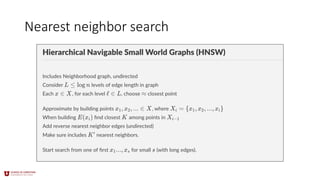
•Utilize graph structures (e.g., k-NN graphs, HNSW) for efficient
similarity search
• These are well-suited for large-scale datasets where approximate
nearest neighbor (ANN) searches are common
• Examples:
• ElasticSearch (with ANN plugins)
• Vespa
• HNSWlib-based databases
5.
Hash-based vector databases
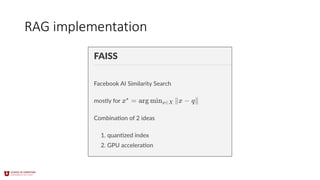
•Use hashing techniques like Locality-Sensitive Hashing (LSH) for fast
approximate searches
• Suitable for sparse or low-dimensional datasets.
• Examples:
• FAISS (Flat and Hash-based indexing options)
• Annoy (Approximate Nearest Neighbors)
6.
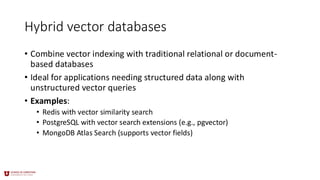
Hybrid vector databases
•Combine vector indexing with traditional relational or document-
based databases
• Ideal for applications needing structured data along with
unstructured vector queries
• Examples:
• Redis with vector similarity search
• PostgreSQL with vector search extensions (e.g., pgvector)
• MongoDB Atlas Search (supports vector fields)
7.
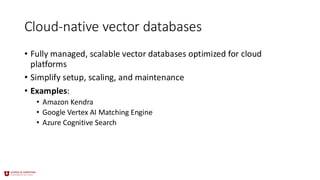
Cloud-native vector databases
•Fully managed, scalable vector databases optimized for cloud
platforms
• Simplify setup, scaling, and maintenance
• Examples:
• Amazon Kendra
• Google Vertex AI Matching Engine
• Azure Cognitive Search
8.
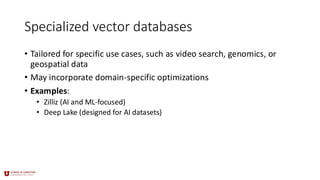
Specialized vector databases
•Tailored for specific use cases, such as video search, genomics, or
geospatial data
• May incorporate domain-specific optimizations
• Examples:
• Zilliz (AI and ML-focused)
• Deep Lake (designed for AI datasets)
9.
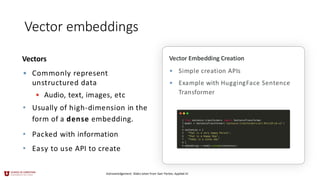
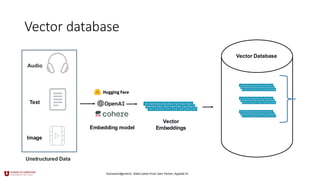
Vector embeddings
• Usuallyof high-dimension in the
form of a dense embedding.
• Packed with information
• Easy to use API to create
Vectors
• Commonly represent
unstructured data
• Audio, text, images, etc
• Simple creation APIs
• Example with HuggingFace Sentence
Transformer
Vector Embedding Creation
Acknowledgement: Slides taken from Sam Partee, Applied AI
10.
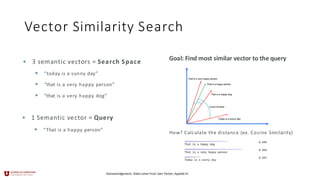
Vector Similarity Search
•“That is a happy person”
How? Calculate the distance (ex. Cosine Similarity)
Goal: Find most similar vector to the query
• 3 semantic vectors = Search Space
• “today is a sunny day”
• “that is a very happy person”
• “that is a very happy dog”
• 1 Semantic vector = Query
Acknowledgement: Slides taken from Sam Partee, Applied AI
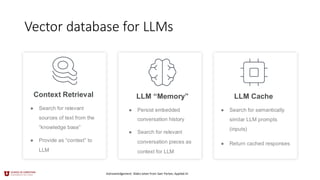
LLM Cache
● Searchfor semantically
similar LLM prompts
(inputs)
● Return cached responses
Context Retrieval
● Search for relevant
sources of text from the
“knowledge base”
● Provide as “context” to
LLM
LLM “Memory”
● Persist embedded
conversation history
● Search for relevant
conversation pieces as
context for LLM
Vector database for LLMs
Acknowledgement: Slides taken from Sam Partee, Applied AI
22.
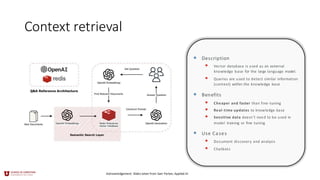
Context retrieval
• Description
•Vector database is used as an external
knowledge base for the large language model.
• Queries are used to detect similar information
(context) within the knowledge base
• Benefits
• Cheaper and faster than fine-tuning
• Real-time updates to knowledge base
• Sensitive data doesn’t need to be used in
model training or fine tuning
• Use Cases
• Document discovery and analysis
• Chatbots
Acknowledgement: Slides taken from Sam Partee, Applied AI
23.
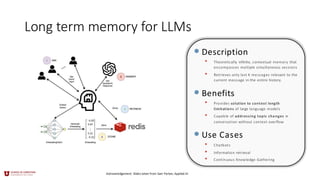
Long term memoryfor LLMs
•Description
• Theoretically infinite, contextual memory that
encompasses multiple simultaneous sessions
• Retrieves only last K messages relevant to the
current message in the entire history.
•Benefits
• Provides solution to context length
limitations of large language models
• Capable of addressing topic changes in
conversation without context overflow
•Use Cases
• Chatbots
• Information retrieval
• Continuous Knowledge Gathering
Acknowledgement: Slides taken from Sam Partee, Applied AI
24.
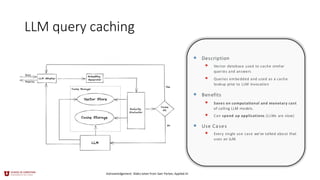
LLM query caching
•Description
• Vector database used to cache similar
queries and answers
• Queries embedded and used as a cache
lookup prior to LLM invocation
• Benefits
• Saves on computational and monetary cost
of calling LLM models.
• Can speed up applications (LLMs are slow)
• Use Cases
• Every single use case we’ve talked about that
uses an LLM.
Acknowledgement: Slides taken from Sam Partee, Applied AI
25.
Parting thoughts
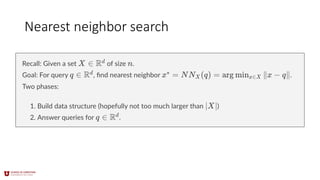
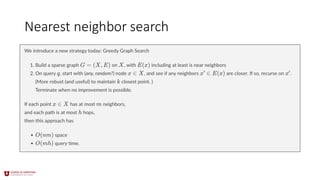
• Vectordatabases are hot and underlie modern ML-based platforms
• There are still a bunch of open research questions regarding
• Most efficient indexing technique for managing embeddings




![Hacking-Uncovered-How-People-Get-Hacked-and-How-to-Stay-Safe[1].pptx](https://cdn.slidesharecdn.com/ss_thumbnails/hacking-uncovered-how-people-get-hacked-and-how-to-stay-safe1-260130170011-4883a9c7-thumbnail.jpg?width=640&height=640&fit=bounds)


![제 23회 보아즈(BOAZ) 빅데이터 컨퍼런스 - [MBOAX] : ABSA를 활용한 소비자 반응 분석 기반 운영 효율화 대시보드 설계](https://cdn.slidesharecdn.com/ss_thumbnails/3-1boaz23rdconferencemboax-260203102709-9d519923-thumbnail.jpg?width=640&height=640&fit=bounds)
