NETAJI SUBASH ENGINEERING COLLEGE
Topic:- Merge Sort
 PRESENTED BY: PRADEEP KUMAR
 SUBJECT: ADVANCED ALGORITHMS
UNIVERSITY ROLL NO. :10900220021
CLASS ROLL NO. :21
STREAM :IT
SEC :'A'
SEM:-(6TH)
Merge Sort
INTRODUCTION
Merge Sort is a Divide and
Conquer algorithm. It divides the input
array in two halves, calls itself for the two
halves and then merges the two sorted
halves.
The merge() function is used for merging
two halves. The merge(arr, l, m, r) is key
process that assumes that arr[l..m] and
arr[m+1..r] are sorted and merges the
two sorted sub-arrays into one in a sorted
manner.
Merge Sort
Algorithm
Merge Sort Algorithm works in the following
steps-
 It divides the given unsorted array into two halves- left
and right sub arrays.
 The sub arrays are divided recursively.
 This division continues until the size of each sub array
becomes 1.
 After each sub array contains only a single element,
each sub array is sorted trivially.
 Then, the above discussed merge procedure is called.
 The merge procedure combines these trivially sorted
arrays to produce a final sorted array.
 Merge Sort Code
 // A : Array that needs to be sorted
 MergeSort(A)
 {
 n = length(A)
 if n<2 return
 mid = n/2
 left = new_array_of_size(mid) // Creating temporary array for left
 right = new_array_of_size(n-mid) // and right sub arrays
 for(int i=0 ; i<=mid-1 ; ++i)
 {
 left[i] = A[i] // Copying elements from A to left
 }
 for(int i=mid ; i<=n-1 ; ++i)
 {
 right[i-mid] = A[i] // Copying elements from A to right
 }
 MergeSort(left) // Recursively solving for left sub array
 MergeSort(right) // Recursively solving for right sub array
 merge(left, right, A) // Merging two sorted left/right sub array to final array
 }
The Merge Sort Algorithm
Works As-(Example)
• The following diagram from shows the
complete merge sort process for an
example array {38, 27, 43, 3, 9, 82, 10}. If
we take a closer look at the diagram, we
can see that the array is recursively
divided in two halves till the size
becomes 1. Once the size becomes 1, the
merge processes comes into action and
starts merging arrays back till the
complete array is merged.
Time Complexity
Analysis-
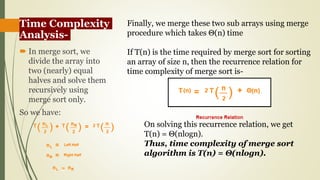
 In merge sort, we
divide the array into
two (nearly) equal
halves and solve them
recursively using
merge sort only.
So we have:
Finally, we merge these two sub arrays using merge
procedure which takes Θ(n) time
If T(n) is the time required by merge sort for sorting
an array of size n, then the recurrence relation for
time complexity of merge sort is-
On solving this recurrence relation, we get
T(n) = Θ(nlogn).
Thus, time complexity of merge sort
algorithm is T(n) = Θ(nlogn).
Time complexity of Merge Sort
is Θ(nLogn) in all 3 cases (worst, average and
best) as merge sort always divides the array in
two halves and take linear time to merge two
halves.
Space Complexity Analysis-
 Merge sort uses additional memory for left and right sub
arrays.
 Hence, total Θ(n) extra memory is needed.
Some of the important properties of
merge sort algorithm are
Merge sort uses a divide and conquer paradigm for sorting.
Merge sort is a recursive sorting algorithm.
Merge sort is a stable sorting algorithm.
Merge sort is not an in-place sorting algorithm.
The time complexity of merge sort algorithm is Θ(nlogn).
The space complexity of merge sort algorithm is Θ(n).
THANK YOU

advanced algo

  • 1.
    NETAJI SUBASH ENGINEERINGCOLLEGE Topic:- Merge Sort  PRESENTED BY: PRADEEP KUMAR  SUBJECT: ADVANCED ALGORITHMS UNIVERSITY ROLL NO. :10900220021 CLASS ROLL NO. :21 STREAM :IT SEC :'A' SEM:-(6TH)
  • 2.
    Merge Sort INTRODUCTION Merge Sortis a Divide and Conquer algorithm. It divides the input array in two halves, calls itself for the two halves and then merges the two sorted halves. The merge() function is used for merging two halves. The merge(arr, l, m, r) is key process that assumes that arr[l..m] and arr[m+1..r] are sorted and merges the two sorted sub-arrays into one in a sorted manner.
  • 3.
    Merge Sort Algorithm Merge SortAlgorithm works in the following steps-  It divides the given unsorted array into two halves- left and right sub arrays.  The sub arrays are divided recursively.  This division continues until the size of each sub array becomes 1.  After each sub array contains only a single element, each sub array is sorted trivially.  Then, the above discussed merge procedure is called.  The merge procedure combines these trivially sorted arrays to produce a final sorted array.
  • 4.
     Merge SortCode  // A : Array that needs to be sorted  MergeSort(A)  {  n = length(A)  if n<2 return  mid = n/2  left = new_array_of_size(mid) // Creating temporary array for left  right = new_array_of_size(n-mid) // and right sub arrays  for(int i=0 ; i<=mid-1 ; ++i)  {  left[i] = A[i] // Copying elements from A to left  }  for(int i=mid ; i<=n-1 ; ++i)  {  right[i-mid] = A[i] // Copying elements from A to right  }  MergeSort(left) // Recursively solving for left sub array  MergeSort(right) // Recursively solving for right sub array  merge(left, right, A) // Merging two sorted left/right sub array to final array  }
  • 5.
    The Merge SortAlgorithm Works As-(Example) • The following diagram from shows the complete merge sort process for an example array {38, 27, 43, 3, 9, 82, 10}. If we take a closer look at the diagram, we can see that the array is recursively divided in two halves till the size becomes 1. Once the size becomes 1, the merge processes comes into action and starts merging arrays back till the complete array is merged.
  • 6.
    Time Complexity Analysis-  Inmerge sort, we divide the array into two (nearly) equal halves and solve them recursively using merge sort only. So we have: Finally, we merge these two sub arrays using merge procedure which takes Θ(n) time If T(n) is the time required by merge sort for sorting an array of size n, then the recurrence relation for time complexity of merge sort is- On solving this recurrence relation, we get T(n) = Θ(nlogn). Thus, time complexity of merge sort algorithm is T(n) = Θ(nlogn).
  • 7.
    Time complexity ofMerge Sort is Θ(nLogn) in all 3 cases (worst, average and best) as merge sort always divides the array in two halves and take linear time to merge two halves. Space Complexity Analysis-  Merge sort uses additional memory for left and right sub arrays.  Hence, total Θ(n) extra memory is needed.
  • 8.
    Some of theimportant properties of merge sort algorithm are Merge sort uses a divide and conquer paradigm for sorting. Merge sort is a recursive sorting algorithm. Merge sort is a stable sorting algorithm. Merge sort is not an in-place sorting algorithm. The time complexity of merge sort algorithm is Θ(nlogn). The space complexity of merge sort algorithm is Θ(n).
  • 9.