Administration Manual
Khelo India Fitness
Assessment in Schools
- version 2.0
Sports Authority of India
Last Updated: October, 2020
Sports Authority of India | Khelo India Fitness Assessment v 2.0 | Page 1
Disclaimer
The contents on this manual are intellectual property of Sports Authority of India.
The information contained in this and related documents is confidential, privileged and only for the
information of the intended recipient and may not be used, published or redistributed without the prior
written consent of Sports Authority of India. The opinions expressed are in good faith and while every
care has been taken in preparing these documents, Sports Authority of India makes no representations and
gives no warranties of whatever nature in respect of these documents, including but not limited to the
accuracy or completeness of any information, facts and/or opinions contained therein. Sports Authority of
India, its regional offices and affiliate agencies working in the Fitness Assessment cannot be held liable
for the use of and reliance of the recommendations and procedures in these documents.
© Sports Authority of India
Gate No. 10, JLN Stadium, New Delhi - 110003
Sports Authority of India | Khelo India Fitness Assessment v 2.0 | Page 2
To Get Started
Assessors (PETs/Sports Coaches/Fitness Assessors)
Download “Khelo India (School Version)” (Assessor App) from Google Play Store. Create/Login with
your User Name and Password.
Principal/HM Login:
schoolfitness.kheloindia.gov.in. Create/Login with your User Name and Password.
Parent App/Interface
Download “Khelo India App” from Google Play Store. Create/Login with your User Name and Password.
Sports Authority of India | Khelo India Fitness Assessment v 2.0 | Page 3
Overview
Fitness defines the ability to perform physical activity, and encompasses a wide range of abilities. Each
activity and sports requires a specific set of skills, and so being fit for an activity or a sport does not
necessarily make you fit for another.
Fitness is generally divided into specific fitness categories or components, and each can be tested and
trained individually. The following pages will help you do the Fitness Test Administration in your school
more effectively using Khelo India Fitness Assessment App and viewing the School Dashboard on
School Interface.
BATTERY OF TESTS
AGE GROUP 5-8 YEARS | CLASS 1 to 3
At Primary class 1-3, children should acquire Fundamental Movement Skills (FMS) leaving the learning
of specific physical activities to later stages. FMS provide the building blocks for many physical
activities, such as playing games, dance, and sport. Locomotor, Manipulative & Body Management
abilities are key to success in most sports and physical activities. Abilities of children in class 1-3 which
need to be measured and tracked are
1. Body Composition (BMI)
2. Coordination (Plate Tapping)
3. Balance (Flamingo Balance)
Which are important for controlling the body in various situations.
AGE GROUP: 9-18+ YEARS | CLASS 4 to 12
For Class 4 to 12, it is important for students to have an overall physical fitness. The following
Components are to be considered in Physical Health and Fitness Profile:
1. Body Composition (BMI)
2. Strength
a. Abdominal (Partial Curl-up)
b. Muscular Endurance (Push Ups for Boys, Modified Push Ups for Girls)
3. Flexibility (Sit and Reach Test)
4. Cardiovascular Endurance (600 Meter Run/Walk)
5. Speed (50 mt. Dash)
Sports Authority of India | Khelo India Fitness Assessment v 2.0 | Page 4
Test Descriptions for Children
Body Mass Index
What does it measure: Body Composition refers primarily to the distribution of muscle and fat in the
body. Body size such as height, lengths and girths are also grouped under this component.
The test performed is Body Mass Index (BMI), which is calculated from body Weight (W) and
height(H). BMI = W / (H x H), where W = body weight in kilograms and H = height in meters. The
higher the score usually indicating higher levels of body fat.
Measuring Height Accurately
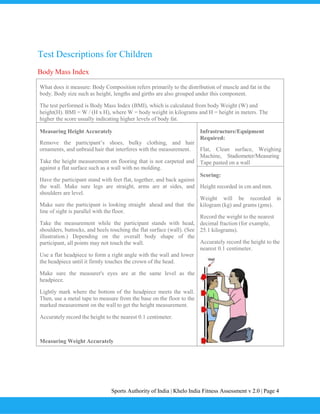
Remove the participant’s shoes, bulky clothing, and hair
ornaments, and unbraid hair that interferes with the measurement.
Take the height measurement on flooring that is not carpeted and
against a flat surface such as a wall with no molding.
Have the participant stand with feet flat, together, and back against
the wall. Make sure legs are straight, arms are at sides, and
shoulders are level.
Make sure the participant is looking straight ahead and that the
line of sight is parallel with the floor.
Take the measurement while the participant stands with head,
shoulders, buttocks, and heels touching the flat surface (wall). (See
illustration.) Depending on the overall body shape of the
participant, all points may not touch the wall.
Use a flat headpiece to form a right angle with the wall and lower
the headpiece until it firmly touches the crown of the head.
Make sure the measurer's eyes are at the same level as the
headpiece.
Lightly mark where the bottom of the headpiece meets the wall.
Then, use a metal tape to measure from the base on the floor to the
marked measurement on the wall to get the height measurement.
Accurately record the height to the nearest 0.1 centimeter.
Measuring Weight Accurately
Infrastructure/Equipment
Required:
Flat, Clean surface, Weighing
Machine, Stadiometer/Measuring
Tape pasted on a wall
Scoring:
Height recorded in cm and mm.
Weight will be recorded in
kilogram (kg) and grams (gms).
Record the weight to the nearest
decimal fraction (for example,
25.1 kilograms).
Accurately record the height to the
nearest 0.1 centimeter.
Sports Authority of India | Khelo India Fitness Assessment v 2.0 | Page 5
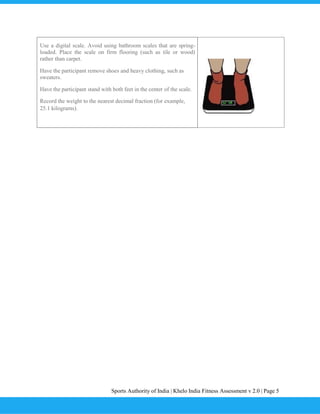
Use a digital scale. Avoid using bathroom scales that are spring-
loaded. Place the scale on firm flooring (such as tile or wood)
rather than carpet.
Have the participant remove shoes and heavy clothing, such as
sweaters.
Have the participant stand with both feet in the center of the scale.
Record the weight to the nearest decimal fraction (for example,
25.1 kilograms).
Sports Authority of India | Khelo India Fitness Assessment v 2.0 | Page 6
Plate Tapping Test
What does it measure:
Tests speed and coordination of limb movement
How to Perform:
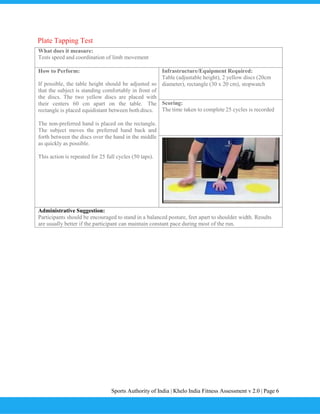
If possible, the table height should be adjusted so
that the subject is standing comfortably in front of
the discs. The two yellow discs are placed with
their centers 60 cm apart on the table. The
rectangle is placed equidistant between both discs.
The non-preferred hand is placed on the rectangle.
The subject moves the preferred hand back and
forth between the discs over the hand in the middle
as quickly as possible.
This action is repeated for 25 full cycles (50 taps).
Infrastructure/Equipment Required:
Table (adjustable height), 2 yellow discs (20cm
diameter), rectangle (30 x 20 cm), stopwatch
Scoring:
The time taken to complete 25 cycles is recorded
Administrative Suggestion:
Participants should be encouraged to stand in a balanced posture, feet apart to shoulder width. Results
are usually better if the participant can maintain constant pace during most of the run.
Sports Authority of India | Khelo India Fitness Assessment v 2.0 | Page 7
Flamingo Balance Test
What does it measure:
Ability to balance successfully on a single leg. This single leg balance test assesses the strength of the
leg, pelvic, and trunk muscle as well as Static balance.
How to Perform:
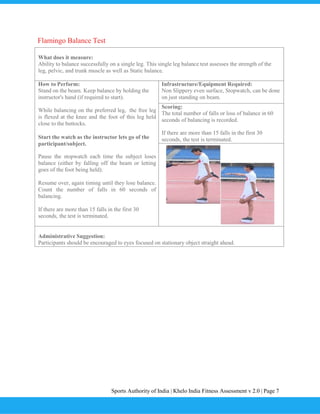
Stand on the beam. Keep balance by holding the
instructor's hand (if required to start).
Infrastructure/Equipment Required:
Non Slippery even surface, Stopwatch, can be done
on just standing on beam.
While balancing on the preferred leg, the free leg
is flexed at the knee and the foot of this leg held
close to the buttocks.
Scoring:
The total number of falls or loss of balance in 60
seconds of balancing is recorded.
Start the watch as the instructor lets go of the
participant/subject.
If there are more than 15 falls in the first 30
seconds, the test is terminated.
Pause the stopwatch each time the subject loses
balance (either by falling off the beam or letting
goes of the foot being held).
Resume over, again timing until they lose balance.
Count the number of falls in 60 seconds of
balancing.
If there are more than 15 falls in the first 30
seconds, the test is terminated.
Administrative Suggestion:
Participants should be encouraged to eyes focused on stationary object straight ahead.
Sports Authority of India | Khelo India Fitness Assessment v 2.0 | Page 8
Partial Curl Up (30 seconds)
What does it measure:
The curl up test measures abdominal muscular strength and endurance of the abdominals and hip-
Flexors, important in back support and core stability.
How to Perform:
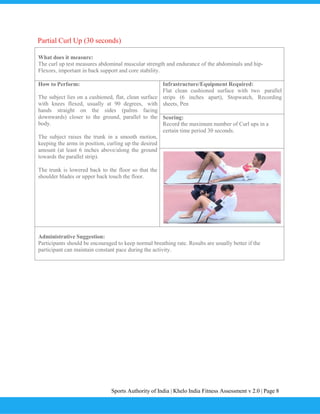
The subject lies on a cushioned, flat, clean surface
with knees flexed, usually at 90 degrees, with
hands straight on the sides (palms facing
downwards) closer to the ground, parallel to the
body.
The subject raises the trunk in a smooth motion,
keeping the arms in position, curling up the desired
amount (at least 6 inches above/along the ground
towards the parallel strip).
The trunk is lowered back to the floor so that the
shoulder blades or upper back touch the floor.
Infrastructure/Equipment Required:
Flat clean cushioned surface with two parallel
strips (6 inches apart), Stopwatch, Recording
sheets, Pen
Scoring:
Record the maximum number of Curl ups in a
certain time period 30 seconds.
Administrative Suggestion:
Participants should be encouraged to keep normal breathing rate. Results are usually better if the
participant can maintain constant pace during the activity.
Sports Authority of India | Khelo India Fitness Assessment v 2.0 | Page 9
Push Ups (Boys)/Modified Push Ups (Girls)
What does it measure:
Upper body strength endurance, and trunk stability.
How to Perform:
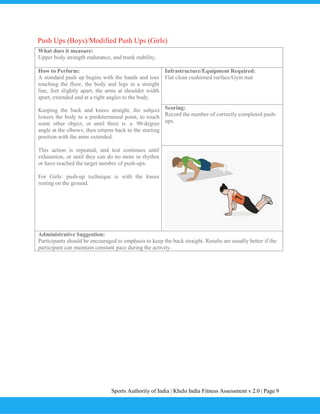
A standard push up begins with the hands and toes
touching the floor, the body and legs in a straight
line, feet slightly apart, the arms at shoulder width
apart, extended and at a right angles to the body.
Keeping the back and knees straight, the subject
lowers the body to a predetermined point, to touch
some other object, or until there is a 90-degree
angle at the elbows, then returns back to the starting
position with the arms extended.
This action is repeated, and test continues until
exhaustion, or until they can do no more in rhythm
or have reached the target number of push-ups.
For Girls: push-up technique is with the knees
resting on the ground.
Infrastructure/Equipment Required:
Flat clean cushioned surface/Gym mat
Scoring:
Record the number of correctly completed push-
ups.
Administrative Suggestion:
Participants should be encouraged to emphasis to keep the back straight. Results are usually better if the
participant can maintain constant pace during the activity.
Sports Authority of India | Khelo India Fitness Assessment v 2.0 | Page 10
Sit and Reach
What does it measure:
Common measure of flexibility, and specifically measures the flexibility of the lower back and
hamstring muscles. This test is important as because tightness in this area is implicated in lumbar
lordosis, forward pelvic tilt and lower back pain
How to Perform:
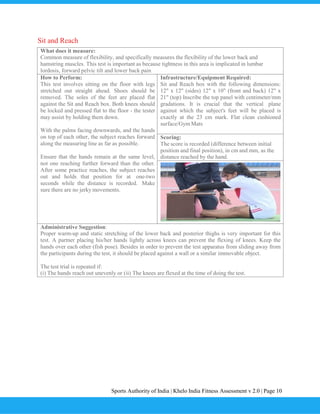
This test involves sitting on the floor with legs
stretched out straight ahead. Shoes should be
removed. The soles of the feet are placed flat
against the Sit and Reach box. Both knees should
be locked and pressed flat to the floor - the tester
may assist by holding them down.
With the palms facing downwards, and the hands
on top of each other, the subject reaches forward
along the measuring line as far as possible.
Ensure that the hands remain at the same level,
not one reaching further forward than the other.
After some practice reaches, the subject reaches
out and holds that position for at one-two
seconds while the distance is recorded. Make
sure there are no jerky movements.
Infrastructure/Equipment Required:
Sit and Reach box with the following dimensions:
12" x 12" (sides) 12" x 10" (front and back) 12" x
21" (top) Inscribe the top panel with centimeter/mm
gradations. It is crucial that the vertical plane
against which the subject's feet will be placed is
exactly at the 23 cm mark. Flat clean cushioned
surface/Gym Mats
Scoring:
The score is recorded (difference between initial
position and final position), in cm and mm, as the
distance reached by the hand.
Administrative Suggestion:
Proper warm-up and static stretching of the lower back and posterior thighs is very important for this
test. A partner placing his/her hands lightly across knees can prevent the flexing of knees. Keep the
hands over each other (fish pose). Besides in order to prevent the test apparatus from sliding away from
the participants during the test, it should be placed against a wall or a similar immovable object.
The test trial is repeated if:
(i) The hands reach out unevenly or (ii) The knees are flexed at the time of doing the test.
Sports Authority of India | Khelo India Fitness Assessment v 2.0 | Page 11
600 Mtr Run/Walk
What does it measure:
Cardiovascular Fitness/Cardiovascular Endurance
How to Perform:
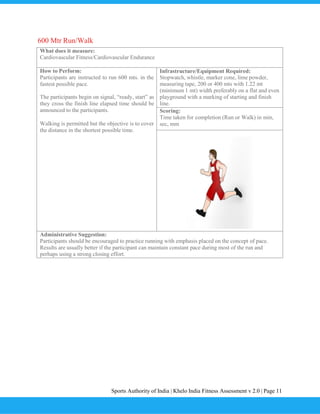
Participants are instructed to run 600 mts. in the
fastest possible pace.
The participants begin on signal, “ready, start” as
they cross the finish line elapsed time should be
announced to the participants.

Walking is permitted but the objective is to cover
the distance in the shortest possible time.
Infrastructure/Equipment Required:
Stopwatch, whistle, marker cone, lime powder,
measuring tape, 200 or 400 mts with 1.22 mt
(minimum 1 mt) width preferably on a flat and even
playground with a marking of starting and finish
line.
Scoring:
Time taken for completion (Run or Walk) in min,
sec, mm
Administrative Suggestion:
Participants should be encouraged to practice running with emphasis placed on the concept of pace.
Results are usually better if the participant can maintain constant pace during most of the run and
perhaps using a strong closing effort.
Sports Authority of India | Khelo India Fitness Assessment v 2.0 | Page 12
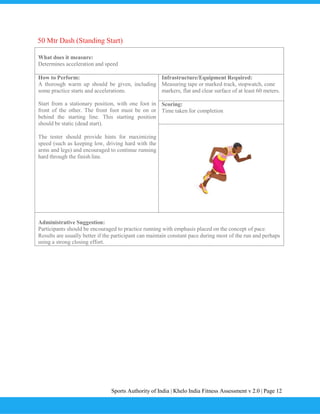
50 Mtr Dash (Standing Start)
What does it measure:
Determines acceleration and speed
How to Perform:
A thorough warm up should be given, including
some practice starts and accelerations.
Start from a stationary position, with one foot in
front of the other. The front foot must be on or
behind the starting line. This starting position
should be static (dead start).
The tester should provide hints for maximizing
speed (such as keeping low, driving hard with the
arms and legs) and encouraged to continue running
hard through the finish line.
Infrastructure/Equipment Required:
Measuring tape or marked track, stopwatch, cone
markers, flat and clear surface of at least 60 meters.
Scoring:
Time taken for completion
Administrative Suggestion:
Participants should be encouraged to practice running with emphasis placed on the concept of pace.
Results are usually better if the participant can maintain constant pace during most of the run and perhaps
using a strong closing effort.
Sports Authority of India | Khelo India Fitness Assessment v 2.0 | Page 13
Do’s and Dont’s
Preparing for Assessments
To participate in Physical Fitness Assessments, some good preparation can go a long way.
1. It is recommended that the assessments are done twice a year (for Term I and Term II
in each academic year). The minimum gap between tests should be 4 months.
2. Find out what is required. Most fitness tests will require a combination of evaluations to
assess speed, endurance/stamina, strength, flexibility, and body composition. Read about
these tests and plan for the same.
3. Determine the current abilities. Pretend you are taking their test today and perform each
exercise. Note how close they came to the goal and how much further they need to go.
4. Calculate the time you have to prepare. You need adequate time to prepare for thetest.
5. Participants must pace themselves. Maintaining a constant tempo is crucial for completing
long and repetitive exercises, like Curl-ups, Push-ups and 600 mt run/walk. If you work too
fast at the beginning of the exercise, you may become fatigued quickly. It is more effective to
maintain a steady pace throughout.
6. Participants should be encouraged to practice for few weeks with emphasis placed on the
concept of pace. Results are usually better if the participant can maintain consistency in
performance during this practice period.
Before a Test
Get appropriate clothing
1. Participant to wear comfortable clothes with sports shoes.
a. In case shoes are not available, he/she can run bare-feet. He/she needs to take
precaution so that the foot doesn’t get hurt with pointed objects in the playingfields.
b. Avoid leather shoes.
2. Get clothes that are comfortable to wear and run or bend (eg. T-shirt and comfortable fitting
trousers/half pants).
3. Wearing socks that will keep the feet dry.
Safety Measures
1. If you plan to do for a group of people, decide Date/Time when you want to do the test.
2. Ensure that the play field is flat and clear from stones/pointed objects that may injurechildren.
3. Ensure that the equipment required for the tests are available at the place where you want to
do the tests.
4. Have a First Aid Box.
Sports Authority of India | Khelo India Fitness Assessment v 2.0 | Page 14
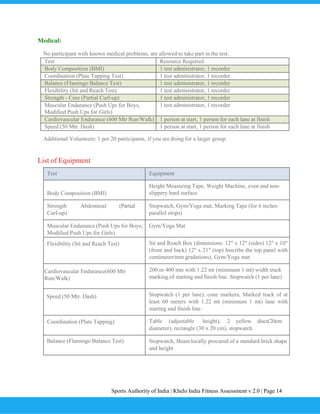
Medical:
No participant with known medical problems, are allowed to take part in the test.
Test Resource Required
Body Composition (BMI) 1 test administrator, 1 recorder
Coordination (Plate Tapping Test) 1 test administrator, 1 recorder
Balance (Flamingo Balance Test) 1 test administrator, 1 recorder
Flexibility (Sit and Reach Test) 1 test administrator, 1 recorder
Strength - Core (Partial Curl-up) 1 test administrator, 1 recorder
Muscular Endurance (Push Ups for Boys,
Modified Push Ups for Girls)
1 test administrator, 1 recorder
Cardiovascular Endurance (600 Mtr Run/Walk) 1 person at start, 1 person for each lane at finish
Speed (50 Mtr. Dash) 1 person at start, 1 person for each lane at finish
Additional Volunteers: 1 per 20 participants, if you are doing for a larger group.
List of Equipment
Test Equipment
Body Composition (BMI)
Height Measuring Tape, Weight Machine, even and non-
slippery hard surface
Strength Abdominal (Partial
Curl-up)
Stopwatch, Gym/Yoga mat, Marking Tape (for 6 inches
parallel strips)
Muscular Endurance (Push Ups for Boys,
Modified Push Ups for Girls)
Gym/Yoga Mat
Flexibility (Sit and Reach Test) Sit and Reach Box (dimensions: 12" x 12" (sides) 12" x 10"
(front and back) 12" x 21" (top) Inscribe the top panel with
centimeter/mm gradations), Gym/Yoga mat
Cardiovascular Endurance(600 Mtr
Run/Walk)
200 or 400 mts with 1.22 mt (minimum 1 mt) width track
marking of starting and finish line. Stopwatch (1 per lane)
Speed (50 Mtr. Dash) Stopwatch (1 per lane), cone markers, Marked track of at
least 60 meters with 1.22 mt (minimum 1 mt) lane with
starting and finish line.
Coordination (Plate Tapping) Table (adjustable height), 2 yellow discs(20cm
diameter), rectangle (30 x 20 cm), stopwatch
Balance (Flamingo Balance Test) Stopwatch, Beam locally procured of a standard brick shape
and height
Sports Authority of India | Khelo India Fitness Assessment v 2.0 | Page 15
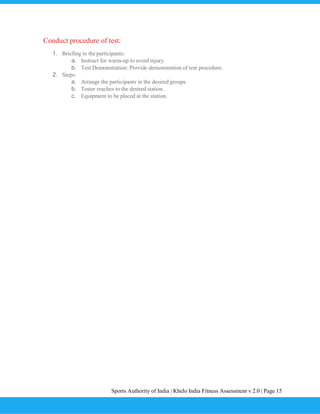
Conduct procedure of test:
1. Briefing to the participants:
a. Instruct for warm-up to avoid injury.
b. Test Demonstration: Provide demonstration of test procedure.
2. Steps:
a. Arrange the participants in the desired groups.
b. Tester reaches to the desired station.
c. Equipment to be placed at the station.
Sports Authority of India | Khelo India Fitness Assessment v 2.0 | Page 16
Usage of Khelo India
Mobile App and Portal
1. Assessor App
2. School Portal
3. Parent App
Sports Authority of India | Khelo India Fitness Assessment v 2.0 | Page 17
Assessor App
Se-lf Registration of Assessor
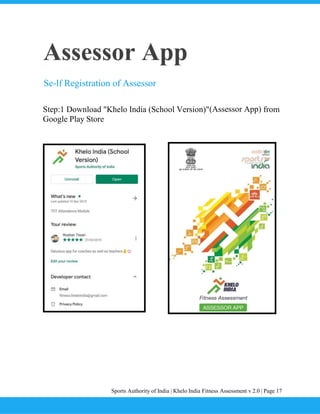
Step:1 Download "Khelo India (School Version)"(Assessor App) from
Google Play Store
Sports Authority of India | Khelo India Fitness Assessment v 2.0 | Page 18
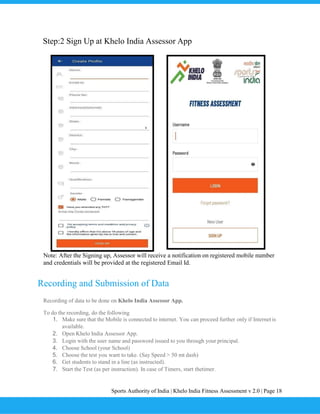
Step:2 Sign Up at Khelo India Assessor App
Note: After the Signing up, Assessor will receive a notification on registered mobile number
and credentials will be provided at the registered Email Id.
Recording and Submission of Data
Recording of data to be done on Khelo India Assessor App.
To do the recording, do the following
1. Make sure that the Mobile is connected to internet. You can proceed further only if Internet is
available.
2. Open Khelo India Assessor App.
3. Login with the user name and password issued to you through your principal.
4. Choose School (your School)
5. Choose the test you want to take. (Say Speed > 50 mt dash)
6. Get students to stand in a line (as instructed).
7. Start the Test (as per instruction). In case of Timers, start thetimer.
Sports Authority of India | Khelo India Fitness Assessment v 2.0 | Page 19
8. In case of multiple students taking Timer based tests, use the start and split timer.
9. Once they have finished the test:
a. Enter the performance against each test (if required). In case of Timing based tests,
split timer/stop timer to be used.
b. Scan the QR code of the student from his ID card. In case, he doesn’t have ID Card
with QR Code, choose his/her class and section, Name. The ID no. will get
automatically filled up.
10. Click on “Save Data” button and Tap on refresh button to synchronize theassessment
data
11. After you finish taking the tests, click on “Go to Dashboard” by loggingto
schoolfitness.kheloindia.gov.in.
12. The Fitness Dashboard of the students will get updated. Parents can log into
schoolfitness.kheloindia.gov.in by using their user name and password issued tothem
PN: Make sure that you have saved the data, after every test. Do not forget to click on “Go to
Dashboard” button, which will prepare your fitness dashboard.
Sports Authority of India | Khelo India Fitness Assessment v 2.0 | Page 20
School Principal
Portal
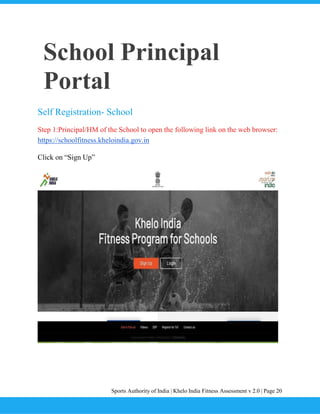
Self Registration- School
Step 1:Principal/HM of the School to open the following link on the web browser:
https://schoolfitness.kheloindia.gov.in
Click on “Sign Up”
Sports Authority of India | Khelo India Fitness Assessment v 2.0 | Page 21
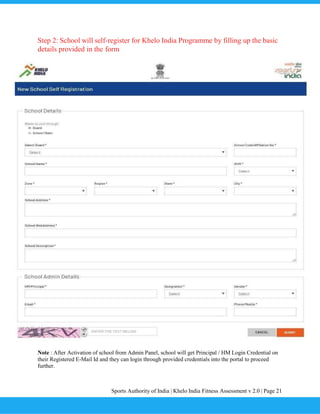
Step 2: School will self-register for Khelo India Programme by filling up the basic
details provided in the form
Note : After Activation of school from Admin Panel, school will get Principal / HM Login Credential on
their Registered E-Mail Id and they can login through provided credentials into the portal to proceed
further.
Sports Authority of India | Khelo India Fitness Assessment v 2.0 | Page 22
Sports Authority of India | Khelo India Fitness Assessment v 2.0 | Page 23
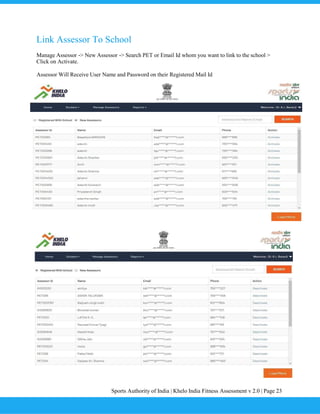
Link Assessor To School
Manage Assessor -> New Assessor -> Search PET or Email Id whom you want to link to the school >
Click on Activate.
Assessor Will Receive User Name and Password on their Registered Mail Id
Sports Authority of India | Khelo India Fitness Assessment v 2.0 | Page 24
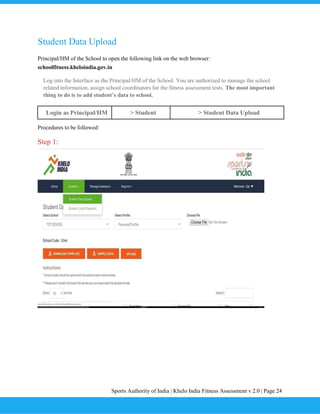
Student Data Upload
Principal/HM of the School to open the following link on the web browser:
schoolfitness.kheloindia.gov.in
Log into the Interface as the Principal/HM of the School. You are authorized to manage the school
related information, assign school coordinators for the fitness assessment tests. The most important
thing to do is to add student’s data to school.
Login as Principal/HM > Student > Student Data Upload
Procedures to be followed:
Step 1:
Sports Authority of India | Khelo India Fitness Assessment v 2.0 | Page 25
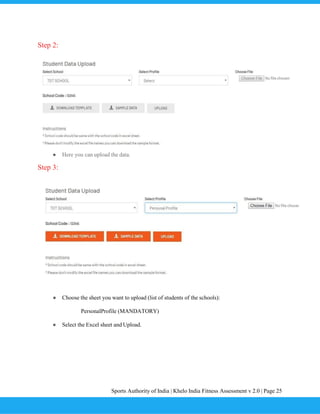
Step 2:
● Here you can upload the data.
Step 3:
● Choose the sheet you want to upload (list of students of the schools):
PersonalProfile (MANDATORY)
● Select the Excel sheet and Upload.
Sports Authority of India | Khelo India Fitness Assessment v 2.0 | Page 26
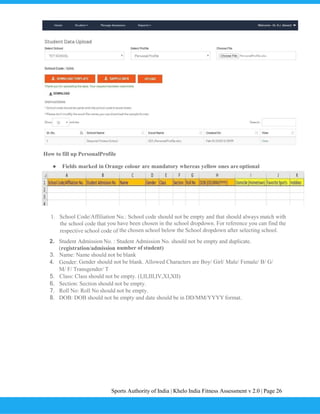
How to fill up PersonalProfile
● Fields marked in Orange colour are mandatory whereas yellow ones are optional
1. School Code/Affiliation No.: School code should not be empty and that should always match with
the school code that you have been chosen in the school dropdown. For reference you can find the
respective school code of the chosen school below the School dropdown after selecting school.
2. Student Admission No. : Student Admission No. should not be empty and duplicate.
(registration/admission number of student)
3. Name: Name should not be blank
4. Gender: Gender should not be blank. Allowed Characters are Boy/ Girl/ Male/ Female/ B/ G/
M/ F/ Transgender/ T
5. Class: Class should not be empty. (I,II,III,IV,XI,XII)
6. Section: Section should not be empty.
7. Roll No: Roll No should not be empty.
8. DOB: DOB should not be empty and date should be in DD/MM/YYYY format.
Sports Authority of India | Khelo India Fitness Assessment v 2.0 | Page 27
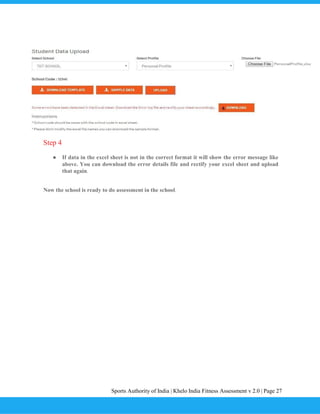
Step 4
● If data in the excel sheet is not in the correct format it will show the error message like
above. You can download the error details file and rectify your excel sheet and upload
that again.
Now the school is ready to do assessment in the school.
Sports Authority of India | Khelo India Fitness Assessment v 2.0 | Page 28
Khelo India Parent
App
Installation and Creation of Parent User ID
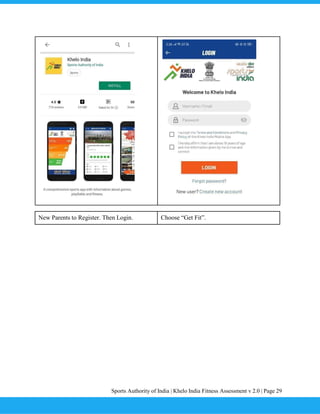
Ask parents to download “Khelo India App” from Google Play Store or Apple Store and Install the App.
Parents to click on “Create New Account” to create a Parent Username and Password. They will receive
email and SMS confirmation.
Download and Install Login as Parent
Sports Authority of India | Khelo India Fitness Assessment v 2.0 | Page 29
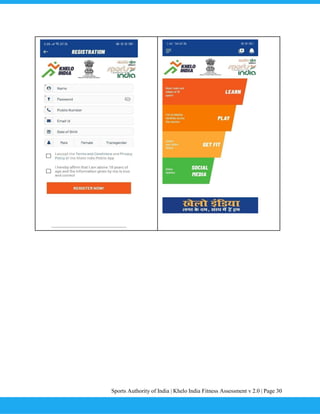
New Parents to Register. Then Login. Choose “Get Fit”.
Sports Authority of India | Khelo India Fitness Assessment v 2.0 | Page 30
Sports Authority of India | Khelo India Fitness Assessment v 2.0 | Page 31
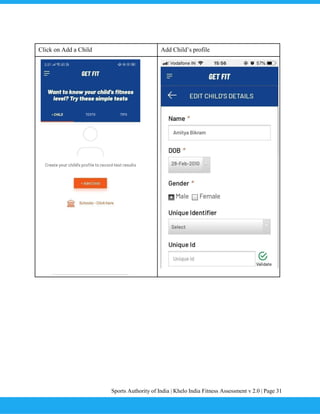
Click on Add a Child Add Child’s profile
Sports Authority of India | Khelo India Fitness Assessment v 2.0 | Page 32
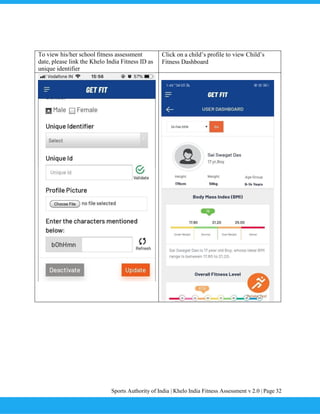
To view his/her school fitness assessment
date, please link the Khelo India Fitness ID as
unique identifier
Click on a child’s profile to view Child’s
Fitness Dashboard
Sports Authority of India | Khelo India Fitness Assessment v 2.0 | Page 32
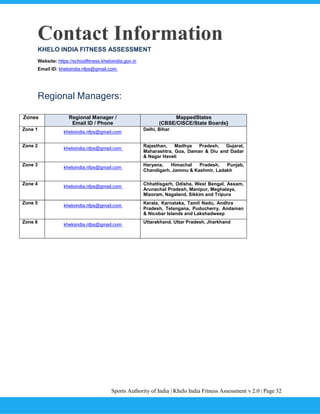
Contact Information
KHELO INDIA FITNESS ASSESSMENT
Website: https://schoolfitness.kheloindia.gov.in
Email ID: kheloindia.nfps@gmail.com
Regional Managers:
Zones Regional Manager /
Email ID / Phone
MappedStates
(CBSE/CISCE/State Boards}
Zone 1
kheloindia.nfps@gmail.com
Delhi, Bihar
Zone 2
kheloindia.nfps@gmail.com
Rajasthan, Madhya Pradesh, Gujarat,
Maharashtra, Goa, Daman & Diu and Dadar
& Nagar Haveli
Zone 3
kheloindia.nfps@gmail.com
Haryana, Himachal Pradesh, Punjab,
Chandigarh, Jammu & Kashmir, Ladakh
Zone 4
kheloindia.nfps@gmail.com
Chhattisgarh, Odisha, West Bengal, Assam,
Arunachal Pradesh, Manipur, Meghalaya,
Mizoram, Nagaland, Sikkim and Tripura
Zone 5
kheloindia.nfps@gmail.com
Kerala, Karnataka, Tamil Nadu, Andhra
Pradesh, Telangana, Puducherry, Andaman
& Nicobar Islands and Lakshadweep
Zone 6
kheloindia.nfps@gmail.com
Uttarakhand, Uttar Pradesh, Jharkhand
Sports Authority of India | Khelo India Fitness Assessment v 2.0 | Page 33

AdminManual.pdf

  • 1.
    Administration Manual Khelo IndiaFitness Assessment in Schools - version 2.0 Sports Authority of India Last Updated: October, 2020
  • 2.
    Sports Authority ofIndia | Khelo India Fitness Assessment v 2.0 | Page 1 Disclaimer The contents on this manual are intellectual property of Sports Authority of India. The information contained in this and related documents is confidential, privileged and only for the information of the intended recipient and may not be used, published or redistributed without the prior written consent of Sports Authority of India. The opinions expressed are in good faith and while every care has been taken in preparing these documents, Sports Authority of India makes no representations and gives no warranties of whatever nature in respect of these documents, including but not limited to the accuracy or completeness of any information, facts and/or opinions contained therein. Sports Authority of India, its regional offices and affiliate agencies working in the Fitness Assessment cannot be held liable for the use of and reliance of the recommendations and procedures in these documents. © Sports Authority of India Gate No. 10, JLN Stadium, New Delhi - 110003
  • 3.
    Sports Authority ofIndia | Khelo India Fitness Assessment v 2.0 | Page 2 To Get Started Assessors (PETs/Sports Coaches/Fitness Assessors) Download “Khelo India (School Version)” (Assessor App) from Google Play Store. Create/Login with your User Name and Password. Principal/HM Login: schoolfitness.kheloindia.gov.in. Create/Login with your User Name and Password. Parent App/Interface Download “Khelo India App” from Google Play Store. Create/Login with your User Name and Password.
  • 4.
    Sports Authority ofIndia | Khelo India Fitness Assessment v 2.0 | Page 3 Overview Fitness defines the ability to perform physical activity, and encompasses a wide range of abilities. Each activity and sports requires a specific set of skills, and so being fit for an activity or a sport does not necessarily make you fit for another. Fitness is generally divided into specific fitness categories or components, and each can be tested and trained individually. The following pages will help you do the Fitness Test Administration in your school more effectively using Khelo India Fitness Assessment App and viewing the School Dashboard on School Interface. BATTERY OF TESTS AGE GROUP 5-8 YEARS | CLASS 1 to 3 At Primary class 1-3, children should acquire Fundamental Movement Skills (FMS) leaving the learning of specific physical activities to later stages. FMS provide the building blocks for many physical activities, such as playing games, dance, and sport. Locomotor, Manipulative & Body Management abilities are key to success in most sports and physical activities. Abilities of children in class 1-3 which need to be measured and tracked are 1. Body Composition (BMI) 2. Coordination (Plate Tapping) 3. Balance (Flamingo Balance) Which are important for controlling the body in various situations. AGE GROUP: 9-18+ YEARS | CLASS 4 to 12 For Class 4 to 12, it is important for students to have an overall physical fitness. The following Components are to be considered in Physical Health and Fitness Profile: 1. Body Composition (BMI) 2. Strength a. Abdominal (Partial Curl-up) b. Muscular Endurance (Push Ups for Boys, Modified Push Ups for Girls) 3. Flexibility (Sit and Reach Test) 4. Cardiovascular Endurance (600 Meter Run/Walk) 5. Speed (50 mt. Dash)
  • 5.
    Sports Authority ofIndia | Khelo India Fitness Assessment v 2.0 | Page 4 Test Descriptions for Children Body Mass Index What does it measure: Body Composition refers primarily to the distribution of muscle and fat in the body. Body size such as height, lengths and girths are also grouped under this component. The test performed is Body Mass Index (BMI), which is calculated from body Weight (W) and height(H). BMI = W / (H x H), where W = body weight in kilograms and H = height in meters. The higher the score usually indicating higher levels of body fat. Measuring Height Accurately Remove the participant’s shoes, bulky clothing, and hair ornaments, and unbraid hair that interferes with the measurement. Take the height measurement on flooring that is not carpeted and against a flat surface such as a wall with no molding. Have the participant stand with feet flat, together, and back against the wall. Make sure legs are straight, arms are at sides, and shoulders are level. Make sure the participant is looking straight ahead and that the line of sight is parallel with the floor. Take the measurement while the participant stands with head, shoulders, buttocks, and heels touching the flat surface (wall). (See illustration.) Depending on the overall body shape of the participant, all points may not touch the wall. Use a flat headpiece to form a right angle with the wall and lower the headpiece until it firmly touches the crown of the head. Make sure the measurer's eyes are at the same level as the headpiece. Lightly mark where the bottom of the headpiece meets the wall. Then, use a metal tape to measure from the base on the floor to the marked measurement on the wall to get the height measurement. Accurately record the height to the nearest 0.1 centimeter. Measuring Weight Accurately Infrastructure/Equipment Required: Flat, Clean surface, Weighing Machine, Stadiometer/Measuring Tape pasted on a wall Scoring: Height recorded in cm and mm. Weight will be recorded in kilogram (kg) and grams (gms). Record the weight to the nearest decimal fraction (for example, 25.1 kilograms). Accurately record the height to the nearest 0.1 centimeter.
  • 6.
    Sports Authority ofIndia | Khelo India Fitness Assessment v 2.0 | Page 5 Use a digital scale. Avoid using bathroom scales that are spring- loaded. Place the scale on firm flooring (such as tile or wood) rather than carpet. Have the participant remove shoes and heavy clothing, such as sweaters. Have the participant stand with both feet in the center of the scale. Record the weight to the nearest decimal fraction (for example, 25.1 kilograms).
  • 7.
    Sports Authority ofIndia | Khelo India Fitness Assessment v 2.0 | Page 6 Plate Tapping Test What does it measure: Tests speed and coordination of limb movement How to Perform: If possible, the table height should be adjusted so that the subject is standing comfortably in front of the discs. The two yellow discs are placed with their centers 60 cm apart on the table. The rectangle is placed equidistant between both discs. The non-preferred hand is placed on the rectangle. The subject moves the preferred hand back and forth between the discs over the hand in the middle as quickly as possible. This action is repeated for 25 full cycles (50 taps). Infrastructure/Equipment Required: Table (adjustable height), 2 yellow discs (20cm diameter), rectangle (30 x 20 cm), stopwatch Scoring: The time taken to complete 25 cycles is recorded Administrative Suggestion: Participants should be encouraged to stand in a balanced posture, feet apart to shoulder width. Results are usually better if the participant can maintain constant pace during most of the run.
  • 8.
    Sports Authority ofIndia | Khelo India Fitness Assessment v 2.0 | Page 7 Flamingo Balance Test What does it measure: Ability to balance successfully on a single leg. This single leg balance test assesses the strength of the leg, pelvic, and trunk muscle as well as Static balance. How to Perform: Stand on the beam. Keep balance by holding the instructor's hand (if required to start). Infrastructure/Equipment Required: Non Slippery even surface, Stopwatch, can be done on just standing on beam. While balancing on the preferred leg, the free leg is flexed at the knee and the foot of this leg held close to the buttocks. Scoring: The total number of falls or loss of balance in 60 seconds of balancing is recorded. Start the watch as the instructor lets go of the participant/subject. If there are more than 15 falls in the first 30 seconds, the test is terminated. Pause the stopwatch each time the subject loses balance (either by falling off the beam or letting goes of the foot being held). Resume over, again timing until they lose balance. Count the number of falls in 60 seconds of balancing. If there are more than 15 falls in the first 30 seconds, the test is terminated. Administrative Suggestion: Participants should be encouraged to eyes focused on stationary object straight ahead.
  • 9.
    Sports Authority ofIndia | Khelo India Fitness Assessment v 2.0 | Page 8 Partial Curl Up (30 seconds) What does it measure: The curl up test measures abdominal muscular strength and endurance of the abdominals and hip- Flexors, important in back support and core stability. How to Perform: The subject lies on a cushioned, flat, clean surface with knees flexed, usually at 90 degrees, with hands straight on the sides (palms facing downwards) closer to the ground, parallel to the body. The subject raises the trunk in a smooth motion, keeping the arms in position, curling up the desired amount (at least 6 inches above/along the ground towards the parallel strip). The trunk is lowered back to the floor so that the shoulder blades or upper back touch the floor. Infrastructure/Equipment Required: Flat clean cushioned surface with two parallel strips (6 inches apart), Stopwatch, Recording sheets, Pen Scoring: Record the maximum number of Curl ups in a certain time period 30 seconds. Administrative Suggestion: Participants should be encouraged to keep normal breathing rate. Results are usually better if the participant can maintain constant pace during the activity.
  • 10.
    Sports Authority ofIndia | Khelo India Fitness Assessment v 2.0 | Page 9 Push Ups (Boys)/Modified Push Ups (Girls) What does it measure: Upper body strength endurance, and trunk stability. How to Perform: A standard push up begins with the hands and toes touching the floor, the body and legs in a straight line, feet slightly apart, the arms at shoulder width apart, extended and at a right angles to the body. Keeping the back and knees straight, the subject lowers the body to a predetermined point, to touch some other object, or until there is a 90-degree angle at the elbows, then returns back to the starting position with the arms extended. This action is repeated, and test continues until exhaustion, or until they can do no more in rhythm or have reached the target number of push-ups. For Girls: push-up technique is with the knees resting on the ground. Infrastructure/Equipment Required: Flat clean cushioned surface/Gym mat Scoring: Record the number of correctly completed push- ups. Administrative Suggestion: Participants should be encouraged to emphasis to keep the back straight. Results are usually better if the participant can maintain constant pace during the activity.
  • 11.
    Sports Authority ofIndia | Khelo India Fitness Assessment v 2.0 | Page 10 Sit and Reach What does it measure: Common measure of flexibility, and specifically measures the flexibility of the lower back and hamstring muscles. This test is important as because tightness in this area is implicated in lumbar lordosis, forward pelvic tilt and lower back pain How to Perform: This test involves sitting on the floor with legs stretched out straight ahead. Shoes should be removed. The soles of the feet are placed flat against the Sit and Reach box. Both knees should be locked and pressed flat to the floor - the tester may assist by holding them down. With the palms facing downwards, and the hands on top of each other, the subject reaches forward along the measuring line as far as possible. Ensure that the hands remain at the same level, not one reaching further forward than the other. After some practice reaches, the subject reaches out and holds that position for at one-two seconds while the distance is recorded. Make sure there are no jerky movements. Infrastructure/Equipment Required: Sit and Reach box with the following dimensions: 12" x 12" (sides) 12" x 10" (front and back) 12" x 21" (top) Inscribe the top panel with centimeter/mm gradations. It is crucial that the vertical plane against which the subject's feet will be placed is exactly at the 23 cm mark. Flat clean cushioned surface/Gym Mats Scoring: The score is recorded (difference between initial position and final position), in cm and mm, as the distance reached by the hand. Administrative Suggestion: Proper warm-up and static stretching of the lower back and posterior thighs is very important for this test. A partner placing his/her hands lightly across knees can prevent the flexing of knees. Keep the hands over each other (fish pose). Besides in order to prevent the test apparatus from sliding away from the participants during the test, it should be placed against a wall or a similar immovable object. The test trial is repeated if: (i) The hands reach out unevenly or (ii) The knees are flexed at the time of doing the test.
  • 12.
    Sports Authority ofIndia | Khelo India Fitness Assessment v 2.0 | Page 11 600 Mtr Run/Walk What does it measure: Cardiovascular Fitness/Cardiovascular Endurance How to Perform: Participants are instructed to run 600 mts. in the fastest possible pace. The participants begin on signal, “ready, start” as they cross the finish line elapsed time should be announced to the participants. Walking is permitted but the objective is to cover the distance in the shortest possible time. Infrastructure/Equipment Required: Stopwatch, whistle, marker cone, lime powder, measuring tape, 200 or 400 mts with 1.22 mt (minimum 1 mt) width preferably on a flat and even playground with a marking of starting and finish line. Scoring: Time taken for completion (Run or Walk) in min, sec, mm Administrative Suggestion: Participants should be encouraged to practice running with emphasis placed on the concept of pace. Results are usually better if the participant can maintain constant pace during most of the run and perhaps using a strong closing effort.
  • 13.
    Sports Authority ofIndia | Khelo India Fitness Assessment v 2.0 | Page 12 50 Mtr Dash (Standing Start) What does it measure: Determines acceleration and speed How to Perform: A thorough warm up should be given, including some practice starts and accelerations. Start from a stationary position, with one foot in front of the other. The front foot must be on or behind the starting line. This starting position should be static (dead start). The tester should provide hints for maximizing speed (such as keeping low, driving hard with the arms and legs) and encouraged to continue running hard through the finish line. Infrastructure/Equipment Required: Measuring tape or marked track, stopwatch, cone markers, flat and clear surface of at least 60 meters. Scoring: Time taken for completion Administrative Suggestion: Participants should be encouraged to practice running with emphasis placed on the concept of pace. Results are usually better if the participant can maintain constant pace during most of the run and perhaps using a strong closing effort.
  • 14.
    Sports Authority ofIndia | Khelo India Fitness Assessment v 2.0 | Page 13 Do’s and Dont’s Preparing for Assessments To participate in Physical Fitness Assessments, some good preparation can go a long way. 1. It is recommended that the assessments are done twice a year (for Term I and Term II in each academic year). The minimum gap between tests should be 4 months. 2. Find out what is required. Most fitness tests will require a combination of evaluations to assess speed, endurance/stamina, strength, flexibility, and body composition. Read about these tests and plan for the same. 3. Determine the current abilities. Pretend you are taking their test today and perform each exercise. Note how close they came to the goal and how much further they need to go. 4. Calculate the time you have to prepare. You need adequate time to prepare for thetest. 5. Participants must pace themselves. Maintaining a constant tempo is crucial for completing long and repetitive exercises, like Curl-ups, Push-ups and 600 mt run/walk. If you work too fast at the beginning of the exercise, you may become fatigued quickly. It is more effective to maintain a steady pace throughout. 6. Participants should be encouraged to practice for few weeks with emphasis placed on the concept of pace. Results are usually better if the participant can maintain consistency in performance during this practice period. Before a Test Get appropriate clothing 1. Participant to wear comfortable clothes with sports shoes. a. In case shoes are not available, he/she can run bare-feet. He/she needs to take precaution so that the foot doesn’t get hurt with pointed objects in the playingfields. b. Avoid leather shoes. 2. Get clothes that are comfortable to wear and run or bend (eg. T-shirt and comfortable fitting trousers/half pants). 3. Wearing socks that will keep the feet dry. Safety Measures 1. If you plan to do for a group of people, decide Date/Time when you want to do the test. 2. Ensure that the play field is flat and clear from stones/pointed objects that may injurechildren. 3. Ensure that the equipment required for the tests are available at the place where you want to do the tests. 4. Have a First Aid Box.
  • 15.
    Sports Authority ofIndia | Khelo India Fitness Assessment v 2.0 | Page 14 Medical: No participant with known medical problems, are allowed to take part in the test. Test Resource Required Body Composition (BMI) 1 test administrator, 1 recorder Coordination (Plate Tapping Test) 1 test administrator, 1 recorder Balance (Flamingo Balance Test) 1 test administrator, 1 recorder Flexibility (Sit and Reach Test) 1 test administrator, 1 recorder Strength - Core (Partial Curl-up) 1 test administrator, 1 recorder Muscular Endurance (Push Ups for Boys, Modified Push Ups for Girls) 1 test administrator, 1 recorder Cardiovascular Endurance (600 Mtr Run/Walk) 1 person at start, 1 person for each lane at finish Speed (50 Mtr. Dash) 1 person at start, 1 person for each lane at finish Additional Volunteers: 1 per 20 participants, if you are doing for a larger group. List of Equipment Test Equipment Body Composition (BMI) Height Measuring Tape, Weight Machine, even and non- slippery hard surface Strength Abdominal (Partial Curl-up) Stopwatch, Gym/Yoga mat, Marking Tape (for 6 inches parallel strips) Muscular Endurance (Push Ups for Boys, Modified Push Ups for Girls) Gym/Yoga Mat Flexibility (Sit and Reach Test) Sit and Reach Box (dimensions: 12" x 12" (sides) 12" x 10" (front and back) 12" x 21" (top) Inscribe the top panel with centimeter/mm gradations), Gym/Yoga mat Cardiovascular Endurance(600 Mtr Run/Walk) 200 or 400 mts with 1.22 mt (minimum 1 mt) width track marking of starting and finish line. Stopwatch (1 per lane) Speed (50 Mtr. Dash) Stopwatch (1 per lane), cone markers, Marked track of at least 60 meters with 1.22 mt (minimum 1 mt) lane with starting and finish line. Coordination (Plate Tapping) Table (adjustable height), 2 yellow discs(20cm diameter), rectangle (30 x 20 cm), stopwatch Balance (Flamingo Balance Test) Stopwatch, Beam locally procured of a standard brick shape and height
  • 16.
    Sports Authority ofIndia | Khelo India Fitness Assessment v 2.0 | Page 15 Conduct procedure of test: 1. Briefing to the participants: a. Instruct for warm-up to avoid injury. b. Test Demonstration: Provide demonstration of test procedure. 2. Steps: a. Arrange the participants in the desired groups. b. Tester reaches to the desired station. c. Equipment to be placed at the station.
  • 17.
    Sports Authority ofIndia | Khelo India Fitness Assessment v 2.0 | Page 16 Usage of Khelo India Mobile App and Portal 1. Assessor App 2. School Portal 3. Parent App
  • 18.
    Sports Authority ofIndia | Khelo India Fitness Assessment v 2.0 | Page 17 Assessor App Se-lf Registration of Assessor Step:1 Download "Khelo India (School Version)"(Assessor App) from Google Play Store
  • 19.
    Sports Authority ofIndia | Khelo India Fitness Assessment v 2.0 | Page 18 Step:2 Sign Up at Khelo India Assessor App Note: After the Signing up, Assessor will receive a notification on registered mobile number and credentials will be provided at the registered Email Id. Recording and Submission of Data Recording of data to be done on Khelo India Assessor App. To do the recording, do the following 1. Make sure that the Mobile is connected to internet. You can proceed further only if Internet is available. 2. Open Khelo India Assessor App. 3. Login with the user name and password issued to you through your principal. 4. Choose School (your School) 5. Choose the test you want to take. (Say Speed > 50 mt dash) 6. Get students to stand in a line (as instructed). 7. Start the Test (as per instruction). In case of Timers, start thetimer.
  • 20.
    Sports Authority ofIndia | Khelo India Fitness Assessment v 2.0 | Page 19 8. In case of multiple students taking Timer based tests, use the start and split timer. 9. Once they have finished the test: a. Enter the performance against each test (if required). In case of Timing based tests, split timer/stop timer to be used. b. Scan the QR code of the student from his ID card. In case, he doesn’t have ID Card with QR Code, choose his/her class and section, Name. The ID no. will get automatically filled up. 10. Click on “Save Data” button and Tap on refresh button to synchronize theassessment data 11. After you finish taking the tests, click on “Go to Dashboard” by loggingto schoolfitness.kheloindia.gov.in. 12. The Fitness Dashboard of the students will get updated. Parents can log into schoolfitness.kheloindia.gov.in by using their user name and password issued tothem PN: Make sure that you have saved the data, after every test. Do not forget to click on “Go to Dashboard” button, which will prepare your fitness dashboard.
  • 21.
    Sports Authority ofIndia | Khelo India Fitness Assessment v 2.0 | Page 20 School Principal Portal Self Registration- School Step 1:Principal/HM of the School to open the following link on the web browser: https://schoolfitness.kheloindia.gov.in Click on “Sign Up”
  • 22.
    Sports Authority ofIndia | Khelo India Fitness Assessment v 2.0 | Page 21 Step 2: School will self-register for Khelo India Programme by filling up the basic details provided in the form Note : After Activation of school from Admin Panel, school will get Principal / HM Login Credential on their Registered E-Mail Id and they can login through provided credentials into the portal to proceed further.
  • 23.
    Sports Authority ofIndia | Khelo India Fitness Assessment v 2.0 | Page 22
  • 24.
    Sports Authority ofIndia | Khelo India Fitness Assessment v 2.0 | Page 23 Link Assessor To School Manage Assessor -> New Assessor -> Search PET or Email Id whom you want to link to the school > Click on Activate. Assessor Will Receive User Name and Password on their Registered Mail Id
  • 25.
    Sports Authority ofIndia | Khelo India Fitness Assessment v 2.0 | Page 24 Student Data Upload Principal/HM of the School to open the following link on the web browser: schoolfitness.kheloindia.gov.in Log into the Interface as the Principal/HM of the School. You are authorized to manage the school related information, assign school coordinators for the fitness assessment tests. The most important thing to do is to add student’s data to school. Login as Principal/HM > Student > Student Data Upload Procedures to be followed: Step 1:
  • 26.
    Sports Authority ofIndia | Khelo India Fitness Assessment v 2.0 | Page 25 Step 2: ● Here you can upload the data. Step 3: ● Choose the sheet you want to upload (list of students of the schools): PersonalProfile (MANDATORY) ● Select the Excel sheet and Upload.
  • 27.
    Sports Authority ofIndia | Khelo India Fitness Assessment v 2.0 | Page 26 How to fill up PersonalProfile ● Fields marked in Orange colour are mandatory whereas yellow ones are optional 1. School Code/Affiliation No.: School code should not be empty and that should always match with the school code that you have been chosen in the school dropdown. For reference you can find the respective school code of the chosen school below the School dropdown after selecting school. 2. Student Admission No. : Student Admission No. should not be empty and duplicate. (registration/admission number of student) 3. Name: Name should not be blank 4. Gender: Gender should not be blank. Allowed Characters are Boy/ Girl/ Male/ Female/ B/ G/ M/ F/ Transgender/ T 5. Class: Class should not be empty. (I,II,III,IV,XI,XII) 6. Section: Section should not be empty. 7. Roll No: Roll No should not be empty. 8. DOB: DOB should not be empty and date should be in DD/MM/YYYY format.
  • 28.
    Sports Authority ofIndia | Khelo India Fitness Assessment v 2.0 | Page 27 Step 4 ● If data in the excel sheet is not in the correct format it will show the error message like above. You can download the error details file and rectify your excel sheet and upload that again. Now the school is ready to do assessment in the school.
  • 29.
    Sports Authority ofIndia | Khelo India Fitness Assessment v 2.0 | Page 28 Khelo India Parent App Installation and Creation of Parent User ID Ask parents to download “Khelo India App” from Google Play Store or Apple Store and Install the App. Parents to click on “Create New Account” to create a Parent Username and Password. They will receive email and SMS confirmation. Download and Install Login as Parent
  • 30.
    Sports Authority ofIndia | Khelo India Fitness Assessment v 2.0 | Page 29 New Parents to Register. Then Login. Choose “Get Fit”.
  • 31.
    Sports Authority ofIndia | Khelo India Fitness Assessment v 2.0 | Page 30
  • 32.
    Sports Authority ofIndia | Khelo India Fitness Assessment v 2.0 | Page 31 Click on Add a Child Add Child’s profile
  • 33.
    Sports Authority ofIndia | Khelo India Fitness Assessment v 2.0 | Page 32 To view his/her school fitness assessment date, please link the Khelo India Fitness ID as unique identifier Click on a child’s profile to view Child’s Fitness Dashboard
  • 34.
    Sports Authority ofIndia | Khelo India Fitness Assessment v 2.0 | Page 32 Contact Information KHELO INDIA FITNESS ASSESSMENT Website: https://schoolfitness.kheloindia.gov.in Email ID: kheloindia.nfps@gmail.com Regional Managers: Zones Regional Manager / Email ID / Phone MappedStates (CBSE/CISCE/State Boards} Zone 1 kheloindia.nfps@gmail.com Delhi, Bihar Zone 2 kheloindia.nfps@gmail.com Rajasthan, Madhya Pradesh, Gujarat, Maharashtra, Goa, Daman & Diu and Dadar & Nagar Haveli Zone 3 kheloindia.nfps@gmail.com Haryana, Himachal Pradesh, Punjab, Chandigarh, Jammu & Kashmir, Ladakh Zone 4 kheloindia.nfps@gmail.com Chhattisgarh, Odisha, West Bengal, Assam, Arunachal Pradesh, Manipur, Meghalaya, Mizoram, Nagaland, Sikkim and Tripura Zone 5 kheloindia.nfps@gmail.com Kerala, Karnataka, Tamil Nadu, Andhra Pradesh, Telangana, Puducherry, Andaman & Nicobar Islands and Lakshadweep Zone 6 kheloindia.nfps@gmail.com Uttarakhand, Uttar Pradesh, Jharkhand
  • 35.
    Sports Authority ofIndia | Khelo India Fitness Assessment v 2.0 | Page 33