Harmonisation, Decentralisation and Local Governance
Session Overview
⚫Definitionand forms
⚫Assignmentof functions
⚫Exercise
⚫Legal framework
⚫Vertical and coordination
⚫Human resource issues
⚫Capacitydevelopment
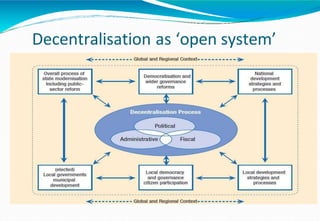
Decentralisation as ‘open system’
⚫Conceptsand context
⚫Definition and forms
⚫Assignment of functions
⚫Exercise
⚫Legal framework
⚫Implementation challenges
⚫Vertical and horizontal coordination
⚫Human resources and capacitydevelopment
Definition
Administrative decentralisation is the transfer of
responsibility for planning, financing and managing
public functions to:
⚫Field units of governmentagencies
⚫Subordinate unitsor levels of government
⚫Semi-autonomous publicauthorities orcorporations
Administrative decentralisation
This means: a redistribution of authority,
responsibility and financial resourcesamong
different levelsof governmentand beyond
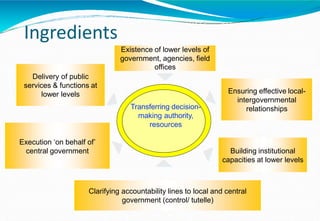
Ingredients
Existence of lower levels of
government, agencies, field
offices
Delivery of public
services & functions at
lower levels
Execution ‘on behalf of’
central government
Clarifying accountability lines to local and central
government (control/ tutelle)
Ensuring effective local-
intergovernmental
relationships
Transferring decision-
making authority,
resources
Building institutional
capacities at lower levels
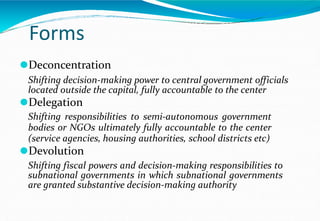
Forms
⚫Deconcentration
Shifting decision-making power to central government officials
located outside the capital, fully accountable to the center
⚫Delegation
Shifting responsibilities to semi-autonomous government
bodies or NGOs ultimately fully accountable to the center
(service agencies, housing authorities, school districts etc)
⚫Devolution
Shifting fiscal powers and decision-making responsibilities to
subnational governments in which subnational governments
are granted substantive decision-making authority
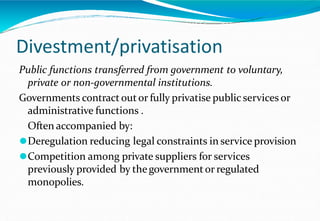
Divestment/privatisation
Public functions transferred from government to voluntary,
private or non-governmental institutions.
Governments contract outor fully privatise public services or
administrative functions .
Often accompanied by:
⚫Deregulation reducing legal constraints in service provision
⚫Competition among private suppliers for services
previously provided by thegovernmentor regulated
monopolies.
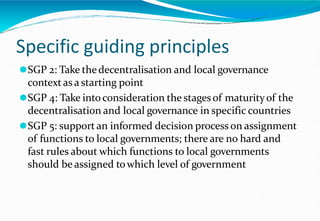
Specific guiding principles
⚫SGP 2: Take thedecentralisation and local governance
contextas a starting point
⚫SGP 4: Take into consideration the stagesof maturityof the
decentralisation and local governance in specific countries
⚫SGP 5: supportan informed decision process on assignment
of functions to local governments; there are no hard and
fast rules about which functions to local governments
should be assigned towhich level of government
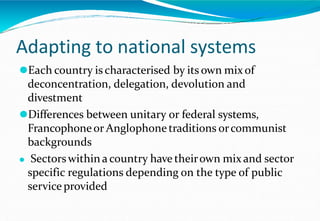
Adapting to national systems
⚫Each country is characterised by its own mix of
deconcentration, delegation, devolution and
divestment
⚫Differences between unitary or federal systems,
Francophoneor Anglophonetraditions orcommunist
backgrounds
⚫ Sectorswithin a country have theirown mix and sector
specific regulations depending on the type of public
service provided
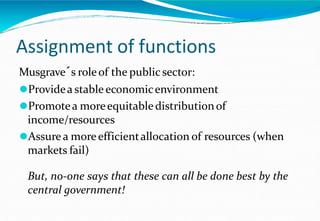
Assignment of functions
Musgrave´s roleof the public sector:
⚫Providea stable economicenvironment
⚫Promotea moreequitable distributionof
income/resources
⚫Assure a moreefficientallocation of resources (when
markets fail)
But, no-one says that these can all be done best by the
central government!
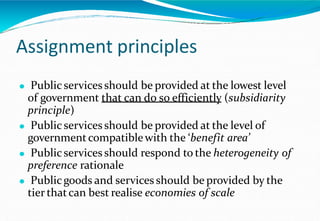
Assignment principles
⚫ Public services should be provided at the lowest level
of government that can do so efficiently (subsidiarity
principle)
⚫ Public services should be provided at the level of
governmentcompatiblewith the ‘benefit area’
⚫ Publicservices should respond to the heterogeneity of
preference rationale
⚫ Publicgoods and services should be provided by the
tier thatcan best realise economies of scale
Subsidiarity principle
European Charter on Local Self-Government, article 4:
⚫Public responsibilities shall generally be exercised, in
preference, by those authorities which are closest to the
citizen. Allocation of responsibility toanotherauthority
should weigh up the extent and nature of the task and
requirements of efficiency and economy.
⚫Powersgiven to local authorities shall normally be full and
exclusive. They may not be undermined or limited by
another, central or regional, authority except as provided
for by the law.
No single ´best´ assignment (SGP 5)
Functions thatare typicallydecentralised to the local
government level include:
⚫Basiceducation, basic health services, agricultural
extension, (rural) watersupply, local roads
⚫Urban services (public utilities, roads, sanitation)
⚫Note that many of these functions are closely related to
achieving the MDGs !
Multilevel governance
Forconcurrent functions, responsibilitycan be
assigned separately for:
⚫policyand regulation: often central government
⚫financing: local social services mostoften
financed centrally, local economic functionscan
be financed locally
⚫provision/delivery of theservice: often by local
authorities
1. Assess theexisting formsof administrativedecentralisation in the
sectoryou work in.
2. Then identify the responsibilities of the differentgovernment
levels forthe sector you work in with respect to:
• Policy & regulation
• Financing
• Provision and deliveryof the service
Legal framework
Basis fordecentralisation, definition of rights and
duties to all parties, levels and institutions
involved:
⚫Constitution: defining broad principles, roles and
responsibilities of institutions atdifferent levels
⚫Laws: defining intergovernmental fiscal system and
institutional detailsof the local government structure
⚫Regulations: interpreting and detailing practices and
measures bywhich the laws will operate
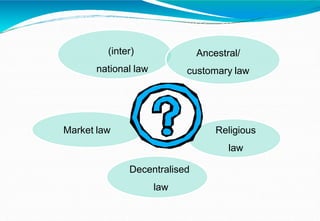
Legal framework
But a law cannot act on its own, since it is
enacted, enforced and shaped by society...
Ancestral/
customary law
(inter)
national law
Decentralised
law
Market law Religious
law
Intergovernmental arrangements
⚫Code of Interadministrative Relations, The Netherlands
⚫Contrats de projet État-Région, France
⚫Other examples?
Civil service reform
Decentralisation is a process of civil service reform with
consequences notonly for the local butalso forcentral
government:
⚫has to promote and sustain decentralisation by developing
appropriate and effective national policies and regulations
fordecentralisation.
⚫coordination task becomes more complicated in case of
shared rather than exclusive responsibilities!
Kampala Call to Action
Roleof central government:
⚫Give sufficient autonomy to LAs to exercise leadership,
foster innovation in development, mobilise local resources
and stimulatecitizenship;
⚫Stimulatea development oriented and democratic mindset
of local governments;
⚫Overcome bureaucratic obstacles and develop capacity to
supervise and support local authorities;
⚫Establish necessary structures for effective
intergovernmental relations toensure cooperation and
consensuson localising the MDGs.
Implementation challenges
Shifting roles and responsibilities cause numerous challenges
for the implementation of administrative reforms:
⚫Vertical coordination between the different government
levels (control and oversight, information and monitoring)
⚫Horizontal coordination: (regional) cooperation between
similar levels of government
⚫Human resource issues and capacitydevelopment
Vertical coordination
⚫Coordination becomes more complicated in caseof shared
rather than exclusive responsibilities.
⚫Supervision and monitoring necessary toverify compliance
with policy goals, analyse alternative outcomes and guide
future decisions.
⚫Must be supported by systematiccollection, analysis and
reporting of information.
⚫Deconcentrated offices can assist in data collection and
supervision, and provide guidance to local governments.
Vertical coordination II
How to ensure a certain degree of monitoring of quality
performance without compromising the newly found
subnational decentralisation, ending up in de-facto
recentralisation?
⚫Roleof LGAs toaddress concurrent coordination issuesand
to represent the interests of LGs
⚫Ministryof Local Government charged with the
implementation of decentralisation
Horizontal coordination
Regional or inter-municipal cooperationand territorial
planning, in order to:
⚫Realise joint investments in infrastructure
⚫Foster regional economicdevelopment
⚫Manage natural resources
⚫Manage local services (economiesof scale)
⚫Inter-sectoral coordination
⚫Examples?
Horizontal coordination II
Another form of horizontal coordination are the associations
of municipalities, unions of mayors, chief executives or
professionals, aiming to:
• Defend and promote thewider interestof thegroup vis-a-
viscentral level (lobby)
• Share lessonsand experiences (knowledge and capacity
development)
Administrative decentralisation means empowering sub-
national governments to hire a civil service that matches
community needs and budgetconstraints
⚫Hiring and firing governmentworkers in service sectors
⚫Fill open positions without permission from the central
government and by setting the jobqualifications
⚫Determinesalary levels and supplementsalaries on a
performance basis
⚫Determine the numberof positions of governmentemployees
at the local level.
Human resources
Human resources - challenges
⚫Skewed distribution of human resources (regional
inequalities) because skilled civil servants mostly prefer to
work for the more developed areas.
⚫Smaller units of government have less opportunity to build
expertise (lack of skilled staff). Exacerbated when
responsibilities are divided upamong smaller jurisdictions.
Human resources - solutions
⚫Cadre system in which highly skilled civil servants rotate
between more and less developed regions (India)
⚫Sending skilled servants from central government to less
developed areas (Ethiopia)
⚫Incentives to people whowork in difficult/unpopular areas
(Tanzania)
⚫Pooling resources forspecialised staff, orcentral
consultancyservices
⚫Other examples?
Capacity Development
⚫Subnational levels have toadapt to their newly
assigned responsibilities in servicedelivery
⚫National level has tocreateconditions, set standards
and supervise
⚫National government has to ´letgo´
More on this during the afternoon discussion and on Day 4

ADMINISTRATIVE_DECENTRALIZATION_PHIL_POL

  • 1.
  • 2.
    Session Overview ⚫Definitionand forms ⚫Assignmentoffunctions ⚫Exercise ⚫Legal framework ⚫Vertical and coordination ⚫Human resource issues ⚫Capacitydevelopment
  • 3.
    Decentralisation as ‘opensystem’ ⚫Conceptsand context ⚫Definition and forms ⚫Assignment of functions ⚫Exercise ⚫Legal framework ⚫Implementation challenges ⚫Vertical and horizontal coordination ⚫Human resources and capacitydevelopment
  • 4.
    Definition Administrative decentralisation isthe transfer of responsibility for planning, financing and managing public functions to: ⚫Field units of governmentagencies ⚫Subordinate unitsor levels of government ⚫Semi-autonomous publicauthorities orcorporations
  • 5.
    Administrative decentralisation This means:a redistribution of authority, responsibility and financial resourcesamong different levelsof governmentand beyond
  • 6.
    Ingredients Existence of lowerlevels of government, agencies, field offices Delivery of public services & functions at lower levels Execution ‘on behalf of’ central government Clarifying accountability lines to local and central government (control/ tutelle) Ensuring effective local- intergovernmental relationships Transferring decision- making authority, resources Building institutional capacities at lower levels
  • 7.
    Forms ⚫Deconcentration Shifting decision-making powerto central government officials located outside the capital, fully accountable to the center ⚫Delegation Shifting responsibilities to semi-autonomous government bodies or NGOs ultimately fully accountable to the center (service agencies, housing authorities, school districts etc) ⚫Devolution Shifting fiscal powers and decision-making responsibilities to subnational governments in which subnational governments are granted substantive decision-making authority
  • 8.
    Divestment/privatisation Public functions transferredfrom government to voluntary, private or non-governmental institutions. Governments contract outor fully privatise public services or administrative functions . Often accompanied by: ⚫Deregulation reducing legal constraints in service provision ⚫Competition among private suppliers for services previously provided by thegovernmentor regulated monopolies.
  • 9.
    Specific guiding principles ⚫SGP2: Take thedecentralisation and local governance contextas a starting point ⚫SGP 4: Take into consideration the stagesof maturityof the decentralisation and local governance in specific countries ⚫SGP 5: supportan informed decision process on assignment of functions to local governments; there are no hard and fast rules about which functions to local governments should be assigned towhich level of government
  • 10.
    Adapting to nationalsystems ⚫Each country is characterised by its own mix of deconcentration, delegation, devolution and divestment ⚫Differences between unitary or federal systems, Francophoneor Anglophonetraditions orcommunist backgrounds ⚫ Sectorswithin a country have theirown mix and sector specific regulations depending on the type of public service provided
  • 11.
    Assignment of functions Musgrave´sroleof the public sector: ⚫Providea stable economicenvironment ⚫Promotea moreequitable distributionof income/resources ⚫Assure a moreefficientallocation of resources (when markets fail) But, no-one says that these can all be done best by the central government!
  • 12.
    Assignment principles ⚫ Publicservices should be provided at the lowest level of government that can do so efficiently (subsidiarity principle) ⚫ Public services should be provided at the level of governmentcompatiblewith the ‘benefit area’ ⚫ Publicservices should respond to the heterogeneity of preference rationale ⚫ Publicgoods and services should be provided by the tier thatcan best realise economies of scale
  • 13.
    Subsidiarity principle European Charteron Local Self-Government, article 4: ⚫Public responsibilities shall generally be exercised, in preference, by those authorities which are closest to the citizen. Allocation of responsibility toanotherauthority should weigh up the extent and nature of the task and requirements of efficiency and economy. ⚫Powersgiven to local authorities shall normally be full and exclusive. They may not be undermined or limited by another, central or regional, authority except as provided for by the law.
  • 14.
    No single ´best´assignment (SGP 5) Functions thatare typicallydecentralised to the local government level include: ⚫Basiceducation, basic health services, agricultural extension, (rural) watersupply, local roads ⚫Urban services (public utilities, roads, sanitation) ⚫Note that many of these functions are closely related to achieving the MDGs !
  • 15.
    Multilevel governance Forconcurrent functions,responsibilitycan be assigned separately for: ⚫policyand regulation: often central government ⚫financing: local social services mostoften financed centrally, local economic functionscan be financed locally ⚫provision/delivery of theservice: often by local authorities
  • 16.
    1. Assess theexistingformsof administrativedecentralisation in the sectoryou work in. 2. Then identify the responsibilities of the differentgovernment levels forthe sector you work in with respect to: • Policy & regulation • Financing • Provision and deliveryof the service
  • 17.
    Legal framework Basis fordecentralisation,definition of rights and duties to all parties, levels and institutions involved: ⚫Constitution: defining broad principles, roles and responsibilities of institutions atdifferent levels ⚫Laws: defining intergovernmental fiscal system and institutional detailsof the local government structure ⚫Regulations: interpreting and detailing practices and measures bywhich the laws will operate
  • 18.
    Legal framework But alaw cannot act on its own, since it is enacted, enforced and shaped by society...
  • 19.
  • 20.
    Intergovernmental arrangements ⚫Code ofInteradministrative Relations, The Netherlands ⚫Contrats de projet État-Région, France ⚫Other examples?
  • 21.
    Civil service reform Decentralisationis a process of civil service reform with consequences notonly for the local butalso forcentral government: ⚫has to promote and sustain decentralisation by developing appropriate and effective national policies and regulations fordecentralisation. ⚫coordination task becomes more complicated in case of shared rather than exclusive responsibilities!
  • 22.
    Kampala Call toAction Roleof central government: ⚫Give sufficient autonomy to LAs to exercise leadership, foster innovation in development, mobilise local resources and stimulatecitizenship; ⚫Stimulatea development oriented and democratic mindset of local governments; ⚫Overcome bureaucratic obstacles and develop capacity to supervise and support local authorities; ⚫Establish necessary structures for effective intergovernmental relations toensure cooperation and consensuson localising the MDGs.
  • 23.
    Implementation challenges Shifting rolesand responsibilities cause numerous challenges for the implementation of administrative reforms: ⚫Vertical coordination between the different government levels (control and oversight, information and monitoring) ⚫Horizontal coordination: (regional) cooperation between similar levels of government ⚫Human resource issues and capacitydevelopment
  • 24.
    Vertical coordination ⚫Coordination becomesmore complicated in caseof shared rather than exclusive responsibilities. ⚫Supervision and monitoring necessary toverify compliance with policy goals, analyse alternative outcomes and guide future decisions. ⚫Must be supported by systematiccollection, analysis and reporting of information. ⚫Deconcentrated offices can assist in data collection and supervision, and provide guidance to local governments.
  • 25.
    Vertical coordination II Howto ensure a certain degree of monitoring of quality performance without compromising the newly found subnational decentralisation, ending up in de-facto recentralisation? ⚫Roleof LGAs toaddress concurrent coordination issuesand to represent the interests of LGs ⚫Ministryof Local Government charged with the implementation of decentralisation
  • 26.
    Horizontal coordination Regional orinter-municipal cooperationand territorial planning, in order to: ⚫Realise joint investments in infrastructure ⚫Foster regional economicdevelopment ⚫Manage natural resources ⚫Manage local services (economiesof scale) ⚫Inter-sectoral coordination ⚫Examples?
  • 27.
    Horizontal coordination II Anotherform of horizontal coordination are the associations of municipalities, unions of mayors, chief executives or professionals, aiming to: • Defend and promote thewider interestof thegroup vis-a- viscentral level (lobby) • Share lessonsand experiences (knowledge and capacity development)
  • 28.
    Administrative decentralisation meansempowering sub- national governments to hire a civil service that matches community needs and budgetconstraints ⚫Hiring and firing governmentworkers in service sectors ⚫Fill open positions without permission from the central government and by setting the jobqualifications ⚫Determinesalary levels and supplementsalaries on a performance basis ⚫Determine the numberof positions of governmentemployees at the local level. Human resources
  • 29.
    Human resources -challenges ⚫Skewed distribution of human resources (regional inequalities) because skilled civil servants mostly prefer to work for the more developed areas. ⚫Smaller units of government have less opportunity to build expertise (lack of skilled staff). Exacerbated when responsibilities are divided upamong smaller jurisdictions.
  • 30.
    Human resources -solutions ⚫Cadre system in which highly skilled civil servants rotate between more and less developed regions (India) ⚫Sending skilled servants from central government to less developed areas (Ethiopia) ⚫Incentives to people whowork in difficult/unpopular areas (Tanzania) ⚫Pooling resources forspecialised staff, orcentral consultancyservices ⚫Other examples?
  • 31.
    Capacity Development ⚫Subnational levelshave toadapt to their newly assigned responsibilities in servicedelivery ⚫National level has tocreateconditions, set standards and supervise ⚫National government has to ´letgo´ More on this during the afternoon discussion and on Day 4