
















Adlerian Counseling
OAdlerian Counseling
includes individual,
developmental, and social
psychology.
OIt focuses on human
wellness, individual
growth and expansion,
and social interest .
OIt is aimed at helping the
client lead a socially
useful life by
encouraging the re-
alignment of the
individual interests with
that of society.
OIt is humanistic, holistic,
phenomenological,
teleological, field-
theoretical, and
socially-oriented.
OThe interpretation is upon
purpose and not upon
cause, upon movement and
not upon description.
OThe main goal of the Adlerian
Counseling process is to aid the
client to realize his priorities
and to decide whether or not it
is worth paying the price
behaviorally to change his
present life style.
OThe process enables the client
to gain insight into himself
and to eventually take courage
to risk some personal safety
for social usefulness, greater
happiness and satisfaction in
life.
OIn therapy, Adler almost
always asked patients
about their family
constellation, that is, their
birth order, the gender of
their siblings,
and the age spread
between them.
OOne of Adler’s most
enduring contributions is
the idea that order of
birth
is a major social influence
in childhood, one from
which we create our style
of life.
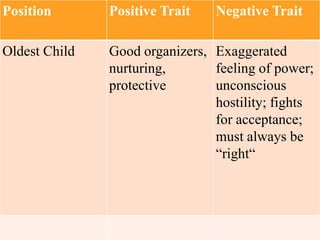
Position Positive Trait Negative Trait
Oldest Child Good organizers,
nurturing,
protective
Exaggerated
feeling of power;
unconscious
hostility; fights
for acceptance;
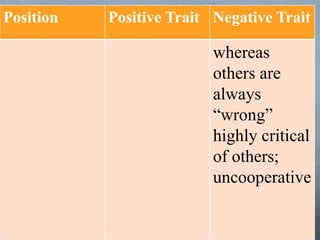
must always be
“right“
Position Positive Trait Negative Trait
whereas
others are
always
“wrong”
highly critical
of others;
uncooperative
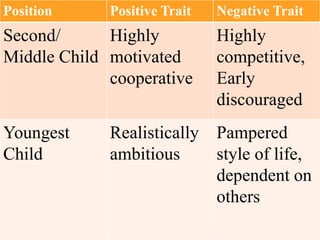
Position Positive Trait Negative Trait
Second/
Middle Child
Highly
motivated
cooperative
Highly
competitive,
Early
discouraged
Youngest
Child
Realistically
ambitious
Pampered
style of life,
dependent on
others
Wants to excel in
everything
Unrealistically
ambitious
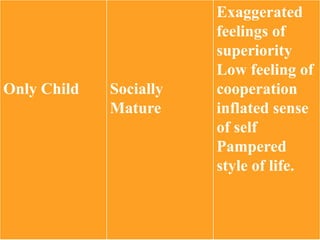
Only Child Socially
Mature
Exaggerated
feelings of
superiority
Low feeling of
cooperation
inflated sense
of self
Pampered
style of life.
Early Recollection
OAdler believed that
reports by patients of
their earliest memories
provided valuable
insights into their
unique styles of life.
Early Recollection
OThey still revealed
important meanings, and
gave glimpses into the
person’s strivings for
superiority.
Early Recollection
OThe primary interest
of the person’s life
revolved around the
remembered
incidents.
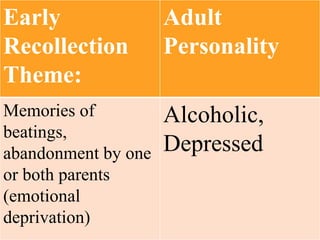
Early
Recollection
Theme:
Adult
Personality
Memories of
beatings,
abandonment by one
or both parents
(emotional
deprivation)
Alcoholic,
Depressed
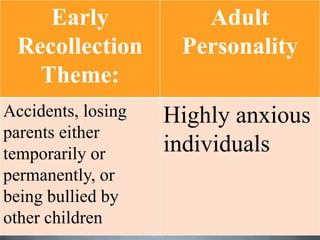
Early
Recollection
Theme:
Adult
Personality
Accidents, losing
parents either
temporarily or
permanently, or
being bullied by
other children
Highly anxious
individuals
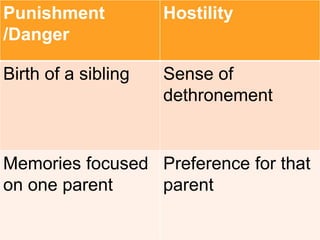
Punishment
/Danger
Hostility
Birth of a sibling Sense of
dethronement
Memories focused
on one parent
Preference for that
parent
Dream Analysis
ODreams are goal-
oriented rather then
reflections of the
past.
Dream Analysis
OThey reveal the mood
that we want to feel and
suggest how we might
deal with the future
problem or task.
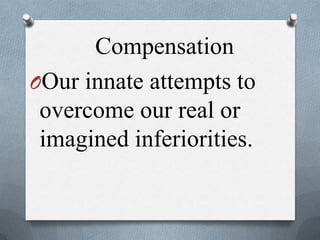
Compensation
OOur innate attempts to
overcome our real or
imagined inferiorities.
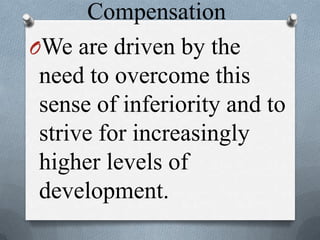
Compensation
OWe are driven by the
need to overcome this
sense of inferiority and to
strive for increasingly
higher levels of
development.
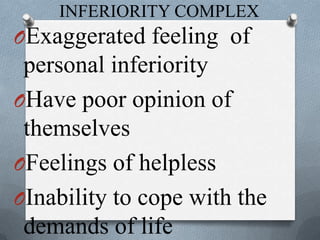
INFERIORITY COMPLEX
OExaggerated feeling of
personal inferiority
OHave poor opinion of
themselves
OFeelings of helpless
OInability to cope with the
demands of life
Superiority Complex
OThis involves an
exaggerated opinion of
one’s abilities and
accomplishments.
Superiority Complex
OBoasting, vanity,
self-centeredness,
and a tendency to
denigrate others.
Style of Life
OA unique pattern of
characteristics, behaviors,
and habits.
OEverything we do is
shaped and defined by
our unique style of life.
OThe style of life becomes
the guiding framework for
all later behaviors
OAdler suggest that the style of
life is so firmly crystallized by
the age of 4 or 5 that it is
difficult to change thereafter.
Social Interest
OThe individual’s innate
potential to cooperate
with other people to
achieve personal and
societal goals.
OThe only gauge to
be used in judging
the worth of a
person.
OIt is the standard to be
used in determining
the usefulness of a
life.
Adlerian theraphy

Adlerian theraphy