Purchasing a Pesticide:
Pesticide Action, Formulations,
and Adjuvants
and Adjuvants
Montana State University
Pesticide Safety Education Program
2008
2008
What is a formulation?
How a pesticide is packaged
How a pesticide is packaged.
Contains:
A ti I di t
– Active Ingredient
– Inert Ingredient
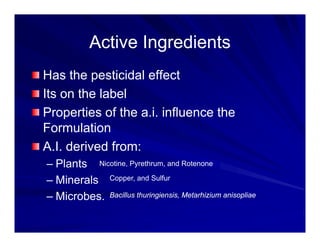
Active Ingredients
Active Ingredients
Active Ingredients
Active Ingredients
Has the pesticidal effect
Its on the label
P ti f th i i fl th
Properties of the a.i. influence the
Formulation
A.I. derived from:
– Plants Nicotine, Pyrethrum, and Rotenone
– Minerals
– Microbes.
Copper, and Sulfur
Bacillus thuringiensis, Metarhizium anisopliae
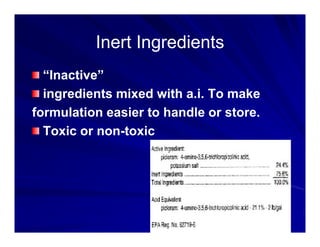
Inert Ingredients
Inert Ingredients
Inert Ingredients
Inert Ingredients
“Inactive”
Inactive
ingredients mixed with a.i. To make
f l ti i t h dl t
formulation easier to handle or store.
Toxic or non-toxic
Can you get the same reaction
from the same active ingredients
regardless of inert ingredients?
NO, Inert Ingredients are often patented
and are only known to the company.
Many times this is the difference between
a product working effectively and not at all.
BANDED SEED FOLIAR applications all
BANDED, SEED, FOLIAR applications all
different yet the same!
Types of Formulations
Liquid (Wet)
Liquid (Wet)
– Mixed with water / oils / diesel fuel /
kerosene
kerosene
– More easily absorbed
Dry
Dry
– More easily inhaled
Liquid Formulations (Wet)
EC –emulsifiable concentrate
EC emulsifiable concentrate
S – soluble
Fl bl
Flowables
ULV – ultra low volume (approach 100%
active ingredient)
Soluble
Soluble
Soluble
Soluble
Advantage:
Advantage:
– ☺ Will not separate or settle out when
mixed with water
mixed with water.
– ☺ Not as harmful to non-target plants
and animals
and animals
Disadvantage:
N t di d t
– Not many disadvantages.
– Readily absorbs into skin
Emulsified Concentrates
(1 or more petroleum based solvents)
ADVANTAGES
– ☺ Little agitation required. Won’t settle out when equipment
is turned off. Does not plug equipment
– ☺ Relatively non-abrasive.
– ☺ Easy to handle, store and transport
DISADVANTAGES
– Because of the solvents and emulsifiers, EC’s are a hazard
Because of the solvents and emulsifiers, EC s are a hazard
to non-target plants and animals.
Easily absorbed through skin of plants and humans.
– Solvents may cause rubber or plastic hoses & gaskets to
Solvents may cause rubber or plastic hoses & gaskets to
deteriorate.
- May cause pitting of painted finishes, and may be corrosive
Flowable
Flowable
Flowable
Flowable
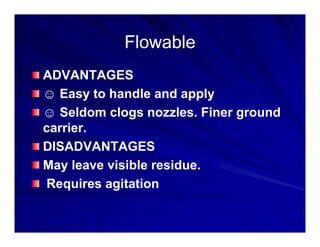
ADVANTAGES
ADVANTAGES
☺ Easy to handle and apply
S ld l l Fi d
☺ Seldom clogs nozzles. Finer ground
carrier.
DISADVANTAGES
May leave visible residue.
y
Requires agitation
Dry Formulations
Dry Formulations
Dry Formulations
Dry Formulations
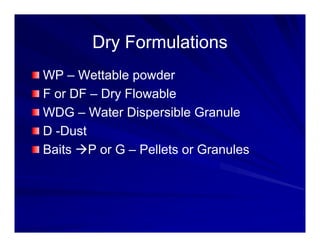
WP – Wettable powder
WP Wettable powder
F or DF – Dry Flowable
WDG W t Di ibl G l
WDG – Water Dispersible Granule
D -Dust
Baits ÆP or G – Pellets or Granules
Wettable Powders
Wettable Powders
Wettable Powders
Wettable Powders
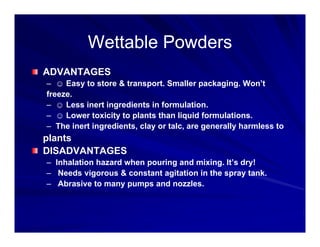
ADVANTAGES
– ☺ Easy to store & transport. Smaller packaging. Won’t
freeze.
– ☺ Less inert ingredients in formulation.
☺ g
– ☺ Lower toxicity to plants than liquid formulations.
– The inert ingredients, clay or talc, are generally harmless to
plants
plants
DISADVANTAGES
– Inhalation hazard when pouring and mixing. It’s dry!
N d i & t t it ti i th t k
– Needs vigorous & constant agitation in the spray tank.
– Abrasive to many pumps and nozzles.
Granules or Pellets
Granules or Pellets
Granules or Pellets
Granules or Pellets
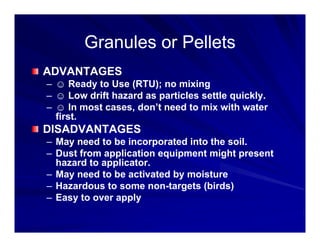
ADVANTAGES
– ☺ Ready to Use (RTU); no mixing
– ☺ Low drift hazard as particles settle quickly.
– ☺ In most cases don’t need to mix with water
– ☺ In most cases, don t need to mix with water
first.
DISADVANTAGES
M d t b i t d i t th il
– May need to be incorporated into the soil.
– Dust from application equipment might present
hazard to applicator.
– May need to be activated by moisture
– Hazardous to some non-targets (birds)
– Easy to over apply
y pp y
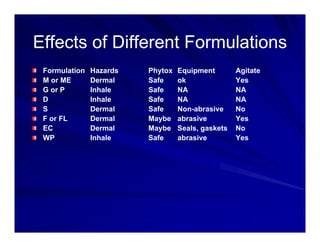
Effects of Different Formulations
Formulation Hazards Phytox Equipment Agitate
M or ME Dermal Safe ok Yes
G or P Inhale Safe NA NA
D Inhale Safe NA NA
S Dermal Safe Non abrasive No
S Dermal Safe Non-abrasive No
F or FL Dermal Maybe abrasive Yes
EC Dermal Maybe Seals, gaskets No
WP Inhale Safe abrasive Yes
Adjuvants
Adjuvants
Adjuvants
Adjuvants
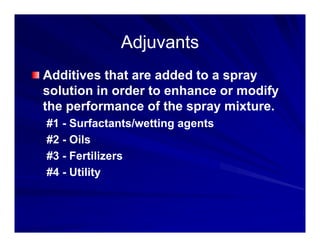
Additives that are added to a spray
solution in order to enhance or modify
the performance of the spray mixture
the performance of the spray mixture.
#1 - Surfactants/wetting agents
#2 Oils
#2 - Oils
#3 - Fertilizers
#4 Utility
#4 - Utility
Surfactants
Surfactants
Surfactants
Surfactants
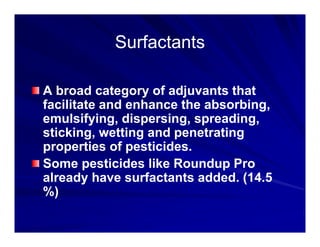
A broad category of adjuvants that
facilitate and enhance the absorbing,
emulsifying, dispersing, spreading,
sticking, wetting and penetrating
g g p g
properties of pesticides.
Some pesticides like Roundup Pro
p p
already have surfactants added. (14.5
%)
Why Surfactants
Why Surfactants
Why Surfactants
Why Surfactants
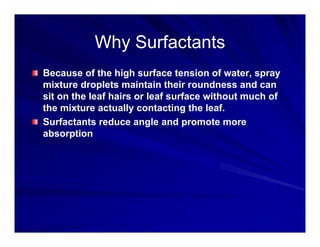
Because of the high surface tension of water, spray
g , p y
mixture droplets maintain their roundness and can
sit on the leaf hairs or leaf surface without much of
the mixture actually contacting the leaf
the mixture actually contacting the leaf.
Surfactants reduce angle and promote more
absorption
Utility
Utility
Utility
Utility
Acidifiers -neutralize alkaline solutions & lower pH.
Buffering agents -stabilize the pH of spray solutions.
Buffering agents stabilize the pH of spray solutions.
Anti-foaming agents
Compatibility agents
Drift control agents
Emulsification aids
Suspension aids -added to a suspension in order to
keep pesticide particles dispersed or to resuspend
particles.
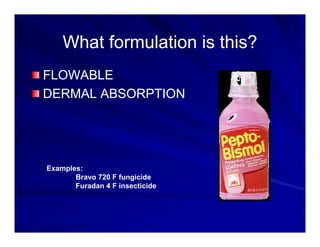
What formulation is this?
FLOWABLE
FLOWABLE
FLOWABLE
FLOWABLE
DERMAL ABSORPTION
DERMAL ABSORPTION
Examples:
Examples:
Bravo 720 F fungicide
Furadan 4 F insecticide
Question #2
Question #2
f ?
f ?
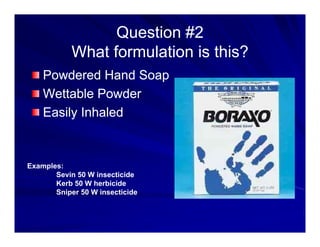
What formulation is this?
Powdered Hand Soap
Powdered Hand Soap
Powdered Hand Soap
Powdered Hand Soap
Wettable Powder
Wettable Powder
E il I h l d
E il I h l d
Easily Inhaled
Easily Inhaled
Examples:
Sevin 50 W insecticide
Kerb 50 W herbicide
Sniper 50 W insecticide
Pesticide Properties Important to
Know Prior to Purchase
Formulation
Formulation
Formulation
Formulation
Adjuvants to use with this pesticide
Oth ti ?
Oth ti ?
Other properties?
Other properties?
What to know when
What to know when
What to know when
What to know when
purchasing a Herbicide
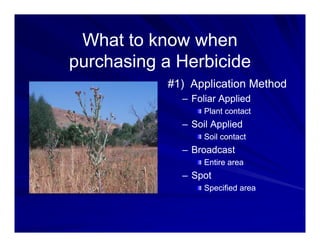
#1) Application Method
–
– Foliar Applied
Foliar Applied
Plant contact
Plant contact
–
– Soil Applied
Soil Applied
Soil contact
Soil contact
Soil contact
Soil contact
–
– Broadcast
Broadcast
Entire area
Entire area
–
– Spot
Spot
Specified area
Specified area
What to know when
What to know when
What to know when
What to know when
purchasing a Herbicide
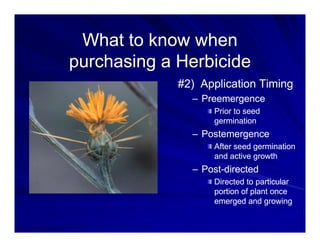
#2) Application Timing
–
– Preemergence
Preemergence
Prior to seed
Prior to seed
germination
germination
–
– Postemergence
Postemergence
g
g
After seed germination
and active growth
and active growth
–
– Post
Post-
-directed
directed
–
– Post
Post-
-directed
directed
Directed to particular
portion of plant once
emerged and growing
emerged and growing
emerged and growing
emerged and growing
M d f A ti
M d f A ti
Mode of Action
Mode of Action
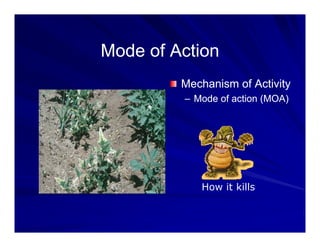
Mechanism of Activity
–
– Mode of action (MOA)
Mode of action (MOA)
How it kills
Herbicide Modes of Action
Why is this important?
1. Plant Growth Regulation
2. Photosynthesis Inhibitors
3 Photosynthetic Pigment Inhibitors
3. Photosynthetic Pigment Inhibitors
4. Plant Growth Inhibitors
5 Amino Acid Synthesis Inhibition
5. Amino Acid Synthesis Inhibition
6. Lipid Biosynthesis Inhibition
7 Cell Membrane Disruption
7. Cell Membrane Disruption
8. Unclassified Activity
Pl t G th R l ti
Pl t G th R l ti
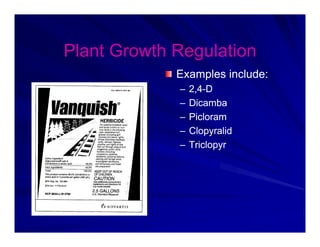
Plant Growth Regulation
Examples include:
Examples include:
Examples include:
Examples include:
–
– 2,4
2,4-
-D
D
–
– Dicamba
Dicamba
–
– Picloram
Picloram
–
– Clopyralid
Clopyralid
–
– Triclopyr
Triclopyr
Plant Growth Regulation
Mimics natural plant hormone
Mimics natural plant hormone –
–
Mimics natural plant hormone
Auxins.
Auxins.
Results in an imbalance of this growth
g
g
regulating hormone.
regulating hormone.
Cells of the leaf vein rapidly divide while cells
p y
p y
between the veins do not.
Cell division and respiration increase, while
photosynthesis does not.
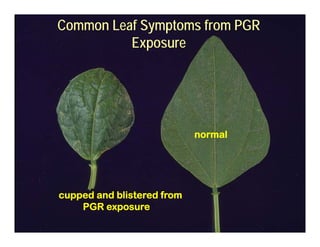
Common Leaf Symptoms from PGR
Exposure
Exposure
normal
cupped and blistered from
PGR exposure
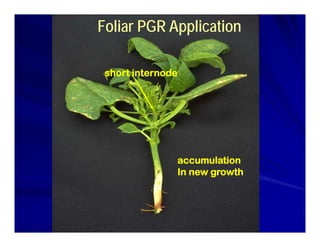
Foliar PGR Application
short internode
accumulation
In new growth
In new growth
How does this type of injury occur?
Drift
Drift -
- both particle and vapor
both particle and vapor
Drift
Drift both particle and vapor.
both particle and vapor.
Improper cleaning of equipment.
A l i h i t t d
A l i h i t t d
Applying when air temperatures exceed
those listed on the label.
Exceeding the labeled rate.
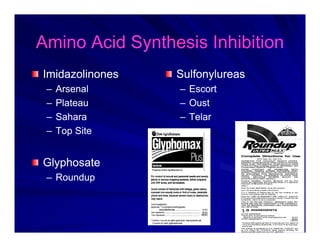
Amino Acid Synthesis Inhibition
Imidazolinones
Imidazolinones Sulfonylureas
Sulfonylureas
Imidazolinones
Imidazolinones
–
– Arsenal
Arsenal
–
– Plateau
Plateau
Sulfonylureas
Sulfonylureas
–
– Escort
Escort
–
– Oust
Oust
–
– Sahara
Sahara
–
– Top Site
Top Site
–
– Telar
Telar
Glyphosate
Glyphosate
–
– Roundup
Roundup
Amino Acid Synthesis Inhibition
Amino Acids = life!!
Specific to plant AAs only
p p y
p p y
Visual results are the result of secondary
injury
injury
injury
injury
–
– the injury as the beginning of a chain of
the injury as the beginning of a chain of
events that take place in the plant
events that take place in the plant.
–
– symptoms take time to develop
symptoms take time to develop –
– it is not an
it is not an
immediate process.
immediate process.
immediate process.
immediate process.
Amino Acid Synthesis Inhibition
May or may not have soil activity.
Activity associated with a particular amino acid
synthesis sequence.
synthesis sequence.
y q
y q
–
– Acetyl CoA Carboxylase (ACCase)
Acetyl CoA Carboxylase (ACCase) -
- Select
Select
–
– Acetolacte Synthase (ALS)
Acetolacte Synthase (ALS) -
- Arsenal, Escort
Arsenal, Escort
–
– EPSPase Inhibitor
EPSPase Inhibitor -
- Roundup
Roundup
Interference is translated to protein synthesis
and inhibition of growth which takes time
and inhibition of growth which takes time -
- slow
slow
acting.
acting.
Amino Acid Synthesis Inhibition
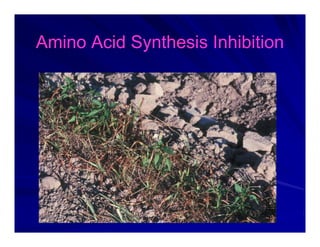
What are you going to see visually?
–
– Initially there will be a general yellowing of the
Initially there will be a general yellowing of the
treated plants
treated plants
treated plants.
treated plants.
–
– After 5 to 10 days, chlorosis results in
After 5 to 10 days, chlorosis results in
necrosis.
necrosis.
necrosis.
necrosis.
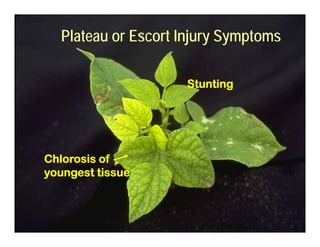
Plateau or Escort Injury Symptoms
Stunting
Chlorosis of
t ti
youngest tissue
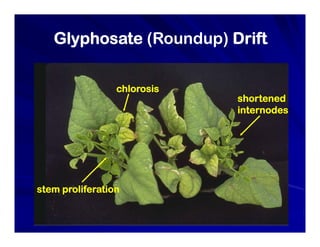
Glyphosate (Roundup) Drift
yp ( p)
chlorosis
shortened
i t d
internodes
stem proliferation
How does this type of injury occur?
Drift
Drift -
- application on a windy day.
application on a windy day.
Drift
Drift application on a windy day.
application on a windy day.
Movement of treated soil.
Failure to apply the correct amount
Failure to apply the correct amount –
– the use
the use
Failure to apply the correct amount
Failure to apply the correct amount the use
the use
rates are small and an error in measuring can
make a large difference.
g
g
When purchasing pesticides know:
Formulation
Formulation
Formulation
Formulation
Adjuvants
Adjuvants
H t ti id
H t ti id
How to use pesticide
Pest Timing
Pest Timing
g
g
Mode of Action
Mode of Action
Contact:
Contact:
Contact:
Contact:
Montana State University
Pesticide Safety Education Program
www pesticides montana edu
www.pesticides.montana.edu

adjuvantssandaaction.pdf

  • 1.
    Purchasing a Pesticide: Purchasinga Pesticide: Purchasing a Pesticide: Purchasing a Pesticide: Pesticide Action, Formulations, Pesticide Action, Formulations, and Adjuvants and Adjuvants Montana State University Montana State University Pesticide Safety Education Program Pesticide Safety Education Program 2008 2008
  • 2.
    What is aformulation? What is a formulation? What is a formulation? What is a formulation? How a pesticide is packaged How a pesticide is packaged. Contains: A ti I di t – Active Ingredient – Inert Ingredient
  • 3.
    Active Ingredients Active Ingredients ActiveIngredients Active Ingredients Has the pesticidal effect Has the pesticidal effect Its on the label P ti f th i i fl th Properties of the a.i. influence the Formulation A.I. derived from: – Plants Nicotine, Pyrethrum, and Rotenone – Minerals – Microbes. Copper, and Sulfur Bacillus thuringiensis, Metarhizium anisopliae
  • 4.
    Inert Ingredients Inert Ingredients InertIngredients Inert Ingredients “Inactive” Inactive ingredients mixed with a.i. To make f l ti i t h dl t formulation easier to handle or store. Toxic or non-toxic
  • 5.
    Can you getthe same reaction Can you get the same reaction from the same active ingredients from the same active ingredients regardless of inert ingredients? regardless of inert ingredients? regardless of inert ingredients? regardless of inert ingredients? NO, Inert Ingredients are often patented NO, Inert Ingredients are often patented NO, Inert Ingredients are often patented NO, Inert Ingredients are often patented and are only known to the company. and are only known to the company. Many times this is the difference between Many times this is the difference between Many times this is the difference between Many times this is the difference between a product working effectively and not at all. a product working effectively and not at all. BANDED SEED FOLIAR applications all BANDED SEED FOLIAR applications all BANDED, SEED, FOLIAR applications all BANDED, SEED, FOLIAR applications all different yet the same! different yet the same!
  • 6.
    Types of Formulations Typesof Formulations Types of Formulations Types of Formulations Liquid (Wet) Liquid (Wet) – Mixed with water / oils / diesel fuel / kerosene kerosene – More easily absorbed Dry Dry – More easily inhaled
  • 7.
    Liquid Formulations (Wet) LiquidFormulations (Wet) Liquid Formulations (Wet) Liquid Formulations (Wet) EC –emulsifiable concentrate EC emulsifiable concentrate S – soluble Fl bl Flowables ULV – ultra low volume (approach 100% active ingredient)
  • 8.
    Soluble Soluble Soluble Soluble Advantage: Advantage: – ☺ Willnot separate or settle out when mixed with water mixed with water. – ☺ Not as harmful to non-target plants and animals and animals Disadvantage: N t di d t – Not many disadvantages. – Readily absorbs into skin
  • 9.
    Emulsified Concentrates Emulsified Concentrates (1or more petroleum based solvents) (1 or more petroleum based solvents) ADVANTAGES – ☺ Little agitation required. Won’t settle out when equipment is turned off. Does not plug equipment – ☺ Relatively non-abrasive. – ☺ Easy to handle, store and transport DISADVANTAGES – Because of the solvents and emulsifiers, EC’s are a hazard Because of the solvents and emulsifiers, EC s are a hazard to non-target plants and animals. Easily absorbed through skin of plants and humans. – Solvents may cause rubber or plastic hoses & gaskets to Solvents may cause rubber or plastic hoses & gaskets to deteriorate. - May cause pitting of painted finishes, and may be corrosive
  • 10.
    Flowable Flowable Flowable Flowable ADVANTAGES ADVANTAGES ☺ Easy tohandle and apply S ld l l Fi d ☺ Seldom clogs nozzles. Finer ground carrier. DISADVANTAGES May leave visible residue. y Requires agitation
  • 11.
    Dry Formulations Dry Formulations DryFormulations Dry Formulations WP – Wettable powder WP Wettable powder F or DF – Dry Flowable WDG W t Di ibl G l WDG – Water Dispersible Granule D -Dust Baits ÆP or G – Pellets or Granules
  • 12.
    Wettable Powders Wettable Powders WettablePowders Wettable Powders ADVANTAGES – ☺ Easy to store & transport. Smaller packaging. Won’t freeze. – ☺ Less inert ingredients in formulation. ☺ g – ☺ Lower toxicity to plants than liquid formulations. – The inert ingredients, clay or talc, are generally harmless to plants plants DISADVANTAGES – Inhalation hazard when pouring and mixing. It’s dry! N d i & t t it ti i th t k – Needs vigorous & constant agitation in the spray tank. – Abrasive to many pumps and nozzles.
  • 13.
    Granules or Pellets Granulesor Pellets Granules or Pellets Granules or Pellets ADVANTAGES – ☺ Ready to Use (RTU); no mixing – ☺ Low drift hazard as particles settle quickly. – ☺ In most cases don’t need to mix with water – ☺ In most cases, don t need to mix with water first. DISADVANTAGES M d t b i t d i t th il – May need to be incorporated into the soil. – Dust from application equipment might present hazard to applicator. – May need to be activated by moisture – Hazardous to some non-targets (birds) – Easy to over apply y pp y
  • 14.
    Effects of DifferentFormulations Effects of Different Formulations Effects of Different Formulations Effects of Different Formulations Formulation Hazards Phytox Equipment Agitate M or ME Dermal Safe ok Yes G or P Inhale Safe NA NA D Inhale Safe NA NA S Dermal Safe Non abrasive No S Dermal Safe Non-abrasive No F or FL Dermal Maybe abrasive Yes EC Dermal Maybe Seals, gaskets No WP Inhale Safe abrasive Yes WP Inhale Safe abrasive Yes
  • 15.
    Adjuvants Adjuvants Adjuvants Adjuvants Additives that areadded to a spray Additives that are added to a spray solution in order to enhance or modify the performance of the spray mixture the performance of the spray mixture. #1 - Surfactants/wetting agents #2 Oils #2 - Oils #3 - Fertilizers #4 Utility #4 - Utility
  • 16.
    Surfactants Surfactants Surfactants Surfactants A broad categoryof adjuvants that facilitate and enhance the absorbing, facilitate and enhance the absorbing, emulsifying, dispersing, spreading, sticking, wetting and penetrating g g p g properties of pesticides. Some pesticides like Roundup Pro p p already have surfactants added. (14.5 %)
  • 17.
    Why Surfactants Why Surfactants WhySurfactants Why Surfactants Because of the high surface tension of water, spray g , p y mixture droplets maintain their roundness and can sit on the leaf hairs or leaf surface without much of the mixture actually contacting the leaf the mixture actually contacting the leaf. Surfactants reduce angle and promote more absorption
  • 18.
    Utility Utility Utility Utility Acidifiers -neutralize alkalinesolutions & lower pH. Buffering agents -stabilize the pH of spray solutions. Buffering agents stabilize the pH of spray solutions. Anti-foaming agents Compatibility agents Drift control agents Emulsification aids Suspension aids -added to a suspension in order to Suspension aids -added to a suspension in order to keep pesticide particles dispersed or to resuspend particles.
  • 19.
    What formulation isthis? What formulation is this? What formulation is this? What formulation is this? FLOWABLE FLOWABLE FLOWABLE FLOWABLE DERMAL ABSORPTION DERMAL ABSORPTION Examples: Examples: Bravo 720 F fungicide Furadan 4 F insecticide
  • 20.
    Question #2 Question #2 f? f ? What formulation is this? What formulation is this? Powdered Hand Soap Powdered Hand Soap Powdered Hand Soap Powdered Hand Soap Wettable Powder Wettable Powder E il I h l d E il I h l d Easily Inhaled Easily Inhaled Examples: Sevin 50 W insecticide Kerb 50 W herbicide Sniper 50 W insecticide
  • 21.
    Pesticide Properties Importantto Pesticide Properties Important to Know Prior to Purchase Know Prior to Purchase Formulation Formulation Formulation Formulation Adjuvants to use with this pesticide Adjuvants to use with this pesticide Oth ti ? Oth ti ? Other properties? Other properties?
  • 22.
    What to knowwhen What to know when What to know when What to know when purchasing a Herbicide purchasing a Herbicide #1) Application Method #1) Application Method – – Foliar Applied Foliar Applied Plant contact Plant contact – – Soil Applied Soil Applied Soil contact Soil contact Soil contact Soil contact – – Broadcast Broadcast Entire area Entire area – – Spot Spot Specified area Specified area
  • 23.
    What to knowwhen What to know when What to know when What to know when purchasing a Herbicide purchasing a Herbicide #2) Application Timing #2) Application Timing – – Preemergence Preemergence Prior to seed Prior to seed germination germination – – Postemergence Postemergence g g After seed germination After seed germination and active growth and active growth – – Post Post- -directed directed – – Post Post- -directed directed Directed to particular Directed to particular portion of plant once portion of plant once emerged and growing emerged and growing emerged and growing emerged and growing
  • 24.
    M d fA ti M d f A ti Mode of Action Mode of Action Mechanism of Activity Mechanism of Activity – – Mode of action (MOA) Mode of action (MOA) How it kills
  • 25.
    Herbicide Modes ofAction Herbicide Modes of Action Why is this important? Why is this important? 1. Plant Growth Regulation 1. Plant Growth Regulation 1. Plant Growth Regulation 1. Plant Growth Regulation 2. Photosynthesis Inhibitors 2. Photosynthesis Inhibitors 3 Photosynthetic Pigment Inhibitors 3 Photosynthetic Pigment Inhibitors 3. Photosynthetic Pigment Inhibitors 3. Photosynthetic Pigment Inhibitors 4. Plant Growth Inhibitors 4. Plant Growth Inhibitors 5 Amino Acid Synthesis Inhibition 5 Amino Acid Synthesis Inhibition 5. Amino Acid Synthesis Inhibition 5. Amino Acid Synthesis Inhibition 6. Lipid Biosynthesis Inhibition 6. Lipid Biosynthesis Inhibition 7 Cell Membrane Disruption 7 Cell Membrane Disruption 7. Cell Membrane Disruption 7. Cell Membrane Disruption 8. Unclassified Activity 8. Unclassified Activity
  • 26.
    Pl t Gth R l ti Pl t G th R l ti Plant Growth Regulation Plant Growth Regulation Examples include: Examples include: Examples include: Examples include: – – 2,4 2,4- -D D – – Dicamba Dicamba – – Picloram Picloram – – Clopyralid Clopyralid – – Triclopyr Triclopyr
  • 27.
    Plant Growth Regulation PlantGrowth Regulation Plant Growth Regulation Plant Growth Regulation Mimics natural plant hormone Mimics natural plant hormone – – Mimics natural plant hormone Mimics natural plant hormone Auxins. Auxins. Results in an imbalance of this growth Results in an imbalance of this growth g g regulating hormone. regulating hormone. Cells of the leaf vein rapidly divide while cells Cells of the leaf vein rapidly divide while cells p y p y between the veins do not. between the veins do not. Cell division and respiration increase, while Cell division and respiration increase, while photosynthesis does not. photosynthesis does not.
  • 28.
    Common Leaf Symptomsfrom PGR Exposure Exposure normal cupped and blistered from PGR exposure
  • 29.
    Foliar PGR Application shortinternode accumulation In new growth In new growth
  • 30.
    How does thistype of injury occur? How does this type of injury occur? How does this type of injury occur? How does this type of injury occur? Drift Drift - - both particle and vapor both particle and vapor Drift Drift both particle and vapor. both particle and vapor. Improper cleaning of equipment. Improper cleaning of equipment. A l i h i t t d A l i h i t t d Applying when air temperatures exceed Applying when air temperatures exceed those listed on the label. those listed on the label. Exceeding the labeled rate. Exceeding the labeled rate.
  • 31.
    Amino Acid SynthesisInhibition Amino Acid Synthesis Inhibition Amino Acid Synthesis Inhibition Amino Acid Synthesis Inhibition Imidazolinones Imidazolinones Sulfonylureas Sulfonylureas Imidazolinones Imidazolinones – – Arsenal Arsenal – – Plateau Plateau Sulfonylureas Sulfonylureas – – Escort Escort – – Oust Oust – – Sahara Sahara – – Top Site Top Site – – Telar Telar Glyphosate Glyphosate – – Roundup Roundup
  • 32.
    Amino Acid SynthesisInhibition Amino Acid Synthesis Inhibition Amino Acid Synthesis Inhibition Amino Acid Synthesis Inhibition Amino Acids = life!! Amino Acids = life!! Specific to plant AAs only Specific to plant AAs only p p y p p y Visual results are the result of secondary Visual results are the result of secondary injury injury injury injury – – the injury as the beginning of a chain of the injury as the beginning of a chain of events that take place in the plant events that take place in the plant events that take place in the plant. events that take place in the plant. – – symptoms take time to develop symptoms take time to develop – – it is not an it is not an immediate process. immediate process. immediate process. immediate process.
  • 33.
    Amino Acid SynthesisInhibition Amino Acid Synthesis Inhibition Amino Acid Synthesis Inhibition Amino Acid Synthesis Inhibition
  • 34.
    Amino Acid SynthesisInhibition Amino Acid Synthesis Inhibition Amino Acid Synthesis Inhibition Amino Acid Synthesis Inhibition May or may not have soil activity. May or may not have soil activity. May or may not have soil activity. May or may not have soil activity. Activity associated with a particular amino acid Activity associated with a particular amino acid synthesis sequence. synthesis sequence. y q y q – – Acetyl CoA Carboxylase (ACCase) Acetyl CoA Carboxylase (ACCase) - - Select Select – – Acetolacte Synthase (ALS) Acetolacte Synthase (ALS) - - Arsenal, Escort Arsenal, Escort – – EPSPase Inhibitor EPSPase Inhibitor - - Roundup Roundup Interference is translated to protein synthesis Interference is translated to protein synthesis and inhibition of growth which takes time and inhibition of growth which takes time - - slow slow acting. acting.
  • 35.
    Amino Acid SynthesisInhibition Amino Acid Synthesis Inhibition Amino Acid Synthesis Inhibition Amino Acid Synthesis Inhibition What are you going to see visually? What are you going to see visually? What are you going to see visually? What are you going to see visually? – – Initially there will be a general yellowing of the Initially there will be a general yellowing of the treated plants treated plants treated plants. treated plants. – – After 5 to 10 days, chlorosis results in After 5 to 10 days, chlorosis results in necrosis. necrosis. necrosis. necrosis.
  • 36.
    Plateau or EscortInjury Symptoms Stunting Chlorosis of t ti youngest tissue
  • 37.
    Glyphosate (Roundup) Drift yp( p) chlorosis shortened i t d internodes stem proliferation
  • 38.
    How does thistype of injury occur? How does this type of injury occur? How does this type of injury occur? How does this type of injury occur? Drift Drift - - application on a windy day. application on a windy day. Drift Drift application on a windy day. application on a windy day. Movement of treated soil. Movement of treated soil. Failure to apply the correct amount Failure to apply the correct amount – – the use the use Failure to apply the correct amount Failure to apply the correct amount the use the use rates are small and an error in measuring can rates are small and an error in measuring can make a large difference. make a large difference. g g
  • 39.
    When purchasing pesticidesknow: When purchasing pesticides know: Formulation Formulation Formulation Formulation Adjuvants Adjuvants H t ti id H t ti id How to use pesticide How to use pesticide Pest Timing Pest Timing g g Mode of Action Mode of Action
  • 40.
    Contact: Contact: Contact: Contact: Montana State University MontanaState University Pesticide Safety Education Program Pesticide Safety Education Program www pesticides montana edu www pesticides montana edu www.pesticides.montana.edu www.pesticides.montana.edu