Introduction to Advertising
History and Roles
Presented by:
Prof. Leslie Ann U. Gamundoy
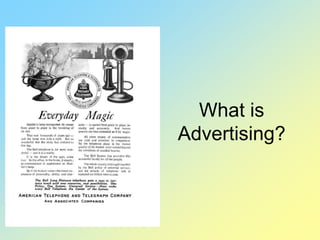
What is
Advertising?
Advertising is:
Paid, Nonpersonal Communication
From An Identified Sponsor Using
Mass Media to Persuade or
Influence an Audience.
Advertising is:
 structured and composed nonpersonal
communication of information,
 usually paid for and usually persuasive in
nature,
 about products (goods, services, and ideas)
 by identified sponsors through various
media
Advertising Campaigns
 a series of coordinated advertisements
 single advertisement placed in multiple
media
 several different advertisements with a
similar look, feel, and message
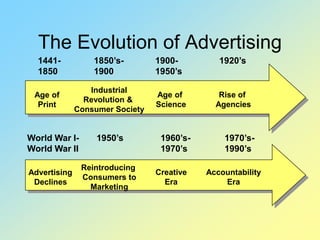
Age of
Print
Industrial
Revolution &
Consumer Society
Age of
Science
Rise of
Agencies
Advertising
Declines
Reintroducing
Consumers to
Marketing
Creative
Era
Accountability
Era
The Evolution of Advertising
1441-
1850
1850’s-
1900
1900-
1950’s
World War I-
World War II
1950’s 1960’s-
1970’s
1970’s-
1990’s
1920’s
Historical Roles of Advertising
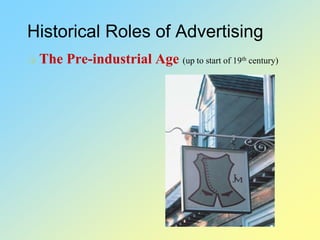
 The Pre-industrial Age (up to start of 19th century)
Historical Roles of Advertising
The Industrializing Age (Mid 1700’s Europe /
1800’s in U.S. To WW1)
 Mass production / Need for mass consumption
 Cost people less to buy products than to make them
 Manufacturers were concerned with production
Historical Roles of Advertising
 The Industrial Age (1900’s to 1970s)
 Luxury goods developed
 Manufacturers changed from a production
orientation to a sales orientation
Historical Roles of Advertising
 The Post Industrial Age (Starting 1980)
 Age of social responsibility / Quality of life
issues
 Lifestyle advertising
Historical Roles of Advertising
 The Global Interactive Age (Last 15 years)
 Growth in world markets
Historical Roles of Advertising
 The Pre-industrial Age (up to start of 19th century)
 The Industrializing Age (To WW1)
 The Industrial Age (1900’s to 1970s)
 The Post Industrial Age (Starting 1980)
 The Global Interactive Age
13
7 People Who Changed the
History of Advertising
Johannes Gutenberg: the printing press
Benjamin Franklin: magazine and design
Phineas Taylor Barnum: fake news
F. Wayland Ayer: the ad agency
Helen Lansdowne Resor: the first ad using
sex appeal
William Bernbach: the original mad man
David Ogilvy: the father of modern
advertising
14
Nature and Scope of
Advertising
•Advertising is never free, it is always paid.
•Basis of payment are time and space. Time is the
basis of payment for broadcast advertising, and
space is the basis for print advertising.
• Per column centimeter is the unit of measurement for
advertisement in print media particularly those for
magazine.
• Per agate line is the unit of measurement for
advertisements also in print media, but classified in
newspaper.
• As a marketing function, it is openly persuasive and convincing
in order to sell or secure favorable consideration.
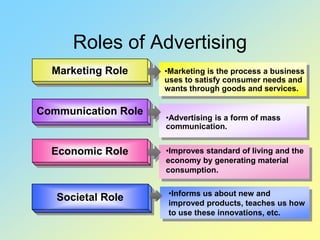
Roles of Advertising
Marketing Role
Communication Role
Economic Role
•Marketing is the process a business
uses to satisfy consumer needs and
wants through goods and services.
Societal Role
•Advertising is a form of mass
communication.
•Improves standard of living and the
economy by generating material
consumption.
•Informs us about new and
improved products, teaches us how
to use these innovations, etc.
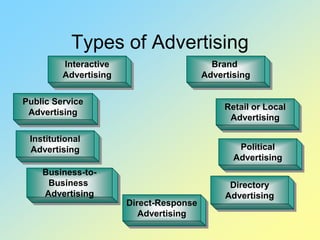
Interactive
Advertising
Public Service
Advertising
Institutional
Advertising
Business-to-
Business
Advertising
Brand
Advertising
Retail or Local
Advertising
Political
Advertising
Direct-Response
Advertising
Directory
Advertising
Types of Advertising
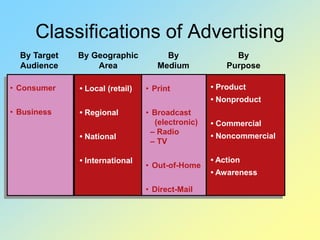
Classifications of Advertising
By Target
Audience
By Geographic
Area
By
Medium
By
Purpose
• Consumer
• Business
• Local (retail)
• Regional
• National
• International
• Print
• Broadcast
(electronic)
– Radio
– TV
• Out-of-Home
• Direct-Mail
• Product
• Nonproduct
• Commercial
• Noncommercial
• Action
• Awareness
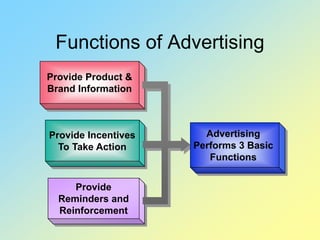
Provide Product &
Brand Information
Provide Incentives
To Take Action
Provide
Reminders and
Reinforcement
Advertising
Performs 3 Basic
Functions
Functions of Advertising
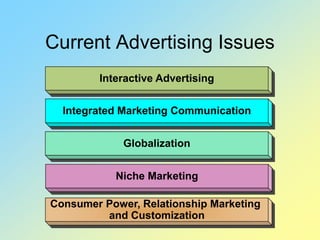
Interactive Advertising
Integrated Marketing Communication
Consumer Power, Relationship Marketing
and Customization
Globalization
Niche Marketing
Current Advertising Issues
20
21
Stages in the Advertising Cycle
• Introductory Stage. It is used in launching publicity a product
or services which is entirely new or unknown to the market.
First objective is to develop consumer awareness for an
entirely new product; Second, is to advertise an established
product innovation.
• Competitive Stage. Seeks to urge the consumers to prefer
the advertisers product or service over other competing
brands. In this stage, the advertiser emphasizes a selling
point unique to the product or service presented.
• Retentive Stage. Attempts to develop or establish consumer
loyalty by keeping the buying public reminded of the name or
brand of the item. This is suitable for products who have
gained sufficient market share, but aims to hold on their
consumer loyal group by periodically repeating.
22
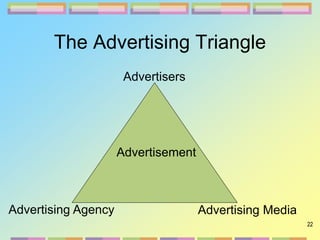
The Advertising Triangle
Advertisement
Advertisers
Advertising Agency Advertising Media
23
Advertiser. It is called the client, an account or
sponsor. This can be anyone from among the
sources of advertisement, under the topic –
classification of advertising according to the
source of origin.
Advertising agency. It is an independent service
organization whose function is to provide
advertising, merchandising, and other
promotional activities related to selling of the
client’s products, services or ideas.
Advertising media. It include the mass media of
communication in broadcast, print, outdoor,
transit, field and movie.
24
The Advertising Department-
A Client
This department is a dependent service
organization, a functional division within
the client or advertiser’s company.
The advertising department is part of
the structure of the client company, and
should not be confused with an
advertising agency
25
The Advertising Agency
This is an independent service organization operating outside
of the control of the advertiser or client.
• The Account Management Department. It is headed by
Account Executive. This is the department where the
advertiser or client, or representative of the client’s
advertising department, communicates their requirements
to the agency, for an advertising product.
• Research Department. It is responsible for gathering
information under cases where data given by the client
may be insufficient, to start the project.
• Copy Department. Prepares the text or words of the
advertisement. This may include the story board for
television commercial, or the script for radio, and the layout
for print.
26
Art Department. Translates the words into pictures. The
department is responsible for preparing the visual
presentation of the advertisement. Pictures shall be created
the illustration of the advertisement.
Media Department. Prepares the detailed media schedule,
the list of media selected for the delivery of the advertising
message. The department may consist of two – the space
buying section – for print media; and the time buying
section – for broadcast media.
Production Department. It is responsible for handling the
mechanical requirements of the advertisement including
preparing several copies of the mastertape, blue print for
distribution to media, typefacing, color reproduction
Traffic Department. Sees to it that the advertisements are
shown or published according to schedule.
27
The Advertising Theme
The central buying incentive featured in an advertising message is
the frame of reference, serving as stimulus to an expected
response from the audience. This stimulus called advertising
appeal.
The ideas created using a defined advertising appeal must be
directly related to the product benefits desires by the consumers,
thus sales point must be developed.
To communicate these sales points capitalizing on features,
advantages and benefits, the advertisement may target any of
these attention-getting factors: involuntary and voluntary.
Involuntary attention-getting factors holds that mental processes
are directed toward something else, and not focused on looking,
listening or watching advertisement.
Voluntary attention-getting factor can be beneficial to the
advertiser since the mental processes of the consumer is really
intended towards checking, looking or reading an advertisement.
28
https://www.youtube.com/watch?v=Gm
YVfyqzu4Y
https://www.youtube.com/watch?v=aUP
IRDy4qLU
https://www.youtube.com/watch?v=5dks
Rn2vjcY
https://www.youtube.com/watch?v=8xvt
cmWKTTQ

adhistory ni leslie.ppt

  • 1.
    Introduction to Advertising Historyand Roles Presented by: Prof. Leslie Ann U. Gamundoy
  • 2.
  • 3.
    Advertising is: Paid, NonpersonalCommunication From An Identified Sponsor Using Mass Media to Persuade or Influence an Audience.
  • 4.
    Advertising is:  structuredand composed nonpersonal communication of information,  usually paid for and usually persuasive in nature,  about products (goods, services, and ideas)  by identified sponsors through various media
  • 5.
    Advertising Campaigns  aseries of coordinated advertisements  single advertisement placed in multiple media  several different advertisements with a similar look, feel, and message
  • 6.
    Age of Print Industrial Revolution & ConsumerSociety Age of Science Rise of Agencies Advertising Declines Reintroducing Consumers to Marketing Creative Era Accountability Era The Evolution of Advertising 1441- 1850 1850’s- 1900 1900- 1950’s World War I- World War II 1950’s 1960’s- 1970’s 1970’s- 1990’s 1920’s
  • 7.
    Historical Roles ofAdvertising  The Pre-industrial Age (up to start of 19th century)
  • 8.
    Historical Roles ofAdvertising The Industrializing Age (Mid 1700’s Europe / 1800’s in U.S. To WW1)  Mass production / Need for mass consumption  Cost people less to buy products than to make them  Manufacturers were concerned with production
  • 9.
    Historical Roles ofAdvertising  The Industrial Age (1900’s to 1970s)  Luxury goods developed  Manufacturers changed from a production orientation to a sales orientation
  • 10.
    Historical Roles ofAdvertising  The Post Industrial Age (Starting 1980)  Age of social responsibility / Quality of life issues  Lifestyle advertising
  • 11.
    Historical Roles ofAdvertising  The Global Interactive Age (Last 15 years)  Growth in world markets
  • 12.
    Historical Roles ofAdvertising  The Pre-industrial Age (up to start of 19th century)  The Industrializing Age (To WW1)  The Industrial Age (1900’s to 1970s)  The Post Industrial Age (Starting 1980)  The Global Interactive Age
  • 13.
    13 7 People WhoChanged the History of Advertising Johannes Gutenberg: the printing press Benjamin Franklin: magazine and design Phineas Taylor Barnum: fake news F. Wayland Ayer: the ad agency Helen Lansdowne Resor: the first ad using sex appeal William Bernbach: the original mad man David Ogilvy: the father of modern advertising
  • 14.
    14 Nature and Scopeof Advertising •Advertising is never free, it is always paid. •Basis of payment are time and space. Time is the basis of payment for broadcast advertising, and space is the basis for print advertising. • Per column centimeter is the unit of measurement for advertisement in print media particularly those for magazine. • Per agate line is the unit of measurement for advertisements also in print media, but classified in newspaper. • As a marketing function, it is openly persuasive and convincing in order to sell or secure favorable consideration.
  • 15.
    Roles of Advertising MarketingRole Communication Role Economic Role •Marketing is the process a business uses to satisfy consumer needs and wants through goods and services. Societal Role •Advertising is a form of mass communication. •Improves standard of living and the economy by generating material consumption. •Informs us about new and improved products, teaches us how to use these innovations, etc.
  • 16.
    Interactive Advertising Public Service Advertising Institutional Advertising Business-to- Business Advertising Brand Advertising Retail orLocal Advertising Political Advertising Direct-Response Advertising Directory Advertising Types of Advertising
  • 17.
    Classifications of Advertising ByTarget Audience By Geographic Area By Medium By Purpose • Consumer • Business • Local (retail) • Regional • National • International • Print • Broadcast (electronic) – Radio – TV • Out-of-Home • Direct-Mail • Product • Nonproduct • Commercial • Noncommercial • Action • Awareness
  • 18.
    Provide Product & BrandInformation Provide Incentives To Take Action Provide Reminders and Reinforcement Advertising Performs 3 Basic Functions Functions of Advertising
  • 19.
    Interactive Advertising Integrated MarketingCommunication Consumer Power, Relationship Marketing and Customization Globalization Niche Marketing Current Advertising Issues
  • 20.
  • 21.
    21 Stages in theAdvertising Cycle • Introductory Stage. It is used in launching publicity a product or services which is entirely new or unknown to the market. First objective is to develop consumer awareness for an entirely new product; Second, is to advertise an established product innovation. • Competitive Stage. Seeks to urge the consumers to prefer the advertisers product or service over other competing brands. In this stage, the advertiser emphasizes a selling point unique to the product or service presented. • Retentive Stage. Attempts to develop or establish consumer loyalty by keeping the buying public reminded of the name or brand of the item. This is suitable for products who have gained sufficient market share, but aims to hold on their consumer loyal group by periodically repeating.
  • 22.
  • 23.
    23 Advertiser. It iscalled the client, an account or sponsor. This can be anyone from among the sources of advertisement, under the topic – classification of advertising according to the source of origin. Advertising agency. It is an independent service organization whose function is to provide advertising, merchandising, and other promotional activities related to selling of the client’s products, services or ideas. Advertising media. It include the mass media of communication in broadcast, print, outdoor, transit, field and movie.
  • 24.
    24 The Advertising Department- AClient This department is a dependent service organization, a functional division within the client or advertiser’s company. The advertising department is part of the structure of the client company, and should not be confused with an advertising agency
  • 25.
    25 The Advertising Agency Thisis an independent service organization operating outside of the control of the advertiser or client. • The Account Management Department. It is headed by Account Executive. This is the department where the advertiser or client, or representative of the client’s advertising department, communicates their requirements to the agency, for an advertising product. • Research Department. It is responsible for gathering information under cases where data given by the client may be insufficient, to start the project. • Copy Department. Prepares the text or words of the advertisement. This may include the story board for television commercial, or the script for radio, and the layout for print.
  • 26.
    26 Art Department. Translatesthe words into pictures. The department is responsible for preparing the visual presentation of the advertisement. Pictures shall be created the illustration of the advertisement. Media Department. Prepares the detailed media schedule, the list of media selected for the delivery of the advertising message. The department may consist of two – the space buying section – for print media; and the time buying section – for broadcast media. Production Department. It is responsible for handling the mechanical requirements of the advertisement including preparing several copies of the mastertape, blue print for distribution to media, typefacing, color reproduction Traffic Department. Sees to it that the advertisements are shown or published according to schedule.
  • 27.
    27 The Advertising Theme Thecentral buying incentive featured in an advertising message is the frame of reference, serving as stimulus to an expected response from the audience. This stimulus called advertising appeal. The ideas created using a defined advertising appeal must be directly related to the product benefits desires by the consumers, thus sales point must be developed. To communicate these sales points capitalizing on features, advantages and benefits, the advertisement may target any of these attention-getting factors: involuntary and voluntary. Involuntary attention-getting factors holds that mental processes are directed toward something else, and not focused on looking, listening or watching advertisement. Voluntary attention-getting factor can be beneficial to the advertiser since the mental processes of the consumer is really intended towards checking, looking or reading an advertisement.
  • 28.