Adding Wi-Fi
capability to the
Microcontroller
• To illustrate the use of wireless connectivity in
embedded networks, this section discusses
the usage of Wi-Fi technology with a
microcontroller. Wi-Fi is very widely used to
provide connectivity between user and
embedded systems.
• For example, a user can interact with utility
systems (like AC, Garage door, Coffee machine,
etc.) in a smart-home using a smartphone,
provided both (smart-home and smartphone)
are connected to the internet.
• TI provides low-power and easy-to-use Wi-Fi
solutions that include battery-operated Wi-Fi
designs with more than a year of battery life
on two AA batteries. TI’s Simple Link Wi-Fi
CC3100 module is a wireless network
processor with on-chip Wi-Fi, internet, and
robust security protocols.
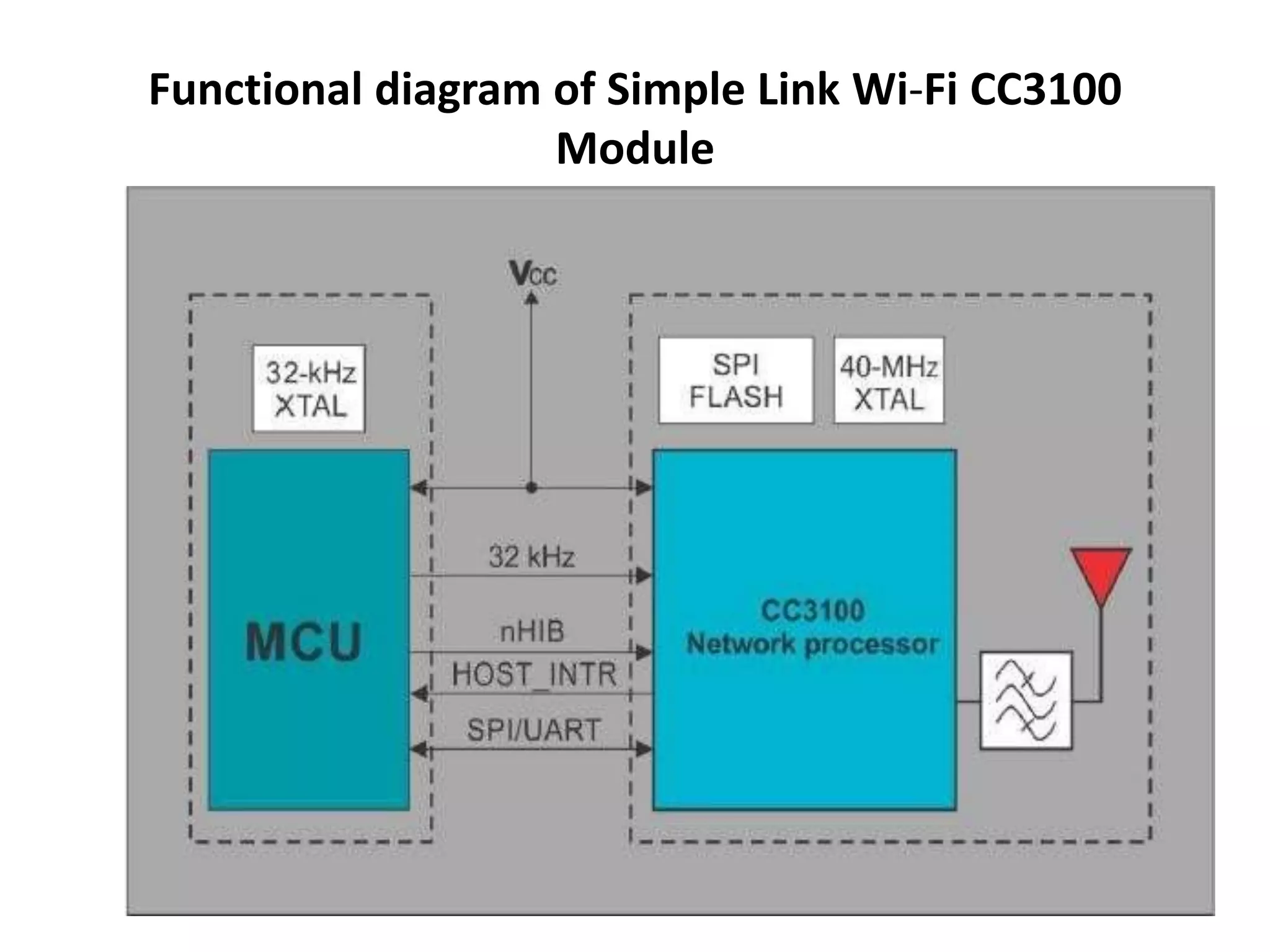
• It can be used to connect any low-cost
microcontroller (MCU). A functional block
diagram of CC3100 module is shown in the
below figure.
Functional diagram of Simple Link Wi-Fi CC3100
Module
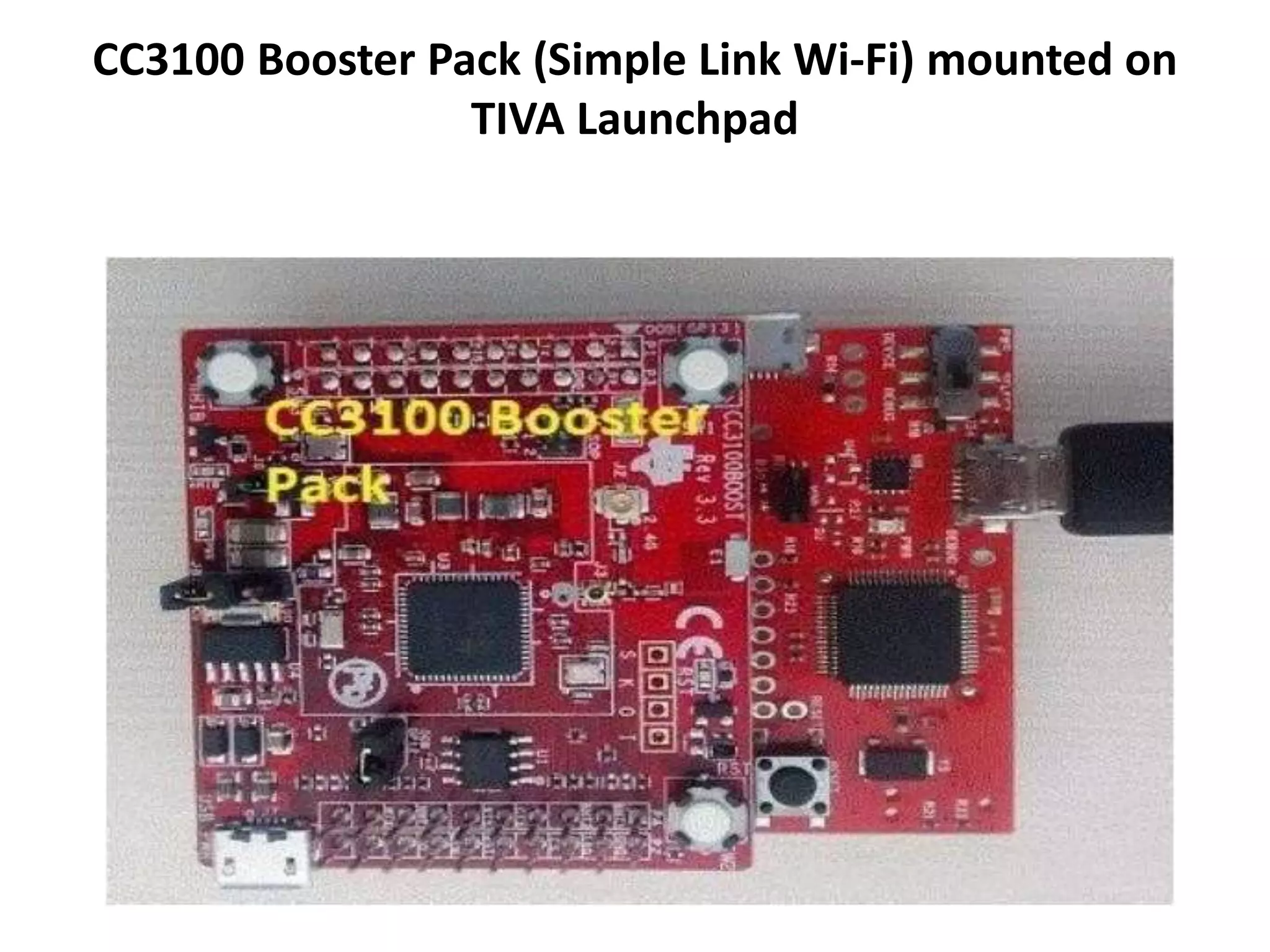
CC3100 Booster Pack (Simple Link Wi-Fi) mounted on
TIVA Launchpad
Embedded Wi-Fi:
• It is important to understand the hardware and
software architecture of any device before
using it in a design.
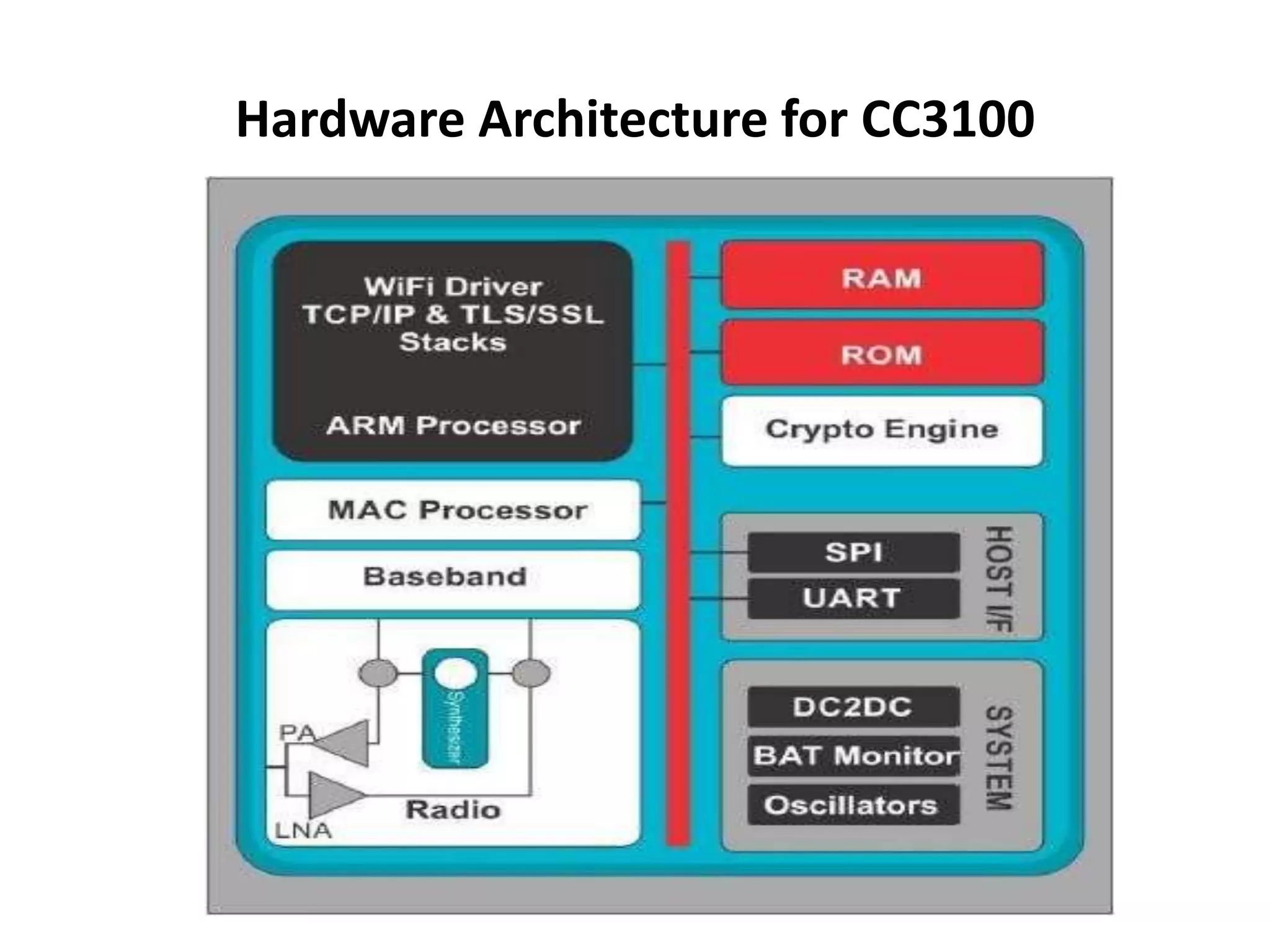
• the hardware architecture for Simple Link Wi- Fi
CC3100 module, that can be used to provide
Wi-Fi connectivity to any micro-controller
based system.
• It consists mainly of two parts:
1. Wi-Fi Network Processor Subsystem
2. Power-management Subsystem
Wi-Fi Network Processor Subsystem:
• The Wi-Fi Network Processor subsystem
mainly consists of the following:
– Dedicated ARM MCU – It executes the Wi-Fi and
Internet protocols required to communicate over
the Internet using Wi-Fi connectivity.
– ROM–stores pre-programmed Wi-Fi driver and
multiple Internet protocols
– TCP/IP Stack – supports communication with
Hardware Architecture for CC3100 computer
systems on the Internet
– Crypto Engine – provides fast, and secure Wi-Fi as
well as Internet connectivity
– 802.11 b/g/n Radio, Baseband and Medium
Access Control - for wireless transmission and
reception of data
– SPI/ UART Interface – connects the CC3100
module to the host MCU.
Hardware Architecture for CC3100
Power Management Subsystem:
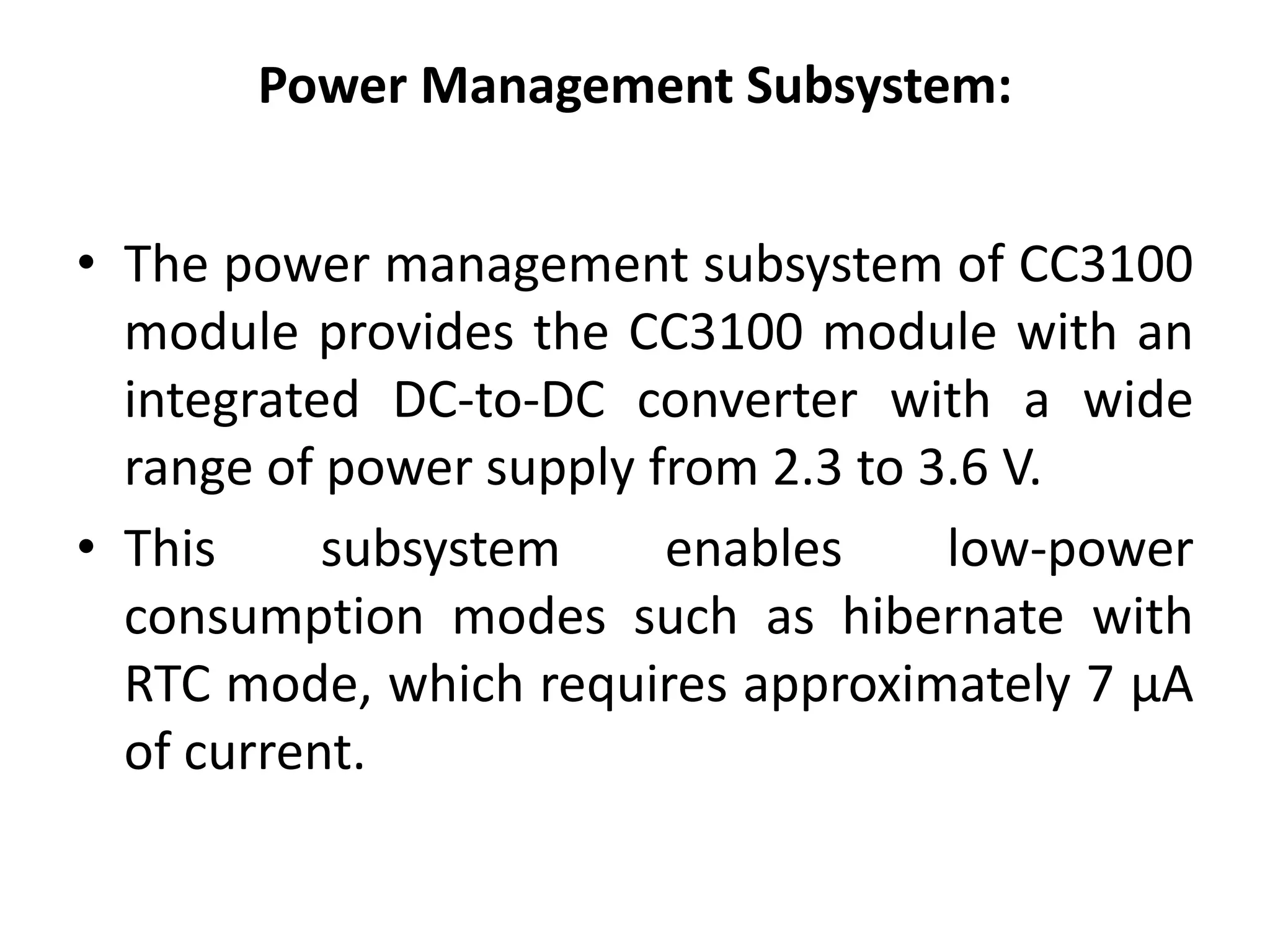
• The power management subsystem of CC3100
module provides the CC3100 module with an
integrated DC-to-DC converter with a wide
range of power supply from 2.3 to 3.6 V.
• This subsystem enables low-power
consumption modes such as hibernate with
RTC mode, which requires approximately 7 μA
of current.
Features of Wi-Fi supported by CC3100 chip:
• The Wi-Fi network processor sub-system in
SimpleLink Wi-Fi CC3100 device integrates all
protocols for Wi-Fi and Internet, greatly
minimizing MCU software requirements.
• With built-in security protocols, SimpleLink
Wi-Fi provides a simple yet robust security
experience.
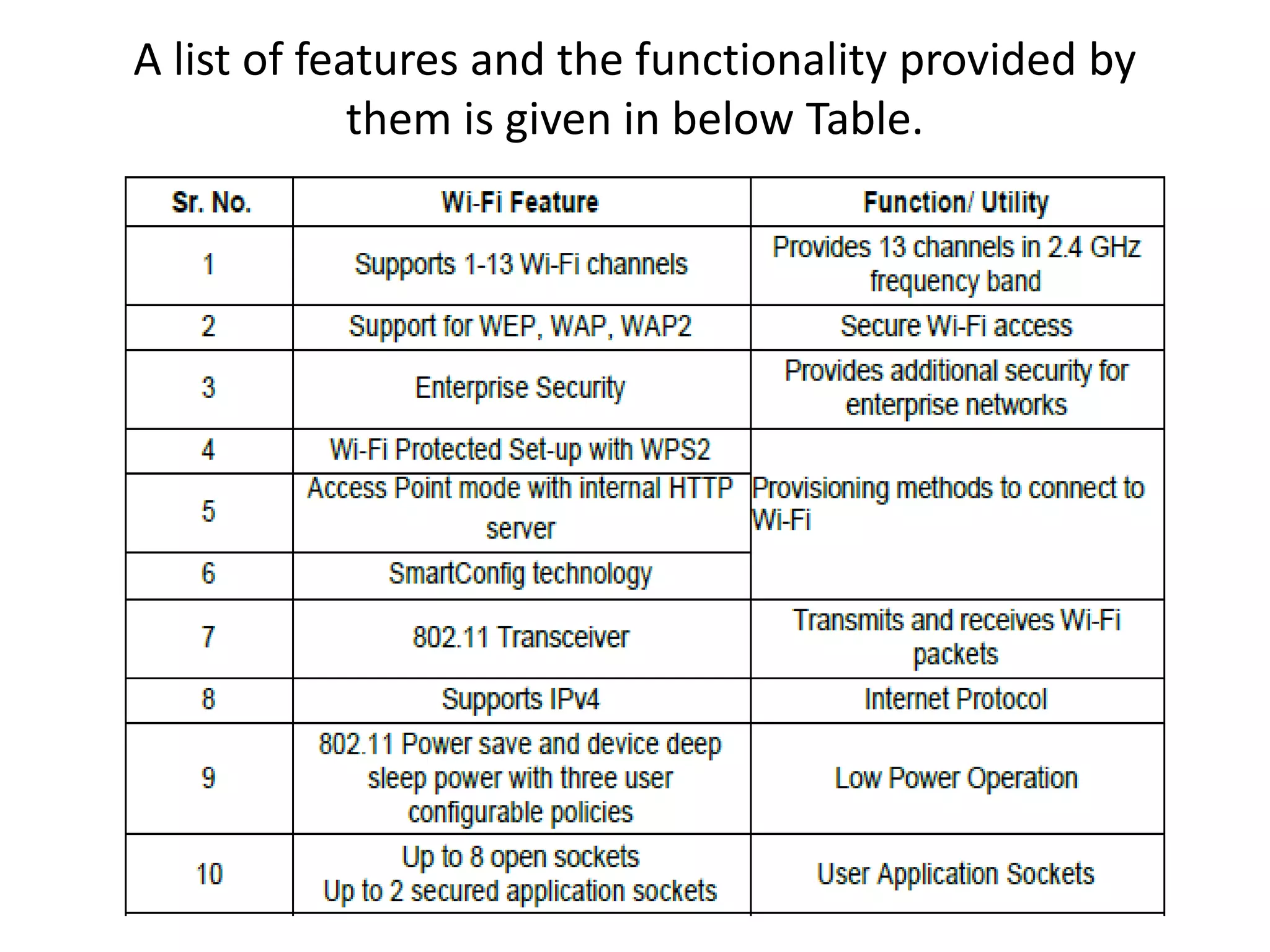
A list of features and the functionality provided by
them is given in below Table.
User APIs for Wireless
and Networking
Applications
• In order to simplify the development using the
SimpleLink Wi-Fi devices, TI provides a simple
and user friendly host driver software.
• This driver software allows any MCU (like TIVA
platform) to interact with a SimpleLink device
and performs the following functions:
User APIs for Wireless and Networking applications.
• Provides a simple API for user application development.
• Handles the communication of MCU with the
SimpleLInk device.
• Provides flexibility in working with a MCU, with or
without an OS.
• Works with existing UART or SPI physical interface
drivers
• Compatible with 8-bit, 16-bit or 32-bit MCUs
• The SimpleLink Host Driver includes a set of
six logical and simple API modules:
• Device API – Manages hardware-related
functionality such as start, stop, set, and get
device configurations.
• WLAN API – Manages WLAN, 802.11 protocol-
related functionality such as device mode
(station, AP, or P2P), setting provisioning
method, adding connection profiles, and
setting connection policy.
• Socket API – The most common API set for
user applications, and adheres to socket APIs.
• NetApp API – Enables different networking
services including the Hypertext Transfer Protocol
(HTTP) server service, DHCP(Dynamic Host
Configuration Protocol) server service, and
MDNS( Multicaste domain name system)
clientserver service.
• NetCfg API – Configures different networking
parameters, such as setting the MAC address,
acquiring the IP address by DHCP, and setting the
static IP address.
• File System API – Provides access to the serial
flash component for read and write operations of
networking or user proprietary data.

Adding Wi-Fi capability to the Microcontroller.pptx

  • 1.
    Adding Wi-Fi capability tothe Microcontroller
  • 2.
    • To illustratethe use of wireless connectivity in embedded networks, this section discusses the usage of Wi-Fi technology with a microcontroller. Wi-Fi is very widely used to provide connectivity between user and embedded systems.
  • 3.
    • For example,a user can interact with utility systems (like AC, Garage door, Coffee machine, etc.) in a smart-home using a smartphone, provided both (smart-home and smartphone) are connected to the internet.
  • 4.
    • TI provideslow-power and easy-to-use Wi-Fi solutions that include battery-operated Wi-Fi designs with more than a year of battery life on two AA batteries. TI’s Simple Link Wi-Fi CC3100 module is a wireless network processor with on-chip Wi-Fi, internet, and robust security protocols.
  • 5.
    • It canbe used to connect any low-cost microcontroller (MCU). A functional block diagram of CC3100 module is shown in the below figure.
  • 6.
    Functional diagram ofSimple Link Wi-Fi CC3100 Module
  • 7.
    CC3100 Booster Pack(Simple Link Wi-Fi) mounted on TIVA Launchpad
  • 8.
  • 9.
    • It isimportant to understand the hardware and software architecture of any device before using it in a design. • the hardware architecture for Simple Link Wi- Fi CC3100 module, that can be used to provide Wi-Fi connectivity to any micro-controller based system.
  • 10.
    • It consistsmainly of two parts: 1. Wi-Fi Network Processor Subsystem 2. Power-management Subsystem
  • 11.
    Wi-Fi Network ProcessorSubsystem: • The Wi-Fi Network Processor subsystem mainly consists of the following: – Dedicated ARM MCU – It executes the Wi-Fi and Internet protocols required to communicate over the Internet using Wi-Fi connectivity. – ROM–stores pre-programmed Wi-Fi driver and multiple Internet protocols – TCP/IP Stack – supports communication with Hardware Architecture for CC3100 computer systems on the Internet
  • 12.
    – Crypto Engine– provides fast, and secure Wi-Fi as well as Internet connectivity – 802.11 b/g/n Radio, Baseband and Medium Access Control - for wireless transmission and reception of data – SPI/ UART Interface – connects the CC3100 module to the host MCU.
  • 13.
  • 14.
    Power Management Subsystem: •The power management subsystem of CC3100 module provides the CC3100 module with an integrated DC-to-DC converter with a wide range of power supply from 2.3 to 3.6 V. • This subsystem enables low-power consumption modes such as hibernate with RTC mode, which requires approximately 7 μA of current.
  • 15.
    Features of Wi-Fisupported by CC3100 chip: • The Wi-Fi network processor sub-system in SimpleLink Wi-Fi CC3100 device integrates all protocols for Wi-Fi and Internet, greatly minimizing MCU software requirements. • With built-in security protocols, SimpleLink Wi-Fi provides a simple yet robust security experience.
  • 16.
    A list offeatures and the functionality provided by them is given in below Table.
  • 17.
    User APIs forWireless and Networking Applications
  • 18.
    • In orderto simplify the development using the SimpleLink Wi-Fi devices, TI provides a simple and user friendly host driver software. • This driver software allows any MCU (like TIVA platform) to interact with a SimpleLink device and performs the following functions:
  • 19.
    User APIs forWireless and Networking applications. • Provides a simple API for user application development. • Handles the communication of MCU with the SimpleLInk device. • Provides flexibility in working with a MCU, with or without an OS. • Works with existing UART or SPI physical interface drivers • Compatible with 8-bit, 16-bit or 32-bit MCUs
  • 20.
    • The SimpleLinkHost Driver includes a set of six logical and simple API modules: • Device API – Manages hardware-related functionality such as start, stop, set, and get device configurations. • WLAN API – Manages WLAN, 802.11 protocol- related functionality such as device mode (station, AP, or P2P), setting provisioning method, adding connection profiles, and setting connection policy. • Socket API – The most common API set for user applications, and adheres to socket APIs.
  • 21.
    • NetApp API– Enables different networking services including the Hypertext Transfer Protocol (HTTP) server service, DHCP(Dynamic Host Configuration Protocol) server service, and MDNS( Multicaste domain name system) clientserver service. • NetCfg API – Configures different networking parameters, such as setting the MAC address, acquiring the IP address by DHCP, and setting the static IP address. • File System API – Provides access to the serial flash component for read and write operations of networking or user proprietary data.