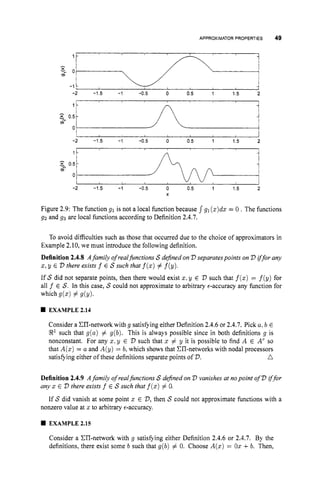
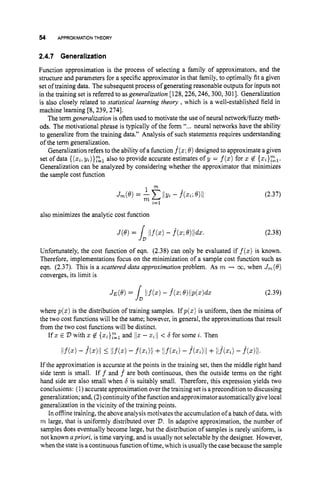
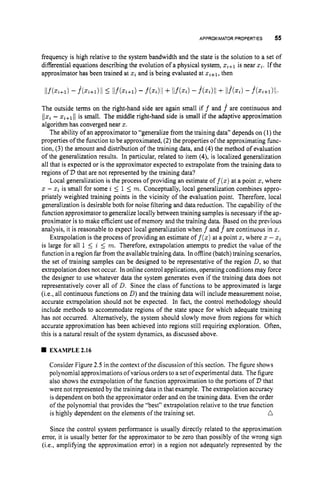
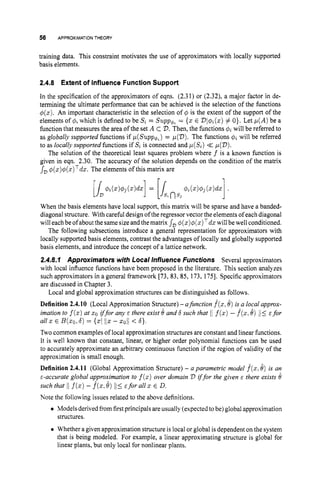
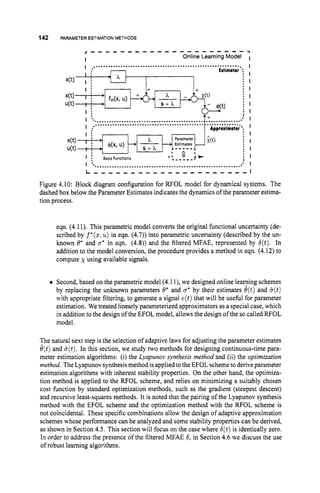
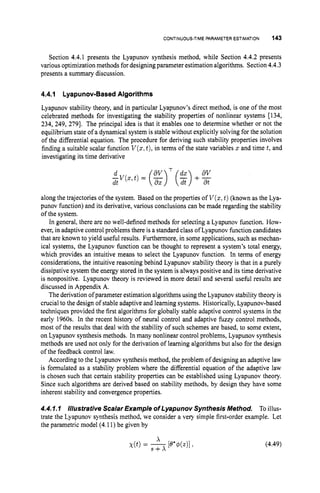
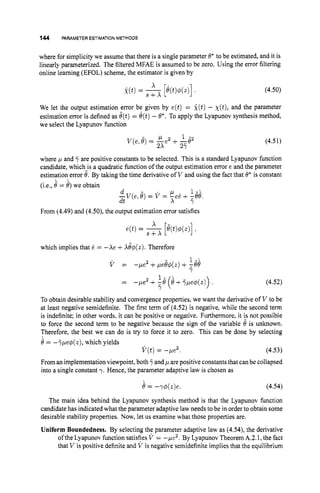
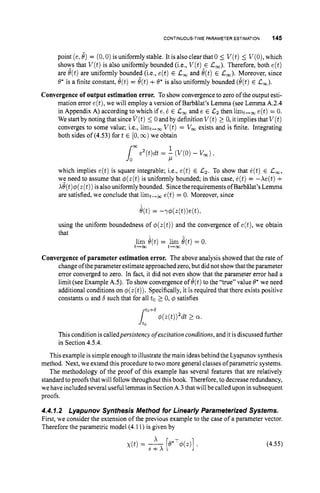
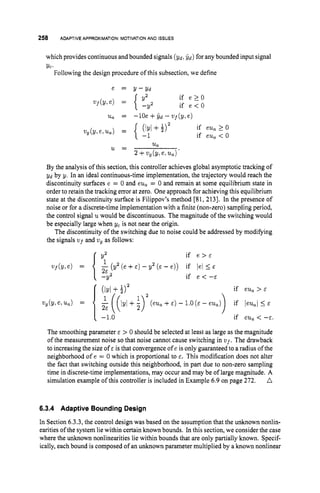
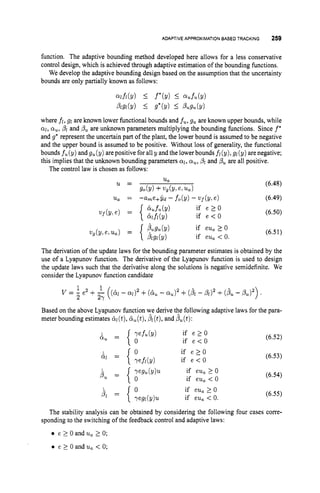
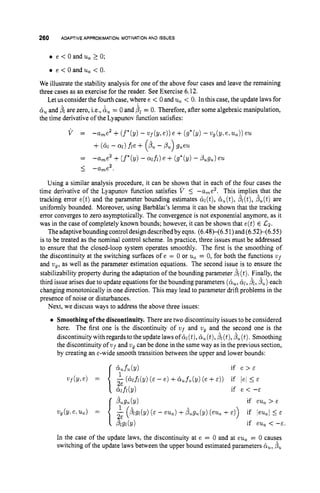
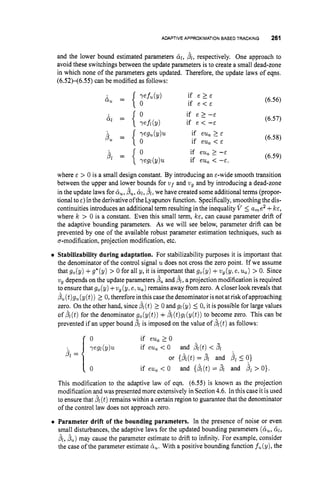
ADAPTIVE APPROXIMATlON
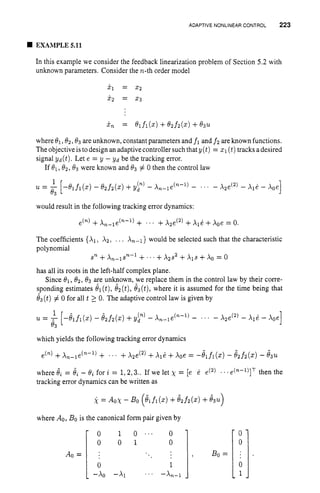
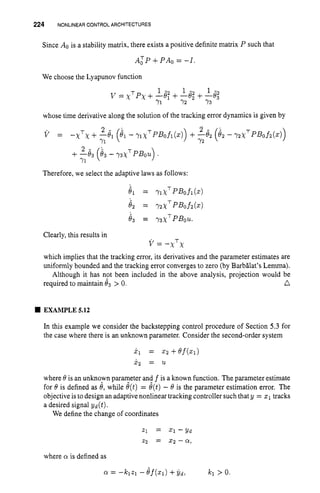
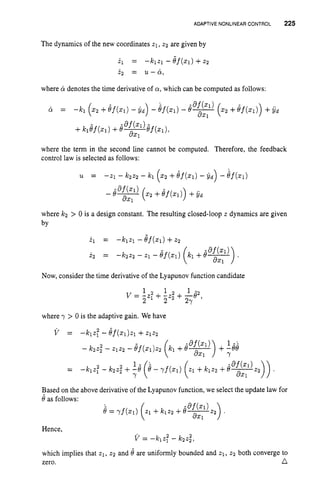
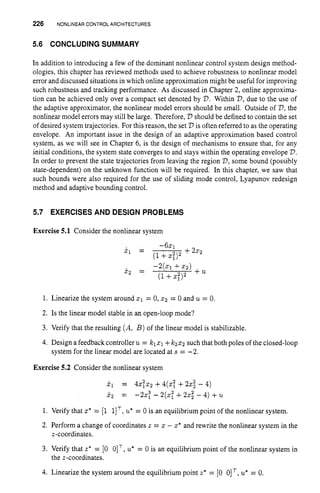
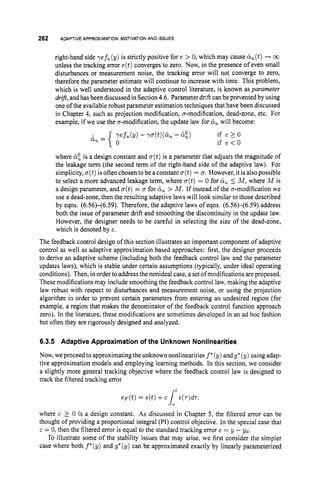
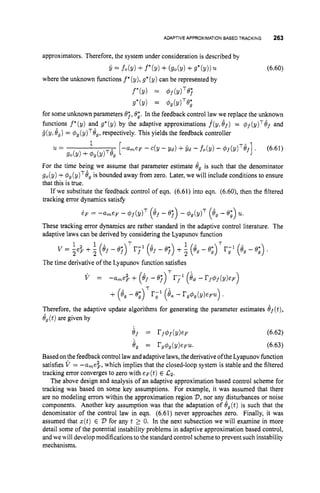
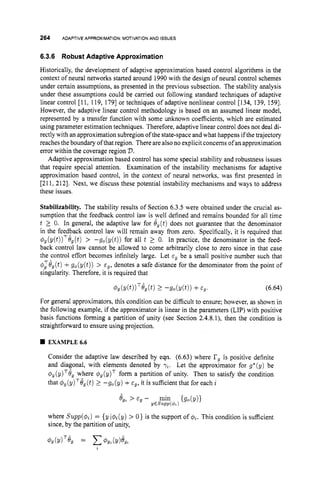
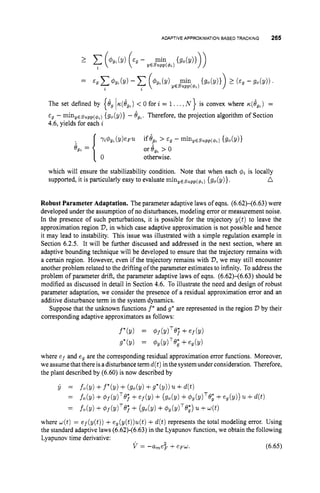
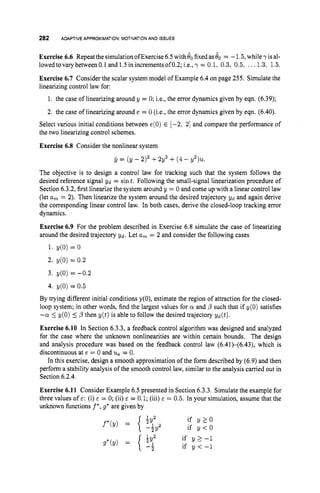
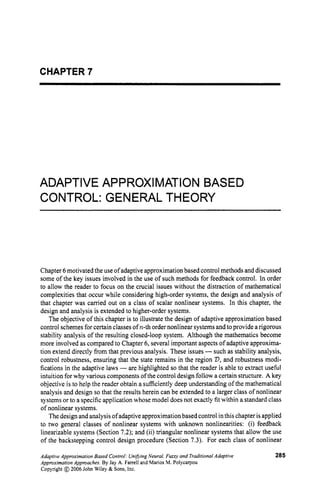
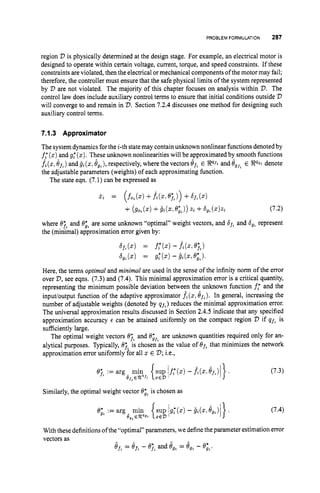
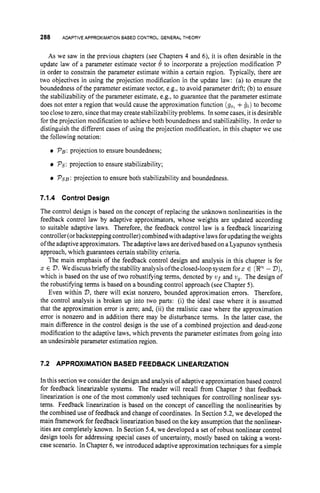
BASED CONTROL
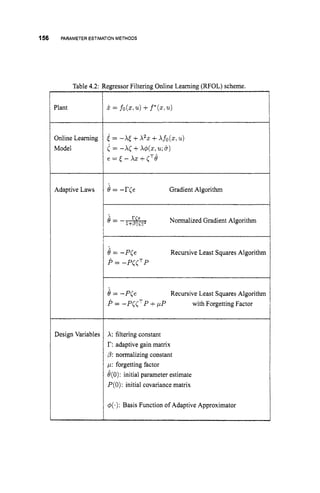
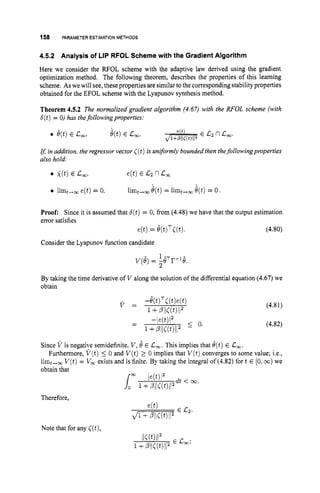
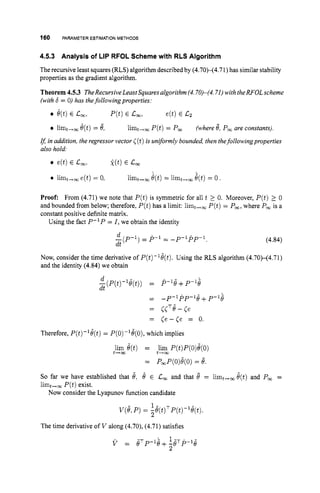
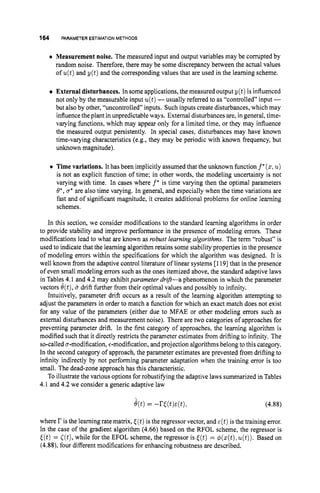
Unifying Neural, Fuzzy and Traditional
Adaptive Approximation Approaches
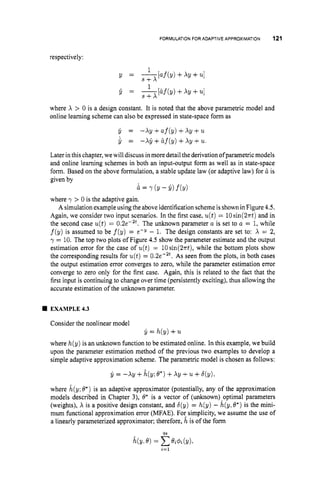
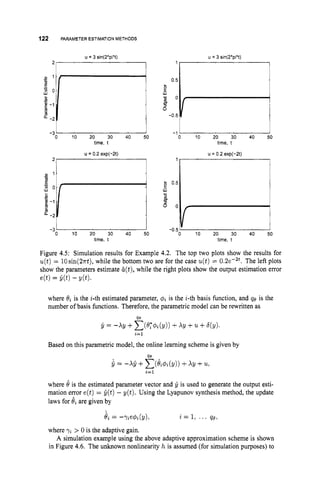
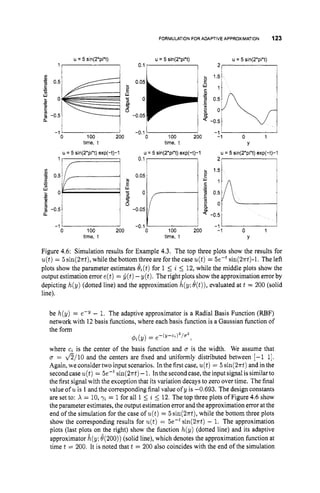
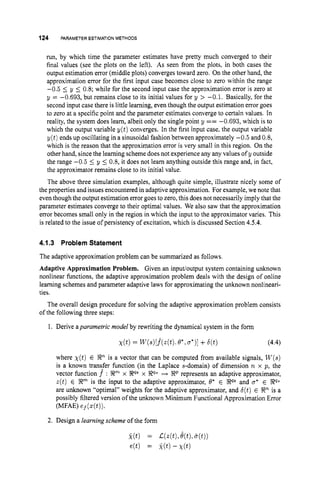
Jay A. Farrell
Universityof California Riverside
Marios M.Polycarpou
Universityof Cyprus and Universityof Cincinnati
WILEY-
INTERSCIENCE
A JOHN WILEY 81SONS, INC., PUBLICATION
This Page Intentionally Left Blank
ADAPTIVE APPROXIMATION
BASED CONTROL
This Page Intentionally Left Blank
ADAPTIVE APPROXIMATlON
BASED CONTROL
Unifying Neural, Fuzzy and Traditional
Adaptive Approximation Approaches
Jay A. Farrell
Universityof California Riverside
Marios M.Polycarpou
Universityof Cyprus and Universityof Cincinnati
WILEY-
INTERSCIENCE
A JOHN WILEY 81SONS, INC., PUBLICATION
Copyright 0 2006 by John Wiley & Sons, Inc. All rights reserved.
Published by John Wiley & Sons, Inc., Hoboken, New Jersey.
Published simultaneously in Canada.
No part of this publication may be reproduced, stored in a retrieval system, or transmitted in any form
or by any means, electronic, mechanical, photocopying, recording, scanning, or otherwise, except as
permitted under Section 107or 108 of the 1976United States Copyright Act, without either the prior
writtenpermission of the Publisher, or authorizationthrough payment of the appropriate per-copy fee to
the Copyright Clearance Center, Inc., 222 Rosewood Drive, Danvers, MA 01923, (978) 750-8400, fax
(978) 750-4470, or on the web at www.copyright.com.Requests to the Publisher for permission should
be addressed to the Permissions Department, John Wiley & Sons, Inc., 111 River Street, Hoboken,NJ
07030, (201) 748-601 1, fax (201) 748-6008, or online at http:llwww.wiley.coxn/go/permission.
Limit of LiabilityiDisclaimerof Warranty: While the publisher and author have used their best efforts in
preparing this book, they make no representationsor warranties with respect to the accuracy or
completenessof the contents of this book and specificallydisclaim any implied warranties of
merchantability or fitness for a particular purpose. No warranty may be created or extended by sales
representatives or written sales materials. The advice and strategies contnined lierciti m,iy not be
suitable for your situation. You should consult with a professional where appropriate. Neither the
publisher nor author shall be liable for any loss of profit or any other commercial damages, including
but not limited to special, incidental, consequential,or other damages.
For general information on our other products and services or for technical support, please contact our
Customer Care Department within the United States at (800) 762-2974, outside the United States at
(317) 572-3993 or fax (317) 572-4002.
Wiley also publishes its books in a variety of electronic formats. Some content that appears in print may
not be available in electronic formats. For more information about Wiley products, visit our web site at
www.wiley.com.
Library of Congress Cataloging-in-Publication Data:
Farrell, Jay.
approximationapproaches / Jay A. Farrell, Marios M. Polycarpou.
Adaptive approximation based control : unifying neural, fuzzy and traditional adaptive
p. cm.
Includes bibliographical references and index.
ISBN-I 3 978-0-471-72788-0 (cloth)
ISBN-I0 0-471-72788-1 (cloth)
1. Adaptive control systems. 2. Feedback control systems. I. Polycarpou, Marios. 11. Title.
TJ217.F37 2006
629.8'3Wc22
2005021385
Printed in the United States of America.
10 9 8 7 6 5 4 3 2 1
To ourfamilies andfriends.
This Page Intentionally Left Blank
CONTENTS
Preface
1 Introduction
1.I
1.2 Nonlinear Systems
1.3 Feedback Control Approaches
Systems and Control Terminology
1.3.1 Linear Design
1.3.2 Adaptive Linear Design
1.3.3 Nonlinear Design
1.3.4 Adaptive Approximation Based Design
1.3.5 Example Summary
Components of Approximation Based Control
1.4.1 Control Architecture
1.4.2 Function Approximator
1.4.3 Stable Training Algorithm
1.5 Discussion and Philosophical Comments
1.6 Exercises and Design Problems
1.4
2 ApproximationTheory
2.1 Motivating Example
2.2 Interpolation
...
Xlll
1
1
3
4
4
6
9
11
13
15
15
16
17
18
19
23
24
29
vii
Viii CONTENTS
2.3 Function Approximation
2.3.1 Offline (Batch)Function Approximation
2.3.2 Adaptive Function Approximation
2.4.1 Parameter(Non)Linearity
2.4.2 ClassicalApproximationResults
2.4.3 Network Approximators
2.4.4 Nodal Processors
2.4.5 Universal Approximator
2.4.6 Best ApproximatorProperty
2.4.7 Generalization
2.4.8
2.4.9 ApproximatorTransparency
2.4.10 Haar Conditions
2.4.11 MultivariableApproximationby Tensor Products
2.5 Summary
2.6 Exercises and Design Problems
2.4 ApproximatorProperties
Extent of InfluenceFunction Support
3 Approximation Structures
3.1 Model Types
3.1.1 PhysicallyBased Models
3.1.2 Structure (Model)Free Approximation
3.1.3 Function ApproximationStructures
3.2.1 Description
3.2.2 Properties
3.3.1 Description
3.3.2 Properties
3.4 Radial Basis Functions
3.4.1 Description
3.4.2 Properties
3.5.1 Description
3.5.2 Properties
3.6 MultilayerPerceptron
3.6.1 Description
3.6.2 Properties
3.7 Fuzzy Approximation
3.7.1 Description
3.7.2 Takagi-Sugeno Fuzzy Systems
3.7.3 Properties
3.2 Polynomials
3.3 Splines
3.5 CerebellarModel ArticulationController
30
31
33
39
39
43
46
48
50
52
54
56
65
66
67
68
69
71
72
72
73
74
75
75
77
78
78
83
84
84
86
87
88
89
93
93
95
96
96
104
105
CONTENTS
3.8 Wavelets
3.8.1 Multiresolution Analysis ( M U )
3.8.2 MR4 Properties
3.9 Further Reading
3.10 Exercises and Design Problems
4 Parameter EstimationMethods
4.1 Formulation for Adaptive Approximation
4.I.1 Illustrative Example
4.1.2 Motivating Simulation Examples
4.1.3 Problem Statement
4.1.4
4.2 Derivation of Parametric Models
4.2.1
4.2.2 Filtering Techniques
4.2.3 SPR Filtering
4.2.4 Linearly Parameterized Approximators
4.2.5 Parametric Models in State Space Form
4.2.6 Parametric Models of Discrete-Time Systems
4.2.7 Parametric Models of Input-Output Systems
Design of Online Learning Schemes
4.3.1 Error Filtering Online Learning (EFOL) Scheme
4.3.2 Regressor Filtering Online Learning (RFOL) Scheme
4.4.1 Lyapunov-Based Algorithms
4.4.2 Optimization Methods
4.4.3 Summary
4.5.1
4.5.2
4.5.3
4.5.4
Discussion of Issues in Parametric Estimation
Problem Formulation for Full-State Measurement
4.3
4.4 Continuous-Time Parameter Estimation
4.5 Online Learning: Analysis
Analysis of LIP EFOL Scheme with Lyapunov Synthesis Method
Analysis of LIP RFOL Scheme with the Gradient Algorithm
Analysis of LIP RFOL Scheme with RLS Algorithm
Persistency of Excitation and Parameter Convergence
4.6 Robust Learning Algorithms
4.6.1 Projection Modification
4.6.2 a-Modification
4.6.3 c-Modification
4.6.4 Dead-Zone Modification
4.6.5 Discussion and Comparison
4.7 Concluding Summary
4.8 Exercises and Design Problems
ix
106
108
110
112
112
115
1I6
116
118
124
125
127
128
129
131
131
133
134
136
138
138
140
141
143
148
154
154
155
158
160
161
163
165
168
169
170
172
173
173
X CONTENTS
5 Nonlinear Control Architectures 179
180
181
183
186
188
188
190
193
196
203
203
205
207
211
211
212
215
219
220
222
225
226
5.1 Small-Signal Linearization
5.1.1
5.1.2 Linearizing Around a Trajectory
5.I .3 Gain Scheduling
5.2.1 Scalar Input-State Linearization
5.2.2 Higher-Order Input-State Linearization
5.2.3 Coordinate Transformations and Diffeomorphisms
5.2.4 Input-Output Feedback Linearization
5.3.1 Second Order System
5.3.2 Higher Order Systems
5.3.3 Command Filtering Formulation
Robust Nonlinear Control Design Methods
5.4.1 Bounding Control
5.4.2 Sliding Mode Control
5.4.3 Lyapunov Redesign Method
5.4.4 Nonlinear Damping
5.4.5 Adaptive Bounding Control
5.5 Adaptive Nonlinear Control
5.6 Concluding Summary
5.7 Exercises and Design Problems
Linearizing Around an Equilibrium Point
5.2 Feedback Linearization
5.3 Backstepping
5.4
6 Adaptive Approximation: Motivation and Issues
6.1
6.2
Perspective for Adaptive Approximation Based Control
Stabilization of a Scalar System
6.2.1 Feedback Linearization
6.2.2 Small-Signal Linearization
6.2.3
6.2.4 Adaptive Bounding Methods
6.2.5 Approximating the Unknown Nonlinearity
6.2.6
6.2.7
6.2.8 Summary
6.3.1 Feedback Linearization
6.3.2 Tracking via Small-Signal Linearization
6.3.3
6.3.4 Adaptive Bounding Design
6.3.5
Unknown Nonlinearity with Known Bounds
Combining Approximation with Bounding Methods
Combining Approximation with Adaptive Bounding Methods
6.3 Adaptive Approximation Based Tracking
Unknown Nonlinearities with Known Bounds
Adaptive Approximation of the Unknown Nonlinearities
231
232
236
231
238
239
241
243
250
252
252
253
253
253
256
258
262
CONTENTS
6.3.6 Robust Adaptive Approximation
6.3.7
6.3.8 Advanced Adaptive Approximation Issues
6.4 Nonlinear Parameterized Adaptive Approximation
6.5 Concluding Summary
6.6 Exercises and Design Problems
Combining Adaptive Approximation with Adaptive Bounding
7 Adaptive Approximation Based Control: General Theory
7.1
7.2
7.3
7.4
7.5
Problem Formulation
7.1.1 Trajectory Tracking
7.1.2 System
7.1.3 Approximator
7.1.4 Control Design
Approximation Based Feedback Linearization
7.2.1 Scalar System
7.2.2 Input-State
7.2.3 Input-Output
7.2.4
Approximation Based Backstepping
7.3.1 Second Order Systems
7.3.2 Higher Order Systems
7.3.3 Command Filtering Approach
7.3.4 Robustness Considerations
Concluding Summary
Exercises and Design Problems
Control Design Outside the Approximation Region 2
3
8 Adaptive Approximation Based Control for Fixed-Wing Aircraft
8.1 Aircraft Model Introduction
8.1.1 Aircraft Dynamics
8.1.2 Nondimensional Coefficients
Angular Rate Control for Piloted Vehicles
8.2.1 Model Representation
8.2.2 Baseline Controller
8.2.3 Approximation Based Controller
8.2.4 Simulation Results
Full Control for Autonomous Aircraft
8.3.1
8.3.2 Wind-Axes Angle Control
8.3.3
8.3.4
8.3.5 Approximator Definition
8.2
8.3
Airspeed and Flight Path Angle Control
Body Axis Angular Rate Control
Control Law and Stability Properties
xi
264
266
271
278
280
281
285
286
286
286
287
288
288
289
294
306
308
309
309
316
323
328
330
331
333
334
334
335
336
337
337
338
345
349
350
355
359
362
365
xii CONTENTS
8.3.6 Simulation Analysis
8.3.7 Conclusions
8.4 Aircraft Notation
Appendix A: Systems and Stability Concepts
A.1 Systems Concepts
A.2 Stability Concepts
A.2.1 Stability Definitions
A.2.2 Stability Analysis Tools
A.2.3 Strictly Positive Real Transfer Functions
A.3 General Results
A.4 Trajectory Generation Filters
A S A Useful Inequality
A.6 Exercises and Design Problems
Appendix B: RecommendedImplementationand DebuggingApproach
References
367
371
371
377
377
379
379
381
391
392
394
391
398
399
401
Index 417
PREFACE
During the last few years there have been significant developments in the control of highly
uncertain, nonlinear dynamical systems. For systems with parametric uncertainty, adaptive
nonlinear control has evolved as a powerful methodology leading to global stability and
tracking results for a class of nonlinear systems. Advances in geometric nonlinear control
theory, in conjunction with the development and refinement of new techniques, such as
the backstepping procedure and tuning functions, have brought about the design of control
systems with proven stability properties. In addition, there has been a lot of research
activityon robust nonlinear controldesign methods, such as sliding mode control, Lyapunov
redesign method, nonlinear damping, and adaptive bounding control. These techniques are
based on the assumption that the uncertainty in the nonlinear functions is within some
known, or partially known, bounding functions.
In parallel with developments in adaptivenonlinear control, there has been a tremendous
amount of activity in neural control and adaptive fuzzy approaches. In these studies, neural
networks or fuzzy approximators are used to approximate unknown nonlinearities. The
input/output response of the approximator is modified by adjusting the values of certain
parameters, usually referred to asweights. From a mathematical control perspective, neural
networks and fuzzy approximators represent just two classes of function approximators.
Polynomials, splines, radial basis functions, and wavelets are examples of other function
approximators that can be used-and have been used-in a similar setting. We refer to
such approximation models with adaptivityfeatures as adaptive approximators, and control
methodologies that are based on them as adaptive approximation based control.
Adaptive approximation based control encompasses a variety of methods that appear
in the literature: intelligent control, neural control, adaptive fuzzy control, memory-based
control, knowledge-based control, adaptive nonlinear control, and adaptive linear control.
xiii
xiv PREFACE
Researchers in these fields have diverse backgrounds: mathematicians, engineers, and
computer scientists. Therefore, the perspective of the various papers in this area is also
varied. However, the objective of the various practitioners is typically similar: to design a
controller that can be guaranteed to be stable and achieve a high level of control performance
for systems that contain poorly modeled nonlinear effects, or the dynamics of the system
change during operation (for example, due to system faults). This objective is achieved
by adaptively developing an approximating function to compensate the nonlinear effects
during the operation of the system.
Many of the original papers on neural or adaptive fizzy control were motivated by such
concepts as ease of use, universal approximation, and fault tolerance. Often, ease of use
meant that researchers without a control or systems background could experiment with and
often succeed at controlling certain dynamics systems, at least in simulation. The rise of
interest in the neural and adaptive fuzzy control approaches occurred at a time when desktop
computers and dynamic simulation tools were becoming sufficiently cheap at reasonable
levels of performance to support such research on a wide basis.
However, prior to application on systems of high economic value, the control system
designer must carefully consider any new approach within a sound analytical framework that
allows rigorous analysis of conditions for stability and robustness. This approach opens
a variety of questions that have been of interest to various researchers: What properties
should the function approximator have? Are certain families of approximators superior
to others? How should the parameters of the approximator be estimated? What can be
guaranteed about the properties of the signals within the control system? Can the stability
of the approximator parameters be guaranteed? Can the convergence of the approximator
parameters be guaranteed? Can such control systems be designed to be robust to noise,
disturbances, and unmodeled effects. Can this approach handle significant changes in the
dynamics due to, for example, a system failure. What types of nonlinear dynamic systems
are amenable to the approach? What are the limitations? The objective of this textbook is
to provide readers with a framework for rigorously considering such questions.
Adaptive approximation based control can be viewed as one of the available tools that
a control designer should have in herihis control toolbox. Therefore, it is desirable for the
reader not only to be able to apply, for example, neural network techniques to a certain
class of systems, but more importantly to gain enough intuition and understanding about
adaptive approximation so that shelhe knows when it is a useful tool to be used and how to
make necessary modifications or how to combine it with other control tools, so that it can
be applied to a system that has not be encountered before.
The book has been written at the level of a first-year graduate student in any engineering
field that includes an introduction to basic dynamic systems concepts such as state variables
and Laplace transforms. We hope that this book has appeal to a wide audience. For use as
a graduate text, we have included exercises, examples, and simulations. Sufficient detail is
included in examples and exercises to allow students to replicate and extend results. Simu-
lation implementation of the methods developed herein is a virtually necessary component
of understanding implications of the approach. The book extensively uses ideas from sta-
bility theory. The advantage of this approach is that the adaptive law is derived based on the
Lyapunov synthesis method and therefore the stability properties of the closed-loop system
are more readily determined. Therefore, an appendix has been included as an aid to readers
who are not familiar with the ideas ofLyapunov stability analysis. For theoretically oriented
readers, the book includes complete stability analysis of the methods that are presented.
PREFACE XV
Organization. To understand and effectively implement adaptive approximation based
control systems that have guaranteed stability properties, the designermust become familiar
with concepts of dynamic systems, stability theory, function approximation, parameter
estimation, nonlinear control methods, and the mechanisms to apply these various tools in
a unified methodology.
Chapter 1 introduces the idea of adaptive approximation for addressing unknown nonlin-
ear effects. This chapter includes a simple example comparing various control approaches
and concludes with a discussion of components of an adaptive approximation based control
system with pointers to the locations in the text where each topic is discussed.
Function approximation and data interpolation have long histories and are important
fields in their own right. Many of the concepts and results from these fields are impor-
tant relative to adaptive approximation based control. Chapter 2 discuss various properties
of function approximators as they relate to adaptive function approximation for control
purposes. Chapter 3 presents various function approximation structures that have been
considered for implementation of adaptive approximation based controllers. All of the ap-
proximators of this chapter are presented using a single unifying notation. The presentation
includes a comparative discussion of the approximators relative to the properties presented
in Chapter 2.
Chapter 4 focuses on issues related to parameter estimation. First we study the formu-
lation of parametric models for the approximation problem. Then we present the design of
online learning schemes; and finally, we derive parameter estimation algorithms with cer-
tain stability and robustness properties. The parameter estimation problem is formulated
in a continuous-time framework. The chapter includes a discussion of robust parame-
ter estimation algorithms, which will prove to be critical to the design of stable adaptive
approximation based control systems.
Chapter 5 reviews various nonlinear control system design methodologies. The objective
of this chapter is to introduce the methods, analysis tools, and key issues of nonlinear
control design. The chapter begins with a discussion of small-signal linearization and gain
scheduling. Then we focus on feedback linearization and backstepping, which are two of
the key design methods for nonlinear control design. The chapter presents a set of robust
nonlinear control design techniques. These methods include bounding control, slidingmode
control, Lyapunov redesign method, nonlinear damping, and adaptive bounding. Finally,
we briefly study the adaptive nonlinear control methodology. For each approach we present
the basic method, discuss necessary theoretical ideas related to each approach, and discuss
the effect (and accommodation) of modeling error.
Chapters 6 and 7 bring together the ideas of Chapters 1-5 to design and analyze con-
trol systems using adaptive approximation to compensate for poorly modeled nonlinear
effects. Chapter 6 considers scalar dynamic systems. The intent of this chapter is to al-
low a detailed discussion of important issues without the complications of working with
higher numbers of state variables. The ideas, intuition, and methods developed in Chapter
6 are important to successful applications to higher order systems. Chapter 7 will aug-
ment feedback linearization and backstepping with adaptive approximation capabilities to
achieve high-performance tracking for systems with significant unmodeled nonlinearities.
The presentation of each approach includes a rigorous Lyapunov analysis.
Chapter 8 presents detailed design and analysis of adaptive approximation based con-
trollers applied to fixed-wing aircraft. We study two control situations. First, an angular
rate controller is designed and analyzed. This controller is applicable in piloted aircraft
applications where the stick motion of the pilot is processed into body-frame angular rate
commands. Then we develop a full vehicle controller suitable for uninhabited air vehicles
XVi PREFACE
(UAVs). The control design is based on the approximation based backstepping methodol-
ogy.
Acknowledgments. The authors would like to thank the various sponsors that have sup-
ported the research that has resulted in this book: the National Science Foundation (Paul
Werbos), Air Force Wright-Patterson Laboratory (Mark Mears), Naval Air Development
Center (Marc Steinberg), and the Research Promotion Foundation of Cyprus. We would
like to thank our current and past employers who have directly and indirectly enabled this
research: University of California, Riverside; University of Cyprus; University of Cincin-
nati; and Draper Laboratory. In addition, we wish to acknowledge the many colleagues,
collaborators, and students who have contributed to the ideas presented herein, especially:
P.Antsaklis, W. L. Baker, J.-Y. Choi, M. Demetriou, S. Ge, J. Harrison, P. A. Ioannou, H. K.
Khalil, P. Kokotovic, F. L. Lewis, D. Liu, M. Mears, A. N. Michel, A. Minai, J. Nakanishi,
K. Narendra, C. Panayiotou, T. Parisini, K. M. Passino, T. Samad, S. Schaal, M. Sharma,
J.-J. Slotine, E. Sontag, G. Tao, A. Vemuri, H. Wang, S. Weaver, Y. Yang, X. Zhang, Y.
Zhao, and P. Zufiria. Finally, we would like to thank our families for their constant support
and encouragement throughout the long period that it took for this book to be completed.
Jay A. Farrell
Marios M. Polycarpou
Riverside, California and Nicosia, Cyprus
(10 hours time difference)
July 2005
CHAPTER I
INTRODUCTION
This book presents adaptive function estimation and feedback control methodologies that
develop and use approximations toportions ofthenonlinear functions describing the system
dynamics while the system is in online operation. Such methodologies have been proposed
and analyzed under a variety of titles: neural control, adaptive fuzzy control, learning
control, and approximation-based control. A primary objective of this text is to present the
methods systematically in a unifying framework that will facilitate discussion of underlying
properties and comparison of alternative techniques.
This introductory chapter discusses some fundamental issues such as: (i) motivations
for using adaptive approximation-based control; (ii) when adaptive approximation-based
control methods are appropriate; (iii) how the problem can be formulated; and (iv) what
design decisions are required. These issues are illustrated through the use of a simple
simulation example.
1.1 SYSTEMS AND CONTROL TERMINOLOGY
Researchers interested in this area come from a diverse set of backgrounds other than
control; therefore, we start with a brief review of terminology standard to the field of
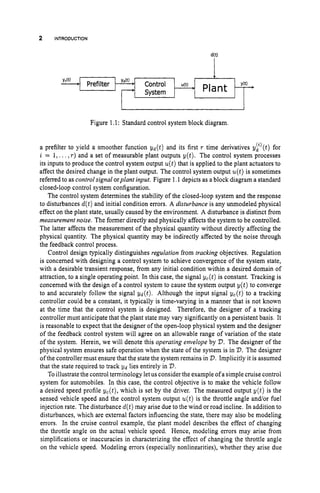
control systems, as depicted in Figure 1.1. The plant is the system to be controlled. The
plant will by modeled herein by a typically nonlinear set of ordinary differential equations.
The plant model is assumed to include the actuator and sensor models. The control system
is designed to achieve certain control objectives. As indicated in Figure 1.1, the inputs
to the control system include the reference input yc(t) (which is possibly passed through
Adaptive Approximation Based Control: UnifiingNeural, Fuzzy and TruditionalAdaptive
Approximation Approaches. By Jay A. Farretl and Marios M. Polycarpou
Copyright @ 2006 John Wiley & Sons, Inc.
1
2 INTRODUCTION
YJt)
- Y(t)
Control u(t)
Prefilter
Figure 1.1: Standard control system block diagram.
Plant
System
a prefilter to yield a smoother function y d ( t ) and its first T time derivatives y!’(t) for
i = 1,...,T ) and a set of measurable plant outputs y(t). The control system processes
its inputs to produce the control system output u ( t )that is applied to the plant actuators to
affect the desired change in the plant output. The control system output u(t)is sometimes
referred to as control signal orplant input. Figure 1.1 depicts as a block diagram a standard
closed-loop control system configuration.
The control system determines the stability of the closed-loop system and the response
to disturbances d(t)and initial condition errors. A disturbance is any unmodeled physical
effect on the plant state, usually caused by the environment. A disturbance is distinct from
measurement noise. The former directly and physically affects the system to be controlled.
The latter affects the measurement of the physical quantity without directly affecting the
physical quantity. The physical quantity may be indirectly affected by the noise through
the feedback control process.
Control design typically distinguishes regulation from tracking objectives. Regulation
is concerned with designing a control system to achieve convergence of the system state,
with a desirable transient response, from any initial condition within a desired domain of
attraction, to a single operating point. In this case, the signal yc(t) is constant. Tracking is
concerned with the design of a control system to cause the system output y(t) to converge
to and accurately follow the signal yd(t). Although the input signal yc(t) to a tracking
controller could be a constant, it typically is time-varying in a manner that is not known
at the time that the control system is designed. Therefore, the designer of a tracking
controller must anticipate that the plant state may vary significantly on a persistent basis. It
is reasonable to expect that the designer of the open-loop physical system and the designer
of the feedback control system will agree on an allowable range of variation of the state
of the system. Herein, we will denote this operating envelope by V.The designer of the
physical system ensures safe operation when the state of the system is in V.The designer
ofthe controller must ensure that the state the system remains in V.Implicitly it is assumed
that the state required to track Yd lies entirely in V.
To illustratethe control terminology letus considerthe example of a simple cruise control
system for automobiles. In this case, the control objective is to make the vehicle follow
a desired speed profile yc(t),which is set by the driver. The measured output y ( t ) is the
sensed vehicle speed and the control system output u(t)is the throttle angle and/or fuel
injection rate. The disturbance d(t)may arise due to the wind or road incline. In addition to
disturbances, which are external factors influencing the state, there may also be modeling
errors. In the cruise control example, the plant model describes the effect of changing
the throttle angle on the actual vehicle speed. Hence, modeling errors may arise from
simplifications or inaccuracies in characterizing the effect of changing the throttle angle
on the vehicle speed. Modeling errors (especially nonlinearities), whether they arise due
-
NONLINEAR SYSTEMS 3
to inaccuracies or intentional model simplifications, constitute one of the key motivations
for employing adaptive approximation-basedcontrol, and thus are crucial to the techniques
developed in this book.
In general, the objectives of a control system design are:
1. to stabilize the closed-loop system;
2. to achieve satisfactory reference input tracking in transient and at steady state;
3. to reduce the effect of disturbances;
4. to achieve the above in spite of modeling error;
5. to achieve the above in spite of noise introduced by sensors required to implement
the feedback mechanism.
Introductory textbooks in control systems provide linear-based design and analysis tech-
niques for achieving the above objectives and discuss some basic robustness and imple-
mentation issues [61, 66, 86, 1401. The theoretical foundations of linear systems analysis
and design are presented in more advanced textbooks (see, for example, [lo, 19,39, 130]),
where issues such as controllability, observability, and model reduction are examined.
1.2 NONLINEAR SYSTEMS
Most dynamic systems encountered in practice are inherentlynonlinear. The control system
design process builds on the concept of a model. Linear control design methods can some-
times be applied to nonlinear systems over limited operating regions (i.e., 2)is sufficiently
small), through the process of small-signal linearization. However, the desired level of
performance or tracking problems with a sufficiently large operating region 2)may require
in which the nonlinearities be directly addressed in the control system design. Depending
on the type of nonlinearity and the manner that the nonlinearity affects the system, various
nonlinear control design methods are available [121, 134, 159, 234, 249, 2791. Some of
these methods are reviewed in Chapter 5.
Nonlinearity and model accuracy directly affect the achievable control system perfor-
mance. Nonlinearity canimpose hard constraintson achievable performance. The challenge
of addressing nonlinearities during the control design process is further complicated when
the description of the nonlinearities involves significant uncertainty. When portions of the
plant model are unknown or inaccurately defined, or they change during operation, the con-
trol performance may need to be severely limited to ensure safe operation. Therefore there
is often an interest to improve the model accuracy. Especially in tracking applications this
will typically necessitate the use of nonlinear models. The focus of this text is on adaptively
improving models of nonlinear effects during online operation.
In such applications the level of achievable performance may be enhanced by using
adaptive function approximation techniques to increase the accuracy of the model of the
nonlinearities. Such adaptive approximation-based control methods include the popular
areas of adaptive fuzzy and neural control. This chapter introduces various issues related to
adaptive approximation-based control. This introductory discussion will direct the reader
to the appropriate sections of the text where more detailed discussion of each issue can be
found.
4 INTRODUCTION
1.3 FEEDBACK CONTROL APPROACHES
To introduce the concept of adaptive approximation-based control, consider the following
example, where the objective is to control the dynamic system
in a manner such that y ( t ) accurately tracks an externally generated reference input signal
yd(t). Therefore, the control objective is achieved if the tracking error Q(t)= y ( t ) - yd(t)
is forced to zero. The performance specification is for the closed-loop system to have a
rate of convergence corresponding to a linear system with a dominant time constant T of
about 5.0 s. With this time constant, tracking errdrs due to disturbances or initial conditions
should decay to zero in approximately 15 s (= 37). The system is expected to normally
operate within y E 120,601, but may safely operate on the region 23 = {y E [0,loo]}. Of
course, all signals in the controller and plant must remain bounded during operation.
However, the plant model is not completely accurate. The best model available to the
control system designer is given by
where f,(y) = -y and go(y) = 1.0+0 . 3 ~ .
The actual system dynamics are not known or
available to the designer. For implementation of the following simulation results, the actual
dynamics will be
f(y) = -1 -0.01y2
Therefore, there exists significant error between the design model and the actual dynamics
over the desired domain of operation.
This section will consider four alternative control system design approaches. The ex-
ample will allow a concrete, comparative discussion, but none of the designs have been
optimized. The objective is to highlight the similarities, distinctions, complexity, and com-
plicating factors of each approach. The details of each design have been removed from this
discussion so as not to distract from the main focus. The details are included in the problem
section of this chapterto allow further exploration. These methodologies and various others
will be analyzed in substantially greater detail throughout the remainder of the book.
1.3.1 Linear Design
Given the design model and performance specification, the objective in this subsection is
to design a linear controller for the system
y(t)= h(y(t),u(t))
= - y ( t ) +(1.0 +O.Sy(t))u(t) (1.3)
so that the linearized closed-loop system is stable (stability concepts are reviewed in Ap-
pendix A) and has the desired tracking error convergence rate. This controller is designed
based on the idea of small-signal linearization and is approximate, evenrelative tothe model.
Section 1.3.3 will consider feedback linearization, which is a nonlinear design approach
that exactly linearizes the model using the feedback control signal.
FEEDBACK CONTROL APPROACHES 5
For the scalar system g = h(y, u), an operatingpoint is a pair of real numbers (y*,u
'
)
such that h(y*,u*)
= 0. If y = y* and u = u*,
then jr = 0. In a more general setting,
the designer may need to linearize around a time-varying nominal trajectory (y*(t),u*(t)).
Note that operating points may be stable orunstable (see the discussion in Appendix A). An
operating point analysis only indicates the values of y at which it is possible, by appropriate
choice of u, for the system to be in steady state. For our example, the set of operatingpoints
is defined by (y', u*)
such that
Y*
u*= -
1 +0.3y*'
Therefore, the design model indicates that the system can operate at any y E D.
The operating point analysis does not indicate how u(t)should be selected to get con-
vergence to any particular operating point. Convergence to a desired operating point is an
objective for the control system design. In a linear control design, the best available model
is linearized around an operating point and a linear controller is designed for that linearized
model. If we choose the operating point (y*, u
'
)= (40, fi)as the design point, then the
linearized dynamics are (see Exercise 1.1)
1
13
-by = ---by +13&,
where by = y - 40 and bu = u- 3.The linear controller
40 0.2(s+ L,
13 13s
U ( S )= - - l3 F(s)
used with the design model results in a stable system that achieves the specification at
y* = 40. In the above, s is the Laplace variable, U ( s )denotes the Laplace transform of
u(t),C(t)= y ( t ) -yd(t), and yd(t) is the reference input. Ofcourse, D is large enough that
a linear controller designed to achieve the specification at one operating point will probably
not achieve the specification at all operating points in D or for yd(t) varying with time over
the region D.
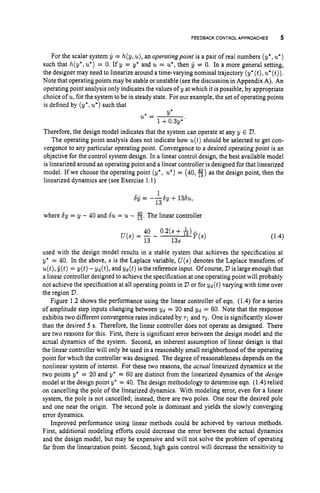
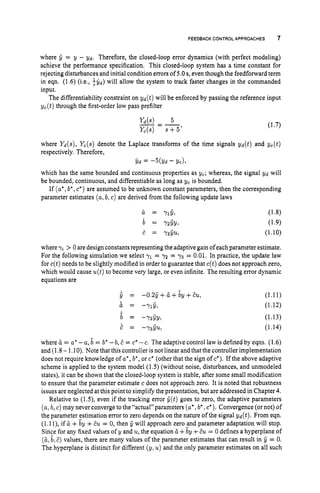
Figure 1.2 shows the performance using the linear controller of eqn. (1.4) for a series
of amplitude step inputs changing between yd = 20 and yd = 60. Note that the response
exhibits two different convergence rates indicated by T~ and 7 2 . One is significantly slower
than the desired 5 s. Therefore, the linear controller does not operate as designed. There
are two reasons for this. First, there is significant error between the design model and the
actual dynamics of the system. Second, an inherent assumption of linear design is that
the linear controller will only be used in a reasonably small neighborhood of the operating
point for which the controller was designed. The degree of reasonableness depends on the
nonlinear system of interest. For these two reasons, the actual linearized dynamics at the
two points y* = 20 and yc = 60 are distinct from the linearized dynamics of the design
model at the design point y* = 40. The design methodology to determine eqn. (1.4) relied
on cancelling the pole of the linearized dynamics. With modeling error, even for a linear
system, the pole is not cancelled; instead, there are two poles. One near the desired pole
and one near the origin. The second pole is dominant and yields the slowly converging
error dynamics.
Improved performance using linear methods could be achieved by various methods.
First, additional modeling efforts could decrease the error between the actual dynamics
and the design model, but may be expensive and will not solve the problem of operating
far from the linearization point. Second, high gain control will decrease the sensitivity to
6 INTRODUCTION
65
I I t I
0 10 20 30 40 50 60 70 80 90 100
Time, t
Figure 1.2: Performance of the linear control system of eqn. (1.4) with the dynamic system
of eqn. (1.1). The solid curve is y ( t ) . The dashed curve is yd(t).
modeling error, but will result in a higher bandwidth closed-loop system as well as a large
control effort. Third, gain scheduling methods (although not truly linear) address the issue
of limiting the use of a linear controller to a region about its design point by switching
between a set of linear controllers as a function of the system state. Each linear controller
is designed to meet the performance specification (for the design model) on a small region
of operation Di. The regions Q are defined such that they cover the region of operation 2)
(i.e., D C Uz,Di). Gain scheduling a set of linear controllers does not address the issue
of error between the actual system and the design model.
1.3.2 Adaptive Linear Design
Through linearization, the dynamics near a fixed operating point (y*,u
'
)are approximated
by
$(t)= a' +b*y(t)+c*u(t), (1.5)
where a', b', and c* are parameters that depend on (y*,u*). In one possible adaptive
control approach, the control law is
1
U = - (-a - by +yd +0.2(Yd - y)) , (1.6)
C
where yd E C'(D) (i.e., the first derivative of yd exists and is continuous within the region
D),
and a, b, care parameter estimates of a*,b', and c*,respectively. Note that if (a,b,c) =
(a', b', c*), then exact cancellation occurs and the resulting error dynamics are
s= -0.29,
FEEDBACKCONTROL APPROACHES 7
where fi = y - Yd. Therefore, the closed-loop error dynamics (with perfect modeling)
achieve the performance specification. This closed-loop system has a time constant for
rejecting disturbances and initial condition errors of 5.0s,even though the feedforward term
in eqn. (1.6) (i.e., $yd) will allow the system to track faster changes in the commanded
input.
The differentiability constraint on Yd(t) will be enforced by passing the reference input
yc(t) through the first-order low pass prefilter
(1.7)
where Yd(s), Yc(s) denote the Laplace transforms of the time signals Yd(t) and yc(t)
respectively. Therefore,
Y d = -5(Yd - Yc),
which has the same bounded and continuous properties as yc; whereas, the signal Yd will
be bounded, continuous, and differentiable as long as yc is bounded.
If (a*,b*,c*) are assumed to be unknown constant parameters, then the corresponding
parameter estimates (a,b,c) are derived from the following update laws
where yi > 0 aredesign constants representing the adaptive gain ofeachparameter estimate.
For the following simulation we select y1= 7 2 = y3 = 0.01. In practice, the update law
for c(t)needs to be slightly modified in order to guarantee that c(t) does not approach zero,
which would cause u(t)to become very large, or even infinite. The resulting error dynamic
equations are
s = -0.2fi+6+6y+Eu,
6 = -715,
b = -YzfiY,
E = -y&,
(1.11)
(1.12)
(1.13)
(1.14)
where ZL = a* -a, b = b
’ -b, E = C* -c. The adaptive control law is defined by eqns. (1.6)
and (1.8 - 1.10). Note that this controller is not linear and that the controller implementation
does not require knowledge of a*,b*,or c* (other that the sign of c*). If the above adaptive
scheme is applied to the system model (1.5) (without noise, disturbances, and unmodeled
states), it can be shown that the closed-loop system is stable, after some small modification
to ensure that the parameter estimate c does not approach zero. It is noted that robustness
issues are neglected at this point to simplify the presentation, but are addressed in Chapter 4.
Relative to (lS), even if the tracking error fi(t)goes to zero, the adaptive parameters
(a:b, c) may never converge to the “actua1”parameters (a*,b
’ ,c*). Convergence (or not) of
the parameter estimation error to zero depends on the nature of the signal Yd(t). From eqn.
(1.1l), if ZL +6~+E
u = 0, then fi will approach zero and parameter adaptation will stop.
Since for any fixed values of y and u,the equation 6 +by +E
u = 0 defines a hyperplane of
(&b, E ) values, there are many values of the parameter estimates that can result in fi = 0.
The hyperplane is distinct for different (y, u) and the only parameter estimates on all such
8 INTRODUCTION
0 55-
i 5 0 -
45-
2
6 40-
;
35-
30
3
hyperplanes satisfy (6, b, E) = (0,0,O). Therefore, convergence ofthe parameter estimates
would require that (y,u ) change sufficiently in an appropriate sense, leading to the concept
ofpersistency ofexcitation (see Chapter 4
)
. An important fact to remember in the design
of adaptive control systems is that convergence of the tracking error does not necessarily
imply convergence (or even boundedness) of the parameter estimates.
Relative to (1. l), the parameters of (1.5) will be a function of the operating point (see
Exercise 1.2). Each time that the operating point changes, the parameter estimates will
adapt. If the operating point changed slowly, then a* ,b
' , and c* could be considered as
slowly time-varying. In such an approach, depending on the magnitude of the adaptive
gains yi, the corresponding estimates may be able to change the adaptive parameters fast
enough to maintain high performance. However, in this case the operating point would
be restricted to vary slowly so that the control approach would behave properly. It is also
important to note that increasing y
imay create stability problems of the closed-loop system
in the presence of measurement noise.
-
70
60
651
20
251--
0 10 20 30 40 50 60 70 80 90 100
15'
Time, 1, s
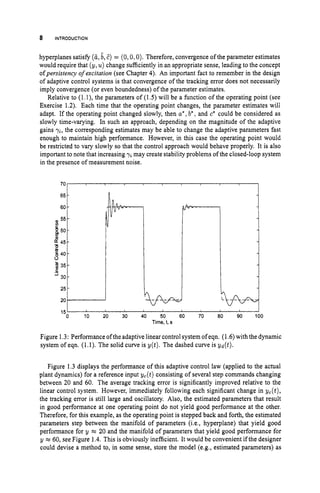
Figure 1.3: Performance oftheadaptive linear control system of eqn. (1.6)with the dynamic
system of eqn. (1.1). The solid curve is y(t). The dashed curve is yd(t).
Figure 1.3 displays the performance of this adaptive control law (applied to the actual
plant dynamics) for a reference input yc(t) consisting of several step commands changing
between 20 and 60. The average tracking error is significantly improved relative to the
linear control system. However, immediately following each significant change in yc(t),
the tracking error is still large and oscillatory. Also, the estimated parameters that result
in good performance at one operating point do not yield good performance at the other.
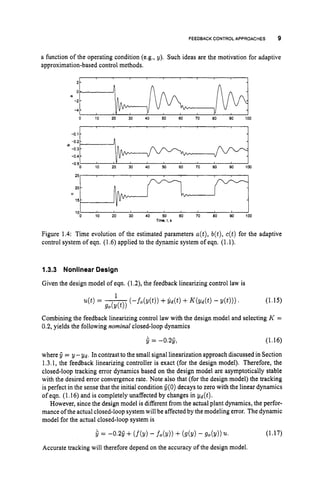
Therefore, for this example, as the operating point is stepped back and forth, the estimated
parameters step between the manifold of parameters (i.e., hyperplane) that yield good
performance for y = 20 and the manifold of parameters that yield good performance for
y =60, see Figure 1.4. This is obviously inefficient. It would be convenient if the designer
could devise a method to, in some sense, store the model (e.g., estimated parameters) as
FEEDBACK CONTROL APPROACHES 9
2 -
0
-2
-4
a function of the operating condition (e.g., y). Such ideas are the motivation for adaptive
approximation-based control methods.
0-
-
-
25
20
0
15
10
-
- 1
-
Figure 1.4: Time evolution of the estimated parameters a(t), b(t), c(t) for the adaptive
control system of eqn. (1.6) applied to the dynamic system of eqn. (1.1).
1.3.3 Nonlinear Design
Given the design model of eqn. (1.2), the feedback linearizing control law is
(1.15)
Combining the feedback linearizing control law with the design model and selecting K =
0.2, yields the following nominal closed-loop dynamics
1
u(t)= -
(-fo(y(t)) +$ d ( t ) +K(yd(t)-y ( t ) ) ) .
g*(y(t))
5 = -0.25, (1.16)
where 5 = y -gd. In contrast to the small signal linearization approach discussed in Section
1.3.1, the feedback linearizing controller is exact (for the design model). Therefore, the
closed-loop tracking error dynamics based on the design model are asymptotically stable
with the desired error convergence rate. Note also that (for the design model) the tracking
is perfect in the sense that the initial condition C(0) decays to zero with the linear dynamics
of eqn. (1.16) and is completely unaffected by changes in yd(t).
However, since the design model is different from the actual plant dynamics, the perfor-
mance of the actual closed-loop systemwill be affectedby the modeling error. The dynamic
model for the actual closed-loop system is
s= - 0 3 + - fo(Y)) + (9(Y)- 9o(Y)) 21. (1.17)
Accurate tracking will therefore depend on the accuracy of the design model.
10 INTRODUCTION
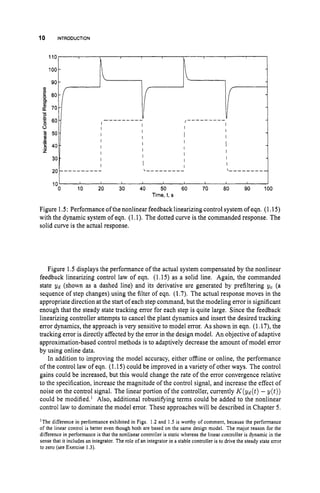
Figure 1.5: Performance of the nonlinear feedbacklinearizing control system of eqn. (1.15)
with the dynamic system of eqn. (1.1). The dotted curve is the commanded response. The
solid curve is the actual response.
Figure 1.5 displays the performance of the actual system compensated by the nonlinear
feedback linearizing control law of eqn. (1.15) as a solid line. Again, the commanded
state ~d (shown as a dashed line) and its derivative are generated by prefiltering yc (a
sequence of step changes) using the filter of eqn. (1.7). The actual response moves in the
appropriate direction at the start of each step command, but the modeling error is significant
enough that the steady state tracking error for each step is quite large. Since the feedback
linearizing controller attempts to cancel the plant dynamics and insert the desired tracking
error dynamics, the approach is very sensitive to model error. As shown in eqn. (1.17), the
tracking error is directly affected by the error in the design model. An objective of adaptive
approximation-based control methods is to adaptively decrease the amount of model error
by using online data.
In addition to improving the model accuracy, either offline or online, the performance
of the control law of eqn. (1.15) could be improved in a variety of other ways. The control
gains could be increased, but this would change the rate of the error convergence relative
to the specification, increase the magnitude of the control signal, and increase the effect of
noise on the control signal. The linear portion of the controller, currently K(yd(t)- y ( t ) )
could be modified.' Also, additional robustifying terms could be added to the nonlinear
control law to dominate the model error. These approaches will be described in Chapter 5.
'The difference in performance exhibited in Figs. 1.2 and 1.5 is worthy of comment, because the performance
of the linear control is better even though both are based on the same design model. The major reason for the
difference in performance is that the nonlinear controller is static whereas the linear controller is dynamic in the
sense that it includes an integrator. The role of an integrator in a stable controller is to drive the steady state error
to zero (see Exercise 1.3).
FEEDBACK CONTROL APPROACHES 11
1.3.4 Adaptive Approximation Based Design
The performance of the feedback linearizing control law was significantly affected by the
error between the design model and the actual dynamics. It istherefore ofinterest to consider
whether the data accumulated online, in the process of controlling the system, can be used to
decrease the modelingerror and improve the control performance. This subsection discusses
one such approach. The goal isto motivate various design issues relevant to generic adaptive
approximation-based approaches. The remainder ofthis chapterwill expand on thesedesign
issues and point the reader to the sections of the book that provide an in-depth discussion
of both the issues and alternative design approaches.
In one method to implement such an approach, the designer assumes that the actual
system dynamics can be represented as
?dt)= f(Y(t)) +g(y(t))u(t), (1.18)
where f(y) = (87)T$(y) and g(v) = (O;)Tq5(y) and $(y) is a vector of basis functions
selected by the designer during the offline design phase. Since f and g are unknown, the
parameters 0; and 0; are also unknown and will be estimated online. Therefore, we define
the approximated functions f(y) = OT$(y) and i(y) = O;$(y), where €Jf and 0, are
parameter vectors that will be estimated using the online data. One approach to using the
design model (i.e., fo and go of (1.2)) is to initialize the parameter vector estimates.
The adaptive feedback linearizing control law
(1.19)
er = Yl5dY) (1.20)
4 7 = nuB$(y) (1.21)
1
u = ( 4 Y ) +Yd +0.2 (Yd - Y))
results in the actual closed-loop system having error dynamics described by
6 = -0.25 +BJ4(y) +B,T4(y)u +e4(y, u) (1.22)
8, = -Y154(Y) (1.23)
6, = -nu54(Y), (1.24)
where Of = 0; - Of,B, = t
9
; - B,, and e4(y, u ) denotes the residual approximation error
(i.e., the approximation error that may still exist even if the parameters of the adaptive
approximators were set to their optimal values).’ The 5 error dynamics are very similar for
the adaptive and nonadaptive feedback linearizing approaches. Relative to the nonadaptive
feedback linearizing approach, the error dynamics are more complicated due to the presence
of the dynamic equations for 8
, and 0, , The expected payoff for this added complexity is
higher performance (i,e,,decreased tracking error). The designer must be carehl to analyze
the stability ofthe state ofthe adaptive feedback linearizing system (i.e., 5,Of and 0,) and to
analyze the effect of e$(y, u). This term is rarely zero and the upper bound on its magnitude
is a function of the designer’s choice of approximation method (i.e., 4).
Figure 1.6 displays the performance of the approximation-based feedback linearizing
control law using the basis functions defined by
ZRigorousdefinitions of the optimal parameters and residual approximation error will be given in Section I 4.2.
12 INTRODUCTION
80
40
4
P
20
i
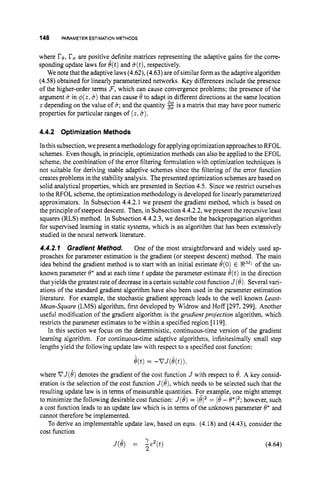
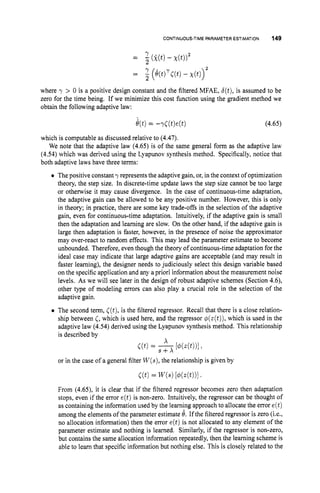
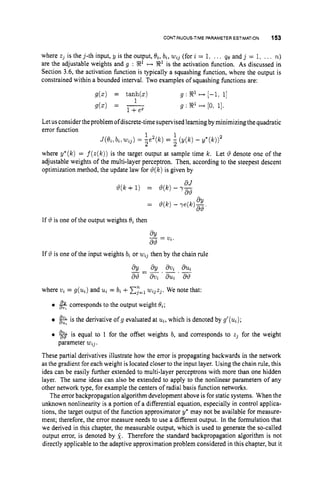
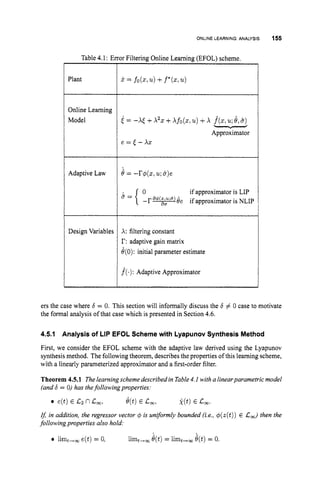
0 10 20 30 40 50 60 70 80 90 100
Time, t, s
Figure 1.6: Performance of the approximation-based control system of eqn. (1.19)-(1.21)
with the dynamic system of eqn. (1.1).
ci = (i - 1)5, f o r i = 1,. . . ,21.
This simulation uses the actual plant dynamics. Initially, the tracking error is large, but as
the online data is used to estimate the approximator parameters, the tracking performance
improves significantly.
It is important that the designer understands the relationship between the tracking error
and the function approximation error. It is possible for the tracking error to approach zero
without the approximation error approaching zero. To see this, consider (1.22). If the last
three terms sum to zero, then ij will converge to zero. The last three terms sum to zero
across a manifold of parameter values, most of which do not necessarily represent accurate
approximations over the region D. If the designer is only interested in accurate tracking,
then inaccurate function approximation over the entire region 2)may be unimportant. If
the designer is interested in obtaining accurate function approximations, then conditions
for function approximation error convergence must be considered.
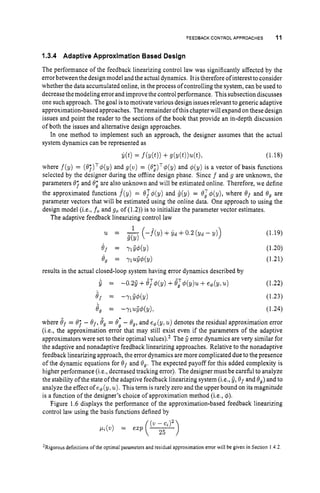
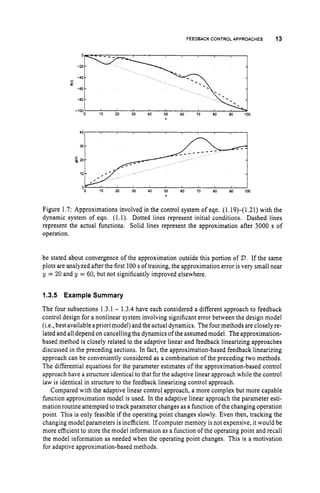
Figure 1.7 displays the approximations at the initiation (dotted) and conclusion (solid)
of the simulation evaluation, along with the actual functions (dashed). The simulation was
concluded after 3000 s of simulated operation. The first 100 s of operation involved the
filtered step commands displayed in Figure 1.6. The last2900 sof operation involved filtered
step commands, each with a 10-sduration, randomly distributed in a uniform manner with
yc E [20,60]. The initial conditions for the function approximation parameter vectors were
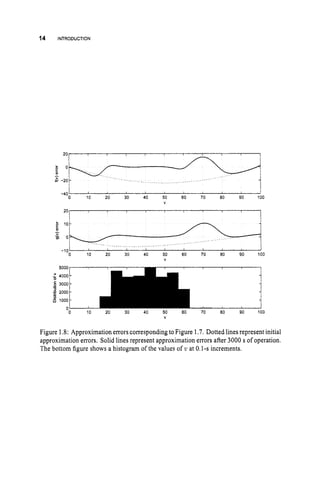
defined to closely match the functions j oand go of the design model. The bottom graph
of Figure 1.8 displays the histogram of yd at 0.1-s intervals. The top two graphes show
the approximation error at the initial and final conditions. By 3000 s, both f and B have
converged over the portion of D that contains a large amount of training data. Nothing can
FEEDBACKCONTROLAPPROACHES 13
10 20 30 40 50 M) 70 80 80 1W
V
Figure 1.7: Approximations involved in the control system of eqn. (1.19H1.21) with the
dynamic system of eqn. (1.1). Dotted lines represent initial conditions. Dashed lines
represent the actual functions. Solid lines represent the approximation after 3000 s of
operation.
be stated about convergence of the approximation outside this portion of D.If the same
plots are analyzed after the first 100s of training, the approximation error is very small near
y = 20 and y = 60, but not significantly improved elsewhere.
1.3.5 Example Summary
The four subsections 1.3.1 - 1.3.4 have each considered a different approach to feedback
control design for a nonlinear system involving significant error between the design model
(i.e., best available apriori model) and the actual dynamics. The fourmethods are closely re-
lated and all depend on cancelling the dynamics of the assumed model. The approximation-
based method is closely related to the adaptive linear and feedback linearizing approaches
discussed in the preceding sections. In fact, the approximation-based feedback linearizing
approach can be conveniently considered as a combination of the preceding two methods.
The differential equations for the parameter estimates of the approximation-based control
approach have a structure identical to that for the adaptive linear approach while the control
law is identical in structure to the feedback linearizing control approach.
Compared with the adaptive linear control approach, a more complex but more capable
function approximation model is used. In the adaptive linear approach the parameter esti-
mation routine attempted to track parameter changes as a function of the changing operation
point. This is only feasible if the operating point changes slowly. Even then, tracking the
changing model parameters is inefficient. If computer memory is not expensive, it would be
more efficient to store the model information as a function of the operating point and recall
the model information as needed when the operating point changes. This is a motivation
for adaptive approximation-based methods.
14 INTRODUCTION
1 I I I I 1 I
h
20,
-40' I
0 10 20 30 40 50 60 70 80 90 100
V
-10'
1 I
0 10 20 30 40 50 60 70 80 90 100
V
5000I
"0 10 20 30 40 50 60 70 80 90 100
V
Figure 1.8: Approximation errors corresponding to Figure 1.7. Dotted lines represent initial
approximation errors. Solid lines represent approximation errors after 3000 s of operation.
The bottom figure shows a histogram of the values of w at 0.1-s increments.
COMPONENTSOF APPROXIMATION
BASED CONTROL 15
Compared with the feedback linearizing approach, the approximation-based approach is
more complex since the dimension of the parameter vectors may be quite large. The rapid
increase in computational power andmemory atreasonable cost overthe last several decades
has made the complexity feasible in an increasing array of applications. It is important to
note that even though an adaptive approximator may have a very largenumber of adaptable
parameters, with localized approximation models only a very small number of weights are
adapted an any one time; therefore, while the memory requirements of adaptive approxima-
tion may be large, the computational requirements may be quite reasonable. Also, there is
more risk in the approximation-based approach if the stability of the state and parameter es-
timates is not properly considered. On the positive side, the approximation-based approach
has the potential for improved performance since the modeling or approximation error can
be decreased online based on the measured control data. The extent to which performance
improves will depend on several design choices: control design approach, approximator
selection, parameter estimation algorithm, applications conditions, etc.
The following section discusses the major components of adaptive approximation-based
control implementations. The discussion is broader than the example based discussion of
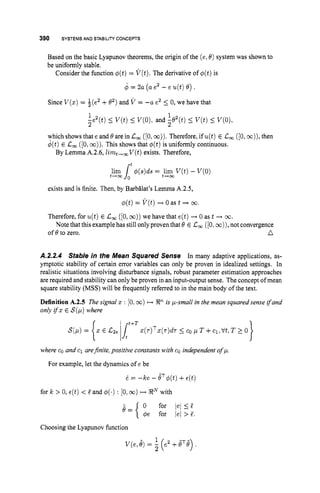
this section and directs the reader to the appropriate sections of the book where each topic
is discussed in depth.
1.4 COMPONENTS OF APPROXIMATION BASED CONTROL
Implementation or analysis of an adaptive approximation-based control system requires the
designer to properly specify the problem and solution. This section discusses major aspects
of the problem specification.
1.4.1 Control Architecture
Specification of the control architecture is one of the critical steps in the design process.
Various nonlinear control methodologies and rigorous tools to analyze their performance
have been developed in recent decades [121, 134, 139, 159, 234, 249, 2791. The choices
made at this step will affect the complexity of the implementation, the type and level of
performance that can be guaranteed, andthe properties that the approximated function must
satisfy. Major issues influencing the choice of control approach are the form of the system
model and the manner in which the nonlinear model error appears in the dynamics. A few
methods that are particularly appropriate for use with adaptive approximation are reviewed
in Chapter 5.
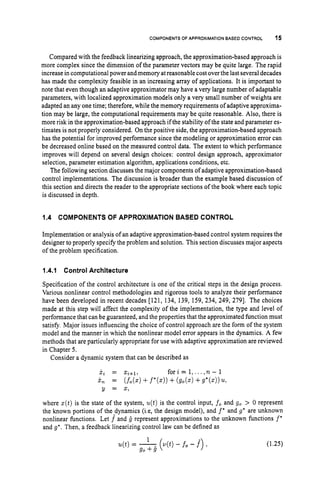
Consider a dynamic system that can be described as
xz = for i = 1,... ,n - 1
Xn = (fo(.) +f*(x))+ (go(z) +g'k)) %
Y = 5,
where z(t)is the state of the system, u(t)is the control input, fo and go > 0 represent
the known portions of thePynamics (i.e, the design model), and f' and g* are unknown
nonlinear functions. Let f and 4 represent approximations to the unknown functions f
'
and 9'. Then, a feedback linearizing control law can be defined as
(1.25)
16 INTRODUCTION
where i ( z ) > -go(.) and v(t)can be specified as a function of the tracking error to meet
the performance specification. If the approximations were exact (i.e., f* = f and g* = i),
then this control law would cancel the plant dynamics resulting in
When the approximators are not exact, the tracking error dynamic equations are
(1.26)
This simple example motivates a few issues that the designer should understand. First,
if adaptive approximation is not used (i,e., f
(
z
)= i(z) = 0), the tracking error will be
determined by the n-th integral of the the interaction between the control law specified by Y
and the model error, as expressed by eqn. (1.26). Second, adaptive approximation is not the
only method capable of accomodating the unknown nonlinear effects. Alternative methods
such as Lyapunov redesign, nonlinear damping, and sliding mode are reviewed in Section
5.4. These methods work by adding terms to the control law designed to dominate the
worst case modeling error, therefore they may involve either large magnitude or high band-
width control signals. Alternatively, adaptive approximation methods accumulate model
information and attempt to remove the effects of a specific set of nonlinearities that fit the
model information. These methods are compared, and in some cases combined, in Chapter
6. Third, it is not possible to approximate an arbitrary function over the entire W. Instead,
we must restrict the class of functions, constrain the region over which the approximation
is desired, or both. Since the operating envelope is already restricted for physical reasons,
we will desire the ability to approximate the functions f
' and g* only over the compact set
denoted by V.Note that V is a fixed compact set, but its size can be selected as large as
need be at the design stage. Therefore, we are seeking to show that initial conditions outside
V converge to V and that for trajectories in 'D the trajectory tracking error converges in a
desired sense. Various techniques to achieve this are thoroughly discussed in Chapters 6,
7, and 8. The Lyapunov definitions of various forms of stability, and extensions to those
definitions, are reviewed in Appendix A.
1.4.2 FunctionApproximator
Having analyzed the control problem and specified a control architecture capable of using
an approximated function to improve the system control performance, the designer must
specify the form of the approximating function. This specification includes the definition
of the inputs and outputs of the function, the domain V over which the inputs can range, and
the structure of the approximating function. This is a key performance limiting step. If the
approximation capabilities are not sufficient over V,then the approximator parameters will
be adapted as the operating point changes with no long term retention of model accuracy.
For the discussion that follows, the approximating function will be denoted f(z;
@,a)
where
j(z;8,a)= 8T$(z, .). (1.27)
In this notation z is a dummy variable representing the input vector to the approximation
function. The actual functicy inputs may include e!ements of the plant state, control input,
or outputs. The notation f(z;
8,a) implies that f is evaluated as a function of z when
8 and a are considered fixed for the purposes of function evaluation. In applications,
the approximator parameters 8 and a will be adapted online to improve the accuracy of the
COMPONENTS OF APPROXIMATION BASED CONTROL 17
approximating function -this isreferred to as training in the neural network literature. The
parameters 6 are referred to in the (neural network) literature as the output layer parameters.
The parameters u are referred to as the input layer parameters. Note that the approximation
of eqn. (1.27) is linear-in-the-parameters with respect to 8. The vector of basis functions
4 will be referred to as the regressor vector. The regressor vector is typically a nonlinear
function of z and the parameter vector a.Specification of the structure of the approximating
function includes selection of the basis elements of the regressor 4, the dimension of 8,and
the dimension of a. The values of 8 and a are determined through parameter estimation
methods based on the online data.
Regardless of the choice of the function approximator and its structure, it will normally
be the case that perfect approximation is not possible. The approximation error is denoted
by e(z; 8,a)where
e(z; 6,U ) = f
(
z
)- f(z;8,a). (1.28)
If 8*and CT* denote parameters that minimize the m-norm of the approximating error over a
compact region V,
then the Minimum Functional Approximation Error (MFAE) is defined
as
e+(z) = e(z; 6', a*)= f(z)
- f
(
z
;
8*,a*).
In practice, the quantities e+,8' and a* are not known, but are useful for the purposes of
analysis. Note, as in eqn. (1.22), that e4(z) acts as a disturbance affecting the tracking error
and therefore the parameter estimates. Therefore, the specification of the adaptive approx-
imator f(z;8,a)has a critical affect on the tracking performance that the approximation-
based control system will be capable of achieving.
The approximator structure defined in eqn. (1.27) is sufficient to describe the various
approximators used in the neural and fuzzy control literature, as well as many other approx-
imators. Issues related to the adaptive approximation problem and approximator selection
will be discussed in Chapter 2. Specific approximators will be discussed in Chapter 3.
1.4.3 Stable Training Algorithm
Given that the control architecture and approximator structure have been selected, the
designer must specify the algorithm for adapting the adjustable parameters 6 and a of
the approximating function based on the online data and control performance.
Parameter estimation can be designed for either a fixed batch of training data or for
data that arrives incrementally at each control system sampling instant. The latter situation
is typical for control applications; however, the batch situation is the focus for much of
the traditional function approximation literature. In addition, much of the literature on
function approximation is devoted to applications where the distribution of the training
data in V can be specified by the designer. Since a control system is completing a task
during the function approximation process, the distribution of training data usually cannot
be specified by the control system designer. The portion of the function approximation
literature concerned with batches of data where the data distribution is defined by the
experiment and not the analyst is referred to as scattered data approximation methods
[84].
Adaptive approximation-based control applications are distinct from traditional batch
scattered data approximation problems in that:
0 the data involved in the parameter estimation will become available incrementally
(ad infinitum) while the approximated function is being used in the feedback loop;
18 INTRODUCTION
0 the training data might not be the direct output of the function to be approximated;
and,
the stability of the closed-loop system, which depends on the approximated function,
must be ensured.
Themain issue to be considered in the development oftheparameter estimation algorithm
is the overall stability of the closed-loop control system. The stability of the closed-loop
system requires guarantees of the convergence of the system state and of (at least) the
boundedness of the error in the approximator parameter vector. This analysis must be
completed with caution, as it is possible to design a system for which the system state is
asymptotically stable while
1. even when perfect approximation is possible (i.e., e$ = 0), the error in the estimated
approximator parameters is bounded, but not convergent;
2. when perfect approximation is not possible, the error in the estimated approximator
parameters may become unbounded.
In the first case, the lack of approximator convergence is due to lack of persistent excita-
tion, which is further discussed in Chapter 4. This lack of approximator convergence may
be acceptable, if the approximator is not needed for any other purpose, since the control
performance is still achieved; however, control performance will improve as approximator
accuracy increases. Also, the designer of a control system involving adaptive approxima-
tion sometimes has interest in the approximated function and is therefore interested in its
accuracy. In such cases, the designer must ensure the convergence of the control state and
approximator parameters. In the second case (the typical situation), the fact that e++ cannot
be forced to zero over D must be addressed in the design of the parameter estimation algo-
rithm. Chapter 4 discusses the basic issues of adaptive (incremental) parameter estimation.
Various methods including least squares and gradient descent (back-propagation) are de-
rived and analyzed. Chapters 6 and 7 discuss the issues related to parameter estimation in
the context of feedback control applications. Chapter 6 presents a detailed analysis of the
issues related to stability of the state and parameter estimates. Robustness of parameter
estimation algorithms to noise, disturbances, and eq(z) is discussed in Section 4.6 as well
as in Chapter 7.
1.5 DISCUSSION AND PHILOSOPHICAL COMMENTS
The objective of adaptive approximation-based control methods is to achieve a higher level
of control system performance than could be achieved based on the n pviori model in-
formation. Such methods can be significantly more complicated (computationally and
theoretically) than non-adaptive or even linear adaptive control methods. This extra com-
plication can result in unexpected behavior (e.g., instability) if the design is not rigorously
analyzed under realistic assumptions.
Adaptive function approximation has an important role to play in the development of
advanced control systems. Adaptive approximation-based control, including neural and
fuzzy approaches, have become feasible in recent decades due to the rapid advances that
have occurred in computing technologies. Inexpensive desktop computing has inspired
many ad hoc approximation-based control approaches. In addition, similar approaches in
different communities (e.g., neural, fuzzy) have been derived and presented using different
EXERCISES AND DESIGN PROBLEMS 19
nomenclature yet nearly identical theoretical results. Our objective herein is to present
such approaches rigorously within a unifying framework so that the resulting presentation
encompasses both the adaptive fuzzy and neural control approaches, thereby allowing the
discussion to focus on the underlying technical issues.
The three terms, adaptation, learning, and self-organization, are used with different
meanings by different authors. In' this text, we will use adaptation to refer to temporal
changes. For example, adaptive control is applicable when the estimated parameters are
slowly varying functions of time. We will use learning to refer to methods that retain
information as a function of measured variables. Herein, learning is implemented via
function approximation. Therefore, learning has a spatial connotation whereas adaptation
refers to temporal effects. The process of learning requires adaptation, but the retention
of information as a function of other variables in learning implies that learning is a higher
level process than is adaptation.
Implementation of learning via function approximation requires specification ofthe func-
tion approximation structure. This specification is not straightforward, since the function to
be approximated is assumed to be unknown and input-output samples of the function may
not be available apriori. For the majority of this text, we assumethat the designer is able to
specify the approximation structure prior to online operation. However, an unsolved prob-
lem in the field is the online adaptation of the function approximation structure. We will
refer to methods that adapt the function approximation structure during online operation as
self-organizing.
Since most physical dynamic systems are described in continuous-time, while most ad-
vanced control systems are implemented via digital computer in discrete-time, the designer
may consider at least two possible approaches. In one approach, the design and analy-
sis would be performed in continuous-time with the resulting controller implemented in
discrete-time by numeric integration. The alternative approach would be to transform the
continuous-time ordinary differential equation to a discrete-time model that has equivalent
state behavior at the sampling instants and then perform the control system design and
analysis in discrete-time. Throughout this text, we will take the former approach. We do
not pursue both approaches concurrently as the required significant increase in length and
complexity would not provide a proportionate increase in understanding of the main design
and analysis issues. Furthermore, the transformation of a continuous-time nonlinear sys-
tem to a discrete-time equivalent model is not straightforward and often does not maintain
certain useful properties of the continuous-time model (e.g., affine in the control).
1.6 EXERCISES AND DESIGN PROBLEMS
Exercise 1.1 This exercise steps through the design details for the linear controller of Sec-
tion 1.3.1.
1. For the specified design model of eqn. (1.2), show that
and that the linearized system at (Y*~
u') = (40, 8)is
66= p6y +1 3 6 ~
20 INTRODUCTION
withp = G,
2. Analyze the linear control law of eqn. (1.4) and the linearized dynamics (above)
to see that the nominal control design relies on cancelling the plant dynamics and
replacing them with error dynamics of the desired bandwidth. Analyze the charac-
teristic equation of the second-order, closed-loop linearized dynamics to see what
happens to the closed-loop poles when p is near but not equal to 3.
3. Design a set of linear controllers and a switching mechanism (i.e., a gain scheduled
controller) so that the closed-loop dynamics of the design model achieve the band-
width specification over the region v E [20,60]. Test this in simulation. Analyze the
performance of this gain scheduled controller using the actual dynamics.
Exercise 1.2 This exercise steps through the design details for the linear adaptive controller
of Section 1.3.2.
Derive the error dynamics of eqns. (1.1 1)-( I.14) for the linear adaptive control law.
(Hint: add -tu +EIJ to eqn. (1.5)and substitute eqn. (1.6) for the latter term.)
Show that the correct values for the model of eqn. (1.5) to match eqn. (1.1) to first
order are:
y=y*,u=u*
Implement a simulation of the adaptive control system of Section 1.3.2. First, dupli-
cate the results of the example. Do the estimated parameters converge to the same
values each time TI is commanded to the same operating point?
Using the Lyapunov function
7
1 Yz 7 3
show that the time derivative of V evaluated along the error dynamics of the adaptive
control system is negative semidefinite. Why can we only say that this derivative is
semidefinite? What does this fact imply about each component of (a,5:Ib, Z)?
Exercise 1.3 This exercise steps through the design details of an extension to the feedback
linearizing controller of Section 1.3.3.
Consider the dynamic feedback linearizing controller defined as
where 5 = (y - Yd). This controller includes an appended integrator with the goal of
driving the tracking error to zero.
EXERCISES AN0 DESIGN PROBLEMS 21
1. Show that the tracking error dynamics (relative to the design model) are
2. For stability of the closed-loop system, relative to the design model, K1 and K2
must both be positive. If K1 = 0.04 and K2 = 0.40, then the linear tracking error
dynamics have two poles at 0.2. If K1 = 1.00and K2 = 5.20, then the poles are
at 0.2 and 5.0. In each case, there is a dominant pole at 0.2. For each set of control
gains:
(a) Simulatethe closed-loop systemformedby this controller andthe design model.
Use this simulation to ensure that your controller is implemented correctly.
The tracking should be perfect. That is, the tracking error states converge
exponentially toward zero and are not affected by changes in Yd. If the tracking
error states are initially zero, then they are permanently zero.
(b) Simulate the closed-loop system formed by this controller and the actual dy-
namics.
Discuss the effect of model error. Discuss the tradeoffs related to the choice of control
gains.
Exercise 1.4 This exercise stepsthrough the design details for the adaptive approximation-
based feedback linearizing controller of Section 1.3.4.
1. Derive the error dynamics for the adaptive approximation-based control law.
2. Implement a simulation of the approximation-based control system of Section 1.3.4.
First, duplicate the results of the example. Plot the approximation error versus v at
t = 100. Discuss why it is small near v = 20 and v = 100,but not small elsewhere.
3. Using the Lyapunov function
showthatthetime derivativeofV evaluatedalongthe errordynamics ofthe approximation-
based controlsystem isnegativesemidefinite. Why canwe only saythat thi; derivative
is semidefinite? What does this fact imply about each component of (a,B J ,#,)?
This Page Intentionally Left Blank
CHAPTER 2
APPROXIMATION THEORY
This chapter formulates the numeric data processing issues of interpolation and function
approximation, and then discusses function approximator properties that are relevant to the
use of adaptive approximation for estimation and feedback control. Our interest in func-
tion approximation is derived from the hypothesis that online control performance could
be improved if unknown nonlinear portions of the model are more accurately modeled.
Although the data to improve the model may not be available apriori, additional data can
be accumulated while the system is operating. Appropriate use of such data to guarantee
performance improvement requires that the designer understand the areas of function ap-
proximation, control, stability, and parameter estimation. This chapter focuses on several
aspects of approximation theory.
The discussion of function approximation is subdivided into offline and online approxi-
mation. Offlinefunction approximation isconcerned with the questions ofselecting a family
of approximators and parameters of a particular approximator to optimally fit a given set
of data. The issue of the design of the set of data is also of interest when the acquisition of
the data is under the control of the designer. An understanding of offline function approx-
imation is necessary before delving into online approximation. The discussion of online
approximation builds on the understanding of offline approximation, and also raises new
issues motivated by the need to guarantee stability of the dynamic system and estimation
process, the possible need to forget old stored information at a certain rate, and the inability
to control the data distribution.
Section 2.1 presents an easy-to-understand (and replicate) example in order to motivate,
in the context of online approximation based control, a few important issues that will
AdaptiveApproximation Based Control:UnifiingNeural,Fur? and TraditionalAdaptive
AppmximationApproaches.By Jay A. Farrell and Marios M. Polycarpou
Copyright @ 2006 John Wiley & Sons, Inc.
23
24 APPROXIMATIONTHEORY
be discussed through the remainder of this chapter. Section 2.2 discusses the problem
of function interpolation. Section 2.3 discusses the problem of function approximation.
Section 2.4 discusses function approximator properties in the context of online function
approximation.
2.1 MOTIVATING EXAMPLE
Consider the following simple example that illustrates some of the issues that arise in
approximation based control applications.
4 EXAMPLE2.1
Consider the control of the discrete-time system
z(k +1) = f(z(k))+u(k)
y(k) = +),
where u(k)is the control variable at discrete-time k, z ( k ) is the state, y(k) is the
measured output, the function f(z)
is not known to the designer, and the control law
is given by
The above control law assumes that the reference trajectory Yd is known one step in
advance. For the purposes of simulation in the example, we will use f(z)
= sin(z).
u(k)= Yd(k +1)-P [ Y d P ) - Y (k)l -f*(Y(k)). (2.1)
If f(y) = sin(y),then the closed-loop tracking error dynamics would be
e(k +1)= Pe(k),
where e(k)= yd(k) - z(k),which is stable for IpI < 1(in the following simulation
example we use p = 0.5). If f(y) # f(z),
then the closed-loop tracking error
dynamics would be
e(k + 1)= Pe(k) - [f(z(k))
- f(Y(W1. (2.2)
Therefore, the tracking performance is directly affected by the accuracy of the design
model f(z). The left hand column of Figure 2.1 shows the performance of this
closed-loop system when yd(k) = nsin(0.lk) and f(y) = 0.
When f(z)
is not known apriori,the designer may attempt to improve the closed-
loop performance by developing an online (i.e., adaptive) approximation to f
(
z
)
.
In
this section a straightforward database function approximation approach is used. At
each time step k, the data
4 k ) = [ M k - I))>Y(k - 1)1
will be stored. Note that the approach ofthis example requires that the function value
f(y(k - 1))must be computable at each step from the measured variables. This
assumed approach is referred to as supervised learning. This is a strict assumption
that is not always applicable. Much more general control approaches that do not
require this assumption are presented in Chapter 6. For this example, at time k, the
information in z(k)can be computed from available data according to
r(k)= [y(k) - u(k - 1). y(k - l)].
MOTIVATINGEXAMPLE 25
Response without Learning
4
-
-4 -
0 20 40 60 80 100
Response with Learning
4
-
-4 -
0 20 40 60 80 100
-0 20 40 60 80 100
iteration,k
20 40 60 80 100
iteration,k
Figure 2.1: Closed-loop control performance for eqn. (2.I). Left column corresponds to
f = 0. Right column corresponds to fconstructed via nearest neighbor matching. For the
top row of graphs, the solid line is the reference trajectory. The dotted line is the system
response. The tracking error is plotted in the bottom row of graphs.
At time step k with y(k) available, ~ ( k )
is calculated using eqn. (2.1) as follows:
(1) search the second column of z for the row i that most closely matches y(k) (i.e.,
i = argmino<j<k (iiz(j,2) -y(k)ll), (2) use f(y(k)) = z(i,1). The remaining
terms in eqn. (2.1) can be directly calculated. The right-hand column of Figure 2.1
shows the performance of the closed-loop system using this adaptive approximation
basedmethod. Note that asthe row dimension of z growswith k (i.e., more data values
for f(z)
are stored) the tracking performance rapidly improves. However, both the
memory required to store z and the computation required to search z increase at each
iteration.'
The top graph of Figure 2.2 plots as discrete points the first column of z as a
function of the second column of z. The approximate function used in the control
law is piecewise constant with each piecewise section (of variable width) centered on
one oftheexamples y(i), as shown in the bottom graph ofFigure 2.2. With noise-free
data, the approximation becomes very good for large k. The approach defined above
is referred to as nearest neighbor matching. Various other alternatives are possible
such as k-nearest neighbor averaging, which perform better when noise is present in
the measurement data. n
Note the following issues related to this example and the broader adaptive function
approximation problem:
'Assuming abinaly searchof one-dimensionalordereddata,the numberof comparisonsison the orderof log2(k).
In addition,as each new sample amves, the stored data must be moved to maintain the ordering.
26 APPROXIMATION THEORY
1 -
3 05-
-
c
t? 0 -
p
2 - 0 5 -
-1
-15-
...
..* -, I...,
.-
%
' ..,. ., * '
%
.*..
-
J
-2 -1 0 1 2 3
-1.5'
-3
Y
Figure 2.2: Top - Data for approximating f using nearest neighbor matching. Bottom -
Approximated f resulting from nearest neighbor matching. Both graphs correspond to
Example 2.1.
1. The input-output training data (f(y(i)), y(i)) cannot be expected to be distributed
according to an analytic distribution. Instead, the training data will be defined by the
control task that the system is performing. The distribution of training data over a
fixed-duration window will typically be time varying. If control is operating well,
then the training samples will cluster in the vicinity of a state trajectory (several may
be possible) defined by the reference input. In particular, over short periods of time,
the training data will not be uniformly distributed, but will cluster in some small
subregion of the domain of approximation. For example, if the control objective is
regulation to a certain fixed point (i.e., yd(k) = constant) then the training data may
cluster around a single point.
2. When theraw training data are stored, as in this example, the approach will havegrow-
ing memory and computational penalties. These can be overcome by the function
approximation and recursive parameter estimation techniques to be described.
3. Consider the case ofmeasurement data corrupted by noise. Direct storageof the data
doesnot work aswell asshowninFigures 2.1 and2.2. Figure2.3 showsperformance*
in the time domain when the measured y(k) is corrupted with Gaussian random noise
n ( k )with standard deviation 0 = 0.1. In this case, y(k) = ~ ( k )
+n ( k )is stored
in the database calculations and used in the control law. The actual tracking error
(z - gd) is plotted. For k > 100, the tracking error has standard deviation of 0.16.
So the approach has amplified the effects of noise. In this approach, noisy data are
2Notethat the magnitude of the reference signal has also been decreased &j
= 5 sin(0.lk). The reason for this
will become clear in the subsequent item.
MOTIVATINGEXAMPLE 27
2
1.
L
0
._
P 0,
Y
L
+ -1.
-2
Response without Learning Response with Learning
41 I 21 I


2
$ 1 .
P O
s -1.
k
H
m
I -2
6 0
5
32w
-2
-4 0 50 100 150 200 iiw
-1
-2 0 50 100 150 200
Figure 2.3: Closed-loop control performance for eqn. (2.1)with noisy measurement data.
Left column corresponds to f = 0. Right column corresponds to f constructed via nearest
neighbor matching. In the top row of graphs, the solid line is the reference trajectory and
the dotted line is the system response.
stored in the data vector without noise attenuation. It is important to note that, as
we will see, methods to attenuate noise through averaging lead directly to function
approximation methods.
4.Function approximation problems are not well defined. Consider Figure 2.4, which
corresponds to the the data matrix z stored relative to Figure 2.3. If the domain of
approximation that is of interest is D = [-T, T ] ,
how should the approximation given
the available data be extended to all of D (or should it?). A quick inspection of the
datamightleadtothe conclusion thatthe function islinear. A more careful inspection,
noting the apparent curvature near !
z
; might result in the use of a saturating function.
From our knowledge of f(x)neither of these is of course correct. Extreme care must
be exercised in generalizing from available data in given regions to the form of
the function in other regions. The manner in which data in one region affects the
approximated function in another region is determined primarily by the specification
of the function approximator structure. The assumed form of the approximation
inserts the designer’s bias into the approximation problem. The effect of this bias
should be well understood.
5. From eqn. (2.2)the designer might expect that, as the database accumulates data,
then the (f -f)term and hence e should decrease; however,the control and function
approximation approach of this example did not allow a rigorous stability analysis.
The parametric function approximation methods that follow will enable a rigorous
analysis of the stability properties of the closed-loop system.
28 APPROXIMATION THEORY
Stored data
Y
Figure 2.4: Data for approximating f^ corresponding to eqn. (2.1) with noisy measurement
data.
Items 2 through 4 above naturally direct the attention of the designer to more general
fimction interpolation and approximation issues. The above nearest neighbors approach
can be represented as
k
j(2 : z(k))= Cz(i.
l)r#)i(Z : z ( k ) ) (2.3)
i=l
where thenotation f^(z
: z ( k ) )means the value off evaluatedat 2 given the data indatabase
matrix z at time Ic, and
where we have assumed that no two entries (i.e., rows) have the same value for z(j,2).
Note that by its definition, this function passes exactly through each piece of measured
data (i.e., f ( z ( i ,2 ) : z ( k ) )= z(i,1)).This is referred to as interpolation. Item 2 above
points out the fact that this approximation structure has k basis elements that are redefined
at each sampling instant. The computational complexity and memory requirements can be
decreased and fixed by instead using a fixed number N of basis elements of the form
where the data matrix z would be used to estimate 0 = [el,...,ON] and u = [ul,...,b ~ ] .
With such a structure, it will eventually happen that there is more data than parameters,
in which case interpolation may no longer be possible. After this instant in time, a well-
designed parameter estimation algorithm will combine new and previous measurements to
INTERPOLATION 29
attenuate the affects of measurement noise on the approximated function. The choice of
basis functions can affect the noise attenuation properties of the approximator. In addition,
the choice of approximator will affect the accuracy of the approximation, the degree of
approximator continuity and the extent of training generalization, as will be explained in
Section 2.4.7.
2.2 INTERPOLATION
Given a set of input-output data {(zj, yj) 1 j = 1,...,m; xj E R2";yj E R
'
}
, function
interpolation is the problem of defining a function f
(
z
)
: Rn + R1 such that f
(
z
,
)
= yj
for all j = 1,...,m. When f(z)is constrained to be an element of a finite dimensional
linear space, this is called Lagrange interpolation. The interpolating function f(z)can
then be used to estimate the value of f(z)
between the known values of f(zj).
In Lagrange interpolation with the basis functions {$i(z)}El,
N
f(z)= Cei4i(z)
= eT4(.) = 4 ( ~ ) ~ 8 , (2.6)
i=l
where 8 = [el,...16'N]T E RZN
and d(z) = [@1(z),
...,$N(z)IT : R2"+ RN. The
Lagrange interpolation condition can be expressed as the problem of finding 6' such that
Y = QT8.
Note that Q, = [$(.I), ...,4(zm)]
E RNxm.
The matrix QT is referred to as the interpola-
tion or collocation matrix. Much of the function approximation and interpolation literature
focuses on the case where n = 1. When n > 1and the data points are not defined on a
grid, the problem is referred to as scattered data interpolation .
A necessary condition for interpolation to be possible is that N 2 m. In online appli-
cations, where m is unbounded (i.e., zk = z(kT)),
interpolation would eventually lead to
both memory and computational problems.
If N = m and CP is nonsingular, the unique interpolated solution is
8 = (aT)-lY = Q,-TY. (2.9)
Nonsingularity of Q, is equivalent to the column vectors $(xi),i = 1,...,m being linearly
independent. This requires (at least) that the zibe distinct points. Once suitable N, 4(z),
yi, and z
ihave been specified, the interpolation problem has a guaranteed unique solution.
When the basis set {$j},"=, has the property that the matrix Q, is nonsingular for any
distinct {zi}El,the linear space spanned by {q$},"=, is referred to as a Chebyshat space
or a Haar space [79, 155, 2181. The issue of how to select 4 to form a Haar space has
been widely studied. A brief discussion of related issues is presented in Section 2.4.10.
Even if the theoretical conditions required for CP to be invertible are satisfied, if zi is near
z j for i # j, then Q, may be nearly singular. In this case, any measurement error in Y
may be magnified in the determination of 8. In addition, the solution via eqn. (2.9) may
30 APPROXIMATIONTHEORY
be numerically unstable. Preferred methods of solution are by QR, UD, or singular value
decompositions [991.
For a unique solution to exist, the number of free parameters (Lee,the dimension of 0)
must be exactly equal to the number mof sample points 2%.
Therefore, the dimension of the
approximator parameter vector must increase linearly with the number of training points.
Under these conditions, the number of computations involved in solving eqn. (2.9) is on
the order of m3floating point operations (FLOPS) (see Section 5.5.9 in [99]). In addition
to this large computational burden, the condition number of often becomes small as m
gets large.
As the number of data points m increases, there will eventually be more data (and
for m = N more degrees of freedom in the approximator) than degrees of freedom in
the underlying function. In typical situations, the data yi will not be measured perfectly,
but will include errors from such effects as sensor measurement noise. The described
interpolation solution attempts to fit this noisy dataperfectly, which is not usually desirable.
Approximators with N < m parameters will be over-constrained (i.e., more constraints
than degrees of freedom). In this case, the approximated function can be designed (in an
appropriate sense)to attenuate the effects of noisy measurement data. An additional benefit
of fixing N (independent of m)is that the computational complexity of the approximation
and parameter estimation problems is fixed as a function of N and does not change as more
data is accumulated.
1 EXAMPLE2.2
Consider Figures 2.2 and 2.4. The former figure represents the underlying "true"
function (i.e., noise-free data samples). The latter represents noisy samples of the
underlying function. Interpolation of the data in Figure 2.4 would not generate a
reliable representation of the desired function. In fact, depending on the choice of
basis functions, interpolation of the noisy data may amplify the noise between the
data points. n
2.3 FUNCTION APPROXIMATION
The linear in the parameters3 (LIP) function approximation problem can be stated as: Given
a basis set {$J~(z)
: En --t Efor i = 1... N } and a function f(z): En + E1find a
linear combination of the basis elements f(x) = OT+(z) : En + E
l that is close to f.
Key problems that arise are:
0 How to select the basis set?
0 How to measure closeness?
0 How to determine the optimal parameter vector 0 for the linear combination?
In the function approximation literature there are various broad classes of function ap-
proximation problems. The class of problems that will be of interest herein is the develop-
ment of approximations to functions based on information related to input-output samples
'In general, the function approximation problem is not limited to LIP approaches; however, this introductory
section will focus on LIP approaches to simplify the discussion.
FUNCTIONAPPROXIMATION 31
of the function. The foundations of the results that follow are linear algebra and matrix
theory [99].
2.3.1 Offline (Batch) FunctionApproximation
Given a set of input-output data {(
z
i
,
yi), i = 1,...,m} function approximation is the
problem of defining a function f(z): ---t ?I?1 to minimize lY - Y/I where Y =
[yl,...,
y
,
I
T andY = [f(q),
...,f*(zm)lT.Thediscussionofthefollowingtwosections
will focus on the over and under constrained cases where 11. I/ denotes thep = 2 (Euclidean)
norm. Solutions for other p norms are discussed, for example, in the references [54,309].
2.3.1.1 Over-constrainedSolution Consider the approximator structure of eqn.
(2.6), which can be represented in matrix form as in eqn. (2.8). When N < m the problem
is over-specified (more constraints than degrees of freedom). In this case, the matrix @
defined relative to eqn. (2.8) is not square and its inverse does not exist. In this case, there
may be no solution to the corresponding interpolation problem. Since with the specified
approximation structure the datacannot be fit perfectly, the designer may instead select the
approximator parameters to minimize some measure of the function approximation error.
If a weighted second-order cost function is specified then
(2.10)
1
J(e)= 5(Y - Y ) ~ w ( Y
-Y )
which corresponds to the norm lYlb= iYTWY where W is symmetric and positive
definite. In this case, the optimal vector 8*can be found by differentiation:
1
2
~ ( 8 )= -(aTe-y)Tw(@Te
-Y ) (2.1I)
(2.12)
e* = (@W@T)-'@WY (2.13)
where it has been assumed that rank(@)= N (Lee,that @ has N linearly independent
rows and columns) so that @W@' is nonsingular. When the rank of @ < N (i.e., the
N rows of @ are not linearly independent), then either additional data are required or the
under-constrained approach defined below must be used. Since the second derivative of
J(8)with respect to 8 evaluated at 0' (i.e., @WQT),
is at least positive semidefinite, the
solution of eqn. (2.13) is a minimum of the cost function.
Eqn. (2.13) is the weighted least squares solution. If W is a scalar multiple of the
identity matrix, then the standard least squares solution results. Note from eqn. (2.12)
that the weighted least squares approximation error (@TO* - Y )has the property that it is
orthogonal to all N columns of the weighted regressor W a T .
Even when the rank(@)is N so that the inverse of (@WQT)
exists, the weighted least
squares solution may still be poorly conditioned. In such a case, direct solution of eqn.
(2.13)may not be the best numeric approach (see Ch. 5 in [99]). The condition number of
the matrix A (i.e., cond(A))provides an estimate of the sensitivity of the solution of the
linear equation Aa: = bto errors in b. If a(A) anda(A)denote the maximum and minimum
singular values ofA,then log,, (B)
provides anestimate inthe numberofdecimal digits
of accuracy that are lost in solving the linear equation. The function C = #isan estimate
32 APPROXIMATIONTHEORY
of the distance between A and a singular matrix. Even if (@WaT)
has rank equal to N , if
C is near zero, then the problem is not numerically well conditioned.
EXAMPLE2.3
Ifadesignerchoosestoapproximatea function f(z)byan (N-1)-storderpolynomial
usingthe naturalbasis forpolynomials {1 z, xz,.. .,zN-' } andthe evaluation points
are { +}i=l:mwith m 1 N then
Although this Vandermonde matrix always has rank(@)= N , it also has c o d ( @ )
increasing like loN.The condition ofthe matrix @ will be affected by both the choice
n
of basis functions and the distribution of evaluation points.
2.3.1.2 Under-constrained Solution When N > m the problem is under-specified
(i.e., fewer constraints than degrees of freedom). This situation is typical at the initiation of
an approximation based control implementation. In this case, the matrix @ defined in eqn.
(2.8) is not square and its inverse does not exist. Therefore, there will either be no solution
(Y is not in the column space of QT) or an infinite number of solutions. In the latter case,
Y is in the column space of a'; however, since the number of columns of aTis larger than
the number of rows, the solution is not unique. The minimum norm solution can be found
by application of Lagrange multipliers.
Define the cost function
1
J(e,A) = ZeTe+X ~ ( Y
- aTe) (2.14)
which enforces the constraintof eqn. (2.8) and isminimized by the minimum norm solution.
Taking derivatives with respect to 8 and X yields
(2.15)
Combining these two equations and solving yields
x = (aT@)-ly 8 = @ ( @ T @ ) - l ~ (2.16)
where (aT@)
is an m x m matrix that is assumed to be nonsingular. The matrix @(QT@)
is the Moore-Penrose pseudo-inverse of QT [29, 99,2021.
Linear combinations of the rows of aT,i.e. czlpzq5(z,)for pzE %I, form an linear
space denoted La. Le is a subspace of !RN. For simplicity, we will assume that the
dimension of La is m. Let L i denote the set of vectors perpendicular to La: L& =
{w E !RNIvTw = 0.Vs E La}. The set L&is also a linear subspace of % N . Let {d,} for
i = 1 ., , N -m denote abasis for L&.The vector X definesthe unique linear combination
of the 4(zc,)
(i.e., 0 = @A) such that @'B = Y . Every other solution v to @
'
v = Y can
be expressed as
w = 8 + a,d, for some atE R1.
N - m
2 = 1
FUNCTIONAPPROXIMATION 33
Since 6' is orthogonal to C,"=;'"
aidi by construction, llwll = ll6'll+ I/C,";" aidill which
is always greater than Il6'il. For additional discussion, see Section 6.7 of [29].
2.3.7.3 Summary This section has discussed the offline problem of fitting a function
to a fixed batch of data. In the process, we have introduced the topic of weighted least
squares parameter estimation which is applicable when the number of data points exceeds
the number of free parameters defined for the approximator. We have also discussed the
under-constrained case when there is not sufficient data available to completely specify the
parameters of the approximator. Normally in online control applications, the number of
data samples rnwill eventually be much larger that the number ofparameters N . Thisis true
since additional training examples are accumulated at each sampling instant. The results
for the under-constrained case are therefore mainly applicable during start-up conditions.
2.3.2 Adaptive Function Approximation
Section 2.3.1.1 derived a formula for the weighted least squares (WLS) parameter estimate.
Given the first k samples, with k 2 N , the WLS estimate can be expressed as
e k = ( @ k w k @ ; ) - ' @ k w k Y k
where @ k = [$(XI), ...,@ ( x k ) ] E R N x k ,
Y k = [ y l ,...,y k I T , and w k is an appropriately
dimensioned positive definite matrix. Solution of this equation requires inversion of an
N x N matrix. When the ( k+1)stsample becomes available, this expression requires the
availability of all previous training samples and again requires inversion of a new N x N
matrix. For a diagonal weighting matrix w k , direct implementation of the WLS algorithm
has storage and computational requirements that increase with k. This is not satisfactory,
since k is increasing without bound.
A main goal of subsection 2.3.2.1 is to derive a recursive implementation of that algo-
rithm. That subsection is technical and may be skipped by readers who are not interested in
the algorithm derivation. Properties of the recursive weighted least squares (RWLS) algo-
rithm will be discussed in subsection 2.3.2.2. Twoproperties that are critically important are
that (given proper initialization) the WLS and RWLSprovide identical parameter estimates
and that the computational requirements of the RWLS solution method are determined by
N instead of k.
2.3.2.7 Recursive WLS:Derivation The WLS parameter estimate can be expressed
as
(2.17)
In the case where w k = 1,p k is the sample regressor autocorre~ation
matrix and R k is
the sample cross-correlation matrix between the regressor and the function output. For
interpretations of these algorithms in a statistical setting, the interested reader should see,
for example, [133, 1641.
From the definitions of @, Y ,and W ,assuming that W is a diagonal matrix, we have
that
1
k k
e k = P L I R k , where P k = ' @ k w k @ L and R k = - @ k W k Y k .
Y k + l = [ yk ] @ k + l = [ @ k #k+l 1, and w k + l = [ L k + l ]. (2.18)
Y k + l
Therefore,
34 APPROXIMATIONTHEORY
Calculation of the WLS parameter estimate after the (Ic + 1)st sample is available will
require inversion of the @k+lWk+1@&1. The Matrix Inversion Lemma [99] will enable
derivation of the desired recursive algonthm based on eqn. (2.19).
The Matrix Inversion Lemma statesthat if matrices A, C, and ( A+BCD)are invertible
(and of appropriate dimension), then
( A+B C D ) - ~
= A-1 - A - ~ B
( D A - ~ B
+c-l)-lDA-'.
The validity of this expression is demonstrated by multiplying ( A+BCD) by the right-
hand side expression and showing that the result is the identity matrix.
Applying the Matrix Inversion Lemma to the task of inverting @k+lWk+l@L+l, with
Ak = @ k w k @ l , B = f$k+l, c = W k + l , and D = C$:+~,
yields
AL;l = ( @ k w k @ l f 4 k + l W k + l d ) l + 1 ) - 1
Ai;1 = Ail - AL14k+l(&+iAi14k+l +wi:i)-' 4i+;rlAk1. (2.21)
Note that the WLS estimate after samples k and (k+1)can respectively be espressed as
e k = Acl@kwkYkand ek+l = Ai:1@k+lWk+1Yk+l.
The recursive WLS update is derived, using eqns. (2.20) and (2.21), as follows:
ek+l = [A,' - Akl$k+l (&+lAild'k+l f w;;1)-' 4i+1Ak1]
[ @ k w k y k +$ k + l w k + l Y k + l ]
= e k - AL14k+l (&+lAL1d)k+l f wc:l)-' @kjiek
+ A i 1 4 k + l w k + l Y k + l
-Ai14k+l (4L+;1Ak14k+l
+w;:i)- d)k+l
T A-1
k +k+lwk+lYk+l
= e k - Ai14k+l (&+iA;'$k+l f w;:i)-' 4;+1ek
+AL1d%+i
[I- (&+1Ai14k+i +wi;l)-l d):flAi14k+i]
wk+iYk+i
= e k - Ail$k+i (&+1Ai14k+l +WL:l)-l #;+lek
+A,l$k+l (4kj1Ai1d)k+l
f wi:l)-'
[4L+1AL1$k+l +wL;l - 4;+1Ai14k+l]wk+lYk+l
= e k +Ai14k+1(&+lAkl$k+l +WF;1)-' ( Y k f l - 4L+iek) 3
= e k +A,' ( & + l A ~ l $ k + l +wi;i)-' $k+l (Yk+l - 4l+;,ek) 2
ek+l
ek+l (2.22)
where we have used the fact that (4L+;,Ai14k+l
+wii1) is a scalar. Shifting indices in
eqn. (2.21) yields the recursive equation for A i l :
(2.23)
2.3.2.2 Recursive WLS:Properties TheRWLSalgorithm isdefinedby eqns. (2.22)
and (2.23). This algorithm has several features worth noting.
Ail = A-' -A- T -1
k - 1 k l l @ k ( 4 k A k - l @ k f wc1)-l d)LAL:l.
FUNCTION APPROXIMATION 35
1. Eqn. (2.22) has a standard predictor-corrector format
ek+l= ek+n k $ k + l b k + l - gk+l:k) (2.24)
- 1
where RI, = A i l ($L+lAklI$k+l+wkil) is the estimate
of yk+l based on ek. The majority of computations for the RWLS algorithm are
involved in the propagation of Ail by eqn. (2.23).
2. The RWLS calculation only uses information from the last iteration (i.e., A i l and
8 k ) and the current sample (i.e., Yk+l and &+I). The memory requirements of the
RWLS algorithm are proportional to N , not k. Therefore, the memory requirements
are fixed at the design stage.
and $k+l:k =
3. The WLS calculation of eqn. (2.13) requires inversion of an N x N matrix. The
RWLS algorithm only requires inversion of an n x n matrix where N is the number
of basis functions and n is the output dimension off, which we have assumed to be
one. Therefore, the matrix inversion simplifies to a scalar division. Note that Ak is
never required. Therefore, A i l is propagated, but never inverted.
4. All vectors and matrices in eqns. (2.22) and (2.23) have dimensions related to N ,
not k. Therefore, the computational requirements of the RWLS algorithm are fixed
at the design stage.
5. Since no approximations have been made, the recursive WLS parameter estimate is
the same as the solution of eqn. (2.13),if the matrix A i l isproperly initialized. One
approach is to accumulate enough samples that A k is nonsingular before initializing
the RWLS algorithm. An alternative common approach is to initialize A;' as a large
positive definite matrix. This approximate initialization introduces an error in 81
that is proportional to IIAolI. This error is small and decreases as k increases. For
additional details see Section 2.2 in [154].
6. Due to the equivalence of the WLS and RWLS solutions, the RWLS estimate will
not be the unique solution to the WLS cost function until the matrix @k Wk@lis not
singular. This condition is referred to as @k being su8ciently exciting.
Various alternative parameter estimation algorithms can be derived (see Chapter 4).
These algorithms require substantially less memory and fewer computations since they do
not propagate A i l , the tradeoff is that the alternative algorithms converge asymptotically
instead of yielding the optimal parameter estimate as soon as $k achieves sufficient exci-
tation. In fact, if convergence of the parameter vector is desired for non-WLS algorithms,
then the more stringent condition ofpersistence o
f excitation will be required.
EXAMPLE2.4
Example 2.1 presented a control approach requiring the storage of all past data z(k).
That approach had the drawback of requiring memory and computational resources
that increased with k. The present section has shown that use of a function approxi-
mation structure of the form
and a parameter update law of the formeqn. (2.24) (e.g., the RWLSalgorithm) results
inanadaptive function approximation approach withfixedmemory andcomputational
f^(4
= $(.)Te
36 APPROXIMATIONTHEORY
0.5
-
g o
-0.5
2
-1.5
-2 0
1.5, I
- 0.5
11 A
g o
I
.:
-0.5
4.
-1 * .
-1.5
-2 0 2
X
0.5
g o
. .
I .
-0.5
4
.
.
-1 .4:
2
-1 5
-2 0
g o
0.5
l.:Jr:i
. .
1 -
-0 5
*.
-1 ..
-1 5
-2 0 2
X
Figure 2.5: Least squarespolynomial approximations to experimental data. Thepolynomial
orders are 1 (topleft),3 (topright), 5 (bottom left),and 7 (bottom right).
requirements. This example further considers Example 2.1 to motivate additional
issues related to the adaptive function approximation problem.
Let f be a polynomial of order m. Then, one possible choice of a basis for this
approximator is (see Section 3.2) $(z) = [l,
z, ...,PIT.Figure 2.5 displays the
function approximation results foronesetofexperimental data (600samples)and four
different order polynomials. The x-axis of this figure corresponds to D = [-T, T ]
as specified in Example 2.1. Each of the polynomial approximations fits the data in
the weighted least squares sense over the range of the data, which is approximately
B = (-2; 2). Outside of the region B,the behavior of each approximation is distinct.
The disparity of the behavior of the approximators on D - B should motivate
questions related to the idea of generalization relative to the training data. First, we
dichotomize the problem into local and nonlocal generalization. Gocalgeneralization
refers to the ability of the approximator to accurately compute f(x) = f ( z ,+dz)
where z, is the nearest training point and dz is small. Local generalization is a neces-
sary and desirable characteristic of parametric approximators. Local generalization
allows accurate function approximation with finite memory approximators and finite
amounts of training data. The approximation and local generalization characteristics
of an approximator will depend on the type and magnitude of the measurement noise
and disturbances, the continuity characteristics off and f,and the type and number
of elements in the regressor vector 4. NFnlocal generalization refers to the ability of
an approximatorto accuratelycompute f(x)for z E V - B.Nonlocal generalization
is always a somewhat risky proposition.
Although the designer would like to minimize the norm of the function approxima-
tion errors, l/f(z)-f(z)//dz,
this quantity is not able to be evaluated online, since
f ( z )is not known. The norm ofthe sample data fiterror C,"=,
lIyz-f(z,)11can be
evaluated and minimized. Figure 2.6 compares the minimum of these two quantities
FUNCTION APPROXIMATION 37
1o2
1 - Error relative to actualfundion
Errorrelativeto data
10’
w
‘
a .
e
l
?loo ;
-
.-
3 :
E ,
lo-’ -
2
0
0 0 0 0 0 0
2 3 4 5 6 7 0
Approximating PolymontalOrder
10-2,
Figure 2.6: Data fit (dotted with circles) and function approximation (solid with x’s) error
versus polynomial order.
for the data of Figure 2.5 as the order m of the polynomial is increased. Both graphs
decrease for small values of m until some critical regressor dimension m* is attained.
For m > m*, the data fit error continues to decrease while the function approxima-
tion error actually increases. The data fit error decreases with m, since increasing the
number of degrees of freedom of the approximator allows the measured data to be fit
more accurately. The function approximation error increases with m for m > m*,
since the ability of the approximator to fit the measurement noise actually increases
the error of the approximator relative to the true function. The value m*is problem,
data, and approximator dependent. In adaptive approximation problems where the
data distribution and f are unknown, estimation of m
’ prior to online operation is a
difficult problem.
Since this example has used the RWLS method which propagates A-I without
data forgetting, the parameter estimate is independent ofthe order in which the data is
presented. Generally, parameter estimation algorithms of the form eqn. (2.24)(e.g.,
gradient descent) are also trajectory (i.e., order of data presentation) dependent. A
Startingin Chapter4,allderivationswillbeperformed incontinuous-time. Incontinuous-
time, the analog of recursive parameter updates will be written as
where r(t)
is the adaptive gain or learning rate. In discrete-time the corresponding adap-
tive gain O(t)(sometimes referred to as step size) needs to be sufficiently small in order
to guarantee convergence; however, in continuous-time r(t ) simply needs to be positive
definite (due to the infinitesimal change of the derivative 6(t)).
38 APPROXIMATION THEORY
1 EXAMPLE2.5
The continuous-time least squares problem estimates the vector 0 such that $(t)=
$(t)Te minimizes
J(0)= ( y ( 7 )- G ( T ) ) ~
d7 = ( y ( 7 )- 4(7)T@)2
d7 (2.26)
1' 1'
where y : X+H X
'
,0 E XN,and q5 : X+H XN.Setting the gradient of J(0)with
respect to 0 to zero yields the following
1'4(7)(Y(7)- 4(4'0) d r = 0
I'$(T)Y(T)d.T = Lt@ ( 4 4 ( 4 T d T0
R(t) = P-'(t) 0
e(t) = P(t)R(t) (2.27)
where R(t)=
tions of P and R, that P-' is symmetric and that
@(.r)y(r)dTand P-l(t) =
d
dt
(b(7)4(T)'d.. Note by the defini-
- R t ) l = #(t)y(t)
Since P(t)P-l(t)= I , differentiation and rearrangement shows that in general the
time derivative of a matrix and its inverse must satisfy P = -P$ [P-'(t)]P;
therefore, in least squares estimation
P = -P(t)$(t)q(t)TP(t). (2.28)
Finally, to show that the continuous-time least squares estimate of 0 satisfies eqn.
(2.25) we differentiate both sides of eqn. (2.27):
e(t) = P(t)R(t)
+P(t)&(t)
= -P(t)~(t)@(t)TP(t)R(t)
+P(t)dt)Y(t)
= P(t)4(t)(-4WTW) +!At))
d(t) = W d t ) (Y(4 -B(t)). (2.29)
Implementation of the continuous-time least squares estimation algorithm uses equa-
tions (2.28)-(2.29). Typically,the initial value of the matrix P is selected to be large.
The initial matrix must be nonsingular. Often, it is initialized as P(0)= y I where y
n
is a large positive number. The implementation does not invert any matrix.
Before concluding this section, we consider the problem of approximating a function
over a compact region V.The cost function of interest is
(.m- ~ ( z ) ~ e ) ~
(M - q 5 ~ ~ 0 )
d z .
APPROXIMATORPROPERTIES 39
Again, we find the gradient of J with respect to 8, set it to zero, and find the resulting
parameter estimate. The final result is that 8must satisfy (see Exercise 2.9)
(2.30)
Computation of 8by eqn. (2.30) requires knowledge of the function f. For the applications
of interest herein, we do not have this luxury. Instead, we will have measurements that
are indirectly related to the unknown function. Nonetheless, eqn. (2.30) shows that the
condition of the matrix s
, 4 ( ~ ) 4 ( z ) ~ d z
is important. When the elements of the 4 are
mutually orthonormal over D,then s
, $ ( ~ ) $ ( z ) ~ d z
is an identity matrix. This is the
optimal situation for solution of eqn. (2.30), but is often not practical in applications.
2.4 APPROXIMATOR PROPERTIES
This section discusses properties that families of function approximators may have. In
each subsection, the technical meaning of each property is presented and the relevance and
tradeoffs of the property in the applications of interest are discussed. Due to the technical
nature of and the broad background that would be required for the proofs, in most cases the
proofs are not presented. Literature sources for the proofs are cited.
2.4.1 Parameter(Non)Linearity
An initial decision that the designer must make is the form of the function approximator. A
large class of function approximators (several arepresented in Chapter 3)canbe represented
as
f^(z: 8,.
) = eT+, g) (2.31)
where z E En,8 E !RN,and the dimension of u depends on the approximator of interest.
The approximator has a linear dependence on 8,but a nonlinear dependence on u.
rn EXAMPLE2.6
The (N-I)-th order polynomial approximation f^(z: 8,N)= CE-' 8,zifor z E $3'
has the form of eqn. (2.31) where $(z,N) = [ l , ~ ,
...,zN-']'. If N is fixed,
then the polynomial approximation is linear in its adjustable parameter vector 8 =
[&,...,ON-']. See Section 3.2 for amoredetailed discussionofpolynomialapprox-
imators. n
rn EXAMPLE2.7
The radial basis function approximator with Gaussian nodes:
with z, ci E !Rn and &, 7, E !R1, has the form of eqn. (2.31) where
40 APPROXIMATIONTHEORY
and
This radial basis function approximator is only linear in its parameters when all
elements of a are fixed, See Section 3.4for amore detailed discussion of radial basis
function approximators. a
W EXAMPLE23
The sigmoidal neural network approximator
N
f
^
(
.
:8,a))= c8ig(XTZ +bz)
i-I
with nodalprocessingJirnctiong defined by the squashing function g(u) = -has
the form of eqn. (2.31) where
and
f
J= [XI,. .., X N , b l , . .., b N ] .
The sigmoidal neural network approximator is again linear in its parameters if all
elements of the vector u are fixed apriori. Sigmoidal neural networks are discussed
in detail in Section 3.6. n
In most articles and applications, the parameter N which is the dimension of 4 is fixed
prior to online usage of the approximator. When N is fixed prior to online operation,
selection of its value should be carefully considered as N is one of the key parameters that
determines the minimum approximation accuracy that can be achieved. All the uniform
approximation results of Section 2.4.5 will contain a phrase to the effect “for N sufficiently
large.” Self-organizing approximators that adjust N online while ensuring stability of the
closed-loop control system constitute an area of continuing research.
A second key design decision is whether a will be fixed apriori (i.e., a(t)= a(0)and
u = 0)or adapted online (Le., a(t)is a functionoftheonline data and controlperformance).
If0isfixedduring onlineoperation,then the hnction approximator is linear intheremaining
adjustable parameters 8 so that the designer has a linear-in-the-parameter (LIP) adaptive
function approximation problem. Proving theoretical issues, such as closed-loop system
stability, is easier in the LIP case. In the case where the approximating parameters a are
fixed, these parameters will be dropped from the approximation notation, yielding
j(5)= 8T$(z). (2.32)
Fixing u is beneficial in terms of simplifying the analysis and online computations, but may
limit the functions that can be accurately approximated and may require that N = dim($)
be larger than would be required if 0 were estimated online.
Example 2.8 has introduced the term nodalprocessingfinction. This terminology is
used when each node in a network approximator uses the same function, but different
APPROXIMATORPROPERTIES 41
nonlinear parameters. In Example 2.8, the i-th component of the $ can be written as
$
i
(
z
)= g(z : Xi, bi). Using the idea of a nodal processor, the i-th element of the regressor
vector in Example 2.7 can be written as 4
i
(
z
)= g(z : ci,ri)where for that example the
nodal processor is g(u) = e z p (-u2)).Many ofthe other approximators defined in Chapter
3 can be written using the nodal processor notation.
To obtain a linear in the parameters function approximation problem, the designer must
specify apriori values for (n,
N ,9,u). If these parameters are not specified judiciously,
then an approximator achieving a desired €-accuracy may not be achievable for any value
of 8. After (n,
N ,9,u) are fixed, a family of linear in the parameter approximators results.
Definition 2.4.1 (Linear-in-Parameter Approximators) Thefamily ofn input, N node,
LIP approximatorsassociated with nodalprocessor g(.) is dejned by
(2.33)
}
N
s ~ , N , ~ , ~
= f : R%+ 8' f(z)= C~ i $ i
(z) = eT$(z)
{ I i=l
with
This family of LIP approximators defines a linear subspace of functions from 92%to 9'. A
basis for this linear subspace is {$i ( z ) } ~ = ~ .
The relative drawbacks of approximators that are linear in the adjustable parameters
are discussed, for example, by Barron in [17]. Barron shows that under certain technical
assumptions, approximators that are nonlinear in their parameters have squared approxima-
tion errors of order 0 ($)while approximators that are linear in their parameters cannot
have squared approximation errors smaller than order 0 (h)
(N is the number of nodal
functions, n is the dimension of domain 2)). Therefore, for n > 2 the approximation error
for nonlinear in the parameter families of approximators can be significantly less than that
for LIP approximators. This order of approximation advantage for nonlinear in the parame-
ter approximators requires significant tradeoffs, that will be summarized at the end of this
subsection. Note that this order of approximation advantage is a theoretical result, it does
not provide a means of determining approximator parameters or an approximator structure
that achieves the bound.
A cost function Je(e)is strictly convex in e if for 0 5 (Y 5 1and for all e l ,e2 E El, the
function J, satisfies
E En, and 8 E ENwhere $i (z) = g(z : ui) and ui isfied at the design stage.
N
If a continuous strictly convex function has a minimum e*,then that minimum is a unique
global minimum.
If J, is strictly convex in e and e ( z ) = eT$(z), then for an fixed value z
ithe cost
function J(8) = Je(eT$(zi))
is only convex in 8. This is important since some of the
parameter estimation algorithmsto be presented in Chapter 4 will be extensions of gradient
following methods. For discussion, let e = $(zi)T8 where $(xi) is a constant vector.
Then, there is a linear space of parameter vectors Oi such that e
' = $(zi)T8, V6 E Qi.
The fact that J is strictly convex in e and convex in 8 for LIP approximators ensures that
for any initial value of 8, gradient based parameter estimation will cause the parameter
estimate to converge toward the space Oi (i.e., for LIP approximators, although there is a
linear space of minima, there is a single basin of attraction). Alternatively when J,(e) is
convex but the approximator is not linear in its parameters (i.e., j ( z ,6,a) = BT$(z,a
)
)
,
then the cost function J(8,u ) = J,(eT$(z, u))may not be convex in 6and u. If the cost
42 APPROXIMATIONTHEORY
0.8
0 7
::I , 1
0
0 0.5 1
e
' I I
Figure 2.7: Convex (lej?)and nonconvex (right)cost functions.
function is not convex, then multiple local minima may exist. Each local minima could
have its own basin of attraction.
Convex and nonconvex one dimensional cost functions are depicted in Figure 2.7. When
the cost function is convex in the parameter error (as in the left graph of Figure 2.7),
regardless of the initial parameter values, the gradient will point towards the 6". Therefore,
LIP approximators allow global convergence results. For approximators that are not linear
in their parameters, even if the cost function is convex in the approximation error, the cost
function may not be convex in the parameter error. When the cost function is not convex in
the parameter error, there may be saddle points or several values of 6
' that locally minimize
the cost function. Each local minimum of the cost function will have associated with it
a local domain of attraction (indicated by DI and D2 in the figure). Therefore, when an
approximator that is not linear in its parameters is used, only localconvergence results may
be possible. In this case it would be immaterial that the global minimizing parameter vector
achieves a desired E approximation accuracy if the parameter vector at the local minimum
does not.
When multiple evaluation points {xi}i=l:mare available, the cost function can be se-
lected as
m
a=1
This cost function is minimized for 6' E nEl0,.If ~ ( I c , )
varies sufficiently,then 02,
0,
will shrink to a single point 6';. This condition is referred to as sufficiency of excitation.
In summary, the main advantage of nonlinear in their parameter approximators is that
for a given accuracy of approximation, the minimum number of nodes or basis elements
N will typically be less than f0r.a LIP approximator. However, for the same value of N ,
the nonlinear in the parameter approximator will require much more computation due to
the estimation of u. When the LIP approximator is also a lattice approximator, the com-
APPROXIMATOR PROPERTIES 43
putation of the approximator is also significantly reduced, see Section 2.4.8.4. Additional
advantages of LIP approximators are simplification of theoretical analysis, the existence of
a global minimizing parameter value, the ability toprove global (in the parameter estimate)
convergence results, and the ability (if desired) to initialize the approximation parameters
based on prior data or model information using the methods of Section 2.3. An additional
motivation for the use of LIP approximators is discussed in Section 2.4.6.
In the batch training of LIP approximators by the least squares methods of Section
2.3.1, unique determination of 0 is possible once @ is nonsingular. In the literature, this
is sometimes referred to as a guaranteed learning algorithm [31]. This is in contrast to
gradient descent learning algorithms (especially in the case of non-LIP approximators) that
(possibly) converge asymptotically to the optimal parameter estimate.
2.4.2 Classical Approximation Results
This section reviews results from the classic theory of function approximation [155, 2181
that will recur in later sections and that have direct relevance to the stated motivations
for using certain classes of function approximators. The notation and technical concepts
required to discuss these results will be introduced in this section and used throughout the
reminder of the text.
2.4.2.I BackgroundandNotation The set of functions3 ( D )definedon a compact
set4 2)is a linear space (i.e., iff, g E F,then cuf +pg E F.).
The m-norm of F(D)is
defined as
llflloc = SUP If(.)l.
X E D
The set C(D)of continuous functions definedon D is also a linear space of functions. Since
D is ~ompact,~
for f E C(D),
Since supzEDIf(z)l satisfies the properties of a norm, both F(D)
and C(D)are normed
linear spaces. Given a norm on F(D),
the distance between f,g E F(D)
can be defined as
d(f,
g) = Ilf -g1/.When f,g are elements of a space S,d(f,g) is a metric for S and the
pair {S,d } is referred to as a metric space. When S(D)is a subset of F(D),the distance
from f E F(D)
to S(D)is defined to be d(f,S) = infaESd(f,a).
A sequence {fi} E X is a Cauchysequence if ilfi -fj 11 + 0as i,j -+ 00. A space X is
complete if every Cauchy sequence in X converges to an element of X (i.e., ilfi - fll ---t 0
as i -+ m for some f E X ) . A Banach space is the name given to a complete normed
linear space. Examples of Banach spaces include the C
, spaces for p 1 1where
or the set C(D)with norm ilfliw.
4Thefollowingpropertiesareequivalentforafinitedimensionalcompactset '
D c X:(1) V isclosedandbounded,
(2) every infinite cover of V has a finite subcover (i.e.,Given any {di}c,
c K such that '
D C Uzld,, then
there exist N such that V C U z N d i ) ,
(3) every infinite sequence in V has a convergentsubsequence.
51ff is a continuous real function defined over a compact region V,then f achieves both a maximum and a
minimum value on V.
44 APPROXIMATIONTHEORY
EXAMPLE2.9
Let D = [0,1].Is C(D)
with the C2 norm complete?
Consider the sequence of functions { z ~ } ? ? ~
each of which is in C(D).
Basic
calculus and algebra (assuming without loss of generality that m > n)leads to the
bound
Since the right-hand side can be made arbitrarily small by choice on n,{s”}?=~is a
Cauchy sequence of function in C(D)
with norm 11 . 112. The limit of this sequence is
the function
which is not in C(D).
Therefore, by counterexample, C(D)
with the C
z norm is not
complete.
n
Note that this sequence is not Cauchy with the m-norm.
2.4.2.2 WeiersfrassResults Given a Banach space K with elements f,norm ilfii,
and a sequence @N= {@i}zl
C X of basis elements, f is said to be approximable by
linear combinations of @N with respect to the norm 11 . /Iif for each E > 0 there exists N
such that ilf - P~11< E where
N
P N ( z ) = Cei4&), for some ~i E R. (2.34)
i=l
The N-th degree o
f approximation off by @N is
E:(f) = d(f, P N ) = i
!
f 1
I
.
f - p N i / .
Whenthe infimum is attained forsomeP E K ,this Pisreferred to as the linear combination
of best approximation.
Consider the theoretical problem of approximating a given function f E C(D)relative
to the two norm using PN.The solution to eqn. (2.30) is
(2.35)
where the basis elements @i (x)are assumed to be linearly independent so that
is not singular.6 This solution shows that there is a unique set of coefficients for each N
such that the two-norm of the approximation error is minimized by a linear combination of
the basis vectors. This solution does not show that f E C(D)
is “approximable by linear
combinations of @N,” since eqn. (2.35) does not show whether E $ ( f )approaches zero as
N increases.
6Notethe similarity between eqns. (2.13) and (2.35). The properties of the matrix to be inverted in the latter
equation are determined by V and the definitionof the basis elements. The properties of the matrix to be inverted
in the former equation depend on these same factors as will as the distribution of the samples used to define the
matrix.
APPROXIMATOR PROPERTIES 45
EXAMPLE 2.10
Let x ( x : a:b) be the characteristic function on the interval [u,b]:
1
0 otherwise.
for z E [u,b],
x ( x ,a, b) =
If the designer selects the approximator basis elements to be $i(x) = x ( x : 0,+)
where V = [O, 11,then
This matrix is nonsingular for all N . Therefore, for any continuous function f on V,
there exists a optimal set ofparameters given by eqn. (2.35) such that ELl
&$Ji(x)
achieves E:(f). However, this choice of basis function, even as N increases to
infinity,cannot accurately approximate continuous functions that are nonconstant for
.A
x E [0.5,I](e.g., f(x)= 2).
The previous example shows that for a set of basis elements to be capable of uniform
approximation of continuous functions over a compact region V,
conditions in addition to
linear independence of the basis elements over V must be satisfied. The uniform approxi-
mation property of univariate polynomials
1
N
pN(x)= akXk,x ,arc E 8
'
{k
=
O
is addressed by the Weierstrass theorem.
Theorem 2.4.1 Each realfinctionf that is continuous on D = [u,b] is approximable by
algebraicpolynomials with respect to the co-norm: VE> 0, 3M such that ifN > M there
exists apolynomial p E PN with Ilf(x)-p(x)lloc< Efor all x E D.
A set S being dense on a set 7means that for any E > 0 and T E 7,there exists S E S
such that 1
1
s- TI1 < E. A simple example is the set of rational numbers being dense on
the set of real numbers. The Weierstrass theorem can be summarized by the statement that
the linear space of polynomials is dense on the set of functions continuous on compact D.
It is important to note that the Weierstass theorem shows existence, but is not constructive
in the sense that it does not specify M or the parameters [uo,...,U M ] .
EXAMPLE 2.11
The Weierstrass theorem requires that the domain D be compact. This example
motivates the necessity of this condition.
Let D = (0,1], which is not compact. Let f = i,
which is continuous on D.
Therefore, all preconditions of the Weierstrass theorem are met except for D being
compact. Due to the lack of boundedness off on D and the fact that the value of any
46 APPROXIMATIONTHEORY
element of PNas x + 0 is a0 < 00, E accuracy over D cannot be achieved no matter
n
how large N is selected.
The remainder of this chapter will introduce the concept of network approximators and
discuss the extension of the above approximation concepts to network approximators.
2.4.3 Network Approximators
Network approximators included some traditional (e.g., spline) and many recently intro-
duced (e.g., wavelets, radial basis functions, sigmoidal neural networks) function approxi-
mation methods. Thebasic idea of anetwork approximator istouse apossibly large number
of simple, identical, interconnected nodal processors. Because of the structure that results,
matrix analysis methods are natural and parallel computation is possible.
Consider the family of affine functions.
Definition 2.4.2 (Affine Functions) For any T E {1,2,3...}, A' : 8
' + 8' denotes the
set of affine functions of theform
A(x) = wTx +b
where w,x E 8
' and b E 8',
Theaffinefunction A(x)definesahyperplane that divides 8
' into two sets {x E 8
' IA(x) 1
0 ) and {x E R'lA(x) < O}. In pattern recognition and classification applications, such
hyperplane divisions can be used to subdivide an input space into classes of inputs [152].
Network approximators are defined by constructing linear combinations of processed
affine functions [259].
Definition 2.4.3 (Single Hidden Layer (C) Networks) Thefamily of r input, N node,
single hidden layer (E) network approximators associated with nodal processor g(.) i
s
defined by
where@=[el;...,ON].
The C designation in the title of this definition indicates that each nodal processor sums
its scalar input variables. The type of nodal processor selected determines the form of the
nodal processor g(.). In network function approximation structures x is the network input,
w are the hidden layer weights, b is a bias, and @ are the output layer weights.
EXAMPLE 2.12
The well-known single-layer perceptron (which will be defined later in Section 3.6)
is a C network there Ai would denote the input layer parameters of the i-th neuron.
n
Extending the C-network definition to allow nodal processors with outputs that are the
product of C-networkhidden layer outputsproduces awider class ofnetworkapproximators.
APPROXIMATOR PROPERTIES 47
Definition 2.4.4 (Single Hidden Layer (Ell) Networks) Thefamily ofr input, N node,
single hidden layer (cn) network approximators associated with nodalprocessor g(.) is
dejined by
N
eiII;,,g (Aij(z)) , z E R”,
6 E RN,and Aij E A’
EXAMPLE 2.13
Radial basis functions (see Section 3.4) are defined by
where Pi E Rnxnis symmetric and positive semidefinite and ci E Rn.The matrix
Pi can always be expressed as Pi = ViKT where V,E Rnxqand q = rank(Pi).
In the special case that q = 1,where V,is an n-dimensional vector, define
ui = V,T (
. -cz)
= KTz+bz
where bi = -vTpi.As a result,
N
y = c8i exp (-uTui) .
Therefore, this special case of the radial basis function fits Definition 2.4.3 with the
nodal processor defined as g(u) = exp(-uTu).
In the case that q > 1(q is normally equal to n),V,is a matrix sothat u
iis a vector
with components denoted by uij. Therefore,
i=l
N
y = CBiexp(-ui Tui)
i=l
N 9
= p i e x p (-cue’l
= ~8irIq,,g(uij)
i=l
where uij is an affine function. Therefore, radial basis functions are CII-networks.
n
Any C-network can be written in the form of eqn. (2.31) by defining &(z, a)to be
g (Ai(z)),
where a is a vector composed of the elements of w and b. Similarly, any En-
networkcanbewritten intheformofeqn. (2.31)bydefining&(z, u )tobeII;=,g (Aij(z)).
48 APPROXIMATION THEORY
-4 -3 -2 -1 0 1 2 3 4
x
Figure 2.8: Example of a squashing function.
Specification of a unique single hidden layer network approximator requires definition of
the following 5-tuple 3 = (r,N ,9,8,a). If all parameters except for 8 are specified, then
we have a linear-in-the-parameters approximator.
Definitions 2.4.3 and 2.4.4 explicitly define single output network functions. The defin-
ition of vector output network approximators is a direct extension of the definition, where
each vector component is defined as in the definitions and 8is a matrix. With the definition
of vector output single hidden layer networks, multi-hidden layer networks can be defined
by using the vector output from one network as the vector input to another network.
The universal approximation results that follow utilize the concept of an algebra.
Definition 2.4.5 Afamily of realjhctions S dejnedon V is an algebra ifS is closed under
the operations of addition, multiplication, and scalar multiplication.
The set of functions in C,(V)is an algebra. The set of functions in C(V)
is an algebra.
The set of polynomial functions P is an algebra. The set P, of polynomials of order m is
not an algebra. The set of single hidden layer C-networks is not an algebra. Of particular
note for the results to follow, the set of Ell-networks is an algebra as long as q and N are
not fixed.
2.4.4 Nodal Processors
Theuniversal approximationtheorems of Section2.4.5will build onthe C and Clhetworks
of the previous section and the squashing and local functions defined below [1101.
Definition 2.4.6 (Squashing functions) The nodalprocessor g(.) is a squashing function
ifg : 8
'H X
' is a non-constant, continuous, bounded, and monotone increasingfunction
of its scalar argument.
Definition2.4.7 (Localfunctions) Thenodalprocessor g(.) isa localfirnction ifg : 8
'I+
8' is continuous, g E C1 nC
,
, 1 5 p < coand s-", g(z)da: # 0.
Figure 2.8showsanexampleofanodalfunction that satisfiesDefinition 2.4.6. Figure 2.9
shows three finctions. The function 91 is not a local function because s-", 91(z)dz= 0.
The functions g2 and 93 are local functions according to Definition 2.4.7.
APPROXIMATORPROPERTIES 49
1 -
-
v
"
,
0
m
-1 -
I I
-2 -1.5 -1 -0.5 0 0.5 1 1.5 2
n
1
1
0.51-----J
0 7A d
-2 -1.5 -1 -0.5 0 0.5 1 1.5 2
X
Figure 2.9: The function g1 is not a local function because
g2 and g3 are local functions according to Definition 2.4.7.
g1 (z)dz= 0 .The functions
To avoid difficulties such as those that occurred due to the choice of approximators in
Example 2.10, we must introduce the following definition.
Definition 2.4.8 Afamily of realfunctions S defined on V separatespoints on V iffor any
z, y E V there exists f E S such that f(z)# f(y).
If S did not separate points, then there would exist z:
y E V such that f(z)= f(y) for
all f E S. In this case, S could not approximate to arbitrary €-accuracy any function for
which dz)# dY).
EXAMPLE 2.14
Consider a ZIT-network with g satisfying either Definition 2.4.6 or 2.4.7. Pick a,b E
R1such that g(a) # g(b). This is always possible since in both definitions g is
nonconstant. For any z. y E V such that z # y it is possible to find A E A
' so
that A(z)= a and A(y) = b, which shows that CI1-networks with nodal processors
n
satisfying either of these definitions separate points of V.
Definition 2.4.9 Afamily of realfunctions S defined on V vanishes at nopoint of V ij'for
any z E V there exists f E S such that f(z)# 0.
If S did vanish at some point z E V,then S could not approximate functions with a
nonzero value at z to arbitrary €-accuracy.
EXAMPLE 2.15
Consider a CII-network with g satisfying either Definition 2.4.6 or 2.4.7. By the
definitions, there exist some b such that g(b) # 0. Choose A(z)= O
z+b. Then,
50 APPROXIMATIONTHEORY
g(A(z))
# 0. Therefore, ZIT-networks with nodal processors satisfying either of
n
these definitions satisfy Definition 2.4.9.
2.4.5 UniversalApproximator
Consider the following theorem.
Theorem 2.4.2 Given f E C2('D)and an approximator of theform eqn. (2.32),for any
N i j (s, @~(z)@L(z)dz)
is nonsingulal; then there exists a unique 0* E !RN such that
f(z)
= (19*)~4(s)
+e'j(z) where
(2.36)
In addition, there are no local minima of the costfunction (other than 0*).
This theorem states the condition necessary that for a given N , there exists a unique para-
meter vector 0* that minimizes the C2 error over 2). In spite of this, for f € &(D), the
error e;(z) may be unbounded pointwise (see Exercise 2.7). Since V is compact, iff and
@N E C(2)),then e;(z) is uniformily bounded on 2
)
,but the theorem does not indicate
how e;(z) changes as N increases. This is in contrast to results like the Weierstass theorem
which showed polynomials could achieve arbitrary €-accuracyapproximation to continuous
functionsuniformly over a compact region, if the order of the polynomial was large enough.
Development of results analogous to the Weierstrass theorem for more general classes of
functions is the goal of this section.
For approximation based control applications, a fundamental question is whether a par-
ticular family of approximators is capable ofprovidinga close approximation to the function
f(x).There are at least three interesting aspects of this question:
1. Is there some subset of a family of approximators that is capable of providing an
e-accurate approximation to f(x)uniformly over D.
2. If there exists some subset of the family of approximators that is capable of providing
an e-accurate approximation, can the designer specify an approximation structure in
this subset apriori?
3. Given that an approximation structure can be specified, can appropriate parameter
vectors 6
'and o be estimated using data obtained during online system operation,
while ensuring stable operation?
The first item is addressed by the universal approximation results of this subsection. The
second item is largely unanswered, but easier for some approximation structures. Item 2 is
discussed in Chapter 3. Item 3 which is a main focus of this text is discussed in Chapters
4-7. The discussion of this section focuses on single hidden layer networks. Similar results
apply to multi-hidden layer networks [88,259].
The N-th degree of approximation off by S r , ~
is
APPROXIMATOR PROPERTIES 51
Uniform Approximation is concerned with the question ofwhether for aparticular family of
approximators and f having certain properties (e.g., continuity), is it guaranteed to be true
that for any E > 0, E$ (f)< E if N is large enough? Many such universal approximation
results have been published (e.g.,[58, 88, 110, 146, 193,2591). This section will present
and prove one very general result for Ell-networks [1lo], and discuss interpretations and
implications of this (and similar) results. Theorem 2.4.5 summarizes related results for
C-networks.
The proof for XI-networks uses the Stone-Weierstrass Theorem [48] which is stated
below.
Theorem 2.4.3 (Stone-Weierstrass Theorem) Let S be any algebra of real continuous
jimctions on a compact set D. rfS separates points on D and vanishes at nopoint of D,
thenfor any f E C(D)
and E > 0 there exists f E S such that supDif(.) - f(.)l < E.
Theorem 2.4.4 ([l lo]) Let 2)be a compact subset of !Rr and g : !R1 H !R1 be any con-
tinuous, nonconstantfunction. The set S of Ell-networks with nodalprocessors specified
by g has the property thatfor any f E C(D)
and E > 0 there exists f E S such that
SUPD If(.) - m< E.
Extensions of the examples of Section 2.4.4show that for any continuous nonconstant g,
CJI-networks satisfy the conditionsofthe Stone-Weierstrass Theorem. Therefore, the proof
of Theorem 2.4.4follows directly from the Stone-Weierstrass Theorem. An interesting and
powerful feature of his theorem is that g is arbitrary in the set of continuous, nonconstant
functions. The following theorem shows that C-networks with appropriate nodal functions
also have the universal approximation property. The proof is not included due to the scope
of the results that would be required to support it.
Theorem 2.4.5 r f g is either a squashingfunction or a localfunction (according to Deji-
nitions 2.4.6or 2.4.7respectively), f is continuous on the compact set D E !Rr, and S is
thefamily of approximators dejned as C network (according to Dejinition 2.4.3),thenfor
a given E there exist R(E)
such thatfor N > S(E)
there exist f^ E ST,^ such that
for an appropriately defined metric pforfunctions on D.
Approximators that satisfy theorems such as 2.4.4and 2.4.5 are referred to as universal
approximators. Universal Approximation Theorems suchas this statethat under reasonable
assumptionsonthenodalprocessor andthefunction tobe approximated, ifthe(single hidden
layer) network approximator has enough nodes, then an accurate network approximation
can be constructed by selection of 8 and u. Such theorems do not provide constructive
methods for determining appropriate values of N:8, or 0.
Universal approximation results are one of the most typically cited reasons for applying
neural or fuzzytechniques in control applications involvingsignificantunmodeled nonlinear
effects. The reasoning is along the following lines. The dynamics involve a function
f(x)= fo(x)+f*(x)where f*(x)has a significant efect on the system performance
and is known to have properties satisfiing a universal approximation theorem, but f * (x)
cannot be accurately modeled a priori. Based on universal approximation results, the
designer knows that there exists some subset of S that approximates f* (x)to an accuracy
Efor which the control specification can be achieved Therefore,the approximation based
52 APPROXIMATIONTHEORY
controlproblem reduces tofinding f E S that satisjies the E accuracy spec@ation. Most
articles in the literature address the third question stated at the beginning of this section:
selection of I9 or (0,o)given that the remaining parameters of S have been specified.
However, selection of N for a given choice of g and a (or ( N ,cr) for a specified g) is
the step in the design process that limits the approximation accuracy that can ultimately
be achieved. To cite universal approximation results as a motivation and then select N as
some arbitrary, small number are essentialiy contradictory.
Starting with the motivation stated in the previous paragraph, it is reasonable to derive
stable algorithms for adaptive estimation of I9 (or (8,a
)
) if N is specified large enough
that it can be assumed larger than the unknown 8.Specification of too small of a value
for N defeats the purpose of using a universal approximation based technique. When N is
selected too small but a provably stable parameter estimation algorithm isused, stable (even
satisfactory) control performance is still achievable; however, accurate approximation will
not be achievable. Unfortunately, the parameter m is typically unknown, since f*(x)is
not known. Therefore, the selection of N must be made overly large to ensure accurate
approximation. The tradeoff for over estimating the value of N is the larger memory and
computation time requirements of the implementation. In addition, if N is selected too
large, then the approximator will be capable of fitting the measurement noise as well as the
function. Fourier analysis based methods for selecting N are discussed in [232]. Online
adjustment of N is an interesting area of research which tries to minimize the computational
requirements while minimizing E and ensuring stability [13, 37,49, 72, 89, 1781.
Results such as Theorems 2.4.4and 2.4.5 provide sufficient conditions for the approxi-
mation of continuous functions over compact domains. Other approximation schemes exist
that do not satisfy the conditions of these particular theorems but are capable of achiev-
ing E approximation accuracy. For example, the Stone-Weierstrass Theorem shows this
property for polynomial series. In addition, some classical approximation methods can be
coerced into the form necessary to apply the universal approximation results. Therefore,
there exist numerous approximators capable of achieving E approximation accuracy when
a sufficiently large number of basis elements is used. The decision among them should be
made by considering other approximator properties and carefully weighing their relative
advantages and disadvantages.
2.4.6 Best Approximator Property
Universal approximation theorems of the type discussed in Section 2.4.5 analyze the prob-
lem of whether for a family of function approximators S r , ~ ,
there exists a E ST,^ that
approximates a given function with at most E error over a region D. Universal approxima-
tion results guarantee the existence of a sequence of approximators that achieve EL-accuracy,
where { E ~ }is a sequence that converges to zero. Depending on the properties of the set
S r , ~ ,
the limit point of such a sequence may or may not exist in S r , ~ .
This section considers an interesting related question: Given a convergent sequence of
approximators {ai}, ai E ST,^, is the limit point of the sequence in the set S
,
,
,
? If the
limit point is guaranteed to be in S r , ~ ,
then the family of approximators is said to have
the best approximator property. Therefore, where universal approximation results seek
approximators that satisfy a given accuracy requirement, best approximation results seek
optimal approximation accuracy.
The best approximation problem [97, 1551 can be stated as “Given f E C(D)and
Sr,N C C ( D ) ,find a
’ E ST,^ such that d(f,a*) = d(f.S?,N).’’A set S r , ~
is called an
existenceset if for any f E C(D)there is at least one best approximationto f in ST,,,. A set
APPROXIMATOR PROPERTIES 53
S,-..~,J is called a uniqueness set if for any f E C(D)there is at most one best approximation
to f in S,-,N.A set S r , ~
is called a Tchebychefset if it is both a uniqueness set and an
existence set. The results and discussion to follow are based on [48, 971.
Theorem 2.4.6 Every existence set is closed
Proof. Assume that existence set S c C(V)is not closed. Then there exists a convergent
sequence {si} c Ssuch that the limit f $Z S. Since f is a limit of {si},d(f,
S)= 0. Since
S is an existence set, there exists g E S such that d(f,g) = 0. This implies that f = g
which is a contradiction. Therefore, Smust be closed.
Theorem 2.4.7 IfA is a compact set in metric space (S,11 ti), then A is an existence set.
Proof. Let p = d(f.A) for f E S. By the definition of d as an infimum there exists
a sequence {a,} c A such that d(f,a,) converges to p as i + m. By the compactness
of A, the sequence {a,} has a limit a* E A. By the triangle inequality, d(f.a*) 5
d(f,a k ) +d(ak,a*).Since the left side is independent of k and the right side converges
to p, d(f.a*) 5 p. By the definition of p as the infimum over all elements of A, it is
necessary that d(f.a*)
2 p. Combining inequalities gives d(f.a*) = p, which shows that
the best approximation is achieved by an element of A.
The above two theorems show that a set being closed is a necessary, but not sufficient
condition for a set to be an existence set. Compactness is a sufficient condition.
Theorem 2.4.8 For g continuous and nonconstant, let Sn,~,g,,,
c C(V)be defined as in
Definition 2.4.1, then Sn,~,g,u
is an existence set.
Proof. Let f be an arbitrary fixed element of C(V).
Choose an arbitrary h E Sn,~.g,o.
The set
is closed and bounded. Therefore, the finite dimensional set 7 - l ~
is compact. Theorem
7 - t ~
= (9 6 Sn.N.g,a 1/19- fll 5 IIh- fll1
2.4.7 implies that 7-t (and therefore Sn,,v,g,a)
is an existence set.
The set 7 - t ~
being closed and bounded relies on the assumption that Sn,~,y,o
C C(V)
is defined by a finite dimensional LIP approximator. When the approximator f^ in not LIP,
the proof will not typically go through, since the set 7-1defined relative to
for x E En,0 E Xm and .Q E SNis not usually closed. In particular, [97] shows that radial
basis functions with adaptive centers and sigmoidal neural networks with an adaptive input
layer (or multiple adaptive layers) do not have the best approximator property.
Although thebest approximation property isamotivationtousing LIP approximators, the
motivation is not strong. If €-accuracy approximation is required for satisfactory control
performance and an approximator structure S,-,N,~
can be defined which is capable of
achieving d-accuracy for some E
' < E, then there exist a subset A of S,-,N,~
that achieves
the desired €-accuracy approximation. However, it may be quite difficult to specify the
required approximation structure and find an element of the subset A.
54 APPROXIMATION THEORY
2.4.7 Generalization
Function approximation is the process of selecting a family of approximators, and the
structure and parameters for a specific approximator in that family, to optimally fit a given
set of training data. The subsequent process of generating reasonable outputs for inputs not
in the training set is referred to as generalization [128,226,246, 300,3011. Generalization
is also closely related to statistical learning theory ,which is a well-established field in
machine learning 18,239,2741.
The term generalization is often used to motivate the use of neural networklfuzzy meth-
ods. The motivational phrase is typically of the form “.,. neural networks have the ability
to generalize from the training data.” Analysis of such statements requires understanding
of the term generalization.
Generalization refers to the ability of a function f(s;
0) designed to approximate a given
set of data {(xi;yi)}gl also to provide accurate estimates of y = f(s)
for s @ {zi}zl.
Generalization can be analyzed by considering whether the approximator that minimizes
the sample cost function
also minimizes the analytic cost function
(2.37)
(2.38)
Unfortunately, the cost function of eqn. (2.38) can only be evaluated if f(z)is known.
Therefore, implementations focus on the minimization of a sample cost function such as
eqn. (2.37). This is a scattered data approximation problem. As m -+ co,when Jrn(8)
converges, its limit is
= s,Ilf(.) - &; ~)llP(z)dz (2.39)
where p(s)is the distribution of training samples. If p(s)is uniform, then the minima of
the two cost functions will be the same; however, in general, the approximations that result
from the two cost functions will be distinct.
If s E D with z $ {si}zl
and 1
1
s - stll < b for some i. Then
If the approximation is accurate at the points in the training set, then the middle right hand
side term is small. I f f and f^ are both continuous, then the outside terms on the right
hand side are also small when b is suitably small. Therefore, this expression yields two
conclusions: (1) accurate approximation over the training set is a precondition to discussing
generalization; and, (2) continuity ofthe function and approximator automatically give local
generalization in the vicinity of the training points.
In offline training, the above analysis motivates the accumulation of a batch of data, with
m large, that is uniformly distributed over D.In adaptive approximation, the number of
samples does eventually become large, but the distribution of samples is rarely uniform, is
not known apriori, is time varying, and is usually not selectable by the designer. However,
when the state is a continuousfunction of time, which isusually the casebecause the sample
APPROXIMATOR PROPERTIES 55
frequency is high relative to the system bandwidth and the state is the solution to a set of
differential equations describing the evolution of a physical system, z,+1 is near z
i
.
If the
approximator has been trained at z
iand is being evaluated at z,+1, then
The outside terms on the right-hand side are again small i f f and f are continuous and
IIzi - xi+l11 is small. The middle right-hand side is small if the adaptive approximation
algorithm has converged near x.
The ability of an approximator to “generalize from the training data” depends on (1) the
properties of the function to be approximated, (2) the properties of the approximating func-
tion, (3) the amount and distribution of the training data, and (4) the method of evaluation
of the generalization results. In particular, related to item (4), is localized generalization
all that is expected or is the approximator expected to extrapolate from the training data to
regions of ’D that are not represented by the training data?
Local generalization is the process of providing an estimate of f(z)at a point x,where
z - z
iis small for some i 5 1 5 m. Conceptually, local generalization combines appro-
priately weighted training points in the vicinity of the evaluation point. Therefore, local
generalization is desirable both for noise filtering and data reduction. The capability of the
function approximator togeneralize locally between training samples is necessary if the ap-
proximator is to make efficient use of memory and the training data. Based on the previous
analysis, it is reasonable to expect local generalization when f and f^are continuous in 2.
Extrapolation is the process of providing an estimate of f(z)at a point x,where z - zi
is large for all 1 5 i 5 m. Therefore, extrapolation attempts to predict the value of the
function in a region farfrom the availabletraining data. In offline(batch) training scenarios,
the set of training samples can be designed to be representative of the region D,so that
extrapolation does not occur. In online control applications, operating conditions may force
the designer to use whatever data the system generates even if the training data does not
representatively cover all of D. Since the class of functions to be approximated is large
(i.e., all continuous functions on D)and the training data will include measurement noise,
accurate extrapolation should not be expected. In fact, the control methodology should
include methods to accommodate regions of the state space for which adequate training
has not occurred. Alternatively, the system should slowly move from regions for which
accurate approximation has been achieved into regions still requiring exploration. Often,
this is a natural result of the system dynamics, as discussed above.
EXAMPLE 2.16
Consider Figure 2.5 in the context ofthe discussion ofthis section. The figure shows
polynomial approximations of variousorders to a set of experimental data. The figure
also shows the extrapolation of the function approximation to the portions of 21, that
were not represented by the training data in that example. The extrapolation accuracy
is dependent on both the approximator order and on the training data. Even the order
of the polynomial that provides the “best” extrapolation relative to the true function
n
is highly dependent on the elements of the training set.
Since the control system performance is usually directly related to the approximation
error, it is usually better for the approximator to be zero than possibly of the wrong sign
(i.e., amplifying the approximation error) in a region not adequately represented by the
56 APPROXIMATION
THEORY
training data. This constraint motivates the use of approximators with locally supported
basis elements.
2.4.8 Extent of Influence Function Support
In the specification of the approximators of eqns. (2.31) or (2.32), a major factor in de-
termining the ultimate performance that can be achieved is the selection of the functions
4(x).An important characteristic in the selection of 4 is the extent of the support of the
elements of 4, which is defined to be S, = Supp6, = {x E Dl+2(z)# O}. Let p ( A )be a
function that measures the area of the set A C D. Then, the functions Qtwill be referred to
as globally supported functions if p ( S ~ p p + ~ )
= ~(2)).
The functions ql will be referred
to as locally supported functions if S, is connected and p(S,) << p(D).
The solution of the theoretical least squares problem where f is a known function is
given in eqn. 2.30. The accuracy of the solution depends on the condition of the matrix
JD q(x)$(x)Tdz.The elements of this matrix are
When the basis elements have local support, this matrix will be sparse and have a banded-
diagonal structure. With careful design of the regressor vector the elements of each diagonal
will each be of about the same sizeand the matrix sD@ ( z ) @ ( ~ ) ~ d x
will be well conditioned.
The following subsections introduce a general representation for approximators with
locally supported basis elements, contrast the advantages of locally and globally supported
basis elements, and introduce the concept of a lattice network.
2.4.8.1 Approximators with Local Influence Functions Several approximators
with local influence functions have been proposed in the literature. This section analyzes
such approximators in a general framework [73, 83,85, 173, 1751. Specific approximators
are discussed in Chapter 3.
Definition 2.4.10 (Local Approximation Structure)- afunction f(x,8)is a local approx-
imation to f(z)at zoiffor any E there exist 8and S such that I[ f(x)- f ( z .8) /I< E for
all zE B(Q,6)= {XI 1
1
5 -zoii < 6).
Two common examples of local approximation structures are constant and linear functions.
It is well known that constant, linear, or higher order polynomial functions can be used
to accurately approximate an arbitrary continuous function if the region of validity of the
approximation is small enough.
Definition 2.4.11 (Global Approximation Structure) - a parametric model f(x.8) is an
E-accurate global approximation to f (x)over domain D iffor the given E there exists 0
such that /If(x)- f(z.
8) 1
1
5 Efor all x E D.
Note the following issues related to the above definitions.
Local and global approximation structures can be distinguished as follows.
0 Models derived from firstprincipals areusually (expected to be) global approximation
Whether a given approximation structure is local or global is dependent on the system
that is being modeled. For example, a linear approximating structure is global for
linear plants, but only local for nonlinear plants.
structures.
APPROXIMATORPROPERTIES 57
The set of global models is a strict subset of the set of local models. This is obvious,
since if there exists a set of parameters 8 satisfying Definition 2.4.11 for a particular
E, then this 0 also satisfies Definition 2.4.10for the same c at each xo E V.
To maintain accuracy over domain V,a local approximation structure can either adjust its
parameter vector, through time, as the operating point zo changes; or store its parameter
vector asa function ofthe operating point. Theformer approach is typical of adaptive control
methodologies while the latter approach is being motivated herein as learning control. The
latter approach can effectively construct a global approximation structure by connecting
several local approximating structures.
A main objective of this subsection is to appropriately piece together a (large) set of
local approximation structures to achieve a global approximation structure. The following
definition of the class of Basis-Influence Functions [16, 76, 85, 122, 1731 presents one
means of achieving this objective.
Definition 2.4.12 (Basis-Influence (BI) Functions) - A function approximator is of the BI
Class ifand only ifit can be written as
(2.40)
i
where each fi(z,6) is a local approximation to f(z)
for all z E B(xi,6), and ri(x)has
local support S
iwhich is a subset of B(xi;6) such that D & uiSi.
Examples ofBasis-Influence approximators include: Boxes [23I], CMAC [2], Radial Basis
Functions [205], splines, and severalversions of fuzzy systems [198,2831. In the traditional
implementation of each of these approximators, the basis functions are constant on the
support of the influence function. If more capable basis functions (e.g., linear functions)
were implemented, then the designer should expect there to be a decrease in the number of
required local approximation structures. An alternative definition of local influence, which
also provides a measure of the degree of localization based on the learning algorithm, is
given in [288].
The partition of unity is defined as follows [253, 2931.
Definition 2.4.13 (Partition of Unity) - Theset ofpositive semidejnite influencefunctions
{ri}forma Partition ofunity on iffor any 5 E V ,
Influence functions that form a partition of unity have a variety of benefits. First, if {ri}
form a Partition of Unity on 'D, then there cannot be any x E V such that xgll?i(x)= 0.
Also, when the approximator is defined by eqn. (2.40) with {Ti} forming a Partition of
Unity, then at any z E 2
7
,f ( x ,6) is a convex combination of fi(z,6).
If a set of positive semidefinite influence functions {ri}do not form a partition of unity,
but have the coverage property (i.e., for any x E V there exists at least one i such that
Fi(x)# 0), then a partition of unity can be formed from {Ti}as
ri(x)= 1.
(2.41)
Thisnormalization operation should howeverbe used cautiously [2211. Suchnormalization
can yield ri(z)that have large flat areas. In addition, even when (x)is unimodal, I'i(z)
may be multimodal. See Exercise 2.10. When the functions T
i
(
.
) are fixedafter the design
58 APPROXIMATIONTHEORY
stage, the designer can ensure that the ri(2) have desirable properties; however, when the
centers and radii of the fi(z)are adapted online (i.e., nonlinear in the parameter adaptive
approximation), then such anomalous behaviors may occur.
Given Definition 2.4.12 it is possible to constructively prove a sufficient condition for
Basis-Influence functions to be global approximators.
Theorem 2.4.9 r f f ( x ,b)is of Class BI with each fi(x,
0) satisfiing Definition2.4.lOfor
afied E > 0, then
are suflcient conditionsfor f(x,6)to be an E accurateglobal approximationto f E C(D)
for compact 73.
Proof. Fixz E D.LetN, = {i E I Iri(z)# O
}
. ThenbyDefinition2.4.12,CiEN, r'i(z) =
1. For each i E Nx,
forz E Si, by Definitions 2.4.12and 2.4.10,there exists iai(z)l 5 E
such that
fi(Z, 8) = f(z)+Ei((C). (2.42)
Therefore,
and
Since z is an arbitrary point in D, this completes the proof. rn
When a multivariable Basis-Influence approximator can be represented by taking the
product of the influence functions for each single variable:
f(z,
Y1Q = ccf i 3 (z,Y
t @rx%(z)r,(Y;) (2.43)
i 3
the basis-influence approximator fits the definition of a C1T-network to which Theorem
2.4.4applies.
APPROXIMATOR PROPERTIES 59
a EXAMPLE 2.17
A one input approximator that meets all the conditions of Theorem 2.4.9is
(2.44)
where xi = a$
and fi(x,8)can be any function capable of providing a local approximation to f(x)
at xi. n
a EXAMPLE 2.18
Figure 2.10 illustrates basis-influence function approximation. The routine for con-
structing this plot used r as defined in eqn. (2.45) with X = 0.785. In the notation
of Definition 2.4.12,for i = 1,... ,6:
where cz = 0.2(i - 1)and D = [0,1]. For clarity, the influence functions are plotted
at a 10%scale and only a portion of each linear approximation is plotted.
Note that the parameters of the approximator havebeenjointly optimized such that
eqn. (2.44) has minimum least squares approximation error over D.This does not
imply that each fi is least squares optimal over Si. This is clearly evident from the
figure. For example, f5 is not least squares optimal over S5 = [0.6,1.0].
The least
squared error of f5 over 5’5 would be decreased by shifting f5 down. It is possible to
improvethe local accuracy ofeach fi over Si,but this will increase the approximation
error of eqn. (2.44) over D. Often, this increase is small and such receptive field
weighted regression methods have other advantages in terms of computation and ap-
proximator structure adaptation (i.e., approximator self-organization) [13,236,2371.
n
2.4.8.2 Retention of TrainingExperience Based on the discussion of Subsection
2.4.7,the designer should not expect fto accurately extrapolate training data from regions
of D containing significant training data into other (unexplored) regions. In addition, it is
desirable for training data in new regions to not affect the previously achieved approxima-
tion accuracy in distant regions. These two issues are tightly interrelated. The issues of
localization and interference in learning algorithmswere rigorously examined in [288,289].
The online parameter estimation algorithms of Chapters 4, 6, and 7 will adapt the pa-
rameter vector estimate @(t)
based on the current (possibly filtered) tracking error e(t).
The algorithms will have the generic forms of eqns. (2.24) and (2.25).*If the regressor
(i.e., @(z))
has global support, then changing the estimated parameter 0, affects the ap-
proximation accuracy throughout D. Alternatively, if q& has local support, then changing
the estimated parameter Bt affects the approximation accuracy only on Suppm, which by
assumption is a small region of D containing the training point.
60 APPROXIMATIONTHEORY
-
$ 0 5 -
0 4 -
0 3 -
0 2
0 1
0.6


Figure 2.10: Basis-Influence Function Approximation of Example 2.18. The original func-
tion is shown as a dashed line. The local approximations (basis functions) are shown as
solid lines. The influence functions (drawn at 10% scale) are shown as solid lines at the
bottom of the figure.
EXAMPLE 2
.
1
9
Consider the task of estimating a function f
(
z
)
by an approximator f(z)=
As in a control application, assume that samples are obtained incrementally and the
z k f l is near x k . This example considers how the support characteristics of the basis
elements {r+f~i}& affects the convergence of the function approximation.
For computational purposes, assumethat f
(
z
)
= sin(z)andthe domain ofapprox-
imation D = [-T, 7r]. Also, let x k = -3.6 +0.lk for k = 0, .. .,72. Consider two
possible basis sets. The first set of basis elements is the first eight Legendre polyno-
mials (see Section 3.2) with the input to the polynomial scaled so that 'D H [-1,1].
This basis sets has global support over 'D. The approximator with the first eight
Legendre polynomials as basis elements is capable of approximating the sin func-
tion with a maximum error over '
D of approximately 1.0 x The second set
of basis elements is a set of Gaussian radial basis elements (see Section 3.4) with
centers at ci = -4 +0.52 for i = 0,...,16and spread = 0.5. Although each
Gaussian basis element is nonzero over all of D,each basis element is effectively
locally supported. This 17-element RBF approximator is capable of approximating
the sin function with maximum error over 'D of approximately 0.5 x low3.For both
approximators, initially the parameter estimate is the zero vector.
Figure 2.11 shows the results of gradient descent based (normalized least mean
squares) estimation of the sin function with each of the two approximators. The
Legendre polynomial approximation process is illustrated in the top graph. The RBF
approximation process is illustrated in the bottom graph. Each of the graphs contains
threecurves. The solidlineindicatesthe function f(z)that istobe approximated. The
APPROXIMATORPROPERTIES 61
A
B
- sin(x)
Trainingover [-3.4,-0 7
1
1H- - Trainingover [-3.4, 2.31 - ----- - - 1
_ _ - - - _
I I
Figure 2.11: Incremental Approximations to a sin function. Top - Approximation by
8-th order Legendre Polynomials. Bottom - Approximation by normalized Radial Basis
Functions. The asterisks indicate the rightmost training point for the two training periods
discussed in the text.
dotted line is the approximation at k = 29. At this time, the approximation process
has only incorporated training examples over the region V29 = [-3.6, -0.71. The
left asterisk on the x-axis indicates the largest value of x in D29. Note that both
approximators have partially converged over V29. The RBF approximation is more
accurate over V2g. Thepolynomial approximation has changed onV-V29. The RBF
approximation islargely unchanged on V-V29. The dashed line isthe approximation
at k = 59. At this time, theapproximation process has incorporated training examples
overtheregionD29 = [-3.6,2.3]. Therightasteriskonthex-axis indicates thelargest
value of x in 2759. Note that while the polynomial approximation is now accurate near
the current training point (z = 2.3), the approximation error has increased, relative
to the dotted curve, on V29. Alternatively,the RBF approximator is not only accurate
in the vicinity of the current training point, but is still accurate on V - V29, even
though no recent training data has been in that set. For both approximators, the norm
of the parameter error is decreasing throughout the training.
This example has used polynomials and Gaussian RBFs for computational pur-
poses, but the main idea can be more broadly stated. When the approximator uses
locally supportedbasis elements, there is a close correspondence between parameters
of the approximation and regions of V.Therefore, the function can be adapted lo-
cally to learn new information, without affecting the function approximation in other
regions of the domain of approximation. This fact facilitates the retention of past
training data. When the basis elements have global support, retention of past training
62 APPROXIMATIONTHEORY
1 2 3
r" 1
-1
-3 -2 -1 0 1 2 3
-3 -2 -1 0 1 2 3
X
Figure 2.12: Three RBF approximations to a sine function using different values of g. The
basis elements of the middle and bottom approximations form partitions of unity.
data is much more complicated. It can be accomplished, for example, using recursive
n
least squares, but only at significant computational expense.
When an approximator uses influence functions that do not form a partition of unity and
the influence functions are too narrow relative to their separation, the resulting approxima-
tion may be "spiky." Alternatively, when the influence functions do form a partition of unity
and the influence functions are too narrow relative to their separation, the approximation
may have flat spots.
EXAMPLE 2.20
Figure 2.12 shows three radial basis function approximations to a sine function. The
top plot uses an approximation hl with unnormalized RBF functions every 0.5 units
and u = 0.1. Since u is much less than the separation between the basis elements,
the approximation is spiky. The middle approximation hz uses normalized RBF
functions every 0.5 units with D = 0.1. Since r is much less than the separation
between the basis elements, the normalization of the regressor vector results in an
approximation that has flat regions. The bottom approximation h3 uses normalized
RBF functions every 0.5 units with u = 0.5. Since u is similar to the separation
between the basis elements, the support of adjacent basis elements overlap. In this
n
case, the approximation has neither spikes nor flat regions.
The choice of the functions fi(x,8;xi)are important to application success and compu-
tational feasibility. Consider the case where fi(x,8;xi)are either zero or first order local
Taylor series approximations:
f i ( ~ , 8 ) = A (2.46)
APPROXIMATORPROPERTIES 63
or fi(z,
8) = A +B(Z- xi). (2.47)
In the first case, the basis functions are constants, as in the case of normalized radial
basis functions. For a given desired approximation accuracy E, many more basis-influence
pairs may be required if constant basis functions are used instead of linear basis functions.
Estimates of the magnitude of higher order derivatives can be used to estimate the number
of Basis Influence (BI) function pairs required in a given application.
The linear basis functions hold two advantages in control applications.
1. Linear approximations are often known a priori (e.g., from previous gain sched-
uled designs or operating point experiments). It is straightforward to use this prior
information to initialize the BI function parameters.
2. Linear approximations are often desired aposteriori either for analysis or design pur-
poses. These linear approximations are easily derived from the BI model parameters.
See the related discussion in Section 2.4.9of network transparency.
2.4.8.3 Curse of Dimensionality A well-known drawback [20]of function approx-
imators with locally supported regressor elements is the “curse of dimensionality,” which
refers to the fact that the number of parameters required for localized approximators grows
exponentially with the number of dimensions V.
EXAMPLE 2.21
Let d = dim(V).If V is partitioned into E divisions per dimension, then there will
n
be N = Edtotal partitions.
This exponential increase in N with d is a problem if either the computation time or
memory requirements of the approximator become too large. The embedding approach
discussed in Section 3.5 is a method of allowing the number of partitions of V to increase
exponentially without a corresponding increase in the number of approximator parameters.
The lattice networks discussed in Section 2.4.8.4illustrate a method by which the com-
putational requirements grow much slower than the exponential growth in the number of
parameters.
2.4.8.4 Lattice-BasedApproximators Specificationoflocally supportedbasis func-
tions requires specification of the type and support of each basis element. Typically, the
support of a basis element is parameterized by the center and width parameters of each $i.
This specification includes the choice as to whether the center and width parameters are
fixed apriori or estimated based on the acquired data.
Adaptive estimation ofthe center andwidth parameters isanonlinear estimationproblem.
Therefore, the resulting approximator would not have the best approximator property, but
would have the beneficial “order of approximation” behavior as discussed in Section 2.4.I.
Prior specification of the centers on a grid of points results in a lattice-based approxi-
mator [32]. Lattice-based approximators result in significant computational simplification
over adaptive center-based approximators for two reasons. First, the center adaptation cal-
culations are not required. Second, the non-zero elements of the vector q5 can be determined
without direct calculation of q5 (see below). If the width parameters are also fixed apriori,
then a linear parameter estimation problem results with the corresponding benefits.
64 APPROXIMATIONTHEORY
EXAMPLE 2.22
The purpose of this example [75] is to clarify how lattice-based approximators can
reduce the amount of computation required per iteration. For clarity, the example
discusses a two-dimensional region of approximation, as shown in Figure 2.13, but
the discussion directly extends to d > 2 dimensions.
AfunctionfistobeapproximatedovertheregionD= {(z)y) E [0,l]x[O,1
1
)
. If
the approximator takes the form f
(
z
)= OT#(z),where 6 E EN and q5 : R2-+ SRN,
then evaluationoff fora general approximatorrequires calculation ofthe N elements
of #
(
z
)followed by an N-vector multiply (with the associated memory accesses).
Assuming that $(z) ismaintained in memory between the approximator computation
and parameter adaptation, then adaptation of 8requires (at the minimum) a scalar by
N-vector multiply.
Alternatively, let the elements of #(z) be locally supported with fixed centers
defined on a lattice by
cm = C2,J = ((i - 1). dz, ( j - 1).dy)
for i = 1,...,nx
and j = 1,....ny,where N = n,ny, m = i +n, * ( j - l
)
,
dx = &, and dy = 1
n,-l. Also, let #z,3 (x) = g ((z,Y)-c ~ , ~ )
be locally
supported such g ((5,y) - c ~ , ~ )
= 0 if ii(z*y) - ljoo > A. The parameter X
is referred to as the generalization parameter. To allow explicit discussion in the
following, assume that X = 1.5dz. Also, as depicted in Figure 2.13, assume that
nz = ny= 5, so that dx = dy = 0.25. The figure indicates the nodal centers with
z’s and indicates the values of rnonthe lattice diagram. In general, these assumptions
imply that although N may be quite large, at most 9 elements of the vector I
$ will
X X I 8 x
l9 *OI
16 1 7
l3 x
X l 2 x
l4 ‘j:
11
6 7 * a 9 101
,x1
1 2 3 4 5
Figure 2.13: Lattice structure diagram for Example 2.22. The 2’s indicate locations of
nodal centers. The integers near the z’s indicate the nodal addresses m. The * indicates an
evaluation point.
APPROXIMATORPROPERTIES 65
be non-zero at a given value of z; therefore, calculation of f only requires a 9-
element vector multiply (with the associated memory accesses). This computational
simplification assumes that there is a simple method for determining the appropriate
elements of $ and 8 without search and without directly calculating all of $(z).
The indices for the nonzero elements of $ and corresponding elements of 8(some-
times called nodal addresses)can be found by an algorithm such as
($1
jc(y) = 1 +round
where round(z)is the functionthat returns the nearest integer to z. The set of indices
corresponding to nonzero basis elements (neglecting evaluation points within and
of the edges of D)is then
(ic - 1 , j c +1) ( i c , j c +1) (ic +l,jc+1)
( i c - L j c ) ( i c , j c ) ( i c +1 . L )
(ic - 1 : j c - 1) (ic,jc- 1) (ic +l,jc- 1).
At the evaluation point indicated by the *, (zc,jc)
= (3.2), m = 8, and the nodal
D
addresses of the nonzero basis elements are {2,3,4,7,8,9,12,13,14}.
To summarize, if an approximator has locally supported basis elements defined on a
lattice, then both the approximation at a point and the parameter estimation update can be
performed (due to the sparseness of $ and the regularity of the centers) without calculating
all of @ and without direct sorting of $ to find its non-zero elements.
Even if each element of $ is locally supported, if the centers are not defined on a lattice,
then ingeneralthere isnomethod tofindthenonzero elementsof$without direct calculation
of and search over the vector 4.
A common argument against lattice networks is that fewer basis functions may be re-
quired if the centers are allowed to adapt their locationsto optimize their distribution relative
to the function being approximated. There is a tradeoff involved between the decrease in
memory required (due to the potential decreased number of basis functions) and the in-
creased per iteration computation (due to all of $ being calculated). In addition, online
adaptation of the center locations optimizes the estimated center locations relative to the
training data, which at any given time may not represent optimization relative to the actual
function.
2.4.9 Approximator Transparency
Approximator transparency refers to the ability to preload a priori information into the
function approximator and the ability to interpret the approximated function as it evolves in
applications. Applications using fuzzy systems typically cite approximator transparency as
a motivation. The fuzzy system can be interpreted as a rule base stating either the control
value or control law applicable at a given system state [198, 2831.
In any application, a priori information can be preloaded by at least two approaches.
First, the function to be approximated can always be decomposed as
66 APPROXIMATION THEORY
where fo(x)represents the known portion of the function and f*(x)represents the un-
known portion for which an approximation will be developed online. In this case, the
function approximator would approximate only f*(x).Second, if for some reason, the ap-
proach described in eqn. (2.48)is not satisfactory, then f(x)could be initialized by offline
methods to accurately approximate the known portion of the function (Lee,fo(x)).During
online operation, the parameters of the approximator would be tuned to account also for
the unknown portion of the function so that ultimately f(x)= fo(x)+f*(x).
Any approximator of the basis-influenceclass allows the user to interpret the approxi-
mated function. The influence functions dictate which of the basis functions are applicable
(and the amount of applicability) at any given point.
The fuzzy logic (see Section 3.7) interpretation of approximator transparency is slightly
more that the interpretation of the previous paragraph. In fuzzy logic approaches the
influence variables are often associated with linguistic variables: “small,” “medium,” or
“large.” Sothat the ideas of the previous paragraph together with the linguistic variable can
result in statements like: “If the ... is small, then use the control law ....” Similar ideas
could be extended to any lattice based approximator, but when the number of influence
functions per input dimension becomes large, the linguistic variables become awkward.
2.4.10 Haar Conditions
Section 2.2 introduced the idea of a Haar space: for unique function interpolation to be
possible by a LIP approximator with N basis elements using training data from an arbitrary
set of distinct locations {ai}L1,
the matrix @ = [q!~j(zi)]
must be nonsingular.
An example of a Haar subspace of Cia,b] is the set of N-dimensional polynomials
PN(z)defined on [a,b]. With the natural basis for polynomials, it can be shown that
I 1 1 ... 1 1
which is positive if it is assumed that the z
iare sorted such that 2
1 < xz < ... < ZN+I.
An N-dimensional Haar space (see Appendix A in [218]) can be considered as a gener-
alized polynomial in the sense that the Haar space is a linear space of functions that retains
the ability to interpolate a set of data defined at N arbitrary locations. For a Haar space
A c C[a,b],the following conditions are equivalent:
I. I f f E A and f is not identically zero, then the number of roots of the equation
2. Iff E A and fis not identically zero, if the number of roots of the equation f(z)
= 0
in [a,b] is j,and if k of these roots are interior points of [a,b] at which f does not
change sign, then (j+k) < N .
3. If { $ j , j = 1,...,N } is any basis for A, and if {zz,z= 1,...; N }is aset ofany N
distinct points in [a,b]then the N x N matrix [$J
(xi)]
is nonsingular.
The space PN of N-th order polynomials is an example of a Haar space. It is straightfor-
ward to show that spline functions (see Section 3.3) with fixed knots that are not dependent
on the data (or any approximator such that Supp(q5j)is finite) is not a Haar space. This is
f(z)= 0 in [a,b]is less than N .
APPROXIMATORPROPERTIES 67
shown using item 1 or item 3 of the Haar conditions as follows.
Item 1: Fix j as an integer in [I,N ] .Assume that Supp($j) c V,
Supp($j) # V ,and
This f^ is not identi-
v c uglSupp($i). Let f(x) = eT$(.) with ek =
cally zero, but has an infinite number of zeros since it is zero for all x E V - Supp($j).
Item 3: If { ~ i } ~ ~
is selected such that xi $2 Supp($j) for any i = 0,...,N , then the
matrix [#j(xi)]will have all zero elements in its j-th column. Therefore, this matrix is
singular.
The fact that approximators using basis elements with finite support do not generate
Haar spaces does not imply that such approximators are unsuitable for interpolation or
adaptive approximation problems. Instead, it implies that the choice of the points {xi}
affects the existence and uniqueness of a solution to the problem of interest. In offline data
interpolation problems, the points {xi} are used to define the center or knot locations of
the 4
j
,in such a way that the matrix [
4
j
(xi)]
is nonsingular.
In adaptive function approximation problems, defining the center or knot locations to
match the first N data locations is typically not suitable, since these data locations will
rarely be representative of all of V.At least three alternative approaches to the definition
of the center (or knot) locations are possible:
{
IC ' j
1 k = j .
1. A set of experimental data representative of all expected system operating conditions
could be accumulated and analyzed offline to determine appropriate center locations.
2. The center (or knot) locations could be altered during online operation as new data
is received.
3. The center (or knot) locations could be defined, possibly on a lattice, such that the
union of the support of the basis elements covers V.
None of these three approaches will ensure that the interpolation problem is solvable after
N samples, but that is not the objective. Instead, if appropriately implemented, these
approacheswill ensurethat accurate approximation ispossible over V.Parameter estimation
by the methods of Chapter 4 will result in convergence of the approximator locally in the
neighborhood of each sample point. Because the sample points cover all of V,global
convergence can be achieved.
Note that the Haar condition ensures that the matrix [&(xi)] is nonsingular for solution
of the interpolation problem. The Haar condition does not ensure that this matrix is well-
conditioned.
2.4.11 Multivariable Approximation by Tensor Products
Fordimensions greaterthan one, onemeansforconstructing basis functions is asthe product
ofbasis functionsdefined separateIyfor each dimension. This can be represented as atensor
product.
Let G = span(g1,. .., g p } (i.e., G = {gjg(x) = C;='=,
aigi(s),ai E @,gi : [a,b] ++
@}). Let H = span(h1 ...,hq}where hi : [c,d] ++ 9'. Then the tensorproduct of the
spaces G and H is
68 APPROXIMATIONTHEORY
where 4
; = [gl,...,gp],4: = [hl, ...,hp],and A = [aij].The function f canbe written
in standard LIP form with
eT = [all,...1 a1qr.. .,a p 1 , . .’ ,apq1
and
If q%gand O h are partitions of unity, then the q corresponding to their tensor product is
also also a partition of unity since
(2.50)
(2.51)
Assume that G and H vanish nowhere on their respective domains. If G separates
points in [a,b] and H separates points in [c,d], then it is straightforward to show that
4(z,y) separates points in [a,b] x [c,d]. Therefore, it is also straightforward to show
that if G and H each satisfy the preconditions of the Stone-Weierstrass theorem, then
the tensor product of G and H also satisfies the Stone-Weierstrass theorem. Therefore,
G, @ Hp(z:
y) = span{gi(z)hj(y), i = 1,.
..,plj = 1,...,q } is a family of uniform
approximators in C([a;b] x [c,d]).
This product of basis function approach can be directly extended to higher dimensions,
but results in an exponential growth in the number of basis functions with the dimension
of the domain of approximation. This approach is not restricted to locally supported basis
elements. Itcan forexamplebe applied topolynomial basis elementstoproduce multivariate
polynomials.
2.5 SUMMARY
This chapter has introduced various function approximation issues that are important for
adaptive approximation applications. In particular, this chapter has motivated why var-
ious issues should (or should not) be taken into account when selecting an appropriate
approximator for a particular application.
Since the number of training samples will eventually become large, approximation by
recursive parameter update eventually becomes important. All the data cannot be stored
and a basis function cannot be associated with each training point. Due to noise on the
measurements and the ever increasing number of samples, interpolation is neither desired
nor practical.
Severalfactors influencethe specification ofthe function approximator. Sincethe criteria
forafamilyof approximators tobecapableofuniform€-accuracyapproximation are actually
quite loose, the existence of uniform approximation theorems for a particular family of
approximators is not a key factor in the selection process. Important issues include the
memory requirements, the computation required per function evaluation, the computation
required for parameter update, and the numeric properties of the approximation problem.
These issues are affected by whether or not the approximator is LIP, has locally supported
basis elements, and is defined on a lattice. Various tradeoffs are possible.
EXERCISESAND DESIGNPROBLEMS 69
The concept of a partition of unity has also been introduced. Advantages of approxima-
tors having the partition of unity property are (1) such approximators vanish nowhere and
(2) such approximators are capable of exactly representing constant functions. The basis-
influence function idea has been introduced to group together a set of approaches involving
locally accurate approximations (i.e., basis functions) that are smoothly interpolated by the
influence functions to generate an approximator capableof accurate approximation over the
larger set V.Whenthe influence functions form a partition of unity, then the basis-influence
approximator is formed as the convex combination of the local approximations.
Once a family of approximators has been selected, the designer must still specify the
structure of the approximator, the parameter estimation algorithm, and the control archi-
tecture. Optimal selection of the structure of the approximator is currently an unanswered
research question. The designer must be careful to ensure that the approximation structure
that is specified is not too small or it will overly restrict the class of functions that can
ultimately be represented. The parameter N should also not be too large or the approxi-
mated function may fit the noise on the measured data. Parameter estimation algorithms
are discussed in Chapter 4. Control architectures and stability analysis are discussed in
Chapters 5 - 7.
2.6 EXERCISESAND DESIGN PROBLEMS
Exercise 2.1 Implement a simulation to duplicate the results of Section 2.1.
Exercise 2.2 Show that the parameter vector that jointly minimizes the norm of the para-
meter vector and the approximation error is 8 = ( X I +(PaT)-'(PY. Note that the cost
function for this optimization problem is
Exercise 2.3 Perform the matrix algebraic manipulations to validate the Matrix Inversion
Lemma.
Exercise 2.4 Show that if J ( e )is strictly convex in e and e is a linear function of 8, then
J is convex in 8.
Exercise 2.5 Derive eqn. (2.35).
Exercise 2.6 Following Definition 2.4.5 a series of statements is made about whether or
not given sets of functions are algebras. Prove each of these statements.
Exercise 2.7 Let f(z)= x-'I3 and V = [0,1].
1. Show that f E &(V).
2. Is f E C,(V)?
3. Use eqn. (2.35) to find the Cz optimal constant approximation (i.e., let $(x) = [l])
4. Use eqn. (2.35) to find the Cz optimal linear approximation (i.e., let 4(z) = [l,
zIT)
to f over V.
to f over V.
70 APPROXIMATIONTHEORY
For each of the constant and linear approximations, is the approximation error in &(D)?
.cm PP
Exercise 2.8 Repeat Example 2.l-using recursive weighted least squares to estimate the
parameters of the approximator f = eT@(z)
where $(z) is the Gaussian radial basis
function described in Example 2.19.
Exercise 2.9 Show that eqn. (2.30) is true.
Exercise 2.10 Thetext following Definition2.4.13discussed normalizationoftheinfluence
functions rito produce influence functions '
i
'
i forming a partition of unity. This problem
hrther considers the cautions expressed in that text. Let D = [0,I].
1. Let TI(z) = exp (- (:)') and l?z(z)= exp . Numerically computed
and plot {Fi(z)}i=1:2
and {ri(~)}i=~:2
over '
D with u = 1. Repeat for B = 0.1 and
u = 0.5. Discuss the tradeoffs involved with choosing u.
2. LetP1(z) = exp andfz(z) = exp (- (w)').
Plotanddiscussrl(z)
and rz(x).
CHAPTER 3
APPROXIMATION STRUCTURES
The objective of this chapter is to present and discuss several neural, fuzzy, and traditional
approximation structures in a unifying framework. The presentation will make direct refer-
ences to the approximator properties presented in Chapter 2. In addition to introducing the
reader to these various approximation structures, this chapter will be referenced throughout
the remainder of the text.
Each section of this chapter discusses one type of function approximator, presents the
motivation for the development of the approximator, and shows how the approximator can
be represented in one of the standard nonlinearly and linearly parameterized forms:
where x E D C W ,
6' E S N ;u E %P, .f : D H X1,
and D is assumed to be compact.
Note that .f is assumed to map a subset of sRn onto R
'
. This assumption that we are only
concerned with scalar functions (i.e., single output) is made only for simplicity of notation.
All the results extend to vector functions. Furthermore, vector functions will be used in
several examples to motivate and exemplify this extension.
The ultimate objective is to adjust the approximator parameters 8 and u to encode in-
formation that will enable better control performance. Proper design requires selection
of a family of function approximators, specification of the structure of the approximator,
and estimation of appropriate approximator parameters. The latter process is referred to as
parameter estimation, adaptation, or learning. Such processes are discussed in Chapter 4.
AdaptiveApproximation Based Control:UnifvingNeural,Fuzzy and TraditionalAdaptive 71
ApproximationApproaches.By Jay A. Farrell and Marios M. Polycarpou
Copyright @ 2006 John Wiley & Sons,Inc.
72 APPROXIMATION STRUCTURES
M
Figure 3.1: Simple pendulum.
3.1 MODEL TYPES
This section discusses three approaches to adaptive approximation. The first subsection
discusses the use of a model structure derived from physical principles. The second subsec-
tion discusses the storage and use of the raw data without the intermediate step of function
approximation. The third section discusses the use of generic function approximators. It is
this third approach that will be the main focus of the majority of this text.
3.1.
I Physically Based Models
In some applications, the physics of the problem will provide a well-defined model struc-
ture where only parameters with well-defined physical interpretations are unknown. In
such cases, the physically defined model may provide a structure appropriate for adaptive
parameter identification.
EXAMPLE3.1
The dynamics of the simple pendulum of Figure 3.1 are
where T is the applied control torque. If the parameters A4 and L were unknown,
they could be estimated based on the model structure
where z = [$, 7
1
' and #(z) = [sin($), T ] ~ ,
while the parameters 8
1 and 82 are
defined as = f and 82 = A. n
When the physics of the problem provides a well-defined model structure, parameter
estimation based on that model is often the most appropriate approach to pursue. However,
even these applications must be designed with care to ensure stable operation and meaningful
parameter estimates.
Alternatively, the physics of an application will often provide a model structure, but
leave certain functions within the structure ill-defined. In these applications, adaptive
approximation based approaches may be of interest.
MODEL TYPES 73
1 5 -
1 -
0.5
0 -
Actuator Nonlinearity
r
Friction force
2
1
-5 0 5
Velocity, v
0 5
Commanded Force, f
Figure 3.2: Friction and actuator nonlinearities.
H EXAMPLE3.2
The dynamics of a mass-spring-damper system are
1
m
?(t)= - [-h (i-(t))
- k ( z ( t ) )+g ( F ( t ) ) ]
where z(t)is the distance from a reference point, F(t)is the applied force (control
input), h(.) represents friction, k(.)represents the nonlinear spring restoring force,and
g(,)represents the actuator nonlinearity. Example friction and actuator nonlinearities
n
are depicted in Figure 3.2.
3.1.2 Structure (Model) Free Approximation
In applications where adaptive function approximation is of interest, the data necessary to
perform the functions approximation will be supplied by the application itself and could
arrive in a variety of formats. The easiest form of data to work with is samples of the
input and output of the function to be approximated. Although this is often an unrealistic
assumption, for this section we will assume availability of a set of data {zt}pl,
where
each vector z, can be decomposed as z, = [z,, f(z,)]
with z, being the function inputs and
f(z,) being the function outputs. This set of data can be directly stored without further
processing, as in Section 2.1. This is essentially a database approach. If the function value
is required at xJ for some 1 5 j 5 m, then its value can be retrieved from the database.
Note that there is no noise attenuation. However, in control applications, the chance of
getting exactly the same evaluation point in the future as one of the sample points from
the past is very small. Therefore, the exact input matching requirement would render the
database useless.
74 APPROXIMATIONSTRUCTURES
Many extensions of the database type of approach are available to generate estimates
of the functions values at evaluation points IC # {z,}El,
see for example Section 2.1 or
[12,222,2521. In such approaches, the sample points {z,}Elaffect the estimate of f(z)
at points z# {z,}zl.Therefore, all such approaches cause generalization (appropriately
or not) from the training data. If the function samples at several of the 2 , are combined to
produce the estimate of f(x),then noise on individual samples might be attenuated.
When the designer does not have prior knowledge of aparametric description of function,
then the basic function approximation problem is nonparametric. A complete description
of an arbitrary function could require an infinite number of parameters, which is clearly not
physically possible.
In the database approach of this section, the designer specifies a method to estimate
f(z)for z# {z,}zn=,,
but since all data is stored the approach is still infinite dimensional
since m + 03. The label structurefree approximation can be used to define the class
of nonparametric approximation approaches that store all data as it becomes available and
generate function estimates by combining the stored data. Since in such approaches all data
is stored, the memory and computational requirements increase with time. Since online
control applications theoretically run for infinite periods of time on computers with finite
memory and computational resources, data reduction eventually becomes a requirement.
Data reduction can be effectively implemented by specifying an approximation structure
with unknown parameters and using the available data to estimate the parameter values.
When the designer chooses such an approach, the problem is converted to one ofparameter
estimation for a finite dimensional parameter vector; however, the designer must expect
that the approximated function will not perfectly match the actual function even for some
optimal set of parameters. Therefore, the effect of residual approximation error must be
considered.
Once the designer of a structure free approximator specifies a method to estimate f(z)
for z # { z ~ } ~ ~
the designer has specified a function approximation method. Therefore,
the specified function approximator should be evaluated relative to existing approximation
methods. Several traditional and recently developed parametric approximatorsare discussed
in the subsequent sections of this chapter.
3.1.3 Function Approximation Structures
The design philosophy should be to use as much known information as is possible when
constructing the dynamic model; however, when portions of a physically based model are
either not accurately known or deemed inappropriate for online applications, then it is
reasonable to use function approximation structures capable of approximating wide classes
of functions. To make this point explicit, we will use the notation f ( z )= fo(z)+f*(z)
to
describe a partially known function f . In this notation, fo is the known information about
f and f' represents the unknown portion o f f . When there is no prior known information,
the function fo is set to zero.
Basic descriptions and properties of specific function approximation structures are dis-
cussed in the remaining sections of this chapter. Note that the choice of a family of approx-
imators and the structure of a particular approximator is based on the implicit assumption
by the designer that the selected approximator structure is sufficient for the application.
Subsequent adaptive function approximation is constrained to the functions that can be
implemented only by adjusting the parameters of the (now) fixed approximation structure.
Once the approximation structure and the compact region of approximation D are fixed,
we can define an optimal parameter vector, a parameter error vector, and the residual
POLYNOMIALS 75
approximation error. Given f E C(V),
then by the properties of continuous functions on
compact sets, we know that f E L,(D). For an approximator given by eqn. (3.2), we
define
For an approximator given by eqn. (3.l), we define
f'(z) - f(z : 0,u ) (3.4)
Given these definitions of the optimal parameters, the parameter error vector for LIP ap-
proximators is defined by
0 = e - 0'.
For NLIP approximators, in addition of 8,we also define
(3.5)
(3.6)
a = u - u*.
The residual or inherent approximation error (for the specified approximation structure) is
defined as
for LIP approximators and as
e*(z) = f(z: Q*) - j * ( z )
e
*
(
z
)
= f(z: e*,u*)- f*(z)
(3.7)
(3.8)
for NLIP approximators. This error will also sometimes be referred to as the Minimum
Functional Approximation Error (MFAE).
Note that none of 0*,u*,8,5 or e*(z)
are known. These are theoretical quantities that
are necessary for analysis, but they cannot be used in implementation equations. When
f E C(D)with 2)compact, then the quantities 0' and supzEz)le*(z)i are easily shown to
be bounded.
3.2 POLYNOMIALS
Due to their long history in the field of approximation, polynomials are a natural starting
point for a discussion of approximators. Examples of the use of polynomial approximators
in control related applications can be found in 118, 2001.
3.2.1 Description
The space PNof polynomials of order N is
The natural basis for this set of functions is { 1,z, ...,zN}.If, for example, the value of
the function and its first N derivatives are known at a specific point zo,
then the well known
Taylor series approximation is constructed as
76 APPROXIMATION STRUCTURES
which is accurate for znear 20. However, for interpolation or approximation problems,
this basis set is not convenient. The basis elements are not orthogonal. In fact, their shapes
are very similar over the standard interval z E [-1, 11. This choice of basis for PNis well
known to yield matrices with poor numeric properties.
An alternative choice of basis functions for PNis the set of Legendre polynomials of
degree N . The Legendre polynomials are generated by
1 dj
23j!dxj
$
j
(
.
) = -- [(zZ - l
)
j
]
The first six Legendre polynomials are
40(2) = 1 Ol(X) = z
1
2
$ 3 ( 2 ) = -(523 - 32)
1
2
42(z) = - ( 3 2 - 1)
(3.10)
1
&
,
(
z
)= 1(63z5- 70z3+15s)
8
# 4 ( ~ ) = -(35z4 - 30x2 +3)
8
after scaling such that q$(l)= 1. For j > 1,the Legendre polynomials can be generated
using the recurrence relation
This relation can also be used to compute recursively the values of the Legendre polynomials
at a specific value of z.
Over the region 5 E [-1,1], the Legendre polynomials are orthogonal, satisfying
The fact that the Legendre polynomials are orthogonal over [-1,1] is the reason that they
are a preferred basis set for performing function approximation over this interval.
EXAMPLE3.3
If it is desired to find an N-th order polynomial approximation to the known fimction
f : R1-+ R1 over the region D = [0,1],we can select g(z) = c,”=,
v B i + i ( z )
where Bi =< #i, f >= s-, #i(z)f(z)dxand < @ L l f > denotes the inner product
between 4iand f.
Let the error in this polynomial approximation be h(z)= f(x)- g(z). For each
i E [O,. ..,N], < h,q5i >=< f,4i > - < g, 4i >= 0; - Bi = 0. Therefore, the
approximation error h is orthogonal to the space PN.
This shows that g is in fact the
optimal N-th order polynomial approximation to f.
It is due to the orthogonality of the q5i that the coefficient Bi can be computed
independently of B j for i # j . Once the Qi are available, if desired, they could be
used to generate the coefficients for a polynomial as represented in the natural basis.
A
1
If an approximation is needed over 2 E [a,b]with b > a, then define z= -which
maps [a,b]to the interval [-I, 1
1where the standard Legendre polynomials can be used.
POLYNOMIALS 77
3.2.2 Properties
The space of polynomial approximators have several useful properties [240]:
1. PN is a finite dimensional (i.e., d = N + 1)linear space with several convenient
basis sets.
2. Polynomials are smooth (i.e., infinitely differentiable) functions.
3. Polynomials are easy to store, implement, and evaluate on a computer.
4. The derivative and integral of a polynomial are polynomials whose coefficients can
be found algebraically.
5. Certain matrices involved in solving the interpolation or approximation problems can
be guaranteed to be nonsingular (i.e., PNon 2)is a Haar space).
6. Given any continuous function on an interval [a,
b],there exists a polynomial (for N
sufficiently large) that is uniformly close to it (by the Weierstrass Theorem).
In contrast to these strong positive features, polynomial approximators have a few practical
disadvantages.
Any basis { p j ( ~ ) } ~ = ~
for P
, satisfies a Haar condition on [a,b]. This implies that if
{xi},i = 1,. .. ,N +1is a set of N +1distinct points on [a,
b],then the ( N+1)x (N+1)
collocation matrix with elements & , j = p j ( z i ) is nonsingular. This fact is also true on
any arbitrarily small subinterval of [a,
b]. Therefore, the values of the polynomial at N +1
distinct points on an arbitrarily small subinterval completely determine the polynomial
coefficients; however, the condition number of this matrix can be arbitrarily bad. The fact
that the matrix [q?~i,j]
is nonsingular for N + 1 distinct evaluation points, is beneficial in
the sense that the interpolation problem is guaranteed solvable and that the approximation
problem has a solution once m 2 N + 1 distinct evaluation points (xi,
yi) are available.
The fact that the condition number of this matrix can be arbitrarily bad means that even
small errors in the measurement of yi or numeric errors in the algorithm implementation
can greatly affect the estimated coefficients of the polynomial.
Any approximating polynomial can be manipulated into the form
N
The derivative of the approximation is
Since i is greater than 1, the coefficients of the derivative are largerthan the coefficients ofthe
original polynomial. This fact becomes increasingly important as N increases. Therefore,
higher order polynomials are likely to have steep derivatives. These steep derivatives may
cause the approximating polynomial to exhibit large oscillations between interpolation
points. Since the approximation accuracy of a polynomial is also directly related to N,
polynomials are somewhat inflexible. To approximate the measured data more accurately,
N must be increased; however, this may result in excessive oscillations between the points
involved in the approximation (see Exercises 3.2,3.4,and 3.6). Unfortunately, there are no
78 APPROXIMATION STRUCTURES
parameters of the approximating structure other than N that can be manipulated to affect
the approximating accuracy.
Finally, the polynomial basis elements are each globally supported over the interval
of approximation I. Therefore, incremental training on a subinterval Ij will affect the
approximation accuracy on all of I . This issue is further explored in Exercises 3.1.
These drawbacks have motivated researchers to develop alternative function approxima-
tors. The above text has discussed univariate polynomial approximation. Similar comments
apply to multivariable polynomial approximation. In addition, the number of basis elements
required to represent multivariable polynomials increases dramatically with the dimension
of the input space n.
3.3 SPLINES
The previous section discussed the benefits and drawbacks of using polynomials as approx-
imators. Although higher order polynomials had difficulties, low order polynomials are
a reasonable approximator choice when the region of approximation is sufficiently small
relative to the rate of change of the function f. This motivates the idea of subdividing
a large region and using a low order approximating polynomial on each of the resulting
subregions.
Numeric splines implement this idea by connecting in a continuous fashion a set of local,
low order, piecewise polynomial functions to fit a function over a region D.For example,
given a set of data {(Q, y
i
)
}
:
;
’ with z
i < q + l , if the data are drawn on a standard z - y
graph and connected with straight lines, this would be a spline of order two interpolation
of the data set. If the data were connected using 2rd order polynomials between the data
points in such a way that the graph had a continuous first derivative at these interconnection
points, this would be a spline of order three. The name “spline” comes from drafting where
flexible strips were used to aid the drafter to interpolate smoothly between points on paper.
Examples of the use of splines in control related applications can be found in [27, 38,
132, 142, 143, 174, 175,294,3051,
3.3.1 Description
Various types of splines now exist in the literature. The types of splines differ in the
properties that they are designed to optimize and in their implementation methods. In the
following, natural splines will be discussed to allow a more complete discussion of the
examples from the introduction to this section and to motivate B-splines. Then B-splines
will be discussed in greater depth.
Natural Splines. In one dimension, a spline is constructed by subdividing the interval of
approximation I = (2,
Z] into K subintervals 13 = (zj,
xj+l]where the xj,referred to as
knots or break points, are assumed’ to be ordered such that a: = 20 < 2
1 < ... < XK = Z.
For a spline of order k, a (k- 1)st order polynomial is defined on each subinterval Ij.
Without additional constraints, each (k- 1)st order polynomial has k free parameters for
a total of Kk free spline parameters. The spline functions are, however, usually defined
so that the approximation is in C(‘“-*) over the interior of I . For example, a 2nd order
spline is composed of first order polynomials (i.e., lines) defined so that the approximation
’More generally, strict inequalities are not required. The entire spline theory goes through for g = 50 5 zl 5
... 5 zi(= Z. We use strict inequalities in our presentation as it simplifies the discussion.
SPLINES 79
is continuous over I including at the knots. With such continuity constraints, the spline has
Kk - ( k - 1)(K - 1) = K +k - 1free parameters. With the constraint that the spline
be continuous in (k - 2) derivatives, splines have the property of being continuous in as
many derivatives as is possible without the spline degenerating into a single polynomial. In
contrast to polynomial series approximation, the accuracy of a spline approximation can be
improved by increasing either k or K . Therefore, splines approximations are more flexible
than polynomials series approximators.
EXAMPLE3.4
Consider the approximation of a hnction f by a spline of second order with continuity
constraints using K = 4 subintervals defined over [-1,1].First, we define {x,},"=,
such that xo = -1, x4 = 1, and 5, < x,+1 for j = 0,. . .,3. The approximator can
be expressed as
3
g(x)= c[(a, +b, (
. - 2 3 ) ) 4(
.
)
I
,=O
where Z3 is an indicator function defined as
1
0 otherwise.
xj < x 5 xj+1
I j ( X ) =
The eightunknown parameters can be arranged in avector as 0 = [ao,bo, . ..,u3, b3IT
with the basis vector for the approximator defined as
$(x) = [Io(x),
(
. - xo)Io(x),...,13(x),(x- x3)13(x)IT:
so that g(z) = OT$(x). Note that for arbitrary parameters, this approximation does
not enforce the continuity constraint. To satisfy the continuity constraint, we must
have
a0 +bo(21 -zo) = a1
a1 +bl(xz - 2 1 ) = a
2
a2 +b ( x 3 - x2) = a3
which can be written in matrix form as G
O = 0 where
G = [ O 0 1 (x2 - 2 1 )
0 -10 0
0 ::].
1 (21 - 2 0 ) -1
0 0 0 0 1 ( 2 3 -322) -1 0
If, given adataset { ( z i ,f (zi))}El,the objective is to find parameters 0to approx-
imate f using the continuous spline of 2nd order denoted by g, then we have to solve
a constrained optimization problem. If the optimization is being performed online
(i.e., N is increasing), then the constraint must be accounted for each time that the
parameters are adjusted. Due to the constraint, a change in the parameters for one
interval can result in changes to the parameters in the other intervals. Constrained
n
least squares parameter estimation is considered in Exercise 3.8.
Note that in the previous example, the elements of the basis vector $(z) are not them-
selves continuous. Therefore, the continuity of the approximator is enforced by additional
80 APPROXIMATION STRUCTURES
constraints, resulting in the constrained optimization problem. An alternative approach is
to generate a different set of basis elements for the set of splines of order k such that the
new basis elements are themselves in C(“’). In this case, the adjustment of the coefficients
of the approximator can be performed without “continuity constraint” equations. This ap-
proach results in the definition of B-splines, which are computationally efficient with good
numeric properties [238].
Cardinal B-splines. When the B-splines are defined with the knots at
{. . ., -2, - l , O , 1,2, .. .},
they are called Cardinal B-splines. One of the common forms in which B-splines are used in
adaptive approximation applications isby translation and dilation of the Cardinal B-splines.
Definition 3.3.1 [59/ Thefunctions gk : 9’-+ 8’ defined recursively, for k > 1, by
W
(3.11)
is the Cardinal B-spline of order k for the knot at 0) where
i f O I z < l
gl(z) = { i: otherwise.
The Cardinal B-splines of orders 2 and 3 are, respectively, for the knot at 0 given by
for0 5 3: < 1
for 15z < 2
otherwise,
- z (3.12)
Note that the Cardinal B-spline of order k is a piecewise polynomial of degree k - 1. The
piecewise polynomial is in C(’”-’) with points of discontinuity in the ( k - 1)derivative at
z=O,1,2, ...,k.
The B-spline basis element of order k for the knot at z = j is g k 3 (z) = gk(z - j ) and
has support for z E ( j ,k +j ) . Conversely, for z E [0,1],the functions ,gk(z - j ) are
nonzero for j E [1- k , 0). The B-splines basis elements of order k = 1,2,3, and 4 are
shown in Figure 3.3. This figure shows all the B-splines g k j for j = 1-k, . . . .0 that would
be necessary to form a partition of unity for z E (0.1).
The function sk(z) = x
:
=
:

, .Q3gk(z- j ) is a spline of order k with ( N +k - 1)
knots at z = 1- k , 1,2,.. . ~ N - 1.It is also a piecewise polynomial ofdegree k - 1with
the same continuity properties as gk. The function sk(z) is nonzero on [l- k ,k +N - 11.
For N > k , the set of basis elements {gk(z -j)}y=<ykform a partition ofunity on [O. iv].
If instead, the basis elements are selected as
(3.14)
SPLINES 81
1.21 I
0 2
uO 1 2 3 4
X
0.81
Figure 3.3: B-splines of order 1 thru 4 that are non-zero on (0,l)
for j = 1 - k , . . . ,N - 1, then this basis set {&}y=7hk,formed by translating and
dilating the k-th Cardinal B-spline, is a partition of unity on [alb]. The span of this set of
basis functions is a piecewise polynomial of degree k - 1 that is in C(k-2). By using an
approximator defined as
N - l
= QT4w
= c Q j $ j ( X ) ,
3 = l - k
with qj(x)
as defined in eqn. (3.14),we are ableto adjustthe parameters ofthe approximator
without the explicit inclusion of continuity constraints in the parameter adjustment process,
such as those that were required for the natural splines. We attain a piecewise polynomial
of degree k - 1 in C(k-2) because the basis elements have been selected to have these
properties.
Nonuniformly spaced knots. Splines with uniformly spaced knots, as in the previous
subsection, form lattice networks and are often used in online applications; however, B-
splines are readily defined and implemented for nonuniformly spaced knots as well. In fact,
the majority of the spline literature does not discriminate against nonuniform knot spacing
or repeated knots.
Let there be M +k +1knots where M > 0. If the interval of approximation is (a,b),
then the knots should be defined to satisfy the following conditions:
1 . z3 < zj+l f o r j E [l- k . M ]
2. 20 5 a < z1
3. z.bf < b 5 Z h l + l .
82 APPROXIMATION STRUCTURES
When the knots satisfL these conditions, they are ordered as
xi-k < x2-k < ... < 20 5 a < 21 < . .. < X M < b 5 XMi-1.
With these conditions, for x E (a,b), the B-splines of order k will provide an M + k
element basis for the set of splines of order k with knots at { ~ j } ~ ~ ~ .
This basis will be
a partition ofunity on (a,b). Denote the B-spline basis hnctions as { B k , j ( x ) } z k .
Define the interval index function
J ( x ) = i if x E ( x ~ - ~ ,
x,]. (3.15)
Note that J ( x ) : (a,b) H [l,M + 11. This function simply provides the integer index
for the interval containing the evaluation point x. For uniformly spaced knots (i.e., lattice
approximation), J ( x ) can be computed very efficiently. For nonuniformly spaced knots a
search requiring on the order of log,(K) comparisons will be required.
Given J ( x ) ,the vector of first order splines is calculated as
(3.16)
For higher order splines (i.e.,k > 1)it is computationally efficient to calculate the non-zero
basis functions using the recursion relation
for j E [ J ( x ) ,
J ( x )+k - 11. For j outside this range, B k , j ( x )= 0. This requires about
$k2 multiplications. Derivatives and integrals of the spline can be calculated by related
recursions [55,1421.
EXAMPLE3.5
To clarify the above recursion, consider the following example. Let I = (0,2) and
A
4 = 4 with knots at
j = - 2 - 1 0 1 2 3 4 5
~j = -0.75 -0.1 0.00 0.50 0.75 1.00 1.50 2.00.
For x E I and k = 3, B3,j can be nonzero for j E [l,71. Consider the calculation of
the third order spline basis at 3: = 0.45 and at z = 1.95.
Since 0.45 E (0.00,0.50],we have that J(0.45) = 1and
The recursion of eqn. (3.17) defines (row-wise) the following array of values
B1,1 = 1.0000 Bl,2 = 0.0000 B I , ~
= 0.0000
B2,1 = 0.1000 Bz.2 = 0.9000 B2,3 = 0.0000
B3,1 = 0.0083 B3.2 = 0.4517 B3,3 = 0.5400
(3.18)
and B1,j = B2,j = B3,j = 0 forj 2 4.
SPLINES 83
Since 1.95 E (1.50,2.00],we have that J(1.95) = 5 and
The recursion of eqn. (3.17) defines (row-wise) the following array of values
B1,5 = 1.000 B1,6= 0.000 B1,7 = 0.000
B2,5 = 0.100 Bz,s = 0.900 B2,7 = 0.000
B3,5 = 0.005 B3,6 = 0.320 B3,7 = 0.675
and Bl,j = B2,j = B3,j = 0 f o r j 5 4.
Note that each row sums to one.
(3.19)
a
The order k B-spline approximator is
where q$(z) = Bk,j(z).This approximator is a partition of unity for z E (a,b). Also,
univariate B-splines of order k have support over k knot intervals. Each input z maps to k
non-zero basis elements.
3.3.2 Properties
Splines can be defined as follows.
Definition 3.3.2 The linear space of univariate spline functions of order k with knot se-
quence X = {zj} is
(3.20)
where g k , j are the B-splines of order k corresponding to X.
Similarly, the space of approximations spanned by dilations and translations of the Cardinal
B-splines has the following definition.
Definition 3.3.3 The linear space of univariate splinefunctions with equally space knots
is
where u is the dilation parameter, j counts over translations ofthe Cardinal B-spline, and
p i
s aphase shifr constant
Note that Definition 3.3.3matches eqn. (3.14) if p =
When the region of approximation D is compact and the knots are defined by translation
and dilation of the Cardinal B-splines, the summation will include a finite subset of 2.The
sets Sk,+ and Sk,x are subsets of the C-networks and are linear in the parameter vector 8.
and u = &.
84 APPROXIMATION
STRUCTURES
Sk,”
is also a lattice network. Splines have the uniform approximation property in the sense
that any continuous function on a compact set can be approximated with arbitrary accuracy
by decreasing the spacing between knots, which increases the number of basis elements.
For nonuniformly spaced knots, if it is desired to add additional knots, there are available
methods that can be found by searching for “knot insertion.”
B-splines are locally supported, positive, normalized (i.e., sog k ( z ) d s = 1where Sic(’)
is the basis spline of order k), and form a partition of unity [59]. Each basis element is
nonzero over the k intervals defined by the knots. Therefore, a change in the parameter
8%only affects the approximation over the k intervals of its support. In addition, at any
evaluation point, at most k of the basis elements are nonzero.
k
3.4 RADIAL BASIS FUNCTIONS
Radial basis functions (RBFs) were originally introduced as a solution method for batch
multivariable scattered data interpolation problems [31, 83, 84, 104, 105,204,2191. Scat-
tered data interpolation problems are the subset of interpolation problems, where the data
samples are dictated not by some optimal criteria, but by the application or experimental
conditions. Online control applications involve (non-batch) scattered data function approx-
imation.
The main references for this section are [31, 79, 83, 841. Examples of the use of RBFs
in various control applications are presented in [43,44,46, 47, 74, 136, 156,232,2721,
3.4.1 Description
A radial basis function approximator is defined as
(3.22)
where z E W, { c i } z l are a set of center locations, j/z - c i / Jis the distance from the
evaluation point to the i-th center, g ( . ) : X+ R1is a radial function, and pi(^)}^=^:. is
a basis for the L dimensional linear space of polynomials of degree k in n variables
The polynomial term in eqn. (3.22) is included so that the RBF approximator will have
polynomial precision’ k. Often in RBF applications, k is specified by the designer to be
-1. In that case, the polynomial term does not appear in the approximator structure and
the RBF does not have a guaranteed polynomial precision.
Some forms of the radial function that appear in the literature are
(3.23)
Multi-quadratic: gn(p) = (p2 +y2)’, p E (0,l) (3.24)
Inverse Mulit-quadratic: g s ( p ) = (p2 + , (Y > 0 (3.25)
Gaussian: g1(p) = esp (-57)
1P2
’An approximatorhaving polynomial precision k means that the approximatoris capable of exactly representing
a polynomial of that order.
RADIAL BASIS FUNCTIONS 85
s'h
0
-4 -2 0 2 4
-4 -2 0 2 4
0
-4 -2 0 2 4
X
g4
2
0 ' I
-4 -2 0 2 4
-4 -2 0 2 4
4t i
14 -2 0 2 4
X
Figure 3.4: Radial basis nodal functions (c = 0). Top left - Gaussian 91. Top righf -
Multi-quadratic 92. Middle left - Inverse Multi-quadratic 93. Middle right - Thin plate
spline g4. Bottom left - Cubic 96. Bottom right - Shifted Logarithm g7.
Thin Plate Spline: gs(p) = p2 log(p+y)
Linear: gs(p) = p
Cubic: gs(p) = p3
Shifted Logarithm: gV(p) = log ( p z +7')
(3.26)
(3.27)
(3.28)
(3.29)
where p E [0,DC)) and y is a constant either defined by the designer prior to onlineapplication
or a parameter to be estimated online, The multi-quadratic and inverse multi-quadratic are
stated for specific ranges of /3 and a,but the names of the nodal functions relate explicitly
to the case where a = /3 = 0.5. Multi-quadratics were introduced by Hardy in 1971 [1041.
Figure 3.4 displays plots of six radial functions with a = /3 = 0.5 and y = 1. Constraints
on g for guaranteed solution of the interpolation problem will be discussed later.
Radial basis functions (with ,
& = 0) can be represented in the standard form
N
.b)
= eT4(s,c, Y) = Cu&,
C, 7)
1 = 1
where the i-th basis element is defined by
$,(z, c,y) = g (
1
1
5 - c,11, y) for z E R" and z = 1,... ,m. (3.30)
In the standard RBF, all the elements of q~arebased on the sameradial function g(s
)
. The first
argument of g is the radial distance from the input x to the i-th center c,, p,(z) = ljc, -zll.
When g is selected to be either the Gaussian function or the Inverse multi-quadratic, then
the resulting basis function approximator will have localization properties determined by
the parameter y. In a more general approach, different values of y can be used in different
basis elements of the RBF approach.
86 APPROXIMATIONSTRUCTURES
3.4.2 Properties
Given a constant value for 7 ,three procedures are typical for the specification of the centers
Ci.
1. For a fixed batch of sample data {(zj,
Y~)}T=~,
when the objective is interpolation of
the data set, the centers are equated to the locations of the sample data: ci = zi for
i = 1,... N. Data interpolation for j = 1,. ..,N provides a set of N constraints
leaving ,& degrees of freedom. These interpolation constraints can be written as
Y = [@,',PT][ ;]
where @ and Y are defined in eqn. (2.Q P = [I)(z1), ..., p ( s ~ ) ] ,
p(z3) =
. . , p ~ ( z ~ ) ] ~ ,
and b = [bl,...,billT. Sinceg is a radial function, q5,(z3)=
g((1z3
-z,II) = $3 (
z
,
)
;
therefore, the matrix is symmetric. The RBF approximator
of eqn. (3.22) still allows an additional ,& degrees of freedom. The additional con-
straint that x
:
l 0,p3(z,) = 0 for j = 1,. . . ,& is typically imposed. The resulting
linear set of equations that must be solved for 0 and b is
This is a fully determined set of N +k equations with the same number of unknowns.
It can be shown that when g is appropriately selected, this set of equations is well-
posed [79]. The choice of g is further discussed below.
2. The c, are specified on a lattice covering D. Such specification results in a LIP
approximation problem with memory requirements that grow exponentially with the
dimension of s, but very efficient computation (see Section 2.4.8.4).Theorem 2.4.5
shows that this type of RBF is a universal approximator.
3. The c, are estimated online as training data are accumulated. This results in a NLIP
approximation problem. Theorem 2.4.4shows that this type of RBF is a universal
approximator. Theresulting approximator may have fewerparameters than case 2,but
the approach must address the difficulties inherent in nonlinear parameter estimation.
In addition, the computation saving methods of Section 2.4.8.4will not be applicable.
Although our main interest will be in approximation problems, the use of RBFs for data
interpolation has an interesting history. The analysis of the interpolation has implications
for the choice of g in approximation problems.
As described in Section 2.2,the LIP RBF interpolation problem with c, = z, is solvable
if the regressor matrix @ with elements q$3 = g(/Iz, - z311) is nonsingular (assuming that
k = 0). Therefore, conditions on g such that @ is nonsingular are of interest. An obvious
necessary condition is that the points {z2,
i = 1...,N}be distinct. This will be assumed
throughout the following.
CEREBELLAR MOOELARTICULATION
CONTROLLER 87
EXAMPLE3.6
Let g(r)= rz with r defined as the Euclidean norm, then in two dimensions (n= 2),
$i ( r )= (z- ~ i ) ~
+( y - ~ i ) ~ .
For this nodal function, the approximator EL,
Bi#i (r)
does not define an N dimensional linear space of functions. Instead, it defines a subset
of the linear space of functions spanned by (1,z, y, z2+y2). To see this, consider
that
N N
(3.32)
N
= Cel (z2 - 2z,z +.
p +Y2 - 2Y,Y+Y,z) (3.33)
,=1
= ~ ( 2
+Y2) +B~+cY+
D (3.34)
where the parameters in the bottom equation are defined by A = C,”=,
B,, B =
-2 E,=l
B,z,, C = -2 C,”=,
B,y,, and D = C,=l8%
(za +y,’). For general n,
the interpolation matrix will be singular if N > -1 + $ ( n+1
)
(
n +2
)
. Therefore,
g(r)= r2 with the Euclidean norm is not a suitable choice of radial basis function
when the objective is to interpolate an arbitrary data set using a RBF with centers
n
N N
defined by the data locations [219].
Let A be defined as the matrix with elements given by
A,, = 1
1
z
, - z
,
1
1
2
, z = 1,...,N , j = 1,.. . ,m. (3.35)
Note that A is symmetric with zero diagonal elements and positive off-diagonal elements
that satisfy the triangle inequality (i.e., A,, 5 A,l + Ai,) and = g(A,,). It can be
shown [167, 2191 that if the points ( 2 , ) are distinct in R”,
then the matrix A is positive
definite. Examples of singularity for other norms (e.g., the infinity norm) are presented in
[219].
The results of Micchelli [167] (reviewed in [79, 2191) give sufficient conditions on g ( . )
and k such that the RBF LIP interpolation problem is solvable. In particular, the Gaussian,
multi-quadratic, and inverse multi-quadratic RBF LIP interpolation problems are solvable
independent of n and N . For the linear nodal function the only additional constraint is that
N > 1. For the cubic nodal function, Q, is nonsingular if n = 1, but can be singular if
n > 1.
The relation of RBFs to splines is investigated in [204, 2191.
3.5 CEREBELLAR MODEL ARTICULATION CONTROLLER
The original presentation of the Cerebellar Model Articulation Controller (CMAC) [1, 21
discussed various issues that have been discussed elsewhere in this text. In addition, the
original presentation focused on constant, locally supported basis elements. This resulted
in piecewise constant approximations. A main contribution of the CMAC approach is
the reduction of the amount of memory required to store the coefficient vector denoted
herein by 8. Subsequent articles [4, 142, 1951generalized the CMAC approach to generate
smooth mappings while retaining the reduced address space of the original CMAC. The
88 APPROXIMATION
STRUCTURES
following presentation of the CMAC ideas is distinct from that of the original articles to
both incorporate the new ideas of the subsequent articles and to conform to the style of this
text. The flow of the analysis and some of the examples still follow the presentation in [2].
Applications involvingthe CMAChave been presented, for example,in [170,171,269,2701.
3.5.1 Description
For linear in the parameter approximators, the approximation can be represented in the form
&,= QT4(.)
where Q E RN and $ : D H RN.When $ is a vector of local basis functions defined on a
lattice, then as shown in Section 2.4.8.4, it is possible to define a function I ( z ): D H 2F
where 2~= { 1,. . , ,N}and 2
; is a set of m elements of 2 ~ .
The set 1(z)are the indices
(or addresses) of the nonzero elements of $
(
z
)
.
Throughout the discussion of the CMAC,
the parameter m is a constant. This implies that at any z E 2,there is the same number
m of nonzero basis elements. The motivation of this assumption will become clear in the
following. Therefore, the approximation off at zcan be calculated exactly and efficiently
f(z)= Q k d k ( z ) . (3.36)
by
k E I ( x )
At this point, an example is usekl to ensure that the notation is clear.
EXAMPLE3.7
Let z E D C Rdwith d = 2. Define 2)= [-1.11 x [-1,1]. Define the lattice so
that there are r = 201 basis elements per input dimension with centers defined by
(z2,y3) = (w,
w)for i , j E [I,2011. Let the basis elements for each input
dimension be defined by
4%(.) = x(a:- 2%) and $3 (Y)= X(Y - Y3)
where
1
0 otherwise.
if - 0.01 5 z < 0.01
The approximator basis functions for the region 2
,are defined as
4rC(Z,Y) = x ( z - d X ( Y - Y3)
where k(i,j ) = i +20l(j - 1).Note that the function k(i,j ) maps each integer pair
(i,j)toauniqueintegerinZ~= [1,40401].Foranypoint (z.y) E [-I, 1)x[--I, I),
the indices of the m = rd = 4 nonzero elements of the vector (
I can be directly
computed by
i(z) = floor(100Lz+ 100) +1
j(y) = fIoor(100y + 100) +1
I(z:y) = { ~ ( i l j ) , k ( z + l l j ) . ~ ( ~ ~ j + l ) , k ( ~ + l , j + l ) } ,
where I(z,y) is a four element subset of 2 ~ . D
CEREBELLAR MODEL ARTICULATION
CONTROLLER 89
Since the elements of the vector 4(z) with indices not in Z(z) are all zero and the indices
Z(z) are simple to calculate, locally supported lattice approximators allow a significant
reduction in computation per function evaluation. However, implementation of the ap-
proximator still requires memory3 for the N parameters in 0. The objective of the CMAC
approach is to reduce the dimension ofthe parameter vector 0 from N to M where M << N
without losing the ability to accurately approximate continuous functions over D.
H EXAMPLE33
Assume that z E D C 8
‘ and that the lattice specifies T basis functions per input
dimension. In this case, N = T’. The exponential growth implies that computational
and memory reduction techniques become increasing important as the dimension of
the input space increases. n
The CMAC separates the address space of the parameter vector from the indices of the
regressor vector through the introduction of a (deterministic) embedding function E(i) :
ZN H 2~where A4 <
< N. This results in the approximator being calculated as
f ( z )= o E ( k ) $ k ( Z ) . (3.37)
k E I ( x )
Note that the integers E(k)for k E I ( z )are not guaranteed to be unique. The advantage
of this representation is that the required physical memory to store O E ( k ) requires only M
locations. In the discussion that follows E(Z(zi))
will be used to denote the set {E(j)ijE
Z(zi)}
where ziE 8
‘ is the i-th evaluation point.
The embedding function E can be implemented, for example, by a hashing function
[1601. The embedding function is a deterministic function that maps each integer in [l,
N]
onto an integer in [l,MI. Since M < N the mapping E is not one-to-one. In fact, since it
is typical for M <
< N the mapping E is many-to-one. Example embedding functions are
k = mod(j,M )and k = ceil ( M rand (j))
where j E [l,N].In the latter example, “rand”
is a uniform pseudorandom number generator with seed j and with range [0,1] C 8’.
3.5.2 Properties
Let z’ and z2 denote two evaluation points. Using the index sets Z(z’) and Z(z2) it is
straightforward to see that adjustment of the parameters affecting f
(
z
)
jZ1 as calculated by
eqn. (3.37) will also affect (or generalize to) f*(x)I22as calculated by eqn. (3.37) when
I(z’) nI(z2)# 0,where 0 denotes the empty set. When the approximator is computed
by eqn. (3.36) and I(%’)nI ( z 2 )= 0,the lattice structure of the approximator is said to
dichotomize z1 from x2,in the sense that changing the parameters to adjust f(z)l,i does
not affect f ( z ) I z ~ .
When the function to be approximated is assumed to be continuous,
it is desirable to have generalization between nearby points and to dichotomize widely
separated points. The term learning interference is used to define the possibly negative
effects of training at z1that affects the value of f(z)lxz.
Introduction ofthe CMAC embedding function in eqn. (3.37 results in increased learning
interference. Thisistruesinceevenif1(z1)n1(z2) = 0itmay be thecasethat E (Z(z’))n
’Due to the lattice definition, the basis function parameters (z,, yj) need not be explicitly stored. Therefore, the
memory required to store the parameters used to calculate 4 is much less than N . Throughout this discussion the
memory required for the parameters necessary to compute 6 will be neglected.
90 APPROXIMATION STRUCTURES
d
m
M
N
r
n
Number of input dimensions (i.e., 3: E D C Rd)
Number of nonzero basis elements at any z E D
Number of physical memory elements
Number of basis elements (i.e., N = r d )
Number of basis elements per input dimension.
Number of elements in E(I(3:'))nE ( I ( z 2 ) )
Table 3.1: Symbols used in the CMAC discussion and their definitions
E ( I(z2))
# 0 due to the many to one nature of the embedding function. Although the
CMAC approach increases the effects of learning interference, the amount of increase can
be designed to be small by increasing the parameter m and by designing the approximator
so that the number of elements in the set E ( I ( d ) )n E (1(x2))is expected to be small
when the number of elements in I(z')nI ( z 2 )is small. Increasing m decreases learning
interference, since each parameter contributes on the order of
To design the CMAC approximator sothat the overlap between E (1(d))
nE (I(3:'))is
small when I ( d )nI ( z 2 )= 0 requires some analysis so that the designer can understand
the influence of the various design variables. To facilitate the following discussion, the
various symbols of this section and their definitions have been summarized in Table 3.1.
For any 3: E D,I ( z )contains m elements of ZN.Since there exist rd different cells over
the region D, the fimction I ( z )evaluated over 23 defines rd different sets of m-elements of
ZN.
Each of these sets maps through E (I(%))
to a set of m elements selected from ZM.
The number of such distinct sets (ways of selecting m elements from M choices) is
to f*(x)
Iz1.
M!
(:) = m ! ( M- m)!
Therefore, each I ( z )can map to a unique E (I(3:))
if
(E- > rd. (3.38)
This is an existence result. Whether each I ( z )actually maps to a unique E ( I ( z ) )
depends
on the embedding function that the designer chooses.
EXAMPLE 3.9
To determine a useful design rule, consider the expression of eqn. (3.38). Taking the
log,, of both sides and solving for m yields
The following table displays a few typical values for r and $ with the corresponding
minimum value of m
CEREBELLAR MODEL ARTICULATION CONTROLLER 91
r M m
100 lO"0 m > d
100 1000 m > 2d
1000 100 m > I d
1000 1000 m > d.
B
All of these lower bounds on m are quite reasonable and easily satisfied. n
EXAMPLE 3.10
The purpose of this example is to illustrate that the choice of the embedding function
can have serious negative consequences for the capabilities of the approximator.
Assume that a function is to be approximated over the domain 23 = [0,1]x [0, 11.
Let (z,y) denote the two independent variables and define a lattice by
da: = 0.01, z
i= (i - 2)da, i = 1,...,103,
dy = 0.01, yj = ( j - 2)dx, j = 1,...,103,
so that N = 1032= 10609. Define the address of each node by
k ( i , j ) = (i- 1)103+j
which given the constraints on i and j has the inverse mapping
j = mod(k- 1,103)+1 (3.39)
k - j
103
a = - - - - $ 1 (3.40)
for k E [l,106091where mod(m,n) : I ++ [O, n - 1
1 is the modulus function that
returns the remainder of m divided by n. Given any ( 2 ,y) E 23,the nodal indices
(i.e., indices for the nearest lattice point) can be directly calculated without search as
i(x) = 2 +round(100x)
j(y) = 2 +round(100y)
(3.41)
(3.42)
which allows calculation of k(i,j ) as a function of position ( 2 ,y). Let the approxi-
mator use the basis functions for the nine nearest cells of 23,then
I(z,y)= { k ( i - 1 , j- l), k(i - 1,j), k(2 - 1 , j+l),
k ( i , j - I), k(i!j)l k ( i , j+I),
k(i +1 , j - l), k(2 +l,j), k(i +1,j+l)},
where i andj are computed from eqns. (3.41H3.42). Define the embedding function
to be
E(k) = mod(k - 1,M ) + 1, where M < N.
Although the conclusions of the example hold for almost any M < N , assume in the
following that M = 1000 so that the discussion can be explicit.
With the above design, (x,
y) E (0, ,005) x (0,.005) corresponding to i = 2,j =
2, k = 105 maps to the nodal and physical addresses
I(z,Y)
= E (I(., Y)) = (1, 2, 3,
104, 105, 106,
207, 208, 209).
92 APPROXIMATIONSTRUCTURES
In addition, (2, y) E (0.085,0.095) x (0.725,0.735)corresponding to i = 11,j =
75, k = 1105 with nodal addresses
I(%,
y) = {1001, 1002, 1003,
1104, 1105, 1106,
1207, 1208, 1209).
For (z,y) E (0.085,0.095) x (0.725,0.735), E (I(., y)) maps to exactly the same
set ofphysical addresses as resulted for ( 5 ,y) E (0,
.01) x (0,.01). Therefore, the
values of the function approximation at corresponding points on these two regions
are identical, In the following discussion, this mapping of two sets of unique nodal
addresses to identical sets of physical addresses will be referred to as an m-element
collision. In fact, in this example each set of nodal addresses corresponding to Ic 1
1105 will result in an m-element collision with a set previously assigned to another
region.
Given the design parameters of this example, eqn. (3.38) shows that there are at
least 2 x combinations of 1000 addresses taken 9 at a time. Since only 10609
combinations of addresses occur in this design, there do exist embedding functions
that map eachofthe 10609setsofnodal addressesto aunique set ofphysicaladdresses.
Unfortunately, the selected embedding function is not one of them.
Note that the smoothness of the embedding function assumed in this example
allowed the analysis to show that there were many nodal addresses mapping to identi-
cal physical addresses. Good embedding functions are typically very discontinuous.
When the embedding function is discontinuous the only method for detecting the
existence of rn-element collisions may be through exhaustive search over all possi-
ble nodal addresses. Due to the size of the nodal address space such an exhaustive
search is usually not feasible. This is unfortunate since rn-element collisions greatly
affect the capabilities of the approximator and may result in online performance that
n
is difficult to interpret and debug.
By introducing the embedding function to decrease the size of the required physical
memory the designer is accepting the fact that eventhough I(z1)nI(z2)
= 0the number of
elementsn in E (I(z’))n E (1(z2))
may not be zero. The previous example demonstrated
that depending on E,there may exists situations where n = m.An objective ofthe designer
is to select E so that n should be significantly less that m. Two separate issues are of
interest: repetition of an element of E(I(z))when there is no repetition in I(z);and,
E (Z(zl)) nE (1(z2))containing n elements when l ( z l )n1(z2)
= 0. In both cases, a
probabilistic analysis is used; however, once the designer selects the embedding function
the mapping is deterministic.
Assuming the I ( z )is a set of m distinct nodal addresses, the probability that E ( I ( z ) )
duplicates at least one address is
m-l
c;i?=
2M ’
i=l
i rn(rn-1)
which assumes that E uniformly distributes the nodal addresses over the physical address
space with probability &.When E ( l ( z ) )duplicates an address, the corresponding para-
meter receives increased weighting in the calculation of f(z),but it is not too serious of a
problem.
MULTILAYERPERCEPTRON 93
Alternatively, when I ( z l )i
lI(z2)= 0,how can the designer determine the probability
that number of elements in E (I(z'))nE (I(z2))
is a particular value of n? Assuming
the the elements of E (I(zl))are unique and that the mapping E is uniform in the sense of
the previous paragraph, the probability that a single element of E ( I ( z 2 ) )
is in E ( I ( z l ) )
is q = s.The probability that the same single element of E (1(z2))is not in E (I(zl))
is p = 1 - q. The probability that n of the m elements of E ( I ( $ ) ) are in E (I(d))is,
by the binomial distribution,
m!
n!(m
- n)!
qnPm-n (3.43)
The results of evaluating this expression for various values of m, M , and n are displayed
in Table 3.2. The probability decreases rapidly with both n and M . Note that there are
tradeoffs involved in the selection of both m and M . Making m large decreases the average
contribution of each coefficient (data stored at the physical address) and increases the extent
of local generalization, but making m small decreases the amount of computation required
and decreases the probability of collisions between non-overlapping sets of nodal addresses
(i.e., interference). Selecting 111small decreases the physical memory requirements, but
increasing M decreases the probability of collisions between non-overlapping sets of nodal
addresses.
m =
M =
n=O
n=1
n=2
n=3
n=4
-
-
4 9 16 25
2000 2000 2000 2000
9.92e-1 9.60e-1 8.79e-1 7.30e-1
7.95e-3 3.91e-2 1.13e-1 2.31e-1
2.39e-5 7.06e-4 6.87e-3 3.51e-2
3.19e-8 7.45e-6 2.58e-4 3.41e-3
1.60e-11 5.05e-8 6.77e-6 2.37e-4
~
4 9 16 25
4000 4000 4000 4000
9.96e-1 9.80e-1 9.38e-1 8.55e-1
3.99e-3 1.99e-2 6.03e-2 1.34e-1
5.99e-6 1.79e-4 1.82e-3 1.O le-2
3.40e-9 9.44e-7 3.40e-5 4.90e-4
1.00e-12 3.19e-9 4.44e-7 1.69e-5
Table 3.2: Probability of n collisions for an physical memory of size M where each input
point maps to m addresses.
3.6 MULTILAYER PERCEPTRON
Perceptrons [223] and multilayer perceptron networks [226] have a long history and an
extensive literature [170, 2961. Examples of the use of multilayer perceptrons in control
applicationsarecontainedin [36,40,41,42,45,65, 101, 111, 116, 123, 148, 149, 172, 181,
209,211, 224,229, 244,2961.
3.6.1 Description
The left image in Figure 3.5 illustrates a perceptron [223]. The output of the perceptron
denoted by 2ri is
(3.44)
94 APPROXIMATION STRUCTURES
u,=bi+Ci,,,nxiw,i
.
/
.
p
h
J
Xn
Figure 3.5: Left-Single node perceptron. Right-Single layer perceptron network. The
bold lines in the right figure represents the dot product operation (weighting and summing)
performed by the connection and nodal processor.
Often for convenience of notation, this will be written as
vz = g (Wza)
where W, = [b,,w,lr..
. ,w,,]and z = [11zl,
. ..,a,].
The function g : 8
' H R1 is a
squashing function such as g(z) = atan(z)or g(a) = -. Note that the perceptron
has multiple inputs and a single output. If g(a) is the signum function, then a perceptron
divides its input space into two halves using the hyperplane u, = W,z. If u, < 0, then
vt = -1. If u, > 0, then v, = 1.If u,= 0, then v, = 0. This hyperplane is referred to as a
linear discriminant function.
The image on the right sideof Figure 3.5 shows anetwork that forms a linear combination
of perceptron outputs. The network output is
y = O
V
where VT = [vl, ... , v ~ ]
is the vector of outputs from each perceptron defined in eqn.
(3.44) and 8 E V x N
is a parameter matrix. This approximator is referred to as a single
hidden layer perceptron network. The parameters in W, are the hidden layer parameters.
The parameters in 0 are the output layer parameters. By Theorem 2.4.5, single hidden layer
perceptron networks are universal approximators. In the case that y is a scalar (i.e., q = l),
the function g(y) with g being a signum function defines a general discriminator function
that can be used for classification tasks [1521.
Ifdesired, networks with multiple hidden layers can be constructed. This is accomplished
by defining 8 to be a matrix so that y is a vector. If we define z = hg(y), then the network
has two hidden layers defined by the weights in W and 8.
The perceptron networks defined above arefeedforward networks. This means that the
information flow through the network is unidirectional (from left to right in Figure 3.5).
There is not feedback of information either from internal variables or from the network
output to the network input. In the case where some of the internal network variables or
outputs are fed back to serve as a portion of the input, we would have a recurrent perceptron
network. In this case, the network is a dynamics system with its own state vector. When
such recurrent networks are used, the designer must be concerned with the stability of this
network state.
MULTILAYER PERCEPTRON 95
Perceptron networks are sometimes referred to as supervised learning or backpropagation
networks, but neither ofthese namesare accurate. Supervised learning refer; to the approach
of training (i.e., adjusting the parameters) a function approximator y = f(z,6, u ) so that
the approximator matches, as closely as possible, a given set of training data described as
{(yi,zi)}El,In this scenario a batch of training samples is available for which the desired
output yi is known for each input 22.Many early applications of perceptron networks were
formulated within the supervised learning approach; however, any function approximator
can be trained using such a supervised learning scenario. Therefore, referring to aperceptron
network as a supervised learning network is not a clear description.
The backpropagation algorithm is described in Section 4.4.2.3.Although the algorithm
referred to as backpropagation was derived for perceptron networks, see e.g. [226], that
algorithm is based on the idea of gradient descent. Gradient descent parameter adaptation
can be derived for any feed forward network that uses a continuous nodal processor, see e.g.
[29I]. Therefore, referring to a perceptron network as a backpropagation network is again
not a clear description of the network. In addition, the fact that a multilayer perceptron
network can be trained using backpropagation is not a motivation for using these networks,
since gradient descent training is a general procedure that can be used for many families of
approximators.
3.6.2 Properties
The literature on neural networks contains several standard phrases that are often used to
motivate the use of perceptron networks. For any particular applications, the applicability
of these standard phrases should be carefully evaluated.
A typically stated motivation is that perceptron networks are universal approximators.
As discussed in Section 2.4.5, numerous families of approximators have this or related
properties. Therefore, the fact that perceptron networks are universal approximators is not,
by itself, a motivation for using them instead of any other approximator with this property.
A perceptron network with adjustable hidden layer parameters is nonlinearly parame-
terized. Therefore, another stated motivation is that perceptron networks have certain
beneficial “order of approximation” properties, as discussed in Section 2.4.1. On the other
hand, perceptron networks are not transparent, see Section 2.4.9. There are no engineer-
ing procedures available for defining a suitable network structure (i.e., number of hidden
layers, number of nodes per layer, etc.) even in situations where the function f to be
approximated is known. Also, since the network is nonlinearly parameterized, the initial
choice of parameters may not be in the basin of attraction of the optimal parameters.
Early in the history of neural networks, it was noticed that perceptron networks “offer
the inherent potential for parallel computation.” However, any approximation structure that
can be written in vector product form is suitable for parallel implementation on suitable
hardware. Interesting questions are whether any particular application is worth special
hardware, or more generally, is any particular approximation structure worth additional
research funding to develop special purpose implementation hardware, when hardware
optimized for performing matrix vector products already exists.
Another frequently stated motivation is the idea that perceptron networks are models
of the nervous systems of biological entities. Since these biological entities can learn to
perform complex control actions (balancing, walking, dancing, etc.), perceptron networks
should be similarly trainable. There are several directions from which such statements
should be considered. First, is a perceptron network a sufficiently accurate model of a
nervous system that such an analogy is justified? Second, is the implemented perceptron
96 APPROXIMATION
STRUCTURES
network comparable in size to a realistic nervous system? Even if those questions could
be answered affirmatively, do we understand and can we accurately replicate the feedback
and training process that occur in the biological exemplars? Also, the biological nervous
system may be optimized for the biochemical environment in which it operates. The optimal
implementation approach on an electronic processing unit could be significantly different.
Another frequent motivation for perceptron networks is by analogy to biological control
systems. It is stated that biological control systems are semi-fault tolerant because they
rely on large numbers of redundant and highly interconnected nonlinear nodal processors
and communication pathways. This is referred to as distributed information processing. To
motivate perceptron networks, it is argued that highly interconnected perceptron networks
have similar properties to biological control systems, since for perceptron networks the
approximator information is stored across a large number of “connection” parameters.
The idea being that if a few “connections” were damaged, then some information would be
retained via the undamaged parameters and these undamaged parameters could be adapted to
reattain the prior level of performance. However, the perceptron networks that are typically
implemented are much smaller and simpler than such biological systems, resulting in a
weak analogy. In addition, this line of reasoning neglects the fact that perceptron networks
are typically implemented with a standard CPU and RAM, where there is no “distributed
network implementation” since these standard items fail as a unit. Therefore, the CPU and
RAM implementation is not currently analogous to a biochemical network implementation.
3.7 FUZZY APPROXIMATION
This section presents the basic concepts necessary for the reader to be able to construct a
fuzzy logic controller. The presentation is self-contained, yet succinct. Readers interested
in a detailed presentation of the motivation and theory of fuzzy logic should consult, for
example, [21, 303,3041. Detailed discussion of the use of fuzzy logic in fixed and adaptive
controllers is presented, for example, in [15, 32, 63, 65, 67, 125, 131, 150, 151, 182, 184,
189, 198,230,261,266,267, 283,284,286, 3021. The main references for this section are
[67, 284, 3041.
3.7.1 Description
The four basic components of a fuzzy controller are shown in Figure 3.6. In this figure,
over-lined quantities represent fuzzy variables and sets while crisp (real valued) variables
and sets have no over-lining. This notation will be used throughout this section, unless
otherwise specified.
3.7.7.7 Fuzzy Sets and Fuzzy Logic Given a real valued vector variable x =
[zl,. ..,xnITthat is an element of a domain X = XIx X
z x . . I x X,, the region Xi is
referred to as the universe of discourse of xi and X as the universe of discourse of x.The
linguistic variable %i can assume the linguistic values defined by X i = X:,. ..,Xfi.}.
The degree to which the linguistic variable Z
i is described by the linguistic value X! is
defined by a membership function pL8;(z) : Xi H [0,1]. Common membership functions
include triangular and Gaussian functions. The fuzzy set 2;associated with linguistic vari-
able Zi,universe of discourse Xi, linguistic value X!,and membership function px: (z)
{
FUZZY APPROXIMATION 97
Fuzzification iGx Fuzzy ~ € 0
Inference ---
is
Defuzzification uEu
(3.45)
Note that fuzzy sets have members and degrees of membership. The degree of membership
is the main feature that distinguishes fuzzy logic from Boolean logic. The support of a
fuzzy set P on universe of discourse X is defined as Supp(P3)= {z E X I p p ( z )# 0). If
the Supp(F) is a single point z, and pp(z,) = 1,then z, is called afuzzy singleton.
EXAMPLE 3.11
To illustrate the concepts of the previous paragraph, consider a vehicle cruise control
application. Let the physical variables be z = [we, .IT, where u, = w -v,,w denotes
speed, w, denotes the commanded speed, and a denotes acceleration. The linguistic
variables are defined as 3 = [speederror,accele~ation]~.
The linguistic values for
Rule Base
Y
Figure 3.6: Components of a Fuzzy Logic Controller.
1.51 1
0.5
-15 -10 -5 0 5 10 15
Velocity error, mis
1.5
-2 -1.5 -1 -0.5 0 0.5 1 1.5 2
Acceleration, rnis
Figure 3.7: Membership functions for speed error and acceleration for the cruise control
example.
98 APPROXIMATION STRUCTURES
OR
maximum
algebraic sum
bounded sum
drastic sum
PAUB(”) = PA(X) CE P d Z ) AND PAnB(z) = PA(z) *PB (z) .
max(pA(z),p g ( z ) ) minimum min(pA(z), p g ( z ) )
PA(”) +p~g(z)
- p~(z)p,g(z) algebraic product p ~ ( z ) p ~ g ( z )
min(1, p ~ ( z )
+p g ( z ) )
‘ PA(.) ifpg(z) = O ’ p ~ ( z ) ifpg(z) = 1
{ p~g(z) if p ~ ( z )
= 0 drastic product < p g ( z ) ifpA(z) = 1
bounded product max(0, ~ A ( z )
+p~g(z)
- 1)
1 otherwise 0 otherwise
Table3.3: Example implementations of fuzzy logic (left) s-norm operations for A uB and
(right) t-norm operations for i?nB.
each linguistic variable could be defined as
X I = {Slow,Correct,~ a s t )
X2 = {Negative, Zero, Positive}
so that N1 = N2 = 3. Then, the space X is defined as
I
SN C N F N
X = X l x 8 2 = SZ C Z F Z
{ S P CP F P
where each linguistic value has been represented by its first letter. If the universe of
discourse is X = [-15,151 x [-2,2], then one possible definition ofthe membership
n
functions for XIand X 2 are shown in Figure 3.7.
In fuzzy logic, the “Aor B” operation is represented as ‘‘AuB.” The membership
function for the fuzzy set Au B is calculate by a s-norm operation [284] denoted by $,
p~,,g(z) = p ~ ( z )
@ pg(z). In fuzzy logic, the “Aand B” operation is represented
as “AnB.” The membership function for the fuzzy set A nB is calculate by a t-norm
operation [284] denoted by *,p ~ , , ~ ( z )
= p ~ ( z )
*p~g(z).
Table 3.3 contains several of
the possible implementations of the * and @ operations. The membership function for the
complement of fuzzy set i? is p ~ ~ ( z )
= 1- p ~ ( z ) .
The fuzzy complement is used to
implement the “not” operation
EXAMPLE 3.12
Figure 3.8 presents examples of the operations discussed in the previous paragraph
for the fuzzy system described in Example 3.11. The algebraic product is used to
implement the * operator. The left mesh plot shows the membership function for
the fuzzy set “velocity error is fast and acceleration is positive” (i.e., p ~ ~ p ( v ,
a) =
pp(v)pp(a)). The center plot shows the membership function for the fuzzy set
“acceleration isnegative and acceleration is zero” (i.e.,p~,,,q
(a,a) = pz (a)pn(a)).
The right plot shows the membership function for the fuzzy set “acceleration is not
n
negative” (i.e., p ~ ~ ( a )
= 1- pN(a)).
Afuzzy relation Q(U,
V) between the the universe of discourses U and V is a fuzzy set
defined on U x V:
FUZZY APPROXIMATION 99
0.6
Logical statements are fuzzy relations with membership function defined by the *,$, and
complement operators. For example, “(2 is small)AND(y is large)” is a relation with the
membership function p s n ~ ( z ,
y) = pg(z)*p ~ ( y )
where Sdenotes small and L denotes
large.
1
EXAMPLE3.13
0.6
The fuzzy relation for the product zy being small could be defined as
Qzy small = { ( z i ~ i e x ~ ( -
Izyl))).
n
-
Fuzzy relations defined for variables with a finite, discrete universe of discourse can be
conveniently represented in matrix form.
EXAMPLE3.14
LetA = ((1, l),(2,.5)}beafuzzysetdefinedoveruniverseofdiscourseU = {1,2}.
Let B = ((1, .9), (2,.7),(3,.5), (4, .1)} be a fuzzy set defined over universe of
discourse V = {1,2,3,4}. The fuzzy relation corresponding to “AOR B,”using
the maximum function to implement the @ operation, can be represented as
4
n
If P(U,V )and Q(V,
W )are fuzzy relations, their composition is a relation on U x W
defined as
P 0 Q = { (u,
w,
ppoQ(u,w))
Iu E u,
w E W } (3.47)
1 -
O ’ L
%
Figure 3.8: Examples of membership functions produced by operations on fuzzy sets.
a) Velocity error is fast AND acceleration is positive. b) Acceleration is negative AND
acceleration is zero. c) Acceleration is not negative.
100 APPROXIMATION STRUCTURES
where
PLp0Q(Ww)= max [t(PLp('LL,v),PQ(? w))] (3.48)
and t represents a t-norm (see Table 3.3). Computation of the membership functions for
compositions of fuzzy relations can be difficult when the universes of discourse involve
continuous variable. When the universes of discourse involve a finite number of discrete
variables, computation can be efficiently organized through algebra similar to matrix mul-
tiplication.
VEV
w EXAMPLE 3.15
Let P(2,y) be the fuzzy relation 2 < y for 2,y E
function
described by the membership
1
PP(Z?Y)= -.
P Q ( Y > Z )= -
.
Let Q(y, z ) be the fuzzy relation y < z for y, t E 8
'described by the membership
function
1
Then the membership function for the composition P oQ,using the algebraic product
for the t-norm, is
r 1
(3.49)
Derivation of eqn. (3.49) is requested in Exercise 3.9. Examples such as this, where
n
~ L ~ , , Q ( x ,
z ) can be explicitly solved, are the exception.
EXAMPLE 3.16
Let the relation R(U,V )be represented by the matrix [304]
[ ::::::
]
[ :::;:;
]
and let the relation g(V,W )be represented by the matrix
If the t-norm is implemented by the min operation, then the composition R o ,
!
? is
represented as
R o
= [ 0.3 0.8 ] [ 0.5 0.9 ]
0.6 0.9 0.4 1.0
1
max(min(0.3,0.5),min(0.8,0.4)) max(min(0.3,0.9),min(0.8,l.O))
max(min(0.6,0.5), min(0.9,0.4)) max(min(0.6,0.9),min(0.9,l.O))
FUZZY APPROXIMATION 101
n
With these basic tools of fuzzy systems available to us, we are now ready to consider the
components of the fuzzy controller shown in Figure 3.6.
3.7.7.2 Fuzzification The previous subsection has introduce various aspects of fuzzy
logic as operations on fuzzy sets. Since control systems do not directly involve fuzzy sets,
a fuzzification interface is used to convert the crisp plant state or output measurements into
fuzzy sets, so that fuzzy reasoning can be applied.
Given a measurement z* of variable z in universe of discourse X,the corresponding
fuzzy set is X = {(z, p(z : z*)}. A few common choices are singleton, triangular, and
Gaussian fuzzification. For singleton fuzzification,
1 i f z = z *
0 otherwise.
p(x : z*) =
For triangular fuzzification,
p(z : z*) = { 1 - 9 i f l z - z * l < x
0 otherwise.
For Gaussian fuzzification,
In each of the above cases, the parameter X can either be selected by the designer or adapted
online.
Thefuzzijcation process converts each input variable z* into a fuzzy set X.Singleton
fuzzification is often used as it greatly simplifies subsequent computations. Other forms
of fuzzification may be more appropriate for representing uncertainty (or fuzziness) of the
control system inputs due, for example, to measurement noise.
3.7.1.3 Fuzzy implication Thefuzzy rule base will contain a set of rules {R',1 E
[l,...,N ] }ofthefom
R': IF (21 is XI1) and .. . and (2.. is Xk) THEN (iiis @') (3.50)
where li E (1,.. , ,Nil and 8 is the set of linguistic values defined for the fuzzy control
signal a. Each term in parenthesis is an atomicfuzzy proposition. The antecedent is the
compound fuzzy proposition:
z11s X p ) and ... and (
3
.
. is X ? ) .
A' = (- (3.51)
Each antecedent defines a fuzzy set in X = X I x . .. x Xn.The antecedent may con-
tain multiple atomic fuzzy propositions using the same variable and need not include all
fuzzy variables. The membership function for ALis completely specified once the t-norm
102 APPROXIMATIONSTRUCTURES
and s-norm representation of the “and” and “or” operations are selected. Therefore, the
applicability or confidence of rule R1is calculated by the antecedent as
, ~ i f i ( ~ )
= P X ~ t n . . . n ~ i n
(31,
...,%z) = Pzli (51)*...* P X L (G). (3.52)
Note that when *is implemented as the algebraic product, then this membership function
can have the form of a tensor product. If & is not a fuzzy singleton, then evaluation of each
atomic fuzzy proposition can become computationally difficult.
A rule (implication) of the form
R: IF (Z is A) THEN (ais B) (3.53)
for z E X and u E U can be interpreted as a relation in X x U.The membership function
for this implication may have various forms depending on the interpretation of the implica-
tion operation. Four possibilities are displayed in Table 3.4. Thefirst two interpretations are
motivated by the fact that A +B has the same truth table as ( ( w A) or B). The third row
is motivated by the fact that A +B also has the same truth table as ( ( Aand B) or (- A)).
Such direct truth table equivalence approaches are not always the most appropriate inter-
pretations of the implication. In some situations, a more causal situation is desired where
the implication is interpreted as
IF A
THEN B
ELSE
Nothing.
Suchan interpretation ofthe implication is equivalent (in the truth table sense)to ( Aand B).
The fourth row indicates the membership function corresponding to thisinterpretation. Such
Mamdani implications are widely used in fuzzy control approaches.
Table 3.4: Interpretations of Fuzzy Implication. The N notation denotes logical negation.
W EXAMPLE 3.17
Consider the fuzzy rule
R: IF (21is small) AND (22 is large) THEN (uis large)
Let the fuzzy sets for ‘‘small” and ‘‘large’’ be defined as
cL,ma11(z) = exp (-q
PLlarge(Z) = exp (-@ - W)
I*.large(u)= exp (--b
- 10)’) .
FUZZY APPROXIMATION 103
Using Mamdani implication with the algebraic product for the t-norm representation
of the “AND” operation, the membership function relation that corresponds to this
rule is
n
3.7.1.4 Fuzzy Inference Given the results of the two previous subsections, from a
control system point of view, the inputs to the control system have been converted to fuzzy
sets and each rule has been translated into a fuzzy relation. Pertaining to the issue of
inference there are two related questions. How can the fuzzy set in U that results from a
single rule be determined? How can the fuzzy set in U from a set of rules be determined?
According to the compositional rule of inference [284, 3041, given a rule of the form
of eqn. (3.53) and a fuzzy set R with membership function px(z),then the membership
function of the resultant fuzzy set in U can be found by the composition
PLR(U) = SUP t (Ilx(z),
pLR(z, (3.54)
X E X
EXAMPLE 3.18
Let the relevant fuzzy sets corresponding to the (Gaussian) fuzzified control inputs
be defined by
Xl = ((z1,exp ( - 9 h - x;)”)}
X 2 = ((z2,exp (-9(zz - z
;
)
’
)
)
}
where (
z
;
,
z
;
)represent the crisp control input variables. Continuing from Example
3.17, let the algebraic product be the t-norm representation of the “AND” operation,
with Mamdani implication, then
pR(u) = sup [exp (-9(z1 - ~ 7 ) ~ )
exp (-9(22 - z
;
)
’
)
(ZllXZ)
exp ( - ( ~ 1 ) ~ )
exp (-(Q - 10)’) exp (-(u
- 10)’)3 .
Alternatively, let the fuzzy sets corresponding to the fuzzified control inputs be
defined by singleton fuzzification. In this case,
pR(u) = exp (--(z;)’) exp (--(z; - 10)~)
exp (-(u- 10)’)
Note that significant simplification results from singleton fuzzification, since the op-
a
timization (sup) over zis effectively eliminated.
The above text has discussed the method for inferring the fuzzy set output corresponding
to asingle rule. Theremainder ofthis sectionwill be concernedwith the problem ofinferring
the output fuzzy set that results from a set of rules called the rule base. A fuzzy rule base is
called complete if for any z E X there exists at least one rule with a nonzero membership
function (i.e., Vz E X ,31 3 (z) # 0). Note that completeness of a fuzzy rule base is
104 APPROXIMATION
STRUCTURES
similar to the idea of coverage discussed in Section 2.4.8.1. Two methods of inferring the
output of a rule base are possible: compositional inference and individual rule inference.
In compositional inference (see Section 7.2.1 in [284]), the relations corresponding to
each rule are combined (through appropriately selected logical operations) into one relation
representing the entire rule base. Then, composition with the input fuzzy sets is used to
define the output fuzzy set. The composition of all the rules into a single relation can
become cumbersome.
In individual rule inference, the output fuzzy set U
i = {(u:
pjp (u))}
corresponding to
each individual rule is determined according to eqn. (3.54). The output of the inference
engine, based on the entire (1 rule) rule base, then has membership function described by
either
(3.55)
(3.56)
Eqn. (3.55) is used when the individual rules are interpreted as independent conditional
statements intended to cover all possible operational situations. Eqn. (3.56) is used when
the rule base is interpreted as a strongly coupled set of conditional statements that all should
apply to the given situation. For example, given Mamdani product implication, eqn. (3.55),
with the “or” operation implemented as max, the output membership function is
P R B ( u ) = max sup ( P x ( z: z*)p.xl(z)PB.(u))].
“ [Z€X
(3.57)
Note that the resulting rule base membership function may be multimodal or have discon-
nected support.
3.7.1.5 Defuzzification The purpose of the defuzzifier is to map a fuzzy set, such as
0= (u,
~ R B
(u))
for u E U, to a crisppoint u*in U.
The point u*should be in some sense
“most representative” of U . Since there are many interpretations of “most representative,”
there are also many means to implement the defuzzification process.
Table 3.5 summarizes three methods for performing defuzzification. The first method
computes an indexed center ofgravity. This method is often computationally difficult since
the rule base membership function is typically not simple to describe. The middle row of
the table describes the center average defuzzification process. The function “center” could,
for example, select the midpoint of the set { u E U l p h (u)
> 0 1. The center average is
computationally easier than the indexed center of gravity approach. The final row of the
table describes the maximum defuzzification process. The set hgtRB(U) contains all values
ofuthat achieve the maximum value OfpRB (u)
over U.The functiong processes hgtRB(U)
to produce a unique value for u*. The function g could for example select the minimum,
center, or maximum of hgt,, (U).
3.7.2 Takagi-Sugeno Fuzzy Systems
This subsection presents the Takagi-Sugeno fuzzy system. The reasons for presenting this
special case are (1) it is commonly used, (2)it is rather straightforward to understand, (3) its
parametric form is amenable to stability analysis, and (4) it highlights the parallels between
fuzzy approximators and the other approximators discussed in this chapter.
The Takagi-Sugeno fuzzy system uses rules of the form
R1:IF (21 is and ... and (5nis Xk) THEN (fi = fi(z)). (3.58)
FUZZY APPROXIMATION 105
Indexed Center of Gravity
J, I I R B ( U ) U . ~ U
=
u, = {uE ~ I P R B ( U )
2 a )
c, = center ({uE U I p ~ " ( u )
> 0))
Table 3.5: Example methods of defuzzification.
For the fuzzy logic controllers that are of interest in this book, fi(z)is a parameterized
function (e.g., fi (z : e l ) )where the parameters are identified based on experimental data.
Typically,
n
but nonlinear functions in either z or 8 can be used. The membership function for the
antecedent is formed as in eqn. (3.52). The Takagi-Sugeno approach then calculates the
output control action as
Note that this approximator has the form of a basis-influence function with basis set {f,(z:
0,)) and influence functions {
r
,
(
z
)
}
.If the fuzzy rule set is complete and each PA, (z) is
finite, then this set of influence functions {r,(z))
will be finite, vanish nowhere, and form
a partition of unity.
Eqn. (3.59) has a variety of interesting interpretations. The f,(z)
can be previously
existing operating point controllers or local controllers defined by human "experts." Alter-
natively, this expression can be interpreted as a "gain scheduled" controller. In all these
cases, it is of interest to analyze the stability of the nonlinear closed-loop control loop that
results.
3.7.3 Properties
One of the early motivations for fuzzy systems was there transparency, in the sense that
users can (linguistically) read, describe, and understand the rule base. Similarly, a fuzzy
system such as the Takagi-Sugeno type is similar to a smoothly interpolated gain scheduled
controller, where each control law fiis applicable over the support of ri.
Fuzzy systems are capable of universal approximation, see for example Chapter 9 in
[284]. Adaptation of fuzzy systems, as with any approximator, must be approached with
caution. If for example the antecedents of the rule base are adapted, this is a nonlinear
estimation process. Adaptation of the antecedents could lead to loss of completeness of the
fuzzy rule base.
106 APPROXIMATION
STRUCTURES
3.8 WAVELETS
Efficient allocation of approximator resources motivates the tuning of approximator basis
functions to the local curvature properties of the function. Similar motivations arise in
various application fields. For example, in signal (and image) processing it has proven
useful to decompose signals (and images) using a space of basis functions that have local
support both in the time and frequency domains. Such motivations across various fields
has lead to the development of wavelets, which means small waves. The main references
for this section are [51,60, 260, 262, 3061. A very understandable review of wavelets
is maintained on the website of R. Polikar [206]. Example articles discussing the use of
wavelets in control applications include [22, 37, 217, 2621.
Wavelet algorithms are defined to process data at different scales of resolution in both the
time and frequency domains. For our function approximation purposes, we are dealing with
a variable zinstead of time. Therefore, we will refer to the space and spatialfrequency
domains. For a function f(z) in the spatial domain, we will use the notation Ff([)
to
denote the Fourier transform o f f where E is the spatial frequency variable. The spatial
wavelength is D = 1,
t
The continuous wavelet transform is defined as
(3.60)
where 1c, is a real valued mother wavelet, 'T is the translation parameter, and D is the scale
parameter. Eqn. (3.60) is an inner product between the function f and the scaled and
translated mother wavelet. For fixed values of 'T and u, the wavelet transform Q?('T,a)
quantifies the similarity between f and the wavelet at that scale and translation. The
variable 'T shifts the mother wavelet along the x-axis. The mother wavelet $
J is selected
to have localized support which allows characteristics off to be accurately resolved along
the x-axis when a is small. The variable a allows analysis o f f at different scales. As 0
is increased, the inner product considers a wider range of 3: which includes lower spatial
frequencies. Similarly, as D is decreased the inner product considers a narrower range of z
and higher spatial frequencies.
The continuous wavelet transform is invertible by
if the admissibility constant cQ satisfies
(3.61)
where 4 = F$ is the Fourier transform of $(z). For the condition of eqn. (3.61) to be
true, it is necessary that d(0)= 0 which is equivalent to
]f(z)dz= 0. (3.62)
Examples of two real-valued wavelets are the Mexican hat (or Maar function) described
as
w,h(z) = A (1- z
'
) e-*"*,
WAVELETS 107
1
0 8 -
0 6 -
-
5 0 4 -
sE 0 2 - 7
0
- 0 2 -
-0 4
I ‘ I
-1 I I
-5 -4 -3 -2 -1 0 1 2 3 4 5
Figure 3.9: Examples of nonorthonormal mother wavelets. Top - Gaussian derivative.
Bottom - Mexican hat.
and the Gaussian derivative described as
wgd(z) = -Ase-iz2.
These two wavelet functions are illustrated in Figure 3.9. In this figure, the coefficient A
of each wavelet is selected so that the Lz norm of the wavelet is equal to one. Note in
particular that each of these wavelets is localized, oscillatory, and satisfies eqn. (3.62).
Wavelets defined as higher order derivatives of the function Ae-4”’ are often considered.
For function approximation a discretized wavelet basis is selected:
where $ J , k ( z ) = A23/2$(23s - k ) and A is selected so that the Lz norm of each $ j , k is
one. This approximation uses an infinite basis set in the same sense as the Fourier or Taylor
series involve an infinite basis set. In an application, maximum and minimum values of j
are selected to define the minimum and maximum scales of resolution that are of interest.
Since the region of approximation 2)is compact, at each scale of resolution, a finite range
of k can be selected to cover 2
)
.Therefore, each application involves a finite basis set,
(3.63)
The properties of the wavelet $j,k are of obvious interest. There exist wavelet basis that
are orthogonal, biorthogonal, or that form a frame. The following subsections discuss
108 APPROXIMATION
STRUCTURES
the concept of a multiresolution analysis. Readers interested in frames and biorthogonal
wavelets should consult, e.g. [5 1,601.
3.8.1 Multiresolution Analysis (MRA)
Consider a function < E L2 (called the scaling function). Dyadic dilations and translations
of the scaling function are defined by
[ j , k ( ~ )
= 23’2<(23~- k ) (3.64)
with j , k E 2. For any j E 2,we can define a space of functions
(3.65)
For certain scaling functions it is possible to define a multiresolution analysis.
Definition 3.8.1 A multiresolution analysis with scalingfunction <consists of a sequence
ofsuccessive approximation closed subspaces V j
. . .cv-1cv0cv1c ... (3.66)
with thefollowingproperties:
Density.
Separation.
uV, is dense in Lz(R)
i E Z
(3.67)
(3.68)
Orthonormality.
(60,~;
n E Z } is an orthonormal basisfor VO (3.69)
Scaling.
f
(
.
) E vj *f ( 2 2 ) E Vj+l, j E z. (3.70)
The density property implies that any f E Lz can be approximated to any specified
accuracy E > 0 if j is sufficiently large. The separation property states that the function
that is identically zero is the only function common to all the spaces V j . This property is
necessary for functions to have a unique representation under the direct summation operator
$. The orthonormality property requires that the scaling function be orthonormal to each
of its integer translations:
where
1 i f n = m
0 otherwise.
&,Ill =
WAVELETS 109
When this orthonormality condition is satisfied, then for a function g E Lz if we wish to
minimize Ilf - 9
1
1 for f E V,, the optimal value for the parameter 03,k in eqn. (3.65) is
defined uniquely by the Fourier coefficient:
O,,k = / g ( z ) t ~ , k ( z ) d z .
The main advantage of orthonormality is that the computation of the k-th coefficient of the
expansion of a function 9 in V, is independent of the the i-th coefficient or basis function
of that space. This greatly simplifies computations.
EXAMPLE 3.19
The simplest scaling function to satisfy these conditions is the characteristic function
on the unit interval
With this scaling function, Vo is the set of functions that are piecewise constant
between integers. The space V j is the set of functions that are piecewise constant
on each interval [$,5).
Since the functions that are piecewise constant on the
half integer intervals includes the set of functions that are piecewise constant on the
integer intervals, it is clear that VOC V1. Repetition of this reasoning can verify the
nesting condition of eqn. (3.66). Direct integration of
- W -c€
t H ( z ) c H ( z -j) = 1,X [ O . l ) ( ~ ) X [ O , l ) ( ~
- j) = X [ o , l ) ( ~ ) X [ j , J + l ) ( ” )
= 0
1,
shows that the orthonormality condition is satisfied. n
The MRA definition shows that { & , n } n E ~
is an orthonormal basis for Vj. The fact that
the Vj are dense in Lz means that {[j,n}j,ncz
is a basis for L2; however, the elements of
{ t j , n } n E ~
are not necessarily orthonormal to the elements of { [ k , n } n E Z for k # j . There-
fore, the dilations and translations of the scaling function do not provide an orthonormal
basis for Lz.
If we define W, to be the orthogonal complement of V, in Vj+l,then
Vj+l = vj a
3 Wj. (3.72)
In particular, we will call the function $J the wavelet generated by the scaling function [,
if its translates are mutually orthonormal (i.e., s$(z - k)$(z - m)dz = bk,m for all
k ,m E Z),are orthogonal to (i.e., s$
(
z - k)<(z - n)dz = 0 for all k ,TI E Z),and
form basis for WO.
The wavelets of resolution j are then defined as
$ j , k ( W ) = 2 i / 2 $ J ( 2 i ~
- k ) , j,k E z. (3.73)
The set { $ , , k } k E Z is an orthonormal basis for W j .Fortunately, whenever a M U exists,
there exist a wavelet that can be constructed from the scaling function. This construction
process is not straightforward. For details on the construction of the wavelets, the reader is
referred to [60].
110 APPROXIMATIONSTRUCTURES
3.8.2 MRA Properties
It follows from the above that
&(R) = .' . C
E W-1@WoCEW1 CB. .
That is, the orthonormal wavelet basis generates an orthogonal decomposition of the Lz
space. The following uniform approximation property can be easily verified from the above
discussion. It states that any Lz function can be uniformly approximated using a orthogonal
wavelet series.
Theorem 3.8.1 Anyfunction f E Lz(R)has thefollowing unique series representation
j=-m k = - w
The above doubly bi-infinite series converges with respect to Lz norm, that is,
(3.74)
The series representation in (3.74)is called a wavelet series, andthe coefficients < f l$j,k >
of the series expansion are called the wavelet coefficients. Note that the (optimal) wavelet
coefficients are Fourier coefficients. For the applications of interest in this book, the Fourier
coefficients cannot be calculated directly from the inner product since the function f is not
known.
The above properties indicate that any function f(w)
E Lz can be written as a unique
linear combination of orthogonal wavelets of different resolutions. That is, we can write
f(w)
= ' . ' + g - l ( w ) + g o ( w ) + g l ( w ) + ~ ~ ~ (3.75)
where gj E Wj is unique, and (gi,g j ) cx &j. While many other functional approximators,
have the universal approximation property, only wavelets have both the multi-resolution
and orthogonal decomposition properties.
EXAMPLE 3.20
The Haar wavelet generated from the Haar scaling function is
(3.76)
:2.Next, for any
o s w < g
z < w < l
1
0 otherwise.
To see this, note first that $ H ~ , ~
(w)
= 2'/*$~(23w - k);jlk
n,k 6 we have ( $ H ~ , ~ , E H ( Z- n))= 0.In addition, ( $ H ~ , ~ ~ $ J H ~ , ~ )
= S 3 , d ~ , m .
Finally, $ H ~ , ~
are a basis for WO.
At this point, it is of interest to compare approximation of a function using wavelets
with approximation by other methods, for example, with splines. Consider the Haar
basis and zeroth order splines. In fact, the Haar scaling function is a first order spline.
In the spline expansion, a function is approximated using a series of translates of a
WAVELETS 111
rectangular box of a given width, and the coefficients of the expansion are the averages
the function taken over the support of the boxes. In the wavelet approach, the scaling
function and its translates will be used in conjunction with the wavelets that it gen-
erates. The scaling function for the Haar basis captures the average (low frequency)
behavior, while the wavelets capture the variation (higher frequency) behavior of the
function. An advantage of the wavelet approach is that due to the orthogonality and
local support ofthe basis functions, new basis elements can be added locally as needed
n
without affecting the values of the preexisting basis functions.
The Haar basis wavelet function isused throughout this section as it is straightforward to
understand and is useful for illustration of wavelet concepts. Applications where there are
constraints, such as smoothness of the approximation, motivate the use of other orthogonal
wavelets with compact support. Alternative wavelets have been formulated in literature.
For example, a class of orthogonal wavelets called Daubechies wavelets also are compactly
supported. Further, there are classes of orthogonal wavelets such as Meyer wavelets, and
Battle-Lemarie wavelets that vanish rapidly outside a compact support. For a detailed study
of orthogonal wavelets, the reader is referred to [60].
Let us consider the problem off approximating the function f over the compact set V.
Let 11,be a compactly supported orthogonal wavelet and E, the associated scaling function
as defined in Section 3.8.1. Let Vj be an MRA and Wj be as defined in eqn. (3.72). If
((w)
is the scaling function that generates the space V,with &,k(w)
defined as in (3.64),
then from properties (3.66) and (3.67) of the MRA, we get that given any c > 0, there exist
an integer j o , and a function f(w; p) given by
W
k = - w
such that
with pT = (.. ,p-1, PO,p l , ' .). Since V is a compact set, if the scaling function has a
compact support, we can write
llf(w) - h P ) I l < E
for some L, U E 2.
From (3.66)-(3.69) and (3.72) we have
Hence we can write the approximation for f uniquely as
The summation inside the square brackets is carried out over orthogonal wavelet translates
of a particular resolution. The left summation is carried out over resolutions higher than j1.
112 APPROXIMATION STRUCTURES
The summation involving E j , ,k is carried over orthogonal translates of the scaling function,
at the lower resolution level, j,. Thus (3.78) can be seen as reflecting the fact that any
function in L2 can be decomposed into a scaling function of resolution j, and wavelets
of higher resolution, with the highest resolution depending upon the desired accuracy of
approximation. The analysis leading to (3.78) can be carried out for any wavelet with com-
pact support, with the unique decomposition being a direct sum rather than an orthogonal
sum. However, an explicit use of orthogonality is needed for the next step.
The accuracy of approximation can be improved by increasing j o . Due to the orthog-
onality of the scaling and wavelet functions, the new approximation is obtained from the
existing approximation, simply by adding more basis functions, and evaluating the coef-
ficients corresponding to the new basis elements. The coefficients of the existing basis
hnctions remain the same. New basis elements need to be added only where the function
varies rapidly. Care must also be taken, since, as the resolution increases it may be difficult
to obtain enough samples to accurately estimate the parameters corresponding to the high
resolution wavelets.
3.9 FURTHER READING
This chapter has briefly introduced various approximation structures. Several of these
structures have entire books or journals devoted to their study. Therefore, we have only
touched the surface in this chapter. Sample references, in addition to those included directly
in the text, to publications providing additional information about specific approximator
structures are: polynomials and splines [52, 53, 55, 56, 57, 59, 62, 71, 238, 2401, CMAC
[l, 2,4, 125, 142, 170, 187, 1951,fuzzylogic [15,21, 63,67, 131, 150, 182, 184, 198,201,
285, 283, 284, 302, 303, 3041, radial basis functions [30, 31, 35, 79, 193, 204, 205, 219,
232,2901, neural networks [88, 108, 109, 110, 117, 152, 172, 186, 188, 190,203,211,223,
226,280,287,2981, and wavelets [22, 37, 51,60,260, 281, 3061.
3.10 EXERCISES AND DESIGN PROBLEMS
Exercise 3.1 The purpose of this exercise is to exhibit the effect that spatially localized
training samples can have on an approximator composed of basis elements with global
support.
Consider the approximation of the function f(z)= sin(7rz) over the interval V =
[-l: 1
1by a third order polynomial. The approximator is f(z)= x:=o
0,4t(z) where the
basis functions are the first four Legendre polynomials defined in eqn. (3.10). Theparameter
vector 8
,= [Qo,. . .,031 = [O.OOOO; 0.9549,0.0000,-1.15821 is the least squares optimal
set of parameters over V after truncation to four decimal places. This parameter vector
results in the Lz approximation error
-1
[/:
- ( j ( z )- f ( ~ ) ) ~ d z ]
= 0.0937.
The L, approximation error over 7
7 is about 0.2.
1. NumericallycomputedtheCz approximationerror over [-1.0,1.0] andover [0.5,1.0].
2. In control applications, the system may operate in the vicinity of any given operating
point for an extended period of time. This results in training samples arriving from a
EXERCISESAND DESIGN PROBLEMS 113
small subset of the domain Dfor that period oftime. In this exercise, we will simulate
this by selecting training samples only from the region D1 = [0.5,1.0). Randomly
generate 1000 training points z
iin D1.At each xi,compute the (noise free) value
of f(zi)= sin(.irzi). Update the approximation parameter vector using recursive
least squares as defined by eqns. (2.23) and (2.24). Initialize the parameter vector
as O0 and f‘k = A;’ = I . Use uniform weights Wk = 1. Save the sequence 6’i for
i = 100,200,... ,1000.
3. Using 8, for i = 100,200,.. . ,1000, compute the L2 approximation error over
[-1.O,l.O] and over [0.5,1.0].Plot these values versus the training iteration i.
You should see the Cz error over [-1.0,1.0] increasing (not monotonically) and the Lz
error over [0.5,1.0]decreasing. Why? How would an approximator with locally supported
basis elements perform differently?
Exercise 3.2 Select a low order polynomial function such as f(z)= 1 + z. Although
this is a polynomial function, assume that its functional form is not known and that this
unknown function is to be approximated based on noise corrupted measured data. Let m
be an integer value varying from the order of f(z)
to approximately 10. For each value of
m:
for i = 0, .. .,m by
evaluating f(zi)
and adding a small amount of random noise (e.g., Gaussian random
noise with standard deviation o = 0.1). Denote the vector of these measurements by
2. Fit an m-th order polynomial to the measured data {
(
q
,
$i)}zo.
Note that this is
an interpolation problem. Use the natural polynomial basis &
(
z
) = [l,
z,
. ..,P].
Let Om denote the resulting set of parameters such that Gi= Cp,(zi)O,.
3. Generateanew setofevaluationpoints(e.g., z= [0,0.01,.. . ,0.99! 11. Evaluateboth
the original polynomial f(z)= 1+zand the approximated polynomial p m ( z ) =
q
5
,
(
z
)
O
, at each of these evaluation points. Plot zversus both f and p,. What
happens as the order of the interpolating polynomial m increases?
Exercise 3.3 Repeat Exercise 3.2, but use alternative choices of basis functions. Include
at least one choice of basis functions that are defined to form a partition of unity.
Exercise 3.4 Select a low order polynomial function such as f(z)= 1 +z.For each
n = 11,.. .,100:
1. Generate m +1noise corrupted “measurements” at z, = i *
5.
1. Generate a set of evaluation points defined as zi= i *
2. Generate a set of noise corrupted “measurement” data jji = f(q)
+v, where v, is
3. Find Olo(n)to result in a least squares fit of a tenth order polynomial p l o ( z ) =
@lo(z2)6’lo(n)
to the measurement data {(xi,
&)}:=,, where &o(z) is a basis for the
space of 10-th order polynomials defined on [0,1].Note that this is an approximation,
not an interpolation, problem.
for i = 0,.. . ,n.
Gaussian random noise with standard deviation B = 0.1.
4. Evaluate the approximation accuracy defined by the Lz norm of the approximation
error
(f(z)- $l0(z~)Q10(n))~dz.
114 APPROXIMATION
STRUCTURES
5. Evaluate the sample variance of the approximation error
as a function of n.
Plot e(n) and v(n)versus n.
Exercise 3.5 Repeat Exercise 3.4, but use alternative choices of basis functions. Use at
least one choice of basis functions that are defined to form a partition of unity. Keep the
dimension of the basis vector fixed at 11.
Exercise 3.6 Write a program to interpolate the function
at the points z
i = -5+ 10 (A)for i = 0, ...,m, using an m-th order polynomial. For each
value of m, denote the interpolating polynomial by p,(z). Use odd values of m E [3;211.
For each value of m and for z E [-5,5]: (1) plot f and pm(z)versus z; and, (2) plot the
error E ( z )= f(z)-pm(z)versus z. Be certain that each plot includes several evaluation
points between each pair of interpolation points. Numerically compute
r5
Plot e(m) versus m. (See Section 3.6 in [240] for a discussion of issues related to this
exercise.)
Exercise 3.7 Repeat Exercise 3.6, but use an alternative choice of basis functions (e.g.,
splines or radial basis functions) that are defined to form a partition of unity.
Exercise 3.8 Consider the problem of estimating the vector 0 to minimize the two-norm
of the error between Y and aT0subject to the constraint that GB = 6, where Y E RM is
known, E R N x Mis known, B E gNis unknown, G E R J x is known, and 6 E RJ is
known. This is the restricted least squares problem [82, 1641. Use the method of Lagrange
multipliers to show that the the optimal constrained parameter estimate is
Exercise 3.9 In Example 3.15 ,confirm eqn. (3.49).
CHAPTER 4
PARAMETER ESTIMATION METHODS
This chapter has three objectives: the formulation of parametric models for the approxi-
mation problem; the design of online learning schemes; and the derivation of parameter
estimation algorithms with certain stability and robustness properties. The perspective of
this chapter is motivated in Section 4.1, where we use examples to develop some intuition
into the adaptive approximation problem for unknown nonlinear functions that appear in
the state equation model of a dynamical system. This section includes a formal definition
of the adaptive approximation problem and a discussion of various key issues in parametric
estimation. In the subsequent sections of this chapter, we describe in detail the procedure
for designing online learning algorithms, which consists of three steps: (i) derivation of
parametric models; (ii) design of online learning scheme; and (iii) derivation of parameter
estimation algorithms. The overall learning approach is developed in a continuous-time
framework, where it is assumed that the original dynamical system as well as the adaptive
law evolve in continuous-time. The focus on this chapter is parameter estimation methods
for adaptive function approximation, not adaptive approximation based control. The meth-
ods that are developed here will provide a foundation for the adaptive approximation based
control approaches that are developed in Chapters 6 and 7.
Section 4.2 considers the derivation of parametric models. The objective in deriving
a suitable parametric model is to rewrite the nonlinear differential equation model in a
structured way such that the uncertainty appears in a desired fashion. Specifically, any
unknown functions in the state variable model are replaced by approximators (potentially,
of any form described in Chapter 3), such that the uncertainty is now converted into two
components that will be treated differently:
Adaptive Approximation Based Control: UnifringNeural, Fuzzy and Traditional Adaptive
Approximation Approaches. By Jay A. Farrell and Marios M. Polycarpou
Copyright @ 2006 John Wiley & Sons, Inc.
115
116 PARAMETER ESTIMATIONMETHODS
parameter uncertainty - unknown “optimal” weights of the approximator;
functional approximation error - due to the approximator not being able to represent
Based on the derived parametric model, in Section 4.3 we consider the design of online
learning schernes. This step constructs an architecture for adaptive approximation. The
architecture is tightly related to the parametric model derived in Section 4.2. Two types of
online learning schemes will be investigated: the errorfiltering online learning scheme,
and the regressorfiltering online learning scheme. The final step of the design procedure,
described in Section 4.4,deals with deriving adaptive laws for updating the parameter
estimates (weights) that reside in the function approximator.
The stability and convergence properties of the learning architecture (under certain con-
ditions) are formally analyzed in Section4.5.In Section4.6,we examine the case where the
functional approximation error is nonzero, or there are external time-varying disturbances
and/or measurement noise terms that cannot be approximated by the adaptive approximation
scheme. In this situation, we consider the modification ofthe learning algorithms, leadingto
so called robust learning algorithms, and consider the stability and convergence properties
of robust learning schemes. Finally, Section 4.7 provides some concluding remarks.
exactly the unknown function.
4.1 FORMULATION FOR ADAPTIVE APPROXIMATION
This section describes the general problem of adaptive approximation. The section begins
with an example, intended to illustrate the elements that must be defined in any adaptive
approximation problem. Next, a series of simple examples illustrate the motivation for
parameter estimationwithin the framework ofadaptive approximation. Thegeneral adaptive
approximation problem is then formulated, and the section concludes with a discussion of
key issues that arise in adaptive approximation. These issues will be revisited throughout
the chapter, as well as in subsequent chapters dealing with feedback control.
4.1.I Illustrative Example
As discussed above, the design of the adaptive function approximation schemes consists
of three steps: (i) the formulation of a parametric model; (ii) the design of the learning
scheme; and (iii) the derivation of parameter estimation algorithms. Next, we consider an
example which is intended to illustrate the three steps in the design of adaptive function
approximation schemes, and also to illustrate the idea of incorporating a priori information.
To avoid (at this stage) some of the complexities associated with dynamical systems, we
consider the simple case of a static (memoryless) input-output system of the form
where u E $2’ and y E $2’ are the input and output signals respectively, and f* : 8’ ++ W1
is an unknown function. It is assumed that u(t)and y(t) are available for measurement.
One method to make the problem tractable is to replace the unknown function f*(u(t))
by a function approximator f(u(t);
O*, a*)with known structure. As discussed in Section
3.1.3, we assume that the structure o f f has been selected so that there exists (unknown)
parameters 8’ E Rq8 and a* E ?RqUsuch that the Minimum Functional Approximation
Error (MFAE)
q t )= f*(u(t))
- &(t); e*,a*)
FORMULATIONFOR ADAPTIVE APPROXIMATION 117
is small (in some norm sense) on a compact region V C 8’ that is of interest. Therefore,
by rewriting (4.1) we can derive a parametric model written in the form
X ( t ) = f^(u(t);
6*,u*)+6(t): (4.2)
where ~ ( t )
= y ( t ) canbe computed fromthe measured signals. Note thatthefirst stepoffor-
mulating the parametric model isbasically equivalent to rewriting the unknown input-output
system into a function approximation model of known structure but unknown parameters
(or weights).
Based on the parametric model (4.2), we design the online learning scheme as follows:
where @t),&(t)
are the adjustable weights of an adaptive approximator. The second step,
which dealswith the design ofthe onlinelearning scheme consists of replacing the unknown
parameters in the parametric model by adjustable parameters (weights).
The third step of the design procedure deals with the derivation of an adaptive law for
updating the adjustable parameters of the adaptive approximator. The adaptive law is based
on the output estimation error e(t) = x(t) - ~ ( t ) .
By using the gradient optimization
method with a simple quadratic cost function, we obtain the following adaptive laws for
&t)and &(t):
where re,r,,are positive definite matrices representing the adaptive gain for the update of
8and urespectively.
The details of the design procedure, as well as the derivation of the analytical properties,
are not discussed in this simple illustrative example. The objective of this chapter is to
develop a systematic approach for the design and analysis ofparameterestimation methods.
In the above formulation, as illustrated in Figure 4.1, X ( t ) is simply equal to y ( t ) , and
therefore the online learning model consists only of the adaptive approximator f.As we
will see, in a general setting of dynamic systems, the online learning model will also contain
stable filters.
Now, consider the case where the input-output static system is partially known; i.e.,
Y(t) = fo(u(t))+f*(u(t))
with f ~ ( u ( t ) )
a known function. In this case, the system can be written in the same
parametric model form as (4.2):
X ( t ) = f^(u(t);
8*:a*)+6(t);
however, the measurable variable X ( t ) is given by ~ ( t )
= y ( t ) - fo(u(t)).Therefore,
the online learning model consists of the adaptive approximator and an identifier structure
containing the known component of the input-output system, as shown in Figure 4.2.
To summarize, in the design of an adaptive approximation system, the designer must
specify a Parametric model for the application, an online learning scheme including a signal
x that is computable from the measured variables and directly affected by the parametric
118 PARAMETERESTIMATIONMETHODS
I
I Online Learning Model
I I
- - - - - - - - - - - - - - - -
I
I
I
I
I
I
8 a)
;(t) I+ I
__f
I
u(t) f(u; %a)
I m - 4 $0) 3(t) '.-*
t - - - - - - - - - I
I
- - - - - - - - - - - - - - - - 4
Figure 4.1: Block diagram of online learning model for the unknown static system (4.1).
The dashed box underneath the approximator will contain the dynamics associated with
estimation of the parameters 0 and 3.
- - - - - - - - - - - - - - - - -
I Online Learning Model I
Y(t)'
1 I
I - I+ I
I
I
I
I
I
I
I
I
I
Figure 4.2: Block diagram of online learning model for a partially known static system.
The dashed box underneath the approximator will contain the dynamics associated with
estimation of the parameters 0 and 3.
error, and a parameter adaptation law. One item that sometimes causes confusion and that
is easily clarified at this point is that the design will typically include two equations for the
signal x. One of the equations shows the dependence of x on the parametric error. The
other equation showsthe method of computation of xusing measured signals in the system.
4.1.2 MotivatingSimulation Examples
In this section we consider three simple scalar examples to motivate the use of adaptive
approximation. In thefirst example, the system is a linear model with two unknown parame-
ters. The second example deals with a nonlinear system with an unknown parameter, while
the nonlinearity isknown. Finally, in the third examplewe consider a scalar system with an
unknown nonlinearity, which is approximated online using a radial basis function network.
In these examples we do not include the details of the design and analysis procedure for
adaptive approximation, which are presented later in the chapter.
FORMULATION FOR ADAPTIVE APPROXIMATION 119
EXAMPLE4.1
Consider the linear model
y = ay +bu
where u(t)is the input, y(t) is the output and a, b are unknown parameters to be
estimated online. In the parameter estimation and adaptive control literature there
are various parametric models that have been proposed. We consider the following
parametric model and online learning scheme:
1
S + X
1
S + X
y = - [ ( a + X ) y + b ~ ]
y = -[(u+X)y+bu],
where X > 0 is a design constant. In the above formulation, we use the notation
y = H(s)(z],
where y ( t ) is the output of a linear system represented by the transfer
function H ( s )with z(t)as input (see Figure 4.3). Although this notation mixes the
time signals z(t),y ( t ) with the Laplace based transfer function H ( s ) ,it turns out to
be quite convenient in describing filtering schemes and therefore is used extensively
in the adaptive control literature of continuous-time systems [I 19, 179, 2351 and in
the remainder of this book. If the initial conditions of the filter are non-zero then
there will be an additional term for the initial conditions, however, for simplicity here
we assume that the initial conditions are set to zero.
Figure 4.3: Block diagram ofthe notation y = H(s)[z].
Let e = y - y be the output estimation error. The update laws for u,b are
generated as follows, based on the so-called Lyapunov synthesis method, which will
be described later in the chapter:
& = -71 ey
b = -72eu
where 71, 7 2 are positive design constants representing the adaptive gain for the
update algorithm of &(t)
and b(t)
A simulation example usingthe above identification schemeis shown in Figure 4.4.
We consider two input scenarios. In the first case, u(t)= sin(2xt)and in the second
case u(t)= 3 exp(-t/100). For simulation purposes, the unknown parameters are
assumed to be a = -1, b = 1, while the design constants are set to: X = 2,
y1 = 7 2 = 10. The top two plots of Figure 4.4 show the results for u(t)= sin(2rt),
while the bottom two are for the second case of u(t)= 3 exp(-t/100). As seen from
the plots, in both cases the output estimation error converges to zero. In fact, in the
second case the output estimation error converges to zero faster, as compared to the
first case. However, the parameter estimates converge to their true values (-1 and
1,respectively), only in the first case, where u(t)= sin(2n-t). This is related to the
120 PARAMETER ESTIMATION METHODS
u = sin(2'pi.t) u = sin(2*pi"t)
0.8
0.6
e
& 0.4
-2'0 20 40 60 80
time, t
u = 3 exp(-WOO)
-0 4 I' I
0 20 40 60 80
time, t
u = 3 exp(-V100)
E 0
f -2
-41 I
0 20 40 60 80
time, t
-1 ' I
0 20 40 60 80
time, t
Figure 4.4: Simulation results for Example 4.1. The top two plots show the results for
u(t)= sin(2~t),
while the bottom two are for the case of u(t)= 3exp(-t/100). The left
plots show the parameters estimates ii(t), 6(t)and the right plots show the output estimation
errore=y-y.
fact that, for this problem, the input u(t)= sin(2~t)
is a persistently exciting signal,
while the signal u(t)= 3exp(-t/100) is not persistently exciting. The concept of
persistency of excitation will be discussed in Section 4.5.4. This example, illustrates
the fact that convergence of the output estimation error to zero does not necessarily
imply that the parameter estimation error will also converge to zero. It is important
to note, however, that convergence of the parameter estimates to their true values is
often not a required property of parameter estimation and adaptive approximation
tasks.
EXAMPLE4.2
Consider the scalar nonlinear model
where f ( y ) is a known function, and a is an unknown parameter to be estimated
online. We consider the following parametric model and online learning scheme,
FORMULATION FOR ADAPTIVE APPROXIMATION 121
respectively:
1
Y = ---MY) +XY +uI
S + X
where X > 0 is a design constant. It is noted that the above parametric model and
online learning scheme can also be expressed in state-space form as
y = -Xy +af(y) +Xy +u
y = -XY +&f(y)+xy +u.
Later in this chapter,wewill discuss in more detail the derivationofparametric models
and online learning schemes in both an input-output form as well as in state-space
form. Based on the above formulation, a stable update law (or adaptive law) for & is
given by
where
A simulation example using the above identification scheme is shown in Figure 4.5.
Again, we consider two input scenarios. In the first case, u(t)= lOsin(2~t)
and in
the second case u(t)= 0.2e-2t. The unknown parameter a is set to a = 1,while
f(y) is assumed to be f(y) = e-Y - 1. The design constants are set to: X = 2,
y = 10. The top two plots of Figure 4.5 show the parameter estimate and the output
estimation error for the case of u(t) = 10sin(2~t),
while the bottom plots show
the corresponding results for u(t)= 0.2e-2t. As seen from the plots, in both cases
the output estimation error converges to zero, while the parameter estimation error
converge to zero only for the first case. Again, this is related to the fact that the
first input is continuing to change over time (persistently exciting), thus allowing the
accurate estimation of the unknown parameter.
& = Y (Y- Y) f(Y)
> 0 is the adaptive gain.
4 EXAMPLE4.3
Consider the nonlinear model
y = h(y) +u
where h(y) is an unknown function to be estimated online. In this example, we build
upon the parameter estimation method of the previous two examples to develop a
simple adaptive approximation scheme. The parametric model is chosen as follows:
y = -XU +&(Y;e*) +x~ +' 1 ~
+q ~ ) ,
where k(y;6.) is an adaptive approximator (potentially, any of the approximation
models described in Chapter 3), O* is a vector of (unknown)-optimal parameters
(weights), X is a positive design constant, and 6(y) = h(y) - h(y,0.) is the mini-
mum fbnctional approximation error (MFAE). For simplicity, we assume the use of
a linearly parameterized approximator; therefore, h is of the form
i=l
122 PARAMETER ESTIMATIONMETHODS
u = 3 sin(2'pi.t)
2
7
u = 3 sin(2'pi't)
1, I
0.5
I i
-3 ' I
0 10 20 30 40 50
1
0 10 20 30 40 50
time, t
u = 0.2 exp(-2t)
-3
0 10 20 30 40
time, t
1
2 0.5
lz
+
n
-
5 0
-0.5
time, t
u = 0.2 exp(-2t)
10 20 30 40 50
time, t
Figure 4.5: Simulation results for Example 4.2. The top two plots show the results for
u(t)= 10sin(27rt),while the bottom two are for the case u(t)= 0.2e-2t. The left plots
show the parameters estimate 8(t),while the right plots show the output estimation error
= !Xt) -d t ) .
where 8, is the 2-th estimated parameter, ~ 5 %
is the 2-th basis function, and qe is the
number of basis functions. Therefore, the parametric model can be rewritten as
48
D = -XY +X(e:ody)) +XY +21 +qY).
Y = -A6 +~(&4J2(!d)
+XY +u,
t=1
Based on this parametric model, the online learning scheme is given by
4e
2=1
where 8 is the estimated parameter vector and 9 is used to generate the output esti-
mation error e(t) = $(t)- y(t). Using the Lyapunov synthesis method, the update
laws for 8, are given by
8, = -rze@,(y), z = 1. ... 46,
where yl.
> 0 is the adaptive gain.
A simulation example using the above adaptive approximation scheme is shown
in Figure 4.6. The unknown nonlinearity h is assumed (for simulation purposes) to
FORMULATION FOR ADAPTIVEAPPROXIMATION 123
u = 5 sin(2'pi't) u = 5 sin(2'pi.t) u = 5 sin(2'pi.t)
-1 --0.1 -1 -
0 100 200 0 100 200 -1 0 1
time, t
u = 5 sin(2*pi*t)exp(-t)-1
time, t
u = 5 sin(Z'pi*t) exp(-t)-I
Y
u = 5 sin(2'pi't) exp(-t)-1
' 0 100 200 0 100 200 -1 0 1
time, t time, t Y
Figure 4.6: Simulation results for Example 4.3. The top three plots show the results for
u(t)= 5 sin(27rt), while the bottom three are for the case u(t)= 5e-t sin(27rt)-l. The left
plots show the parameter estimates &(t)for 1 5 i 5 12,while the middle plots show the
output estimation error e(t)= $(t)-y(t). The right plots show the approximation error by
depicting h(y) (dotted line) and the approximation k(y;e(t)), evaluated at t = 200 (solid
line).
be h(y) = e-Y - 1. The adaptive approximator is a Radial Basis Function (RBF)
network with 12basis functions, where each basis function is a Gaussian function of
the form
where cz is the center of the basis function and D is the width. We assume that
D = 4 / 1 0 and the centers are fixed and uniformly distributed between [-1 11.
Again, we consider two input scenarios. In the first case, u(t)= 5 sin(27rt) and in the
secondcase u(t)= 5e-t sin(27rt)-1. In the secondcase, the input signal is similar to
the first signal with the exception that its variation decays to zero over time. The final
value of uis 1 and the correspondingfinal value of y is -0.693. The design constants
are set to: X = 10,y
i = 1for all 1 5 i 5 12. The top three plots of Figure 4.6 show
the parameter estimates, the output estimation error and the approximation error at the
end of the simulation for the case of u(t) = 5 sin(27rt), while the bottom three plots
show the corresponding results for u(t)= 5e-t sin(27rt) - 1. The approximation
plots (last plots on the right) show the function h(y) (dotted line) and its adaptive
approximator k(y;8(200)) (solid line), which denotes the approximation function at
time t = 200. It is noted that t = 200 also coincides with the end of the simulation
(#,(
Z Y) -
- e-(Y-c%)2/a2,
124 PARAMETERESTIMATION METHODS
run, by which time the parameter estimates have pretty much converged to their
final values (see the plots on the left). As seen from the plots, in both cases the
output estimation error (middle plots) converges toward zero. On the other hand, the
approximation error for the first input case becomes close to zero within the range
-0.5 5 y 5 0.8; while for the second input case the approximation error is zero at
y = -0.693, but remains close to its initial values for y > -0.1. Basically, for the
second input case there is little learning, even though the output estimation error goes
to zero at a specific point and the parameter estimates converge to certain values. In
reality, the system does learn, albeit only the single point y == -0.693, which is to
which the output variable y(t) converges. In the first input case, the output variable
y(t) ends up oscillating in a sinusoidal fashion between approximately -0.5 and 0.8,
which is the reason that the approximation error is very small in this region. On the
other hand, since the learning scheme doesnot experience any any values of y outside
the range -0.5 5 y 5 0.8, it does not learn anything outside this range and, in fact,
the approximator remains close to its initial value.
The above three simulation examples, although quite simple, illustrate nicely some of
the properties and issues encountered in adaptive approximation. For example, we note that
eventhough the output estimation error goes to zero, this does not necessarily imply that the
parameter estimates converge to their optimal values. We also saw that the approximation
error becomes small only in the region in which the input to the approximator varies. This
is related to the issue of persistency of excitation, which is discussed Section 4.5.4.
4.1.3 Problem Statement
The adaptive approximation problem can be summarized as follows
Adaptive Approximation Problem. Given an inputloutput system containing unknown
nonlinear functions, the adaptive approximation problem deals with the design of online
learning schemes and parameter adaptive laws for approximating the unknown nonlineari-
ties.
The overall design procedure for solving the adaptive approximation problem consists
of the following three steps:
1. Derive aparumetric model by rewriting the dynamical system in the form
(4.4)
where X ( t ) E LRn is a vector that can be computed from available signals, W ( s )
is a known transfer function (in the Laplace s-domain) of dimension n x p , the
vector function f : X m x W8 x 9
8
’
0 H LRp represents an adaptive approximator,
z(t) E X m is the input to the adaptive approximator, 8* E LR@ and a* E Po
are unknown “optimal” weights for the adaptive approximator, and b(t) E %sz”
is a
possibly filtered version of the unknown Minimum Functional Approximation Error
W A E ) ef(z(t)).
2. Design a learningscheme of the form
FORMULATIONFOR ADAPTIVE APPROXIMATION 125
where e(t),
8(t)are adjustable weights oftheadaptiveapproximator, Cisthe structure
of the learning scheme, and k(t) is an estimate of x(t)which is used to generate the
output estimation error e(t). The output estimation error e ( t ) provides a measure
of how well the estimator approximates the unknown nonlinearities, and therefore is
utilized in updating the parameter adaptive laws.
3. Design aparameter adaptive law for updating e(t) and &(t)
,of the form
e(t)= Ae(z(t),
~ ( t ) ,
k(t),&t))
e(t)= &(z(t), ~ ( t ) !
k(t)le(t))
where A
0 and A, represent the right-hand side of the adaptive law for e(t)and &(t)),
respectively.
The design of parametric models is discussed in Section 4.2. Design of online learning
schemes is discussed in Section 4.3. The design of parameter adaptation schemes is dis-
cussed in Section 4.4 for the ideal case, and in 4.6 for the case of the presence ofuncertainty.
The role of the filter W(s)will become clear in the subsequent presentation. For some ap-
plications, the form of the filter W(s)is imposed by the structure of the problem. In other
applications, the structure of the problem may purposefully be manipulated to insert the
filter in order to take advantage of its beneficial noise reduction properties.
The analysis of the learning scheme consists of proving (under reasonable assumptions)
the following properties:
Stable Adaptation Property. In the case of zero mismatch error (i.e., 6(t) = 0), the
estimation error e(t)= k(t)-~ ( t )
remains bounded and asymptotically approaches
zero (or a small neighborhood of zero).
Stable Learning Property. Inthe case ofzeromismatch error(i.e., 6(t)= 0),the function
approximation error f(z(t),
e(t ),8(t))
-f((z(t),8' ,a*)
remains bounded for all z in
some domain of interest V and asymptotically approaches zero (or is asymptotically
less than some threshold E over 2
7
)
.
Robust Adaptive and Learning Properties. In thecase ofnon-zero mismatch error (i.e.,
6(t) # 0), the function approximation error f(z(t),@(t),*(t))
- f((z(t),O*.o*),
and the estimation error e(t)= g(t)-~ ( t )
remain bounded for all z in some domain
of interest V and satisfy a small-in-the-mean-square property with respect to the
magnitude of the mismatch error.
4.1.4 Discussionof Issues in Parametric Estimation
The parameter estimation methods presented in this text are based on standard estimation
techniques but with special emphasis on the adaptive approximation problem. It is impor-
tant for the reader to note that the methodologies developed in this chapter are not in a
research vacuum but the extension of a large number of parameter estimation results. Para-
metric estimation is a well-established field in science and engineering since it is one of the
key components in developing models from observations. Several books are available for
parameter estimation in the context of system identification [127, 153, 163,2511, adaptive
control [I 19, 179,2351and time series analysis [28, 1031.
A significant number of results have been developed for offline parameter estimation,
where all the data is first collected and then processed to fit an assumed model. Both
126 PARAMETERESTIMATION
METHODS
frequency and time domain approaches can be used, depending on the nature of the input-
output data. Moreover, stochastic techniques have been extensively used to deal with
measurement noise and other types of uncertainty. A key component in offline parameter
estimation is the selection of the norm, which determines the objective function to be
minimized.
Most of the parameter estimation methods developed so far in the literature are for linear
models. As expected, in the special case of linear models there are more well-established
design and analysis tools. However, there is also a large amount of research work that
has been developed for nonlinear systems 1102, 109, 1531. As illustrated in Examples 4.2
and 4.3, there is a key difference between nonlinear systems where the nonlinearities are
known but are multiplied with unknown parameters (Example 4.2),and nonlinear systems
where there are unknown nonlinearities that need to be approximated (Example 4.3). The
emphasis of the techniques developed in this chapter deals with the latter case of unknown
nonlinearities. In this framework, as we saw in Chapter 3, there are several adaptive
approximation models that can be used to estimate the unknown nonlinearities.
Next, we discuss some fundamental issues that arise in parameter estimation, as they
relate to the contents of this chapter.
Recursive estimation -no data storage. This chapter deals exclusively with online pa-
rameter estimation methods; that is, techniques that are based on the idea of first
choosing an initial estimate for the unknown parameter, then recursively updating
the estimate based on the current set of measurements. This is in contrast to offline
parameter estimation methods where a set of data is first collected and then fit to
a model. One of they key characteristics of online parameter estimation methods
that the reader should keep in mind is that as streaming data becomes available in
real-time, it is processed, via updating the of parameter estimates, and then thrown
away. Therefore, the presented techniques require no data storage during real-time
processing applications, except possibly for some buffering window that can be used
to filter measurement noise. In general, the information presented by the past history
of measurements (in time and/or space) is encapsulated by the current value of the
parameter estimate. Adaptive parameter estimation methods are used extensively in
various applications, especially those dealing with time-varying systems or unstable
open-loop systems. It is also used as a way of avoiding long delays and high costs
that result from offline system identification methods.
Linearly versus nonlinearly parameterized approximators. As discussed in Chapter 2,
adaptive approximators can be classified into two categories of interest: linearly pa-
rameterized and nonlinearly parameterized. In the case of linearly parameterized
approximators, the parameters denoted by a a r e selected a priori and remain fixed.
Therefore, the remaining adaptable weights 0 appear linearly. For nonlinearly para-
meterized approximators, both 0 and u weights are updated online. As we will see,
the case of linearly parameterized approximators provides alternative approaches for
designing online learning schemes and allows the derivation of stronger analytical
results for stability and convergence. It is important for the reader to note the dif-
ference between linear models and linearly parameterized approximators. In linear
models, the entire structure of the system is assumed to be linear, as in Example 4.1.
In linearly parameterized approximators, the unknown nonlinearities are estimated
by nonlinear approximators, where the weights (parameter estimates) appear linearly
with respect to some basis functions, as in Example 4.3.
DERIVATION
OF PARAMETRICMODELS 127
Continuous-time versus discrete-time. The adaptive parameter estimation problem can
be formulated both in a continuous-time as well as a discrete-time framework. In
practical applications, the actual plant typically evolves in continuous-time, while
data processing (parameter estimation, monitoring, etc.) and feedback control is
implemented in discrete-time using computing devices. Therefore, real-time appli-
cations yield so called hybridsystems, where both continuous-timeand discrete-time
signals are intertwined [9, 2651. Unfortunately, the theory of hybrid systems is still
at an early stage, and the analysis of parameter estimation techniques for such sys-
tems is difficult to achieve. The approach followed in this chapter is to describe the
relevant formulation and results in continuous-time. Naturally, the continuous-time
framework is in line with the rest of the book. The discrete-time framework is briefly
illustrated with some example and exercises.
Parameter convergence and persistency of excitation. It is important to keep in mind
that different applications may have different objectives relevant to parameter con-
vergence. In most control applications that focus on accurate tracking of reference
ipput signals, the main objective is not necessarily to make the parameter estimates
e(t)and &(t)converge to the optimal values 8' and u*, respectively, since accu-
rate tracking performance can be achieved without convergence of the parameters.
Of course, if parameter convergence occurs, then the designer should be ecstatic!
Parameter convergence is a strong requirement. In applications where parameter
convergence is desired, the input to the approximator, denoted by z(t),must also sat-
isfy a so-calledpersistency ofexcitufion condition. The structure ofthe persistence of
excitation condition can be strongly affected by the choice of function approximator.
The issue ofpersistency of excitation and parameter convergence is further discussed
in Section 4.5.4.
4.2 DERIVATIONOF PARAMETRIC MODELS
From a mathematical viewpoint the selection of a function approximator provides a way
for parameterizing an unknown function. As discussed in Chapter 2, several approximator
properties such as localization, generalization and parametric linearity need to be consid-
ered.
In this section we present a procedure for creating parametric models suitable for de-
veloping adaptive parameter estimation algorithms. The procedure for deriving parametric
models basically consists of rewriting the nonlinear differential equation model that de-
scribes the system in such a way that unknown parameters appear in a desired fashion.
There are two key steps to pay attention to:
0 in replacing the unknown nonlinearities by approximators and unknown parameters
by their estimates, we make sure that we use, as much as possible, any available plant
knowledge;
0 to avoid the use of differentiators and to facilitate the derivation of convenient para-
metric models, we employ a number offiltering techniques, where certain signals are
passed through a stable (usually low-pass) filter.
As we will see, the objective is to define asignal xthat is computable from measured signals
and is affected by the parametric error.
128 PARAMETERESTIMATION METHODS
4.2.1
To further examine the construction of parametric models let us focus on the nonlinear
system represented by
Problem Formulationfor Full-State Measurement
where u(t)E Rm is the control input vector, z(t)E gnis the state variable vector, y(t) is
the measured output and f : Xnx 8
" H Xn is a vector field representing the dynamics of
the system. Therefore, in this problem the full state vector z(t)is assumed to be available
for measurement. In most applications the vector field f is partially known. The known
part off, usually referred to as the nominal model, is derived either by analytical methods
using first principles or by offline identification methods. Therefore. it is assumed that f
can be decomposed as
(4.7)
where fo represents the known system dynamics and f *represents the discrepancy between
the actual dynamics f and the nominal dynamics fo. The above decomposition is crucial
because it allows the control designer to incorporate any prior information; therefore, the
fimction approximator is needed to approximate only the uncertainty f*,whose magnitude
is typically small, instead of the overall function f.If there is no prior information, then fo
is simply set to zero.
f
(
.
, u)= f
o
(
.
, .
) +f*(., u).
The nonlinear system (4.5) can be rewritten as
x = fo(z,u)
+. f ( z , u ; ~ * , a * )
+ef(z.u), (4.8)
where .fis an approximating function of the type described in Chapter 3, and (0.. a*)is a
set of "optimal" parameters that minimize a suitable cost function between f* and f*for all
(z,u) belonging to a compact set V c (
P
x R
"
)
. The error term e f ,defined as
(4.9)
ef(z.u)= f*(z,u)
- f * ( z . u ; ~ * , a * ) ,
represents the minimumfunctional approximation error (MFAE), which is the minimum
possible deviation between the unknown function f" and the adaptive approximator f^ in
the m-norm sense over the compact set V :
In general, increasing the number of adjustable parameters in the adaptive approximator
reduces the MFAE. Universal approximation results (discussed in Chapter 2) indicate that
as the number of adjustable parameters becomes sufficiently large, the MFAE, ef, can be
made arbitrarily small (over a compact domain). However, in most practical cases the
number of adjustable parameters is not extremely high and therefore the designer has to
deal with non-zero MFAE.
If x is available for measurement then from (4.8) the parameter estimation problem
becomes a static nonlinear approximation problem of the general form
x = f ( z , u ; ~ , a * )
+ e f ( z , u ) , (4.10)
where 2 = 5-fo (z:u)is a measurable variable, e f is the minimum functional approxima-
tion error (or noise term) and (0. ,a*)are the unknown parameter vectors to be estimated.
DERIVATIONOF PARAMETRIC MODELS 129
4.2.2 FilteringTechniques
Frequently in applications only IC is available for measurement. The use of differentiation to
obtain x is not desirable. Therefore, the assumption of k being available should be avoided.
One way to avoid the use of differentiators is to use filtering techniques. By filtering each
side of (4.8) with a stable first-order filter A,where X > 0, we obtain
(4.11)
where z(t) = (z(t),u(t))
is the input vector to the adaptive approximator f,~ ( t )
is a
measurable variable computed as
(4.12)
AS x
X(t)= s+x["(t)l - s+x[fo(4t),'1L(t))l
and 6(t)is the filtered MFAE:
(4.13)
It is noted that in deriving (4.12) we use the fact that k(t)= s[z(t)].
form (4.4) described in Section 4.1.3, where the filter W(s)is given by
The reader is reminded that the parametric model described by (4.11) is of the general
and Inxnis the n x n identity matrix. Therefore, in this case, the matrix transfer function
consists of n identical first-order filters. The parameter X > 0 is a design parameter that
could influence the convergence rate of the adaptive scheme.
A reader may ask: what's the use of rewriting (4.5) as (4.1I), since the functional
uncertainty in f* is still present in the form of 6? The answer to this question is that
the magnitude of the uncertainty f
' can be significantly larger than the magnitude of the
filtered MFAE 6. Moreover, the magnitude of 6 can be further reduced, if desired, by
increasing the dimension ofthe basis vector $(z)in the adaptive approximator. In the limit,
as this dimension increases toward infinity,the MFAE ef converges to zero (over a compact
domain), as shown by universal approximation results. Since 6 is small, it can be more
easily accommodated in the nonlinear identification and control design. The "price" paid
for reducing the uncertainty from f*to 6is the presence of unknown parameters .Q* and c*,
which need to be estimated online. This cost becomes a design tradeoff, in the sense that
the smaller the dimension of @(z)(or the number of adjustable parameters) that are used
the smaller the difference between f
' and 6.
EXAMPLE4.4
Consider the second-order system
x1 = 2 2 -91(22)
x, = 2
1 +9
2
(
2
1t 22) +2u
where g1 and g2 are the unknown functions. In this example, fo and f* are given by
130 PARAMETERESTIMATIONMETHODS
If we let fl(z2;81,ol)and f2(51, 2 2 ; 8 2 , ~ ~ )
be the adaptive approximators for
-91 ( 2 2 ) and g2 ( 2 1 I 2 2 ) respectively then the parametric model (4.11)becomes
where 61 and 62 are the filtered MFAEs associated with each approximator, and xl,
xz are measurable variables generated by (see eqn. (4.12))
n
EXAMPLE4.5
Consider the second-order system
which can be written in state-space form as
2, = 2 2
j-2 = g(51,52,u)
where x1 = y, x2 = y and g is an unknown function. Now, we have
It is clear that in this example, xl(t) = 0, and therefore it does not require any
further consideration. Hence, we can proceed to derive a parametric model only for
the second state equation-since the first does not contain any uncertainty. If we let
fi ( 2 1 5 2 , u;
0 ~ ~ 0 2 )
be the adaptive approximator of g(z1,ICZ, u) then the parametric
model for x2 becomes
where 62 is the filtered MFAEs associated with f 2 , and x 2 is generated as follows:
This examples shows that often the parametric model can be simplified, thereby
a
leading to a simpler estimation scheme.
DERIVATIONOF PARAMETRICMODELS 131
4.2.3 SPR Filtering
Instead of the simple filter A,the designer can select to use a more complicated filter
W(s).In this case, by filtering each side of(4.8)with an appropriate stable filter W(s),
we
obtain
X ( t ) = W ( s )[f^(z(t);@*,u*)]
+W), (4.14)
where b(t)and X ( t ) are given by
6(t) = W S ) [ef(4t)l4t))l (4.15)
X ( 4 = sW(s)[Wl- W S ) [fo(m
4t))l' (4.16)
For reasons that will become apparent in the subsequent analysis of the adaptive approx-
imation scheme using the general filter W(s),
we assume that W(s)is a strictly positive
real (SPR) filter. A detailed presentation of SPR function and their properties is beyond the
scope of this book. A thorough treatment of the SPR condition and it's use in parameter
estimation problems is given for example in [119,2351. Some of the key features of SPR
functions that will be used subsequently are summarized in Section A.2.3of Appendix A.
4.2.4 Linearly ParameterizedApproximators
The nonlinear system (
4
.
5
)
-
(
4
.
6
)can be rewritten as a parametric model of the form (
4
.
11)
whether the adaptive approximator used is linearly or nonlinearly parameterized. However,
in the special case of a linearly parameterized approximator, a different type of parametric
model can be derived.
It is recalled that for linearly parameterized approximators, u is selected a priori, and
therefore the approximation function f can be written as f(z;O*, a*)= @*T4(z).There-
fore, the parametric model (4.11) becomes
(4.17)
Since 0' is a constant vector, it can be pulled in front of the linear filter, resulting in
X ( t ) = e*Tc(t)+b(t): (4.18)
where ( ( t )is a vector offiltered basis functions; i.e.,
Of course, the extension also works when (4.14)
is used with the more general filter W(s).
It is interesting to note that the parametric model (4.18)
is an algebraic equation with
the unknown coefficient vector 8' appearing linearly. As we will see in the next two sec-
tions, this type of parametric model allows the application of powefil and well-understood
optimization algorithms, such as the gradient algorithm and the recursive least squares
algorithm.
IncorporatingPartialA Priori Knowledge. From amathematical perspective, any nonlin-
ear function f in (4.5)
can be broken in up in two components fo and f*,as in (4.7),
where
f
' contains all the uncertain and unknown terms, and fo contains the remaining (known)
132 PARAMETER ESTIMATION METHODS
terms. However, in many practical applications the system under consideration may have
a partially known structure with unknown nonlinearities multiplying known functions. As
discussed earlier, in general the designer is interested in taking advantage of any known
structure. Therefore, instead of collapsing all the nonlinearities together into one "big"
nonlinearity f*, sometimes it is better to leave the underlying known structure intact, and
proceed to approximate each nonlinearity separately.
To formulate such a scenario, let the unknown function f be written as
(4.19)
i=l
where fo : Xn x Xm +
+ X" is a known function, f," : !Rn x Xm ++ Xn are unknown
functions, and pi : R"x X" ++ R1 are known functions. The integer M simply represents
the number of pi terms that are multiplied by unknown nonlinearities f,".In this case, the
derivation of parametric models can proceed in a similar fashion as presented above. It can
readily be verified (see Exercise 4.1) that the parametric model is of the form
where X ( t ) is given by (4.12), and the filtered MFAE is given by
Each approximating function fthas a correspondjngset of (unknown)"optimal parameters"
(8;, 0:) that minimize the max(,,,)ED ilf,* - fill. The presence of the known multiplier
terms pz,in general,does not present any additional challenges for adaptive approximation.
In the case that fi is linearly parameterized, the parametric model can be further sim-
plified. If each fzis parameterized as fi(z;0:) = efT+,(z), then the resulting filtered
regressor form is
M
EXAMPLE4.6
Consider the second-order system
51 = 5 2 -zlgl(zz)
5'2 = 5 1 9 2 ( 2 1 : 2 2 ) -.2g3(U)
where the above structure of the system is known, but the functions 91,g 2 , g 3 are un-
known. One approach to deriving parametric models, is to follow the direct breaking
up of the known and unknown components, as described by (4.7). In this case, fo
and f* are given by
DERIVATIONOF PARAMETRIC MODELS 133
In this case, two functions are approximated. One function has two arguments and
the other has three arguments.
Alternatively, the designer can choose to incorporate the known structure of the
system into the formulation of the adaptive approximation problem, as described by
(4.19). In this case f = fo +f;pl +f;p2, where pl(z1) = 2 1 , ~ ~ ( 2 2 )
= - 2 2 and
In this case, three functions would be approximated; however, two have a single
argument and the third has two arguments. In addition, each approximated function
n
is simpler than in the former case.
Choosing themost suitable formulation isnot usually obvious. Sometimes itispreferable
to collapse all the nonlinearities together, while at other times it is more convenient to leave
them separate. In general, it is wise to collapse nonlinear functions together only if they
are not needed at a later time, for example, to design feedback control laws. For the readers
familiar with elementary circuit theory, the decision is analogous to simplifying electrical
circuits: if the voltages and currents through a part of the network are not needed, then
that part of the network can be collapsed into a simpler network containing only a voltage
source and an impedance (Thevenin’sand Norton’s equivalent circuits). A similar dilemma
occurs in parameter estimation problems for simple linear systems: sometimes, it is more
convenient to collapse several parameters together and estimate only one parameter, in
other cases the physical significance of a certain parameter necessitates that it be estimated
separately.
Another motivation for not collapsing the nonlinearities to a single function with several
inputs is that the memory requirements grow exponentially with input dimensions, but only
linearly with the number of approximated functions.
4.2.5 ParametricModels in State Space Form
The filtering techniques developed above have conveniently been described in terms oftime
signals (or functions of time signals) passed through a transfer function. In this section we
present the same results in state-space form. The rationale for considering this parallel
formulation in state-space is two-fold. First, it provides a way to view the parametric
modeling derivation that may be more suitable to readers that are more comfortable with the
state-space domain for representing dynamical systems. Second, it provides an alternative
approach for parametric modeling that is more convenient for time-varying and nonlinear
systems.
In the case of nonlinearly parameterized approximators, (4.11) can be written in state-
space form as
(4.22)
utilizing the definition of (4.13). This equation shows the dependence of x on 8’ and o*,
but is not directly computable since 8*,u*,e f are unknown. The value of the variable X ( t )
is computed by (4.12), which can be rewritten as
134 PARAMETERESTIMATIONMETHODS
Therefore, X ( t ) is generated in state-space form as follows:
i(t) = -Wt) -W t )- fo(z(t),
4 t ) ) (4.23)
X ( t ) = W t )+W t ) (4.24)
where
x 1
S + X S f X
t = ----[z(t)l - -[fo(z(t),u(t))l
is an intermediate state-variable. It is important to note that the state-space representation
(4.23)-(4.24) is not unique. Using a change of variables, it is possible to use a different
state-space form to represent the input-output system characterized by (4.12).
In the case oflinearly parameterized approximators,the parametric model canbe written
in the form of (4.18),where Cand 6 are generated as follows:
((t) = - W t ) +k w t ) ,4 t ) )
8(t) = - ~ ( t )
+Aej(z(t),u(t)).
4.2.6 Parametric Models of Discrete-Time Systems
In the case of discrete-time systems with full state measurement, the equations correspond-
ing to (4.5) and (4.6) are given by
(4.25)
(4.26)
where u(k)E !JF is the control input vector at sampled time t = kT, (Tsis the sampling
time), z(k)E Rnis the state variable vector, y(k) is the measured output and f : SR" x
EmH Rn is a vector field representing the dynamics of the discrete-time system. Again,
it is assumed that f can be broken up into two components, fo and f*,where fo represents
the known part and f*represents the unknown part, which is to be approximated online.
Similarto the formulation developed in Section 4.2.1,the state difference equation (4.25)
can be rewritten as
z(k) = fo(z(l~
- I),u(k - 1))+f^(z(k- I),u(k- 1
)
; o*, a*)
+e j ( z ( k- 1).u(k- I
)
)
,
(4.27)
where f^ is an approximating function and ef is the minimum functional approximation
error (MFAE):
e f ( z ( k ) . u ( k ) )
= f * ( z ( k ) , u ( k ) )
- f*(z(/~).u(k);e*,a*).
Therefore, the discrete-time parametric model is of the form
x ( k ) = j ( z ( k- 1))
u(k - 1);e*.a*)
+6(k) (4.28)
where the discrete-time measurement model is x ( k )= z ( k )-fo(z(k- l),u(k- 1))with
the filtered error 6(k)= e j ( z ( k- l),u(k - I
)
)
.
In comparing the continuous-time parametric model (4.11)and discrete-time parametric
model (4.28)we notice that the two models are almost identical. with the filter -&being
replace by the delay function z-', where z is defined based on the z-transform variable. In
a more general setting, the discrete-time parametric model can be described by
~ ( k )
= wz)[f^(z(k), e*.a*)]
+6(k) (4.29)
DERIVATIONOFPARAMETRICMODELS 135
where the discrete-time measurement is
X(k) = .W(z)[4k)I - W(z)[fo(Z(k)?
4k))I
6(k) = W(Z)[ef(a(k)?
4k))l
with the filtered model error
The matrix W ( z )is a stable discrete-time filter, whose denominator degree is at least one
higher than the degree ofthe numerator (in order for zW ( z )tobe aproper transfer function).
In many applications, the discrete-time system is represented in terms of tapped delays
of the inpuuoutput instead of the full-state model described by (4.25) and 4.26). This is
sometimes referred to as a nonlinear auto-regressive moving average (NARMA) model
[153]. In this case, the output y(k) is described by
y(k) = f(Y(k-1),Y(lc-2),...,y(k-~y)ru(k--1),u(k--2),...,~IL(k--72,)),(4.30)
where ny and nu are the maximum delays in the output and input variables respectively
that influence the current output. By letting
z(k)= [y(k), y(k - 1)1 ... ,y(k +1- ny), u(k),u(k- l), ., , ,u(k+1- -,IT:
and rewriting the difference equation, we obtain a similar discrete-time parametric model
as in (4.28); i.e.,
x ( k )= .f(z(k - 1);e*,6 " )+6(k), (4.31)
where x ( k )= y(k) and 6 ( k )= f ( z ( k - 1))- .f(z(k- 1);8*, u*).
In summary, we see that a class of nonlinear discrete-time systems can be represented by
a parametric model of the general form (4.29), which is quite similar to the corresponding
continuous-time formulation. As with*continuous-time systems, in the special case of
linearly parameterized approximators, f can be written as f(z;8*,o*)= e*T@(z),
and
therefore the discrete-time parametric model (4.31)can be written as
x ( k ) = e*TC(k- 1)+6 ( q , (4.32)
where [ ( k ) = $(z(k)).
EXAMPLE4.7
Let us now consider the following discrete-time time nonlinear system
y(k) = ;y(k - 1)- i y ( k - 2)2 +f(y(k - l),y(k - 2))
+g(u@ - l),u(k- 2)); (4.33)
where f and g are unknown nonlinear functions. It is assumed that the above general
structure of the dynamic system is known by the designer, including the fact that f
andgarefunctionsofy(k- l
)
, y(k-2) andu(k- l),u(k-2) respectively; however,
the functions f and g are not known.
The systems described by (4.33) can be rewritten as
1 2
2
y(k) - -y(k - 1)+,y(k - 212 = .f(y(k- I),~ ( k
- 2 ) ; e ; ~ j )
+ i ( u ( ~ c -
i ) , u ( t - q;e;,~;)
+W)l (4.34)
136 PARAMETER ESTIMATIONMETHODS
where
S(k) = f ( y @ - I
)
!d k - 2)) - h ( k - 11,Y
(
k -2);e;,a;,
+g(u(k- l ) , u ( k- 2)) -jl(u(k- 1).u(k - 2);o;. a;,
Therefore (4.34) can be written in the form
~ ( k )
= f(y(k - 1
)
: ~ ( k
- 2 ) ;e;,a;)+jr(u(k- 1).u(lc - 2);e;, a
;
) +b(k),
2
where
1
2
x ( k )= y(k) - -y(k - 1) + ,y(k - 2 y .
It is noted that f +ij can also be represented with only one adaptive approximator
h which has four inputs (y(k - l),y(k - 2), u(k - l), u(k - 2)), instead of two
approximators each with two inputs. However, in general this is not beneficial since
adaptive approximation is more difficult with one network having four inputs, as
compared to two networks having two inputs each. The former will require on the
order of d4parameters whereas the latter will require on the order of 2d2 parameters
where d >
> 1is the number of basis functions per input dimension. This is related to
n
the “curse of dimensionality” issue, which was discussed in Chapter 2.
4.2.7 Parametric Models of Input-OutputSystems
So far (with the exception of the discrete-time NARMA model (4.30)) the derivation of
a parametric models has assumed that the full-state is available for measurement. In this
section, we show that a similar procedure also works for a class of input-output systems.
A key requirement for input-output systems is that any unknown nonlinearity f*(y, u)is a
function of measurable variables.
EXAMPLE43
Consider a second order system of the form
X I = 2 2
X2 = -21 +222 +f*(Xl) +u
Y = 2 1
where uis the input, y is the measurable output and f * is an unknown function of 5 1 .
The system can be rewritten as
ij - 2y +y - f*(y) = u.
In this example, y is measurable, but jl andAij
are not. By introducing (i.e., adding
and subtracting) an adaptive approximator f(y; O
‘
, a*)and then filtering both sides
by a transfer function of the form A,
we obtain
DERIVATION OF PARAMETRIC MODELS 137
This can be written (similar to the general parametric form (4.11)) as
where X ( t ) and b(t)are defined as
which is of the same parametric modeling structure as that derived for the full-state
measurement. n
It is clear from this simple examplethat for the procedure to work out it is crucial that the
unknown nonlinearity f be a function of the measurable variable y (and not 6
)
.Otherwise,
it would have been necessary for 6to be an input to the adaptive approximator.
The above procedure for deriving a parametric model for input-output systems can be
extended to a more general class of systems described by
y(") +an-1y(n-1) +' . .+.2ij +a16 +croy +go(u) +f*(y,u)= 0, (4.35)
where the coefficients (010, 011, ... 01"-1} and the function go are known, while f *is an
unknown nonlinear function which is to be approximated online.
Let the n-th order filter W ( s )
be of the form
A"
W(s)= -
(s +A)"'
Then by filtering both sides of (4.35) we obtain
X ( t ) = W(s)lf(Y(t);4t);
@*,a
'
)
] +h(t),
A" (s" +cr,-lS(n-l) +'. .+Q2S2 +01s +Q O )
where ~ ( t )
and b(t)are defined as follows:
X ( t ) = (s+A)" [Y(t)l
Therefore, again we obtain a similar parametric modeling structure
138 PARAMETERESTIMATIONMETHODS
4.3 DESIGN OF ONLINE LEARNING SCHEMES
The previous section has dealt with rewriting the nonlinear system, in particular the func-
tional uncertainty f*,into a form that is convenient for designing online learning models
and parameter adaptive laws. Inthat section we defined the utility variable x.For each type
of system, we presented two equations: the parametric model equation shows the depen-
dence of xon the parametric function approximator; and, the measurement equation shows
how x can be computed from measured signals. In this section, we consider the design
of online learning models for nonlinear function approximation, based on the parametric
forms derived in the previous section. The online learning model will generate a training
signal e(t)that will be used to approximate the unknown nonlinearities in the system. The
online learning model consists of the adaptive approximator augmented by identifier dy-
namics. The identifier dynamics are used to incorporate any a priori knowledge into the
identification design and to filter some of the signals to avoid the use of differentiators and
decrease the effects of noise.
We now proceed to the design of online learning schemes for dynamic systems. We
will consider the design of two approaches: (i) the Error Filtering Online Learning (EFOL)
scheme, and (ii) the Regressor Filtering Online Learning (RFOL) scheme.
4.3.1 Error Filtering Online Learning (EFOL) Scheme
Based on the general parametric model (4.1l), the EFOL model is described by
(4.36)
Therefore, the estimator is obtained by replacing the unknown “optimal” weights 8* and
8 ,by their parameter estimates 8(t)and S(t),respectively. The output estimation error
e(t),which will be used in the update of the parameter estimates, is given by
e(t) = X(t) - X ( t ) , (4.37)
where X(t)generated by (4.12) is a measurable variable. The architecture of the EFOL
scheme is depicted as a block diagram in Figure 4.7. As can be seen from the diagram,
the inputs to the EFOL scheme are the plant input vector u(t)and measurable state vector
z(t).The output estimation error e(t),used in the update of the parameter estimates e(t)
and 8(t),
can be regarded as the output of the EFOL model.
Alternatively, one may consider the EFOL model as consisting of two components:
(1) the adaptive approximator, which is selected based on the considerations outlined in
Chapters 2 and 3; and (2) the rest of the parts, referred to as the estimator, which contains
the filters and apriori known nonlinearities fo. The block diagram of this configuration is
depicted in Figure 4.8. As seen from the diagram, this configuration for viewing the EFOL
model isolates the approximator, which is usually a convenient way for implementing the
online learning design, as it requires fewer filters.
To extract some intuition behind this online learning scheme and to understand why it
is referred to as “error filtering” scheme, we use (4.36) and (4.11) to rewrite the output
estimation error as
DESIGNOF ONLINE LEARNINGSCHEMES 139
. . . . . . . . . . . . . . . . . . . .
I Online Learning Model 1
I
I
I - l-
., I
I t(0 &[L) ;-t I
1 --------- I
L - - - - - - - - - - - - - - - - - - -
Figure 4.7: Block diagram of error filtered online learning system. The dashed box under
the approximator indicates the dynamics of the parameter estimator.
r " " " - - - - " - - - - " -
Online Learning Model I
' I
I ' , I
I
I ....................................................
Estimator ':
S + h
, ......................................................
->
....................................................
L-,,,,-,,----------- I
Figure 4.8:Alternative block diagram configuration for EFOL model for dynamical sys-
tems.
Therefore, e(t )isequaltothefilteredversionoftheapproximation error f(z(t);b(t).8(t))
-
f*(z(t))
at time t;thus the term "error filtering."
A key observation is that if at some specific time t = tl, the estimation error e(t1) = 0,
this does not necessarily imply that f(z(t1);e(tl),&(tl))
= f*((z(tl)). Moreover, the
reverse is also not valid; the fact that f^(z(tl);e(tl),
8(tl)) = f'((z(t1)) does not imply
that e(tl) = 0 (see Exercise 4.2). In general, the estimation error signal e(t) follows the
approximation error signal f*(z(t);
@t),
8(t))
- f*((z(t))with some decay dynamics that
depend on the value of A. It is easy to see that the larger the value of X the closer the
estimation error will follow the approximation error. On the other hand, in the presence
140 PARAMETERESTIMATION METHODS
of measurement noise, a large value of X will allow noise to have a greater effect on
the approximator parameters. This may also be seen from Figures 4.7 and 4.8, where X
multiplies the state measurement vector z(t).
The EFOL scheme can be applied both to linearly as well nonlinearly parameterized
approximators. In the special case of linearly parameterized approximators, the EFOL
model described by (4.36) becomes
(4.38)
where d(t)are the adjustable parameters and p(z(t))is a vector of basis functions. The
remaining components of the online learning model remain the same. As presented in Fig-
ure4.8, any of the approximators described in Chapter 3 can be inserted as the approximator
component of the online learning scheme.
Eqn. (4.38) should be contrasted with eqn. (4.17). In (4.17) 8* is a constant vector that
can be factored through the filter without affecting the validity of the equation. In (4.38),
6(t)cannot be pulled through the filter as it is not a constant vector.
For readers who are more comfortable with state space representations, the EFOL model
can be readily described in state space form using the same procedure described in Sec-
tion 4.2. Specifically, g(t)is described in state space form as
To compute the output estimation error e(t) = f ( t ) - ~ ( t ) ,
the variable X(t)is generated
according to (4.23)-(4.24). Therefore, the estimation error e(t)is described in state space
form as:
i ( t ) = -Wt) - W t )- fo(z(t),4 t ) ) (4.40)
e(t) = x(t) - X [ ( t ) - Xz(t). (4.41)
Although in this section we haveworked only with the filter &,the same design procedure
can be applied to any SPR filter W(s).Based on the parametric model (4.17), the EFOL
model is of the form
(4.42)
4.3.2 Regressor FilteringOnline Learning (RFOL) Scheme
The second class of learning models that we consider is called Regressor Filtering Online
Learning (RFOL) scheme. The way it is introduced here, this learning model can be
designed only for linearly parameterized approximators. It is important to reiterate that the
RFOL scheme is not based on the EFOL model (4.38).
Based on the linearly parameterized model (4.18), the RFOL model is described by:
k(t)= B(t)TC(t). (4.43)
where C is a vector of filtered basis functions
X
(4.44)
a t ) = s+x [4?J(.(t))l.
In the more general case of a filter of the form W(s),
Cbecomes
C ( t ) = W ( s )[d@(t))l ' (4.45)
CONTINUOUS-TIMEPARAMETER ESTIMATION 141
The name "regressor filtering" is due to the filtering W(s)
being placed in between the basis
functions 4 (sometimes referred to as regressor) and the adaptable parameters 8, as shown
in Figure 4.9. As we will see later on, RFOL models allow the use of powerful optimization
methods, for deriving parameter adaptive laws, with provable convergence properties.
.
.
.
.
.
.
.
.
.
.
.
.
.
.
.
.
.
.
.
.
.
.
.
.
.
.
.
.
.
.
.
.
.
.
.
.
.
.
.
.
.
.
.
.
, 6
Figure 4.9: Online learning scheme based on regressor filtering,
An important observation from Figure 4.9 is that the adaptive approximator as used
in generating g(t) is no longer a static mapping, since it contains filters in the middle,
which have dynamics. At any time instant, a static approximator can still be produced as
f(z) = 8(t)T$(z(t)),but it is not utilized in the learning scheme.
In the state space representation, the RFOL model is described by
I(t) = - M t ) - X4(4t)) (4.46)
k(t) = eT(t)C. (4.47)
To compute the output estimation error e(t) = k(t)- ~ ( t ) ,
the variable ~ ( t )
is again
generated according to (4.23H4.24). A key characteristic of the RFOL model is that the
output estimation error e(t)satisfies
T
e(t)= (e(t)- e*) [(t)- 6(t). (4.48)
Therefore, the relationship between the output estimation error e(t) and the parameter
estimation error 8 = 8(t)- 8* is a simple linear and static relationship, which allows the
direct use of linear regression methods.
A block diagram representation of the overall configuration for the RFOL model is
depicted in Figure 4.10. In comparing the EFOL and RFOL configurations, as shown in
Figure 4.8 and Figure 4.10, we notice that the EFOL requires only n filters (where n is the
number ofstate variables), whereas the RFOL requires n f N filters. where N is the number
ofbasis functions. In general, thenumber ofbasis functions isquite large, especially incases
where the dimension of the input z is large. Therefore, the RFOL scheme is significantly
more demanding computationally than the EFOL scheme.
4.4 CONTINUOUS-TIME PARAMETER ESTIMATION
This is a good time to pause momentarily and summarize the overall learning procedure.
So far, we have achieved two tasks:
First, we derived a class of parametric models by rewriting the (partially) unknown
differential equation as a parametric model, for example, converting eqn. (4.5) to
142 PARAMETER ESTIMATION METHODS
x(t) I ; ; I
I i - I+- I+
I BasisFunctions
I
I
I
I
I
I
I
I
I
I
I ............................................................. *
; I
L - , - , , , , - - - - , - - - - - - - - - I
Figure 4.10: Block diagram configuration for RFOL model for dynamical systems. The
dashed box below the Parameter Estimates indicates the dynamics of the parameter estima-
tion process.
eqn. (4.11). This parametric model converts the original functional uncertainty (de-
scribed by f*(x:
u) in eqn. (4.7))into parametric uncertainty (described by the un-
known 8’ and B* in eqn. (4.8)) and the filtered MFAE, represented by 6(t). In
addition to the model conversion, the procedure provides a method in eqn. (4.12)to
compute x using available signals.
Second, based on the parametric model (4.1l),we designed online leaming schemes
by replacing the unknown parameters 0’ and u* by their estimates B(t) and &(t)
with appropriate filtering, to generate a signal e(t)that will be usehl for parameter
estimation. We treated linearly parameterized approximators as a special case, which
in addition to the design of the EFOL model, allows the design of the socalled RFOL
model.
The natural next step is the selection of adaptive laws for adjusting the parameter estimates
e(t)and &(t).
In this section, we study two methods for designing continuous-time para-
meter estimation algorithms: (i) the Lyupunov synthesis method and (ii) the optimization
method. The Lyapunov synthesismethod is applied to the EFOL scheme to deriveparameter
estimation algorithms with inherent stability properties. On the other hand, the optimiza-
tion method is applied to the RFOL scheme, and relies on minimizing a suitably chosen
cost function by standard optimization methods, such as the gradient (steepest descent)
and recursive least-squares methods. It is noted that the pairing of the Lyapunov synthesis
method with the EFOL scheme and the optimization method with the RFOL scheme is
not coincidental. These specific combinations allow the design of adaptive approximation
schemes whose performance can be analyzed and some stability properties can be derived,
as shown in Section 4.5. This section will focus on the case where 6(t)is identically zero.
In order to address the presence of the filtered MFAE 6, in Section 4.6 we discuss the use
of robust leaming algorithms.
CONTINUOUS-TIMEPARAMETERESTIMATION 143
Section 4.4.1 presents the Lyapunov synthesis method, while Section 4.4.2 presents
various optimization methods for designing parameter estimation algorithms. Section 4.4.3
presents a summary discussion.
4.4.1 Lyapunov-Based Algorithms
Lyapunov stability theory, and in particular Lyapunov’s direct method, is one of the most
celebrated methods for investigating the stability properties of nonlinear systems [134,
234, 249, 2791. The principal idea is that it enables one to determine whether or not the
equilibrium state of a dynamical system is stable without explicitly solving for the solution
of the differential equation. The procedure for deriving such stability properties involves
finding a suitable scalar function V(x,
t),in terms of the state variables x and time t,and
investigating its time derivative
along the trajectories of the system. Based on the properties of V(x,
t)(known as the Lya-
punov function) and its derivative, various conclusions can be made regarding the stability
of the system.
In general, there are no well-defined methods for selecting a Lyapunov function. How-
ever,in adaptive control problems there is a standard class of Lyapunov function candidates
that are known to yield useful results. Furthermore, in some applications, such as mechan-
ical systems, the Lyapunov function can be thought to represent a system’s total energy,
which provides an intuitive means to select the Lyapunov function. In terms of energy
considerations, the intuitive reasoning behind Lyapunov stability theory is that in a purely
dissipative system the energy stored in the system is always positive and its time derivative
is nonpositive. Lyapunov theory is reviewed in more detail and several useful results are
discussed in Appendix A.
The derivation ofparameterestimation algorithms using the Lyapunov stability theory is
crucial to the design of stable adaptive and learning systems. Historically, Lyapunov-based
techniques provided the first algorithms for globally stable adaptive control systems in the
early 1960s. In the recent history of neural control and adaptive fuzzy control methods,
most of the results that deal with the stability of such schemes are based, to some extent,
on Lyapunov synthesis methods. In many nonlinear control problems, Lyapunov synthesis
methods are used not only for the derivation of learning algorithms but also for the design
of the feedback control law.
According to the Lyapunov synthesis method, the problem of designing an adaptive law
is formulated as a stability problem where the differential equation of the adaptive law
is chosen such that certain stability properties can be established using Lyapunov theory.
Since such algorithms are derived based on stability methods, by design they have some
inherent stability and convergence properties.
4.4.I.I Illustrative Scalar Example of Lyapunov Synthesis Method. To illus-
trate the Lyapunov synthesis method, we consider a very simple first-order example. Let
the parametric model (4.11) be given by
(4.49)
144 PARAMETERESTIMATIONMETHODS
where for simplicity we assume that there is a single parameter 6* to be estimated, and it is
linearly parameterized. The filtered MFAE is assumed to be zero. Using the error filtering
online learning (EFOL) scheme, the estimator is given by
(4.50)
We let the output estimation error be given by e(t) = i ( t )- ~ ( t ) ,
and the parameter
estimation error is defined as e(t)= 6(t)- 8'. To apply the Lyapunov synthesis method,
we select the Lyapunov function
- 1 - 1 2 1 -
V ( e , 6 )= -e + -62
2X 2y
(4.51)
where ,
u and are positive constants to be selected. This is a standard Lyapunov function
candidate, whichjs a quadratic function of the output estimation error e and the parameter
estimation error 6. By taking the time derivative of V and using the fact that 6' is constant
(i.e., 8 = 6) we obtain
. .
d - . h . 1 - -
-V(e, 6 ) = V = -ee + ,66.
dt X Y
From (4.49)
and (4.50), the output estimation error satisfies
which implies that e = -Xe +A&(z). Therefore
(4.52)
1 -
Y
To obtain desirable stability and convergence properties, we want the derivative of V to be
at least negative semidefinite. The first term of (4.52) is negative, while the second term
is indefinite; in other words. it can be positive or negative. Furthermore, it i_snot possible
to force the second term to be negative because the sign of the variable 6 is unknown.
Therefore, the best we can do is try to force it to zero. This can be done by selecting
6 = -y,ue4(z), which yields
From an implementation viewpoint, both +and ,
uare positive constants that can be collapsed
into a single constant 7. Hence, the parameter adaptive law is chosen as
= -pe2 + ,e (8 ++,ue$(z)) .
V ( t )= -,ue2. (4.53)
8 = -T$(r)e. (4.54)
The main idea behind the Lyapunov synthesis method is that the Lyapunov hnction
candidate has indicated what the parameter adaptive law needs to be in order to obtain some
desirable stability properties. Now, let us examine what those properties are.
Uniform Boundedness. By selecting the parameter adaptive law as (4.54), the derivative
ofthe Lyapunov function satisfies V = -pe2. By Lyapunov Theorem A.2.1, the fact
that V is positive definite and V is negative semidefinite implies that the equilibrium
CONTINUOUS-TIME PARAMETER ESTIMATION 145
point (e, 8) = (0,O)
is uniformly stable. It is also clear that 0 5 V(t)5 V(O),
which
shows that V ( t )is also uniformly bounded (i.e., V(t)E L,). Therefore, both e(t)
are e(t)are uniformly bounded (i.e., e(t) E Lw and e(t)E Lw). Moreover, since
8
’is a finite constant, e(t)= e(t)+8’is also uniformly bounded (e(t)E L,).
Convergenceof output estimation error. To show convergence to zero of the output esti-
mation error e(t),we will employ a version of Barbglat’s Lemma (see Lemma A.2.4
in Appendix A) according to which if e:6 E L, and e E Lz then limt,, e(t)= 0.
We startby noting that since V ( t )5 0 and by definition V(t)2 0, itimplies that V ( t )
converges to some value; i.e., limt,, V ( t )= V, exists and is finite. Integrating
both sides of (4.53) fort E [O,m)we obtain
which implies e(t) is square integrable; i.e., e(t) E Lz. To show that e(t) E L,,
we need to assume that &(t) is uniformly bounded; in this case, e(t)= -Ae(t) +
Ae(t)@(z(t))
isalso uniformly bounded. Sincethe requirements ofBarb8lat’s Lemma
are satisfied, we conclude that limt+, e(t) = 0. Moreover, since
e(t)= -r@(z(t))e(t),
using the uniform boundedness of @(z(t))
and the convergence of e(t),we obtain
that
lim &t)= lim e(t)= 0.
t-02 t-m
Convergenceof parameter estimation error. The above analysis showed that the rate of
change ofthe parameter estimate approached zero, but did not showthat the parameter
error converged to zero. In fact, it did not even shpw that the parameter error had a
limit (see Example AS). To show convergence of 8(t)to the “true” value 8’ we need
additional conditions on $(z(t)).Specifically, it is required that there exists positive
constants a and 6 such that for all to2 0, @ satisfies
Ji:”+6f#J(Z(t))%t 2 a.
This condition is calledpersistency o
f excitation conditions, and it is discussed further
in Section 4.5.4.
This example is simple enough to illustrate the main ideasbehind the Lyapunov synthesis
method. Next, we extend this procedure to two more general classes ofparametric systems.
The methodology of the proof of this example has several features that are relatively
standard to proofs that will follow throughout this book. Therefore, to decrease redundancy,
we haveincluded severaluseful lemmas in Section A.3thatwill be called upon in subsequent
proofs.
4.4.1.2 Lyapunov Synthesis Method for Linearly Parameterized Systems.
First, we consider the extension of the previous example to the case of a parameter vector.
Therefore the parametric model (4.11) is given by
(4.55)
146 PARAMETER ESTIMATIONMETHODS
and the EFOL scheme is described by
k(t) =
The same procedure followed earlier
(4.56)
X
S + X
for the case of a scalar parameter, can be applied
again here.. The main difference is that, since 8(t)is now a vecior, the Lyapunov function
candidate is
v(e,
8)= &e2 +eTr-le (4.57)
where r is a positive definite matrix that will ultimately appear in the adaptive law for
updating e(t)as the learning rate or adaptive gain. Using the same procedure as for the
scalar case we obtain the following parameter adaptive law:
e(t)= -r$(z)e. (4.58)
The details are left for the reader, as Exercise 4.7. In general, the adaptive gain r is a
positive-definite (symmetric) matri?. In many applications, it is simplified to r = 71,
which implies that each element e,(t) of the parameter estimate vector uses the same
adaptive gain. Another useful special case is that of a diagonal adaptive gain
In this case, each element &(t)of the parameter estimate vector has its own adaptive gain
yi,but there is no coupling between them.
Next, let us consider the case of a general filter W s instead of the first-order fil-
ter A*.From the parametric model ~ ( t )
= W(s)[O*$
(
.
)
I and it's estimate k(t) =
W(s)[BT$(t)],
we obtain that for S = 0 the output error e(t)= k(t)- X ( t ) satisfies
e(t) = ~ ( s ) [ B ~ $ ( z ) l .
We assume that the filter W ( s )= C(s1- A)-lB is SPR where (A, B, C) is a minimal
state-space realization of W(s).
The state-space model is
$ )
(4.59)
where eo is the state variable of the realization. Note that (4.59) is a theoretical tool that
supports the following analysis. The error e is still computed using (4.41).
To apply the Lyapunov synthesis method we select the Lyapunov function
where P > 0 is a positive definite matrix. The time derivative of V along the solutions of
(4.59) satisfies
V = E e i (ATP+PA) eo +,uP$(z)BTPeo+8Tr-G.
2
CONTINUOUS-TIME
PARAMETER ESTIMATION 147
Now, using the Kalman-Yakubovich-Popov Lemma (see page 392), since W ( s )is SPR
there exist positive definite matrices P, Q such that ATP +P A = -Q and B T P = C.
Therefore
V = -EeT Qeo +,dT$(z)Ceo +eTr-'e
2
2
-
- -Ee:Qeo +BTr-l
(4 +pr$(z)e) ,
which leads to the parameter adaptive law
8 = -pr+(z)e.
The reader will notice that this adaptive law is exactly of the same form as (4.58), even
though the filter W(s)is different.
4.4.1.3 LyapunovSynthesis Method forNonlinearly Parameterized Systems.
Now, we consider the case of nonlinearly parameterized approximators. The parametric
model (4.11) is given by
(4.60)
x
X(t)= s+x [m
e', .*)I I
and the EFOL scheme is described by
(4.61)
We attempt to follow a similar procedure as for the case of linearly parameterized approx-
imators. In this case, the output estimation error e(t) = g(t)- X(t)satisfies
x
S + X
e(t) = -"f*(z(t); 8,a)- f^(z(t);
o*,a*)],
which can also be written in state-space form as follows:
i. = -xe +x (j(z(t);
6,6)
- j ( z ( t ) ;
.o*,u*)).
Following the formulation of Chapter 2, f is assumed to be of the form
j ( ~ ;
e,.
) = $(z,~ ) ~ e .
Using the Taylor series expansion
where 8 = 6 - 8*, 5 = 6- u* are the parameter estimation errors and 3is a term that
contains the higher-order components of the Taylor series expansion. If these higher-order
terms are ignored for the purpose of deriving adaptive laws for e(t)and &(t),
we obtain
148 PARAMETER ESTIMATION METHODS
where re,rOare positive-definite matrices representing the adaptive gains for the corre-
sponding update laws for O(t)and 6(t),
respectively.
We note that the adaptive laws (4.62), (4.63) are of similar form as the adaptive algorithm
(4.58) obtained for linearly parameterized networks. Key differences include the presence
of the higher-order terms 3,which can cause convergence problems; the presence of the
argument uin O(z,6) that can cause 8to adapt in different directions at the same location
z depending on the value of 6;
and the quantity 2 is a matrix that may have poor numeric
properties for particular ranges of (z,8).
4.4.2 OptimizationMethods
In this subsection, we present a methodology for applyingoptimization approachesto RFOL
schemes. Even though, in principle, optimization methods can also be applied to the EFOL
scheme, the combination of the error filtering formulation with optimization techniques is
not suitable for deriving stable adaptive schemes since the filtering of the error function
creates problems in the stability analysis. The presented optimization schemes arebased on
solid analytical properties, which are presented in Section 4.5. Since we restrict ourselves
to the RFOL scheme,the optimization methodology is developed for linearly parameterized
approximators. In Subsection 4.4.2.1 we present the gradient method, which is based on
the principle of steepest descent. Then, in Subsection 4.4.2.2, we present the recursive least
squares (RLS) method. In Subsection 4.4.2.3, we describe the backpropagation algorithm
for supervised learning in static systems, which is an algorithm that has been extensively
studied in the neural network literature.
4.4.2.1 Gradient Method. One of the most straightforward and widely used ap-
proaches for parameter estimation is the gradient (or steepest descent) method. The main
idea behind the gradient method is to start with an initial estimate O(0) E of the un-
known parameter 8' and at each time t update the parameter estimate 8(t)in the direction
that yields the greatest rate ofdecrease in a certain suitable cost function J(8).Several vari-
ations of the standard gradient algorithm have also been used in the parameter estimation
literature. For example, the stochastic gradient approach leads to the well known Least-
Mean-Square (LMS) algorithm, first developed by Widrow and Hoff [297, 2991. Another
useful modification of the gradient algorithm is the gradient projection algorithm, which
restricts the parameter estimates to be within a specified region [I 191.
In this section we focus on the deterministic, continuous-time version of the gradient
learning algorithm. For continuous-time adaptive algorithms, icfinitesimally small step
lengths yield the following update law with respect to a specified cost function:
e(t)= -VJ(e(t));
where VJ(8)denotes the gradient of the cost function J with respect to 8. A key consid-
eration is the selection of the cost function J(8),which needs to be selected such that the
resulting update law is in terms of measurable quantitjes. Fcr example, one might attempt
to minimize the following desirable cost function: J(8) = = 18- 8*12; however, such
a cost function leads to an update law which is in terms of the unknown parameter 8" and
cannot therefore be implemented.
To derive an implementable update law, based on eqns. (4.18) and (4.43), consider the
cost function
J ( e ) = Q(t) (4.64)
2
CONTINUOUS-TIMEPARAMETER ESTIMATION 149
where y > 0 is a positive design constant and the filtered MFAE, b(t),is assumed to be
zero for the time being. If we minimize this cost function using the gradient method we
obtain the following adaptive law:
(4.65)
which is computable as discussed relative to (4.47).
We note that the adaptive law (4.65) is of the same general form as the adaptive law
(4.54) which was derived using the Lyapunov synthesis method. Specifically, notice that
both adaptive laws have three terms:
0 The positive constant y represents the adaptive gain, or,in the context of optimization
theory, the step size. In discrete-time update laws the step size cannot be too large
or otherwise it may cause divergence. In the case of continuous-time adaptation,
the adaptive gain can be allowed to be any positive number. However, this is only
in theory; in practice, there are some key trade-offs in the selection of the adaptive
gain, even for continuous-time adaptation. Intuitively, if the adaptive gain is small
then the adaptation and learning are slow. On the other hand, if the adaptive gain is
large then adaptation is faster, however, in the presence of noise the approximator
may over-react to random effects. This may lead the parameter estimate to become
unbounded. Therefore, even though the theory of continuous-time adaptation for the
ideal case may indicate that large adaptive gains are acceptable (and may result in
faster learning), the designer needs to judiciously select this design variable based
on the specific application and any a priori information about the measurement noise
levels. As we will see later in the design of robust adaptive schemes (Section 4.6),
other type of modeling errors can also play a crucial role in the selection of the
adaptive gain.
0 The second term, ((t),is the filtered regressor. Recall that there is a close relation-
ship between <,which is used here, and the regressor @(z(t)),
which is used in the
adaptive law (4.54) derived using the Lyapunov synthesis method. This relationship
is described by
x
r(t)= s+x[dMt))l1
or in the case of a general filter W(s),
the relationship is given by
From (4.65), it is clear that if the filtered regressor becomes zero then adaptation
stops, even if the error e(t) is non-zero. Intuitively, the regressor can be thought of
as containing the information used by the learning approach to allocate the error e(t)
among the elements of the parameter estimate 6. If the filtered regressor is zero (i.e.,
no allocation information) then the error e(t)is not allocated to any element of the
parameter estimate and nothing is learned. Similarly, if the regressor is non-zero,
but contains the same allocation information repeatedly, then the learning scheme is
able to learn that specific information but nothing else. This is closely related to the
150 PARAMETER ESTIMATIONMETHODS
issue of persistency of excitation (see Section 4.5.4), which requires the regressor to
change sufficiently over any time interval in order for the parameter estimate vector
O(t) to converge to its true vector value 8'.
The third term, e(t),is the measurable output estimation error. This can be viewed
as the feedback information for the learning scheme. If the error e(t)is non-zero, it
provides two key pieces of information to the learning system: (i) the sign of e(t)
indicates to the learning scheme the direction in which the parameter estimate vector
should be changed to enhance learning; (ii) the magnitude of e(t) indicates to the
learning scheme by how much to update: large errors require larger modifications,
while small errors require only smallmodifications intheweights oftheapproximator.
If for some period of time t E [to, tl]the error e(t) x 0, where (tl - to) > X
this implies that the learning system already knows (or has already learned) this
information (contained in the parameter subspace spanned by the regressor ((t)for
t E [to, tl])and therefore there is no need to make any modifications to the value
of its parameter estimate vector during this time period. If we use the analogy of
classroom teaching, if the professor lectures on material that the students are already
familiar with, there is no learning taking place (surprise, surprise!).
The adaptive law described by (4.65) can be generalized to the case where the scalar
adaptive gain y is replaced by a positive definite matrix r of dimension qe-by-qe, where qe
is the dimension of 6'(t).This is achieved by re-scaling the optimization problem [157]. In
this case, the adaptive law becomes
The normalized gradient algorithm is a variation of the gradient algorithm, which is
sometimes used to improve the stability and convergence properties of the algorithm. The
normalized gradient algorithm is described by
(4.67)
where /3 2 0 is a design constant. If /3 is set to zero, the we obtain the standard (non-
normalized) gradient adaptive law.
The stability properties of the gradient algorithm are discussed in Section 4.5.2, while
the non-ideal case of b(t)# 0 and the derivation of robust learning algorithms are examined
in more detail in Section 4.6.
In this section we focused on an instantaneous cost function of a simple quadratic form.
The parameter estimation literature also contains some more advanced gradient algorithms
which are based on more complex cost functions. One such cost function that has attracted
some attention is the integral cost function of the form
The application of the gradient method to this cost function yields a new adaptive law whose
stability properties have been investigated in [119, 1381.
4.4.2.2 Least Squares Algorithms. Least squares methods havebeen widely used
in parameter estimation both in batch (nonrecursive) and in recursive form [I1, 1191. The
CONTINUOUS-TIME PARAMETER ESTIMATION 151
basic idea behind the least squares method is to fit a mathematical model to a sequence
of observed data by minimizing the sum of the squares of the difference between the
observed and computed data. To illustrate the least squares method, consider the problem
of computing the parameter vector 6’ at time t that minimizes the cost function
(4.68)
where ~ ( r )
is the measured data at time T , and ((7) is the filtered regressor vector at time
7 . The above cost function penalizes all the past errors C ( ~ ) ~ e ( t )
-~ ( r )
for 7 E [O,t].By
setting the gradient (with respect to 8)of the cost hnction to zero (VJ(8)= 0), we obtain
the least squares estimate for 8(t):
(4.69)
provided that the inverseexists. Thevalidity of this assumption is determined by the level of
regressor excitation. In the above formulation, we have considered the general case where
~ ( t )
is a vector (say of dimension m),which implies that O(t)is a matrix of dimension
qe-by-m.
The least squares estimate given by (4.69) is derived for batch processing; in other
words, all the data in the time interval [0, t]is gathered before it is processed. In adaptive
approximation, the estimated parameter vector 8(t)needs to be computed in real-time, as
new dara becomes available. The recursive version of the least squares algorithm for the
vector 6’ is given by
where P(t)is a square matrix of the same dimension as the parameter estimate @t).The
initial condition POof the P matrix is chosen to be positive-definite. In applications where
the measurements are corrupted by noise, the least squares algorithm can be derived within
a stochastic framework. In such a derivation, the matrix P represents the covariance of the
parameter estimation error. In deterministic analysis, even though this interpretation is not
applicable, P is often referred to as the covariancematrix.
It is interesting to note that the update law for 19,described by (4.70), is similar to the
gradient learning algorithm (4.66), with P(t)representing a time-varying learning rate. In
practice, recursive least squares can converge considerably faster than the gradient algo-
rithm at the expense of the increased computation required to compute P. However, in its
“pure” form the recursive least squares may result in the covariance matrix P(t)becoming
arbitrarily small. This problem, which is referred to as the covariance wind-up problem,
can slow down adaptation in some directions and, as a result, critically dampen the ability
of the algorithm to track time-varying parameters.
Several modifications to the ”pure” least squares algorithm have been considered. One
such modification is covariance resetting according to which the covariance matrix is reset
to P(tr)= POat time t, if the minimum eigenvalue of P(t,) is less then a predefined
small positive constant. This modification helps in preventing the covariance matrix from
becoming too small, but may result in large estimation transients immediately following
t = t,. A second commonly used modification to the least squares algorithm leads to the
152 PARAMETER ESTIMATION METHODS
least squares withforgettingfactor, which is given by
where p > 0 is typically a small positive constant, referred to as the forgetting factor. The
extra term pP(t)in (4.73) prevents the covariance matrix from becoming too small, but it
may, on the other hand, cause it to become too large. To avoid this complication, P(t)is
either reset to POor adaptation is disabled (i.e., P(t)= 0) in the case that P(t)becomes
too large. The literature on parameter estimation and adaptive control has several rules of
thumb on how to choose the design variables that appear in the least squares algorithm and
its various modified versions [119]. The stability and convergence properties of the least
squares algorithm are presented in Section 4.5.3.
4.4.2.3 Error Backpropagation Algorithm The error backpropagation algorithm
(orsimply backpropagation algorithm)isalearningmethod that hasbeen studiedandapplied
extensively in the neural networks literature. It appears that the term backpropagationwas
first used around 1985 [227]and became popular with the publication ofthe seminal edited
book by Rumelhart and McClelland [226]. However, the backpropagation algorithm was
discovered independently by two other researchers at about the same time [145,1941.After
the error backpropagation algorithm became popular, it was found out that the algorithm
had also been described earlier by Werbos in his doctoral thesis in 1974 [291]. Moreover,
the basic idea behind the backpropagation algorithm can be traced even further back to the
control theory literature, and specifically the book by Bryson and Ho [33].
In hindsight, it is not surprising that the error backpropagation algorithm was indepen-
dently discovered by somany researchers overthe years, since it is based on the well-known
steepest descent method, as it applies to the multi-layer perceptron. In this subsection, we
will describe briefly the error backpropagation algorithm for the training of multi-layer
perceptrons and we will relate it to the other learning algorithms that we developed in this
chapter.
The error backpropagation algorithm is derived by using the steepest descent optimiza-
tion method on the multi-layer perceptron. It provides a computationally efficient method
for training multi-layer perceptrons dueto the fact that it can be implemented in a distributed
manner. Moreover, the derivation of the local gradient for each network weight (parame-
ter) can be computed by propagating the error through the network in reverse; i.e., in the
opposite direction of processing the input signal. This is the reason for being called error
backpropagation algorithm. In contrast to the other learning algorithms developed in this
chapter for adaptive approximation of dynamic systems, the backpropagation development
herein is based on supervised learning for static systems.
The multi-layer perceptron was described in Section 3.6. The input-output ( z H y)
relationship of a multi-layer perceptron with n inputs, a single output, and one hidden layer
with qe nodes is given by
CONTINUOUS-TIME PARAMETER ESTIMATION 153
where z, is the 3-th input, y is the output, O,,b,, wzj(for z = 1. ... qe and 3 = 1. .., n)
are the adjustable weights and g : R1 -9' is the activation function. As discussed in
Section 3.6, the activation function is typically a squashing function, where the output is
constrained within a bounded interval. Two examples of squashing functions are:
g(z) = tanh(z) g : R1 i--) [-1, 1
1
9 b ) = g : R1 ++ (0, 1
1
.
1
Letusconsider theproblem ofdiscrete-time supervised learningby minimizing the quadratic
error function
1 1
J ( 8 z , b t , W J )= -e2
2 ((") = ;z (Y(k1 - Y * ( W 2
where y*(k) = f ( z ( k ) )is the target output at sample time Ic. Let 19 denote one of the
adjustable weights of the multi-layer perceptron. Then, according to the steepest descent
optimization method, the update law for 8(k)is given by
dJ
6
2
9
29(k+ 1) = 6 ( k )- 7 -
If 29 is one of the output weights 8, then
If 19 is one of the input weights bi or wlj then by the chain rule
where v, = g(uz)
and u, = 6, +C,"=,
wlJz,. We note that:
0
&is the derivative ofg evaluated at u,, which is denoted by g'(uz);
0 % is equal to I for the offset weights b, and corresponds to zJ for the weight
These partial derivatives illustrate how the error is propagating backwards in the network
as the gradient for each weight is located closer to the input layer. Using the chain rule, this
idea can be easily further extended to multi-layer perceptrons with more than one hidden
layer. The same ideas can also be extended to apply to the nonlinear parameters of any
other network type, for example the centers of radial basis function networks.
The error backpropagation algorithm development above is for static systems. When the
unknown nonlinearity is a portion of a differential equation, especially in control applica-
tions, the target output of the function approximator y* may not be available for measure-
ment; therefore, the error measure needs to use a different output. In the formulation that
we derived in this chapter, the measurable output, which is used to generate the so-called
output error, is denoted by 2. Therefore the standard backpropagation algorithm is not
directly applicable to the adaptive approximation problem considered in this chapter, but it
corresponds to the output weight 8,;
parameter w , ~ .
154 PARAMETER ESTIMATION METHODS
can be used indirectly, as a component of the adaptive law, in the computation of the partial
derivative if the multi-layer perceptron is used as the adaptive approximator.
Furthermore, it is worth noting that the concept of the error backpropagation algorithm
has also been extended to dynamical systems using learning algorithms such as dynamic
backpropagation [1811 and backpropagation through time [292], although the stability
properties of these algorithms are not established. One of the difficulties associated with
dynamic backpropagation type of algorithms is the fact it yields adaptive laws that typically
require the sensitivity of the output with respect to variations in the unknown parameters Q*.
Since these sensitivity functions are not available, implementation of such adaptive laws
is not possible and instead the designer needs to use an approximation of the sensitivity
functions instead of the actual ones. Onetype of approximation used in dynamic backprop-
agation is to replace the gradient with respect to the unknown parameters by the gradient
with respect to the estimated parameters. Such adaptive laws were used extensively in the
early neural control literature, and simulations indicated that they performed well under
certain conditions. Unfortunately, with approximate sensitivity functions, it is not possible,
in general, to prove stability and convergence. It is interesting to note that approximate
sensitivity function approaches also appeared in the early days of adaptive linear control,
in the form of the so-called MIT rule [1241.
4.4.3 Summary
In the previous sections we have developed a number of learning schemes. At this time, the
reader maybe overwhelmed by the differentpossible combinations. For example, one could
employ the error filtering scheme or the regressor filtering scheme; in the derivation of the
update law, there is the option of using a the Lyapunov synthesis method or optimization
approaches such as the gradient and the recursive least squares. Moreover, there are options
in selectingthe filter: aswe discussed, one could proceed with a first-order filter ofthe form
&or a more complicated filter W(s).There is also the selection of the approximator,
which can be linearly or nonlinearly parameterized. Lastly, within each selection there
are a number of design constants that need to be selected. In this subsection, we attempt
to put some order in the design of learning schemes by tabulating some of the different
schemes. The reader can obtain a better understanding of the issues by simulating the
learning schemes and varying some of the design variables.
Table4.1 summarizes the design options for the Error Filtering Online Learning (EFOL)
scheme. The stability properties of this approach are summarized in Theorem 4.5.1.
Table 4.2 summarizes the design options for the Regressor Filtering Online Learning
(RFOL) scheme, which is only applicable for LIP approximators. The stability properties
of this approach are summarized in Theorems 4.5.2 and 4.5.3.
4.5 ONLINE LEARNING:ANALYSIS
The previous three sections have introduced the idea of designing parametric models, learn-
ing schemes, and parameter estimation algorithms; the overall adaptive approximation
scheme was presented with a minimum of formal analysis. In this section, we examine
the stability and convergence properties of the developed learning schemes. In addition to
obtaining guarantees about the performance of the learning scheme, this stability analysis
provides valuable intuition about the underlying properties of the online learning methods
and in the selection of the design variables. The formal analysis of this section only consid-
ONLINE LEARNING: ANALYSIS 155
Table 4.1: Error Filtering Online Learning (EFOL) scheme.
Plant
Online Learning
Model
Adaptive Law
Design Variables
i = -A( +x22+Xfo(2: u)+x f ( 2 ,
u;
e,a)
-
Approximator
e = E - X x
0 if approximator is LIP
- r y e e ifapproximator is NLIP
A: filtering constant
I?: adaptive gain matrix
8(0): initial parameter estimate
f(.):Adaptive Approximator
ers the case where 6 = 0. This section will informally discuss the 6 # 0 case to motivate
the formal analysis of that case which is presented in Section 4.6.
4.5.1 Analysis of LIP EFOLScheme with Lyapunov Synthesis Method
First, we consider the EFOL scheme with the adaptive law derived using the Lyapunov
synthesis method. The following theorem, describes the properties of this learning scheme,
with a linearly parameterized approximator and a first-order filter.
Theorem 4.5.1 Thelearning scheme described in Table4.1 with a linearparametric model
(and 6 = 0) has thefollowing properties:
e ( t ) E C2 nC
,
, e(t)E Cm, k(t)E Ccc.
rf; in addition, the regressor vector 4is uniformly bounded (i.e., #(z(t)) E C
,
) then the
following properties also hold:
156 PARAMETERESTIMATION METHODS
Table 4.2: Regressor Filtering Online Learning (RFOL) scheme.
Plant
Online Learning
Model
Adaptive Laws
Design Variables
8 = -rCe Gradient Algorithm
8 = -
&
2 Normalized Gradient Algorithm
1+811CII
9 = -PCe Recursive Least Squares Algorithm
P = -P<CTP
8 = -P<e
P = -PCCTP +pP
Recursive Least Squares Algorithm
with Forgetting Factor
A: filtering constant
r:adaptive gain matrix
/3: normalizing constant
p: forgetting factor
8(0):initial parameter estimate
P(0):initial covariance matrix
4(.):Basis Function of Adaptive Approximator
ONLINE LEARNING: ANALYSIS 157
Proof: Based on (4.55) and (4.56), the output estimation error e(t) = k(t)-X ( t ) satisfies
the differential equation
~ ( t )
= -xe(t) +xeT(t)+(z(t)). (4.74)
Consider the Lyapunov function candidate
(4.75)
I p 2 p-T -1-
V(e,e) = -e +-0 r 0
2x 2
where p is a positive constant. By taking the time derivative of V along the differential
equations (4.74) and (4.58), and using the fact that 8' is constant we obtain
(4.76)
We are now in a position to utilize Lemma A.3.1 to show that e(t) E Cz,limt,, e(t) = 0,
e(t) E C
, and e(t)E C,. Moreover, since 0' is a finite constant, d(t)= &t)+0* is
also uniformly bounded (i.e., e(t)E C
,
)
. Finally, since @t)= r@e,with 6 E C
, and
Ifthe first-order filter &is replaced by a general filter W(s),
which is Strictly Positive
Real (SPR), then it is possible to obtain similar results. The details of the proof for an SPR
filter is left as an exercise (see Exercise 4.7).
e(t) -+ 0, it can be readily seen that limt+, 0(t)= limt+, e(t)= 0.
Effect of model error. In the case where 6 # 0, the error dynamics of eqn. (4.74) become
i(t)= -Xe(t) +xeT(t)+(z(t) - Xef, (4.77)
where the relation between 6and ef is given by
Therefore, the derivative of the same Lyapunov function becomes
V = -Fez -pefe (4.78)
which is not negative definite. Note that
v 5 -pleI (lel - kfl)' (4.79)
Therefore, V is only guaranteed to be negative semidefinite when /el 2 /efl. When
/el < /ef/,the Lyapunov function may increase. In fact, there is no bound on lleli while
lei < lef1. Let (tl,t2) denote a time period for which ]el < jef/. In this time period, it is
possible for llellto grow large, while maintaining 6(t)Tq5(z(t))=0. Ifat t = t2, the vector
+(z(t))
changes significantly dueto changes in z(t),then e(t,)Tq5(z(t,)) can become large
which causes lei to become large. Therefore, even if it is known that lef(t)l 5 5 for all
t > 0, where 5 is a small positive constant, it is not valid to state that ie(t)l is ultimately
bounded by /FI.
Therefore, in the presence of noise, disturbances, or modeling errors that can be rep-
resented by ef, there are no guaranteed stability or performance properties. Appropriate
robust methods to recover these properties will be discussed in Section 4.6.
158 PARAMETERESTIMATIONMETHODS
4.5.2 Analysis of LIP RFOL Scheme with the Gradient Algorithm
Here we consider the RFOL scheme with the adaptive law derived using the gradient
optimization method. The following theorem, describes the properties of this learning
scheme. As we will see, these properties are similar tothe corresponding stability properties
obtained for the EFOL scheme with the Lyapunov synthesis method.
Theorem 4.5.2 The normalized gradient algorithm (4.67) with the RFOL scheme (with
6(t)= 0) has thefollowingproperties:
rf; in addition, the regressorvector C(t)is uniformly bounded then thefollowingproperties
also hold:
0 i ( t )E c,,
0 limt+, e(t) = 0,
e(t)E C2 nC
,
limt,, e(t)= limt,, @t)= 0.
Proof: Since it is assumed that 6(t)= 0, from (4.48) we have that the output estimation
error satisfies
e(t)= 6(t)T<(t). (4.80)
Consider the Lyapunov function candidate
1-, -1-
v(e)= 2e r e.
By taking the time derivative of V along the solution of the differential equation (4.67) we
obtain
(4.81)
(4.82)
Since V is negative semidefinite, V ,6 E C,. This implies that e(t)E L
,
.
Furthermore, V ( t ) 5 0 and V(t)2 0 implies that V ( t )converges to some value; i.e.,
limt,, V(t)= V, exists and is finite. By taking the integral of (4.82)fort E [0,m)we
obtain that
Therefore,
Note that for any ((t),
ONLINE LEARNING:ANALYSIS 159
therefore, since 8 E C
, we obtain
This implies
Moreover,
Therefore, we obtain that 8 E C,.
e(t)TC(t)E C
, and e(t)E C2 nC
,
. Next, consider the error derivative
Now, if we assume that ((t)is uniformly bounded, we can easily obtain that a(t)=
C ( t ) = B(t)TC(t)+6(t)T((t)
Using the normalized adaptive law for e(t)and the fact that e(t),[(t)E C
,
, we obtain
8 E 1
3
,
. Moreover, since C(t)= W(s)[$(t(t))]
is the output of a stable SPR filter W(s).
with a bounded input $, we obtain that 5 E C,. Therefore, C E C
,
. Since e E C2 nC
,
and d E Co3,using Barbilat's Lemma we conclude that limt,, e(t) = 0. Moreover, it
W
It is important to note that even in the restrictive case of no approximation errors and a
linearlyhparameterized approximator, it cannot be established that the parameter estimate
vector O(t)will converge to the optimal vector O*. To guarantee that O(t) will converge to
O', the regressor vector C(t)needs to satisfy a so-calledpersistency o
f excitation condition.
Intuitively,this impliesthat there should be sufficientvariation in [(t)
to allowthe parameter
estimates to converge to their optimal values. The concept of persistency of excitation is
discussed in Section 4.5.4.
can be readily seen that limt,, O(t)= limt,, O(t)= 0.
Effect of model error. In the presence of approximation errors (i.e., b(t) # 0), the eqn.
(4.80)
becomes
e(t)= @ t ) T ~ ( t )
- 6(t).
Therefore, the derivative of the Lyapunov hnction becomes
(4.83)
This is only negative semidefinite if e(t)2> -b(t)e(t) for all t. Even if b(t)is known to be
upper bounded, this condition cannot be guaranteed for small e(t).Therefore, the stability
of the gradient algorithm (4.66)
cannot be guaranteed. In fact, it is known from adaptive
parameter estimation of linear systems that even if b(t)is a small signal it can be sufficient
to make the adaptive system unstable. The instability is typically caused by drift of the
adaptive parameter estimates. To address this problem, the standard update law described
by (4.66)
needs to be modified. Several modifications exist in the literature for enhancing
the robustness of adaptive schemes. These modifications are discussed in Section 4.6.
160 PARAMETER ESTIMATION METHODS
4.5.3 Analysis of LIP RFOL Scheme with RLS Algorithm
The recursive least squares(RLS) algorithm described by (4.70)-(4.7 1)has similar stability
properties as the gradient algorithm.
Theorem 4.5.3 TheRecursive Least Squaresalgorithm (4.70)-(4.71) with theRFOL scheme
(with 6= 0
)has thefollowingproperties:
e(t)E c,, P(t)E em, e(t)E -CZ
limt-, B(t)= 8, limt,, P(t)= P, (where $, P, are constants).
If:in addition, the regressor vector ( ( t )is uniformb bounded, then thefollowingproperties
also hold:
e(t)E C
,
,
0 limt,, e(t)= 0,
i ( t )E .
c
,
limt,, B(t)= limt,, 8(t)= o .
Proof: From (4.71) we note that P(t)is symmetric for all t 2 0. Moreover, P(t)2 0
and bounded from below; therefore, P(t)has a limit: limt-, P(t)= P,, where P , is a
constant positive definite matrix.
Using the fact P-lP = I , we obtain the identity
(4.84)
Now, consider the time derivative of P(t)-l8(t).Using the RLS algorithm (4.70H4.71)
and the identity (4.84) we obtain
-(p-l)
d = p - 1 = -p-lPp-',
dt
&(p(t)-%(t)) = P-9-t P-le
dt
-
- -p-lpp-lg + p-'8
= (cT8-(e
= [ e - ( e = 0.
Therefore, P(t)-'B(t)= P(O)-l8(0),which implies
lim 8(t) = lim P(~)P(o)$(o)
= P,P(0)8(0) = e.
t-crc, t-ca
So far we have established that 8, 8 E C
, and that e = limt-, 8(t)and P, =
limt-, P(t)exist.
Now consider the Lyapunov function candidate
V($,
P ) = ;B(t)TP(t)-'B(t).
The time derivative of V along (4.70), (4.71) satisfies
p = 8 ~ ~ - i e + I g ~ p - i g
2
ONLINE LEARNING: ANALYSIS 161
= -e2+;0l - T CCT -
O
This implies V E C
, and e E L2. If ((t)is uniformly bounded then e E C,. Using a
similar procedure as in the stability proof of the gradient algorithm, we obtain that e E C,.
In comparing the stability properties of the gradient and least squares algorithms we no-
tice that in addition to the other boundedness and convergence properties, the recursive least
squares also guarantees that the parameter estimate 6(t)converges to a constant vector e.
If the regressor vector Csatisfies the persistency of excitation condition then 6(t)converges
to the optimal parameter vector 8'.
Despite its fast convergenceproperties, the recursive least squaresalgorithm has not been
widely used in problems involving large function approximation structures, mainly due to
itsheavy computational demands. Specifically,ifthe number of adjustable parameters is N ,
then updating of the covariance matrix P(t)requires adaptation of N 2 parameters. Issues
related to least-squares-based learning and its computational requirements are discussed
in some detail in Exercise 4.4. An alternative locally weighted learning approach that
can have considerably smaller computational requirements, referred to as receptive jeld
weightedregression [13,236,237], is discussed in Exercise 4.5.
Effect of model error. When 6(t) # 0, then e(t) = t?(t)T<(t)
- 6(t). Therefore, the
derivative of the Lyapunov function becomes
Therefore, using Barbillat's Lemma we conclude that lirnt+= e(t)= 0.
= -(e +6)e +s ( e
1 +6)2
Therefore, V is negative semidefinite only if le(t)l > I6(t)l for all t. Once le(t)l becomes
smaller than lb(t)1 then the derivative becomes positive.
4.5.4 Persistencyof Excitationand ParameterConvergence
In Section4.5itwas established that under certain conditions theparameter estimatesremain
bounded and the output estimation error convergesto zero asymptotically. We also saw that
the various adaptive approximation schemes presented in this section could not establish
that the parameter estimation vector e(t)will converge to the optimal parameter vector O',
even in the special case of linearly parameterized approximators with no approximation
error (6(t)= 0).
The observation that it is pos!ible for the output error e = y - 9 to be zero while the
parameter estimation error 6 = 8 - O* is non-zero was also made in Example 4.1for the
162 PARAMETERESTIMATION METHODS
linear case and in Example 4.2 for the nonlinear case, where forAcertaininputs the output
estimation error e(t)+ 0, while the parameter estimate 6(t)+ 6, # 6’.
In this subsection, we consider the issue of parameter-convergence, and present condi-
tions under which the parameter estimation error 6(t)= 0 -0”converges to zero. Conver-
gence conditions are related to the issue of persistency of excitation, which is an important
topic when the objective is to achieve parameter convergence. In adaptive approximation
based control the objective typically is to track a desired signal, not to achieve convergence
of the parameter estimation error.
To extract some intuition behind persistency of excitation and parameter convergence,
let us consider the gradient algorithm within the RFOL scheme. In this case, the parameter
update law and output estimation error e(t)satisfy
. .
8 = 8 = -r((t)e(t):and
e(t) = ~ ( t ) ~ 8 .
From (4.85H4.86)we obtain
8= -r((t)C(t)T8.
(4.85)
(4.86)
(4.87)
As longasthe adaptive gainmatrix r is positive definite, itdoesnot play arole in whether the
parameter estimation error converges to zero or not, but it does influence (significantly) the
rate of convergence. Therefore, we note that the convergence of the parameter estimation
error 8(t)depends on the matrix C(t)C(t)T.
In general, for parameter convergence it is desired that ((t)C(t)Tstays away from zero
in some sense -this is exactly the concept that the persistency of excitation condition
formalizes.
Definition 4.5.1 A bounded vector signal 5 E Peis persistently exciting (PE) i
f there
exists o > 0 and 6 > 0 such that
for all t 2 0.
We note that at any time instance t the qe x qe matrix C(t)C(t)Thas rank 1. Therefore, the
PE condition is not expected to hold instantaneously, but the idea is that over every time
period [t, t +61 the integral of ((t)C(t)T
retains a rank equal to 40.
It canbe shown [138,2351that if( ( t )isPE andpiecewise continuousthen the equilibrium
8= 0 of the differential equation (4.87) is globally exponentially stable.
It is recalled that the filtered regressor vector ( ( t )is obtained by filtering the regressor
4; that is,
Therefore, the condition of PE on C is influenced, in general, by the signals u(t),s(t),
and also possibly by the filter W(s).Since z(t)is the output of the system with u(t)as
input, we see that the unknown system also influences the PE condition on ((t).For the
special case of a linear system, with the unknown parameters 6* being the coefficients of
the numerator and denominator polynomial of the transfer function, it can be shown that
the persistency of excitation condition on ( ( t )can be converted to a “richness” condition
[119] on the input u(t).Specifically, under such conditions, ((t)is PE if u(t)has at least
290 frequencies [235]. In this case, u(t)is said to be suficiently rich.
The above results show the relationship between the PE condition and parameter conver-
gence. Although the above formulation has considered the RFOL scheme with the gradient
C(t)= W S ) 1
4( 4 t h 4t))l ’
ROBUSTLEARNINGALGORITHMS 163
algorithm, similar results can be obtained for the RLSalgorithm aswell as the error filtering
scheme. For a detailed treatment of parameter convergence in various linear identification
schemes, the interested reader is referred to [119, 179,2351.
Subsequent chapters will focus on the problem of designing approximation based track-
ing controllers for nonlinear systems. In such tracking control applications, a goal is to force
the system state vector z(t)to converge to a desired state vector xc(t).The control input
u(t)is determined by the history of x(t),zc(t),and the error between them. Assuming
that the controller is able to achieve its goal of forcing E = z - x, toward zero, then the
reference trajectory xc plays a very significant role in determining whether q5 and hence (
satisfy the persistence of excitation condition.
For local basis elements, especially radial basis functions, various authors have consid-
ered the issue of persistence of excitation in adaptive approximation types of applications,
e.g., [74,75, 100, 141,2331. The problem is particularly interesting with locally supported
basis elements. For example, the results in [loo, 1411 demonstrate that persistence of ex-
citation of the vector @ is achieved if for a specified E > 0 there exists T > ,
u > 0 such that
in every time interval of length T the state x spends at least p seconds within an E neighbor-
hood of each radial basis function center. Note that since the centers are distributed across
the operating region 'D, this type of condition would require the state (and the commanded
trajectory 5,) to fully explore the operating region in each time interval of length T . This
is impractical in many control applications, but is required if the objective is to achieve
convergence of the parameters over the entire region D.
If SI, denotes the support of the k-th element of 4 and each SI, is small relative to 'D
(e.g., splines that become zero instead of Gaussian RBFs that approach zero asymptoti-
cally), then the results in [74,75] present local persistence of excitation results that ensure
convergence of the approximator parameters associated with @I, while x E SI,. These local
persistence of excitation results are very reasonable to achieve in applications, but approx-
imator convergence is only obtained in those regions SI, that lie along the state trajectory
corresponding to x,.
4.6 ROBUST LEARNINGALGORITHMS
The learning algorithms designed by the procedure described in Sections 4 2 4 4 . 4 , and
analyzed in Section 4.5 are based on the assumption that b = 0. In other words, it was
assumed that the only uncertainty in the dynamical system is due to the unknown f *(x,
u),
which can be represented exactly by an adaptive approximation function f(z,
u;
B*, a*)
for some unknown parameter vectors B* and CT*. In practice, the adaptive approximation
functionf(x: u;
B*, u * )maynotbeabletomatchexactlythemodelinguncertaintyf*(x,u),
even if it was possible to select the parameter vectors 8 and b optimally. This discrepancy
is what we defined as "minimum functional approximation error" (MFAE) in Section 3.1.3
and Section 4.2.
In addition to the MFAE, there are other types of modeling errors that may occur:
Unmodeled dynamics. The dimension of the state space model described by (4.5)
may be less than the dimension of the real system. It is quite typical in practice
to utilize reduced order models. This may be done either purposefully, in order to
reduce the complexity of the model, or due to unknown dynamics of the full-order
model. Indeed, in some applications (such as in flexible structures) the full-order
model may be of infinite dimension.
164 PARAMETER ESTIMATION METHODS
0 Measurement noise. The measured input and output variables may be compted by
random noise. Therefore, there may be some discrepancy between the actual values
of u(t)and y(t) and the corresponding values that are used in the learning scheme.
External disturbances. In some applications, the measured output y ( t ) is influenced
not only by the measurable input u(t)-usually referred to as “controlled” input -
but also by other, “uncontrolled” inputs. Such inputs create disturbances, which may
influencethe plant in unpredictableways. External disturbances are, in general, time-
varying functions, which may appear only for a limited time, or they may influence
the measured output persistently. In special cases, disturbances may have known
time-varying characteristics (e.g., they may be periodic with known frequency, but
unknown magnitude).
0 Time variations. It has been implicitly assumed that the unknown function f*( 2 ,u)
is not an explicit function of time; in other words, the modeling uncertainty is not
varying with time. In cases where f’ is time varying then the optimal parameters
8*, u* are also time varying. In general, and especially when the time variations are
fast and of significant magnitude, it creates additional problems for online learning
schemes.
In this section, we consider modifications to the standard learning algorithms in order
to provide stability and improve performance in the presence of modeling errors. These
modifications lead to what are known as robust learning algorithms. The term “robust” is
used to indicate that the learning algorithm retains some stability properties in the presence
of modeling errors within the specifications for which the algorithm was designed. It is
well known from the adaptive control literature of linear systems [1191that in the presence
of even small modeling errors such as the ones itemized above, the standard adaptive laws
in Table; 4.1 and 4.2 may exhibit parameter drift-a phenomenon in which the parameter
vectors O(t),B drift further from their optimal values and possibly to infinity.
Intuitively, parameter drift occurs as a result of the learning algorithm attempting to
adjust the parameters in order to match a function for which an exact match does not exist
for any value of the parameters (either due to MFAE or other modeling errors such as
external disturbances and measurement noise). There are two categories of approaches for
preventing parameter drift. In the first category of approaches, the learning algorithm is
modified such that it directly restricts the parameter estimates from drifting to infinity. The
so-called a-modification, +modification, and projection algorithms belong tothis category.
In the second category of approach, the parameter estimates are prevented from drifting to
infinity indirectly by not performing parameter adaptation when the training error is too
small. The dead-zone approach has this characteristic.
To illustrate the various options for robustifying the adaptive laws summarized in Tables
4.1 and 4.2 we consider a generic adaptive law
e(t)= -r((t)E(t), (4.88)
where r is the learningrate matrix, [(t)is the regressor vector, and ~ ( t )
is the training error.
In the case of the gradient algorithm (4.66) based on the RFOL scheme, the regressor is
[(t)= ((t),
while for the EFOL scheme, the regressor is [(t)= $(z(t),
u(t)).Based on
(4.88), four different modifications for enhancing robustness are described.
ROBUST LEARNING ALGORITHMS 165
4.6.1 ProjectionModification
One of the most straightforward and effective ways to prevent parameter drift is to restrain
the parameter estimateswithin apredefinedbounded andconvex region S,which isdesigned
to ensure that 8
' E S.In addition, the initial conditions 8(0)are chosen such that e(0)E 5.
The projection modification implements this idea as follows: ifthe parameter estimate 8(t)
is inside the desired region S,or is on the boundary (denoted by bS)with its direction of
change toward the insidethe region S,then the standard adaptive law (4.88) is implemented.
In the case that 8(t)is on the boundary 6
sand its derivative is directed outside the region,
then the derivativeis projected ontothe hyperplane tangent to 6
s
.
Therefore, the projection
modification keeps the parameter estimation vector within the desired convex region S for
all time.
Next, we make the projection modification more precise. Let the desirable region S be
a closed convex set with a smooth boundary defined by
s = (
8E 1 K ( e ) 5 0
)
where K : P o H $2 is a smooth function. According to the projection algorithm, the
standard adaptive law (4.88) is modified as follows:
if8 E SOor if
8 E bS and VnTr(E 2 0 (4.89)
i-I?& +r:;F:KI-'<& otherwise
e(t)= p[-rtE]
=
where Sois the interior of S,6
sis the boundary of S,and VK= f .
To illustrate the use of the projection algorithm, we now consider some examples.
EXAMPLE4.9
Consider a desirable region S defined by all the values of 8 E !
I
F that satisfy eT8 5
M 2where M isapositive constant. Inthis case, theparameter estimates areprevented
from becoming too large by restricting them within the region 0'8 5 M2. By
defining ~ ( 8 )
= eT8 - M2,we obtain the column vector VK= 28. Therefore, the
projection algorithm (4.89) becomes
ifil81iz< M
or if l18ii2= M and eTI'<& _> 0 (4.90)
-r@+I'&r@ otherwise.
8Tri
A
The above modification guarantees that l18(t)1l2 5 M for all t 2 0 as long as
ll~(o)llz5 M .
EXAMPLE 4.10
Now consider a two-dimensional parameter estimate8 = (81 &IT, where it is known
that el 5 8, 5 elande25 82 5 3 2 . The lower and upper limits e,,~
9
, and8 1 , 8 2 are
assumed to be known. Therefore, in this case the desirable region Sis a rectangle. For
simplicity,let us choose the learning rate matrix tobe diagonal; i.e., I' = diag(y1,y~).
166 PARAMETERESTIMATION METHODS
The regressor <is defined by E = [El .5IT.By using simple algebraic computations,
i
! can be easily shown that in this case the projection algorithm (4.89) for updating
el,&,becomes
I
&(t)=
or if 8, = 6, and yl&& 5 0
or if 81 = 81and yl&e 2 0
(4.91)
( 0 otherwise;
- 7 2 ~ 2 ~ife2 < 82 < $2
or if 8 2 = e2and YZ&E I
0
or if 8 2 = 82 and ~ 2 5 2 ~
L 0
otherwise.
(4.92)
n
The initial conditions need to be chosen suchthat el 5 81(0) 5 81and e25 &
(
O
) 5
{ o
&(t)=
-
e2.
One of the key properties of the projection modification is that it does not destroy the
stability properties obtained using the standard adaptive laws in the case where b = 0.
As the following theorem shows, in addition to guaranteeing that 8(t) E S for all t 2 0,
the projection algorithm retains the stability properties obtained without the projection
modification.
Theorem 4.6.1 Suppose 8(0) E S and 8' E S. In the case where 6 = 0, the projection
modification algorithm given by (4.89) retains the stability properties of the EFOL and
RFOL schemes established in the absence o
f the projection and, in addition, guarantees
that 8(t)E Sfor all t 2 0.
Proof: First, we prove that 8(t)E S for all t 2 0. If 8(t) E 6
sthen it follows from
(4.89) that if VnTr@ 2 0 then no modification is employed; therefore 8 VK.5 0. On the
other hand, if the projection modification is used (i.e., VKTI'(E < 0) then it can be easily
seen that the modified projection algorithm satisfies B VK= 0. Therefore, if 8 is on the
boundary bS,then we have 8 VK5 0. This implies that the vector 8points either inside
Sor along the tangent plane of 6
sat point 8. This implies that 8(t)will never leave S.
The projection algorithm has the same form as the standard algorithm except for the
.,T
:
T
.,T
additional term
(4.93)
which goes into effect if 0 E 6
sand VtcTl?E&
< 0. Ifwe use the same Lyapunov function
candidate V as with the standard adaptive algorithm, then the time derivative V will have
an additional term due to Q. This additional term is given by
Since S is convex, and by assumption 8' E S,we have that g T V ~
= (8- 8*)TVn2 0
when 8 E S. Moreover,by definition, VKTr<&
< 0. Hence, the extra term in the derivative
of the Lyapunov function satisfies eTr-lQ 5 0. Since the projection modification can
ROBUST LEARNING ALGORITHMS 167
only make the Lyapunov function derivative more negative, the stability properties derived
rn
Remark: In the above proof, we use the following standard result from vector calculus:
for two vectors a,b E %Iz", if aTb > 0 then the angle between the two vectors is less than
90". If aTb = 0 then the two vectors are orthonormal, and the angle between them is 90".
for the standard algorithm still hold.
Effect of Model Error. Note that the projection operator has no effect on the parameter
estimation as long as 0 E S.Therefore, in the case where 6 # 0, the projec:ion method
does not prevent an increase in the Lyapunov function (i.e., an increase in Ilellr) when e
is small relative to 6. The projection operator only prevents 6 from leaving S. Therefore,
use of the projection method does not guarantee a small ultimate bound on e(t)in the case
where 6 # 0. Consider the following example which extends the EOFL analysis that is on
page 144.
EXAMPLE 4.11
In this example, we will let 6(t)= [E] where ~ ( t )
is the combined modeling errors
due to disturbances, MFAE, etc. that add into the j
.equation. The EOFL learning
system variables are defined as
x = [(s*)T4 +6, 2 = S+X [ e ~ ] e(t)= P [ - ~ E E ]
e = k - x , e=e-e*.
- A
Therefore,
d = -xe +xeT$- AE.
Consider the Lyapunov function V of eqn. (4.75). The time derivative of V using
the projection form of parameter adaptation is
= -pe2 - pee +peTrW1Q
where Q is defined in (4.93). On the interior of S,Q = 0; therefore,
2
V = -pe -pee.
Even if E is bounded as Ie/ < 5, the term ee is sign indefinite. Using the upper bound,
v < -Pbl (lel - 5)
we can show that that V will decrease for /el > 5; however, when /el < 5 it is
possible that V will increase until 0 E 6
s
.
Figure 4.11 shows the type of trajectory
that could occur. In this figure, the parameter error and e decrease until lei < 5. Once
that inequality is satisfied, the parameter error diverges until 0 E 6
s
.Eventually
e increases. Once /el > 5, the Lyapunov function again decreases. Note that such
behavior could occur repetitively. n
168 PARAMETER ESTIMATIONMETHODS
Figure 4.11: Depiction of possible projection-based parameter adaptation in the presence
of model error.
4.6.2 a-Modification
In this approach, the adaptive law (4.88) is modified to
e(t)= -r,gt)E(t) - ru(8(t)- e,) (4.94)
where u is a small positive constant and Bo is a vector design parameter that is often selected
to be the zero vector, unless there is better prior information about the value of 8:. When
6 # 0, the additional term -ru e(t)- 0, prevents 8(t)from drifting to coby pulling it
toward 0,. For example, if due to nonzero 6 the parameter estimate 8(t)starts drifting to
parameter estimate to decrease.
( A )
large positive values, then -ru becomes large and negative, thus forcing the
EXAMPLE 4.12
In this example, we consider the same problem as Example 4.11, but using the u-
modification adaptation specified in (4.94). As in Example 4.11 we use the Lyapunov
function ofEquation (4.75). In this case, for simplicity we set = 1. We do not make
any assumptions regarding the sizeof E otherthan itsbeing in L,. The time derivative
of the Lyapunov function using the u-modification form of parameter adaptation is
T
1 e2 C7-T- 0 T
I--e2 + - - -e e+- (e*- 6,) (e*- e,)
2 2 2 2
v 5 - c v + p
ROBUSTLEARNINGALGORITHMS 169
where
Therefore, the function V converges exponentially until V(e(t),
@t))
5 f . Theoret-
ically this bound and exponential convergence look great, but it is important to note
that at least when the basis vectors form a partition of unity over 'D, then 116"/Ioc
is the same order of magnitude as supZED(f*(~)).Since 8*is unknown, 8, is often
set to zero. Also, c is typically much less than one. Therefore, the ultimate bound f
is not necessarily small. In addition, the ultimate bound is not directly related to the
MFAE, so enhancing the approximator structure does not necessarily decrease the
bound. n
Although the a-modification doesnotrequire aprioriinformation suchasan upper bound
on 6, the robustness is achieved at the expense of destroying some of the convergence
properties of the ideal case (6 = 0
)
. For exampje, parameter estimation using the, a-
modification no longer has an equilibrium at ( E ; 8) = (O,O), since E = 0 causes 8 to
converge to 8,. Therefore, several modifications have been suggested for addressing this
issue, including the so-called switching o-modification [1191.
4.6.3 €-Modification
The €-modification was motivated as an attempt to eliminate some of the drawbacks asso-
ciated with the a-modification. It is given by
(4.95)
where Y > 0 and 8, are design constants. The idea behind this approach is to retain the
equilibrium at ( E , 6)= (0.0)by forcing the additional term -r/E/v(e(t)- 8,) to be zero
in the case that ~ ( t )
is zero. In the case that the parameter estimate vector e(t)starts drifting
to large values then the +modification term again acts as a stabilizing force if E # 0. Note
that without such modifications it is possible for the parameter estimate to diverge to m
while maintaining E near zero, since without persistence of excitation it is verypossible that
8lies in the subspace defined by E = eT[(t)= 0.
Now let us consider the same formulation as Example 4.12, where instead of the a-
modification we use the +modification. In this case, the time derivative of the Lyapunov
function is given by
170 PARAMETERESTIMATIONMETHODS
v 5 - c v + p
where
Therefore, we obtain similar results as with the u-modification.
4.6.4 Dead-ZoneModification
When 6 = &[E] # 0 (e.g., in the presence of approximation errors), the adaptive law
(4.88) tries to drive the estimation error E to zero, sometimes at the expense of increasing
the magnitude of the parameter estimates. The idea behind the dead-zone modification
is to enhance robustness by turning off adaptation when the estimation error becomes
relatively small compared to E. Note, for example, that in eqn. (4.79)the time derivative
of the Lyapunov function is negative semidefinite for
the Lyapunov function is decreasing. When I E ~ < /el, then the parameter estimates may
diverge and the Lyapunov function may increase. The apparently simple solution is to stop
parameter estimation when I E ~ < lei.
> /EI. Therefore, for I E ~ >
The dead-zone modification is given by
(4.96)
where €0 is a positive design constant intended to be an upper bound on E ( t ) . One of the
drawbacks of the dead-zone modification is that the designer needs an upper bound on the
model error, which is usually not available. Therefore, €0 must be selected conservatively
to ensurethat it overbounds E(t). A second drawback of the dead-zone approach is that even
in the case where E ( t ) = 0, asymptotic stability of the origin cannot be proved; instead,
uniform ultimate boundedness of the origin is attained with the size ofthebound determined
by €0 and the control parameters.
If ~ ( t )
> €0 for any interval of time for which l ~ l
< E, then the Lyapunov function may
increase. Note that the dead-zone approach can be combined with the other approaches
(e.g., projection). Such combined approaches are considered further in the example at the
end of this section.
EXAMPLE 4.13
In this example, we consider the same problem as Example 4.11, but using the dead-
zone adaptation specified in eqn. (4.96). As in Example 4.1 1, we use the Lyapunov
function of eqn. (4.75)(with ,
u = 1)andwe assume that E < 5. The time derivative of
the Lyapunov function using the dead-zone form of parameter adaptation for /el > e0
is
ROBUST LEARNINGALGORITHMS 171
Figure 4.12: Depiction of possible dead-zone based parameter adaptation in the presence
of model error.
= e (-e +eT4-t) - BTr-l(r4e)
< -le/ (lei - 5)
= -e2 - ee
There are now two cases to consider €0 > 5 and €0 < 5. The designer of course will
try to select €0 > S, but since 5 may not be know it is important to understand the
consequences of haying €0 < 5.
If €0 > S
,then V < 0 whenever parameter adaptation is active (i.e., /el 2 €0).
When /el < €0, parameter adaptation stops. Note that if the trajectory enters the
dead-zone at time tl and leaves the dead-zone at time tz,then /e(tl)l = le(tz)/ = €0
and &t,) = e ( t 2 ) ; therefore, V(e(tl),e(t1)) = V(e(t2),e ( t 2 ) ) . If odd subscripted
times (i.e., t2%+1 for i = 1,2,...) denote times at which the trajectory leaves the
dead-zone and even subscripted times (i.e,, t2, for i = 1,2, ...) denote times at
which the trajectory enters the dead-zone, the? extension of the abov? argument
V(e(tz,),e ( t 2 , ) ) . In fact, ifwe denote a = €0 - S > 0 then outside the dead-zone
shows that V(e(t2%-1),
e(t2,-1)) = V(e(tz,),O(t2,)) and V(e(tn,+l),O(tz%+l))I
v < -€oa<O;
therefore, V(e(tzz+l),B(t2,+1)) 5 V(e(tz,), e ( t 2 , ) ) -~0a(t2,+1
-t2,). This shows
that the total time outside the dead-zone must satisfy the following inequality
where q may be finite or infinite, but the cumulative time outside the dead-zone is
finite [87]. Therefore, in this example, le(t)l is ultimately bounded by €0. Such a
possible trajectory is depicted in the left image of Figure 4.12.
If €0 < 5, then, even though parameter adaptation will stop for /el < €0, the
Lyapunov function and in particular the parameter estimation error may increase for
5 > (el > €0. Two possible trajectories are depicted in the image in the right half
of Figure 4.12. Note that while 5 > /el > €0 the Lyapunov function can increase
without bound. n
172 PARAMETERESTIMATION METHODS
4.6.5 Discussionand Comparison
In the presence ofmodel errors (i.e., b # 0),the aboverobust adaptive laws guarantee, under
certain conditions, that the parameter estimates O(t) and the estimation error ~ ( t )
remain
bounded. We haveincluded severalexamplesintheprevious subsectionstoclarify and allow
comparison between the bounds available from the alternative approaches. To be useful
as design tools, the designer should be able to clearly understand how to make the bound
smaller as a function of the approximation structure or the control and estimation design
parameters. Although, in the presence of approximation error, it cannot be established
that E ( t ) will converge to zero, it can be shown that the estimation error is small-in-the-
mean-squared sense [119], in the sense that integral square error over a finite interval is
proportional to the integral square approximation error (see Section A.2.2.4).
In the introduction to this section, we stated that there were two categories of approaches
for increasing the robustness of parameter adaptation methods to model error. As the
discussion ofthis sectionhas pointed out, the first category of methods (is., cr-modification,
€-modification, and projection) do not require any assumptions about upper bounds on the
model error and do prevent the parameter estimates from diverging to infinity, but also are
not guaranteed to maintain the accuracy of theparameter estimateswhen the training error is
small relative to the model error. The second category of methods (i.e., dead-zones) require
an assumption of a known bound on the model error. If this assumption is valid, then the
dead-zonemaintains the accuracy of the parameter estimate when the training error is small
relative to the modeling error. If the assumed size of the bound is invalid, then there are
no guarantees. Note that the best of both approaches is easily achievable by implementing
one of the approaches from each category.
EXAMPLE 4.14
In this example, we consider the same problem as Example 4.11, but using the pro-
jection and dead-zone adaptation:
(4.97)
where the projection operator is defined in eqn. (4.89) and the dead-zone is imple-
mented as
if E 2 €0
d ( E ) = { otherwise.
The analysis for this approach must consider a few cases. If the assumption that
5 < e0 is valid, then projection maintains t
9 E S while the dead-zone maintains the
accuracy oftheparameter estimate whenthe training erroris small; thus preventing the
possible divergence of the parameter estimate depicted in Figure 4.11. Alternatively,
if the assumption that 5 < €0 is not valid then projection would prevent divergence
to infinity as depicted in the right image of Figure 4.12 when 5 > lel > €0. In
both of these cases, performance of parameter estimation using both projection and
n
a dead-zone is better than using either approach alone.
Implementation of the dead-zone or projection methods as written would involved dis-
continuous differential equations. Therefore, implementations usually involve smoothing
of the discontinuities.
CONCLUDINGSUMMARY 173
4.7 CONCLUDING SUMMARY
One of the key components of adaptive approximation based control is the design of esti-
mation schemes for approximating, online, the unknown nonlinearities. In this chapter, the
emphasis was on adaptive approximation without regard to the feedback control problem,
which will be discussed in the next three chapters. Invariably, the problem of adaptive
approximation is closely related to parameter estimation. Once a certain approximation
structure is selected, based on the options presented in Chapter 3 and following the prop-
erties described in Chapter 2, then the approximation problem to a large extent reduces to
the estimation of unknown parameters.
The literature has a large number of formulations and parameter estimation techniques.
For example, there are techniques based on optimization methods, there are techniques
that are based on Lyapunov design methods, and there are also methods for modifying
the standard update laws so that they are made robust to certain types of modeling errors.
This chapter has provided a structured formulation for parameter estimation in the context
of adaptive approximation of dynamical systems. First, we considered the derivation of
parametric models, which basically amounts to rewriting the system equation so that the
uncertainty appears in a suitable way for designing estimation schemes. Then, we con-
sidered the design of online learning schemes. The last part of the design procedure was
the derivation of adaptive laws for updating the parameter estimates. The stability and
convergenceproperties of the designed adaptive schemes were analyzed under certain ideal
conditions. Finally, we investigated the design and analysis of robust learning algorithms,
which are able to address the case of modeling errors.
4.8 EXERCISESAND DESIGN PROBLEMS
Exercise 4.1 For the case where the unknown nonlinearities are of the form described by
eqn. (4.19), work out the details in deriving the parametric model eqn. (4.20).
Exercise 4.2 Consider the filtering scheme
where q(t)is the input to the filter and e(t)isthe filter output. Simulate this and plot q(t)
and e(t)on the same figure for these scenarios:
(a) X = 1,
(a) X = 10,
(a) A = 1,
(a) X = 10,
q(t) = eWt(sin(27rt) +0.4(cos(2Ont)));
q(t) = e-t (sin(2nt)+O.4(cos(2Ont)));
q(t)= e-'.lt2 cos(27rt) fort 5 3 and g(t) = -0.1 fort > 3;
q ( t ) = e-O.lt* cos(27rt) fort 5 3 and g(t) = -0.1 for t > 3.
Assume zero initial condition forthe filter,and inyour simulations consider the time interval
Exercise 4.3 Consider the following methodology that is phrased in terms of state estima-
tion. Let
t E [O:61.
j . = f (XI
Y = 5
174 PARAMETER ESTIMATION METHODS
where f(z)
= OT4(x)+ep(x) with lef(z)l < E on V.Define
i = f*(z)+L(y-Y)
y = ?
where f(z) = 6'TI$(z).
Also, define e = z - 2 and 8 = 6' - 8. The above defines a
parametric model and learning scheme with training signal e that can be computed from
available signals.
1. Find the differential equation for e.
2. Use the Lyapunov candidate function V =
3. For the case that E = 0, prove the properties of e and 6.
4. For the case that E # 0, but an upper bound is known, what is the appropriate dead-
zone size to ensure uniform boundedness of the solution. What is the uniform bound
on je(t)l?
e2+8Tr-18 to derive a stable
( -)
parameter update law for the case that E = 0. What constraint is required for L?
Exercise 4.4 In this exercise, we consider the second order case where the system model
is
(4.98)
Y = 21 (4.99)
where y and u are available signals. In particular, the derivative of the output z2is not
directly measured. The functions f and g are not known and will be approximated. An
important aspect of this problem is that unknown nonlinearities f and g depend only on the
directly measurable signal y. If this approach is understood, then generalization to the n-th
order case is straightfonvard.
1. Assuming that f(y) = e;I$f(y) andg(y) = OJ&(y), show that the state differential
equation can be written as
2 2
[ s:] = [ OT@(y,u)]
where OT = [OT, 8:] E XZNand @(V>u) = @;I.
2. Add and subtract a121 T a221 to both sides of the equation
$1 = f b )+4 Y ) U
to show that
where
9 = QT@F +YFl $
. YF2
(4.100)
EXERCISESAND DESIGN PROBLEMS 175
Note that (s2+als +u2) = 0 must be a Hurwitz polynomial.
3. Let
Q = GT@F+yFl +yF*
and e = Q - y. Show that e = OT@p
where 6 = 6- 0.
4. Relative to the cost function
the adaptation algorithm for least squares with forgetting is:
P = - P @ F @ ~ P
+pP with P(0)positive definite
0 = -P@Fe.
(a) Show that the time derivative of the Lyapunov function V = 6TP-'6 is
V = - ( p V +e'). Show that V E Cm, V E Cz,and e E CZ.
(b) Show that implementation of the this least squares approach requires imple-
mentation of 2N +2 second-orderfilters plus solution of (4N2+2N) ordinary
differential equations.
5. Implement a simulation using f = 0, g = 2 +sin(y2), and
1
u = 1( - ~ 1 (y - 2 sin(rt))- ~2 -yFl - 2r cos(rt) +2 2 sin(rt)
2 (:: 1
The choice ofparameters K1 = 1,K2 = 1
,a1 = 3.5, a2 = 49, and p = 0.01works
reasonably well. Let f = 0 and g = O:$g(y) where #g is composed of Gaussian
radial basis functions defined by eqn. (3.23) with centers separated by y = 0.3and
uniformly covering y E 2
) = [-6,6]. Let the simulation run for at least 100 s.
(a) Since g is available in simulation, you can compute 09.Use this known vector
to plot the norm of the approximator parameter error as a function of time.
Discuss.
(b) Use the known value of 8, to plot the plot the value of the Lyapunov function
versus time. Discuss.
(c) Plot g and g (at least) at the beginning and end of the simulation. Discuss why
it is more accurate in some regions of '
D than others.
(d) Repeat the above simulation using alternative definitions of the approximator.
Be certain to try some approximator with globally supported basis functions.
Compare such items as the number of filters needed to compute @F and the
approximation accuracy.
6. In the above controller, fypl is used as an estimate for the unmeasured quantity
y = x2. Use Laplace anaiysis to show that this approximation is reasonable at low
frequencies (i.e., s near zero).
Note that in this approach P has row and column dimensions equal to q = dzm(O)= N
which canbe quite large, especially when the dimension of D is larger than one. A similarly
176 PARAMETERESTIMATIONMETHODS
large number offilters is required to compute @F. The computations required for this least
squares implementation can become impractical in some applications. For comparison, see
the approach of Exercise 4.5.
Exercise 4.5 This exercise considers an alternative estimation approach that is referred to
inthe literature asreceptive fieldweighted regression (RFWR) [236,237]. For convenience,
we will consider the sameapplication as Exercise 4.4,only the approximator andestimation
algorithms will change.
1. Assume that
The following items clarify the constraints assumed in this decomposition.
(a) { ~ k ( x ) } E ~
defines a set of continuous, positive, locally supported weighting
functions.
(b) = {z E I w k ( x ) # 0 ) denotes the support of w k ( x ) . The weighting
functions W k are defined so that each set s k is convex and connected and l
J =
u,"=,s k . An example of a weighting function satisfying the above conditions
is the biquadratic kernel defined as
where c k isthe center location ofthe k-th weighting function and pk isa constant
which represents the radius of the region of support.
(c) To simplify expressions used later, define
The set of non-negative functions {&(x)}tLl forms apartition o
f unity on V:
W k ( S ) = 1, for all x E v.
Note that the support OfLdk(z) is exactly the
same as the support of 3
1
,(x).
(d) On each region s k ,
f k ( x > e f k ) = 'd'A(x)ofk and g k ( x j B g k ) = ' d ' L k ( x ) e g k
are local estimates to f and g . Since each region s k is small, the local ap-
proximations can be quite simple. For example, an affine approximation such
as .fk(z, efk)= B +ofk.(x - C k ) would yield @fk = [I,(x- C k ) l T and
-P
* f k = P f k , , e f k , l .
EXERCISESAND DESIGN PROBLEMS 177
Under the assumption that, for y E s k it is true that f(y) = f k (y) and g(y) = gk(y),
show that the state differential equation of (4.98) can be written as
(4.105)
2. Add and subtract alj.1 +a251 to both sides of the equation
and y ~ ~ ,
y ~ ~ ,
and (s2 +als +a2) are as defined in Exercise 4.4.
3. Let
^ T
$k = @ k QFk +yF1 +!/Fz
and ek = yk - y. Show that ek = 6;*pk where 6, = 6, - 01;.
4. In contrast tothe least squarescost function of eqn. (4.1Ol), which allows cooperation
between all the elements of 0 in fitting the data over D,RFWR uses the locally
weighted error criterion:
t 2
J k ( @ k ) = 1e-'("-"~k(Y(.)) (Y(') - yk ( e k ( ~ ) . Q F ~ ( ' ) , y ~ l ( ' ) . Y F z ( ' ) ) )
dT
(4.106)
where all arguments indicated by (.) are (r)'sAthatwere eliminated to make the
equation fit on the line. In this approach, each @k is optimized independently over
Sk. The RFWR adaptation algorithm is:
& = - 3 k P k Q F Q : P k +a k / b p k with P k ( 0 ) positive definite
6 k = - 0 k P k Q F e k .
Note that both differential equations automatically turn off when y $ s k . Note also
that both forgetting and learning are localized to the regions s k corresponding to
active weighting functions.
(a) Show that the time derivative of the Lyapunov function v = EElv k with
v k = 6 l P L 1 6 k is
.I;I
v=-C[-
d k ( p v k +e i ) ]
k=l
where the term in square brackets is the vk. Showthat v,v k E c,, v k . v.e E
178 PARAMETER ESTIMATION METHODS
(b) Let qk = dirn(8fk).Show that implementation of the RFWR requires imple-
mentation of 2Mqk + 2 second-order filters plus solution of M(4q: + 2 q k )
ordinary differential equations. Compare these computations with those for the
least squares approach of Exercise 4.4. First consider N = M and q k = 1. This
is a direct comparison. The difference in computational requirements is due to
the relative sizes of P and 9.The difference is significant for large N. Next
consider the situation where you increase to q k = 2 in the RFWR, i.e., using
an affine local approximator. Show that if N > 4 then the RFWR approach is
still computationally less expensive than the least squares approach.
5. Repeat the simulation exercise ofExercise4.4using theRFWR approach toparameter
adaptation.
Exercise 4.6 Given the Lyapunov function of eqn. (4.57) complete the analysis required
to derive eqn. (4.58). What properties can be derived for the signals e, 4,8, and V(t).
Exercise 4.7 Prove a similar stability result as in Theorem 4.5.1, with the first-order filter
-
,
i
X
being replaced by an SPR filter W(s).
(Hint: see the SPR discussion in Appendix A.)
CHAPTER 5
NONLINEAR CONTROL ARCHITECTURES
This chapter presents an introduction to someofthe dominantmethods that have been devel-
oped for nonlinear control design. The objective of this chapter is to introduce the methods,
analysis tools, and key issues of nonlinear control. In this chapter, we set the foundation,
but do not yet discuss the use of adaptive approximation to improve the performance of
nonlinear controller operation in the presence of nonlinear model uncertainty. Chapters 6
and 7 will discuss the methods, objectives, and outcomes of augmenting nonlinear control
with approximation capabilities assuming that the reader is familiar with the material in
this chapter.
This chapter begins with a discussion of the traditional and still commonly used ap-
proaches of small-signal linearization and gain scheduling. These approaches are based on
the principle of linearizing the system around a certain operation point, or around multiple
operating points, as in gain scheduling. The method of feedback linearization is presented
in Section 5.2. This is one of the most commonly used nonlinear control design tools.
In Section 7.2, feedback linearization is extended to include adaptive approximation. The
method of backstepping is discussed in Section 5.3 and its extension using adaptive approx-
imation is discussed in Section 7.3. A modification to the standard backstepping approach
that simplifies the algebraic manipulations and online computations, especially in adaptive
approaches, is presented in Section 5.3.3. Section 5.4 presents a set of robust nonlinear
control design techniques, which are based on the principle of assuming that the unknown
component of the nonlinearities is bounded by a known function. The methods include
bounding control, sliding mode control, Lyapunov redesign, nonlinear damping, and adap-
tive bounding. These techniques rely on the design of a nonlinear controller that is able to
Adaptive Approximation Based Control: UnifvingNeural,Fuzzy and TraditionalAdaptive
ApproximationApproaches.By Jay A. Farrell and Marios M. Polycarpou
Copyright @ 2006 John Wiley & Sons,Inc.
179
180 NONLINEARCONTROLARCHITECTURES
handle all nonlinearities within the assumed bound. As a result, they may result inhigh-gain
control algorithms. As we will see, one of the key motivations of adaptive approximation is
to reduce the need for such conservative control design. Finally, Section 5.5briefly presents
the adaptive nonlinear control methodology, which is based on the estimation of unknown
parameters in nonlinear systems.
Naturally, it is impossible to cover in a single chapter all nonlinear control design and
analysis methods. By necessity, many of the technical details have been omitted. An
excellent treatment of nonlinear systems and control methods is given in [134]. The intent
of the present chapter is to introduce selected nonlinear control methods, highlight some
methods that are robust to nonlinear model errors, and to motivate the use of adaptive
approximation in certain situations. Throughout this chapter, the main focus is on tracking
control problems, even though where convenient we also consider the regulation problem.
Also, the presentation focuses on systemswhere the full state is measured; output feedback
methods are not discussed.
5.1 SMALL-SIGNAL LINEARIZATION
Consider the nonlinear system
x = j(x,u)
where f(z,
u)is continuously differentiable in a domain Dz x D, C !Rn x W. First, we
consider the linearization around an equilibrium point x,,which for notational simplicity
is assumed to be the origin; i.e.,x = 0, u = 0. Then we consider the linearization around
a nominal trajectory x*(t).Finally, we describe the concept of gain scheduling, which is a
feedback control technique based on linearization around multiple operating points.
The main idea behind linearization is to approximate the nonlinear system in (5.1) by a
linear model of the form
x = A x +Bu
where A, B are matrices of dimension n x n and n x m,respectively. Typically, the linear
model is an accurate approximation to the nonlinear system only in a neighborhood of the
point around which the linearization took place. This is illustrated in Figure 5.1, which
depicts linearization around x = 0. As shown in the diagram, the linearized model Az
is a good approximation of f(z)
for z close to zero; however, if x(t)moves significantly
away from the equilibrium point z = 0, then the linear approximation is inaccurate. As a
consequence, a linear control law that was designed based on the linear approximation may
very well be unsuitable once the trajectory moves away from the equilibrium, possibly due
to modeling errors or disturbances.
The term small-signallinearization is used to characterize the fact that the linear model
is close to the real nonlinear system if the system trajectory x(t) remains close to the
equilibrium point x, or to the nominal trajectory x*(t). Therefore, for sufficiently small
signals z(t) - x,, the linearized system is an accurate approximation of the nonlinear
system. The term “small-signal” linearization also distinguishes this type of linearization
fromfeedback linearization, which will be studied in the next section.
In general, feedback control techniques based on the linear model work well when
applied to the nonlinear system if the uncertainty of the system is small, thus allowing the
feedback controller to keep the trajectory closeto the equilibriumpoint 5 , . Obviously, linear
controllers derived based on small-signal linearization have good closed-loop performance
in cases where the system nonlinearities are not dominant or they donot have a destabilizing
SMALL-SIGNAL LINEARIZATION 181
Figure 5.1: Diagram to illustrate small-signal linearization around x = 0.
effect. For example, stabilization of the origin, the nonlinearity of the scalar system
x = x - x3 + u
has a stabilizing effect, thus if the control law u = -22 isused then for the resulting closed-
loop system i = -z - x3 the origin is asymptotically stable even though the nonlinear
term -x3 has not been removed by the control law.
5.1.1 Linearizing Around an Equilibrium Point
If the nonlinear system of (5.1) is linearized around (2, u)= (0, 0) then the linear model
is described by
x = AX+Bu
where the matrices A E !Px"
and B E E
n
'
" are given by
(5.2)
(5.3)
If we assume that the pair (A, B ) is stabilizable [10, 19, 391, then there exists a matrix
K E !R" x n such that the eigenvalues of A +B K are located strictly in the left-half complex
plane. Therefore, if the control law u= Kx is selected then the closed-loop linear model
is given by
x = ( A+BK)x.
Since all the eigenvalues of A +BK are in the left-half complex plane, x(t)will converge
to zero asymptotically (exponentially fast).
Now, if the control law u = Kx is applied to the nonlinear system (5.1) then the closed-
loop dynamics are
Linearization of (5.4)
around z = 0 yields
x = f(x, Kx). (5.4)
x = [af(xlKz)+x(z,u)K]
af z
d X s=o, u=o
= (A+BK)x.
Therefore, the linear control law u = Kx not only makes the linear model asymptotically
stable but also makes the equilibrium point x = 0 of the nonlinear system asymptotically
182 NONLINEARCONTROLARCHITECTURES
stable. Unfortunately, in the case of the nonlinear system, the asymptotic stability is only
local. This implies that if the initial condition x(0)is sufficiently close to x = 0 then there
is asymptotic convergence of z(t)to zero; if not, then the trajectory may not converge to
zero. In fact, it may also become unbounded.
If the nonlinear system has an output function then we can proceed to obtain the C and
D matrices as well. Specifically, consider the system
where h(z,u)is continuously differentiable in the domain V, x V,,
C En x R". Lin-
earization about z = 0, u = 0 yields the linear model
x = Az+Bu
y = Cx-kDu
where A, B are given by (5.3), while C E Epxn
and D E Rpxmare given by
Assuming (A, B),is stabilizable and (A, C) is detectable, then bascd on the linear model
one can design a linear dynamic output feedback controller to achieve regulation. An
observer-based controller is an example of such an approach [134, 159, 2791.
It is interesting to note that, similar to adaptive approximation based control, linear
control is also based on an approximation, albeit a very simple one: a linear function,
which is accurate only in a small neighborhood of an operating point. The basic idea
behind approximation based control using nonlinear models is to expand the region where
the approximation is valid from a small neighborhood around the linearizing point (in the
case of linear models) to an expanded region V,where V can be relatively large (i.e.,
defining the state space region of possible operation). It should be noted, however, that
similar to linear control methods, if the state trajectories move outside the approximating
region V,then the approximation-based controller may not be effective in achieving the
desired control objectives. Methods to ensure that the state trajectory remains in the region
V will be an important topic in Chapters 6 and 7.
EXAMPLE51
Consider the third-order nonlinear system
j
.
1 = X Z + Z Z X ~
j.2 = ~ 3 + 2 1 ~ 3
- Z Z U
5 3 = X ~ + U + X 3 ' u .
y = XI,
It can be readily verified that z*= [0 0 0IT, U* = 0 is an equilibrium point of
the nonlinear system. Linearizing the system around the equilibrium point x = z*,
u = u*gives
SMALL-SIGNAL LINEARIZATION 183
Suppose the control objective is to achieve regulation of y with the closed-loop poles
located at s = -1ij and s = -2. Hence the desired characteristic equation is
s3+4s' +6s +4 = 0.
This can be achieved by selecting the control law as
U = -521 - 6 x 2 - 4x3
If the same linear control law is applied to the nonlinear system then we obtain the
following closed-loop nonlinear dynamics:
k 1 = ~ 2 + ~ 2 2 3 (5.7)
x 2 = 2 3 +2 1 2 3 +5 2 1 2 2 +62; +4 2 2 2 3 (5.8)
X3 = - 4 2 1 - 6 x 2 - 4 2 3 - 5 2 1 2 3 - 6 2 2 x 3 - 42;. (5.9)
Linearization of the above closed-loop system (5.7)-(5.9) yields
0 1
X = A + B K = [ 0 0 y ] .
-4 -6 -4
As expected, the eigenvalues of are = -1 ij and X3 = -2. n
5.1.2 Linearizing Around a Trajectory
Consider the nonlinear system system (5.1), where in this case the control objective is to
design a control law such that the state a(t)tracks a desired vector signal zd(t). Let the
tracking error be denoted by e ( t ) = z(t)-ad(t).If a tracking controller is designed based
on a linearization valid at some operating point 2 , E P,
then as ~ ( t )
moves away fromthe
equilibrium point, the state z(t)will try to follow it. However, as the distance between s(t)
and 2, increases, the linear approximation may become increasingly inaccurate. As the
accuracy of the linear approximation decreases, the designed linear controller may become
unsuitable, thus possibly forcing z(t)even further away from the equilibrium 2,.
The tracking objective is in general more suitably addressed by a control law that is
designed based on linearization about the desired trajectory ad(t).Obviously, linearization
around xd(t)assumes that this signal is available apriori. If xd(t)is not available but needs
to be generated online possibly by an outer-loop controller, then small-signal linearization
can be performed around a nominal trajectory z*(t),
which is available apriori. Associated
with a nominal trajectory z*(t) is a nominal control signal u*(t)and initial conditions
z
'
(
0
) = x
: such that z*(t)
satisfies
k*(t)= f(z*(t),u*(t)), 2*(0)= 2;.
Let Z ( t ) = ~ ( t )
- z*(t)and G ( t ) = u(t)- u*(t).
Then
P = f(2,u)- f ( Z * , U * )
= f(5+2*,iL +u*)- f(z*,u*). (5.10)
184 NONLINEARCONTROLARCHITECTURES
Using the Taylor series expansion off(? + G +u*)around (x*,
v*)we obtain
f ( Z + X * , ii+u*)= f ( X * , U ' ) + .i(z*,u*)j.+ -((2",u*)G+F(t,?,ii)
8.f
dX dU
where F represents the higher-order terms of the Taylor series expansion. Since F contains
the higher-order terms, it satisfies
In other words, as 2 and G become small, 3 goes to zero faster than I/(2,G)11. Using the
Taylor series expansion, (5.10) can be rewritten
In a linear approximation the higher-order terms are ignored. Hence, the small-signal
linearization of (5.1) around the nominal trajectory z*
(t)is given by
i = A(t)z+B(t)G1
where z is the state of the linear model and the matrices A(t) : [0, 03) c) En'" and
B(t): [0, 03) ++PX"
are given by
(5.1 1)
. (5.12)
& Z * , U * ) . . ' &c*,u*)
% ( Z * , U * ) ". g$(z*,u*)
% ( Z * , U * ) ". - q X * , U * )
8%
% ( Z * , U * ) ' ' . &(z*,u*)
x = x * , u=u-
x = x * , u=u-
Now, suppose we select the control law as U. = K(t)z(t).The closed-loop dynamics
for the linear system system are given by
i = [A@)
+B(t)K(t)]
z(t). (5.13)
If the pair (A(t),B(t))is uniformly completely controllable, then there exists K(t)such
that the closed-loop system (5.13) is asymptotically stable; therefore, z(t) -+ 0, which
implies that z(t)+ x*(t).Ifthe nominal trajectory z*(t)
coincides with the desired vector
signal z d ( t ) , then we achieve asymptotic convergence of the tracking error to zero.
Clearly, the above stability arguments were based on the linear model. Applying the
same control law to the nonlinear system we have
4 t ) = K ( t )( 4 t )- Z d ( t ) ) +U * ( t ) ,
which implies
Again, linearizing the closed-loop system around z = X* = z d , u = U* yields
i(t) = f ( X ( t ) , K(t)(x(t)
- X d ( t ) ) +u*(t)).
6(t)= (A(t)+B(t)K(t))
e(t).
SMALL-SIGNAL LINEARIZATION 185
Therefore, applying the linear control law to the nonlinear system yields a locally asymp-
totically stable closed-loop system. In this case, locality is defined relative to the nominal
trajectory (i.e., /Iz(t)
- x*(t)l/sufficiently small for all t > 0).
If the nonlinear system has an output function then, again, we can proceed to obtain
the C(t)and D(t) matrices. Linearization of the nonlinear system (5.5)-(5.6) around a
nominal trajectory x*(t)produces a linear model of the form
i = A(t)z+B(t)C
= C(t)Z+D(t)C;
where A@),
B(t)are given by (5.11)-(5.12), while C(t)E Wxnand D(t) E W x m
are
given by
x=s.(t), u = u * ( t ) '
Therefore, we see that linearizing around a trajectory yields similar results as linearizing
around an equilibrium point, with the key difference that in the former case the linear model
is time-varying.
Next we present an example of linearizing around a nominal trajectory to illustrate the
concepts introduced in this subsection.
EXAMPLE5.2
A simple model of a satellite of unit mass moving in a plane can be described by the
following equations of motion in polar coordinates [225]:
F(t) = r(t)P(t)- -
P +U
l
(
t
)
r2(t)
where, as shown in Figure 5.2, r(t)is the radius from the origin to the mass, B(t)
is the angle from a reference axis, ul(t) is the thrust force applied in the radial
direction, u2(t)isthe thrust force applied inthe tangential direction, and P is a constant
parameter. With zero thrust forces (i.e., ul(t)= 0 and ug(t) = 0), the resulting
solution can take various forms (ellipses, parabolas, or hyperbolas) depending on
the initial conditions. In this example, we consider a simple circular trajectory with
constant angular velocity (i,e.,r(t)and B ( t ) are both constant). It is easy to verify that
with zero thrusts forces and the initial conditions r(0) = TO, +(O) = 0, O(0) = 00,
b(0) = wo := the resulting nominal trajectory is r*(t)= v0 and B*(t) =
wot +Qo. The objective is to linearize the model around this nominal trajectory.
To construct the state,equation representation, let x
l
(
t
) = r(t),x2(t) = +(t),
x3(t)= B(t),x4(t) = B(t). The equations of motion in the state coordinates are
given by
186 NONLINEAR CONTROLARCHITECTURES
,
- - _ - -
Figure 5.2: Point mass satellite moving in a planar gravitational orbit.
The nominal trajectory is described by
IfwedefineZ(t) = z(t)-z*(t),
C(t) = u(t)-u'(t),thenthe small-signal linearized
system (around the nominal trajectory) is given by
0 1 0 0 0 0
TO
i = A(t)z+B(t)u.
We notice that in this special case of a circular orbit, the matrices A(t)and B(t)
happen to be time-invariant. This is a coincidence -in general, the matrices will be
time-varying. a
5.1.3 Gain Scheduling
In the previous two subsections we have described the procedure for linearizing around
an operating point ze or around a trajectory z*(t).As discussed, a key limitation of the
small-signal linearization approach is the fact that the linear model is accurate only in a
neighborhood around the operating point z, or the nominal trajectory z*. Consequently,
the linear control law that is designed based on the linear model is, in general, effective
only ifthe system state remains in that same neighborhood. In this subsection we introduce
the gain scheduling control approach, which is based on small-signal linearization around
multiple operating points. For each linear model we design a feedback controller, thus
creating a family of feedback control laws, each applicable in the neighborhood of a specific
operating point. The family of feedback controllers can be combined into a single control
whose parameters are changed by a scheduling scheme based on the trajectory or some
other scheduling variables.
SMALL-SIGNAL LINEARIZATION 187
Figure 5.3: Diagram to illustrate the gain scheduling approach, which is based on the
linearization aroundmultiple operating points ( 2 1 , 2 2 , ... 29). The multiple linear models
constitute an example of approximating a nonlinear system.
Consider again the nonlinear system (5.1), where in this case we linearize the system
into N linear models
i = AEz+B,u, i = l , 2, . . . N
where z = z - 2, for each i. Each linear model parameterized by (A,, BE)
is valid
around an operating point point z,. This is illustrated in Figure 5.3, where the nonlinear
function f(z)is linearized around nine operating points {qlzz, .. . zg}. For each linear
model we design a control law based on the control objective associated with a particular
operating point. Suppose that the control law u = K,z corresponds to the linear model
i = A,z +B,u.
A key element of the gain scheduling approach is the design of a scheduler
for switching between the various control lawsparameterized by (K1,
Kz,
.. . K N } .Typ-
ically, transitions between different operating points are handled by interpolation methods.
The gain scheduler can be viewed as a look-uptable with the appropriate logic for selecting
a suitable controller gain K, based on identifying the corresponding operating point 2 , .
Intuitively, we note that if the region of attraction associated with each linearization is
larger than the scheduled operating region corresponding to each operating point, then the
resulting gain scheduling control scheme will be stable. However, special care needs to be
taken since the resulting controller is time-varying, hence the stability analysis needs to be
treated as a time-varying system. A formal stability analysis for gain scheduling is beyond
the scope of this text (see the work of Shamma and Athans [242,243]).
Despite the derivation o f some stability results under certain conditions, gain scheduling
is still considered to some degree an ad hoc control method. However, it has been used in
several application examples, especially in flight control [118, 161, 183, 256, 257, 2581.
The gain scheduling approach has also been utilized in other applications such as in process
control and automotive applications [11, 113, 1261.
One of the key limitations of gain scheduling is that the controller parameters are pre-
computed offline for each operating condition. Hence, during operation the controller is
fixed, even though the linear control gains are changing as the operating conditions change.
In the presence of modeling errors or changes in the system dynamics, the gain schedul-
ing controller may result in deterioration of the performance since the method does not
provide any learning capability to correct-during operation-any inaccurate schedules.
Another possible drawback of the gain scheduling approach is that it requires considerable
offline effort to derive a reliable gain schedule for each possible situation that the plant will
encounter.
188 NONLINEARCONTROLARCHITECTURES
The gain scheduling approach can be conveniently viewed as a special case of the adap-
tive approximation approach developed in this text. A local linear model is an example
case of a local approximation function. For example, the linear functions in Figure 5.3
can be replaced by other approximation functions. Typically, the adaptive approximation
based techniques developed in this book consist of approximation functions with at least
some overlap between, which intuitively can be viewed as a way to obtain a smoother
approximation from one operating position (or from one node) to another.
One of the key differences between the standard gain scheduling technique and the
adaptive approximation based control approach is the ability of the latter to adjust certain
parameters (weights) during operation. Unlike gain scheduling, adaptive approximation
is designed around the principle of “learning” and thus reduces the amount of modeling
effort that needs to be applied offline. Moreover, it allows the control scheme to deal with
unexpected changes in plant dynamics due to faults or severe disturbances.
5.2 FEEDBACK LINEARIZATION
This section describes the approach of cancelling the nonlinearities by the combined use of
feedback and change of coordinates. This approach, referred to as Feedback Linearization,
is one of the most powerful and commonly found techniques in nonlinear control. The
presentation begins with a simple single variable plant to illustrate the main ideas of the
approach and proceeds to generalize the approach to wider classes of systems.
In this section, we restrict ourselves to the case of completely known nonlinearities. In
Chapters 6 and 7 we will deal with the case that the nonlinearities are partially or completely
unknown. For convenience, it is appropriate to distinguish between input-state linearization
methods and input-output linearization methods.
5.2.1 Scalar Input-State Linearization
To illustrate the main intuitive idea behind feedback linearization, we start by considering
the simple scalar system
Y = f(Y) +S(Yh
where uis the control input, y is the measured output, and the nonlinear functions f , g are
assumed to be known a priori. The control objective is to design a control law that generates
usuch that u(t)and y ( t ) remain bounded and y ( t ) tracks a desired function yd(t). We will
assume throughout that y d ( t ) and all of its derivatives that are required for computing the
control signal are in fact available, continuous, and bounded. Section A.4 of the appendix
discusses prefiltering, which is one method to ensure the validity of this assumption. For
this scalar system it is straightforward to see that, assuming that g(y) # 0, the control law
(5.14)
where a, > 0 is a design constant, achieves the control objective. Specifically, with the
above feedbackcontrol algorithm, the tracking errore(t) = y(t)-yd(t) satisfies 1 = -a,e.
Hence, the tracking error converges to zero exponentially fast from any initial condition
(global stability results).
A key observation for the reader isthat implementation of the feedback control algorithm
(5.14) is feasible in all scenarios of desired trajectories yd only if the function g(y) # 0
FEEDBACK LINEARIZATION 189
for all y E 3
2
. Otherwise, if g(y) approaches zero then the control effort becomes large,
causing saturation of the control input and possibly leading to instability. This problem,
which arises due to the lack of controllability at some values of the state-space, is referred
to as the stabilizability problem.
EXAMPLE5.3
It is important to note that even if g(y) = 0 at a crucial part of the state-space, that
does not necessarily imply that the system is uncontrollable. For example, consider
the input-output system
where the objective is to track the signal &(t) = 0. Therefore, in this case the
singularity point y = 0 is actually the desired setpoint. The regulation problem
can be solved by simply selecting u = -1 (which does not contain any feedback
information), or by selecting u = -9’. Therefore, it is not necessary for the control
law to cancel g(y) in order to stabilize the closed-loop system. If the control objective
is for y to track an arbitrary signal yd(t) then the problem becomes more difficult,
A
y = yu
and in fact it becomes necessary to address the stabilizability problem.
The control law (5.14) illustrates the use of the controller for cancelling nonlinearities.
Specifically, aswe can seefrom (5.14), the nonlinearities f and g in the open-loop system are
cancelled by the controller. This converts the system into one with linear error dynamics,
for which there are known control design and analysis methods. In fact, (5.14), can be
rewritten as
(5.15)
21 = -&(y - y d ) +ydr (5.16)
where (5.15) is a feedback linearizing operator that causes the closed-loop system to trans-
form to the linear system = w,and (5.16)is a linear stabilizing controller for the linearized
tracking problem. Many other linear controllers could be selected. Even for this simple
system we can extract some key observations:
The feedback linearizing operator of (5.15) exactly linearizes the model jl = f(y) +
g(y)u over the domain of validity of that model. There are no approximations. This
is distinct from the small signal linearization of Section 5.1, which was exact only at
a single point.
The role of the design parameter a, > 0 is to set the time constant of the expo-
nential convergence of the tracking error in response to initial condition errors and
disturbances.
The parameter a, does not determine the bandwidth of the overall control system
in the sense of the bandwidth of input signals Y d that can be tracked. Note that the
exponential convergence of the tracking error dynamics is independent of the input
signal Y d . This is achieved by feeding forward the derivative of the input signal,
yd. Therefore, from a theoretical perspective, the reference input tracking bandwidth
of this controller is infinite. In fact, this bandwidth will be limited by physical
constraints, such as the actuators, and must be accounted for in the design of the
system that generates Y d and its derivatives.
190 NONLINEAR CONTROL ARCHITECTURES
The linearization achieved by the feedback operator (5.15) requires exact knowledge
These comments also apply to feedback linearization when it is applied to higher order
systems.
off and g.The effect of model errors requires further analysis.
Appended Integrators. One role of integrators in control laws is to force the tracking
error to zero in the presence of model error, disturbances, and input type. The required
number of integrators as a function of the type of the input to be tracked is discussed in
most text books on control system design, e.g., [66, 86, 1401. Integrators can have similar
utility in nonlinear control applications. Integrators can be included in the control law and
control design analysis by various approaches such as that discussed in Exercise 1.3 and
the following.
In addition to the tracking error e(t)= y(t) - yd(t) define
(5.17)
where c > 0. It is noted that e F ( t ) is a linear combination of the tracking error and the
integral ofthe tracking error that can be thought of as providing a PI controller (proportional-
integral control). For implementationand analysis, the system state spacemodel will include
one appended controller state to compute the integral of the tracking error. From (5.17),
we obtain e~ = 6 +ce; hence, to force e F ( t ) to zero, the control law (5.15) is modified to
(5.18)
(see also (6.35)). This control law results in 6~ = -ameF. It is easy to see that if e F ( t )
converges to zero then so does e(t) (notice that e = -&
[ e ~ ] ) .
5.2.2 Higher-Order Input-State Linearization
Similar ideas can be developed for n-th order systems in the so called companion form:
> (5.19)
The nonlinearities can be cancelled by using a feedback linearizing control law of the form
1
u = -[-f(x)+v]
g(x)
This results in a simple linear relation (n integrators in series) between v and x,given by
x, = V .
FEEDBACK LINEARIZATION 191
Therefore, we can choose u as
where e(t) = zl(t)- yd(t) is the tracking error. In this case, the characteristic equation
for the tracking error dynamics of the closed-loop system is
Choosing the design coefficients {Ao, XI, . . . A,-,} so that this characteristic equation
is a Hunvitz polynomial (i.e., the roots of the polynomial are all in the left-half complex
plane) implies that the closed-loop system is exponentially stable and e(t)converges to zero
exponentially fast, with a rate that depends on the choice of the design coefficients.
A important question is: Can all functions in nonlinear systems be cancelled by such
feedback methods?
Clearly, the extent of the designer's ability to cancel nonlinearities depends on the struc-
tural and physical limitations that are applicable. For example, if control actuators could
be placed to allow control of every state independently (an unrealistic assumption in almost
all practical applications), then under some conditions on the invertibility of the actuator
gain g(x),we would be able to use each control signal to cancel the nonlinearities of the
corresponding state. In general, however, it is not possible to cancel all nonlinearities by
feedback linearization methods. To achieve such nonlinearity cancellation, certain struc-
tural properties in the nonlinear system must be satisfied.
A first cut at the class of feedback linearizable systems is nonlinear systems described
by
X = AX +BP-'(z) [U - a(.)], (5.20)
where u is a m-dimensional control input, x is an n-dimensional state vector, A is an n x n
matrix, B is an n x m matrix, and the pair (A,B ) is controllable. The nonlinearities are
contained in the functions cr : 22, H Rm and p : 8, H gZmxm, which are defined on an
appropriate domain of interest, with the matrix p(x) assumed to be nonsingular for every z
in the domain of interest and the symbol P-l denotes an inverse matrix. Systems described
by (5.20) can be linearized by using a state feedback of the form
u = a(.) +P(.).,
which results in
x = Ax +BW
For stabilization, a state feedback w = K z can be designed such that the closed-loop system
x = ( A+ B K ) z is asymptotically stable. This is achieved by selecting K such that all
the eigenvalues of A +BK are in the left-half complex plane. A similar design procedure,
based on linear control designed methods, can be used to select w for tracking problems.
The reader will undoubtedly notice that the class of systems described by (5.20) is
significantly more general than the class of nonlinear systems in companion form (5.19).
The class of feedback linearizable systems is actually even larger than the systems described
by (5.20) since it includes nonlinear systems that can be transformed to (5.20) by a coordinate
transformation. This topic is discussed in detail in the next subsection.
If a nonlinear system is not feedback linearizable, it does not imply that it cannot be
controlled. Thereareseveral classes ofnonlinear systems that cannotbe put into the standard
form for feedback linearizable systems, but they can be controlled by other methods.
192 NONLINEAR CONTROLARCHITECTURES
Feedback linearization, although a very useful tool with a beautiful mathematical theory
for dealing with nonlinear systems, has some serious drawbacks in practical applications.
Two of these drawbacks are discussed below:
Feedback linearization may not be the most efficient way of controlling a nonlinear
system. To illustrate this concept consider the (frequently used) simple system
x = -x3 +u.
For stabilization around L = 0, a feedback linearizing controller would cancel the
term x3.However, this is a “stable” term so there is not real need to cancel it. Instead,
a simple linear feedback control law ofthe form u = -5, could achieve similar results
without a large control effort, as compared to linearizing feedback controller of the
form u = -L +x3. The reader will undoubtedly note that if the initial state x(0)is
far away from zero, then the feedback linearizing controller will require significantly
larger control effort than a linear control law. The bottom line is that, in this case,
the controller is working hard to cancel a nonlinearity that is actually a stable term
helping the control effort. The concept of cancelling useful nonlinearities is also
present in higher dimensional systems, however it becomes less evident due to the
complexity of the problem. Note that this issue is less important when the objective
is tracking. In the above example, when the objective is to cause 5 to track yd, then
the z3term would have to be addressed, e.g.,
’u. = Z 3 +y d - am(y - Y d ) .
Feedback linearization relies heavily on the exact cancellation of nonlinearities. In
practice, the nonlinear terms of a dynamical system are not known exactly, therefore
exact cancellation may not be possible. By their nature, linearization methods are
not “robust” with respect to modeling or other uncertainties. For example, consider
a feedback linearizable system of the form
j
: = x2 +E X 4 +21
where in the actual system, E > 0. However, because of lack of knowledge about the
value of E , the designer had assumed that E = 0, thus designing a stabilizing control
law ofthe form u = -2 - 5’. In this case, the closed-loop system is given by
x = -x +E X 4 .
which is unstable if
x(0)>
Moreover, if x(0) > E - ~ / ~ ,
then x(t) --f 00 in finite time - this is calledjnite
escape time. For tracking control, the issue of modeling errors can be even more
critical, since the signal Y d may cause the state to move into the portion of the state
space where the model error is significant (e.g., yd > in the example of this
paragraph). Methods to accommodate modeling error are presented in Section 5.4
using bounding techniques, in Section 5.5using adaptive techniquesand in Chapters 6
and 7 using adaptive approximation methods.
FEEDBACK LINEARIZATION 193
5.2.3 Coordinate Transformations and Diffeomorphisms
Fortunately, the class of systems described by (5.20) does not include all the possible
systems the are feedback linearizable. The reason is that a large number of systems are not
immediately in the form described by (5.20),but they can be put into that form by anonlinear
change of coordinates, or as it is sometimes called, state transformations. In this section,
we attempt to make the concept of coordinate transformation intuitively understandable
without going into all the mathematical details that are sometimes associated with it.
Since we are dealing with nonlinear systems, we are interested in nonlinear state trans-
formations. A nonlinear state transformation is a natural extension of the same concept
from linear systems. For example, consider the linear inpudoutput system
X = A,x+B,u
y = C,x+D,u
(5.21)
where u E R" is the input, y E RP is the output and x E R" is the state. The above system
can be transformed to a new state coordinate system z = Tx, where T is an invertible
matrix. In the new z-coordinate, the system is described by
i = A,z+B,u
y = C,z+ D,u
(5.22)
where
A, = TA,T-'
B, = TB,
C
, = C,T-l
D, = D,.
Clearly, from an input/output (u H y) viewpoint, the two systems C,, C, are exactly the
same. As discussed in basic control courses and linear system theory textbooks [10, 19,391,
state transformations can be useful for putting the system into a new coordinate framework
which can make the control design and analysis more convenient.
In the case of nonlinear state transformations, we have z = T ( z ) ,
where T : Rn H !Rn
is a function which is required to be a difSeomorphism. This means that T is smooth and
its inverse T-' exists and is also smooth. It is important for the reader to distinguish
between a local diffeomorphism, where T is defined over a region R C R", and a global
diffeomorphism, which is defined over the whole space Rn.
In the special case of a linear transformations, a diffeomorphism is equivalent to the
matrix (which represents the linear operator relative to some basis) being invertible (i.e.,
non-zero determinant). For nonlinear transformations, one can check whether a function is a
diffeomorphism by attempting to find a smooth inverse function T-l such that x = T-l(z).
In cases of complexmultivariabletransformations itmay be difficult to derive such an inverse
function. In these cases, one can show local existence of a diffeomorphism by using Lemma
5.2.1,which follows from the well-known implicit function theorem.
Lemma 5.2.1 Let T ( x )be a smoothfunction defined in a region R c En.rftheJacobian
matrix
dT
V T = -
62
is nonsingular at apoint xo E 0,then T ( x )is a local diffeomorphism in a subregion of R.
194 NONLINEAR CONTROLARCHITECTURES
Once a diffeomorphism T ( z )is defined then it is possible to follow a similar procedure
as for linear systems to derive the model appropriate relative to the new set of coordinates
z = T(z).Consider the following affine nonlinear dynamical system:
(5.23)
where j z : R, H En,G
, : R, H PX"
and h, : R, H R P are smooth functions in a
region R, c P.The above system can be transformed to a new state coordinate system
z = T ( z ) ,
where T is a diffeomorphism. In the new z-coordinate, the system is described
bv
(5.24)
where
It is important to note that, while in linear change of coordinates the transformation is
always global (i.e., T it is a global diffeomorphism), for nonlinear change of coordinates it
is often the case that the transformation is local.
Following the development of the concept of a diffeomorphism, we can now define the
class of feedback linearizable systems. A nonlinear system
j
.= f(s)
+G(s)u (5.25)
is said to be input-statefeedback linearizable if there exists a diffeomorphism z = T(z),
with T(0)= 0, such that
i = AZ+B ~ - ' ( z )
[U - ~ ( z ) ] , (5.26)
where (A, B ) is a controllable pair and p(z) is an invertible matrix for all z in a domain
of interest D, c P.
Therefore, we see that the class of feedback linearizable systems includes not only
systems described by (5.20), but also systems that can be transformed into that form by
a nonlinear state transformation. Determining if a given nonlinear system is feedback
linearizable and what is an appropriate diffeomorphism are not obvious issues, and in
fact they can be extremely difficult since in general they involve solving a set of partial
differential equations.
Given a nonlinear system (5.25), consider a diffeomorphism z = T(s). In the z-
coordinates we have
dT dT
d X dX
i. = -
f
(
.
) +-G(z)u.
For feedback linearizable systems, (5.27) needs to be of the form
i = Az +BP-'(z) [u
- a(.)]
= AT(x)- BP-'(T(Z))Q(T(Z))
+BP-l(T(z))u.
(5.27)
FEEDBACK LINEARIZATION 195
Therefore, the diffeomorphism T(x)that we are looking for needs to satisfy
Hence, we conclude that that for a diffeomorphism to be able to transform (5.25) into
(5.26), it needs to satisfy the partial differential equations (5.28)-(5.29) for some a(.)
and
p(.). Whether a given system belongs to the class of feedback linearizable systems or
not can be determined by checking two types of necessary and sufficient conditions: (i) a
controllability condition and (ii) an involutivity condition [121, 134, 2491. The derivation
of this result, while interesting from a mathematical viewpoint, is beyond the scope of this
book.
EXAMPLE5.4
Consider a model of a single-link manipulator with flexiblejoints, which is described
by
Jlql +MgLsinql +k(ql - q 2 ) = 0
J2G2 - k(qi - 42) = u,
where J1, J2, M , g, L, k are known constants. The system can be written in state-
space form by defining 21 = q1,xz = &, 2 3 = q2, 24 = q 2 . Thus, we obtain
Consider the following diffeomorphism z = T ( z )
z2 = 2 2
2
3 = -y
sin21 - - 23)
z4 = --+Q
M I L cos51 - A(s2 - 2 4 ) .
JI
JI
(5.30)
Proving that (5.30) is indeed a diffeomorphism is left as an exercise (see Exercise
5.8). The dynamics of the system in the z-coordinates are given by
i z = z3
(5.3 1)
z3 = z4
i 4 = -z3 ( y c o s z , +
Therefore, if we choose the control law uas
196 NONLINEAR CONTROLARCHITECTURES
we obtain the following set of linear equations
i l = z 2
i 2 = z 3
i 3 = 2 4
i q = v.
(5.32)
Finally, the performance of the closed-loop system can be adjusted by selecting the in-
termediate control function w.Since (5.32) is controllable, by appropriately selecting
n
‘u it is possible to arbitrarily place the closed-loop poles.
5.2.4 Input-Output Feedback Linearization
Feedback linearization has been studied extensively in the nonlinear systems literature (see,
for example, [121, 134, 159,1851). In this text, we cover only someof the basic background
to help the reader understand some of the techniques that will be used in Chapters 6 and 7
in the context of adaptive approximation based control. In this subsection, we present the
concept of input-output linearization.
Consider the single-input single-output (SISO) nonlinear system
(5.33)
(5.34)
where u E %’, y E %I, z E Rnand f,g and h are sufficiently smooth in adomain D C En.
The time derivative of y = h(z)is given by
If g(z)g(z) # 0 for any x E DOthen the nonlinear system is said to have relative degree
one on DO. Intuitively, this implies that the control variable u appears explicitly in the
differential equation for the first derivative of the output y; i.e., the input and output are
separated by a single integrator. If g(z)g(z) = 0 (Le., udoes not directly affect G), then
we keep on differentiating the output until uappearsexplicitly. In order to define the second,
third (and so on) derivatives, it is convenient to define the concept of aLie derivative, which
is used in advanced calculus.
The notation for the Lie derivative of h with respect to f is defined as
This notation is convenient for dealing with repeated derivatives, as shown below:
Based on the definition of the Lie derivative, if
d h
d X
L,h(z) = -(z)g(z) = 0,
FEEDBACK LINEARIZATION 197
0 1 0 " ' 0
0 0 1 0
.. : , Bo =
. .
A0 =
0 1
0 0 ' ( . 0
we keep on taking derivatives until L,L;-'h(z) # 0, which implies that u first appears
explicitly in the equation for ~('1, the r-th derivative of the output.
The nonlinear system (5.33)-(5.34) is said to have a relative degree r in a region DOC D
if the following conditions are satisfied for any z E Do:
L,Ljh(X) = 0, i = O , 1, 2, r - 2
LgL;-lh(X) # 0.
If a system has relative degree r,then
y(') = L'h
f (2)+L,L;-lh(s)u.
Hence, the system is input-output linearizable, since the state feedback control
'0
0
; , c
o = [ 1 0 ' . . 0 0 1 . (5.39)
0
1
[-Ljh(z) +4
1
U =
LgL;-'h(X)
(5.35)
gives the following linear input-output mapping:
198 NONLINEAR CONTROL ARCHITECTURES
The transformed system described by (5.36)-(5.38)
is said to be in normalform. Ba-
sically, the nonlinear system is decomposed in two parts, the (-dynamics, which can be
linearized by feedback, and the Q variables, which characterize the internal dynamics of the
system. The (-dynamics can be linearized and controlled by utilizing a feedback controller
of the form
where u can be chosen to set the convergence rate of the <-dynamics or to achieve reference
input tracking. The feedback linearizing control functions a0 and POare computable based
on the Lie derivatives obtained by differentiating the output variable:
u = QO(Ql C)+PO(Ql o w ,
The zero dynamics are obtained by setting C = 0 in the .r)-dynamics:
7i = 4 4 1 7 1 0). (5.40)
The nonlinear system is said to be minimumphase if the zero dynamics described by (5.40)
have an asymptotically stable equilibrium point in D.
The concepts of relative degree, coordinate decomposition into the Q and C dynamics,
minimum phase, zero dynamics, etc. all have their corresponding equivalents for linear
systems. Of course, for linear systems we have the concept of a transfer function which
characterizes both the stability of the input-output system (by the location of the roots of
the denominator polynomial -the poles), as well as the stability of the internal dynamics,
which are given by the roots of the numerator polynomial -the zeros.
Consider the n-th order linear system described by the transfer function
Sn-r +bn-r-l~n-r-l + ' . bls +bo
H ( s )= k
Sn +an-1sn-1 + ' ' ' a1s +a0
where r is the relative degree of the system; i.e., the difference between the order of the
denominator and the order of the numerator. A state model (non-unique) for the system is
given by
X = A x t B u
y = cx,
where we are assuming that r 2 1, thus the D matrix is zero. By taking the first time
derivative of the output y ( t ) , we obtain
y = CAX+CBu.
If r = 1(relative degree 1) then CB # 0. On the other hand, if CB = 0, then the relative
degree is larger than 1 so we continue to take time derivatives of the output. Following this
procedure it can be shown that for linear systems with relative degree r,
C A ~ B= 0, for i = l , 2, . . . r - 2
CA'-'B # o
FEEDBACK LINEARIZATION 199
and the r-th derivative of y ( t ) satisfies
y(') = CA'x +CAT-' Bu.
Moreover, the dynamics of the linear system can be broken up into two components as
follows:
4 = Pv+QC (5.41)
( = AoC +Bo [C(" +C,Tq +ku] (5.42)
Y = c
o
c (5.43)
where q E IfZ"-', c E %', the triple (Ao, Bo, CO)is a canonical form representation of r
integrators, as described by (5.39), P and Q are matrices of appropriate dimension, C
c is
a vector of dimension r, and C, is a vector of dimension (n- r).
The reader will note that (5.41)-(5.43) is a linear special case of the normal form de-
scribed by (5.36H5.38). The zero dynamics of the linear system, as defined earlier for the
general normal form of nonlinear systems, are obtained by setting C = 0 in (5.41). This
yields
7j = Pq. (5.44)
The stability of the zero dynamics are determined by the eigenvalues of P. The model is
said to be minimum phase if all the eigenvalues are in the left open-half complex plane. It
is important to note that the eigenvalues of P turn out to be the same as the roots of the
numerator of the transfer hnction H(s). This justifies the use of the term zero dynamics
for nonlinear systems.
One question that may be raised in obtaining the normal form for nonlinear systems is
whether any system can be put into the canonical normal form. In general, the answer is
negative since for some systems the relative degree is undefined. This may happen, for
example, if L,Lqh(z) = /coal, where ko is a scalar constant. This implies that L,L$h(z)
is zero for z1= 0 but it is nonzero in any neighborhood of z1 = 0.
Next, we consider the tracking control design for input-output feedback linearizable
systems. We assume that the control objective is for y ( t ) to track a desired signal yd(t).
Let e(t) = y(t) -yd(t)be the tracking error. Starting from the normal form (5.36)-(5.38)
we design the feedback control law
u = 0 0 ( ? 7 , e ) +Po(77, O V
where v is selected as follows:
(5.45)
(5.46)
200 NONLINEAR CONTROLARCHITECTURES
Therefore, by appropriately selecting the coefficients {ko, k1, ... k,-2, kT-l} the roots
of the characteristic equation
sr +k,-lST-l +k r - 2 S T 4 + .’ . +k1s +ko = 0
can be arbitrarily assigned. This implies that the tracking error can be made to converge to
zero asymptotically (exponentially fast).
From the normal form (5.36)-(5.38), we note that the above control design has taken care
only of the ( variables. The designer also needs to be assured that the internal dynamics,
+ = $(7,(), remain bounded when the control law is designed for the (-dynamics. This
issue is addressed next.
Let
T
g d ( t ) = [l/d(t) Y d ( t ) l/r’(t) ’ ‘ ’ Y!-”(t)]
As shown by Isidori [1211,ifwe assume that g d ( t ) is bounded for all t 2 0 and the solution
of
is well defined, bounded, and uniformly asymptotically stable, then using the control law
(5.45)-(5.46) guarantees that the whole state remains bounded and the tracking error e(t)
converges to zero exponentially fast.
In the special case of regulation to the origin; i.e., yd(t) = 0 for all t 2 0, then it is
required that the zero dynamics
are asymptotically stable in order to ensure that the overall system states remain bounded
and the tracking error converges to zero.
In summary, we note that for input-output linearizable systems there are two components
to be taken care of:
the (-dynamics, which can be linearized by the control variable u,
and
the 7-dynamics, referred to as internal dynamics, which are rendered unobservable
by the u defined in (5.33, but which need to have some stability properties (minimum
phase) in order to allow stable control of the overall system.
$ = d’(7,g d ( t ) ) , 7(0)= 0
4 = d47,O)
EXAMPLE~S
Consider the flexible manipulator model of Example 5.4,
whose state representation
is given by
First consider the case where the output y = 2 1 . In this case the diffeomorphism
2 = T ( s )given by (5.30) transforms the system into the normal form since
(5.47)
FEEDBACK LINEARIZATION 201
is already in the form described by (5.36)-(5.36). The relative degree is 4, which is
the same as the order of the nonlinear system; hence, there are no internal dynamics.
Next, consider the case where the output is given by y = x3. By taking time
derivatives of y(t), we note that the control input uappears in the second derivative:
Therefore, in this case the relative degree is 2. The input-output feedback linearizing
controller designed for tracking the signal Yd is
)
k
u = J1 !
L
d - -
(
x
1 -2 3 ) - Xl(Y - Yd) - Xz(Y - 6
, ;
( J2
for XI, Xz > 0. This controller renders x1and 2 2 unobservable from y. The system
is already in normal form, without any transformation, since the first two variables
xi, x2,are the 7-dynamics which characterize the internal dynamics of the system.
The last two variables 23, x4,are the (-dynamics, which are in the canonical form.
The zero dynamics are obtained from the 7 variables by setting 2 3 and x4 to zero.
Therefore the zero dynamics are given by
2 1 = 2 2
k
Ji J1
x 2 = --
M g L sinxi - -xl
or equivalently
Jlql +MgLsinql +kql = 0.
This example illustrates that, while in the general case, the transformation of a
system into normal form can be quite tedious, in practice it may often turn out that
n
the normal form can be obtained quite trivially.
EXAMPLE56
Consider the system
3
x, = 2 2 - ax,
xz = 22; +u
x 3 = 2 1 +x; - 32;
Y = 21
where (Y is a constant. The objective is to transform the system into normal form and
to design a feedback linearizing controller. By taking the first two time derivatives of
y(t) we obtain
202 NONLINEARCONTROL ARCHITECTURES
Therefore, the relative degree of the system is 2. By using the diffeomorphism
we can convert the system into the normal form:
By selecting the feedback control law
we obtain
il = el + (cz + - 3v3
el = c 2
<2 = 21.
The zero dynamics are obtained by setting (1, (2 to zero in the 7-dynamics, which
yields
?j= -373.
Therefore, the zero dynamics are globally asymptotically stable, which implies that
the system is minimum phase. This can be seen from the fact that the solutions of the
zero dynamics with initial conditions v(t0) = 70are given by
It is important to note that both the diffeomorphism as well as the normal form
depend on the parameter a. Therefore, if the parameter a is unknown or uncertain,
then both the transformation and the normal form will be incorrect. Consequently,
the feedback linearizing controller will not cancel all the nonlinearities; i.e., it will
n
not be a true feedback linearizing controller.
The last example illustrates one of the key drawbacks of feedback linearization: it
depends on exact cancellation of nonlinear functions. If one of the functions is uncertain
then cancellation is not possible. This is one of the motivations for adaptive approximation
based control.
Another possible difficulty with feedback linearization is that not all systems can be
transformed to a linearizable form. The next section presents another technique, referred
to as backstepping, which can be applied to a class of systems which may not be feedback
linearizable.
BACKSTEPPING 203
5.3 BACKSTEPPING
This section describes the backstepping control design procedure. In Section 5.3.1 we
consider a second order system with known nonlinearities. In Section 5.3.2 we present a
lemma that can be applied recursively to extend the backstepping control design method to
higher order systems. One of the drawbacks of the backstepping approach is the complex-
ities involved with the computation of the control signal for higher order systems. Section
5.3.3presents an alternative formulation of the backstepping approach to addressthis issue.
These methods will be revisited in Chapter 7 for the case of unknown nonlinearities, where
adaptive approximation methods will be developed.
5.3.1 Second Order System
To illustrate the concept of backstepping, or integrator backstepping, we start with a simple
second-order system:
(5.48)
(5.49)
where ( ~ 1 ~ x 2 )
E R2 is the state, g ( x 1 ) # 0 for 2 1 in some domain D that defines the
operating envelope, and u E R is the control input. The objective is to design a feedback
control algorithm to cause 21 (t)to converge to yd(t). In this section, we assume that both
f(z1) and g(z1) are known functions.
The key idea behind the backstepping procedure is that the tracking problem would be
solved if the control input ucould force x2(t)to satisfy
with kl > 0. In this case, 2 1 satisfies k1 - yd = -kl(zl - yd), which implies that zl(t)
converges to y d ( t ) . This is equivalent to treating 2 2 as a virtual control input for the 2 1
subsystem. Therefore, we introduce the virtual control variable a ( q lY d , yd), which is
defined as
1
Q.(Zl,Yd,!jd) = -[-f(21) - h(2l - Yd(t)) +Ijd(t)l.
d X 1 )
By adding and subtracting g ( z 1 ) a ( ~ 1 ~
yd, y d ) in (5.48) we obtain
$1 = f(21) +g(z1)a +g(21) ( 2 2 - a )
i l = -k121 +g(21) (22- a ) ,
If we let 21 = z1 - yd, then z1 satisfies
Now, consider a coordinate transformation
22 = 2 2 - a(z1,Y d , y d ) ?
whose derivative is given by
204 NONLINEARCONTROLARCHITECTURES
where
(5.50)
is referred to as a modiJed control input.
tracking error dynamics:
With this change of variables, we have rewritten the original system (5.48)-(5.49) as the
(5.51)
(5.52)
The main, and key difference, between the original system (5.48H5.49) and the modified
system (5.51H5.52) is that the modified system has an equilibrium at the origin and the z1
dynamics of that equilibrium are asymptotically stable when 2 2 = 0 and w = 0.
Now consider the Lyapunov function
1 1
2 2
V k l , 2 2 ) = -2: + -z;,
whose time derivative along the solutions of (5.5 1)- (5.52) is given by
v = -k12,2 +zlg(zl)zz +2221,
If we select the modified control input as
v = -zlg(sl) - kzz2, kz > 0 (5.53)
then
V = -klzT - kzzz,
which shows that the equilibrium point (21, 22) = (0,O) of the closed-loop tracking error
dynamics is globally asymptotically stable.
From the definition of v we conclude (by combining (5.50) and (5.53)) that the feedback
control law u given by
results in a globally asymptotically stable origin for the (21, 22) system that ensures perfect
tracking of Y d by zl,
assuming of course, that g ( q ) is bounded away from zero for all
x1 E 8.
Some remarks:
Even with a simple second-order system, the feedback control algorithm (5.54) be-
comes quite complex. Once the backstepping procedure gets extended to the n-th
order case, it becomes considerably more complex. In fact, as we will see, for the
n-th order case, the feedback control law is usually not written in a closed form, as
in (5.54), but recursively based on a so-called backstepping procedure, which has as
many steps as the number of state variables.
BACKSTEPPING 205
A key assumption in the above backstepping procedure is that both f(q)
and g(z1)
are known exactly. In the case where they are partially or completely unknown then
it may be appropriate that these functions be estimated online, which is the topic of
discussion in the next two chapters.
5.3.2 Higher Order Systems
Consider the system model
j.1 = fl(Z1) +91(21)22 (5.55)
j.2 = f2(z)+gz(z)U. (5.56)
where z = [z: ~ $ 1 ’ E Snand x2 E S1.Define %1 = z1 - Y d where Yd(t) is the
signal vector to be tracked. For this system, we assume that we know scalar virtual control
functions a ( z 1 , Ydr&) and positive definite V1(zl) such that
av1
a21
(5.57)
-[fl+g l a - Gd] 5 -Wl(zl)
where Wl(zl) is a positive definite function. Our objective is to define u such that the
system of equations (5.55)-(5.56) will have 2
1 tracking Y d (ix., 21 convergent to zero).
We define 22 = 2 2 - a.Then the ( ~ 1 ~ 2 2 )
dynamics are described by
21 = fl(z1) +gl(z1)a +91(21)%2- G d (5.58)
i 2 = f2(z)+g2(z)u -ix (5.59)
where
Consider V(zl,t2) = VI(z1) + $ 2 ; . The time derivative of V along the solutions of
(5.58)-(5.59) is given by
av1
3%
1
I -
W
1
(
Z
1
)
+ -g1(z1)22 +22 (fd. ) +92(z 1
. -
Therefore, if g2(z) # 0 and the control signal 2~ is selected as
(5.60)
with IC2 > 0 being a design parameter, then we have
v 5 -W1(21) - IC2.t;
which is negative definite.
Therefore, we have proven Lemma 5.3.1.Note that this lemma can be applied recursively
to achieve tracking control for higher order systems.
Lemma 5.3.1 Givenasystem intheform oS(5.55)-(5.56)andknown functionsal(z1, yd, yd)
andpositive dejnite Vl(zl) satisfying (5.57), thenfor u specijied according to (5.60), the
tracking error dynamics of (5.58)-(5.59) are asymptotically stable. IfV
1 is radially un-
bounded and all assumptions hold globally, then the tracking error dynamics are globally
asymptotically stable.
206 NONLINEAR CONTROL ARCHITECTURES
EXAMPLE57
Consider the third-order system
(5.61)
(5.62)
(5.63)
The tracking control design problem is solved in three steps, where the second and
third steps will utilize Lemma 5.3.1,
Step 1. In this step, we find a control signal a
1 to solve the tracking control problem for
the system
If we select
w1 = w: +(1 +w
;
)
.
1
.
-Wf - klzl +$d
a1 =
(1+4
where 2
1 = wl - yd and Icl > 0, then the controlled z1 dynamics are
il = -klzl
and the time derivative of Vl= fz: is given by
V = -klz: = --Wl(.q),
where W1(zl) = klzt.
the tracking problem for the second order subsystem
Step 2. We are now in a position to use Lemma 5.3.1 to specify a control signal a
2 to solve
8
1 = w
: +(1+w:,wz
w 2 = WlV2 + (2+cos U 2 ) Q Z .
To utilize the lemma, we let x1 = vl,1 2 = vg, fl = v:, g1 = (1+u:), f2 = ~ ~ 2 1 2 ,
92 = (2+cos wz),and define 22 = w2 - a1. Application of Lemma 5.3.1, specifies
that
1
a
2 = ( - w 2 - k2.22 - Z l ( 1 +w:, +ty1)
(2 +cos w2)
where kz is a positive design parameter. The Lyapunov function for the second order
tracking error dynamics would be V
2 = f (29 +z i ) , which has a time derivative
satisfying
where W2(21,22) = Iclzf+kzzi.
v 2 = - W ( Z 1 ) ,
Step 3. Now, we are in a position to use Lemma 5.3.1 to specify a control signal u to solve
the original three state tracking problem To utilize the lemma, we let
51 = 1
.
1 WIT
5 2 = 2
1
3
BACKSTEPPING 207
0
g1 = [ 2+c0sv2 ]
f 2 = v3”
gz = (l+V:v,”)
and define z3 = v3 - 0 2 . Application of Lemma 5.3.1, specifies that
(-Vi -
1
21=
(1+v;v,’,
where k3 is a positive design parameter. As a result of the lemma, the control law
given by (5.64) results in globally exponentially stable tracking error dynamics.
Implementation ofthiscontroller requires analytic computation ofal, C
Y
l
, 012, CYz, and
finally u.These computations will involve Y d , Gd, and i d . In general, the computation
of the quantities CY, can be algebraically tedious, especially for systems of order larger
than two or three. a
5.3.3 Command Filtering Formulation
Much of the complexity that arises in the backstepping control laws that result from recursive
application of Lemma 5.3.1 is due to the computation of the time derivative of the virtual
control variables ai(xlr...,xi,Y d , ...,yy)). The computation of these time derivatives
becomes even more complex in applications where the functions f and g are approximated
online. This section presents an alternative formulation of the backstepping approach that
decreases the algebraic complexity ofthe backstepping control law from that ofeqn. (5.54).
Consider the second-order system
(5.65)
(5.66)
where z = [z1x2IT E Rzis the state, 5 2 E !R1, and u is the scalar control signal. A
region D is the specified operation region of the system. The functions fi, gi for i = 1 , 2
are known locally Lipschitz functions. The functions gi are assumed to be nonzero for all
z E D.There is a desired trajectory zlc(t),with derivative &(t), both of which lie in a
region D fort 2 0 and both signals are assumed known. Define the tracking errors
51 = 2 1 - X I c
52 = 2 2 - X z c
where xzc will be defined by the backstepping controller. Let
(5.67)
al(z1,51,
X l C ) = - [-fl - k151 +kl,] with kl > 0
be a smooth feedback control and define the smooth positive definite function Vl(5.1) =
?z x such that
1
91
1 - T -
~av1 [fl+QlQl- &I = -W@d (5.68)
851
208 NONLINEAR CONTROLARCHITECTURES
where W(Z1) = klZTf1 is positive definite in 51.
following procedure:
To solve the tracking control problem for the system of eqns. (5.65)-(5.66) we use the
1. Define
x;, = Ql(xl,Zl,&) - 6 2 (5.69)
E l = -k1 E l +Ql(S1)
( z z c - xic), (5.70)
where E2 will be defined in step 3. The signal xic is filtered to produce the command
signal z
2
, and its derivative xzc. Such a filter is defined in Appendix A.4. Note that
by the design of this commandjlter, the signal (z2, - xic)is bounded and small.
Therefore, as long as gl(x1) is bounded, then 51 is bounded because it is the output
of a stable linear filter with a bounded input.
2. Define the compensated tracking errors as
Zi= 5i - ti,for i = 1 , 2 . (5.71)
3. Define
where u
g is filtered to produce u,and ti, where u = u,is the control signal applied
to the actual system. By the design of the command filter, the signal (uc- ug)is
bounded and small; therefore, if g2(x) is bounded, then (2 is the bounded output of
a stable linear filter with a bounded input. If u
g = u,= u,
then 6 2 = 0.
x2c
Xlc
Calculation
Figure 5.4: Diagram illustrating the command filter computations related to zl. The nom-
inal control block refers to eqn. (5.67). The diagram for zz would be similar.
BACKSTEPPING 209
Figure 5.4displays a block diagram implementation of the above procedure. Note that u
:
is computed using x z C ,not xic.The quantity xzcis available as the output of the filter in
step 1. The quantity x& is not used in the control law. It is not directly available and is
tedious to compute for higher order systems.
Given the above procedure, we now analyze the stability of the control law. The tracking
error dynamics can be written as
21 = fl +91 Gc- Xlc +91(22c -
fl +SlQl - j.lc - 91 Ez +g1(22c - xic)+(9122 - 91 z z c )
-kl21 - 91 EZ +gl(s;c - z&) +g1(22 - z2c)
-kifl +91 2; +g1(xZc- &) +
f2 +g2 u
: - x2c +g2(uc - 4)
+(9122 -91 2 2 c )
=
= (5.74)
(5.75)
=
2 2 =
= -k;2; - gTZ1 +g;(uc - u:). (5.76)
As defined in (5.70)and (5.73),the variables El, <; represent the filtered effect of the
errors (22,-xic)and (uc-u:),
respectively. The variables zi represent the compensated
tracking errors, obtained after removing the corresponding unachieved portion of zgc and
u
:
. After some algebraic manipulation, the dynamics of the compensated tracking errors
are described by
$1 = ii., -51
= -klZ+gllC;
& = -kzz;-g:i?l
Consider the following Lyapunov function candidate
(5.77)
(5.78)
(5.79)
The time derivative of V along the solution of (5.77)-(5.78) is
T
~c - T -
V 1 = PI (fi +glai +k l f l - j . l C - kl 21 +glzz)
= - 1 2 1 21 +2;g1z,
V; = 2; (-k;f; -g:51)
= - k ; f ; - 2;g:fl
V = Vl +V; = -kiZ;%I -k2Z; 5 -A V (5.80)
where X = 2min(kl,Icz) > 0. The fact that V _< -A V shows that the origin of the
(T1,22) system is exponentially stable. Therefore, we can summarize these results in the
following theorem.
Lemma 5.3.2 Let the control law 01 solve the trackingproblemfor system
i l = fl(z1) +gl(zl)al with 2 1 E V-'
with Lyapunovfunction V1 satisjjing (5.68). Then the controller of(5.69)-(5.73) solves the
trackingproblem (ie.,guarantees that 2 1(t)converges to yd(t)) for the system described
by (5.4S)-(S. 66).
210 NONLINEARCONTROLARCHITECTURES
Note that this lemma can be applied recursively n - 1times to address a system with n
states. An example of thiswill be presented below. Note that the result guarantees desirable
properties for the compensated tracking errors Zi,
not the actual tracking errors ii. The
difference between these two quantities is [i, which is the output of the stable linear filter
with input
Ti = gi - q,+l)c)
.
The magnitude of the portion ofthe input defined by (z(j+l)c
- x : , + ~ ) ~ )
is determined by
the design of the (i + 1)st command filter. This portion can be made arbitrarily small by
appropriate design of the command filter. If the function gi is bounded, then [i is bounded.
When rZapproaches zero, then [i -+ 0 and 2, -
+ 3,all i.
The goal of the derivation of this theorem was to avoid tedious algebraic manipulations
involved in the computation of the backstepping control signal. Avoiding such computations
will become increasingly important in backstepping approaches that include parameter
adaptation.
In the following example, we return to the problem of Example 5.7 using Lemma 5.3.2.
EXAMPLE5.8
From (5.61)-(5.63) and (5.69), we have that
1
x;, = (-v1.2 -
(2 +cos v2)
k222 +x
,
, - (1+.?).I) - E3
1
u
: = (
-
.
; -
(1+vpv,",
k 3 5 3 +X3c - ( 2 +cos2)2)22) ,
where
and for z = 1.2.3 we have 5, = u, - x,,,2, = 5, - [,. Each pair (z2,, i 2 , ) and
( Q ~ ,
&) is the output of second-order, low-pass, unity-gain filter of Figure A.4with
input xic or xic, respectively. If u
: is used as the control signal, then u,= U: and
& = 0. n
This example should be compared with Example 5.7. For an n-th order system, standard
backstepping will require as controller inputs vi) for z = 0. . . . ,n and will analytically
compute a, and &. The command filtered approach will require as controller inputs only
yd and yd and will analytically compute only a,. The tradeoff is that the command filtered
approach will require n scalar filters for the E variables and R.command filters.
ROBUST NONLINEAR CONTROL DESIGN METHODS 211
5.4 ROBUST NONLINEAR CONTROL DESIGN METHODS
In the previous three sections of this chapter we have examined three methods for con-
trolling nonlinear systems, namely small-signal linearization, feedback linearization, and
backstepping. The methodologies developed were based on the key assumption that the
control designer exactly knows the system nonlinearities. In practice, this is not a realistic
assumption. Consequently, it is important to consider ways to make these approaches more
robust with respect to modeling errors. In this section we introduce a set ofnonlinear control
design tools that are based on the principle of assuming that the unknown component of the
nonlinearities are bounded in some way by a known function. Ifthis assumption is satisfied
then it is possible to derive nonlinear control schemes that utilize these known bounding
functions instead of the unknown nonlinearities.
Although these techniques have been extensively studied in the nonlinear control litera-
ture, they tend to yield conservative control laws, especially in cases where the uncertainty
is significant. The term “conservative” is used among control engineers to indicate the fact
that due to the uncertainty the control effort applied is more than needed. As a result, the
control signal u(t)may be large (high-gain feedback), which may cause several problems,
such as saturation of the actuators, large error in the presence of measurement noise, excita-
tion of unmodeled dynamics, and large transient errors. Furthermore, as we will see, these
techniques typically involve a switching control function, which may cause chattering.
The robust nonlinear control design methods developed in this section provide an impor-
tant perspective for the adaptive approximation based control described in Chapters 6 and
7 . Specifically, adaptive approximation based control can be viewed as a way of reducing
uncertainty during operation such that the need for conservative robust control can be elirn-
inated or reduced. Another reason for studying these techniques in the context of adaptive
approximation is their utilization, as we will see, to guarantee closed-loop stability outside
of the approximation region 2).
This section presents five nonlinear control design tools: (i) bounding control, (ii) sliding
mode control, (iii) Lyapunov redesign method, (iv) nonlinear damping, and (v) adaptive
bounding. As we will see, these techniques are, in fact, quite similar.
5.4.1 Bounding Control
Bounding control is one of the simplest approaches for dealing with unknown nonlinearities.
Here, we consider a simple scalar system with one unknown nonlinearity, which lies within
certain known bounds. This approach can be extended to more complex systems. In
Chapter 6, we will revisit bounding control as a way of motivating adaptive approximation
of the unknown component of nonlinear systems.
Consider the scalar nonlinear system
x = f ( x ) + u (5.81)
where the objective is to design a control law such that y(t) = z(t)tracks a desired signal
yd(t). Let e(t) = y ( t ) - yd(t) be the tracking error. We assume that the function f is
unknown but belongs to a certain known range as follows:
f L ( X ) 5 f(z)I fu(x), vx E R1
where fL and fu are known lower and upper bounds, respectively, on the unknown function
f.In general, the bounds f L and f” may be positive or negative, or their sign may change
as x varies.
212 NONLINEAR CONTROLARCHITECTURES
Consider the following control law:
where a, > 0. Using the above control, it is easy to see that the tracking error dynamics
satisfy
1= -a,e +f(z)- fu(z)
{ 1 = -a,e +f(5)- ~ L ( z )
if e 1 0
if e < 0.
Now, let V = fe2 be a Lyapunov function candidate. The time derivative of V satisfies
Therefore, the tracking error converges to zero exponentially fast. It is noted that, in
general, the control law (5.82) is discontinuous at e = 0. This may result in the trajectory
z(t)going back and forth between vz and yd, causing the control law to be switching,
thus creating chattering problems. By y; we denote a value of the trajectory y ( t ) which
is slightly larger than Y d ( t ) , thus causing the tracking error e to be slightly positive, and
correspondingly, yd denotes a value of the trajectory which is slightly smaller than Y d ( t ) .
The chattering can be remedied by using a smooth approximation to the control law of the
form
where 6 > 0 is a small design constant. Exercise 5.18 asks the reader to prove that the
closed-loop system with the above smooth approximation of the discontinuous bounding
control achieves convergence to the set 1x1 < 6in finite time.
5.4.2 Sliding Mode Control
Sliding mode control is a methodology based on the principle that it is easier to control
a first-order system than a n-th order system. Therefore, this approach can be viewed as
a way to reduce a higher-order control problem into a simpler one for which there are
known feedback control methods. This simplification comes at the expense of using a
large control effort, which, as discussed earlier in the chapter, could be the source of other
potential problems, especially in the presence of measurement noise or high frequency
unmodeled dynamics. The sliding mode control methodology can be applied to several
classes of nonlinear systems. Here, we consider its application to a class of feedback
linearizable systems.
ROBUST NONLINEARCONTROLDESIGNMETHODS 213
Consider an n-th order nonlinear system of the form
X I = x2
x, = x3
(5.83)
x,-1 = Xn
X, = f(x)+g(x)u,
where it is assumed that f and g are unknown and g(x) 2 go > 0 for all x E gR".
The
control objective is for y ( t ) = 21 (t)to track a desired signal yd(t). Let e = y - Yd be the
tracking error. The sliding mode surface s is defined as
s = e(*-') +A,-le(n-2) + ' . +~ 2 e
+Ale = 0, (5.84)
where the coefficients {XI, Az, ... An-,} are selected such that the characteristic poly-
nomial (in p)
pn-1 +A,-lpn-2 +.' ' +Azp +A1 = 0 (5.85)
is Hunvitz (i.e., all the roots of the polynomial are in the left-half complex plane). The
manifold described by s = 0 is referred to as the sliding manifold or sliding surface and
has dimension (n- 1).The objective of sliding mode control is to steer the trajectory onto
this sliding manifold. This is achieved by forcing the variable s to zero in finite time. By
design of the sliding surface, if 2 is on the sliding surface defined by s = 0, then
Since the polynomial given by (5.85) is Hurwitz, once on the sliding manifold the tracking
error will go to zero with a transient behavior characterized by the selected coefficients
{AI, .&, . .. A,-I} (i.e., exponentially fast).
The sliding mode control objective can be achieved if the control law u is chosen such
that
d l
dt 2
--s2 5 --nls/,
where K > 0. In this case, the upper right-hand derivative of ls(t)lsatisfies the differential
inequality
which implies that the trajectory reaches the manifold s = 0 in finite time.
Following (5.84), the derivative of s ( t ) satisfies
6 = dn)
+A,-le("-') +..' +~ z l i ' +~ l i i
= f(x) +g(x)u - y y ) +A,-le("-l) +..' +A2E +Ale.
Iff and g were known function, then we could choose the control law
where K > 0 is a design variable and sgn(.)denotes the sign function:
1 if s > O
if s = O
if s < 0.
214 NONLINEARCONTROL ARCHITECTURES
Based on this control law, the derivative of s ( t ) satisfies
s = -rcsgn(s),
which implies
SS
-_
d l s* =
dt 2
= -sr;sgn(s)
-
- -n/s/.
Now consider the case where f and g are unknown but the designer has a known upper
bound ~ ( z ,
t )such that
f(z)- y p ) +X,-le(n-’) +.’ . +~ z i ;
+xli
g(z)
I77(x,
t).
Suppose that the control law is selected as
(5.86)
where 770 > 0 is a design constant. Now, let
be the Lyapunov function candidate. The derivative of V is given by
v = ss
= s (f(z)
- yf) +X,-le(n-l) + ’ . +~ z i ;
+~ 1 1 )+sg(z)u
I
= -77090 Is/,
Is14 2 1 t )g(z) + sg(z) ‘u.
where go is defined in (5.83).Therefore, we have achieved the desired objective of forcing
the trajectory onto the sliding manifold in finite time. It is interesting to note that this is
achieved without specific knowledge off and g, just the upper bound ~ ( z ,
t).
Despite the resulting stability and convergence properties of the sliding mode control
approach, it has two key drawbacks in its standard form. The sliding mode control law given
by (5.86)has two components, the gain q(z,t )+770 and the switching function sgn(s), both
of which can create problems:
(High-Gain) Note that the gain term is the result of taking an upper bound on the
uncertainty. In general, this creates a high-gain feedback control, which can create
problem in the presence of measurement noise and high-frequency unmodeled dy-
namics. Moreover, high-gain feedback may require significant control effort, which
can be expensive and/or may cause saturation of the actuators. In practice, high-gain
feedback control is to be avoided.
(Chattering) The switching function sgn(s) causes the control gain to switch from
9(z,t )+70 to -(q(z, t )+70)every time the trajectory crosses the sliding manifold.
Although in theory the trajectory is suppose to “slide” on the sliding manifold, in
ROBUST NONLINEARCONTROLDESIGNMETHODS 215
,............s = o
,x: ..... Sliding
. ;
y
y
*
~
isurface
x1
Figure 5.5: Graphical illustration of sliding mode control and chattering as a result of
imperfection in the switching.
practice there are imperfections and delays in the switching devices, which lead to
chattering. This is illustrated in Figure 5.5. Chattering causes significant problems
in the feedback control system, especially if it is associated with high gains. For
example, chattering may excite high-frequency dynamics which were neglected in
the design model, it can cause wear and tear of moving mechanical parts and it can
cause high heat losses in electrical power systems.
Research in slidingmode controlhasdeveloped sometechniques for addressing the above
two issues. The high gain problem can be reduced by using as much apriori information as
possible, thus cancelling the known nonlinearities and employing an upper bound only for
the unknown portions of the nonlinearities. The chattering problem can also be addressed,
partially, by employing a continuous approximation of the sign function. The tradeoff in
the use of this approximation is that only uniform boundedness of solutions can be proved.
Despite these remedies, the slidingmode methodology is based on the principle of bounding
the uncertainty by a larger function, and as a result it is a conservative control approach. In
this text, we present a methodology for “learning” or approximating the uncertainty online,
instead of using an upper bound for it. However, the approximation will be valid only
within a certain compact region D.In order to achieve stability outside this region, we will
rely on bounding control techniques such as sliding mode.
5.4.3 Lyapunov Redesign Method
Consider a nonlinear system described by
x = f ( z ) +G(z)u, (5.87)
where zE !Rnis the state and u E ?Ti” is the controlled input. Assume that the vector field
f(x)and the matrix G(z) each consist of two components: a known nominal part and an
unknown part. Therefore,
(5.88)
(5.89)
where fo and Gocharacterize the known nominal plant, and f * ,G
’ represent theuncertainty.
Later n e will assume that the unknown portion satisfies a certain bounding condition.
216 NONLINEARCONTROL ARCHITECTURES
Moreover, we assume that the uncertainty satisfies a so-called matching condition:
(5.90)
(5.91)
The matching condition implies that the uncertainty terms appear in the same equations as
the control inputs u,
and as a result they can be handled by the controller.
By substituting (5.88)-(5.89) and (5.90)-(5.91) in (5.87) we obtain
= fo(z)+G
o
(
.
) (u+d z ,u)),
where 17 comprises all the uncertainty terms, and is given by
~ ( z ,
u)= A; +A&u.
(5.92)
The Lyapunov redesign method addresses the following problem: suppose that the equi-
librium of the nominal model x = fo(z)+Go(z)ucan be made uniformly asymptotically
stable by using a feedback control law u = PO(%). The objective is to design a corrective
control function p*(z)such that the augmented control law u = po(z)+p*(z)is able to
stabilize the system (5.92) subject to the uncertainty ~ ( z !
u)being bounded by a known
function.
Next, we consider the details of the Lyapunov redesign method, which is thoroughly
presented for a more general case in [134]. We assume that there exists a control law
u = po(z) such that z = 0 is a uniformly asymptotically stable equilibrium point of the
closed-loop nominal system
We also assume that we know a Lyapunov function Vo(z)that satisfies
(5.94)
where 01, 0 2 , 0 3 : %+ +-+ 92’ are strictly increasing functions that satisfy ~ ~ ( 0 )
= 0 and
a i ( ~ )
-+ 03 as r -+ m. These type of functions are sometimes called class Ic, functions
[134].
The uncertainty term is assumed to satisfy the bound
tlv(z1u)llm I
ij(t>.) (5.95)
where the bounding function ij isassumed to be known apriori or available formeasurement.
Now, we will proceed to the design of the “corrective control” component pi (z) such that
u = po +p‘ stabilizes the class of systems described by (5.92) and satisfying (5.95). The
corrective control term is designed based on a technique following the nominal Lyapunov
function VO,
which justifies the name Lyapunov redesign method.
Consider the same Lyapunov function VO
that guarantees the asymptotic stability of the
nominal closed-loop system, but now consider the time derivative of V
o along the solutions
of the full system (5.92). We have
ROBUST NONLINEAR CONTROL DESIGN METHODS 217
where
which is a known function. By taking bounds we obtain
m
vo I-.3(~iz~~)
+p ( z ) p t ( z )
+ ii-+)iiliidz,u)itoo
i=l
m
(5.96)
(5.97)
The second term of the right-hand side of (5.97) can be made zero if pf (z)is selected as
Each component of the corrective control vector p*(z) is selected to be of the form p*(z)=
iij(z,t), where the sign of pf (z) depends on the sign of ui(z)
and, in fact, changes as
q ( z )changes sign.
By substituting (5.98) in (5.97) we obtain the desired “stability” property
which implies that the closed-loop system is asymptotically stable.
The augmented control law u = po(z)+p*(z)
is discontinuous since each elementp;(z)
is discontinuous atw,(z) = 0. Moreover, the discontinuityjump ij(z,t) ++ -fj(z, t )can be
of large magnitude if the uncertainty bound ij is large. As discussed earlier, discontinuities
in the control law can cause chattering, therefore it is desirable to smooth the discontinuity
and at the same time retain to some degree the nice stability properties of the original
discontinuous control law.
This can be achieved by replacing (5.98) with
pf(z)= -ij(z, t) tanh -
1
(5.99)
where E > 0 is a small design constant. Note that as E approaches zero, the tanh ($)
function converges to the discontinuous sgn(q) function.
By substituting (5.99) in (5.97) we obtain
Using Lemma A.5.1 (see p. 397),
v o I
-.3(11~11) +E m K i i ( z l t ) , (5.100)
where K = 0.2785. Since a3is a class K
, function (strictly increasing), for any uniformly
bounded function ij and for any r > 0,there exists an E (sufficiently small), such that V 5 0
for 3: outside a region D,= {z I V(z) 5 r }. Therefore, the trajectory is convergent to the
invariant set D,.
The following example illustrates the use of the Lyapunov redesign method.
218 NONLINEARCONTROLARCHITECTURES
W EXAMPLE59
Consider the nonlinear system
x 2 = - u - q ( z ) ,
where q is unknown but is known to satisfy the inequality
11~(~)11m
5 75(t,x)
for some known bound 75. This second-order model represents ajet engine compres-
sion system with no-stall [1391, which is based on the Galerkin approximation of the
nonlinear PDE model [1761. The state x 1 corresponds to the mass flow and x 2 is the
pressure rise.
The first step is to design the nominal control law 2~ = p o ( z ) for the case of
q = 0. This can be accomplished by feedback linearization (note that it can also
be accomplished by the backstepping method). Consider the change of coordinates
z = T ( z )where
2
1 = 2 1
The dynamics in the z-coordinates are described by
i l = 22
3
2
i 2 = 21 - 32122 - -2:Z2 -tq z ( Z ) ,
where q,(z) = q(z)~z=T-l~z~.
A stabilizing nominal controller is given by
n
3
21 = po(Z) = -21 - 222 +3.2122 +-Z;Z2.
2
A nominal Lyapunov function associated with the above nominal controller is given
by
Vo(z)= 22; +(21 +4 2 ,
vo = - 2 ( Z f +2 )
2
whose time derivative is given by
Since by eqn. (5.96) W ( Z ) = 2(21+ z2),the corrective feedback control law obtained
using the Lyapunov redesign method is given by
P * ( Z ) = - i i z ( z ) sgn(z1 +2 2 ) .
where fjz is the assumed bound on q. The above control law can be made continuous
using the following approximation
p*(z)= -
where E > 0 is a small design constant. n
ROBUST NONLINEAR CONTROL DESIGN METHODS 219
5.4.4 Nonlinear Damping
The Lyapunov redesign approach developed in Section 5.4.3 is based on the principle
of first designing a nominal controller u = po(z), with a Lyapunov function such that
the nominal system satisfies some desirable stability properties, and then augmenting the
control law using u = po(z) +p*(z)such that the corrective term p*(s)is designed
(using the same nominal Lyapunov function) to address a matched uncertainty term ~ ( z ,
u).
One of the key assumptions made in the design methodology described in Section 5.4.3
is that the uncertainty term q(z,u) is bounded by a known bounding term q(t,z). The
nonlinear damping method developed in this section relaxes somewhat this assumption by
not requiring that the bounding term fj is known.
Consider again the system described by (5.92); i.e.,
j
.= f o b ) + Go(z) (
. + 77(&
The uncertainty function ~ ( z ,
u)is assumed to be of the form
(5.101)
where the m x m matrix @ is known, and 70 is unknown but uniformly bounded (i.e.,
lIvo(s,u)llm < M for all ( 5 ,u)).In this case the bound M does not need to be known.
Again, the objective is to design a “corrective” control law p*(z)that stabilizes the closed-
loop system.
Following the same procedure as in Section 5.4.3, we consider a nominal Lyapunov
hnction Vo(z) that satisfies (5.93), (5.94) for some class K w functions ~ 1 ,
crz, 0 3 . The
time derivative of VO
along the solutions of (5.101), (5.102) is given by
avo
vo = [fo(z)+Go(.) (u+ @(t,
z)~o(z,
.
)
)
I
5 -a3(ll.ll) +4 4 T P * ( 4+4.)T@(4.)770(z, u), (5.103)
where ~ ( z )
is the same as defined in (5.96). Now, let us select p*(z)as
P ’ b ) = -w~)llw,~)ll;, (5.104)
where k > 0 is a scalar. By substituting (5.104) in (5.103) we obtain
v o 5 -
.
3
(
1
1
.
1
1
) - kll4z)II; Il@(t,
.)ll; ++)‘@(t, z
)
7
7
0
(
.
, u).
4z)T@(t?z)770(.,u)5 Il4.)llz Il@(t,z)llzM.
Since qo(z,u) is uniformly bounded in ( 5 ,u),
The term
Q = - N l ~ ( z ) l l ~
ll@(tlz)ll~
+ Ilw(z)Ilz Il@.(t,z)I/~
M
is ofthe form &(a)= -ka2 +cyM, where cr = Ilw(z)lIz ll@(t,
z)/1~;
therefore, Q attains
the maximum value of M / 4 k at cy = M/2k. Therefore,
220 NONLINEARCONTROLARCHITECTURES
Since ~ ~ ( 1 1 ~ 1 1 )
is strictly increasing and approaches 03 as (/z11+ co,there exists a ball
B, of radius p such that VOI 0 for z outside 0,.Therefore, the closed-loop system is
uniformly bounded and the trajectory z(t)converges to the invariant set
where p can be made smaller by increasing the feedback gain k or by decreasing the infinity
norm of the model error.
EXAMPLE 5.10
Consider the nonlinear model of Example 5.9. In this case, instead of assuming that
l/qz(z)//
I
:fje(z)where fjz(z)is known, we assume that qz(z)= @(z)qo(z) where
0 is known, while qo is unknown but uniformly bounded.
The corrective control term obtained using the nonlinear damping method is given
by
P " ( S ) = - 2 k h +dll@(kz)ll;.
redesign method. n
It is noted that this control law is not switching as it was in the case of the Lyapunov
5.4.5 Adaptive Bounding Control
Of the four techniques presented in this section, namely bounding control, sliding mode
control, Lyapunov redesign, and nonlinear damping, the first three are based on the key
assumption of a known bound on the uncertainty. The nonlinear damping technique does
not make this bounding assumption; however, the resulting stability property does not
guarantee the convergence of the tracking error to zero, but to an invariant set whose radius
is proportional to the m-norm of the uncertainty. Even though the residual error in the
nonlinear damping design can be reduced by increasing the feedback gain parameter k ,
this is not without drawbacks, since increasing the feedback gain may result in high-gain
feedback ,with all the undesirable consequences.
In this subsection, we introduce another technique which also relaxes the assumption of
a known bound. Specifically, it is assumed that q(z.u ) is bounded by
where 0 is an unknown parameter vector of dimension q and p is a known vector function.
Since B T p represents a bound on the uncertainty, each element of 8 and p is assumed to
be non-negative. Typically, the dimension q is simply equal to one. However, the general
case where both 8 and p are vectors, allows the control designer to take advantage of any
knowledge where the bound changes for different regions of the state-space z. If a known
function p(z) is not available, it can be simply assumed that /lv(zr
Z L ) / ~ ~
5 8, where 8 is a
scalar unknown bounding constant. The adaptive bounding control method was introduced
in [215] and was later used in neural control [209].
It is worth noting that the bounding assumption ofthe adaptive bounding control method
is significantly less restrictive than that of the Lyapunov redesign method where the bound
is assumed to be known. Even though one may consider simply increasing the bound of the
Lyapunov redesign method until the assumed bound holds, this is not always possible, and
ROBUST NONLINEAR CONTROL DESIGN METHODS 221
quite often it is not an astute way to handle the problem since it will increase the feedback
gain of the system.
The adaptive bounding control technique is based on the idea of estimating onlinejhe
unknown parameter vector 0. The feedback controller utilizes the parameter estimate 0(t)
instead of the true bounding vectof 0. One of the key questions has to do with the design
of the adaptive law for generating 0(t).As we will see, this is achieved again by Lyapunov
analysis.
Let e(t) = e(t)- 0 denote the parameter estimation error. Consider the augmented
Lyapunov function
where r is a positive define matrix of dimension q x q, which represents the adaptive gain.
By taking the time derivative of V along the solutions of (5.92), we obtain
I - 0 ~ ( 1 1 ~ 1 1 ) +w(x)~P*(x)
+ W ( ~ ) T ~ ( ~ , ~ )
+g T r 3
m
I - ~ 3 ( 1 1 ~ 1 1 )
+ c(wz(4P:(z)+eTP(z,t)lwt(X)l)
t = l
- eTp(z,t)li+)iil +eTr-li.
We choose the corrective control term pz(z)and the update law for 6 as follows:
P:(x) = -eTp(z, t)sgn(wZ(z)) (5.105)
e = rd",t)llw(z)li1, (5.106)
which implies that V 5 -cQ(/)x~~).
Therefore, both z(t)and e(t)remain bounded and
z(t)converges to zero (using Barbdat's Lemma).
The feedback control law (5.105) is discontinuous at w,(z) = 0. As discussed in
Section 5.4.3, the discontinuous sign functions can be smoothed by using the tanh(.)
function:
p:(z) = -eTp(z,t) tanh (-
w t F ) ) >
where E > 0 is a small design constant. Another issue that arises with adaptive bounding
control is the possible parameter drift of the bounding estimate B(t). This may occur as
a consequence of using the smooth approximation tanh(wi(z)/&),which may result in
a small residual error. Moreover, in the presence of measurement noise or disturbances,
again the bounding parameter estimate 8may not converge. Since the right-hand side of
(5.106) is nondecreasing, the presence of such residual errors (even if small) may cause
the parameter drift of the estimate, which in turn will cause the feedback control signal
to become large. This can be prevented by using a robust adaptive law, as described in
Chapter 4. One of the available techniques is the dead-zone, which requires knowledge of
the size of the residual error. Another method is the projection modification, which prevents
the parameter estimate from becoming larger than a preselected level. Yet another approach
is the c modification.
The adaptive bounding control method is also used in adaptive approximation based
control in order to address the issue of having the trajectory leave the approximation region.
This is illustrated in Chapters 6 and 7.
222 NONLINEAR CONTROL ARCHITECTURES
5.5 ADAPTIVE NONLINEARCONTROL
Adaptive control deals with systems where some of the parameters are unknown or slowly
time-varying. The basic idea behind adaptive control is to estimatethe unknown parameters
online using parameter estimation methods (such as those presented in Chapter4), and then
to use the estimated parameters, in place of the unknown ones, in the feedback control law.
Most of the research in adaptive control has been developed for linear models, even though
in the last decade or so there has been a lot of activity on adaptive nonlinear control as well.
Even in the case of adaptive control applied to linear systems, the resulting control law is
nonlinear. This is due to the parameter update laws, which render the feedback controller
nonlinear.
There are two strategies for combining the control law and the parameter estimation
algorithm. In the first strategy, referred to as indirect adaptive control, the parameter
estimation algorithm is used to estimate the unknown parameters of the plant. Based on
these parameter estimates, the control law is computed by treating the estimates as if they
were the true parameters, based on the certainty equivalence principle [111. In the second
strategy, referred to as direct adaptive control, the parameter estimator is used to estimate
directly the unknown controller parameters.
It is interesting to note the similarities and difference between so called robust control
laws and adaptive control laws. Therobust approaches, which were discussedin Section5.4,
treat the uncertainty as an unknown box where the only information available are some
bounds. The robust control law is obtained based on these bounds, and in fact is designed
to stabilizes the system for any uncertainty within the assumed bounds. As a result, the
robust control law tends to be conservative and it may lead to large control input signals
or control saturation. On the other hand, adaptive control assumes a special structure for
the uncertainty where the nonlinearities are known but the parameters are unknown. In
contrast to robust control, in adaptive control the objective is to try to estimate the uncertain
(or time-varying) parameters to reduce the level of uncertainty.
In the next chapter, we will start investigating the adaptive approximation control ap-
proach where the uncertainty also includes nonlinearities that are estimated online. Hence,
adaptive approximation based control can be viewed as an expansion of the adaptive con-
trol methodology where instead of having simply unknown parameters we have unknown
nonlinearities.
Adaptive control is a well-established methodology in the design of feedback control
systems. The first practical attempts to design adaptive feedback control systems go back
as far as the 1950s, in connection with the design of autopilots [295]. Stability analysis
of adaptive control for linear systems started in the mid-1960s [196] and culminated in
1980with the complete stability proof for linear systems [69, 177, 1801. The first stability
results assumed that the only uncertainty in the system was due to unknown parameters;
i.e., no disturbances, measurement noise, nor any other form of uncertainty. In the 1980s,
adaptive control research focused on robust adaptive control for linear systems, which dealt
with modifications to the adaptive algorithms and the control law in order to address some
types of uncertainties [1191. In the 1990s, most of the effort in adaptive control focused on
adaptive control of nonlinear systems with some elegant results [1391.
To illustrate the use of the adaptivecontrol methodology we consider below twoexamples
of adaptive nonlinear control.
ADAPTIVENONLINEARCONTROL 223
, Bo=
EXAMPLE 5.11
In this example we consider the feedback linearization problem of Section 5.2 with
unknown parameters. Consider the n-th order model
XI = 2,
x, = 23
i n = Q~fl(x)
+Q z ~ z ( x )
+Q3u
where Q 1 , 0 z r6
'
3 are unknown, constant parameters and fl and f2 are known functions.
The objective istodesign an adaptivecontroller such that y(t)= x1 (t)tracks adesired
signal yd(t). Let e = y - yd be the tracking error.
If Q1,02, 8 3 were known and Q3 # 0 then the control law
I
1
u = - [-Qlfl(x) - O,fz(x) +y p ) - X,_le("-l) - ... - X2e(') - Ale - Xoe
would result in the following tracking error dynamics:
Q 3
+X,-le("-') + . .. +X2e(2) + +Xoe = 0.
- 0
0
:
0
1
The coefficients {XI,X2, . .. A,-,} would be selected such that the characteristic
polynomial
has all its roots in the left-half complex plane.
Since Q1, 02,O3 are unknown, we replace them in the control law by their corre-
sponding estimates el(t),&(t),&(t), where it is assumed for the time being that
&(t) # 0 for all t 20. The adaptive control law is given by
sn +X n - l S n - l +' . ' +X2s2 +X l S +Xo = 0
A0 =
which yields the following tracking error dynamics
e(,) +An-le(n-l) + * . +~ 2 e ( ' )
+ +Xoe = -&fl(x) - &f2(x) - 83u
where 6i = 6, - Bi for i = 1,2,3..If we let x = [e 2 e(2) . ..e(,'-') I h h
t en t e
tracking error dynamics can be written as
X = AOX- Bo (&fi(x) +& f 2 ( ~ ) +&u)
- 0 1 0 ... 0
0 0 1 0
:
0 1
-Xo -A1 ' .' -Xn-l
224 NONLINEARCONTROL ARCHITECTURES
Since A. is a stability matrix, there exists a positive definite matrix P such that
A: P +PA0 = -I.
We choose the Lyapunov function
I - I - 1 - 2
Y
1 Y2 Y3
v = X T ~ X
+-e: +-e; +-8,
whose time derivative along the solution of the tracking error dynamics is given by
Therefore, we select the adaptive laws as follows:
T
Clearly, this results in
which implies that the tracking error, its derivatives and the parameter estimates are
uniformly bounded and the tracking error converges to zero (by Barbglat’s Lemma).
Although it has not been included in the above analysis, projection would be
n
v=-x x
required to maintain 83 > 0.
EXAMPLE 5.12
In this example we consider the backstepping control procedure of Section 5.3 for
the case where there is an unknown parameter. Consider the second-order system
xl = Z2 +ef(Z1)
x 2 = 21
where 8is an unknown parameter and f is a known function. The parameterestimate
for 8 is defined as 8, while e(t) = 8(t)- 8 is the parameter estimation error. The
objective is to design an adaptive nonlinear tracking controller such that y = XI tracks
a desired signal yd (t).
We define the change of coordinates
where Q! is defined as
ADAPTIVE NONLINEAR CONTROL 225
The dynamics of the new coordinates 21,z2 are given by
2.l = --klZl - ef(x1) +z2
i 2 = u - ci,
where & denotes the time derivative of a,which can be computed as follows:
-8f(21)
8x1
= -k1 (22 +Bf(21) - i d ) - Bf(x1) - 8
- ( 2 2 +ef ( X l ) ) +y,
-8f
(21) -
8x1
+k l e f ( X 1 ) +e--ef(Xl),
where the term in the second line cannot be computed. Therefore, the feedback
control law is selected as follows:
- 8
-
-af(xl) (x2 +8f(z1))+y
,
axl
where k2 > 0 is a design constant. The resulting closed-loopz dynamics are given
by
Now, consider the time derivative of the Lyapunov function candidate
1 2 1 1 -2
v = -z1+ -22” + -8 ,
2 2 27
where y > 0 is the adaptive gain. We have
Based on the above derivative of the Lyapunov function, we select the update law for
Hence,
v = -lC1z; - k2z,2,
which implies that 21,22 and 8 are uniformly bounded and z1, 22 both converge to
zero. n
226 NONLINEARCONTROLARCHITECTURES
5.6 CONCLUDING SUMMARY
In addition to introducing a few of the dominant nonlinear control system design method-
ologies, this chapter has reviewed methods used to achieve robustness to nonlinear model
error and discussed situations in which online approximation might be useful for improving
such robustness and tracking performance. As discussed in Chapter 2, online approxima-
tion can be achieved only over a compact set denoted by V.Within V,due to the use of
the adaptive approximator, the nonlinear model errors should be small. Outside of V,
the
nonlinear model errors may still be large. Therefore, V should be defined to contain the set
of desired system trajectories. For this reason, the set V is often referred to as the operating
envelope. An important issue in the design of an adaptive approximation based control
system, as we will see in Chapter 6, is the design of mechanisms to ensure that, for any
initial conditions, the system state converges to and stays within the operating envelope V.
In order to prevent the state trajectories from leaving the region V,some bound (possibly
state-dependent) on the unknown function will be required. In this chapter, we saw that
such bounds were also required for the use of sliding mode control, Lyapunov redesign
method and adaptive bounding control.
5.7 EXERCISES AND DESIGN PROBLEMS
Exercise 5.1 Consider the nonlinear system
- 6 ~ 1
x 1 = +2x2
(1+xt)2
1. Linearize the system around XI = O,x2 = 0 and u = 0.
2. Is the linear model stable in an open-loop mode?
3. Verify that the resulting (A, B )of the linear model is stabilizable.
4. Design a feedbackcontroller u= klxl +kzsz such that both poles of the closed-loop
system for the linear model are located at s = -2.
Exercise 5.2 Consider the nonlinear system
j.1 = 4 S I X 2 +4(27 +22; - 4)
5
, = -25: - 2(x?+22; - 4)+u
1. Verify that z* = [l 1IT,
u*= 0 is an equilibriumpoint of the nonlinear system.
2. Perform a char,ge of coordinates a = x - x* and rewrite the nonlinear system in the
3. Verify that z* = [0 OIT, u*= 0 is an equilibrium point of the nonlinear system in
4. Linearize the system around the equilibrium point z* = [0 0IT, u*= 0.
z-coordinates.
the a-coordinates.
EXERCISES AND DESIGNPROBLEMS 227
5. Design a feedback controller u = klzl +lc2z2 such that the poles of the closed-loop
system for the linear model are located at s = -1 fj .
Exercise 5.3 Use a simulation study to investigate the performance of the linear feedback
control law
developed in Exercise 5.2 when applied to the original nonlinear system. Consider several
initial conditions close to the equilibrium point 5 = z* to get a rough idea of how large is
the region of attraction around the equilibrium point.
Exercise 5.4 Use a simulation study for the satellite example of Example 5.2. Assume
that: p = 10; q ( 0 ) = TO = 10; z2(0) = +(O) = 0;q ( O ) = 80 = 0. Consider the
following cases:
(a) ~ ( 0 )
= 0.1, ul(t) = 0, u2(t)= 0;
u = ICl(51 - 1)+kz(52 - 1)
(b) 54(0) = 0.095, ul(t) = 0, u2(t)= 0;
(c) 5 4 ( 0 ) = 0.105, ul(t) = 0, uz(t)= 0;
(d) 54(0) = 0.1, ul(t)= 0.02, u2(t)= 0;
(e) z4(0)= 0.1, ul(t) = 0.1sin(t), uz(t)= 0.1cos(t);
(f) x4(0) = 0.09, W(t) = 0, uz(t)= O.lcos(t).
Simulate the differential equation for about 100 s. Provide plots of the satellite motion
in Cartesian coordinates instead of polar coordinates. Interpret your results. Compare the
solution of the nonlinear differential equation with that of the linearized model (assume
that TO = 10; 80 = 0; w = 0.1). Discuss the accuracy of the linearized model as an
approximation of the nonlinear system. Plot the trajectories of the satellite motion of both
the linear and nonlinear model on the same diagram for comparison purposes.
Exercise 5.5 Consider the nonlinear state equation
u(t)
51(t)u(t)
- 5 3 ( 9
5 2 (t)- 253 (t)
Y(t) = z 2 ( t ) - 2%3(t)
[z] = [
with the nominal initial state zI(0) = 0, xZ(0) = -3, z
: (0) = -2, and the nominal input
u*(t)= 1. Show that the nominal output is y*(t) = 1. Linearize the state equation about
the nominal solution.
Exercise 5.6 Consider the following second-order model which represents a field con-
trolled DC motor [2481
i 1 = -50x1 - 0 . 4 5 2 U +40
X 2 = -5X2 + ~ O O O O X ~ U
y = 5 2
where 51 is the armature current, 5 2 is the speed, and uis the field current. It is required to
design a speed control system so that y(t) asymptotically tracks a constant reference speed
228 NONLINEAR CONTROLARCHITECTURES
Yd = 100. It is assumed that the domain of operation for the armature current is restricted
to x1 > 0.2.
1. Find the steady-state field current us, and steady-state armaturecurrent qSs
(within
the domain of operation) such that the output y follows exactly the desired constant
speed Yd = 100.
2. Verify that the control u = ussresults in an asymptotically stable equilibriumpoint.
3. Using small-signal linearization techniques, design a state feedback control law to
achieve the desired speed control.
4. Using computer simulations, study the performance of the linear controller of part
(c) when applied to the nonlinear system. Assume that Yd = 100 and at a certain
time it increases (step change) to Yd = 105. Repeat the simulationexperiment while
gradually increasing the step change to Yd = 110, 115, 120,. . . .
Exercise 5.7 Consider the same field controlled DC motor of Exercise 5.6. Suppose that
the speed 5 2 is measurable but the armature current 21 is not measured for feedback control
purposes.
1. Repeat part (d) of Exercise 5.6 using an observer to estimate the current; i.e., instead
of using x1 in the feedback control, use PIwhere 21(t)is generated by an observer.
2. Design a gain scheduling, observer based controller, where the scheduling variable
is the measured speed 2 2 .
3. Study the performance of the gain scheduling controller using computer simulation.
Compare to the performance of the linear controller of part (a) obtained via small-
signal linearization and discuss.
Exercise 5.8 ConsidertheExample 5.4on page 195,which describesthe model of a single-
link manipulator with flexiblejoints.
1. Show that the transformation z = T ( z )given by (5.30) is indeed a diffeomorphism,
by obtaining the inverse x = T-l(z). What is the region in which this diffeomor-
phism is valid.
2. Verify the differential equations (5.31).
Exercise 5.9 Consider the system
1
2
i
l = 22 +-xi
xz = 5 3 - 2x3x4
x 3 = 5 4
x 4 = U
Y = 21
Convert the system to normal form. Design a feedback linearizing tracking controller so
that y(t) tracks the target signal Yd(t) = sin@).
EXERCISES AND DESIGNPROBLEMS 229
Exercise 5.10 For the system given in Exercise 5.9,after converting the system to normal
form,use standard backstepping to design a tracking controller so that y(t) tracks the target
signal yd(t).
Exercise 5.11 For the system given in Exercise 5.9,use command filtered backstepping to
design a tracking controller so that y ( t ) tracks the target signal yd(t).
Exercise 5.12 Consider the system
i l = 2 2 +f(Xl,X2)
x2 = U
Y = 21
1. Is the system input-output linearizable? Under what conditions? Assuming that these
2. Assume that f = (1+~ ) f ( ~ 1 , ~ 2 ) ,
where f is known while c is assumed by the
designer to be zero, while in reality it is equal to 0.05. Investigate to what degree this
modeling error affects the linearization and the design of the tracking controller.
conditions are valid, design a tracking controller.
Exercise 5.13 Design a tracking control algorithm for the system
2
x1 = 2 2 - 22,
x2 = u
x 3 = 2 1 - 2 2 - 2 3
2
Y = x1
where the desired output signal is yd(t) = sin(3t).
Exercise 5.14 ConsiderExample 5.7on page 206. Perform a computer simulation study to
illustrate the performance of the control system. Similarly, perform a computer simulation
for Example 5.8 and compare the differences.
Exercise 5.15 ConsiderExample 5.9on page 218. Assume that the actual uncertainty term
q is given by
while the bound is given by fj = 1.8. Perform a computer simulation study to illustrate
the performance of the control system using both the discontinuous algorithm and the
continuous approximation obtained using the tanh function, with E = 0.1.
Exercise 5.16 Consider Example 5.10on page 220. As in Example 5.15, assume that the
actual uncertainty term q is given by q ( x ) = 1.2cos(x1). Let 4 = 1and qo = 1.2cos(z1).
Perform a computer simulation study to illustrate the performance of the control system
obtained using the nonlinear damping method. Repeat the simulation for various values of
k. Comparethe control performance and control effort with the Lyapunov redesign method
of Example 5.15.
Exercise 5.17 Consider Example 5.12 on page 224. Let f(x1) = Z
: and 6 = 1.Simulate
this example for kl = k2 = y = 2. Plot the tracking error, the control effort and the
parameter estimation error. Discuss your results.
Exercise 5.18 For the bounding control of Section 5.4.1 that uses the smoothing approxi-
q(2)= 1.2cos(z1)
mation, show that e(t)ultimately converges to the set lel < 6. Also show that le(t)l 5 6
fort > 3.
This Page Intentionally Left Blank
CHAPTER 6
ADAPTIVE APPROXlMATI0N: MOTIVATI0N
AND ISSUES
Chapters 2 and 3 have presented approximator properties and structures. Chapter 4 dis-
cussed and analyzed methods for parameter estimation and issues related to adaptive ap-
proximation. Chapter 5 reviewed various nonlinear control design methods. The objective
of this chapter is to bring these different topics together in the synthesis and analysis of
adaptive approximation based control systems. An additional objective of this chapter is
to clearly state and intuitively explain certain issues that must be addressed in adaptive
approximation based control problems. To allow the reader to focus on these issues without
the distraction of mathematical complexities, in the majority of this chapter we will restrict
our discussion to scalar systems. Adaptive approximation based control for higher order
dynamical systems will be considered in Chapter 7.
In addition to presenting nonlinear control design methods, Chapter 5 also discussed the
effect of nonlinear model errors on the controller performance. Nonlinear damping, Lya-
punov redesign, high-gain, and adaptive approximation were discussed as possible methods
to address modeling error. The first three approaches rely on bounds on the model error to
develop additional terms in the control law that dominate the model error. Typically, these
terms are large in magnitude and may involve high frequency switching. Neither of these
characteristics is desirable in a feedback control system.
The role of adaptive approximation based control will be to estimate unknown nonlinear
functions and cancel their effect using the feedback control signal. Cancelling the estimated
nonlinear function allows accurate tracking to be achieved with a smoother control signal.
The tradeoff is that the adaptive approximation based controller will typically have much
higher state dimension (with the approximator adaptive parameters considered as states).
Adaptive ApproximationBased Control: Uniaing Neural, Fuzzy and TraditionalAdaptive
Appmximation Approaches. By Jay A. Farrell and Marios M. Polycarpou
Copyright @ 2006 John Wiley & Sons, Inc.
231
232 ADAPTIVEAPPROXIMATION:
MOTIVATION
AND ISSUES
This tradeoff has become significantly more feasible over the past few decades, since con-
trollers are frequently implemented via digital computers which have increased remarkably
in memory and computational capabilities over this recent time span.
The chapter starts with a general perspective for motivating the use of adaptive ap-
proximation based control. Then we develop a set of intuitive design and analysis tools
by considering the stabilization of a simple scalar example with an unknown nonlinearity.
Somemore advanced tools are then motivated and developed based on the tracking problem
for a scalar system with two unknown nonlinearities.
6.1 PERSPECTIVE FOR ADAPTIVE APPROXIMATION BASED CONTROL
The techniques developed inthis book are suitable forsystemswith uncertain nonlinearities.
Asmotivated inChapter 1,adaptive approximation methods rely on the approximation ofthe
uncertain nonlinearities. In this subsection, we present a general perspective for adaptive
approximation based control to help the reader obtain a firmer understanding and better
intuition behind the use of this control methodology.
The need to addressuncertain nonlinearities in feedback control problems iswell known.
As illustrated in many simulation and experimental studies, uncertain nonlinearities that
have not been accounted for in the feedback control design can cause instability or severe
transient and steady stateperformance degradation. Such uncertain nonlinearities may arise
due to several reasons:
0 Modeling errors. The design of the feedback control system typically depends on
a mathematical model which should represent the real systedprocess. Naturally,
there are discrepancies between the dynamic behavior of the real system and the
assumed mathematical models. These discrepancies arise due to several factors, but
mainly due to difficulties in capturing in a mathematical model the behavior of a real
system under different conditions. Thus, modeling errorsare an important component
of mathematical representations, and accordingly should also be considered in the
feedback control design.
0 Modeling simplifications. In some applications, the derived mathematical model
may be too complex to allow for a feedback control design. In other words, the full
mathematical model may be quite accurate, but its complexity is to the point where
the designer cannot use the full model to derive a suitable feedback control law.
Therefore, there is a need to derive a simplified mathematical model that capturesthe
“crucial” dynamics of the real system and, at the same time, it allows the design of
a feedback control law. Modeling simplification is usually achieved by reducing the
dynamic order of the model, by ignoring certain nonlinear functions, by assuming
that certain slowly time-varying parameters are constant, or by ignoring the effect of
certain external factors.
As illustrated in Figure 6.1, the modeling procedure typically consists of first creating
a possibly complex mathematical model, which attempts to capture all the details of the
dynamic system under various operating conditions; this model is later simplified for the
purpose of control design. Usually, the advanced (complex) model is used for simulation
purposes, for predicting future behavior of the process, as well as for fault monitoring and
diagnosis purposes. The simplified model is typically used for the control design and for
analytical studies.
PERSPECTIVE FOR ADAPTIVE APPROXIMATION BASE0 CONTROL
Real - - - - - - - - - - - - - ExperimentalTesting
System (onreal system)
233
SimulationTesting
(onfull model)
- - - - - - - - - - - - -
Mathematical +
Model
Figure 6.1: Flow chart of the modeling, feedback control design, and evaluation and testing
procedure.
Analysis of Feedback
Control System
In general, the feedback control evaluation procedure consists of the following three
steps: (i) stability and convergence analysis; (ii) simulation studies; and (iii) experimental
testing and evaluation. As shown in Figure 6.1, typically the stability and convergence
analysis is performed on the simplified model. The simulation studies are based on the
advanced (complex) model, while the experimental testing studies are based on the real
system (or a simplified and possibly less expensive version of the real system).
It is important to note a key special case in the above general methodology for modeling
dynamic systems and for designing and testing feedback control algorithms. In many
applications, the simplified model used for the control design is a linear model, which is
accurate at (and, possibly, near) a nominal operating point in the state space, but possibly
inaccurate at operating conditions away from the nominal point. As discussed in other
sections of this book, linear models are convenient for feedback control design and analysis
due to the plethora of analytic tools that are available for linear systems.
As discussed in Chapter 1 and illustrated again in this chapter, one of the key motiva-
tions for using adaptive approximation methods is to estimate the unknown nonlinearities
during operation. In view of the above framework for modeling and controlling dynamical
systems, the key concept behind adaptive approximation based control is to start with a
feedback control design that is based on the simplified model and end up (after adjustment
of the adaptable parameters during operation) with a feedback controller suitable for the
advanced (complex) model. Another way to view the adaptive approximation based control
approach is that of a general parameterized controller, which, depending on the value of
some adjustable parameters, is suitable forthe nominal simplified model aswell as a family
of other nonlinear models, including (hopefully) an accurate model of the real system. By
f
Designof Feedback
'ControlSystem
234 ADAPTIVE APPROXIMATION:MOTIVATIONAND ISSUES
adjusting the adaptable parameters, the objective is to fine-tune the feedback controller such
that the closed-loop dynamics for the real system follow a desired trajectory.
EXAMPLE6.1
Consider a system described by
P = f(z)
+G(z)u. (6.1)
where s E RTL
is the state and u E RTnis the controlled input. The vector field
f : E'l H !Rnis of dimension n x 1and the matrix G : EnH Enxm
IS
' of dimension
n x m. We assume that the nominal model is given by
where we are using the symbol zn E R"to denote the state vector for the nominal
model. If the control objective is to achieve stabilization of z to zero, then based on
the nominal model we design a nominal feedback control law of the form
u = u
o = kO(2,) +Bo(z,,)w (6.3)
where ko(z)is of dimension m x 1, Bo(z)is of dimension 7n x m, and w is an m-
dimensional intermediate control variable that can be chosen to achieve the control
objective. In the framework of Figure 6.1, the full mathematical model is described
by eqn. (6.l), while eqn. (6.2) represents the simplified mathematical model.
Next, let us consider the evaluation and testing of the closed-loop system, which
will lead to the motivation for using adaptive approximation based approaches.
Typically, the standard stability analysis is performed on the nominal (simplified)
model. If we apply the nominal control law of eqn. (6.3) to the nominal model of
eqn. (6.2), we obtain the following closed-loop dynamics
As described in Chapter 5, feedback linearization approaches rely on the use of a
local diffeomorphism t = T(z,),with T(0)= 0, such that in the 2-coordinates the
closed-loop dynamics are given by
i = At+ B
1
1
where (A. B )is a controllable pair. Therefore, by selecting u = K,z = K,T(z,),
where K, is a m x n constant matrix, we obtain the following closed-loop dynamics:
i = (A +Bh',)z.
Since (A.B) is controllable, there does exist K, such that the closed-loop system is
stablewith designer-specified pole locations. This results inthe follou ing closed-loop
system in the s-domain:
Pn = f o ( s n ) +G o ( ~ n ) k o ( z n )
+G,(z,,)B,(z,)K,T(~,l).
Note that the above control law was designed to ensure the stability of the nominal
model, not the full model of eqn. (6.1).
PERSPECTIVEFOR AOAPTIVEAPPROXIMATION
BASED CONTROL 235
If the derived nominal control law
u = ko(z)+B,(z)K,T(z)
is applied to the full model of eqn. (6.l), then the closed-loop dynamics will be
different. Specifically, ifwe let f*(z)
= f(z)
- fo(z)
and G*(z) = G(z) - G,(z)
then we obtain
j. = fo(z)+G,(x)ko(z)+Go(s)B,(~)KzT(z)
+A*(x)
where
In the z-domain, the closed-loop system is given by
A*(z) = f * ( ~ )
t G*(z)ko(z)
+G*(Z)B,(Z)K,T(~)
The motivation for using adaptive approximation can be viewed as. a way to esti-
mate during operation the unknown functions f*(z) and G*(z)by f(z;
Of.8f)
and
G(z;&. 8 ~ ) ,
respectively,and use theseapproximations to improvetheperformance
of the controlled system. If the initial weights ofthe adaptive approximators are cho-
sen such that f(z;
ef(O), ef(0))= 0 and G(s;e G ( o ) , ~ . G ( O ) )= 0 for all z, then at
t = 0the control law is the same as the nominal tontrol law u
,
.During operation, the
objective is for the adaptive approximators f(z;
ef(t),
B f ( t ) )and G(z;e.G(t),8 . ~ ( t ) )
to learn the unknown functions such that they can be used in the feedback control
law. The sought enhancement in performance can be in the form of a larger region
of attraction (Le., loosely speaking, a larger region of attraction implies that initial
conditions further away from the equilibrium still convergeto the equilibrium), faster
convergence, or more robustness in the presence of modeling errors and disturbances.
a
To illustrate some key concepts in adaptive approximation based control, it is useful to
consider the stability properties of the equilibrium of the closed-loop system in terms of the
size of the region of attraction. Let us define the following type of stability results [1341.
For better understanding, the definitions are provided for a scalar system with a single state
y ( t ) . We let the initial condition y(0) be denoted by yo.
0 Local Stability. The results hold only for some initial conditions yo E [-a, b],where
a, b are positive constants, whose magnitude may be arbitrarily small. In addition,
the values of a and b are determined by f’ which is unknown; hence a and b are
unknown.
0 Regional Stability. The results hold only for some initial conditions that belong to a
known and predetermined range yo E [-a, b]. Typically, the magnitude of a and b
is not “too small.”
0 Semi-global Stability. In this case, the stability results are valid for any initial con-
ditions yo E [-a: a],where a is a finite constant that can be arbitrarily large. The
value of a is determined by the designer.
0 Global Stability. The stability results hold for any initial condition yo E 8.
236 ADAPTIVE APPROXIMATION:MOTIVATIONAND ISSUES
Figure 6.2: Diagram to illustrate local stability, regional stability, and expansion to global
stability.
Although the above definitions of stability may be a bit subjective, as we will see, each
case corresponds to certain design techniques and assumptions. In general, linear control
techniques applied to nonlinear systems result in local stability. Adaptive approximation
methods are based on approximating the unknown functionswithin a compact region of the
state space; therefore, typically it results in regional stability. Later in this chapter we will
develop an adaptive bounding technique, which if augmented to adaptive approximation
based control may yield global stability results.
While the definitions of local stability, semi-global stability, and global stability are well
established in the nonlinear systems literature [1341, the definition of regional stability is
added here to emphasize the ability of adaptive approximation based control to establish
closed-loop stability over a larger region as compared to local stability, which is typically
associated with linear systems. Moreover, tha region of attraction can be expanded by the
use of a larger number of basis functions (resulting in more weights), and can be made
global by using bounding or adaptive bounding techniques.
Let 2 , E !R2 be an equilibrium point in a 2-dimensional space. Figure 6.2 shows
an example of a local stability region N(z,) and a regional stability region R,, in a 2-
dimensional space. One perspective for the utilization of adaptive approximation based
control is to increase the region of attraction from N(z,) to Ro.The region of attraction
can be further expanded by the use of adaptive bounding techniques.
6.2 STABILIZATIONOF A SCALAR SYSTEM
In this section, we consider the problem of controlling simple dynamical systems with
unknown nonlinearities. Specifically, we consider scalar systems, described by first-order
differential equations. These examples help to illustrate some of the key issues that arise
in adaptive approximation based control, without some of the complex mathematics that
is required for higher order systems. To facilitate the presentation of certain illustrative
figures, this section will focus on regulation as opposed to trajectory tracking.
This section considers in detail the benefits, drawbacks, and provable performance that
applies to alternative mechanisms available for addressing unknown nonlinearities. It is
intended to provide the reader with an intuitive understanding of the key issues, which have
also been discussed in the previous section. The ideas and techniques developed in this
STABILIZATIONOF A SCALAR SYSTEM 237
section will be expanded to the tracking problem in Section 6.3 and then extended to more
realistic higher order systems in Chapter 7.
Consider the scalar system described by
Y = f b )+% d o ) = Yo (6.4)
where u E R1is the controlled input, y E 8’is the measured output, and f(y) is an
unknown nonlinearity. Without loss of generality we assume that f(0) = 0. To allow the
possibility of incorporating any available information into the control design, we assume
that f is made of two components:
where f,(y) is a known function representing the nominal dynamics of the system, and
f’(y) is an unknown function representing the nonlinear uncertainty. The control objective
is to design a control law (possibly dynamic) such that u(t)and y(t) remain bounded and
y(t) converges to zero (or to a small neighborhood of zero) as t + 00.
The following subsections will lead the reader through a series of different assump-
tions and design techniques that will yield different stability results and will provide some
intuition about the achievable levels of performance and the trade-offs between different
techniques.
6.2.1 Feedback Linearization
First consider the casewhere the nonlinear function f is known (i.e., assume that f *(y) = 0
for all y E 8).In this simple case, we saw in Chapter 5 that the control law
u = -a,y -f(y) = -a,y - f,(y) with a, > 0 (6.5)
achieves the desired control objective since the closed-loop dynamics y = -a,y make the
equilibrium pointy = 0 asymptotically stable. In fact, y(t) converges to zero exponentially
fast.
Obviously, if the function f(y) is known exactly for all y E R1,
the stability results are
global. On the other hand, if f(y) is known only for y E [-a, b]then the stability results
are regional, assuming that we use the same control law as in eqn. (6.5). Specifically, if the
initial condition yo belongs in the range [-a, b],then y(t) converges to zero exponentially
fast; otherwise it may not converge.
The reader will recall from Chapter 5 that this control strategy is known as feedback
linearization. It is based on the simple idea that if all the nonlinearities of the system are
known and of a certain structure suchthat they can be “cancelled” by the controlled variable
u, then the feedback control law is used to make the closed-loop dynamics linear. Once
this is achieved, then standard linear control techniques can be used to achieve the desired
transient and steady-state objectives.
As discussed in Chapter 5, the practical use of feedback linearization techniques faces
some difficulties. First, not all nonlinear systems are feedback linearizable. Second, in
many practical nonlinear systems some of the nonlinearities are “useful” (in the sense
that they have a stabilizing effect) and therefore it is not advisable to employ significant
control effort for cancelling stabilizing components of the system. Thirdly, and perhaps
most importantly, in most practical systems the nonlinearities are not known exactly, or
they may change unpredictably during operation. Therefore, in general, it is not possible to
238 ADAPTIVE APPROXIMATION:MOTIVATION
AND ISSUES
achieve perfect cancellation of the nonlinearities, which motivates the use of more advanced
control approaches to handle uncertainty. The effect on the closed-loop performance of
inaccurate cancellation of the nonlinearities was illustrated in the simple example discussed
in Chapter I.
6.2.2 Small-SignalLinearization
Next, suppose that we linearize the nonlinear system around the equilibrium point y = 0,
and then employ a linear control law. In this case, the linearized system is given
Therefore, the linear control law u = -(a* +a,)y results in the closed-loop dynamics
Consider the Lyapunov function V = iy2
eqn. (6.6) is
dV 2
-= -
a
,
y +
dt
Thus, the region of convergence is
The time derivative of V along the solutions of
Therefore, the linear control law, applied to the nonlinear system, results in local stability
results. Specifically, ifthe initial condition yo is in A,then we have asymptotic convergence
to zero. According to the fundamental theorem of stability (see Chapter 5), the size of
the region A can be arbitrarily small, depending on the nature of f ( y ) relative to that
of its linearization. In this case, we cannot quantify a specific range [-a, b] without
additional assumptions about the nature o f f . The designer can increase the size of the
set A by increasing a, (i.e., high-gain control); however, this is an undesirable approach
to increasing the domain of attraction, as the parameter a, determines the bandwidth of
the control system. Increasing a, to enlarge the theoretical domain of attraction would
necessitate faster (more expensive actuators) and might result in excitation of previously
unmodeled higher frequency dynamics. The use of high-gain feedback is particularly
problematic in the presence of measurement noise. For special classes ofnonlinear systems,
it may also result in large transient errors, which is known as the peaking phenomenon
[134,263].
EXAMPLE6.2
Consider the scalar example
The linearized system is given by 61 = u, which can be easily controlled by a linear
control law of the form u = -a,yl, a, > 0. If we apply the same linear control
law to the original (nonlinear) system, the resulting closed-loop system is given by
y = -
a
,
y +Icy
jl = Icy2 +u
2
STABILIZATIONOF A SCALAR SYSTEM 239
The resulting system is locally asymptotically stable, with the region of attraction A
given by
Independent of the sign of k, the set {lyl < 1 1} is in the domain of attraction.
However, we notice that, depending on the value of k , the region of attraction can
come arbitrarily close to the equilibrium point. This illustrates the local nature of
n
stability for controllers designed using small-signal linearization.
6.2.3 Unknown Nonlinearity with Known Bounds
Now consider the situation where the function f is unknown due to f * being unknown.
However, we assume that the unknown function f * belongs to a certain known range as
follows:
f L ( Y ) 5 f*(y) I
fU(Y)
where f~ and fc are known lower and upper bounds, respectively, of the uncertainty f*.
Since fo isthe assumednominal function representing f and f*characterizes the uncertainty
around fo, typically the lower bound f~ will be negative and the upper bound fuwill be
positive for all y E El. However, the design and analysis procedure is valid even if this is
not true.
In this case we use the control law
which yields the closed-loop dynamics
y = -a,y +f
' - v(y).
In general, the above control law of eqn. (6.7)is discontinuous at y = 0 (unless f~(0)
=
f~(0);
i.e., there is no uncertainty at y = 0
)
. When the control law is discontinuous at
y = 0, the discontinuity may cause the trajectory y(t) to keep changing signs, causing the
control law to switching back and forth, thus creating chattering problems. The chattering
can be remedied by using a smooth approximation of the form
if y > ~
if y < -E.
- Y ) f L ( - E ) + ( E +Y)fLT(E)I if IyI 5 E (6.9)
This smooth approximation of v(y) is illustrated by an example in Figure 6.3, where both
the upper bound f~(y) and lower bound f~(y) are also shown.
By using the Lyapunov function V = gy2 we see that for y in the region d
l =
{y 1 lyl 2 E } the time derivative of V satisfies V 5 -amy2, which implies that ly(t)l
decreases monotonically. For y in the region AZ= {y 1 lyl < E } the time derivative of V
240 ADAPTIVE APPROXIMATION MOTIVATIONAND ISSUES
I
Figure 6.3: Plot illustrating the smooth approximation of v(y). The upper bound fu(y)
is plotted above the y-axis, while the lower bound f~(y) is plotted below the y-axis. The
function v(y)of eqn. (6.9) is plotted as the bold portion of f~ and fualong with the bold
dashed line for y E [-E; E ] .
satisfies
Therefore, using Lemma A.3.2,given any ,
L
L > 2 there exists a time Tpsuch that for all
t 2 Tpwe have V ( t )5 p. This implies that asymptotically (as t + m),the output y(t)
satisfies Iy(t)i 5 d x .
Therefore, by combining the stability analysis for both regions A
1 and A:!we obtain
that asymptotically the output y ( t ) goes within a bound which is the minimum of E and
d G . We notice that as E becomes smaller, the residual regulation error y ( t ) also
becomes smaller; however, the control switching frequency increases. In the limit, as E
approaches zero, the control law becomes discontinuous and the output y ( t ) converges to
zero asymptotically.
The feedback control law used in this subsection employs the known bounding functions
f~(y), fu(y) toguarantee that the feedback system is ableto handle the worst-case scenario
of the unknown nonlinearity. However, this may result in unnecessarily large control efforts
(high-gain feedback), and also possibly degraded transient behavior. Although the closed-
loop stability, as we saw earlier, can be guaranteed, from a practical perspective there are
some other issues that the designer needs to be aware of:
0 Large control efforts may be undesirable due to the additional cost.
In practice, the control input generated by the controller can be implemented only if it
is within a certain range. High-gain feedback may cause saturation of the controller,
which can degrade the performance or even cause instability.
0 In the presence of noise or disturbances, high-gain feedback may perform poorly
and can result in instability. The robustness issue is quite critical in practice because
measurement noise is inherently present in most feedback systems. Intuitively, we
STABILIZATIONOFA SCALAR SYSTEM 241
can see that measurement noise will appear to the controller as small tracking errors,
which with a high-gain control scheme can cause large actuation signals that may
result in significant tracking errors.
Typically,the mathematical model on which the control design is based is the result
of a reduced-order simplification of the actual plant. For example, the real plant may
be of order 20,while the model used for control design may be 3rd order. Such model
reduction is achieved by ignoring the so-called fast dynamics. Unfortunately, high-
gain feedback may excite these fast dynamics, possibly degrading the performance
of the closed-loop system.
The extend to which these are critical problems depends on the specific application
and the amount of uncertainty. In some applications the plant is quite susceptible to the
problems of high-gain feedback and switching, while in others there is significant margin
of tolerance. The magnitude of uncertainty also plays a key role. The level of uncertainty
is represented by the difference between f ~ ( y )
and fcr(y). If the difference is ‘‘large’’then
that is an indication that the range in which the uncertainty f* may vary is large, and thus
the control design team would need to be conservative, which results in larger control effort
than necessary. Onthe other hand, ifthebounding functions selected donot hold in practice,
then stability of the closed-loop system cannot be guaranteed. Twomethods to decrease the
conservatism are to approximatethe nonlinearity f’ and to estimate the bounding functions
f ~ ( y )
and fu(y). These methods are considered in the sequel.
6.2.4 Adaptive BoundingMethods
One approach to try to reduce the amount of uncertainty, and thus have a less conservative
control algorithm, is to use adaptive bounding methods [215]. According to this approach,
the unknown function f* is assumed to belong to apartidly known range as follows:
W f i ( Y ) I f*(Y) I Qufu(Y)
where fi and fu are known positive lower and upper bounding functions, respectively,
while a
1 and a, are unknown constant parameters multiplying the bounding functions.
The unknown parameters al, a, can be positive or negative depending on the nature of
the bounding functions fi(y) and f,(y). The procedure that we will follow is based on
estimating online the unknown parameters ai, a, and using the estimated parameters in
the feedback control law. It is noted that the above condition is similar to the sector
nonlinearity condition which has been considered in terms of absolute stability of nonlinear
systems [134].
The advantage of this formulation over a fixed bounding method is that it allows the
design of control algorithms for the case where the bounds are not known. The function
fi (y) (correspondingly fU (y)) represents the general structure of the uncertainty, however
the level of uncertainty is characterized by the unknown parameter a
1 (correspondingly
a,). In the absence of any information about the uncertainty, the bounding functions can
both be taken to be fl(y) = f,(y) = 1.
Now, the control law is given by
(6.10)
(6.11)
242 ADAPTIVE APPROXIMATION: MOTIVATION AND ISSUES
The parameter bounding estimates 6
1(t)and t
i
,(t)are generated accordingto the following
adaptive laws:
if y > O
if y < O
(6.12)
(6.13)
where y
,
, y
i are positive constants representing the adaptive gain of the update laws for 6,
and hi, respectively.
The stabilityanalysisof this schemecanbe derivedbyconsidering the Lyapunovfunction
candidate
First let us consider the case of y > 0.The time derivative of V along the solutions of the
differential equations for y, &
, and 6
1 is given by
V = -amY2 +yf*(y) - ~ & u f u ( ~ )
+ (&u -Q I ~ ) Y ~ ~ ( Y )
-%Y2 +YQufZl(Y) - Y&ufu((Y)+ (6u - %)Yfu(Y)
5
= - a m y .
2
If y < 0 then we get similar results:
V = -UmY2 +yf*(y) - Y&fi(Y) +(4
- W)Yfi(Y)
I -%Y2 +Y w f i ( Y ) - Y6ifi(Y) +(& - QIdYfi(Y)
2
-arnY.
-
-
Since V is negative semidefinite, we conclude that y(t), B,(t) and &(t)are uniformly
bounded (e.g., y(t) 5 V(0)for all t 2 0). Furthermore, using the standard Lyapunov
analysisprocedure, based onBarbBlat’sLemma, it can be readily shown that limt,,s y(t) =
0.
Again, as discussed before, the above control law is, in general, discontinuous at y = 0,
which may cause chattering problems. Thisproblem can againbe remedied by using smooth
approximations to the discontinuous sign function.
In the special case that fu(0)= fi(0) = 0, the feedback control becomes continuous.
It turns out that this special case is an important one in stabilization tasks: in regulation
problems it is often the case that the model is obtained after small-signal linearization
around the desired setpoint. Therefore, in such situations, it is reasonable to assume that
the uncertainty at the setpoint y = 0 is zero, causing f,(O) = fi(0)= 0. As we will see
in the next section, in tracking control applications the switching will be a function of the
tracking error.
Note that theparameter estimation differential equations(6.12H6.13)aremonotonically
positive and negative, respectively (with respect to y). Therefore, they may not be robust
with respect to measurement noise and disturbances, in the sense that a small disturbance
or noise term will cause the parameter estimate to keep on increasing in magnitude. In
practical applications, & and may wander towards 03 and -03, respectively, which is
known as parameter drift. To remedy this situation, the bounding parameter update laws
would have to be modified as discussed in Section 4.6.
STABILIZATION
OF A SCALAR SYSTEM 243
6.2.5 Approximating the Unknown Nonlinearity
So far the control design has been based on using some known (or partially known) lower
and upper bounds on the modeling uncertainty. In the context of “learning” the uncertainty
we now use adaptive approxjmation methods. The idea is to use an adaptive approximation
model of the general form f(y; 8,a)to learn the uncertain component f *(y).
We represent f*(y) as f*(y) = f^(y;8*,a*)+Ef(y) where (0.;a*)are the optimal
weights of the adaptive approximation model and the quantity
is the minimum functional approximation error (MFAE), which is a function of y. Similar
to the way it was defined in Section 3.1.3, the MFAE represents the minimum possible
deviation between the unknown function f * and the adaptive approximator f that can be
achieved by selection of 0,n, where the minimum is interpreted with respect the the infinity
norm over a compact set D.Specifically,the optimal weights (@*
,a*)
are defined as:
where Cl is a convex set representing the allowable parameter space.
The extent to which the MFAE can be made small over the region D depends on many
factors, including the type of approximation model used, the number of adjustable para-
meters, as well as the size of the parameter space a. For example, the constraint that the
optimal weights (e*,a*)
belong to the set R may increase the size of the MFAE. However,
if the size of the set R is large then any increase in MFAE due to the parameter space
constrained in R will be small. Typically,the function approximation cannot be expected
to be global with respect to y. For analysis, it is useful to define
ef(t)= Ef(Y(t)) = f*(y(t))- f^(Y(t), @*,a*)
If we follow the same feedback control structure as in eqn. (6.5) we obtain:
u = -amy - fo(Y) - f^(Ke,e)> (6.14)
where 8and 6represent the adjustable parameters (weights) of the adaptive approximation
network. Therefore, now we are seeking to derive adaptive laws for updating the weights
of the adaptive approximation network. By substituting the feedback control law of eqn.
(6.14) in the plant eqn. (6.4) we obtain
j, = -a,y+f*(Y)-P(Y;~,e)
= +.f(y;e*, a*)
- .f(y; e,6 )+E ~ ( Y ) . (6.15)
First, we con?ider the case where the adaptive approximation network is linearly para-
meterized (i.e., f(y; @,a)
= q5(y)T@= eT#(y), where 4 are the basis functions, 0 are the
adjustable parameters and a are fixed? priori).
To derive an update algorithm for @(t)
and to investigate analytically the stability prop-
erties of the feedback system, we consider the following Lyapunov function candidate:
1 1 T
2 2
v = -92 +- (8 - e*) r-1 (e - e.>
244 ADAPTIVE APPROXIMATION: MOTIVATIONAND ISSUES
By this time the reader can recognize this as a rather standard adaptive scheme with the
time derivative of V satisfying
T
v = -amY2 +y ~ f ( y )
+ (B- e*) r-1 (e - rd(y)y). (6.16)
Therefore, if we select the adaptive update algorithm for e(t)as
e = rd(Y)Y, (6.17)
then the Lyapunov function derivative satisfies
v = -amy2 +yPf(y). (6.18)
Let us try to understand better the effect of Ef(y) on stability. First, assume that the
MFAE satisfies Ef (y) = 0 for all y E V = {/y/ 5 a}. In this case, V = -amy2 for y
in the region lyI 5 a. If ly(t)l > a for some t > 0, then nothing can be said about the
stability of the present feedback system, as the present controller does not address Pf(y)
outside of V.If the initial condition y(0) = yo satisfies (yo15 a there is no guarantee
that ly(t)l 5 a for all t 2 0, since the Lyapunov function V depends on both y and 8.
Whether or not y(t) remains within [-a, a]depends on the initial parameter estimation
error e(0)- 6*, in addition to the initial condition yo. Moreover, the closed-loop stability
properties depend critically on design variables such as the learning rate matrix r and the
selected feedback pole location a
,
.
Thistype ofsituation iscommonlyfound inthe use ofapproximators infeedback systems.
In general, adaptive approximation methods provide reasonably accurate approximation of
the uncertainty over a certain region of the state space denoted by V,
while not providing
accurate approximation in the rest of the state space (outside the approximation region).
Therefore, it is worthwhile taking a closer look at the parameters that influence stability
and performance. We start with a simple example of a scalar parameter estimate and then
extend the results to vector parameter estimates.
EXAMPLE6.3
Consider a simple scalar example where the modeling uncertainty is approximated by
a single basis function ~ ( y ) .
In this case, the dynamics of the closed-loop feedback
system are described by the second-order system
y = -a,y- (8--8*)$(y) Y(0) = Yo (6.19)
= Yd(Y)Y O
(
0
) = eo. (6.20)
We are looking for conditions on the initial parameters yo, 80and design parameters
7, a
,
, under which y ( t ) remains within the region [-a, a]for all t 2 0, where a is
some prespecified bound within which the approximation of the uncertainty is valid.
Using standard stability methods it can be readily shown that if y(t) remains within
the region [-a, a]then it will converge to zero asymptotically.
By using the Lyapunov function V = by2 + $-(d - 0.)’ we see that in order to
guarantee that iy(t)i 1
.a we need the initial conditions yo and 80 such that
1
1 2 1
5Yo + -(&
27 - 6 * ) 2 5 -2.
2 (6.21)
STABILIZATIONOF A SCALARSYSTEM 245
Figure 6.4: Plot of y versus 8 -@*to illustrate the derivation of initial conditions (shaded
region) which guarantee that the trajectory y(t) remains within Iy(t)l 5 a for all t 10.
This corresponds to the trajectory being inside the iso-distance curve V = $a2.
If
this condition is not satisfied then it is possible for the trajectory to leave the region
iy(t)i 5 a. This is illustrated in Figure 6.4,which shows three oval curves V = k
for different values of k. The important curve is the largest oval curve that does not
cross the line iy(t)i 5 a (in the diagram this is shown as the shaded oval). If the
trajectory is within this region then we know from the Lyapunov analysis that V 5 0;
this, together with BarbBlat’sLemma, implies that the trajectories are attracted to the
origin. If the initial conditions do not satisfy eqn. (6.21) then, even if lyol 5 a,
it is possible for y ( t ) to cross the line iy(t)l = a, as shown in the diagram. Once
Iy(t)l > a,the ef(y) term could cause divergence.
From eqn. (6.21) we obtain that to guarantee stability the initial parameter esti-
mation error 80- @*needs to satisfy:
(6.22)
Therefore, for a given a and initial condition yo, increasing the value of y increases
the maximum allowable parameter estimation error Bo-@*.Diagrammatically, from
the definition of the Lyapunov function it is also easy to see that as the learning rate
y is made larger then the oval region which guarantees that the trajectory remains
within iy(t)i 5 a becomes more wide, thereby allowing larger initial parametric
estimation errors 60-8*.This is illustrated in Figure 6.5,which shows the attractive
region for different values of y. Intuitively, this can be explained by the fact that
larger y implies faster adaptation, which allows 180 -@*1 to be larger and still manage
to keep the trajectory within Iy(t)l 5 a. In the limit, as y becomes very large then
the region of attraction approaches the whole region {y I iy(t)i 5 a}. However,
there is a crucial trade-off that the designer needs to keep in mind: in the presence
of measurement noise (or some other type of uncertainty) a larger adaptation gain
causes greater reaction to small errors which may result in deteriorated performance,
or even instability.
As we see from the Lyapunov argument, the design parameter a, does not effect
how large is the region of attraction. However,the selection of a, does influence the
behavior of the trajectories, especially the way y(t) converges to zero.
246 ADAPTIVEAPPROXIMATION:
MOTIVATION
AND ISSUES
------ -- -
0*
I y=-a
Figure 6.5: Plot of y versus 8 - O* to illustrate the effect of the adaptation rate parameter
y on the set of initial conditions which guarantee that the trajectory y ( t ) remain within
ly(t)i 5 a for all t 2 0.
Finally, it should be noted that the above arguments are based on deriving su$-
cient conditions under which it is guaranteed that the trajectory does not leave the
approximation region {y I Iy(t)l 5 a}. However, the derived conditions are by
no means necessary conditions. Indeed, it can be readily verified that it is possible
for the unknown nonlinearity (modeling uncertainty) to steer the system towards the
n
stability region even if the inequality (6.22) is not satisfied.
The conditionsderived above forthe case ofa scalarparametric approximator can readily
be extended to the more realistic case of a vector parametric estimate, which yields the
following inequality for the initial conditions
(6.23)
1 1 . 1 2
-9;
2 + Z(eo -e*)Tr-l(io
- e*) 5 -a
2 .
Using the inequality [99]
we obtain that the initial parameter estimation error needs to satisfy the following inequality
to guarantee that iy(t)i 5 a for all t 2 0 :
(6.24)
Similarconclusions apply to the learning rate matrix r as applied to the scalar parameter y.
Trajectories Outside the Approximation Region. So far we have considered what hap-
penswhentheplantoutput y(t) remainswithin the approximationregionV = {y 1 lyl <a }
and under what conditionsit isguaranteed that y(t) E V.Next, we investigate what happens
if y ( t ) leaves the region V.
From eqn. (6.18) it is easy to see that if the MFAE, denoted by Ef(y), outside the
approximation region V grows faster than a certain rate then the trajectory may become
unbounded. For example, if Bf(y) = key outside of V,
where k, > a,, then the derivative
V of the Lyapunov fimction becomes positive. This implies that at least one (and possibly
both)ofthetwovariables iy(t)i2and lQ(t)l2= le(t)-e*12growswithtime. Itisimportant
STABILIZATIONOF A SCALAR SYSTEM 247
to note that if y ( t ) moves further away from the approximation region, naturally the ap-
proximation capability of the network may become even worse, possibly leading to further
instability problems. The reader may recall that in the case of localized basis function (see
Chapter 2) the approximation holds only within a certain region, and beyond this region the
approximator gives a zero, or some other constant, value.
To derive some intuition, let us consider the case where lGj(y)l 5 k, for lyI > 01 and,
as before, it assumed that lGj(y)i = 0 for Iy1 Ia. Therefore, when /yI > Q, V satisfies
V I-urny2 +keIvI,
which implies that for Q < /y/2 ke/urn(for the time being we assume that cy < &/urn),
the Lyapunov derivative satisfies V 5 0, while for 1y/ < ke/um,the Lyapunov derivative
is indefinite (can be positive or negative). This observation, combined wjth the assumption
that for IyI I a, the approximation error (MFAE) is zero and thus V 5 0, yields the
following general description for the behavior of the Lyapunov function derivative:
Another key observation regarding the stability properties is that during time periods
when V is indefinite there is nothing to prevent the parameter estimation error 6(t)from
growing indefinitely. Specifically, if lyi 5 k,/urn and 8(t)does not satisfy the inequality
(6.24) then it is possible for 181 -+ 03. This type of scenario was encountered earlier
in Chapter 4, where it was referred to as parameter drift. As discussed in that chapter,
parameter drift can be prevented by using so-called robust adaptive laws as described in
Section 4.6. If we use the projection modification in this case, we can guarantee that
ie(t)l 5 ern,where 8, is the maximum allowed magnitude for the parameter estimate.
As we saw earlier in Chapter 4,with the projection modification the closed-loop stability
properties are retained if 8, is large enough such that 16'1 5 Om.
The stability properties are illustrated in Figure 6.6 for the case where both y and 8
are scalar. The dark shaded region R1corresponds to the asymptotic stability region
that guarantees that y ( t ) + 0. In other words, if the initial condition (yo,&) E R
1
(or if at some time t = t', we have (y(t*),e(t*))E R1, then it is guaranteed that the
trajectorywillremaininR1 andlimt,, y(t) = 0. Thepropertythat (yo, $0) E R
1implies
( y ( t ) ,e(t))E 72.1 for all t 2 0 makes R
1apositively invariant set [134]. If (yo, 40) E R
2
or (yo,6,) E 72.3 (medium shaded region), then the Lyapunov function derivative V is still
negative semidefinite; however, in this case the trajectory may go into R
q (lightly shaded
region), where V is indefinite (can be either positive or negative). For example, a trajectory
that starts in Rzmay go to R1,or it may go to 724. From 72.4 (indefinite region) it may go
to R3,it may go back to Rz,
or it may even go to 721. In summary, a trajectory in R
1will
remain there and cause y(t) to converge to zero, while a trajectory in R
zuR
3 uR
q will
remain bounded but it may not go to the convergent set R1.
From the diagram, assuming that Iy(0)l < Q and 8 < em,we see that the maximum
value that y ( t ) can take (let us refer to it as gm; i.e., Iy(t)i I ym for all t 2 0), can be
obtained by looking at the Lyapunov curve passing through the point (y,6) = (ke/urn*
e),
where eis given by
e= ma~{8,,,- e*, -em - e*).
248 ADAPTIVEAPPROXIMATION:
MOTIVATION
AND ISSUES
Figure 6.6: Plot of y versus 6 - 8' to illustrate the stability regions for the case where
cy < & and the approximation error is zero for lyl 5 Q and bounded by Ice for lyl 2 a.
This curve is therefore given by
2
1 k, 1 -
2 am 2
7
v
o = - (-) + -82.
To compute ym, we find the maximum point that y can take on this curve. Therefore,
Vo = i y k , which implies that
In the case of a parameter vector (instead of a scalar) we obtain
(6.26)
The maximum value that y ( t ) can take can be thought of as a stability region in the sense
that, if :yo1 5 ym, then it is guaranteed that Iy(t)l 5 ym for all t 2 0. However, other
than uniform boundedness, nothing can be concluded about the trajectory, unless it is
assumed that /yo/ 5 Q and condition (6.24) is satisfied, in which case we can conclude
that the trajectory is uniformly stable (in the sense of Lyapunov) and y ( t ) converges to zero
asymptotically.
From eqn. (6.26) we can make some key observations:
0 As Ice increases, ym also increases. Intuitively this should make sense since as the
maximum approximation error Ice increases it is expected that the maximum value
that y ( t ) can take also increases.
0 As r increases, ym decreases. This implies that increasing the learning rate can
decrease the maximum value that y ( t ) can take. In the limit, as r becomes very
STABILIZATIONOF A SCALAR SYSTEM 249
Figure 6.7: Plot of y versus 6 - 8* to illustrate the stability regions for the case where the
approximation error is zero for IyI 5 cy and bounded by k, for IyI 2 a,and cy 2 k,/a,.
large, ynL--$ k,/a,. However, as discussed earlier, increasing the learning rate may
create some serious problems in the presence of measurement noise.
As a, increases, y
, decreases. This is another method for decreasing ym. As with
the increase ofthe learning rate, there is a trade-off here because increasing a, causes
a greater control effort, which requires more “energy” and may lead to some of the
problems associated with high-gain feedback.
In the above analysis and in the diagram of Figure 6.6we have assumed for convenience
that cy < k,/a,. In the case that a > ke/am the diagram changes to Figure 6.7. In
comparing Figures 6.6and 6.7,we see that the indefinite region R
d is not present anymore.
Therefore, a trajectory in either R
z or R
3 will end up in 2 1 , causing y ( t ) to converge to
zero. Clearly, in this case there is a larger region of convergence since initial conditions
from the union of the regions R1,
Rz,
and R
3 result in trajectories convergent to the origin.
It is also worth noting that as the approximation region D becomes sufficiently large such
that
then it isguaranteed that foranyinitial feasibleinitial condition satisfying {1901 5 a; 1601 5
6,) the trajectory remains inthe region R
1and y(t) convergestozero. This case, of course,
corresponds to the inequality (6.24) being valid by assumption. This situation may arise
if ’13 is very large (e.g., a large number of basis functions are used) or if there is sufficient
prior information on the uncertainty such that the maximum value for 8is small.
Appraising Remark. At this point it is useful to pause and summarize what this detailed
example has discussed so far. Section 6.2.1 showed that feedback linearization achieved
exponential stability within the region for which the model error was zero. Outside that
region, nothing general could be said. Section 6.2.3 considered the case where bounds
were known for the unknown dynamics. In that case we were able to derive a control law
250 ADAPTIVEAPPROXIMATION:
MOTIVATION
AND ISSUES
of the form of eqns. (6.7H6.Q which utilized the known upper and lower bounds on
the uncertainty. Asymptotic convergence to a region of uniform boundedness was shown,
but required a control signal that may be high gain with high-frequency switching. To
decrease the conservatism due to the use of prior bounds, Section 6.2.4 consider the case
where the known bounds onthe uncertainty were multiplied by unknown coefficients. These
unknown coefficientswere estimated onlineto derive the adaptive bounding control scheme
described by eqns. (6.10H6.13). Section 6.2.5 considered an alternative approach that
attempts to approximate the unknown nonlinearities and cancel their effects in the sense of
feedback linearization, thus avoiding the high-gain, high-frequency switching required for
(adaptive)bounding methods. However, as we saw adaptive approximation methods are, in
general, valid only in a finite region, which depends on both the state and parameter error.
If the trajectory leaves the so-called “approximation region” V,then the approximation
accuracy may deteriorate dramatically, possibly allowing the trajectory into an unstable
region. Even in the mild case where the approximation error is bounded by a constant
(outside the approximation region), we saw that once the vector of state and parameter
errors leaves the region R1,
the trajectory may never return back. Therefore, we need
methods to cause the trajectory to return back to the approximation region R1.This can be
achieved by combining the adaptive approximation techniques with the bounding methods.
6.2.6 Combining Approximation with Bounding Methods
We consider the adaptive approximation based control law of eqn. (6.14) augmented by an
additional term vo(y), which will be used to address the presence ofthe approximation error
(formally defined as minimum functional approximation error (MFAE)). First, we assume
that the MFAE &f(y)satisfies
(6.27)
where EL (y) and EU (y) are known lower and upper bounds, respectively, on the MFAE.
Due to the use of adaptive approximation, it is reasonable to define EL (y) and eu (y) very
small (even zero) for y E V,
and larger for y outside of V.
The overall feedback control law is given by
(6.28)
if y > O
if y < O
The feedback control law described by eqn. (6.28) is of the same form as the bounding
control law of eqn. (6.7) with the key difference that the adaptive approximation scheme is
used to handle the major part of the uncertainty f*(y) for y E V.The bounding term vo(y)
ensures that all trajectories return to and stay within V (i.e., V is positively invariant).
Within V,
the bounding term vo(y) is used only for handling the residual approximation
error Ef (y) which is small (or zero). Previously we had assumed that the approximation
error t?f (y) was zero for y E V.This assumption can easily be incorporated into the control
law of eqn. (6.28) by having both Cu(y) and EL(^) be zero for y E D.This will cause the
control component vo(y) to be activated only if y(t) leaves the region y E V.However,
the above scheme is more general in allowing the MFAE to be nonzero even within the
approximation region y E V (as long as we have upperilower bounds for it).
STABILIZATION
OF A SCALAR SYSTEM 251
Global Stability Proof. With the combined adaptive approximation and bounding control
scheme we can now obtain global stability results.
Lemma 6.2.1 The closed-loop system described by the scalar plant (6.4) and the confrol
law (6.28)guarantees thatfor any initial condition (yo, eo), the trajectories y ( t ) and e(t)
are uniformly bounded and limt,, y ( t ) = 0
.
Proof: Consider the Lyapunov function candidate
1 1 T
2 2
v = -,y2 + - (e - e*) r-1 (8 - e*) .
By using (6.28),the time derivative of V satisfies
T
v = -arnY2 +yaf(y) - yvo(y) + (6 -e*) r-1 (e - r4(y)y)
= -amp2 +y ~ f
(y) -9 ~ 0
(y).
By using the inequality (6.27)it can be easily shown that y&f(y)- yvo (y) 5 0. Therefore,
we conclude that
v I-amY2,
which implies that y(t)>
e(t) E C
,
, and the equilibrium (y:8) = (0,6*)is uniformly
stable in the sense of Lyapunov. Furthermore, using Barbilat's Lemma it can be shown that
The control law component vo(y) in eqn. (6.28)is possibly discontinuous with respect
to y. As discussed earlier discontinuous control lawsmay cause chattering problems, which
are characterized by the y ( t ) trajectory going back and forth across the line y = 0 at a fast
rate.
In the special case that Cu(0)= a ~ ( 0 )
then the control component uo(y) is continuous
at y = 0 and therefore the issue does not arise. From a practical perspective, with adaptive
approximation, theassumption that EU (0) = EL (0) = 0isquite reasonable forthe following
reason: even if f*(y) is unknown at y = 0, for au(0) = a~(0)
= 0 to be valid all that
is required is that there exists a (not necessarily known) parameter vector @ such that
f"(0) = q(0)Te*.In general, this is an easy condition to satisfy.
If the condition Eu(0)= EL(O) is not satisfied the designer has the option of modifying
the control component vo(y) tobe continuous at y = 0using the same dead-zonesmoothing
techniques as described earlier. One way to make vo(y) continuous is a modification of the
form
limt+, y(t) = 0 (see Example A.7 on p. 389 in Appendix A).
cv(Y) if Y > E
vo(y) = & [ ( E - Y ) a L ( - E ) + ( E +Y)EU(E)l if lyl I
E
iE L ( Y ) if y < --E
where E > 0 is a small design constant. This modification will introduce a positive constant
term of the form KE in the derivative of the Lyapunov function V . Even though this term is
small in magnitude (since nis proportional to the approximation error), unless addressed, it
may cause problems in the stability analysis because in this case we can no longer guarantee
that the parameter estimate vector e(t)remains bounded while lyJ< E. This can again be
remedied by using the robust parameter estimation methods of Section 4.6. In particular, a
dead-zone that stops parameter adaptation for lyl < E would eliminate the issue.
252 ADAPTIVE APPROXIMATION: MOTIVATION AND ISSUES
6.2.7 CombiningApproximation with Adaptive Bounding Methods
Finally, in the case where the bounds of eqn. (6.27) are not known, we can combine the
adaptive bounding techniques of Section 6.2.4 with the adaptive approximation techniques
of Section 6.2.5. Assume that the MFAE function Zf(y) (associated with the unknown
function f*)belongs to a partially known range described by
@l(Y) I E f b ) I %cL(Y),
where El(y) and e,( y) are known positive lower and upper bounding functions, respectively,
while 01 and a, are unknown parameters multiplying thebounding functions. Theunknown
bounding parameters crl, a, will be estimated online by a standard parameter estimation
method, which will generate the parameter estimates 8
1and 8,,
respectively.
The overall feedback control scheme in this case is given by
if y > O
if y < O
(6.29)
(6.30)
(6.32)
(6.33)
The stability properties of this control scheme are similar to those of Lemma 6.2.1, but
with robustness (and less conservatism) to the size of the model error outside of 2
)
. The
details of the stability proof are left as an exercise for the reader (see Exercise 6.3).
Note that in the case where perfect approximation is possible for y E V,
then &(y) and
E,(y) are zero for y E V.In this case, chattering near y = 0 does not occur.
6.2.8 Summary
At thispoint, atleast for the simple example, we should be quite content. Forthe stabilization
problem, wehavedeveloped acontrollawthat hasglobal stability properties and high fidelity
control within the region V.
In terms of the original simple problem of example 6.3, the region diagram would look
similar to Figure 6.7, but without the specific assumptions about the form of the unmodeled
nonlinearity. If a trajectory started outside of D,
the uo(9)term would force the trajectory
to the boundary of 2
)
. Trajectories starting in V with sufficiently small parameter error,
call this region R1, would stay within V.Trajectories starting within V,
but with too
large parameter error, call this region Rz,would either converge directly to R1or reach
the boundary of 2
7
.Trajectories at the boundary of V are not allowed to leave V due to
the wo(y) term and eventually enter 721 due to the function approximation on V and the
negative definiteness of the Lyapunov function.
To simplify the presentation and to allow a very clear statement of issues with mini-
mal complicating factors, this section used two major simplifying assumptions. First, we
assumed that the control multiplier g(y) = 1. Second, we considered stabilization (regu-
lation) instead of tracking problems. The following section considers tracking control for
the more general scalar system Ij = f(y) +g(y)u.
ADAPTIVEAPPROXIMATIONBASEDTRACKING 253
6.3 ADAPTIVE APPROXIMATION BASED TRACKING
In this section, we consider the more general scalar system
where f(y) and g(y) are unknown nonlinear functions. The tracking control objective
is to design a control law that generates u such that u(t)and y(t) remain bounded and
y(t) tracks a desired function yd(t). The control design approach assumes knowledge and
boundedness of yd and all necessary derivatives. This assumption can always be achieved
through prefiltering, as discussed in Section A.4. In addition to solving the tracking control
problem, the objective of this section is to highlight the issues that differ between adaptive
approximation based stabilization and tracking. In the next subsections, we consider dif-
ferent approaches for the design of feedback control algorithms for tracking, depending on
our partial knowledge (if any) of the nonlinear functions f and g.
6.3.1 Feedback Linearization
We start by first considering the case where both f and g are completely known. In this
case, it is straightforward to see that the control law
(6.35)
where a, > 0isa designconstant, achievesthe control objective forg(y) # 0. Specifically,
with the above feedback control algorithm, the tracking error e ( t ) = y ( t ) - yd(t) satisfies
6 = -a,e. Hence, the tracking error converges to zero exponentially fast from any
initial condition (global stability results). The reader will recall from the recent comments
in Section 6.2.1 that the standard feedback linearizing control procedure relies on exact
cancellation of all the nonlinearities. In the presence of uncertainties, exact cancellation is
not possible.
In the system considered in this section, due to g(y), implementation of the feedback
control algorithm (6.35) is feasible only if the function g(y) # 0 for all y E R. In
practice, g(y) should not only be away from the point y = 0, but also should be away
from a neighborhood of y = 0; otherwise, if g(y) approaches zero then the control effort
becomes large, causing saturation of the control input and possibly leading to instability.
As discussed in Chapter 5, this is known as the srabilizabilify or controllability problem.
While in the case of no uncertainty it is reasonable to assume that exact cancellation of g(y)
is feasible, the issue becomes more difficult in the presence of uncertainty. As we will see
later in this section, it will be required that the adaptive approximator of g(y), denoted as
g(y(t);O,(t), us(t)),
remains away from zero for all t 2 0. In other words, it is required
that the adaptive approximator that is used as an estimator of g remains away from zero
while it adapts its weights.
6.3.2 Tracking via Small-Signal Linearization
Standard techniques in linear control systems are based on linearizing the nonlinear system
(6.34) around some equilibrium point or around a reference trajectory. If the nonlinear
system is linearized around y = 0 then the linearized system is described by
Ij, = U * ~ L
+b*ui (6.36)
254 ADAPTIVE APPROXIMATION: MOTIVATION AND ISSUES
where yl is the state of the linearized model, the control signal for the linearized model is
and the parameters a* and b* are given by
If we select the linear control law
and apply it to the linear model of eqn. (6.36),it can be readily shown that it results in
Hence the linearizing control law is designed to make the tracking error for the linear model
convergeto zero exponentially fast.
Now, by considering the control offset u = u
l-#and applying the linearizingcontrol
law to the original nonlinear system, it becomes
With the above feedback control law, the closed-loop dynamics for the tracking error e =
y - v d is given by
This closed-loop system (for gd = 0) can be shown to be locally asymptotically stable
(in fact, it is locally exponentially stable). However, this theoretical result is not very
satisfying, as it holds in an neighborhood of the y = 0 that may be arbitrarily small. This
“small neighborhood” limitation is at odds with the tracking objective, which requires that
The tracking objective may be more suitably addressed by a control that incorporates
linearization about the desired trajectory v d ( t ) . In this case the linearizing feedback control
is given by
y ( t ) follows Yd(t).
Although the above feedback control lawmay appear rather complex, once yd (t)is replaced
by its corresponding function of time, it becomes a linear time-varying control law of the
form
u= -kl(t)e +kz(t).
ADAPTIVE APPROXIMATION
BASED TRACKING 255
Similar to the earlier derivation for linearization around the fixed point y = 0, for the time-
varying tracking function Yd, the resulting closed-loop tracking error dynamics are given
by
Again, the stability analysis is only local, but now it is local in a neighborhood of e = 0.
The following example illustrates some of the concepts developed in this subsection.
EXAMPLE~A
Consider the scalar system
1
4
6 = 2y--y4+(2+y)21
which is controllable for y # -2. The objective is to linearize the system and design
a linear control law for forcing the system to track the desired trajectory Yd = $ sint.
Let us first linearize around the fixed point y = 0. In this case, the linearized system
is given by
Let a, be chosen as a
, = 1. The linear control law obtained based on the derived
linear system is
3 1
$1 = 2Yl +2211.
u = - i ( Y - y d ) + i $ d - Y d
resulting in the closed-loop error dynamics
(6.39)
1
i = - e - - 4
4Y +YU.
Next, let us consider the linearization around the desired trajectory Yd = 4sint. The
linearized model is given by
el = (2 - &el+ (2 +Yd)W
= a*(t)el +b*(t)ul.
Following the linearizing feedback control described by of eqn. (6.37), the resulting
control law is given by
In this case the closed-loop dynamics are given by
(6.40)
1
6 = -e - 2 (y4 - Y,") +Yi (y - Yd) + (y - Yd)u*
It is noted that if gd = 0 then the tracking error dynamics of eqn. (6.40) becomes of
eqn. (6.39). We also note that e = 0 is an equilibrium of eqn. (6.40); this implies
n
that if y(0) = Yd(0) then y(t) = Yd(t) for all t 2 0.
256 ADAPTIVE APPROXIMATION: MOTIVATIONAND ISSUES
6.3.3 Unknown Nonlinearitieswith Known Bounds
Here, we assume that
f(Y) = fo(Y) +f*(Y)
g(Y) = go(!/) +g*(y)
where f o and go are known functions, representing the nominal dynamics of the system,
while f* andg
' areunknown functionsrepresenting the nonlinear uncertainty. It is assumed
that the unknown functions f* and g* are within certain known bounds as follows:
fL(Y) L f*(Y) L fU(Y)
gL(Y) Ig'b) I 9U(Y)
where fL,gL are lower bounds and fu,
gu are upper bounds on the corresponding uncertain
functions. To avoid any stabilizability problems, we assume that g(y) > 0 for all y, which
implies that the lower bound should satisfy gL (y) > -g,(y). A similar framework can be
developed if g(y) < 0 for all y.
The control law is chosen as follows:
u =
if e > O
if e < O
(6.41)
(6.42)
(6.43)
It may not be obvious at first sight, however, in the above feedback control definition for
u there exists the possibility of an algebraic loop singularity. This is due to the fact that
the right-hand side of eqn. (6.41) depends on uas a result of the switching present in eqn.
(6.43) that depends on the sign of u.This algebraic loop singularity will be eliminated later
by slightly modifying the definition ofw,(y, e,u).
Next, we proceed to derive the stability properties of the above feedback control scheme.
By substituting the control law of eqn. (6.41) into the original system of eqn. (6.34), the
tracking error dynamics satisfy
& = 6- Yd
= f o b ) +f*(y) + (g*(y)- ug(y,esu)) 'U - 6 d
- ame+?id - fob)
- U U ~ ( Y ,
e )
= -ame +(f*(y) - u ~ f ( v ,
e ) )+(g*(y) - ugh,e.u))u. (6.44)
Now, let us analyze the closed-loop stability properties by using the quadratic Lyapunov
function V = ie2.The derivative of V along the solution of eqn. (6.44) is given by
V = --ame2 +e (f*(y) - q ( ~ ,
e ) )+eu (g*(y)- ug(y,e.u))
.
Based on the definition of ~ f ( y ,
e) and ug(y,e, u),
as given in eqns. (6.42) and (6.43),
respectively, it can be readily shown that
e (f*(Y) - Vf(Y3 el) I 0
eu(g*(y) - V g ( Y l l . , ~ ) ) 5 0,
ADAPTIVE APPROXIMATIONBASED TRACKING 257
which implies that V 5 u,e2 = 2a,V. Therefore, the tracking error e(t)= y(t) - yd(t)
converges to zero exponentially fast. If the assumed bounds on the uncertainty are global,
then the stability results will also be global.
The algebraic singularity introduced by the definition of vg(y, e,u ) can be eliminated as
follows. The control law of eqn. (6.41)can be rewritten as
u,
u =
go(Y) +v g (Y.e, u a ) '
where the intermediate control variable u, is given by
'% = - h e +$d - fo(y) - v
U
f (3'. e ) ,
Since go(y) +vg is assumed to be positive for all y (for stabilizability purposes), the sign
of u is the same as the sign of u,. Therefore the definition of wg(y,e. u) can be modified
as follows without losing any of the stability properties, and at the same time eliminating
the algebraic singularity:
(6.45)
The above feedback control law is, in general, discontinuous at e = 0 and at u, = 0. This
may cause chattering at the switching surfaces. As discussed earlier, this problem can be
remedied by using a smooth approximation of the form described by eqn. (6.9),as shown
diagrammatically in Figure 6.3. As before, the main idea is to create a smooth transition of
vf and wg at the switching surfaces e = 0 and u, = 0. In this case, the design and stability
derivation is a bit more tricky because the bounds f ~ ,
fu,
gL, and gu are functions of y
while the switching is a function of the tracking error e(t)and the signal u,.
EXAMPLE6.5
Consider the scalar system model
c = f*(Y) + (90+g*(y))u
where the only available apriori information is go = 2 and
-Y2 5 f*(y) 5 Y2
for all y E 9
'
.
The feedback control specification is to track reference inputs yc(t)
with bandwidth up to 2 and reject initial condition errors with a time constant of
approximately 0.1 s.
For the tracking control design process we require a reference trajectory yd(t) and
its derivativeIjd (t).If the derivativeof ycis not available, then as discussed in Section
A.4, we can design a prefilter with yc(t) as its input and [ y d ( t ) %
y d ( t ) ] as outputs. To
ensure that the error between yd(t) and yc(t) is small, the prefilter should be stable,
with unity gain at low frequencies, and with bandwidth of at least 2 y.
Such a
prefilter, as discussed in Example A.9 of Section A.4, is given by
[ ::] = [-I: -2.:] [::I+[ :Iyc (6.46)
(6.47)
[;:I = [t :I[::]
258 ADAPTIVE APPROXIMATION: MOTIVATIONAND ISSUES
which provides continuous and bounded signals (Yd, &) for any bounded input signal
Yc.
Following the design procedure of this subsection, we define
e = Y - Y d
if e > _ O
if e < O
2
1
, = -lOe +$d - vf(y,e)
u,
u =
2 +vg(Y1 e,u,).
By the analysis of this section, this controller achieves global asymptotic tracking of
Yd by y. In an ideal continuous-time implementation, the trajectory would reach the
discontinuity surfaces e = 0 and eu, = 0 and remain at some equilibrium state in
order to retain the tracking emorat zero. Oneapproach for achieving this equilibrium
state at the discontinuity surface is Filippov's method [81, 2 131. In the presence of
noise or for a discrete-time implementation with a finite (non-zero) sampling period,
the control signal uwould be discontinuous. The magnitude of the switching would
be especially large when yc is not near the origin.
The discontinuity of the switching due to noise could be addressed by modifying
the signals v ~ f
and vg as follows:
if e > E
vf(Yle) = {$(y2(e+E)-y2(&-e)) if lei<&
-Y2 if e < -E
(IYl + f ) 2 if eu, > E
1 ((lyl +$ ) 2 (eu, +E ) - 1.0
( E - eu,) if leu,l< E
if eu, < -E.
)
The smoothing parameter E > 0 should be selected at least as large as the magnitude
of the measurement noise so that noise cannot cause switching in V U ~ .
The drawback
to increasing the size of E is that convergence of e is only guaranteed to a radius of the
neighborhood of e = 0 which is proportional to E. This modification does not alter
the fact that switching outside this neighborhood, in part due to non-zero sampling
time in discrete-time implementations, may occur and may be of large magnitude. A
simulation example of this controller is included in Example 6.9 on page 272. A
Vg(Y,e,'Ua) =
-1.0
6.3.4 Adaptive Bounding Design
In Section 6.3.3, the control design was based on the assumption that the unknown nonlin-
earities of the system lie within certain known bounds. In this section, we consider the case
where the unknown nonlinearities lie within bounds that are only partially known. Specif-
ically, each bound is composed of an unknown parameter multiplied by a known nonlinear
ADAPTIVE APPROXIMATION BASEDTRACKING 259
function. The adaptive bounding method developed here allows for a less conservative
control design, which is achieved through adaptive estimation of the bounding functions.
We develop the adaptive bounding design based on the assumption that the uncertainty
bounds are only partially known as follows:
Qlfl(Y) I f*(v) 5 %fu(Y)
Plgl(Y) I g*(y) I Pugu(9)
where fi, g1 are known lower functional bounds and fu, gu are known upper bounds, while
011, cyu, pl and PU are unknown parameters multiplying the bounding functions. Since f*
and g
' represent the uncertain part of the plant, the lower bound is assumed to be negative
and the upper bound is assumed to be positive. Without loss of generality, the functional
bounds fu (y) and gu (y) are positive for all y and the lowerbounds fi (y), g1(y) arenegative;
this implies that the unknown bounding parameters 01, ou,
,8l and pu are all positive.
The control law is chosen as follows:
(6.48)
u, = --ame+Yd - fo(Y) - 2.'f(Y, e ) (6.49)
Ua
g o b ) +ug(y!e,ua)
u =
(6.50)
(6.51)
The derivation of the update laws for the bounding parameter estimates is obtained by the
use of a Lyapunov function. The derivative of the Lyapunov function is used to design
the update laws such that the derivative along the solutions is negative semidefinite. We
consider the Lyapunov function candidate
Based on the above Lyapunov function we derive the following adaptive laws for the para-
meter bounding estimates &@),b,(t), /?l(t),
and P,(t):
0 if e > O
if e < O
(6.52)
(6.53)
(6.54)
(6.55)
The stability analysis can be obtained by considering the following four cases corre-
e 2 0 and u, 1 0;
e 2 0 and ua < 0;
sponding to the switching of the feedback control and adaptive laws:
260 ADAPTIVE APPROXIMATION:MOTIVATIONAND ISSUES
e < O a n d u a > O ;
e < 0 and ua < 0.
We illustrate the stability analysis for one of the above four cases and leave the remaining
three cases as an exercise for the reader. See Exercise 6.12.
Let us consider the fourth case, where e < 0 and u, < 0. In this case, the update laws for
&
, and b
l are zero, i.e., &
, = 0 and fiL = 0. Therefore, after some algebraic manipulation,
the time derivative of the Lyapunov hnction satisfies:
Using a similar analysis procedure, it can be shown that in each of the four cases the
time derivative of the Lyapunov function satisfies V 5 -a,e2. This implies that the
tracking error e(t)and the parameter bounding estimates &l(t),
&(t), &(t),fiu(t)are
uniformly bounded. Moreover, using Barbglat’s lemma it can be shown that the tracking
error converges to zero asymptotically. The convergence is not exponential anymore, as it
was in the case of completely known bounds; however, it can be shown that e(t)E La.
The adaptiveboundingcontrol design describedbyeqns. (6.48X6.51)and(6.52X6.55)
is to be treated as the nominal control scheme. In practice, three issues must be addressed
to ensure that the closed-loop system operates smoothly. The first is the smoothing of
the discontinuity at the switching surfaces of e = 0 or u, = 0, for both the functions v ~ f
and wg,as well as the parameter estimation equations. The second issue is to ensure the
stabilizability property during the adaptation of the bounding parameter (t).Finally, the
third issue arises due to update equations for the bounding parameters (&, &,bl,b,) each
changing monotonically in one direction. This may lead to parameter drift problems in the
presence of noise or disturbances.
Next, we discuss ways to address the above three issues:
Smoothing of the discontinuity. There are two discontinuity issues to be considered
here. The first one is the discontinuity of wf and wg and the second one is the
discontinuitywith regards to theupdate laws of&l(t),&,(t),pl(t),/?,(t). Smoothing
the discontinuity of ufand vg can be done in the same way as in the previous section,
by creating an &-widesmooth transition between the upper and lower bounds:
if e > c
-(&MY) ( E - e ) +&fu.(Y) (e+4) if lel 5 E
bug21(Y)
- ( i g l ( y ) ( E - eu,) +PZLsu(Y)
(eufl
+E ) ) if leu,~5 E
P1sr(Y)
if e < --E
if eu, > E
vf(Yle) =
if eu, < -E.
{ :
E
wg(~.e,u,) =
In the case of the update laws, the discontinuity at e = 0 and at eu, = 0 causes
switching of the update laws between the upper bound estimated parameters &
,
, p,
ADAPTIVE APPROXIMATIONBASED TRACKING 261
and the lower bound estimated parameters til, f i i , respectively. One approach to
avoid these switchings between the update parameters is to create a small dead-zone
in which none of the parameters gets updated. Therefore, the update laws of eqns.
(6.52X6.55) can be modified as follows:
(6.56)
(6.57)
(6.58)
(6.59)
where E > 0 is a small design constant. By introducing an €-wide smooth transition
between the upper and lower bounds for v ~ f
and vg and by introducing a dead-zone
in the update laws for &
,
, b,, &,bl, we have created some additional terms (propor-
tional toc)inthe derivativeofthe Lyapunovfunction. Specifically,smoothing the dis-
continuities introduces an additional term resulting in the inequality V 5 a,e2 +k€,
where k > 0 is a constant. Even this small term, ICE, can cause parameter drift of
the adaptive bounding parameters. As we will see below, parameter drift can be
prevented by one of the available robust parameter estimation techniques, such as
a-modification, projection modification, etc.
Stabilizability during adaptation. For stabilizability purposes it is important that
the denominator of the control signal udoes not cross the zero point. If we assume
that g,(y) +g*(y) > 0 for all y, it is important that g,(y) +vg(yle,u,) > 0. Since
vg depends on the update parameters duand bl, a projection modification is required
to ensure that g,(y) +v, (y,elu,)remains away from zero. A closer look reveals that
fi, (t)gu(y(t)) 2 0, therefore inthis case the denominator is not atriskofapproaching
zero. On the other hand, since 8
1(t)2 0 and gl(y) 5 0, it is possible for large values
of BL(t)for the denominator g,(y(t)) +bl(t)gl(y(t)) to become zero. This can be
prevented if an upper bound pl is imposed on the value of bl(t)as follows:
0 if eu, 2 0
if eu, < 0 and bl(t)< jl
and {&(t)= pi and bl> 0
)
.
or {bl(t)
= PL and j l 5 0}
if eua < 0
This modification to the adaptive law of eqn. (6.55) is known as the projection
modification and was presented more extensively in Section 4.6. In this case it is used
to ensure that B
1 (t)remains within a certain region to guarantee that the denominator
of the control law does not approach zero.
0 Parameter drift of the bounding parameters. In the presence of noise or even
small disturbances, the adaptive laws for the updated bounding parameters (ti,, 61,
f i l , b,) may cause the parameter estimate to drift to infinity. For example, consider
the case of the parameter estimate ti,. With a positive bounding function f,(y), the
262 ADAPTIVE APPROXIMATION: MOTIVATION AND ISSUES
right-hand side ref,(g) is strictly positive for e > 0, which may cause &(t)+ 03
unless the tracking error e(t)converges to zero. Now, in the presence of even small
disturbances or measurement noise, the tracking error will not converge to zero,
therefore the parameter estimate will continue to increase with time. This problem,
which is well understood in the adaptive control literature, is known as parameter
drift,andhas been discussed in Section 4.6. Parameter drift canbe prevented by using
one of the available robust parameter estimation techniques that have been discussed
in Chapter 4, such as projection modification, a-modification, dead-zone, etc. For
example, if we use the a-modification, the update law for 8,will become:
where &
: is a design constant and a(t)is a parameter that adjusts the magnitude of
the leakage term (the second term of the right-hand side of the adaptive law). For
simplicity, o(t)is often chosen tobe aconstant o(t)= a. However, it is alsopossible
to select a more advanced leakage term, where a(t)= 0 for 5 M , where M is
a design parameter, and o(t)= u for 6, > M . If instead of the a-modification we
use a dead-zone, then the resulting adaptive laws will look similar to those described
by eqns. (6.56H6.59). Therefore, the adaptive laws of eqns. (6.56H6.59) address
both the issue of parameter drift and smoothing the discontinuity in the update law.
However, the designer needs to be careful in selecting the size of the dead-zone,
which is denoted by E.
The feedback control design of this section illustrates an important component of adaptive
control as well as adaptive approximation based approaches: first, the designer proceeds
to derive an adaptive scheme (including both the feedback control law and the parameter
updates laws), which is stable under certain assumptions (typically, under ideal operating
conditions). Then, in order to address the nonideal case, a set of modifications are proposed.
These modifications may include smoothing the feedback control law,making the adaptive
law robust with respect to disturbances and measurement noise, or using the projection
algorithm in order to prevent certain parameters from entering an undesired region (for
example, a region that makes the denominator of the feedback control function approach
zero). In the literature, these modifications are sometimes developed in an ad hoc fashion
but often they are rigorously designed and analyzed.
6.3.5 Adaptive Approximationof the UnknownNonlinearities
Now,we proceed to approximatingthe unknown nonlinearities f*(y) andg*(y) using adap-
tive approximation models and employing learning methods. In this section, we consider
a slightly more general tracking objective where the feedback control law is designed to
track the filtered tracking error
e F ( t ) = e(t)+cJ: e(T)dT,
where c 2 0 is a design constant. As discussed in Chapter 5, the filtered error can be
thought of providing a proportional integral (PI) control objective. In the special case that
c = 0, then the filtered error is equal to the standard tracking error e = y - Y d .
To illustrate some of the stability issues that may arise, we first consider the simpler
case where both f*(y) and g* (y) can be approximated exactly by linearly parameterized
t
ADAPTIVEAPPROXIMATIONBASEDTRACKING 263
approximators. Therefore, the system under consideration is described by
i = fo(Y) +f*(y) +(go(Y) +9*(Y))u.
where the unknown functions f*(y),g*(y) can be represented by
(6.60)
f*(Y) = 4f(dT@j
g*(?/) = $g(dTe;
for some unknown parameters e;, 0;. In the feedback control law we replace the unknown
functions f*(y) and g*(y) by the adaptive approximations f(y,ef) = $ f ( ~ ) ~ h f
and
i ( y ,8,) = $,(~)~e,,
respectively. This yields the feedback controller
For the time being we assume that parameter estimate 8, is such that the denominator
go(y) +$,(y)T8, is bounded away from zero. Later, we will include conditions to ensure
that this is true.
If we substitute the feedback control of eqn. (6.61) into eqn. (6.60), then the filtered
tracking error dynamics satisfy
These tracking error dynamics are rather standard in the adaptive control literature. The
adaptive laws can be derived by considering the Lyapunov function
The time derivative of the Lyapunov function satisfies
V = -a,e$ + (8, - ~ j ) ~
r;' (i4
-rfOf(Y)cF)
+ (ey - ey)Tr;l (ex - rgOg(Y)tFu)
.
Therefore, the adaptive update algorithms for generating the parameter estimates 8f(t),
6, (t)are given by
ef = rf$f(Y)eF (6.62)
8, = rg$,(y)em. (6.63)
Based onthe feedback control law andadaptive laws,the derivativeoftheLyapunovfunction
satisfies V = -ame$, which implies that the closed-loop system is stable and the filtered
tracking error converges to zero with e p ( t ) E Gz.
The above design and analysis of an adaptive approximation based control scheme for
tracking was based on some key assumptions. For example, it was assumed that there
are no modeling errors within the approximation region 23,nor any disturbances or noise
components. Another key assumption was that the adaptation of eg(t)is such that the
denominator of the control law in eqn. (6.61) never approaches zero. Finally, it was
assumed that z(t) E 2, for any t 2 0. In the next subsection we will examine in more
detail some of the potential instability problems in adaptive approximation based control,
and we will develop modifications to the standard control schemeto prevent such instability
mechanisms.
264 ADAPTIVE APPROXIMATION:MOTIVATIONAND ISSUES
6.3.6 Robust Adaptive Approximation
Historically, the development of adaptive approximation based control algorithms in the
context of neural networks started around 1990with the design of neural control schemes
under certain assumptions, as presented in the previous subsection. The stability analysis
under these assumptions could be camed out following standard techniques of adaptive
linear control [I 1, 119, 1791or techniques of adaptive nonlinear control [134, 139, 1591.
However, the adaptive linear control methodology is based on an assumed linear model,
represented by a transfer function with some unknown coefficients, which are estimated
using parameter estimation techniques. Therefore, adaptive linear control does not deal di-
rectly with an approximation subregion of the state-space and what happens if the trajectory
reaches the boundary of that region. There arealso no explicit concerns ofan approximation
error within the coverage region V.
Adaptive approximation based control has some special stability and robustness issues
that require special attention. Examination of the instability mechanisms for adaptive
approximation based control, in the context of neural networks, was first presented in
[211, 2121. Next, we discuss these potential instability mechanisms and ways to address
these issues.
Stabilizability. The stability results of Section 6.3.5 were obtained under the crucial as-
sumption that the feedback control law is well defined and remains bounded for all time
t 2 0. In general, the adaptive law for e,(t) does not guarantee that the denominator
in the feedback control law will remain away from zero. Specifically, it is required that
dg(y(t))TOg(t) > -g,(y(t)) for all t 2 0. In practice, the denominator in the feed-
back control law cannot be allowed to come arbitrarily close to zero since in that case
the control effort becomes infinitely large. Let E, be a small positive number such that
$:eg(t) +g,(y(t)) > cg, denotes a safe distance for the denominator from the point of
singularity. Therefore, it is required that
(6.64)
For general approximators, this condition can be difficult to ensure; however, as shown in
the following example, if the approximator is linear in the parameters (LIP) with positive
basis functions forming a partition of unity (see Section 2.4.8.1), then the condition is
straightforward to ensure using projection.
EXAMPLE6.6
Consider the adaptive law described by eqn. (6.63) where I
?
, is positive definite
and diagonal, with elements denoted by "/2. Let the approximator for g*(y) be
$ , ( ~ ) ~ e ,
where C$,(P)~ form a partition of unity. Then to satisfy the condition
that $g(y)Te,(t) 2 -go(y) +E ~ ,
it is sufficient that for each i
where Supp(C$i)= {y i@i(y)> 0 ) is the support of qi. This condition is sufficient
since, by the partition of unity,
ADAPTIVE APPROXIMATIONBASEDTWCKING 265
The set defined by 0 for i = 1 . ..,N } is convex where ~ ( l ~ , )
=
E~ - miny,supp($,){go(y)} - Ogt. Therefore, the projection algorithm of Section
4.6, yields for each i
YP4gt(Y)eF'IL if& > €9 - miny,supp(qL) {go(!/)}
or gg, > o
otherwise.
@
,
, =
which will ensure the stabilizability condition. Note that when each c$~
is locally
supported, it is particularly easy to evaluate minyEsupp(~L)
{go(y)}. a
Robust Parameter Adaptation. The parameter adaptive laws of eqns. (6.62)-(6.63) were
developed under the assumption of no disturbances, modeling error or measurement noise.
In the presence of such perturbations, it is possible for the trajectory y(t) to leave the
approximation region V,
in which case adaptive approximation is not possible and hence
it may lead to instability. This issue was illustrated with a simple regulation example in
Section 6.2.5. It will be further discussed and addressed in the next section, where an
adaptive bounding technique will be developed to ensure that the trajectory remains with
a certain region. However, even if the trajectory remains with 23,we may still encounter
another problem related to the drifting of the parameter estimates to infinity. To address the
problem of parameter drift, the parameter adaptive laws of eqns. (6.62)-(6.63) should be
modified as discussed in detail in Section 4.6. To illustrate the need and design of robust
parameter adaptation, we consider the presence of a residual approximation error and an
additive disturbance term in the system dynamics.
Suppose that the unknown functions f* and g* are represented in the region V by their
corresponding adaptive approximators as follows:
f'h) = Pf(Y)T@; +ef(Y)
g*(y) = @g(dT@; +eg(v)
where e f and eg are the corresponding residual approximation error functions. Moreover,
we assumethat there isadisturbance termd(t)inthe system under consideration. Therefore,
the plant described by (6.60) is now described by
y = fo(Y) +f*(Y)+ ( g o b ) +g*(y))'IL+
= fo(Y) +@f(Y)TQj +ef(Y)+ (go(!/)+%mTe; +eg(y)) '1L +4 t )
fo(Y) +4f(dT@j
+ (go(Y) + @,(dT@,*)
'IL +4 )
=
where d(t)= ef(y(t)) +e,(y(t))u(t) +d ( t ) represents the total modeling error. Using
the standard adaptive laws (6.62)-(6.63) in the Lyapunov function, we obtain the following
Lyapunov time derivative:
V = -a,e$ +e F d . (6.65)
266 ADAPTIVEAPPROXIMATION:MOTIVATION AND ISSUES
Suppose Iu(t)I 5 3,where 3 is a constant. It can be readily seen that the derivative of the
Lyapunov function satisfies V 5 0 when ( e F ( t ) l > G/am. However, if leF(t)l < G/am
then V may become positive, which implies the parameter estimates may grow unbounded.
In other words, for small enough values of e F ( t ) the parameter estimates may keep on
increasing (or decreasing), leading to the phenomenon of parameter drift.
As discussed in Section4.6,there are several techniques for modifying the adaptive laws
such that they are robust with respect to modeling errors. Such modifications include the
dead-zone, the a-modification, the projection modification.
Robustnesstolargeinitialparametererrors. The proof of stability of the previous section
implicitly assumes that the state stays within the domain of approximation D.This issue
was thoroughly discussed in Section6.2.5relative to the regulation problem. Similar issues
arise in the tracking problem; the essential summary is that if the initial parameter errors
are sufficientlylarge, then the state could leavethe region D,unless the designer anticipates
this contingency and adds a term to the control law to ensure against it. The following two
sections address this issue.
Note that the issue of the state leaving the region D has additional importance for the
tracking problem, since the desired trajectory yd may take the state near the boundary of D.
6.3.7 Combining Adaptive Approximation with Adaptive Bounding
In this section, we present several complete adaptive approximation based designs that
contain all the required elements. The required elements include the control algorithm, a
robust parameter estimation algorithm, and a bounding term to ensure that the state remains
within the approximation region.
Assume that for the system
j, = f(Y) +d Y ) U
the objective is to track a signal y d ( t ) that is continuous, differentiable, and bounded. The
derivative G d ( t ) is also assumed to be available and bounded. Let the operating region (or
approximation region) be denoted by '
D = {y ( (yl 5 a }where CY > 0, which is a compact
set. Define 0 < p < 01, and assume that yd, p, and a are selected such that Igd(t)l < a -p,
for all t > 0. Therefore, the desired signal is at least a distance p from the boundary of D
at any time. Since 2,is the approximation region, p can be viewed as the radius of a safety
region that allows a certain level of tracking error while still having y E D.Note that in
general, the approximation region will be of the form D = {y I -p 5 y 5 CY; a,p > 0).
For notational simplicity, and without any loss of generality, in this section we assume that
p = O1.
Let
where fo and go are known functions, representing the nominal dynamics of the system,
while f
' and g' are unknown functions representing the nonlinear functional uncertainty.
It is assumed that the unknown functions are within certain known bounds:
ADAPTIVE APPROXIMATIONBASEDTRACKING 267
for any y E !R1.
f*(y),g*(y) can be represented within V by
Next, we select a set ofbasis functions 4f(y) and #,(y) suchthat the unknown functions
f*(Y) = 4p(?dT@;+e f b )
g*(Y) = @g(dTe; +e g b )
for some unknown optimal parameters O;, 0;. The basis functions q5f (y), 4
,(y) are defined
such that they have zero value outside the region 2
)
. Hence, @f(y)T@f
= 0 for all y E
{!R1- 2
)
) and for any @f (similarly for @
, (v)).Let
&f = I$$ef(Y)l
e, = FEgeg(Y)l.
Since the least upper bounds &f and Z
, are unknown they will be adaptively estimated.
The bounding estimates, denoted by &f(t)
and Sg(t), respectively, will be used to address
via adaptive bounding techniques the presence of the minimum functional approximation
errors within V.Therefore, we define
if IYI < Q - P
if a < jyi
if
+ f u ( y ) ' ~ ' - ~ + ~ if a-,u< lyl < a
if a - p < lyl<cr
if Q < /y/.
P
IYI < 0 - P
' Y ' - ~ + P
It is easy to verify that
wY,+)l@,,e, I
@*(!A - 4f(dTOj) 5 Fu(Y,+)/+E, : VY E 32l.
The various quantities discussed in this paragraph are illustrated in Figure 6.8.
Similarly, we define
if IYl < ff - P
GU(Y! %) =
if a < IyI
if IYI < ff - P
if Q < /y/
which satisfies
G1(Y!%7)I&9=dp
5 (g*(Y) - 4gcY)'e;) I
GU(Y!%)l@g=Eg i
VY E gl.
In the following, we assume that Z
, 5 E, where E~ is a constant that satisfies cg < g,(y).
This condition is necessary to ensure that g,(y) +@g(y)T6g
+Gl(y,Eg) > 0.
268 ADAPTIVEAPPROXIMATION:MOTIVATIONAND ISSUES
Figure 6.8: Diagram to illustrate the approximation error ef(y), the upper bound E f , its
estimate E f , the approximation region V and the derivation of F,(y: E f ) .
Definethe online estimates of f*(y) and g*(y) as f(y; 8,) = 4f(y)T8f and g(y;8,) =
(p,(~)~8,,
for y E V ,
respectively. When y E {iR1 - V},
the parameters are not adjusted.
When y E V,
the parameters are adapted according to
ef = r f 4 f e d 8, = Pl (rg4gedu) (6.66)
if = +dl hg = p'2(yledul) t (6.67)
where y > 0, rf and I?, are positive definite, Pl is a projection operator that will be used
to ensure the stabilizability condition of eqn. (6.64), P
2 is a projection operator that will
be used to ensure 2, < E~ and
denotesthe tracking error e = y -yd processed by adead-zone (see Section4.6). The dead-
zone is included to prevent against parameter drift due to noise, disturbances, or MFAE.
Note that the positive design parameter E is small and independent of the control gain a,.
Finally, define the feedback controller
(6.68)
(6.69)
T -
u
, =
u =
- h e + i d - fo(Y) - @f(Y) of- uf (Yt e;ef)
%
go(y)+#,(~)~e, +ng(y,e,uu;gg)'
with a, > 0 and
if e > &
if /el < E (6.70)
if e < --E
& - e & + e
+ F , ( Y , E f ) T
(6.71)
As we will see, the auxiliary terms u f and vg in the control law (6.68), (6.69) are used
to enhance the robustness of the closed-loop system. When the control law is substituted
ADAPTIVEAPPROXIMATIONBASED TRACKING 269
into the system dynamics, the resulting tracking error dynamics are
= f o +f^+(go +8)u+(f*-f)+(g* - 9).
fo +f+u
,- uug +(f*- #ref)+(g* - @
,
)
u
-ame - Vf -uvg+(f*- $ref)+(g* - @,)u.
=
& =
Assume that the state is outside of V at some time tl 1 0 (i.e., Iy(tl)l > a).While the
state is outside of 77,parameter adaptation is off and $f = 0 and $g = 0; therefore, we can
consider the simple Lyapunov function
1
2
v1= - e2.
The derivative of V1 reduces to
(6.72)
dVi
-= -ame2 +e ( - ~ f +f*)+eu (-vg +g*) .
dt
Using the definitions of ufand u, for y outside V,
we obtain that e (-vf +f*) 5 0 and
eu (-wg +g*) 5 0. Therefore,
Since lyd(t)l < a - p and jy/ > a, we have lei = jy - Ydl > p > 0.Hence, fort 5 tl,
as long as y(t) is outside V,ie(t)l is decreasing exponentially. This implies that y returns
to V in finite time. Note that in this scalar example, large magnitude switching of vf will
not occur for y outside of V,
because it is not possible fore to switch signs without passing
through V.Within V,
the w ~ f
term may switch signs, but its magnitude is only df.
Within V,
consider the Lyapunov function
1
> .
v = - e2 +- ((6f - E ~ ) ~
+(6, - F,)~) +JTr-lJ
f f f +J;r;lJ,
2
Y 7
The time derivative of V along the solution of the system model is given by
_ -
-
dV
dt
-u,e2 - evf - euug +e ( f * -4Tijf)+e(g* - $,Te,)u
1
Y
+- ((zf - zf)if+ (e, - e,)i,) +#;rTGf +J?r;1eg
= -ame2 +e (-uf +f* - $ ~ i j f )+eu (-u, +g* - 4
:
~
~
)
(e, - af)if +(6, - ~ ~ ) i ~ )
+J;r;Gf +J;r;+,.
Y
For jel 2E, and in the absence of projection, the time derivative of V becomes
270 ADAPTIVE APPROXIMATION:MOTIVATIONAND ISSUES
which is negative semidefinite. When projection occurs, its beneficial effects have been
discussed in Section 4.6. Therefore, we have shown that e(t)will converge regardless of
initial condition to the set lei 5 E within which all parameter adaptation stops. The designer
can independently specify the desired tracking accuracy (i.e., E ) and the rate of decay of
errors due to disturbances or initial conditions (i.e., urn).
EXAMPLE^.^
Consider the scalar system first considered in Example 6.5 on page 257. The assumed
a priori information, control specification, and prefilter will be the same as in that
example. The only additional required information is that the desired trajectory yc is
designed such that for all t 2 0, yc(t) E Vc= {yc1-9 Iyc 5 9).
Let a = 10, 1-1= 1 and define V = {y 1
-
1
0 5 y 5 lo}, which contains Vc.
Following the design procedure ofthis subsection, we define (for c = 0,i.e., e F = e)
FU(Y!
df) if e > c
wf(y: e:df) = FL(Y,
if)% +FU(y,d f ) e if lei 5 E
if e < -E
iFl(Y!df)
-10e +~d - $f(y)Tef - wf(~,
e,6,)
ua =
u a
2 +4g(y)Teg +"g(y3 e.u a ,29)'
u =
where the upper and lower functional bounds are defined as
if lYI < 9
F,(~,c~)
= :
f
+ + (y2)T if 9 <_ l y ~
< 10
if a! 5 iy/
if lYI < 9
' '-+p if 9 5 lyi < 10
{ 1:
fi(Y.bf) = { 1
;
"
" - (Y2) IY' p
id g
- { -1.0 if a 5 IYI.
-if
if 10 <_ 1yl
if IYI < a - CL
~~y
+ (iyl+ $)2 lyI-a+ll if a -1-1 5 /y/< a
(ivl + if Q 5 lYl
-6, if 1
9
1 < a! - CL
Gu(y.6,) =
Gl(y.2,) - - 6 , a - 1
.
0
- if a - p 5 1yi <
The basis elements in $(y) are selected to be positive, forming a partition of unity
that covers V.Finally, when y E V,the approximator parameters 6, and eg,and
bounding parameters 2fand dg, are adapted according to eqn. (6.66) and (6.67), with
projection PI maintaining Ogt > -1 for i = 1,...,N and projection P
2 maintaining
By the analysis of this section, regardless of the initial values of y, bf,b,, df and
d,, the tracking error will asymptotically converge to lei 5 E for yc E VC.
For y E V,
if switching does occur due to the vf term in u,,it will have magnitude of only 25.
0< 6, < E, = 1.
ADAPTIVEAPPROXIMATIONBASEDTRACKING 271
Note, however, that there are choices of either the initial conditions or the adaptation
parameters that could allow 6s to become large. If this occurs, then the asymptotic
convergenceof ewill stillbe achieved; however,the closed-loop tracking performance
will be due to high-gain feedback (resulting in large amplitude switching), not due to
adaptive approximation. This issue isfurtherdiscussed in Section6.3.8. A simulation
example of an extension of this controller is included in Example 6.9 on page 272.
n
6.3.8 Advanced Adaptive Approximation Issues
The adaptive approximation control scheme developed in the previous section consists
of two main components: (i) the adaptive approximation based control, which operates
within the coverage region V with the objective of causing the tracking error to converge to
zero, or to a neighborhood of zero; and (ii) the adaptive bounding control, which operates
mostly on the boundary of V with the objective of preventing the trajectory from leaving
the approximation region V. A secondary objective of the adaptive bounding control
component is to estimate and cancel the effect of any approximation error within the region
2
)
.
There are severalinteresting issues andtrade-offs that arise asthe two control components
combine to form the overall controller. In this section we consider two such issues: (i)
ensuringthe benefitsof adaptive approximation by reducing the effect of adaptingbounding
inside the approximation region 2);and (ii) introducing advanced methods for designing
the adaptive bounding functions.
Ensuring the Benefits of Adaptive Approximation. In the approach just presented, if the
adaptive gain yof the bounding parameter estimate is large relative to the adaptive gain r of
the approximatorparameter estimates, then it may be the case that the tracking performance
is attained predominantly through the adaptive bounding terms. This would be the case if
the adaptive bounds quickly increased prior to the adaptive approximators converging. In
this case, the switching term would be large even within V,which would eliminate the
benefits of including the adaptive approximators.
If alternatively, eqn. (6.67) is changed to include leakage terms
for y E V,
with y,u,, u, > 0, then bounds within V would be allowed to decay over
time. The Lyapunov analysis of the previous approach remains the same until eqn. (6.73).
Therefore, we start the analysis from that point.
Within V,
for lei 2 E, and in the absence of projection, the time derivative of V satisfies
2 1 . 1
dV
dt Y Y
- -a,e +e (-vf +ef) +eu (-21, +e,) +-(Zf - af)Ef +-(Eg - a,)&,
- -
272 ADAPTIVEAPPROXIMATION:
MOTIVATION
AND ISSUES
E! 2
5 -a,e’ +a f - +a g g ,
4 4
62 2
which is negative for a
,
e
’ > p2, where p2 = af-$+u g f . Therefore, assuming that
E > &, we have shown that e(t)will converge to ie(t)l < E . Note that while trying to
ensure the condition E > &,the designer should not increase a
, since that increases
the system bandwidth. Instead, the designer could decrease a f ,decrease ug,or change the
basis functions to decrease Ef or Eg.
w EXAMPLE63
Consider the scalar system first considered in Example 6.5 on page 257 and subse-
quently reconsidered in Example 6.7. This example will use the same prior informa-
tion, specification, and prefilter as in Example 6.7. The only change that is required to
the controller of Example 6.7 to ensure that (ultimately) the tracking performance is
achieved through adaptive approximation isthat the parameters &f and gg be estimated
n
using eqn. (6.74) instead of eqn. (6.67).
I
EXAMPLE6.9
Consider the system
Ij = f*+(2+g*)u
with f * = iy’ sin (0.3~3)
and g’ = a (y2 +iyl) cos ( 0 . 0 5 ~ ~ ) .
Note that the func-
tions f * and g*,which are not known to the designer, satisfy all conditions stated
in Example 6.5. This example compares results of simulations of the closed-loop
systems designed in Examples 6.5 and 6.8. As much as is possible, the simulations
corresponding tothese twoexamples use the sameparameters. We specify all parame-
ters necessary to allow interested readers to replicate the simulation. The commanded
input is yc(t) = 9sin(0.2~t),
which is applied as an input to the prefilter of eqns.
(6.46X6.47) to obtain yd(t) and its derivative Ij(t).Even though this particular yc is
simple enough to be differentiated analytically, we use the prefilter approach because
of its generality (i.e., if yc were changed, no new control law derivations or pro-
gramming would be required). For both controller implementations we select control
parameter a, = 10.0 and smoothing and dead-zone parameter E = 0.05.
Variablesindicating the performance ofthe closed-loop system using the bounding
controller of Example 6.5 are shown in Figure 6.9. Only the first 20 s are shown as
the controller has no state; hence, the performance is not time varying after the initial
condition errors decay. The performance is quite good. However, to achieve this
level of performance required Simulink to use the ODE45 integration routine with
a maximum step size of 1.Oe-4 s and a relative tolerance of 1.Oe-6. For larger step
size orhigher tolerance, the control signal contained large-magnitude, high-frequency
switching and the tracking error increases significantly. Such stringent settings of the
numeric integration parameters indicate that a discrete-time implementation of this
controller would require a very high sampling frequency. In fact, simulation analysis
ADAPTIVEAPPROXIMATION
BASED TRACKING 273
2. -5
l
:
0 2 4 6 8 10 12 14 16 18 20
-10
0 2 4 6 8 10 12 14 16 16 20
4 1 I
I I
0 2 4 6 6 10 12 14 16 18 20
-4 1
time, t s
Figure 6.9: Simulation performance of the bounding controller described in Example 6.5.
The output is y. The tracking error is e = y - Y d . The control signal is u.
of the controller with a sampling time T, and zero-order-hold control signalsbetween
the sampling instants showed very large magnitude switching in the control signal
for T, > 0.005 s.
Variables indicating the performance of the approximation based controller of
Example 6.7 are show in Figyes 6.10-6.13. For implementation of this controller,
the approximation fknctions f and g are each implemented using normalized radial
basis functions using
with centers located at c, = -10.0 +z for z = 0. .. . .20. Initially, Of = Og = 0.0.
For function approximation by eqn. (6.66) the learning rates were I
?
, = rg= 1001.
For bound estimation by eqn. (6.74), = 1.0 and of = og = 1.0. Figure 6.10
shows the output y(t), tracking error e(t),and control signal u(t)for the first 20 s
of the simulation. This figure is included to show that the initial tracking error and
control signal transients are reasonable. Note that the tracking error significantly
exceeds the dead-zone (E = 0.05).Therefore, function approximation is occumng.
Figure 6.11 shows the output y(t), tracking error e(t),and control signal u(t)for
t E [80.100].
This figure show that as learning progresses. the increased function
approximation accuracy results in improved control performance as exhibited be the
decreased tracking error. Note that for the majority of the time shown in Figure
6.11,the tracking error is within the dead-zone lyl < c^ = 0.05 for which parameter
adaptation no longer occurs. Only for short time intervals at specific ranges of y does
the tracking error leave the dead-zone. Therefore, function approximation only is still
occurring at those specific ranges of y. If the simulation were continued for a longer
duration the tracking error would ultimately enter and remain in the dead-zone. The
274 ADAPTIVEAPPROXIMATION:
MOTIVATION
AND ISSUES
approximated functions are plotted at 10-sintervals in Figure 6.12. In this figure, the
actual functions f *and g" are shown with dotted lines. The function approximation
errors are shown in Figure 6.13. Several features of these figures are worth noting.
1. The initial f(y) = 0. The subsequent sequence of approximated functions is ordered
from top to bottom at y = -9.
2. The initial g(y) = 0. The subsequent sequence of approximated functions is ordered
from bottom to top at y = -6.
3. Astimeprogresses andtraining samplesare accumulated, the approximated functions
appeartoconvergetoward f
' and9'. However, this shouldbeinterpreted with caution
since the analysis guaranteed boundedness, but not convergence of the approximator
parameters. Note for example that for the t = 10plot of the functions that while the
approximation error for 4 has decreased at jyl = 2 it has increased at y = 0.
4. As time increase, the approximation error for lyI E [9,10]is increasing. This is
due to the fact that very few training samples are available in that range. However,
these parameters are not diverging. Instead, the parameters are beingjointly adjusted
to approximate the functions using the available training samples. Throughout the
process, the Lyapunov function is decreasing.
These Simulink results were achieved using a maximum step size of 0.005 s and
the default relative tolerance of le-3. A discrete-time implementation using a zero-
order-hold control signal between control samples computed 1OOHz yield essentially
n
identical performance to that shown in Figures 6.10-6.13.
Bounding Function Development. So far, we have estimated parameters E f and Eg that
bound the function approximation error over the entire region 2
7
.In some applications,
it is of interest to estimate functions that bound lef(y)I and leg(y)l over the entire region
V.When this is the case, we define df(y) = q!~;@(y) and Zg(y) = $T@(y) where each
element of each vector $ f and Gg is positive. Define @
; and $I,* as the vectors with the
smallestelementssuchthat ief(y)i 5 ($I;)T~(y) and leg(y)l 5 ($:)TC$(y) foranyy E 2
)
.
Then, we can change eqn. (6.74) to
for y E V and i = 1... . ,N . With these changes, both the Lyapunov function and its
derivative analysis will change, but the underlying ideas are the same.
Consider the Lyapunov function
The time derivative is
ADAPTIVEAPPROXIMATIONBASED TRACKING 275
0 0
-0 2
-0 4
0 2 4 6 8 10 12 14 16 18 20
-4 1 J
0 2 4 6 8 10 12 14 16 18 20
time. 1, sec
Figure 6.10: Initial simulation performance of the approximation based controller described
in Example 6.7. The output is y. The tracking error is e = y -yd. The control signal is u.
-0.2 1 I
80 82 E4 86 88 90 92 94 96 98 100
-4 ' I
80 82 84 86 88 90 92 94 96 98 100
time, 1. sec
Figure 6.11: Simulation performance of the approximation based controller described in
Example 6.7 for t E [80,100]. The output is y. The tracking error is e = y - yd. The
control signal is u.
276 ADAPTIVEAPPROXIMATION:MOTIVATIONAND ISSUES
5
- 0
-5
, I 8 ,
-d -8 -6 -a -2 0 2 4 6 8 10
"I I
8
4
2
0
(51
1 I , J
-3b -8 -6 -4 -2 0 2 4 6 a 10
Y
Figure 6.12: The functions f and g (dotted line) and their online approximations(solid
lines) at 10-sintervals. At t = 0, f(y) = j(y) = 0.
10
5
L
0,
$ 0
L
-5
-10' 1 1 I I , I
-10 -8 -6 -4 -2 0 2 4 6 a 10
6
L 4
m 2
0
-2
-10 -8 -6 -4 -2 0 2 4 6 8 10
Y
?
Figure 6.13: The function approximationerrors at 10-sintervals.
ADAPTIVE APPROXIMATIONBASEDTRACKING 277
For y outside the approximation region V,
using the fact that the parameter adaptation is
off, reduces the derivative of V to
d V
-= -a,e2 +e (-wf +f*)+eu (-wg +g*) I-a,e2,
dt
which is negative semidefinite. In fact, for y E !R1 - V,
which ensures that y returns to V in finite time.
Within V,
for 1
.
52 E, and in the absence of projection,
2
= -a,e +e (-vf +e f )+eu (-wg +e,)
d V
dt
-
where
p
' = (y)2+,
( + ) 2 )
Therefore, the Lyapunov derivative is negative for /el > E, if E > ET.
When projection occurs, its beneficial effects have been discussed in Section 4.6. There-
fore, we have shown that e(t)will converge, for any initial condition, to the set lei I E ,
within which all parameter adaptation stops. The design parameter E > 0 is selected by the
designer independent of the control gain a,. The parameter E is small, but must be lzrger
enough to satisfy the conditions stated in the analysis.
278 ADAPTIVE APPROXIMATION:MOTIVATION AND i s s m
6.4 NONLINEAR PARAMETERIZEDADAPTIVE APPROXIMATION
The differences and trade-offs between linearly and nonlinearly parameterized approxima-
tors were discussed in Chapter 2. In the case of linearly Parameterized approximators, the
parameters o are kept fixed, therefore f^(y;0,o) = @(y;u)TOcan be conveniently written
as
where the dependence of q5 on the fixed o vector can be dropped altogether. The synthesis
and analysis of adaptive approximation based control systems developed so far in this
chapter, were based on linearly parameterized approximators. In this section, we consider
the case of nonlinearly parameterized approximation models and derive adaptive laws for
updating not only the 0 parameters of the adaptive approximators but also the u parameters.
Let us consider the adaptive approximation of the unknown function f*(y) by a non-
linearly parameterized approximator. For notational convenience, define w := [BT oTlT.
We have
f^b;
030) = OT@(Y) = 4(y)TQ
f*(Y) = f^(y;w*)+Zf(Y)
= f ( y ;w)+ [h
w*)
- f ( y ;w
)
]+Ef(Y) (6.76)
where ef(y) is the MFAE and w*is the optimal weight vector that minimizes the MFAE
within a compact set V,
which typically represents the approximation region (see Section
3.1.3).
If we assume that f(y; w)is a smooth function with respect to w then using the Taylor
series expansion f(y; w")
can be written as
f^(y;w*) = f^(y;w-G)
(6.77)
where .W := w - 20* is the parameter estimation error and F ( y ; w)represents the higher-
order terms off with respect to w.
Before proceeding with the analysis using eqn. (6.77), let us examine the properties of
the higher-order term F.Using the Mean Value Theorem [64], it can be shown that
a?
f(y: w)- -(y; w)G -F(y;w).
aw
=
I n Y ; Ul)l IPb;w)llGll
where
and [w,
w*]
is a line segment connecting w and w*;
i.e.,
[w,
w*]
:={x 1 x = xw +(1 - X)w*; 05 x 5 l}.
It is noted that based on the definition ofp(y;w), the following property holds:
lim p(y:w) = 0 Vy E V.
W
'
W
'
Therefore,
NONLINEAR PARAMETERIZED ADAPTIVE APPROXIMATION 279
The higher-order term 3encapsulates the nonlinear parametrization structure of the ap-
proximator. In the special case of a linearly parameterized approximator, 3is identically
equal to zero.
By substituting (6.77) in (6.76) we obtain
This can be written as
where 6(y;w) := Zf(y) -3(y;w).Now, let us consider the term
for the case where f(y; w)= $(y; a)'6. In this case we have
= 4(g;u ) ~ $
+((y; 6 , ~ ) ' s
(6.78)
(6.79)
where
J(y; 6,a):= 3 ( y ;0 ) ~ 6 .
Suppose 6 is of dimension 41, and u is ofdimension 4 2 . Then5will be a vector of dimension
42, whose k-th element can be computer by
dU
By substituting (6.79) in (6.78), we obtain
f*(y) - @(y; a
)
'
@ = -$(y; u ) ~ B
-J(y; 6,~ ) ~ i i
+b(y;8,u ) . (6.80)
Now, let us consider the system described in Section 6.3.5 by eqn. (6.60) where the
unknown functions f *(y) and g* (y) are represented by nonlinearly parameterized approx-
imators:
where @f(y: and '$g(y;bg)T8g
are the online estimates of the unknown functions
f*(y) and g*(y), respectively. If we substitute the control law (6.81) in (6.60) then after
some algebraicmanipulation it can be shownthat the filteredtracking error dynamics satisfy
280 ADAPTIVE APPROXIMATION: MOTIVATIONAND ISSUES
Hence using (6.80) we obtain
we obtain the following adaptive update algorithms for generating the parameter estimates
6f(t),+ f ( t ) , 8,(t), &,(t):
(6.82)
(6.83)
(6.84)
(6.85)
Based on the feedback control law and adaptive laws, assuming that 6f = 6, = 0, the
derivative of the Lyapunov function satisfies V = -u,,e2f, which implies that the closed-
loop system is stable and the filtered tracking error converges to zero. Of course, for
applications nonzero 6fand 6
,
,local minima, and other issues must be addressed.
6.5 CONCLUDING SUMMARY
Adaptive approximation based control can be viewed as one of the available tools that a
control designer should have in herhis control toolbox. Therefore, it is desirable for the
reader not only to be able to apply, for example, neural network techniques to a certain
class of systems, but more importantly to gain enough intuition and understanding about
adaptive approximation so that sheihe knows when it is a useful tool to be used and how to
make necessary modifications or how to combine it with other control tools, so that it can
be applied to a system which has not be encountered before.
In this chapter we have learned various key aspects of approximation based control
and, hopefully, we have acquired some useful intuition about this control tool. We have
studied the problem of designing and analyzing adaptive approximation based control.
The presentation of this chapter has been restricted to a class of simple scalar systems with
unknown nonlinearities, which has allowed the thorough analysis of the closed-loop system
without the complicating mathematics that are usually encountered in higher dimensional
systems.
The first section of the chapter presented a general framework for modeling of a dynam-
ical system, design of a feedback control system, and evaluation and testing of the overall,
closed-loop system. This discussion has provided the reader with a general perspective
for the application of adaptive approximation based control in terms of handling modeling
errors.
We then studied the stabilization of a scalar system. Our study started with the case of
a known nonlinearity, proceeded to the case where the nonlinearity is unknown but there
is a known bound available. and finally we considered the case where the nonlinearity
EXERCISESAND DESIGN PROBLEMS 281
is unknown and is approximated online. We studied various aspects of the adaptive ap-
proximation based control problem, including the effect on closed-loop performance of the
learning rate, feedback gain, and initial conditions. In order to make the design of adaptive
approximation based control more robust with respect to residual approximation error and
disturbances, we studied its combination with adaptive bounding techniques, and analyzed
the stability properties of the closed-loop system.
We then considered the tracking problem of a scalar system with two unknown non-
linearities. We studied the synthesis of stable approximation based control schemes and
investigated the stability and robustness properties of the closed-loop system. Finally, we
discussed the case of nonlinearly parameterized approximators.
The results of this chapter are extended tohigher-order systems in thenext chapter, which
provides a general theory for the synthesis and analysis of adaptive approximation based
control systems.
6.6 EXERCISES AND DESIGN PROBLEMS
Exercise 6.1 Consider the simple example examined in Example 6.3, where there is a
single basis function. In the analysis presented on page 246 for trajectories outside the
approximation region, we derived some intuition by considering the problem where the
approximation error satisfies Ef(y) = 0 for 1
9
1 5 a, and Ef(y) 5 k, for Iyi > a. Now
consider the case where the approximation error increases incrementally as follows:
Ef (Y)= 0
Pf(Y)I I kl
lEf(Y)I Ikz
for Iyl i a
for a 4 IYI I4
for IYI z 4,
where kl < kz and a < 4.Repeat the derivation of the stability regions analytically and
show them diagrammatically.
Exercise 6.2 Show that eqn. (6.16) is valid.
Exercise 6.3 Showthe stability analysis ofthecombined adaptive approximation and adap-
tive bounding method developed in Section 6.2.7.
Exercise 6.4 Consider the tracking problem formulated in Section 6.3.2. Show that in the
case of linearizing around the desired trajectory ~ d ,
the control law (6.37) results in the
closed-loop dynamics described by (6.38).
Exercise 6.5 Simulate the second-order system of Example 6.3, which is described by
Y = -amy - M Y ) +Ef (Y) Y(0)= Yo
8 = Y@(Y)Y e(0)= 80,
where a, = 0.4, y = 1,@(y)= e-Y2, yo = 0.5 and
Let the initial condition 80 vary between 0 and -2 in increments of 0.2. Fort E [0, 501,plot
on the same graph y(t) versus e(t)for the cases where 00 = 0, -0.2, -0.4,... - 2.0.
282 ADAPTIVE APPROXIMATION: MOTIVATIONAND ISSUES
Exercise 6.6 Repeatthe simulation ofExercise 6.5with 6, fixedas6, = -1.5,while yisal-
lowedtovary between 0.l and l .5in increments of 0.2; i.e.,y = 0.1, 0.3, 0.5, ...l.3, l.5.
Exercise 6.7 Consider the scalar system model of Example 6.4 on page 255. Simulate the
linearizing control law for:
1. the case of linearizing around y = 0; i.e., the error dynamics given by eqn. (6.39);
2. the case of linearizing around e = 0 (i.e., the error dynamics given by eqn. (6.40).
Select various initial conditions between e(0) E [-2; 21 and compare the performance of
the two linearizing control schemes.
Exercise 6.8 Consider the nonlinear system
The objective is to design a control law for tracking such that the system follows the
desired reference signal yd = sin t. Following the small-signal linearization procedure of
Section 6.3.2,first linearize the system around y = 0 and come up with a linear control law
(let a, = 2). Then linearize the system around the desired trajectory yd and again derive
the corresponding linear control law. In both cases, derive the closed-loop tracking error
dynamics.
Exercise 6.9 For the problem described in Exercise 6.8 simulate the case of linearizing
around the desired trajectory Yd. Let a, = 2 and consider the following cases
1. y(0) = o
2. y(0) = 0.2
3. y(0) = -0.2
4. y(0) = 0.5
By trying different initial conditions y(O), estimate the region of attraction for the closed-
loop system; in other words, find the largest values for c
t and /?’such that if y(0) satisfies
-a 5 y(0) 5 p then y(t) is able to follow the desired trajectory yd(t).
Exercise 6.10 In Section 6.3.3,a feedback control algorithm was designed and analyzed
for the case where the unknown nonlinearities are within certain bounds. The design
and analysis procedure was based on the feedback control law (6.41H6.43), which is
discontinuous at e = 0 and ua = 0.
In this exercise, design a smooth approximation of the form described by (6.9)and then
perform a stability analysis of the smooth control law, similar to the analysis carried out in
Section 6.2.4.
Exercise 6.11 Consider Example 6.5presented in Section 6.3.3. Simulatethe example for
three values of E : (i) E = 0; (ii) E = 0.1; (iii) E = 0.5. In your simulation, assume that the
unknown functions f*, g* are given by
if 9 2 0
if y < O
if y > - 1
if y < - 1
9*(Y) = __
2
EXERCISESAND DESIGNPROBLEMS 283
and the reference input yc(t) is given by
1 if 2m 5 t 5 2m+ 1 m = 0
:1, 2, ....
if 2m +15 t 5 2m +2 7
n = 0;1,2, ....
yc(t) = { -1
Note that yc(t) is a signal of period t = 2s, which oscillates between 1and -1. Assume that
y(0) = 0 and the initial conditions for the prefilter are zero. Plot e(t),y(t), yc(t), yd(t)
and u(t).Discuss both the positive and negative aspects of u(t).
Exercise 6.12 The analysis on p. 259 considered one of four possible cases. Complete the
proof for one of the remaining cases.
This Page Intentionally Left Blank
CHAPTER 7
ADAPTIVE APPROXIMATION BASED
CONTROL: GENERAL THEORY
Chapter 6motivated the use ofadaptive approximation based control methods and discussed
some of the key issues involved in the use of such methods for feedback control. In order
to allow the reader to focus on the crucial issues without the distraction of mathematical
complexities that occur while considering high-order systems, the design and analysis of
that chapter was carried out on a class of scalar nonlinear systems. In this chapter, the
design and analysis is extended to higher-order systems.
The objective of this chapter is to illustrate the design of adaptive approximation based
control schemes for certain classes ofn-th order nonlinear systems and to provide a rigorous
stability analysis of the resulting closed-loop system. Although the mathematics become
more involved as compared to Chapter 6, several important aspects of adaptive approxima-
tion extend directly from that previous analysis. These issues -such as stability analysis,
control robustness, ensuring that the state remains in the region V,and robustness modi-
fications in the adaptive laws -are highlighted so that the reader is able to extract useful
intuition for why various components of the control design follow a certain structure. A key
objective is to help the reader obtain a sufficiently deep understanding of the mathematical
analysis and design so that the results herein can be extended to a larger class of nonlinear
systems or to a specific application whose model does not exactly fit within a standard class
of nonlinear systems.
The designand analysis of adaptiveapproximation based control inthis chapterisapplied
to two general classes of nonlinear systems with unknown nonlinearities: (i) feedback
linearizable systems (Section 7.2); and (ii) triangular nonlinear systems that allow the use
of the backstepping control design procedure (Section 7.3). For each class of nonlinear
Adaptive Approximation Based Control: Unibing Neural, Fuzzy and Traditional Adaptive
Approximation Approaches. By Jay A. Farrell and Marios M. Polycarpou
Copyright @ 2006 John Wiley & Sons, Inc.
285
286 ADAPTIVEAPPROXIMATION
BASED CONTROL:GENERAL THEORY
systems,we firstconsider the ideal case where the uncertainties can be approximatedexactly
by the selected approximation model within a certain operating region of interest (i-e.,the
Minimum Function Approximation Error (MFAE) is zero within a certain domain D),and
then we consider the case that includes the presence of residual approximation errors and
disturbances. The latter case is referred to as robust adaptive approximationbased control.
As we will see, to achieve robustness, we utilize a modification in the adaptive laws for
updating the weights of the adaptive approximation. This modification in the adaptive
laws is based on a combination of projection and dead-zone- techniques that have been
introduced in Chapter 4, and also used in Chapter 6.
It is important to note that this chapter follows a structure parallel to that of Chap-
ter 5, where we introduced various design and analysis tools for nonlinear systems under
the assumption that the nonlinearities were known. In this chapter, we revisit these tech-
niques (e.g., feedback linearization, backstepping), with adaptive approximation models
representing the unknown nonlinearities.
7.1 PROBLEM FORMULATION
This section presents some issues in the problem formulation for adaptive approximation
based control. As we will see, certain notation, assumptions, and control law terms will be
used repeatedly throughout this chapter. To decrease redundancy throughout the following
sections, these items and their related discussion are collected here.
7.1.1 TrajectoryTracking
Throughout this chapter, the objective is to design tracking controllers such that the system
output y(t) converges to Y d ( t ) as t -+ o.
The controller may use the derivatives y i )(t)for
i = 1,....n. As discussed in Appendix A.4, these signals are continuous, bounded, and
available without the need for explicit differentiation of the tracking signal.
Associated with the tracking signal gd(t), there is a desired state z d ( t ) of the system,
which is assumed to belong to a certain known compact set V for all t > 0. In feedback
linearization control methods it will typically be the case that the i-th component of the
desired state satisfies: xd, (t)= y
:
-
l
) (t).where gf'(t) = &(t).In backstepping control
approaches, the desired state is defined by certain intermediate control variables, denoted by
a,.The tracking error between zd, (t)and z, (t)will be denoted by 5,
(t)= z, (t)-xd, (t).
The vector of tracking errors is denoted as Z = [&. ... 2n]T.
7.1.2 System
Throughout this chapter, the dynamics of each state variable may contain unknown func-
tions. For example, the dynamics of the i-th state variable may be represented as
where z, can be the control variable u or the next state z,+1. The functions fo, (z) and
go,(z)are the known components of the dynamics and f,"(x)and g: (z)are the unknown
parts of the dynamics. Both the known portion of the dynamics, fo, (z)and go,(z),and the
unknown functions f: (z)and g: (z)are assumed to be locally Lipschitz continuous in z.
The unknown portions of the model will be approximated over the compact region V.
This region is sometimes referred to as the safe operating envelope. For any system, the
PROBLEM FORMULATION 287
region V is physically determined at the design stage. For example, an electrical motor is
designed to operate within certain voltage, current, torque, and speed constraints. If these
constraints are violated, then the electrical ormechanical components ofthe motor may fail;
therefore, the controller must ensure that the safe physical limits of the system represented
by 'D are not violated. The majority of this chapter focuses on analysis within V.The
control law does include auxiliary control terms to ensure that initial conditions outside V
will converge to and remain in V.Section 7.2.4 discusses one method for designing such
auxiliary control terms.
7.1.3 Approximator
The systemdynamics forthe i-th statemay contain unknown nonlinear functions denoted by
f,' (x)and g
: (z). These unknown nonlinearities will be approximated by smooth functions
.ft(z,8f,)and g2(x,e,,),respectively,where the vectors 6f, E Pf;
and egfZ
E @QZ denote
the adjustable parameters (weights) of each approximating function.
The state eqn. (7.1) can be expressed as
j.2 = (fo,(x)+fz(x,e;,)) +bf,(X)
+ (go,($1 +j 2(5,e;%)) 2% +6
,
,(z)z, (7.2)
where 67%
and 6;" are some unknown "optimal" weight vectors, and 65, and 6
,
, represent
the (minimal) approximation error given by:
65,(
.
) = f,*(
.
I - fz(x,
q,)
b,,(x) = d ( Z ) - Dz(x1e;,,.
Here, the terms optimal and minimal are used in the sense of the infinity norm of the error
over 'D, see eqns. (7.3) and (7.4). This minimal approximation error is a critical quantity,
representing the minimum possible deviation between the unknown function f
,
' and the
inpudoutput function of the adaptive approximator ft (x,
Jf,). In general, increasing the
number of adjustable weights (denoted by qf,)reduces the minimal approximation error.
The universal approximation results discussed in Section 2.4.5 indicate that any specified
approximation accuracy E can be attained uniformly on the compact region V if qf, is
sufficiently large.
The optimal weight vectors Q;, and el;, are unknown quantities required only for an-
alytical purposes. Typically, O;, is chosen as the value of Of,that minimizes the network
approximation error uniformly for all x E V ;i.e.,
Similarly, the optimal weight vector @
;
% is chosen as
(7.3)
(7.4)
With these definitions ofthe"optimal" parameters, we definethe parameter estimation error
vectors as
Of,= Oft - O;, and Ogt = Ogt - O;,.
288 ADAPTIVEAPPROXIMATIONBASED CONTROL: GENERALTHEORY
As we saw in the previous chapters (see Chapters 4 and 6), it is often desirable in the
update law of a parameter estimate vector 8 to incorporate a projection modification P
in order to constrain the parameter estimate within a certain region. Typically, there are
two objectives in using the projection modification in the update law: (a) to ensure the
boundedness of the parameter estimate vector, e.g., to avoid parameter drift; (b) to ensure
the stabilizability of the parameter estimate, e.g., to guarantee that the parameter estimate
does not enter a region that would cause the approximation function (go, +g t ) to become
too close to zero, since that may createstabilizability problems. In some cases, it is desirable
for the projection modification to achieve both boundedness and stabilizability. In order to
distinguish the different cases of using the projection modification. in this chapter we use
the following notation:
PB:projection to ensure boundedness;
Ps:
projection to ensure stabilizability;
PSB:projection to ensure both stabilizability and boundedness.
7.1.4 Control Design
The control design is based on the concept of replacing the unknown nonlinearities in the
feedback control law by adaptive approximators, whose weights are updated according
to suitable adaptive laws. Therefore, the feedback control law is a feedback linearizing
controller(orbackstepping controller)combined with adaptive laws forupdating the weights
ofthe adaptive approximators. The adaptive laws are derivedbased on a Lyapunov synthesis
approach, which guarantees certain stability criteria.
The main emphasis of the feedback control design and analysis in this chapter is for
2 E 73. We discussbrieflythe stability analysis ofthe closed-loop system forz E (En- D),
which is based on the use of two robustifying terms, denoted by vf and ug. The design of
the robustifying terms is based on a bounding control approach (see Chapter 5).
Even within D, there will exist nonzero, bounded approximation errors. Therefore,
the control analysis is broken up into two parts: (i) the ideal case where it is assumed
that the approximation error is zero; and, (ii) the realistic case where the approximation
error is nonzero and in addition there may be disturbance terms. In the latter case, the
main difference in the control design is the use of a combined projection and dead-zone
modification to the adaptive laws, which prevents the parameter estimates from going into
an undesirable parameter estimation region.
7.2 APPROXIMATION BASED FEEDBACK LINEARIZATION
In this section we consider the design and analysis of adaptive approximation based control
for feedback linearizable systems. The reader will recall from Chapter 5 that feedback
linearization is one of the most commonly used techniques for controlling nonlinear sys-
tems. Feedback linearization is based on the concept of cancelling the nonlinearities by
the combined use of feedback and change of coordinates. In Section 5.2, we developed the
main framework for feedback linearization based on the key assumption that the nonlinear-
ities are completely known. In Section 5.4, we developed a set of robust nonlinear control
design tools for addressing special cases of uncertainty, mostly based on taking a worst-
case scenario. In Chapter 6,we introduced adaptive approximation techniques for a simple
APPROXIMATION
BASED FEEDBACK LINEARIZATION 289
scalar system, which is a first step in the design of feedback linearization. Specifically, in
Section 6.3.5 we considered the tracking problem for a scalar system and investigated the
key issues encountered in the use of adaptive approximation based control.
In this section we consider the feedback linearization problem with unknown nonlin-
earities, which are approximated online. We start in Section 7.2.1 with a scalar system
(similar to Chapter 6) in order to examine carefully the ideal case, the need for projection
and dead-zone techniques, and the robustness issues that are involved. In Section 7.2.2 we
consider adaptive approximation based controlof input-state feedback linearizable systems,
and in Section 7.2.3 we consider input-output feedback linearizable systems.
7.2.1 Scalar System
The simple scalar system
x = (fo(x) +f*(z))
+ (go(.) +g*(z))u. (7.5)
y = x (7.6)
has already been extensively discussed in Chapter 6. To achieve tracking of yd by y, the
approximation based feedback linearizing control law is summarized as
(7.9)
(7.10)
where 2 = x -yd is the tracking error, a, > 0 is a positive design constant, rfand r, are
positive definite matrices, and Ps is the projection operator that will be used to ensure the
stabilizability condition on 8,. The auxiliary terms vf and v, are included to ensure that
the state remains within a certain approximation region 'D, see Section 7.2.4.
Theorem 7.2.1 summarizes the stability properties for the adaptive approximation based
controller in the ideal case where the MFAE is zero and there are no disturbance terms.
Theorem 7.2.1 [Ideal Case] Let T J ~
and ug be zerofor IC E V and assume that df, @
, are
bounded. In the ideal case where the MFAE and disturbances are zero, the closed-loop
system composed o
f the system model (7.5) with the control law (7.7)-(7.10) satisfies the
following properties:
0 2, x,ef,e, E c,
0 i E C 2
0 5(t)--+ 0 as t --$ 02.
Proof: Outside the region 'D, we assume that the terms u f and vy have been defined to
ensure that the state will convergeto and remain in 'D(i.e., the set 2)is positively invariant).
Therefore, the proof is only concerned with x E 2).
For 5 E '
D with the stated control law, after some algebraic manipulation, the dynamics
of the tracking error 5= y - yd reduce to
290 ADAPTIVEAPPROXIMATIONBASEDCONTROL: GENERAL THEORY
The derivative of the Lyapunov function
v = 1(52 +ejr;lef +
2
satisfies
(7.11)
Therefore, with the adaptive laws (7.9),(7.10), the time derivative ofthe Lyapunov function
V becomes
v = -a,?'
when the projection operator is not enforcing the stabilizability condition. Note that as long
as $f, 4, are bounded, Lemma A.3.1 completes the proof. When the projection operator is
active, as discussed in Theorem 4.6.1, the stability properties of the control algorithm are
preserved. rn
The previous theorem considered the ideal case. The following theorems analyze two
possible approaches applicable to more realistic situations, where we consider the presence
of disturbance terms and MFAE.
Consider again the system described by (7.5) with the addition of another term d(t),
which may represent disturbances:
j . =
=
fo(x) +f
*
(
.
) +(
g
o
(
.
) +g*(.))u +d
fo(.) +$;8; +(go(.) +$,T&)u +6f +6 , ~
+d
= f
o
(
.
) +4;e; +(
g
o
(
.
) +O,T8;;)u
+6
where 6 is given by
6(x,u,t )= 6f(")+b,(z)u +d.
(7.12)
As discussed earlier, the first two terms of 6 represent the MFAE, which arise due to the
fact that the corresponding adaptive approximator is not able to match exactly the unknown
functions f* and g
' within the region D.
Theorem 7.2.2 [Projection] Let ufandv, be zerofor 2 E 2
3 andassume that $f, 4
, are
bounded. Let theparameter estimates be adjusted according to
e j = ~ B ( r j $ f ~ ) ,
for x E D (7.13)
4, = PSB (rg$,zu): for x E D (7.14)
where P, is a projection operator designed to keep 9 j in the convex and compact set Sf
and P ~ B
is a projection operator designed to keep 6, in the convex and compact set S,,
which is designed to ensure the stabilizability condition, the condition that 0: E S
,
,and
the boundedness of 8,.
1. In the case where b = 0,
5,2, e,, e, E c,
5 E C z
APPROXIMATIONBASEDFEEDBACKLINEARIZATION 291
0 5(t)---t 0 us t + m.
2. In the case where 6# 0,but 1
6
15 60 where 60i
s an unknownpositive constant, then
2,5,8f,g,, 8f,8, E C
,
.
Proof:
Theorems 4.6.1 and 7.2.1,and therefore it is not included here.
5 = y - Yd reduce to
The time derivative of the Lyapunov function of eqn. (7.11)becomes
The proof of the case where 6 = 0 is straightforward based on the proofs of
For 6 # 0, for 2 E D,with the stated control law, the dynamics of the tracking error
.
5= -arn$ - eT
-f @f -@J,U +6.
Using (7.13)and (7.14) the time derivative of the Lyapunov function becomes
V = -am?’ +56,
if the projection modification is not in effect. In the case that the projection is active,
then, as shown in Theorem 4.6.1,the stability properties are retained (in the sense that the
additional terms in the derivative of the Ly!pu?ov function are negative) and in addition it
is guaranteed that the parameter estimates Of,8, remain within the desired regions S f and
S,, respectively. Therefore, with the projection modification, we have
V 5 -a,z2 +5
.
6
.
We note that as 1
5
1 increases, at some point the term -a,Z’ +5
6 becomes negative.
Therefore, 5 E C
,
. When a
,
?
? < 65,
the time de_rivative_ofthe Lyapunov function may
become positive. In this case, the parameter errors 8fand 8, may increase (this is referred
tp as parameter drift); however, the projection on the parameter es,tim,ates_will maintain
Of E S f and 8, E S,. By the compactness ofSf and S,, we attain Of,Qg, Of,8, E C,.
So far we have established that 5,
6f gg are bounded; however, it is not yet clear what
is an upper bound or the limit for 5,which is a key performance issue. Consider the TWO
cases:
1. If a,Z2 < 65,
then 8fand Jg may increase with either 8f + aSf or 8, + as,,
where 85, and as, denote the bounding surfaces forSf and S,, respectively. While
this case remains valid, we have a
,
& < 1
6
1 < 60;
however, a change in @f or #g
may cause the state to switch to Case 2 at any time.
2. With a
,
5
’ 2 65,the time derivativeofthe Lyapunov function is decreasing. Let the
condition a
,
*
’ L 65be satisfied fort E [ts,,tf,]
with 1
5(t6%)/
= 1
5(tf,)l = &.
Fort in this interval,
(7.15)
292 ADAPTIVEAPPROXIMATIONBASEDCONTROL GENERALTHEORY
Since S is bounded and Xd is bounded, then x is also bounded.
Note that there is no limit to the number of times that the system can switch between cases
1 and 2. The fact that S(t)becomes small for an extended period of time (i.e., Case 1)
does not guarantee that it will stay small. Parameter drift or changes in the reference input
may cause the system to switch from Case 1 to Case 2. The bound B applicable in Case 2
may be quite large as it is determined by the maximum value achieved over the allowable
parameter sets. The term “bursting” has been used in the literature [5, 114, 119, 1581 to
describe the phenomenon where the tracking error d is small in Case 1, and while it appears
to have reached a steady state behavior, there occurs a switch to Case 2, which results in S
increasing dramatically. In summary, the best guaranteed bound for this approach is given
rn
The previous result and the proof highlights the fact that merely proving boundedness is
not necessarily useful in practice. From a designer’s viewpoint, it is important to be able
to manipulate the design variables in a way that improves the level of performance. The
bound provided by (7.15) is not useful from a designer’s point of view since it cannot be
made sufficiently small by an appropriate selection of certain design variables.
In the next design approach, we introduce a dead-zone on the error variable and investi-
gate the closed-loop stability properties of this new scheme.
Theorem 7.2.3 [Projectionwith Dead-Zone] Letvf andv, bezeroforx E V andassume
that 4J , 4, are bounded. Let theparameter estimates be adjusted according to
by eqn. (7.15) and this bound is not small.
er = pB (rf4fd(z,E)), for z E v (7.16)
4, = PSB (rg4,d (5,E ) u ) for z E v (7.17)
where
and
60
E = - + p
am
for some p > 0. PBisaprojection operatordesigned tokeep 6, in the convexand compact
set S f and Ps, is aprojection operator designed to keep 6, in the convex and compact set
S,, which is designed to ensure the stabilizability condition, the condition that $9’ E S,,
and the boundedness of 6,. In the case where 1
6
1 < 60,
1. 3, 5,e,, e, E L
,
;
2. S is small-in-the-mean-square sense, satisfying
3. d(t) is unyormly ultimately bounded by E; i.e., the total time such that lS(t)1 > E is
jnite.
Proof: Let the condition Id(t)i > E be satisfied for t E (ts,,t ~ % ) ,
i = 1,2,3,..., where
t y , < tf. 5 t,%+,,
/S(t)l 5 E for t E (t~,,t~,+~),
t,, is assumed to be zero without
APPROXIMATION
BASED FEEDBACKLINEARIZATION 293
ts1 tfl tsq ff* tS3 tf3 Time, t
Figure 7.1: Illustration of the definitions of the time indices for the proof of Theorem 7.2.3.
loss of generality, and t,,+, may be infinity for some i (see Figure 7.1). Following the
same procedure as in the previous proof, for t E (ts,
,tp,)where i = 1,2,3,...,the time
derivative of the Lyapunov hnction (7.11) reduces to
v = -am52+56
Therefore, since V(tf,)
2 0,
which shows that the total time spent with 1
5
1 > E must be finite. Note also that V ( t f * )
for i = 1,2,3,. ..is a positive decreasing sequence. This implies that either the sequence
terminates with i, t f ,and V(tf,)
being finite or limi-, V(tf,)
= V, exists and is finite.
In addition, ift > tf.,then V ( t )5 V(t,).
294 ADAPTIVEAPPROXIMATIONBASED CONTROL:GENERALTHEORY
Using the inequality
1
XY I a2x2+g 2 , va # 0,
we have that
where a2 = am/2. Therefore, we obtain
v 5 - a m 5 2 + -
6
,
.
1 2 (7.18)
2 2am
Integrating both sides of (7.18) over the time interval [t,t +T ]yields
Hence
t+T
which completes the proof.
In this case, where I6(t)I 5 60for all t > 0, then the ultimate bound for the tracking error
is Z(t)l 5 E. In practice, it is usually not desirable to decrease the bound by increasing
am, since this parameter is directly related to the magnitude of the control signal (see eqn.
(7.7)) and the rate of decay of transient errors. Instead, the designer can consider whether it
is possible to decrease 60.If60 was determined by disturbances, then not much can be done
-unless the general structure of the disturbance is already known. If 60was determined by
unmodeled nonlinear effects, then the designer can enhance the structure of the adaptive
approximator.
One of the possible disadvantages of the dead-zone is the need to know an upper bound
60on the uncertainty. However, if the designer utilizes a smaller than necessary 60 which
results in the inequality I6(t)1 5 60not being valid for some t > 0, then the stability result
is essentially the same as for Theorem 7.2.2. This is left as an exercise (see Problem 7.1).
7.2.2 input-State
To illustrate some of the key concepts andto obtain some intuitionregarding the control and
robustness design, in Section 7.2.1, we considered the scalar case. In this subsection we
consider the n-th order input-state feedback linearization case. In Section 7.2.2.1, we first
consider the ideal case where the MFAE and disturbances are all zero. In Section 7.2.2.2,
we consider an approach to achieve robustness with respect to these same issues.
APPROXIMATIONBASED FEEDBACK LINEARIZATION 295
- 0 1 0 ... 0
0 0 1 ... 0
A = : : : . . 1 ,
. . . . .
0 0 0 ... 1
L o 0 0 ... 0
7-2.2.1 /deal Case. Consider nonlinear systems of the so-called companion form:
0
0
B = : .
0
1 -
XI = 2 2
x, = x3
(7.19)
(7.20)
x
7
l = (fo(.) +f*(s))
+(go(.) +g*(z))'IL, (7.21)
where x = [q52 ... x,IT is the state vector, fo, go are known functions, while f * ( x )
and g* ( 3 )are unknown functions, which are to be estimated using adaptive approximators.
The tracking objective is satisfied if y(t) = x1(t)converges to a desirable tracking signal
yd(t)
, The tracking error dynamics are
51 = 52
5, = 5 3
i n = (fo(.) +f*(x))+(go(.) +g*(x))u- Y L W ,
where &(t)= zi(t)- y;-')(t). The tracking error dynamics can be written in matrix
state space form as
i = A5 +B ( f o ( x )
+f*(x)+(go(.) +g*(x))u- gp)(t)) (7.22)
296 ADAPTIVE APPROXIMATION BASED CONTROL:GENERALTHEORY
In the ideal case where we assume that the MFAE is zero (i.e., there exists 0; such that
f*(z)
= @f(z)T8;for all z E V,
and correspondingly for 8;), then the control law defined
in (7.23) and (7.24) results in the following closed-loop tracking error dynamics
i = ( A- BKT)E - B@f(;Z)T8f
- B @ , ( Z ) ~ ~ , U . (7.27)
Since the feedback gain vector K is selected such that A - BKT is Hunvitz, for any
positive definiteQ there exists a positive definite matrix P satisfyingthe Lyapunov equation
P ( A- BKT) +(A - BKT)TP= -Q. (7.28)
In the following, without any loss of generality we will select Q = I. Finally, based on the
solution ofthe Lyapunov equation, we define the scalar training error e(t)as follows:
e = BTP?.
The stability properties of this control law are summarized in Theorem 7.2.4.
Theorem 7.2.4 [Ideal Case] Let vf and vy be zerofor z E V and assume that Q f , 4
,
are bounded. In the ideal case where the MFAE and disturbances arezero, the closed-loop
system (7.19)-(7.21) with the control law (7.23)-(7.26)satisfies thefollowingproperties:
- A
b 2, 5, Of, 8, E c
,
? € I 2 2
E ( t ) -+ 0 as t -+ 00.
Proof: Outside the region V, we assume that the terms wf and ug have been defined
to ensure that the state will converge to and remain in V.Therefore, the proof is only
concerned with z E 2
)
.
For z E V,
the time derivative of the Lyapunov function
v = Z ~ P E
+e,Tr;lGf +e,Tri18, (7.29)
satisfies
for Q = I . Therefore, with the adaptive laws (7.25)-(7.26), the Lyapunov time derivative
V becomes
i/ = -ET&
which is negative semidefinite. In the case that the projection operator Psbecomes active
in order to ensure the stabilizability condition, as discussed earlier, the stability properties
are preserved. Therefore, V satisfies V 5 -dT5 for all z E V.Hence the application of
The above design and analysis of approximation based input-state feedback linearization
was developed for nonlinear systems of the companion form (7.19H7.21). This can be
extended to a more general class of feedback linearizable systems of the form
Lemma A.3.1 completes the proof.
X = AX+BP-'(z) [U - ~ ( z ) ] , (7.30)
APPROXIMATIONBASED FEEDBACK LINEARIZATION 297
where uis a scalar control input, z is an n-dimensional state vector, A is an n x R matrix,
B is an n x 1matrix, and the pair (A,B )is controllable. The unknown nonlinearities are
contained in the continuous functions LY : Xn H !
J
?
l and /
3 : XnH X1, which are defined
on an appropriate domain of interest V,
with the function p(z)assumed to be nonzero for
everyx E V.It is noted that the caseofsystems ofthe form (7.30)withknownnonlinearities
was studied in Section 5.2. The tracking control objective is for z(t)to track the desired
state zd(t),where X d ( t ) is generated by the reference model
X d = AXd +Br, (7.31)
and r(t)denotes a certain command tracking signal (see Appendix Section A.4). Using the
definition 1= z - Q, the tracking error dynamics are described by
k = A? +B [p-'(x) (u - a
(
.
)
) - r].
These tracking error dynamics can be written in the form (similar to (7.22)):
k = A5 +B ((fo(z)
+f*(x))+ (
g
o
(
.
) +g*(z))u- d t ) ) (7.32)
where
fo(z)
is the known component of -p-'(z)cy(z);
f*(z)is the unknown component of -P-l(x)a(x);
g
o
(
.
) is the known component of p-'(x);
0 g*(x)is the unknown component of P-l(z).
Note that the command signal r(t)corresponds to the signal yy'(t) that was used for the
nonlinear system in companion form.
Once the tracking error dynamics are formulated as in eqn. (7.32), the approximation
based feedback controller (7.23)-(7.26), with yP)(t) being replaced by r(t),can be used
to achieve the tracking results described by Theorem 7.2.4.
In the next subsection, we consider the case where the adaptive approximators cannot
match exactly the unknown nonlinearities within the domain of interest V (i.e., the MFAE
is nonzero), and there may be disturbance terms.
7.2.2.2 Robustness Considerations. In arealistic situation, therewill bemodeling
errors. If the modeling error, represented by 6,satisfies a matching condition. then the
tracking error dynamics satisfy
= AE +B (fo(z)
+f*(x)+(
g
o
(
.
) +g*(x))u - yp)(t)) +B6.
As previously, the term 6(t)may contain disturbance terms, as well as residual approxima-
tion errors due to the MFAE, which was discussed earlier. The following theorem presents
a projection and dead-zone modification in the adaptive laws of the parameter estimates
that ensures some key robustness properties.
Theorem 7.2.5 [Projectionwith Dead-Zone] Letvf andv, bezeroforx E V andassume
that of,
Q
, are bounded. Let theparameter estimates be adjusted according to
Jf = Ps(rfOfd(e.z,E)). for X E V (7.33)
6, = PsS (r,qgd(e.E,E)u), for 3: E V (7.34)
298 ADAPTIVE APPROXIMATIONBASEO CONTROL: GENERAL THEORY
wherefor P satisfying eqn. (7.28)
(7.35)
E = 2IIPq260 + P (7.36)
where p > 0 is a positive constant, and X p and are the maximum and minimum
eigenvalues of P respectively. PB is a projection operator designed to keep 8, in the
convex and compact set Sf and PSBis a projection operator designed to keep 8, in the
convex and compact set S,, which i
s designed to ensure the stabilizability condition, the
condition that 0; E S,, and the boundedness of 8,. In the case where 1
6
1 < SO,
1. e, x,Of, 8, E c
,
;
2. 2 is small-in-the-mean-square sense, satisfiing
3. !2(t)112 is uniformly ultimately bounded by E; i.e., the total time such that 5TP2>
Proof: Outside the region D,we assume that the terms vf and v9 have been defined
to ensure that the state will return to and remain in D.Therefore, the proof will only be
concerned with x E D.
In the region D,
with P selectedto solve the Lyapunov eqn. (7.28) with Q = I , the time
derivative of the Lyapunov function (7.29) is
Xpa2 isjnite.
Supposethatthetime intervals (t,,,tft) aredefinedasdiscussed relativeto Figure 7.1, sothat
the condition 2(t)TP2(t) > Xpe2is satisfied only fort E (ts,,
tfL),z = 1,2,3,..., where
t,, < t f , I t,,,,. Since 2(tft)TP2(tfz)
= 5(tsz+,)TP2(t,z+,)
= Xpc2 and parameter
estimation is off fort E [tf%,
ts,+,],
we have that V(t,) = V(thL+,).When t E (t5",
t f z )
foranyi thefactthat2'PZ > XP (2/IPB1/2S0
+ P ) ~
ensuresthat 112112 > 21/PBl/2So+p;
therefore, when projection is not in effect,
V = -2T2+22TPB6
I -
1
1
2
1
1
; +211~ll2llPBIl21~1
I -ll2ll2 ( I I ~ I I Z- 211PBIl2~0)
I -&P.
Therefore, by integrating both sides over (ty,,
th),
V(tf%) 5 V(ts,) -&P (tf%
-t 5 % )
I
I
V(tf%_,)
-E P (tf. -t 3 , )
V(t,-*)- EP ((tf%
- L)
+ (tA-1 - t S J )
APPROXIMATIONBASEDFEEDBACKLINEARIZATION 299
Hence, since V(tf%)
2 0,
which shows that the total time spent with I T P I >
1,2,3,.. .isapositivedecreasingsequence, eitherthisisafinitesequenceorlimi,, V(tfL)=
V
, exists and is finite. In addition, ift > t f h ,
then V ( t )< V(tf*).
is finite. In addition, V(t,) i =
Within the dead-zone, it is obvious that XpliZiil 5 fTP55 X ~ E ~
implies
Outside the dead-zone, using the inequality,
1
xy 5 p2x2+- V’P#O,
4 P Y ’
we have that
for p2 = 0.5. Integrating both sides of the last equation over the time interval [t,t +T ]
we obtain
Therefore,
X P 2
XP
t f T
4 115(r)Il;d r 5 2V(t) +c2T 5 2V(t) + -E T,
which completes the proof. W
The mean-square and the ultimate bound E are increasing functions of the bound 60 on
the model error. When the model error is determined predominantly by the MFAE, the
performance can be improved, independent of the control parameters K ,by increasing the
capabilities of the adaptive approximator, which decreases 60.
300 ADAPTIVEAPPROXIMATIONBASED CONTROL:GENERALTHEORY
Figure 7.2: Block diagram implementation of the trajectory generation prefilter described
in Section 7.2.2.3.
7.2.2.3 Detailed Example This subsection presents a simulation implementation of
the control approach of Section 7.2.2applied to the system
j
.
, = x 2
x.2 = x 3
x3 = f ( X 1 , az) +g(z1,22).
which is of the form of eqns. (7.19)-(7.21). The only knowledge o f f and g assumed at
the design stage is that both are continuous with -1 5 f 5 1 and 0.05 5 g. Therefore,
fo = go = 0. We also assume that the system is designed to safely operate over the region
The user of the system specifies a desired output r ( t ) that will be used to generate a
desired trajectory q ( t )= [ x d l (t)x d 2 (t)X d 3 (t)lTand x d 3 (t)such that x d is continuous;
t > 0. The trajectory generation system is defined by
(xi,~ 2 )
E 2,= [-1.3, 1.31 x [-1.3,1.3].
X d and i d 3 ( t ) are bounded; ?dl = X d 2 and X & = X d 3 ; and, ( a d 1 (t),
X d 2 ( t ) ) E D for all
x d l = X d 2
x d 2 = XdS
x d s = a1 (a2 [ a ( a 3 ( T s - - d l ) ) -x&] - x d 3 )
where r, = ~ ( r )
and u(.)
is that saturation function
1.3 if a > 1.3
x if 1
x
1 5 1.3
i-1.3 if x < -1.3.
u ( x )=
Figure 7.2 shows this trajectory generation prefilter in block diagram form. The signal
T, (t)is a magnitude limited version of ~ ( t )
that is treated as the commanded value of X d l .
The signal v(t)= a3(rs(t)
-%dl (t))
has the correct sign to drive z d l toward r,. The signal
z
1
, has the same sign as v,but its magnitude is constrained to [-1.3,1.3], so that it can be
interpreted as a desired value for x d z . By the design of the filter, (r,(t),
us(t))E D for
all t 1 0 and the filter is designed so that ( Z d l , x d z ) track (r6,
us). However, due to the
dynamics of the filter, tracking may not be perfect. If it is essential that the commanded
trajectory always remain in D, then the magnitude limits in the function a
(
.
)should be
decreased from iz1.3. We select the parameter vector [ a l ,a2,a31 = 19,3,1]. Within the
linear range of the trajectory generator, this choice yields the transfer functions
3 - 27
-
r s3 +9s2 +27s +27
APPROXIMATIONBASED FEEDBACKLINEARIZATION 301
3 - 27s
-
r s3 +9s2+27s +27
x d 27s2
3 =
r s3 +9s2+27s +27
which have three poles at s = -3. As long as r is bounded, the signal xy)will be bounded,
but it isnot necessarily continuous. Issues related tothe design of such trajectory generation
prefilters are discussed in Appendix Section A.4.
For 2 E 23, the adaptive approximation based controller is designed to satisfy the re-
quirements of Theorem 7.2.5. The control gain is selected as K = [l,3,3]which gives
A - B K = [ 0 1
0 0 y ]
1
-1 -3 -3
with A and B defined as in eqn. (7.22). The matrix A - BK is Hurwitz with all three
eigenvalues equal to -1. The matrix solving Lyapunov eqn. (7.28) with Q = I is
2.3125 1.9375 0.5000
P = 1.9375 3.2500 0.8125
10.5000 0.8125 0.4375
which has eigenvalues 0.2192,0.8079, and 4.9728. The vector L = BTP takes the value
L = [0.5000,0.8125,0.4375].Note that this choice of L ensures that the transfer function
L (sl- ( A- BK))-l B is strictly positive real, according to the Kalman-Yakubovich
Lemma (see page 392). Satisfaction of the SPR condition is critical to the design of a stable
adaptive system.
Forthe approximators, a lattice network was designedwith centerslocated onthe grid de-
finedby bxbwithb = [-1.300, -0.975, -0.650, -0.325,0.000,0.325,0.650,0.975,1.300]
to yield a set of 81 centers:
C =
(-1.300, -1.300)
(-1.300, -0.975)
( 1.300, 0.975)
( 1.300, 1.300)
We define the i-thregressor element by the biquadratic function
where v = (XI 2 2 ) . The value of p was selected to be 0.66. The approximators are
f = e T $ j and g = el&. The parameter vectors are estimated according to eqns. (7.33-
7.34). The deadzone in the adaptation lawwas designed so that parameter estimation would
occur for x E D and 5TP5> 0.002:
{ if ZTp? 5 0.002,
if Z ~ P Z
> 0.002.
d(e,Z) = (7.37)
302 ADAPTIVEAPPROXIMATION
BASED CONTROL GENERAL THEORY
'h
1.5-
1 -
0.5.
2 0.
-0.5
-1.
-1.5.
-
I 
1.5-
1 .
0.5-
1 2 1
-1 0 1 -1 0 1
X I X I
-0.5
-1.
-1.5-
Figure 7.3: Phase plane plot of 21 versus 2 2 for t E [0,100].
The left plot shows the
performance without adaptive approximation. The right plot shows the performance with
adaptive approximation. In each plot, the dotted line is the desired trajectory fort E [O:100)
s. The thin solid line represents the actual trajectory. The domain of approximation V =
[-1.3,1.3] x [-1.3,1.3] is also shown.
The learning rate matrices were diagonal with all diagonal elements equal to &. A
projection operator is included in the adaptation law for 8, to ensure that each element
of the vector 8, remains larger than 0.05. All elements of 8 f are initialized to zero. All
elements of Og are initialized to 0.5.
This paragraph focuses on the design of the control signal to ensure that states outside of
V are returned to '
D
. Since 2
3is defined only by the variables ( 2 1 ,2 2 ) , the design focuses on
forcing 5 3 to take a value 2 3 , that is designed to cause (
5
1
,2 2 ) to return to V.For z $ 'D,
we define 5 3 , = - 5 1 - h(z2)where h(.)can be selected from the class of functions such
that yh(y) > 0 for all y # 0. Let z = [XI,
2 2 ; ( 2 3 - Q,)]. If 2 3 > 0 we select
0 if 222 +fu +& 2 3 5 o
u={ -i(222 +fu + ~ 2 3 ) if 2 2 2 +fu + 2 x 3 > 0.
If z3 < 0 we select
0 if 2x2 +fi +2 2 3 2 o
.={ ; / 2 ~ 2 + f i + 2 ~ 3 / if 2zz+fi+&z3<0.
We select h(z2)= ~ i g n u m ( z 2 )
for which we define $
& = 0 even for 5 2 = 0. Ifwe select
the Lyapunov function V = 4 . ~ ~ 2 ,
then it is straightforward (see Problem 7.7)to show that
this choice of uyields V 5 -zzh(zz). The function V is decreasing outside of V except
when z2 = 0. Since z2 = 0 is not a stationary point of the system, invariance theory shows
that trajectories outside D will be forced into D; however, because the boundary of 2)is
not a portion ofa level curve of V ,we cannot show that V is a a positively invariant set.
The simulation results are shown in Figures 7.3-7.7. For implementation of the plant in
the simulation, f = cos (ARg) and g = ( 2 1 +~ 2 ) ~
+2e-R2 where R2 = z
: +zz.
APPROXIMATIONBASED FEEDBACKLINEARIZATION 303
6
Time, t, s
Figure 7.4: Training error e = L2 after processing through the deadzone operator d(e,2)
fort E [5,15]s (dashed), t E [15,25]s (dash-dot), t E [25,35]s (dotted), and t E [35,45]
s (thin solid). The wide solid line shows a portion of the error e for the simulation without
adaptive approximation. The time axis of each plot has been shifted by a multiple of
T = 10 s to increase the resolution of the time axis and to facilitate direct comparison
across repetitions of the trajectory.
Both graphs in Figure 7.3displays the desired trajectory as a dotted line. Fort E [0,100],
the input r(t)is a unit amplitude square wave with period T = 10 s. The state of the
trajectory generation system starts at the origin. Therefore, for t E [0,5)the effects of
the initial condition of the state of Xd are dominant. For t E [5,100]s,the desired state
has essentially converged to a repetitive trajectory pattern with period T. To analyze the
performance improvement overtherepetitiveportion ofthe desiredtrajectory, the discussion
of the next three paragrapheswill focusont E [5,1OO]s.Both graphs also display the square
operating region 'D.
The narrow solid curve of the left graph of Figure 7.3 is the plot of 2 1 (t)versus 5 2 (t)
when the simulation is run with learning turned off. Note that the actual trajectory does
leave 2)twice for every repetition of the desired trajectory, but is returned to '
D by the
control law. Also, without learning, the tracking performance does not improve from one
repetition of the pattern to the next.
The narrow solid curve of the right graph of Figure 7.3 is the plot of q ( t )versus zz(t)
when the simulation is run with learning turned on. As the system operates, the tracking
performance improves. This is shown more clearly in Figure 7.4, which displays the
training error for the first four repetitions of the trajectory pattern. For graphical purposes
the tracking error for each 10 s interval is shifted in time by a multiple of T = 10 s.
This shifting enhances the resolution of the time axis and facilitates the comparison of the
training errors at corresponding points in the repeating pattern.
Fort E [5,15]s the training error e = L5 is plotted as a dashed line. Fort E [15,25]s
the training error is plotted as a dash-dot line. Fort E (25,351s the training error is plotted
304 ADAPTIVEAPPROXIMATION
BASED CONTROL:GENERAL THEORY
1.51
I
I!
0.5I
x" oi
i
-0.51
-I
1
-1.5t
I I 1
-1 0 1 -1 0 1
X I
Figure 7.5: Phase plane plot of 2 1 versus 2 2 for t E [loo,
ZOO]. The left plot shows the
performance without online approximation. The right plot shows the performance with on-
line approximation. In each plot, the dotted line is the desired trajectory for t E [loo,
2001
s. The thin solid line represents the actual trajectory. The domain of approximation V =
[-1.3. 1.31x [-1.3.1.31 is also shown.
as a dotted line. Fort E 135.451 s the training error is plotted as the thin solid line. Figure
7.4 plots d(e,i),
not e. The effect of the deadzone is particularly evident in the plot for
t E [35.45]s. Note that with online approximation, the training error tends to decrease
with each repetition of the trajectory. The wide solid line shows a clipped portion of the
error e for the simulation with learning turned off. For the simulation without learning, the
range of the training error was (-13.5.14).
At t = 100 s, the signal r(t)is changed to a sawtooth wave with amplitude 2.0 and
period T = 10.0.
The first two components of the resulting desired trajectory xd are again
shown as the dotted line in both graphs of Figure 7.5. Note that for z2 > 0 the trajectory
lies in similar regions of D as did the previous trajectory. However, when 2 2 < 0 the
two trajectories pass through different portions of the operating envelope 2
)
. Note that
the system with learning maintains accurate tracking for 2 2 > 0 where the functions had
previously converged, but requires several repetitions before achieving accurate tracking
on the new regions of V.This demonstrates that learning is achieved as a function of
the operating point, not as a function of a specific trajectory. The training errors for the
sawtooth generated trajectory are displayed in Figure 7.6. Again the time axis is shifted to
that corresponding portions of the repeating pattern line up vertically. The improvement
in performance as the number of repetitions increases is easily observed. Again, the graph
of the training error when learning is turned off (wide solid) is clipped from its maximum
value of 15.5to enhance the vertical resolution of the plot.
Define an indicator signal
1 i f i T P i > 0.002
0 otherwise.
APPROXIMATIONBASEDFEEDBACK LINEARIZATION 305
/”
.5,125]
Time, t, s
Figure 7.6:Training error e = LZ after processing through the deadzone operator d(e,5)
for t E [105,115]s (dashed), t E [115,125]s (dash-dot), t E [125,135]s (dotted), and
t E [135,145]s (thin solid). The wide dotted line shows a portion of the error e for the
simulation without online approximation. The time axis of each plot has been shifted by
a multiple of T = 10-s to increase the resolution of the time axis and to facilitate direct
comparison across repetitions of the trajectory.
306 ADAPTIVE APPROXIMATIONBASED CONTROL: GENERAL THEORY
Also define the signal
10
m
5 8.-
I
+ 6 -
a
D
Lo
-
i! 4 -
F
2 -
This signal represents the total time during the preceding 10s interval that the tracking error
was outside of the deadzone. The signal y is plotted in Figure 7.7, which shows that for
each given trajectory the time outside the deadzone is decreasing, but not necessarily in a
monotonic fashion. Also, changing the trajectory increases the time outside the deadzone
temporarily when the new trajectory explores new regions of the operating envelope. Theo-
rem 7.2.5guarantees that, even with time variation of the desired trajectory, if the deadzone
is sufficiently large, the total time outside the deadzone will be finite.
I I 1 I I I I I
0 1
Figure 7.7: Time spent outside the deadzone 5P? = 0.002 during the previous 10s.
7.2.3 Input-Output
As discussed in Section 5.2 for the case of known nonlinearities, feedback linearization
methods have been studied both in an input-state formulation as well as within an input-
output framework. In the input-output formulation, a change of state coordinates is used
to convert the system into a canonical form (normal form), where the nonlinear system is
decomposed into two parts: the <-dynamics, which can be linearized by feedback; and the
7-dynamics, which characterize the internal dynamics of the system. It is assumed that the
internal dynamics are such that the the ?-variables remain bounded as the <-variables are
moving in the state-space following a tracking objective.
In this section, we consider nonlinear systems of the input-output linearizable canonical
form
(7.38)
(7.39)
(7.40)
APPROXIMATIONBASED FEEDBACK LINEARIZATION 307
- 0 1 0 . ' ' 0
0 0 1 0
A0 = : '.. .
:
0 1
0 0 ' . ' 0
- 0
0
, Bo= , Co= [ 1 0 ... 0 0 1 . (7.41)
0
1
Intheaboveformulation thefunctionsQO andPO
areassumedunknown, while (Ao, Bo, CO)
are known. The vector field 4 does not necessarily need to be known, as long as it is such
that it guarantees the boundedness of the internal states q for different values of C. As
previously, d ( t )denotes the disturbance terms and the MFAE, which are assumed to satisfy
a matching condition. The control objective is for y ( t ) to track the signal yd(t), which is
generated by
Co = AoCo+Bor
Yd = coco,
(7.42)
(7.43)
where r(t)denotes a certain command tracking signal (see Appendix Section A.4). Let
C(t)= [(t)- 6 ( t )denote the tracking error in the <-dynamics. Then, the tracking error
dynamics can be written in the form
II = AoC+ Bo (fo(7,
C)+f*(q,C)+(go(q,0+g*(q,0 ) ~
- T ) +Bob (7.44)
where
0 fo(q,C)is the known component of -p-'(q, <)a(?,
C);
0 f*(q
c)is the unknown component of --P-'(q, <)a(?,
C);
0 go(q,C)is the known component of ,E1(q,5);
0 g*(q,C)is the unknown component of P-l(q, <).
The reader will notice that once the input-output problem is formulated as shown above,
then the control design and the adaptive laws for the weights of the adaptive approximator
canproceed similar to the designshown in Section7.2.2. Onemain differenceisthepresence
of the internal dynamics variables 7, which need to be guaranteed to remain bounded.
For completeness, we provide below the adaptive approximation based control design,
which also incorporates the projection and dead-zone for robustness purposes:
(7.45)
(7.46)
(7.47)
8, = PSB (r,m,d(e, C,E)u) for ( q , ~ )
E 2). (7.48)
The training error e(t)is defined as e = BTPt,
where P is the solution of the Lyapunov
equation:
P ( A- B K T )+ ( A- B K T ) T P= -I.
308 ADAPTIVE APPROXIMATION BASEDCONTROL: GENERALTHEORY
As previously, the dead-zone is defined as
(7.49)
E = 2 l l P ~ o I l 2 ~ 0
+ P (7.50)
where p > 0 is a positive constant. Again, PB is a projection operator designed to keep
Of in the convex and compact set Sfand Ps, is a projection operator designed to keep Bg
in the convex and compact set S,,which is designed to ensure the stabilizability condition,
the condition that 6; E S,, and the boundedness of 8,.
The analysis of the above approximation based feedback control scheme is left as an
exercise (see Problem 7.2).
7.2.4 Control Design Outside the Approximation Region '
D
So far in Section 7.2 we have considered the problem of approximation based feedback
linearization under the assumption that the trajectory z(t)remains within a predefined
approximation region D,
which is a compact subset of R".
As discussed in the introduction
to this chapter, the operating envelope 'D is a physically defined region over which it is safe
and desirable for the system to operate. The trajectory generation system ensures that the
desired state remains in V.The control designer must ensure that the actual state converges
to 2
)
.Within D the objective is high accuracy trajectory tracking; therefore, the designer
will select the ?pproximator structure to provide confidence about the capability of the
approximators f and g to approximate the unknown functions f* and g* accurately for
x E 2
)
.
The techniques developed in Section 7.2.1 for scalar systems, in Section 7.2.2for input-
state feedback linearizable systems, and in Section 7.2.3 for input-output feedback lineariz-
able systems have focused on the design, analysis and robustness of the closed-loop system
under the key assumption that z(t)remains in 'D. Moreover, it was assumed that if z(t)
leaves the region V,then the auxiliary control terms W U ~
and ug are able to bring the state
back within 2
)
.
In this subsection, we show how to ensure that the design of the auxiliary terms W U ~
and
ug achieves the objective of bringing the trajectory within 2
)
.Although the control design
outside the approximation region V can be formulated and solved in a number of ways,
such as sliding mode control, Lyapunov redesign method, etc., for simplicity we use the
bounding method (see Section 5.4.1).
is the region outside of D.Consider the class of nonlinear
systems described by (7.19)-(7.21). We assume that outside of V,
the unhown functions
f"(x)and g*(z) are bounded by known nonlinearities as follows:
Let B = R"- 2
)
;i.e.,
fdz) 5 f*(z)I f
u
(
.
) 5 € 5
0 <gL(x) 5 !?*(XI i gv(z) 5 ED.
The control design for z - ~
D has already been considered. For IC E 5,the adaptation
of the parameter estimates 0f and 6, is stopped and @f(z)
= 0, &(x) = 0;i.e., no basis
functions are placed in 5. Therefore, for IC E 5,the feedback linearizing controller is
given by
ua = -KT3 +y p - fo(z)
- Wf
u a
u =
g
o
(
.
) +v g .
APPROXIMATION BASED BACKSTEPPING 309
where the design of the auxiliary terms v ~ f
and vg for z E Dis as follows:
(7.51)
(7.52)
where e = BTPP.
punov function
Note that for z E Dadaptation is off, therefore, the parameter estimation error terms ef,
Jgdo not appear in the Lyapunov function. The time derivative of V
, along the solutions
of the closed-loop system is given by
The stability of the closed-loop system for z E D is obtained by considering the Lya-
v
, = PTPP.
V, = PT (P(A- BKT)+( A- BKT)TP)
E
+2BTPP(f*(z)
-Uf +(g*(z)
- vg)u)
=
I -1lPIl;.
- P ~ E+2e (f*(z)
- vf)+2eu (g*(z)- wg)
Since the desired state is strictly within V,IiPIlf is positive for z E D.Therefore, VF is
negative on D,which shows that z(t)enters V in finite time.
The functions uf and vg defined in (7.51)-(7.52) are not Lipschitz functions. Their
simplicity facilitates a clear discussion of methods to enforce convergence to V.Usually
these functions are smoothed across the boundary of V for practical implementations. For
example, let Voc '
7
3
, where the minimum distance between points on the boundaries of
these sets is p > 0. Assume that all trajectories are defined such that zd(t) E '730 for all
t 2 0. Here we perform function approximation over the set V,
which is slightly larger than
the region VOcontaining all expected trajectories. Therefore, if 17: E n,then /lz-z d / / 2 p.
The functions vf and vg can be defined to be zero on DO,
as in the previous paragraphs
of this section on D,
and increasing from the former to the latter as z crosses V - VO.
This interpolation must be done carefully so that the terms including v ~ f
and vg are negative
semidefinite on V - Voleaving the stability analysis on '73 effectively unchanged. An
example of such a design is included in Section 8.3.2.3.
7.3 APPROXIMATION BASED BACKSTEPPING
In this section we consider the design and analysis of approximation based backstepping
control. The control design procedure follows the same general formulation as in Sec-
tion 5.3, with the adaptive approximators replacing the unknown nonlinearities. We start
in Section 7.3.1 with a second-order system, which is extended to higher-order systems
in Section 7.3.2. Finally, in Section 7.3.3 we present an alternative approximation based
backstepping design, referred to as the command filtering approach.
7.3.1 Second Order Systems
In this section we consider second order systems of the form
i 1 = fo,(zl)+f;(zl)+(So,(zl)+g;(zl))z2 (7.53)
310 ADAPTIVEAPPROXIMATIONBASED CONTROL: GENERALTHEORY
i 2 = fO2(21122)+f;(Zl:Q) +(go2(21,22)+92*(21,22))~, (7.54)
where zl(t),
z z ( t ) are the state variables and u(t)is the control variable. The functions
fol (XI),go1(XI), fo, ( 2 1 ; z2), go, (21:ZZ) represent the known components of the system
nonlinearities and f;(zl), g;(x1), f2+(~1,
x~),
g2+(51,
2 2 ) represent the corresponding un-
known components ofthenonlinearities. The control objective is for y(t) = 2 1 (t)to track a
desiredsignalyd(t). Weassumethatg,,(q)+g,'(q) > Oandg0,(q, 22)+91(21,22) >
0 for all (21,22) E D,even though the results can easily be modified if these functions
are entirely negative instead of positive -the important assumption is to ensure that these
functions do not cross through zero, since that would imply loss of controllability.
7.3.7.1 /deal Case. As discussed in Chapter 5, the main idea behind backstepping is
to treat 2 2 as a virtual control for the 21-subsystem. Therefore, we introduce the vipual
control variable a
1which is now defined in terms ofthe adaptive approximators f l ( 2 ,Qf,),
g1(z: eg1)as follows:
where kl > 0 is a design constant. Following this definition of al,the z1tracking error
dynamics, denoted as 5
1 = 5 1 - vd, reduce to
51 = 5, - y d
-
-
(fo, +fl)+(90, +61) a
1 + (go, +g,) ( 2 2 -a1)
f (f;- f l ) + (9; - Bl) T 2 - Yd
(7.55)
where .fi (21,if,
) = 8; 4fl,61( 2 1 8g,) = 8
; #91 (i.e., f1, 8
1 are linearly parameterized
approximators), and 5 2 is defined as 5 2 = 2 2 - a ~ .
Therefore, according to the definition
of 52, the signal a1 is treated as the command signal for Q. The dynamics of Z2 are
described by
-
-
-h& + (90, +i d 5 2 - BfT,4)fl - .fj;4g122,
5 2 = ( f o , +f;)+ (go, +9;) u- 61
(7.56)
where for simplicity it is assumed that f 2 , 62 are also linearly parameterized. The time
derivative dil is given by
-
- ( f o , +f 2 ) +(go, +B2) u- ',T,dJf, - e;py2u - &I,
where
APPROXIMATION BASED BACKSTEPPING 311
It is noted that dil is broken into two components:
,L1, which is available analytically in terms of known functions and measurable vari-
(8i@fl +8; 4g1
1 2 ) ,which is not available analytically due to the fact that
8f,,8,, are unknown. As we will see, this second componentwill be carried through
the backstepping procedure until the end, and eventually it will be handled by appro-
priately selecting the adaptive laws for Of,, Ogl.
ables; and
Now, define a Lyapunov function as
(7.58)
= -hG - M ; +5 2 (&2 +&(go1 +81) +(fo, +h)- ,L1+ (go, +B2)U)
In order to make the derivative of the Lyapunov function negative semidefinite, we choose
the control law and the adaptive laws as follows:
u =
;in =
eg, =
Bfi =
e,, =
1
902 +9 2
-
( 4 2 2 2 - Z1(9o1 +91) - (fo, +f2) +,Ll) (7.59)
(7.60)
(7.61)
(7.62)
(7.63)
where P, is the projection operator that is used to ensure the stabilizability conditions:
312 ADAPTIVEAPPROXIMATIONBASEDCONTROL: GENERAL THEORY
Moreover, it is assumed that the state remains in the approximation region D via the use of
some robustifying terms ufl, ugl, uf2,
and ug2,whose design will be discussed later in this
subsection.
The derivativeof V along solutions of the closed-loop system when the projection is not
active reduces to
V = -rClZy - k25;, (7.64)
which provides the required closed-loop stability result, summarized in Theorem 7.3.1, in
the ideal case of no approximation error and no disturbances.
Theorem 7.3.1 [ideal Case] For the closed-loop system composed of the system model
describedby eqns. (7.53)-(7.54)and thefeedback controller defined by eqns. (7.59)-(7.63),
satisfies thefollowing properties
2 = 1, 2;
1. 2,, x,,eft,8,, E c,
2. 5 E c2;
3. q ( t )-+gd(t) andzz(t) -
+ a 1 as t -
+ co.
Proof: The proof follows trivially based on the design of the feedback control law (see
Problem 7.3). As discussed earlier, in the case where the projection operator is active, the
The controller specified in this section was successfully defined by deferring the choice
of the parameter update laws until the second step of the backstepping recursion. As we will
see, this approach to defining the approximation based backstepping controller becomes
increasing complicated for higher order systems. Section 7.3.3 presents an alternative
approach.
7.3.7.2 RobustnessConsiderations. In this subsection,we considerthe casewhere
there are residual modeling errors for 2 E 2
)
. We consider the following, more general
class of second order systems:
f l = f o l ( ~ l ) + f ; ( x l ) +( ~ 0 , ( ~ 1 ) + g ; ( ~ l ) ~ ~ Z + ~ 1 ( ~ ) (7.65)
stability properties of the algorithm are preserved.
5 2 = f o , ( x 1 . 2 ~ ) + f ; r ( 2 1 , 5 ~ ) +
(go,(x1.22)+g~(slr22))u+62(x).
(7.66)
where 6
1 and 62 may contain disturbance terms as well as residual approximation errors,
referred to as MFAE. Let 6 = [
6
1 &IT. As previously, the main idea is to modify the
adaptive laws(7.60>(7.63), using the dead-zone and projection modifications, suchthat the
tracking error of the closed-loop system is small-in-the-mean-square sense and is uniformly
ultimately bounded by a certain constant E that depends on the size of the modeling error,
denoted by 60.We assume that the modeling error term satisfies lIbjl2 5 6"for all z E V.
In the presence of the modeling error terms 61, 62, the tracking error dynamics (7.55),
(7.56), now become
- h 5 1 +(go, +91) 52 - e,T,4,, -eT
g1q9122 +61,
(fo, +f 2 ) +(go, +42) u- e,Tz@,,- egT,0g2u-61+62.
51 =
5 2 =
(7.67)
(7.68)
In this case, 61 has an additional term which cannot be obtained analytically. Therefore,
we have
(7.69)
APPROXIMATIONBASEDBACKSTEPPING 313
For notational convenience, let el, e2 be defined as
(7.70)
(7.71)
Computing the time derivative of the Lyapunov function (7.58)yields the following expres-
sion, which is the same as for the ideal case, except for some additional terms due to the
presence of the modeling errors 61, 62:
We are now ready to present the robustness theorem with the projection and dead-zone
modification in the adaptive laws.
Theorem 7.3.2 [Projectionwith Dead-Zone] Suppose therearesome terms wf,, v,,, vfz,
vgzwhich are zerofor x E V and are designed to ensure that the state will return to and
remain in V.
Assume that $f,,#
,
,
, $f2, $g2 are bounded and let theparameter estimates
be adjusted according to
where
E = Ce6O + p
(7.76)
(7.77)
where > 0 is a positive constant, and 5. > 0 will be dejned in the proof PBis a
projection operator designed to keep Of,,Bf, in some convex and compact sets Sf,,Sf,
respectively, and PSBi
s a projection operator designed to keep B,,, €Jg2 in the convex
and compact sets S,,, S,,, which are designed to ensure the stabilizability condition, the
condition that e;, E S
,
,
,
and the boundedness of 8,,. In the case where /16/12< 60,
* *
1. zt,x,, 8fz,8,, E C
, for i = 1, 2;
2. 5 is small-in-the-mean-square sense, satisfiing
314 ADAPTIVEAPPROXIMATIONBASED CONTROL: GENERAL THEORY
3. Ilz(t)Ilzis uniformly ultimately boundedby E.
Proof: Let e = [el e2IT. Based on the definition of el, e2, given by (7.70),(7.71), there
exists a finite constant c > 0 such that /(e(/p
5 cjl2./12,
where c is defined over all x E 2
)
.
The time derivative of the Lyapunov function (7.58) for x E D satisfies
V 5 -kl121ii+eT6
+6 ~ ~ 7 :
(bfl - r f l ~ f 1 e i )
+6ir;: (igl- rgl~glx2e1)
-T -1
+"rr,' (ifz
-rfzwz)
+~gzrsz
('gz - rg2Qgzezu)
I
where k = min(k1, kz} is a positive constant. Suppose that the time intervals (ts,,
tf.)
are definedas discussed relative to Figure 7.I, sothat the condition liE(t)1
1
2 > E is satisfied
only for t E (tst,tft),
i = 1,2,3,..., where t,, < tft I t,,+,. Since lIS(tfZ)112 =
~ ~ ~ ( t a ~ + l ) ~ ~ ~
= E and parameter estimation is off fort E [tf,,t,,,,], we have that V(tf,)
=
V(ts,+l).
When t E (ts,,
t n )for any i and projection is not in effect, then
(7.78)
where ce = c/k. Therefore, by integrating both sides over (ts,,
t f % ) ,
Hence, since V(tf,)2 0,
which shows that the total time spent with llS(t)llz > E is finite. In addition, V(tf,)
i =
1,2,3.. ..isapositive decreasing sequence,eitherthis isafinite sequenceorlim+m V(tfL)=
V, exists and is finite. In addition, if t > tf.,then V(t)< V ( t , ) .
Within the dead-zone, it is obvious that llS(t)112 IE implies
t+T
4 l l S ( m h I E2T.
Outside the dead-zone, using the inequality,
1
xy I
p Z x Z C ~ y 2 ;
4P
APPROXIMATIONBASED BACKSTEPPING 315
with ,02= 2 it can be readily shown from eqn. (7.78) that
Integrating both sides of this inequality over the time interval [t,t +T]yields
which completes the proof.
So far, we have considered the ideal case where all the uncertainties can be represented
exactly in the region V by the adaptive approximators, and the robust case, where we allow
the presence of residual approximation errors, as well as disturbance terms. In the robust
case, the adaptive laws are modified accordingly. In the next subsection, we consider the
design of the control for z outside the approximation region V.
7
.
3
.
7
.
3 Control Outside the Region 72. In the previous design and analysis, it was
assumed that if z(t)starts outside the region V,
then the auxiliary control terms ufl, wgl,
w ~ f , ,
ugz,are able to bring the trajectory within V.In this subsection,we showhow to ensure
that the design of the auxiliary terms ufl, ugl, vf,, vg2achieves the desired objective.
Again, we consider the second-order system
As discussed previously, for z E D,
the regressor vectors pfl, +gl, +f2, $92 are all zero
(i.e., no basis functions are placed in D)and the adaptation of the parameter estimates is
stopped. The feedback control for z E 5is derived as follows.
Let the virtual control variable a1 be defined as
After some algebraic manipulation, the 21 tracking error dynamics become
$1 = -h21 + (90, +u g l ) 5 z +(f;- ufl) +(9; - ugl) 2 2 (7.81)
where 52 = 5 2 - cq. The error dynamics for 2 2 are described by
532 = (fo, +fi*) + (go, +9;) u- bl
(7.82)
316 ADAPTIVEAPPROXIMATIONBASED CONTROL:GENERALTHEORY
where p, is given by
The closed-loop stability forx E is investigatedby considering the Lyapunov function
1- 1-
v- - -
.
:
+ -2
2 ) - 2 2 2
The time derivative of V, along the solutions of (7.81), (7.82) is given by
v-
z, = -k& - k22.22+E2 ((fo2 +W f Z ) +(go, +wgl)dl +k2E2 -p,)
+&(go2 +U g z ) u + A
where A is
A = (f;-W f 1 ) (zl - %z2)
8x1 +(9; -wg,)( 2 , - 2z2)
x2
The control law is selected as
1
u
=
- ( 4 2 5 2 - (fo, + W " f ) - (90,+wg1)41 +Pl)>
go2 +2192
which results in the following Lyapunov function derivative
V-
2,
= - 1 ~ 1 ~ : - 1~22.22
+A i -rnin(k1,k2)l12112
+A.
In order to ensure that A 5 0, the design of the auxiliary terms wfl, wg,,wfz, wgz for z E D
is chosen as follows:
(7.83)
(7.84)
(7.85)
(7.86)
Since the desired state is strictly within D,l
I
2
1
1
$is positive for x E D.Therefore, V, is
negative on D,which shows that z(t)enters D in finite time.
7.3.2 HigherOrder Systems
In this subsection, we extend the results of Section (7.3.1) from second-order systems
to higher-order systems. We consider n-order single-input single-output (SISO) systems
APPROXIMATIONBASED BACKSTEPPING 317
described by
i n = fn(x1,...r z n ) +gn(z1,. ..,z,)u.+ d,(t),
where di(t) denote unknown disturbance terms. If we define Z
i = [xl 2 2 ... xi]T,then
the above system can be written in compact form as
xi = fi(Ei)+gi(Zi)xi+l +di(t) for i = 1, 2 ... n - 1 (7.87)
x, = fn(3.n) +gn(Zn)u +dn(t). (7.88)
Each function fi(Zi)and gi(Zi) is assumed to consist of two parts: (i) the known part,
or nominal model, which is denoted by fo, (zi);
and (ii) the unknown part, or the model
uncertainty, which is denoted by f;(&) (correspondingly for gi(3i)). Each unknown
nonlinearity f: (Ei) will be represented by a linearly parameterized approximator of the
form ejtT#,, where 0;, is an unknown vector of network weights, referred to as the
optimal weights of the approximator. As previously, the residual approximation error
6
, = f,'(Si) - BjiT#f, (
Z
i
)
is referred to as the MFAE.
Therefore, (7.87), (7.88) can be rewritten as
pi = M Z ~ ) +e;,T4f, (zi)
+ (go,(zi)
+e;tT+g, ( ~ ~ 1 )
xi+l +di
i n = fo,(Z,) +ejnT4f,(Zn) + +O;nT#gn(Zn)) 21 +6
,
:
where i = 1: 2 ... n - 1and 6
,is defined as
6f,(Zi)+b,, (zi)xifl +di
bf,(Zi)
+bgs( 3 i ) U +di
if i = l , 2 ... n - 1
if i = n.
In the subsequent analysis, we will assume that a known bound is available for bi. We
denote the bound by &; i.e.,
Idi(x)I I Ji, vx E D.
If such a bound is not available, then the adaptive bounding methodology (see Chapter 5)
can be employed.
It is assumed that each gi(Zi) > 0 for all z E 2
7
,which allows controllability through
the backstepping procedure. The control objective is for y ( t ) = x1(t)to track some desired
reference signal y d ( t ) . It is assumed that yd, &, ...y p )are known and uniformly bounded.
l s i s n , (7.89)
where a
i are virtual control inputs or intermediate control variables. For notational conve-
nience we let a0 = yd. The design of the adaptive controller is recursive in the sense that
computation of cyi relies on first computing ai-,.
The overall design procedure yields a
Let
z
i= x,- a*-,
318 ADAPTIVE APPROXIMATIONBASEDCONTROL:GENERALTHEORY
dynamic controller u that depends on the adaptive parameters efk,b,,, whose right-hand
side of the adaptation is also computed recursively:
' f k = 'fkn l s k s n (7.90)
e,, = 'gkn 1 S k s n . (7.91)
The recursive steps of the backstepping procedure are described next. For notational sim-
plicity we drop the functional dependence on the state.
Step
-
I : Using (7.87) and the change of coordinates (7.89) we obtain
kl = fo, +e h 1+ (gol+e,.,4,,) 0 1 + (gol +e,$gl) (22 - 0 1 )
- Bi+fl -8;$9122-idf61. (7.92)
Now consider the intermediate Lyapunov function
whose time derivative along (7.92) is given by
We let
(7.95)
(7.96)
APPROXIMATION BASED BACKSTEPPING 319
where fi1 is given by
320 ADAPTIVE APPROXIMATION BASED CONTROL: GENERAL THEORY
where ,&-I is given by
We let
V,= va-l+ : x ~
1.. +50;r;z1efL
1 - +ieTr;tlijgL.
From (7.107) and (7.109), the time derivative of V,satisfies
7fLL
= rft4fx5a (7.114)
Tg,L = r g , @ g , x t + l 2 t (7.115)
for k = 1,...,i - 1.By substituting (7.111H7.115)in (7.110)we obtain
APPROXIMATION BASED BACKSTEPPING 321
where
Step n : In the final design step, the actual control input uappears. We consider the overall
Lyapunov function
-
The time derivative of the Lyapunov function V becomes
Since this is the last step, we choose the control law and the adaptive laws for generating
Bfk(t),Bg, (t),k = 1, 2 , ...,n:
322 ADAPTIVEAPPROXIMATION
BASED CONTROL:GENERALTHEORY
For notational convenience, we define
(7.121)
(7.122)
Therefore the update laws (7.119H7.122)can be rewritten in compact form as
g f k = r f k 4 f k e k r k = 1 , ... n (7.123)
O g k = ps ( r g k $ g k x k + l e k ) , k = 1 , ... n - 1 (7.124)
Og, = PSU'gn#gnuen) 1 (7.125)
where the projector operator Pshas been added to ensure the stabilizability property.
By substituting (7.118H7.122)in (7.117) we obtain
n
V = - c k j 3 i + A n (7.126)
where
n
= C e d k
k=l
= eTb
where e = [el ... enIT and 6 = [61 .. &IT.
An = 0; therefore
First we consider the ideal case where each di = 0, for i = 1, 2 ... n. In this case,
n
V = -Ckjj.3. (7.127)
j=1
The following closed-loop stability result follows directly from the backstepping design
procedure.
Theorem 7.3.3 [IdealCase] Theclosed-loop composedof the system described by (7.87),
(7.88) with the approximation-based backstepping controller defined by (7.I 18)-(7.122),
guarantees thefollowing properties:
APPROXIMATION
BASED BACKSTEPPING 323
+ *
I. 2i,
xi,efb,egt E c,
2. 5 E c
2
3. 2(t)+ 0 as t + 00.
i = l , 2, . . . ) n
Proof: The proof follows trivially based on the design of the feedback control law that
results in eqn. (7.127).
Next, we consider the robustness issues. In the presence of modeling errors 6,, the time
derivative of the Lyapunov function satisfies
n
j=1
In order to deal with modeling errors, the adaptive laws (7.123H7.125) are modified with
the incorporation of projection and dead-zone as follows:
if, = P B ( r f k 4 f k d ( e k i 2:E ) ) i k = 1, ... n (7.128)
bg, = PSB ( r g k @ g , x k + l d ( e k > % ,E ) ) i k = 1: ... - 1 (7.129)
i,, = PSB (rg,,~g,,ud(en151c)), (7.130)
where
E = c,60 + p ,
where p > 0 and c, > 0 are positive constants. PBis a projection operator designed to
keep Of,in some convex and compact set Sf,,
and P ~ B
is a projection operator designed to
keep is,in the convex and compact set S,,, which is designed to ensure the stabilizability
condition, the condition that t9ik E S,,, and the boundedness of eg,. The proof of this
result is similar to previous proofs in this Chapter using the projection with a dead-zone to
obtain robustness -therefore it is left as an exercise (see Problem 7.4).
7.3.3 Command FilteringApproach
Due to the recursive nature of the approach of Section 7.3.2, the derivation and implemen-
tation of the feedback control algorithm becomes quite tedious for n > 3. This section
presents an alternative approach that decouples the design of each pseudo-control using
command filters.
Consider the system
where z = [z1
,...,znIT E !JP is the state, z
iE X1,
and u is the scalar control signal. The
system is not assumed to be triangular, but is assumed to be feedback passive [1391. The
functions fi, gi for i = 1,...,n are locally Lipschitz hnctions that are unknown. For each
324 ADAPTIVEAPPROXIMATION
BASED CONTROL:GENERALTHEORY
Figure 7.8: Block diagram of command filtered approximation based backstepping imple-
mentation for i E [2,n -11.The inputs to the block diagram are z from the plant; xi,,k2c,
and Zi-l from a previous block of the controller; and fi and gt from the approximation
block (not shown). The outputs are the commands x(i+l)cand k(i+l)cto the next block
and iti to the approximation block.
i, the sign of gi(z) is known and gi(z) # 0 for any 5 E 2
3
.There is a desired trajectory
zl,(t),with derivative kl,(t), both of which lie in a region V for t 2 0 and both signals
are known.
The control law is defined by
for i = 1
(7.133)
{
i ( - ! - k ~ h + & ~
x;? = ai-l-&, f o r i = 2 ,...,n
(-fi - ~cidi
+pi, - ~ i - 1 ~ i - 1 , for i = 2,. ..,n
(7.134)
cra =
i, = { -kiti +i
i ( q i + l ) c -z:i+llc), for i = 1,....(n- 1) (7.135)
Z
i = 2, - &, for i = 1;...,n (7.136)
with u = anwhere each ki > 0 for i = 1,...,n. For each i = 1,...,n,the signal xi, and
itsderivativexic are produced without differentiation by using acommand filter such asthat
defined in Figure A.4 with the input zyc.The tracking error is defined for i = 1,...,n as
di = xi -xi,.The variable & is a filtered version of the error ( z ( ~ + ~ ) ,
- imposed
by the command filter. The variable Z
iis referred to as the compensated tracking error as
it is the tracking error after removal of ti. A block diagram of this control calculation for
one value of i E [2,n - 1
1 is shown in Figure 7.8.
Given eqns. (7.133)-(7.136), the dynamics of the tracking errors and the compensated
tracking errors can be derived. We present the derivations only for i = 2, ...,(n- 1)and
the final results for all cases. The derivations for the i = 1and i = n cases are left as an
exercise (see Problem 7.5). For i = 2,. ..,(n- l
)
, the tracking error dynamics simplify
0, for i = n
APPROXIMATIONBASED BACKSTEPPING 325
For i = 2, ...,(n- l), the compensated tracking error dynamics simplify as follows:
For i = 1the tracking error and compensated tracking error dynamics are
For i = n,we have that 5, = 2,; therefore, the tracking error and compensated tracking
error dynamics are
Consider the following Lyapunov function candidate
(7.140)
The time derivative of V along solutions of eqns. (7.137H7.139) satisfies
n-1
326 ADAPTIVE APPROXIMATIONBASED CONTROL:GENERALTHEORY
Therefore, we select the parameter adaptation laws as
if. = rfz#zz forz = I,...,n (7.142)
8," = PS, (rg,#zzz(z+l))for i = I , ....n - 1 (7.143)
Jgn = pSn
(rgn@nu) (7.144)
where PsLfor i = 1,....n are projections operators designed to maintain 8,. in S,,, where
S,, is specified to ensure the stabilizability condition and possibly the boundedness of Jg%.
When the projection operators are not in effect, the derivative of the Lyapunov function
reduces to
n
V = - c k i Z f
i
=
l
(7.145)
Therefore, we can summarize these results in the following theorem, which applies for the
ideal case (i.e., 6 = 0).
Theorem 7.3.4 Consider the closed-loop system composed o
f theplant described in eqns.
(7.I3I)-(7.132) with the controller of eqns. (7.133)-(7.136) with parameter adaptation
definedbyeqns. (7.142)-(7.144). Thissystem solves the trackingproblemwiththefollowing
properties:
I. 2,ef,6, E c,,
2. fii E C2, and
3. l
i -+ 0 as t -+ 00.
Proof: Outside the region V,
we assume that the terms uft and zlg, for i = 1,...,n
have been defined to ensure that the state will converge to 2
)
.Therefore, the proofwill only
be concerned with x E 2
)
.
For x E V with the stated control law, along solutions of the closed-loop system, the
Lyapunov function of eqn. (7.140) has the time derivative V = - C:=, k&, which is
negative semidefinite. Note that as long as 4 is bounded, Lemma A.3.1 completes the
proof.
When the projection operator is active, as discussed in Theorem 4.6.1, the stability
w
Theorem 7.3.4 guarantees desirable properties for the compensated tracking errors Zi,
not the actual tracking errors &. The difference between these two quantities is ti,which
is the output of the stable filter
properties of the control algorithm are preserved.
i i = -h Fi +6i (X(i+ljC- z:z+l)c) .
(
The magnitude of the input x(i+l)c
-~ 7 ~ ~ ~ ) ~ )
to this filter is determined by the design of
the (i+1)-st command filter. For a well-designed command filter, this error will be small.
The continuous function & is bounded on the compact set V.Therefore, & is expected to
be small during transients and zero under steady state conditions.
The goal of the command filtered approach summarized in this theorem was to avoid
tedious algebraic manipulations involved in the computation of the backstepping control
APPROXIMATIONBASEDBACKSTEPPING 327
signal. In addition to achieving the desired goal, the above command filtering approach
allows parameter estimation to continue in the presence of-and can be used to enforce on
the virtual control variables -any magnitude, rate, and bandwidth limitations of the actual
physical system. This is achieved by the design of the command filters; however, when a
physical limitation is imposed on the i-th state, then tracking of the filtered commands will
not be achieved by states xj for j = 1,...,i. Once the physical constraint is no longer in
effect, 5
i + I i for all i. The following example is designed to clarify this issue.
EXAMPLE7.1
The main issue of this example is the accommodation of constraints on the state
variables in the backstepping control approach. In fact, we take this one step further,
by also accommodating such constraints in the parameter adaptation process. To
clearly present the issues, we focus in this example on a very simple system that
contains a single unknown parameter.
Consider the system
k1 = - 2 ; l 2 2 j + b 5 2
x 2 = 11
where the parameter b is not known, 21, is in [-1,1], and 2 2 is constrained to be
within [-2, 21. In the notation of this section, fl, = -2?Is21, f; = 91, = fz, =
f; = g3 = 0,
g2, = 1,and g; = b. Note that this system is not triangular; therefore,
the standard backstepping approach does not apply.
, :2c
I 1 I
Magnitude Limiter
I
Figure 7.9: Command filter for state 2 2 of Example 7.1.
The controller is defined by
a1 = j (2:lZzl - kl21 +?Ic) u = 0 2 = ( 4 2 5 2 +kzc -2 1 g 1 )
b = Z 1 ~ 2
xp, = a1 - E2
2, = 2 2 - 2 2 ,
2 2 = 2 2
i l = - h E 1 +il (2zc - .a,)
E2 = 0
2
1 = x1 -21,
21 = 5
1 - (1
(7.146)
where kl = 1, and k 2 = 2. The signals 2 2 , and X z c are outputs of the command
filter shown in Figure 7.9 with magnitude limits of +2,*u,= 100and ( 2 0.8. For
simulation purposes, b = 3.0. The estimated value of b is initialized as b(0) = 1.0
and projection is used to ensure that &(t)
> 0.5 for all t.
Simulation results are shown in Figures 7.10,7.11 and 7.12. The spcplot of Figure
7.10 shows that early in the simulation, the value of xpCexceeds the +2 magnitude
328 ADAPTIVEAPPROXIMATION
BASED CONTROL:GENERAL THEORY
i
)
) 0 _ - - - _

- _ _ _ - -
-1
1 I
0 02 04 0 6 08 1
Figure 7.10: Simulated states and commands from the first simulated second for Example
7.1. Top-2
1 is solid, 21, is dashed; Bottom -z2 is solid, 2 2 , is dashed z
p
,is dotted.
limit. The command filter ensures that 2 2 , satisfies the 1 2 magnitude limit. Note
that 2 2 accurately tracks 22,. By the end of the 50-s simulation, see Figure 7.11, both
z
;
c and 2 2 , satisfy the 1 2 magnitude limit. Throughout the entire simulation, even
when z;c is not achievable by the system, the Lyapunov function is decreasing, as
shown in the top curve of Figure 7.12. The bottom curve of Figure 7.12 shows 6(t).
If parameter adaptation is implemented using 21 instead of 3
1 (i.e., b = 2 1 2 2 ) , the
system does not converge. n
7.3.4 RobustnessConsiderations
Assume that perfect approximation is not possible, but instead, bounded model errors occur
in each of the tracking error equations:
The compensated tracking error dynamics simplify as follows:
APPROXIMATION BASED BACKSTEPPING 329
I I
I 1
48 48.2 49.4 48.6 48.8 M
Time. t. s
Figure 7.11: Simulated states and commands from the 49th (last) simulated second for
Example 7.1. Top-2
1 is solid, 2
1
, is dashed; Bottom -22 is solid, 5 2 , is dashed z
;
c is
dotted.
3
i
0.5
00 10 20 30 40 50
2
z-,b
, , , , ,
-2
0 10 20 30 40 50
Time, t, s
Figure 7.12: Value of the Lyapunov function V (top)and parameter estimation error b(t)
(bottom)versus time during the simulation of Example 7.1.
330 ADAPTIVE APPROXIMATIONBASED CONTROL: GENERAL THEORY
When the projection operators are not in effect, the derivative of the Lyapunov function
reduces to
n
(7.153)
which is negative for CC,kzZT 2 El”=,
2,6,. Therefore, we can prove the following
theorem.
Theorem 7
.
3
.
5 Consider the closed-loop system composed of theplant described in eqns.
(7.13447.132) with the controller of eqns. (7.133)-(7.136) with parameter adaptation
defined by
eft = PB, (rf.#d,(z,6
0
)
) for z = 1,....n (7.154)
g
,
, (7.155)
e,, = psB, (rg,4dn(z,
6 0 ) ~ ) (7.1 56)
= PSB, (rg,&&(a,
60)q2+1)) for = 1,. ..,n - 1
where
where E = $CYZl
6
;
o +,
ufor some ,u > 0 and tc = mini(ki). Assuming that 6i 5 6io
where 60 = [61,, ... ,S,,], this system solves the tracking problem with the following
properties:
1. Zi,2,ef,eg,ef,8, E cm,
2. Ei is small-in-the-mean-square sense, satisfying
3. as t + m, %i i
s ultimately bounded by 5 E.
The proof follows the same lines as those of Theorems 7.2.3and 7.2.5. Therefore, it is left
as an exercise. For hints, see Problem 7.6
7.4 CONCLUDING SUMMARY
This chapter ha5 presented a general theoretical framework for adaptive approximation
based control. The main emphasis has been the derivation of provably stable feedback
algorithms for some general classes of nonlinear systems, where the unknown nonlineari-
ties are represented by adaptive approximation models. Two general classes of nonlinear
systems have been considered: (i) feedback linearizable systems with unknown nonlinear-
ities; (ii) triangular nonlinear systems that allow the use of the backstepping control design
procedure.
Overall, this chapter has followed a similar development as Chapter 5, with the unknown
nonlinearities being replaced by adaptive approximators. In some cases the mathematics
get rather involved, especially when using the backstepping procedure. In this chapter,
EXERCISES AND DESIGN PROBLEMS 331
as well as in Chapter 6, there was a focus on understanding some of the key underlying
concepts of adaptive approximation.
The development of a general theory for designing and analyzing adaptive approxima-
tion based control systems started in the early 1990s [40, 181,208,211,212,229,232,2731.
In the beginning, most of the techniques dealt with the use of neural networks as approx-
imators of unknown nonlinearities and they considered, in general, the ideal case of no
approximation error. These works generated significant interest in the use of adaptive ap-
proximation methods for feedback control. One direction of research dealt with the design
and analysis of robust adaptive approximation based control schemes [111, 191, 192,209,
2241. There is also considerable research work focused on nonlinearly parameterized ap-
proximators [149, 2161 and output-based adaptive approximation based control schemes
[3,90,112,144]. In addition to the continuous-time framework, several researchers have in-
vestigated the issue of designing and analyzing discrete-time adaptive approximation based
control systems [41, 93, 95, 123, 2101, as well as the multivariable case [94, 1621. Sev-
eral researchers have investigated adaptive fuzzy control schemes and adaptive neuro-fuzzy
control schemes [255,282], as well as wavelet approximation models [25,37, 199,3061. A
significantamount ofresearchwork has focused on adaptive approximation based control of
specific applications, such as robotic systems [92,241,278,275,277]and aircraft systems
[36,77,78]. In addition to feedback control, there has also been a lot of interest in the appli-
cation of adaptive approximation methods to fault diagnosis [50,207,271,276,307,308].
system identification [24, 44, 214, 137, 2281, and adaptive critics [220, 2471. Finally,
it is noted that several books have also appeared in the topics related to this chapter
[15,23,32,63,87,91,101,115,129, 147,148,151,168,189, 197,198,254,264,283,2961.
7.5 EXERCISES AND DESIGN PROBLEMS
Exercise 7.1 Theorem 7.2.3 stability results for a scalar approximation based feedback
linearization approach using a dead-zone. Discuss why violation of the inequality Id1 < 6
,
causes the proof of that theorem to break down. Show that even with the dead-zone, if the
inequality Id1 < b, does not always hold, then the method yields performance similar to
that stated in Theorem 7.2.2.
Exercise 7.2 Complete the stability analysis for the closed-loop systems described in Sec-
tion 7.2.3.
Exercise 7.3 Starting from eqn. (7.64) prove the properties of Theorem 7.3.1.
Exercise 7.4 Complete the stability analysis for the closed-loop systems described in Sec-
tion 7.3.2 with b # 0 (discussed after Theorem 7.3.3).
Exercise 7.5 For the approach derived in Section 7.3.3:
1. derive the dynamic equations for the tracking errors 5, and &;
2. derive eqns. (7.138) and (7.139).
Hint: Use Young’s inequality in the form Z,b, < $Z.f +k6:. Show that
Exercise 7.6 Complete the proof of Theorem 7.3.5.
332 ADAPTIVEAPPROXIMATIONBASED CONTROL: GENERALTHEORY
Use this expression to show that the time outside the dead-zone is finite. Integrate both
sides of the inequality to derive the mean-squared error bound.
Exercise 7.7 This problem considers the design of u for 2 4 D, for the example of Section
1.2.2.3.
1. For the definition of z on page 302, find the equations for i .
2. Evaluate V for V = i z T z .
3. Show that V 5 -zzh(z2) for the specified u.
4. Discusshowthis factjustifiestheclaimthat initial conditionsoutsideD = [-1.3,1.3]
x
[-1.3,1.3] ultimately converge to V,
but D is not positively invariant. Consider the
initial condition 5 = [1.3,1.3,0].
5. If V were redefined to be V = { ( q r x 2 ) /1 1 ( 2 1 , 5 2 ) / 1 ~
5 1.3}, can you show that
Exercise 7.8 For the detailedexample ofSection 7.2.2.3,design andsimulateda controller
using the backstepping approach discussed in Section 7.3.2.
Exercise 1.9 For the detailed example of Section 7.2.2.3,design andsimulateda controller
using the commandjltered backstepping approach discussed in Section 7.3.3.
the new V is positively invariant.
CHAPTER 8
ADAPTIVE APPROXIMATION BASED
CONTROL FOR FIXED-WINGAIRCRAFT
Various authors have investigated the applicability of nonlinear control methodologies to
advanced flight vehicles. These methodsoffer both increases in aircraft performance aswell
as reduction of development times by dealing with the complete dynamics of the vehicle
rather than local operating point designs (see Section 5.1.3). Feedback linearization, in its
various forms, is perhaps the most commonly employed nonlinear control method in flight
control [14, 34, 143, 165, 166, 2501. Backstepping-based approaches are discussed for
example in [77,98, 106, 107,2451. Reference [135] presents a nonlinear model predictive
control approach that relies on a Taylor series approximation to the system’s differential
equations. Optimal control techniques are applied to control load-factor in [96]. Prelin-
earization theory and singular perturbation theory are applied for the derivation of inner
and outer loop controllers in [1651. The main drawback to the nonlinear control approaches
mentioned above is that, as model-based control methods, they require accurate knowledge
ofthe plant dynamics. This isof significance in flight control since aerodynamicparameters
always contain some degree of uncertainty. Although, some of these approaches are robust
to small modeling errors, they are not intended to accommodate significant unanticipated
errors that can occur, for example, in the event of failure or battle damage. In such an
event, the aerodynamics can change rapidly and deviate significantly from the model used
for control design. Uninhabited Air Vehicles (UAVs) are particularly susceptible to such
events since there is no pilot onboard. For high performance aircraft and UAVs, improved
control may be achievable if the unknown nonlinearities are approximated adaptively.
Adaptive Approximation Based Control:UnifiingNeural, Fuzzy and TraditionalAdaptive 333
ApproximationApproaches.By Jay A. Farrell and Manos M. Polycarpou
Copyright @ 2006 John Wiley & Sons, Inc.
334 ADAPTIVE APPROXIMATION BASED CONTROL FOR FIXED-WINGAIRCRAFT
This chapter presents detailed design and analysis of adaptive approximation based
controllers applied to fixed-wing aircraft.' Therefore, we begin the chapter in Section
8.1 with a brief introduction to aircraft dynamics and the industry standard method for
representing the aerodynamic forces and moments that act on the vehicle. The dynamic
model for an aircraft is presented in Subsection 8.1.1. Subsection 8.1.2 introduces the
nondimensional coefficient representation for the aerodynamic forces and moments in the
dynamic model. For ease of reference, tables summarizing aircraft notation are included at
the end of the chapter in Section 8.4.
Two control situations are considered. In Section 8.2, an angular rate controller is de-
signed and analyzed. That controller is applicable in piloted aircraft applicationswhere the
stick motion of the pilot is processed into body-frame angular rate commands. That section
will also discuss issues such as the effect of actuator distribution. In Section 8.3,we develop
a full vehicle controller suitable for UAVs. The controller inputs are commands for climb
rate y, ground track 2, and airspeed V . An adaptive approximation based backstepping
approach is used.
8.1 AIRCRAFT MODEL INTRODUCTION
Since entire books are written on aircraft dynamics and control, this section cannot com-
pletelycoverthetopic. Thegoalofthis section istobrieflyprovide enoughofan introduction
so that readers unfamiliar with aircraft dynamics and control can understand the derivations
that follow.
8.1.1 Aircraft Dynamics
Aircraft dynamics are derived and discussed in e.g. [7, 2581. Various choices are possible
for the definition of the state variables. We will define the state vector using the standard
choice IC = [x,
y,V,p, Q, p;P,Q;R].The subvector [P,
Q:R]is the body-frame angular
rate vector. The components are the roll, pitch, and yaw rates, respectively. The subvector
[p,cy,,3]will be referred to as the wind-axes angle vector. The bank angle of the vehicle is
denoted by p. The angle-of-attack Q and sideslip p define the rotation between the body
and wind frames-of-reference. The variables x and y are the ground-track angle and the
climb angle. Finally, V is the airspeed. For convenience of the reader, the dynamics of this
state vector are summarized here:
1
x = - [Dsinp cosp +Y cosp cos p +L sinp
mV cosy
+T (sincy sinp - cos cy sinp cosp)]
1
i. = -[-Dsinpsinp-Ycos10sinp+Lcosy
mV
+T (sincy cosp +coscy sin @sinp ) ] - -cosy
9
V
1
V = - (Tcoscucosp - Dcosp +Y sin/?) - gsiny
m
= [Dsinptany cosp +Y cosptany cosp +L (tan p +tany sinp) +
mV
'This research was performed in collaborationwith by Barron Associates Inc. and builds on the ideas published
in [77, 781 and the citations therein. The authors gratefully acknowledge the contributions of Manu Sharma and
Nathan Richards to the theoretical developmentand for the implementationof the control algorithm software.
AIRCRAFT MODEL INTRODUCTION
+T (sina tan y sinp +sina tan p - cos a sin p tan y cos p)]
gtan ,G’cosy cos p
V cos p
-1 g cosy cosp
P,
- +-
& = - [L+Tsina] + +Q-P,tanP
m V c o s p vcos p
1 g cosy sinp
- Rs
V
p = -[Dsinp+Ycosp-Tcosasinp]+
mV
P = ( c ~ R + c ~ P ) Q + c B E + c ~ R
Q = CSPR- c6 (P2- R2)+C,&?
R = (CSP
- c ~ R )
Q +c ~ L
+c ~ N .
In these equations, m is the mass, g denotes gravity, and the ci coefficients for i = 1,...,9
are definedon page 80 in [258]. The variables P, and R, are the stability axes roll and yaw
rates:
cosa sina
[:I=[ -sina c o s a ] [ i]’ (8.10)
The symbols [D,Y,L]denote the drag, side, and lift aerodynamicforces and the symbols
[E,a,I
?
] denote the aerodynamic moments about the body-frame z,g, and z axes, respec-
tively. The aerodynamic forces and moments are functions of the aircraft state and of the
control variables. The control variables are the engine thrust T and the angular deflection
of each of the control surfaces denoted by the vector 6 = [Sl,...,
6
,
]
. The control signal
6does not appear explicitly in the above equations, but may affect the magnitude and sign
of the aerodynamic forces and moments. See Section 8.1.2 for further discussion.
Tables 8.2, 8.3, and 8.4 at the end of this chapter define the constants, variable, and
functions used in the above equations. For the discussion to follow, we will assume the
(nominal) aircraft is tailless and configured with p = 6 control surfaces.
8.1.2 NondimensionalCoefficients
In the aircraft literature, these aerodynamic force and moments functions are represented
by nondimensional coefficient functions. In this approach, the basic structure of the model
and the major effects of speed, air density, etc. are accounted for explicitly for a general
class of air vehicles. Nondimensional coefficient functions relate the general model to a
specific vehicle in the class.
For example, the aerodynamic forces might be represented as
m 
(8.1 1)
/ m 
(8.13)
where Q = is the aerodynamic pressure, S is the wing reference area, b is the reference
wing span, and p is the air density. The subscripted ‘C’ symbols are the nondimensional
336 ADAPTIVE APPROXIMATION BASEDCONTROL FOR FIXED-WING AIRCRAFT
aerodynamiccoefficient functions, i.e., CD,. C D , ~
,Cyo.... Different aerodynamic coeffi-
cient hnctions are dominant for different vehicles. The force and moment equations shown
in this section includethe dominant coefficient functions for the vehicle that we utilize in the
simulations to follow. For the methods to follow,it will be clear how to extend the approach
to use additional coefficient hnctions that may be applicable to other classes of vehicles.
Typically,the nondimensional coefficients are functions of only one or two arguments. In
the simulation examples to follow, the nondimensional coefficients will only be functions
of angle-of-attack cy and Mach number M.Similarto the above, the aerodynamic moments
are represented as
Whereas the aerodynamic forces and moments are functions of several variables and may
change rapidly as a function of the vehicle state over the desired flight envelope, the nondi-
mensional coefficients are continuous functions of only a few states (e.g., cy and M in this
case study).
In the control derivations that follow, for the convenience of representation of the control
surface effectiveness matrix, the moment functions are decomposed as:
8.2 ANGULAR RATE CONTROL FOR PILOTEDVEHICLES
This sectionconsidersthe design of an angular rate controllerwhere the pilot stickinputs are
processed to generate angular rate commands (Pc,
Q,, R,) and rate command derivatives
(P,?
Q,. kc).
Note that this does not suggest that the pilot is analytically computing deriv-
atives while flying the plane. Instead, the pilot maneuvers the stick. The stick motion is
processed to produce the (continuous and bounded) angular rate commands (Pi,Q:, I$’).
These signals are filtered (see Appendix A.4) to produce (P,,Q,, R,) and (P,. Q,, R,).
Such filters are referred to herein as commandfilters.
The objective of a command filter with bounded input z,“is to produce two continuous
and bounded output signals z, and 5,. The error between z,“and z, should be small. This
is achieved by designing the command filter to have a bandwidth larger than the bandwidth
of z,“.Ensuring the fact that the signal z, is the integral of i,,is a design constraint on the
command filter. We present the design of one such prefilter here, and will refer back to it
several times throughout the remainder of this chapter.
Consider the filtering of P ,by
ANGULAR RATECONTROL FOR PILOTED VEHICLES 337
1 0
[z]= [ 0 I ] [ : : ]
The transfer function from P,P to P, is given by
(8.14)
which has unity gain at low frequencies, damping specified by C,and undamped natural
frequency equal to w,. As long as wnis selected to be large relative to the bandwidth of
P,"(t),the error P,"(t)- Pc(t)will be small. Also, by the design of the filter, the output
Pc(t)is the integral of the output P,(t).In the analysis of the control law,we will prove that
P(t)converges to and tracks Pc(t).Therefore, the response of P(t)to the pilot command
P," (t)is determined by this prefilter; therefore, the prefilter determines the aircraft handling
qualities. Similar prefilters are designed for Q
Z and R,".
8.2.1 Model Representation
The angular rate dynamics of eqns. (8.7H8.9)
can be written as
i = A(fo +f*)+F ( x )+B(Go+G*)6 (8.15)
where z = [P,Q,RIT and A = B = are known matrices. The inertial
terms represented by
1
(ciR+c2P)Q
c ~ P R
- (P2- R2)
(c6p- CZR)
Q
are assumed to be known. The aerodynamic moments are represented as
L'
(fo +f*)= [:
: ] and (Go+G*) =
In this representation, fo and G
o represent the baseline or design model, while f' and G*
represent model error. The model error may represent error between the actual dynamics
and the baseline model or model error due to in-flight events.
The control signal will be implemented through the surface deflection vector 6 =
[&....,&IT. The objective of the control design is to select 6 to force [P(t),
Q(t),
R(t)]
to track [P,(t),
Qc(t),
R,(t)]in the presence of the nonlinear model errors f *and G*.
8.2.2 Baseline Controller
This subsection considers the design of an angular rate controller based on the design model
without function approximation. The objective is to analyze the affect of model error and
to illustrate that the approximation based controller can be considered as a straightforward
addition to the baseline controller that enhances stability and performance in the presence
of errors between the baseline model and the actual aircraft dynamics.
338 ADAPTIVEAPPROXIMATION
BASED CONTROLFOR FIXED-WING
AIRCRAFT
Since the functions f *and G" are unknown, the baseline controller design is developed
using the following design model.
i = Afo +F ( z )+BGo6.
Therefore, we select a continuous signal 6 such that
BGo6 = -Afo - F - KE +ic; (8.16)
where K isapositivedefinitematrix, E = z-z,, zc = [Pc,
Qc, &ITandi, = [pc,
Qc,&,IT.
Since the aircraft is over-actuated (i.e., Go E T-?3x6), the matrix BGo will have more
columns than rows and will have full row rank. Therefore, many solutions to eqn. (8.16)
exist. Some form of actuator distribution [26,68,701 is required to select a specific 6. For
example, the surface deflections could be defined according to
6= d +W-lG;BT [BGoW-'G:BT]-' (u,- BGo d ) , (8.17)
where W is a positive definite matrix, d E !R6is a possibly time-varying vector, and uc =
-Afo -F -KE +iC.
This actuator distribution approach minimizes (6 - d)T W (6 - d)
subject to the constraint that uc = BGo6. It is straightforward to simply let d be the zero
vector; however, it is also possible to define d to decrease the magnitude and rate of change
of 6.
Whena surface deflection vector 6 satisfyingeqn. (8.16) is appliedto the actual dynamics
of eqn. (8.15), the resulting closed-loop tracking error dynamics reduce as follows:
i =
=
Afo +F ( z )+BGo6 +Af* +BG'6
-KE +i,+Af* +BG*6
5 = -KE+Af* +BG*6. (8.18)
If the design model were perfect (i.e., f* = 0 and G* = 0), then we would analyze the
Lyapunov function V = $ZT.Z. The time derivative of V along solutions of eqn. (8.18)
with f* = 0 and G* = 0 is V = -ETKE which is negative definite. Therefore, relative
to the design model, the closed-loop system is exponentially stable (by item 5 of Theorem
A.2.1).
Relative to the actual aircraft dynamics, the derivative of the Lyapunov function is V =
-ETKE +5T (Af' t BG'6). Nothing can be said about the definiteness properties of
this time derivative without further assumptions about the modeling errors f* and G*. If
f *and G*satisfycertain growth conditions (e.g., see the topic of "vanishing perturbations"
in [134]), then the system is still locally exponentially stable. Note that such vanishing
perturbation conditions are difficult to apply in tracking applications. As the modeling
errors f* and G' increase, the closed-loop system may have bounded tracking errors or be
unstable. However, nothing specific can be said without more explicit knowledge of the
model error.
8.2.3 Approximation Based Controller
The approximation based controller will select a continuous signal 6 such that
B ( G ~
+G) 6= - A ( j o+f) - F - K Z+i,, (8.19)
ANGULAR RATE CONTROL FOR PILOTEDVEHICLES 339
where the only differences relative to the definition from (8.16) are the inclusion of the
approximations f and G to the model errors f * and G*. The approximator structure
and the parameter adaptation will be defined in the next two subsections. The parameter
adaptation process must ensure that G = (Go +G maintains full row rank to ensure
that a solution to eqn. (8.19) exists. The solution vector 6 can again be found by some
form of actuator distribution, e.g., eqn. (8.17) with Go replaced by G and with uc =
- A (fo +f) -F -KZ +2,. When the surface deflection vector 6 satisfying eqn. (8.19)
is applied to the actual dynamics of eqn. (8.15), the resulting closed-loop tracking error
dynamics reduce as follows:
7
i = A (So +f)
+ F ( z )+B (GO+G ) 6 + A (f*- f) + B (G*- G) 6
= -KZ+ic+A f - f + B G - G 6
( * ( * 7
2 = - K i + A ( f ’ - f ) + B ( G * - G ) 6
.
i= - K . z - A ~ - B G ~ , (8.20)
where f = f - f and G = G - G . Completion of the design of the adaptive
approximation based controller requires specification of the approximators, specification
of the parameter adaptation laws, and analysis of the stability of the resulting closed-loop
systems. These items are addressed in the following three subsections.
8.2.3.7 Approximator Definition. The aircraft angular rate dynamics involve three
moments (E,M ,
n).
The unknown portion of these moment functions determines the
vector and matrix functions f * and G*that we wish to approximate.
( A -1 ( * ‘1
The designer could choose to approximate directly the three functions
E(V.P. a,P:p,R,4, M(V,P, a,P,Q,6), and R KP, a,P,P,R,6).
Since each ofthese functionshas several arguments, useful generalization would be difficult
to achieve and the curse of dimensionality would be an issue. Alternatively, a designer
wishing to take advantage of the known model structure could chose to approximate the 28
nondimensional coefficient functions each as a function of only a and M. We choose this
latter approach. In doing so,we realize that the 28nondimensional coefficient functionswill
likely not converge to the actual coefficient functions; instead, the approximated coefficient
functions will only converge to the extent sufficient to ensure accurate command tracking.
If guaranteed convergence of the approximated functions is desired, then persistence of
excitation conditions would need to be analyzed and ensured.
Let each nondimensional coefficient function be represented as the sum of a known
portion denoted with a superscript “0”and an unknown portion indicated with a lower case
“c”. For example,
where Ci, is the known portion used in the baseline design model and C I ; ~is the unknown
portion to be approximated online. Then, the baseline model is described by
CLP= CiP+C L P ,
340 ADAPTIVE APPROXIMATION BASED CONTROL FOR FIXED-WING AIRCRAFT
The functions f* and G* are defined similarly as
b
P
b O O (CEO + C E P Z +CLOP)
4)
O O b ( c N o + c N p 2 V + C N , ~ + C -
bP
(CM, +CM, $8)
(8.22)
(8.23)
The unknown portion of each nondimensional coefficient function will be approximated
during aircraft operation. The coefficient c~ will be approximated as EL" (alM ) =
e & # ~ , ( a ~
M ) where 4 ~ ~ ( a ~ M )
: !R2 c-t !Rfiis a regressor vector that is selected by
the designer. The coefficient csP will be approximated as EN^ (a.M ) = O ~ . p # ~ p
(a.M ) .
The approximations to the other 28 coefficient functions are defined similarly. While it
is reasonable to use different regressor vectors such as # f i p (a,Ad) for each coefficient
functions, in this case study we uses a single regressor vector for all the approximated co-
efficient functions for notational simplicity: #(a.M ) = $ L ~
= $ f l P = .... The regressor
vector d(a,M ) will be defined sothat it is a partition of unity for every (a,M ) E V where
D = DoXVM
iscompactwithD, = [-7,151 degreesandDM = [0.2,1.0]. Thevariables
a and M are outside the control loop, but are affected by the angular rates. It is assumed
that the pilot issues commands (P,"l
QZ.I?:) and controls the engine thrust to ensure that
(a,M ) remains in 2
)
.
An alternative way of stating the ideas at the end of the previous paragraph is that the
aircraft designers specify an operating envelope V = Va x VM.The control designers
develop a controller with guaranteed performance over V.The pilot must ensure that the
angular rate and thrust commands maintain (a(t).
M(t))E D for all t.
The functions fand G can be reconstructed from the approximated coefficient functions
(8.25)
where the arguments to the functions have been dropped to simplify the notation. For
the analysis that follows, it is useful to note that f can be manipulated into the standard
Linear-In-the-Parameter (LIP) form f = @:Of where
1
and
EL6, EL,, ... EL,,
EM,, EGa2 , . . EM,- ,
en,, EN6, ... ENarn
@ T - T
- [eE0,
... OX,]E %IoN
ANGULAR RATE CONTROL FOR PILOTED VEHICLES 341
and @f E !R10Nx3. This representation is not computationally efficient, since @pf is sparse,
but simplifies the qotation of the analysis. Similarly, the j-th column of the matrix G can
be represented as G, = @
;
, QG, where
@, = ] E ! R ~ ~ ~ ~
and @G, E !R3Nx3 forj = 1.... ,6.
3.1.3, we know that there exists optimal 0; and @&, such that
Finally, over a compact region V,
which represents the operating envelope, from Section
j * = @T@;+ef (8.26)
Gj = @ & 3 0 & 3 + e G 3 f o r j = l , ...,m (8.27)
where ef and eG, are bounded with the bound determined by V and the choice of 4. The
approximation parameter errors are defined as
Of = of-@; (8.28)
6 G 3 = oG, - for 3 = 1,.
..,m. (8.29)
With the approximator defined as in this subsection, the tracking error dynamics of eqn.
(8.20) reduce to
8.2.3.2 ParameterAdaptation. We select the parameter adaptation laws as
Gf =bf z Pf (rf@fATZ) (8.31)
6 G l = b G , = PG, (rG,@G,BTZ6j) , (8.32)
where rf and r G , are positive definite matrices. The signal
2 ifX&l)z > &
f = { 0 otherwise
where XK is the minimum eigenvalue of K. This adaptation law includes dead-zone and
projection operators. The projection operator Pf ensures that each element of 0, remains
within known upper and lower bounds: eft5 Ofb5 Qf,. Therefore, the Pf projection
operator acts componentwise according to
7%
0 otherwise
where 7 = rf@fATZ. The projection operators PG, for j = 1,...,m must maintain
boundedness of the elements of OC, and full row rank of the matrix G. The row rank of G
is determined by the row rank of the matrix
ifOf, I Of,
IQfz
Pf,(TZ) = {
c;*,
+ELS, L*2 +E& ... Ct,, +EL.*,
C&&,
+E$f&l co-
M82 +EM&, ... C
&
, +E$I.,,
Cg6,+E.V&, c*;*,
+ENs2 ... C5&, +E.v&m
342 ADAPTIVEAPPROXIMATIONBASED CONTROLFOR FIXED-WING
AIRCRAFT
defined in eqns. (8.19), (8.22), and (8.25). Based on physical principals, each element of
the C matrix has a known sign. If the sign structure of the matrix is maintained, then the
full rank condition is also maintained. Therefore, with the fact that 4 is a partition of unity
on V,it is straightforward to find upper and lower bounds on each element of OG, such
that OG,,i
: OG,, 5 QG,, ensures both the boundedness of OG, and the full row rank of
G. Therefore, the PG, projection operator acts componentwise according to
where r = r G 3QG,BT26,.
8.2.3.3 Stabirity Analysis. Define the Lyapunov function
(8.33)
When neither the projection nor the dead-zone is in effect, the time derivative of V is
(8.34)
where p(6) = Aef +cY==,
BeG,dj. Therefore, the Lyapunov function is decreasing for
Since the surface deflection vector 6 has bounded components, the quantity p(6) is
bounded. Unfortunately, since e f and eG, are unknown, the bound on p(6) is unknown.
When p(6) 5 E , then the dead-zone in the parameter update law prevents parameter drift
when 11Z112 < < &.As shown in Chapter 7, the error state Z will only spend a
finite time outside the dead-zone with llfllz > E. During periods of time when p(6) > E
and f < llZll2 < y,
the parameter vector may wander; however, projection will
main& its boundedness.
rn
/ l ~ / / z
> XK '
XK
ANGULAR RATE CONTROL FOR PILOTED VEHICLES 343
8.2.3.4 Control Law and Stabilify Properties. This subsection summarizes the
stability results of the closed-loop system composed of the aircraft angular rate dynamics
of eqns. (8.7)-(8.9) with the control law of (8.19) and parameter adaptation defined by
(8.31)-(8.32). The summary is phrased in terms of three theorems. The theorems differ
in the assumptions applicable to the modeling error term p(6). The proof of each theorem
proceeds from eqn. (8.34) using the methods described in Chapter 7.
In each of the theorems of this subsection, we implicitly assume that the pilot issues
continuous and bounded commands (P,",QE, RE) and adjusts the thrust so that (a,M)
remain in V.For the purpose of the design of the (P,Q,R) tracking controller, the vari-
ables (a,M ) are considered as exogenous variables. The controller cannot simultaneously
track the pilot specified (P,",QZ: RZ)signals and independently alter (P,&,R)to maintain
(a,M) in V.In Section 8.3, we will consider the design of a full vehicle controller for
unpiloted vehicles.
Theorem 8.2.1 In the ideal situation where p(6) = 0,the approximation based controller
dejned above solves the trackingproblem with thefollowing properties:
1. zi,z, Sf,
e,,6f,
6, E c,;
2. 3 E C2; and,
3. the total time i ( t )spends outside the dead-zone (ie.. that XK I[E(t)iiz2 E) isjinite.
Theorem 8.2.1 is idealized, since it is not reasonable to expect perfect approximation of
unknown functions. The following theorem is much more reasonable as it assumes that the
approximators can be defined such that the approximation error is less than a known bound
E. This assumption is more reasonable since it can often be satisfied, based on available
knowledge about the application, simplyby increasing thedimensionofthe regressor vector.
Theorem 8.2.2 In the situation where l(p(6)iI2 < E , the approximation based controller
dejined above solves the trackingproblem with thefollowingproperties:
1. z,, z, of,
e,,Gf,
6, E Lw;
2. i is small-in-the-mean-squared sense, satisfying
3. as t + 03, 2(t)is ultimately bounded by ilEli2 5 f; and,
4. ifI1p(S)ll2 < E , < E, then the total time E(t) spends outside the dead-zone isjinite.
Proof: We will only prove item 2. Starting from eqn. (8.34), completing the square
-K
yields
344 ADAPTIVE APPROXIMATIONBASED CONTROL FOR FIXED-WING AIRCRAFT
Integrating both sides and rearranging yields
w
Whereas the previous theorem is valid under reasonable conditions, the following theo-
rem is aworst case result. Theorem 8.2.3is applicablewhen the dead-zone oftheparameter
adaptation lawwas selected to be too small relative to the size of the inherent approximation
error.
Theorem 8.2.3 In the situation where llp(6)/12may exceed E in certain regions of D,
the
approximationbasedcontroller dejinedabovesolves the trackingproblemwith thefollowing
properties:
1. E,, 2, sf,
o,, 6j,6, E C
,
; and,
2. Z
i is small-in-the-mean-squared sense, satis&ing
Note that jlp(6)Jjzis bounded, but its bound exceeds E.
Theproof ofTheorem 8.2.3isnotincludeddueto itssimilarity with theprevious theorems
of this section.
The interpretation of Theorem 8.2.3 deserves additional comment. In this worst case
scenario, we cannot guarantee that the tracking error is ultimately bounded by a known
bound. There are two major issues. First, the structure of the approximator was not defined
sufficiently well to ensure that IIp(6)1[2 < E ; however, since f
' and G' are unknown
this situation may sometimes occur in practice. The second issue is one that requires
interpretation. The optimal parameter vectors 0; and 0; are defined to minimize the L,
approximation error over the entire region D;
however, the parameter adaptation is using
the tracking error 2 at the present operating point to estimate the parameter vector. The
infinity norm of the approximation error on V decreases as the size of D (i.e., radius of the
largest ball containing 2
)
)decreases. Note that if the region V were redefined to be a small
neighborhood of the present operating point, the entire analysis would still go through.
Also, the optimal parameter vectors would change to those applicable to the new D around
the present operating point; however, the parameter update of eqn. (8.31H8.32) would
not change. To summarize, in situations where the condition llp(6)112 < E is not satisfied
over the entire region D,
the parameter adaptation law can drive the parameter estimates to
values that do satisfy this condition at least in some neighborhood of the present operating
point. These locally satisfactory parameter values change with the operating point and are
different from the 0; and 0; used in the definition of the Lyapunov function of (8.33).
Therefore, when f < Ild//z < the Lyapunov function may increase, since we
cannot prove anythingabout the negative definiteness of itsderivative; however, the increase
in the Lyapunov function may only be the result of the parameter estimates converging to
-K -K
ANGULAR RATE CONTROL FOR PILOTED VEHICLES 345
the parameters that result in a locally accurate fit to the functions f* and G*. This would
be an example of the approach adapting the parameters to the local situation when it is
not capable of learning the parameters that would be globally satisfactory over V.A very
simple example illustrating this issue is described in Exercise 8.1.
8.2.4 SimulationResults
Thissection presents simulation results fromthecontrol algorithms developed inthis section
when applied to the Baron Associates Nonlinear Tailless Aircraft Model (BANTAM),
which is a nonlinear 6-DOF model of a flying-wing aircraft. BANTAM was developed
primarily using the technical memorandum [80], which contains aerodynamic data from
wind-tunnel testing of several flying-wing planforms, but also using analytical estimates
of dynamic stability derivatives from DATCOM and HASC-95. The flying wing airframe
is particularly challenging to control as it is statically unstable at low angles-of-attack
and possesses a restricted set of control effectors that provide less yaw authority than the
traditional set used on tailed aircraft. The control surfaces consist of two pairs of body
flaps mounted on the trailing edge of the wing. Additionally, a pair of spoilers are mounted
upstream of the flaps. This configuration generally relies upon the flaps for pitch and roll
authority and the spoilers for yaw and drag. The simulation model also contains realistic
actuator models for the control effectors with second order dynamics and both position and
rate limits. The body flap actuators have 40 radsec bandwidth with 3=30deg position limits
and 590 deghec rate limits. The spoiler actuators are identical except that they can only
be deflected upwards and their motion is limited to 60 deg.
Simulation results are shown in Figures 8.1-8.3. The simulation time is 100 s, with a
simulated pilot generating the signals (P,".
Q:, Rz). Each (Pi:Q:, R:)-command filter
is of the form of eqn. (8.14). Each uses a damping factor of 1.O and undamped natural
frequencies of 20,20, and 10 *,respectively.
At t = 0, the known portion of the model described in (8.21H8.22) is defined using
constant values for each of the nondimensional coefficient functions C,O. The constant
values were selected so that the coefficient functions were approximately accurate near
a = 0" and M = 0.46. The approximated functions f and G were initialized to be zero by
defining each approximated coefficient function 2, in (8.24)<8.25) to be zero. The control
law is specified by (8.19). The control gain matrix is K = diag(20.20,lO).Parameter
adaptation is specified by (8.31H8.32) with the dead-zone defined by E = 1,which implies
that parameter adaptation will stop if 112112 < f = 0.19.
As the simulation progresses,
the tracking of the (filtered) pilot specified command trajectory should improve as the
functions f^and G are increasingly well-approximated.
During the first 5 s of the simulation, the P,"
and R: signals are zero. The pilot adjusts
the Q: signal to attain stable flight near the initial flight condition with an airspeed of
500 fps, altitude of 4940 ft, and angle-of-attack of 3.6'. For t 6 [5,50]s,the pilot issues
(P,".Q:, R:) to perform aircraft maneuvering along a nominal trajectory. At t = 50s, the
right midflap fails to the zero position. Throughout the simulation, the approximated model
must be adjusted to maintain stability of the closed-loop and to attain the desired level of
tracking performance.
The simulation was ran twice, once with learning off and once with learning on. The
learning off simulation corresponds to the baseline controller. Other than turning learning
on or off, all parameters were identical for the two simulations. The results in the left
column of each figure correspond to the simulation with learning off. The results in the
right column of each figure correspond to the simulation with learning off.
-K
346 ADAPTIVE APPROXIMATION BASED CONTROL FOR FIXED-WINGAIRCRAFT
100 100
50 50
a B
- 0 - 0
d 0'
-50 -50
-100; 20 40 so so 1bO
10, 1
5
B
- 0
d
-5
- 1 4 20 40 so 80 IbO
10,
I
5
- 0
d
a
20 40 60 80 100
-10
1
20 40 60 80 100
-10:
4 4
% 2 % 2
- 0 - 0
-2
-2
K-
-4 -4
rr
I
20 40 60 80 100
Time, t. sec
(a) Response of( P,Q,R)without learning.
I
20 40 60 80 100
-6 '
Time, t, SRC.
(b)Response o
f (P,Q,R)wirh learning.
Figure 8.1: Response of the aircraft angular rate vector for the cases: (a)without learning
and (b)with learning. At t = 50 s, the right midflap fails to zero. The solid lines are the
state variables. The dotted lines are the commanded values of the state variables.
ANGULAR RATE CONTROL FOR PILOTED VEHICLES 347
10 10 10.
B 3
g o 6 0
-10 -10.
-20 -20
1 20, I
s
-
I I
-lo'
0 20 40 60 a0 d o -lo
b 20 4
0 60 a0 I b O
1
1 1
I
-1
20 40 60 80 100 0 20 40 60 80 100
Time, t, s Time, t, s
(a) Trackingerror vector 2 withoutlearning. (b) Trackingerror vector iwith learning.
Figure 8.2: Tracking error vector 2 = (P-P,;
Q -Q,, R -R,) for the cases: (a)without
learning and (b)with learning. At t = 50 s, the right midflap fails to zero.
348 ADAPTIVE APPROXIMATIONBASEDCONTROL FOR FIXED-WING AIRCRAFT
Figure 8.1 plots the variables (P,Q.R)as a solid line and (P,, Q,, R,) as dashed lines.
The units are degrees per second. Note that the pilot serves as an outer loop controller who
adjusts the commands to maintain the nominal vehicle trajectory based on the response of
the aircraft. Therefore, the nominal commands (P,",QZ,
RZ)with and without learning are
slightly different. Without the feedback action of the pilot, the trajectory tracking errors
would accumulate resulting in the aircraft in the two simulations ultimately following very
distinct trajectories. With the pilot feedback the operating point maintains M E [0.44,
.47]
throughout both simulations; and maintains cy E [1.8,5.1]
deg. throughout the simulation
with learning and cy E [0.6,5.1]deg. throughout the simulation without learning.
Due to the scale of Figure 8.1, the differences in tracking error between the two simula-
tions are not easily observed; therefore, Figure 8.2 directly plots the tracking error vector
2 = ( P - P,, Q - Q,, R - R,). The P and Q variables show clear improvements as a
result of the adaptive function approximation. Note that, in the case that learning is used, as
experience is accumulated, first fort E [0,50]s
and then fort E [50,100],
the tracking error
decreases toward the point where it will be within the adaptation dead-zone. The change
in performance in the R variable is minor for a few reasons. First, the control authority for
the R state is limited. Second, the rate of learning is related to the size of the tracking error.
Since the magnitude of the R tracking errors are initially small, so are the changes to the
functions affecting R.
-5 -5
-10 -10
30 40 50 60 70 30 40 50 60 70
10, , 101 1
I
50 60 70
40
-15'
30
4
-right
p 3 left
(a) Commanded surface deflections without learning.
-10 right
-1530 40 50 60 70
-
left
1 -
30 40 60 70
50
0
(b) Commanded surface deflections with learning.
Figure 8.3: Commanded surfacedeflections fort E [30,70]
s. At t = 50 s,the right midflap
fails to zero instead of tracking the command shown in this figure.
Figure 8.3 displays a portion of the time series of the surface position commands. Only
a portion of the time series is shown sothat the time axis can be expanded to a degree which
allows the reader to clearly observe the signals. The selected time period includes 20 s
FULL CONTROL FOR AUTONOMOUS AIRCRAFT 349
before and after the actuator fault at t = 50 s. The previous two graphs indicate robustness
to initial model error and to changes to the vehicle dynamics while in-flight. The main
purpose of Figure 8.3 is to show that the robustness was achieved without using high gain
or switching control. The actuator signals are very reasonable in magnitude and frequency
content. In fact, the nature of the control signal does not change drastically after the fault
(i.e., t 2 50 s).
8.3 FULL CONTROL FOR AUTONOMOUS AIRCRAFT
This section presents an adaptive approximation based approach to the control of advanced
flight vehicles. The controller is designed using three loops as illustrated in Figure 8.4 and
the command filteredapproximation basedbackstepping method described in Sections 5.3.3
and 7.3.3.The state of the vehicle 2 is subdivided into three subvectors: z1 = [x,
y, VIT,
z~ = ([I, a,
PIT,and z3 = [P,Q,RIT. The airspeed and flight path angle controller is the
outermost loop. That controller receives a reference input command vector zlc(t)and its
derivative i l c ( t )from an external system such asa mission planner. The airspeed and flight
path angle controller is described in Section 8.3.1. It generates a command vector zz,(t)
and its derivative iz,(t), which are command inputs to the wind-axes angle controller that
is described in Section 8.3.2. The wind-axes angle controller generates a command vector
z ~ ~ ( t )
and its derivative &(t), which are command inputs to the (body-axis) angular rate
controller that is described in Section 8.3.3. Each of the blocks in Figure 8.4 is expanded
in a later figure, in the same section in which the equations of the block are analyzed.
Figure 8.4: Block diagram of the full aircraft controller. The signals ~ ( t )
and Zl(t) for
i = 1,2,3 are inputs to the adaptive tinction approximation process (not shown) that
develops !
I
, GI, f3, and G3.
The control approach includes adaptive approximation of the aerodynamic force and
moment coefficient functions, as discussed in Section 8.1.2. The approach presented herein
attains stability (in the sense of Lyapunov) of the aircraft state and of the adaptive fhction
approximation process in the presence of unmodeled nonlinear effects. In Figure 8.4, fi,
f3, GI,
and G 3 are approximated functions. The signals Z1,22,and Z3 are signals used to
implement the parameter estimation in the tinction approximation process.
The main advantages of the approach presented herein are the following: the aerody-
namic force and moment models are automatically adjusted to accommodate changes to the
aerodynamic properties of the vehicle and the Lyapunov stability results are provable. The
main motivations forthis work were to produce a simplified control design that is also more
robust to model error without resorting to high gain or switching control, to accommodate
large changes in the vehicle dynamics (e.g., damage) adaptively during operation, and to
learn the aerodynamic coefficient tinctions for the vehicle. An anticipated benefit from
350 ADAPTIVE APPROXIMATION BASEDCONTROLFOR FIXED-WING AIRCRAFT
these properties is that the controller could be applied to an aircraft for which it was not
explicitly designed, e.g., an aircraft of the same family but different configuration. Addi-
tionally, the controller could be developed using a lower fidelity model than required by
current methods, thereby offering a cost savings. Thiscontrolmethod is expected to provide
significant reduction in design time since the control system design does not depend on a
conglomeration of point designs.
The functions that are approximated adaptively will use a basis set defined as a function
of angle-of-attack a and Mach M . Successful implementation of the approach assumes
that we can define a set V, = [a-.6
1 with < 0 < d and L(Q- E,) < 0 < L(6 +E,)
where L(x)denotes the lift force evaluated at 5 , and E, > 0 is a designer-specified small
constant. The approximated functions will be designed assuming that A4 E [0.2.1.0]and
a E V$ = [a-- E,. 6 +E,]. We assume that the region V$has been defined so that stall
will not occur for a E Vo,'.
Finally, we assume that a(0)E Vo,'
and that crc(t)E V,for all
t 1 0, where a, is an angle-of-attack command defined following eqn. (8.41)in Section
8.3.1.
Most of the assumptions stated in the previous paragraph are, in fact, operating en-
velope design constraints that the planner can enforce by monitoring and altering the
z
l
, = [xl,,yl,. VlClTcommands that it issues. For example, as the control signal ac(t)
approaches d from below, the planner can decrease ylc, decrease the magnitude of xl,,
or increase VlC. Determining the combination of these options most appropriate for the
current circumstance of the aircraft is straightforward within a planning framework. Given
the above conditions, analysis showing that a(t)E '
D
:
, Vt > 0 is presented in Subsection
8.3.2.3.
Each of the next three subsections derives and analyzes the control law for one of the
three control loops depicted in Figure 8.4. Since that presentation approach leaves the
control algorithm interspersed with the analysis equations, the control law and its stability
properties are summarized in Section 8.3.4.The structure of the adaptive approximators
are defined in Section 8.3.5.Section 8.3.6contains a simulation example and discussion of
the controller properties.
8.3.1 Airspeed and Flight Path Angle Control
Let the state vector 21 be defined by z1 = [x,
y, VIT. To initiate the command-filtered
backstepping process, we need a control law that stabilizes the 21 dynamics in the presence
ofnonlinear model error. We assume that the command signal vector 21, = (xc,
"ic,V,) and
its derivative 21, is available, bounded, and continuous. The airspeed V will be controlled
via thrust T. The flight path angles (x,
y) will be controlled through the wind-axes angles
( p ,a);therefore, p l = [p,a,TITis the control signal for zl.
The block diagram of the
controller derived in this subsection is shown in Figure 8.5.
The airspeed and flight path angle dynamics of eqns. (8.1)-(8.3) can be represented as
.ii =Aifi +Fi +Gi(Pirx)
cosp cos p/ cosy
cosp sin p
sin p cosp/ cosy
- sin/?sin p
-
- v c o s p V sin/?
with Al =
(Tcoscusinpsinp - mgcosy)
-T cos a sin p cos p h
F I = [-g siny
,p1 =
1
(8.35)
FULL CONTROL FOR AUTONOMOUS AIRCRAFT 351
. A A
Zlc Command
Calculation Filter
7
l
h
l z2c
Figure 8.5: Block diagram of the airspeed and flight path angle controller described in
Section8.3.1. Thesignal zl(t)isasubvectorofz(t).The functions f1 anddl areoutputsof
the adaptive function approximation process (not shown). The nominal control calculation
refers to the solution of eqn. (8.39). The signals z1, and il, are inputs from the mission
planner. The signals t2, and i2,are outputs to the wind-axes angle controller described
in Section 8.3.2. The signal Z1 is a training signal output to the function approximation
process.
and
:
:]=
uv
3 (8.36)
where
PI^,z) = (J%L~~.
x)+TsinPlz1 (8.37)
UP12 1 .
) = Lo(z)+LY(X)Plz. (8.38)
The drag, lift, and side force functions that are used in the definitions of f1, L,(z), and
L,(x) are unknown. The function Fl is known.
We select the control signal PI,with K1positive definite, so that the following equation
is satisfied
Gl(p1?X) = -K1il +i?iC
- Al.fi - F
1 (8.39)
where f1 = [b(z),
Y ( x ) .
-k(z)lTand
L m
(8.40)
352 ADAPTIVEAPPROXIMATION
BASED CONTROLFOR FIXED-WING
AIRCRAFT
withg(pI2,z)= & ~ l ~ , z ) + T s i n p 1 , .The functions [B(z),
Y ( z ) ,
i(z)]areapproxima-
tions to [D(z),
Y ( z ) ,
L(z)].
The effect of the error between these functions is considered
in the analysis of Section 8.3.2.1. The solution of eqn. (8.39) for 1-11 is discussed in Section
8.3.1.1.
Assuming that the solution p1 to (8.39) has been found, let z;, = [p:.a,",
&'IT. To
produce the signals z2, and &, which are the command inputs to the wind-axes angle
controller, we pass zi, through a command filter. The error between t
i
,and 22, will be
explicitly accounted for in the subsequent stability analysis. Define 21 = 21 - [I where
the variable (1 is the output of the filter
61 = -Kit1 + (GI(,,, z) - G ~ ( Z ; ~ ,
z)) . (8.41)
The purpose of the command filter is to compute the command signal 22, and its deriva-
tive i2,, This is accomplished without differentiation. The purpose of the &-filter is to
compensate the tracking error 21 for the effect of any differences between 22 and .ti,.In
the analysis to follow, we will prove that dl is a bounded function. By the design of the
command filter, the difference between z2, and z;c will be small. Finally, in the following
subsections, we will design tracking controllers to ensure that the difference between 22
and z2, is small. Therefore, (1 will be bounded, because it is the output of a stable linear
filter with a bounded input.
8.3.1.1 Selection of a and p Commands. The value of the vector pl in the left-
hand side of eqn. (8.39) must be derived, as it determines the command input to the
wind-axes angle loop. Because all quantities in the right-hand side of eqn. (8.39) are
known, the desired value of GI(p1,z) can be computed at any time instant. The purpose
of this subsection is to discuss the solution of eqn. (8.40) for 1-11. Note that = 1-1:
and p l z = a,"are the roll-angle and angle-of-attack commands. Also, to decrease the
complexity of the notation, we will use the notation g(a,")
instead ofg(,u12,
z). Finally, for
complete specification of the desired wind-axes state, we will always specify p," as zero.
Defining (X,Y )such that the first two rows of eqn. (8.40) can be written as
we can interpret (X,Y )= (cos(y)mVC,. mVB,) as the known rectangular coordinates
for a point with (signed) radius fj(a:)and angle p: relative to the positive Y axis. Since the
force g(@) may be either positive or negative, there are always two possible solutions, as
depicted in Figures 8.6a and 8.6b. Switching between the two possible solutions requires
p: to change by 180 degrees as g(a,")
reverses its sign. When g(@) reverses its sign, the
point (X,Y )passes through the origin. If g(az)is selected to be positive for a sufficiently
aggressive diving turn (i.e., xc and $c both large), then the maneuver would be performed
with the aircraft inverted (i.e., roll greater than 90 deg). When choosing (&, a:) to satisfy
eqn. (8.40), the designer should only allow i(a:)to reverse its sign when ti, is near zero.
If the sign of g ( a ) reversed while ti, was non-zero, then 1-1: would also need to change so
that (sin(&?),cos(p,"))would have the correct signs to attain the desired control signals.
This change is a 180' roll reversal.
Once p: and a: have been specified, the third equation of eqn. (8.40) can be directly
solved for T.
FULL CONTROLFOR AUTONOMOUS AIRCRAFT 353
(a,“)
> oi
(a) The (a:, pg) solution withpositive lif& (b) The (a:, p:) solution with negative l&
Figure 8.6: Two possible choices for a: and ,
u
: to solve the (x,
y) control.
EXAMPLE8.1
This example illustrates, using Figures 8.7-8.9, the process of selecting the (p,“,
a,“)
signals. The top row of graphs in Figure 8.7 shows the y and x signals during a
sequence of dive and turn maneuvers. Various points are labelled to aid the following
discussion. The bottom row of graphes in Figure 8.7 shows the cr and ,
u signals
selected to force the (x,
y) response. Figure 8.8 is a plot of ( X ,Y ) from eqns.
(8.42H8.43)in a polar format. The radius is g(cr) = li(X,Y)liz and the angle is
p = atan2(X,Y )where atan2 is a four-quadrant inverse tangent function. Figure
8.9 is a polar plot of the magnitude of cr versus the angle p. Figure 8.9 is included for
comparison with Figure 8.8 to illustrate the fact that the main difference between the
two is the distortion caused by inverting the nonlinear function g(a).At any point in
time, the angles of the two contours are the same.
The time series begins at the point indicated by “A”. At that time, the aircraft is
diving and about to initiate a turn to 20”. At the time indicated by “C”, the aircraft
is nearly finished with its turn and also about to bring the dive rate y back to zero.
Between times “A” and “B”, both ,
u and cy are increased, even though the aircraft is
still increasing its dive rate. While the aircraft is increasing a,it is also banking the
aircraft (increasing ,
u
) so that the increased lift is directed appropriately to turn the
vehicle while still achieving the desired dive rate. Between the times indicated by
“C” and “D’, the aircraft is decreasing the dive rate to zero while ending the turn. To
end the turn, the bank angle converges toward zero. To return the dive rate to zero,
the angle-of-attack a is increased. Related comments are applicable to the second
n
half of the plotted simulation results.
354 ADAPTIVE APPROXIMATIONBASED CONTROL FOR FIXED-WING AIRCRAFT
1 , 25
0
40
-20
2om
O A
4 0
a 70 8O 90 100
time. 1, s
Figure 8.7: Time series plots of y and x in the top row and a and p in the bottom row. The
data is explained in Example 8.1.
p=O
Figure 8.8: Polar plot with g(a)= II(X,Y)llzcorresponding to the (signed) radius and
p = atan2(X,Y )defining the angle, as discussed in in Example 8.1.
270
Figure 8.9: Polar plot with cy corresponding to the (signed) radius and p defining the angle,
as discussed in in Example 8.1.
FULLCONTROL FOR AUTONOMOUS AIRCRAFT 355
Figure 8.10: Block diagram of the wind-axes controller described in Section 8.3.2. The
signal zz(t) is a subvector of z(t).The function f l is an output of the adaptive function
approximation process (not shown). The nominal control calculation refers to the solution
of eqn. (8.44). The signals 2 2 , and i2, are inputs from the flight path angle controller of
Section 8.3.1. The signals 23, and 23, are outputs to the angular rate controller described
in Section 8.3.3. The signal <3 is an input from the angular rate controller. The signal 22 is
a training signal output to the function approximation process.
8.3.2 Wind-Axes Angle Control
Let 21 be as defined in Section 8.3.1. Define 22 = [p,a;PIT. Then, the combined ( z 1 ~
2 2 )
dynamics are
& = Ai(z)fi +Fi(2)+Gi(22,x:T)
i 2 = Az(2)fi +Fz(z)+B2pz
O % l
COS 0
where Bz = [ - c o Z a n p 1 -sinatan0
1 sin0 o -cosa J
1
sin /3 cosp tan y cosp cosp tan y
sin D cos p 0
(tan p +tan y sin p )
A2 = - 0 -1/cosp
mV
mV
l [
1
(sina:tan y sin p +sin a:tan - coy a:tan y cospsinp) T - mgcosycosp tanp
[-T sin (Y +mg cosy cosfi] 5
-7 sin p cos a + mg cosy sin p
l [ O
Fz = -
are known functions and p2 = [P,QIRIT. Note that the ( q ,
22) dynamics are not trian-
gular, since Al, f1, F1 all depend on z2. Nevertheless, the command filtered backstepping
approach is applicable. The block diagram of the controller derived in this subsection is
shown in Figure 8.10.
Select pzc such that
B2pgc = -K252 +22c - Azfi - F2 +qa (8.44)
356 ADAPTIVE
APPROXIMATION
BASED CONTROLFOR FIXED-WING
AIRCRAFT
with K 2 positive definite and diagonal. The function qa will be defined in Subsection
8.3.2.3 to ensure that cy remains in 2
7
:
. When cy E VQ,
qQwill be zero. Eqn. (8.44) is
always solvable for pzc since B 2 is well defined and nonsingular (for p # +goo).
To specify the angular rate control command signal tg,, we define
& = Pic - t3. (8.45)
where [
3 will be defined in Section 8.3.3. The signal 230, is input to a command filter with
outputs 23, and is,. The variable & is the output of the filter
(2 = - K 2 t 2 +B 2 (23, - 230,) (8.46)
and the compensated tracking error is defined as 22 = 52 - (2. The command filter is
designed to ensurethat 1B22 ( ~ 3 ~
- 230,) I 5 +cQ where K 2 2 denotes the second diagonal
element of K 2 and B 2 2 is the second row of B 2 . This is always possible, since the matrix
B 2 is bounded (since ,
!
?is near zero). Therefore,
(8.47)
E a
2
It221 I -
where (22 is the second element of (2. This bound is used later in the analysis.
8.3.2.1
vious section, for cy E 272,the dynamics of the z1 and 22 tracking errors can be derived:
Tracking Error Dynamics for Q E 232. Given the definitions of the pre-
i, = Alfl +Fl +Gl(Plrz) - 2lc
+( G ~ ( ~ Z ~ Z )
- G : 1 ( . ~ 2 , 2 ) )
+( G i ( ~ 2 , z )
- Gi(p1.z))
= -Ki% - Aifi + (Gi(z21.) - G i ( 2 2 , z ) ) +( G i ( 2 2 . 5 ) - G i ( ~ i , z ) )
= -KiEi - Aifi +( G i ( z 2 . 5 ) - G i ( p 1 , ~ ) ) . (8.48)
fl(z)- fl(z)and algebraic manipulations result in Alfl = A1f1 -
A1 = - [ ---SyWl cospsinp cosp ]. (8.49)
where fl(z)
( G l ( z 2 . z ) - G 1 ( ~ 2 , z ) ) with
sin @cosp/ cosy cosP cos pl cosy
V sin(@) 0
mV
Similarly, the tracking error dynamics for z2 are
42 =
=
A2f1 +F2(2)+B2~30,-i 2 , +B 2 (z3 - 23,) +B 2 (2& - 230,)
A 2 f i +F2(.) +B 2 & -B 2 6 3 - i2, +B 2 (23 - ~ 3 , )
+5’2 (23, - 230,)
-K252 +B223 - A2f1 +B 2 (QC - z&) +qQ.
= -K2& +B 2 f 3 - B2(3 - A2f1 +B 2 (23, - ~ 3 0 ~ )
+TQ
= (8.50)
Combining eqns. (8.41) and (8.46), respectively, with eqns. (8.48) and (8.50), the
dynamics of the compensated tracking errors are
-z’1 = (-K151 - A l f l +( G l ( 2 2 , Z ) - G,(p1,5,,)
- (-K1&+ ( G l ( Z 2 , Z ) - Gl(z;~.z)))
= -K12l -Alf, (8.51)
i 2 = (-K252 +&% - A 2 j 1 +B2 (2gC - z.&) +lla>- (-K2& +B 2 (z3, - 230,))
= - K 2 & - A2f1 +B 2 2 3 +77,. (8.52)
FULL CONTROL FOR AUTONOMOUS AIRCRAFT 357
Using the notation of Section 3.1.3, modified for the application of this section, f l =
@ j ,+efl whereOjl E RNx3and@fl : 23 H RN;
therefore, fi = 6,f',afl
-ejl,
where Of, = Of, -Oil and e f , is the Minimum Functional Approximation Error (MFAE)
function. Using this notation, (8.51H8.52)reduce to
il = -K1% - AlGL@f,+Alef, (8.53)
i2 == -K222 - A & i @ f l +&23 +Azef, +vu: (8.54)
T
which are in the form that is required to prove the desired stability properties.
8.3.2.2 Adaptive Approximation and Stability Analysis for a E 732. Let the
parameter update be defined by
with E = [EI ~2~ &3IT being a vector of designer specified constants, rf,a positive definite
adaptation gain matrix, and the function 'T defined later in (8.66).
Define the Lyapunov function as
1
~ 1 =
5 (z:T~+~ ~ 2 2
+trace (6;,r;;GfI)) . (8.56)
For Q E 2
3
: and ' ~ ( 2 ,
E) > 0, when projection is not in effect, the time derivative of V1
along solutions of eqns. (8.53H8.55) is given by
- _
dVi - E,T ( - K ~ Z ~
- A ~ G T , ~ ~ ,
+ +trace (G;lr;;6fl)
dt
+
f
,
' (-K222 - A26F1@fl +&z3 +A2efl +qn1
-
- -3TK1Ei - 2zK222 +ZzB2Z3 + (ZlAl +zzA2) ef, +zzva
- (zTA1 +2,'Az) 6L@fl
+trace (6Tl@f,
(Z;A1 +?:A2))
= - E ? - K ~ E ~
- z z ~ ~ z ~
+zzB223 +zzva + ( 2 : ~ ~
+2 : ~ ~ )
efl,(8.57)
The first two terms in this expression are negative. The third term is not sign definite. The
control law of Section 8.3.3 will be designed to accommodate this sign indefiniteterm. The
right-most term, due to the inherent approximation error efl,is also sign indefinite. It will
be addressed in the overall stability analysis of Section 8.3.4. Finally, the term Zzv, will
be designed in Subsection 8.3.2.3 to ensure that ~ ( t )
E 2
3
: for all t 2 0. In addition,
we will show that Z z v a is nonpositive. Therefore, this term can be dropped in subsequent
analysis. The stability analysis is completed in Subsection 8.3.4.
8.3.2.3 Ensuring a E 732. Ensuring that ~ ( t )
E D$ for all t 2 0 is critical both for
physical and for implementation reasons. Physically, if o is allowed to become too large,
then the aircraft might reach a stall condition. From an implementation point of view, the
approximator basis functions have Q and A4 as inputs. The approximator will be defined
to achieve accurate approximation for cr E 2
3
2 (defined on p. 350). For o E 33' -2
3
2 the
approximators are set to zero.
358 ADAPTIVE APPROXIMATIONBASED CONTROL FOR FIXED-WING AIRCRAFT
The portion of the control law denoted by qa is responsible for ensuring that a remains
in the region of approximation Vifor all t 2 0. We choose q,(a) = [0, -s,(a), 0lT
where
r,(a- (cy- 3))i f a 5 cy- %
s,(a)= w ( a - ( d + % ) ) i f a > f i + %
{: 0 otherwise
as illustrated in Figure 8.11, The magnitude constraint on M > 0 is discussed below in
(8.58). With this definition of ?,(a) and (8.50) the a dynamics are
where K22 denotes the second diagonal element of K2 and B22 is the second row of B2.
Also, note that a&> 0 for a E V
: -Va.
Consider the time derivative of the function V, = $a2:
On the set a E 2
3
: - V,,the term -aK226 5 0 which yields
We will select M to satisfy
The last three terms in this constraint can be directly computed. The first term -
must be upper bounded.
Note that the definition of s
, ensures that the quantity --(Ls(Q) is negative for a E
(d +9,d +E,] and a E [cy-~ ~ , c y
- 3).
Constraint (8.58) ensures that
for a E (6+ SE,, d + and a E [a- E,,Q - SE,). Note that a exiting V
: would
require V, to be positive for either a E (6+ d +E,] or a E [g
-E,, a- ice). Since
we havejust shown V, to be negative on each of these regions, a cannot exit V
: (i.e., 2
3
:
is positively invariant).
Finally, as discussed following (8.57), ifwe can show that the quantity Zzq, = -(a -
&)s, (a)is always non-positive, then itcanbe dropped in the subsequent analysis of(8.57).
We need to consider three cases:
Fora E [cy--~,.g-?f],thefactors,(o) 5 Owhile(ti-E,) 5 Obecauseti 5 -%
For a E [cy- y .d +41,the term Z ~ Q ,= 0.
while ltal5 3;
therefore, Zlv, 5 0.
FULL CONTROL FOR AUTONOMOUS AIRCRAFT 359
Figure 8.11: Nonlinearity used in the computation of vaas described in Subsection 8.3.2.3.
Note that this figure greatly exaggerates the size of
For a E [G +5f ~ d +4,the factor sa(a)1 0while (6-&) 2 0because d 2 4
The inequalities on d are derived using the assumed range of a and the fact that a,(t) E Da
for all t 2 0. The inequality on is given by (8.47).
while ita[
5 %;therefore, ,i?zqa5 0.
8.3.3 Body Axis Angular Rate Control
Given the results of the previous sections, the objective of this subsection is to design a
tracking controller to force 23 to track 23, while ensuring the stability of the overall system.
This controller and its derivation are very similar to that of Section 8.2. A block diagram
representation of the controller derived in this section is shown in Figure 8.12.
The aircraft dynamics of eqns. (8.1)--(8.9) can be written as
i i = Ai(z)fi + F i ( z ) + G i ( z z , z , T )
i 2 = Az(z)fi+Fz(z)+B 2 ( 2 ) ~ 3
4 = A3f3 +F3(5)+B3G36
where 6 = [dl, .. ..&ITis the control signal, B3 = A3 = [
matrices, F3 =
i]are known
1
[
[;
; . . ' E 6 6 ]
(ciR+czp)Q
c5PR - Cg (P'- R2)
(CsP-czR)Q
is aknown function, and f 3 = [z',
A
?
. n']
... R&
and G3 = A?,jl . a A?&6 are unknown functions. The notation for the moment
functions was defined in Section 8.1.2.
Select continuous 6,"
such that
B3G3b,O= -A3f3 - F3 - K3i3 +23, - B,TZ2, (8.59)
with K3 positive definite. When the aircraft is over-actuated, the matrix B3G.3 will have
more columns than rows and will have full row rank. Therefore, many solutions to eqn.
(8.59) exist and some form of actuator distribution [26,68,70] is required to select 6,"
(see
Section 8.2.2).
360 ADAPTIVEAPPROXIMATION
BASED CONTROLFOR FIXED-WING
AIRCRAFT
Figure 8.12: Block diagram of the angular rate controller described in Section 8.3.3. The
signal z3(t) is a subvector of z(t).The functions f3 and G 3 are outputs of the adaptive
function approximation process (not shown). The nominal control calculation refers to
the solution of eqn. (8.59). The signals 23, and .i3, are inputs from the wind-axes angle
controller of Section 8.3.2. The signal (3 is an output to the wind-axes angle controller.
The signals 6,is the surface deflection command. The signal 23 is an output training signal
to be used by the adaptive function approximation process.
We pass 6
; through a filter, to produce 6 which is within the bandwidth limitations of
the actuation system.2 The signal (3 is the output of the filter
63 = -K3(3 +B3G3 (
6- 6,") (8.60)
and the compensated tracing error is defined by 23 = 23 - (3.
Finally, select the moment function parameter adaptation laws as
(8.61)
with E = [&I,E Z . &3lT being a vector of designer-specified constants, d3 is the j-th element
of 6, rf3and rG3] being positive definite matrices of appropriate dimensions, and the
function 'T defined in (8.66). The parameterization of .f3 = @T3@f3and G 3 ] = @&,, @ G ~ ~
is derived in Section 8.3.5.
8.3.3.I TrackingError Dynamics and Stability Analysis The tracking error and
compensated tracking error dynamics for z1 are given by eqns. (8.48) and (8.53). The
ZAlternatively,if the surface deflection is measured, then the signal 6
; could be used as the commanded surface
positionsand the measured surface deflectionvector 6can be used directly to calculate E3. No change is required
in the notation of eqn. (8.60).
FULL CONTROL FOR AUTONOMOUS AIRCWIFT 361
tracking error and compensated tracking error dynamics for z2 are given by eqns. (8.50)
and (8.54).
The tracking error dynamics for t3are
b3 = A3f 3 +F3(2)+B3G36," - 23, +B3G3 (6 - 6,")
+B3 (G3 - G 3 ) 6
= -K3& - A 3 f 3 +B3G36 +B3G3 (6 - 6,")- B,T&
= -K3& - A36r3@f3
+B3G36 +B3G3 (6 - 6,")
- B;E2 +A3ef3.
- . .
where f 3 = f 3 - f 3 = 6i@f,
- ef3and
G36 = ( G 3 - G3) 6=
m
(6z3,
@ G ~ ,- eG3,) 6
,
.
,=1
The compensated tracking error dynamics for z3 are
T l
E3 = -K3E3 - A36,T,@f3
- B3 C6&J,@~j,63
- B:Z2 +p3
j = 1
where p3 = A3efJ +B3 C,"=,
eG3,6].
Define the Lyapunov function
(8.63)
(8.64)
The term Bz22 in eqn. (8.59) results in the cancellation of one of the sign indefinite terms
of eqn. (8.57). Also, the discussion of p. 359 shows that E:qa is negative, hence this
term is dropped in the subsequent discussion. Eqn. (8.64) will be used in Section 8.3.4 to
prove the stability properties of the UAV adaptive approximation based controller. Further
manipulation of (8.64) is needed to determine the appropriate structure for the parameter
estimation dead-zones. To continue the analysis, we express (8.64) in matrix form:
V 5 - Z T K E + E T p
where K = diag(K1.K2. K3) is block diagonal, E = [?I. 22, E3IT and p = [ P I .p2. p3IT
with p1 = Alef,, p2 = A2efl,andp 3 = A3ef3+ B3 cy=l
eG3,d3. Each of the p2
362 ADAPTIVE APPROXIMATION BASED CONTROL FOR FIXED-WING AIRCRAFT
are bounded. The bounds are unknown, but can be made arbitrarily small by appropriate
selection of the function approximator structure. However, once the designer specifies the
structure, the bounds pion each piare fixed. SinceK is positive definite, there exist positive
definite D such that K = DTD. Therefore,
v I-.ZTDTDI +E T D ~
( ~ ~ 1 - l
p
= -yTy+yTv
I- l l ~ l l 2 (IIYll2 - l l + J )
(8.65)
where y = DZ, v = (DT)-'
p, the symbol A
, indicates the minimum eigenvalue of K,
and X K - 1 = f is the maximum eigenvalue of K-'. Therefore, V is negative definite if
-K
(8.66)
The theorems in the next subsection summarize the stability properties for the closed-loop
system that can be proven based on the relationship of p to the dead-zone size parameter E .
8.3.4 Control Law and Stability Properties
The previous subsections intermix the design of the control law equations with the analysis.
This section presents in an organized summary fashion the control law implementation
equations and states the stability properties that apply.
For the input signals zlc and klc the control law is given by the following:
1. Select the control signals p1 so that
G&l, .
) = -K121 +21c - A1.A - F
l (8.67)
where 21 = zl - zlc. Define z;, = p1. Command filter 2
2
0
, to produce the signals
22, and k2,.
2. Select pic such that
B24, = -K222 +t z c - A2f1- F2 +77, (8.68)
where Ez = 22 - zzC.Since B
2 is square and invertible, this solution is unique and
straightforward. Define zi, = pic - 53. Command filter zi, to produce the signals
23, and 23,.
3. Select 6,"such that
B3G36: = -K323 +k3c - A3f3 - F
3 - BzI2 (8.69)
FULL CONTROLFOR AUTONOMOUSAIRCRAFT 363
where 23 = 23 - 23,. Ifp > 3, then the system is over-actuated and some form of
actuator distribution process will be implemented. This actuator distribution can be
used to limit the extent and rate of the commanded actuator deflections.
4. Implement the following bank of filters to compute for i = 1;2;3:
i l = -K1t1 + ( C l ( 2 2 , Z ) - G 1 ( & Z ) ) I (8.70)
62 = -K2& +B
2 (ac
- zi,) and (8.71)
i 3 = -K3<3 +B 3 G 3 (6 - 6,"). (8.72)
Thecontrollerincludesadaptive approximation of theunknown force andmoment functions
using the following parameter estimation equations:
6fl = P (rfl@fl
(
.
$
A
1 +zz'A2)) (8.73)
Of$ = P (rf3Qf3
( 2 : ~ ~ ) ) (8.74)
6 ~ ~ )
= P (rG3]@G3]
(2:3Tb3B3)) , fOrj = 1 . ..,m (8.75)
when ~ ( 2 ,
E ) > 0. Otherwise the derivatives of the approximator parameters are zero.
Such adaptive approximators are especially useful on UAVs, where the aerodynamics
may change duringflight, for example, dueto battle damage. For the controller summarized
above, the following three theorems summarize the stability properties under different
application conditions. Theorem 8.3.1 is concerned with the most ideal case.
Theorem 8.3.1 Assuming that the functions @ f l , Qf3, and @ G ~ ~
are bounded and that
perfect approximation can be achieved (i.e., E = p = 0), the adaptive approximation based
controllersummarized in eqns. (8.67)-(8.75) has thefollowing properties:
I. The estimatedparameters Of,, Of,, &$I andparameter errors Qf,, Of,. OG,]
- -
are bounded.
2. The compensated tracking errors 21, 22, and 23 are bounded
3. liz,(t)li + O u s t + m f o r i = 1.2,3.
4. z,(t) E C 2 for z = 1,2.3.
Proof: Boundedness of the parameter error vector is due to the fact that V of eqn. (8.63) is
positive definite in the parameter error vectors and $
!
f ofeqn. (8.64) is negative semidefinite
when E = p = 0. Therefore, V ( t )5 V(0)for t > 0. This implies that for any t > 0,
This completes the proof of item 1. The boundedness of the compensated tracking errors is
shown similarly, to complete the proof of item 2. Since the parameter errors are bounded
and the optimal parameters are bounded, we also know that the estimated parameters are
bounded (i.e., Of,. Of3, OG$,E Cm). By the definition of the approximators, this also
implies that f1, f3. and G3) are bounded functions, as are fitf3, and G3]on 23.
364 ADAPTIVE APPROXIMATIONBASEDCONTROLFOR FIXED-WINGAIRCRAFT
The second time derivative of the Lyapunov function is
- -
d2V - -2: (K1+K:) (-Klzl - Alfl)
dt2
-2; (K2 +K z ) (-IS252 - A 2 f 1 f B2%)
-
2
: (K3+K z ) (-K3Z3 - A 3 f 3 - B3G6 - BTE
2)
which is bounded. Therefore, the function %is uniformly continuous. Barbilat’s Lemma
(Seep. 388 in Appendix A) implies that $$+ 0as t + cc.This requires that zTK,z, + 0
forz = 1 , 2 , 3as t -
+ 03 and because ZTK,Z, X(K,)II.?,l12,
whereX(K,) is theminimum
eigenvalueofthepositivedefinitematrixK,,wesee
that 11z,112 -+ Oast --t cofori = 1,2,3.
This completes the proof of item 3.
Integrating both sides of eqn. (8.64) with p = 0 yields
V ( t )- V(0) 5 (-z:(T)K&(T)) d7, t/ t L 0 (8.76)
(8.77)
(8.78)
where 0 5 V(t)5 V(0)for all t 2 0 and % 5 0 implies that limt,m U ( t )= V , is well
Theorem 8.3.1 considered a very idealized case where E = p = 0. Theorem 8.3.2will
consider a more reasonable situation that corresponds to the dead-zone design assumption
p < E being satisfied. Theorem 8.3.2 corresponds to the typical situation.
The proof is not included, but follows the same procedures as presented in the robustness
analysis of Section 7.3.3.
Theorem 8.3.2 Assuming that thefunctions @ f l , @ f 3 , and @ G ~ ~
are bounded and that
1 I ~ / l p> IIpll2, the adaptive approximation based controller summarized in eqns. (8.67)-
(8.75) has thefollowingproperties:
1. The estimatedparameters Of,. Of,, O G ~ ~
andparameter errors ofl,6f3.
6~~~
2. The compensated tracking error vector 2, as t -+ co,is ultimately bounded by
defined. This completes the proof of item 4.
are bounded.
I/211 L &11E 112 . Infact, the total time spent outside the dead-zone isjinite.
3. .?(
t ) is small-in-the-mean-squared sense satislfying:
The following theorem presents stability results applicable in the worst-case scenario
where the dead-zone is not large enough and the model error p sometimes exceeds the
dead-zone size E.
FULLCONTROL FOR AUTONOMOUS AIRCRAFT 365
Theorem 8.3.3 Assuming that thefunctions @fl, @ f 3 , and @ . G ~ ~
are bounded and there
exist regions of the state space where l l ~ l l 25 ilpll2, the adaptive approximation based
controllersummarized in eqns. (8.67)-(8.75) has thefollowingproperties:
andparameter errors 6fl,6f,,6 ) ~ ~ ~
1. The estimatedparameters Ofl, Of,,
are bounded.
2. The compensated tracking error vector E E 1
2
,
.
3. E(t )is small-in-the-mean-squared sense satishing.
t+T
If a nominal design model were known and used to define the functions fl, f2, and
f3, then the above controller could be used without adaptive approximation. This would
be similar to the baseline control approach presented in Section 8.2.2. The stability and
tracking performance would be affected by the errors between the design model and the
actual system as indicated in the tracking error equations (8.53), (8.54), and (8.63). In fact,
if the command filters were replaced by analytic computation of the command derivatives,
then the & filters could be removed (i-e., &(t)= 0). The remaining controller would be
a backstepping controller for the aircraft designed using the nominal model. We mention
this only to point out that the approximation based approach can be considered as a retrofit
to a baseline nominal controller designed by the backstepping method. The retrofit would
add in command filtering, adaptive approximation, and the <filters. Due to the adaptive
approximation, the retrofit would attain both stability and performance robustness to model
error.
Note that the bound on E provable in item 2 of Theorem 8.3.3 is not very reassuring.
The bound would be related to the maximum value of the Lyapunov function evaluated
on the boundary of the parameter set defined in the projection. Although this bound is
potentially huge, it should be considered in the light of the discussion following Theorem
8.2.3 on page 344. The bound on the tracking error in Theorem 8.3.2is much smaller and
defined completely by the design parameters. It pays for the designer to be conservative in
specifying the dead-zone size and the function approximator.
8.3.5 Approximator Definition
The aircraft dynamics involve three moments (z,
&f,R)and three forces (D.Y,L ) that
define the functions fi, f3, and G3. The nondimensional coefficient hnction approach to
defining the structure of these functions has been discussed in Sections 8.1.2 and 8.2.3.1.
Due to a change in subscript notation, a small portion of the material from Section 8.2.3.1
is repeated here. The objective of this section is to demonstrate that the approximators can
be manipulated into the form required for the preceding theoretical analysis:
fl = @Tl@fl. f 3 = @!,@f3, G33 = @Z3J@G3J
for j = 1,...,6. The form of the equations shown above which is convenient for analysis
is not the most efficient for implementation. For implementation, it is much more efficient
to manipulate the parameter adaptation equations into separate equations suitable for each
nondimensional coefficient function.
366 ADAPTIVEAPPROXIMATION
BASED CONTROLFOR FIXED-WING
AIRCRAFT
Each of the coefficient functions C,is an unknown function that is implemented as
C,(a,M) = ez4(a,M)(e.g.,CD,(a,M) = O&#(a,M)),where4(cr:M)isaregressor
vector that is selected by the designer and 8, is estimated online. Note that different
regressors can be used for the different functions. This section uses a single regressor
vector $(a,M ) for all the approximations for notational simplicity.
The drag forceapproximatoruses the coefficientfunctions CD,and C D ~ ,
,.. .,C D ~ ~ .
By
defining the matrix 0 0 = [OD,, OD,?, ..., 8 ~ , ~ ]
E !RRNx7,which contains in each column
the parameter vector used to approximate one of the coefficient functions, we have that
1& , , ( ~ J f )
1
The drag force of (8.11) is then represented as
D = Q’n0;qJ
where Q D = qS[1:61,
... 6
,
]
. Similarly, for the other forces and moments:
(8.79)
(8.80)
Each of OD, 6y, Q L , BE, OM, and
parameters; therefore, each approximator can be rewritten into the standard vector form
is a matrix of unknown parameters.
Each of the equations (8.79)-(8.80) is linear with respect to the matrix of unknown
For example,
FULL CONTROLFOR AUTONOMOUS AIRCRAFT 367
Finally, using the above definitions,
The moments of (8.80) require slightly more effort, because the control derivations
utilize f3 and G3 separately. The portion of the moment equations that is independent of
the surface deflections can be represented as
where, for example,
Therefore,
Finally, using the above definitions,
(8.83)
(8.84)
for j = 1:...,6. Eqns. (8.82H8.84) are compatible with the approximator form used
throughout the previous sections of this chapter. Therefore, the approximator parameters
can be adapted according to eqns. (8.73)-(8.75).
8.3.6 SimulationAnalysis
This section presents simulation results from the application of the control algorithms
summarized in Section 8.3.4 to a nonlinear 6-DOF model of a flying-wing UAV.The model
has previously been described in Section 8.2.4.
The scenario for this section is that the UAV is in flight, when at the time indicated by
t = 0 some event occurs that causes substantial model error. The adaptive approximation
algorithms are running throughout the simulation and must maintain stable flight and tra-
jectory following. The bounded commands (x:,~ z ,
V,")as functions of time are generated
outsidethe controller. Those signals arefilteredby the controller using techniques similarto
those described in Section 8.2 to generate the bounded and continuous signals (xclyc,Vc)
that the controller will track and their derivatives.
The state and state commands for the y:x,Q, y, Q, and P variables are shown versus
time in Figure 8.13. The aircraft is commanded to simultaneously change altitude (i.e.,
368 ADAPTIVE APPROXIMATION BASED CONTROL FOR FIXED-WINGAIRCRAFT
0 20 40 60 0 20 40 60
50
0
-50
6
4
a
0,
-0
2 z-
n
-0 20 40 60 0 20 40 60
5
0
-5' I I
0 20 40 60 0 20 40 60
Figure 8.13: Aircraft state data for Section 8.3.6. The commanded state trajectory z, is
shown as a dotted line. The actual state trajectory is shown as a solid line. The horizontal
axis shows the time, t,in seconds.
FULL CONTROLFOR AUTONOMOUS AIRCRAFT 369
nonzero y) and turn (i.e., time-varying x)while holding airspeed constant and regulating
sideslip to zero, i.e., coordinated turns. This type of command is relatively challenging for
the autopilot because it induces significant amounts of coupling between all three channels
and requires flight at high roll angles. In Figure 8.13, the commanded state is plotted as a
dotted curve while the actual state is plotted as a solid curve. The tracking error is clearly
evident near t = 0 for the variables y,a,and Q.
0 20 40 60
L
0 20 40 60
L I
0 20 40 60
“I I
I I
0 20 40 60
r n
20
-5‘ 1
0 20 40 60
-20L 1
0 20 40 60
Figure 8.14: Aircraft compensated tracking error E for Section 8.3.6. The horizontal axis
shows the time, t,in seconds.
Figure 8.14 plots the compensated tracking error for the y: x,a: p, Q, and P
variables. Within about 10 s, the controller has learned the lift and Q-moment functions
sufficiently well sothat it can command the correct cv and achieve that cv via Q so that the y
command istracked accurately. The p and Ptracking errors are initially large,but decreased
dramatically over the first 75 s of the simulation. For this time period, ~ ( t )
E [2.0,5.0]
degrees and hl E [0.445,0.4651. Therefore, learning has only occurred over a small part
of the operating envelope defined by V.
Figure 8.15 shows the surface positions measured in degrees. The main purpose of these
graphs is to illustrate the reasonableness in terms of magnitude andbandwidth of the control
signals. Accurate tracking has been achieved, in spite of large modeling error, via adaptive
approximation methods without resorting to high-gain or switching control methods.
The control gains were K1 = diag(0.3,0.3,0.2), K2 = diag(2:2,2),and K3 =
diag(l0,30:10). Therefore, X K = 0.2. In the parameter adaptation dead-zone, j ( ~ l ( 2
=
0.02; therefore, parameter adaptation stops- when (l.i1/2 < 0.1. Projection was used to
enforce sign constraints on the elements of G, but not upper bound constraints. The region
V, = [-6,141 deg, E , = 1.0”,and V
: = [-7,151 deg. The quantity = 0 . 2 y .
370 ADAPTIVE APPROXIMATIONBASEDCONTROLFOR FIXED-WING AIRCRAFT
- 5 ' 1
0 20 40 60
-5' I
0 20 40 60 "0 20 40 60
Figure 8.15: Aircraft surface deflection 6 for Section 8.3.6. OF, MF, and SP denote outer-
flap, mid-flap, and spoiler, respectively. The symbolsR and L denote right and left, respec-
tively. The horizontal axis shows the time, t,in seconds.
AIRCRAFT NOTATION 371
Commandvariable
Filter bandwidth, w,
x y V p cr 0 P Q R
1.3 1.3 0.2 6 6 6 100 100 100
The purpose of the command filters for this simulation is only to compute a command
and its derivative; however, the bandwidth of the command filter will influence the state
trajectory. If, for example, 7,"were a step command, then as the bandwidth of the y-
command filter is increased, the magnitude of +c will increase. This will result in larger
changes in Q
, and hence Qc and 6. Similar comments apply to x:, p,, P, and R. The
command filter parameters used for the simulation in this section are given in Table 8.1.
The damping factor in each filter was 1.O.
8.3.7 Conclusions
This section has been concerned with the problem of designing an aircraft control system
capable of tracking ground track, climb rate, and speed commands from a mission planner
while being robust to initial model error as well as changes to the nonlinear model that
might occur during flight due to failures and battle damage. This section derives the aircraft
controller using the command filtered backstepping approach with adaptive approximation
to achieve robustness to unmodeled nonlinear effects, even if those effects change during
flight. The stability properties are proved using Lyapunov methods. The control law and
its stability properties are summarized in Section 8.3.4.
8.4 AIRCRAFT NOTATION
This section is provided as a resource to the reader. Table 8.2 defines the meaning of
the constants that appear in the dynamic equations of the aircraft. Table 8.3 defines the
interpretation of the symbols used to represent the state and control variables. Table 8.4
definesthe unknown and approximate force and moment functions that appear in the model
and control equations.
Figures 8.16 and 8.17 illustrate the definitions of the state related variables.
Symbol Meaning
Mass
Vertical gravity component
Rotational inertia parameters defined on p. 80 in [258]
Reference wing span
Mean geometric chord
Wing reference area
Table 8.2: Definitions of Constants
372 ADAPTIVE APPROXIMATIONBASEDCONTROLFOR FIXED-WINGAIRCRAFT
Symbol
D
Y
L
M
D
Y
1
k
Variable
P
e
a
Y
X
P
M
P
Q
R
V
Definition
Stability axis drag force. This function is unknown.
Stability axis side force. This function is unknown.
Stability axis lift force. This function is unknown.
Body axis roll moment. This function is unknown.
Body axispitch moment. This fimction is unknown.
Body axis yaw moment. This function is unknown.
Approximated stability axis drag force
Approximated stability axis side force
Approximated stability axis lift force
Approximated body axis roll moment
Approximated body axis pitch moment
Approximated body axis yaw moment
Definition
Angle-of-attack
Side slip
Climb angle
Pitch angle
Ground track angle
Roll angle
Mach number
Body axis roll rate
Body axis pitch rate
Body axis yaw rate
SDeed
Deflection of the i-th control surface.
Stability axis roll rate
Stability axis yaw rate
Thrust
Table 8.3: Definitions of Variables
AIRCRAFT NOTATION 373
Figure 8.16: Illustration of selected aircraft variables defined in Table 8.3. For this figure,
the viewer is directly above the aircraft, looking along the gravity vector. The illustration
is valid for 0 = p = 0. The angular rates P and Q are defined in a right-hand sense with
respect to the z and y axes, respectively.
Figure 8.17: Illustration of selected aircraft variables defined in Table 8.3. For this figure,
the viewer is at the same altitude as the aircraft and viewing along the negative y-axis of
the aircraft. The illustration is valid for p = D = 0. The angular rates P and R are defined
in a right-hand sense with respect to the z and z axes, respectively.
374 ADAPTIVE APPROXIMATION BASED CONTROL FOR FIXED-WING AIRCRAFT
Problems
Exercise 8.1 Consider the very simple system 5 = f* +u with z E 'D = [-2,2] C R1
and f* = 1
x
1-1being unknown at the design stage. Even though it is obviously not a good
choice, assume that the designer has selected the approximator be f^ = 80 +012 = eT4(z)
where $(z) = [l,zIT.
1. Use (2.35) to show that the least squares optimal parameter estimate over 'D is
O* = [0,0IT. The C
, optimal estimate over 2)is also 8* = [0,0IT. Therefore,
rnaxzED (ief(z)i) = 1.0 = df where ef(z)= f*(z)- f(z).
2. Show that for any operating point z+ E '
D such that z+ > 0, there is a closed
neighborhood of z+ on which f * is perfectly approximated with 6; = -1:I].
Similarly, for z- E 'D such that z- < 0, there is a closed neighborhood of z-
on which f" is perfectly approximated with 0: = [-1,-11. For later use, define
0+=8-8;andO- =8-8?.
update equations as
3. Following the basic procedure of Section 8.2.3,define the control law and parameter
3 = { " ifK/i?/> E
0 otherwise
where z
, and i,are the commanded state trajectory and its time derivative.
(a) Show that the tracking error dynamics are
2 = -ijT$- KZ+ef(z)+VD.
(b) Show that, for K/Zl > E and z E 'D, the time derivative of the Lyapunov
function v = i? +BTr-16) satisfies
(
v I
-13 (KFl- lerl).
Therefore, when E < Kl3/ < / e f /it is possible for the positive function V to
increase.
4. SimulatethesysternandgenerateplotsofV(t),V+(t)= $ (2 +6lI?-'8+),V-(t)=
(2 +6?I'-'6-), and (K12.j- lefl). Use the control gain K = 4, adaptationrate
I' = 51, dead-zone radius E = 0.01, and command filter parameters wn = 15,
( = 1.0 (see eqn. (8.14)). Let zz = 0.8sin(t)+T ( t ) where r(t)is a square wave
switching between *l.O with a period of 50 s.
From these plots, you should notice the following: (a) V ( t )is decreasing when
(K/Z- lefl) is positive and increasing otherwise; (b) V+(t)
is decreasing when z
is positive and V- (t)is decreasing when z is negative.
The main conclusion of this exercise is that when the approximation structure is not
sufficient to guarantee learning (Lea,Ef > E ) then the approximator parameters will
AIRCRAFT NOTATION 375
be adapted to temporarily meet this condition in the vicinity of the present operating
point. Evidence that the approximator structure is not sufficient includes (i) a graph
of 0 versus t exhibiting clear convergence toward different parameter vectors for
different regions of V and (ii) the tracking error not retaining improved performance
in subregions of 2)for which training experience has already been obtained. If the
approximation structure is sufficientto allow learning over V,
then the training error
should eventually enter and remain within the dead-zone. Observation of the tracking
error in this problem makes clearthat the tracking error will not ultimately staywithin
the dead-zone.
5. Define an alternative approximator sufficient to allow learning. In doing this, the
approximator structure will often be over-specified, since f
' is not known.
This Page Intentionally Left Blank
APPENDIX A
SYSTEMS AND STABILITY CONCEPTS
This appendix presents certain necessary concepts that are used in the main body of the
book. This material is presented in the form of an appendix, as it may be familiar to many
readers and will therefore not interrupt the main flow of the text. Proofs are not included.
Proofs canbe found in [119,134,169,249], which are the main references for this appendix.
A.l SYSTEMS CONCEPTS
Many dynamic systems (all those of interest herein) can be conveniently represented by a
finite number of coupled first-order ordinary differential equations:
w h e r e x ~ S F Z n , u ~ S F Z m ~ , y ~ S F Z ~ , f o : ~ n x S F Z m x ~ 1 ~ ~ n , a n d h o : ~ n x ~ m x ~
++SFZP.
The parameter n is referred to as the system order. The vector z is referred to as the system
state. The vector space SFZn over which the state vector is defined is the state space.
In the special case where u(t)is a constant and fo is not an explicit fimction oft, then
eqn. (A.1)simplifies to
This equation, which is independent of time, is said to be autonomous,
Adaptive Approximation Based Control:Uni5ing Neural,Fuzqv and TraditionalAdaptive 377
Approximation Approaches.By Jay A. Farrell and Marios M. Polycarpou
Copyright @ 2006 John Wiley & Sons,Inc.
378 SYSTEMSAND STABILITYCONCEPTS
Solutions. The analyst is often interested in qualitative properties of the solutions of the
system ofequations defined by eqn. (A.1). For a given signal u(t),a solution to eqn. (A.1)
over an interval t E [to,tl]is a continuous function x(t) : [to,tl] Rn such that x(t)is
defined and j ( t )= f,(z(t),u(t),t )for all t E [to,t l ] .The solution x(t) traces a curve in
Rn as t varies from toto tl. This curve is the state trajectory.
Existence and Uniqueness of Solutions. The two questions of whether a differential
equation has a solution and, if so, whether it is unique are fundamental to the study of
differential equations. Discussion of the uniqueness of a solution requires introduction of
the concept of the Lipschitz condition.
Definition A.l.l Afunction f satisfies a Lipschitz condition on V with Lipschitz constant
llf(tlx)- f(tl Y)li 5 YIIX - YII
rif
for allpoints (t,z) and (tly) in V.
Lipschitz continuity is a stronger condition that continuity. For example, f(z) =
xPl for 0 < p < 1, is a continuous function on V = [O,m],but it is not Lipschitz
continuous on V since its slope approaches infinity as z approaches zero.
The following theorem summarizes the conditions required for local existence and
uniqueness of solutions.
Theorem A.1.1 [134] rf f(t,x) ispiecewise continuous in t and satisfies a Lipschitz con-
dition on a compact set containing x(t0).then there exists some S > 0 such that the initial
valueproblem
x = f(t,z), with z(t,-,)= zo
has a unique solution on [to,to +61.
Consider, as an example, the initial value problem
x = zp, with z(0) = 0 and 0 <p < 1.
The previous discussion has already shown that f(z)= xp is not Lipschitz. Therefore, the
previous theorem does not guarantee uniqueness of the solution to the initial value problem.
In fact,
z ( t ) = O a n d x ( t ) = ( ( l - p ) t ) h
are both valid solutions to the initial value problem.
Throughout themain body ofthis text, it will often be the casethat solutions ofthe system
equations can be shown to lie entirely in a compact set V.In such cases, the following
theorem is applicable.
Theorem A.1.2 [134] Let f (t,x)be piecewise continuous in t and locally Lipschitz in x
for all t > toand all 2 E A c Rn,where A is a domain containing the compact set V.I
f
for x, E V it is known that every solution of
i = f(t,x), with z(t0)= $0
lies entirely within V,
then there is a unique solution definedfor all t 2 to.
EquilibriumPoint. Letu(t) = Oforallt E ?
I
?
+
.
Anypointz, E Wsuchthatf(z,,O,t) =
0 for all t 6 R+ is an equilibrium point of eqn. (A.1). Conceptually, an equilibrium point
STABILITYCONCEPTS 379
is a point such that z(t)= zesolves the differential equation fort 2 0. Other names for an
equilibrium point include stationary point, singular point, critical point, and rest position.
A differential equation can have zero, many, or an infinite number of equilibria. If z, is an
equilibrium point and there is an T > 0 such that B(z,, r)contains no other equilibria, then
2, is said to be an isolated equilibrium point. For example, the pendulum system described
by x = -sin(z) has an infinite number of isolated equilibria defined by 2 = * k r where
k is any integer.
Translation to the Origin. Many of the results to follow will state properties of the
equilibrium solution z(t)= 0. The purpose of this paragraph is to show that there is no
loss of generality in these statements. Let z,(t) denote the solution to eqn. (A.l) that is of
interest. Let z(t)be any other solution. Define w(t) = z(t)- zo(t).
Then,
i r = fo(z(t),4 t h t)- fo(zo(t),u(t),
t) (A.4)
i r = f(w(t),4%t) 64.5)
where f(w(t), u(t),
t) = f,(w(t) +z,(t);u(t),
t ) - fo(zo(t),
u(t),t). First, note that
f(w,u,t)
has an equilibrium point at w = 0. Therefore, the following definitions will
refer without loss of generality to properties of the solution v(t)= 0. Second, note that
even if the original system was autonomous, the translated system of eqn. (A.6) may not
be autonomous. Therefore, for generality, the subsequent definitions discuss properties of
nonautonomous systems.
Operating Point. An operating point is a generalization of the idea of an equilibrium
point. An operating point is any state space location at which the system can forced into
equilibrium by choice of the control signal. By eqn. (A.l), the pair (zol
u,) is an operating
point if f(zol
u,, t ) = 0 for all t E 9?+. Typically, operating points are not isolated.
Instead, there will exist a surface of operating points that can be selected by the value of
the control signal. Note that operating points, like equilibrium points, may be either stable
or unstable. For example, the system
j
.
, = 22
P2 = z ; + u
has an operating point at z0= [1,0IT with u,= -1. In fact, the surface of operating points
is z0= [a:OIT with u, = -a3. Every operating point on this surface is unstable. The
system could be forced to operate at any point on this surface only if a stabilizing controller
(e.g., u = -2: - (51- a) - 22)was defined.
A.2 STABILITYCONCEPTS
Based on the discussion of Section A.1, this section will discuss stability properties and
analysis methods for the system
x = f(x(t),
t ) ( A 4
which (without loss of generality) is non-autonomous and assumed to have an equilibrium
at the origin.
A.2.1 Stability Definitions
We are interested in analyzing the stability properties of the equilibrium point xe = 0.
By the previous phrase we mean that we want to know what happens to a solution z(t)for
380 SYSTEMS AND STABILITY
CONCEPTS
t > tocorresponding to the initial condition x(to)= C # 0. This initial value problem may
arise since in a physical application the system may not initially be at the origin or at some
later time may become perturbed from the origin. The following definitions of stability
(referred to as stability in the sense of Lyapunov or internal stability) have been shown to
be useful for the rigorous classification of the stability properties of an equilibrium point.
Definition A.2.1 The equilibrium x, = 0 of eqn. (A.6) is
stable iffor any E > 0 and any to > 0, there exists 6 ( ~ , t , )> 0 such that ilz(to)li<
uniformly stable iffor any E > 0 and any to > 0, there exists 6 ( ~ )
> 0 such that
6 ( ~ ,
to)=+ llx(t)11 < Efor all t 2 to;
Ilz(to)ll< b ( ~ )
* Ilx(t)II < €forall t 2 to;
unstable ifit is not stable;
asymptotically stable i
f it is stable andfor any to 2 0 there exist q(t,) > 0 such that
Il~(t0)ll< d t o ) * llx(t)ll -
+ 0 as t + w;
uniformly asymptotically stable if(1) it is uniformly stable, and (2) there exist 6 > 0
independent oft such that VE > 0 there exists T ( E )
> 0 such that lix(to)ll< 6 +-
Ilz(t)/j< Eforallt > to+T(E);
exponentially stable iffor any E > 0 there exist 6 ( ~ )
> 0 such that llx(t,)Il < 6 +-
Ilz(t)II< Ee-a(t-to), Vt > to2 Oforsomea > 0.
The definition of stability in the sense of Lyapunov includes the intuitive idea that solu-
tions are bounded, but also requires that the bound on the solution can be made as small as
desired by restriction of the size of the initial condition. The property of instability implies
that there is some E > 0 such that, no matter how small the bound on the initial condition is
required to be, there will exist some initial condition for which the corresponding solution
always grows larger than E. Note that instability does not require the solution to blow up
(i.e., llx(t)ll+ m). The main distinction between stability and uniform stability is that in
the later case b is independent of to. In either case, stability is a local property of the ori-
gin. Asymptotic stability requires solutions to converge to the origin. Exponential stability
requires at least an exponential rate of convergence to the origin.
The set of initial conditions D = {xoE P ( x ( t , )= xo and llz(t)ll+ 0 as t .
-
-
) w} is
the domain of attraction of the origin. If 2)is equal to !Rn,then the origin is said to be
globally asymptotically stable.
In some cases of importance in the main text, it will not be possible to prove stability of
the origin due to certain perturbations. In such cases concepts related to boundedness are
important.
Definition A.2.2 The equilibrium x, = 0 is
uniformly ultimately bounded if there exist positive constants R;T(R),b such that
globally uniformly ultimately bounded ifR = w.
The constant b is referred to as the ultimate bound. There are several important distinctions
between the classification as stable or uniformly ultimately bounded (UUB). For stability,
6 will be less that E and llz(t)ll< E for all t. For UUB, R is normally larger that b and
llx(to)II5 R implies that lIz(t)/I < bfor all t > to+T:
STABILITY CONCEPTS 381
I
0
Figure A.1: Example trajectories for systems with different stability properties. Trajectory
US is unstable. Trajectory S is stable. Trajectory AS is asymptotically stable. Also shown
are the E and b contours of the stability definitions.
[[z(t)ll
< b only after an intervening time denoted by T. Also, for stability, the quantity E
can be made arbitrarily small. For UUB the quantity b is determined by physical aspects
of the system. For example, b may be a hnction of the control parameters and a bound on
the disturbances. The form of the functionality can be important as it provides the designer
guidance on how control performance can be affected by choice of the design parameters.
The UUB classification is uniform in the sense that the constants R, T, b do not depend
on to.
A.2.2 StabilityAnalysis Tools
The previous section presented the technical definitions of various forms of stability. As
written, the definitions are not easily applicable to the classification of systems. This section
presents various results that have been found useful for classifying systems according to
the definitions of the previous section.
A.2.2.7 LyapunovFunctions Figure A.1 showstrajectories for stable, unstable, and
asymptotically stable systems. For the stable system, given any E > 0, it is possible to find
a 6 such that starting within the 6 > 0 contour ensures that the solution is always inside the
E contour. This is also true for the asymptotically stable system, with the added property
that the trajectory of the AS system eventually converges to zero. For the unstable system,
for the given E , there is not b > 0 that yields trajectories within the E contour for all t > 0.
Figure A.l illustrates the stability definitions in a two-dimensional plane. The two-
dimensional case is special since it is the highest order system that can be conveniently
and completely illustrated graphically. Since most physical systems have state dimension
greater than two, an analysis tool is required to allow the application of the stability def-
initions, the key ideas of which are illustrated in Figure A.l, in higher dimensions where
382 SYSTEMSAND STABILITYCONCEPTS
graphical analysis of trajectories is not possible. Lyapunov's direct method provides these
tools, without the need to explicitly solve for the solution of the differential equation.
The key idea of Lyapunov's direct approach is that the analyst define closed contours
in R" that correspond to the level curves of a sign definite function. The analysis then
focuses on the behavior of the system trajectories relative to these contours. The ideas
of Lyapunov's direct method are rigorously summarized by the Theorem A.2.1. Before
presenting that theorem, we introduce a few essential concepts. In the following definition,
B(T)
denotes an open set containing the origin.
Definition A.2.3
1. A continuousfunction V ( x )ispositive definite on B(r)if
(a) V(0)= 0, and
(b) V ( z )> 0, Vx E B(T)
such that z# 0.
2. A continuousfunction V ( x )ispositive semidefinite on B(r) if
(a) V(0)= 0, and
(b) V ( z )2 0, Vx E B(T)
such that x # 0.
3. A continuousfunction V ( x )i
s negative (semi-)definite on B(r)if-V(x) ispositive
(semi-)definite.
4. A continuousfunction V ( x )i
s radially unbounded i
f
(a) V ( 0 )= 0,
(c) V ( x )+ mas 1
]
5
1
1+ m.
(b) V > 0 on Rn - {0},and
5. A continuousfunction V(t,x)ispositive definite onRx B(r)ifthere exists apositive
definitefunction w( x )on B(T ) such that
(a) V(t,0) = 0,V t 2 0, and
(b) V ( t , x )2 ~ ( x ) ,
V t 2 OandVx E B(T).
6. A continuous function V ( t ,x ) is radially unbounded if there exists a radially un-
boundedfunction w(z)
(a) V(t,O)= 0,Vt 2 0, and
(b) V ( t , z )2 w(x):V t 2 0 andVz E R".
7. A continuousfunction V(t,
x) i
s decrescent on R x B(r)i
f there exists a positive
definitefunction ~ ( x )
on B(T)
such that
V ( t , x )5 ~ ( z ) ,
Vt 2 0 andVx E B(r).
The concept of positive definiteness is important since positive definite functions char-
acterize closed contours around the origin in R". If the time derivative of a positive definite
function V along the system's trajectories can be shown to always be negative, then the
trajectories are only crossing contours in the direction towards the origin. This fact can
STABILITY CONCEPTS 383
be used through the Lyapunov theorems to rigorously prove asymptotic stability. Similar
theorems will show the conditions sufficient to prove the other forms of stability.
Before presenting the Lyapunov theorems, it is necessary to state that the rate of change
of V ( t ,x ) along solutions of eqn. (A.6) is defined by
dV dx
= -
at +V V ( t , x ) T -
dt
dV
dt
-+VV(t,
.)Tf(., t )
where VV(t,
x ) denotes the gradient of V with respect to x. The gradient of V is a vector
pointing in the direction of maximum increase of V . The vector f(z,
t )is tangent to the
solution x(t). Therefore, if = 0, the condition VV(t,
x ) ~ ~ ( x ,
t ) < 0 implies that
the solutions x(t)always cross the contours of V with an angle greater than 90 degrees
relative to the outward normal. Therefore, the direct method of Lyapunov replaces the n-
dimensional analysis problem that is difficultto visualize with a lower dimensional problem
that is easy to interpret. The difficulty of the Lyapunov approach is the specification of a
suitable Lyapunov function V . In the following theorem, D is an open region containing
the origin.
Theorem A.2.1 Let V(t,
x ) : !J?+x D H 8' be a continuously diflerentiableandpositive
definitefunction.
1. g
2. IfV(t,x ) is decrescent and %
(A,6)_< 0for x E D, then the equilibrium x = 0 is stable.
_< 0for x E D, then the equilibrium x = 0 is
uniformly stable.
3. I f %1(A,6)is negative definitefor x E D, then the equilibrium x = 0 is asymptoti-
4. rfV(t,x ) is decrescent and %l(A,6) is negative definitefor x E D, then the equi-
5. gthere exist threepositive constants c1, CZ, and cg such that ~111x11~
I V(t,
X ) 5
c~11xj1~and
%l(A,6) I -cgjlxl12foraNt 2 Oandforallx E D, thentheequilibrium
x = 0 is exponentially stable.
cally stable.
librium x = 0 is uniformly asymptoticallystable.
A key advantage of this theorem is that it can be applied without finding the solutions
of the differential equation. A key disadvantage is that there is no systematic method
for generating the Lyapunov function V . In addition, if a particular choice of Lyapunov
fimction does not yield the desired definiteness properties for its time derivative, then no
conclusioncan be made about the stability properties of the systemby use of that Lyapunov
function; instead, another Lyapunov function candidate must be evaluated.
w EXAMPLEA.l
Consider the linear system
k = A x .
384 SYSTEMS AND STABILITY
CONCEPTS
Let V ( x )= xTP x, where P is a symmetric and positive definite matrix.' Then,
e
l = x ~ ~ ~ ~ x + x ~ ~ ~ x
dt (A.9)
= xT ( A ~ P + P A ) X
-
- -xTQx
where
Q = - ( A ~ P + P A ) (A.10)
is a symmetric matrix. If Q is positive definite, then the linear system is globally2
exponentially stable.
If Q is not positive definite, then nothing can be said about the stability properties
of the system. The fact that Q is not positive definite may be the result of a poor
choice of P for the problem of interest. Therefore, the method of selecting P and
calculating Q = - (ATP +P A) is not the preferred approach.
The equation Q = - (ATP+P A) is referred to as the continuous-timeLya-
punov equation. Note that if Q is specified and A is known, then the Lyapunov
equation is linear in P. Therefore the preferred approach is (1) to specify a positive
definite Q,and (2) to solve the Lyapunov equation for P. If the resulting P is posi-
tive definite, then the linear system is exponentially stable. Ifthe resulting P has any
n
negative eigenvalue, then the linear system is unstable.
EXAMPLEA.2
Consider the example of the pendulum described by
x, = 2 2
x2 = -sin(x1)- xz.
The total energy for this system is
1
2
E(x1,x2) = lzl
sin(v)dv +-x;.
For solutions of the eqn. (A.1I),
dE
-
dt = (VE)T.[ ]
(A.11)
(A.12)
(A.13)
= -x; 5 0, VXl,2 2 . (A.14)
Therefore, the function E is positive definite for x1 E (-n,n),Vx2 E R
'
, with a
negative semidefinite derivative. The conclusion by Theorem A.2.1 is that the system
is uniformly stable.
' A symmetric matrix has all real eigenvalues. If all these eigenvalues are positive, then the matrix is positive
definite.
'The region B(r)in Theorem A.2.1 has T = oc.
STABILITYCONCEPTS 385
3
3 2 1 0 1 2 3
Angle. x, rad
Figure A.2: Energy contours discussed in Example A.2 with the 1
1
z
1
1 = E and 6 contours
of the Lyapunov stability definitions shown.
Although Theorem A.2.1 will not be proved herein, the flavor of the proof is
illustrated in this paragraph and Figure A.2. To relate the fknction E back to the
definition of stability, consider a specific value of E. Figure A.2 shows the contour
11zl(= EforE = 2.09. First,finda = infil,ll=,E(z). LetR, = {z E RzlE(z)< a }
and let 6Q, = {z E R21E(z)= a}. Figure A.2 shows the boundary of R, for
a = 1.5. Note that by the properties of E and the definition of a
,
, Q, C B(0,E ) .
Second, find 6 = infzE~n,11z11.
The contour jlzll = 6 for 6 = 1.73 is shown
in Figure A.2. Note that B(O,6)C 0,. By the definitions of 6 and R, of this
paragraph, if /Izo/I < 6, then E(Q) < a. Since $f 5 0 along solutions of the
system, E(z(t))< a, Vt > 0 (i.e., z(t) E R,Vt > 0). Since R, c B(O.E),
llz(t)ll< E , Vt > 0. Therefore, the E - 6 definition of uniform stability is satisfied.
n
EXAMPLEA.3
Consider the system
k(t)= -a ~ ( t )
+b u(t) (A.15)
where a > 0 is known and the unknown constant parameter b is to be estimated.
Define the parameter estimation system to be
(A.16)
(A.17)
where c(t)is the estimate of b. The remaining step in the estimator design requires
specification of the function g(u,u,
z) so that c(t)+ b.
386 SYSTEMS AND STABILITYCONCEPTS
Define the error variables e(t)= z(t)-u(t)and e(t)= c(t) - b. Then,
e = c = g(u,2/, X)
and
6 = k(t)-i)(t)
= (-a ~ ( t )
+b u(t))- (-a u(t)+c(t)u(t))
6 = -a e(t)-O(t)u(t).
To analyze this system, let V ( e ,0) = $(e2+02). The time derivative of V along
solutions of eqn. (A.22) is
dvi = ei+Ob (A.18)
= -a e2 +e(-e u+b) (A.19)
= -a e2 +O(-e u + g (u,u , ~ ) ) . (A.20)
dt (A.22)
If the designer selects g(u,u,
z) = e u,then
El = - a e 2 (A.21)
dt (A.22)
which isnegativesemidefinite. Therefore, we know that the origin ofthe (e,0) system
is uniformly stable.
Due to the choice of g(ulu,
z) = e u,the dynamics of the error variables are
defined by a linear time varying (LTV) system:
(A.22)
Several interesting observations related to this simple example have direct rele-
vance to the main topic of the text.
1. Even though the original system of eqn. (A.15) is linear time invariant (LTI), the
2. If the parameter a were alsounknown, then that parameter estimationproblem would
3. The time rate of change of c depends on the signal u(t). In particular, if u(t) =
4. The above analysis shows that the solutions of eqn. (A.22) never increase V .How-
ever, either one of e or B can increase, as long as the other decreases at least as
fast.
corresponding parameter estimation system of eqn. (A.22) is LTV.
involve a nonlinear system of equations.
0;tit > to,then b cannot be estimated.
n
Note that although Examples A.2 and A.3 have only demonstrated uniform stability,
stronger forms of stability may be provable either by an alternate choice of Lyapunov
function or by more advanced forms of analysis.
STABILITY CONCEPTS 387
A.2.2.2 lnvariance Theory Analysis of dynamic systems often results in situations
where thederivativeoftheLyapunovfunction isonlynegativesemidefinite. Forautonomous
systems, it is sometimespossible to conclude asymptotic stability, evenwhen the time deriv-
ative of the Lyapunov function is only negative semidefinite. This extension of Lyapunov
Theory is referred to as LaSalle's Theory and relies on the concept of invariant sets.
Definition A.2.4 A set I? isapositively invariantset of a dynamic system ifevery trajectory
starting in r at t = 0 remains in rfor all t > 0.
Regarding the invariant sets of a dynamic system, consider the following observations:
Any equilibrium of a system is an invariant set.
0 The set of all equilibria of a system is an invariant set.
Any solution of an initial value problem related to the dynamic system is an invariant
set.
0 The domain of attraction of an equilibrium is an invariant set.
0 A system can have many invariant sets.
An invariant set need not be connected.
0 The union of invariant sets yields an invariant set.
Using the concept of invariant sets, the local and global invariant set theorems can be
stated.
Theorem A.2.2 (Local Invariant Set Theorem) For an autonomous system x = f(x),
with f continuous on domain V,let V ( x ): V H R1be afunction with continuousfirst
partial derivatives on V.rf
I. the compact set R cV i
s a positively invariant set of the system, and
2. v 5 0 vx E 0,
then every solution x(t)originating in R converges to M as t + M , where R = { x E
R I V ( z )= 0 ) and hlis the union of all invariant sets in R.
Theorem A.2.3 (Global Invariant Set Theorem) For an autonomous system, with f
continuous, let V ( x )be afunction with continuousfirst partial derivatives. rf
1. V ( x )-+ M as llxi/+ 30, and
2. v I0 vx E Rn,
then all solutions x(t)converge to M as t -+ co,
where R = { x E R" I V ( x )= 0 ) and
M is the union of all invariant sets in R.
Note that neither theorem requires V to be positive definite. Also, in the local theorem,
when the set M contains a single equilibrium point, the set R provides an estimate of the
domain of attraction of the equilibrium point.
388 SYSTEMS AND STABILITYCONCEPTS
EXAMPLE A.4
Consider the system described by
(A.23)
where f and g are differentiable on X
'
, g(0) = 0, qg(x1) > 0 Vx1 # 0, and
f ( q )
> 0 Vx1 E R1. This system is a state space representation of the Lienard
equation. The only equilibrium point of this system isthe origin.
Consider the function
V(z) = g(7J)dv+-&
1
LX1 2
The time derivative of V along solutions of eqn. (A.23) is
v = 9(Zl)kl+z2i2
v = - f ( q ) x ; 1 0 vx E 8 2 .
= g(x1).2 -f(x1)xi -g(xl)x2
Therefore, R = ( ( 5 1 , x?) E X2 1 z2 = O}. The only invariant set in R is {(O,O)};
therefore, M is the set containing the origin.
Since this V happens to be positive definite, there does exist 1 > 0 such that
0
1 = {x E X2 1 V ( x )1
I } is bounded. Therefore, the local invariant set theorem
shows that the origin of the system is locally asymptotically stable.
If g has the property that s,'g(v)dv -+ co as 5 1 -
+ 00, then V(z) + 00 as
/1x11-+ co. In this case, the global invariant set theorem shows that the origin is
globally asymptotically stable. n
A.2.2.3 Barbalat's Lemma LaSalle's Theorem is applicable to the analysis of au-
tonomous systems. For nonautonomous systems, it may be unclear how to define the sets
R and M . Following are various useful forms of Barbdat 's Lemma that are useful for
nonautonomous systems.
LemmaA.2.4 Let$(t) : !R+ -X'beinL,, $$' E Lmand$$' E 132. thenlimt,, #(t)=
0.
Lemma A.2.5 Ler $(t) : X+ H X 1 be unformly continuous on [O,
001. rf
r t
then limt,= @(t)
= 0.
Note that the uniform continuity of q!~needed for these Lemmas can be proven by show-
ing either that $ E L,([O,co)) or that q(t)is Lipschitz on [O,m).The importance of
Barbilat's Lemma is highlighted by the following two examples [119, 2491. The applica-
tion of Barbilat's Lemma is demonstrated in the third example.
STABILITY CONCEPTS 389
EXAMPLE A S
Consider the function f (t)= sin (log (t)),
which does not have a limit as t + 00.
The derivative off is
df - cos (log(t))
- -
dt t '
which approaches zero as t + 03. This function f demonstrates the main conclusion
of this example which is
i(t)+ 0 does not imply that f(t) converges to a constant.
The fact that limt,, f = 0 only implies that as t increases the rate of change off
becomes increasingly slow. Similar examples exist for which f ( t )is unbounded. A
EXAMPLEA.6
Consider the function
sin((1+t)")
f ( t ) =
for R 2 2, which converges to zero as t -+ co.The derivative off is
+n(1+t)"-2cos(l +t)",
df - sin((l+t)")
_ -
-
dt (1+t ) 2
which has no limit as t + w. In fact, for R > 2 the function f is unbounded. This
function f demonstrates the main conclusion of this example which is
f(t)-+c does not imply that f(t) converges to zero.
n
Before proceeding tothe last example of this section, the following lemma is introduced.
The lemma is used in the example and in the main body of the text.
Lemma A.2.6 rff(t) : R1 H R1 i
s boundedfrom below and f 5 0, then l i r ~ t - ~ f ( t )
=
fm exists.
EXAMPLEA.7
Example A.3 (beginning on page 385) analyzed the system described by
using the Lyapunov function V ( z )= b(e2 +02). The analysis of that example
showed that
= -a e2. (A.24)
390 SYSTEMSAND STABILIW CONCEPTS
Based on the basic Lyapunov theorems, the origin of the (el0) system was shown to
be uniformly stable.
Consider the function @(t)
= V ( t ) .The derivative of $(t)is
4= 2u (u e2 - e u(t)e) .
Since V ( x )= $(e2 +0') and V = -a e2 5 0, we have that
1
-e2(t) I
V(t)5 V(O),and i e 2 ( t )I
V(t) i V(O),
2
which shows that e and 6
'are in C
, ([0,M)). Therefore, if u(t)E C
, ([0,m)),then
$(t)E 13, ([0,a
)
)
.
This shows that @(t)
is uniformly continuous.
By Lemma A.2.6,lim++,V(t) exists. Therefore,
t
~i%A $(s)ds = lim v(t)
- V(O)
t-+x
exists and is finite. Then, by BarbBlat's Lemma A.2.5,
~ ( t )
= V ( t )-oas t + m.
Therefore, for u(t)E C
, ([0,m))we have that e(t) + 0 as t + M.
Note that this examplehas still onlyproven that 6 E C
, ([O;m)),not convergence
of 0 to zero. a
A.2.2.4 Stable in the Mean Squared Sense In many adaptive applications, as-
ymptotic stability of certain error variables can only be proven in idealized settings. In
realistic situations involving disturbance signals, robust parameter estimation approaches
are required and stability can only be proven in an input-output sense. The concept of mean
square stability (MSS) will be frequently referred to in the main body of the text.
Definition A.2.5 Thesignal x : [O.M) H E"is p-small in the mean squared sense ifand
only i
f
.
: E S(p)where
where co and c1 areflnite, positive constantswith cg independent of p.
For example, let the dynamics of e be
d = -ke - eTq5(t)+c(t)
for k > 0, ~ ( t )
< Sand @(.) : [0,c
o
)
H XN with
Choosing the Lyapunov function
STABILITY CONCEPTS 391
The time derivative of V along solutions of the above system while lej > 2 is
v = -ke2 +eE.
To show MSS, we choose y E (0,
k ) and complete the square on the right hand side:
5 -(k -y)e2 +-
€2
47
€ 2
47
(k-y)e2 5 -v+ -
where we have assumed that le(0)l > 5 (without loss of generality). From this we can
conclude thate E S
A.2.3 Strictly PositiveReal Transfer Functions
The concepts of Positive Real (PR) and Strictly Positive Real (SPR) ,which are useful in
some forms of stability analysis, are derived from network theory, where a rational transfer
function is the driving point impedance of a network that does not generate energy if and
only if it is PR. A network that does not generate energy is known as a passive or dissipative
network, and it consists mainly of resistors, inductors and capacitors.
Specifically,a rational transfer function W (s)of the complex variable s = u+j w is PR
if W(s)is real for real s, and Re[W(s)] 2 0 for all Re[s] 2 0. A transfer function W ( s )
is SPR if for some E > 0, W ( s- E ) is PR.
The following result of Ioannou and Tao [1201provide frequency domain conditions for
SPR transfer functions.
Lemma A.2.7 A strictlyproper transferfunction W(s)i
s SPR ifand only if
1. W( s )i
s stable;
2. Re[W(jw)]
> 0,for all w E (-m, m); and
3. lim~u~+m
w2Re[W(jw)]
> 0.
It is clear that the class of SPR transfer functions is a special class of stable transfer
functions, which also satisfy a minimum phase condition. The following exampleillustrates
the class of SPR transfer functions for a second order system.
EXAMPLEA.8
Consider the transfer function
392 SYSTEMS AND STABILITYCONCEPTS
Using Lemma A.2.7, W ( s )is SPR if and only if following conditions hold:
b kl > 0, kz > 0, k3 > 0
0 kl < k2 +k3.
The details of the proof are left as an exercise (see Exercise A.3). n
An important result concerning SPRtransfer functions isthe Kalman-Yakubovich-Popov
(KYP) Lemma. This lemma provides a useful property, which is employed extensively in
parameter estimation texts [119, 179,235, 2681.
Lemma A.2.8 (Kalman-Yakubovich-Popov Lemma) 1
6
1 Given a strictly propel; stable,
rational transferfunction W(s).
Assume that
W ( S )
= C(s1- A)-'B
where (A, B, C )is a minimal state-space realization of W ( s )with (A,B ) controllable
and (A,C )observable. Then, W(s)is SPR if and only if there exist symmetric positive
dejnite matrices P, Q such that
ATP+PA = -Q
BTP = C.
The KYP Lemma is particularly useful in adaptive systems where the dynamics of an
error vector 2 are defined as
i. = Az +B@(t)
where d is an unknown vector to be estimated and 4(t)is known. See, for example, Section
7.2.2.1. Estimation of 4 involves a training error e = Cz. The KYP Lemma provides a
direct method to define a vector C such that the transfer function from &$(t)to e is SPR.
The above definitions and lemmas for PR and SPR transfer functions are applicable
to scalar transfer functions. The extension to matrix transfer functions is omitted. The
interested reader is referred to [1191for SPR conditions for matrix transfer functions.
A.3 GENERAL RESULTS
This sectionpresents and proves a set oftheorems referenced from the main body ofthe text.
The theorems of this section are generalizations of the basic results presented previously in
this appendix.
Lemma A.3.1 Given the system
x 1 = fl(X1.52)
xz = fz(.1..2)
with an equilibrium at x1 = 0 E Xnl and x~ = 0 E Xn2, where fl and fz are Lipschitz
functions of (21.22). Ifthere exists a continuously diferentiable function V ( x 1 . x ~ )
such
that
2
~111x11122
+Q 2 / / 4 l 2 5 V(Z1,XZ) 5 Sl1l~lll22
+1 3 1 / / ~ 1 / / 2 2
GENERAL RESULTS 393
where 0 1 . cy2. PI. I32 arepositive constants and if
(A.25)
with > 0, then
1. the system i
s uniformly stable (i.e.,xl,
x2 E L,),
2. x1 E La; and,
3. rfk1 E L, (i.e., fl(z1.x2) is bounded), then z1 -+ 0 as t -+o.
Proof: The fact that the system is uniformly stable is immediate from Theorem A.2.1. By
Lemma A.2.6, V, = limt-tcz;V(t)
exists and is finite. From eqn. (A.25), we have that
which shows that 21 E Cz.Finally, using BarbBlat's Lemma A.2.5 with d = % and using
Lemma A.3.1 is a special case of results by LaSalle and Yoshizawa. This lemma is
useful in the proofs related to stability of adaptive approximation systems. In such proofs,
x1 will denote the tracking error of the closed-loop system and x2 will denotethe estimated
parameters of the approximator.
Lemma A.3.2 Suppose v(t)2 0 satisfies the inequality
the fact that fl is bounded, we have that z
1 --+ 0.
i'(t)5 -cv(t) +A
where c > 0 and X > 0 are constants. Then v(t)satisjies
X
v ( t ) 5 (o(o) - ;>
e-ct + -.
C
Proof:
-cw(t) +X - k(t).Therefore v ( t )satisfies
Since ~ ( t )
5 -cz!(t) t X, there exists a function k(t) 2 0 such that G(t) =
r t
This concludes the proof.
According to the above lemma, if C ( t ) 5 -cv(t) +X then given any 1.1 > $ there exists
a time T,, such that for all t 2 T,,we have v ( t ) 5 p. Figure A.3 illustrates a possible plot
for v(t)versus t.
394 SYSTEMS AND STABILITY CONCEPTS
i ( t ) =
Figure A.3: Plot of a possible w(t) versus time t.
- 0 1 0 ... 0 -
0 0 1 ... 0
; z(t)+
. .
. .
. .
0 0 0 ... 1
-a0 -a1 -a2 ... -a,-1
- -
A.4 TRAJECTORY GENERATION FILTERS
Advanced control approaches often assume the availability of a continuous and bounded
desired trajectory yd(t) and its first r derivatives yr’(t). The first time that this assumption
is encountered it may seem unreasonable, since a user will often only specify a command
signal yc(t). However,this assumption can always be satisfied by passing the commanded
signal yc(t) through a single-input, multi-output prefilter of the form
where 2 E P,
r < n, and
71-1
sn +CaisZ= o
i=O
I
- a0 1
(A.27)
is a stable (Hunvitz) polynomial. If yc(t) is bounded, then this prefilter will provide as its
output vector the bounded and continuous signals yt’(t), i = 0, ...,r. Each y$’(t), i =
TRAJECTORY GENERATIONFILTERS 395
+ 2 L
Yc +
-
0,...,r is continuous and bounded as it is a state of a stable linear filter with a bounded
input. Note that yd(t) and its first r derivatives are produced without differentiation3.
The transfer function from yc to Yd is
a0
- -
yd(s) - H(s)=
Sn +an-lsn--l + ...+a1s +a0
which has unity gain at low frequencies. Therefore, the error Iyd(t) - yc(t)l is small if the
bandwidth of Yc(s)
is less than the bandwidth of H(s).If the bandwidth of yc is specified
and the only goal of the filter is to generate Y d and its necessary derivatives with jyd - ycl
small, then the designer simply chooses the H ( s )as a stable filter with sufficiently high
bandwidth. However, there are typically additional constraints.
2cw*
EXAMPLEA.9
derivative generation and Iyd - ycl small when the maximum bandwidth of Yc(s)is
specified to be 5 H z ,then any positive value of C and wn > 30% should suffice. A
For many advanced control methods the objective is to design the feedback control law
so that the plant state z(t)E RTwill track the reference trajectory zr(t)= [yd(t), ... ,yr’]
perfectly. Perfect tracking has two conditions. First, if z(0) = zr(0),then z(t)= zT(t)
for any t 2 0. Second, if z(0) # zT(0),then e(t) = z(t)- zr(t)should converge to
zero exponentially (see p. 217 in [249]). If 5 tracks z, perfectly, then the transfer function
H ( s )of the prefilter defined in eqn. (A.26) largely determines the bandwidth required for
the plant actuators and does determine the transient response to changes in yc. In some
applications, this transient response is critically important. For example, in aircraft control
it is referred to as handling qualities and has its own literature. Therefore the choice of
the parameters [ao,al,a2, ...,a,-l], and the pole locations of H ( s )that they determine,
should be carefully considered.
3Notethat the approach described herein is essentially the same as that described in eqns. (7.31) and (7.42). For
example, in eqn. (7.31):
with A and B is definedon page 295. If T is selected as
X d = A X d +BT,
n
T = we- Ca,-,x,t
1=1
then both approaches yield identical results.
396 SYSTEMS AND STABILITY CONCEPTS
EXAMPLE A.IO
In the case that n = 2 and T = 1that was considered in Example A.9, if the control
specification is for yc defined as a step function to be tracked with less than 5%
overshoot with rise time T,. E [O.l, 0.21 s and settling time to within 1%of its final
value in T, < 0.5 s, then appropriate pole locations are p = -10 fj5, which are
achieved for a. = 125 and al = 20. The selection of pole locations to achieve time
domain specifications is discussed in for example Section 3.4 in 1861.
The trajectory output by the prefilter will achieve the time domain tracking spec-
ification. The prefilter is outside of the feedback control loop. If the feedback
controller achieves perfect tracking, then the state of the plant will also achieve the
tracking specification. n
Finally, in adaptive approximation based control, the desired trajectory is assumed to
remain in the operating region denoted by V.This assumption can also be enforced by a
suitable trajectory prefilter design, as shown in the following example.
EXAMPLE A.ll
In the case that n = 2 and T = 1 that was considered in Example A.9, assume
that V = [y,B] x [gl
?i] and an additional constraint on the prefilter is to ensure that
(yd(t)r y d ( z ) ) E v trt 2 0,assuming that (&(0)lyd(0)) E V.A filter designed to
help enforce this constraint is
where
Ye,@) = 9 (YC(tL&B).
The saturation function indicated by g is defined as
z i f s z z
i-
x ifxs:.
g(z,:,Z) = 2 i f g 2 2 Iz
This filter is depicted as a block diagram format in Figure AS.
The signal yel(t)is a magnitude limited version of yc(t).Thisensures that the user
does not inadvertently command Yd to leave [g,
- g].The signal ycl is interpreted as the
commanded value for z1 = yd. The error (yo - &) is multiplied by the gain 2and
limited to the range [g?
a]to produce the signal v,~that is treated as the commanded
value for z2 = yd.
Note that even such a filter does not guarantee that (Yd(t)l y d ( t ) ) E V V t 2 0,
because z2 will lag we,. Therefore, the region enforced by the command filter should
n
be selected as a proper subset of the physical operating envelope.
A USEFUL INEQUALITY 397
Figure AS: Trajectory generation prefilter for Example A.11 that ensures ~ d ( t )
E [y!
- jj]
and yd(t) E [g!
7
4
.
A.5 A USEFUL INEQUALITY
Most of the bounding techniques that are developed and used throughout the book require
the use of a switching, or signum function sgn(E), which is discontinuous at < = 0. In
order to avoid hard switching in the control or adaptive laws, it is desirable to use a smooth
approximation of the signum function. The following result presents a useful inequality for
using the function tanh(c/a) as a smooth approximation to sgn(6).
Lemma A.5.1 Thefollowing inequalityholdsfor any E > 0 andfor any ,
$ E R'
(A.28)
where K i
s a constant that satisfies K = e-("+l); j.e., IC = 0.2785,
Proof: By dividing throughout by E, proving (A.28) is in fact equivalent to
0 5 111 - ztanh(z) 5 IC! 2 E 3' (A.29)
where z = < / E . Let
M ( z )= /zI - z tanh(z).
Since M(-z) = M ( z )(i.e., M is an even function), we only need to consider the case of
z 2.0. Moreover, we note that M(0)= 0, so for z = 0 (A.29) holds trivially. Hence, it is
left to show that for positive z we have 0 5 M ( z )5 K. For z > 0,
M ( z )= z(1 - tanh(z)),
and therefore M ( z ) 2 0. To prove that M ( z )5 IC we note that M ( z )has a well-defined
maximum (see Figure A.6). To determine the maximum, we take the derivative and set it
to zero, which yields
dM e z -e-2
-
dz = dz
L{+-)}ez +cZ
(I-2z +e-") = 0.
Hence, the value z = z* that achieves the maximum satisfies
2
(ez +e-z)2
-
-
e-2'' = 22" - 1.
398 SYSTEMS AND STABILITY CONCEPTS
I
-3 -2 1 0
Figure A.6: Plot of M ( z ) = Iz/ - z tanh(z).
After some algebraic manipulation, it can be shown that
- (e-2z* + 1)e-z'
-
- e-2z*
-
e
" + e-z'
= 2z* - 1
Therefore, the maximum value of M ( z ) is 2z* - 1 and it occurs at z = z* satisfying
221 - 1 = e-2a* . If we let 6 = 2z* - 1then M ( z ) 5 K., where K satisfies IC = e-(K+l).
By numerical methods, it can be readily shown deduced that K = e-(K+l) is satisfied for
w
K. = 0.278464...;therefore, we take K = 0.2785 as an upper bound.
A.6 EXERCISESAND DESIGN PROBLEMS
Exercise A.l For the linear system x = A 5 :
1. Show that if A is nonsingular, then the system has a single equilibrium point,
2. Show that if A is singular, then the system has an (uncountably) infinite number of
equilibria. Are these equilibria isolated?
Exercise A.2 For the system
find all equilibria. Are any of the equilibria isolated?
Exercise A.3 Consider the Example A.8 on page 391. Show that the second-order system
is Strictly Positive Real (SPR) if and only if the listed conditions hold.
8+24 +sin(8) = 0,
APPENDIX B
RECOMMENDED IMPLEMENTATION
AND DEBUGGINGAPPROACH
The approach to implementation and debugging presented in this appendix has been defined
based on interactions with numerous students and colleagues. The objective is to correctly
implement a working adaptive approximation based controller.
1. Derive a state space model for the plant that is of interest. Relative to the model,
clearly record which portions are known and which are not. Denote the unknown
functions by fi where a counts over the number of unknown functions.
2. Choose a control design approach. For this approach, assume for a moment the all
portions of the model are known. Derive a control law applicable to this known
system that is provably stable. Note the stability properties that are expected.
3. Implement a simulation of the state space system. Also, implement the controller
equations. In the controller, let the symbol fi represent the approximation to fi.
Make sure that the controller implements fi as a clearly distinguishable entity as it
will be replaced later. For this step in the debugging process, assume some reason-
able function for each fi and let fi = fi. With this perfect modeling, the stability
properties provable in the previous step should hold exactly.
4. Run the simulation from various initial conditions and with various commanded
trajectories. Make sure that all proven stability properties hold. For example, if
Adaptive Approximation Based Control: UnifvingNeural, Fuzzy and TraditionalAdaptive 399
Approximation Approaches. By Jay A. Farrell and Marios M. Polycatpou
Copyright @ 2006 John Wiley & Sons, Inc.
400 RECOMMENDEDIMPLEMENTATIONAND DEBUGGINGAPPROACH
you have proven that the derivative of a function V is negative definite, then make
sure that it is in the simulation. If any proven stability properties do not hold, even
intermittently, then debugging is required. If any bugs are not removed at this step,
then they may lead to misinterpretations or instability later.
5. Parameterize each unknown function: fi = (B*)'@(z,u * )+e,(z).
6. Derive parameter adaptation laws for B and 0 such that the adaptive closed-loop sys-
tem has the desired set of stability properties required for the application conditions.
7 . Modifythe simulation from Step3sothat ft = OT4(z,u)where Band D are estimated
by the methods determined in Step 6. It is particularly important that relative to the
working simulation from Step 3, the only changes should be those required to change
the fi functions to the form required for adaptive approximation.
8. Run the simulation from various initial conditions and with various commanded
trajectories. Make sure that all proven stability properties hold. Assuming that the
simulation was properly debugged in Step 3, this step should only involvetuning and
debugging of the approximator and parameter estimation routines.
9. Translate the adaptive approximation based controllerresulting fromthe aboveprocess
to the platform required for actual implementation.
It is important to not skip Steps 3 and 4.Skipping those steps can result in bugs in the
basic control law implementation being misinterpreted as problems or bugs in the adaptive
approximation process. The above stepwise derivation and debugging approach decom-
poses the problem into pieces that can be separably solved, analyzed, and debugged.
REFERENCES
I. J. Albus. Data storage in the cerebellar model articulation controller(CMAC). Trans.ASMEJ.
Dynamic Syst. Meas. and Contr,97:228-233, 1975.
2. J. Albus. A new approach to manipulator control: The cerebellar model articulation controller
(CMAC). Trans.ASMEJ. Dynamic Syst. Meas. and Contr,91:22&227, 1975.
3. A. Alessandri, M. Baglietto,T. Parisini, and R. Zoppoli. A neural state estimator with bounded
errors for nonlinear systems. IEEE Transactions on Automatic Control, 44(11):2028-2042,
1999.
4. P. An, W. Miller, and P. Parks. Design improvements in associative memories for cerebel-
lar model articulation controllers (CMAC). In International Conference on ArtrJcial Neural
Networks, pages 1207-1210, 1991.
5. B. D.0.Anderson. Adaptive systems,lackofpersistency ofexcitation andbursting phenomena.
Automatica, 21:247-258, 1985.
6. B. D. 0. Anderson and S. Vongpanitlerd. Network Analysis and Synthesis. Prentice-Hall,
Englewood Cliffs, NJ, 1973.
7. Anonymous. Recommended practice for atmospheric and space flight vehicle coordinate sys-
tems. Technical Report R-004-1992,AIAAIANSI, 1992.
8. M. Anthony and P.L. Bartlett. Neural Network Learning: TheoreticalFoundations. Cambridge
University Press, Cambridge, UK, 1999.
9. P. J. Antsaklis, W. Kohn, A. Nerode, and S. Sastry Hybrid Systems 11, volume 999 of Lecture
Notes in Computer Science. Springer-Verlag, New York, 1995.
10. P. J. Antsaklis and A. N. Michel. Linear Systems. McGraw-Hill, Reading, MA, 1997.
11. K. Astrom and B. Wittenmark. Adaptive Control. Addison-Wesley, Reading, MA, 2nd edition,
1995.
Adaptive Approximation Based Control: Unifling Neural, Furry and TraditionalAdaptive 401
Approximation Approaches. By Jay A. Farrelland Marios M. Polycarpou
Copyright @ 2006 John Wiley & Sons, Inc.
402 REFERENCES
12. C. G. Atkeson. Using modular neural networks with local representations to control dynamical
13. C. G.Atkeson, A. W. Moore, and S. Schaal. Locally weighted learning. ArtiJicialIntelligence
14. M. Azam and S. N. Singh. Invertibility andtrajectorycontrol fornonlinearmaneuversofaircraft.
15. R. Babueska. Fuzzy Modelingfor Control. Kluwer Academic Publishers, Boston, 1998.
16. W. Baker and J. Farrell. Connectionist learning systems for control. In P I E UE/Boston '90,
1990.
17. A. Barron. Universal approximation bounds for superpositions of a sigmoidal function. IEEE
Transactionson Information Theory, 39(3):930-945, 1993.
18. R. L. Barron, R. L. Cellucci, P. R. Jordan, N. E. Beam, P. Hess, and A. R. Barron. Applications
of polynomial neural networks to FDIE and reconfigurable flight control. In Proc. National
Aerospace and Electronics Conference,page 507-5 19, 1990.
systems. Technical Report AFOSR-TR-91-0452,MIT A1Lab, Cambridge, MA, 1991.
Review, 11:ll-73, 1997.
AIAA Journal of Guidance, Control, and Dynamics, 17(1):192-200, 1994.
19. J. S.Bay. FundamentalsofLinear State Space Systems. McGraw-Hill, Boston, MA, 1998.
20. R. Bellman. Adaptive ControlProcesses. Princeton University Press, Princeton, NJ, 1961.
21. H. Berenji. Fuzzy logiccontrollers. In R. Yager and L. Zadeh, editors,An Introductionto Fuzzy
22. C. P. Bernard and J.-J. E. Slotine. Adaptive control with multiresolutionbases. In Proceedings
23. D. Bertsekas and J. Tsitsiklis. Neuro-dynamic Programming. Athena Scientific, Belmont, MA,
24. S. Billingsand W. Voon. Correlationbased model validity tests for nonlinear models. Interna-
25. S. A. Billings andH.-L.Wei. Anew classofwaveletnetworks fornonlinearsystemidentification.
26. M. Bodson. Evaluation of optimization methods for control allocation. AIAA Journal of Guid-
27. S. A. Bortoff. Auromatica,
28. G.Box,G.M. Jenkins, and G.Reinsel. TimeseriesAnalysis: ForecastingandControl.Prentice-
29. W. Brogan. Modern Control Theory. Prentice-Hall, Englewood Cliffs, NJ, 1991.
30. D. Broomhead and D. Lowe. Multivariable functional interpolation and adaptive networks.
Complex Systems, 1988.
31. D. Broomhead and D. Lowe. Radial basis functions,multivariable functional interpolationand
adaptive networks. Technical Report 4148, Royal Signals and Radar Establishment, March
1988.
32. M.Brown andC. Harris.NeurofirzzyAdaptiveModellingandControl. Prentice-Hall,Englewood
Cliffs, NJ, 1994.
33. A. E. Bryson and Y.C. Ho. Applied Optimal Control. Blaisdell, Waltham, MA, 1969.
34. D. J. Bugajski, D. F. Enns, and M. R. Elgersma. A dynamic inversion based control law with
application to high angle of attack research vehicle. In AIAA Guidance,Navigation andControl
Confernece, number AIAA-90-3407-CP, pages 826-839, 1990.
35. M. D. Buhmann. Radial Basis Functions: Theoryand Implementation. Cambridge University
Press, Cambridge, UK, 2003.
Logic Applications and Intelligent Systems.Kluwer Academic Publisher, Boston, MA, 1992.
of the 36th IEEE Conference on Decision and Control,pages 3884-3889, 1997.
1996.
tionalJournal of Control,44:235-244, 1986.
IEEE Transactionson Neural Networks, 16(4):862-874,2005.
ance, Control, andDynamics, 25(4):703-711,2002.
Approximate feedback linearization using spline functions.
33(8) 1449- 1458, 1997.
Hall, Englewood Cliffs, NJ, 3rd edition, 1994.
REFERENCES 403
36. A. J. Calise and R. T. Rysdyk. Nonlinear adaptive flight control using neural networks. IEEE
Control Systems Magazine, 18(6):14-25, 1998.
37. M. Cannonand J.-J. E. Slotine. Space-frequency localized basis function networksfor nonlinear
system estimation and control. Neurocomputing,9:293-342, 1995.
38. M. Carlin, T. Kavli, and B. Lillekjendlie. A comparison of four methods for nonlinear data
modeling. Chemometrics and Intelligent Laboratory Systems, 23:163-1 78, 1994.
39. C.-T. Chen. Linear System Theory and Design. Oxford University Press, Oxford, UK, 3rd
edition, 1998.
40. F.-C. Chen and H. K. Khalil. Adaptive control of nonlinear systems using neural networks.
InternationalJournal ofControl,55(6): 1299-1317, 1992.
41. F.-C. Chen and H. K. Khalil. Adaptive control of a class of nonlinear discrete-time systems
using neural networks. IEEE Transactions on Automatic Control,40:791-801, 1995.
42. E-C. Chen and C. C. Liu. Adaptively controlling nonlinear continuous-time systems using
multilayerneural networks. IEEE Transactions onAutomatic Control,39(6): 1306-1 310, 1994.
43. S. Chen and S. Billings. Neural networks for nonlinear dynamic system modelling and identi-
fication. In Advances in Intelligent Control. Taylor and Francis, London, 1994.
44. S. Chen, S. Billings, C. Cowan, and P. Grant. Practical identification of NARMAX models
using radial basis functions. International Journal of Control,52(6): 1327-1350, 1990.
45. S. Chen, S. Billings, and P. Grant. Non-linear system identification using neural networks.
International Journalof Control,51:1191-1214, 1990.
46. S. Chen, S. Billings, and P. Grant. Recursive hybrid algorithm for non-linear system identifica-
tion using radial basis function networks. International Journal of Contml, 55(5):1051-1070,
1992.
47. S. Chen, C. F. N. Cowan, and P. M. Grant. Orthogonal least squares learning algorithm for
48. E. W. Cheney. Introduction to Approximation Theory. McGraw-Hill, New York, 1966.
49. J.Y. Choi and J.A. Farrell. Nonlinear adaptive control using networks of piecewise linear
approximators. IEEE Transactions on Neural Networks, 11(2):390401,2000.
50. M.-Y. Chow. Methodologiesof UsingNeural Network and Furry Logic Technologiesfor Motor
Incipient Fault Detection. World Scientific, London, 1998.
51. C. Chui. An Introduction to Wavelets. Academic Press, San Diego, CA, 1992.
52. C. W. Clenshaw. A comparison of “best”polynomialapproximationswith truncated chebyshev
series expansions. Journal ofthe Societyfor Industrial and Applied Mathematics: Series B,
Numerical Analysis, 1:26-37, 1964.
radial basis function networks. lEEE Transactions on Neural Networks, 2(2):302-309, 1991.
53. C. W. Clenshaw. Curve and surface fitting. J. Inst. Math. AppL, 1:1 6 6 183, 1965.
54. T. F. Coleman and Y. Li. A globally and quadratically convergent affine scaling method for l1
55. M. Cox. Practical spline approximation. In Topics in Numerical Analysis, pages 79-1 12.
56. M. Cox. Algorithms forsplinecurves and surfaces.Technical report, NPL ReportDITC 166/90,
57. M. G. J. Cox. Curve fitting with piecewise polynomials. Inst. Math. Appl., 8:36-52, 1971.
58. G. Cybenko. Approximationby superposition of a sigmoidal function. Mathematics of Control,
59. M. Daehlen and T. Lyche. Box splines and applications. In H. Hagen and D. Roller, editors,
problems. Mathematical Programming,56, Series A:189-222, 1992.
Springer-Verlag, Berlin, 1981.
1990.
Signals, and Systems, 2(4):303-314, 1989.
Geometric Modeling: Methods and Applications. Springer-Verlag, Berlin, 1991.
404
60.
61.
62.
63.
64.
65.
66.
67.
68.
69.
70.
71.
72.
73.
74
75
76
77
REFERENCES
1. Daubechies. Ten Lectures on Wavelets. SIAM, Philadelphia, PA, 1992,
J. D'Azzo and C. Houpis. Linear Control System Analysis and Design: Conventional and
Modern. McGraw-Hill, New York, 1995.
C. de Boor. A Practical Guide to Splines, volume 27 of Applied Mathematical Sciences.
Springer-Verlag, New York, 1978.
C. De Silva. Intelligent Control: Fuzzy Logic. CRC Press, Boca Raton, FL, 1995
J. D. DePree and C. W. Swartz. Introduction to Real Analysis. John Wiley and Sons,New York,
1988.
Y. Diao and K. M. Passino. Stable fault-tolerant adaptive fuzzy/neural control for a turbine
engine. IEEE Transactionson Control Systems Technology, 9:494-509,2001,
R. Dorf and R. Bishop. Modern Control Systems. Addison-Wesley, Reading, MA, 9th edition,
1998.
D. Driankov, H. Hellendoom, and M. Reinfrank. An Introduction to Fuzzy Control. Springer-
Verlag, Berlin, 1993.
W.C. Durham. Computationallyefficientcontrol allocation.AIAAJournal of Guidance, Control,
andDynamics, 24(3):519-524,2001.
B. Egardt. Stability ofAdaptive Controllers. Spinger-Verlag, Berlin, 1979.
D.Enns. Controlallocationapproaches.InAIAA Guidance,Navigation and ControlConference,
number AIAA-98-4109,pages 98-108, 1998.
R. Eubank. Spline Smoothing and Nonparametric Regression. Marcel Dekker, New York, 1988.
S.Fabri and V. Kadirkamanathan. Dynamicstructureneural networks forstableadaptivecontrol
of nonlinear systems. IEEE Transactionson Neural Networks, 7(5): 1151-1 167, 1996.
J. A. Farrell. Neural control systems. In W. Levine, editor, The Controls Handbook, pages
1017-1030. CRC Press, Boca Raton, FL, 1996.
J. A. Farrell. Persistancy of excitation conditions in passive learning control. Autornatica,
J. A. Farrell. Stability and approximator convergence in nonparametric nonlinear adaptive
control. IEEE Transactionson Neural Networks, 9(5):1008-1020, 1998.
J. A. Farrell and M. M. Polycarpou. Neural, fuzzy, and approximation-based control. In
T. Samad, editor, Perspectives in Control Engineering Technologies, Applications, and New
Directions, pages 134-164. IEEE Press, Piscataway, NJ, 2001.
33(4):699-703, 1997.
J. A. Farrell, M. M. Polycarpou, and M. Sharma. Longitudinal flight path control using on-line
function approximation. AIAA Journal of Guidance, Control, and Dynamics, 26(6):885-897,
2003.
78. J. A. Farrell, M. Sharma,andM.M.Polycarpou.Backstepping-basedflight controlwith adaptive
function approximation. AIAA Journal of Guidance, Control,andDynamics,28(6): 1089-1 102,
2005.
79. G. E. Fasshauer. Meshfree methods. In M. Rieth and W. Schommers, editors, Handbook of
Theoreticaland Computational Nanotechnology. American ScientificF'ubl., Stevenson Ranch,
CA, 2005.
80. S.P. Fears, H. M. Ross, and T. M. Moul. Low-speed wind-tunnel investigation ofthe stability
and control characteristics of a series of flying wings with sweep angles of 50". Technical
Memorandum 4640, NASA, 1995.
81. A. F. Filippov. Differential equations with discontinuous right hand sides. American Mathe-
matical Society Translations,42: 199-23 1, 1964.
REFERENCES 405
82. T. B. Fomby, R. C. Hill, and S. R. Johnson. Advanced Econometric Models. Springer-Verlag,
New York, 1984.
83. R. Franke. Locally determined smooth interpolation at irregularly spaced points in several
variables. J. Inst. of Math. Appl., 19:471432, 1977.
84. R. Franke. Scattereddata interpolation: Tests of some methods. Mathematics of Computation,
38(157), 1982.
85. R. Franke and G.Nielson. Scattereddata interpolationand applications: A tutorial and survey.
In H. Hagen and D. Roller, editors, Geometric Modeling. Springer-Verlag, Berlin, 1991.
86. G. F. Franklin, J. D. Powell, and A. Emani-Naeini. Feedback Control ofDynamic Systems.
Addison-Wesley, Reading, MA, 3rd edition, 1994.
87. M. French, C. Szepesvari, and E. Rogers. Performance of Nonlinear Approximate Adaptive
Controllers. John Wiley, Hoboken, NJ, 2003.
88. K. Funahashi. On the approximate realization of continuous mappings by neural networks.
Neural Networks, 2:183-1 92, 1989.
89. V. Gazi, K. M. Passino, and J. A. Farrell. Adaptive control of discrete time nonlinear systems
using dynamic structure approximators. In Proceedings of the American Control Conference,
pages 3091-3096,2001,
90. S. Ge, C. Hang, T.H. Lee, and T. Zhang. Adaptive neural network control of nonlinear systems
by state and output feedback. IEEE Transactions on Systems, Man, and Cybernetics. Part B:
Cybernetics, 29(6):818-828, 1999.
91. S. Ge, C. Hang, T.H. Lee, and T. Zhang. Stable Adaptive Neural Network Control. Kluwer,
Boston, MA, 2001.
92. S. Ge, T.H. Lee, and C. Harris. Adaptive Neural Network Control of Robotic Manipulators.
World Scientific, London, 1998.
93. S. Ge, G. Li, and T.H. Lee. Adaptive neural network control for a class of strict feedback
discrete-timenonlinear systems. Aufomatica,39:807-819, 2003.
94. S. Ge and C. Wang. Adaptive neural control of uncertain MIMO nonlinear systems. IEEE
Transactions on Neural Networks, 15(3):674492,2004.
95. S.Ge, J. Zhang, and T.H.Lee. State feedback NN control ofa class ofdiscrete MIMO nonlinear
systems with disturbances. IEEE Transactions on Systems, Man, and Cybernetics, Part B:
Cybernetics, 34(4):16341645,2004.
96. W. L. Gerrard, D. F. Enns, and A. Snell. Nonlinear longitudinalcontrol of a supermaneuverable
aircraft. In Proceedings ofthe American Control Conference,pages 142-147, 1989.
97. F. Girosiand T. Poggio. Networksand the best approximationproperty. Biological Cybernetics,
98. S. T. Glad and 0.Harkeglrd. Backstepping control of a rigid body. In Proceedings ofthe 41st
IEEE Conferenceon Decision and Control,pages 39443945,2002,
99. G. Golub and C. Van Loan. Matrix Computations. John Hopkins University Press, Baltimore
MD, 1996.
100. D. Gorinevsky On the persistency of excitation in radial basis function network identification
of nonlinear-systems. IEEE Transactions on Neural Networks, 6(5):1237-1244, 1995.
101. M. M. Gupta and N. K. Sinha, editors. Intelligent Control Systems: Theory andApplications.
IEEE Press, New York, 1996.
102. F. M. Ham and 1. Kostanic. Principles of Neurocomputing for Science and Engineering.
McGraw-Hill,New York, 2000.
63:169-1 76, 1990.
103. J. D. Hamilton. Time Series Analysis. Princeton University Press, Princeton, NJ, 1994.
406 REFERENCES
104. R. L. Hardy. Multiquadraticequationsoftopography and other irregular surfaces. J. Geograph-
ical Res., 76:1905-1 915, 1971.
105. R. L. Hardy. Research results in the application of multiquadratic equations to surveying and
mapping problems. Surveying and Mapping, 35:321-332, 1975.
106. 0.Harkegird. Backstepping and Control Allocation with Applications to Flight Control. Ph.
D. dissertation 820, Linkoping Studies in Science and Technology, 2003.
107. 0.Harkegird and S.T.Glad. A backsteppingdesign forflight path angle control. In Proceedings
of the 39th IEEE Conferenceon Decision and Control,pages 3570-3575,2000.
108. C. Hams, C. Moore, and M. Brown. Intelligent Control: Some Aspects of Fuzzj Logic and
Neural Networks. World ScientificPress,Hackensack, NJ, 1993.
109. S. Haykin. Neural Networks: A ComprehensiveFoundation. Prentice-Hall, Englewood Cliffs,
NJ, 2nd edition, 1999.
110. K. Hornik, M. Stinchcombe, and H. White. Multilayer feedforward networks are universal
approximators. Neural Networks, 2:359-366, 1989.
111. N. Hovakimyan, F. Nardi, A. Calise,and N.Kim. Adaptiveoutput feedbackcontrol ofuncertain
nonlinear systems using single-hidden-layer neural networks. IEEE Transactions on Neural
Networks, 13(6):1420-1431,2002,
112. N. Hovakimyan, R. Rysdyk, and A. Calise. Dynamic neural networks for output feedback
control. International Journal of Robust and Nonlinear Control, 11(1):23-29,2001.
113. D. Hrovat and M. Tran. Application of gain scheduling to design of active suspension. In Proc.
of theIEEE Conj on Decision and Control,pages 1030-1035, December 1993.
114. L. Hsu and R. Costa. Bursting phenomena in continuous-time adaptive systems with a 0-
modification. IEEE Transactions on Automatic Control, 32(1):84-86, 1987.
115. K. Hunt, G.Irwin, and K. Wanvick, editors. Neural Network Engineering in Dynamic Control
Systems. Springer,Berlin, 1995.
116. K. Hunt and D. Sbarbaro-Hofer. Neural networks for nonlinear internal model control. IEE
Proc. D, 138(5):431-438, 1991.
117. D. Hush and B. Home. Progress in supervised neural networks: What’s new since Lippman?
IEEE Signal Processing Magazine, 10:8-39, 1993.
118. R. A. Hyde and K. Glover. The application of H , controllers to a VSTOL aircraft. IEEE
Transactions on Automatic Control,38:1021-1039, 1993.
119. P. A. Ioannou and J. Sun. Robust Adaptive Control. Prentice Hall, Upper Saddle River, NJ,
1996.
120. P. A. Ioannou and G. Tao. Frequency domin conditions for strictly positive functions. IEEE
121. A. Isidori. Nonlinear ControlSystems. Springer-Verlag, Berlin, 1989.
122. R. A. Jacobs and M. I. Jordan. A modular connectionist architecture for learning piecewise
123. S. Jagannathan and F. L. Lewis. Multilayer discrete-time neural net controller with guaranteed
124. D. James. Stability of a model reference control system. AlAA Journal, 9(5), 1971.
125. M. Jamshidi,N. Vadiee, and T. Ross, editors. Fuzzy Logic and Control: Software andHardware
126. J. Jiang. Optimal gain scheduling controllers for a diesel engine. IEEE Control Systems Mag-
Transactions on Automatic Control, 32(1):53-54, 1987.
control strategies. In Proceedings ofthe American Control Conference, 1991.
performance. IEEE Transactions on Neural Networks, 7(1): 107-130, 1996.
Applications. Prentice Hall, Englewood Cliffs, NJ, 1993.
azine, 14(4):4248, 1994.
REFERENCES 407
127. R. Johansson. System Modeling and IdentrJcation. Prentice Hall, Englewood Cliffs, NJ, 1993.
128. J. Judd. Neural Network Design and the Complexi@oflearning. MIT Press, Cambridge, MA,
129. J. Kacprzyk. Multistage fuzzy control: a model-based approach tofuzzy control and decision
130. T. Kailath. Linear Systems. Prentice-Hall,Englewood-Cliffs,NJ, 1980.
131. A. Kandel and G. Langholz, editors. Fuzzy control systems. CRC Press, Boca Raton, FL, 1994.
132. T. Kavli. ASMOD-an algorithmforadaptive splinemodelling ofobservationdata. International
133. S. M. Kay. Fundamentals of Statistical Signal Processing. Prentice Hall Signal Processing
134. H. Khalil. Nonlinear Systems. Prentice Hall, Englewood Cliffs, NJ, 1996.
135. M. A. Khan and P. Lu. New technique for nonlinear control of aircraft. AIAA Journal of
Guidance, Control, and Dynamics, 17(5):1055-1060, 1994.
136. J. Kindermann and A. Linden. Inversion of neural networks by gradient descent. Parallel
Computing, 14:277-286, 1990.
137. E. Kosmatopoulos, M. Polycarpou, M. Christodoulou, and P. Ioannou. High-order neural net-
work structuresforidentification ofdynamicalsystems.IEEE Transactions onNeuralNetworks,
6(2):422431, 1995.
138. G. Kreisselmeier. Adaptive observers with exponentialrate of convergence. IEEE Transactions
on Automatic Control,22(1):2-8, 1977.
139. M. Krstic, I. Kanellakopoulos, and P. Kokotovic. Nonlinear and Adaptive Control Design.
Wiley, New York, 1995.
140. B. C. Kuo. Automatic ControlSystems. Prentice-Hall, Englewood Cliffs, NJ, 6th edition, 1991.
141. A. J. Kurdila, F. J. Narcowich, and J. D. Ward. Persistency of excitation in identification using
radial basis functionapproximants. SIAMJournal of Control and Optimization,33(2):625-642,
1995.
142. S. Lane, D. Handelman,and J. Gelfand. Theory and developmentof higher-order CMAC neural
networks. IEEE Control Systems Magazine, pages 23-30, 1992.
143. S.H.Lane andR. F. Stengel.Flight control design usingnonlinearinversedynamics.Automatica,
144. E. Lavretsky, N. Hovakimyan, and A. Calise. Upper bounds for approximationof continuous-
time dynamics using delayed outputs and feedfornard neural networks. IEEE Transactions on
Automatic Confrol,48(9):1606-1610,2003.
145. Y. LeCun. Une procedure d’apprentissagepour reseau a seuilassymetrique. Cognitiva,85:599-
604, 1985.
146. M. Leshno, V. Y. Lin, A. Pinkus, and S. Schocken. Multilayer feedforward networks with a
nonpolynomial activation functioncan approximate any function. Neural Computation, 6:861-
867,1993.
147. F. L. Lewis, J. Campos, and R. R. Selmic. Neuro-Fuzzy Control of Industrial Systems With
Actuator Nonlinearities. SlAM Press, Philadelphia,PA, 2002.
148. F. L. Lewis, S.Jagannathan, and A. Yesildirek. Neural Network Control ofRobot Manipulators
and Nonlinear Systems. Taylor & Francis, London, 1999.
149. F. L. Lewis, A. Yesildirek, and K. Liu. Multilayer neural-net robot controller with guaranteed
tracking performance. IEEE Transactions on Neural Networks, 7:1-12, 1996.
1990.
making. Wiley, Chichester, 1997.
Journal of Control, 58(4):947-967, 1993.
Series,Englewood Cliffs, NJ, 1993.
31(4):781-806, 1988.
408 REFERENCES
150. H. Lewis. The Foundations ofFuzzy Control. Plenum Press, New York, 1997.
151. C. Lin. Neural Fuzv ControlSystems with Structure andParameterLearning. World Scientific,
Singapore, 1994.
152. Lipmann. A critical overview of neural network pattern classifiers. In Proceedings o
f the IEEE
Workshop on Neural Networksfor Signal Processing, pages 266-275, 1991.
153. L. Ljung. System Identification: Theoryfor the User. Prentice-Hall, Englewood Cliffs, NJ, 2nd
edition, 1999.
154. L. Ljung and T. Soderstrom. Theory and Practice of Recursive Identification. MIT Press,
Cambridge, MA, 1983.
155. G. Lorentz. Approximation ofFunctions. Holt, Rinehart, and Winston, New York, 1966.
156. D. Lowe. On the iterative inversion of RBF networks: A statistical interpretation. In IEE 2nd
International Conference on Artlfrial Neural Networks,pages 29-39, 1991.
157. D. G. Luenberger. Linear and Nonlinear Programming. Addison-Wesley, Reading, MA, 2nd
edition, 1984.
158. I. Mareels and R. Bitmead. Nonlinear dynamics in adaptive control: Chaotic and periodic
stabilization. Automatica, 22:641-655, 1986.
159. R. Marinoand P.Tomei. Nonlinear ControlDesign: Geometric,Adaptive andRobust. Prentice-
Hall, Englewood Cliffs, NJ, 1995.
160. W. D. Maurer and T. G. Lewis. Hash table methods. Computing Surveys, 7(1):5-19, 1975.
161. D. McRuer, I. Ashkenas, and D. Graham. Aircrafr Dynamics andAutomatic Control. Princeton
University Press, Princeton, NJ, 1973.
162. M. Mears and M. Polycarpou. Stable neural control of uncertain multivariable systems. Inter-
national Journal o
f Adaptive Control and Signal Processing, 17:447466, 2003.
163. J. M. Mendel. Discrete Techniqueso
f Parameter Estimation: The Equation Error Formulation.
Marcel Dekker,New York, 1973.
164. J. M. Mendel. Lessons in Estimation Theoryfor Signal Processing, Communications, and
Control. Prentice Hall, Englewood Cliffs, NJ, 1995.
165. P. K. A. Menon, M. E. Badget, R. A. Walker, and E. L. Duke. Nonlinear flight test trajectory
controllers for aircraft. AIAA Journal ofGuidance, Control,and Dynamics, 10(1):67-72, 1987.
166. G. Meyer, R. Su, and L. R. Hunt. Application of nonlinear transformations to automatic flight
control. Automatica, 20(1):103-107, 1984.
167. C. A. Micchelli. Interpolation of scattered data: Distance matrices and conditionally positive
definite functions. Constructive Approximation, pages 11-22, 1986.
168. A. N. Michel and D. Liu. Qualitative Analysis and Synthesis ofRecurrent Neural Networks.
Marcel Dekker, New York, 2002.
169. R. K. Miller and A. N. Michel. OrdinaryDzferential Equations. Academic Press, New York,
1982.
170. W. T. Miller, F. Glanz, and G. Kraft. CMAC: An associative neural network alternative to
backpropagation. Proc. IEEE, 78(10):1561-1567, 1990.
171. W. T. Miller, F.Glanz, and G. Kraft. Real-time dynamic control ofan industrialmanipulatorus-
ing a neural-networkbased learningcontroller. IEEE TransactionsonRobotics anddutomation,
172. W.T.Miller, R. S. Sutton,andP.3. Werbos. NeuralNetworksfor Control. MIT Press,Cambridge,
173. P. Millington. Associative reinforcement learning for optimal control. Master’s thesis, Depart-
6(1):1-9, 1990.
MA, 1990.
ment of Aeronautics and Astronautics, MIT, Cambridge, MA, 1991.
REFERENCES 409
174. R. S. Minhas and S. A. Bortoff. Robustness considerations in spline-based adaptive feedback
linearization. In Proceedings ofthe 1996 IFAC World Congress, volume E, pages 191-196,
1996.
175. J. Moody and C. Darken. Fast learning in networks of locally-tuned processing units. Neural
176. F. K. Moore and E. M. Greitzer. A theory of post-stall transients in axial compression systems
177. A. S. Morse. Global stability of parameter adaptive control systems. IEEE Transactions on
178. J. Nakanishi, J. A. Farrell, and S. Schaal. Composite adaptive control with locally weighted
179. K. S. Narendra and A. M. Annaswamy. Stable Adaptive Systems. Prentice Hall, Englewood
180. K. S.Narendra, Y. H. Lin, and L. S. Valavani. Stable adaptive controller design, part 11: Proof
181. K. S. Narendra and K. Parthasarathy. Identification and control of dynamical systems using
182. H. T. Nguyen, editor. Theoretical Aspects ofFuzzy Control. Wiley, New York, 1995.
183. R.A. Nichols, R.T. Reichert, and W.J. Rugh. Gain scheduling for H
, controllers: A flight
control example. IEEE Transactions on Control Systems Technologv, 1:69-75, 1993.
184. J. Nie and D. Linkens. Fuzzy-Neural Control: Principles. Algorithms, and Applications. Pren-
tice Hall, New York, 1995.
185. H. Nijmeijer and A. van der Schaft. Nonlinear Dynamical Control Systems. Spinger-Verlag,
New York, 1990.
186. 0.Omidvar and D. L. Elliott, editors. Neural Systemsfor Control. Academic Press, San Diego,
1997.
187. J. Ozawa, I. Hayashi, and N. Wakami. Formulation of CMAC-fuzzy system. In Proc. IEEE
188. G. Page, J. Gomm, ,and D. Williams, editors. Application o
f NeuralNetworks to Modeling and
189. R. Palm, D. Driankov, and H. Hellendoom. Model BasedFuzzy Control: Fuzzy GainSchedulers
190. Y. Pao. Adaptive Pattern Recognition and Neural Networks. Addison-Wesley, Reading, MA,
191, T. Parisini and R. Zoppoli. A receding-horizon regulator for nonlinear systems and a neural
approximation. Automatica, 31(10):1443-1451, 1995.
192. T. Parisini and R. Zoppoli. Neural approximations for infinite-horizon optimal control of non-
linear stochastic systems. IEEE Transactions on Neural Networks, 9(6):1388-1408, 1998.
193, J. Park and I.W. Sandberg.Universal approximationusing radial basis function networks.Neural
Computation, 3(2):24&257, 1991.
194. D.B. Parker, Learning-logic: Casting the cortex of the human brain in silicon. Technical
Report TR-47, Center for Computational Research in Economics and Management Science,
MIT, Cambridge, MA, 1985.
195. P. Parks and J. Militzer. A comparison of five algorithms for the training of CMAC memories
for learning control systems. Automatica, 28(5): 1027-1035, 1992.
Comput., 1:281-294, 1989.
-part 1:development of equations. Journal o
f Turbomachinery,108:68-76, 1986.
Automatic Control,25:433439, 1980.
statistical learning. Neural Networks, 18(1):71-90,2005,
Cliffs, NJ, 1989.
of stability. IEEE Transactions on Automatic Control,25:44(!-448, 1980.
neural networks. IEEE Transactions on Neural Networks, 1(1):4-27, 1990.
Intern. Con$ Fuzzy Systems, pages 1179-1 186, 1992.
Control. Chapman & Hall, London, 1993.
and Sliding Mode Fuzzy Controllers. Springer, Berlin, 1997.
1989.
410 REFERENCES
196. P. C.Parks. Lyapunov redesignof model referenceadaptivecontrol systems. IEEE Transacfions
197. K. Passino. Biomimicryfor Optimization, Control, and Auiomation. Springer-Verlag, London,
198. K. Passino and S. Yurkovich. Fuzzy Control. Addison-Wesley, Menlo Park, CA, 1998.
199. Y. C. Pati and P.S.Krishnaprasad. Analysis and synthesisof feedforwardneural networks using
200. A. Patrikar and J. Provence. Nonlinear system identification and adaptive control using poly-
201. W. Pedrycz. Fuzzy Control andFuzzy Systems. Wiley, New York, 2nd edition, 1993.
202. R. Penrose. A generalized inverse formatrices. In Proceedings of the CambridgePhilosophical
203. D. Pham and L. Xing. Neural Networksfor IdentiJication,Prediction, and Control. Springer-
204. T. Poggio and F. Girosi. A theory of networks forapproximation and learning. TechnicalReport
205. T. Poggio and F. Girosi. Networks for approximation and learning. Proceedings of the IEEE,
206. R. Policar. The engineer’s ultimate guide to wavelet analysis. http://users.rowan.edu/ po-
IikariWAVELETSMiTtutoriaLhtml.
207. M. Polycarpou and A. Helmicki. Automated fault detection and accommodation: A learning
system approach. IEEE Transactions on Systems, Man, and Cybernetics,25(11): 1447-1458,
1995.
Modeling, identification and stable adaptive control of
continuous-time nonlinear dynamical systems using neural networks. In Proc. 1992Ameri-
can Control Conference,pages 36-40,1992.
209. M. M Polycarpou. Stable adaptive neural control scheme for nonlinear systems. IEEE Trans-
actions on Automatic Control,41(3):44745 1, 1996.
210. M. M. Polycarpou. On-line approximators for nonlinear system identification: A unified ap-
proach. In C. Leondes, editor, Control and Dynamic Systems: Neural Network Systems Tech-
niques and Applications,pages 191-230. Academic Press, New York, NY, 1998.
211. M. M. Polycarpou and P. A. Ioannou. Identification and control of nonlinear systems using
neural network models: Design and stability analysis. Technical Report 91-09-01, University
of Southern California, Dept. Electrical Engineering - Systems, September 1991.
212. M. M. Polycarpou and P. A. Ioannou. Neural networks as on-line approximators of nonlinear
on Automatic Control, 11:362-367, 1966.
2005.
discrete affine wavelet transform. IEEE Transactionson Neural Networks,4(1):73-85, 1993.
nomial networks. Mathematical & Computer Modelling, 23:159-173, 1996.
Society, volume 51, Part 3, pages 406-413,1955.
Verlag, London, 1995.
AIM 1140,A1 Laboratory, MIT, Cambridge, MA, 1989.
78(9):1481-1497, 1990.
208. M. Polycarpou and P. Ioannou.
systems. In Proceedings ofthe 31st IEEE Conference on Decision and Control, pages 7-12,
1992.
213. M. M. Polycarpou and P. A. Ioannou. On the existenceand uniqueness of solutions in adaptive
control systems. IEEE Transactionson Automatic Control, 38(3):474-479, 1993.
214. M. M. Polycarpou andP.A. Ioannou. Stablenonlinear systemidentification usingneural network
models. In G. Bekey and K Goldberg, editors, Neural Networksfor Robotics, pages 147-164.
Kluwer Acedemic Publishers, 1993.
215. M. M. Polycarpou and P. A. Ioannou. A robust adaptive nonlinear control design. Autornatica,
32(3):423-427, 1996.
216. M.M. PolycarpouandM. Mears. Stableadaptive trackingofuncertain systems using nonlinearly
parametrized on-line approximators. International Journal ofControl,70(3):363-384, 1998.
REFERENCES 411
217. M. M. Polycarpou,M. J. Mears,andS.E. Weaver. Adaptive wavelet control ofnonlinearsystems.
In Proceedings of the 36th IEEE Conference onDecision and Control,pages 389G3895, 1997.
218. M. Powell. Approximation Theory and Methods. Cambridge University Press, Cambridge, UK,
1981.
219. M. Powell. Radial basis functions for multivariable interpolation: A review. In J. Mason and
M. Cox, editors,Algorithmsfor ApproximationofFunctions and Data, pages 143-167. Oxford
University, Oxford, UK, 1987.
220. D. V. Prokhorov and D. C. Wunsch. Adaptive critic designs. IEEE Transactions on Neural
Networks, 8(5):997-1007, 1997.
221. Shorten R. and Murray-Smith R. Side effects of normalising radial basis function networks.
InternationalJournal of Neural Systems, 7(2):167-1 79, 1996.
222. H. Ritter, T. Martinez, and K. Schulten. Topology conserving maps for learning visuo-
motorcoordination. Neural Networks, 2(2):159-168, 1989.
223. F. Rosenblatt. Principles ofNeuro&namics:Perceptrons and the Theory of Brain Mechanisms.
Spartan Books, Washington, DC, 1961.
224. G.A. Rovithakisand M. A. Christodoulou.Adaptive controlof unknown plants usingdynamical
neural networks. IEEE Trans.Systems, Man, and Cybernetics,24(3):40M12, 1994.
225. W. J. Rugh. Linear System Theory. Prentice-Hall, Englewood Cliffs, NJ, 2nd edition, 1995.
226. D. Rumelhart and J. McClelland (Eds.). Parallel Distributed Processing: Explorations in the
Microstructure of Cognition. MIT Press, Cambridge, MA, 1986.
227. D. E. Rumelhart,G.E. Hinton, and R.J. Williams. Learningrepresentations of backpropagation
errors. Nature, 323533-536, 1986.
228. E. W. Saad, D. V. Prokhorov, and D. C. Wunsch. Comparative study of stock trend prediction
using time delay, recurrent and probabilistic neural networks. IEEE Transactions on Neural
Networks, 9(6):1456-1470, 1998.
229. N. Sadegh. A perceptron network for hnctional identification and control ofnonlinear systems.
IEEE Transactions on Neural Networks, 4(6):982-988, 1993.
230. A. Saffiotti, E. H. Ruspini, and K. Konolige. Using fuzzy logic for mobile robot control. In
H. Prade, D. Dubois, and H. J. Zimmermann, editors, International Handbook ofFuzzy Sets
and Possibility Theory, volume 5. Kluwer Academic Publishers Group, Nonvell, MA, and
Dordrecht, The Netherlands, 1997.
231. A. Samuel. Some studies in machine learning using the game of checkers. IBM Journal of
Research and Development, 3:210-229, 1959.
232. R. Sanner and J. Slotine. Gaussian networks for direct adaptive ccontrol. IEEE Transactions
on Neural Networks, 3(6):837-863, 1992.
233. R. M. Sanner and J.-J. E. Slotine. Stable recursive identification using radial basis function
networks. In Proceedings ofthe American Controls Conference,volume 3, pages 1829-1 833,
1992.
234. S. Sastry. Nonlinear Systems: Analysis, Stability, and Control. Springer-Verlag, New York,
235. S. Sastry and M. Bodson. Adaptive Control: Stability, Convergence and Robustness. Prentice
236. S. Schaal and C. G.Atkeson. Receptive field weighted regression. Technical Report TR-H-209,
237. S. Schaal and C. G. Atkeson. Constructive incremental learning from only local information.
1999.
Hall, Englewood Cliffs, NJ, 1989.
ATR Human Information Processing Laboratories, Kyoto, Japan, 1997.
Neural Computation, 10(8):2047-2084, 1998.
412 REFERENCES
238. I. J. Schoenberg. Spline functions and the problem of graduation. Proceedings ofthe National
239. B. Scholkopf and A.J. Smola. Learning with Kernels. The MIT Press, Cambridge, MA, 2002.
240. L. Schumaker. Spline Functions Basic Theory. John Wiley, New York, 1981.
241, R. R. Selmicand F. L. Lewis. Neural networkapproximationofpiecewise continuous functions:
application to friction compensation. IEEE Transactions on Neural Networks, 13(3):745-75 1,
2002.
242. J. S. Shamma and M. Athans. Analysis of gain scheduled control for nonlinear plants. IEEE
Transactionson Automatic Control, 35(8):898-907, 1990.
243. J. S.Shamma and M. Athans. Gain scheduling: Potential hazards and possible remedies. IEEE
ControlSystems Magazine, 12:101-107, 1992.
244. M. Sharma and A. J. Calise. Neural-network augmentation of existing linear controllers. AfAA
Journal o
f Guidance, Control, and Dynamics, 28(1):12-1 9,2005.
245. M. Sharma, J. A. Farrell, M. M. Polycarpou, N. D. Richards, and D. G. Ward. Backstepping
flight control usingon-line functionapproximation. In Proc.of theAIAA Guidance, Navigiation,
and Control Conference, 2003.
246. S. Shekharand M. Amin. Generalizationby neural networks. IEEE Transactionson Knowledge
and Data Engineering, 4(2):177-185, 1992.
247. J. Si, A. Barto, Powell W, and D. Wunsch, editors. Handbook of Learning and Approximate
Dynamic Programming. Wiley-Interscience,Hoboken, NJ, 2004.
248. G.R. Slemon and A. Straughen. Electric Machines. Addison-Wesley, Reading, MA, 1980.
249. J. J. Slotine and W. Li. Applied Nonlinear Control. Prentice Hall, Englewood Cliffs, NJ, 1991.
250. S . A. Snell, D. F. Ems, and W. L. Garrard. Nonlinear inversion flight control for a super-
maneuverable aircraft. AIAA Journal of Guidance, Control, and Dynamics, 14(4):976-984,
1992.
Academy of Sciences, 52:947-950, 1964.
251. T. Soderstrom and P. Stoica. System fdenty'ication. Prentice Hall, New York, 1989.
252. D. Specht. A general regression network. fEEE Transactions on Neural Networks, 2(6):568-
253. M. Spivak. Calculus on Manifold. W.A.Benjamin, New York, 1965.
254. J. Spooner,M. Maggiore, R. Ordonez, and K. Passino. Stable Adaptive Controland Estimation
for Nonlinear Systems: Neural and Fuzzy Approximator Techniques. Wiley-Interscience, New
York, 2002.
255. J. Spooner and K. Passino. Stable adaptive control using fuzzy systems and neural networks.
IEEE Transactionson Fuzzy Systems, 4(3):339-359, 1996.
256. G. Stein. Adaptive flight control - a pragmatic view. In K. S . Narendra and R. V. Monopoli,
editors, Applications ofAdaptive Control. Academic Press, New York, 1980.
257. G. Stein, G. Hartmann, and R. Hendrick. Adaptive control laws for F-8 flight test. fEEE
Transactionson Automatic Control, 22:758-767, 1977.
258. B. L. Stevensand F. L. Lewis. Aircraft Control andSimulation. Wiley Interscience,New York,
1992.
259. M. Stinchcombeand H. White. Universal approximationusing feedfonvard networks with non-
sigmod hidden layer activation functions. In Proceedings ofthe fnternationalJoint Conference
on Neural Networks, volume 1,pages 613-6 17, 1989.
260. G.Strang.Wavelettransformsversus Fouriertransforms. Bulletin oftheAmericanMathematical
Society,28(2):288-305, 1993.
576, 1991.
REFERENCES 413
261. M. Sugeno and M. Nishida. Fuzzy control of model car. Fuzzy Sets andsystems, 16:103-1 13,
1985.
262. N. Sureshbabu and J.A. Farrell. Wavelet based system identification for nonlinear control
applications. IEEE Transactionson Automatic Control, 44(2):412417, 1999.
263. H. J. Sussmann and P. V. Kokotovic. The peaking phenomenon and the global stabilization of
nonlinear systems. IEEE Transactionson Automatic Control, 36(4):424-440, 1991.
264. J. Suykens,J. Vandewalle, and B. DeMoor. Artijicial neuralnetworksfor modelling and control
of non-linear systems. Kluwer Academic Publishers, Boston, MA, 1996.
265. D. Sworderand J. Boyd. Estimation Problems in HybridSystems. Cambridge University Press,
Cambridge, UK, 1999.
266. T. Takagi and M. Sugeno. Fuzzy identification of systems and its application to modeling and
control. IEEE Trans. Systems, Man and Cybernetics, 15(1):116-132, 1985.
267. T. Takagi and M. Sugeno. Stability analysis and design of fuzzy control systems. Fuzzy Sets
268. G.Tao. Adaptive ControlDesign and Analysis. Wiley-Interscience, Hoboken, NJ, 2003.
269. H. Tolle and E. Ersu. Neurocontrol: Learning Control Systems Inspired by Neuronal Architec-
tures and Human Problem Solving, volume 172 of Lecture Notes in Control and Information
Sciences. Springer-Verlag, New York, 1992.
270. H. Tolle, P. Parks, E. Erus, M. Hormel, and J. Militzer. Learning control with interpolating
memories. in C. Hams, editor, Advances in Intelligent Control. Taylor and Francis, London,
1994.
271, A. Trunov and M. Polycarpou. Automated fault diagnosis in nonlinear multivariable systems
using a learning methodology. IEEE Transactionson Neural Networks, 11(1):91-l01,2000.
272. E. Tzirkel-Hancock and F. Fallside. A direct control method for a class of nonlinear systems
using neural networks. In Proc. 2nd IEE Int. Conf on ArtlJicial Neuural Networks, pages
134138, 1991.
273. E. Tzirkel-Hancockand F. Fallside. Stablecontrol of nonlinear systems using neural networks.
International Journal Robust Nonlinear Control, 2(2):67-8 I, 1992.
274. V. Vapnik. Statistical Learning Theory. Wiley, New York, NY, 2001.
275. A. Vemuri and M. Polycarpou. Neural network based robust fault diagnosis in robotic systems.
IEEE Transactionson Neural Networks, 8(6):1410-1420, 1997.
276. A. Vemuri and M. Polycarpou. Robust nonlinear fault diagnosis in input-outputsystems. Inter-
national Journal of Control, 68(2):343-360, 1997.
277. A. Vemuri, M. Polycarpou,and S. Diakourtis. Neural network based fault detectionand accom-
modation in robotic manipulators. IEEE Transactionson Robotics anddutomation, 14(2):342-
348,1998.
278. G.K. Venayagamoorthy, R.G. Harley,and D. C.Wunsch. Comparisonofheuristicdynamic pro-
grammingand dual heuristicprogramming adaptivecritics forneurocontrol of a turbogenerator.
IEEE Transactionson Neural Networks, 13(3):764773,2002.
279. M. Vidyasagar. Nonlinear Systems Analysis. Prentice-Hall,Englewood Cliffs, NJ, 2nd edition,
1993.
280. M.Vidyasagar. A TheoryofLearningand Generalization: withApplications toNeuralNetworks
and Control Systems. Springer-Verlag, London, 1997.
281. G. Walter. Waveletsand Other Orthogonal Systems with Applications. CRC Press, Boca Raton,
FL, 1994.
282. L.-X Wang. Stable adaptive fuzzy control of nonlinear systems. IEEE Transactionson Fuzzy
Systems, 1(2):146-155, 1993.
Sy~t.,
45:135-156, 1992.
414 REFERENCES
283. L.-X Wang. Adaptive Fuzzy Systems and Control: Design andStability Analysis. Prentice Hall,
284. L.-X. Wang. A Course in Fuzqv Systems and Control. Prentice Hall, Upper Saddle River, NJ,
285. L.-X Wang and J. Mendel. Fuzzy basis functions, universal approximation, and orthogonal
286. L.-X. Wang and J. M. Mendel. Generating fuzzy rules by learning from examples. IEEE
287. K. Warwick, G. Irwin, and K. Hunt, editors. Neural Networksfor Control and Systems. P.
288. S. Weaver, L. Baird, and M. Polycarpou. An analytical framework for local feedforward net-
289. S.Weaver, L.Baird, and M. Polycarpou. Using localized learning toimprove supervised learning
290. H. Wendland. Piecewise polynomial, positive definite and compactly supportedradial fbnctions
291. P. Werbos. Beyond regression: New tools forprediction and analysisin the behavioral sciences.
292. P. Werbos. Backpropagation through time: What it does and how to do it. Proceedings ofthe
293. H. Werntges. Partitions of unity improve neural function approximation. In Proc. IEEE In?.
Conf Neural Networks, pages 914918, San Francisco, CA, 1993.
294. E. Weyer and T.Kavli. Theoretical properties ofthe ASMOD algorithm forempirical modelling.
International Journal of Control, 67(5):767-790, 1997.
295. H. P.Whitaker, J. Yamron,and A. Kezer. Design ofmodel reference adaptive control systemsfor
aircraft. Technical Report R-164, Instrumentation Lab, Massachusetts Institute of Technology,
1958.
296. D. White and D. Sofge, editors. Handbook o
f Intelligent Control: Neural, Fuzzy, andAdaptive
Approaches. Van Nostrand Reinhold, New York, 1992.
297. B. Widrow and M. Hoff. Adaptive switching circuits. In IRE WESCON Convention Record,
pages 96104, 1960.
298. B. Widrow and M. Lehr. 30 years of adaptive neural networks: Perceptron, Madaline and
Backpropagation. Proc. IEEE, 78(9):1415-1441, 1990.
299. B. Widrow and S. Steams. Adaptive Signal Processing. Prentice Hall, Englewood Cliffs, NJ,
1985.
300. D. Wolpert. A mathematical theory of generalization: Part 1. Complex Systems, 4:151-200,
Englewood Cliffs, NJ, 1994.
1997.
least-squares learning. IEEE Transactions on Neural Networks, 3(5):807-814, 1992.
Transactions on Systems, Man, and Cybernetics, 22:14141427, 1992.
PeregrinusiIEE, London, 1992.
works. IEEE Transactions on Neural Networks, 9(3):473482, 1998.
algorithms. IEEE Transactions on Neural Networks, 12(5):1037-1046, 2001.
of minimal degree. Adv. in Comput. Math, 4:389-396, 1995.
Master’s thesis, Harvard University, Cambridge, MA, 1974.
IEEE, 78:1550-1560, 1990.
1990.
301. D. Wolpert. A mathematical theory of generalization: Part 11. Complex Systems, 4:201-249,
1990.
302. R. Yager and D. Filev. Essentials o
f Fuzzy Modeling and Control. Wiley, New York, 1994.
303. L. Zadeh. Fuzzy sets. Information and Control, 8:338-353, 1965.
304. L. Zadeh. Outlineof a new approach to the analysis of complex systems and decision processes.
IEEE Transactions on Systems, Man, and Cybernetics, 3(1):28-44, 1973.
305. J. Zhang, J. Raczkowsky, and A. Herp. Emulation of spline curves and its applications in robot
motion control. In Pmcs. ofthe IEEE In?.Con$ on Fuzzy Systems, pages 831-836, 1994.
REFERENCES 415
306. Q.Zhang and A. Benveniste. Wavelet networks. IEEE Transactions on Neural Network,
307. X. Zhang, T. Parisini, and M. Polycarpou. A unified methodology for fault diagnosis and
accommodation for a class of nonlinear uncertain systems. IEEE Transactions on Automatic
Control, 49(8):1259-1274,2004,
308. X.Zhang, M. Polycarpou,andT.Parisini. A robust detectionand isolation scheme forabruptand
incipient faults in nonlinear systems. IEEE TransactionsonAutomatic Control,47(4):576-593,
2002.
309. Y. Zhang. A primal-dual interior point approach for computing the I1 and 1, solutions of
3(6):889-898, 1992.
overdetermined linear systems. J. Optimization Theory and Applications,77592601, 1993.
This Page Intentionally Left Blank
INDEX
Actuator, 1
Adaptation, 19
Adaptive approximation, 116
Adaptive approximation based control, robust, 286
Adaptive approximation problem, 124
Adaptive bounding, 220,241, 252
Adaptive function approximation, 33
Adaptive linear control, 6
Adaptive nonlinear control, 222
Affine function, 46
Algebra, 48
Approximable by linear combinations, 44
Approximation based backstepping, 309
Approximation based backstepping, command fil-
tered, 323
Approximation based feedback linearization, 288,
289
Approximation based input-output feedback lineariza-
tion, 306
Approximation based input-state feedback lineariza-
tion, 294
Approximation error, inherent, 75
Approximation error, residual, 74, 75
Approximation theory, 23
Approximation, degree of, 44
Approximation, nonparametric, 74
Approximation, scattered data, 84
Approximation, structure free, 74
Asymptotically stable, 380
Atomic fuzzy proposition, 101
Backpropagation, 95, 148, 152
Backpropagation through time, 154
Backpropagation, dynamic, 154
Backstepping control design, 203
Backstepping, approximation based, 309
Banach space, 43
Barbilat’s Lemma, 260, 388
Basis-Influence functions, 57
Batch function approximation, 31
Best approximation, 44
Best approximator, 52
Boundedness, uniform ultimate, 380
Bounding control, 21 1, 239
Break point, 78
Bursting phenomenon, 292
Cardinal B-splines, 80
Cauchy sequence, 43
Cerebellar Model Articulation Controller, 87
Certainty equivalence principle, 222
Chattering, 21 1, 212, 215
Chebyshev space, 29
Class K function, 216, 219
CMAC, 87
Collocation matrix, 29, 77
Command filter, 208, 336, 352, 356
Command filtered approximation based backstep-
ping, 323
Command filtering formulation, 207
Companion form, 190,295
Adaptive Approximation Based Control: Unifying Neural, Fuzzy and Traditional Adaptive
Approxiniation Approaches. By Jay A. Farrell and Marios M. Polycarpou
Copyright @ 2006 John Wiley & Sons, Inc.
417
418 INDEX
Condition number, matrix, 31
Continuous-time parameter estimation, 126, 141
Control system, 1
Control system design objectives, 3
Control terminology, 1
Controllable, 194, 253
Coordinate transformation, 193, 203
Correctivecontrol law, 219
Covariancematrix, 151
Covarianceresetting, 151
Covariancewind-up, 151
Cruise control example, 2
Curse of dimensionality, 136
Daubechies wavelets, 111
Dead-zone, 221
Dead-zone modification, 170
Definiteness,382
Defuzzification, 104
Degree of approximation, 44
Dense, 45
Density, 108
Diffeomorphism, 193
Dilation, 83
Dilation parameter, 83
Direct adaptive control, 222
Discontinuous control law, 239
Discrete-time parameter estimation, 126
Discrete-time parametric modeling, 134
Distributed information processing, 96
Distributionof training data, 26
Disturbance, 2
Embedding function, 89
Epsilon-modification, 169
Equilibrium, 378
Error backpropagation algorithm, 148, 152
Error filteringonline learning, 116
Estimator, 138
Excitation, sufficient, 42
Exponentially stable, 380
Feedback linearization, 180, 188,237,253
Feedback linearization, approximation based, 288,
Feedback linearization, input-output, 196
Feedback linearization, input-state, 190
Filtering techniques, 129
Finite escape time, 192
Function approximation, 30
Functional approximation error, 116
Fuzzification, 101
Fuzzy approximation, 96
Fuzzy implication, 101
Fuzzy inference, 103
Fuzzy logic, 96
Fuzzy rule base, 101
Fuzzy singleton, 97
289
Gain scheduling, 6, 186
Generalization, 29, 36, 54, 74
Generalization parameter, 64
Global approximation structure, 56
Global stability, 235
Global support, 56
Globally asymptotically stable, 204, 380
Gradient algorithm, normalized, 150
Gradient descent, 148
Guaranteed learning algorithm, 43
Haar space, 29,66,77
Haar wavelet, 110
Handling qualities, 395
Hidden layer, 94
High-gain feedback, 211,214, 220
Hurwitz matrix, 295
Hurwitz polynomial, 191, 394
Hybrid systems, 127
Ill-conditioned, 32
Indirect adaptive control, 222
Inherent approximation error, 344
Input-output feedback linearization, 196
Input-output feedback linearization, approximation
Input-state linearization, 190, 194
Instability mechanisms, 264
Integrator backstepping, 203
Integrators, appended, 190
Internal dynamics, 198, 306
Interpolation, 28, 30
Interpolation matrix, 29
Interpolation, Lagrange, 29
Interpolation, scattered data, 84
Invariant set, 387
Involutivity, 195
based, 306
Kalman-Yakubovich-PopovLemma, 392
Knot, 78
Knots, nonuniformly spaced, 81
KYP Lemma, 392
Lagrange interpolation, 29
LaSalle’s Theorem, 387
Lattice, 63, 86, 88
Learning, 19
Learning algorithms, robust, 163, 164
Learning interference, 89
Learning scheme, 124
Learning, supervised, 24
Least squares with forgetting, 152, 175
Least squares, batch recursive, 33
Least squares, batch weighted, 31
Least squares, continuous-time, 38, 150
Least squares, continuous-time recursive, 151
Least squares, discrete-time recursive, 33
Least squares, discrete-time weighted, 33
Legendre polynomials, 76
INDEX 419
Lie derivative, 196
Linear control design, 4
Linearization, feedback, 180
Linearization, small-signal, 180, 253
Linearlyparameterized approximators,41, 126, 131
LIP approximators, 41
Lipschitz condition, 378
Local approximation structure, 56
Local function, 48
Local stability, 182,235
Local support, 56
Locally weighted learning, 161, 177
Lyapunov equation, 296,384
Lyapunov function, 381
Lyapunov redesign method, 215
Lyapunov’sdirect method, 382
Maar wavelet, 106
Mass-spring-damper model, 73
Matching condition, 216, 307
Matrix Inversion Lemma, 34
Measurement noise, 2, 26
Membership function, 96
Memoryless system, 116
Metric space, 43
Mexican hat wavelet, 106
MFAE, 75, 116, 128,243,267,278,286
Minimum functional approximation error, 73, 116,
121, 128
Minimum phase, 198
Model structure, 72
Model, physically based, 72
Modeling errors, 232
Modeling simplifications, 232
Modified control input, 204
Moore-Penrose pseudo-inverse, 32
Mother wavelet, 106
Multi-layer perceptron, 93
Multiresolution analysis, 108
Nearest neighbor matching, 25
Network, feedforward, 94
Network, recurrent, 94
Neural network training, 17
Nodal address, 65
Nodal processor, 40,48
Noise, 2, 26
Nominal model, 128
Nonlinear control design, 9
Nonlinear damping, 219
Nonlinear state transformation, 193
Nonlinear systems, 3
Nonlinearlyparameterizedapproximators, 126,278
Nonuniformly spaced knots, 81
Normal form, 198
Offline function approximation, 31
Offline parameter estimation, 126
Online learning schemes, 116
Operating envelope, 2, 226, 286, 350
Operating point, 5, 180, 186, 344, 379
Order, system, 377
Orthogonal wavelet, 111
Orthonormality, 108
Output layer, 94
Over-constrained solution,31
Parameter adaptive law, 125
Parameter convergence, 127, 145, 161
Parameter drift, 164,242, 247, 261, 262, 265, 291
Parameter estimation, 115
Parameter estimation, Lyapunov based, 143
Parameter estimation, optimization based, 148
Parameter uncertainty, 116
Parametric model, 124
Parametric modeling, 127
Partition of unity, 57, 176
Peaking phenomenon, 238
Pendulum model, 72
Perceptron, 93
Perfect tracking, 21, 395
Persistency of excitation, 8, 35, 124, 127, 145, 159,
161
Persistently exciting signal, 120, 161, 162
Physically based models, 72
Plant, 1
Polynomial precision, 84
Polynomials, 75
Positive real, 391
Positively invariant set, 247
Predictor-corrector, 35
Prefilter,2
Projection modification, 165,221,261
Projection, boundedness, 288
Projection, stabilizability, 288
Pseudo-inverse, 32
Radial basis function network, 123
Radial basis functions, 84
Rank, matrix, 31
RBF networks, 84
Receptive field weighted regression, 161, 176
Recursiveparameter estimation, 126
Reference input, 1
Regional stability, 235
Regressor filtering online learning, 116
Regulation, 2
Relative degree, 197
Residual approximation error, 74
RFWR, 176
Richness condition, 162
Robotic manipulator model, 195
Robust learning algorithms, 116, 163
Robust nonlinear control, 211
Satellite model, 185
Scaling, 108
Scattered data approximation, 17,54, 84
420 INDEX
Scattered data interpolation, 29, 84
Self-organizing, 19
Semi-global stability, 235
Sensor, 1
Separation, 108
Sigma-modification, 168, 221
Sigmoidal neural network, 40
Sign function, 213
Singular values, matrix, 31
Sliding manifold, 213
Sliding mode control, 212
Sliding surface, 213
Small signal linearization, 253
Small-in-the-mean-square sense, 292,364, 390
Small-signal linearization, 180,238
Smoothing the control law, 239
Solution existence, 378
Solution uniqueness, 378
Splines, 78
Splines, B-splines, 80
Splines, natural, 78
SPR, 391
SPR filtering, 131
Squashing function, 40, 48, 94
Stability,379
Stabilizability, 181, 189, 253, 261
Stabilization, 236
Stable, 380
Stable, asymptotically, 380
Stable, exponentially ,380
Stable, uniformly ,380
Stable, uniformly asymptotically, 380
State, 377
State space, 377
State transformation, 193
State-space parametric modeling, 133
Static system, 116
Statistical learning theory, 54
Steepest descent, 148
Stone-Weierstrasstheorem, 51
Strictly positive real, 391
Structure free approximation, 74
Sufficiently exciting, 35
Sufficientlyrich, 162
Supervised learning, 24,95, 152
Support, 176,264
Support, global, 56
Support, local, 56
Switching control, 211
Systems terminology, 1
Takagi-Sugeno fuzzy system, 104
Taylor series approximation, 75
Tchebycheff set, 53
Time constant, 4
Tracking, 2, 253
Translation, 83
Uniform ultimate boundedness, 380
Uniformly completely controllable, 184
Universal approximator, 50, 51
Universe of discourse, 96
Vandermonde matrix, 32
Vanishing perturbation, 338
Virtual control input, 203, 205, 310, 315, 317
Wavelet transform, 106
Wavelet, mother, 106
Wavelets, 106
Weierstrass theorem, 44, 45, 77
Zero dynamics, 197, 198
Under-constrained solution, 32
Adaptive and LearningSystemsfor Slgnai Processing,
Communications,and Control
Edltoc SlmonHayMn
Beckerman / ADAPTIVE COOPERATIVESYSTEMS
Candy / MODEL-BASEDSIGNAL PROCESSING
Chen and Gu / CONTROL-ORIENTEDSYSTEM IDENTIFICATION:An %
Approach
Cherkassky and Mulier / LEARNING FROM DATA: Concepts,Theory, and
Methods
Diamantaras and Kung / PRINCIPALCOMPONENT NEURAL NETWORKS:
Theory and Applications
Farrell and Polycarpou / ADAPTIVE APPROXIMATION BASED CONTROL:
UnifyingNeural, Fuzzy and TraditionalAdaptive Approximation Approaches
Hansler and Schmidt / ACOUSTIC ECHO AND NOISE CONTROL:A Practical
Approach
Haykin / UNSUPERVISEDADAPTIVE FILTERING:Blind Source Separation
Haykin / UNSUPERVISEDADAPTIVE FILTERING:BlindDeconvolution
Haykinand Puthussarypady / CHAOTIC DYNAMICSOF SEA CLUTTER
Haykinand Widrow / LEAST-MEAN-SQUAREADAPTIVE FILTERS
Hrycej / NEUROCONTROL:Towards an Industrial Control Methodology
Hyvarinen,Karhunen,and Oja / INDEPENDENT COMPONENTANALYSIS
KristiC, Kanellakopoulos,and KokotoviC / NONLINEARAND ADAPTIVE
CONTROLDESIGN
Mann / INTELLIGENTIMAGE PROCESSING
Nikias and Shao / SIGNAL PROCESSINGWITH ALPHA-STABLE DISTRIBUTIONS
AND APPLICATIONS
Passinoand Burgess / STABILITYANALYSIS OF DISCRETE EVENTSYSTEMS
Sanchez-Pehaand Sznaier / ROBUST SYSTEMSTHEORY AND APPLICATIONS
Sandberg,Lo, Fancourt,Principe,Katagiri,and Haykin / NONLINEAR
DYNAMICALSYSTEMS: Feedforward NeuralNetwork Perspectives
Spooner, Maggiore, Ord6riez,and Passino/ STABLEADAPTIVE CONTROLAND
ESTIMATIONFOR NONLINEAR SYSTEMS:Neural and FuzzyApproximator
Techniques
Tao / ADAPTIVE CONTROL DESIGNAND ANALYSIS
Tao and KokotoviC / ADAPTIVE CONTROL OF SYSTEMSWITH ACTUATOR AND
SENSOR NONLlNEARlTlES
Tsoukalasand Uhrig / FUZZYAND NEURALAPPROACHESIN ENGINEERING
Van Hulle / FAITHFULREPRESENTATIONSAND TOPOGRAPHIC MAPS: From
Distortion-to Information-BasedSelf-organization
Vapnik / STATISTICALLEARNINGTHEORY
Werbos / T
H
E ROOTSOF BACKPROPAGATION:From Ordered Derivativesto
Neural Networksand PoliticalForecasting
Yee and Haykin / REGULARIZED RADIAL BIAS FUNCTION NETWORKS:Theory
and Applications

adaptive-approximation-based-control_compress.pdf

  • 1.
    ADAPTIVE APPROXIMATlON BASED CONTROL UnifyingNeural, Fuzzy and Traditional Adaptive Approximation Approaches Jay A. Farrell Universityof California Riverside Marios M.Polycarpou Universityof Cyprus and Universityof Cincinnati WILEY- INTERSCIENCE A JOHN WILEY 81SONS, INC., PUBLICATION
  • 2.
  • 3.
  • 4.
  • 5.
    ADAPTIVE APPROXIMATlON BASED CONTROL UnifyingNeural, Fuzzy and Traditional Adaptive Approximation Approaches Jay A. Farrell Universityof California Riverside Marios M.Polycarpou Universityof Cyprus and Universityof Cincinnati WILEY- INTERSCIENCE A JOHN WILEY 81SONS, INC., PUBLICATION
  • 6.
    Copyright 0 2006by John Wiley & Sons, Inc. All rights reserved. Published by John Wiley & Sons, Inc., Hoboken, New Jersey. Published simultaneously in Canada. No part of this publication may be reproduced, stored in a retrieval system, or transmitted in any form or by any means, electronic, mechanical, photocopying, recording, scanning, or otherwise, except as permitted under Section 107or 108 of the 1976United States Copyright Act, without either the prior writtenpermission of the Publisher, or authorizationthrough payment of the appropriate per-copy fee to the Copyright Clearance Center, Inc., 222 Rosewood Drive, Danvers, MA 01923, (978) 750-8400, fax (978) 750-4470, or on the web at www.copyright.com.Requests to the Publisher for permission should be addressed to the Permissions Department, John Wiley & Sons, Inc., 111 River Street, Hoboken,NJ 07030, (201) 748-601 1, fax (201) 748-6008, or online at http:llwww.wiley.coxn/go/permission. Limit of LiabilityiDisclaimerof Warranty: While the publisher and author have used their best efforts in preparing this book, they make no representationsor warranties with respect to the accuracy or completenessof the contents of this book and specificallydisclaim any implied warranties of merchantability or fitness for a particular purpose. No warranty may be created or extended by sales representatives or written sales materials. The advice and strategies contnined lierciti m,iy not be suitable for your situation. You should consult with a professional where appropriate. Neither the publisher nor author shall be liable for any loss of profit or any other commercial damages, including but not limited to special, incidental, consequential,or other damages. For general information on our other products and services or for technical support, please contact our Customer Care Department within the United States at (800) 762-2974, outside the United States at (317) 572-3993 or fax (317) 572-4002. Wiley also publishes its books in a variety of electronic formats. Some content that appears in print may not be available in electronic formats. For more information about Wiley products, visit our web site at www.wiley.com. Library of Congress Cataloging-in-Publication Data: Farrell, Jay. approximationapproaches / Jay A. Farrell, Marios M. Polycarpou. Adaptive approximation based control : unifying neural, fuzzy and traditional adaptive p. cm. Includes bibliographical references and index. ISBN-I 3 978-0-471-72788-0 (cloth) ISBN-I0 0-471-72788-1 (cloth) 1. Adaptive control systems. 2. Feedback control systems. I. Polycarpou, Marios. 11. Title. TJ217.F37 2006 629.8'3Wc22 2005021385 Printed in the United States of America. 10 9 8 7 6 5 4 3 2 1
  • 7.
  • 8.
  • 9.
    CONTENTS Preface 1 Introduction 1.I 1.2 NonlinearSystems 1.3 Feedback Control Approaches Systems and Control Terminology 1.3.1 Linear Design 1.3.2 Adaptive Linear Design 1.3.3 Nonlinear Design 1.3.4 Adaptive Approximation Based Design 1.3.5 Example Summary Components of Approximation Based Control 1.4.1 Control Architecture 1.4.2 Function Approximator 1.4.3 Stable Training Algorithm 1.5 Discussion and Philosophical Comments 1.6 Exercises and Design Problems 1.4 2 ApproximationTheory 2.1 Motivating Example 2.2 Interpolation ... Xlll 1 1 3 4 4 6 9 11 13 15 15 16 17 18 19 23 24 29 vii
  • 10.
    Viii CONTENTS 2.3 FunctionApproximation 2.3.1 Offline (Batch)Function Approximation 2.3.2 Adaptive Function Approximation 2.4.1 Parameter(Non)Linearity 2.4.2 ClassicalApproximationResults 2.4.3 Network Approximators 2.4.4 Nodal Processors 2.4.5 Universal Approximator 2.4.6 Best ApproximatorProperty 2.4.7 Generalization 2.4.8 2.4.9 ApproximatorTransparency 2.4.10 Haar Conditions 2.4.11 MultivariableApproximationby Tensor Products 2.5 Summary 2.6 Exercises and Design Problems 2.4 ApproximatorProperties Extent of InfluenceFunction Support 3 Approximation Structures 3.1 Model Types 3.1.1 PhysicallyBased Models 3.1.2 Structure (Model)Free Approximation 3.1.3 Function ApproximationStructures 3.2.1 Description 3.2.2 Properties 3.3.1 Description 3.3.2 Properties 3.4 Radial Basis Functions 3.4.1 Description 3.4.2 Properties 3.5.1 Description 3.5.2 Properties 3.6 MultilayerPerceptron 3.6.1 Description 3.6.2 Properties 3.7 Fuzzy Approximation 3.7.1 Description 3.7.2 Takagi-Sugeno Fuzzy Systems 3.7.3 Properties 3.2 Polynomials 3.3 Splines 3.5 CerebellarModel ArticulationController 30 31 33 39 39 43 46 48 50 52 54 56 65 66 67 68 69 71 72 72 73 74 75 75 77 78 78 83 84 84 86 87 88 89 93 93 95 96 96 104 105
  • 11.
    CONTENTS 3.8 Wavelets 3.8.1 MultiresolutionAnalysis ( M U ) 3.8.2 MR4 Properties 3.9 Further Reading 3.10 Exercises and Design Problems 4 Parameter EstimationMethods 4.1 Formulation for Adaptive Approximation 4.I.1 Illustrative Example 4.1.2 Motivating Simulation Examples 4.1.3 Problem Statement 4.1.4 4.2 Derivation of Parametric Models 4.2.1 4.2.2 Filtering Techniques 4.2.3 SPR Filtering 4.2.4 Linearly Parameterized Approximators 4.2.5 Parametric Models in State Space Form 4.2.6 Parametric Models of Discrete-Time Systems 4.2.7 Parametric Models of Input-Output Systems Design of Online Learning Schemes 4.3.1 Error Filtering Online Learning (EFOL) Scheme 4.3.2 Regressor Filtering Online Learning (RFOL) Scheme 4.4.1 Lyapunov-Based Algorithms 4.4.2 Optimization Methods 4.4.3 Summary 4.5.1 4.5.2 4.5.3 4.5.4 Discussion of Issues in Parametric Estimation Problem Formulation for Full-State Measurement 4.3 4.4 Continuous-Time Parameter Estimation 4.5 Online Learning: Analysis Analysis of LIP EFOL Scheme with Lyapunov Synthesis Method Analysis of LIP RFOL Scheme with the Gradient Algorithm Analysis of LIP RFOL Scheme with RLS Algorithm Persistency of Excitation and Parameter Convergence 4.6 Robust Learning Algorithms 4.6.1 Projection Modification 4.6.2 a-Modification 4.6.3 c-Modification 4.6.4 Dead-Zone Modification 4.6.5 Discussion and Comparison 4.7 Concluding Summary 4.8 Exercises and Design Problems ix 106 108 110 112 112 115 1I6 116 118 124 125 127 128 129 131 131 133 134 136 138 138 140 141 143 148 154 154 155 158 160 161 163 165 168 169 170 172 173 173
  • 12.
    X CONTENTS 5 NonlinearControl Architectures 179 180 181 183 186 188 188 190 193 196 203 203 205 207 211 211 212 215 219 220 222 225 226 5.1 Small-Signal Linearization 5.1.1 5.1.2 Linearizing Around a Trajectory 5.I .3 Gain Scheduling 5.2.1 Scalar Input-State Linearization 5.2.2 Higher-Order Input-State Linearization 5.2.3 Coordinate Transformations and Diffeomorphisms 5.2.4 Input-Output Feedback Linearization 5.3.1 Second Order System 5.3.2 Higher Order Systems 5.3.3 Command Filtering Formulation Robust Nonlinear Control Design Methods 5.4.1 Bounding Control 5.4.2 Sliding Mode Control 5.4.3 Lyapunov Redesign Method 5.4.4 Nonlinear Damping 5.4.5 Adaptive Bounding Control 5.5 Adaptive Nonlinear Control 5.6 Concluding Summary 5.7 Exercises and Design Problems Linearizing Around an Equilibrium Point 5.2 Feedback Linearization 5.3 Backstepping 5.4 6 Adaptive Approximation: Motivation and Issues 6.1 6.2 Perspective for Adaptive Approximation Based Control Stabilization of a Scalar System 6.2.1 Feedback Linearization 6.2.2 Small-Signal Linearization 6.2.3 6.2.4 Adaptive Bounding Methods 6.2.5 Approximating the Unknown Nonlinearity 6.2.6 6.2.7 6.2.8 Summary 6.3.1 Feedback Linearization 6.3.2 Tracking via Small-Signal Linearization 6.3.3 6.3.4 Adaptive Bounding Design 6.3.5 Unknown Nonlinearity with Known Bounds Combining Approximation with Bounding Methods Combining Approximation with Adaptive Bounding Methods 6.3 Adaptive Approximation Based Tracking Unknown Nonlinearities with Known Bounds Adaptive Approximation of the Unknown Nonlinearities 231 232 236 231 238 239 241 243 250 252 252 253 253 253 256 258 262
  • 13.
    CONTENTS 6.3.6 Robust AdaptiveApproximation 6.3.7 6.3.8 Advanced Adaptive Approximation Issues 6.4 Nonlinear Parameterized Adaptive Approximation 6.5 Concluding Summary 6.6 Exercises and Design Problems Combining Adaptive Approximation with Adaptive Bounding 7 Adaptive Approximation Based Control: General Theory 7.1 7.2 7.3 7.4 7.5 Problem Formulation 7.1.1 Trajectory Tracking 7.1.2 System 7.1.3 Approximator 7.1.4 Control Design Approximation Based Feedback Linearization 7.2.1 Scalar System 7.2.2 Input-State 7.2.3 Input-Output 7.2.4 Approximation Based Backstepping 7.3.1 Second Order Systems 7.3.2 Higher Order Systems 7.3.3 Command Filtering Approach 7.3.4 Robustness Considerations Concluding Summary Exercises and Design Problems Control Design Outside the Approximation Region 2 3 8 Adaptive Approximation Based Control for Fixed-Wing Aircraft 8.1 Aircraft Model Introduction 8.1.1 Aircraft Dynamics 8.1.2 Nondimensional Coefficients Angular Rate Control for Piloted Vehicles 8.2.1 Model Representation 8.2.2 Baseline Controller 8.2.3 Approximation Based Controller 8.2.4 Simulation Results Full Control for Autonomous Aircraft 8.3.1 8.3.2 Wind-Axes Angle Control 8.3.3 8.3.4 8.3.5 Approximator Definition 8.2 8.3 Airspeed and Flight Path Angle Control Body Axis Angular Rate Control Control Law and Stability Properties xi 264 266 271 278 280 281 285 286 286 286 287 288 288 289 294 306 308 309 309 316 323 328 330 331 333 334 334 335 336 337 337 338 345 349 350 355 359 362 365
  • 14.
    xii CONTENTS 8.3.6 SimulationAnalysis 8.3.7 Conclusions 8.4 Aircraft Notation Appendix A: Systems and Stability Concepts A.1 Systems Concepts A.2 Stability Concepts A.2.1 Stability Definitions A.2.2 Stability Analysis Tools A.2.3 Strictly Positive Real Transfer Functions A.3 General Results A.4 Trajectory Generation Filters A S A Useful Inequality A.6 Exercises and Design Problems Appendix B: RecommendedImplementationand DebuggingApproach References 367 371 371 377 377 379 379 381 391 392 394 391 398 399 401 Index 417
  • 15.
    PREFACE During the lastfew years there have been significant developments in the control of highly uncertain, nonlinear dynamical systems. For systems with parametric uncertainty, adaptive nonlinear control has evolved as a powerful methodology leading to global stability and tracking results for a class of nonlinear systems. Advances in geometric nonlinear control theory, in conjunction with the development and refinement of new techniques, such as the backstepping procedure and tuning functions, have brought about the design of control systems with proven stability properties. In addition, there has been a lot of research activityon robust nonlinear controldesign methods, such as sliding mode control, Lyapunov redesign method, nonlinear damping, and adaptive bounding control. These techniques are based on the assumption that the uncertainty in the nonlinear functions is within some known, or partially known, bounding functions. In parallel with developments in adaptivenonlinear control, there has been a tremendous amount of activity in neural control and adaptive fuzzy approaches. In these studies, neural networks or fuzzy approximators are used to approximate unknown nonlinearities. The input/output response of the approximator is modified by adjusting the values of certain parameters, usually referred to asweights. From a mathematical control perspective, neural networks and fuzzy approximators represent just two classes of function approximators. Polynomials, splines, radial basis functions, and wavelets are examples of other function approximators that can be used-and have been used-in a similar setting. We refer to such approximation models with adaptivityfeatures as adaptive approximators, and control methodologies that are based on them as adaptive approximation based control. Adaptive approximation based control encompasses a variety of methods that appear in the literature: intelligent control, neural control, adaptive fuzzy control, memory-based control, knowledge-based control, adaptive nonlinear control, and adaptive linear control. xiii
  • 16.
    xiv PREFACE Researchers inthese fields have diverse backgrounds: mathematicians, engineers, and computer scientists. Therefore, the perspective of the various papers in this area is also varied. However, the objective of the various practitioners is typically similar: to design a controller that can be guaranteed to be stable and achieve a high level of control performance for systems that contain poorly modeled nonlinear effects, or the dynamics of the system change during operation (for example, due to system faults). This objective is achieved by adaptively developing an approximating function to compensate the nonlinear effects during the operation of the system. Many of the original papers on neural or adaptive fizzy control were motivated by such concepts as ease of use, universal approximation, and fault tolerance. Often, ease of use meant that researchers without a control or systems background could experiment with and often succeed at controlling certain dynamics systems, at least in simulation. The rise of interest in the neural and adaptive fuzzy control approaches occurred at a time when desktop computers and dynamic simulation tools were becoming sufficiently cheap at reasonable levels of performance to support such research on a wide basis. However, prior to application on systems of high economic value, the control system designer must carefully consider any new approach within a sound analytical framework that allows rigorous analysis of conditions for stability and robustness. This approach opens a variety of questions that have been of interest to various researchers: What properties should the function approximator have? Are certain families of approximators superior to others? How should the parameters of the approximator be estimated? What can be guaranteed about the properties of the signals within the control system? Can the stability of the approximator parameters be guaranteed? Can the convergence of the approximator parameters be guaranteed? Can such control systems be designed to be robust to noise, disturbances, and unmodeled effects. Can this approach handle significant changes in the dynamics due to, for example, a system failure. What types of nonlinear dynamic systems are amenable to the approach? What are the limitations? The objective of this textbook is to provide readers with a framework for rigorously considering such questions. Adaptive approximation based control can be viewed as one of the available tools that a control designer should have in herihis control toolbox. Therefore, it is desirable for the reader not only to be able to apply, for example, neural network techniques to a certain class of systems, but more importantly to gain enough intuition and understanding about adaptive approximation so that shelhe knows when it is a useful tool to be used and how to make necessary modifications or how to combine it with other control tools, so that it can be applied to a system that has not be encountered before. The book has been written at the level of a first-year graduate student in any engineering field that includes an introduction to basic dynamic systems concepts such as state variables and Laplace transforms. We hope that this book has appeal to a wide audience. For use as a graduate text, we have included exercises, examples, and simulations. Sufficient detail is included in examples and exercises to allow students to replicate and extend results. Simu- lation implementation of the methods developed herein is a virtually necessary component of understanding implications of the approach. The book extensively uses ideas from sta- bility theory. The advantage of this approach is that the adaptive law is derived based on the Lyapunov synthesis method and therefore the stability properties of the closed-loop system are more readily determined. Therefore, an appendix has been included as an aid to readers who are not familiar with the ideas ofLyapunov stability analysis. For theoretically oriented readers, the book includes complete stability analysis of the methods that are presented.
  • 17.
    PREFACE XV Organization. Tounderstand and effectively implement adaptive approximation based control systems that have guaranteed stability properties, the designermust become familiar with concepts of dynamic systems, stability theory, function approximation, parameter estimation, nonlinear control methods, and the mechanisms to apply these various tools in a unified methodology. Chapter 1 introduces the idea of adaptive approximation for addressing unknown nonlin- ear effects. This chapter includes a simple example comparing various control approaches and concludes with a discussion of components of an adaptive approximation based control system with pointers to the locations in the text where each topic is discussed. Function approximation and data interpolation have long histories and are important fields in their own right. Many of the concepts and results from these fields are impor- tant relative to adaptive approximation based control. Chapter 2 discuss various properties of function approximators as they relate to adaptive function approximation for control purposes. Chapter 3 presents various function approximation structures that have been considered for implementation of adaptive approximation based controllers. All of the ap- proximators of this chapter are presented using a single unifying notation. The presentation includes a comparative discussion of the approximators relative to the properties presented in Chapter 2. Chapter 4 focuses on issues related to parameter estimation. First we study the formu- lation of parametric models for the approximation problem. Then we present the design of online learning schemes; and finally, we derive parameter estimation algorithms with cer- tain stability and robustness properties. The parameter estimation problem is formulated in a continuous-time framework. The chapter includes a discussion of robust parame- ter estimation algorithms, which will prove to be critical to the design of stable adaptive approximation based control systems. Chapter 5 reviews various nonlinear control system design methodologies. The objective of this chapter is to introduce the methods, analysis tools, and key issues of nonlinear control design. The chapter begins with a discussion of small-signal linearization and gain scheduling. Then we focus on feedback linearization and backstepping, which are two of the key design methods for nonlinear control design. The chapter presents a set of robust nonlinear control design techniques. These methods include bounding control, slidingmode control, Lyapunov redesign method, nonlinear damping, and adaptive bounding. Finally, we briefly study the adaptive nonlinear control methodology. For each approach we present the basic method, discuss necessary theoretical ideas related to each approach, and discuss the effect (and accommodation) of modeling error. Chapters 6 and 7 bring together the ideas of Chapters 1-5 to design and analyze con- trol systems using adaptive approximation to compensate for poorly modeled nonlinear effects. Chapter 6 considers scalar dynamic systems. The intent of this chapter is to al- low a detailed discussion of important issues without the complications of working with higher numbers of state variables. The ideas, intuition, and methods developed in Chapter 6 are important to successful applications to higher order systems. Chapter 7 will aug- ment feedback linearization and backstepping with adaptive approximation capabilities to achieve high-performance tracking for systems with significant unmodeled nonlinearities. The presentation of each approach includes a rigorous Lyapunov analysis. Chapter 8 presents detailed design and analysis of adaptive approximation based con- trollers applied to fixed-wing aircraft. We study two control situations. First, an angular rate controller is designed and analyzed. This controller is applicable in piloted aircraft applications where the stick motion of the pilot is processed into body-frame angular rate commands. Then we develop a full vehicle controller suitable for uninhabited air vehicles
  • 18.
    XVi PREFACE (UAVs). Thecontrol design is based on the approximation based backstepping methodol- ogy. Acknowledgments. The authors would like to thank the various sponsors that have sup- ported the research that has resulted in this book: the National Science Foundation (Paul Werbos), Air Force Wright-Patterson Laboratory (Mark Mears), Naval Air Development Center (Marc Steinberg), and the Research Promotion Foundation of Cyprus. We would like to thank our current and past employers who have directly and indirectly enabled this research: University of California, Riverside; University of Cyprus; University of Cincin- nati; and Draper Laboratory. In addition, we wish to acknowledge the many colleagues, collaborators, and students who have contributed to the ideas presented herein, especially: P.Antsaklis, W. L. Baker, J.-Y. Choi, M. Demetriou, S. Ge, J. Harrison, P. A. Ioannou, H. K. Khalil, P. Kokotovic, F. L. Lewis, D. Liu, M. Mears, A. N. Michel, A. Minai, J. Nakanishi, K. Narendra, C. Panayiotou, T. Parisini, K. M. Passino, T. Samad, S. Schaal, M. Sharma, J.-J. Slotine, E. Sontag, G. Tao, A. Vemuri, H. Wang, S. Weaver, Y. Yang, X. Zhang, Y. Zhao, and P. Zufiria. Finally, we would like to thank our families for their constant support and encouragement throughout the long period that it took for this book to be completed. Jay A. Farrell Marios M. Polycarpou Riverside, California and Nicosia, Cyprus (10 hours time difference) July 2005
  • 19.
    CHAPTER I INTRODUCTION This bookpresents adaptive function estimation and feedback control methodologies that develop and use approximations toportions ofthenonlinear functions describing the system dynamics while the system is in online operation. Such methodologies have been proposed and analyzed under a variety of titles: neural control, adaptive fuzzy control, learning control, and approximation-based control. A primary objective of this text is to present the methods systematically in a unifying framework that will facilitate discussion of underlying properties and comparison of alternative techniques. This introductory chapter discusses some fundamental issues such as: (i) motivations for using adaptive approximation-based control; (ii) when adaptive approximation-based control methods are appropriate; (iii) how the problem can be formulated; and (iv) what design decisions are required. These issues are illustrated through the use of a simple simulation example. 1.1 SYSTEMS AND CONTROL TERMINOLOGY Researchers interested in this area come from a diverse set of backgrounds other than control; therefore, we start with a brief review of terminology standard to the field of control systems, as depicted in Figure 1.1. The plant is the system to be controlled. The plant will by modeled herein by a typically nonlinear set of ordinary differential equations. The plant model is assumed to include the actuator and sensor models. The control system is designed to achieve certain control objectives. As indicated in Figure 1.1, the inputs to the control system include the reference input yc(t) (which is possibly passed through Adaptive Approximation Based Control: UnifiingNeural, Fuzzy and TruditionalAdaptive Approximation Approaches. By Jay A. Farretl and Marios M. Polycarpou Copyright @ 2006 John Wiley & Sons, Inc. 1
  • 20.
    2 INTRODUCTION YJt) - Y(t) Controlu(t) Prefilter Figure 1.1: Standard control system block diagram. Plant System a prefilter to yield a smoother function y d ( t ) and its first T time derivatives y!’(t) for i = 1,...,T ) and a set of measurable plant outputs y(t). The control system processes its inputs to produce the control system output u ( t )that is applied to the plant actuators to affect the desired change in the plant output. The control system output u(t)is sometimes referred to as control signal orplant input. Figure 1.1 depicts as a block diagram a standard closed-loop control system configuration. The control system determines the stability of the closed-loop system and the response to disturbances d(t)and initial condition errors. A disturbance is any unmodeled physical effect on the plant state, usually caused by the environment. A disturbance is distinct from measurement noise. The former directly and physically affects the system to be controlled. The latter affects the measurement of the physical quantity without directly affecting the physical quantity. The physical quantity may be indirectly affected by the noise through the feedback control process. Control design typically distinguishes regulation from tracking objectives. Regulation is concerned with designing a control system to achieve convergence of the system state, with a desirable transient response, from any initial condition within a desired domain of attraction, to a single operating point. In this case, the signal yc(t) is constant. Tracking is concerned with the design of a control system to cause the system output y(t) to converge to and accurately follow the signal yd(t). Although the input signal yc(t) to a tracking controller could be a constant, it typically is time-varying in a manner that is not known at the time that the control system is designed. Therefore, the designer of a tracking controller must anticipate that the plant state may vary significantly on a persistent basis. It is reasonable to expect that the designer of the open-loop physical system and the designer of the feedback control system will agree on an allowable range of variation of the state of the system. Herein, we will denote this operating envelope by V.The designer of the physical system ensures safe operation when the state of the system is in V.The designer ofthe controller must ensure that the state the system remains in V.Implicitly it is assumed that the state required to track Yd lies entirely in V. To illustratethe control terminology letus considerthe example of a simple cruise control system for automobiles. In this case, the control objective is to make the vehicle follow a desired speed profile yc(t),which is set by the driver. The measured output y ( t ) is the sensed vehicle speed and the control system output u(t)is the throttle angle and/or fuel injection rate. The disturbance d(t)may arise due to the wind or road incline. In addition to disturbances, which are external factors influencing the state, there may also be modeling errors. In the cruise control example, the plant model describes the effect of changing the throttle angle on the actual vehicle speed. Hence, modeling errors may arise from simplifications or inaccuracies in characterizing the effect of changing the throttle angle on the vehicle speed. Modeling errors (especially nonlinearities), whether they arise due -
  • 21.
    NONLINEAR SYSTEMS 3 toinaccuracies or intentional model simplifications, constitute one of the key motivations for employing adaptive approximation-basedcontrol, and thus are crucial to the techniques developed in this book. In general, the objectives of a control system design are: 1. to stabilize the closed-loop system; 2. to achieve satisfactory reference input tracking in transient and at steady state; 3. to reduce the effect of disturbances; 4. to achieve the above in spite of modeling error; 5. to achieve the above in spite of noise introduced by sensors required to implement the feedback mechanism. Introductory textbooks in control systems provide linear-based design and analysis tech- niques for achieving the above objectives and discuss some basic robustness and imple- mentation issues [61, 66, 86, 1401. The theoretical foundations of linear systems analysis and design are presented in more advanced textbooks (see, for example, [lo, 19,39, 130]), where issues such as controllability, observability, and model reduction are examined. 1.2 NONLINEAR SYSTEMS Most dynamic systems encountered in practice are inherentlynonlinear. The control system design process builds on the concept of a model. Linear control design methods can some- times be applied to nonlinear systems over limited operating regions (i.e., 2)is sufficiently small), through the process of small-signal linearization. However, the desired level of performance or tracking problems with a sufficiently large operating region 2)may require in which the nonlinearities be directly addressed in the control system design. Depending on the type of nonlinearity and the manner that the nonlinearity affects the system, various nonlinear control design methods are available [121, 134, 159, 234, 249, 2791. Some of these methods are reviewed in Chapter 5. Nonlinearity and model accuracy directly affect the achievable control system perfor- mance. Nonlinearity canimpose hard constraintson achievable performance. The challenge of addressing nonlinearities during the control design process is further complicated when the description of the nonlinearities involves significant uncertainty. When portions of the plant model are unknown or inaccurately defined, or they change during operation, the con- trol performance may need to be severely limited to ensure safe operation. Therefore there is often an interest to improve the model accuracy. Especially in tracking applications this will typically necessitate the use of nonlinear models. The focus of this text is on adaptively improving models of nonlinear effects during online operation. In such applications the level of achievable performance may be enhanced by using adaptive function approximation techniques to increase the accuracy of the model of the nonlinearities. Such adaptive approximation-based control methods include the popular areas of adaptive fuzzy and neural control. This chapter introduces various issues related to adaptive approximation-based control. This introductory discussion will direct the reader to the appropriate sections of the text where more detailed discussion of each issue can be found.
  • 22.
    4 INTRODUCTION 1.3 FEEDBACKCONTROL APPROACHES To introduce the concept of adaptive approximation-based control, consider the following example, where the objective is to control the dynamic system in a manner such that y ( t ) accurately tracks an externally generated reference input signal yd(t). Therefore, the control objective is achieved if the tracking error Q(t)= y ( t ) - yd(t) is forced to zero. The performance specification is for the closed-loop system to have a rate of convergence corresponding to a linear system with a dominant time constant T of about 5.0 s. With this time constant, tracking errdrs due to disturbances or initial conditions should decay to zero in approximately 15 s (= 37). The system is expected to normally operate within y E 120,601, but may safely operate on the region 23 = {y E [0,loo]}. Of course, all signals in the controller and plant must remain bounded during operation. However, the plant model is not completely accurate. The best model available to the control system designer is given by where f,(y) = -y and go(y) = 1.0+0 . 3 ~ . The actual system dynamics are not known or available to the designer. For implementation of the following simulation results, the actual dynamics will be f(y) = -1 -0.01y2 Therefore, there exists significant error between the design model and the actual dynamics over the desired domain of operation. This section will consider four alternative control system design approaches. The ex- ample will allow a concrete, comparative discussion, but none of the designs have been optimized. The objective is to highlight the similarities, distinctions, complexity, and com- plicating factors of each approach. The details of each design have been removed from this discussion so as not to distract from the main focus. The details are included in the problem section of this chapterto allow further exploration. These methodologies and various others will be analyzed in substantially greater detail throughout the remainder of the book. 1.3.1 Linear Design Given the design model and performance specification, the objective in this subsection is to design a linear controller for the system y(t)= h(y(t),u(t)) = - y ( t ) +(1.0 +O.Sy(t))u(t) (1.3) so that the linearized closed-loop system is stable (stability concepts are reviewed in Ap- pendix A) and has the desired tracking error convergence rate. This controller is designed based on the idea of small-signal linearization and is approximate, evenrelative tothe model. Section 1.3.3 will consider feedback linearization, which is a nonlinear design approach that exactly linearizes the model using the feedback control signal.
  • 23.
    FEEDBACK CONTROL APPROACHES5 For the scalar system g = h(y, u), an operatingpoint is a pair of real numbers (y*,u ' ) such that h(y*,u*) = 0. If y = y* and u = u*, then jr = 0. In a more general setting, the designer may need to linearize around a time-varying nominal trajectory (y*(t),u*(t)). Note that operating points may be stable orunstable (see the discussion in Appendix A). An operating point analysis only indicates the values of y at which it is possible, by appropriate choice of u, for the system to be in steady state. For our example, the set of operatingpoints is defined by (y', u*) such that Y* u*= - 1 +0.3y*' Therefore, the design model indicates that the system can operate at any y E D. The operating point analysis does not indicate how u(t)should be selected to get con- vergence to any particular operating point. Convergence to a desired operating point is an objective for the control system design. In a linear control design, the best available model is linearized around an operating point and a linear controller is designed for that linearized model. If we choose the operating point (y*, u ' )= (40, fi)as the design point, then the linearized dynamics are (see Exercise 1.1) 1 13 -by = ---by +13&, where by = y - 40 and bu = u- 3.The linear controller 40 0.2(s+ L, 13 13s U ( S )= - - l3 F(s) used with the design model results in a stable system that achieves the specification at y* = 40. In the above, s is the Laplace variable, U ( s )denotes the Laplace transform of u(t),C(t)= y ( t ) -yd(t), and yd(t) is the reference input. Ofcourse, D is large enough that a linear controller designed to achieve the specification at one operating point will probably not achieve the specification at all operating points in D or for yd(t) varying with time over the region D. Figure 1.2 shows the performance using the linear controller of eqn. (1.4) for a series of amplitude step inputs changing between yd = 20 and yd = 60. Note that the response exhibits two different convergence rates indicated by T~ and 7 2 . One is significantly slower than the desired 5 s. Therefore, the linear controller does not operate as designed. There are two reasons for this. First, there is significant error between the design model and the actual dynamics of the system. Second, an inherent assumption of linear design is that the linear controller will only be used in a reasonably small neighborhood of the operating point for which the controller was designed. The degree of reasonableness depends on the nonlinear system of interest. For these two reasons, the actual linearized dynamics at the two points y* = 20 and yc = 60 are distinct from the linearized dynamics of the design model at the design point y* = 40. The design methodology to determine eqn. (1.4) relied on cancelling the pole of the linearized dynamics. With modeling error, even for a linear system, the pole is not cancelled; instead, there are two poles. One near the desired pole and one near the origin. The second pole is dominant and yields the slowly converging error dynamics. Improved performance using linear methods could be achieved by various methods. First, additional modeling efforts could decrease the error between the actual dynamics and the design model, but may be expensive and will not solve the problem of operating far from the linearization point. Second, high gain control will decrease the sensitivity to
  • 24.
    6 INTRODUCTION 65 I It I 0 10 20 30 40 50 60 70 80 90 100 Time, t Figure 1.2: Performance of the linear control system of eqn. (1.4) with the dynamic system of eqn. (1.1). The solid curve is y ( t ) . The dashed curve is yd(t). modeling error, but will result in a higher bandwidth closed-loop system as well as a large control effort. Third, gain scheduling methods (although not truly linear) address the issue of limiting the use of a linear controller to a region about its design point by switching between a set of linear controllers as a function of the system state. Each linear controller is designed to meet the performance specification (for the design model) on a small region of operation Di. The regions Q are defined such that they cover the region of operation 2) (i.e., D C Uz,Di). Gain scheduling a set of linear controllers does not address the issue of error between the actual system and the design model. 1.3.2 Adaptive Linear Design Through linearization, the dynamics near a fixed operating point (y*,u ' )are approximated by $(t)= a' +b*y(t)+c*u(t), (1.5) where a', b', and c* are parameters that depend on (y*,u*). In one possible adaptive control approach, the control law is 1 U = - (-a - by +yd +0.2(Yd - y)) , (1.6) C where yd E C'(D) (i.e., the first derivative of yd exists and is continuous within the region D), and a, b, care parameter estimates of a*,b', and c*,respectively. Note that if (a,b,c) = (a', b', c*), then exact cancellation occurs and the resulting error dynamics are s= -0.29,
  • 25.
    FEEDBACKCONTROL APPROACHES 7 wherefi = y - Yd. Therefore, the closed-loop error dynamics (with perfect modeling) achieve the performance specification. This closed-loop system has a time constant for rejecting disturbances and initial condition errors of 5.0s,even though the feedforward term in eqn. (1.6) (i.e., $yd) will allow the system to track faster changes in the commanded input. The differentiability constraint on Yd(t) will be enforced by passing the reference input yc(t) through the first-order low pass prefilter (1.7) where Yd(s), Yc(s) denote the Laplace transforms of the time signals Yd(t) and yc(t) respectively. Therefore, Y d = -5(Yd - Yc), which has the same bounded and continuous properties as yc; whereas, the signal Yd will be bounded, continuous, and differentiable as long as yc is bounded. If (a*,b*,c*) are assumed to be unknown constant parameters, then the corresponding parameter estimates (a,b,c) are derived from the following update laws where yi > 0 aredesign constants representing the adaptive gain ofeachparameter estimate. For the following simulation we select y1= 7 2 = y3 = 0.01. In practice, the update law for c(t)needs to be slightly modified in order to guarantee that c(t) does not approach zero, which would cause u(t)to become very large, or even infinite. The resulting error dynamic equations are s = -0.2fi+6+6y+Eu, 6 = -715, b = -YzfiY, E = -y&, (1.11) (1.12) (1.13) (1.14) where ZL = a* -a, b = b ’ -b, E = C* -c. The adaptive control law is defined by eqns. (1.6) and (1.8 - 1.10). Note that this controller is not linear and that the controller implementation does not require knowledge of a*,b*,or c* (other that the sign of c*). If the above adaptive scheme is applied to the system model (1.5) (without noise, disturbances, and unmodeled states), it can be shown that the closed-loop system is stable, after some small modification to ensure that the parameter estimate c does not approach zero. It is noted that robustness issues are neglected at this point to simplify the presentation, but are addressed in Chapter 4. Relative to (lS), even if the tracking error fi(t)goes to zero, the adaptive parameters (a:b, c) may never converge to the “actua1”parameters (a*,b ’ ,c*). Convergence (or not) of the parameter estimation error to zero depends on the nature of the signal Yd(t). From eqn. (1.1l), if ZL +6~+E u = 0, then fi will approach zero and parameter adaptation will stop. Since for any fixed values of y and u,the equation 6 +by +E u = 0 defines a hyperplane of (&b, E ) values, there are many values of the parameter estimates that can result in fi = 0. The hyperplane is distinct for different (y, u) and the only parameter estimates on all such
  • 26.
    8 INTRODUCTION 0 55- i5 0 - 45- 2 6 40- ; 35- 30 3 hyperplanes satisfy (6, b, E) = (0,0,O). Therefore, convergence ofthe parameter estimates would require that (y,u ) change sufficiently in an appropriate sense, leading to the concept ofpersistency ofexcitation (see Chapter 4 ) . An important fact to remember in the design of adaptive control systems is that convergence of the tracking error does not necessarily imply convergence (or even boundedness) of the parameter estimates. Relative to (1. l), the parameters of (1.5) will be a function of the operating point (see Exercise 1.2). Each time that the operating point changes, the parameter estimates will adapt. If the operating point changed slowly, then a* ,b ' , and c* could be considered as slowly time-varying. In such an approach, depending on the magnitude of the adaptive gains yi, the corresponding estimates may be able to change the adaptive parameters fast enough to maintain high performance. However, in this case the operating point would be restricted to vary slowly so that the control approach would behave properly. It is also important to note that increasing y imay create stability problems of the closed-loop system in the presence of measurement noise. - 70 60 651 20 251-- 0 10 20 30 40 50 60 70 80 90 100 15' Time, 1, s Figure 1.3: Performance oftheadaptive linear control system of eqn. (1.6)with the dynamic system of eqn. (1.1). The solid curve is y(t). The dashed curve is yd(t). Figure 1.3 displays the performance of this adaptive control law (applied to the actual plant dynamics) for a reference input yc(t) consisting of several step commands changing between 20 and 60. The average tracking error is significantly improved relative to the linear control system. However, immediately following each significant change in yc(t), the tracking error is still large and oscillatory. Also, the estimated parameters that result in good performance at one operating point do not yield good performance at the other. Therefore, for this example, as the operating point is stepped back and forth, the estimated parameters step between the manifold of parameters (i.e., hyperplane) that yield good performance for y = 20 and the manifold of parameters that yield good performance for y =60, see Figure 1.4. This is obviously inefficient. It would be convenient if the designer could devise a method to, in some sense, store the model (e.g., estimated parameters) as
  • 27.
    FEEDBACK CONTROL APPROACHES9 2 - 0 -2 -4 a function of the operating condition (e.g., y). Such ideas are the motivation for adaptive approximation-based control methods. 0- - - 25 20 0 15 10 - - 1 - Figure 1.4: Time evolution of the estimated parameters a(t), b(t), c(t) for the adaptive control system of eqn. (1.6) applied to the dynamic system of eqn. (1.1). 1.3.3 Nonlinear Design Given the design model of eqn. (1.2), the feedback linearizing control law is (1.15) Combining the feedback linearizing control law with the design model and selecting K = 0.2, yields the following nominal closed-loop dynamics 1 u(t)= - (-fo(y(t)) +$ d ( t ) +K(yd(t)-y ( t ) ) ) . g*(y(t)) 5 = -0.25, (1.16) where 5 = y -gd. In contrast to the small signal linearization approach discussed in Section 1.3.1, the feedback linearizing controller is exact (for the design model). Therefore, the closed-loop tracking error dynamics based on the design model are asymptotically stable with the desired error convergence rate. Note also that (for the design model) the tracking is perfect in the sense that the initial condition C(0) decays to zero with the linear dynamics of eqn. (1.16) and is completely unaffected by changes in yd(t). However, since the design model is different from the actual plant dynamics, the perfor- mance of the actual closed-loop systemwill be affectedby the modeling error. The dynamic model for the actual closed-loop system is s= - 0 3 + - fo(Y)) + (9(Y)- 9o(Y)) 21. (1.17) Accurate tracking will therefore depend on the accuracy of the design model.
  • 28.
    10 INTRODUCTION Figure 1.5:Performance of the nonlinear feedbacklinearizing control system of eqn. (1.15) with the dynamic system of eqn. (1.1). The dotted curve is the commanded response. The solid curve is the actual response. Figure 1.5 displays the performance of the actual system compensated by the nonlinear feedback linearizing control law of eqn. (1.15) as a solid line. Again, the commanded state ~d (shown as a dashed line) and its derivative are generated by prefiltering yc (a sequence of step changes) using the filter of eqn. (1.7). The actual response moves in the appropriate direction at the start of each step command, but the modeling error is significant enough that the steady state tracking error for each step is quite large. Since the feedback linearizing controller attempts to cancel the plant dynamics and insert the desired tracking error dynamics, the approach is very sensitive to model error. As shown in eqn. (1.17), the tracking error is directly affected by the error in the design model. An objective of adaptive approximation-based control methods is to adaptively decrease the amount of model error by using online data. In addition to improving the model accuracy, either offline or online, the performance of the control law of eqn. (1.15) could be improved in a variety of other ways. The control gains could be increased, but this would change the rate of the error convergence relative to the specification, increase the magnitude of the control signal, and increase the effect of noise on the control signal. The linear portion of the controller, currently K(yd(t)- y ( t ) ) could be modified.' Also, additional robustifying terms could be added to the nonlinear control law to dominate the model error. These approaches will be described in Chapter 5. 'The difference in performance exhibited in Figs. 1.2 and 1.5 is worthy of comment, because the performance of the linear control is better even though both are based on the same design model. The major reason for the difference in performance is that the nonlinear controller is static whereas the linear controller is dynamic in the sense that it includes an integrator. The role of an integrator in a stable controller is to drive the steady state error to zero (see Exercise 1.3).
  • 29.
    FEEDBACK CONTROL APPROACHES11 1.3.4 Adaptive Approximation Based Design The performance of the feedback linearizing control law was significantly affected by the error between the design model and the actual dynamics. It istherefore ofinterest to consider whether the data accumulated online, in the process of controlling the system, can be used to decrease the modelingerror and improve the control performance. This subsection discusses one such approach. The goal isto motivate various design issues relevant to generic adaptive approximation-based approaches. The remainder ofthis chapterwill expand on thesedesign issues and point the reader to the sections of the book that provide an in-depth discussion of both the issues and alternative design approaches. In one method to implement such an approach, the designer assumes that the actual system dynamics can be represented as ?dt)= f(Y(t)) +g(y(t))u(t), (1.18) where f(y) = (87)T$(y) and g(v) = (O;)Tq5(y) and $(y) is a vector of basis functions selected by the designer during the offline design phase. Since f and g are unknown, the parameters 0; and 0; are also unknown and will be estimated online. Therefore, we define the approximated functions f(y) = OT$(y) and i(y) = O;$(y), where €Jf and 0, are parameter vectors that will be estimated using the online data. One approach to using the design model (i.e., fo and go of (1.2)) is to initialize the parameter vector estimates. The adaptive feedback linearizing control law (1.19) er = Yl5dY) (1.20) 4 7 = nuB$(y) (1.21) 1 u = ( 4 Y ) +Yd +0.2 (Yd - Y)) results in the actual closed-loop system having error dynamics described by 6 = -0.25 +BJ4(y) +B,T4(y)u +e4(y, u) (1.22) 8, = -Y154(Y) (1.23) 6, = -nu54(Y), (1.24) where Of = 0; - Of,B, = t 9 ; - B,, and e4(y, u ) denotes the residual approximation error (i.e., the approximation error that may still exist even if the parameters of the adaptive approximators were set to their optimal values).’ The 5 error dynamics are very similar for the adaptive and nonadaptive feedback linearizing approaches. Relative to the nonadaptive feedback linearizing approach, the error dynamics are more complicated due to the presence of the dynamic equations for 8 , and 0, , The expected payoff for this added complexity is higher performance (i,e,,decreased tracking error). The designer must be carehl to analyze the stability ofthe state ofthe adaptive feedback linearizing system (i.e., 5,Of and 0,) and to analyze the effect of e$(y, u). This term is rarely zero and the upper bound on its magnitude is a function of the designer’s choice of approximation method (i.e., 4). Figure 1.6 displays the performance of the approximation-based feedback linearizing control law using the basis functions defined by ZRigorousdefinitions of the optimal parameters and residual approximation error will be given in Section I 4.2.
  • 30.
    12 INTRODUCTION 80 40 4 P 20 i 0 1020 30 40 50 60 70 80 90 100 Time, t, s Figure 1.6: Performance of the approximation-based control system of eqn. (1.19)-(1.21) with the dynamic system of eqn. (1.1). ci = (i - 1)5, f o r i = 1,. . . ,21. This simulation uses the actual plant dynamics. Initially, the tracking error is large, but as the online data is used to estimate the approximator parameters, the tracking performance improves significantly. It is important that the designer understands the relationship between the tracking error and the function approximation error. It is possible for the tracking error to approach zero without the approximation error approaching zero. To see this, consider (1.22). If the last three terms sum to zero, then ij will converge to zero. The last three terms sum to zero across a manifold of parameter values, most of which do not necessarily represent accurate approximations over the region D. If the designer is only interested in accurate tracking, then inaccurate function approximation over the entire region 2)may be unimportant. If the designer is interested in obtaining accurate function approximations, then conditions for function approximation error convergence must be considered. Figure 1.7 displays the approximations at the initiation (dotted) and conclusion (solid) of the simulation evaluation, along with the actual functions (dashed). The simulation was concluded after 3000 s of simulated operation. The first 100 s of operation involved the filtered step commands displayed in Figure 1.6. The last2900 sof operation involved filtered step commands, each with a 10-sduration, randomly distributed in a uniform manner with yc E [20,60]. The initial conditions for the function approximation parameter vectors were defined to closely match the functions j oand go of the design model. The bottom graph of Figure 1.8 displays the histogram of yd at 0.1-s intervals. The top two graphes show the approximation error at the initial and final conditions. By 3000 s, both f and B have converged over the portion of D that contains a large amount of training data. Nothing can
  • 31.
    FEEDBACKCONTROLAPPROACHES 13 10 2030 40 50 M) 70 80 80 1W V Figure 1.7: Approximations involved in the control system of eqn. (1.19H1.21) with the dynamic system of eqn. (1.1). Dotted lines represent initial conditions. Dashed lines represent the actual functions. Solid lines represent the approximation after 3000 s of operation. be stated about convergence of the approximation outside this portion of D.If the same plots are analyzed after the first 100s of training, the approximation error is very small near y = 20 and y = 60, but not significantly improved elsewhere. 1.3.5 Example Summary The four subsections 1.3.1 - 1.3.4 have each considered a different approach to feedback control design for a nonlinear system involving significant error between the design model (i.e., best available apriori model) and the actual dynamics. The fourmethods are closely re- lated and all depend on cancelling the dynamics of the assumed model. The approximation- based method is closely related to the adaptive linear and feedback linearizing approaches discussed in the preceding sections. In fact, the approximation-based feedback linearizing approach can be conveniently considered as a combination of the preceding two methods. The differential equations for the parameter estimates of the approximation-based control approach have a structure identical to that for the adaptive linear approach while the control law is identical in structure to the feedback linearizing control approach. Compared with the adaptive linear control approach, a more complex but more capable function approximation model is used. In the adaptive linear approach the parameter esti- mation routine attempted to track parameter changes as a function of the changing operation point. This is only feasible if the operating point changes slowly. Even then, tracking the changing model parameters is inefficient. If computer memory is not expensive, it would be more efficient to store the model information as a function of the operating point and recall the model information as needed when the operating point changes. This is a motivation for adaptive approximation-based methods.
  • 32.
    14 INTRODUCTION 1 II I I 1 I h 20, -40' I 0 10 20 30 40 50 60 70 80 90 100 V -10' 1 I 0 10 20 30 40 50 60 70 80 90 100 V 5000I "0 10 20 30 40 50 60 70 80 90 100 V Figure 1.8: Approximation errors corresponding to Figure 1.7. Dotted lines represent initial approximation errors. Solid lines represent approximation errors after 3000 s of operation. The bottom figure shows a histogram of the values of w at 0.1-s increments.
  • 33.
    COMPONENTSOF APPROXIMATION BASED CONTROL15 Compared with the feedback linearizing approach, the approximation-based approach is more complex since the dimension of the parameter vectors may be quite large. The rapid increase in computational power andmemory atreasonable cost overthe last several decades has made the complexity feasible in an increasing array of applications. It is important to note that even though an adaptive approximator may have a very largenumber of adaptable parameters, with localized approximation models only a very small number of weights are adapted an any one time; therefore, while the memory requirements of adaptive approxima- tion may be large, the computational requirements may be quite reasonable. Also, there is more risk in the approximation-based approach if the stability of the state and parameter es- timates is not properly considered. On the positive side, the approximation-based approach has the potential for improved performance since the modeling or approximation error can be decreased online based on the measured control data. The extent to which performance improves will depend on several design choices: control design approach, approximator selection, parameter estimation algorithm, applications conditions, etc. The following section discusses the major components of adaptive approximation-based control implementations. The discussion is broader than the example based discussion of this section and directs the reader to the appropriate sections of the book where each topic is discussed in depth. 1.4 COMPONENTS OF APPROXIMATION BASED CONTROL Implementation or analysis of an adaptive approximation-based control system requires the designer to properly specify the problem and solution. This section discusses major aspects of the problem specification. 1.4.1 Control Architecture Specification of the control architecture is one of the critical steps in the design process. Various nonlinear control methodologies and rigorous tools to analyze their performance have been developed in recent decades [121, 134, 139, 159, 234, 249, 2791. The choices made at this step will affect the complexity of the implementation, the type and level of performance that can be guaranteed, andthe properties that the approximated function must satisfy. Major issues influencing the choice of control approach are the form of the system model and the manner in which the nonlinear model error appears in the dynamics. A few methods that are particularly appropriate for use with adaptive approximation are reviewed in Chapter 5. Consider a dynamic system that can be described as xz = for i = 1,... ,n - 1 Xn = (fo(.) +f*(x))+ (go(z) +g'k)) % Y = 5, where z(t)is the state of the system, u(t)is the control input, fo and go > 0 represent the known portions of thePynamics (i.e, the design model), and f' and g* are unknown nonlinear functions. Let f and 4 represent approximations to the unknown functions f ' and 9'. Then, a feedback linearizing control law can be defined as (1.25)
  • 34.
    16 INTRODUCTION where i( z ) > -go(.) and v(t)can be specified as a function of the tracking error to meet the performance specification. If the approximations were exact (i.e., f* = f and g* = i), then this control law would cancel the plant dynamics resulting in When the approximators are not exact, the tracking error dynamic equations are (1.26) This simple example motivates a few issues that the designer should understand. First, if adaptive approximation is not used (i,e., f ( z )= i(z) = 0), the tracking error will be determined by the n-th integral of the the interaction between the control law specified by Y and the model error, as expressed by eqn. (1.26). Second, adaptive approximation is not the only method capable of accomodating the unknown nonlinear effects. Alternative methods such as Lyapunov redesign, nonlinear damping, and sliding mode are reviewed in Section 5.4. These methods work by adding terms to the control law designed to dominate the worst case modeling error, therefore they may involve either large magnitude or high band- width control signals. Alternatively, adaptive approximation methods accumulate model information and attempt to remove the effects of a specific set of nonlinearities that fit the model information. These methods are compared, and in some cases combined, in Chapter 6. Third, it is not possible to approximate an arbitrary function over the entire W. Instead, we must restrict the class of functions, constrain the region over which the approximation is desired, or both. Since the operating envelope is already restricted for physical reasons, we will desire the ability to approximate the functions f ' and g* only over the compact set denoted by V.Note that V is a fixed compact set, but its size can be selected as large as need be at the design stage. Therefore, we are seeking to show that initial conditions outside V converge to V and that for trajectories in 'D the trajectory tracking error converges in a desired sense. Various techniques to achieve this are thoroughly discussed in Chapters 6, 7, and 8. The Lyapunov definitions of various forms of stability, and extensions to those definitions, are reviewed in Appendix A. 1.4.2 FunctionApproximator Having analyzed the control problem and specified a control architecture capable of using an approximated function to improve the system control performance, the designer must specify the form of the approximating function. This specification includes the definition of the inputs and outputs of the function, the domain V over which the inputs can range, and the structure of the approximating function. This is a key performance limiting step. If the approximation capabilities are not sufficient over V,then the approximator parameters will be adapted as the operating point changes with no long term retention of model accuracy. For the discussion that follows, the approximating function will be denoted f(z; @,a) where j(z;8,a)= 8T$(z, .). (1.27) In this notation z is a dummy variable representing the input vector to the approximation function. The actual functicy inputs may include e!ements of the plant state, control input, or outputs. The notation f(z; 8,a) implies that f is evaluated as a function of z when 8 and a are considered fixed for the purposes of function evaluation. In applications, the approximator parameters 8 and a will be adapted online to improve the accuracy of the
  • 35.
    COMPONENTS OF APPROXIMATIONBASED CONTROL 17 approximating function -this isreferred to as training in the neural network literature. The parameters 6 are referred to in the (neural network) literature as the output layer parameters. The parameters u are referred to as the input layer parameters. Note that the approximation of eqn. (1.27) is linear-in-the-parameters with respect to 8. The vector of basis functions 4 will be referred to as the regressor vector. The regressor vector is typically a nonlinear function of z and the parameter vector a.Specification of the structure of the approximating function includes selection of the basis elements of the regressor 4, the dimension of 8,and the dimension of a. The values of 8 and a are determined through parameter estimation methods based on the online data. Regardless of the choice of the function approximator and its structure, it will normally be the case that perfect approximation is not possible. The approximation error is denoted by e(z; 8,a)where e(z; 6,U ) = f ( z )- f(z;8,a). (1.28) If 8*and CT* denote parameters that minimize the m-norm of the approximating error over a compact region V, then the Minimum Functional Approximation Error (MFAE) is defined as e+(z) = e(z; 6', a*)= f(z) - f ( z ; 8*,a*). In practice, the quantities e+,8' and a* are not known, but are useful for the purposes of analysis. Note, as in eqn. (1.22), that e4(z) acts as a disturbance affecting the tracking error and therefore the parameter estimates. Therefore, the specification of the adaptive approx- imator f(z;8,a)has a critical affect on the tracking performance that the approximation- based control system will be capable of achieving. The approximator structure defined in eqn. (1.27) is sufficient to describe the various approximators used in the neural and fuzzy control literature, as well as many other approx- imators. Issues related to the adaptive approximation problem and approximator selection will be discussed in Chapter 2. Specific approximators will be discussed in Chapter 3. 1.4.3 Stable Training Algorithm Given that the control architecture and approximator structure have been selected, the designer must specify the algorithm for adapting the adjustable parameters 6 and a of the approximating function based on the online data and control performance. Parameter estimation can be designed for either a fixed batch of training data or for data that arrives incrementally at each control system sampling instant. The latter situation is typical for control applications; however, the batch situation is the focus for much of the traditional function approximation literature. In addition, much of the literature on function approximation is devoted to applications where the distribution of the training data in V can be specified by the designer. Since a control system is completing a task during the function approximation process, the distribution of training data usually cannot be specified by the control system designer. The portion of the function approximation literature concerned with batches of data where the data distribution is defined by the experiment and not the analyst is referred to as scattered data approximation methods [84]. Adaptive approximation-based control applications are distinct from traditional batch scattered data approximation problems in that: 0 the data involved in the parameter estimation will become available incrementally (ad infinitum) while the approximated function is being used in the feedback loop;
  • 36.
    18 INTRODUCTION 0 thetraining data might not be the direct output of the function to be approximated; and, the stability of the closed-loop system, which depends on the approximated function, must be ensured. Themain issue to be considered in the development oftheparameter estimation algorithm is the overall stability of the closed-loop control system. The stability of the closed-loop system requires guarantees of the convergence of the system state and of (at least) the boundedness of the error in the approximator parameter vector. This analysis must be completed with caution, as it is possible to design a system for which the system state is asymptotically stable while 1. even when perfect approximation is possible (i.e., e$ = 0), the error in the estimated approximator parameters is bounded, but not convergent; 2. when perfect approximation is not possible, the error in the estimated approximator parameters may become unbounded. In the first case, the lack of approximator convergence is due to lack of persistent excita- tion, which is further discussed in Chapter 4. This lack of approximator convergence may be acceptable, if the approximator is not needed for any other purpose, since the control performance is still achieved; however, control performance will improve as approximator accuracy increases. Also, the designer of a control system involving adaptive approxima- tion sometimes has interest in the approximated function and is therefore interested in its accuracy. In such cases, the designer must ensure the convergence of the control state and approximator parameters. In the second case (the typical situation), the fact that e++ cannot be forced to zero over D must be addressed in the design of the parameter estimation algo- rithm. Chapter 4 discusses the basic issues of adaptive (incremental) parameter estimation. Various methods including least squares and gradient descent (back-propagation) are de- rived and analyzed. Chapters 6 and 7 discuss the issues related to parameter estimation in the context of feedback control applications. Chapter 6 presents a detailed analysis of the issues related to stability of the state and parameter estimates. Robustness of parameter estimation algorithms to noise, disturbances, and eq(z) is discussed in Section 4.6 as well as in Chapter 7. 1.5 DISCUSSION AND PHILOSOPHICAL COMMENTS The objective of adaptive approximation-based control methods is to achieve a higher level of control system performance than could be achieved based on the n pviori model in- formation. Such methods can be significantly more complicated (computationally and theoretically) than non-adaptive or even linear adaptive control methods. This extra com- plication can result in unexpected behavior (e.g., instability) if the design is not rigorously analyzed under realistic assumptions. Adaptive function approximation has an important role to play in the development of advanced control systems. Adaptive approximation-based control, including neural and fuzzy approaches, have become feasible in recent decades due to the rapid advances that have occurred in computing technologies. Inexpensive desktop computing has inspired many ad hoc approximation-based control approaches. In addition, similar approaches in different communities (e.g., neural, fuzzy) have been derived and presented using different
  • 37.
    EXERCISES AND DESIGNPROBLEMS 19 nomenclature yet nearly identical theoretical results. Our objective herein is to present such approaches rigorously within a unifying framework so that the resulting presentation encompasses both the adaptive fuzzy and neural control approaches, thereby allowing the discussion to focus on the underlying technical issues. The three terms, adaptation, learning, and self-organization, are used with different meanings by different authors. In' this text, we will use adaptation to refer to temporal changes. For example, adaptive control is applicable when the estimated parameters are slowly varying functions of time. We will use learning to refer to methods that retain information as a function of measured variables. Herein, learning is implemented via function approximation. Therefore, learning has a spatial connotation whereas adaptation refers to temporal effects. The process of learning requires adaptation, but the retention of information as a function of other variables in learning implies that learning is a higher level process than is adaptation. Implementation of learning via function approximation requires specification ofthe func- tion approximation structure. This specification is not straightforward, since the function to be approximated is assumed to be unknown and input-output samples of the function may not be available apriori. For the majority of this text, we assumethat the designer is able to specify the approximation structure prior to online operation. However, an unsolved prob- lem in the field is the online adaptation of the function approximation structure. We will refer to methods that adapt the function approximation structure during online operation as self-organizing. Since most physical dynamic systems are described in continuous-time, while most ad- vanced control systems are implemented via digital computer in discrete-time, the designer may consider at least two possible approaches. In one approach, the design and analy- sis would be performed in continuous-time with the resulting controller implemented in discrete-time by numeric integration. The alternative approach would be to transform the continuous-time ordinary differential equation to a discrete-time model that has equivalent state behavior at the sampling instants and then perform the control system design and analysis in discrete-time. Throughout this text, we will take the former approach. We do not pursue both approaches concurrently as the required significant increase in length and complexity would not provide a proportionate increase in understanding of the main design and analysis issues. Furthermore, the transformation of a continuous-time nonlinear sys- tem to a discrete-time equivalent model is not straightforward and often does not maintain certain useful properties of the continuous-time model (e.g., affine in the control). 1.6 EXERCISES AND DESIGN PROBLEMS Exercise 1.1 This exercise steps through the design details for the linear controller of Sec- tion 1.3.1. 1. For the specified design model of eqn. (1.2), show that and that the linearized system at (Y*~ u') = (40, 8)is 66= p6y +1 3 6 ~
  • 38.
    20 INTRODUCTION withp =G, 2. Analyze the linear control law of eqn. (1.4) and the linearized dynamics (above) to see that the nominal control design relies on cancelling the plant dynamics and replacing them with error dynamics of the desired bandwidth. Analyze the charac- teristic equation of the second-order, closed-loop linearized dynamics to see what happens to the closed-loop poles when p is near but not equal to 3. 3. Design a set of linear controllers and a switching mechanism (i.e., a gain scheduled controller) so that the closed-loop dynamics of the design model achieve the band- width specification over the region v E [20,60]. Test this in simulation. Analyze the performance of this gain scheduled controller using the actual dynamics. Exercise 1.2 This exercise steps through the design details for the linear adaptive controller of Section 1.3.2. Derive the error dynamics of eqns. (1.1 1)-( I.14) for the linear adaptive control law. (Hint: add -tu +EIJ to eqn. (1.5)and substitute eqn. (1.6) for the latter term.) Show that the correct values for the model of eqn. (1.5) to match eqn. (1.1) to first order are: y=y*,u=u* Implement a simulation of the adaptive control system of Section 1.3.2. First, dupli- cate the results of the example. Do the estimated parameters converge to the same values each time TI is commanded to the same operating point? Using the Lyapunov function 7 1 Yz 7 3 show that the time derivative of V evaluated along the error dynamics of the adaptive control system is negative semidefinite. Why can we only say that this derivative is semidefinite? What does this fact imply about each component of (a,5:Ib, Z)? Exercise 1.3 This exercise steps through the design details of an extension to the feedback linearizing controller of Section 1.3.3. Consider the dynamic feedback linearizing controller defined as where 5 = (y - Yd). This controller includes an appended integrator with the goal of driving the tracking error to zero.
  • 39.
    EXERCISES AN0 DESIGNPROBLEMS 21 1. Show that the tracking error dynamics (relative to the design model) are 2. For stability of the closed-loop system, relative to the design model, K1 and K2 must both be positive. If K1 = 0.04 and K2 = 0.40, then the linear tracking error dynamics have two poles at 0.2. If K1 = 1.00and K2 = 5.20, then the poles are at 0.2 and 5.0. In each case, there is a dominant pole at 0.2. For each set of control gains: (a) Simulatethe closed-loop systemformedby this controller andthe design model. Use this simulation to ensure that your controller is implemented correctly. The tracking should be perfect. That is, the tracking error states converge exponentially toward zero and are not affected by changes in Yd. If the tracking error states are initially zero, then they are permanently zero. (b) Simulate the closed-loop system formed by this controller and the actual dy- namics. Discuss the effect of model error. Discuss the tradeoffs related to the choice of control gains. Exercise 1.4 This exercise stepsthrough the design details for the adaptive approximation- based feedback linearizing controller of Section 1.3.4. 1. Derive the error dynamics for the adaptive approximation-based control law. 2. Implement a simulation of the approximation-based control system of Section 1.3.4. First, duplicate the results of the example. Plot the approximation error versus v at t = 100. Discuss why it is small near v = 20 and v = 100,but not small elsewhere. 3. Using the Lyapunov function showthatthetime derivativeofV evaluatedalongthe errordynamics ofthe approximation- based controlsystem isnegativesemidefinite. Why canwe only saythat thi; derivative is semidefinite? What does this fact imply about each component of (a,B J ,#,)?
  • 40.
  • 41.
    CHAPTER 2 APPROXIMATION THEORY Thischapter formulates the numeric data processing issues of interpolation and function approximation, and then discusses function approximator properties that are relevant to the use of adaptive approximation for estimation and feedback control. Our interest in func- tion approximation is derived from the hypothesis that online control performance could be improved if unknown nonlinear portions of the model are more accurately modeled. Although the data to improve the model may not be available apriori, additional data can be accumulated while the system is operating. Appropriate use of such data to guarantee performance improvement requires that the designer understand the areas of function ap- proximation, control, stability, and parameter estimation. This chapter focuses on several aspects of approximation theory. The discussion of function approximation is subdivided into offline and online approxi- mation. Offlinefunction approximation isconcerned with the questions ofselecting a family of approximators and parameters of a particular approximator to optimally fit a given set of data. The issue of the design of the set of data is also of interest when the acquisition of the data is under the control of the designer. An understanding of offline function approx- imation is necessary before delving into online approximation. The discussion of online approximation builds on the understanding of offline approximation, and also raises new issues motivated by the need to guarantee stability of the dynamic system and estimation process, the possible need to forget old stored information at a certain rate, and the inability to control the data distribution. Section 2.1 presents an easy-to-understand (and replicate) example in order to motivate, in the context of online approximation based control, a few important issues that will AdaptiveApproximation Based Control:UnifiingNeural,Fur? and TraditionalAdaptive AppmximationApproaches.By Jay A. Farrell and Marios M. Polycarpou Copyright @ 2006 John Wiley & Sons, Inc. 23
  • 42.
    24 APPROXIMATIONTHEORY be discussedthrough the remainder of this chapter. Section 2.2 discusses the problem of function interpolation. Section 2.3 discusses the problem of function approximation. Section 2.4 discusses function approximator properties in the context of online function approximation. 2.1 MOTIVATING EXAMPLE Consider the following simple example that illustrates some of the issues that arise in approximation based control applications. 4 EXAMPLE2.1 Consider the control of the discrete-time system z(k +1) = f(z(k))+u(k) y(k) = +), where u(k)is the control variable at discrete-time k, z ( k ) is the state, y(k) is the measured output, the function f(z) is not known to the designer, and the control law is given by The above control law assumes that the reference trajectory Yd is known one step in advance. For the purposes of simulation in the example, we will use f(z) = sin(z). u(k)= Yd(k +1)-P [ Y d P ) - Y (k)l -f*(Y(k)). (2.1) If f(y) = sin(y),then the closed-loop tracking error dynamics would be e(k +1)= Pe(k), where e(k)= yd(k) - z(k),which is stable for IpI < 1(in the following simulation example we use p = 0.5). If f(y) # f(z), then the closed-loop tracking error dynamics would be e(k + 1)= Pe(k) - [f(z(k)) - f(Y(W1. (2.2) Therefore, the tracking performance is directly affected by the accuracy of the design model f(z). The left hand column of Figure 2.1 shows the performance of this closed-loop system when yd(k) = nsin(0.lk) and f(y) = 0. When f(z) is not known apriori,the designer may attempt to improve the closed- loop performance by developing an online (i.e., adaptive) approximation to f ( z ) . In this section a straightforward database function approximation approach is used. At each time step k, the data 4 k ) = [ M k - I))>Y(k - 1)1 will be stored. Note that the approach ofthis example requires that the function value f(y(k - 1))must be computable at each step from the measured variables. This assumed approach is referred to as supervised learning. This is a strict assumption that is not always applicable. Much more general control approaches that do not require this assumption are presented in Chapter 6. For this example, at time k, the information in z(k)can be computed from available data according to r(k)= [y(k) - u(k - 1). y(k - l)].
  • 43.
    MOTIVATINGEXAMPLE 25 Response withoutLearning 4 - -4 - 0 20 40 60 80 100 Response with Learning 4 - -4 - 0 20 40 60 80 100 -0 20 40 60 80 100 iteration,k 20 40 60 80 100 iteration,k Figure 2.1: Closed-loop control performance for eqn. (2.I). Left column corresponds to f = 0. Right column corresponds to fconstructed via nearest neighbor matching. For the top row of graphs, the solid line is the reference trajectory. The dotted line is the system response. The tracking error is plotted in the bottom row of graphs. At time step k with y(k) available, ~ ( k ) is calculated using eqn. (2.1) as follows: (1) search the second column of z for the row i that most closely matches y(k) (i.e., i = argmino<j<k (iiz(j,2) -y(k)ll), (2) use f(y(k)) = z(i,1). The remaining terms in eqn. (2.1) can be directly calculated. The right-hand column of Figure 2.1 shows the performance of the closed-loop system using this adaptive approximation basedmethod. Note that asthe row dimension of z growswith k (i.e., more data values for f(z) are stored) the tracking performance rapidly improves. However, both the memory required to store z and the computation required to search z increase at each iteration.' The top graph of Figure 2.2 plots as discrete points the first column of z as a function of the second column of z. The approximate function used in the control law is piecewise constant with each piecewise section (of variable width) centered on one oftheexamples y(i), as shown in the bottom graph ofFigure 2.2. With noise-free data, the approximation becomes very good for large k. The approach defined above is referred to as nearest neighbor matching. Various other alternatives are possible such as k-nearest neighbor averaging, which perform better when noise is present in the measurement data. n Note the following issues related to this example and the broader adaptive function approximation problem: 'Assuming abinaly searchof one-dimensionalordereddata,the numberof comparisonsison the orderof log2(k). In addition,as each new sample amves, the stored data must be moved to maintain the ordering.
  • 44.
    26 APPROXIMATION THEORY 1- 3 05- - c t? 0 - p 2 - 0 5 - -1 -15- ... ..* -, I..., .- % ' ..,. ., * ' % .*.. - J -2 -1 0 1 2 3 -1.5' -3 Y Figure 2.2: Top - Data for approximating f using nearest neighbor matching. Bottom - Approximated f resulting from nearest neighbor matching. Both graphs correspond to Example 2.1. 1. The input-output training data (f(y(i)), y(i)) cannot be expected to be distributed according to an analytic distribution. Instead, the training data will be defined by the control task that the system is performing. The distribution of training data over a fixed-duration window will typically be time varying. If control is operating well, then the training samples will cluster in the vicinity of a state trajectory (several may be possible) defined by the reference input. In particular, over short periods of time, the training data will not be uniformly distributed, but will cluster in some small subregion of the domain of approximation. For example, if the control objective is regulation to a certain fixed point (i.e., yd(k) = constant) then the training data may cluster around a single point. 2. When theraw training data are stored, as in this example, the approach will havegrow- ing memory and computational penalties. These can be overcome by the function approximation and recursive parameter estimation techniques to be described. 3. Consider the case ofmeasurement data corrupted by noise. Direct storageof the data doesnot work aswell asshowninFigures 2.1 and2.2. Figure2.3 showsperformance* in the time domain when the measured y(k) is corrupted with Gaussian random noise n ( k )with standard deviation 0 = 0.1. In this case, y(k) = ~ ( k ) +n ( k )is stored in the database calculations and used in the control law. The actual tracking error (z - gd) is plotted. For k > 100, the tracking error has standard deviation of 0.16. So the approach has amplified the effects of noise. In this approach, noisy data are 2Notethat the magnitude of the reference signal has also been decreased &j = 5 sin(0.lk). The reason for this will become clear in the subsequent item.
  • 45.
    MOTIVATINGEXAMPLE 27 2 1. L 0 ._ P 0, Y L +-1. -2 Response without Learning Response with Learning 41 I 21 I 2 $ 1 . P O s -1. k H m I -2 6 0 5 32w -2 -4 0 50 100 150 200 iiw -1 -2 0 50 100 150 200 Figure 2.3: Closed-loop control performance for eqn. (2.1)with noisy measurement data. Left column corresponds to f = 0. Right column corresponds to f constructed via nearest neighbor matching. In the top row of graphs, the solid line is the reference trajectory and the dotted line is the system response. stored in the data vector without noise attenuation. It is important to note that, as we will see, methods to attenuate noise through averaging lead directly to function approximation methods. 4.Function approximation problems are not well defined. Consider Figure 2.4, which corresponds to the the data matrix z stored relative to Figure 2.3. If the domain of approximation that is of interest is D = [-T, T ] , how should the approximation given the available data be extended to all of D (or should it?). A quick inspection of the datamightleadtothe conclusion thatthe function islinear. A more careful inspection, noting the apparent curvature near ! z ; might result in the use of a saturating function. From our knowledge of f(x)neither of these is of course correct. Extreme care must be exercised in generalizing from available data in given regions to the form of the function in other regions. The manner in which data in one region affects the approximated function in another region is determined primarily by the specification of the function approximator structure. The assumed form of the approximation inserts the designer’s bias into the approximation problem. The effect of this bias should be well understood. 5. From eqn. (2.2)the designer might expect that, as the database accumulates data, then the (f -f)term and hence e should decrease; however,the control and function approximation approach of this example did not allow a rigorous stability analysis. The parametric function approximation methods that follow will enable a rigorous analysis of the stability properties of the closed-loop system.
  • 46.
    28 APPROXIMATION THEORY Storeddata Y Figure 2.4: Data for approximating f^ corresponding to eqn. (2.1) with noisy measurement data. Items 2 through 4 above naturally direct the attention of the designer to more general fimction interpolation and approximation issues. The above nearest neighbors approach can be represented as k j(2 : z(k))= Cz(i. l)r#)i(Z : z ( k ) ) (2.3) i=l where thenotation f^(z : z ( k ) )means the value off evaluatedat 2 given the data indatabase matrix z at time Ic, and where we have assumed that no two entries (i.e., rows) have the same value for z(j,2). Note that by its definition, this function passes exactly through each piece of measured data (i.e., f ( z ( i ,2 ) : z ( k ) )= z(i,1)).This is referred to as interpolation. Item 2 above points out the fact that this approximation structure has k basis elements that are redefined at each sampling instant. The computational complexity and memory requirements can be decreased and fixed by instead using a fixed number N of basis elements of the form where the data matrix z would be used to estimate 0 = [el,...,ON] and u = [ul,...,b ~ ] . With such a structure, it will eventually happen that there is more data than parameters, in which case interpolation may no longer be possible. After this instant in time, a well- designed parameter estimation algorithm will combine new and previous measurements to
  • 47.
    INTERPOLATION 29 attenuate theaffects of measurement noise on the approximated function. The choice of basis functions can affect the noise attenuation properties of the approximator. In addition, the choice of approximator will affect the accuracy of the approximation, the degree of approximator continuity and the extent of training generalization, as will be explained in Section 2.4.7. 2.2 INTERPOLATION Given a set of input-output data {(zj, yj) 1 j = 1,...,m; xj E R2";yj E R ' } , function interpolation is the problem of defining a function f ( z ) : Rn + R1 such that f ( z , ) = yj for all j = 1,...,m. When f(z)is constrained to be an element of a finite dimensional linear space, this is called Lagrange interpolation. The interpolating function f(z)can then be used to estimate the value of f(z) between the known values of f(zj). In Lagrange interpolation with the basis functions {$i(z)}El, N f(z)= Cei4i(z) = eT4(.) = 4 ( ~ ) ~ 8 , (2.6) i=l where 8 = [el,...16'N]T E RZN and d(z) = [@1(z), ...,$N(z)IT : R2"+ RN. The Lagrange interpolation condition can be expressed as the problem of finding 6' such that Y = QT8. Note that Q, = [$(.I), ...,4(zm)] E RNxm. The matrix QT is referred to as the interpola- tion or collocation matrix. Much of the function approximation and interpolation literature focuses on the case where n = 1. When n > 1and the data points are not defined on a grid, the problem is referred to as scattered data interpolation . A necessary condition for interpolation to be possible is that N 2 m. In online appli- cations, where m is unbounded (i.e., zk = z(kT)), interpolation would eventually lead to both memory and computational problems. If N = m and CP is nonsingular, the unique interpolated solution is 8 = (aT)-lY = Q,-TY. (2.9) Nonsingularity of Q, is equivalent to the column vectors $(xi),i = 1,...,m being linearly independent. This requires (at least) that the zibe distinct points. Once suitable N, 4(z), yi, and z ihave been specified, the interpolation problem has a guaranteed unique solution. When the basis set {$j},"=, has the property that the matrix Q, is nonsingular for any distinct {zi}El,the linear space spanned by {q$},"=, is referred to as a Chebyshat space or a Haar space [79, 155, 2181. The issue of how to select 4 to form a Haar space has been widely studied. A brief discussion of related issues is presented in Section 2.4.10. Even if the theoretical conditions required for CP to be invertible are satisfied, if zi is near z j for i # j, then Q, may be nearly singular. In this case, any measurement error in Y may be magnified in the determination of 8. In addition, the solution via eqn. (2.9) may
  • 48.
    30 APPROXIMATIONTHEORY be numericallyunstable. Preferred methods of solution are by QR, UD, or singular value decompositions [991. For a unique solution to exist, the number of free parameters (Lee,the dimension of 0) must be exactly equal to the number mof sample points 2%. Therefore, the dimension of the approximator parameter vector must increase linearly with the number of training points. Under these conditions, the number of computations involved in solving eqn. (2.9) is on the order of m3floating point operations (FLOPS) (see Section 5.5.9 in [99]). In addition to this large computational burden, the condition number of often becomes small as m gets large. As the number of data points m increases, there will eventually be more data (and for m = N more degrees of freedom in the approximator) than degrees of freedom in the underlying function. In typical situations, the data yi will not be measured perfectly, but will include errors from such effects as sensor measurement noise. The described interpolation solution attempts to fit this noisy dataperfectly, which is not usually desirable. Approximators with N < m parameters will be over-constrained (i.e., more constraints than degrees of freedom). In this case, the approximated function can be designed (in an appropriate sense)to attenuate the effects of noisy measurement data. An additional benefit of fixing N (independent of m)is that the computational complexity of the approximation and parameter estimation problems is fixed as a function of N and does not change as more data is accumulated. 1 EXAMPLE2.2 Consider Figures 2.2 and 2.4. The former figure represents the underlying "true" function (i.e., noise-free data samples). The latter represents noisy samples of the underlying function. Interpolation of the data in Figure 2.4 would not generate a reliable representation of the desired function. In fact, depending on the choice of basis functions, interpolation of the noisy data may amplify the noise between the data points. n 2.3 FUNCTION APPROXIMATION The linear in the parameters3 (LIP) function approximation problem can be stated as: Given a basis set {$J~(z) : En --t Efor i = 1... N } and a function f(z): En + E1find a linear combination of the basis elements f(x) = OT+(z) : En + E l that is close to f. Key problems that arise are: 0 How to select the basis set? 0 How to measure closeness? 0 How to determine the optimal parameter vector 0 for the linear combination? In the function approximation literature there are various broad classes of function ap- proximation problems. The class of problems that will be of interest herein is the develop- ment of approximations to functions based on information related to input-output samples 'In general, the function approximation problem is not limited to LIP approaches; however, this introductory section will focus on LIP approaches to simplify the discussion.
  • 49.
    FUNCTIONAPPROXIMATION 31 of thefunction. The foundations of the results that follow are linear algebra and matrix theory [99]. 2.3.1 Offline (Batch) FunctionApproximation Given a set of input-output data {( z i , yi), i = 1,...,m} function approximation is the problem of defining a function f(z): ---t ?I?1 to minimize lY - Y/I where Y = [yl,..., y , I T andY = [f(q), ...,f*(zm)lT.Thediscussionofthefollowingtwosections will focus on the over and under constrained cases where 11. I/ denotes thep = 2 (Euclidean) norm. Solutions for other p norms are discussed, for example, in the references [54,309]. 2.3.1.1 Over-constrainedSolution Consider the approximator structure of eqn. (2.6), which can be represented in matrix form as in eqn. (2.8). When N < m the problem is over-specified (more constraints than degrees of freedom). In this case, the matrix @ defined relative to eqn. (2.8) is not square and its inverse does not exist. In this case, there may be no solution to the corresponding interpolation problem. Since with the specified approximation structure the datacannot be fit perfectly, the designer may instead select the approximator parameters to minimize some measure of the function approximation error. If a weighted second-order cost function is specified then (2.10) 1 J(e)= 5(Y - Y ) ~ w ( Y -Y ) which corresponds to the norm lYlb= iYTWY where W is symmetric and positive definite. In this case, the optimal vector 8*can be found by differentiation: 1 2 ~ ( 8 )= -(aTe-y)Tw(@Te -Y ) (2.1I) (2.12) e* = (@W@T)-'@WY (2.13) where it has been assumed that rank(@)= N (Lee,that @ has N linearly independent rows and columns) so that @W@' is nonsingular. When the rank of @ < N (i.e., the N rows of @ are not linearly independent), then either additional data are required or the under-constrained approach defined below must be used. Since the second derivative of J(8)with respect to 8 evaluated at 0' (i.e., @WQT), is at least positive semidefinite, the solution of eqn. (2.13) is a minimum of the cost function. Eqn. (2.13) is the weighted least squares solution. If W is a scalar multiple of the identity matrix, then the standard least squares solution results. Note from eqn. (2.12) that the weighted least squares approximation error (@TO* - Y )has the property that it is orthogonal to all N columns of the weighted regressor W a T . Even when the rank(@)is N so that the inverse of (@WQT) exists, the weighted least squares solution may still be poorly conditioned. In such a case, direct solution of eqn. (2.13)may not be the best numeric approach (see Ch. 5 in [99]). The condition number of the matrix A (i.e., cond(A))provides an estimate of the sensitivity of the solution of the linear equation Aa: = bto errors in b. If a(A) anda(A)denote the maximum and minimum singular values ofA,then log,, (B) provides anestimate inthe numberofdecimal digits of accuracy that are lost in solving the linear equation. The function C = #isan estimate
  • 50.
    32 APPROXIMATIONTHEORY of thedistance between A and a singular matrix. Even if (@WaT) has rank equal to N , if C is near zero, then the problem is not numerically well conditioned. EXAMPLE2.3 Ifadesignerchoosestoapproximatea function f(z)byan (N-1)-storderpolynomial usingthe naturalbasis forpolynomials {1 z, xz,.. .,zN-' } andthe evaluation points are { +}i=l:mwith m 1 N then Although this Vandermonde matrix always has rank(@)= N , it also has c o d ( @ ) increasing like loN.The condition ofthe matrix @ will be affected by both the choice n of basis functions and the distribution of evaluation points. 2.3.1.2 Under-constrained Solution When N > m the problem is under-specified (i.e., fewer constraints than degrees of freedom). This situation is typical at the initiation of an approximation based control implementation. In this case, the matrix @ defined in eqn. (2.8) is not square and its inverse does not exist. Therefore, there will either be no solution (Y is not in the column space of QT) or an infinite number of solutions. In the latter case, Y is in the column space of a'; however, since the number of columns of aTis larger than the number of rows, the solution is not unique. The minimum norm solution can be found by application of Lagrange multipliers. Define the cost function 1 J(e,A) = ZeTe+X ~ ( Y - aTe) (2.14) which enforces the constraintof eqn. (2.8) and isminimized by the minimum norm solution. Taking derivatives with respect to 8 and X yields (2.15) Combining these two equations and solving yields x = (aT@)-ly 8 = @ ( @ T @ ) - l ~ (2.16) where (aT@) is an m x m matrix that is assumed to be nonsingular. The matrix @(QT@) is the Moore-Penrose pseudo-inverse of QT [29, 99,2021. Linear combinations of the rows of aT,i.e. czlpzq5(z,)for pzE %I, form an linear space denoted La. Le is a subspace of !RN. For simplicity, we will assume that the dimension of La is m. Let L i denote the set of vectors perpendicular to La: L& = {w E !RNIvTw = 0.Vs E La}. The set L&is also a linear subspace of % N . Let {d,} for i = 1 ., , N -m denote abasis for L&.The vector X definesthe unique linear combination of the 4(zc,) (i.e., 0 = @A) such that @'B = Y . Every other solution v to @ ' v = Y can be expressed as w = 8 + a,d, for some atE R1. N - m 2 = 1
  • 51.
    FUNCTIONAPPROXIMATION 33 Since 6'is orthogonal to C,"=;'" aidi by construction, llwll = ll6'll+ I/C,";" aidill which is always greater than Il6'il. For additional discussion, see Section 6.7 of [29]. 2.3.7.3 Summary This section has discussed the offline problem of fitting a function to a fixed batch of data. In the process, we have introduced the topic of weighted least squares parameter estimation which is applicable when the number of data points exceeds the number of free parameters defined for the approximator. We have also discussed the under-constrained case when there is not sufficient data available to completely specify the parameters of the approximator. Normally in online control applications, the number of data samples rnwill eventually be much larger that the number ofparameters N . Thisis true since additional training examples are accumulated at each sampling instant. The results for the under-constrained case are therefore mainly applicable during start-up conditions. 2.3.2 Adaptive Function Approximation Section 2.3.1.1 derived a formula for the weighted least squares (WLS) parameter estimate. Given the first k samples, with k 2 N , the WLS estimate can be expressed as e k = ( @ k w k @ ; ) - ' @ k w k Y k where @ k = [$(XI), ...,@ ( x k ) ] E R N x k , Y k = [ y l ,...,y k I T , and w k is an appropriately dimensioned positive definite matrix. Solution of this equation requires inversion of an N x N matrix. When the ( k+1)stsample becomes available, this expression requires the availability of all previous training samples and again requires inversion of a new N x N matrix. For a diagonal weighting matrix w k , direct implementation of the WLS algorithm has storage and computational requirements that increase with k. This is not satisfactory, since k is increasing without bound. A main goal of subsection 2.3.2.1 is to derive a recursive implementation of that algo- rithm. That subsection is technical and may be skipped by readers who are not interested in the algorithm derivation. Properties of the recursive weighted least squares (RWLS) algo- rithm will be discussed in subsection 2.3.2.2. Twoproperties that are critically important are that (given proper initialization) the WLS and RWLSprovide identical parameter estimates and that the computational requirements of the RWLS solution method are determined by N instead of k. 2.3.2.7 Recursive WLS:Derivation The WLS parameter estimate can be expressed as (2.17) In the case where w k = 1,p k is the sample regressor autocorre~ation matrix and R k is the sample cross-correlation matrix between the regressor and the function output. For interpretations of these algorithms in a statistical setting, the interested reader should see, for example, [133, 1641. From the definitions of @, Y ,and W ,assuming that W is a diagonal matrix, we have that 1 k k e k = P L I R k , where P k = ' @ k w k @ L and R k = - @ k W k Y k . Y k + l = [ yk ] @ k + l = [ @ k #k+l 1, and w k + l = [ L k + l ]. (2.18) Y k + l Therefore,
  • 52.
    34 APPROXIMATIONTHEORY Calculation ofthe WLS parameter estimate after the (Ic + 1)st sample is available will require inversion of the @k+lWk+1@&1. The Matrix Inversion Lemma [99] will enable derivation of the desired recursive algonthm based on eqn. (2.19). The Matrix Inversion Lemma statesthat if matrices A, C, and ( A+BCD)are invertible (and of appropriate dimension), then ( A+B C D ) - ~ = A-1 - A - ~ B ( D A - ~ B +c-l)-lDA-'. The validity of this expression is demonstrated by multiplying ( A+BCD) by the right- hand side expression and showing that the result is the identity matrix. Applying the Matrix Inversion Lemma to the task of inverting @k+lWk+l@L+l, with Ak = @ k w k @ l , B = f$k+l, c = W k + l , and D = C$:+~, yields AL;l = ( @ k w k @ l f 4 k + l W k + l d ) l + 1 ) - 1 Ai;1 = Ail - AL14k+l(&+iAi14k+l +wi:i)-' 4i+;rlAk1. (2.21) Note that the WLS estimate after samples k and (k+1)can respectively be espressed as e k = Acl@kwkYkand ek+l = Ai:1@k+lWk+1Yk+l. The recursive WLS update is derived, using eqns. (2.20) and (2.21), as follows: ek+l = [A,' - Akl$k+l (&+lAild'k+l f w;;1)-' 4i+1Ak1] [ @ k w k y k +$ k + l w k + l Y k + l ] = e k - AL14k+l (&+lAL1d)k+l f wc:l)-' @kjiek + A i 1 4 k + l w k + l Y k + l -Ai14k+l (4L+;1Ak14k+l +w;:i)- d)k+l T A-1 k +k+lwk+lYk+l = e k - Ai14k+l (&+iA;'$k+l f w;:i)-' 4;+1ek +AL1d%+i [I- (&+1Ai14k+i +wi;l)-l d):flAi14k+i] wk+iYk+i = e k - Ail$k+i (&+1Ai14k+l +WL:l)-l #;+lek +A,l$k+l (4kj1Ai1d)k+l f wi:l)-' [4L+1AL1$k+l +wL;l - 4;+1Ai14k+l]wk+lYk+l = e k +Ai14k+1(&+lAkl$k+l +WF;1)-' ( Y k f l - 4L+iek) 3 = e k +A,' ( & + l A ~ l $ k + l +wi;i)-' $k+l (Yk+l - 4l+;,ek) 2 ek+l ek+l (2.22) where we have used the fact that (4L+;,Ai14k+l +wii1) is a scalar. Shifting indices in eqn. (2.21) yields the recursive equation for A i l : (2.23) 2.3.2.2 Recursive WLS:Properties TheRWLSalgorithm isdefinedby eqns. (2.22) and (2.23). This algorithm has several features worth noting. Ail = A-' -A- T -1 k - 1 k l l @ k ( 4 k A k - l @ k f wc1)-l d)LAL:l.
  • 53.
    FUNCTION APPROXIMATION 35 1.Eqn. (2.22) has a standard predictor-corrector format ek+l= ek+n k $ k + l b k + l - gk+l:k) (2.24) - 1 where RI, = A i l ($L+lAklI$k+l+wkil) is the estimate of yk+l based on ek. The majority of computations for the RWLS algorithm are involved in the propagation of Ail by eqn. (2.23). 2. The RWLS calculation only uses information from the last iteration (i.e., A i l and 8 k ) and the current sample (i.e., Yk+l and &+I). The memory requirements of the RWLS algorithm are proportional to N , not k. Therefore, the memory requirements are fixed at the design stage. and $k+l:k = 3. The WLS calculation of eqn. (2.13) requires inversion of an N x N matrix. The RWLS algorithm only requires inversion of an n x n matrix where N is the number of basis functions and n is the output dimension off, which we have assumed to be one. Therefore, the matrix inversion simplifies to a scalar division. Note that Ak is never required. Therefore, A i l is propagated, but never inverted. 4. All vectors and matrices in eqns. (2.22) and (2.23) have dimensions related to N , not k. Therefore, the computational requirements of the RWLS algorithm are fixed at the design stage. 5. Since no approximations have been made, the recursive WLS parameter estimate is the same as the solution of eqn. (2.13),if the matrix A i l isproperly initialized. One approach is to accumulate enough samples that A k is nonsingular before initializing the RWLS algorithm. An alternative common approach is to initialize A;' as a large positive definite matrix. This approximate initialization introduces an error in 81 that is proportional to IIAolI. This error is small and decreases as k increases. For additional details see Section 2.2 in [154]. 6. Due to the equivalence of the WLS and RWLS solutions, the RWLS estimate will not be the unique solution to the WLS cost function until the matrix @k Wk@lis not singular. This condition is referred to as @k being su8ciently exciting. Various alternative parameter estimation algorithms can be derived (see Chapter 4). These algorithms require substantially less memory and fewer computations since they do not propagate A i l , the tradeoff is that the alternative algorithms converge asymptotically instead of yielding the optimal parameter estimate as soon as $k achieves sufficient exci- tation. In fact, if convergence of the parameter vector is desired for non-WLS algorithms, then the more stringent condition ofpersistence o f excitation will be required. EXAMPLE2.4 Example 2.1 presented a control approach requiring the storage of all past data z(k). That approach had the drawback of requiring memory and computational resources that increased with k. The present section has shown that use of a function approxi- mation structure of the form and a parameter update law of the formeqn. (2.24) (e.g., the RWLSalgorithm) results inanadaptive function approximation approach withfixedmemory andcomputational f^(4 = $(.)Te
  • 54.
    36 APPROXIMATIONTHEORY 0.5 - g o -0.5 2 -1.5 -20 1.5, I - 0.5 11 A g o I .: -0.5 4. -1 * . -1.5 -2 0 2 X 0.5 g o . . I . -0.5 4 . . -1 .4: 2 -1 5 -2 0 g o 0.5 l.:Jr:i . . 1 - -0 5 *. -1 .. -1 5 -2 0 2 X Figure 2.5: Least squarespolynomial approximations to experimental data. Thepolynomial orders are 1 (topleft),3 (topright), 5 (bottom left),and 7 (bottom right). requirements. This example further considers Example 2.1 to motivate additional issues related to the adaptive function approximation problem. Let f be a polynomial of order m. Then, one possible choice of a basis for this approximator is (see Section 3.2) $(z) = [l, z, ...,PIT.Figure 2.5 displays the function approximation results foronesetofexperimental data (600samples)and four different order polynomials. The x-axis of this figure corresponds to D = [-T, T ] as specified in Example 2.1. Each of the polynomial approximations fits the data in the weighted least squares sense over the range of the data, which is approximately B = (-2; 2). Outside of the region B,the behavior of each approximation is distinct. The disparity of the behavior of the approximators on D - B should motivate questions related to the idea of generalization relative to the training data. First, we dichotomize the problem into local and nonlocal generalization. Gocalgeneralization refers to the ability of the approximator to accurately compute f(x) = f ( z ,+dz) where z, is the nearest training point and dz is small. Local generalization is a neces- sary and desirable characteristic of parametric approximators. Local generalization allows accurate function approximation with finite memory approximators and finite amounts of training data. The approximation and local generalization characteristics of an approximator will depend on the type and magnitude of the measurement noise and disturbances, the continuity characteristics off and f,and the type and number of elements in the regressor vector 4. NFnlocal generalization refers to the ability of an approximatorto accuratelycompute f(x)for z E V - B.Nonlocal generalization is always a somewhat risky proposition. Although the designer would like to minimize the norm of the function approxima- tion errors, l/f(z)-f(z)//dz, this quantity is not able to be evaluated online, since f ( z )is not known. The norm ofthe sample data fiterror C,"=, lIyz-f(z,)11can be evaluated and minimized. Figure 2.6 compares the minimum of these two quantities
  • 55.
    FUNCTION APPROXIMATION 37 1o2 1- Error relative to actualfundion Errorrelativeto data 10’ w ‘ a . e l ?loo ; - .- 3 : E , lo-’ - 2 0 0 0 0 0 0 0 2 3 4 5 6 7 0 Approximating PolymontalOrder 10-2, Figure 2.6: Data fit (dotted with circles) and function approximation (solid with x’s) error versus polynomial order. for the data of Figure 2.5 as the order m of the polynomial is increased. Both graphs decrease for small values of m until some critical regressor dimension m* is attained. For m > m*, the data fit error continues to decrease while the function approxima- tion error actually increases. The data fit error decreases with m, since increasing the number of degrees of freedom of the approximator allows the measured data to be fit more accurately. The function approximation error increases with m for m > m*, since the ability of the approximator to fit the measurement noise actually increases the error of the approximator relative to the true function. The value m*is problem, data, and approximator dependent. In adaptive approximation problems where the data distribution and f are unknown, estimation of m ’ prior to online operation is a difficult problem. Since this example has used the RWLS method which propagates A-I without data forgetting, the parameter estimate is independent ofthe order in which the data is presented. Generally, parameter estimation algorithms of the form eqn. (2.24)(e.g., gradient descent) are also trajectory (i.e., order of data presentation) dependent. A Startingin Chapter4,allderivationswillbeperformed incontinuous-time. Incontinuous- time, the analog of recursive parameter updates will be written as where r(t) is the adaptive gain or learning rate. In discrete-time the corresponding adap- tive gain O(t)(sometimes referred to as step size) needs to be sufficiently small in order to guarantee convergence; however, in continuous-time r(t ) simply needs to be positive definite (due to the infinitesimal change of the derivative 6(t)).
  • 56.
    38 APPROXIMATION THEORY 1EXAMPLE2.5 The continuous-time least squares problem estimates the vector 0 such that $(t)= $(t)Te minimizes J(0)= ( y ( 7 )- G ( T ) ) ~ d7 = ( y ( 7 )- 4(7)T@)2 d7 (2.26) 1' 1' where y : X+H X ' ,0 E XN,and q5 : X+H XN.Setting the gradient of J(0)with respect to 0 to zero yields the following 1'4(7)(Y(7)- 4(4'0) d r = 0 I'$(T)Y(T)d.T = Lt@ ( 4 4 ( 4 T d T0 R(t) = P-'(t) 0 e(t) = P(t)R(t) (2.27) where R(t)= tions of P and R, that P-' is symmetric and that @(.r)y(r)dTand P-l(t) = d dt (b(7)4(T)'d.. Note by the defini- - R t ) l = #(t)y(t) Since P(t)P-l(t)= I , differentiation and rearrangement shows that in general the time derivative of a matrix and its inverse must satisfy P = -P$ [P-'(t)]P; therefore, in least squares estimation P = -P(t)$(t)q(t)TP(t). (2.28) Finally, to show that the continuous-time least squares estimate of 0 satisfies eqn. (2.25) we differentiate both sides of eqn. (2.27): e(t) = P(t)R(t) +P(t)&(t) = -P(t)~(t)@(t)TP(t)R(t) +P(t)dt)Y(t) = P(t)4(t)(-4WTW) +!At)) d(t) = W d t ) (Y(4 -B(t)). (2.29) Implementation of the continuous-time least squares estimation algorithm uses equa- tions (2.28)-(2.29). Typically,the initial value of the matrix P is selected to be large. The initial matrix must be nonsingular. Often, it is initialized as P(0)= y I where y n is a large positive number. The implementation does not invert any matrix. Before concluding this section, we consider the problem of approximating a function over a compact region V.The cost function of interest is (.m- ~ ( z ) ~ e ) ~ (M - q 5 ~ ~ 0 ) d z .
  • 57.
    APPROXIMATORPROPERTIES 39 Again, wefind the gradient of J with respect to 8, set it to zero, and find the resulting parameter estimate. The final result is that 8must satisfy (see Exercise 2.9) (2.30) Computation of 8by eqn. (2.30) requires knowledge of the function f. For the applications of interest herein, we do not have this luxury. Instead, we will have measurements that are indirectly related to the unknown function. Nonetheless, eqn. (2.30) shows that the condition of the matrix s , 4 ( ~ ) 4 ( z ) ~ d z is important. When the elements of the 4 are mutually orthonormal over D,then s , $ ( ~ ) $ ( z ) ~ d z is an identity matrix. This is the optimal situation for solution of eqn. (2.30), but is often not practical in applications. 2.4 APPROXIMATOR PROPERTIES This section discusses properties that families of function approximators may have. In each subsection, the technical meaning of each property is presented and the relevance and tradeoffs of the property in the applications of interest are discussed. Due to the technical nature of and the broad background that would be required for the proofs, in most cases the proofs are not presented. Literature sources for the proofs are cited. 2.4.1 Parameter(Non)Linearity An initial decision that the designer must make is the form of the function approximator. A large class of function approximators (several arepresented in Chapter 3)canbe represented as f^(z: 8,. ) = eT+, g) (2.31) where z E En,8 E !RN,and the dimension of u depends on the approximator of interest. The approximator has a linear dependence on 8,but a nonlinear dependence on u. rn EXAMPLE2.6 The (N-I)-th order polynomial approximation f^(z: 8,N)= CE-' 8,zifor z E $3' has the form of eqn. (2.31) where $(z,N) = [ l , ~ , ...,zN-']'. If N is fixed, then the polynomial approximation is linear in its adjustable parameter vector 8 = [&,...,ON-']. See Section 3.2 for amoredetailed discussionofpolynomialapprox- imators. n rn EXAMPLE2.7 The radial basis function approximator with Gaussian nodes: with z, ci E !Rn and &, 7, E !R1, has the form of eqn. (2.31) where
  • 58.
    40 APPROXIMATIONTHEORY and This radialbasis function approximator is only linear in its parameters when all elements of a are fixed, See Section 3.4for amore detailed discussion of radial basis function approximators. a W EXAMPLE23 The sigmoidal neural network approximator N f ^ ( . :8,a))= c8ig(XTZ +bz) i-I with nodalprocessingJirnctiong defined by the squashing function g(u) = -has the form of eqn. (2.31) where and f J= [XI,. .., X N , b l , . .., b N ] . The sigmoidal neural network approximator is again linear in its parameters if all elements of the vector u are fixed apriori. Sigmoidal neural networks are discussed in detail in Section 3.6. n In most articles and applications, the parameter N which is the dimension of 4 is fixed prior to online usage of the approximator. When N is fixed prior to online operation, selection of its value should be carefully considered as N is one of the key parameters that determines the minimum approximation accuracy that can be achieved. All the uniform approximation results of Section 2.4.5 will contain a phrase to the effect “for N sufficiently large.” Self-organizing approximators that adjust N online while ensuring stability of the closed-loop control system constitute an area of continuing research. A second key design decision is whether a will be fixed apriori (i.e., a(t)= a(0)and u = 0)or adapted online (Le., a(t)is a functionoftheonline data and controlperformance). If0isfixedduring onlineoperation,then the hnction approximator is linear intheremaining adjustable parameters 8 so that the designer has a linear-in-the-parameter (LIP) adaptive function approximation problem. Proving theoretical issues, such as closed-loop system stability, is easier in the LIP case. In the case where the approximating parameters a are fixed, these parameters will be dropped from the approximation notation, yielding j(5)= 8T$(z). (2.32) Fixing u is beneficial in terms of simplifying the analysis and online computations, but may limit the functions that can be accurately approximated and may require that N = dim($) be larger than would be required if 0 were estimated online. Example 2.8 has introduced the term nodalprocessingfinction. This terminology is used when each node in a network approximator uses the same function, but different
  • 59.
    APPROXIMATORPROPERTIES 41 nonlinear parameters.In Example 2.8, the i-th component of the $ can be written as $ i ( z )= g(z : Xi, bi). Using the idea of a nodal processor, the i-th element of the regressor vector in Example 2.7 can be written as 4 i ( z )= g(z : ci,ri)where for that example the nodal processor is g(u) = e z p (-u2)).Many ofthe other approximators defined in Chapter 3 can be written using the nodal processor notation. To obtain a linear in the parameters function approximation problem, the designer must specify apriori values for (n, N ,9,u). If these parameters are not specified judiciously, then an approximator achieving a desired €-accuracy may not be achievable for any value of 8. After (n, N ,9,u) are fixed, a family of linear in the parameter approximators results. Definition 2.4.1 (Linear-in-Parameter Approximators) Thefamily ofn input, N node, LIP approximatorsassociated with nodalprocessor g(.) is dejned by (2.33) } N s ~ , N , ~ , ~ = f : R%+ 8' f(z)= C~ i $ i (z) = eT$(z) { I i=l with This family of LIP approximators defines a linear subspace of functions from 92%to 9'. A basis for this linear subspace is {$i ( z ) } ~ = ~ . The relative drawbacks of approximators that are linear in the adjustable parameters are discussed, for example, by Barron in [17]. Barron shows that under certain technical assumptions, approximators that are nonlinear in their parameters have squared approxima- tion errors of order 0 ($)while approximators that are linear in their parameters cannot have squared approximation errors smaller than order 0 (h) (N is the number of nodal functions, n is the dimension of domain 2)). Therefore, for n > 2 the approximation error for nonlinear in the parameter families of approximators can be significantly less than that for LIP approximators. This order of approximation advantage for nonlinear in the parame- ter approximators requires significant tradeoffs, that will be summarized at the end of this subsection. Note that this order of approximation advantage is a theoretical result, it does not provide a means of determining approximator parameters or an approximator structure that achieves the bound. A cost function Je(e)is strictly convex in e if for 0 5 (Y 5 1and for all e l ,e2 E El, the function J, satisfies E En, and 8 E ENwhere $i (z) = g(z : ui) and ui isfied at the design stage. N If a continuous strictly convex function has a minimum e*,then that minimum is a unique global minimum. If J, is strictly convex in e and e ( z ) = eT$(z), then for an fixed value z ithe cost function J(8) = Je(eT$(zi)) is only convex in 8. This is important since some of the parameter estimation algorithmsto be presented in Chapter 4 will be extensions of gradient following methods. For discussion, let e = $(zi)T8 where $(xi) is a constant vector. Then, there is a linear space of parameter vectors Oi such that e ' = $(zi)T8, V6 E Qi. The fact that J is strictly convex in e and convex in 8 for LIP approximators ensures that for any initial value of 8, gradient based parameter estimation will cause the parameter estimate to converge toward the space Oi (i.e., for LIP approximators, although there is a linear space of minima, there is a single basin of attraction). Alternatively when J,(e) is convex but the approximator is not linear in its parameters (i.e., j ( z ,6,a) = BT$(z,a ) ) , then the cost function J(8,u ) = J,(eT$(z, u))may not be convex in 6and u. If the cost
  • 60.
    42 APPROXIMATIONTHEORY 0.8 0 7 ::I, 1 0 0 0.5 1 e ' I I Figure 2.7: Convex (lej?)and nonconvex (right)cost functions. function is not convex, then multiple local minima may exist. Each local minima could have its own basin of attraction. Convex and nonconvex one dimensional cost functions are depicted in Figure 2.7. When the cost function is convex in the parameter error (as in the left graph of Figure 2.7), regardless of the initial parameter values, the gradient will point towards the 6". Therefore, LIP approximators allow global convergence results. For approximators that are not linear in their parameters, even if the cost function is convex in the approximation error, the cost function may not be convex in the parameter error. When the cost function is not convex in the parameter error, there may be saddle points or several values of 6 ' that locally minimize the cost function. Each local minimum of the cost function will have associated with it a local domain of attraction (indicated by DI and D2 in the figure). Therefore, when an approximator that is not linear in its parameters is used, only localconvergence results may be possible. In this case it would be immaterial that the global minimizing parameter vector achieves a desired E approximation accuracy if the parameter vector at the local minimum does not. When multiple evaluation points {xi}i=l:mare available, the cost function can be se- lected as m a=1 This cost function is minimized for 6' E nEl0,.If ~ ( I c , ) varies sufficiently,then 02, 0, will shrink to a single point 6';. This condition is referred to as sufficiency of excitation. In summary, the main advantage of nonlinear in their parameter approximators is that for a given accuracy of approximation, the minimum number of nodes or basis elements N will typically be less than f0r.a LIP approximator. However, for the same value of N , the nonlinear in the parameter approximator will require much more computation due to the estimation of u. When the LIP approximator is also a lattice approximator, the com-
  • 61.
    APPROXIMATOR PROPERTIES 43 putationof the approximator is also significantly reduced, see Section 2.4.8.4. Additional advantages of LIP approximators are simplification of theoretical analysis, the existence of a global minimizing parameter value, the ability toprove global (in the parameter estimate) convergence results, and the ability (if desired) to initialize the approximation parameters based on prior data or model information using the methods of Section 2.3. An additional motivation for the use of LIP approximators is discussed in Section 2.4.6. In the batch training of LIP approximators by the least squares methods of Section 2.3.1, unique determination of 0 is possible once @ is nonsingular. In the literature, this is sometimes referred to as a guaranteed learning algorithm [31]. This is in contrast to gradient descent learning algorithms (especially in the case of non-LIP approximators) that (possibly) converge asymptotically to the optimal parameter estimate. 2.4.2 Classical Approximation Results This section reviews results from the classic theory of function approximation [155, 2181 that will recur in later sections and that have direct relevance to the stated motivations for using certain classes of function approximators. The notation and technical concepts required to discuss these results will be introduced in this section and used throughout the reminder of the text. 2.4.2.I BackgroundandNotation The set of functions3 ( D )definedon a compact set4 2)is a linear space (i.e., iff, g E F,then cuf +pg E F.). The m-norm of F(D)is defined as llflloc = SUP If(.)l. X E D The set C(D)of continuous functions definedon D is also a linear space of functions. Since D is ~ompact,~ for f E C(D), Since supzEDIf(z)l satisfies the properties of a norm, both F(D) and C(D)are normed linear spaces. Given a norm on F(D), the distance between f,g E F(D) can be defined as d(f, g) = Ilf -g1/.When f,g are elements of a space S,d(f,g) is a metric for S and the pair {S,d } is referred to as a metric space. When S(D)is a subset of F(D),the distance from f E F(D) to S(D)is defined to be d(f,S) = infaESd(f,a). A sequence {fi} E X is a Cauchysequence if ilfi -fj 11 + 0as i,j -+ 00. A space X is complete if every Cauchy sequence in X converges to an element of X (i.e., ilfi - fll ---t 0 as i -+ m for some f E X ) . A Banach space is the name given to a complete normed linear space. Examples of Banach spaces include the C , spaces for p 1 1where or the set C(D)with norm ilfliw. 4Thefollowingpropertiesareequivalentforafinitedimensionalcompactset ' D c X:(1) V isclosedandbounded, (2) every infinite cover of V has a finite subcover (i.e.,Given any {di}c, c K such that ' D C Uzld,, then there exist N such that V C U z N d i ) , (3) every infinite sequence in V has a convergentsubsequence. 51ff is a continuous real function defined over a compact region V,then f achieves both a maximum and a minimum value on V.
  • 62.
    44 APPROXIMATIONTHEORY EXAMPLE2.9 Let D= [0,1].Is C(D) with the C2 norm complete? Consider the sequence of functions { z ~ } ? ? ~ each of which is in C(D). Basic calculus and algebra (assuming without loss of generality that m > n)leads to the bound Since the right-hand side can be made arbitrarily small by choice on n,{s”}?=~is a Cauchy sequence of function in C(D) with norm 11 . 112. The limit of this sequence is the function which is not in C(D). Therefore, by counterexample, C(D) with the C z norm is not complete. n Note that this sequence is not Cauchy with the m-norm. 2.4.2.2 WeiersfrassResults Given a Banach space K with elements f,norm ilfii, and a sequence @N= {@i}zl C X of basis elements, f is said to be approximable by linear combinations of @N with respect to the norm 11 . /Iif for each E > 0 there exists N such that ilf - P~11< E where N P N ( z ) = Cei4&), for some ~i E R. (2.34) i=l The N-th degree o f approximation off by @N is E:(f) = d(f, P N ) = i ! f 1 I . f - p N i / . Whenthe infimum is attained forsomeP E K ,this Pisreferred to as the linear combination of best approximation. Consider the theoretical problem of approximating a given function f E C(D)relative to the two norm using PN.The solution to eqn. (2.30) is (2.35) where the basis elements @i (x)are assumed to be linearly independent so that is not singular.6 This solution shows that there is a unique set of coefficients for each N such that the two-norm of the approximation error is minimized by a linear combination of the basis vectors. This solution does not show that f E C(D) is “approximable by linear combinations of @N,” since eqn. (2.35) does not show whether E $ ( f )approaches zero as N increases. 6Notethe similarity between eqns. (2.13) and (2.35). The properties of the matrix to be inverted in the latter equation are determined by V and the definitionof the basis elements. The properties of the matrix to be inverted in the former equation depend on these same factors as will as the distribution of the samples used to define the matrix.
  • 63.
    APPROXIMATOR PROPERTIES 45 EXAMPLE2.10 Let x ( x : a:b) be the characteristic function on the interval [u,b]: 1 0 otherwise. for z E [u,b], x ( x ,a, b) = If the designer selects the approximator basis elements to be $i(x) = x ( x : 0,+) where V = [O, 11,then This matrix is nonsingular for all N . Therefore, for any continuous function f on V, there exists a optimal set ofparameters given by eqn. (2.35) such that ELl &$Ji(x) achieves E:(f). However, this choice of basis function, even as N increases to infinity,cannot accurately approximate continuous functions that are nonconstant for .A x E [0.5,I](e.g., f(x)= 2). The previous example shows that for a set of basis elements to be capable of uniform approximation of continuous functions over a compact region V, conditions in addition to linear independence of the basis elements over V must be satisfied. The uniform approxi- mation property of univariate polynomials 1 N pN(x)= akXk,x ,arc E 8 ' {k = O is addressed by the Weierstrass theorem. Theorem 2.4.1 Each realfinctionf that is continuous on D = [u,b] is approximable by algebraicpolynomials with respect to the co-norm: VE> 0, 3M such that ifN > M there exists apolynomial p E PN with Ilf(x)-p(x)lloc< Efor all x E D. A set S being dense on a set 7means that for any E > 0 and T E 7,there exists S E S such that 1 1 s- TI1 < E. A simple example is the set of rational numbers being dense on the set of real numbers. The Weierstrass theorem can be summarized by the statement that the linear space of polynomials is dense on the set of functions continuous on compact D. It is important to note that the Weierstass theorem shows existence, but is not constructive in the sense that it does not specify M or the parameters [uo,...,U M ] . EXAMPLE 2.11 The Weierstrass theorem requires that the domain D be compact. This example motivates the necessity of this condition. Let D = (0,1], which is not compact. Let f = i, which is continuous on D. Therefore, all preconditions of the Weierstrass theorem are met except for D being compact. Due to the lack of boundedness off on D and the fact that the value of any
  • 64.
    46 APPROXIMATIONTHEORY element ofPNas x + 0 is a0 < 00, E accuracy over D cannot be achieved no matter n how large N is selected. The remainder of this chapter will introduce the concept of network approximators and discuss the extension of the above approximation concepts to network approximators. 2.4.3 Network Approximators Network approximators included some traditional (e.g., spline) and many recently intro- duced (e.g., wavelets, radial basis functions, sigmoidal neural networks) function approxi- mation methods. Thebasic idea of anetwork approximator istouse apossibly large number of simple, identical, interconnected nodal processors. Because of the structure that results, matrix analysis methods are natural and parallel computation is possible. Consider the family of affine functions. Definition 2.4.2 (Affine Functions) For any T E {1,2,3...}, A' : 8 ' + 8' denotes the set of affine functions of theform A(x) = wTx +b where w,x E 8 ' and b E 8', Theaffinefunction A(x)definesahyperplane that divides 8 ' into two sets {x E 8 ' IA(x) 1 0 ) and {x E R'lA(x) < O}. In pattern recognition and classification applications, such hyperplane divisions can be used to subdivide an input space into classes of inputs [152]. Network approximators are defined by constructing linear combinations of processed affine functions [259]. Definition 2.4.3 (Single Hidden Layer (C) Networks) Thefamily of r input, N node, single hidden layer (E) network approximators associated with nodal processor g(.) i s defined by where@=[el;...,ON]. The C designation in the title of this definition indicates that each nodal processor sums its scalar input variables. The type of nodal processor selected determines the form of the nodal processor g(.). In network function approximation structures x is the network input, w are the hidden layer weights, b is a bias, and @ are the output layer weights. EXAMPLE 2.12 The well-known single-layer perceptron (which will be defined later in Section 3.6) is a C network there Ai would denote the input layer parameters of the i-th neuron. n Extending the C-network definition to allow nodal processors with outputs that are the product of C-networkhidden layer outputsproduces awider class ofnetworkapproximators.
  • 65.
    APPROXIMATOR PROPERTIES 47 Definition2.4.4 (Single Hidden Layer (Ell) Networks) Thefamily ofr input, N node, single hidden layer (cn) network approximators associated with nodalprocessor g(.) is dejined by N eiII;,,g (Aij(z)) , z E R”, 6 E RN,and Aij E A’ EXAMPLE 2.13 Radial basis functions (see Section 3.4) are defined by where Pi E Rnxnis symmetric and positive semidefinite and ci E Rn.The matrix Pi can always be expressed as Pi = ViKT where V,E Rnxqand q = rank(Pi). In the special case that q = 1,where V,is an n-dimensional vector, define ui = V,T ( . -cz) = KTz+bz where bi = -vTpi.As a result, N y = c8i exp (-uTui) . Therefore, this special case of the radial basis function fits Definition 2.4.3 with the nodal processor defined as g(u) = exp(-uTu). In the case that q > 1(q is normally equal to n),V,is a matrix sothat u iis a vector with components denoted by uij. Therefore, i=l N y = CBiexp(-ui Tui) i=l N 9 = p i e x p (-cue’l = ~8irIq,,g(uij) i=l where uij is an affine function. Therefore, radial basis functions are CII-networks. n Any C-network can be written in the form of eqn. (2.31) by defining &(z, a)to be g (Ai(z)), where a is a vector composed of the elements of w and b. Similarly, any En- networkcanbewritten intheformofeqn. (2.31)bydefining&(z, u )tobeII;=,g (Aij(z)).
  • 66.
    48 APPROXIMATION THEORY -4-3 -2 -1 0 1 2 3 4 x Figure 2.8: Example of a squashing function. Specification of a unique single hidden layer network approximator requires definition of the following 5-tuple 3 = (r,N ,9,8,a). If all parameters except for 8 are specified, then we have a linear-in-the-parameters approximator. Definitions 2.4.3 and 2.4.4 explicitly define single output network functions. The defin- ition of vector output network approximators is a direct extension of the definition, where each vector component is defined as in the definitions and 8is a matrix. With the definition of vector output single hidden layer networks, multi-hidden layer networks can be defined by using the vector output from one network as the vector input to another network. The universal approximation results that follow utilize the concept of an algebra. Definition 2.4.5 Afamily of realjhctions S dejnedon V is an algebra ifS is closed under the operations of addition, multiplication, and scalar multiplication. The set of functions in C,(V)is an algebra. The set of functions in C(V) is an algebra. The set of polynomial functions P is an algebra. The set P, of polynomials of order m is not an algebra. The set of single hidden layer C-networks is not an algebra. Of particular note for the results to follow, the set of Ell-networks is an algebra as long as q and N are not fixed. 2.4.4 Nodal Processors Theuniversal approximationtheorems of Section2.4.5will build onthe C and Clhetworks of the previous section and the squashing and local functions defined below [1101. Definition 2.4.6 (Squashing functions) The nodalprocessor g(.) is a squashing function ifg : 8 'H X ' is a non-constant, continuous, bounded, and monotone increasingfunction of its scalar argument. Definition2.4.7 (Localfunctions) Thenodalprocessor g(.) isa localfirnction ifg : 8 'I+ 8' is continuous, g E C1 nC , , 1 5 p < coand s-", g(z)da: # 0. Figure 2.8showsanexampleofanodalfunction that satisfiesDefinition 2.4.6. Figure 2.9 shows three finctions. The function 91 is not a local function because s-", 91(z)dz= 0. The functions g2 and 93 are local functions according to Definition 2.4.7.
  • 67.
    APPROXIMATORPROPERTIES 49 1 - - v " , 0 m -1- I I -2 -1.5 -1 -0.5 0 0.5 1 1.5 2 n 1 1 0.51-----J 0 7A d -2 -1.5 -1 -0.5 0 0.5 1 1.5 2 X Figure 2.9: The function g1 is not a local function because g2 and g3 are local functions according to Definition 2.4.7. g1 (z)dz= 0 .The functions To avoid difficulties such as those that occurred due to the choice of approximators in Example 2.10, we must introduce the following definition. Definition 2.4.8 Afamily of realfunctions S defined on V separatespoints on V iffor any z, y E V there exists f E S such that f(z)# f(y). If S did not separate points, then there would exist z: y E V such that f(z)= f(y) for all f E S. In this case, S could not approximate to arbitrary €-accuracy any function for which dz)# dY). EXAMPLE 2.14 Consider a ZIT-network with g satisfying either Definition 2.4.6 or 2.4.7. Pick a,b E R1such that g(a) # g(b). This is always possible since in both definitions g is nonconstant. For any z. y E V such that z # y it is possible to find A E A ' so that A(z)= a and A(y) = b, which shows that CI1-networks with nodal processors n satisfying either of these definitions separate points of V. Definition 2.4.9 Afamily of realfunctions S defined on V vanishes at nopoint of V ij'for any z E V there exists f E S such that f(z)# 0. If S did vanish at some point z E V,then S could not approximate functions with a nonzero value at z to arbitrary €-accuracy. EXAMPLE 2.15 Consider a CII-network with g satisfying either Definition 2.4.6 or 2.4.7. By the definitions, there exist some b such that g(b) # 0. Choose A(z)= O z+b. Then,
  • 68.
    50 APPROXIMATIONTHEORY g(A(z)) # 0.Therefore, ZIT-networks with nodal processors satisfying either of n these definitions satisfy Definition 2.4.9. 2.4.5 UniversalApproximator Consider the following theorem. Theorem 2.4.2 Given f E C2('D)and an approximator of theform eqn. (2.32),for any N i j (s, @~(z)@L(z)dz) is nonsingulal; then there exists a unique 0* E !RN such that f(z) = (19*)~4(s) +e'j(z) where (2.36) In addition, there are no local minima of the costfunction (other than 0*). This theorem states the condition necessary that for a given N , there exists a unique para- meter vector 0* that minimizes the C2 error over 2). In spite of this, for f € &(D), the error e;(z) may be unbounded pointwise (see Exercise 2.7). Since V is compact, iff and @N E C(2)),then e;(z) is uniformily bounded on 2 ) ,but the theorem does not indicate how e;(z) changes as N increases. This is in contrast to results like the Weierstass theorem which showed polynomials could achieve arbitrary €-accuracyapproximation to continuous functionsuniformly over a compact region, if the order of the polynomial was large enough. Development of results analogous to the Weierstrass theorem for more general classes of functions is the goal of this section. For approximation based control applications, a fundamental question is whether a par- ticular family of approximators is capable ofprovidinga close approximation to the function f(x).There are at least three interesting aspects of this question: 1. Is there some subset of a family of approximators that is capable of providing an e-accurate approximation to f(x)uniformly over D. 2. If there exists some subset of the family of approximators that is capable of providing an e-accurate approximation, can the designer specify an approximation structure in this subset apriori? 3. Given that an approximation structure can be specified, can appropriate parameter vectors 6 'and o be estimated using data obtained during online system operation, while ensuring stable operation? The first item is addressed by the universal approximation results of this subsection. The second item is largely unanswered, but easier for some approximation structures. Item 2 is discussed in Chapter 3. Item 3 which is a main focus of this text is discussed in Chapters 4-7. The discussion of this section focuses on single hidden layer networks. Similar results apply to multi-hidden layer networks [88,259]. The N-th degree of approximation off by S r , ~ is
  • 69.
    APPROXIMATOR PROPERTIES 51 UniformApproximation is concerned with the question ofwhether for aparticular family of approximators and f having certain properties (e.g., continuity), is it guaranteed to be true that for any E > 0, E$ (f)< E if N is large enough? Many such universal approximation results have been published (e.g.,[58, 88, 110, 146, 193,2591). This section will present and prove one very general result for Ell-networks [1lo], and discuss interpretations and implications of this (and similar) results. Theorem 2.4.5 summarizes related results for C-networks. The proof for XI-networks uses the Stone-Weierstrass Theorem [48] which is stated below. Theorem 2.4.3 (Stone-Weierstrass Theorem) Let S be any algebra of real continuous jimctions on a compact set D. rfS separates points on D and vanishes at nopoint of D, thenfor any f E C(D) and E > 0 there exists f E S such that supDif(.) - f(.)l < E. Theorem 2.4.4 ([l lo]) Let 2)be a compact subset of !Rr and g : !R1 H !R1 be any con- tinuous, nonconstantfunction. The set S of Ell-networks with nodalprocessors specified by g has the property thatfor any f E C(D) and E > 0 there exists f E S such that SUPD If(.) - m< E. Extensions of the examples of Section 2.4.4show that for any continuous nonconstant g, CJI-networks satisfy the conditionsofthe Stone-Weierstrass Theorem. Therefore, the proof of Theorem 2.4.4follows directly from the Stone-Weierstrass Theorem. An interesting and powerful feature of his theorem is that g is arbitrary in the set of continuous, nonconstant functions. The following theorem shows that C-networks with appropriate nodal functions also have the universal approximation property. The proof is not included due to the scope of the results that would be required to support it. Theorem 2.4.5 r f g is either a squashingfunction or a localfunction (according to Deji- nitions 2.4.6or 2.4.7respectively), f is continuous on the compact set D E !Rr, and S is thefamily of approximators dejned as C network (according to Dejinition 2.4.3),thenfor a given E there exist R(E) such thatfor N > S(E) there exist f^ E ST,^ such that for an appropriately defined metric pforfunctions on D. Approximators that satisfy theorems such as 2.4.4and 2.4.5 are referred to as universal approximators. Universal Approximation Theorems suchas this statethat under reasonable assumptionsonthenodalprocessor andthefunction tobe approximated, ifthe(single hidden layer) network approximator has enough nodes, then an accurate network approximation can be constructed by selection of 8 and u. Such theorems do not provide constructive methods for determining appropriate values of N:8, or 0. Universal approximation results are one of the most typically cited reasons for applying neural or fuzzytechniques in control applications involvingsignificantunmodeled nonlinear effects. The reasoning is along the following lines. The dynamics involve a function f(x)= fo(x)+f*(x)where f*(x)has a significant efect on the system performance and is known to have properties satisfiing a universal approximation theorem, but f * (x) cannot be accurately modeled a priori. Based on universal approximation results, the designer knows that there exists some subset of S that approximates f* (x)to an accuracy Efor which the control specification can be achieved Therefore,the approximation based
  • 70.
    52 APPROXIMATIONTHEORY controlproblem reducestofinding f E S that satisjies the E accuracy spec@ation. Most articles in the literature address the third question stated at the beginning of this section: selection of I9 or (0,o)given that the remaining parameters of S have been specified. However, selection of N for a given choice of g and a (or ( N ,cr) for a specified g) is the step in the design process that limits the approximation accuracy that can ultimately be achieved. To cite universal approximation results as a motivation and then select N as some arbitrary, small number are essentialiy contradictory. Starting with the motivation stated in the previous paragraph, it is reasonable to derive stable algorithms for adaptive estimation of I9 (or (8,a ) ) if N is specified large enough that it can be assumed larger than the unknown 8.Specification of too small of a value for N defeats the purpose of using a universal approximation based technique. When N is selected too small but a provably stable parameter estimation algorithm isused, stable (even satisfactory) control performance is still achievable; however, accurate approximation will not be achievable. Unfortunately, the parameter m is typically unknown, since f*(x)is not known. Therefore, the selection of N must be made overly large to ensure accurate approximation. The tradeoff for over estimating the value of N is the larger memory and computation time requirements of the implementation. In addition, if N is selected too large, then the approximator will be capable of fitting the measurement noise as well as the function. Fourier analysis based methods for selecting N are discussed in [232]. Online adjustment of N is an interesting area of research which tries to minimize the computational requirements while minimizing E and ensuring stability [13, 37,49, 72, 89, 1781. Results such as Theorems 2.4.4and 2.4.5 provide sufficient conditions for the approxi- mation of continuous functions over compact domains. Other approximation schemes exist that do not satisfy the conditions of these particular theorems but are capable of achiev- ing E approximation accuracy. For example, the Stone-Weierstrass Theorem shows this property for polynomial series. In addition, some classical approximation methods can be coerced into the form necessary to apply the universal approximation results. Therefore, there exist numerous approximators capable of achieving E approximation accuracy when a sufficiently large number of basis elements is used. The decision among them should be made by considering other approximator properties and carefully weighing their relative advantages and disadvantages. 2.4.6 Best Approximator Property Universal approximation theorems of the type discussed in Section 2.4.5 analyze the prob- lem of whether for a family of function approximators S r , ~ , there exists a E ST,^ that approximates a given function with at most E error over a region D. Universal approxima- tion results guarantee the existence of a sequence of approximators that achieve EL-accuracy, where { E ~ }is a sequence that converges to zero. Depending on the properties of the set S r , ~ , the limit point of such a sequence may or may not exist in S r , ~ . This section considers an interesting related question: Given a convergent sequence of approximators {ai}, ai E ST,^, is the limit point of the sequence in the set S , , , ? If the limit point is guaranteed to be in S r , ~ , then the family of approximators is said to have the best approximator property. Therefore, where universal approximation results seek approximators that satisfy a given accuracy requirement, best approximation results seek optimal approximation accuracy. The best approximation problem [97, 1551 can be stated as “Given f E C(D)and Sr,N C C ( D ) ,find a ’ E ST,^ such that d(f,a*) = d(f.S?,N).’’A set S r , ~ is called an existenceset if for any f E C(D)there is at least one best approximationto f in ST,,,. A set
  • 71.
    APPROXIMATOR PROPERTIES 53 S,-..~,Jis called a uniqueness set if for any f E C(D)there is at most one best approximation to f in S,-,N.A set S r , ~ is called a Tchebychefset if it is both a uniqueness set and an existence set. The results and discussion to follow are based on [48, 971. Theorem 2.4.6 Every existence set is closed Proof. Assume that existence set S c C(V)is not closed. Then there exists a convergent sequence {si} c Ssuch that the limit f $Z S. Since f is a limit of {si},d(f, S)= 0. Since S is an existence set, there exists g E S such that d(f,g) = 0. This implies that f = g which is a contradiction. Therefore, Smust be closed. Theorem 2.4.7 IfA is a compact set in metric space (S,11 ti), then A is an existence set. Proof. Let p = d(f.A) for f E S. By the definition of d as an infimum there exists a sequence {a,} c A such that d(f,a,) converges to p as i + m. By the compactness of A, the sequence {a,} has a limit a* E A. By the triangle inequality, d(f.a*) 5 d(f,a k ) +d(ak,a*).Since the left side is independent of k and the right side converges to p, d(f.a*) 5 p. By the definition of p as the infimum over all elements of A, it is necessary that d(f.a*) 2 p. Combining inequalities gives d(f.a*) = p, which shows that the best approximation is achieved by an element of A. The above two theorems show that a set being closed is a necessary, but not sufficient condition for a set to be an existence set. Compactness is a sufficient condition. Theorem 2.4.8 For g continuous and nonconstant, let Sn,~,g,,, c C(V)be defined as in Definition 2.4.1, then Sn,~,g,u is an existence set. Proof. Let f be an arbitrary fixed element of C(V). Choose an arbitrary h E Sn,~.g,o. The set is closed and bounded. Therefore, the finite dimensional set 7 - l ~ is compact. Theorem 7 - t ~ = (9 6 Sn.N.g,a 1/19- fll 5 IIh- fll1 2.4.7 implies that 7-t (and therefore Sn,,v,g,a) is an existence set. The set 7 - t ~ being closed and bounded relies on the assumption that Sn,~,y,o C C(V) is defined by a finite dimensional LIP approximator. When the approximator f^ in not LIP, the proof will not typically go through, since the set 7-1defined relative to for x E En,0 E Xm and .Q E SNis not usually closed. In particular, [97] shows that radial basis functions with adaptive centers and sigmoidal neural networks with an adaptive input layer (or multiple adaptive layers) do not have the best approximator property. Although thebest approximation property isamotivationtousing LIP approximators, the motivation is not strong. If €-accuracy approximation is required for satisfactory control performance and an approximator structure S,-,N,~ can be defined which is capable of achieving d-accuracy for some E ' < E, then there exist a subset A of S,-,N,~ that achieves the desired €-accuracy approximation. However, it may be quite difficult to specify the required approximation structure and find an element of the subset A.
  • 72.
    54 APPROXIMATION THEORY 2.4.7Generalization Function approximation is the process of selecting a family of approximators, and the structure and parameters for a specific approximator in that family, to optimally fit a given set of training data. The subsequent process of generating reasonable outputs for inputs not in the training set is referred to as generalization [128,226,246, 300,3011. Generalization is also closely related to statistical learning theory ,which is a well-established field in machine learning 18,239,2741. The term generalization is often used to motivate the use of neural networklfuzzy meth- ods. The motivational phrase is typically of the form “.,. neural networks have the ability to generalize from the training data.” Analysis of such statements requires understanding of the term generalization. Generalization refers to the ability of a function f(s; 0) designed to approximate a given set of data {(xi;yi)}gl also to provide accurate estimates of y = f(s) for s @ {zi}zl. Generalization can be analyzed by considering whether the approximator that minimizes the sample cost function also minimizes the analytic cost function (2.37) (2.38) Unfortunately, the cost function of eqn. (2.38) can only be evaluated if f(z)is known. Therefore, implementations focus on the minimization of a sample cost function such as eqn. (2.37). This is a scattered data approximation problem. As m -+ co,when Jrn(8) converges, its limit is = s,Ilf(.) - &; ~)llP(z)dz (2.39) where p(s)is the distribution of training samples. If p(s)is uniform, then the minima of the two cost functions will be the same; however, in general, the approximations that result from the two cost functions will be distinct. If s E D with z $ {si}zl and 1 1 s - stll < b for some i. Then If the approximation is accurate at the points in the training set, then the middle right hand side term is small. I f f and f^ are both continuous, then the outside terms on the right hand side are also small when b is suitably small. Therefore, this expression yields two conclusions: (1) accurate approximation over the training set is a precondition to discussing generalization; and, (2) continuity ofthe function and approximator automatically give local generalization in the vicinity of the training points. In offline training, the above analysis motivates the accumulation of a batch of data, with m large, that is uniformly distributed over D.In adaptive approximation, the number of samples does eventually become large, but the distribution of samples is rarely uniform, is not known apriori, is time varying, and is usually not selectable by the designer. However, when the state is a continuousfunction of time, which isusually the casebecause the sample
  • 73.
    APPROXIMATOR PROPERTIES 55 frequencyis high relative to the system bandwidth and the state is the solution to a set of differential equations describing the evolution of a physical system, z,+1 is near z i . If the approximator has been trained at z iand is being evaluated at z,+1, then The outside terms on the right-hand side are again small i f f and f are continuous and IIzi - xi+l11 is small. The middle right-hand side is small if the adaptive approximation algorithm has converged near x. The ability of an approximator to “generalize from the training data” depends on (1) the properties of the function to be approximated, (2) the properties of the approximating func- tion, (3) the amount and distribution of the training data, and (4) the method of evaluation of the generalization results. In particular, related to item (4), is localized generalization all that is expected or is the approximator expected to extrapolate from the training data to regions of ’D that are not represented by the training data? Local generalization is the process of providing an estimate of f(z)at a point x,where z - z iis small for some i 5 1 5 m. Conceptually, local generalization combines appro- priately weighted training points in the vicinity of the evaluation point. Therefore, local generalization is desirable both for noise filtering and data reduction. The capability of the function approximator togeneralize locally between training samples is necessary if the ap- proximator is to make efficient use of memory and the training data. Based on the previous analysis, it is reasonable to expect local generalization when f and f^are continuous in 2. Extrapolation is the process of providing an estimate of f(z)at a point x,where z - zi is large for all 1 5 i 5 m. Therefore, extrapolation attempts to predict the value of the function in a region farfrom the availabletraining data. In offline(batch) training scenarios, the set of training samples can be designed to be representative of the region D,so that extrapolation does not occur. In online control applications, operating conditions may force the designer to use whatever data the system generates even if the training data does not representatively cover all of D. Since the class of functions to be approximated is large (i.e., all continuous functions on D)and the training data will include measurement noise, accurate extrapolation should not be expected. In fact, the control methodology should include methods to accommodate regions of the state space for which adequate training has not occurred. Alternatively, the system should slowly move from regions for which accurate approximation has been achieved into regions still requiring exploration. Often, this is a natural result of the system dynamics, as discussed above. EXAMPLE 2.16 Consider Figure 2.5 in the context ofthe discussion ofthis section. The figure shows polynomial approximations of variousorders to a set of experimental data. The figure also shows the extrapolation of the function approximation to the portions of 21, that were not represented by the training data in that example. The extrapolation accuracy is dependent on both the approximator order and on the training data. Even the order of the polynomial that provides the “best” extrapolation relative to the true function n is highly dependent on the elements of the training set. Since the control system performance is usually directly related to the approximation error, it is usually better for the approximator to be zero than possibly of the wrong sign (i.e., amplifying the approximation error) in a region not adequately represented by the
  • 74.
    56 APPROXIMATION THEORY training data.This constraint motivates the use of approximators with locally supported basis elements. 2.4.8 Extent of Influence Function Support In the specification of the approximators of eqns. (2.31) or (2.32), a major factor in de- termining the ultimate performance that can be achieved is the selection of the functions 4(x).An important characteristic in the selection of 4 is the extent of the support of the elements of 4, which is defined to be S, = Supp6, = {x E Dl+2(z)# O}. Let p ( A )be a function that measures the area of the set A C D. Then, the functions Qtwill be referred to as globally supported functions if p ( S ~ p p + ~ ) = ~(2)). The functions ql will be referred to as locally supported functions if S, is connected and p(S,) << p(D). The solution of the theoretical least squares problem where f is a known function is given in eqn. 2.30. The accuracy of the solution depends on the condition of the matrix JD q(x)$(x)Tdz.The elements of this matrix are When the basis elements have local support, this matrix will be sparse and have a banded- diagonal structure. With careful design of the regressor vector the elements of each diagonal will each be of about the same sizeand the matrix sD@ ( z ) @ ( ~ ) ~ d x will be well conditioned. The following subsections introduce a general representation for approximators with locally supported basis elements, contrast the advantages of locally and globally supported basis elements, and introduce the concept of a lattice network. 2.4.8.1 Approximators with Local Influence Functions Several approximators with local influence functions have been proposed in the literature. This section analyzes such approximators in a general framework [73, 83,85, 173, 1751. Specific approximators are discussed in Chapter 3. Definition 2.4.10 (Local Approximation Structure)- afunction f(x,8)is a local approx- imation to f(z)at zoiffor any E there exist 8and S such that I[ f(x)- f ( z .8) /I< E for all zE B(Q,6)= {XI 1 1 5 -zoii < 6). Two common examples of local approximation structures are constant and linear functions. It is well known that constant, linear, or higher order polynomial functions can be used to accurately approximate an arbitrary continuous function if the region of validity of the approximation is small enough. Definition 2.4.11 (Global Approximation Structure) - a parametric model f(x.8) is an E-accurate global approximation to f (x)over domain D iffor the given E there exists 0 such that /If(x)- f(z. 8) 1 1 5 Efor all x E D. Note the following issues related to the above definitions. Local and global approximation structures can be distinguished as follows. 0 Models derived from firstprincipals areusually (expected to be) global approximation Whether a given approximation structure is local or global is dependent on the system that is being modeled. For example, a linear approximating structure is global for linear plants, but only local for nonlinear plants. structures.
  • 75.
    APPROXIMATORPROPERTIES 57 The setof global models is a strict subset of the set of local models. This is obvious, since if there exists a set of parameters 8 satisfying Definition 2.4.11 for a particular E, then this 0 also satisfies Definition 2.4.10for the same c at each xo E V. To maintain accuracy over domain V,a local approximation structure can either adjust its parameter vector, through time, as the operating point zo changes; or store its parameter vector asa function ofthe operating point. Theformer approach is typical of adaptive control methodologies while the latter approach is being motivated herein as learning control. The latter approach can effectively construct a global approximation structure by connecting several local approximating structures. A main objective of this subsection is to appropriately piece together a (large) set of local approximation structures to achieve a global approximation structure. The following definition of the class of Basis-Influence Functions [16, 76, 85, 122, 1731 presents one means of achieving this objective. Definition 2.4.12 (Basis-Influence (BI) Functions) - A function approximator is of the BI Class ifand only ifit can be written as (2.40) i where each fi(z,6) is a local approximation to f(z) for all z E B(xi,6), and ri(x)has local support S iwhich is a subset of B(xi;6) such that D & uiSi. Examples ofBasis-Influence approximators include: Boxes [23I], CMAC [2], Radial Basis Functions [205], splines, and severalversions of fuzzy systems [198,2831. In the traditional implementation of each of these approximators, the basis functions are constant on the support of the influence function. If more capable basis functions (e.g., linear functions) were implemented, then the designer should expect there to be a decrease in the number of required local approximation structures. An alternative definition of local influence, which also provides a measure of the degree of localization based on the learning algorithm, is given in [288]. The partition of unity is defined as follows [253, 2931. Definition 2.4.13 (Partition of Unity) - Theset ofpositive semidejnite influencefunctions {ri}forma Partition ofunity on iffor any 5 E V , Influence functions that form a partition of unity have a variety of benefits. First, if {ri} form a Partition of Unity on 'D, then there cannot be any x E V such that xgll?i(x)= 0. Also, when the approximator is defined by eqn. (2.40) with {Ti} forming a Partition of Unity, then at any z E 2 7 ,f ( x ,6) is a convex combination of fi(z,6). If a set of positive semidefinite influence functions {ri}do not form a partition of unity, but have the coverage property (i.e., for any x E V there exists at least one i such that Fi(x)# 0), then a partition of unity can be formed from {Ti}as ri(x)= 1. (2.41) Thisnormalization operation should howeverbe used cautiously [2211. Suchnormalization can yield ri(z)that have large flat areas. In addition, even when (x)is unimodal, I'i(z) may be multimodal. See Exercise 2.10. When the functions T i ( . ) are fixedafter the design
  • 76.
    58 APPROXIMATIONTHEORY stage, thedesigner can ensure that the ri(2) have desirable properties; however, when the centers and radii of the fi(z)are adapted online (i.e., nonlinear in the parameter adaptive approximation), then such anomalous behaviors may occur. Given Definition 2.4.12 it is possible to constructively prove a sufficient condition for Basis-Influence functions to be global approximators. Theorem 2.4.9 r f f ( x ,b)is of Class BI with each fi(x, 0) satisfiing Definition2.4.lOfor afied E > 0, then are suflcient conditionsfor f(x,6)to be an E accurateglobal approximationto f E C(D) for compact 73. Proof. Fixz E D.LetN, = {i E I Iri(z)# O } . ThenbyDefinition2.4.12,CiEN, r'i(z) = 1. For each i E Nx, forz E Si, by Definitions 2.4.12and 2.4.10,there exists iai(z)l 5 E such that fi(Z, 8) = f(z)+Ei((C). (2.42) Therefore, and Since z is an arbitrary point in D, this completes the proof. rn When a multivariable Basis-Influence approximator can be represented by taking the product of the influence functions for each single variable: f(z, Y1Q = ccf i 3 (z,Y t @rx%(z)r,(Y;) (2.43) i 3 the basis-influence approximator fits the definition of a C1T-network to which Theorem 2.4.4applies.
  • 77.
    APPROXIMATOR PROPERTIES 59 aEXAMPLE 2.17 A one input approximator that meets all the conditions of Theorem 2.4.9is (2.44) where xi = a$ and fi(x,8)can be any function capable of providing a local approximation to f(x) at xi. n a EXAMPLE 2.18 Figure 2.10 illustrates basis-influence function approximation. The routine for con- structing this plot used r as defined in eqn. (2.45) with X = 0.785. In the notation of Definition 2.4.12,for i = 1,... ,6: where cz = 0.2(i - 1)and D = [0,1]. For clarity, the influence functions are plotted at a 10%scale and only a portion of each linear approximation is plotted. Note that the parameters of the approximator havebeenjointly optimized such that eqn. (2.44) has minimum least squares approximation error over D.This does not imply that each fi is least squares optimal over Si. This is clearly evident from the figure. For example, f5 is not least squares optimal over S5 = [0.6,1.0]. The least squared error of f5 over 5’5 would be decreased by shifting f5 down. It is possible to improvethe local accuracy ofeach fi over Si,but this will increase the approximation error of eqn. (2.44) over D. Often, this increase is small and such receptive field weighted regression methods have other advantages in terms of computation and ap- proximator structure adaptation (i.e., approximator self-organization) [13,236,2371. n 2.4.8.2 Retention of TrainingExperience Based on the discussion of Subsection 2.4.7,the designer should not expect fto accurately extrapolate training data from regions of D containing significant training data into other (unexplored) regions. In addition, it is desirable for training data in new regions to not affect the previously achieved approxima- tion accuracy in distant regions. These two issues are tightly interrelated. The issues of localization and interference in learning algorithmswere rigorously examined in [288,289]. The online parameter estimation algorithms of Chapters 4, 6, and 7 will adapt the pa- rameter vector estimate @(t) based on the current (possibly filtered) tracking error e(t). The algorithms will have the generic forms of eqns. (2.24) and (2.25).*If the regressor (i.e., @(z)) has global support, then changing the estimated parameter 0, affects the ap- proximation accuracy throughout D. Alternatively, if q& has local support, then changing the estimated parameter Bt affects the approximation accuracy only on Suppm, which by assumption is a small region of D containing the training point.
  • 78.
    60 APPROXIMATIONTHEORY - $ 05 - 0 4 - 0 3 - 0 2 0 1 0.6 Figure 2.10: Basis-Influence Function Approximation of Example 2.18. The original func- tion is shown as a dashed line. The local approximations (basis functions) are shown as solid lines. The influence functions (drawn at 10% scale) are shown as solid lines at the bottom of the figure. EXAMPLE 2 . 1 9 Consider the task of estimating a function f ( z ) by an approximator f(z)= As in a control application, assume that samples are obtained incrementally and the z k f l is near x k . This example considers how the support characteristics of the basis elements {r+f~i}& affects the convergence of the function approximation. For computational purposes, assumethat f ( z ) = sin(z)andthe domain ofapprox- imation D = [-T, 7r]. Also, let x k = -3.6 +0.lk for k = 0, .. .,72. Consider two possible basis sets. The first set of basis elements is the first eight Legendre polyno- mials (see Section 3.2) with the input to the polynomial scaled so that 'D H [-1,1]. This basis sets has global support over 'D. The approximator with the first eight Legendre polynomials as basis elements is capable of approximating the sin func- tion with a maximum error over ' D of approximately 1.0 x The second set of basis elements is a set of Gaussian radial basis elements (see Section 3.4) with centers at ci = -4 +0.52 for i = 0,...,16and spread = 0.5. Although each Gaussian basis element is nonzero over all of D,each basis element is effectively locally supported. This 17-element RBF approximator is capable of approximating the sin function with maximum error over 'D of approximately 0.5 x low3.For both approximators, initially the parameter estimate is the zero vector. Figure 2.11 shows the results of gradient descent based (normalized least mean squares) estimation of the sin function with each of the two approximators. The Legendre polynomial approximation process is illustrated in the top graph. The RBF approximation process is illustrated in the bottom graph. Each of the graphs contains threecurves. The solidlineindicatesthe function f(z)that istobe approximated. The
  • 79.
    APPROXIMATORPROPERTIES 61 A B - sin(x) Trainingover[-3.4,-0 7 1 1H- - Trainingover [-3.4, 2.31 - ----- - - 1 _ _ - - - _ I I Figure 2.11: Incremental Approximations to a sin function. Top - Approximation by 8-th order Legendre Polynomials. Bottom - Approximation by normalized Radial Basis Functions. The asterisks indicate the rightmost training point for the two training periods discussed in the text. dotted line is the approximation at k = 29. At this time, the approximation process has only incorporated training examples over the region V29 = [-3.6, -0.71. The left asterisk on the x-axis indicates the largest value of x in D29. Note that both approximators have partially converged over V29. The RBF approximation is more accurate over V2g. Thepolynomial approximation has changed onV-V29. The RBF approximation islargely unchanged on V-V29. The dashed line isthe approximation at k = 59. At this time, theapproximation process has incorporated training examples overtheregionD29 = [-3.6,2.3]. Therightasteriskonthex-axis indicates thelargest value of x in 2759. Note that while the polynomial approximation is now accurate near the current training point (z = 2.3), the approximation error has increased, relative to the dotted curve, on V29. Alternatively,the RBF approximator is not only accurate in the vicinity of the current training point, but is still accurate on V - V29, even though no recent training data has been in that set. For both approximators, the norm of the parameter error is decreasing throughout the training. This example has used polynomials and Gaussian RBFs for computational pur- poses, but the main idea can be more broadly stated. When the approximator uses locally supportedbasis elements, there is a close correspondence between parameters of the approximation and regions of V.Therefore, the function can be adapted lo- cally to learn new information, without affecting the function approximation in other regions of the domain of approximation. This fact facilitates the retention of past training data. When the basis elements have global support, retention of past training
  • 80.
    62 APPROXIMATIONTHEORY 1 23 r" 1 -1 -3 -2 -1 0 1 2 3 -3 -2 -1 0 1 2 3 X Figure 2.12: Three RBF approximations to a sine function using different values of g. The basis elements of the middle and bottom approximations form partitions of unity. data is much more complicated. It can be accomplished, for example, using recursive n least squares, but only at significant computational expense. When an approximator uses influence functions that do not form a partition of unity and the influence functions are too narrow relative to their separation, the resulting approxima- tion may be "spiky." Alternatively, when the influence functions do form a partition of unity and the influence functions are too narrow relative to their separation, the approximation may have flat spots. EXAMPLE 2.20 Figure 2.12 shows three radial basis function approximations to a sine function. The top plot uses an approximation hl with unnormalized RBF functions every 0.5 units and u = 0.1. Since u is much less than the separation between the basis elements, the approximation is spiky. The middle approximation hz uses normalized RBF functions every 0.5 units with D = 0.1. Since r is much less than the separation between the basis elements, the normalization of the regressor vector results in an approximation that has flat regions. The bottom approximation h3 uses normalized RBF functions every 0.5 units with u = 0.5. Since u is similar to the separation between the basis elements, the support of adjacent basis elements overlap. In this n case, the approximation has neither spikes nor flat regions. The choice of the functions fi(x,8;xi)are important to application success and compu- tational feasibility. Consider the case where fi(x,8;xi)are either zero or first order local Taylor series approximations: f i ( ~ , 8 ) = A (2.46)
  • 81.
    APPROXIMATORPROPERTIES 63 or fi(z, 8)= A +B(Z- xi). (2.47) In the first case, the basis functions are constants, as in the case of normalized radial basis functions. For a given desired approximation accuracy E, many more basis-influence pairs may be required if constant basis functions are used instead of linear basis functions. Estimates of the magnitude of higher order derivatives can be used to estimate the number of Basis Influence (BI) function pairs required in a given application. The linear basis functions hold two advantages in control applications. 1. Linear approximations are often known a priori (e.g., from previous gain sched- uled designs or operating point experiments). It is straightforward to use this prior information to initialize the BI function parameters. 2. Linear approximations are often desired aposteriori either for analysis or design pur- poses. These linear approximations are easily derived from the BI model parameters. See the related discussion in Section 2.4.9of network transparency. 2.4.8.3 Curse of Dimensionality A well-known drawback [20]of function approx- imators with locally supported regressor elements is the “curse of dimensionality,” which refers to the fact that the number of parameters required for localized approximators grows exponentially with the number of dimensions V. EXAMPLE 2.21 Let d = dim(V).If V is partitioned into E divisions per dimension, then there will n be N = Edtotal partitions. This exponential increase in N with d is a problem if either the computation time or memory requirements of the approximator become too large. The embedding approach discussed in Section 3.5 is a method of allowing the number of partitions of V to increase exponentially without a corresponding increase in the number of approximator parameters. The lattice networks discussed in Section 2.4.8.4illustrate a method by which the com- putational requirements grow much slower than the exponential growth in the number of parameters. 2.4.8.4 Lattice-BasedApproximators Specificationoflocally supportedbasis func- tions requires specification of the type and support of each basis element. Typically, the support of a basis element is parameterized by the center and width parameters of each $i. This specification includes the choice as to whether the center and width parameters are fixed apriori or estimated based on the acquired data. Adaptive estimation ofthe center andwidth parameters isanonlinear estimationproblem. Therefore, the resulting approximator would not have the best approximator property, but would have the beneficial “order of approximation” behavior as discussed in Section 2.4.I. Prior specification of the centers on a grid of points results in a lattice-based approxi- mator [32]. Lattice-based approximators result in significant computational simplification over adaptive center-based approximators for two reasons. First, the center adaptation cal- culations are not required. Second, the non-zero elements of the vector q5 can be determined without direct calculation of q5 (see below). If the width parameters are also fixed apriori, then a linear parameter estimation problem results with the corresponding benefits.
  • 82.
    64 APPROXIMATIONTHEORY EXAMPLE 2.22 Thepurpose of this example [75] is to clarify how lattice-based approximators can reduce the amount of computation required per iteration. For clarity, the example discusses a two-dimensional region of approximation, as shown in Figure 2.13, but the discussion directly extends to d > 2 dimensions. AfunctionfistobeapproximatedovertheregionD= {(z)y) E [0,l]x[O,1 1 ) . If the approximator takes the form f ( z )= OT#(z),where 6 E EN and q5 : R2-+ SRN, then evaluationoff fora general approximatorrequires calculation ofthe N elements of # ( z )followed by an N-vector multiply (with the associated memory accesses). Assuming that $(z) ismaintained in memory between the approximator computation and parameter adaptation, then adaptation of 8requires (at the minimum) a scalar by N-vector multiply. Alternatively, let the elements of #(z) be locally supported with fixed centers defined on a lattice by cm = C2,J = ((i - 1). dz, ( j - 1).dy) for i = 1,...,nx and j = 1,....ny,where N = n,ny, m = i +n, * ( j - l ) , dx = &, and dy = 1 n,-l. Also, let #z,3 (x) = g ((z,Y)-c ~ , ~ ) be locally supported such g ((5,y) - c ~ , ~ ) = 0 if ii(z*y) - ljoo > A. The parameter X is referred to as the generalization parameter. To allow explicit discussion in the following, assume that X = 1.5dz. Also, as depicted in Figure 2.13, assume that nz = ny= 5, so that dx = dy = 0.25. The figure indicates the nodal centers with z’s and indicates the values of rnonthe lattice diagram. In general, these assumptions imply that although N may be quite large, at most 9 elements of the vector I $ will X X I 8 x l9 *OI 16 1 7 l3 x X l 2 x l4 ‘j: 11 6 7 * a 9 101 ,x1 1 2 3 4 5 Figure 2.13: Lattice structure diagram for Example 2.22. The 2’s indicate locations of nodal centers. The integers near the z’s indicate the nodal addresses m. The * indicates an evaluation point.
  • 83.
    APPROXIMATORPROPERTIES 65 be non-zeroat a given value of z; therefore, calculation of f only requires a 9- element vector multiply (with the associated memory accesses). This computational simplification assumes that there is a simple method for determining the appropriate elements of $ and 8 without search and without directly calculating all of $(z). The indices for the nonzero elements of $ and corresponding elements of 8(some- times called nodal addresses)can be found by an algorithm such as ($1 jc(y) = 1 +round where round(z)is the functionthat returns the nearest integer to z. The set of indices corresponding to nonzero basis elements (neglecting evaluation points within and of the edges of D)is then (ic - 1 , j c +1) ( i c , j c +1) (ic +l,jc+1) ( i c - L j c ) ( i c , j c ) ( i c +1 . L ) (ic - 1 : j c - 1) (ic,jc- 1) (ic +l,jc- 1). At the evaluation point indicated by the *, (zc,jc) = (3.2), m = 8, and the nodal D addresses of the nonzero basis elements are {2,3,4,7,8,9,12,13,14}. To summarize, if an approximator has locally supported basis elements defined on a lattice, then both the approximation at a point and the parameter estimation update can be performed (due to the sparseness of $ and the regularity of the centers) without calculating all of @ and without direct sorting of $ to find its non-zero elements. Even if each element of $ is locally supported, if the centers are not defined on a lattice, then ingeneralthere isnomethod tofindthenonzero elementsof$without direct calculation of and search over the vector 4. A common argument against lattice networks is that fewer basis functions may be re- quired if the centers are allowed to adapt their locationsto optimize their distribution relative to the function being approximated. There is a tradeoff involved between the decrease in memory required (due to the potential decreased number of basis functions) and the in- creased per iteration computation (due to all of $ being calculated). In addition, online adaptation of the center locations optimizes the estimated center locations relative to the training data, which at any given time may not represent optimization relative to the actual function. 2.4.9 Approximator Transparency Approximator transparency refers to the ability to preload a priori information into the function approximator and the ability to interpret the approximated function as it evolves in applications. Applications using fuzzy systems typically cite approximator transparency as a motivation. The fuzzy system can be interpreted as a rule base stating either the control value or control law applicable at a given system state [198, 2831. In any application, a priori information can be preloaded by at least two approaches. First, the function to be approximated can always be decomposed as
  • 84.
    66 APPROXIMATION THEORY wherefo(x)represents the known portion of the function and f*(x)represents the un- known portion for which an approximation will be developed online. In this case, the function approximator would approximate only f*(x).Second, if for some reason, the ap- proach described in eqn. (2.48)is not satisfactory, then f(x)could be initialized by offline methods to accurately approximate the known portion of the function (Lee,fo(x)).During online operation, the parameters of the approximator would be tuned to account also for the unknown portion of the function so that ultimately f(x)= fo(x)+f*(x). Any approximator of the basis-influenceclass allows the user to interpret the approxi- mated function. The influence functions dictate which of the basis functions are applicable (and the amount of applicability) at any given point. The fuzzy logic (see Section 3.7) interpretation of approximator transparency is slightly more that the interpretation of the previous paragraph. In fuzzy logic approaches the influence variables are often associated with linguistic variables: “small,” “medium,” or “large.” Sothat the ideas of the previous paragraph together with the linguistic variable can result in statements like: “If the ... is small, then use the control law ....” Similar ideas could be extended to any lattice based approximator, but when the number of influence functions per input dimension becomes large, the linguistic variables become awkward. 2.4.10 Haar Conditions Section 2.2 introduced the idea of a Haar space: for unique function interpolation to be possible by a LIP approximator with N basis elements using training data from an arbitrary set of distinct locations {ai}L1, the matrix @ = [q!~j(zi)] must be nonsingular. An example of a Haar subspace of Cia,b] is the set of N-dimensional polynomials PN(z)defined on [a,b]. With the natural basis for polynomials, it can be shown that I 1 1 ... 1 1 which is positive if it is assumed that the z iare sorted such that 2 1 < xz < ... < ZN+I. An N-dimensional Haar space (see Appendix A in [218]) can be considered as a gener- alized polynomial in the sense that the Haar space is a linear space of functions that retains the ability to interpolate a set of data defined at N arbitrary locations. For a Haar space A c C[a,b],the following conditions are equivalent: I. I f f E A and f is not identically zero, then the number of roots of the equation 2. Iff E A and fis not identically zero, if the number of roots of the equation f(z) = 0 in [a,b] is j,and if k of these roots are interior points of [a,b] at which f does not change sign, then (j+k) < N . 3. If { $ j , j = 1,...,N } is any basis for A, and if {zz,z= 1,...; N }is aset ofany N distinct points in [a,b]then the N x N matrix [$J (xi)] is nonsingular. The space PN of N-th order polynomials is an example of a Haar space. It is straightfor- ward to show that spline functions (see Section 3.3) with fixed knots that are not dependent on the data (or any approximator such that Supp(q5j)is finite) is not a Haar space. This is f(z)= 0 in [a,b]is less than N .
  • 85.
    APPROXIMATORPROPERTIES 67 shown usingitem 1 or item 3 of the Haar conditions as follows. Item 1: Fix j as an integer in [I,N ] .Assume that Supp($j) c V, Supp($j) # V ,and This f^ is not identi- v c uglSupp($i). Let f(x) = eT$(.) with ek = cally zero, but has an infinite number of zeros since it is zero for all x E V - Supp($j). Item 3: If { ~ i } ~ ~ is selected such that xi $2 Supp($j) for any i = 0,...,N , then the matrix [#j(xi)]will have all zero elements in its j-th column. Therefore, this matrix is singular. The fact that approximators using basis elements with finite support do not generate Haar spaces does not imply that such approximators are unsuitable for interpolation or adaptive approximation problems. Instead, it implies that the choice of the points {xi} affects the existence and uniqueness of a solution to the problem of interest. In offline data interpolation problems, the points {xi} are used to define the center or knot locations of the 4 j ,in such a way that the matrix [ 4 j (xi)] is nonsingular. In adaptive function approximation problems, defining the center or knot locations to match the first N data locations is typically not suitable, since these data locations will rarely be representative of all of V.At least three alternative approaches to the definition of the center (or knot) locations are possible: { IC ' j 1 k = j . 1. A set of experimental data representative of all expected system operating conditions could be accumulated and analyzed offline to determine appropriate center locations. 2. The center (or knot) locations could be altered during online operation as new data is received. 3. The center (or knot) locations could be defined, possibly on a lattice, such that the union of the support of the basis elements covers V. None of these three approaches will ensure that the interpolation problem is solvable after N samples, but that is not the objective. Instead, if appropriately implemented, these approacheswill ensurethat accurate approximation ispossible over V.Parameter estimation by the methods of Chapter 4 will result in convergence of the approximator locally in the neighborhood of each sample point. Because the sample points cover all of V,global convergence can be achieved. Note that the Haar condition ensures that the matrix [&(xi)] is nonsingular for solution of the interpolation problem. The Haar condition does not ensure that this matrix is well- conditioned. 2.4.11 Multivariable Approximation by Tensor Products Fordimensions greaterthan one, onemeansforconstructing basis functions is asthe product ofbasis functionsdefined separateIyfor each dimension. This can be represented as atensor product. Let G = span(g1,. .., g p } (i.e., G = {gjg(x) = C;='=, aigi(s),ai E @,gi : [a,b] ++ @}). Let H = span(h1 ...,hq}where hi : [c,d] ++ 9'. Then the tensorproduct of the spaces G and H is
  • 86.
    68 APPROXIMATIONTHEORY where 4 ;= [gl,...,gp],4: = [hl, ...,hp],and A = [aij].The function f canbe written in standard LIP form with eT = [all,...1 a1qr.. .,a p 1 , . .’ ,apq1 and If q%gand O h are partitions of unity, then the q corresponding to their tensor product is also also a partition of unity since (2.50) (2.51) Assume that G and H vanish nowhere on their respective domains. If G separates points in [a,b] and H separates points in [c,d], then it is straightforward to show that 4(z,y) separates points in [a,b] x [c,d]. Therefore, it is also straightforward to show that if G and H each satisfy the preconditions of the Stone-Weierstrass theorem, then the tensor product of G and H also satisfies the Stone-Weierstrass theorem. Therefore, G, @ Hp(z: y) = span{gi(z)hj(y), i = 1,. ..,plj = 1,...,q } is a family of uniform approximators in C([a;b] x [c,d]). This product of basis function approach can be directly extended to higher dimensions, but results in an exponential growth in the number of basis functions with the dimension of the domain of approximation. This approach is not restricted to locally supported basis elements. Itcan forexamplebe applied topolynomial basis elementstoproduce multivariate polynomials. 2.5 SUMMARY This chapter has introduced various function approximation issues that are important for adaptive approximation applications. In particular, this chapter has motivated why var- ious issues should (or should not) be taken into account when selecting an appropriate approximator for a particular application. Since the number of training samples will eventually become large, approximation by recursive parameter update eventually becomes important. All the data cannot be stored and a basis function cannot be associated with each training point. Due to noise on the measurements and the ever increasing number of samples, interpolation is neither desired nor practical. Severalfactors influencethe specification ofthe function approximator. Sincethe criteria forafamilyof approximators tobecapableofuniform€-accuracyapproximation are actually quite loose, the existence of uniform approximation theorems for a particular family of approximators is not a key factor in the selection process. Important issues include the memory requirements, the computation required per function evaluation, the computation required for parameter update, and the numeric properties of the approximation problem. These issues are affected by whether or not the approximator is LIP, has locally supported basis elements, and is defined on a lattice. Various tradeoffs are possible.
  • 87.
    EXERCISESAND DESIGNPROBLEMS 69 Theconcept of a partition of unity has also been introduced. Advantages of approxima- tors having the partition of unity property are (1) such approximators vanish nowhere and (2) such approximators are capable of exactly representing constant functions. The basis- influence function idea has been introduced to group together a set of approaches involving locally accurate approximations (i.e., basis functions) that are smoothly interpolated by the influence functions to generate an approximator capableof accurate approximation over the larger set V.Whenthe influence functions form a partition of unity, then the basis-influence approximator is formed as the convex combination of the local approximations. Once a family of approximators has been selected, the designer must still specify the structure of the approximator, the parameter estimation algorithm, and the control archi- tecture. Optimal selection of the structure of the approximator is currently an unanswered research question. The designer must be careful to ensure that the approximation structure that is specified is not too small or it will overly restrict the class of functions that can ultimately be represented. The parameter N should also not be too large or the approxi- mated function may fit the noise on the measured data. Parameter estimation algorithms are discussed in Chapter 4. Control architectures and stability analysis are discussed in Chapters 5 - 7. 2.6 EXERCISESAND DESIGN PROBLEMS Exercise 2.1 Implement a simulation to duplicate the results of Section 2.1. Exercise 2.2 Show that the parameter vector that jointly minimizes the norm of the para- meter vector and the approximation error is 8 = ( X I +(PaT)-'(PY. Note that the cost function for this optimization problem is Exercise 2.3 Perform the matrix algebraic manipulations to validate the Matrix Inversion Lemma. Exercise 2.4 Show that if J ( e )is strictly convex in e and e is a linear function of 8, then J is convex in 8. Exercise 2.5 Derive eqn. (2.35). Exercise 2.6 Following Definition 2.4.5 a series of statements is made about whether or not given sets of functions are algebras. Prove each of these statements. Exercise 2.7 Let f(z)= x-'I3 and V = [0,1]. 1. Show that f E &(V). 2. Is f E C,(V)? 3. Use eqn. (2.35) to find the Cz optimal constant approximation (i.e., let $(x) = [l]) 4. Use eqn. (2.35) to find the Cz optimal linear approximation (i.e., let 4(z) = [l, zIT) to f over V. to f over V.
  • 88.
    70 APPROXIMATIONTHEORY For eachof the constant and linear approximations, is the approximation error in &(D)? .cm PP Exercise 2.8 Repeat Example 2.l-using recursive weighted least squares to estimate the parameters of the approximator f = eT@(z) where $(z) is the Gaussian radial basis function described in Example 2.19. Exercise 2.9 Show that eqn. (2.30) is true. Exercise 2.10 Thetext following Definition2.4.13discussed normalizationoftheinfluence functions rito produce influence functions ' i ' i forming a partition of unity. This problem hrther considers the cautions expressed in that text. Let D = [0,I]. 1. Let TI(z) = exp (- (:)') and l?z(z)= exp . Numerically computed and plot {Fi(z)}i=1:2 and {ri(~)}i=~:2 over ' D with u = 1. Repeat for B = 0.1 and u = 0.5. Discuss the tradeoffs involved with choosing u. 2. LetP1(z) = exp andfz(z) = exp (- (w)'). Plotanddiscussrl(z) and rz(x).
  • 89.
    CHAPTER 3 APPROXIMATION STRUCTURES Theobjective of this chapter is to present and discuss several neural, fuzzy, and traditional approximation structures in a unifying framework. The presentation will make direct refer- ences to the approximator properties presented in Chapter 2. In addition to introducing the reader to these various approximation structures, this chapter will be referenced throughout the remainder of the text. Each section of this chapter discusses one type of function approximator, presents the motivation for the development of the approximator, and shows how the approximator can be represented in one of the standard nonlinearly and linearly parameterized forms: where x E D C W , 6' E S N ;u E %P, .f : D H X1, and D is assumed to be compact. Note that .f is assumed to map a subset of sRn onto R ' . This assumption that we are only concerned with scalar functions (i.e., single output) is made only for simplicity of notation. All the results extend to vector functions. Furthermore, vector functions will be used in several examples to motivate and exemplify this extension. The ultimate objective is to adjust the approximator parameters 8 and u to encode in- formation that will enable better control performance. Proper design requires selection of a family of function approximators, specification of the structure of the approximator, and estimation of appropriate approximator parameters. The latter process is referred to as parameter estimation, adaptation, or learning. Such processes are discussed in Chapter 4. AdaptiveApproximation Based Control:UnifvingNeural,Fuzzy and TraditionalAdaptive 71 ApproximationApproaches.By Jay A. Farrell and Marios M. Polycarpou Copyright @ 2006 John Wiley & Sons,Inc.
  • 90.
    72 APPROXIMATION STRUCTURES M Figure3.1: Simple pendulum. 3.1 MODEL TYPES This section discusses three approaches to adaptive approximation. The first subsection discusses the use of a model structure derived from physical principles. The second subsec- tion discusses the storage and use of the raw data without the intermediate step of function approximation. The third section discusses the use of generic function approximators. It is this third approach that will be the main focus of the majority of this text. 3.1. I Physically Based Models In some applications, the physics of the problem will provide a well-defined model struc- ture where only parameters with well-defined physical interpretations are unknown. In such cases, the physically defined model may provide a structure appropriate for adaptive parameter identification. EXAMPLE3.1 The dynamics of the simple pendulum of Figure 3.1 are where T is the applied control torque. If the parameters A4 and L were unknown, they could be estimated based on the model structure where z = [$, 7 1 ' and #(z) = [sin($), T ] ~ , while the parameters 8 1 and 82 are defined as = f and 82 = A. n When the physics of the problem provides a well-defined model structure, parameter estimation based on that model is often the most appropriate approach to pursue. However, even these applications must be designed with care to ensure stable operation and meaningful parameter estimates. Alternatively, the physics of an application will often provide a model structure, but leave certain functions within the structure ill-defined. In these applications, adaptive approximation based approaches may be of interest.
  • 91.
    MODEL TYPES 73 15 - 1 - 0.5 0 - Actuator Nonlinearity r Friction force 2 1 -5 0 5 Velocity, v 0 5 Commanded Force, f Figure 3.2: Friction and actuator nonlinearities. H EXAMPLE3.2 The dynamics of a mass-spring-damper system are 1 m ?(t)= - [-h (i-(t)) - k ( z ( t ) )+g ( F ( t ) ) ] where z(t)is the distance from a reference point, F(t)is the applied force (control input), h(.) represents friction, k(.)represents the nonlinear spring restoring force,and g(,)represents the actuator nonlinearity. Example friction and actuator nonlinearities n are depicted in Figure 3.2. 3.1.2 Structure (Model) Free Approximation In applications where adaptive function approximation is of interest, the data necessary to perform the functions approximation will be supplied by the application itself and could arrive in a variety of formats. The easiest form of data to work with is samples of the input and output of the function to be approximated. Although this is often an unrealistic assumption, for this section we will assume availability of a set of data {zt}pl, where each vector z, can be decomposed as z, = [z,, f(z,)] with z, being the function inputs and f(z,) being the function outputs. This set of data can be directly stored without further processing, as in Section 2.1. This is essentially a database approach. If the function value is required at xJ for some 1 5 j 5 m, then its value can be retrieved from the database. Note that there is no noise attenuation. However, in control applications, the chance of getting exactly the same evaluation point in the future as one of the sample points from the past is very small. Therefore, the exact input matching requirement would render the database useless.
  • 92.
    74 APPROXIMATIONSTRUCTURES Many extensionsof the database type of approach are available to generate estimates of the functions values at evaluation points IC # {z,}El, see for example Section 2.1 or [12,222,2521. In such approaches, the sample points {z,}Elaffect the estimate of f(z) at points z# {z,}zl.Therefore, all such approaches cause generalization (appropriately or not) from the training data. If the function samples at several of the 2 , are combined to produce the estimate of f(x),then noise on individual samples might be attenuated. When the designer does not have prior knowledge of aparametric description of function, then the basic function approximation problem is nonparametric. A complete description of an arbitrary function could require an infinite number of parameters, which is clearly not physically possible. In the database approach of this section, the designer specifies a method to estimate f(z)for z# {z,}zn=,, but since all data is stored the approach is still infinite dimensional since m + 03. The label structurefree approximation can be used to define the class of nonparametric approximation approaches that store all data as it becomes available and generate function estimates by combining the stored data. Since in such approaches all data is stored, the memory and computational requirements increase with time. Since online control applications theoretically run for infinite periods of time on computers with finite memory and computational resources, data reduction eventually becomes a requirement. Data reduction can be effectively implemented by specifying an approximation structure with unknown parameters and using the available data to estimate the parameter values. When the designer chooses such an approach, the problem is converted to one ofparameter estimation for a finite dimensional parameter vector; however, the designer must expect that the approximated function will not perfectly match the actual function even for some optimal set of parameters. Therefore, the effect of residual approximation error must be considered. Once the designer of a structure free approximator specifies a method to estimate f(z) for z # { z ~ } ~ ~ the designer has specified a function approximation method. Therefore, the specified function approximator should be evaluated relative to existing approximation methods. Several traditional and recently developed parametric approximatorsare discussed in the subsequent sections of this chapter. 3.1.3 Function Approximation Structures The design philosophy should be to use as much known information as is possible when constructing the dynamic model; however, when portions of a physically based model are either not accurately known or deemed inappropriate for online applications, then it is reasonable to use function approximation structures capable of approximating wide classes of functions. To make this point explicit, we will use the notation f ( z )= fo(z)+f*(z) to describe a partially known function f . In this notation, fo is the known information about f and f' represents the unknown portion o f f . When there is no prior known information, the function fo is set to zero. Basic descriptions and properties of specific function approximation structures are dis- cussed in the remaining sections of this chapter. Note that the choice of a family of approx- imators and the structure of a particular approximator is based on the implicit assumption by the designer that the selected approximator structure is sufficient for the application. Subsequent adaptive function approximation is constrained to the functions that can be implemented only by adjusting the parameters of the (now) fixed approximation structure. Once the approximation structure and the compact region of approximation D are fixed, we can define an optimal parameter vector, a parameter error vector, and the residual
  • 93.
    POLYNOMIALS 75 approximation error.Given f E C(V), then by the properties of continuous functions on compact sets, we know that f E L,(D). For an approximator given by eqn. (3.2), we define For an approximator given by eqn. (3.l), we define f'(z) - f(z : 0,u ) (3.4) Given these definitions of the optimal parameters, the parameter error vector for LIP ap- proximators is defined by 0 = e - 0'. For NLIP approximators, in addition of 8,we also define (3.5) (3.6) a = u - u*. The residual or inherent approximation error (for the specified approximation structure) is defined as for LIP approximators and as e*(z) = f(z: Q*) - j * ( z ) e * ( z ) = f(z: e*,u*)- f*(z) (3.7) (3.8) for NLIP approximators. This error will also sometimes be referred to as the Minimum Functional Approximation Error (MFAE). Note that none of 0*,u*,8,5 or e*(z) are known. These are theoretical quantities that are necessary for analysis, but they cannot be used in implementation equations. When f E C(D)with 2)compact, then the quantities 0' and supzEz)le*(z)i are easily shown to be bounded. 3.2 POLYNOMIALS Due to their long history in the field of approximation, polynomials are a natural starting point for a discussion of approximators. Examples of the use of polynomial approximators in control related applications can be found in 118, 2001. 3.2.1 Description The space PNof polynomials of order N is The natural basis for this set of functions is { 1,z, ...,zN}.If, for example, the value of the function and its first N derivatives are known at a specific point zo, then the well known Taylor series approximation is constructed as
  • 94.
    76 APPROXIMATION STRUCTURES whichis accurate for znear 20. However, for interpolation or approximation problems, this basis set is not convenient. The basis elements are not orthogonal. In fact, their shapes are very similar over the standard interval z E [-1, 11. This choice of basis for PNis well known to yield matrices with poor numeric properties. An alternative choice of basis functions for PNis the set of Legendre polynomials of degree N . The Legendre polynomials are generated by 1 dj 23j!dxj $ j ( . ) = -- [(zZ - l ) j ] The first six Legendre polynomials are 40(2) = 1 Ol(X) = z 1 2 $ 3 ( 2 ) = -(523 - 32) 1 2 42(z) = - ( 3 2 - 1) (3.10) 1 & , ( z )= 1(63z5- 70z3+15s) 8 # 4 ( ~ ) = -(35z4 - 30x2 +3) 8 after scaling such that q$(l)= 1. For j > 1,the Legendre polynomials can be generated using the recurrence relation This relation can also be used to compute recursively the values of the Legendre polynomials at a specific value of z. Over the region 5 E [-1,1], the Legendre polynomials are orthogonal, satisfying The fact that the Legendre polynomials are orthogonal over [-1,1] is the reason that they are a preferred basis set for performing function approximation over this interval. EXAMPLE3.3 If it is desired to find an N-th order polynomial approximation to the known fimction f : R1-+ R1 over the region D = [0,1],we can select g(z) = c,”=, v B i + i ( z ) where Bi =< #i, f >= s-, #i(z)f(z)dxand < @ L l f > denotes the inner product between 4iand f. Let the error in this polynomial approximation be h(z)= f(x)- g(z). For each i E [O,. ..,N], < h,q5i >=< f,4i > - < g, 4i >= 0; - Bi = 0. Therefore, the approximation error h is orthogonal to the space PN. This shows that g is in fact the optimal N-th order polynomial approximation to f. It is due to the orthogonality of the q5i that the coefficient Bi can be computed independently of B j for i # j . Once the Qi are available, if desired, they could be used to generate the coefficients for a polynomial as represented in the natural basis. A 1 If an approximation is needed over 2 E [a,b]with b > a, then define z= -which maps [a,b]to the interval [-I, 1 1where the standard Legendre polynomials can be used.
  • 95.
    POLYNOMIALS 77 3.2.2 Properties Thespace of polynomial approximators have several useful properties [240]: 1. PN is a finite dimensional (i.e., d = N + 1)linear space with several convenient basis sets. 2. Polynomials are smooth (i.e., infinitely differentiable) functions. 3. Polynomials are easy to store, implement, and evaluate on a computer. 4. The derivative and integral of a polynomial are polynomials whose coefficients can be found algebraically. 5. Certain matrices involved in solving the interpolation or approximation problems can be guaranteed to be nonsingular (i.e., PNon 2)is a Haar space). 6. Given any continuous function on an interval [a, b],there exists a polynomial (for N sufficiently large) that is uniformly close to it (by the Weierstrass Theorem). In contrast to these strong positive features, polynomial approximators have a few practical disadvantages. Any basis { p j ( ~ ) } ~ = ~ for P , satisfies a Haar condition on [a,b]. This implies that if {xi},i = 1,. .. ,N +1is a set of N +1distinct points on [a, b],then the ( N+1)x (N+1) collocation matrix with elements & , j = p j ( z i ) is nonsingular. This fact is also true on any arbitrarily small subinterval of [a, b]. Therefore, the values of the polynomial at N +1 distinct points on an arbitrarily small subinterval completely determine the polynomial coefficients; however, the condition number of this matrix can be arbitrarily bad. The fact that the matrix [q?~i,j] is nonsingular for N + 1 distinct evaluation points, is beneficial in the sense that the interpolation problem is guaranteed solvable and that the approximation problem has a solution once m 2 N + 1 distinct evaluation points (xi, yi) are available. The fact that the condition number of this matrix can be arbitrarily bad means that even small errors in the measurement of yi or numeric errors in the algorithm implementation can greatly affect the estimated coefficients of the polynomial. Any approximating polynomial can be manipulated into the form N The derivative of the approximation is Since i is greater than 1, the coefficients of the derivative are largerthan the coefficients ofthe original polynomial. This fact becomes increasingly important as N increases. Therefore, higher order polynomials are likely to have steep derivatives. These steep derivatives may cause the approximating polynomial to exhibit large oscillations between interpolation points. Since the approximation accuracy of a polynomial is also directly related to N, polynomials are somewhat inflexible. To approximate the measured data more accurately, N must be increased; however, this may result in excessive oscillations between the points involved in the approximation (see Exercises 3.2,3.4,and 3.6). Unfortunately, there are no
  • 96.
    78 APPROXIMATION STRUCTURES parametersof the approximating structure other than N that can be manipulated to affect the approximating accuracy. Finally, the polynomial basis elements are each globally supported over the interval of approximation I. Therefore, incremental training on a subinterval Ij will affect the approximation accuracy on all of I . This issue is further explored in Exercises 3.1. These drawbacks have motivated researchers to develop alternative function approxima- tors. The above text has discussed univariate polynomial approximation. Similar comments apply to multivariable polynomial approximation. In addition, the number of basis elements required to represent multivariable polynomials increases dramatically with the dimension of the input space n. 3.3 SPLINES The previous section discussed the benefits and drawbacks of using polynomials as approx- imators. Although higher order polynomials had difficulties, low order polynomials are a reasonable approximator choice when the region of approximation is sufficiently small relative to the rate of change of the function f. This motivates the idea of subdividing a large region and using a low order approximating polynomial on each of the resulting subregions. Numeric splines implement this idea by connecting in a continuous fashion a set of local, low order, piecewise polynomial functions to fit a function over a region D.For example, given a set of data {(Q, y i ) } : ; ’ with z i < q + l , if the data are drawn on a standard z - y graph and connected with straight lines, this would be a spline of order two interpolation of the data set. If the data were connected using 2rd order polynomials between the data points in such a way that the graph had a continuous first derivative at these interconnection points, this would be a spline of order three. The name “spline” comes from drafting where flexible strips were used to aid the drafter to interpolate smoothly between points on paper. Examples of the use of splines in control related applications can be found in [27, 38, 132, 142, 143, 174, 175,294,3051, 3.3.1 Description Various types of splines now exist in the literature. The types of splines differ in the properties that they are designed to optimize and in their implementation methods. In the following, natural splines will be discussed to allow a more complete discussion of the examples from the introduction to this section and to motivate B-splines. Then B-splines will be discussed in greater depth. Natural Splines. In one dimension, a spline is constructed by subdividing the interval of approximation I = (2, Z] into K subintervals 13 = (zj, xj+l]where the xj,referred to as knots or break points, are assumed’ to be ordered such that a: = 20 < 2 1 < ... < XK = Z. For a spline of order k, a (k- 1)st order polynomial is defined on each subinterval Ij. Without additional constraints, each (k- 1)st order polynomial has k free parameters for a total of Kk free spline parameters. The spline functions are, however, usually defined so that the approximation is in C(‘“-*) over the interior of I . For example, a 2nd order spline is composed of first order polynomials (i.e., lines) defined so that the approximation ’More generally, strict inequalities are not required. The entire spline theory goes through for g = 50 5 zl 5 ... 5 zi(= Z. We use strict inequalities in our presentation as it simplifies the discussion.
  • 97.
    SPLINES 79 is continuousover I including at the knots. With such continuity constraints, the spline has Kk - ( k - 1)(K - 1) = K +k - 1free parameters. With the constraint that the spline be continuous in (k - 2) derivatives, splines have the property of being continuous in as many derivatives as is possible without the spline degenerating into a single polynomial. In contrast to polynomial series approximation, the accuracy of a spline approximation can be improved by increasing either k or K . Therefore, splines approximations are more flexible than polynomials series approximators. EXAMPLE3.4 Consider the approximation of a hnction f by a spline of second order with continuity constraints using K = 4 subintervals defined over [-1,1].First, we define {x,},"=, such that xo = -1, x4 = 1, and 5, < x,+1 for j = 0,. . .,3. The approximator can be expressed as 3 g(x)= c[(a, +b, ( . - 2 3 ) ) 4( . ) I ,=O where Z3 is an indicator function defined as 1 0 otherwise. xj < x 5 xj+1 I j ( X ) = The eightunknown parameters can be arranged in avector as 0 = [ao,bo, . ..,u3, b3IT with the basis vector for the approximator defined as $(x) = [Io(x), ( . - xo)Io(x),...,13(x),(x- x3)13(x)IT: so that g(z) = OT$(x). Note that for arbitrary parameters, this approximation does not enforce the continuity constraint. To satisfy the continuity constraint, we must have a0 +bo(21 -zo) = a1 a1 +bl(xz - 2 1 ) = a 2 a2 +b ( x 3 - x2) = a3 which can be written in matrix form as G O = 0 where G = [ O 0 1 (x2 - 2 1 ) 0 -10 0 0 ::]. 1 (21 - 2 0 ) -1 0 0 0 0 1 ( 2 3 -322) -1 0 If, given adataset { ( z i ,f (zi))}El,the objective is to find parameters 0to approx- imate f using the continuous spline of 2nd order denoted by g, then we have to solve a constrained optimization problem. If the optimization is being performed online (i.e., N is increasing), then the constraint must be accounted for each time that the parameters are adjusted. Due to the constraint, a change in the parameters for one interval can result in changes to the parameters in the other intervals. Constrained n least squares parameter estimation is considered in Exercise 3.8. Note that in the previous example, the elements of the basis vector $(z) are not them- selves continuous. Therefore, the continuity of the approximator is enforced by additional
  • 98.
    80 APPROXIMATION STRUCTURES constraints,resulting in the constrained optimization problem. An alternative approach is to generate a different set of basis elements for the set of splines of order k such that the new basis elements are themselves in C(“’). In this case, the adjustment of the coefficients of the approximator can be performed without “continuity constraint” equations. This ap- proach results in the definition of B-splines, which are computationally efficient with good numeric properties [238]. Cardinal B-splines. When the B-splines are defined with the knots at {. . ., -2, - l , O , 1,2, .. .}, they are called Cardinal B-splines. One of the common forms in which B-splines are used in adaptive approximation applications isby translation and dilation of the Cardinal B-splines. Definition 3.3.1 [59/ Thefunctions gk : 9’-+ 8’ defined recursively, for k > 1, by W (3.11) is the Cardinal B-spline of order k for the knot at 0) where i f O I z < l gl(z) = { i: otherwise. The Cardinal B-splines of orders 2 and 3 are, respectively, for the knot at 0 given by for0 5 3: < 1 for 15z < 2 otherwise, - z (3.12) Note that the Cardinal B-spline of order k is a piecewise polynomial of degree k - 1. The piecewise polynomial is in C(’”-’) with points of discontinuity in the ( k - 1)derivative at z=O,1,2, ...,k. The B-spline basis element of order k for the knot at z = j is g k 3 (z) = gk(z - j ) and has support for z E ( j ,k +j ) . Conversely, for z E [0,1],the functions ,gk(z - j ) are nonzero for j E [1- k , 0). The B-splines basis elements of order k = 1,2,3, and 4 are shown in Figure 3.3. This figure shows all the B-splines g k j for j = 1-k, . . . .0 that would be necessary to form a partition of unity for z E (0.1). The function sk(z) = x : = : , .Q3gk(z- j ) is a spline of order k with ( N +k - 1) knots at z = 1- k , 1,2,.. . ~ N - 1.It is also a piecewise polynomial ofdegree k - 1with the same continuity properties as gk. The function sk(z) is nonzero on [l- k ,k +N - 11. For N > k , the set of basis elements {gk(z -j)}y=<ykform a partition ofunity on [O. iv]. If instead, the basis elements are selected as (3.14)
  • 99.
    SPLINES 81 1.21 I 02 uO 1 2 3 4 X 0.81 Figure 3.3: B-splines of order 1 thru 4 that are non-zero on (0,l) for j = 1 - k , . . . ,N - 1, then this basis set {&}y=7hk,formed by translating and dilating the k-th Cardinal B-spline, is a partition of unity on [alb]. The span of this set of basis functions is a piecewise polynomial of degree k - 1 that is in C(k-2). By using an approximator defined as N - l = QT4w = c Q j $ j ( X ) , 3 = l - k with qj(x) as defined in eqn. (3.14),we are ableto adjustthe parameters ofthe approximator without the explicit inclusion of continuity constraints in the parameter adjustment process, such as those that were required for the natural splines. We attain a piecewise polynomial of degree k - 1 in C(k-2) because the basis elements have been selected to have these properties. Nonuniformly spaced knots. Splines with uniformly spaced knots, as in the previous subsection, form lattice networks and are often used in online applications; however, B- splines are readily defined and implemented for nonuniformly spaced knots as well. In fact, the majority of the spline literature does not discriminate against nonuniform knot spacing or repeated knots. Let there be M +k +1knots where M > 0. If the interval of approximation is (a,b), then the knots should be defined to satisfy the following conditions: 1 . z3 < zj+l f o r j E [l- k . M ] 2. 20 5 a < z1 3. z.bf < b 5 Z h l + l .
  • 100.
    82 APPROXIMATION STRUCTURES Whenthe knots satisfL these conditions, they are ordered as xi-k < x2-k < ... < 20 5 a < 21 < . .. < X M < b 5 XMi-1. With these conditions, for x E (a,b), the B-splines of order k will provide an M + k element basis for the set of splines of order k with knots at { ~ j } ~ ~ ~ . This basis will be a partition ofunity on (a,b). Denote the B-spline basis hnctions as { B k , j ( x ) } z k . Define the interval index function J ( x ) = i if x E ( x ~ - ~ , x,]. (3.15) Note that J ( x ) : (a,b) H [l,M + 11. This function simply provides the integer index for the interval containing the evaluation point x. For uniformly spaced knots (i.e., lattice approximation), J ( x ) can be computed very efficiently. For nonuniformly spaced knots a search requiring on the order of log,(K) comparisons will be required. Given J ( x ) ,the vector of first order splines is calculated as (3.16) For higher order splines (i.e.,k > 1)it is computationally efficient to calculate the non-zero basis functions using the recursion relation for j E [ J ( x ) , J ( x )+k - 11. For j outside this range, B k , j ( x )= 0. This requires about $k2 multiplications. Derivatives and integrals of the spline can be calculated by related recursions [55,1421. EXAMPLE3.5 To clarify the above recursion, consider the following example. Let I = (0,2) and A 4 = 4 with knots at j = - 2 - 1 0 1 2 3 4 5 ~j = -0.75 -0.1 0.00 0.50 0.75 1.00 1.50 2.00. For x E I and k = 3, B3,j can be nonzero for j E [l,71. Consider the calculation of the third order spline basis at 3: = 0.45 and at z = 1.95. Since 0.45 E (0.00,0.50],we have that J(0.45) = 1and The recursion of eqn. (3.17) defines (row-wise) the following array of values B1,1 = 1.0000 Bl,2 = 0.0000 B I , ~ = 0.0000 B2,1 = 0.1000 Bz.2 = 0.9000 B2,3 = 0.0000 B3,1 = 0.0083 B3.2 = 0.4517 B3,3 = 0.5400 (3.18) and B1,j = B2,j = B3,j = 0 forj 2 4.
  • 101.
    SPLINES 83 Since 1.95E (1.50,2.00],we have that J(1.95) = 5 and The recursion of eqn. (3.17) defines (row-wise) the following array of values B1,5 = 1.000 B1,6= 0.000 B1,7 = 0.000 B2,5 = 0.100 Bz,s = 0.900 B2,7 = 0.000 B3,5 = 0.005 B3,6 = 0.320 B3,7 = 0.675 and Bl,j = B2,j = B3,j = 0 f o r j 5 4. Note that each row sums to one. (3.19) a The order k B-spline approximator is where q$(z) = Bk,j(z).This approximator is a partition of unity for z E (a,b). Also, univariate B-splines of order k have support over k knot intervals. Each input z maps to k non-zero basis elements. 3.3.2 Properties Splines can be defined as follows. Definition 3.3.2 The linear space of univariate spline functions of order k with knot se- quence X = {zj} is (3.20) where g k , j are the B-splines of order k corresponding to X. Similarly, the space of approximations spanned by dilations and translations of the Cardinal B-splines has the following definition. Definition 3.3.3 The linear space of univariate splinefunctions with equally space knots is where u is the dilation parameter, j counts over translations ofthe Cardinal B-spline, and p i s aphase shifr constant Note that Definition 3.3.3matches eqn. (3.14) if p = When the region of approximation D is compact and the knots are defined by translation and dilation of the Cardinal B-splines, the summation will include a finite subset of 2.The sets Sk,+ and Sk,x are subsets of the C-networks and are linear in the parameter vector 8. and u = &.
  • 102.
    84 APPROXIMATION STRUCTURES Sk,” is alsoa lattice network. Splines have the uniform approximation property in the sense that any continuous function on a compact set can be approximated with arbitrary accuracy by decreasing the spacing between knots, which increases the number of basis elements. For nonuniformly spaced knots, if it is desired to add additional knots, there are available methods that can be found by searching for “knot insertion.” B-splines are locally supported, positive, normalized (i.e., sog k ( z ) d s = 1where Sic(’) is the basis spline of order k), and form a partition of unity [59]. Each basis element is nonzero over the k intervals defined by the knots. Therefore, a change in the parameter 8%only affects the approximation over the k intervals of its support. In addition, at any evaluation point, at most k of the basis elements are nonzero. k 3.4 RADIAL BASIS FUNCTIONS Radial basis functions (RBFs) were originally introduced as a solution method for batch multivariable scattered data interpolation problems [31, 83, 84, 104, 105,204,2191. Scat- tered data interpolation problems are the subset of interpolation problems, where the data samples are dictated not by some optimal criteria, but by the application or experimental conditions. Online control applications involve (non-batch) scattered data function approx- imation. The main references for this section are [31, 79, 83, 841. Examples of the use of RBFs in various control applications are presented in [43,44,46, 47, 74, 136, 156,232,2721, 3.4.1 Description A radial basis function approximator is defined as (3.22) where z E W, { c i } z l are a set of center locations, j/z - c i / Jis the distance from the evaluation point to the i-th center, g ( . ) : X+ R1is a radial function, and pi(^)}^=^:. is a basis for the L dimensional linear space of polynomials of degree k in n variables The polynomial term in eqn. (3.22) is included so that the RBF approximator will have polynomial precision’ k. Often in RBF applications, k is specified by the designer to be -1. In that case, the polynomial term does not appear in the approximator structure and the RBF does not have a guaranteed polynomial precision. Some forms of the radial function that appear in the literature are (3.23) Multi-quadratic: gn(p) = (p2 +y2)’, p E (0,l) (3.24) Inverse Mulit-quadratic: g s ( p ) = (p2 + , (Y > 0 (3.25) Gaussian: g1(p) = esp (-57) 1P2 ’An approximatorhaving polynomial precision k means that the approximatoris capable of exactly representing a polynomial of that order.
  • 103.
    RADIAL BASIS FUNCTIONS85 s'h 0 -4 -2 0 2 4 -4 -2 0 2 4 0 -4 -2 0 2 4 X g4 2 0 ' I -4 -2 0 2 4 -4 -2 0 2 4 4t i 14 -2 0 2 4 X Figure 3.4: Radial basis nodal functions (c = 0). Top left - Gaussian 91. Top righf - Multi-quadratic 92. Middle left - Inverse Multi-quadratic 93. Middle right - Thin plate spline g4. Bottom left - Cubic 96. Bottom right - Shifted Logarithm g7. Thin Plate Spline: gs(p) = p2 log(p+y) Linear: gs(p) = p Cubic: gs(p) = p3 Shifted Logarithm: gV(p) = log ( p z +7') (3.26) (3.27) (3.28) (3.29) where p E [0,DC)) and y is a constant either defined by the designer prior to onlineapplication or a parameter to be estimated online, The multi-quadratic and inverse multi-quadratic are stated for specific ranges of /3 and a,but the names of the nodal functions relate explicitly to the case where a = /3 = 0.5. Multi-quadratics were introduced by Hardy in 1971 [1041. Figure 3.4 displays plots of six radial functions with a = /3 = 0.5 and y = 1. Constraints on g for guaranteed solution of the interpolation problem will be discussed later. Radial basis functions (with , & = 0) can be represented in the standard form N .b) = eT4(s,c, Y) = Cu&, C, 7) 1 = 1 where the i-th basis element is defined by $,(z, c,y) = g ( 1 1 5 - c,11, y) for z E R" and z = 1,... ,m. (3.30) In the standard RBF, all the elements of q~arebased on the sameradial function g(s ) . The first argument of g is the radial distance from the input x to the i-th center c,, p,(z) = ljc, -zll. When g is selected to be either the Gaussian function or the Inverse multi-quadratic, then the resulting basis function approximator will have localization properties determined by the parameter y. In a more general approach, different values of y can be used in different basis elements of the RBF approach.
  • 104.
    86 APPROXIMATIONSTRUCTURES 3.4.2 Properties Givena constant value for 7 ,three procedures are typical for the specification of the centers Ci. 1. For a fixed batch of sample data {(zj, Y~)}T=~, when the objective is interpolation of the data set, the centers are equated to the locations of the sample data: ci = zi for i = 1,... N. Data interpolation for j = 1,. ..,N provides a set of N constraints leaving ,& degrees of freedom. These interpolation constraints can be written as Y = [@,',PT][ ;] where @ and Y are defined in eqn. (2.Q P = [I)(z1), ..., p ( s ~ ) ] , p(z3) = . . , p ~ ( z ~ ) ] ~ , and b = [bl,...,billT. Sinceg is a radial function, q5,(z3)= g((1z3 -z,II) = $3 ( z , ) ; therefore, the matrix is symmetric. The RBF approximator of eqn. (3.22) still allows an additional ,& degrees of freedom. The additional con- straint that x : l 0,p3(z,) = 0 for j = 1,. . . ,& is typically imposed. The resulting linear set of equations that must be solved for 0 and b is This is a fully determined set of N +k equations with the same number of unknowns. It can be shown that when g is appropriately selected, this set of equations is well- posed [79]. The choice of g is further discussed below. 2. The c, are specified on a lattice covering D. Such specification results in a LIP approximation problem with memory requirements that grow exponentially with the dimension of s, but very efficient computation (see Section 2.4.8.4).Theorem 2.4.5 shows that this type of RBF is a universal approximator. 3. The c, are estimated online as training data are accumulated. This results in a NLIP approximation problem. Theorem 2.4.4shows that this type of RBF is a universal approximator. Theresulting approximator may have fewerparameters than case 2,but the approach must address the difficulties inherent in nonlinear parameter estimation. In addition, the computation saving methods of Section 2.4.8.4will not be applicable. Although our main interest will be in approximation problems, the use of RBFs for data interpolation has an interesting history. The analysis of the interpolation has implications for the choice of g in approximation problems. As described in Section 2.2,the LIP RBF interpolation problem with c, = z, is solvable if the regressor matrix @ with elements q$3 = g(/Iz, - z311) is nonsingular (assuming that k = 0). Therefore, conditions on g such that @ is nonsingular are of interest. An obvious necessary condition is that the points {z2, i = 1...,N}be distinct. This will be assumed throughout the following.
  • 105.
    CEREBELLAR MOOELARTICULATION CONTROLLER 87 EXAMPLE3.6 Letg(r)= rz with r defined as the Euclidean norm, then in two dimensions (n= 2), $i ( r )= (z- ~ i ) ~ +( y - ~ i ) ~ . For this nodal function, the approximator EL, Bi#i (r) does not define an N dimensional linear space of functions. Instead, it defines a subset of the linear space of functions spanned by (1,z, y, z2+y2). To see this, consider that N N (3.32) N = Cel (z2 - 2z,z +. p +Y2 - 2Y,Y+Y,z) (3.33) ,=1 = ~ ( 2 +Y2) +B~+cY+ D (3.34) where the parameters in the bottom equation are defined by A = C,”=, B,, B = -2 E,=l B,z,, C = -2 C,”=, B,y,, and D = C,=l8% (za +y,’). For general n, the interpolation matrix will be singular if N > -1 + $ ( n+1 ) ( n +2 ) . Therefore, g(r)= r2 with the Euclidean norm is not a suitable choice of radial basis function when the objective is to interpolate an arbitrary data set using a RBF with centers n N N defined by the data locations [219]. Let A be defined as the matrix with elements given by A,, = 1 1 z , - z , 1 1 2 , z = 1,...,N , j = 1,.. . ,m. (3.35) Note that A is symmetric with zero diagonal elements and positive off-diagonal elements that satisfy the triangle inequality (i.e., A,, 5 A,l + Ai,) and = g(A,,). It can be shown [167, 2191 that if the points ( 2 , ) are distinct in R”, then the matrix A is positive definite. Examples of singularity for other norms (e.g., the infinity norm) are presented in [219]. The results of Micchelli [167] (reviewed in [79, 2191) give sufficient conditions on g ( . ) and k such that the RBF LIP interpolation problem is solvable. In particular, the Gaussian, multi-quadratic, and inverse multi-quadratic RBF LIP interpolation problems are solvable independent of n and N . For the linear nodal function the only additional constraint is that N > 1. For the cubic nodal function, Q, is nonsingular if n = 1, but can be singular if n > 1. The relation of RBFs to splines is investigated in [204, 2191. 3.5 CEREBELLAR MODEL ARTICULATION CONTROLLER The original presentation of the Cerebellar Model Articulation Controller (CMAC) [1, 21 discussed various issues that have been discussed elsewhere in this text. In addition, the original presentation focused on constant, locally supported basis elements. This resulted in piecewise constant approximations. A main contribution of the CMAC approach is the reduction of the amount of memory required to store the coefficient vector denoted herein by 8. Subsequent articles [4, 142, 1951generalized the CMAC approach to generate smooth mappings while retaining the reduced address space of the original CMAC. The
  • 106.
    88 APPROXIMATION STRUCTURES following presentationof the CMAC ideas is distinct from that of the original articles to both incorporate the new ideas of the subsequent articles and to conform to the style of this text. The flow of the analysis and some of the examples still follow the presentation in [2]. Applications involvingthe CMAChave been presented, for example,in [170,171,269,2701. 3.5.1 Description For linear in the parameter approximators, the approximation can be represented in the form &,= QT4(.) where Q E RN and $ : D H RN.When $ is a vector of local basis functions defined on a lattice, then as shown in Section 2.4.8.4, it is possible to define a function I ( z ): D H 2F where 2~= { 1,. . , ,N}and 2 ; is a set of m elements of 2 ~ . The set 1(z)are the indices (or addresses) of the nonzero elements of $ ( z ) . Throughout the discussion of the CMAC, the parameter m is a constant. This implies that at any z E 2,there is the same number m of nonzero basis elements. The motivation of this assumption will become clear in the following. Therefore, the approximation off at zcan be calculated exactly and efficiently f(z)= Q k d k ( z ) . (3.36) by k E I ( x ) At this point, an example is usekl to ensure that the notation is clear. EXAMPLE3.7 Let z E D C Rdwith d = 2. Define 2)= [-1.11 x [-1,1]. Define the lattice so that there are r = 201 basis elements per input dimension with centers defined by (z2,y3) = (w, w)for i , j E [I,2011. Let the basis elements for each input dimension be defined by 4%(.) = x(a:- 2%) and $3 (Y)= X(Y - Y3) where 1 0 otherwise. if - 0.01 5 z < 0.01 The approximator basis functions for the region 2 ,are defined as 4rC(Z,Y) = x ( z - d X ( Y - Y3) where k(i,j ) = i +20l(j - 1).Note that the function k(i,j ) maps each integer pair (i,j)toauniqueintegerinZ~= [1,40401].Foranypoint (z.y) E [-I, 1)x[--I, I), the indices of the m = rd = 4 nonzero elements of the vector ( I can be directly computed by i(z) = floor(100Lz+ 100) +1 j(y) = fIoor(100y + 100) +1 I(z:y) = { ~ ( i l j ) , k ( z + l l j ) . ~ ( ~ ~ j + l ) , k ( ~ + l , j + l ) } , where I(z,y) is a four element subset of 2 ~ . D
  • 107.
    CEREBELLAR MODEL ARTICULATION CONTROLLER89 Since the elements of the vector 4(z) with indices not in Z(z) are all zero and the indices Z(z) are simple to calculate, locally supported lattice approximators allow a significant reduction in computation per function evaluation. However, implementation of the ap- proximator still requires memory3 for the N parameters in 0. The objective of the CMAC approach is to reduce the dimension ofthe parameter vector 0 from N to M where M << N without losing the ability to accurately approximate continuous functions over D. H EXAMPLE33 Assume that z E D C 8 ‘ and that the lattice specifies T basis functions per input dimension. In this case, N = T’. The exponential growth implies that computational and memory reduction techniques become increasing important as the dimension of the input space increases. n The CMAC separates the address space of the parameter vector from the indices of the regressor vector through the introduction of a (deterministic) embedding function E(i) : ZN H 2~where A4 < < N. This results in the approximator being calculated as f ( z )= o E ( k ) $ k ( Z ) . (3.37) k E I ( x ) Note that the integers E(k)for k E I ( z )are not guaranteed to be unique. The advantage of this representation is that the required physical memory to store O E ( k ) requires only M locations. In the discussion that follows E(Z(zi)) will be used to denote the set {E(j)ijE Z(zi)} where ziE 8 ‘ is the i-th evaluation point. The embedding function E can be implemented, for example, by a hashing function [1601. The embedding function is a deterministic function that maps each integer in [l, N] onto an integer in [l,MI. Since M < N the mapping E is not one-to-one. In fact, since it is typical for M < < N the mapping E is many-to-one. Example embedding functions are k = mod(j,M )and k = ceil ( M rand (j)) where j E [l,N].In the latter example, “rand” is a uniform pseudorandom number generator with seed j and with range [0,1] C 8’. 3.5.2 Properties Let z’ and z2 denote two evaluation points. Using the index sets Z(z’) and Z(z2) it is straightforward to see that adjustment of the parameters affecting f ( z ) jZ1 as calculated by eqn. (3.37) will also affect (or generalize to) f*(x)I22as calculated by eqn. (3.37) when I(z’) nI(z2)# 0,where 0 denotes the empty set. When the approximator is computed by eqn. (3.36) and I(%’)nI ( z 2 )= 0,the lattice structure of the approximator is said to dichotomize z1 from x2,in the sense that changing the parameters to adjust f(z)l,i does not affect f ( z ) I z ~ . When the function to be approximated is assumed to be continuous, it is desirable to have generalization between nearby points and to dichotomize widely separated points. The term learning interference is used to define the possibly negative effects of training at z1that affects the value of f(z)lxz. Introduction ofthe CMAC embedding function in eqn. (3.37 results in increased learning interference. Thisistruesinceevenif1(z1)n1(z2) = 0itmay be thecasethat E (Z(z’))n ’Due to the lattice definition, the basis function parameters (z,, yj) need not be explicitly stored. Therefore, the memory required to store the parameters used to calculate 4 is much less than N . Throughout this discussion the memory required for the parameters necessary to compute 6 will be neglected.
  • 108.
    90 APPROXIMATION STRUCTURES d m M N r n Numberof input dimensions (i.e., 3: E D C Rd) Number of nonzero basis elements at any z E D Number of physical memory elements Number of basis elements (i.e., N = r d ) Number of basis elements per input dimension. Number of elements in E(I(3:'))nE ( I ( z 2 ) ) Table 3.1: Symbols used in the CMAC discussion and their definitions E ( I(z2)) # 0 due to the many to one nature of the embedding function. Although the CMAC approach increases the effects of learning interference, the amount of increase can be designed to be small by increasing the parameter m and by designing the approximator so that the number of elements in the set E ( I ( d ) )n E (1(x2))is expected to be small when the number of elements in I(z')nI ( z 2 )is small. Increasing m decreases learning interference, since each parameter contributes on the order of To design the CMAC approximator sothat the overlap between E (1(d)) nE (I(3:'))is small when I ( d )nI ( z 2 )= 0 requires some analysis so that the designer can understand the influence of the various design variables. To facilitate the following discussion, the various symbols of this section and their definitions have been summarized in Table 3.1. For any 3: E D,I ( z )contains m elements of ZN.Since there exist rd different cells over the region D, the fimction I ( z )evaluated over 23 defines rd different sets of m-elements of ZN. Each of these sets maps through E (I(%)) to a set of m elements selected from ZM. The number of such distinct sets (ways of selecting m elements from M choices) is to f*(x) Iz1. M! (:) = m ! ( M- m)! Therefore, each I ( z )can map to a unique E (I(3:)) if (E- > rd. (3.38) This is an existence result. Whether each I ( z )actually maps to a unique E ( I ( z ) ) depends on the embedding function that the designer chooses. EXAMPLE 3.9 To determine a useful design rule, consider the expression of eqn. (3.38). Taking the log,, of both sides and solving for m yields The following table displays a few typical values for r and $ with the corresponding minimum value of m
  • 109.
    CEREBELLAR MODEL ARTICULATIONCONTROLLER 91 r M m 100 lO"0 m > d 100 1000 m > 2d 1000 100 m > I d 1000 1000 m > d. B All of these lower bounds on m are quite reasonable and easily satisfied. n EXAMPLE 3.10 The purpose of this example is to illustrate that the choice of the embedding function can have serious negative consequences for the capabilities of the approximator. Assume that a function is to be approximated over the domain 23 = [0,1]x [0, 11. Let (z,y) denote the two independent variables and define a lattice by da: = 0.01, z i= (i - 2)da, i = 1,...,103, dy = 0.01, yj = ( j - 2)dx, j = 1,...,103, so that N = 1032= 10609. Define the address of each node by k ( i , j ) = (i- 1)103+j which given the constraints on i and j has the inverse mapping j = mod(k- 1,103)+1 (3.39) k - j 103 a = - - - - $ 1 (3.40) for k E [l,106091where mod(m,n) : I ++ [O, n - 1 1 is the modulus function that returns the remainder of m divided by n. Given any ( 2 ,y) E 23,the nodal indices (i.e., indices for the nearest lattice point) can be directly calculated without search as i(x) = 2 +round(100x) j(y) = 2 +round(100y) (3.41) (3.42) which allows calculation of k(i,j ) as a function of position ( 2 ,y). Let the approxi- mator use the basis functions for the nine nearest cells of 23,then I(z,y)= { k ( i - 1 , j- l), k(i - 1,j), k(2 - 1 , j+l), k ( i , j - I), k(i!j)l k ( i , j+I), k(i +1 , j - l), k(2 +l,j), k(i +1,j+l)}, where i andj are computed from eqns. (3.41H3.42). Define the embedding function to be E(k) = mod(k - 1,M ) + 1, where M < N. Although the conclusions of the example hold for almost any M < N , assume in the following that M = 1000 so that the discussion can be explicit. With the above design, (x, y) E (0, ,005) x (0,.005) corresponding to i = 2,j = 2, k = 105 maps to the nodal and physical addresses I(z,Y) = E (I(., Y)) = (1, 2, 3, 104, 105, 106, 207, 208, 209).
  • 110.
    92 APPROXIMATIONSTRUCTURES In addition,(2, y) E (0.085,0.095) x (0.725,0.735)corresponding to i = 11,j = 75, k = 1105 with nodal addresses I(%, y) = {1001, 1002, 1003, 1104, 1105, 1106, 1207, 1208, 1209). For (z,y) E (0.085,0.095) x (0.725,0.735), E (I(., y)) maps to exactly the same set ofphysical addresses as resulted for ( 5 ,y) E (0, .01) x (0,.01). Therefore, the values of the function approximation at corresponding points on these two regions are identical, In the following discussion, this mapping of two sets of unique nodal addresses to identical sets of physical addresses will be referred to as an m-element collision. In fact, in this example each set of nodal addresses corresponding to Ic 1 1105 will result in an m-element collision with a set previously assigned to another region. Given the design parameters of this example, eqn. (3.38) shows that there are at least 2 x combinations of 1000 addresses taken 9 at a time. Since only 10609 combinations of addresses occur in this design, there do exist embedding functions that map eachofthe 10609setsofnodal addressesto aunique set ofphysicaladdresses. Unfortunately, the selected embedding function is not one of them. Note that the smoothness of the embedding function assumed in this example allowed the analysis to show that there were many nodal addresses mapping to identi- cal physical addresses. Good embedding functions are typically very discontinuous. When the embedding function is discontinuous the only method for detecting the existence of rn-element collisions may be through exhaustive search over all possi- ble nodal addresses. Due to the size of the nodal address space such an exhaustive search is usually not feasible. This is unfortunate since rn-element collisions greatly affect the capabilities of the approximator and may result in online performance that n is difficult to interpret and debug. By introducing the embedding function to decrease the size of the required physical memory the designer is accepting the fact that eventhough I(z1)nI(z2) = 0the number of elementsn in E (I(z’))n E (1(z2)) may not be zero. The previous example demonstrated that depending on E,there may exists situations where n = m.An objective ofthe designer is to select E so that n should be significantly less that m. Two separate issues are of interest: repetition of an element of E(I(z))when there is no repetition in I(z);and, E (Z(zl)) nE (1(z2))containing n elements when l ( z l )n1(z2) = 0. In both cases, a probabilistic analysis is used; however, once the designer selects the embedding function the mapping is deterministic. Assuming the I ( z )is a set of m distinct nodal addresses, the probability that E ( I ( z ) ) duplicates at least one address is m-l c;i?= 2M ’ i=l i rn(rn-1) which assumes that E uniformly distributes the nodal addresses over the physical address space with probability &.When E ( l ( z ) )duplicates an address, the corresponding para- meter receives increased weighting in the calculation of f(z),but it is not too serious of a problem.
  • 111.
    MULTILAYERPERCEPTRON 93 Alternatively, whenI ( z l )i lI(z2)= 0,how can the designer determine the probability that number of elements in E (I(z'))nE (I(z2)) is a particular value of n? Assuming the the elements of E (I(zl))are unique and that the mapping E is uniform in the sense of the previous paragraph, the probability that a single element of E ( I ( z 2 ) ) is in E ( I ( z l ) ) is q = s.The probability that the same single element of E (1(z2))is not in E (I(zl)) is p = 1 - q. The probability that n of the m elements of E ( I ( $ ) ) are in E (I(d))is, by the binomial distribution, m! n!(m - n)! qnPm-n (3.43) The results of evaluating this expression for various values of m, M , and n are displayed in Table 3.2. The probability decreases rapidly with both n and M . Note that there are tradeoffs involved in the selection of both m and M . Making m large decreases the average contribution of each coefficient (data stored at the physical address) and increases the extent of local generalization, but making m small decreases the amount of computation required and decreases the probability of collisions between non-overlapping sets of nodal addresses (i.e., interference). Selecting 111small decreases the physical memory requirements, but increasing M decreases the probability of collisions between non-overlapping sets of nodal addresses. m = M = n=O n=1 n=2 n=3 n=4 - - 4 9 16 25 2000 2000 2000 2000 9.92e-1 9.60e-1 8.79e-1 7.30e-1 7.95e-3 3.91e-2 1.13e-1 2.31e-1 2.39e-5 7.06e-4 6.87e-3 3.51e-2 3.19e-8 7.45e-6 2.58e-4 3.41e-3 1.60e-11 5.05e-8 6.77e-6 2.37e-4 ~ 4 9 16 25 4000 4000 4000 4000 9.96e-1 9.80e-1 9.38e-1 8.55e-1 3.99e-3 1.99e-2 6.03e-2 1.34e-1 5.99e-6 1.79e-4 1.82e-3 1.O le-2 3.40e-9 9.44e-7 3.40e-5 4.90e-4 1.00e-12 3.19e-9 4.44e-7 1.69e-5 Table 3.2: Probability of n collisions for an physical memory of size M where each input point maps to m addresses. 3.6 MULTILAYER PERCEPTRON Perceptrons [223] and multilayer perceptron networks [226] have a long history and an extensive literature [170, 2961. Examples of the use of multilayer perceptrons in control applicationsarecontainedin [36,40,41,42,45,65, 101, 111, 116, 123, 148, 149, 172, 181, 209,211, 224,229, 244,2961. 3.6.1 Description The left image in Figure 3.5 illustrates a perceptron [223]. The output of the perceptron denoted by 2ri is (3.44)
  • 112.
    94 APPROXIMATION STRUCTURES u,=bi+Ci,,,nxiw,i . / . p h J Xn Figure3.5: Left-Single node perceptron. Right-Single layer perceptron network. The bold lines in the right figure represents the dot product operation (weighting and summing) performed by the connection and nodal processor. Often for convenience of notation, this will be written as vz = g (Wza) where W, = [b,,w,lr.. . ,w,,]and z = [11zl, . ..,a,]. The function g : 8 ' H R1 is a squashing function such as g(z) = atan(z)or g(a) = -. Note that the perceptron has multiple inputs and a single output. If g(a) is the signum function, then a perceptron divides its input space into two halves using the hyperplane u, = W,z. If u, < 0, then vt = -1. If u, > 0, then v, = 1.If u,= 0, then v, = 0. This hyperplane is referred to as a linear discriminant function. The image on the right sideof Figure 3.5 shows anetwork that forms a linear combination of perceptron outputs. The network output is y = O V where VT = [vl, ... , v ~ ] is the vector of outputs from each perceptron defined in eqn. (3.44) and 8 E V x N is a parameter matrix. This approximator is referred to as a single hidden layer perceptron network. The parameters in W, are the hidden layer parameters. The parameters in 0 are the output layer parameters. By Theorem 2.4.5, single hidden layer perceptron networks are universal approximators. In the case that y is a scalar (i.e., q = l), the function g(y) with g being a signum function defines a general discriminator function that can be used for classification tasks [1521. Ifdesired, networks with multiple hidden layers can be constructed. This is accomplished by defining 8 to be a matrix so that y is a vector. If we define z = hg(y), then the network has two hidden layers defined by the weights in W and 8. The perceptron networks defined above arefeedforward networks. This means that the information flow through the network is unidirectional (from left to right in Figure 3.5). There is not feedback of information either from internal variables or from the network output to the network input. In the case where some of the internal network variables or outputs are fed back to serve as a portion of the input, we would have a recurrent perceptron network. In this case, the network is a dynamics system with its own state vector. When such recurrent networks are used, the designer must be concerned with the stability of this network state.
  • 113.
    MULTILAYER PERCEPTRON 95 Perceptronnetworks are sometimes referred to as supervised learning or backpropagation networks, but neither ofthese namesare accurate. Supervised learning refer; to the approach of training (i.e., adjusting the parameters) a function approximator y = f(z,6, u ) so that the approximator matches, as closely as possible, a given set of training data described as {(yi,zi)}El,In this scenario a batch of training samples is available for which the desired output yi is known for each input 22.Many early applications of perceptron networks were formulated within the supervised learning approach; however, any function approximator can be trained using such a supervised learning scenario. Therefore, referring to aperceptron network as a supervised learning network is not a clear description. The backpropagation algorithm is described in Section 4.4.2.3.Although the algorithm referred to as backpropagation was derived for perceptron networks, see e.g. [226], that algorithm is based on the idea of gradient descent. Gradient descent parameter adaptation can be derived for any feed forward network that uses a continuous nodal processor, see e.g. [29I]. Therefore, referring to a perceptron network as a backpropagation network is again not a clear description of the network. In addition, the fact that a multilayer perceptron network can be trained using backpropagation is not a motivation for using these networks, since gradient descent training is a general procedure that can be used for many families of approximators. 3.6.2 Properties The literature on neural networks contains several standard phrases that are often used to motivate the use of perceptron networks. For any particular applications, the applicability of these standard phrases should be carefully evaluated. A typically stated motivation is that perceptron networks are universal approximators. As discussed in Section 2.4.5, numerous families of approximators have this or related properties. Therefore, the fact that perceptron networks are universal approximators is not, by itself, a motivation for using them instead of any other approximator with this property. A perceptron network with adjustable hidden layer parameters is nonlinearly parame- terized. Therefore, another stated motivation is that perceptron networks have certain beneficial “order of approximation” properties, as discussed in Section 2.4.1. On the other hand, perceptron networks are not transparent, see Section 2.4.9. There are no engineer- ing procedures available for defining a suitable network structure (i.e., number of hidden layers, number of nodes per layer, etc.) even in situations where the function f to be approximated is known. Also, since the network is nonlinearly parameterized, the initial choice of parameters may not be in the basin of attraction of the optimal parameters. Early in the history of neural networks, it was noticed that perceptron networks “offer the inherent potential for parallel computation.” However, any approximation structure that can be written in vector product form is suitable for parallel implementation on suitable hardware. Interesting questions are whether any particular application is worth special hardware, or more generally, is any particular approximation structure worth additional research funding to develop special purpose implementation hardware, when hardware optimized for performing matrix vector products already exists. Another frequently stated motivation is the idea that perceptron networks are models of the nervous systems of biological entities. Since these biological entities can learn to perform complex control actions (balancing, walking, dancing, etc.), perceptron networks should be similarly trainable. There are several directions from which such statements should be considered. First, is a perceptron network a sufficiently accurate model of a nervous system that such an analogy is justified? Second, is the implemented perceptron
  • 114.
    96 APPROXIMATION STRUCTURES network comparablein size to a realistic nervous system? Even if those questions could be answered affirmatively, do we understand and can we accurately replicate the feedback and training process that occur in the biological exemplars? Also, the biological nervous system may be optimized for the biochemical environment in which it operates. The optimal implementation approach on an electronic processing unit could be significantly different. Another frequent motivation for perceptron networks is by analogy to biological control systems. It is stated that biological control systems are semi-fault tolerant because they rely on large numbers of redundant and highly interconnected nonlinear nodal processors and communication pathways. This is referred to as distributed information processing. To motivate perceptron networks, it is argued that highly interconnected perceptron networks have similar properties to biological control systems, since for perceptron networks the approximator information is stored across a large number of “connection” parameters. The idea being that if a few “connections” were damaged, then some information would be retained via the undamaged parameters and these undamaged parameters could be adapted to reattain the prior level of performance. However, the perceptron networks that are typically implemented are much smaller and simpler than such biological systems, resulting in a weak analogy. In addition, this line of reasoning neglects the fact that perceptron networks are typically implemented with a standard CPU and RAM, where there is no “distributed network implementation” since these standard items fail as a unit. Therefore, the CPU and RAM implementation is not currently analogous to a biochemical network implementation. 3.7 FUZZY APPROXIMATION This section presents the basic concepts necessary for the reader to be able to construct a fuzzy logic controller. The presentation is self-contained, yet succinct. Readers interested in a detailed presentation of the motivation and theory of fuzzy logic should consult, for example, [21, 303,3041. Detailed discussion of the use of fuzzy logic in fixed and adaptive controllers is presented, for example, in [15, 32, 63, 65, 67, 125, 131, 150, 151, 182, 184, 189, 198,230,261,266,267, 283,284,286, 3021. The main references for this section are [67, 284, 3041. 3.7.1 Description The four basic components of a fuzzy controller are shown in Figure 3.6. In this figure, over-lined quantities represent fuzzy variables and sets while crisp (real valued) variables and sets have no over-lining. This notation will be used throughout this section, unless otherwise specified. 3.7.7.7 Fuzzy Sets and Fuzzy Logic Given a real valued vector variable x = [zl,. ..,xnITthat is an element of a domain X = XIx X z x . . I x X,, the region Xi is referred to as the universe of discourse of xi and X as the universe of discourse of x.The linguistic variable %i can assume the linguistic values defined by X i = X:,. ..,Xfi.}. The degree to which the linguistic variable Z i is described by the linguistic value X! is defined by a membership function pL8;(z) : Xi H [0,1]. Common membership functions include triangular and Gaussian functions. The fuzzy set 2;associated with linguistic vari- able Zi,universe of discourse Xi, linguistic value X!,and membership function px: (z) {
  • 115.
    FUZZY APPROXIMATION 97 FuzzificationiGx Fuzzy ~ € 0 Inference --- is Defuzzification uEu (3.45) Note that fuzzy sets have members and degrees of membership. The degree of membership is the main feature that distinguishes fuzzy logic from Boolean logic. The support of a fuzzy set P on universe of discourse X is defined as Supp(P3)= {z E X I p p ( z )# 0). If the Supp(F) is a single point z, and pp(z,) = 1,then z, is called afuzzy singleton. EXAMPLE 3.11 To illustrate the concepts of the previous paragraph, consider a vehicle cruise control application. Let the physical variables be z = [we, .IT, where u, = w -v,,w denotes speed, w, denotes the commanded speed, and a denotes acceleration. The linguistic variables are defined as 3 = [speederror,accele~ation]~. The linguistic values for Rule Base Y Figure 3.6: Components of a Fuzzy Logic Controller. 1.51 1 0.5 -15 -10 -5 0 5 10 15 Velocity error, mis 1.5 -2 -1.5 -1 -0.5 0 0.5 1 1.5 2 Acceleration, rnis Figure 3.7: Membership functions for speed error and acceleration for the cruise control example.
  • 116.
    98 APPROXIMATION STRUCTURES OR maximum algebraicsum bounded sum drastic sum PAUB(”) = PA(X) CE P d Z ) AND PAnB(z) = PA(z) *PB (z) . max(pA(z),p g ( z ) ) minimum min(pA(z), p g ( z ) ) PA(”) +p~g(z) - p~(z)p,g(z) algebraic product p ~ ( z ) p ~ g ( z ) min(1, p ~ ( z ) +p g ( z ) ) ‘ PA(.) ifpg(z) = O ’ p ~ ( z ) ifpg(z) = 1 { p~g(z) if p ~ ( z ) = 0 drastic product < p g ( z ) ifpA(z) = 1 bounded product max(0, ~ A ( z ) +p~g(z) - 1) 1 otherwise 0 otherwise Table3.3: Example implementations of fuzzy logic (left) s-norm operations for A uB and (right) t-norm operations for i?nB. each linguistic variable could be defined as X I = {Slow,Correct,~ a s t ) X2 = {Negative, Zero, Positive} so that N1 = N2 = 3. Then, the space X is defined as I SN C N F N X = X l x 8 2 = SZ C Z F Z { S P CP F P where each linguistic value has been represented by its first letter. If the universe of discourse is X = [-15,151 x [-2,2], then one possible definition ofthe membership n functions for XIand X 2 are shown in Figure 3.7. In fuzzy logic, the “Aor B” operation is represented as ‘‘AuB.” The membership function for the fuzzy set Au B is calculate by a s-norm operation [284] denoted by $, p~,,g(z) = p ~ ( z ) @ pg(z). In fuzzy logic, the “Aand B” operation is represented as “AnB.” The membership function for the fuzzy set A nB is calculate by a t-norm operation [284] denoted by *,p ~ , , ~ ( z ) = p ~ ( z ) *p~g(z). Table 3.3 contains several of the possible implementations of the * and @ operations. The membership function for the complement of fuzzy set i? is p ~ ~ ( z ) = 1- p ~ ( z ) . The fuzzy complement is used to implement the “not” operation EXAMPLE 3.12 Figure 3.8 presents examples of the operations discussed in the previous paragraph for the fuzzy system described in Example 3.11. The algebraic product is used to implement the * operator. The left mesh plot shows the membership function for the fuzzy set “velocity error is fast and acceleration is positive” (i.e., p ~ ~ p ( v , a) = pp(v)pp(a)). The center plot shows the membership function for the fuzzy set “acceleration isnegative and acceleration is zero” (i.e.,p~,,,q (a,a) = pz (a)pn(a)). The right plot shows the membership function for the fuzzy set “acceleration is not n negative” (i.e., p ~ ~ ( a ) = 1- pN(a)). Afuzzy relation Q(U, V) between the the universe of discourses U and V is a fuzzy set defined on U x V:
  • 117.
    FUZZY APPROXIMATION 99 0.6 Logicalstatements are fuzzy relations with membership function defined by the *,$, and complement operators. For example, “(2 is small)AND(y is large)” is a relation with the membership function p s n ~ ( z , y) = pg(z)*p ~ ( y ) where Sdenotes small and L denotes large. 1 EXAMPLE3.13 0.6 The fuzzy relation for the product zy being small could be defined as Qzy small = { ( z i ~ i e x ~ ( - Izyl))). n - Fuzzy relations defined for variables with a finite, discrete universe of discourse can be conveniently represented in matrix form. EXAMPLE3.14 LetA = ((1, l),(2,.5)}beafuzzysetdefinedoveruniverseofdiscourseU = {1,2}. Let B = ((1, .9), (2,.7),(3,.5), (4, .1)} be a fuzzy set defined over universe of discourse V = {1,2,3,4}. The fuzzy relation corresponding to “AOR B,”using the maximum function to implement the @ operation, can be represented as 4 n If P(U,V )and Q(V, W )are fuzzy relations, their composition is a relation on U x W defined as P 0 Q = { (u, w, ppoQ(u,w)) Iu E u, w E W } (3.47) 1 - O ’ L % Figure 3.8: Examples of membership functions produced by operations on fuzzy sets. a) Velocity error is fast AND acceleration is positive. b) Acceleration is negative AND acceleration is zero. c) Acceleration is not negative.
  • 118.
    100 APPROXIMATION STRUCTURES where PLp0Q(Ww)=max [t(PLp('LL,v),PQ(? w))] (3.48) and t represents a t-norm (see Table 3.3). Computation of the membership functions for compositions of fuzzy relations can be difficult when the universes of discourse involve continuous variable. When the universes of discourse involve a finite number of discrete variables, computation can be efficiently organized through algebra similar to matrix mul- tiplication. VEV w EXAMPLE 3.15 Let P(2,y) be the fuzzy relation 2 < y for 2,y E function described by the membership 1 PP(Z?Y)= -. P Q ( Y > Z )= - . Let Q(y, z ) be the fuzzy relation y < z for y, t E 8 'described by the membership function 1 Then the membership function for the composition P oQ,using the algebraic product for the t-norm, is r 1 (3.49) Derivation of eqn. (3.49) is requested in Exercise 3.9. Examples such as this, where n ~ L ~ , , Q ( x , z ) can be explicitly solved, are the exception. EXAMPLE 3.16 Let the relation R(U,V )be represented by the matrix [304] [ :::::: ] [ :::;:; ] and let the relation g(V,W )be represented by the matrix If the t-norm is implemented by the min operation, then the composition R o , ! ? is represented as R o = [ 0.3 0.8 ] [ 0.5 0.9 ] 0.6 0.9 0.4 1.0 1 max(min(0.3,0.5),min(0.8,0.4)) max(min(0.3,0.9),min(0.8,l.O)) max(min(0.6,0.5), min(0.9,0.4)) max(min(0.6,0.9),min(0.9,l.O))
  • 119.
    FUZZY APPROXIMATION 101 n Withthese basic tools of fuzzy systems available to us, we are now ready to consider the components of the fuzzy controller shown in Figure 3.6. 3.7.7.2 Fuzzification The previous subsection has introduce various aspects of fuzzy logic as operations on fuzzy sets. Since control systems do not directly involve fuzzy sets, a fuzzification interface is used to convert the crisp plant state or output measurements into fuzzy sets, so that fuzzy reasoning can be applied. Given a measurement z* of variable z in universe of discourse X,the corresponding fuzzy set is X = {(z, p(z : z*)}. A few common choices are singleton, triangular, and Gaussian fuzzification. For singleton fuzzification, 1 i f z = z * 0 otherwise. p(x : z*) = For triangular fuzzification, p(z : z*) = { 1 - 9 i f l z - z * l < x 0 otherwise. For Gaussian fuzzification, In each of the above cases, the parameter X can either be selected by the designer or adapted online. Thefuzzijcation process converts each input variable z* into a fuzzy set X.Singleton fuzzification is often used as it greatly simplifies subsequent computations. Other forms of fuzzification may be more appropriate for representing uncertainty (or fuzziness) of the control system inputs due, for example, to measurement noise. 3.7.1.3 Fuzzy implication Thefuzzy rule base will contain a set of rules {R',1 E [l,...,N ] }ofthefom R': IF (21 is XI1) and .. . and (2.. is Xk) THEN (iiis @') (3.50) where li E (1,.. , ,Nil and 8 is the set of linguistic values defined for the fuzzy control signal a. Each term in parenthesis is an atomicfuzzy proposition. The antecedent is the compound fuzzy proposition: z11s X p ) and ... and ( 3 . . is X ? ) . A' = (- (3.51) Each antecedent defines a fuzzy set in X = X I x . .. x Xn.The antecedent may con- tain multiple atomic fuzzy propositions using the same variable and need not include all fuzzy variables. The membership function for ALis completely specified once the t-norm
  • 120.
    102 APPROXIMATIONSTRUCTURES and s-normrepresentation of the “and” and “or” operations are selected. Therefore, the applicability or confidence of rule R1is calculated by the antecedent as , ~ i f i ( ~ ) = P X ~ t n . . . n ~ i n (31, ...,%z) = Pzli (51)*...* P X L (G). (3.52) Note that when *is implemented as the algebraic product, then this membership function can have the form of a tensor product. If & is not a fuzzy singleton, then evaluation of each atomic fuzzy proposition can become computationally difficult. A rule (implication) of the form R: IF (Z is A) THEN (ais B) (3.53) for z E X and u E U can be interpreted as a relation in X x U.The membership function for this implication may have various forms depending on the interpretation of the implica- tion operation. Four possibilities are displayed in Table 3.4. Thefirst two interpretations are motivated by the fact that A +B has the same truth table as ( ( w A) or B). The third row is motivated by the fact that A +B also has the same truth table as ( ( Aand B) or (- A)). Such direct truth table equivalence approaches are not always the most appropriate inter- pretations of the implication. In some situations, a more causal situation is desired where the implication is interpreted as IF A THEN B ELSE Nothing. Suchan interpretation ofthe implication is equivalent (in the truth table sense)to ( Aand B). The fourth row indicates the membership function corresponding to thisinterpretation. Such Mamdani implications are widely used in fuzzy control approaches. Table 3.4: Interpretations of Fuzzy Implication. The N notation denotes logical negation. W EXAMPLE 3.17 Consider the fuzzy rule R: IF (21is small) AND (22 is large) THEN (uis large) Let the fuzzy sets for ‘‘small” and ‘‘large’’ be defined as cL,ma11(z) = exp (-q PLlarge(Z) = exp (-@ - W) I*.large(u)= exp (--b - 10)’) .
  • 121.
    FUZZY APPROXIMATION 103 UsingMamdani implication with the algebraic product for the t-norm representation of the “AND” operation, the membership function relation that corresponds to this rule is n 3.7.1.4 Fuzzy Inference Given the results of the two previous subsections, from a control system point of view, the inputs to the control system have been converted to fuzzy sets and each rule has been translated into a fuzzy relation. Pertaining to the issue of inference there are two related questions. How can the fuzzy set in U that results from a single rule be determined? How can the fuzzy set in U from a set of rules be determined? According to the compositional rule of inference [284, 3041, given a rule of the form of eqn. (3.53) and a fuzzy set R with membership function px(z),then the membership function of the resultant fuzzy set in U can be found by the composition PLR(U) = SUP t (Ilx(z), pLR(z, (3.54) X E X EXAMPLE 3.18 Let the relevant fuzzy sets corresponding to the (Gaussian) fuzzified control inputs be defined by Xl = ((z1,exp ( - 9 h - x;)”)} X 2 = ((z2,exp (-9(zz - z ; ) ’ ) ) } where ( z ; , z ; )represent the crisp control input variables. Continuing from Example 3.17, let the algebraic product be the t-norm representation of the “AND” operation, with Mamdani implication, then pR(u) = sup [exp (-9(z1 - ~ 7 ) ~ ) exp (-9(22 - z ; ) ’ ) (ZllXZ) exp ( - ( ~ 1 ) ~ ) exp (-(Q - 10)’) exp (-(u - 10)’)3 . Alternatively, let the fuzzy sets corresponding to the fuzzified control inputs be defined by singleton fuzzification. In this case, pR(u) = exp (--(z;)’) exp (--(z; - 10)~) exp (-(u- 10)’) Note that significant simplification results from singleton fuzzification, since the op- a timization (sup) over zis effectively eliminated. The above text has discussed the method for inferring the fuzzy set output corresponding to asingle rule. Theremainder ofthis sectionwill be concernedwith the problem ofinferring the output fuzzy set that results from a set of rules called the rule base. A fuzzy rule base is called complete if for any z E X there exists at least one rule with a nonzero membership function (i.e., Vz E X ,31 3 (z) # 0). Note that completeness of a fuzzy rule base is
  • 122.
    104 APPROXIMATION STRUCTURES similar tothe idea of coverage discussed in Section 2.4.8.1. Two methods of inferring the output of a rule base are possible: compositional inference and individual rule inference. In compositional inference (see Section 7.2.1 in [284]), the relations corresponding to each rule are combined (through appropriately selected logical operations) into one relation representing the entire rule base. Then, composition with the input fuzzy sets is used to define the output fuzzy set. The composition of all the rules into a single relation can become cumbersome. In individual rule inference, the output fuzzy set U i = {(u: pjp (u))} corresponding to each individual rule is determined according to eqn. (3.54). The output of the inference engine, based on the entire (1 rule) rule base, then has membership function described by either (3.55) (3.56) Eqn. (3.55) is used when the individual rules are interpreted as independent conditional statements intended to cover all possible operational situations. Eqn. (3.56) is used when the rule base is interpreted as a strongly coupled set of conditional statements that all should apply to the given situation. For example, given Mamdani product implication, eqn. (3.55), with the “or” operation implemented as max, the output membership function is P R B ( u ) = max sup ( P x ( z: z*)p.xl(z)PB.(u))]. “ [Z€X (3.57) Note that the resulting rule base membership function may be multimodal or have discon- nected support. 3.7.1.5 Defuzzification The purpose of the defuzzifier is to map a fuzzy set, such as 0= (u, ~ R B (u)) for u E U, to a crisppoint u*in U. The point u*should be in some sense “most representative” of U . Since there are many interpretations of “most representative,” there are also many means to implement the defuzzification process. Table 3.5 summarizes three methods for performing defuzzification. The first method computes an indexed center ofgravity. This method is often computationally difficult since the rule base membership function is typically not simple to describe. The middle row of the table describes the center average defuzzification process. The function “center” could, for example, select the midpoint of the set { u E U l p h (u) > 0 1. The center average is computationally easier than the indexed center of gravity approach. The final row of the table describes the maximum defuzzification process. The set hgtRB(U) contains all values ofuthat achieve the maximum value OfpRB (u) over U.The functiong processes hgtRB(U) to produce a unique value for u*. The function g could for example select the minimum, center, or maximum of hgt,, (U). 3.7.2 Takagi-Sugeno Fuzzy Systems This subsection presents the Takagi-Sugeno fuzzy system. The reasons for presenting this special case are (1) it is commonly used, (2)it is rather straightforward to understand, (3) its parametric form is amenable to stability analysis, and (4) it highlights the parallels between fuzzy approximators and the other approximators discussed in this chapter. The Takagi-Sugeno fuzzy system uses rules of the form R1:IF (21 is and ... and (5nis Xk) THEN (fi = fi(z)). (3.58)
  • 123.
    FUZZY APPROXIMATION 105 IndexedCenter of Gravity J, I I R B ( U ) U . ~ U = u, = {uE ~ I P R B ( U ) 2 a ) c, = center ({uE U I p ~ " ( u ) > 0)) Table 3.5: Example methods of defuzzification. For the fuzzy logic controllers that are of interest in this book, fi(z)is a parameterized function (e.g., fi (z : e l ) )where the parameters are identified based on experimental data. Typically, n but nonlinear functions in either z or 8 can be used. The membership function for the antecedent is formed as in eqn. (3.52). The Takagi-Sugeno approach then calculates the output control action as Note that this approximator has the form of a basis-influence function with basis set {f,(z: 0,)) and influence functions { r , ( z ) } .If the fuzzy rule set is complete and each PA, (z) is finite, then this set of influence functions {r,(z)) will be finite, vanish nowhere, and form a partition of unity. Eqn. (3.59) has a variety of interesting interpretations. The f,(z) can be previously existing operating point controllers or local controllers defined by human "experts." Alter- natively, this expression can be interpreted as a "gain scheduled" controller. In all these cases, it is of interest to analyze the stability of the nonlinear closed-loop control loop that results. 3.7.3 Properties One of the early motivations for fuzzy systems was there transparency, in the sense that users can (linguistically) read, describe, and understand the rule base. Similarly, a fuzzy system such as the Takagi-Sugeno type is similar to a smoothly interpolated gain scheduled controller, where each control law fiis applicable over the support of ri. Fuzzy systems are capable of universal approximation, see for example Chapter 9 in [284]. Adaptation of fuzzy systems, as with any approximator, must be approached with caution. If for example the antecedents of the rule base are adapted, this is a nonlinear estimation process. Adaptation of the antecedents could lead to loss of completeness of the fuzzy rule base.
  • 124.
    106 APPROXIMATION STRUCTURES 3.8 WAVELETS Efficientallocation of approximator resources motivates the tuning of approximator basis functions to the local curvature properties of the function. Similar motivations arise in various application fields. For example, in signal (and image) processing it has proven useful to decompose signals (and images) using a space of basis functions that have local support both in the time and frequency domains. Such motivations across various fields has lead to the development of wavelets, which means small waves. The main references for this section are [51,60, 260, 262, 3061. A very understandable review of wavelets is maintained on the website of R. Polikar [206]. Example articles discussing the use of wavelets in control applications include [22, 37, 217, 2621. Wavelet algorithms are defined to process data at different scales of resolution in both the time and frequency domains. For our function approximation purposes, we are dealing with a variable zinstead of time. Therefore, we will refer to the space and spatialfrequency domains. For a function f(z) in the spatial domain, we will use the notation Ff([) to denote the Fourier transform o f f where E is the spatial frequency variable. The spatial wavelength is D = 1, t The continuous wavelet transform is defined as (3.60) where 1c, is a real valued mother wavelet, 'T is the translation parameter, and D is the scale parameter. Eqn. (3.60) is an inner product between the function f and the scaled and translated mother wavelet. For fixed values of 'T and u, the wavelet transform Q?('T,a) quantifies the similarity between f and the wavelet at that scale and translation. The variable 'T shifts the mother wavelet along the x-axis. The mother wavelet $ J is selected to have localized support which allows characteristics off to be accurately resolved along the x-axis when a is small. The variable a allows analysis o f f at different scales. As 0 is increased, the inner product considers a wider range of 3: which includes lower spatial frequencies. Similarly, as D is decreased the inner product considers a narrower range of z and higher spatial frequencies. The continuous wavelet transform is invertible by if the admissibility constant cQ satisfies (3.61) where 4 = F$ is the Fourier transform of $(z). For the condition of eqn. (3.61) to be true, it is necessary that d(0)= 0 which is equivalent to ]f(z)dz= 0. (3.62) Examples of two real-valued wavelets are the Mexican hat (or Maar function) described as w,h(z) = A (1- z ' ) e-*"*,
  • 125.
    WAVELETS 107 1 0 8- 0 6 - - 5 0 4 - sE 0 2 - 7 0 - 0 2 - -0 4 I ‘ I -1 I I -5 -4 -3 -2 -1 0 1 2 3 4 5 Figure 3.9: Examples of nonorthonormal mother wavelets. Top - Gaussian derivative. Bottom - Mexican hat. and the Gaussian derivative described as wgd(z) = -Ase-iz2. These two wavelet functions are illustrated in Figure 3.9. In this figure, the coefficient A of each wavelet is selected so that the Lz norm of the wavelet is equal to one. Note in particular that each of these wavelets is localized, oscillatory, and satisfies eqn. (3.62). Wavelets defined as higher order derivatives of the function Ae-4”’ are often considered. For function approximation a discretized wavelet basis is selected: where $ J , k ( z ) = A23/2$(23s - k ) and A is selected so that the Lz norm of each $ j , k is one. This approximation uses an infinite basis set in the same sense as the Fourier or Taylor series involve an infinite basis set. In an application, maximum and minimum values of j are selected to define the minimum and maximum scales of resolution that are of interest. Since the region of approximation 2)is compact, at each scale of resolution, a finite range of k can be selected to cover 2 ) .Therefore, each application involves a finite basis set, (3.63) The properties of the wavelet $j,k are of obvious interest. There exist wavelet basis that are orthogonal, biorthogonal, or that form a frame. The following subsections discuss
  • 126.
    108 APPROXIMATION STRUCTURES the conceptof a multiresolution analysis. Readers interested in frames and biorthogonal wavelets should consult, e.g. [5 1,601. 3.8.1 Multiresolution Analysis (MRA) Consider a function < E L2 (called the scaling function). Dyadic dilations and translations of the scaling function are defined by [ j , k ( ~ ) = 23’2<(23~- k ) (3.64) with j , k E 2. For any j E 2,we can define a space of functions (3.65) For certain scaling functions it is possible to define a multiresolution analysis. Definition 3.8.1 A multiresolution analysis with scalingfunction <consists of a sequence ofsuccessive approximation closed subspaces V j . . .cv-1cv0cv1c ... (3.66) with thefollowingproperties: Density. Separation. uV, is dense in Lz(R) i E Z (3.67) (3.68) Orthonormality. (60,~; n E Z } is an orthonormal basisfor VO (3.69) Scaling. f ( . ) E vj *f ( 2 2 ) E Vj+l, j E z. (3.70) The density property implies that any f E Lz can be approximated to any specified accuracy E > 0 if j is sufficiently large. The separation property states that the function that is identically zero is the only function common to all the spaces V j . This property is necessary for functions to have a unique representation under the direct summation operator $. The orthonormality property requires that the scaling function be orthonormal to each of its integer translations: where 1 i f n = m 0 otherwise. &,Ill =
  • 127.
    WAVELETS 109 When thisorthonormality condition is satisfied, then for a function g E Lz if we wish to minimize Ilf - 9 1 1 for f E V,, the optimal value for the parameter 03,k in eqn. (3.65) is defined uniquely by the Fourier coefficient: O,,k = / g ( z ) t ~ , k ( z ) d z . The main advantage of orthonormality is that the computation of the k-th coefficient of the expansion of a function 9 in V, is independent of the the i-th coefficient or basis function of that space. This greatly simplifies computations. EXAMPLE 3.19 The simplest scaling function to satisfy these conditions is the characteristic function on the unit interval With this scaling function, Vo is the set of functions that are piecewise constant between integers. The space V j is the set of functions that are piecewise constant on each interval [$,5). Since the functions that are piecewise constant on the half integer intervals includes the set of functions that are piecewise constant on the integer intervals, it is clear that VOC V1. Repetition of this reasoning can verify the nesting condition of eqn. (3.66). Direct integration of - W -c€ t H ( z ) c H ( z -j) = 1,X [ O . l ) ( ~ ) X [ O , l ) ( ~ - j) = X [ o , l ) ( ~ ) X [ j , J + l ) ( ” ) = 0 1, shows that the orthonormality condition is satisfied. n The MRA definition shows that { & , n } n E ~ is an orthonormal basis for Vj. The fact that the Vj are dense in Lz means that {[j,n}j,ncz is a basis for L2; however, the elements of { t j , n } n E ~ are not necessarily orthonormal to the elements of { [ k , n } n E Z for k # j . There- fore, the dilations and translations of the scaling function do not provide an orthonormal basis for Lz. If we define W, to be the orthogonal complement of V, in Vj+l,then Vj+l = vj a 3 Wj. (3.72) In particular, we will call the function $J the wavelet generated by the scaling function [, if its translates are mutually orthonormal (i.e., s$(z - k)$(z - m)dz = bk,m for all k ,m E Z),are orthogonal to (i.e., s$ ( z - k)<(z - n)dz = 0 for all k ,TI E Z),and form basis for WO. The wavelets of resolution j are then defined as $ j , k ( W ) = 2 i / 2 $ J ( 2 i ~ - k ) , j,k E z. (3.73) The set { $ , , k } k E Z is an orthonormal basis for W j .Fortunately, whenever a M U exists, there exist a wavelet that can be constructed from the scaling function. This construction process is not straightforward. For details on the construction of the wavelets, the reader is referred to [60].
  • 128.
    110 APPROXIMATIONSTRUCTURES 3.8.2 MRAProperties It follows from the above that &(R) = .' . C E W-1@WoCEW1 CB. . That is, the orthonormal wavelet basis generates an orthogonal decomposition of the Lz space. The following uniform approximation property can be easily verified from the above discussion. It states that any Lz function can be uniformly approximated using a orthogonal wavelet series. Theorem 3.8.1 Anyfunction f E Lz(R)has thefollowing unique series representation j=-m k = - w The above doubly bi-infinite series converges with respect to Lz norm, that is, (3.74) The series representation in (3.74)is called a wavelet series, andthe coefficients < f l$j,k > of the series expansion are called the wavelet coefficients. Note that the (optimal) wavelet coefficients are Fourier coefficients. For the applications of interest in this book, the Fourier coefficients cannot be calculated directly from the inner product since the function f is not known. The above properties indicate that any function f(w) E Lz can be written as a unique linear combination of orthogonal wavelets of different resolutions. That is, we can write f(w) = ' . ' + g - l ( w ) + g o ( w ) + g l ( w ) + ~ ~ ~ (3.75) where gj E Wj is unique, and (gi,g j ) cx &j. While many other functional approximators, have the universal approximation property, only wavelets have both the multi-resolution and orthogonal decomposition properties. EXAMPLE 3.20 The Haar wavelet generated from the Haar scaling function is (3.76) :2.Next, for any o s w < g z < w < l 1 0 otherwise. To see this, note first that $ H ~ , ~ (w) = 2'/*$~(23w - k);jlk n,k 6 we have ( $ H ~ , ~ , E H ( Z- n))= 0.In addition, ( $ H ~ , ~ ~ $ J H ~ , ~ ) = S 3 , d ~ , m . Finally, $ H ~ , ~ are a basis for WO. At this point, it is of interest to compare approximation of a function using wavelets with approximation by other methods, for example, with splines. Consider the Haar basis and zeroth order splines. In fact, the Haar scaling function is a first order spline. In the spline expansion, a function is approximated using a series of translates of a
  • 129.
    WAVELETS 111 rectangular boxof a given width, and the coefficients of the expansion are the averages the function taken over the support of the boxes. In the wavelet approach, the scaling function and its translates will be used in conjunction with the wavelets that it gen- erates. The scaling function for the Haar basis captures the average (low frequency) behavior, while the wavelets capture the variation (higher frequency) behavior of the function. An advantage of the wavelet approach is that due to the orthogonality and local support ofthe basis functions, new basis elements can be added locally as needed n without affecting the values of the preexisting basis functions. The Haar basis wavelet function isused throughout this section as it is straightforward to understand and is useful for illustration of wavelet concepts. Applications where there are constraints, such as smoothness of the approximation, motivate the use of other orthogonal wavelets with compact support. Alternative wavelets have been formulated in literature. For example, a class of orthogonal wavelets called Daubechies wavelets also are compactly supported. Further, there are classes of orthogonal wavelets such as Meyer wavelets, and Battle-Lemarie wavelets that vanish rapidly outside a compact support. For a detailed study of orthogonal wavelets, the reader is referred to [60]. Let us consider the problem off approximating the function f over the compact set V. Let 11,be a compactly supported orthogonal wavelet and E, the associated scaling function as defined in Section 3.8.1. Let Vj be an MRA and Wj be as defined in eqn. (3.72). If ((w) is the scaling function that generates the space V,with &,k(w) defined as in (3.64), then from properties (3.66) and (3.67) of the MRA, we get that given any c > 0, there exist an integer j o , and a function f(w; p) given by W k = - w such that with pT = (.. ,p-1, PO,p l , ' .). Since V is a compact set, if the scaling function has a compact support, we can write llf(w) - h P ) I l < E for some L, U E 2. From (3.66)-(3.69) and (3.72) we have Hence we can write the approximation for f uniquely as The summation inside the square brackets is carried out over orthogonal wavelet translates of a particular resolution. The left summation is carried out over resolutions higher than j1.
  • 130.
    112 APPROXIMATION STRUCTURES Thesummation involving E j , ,k is carried over orthogonal translates of the scaling function, at the lower resolution level, j,. Thus (3.78) can be seen as reflecting the fact that any function in L2 can be decomposed into a scaling function of resolution j, and wavelets of higher resolution, with the highest resolution depending upon the desired accuracy of approximation. The analysis leading to (3.78) can be carried out for any wavelet with com- pact support, with the unique decomposition being a direct sum rather than an orthogonal sum. However, an explicit use of orthogonality is needed for the next step. The accuracy of approximation can be improved by increasing j o . Due to the orthog- onality of the scaling and wavelet functions, the new approximation is obtained from the existing approximation, simply by adding more basis functions, and evaluating the coef- ficients corresponding to the new basis elements. The coefficients of the existing basis hnctions remain the same. New basis elements need to be added only where the function varies rapidly. Care must also be taken, since, as the resolution increases it may be difficult to obtain enough samples to accurately estimate the parameters corresponding to the high resolution wavelets. 3.9 FURTHER READING This chapter has briefly introduced various approximation structures. Several of these structures have entire books or journals devoted to their study. Therefore, we have only touched the surface in this chapter. Sample references, in addition to those included directly in the text, to publications providing additional information about specific approximator structures are: polynomials and splines [52, 53, 55, 56, 57, 59, 62, 71, 238, 2401, CMAC [l, 2,4, 125, 142, 170, 187, 1951,fuzzylogic [15,21, 63,67, 131, 150, 182, 184, 198,201, 285, 283, 284, 302, 303, 3041, radial basis functions [30, 31, 35, 79, 193, 204, 205, 219, 232,2901, neural networks [88, 108, 109, 110, 117, 152, 172, 186, 188, 190,203,211,223, 226,280,287,2981, and wavelets [22, 37, 51,60,260, 281, 3061. 3.10 EXERCISES AND DESIGN PROBLEMS Exercise 3.1 The purpose of this exercise is to exhibit the effect that spatially localized training samples can have on an approximator composed of basis elements with global support. Consider the approximation of the function f(z)= sin(7rz) over the interval V = [-l: 1 1by a third order polynomial. The approximator is f(z)= x:=o 0,4t(z) where the basis functions are the first four Legendre polynomials defined in eqn. (3.10). Theparameter vector 8 ,= [Qo,. . .,031 = [O.OOOO; 0.9549,0.0000,-1.15821 is the least squares optimal set of parameters over V after truncation to four decimal places. This parameter vector results in the Lz approximation error -1 [/: - ( j ( z )- f ( ~ ) ) ~ d z ] = 0.0937. The L, approximation error over 7 7 is about 0.2. 1. NumericallycomputedtheCz approximationerror over [-1.0,1.0] andover [0.5,1.0]. 2. In control applications, the system may operate in the vicinity of any given operating point for an extended period of time. This results in training samples arriving from a
  • 131.
    EXERCISESAND DESIGN PROBLEMS113 small subset of the domain Dfor that period oftime. In this exercise, we will simulate this by selecting training samples only from the region D1 = [0.5,1.0). Randomly generate 1000 training points z iin D1.At each xi,compute the (noise free) value of f(zi)= sin(.irzi). Update the approximation parameter vector using recursive least squares as defined by eqns. (2.23) and (2.24). Initialize the parameter vector as O0 and f‘k = A;’ = I . Use uniform weights Wk = 1. Save the sequence 6’i for i = 100,200,... ,1000. 3. Using 8, for i = 100,200,.. . ,1000, compute the L2 approximation error over [-1.O,l.O] and over [0.5,1.0].Plot these values versus the training iteration i. You should see the Cz error over [-1.0,1.0] increasing (not monotonically) and the Lz error over [0.5,1.0]decreasing. Why? How would an approximator with locally supported basis elements perform differently? Exercise 3.2 Select a low order polynomial function such as f(z)= 1 + z. Although this is a polynomial function, assume that its functional form is not known and that this unknown function is to be approximated based on noise corrupted measured data. Let m be an integer value varying from the order of f(z) to approximately 10. For each value of m: for i = 0, .. .,m by evaluating f(zi) and adding a small amount of random noise (e.g., Gaussian random noise with standard deviation o = 0.1). Denote the vector of these measurements by 2. Fit an m-th order polynomial to the measured data { ( q , $i)}zo. Note that this is an interpolation problem. Use the natural polynomial basis & ( z ) = [l, z, . ..,P]. Let Om denote the resulting set of parameters such that Gi= Cp,(zi)O,. 3. Generateanew setofevaluationpoints(e.g., z= [0,0.01,.. . ,0.99! 11. Evaluateboth the original polynomial f(z)= 1+zand the approximated polynomial p m ( z ) = q 5 , ( z ) O , at each of these evaluation points. Plot zversus both f and p,. What happens as the order of the interpolating polynomial m increases? Exercise 3.3 Repeat Exercise 3.2, but use alternative choices of basis functions. Include at least one choice of basis functions that are defined to form a partition of unity. Exercise 3.4 Select a low order polynomial function such as f(z)= 1 +z.For each n = 11,.. .,100: 1. Generate m +1noise corrupted “measurements” at z, = i * 5. 1. Generate a set of evaluation points defined as zi= i * 2. Generate a set of noise corrupted “measurement” data jji = f(q) +v, where v, is 3. Find Olo(n)to result in a least squares fit of a tenth order polynomial p l o ( z ) = @lo(z2)6’lo(n) to the measurement data {(xi, &)}:=,, where &o(z) is a basis for the space of 10-th order polynomials defined on [0,1].Note that this is an approximation, not an interpolation, problem. for i = 0,.. . ,n. Gaussian random noise with standard deviation B = 0.1. 4. Evaluate the approximation accuracy defined by the Lz norm of the approximation error (f(z)- $l0(z~)Q10(n))~dz.
  • 132.
    114 APPROXIMATION STRUCTURES 5. Evaluatethe sample variance of the approximation error as a function of n. Plot e(n) and v(n)versus n. Exercise 3.5 Repeat Exercise 3.4, but use alternative choices of basis functions. Use at least one choice of basis functions that are defined to form a partition of unity. Keep the dimension of the basis vector fixed at 11. Exercise 3.6 Write a program to interpolate the function at the points z i = -5+ 10 (A)for i = 0, ...,m, using an m-th order polynomial. For each value of m, denote the interpolating polynomial by p,(z). Use odd values of m E [3;211. For each value of m and for z E [-5,5]: (1) plot f and pm(z)versus z; and, (2) plot the error E ( z )= f(z)-pm(z)versus z. Be certain that each plot includes several evaluation points between each pair of interpolation points. Numerically compute r5 Plot e(m) versus m. (See Section 3.6 in [240] for a discussion of issues related to this exercise.) Exercise 3.7 Repeat Exercise 3.6, but use an alternative choice of basis functions (e.g., splines or radial basis functions) that are defined to form a partition of unity. Exercise 3.8 Consider the problem of estimating the vector 0 to minimize the two-norm of the error between Y and aT0subject to the constraint that GB = 6, where Y E RM is known, E R N x Mis known, B E gNis unknown, G E R J x is known, and 6 E RJ is known. This is the restricted least squares problem [82, 1641. Use the method of Lagrange multipliers to show that the the optimal constrained parameter estimate is Exercise 3.9 In Example 3.15 ,confirm eqn. (3.49).
  • 133.
    CHAPTER 4 PARAMETER ESTIMATIONMETHODS This chapter has three objectives: the formulation of parametric models for the approxi- mation problem; the design of online learning schemes; and the derivation of parameter estimation algorithms with certain stability and robustness properties. The perspective of this chapter is motivated in Section 4.1, where we use examples to develop some intuition into the adaptive approximation problem for unknown nonlinear functions that appear in the state equation model of a dynamical system. This section includes a formal definition of the adaptive approximation problem and a discussion of various key issues in parametric estimation. In the subsequent sections of this chapter, we describe in detail the procedure for designing online learning algorithms, which consists of three steps: (i) derivation of parametric models; (ii) design of online learning scheme; and (iii) derivation of parameter estimation algorithms. The overall learning approach is developed in a continuous-time framework, where it is assumed that the original dynamical system as well as the adaptive law evolve in continuous-time. The focus on this chapter is parameter estimation methods for adaptive function approximation, not adaptive approximation based control. The meth- ods that are developed here will provide a foundation for the adaptive approximation based control approaches that are developed in Chapters 6 and 7. Section 4.2 considers the derivation of parametric models. The objective in deriving a suitable parametric model is to rewrite the nonlinear differential equation model in a structured way such that the uncertainty appears in a desired fashion. Specifically, any unknown functions in the state variable model are replaced by approximators (potentially, of any form described in Chapter 3), such that the uncertainty is now converted into two components that will be treated differently: Adaptive Approximation Based Control: UnifringNeural, Fuzzy and Traditional Adaptive Approximation Approaches. By Jay A. Farrell and Marios M. Polycarpou Copyright @ 2006 John Wiley & Sons, Inc. 115
  • 134.
    116 PARAMETER ESTIMATIONMETHODS parameteruncertainty - unknown “optimal” weights of the approximator; functional approximation error - due to the approximator not being able to represent Based on the derived parametric model, in Section 4.3 we consider the design of online learning schernes. This step constructs an architecture for adaptive approximation. The architecture is tightly related to the parametric model derived in Section 4.2. Two types of online learning schemes will be investigated: the errorfiltering online learning scheme, and the regressorfiltering online learning scheme. The final step of the design procedure, described in Section 4.4,deals with deriving adaptive laws for updating the parameter estimates (weights) that reside in the function approximator. The stability and convergence properties of the learning architecture (under certain con- ditions) are formally analyzed in Section4.5.In Section4.6,we examine the case where the functional approximation error is nonzero, or there are external time-varying disturbances and/or measurement noise terms that cannot be approximated by the adaptive approximation scheme. In this situation, we consider the modification ofthe learning algorithms, leadingto so called robust learning algorithms, and consider the stability and convergence properties of robust learning schemes. Finally, Section 4.7 provides some concluding remarks. exactly the unknown function. 4.1 FORMULATION FOR ADAPTIVE APPROXIMATION This section describes the general problem of adaptive approximation. The section begins with an example, intended to illustrate the elements that must be defined in any adaptive approximation problem. Next, a series of simple examples illustrate the motivation for parameter estimationwithin the framework ofadaptive approximation. Thegeneral adaptive approximation problem is then formulated, and the section concludes with a discussion of key issues that arise in adaptive approximation. These issues will be revisited throughout the chapter, as well as in subsequent chapters dealing with feedback control. 4.1.I Illustrative Example As discussed above, the design of the adaptive function approximation schemes consists of three steps: (i) the formulation of a parametric model; (ii) the design of the learning scheme; and (iii) the derivation of parameter estimation algorithms. Next, we consider an example which is intended to illustrate the three steps in the design of adaptive function approximation schemes, and also to illustrate the idea of incorporating a priori information. To avoid (at this stage) some of the complexities associated with dynamical systems, we consider the simple case of a static (memoryless) input-output system of the form where u E $2’ and y E $2’ are the input and output signals respectively, and f* : 8’ ++ W1 is an unknown function. It is assumed that u(t)and y(t) are available for measurement. One method to make the problem tractable is to replace the unknown function f*(u(t)) by a function approximator f(u(t); O*, a*)with known structure. As discussed in Section 3.1.3, we assume that the structure o f f has been selected so that there exists (unknown) parameters 8’ E Rq8 and a* E ?RqUsuch that the Minimum Functional Approximation Error (MFAE) q t )= f*(u(t)) - &(t); e*,a*)
  • 135.
    FORMULATIONFOR ADAPTIVE APPROXIMATION117 is small (in some norm sense) on a compact region V C 8’ that is of interest. Therefore, by rewriting (4.1) we can derive a parametric model written in the form X ( t ) = f^(u(t); 6*,u*)+6(t): (4.2) where ~ ( t ) = y ( t ) canbe computed fromthe measured signals. Note thatthefirst stepoffor- mulating the parametric model isbasically equivalent to rewriting the unknown input-output system into a function approximation model of known structure but unknown parameters (or weights). Based on the parametric model (4.2), we design the online learning scheme as follows: where @t),&(t) are the adjustable weights of an adaptive approximator. The second step, which dealswith the design ofthe onlinelearning scheme consists of replacing the unknown parameters in the parametric model by adjustable parameters (weights). The third step of the design procedure deals with the derivation of an adaptive law for updating the adjustable parameters of the adaptive approximator. The adaptive law is based on the output estimation error e(t) = x(t) - ~ ( t ) . By using the gradient optimization method with a simple quadratic cost function, we obtain the following adaptive laws for &t)and &(t): where re,r,,are positive definite matrices representing the adaptive gain for the update of 8and urespectively. The details of the design procedure, as well as the derivation of the analytical properties, are not discussed in this simple illustrative example. The objective of this chapter is to develop a systematic approach for the design and analysis ofparameterestimation methods. In the above formulation, as illustrated in Figure 4.1, X ( t ) is simply equal to y ( t ) , and therefore the online learning model consists only of the adaptive approximator f.As we will see, in a general setting of dynamic systems, the online learning model will also contain stable filters. Now, consider the case where the input-output static system is partially known; i.e., Y(t) = fo(u(t))+f*(u(t)) with f ~ ( u ( t ) ) a known function. In this case, the system can be written in the same parametric model form as (4.2): X ( t ) = f^(u(t); 8*:a*)+6(t); however, the measurable variable X ( t ) is given by ~ ( t ) = y ( t ) - fo(u(t)).Therefore, the online learning model consists of the adaptive approximator and an identifier structure containing the known component of the input-output system, as shown in Figure 4.2. To summarize, in the design of an adaptive approximation system, the designer must specify a Parametric model for the application, an online learning scheme including a signal x that is computable from the measured variables and directly affected by the parametric
  • 136.
    118 PARAMETERESTIMATIONMETHODS I I OnlineLearning Model I I - - - - - - - - - - - - - - - - I I I I I I 8 a) ;(t) I+ I __f I u(t) f(u; %a) I m - 4 $0) 3(t) '.-* t - - - - - - - - - I I - - - - - - - - - - - - - - - - 4 Figure 4.1: Block diagram of online learning model for the unknown static system (4.1). The dashed box underneath the approximator will contain the dynamics associated with estimation of the parameters 0 and 3. - - - - - - - - - - - - - - - - - I Online Learning Model I Y(t)' 1 I I - I+ I I I I I I I I I I Figure 4.2: Block diagram of online learning model for a partially known static system. The dashed box underneath the approximator will contain the dynamics associated with estimation of the parameters 0 and 3. error, and a parameter adaptation law. One item that sometimes causes confusion and that is easily clarified at this point is that the design will typically include two equations for the signal x. One of the equations shows the dependence of x on the parametric error. The other equation showsthe method of computation of xusing measured signals in the system. 4.1.2 MotivatingSimulation Examples In this section we consider three simple scalar examples to motivate the use of adaptive approximation. In thefirst example, the system is a linear model with two unknown parame- ters. The second example deals with a nonlinear system with an unknown parameter, while the nonlinearity isknown. Finally, in the third examplewe consider a scalar system with an unknown nonlinearity, which is approximated online using a radial basis function network. In these examples we do not include the details of the design and analysis procedure for adaptive approximation, which are presented later in the chapter.
  • 137.
    FORMULATION FOR ADAPTIVEAPPROXIMATION 119 EXAMPLE4.1 Consider the linear model y = ay +bu where u(t)is the input, y(t) is the output and a, b are unknown parameters to be estimated online. In the parameter estimation and adaptive control literature there are various parametric models that have been proposed. We consider the following parametric model and online learning scheme: 1 S + X 1 S + X y = - [ ( a + X ) y + b ~ ] y = -[(u+X)y+bu], where X > 0 is a design constant. In the above formulation, we use the notation y = H(s)(z], where y ( t ) is the output of a linear system represented by the transfer function H ( s )with z(t)as input (see Figure 4.3). Although this notation mixes the time signals z(t),y ( t ) with the Laplace based transfer function H ( s ) ,it turns out to be quite convenient in describing filtering schemes and therefore is used extensively in the adaptive control literature of continuous-time systems [I 19, 179, 2351 and in the remainder of this book. If the initial conditions of the filter are non-zero then there will be an additional term for the initial conditions, however, for simplicity here we assume that the initial conditions are set to zero. Figure 4.3: Block diagram ofthe notation y = H(s)[z]. Let e = y - y be the output estimation error. The update laws for u,b are generated as follows, based on the so-called Lyapunov synthesis method, which will be described later in the chapter: & = -71 ey b = -72eu where 71, 7 2 are positive design constants representing the adaptive gain for the update algorithm of &(t) and b(t) A simulation example usingthe above identification schemeis shown in Figure 4.4. We consider two input scenarios. In the first case, u(t)= sin(2xt)and in the second case u(t)= 3 exp(-t/100). For simulation purposes, the unknown parameters are assumed to be a = -1, b = 1, while the design constants are set to: X = 2, y1 = 7 2 = 10. The top two plots of Figure 4.4 show the results for u(t)= sin(2rt), while the bottom two are for the second case of u(t)= 3 exp(-t/100). As seen from the plots, in both cases the output estimation error converges to zero. In fact, in the second case the output estimation error converges to zero faster, as compared to the first case. However, the parameter estimates converge to their true values (-1 and 1,respectively), only in the first case, where u(t)= sin(2n-t). This is related to the
  • 138.
    120 PARAMETER ESTIMATIONMETHODS u = sin(2'pi.t) u = sin(2*pi"t) 0.8 0.6 e & 0.4 -2'0 20 40 60 80 time, t u = 3 exp(-WOO) -0 4 I' I 0 20 40 60 80 time, t u = 3 exp(-V100) E 0 f -2 -41 I 0 20 40 60 80 time, t -1 ' I 0 20 40 60 80 time, t Figure 4.4: Simulation results for Example 4.1. The top two plots show the results for u(t)= sin(2~t), while the bottom two are for the case of u(t)= 3exp(-t/100). The left plots show the parameters estimates ii(t), 6(t)and the right plots show the output estimation errore=y-y. fact that, for this problem, the input u(t)= sin(2~t) is a persistently exciting signal, while the signal u(t)= 3exp(-t/100) is not persistently exciting. The concept of persistency of excitation will be discussed in Section 4.5.4. This example, illustrates the fact that convergence of the output estimation error to zero does not necessarily imply that the parameter estimation error will also converge to zero. It is important to note, however, that convergence of the parameter estimates to their true values is often not a required property of parameter estimation and adaptive approximation tasks. EXAMPLE4.2 Consider the scalar nonlinear model where f ( y ) is a known function, and a is an unknown parameter to be estimated online. We consider the following parametric model and online learning scheme,
  • 139.
    FORMULATION FOR ADAPTIVEAPPROXIMATION 121 respectively: 1 Y = ---MY) +XY +uI S + X where X > 0 is a design constant. It is noted that the above parametric model and online learning scheme can also be expressed in state-space form as y = -Xy +af(y) +Xy +u y = -XY +&f(y)+xy +u. Later in this chapter,wewill discuss in more detail the derivationofparametric models and online learning schemes in both an input-output form as well as in state-space form. Based on the above formulation, a stable update law (or adaptive law) for & is given by where A simulation example using the above identification scheme is shown in Figure 4.5. Again, we consider two input scenarios. In the first case, u(t)= lOsin(2~t) and in the second case u(t)= 0.2e-2t. The unknown parameter a is set to a = 1,while f(y) is assumed to be f(y) = e-Y - 1. The design constants are set to: X = 2, y = 10. The top two plots of Figure 4.5 show the parameter estimate and the output estimation error for the case of u(t) = 10sin(2~t), while the bottom plots show the corresponding results for u(t)= 0.2e-2t. As seen from the plots, in both cases the output estimation error converges to zero, while the parameter estimation error converge to zero only for the first case. Again, this is related to the fact that the first input is continuing to change over time (persistently exciting), thus allowing the accurate estimation of the unknown parameter. & = Y (Y- Y) f(Y) > 0 is the adaptive gain. 4 EXAMPLE4.3 Consider the nonlinear model y = h(y) +u where h(y) is an unknown function to be estimated online. In this example, we build upon the parameter estimation method of the previous two examples to develop a simple adaptive approximation scheme. The parametric model is chosen as follows: y = -XU +&(Y;e*) +x~ +' 1 ~ +q ~ ) , where k(y;6.) is an adaptive approximator (potentially, any of the approximation models described in Chapter 3), O* is a vector of (unknown)-optimal parameters (weights), X is a positive design constant, and 6(y) = h(y) - h(y,0.) is the mini- mum fbnctional approximation error (MFAE). For simplicity, we assume the use of a linearly parameterized approximator; therefore, h is of the form i=l
  • 140.
    122 PARAMETER ESTIMATIONMETHODS u= 3 sin(2'pi.t) 2 7 u = 3 sin(2'pi't) 1, I 0.5 I i -3 ' I 0 10 20 30 40 50 1 0 10 20 30 40 50 time, t u = 0.2 exp(-2t) -3 0 10 20 30 40 time, t 1 2 0.5 lz + n - 5 0 -0.5 time, t u = 0.2 exp(-2t) 10 20 30 40 50 time, t Figure 4.5: Simulation results for Example 4.2. The top two plots show the results for u(t)= 10sin(27rt),while the bottom two are for the case u(t)= 0.2e-2t. The left plots show the parameters estimate 8(t),while the right plots show the output estimation error = !Xt) -d t ) . where 8, is the 2-th estimated parameter, ~ 5 % is the 2-th basis function, and qe is the number of basis functions. Therefore, the parametric model can be rewritten as 48 D = -XY +X(e:ody)) +XY +21 +qY). Y = -A6 +~(&4J2(!d) +XY +u, t=1 Based on this parametric model, the online learning scheme is given by 4e 2=1 where 8 is the estimated parameter vector and 9 is used to generate the output esti- mation error e(t) = $(t)- y(t). Using the Lyapunov synthesis method, the update laws for 8, are given by 8, = -rze@,(y), z = 1. ... 46, where yl. > 0 is the adaptive gain. A simulation example using the above adaptive approximation scheme is shown in Figure 4.6. The unknown nonlinearity h is assumed (for simulation purposes) to
  • 141.
    FORMULATION FOR ADAPTIVEAPPROXIMATION123 u = 5 sin(2'pi't) u = 5 sin(2'pi.t) u = 5 sin(2'pi.t) -1 --0.1 -1 - 0 100 200 0 100 200 -1 0 1 time, t u = 5 sin(2*pi*t)exp(-t)-1 time, t u = 5 sin(Z'pi*t) exp(-t)-I Y u = 5 sin(2'pi't) exp(-t)-1 ' 0 100 200 0 100 200 -1 0 1 time, t time, t Y Figure 4.6: Simulation results for Example 4.3. The top three plots show the results for u(t)= 5 sin(27rt), while the bottom three are for the case u(t)= 5e-t sin(27rt)-l. The left plots show the parameter estimates &(t)for 1 5 i 5 12,while the middle plots show the output estimation error e(t)= $(t)-y(t). The right plots show the approximation error by depicting h(y) (dotted line) and the approximation k(y;e(t)), evaluated at t = 200 (solid line). be h(y) = e-Y - 1. The adaptive approximator is a Radial Basis Function (RBF) network with 12basis functions, where each basis function is a Gaussian function of the form where cz is the center of the basis function and D is the width. We assume that D = 4 / 1 0 and the centers are fixed and uniformly distributed between [-1 11. Again, we consider two input scenarios. In the first case, u(t)= 5 sin(27rt) and in the secondcase u(t)= 5e-t sin(27rt)-1. In the secondcase, the input signal is similar to the first signal with the exception that its variation decays to zero over time. The final value of uis 1 and the correspondingfinal value of y is -0.693. The design constants are set to: X = 10,y i = 1for all 1 5 i 5 12. The top three plots of Figure 4.6 show the parameter estimates, the output estimation error and the approximation error at the end of the simulation for the case of u(t) = 5 sin(27rt), while the bottom three plots show the corresponding results for u(t)= 5e-t sin(27rt) - 1. The approximation plots (last plots on the right) show the function h(y) (dotted line) and its adaptive approximator k(y;8(200)) (solid line), which denotes the approximation function at time t = 200. It is noted that t = 200 also coincides with the end of the simulation (#,( Z Y) - - e-(Y-c%)2/a2,
  • 142.
    124 PARAMETERESTIMATION METHODS run,by which time the parameter estimates have pretty much converged to their final values (see the plots on the left). As seen from the plots, in both cases the output estimation error (middle plots) converges toward zero. On the other hand, the approximation error for the first input case becomes close to zero within the range -0.5 5 y 5 0.8; while for the second input case the approximation error is zero at y = -0.693, but remains close to its initial values for y > -0.1. Basically, for the second input case there is little learning, even though the output estimation error goes to zero at a specific point and the parameter estimates converge to certain values. In reality, the system does learn, albeit only the single point y == -0.693, which is to which the output variable y(t) converges. In the first input case, the output variable y(t) ends up oscillating in a sinusoidal fashion between approximately -0.5 and 0.8, which is the reason that the approximation error is very small in this region. On the other hand, since the learning scheme doesnot experience any any values of y outside the range -0.5 5 y 5 0.8, it does not learn anything outside this range and, in fact, the approximator remains close to its initial value. The above three simulation examples, although quite simple, illustrate nicely some of the properties and issues encountered in adaptive approximation. For example, we note that eventhough the output estimation error goes to zero, this does not necessarily imply that the parameter estimates converge to their optimal values. We also saw that the approximation error becomes small only in the region in which the input to the approximator varies. This is related to the issue of persistency of excitation, which is discussed Section 4.5.4. 4.1.3 Problem Statement The adaptive approximation problem can be summarized as follows Adaptive Approximation Problem. Given an inputloutput system containing unknown nonlinear functions, the adaptive approximation problem deals with the design of online learning schemes and parameter adaptive laws for approximating the unknown nonlineari- ties. The overall design procedure for solving the adaptive approximation problem consists of the following three steps: 1. Derive aparumetric model by rewriting the dynamical system in the form (4.4) where X ( t ) E LRn is a vector that can be computed from available signals, W ( s ) is a known transfer function (in the Laplace s-domain) of dimension n x p , the vector function f : X m x W8 x 9 8 ’ 0 H LRp represents an adaptive approximator, z(t) E X m is the input to the adaptive approximator, 8* E LR@ and a* E Po are unknown “optimal” weights for the adaptive approximator, and b(t) E %sz” is a possibly filtered version of the unknown Minimum Functional Approximation Error W A E ) ef(z(t)). 2. Design a learningscheme of the form
  • 143.
    FORMULATIONFOR ADAPTIVE APPROXIMATION125 where e(t), 8(t)are adjustable weights oftheadaptiveapproximator, Cisthe structure of the learning scheme, and k(t) is an estimate of x(t)which is used to generate the output estimation error e(t). The output estimation error e ( t ) provides a measure of how well the estimator approximates the unknown nonlinearities, and therefore is utilized in updating the parameter adaptive laws. 3. Design aparameter adaptive law for updating e(t) and &(t) ,of the form e(t)= Ae(z(t), ~ ( t ) , k(t),&t)) e(t)= &(z(t), ~ ( t ) ! k(t)le(t)) where A 0 and A, represent the right-hand side of the adaptive law for e(t)and &(t)), respectively. The design of parametric models is discussed in Section 4.2. Design of online learning schemes is discussed in Section 4.3. The design of parameter adaptation schemes is dis- cussed in Section 4.4 for the ideal case, and in 4.6 for the case of the presence ofuncertainty. The role of the filter W(s)will become clear in the subsequent presentation. For some ap- plications, the form of the filter W(s)is imposed by the structure of the problem. In other applications, the structure of the problem may purposefully be manipulated to insert the filter in order to take advantage of its beneficial noise reduction properties. The analysis of the learning scheme consists of proving (under reasonable assumptions) the following properties: Stable Adaptation Property. In the case of zero mismatch error (i.e., 6(t) = 0), the estimation error e(t)= k(t)-~ ( t ) remains bounded and asymptotically approaches zero (or a small neighborhood of zero). Stable Learning Property. Inthe case ofzeromismatch error(i.e., 6(t)= 0),the function approximation error f(z(t), e(t ),8(t)) -f((z(t),8' ,a*) remains bounded for all z in some domain of interest V and asymptotically approaches zero (or is asymptotically less than some threshold E over 2 7 ) . Robust Adaptive and Learning Properties. In thecase ofnon-zero mismatch error (i.e., 6(t) # 0), the function approximation error f(z(t),@(t),*(t)) - f((z(t),O*.o*), and the estimation error e(t)= g(t)-~ ( t ) remain bounded for all z in some domain of interest V and satisfy a small-in-the-mean-square property with respect to the magnitude of the mismatch error. 4.1.4 Discussionof Issues in Parametric Estimation The parameter estimation methods presented in this text are based on standard estimation techniques but with special emphasis on the adaptive approximation problem. It is impor- tant for the reader to note that the methodologies developed in this chapter are not in a research vacuum but the extension of a large number of parameter estimation results. Para- metric estimation is a well-established field in science and engineering since it is one of the key components in developing models from observations. Several books are available for parameter estimation in the context of system identification [127, 153, 163,2511, adaptive control [I 19, 179,2351and time series analysis [28, 1031. A significant number of results have been developed for offline parameter estimation, where all the data is first collected and then processed to fit an assumed model. Both
  • 144.
    126 PARAMETERESTIMATION METHODS frequency andtime domain approaches can be used, depending on the nature of the input- output data. Moreover, stochastic techniques have been extensively used to deal with measurement noise and other types of uncertainty. A key component in offline parameter estimation is the selection of the norm, which determines the objective function to be minimized. Most of the parameter estimation methods developed so far in the literature are for linear models. As expected, in the special case of linear models there are more well-established design and analysis tools. However, there is also a large amount of research work that has been developed for nonlinear systems 1102, 109, 1531. As illustrated in Examples 4.2 and 4.3, there is a key difference between nonlinear systems where the nonlinearities are known but are multiplied with unknown parameters (Example 4.2),and nonlinear systems where there are unknown nonlinearities that need to be approximated (Example 4.3). The emphasis of the techniques developed in this chapter deals with the latter case of unknown nonlinearities. In this framework, as we saw in Chapter 3, there are several adaptive approximation models that can be used to estimate the unknown nonlinearities. Next, we discuss some fundamental issues that arise in parameter estimation, as they relate to the contents of this chapter. Recursive estimation -no data storage. This chapter deals exclusively with online pa- rameter estimation methods; that is, techniques that are based on the idea of first choosing an initial estimate for the unknown parameter, then recursively updating the estimate based on the current set of measurements. This is in contrast to offline parameter estimation methods where a set of data is first collected and then fit to a model. One of they key characteristics of online parameter estimation methods that the reader should keep in mind is that as streaming data becomes available in real-time, it is processed, via updating the of parameter estimates, and then thrown away. Therefore, the presented techniques require no data storage during real-time processing applications, except possibly for some buffering window that can be used to filter measurement noise. In general, the information presented by the past history of measurements (in time and/or space) is encapsulated by the current value of the parameter estimate. Adaptive parameter estimation methods are used extensively in various applications, especially those dealing with time-varying systems or unstable open-loop systems. It is also used as a way of avoiding long delays and high costs that result from offline system identification methods. Linearly versus nonlinearly parameterized approximators. As discussed in Chapter 2, adaptive approximators can be classified into two categories of interest: linearly pa- rameterized and nonlinearly parameterized. In the case of linearly parameterized approximators, the parameters denoted by a a r e selected a priori and remain fixed. Therefore, the remaining adaptable weights 0 appear linearly. For nonlinearly para- meterized approximators, both 0 and u weights are updated online. As we will see, the case of linearly parameterized approximators provides alternative approaches for designing online learning schemes and allows the derivation of stronger analytical results for stability and convergence. It is important for the reader to note the dif- ference between linear models and linearly parameterized approximators. In linear models, the entire structure of the system is assumed to be linear, as in Example 4.1. In linearly parameterized approximators, the unknown nonlinearities are estimated by nonlinear approximators, where the weights (parameter estimates) appear linearly with respect to some basis functions, as in Example 4.3.
  • 145.
    DERIVATION OF PARAMETRICMODELS 127 Continuous-timeversus discrete-time. The adaptive parameter estimation problem can be formulated both in a continuous-time as well as a discrete-time framework. In practical applications, the actual plant typically evolves in continuous-time, while data processing (parameter estimation, monitoring, etc.) and feedback control is implemented in discrete-time using computing devices. Therefore, real-time appli- cations yield so called hybridsystems, where both continuous-timeand discrete-time signals are intertwined [9, 2651. Unfortunately, the theory of hybrid systems is still at an early stage, and the analysis of parameter estimation techniques for such sys- tems is difficult to achieve. The approach followed in this chapter is to describe the relevant formulation and results in continuous-time. Naturally, the continuous-time framework is in line with the rest of the book. The discrete-time framework is briefly illustrated with some example and exercises. Parameter convergence and persistency of excitation. It is important to keep in mind that different applications may have different objectives relevant to parameter con- vergence. In most control applications that focus on accurate tracking of reference ipput signals, the main objective is not necessarily to make the parameter estimates e(t)and &(t)converge to the optimal values 8' and u*, respectively, since accu- rate tracking performance can be achieved without convergence of the parameters. Of course, if parameter convergence occurs, then the designer should be ecstatic! Parameter convergence is a strong requirement. In applications where parameter convergence is desired, the input to the approximator, denoted by z(t),must also sat- isfy a so-calledpersistency ofexcitufion condition. The structure ofthe persistence of excitation condition can be strongly affected by the choice of function approximator. The issue ofpersistency of excitation and parameter convergence is further discussed in Section 4.5.4. 4.2 DERIVATIONOF PARAMETRIC MODELS From a mathematical viewpoint the selection of a function approximator provides a way for parameterizing an unknown function. As discussed in Chapter 2, several approximator properties such as localization, generalization and parametric linearity need to be consid- ered. In this section we present a procedure for creating parametric models suitable for de- veloping adaptive parameter estimation algorithms. The procedure for deriving parametric models basically consists of rewriting the nonlinear differential equation model that de- scribes the system in such a way that unknown parameters appear in a desired fashion. There are two key steps to pay attention to: 0 in replacing the unknown nonlinearities by approximators and unknown parameters by their estimates, we make sure that we use, as much as possible, any available plant knowledge; 0 to avoid the use of differentiators and to facilitate the derivation of convenient para- metric models, we employ a number offiltering techniques, where certain signals are passed through a stable (usually low-pass) filter. As we will see, the objective is to define asignal xthat is computable from measured signals and is affected by the parametric error.
  • 146.
    128 PARAMETERESTIMATION METHODS 4.2.1 Tofurther examine the construction of parametric models let us focus on the nonlinear system represented by Problem Formulationfor Full-State Measurement where u(t)E Rm is the control input vector, z(t)E gnis the state variable vector, y(t) is the measured output and f : Xnx 8 " H Xn is a vector field representing the dynamics of the system. Therefore, in this problem the full state vector z(t)is assumed to be available for measurement. In most applications the vector field f is partially known. The known part off, usually referred to as the nominal model, is derived either by analytical methods using first principles or by offline identification methods. Therefore. it is assumed that f can be decomposed as (4.7) where fo represents the known system dynamics and f *represents the discrepancy between the actual dynamics f and the nominal dynamics fo. The above decomposition is crucial because it allows the control designer to incorporate any prior information; therefore, the fimction approximator is needed to approximate only the uncertainty f*,whose magnitude is typically small, instead of the overall function f.If there is no prior information, then fo is simply set to zero. f ( . , u)= f o ( . , . ) +f*(., u). The nonlinear system (4.5) can be rewritten as x = fo(z,u) +. f ( z , u ; ~ * , a * ) +ef(z.u), (4.8) where .fis an approximating function of the type described in Chapter 3, and (0.. a*)is a set of "optimal" parameters that minimize a suitable cost function between f* and f*for all (z,u) belonging to a compact set V c ( P x R " ) . The error term e f ,defined as (4.9) ef(z.u)= f*(z,u) - f * ( z . u ; ~ * , a * ) , represents the minimumfunctional approximation error (MFAE), which is the minimum possible deviation between the unknown function f" and the adaptive approximator f^ in the m-norm sense over the compact set V : In general, increasing the number of adjustable parameters in the adaptive approximator reduces the MFAE. Universal approximation results (discussed in Chapter 2) indicate that as the number of adjustable parameters becomes sufficiently large, the MFAE, ef, can be made arbitrarily small (over a compact domain). However, in most practical cases the number of adjustable parameters is not extremely high and therefore the designer has to deal with non-zero MFAE. If x is available for measurement then from (4.8) the parameter estimation problem becomes a static nonlinear approximation problem of the general form x = f ( z , u ; ~ , a * ) + e f ( z , u ) , (4.10) where 2 = 5-fo (z:u)is a measurable variable, e f is the minimum functional approxima- tion error (or noise term) and (0. ,a*)are the unknown parameter vectors to be estimated.
  • 147.
    DERIVATIONOF PARAMETRIC MODELS129 4.2.2 FilteringTechniques Frequently in applications only IC is available for measurement. The use of differentiation to obtain x is not desirable. Therefore, the assumption of k being available should be avoided. One way to avoid the use of differentiators is to use filtering techniques. By filtering each side of (4.8) with a stable first-order filter A,where X > 0, we obtain (4.11) where z(t) = (z(t),u(t)) is the input vector to the adaptive approximator f,~ ( t ) is a measurable variable computed as (4.12) AS x X(t)= s+x["(t)l - s+x[fo(4t),'1L(t))l and 6(t)is the filtered MFAE: (4.13) It is noted that in deriving (4.12) we use the fact that k(t)= s[z(t)]. form (4.4) described in Section 4.1.3, where the filter W(s)is given by The reader is reminded that the parametric model described by (4.11) is of the general and Inxnis the n x n identity matrix. Therefore, in this case, the matrix transfer function consists of n identical first-order filters. The parameter X > 0 is a design parameter that could influence the convergence rate of the adaptive scheme. A reader may ask: what's the use of rewriting (4.5) as (4.1I), since the functional uncertainty in f* is still present in the form of 6? The answer to this question is that the magnitude of the uncertainty f ' can be significantly larger than the magnitude of the filtered MFAE 6. Moreover, the magnitude of 6 can be further reduced, if desired, by increasing the dimension ofthe basis vector $(z)in the adaptive approximator. In the limit, as this dimension increases toward infinity,the MFAE ef converges to zero (over a compact domain), as shown by universal approximation results. Since 6 is small, it can be more easily accommodated in the nonlinear identification and control design. The "price" paid for reducing the uncertainty from f*to 6is the presence of unknown parameters .Q* and c*, which need to be estimated online. This cost becomes a design tradeoff, in the sense that the smaller the dimension of @(z)(or the number of adjustable parameters) that are used the smaller the difference between f ' and 6. EXAMPLE4.4 Consider the second-order system x1 = 2 2 -91(22) x, = 2 1 +9 2 ( 2 1t 22) +2u where g1 and g2 are the unknown functions. In this example, fo and f* are given by
  • 148.
    130 PARAMETERESTIMATIONMETHODS If welet fl(z2;81,ol)and f2(51, 2 2 ; 8 2 , ~ ~ ) be the adaptive approximators for -91 ( 2 2 ) and g2 ( 2 1 I 2 2 ) respectively then the parametric model (4.11)becomes where 61 and 62 are the filtered MFAEs associated with each approximator, and xl, xz are measurable variables generated by (see eqn. (4.12)) n EXAMPLE4.5 Consider the second-order system which can be written in state-space form as 2, = 2 2 j-2 = g(51,52,u) where x1 = y, x2 = y and g is an unknown function. Now, we have It is clear that in this example, xl(t) = 0, and therefore it does not require any further consideration. Hence, we can proceed to derive a parametric model only for the second state equation-since the first does not contain any uncertainty. If we let fi ( 2 1 5 2 , u; 0 ~ ~ 0 2 ) be the adaptive approximator of g(z1,ICZ, u) then the parametric model for x2 becomes where 62 is the filtered MFAEs associated with f 2 , and x 2 is generated as follows: This examples shows that often the parametric model can be simplified, thereby a leading to a simpler estimation scheme.
  • 149.
    DERIVATIONOF PARAMETRICMODELS 131 4.2.3SPR Filtering Instead of the simple filter A,the designer can select to use a more complicated filter W(s).In this case, by filtering each side of(4.8)with an appropriate stable filter W(s), we obtain X ( t ) = W ( s )[f^(z(t);@*,u*)] +W), (4.14) where b(t)and X ( t ) are given by 6(t) = W S ) [ef(4t)l4t))l (4.15) X ( 4 = sW(s)[Wl- W S ) [fo(m 4t))l' (4.16) For reasons that will become apparent in the subsequent analysis of the adaptive approx- imation scheme using the general filter W(s), we assume that W(s)is a strictly positive real (SPR) filter. A detailed presentation of SPR function and their properties is beyond the scope of this book. A thorough treatment of the SPR condition and it's use in parameter estimation problems is given for example in [119,2351. Some of the key features of SPR functions that will be used subsequently are summarized in Section A.2.3of Appendix A. 4.2.4 Linearly ParameterizedApproximators The nonlinear system ( 4 . 5 ) - ( 4 . 6 )can be rewritten as a parametric model of the form ( 4 . 11) whether the adaptive approximator used is linearly or nonlinearly parameterized. However, in the special case of a linearly parameterized approximator, a different type of parametric model can be derived. It is recalled that for linearly parameterized approximators, u is selected a priori, and therefore the approximation function f can be written as f(z;O*, a*)= @*T4(z).There- fore, the parametric model (4.11) becomes (4.17) Since 0' is a constant vector, it can be pulled in front of the linear filter, resulting in X ( t ) = e*Tc(t)+b(t): (4.18) where ( ( t )is a vector offiltered basis functions; i.e., Of course, the extension also works when (4.14) is used with the more general filter W(s). It is interesting to note that the parametric model (4.18) is an algebraic equation with the unknown coefficient vector 8' appearing linearly. As we will see in the next two sec- tions, this type of parametric model allows the application of powefil and well-understood optimization algorithms, such as the gradient algorithm and the recursive least squares algorithm. IncorporatingPartialA Priori Knowledge. From amathematical perspective, any nonlin- ear function f in (4.5) can be broken in up in two components fo and f*,as in (4.7), where f ' contains all the uncertain and unknown terms, and fo contains the remaining (known)
  • 150.
    132 PARAMETER ESTIMATIONMETHODS terms. However, in many practical applications the system under consideration may have a partially known structure with unknown nonlinearities multiplying known functions. As discussed earlier, in general the designer is interested in taking advantage of any known structure. Therefore, instead of collapsing all the nonlinearities together into one "big" nonlinearity f*, sometimes it is better to leave the underlying known structure intact, and proceed to approximate each nonlinearity separately. To formulate such a scenario, let the unknown function f be written as (4.19) i=l where fo : Xn x Xm + + X" is a known function, f," : !Rn x Xm ++ Xn are unknown functions, and pi : R"x X" ++ R1 are known functions. The integer M simply represents the number of pi terms that are multiplied by unknown nonlinearities f,".In this case, the derivation of parametric models can proceed in a similar fashion as presented above. It can readily be verified (see Exercise 4.1) that the parametric model is of the form where X ( t ) is given by (4.12), and the filtered MFAE is given by Each approximating function fthas a correspondjngset of (unknown)"optimal parameters" (8;, 0:) that minimize the max(,,,)ED ilf,* - fill. The presence of the known multiplier terms pz,in general,does not present any additional challenges for adaptive approximation. In the case that fi is linearly parameterized, the parametric model can be further sim- plified. If each fzis parameterized as fi(z;0:) = efT+,(z), then the resulting filtered regressor form is M EXAMPLE4.6 Consider the second-order system 51 = 5 2 -zlgl(zz) 5'2 = 5 1 9 2 ( 2 1 : 2 2 ) -.2g3(U) where the above structure of the system is known, but the functions 91,g 2 , g 3 are un- known. One approach to deriving parametric models, is to follow the direct breaking up of the known and unknown components, as described by (4.7). In this case, fo and f* are given by
  • 151.
    DERIVATIONOF PARAMETRIC MODELS133 In this case, two functions are approximated. One function has two arguments and the other has three arguments. Alternatively, the designer can choose to incorporate the known structure of the system into the formulation of the adaptive approximation problem, as described by (4.19). In this case f = fo +f;pl +f;p2, where pl(z1) = 2 1 , ~ ~ ( 2 2 ) = - 2 2 and In this case, three functions would be approximated; however, two have a single argument and the third has two arguments. In addition, each approximated function n is simpler than in the former case. Choosing themost suitable formulation isnot usually obvious. Sometimes itispreferable to collapse all the nonlinearities together, while at other times it is more convenient to leave them separate. In general, it is wise to collapse nonlinear functions together only if they are not needed at a later time, for example, to design feedback control laws. For the readers familiar with elementary circuit theory, the decision is analogous to simplifying electrical circuits: if the voltages and currents through a part of the network are not needed, then that part of the network can be collapsed into a simpler network containing only a voltage source and an impedance (Thevenin’sand Norton’s equivalent circuits). A similar dilemma occurs in parameter estimation problems for simple linear systems: sometimes, it is more convenient to collapse several parameters together and estimate only one parameter, in other cases the physical significance of a certain parameter necessitates that it be estimated separately. Another motivation for not collapsing the nonlinearities to a single function with several inputs is that the memory requirements grow exponentially with input dimensions, but only linearly with the number of approximated functions. 4.2.5 ParametricModels in State Space Form The filtering techniques developed above have conveniently been described in terms oftime signals (or functions of time signals) passed through a transfer function. In this section we present the same results in state-space form. The rationale for considering this parallel formulation in state-space is two-fold. First, it provides a way to view the parametric modeling derivation that may be more suitable to readers that are more comfortable with the state-space domain for representing dynamical systems. Second, it provides an alternative approach for parametric modeling that is more convenient for time-varying and nonlinear systems. In the case of nonlinearly parameterized approximators, (4.11) can be written in state- space form as (4.22) utilizing the definition of (4.13). This equation shows the dependence of x on 8’ and o*, but is not directly computable since 8*,u*,e f are unknown. The value of the variable X ( t ) is computed by (4.12), which can be rewritten as
  • 152.
    134 PARAMETERESTIMATIONMETHODS Therefore, X( t ) is generated in state-space form as follows: i(t) = -Wt) -W t )- fo(z(t), 4 t ) ) (4.23) X ( t ) = W t )+W t ) (4.24) where x 1 S + X S f X t = ----[z(t)l - -[fo(z(t),u(t))l is an intermediate state-variable. It is important to note that the state-space representation (4.23)-(4.24) is not unique. Using a change of variables, it is possible to use a different state-space form to represent the input-output system characterized by (4.12). In the case oflinearly parameterized approximators,the parametric model canbe written in the form of (4.18),where Cand 6 are generated as follows: ((t) = - W t ) +k w t ) ,4 t ) ) 8(t) = - ~ ( t ) +Aej(z(t),u(t)). 4.2.6 Parametric Models of Discrete-Time Systems In the case of discrete-time systems with full state measurement, the equations correspond- ing to (4.5) and (4.6) are given by (4.25) (4.26) where u(k)E !JF is the control input vector at sampled time t = kT, (Tsis the sampling time), z(k)E Rnis the state variable vector, y(k) is the measured output and f : SR" x EmH Rn is a vector field representing the dynamics of the discrete-time system. Again, it is assumed that f can be broken up into two components, fo and f*,where fo represents the known part and f*represents the unknown part, which is to be approximated online. Similarto the formulation developed in Section 4.2.1,the state difference equation (4.25) can be rewritten as z(k) = fo(z(l~ - I),u(k - 1))+f^(z(k- I),u(k- 1 ) ; o*, a*) +e j ( z ( k- 1).u(k- I ) ) , (4.27) where f^ is an approximating function and ef is the minimum functional approximation error (MFAE): e f ( z ( k ) . u ( k ) ) = f * ( z ( k ) , u ( k ) ) - f*(z(/~).u(k);e*,a*). Therefore, the discrete-time parametric model is of the form x ( k ) = j ( z ( k- 1)) u(k - 1);e*.a*) +6(k) (4.28) where the discrete-time measurement model is x ( k )= z ( k )-fo(z(k- l),u(k- 1))with the filtered error 6(k)= e j ( z ( k- l),u(k - I ) ) . In comparing the continuous-time parametric model (4.11)and discrete-time parametric model (4.28)we notice that the two models are almost identical. with the filter -&being replace by the delay function z-', where z is defined based on the z-transform variable. In a more general setting, the discrete-time parametric model can be described by ~ ( k ) = wz)[f^(z(k), e*.a*)] +6(k) (4.29)
  • 153.
    DERIVATIONOFPARAMETRICMODELS 135 where thediscrete-time measurement is X(k) = .W(z)[4k)I - W(z)[fo(Z(k)? 4k))I 6(k) = W(Z)[ef(a(k)? 4k))l with the filtered model error The matrix W ( z )is a stable discrete-time filter, whose denominator degree is at least one higher than the degree ofthe numerator (in order for zW ( z )tobe aproper transfer function). In many applications, the discrete-time system is represented in terms of tapped delays of the inpuuoutput instead of the full-state model described by (4.25) and 4.26). This is sometimes referred to as a nonlinear auto-regressive moving average (NARMA) model [153]. In this case, the output y(k) is described by y(k) = f(Y(k-1),Y(lc-2),...,y(k-~y)ru(k--1),u(k--2),...,~IL(k--72,)),(4.30) where ny and nu are the maximum delays in the output and input variables respectively that influence the current output. By letting z(k)= [y(k), y(k - 1)1 ... ,y(k +1- ny), u(k),u(k- l), ., , ,u(k+1- -,IT: and rewriting the difference equation, we obtain a similar discrete-time parametric model as in (4.28); i.e., x ( k )= .f(z(k - 1);e*,6 " )+6(k), (4.31) where x ( k )= y(k) and 6 ( k )= f ( z ( k - 1))- .f(z(k- 1);8*, u*). In summary, we see that a class of nonlinear discrete-time systems can be represented by a parametric model of the general form (4.29), which is quite similar to the corresponding continuous-time formulation. As with*continuous-time systems, in the special case of linearly parameterized approximators, f can be written as f(z;8*,o*)= e*T@(z), and therefore the discrete-time parametric model (4.31)can be written as x ( k ) = e*TC(k- 1)+6 ( q , (4.32) where [ ( k ) = $(z(k)). EXAMPLE4.7 Let us now consider the following discrete-time time nonlinear system y(k) = ;y(k - 1)- i y ( k - 2)2 +f(y(k - l),y(k - 2)) +g(u@ - l),u(k- 2)); (4.33) where f and g are unknown nonlinear functions. It is assumed that the above general structure of the dynamic system is known by the designer, including the fact that f andgarefunctionsofy(k- l ) , y(k-2) andu(k- l),u(k-2) respectively; however, the functions f and g are not known. The systems described by (4.33) can be rewritten as 1 2 2 y(k) - -y(k - 1)+,y(k - 212 = .f(y(k- I),~ ( k - 2 ) ; e ; ~ j ) + i ( u ( ~ c - i ) , u ( t - q;e;,~;) +W)l (4.34)
  • 154.
    136 PARAMETER ESTIMATIONMETHODS where S(k)= f ( y @ - I ) !d k - 2)) - h ( k - 11,Y ( k -2);e;,a;, +g(u(k- l ) , u ( k- 2)) -jl(u(k- 1).u(k - 2);o;. a;, Therefore (4.34) can be written in the form ~ ( k ) = f(y(k - 1 ) : ~ ( k - 2 ) ;e;,a;)+jr(u(k- 1).u(lc - 2);e;, a ; ) +b(k), 2 where 1 2 x ( k )= y(k) - -y(k - 1) + ,y(k - 2 y . It is noted that f +ij can also be represented with only one adaptive approximator h which has four inputs (y(k - l),y(k - 2), u(k - l), u(k - 2)), instead of two approximators each with two inputs. However, in general this is not beneficial since adaptive approximation is more difficult with one network having four inputs, as compared to two networks having two inputs each. The former will require on the order of d4parameters whereas the latter will require on the order of 2d2 parameters where d > > 1is the number of basis functions per input dimension. This is related to n the “curse of dimensionality” issue, which was discussed in Chapter 2. 4.2.7 Parametric Models of Input-OutputSystems So far (with the exception of the discrete-time NARMA model (4.30)) the derivation of a parametric models has assumed that the full-state is available for measurement. In this section, we show that a similar procedure also works for a class of input-output systems. A key requirement for input-output systems is that any unknown nonlinearity f*(y, u)is a function of measurable variables. EXAMPLE43 Consider a second order system of the form X I = 2 2 X2 = -21 +222 +f*(Xl) +u Y = 2 1 where uis the input, y is the measurable output and f * is an unknown function of 5 1 . The system can be rewritten as ij - 2y +y - f*(y) = u. In this example, y is measurable, but jl andAij are not. By introducing (i.e., adding and subtracting) an adaptive approximator f(y; O ‘ , a*)and then filtering both sides by a transfer function of the form A, we obtain
  • 155.
    DERIVATION OF PARAMETRICMODELS 137 This can be written (similar to the general parametric form (4.11)) as where X ( t ) and b(t)are defined as which is of the same parametric modeling structure as that derived for the full-state measurement. n It is clear from this simple examplethat for the procedure to work out it is crucial that the unknown nonlinearity f be a function of the measurable variable y (and not 6 ) .Otherwise, it would have been necessary for 6to be an input to the adaptive approximator. The above procedure for deriving a parametric model for input-output systems can be extended to a more general class of systems described by y(") +an-1y(n-1) +' . .+.2ij +a16 +croy +go(u) +f*(y,u)= 0, (4.35) where the coefficients (010, 011, ... 01"-1} and the function go are known, while f *is an unknown nonlinear function which is to be approximated online. Let the n-th order filter W ( s ) be of the form A" W(s)= - (s +A)"' Then by filtering both sides of (4.35) we obtain X ( t ) = W(s)lf(Y(t);4t); @*,a ' ) ] +h(t), A" (s" +cr,-lS(n-l) +'. .+Q2S2 +01s +Q O ) where ~ ( t ) and b(t)are defined as follows: X ( t ) = (s+A)" [Y(t)l Therefore, again we obtain a similar parametric modeling structure
  • 156.
    138 PARAMETERESTIMATIONMETHODS 4.3 DESIGNOF ONLINE LEARNING SCHEMES The previous section has dealt with rewriting the nonlinear system, in particular the func- tional uncertainty f*,into a form that is convenient for designing online learning models and parameter adaptive laws. Inthat section we defined the utility variable x.For each type of system, we presented two equations: the parametric model equation shows the depen- dence of xon the parametric function approximator; and, the measurement equation shows how x can be computed from measured signals. In this section, we consider the design of online learning models for nonlinear function approximation, based on the parametric forms derived in the previous section. The online learning model will generate a training signal e(t)that will be used to approximate the unknown nonlinearities in the system. The online learning model consists of the adaptive approximator augmented by identifier dy- namics. The identifier dynamics are used to incorporate any a priori knowledge into the identification design and to filter some of the signals to avoid the use of differentiators and decrease the effects of noise. We now proceed to the design of online learning schemes for dynamic systems. We will consider the design of two approaches: (i) the Error Filtering Online Learning (EFOL) scheme, and (ii) the Regressor Filtering Online Learning (RFOL) scheme. 4.3.1 Error Filtering Online Learning (EFOL) Scheme Based on the general parametric model (4.1l), the EFOL model is described by (4.36) Therefore, the estimator is obtained by replacing the unknown “optimal” weights 8* and 8 ,by their parameter estimates 8(t)and S(t),respectively. The output estimation error e(t),which will be used in the update of the parameter estimates, is given by e(t) = X(t) - X ( t ) , (4.37) where X(t)generated by (4.12) is a measurable variable. The architecture of the EFOL scheme is depicted as a block diagram in Figure 4.7. As can be seen from the diagram, the inputs to the EFOL scheme are the plant input vector u(t)and measurable state vector z(t).The output estimation error e(t),used in the update of the parameter estimates e(t) and 8(t), can be regarded as the output of the EFOL model. Alternatively, one may consider the EFOL model as consisting of two components: (1) the adaptive approximator, which is selected based on the considerations outlined in Chapters 2 and 3; and (2) the rest of the parts, referred to as the estimator, which contains the filters and apriori known nonlinearities fo. The block diagram of this configuration is depicted in Figure 4.8. As seen from the diagram, this configuration for viewing the EFOL model isolates the approximator, which is usually a convenient way for implementing the online learning design, as it requires fewer filters. To extract some intuition behind this online learning scheme and to understand why it is referred to as “error filtering” scheme, we use (4.36) and (4.11) to rewrite the output estimation error as
  • 157.
    DESIGNOF ONLINE LEARNINGSCHEMES139 . . . . . . . . . . . . . . . . . . . . I Online Learning Model 1 I I I - l- ., I I t(0 &[L) ;-t I 1 --------- I L - - - - - - - - - - - - - - - - - - - Figure 4.7: Block diagram of error filtered online learning system. The dashed box under the approximator indicates the dynamics of the parameter estimator. r " " " - - - - " - - - - " - Online Learning Model I ' I I ' , I I I .................................................... Estimator ': S + h , ...................................................... -> .................................................... L-,,,,-,,----------- I Figure 4.8:Alternative block diagram configuration for EFOL model for dynamical sys- tems. Therefore, e(t )isequaltothefilteredversionoftheapproximation error f(z(t);b(t).8(t)) - f*(z(t)) at time t;thus the term "error filtering." A key observation is that if at some specific time t = tl, the estimation error e(t1) = 0, this does not necessarily imply that f(z(t1);e(tl),&(tl)) = f*((z(tl)). Moreover, the reverse is also not valid; the fact that f^(z(tl);e(tl), 8(tl)) = f'((z(t1)) does not imply that e(tl) = 0 (see Exercise 4.2). In general, the estimation error signal e(t) follows the approximation error signal f*(z(t); @t), 8(t)) - f*((z(t))with some decay dynamics that depend on the value of A. It is easy to see that the larger the value of X the closer the estimation error will follow the approximation error. On the other hand, in the presence
  • 158.
    140 PARAMETERESTIMATION METHODS ofmeasurement noise, a large value of X will allow noise to have a greater effect on the approximator parameters. This may also be seen from Figures 4.7 and 4.8, where X multiplies the state measurement vector z(t). The EFOL scheme can be applied both to linearly as well nonlinearly parameterized approximators. In the special case of linearly parameterized approximators, the EFOL model described by (4.36) becomes (4.38) where d(t)are the adjustable parameters and p(z(t))is a vector of basis functions. The remaining components of the online learning model remain the same. As presented in Fig- ure4.8, any of the approximators described in Chapter 3 can be inserted as the approximator component of the online learning scheme. Eqn. (4.38) should be contrasted with eqn. (4.17). In (4.17) 8* is a constant vector that can be factored through the filter without affecting the validity of the equation. In (4.38), 6(t)cannot be pulled through the filter as it is not a constant vector. For readers who are more comfortable with state space representations, the EFOL model can be readily described in state space form using the same procedure described in Sec- tion 4.2. Specifically, g(t)is described in state space form as To compute the output estimation error e(t) = f ( t ) - ~ ( t ) , the variable X(t)is generated according to (4.23)-(4.24). Therefore, the estimation error e(t)is described in state space form as: i ( t ) = -Wt) - W t )- fo(z(t),4 t ) ) (4.40) e(t) = x(t) - X [ ( t ) - Xz(t). (4.41) Although in this section we haveworked only with the filter &,the same design procedure can be applied to any SPR filter W(s).Based on the parametric model (4.17), the EFOL model is of the form (4.42) 4.3.2 Regressor FilteringOnline Learning (RFOL) Scheme The second class of learning models that we consider is called Regressor Filtering Online Learning (RFOL) scheme. The way it is introduced here, this learning model can be designed only for linearly parameterized approximators. It is important to reiterate that the RFOL scheme is not based on the EFOL model (4.38). Based on the linearly parameterized model (4.18), the RFOL model is described by: k(t)= B(t)TC(t). (4.43) where C is a vector of filtered basis functions X (4.44) a t ) = s+x [4?J(.(t))l. In the more general case of a filter of the form W(s), Cbecomes C ( t ) = W ( s )[d@(t))l ' (4.45)
  • 159.
    CONTINUOUS-TIMEPARAMETER ESTIMATION 141 Thename "regressor filtering" is due to the filtering W(s) being placed in between the basis functions 4 (sometimes referred to as regressor) and the adaptable parameters 8, as shown in Figure 4.9. As we will see later on, RFOL models allow the use of powerful optimization methods, for deriving parameter adaptive laws, with provable convergence properties. . . . . . . . . . . . . . . . . . . . . . . . . . . . . . . . . . . . . . . . . . . . . , 6 Figure 4.9: Online learning scheme based on regressor filtering, An important observation from Figure 4.9 is that the adaptive approximator as used in generating g(t) is no longer a static mapping, since it contains filters in the middle, which have dynamics. At any time instant, a static approximator can still be produced as f(z) = 8(t)T$(z(t)),but it is not utilized in the learning scheme. In the state space representation, the RFOL model is described by I(t) = - M t ) - X4(4t)) (4.46) k(t) = eT(t)C. (4.47) To compute the output estimation error e(t) = k(t)- ~ ( t ) , the variable ~ ( t ) is again generated according to (4.23H4.24). A key characteristic of the RFOL model is that the output estimation error e(t)satisfies T e(t)= (e(t)- e*) [(t)- 6(t). (4.48) Therefore, the relationship between the output estimation error e(t) and the parameter estimation error 8 = 8(t)- 8* is a simple linear and static relationship, which allows the direct use of linear regression methods. A block diagram representation of the overall configuration for the RFOL model is depicted in Figure 4.10. In comparing the EFOL and RFOL configurations, as shown in Figure 4.8 and Figure 4.10, we notice that the EFOL requires only n filters (where n is the number ofstate variables), whereas the RFOL requires n f N filters. where N is the number ofbasis functions. In general, thenumber ofbasis functions isquite large, especially incases where the dimension of the input z is large. Therefore, the RFOL scheme is significantly more demanding computationally than the EFOL scheme. 4.4 CONTINUOUS-TIME PARAMETER ESTIMATION This is a good time to pause momentarily and summarize the overall learning procedure. So far, we have achieved two tasks: First, we derived a class of parametric models by rewriting the (partially) unknown differential equation as a parametric model, for example, converting eqn. (4.5) to
  • 160.
    142 PARAMETER ESTIMATIONMETHODS x(t) I ; ; I I i - I+- I+ I BasisFunctions I I I I I I I I I I I ............................................................. * ; I L - , - , , , , - - - - , - - - - - - - - - I Figure 4.10: Block diagram configuration for RFOL model for dynamical systems. The dashed box below the Parameter Estimates indicates the dynamics of the parameter estima- tion process. eqn. (4.11). This parametric model converts the original functional uncertainty (de- scribed by f*(x: u) in eqn. (4.7))into parametric uncertainty (described by the un- known 8’ and B* in eqn. (4.8)) and the filtered MFAE, represented by 6(t). In addition to the model conversion, the procedure provides a method in eqn. (4.12)to compute x using available signals. Second, based on the parametric model (4.1l),we designed online leaming schemes by replacing the unknown parameters 0’ and u* by their estimates B(t) and &(t) with appropriate filtering, to generate a signal e(t)that will be usehl for parameter estimation. We treated linearly parameterized approximators as a special case, which in addition to the design of the EFOL model, allows the design of the socalled RFOL model. The natural next step is the selection of adaptive laws for adjusting the parameter estimates e(t)and &(t). In this section, we study two methods for designing continuous-time para- meter estimation algorithms: (i) the Lyupunov synthesis method and (ii) the optimization method. The Lyapunov synthesismethod is applied to the EFOL scheme to deriveparameter estimation algorithms with inherent stability properties. On the other hand, the optimiza- tion method is applied to the RFOL scheme, and relies on minimizing a suitably chosen cost function by standard optimization methods, such as the gradient (steepest descent) and recursive least-squares methods. It is noted that the pairing of the Lyapunov synthesis method with the EFOL scheme and the optimization method with the RFOL scheme is not coincidental. These specific combinations allow the design of adaptive approximation schemes whose performance can be analyzed and some stability properties can be derived, as shown in Section 4.5. This section will focus on the case where 6(t)is identically zero. In order to address the presence of the filtered MFAE 6, in Section 4.6 we discuss the use of robust leaming algorithms.
  • 161.
    CONTINUOUS-TIMEPARAMETERESTIMATION 143 Section 4.4.1presents the Lyapunov synthesis method, while Section 4.4.2 presents various optimization methods for designing parameter estimation algorithms. Section 4.4.3 presents a summary discussion. 4.4.1 Lyapunov-Based Algorithms Lyapunov stability theory, and in particular Lyapunov’s direct method, is one of the most celebrated methods for investigating the stability properties of nonlinear systems [134, 234, 249, 2791. The principal idea is that it enables one to determine whether or not the equilibrium state of a dynamical system is stable without explicitly solving for the solution of the differential equation. The procedure for deriving such stability properties involves finding a suitable scalar function V(x, t),in terms of the state variables x and time t,and investigating its time derivative along the trajectories of the system. Based on the properties of V(x, t)(known as the Lya- punov function) and its derivative, various conclusions can be made regarding the stability of the system. In general, there are no well-defined methods for selecting a Lyapunov function. How- ever,in adaptive control problems there is a standard class of Lyapunov function candidates that are known to yield useful results. Furthermore, in some applications, such as mechan- ical systems, the Lyapunov function can be thought to represent a system’s total energy, which provides an intuitive means to select the Lyapunov function. In terms of energy considerations, the intuitive reasoning behind Lyapunov stability theory is that in a purely dissipative system the energy stored in the system is always positive and its time derivative is nonpositive. Lyapunov theory is reviewed in more detail and several useful results are discussed in Appendix A. The derivation ofparameterestimation algorithms using the Lyapunov stability theory is crucial to the design of stable adaptive and learning systems. Historically, Lyapunov-based techniques provided the first algorithms for globally stable adaptive control systems in the early 1960s. In the recent history of neural control and adaptive fuzzy control methods, most of the results that deal with the stability of such schemes are based, to some extent, on Lyapunov synthesis methods. In many nonlinear control problems, Lyapunov synthesis methods are used not only for the derivation of learning algorithms but also for the design of the feedback control law. According to the Lyapunov synthesis method, the problem of designing an adaptive law is formulated as a stability problem where the differential equation of the adaptive law is chosen such that certain stability properties can be established using Lyapunov theory. Since such algorithms are derived based on stability methods, by design they have some inherent stability and convergence properties. 4.4.I.I Illustrative Scalar Example of Lyapunov Synthesis Method. To illus- trate the Lyapunov synthesis method, we consider a very simple first-order example. Let the parametric model (4.11) be given by (4.49)
  • 162.
    144 PARAMETERESTIMATIONMETHODS where forsimplicity we assume that there is a single parameter 6* to be estimated, and it is linearly parameterized. The filtered MFAE is assumed to be zero. Using the error filtering online learning (EFOL) scheme, the estimator is given by (4.50) We let the output estimation error be given by e(t) = i ( t )- ~ ( t ) , and the parameter estimation error is defined as e(t)= 6(t)- 8'. To apply the Lyapunov synthesis method, we select the Lyapunov function - 1 - 1 2 1 - V ( e , 6 )= -e + -62 2X 2y (4.51) where , u and are positive constants to be selected. This is a standard Lyapunov function candidate, whichjs a quadratic function of the output estimation error e and the parameter estimation error 6. By taking the time derivative of V and using the fact that 6' is constant (i.e., 8 = 6) we obtain . . d - . h . 1 - - -V(e, 6 ) = V = -ee + ,66. dt X Y From (4.49) and (4.50), the output estimation error satisfies which implies that e = -Xe +A&(z). Therefore (4.52) 1 - Y To obtain desirable stability and convergence properties, we want the derivative of V to be at least negative semidefinite. The first term of (4.52) is negative, while the second term is indefinite; in other words. it can be positive or negative. Furthermore, it i_snot possible to force the second term to be negative because the sign of the variable 6 is unknown. Therefore, the best we can do is try to force it to zero. This can be done by selecting 6 = -y,ue4(z), which yields From an implementation viewpoint, both +and , uare positive constants that can be collapsed into a single constant 7. Hence, the parameter adaptive law is chosen as = -pe2 + ,e (8 ++,ue$(z)) . V ( t )= -,ue2. (4.53) 8 = -T$(r)e. (4.54) The main idea behind the Lyapunov synthesis method is that the Lyapunov hnction candidate has indicated what the parameter adaptive law needs to be in order to obtain some desirable stability properties. Now, let us examine what those properties are. Uniform Boundedness. By selecting the parameter adaptive law as (4.54), the derivative ofthe Lyapunov function satisfies V = -pe2. By Lyapunov Theorem A.2.1, the fact that V is positive definite and V is negative semidefinite implies that the equilibrium
  • 163.
    CONTINUOUS-TIME PARAMETER ESTIMATION145 point (e, 8) = (0,O) is uniformly stable. It is also clear that 0 5 V(t)5 V(O), which shows that V ( t )is also uniformly bounded (i.e., V(t)E L,). Therefore, both e(t) are e(t)are uniformly bounded (i.e., e(t) E Lw and e(t)E Lw). Moreover, since 8 ’is a finite constant, e(t)= e(t)+8’is also uniformly bounded (e(t)E L,). Convergenceof output estimation error. To show convergence to zero of the output esti- mation error e(t),we will employ a version of Barbglat’s Lemma (see Lemma A.2.4 in Appendix A) according to which if e:6 E L, and e E Lz then limt,, e(t)= 0. We startby noting that since V ( t )5 0 and by definition V(t)2 0, itimplies that V ( t ) converges to some value; i.e., limt,, V ( t )= V, exists and is finite. Integrating both sides of (4.53) fort E [O,m)we obtain which implies e(t) is square integrable; i.e., e(t) E Lz. To show that e(t) E L,, we need to assume that &(t) is uniformly bounded; in this case, e(t)= -Ae(t) + Ae(t)@(z(t)) isalso uniformly bounded. Sincethe requirements ofBarb8lat’s Lemma are satisfied, we conclude that limt+, e(t) = 0. Moreover, since e(t)= -r@(z(t))e(t), using the uniform boundedness of @(z(t)) and the convergence of e(t),we obtain that lim &t)= lim e(t)= 0. t-02 t-m Convergenceof parameter estimation error. The above analysis showed that the rate of change ofthe parameter estimate approached zero, but did not showthat the parameter error converged to zero. In fact, it did not even shpw that the parameter error had a limit (see Example AS). To show convergence of 8(t)to the “true” value 8’ we need additional conditions on $(z(t)).Specifically, it is required that there exists positive constants a and 6 such that for all to2 0, @ satisfies Ji:”+6f#J(Z(t))%t 2 a. This condition is calledpersistency o f excitation conditions, and it is discussed further in Section 4.5.4. This example is simple enough to illustrate the main ideasbehind the Lyapunov synthesis method. Next, we extend this procedure to two more general classes ofparametric systems. The methodology of the proof of this example has several features that are relatively standard to proofs that will follow throughout this book. Therefore, to decrease redundancy, we haveincluded severaluseful lemmas in Section A.3thatwill be called upon in subsequent proofs. 4.4.1.2 Lyapunov Synthesis Method for Linearly Parameterized Systems. First, we consider the extension of the previous example to the case of a parameter vector. Therefore the parametric model (4.11) is given by (4.55)
  • 164.
    146 PARAMETER ESTIMATIONMETHODS andthe EFOL scheme is described by k(t) = The same procedure followed earlier (4.56) X S + X for the case of a scalar parameter, can be applied again here.. The main difference is that, since 8(t)is now a vecior, the Lyapunov function candidate is v(e, 8)= &e2 +eTr-le (4.57) where r is a positive definite matrix that will ultimately appear in the adaptive law for updating e(t)as the learning rate or adaptive gain. Using the same procedure as for the scalar case we obtain the following parameter adaptive law: e(t)= -r$(z)e. (4.58) The details are left for the reader, as Exercise 4.7. In general, the adaptive gain r is a positive-definite (symmetric) matri?. In many applications, it is simplified to r = 71, which implies that each element e,(t) of the parameter estimate vector uses the same adaptive gain. Another useful special case is that of a diagonal adaptive gain In this case, each element &(t)of the parameter estimate vector has its own adaptive gain yi,but there is no coupling between them. Next, let us consider the case of a general filter W s instead of the first-order fil- ter A*.From the parametric model ~ ( t ) = W(s)[O*$ ( . ) I and it's estimate k(t) = W(s)[BT$(t)], we obtain that for S = 0 the output error e(t)= k(t)- X ( t ) satisfies e(t) = ~ ( s ) [ B ~ $ ( z ) l . We assume that the filter W ( s )= C(s1- A)-lB is SPR where (A, B, C) is a minimal state-space realization of W(s). The state-space model is $ ) (4.59) where eo is the state variable of the realization. Note that (4.59) is a theoretical tool that supports the following analysis. The error e is still computed using (4.41). To apply the Lyapunov synthesis method we select the Lyapunov function where P > 0 is a positive definite matrix. The time derivative of V along the solutions of (4.59) satisfies V = E e i (ATP+PA) eo +,uP$(z)BTPeo+8Tr-G. 2
  • 165.
    CONTINUOUS-TIME PARAMETER ESTIMATION 147 Now,using the Kalman-Yakubovich-Popov Lemma (see page 392), since W ( s )is SPR there exist positive definite matrices P, Q such that ATP +P A = -Q and B T P = C. Therefore V = -EeT Qeo +,dT$(z)Ceo +eTr-'e 2 2 - - -Ee:Qeo +BTr-l (4 +pr$(z)e) , which leads to the parameter adaptive law 8 = -pr+(z)e. The reader will notice that this adaptive law is exactly of the same form as (4.58), even though the filter W(s)is different. 4.4.1.3 LyapunovSynthesis Method forNonlinearly Parameterized Systems. Now, we consider the case of nonlinearly parameterized approximators. The parametric model (4.11) is given by (4.60) x X(t)= s+x [m e', .*)I I and the EFOL scheme is described by (4.61) We attempt to follow a similar procedure as for the case of linearly parameterized approx- imators. In this case, the output estimation error e(t) = g(t)- X(t)satisfies x S + X e(t) = -"f*(z(t); 8,a)- f^(z(t); o*,a*)], which can also be written in state-space form as follows: i. = -xe +x (j(z(t); 6,6) - j ( z ( t ) ; .o*,u*)). Following the formulation of Chapter 2, f is assumed to be of the form j ( ~ ; e,. ) = $(z,~ ) ~ e . Using the Taylor series expansion where 8 = 6 - 8*, 5 = 6- u* are the parameter estimation errors and 3is a term that contains the higher-order components of the Taylor series expansion. If these higher-order terms are ignored for the purpose of deriving adaptive laws for e(t)and &(t), we obtain
  • 166.
    148 PARAMETER ESTIMATIONMETHODS where re,rOare positive-definite matrices representing the adaptive gains for the corre- sponding update laws for O(t)and 6(t), respectively. We note that the adaptive laws (4.62), (4.63) are of similar form as the adaptive algorithm (4.58) obtained for linearly parameterized networks. Key differences include the presence of the higher-order terms 3,which can cause convergence problems; the presence of the argument uin O(z,6) that can cause 8to adapt in different directions at the same location z depending on the value of 6; and the quantity 2 is a matrix that may have poor numeric properties for particular ranges of (z,8). 4.4.2 OptimizationMethods In this subsection, we present a methodology for applyingoptimization approachesto RFOL schemes. Even though, in principle, optimization methods can also be applied to the EFOL scheme, the combination of the error filtering formulation with optimization techniques is not suitable for deriving stable adaptive schemes since the filtering of the error function creates problems in the stability analysis. The presented optimization schemes arebased on solid analytical properties, which are presented in Section 4.5. Since we restrict ourselves to the RFOL scheme,the optimization methodology is developed for linearly parameterized approximators. In Subsection 4.4.2.1 we present the gradient method, which is based on the principle of steepest descent. Then, in Subsection 4.4.2.2, we present the recursive least squares (RLS) method. In Subsection 4.4.2.3, we describe the backpropagation algorithm for supervised learning in static systems, which is an algorithm that has been extensively studied in the neural network literature. 4.4.2.1 Gradient Method. One of the most straightforward and widely used ap- proaches for parameter estimation is the gradient (or steepest descent) method. The main idea behind the gradient method is to start with an initial estimate O(0) E of the un- known parameter 8' and at each time t update the parameter estimate 8(t)in the direction that yields the greatest rate ofdecrease in a certain suitable cost function J(8).Several vari- ations of the standard gradient algorithm have also been used in the parameter estimation literature. For example, the stochastic gradient approach leads to the well known Least- Mean-Square (LMS) algorithm, first developed by Widrow and Hoff [297, 2991. Another useful modification of the gradient algorithm is the gradient projection algorithm, which restricts the parameter estimates to be within a specified region [I 191. In this section we focus on the deterministic, continuous-time version of the gradient learning algorithm. For continuous-time adaptive algorithms, icfinitesimally small step lengths yield the following update law with respect to a specified cost function: e(t)= -VJ(e(t)); where VJ(8)denotes the gradient of the cost function J with respect to 8. A key consid- eration is the selection of the cost function J(8),which needs to be selected such that the resulting update law is in terms of measurable quantitjes. Fcr example, one might attempt to minimize the following desirable cost function: J(8) = = 18- 8*12; however, such a cost function leads to an update law which is in terms of the unknown parameter 8" and cannot therefore be implemented. To derive an implementable update law, based on eqns. (4.18) and (4.43), consider the cost function J ( e ) = Q(t) (4.64) 2
  • 167.
    CONTINUOUS-TIMEPARAMETER ESTIMATION 149 wherey > 0 is a positive design constant and the filtered MFAE, b(t),is assumed to be zero for the time being. If we minimize this cost function using the gradient method we obtain the following adaptive law: (4.65) which is computable as discussed relative to (4.47). We note that the adaptive law (4.65) is of the same general form as the adaptive law (4.54) which was derived using the Lyapunov synthesis method. Specifically, notice that both adaptive laws have three terms: 0 The positive constant y represents the adaptive gain, or,in the context of optimization theory, the step size. In discrete-time update laws the step size cannot be too large or otherwise it may cause divergence. In the case of continuous-time adaptation, the adaptive gain can be allowed to be any positive number. However, this is only in theory; in practice, there are some key trade-offs in the selection of the adaptive gain, even for continuous-time adaptation. Intuitively, if the adaptive gain is small then the adaptation and learning are slow. On the other hand, if the adaptive gain is large then adaptation is faster, however, in the presence of noise the approximator may over-react to random effects. This may lead the parameter estimate to become unbounded. Therefore, even though the theory of continuous-time adaptation for the ideal case may indicate that large adaptive gains are acceptable (and may result in faster learning), the designer needs to judiciously select this design variable based on the specific application and any a priori information about the measurement noise levels. As we will see later in the design of robust adaptive schemes (Section 4.6), other type of modeling errors can also play a crucial role in the selection of the adaptive gain. 0 The second term, ((t),is the filtered regressor. Recall that there is a close relation- ship between <,which is used here, and the regressor @(z(t)), which is used in the adaptive law (4.54) derived using the Lyapunov synthesis method. This relationship is described by x r(t)= s+x[dMt))l1 or in the case of a general filter W(s), the relationship is given by From (4.65), it is clear that if the filtered regressor becomes zero then adaptation stops, even if the error e(t) is non-zero. Intuitively, the regressor can be thought of as containing the information used by the learning approach to allocate the error e(t) among the elements of the parameter estimate 6. If the filtered regressor is zero (i.e., no allocation information) then the error e(t)is not allocated to any element of the parameter estimate and nothing is learned. Similarly, if the regressor is non-zero, but contains the same allocation information repeatedly, then the learning scheme is able to learn that specific information but nothing else. This is closely related to the
  • 168.
    150 PARAMETER ESTIMATIONMETHODS issueof persistency of excitation (see Section 4.5.4), which requires the regressor to change sufficiently over any time interval in order for the parameter estimate vector O(t) to converge to its true vector value 8'. The third term, e(t),is the measurable output estimation error. This can be viewed as the feedback information for the learning scheme. If the error e(t)is non-zero, it provides two key pieces of information to the learning system: (i) the sign of e(t) indicates to the learning scheme the direction in which the parameter estimate vector should be changed to enhance learning; (ii) the magnitude of e(t) indicates to the learning scheme by how much to update: large errors require larger modifications, while small errors require only smallmodifications intheweights oftheapproximator. If for some period of time t E [to, tl]the error e(t) x 0, where (tl - to) > X this implies that the learning system already knows (or has already learned) this information (contained in the parameter subspace spanned by the regressor ((t)for t E [to, tl])and therefore there is no need to make any modifications to the value of its parameter estimate vector during this time period. If we use the analogy of classroom teaching, if the professor lectures on material that the students are already familiar with, there is no learning taking place (surprise, surprise!). The adaptive law described by (4.65) can be generalized to the case where the scalar adaptive gain y is replaced by a positive definite matrix r of dimension qe-by-qe, where qe is the dimension of 6'(t).This is achieved by re-scaling the optimization problem [157]. In this case, the adaptive law becomes The normalized gradient algorithm is a variation of the gradient algorithm, which is sometimes used to improve the stability and convergence properties of the algorithm. The normalized gradient algorithm is described by (4.67) where /3 2 0 is a design constant. If /3 is set to zero, the we obtain the standard (non- normalized) gradient adaptive law. The stability properties of the gradient algorithm are discussed in Section 4.5.2, while the non-ideal case of b(t)# 0 and the derivation of robust learning algorithms are examined in more detail in Section 4.6. In this section we focused on an instantaneous cost function of a simple quadratic form. The parameter estimation literature also contains some more advanced gradient algorithms which are based on more complex cost functions. One such cost function that has attracted some attention is the integral cost function of the form The application of the gradient method to this cost function yields a new adaptive law whose stability properties have been investigated in [119, 1381. 4.4.2.2 Least Squares Algorithms. Least squares methods havebeen widely used in parameter estimation both in batch (nonrecursive) and in recursive form [I1, 1191. The
  • 169.
    CONTINUOUS-TIME PARAMETER ESTIMATION151 basic idea behind the least squares method is to fit a mathematical model to a sequence of observed data by minimizing the sum of the squares of the difference between the observed and computed data. To illustrate the least squares method, consider the problem of computing the parameter vector 6’ at time t that minimizes the cost function (4.68) where ~ ( r ) is the measured data at time T , and ((7) is the filtered regressor vector at time 7 . The above cost function penalizes all the past errors C ( ~ ) ~ e ( t ) -~ ( r ) for 7 E [O,t].By setting the gradient (with respect to 8)of the cost hnction to zero (VJ(8)= 0), we obtain the least squares estimate for 8(t): (4.69) provided that the inverseexists. Thevalidity of this assumption is determined by the level of regressor excitation. In the above formulation, we have considered the general case where ~ ( t ) is a vector (say of dimension m),which implies that O(t)is a matrix of dimension qe-by-m. The least squares estimate given by (4.69) is derived for batch processing; in other words, all the data in the time interval [0, t]is gathered before it is processed. In adaptive approximation, the estimated parameter vector 8(t)needs to be computed in real-time, as new dara becomes available. The recursive version of the least squares algorithm for the vector 6’ is given by where P(t)is a square matrix of the same dimension as the parameter estimate @t).The initial condition POof the P matrix is chosen to be positive-definite. In applications where the measurements are corrupted by noise, the least squares algorithm can be derived within a stochastic framework. In such a derivation, the matrix P represents the covariance of the parameter estimation error. In deterministic analysis, even though this interpretation is not applicable, P is often referred to as the covariancematrix. It is interesting to note that the update law for 19,described by (4.70), is similar to the gradient learning algorithm (4.66), with P(t)representing a time-varying learning rate. In practice, recursive least squares can converge considerably faster than the gradient algo- rithm at the expense of the increased computation required to compute P. However, in its “pure” form the recursive least squares may result in the covariance matrix P(t)becoming arbitrarily small. This problem, which is referred to as the covariance wind-up problem, can slow down adaptation in some directions and, as a result, critically dampen the ability of the algorithm to track time-varying parameters. Several modifications to the ”pure” least squares algorithm have been considered. One such modification is covariance resetting according to which the covariance matrix is reset to P(tr)= POat time t, if the minimum eigenvalue of P(t,) is less then a predefined small positive constant. This modification helps in preventing the covariance matrix from becoming too small, but may result in large estimation transients immediately following t = t,. A second commonly used modification to the least squares algorithm leads to the
  • 170.
    152 PARAMETER ESTIMATIONMETHODS least squares withforgettingfactor, which is given by where p > 0 is typically a small positive constant, referred to as the forgetting factor. The extra term pP(t)in (4.73) prevents the covariance matrix from becoming too small, but it may, on the other hand, cause it to become too large. To avoid this complication, P(t)is either reset to POor adaptation is disabled (i.e., P(t)= 0) in the case that P(t)becomes too large. The literature on parameter estimation and adaptive control has several rules of thumb on how to choose the design variables that appear in the least squares algorithm and its various modified versions [119]. The stability and convergence properties of the least squares algorithm are presented in Section 4.5.3. 4.4.2.3 Error Backpropagation Algorithm The error backpropagation algorithm (orsimply backpropagation algorithm)isalearningmethod that hasbeen studiedandapplied extensively in the neural networks literature. It appears that the term backpropagationwas first used around 1985 [227]and became popular with the publication ofthe seminal edited book by Rumelhart and McClelland [226]. However, the backpropagation algorithm was discovered independently by two other researchers at about the same time [145,1941.After the error backpropagation algorithm became popular, it was found out that the algorithm had also been described earlier by Werbos in his doctoral thesis in 1974 [291]. Moreover, the basic idea behind the backpropagation algorithm can be traced even further back to the control theory literature, and specifically the book by Bryson and Ho [33]. In hindsight, it is not surprising that the error backpropagation algorithm was indepen- dently discovered by somany researchers overthe years, since it is based on the well-known steepest descent method, as it applies to the multi-layer perceptron. In this subsection, we will describe briefly the error backpropagation algorithm for the training of multi-layer perceptrons and we will relate it to the other learning algorithms that we developed in this chapter. The error backpropagation algorithm is derived by using the steepest descent optimiza- tion method on the multi-layer perceptron. It provides a computationally efficient method for training multi-layer perceptrons dueto the fact that it can be implemented in a distributed manner. Moreover, the derivation of the local gradient for each network weight (parame- ter) can be computed by propagating the error through the network in reverse; i.e., in the opposite direction of processing the input signal. This is the reason for being called error backpropagation algorithm. In contrast to the other learning algorithms developed in this chapter for adaptive approximation of dynamic systems, the backpropagation development herein is based on supervised learning for static systems. The multi-layer perceptron was described in Section 3.6. The input-output ( z H y) relationship of a multi-layer perceptron with n inputs, a single output, and one hidden layer with qe nodes is given by
  • 171.
    CONTINUOUS-TIME PARAMETER ESTIMATION153 where z, is the 3-th input, y is the output, O,,b,, wzj(for z = 1. ... qe and 3 = 1. .., n) are the adjustable weights and g : R1 -9' is the activation function. As discussed in Section 3.6, the activation function is typically a squashing function, where the output is constrained within a bounded interval. Two examples of squashing functions are: g(z) = tanh(z) g : R1 i--) [-1, 1 1 9 b ) = g : R1 ++ (0, 1 1 . 1 Letusconsider theproblem ofdiscrete-time supervised learningby minimizing the quadratic error function 1 1 J ( 8 z , b t , W J )= -e2 2 ((") = ;z (Y(k1 - Y * ( W 2 where y*(k) = f ( z ( k ) )is the target output at sample time Ic. Let 19 denote one of the adjustable weights of the multi-layer perceptron. Then, according to the steepest descent optimization method, the update law for 8(k)is given by dJ 6 2 9 29(k+ 1) = 6 ( k )- 7 - If 29 is one of the output weights 8, then If 19 is one of the input weights bi or wlj then by the chain rule where v, = g(uz) and u, = 6, +C,"=, wlJz,. We note that: 0 &is the derivative ofg evaluated at u,, which is denoted by g'(uz); 0 % is equal to I for the offset weights b, and corresponds to zJ for the weight These partial derivatives illustrate how the error is propagating backwards in the network as the gradient for each weight is located closer to the input layer. Using the chain rule, this idea can be easily further extended to multi-layer perceptrons with more than one hidden layer. The same ideas can also be extended to apply to the nonlinear parameters of any other network type, for example the centers of radial basis function networks. The error backpropagation algorithm development above is for static systems. When the unknown nonlinearity is a portion of a differential equation, especially in control applica- tions, the target output of the function approximator y* may not be available for measure- ment; therefore, the error measure needs to use a different output. In the formulation that we derived in this chapter, the measurable output, which is used to generate the so-called output error, is denoted by 2. Therefore the standard backpropagation algorithm is not directly applicable to the adaptive approximation problem considered in this chapter, but it corresponds to the output weight 8,; parameter w , ~ .
  • 172.
    154 PARAMETER ESTIMATIONMETHODS can be used indirectly, as a component of the adaptive law, in the computation of the partial derivative if the multi-layer perceptron is used as the adaptive approximator. Furthermore, it is worth noting that the concept of the error backpropagation algorithm has also been extended to dynamical systems using learning algorithms such as dynamic backpropagation [1811 and backpropagation through time [292], although the stability properties of these algorithms are not established. One of the difficulties associated with dynamic backpropagation type of algorithms is the fact it yields adaptive laws that typically require the sensitivity of the output with respect to variations in the unknown parameters Q*. Since these sensitivity functions are not available, implementation of such adaptive laws is not possible and instead the designer needs to use an approximation of the sensitivity functions instead of the actual ones. Onetype of approximation used in dynamic backprop- agation is to replace the gradient with respect to the unknown parameters by the gradient with respect to the estimated parameters. Such adaptive laws were used extensively in the early neural control literature, and simulations indicated that they performed well under certain conditions. Unfortunately, with approximate sensitivity functions, it is not possible, in general, to prove stability and convergence. It is interesting to note that approximate sensitivity function approaches also appeared in the early days of adaptive linear control, in the form of the so-called MIT rule [1241. 4.4.3 Summary In the previous sections we have developed a number of learning schemes. At this time, the reader maybe overwhelmed by the differentpossible combinations. For example, one could employ the error filtering scheme or the regressor filtering scheme; in the derivation of the update law, there is the option of using a the Lyapunov synthesis method or optimization approaches such as the gradient and the recursive least squares. Moreover, there are options in selectingthe filter: aswe discussed, one could proceed with a first-order filter ofthe form &or a more complicated filter W(s).There is also the selection of the approximator, which can be linearly or nonlinearly parameterized. Lastly, within each selection there are a number of design constants that need to be selected. In this subsection, we attempt to put some order in the design of learning schemes by tabulating some of the different schemes. The reader can obtain a better understanding of the issues by simulating the learning schemes and varying some of the design variables. Table4.1 summarizes the design options for the Error Filtering Online Learning (EFOL) scheme. The stability properties of this approach are summarized in Theorem 4.5.1. Table 4.2 summarizes the design options for the Regressor Filtering Online Learning (RFOL) scheme, which is only applicable for LIP approximators. The stability properties of this approach are summarized in Theorems 4.5.2 and 4.5.3. 4.5 ONLINE LEARNING:ANALYSIS The previous three sections have introduced the idea of designing parametric models, learn- ing schemes, and parameter estimation algorithms; the overall adaptive approximation scheme was presented with a minimum of formal analysis. In this section, we examine the stability and convergence properties of the developed learning schemes. In addition to obtaining guarantees about the performance of the learning scheme, this stability analysis provides valuable intuition about the underlying properties of the online learning methods and in the selection of the design variables. The formal analysis of this section only consid-
  • 173.
    ONLINE LEARNING: ANALYSIS155 Table 4.1: Error Filtering Online Learning (EFOL) scheme. Plant Online Learning Model Adaptive Law Design Variables i = -A( +x22+Xfo(2: u)+x f ( 2 , u; e,a) - Approximator e = E - X x 0 if approximator is LIP - r y e e ifapproximator is NLIP A: filtering constant I?: adaptive gain matrix 8(0): initial parameter estimate f(.):Adaptive Approximator ers the case where 6 = 0. This section will informally discuss the 6 # 0 case to motivate the formal analysis of that case which is presented in Section 4.6. 4.5.1 Analysis of LIP EFOLScheme with Lyapunov Synthesis Method First, we consider the EFOL scheme with the adaptive law derived using the Lyapunov synthesis method. The following theorem, describes the properties of this learning scheme, with a linearly parameterized approximator and a first-order filter. Theorem 4.5.1 Thelearning scheme described in Table4.1 with a linearparametric model (and 6 = 0) has thefollowing properties: e ( t ) E C2 nC , , e(t)E Cm, k(t)E Ccc. rf; in addition, the regressor vector 4is uniformly bounded (i.e., #(z(t)) E C , ) then the following properties also hold:
  • 174.
    156 PARAMETERESTIMATION METHODS Table4.2: Regressor Filtering Online Learning (RFOL) scheme. Plant Online Learning Model Adaptive Laws Design Variables 8 = -rCe Gradient Algorithm 8 = - & 2 Normalized Gradient Algorithm 1+811CII 9 = -PCe Recursive Least Squares Algorithm P = -P<CTP 8 = -P<e P = -PCCTP +pP Recursive Least Squares Algorithm with Forgetting Factor A: filtering constant r:adaptive gain matrix /3: normalizing constant p: forgetting factor 8(0):initial parameter estimate P(0):initial covariance matrix 4(.):Basis Function of Adaptive Approximator
  • 175.
    ONLINE LEARNING: ANALYSIS157 Proof: Based on (4.55) and (4.56), the output estimation error e(t) = k(t)-X ( t ) satisfies the differential equation ~ ( t ) = -xe(t) +xeT(t)+(z(t)). (4.74) Consider the Lyapunov function candidate (4.75) I p 2 p-T -1- V(e,e) = -e +-0 r 0 2x 2 where p is a positive constant. By taking the time derivative of V along the differential equations (4.74) and (4.58), and using the fact that 8' is constant we obtain (4.76) We are now in a position to utilize Lemma A.3.1 to show that e(t) E Cz,limt,, e(t) = 0, e(t) E C , and e(t)E C,. Moreover, since 0' is a finite constant, d(t)= &t)+0* is also uniformly bounded (i.e., e(t)E C , ) . Finally, since @t)= r@e,with 6 E C , and Ifthe first-order filter &is replaced by a general filter W(s), which is Strictly Positive Real (SPR), then it is possible to obtain similar results. The details of the proof for an SPR filter is left as an exercise (see Exercise 4.7). e(t) -+ 0, it can be readily seen that limt+, 0(t)= limt+, e(t)= 0. Effect of model error. In the case where 6 # 0, the error dynamics of eqn. (4.74) become i(t)= -Xe(t) +xeT(t)+(z(t) - Xef, (4.77) where the relation between 6and ef is given by Therefore, the derivative of the same Lyapunov function becomes V = -Fez -pefe (4.78) which is not negative definite. Note that v 5 -pleI (lel - kfl)' (4.79) Therefore, V is only guaranteed to be negative semidefinite when /el 2 /efl. When /el < /ef/,the Lyapunov function may increase. In fact, there is no bound on lleli while lei < lef1. Let (tl,t2) denote a time period for which ]el < jef/. In this time period, it is possible for llellto grow large, while maintaining 6(t)Tq5(z(t))=0. Ifat t = t2, the vector +(z(t)) changes significantly dueto changes in z(t),then e(t,)Tq5(z(t,)) can become large which causes lei to become large. Therefore, even if it is known that lef(t)l 5 5 for all t > 0, where 5 is a small positive constant, it is not valid to state that ie(t)l is ultimately bounded by /FI. Therefore, in the presence of noise, disturbances, or modeling errors that can be rep- resented by ef, there are no guaranteed stability or performance properties. Appropriate robust methods to recover these properties will be discussed in Section 4.6.
  • 176.
    158 PARAMETERESTIMATIONMETHODS 4.5.2 Analysisof LIP RFOL Scheme with the Gradient Algorithm Here we consider the RFOL scheme with the adaptive law derived using the gradient optimization method. The following theorem, describes the properties of this learning scheme. As we will see, these properties are similar tothe corresponding stability properties obtained for the EFOL scheme with the Lyapunov synthesis method. Theorem 4.5.2 The normalized gradient algorithm (4.67) with the RFOL scheme (with 6(t)= 0) has thefollowingproperties: rf; in addition, the regressorvector C(t)is uniformly bounded then thefollowingproperties also hold: 0 i ( t )E c,, 0 limt+, e(t) = 0, e(t)E C2 nC , limt,, e(t)= limt,, @t)= 0. Proof: Since it is assumed that 6(t)= 0, from (4.48) we have that the output estimation error satisfies e(t)= 6(t)T<(t). (4.80) Consider the Lyapunov function candidate 1-, -1- v(e)= 2e r e. By taking the time derivative of V along the solution of the differential equation (4.67) we obtain (4.81) (4.82) Since V is negative semidefinite, V ,6 E C,. This implies that e(t)E L , . Furthermore, V ( t ) 5 0 and V(t)2 0 implies that V ( t )converges to some value; i.e., limt,, V(t)= V, exists and is finite. By taking the integral of (4.82)fort E [0,m)we obtain that Therefore, Note that for any ((t),
  • 177.
    ONLINE LEARNING:ANALYSIS 159 therefore,since 8 E C , we obtain This implies Moreover, Therefore, we obtain that 8 E C,. e(t)TC(t)E C , and e(t)E C2 nC , . Next, consider the error derivative Now, if we assume that ((t)is uniformly bounded, we can easily obtain that a(t)= C ( t ) = B(t)TC(t)+6(t)T((t) Using the normalized adaptive law for e(t)and the fact that e(t),[(t)E C , , we obtain 8 E 1 3 , . Moreover, since C(t)= W(s)[$(t(t))] is the output of a stable SPR filter W(s). with a bounded input $, we obtain that 5 E C,. Therefore, C E C , . Since e E C2 nC , and d E Co3,using Barbilat's Lemma we conclude that limt,, e(t) = 0. Moreover, it W It is important to note that even in the restrictive case of no approximation errors and a linearlyhparameterized approximator, it cannot be established that the parameter estimate vector O(t)will converge to the optimal vector O*. To guarantee that O(t) will converge to O', the regressor vector C(t)needs to satisfy a so-calledpersistency o f excitation condition. Intuitively,this impliesthat there should be sufficientvariation in [(t) to allowthe parameter estimates to converge to their optimal values. The concept of persistency of excitation is discussed in Section 4.5.4. can be readily seen that limt,, O(t)= limt,, O(t)= 0. Effect of model error. In the presence of approximation errors (i.e., b(t) # 0), the eqn. (4.80) becomes e(t)= @ t ) T ~ ( t ) - 6(t). Therefore, the derivative of the Lyapunov hnction becomes (4.83) This is only negative semidefinite if e(t)2> -b(t)e(t) for all t. Even if b(t)is known to be upper bounded, this condition cannot be guaranteed for small e(t).Therefore, the stability of the gradient algorithm (4.66) cannot be guaranteed. In fact, it is known from adaptive parameter estimation of linear systems that even if b(t)is a small signal it can be sufficient to make the adaptive system unstable. The instability is typically caused by drift of the adaptive parameter estimates. To address this problem, the standard update law described by (4.66) needs to be modified. Several modifications exist in the literature for enhancing the robustness of adaptive schemes. These modifications are discussed in Section 4.6.
  • 178.
    160 PARAMETER ESTIMATIONMETHODS 4.5.3 Analysis of LIP RFOL Scheme with RLS Algorithm The recursive least squares(RLS) algorithm described by (4.70)-(4.7 1)has similar stability properties as the gradient algorithm. Theorem 4.5.3 TheRecursive Least Squaresalgorithm (4.70)-(4.71) with theRFOL scheme (with 6= 0 )has thefollowingproperties: e(t)E c,, P(t)E em, e(t)E -CZ limt-, B(t)= 8, limt,, P(t)= P, (where $, P, are constants). If:in addition, the regressor vector ( ( t )is uniformb bounded, then thefollowingproperties also hold: e(t)E C , , 0 limt,, e(t)= 0, i ( t )E . c , limt,, B(t)= limt,, 8(t)= o . Proof: From (4.71) we note that P(t)is symmetric for all t 2 0. Moreover, P(t)2 0 and bounded from below; therefore, P(t)has a limit: limt-, P(t)= P,, where P , is a constant positive definite matrix. Using the fact P-lP = I , we obtain the identity (4.84) Now, consider the time derivative of P(t)-l8(t).Using the RLS algorithm (4.70H4.71) and the identity (4.84) we obtain -(p-l) d = p - 1 = -p-lPp-', dt &(p(t)-%(t)) = P-9-t P-le dt - - -p-lpp-lg + p-'8 = (cT8-(e = [ e - ( e = 0. Therefore, P(t)-'B(t)= P(O)-l8(0),which implies lim 8(t) = lim P(~)P(o)$(o) = P,P(0)8(0) = e. t-crc, t-ca So far we have established that 8, 8 E C , and that e = limt-, 8(t)and P, = limt-, P(t)exist. Now consider the Lyapunov function candidate V($, P ) = ;B(t)TP(t)-'B(t). The time derivative of V along (4.70), (4.71) satisfies p = 8 ~ ~ - i e + I g ~ p - i g 2
  • 179.
    ONLINE LEARNING: ANALYSIS161 = -e2+;0l - T CCT - O This implies V E C , and e E L2. If ((t)is uniformly bounded then e E C,. Using a similar procedure as in the stability proof of the gradient algorithm, we obtain that e E C,. In comparing the stability properties of the gradient and least squares algorithms we no- tice that in addition to the other boundedness and convergence properties, the recursive least squares also guarantees that the parameter estimate 6(t)converges to a constant vector e. If the regressor vector Csatisfies the persistency of excitation condition then 6(t)converges to the optimal parameter vector 8'. Despite its fast convergenceproperties, the recursive least squaresalgorithm has not been widely used in problems involving large function approximation structures, mainly due to itsheavy computational demands. Specifically,ifthe number of adjustable parameters is N , then updating of the covariance matrix P(t)requires adaptation of N 2 parameters. Issues related to least-squares-based learning and its computational requirements are discussed in some detail in Exercise 4.4. An alternative locally weighted learning approach that can have considerably smaller computational requirements, referred to as receptive jeld weightedregression [13,236,237], is discussed in Exercise 4.5. Effect of model error. When 6(t) # 0, then e(t) = t?(t)T<(t) - 6(t). Therefore, the derivative of the Lyapunov function becomes Therefore, using Barbillat's Lemma we conclude that lirnt+= e(t)= 0. = -(e +6)e +s ( e 1 +6)2 Therefore, V is negative semidefinite only if le(t)l > I6(t)l for all t. Once le(t)l becomes smaller than lb(t)1 then the derivative becomes positive. 4.5.4 Persistencyof Excitationand ParameterConvergence In Section4.5itwas established that under certain conditions theparameter estimatesremain bounded and the output estimation error convergesto zero asymptotically. We also saw that the various adaptive approximation schemes presented in this section could not establish that the parameter estimation vector e(t)will converge to the optimal parameter vector O', even in the special case of linearly parameterized approximators with no approximation error (6(t)= 0). The observation that it is pos!ible for the output error e = y - 9 to be zero while the parameter estimation error 6 = 8 - O* is non-zero was also made in Example 4.1for the
  • 180.
    162 PARAMETERESTIMATION METHODS linearcase and in Example 4.2 for the nonlinear case, where forAcertaininputs the output estimation error e(t)+ 0, while the parameter estimate 6(t)+ 6, # 6’. In this subsection, we consider the issue of parameter-convergence, and present condi- tions under which the parameter estimation error 6(t)= 0 -0”converges to zero. Conver- gence conditions are related to the issue of persistency of excitation, which is an important topic when the objective is to achieve parameter convergence. In adaptive approximation based control the objective typically is to track a desired signal, not to achieve convergence of the parameter estimation error. To extract some intuition behind persistency of excitation and parameter convergence, let us consider the gradient algorithm within the RFOL scheme. In this case, the parameter update law and output estimation error e(t)satisfy . . 8 = 8 = -r((t)e(t):and e(t) = ~ ( t ) ~ 8 . From (4.85H4.86)we obtain 8= -r((t)C(t)T8. (4.85) (4.86) (4.87) As longasthe adaptive gainmatrix r is positive definite, itdoesnot play arole in whether the parameter estimation error converges to zero or not, but it does influence (significantly) the rate of convergence. Therefore, we note that the convergence of the parameter estimation error 8(t)depends on the matrix C(t)C(t)T. In general, for parameter convergence it is desired that ((t)C(t)Tstays away from zero in some sense -this is exactly the concept that the persistency of excitation condition formalizes. Definition 4.5.1 A bounded vector signal 5 E Peis persistently exciting (PE) i f there exists o > 0 and 6 > 0 such that for all t 2 0. We note that at any time instance t the qe x qe matrix C(t)C(t)Thas rank 1. Therefore, the PE condition is not expected to hold instantaneously, but the idea is that over every time period [t, t +61 the integral of ((t)C(t)T retains a rank equal to 40. It canbe shown [138,2351that if( ( t )isPE andpiecewise continuousthen the equilibrium 8= 0 of the differential equation (4.87) is globally exponentially stable. It is recalled that the filtered regressor vector ( ( t )is obtained by filtering the regressor 4; that is, Therefore, the condition of PE on C is influenced, in general, by the signals u(t),s(t), and also possibly by the filter W(s).Since z(t)is the output of the system with u(t)as input, we see that the unknown system also influences the PE condition on ((t).For the special case of a linear system, with the unknown parameters 6* being the coefficients of the numerator and denominator polynomial of the transfer function, it can be shown that the persistency of excitation condition on ( ( t )can be converted to a “richness” condition [119] on the input u(t).Specifically, under such conditions, ((t)is PE if u(t)has at least 290 frequencies [235]. In this case, u(t)is said to be suficiently rich. The above results show the relationship between the PE condition and parameter conver- gence. Although the above formulation has considered the RFOL scheme with the gradient C(t)= W S ) 1 4( 4 t h 4t))l ’
  • 181.
    ROBUSTLEARNINGALGORITHMS 163 algorithm, similarresults can be obtained for the RLSalgorithm aswell as the error filtering scheme. For a detailed treatment of parameter convergence in various linear identification schemes, the interested reader is referred to [119, 179,2351. Subsequent chapters will focus on the problem of designing approximation based track- ing controllers for nonlinear systems. In such tracking control applications, a goal is to force the system state vector z(t)to converge to a desired state vector xc(t).The control input u(t)is determined by the history of x(t),zc(t),and the error between them. Assuming that the controller is able to achieve its goal of forcing E = z - x, toward zero, then the reference trajectory xc plays a very significant role in determining whether q5 and hence ( satisfy the persistence of excitation condition. For local basis elements, especially radial basis functions, various authors have consid- ered the issue of persistence of excitation in adaptive approximation types of applications, e.g., [74,75, 100, 141,2331. The problem is particularly interesting with locally supported basis elements. For example, the results in [loo, 1411 demonstrate that persistence of ex- citation of the vector @ is achieved if for a specified E > 0 there exists T > , u > 0 such that in every time interval of length T the state x spends at least p seconds within an E neighbor- hood of each radial basis function center. Note that since the centers are distributed across the operating region 'D, this type of condition would require the state (and the commanded trajectory 5,) to fully explore the operating region in each time interval of length T . This is impractical in many control applications, but is required if the objective is to achieve convergence of the parameters over the entire region D. If SI, denotes the support of the k-th element of 4 and each SI, is small relative to 'D (e.g., splines that become zero instead of Gaussian RBFs that approach zero asymptoti- cally), then the results in [74,75] present local persistence of excitation results that ensure convergence of the approximator parameters associated with @I, while x E SI,. These local persistence of excitation results are very reasonable to achieve in applications, but approx- imator convergence is only obtained in those regions SI, that lie along the state trajectory corresponding to x,. 4.6 ROBUST LEARNINGALGORITHMS The learning algorithms designed by the procedure described in Sections 4 2 4 4 . 4 , and analyzed in Section 4.5 are based on the assumption that b = 0. In other words, it was assumed that the only uncertainty in the dynamical system is due to the unknown f *(x, u), which can be represented exactly by an adaptive approximation function f(z, u; B*, a*) for some unknown parameter vectors B* and CT*. In practice, the adaptive approximation functionf(x: u; B*, u * )maynotbeabletomatchexactlythemodelinguncertaintyf*(x,u), even if it was possible to select the parameter vectors 8 and b optimally. This discrepancy is what we defined as "minimum functional approximation error" (MFAE) in Section 3.1.3 and Section 4.2. In addition to the MFAE, there are other types of modeling errors that may occur: Unmodeled dynamics. The dimension of the state space model described by (4.5) may be less than the dimension of the real system. It is quite typical in practice to utilize reduced order models. This may be done either purposefully, in order to reduce the complexity of the model, or due to unknown dynamics of the full-order model. Indeed, in some applications (such as in flexible structures) the full-order model may be of infinite dimension.
  • 182.
    164 PARAMETER ESTIMATIONMETHODS 0 Measurement noise. The measured input and output variables may be compted by random noise. Therefore, there may be some discrepancy between the actual values of u(t)and y(t) and the corresponding values that are used in the learning scheme. External disturbances. In some applications, the measured output y ( t ) is influenced not only by the measurable input u(t)-usually referred to as “controlled” input - but also by other, “uncontrolled” inputs. Such inputs create disturbances, which may influencethe plant in unpredictableways. External disturbances are, in general, time- varying functions, which may appear only for a limited time, or they may influence the measured output persistently. In special cases, disturbances may have known time-varying characteristics (e.g., they may be periodic with known frequency, but unknown magnitude). 0 Time variations. It has been implicitly assumed that the unknown function f*( 2 ,u) is not an explicit function of time; in other words, the modeling uncertainty is not varying with time. In cases where f’ is time varying then the optimal parameters 8*, u* are also time varying. In general, and especially when the time variations are fast and of significant magnitude, it creates additional problems for online learning schemes. In this section, we consider modifications to the standard learning algorithms in order to provide stability and improve performance in the presence of modeling errors. These modifications lead to what are known as robust learning algorithms. The term “robust” is used to indicate that the learning algorithm retains some stability properties in the presence of modeling errors within the specifications for which the algorithm was designed. It is well known from the adaptive control literature of linear systems [1191that in the presence of even small modeling errors such as the ones itemized above, the standard adaptive laws in Table; 4.1 and 4.2 may exhibit parameter drift-a phenomenon in which the parameter vectors O(t),B drift further from their optimal values and possibly to infinity. Intuitively, parameter drift occurs as a result of the learning algorithm attempting to adjust the parameters in order to match a function for which an exact match does not exist for any value of the parameters (either due to MFAE or other modeling errors such as external disturbances and measurement noise). There are two categories of approaches for preventing parameter drift. In the first category of approaches, the learning algorithm is modified such that it directly restricts the parameter estimates from drifting to infinity. The so-called a-modification, +modification, and projection algorithms belong tothis category. In the second category of approach, the parameter estimates are prevented from drifting to infinity indirectly by not performing parameter adaptation when the training error is too small. The dead-zone approach has this characteristic. To illustrate the various options for robustifying the adaptive laws summarized in Tables 4.1 and 4.2 we consider a generic adaptive law e(t)= -r((t)E(t), (4.88) where r is the learningrate matrix, [(t)is the regressor vector, and ~ ( t ) is the training error. In the case of the gradient algorithm (4.66) based on the RFOL scheme, the regressor is [(t)= ((t), while for the EFOL scheme, the regressor is [(t)= $(z(t), u(t)).Based on (4.88), four different modifications for enhancing robustness are described.
  • 183.
    ROBUST LEARNING ALGORITHMS165 4.6.1 ProjectionModification One of the most straightforward and effective ways to prevent parameter drift is to restrain the parameter estimateswithin apredefinedbounded andconvex region S,which isdesigned to ensure that 8 ' E S.In addition, the initial conditions 8(0)are chosen such that e(0)E 5. The projection modification implements this idea as follows: ifthe parameter estimate 8(t) is inside the desired region S,or is on the boundary (denoted by bS)with its direction of change toward the insidethe region S,then the standard adaptive law (4.88) is implemented. In the case that 8(t)is on the boundary 6 sand its derivative is directed outside the region, then the derivativeis projected ontothe hyperplane tangent to 6 s . Therefore, the projection modification keeps the parameter estimation vector within the desired convex region S for all time. Next, we make the projection modification more precise. Let the desirable region S be a closed convex set with a smooth boundary defined by s = ( 8E 1 K ( e ) 5 0 ) where K : P o H $2 is a smooth function. According to the projection algorithm, the standard adaptive law (4.88) is modified as follows: if8 E SOor if 8 E bS and VnTr(E 2 0 (4.89) i-I?& +r:;F:KI-'<& otherwise e(t)= p[-rtE] = where Sois the interior of S,6 sis the boundary of S,and VK= f . To illustrate the use of the projection algorithm, we now consider some examples. EXAMPLE4.9 Consider a desirable region S defined by all the values of 8 E ! I F that satisfy eT8 5 M 2where M isapositive constant. Inthis case, theparameter estimates areprevented from becoming too large by restricting them within the region 0'8 5 M2. By defining ~ ( 8 ) = eT8 - M2,we obtain the column vector VK= 28. Therefore, the projection algorithm (4.89) becomes ifil81iz< M or if l18ii2= M and eTI'<& _> 0 (4.90) -r@+I'&r@ otherwise. 8Tri A The above modification guarantees that l18(t)1l2 5 M for all t 2 0 as long as ll~(o)llz5 M . EXAMPLE 4.10 Now consider a two-dimensional parameter estimate8 = (81 &IT, where it is known that el 5 8, 5 elande25 82 5 3 2 . The lower and upper limits e,,~ 9 , and8 1 , 8 2 are assumed to be known. Therefore, in this case the desirable region Sis a rectangle. For simplicity,let us choose the learning rate matrix tobe diagonal; i.e., I' = diag(y1,y~).
  • 184.
    166 PARAMETERESTIMATION METHODS Theregressor <is defined by E = [El .5IT.By using simple algebraic computations, i ! can be easily shown that in this case the projection algorithm (4.89) for updating el,&,becomes I &(t)= or if 8, = 6, and yl&& 5 0 or if 81 = 81and yl&e 2 0 (4.91) ( 0 otherwise; - 7 2 ~ 2 ~ife2 < 82 < $2 or if 8 2 = e2and YZ&E I 0 or if 8 2 = 82 and ~ 2 5 2 ~ L 0 otherwise. (4.92) n The initial conditions need to be chosen suchthat el 5 81(0) 5 81and e25 & ( O ) 5 { o &(t)= - e2. One of the key properties of the projection modification is that it does not destroy the stability properties obtained using the standard adaptive laws in the case where b = 0. As the following theorem shows, in addition to guaranteeing that 8(t) E S for all t 2 0, the projection algorithm retains the stability properties obtained without the projection modification. Theorem 4.6.1 Suppose 8(0) E S and 8' E S. In the case where 6 = 0, the projection modification algorithm given by (4.89) retains the stability properties of the EFOL and RFOL schemes established in the absence o f the projection and, in addition, guarantees that 8(t)E Sfor all t 2 0. Proof: First, we prove that 8(t)E S for all t 2 0. If 8(t) E 6 sthen it follows from (4.89) that if VnTr@ 2 0 then no modification is employed; therefore 8 VK.5 0. On the other hand, if the projection modification is used (i.e., VKTI'(E < 0) then it can be easily seen that the modified projection algorithm satisfies B VK= 0. Therefore, if 8 is on the boundary bS,then we have 8 VK5 0. This implies that the vector 8points either inside Sor along the tangent plane of 6 sat point 8. This implies that 8(t)will never leave S. The projection algorithm has the same form as the standard algorithm except for the .,T : T .,T additional term (4.93) which goes into effect if 0 E 6 sand VtcTl?E& < 0. Ifwe use the same Lyapunov function candidate V as with the standard adaptive algorithm, then the time derivative V will have an additional term due to Q. This additional term is given by Since S is convex, and by assumption 8' E S,we have that g T V ~ = (8- 8*)TVn2 0 when 8 E S. Moreover,by definition, VKTr<& < 0. Hence, the extra term in the derivative of the Lyapunov function satisfies eTr-lQ 5 0. Since the projection modification can
  • 185.
    ROBUST LEARNING ALGORITHMS167 only make the Lyapunov function derivative more negative, the stability properties derived rn Remark: In the above proof, we use the following standard result from vector calculus: for two vectors a,b E %Iz", if aTb > 0 then the angle between the two vectors is less than 90". If aTb = 0 then the two vectors are orthonormal, and the angle between them is 90". for the standard algorithm still hold. Effect of Model Error. Note that the projection operator has no effect on the parameter estimation as long as 0 E S.Therefore, in the case where 6 # 0, the projec:ion method does not prevent an increase in the Lyapunov function (i.e., an increase in Ilellr) when e is small relative to 6. The projection operator only prevents 6 from leaving S. Therefore, use of the projection method does not guarantee a small ultimate bound on e(t)in the case where 6 # 0. Consider the following example which extends the EOFL analysis that is on page 144. EXAMPLE 4.11 In this example, we will let 6(t)= [E] where ~ ( t ) is the combined modeling errors due to disturbances, MFAE, etc. that add into the j .equation. The EOFL learning system variables are defined as x = [(s*)T4 +6, 2 = S+X [ e ~ ] e(t)= P [ - ~ E E ] e = k - x , e=e-e*. - A Therefore, d = -xe +xeT$- AE. Consider the Lyapunov function V of eqn. (4.75). The time derivative of V using the projection form of parameter adaptation is = -pe2 - pee +peTrW1Q where Q is defined in (4.93). On the interior of S,Q = 0; therefore, 2 V = -pe -pee. Even if E is bounded as Ie/ < 5, the term ee is sign indefinite. Using the upper bound, v < -Pbl (lel - 5) we can show that that V will decrease for /el > 5; however, when /el < 5 it is possible that V will increase until 0 E 6 s . Figure 4.11 shows the type of trajectory that could occur. In this figure, the parameter error and e decrease until lei < 5. Once that inequality is satisfied, the parameter error diverges until 0 E 6 s .Eventually e increases. Once /el > 5, the Lyapunov function again decreases. Note that such behavior could occur repetitively. n
  • 186.
    168 PARAMETER ESTIMATIONMETHODS Figure4.11: Depiction of possible projection-based parameter adaptation in the presence of model error. 4.6.2 a-Modification In this approach, the adaptive law (4.88) is modified to e(t)= -r,gt)E(t) - ru(8(t)- e,) (4.94) where u is a small positive constant and Bo is a vector design parameter that is often selected to be the zero vector, unless there is better prior information about the value of 8:. When 6 # 0, the additional term -ru e(t)- 0, prevents 8(t)from drifting to coby pulling it toward 0,. For example, if due to nonzero 6 the parameter estimate 8(t)starts drifting to parameter estimate to decrease. ( A ) large positive values, then -ru becomes large and negative, thus forcing the EXAMPLE 4.12 In this example, we consider the same problem as Example 4.11, but using the u- modification adaptation specified in (4.94). As in Example 4.11 we use the Lyapunov function ofEquation (4.75). In this case, for simplicity we set = 1. We do not make any assumptions regarding the sizeof E otherthan itsbeing in L,. The time derivative of the Lyapunov function using the u-modification form of parameter adaptation is T 1 e2 C7-T- 0 T I--e2 + - - -e e+- (e*- 6,) (e*- e,) 2 2 2 2 v 5 - c v + p
  • 187.
    ROBUSTLEARNINGALGORITHMS 169 where Therefore, thefunction V converges exponentially until V(e(t), @t)) 5 f . Theoret- ically this bound and exponential convergence look great, but it is important to note that at least when the basis vectors form a partition of unity over 'D, then 116"/Ioc is the same order of magnitude as supZED(f*(~)).Since 8*is unknown, 8, is often set to zero. Also, c is typically much less than one. Therefore, the ultimate bound f is not necessarily small. In addition, the ultimate bound is not directly related to the MFAE, so enhancing the approximator structure does not necessarily decrease the bound. n Although the a-modification doesnotrequire aprioriinformation suchasan upper bound on 6, the robustness is achieved at the expense of destroying some of the convergence properties of the ideal case (6 = 0 ) . For exampje, parameter estimation using the, a- modification no longer has an equilibrium at ( E ; 8) = (O,O), since E = 0 causes 8 to converge to 8,. Therefore, several modifications have been suggested for addressing this issue, including the so-called switching o-modification [1191. 4.6.3 €-Modification The €-modification was motivated as an attempt to eliminate some of the drawbacks asso- ciated with the a-modification. It is given by (4.95) where Y > 0 and 8, are design constants. The idea behind this approach is to retain the equilibrium at ( E , 6)= (0.0)by forcing the additional term -r/E/v(e(t)- 8,) to be zero in the case that ~ ( t ) is zero. In the case that the parameter estimate vector e(t)starts drifting to large values then the +modification term again acts as a stabilizing force if E # 0. Note that without such modifications it is possible for the parameter estimate to diverge to m while maintaining E near zero, since without persistence of excitation it is verypossible that 8lies in the subspace defined by E = eT[(t)= 0. Now let us consider the same formulation as Example 4.12, where instead of the a- modification we use the +modification. In this case, the time derivative of the Lyapunov function is given by
  • 188.
    170 PARAMETERESTIMATIONMETHODS v 5- c v + p where Therefore, we obtain similar results as with the u-modification. 4.6.4 Dead-ZoneModification When 6 = &[E] # 0 (e.g., in the presence of approximation errors), the adaptive law (4.88) tries to drive the estimation error E to zero, sometimes at the expense of increasing the magnitude of the parameter estimates. The idea behind the dead-zone modification is to enhance robustness by turning off adaptation when the estimation error becomes relatively small compared to E. Note, for example, that in eqn. (4.79)the time derivative of the Lyapunov function is negative semidefinite for the Lyapunov function is decreasing. When I E ~ < /el, then the parameter estimates may diverge and the Lyapunov function may increase. The apparently simple solution is to stop parameter estimation when I E ~ < lei. > /EI. Therefore, for I E ~ > The dead-zone modification is given by (4.96) where €0 is a positive design constant intended to be an upper bound on E ( t ) . One of the drawbacks of the dead-zone modification is that the designer needs an upper bound on the model error, which is usually not available. Therefore, €0 must be selected conservatively to ensurethat it overbounds E(t). A second drawback of the dead-zone approach is that even in the case where E ( t ) = 0, asymptotic stability of the origin cannot be proved; instead, uniform ultimate boundedness of the origin is attained with the size ofthebound determined by €0 and the control parameters. If ~ ( t ) > €0 for any interval of time for which l ~ l < E, then the Lyapunov function may increase. Note that the dead-zone approach can be combined with the other approaches (e.g., projection). Such combined approaches are considered further in the example at the end of this section. EXAMPLE 4.13 In this example, we consider the same problem as Example 4.11, but using the dead- zone adaptation specified in eqn. (4.96). As in Example 4.1 1, we use the Lyapunov function of eqn. (4.75)(with , u = 1)andwe assume that E < 5. The time derivative of the Lyapunov function using the dead-zone form of parameter adaptation for /el > e0 is
  • 189.
    ROBUST LEARNINGALGORITHMS 171 Figure4.12: Depiction of possible dead-zone based parameter adaptation in the presence of model error. = e (-e +eT4-t) - BTr-l(r4e) < -le/ (lei - 5) = -e2 - ee There are now two cases to consider €0 > 5 and €0 < 5. The designer of course will try to select €0 > S, but since 5 may not be know it is important to understand the consequences of haying €0 < 5. If €0 > S ,then V < 0 whenever parameter adaptation is active (i.e., /el 2 €0). When /el < €0, parameter adaptation stops. Note that if the trajectory enters the dead-zone at time tl and leaves the dead-zone at time tz,then /e(tl)l = le(tz)/ = €0 and &t,) = e ( t 2 ) ; therefore, V(e(tl),e(t1)) = V(e(t2),e ( t 2 ) ) . If odd subscripted times (i.e., t2%+1 for i = 1,2,...) denote times at which the trajectory leaves the dead-zone and even subscripted times (i.e,, t2, for i = 1,2, ...) denote times at which the trajectory enters the dead-zone, the? extension of the abov? argument V(e(tz,),e ( t 2 , ) ) . In fact, ifwe denote a = €0 - S > 0 then outside the dead-zone shows that V(e(t2%-1), e(t2,-1)) = V(e(tz,),O(t2,)) and V(e(tn,+l),O(tz%+l))I v < -€oa<O; therefore, V(e(tzz+l),B(t2,+1)) 5 V(e(tz,), e ( t 2 , ) ) -~0a(t2,+1 -t2,). This shows that the total time outside the dead-zone must satisfy the following inequality where q may be finite or infinite, but the cumulative time outside the dead-zone is finite [87]. Therefore, in this example, le(t)l is ultimately bounded by €0. Such a possible trajectory is depicted in the left image of Figure 4.12. If €0 < 5, then, even though parameter adaptation will stop for /el < €0, the Lyapunov function and in particular the parameter estimation error may increase for 5 > (el > €0. Two possible trajectories are depicted in the image in the right half of Figure 4.12. Note that while 5 > /el > €0 the Lyapunov function can increase without bound. n
  • 190.
    172 PARAMETERESTIMATION METHODS 4.6.5Discussionand Comparison In the presence ofmodel errors (i.e., b # 0),the aboverobust adaptive laws guarantee, under certain conditions, that the parameter estimates O(t) and the estimation error ~ ( t ) remain bounded. We haveincluded severalexamplesintheprevious subsectionstoclarify and allow comparison between the bounds available from the alternative approaches. To be useful as design tools, the designer should be able to clearly understand how to make the bound smaller as a function of the approximation structure or the control and estimation design parameters. Although, in the presence of approximation error, it cannot be established that E ( t ) will converge to zero, it can be shown that the estimation error is small-in-the- mean-squared sense [119], in the sense that integral square error over a finite interval is proportional to the integral square approximation error (see Section A.2.2.4). In the introduction to this section, we stated that there were two categories of approaches for increasing the robustness of parameter adaptation methods to model error. As the discussion ofthis sectionhas pointed out, the first category of methods (is., cr-modification, €-modification, and projection) do not require any assumptions about upper bounds on the model error and do prevent the parameter estimates from diverging to infinity, but also are not guaranteed to maintain the accuracy of theparameter estimateswhen the training error is small relative to the model error. The second category of methods (i.e., dead-zones) require an assumption of a known bound on the model error. If this assumption is valid, then the dead-zonemaintains the accuracy of the parameter estimate when the training error is small relative to the modeling error. If the assumed size of the bound is invalid, then there are no guarantees. Note that the best of both approaches is easily achievable by implementing one of the approaches from each category. EXAMPLE 4.14 In this example, we consider the same problem as Example 4.11, but using the pro- jection and dead-zone adaptation: (4.97) where the projection operator is defined in eqn. (4.89) and the dead-zone is imple- mented as if E 2 €0 d ( E ) = { otherwise. The analysis for this approach must consider a few cases. If the assumption that 5 < e0 is valid, then projection maintains t 9 E S while the dead-zone maintains the accuracy oftheparameter estimate whenthe training erroris small; thus preventing the possible divergence of the parameter estimate depicted in Figure 4.11. Alternatively, if the assumption that 5 < €0 is not valid then projection would prevent divergence to infinity as depicted in the right image of Figure 4.12 when 5 > lel > €0. In both of these cases, performance of parameter estimation using both projection and n a dead-zone is better than using either approach alone. Implementation of the dead-zone or projection methods as written would involved dis- continuous differential equations. Therefore, implementations usually involve smoothing of the discontinuities.
  • 191.
    CONCLUDINGSUMMARY 173 4.7 CONCLUDINGSUMMARY One of the key components of adaptive approximation based control is the design of esti- mation schemes for approximating, online, the unknown nonlinearities. In this chapter, the emphasis was on adaptive approximation without regard to the feedback control problem, which will be discussed in the next three chapters. Invariably, the problem of adaptive approximation is closely related to parameter estimation. Once a certain approximation structure is selected, based on the options presented in Chapter 3 and following the prop- erties described in Chapter 2, then the approximation problem to a large extent reduces to the estimation of unknown parameters. The literature has a large number of formulations and parameter estimation techniques. For example, there are techniques based on optimization methods, there are techniques that are based on Lyapunov design methods, and there are also methods for modifying the standard update laws so that they are made robust to certain types of modeling errors. This chapter has provided a structured formulation for parameter estimation in the context of adaptive approximation of dynamical systems. First, we considered the derivation of parametric models, which basically amounts to rewriting the system equation so that the uncertainty appears in a suitable way for designing estimation schemes. Then, we con- sidered the design of online learning schemes. The last part of the design procedure was the derivation of adaptive laws for updating the parameter estimates. The stability and convergenceproperties of the designed adaptive schemes were analyzed under certain ideal conditions. Finally, we investigated the design and analysis of robust learning algorithms, which are able to address the case of modeling errors. 4.8 EXERCISESAND DESIGN PROBLEMS Exercise 4.1 For the case where the unknown nonlinearities are of the form described by eqn. (4.19), work out the details in deriving the parametric model eqn. (4.20). Exercise 4.2 Consider the filtering scheme where q(t)is the input to the filter and e(t)isthe filter output. Simulate this and plot q(t) and e(t)on the same figure for these scenarios: (a) X = 1, (a) X = 10, (a) A = 1, (a) X = 10, q(t) = eWt(sin(27rt) +0.4(cos(2Ont))); q(t) = e-t (sin(2nt)+O.4(cos(2Ont))); q(t)= e-'.lt2 cos(27rt) fort 5 3 and g(t) = -0.1 fort > 3; q ( t ) = e-O.lt* cos(27rt) fort 5 3 and g(t) = -0.1 for t > 3. Assume zero initial condition forthe filter,and inyour simulations consider the time interval Exercise 4.3 Consider the following methodology that is phrased in terms of state estima- tion. Let t E [O:61. j . = f (XI Y = 5
  • 192.
    174 PARAMETER ESTIMATIONMETHODS where f(z) = OT4(x)+ep(x) with lef(z)l < E on V.Define i = f*(z)+L(y-Y) y = ? where f(z) = 6'TI$(z). Also, define e = z - 2 and 8 = 6' - 8. The above defines a parametric model and learning scheme with training signal e that can be computed from available signals. 1. Find the differential equation for e. 2. Use the Lyapunov candidate function V = 3. For the case that E = 0, prove the properties of e and 6. 4. For the case that E # 0, but an upper bound is known, what is the appropriate dead- zone size to ensure uniform boundedness of the solution. What is the uniform bound on je(t)l? e2+8Tr-18 to derive a stable ( -) parameter update law for the case that E = 0. What constraint is required for L? Exercise 4.4 In this exercise, we consider the second order case where the system model is (4.98) Y = 21 (4.99) where y and u are available signals. In particular, the derivative of the output z2is not directly measured. The functions f and g are not known and will be approximated. An important aspect of this problem is that unknown nonlinearities f and g depend only on the directly measurable signal y. If this approach is understood, then generalization to the n-th order case is straightfonvard. 1. Assuming that f(y) = e;I$f(y) andg(y) = OJ&(y), show that the state differential equation can be written as 2 2 [ s:] = [ OT@(y,u)] where OT = [OT, 8:] E XZNand @(V>u) = @;I. 2. Add and subtract a121 T a221 to both sides of the equation $1 = f b )+4 Y ) U to show that where 9 = QT@F +YFl $ . YF2 (4.100)
  • 193.
    EXERCISESAND DESIGN PROBLEMS175 Note that (s2+als +u2) = 0 must be a Hurwitz polynomial. 3. Let Q = GT@F+yFl +yF* and e = Q - y. Show that e = OT@p where 6 = 6- 0. 4. Relative to the cost function the adaptation algorithm for least squares with forgetting is: P = - P @ F @ ~ P +pP with P(0)positive definite 0 = -P@Fe. (a) Show that the time derivative of the Lyapunov function V = 6TP-'6 is V = - ( p V +e'). Show that V E Cm, V E Cz,and e E CZ. (b) Show that implementation of the this least squares approach requires imple- mentation of 2N +2 second-orderfilters plus solution of (4N2+2N) ordinary differential equations. 5. Implement a simulation using f = 0, g = 2 +sin(y2), and 1 u = 1( - ~ 1 (y - 2 sin(rt))- ~2 -yFl - 2r cos(rt) +2 2 sin(rt) 2 (:: 1 The choice ofparameters K1 = 1,K2 = 1 ,a1 = 3.5, a2 = 49, and p = 0.01works reasonably well. Let f = 0 and g = O:$g(y) where #g is composed of Gaussian radial basis functions defined by eqn. (3.23) with centers separated by y = 0.3and uniformly covering y E 2 ) = [-6,6]. Let the simulation run for at least 100 s. (a) Since g is available in simulation, you can compute 09.Use this known vector to plot the norm of the approximator parameter error as a function of time. Discuss. (b) Use the known value of 8, to plot the plot the value of the Lyapunov function versus time. Discuss. (c) Plot g and g (at least) at the beginning and end of the simulation. Discuss why it is more accurate in some regions of ' D than others. (d) Repeat the above simulation using alternative definitions of the approximator. Be certain to try some approximator with globally supported basis functions. Compare such items as the number of filters needed to compute @F and the approximation accuracy. 6. In the above controller, fypl is used as an estimate for the unmeasured quantity y = x2. Use Laplace anaiysis to show that this approximation is reasonable at low frequencies (i.e., s near zero). Note that in this approach P has row and column dimensions equal to q = dzm(O)= N which canbe quite large, especially when the dimension of D is larger than one. A similarly
  • 194.
    176 PARAMETERESTIMATIONMETHODS large numberoffilters is required to compute @F. The computations required for this least squares implementation can become impractical in some applications. For comparison, see the approach of Exercise 4.5. Exercise 4.5 This exercise considers an alternative estimation approach that is referred to inthe literature asreceptive fieldweighted regression (RFWR) [236,237]. For convenience, we will consider the sameapplication as Exercise 4.4,only the approximator andestimation algorithms will change. 1. Assume that The following items clarify the constraints assumed in this decomposition. (a) { ~ k ( x ) } E ~ defines a set of continuous, positive, locally supported weighting functions. (b) = {z E I w k ( x ) # 0 ) denotes the support of w k ( x ) . The weighting functions W k are defined so that each set s k is convex and connected and l J = u,"=,s k . An example of a weighting function satisfying the above conditions is the biquadratic kernel defined as where c k isthe center location ofthe k-th weighting function and pk isa constant which represents the radius of the region of support. (c) To simplify expressions used later, define The set of non-negative functions {&(x)}tLl forms apartition o f unity on V: W k ( S ) = 1, for all x E v. Note that the support OfLdk(z) is exactly the same as the support of 3 1 ,(x). (d) On each region s k , f k ( x > e f k ) = 'd'A(x)ofk and g k ( x j B g k ) = ' d ' L k ( x ) e g k are local estimates to f and g . Since each region s k is small, the local ap- proximations can be quite simple. For example, an affine approximation such as .fk(z, efk)= B +ofk.(x - C k ) would yield @fk = [I,(x- C k ) l T and -P * f k = P f k , , e f k , l .
  • 195.
    EXERCISESAND DESIGN PROBLEMS177 Under the assumption that, for y E s k it is true that f(y) = f k (y) and g(y) = gk(y), show that the state differential equation of (4.98) can be written as (4.105) 2. Add and subtract alj.1 +a251 to both sides of the equation and y ~ ~ , y ~ ~ , and (s2 +als +a2) are as defined in Exercise 4.4. 3. Let ^ T $k = @ k QFk +yF1 +!/Fz and ek = yk - y. Show that ek = 6;*pk where 6, = 6, - 01;. 4. In contrast tothe least squarescost function of eqn. (4.1Ol), which allows cooperation between all the elements of 0 in fitting the data over D,RFWR uses the locally weighted error criterion: t 2 J k ( @ k ) = 1e-'("-"~k(Y(.)) (Y(') - yk ( e k ( ~ ) . Q F ~ ( ' ) , y ~ l ( ' ) . Y F z ( ' ) ) ) dT (4.106) where all arguments indicated by (.) are (r)'sAthatwere eliminated to make the equation fit on the line. In this approach, each @k is optimized independently over Sk. The RFWR adaptation algorithm is: & = - 3 k P k Q F Q : P k +a k / b p k with P k ( 0 ) positive definite 6 k = - 0 k P k Q F e k . Note that both differential equations automatically turn off when y $ s k . Note also that both forgetting and learning are localized to the regions s k corresponding to active weighting functions. (a) Show that the time derivative of the Lyapunov function v = EElv k with v k = 6 l P L 1 6 k is .I;I v=-C[- d k ( p v k +e i ) ] k=l where the term in square brackets is the vk. Showthat v,v k E c,, v k . v.e E
  • 196.
    178 PARAMETER ESTIMATIONMETHODS (b) Let qk = dirn(8fk).Show that implementation of the RFWR requires imple- mentation of 2Mqk + 2 second-order filters plus solution of M(4q: + 2 q k ) ordinary differential equations. Compare these computations with those for the least squares approach of Exercise 4.4. First consider N = M and q k = 1. This is a direct comparison. The difference in computational requirements is due to the relative sizes of P and 9.The difference is significant for large N. Next consider the situation where you increase to q k = 2 in the RFWR, i.e., using an affine local approximator. Show that if N > 4 then the RFWR approach is still computationally less expensive than the least squares approach. 5. Repeat the simulation exercise ofExercise4.4using theRFWR approach toparameter adaptation. Exercise 4.6 Given the Lyapunov function of eqn. (4.57) complete the analysis required to derive eqn. (4.58). What properties can be derived for the signals e, 4,8, and V(t). Exercise 4.7 Prove a similar stability result as in Theorem 4.5.1, with the first-order filter - , i X being replaced by an SPR filter W(s). (Hint: see the SPR discussion in Appendix A.)
  • 197.
    CHAPTER 5 NONLINEAR CONTROLARCHITECTURES This chapter presents an introduction to someofthe dominantmethods that have been devel- oped for nonlinear control design. The objective of this chapter is to introduce the methods, analysis tools, and key issues of nonlinear control. In this chapter, we set the foundation, but do not yet discuss the use of adaptive approximation to improve the performance of nonlinear controller operation in the presence of nonlinear model uncertainty. Chapters 6 and 7 will discuss the methods, objectives, and outcomes of augmenting nonlinear control with approximation capabilities assuming that the reader is familiar with the material in this chapter. This chapter begins with a discussion of the traditional and still commonly used ap- proaches of small-signal linearization and gain scheduling. These approaches are based on the principle of linearizing the system around a certain operation point, or around multiple operating points, as in gain scheduling. The method of feedback linearization is presented in Section 5.2. This is one of the most commonly used nonlinear control design tools. In Section 7.2, feedback linearization is extended to include adaptive approximation. The method of backstepping is discussed in Section 5.3 and its extension using adaptive approx- imation is discussed in Section 7.3. A modification to the standard backstepping approach that simplifies the algebraic manipulations and online computations, especially in adaptive approaches, is presented in Section 5.3.3. Section 5.4 presents a set of robust nonlinear control design techniques, which are based on the principle of assuming that the unknown component of the nonlinearities is bounded by a known function. The methods include bounding control, sliding mode control, Lyapunov redesign, nonlinear damping, and adap- tive bounding. These techniques rely on the design of a nonlinear controller that is able to Adaptive Approximation Based Control: UnifvingNeural,Fuzzy and TraditionalAdaptive ApproximationApproaches.By Jay A. Farrell and Marios M. Polycarpou Copyright @ 2006 John Wiley & Sons,Inc. 179
  • 198.
    180 NONLINEARCONTROLARCHITECTURES handle allnonlinearities within the assumed bound. As a result, they may result inhigh-gain control algorithms. As we will see, one of the key motivations of adaptive approximation is to reduce the need for such conservative control design. Finally, Section 5.5briefly presents the adaptive nonlinear control methodology, which is based on the estimation of unknown parameters in nonlinear systems. Naturally, it is impossible to cover in a single chapter all nonlinear control design and analysis methods. By necessity, many of the technical details have been omitted. An excellent treatment of nonlinear systems and control methods is given in [134]. The intent of the present chapter is to introduce selected nonlinear control methods, highlight some methods that are robust to nonlinear model errors, and to motivate the use of adaptive approximation in certain situations. Throughout this chapter, the main focus is on tracking control problems, even though where convenient we also consider the regulation problem. Also, the presentation focuses on systemswhere the full state is measured; output feedback methods are not discussed. 5.1 SMALL-SIGNAL LINEARIZATION Consider the nonlinear system x = j(x,u) where f(z, u)is continuously differentiable in a domain Dz x D, C !Rn x W. First, we consider the linearization around an equilibrium point x,,which for notational simplicity is assumed to be the origin; i.e.,x = 0, u = 0. Then we consider the linearization around a nominal trajectory x*(t).Finally, we describe the concept of gain scheduling, which is a feedback control technique based on linearization around multiple operating points. The main idea behind linearization is to approximate the nonlinear system in (5.1) by a linear model of the form x = A x +Bu where A, B are matrices of dimension n x n and n x m,respectively. Typically, the linear model is an accurate approximation to the nonlinear system only in a neighborhood of the point around which the linearization took place. This is illustrated in Figure 5.1, which depicts linearization around x = 0. As shown in the diagram, the linearized model Az is a good approximation of f(z) for z close to zero; however, if x(t)moves significantly away from the equilibrium point z = 0, then the linear approximation is inaccurate. As a consequence, a linear control law that was designed based on the linear approximation may very well be unsuitable once the trajectory moves away from the equilibrium, possibly due to modeling errors or disturbances. The term small-signallinearization is used to characterize the fact that the linear model is close to the real nonlinear system if the system trajectory x(t) remains close to the equilibrium point x, or to the nominal trajectory x*(t). Therefore, for sufficiently small signals z(t) - x,, the linearized system is an accurate approximation of the nonlinear system. The term “small-signal” linearization also distinguishes this type of linearization fromfeedback linearization, which will be studied in the next section. In general, feedback control techniques based on the linear model work well when applied to the nonlinear system if the uncertainty of the system is small, thus allowing the feedback controller to keep the trajectory closeto the equilibriumpoint 5 , . Obviously, linear controllers derived based on small-signal linearization have good closed-loop performance in cases where the system nonlinearities are not dominant or they donot have a destabilizing
  • 199.
    SMALL-SIGNAL LINEARIZATION 181 Figure5.1: Diagram to illustrate small-signal linearization around x = 0. effect. For example, stabilization of the origin, the nonlinearity of the scalar system x = x - x3 + u has a stabilizing effect, thus if the control law u = -22 isused then for the resulting closed- loop system i = -z - x3 the origin is asymptotically stable even though the nonlinear term -x3 has not been removed by the control law. 5.1.1 Linearizing Around an Equilibrium Point If the nonlinear system of (5.1) is linearized around (2, u)= (0, 0) then the linear model is described by x = AX+Bu where the matrices A E !Px" and B E E n ' " are given by (5.2) (5.3) If we assume that the pair (A, B ) is stabilizable [10, 19, 391, then there exists a matrix K E !R" x n such that the eigenvalues of A +B K are located strictly in the left-half complex plane. Therefore, if the control law u= Kx is selected then the closed-loop linear model is given by x = ( A+BK)x. Since all the eigenvalues of A +BK are in the left-half complex plane, x(t)will converge to zero asymptotically (exponentially fast). Now, if the control law u = Kx is applied to the nonlinear system (5.1) then the closed- loop dynamics are Linearization of (5.4) around z = 0 yields x = f(x, Kx). (5.4) x = [af(xlKz)+x(z,u)K] af z d X s=o, u=o = (A+BK)x. Therefore, the linear control law u = Kx not only makes the linear model asymptotically stable but also makes the equilibrium point x = 0 of the nonlinear system asymptotically
  • 200.
    182 NONLINEARCONTROLARCHITECTURES stable. Unfortunately,in the case of the nonlinear system, the asymptotic stability is only local. This implies that if the initial condition x(0)is sufficiently close to x = 0 then there is asymptotic convergence of z(t)to zero; if not, then the trajectory may not converge to zero. In fact, it may also become unbounded. If the nonlinear system has an output function then we can proceed to obtain the C and D matrices as well. Specifically, consider the system where h(z,u)is continuously differentiable in the domain V, x V,, C En x R". Lin- earization about z = 0, u = 0 yields the linear model x = Az+Bu y = Cx-kDu where A, B are given by (5.3), while C E Epxn and D E Rpxmare given by Assuming (A, B),is stabilizable and (A, C) is detectable, then bascd on the linear model one can design a linear dynamic output feedback controller to achieve regulation. An observer-based controller is an example of such an approach [134, 159, 2791. It is interesting to note that, similar to adaptive approximation based control, linear control is also based on an approximation, albeit a very simple one: a linear function, which is accurate only in a small neighborhood of an operating point. The basic idea behind approximation based control using nonlinear models is to expand the region where the approximation is valid from a small neighborhood around the linearizing point (in the case of linear models) to an expanded region V,where V can be relatively large (i.e., defining the state space region of possible operation). It should be noted, however, that similar to linear control methods, if the state trajectories move outside the approximating region V,then the approximation-based controller may not be effective in achieving the desired control objectives. Methods to ensure that the state trajectory remains in the region V will be an important topic in Chapters 6 and 7. EXAMPLE51 Consider the third-order nonlinear system j . 1 = X Z + Z Z X ~ j.2 = ~ 3 + 2 1 ~ 3 - Z Z U 5 3 = X ~ + U + X 3 ' u . y = XI, It can be readily verified that z*= [0 0 0IT, U* = 0 is an equilibrium point of the nonlinear system. Linearizing the system around the equilibrium point x = z*, u = u*gives
  • 201.
    SMALL-SIGNAL LINEARIZATION 183 Supposethe control objective is to achieve regulation of y with the closed-loop poles located at s = -1ij and s = -2. Hence the desired characteristic equation is s3+4s' +6s +4 = 0. This can be achieved by selecting the control law as U = -521 - 6 x 2 - 4x3 If the same linear control law is applied to the nonlinear system then we obtain the following closed-loop nonlinear dynamics: k 1 = ~ 2 + ~ 2 2 3 (5.7) x 2 = 2 3 +2 1 2 3 +5 2 1 2 2 +62; +4 2 2 2 3 (5.8) X3 = - 4 2 1 - 6 x 2 - 4 2 3 - 5 2 1 2 3 - 6 2 2 x 3 - 42;. (5.9) Linearization of the above closed-loop system (5.7)-(5.9) yields 0 1 X = A + B K = [ 0 0 y ] . -4 -6 -4 As expected, the eigenvalues of are = -1 ij and X3 = -2. n 5.1.2 Linearizing Around a Trajectory Consider the nonlinear system system (5.1), where in this case the control objective is to design a control law such that the state a(t)tracks a desired vector signal zd(t). Let the tracking error be denoted by e ( t ) = z(t)-ad(t).If a tracking controller is designed based on a linearization valid at some operating point 2 , E P, then as ~ ( t ) moves away fromthe equilibrium point, the state z(t)will try to follow it. However, as the distance between s(t) and 2, increases, the linear approximation may become increasingly inaccurate. As the accuracy of the linear approximation decreases, the designed linear controller may become unsuitable, thus possibly forcing z(t)even further away from the equilibrium 2,. The tracking objective is in general more suitably addressed by a control law that is designed based on linearization about the desired trajectory ad(t).Obviously, linearization around xd(t)assumes that this signal is available apriori. If xd(t)is not available but needs to be generated online possibly by an outer-loop controller, then small-signal linearization can be performed around a nominal trajectory z*(t), which is available apriori. Associated with a nominal trajectory z*(t) is a nominal control signal u*(t)and initial conditions z ' ( 0 ) = x : such that z*(t) satisfies k*(t)= f(z*(t),u*(t)), 2*(0)= 2;. Let Z ( t ) = ~ ( t ) - z*(t)and G ( t ) = u(t)- u*(t). Then P = f(2,u)- f ( Z * , U * ) = f(5+2*,iL +u*)- f(z*,u*). (5.10)
  • 202.
    184 NONLINEARCONTROLARCHITECTURES Using theTaylor series expansion off(? + G +u*)around (x*, v*)we obtain f ( Z + X * , ii+u*)= f ( X * , U ' ) + .i(z*,u*)j.+ -((2",u*)G+F(t,?,ii) 8.f dX dU where F represents the higher-order terms of the Taylor series expansion. Since F contains the higher-order terms, it satisfies In other words, as 2 and G become small, 3 goes to zero faster than I/(2,G)11. Using the Taylor series expansion, (5.10) can be rewritten In a linear approximation the higher-order terms are ignored. Hence, the small-signal linearization of (5.1) around the nominal trajectory z* (t)is given by i = A(t)z+B(t)G1 where z is the state of the linear model and the matrices A(t) : [0, 03) c) En'" and B(t): [0, 03) ++PX" are given by (5.1 1) . (5.12) & Z * , U * ) . . ' &c*,u*) % ( Z * , U * ) ". g$(z*,u*) % ( Z * , U * ) ". - q X * , U * ) 8% % ( Z * , U * ) ' ' . &(z*,u*) x = x * , u=u- x = x * , u=u- Now, suppose we select the control law as U. = K(t)z(t).The closed-loop dynamics for the linear system system are given by i = [A@) +B(t)K(t)] z(t). (5.13) If the pair (A(t),B(t))is uniformly completely controllable, then there exists K(t)such that the closed-loop system (5.13) is asymptotically stable; therefore, z(t) -+ 0, which implies that z(t)+ x*(t).Ifthe nominal trajectory z*(t) coincides with the desired vector signal z d ( t ) , then we achieve asymptotic convergence of the tracking error to zero. Clearly, the above stability arguments were based on the linear model. Applying the same control law to the nonlinear system we have 4 t ) = K ( t )( 4 t )- Z d ( t ) ) +U * ( t ) , which implies Again, linearizing the closed-loop system around z = X* = z d , u = U* yields i(t) = f ( X ( t ) , K(t)(x(t) - X d ( t ) ) +u*(t)). 6(t)= (A(t)+B(t)K(t)) e(t).
  • 203.
    SMALL-SIGNAL LINEARIZATION 185 Therefore,applying the linear control law to the nonlinear system yields a locally asymp- totically stable closed-loop system. In this case, locality is defined relative to the nominal trajectory (i.e., /Iz(t) - x*(t)l/sufficiently small for all t > 0). If the nonlinear system has an output function then, again, we can proceed to obtain the C(t)and D(t) matrices. Linearization of the nonlinear system (5.5)-(5.6) around a nominal trajectory x*(t)produces a linear model of the form i = A(t)z+B(t)C = C(t)Z+D(t)C; where A@), B(t)are given by (5.11)-(5.12), while C(t)E Wxnand D(t) E W x m are given by x=s.(t), u = u * ( t ) ' Therefore, we see that linearizing around a trajectory yields similar results as linearizing around an equilibrium point, with the key difference that in the former case the linear model is time-varying. Next we present an example of linearizing around a nominal trajectory to illustrate the concepts introduced in this subsection. EXAMPLE5.2 A simple model of a satellite of unit mass moving in a plane can be described by the following equations of motion in polar coordinates [225]: F(t) = r(t)P(t)- - P +U l ( t ) r2(t) where, as shown in Figure 5.2, r(t)is the radius from the origin to the mass, B(t) is the angle from a reference axis, ul(t) is the thrust force applied in the radial direction, u2(t)isthe thrust force applied inthe tangential direction, and P is a constant parameter. With zero thrust forces (i.e., ul(t)= 0 and ug(t) = 0), the resulting solution can take various forms (ellipses, parabolas, or hyperbolas) depending on the initial conditions. In this example, we consider a simple circular trajectory with constant angular velocity (i,e.,r(t)and B ( t ) are both constant). It is easy to verify that with zero thrusts forces and the initial conditions r(0) = TO, +(O) = 0, O(0) = 00, b(0) = wo := the resulting nominal trajectory is r*(t)= v0 and B*(t) = wot +Qo. The objective is to linearize the model around this nominal trajectory. To construct the state,equation representation, let x l ( t ) = r(t),x2(t) = +(t), x3(t)= B(t),x4(t) = B(t). The equations of motion in the state coordinates are given by
  • 204.
    186 NONLINEAR CONTROLARCHITECTURES , -- _ - - Figure 5.2: Point mass satellite moving in a planar gravitational orbit. The nominal trajectory is described by IfwedefineZ(t) = z(t)-z*(t), C(t) = u(t)-u'(t),thenthe small-signal linearized system (around the nominal trajectory) is given by 0 1 0 0 0 0 TO i = A(t)z+B(t)u. We notice that in this special case of a circular orbit, the matrices A(t)and B(t) happen to be time-invariant. This is a coincidence -in general, the matrices will be time-varying. a 5.1.3 Gain Scheduling In the previous two subsections we have described the procedure for linearizing around an operating point ze or around a trajectory z*(t).As discussed, a key limitation of the small-signal linearization approach is the fact that the linear model is accurate only in a neighborhood around the operating point z, or the nominal trajectory z*. Consequently, the linear control law that is designed based on the linear model is, in general, effective only ifthe system state remains in that same neighborhood. In this subsection we introduce the gain scheduling control approach, which is based on small-signal linearization around multiple operating points. For each linear model we design a feedback controller, thus creating a family of feedback control laws, each applicable in the neighborhood of a specific operating point. The family of feedback controllers can be combined into a single control whose parameters are changed by a scheduling scheme based on the trajectory or some other scheduling variables.
  • 205.
    SMALL-SIGNAL LINEARIZATION 187 Figure5.3: Diagram to illustrate the gain scheduling approach, which is based on the linearization aroundmultiple operating points ( 2 1 , 2 2 , ... 29). The multiple linear models constitute an example of approximating a nonlinear system. Consider again the nonlinear system (5.1), where in this case we linearize the system into N linear models i = AEz+B,u, i = l , 2, . . . N where z = z - 2, for each i. Each linear model parameterized by (A,, BE) is valid around an operating point point z,. This is illustrated in Figure 5.3, where the nonlinear function f(z)is linearized around nine operating points {qlzz, .. . zg}. For each linear model we design a control law based on the control objective associated with a particular operating point. Suppose that the control law u = K,z corresponds to the linear model i = A,z +B,u. A key element of the gain scheduling approach is the design of a scheduler for switching between the various control lawsparameterized by (K1, Kz, .. . K N } .Typ- ically, transitions between different operating points are handled by interpolation methods. The gain scheduler can be viewed as a look-uptable with the appropriate logic for selecting a suitable controller gain K, based on identifying the corresponding operating point 2 , . Intuitively, we note that if the region of attraction associated with each linearization is larger than the scheduled operating region corresponding to each operating point, then the resulting gain scheduling control scheme will be stable. However, special care needs to be taken since the resulting controller is time-varying, hence the stability analysis needs to be treated as a time-varying system. A formal stability analysis for gain scheduling is beyond the scope of this text (see the work of Shamma and Athans [242,243]). Despite the derivation o f some stability results under certain conditions, gain scheduling is still considered to some degree an ad hoc control method. However, it has been used in several application examples, especially in flight control [118, 161, 183, 256, 257, 2581. The gain scheduling approach has also been utilized in other applications such as in process control and automotive applications [11, 113, 1261. One of the key limitations of gain scheduling is that the controller parameters are pre- computed offline for each operating condition. Hence, during operation the controller is fixed, even though the linear control gains are changing as the operating conditions change. In the presence of modeling errors or changes in the system dynamics, the gain schedul- ing controller may result in deterioration of the performance since the method does not provide any learning capability to correct-during operation-any inaccurate schedules. Another possible drawback of the gain scheduling approach is that it requires considerable offline effort to derive a reliable gain schedule for each possible situation that the plant will encounter.
  • 206.
    188 NONLINEARCONTROLARCHITECTURES The gainscheduling approach can be conveniently viewed as a special case of the adap- tive approximation approach developed in this text. A local linear model is an example case of a local approximation function. For example, the linear functions in Figure 5.3 can be replaced by other approximation functions. Typically, the adaptive approximation based techniques developed in this book consist of approximation functions with at least some overlap between, which intuitively can be viewed as a way to obtain a smoother approximation from one operating position (or from one node) to another. One of the key differences between the standard gain scheduling technique and the adaptive approximation based control approach is the ability of the latter to adjust certain parameters (weights) during operation. Unlike gain scheduling, adaptive approximation is designed around the principle of “learning” and thus reduces the amount of modeling effort that needs to be applied offline. Moreover, it allows the control scheme to deal with unexpected changes in plant dynamics due to faults or severe disturbances. 5.2 FEEDBACK LINEARIZATION This section describes the approach of cancelling the nonlinearities by the combined use of feedback and change of coordinates. This approach, referred to as Feedback Linearization, is one of the most powerful and commonly found techniques in nonlinear control. The presentation begins with a simple single variable plant to illustrate the main ideas of the approach and proceeds to generalize the approach to wider classes of systems. In this section, we restrict ourselves to the case of completely known nonlinearities. In Chapters 6 and 7 we will deal with the case that the nonlinearities are partially or completely unknown. For convenience, it is appropriate to distinguish between input-state linearization methods and input-output linearization methods. 5.2.1 Scalar Input-State Linearization To illustrate the main intuitive idea behind feedback linearization, we start by considering the simple scalar system Y = f(Y) +S(Yh where uis the control input, y is the measured output, and the nonlinear functions f , g are assumed to be known a priori. The control objective is to design a control law that generates usuch that u(t)and y ( t ) remain bounded and y ( t ) tracks a desired function yd(t). We will assume throughout that y d ( t ) and all of its derivatives that are required for computing the control signal are in fact available, continuous, and bounded. Section A.4 of the appendix discusses prefiltering, which is one method to ensure the validity of this assumption. For this scalar system it is straightforward to see that, assuming that g(y) # 0, the control law (5.14) where a, > 0 is a design constant, achieves the control objective. Specifically, with the above feedbackcontrol algorithm, the tracking errore(t) = y(t)-yd(t) satisfies 1 = -a,e. Hence, the tracking error converges to zero exponentially fast from any initial condition (global stability results). A key observation for the reader isthat implementation of the feedback control algorithm (5.14) is feasible in all scenarios of desired trajectories yd only if the function g(y) # 0
  • 207.
    FEEDBACK LINEARIZATION 189 forall y E 3 2 . Otherwise, if g(y) approaches zero then the control effort becomes large, causing saturation of the control input and possibly leading to instability. This problem, which arises due to the lack of controllability at some values of the state-space, is referred to as the stabilizability problem. EXAMPLE5.3 It is important to note that even if g(y) = 0 at a crucial part of the state-space, that does not necessarily imply that the system is uncontrollable. For example, consider the input-output system where the objective is to track the signal &(t) = 0. Therefore, in this case the singularity point y = 0 is actually the desired setpoint. The regulation problem can be solved by simply selecting u = -1 (which does not contain any feedback information), or by selecting u = -9’. Therefore, it is not necessary for the control law to cancel g(y) in order to stabilize the closed-loop system. If the control objective is for y to track an arbitrary signal yd(t) then the problem becomes more difficult, A y = yu and in fact it becomes necessary to address the stabilizability problem. The control law (5.14) illustrates the use of the controller for cancelling nonlinearities. Specifically, aswe can seefrom (5.14), the nonlinearities f and g in the open-loop system are cancelled by the controller. This converts the system into one with linear error dynamics, for which there are known control design and analysis methods. In fact, (5.14), can be rewritten as (5.15) 21 = -&(y - y d ) +ydr (5.16) where (5.15) is a feedback linearizing operator that causes the closed-loop system to trans- form to the linear system = w,and (5.16)is a linear stabilizing controller for the linearized tracking problem. Many other linear controllers could be selected. Even for this simple system we can extract some key observations: The feedback linearizing operator of (5.15) exactly linearizes the model jl = f(y) + g(y)u over the domain of validity of that model. There are no approximations. This is distinct from the small signal linearization of Section 5.1, which was exact only at a single point. The role of the design parameter a, > 0 is to set the time constant of the expo- nential convergence of the tracking error in response to initial condition errors and disturbances. The parameter a, does not determine the bandwidth of the overall control system in the sense of the bandwidth of input signals Y d that can be tracked. Note that the exponential convergence of the tracking error dynamics is independent of the input signal Y d . This is achieved by feeding forward the derivative of the input signal, yd. Therefore, from a theoretical perspective, the reference input tracking bandwidth of this controller is infinite. In fact, this bandwidth will be limited by physical constraints, such as the actuators, and must be accounted for in the design of the system that generates Y d and its derivatives.
  • 208.
    190 NONLINEAR CONTROLARCHITECTURES The linearization achieved by the feedback operator (5.15) requires exact knowledge These comments also apply to feedback linearization when it is applied to higher order systems. off and g.The effect of model errors requires further analysis. Appended Integrators. One role of integrators in control laws is to force the tracking error to zero in the presence of model error, disturbances, and input type. The required number of integrators as a function of the type of the input to be tracked is discussed in most text books on control system design, e.g., [66, 86, 1401. Integrators can have similar utility in nonlinear control applications. Integrators can be included in the control law and control design analysis by various approaches such as that discussed in Exercise 1.3 and the following. In addition to the tracking error e(t)= y(t) - yd(t) define (5.17) where c > 0. It is noted that e F ( t ) is a linear combination of the tracking error and the integral ofthe tracking error that can be thought of as providing a PI controller (proportional- integral control). For implementationand analysis, the system state spacemodel will include one appended controller state to compute the integral of the tracking error. From (5.17), we obtain e~ = 6 +ce; hence, to force e F ( t ) to zero, the control law (5.15) is modified to (5.18) (see also (6.35)). This control law results in 6~ = -ameF. It is easy to see that if e F ( t ) converges to zero then so does e(t) (notice that e = -& [ e ~ ] ) . 5.2.2 Higher-Order Input-State Linearization Similar ideas can be developed for n-th order systems in the so called companion form: > (5.19) The nonlinearities can be cancelled by using a feedback linearizing control law of the form 1 u = -[-f(x)+v] g(x) This results in a simple linear relation (n integrators in series) between v and x,given by x, = V .
  • 209.
    FEEDBACK LINEARIZATION 191 Therefore,we can choose u as where e(t) = zl(t)- yd(t) is the tracking error. In this case, the characteristic equation for the tracking error dynamics of the closed-loop system is Choosing the design coefficients {Ao, XI, . . . A,-,} so that this characteristic equation is a Hunvitz polynomial (i.e., the roots of the polynomial are all in the left-half complex plane) implies that the closed-loop system is exponentially stable and e(t)converges to zero exponentially fast, with a rate that depends on the choice of the design coefficients. A important question is: Can all functions in nonlinear systems be cancelled by such feedback methods? Clearly, the extent of the designer's ability to cancel nonlinearities depends on the struc- tural and physical limitations that are applicable. For example, if control actuators could be placed to allow control of every state independently (an unrealistic assumption in almost all practical applications), then under some conditions on the invertibility of the actuator gain g(x),we would be able to use each control signal to cancel the nonlinearities of the corresponding state. In general, however, it is not possible to cancel all nonlinearities by feedback linearization methods. To achieve such nonlinearity cancellation, certain struc- tural properties in the nonlinear system must be satisfied. A first cut at the class of feedback linearizable systems is nonlinear systems described by X = AX +BP-'(z) [U - a(.)], (5.20) where u is a m-dimensional control input, x is an n-dimensional state vector, A is an n x n matrix, B is an n x m matrix, and the pair (A,B ) is controllable. The nonlinearities are contained in the functions cr : 22, H Rm and p : 8, H gZmxm, which are defined on an appropriate domain of interest, with the matrix p(x) assumed to be nonsingular for every z in the domain of interest and the symbol P-l denotes an inverse matrix. Systems described by (5.20) can be linearized by using a state feedback of the form u = a(.) +P(.)., which results in x = Ax +BW For stabilization, a state feedback w = K z can be designed such that the closed-loop system x = ( A+ B K ) z is asymptotically stable. This is achieved by selecting K such that all the eigenvalues of A +BK are in the left-half complex plane. A similar design procedure, based on linear control designed methods, can be used to select w for tracking problems. The reader will undoubtedly notice that the class of systems described by (5.20) is significantly more general than the class of nonlinear systems in companion form (5.19). The class of feedback linearizable systems is actually even larger than the systems described by (5.20) since it includes nonlinear systems that can be transformed to (5.20) by a coordinate transformation. This topic is discussed in detail in the next subsection. If a nonlinear system is not feedback linearizable, it does not imply that it cannot be controlled. Thereareseveral classes ofnonlinear systems that cannotbe put into the standard form for feedback linearizable systems, but they can be controlled by other methods.
  • 210.
    192 NONLINEAR CONTROLARCHITECTURES Feedbacklinearization, although a very useful tool with a beautiful mathematical theory for dealing with nonlinear systems, has some serious drawbacks in practical applications. Two of these drawbacks are discussed below: Feedback linearization may not be the most efficient way of controlling a nonlinear system. To illustrate this concept consider the (frequently used) simple system x = -x3 +u. For stabilization around L = 0, a feedback linearizing controller would cancel the term x3.However, this is a “stable” term so there is not real need to cancel it. Instead, a simple linear feedback control law ofthe form u = -5, could achieve similar results without a large control effort, as compared to linearizing feedback controller of the form u = -L +x3. The reader will undoubtedly note that if the initial state x(0)is far away from zero, then the feedback linearizing controller will require significantly larger control effort than a linear control law. The bottom line is that, in this case, the controller is working hard to cancel a nonlinearity that is actually a stable term helping the control effort. The concept of cancelling useful nonlinearities is also present in higher dimensional systems, however it becomes less evident due to the complexity of the problem. Note that this issue is less important when the objective is tracking. In the above example, when the objective is to cause 5 to track yd, then the z3term would have to be addressed, e.g., ’u. = Z 3 +y d - am(y - Y d ) . Feedback linearization relies heavily on the exact cancellation of nonlinearities. In practice, the nonlinear terms of a dynamical system are not known exactly, therefore exact cancellation may not be possible. By their nature, linearization methods are not “robust” with respect to modeling or other uncertainties. For example, consider a feedback linearizable system of the form j : = x2 +E X 4 +21 where in the actual system, E > 0. However, because of lack of knowledge about the value of E , the designer had assumed that E = 0, thus designing a stabilizing control law ofthe form u = -2 - 5’. In this case, the closed-loop system is given by x = -x +E X 4 . which is unstable if x(0)> Moreover, if x(0) > E - ~ / ~ , then x(t) --f 00 in finite time - this is calledjnite escape time. For tracking control, the issue of modeling errors can be even more critical, since the signal Y d may cause the state to move into the portion of the state space where the model error is significant (e.g., yd > in the example of this paragraph). Methods to accommodate modeling error are presented in Section 5.4 using bounding techniques, in Section 5.5using adaptive techniquesand in Chapters 6 and 7 using adaptive approximation methods.
  • 211.
    FEEDBACK LINEARIZATION 193 5.2.3Coordinate Transformations and Diffeomorphisms Fortunately, the class of systems described by (5.20) does not include all the possible systems the are feedback linearizable. The reason is that a large number of systems are not immediately in the form described by (5.20),but they can be put into that form by anonlinear change of coordinates, or as it is sometimes called, state transformations. In this section, we attempt to make the concept of coordinate transformation intuitively understandable without going into all the mathematical details that are sometimes associated with it. Since we are dealing with nonlinear systems, we are interested in nonlinear state trans- formations. A nonlinear state transformation is a natural extension of the same concept from linear systems. For example, consider the linear inpudoutput system X = A,x+B,u y = C,x+D,u (5.21) where u E R" is the input, y E RP is the output and x E R" is the state. The above system can be transformed to a new state coordinate system z = Tx, where T is an invertible matrix. In the new z-coordinate, the system is described by i = A,z+B,u y = C,z+ D,u (5.22) where A, = TA,T-' B, = TB, C , = C,T-l D, = D,. Clearly, from an input/output (u H y) viewpoint, the two systems C,, C, are exactly the same. As discussed in basic control courses and linear system theory textbooks [10, 19,391, state transformations can be useful for putting the system into a new coordinate framework which can make the control design and analysis more convenient. In the case of nonlinear state transformations, we have z = T ( z ) , where T : Rn H !Rn is a function which is required to be a difSeomorphism. This means that T is smooth and its inverse T-' exists and is also smooth. It is important for the reader to distinguish between a local diffeomorphism, where T is defined over a region R C R", and a global diffeomorphism, which is defined over the whole space Rn. In the special case of a linear transformations, a diffeomorphism is equivalent to the matrix (which represents the linear operator relative to some basis) being invertible (i.e., non-zero determinant). For nonlinear transformations, one can check whether a function is a diffeomorphism by attempting to find a smooth inverse function T-l such that x = T-l(z). In cases of complexmultivariabletransformations itmay be difficult to derive such an inverse function. In these cases, one can show local existence of a diffeomorphism by using Lemma 5.2.1,which follows from the well-known implicit function theorem. Lemma 5.2.1 Let T ( x )be a smoothfunction defined in a region R c En.rftheJacobian matrix dT V T = - 62 is nonsingular at apoint xo E 0,then T ( x )is a local diffeomorphism in a subregion of R.
  • 212.
    194 NONLINEAR CONTROLARCHITECTURES Oncea diffeomorphism T ( z )is defined then it is possible to follow a similar procedure as for linear systems to derive the model appropriate relative to the new set of coordinates z = T(z).Consider the following affine nonlinear dynamical system: (5.23) where j z : R, H En,G , : R, H PX" and h, : R, H R P are smooth functions in a region R, c P.The above system can be transformed to a new state coordinate system z = T ( z ) , where T is a diffeomorphism. In the new z-coordinate, the system is described bv (5.24) where It is important to note that, while in linear change of coordinates the transformation is always global (i.e., T it is a global diffeomorphism), for nonlinear change of coordinates it is often the case that the transformation is local. Following the development of the concept of a diffeomorphism, we can now define the class of feedback linearizable systems. A nonlinear system j .= f(s) +G(s)u (5.25) is said to be input-statefeedback linearizable if there exists a diffeomorphism z = T(z), with T(0)= 0, such that i = AZ+B ~ - ' ( z ) [U - ~ ( z ) ] , (5.26) where (A, B ) is a controllable pair and p(z) is an invertible matrix for all z in a domain of interest D, c P. Therefore, we see that the class of feedback linearizable systems includes not only systems described by (5.20), but also systems that can be transformed into that form by a nonlinear state transformation. Determining if a given nonlinear system is feedback linearizable and what is an appropriate diffeomorphism are not obvious issues, and in fact they can be extremely difficult since in general they involve solving a set of partial differential equations. Given a nonlinear system (5.25), consider a diffeomorphism z = T(s). In the z- coordinates we have dT dT d X dX i. = - f ( . ) +-G(z)u. For feedback linearizable systems, (5.27) needs to be of the form i = Az +BP-'(z) [u - a(.)] = AT(x)- BP-'(T(Z))Q(T(Z)) +BP-l(T(z))u. (5.27)
  • 213.
    FEEDBACK LINEARIZATION 195 Therefore,the diffeomorphism T(x)that we are looking for needs to satisfy Hence, we conclude that that for a diffeomorphism to be able to transform (5.25) into (5.26), it needs to satisfy the partial differential equations (5.28)-(5.29) for some a(.) and p(.). Whether a given system belongs to the class of feedback linearizable systems or not can be determined by checking two types of necessary and sufficient conditions: (i) a controllability condition and (ii) an involutivity condition [121, 134, 2491. The derivation of this result, while interesting from a mathematical viewpoint, is beyond the scope of this book. EXAMPLE5.4 Consider a model of a single-link manipulator with flexiblejoints, which is described by Jlql +MgLsinql +k(ql - q 2 ) = 0 J2G2 - k(qi - 42) = u, where J1, J2, M , g, L, k are known constants. The system can be written in state- space form by defining 21 = q1,xz = &, 2 3 = q2, 24 = q 2 . Thus, we obtain Consider the following diffeomorphism z = T ( z ) z2 = 2 2 2 3 = -y sin21 - - 23) z4 = --+Q M I L cos51 - A(s2 - 2 4 ) . JI JI (5.30) Proving that (5.30) is indeed a diffeomorphism is left as an exercise (see Exercise 5.8). The dynamics of the system in the z-coordinates are given by i z = z3 (5.3 1) z3 = z4 i 4 = -z3 ( y c o s z , + Therefore, if we choose the control law uas
  • 214.
    196 NONLINEAR CONTROLARCHITECTURES weobtain the following set of linear equations i l = z 2 i 2 = z 3 i 3 = 2 4 i q = v. (5.32) Finally, the performance of the closed-loop system can be adjusted by selecting the in- termediate control function w.Since (5.32) is controllable, by appropriately selecting n ‘u it is possible to arbitrarily place the closed-loop poles. 5.2.4 Input-Output Feedback Linearization Feedback linearization has been studied extensively in the nonlinear systems literature (see, for example, [121, 134, 159,1851). In this text, we cover only someof the basic background to help the reader understand some of the techniques that will be used in Chapters 6 and 7 in the context of adaptive approximation based control. In this subsection, we present the concept of input-output linearization. Consider the single-input single-output (SISO) nonlinear system (5.33) (5.34) where u E %’, y E %I, z E Rnand f,g and h are sufficiently smooth in adomain D C En. The time derivative of y = h(z)is given by If g(z)g(z) # 0 for any x E DOthen the nonlinear system is said to have relative degree one on DO. Intuitively, this implies that the control variable u appears explicitly in the differential equation for the first derivative of the output y; i.e., the input and output are separated by a single integrator. If g(z)g(z) = 0 (Le., udoes not directly affect G), then we keep on differentiating the output until uappearsexplicitly. In order to define the second, third (and so on) derivatives, it is convenient to define the concept of aLie derivative, which is used in advanced calculus. The notation for the Lie derivative of h with respect to f is defined as This notation is convenient for dealing with repeated derivatives, as shown below: Based on the definition of the Lie derivative, if d h d X L,h(z) = -(z)g(z) = 0,
  • 215.
    FEEDBACK LINEARIZATION 197 01 0 " ' 0 0 0 1 0 .. : , Bo = . . A0 = 0 1 0 0 ' ( . 0 we keep on taking derivatives until L,L;-'h(z) # 0, which implies that u first appears explicitly in the equation for ~('1, the r-th derivative of the output. The nonlinear system (5.33)-(5.34) is said to have a relative degree r in a region DOC D if the following conditions are satisfied for any z E Do: L,Ljh(X) = 0, i = O , 1, 2, r - 2 LgL;-lh(X) # 0. If a system has relative degree r,then y(') = L'h f (2)+L,L;-lh(s)u. Hence, the system is input-output linearizable, since the state feedback control '0 0 ; , c o = [ 1 0 ' . . 0 0 1 . (5.39) 0 1 [-Ljh(z) +4 1 U = LgL;-'h(X) (5.35) gives the following linear input-output mapping:
  • 216.
    198 NONLINEAR CONTROLARCHITECTURES The transformed system described by (5.36)-(5.38) is said to be in normalform. Ba- sically, the nonlinear system is decomposed in two parts, the (-dynamics, which can be linearized by feedback, and the Q variables, which characterize the internal dynamics of the system. The (-dynamics can be linearized and controlled by utilizing a feedback controller of the form where u can be chosen to set the convergence rate of the <-dynamics or to achieve reference input tracking. The feedback linearizing control functions a0 and POare computable based on the Lie derivatives obtained by differentiating the output variable: u = QO(Ql C)+PO(Ql o w , The zero dynamics are obtained by setting C = 0 in the .r)-dynamics: 7i = 4 4 1 7 1 0). (5.40) The nonlinear system is said to be minimumphase if the zero dynamics described by (5.40) have an asymptotically stable equilibrium point in D. The concepts of relative degree, coordinate decomposition into the Q and C dynamics, minimum phase, zero dynamics, etc. all have their corresponding equivalents for linear systems. Of course, for linear systems we have the concept of a transfer function which characterizes both the stability of the input-output system (by the location of the roots of the denominator polynomial -the poles), as well as the stability of the internal dynamics, which are given by the roots of the numerator polynomial -the zeros. Consider the n-th order linear system described by the transfer function Sn-r +bn-r-l~n-r-l + ' . bls +bo H ( s )= k Sn +an-1sn-1 + ' ' ' a1s +a0 where r is the relative degree of the system; i.e., the difference between the order of the denominator and the order of the numerator. A state model (non-unique) for the system is given by X = A x t B u y = cx, where we are assuming that r 2 1, thus the D matrix is zero. By taking the first time derivative of the output y ( t ) , we obtain y = CAX+CBu. If r = 1(relative degree 1) then CB # 0. On the other hand, if CB = 0, then the relative degree is larger than 1 so we continue to take time derivatives of the output. Following this procedure it can be shown that for linear systems with relative degree r, C A ~ B= 0, for i = l , 2, . . . r - 2 CA'-'B # o
  • 217.
    FEEDBACK LINEARIZATION 199 andthe r-th derivative of y ( t ) satisfies y(') = CA'x +CAT-' Bu. Moreover, the dynamics of the linear system can be broken up into two components as follows: 4 = Pv+QC (5.41) ( = AoC +Bo [C(" +C,Tq +ku] (5.42) Y = c o c (5.43) where q E IfZ"-', c E %', the triple (Ao, Bo, CO)is a canonical form representation of r integrators, as described by (5.39), P and Q are matrices of appropriate dimension, C c is a vector of dimension r, and C, is a vector of dimension (n- r). The reader will note that (5.41)-(5.43) is a linear special case of the normal form de- scribed by (5.36H5.38). The zero dynamics of the linear system, as defined earlier for the general normal form of nonlinear systems, are obtained by setting C = 0 in (5.41). This yields 7j = Pq. (5.44) The stability of the zero dynamics are determined by the eigenvalues of P. The model is said to be minimum phase if all the eigenvalues are in the left open-half complex plane. It is important to note that the eigenvalues of P turn out to be the same as the roots of the numerator of the transfer hnction H(s). This justifies the use of the term zero dynamics for nonlinear systems. One question that may be raised in obtaining the normal form for nonlinear systems is whether any system can be put into the canonical normal form. In general, the answer is negative since for some systems the relative degree is undefined. This may happen, for example, if L,Lqh(z) = /coal, where ko is a scalar constant. This implies that L,L$h(z) is zero for z1= 0 but it is nonzero in any neighborhood of z1 = 0. Next, we consider the tracking control design for input-output feedback linearizable systems. We assume that the control objective is for y ( t ) to track a desired signal yd(t). Let e(t) = y(t) -yd(t)be the tracking error. Starting from the normal form (5.36)-(5.38) we design the feedback control law u = 0 0 ( ? 7 , e ) +Po(77, O V where v is selected as follows: (5.45) (5.46)
  • 218.
    200 NONLINEAR CONTROLARCHITECTURES Therefore,by appropriately selecting the coefficients {ko, k1, ... k,-2, kT-l} the roots of the characteristic equation sr +k,-lST-l +k r - 2 S T 4 + .’ . +k1s +ko = 0 can be arbitrarily assigned. This implies that the tracking error can be made to converge to zero asymptotically (exponentially fast). From the normal form (5.36)-(5.38), we note that the above control design has taken care only of the ( variables. The designer also needs to be assured that the internal dynamics, + = $(7,(), remain bounded when the control law is designed for the (-dynamics. This issue is addressed next. Let T g d ( t ) = [l/d(t) Y d ( t ) l/r’(t) ’ ‘ ’ Y!-”(t)] As shown by Isidori [1211,ifwe assume that g d ( t ) is bounded for all t 2 0 and the solution of is well defined, bounded, and uniformly asymptotically stable, then using the control law (5.45)-(5.46) guarantees that the whole state remains bounded and the tracking error e(t) converges to zero exponentially fast. In the special case of regulation to the origin; i.e., yd(t) = 0 for all t 2 0, then it is required that the zero dynamics are asymptotically stable in order to ensure that the overall system states remain bounded and the tracking error converges to zero. In summary, we note that for input-output linearizable systems there are two components to be taken care of: the (-dynamics, which can be linearized by the control variable u, and the 7-dynamics, referred to as internal dynamics, which are rendered unobservable by the u defined in (5.33, but which need to have some stability properties (minimum phase) in order to allow stable control of the overall system. $ = d’(7,g d ( t ) ) , 7(0)= 0 4 = d47,O) EXAMPLE~S Consider the flexible manipulator model of Example 5.4, whose state representation is given by First consider the case where the output y = 2 1 . In this case the diffeomorphism 2 = T ( s )given by (5.30) transforms the system into the normal form since (5.47)
  • 219.
    FEEDBACK LINEARIZATION 201 isalready in the form described by (5.36)-(5.36). The relative degree is 4, which is the same as the order of the nonlinear system; hence, there are no internal dynamics. Next, consider the case where the output is given by y = x3. By taking time derivatives of y(t), we note that the control input uappears in the second derivative: Therefore, in this case the relative degree is 2. The input-output feedback linearizing controller designed for tracking the signal Yd is ) k u = J1 ! L d - - ( x 1 -2 3 ) - Xl(Y - Yd) - Xz(Y - 6 , ; ( J2 for XI, Xz > 0. This controller renders x1and 2 2 unobservable from y. The system is already in normal form, without any transformation, since the first two variables xi, x2,are the 7-dynamics which characterize the internal dynamics of the system. The last two variables 23, x4,are the (-dynamics, which are in the canonical form. The zero dynamics are obtained from the 7 variables by setting 2 3 and x4 to zero. Therefore the zero dynamics are given by 2 1 = 2 2 k Ji J1 x 2 = -- M g L sinxi - -xl or equivalently Jlql +MgLsinql +kql = 0. This example illustrates that, while in the general case, the transformation of a system into normal form can be quite tedious, in practice it may often turn out that n the normal form can be obtained quite trivially. EXAMPLE56 Consider the system 3 x, = 2 2 - ax, xz = 22; +u x 3 = 2 1 +x; - 32; Y = 21 where (Y is a constant. The objective is to transform the system into normal form and to design a feedback linearizing controller. By taking the first two time derivatives of y(t) we obtain
  • 220.
    202 NONLINEARCONTROL ARCHITECTURES Therefore,the relative degree of the system is 2. By using the diffeomorphism we can convert the system into the normal form: By selecting the feedback control law we obtain il = el + (cz + - 3v3 el = c 2 <2 = 21. The zero dynamics are obtained by setting (1, (2 to zero in the 7-dynamics, which yields ?j= -373. Therefore, the zero dynamics are globally asymptotically stable, which implies that the system is minimum phase. This can be seen from the fact that the solutions of the zero dynamics with initial conditions v(t0) = 70are given by It is important to note that both the diffeomorphism as well as the normal form depend on the parameter a. Therefore, if the parameter a is unknown or uncertain, then both the transformation and the normal form will be incorrect. Consequently, the feedback linearizing controller will not cancel all the nonlinearities; i.e., it will n not be a true feedback linearizing controller. The last example illustrates one of the key drawbacks of feedback linearization: it depends on exact cancellation of nonlinear functions. If one of the functions is uncertain then cancellation is not possible. This is one of the motivations for adaptive approximation based control. Another possible difficulty with feedback linearization is that not all systems can be transformed to a linearizable form. The next section presents another technique, referred to as backstepping, which can be applied to a class of systems which may not be feedback linearizable.
  • 221.
    BACKSTEPPING 203 5.3 BACKSTEPPING Thissection describes the backstepping control design procedure. In Section 5.3.1 we consider a second order system with known nonlinearities. In Section 5.3.2 we present a lemma that can be applied recursively to extend the backstepping control design method to higher order systems. One of the drawbacks of the backstepping approach is the complex- ities involved with the computation of the control signal for higher order systems. Section 5.3.3presents an alternative formulation of the backstepping approach to addressthis issue. These methods will be revisited in Chapter 7 for the case of unknown nonlinearities, where adaptive approximation methods will be developed. 5.3.1 Second Order System To illustrate the concept of backstepping, or integrator backstepping, we start with a simple second-order system: (5.48) (5.49) where ( ~ 1 ~ x 2 ) E R2 is the state, g ( x 1 ) # 0 for 2 1 in some domain D that defines the operating envelope, and u E R is the control input. The objective is to design a feedback control algorithm to cause 21 (t)to converge to yd(t). In this section, we assume that both f(z1) and g(z1) are known functions. The key idea behind the backstepping procedure is that the tracking problem would be solved if the control input ucould force x2(t)to satisfy with kl > 0. In this case, 2 1 satisfies k1 - yd = -kl(zl - yd), which implies that zl(t) converges to y d ( t ) . This is equivalent to treating 2 2 as a virtual control input for the 2 1 subsystem. Therefore, we introduce the virtual control variable a ( q lY d , yd), which is defined as 1 Q.(Zl,Yd,!jd) = -[-f(21) - h(2l - Yd(t)) +Ijd(t)l. d X 1 ) By adding and subtracting g ( z 1 ) a ( ~ 1 ~ yd, y d ) in (5.48) we obtain $1 = f(21) +g(z1)a +g(21) ( 2 2 - a ) i l = -k121 +g(21) (22- a ) , If we let 21 = z1 - yd, then z1 satisfies Now, consider a coordinate transformation 22 = 2 2 - a(z1,Y d , y d ) ? whose derivative is given by
  • 222.
    204 NONLINEARCONTROLARCHITECTURES where (5.50) is referredto as a modiJed control input. tracking error dynamics: With this change of variables, we have rewritten the original system (5.48)-(5.49) as the (5.51) (5.52) The main, and key difference, between the original system (5.48H5.49) and the modified system (5.51H5.52) is that the modified system has an equilibrium at the origin and the z1 dynamics of that equilibrium are asymptotically stable when 2 2 = 0 and w = 0. Now consider the Lyapunov function 1 1 2 2 V k l , 2 2 ) = -2: + -z;, whose time derivative along the solutions of (5.5 1)- (5.52) is given by v = -k12,2 +zlg(zl)zz +2221, If we select the modified control input as v = -zlg(sl) - kzz2, kz > 0 (5.53) then V = -klzT - kzzz, which shows that the equilibrium point (21, 22) = (0,O) of the closed-loop tracking error dynamics is globally asymptotically stable. From the definition of v we conclude (by combining (5.50) and (5.53)) that the feedback control law u given by results in a globally asymptotically stable origin for the (21, 22) system that ensures perfect tracking of Y d by zl, assuming of course, that g ( q ) is bounded away from zero for all x1 E 8. Some remarks: Even with a simple second-order system, the feedback control algorithm (5.54) be- comes quite complex. Once the backstepping procedure gets extended to the n-th order case, it becomes considerably more complex. In fact, as we will see, for the n-th order case, the feedback control law is usually not written in a closed form, as in (5.54), but recursively based on a so-called backstepping procedure, which has as many steps as the number of state variables.
  • 223.
    BACKSTEPPING 205 A keyassumption in the above backstepping procedure is that both f(q) and g(z1) are known exactly. In the case where they are partially or completely unknown then it may be appropriate that these functions be estimated online, which is the topic of discussion in the next two chapters. 5.3.2 Higher Order Systems Consider the system model j.1 = fl(Z1) +91(21)22 (5.55) j.2 = f2(z)+gz(z)U. (5.56) where z = [z: ~ $ 1 ’ E Snand x2 E S1.Define %1 = z1 - Y d where Yd(t) is the signal vector to be tracked. For this system, we assume that we know scalar virtual control functions a ( z 1 , Ydr&) and positive definite V1(zl) such that av1 a21 (5.57) -[fl+g l a - Gd] 5 -Wl(zl) where Wl(zl) is a positive definite function. Our objective is to define u such that the system of equations (5.55)-(5.56) will have 2 1 tracking Y d (ix., 21 convergent to zero). We define 22 = 2 2 - a.Then the ( ~ 1 ~ 2 2 ) dynamics are described by 21 = fl(z1) +gl(z1)a +91(21)%2- G d (5.58) i 2 = f2(z)+g2(z)u -ix (5.59) where Consider V(zl,t2) = VI(z1) + $ 2 ; . The time derivative of V along the solutions of (5.58)-(5.59) is given by av1 3% 1 I - W 1 ( Z 1 ) + -g1(z1)22 +22 (fd. ) +92(z 1 . - Therefore, if g2(z) # 0 and the control signal 2~ is selected as (5.60) with IC2 > 0 being a design parameter, then we have v 5 -W1(21) - IC2.t; which is negative definite. Therefore, we have proven Lemma 5.3.1.Note that this lemma can be applied recursively to achieve tracking control for higher order systems. Lemma 5.3.1 Givenasystem intheform oS(5.55)-(5.56)andknown functionsal(z1, yd, yd) andpositive dejnite Vl(zl) satisfying (5.57), thenfor u specijied according to (5.60), the tracking error dynamics of (5.58)-(5.59) are asymptotically stable. IfV 1 is radially un- bounded and all assumptions hold globally, then the tracking error dynamics are globally asymptotically stable.
  • 224.
    206 NONLINEAR CONTROLARCHITECTURES EXAMPLE57 Consider the third-order system (5.61) (5.62) (5.63) The tracking control design problem is solved in three steps, where the second and third steps will utilize Lemma 5.3.1, Step 1. In this step, we find a control signal a 1 to solve the tracking control problem for the system If we select w1 = w: +(1 +w ; ) . 1 . -Wf - klzl +$d a1 = (1+4 where 2 1 = wl - yd and Icl > 0, then the controlled z1 dynamics are il = -klzl and the time derivative of Vl= fz: is given by V = -klz: = --Wl(.q), where W1(zl) = klzt. the tracking problem for the second order subsystem Step 2. We are now in a position to use Lemma 5.3.1 to specify a control signal a 2 to solve 8 1 = w : +(1+w:,wz w 2 = WlV2 + (2+cos U 2 ) Q Z . To utilize the lemma, we let x1 = vl,1 2 = vg, fl = v:, g1 = (1+u:), f2 = ~ ~ 2 1 2 , 92 = (2+cos wz),and define 22 = w2 - a1. Application of Lemma 5.3.1, specifies that 1 a 2 = ( - w 2 - k2.22 - Z l ( 1 +w:, +ty1) (2 +cos w2) where kz is a positive design parameter. The Lyapunov function for the second order tracking error dynamics would be V 2 = f (29 +z i ) , which has a time derivative satisfying where W2(21,22) = Iclzf+kzzi. v 2 = - W ( Z 1 ) , Step 3. Now, we are in a position to use Lemma 5.3.1 to specify a control signal u to solve the original three state tracking problem To utilize the lemma, we let 51 = 1 . 1 WIT 5 2 = 2 1 3
  • 225.
    BACKSTEPPING 207 0 g1 =[ 2+c0sv2 ] f 2 = v3” gz = (l+V:v,”) and define z3 = v3 - 0 2 . Application of Lemma 5.3.1, specifies that (-Vi - 1 21= (1+v;v,’, where k3 is a positive design parameter. As a result of the lemma, the control law given by (5.64) results in globally exponentially stable tracking error dynamics. Implementation ofthiscontroller requires analytic computation ofal, C Y l , 012, CYz, and finally u.These computations will involve Y d , Gd, and i d . In general, the computation of the quantities CY, can be algebraically tedious, especially for systems of order larger than two or three. a 5.3.3 Command Filtering Formulation Much of the complexity that arises in the backstepping control laws that result from recursive application of Lemma 5.3.1 is due to the computation of the time derivative of the virtual control variables ai(xlr...,xi,Y d , ...,yy)). The computation of these time derivatives becomes even more complex in applications where the functions f and g are approximated online. This section presents an alternative formulation of the backstepping approach that decreases the algebraic complexity ofthe backstepping control law from that ofeqn. (5.54). Consider the second-order system (5.65) (5.66) where z = [z1x2IT E Rzis the state, 5 2 E !R1, and u is the scalar control signal. A region D is the specified operation region of the system. The functions fi, gi for i = 1 , 2 are known locally Lipschitz functions. The functions gi are assumed to be nonzero for all z E D.There is a desired trajectory zlc(t),with derivative &(t), both of which lie in a region D fort 2 0 and both signals are assumed known. Define the tracking errors 51 = 2 1 - X I c 52 = 2 2 - X z c where xzc will be defined by the backstepping controller. Let (5.67) al(z1,51, X l C ) = - [-fl - k151 +kl,] with kl > 0 be a smooth feedback control and define the smooth positive definite function Vl(5.1) = ?z x such that 1 91 1 - T - ~av1 [fl+QlQl- &I = -W@d (5.68) 851
  • 226.
    208 NONLINEAR CONTROLARCHITECTURES whereW(Z1) = klZTf1 is positive definite in 51. following procedure: To solve the tracking control problem for the system of eqns. (5.65)-(5.66) we use the 1. Define x;, = Ql(xl,Zl,&) - 6 2 (5.69) E l = -k1 E l +Ql(S1) ( z z c - xic), (5.70) where E2 will be defined in step 3. The signal xic is filtered to produce the command signal z 2 , and its derivative xzc. Such a filter is defined in Appendix A.4. Note that by the design of this commandjlter, the signal (z2, - xic)is bounded and small. Therefore, as long as gl(x1) is bounded, then 51 is bounded because it is the output of a stable linear filter with a bounded input. 2. Define the compensated tracking errors as Zi= 5i - ti,for i = 1 , 2 . (5.71) 3. Define where u g is filtered to produce u,and ti, where u = u,is the control signal applied to the actual system. By the design of the command filter, the signal (uc- ug)is bounded and small; therefore, if g2(x) is bounded, then (2 is the bounded output of a stable linear filter with a bounded input. If u g = u,= u, then 6 2 = 0. x2c Xlc Calculation Figure 5.4: Diagram illustrating the command filter computations related to zl. The nom- inal control block refers to eqn. (5.67). The diagram for zz would be similar.
  • 227.
    BACKSTEPPING 209 Figure 5.4displaysa block diagram implementation of the above procedure. Note that u : is computed using x z C ,not xic.The quantity xzcis available as the output of the filter in step 1. The quantity x& is not used in the control law. It is not directly available and is tedious to compute for higher order systems. Given the above procedure, we now analyze the stability of the control law. The tracking error dynamics can be written as 21 = fl +91 Gc- Xlc +91(22c - fl +SlQl - j.lc - 91 Ez +g1(22c - xic)+(9122 - 91 z z c ) -kl21 - 91 EZ +gl(s;c - z&) +g1(22 - z2c) -kifl +91 2; +g1(xZc- &) + f2 +g2 u : - x2c +g2(uc - 4) +(9122 -91 2 2 c ) = = (5.74) (5.75) = 2 2 = = -k;2; - gTZ1 +g;(uc - u:). (5.76) As defined in (5.70)and (5.73),the variables El, <; represent the filtered effect of the errors (22,-xic)and (uc-u:), respectively. The variables zi represent the compensated tracking errors, obtained after removing the corresponding unachieved portion of zgc and u : . After some algebraic manipulation, the dynamics of the compensated tracking errors are described by $1 = ii., -51 = -klZ+gllC; & = -kzz;-g:i?l Consider the following Lyapunov function candidate (5.77) (5.78) (5.79) The time derivative of V along the solution of (5.77)-(5.78) is T ~c - T - V 1 = PI (fi +glai +k l f l - j . l C - kl 21 +glzz) = - 1 2 1 21 +2;g1z, V; = 2; (-k;f; -g:51) = - k ; f ; - 2;g:fl V = Vl +V; = -kiZ;%I -k2Z; 5 -A V (5.80) where X = 2min(kl,Icz) > 0. The fact that V _< -A V shows that the origin of the (T1,22) system is exponentially stable. Therefore, we can summarize these results in the following theorem. Lemma 5.3.2 Let the control law 01 solve the trackingproblemfor system i l = fl(z1) +gl(zl)al with 2 1 E V-' with Lyapunovfunction V1 satisjjing (5.68). Then the controller of(5.69)-(5.73) solves the trackingproblem (ie.,guarantees that 2 1(t)converges to yd(t)) for the system described by (5.4S)-(S. 66).
  • 228.
    210 NONLINEARCONTROLARCHITECTURES Note thatthis lemma can be applied recursively n - 1times to address a system with n states. An example of thiswill be presented below. Note that the result guarantees desirable properties for the compensated tracking errors Zi, not the actual tracking errors ii. The difference between these two quantities is [i, which is the output of the stable linear filter with input Ti = gi - q,+l)c) . The magnitude of the portion ofthe input defined by (z(j+l)c - x : , + ~ ) ~ ) is determined by the design of the (i + 1)st command filter. This portion can be made arbitrarily small by appropriate design of the command filter. If the function gi is bounded, then [i is bounded. When rZapproaches zero, then [i -+ 0 and 2, - + 3,all i. The goal of the derivation of this theorem was to avoid tedious algebraic manipulations involved in the computation of the backstepping control signal. Avoiding such computations will become increasingly important in backstepping approaches that include parameter adaptation. In the following example, we return to the problem of Example 5.7 using Lemma 5.3.2. EXAMPLE5.8 From (5.61)-(5.63) and (5.69), we have that 1 x;, = (-v1.2 - (2 +cos v2) k222 +x , , - (1+.?).I) - E3 1 u : = ( - . ; - (1+vpv,", k 3 5 3 +X3c - ( 2 +cos2)2)22) , where and for z = 1.2.3 we have 5, = u, - x,,,2, = 5, - [,. Each pair (z2,, i 2 , ) and ( Q ~ , &) is the output of second-order, low-pass, unity-gain filter of Figure A.4with input xic or xic, respectively. If u : is used as the control signal, then u,= U: and & = 0. n This example should be compared with Example 5.7. For an n-th order system, standard backstepping will require as controller inputs vi) for z = 0. . . . ,n and will analytically compute a, and &. The command filtered approach will require as controller inputs only yd and yd and will analytically compute only a,. The tradeoff is that the command filtered approach will require n scalar filters for the E variables and R.command filters.
  • 229.
    ROBUST NONLINEAR CONTROLDESIGN METHODS 211 5.4 ROBUST NONLINEAR CONTROL DESIGN METHODS In the previous three sections of this chapter we have examined three methods for con- trolling nonlinear systems, namely small-signal linearization, feedback linearization, and backstepping. The methodologies developed were based on the key assumption that the control designer exactly knows the system nonlinearities. In practice, this is not a realistic assumption. Consequently, it is important to consider ways to make these approaches more robust with respect to modeling errors. In this section we introduce a set ofnonlinear control design tools that are based on the principle of assuming that the unknown component of the nonlinearities are bounded in some way by a known function. Ifthis assumption is satisfied then it is possible to derive nonlinear control schemes that utilize these known bounding functions instead of the unknown nonlinearities. Although these techniques have been extensively studied in the nonlinear control litera- ture, they tend to yield conservative control laws, especially in cases where the uncertainty is significant. The term “conservative” is used among control engineers to indicate the fact that due to the uncertainty the control effort applied is more than needed. As a result, the control signal u(t)may be large (high-gain feedback), which may cause several problems, such as saturation of the actuators, large error in the presence of measurement noise, excita- tion of unmodeled dynamics, and large transient errors. Furthermore, as we will see, these techniques typically involve a switching control function, which may cause chattering. The robust nonlinear control design methods developed in this section provide an impor- tant perspective for the adaptive approximation based control described in Chapters 6 and 7 . Specifically, adaptive approximation based control can be viewed as a way of reducing uncertainty during operation such that the need for conservative robust control can be elirn- inated or reduced. Another reason for studying these techniques in the context of adaptive approximation is their utilization, as we will see, to guarantee closed-loop stability outside of the approximation region 2). This section presents five nonlinear control design tools: (i) bounding control, (ii) sliding mode control, (iii) Lyapunov redesign method, (iv) nonlinear damping, and (v) adaptive bounding. As we will see, these techniques are, in fact, quite similar. 5.4.1 Bounding Control Bounding control is one of the simplest approaches for dealing with unknown nonlinearities. Here, we consider a simple scalar system with one unknown nonlinearity, which lies within certain known bounds. This approach can be extended to more complex systems. In Chapter 6, we will revisit bounding control as a way of motivating adaptive approximation of the unknown component of nonlinear systems. Consider the scalar nonlinear system x = f ( x ) + u (5.81) where the objective is to design a control law such that y(t) = z(t)tracks a desired signal yd(t). Let e(t) = y ( t ) - yd(t) be the tracking error. We assume that the function f is unknown but belongs to a certain known range as follows: f L ( X ) 5 f(z)I fu(x), vx E R1 where fL and fu are known lower and upper bounds, respectively, on the unknown function f.In general, the bounds f L and f” may be positive or negative, or their sign may change as x varies.
  • 230.
    212 NONLINEAR CONTROLARCHITECTURES Considerthe following control law: where a, > 0. Using the above control, it is easy to see that the tracking error dynamics satisfy 1= -a,e +f(z)- fu(z) { 1 = -a,e +f(5)- ~ L ( z ) if e 1 0 if e < 0. Now, let V = fe2 be a Lyapunov function candidate. The time derivative of V satisfies Therefore, the tracking error converges to zero exponentially fast. It is noted that, in general, the control law (5.82) is discontinuous at e = 0. This may result in the trajectory z(t)going back and forth between vz and yd, causing the control law to be switching, thus creating chattering problems. By y; we denote a value of the trajectory y ( t ) which is slightly larger than Y d ( t ) , thus causing the tracking error e to be slightly positive, and correspondingly, yd denotes a value of the trajectory which is slightly smaller than Y d ( t ) . The chattering can be remedied by using a smooth approximation to the control law of the form where 6 > 0 is a small design constant. Exercise 5.18 asks the reader to prove that the closed-loop system with the above smooth approximation of the discontinuous bounding control achieves convergence to the set 1x1 < 6in finite time. 5.4.2 Sliding Mode Control Sliding mode control is a methodology based on the principle that it is easier to control a first-order system than a n-th order system. Therefore, this approach can be viewed as a way to reduce a higher-order control problem into a simpler one for which there are known feedback control methods. This simplification comes at the expense of using a large control effort, which, as discussed earlier in the chapter, could be the source of other potential problems, especially in the presence of measurement noise or high frequency unmodeled dynamics. The sliding mode control methodology can be applied to several classes of nonlinear systems. Here, we consider its application to a class of feedback linearizable systems.
  • 231.
    ROBUST NONLINEARCONTROLDESIGNMETHODS 213 Consideran n-th order nonlinear system of the form X I = x2 x, = x3 (5.83) x,-1 = Xn X, = f(x)+g(x)u, where it is assumed that f and g are unknown and g(x) 2 go > 0 for all x E gR". The control objective is for y ( t ) = 21 (t)to track a desired signal yd(t). Let e = y - Yd be the tracking error. The sliding mode surface s is defined as s = e(*-') +A,-le(n-2) + ' . +~ 2 e +Ale = 0, (5.84) where the coefficients {XI, Az, ... An-,} are selected such that the characteristic poly- nomial (in p) pn-1 +A,-lpn-2 +.' ' +Azp +A1 = 0 (5.85) is Hunvitz (i.e., all the roots of the polynomial are in the left-half complex plane). The manifold described by s = 0 is referred to as the sliding manifold or sliding surface and has dimension (n- 1).The objective of sliding mode control is to steer the trajectory onto this sliding manifold. This is achieved by forcing the variable s to zero in finite time. By design of the sliding surface, if 2 is on the sliding surface defined by s = 0, then Since the polynomial given by (5.85) is Hurwitz, once on the sliding manifold the tracking error will go to zero with a transient behavior characterized by the selected coefficients {AI, .&, . .. A,-I} (i.e., exponentially fast). The sliding mode control objective can be achieved if the control law u is chosen such that d l dt 2 --s2 5 --nls/, where K > 0. In this case, the upper right-hand derivative of ls(t)lsatisfies the differential inequality which implies that the trajectory reaches the manifold s = 0 in finite time. Following (5.84), the derivative of s ( t ) satisfies 6 = dn) +A,-le("-') +..' +~ z l i ' +~ l i i = f(x) +g(x)u - y y ) +A,-le("-l) +..' +A2E +Ale. Iff and g were known function, then we could choose the control law where K > 0 is a design variable and sgn(.)denotes the sign function: 1 if s > O if s = O if s < 0.
  • 232.
    214 NONLINEARCONTROL ARCHITECTURES Basedon this control law, the derivative of s ( t ) satisfies s = -rcsgn(s), which implies SS -_ d l s* = dt 2 = -sr;sgn(s) - - -n/s/. Now consider the case where f and g are unknown but the designer has a known upper bound ~ ( z , t )such that f(z)- y p ) +X,-le(n-’) +.’ . +~ z i ; +xli g(z) I77(x, t). Suppose that the control law is selected as (5.86) where 770 > 0 is a design constant. Now, let be the Lyapunov function candidate. The derivative of V is given by v = ss = s (f(z) - yf) +X,-le(n-l) + ’ . +~ z i ; +~ 1 1 )+sg(z)u I = -77090 Is/, Is14 2 1 t )g(z) + sg(z) ‘u. where go is defined in (5.83).Therefore, we have achieved the desired objective of forcing the trajectory onto the sliding manifold in finite time. It is interesting to note that this is achieved without specific knowledge off and g, just the upper bound ~ ( z , t). Despite the resulting stability and convergence properties of the sliding mode control approach, it has two key drawbacks in its standard form. The sliding mode control law given by (5.86)has two components, the gain q(z,t )+770 and the switching function sgn(s), both of which can create problems: (High-Gain) Note that the gain term is the result of taking an upper bound on the uncertainty. In general, this creates a high-gain feedback control, which can create problem in the presence of measurement noise and high-frequency unmodeled dy- namics. Moreover, high-gain feedback may require significant control effort, which can be expensive and/or may cause saturation of the actuators. In practice, high-gain feedback control is to be avoided. (Chattering) The switching function sgn(s) causes the control gain to switch from 9(z,t )+70 to -(q(z, t )+70)every time the trajectory crosses the sliding manifold. Although in theory the trajectory is suppose to “slide” on the sliding manifold, in
  • 233.
    ROBUST NONLINEARCONTROLDESIGNMETHODS 215 ,............s= o ,x: ..... Sliding . ; y y * ~ isurface x1 Figure 5.5: Graphical illustration of sliding mode control and chattering as a result of imperfection in the switching. practice there are imperfections and delays in the switching devices, which lead to chattering. This is illustrated in Figure 5.5. Chattering causes significant problems in the feedback control system, especially if it is associated with high gains. For example, chattering may excite high-frequency dynamics which were neglected in the design model, it can cause wear and tear of moving mechanical parts and it can cause high heat losses in electrical power systems. Research in slidingmode controlhasdeveloped sometechniques for addressing the above two issues. The high gain problem can be reduced by using as much apriori information as possible, thus cancelling the known nonlinearities and employing an upper bound only for the unknown portions of the nonlinearities. The chattering problem can also be addressed, partially, by employing a continuous approximation of the sign function. The tradeoff in the use of this approximation is that only uniform boundedness of solutions can be proved. Despite these remedies, the slidingmode methodology is based on the principle of bounding the uncertainty by a larger function, and as a result it is a conservative control approach. In this text, we present a methodology for “learning” or approximating the uncertainty online, instead of using an upper bound for it. However, the approximation will be valid only within a certain compact region D.In order to achieve stability outside this region, we will rely on bounding control techniques such as sliding mode. 5.4.3 Lyapunov Redesign Method Consider a nonlinear system described by x = f ( z ) +G(z)u, (5.87) where zE !Rnis the state and u E ?Ti” is the controlled input. Assume that the vector field f(x)and the matrix G(z) each consist of two components: a known nominal part and an unknown part. Therefore, (5.88) (5.89) where fo and Gocharacterize the known nominal plant, and f * ,G ’ represent theuncertainty. Later n e will assume that the unknown portion satisfies a certain bounding condition.
  • 234.
    216 NONLINEARCONTROL ARCHITECTURES Moreover,we assume that the uncertainty satisfies a so-called matching condition: (5.90) (5.91) The matching condition implies that the uncertainty terms appear in the same equations as the control inputs u, and as a result they can be handled by the controller. By substituting (5.88)-(5.89) and (5.90)-(5.91) in (5.87) we obtain = fo(z)+G o ( . ) (u+d z ,u)), where 17 comprises all the uncertainty terms, and is given by ~ ( z , u)= A; +A&u. (5.92) The Lyapunov redesign method addresses the following problem: suppose that the equi- librium of the nominal model x = fo(z)+Go(z)ucan be made uniformly asymptotically stable by using a feedback control law u = PO(%). The objective is to design a corrective control function p*(z)such that the augmented control law u = po(z)+p*(z)is able to stabilize the system (5.92) subject to the uncertainty ~ ( z ! u)being bounded by a known function. Next, we consider the details of the Lyapunov redesign method, which is thoroughly presented for a more general case in [134]. We assume that there exists a control law u = po(z) such that z = 0 is a uniformly asymptotically stable equilibrium point of the closed-loop nominal system We also assume that we know a Lyapunov function Vo(z)that satisfies (5.94) where 01, 0 2 , 0 3 : %+ +-+ 92’ are strictly increasing functions that satisfy ~ ~ ( 0 ) = 0 and a i ( ~ ) -+ 03 as r -+ m. These type of functions are sometimes called class Ic, functions [134]. The uncertainty term is assumed to satisfy the bound tlv(z1u)llm I ij(t>.) (5.95) where the bounding function ij isassumed to be known apriori or available formeasurement. Now, we will proceed to the design of the “corrective control” component pi (z) such that u = po +p‘ stabilizes the class of systems described by (5.92) and satisfying (5.95). The corrective control term is designed based on a technique following the nominal Lyapunov function VO, which justifies the name Lyapunov redesign method. Consider the same Lyapunov function VO that guarantees the asymptotic stability of the nominal closed-loop system, but now consider the time derivative of V o along the solutions of the full system (5.92). We have
  • 235.
    ROBUST NONLINEAR CONTROLDESIGN METHODS 217 where which is a known function. By taking bounds we obtain m vo I-.3(~iz~~) +p ( z ) p t ( z ) + ii-+)iiliidz,u)itoo i=l m (5.96) (5.97) The second term of the right-hand side of (5.97) can be made zero if pf (z)is selected as Each component of the corrective control vector p*(z) is selected to be of the form p*(z)= iij(z,t), where the sign of pf (z) depends on the sign of ui(z) and, in fact, changes as q ( z )changes sign. By substituting (5.98) in (5.97) we obtain the desired “stability” property which implies that the closed-loop system is asymptotically stable. The augmented control law u = po(z)+p*(z) is discontinuous since each elementp;(z) is discontinuous atw,(z) = 0. Moreover, the discontinuityjump ij(z,t) ++ -fj(z, t )can be of large magnitude if the uncertainty bound ij is large. As discussed earlier, discontinuities in the control law can cause chattering, therefore it is desirable to smooth the discontinuity and at the same time retain to some degree the nice stability properties of the original discontinuous control law. This can be achieved by replacing (5.98) with pf(z)= -ij(z, t) tanh - 1 (5.99) where E > 0 is a small design constant. Note that as E approaches zero, the tanh ($) function converges to the discontinuous sgn(q) function. By substituting (5.99) in (5.97) we obtain Using Lemma A.5.1 (see p. 397), v o I -.3(11~11) +E m K i i ( z l t ) , (5.100) where K = 0.2785. Since a3is a class K , function (strictly increasing), for any uniformly bounded function ij and for any r > 0,there exists an E (sufficiently small), such that V 5 0 for 3: outside a region D,= {z I V(z) 5 r }. Therefore, the trajectory is convergent to the invariant set D,. The following example illustrates the use of the Lyapunov redesign method.
  • 236.
    218 NONLINEARCONTROLARCHITECTURES W EXAMPLE59 Considerthe nonlinear system x 2 = - u - q ( z ) , where q is unknown but is known to satisfy the inequality 11~(~)11m 5 75(t,x) for some known bound 75. This second-order model represents ajet engine compres- sion system with no-stall [1391, which is based on the Galerkin approximation of the nonlinear PDE model [1761. The state x 1 corresponds to the mass flow and x 2 is the pressure rise. The first step is to design the nominal control law 2~ = p o ( z ) for the case of q = 0. This can be accomplished by feedback linearization (note that it can also be accomplished by the backstepping method). Consider the change of coordinates z = T ( z )where 2 1 = 2 1 The dynamics in the z-coordinates are described by i l = 22 3 2 i 2 = 21 - 32122 - -2:Z2 -tq z ( Z ) , where q,(z) = q(z)~z=T-l~z~. A stabilizing nominal controller is given by n 3 21 = po(Z) = -21 - 222 +3.2122 +-Z;Z2. 2 A nominal Lyapunov function associated with the above nominal controller is given by Vo(z)= 22; +(21 +4 2 , vo = - 2 ( Z f +2 ) 2 whose time derivative is given by Since by eqn. (5.96) W ( Z ) = 2(21+ z2),the corrective feedback control law obtained using the Lyapunov redesign method is given by P * ( Z ) = - i i z ( z ) sgn(z1 +2 2 ) . where fjz is the assumed bound on q. The above control law can be made continuous using the following approximation p*(z)= - where E > 0 is a small design constant. n
  • 237.
    ROBUST NONLINEAR CONTROLDESIGN METHODS 219 5.4.4 Nonlinear Damping The Lyapunov redesign approach developed in Section 5.4.3 is based on the principle of first designing a nominal controller u = po(z), with a Lyapunov function such that the nominal system satisfies some desirable stability properties, and then augmenting the control law using u = po(z) +p*(z)such that the corrective term p*(s)is designed (using the same nominal Lyapunov function) to address a matched uncertainty term ~ ( z , u). One of the key assumptions made in the design methodology described in Section 5.4.3 is that the uncertainty term q(z,u) is bounded by a known bounding term q(t,z). The nonlinear damping method developed in this section relaxes somewhat this assumption by not requiring that the bounding term fj is known. Consider again the system described by (5.92); i.e., j .= f o b ) + Go(z) ( . + 77(& The uncertainty function ~ ( z , u)is assumed to be of the form (5.101) where the m x m matrix @ is known, and 70 is unknown but uniformly bounded (i.e., lIvo(s,u)llm < M for all ( 5 ,u)).In this case the bound M does not need to be known. Again, the objective is to design a “corrective” control law p*(z)that stabilizes the closed- loop system. Following the same procedure as in Section 5.4.3, we consider a nominal Lyapunov hnction Vo(z) that satisfies (5.93), (5.94) for some class K w functions ~ 1 , crz, 0 3 . The time derivative of VO along the solutions of (5.101), (5.102) is given by avo vo = [fo(z)+Go(.) (u+ @(t, z)~o(z, . ) ) I 5 -a3(ll.ll) +4 4 T P * ( 4+4.)T@(4.)770(z, u), (5.103) where ~ ( z ) is the same as defined in (5.96). Now, let us select p*(z)as P ’ b ) = -w~)llw,~)ll;, (5.104) where k > 0 is a scalar. By substituting (5.104) in (5.103) we obtain v o 5 - . 3 ( 1 1 . 1 1 ) - kll4z)II; Il@(t, .)ll; ++)‘@(t, z ) 7 7 0 ( . , u). 4z)T@(t?z)770(.,u)5 Il4.)llz Il@(t,z)llzM. Since qo(z,u) is uniformly bounded in ( 5 ,u), The term Q = - N l ~ ( z ) l l ~ ll@(tlz)ll~ + Ilw(z)Ilz Il@.(t,z)I/~ M is ofthe form &(a)= -ka2 +cyM, where cr = Ilw(z)lIz ll@(t, z)/1~; therefore, Q attains the maximum value of M / 4 k at cy = M/2k. Therefore,
  • 238.
    220 NONLINEARCONTROLARCHITECTURES Since ~~ ( 1 1 ~ 1 1 ) is strictly increasing and approaches 03 as (/z11+ co,there exists a ball B, of radius p such that VOI 0 for z outside 0,.Therefore, the closed-loop system is uniformly bounded and the trajectory z(t)converges to the invariant set where p can be made smaller by increasing the feedback gain k or by decreasing the infinity norm of the model error. EXAMPLE 5.10 Consider the nonlinear model of Example 5.9. In this case, instead of assuming that l/qz(z)// I :fje(z)where fjz(z)is known, we assume that qz(z)= @(z)qo(z) where 0 is known, while qo is unknown but uniformly bounded. The corrective control term obtained using the nonlinear damping method is given by P " ( S ) = - 2 k h +dll@(kz)ll;. redesign method. n It is noted that this control law is not switching as it was in the case of the Lyapunov 5.4.5 Adaptive Bounding Control Of the four techniques presented in this section, namely bounding control, sliding mode control, Lyapunov redesign, and nonlinear damping, the first three are based on the key assumption of a known bound on the uncertainty. The nonlinear damping technique does not make this bounding assumption; however, the resulting stability property does not guarantee the convergence of the tracking error to zero, but to an invariant set whose radius is proportional to the m-norm of the uncertainty. Even though the residual error in the nonlinear damping design can be reduced by increasing the feedback gain parameter k , this is not without drawbacks, since increasing the feedback gain may result in high-gain feedback ,with all the undesirable consequences. In this subsection, we introduce another technique which also relaxes the assumption of a known bound. Specifically, it is assumed that q(z.u ) is bounded by where 0 is an unknown parameter vector of dimension q and p is a known vector function. Since B T p represents a bound on the uncertainty, each element of 8 and p is assumed to be non-negative. Typically, the dimension q is simply equal to one. However, the general case where both 8 and p are vectors, allows the control designer to take advantage of any knowledge where the bound changes for different regions of the state-space z. If a known function p(z) is not available, it can be simply assumed that /lv(zr Z L ) / ~ ~ 5 8, where 8 is a scalar unknown bounding constant. The adaptive bounding control method was introduced in [215] and was later used in neural control [209]. It is worth noting that the bounding assumption ofthe adaptive bounding control method is significantly less restrictive than that of the Lyapunov redesign method where the bound is assumed to be known. Even though one may consider simply increasing the bound of the Lyapunov redesign method until the assumed bound holds, this is not always possible, and
  • 239.
    ROBUST NONLINEAR CONTROLDESIGN METHODS 221 quite often it is not an astute way to handle the problem since it will increase the feedback gain of the system. The adaptive bounding control technique is based on the idea of estimating onlinejhe unknown parameter vector 0. The feedback controller utilizes the parameter estimate 0(t) instead of the true bounding vectof 0. One of the key questions has to do with the design of the adaptive law for generating 0(t).As we will see, this is achieved again by Lyapunov analysis. Let e(t) = e(t)- 0 denote the parameter estimation error. Consider the augmented Lyapunov function where r is a positive define matrix of dimension q x q, which represents the adaptive gain. By taking the time derivative of V along the solutions of (5.92), we obtain I - 0 ~ ( 1 1 ~ 1 1 ) +w(x)~P*(x) + W ( ~ ) T ~ ( ~ , ~ ) +g T r 3 m I - ~ 3 ( 1 1 ~ 1 1 ) + c(wz(4P:(z)+eTP(z,t)lwt(X)l) t = l - eTp(z,t)li+)iil +eTr-li. We choose the corrective control term pz(z)and the update law for 6 as follows: P:(x) = -eTp(z, t)sgn(wZ(z)) (5.105) e = rd",t)llw(z)li1, (5.106) which implies that V 5 -cQ(/)x~~). Therefore, both z(t)and e(t)remain bounded and z(t)converges to zero (using Barbdat's Lemma). The feedback control law (5.105) is discontinuous at w,(z) = 0. As discussed in Section 5.4.3, the discontinuous sign functions can be smoothed by using the tanh(.) function: p:(z) = -eTp(z,t) tanh (- w t F ) ) > where E > 0 is a small design constant. Another issue that arises with adaptive bounding control is the possible parameter drift of the bounding estimate B(t). This may occur as a consequence of using the smooth approximation tanh(wi(z)/&),which may result in a small residual error. Moreover, in the presence of measurement noise or disturbances, again the bounding parameter estimate 8may not converge. Since the right-hand side of (5.106) is nondecreasing, the presence of such residual errors (even if small) may cause the parameter drift of the estimate, which in turn will cause the feedback control signal to become large. This can be prevented by using a robust adaptive law, as described in Chapter 4. One of the available techniques is the dead-zone, which requires knowledge of the size of the residual error. Another method is the projection modification, which prevents the parameter estimate from becoming larger than a preselected level. Yet another approach is the c modification. The adaptive bounding control method is also used in adaptive approximation based control in order to address the issue of having the trajectory leave the approximation region. This is illustrated in Chapters 6 and 7.
  • 240.
    222 NONLINEAR CONTROLARCHITECTURES 5.5 ADAPTIVE NONLINEARCONTROL Adaptive control deals with systems where some of the parameters are unknown or slowly time-varying. The basic idea behind adaptive control is to estimatethe unknown parameters online using parameter estimation methods (such as those presented in Chapter4), and then to use the estimated parameters, in place of the unknown ones, in the feedback control law. Most of the research in adaptive control has been developed for linear models, even though in the last decade or so there has been a lot of activity on adaptive nonlinear control as well. Even in the case of adaptive control applied to linear systems, the resulting control law is nonlinear. This is due to the parameter update laws, which render the feedback controller nonlinear. There are two strategies for combining the control law and the parameter estimation algorithm. In the first strategy, referred to as indirect adaptive control, the parameter estimation algorithm is used to estimate the unknown parameters of the plant. Based on these parameter estimates, the control law is computed by treating the estimates as if they were the true parameters, based on the certainty equivalence principle [111. In the second strategy, referred to as direct adaptive control, the parameter estimator is used to estimate directly the unknown controller parameters. It is interesting to note the similarities and difference between so called robust control laws and adaptive control laws. Therobust approaches, which were discussedin Section5.4, treat the uncertainty as an unknown box where the only information available are some bounds. The robust control law is obtained based on these bounds, and in fact is designed to stabilizes the system for any uncertainty within the assumed bounds. As a result, the robust control law tends to be conservative and it may lead to large control input signals or control saturation. On the other hand, adaptive control assumes a special structure for the uncertainty where the nonlinearities are known but the parameters are unknown. In contrast to robust control, in adaptive control the objective is to try to estimate the uncertain (or time-varying) parameters to reduce the level of uncertainty. In the next chapter, we will start investigating the adaptive approximation control ap- proach where the uncertainty also includes nonlinearities that are estimated online. Hence, adaptive approximation based control can be viewed as an expansion of the adaptive con- trol methodology where instead of having simply unknown parameters we have unknown nonlinearities. Adaptive control is a well-established methodology in the design of feedback control systems. The first practical attempts to design adaptive feedback control systems go back as far as the 1950s, in connection with the design of autopilots [295]. Stability analysis of adaptive control for linear systems started in the mid-1960s [196] and culminated in 1980with the complete stability proof for linear systems [69, 177, 1801. The first stability results assumed that the only uncertainty in the system was due to unknown parameters; i.e., no disturbances, measurement noise, nor any other form of uncertainty. In the 1980s, adaptive control research focused on robust adaptive control for linear systems, which dealt with modifications to the adaptive algorithms and the control law in order to address some types of uncertainties [1191. In the 1990s, most of the effort in adaptive control focused on adaptive control of nonlinear systems with some elegant results [1391. To illustrate the use of the adaptivecontrol methodology we consider below twoexamples of adaptive nonlinear control.
  • 241.
    ADAPTIVENONLINEARCONTROL 223 , Bo= EXAMPLE5.11 In this example we consider the feedback linearization problem of Section 5.2 with unknown parameters. Consider the n-th order model XI = 2, x, = 23 i n = Q~fl(x) +Q z ~ z ( x ) +Q3u where Q 1 , 0 z r6 ' 3 are unknown, constant parameters and fl and f2 are known functions. The objective istodesign an adaptivecontroller such that y(t)= x1 (t)tracks adesired signal yd(t). Let e = y - yd be the tracking error. If Q1,02, 8 3 were known and Q3 # 0 then the control law I 1 u = - [-Qlfl(x) - O,fz(x) +y p ) - X,_le("-l) - ... - X2e(') - Ale - Xoe would result in the following tracking error dynamics: Q 3 +X,-le("-') + . .. +X2e(2) + +Xoe = 0. - 0 0 : 0 1 The coefficients {XI,X2, . .. A,-,} would be selected such that the characteristic polynomial has all its roots in the left-half complex plane. Since Q1, 02,O3 are unknown, we replace them in the control law by their corre- sponding estimates el(t),&(t),&(t), where it is assumed for the time being that &(t) # 0 for all t 20. The adaptive control law is given by sn +X n - l S n - l +' . ' +X2s2 +X l S +Xo = 0 A0 = which yields the following tracking error dynamics e(,) +An-le(n-l) + * . +~ 2 e ( ' ) + +Xoe = -&fl(x) - &f2(x) - 83u where 6i = 6, - Bi for i = 1,2,3..If we let x = [e 2 e(2) . ..e(,'-') I h h t en t e tracking error dynamics can be written as X = AOX- Bo (&fi(x) +& f 2 ( ~ ) +&u) - 0 1 0 ... 0 0 0 1 0 : 0 1 -Xo -A1 ' .' -Xn-l
  • 242.
    224 NONLINEARCONTROL ARCHITECTURES SinceA. is a stability matrix, there exists a positive definite matrix P such that A: P +PA0 = -I. We choose the Lyapunov function I - I - 1 - 2 Y 1 Y2 Y3 v = X T ~ X +-e: +-e; +-8, whose time derivative along the solution of the tracking error dynamics is given by Therefore, we select the adaptive laws as follows: T Clearly, this results in which implies that the tracking error, its derivatives and the parameter estimates are uniformly bounded and the tracking error converges to zero (by Barbglat’s Lemma). Although it has not been included in the above analysis, projection would be n v=-x x required to maintain 83 > 0. EXAMPLE 5.12 In this example we consider the backstepping control procedure of Section 5.3 for the case where there is an unknown parameter. Consider the second-order system xl = Z2 +ef(Z1) x 2 = 21 where 8is an unknown parameter and f is a known function. The parameterestimate for 8 is defined as 8, while e(t) = 8(t)- 8 is the parameter estimation error. The objective is to design an adaptive nonlinear tracking controller such that y = XI tracks a desired signal yd (t). We define the change of coordinates where Q! is defined as
  • 243.
    ADAPTIVE NONLINEAR CONTROL225 The dynamics of the new coordinates 21,z2 are given by 2.l = --klZl - ef(x1) +z2 i 2 = u - ci, where & denotes the time derivative of a,which can be computed as follows: -8f(21) 8x1 = -k1 (22 +Bf(21) - i d ) - Bf(x1) - 8 - ( 2 2 +ef ( X l ) ) +y, -8f (21) - 8x1 +k l e f ( X 1 ) +e--ef(Xl), where the term in the second line cannot be computed. Therefore, the feedback control law is selected as follows: - 8 - -af(xl) (x2 +8f(z1))+y , axl where k2 > 0 is a design constant. The resulting closed-loopz dynamics are given by Now, consider the time derivative of the Lyapunov function candidate 1 2 1 1 -2 v = -z1+ -22” + -8 , 2 2 27 where y > 0 is the adaptive gain. We have Based on the above derivative of the Lyapunov function, we select the update law for Hence, v = -lC1z; - k2z,2, which implies that 21,22 and 8 are uniformly bounded and z1, 22 both converge to zero. n
  • 244.
    226 NONLINEARCONTROLARCHITECTURES 5.6 CONCLUDINGSUMMARY In addition to introducing a few of the dominant nonlinear control system design method- ologies, this chapter has reviewed methods used to achieve robustness to nonlinear model error and discussed situations in which online approximation might be useful for improving such robustness and tracking performance. As discussed in Chapter 2, online approxima- tion can be achieved only over a compact set denoted by V.Within V,due to the use of the adaptive approximator, the nonlinear model errors should be small. Outside of V, the nonlinear model errors may still be large. Therefore, V should be defined to contain the set of desired system trajectories. For this reason, the set V is often referred to as the operating envelope. An important issue in the design of an adaptive approximation based control system, as we will see in Chapter 6, is the design of mechanisms to ensure that, for any initial conditions, the system state converges to and stays within the operating envelope V. In order to prevent the state trajectories from leaving the region V,some bound (possibly state-dependent) on the unknown function will be required. In this chapter, we saw that such bounds were also required for the use of sliding mode control, Lyapunov redesign method and adaptive bounding control. 5.7 EXERCISES AND DESIGN PROBLEMS Exercise 5.1 Consider the nonlinear system - 6 ~ 1 x 1 = +2x2 (1+xt)2 1. Linearize the system around XI = O,x2 = 0 and u = 0. 2. Is the linear model stable in an open-loop mode? 3. Verify that the resulting (A, B )of the linear model is stabilizable. 4. Design a feedbackcontroller u= klxl +kzsz such that both poles of the closed-loop system for the linear model are located at s = -2. Exercise 5.2 Consider the nonlinear system j.1 = 4 S I X 2 +4(27 +22; - 4) 5 , = -25: - 2(x?+22; - 4)+u 1. Verify that z* = [l 1IT, u*= 0 is an equilibriumpoint of the nonlinear system. 2. Perform a char,ge of coordinates a = x - x* and rewrite the nonlinear system in the 3. Verify that z* = [0 OIT, u*= 0 is an equilibrium point of the nonlinear system in 4. Linearize the system around the equilibrium point z* = [0 0IT, u*= 0. z-coordinates. the a-coordinates.
  • 245.
    EXERCISES AND DESIGNPROBLEMS227 5. Design a feedback controller u = klzl +lc2z2 such that the poles of the closed-loop system for the linear model are located at s = -1 fj . Exercise 5.3 Use a simulation study to investigate the performance of the linear feedback control law developed in Exercise 5.2 when applied to the original nonlinear system. Consider several initial conditions close to the equilibrium point 5 = z* to get a rough idea of how large is the region of attraction around the equilibrium point. Exercise 5.4 Use a simulation study for the satellite example of Example 5.2. Assume that: p = 10; q ( 0 ) = TO = 10; z2(0) = +(O) = 0;q ( O ) = 80 = 0. Consider the following cases: (a) ~ ( 0 ) = 0.1, ul(t) = 0, u2(t)= 0; u = ICl(51 - 1)+kz(52 - 1) (b) 54(0) = 0.095, ul(t) = 0, u2(t)= 0; (c) 5 4 ( 0 ) = 0.105, ul(t) = 0, uz(t)= 0; (d) 54(0) = 0.1, ul(t)= 0.02, u2(t)= 0; (e) z4(0)= 0.1, ul(t) = 0.1sin(t), uz(t)= 0.1cos(t); (f) x4(0) = 0.09, W(t) = 0, uz(t)= O.lcos(t). Simulate the differential equation for about 100 s. Provide plots of the satellite motion in Cartesian coordinates instead of polar coordinates. Interpret your results. Compare the solution of the nonlinear differential equation with that of the linearized model (assume that TO = 10; 80 = 0; w = 0.1). Discuss the accuracy of the linearized model as an approximation of the nonlinear system. Plot the trajectories of the satellite motion of both the linear and nonlinear model on the same diagram for comparison purposes. Exercise 5.5 Consider the nonlinear state equation u(t) 51(t)u(t) - 5 3 ( 9 5 2 (t)- 253 (t) Y(t) = z 2 ( t ) - 2%3(t) [z] = [ with the nominal initial state zI(0) = 0, xZ(0) = -3, z : (0) = -2, and the nominal input u*(t)= 1. Show that the nominal output is y*(t) = 1. Linearize the state equation about the nominal solution. Exercise 5.6 Consider the following second-order model which represents a field con- trolled DC motor [2481 i 1 = -50x1 - 0 . 4 5 2 U +40 X 2 = -5X2 + ~ O O O O X ~ U y = 5 2 where 51 is the armature current, 5 2 is the speed, and uis the field current. It is required to design a speed control system so that y(t) asymptotically tracks a constant reference speed
  • 246.
    228 NONLINEAR CONTROLARCHITECTURES Yd= 100. It is assumed that the domain of operation for the armature current is restricted to x1 > 0.2. 1. Find the steady-state field current us, and steady-state armaturecurrent qSs (within the domain of operation) such that the output y follows exactly the desired constant speed Yd = 100. 2. Verify that the control u = ussresults in an asymptotically stable equilibriumpoint. 3. Using small-signal linearization techniques, design a state feedback control law to achieve the desired speed control. 4. Using computer simulations, study the performance of the linear controller of part (c) when applied to the nonlinear system. Assume that Yd = 100 and at a certain time it increases (step change) to Yd = 105. Repeat the simulationexperiment while gradually increasing the step change to Yd = 110, 115, 120,. . . . Exercise 5.7 Consider the same field controlled DC motor of Exercise 5.6. Suppose that the speed 5 2 is measurable but the armature current 21 is not measured for feedback control purposes. 1. Repeat part (d) of Exercise 5.6 using an observer to estimate the current; i.e., instead of using x1 in the feedback control, use PIwhere 21(t)is generated by an observer. 2. Design a gain scheduling, observer based controller, where the scheduling variable is the measured speed 2 2 . 3. Study the performance of the gain scheduling controller using computer simulation. Compare to the performance of the linear controller of part (a) obtained via small- signal linearization and discuss. Exercise 5.8 ConsidertheExample 5.4on page 195,which describesthe model of a single- link manipulator with flexiblejoints. 1. Show that the transformation z = T ( z )given by (5.30) is indeed a diffeomorphism, by obtaining the inverse x = T-l(z). What is the region in which this diffeomor- phism is valid. 2. Verify the differential equations (5.31). Exercise 5.9 Consider the system 1 2 i l = 22 +-xi xz = 5 3 - 2x3x4 x 3 = 5 4 x 4 = U Y = 21 Convert the system to normal form. Design a feedback linearizing tracking controller so that y(t) tracks the target signal Yd(t) = sin@).
  • 247.
    EXERCISES AND DESIGNPROBLEMS229 Exercise 5.10 For the system given in Exercise 5.9,after converting the system to normal form,use standard backstepping to design a tracking controller so that y(t) tracks the target signal yd(t). Exercise 5.11 For the system given in Exercise 5.9,use command filtered backstepping to design a tracking controller so that y ( t ) tracks the target signal yd(t). Exercise 5.12 Consider the system i l = 2 2 +f(Xl,X2) x2 = U Y = 21 1. Is the system input-output linearizable? Under what conditions? Assuming that these 2. Assume that f = (1+~ ) f ( ~ 1 , ~ 2 ) , where f is known while c is assumed by the designer to be zero, while in reality it is equal to 0.05. Investigate to what degree this modeling error affects the linearization and the design of the tracking controller. conditions are valid, design a tracking controller. Exercise 5.13 Design a tracking control algorithm for the system 2 x1 = 2 2 - 22, x2 = u x 3 = 2 1 - 2 2 - 2 3 2 Y = x1 where the desired output signal is yd(t) = sin(3t). Exercise 5.14 ConsiderExample 5.7on page 206. Perform a computer simulation study to illustrate the performance of the control system. Similarly, perform a computer simulation for Example 5.8 and compare the differences. Exercise 5.15 ConsiderExample 5.9on page 218. Assume that the actual uncertainty term q is given by while the bound is given by fj = 1.8. Perform a computer simulation study to illustrate the performance of the control system using both the discontinuous algorithm and the continuous approximation obtained using the tanh function, with E = 0.1. Exercise 5.16 Consider Example 5.10on page 220. As in Example 5.15, assume that the actual uncertainty term q is given by q ( x ) = 1.2cos(x1). Let 4 = 1and qo = 1.2cos(z1). Perform a computer simulation study to illustrate the performance of the control system obtained using the nonlinear damping method. Repeat the simulation for various values of k. Comparethe control performance and control effort with the Lyapunov redesign method of Example 5.15. Exercise 5.17 Consider Example 5.12 on page 224. Let f(x1) = Z : and 6 = 1.Simulate this example for kl = k2 = y = 2. Plot the tracking error, the control effort and the parameter estimation error. Discuss your results. Exercise 5.18 For the bounding control of Section 5.4.1 that uses the smoothing approxi- q(2)= 1.2cos(z1) mation, show that e(t)ultimately converges to the set lel < 6. Also show that le(t)l 5 6 fort > 3.
  • 248.
  • 249.
    CHAPTER 6 ADAPTIVE APPROXlMATI0N:MOTIVATI0N AND ISSUES Chapters 2 and 3 have presented approximator properties and structures. Chapter 4 dis- cussed and analyzed methods for parameter estimation and issues related to adaptive ap- proximation. Chapter 5 reviewed various nonlinear control design methods. The objective of this chapter is to bring these different topics together in the synthesis and analysis of adaptive approximation based control systems. An additional objective of this chapter is to clearly state and intuitively explain certain issues that must be addressed in adaptive approximation based control problems. To allow the reader to focus on these issues without the distraction of mathematical complexities, in the majority of this chapter we will restrict our discussion to scalar systems. Adaptive approximation based control for higher order dynamical systems will be considered in Chapter 7. In addition to presenting nonlinear control design methods, Chapter 5 also discussed the effect of nonlinear model errors on the controller performance. Nonlinear damping, Lya- punov redesign, high-gain, and adaptive approximation were discussed as possible methods to address modeling error. The first three approaches rely on bounds on the model error to develop additional terms in the control law that dominate the model error. Typically, these terms are large in magnitude and may involve high frequency switching. Neither of these characteristics is desirable in a feedback control system. The role of adaptive approximation based control will be to estimate unknown nonlinear functions and cancel their effect using the feedback control signal. Cancelling the estimated nonlinear function allows accurate tracking to be achieved with a smoother control signal. The tradeoff is that the adaptive approximation based controller will typically have much higher state dimension (with the approximator adaptive parameters considered as states). Adaptive ApproximationBased Control: Uniaing Neural, Fuzzy and TraditionalAdaptive Appmximation Approaches. By Jay A. Farrell and Marios M. Polycarpou Copyright @ 2006 John Wiley & Sons, Inc. 231
  • 250.
    232 ADAPTIVEAPPROXIMATION: MOTIVATION AND ISSUES Thistradeoff has become significantly more feasible over the past few decades, since con- trollers are frequently implemented via digital computers which have increased remarkably in memory and computational capabilities over this recent time span. The chapter starts with a general perspective for motivating the use of adaptive ap- proximation based control. Then we develop a set of intuitive design and analysis tools by considering the stabilization of a simple scalar example with an unknown nonlinearity. Somemore advanced tools are then motivated and developed based on the tracking problem for a scalar system with two unknown nonlinearities. 6.1 PERSPECTIVE FOR ADAPTIVE APPROXIMATION BASED CONTROL The techniques developed inthis book are suitable forsystemswith uncertain nonlinearities. Asmotivated inChapter 1,adaptive approximation methods rely on the approximation ofthe uncertain nonlinearities. In this subsection, we present a general perspective for adaptive approximation based control to help the reader obtain a firmer understanding and better intuition behind the use of this control methodology. The need to addressuncertain nonlinearities in feedback control problems iswell known. As illustrated in many simulation and experimental studies, uncertain nonlinearities that have not been accounted for in the feedback control design can cause instability or severe transient and steady stateperformance degradation. Such uncertain nonlinearities may arise due to several reasons: 0 Modeling errors. The design of the feedback control system typically depends on a mathematical model which should represent the real systedprocess. Naturally, there are discrepancies between the dynamic behavior of the real system and the assumed mathematical models. These discrepancies arise due to several factors, but mainly due to difficulties in capturing in a mathematical model the behavior of a real system under different conditions. Thus, modeling errorsare an important component of mathematical representations, and accordingly should also be considered in the feedback control design. 0 Modeling simplifications. In some applications, the derived mathematical model may be too complex to allow for a feedback control design. In other words, the full mathematical model may be quite accurate, but its complexity is to the point where the designer cannot use the full model to derive a suitable feedback control law. Therefore, there is a need to derive a simplified mathematical model that capturesthe “crucial” dynamics of the real system and, at the same time, it allows the design of a feedback control law. Modeling simplification is usually achieved by reducing the dynamic order of the model, by ignoring certain nonlinear functions, by assuming that certain slowly time-varying parameters are constant, or by ignoring the effect of certain external factors. As illustrated in Figure 6.1, the modeling procedure typically consists of first creating a possibly complex mathematical model, which attempts to capture all the details of the dynamic system under various operating conditions; this model is later simplified for the purpose of control design. Usually, the advanced (complex) model is used for simulation purposes, for predicting future behavior of the process, as well as for fault monitoring and diagnosis purposes. The simplified model is typically used for the control design and for analytical studies.
  • 251.
    PERSPECTIVE FOR ADAPTIVEAPPROXIMATION BASE0 CONTROL Real - - - - - - - - - - - - - ExperimentalTesting System (onreal system) 233 SimulationTesting (onfull model) - - - - - - - - - - - - - Mathematical + Model Figure 6.1: Flow chart of the modeling, feedback control design, and evaluation and testing procedure. Analysis of Feedback Control System In general, the feedback control evaluation procedure consists of the following three steps: (i) stability and convergence analysis; (ii) simulation studies; and (iii) experimental testing and evaluation. As shown in Figure 6.1, typically the stability and convergence analysis is performed on the simplified model. The simulation studies are based on the advanced (complex) model, while the experimental testing studies are based on the real system (or a simplified and possibly less expensive version of the real system). It is important to note a key special case in the above general methodology for modeling dynamic systems and for designing and testing feedback control algorithms. In many applications, the simplified model used for the control design is a linear model, which is accurate at (and, possibly, near) a nominal operating point in the state space, but possibly inaccurate at operating conditions away from the nominal point. As discussed in other sections of this book, linear models are convenient for feedback control design and analysis due to the plethora of analytic tools that are available for linear systems. As discussed in Chapter 1 and illustrated again in this chapter, one of the key motiva- tions for using adaptive approximation methods is to estimate the unknown nonlinearities during operation. In view of the above framework for modeling and controlling dynamical systems, the key concept behind adaptive approximation based control is to start with a feedback control design that is based on the simplified model and end up (after adjustment of the adaptable parameters during operation) with a feedback controller suitable for the advanced (complex) model. Another way to view the adaptive approximation based control approach is that of a general parameterized controller, which, depending on the value of some adjustable parameters, is suitable forthe nominal simplified model aswell as a family of other nonlinear models, including (hopefully) an accurate model of the real system. By f Designof Feedback 'ControlSystem
  • 252.
    234 ADAPTIVE APPROXIMATION:MOTIVATIONANDISSUES adjusting the adaptable parameters, the objective is to fine-tune the feedback controller such that the closed-loop dynamics for the real system follow a desired trajectory. EXAMPLE6.1 Consider a system described by P = f(z) +G(z)u. (6.1) where s E RTL is the state and u E RTnis the controlled input. The vector field f : E'l H !Rnis of dimension n x 1and the matrix G : EnH Enxm IS ' of dimension n x m. We assume that the nominal model is given by where we are using the symbol zn E R"to denote the state vector for the nominal model. If the control objective is to achieve stabilization of z to zero, then based on the nominal model we design a nominal feedback control law of the form u = u o = kO(2,) +Bo(z,,)w (6.3) where ko(z)is of dimension m x 1, Bo(z)is of dimension 7n x m, and w is an m- dimensional intermediate control variable that can be chosen to achieve the control objective. In the framework of Figure 6.1, the full mathematical model is described by eqn. (6.l), while eqn. (6.2) represents the simplified mathematical model. Next, let us consider the evaluation and testing of the closed-loop system, which will lead to the motivation for using adaptive approximation based approaches. Typically, the standard stability analysis is performed on the nominal (simplified) model. If we apply the nominal control law of eqn. (6.3) to the nominal model of eqn. (6.2), we obtain the following closed-loop dynamics As described in Chapter 5, feedback linearization approaches rely on the use of a local diffeomorphism t = T(z,),with T(0)= 0, such that in the 2-coordinates the closed-loop dynamics are given by i = At+ B 1 1 where (A. B )is a controllable pair. Therefore, by selecting u = K,z = K,T(z,), where K, is a m x n constant matrix, we obtain the following closed-loop dynamics: i = (A +Bh',)z. Since (A.B) is controllable, there does exist K, such that the closed-loop system is stablewith designer-specified pole locations. This results inthe follou ing closed-loop system in the s-domain: Pn = f o ( s n ) +G o ( ~ n ) k o ( z n ) +G,(z,,)B,(z,)K,T(~,l). Note that the above control law was designed to ensure the stability of the nominal model, not the full model of eqn. (6.1).
  • 253.
    PERSPECTIVEFOR AOAPTIVEAPPROXIMATION BASED CONTROL235 If the derived nominal control law u = ko(z)+B,(z)K,T(z) is applied to the full model of eqn. (6.l), then the closed-loop dynamics will be different. Specifically, ifwe let f*(z) = f(z) - fo(z) and G*(z) = G(z) - G,(z) then we obtain j. = fo(z)+G,(x)ko(z)+Go(s)B,(~)KzT(z) +A*(x) where In the z-domain, the closed-loop system is given by A*(z) = f * ( ~ ) t G*(z)ko(z) +G*(Z)B,(Z)K,T(~) The motivation for using adaptive approximation can be viewed as. a way to esti- mate during operation the unknown functions f*(z) and G*(z)by f(z; Of.8f) and G(z;&. 8 ~ ) , respectively,and use theseapproximations to improvetheperformance of the controlled system. If the initial weights ofthe adaptive approximators are cho- sen such that f(z; ef(O), ef(0))= 0 and G(s;e G ( o ) , ~ . G ( O ) )= 0 for all z, then at t = 0the control law is the same as the nominal tontrol law u , .During operation, the objective is for the adaptive approximators f(z; ef(t), B f ( t ) )and G(z;e.G(t),8 . ~ ( t ) ) to learn the unknown functions such that they can be used in the feedback control law. The sought enhancement in performance can be in the form of a larger region of attraction (Le., loosely speaking, a larger region of attraction implies that initial conditions further away from the equilibrium still convergeto the equilibrium), faster convergence, or more robustness in the presence of modeling errors and disturbances. a To illustrate some key concepts in adaptive approximation based control, it is useful to consider the stability properties of the equilibrium of the closed-loop system in terms of the size of the region of attraction. Let us define the following type of stability results [1341. For better understanding, the definitions are provided for a scalar system with a single state y ( t ) . We let the initial condition y(0) be denoted by yo. 0 Local Stability. The results hold only for some initial conditions yo E [-a, b],where a, b are positive constants, whose magnitude may be arbitrarily small. In addition, the values of a and b are determined by f’ which is unknown; hence a and b are unknown. 0 Regional Stability. The results hold only for some initial conditions that belong to a known and predetermined range yo E [-a, b]. Typically, the magnitude of a and b is not “too small.” 0 Semi-global Stability. In this case, the stability results are valid for any initial con- ditions yo E [-a: a],where a is a finite constant that can be arbitrarily large. The value of a is determined by the designer. 0 Global Stability. The stability results hold for any initial condition yo E 8.
  • 254.
    236 ADAPTIVE APPROXIMATION:MOTIVATIONANDISSUES Figure 6.2: Diagram to illustrate local stability, regional stability, and expansion to global stability. Although the above definitions of stability may be a bit subjective, as we will see, each case corresponds to certain design techniques and assumptions. In general, linear control techniques applied to nonlinear systems result in local stability. Adaptive approximation methods are based on approximating the unknown functionswithin a compact region of the state space; therefore, typically it results in regional stability. Later in this chapter we will develop an adaptive bounding technique, which if augmented to adaptive approximation based control may yield global stability results. While the definitions of local stability, semi-global stability, and global stability are well established in the nonlinear systems literature [1341, the definition of regional stability is added here to emphasize the ability of adaptive approximation based control to establish closed-loop stability over a larger region as compared to local stability, which is typically associated with linear systems. Moreover, tha region of attraction can be expanded by the use of a larger number of basis functions (resulting in more weights), and can be made global by using bounding or adaptive bounding techniques. Let 2 , E !R2 be an equilibrium point in a 2-dimensional space. Figure 6.2 shows an example of a local stability region N(z,) and a regional stability region R,, in a 2- dimensional space. One perspective for the utilization of adaptive approximation based control is to increase the region of attraction from N(z,) to Ro.The region of attraction can be further expanded by the use of adaptive bounding techniques. 6.2 STABILIZATIONOF A SCALAR SYSTEM In this section, we consider the problem of controlling simple dynamical systems with unknown nonlinearities. Specifically, we consider scalar systems, described by first-order differential equations. These examples help to illustrate some of the key issues that arise in adaptive approximation based control, without some of the complex mathematics that is required for higher order systems. To facilitate the presentation of certain illustrative figures, this section will focus on regulation as opposed to trajectory tracking. This section considers in detail the benefits, drawbacks, and provable performance that applies to alternative mechanisms available for addressing unknown nonlinearities. It is intended to provide the reader with an intuitive understanding of the key issues, which have also been discussed in the previous section. The ideas and techniques developed in this
  • 255.
    STABILIZATIONOF A SCALARSYSTEM 237 section will be expanded to the tracking problem in Section 6.3 and then extended to more realistic higher order systems in Chapter 7. Consider the scalar system described by Y = f b )+% d o ) = Yo (6.4) where u E R1is the controlled input, y E 8’is the measured output, and f(y) is an unknown nonlinearity. Without loss of generality we assume that f(0) = 0. To allow the possibility of incorporating any available information into the control design, we assume that f is made of two components: where f,(y) is a known function representing the nominal dynamics of the system, and f’(y) is an unknown function representing the nonlinear uncertainty. The control objective is to design a control law (possibly dynamic) such that u(t)and y(t) remain bounded and y(t) converges to zero (or to a small neighborhood of zero) as t + 00. The following subsections will lead the reader through a series of different assump- tions and design techniques that will yield different stability results and will provide some intuition about the achievable levels of performance and the trade-offs between different techniques. 6.2.1 Feedback Linearization First consider the casewhere the nonlinear function f is known (i.e., assume that f *(y) = 0 for all y E 8).In this simple case, we saw in Chapter 5 that the control law u = -a,y -f(y) = -a,y - f,(y) with a, > 0 (6.5) achieves the desired control objective since the closed-loop dynamics y = -a,y make the equilibrium pointy = 0 asymptotically stable. In fact, y(t) converges to zero exponentially fast. Obviously, if the function f(y) is known exactly for all y E R1, the stability results are global. On the other hand, if f(y) is known only for y E [-a, b]then the stability results are regional, assuming that we use the same control law as in eqn. (6.5). Specifically, if the initial condition yo belongs in the range [-a, b],then y(t) converges to zero exponentially fast; otherwise it may not converge. The reader will recall from Chapter 5 that this control strategy is known as feedback linearization. It is based on the simple idea that if all the nonlinearities of the system are known and of a certain structure suchthat they can be “cancelled” by the controlled variable u, then the feedback control law is used to make the closed-loop dynamics linear. Once this is achieved, then standard linear control techniques can be used to achieve the desired transient and steady-state objectives. As discussed in Chapter 5, the practical use of feedback linearization techniques faces some difficulties. First, not all nonlinear systems are feedback linearizable. Second, in many practical nonlinear systems some of the nonlinearities are “useful” (in the sense that they have a stabilizing effect) and therefore it is not advisable to employ significant control effort for cancelling stabilizing components of the system. Thirdly, and perhaps most importantly, in most practical systems the nonlinearities are not known exactly, or they may change unpredictably during operation. Therefore, in general, it is not possible to
  • 256.
    238 ADAPTIVE APPROXIMATION:MOTIVATION ANDISSUES achieve perfect cancellation of the nonlinearities, which motivates the use of more advanced control approaches to handle uncertainty. The effect on the closed-loop performance of inaccurate cancellation of the nonlinearities was illustrated in the simple example discussed in Chapter I. 6.2.2 Small-SignalLinearization Next, suppose that we linearize the nonlinear system around the equilibrium point y = 0, and then employ a linear control law. In this case, the linearized system is given Therefore, the linear control law u = -(a* +a,)y results in the closed-loop dynamics Consider the Lyapunov function V = iy2 eqn. (6.6) is dV 2 -= - a , y + dt Thus, the region of convergence is The time derivative of V along the solutions of Therefore, the linear control law, applied to the nonlinear system, results in local stability results. Specifically, ifthe initial condition yo is in A,then we have asymptotic convergence to zero. According to the fundamental theorem of stability (see Chapter 5), the size of the region A can be arbitrarily small, depending on the nature of f ( y ) relative to that of its linearization. In this case, we cannot quantify a specific range [-a, b] without additional assumptions about the nature o f f . The designer can increase the size of the set A by increasing a, (i.e., high-gain control); however, this is an undesirable approach to increasing the domain of attraction, as the parameter a, determines the bandwidth of the control system. Increasing a, to enlarge the theoretical domain of attraction would necessitate faster (more expensive actuators) and might result in excitation of previously unmodeled higher frequency dynamics. The use of high-gain feedback is particularly problematic in the presence of measurement noise. For special classes ofnonlinear systems, it may also result in large transient errors, which is known as the peaking phenomenon [134,263]. EXAMPLE6.2 Consider the scalar example The linearized system is given by 61 = u, which can be easily controlled by a linear control law of the form u = -a,yl, a, > 0. If we apply the same linear control law to the original (nonlinear) system, the resulting closed-loop system is given by y = - a , y +Icy jl = Icy2 +u 2
  • 257.
    STABILIZATIONOF A SCALARSYSTEM 239 The resulting system is locally asymptotically stable, with the region of attraction A given by Independent of the sign of k, the set {lyl < 1 1} is in the domain of attraction. However, we notice that, depending on the value of k , the region of attraction can come arbitrarily close to the equilibrium point. This illustrates the local nature of n stability for controllers designed using small-signal linearization. 6.2.3 Unknown Nonlinearity with Known Bounds Now consider the situation where the function f is unknown due to f * being unknown. However, we assume that the unknown function f * belongs to a certain known range as follows: f L ( Y ) 5 f*(y) I fU(Y) where f~ and fc are known lower and upper bounds, respectively, of the uncertainty f*. Since fo isthe assumednominal function representing f and f*characterizes the uncertainty around fo, typically the lower bound f~ will be negative and the upper bound fuwill be positive for all y E El. However, the design and analysis procedure is valid even if this is not true. In this case we use the control law which yields the closed-loop dynamics y = -a,y +f ' - v(y). In general, the above control law of eqn. (6.7)is discontinuous at y = 0 (unless f~(0) = f~(0); i.e., there is no uncertainty at y = 0 ) . When the control law is discontinuous at y = 0, the discontinuity may cause the trajectory y(t) to keep changing signs, causing the control law to switching back and forth, thus creating chattering problems. The chattering can be remedied by using a smooth approximation of the form if y > ~ if y < -E. - Y ) f L ( - E ) + ( E +Y)fLT(E)I if IyI 5 E (6.9) This smooth approximation of v(y) is illustrated by an example in Figure 6.3, where both the upper bound f~(y) and lower bound f~(y) are also shown. By using the Lyapunov function V = gy2 we see that for y in the region d l = {y 1 lyl 2 E } the time derivative of V satisfies V 5 -amy2, which implies that ly(t)l decreases monotonically. For y in the region AZ= {y 1 lyl < E } the time derivative of V
  • 258.
    240 ADAPTIVE APPROXIMATIONMOTIVATIONAND ISSUES I Figure 6.3: Plot illustrating the smooth approximation of v(y). The upper bound fu(y) is plotted above the y-axis, while the lower bound f~(y) is plotted below the y-axis. The function v(y)of eqn. (6.9) is plotted as the bold portion of f~ and fualong with the bold dashed line for y E [-E; E ] . satisfies Therefore, using Lemma A.3.2,given any , L L > 2 there exists a time Tpsuch that for all t 2 Tpwe have V ( t )5 p. This implies that asymptotically (as t + m),the output y(t) satisfies Iy(t)i 5 d x . Therefore, by combining the stability analysis for both regions A 1 and A:!we obtain that asymptotically the output y ( t ) goes within a bound which is the minimum of E and d G . We notice that as E becomes smaller, the residual regulation error y ( t ) also becomes smaller; however, the control switching frequency increases. In the limit, as E approaches zero, the control law becomes discontinuous and the output y ( t ) converges to zero asymptotically. The feedback control law used in this subsection employs the known bounding functions f~(y), fu(y) toguarantee that the feedback system is ableto handle the worst-case scenario of the unknown nonlinearity. However, this may result in unnecessarily large control efforts (high-gain feedback), and also possibly degraded transient behavior. Although the closed- loop stability, as we saw earlier, can be guaranteed, from a practical perspective there are some other issues that the designer needs to be aware of: 0 Large control efforts may be undesirable due to the additional cost. In practice, the control input generated by the controller can be implemented only if it is within a certain range. High-gain feedback may cause saturation of the controller, which can degrade the performance or even cause instability. 0 In the presence of noise or disturbances, high-gain feedback may perform poorly and can result in instability. The robustness issue is quite critical in practice because measurement noise is inherently present in most feedback systems. Intuitively, we
  • 259.
    STABILIZATIONOFA SCALAR SYSTEM241 can see that measurement noise will appear to the controller as small tracking errors, which with a high-gain control scheme can cause large actuation signals that may result in significant tracking errors. Typically,the mathematical model on which the control design is based is the result of a reduced-order simplification of the actual plant. For example, the real plant may be of order 20,while the model used for control design may be 3rd order. Such model reduction is achieved by ignoring the so-called fast dynamics. Unfortunately, high- gain feedback may excite these fast dynamics, possibly degrading the performance of the closed-loop system. The extend to which these are critical problems depends on the specific application and the amount of uncertainty. In some applications the plant is quite susceptible to the problems of high-gain feedback and switching, while in others there is significant margin of tolerance. The magnitude of uncertainty also plays a key role. The level of uncertainty is represented by the difference between f ~ ( y ) and fcr(y). If the difference is ‘‘large’’then that is an indication that the range in which the uncertainty f* may vary is large, and thus the control design team would need to be conservative, which results in larger control effort than necessary. Onthe other hand, ifthebounding functions selected donot hold in practice, then stability of the closed-loop system cannot be guaranteed. Twomethods to decrease the conservatism are to approximatethe nonlinearity f’ and to estimate the bounding functions f ~ ( y ) and fu(y). These methods are considered in the sequel. 6.2.4 Adaptive BoundingMethods One approach to try to reduce the amount of uncertainty, and thus have a less conservative control algorithm, is to use adaptive bounding methods [215]. According to this approach, the unknown function f* is assumed to belong to apartidly known range as follows: W f i ( Y ) I f*(Y) I Qufu(Y) where fi and fu are known positive lower and upper bounding functions, respectively, while a 1 and a, are unknown constant parameters multiplying the bounding functions. The unknown parameters al, a, can be positive or negative depending on the nature of the bounding functions fi(y) and f,(y). The procedure that we will follow is based on estimating online the unknown parameters ai, a, and using the estimated parameters in the feedback control law. It is noted that the above condition is similar to the sector nonlinearity condition which has been considered in terms of absolute stability of nonlinear systems [134]. The advantage of this formulation over a fixed bounding method is that it allows the design of control algorithms for the case where the bounds are not known. The function fi (y) (correspondingly fU (y)) represents the general structure of the uncertainty, however the level of uncertainty is characterized by the unknown parameter a 1 (correspondingly a,). In the absence of any information about the uncertainty, the bounding functions can both be taken to be fl(y) = f,(y) = 1. Now, the control law is given by (6.10) (6.11)
  • 260.
    242 ADAPTIVE APPROXIMATION:MOTIVATION AND ISSUES The parameter bounding estimates 6 1(t)and t i ,(t)are generated accordingto the following adaptive laws: if y > O if y < O (6.12) (6.13) where y , , y i are positive constants representing the adaptive gain of the update laws for 6, and hi, respectively. The stabilityanalysisof this schemecanbe derivedbyconsidering the Lyapunovfunction candidate First let us consider the case of y > 0.The time derivative of V along the solutions of the differential equations for y, & , and 6 1 is given by V = -amY2 +yf*(y) - ~ & u f u ( ~ ) + (&u -Q I ~ ) Y ~ ~ ( Y ) -%Y2 +YQufZl(Y) - Y&ufu((Y)+ (6u - %)Yfu(Y) 5 = - a m y . 2 If y < 0 then we get similar results: V = -UmY2 +yf*(y) - Y&fi(Y) +(4 - W)Yfi(Y) I -%Y2 +Y w f i ( Y ) - Y6ifi(Y) +(& - QIdYfi(Y) 2 -arnY. - - Since V is negative semidefinite, we conclude that y(t), B,(t) and &(t)are uniformly bounded (e.g., y(t) 5 V(0)for all t 2 0). Furthermore, using the standard Lyapunov analysisprocedure, based onBarbBlat’sLemma, it can be readily shown that limt,,s y(t) = 0. Again, as discussed before, the above control law is, in general, discontinuous at y = 0, which may cause chattering problems. Thisproblem can againbe remedied by using smooth approximations to the discontinuous sign function. In the special case that fu(0)= fi(0) = 0, the feedback control becomes continuous. It turns out that this special case is an important one in stabilization tasks: in regulation problems it is often the case that the model is obtained after small-signal linearization around the desired setpoint. Therefore, in such situations, it is reasonable to assume that the uncertainty at the setpoint y = 0 is zero, causing f,(O) = fi(0)= 0. As we will see in the next section, in tracking control applications the switching will be a function of the tracking error. Note that theparameter estimation differential equations(6.12H6.13)aremonotonically positive and negative, respectively (with respect to y). Therefore, they may not be robust with respect to measurement noise and disturbances, in the sense that a small disturbance or noise term will cause the parameter estimate to keep on increasing in magnitude. In practical applications, & and may wander towards 03 and -03, respectively, which is known as parameter drift. To remedy this situation, the bounding parameter update laws would have to be modified as discussed in Section 4.6.
  • 261.
    STABILIZATION OF A SCALARSYSTEM 243 6.2.5 Approximating the Unknown Nonlinearity So far the control design has been based on using some known (or partially known) lower and upper bounds on the modeling uncertainty. In the context of “learning” the uncertainty we now use adaptive approxjmation methods. The idea is to use an adaptive approximation model of the general form f(y; 8,a)to learn the uncertain component f *(y). We represent f*(y) as f*(y) = f^(y;8*,a*)+Ef(y) where (0.;a*)are the optimal weights of the adaptive approximation model and the quantity is the minimum functional approximation error (MFAE), which is a function of y. Similar to the way it was defined in Section 3.1.3, the MFAE represents the minimum possible deviation between the unknown function f * and the adaptive approximator f that can be achieved by selection of 0,n, where the minimum is interpreted with respect the the infinity norm over a compact set D.Specifically,the optimal weights (@* ,a*) are defined as: where Cl is a convex set representing the allowable parameter space. The extent to which the MFAE can be made small over the region D depends on many factors, including the type of approximation model used, the number of adjustable para- meters, as well as the size of the parameter space a. For example, the constraint that the optimal weights (e*,a*) belong to the set R may increase the size of the MFAE. However, if the size of the set R is large then any increase in MFAE due to the parameter space constrained in R will be small. Typically,the function approximation cannot be expected to be global with respect to y. For analysis, it is useful to define ef(t)= Ef(Y(t)) = f*(y(t))- f^(Y(t), @*,a*) If we follow the same feedback control structure as in eqn. (6.5) we obtain: u = -amy - fo(Y) - f^(Ke,e)> (6.14) where 8and 6represent the adjustable parameters (weights) of the adaptive approximation network. Therefore, now we are seeking to derive adaptive laws for updating the weights of the adaptive approximation network. By substituting the feedback control law of eqn. (6.14) in the plant eqn. (6.4) we obtain j, = -a,y+f*(Y)-P(Y;~,e) = +.f(y;e*, a*) - .f(y; e,6 )+E ~ ( Y ) . (6.15) First, we con?ider the case where the adaptive approximation network is linearly para- meterized (i.e., f(y; @,a) = q5(y)T@= eT#(y), where 4 are the basis functions, 0 are the adjustable parameters and a are fixed? priori). To derive an update algorithm for @(t) and to investigate analytically the stability prop- erties of the feedback system, we consider the following Lyapunov function candidate: 1 1 T 2 2 v = -92 +- (8 - e*) r-1 (e - e.>
  • 262.
    244 ADAPTIVE APPROXIMATION:MOTIVATIONAND ISSUES By this time the reader can recognize this as a rather standard adaptive scheme with the time derivative of V satisfying T v = -amY2 +y ~ f ( y ) + (B- e*) r-1 (e - rd(y)y). (6.16) Therefore, if we select the adaptive update algorithm for e(t)as e = rd(Y)Y, (6.17) then the Lyapunov function derivative satisfies v = -amy2 +yPf(y). (6.18) Let us try to understand better the effect of Ef(y) on stability. First, assume that the MFAE satisfies Ef (y) = 0 for all y E V = {/y/ 5 a}. In this case, V = -amy2 for y in the region lyI 5 a. If ly(t)l > a for some t > 0, then nothing can be said about the stability of the present feedback system, as the present controller does not address Pf(y) outside of V.If the initial condition y(0) = yo satisfies (yo15 a there is no guarantee that ly(t)l 5 a for all t 2 0, since the Lyapunov function V depends on both y and 8. Whether or not y(t) remains within [-a, a]depends on the initial parameter estimation error e(0)- 6*, in addition to the initial condition yo. Moreover, the closed-loop stability properties depend critically on design variables such as the learning rate matrix r and the selected feedback pole location a , . Thistype ofsituation iscommonlyfound inthe use ofapproximators infeedback systems. In general, adaptive approximation methods provide reasonably accurate approximation of the uncertainty over a certain region of the state space denoted by V, while not providing accurate approximation in the rest of the state space (outside the approximation region). Therefore, it is worthwhile taking a closer look at the parameters that influence stability and performance. We start with a simple example of a scalar parameter estimate and then extend the results to vector parameter estimates. EXAMPLE6.3 Consider a simple scalar example where the modeling uncertainty is approximated by a single basis function ~ ( y ) . In this case, the dynamics of the closed-loop feedback system are described by the second-order system y = -a,y- (8--8*)$(y) Y(0) = Yo (6.19) = Yd(Y)Y O ( 0 ) = eo. (6.20) We are looking for conditions on the initial parameters yo, 80and design parameters 7, a , , under which y ( t ) remains within the region [-a, a]for all t 2 0, where a is some prespecified bound within which the approximation of the uncertainty is valid. Using standard stability methods it can be readily shown that if y(t) remains within the region [-a, a]then it will converge to zero asymptotically. By using the Lyapunov function V = by2 + $-(d - 0.)’ we see that in order to guarantee that iy(t)i 1 .a we need the initial conditions yo and 80 such that 1 1 2 1 5Yo + -(& 27 - 6 * ) 2 5 -2. 2 (6.21)
  • 263.
    STABILIZATIONOF A SCALARSYSTEM245 Figure 6.4: Plot of y versus 8 -@*to illustrate the derivation of initial conditions (shaded region) which guarantee that the trajectory y(t) remains within Iy(t)l 5 a for all t 10. This corresponds to the trajectory being inside the iso-distance curve V = $a2. If this condition is not satisfied then it is possible for the trajectory to leave the region iy(t)i 5 a. This is illustrated in Figure 6.4,which shows three oval curves V = k for different values of k. The important curve is the largest oval curve that does not cross the line iy(t)i 5 a (in the diagram this is shown as the shaded oval). If the trajectory is within this region then we know from the Lyapunov analysis that V 5 0; this, together with BarbBlat’sLemma, implies that the trajectories are attracted to the origin. If the initial conditions do not satisfy eqn. (6.21) then, even if lyol 5 a, it is possible for y ( t ) to cross the line iy(t)l = a, as shown in the diagram. Once Iy(t)l > a,the ef(y) term could cause divergence. From eqn. (6.21) we obtain that to guarantee stability the initial parameter esti- mation error 80- @*needs to satisfy: (6.22) Therefore, for a given a and initial condition yo, increasing the value of y increases the maximum allowable parameter estimation error Bo-@*.Diagrammatically, from the definition of the Lyapunov function it is also easy to see that as the learning rate y is made larger then the oval region which guarantees that the trajectory remains within iy(t)i 5 a becomes more wide, thereby allowing larger initial parametric estimation errors 60-8*.This is illustrated in Figure 6.5,which shows the attractive region for different values of y. Intuitively, this can be explained by the fact that larger y implies faster adaptation, which allows 180 -@*1 to be larger and still manage to keep the trajectory within Iy(t)l 5 a. In the limit, as y becomes very large then the region of attraction approaches the whole region {y I iy(t)i 5 a}. However, there is a crucial trade-off that the designer needs to keep in mind: in the presence of measurement noise (or some other type of uncertainty) a larger adaptation gain causes greater reaction to small errors which may result in deteriorated performance, or even instability. As we see from the Lyapunov argument, the design parameter a, does not effect how large is the region of attraction. However,the selection of a, does influence the behavior of the trajectories, especially the way y(t) converges to zero.
  • 264.
    246 ADAPTIVEAPPROXIMATION: MOTIVATION AND ISSUES -------- - 0* I y=-a Figure 6.5: Plot of y versus 8 - O* to illustrate the effect of the adaptation rate parameter y on the set of initial conditions which guarantee that the trajectory y ( t ) remain within ly(t)i 5 a for all t 2 0. Finally, it should be noted that the above arguments are based on deriving su$- cient conditions under which it is guaranteed that the trajectory does not leave the approximation region {y I Iy(t)l 5 a}. However, the derived conditions are by no means necessary conditions. Indeed, it can be readily verified that it is possible for the unknown nonlinearity (modeling uncertainty) to steer the system towards the n stability region even if the inequality (6.22) is not satisfied. The conditionsderived above forthe case ofa scalarparametric approximator can readily be extended to the more realistic case of a vector parametric estimate, which yields the following inequality for the initial conditions (6.23) 1 1 . 1 2 -9; 2 + Z(eo -e*)Tr-l(io - e*) 5 -a 2 . Using the inequality [99] we obtain that the initial parameter estimation error needs to satisfy the following inequality to guarantee that iy(t)i 5 a for all t 2 0 : (6.24) Similarconclusions apply to the learning rate matrix r as applied to the scalar parameter y. Trajectories Outside the Approximation Region. So far we have considered what hap- penswhentheplantoutput y(t) remainswithin the approximationregionV = {y 1 lyl <a } and under what conditionsit isguaranteed that y(t) E V.Next, we investigate what happens if y ( t ) leaves the region V. From eqn. (6.18) it is easy to see that if the MFAE, denoted by Ef(y), outside the approximation region V grows faster than a certain rate then the trajectory may become unbounded. For example, if Bf(y) = key outside of V, where k, > a,, then the derivative V of the Lyapunov fimction becomes positive. This implies that at least one (and possibly both)ofthetwovariables iy(t)i2and lQ(t)l2= le(t)-e*12growswithtime. Itisimportant
  • 265.
    STABILIZATIONOF A SCALARSYSTEM 247 to note that if y ( t ) moves further away from the approximation region, naturally the ap- proximation capability of the network may become even worse, possibly leading to further instability problems. The reader may recall that in the case of localized basis function (see Chapter 2) the approximation holds only within a certain region, and beyond this region the approximator gives a zero, or some other constant, value. To derive some intuition, let us consider the case where lGj(y)l 5 k, for lyI > 01 and, as before, it assumed that lGj(y)i = 0 for Iy1 Ia. Therefore, when /yI > Q, V satisfies V I-urny2 +keIvI, which implies that for Q < /y/2 ke/urn(for the time being we assume that cy < &/urn), the Lyapunov derivative satisfies V 5 0, while for 1y/ < ke/um,the Lyapunov derivative is indefinite (can be positive or negative). This observation, combined wjth the assumption that for IyI I a, the approximation error (MFAE) is zero and thus V 5 0, yields the following general description for the behavior of the Lyapunov function derivative: Another key observation regarding the stability properties is that during time periods when V is indefinite there is nothing to prevent the parameter estimation error 6(t)from growing indefinitely. Specifically, if lyi 5 k,/urn and 8(t)does not satisfy the inequality (6.24) then it is possible for 181 -+ 03. This type of scenario was encountered earlier in Chapter 4, where it was referred to as parameter drift. As discussed in that chapter, parameter drift can be prevented by using so-called robust adaptive laws as described in Section 4.6. If we use the projection modification in this case, we can guarantee that ie(t)l 5 ern,where 8, is the maximum allowed magnitude for the parameter estimate. As we saw earlier in Chapter 4,with the projection modification the closed-loop stability properties are retained if 8, is large enough such that 16'1 5 Om. The stability properties are illustrated in Figure 6.6 for the case where both y and 8 are scalar. The dark shaded region R1corresponds to the asymptotic stability region that guarantees that y ( t ) + 0. In other words, if the initial condition (yo,&) E R 1 (or if at some time t = t', we have (y(t*),e(t*))E R1, then it is guaranteed that the trajectorywillremaininR1 andlimt,, y(t) = 0. Thepropertythat (yo, $0) E R 1implies ( y ( t ) ,e(t))E 72.1 for all t 2 0 makes R 1apositively invariant set [134]. If (yo, 40) E R 2 or (yo,6,) E 72.3 (medium shaded region), then the Lyapunov function derivative V is still negative semidefinite; however, in this case the trajectory may go into R q (lightly shaded region), where V is indefinite (can be either positive or negative). For example, a trajectory that starts in Rzmay go to R1,or it may go to 724. From 72.4 (indefinite region) it may go to R3,it may go back to Rz, or it may even go to 721. In summary, a trajectory in R 1will remain there and cause y(t) to converge to zero, while a trajectory in R zuR 3 uR q will remain bounded but it may not go to the convergent set R1. From the diagram, assuming that Iy(0)l < Q and 8 < em,we see that the maximum value that y ( t ) can take (let us refer to it as gm; i.e., Iy(t)i I ym for all t 2 0), can be obtained by looking at the Lyapunov curve passing through the point (y,6) = (ke/urn* e), where eis given by e= ma~{8,,,- e*, -em - e*).
  • 266.
    248 ADAPTIVEAPPROXIMATION: MOTIVATION AND ISSUES Figure6.6: Plot of y versus 6 - 8' to illustrate the stability regions for the case where cy < & and the approximation error is zero for lyl 5 Q and bounded by Ice for lyl 2 a. This curve is therefore given by 2 1 k, 1 - 2 am 2 7 v o = - (-) + -82. To compute ym, we find the maximum point that y can take on this curve. Therefore, Vo = i y k , which implies that In the case of a parameter vector (instead of a scalar) we obtain (6.26) The maximum value that y ( t ) can take can be thought of as a stability region in the sense that, if :yo1 5 ym, then it is guaranteed that Iy(t)l 5 ym for all t 2 0. However, other than uniform boundedness, nothing can be concluded about the trajectory, unless it is assumed that /yo/ 5 Q and condition (6.24) is satisfied, in which case we can conclude that the trajectory is uniformly stable (in the sense of Lyapunov) and y ( t ) converges to zero asymptotically. From eqn. (6.26) we can make some key observations: 0 As Ice increases, ym also increases. Intuitively this should make sense since as the maximum approximation error Ice increases it is expected that the maximum value that y ( t ) can take also increases. 0 As r increases, ym decreases. This implies that increasing the learning rate can decrease the maximum value that y ( t ) can take. In the limit, as r becomes very
  • 267.
    STABILIZATIONOF A SCALARSYSTEM 249 Figure 6.7: Plot of y versus 6 - 8* to illustrate the stability regions for the case where the approximation error is zero for IyI 5 cy and bounded by k, for IyI 2 a,and cy 2 k,/a,. large, ynL--$ k,/a,. However, as discussed earlier, increasing the learning rate may create some serious problems in the presence of measurement noise. As a, increases, y , decreases. This is another method for decreasing ym. As with the increase ofthe learning rate, there is a trade-off here because increasing a, causes a greater control effort, which requires more “energy” and may lead to some of the problems associated with high-gain feedback. In the above analysis and in the diagram of Figure 6.6we have assumed for convenience that cy < k,/a,. In the case that a > ke/am the diagram changes to Figure 6.7. In comparing Figures 6.6and 6.7,we see that the indefinite region R d is not present anymore. Therefore, a trajectory in either R z or R 3 will end up in 2 1 , causing y ( t ) to converge to zero. Clearly, in this case there is a larger region of convergence since initial conditions from the union of the regions R1, Rz, and R 3 result in trajectories convergent to the origin. It is also worth noting that as the approximation region D becomes sufficiently large such that then it isguaranteed that foranyinitial feasibleinitial condition satisfying {1901 5 a; 1601 5 6,) the trajectory remains inthe region R 1and y(t) convergestozero. This case, of course, corresponds to the inequality (6.24) being valid by assumption. This situation may arise if ’13 is very large (e.g., a large number of basis functions are used) or if there is sufficient prior information on the uncertainty such that the maximum value for 8is small. Appraising Remark. At this point it is useful to pause and summarize what this detailed example has discussed so far. Section 6.2.1 showed that feedback linearization achieved exponential stability within the region for which the model error was zero. Outside that region, nothing general could be said. Section 6.2.3 considered the case where bounds were known for the unknown dynamics. In that case we were able to derive a control law
  • 268.
    250 ADAPTIVEAPPROXIMATION: MOTIVATION AND ISSUES ofthe form of eqns. (6.7H6.Q which utilized the known upper and lower bounds on the uncertainty. Asymptotic convergence to a region of uniform boundedness was shown, but required a control signal that may be high gain with high-frequency switching. To decrease the conservatism due to the use of prior bounds, Section 6.2.4 consider the case where the known bounds onthe uncertainty were multiplied by unknown coefficients. These unknown coefficientswere estimated onlineto derive the adaptive bounding control scheme described by eqns. (6.10H6.13). Section 6.2.5 considered an alternative approach that attempts to approximate the unknown nonlinearities and cancel their effects in the sense of feedback linearization, thus avoiding the high-gain, high-frequency switching required for (adaptive)bounding methods. However, as we saw adaptive approximation methods are, in general, valid only in a finite region, which depends on both the state and parameter error. If the trajectory leaves the so-called “approximation region” V,then the approximation accuracy may deteriorate dramatically, possibly allowing the trajectory into an unstable region. Even in the mild case where the approximation error is bounded by a constant (outside the approximation region), we saw that once the vector of state and parameter errors leaves the region R1, the trajectory may never return back. Therefore, we need methods to cause the trajectory to return back to the approximation region R1.This can be achieved by combining the adaptive approximation techniques with the bounding methods. 6.2.6 Combining Approximation with Bounding Methods We consider the adaptive approximation based control law of eqn. (6.14) augmented by an additional term vo(y), which will be used to address the presence ofthe approximation error (formally defined as minimum functional approximation error (MFAE)). First, we assume that the MFAE &f(y)satisfies (6.27) where EL (y) and EU (y) are known lower and upper bounds, respectively, on the MFAE. Due to the use of adaptive approximation, it is reasonable to define EL (y) and eu (y) very small (even zero) for y E V, and larger for y outside of V. The overall feedback control law is given by (6.28) if y > O if y < O The feedback control law described by eqn. (6.28) is of the same form as the bounding control law of eqn. (6.7) with the key difference that the adaptive approximation scheme is used to handle the major part of the uncertainty f*(y) for y E V.The bounding term vo(y) ensures that all trajectories return to and stay within V (i.e., V is positively invariant). Within V, the bounding term vo(y) is used only for handling the residual approximation error Ef (y) which is small (or zero). Previously we had assumed that the approximation error t?f (y) was zero for y E V.This assumption can easily be incorporated into the control law of eqn. (6.28) by having both Cu(y) and EL(^) be zero for y E D.This will cause the control component vo(y) to be activated only if y(t) leaves the region y E V.However, the above scheme is more general in allowing the MFAE to be nonzero even within the approximation region y E V (as long as we have upperilower bounds for it).
  • 269.
    STABILIZATION OF A SCALARSYSTEM 251 Global Stability Proof. With the combined adaptive approximation and bounding control scheme we can now obtain global stability results. Lemma 6.2.1 The closed-loop system described by the scalar plant (6.4) and the confrol law (6.28)guarantees thatfor any initial condition (yo, eo), the trajectories y ( t ) and e(t) are uniformly bounded and limt,, y ( t ) = 0 . Proof: Consider the Lyapunov function candidate 1 1 T 2 2 v = -,y2 + - (e - e*) r-1 (8 - e*) . By using (6.28),the time derivative of V satisfies T v = -arnY2 +yaf(y) - yvo(y) + (6 -e*) r-1 (e - r4(y)y) = -amp2 +y ~ f (y) -9 ~ 0 (y). By using the inequality (6.27)it can be easily shown that y&f(y)- yvo (y) 5 0. Therefore, we conclude that v I-amY2, which implies that y(t)> e(t) E C , , and the equilibrium (y:8) = (0,6*)is uniformly stable in the sense of Lyapunov. Furthermore, using Barbilat's Lemma it can be shown that The control law component vo(y) in eqn. (6.28)is possibly discontinuous with respect to y. As discussed earlier discontinuous control lawsmay cause chattering problems, which are characterized by the y ( t ) trajectory going back and forth across the line y = 0 at a fast rate. In the special case that Cu(0)= a ~ ( 0 ) then the control component uo(y) is continuous at y = 0 and therefore the issue does not arise. From a practical perspective, with adaptive approximation, theassumption that EU (0) = EL (0) = 0isquite reasonable forthe following reason: even if f*(y) is unknown at y = 0, for au(0) = a~(0) = 0 to be valid all that is required is that there exists a (not necessarily known) parameter vector @ such that f"(0) = q(0)Te*.In general, this is an easy condition to satisfy. If the condition Eu(0)= EL(O) is not satisfied the designer has the option of modifying the control component vo(y) tobe continuous at y = 0using the same dead-zonesmoothing techniques as described earlier. One way to make vo(y) continuous is a modification of the form limt+, y(t) = 0 (see Example A.7 on p. 389 in Appendix A). cv(Y) if Y > E vo(y) = & [ ( E - Y ) a L ( - E ) + ( E +Y)EU(E)l if lyl I E iE L ( Y ) if y < --E where E > 0 is a small design constant. This modification will introduce a positive constant term of the form KE in the derivative of the Lyapunov function V . Even though this term is small in magnitude (since nis proportional to the approximation error), unless addressed, it may cause problems in the stability analysis because in this case we can no longer guarantee that the parameter estimate vector e(t)remains bounded while lyJ< E. This can again be remedied by using the robust parameter estimation methods of Section 4.6. In particular, a dead-zone that stops parameter adaptation for lyl < E would eliminate the issue.
  • 270.
    252 ADAPTIVE APPROXIMATION:MOTIVATION AND ISSUES 6.2.7 CombiningApproximation with Adaptive Bounding Methods Finally, in the case where the bounds of eqn. (6.27) are not known, we can combine the adaptive bounding techniques of Section 6.2.4 with the adaptive approximation techniques of Section 6.2.5. Assume that the MFAE function Zf(y) (associated with the unknown function f*)belongs to a partially known range described by @l(Y) I E f b ) I %cL(Y), where El(y) and e,( y) are known positive lower and upper bounding functions, respectively, while 01 and a, are unknown parameters multiplying thebounding functions. Theunknown bounding parameters crl, a, will be estimated online by a standard parameter estimation method, which will generate the parameter estimates 8 1and 8,, respectively. The overall feedback control scheme in this case is given by if y > O if y < O (6.29) (6.30) (6.32) (6.33) The stability properties of this control scheme are similar to those of Lemma 6.2.1, but with robustness (and less conservatism) to the size of the model error outside of 2 ) . The details of the stability proof are left as an exercise for the reader (see Exercise 6.3). Note that in the case where perfect approximation is possible for y E V, then &(y) and E,(y) are zero for y E V.In this case, chattering near y = 0 does not occur. 6.2.8 Summary At thispoint, atleast for the simple example, we should be quite content. Forthe stabilization problem, wehavedeveloped acontrollawthat hasglobal stability properties and high fidelity control within the region V. In terms of the original simple problem of example 6.3, the region diagram would look similar to Figure 6.7, but without the specific assumptions about the form of the unmodeled nonlinearity. If a trajectory started outside of D, the uo(9)term would force the trajectory to the boundary of 2 ) . Trajectories starting in V with sufficiently small parameter error, call this region R1, would stay within V.Trajectories starting within V, but with too large parameter error, call this region Rz,would either converge directly to R1or reach the boundary of 2 7 .Trajectories at the boundary of V are not allowed to leave V due to the wo(y) term and eventually enter 721 due to the function approximation on V and the negative definiteness of the Lyapunov function. To simplify the presentation and to allow a very clear statement of issues with mini- mal complicating factors, this section used two major simplifying assumptions. First, we assumed that the control multiplier g(y) = 1. Second, we considered stabilization (regu- lation) instead of tracking problems. The following section considers tracking control for the more general scalar system Ij = f(y) +g(y)u.
  • 271.
    ADAPTIVEAPPROXIMATIONBASEDTRACKING 253 6.3 ADAPTIVEAPPROXIMATION BASED TRACKING In this section, we consider the more general scalar system where f(y) and g(y) are unknown nonlinear functions. The tracking control objective is to design a control law that generates u such that u(t)and y(t) remain bounded and y(t) tracks a desired function yd(t). The control design approach assumes knowledge and boundedness of yd and all necessary derivatives. This assumption can always be achieved through prefiltering, as discussed in Section A.4. In addition to solving the tracking control problem, the objective of this section is to highlight the issues that differ between adaptive approximation based stabilization and tracking. In the next subsections, we consider dif- ferent approaches for the design of feedback control algorithms for tracking, depending on our partial knowledge (if any) of the nonlinear functions f and g. 6.3.1 Feedback Linearization We start by first considering the case where both f and g are completely known. In this case, it is straightforward to see that the control law (6.35) where a, > 0isa designconstant, achievesthe control objective forg(y) # 0. Specifically, with the above feedback control algorithm, the tracking error e ( t ) = y ( t ) - yd(t) satisfies 6 = -a,e. Hence, the tracking error converges to zero exponentially fast from any initial condition (global stability results). The reader will recall from the recent comments in Section 6.2.1 that the standard feedback linearizing control procedure relies on exact cancellation of all the nonlinearities. In the presence of uncertainties, exact cancellation is not possible. In the system considered in this section, due to g(y), implementation of the feedback control algorithm (6.35) is feasible only if the function g(y) # 0 for all y E R. In practice, g(y) should not only be away from the point y = 0, but also should be away from a neighborhood of y = 0; otherwise, if g(y) approaches zero then the control effort becomes large, causing saturation of the control input and possibly leading to instability. As discussed in Chapter 5, this is known as the srabilizabilify or controllability problem. While in the case of no uncertainty it is reasonable to assume that exact cancellation of g(y) is feasible, the issue becomes more difficult in the presence of uncertainty. As we will see later in this section, it will be required that the adaptive approximator of g(y), denoted as g(y(t);O,(t), us(t)), remains away from zero for all t 2 0. In other words, it is required that the adaptive approximator that is used as an estimator of g remains away from zero while it adapts its weights. 6.3.2 Tracking via Small-Signal Linearization Standard techniques in linear control systems are based on linearizing the nonlinear system (6.34) around some equilibrium point or around a reference trajectory. If the nonlinear system is linearized around y = 0 then the linearized system is described by Ij, = U * ~ L +b*ui (6.36)
  • 272.
    254 ADAPTIVE APPROXIMATION:MOTIVATION AND ISSUES where yl is the state of the linearized model, the control signal for the linearized model is and the parameters a* and b* are given by If we select the linear control law and apply it to the linear model of eqn. (6.36),it can be readily shown that it results in Hence the linearizing control law is designed to make the tracking error for the linear model convergeto zero exponentially fast. Now, by considering the control offset u = u l-#and applying the linearizingcontrol law to the original nonlinear system, it becomes With the above feedback control law, the closed-loop dynamics for the tracking error e = y - v d is given by This closed-loop system (for gd = 0) can be shown to be locally asymptotically stable (in fact, it is locally exponentially stable). However, this theoretical result is not very satisfying, as it holds in an neighborhood of the y = 0 that may be arbitrarily small. This “small neighborhood” limitation is at odds with the tracking objective, which requires that The tracking objective may be more suitably addressed by a control that incorporates linearization about the desired trajectory v d ( t ) . In this case the linearizing feedback control is given by y ( t ) follows Yd(t). Although the above feedback control lawmay appear rather complex, once yd (t)is replaced by its corresponding function of time, it becomes a linear time-varying control law of the form u= -kl(t)e +kz(t).
  • 273.
    ADAPTIVE APPROXIMATION BASED TRACKING255 Similar to the earlier derivation for linearization around the fixed point y = 0, for the time- varying tracking function Yd, the resulting closed-loop tracking error dynamics are given by Again, the stability analysis is only local, but now it is local in a neighborhood of e = 0. The following example illustrates some of the concepts developed in this subsection. EXAMPLE~A Consider the scalar system 1 4 6 = 2y--y4+(2+y)21 which is controllable for y # -2. The objective is to linearize the system and design a linear control law for forcing the system to track the desired trajectory Yd = $ sint. Let us first linearize around the fixed point y = 0. In this case, the linearized system is given by Let a, be chosen as a , = 1. The linear control law obtained based on the derived linear system is 3 1 $1 = 2Yl +2211. u = - i ( Y - y d ) + i $ d - Y d resulting in the closed-loop error dynamics (6.39) 1 i = - e - - 4 4Y +YU. Next, let us consider the linearization around the desired trajectory Yd = 4sint. The linearized model is given by el = (2 - &el+ (2 +Yd)W = a*(t)el +b*(t)ul. Following the linearizing feedback control described by of eqn. (6.37), the resulting control law is given by In this case the closed-loop dynamics are given by (6.40) 1 6 = -e - 2 (y4 - Y,") +Yi (y - Yd) + (y - Yd)u* It is noted that if gd = 0 then the tracking error dynamics of eqn. (6.40) becomes of eqn. (6.39). We also note that e = 0 is an equilibrium of eqn. (6.40); this implies n that if y(0) = Yd(0) then y(t) = Yd(t) for all t 2 0.
  • 274.
    256 ADAPTIVE APPROXIMATION:MOTIVATIONAND ISSUES 6.3.3 Unknown Nonlinearitieswith Known Bounds Here, we assume that f(Y) = fo(Y) +f*(Y) g(Y) = go(!/) +g*(y) where f o and go are known functions, representing the nominal dynamics of the system, while f* andg ' areunknown functionsrepresenting the nonlinear uncertainty. It is assumed that the unknown functions f* and g* are within certain known bounds as follows: fL(Y) L f*(Y) L fU(Y) gL(Y) Ig'b) I 9U(Y) where fL,gL are lower bounds and fu, gu are upper bounds on the corresponding uncertain functions. To avoid any stabilizability problems, we assume that g(y) > 0 for all y, which implies that the lower bound should satisfy gL (y) > -g,(y). A similar framework can be developed if g(y) < 0 for all y. The control law is chosen as follows: u = if e > O if e < O (6.41) (6.42) (6.43) It may not be obvious at first sight, however, in the above feedback control definition for u there exists the possibility of an algebraic loop singularity. This is due to the fact that the right-hand side of eqn. (6.41) depends on uas a result of the switching present in eqn. (6.43) that depends on the sign of u.This algebraic loop singularity will be eliminated later by slightly modifying the definition ofw,(y, e,u). Next, we proceed to derive the stability properties of the above feedback control scheme. By substituting the control law of eqn. (6.41) into the original system of eqn. (6.34), the tracking error dynamics satisfy & = 6- Yd = f o b ) +f*(y) + (g*(y)- ug(y,esu)) 'U - 6 d - ame+?id - fob) - U U ~ ( Y , e ) = -ame +(f*(y) - u ~ f ( v , e ) )+(g*(y) - ugh,e.u))u. (6.44) Now, let us analyze the closed-loop stability properties by using the quadratic Lyapunov function V = ie2.The derivative of V along the solution of eqn. (6.44) is given by V = --ame2 +e (f*(y) - q ( ~ , e ) )+eu (g*(y)- ug(y,e.u)) . Based on the definition of ~ f ( y , e) and ug(y,e, u), as given in eqns. (6.42) and (6.43), respectively, it can be readily shown that e (f*(Y) - Vf(Y3 el) I 0 eu(g*(y) - V g ( Y l l . , ~ ) ) 5 0,
  • 275.
    ADAPTIVE APPROXIMATIONBASED TRACKING257 which implies that V 5 u,e2 = 2a,V. Therefore, the tracking error e(t)= y(t) - yd(t) converges to zero exponentially fast. If the assumed bounds on the uncertainty are global, then the stability results will also be global. The algebraic singularity introduced by the definition of vg(y, e,u ) can be eliminated as follows. The control law of eqn. (6.41)can be rewritten as u, u = go(Y) +v g (Y.e, u a ) ' where the intermediate control variable u, is given by '% = - h e +$d - fo(y) - v U f (3'. e ) , Since go(y) +vg is assumed to be positive for all y (for stabilizability purposes), the sign of u is the same as the sign of u,. Therefore the definition of wg(y,e. u) can be modified as follows without losing any of the stability properties, and at the same time eliminating the algebraic singularity: (6.45) The above feedback control law is, in general, discontinuous at e = 0 and at u, = 0. This may cause chattering at the switching surfaces. As discussed earlier, this problem can be remedied by using a smooth approximation of the form described by eqn. (6.9),as shown diagrammatically in Figure 6.3. As before, the main idea is to create a smooth transition of vf and wg at the switching surfaces e = 0 and u, = 0. In this case, the design and stability derivation is a bit more tricky because the bounds f ~ , fu, gL, and gu are functions of y while the switching is a function of the tracking error e(t)and the signal u,. EXAMPLE6.5 Consider the scalar system model c = f*(Y) + (90+g*(y))u where the only available apriori information is go = 2 and -Y2 5 f*(y) 5 Y2 for all y E 9 ' . The feedback control specification is to track reference inputs yc(t) with bandwidth up to 2 and reject initial condition errors with a time constant of approximately 0.1 s. For the tracking control design process we require a reference trajectory yd(t) and its derivativeIjd (t).If the derivativeof ycis not available, then as discussed in Section A.4, we can design a prefilter with yc(t) as its input and [ y d ( t ) % y d ( t ) ] as outputs. To ensure that the error between yd(t) and yc(t) is small, the prefilter should be stable, with unity gain at low frequencies, and with bandwidth of at least 2 y. Such a prefilter, as discussed in Example A.9 of Section A.4, is given by [ ::] = [-I: -2.:] [::I+[ :Iyc (6.46) (6.47) [;:I = [t :I[::]
  • 276.
    258 ADAPTIVE APPROXIMATION:MOTIVATIONAND ISSUES which provides continuous and bounded signals (Yd, &) for any bounded input signal Yc. Following the design procedure of this subsection, we define e = Y - Y d if e > _ O if e < O 2 1 , = -lOe +$d - vf(y,e) u, u = 2 +vg(Y1 e,u,). By the analysis of this section, this controller achieves global asymptotic tracking of Yd by y. In an ideal continuous-time implementation, the trajectory would reach the discontinuity surfaces e = 0 and eu, = 0 and remain at some equilibrium state in order to retain the tracking emorat zero. Oneapproach for achieving this equilibrium state at the discontinuity surface is Filippov's method [81, 2 131. In the presence of noise or for a discrete-time implementation with a finite (non-zero) sampling period, the control signal uwould be discontinuous. The magnitude of the switching would be especially large when yc is not near the origin. The discontinuity of the switching due to noise could be addressed by modifying the signals v ~ f and vg as follows: if e > E vf(Yle) = {$(y2(e+E)-y2(&-e)) if lei<& -Y2 if e < -E (IYl + f ) 2 if eu, > E 1 ((lyl +$ ) 2 (eu, +E ) - 1.0 ( E - eu,) if leu,l< E if eu, < -E. ) The smoothing parameter E > 0 should be selected at least as large as the magnitude of the measurement noise so that noise cannot cause switching in V U ~ . The drawback to increasing the size of E is that convergence of e is only guaranteed to a radius of the neighborhood of e = 0 which is proportional to E. This modification does not alter the fact that switching outside this neighborhood, in part due to non-zero sampling time in discrete-time implementations, may occur and may be of large magnitude. A simulation example of this controller is included in Example 6.9 on page 272. A Vg(Y,e,'Ua) = -1.0 6.3.4 Adaptive Bounding Design In Section 6.3.3, the control design was based on the assumption that the unknown nonlin- earities of the system lie within certain known bounds. In this section, we consider the case where the unknown nonlinearities lie within bounds that are only partially known. Specif- ically, each bound is composed of an unknown parameter multiplied by a known nonlinear
  • 277.
    ADAPTIVE APPROXIMATION BASEDTRACKING259 function. The adaptive bounding method developed here allows for a less conservative control design, which is achieved through adaptive estimation of the bounding functions. We develop the adaptive bounding design based on the assumption that the uncertainty bounds are only partially known as follows: Qlfl(Y) I f*(v) 5 %fu(Y) Plgl(Y) I g*(y) I Pugu(9) where fi, g1 are known lower functional bounds and fu, gu are known upper bounds, while 011, cyu, pl and PU are unknown parameters multiplying the bounding functions. Since f* and g ' represent the uncertain part of the plant, the lower bound is assumed to be negative and the upper bound is assumed to be positive. Without loss of generality, the functional bounds fu (y) and gu (y) are positive for all y and the lowerbounds fi (y), g1(y) arenegative; this implies that the unknown bounding parameters 01, ou, ,8l and pu are all positive. The control law is chosen as follows: (6.48) u, = --ame+Yd - fo(Y) - 2.'f(Y, e ) (6.49) Ua g o b ) +ug(y!e,ua) u = (6.50) (6.51) The derivation of the update laws for the bounding parameter estimates is obtained by the use of a Lyapunov function. The derivative of the Lyapunov function is used to design the update laws such that the derivative along the solutions is negative semidefinite. We consider the Lyapunov function candidate Based on the above Lyapunov function we derive the following adaptive laws for the para- meter bounding estimates &@),b,(t), /?l(t), and P,(t): 0 if e > O if e < O (6.52) (6.53) (6.54) (6.55) The stability analysis can be obtained by considering the following four cases corre- e 2 0 and u, 1 0; e 2 0 and ua < 0; sponding to the switching of the feedback control and adaptive laws:
  • 278.
    260 ADAPTIVE APPROXIMATION:MOTIVATIONANDISSUES e < O a n d u a > O ; e < 0 and ua < 0. We illustrate the stability analysis for one of the above four cases and leave the remaining three cases as an exercise for the reader. See Exercise 6.12. Let us consider the fourth case, where e < 0 and u, < 0. In this case, the update laws for & , and b l are zero, i.e., & , = 0 and fiL = 0. Therefore, after some algebraic manipulation, the time derivative of the Lyapunov hnction satisfies: Using a similar analysis procedure, it can be shown that in each of the four cases the time derivative of the Lyapunov function satisfies V 5 -a,e2. This implies that the tracking error e(t)and the parameter bounding estimates &l(t), &(t), &(t),fiu(t)are uniformly bounded. Moreover, using Barbglat’s lemma it can be shown that the tracking error converges to zero asymptotically. The convergence is not exponential anymore, as it was in the case of completely known bounds; however, it can be shown that e(t)E La. The adaptiveboundingcontrol design describedbyeqns. (6.48X6.51)and(6.52X6.55) is to be treated as the nominal control scheme. In practice, three issues must be addressed to ensure that the closed-loop system operates smoothly. The first is the smoothing of the discontinuity at the switching surfaces of e = 0 or u, = 0, for both the functions v ~ f and wg,as well as the parameter estimation equations. The second issue is to ensure the stabilizability property during the adaptation of the bounding parameter (t).Finally, the third issue arises due to update equations for the bounding parameters (&, &,bl,b,) each changing monotonically in one direction. This may lead to parameter drift problems in the presence of noise or disturbances. Next, we discuss ways to address the above three issues: Smoothing of the discontinuity. There are two discontinuity issues to be considered here. The first one is the discontinuity of wf and wg and the second one is the discontinuitywith regards to theupdate laws of&l(t),&,(t),pl(t),/?,(t). Smoothing the discontinuity of ufand vg can be done in the same way as in the previous section, by creating an &-widesmooth transition between the upper and lower bounds: if e > c -(&MY) ( E - e ) +&fu.(Y) (e+4) if lel 5 E bug21(Y) - ( i g l ( y ) ( E - eu,) +PZLsu(Y) (eufl +E ) ) if leu,~5 E P1sr(Y) if e < --E if eu, > E vf(Yle) = if eu, < -E. { : E wg(~.e,u,) = In the case of the update laws, the discontinuity at e = 0 and at eu, = 0 causes switching of the update laws between the upper bound estimated parameters & , , p,
  • 279.
    ADAPTIVE APPROXIMATIONBASED TRACKING261 and the lower bound estimated parameters til, f i i , respectively. One approach to avoid these switchings between the update parameters is to create a small dead-zone in which none of the parameters gets updated. Therefore, the update laws of eqns. (6.52X6.55) can be modified as follows: (6.56) (6.57) (6.58) (6.59) where E > 0 is a small design constant. By introducing an €-wide smooth transition between the upper and lower bounds for v ~ f and vg and by introducing a dead-zone in the update laws for & , , b,, &,bl, we have created some additional terms (propor- tional toc)inthe derivativeofthe Lyapunovfunction. Specifically,smoothing the dis- continuities introduces an additional term resulting in the inequality V 5 a,e2 +k€, where k > 0 is a constant. Even this small term, ICE, can cause parameter drift of the adaptive bounding parameters. As we will see below, parameter drift can be prevented by one of the available robust parameter estimation techniques, such as a-modification, projection modification, etc. Stabilizability during adaptation. For stabilizability purposes it is important that the denominator of the control signal udoes not cross the zero point. If we assume that g,(y) +g*(y) > 0 for all y, it is important that g,(y) +vg(yle,u,) > 0. Since vg depends on the update parameters duand bl, a projection modification is required to ensure that g,(y) +v, (y,elu,)remains away from zero. A closer look reveals that fi, (t)gu(y(t)) 2 0, therefore inthis case the denominator is not atriskofapproaching zero. On the other hand, since 8 1(t)2 0 and gl(y) 5 0, it is possible for large values of BL(t)for the denominator g,(y(t)) +bl(t)gl(y(t)) to become zero. This can be prevented if an upper bound pl is imposed on the value of bl(t)as follows: 0 if eu, 2 0 if eu, < 0 and bl(t)< jl and {&(t)= pi and bl> 0 ) . or {bl(t) = PL and j l 5 0} if eua < 0 This modification to the adaptive law of eqn. (6.55) is known as the projection modification and was presented more extensively in Section 4.6. In this case it is used to ensure that B 1 (t)remains within a certain region to guarantee that the denominator of the control law does not approach zero. 0 Parameter drift of the bounding parameters. In the presence of noise or even small disturbances, the adaptive laws for the updated bounding parameters (ti,, 61, f i l , b,) may cause the parameter estimate to drift to infinity. For example, consider the case of the parameter estimate ti,. With a positive bounding function f,(y), the
  • 280.
    262 ADAPTIVE APPROXIMATION:MOTIVATION AND ISSUES right-hand side ref,(g) is strictly positive for e > 0, which may cause &(t)+ 03 unless the tracking error e(t)converges to zero. Now, in the presence of even small disturbances or measurement noise, the tracking error will not converge to zero, therefore the parameter estimate will continue to increase with time. This problem, which is well understood in the adaptive control literature, is known as parameter drift,andhas been discussed in Section 4.6. Parameter drift canbe prevented by using one of the available robust parameter estimation techniques that have been discussed in Chapter 4, such as projection modification, a-modification, dead-zone, etc. For example, if we use the a-modification, the update law for 8,will become: where & : is a design constant and a(t)is a parameter that adjusts the magnitude of the leakage term (the second term of the right-hand side of the adaptive law). For simplicity, o(t)is often chosen tobe aconstant o(t)= a. However, it is alsopossible to select a more advanced leakage term, where a(t)= 0 for 5 M , where M is a design parameter, and o(t)= u for 6, > M . If instead of the a-modification we use a dead-zone, then the resulting adaptive laws will look similar to those described by eqns. (6.56H6.59). Therefore, the adaptive laws of eqns. (6.56H6.59) address both the issue of parameter drift and smoothing the discontinuity in the update law. However, the designer needs to be careful in selecting the size of the dead-zone, which is denoted by E. The feedback control design of this section illustrates an important component of adaptive control as well as adaptive approximation based approaches: first, the designer proceeds to derive an adaptive scheme (including both the feedback control law and the parameter updates laws), which is stable under certain assumptions (typically, under ideal operating conditions). Then, in order to address the nonideal case, a set of modifications are proposed. These modifications may include smoothing the feedback control law,making the adaptive law robust with respect to disturbances and measurement noise, or using the projection algorithm in order to prevent certain parameters from entering an undesired region (for example, a region that makes the denominator of the feedback control function approach zero). In the literature, these modifications are sometimes developed in an ad hoc fashion but often they are rigorously designed and analyzed. 6.3.5 Adaptive Approximationof the UnknownNonlinearities Now,we proceed to approximatingthe unknown nonlinearities f*(y) andg*(y) using adap- tive approximation models and employing learning methods. In this section, we consider a slightly more general tracking objective where the feedback control law is designed to track the filtered tracking error e F ( t ) = e(t)+cJ: e(T)dT, where c 2 0 is a design constant. As discussed in Chapter 5, the filtered error can be thought of providing a proportional integral (PI) control objective. In the special case that c = 0, then the filtered error is equal to the standard tracking error e = y - Y d . To illustrate some of the stability issues that may arise, we first consider the simpler case where both f*(y) and g* (y) can be approximated exactly by linearly parameterized t
  • 281.
    ADAPTIVEAPPROXIMATIONBASEDTRACKING 263 approximators. Therefore,the system under consideration is described by i = fo(Y) +f*(y) +(go(Y) +9*(Y))u. where the unknown functions f*(y),g*(y) can be represented by (6.60) f*(Y) = 4f(dT@j g*(?/) = $g(dTe; for some unknown parameters e;, 0;. In the feedback control law we replace the unknown functions f*(y) and g*(y) by the adaptive approximations f(y,ef) = $ f ( ~ ) ~ h f and i ( y ,8,) = $,(~)~e,, respectively. This yields the feedback controller For the time being we assume that parameter estimate 8, is such that the denominator go(y) +$,(y)T8, is bounded away from zero. Later, we will include conditions to ensure that this is true. If we substitute the feedback control of eqn. (6.61) into eqn. (6.60), then the filtered tracking error dynamics satisfy These tracking error dynamics are rather standard in the adaptive control literature. The adaptive laws can be derived by considering the Lyapunov function The time derivative of the Lyapunov function satisfies V = -a,e$ + (8, - ~ j ) ~ r;' (i4 -rfOf(Y)cF) + (ey - ey)Tr;l (ex - rgOg(Y)tFu) . Therefore, the adaptive update algorithms for generating the parameter estimates 8f(t), 6, (t)are given by ef = rf$f(Y)eF (6.62) 8, = rg$,(y)em. (6.63) Based onthe feedback control law andadaptive laws,the derivativeoftheLyapunovfunction satisfies V = -ame$, which implies that the closed-loop system is stable and the filtered tracking error converges to zero with e p ( t ) E Gz. The above design and analysis of an adaptive approximation based control scheme for tracking was based on some key assumptions. For example, it was assumed that there are no modeling errors within the approximation region 23,nor any disturbances or noise components. Another key assumption was that the adaptation of eg(t)is such that the denominator of the control law in eqn. (6.61) never approaches zero. Finally, it was assumed that z(t) E 2, for any t 2 0. In the next subsection we will examine in more detail some of the potential instability problems in adaptive approximation based control, and we will develop modifications to the standard control schemeto prevent such instability mechanisms.
  • 282.
    264 ADAPTIVE APPROXIMATION:MOTIVATIONANDISSUES 6.3.6 Robust Adaptive Approximation Historically, the development of adaptive approximation based control algorithms in the context of neural networks started around 1990with the design of neural control schemes under certain assumptions, as presented in the previous subsection. The stability analysis under these assumptions could be camed out following standard techniques of adaptive linear control [I 1, 119, 1791or techniques of adaptive nonlinear control [134, 139, 1591. However, the adaptive linear control methodology is based on an assumed linear model, represented by a transfer function with some unknown coefficients, which are estimated using parameter estimation techniques. Therefore, adaptive linear control does not deal di- rectly with an approximation subregion of the state-space and what happens if the trajectory reaches the boundary of that region. There arealso no explicit concerns ofan approximation error within the coverage region V. Adaptive approximation based control has some special stability and robustness issues that require special attention. Examination of the instability mechanisms for adaptive approximation based control, in the context of neural networks, was first presented in [211, 2121. Next, we discuss these potential instability mechanisms and ways to address these issues. Stabilizability. The stability results of Section 6.3.5 were obtained under the crucial as- sumption that the feedback control law is well defined and remains bounded for all time t 2 0. In general, the adaptive law for e,(t) does not guarantee that the denominator in the feedback control law will remain away from zero. Specifically, it is required that dg(y(t))TOg(t) > -g,(y(t)) for all t 2 0. In practice, the denominator in the feed- back control law cannot be allowed to come arbitrarily close to zero since in that case the control effort becomes infinitely large. Let E, be a small positive number such that $:eg(t) +g,(y(t)) > cg, denotes a safe distance for the denominator from the point of singularity. Therefore, it is required that (6.64) For general approximators, this condition can be difficult to ensure; however, as shown in the following example, if the approximator is linear in the parameters (LIP) with positive basis functions forming a partition of unity (see Section 2.4.8.1), then the condition is straightforward to ensure using projection. EXAMPLE6.6 Consider the adaptive law described by eqn. (6.63) where I ? , is positive definite and diagonal, with elements denoted by "/2. Let the approximator for g*(y) be $ , ( ~ ) ~ e , where C$,(P)~ form a partition of unity. Then to satisfy the condition that $g(y)Te,(t) 2 -go(y) +E ~ , it is sufficient that for each i where Supp(C$i)= {y i@i(y)> 0 ) is the support of qi. This condition is sufficient since, by the partition of unity,
  • 283.
    ADAPTIVE APPROXIMATIONBASEDTWCKING 265 Theset defined by 0 for i = 1 . ..,N } is convex where ~ ( l ~ , ) = E~ - miny,supp($,){go(y)} - Ogt. Therefore, the projection algorithm of Section 4.6, yields for each i YP4gt(Y)eF'IL if& > €9 - miny,supp(qL) {go(!/)} or gg, > o otherwise. @ , , = which will ensure the stabilizability condition. Note that when each c$~ is locally supported, it is particularly easy to evaluate minyEsupp(~L) {go(y)}. a Robust Parameter Adaptation. The parameter adaptive laws of eqns. (6.62)-(6.63) were developed under the assumption of no disturbances, modeling error or measurement noise. In the presence of such perturbations, it is possible for the trajectory y(t) to leave the approximation region V, in which case adaptive approximation is not possible and hence it may lead to instability. This issue was illustrated with a simple regulation example in Section 6.2.5. It will be further discussed and addressed in the next section, where an adaptive bounding technique will be developed to ensure that the trajectory remains with a certain region. However, even if the trajectory remains with 23,we may still encounter another problem related to the drifting of the parameter estimates to infinity. To address the problem of parameter drift, the parameter adaptive laws of eqns. (6.62)-(6.63) should be modified as discussed in detail in Section 4.6. To illustrate the need and design of robust parameter adaptation, we consider the presence of a residual approximation error and an additive disturbance term in the system dynamics. Suppose that the unknown functions f* and g* are represented in the region V by their corresponding adaptive approximators as follows: f'h) = Pf(Y)T@; +ef(Y) g*(y) = @g(dT@; +eg(v) where e f and eg are the corresponding residual approximation error functions. Moreover, we assumethat there isadisturbance termd(t)inthe system under consideration. Therefore, the plant described by (6.60) is now described by y = fo(Y) +f*(Y)+ ( g o b ) +g*(y))'IL+ = fo(Y) +@f(Y)TQj +ef(Y)+ (go(!/)+%mTe; +eg(y)) '1L +4 t ) fo(Y) +4f(dT@j + (go(Y) + @,(dT@,*) 'IL +4 ) = where d(t)= ef(y(t)) +e,(y(t))u(t) +d ( t ) represents the total modeling error. Using the standard adaptive laws (6.62)-(6.63) in the Lyapunov function, we obtain the following Lyapunov time derivative: V = -a,e$ +e F d . (6.65)
  • 284.
    266 ADAPTIVEAPPROXIMATION:MOTIVATION ANDISSUES Suppose Iu(t)I 5 3,where 3 is a constant. It can be readily seen that the derivative of the Lyapunov function satisfies V 5 0 when ( e F ( t ) l > G/am. However, if leF(t)l < G/am then V may become positive, which implies the parameter estimates may grow unbounded. In other words, for small enough values of e F ( t ) the parameter estimates may keep on increasing (or decreasing), leading to the phenomenon of parameter drift. As discussed in Section4.6,there are several techniques for modifying the adaptive laws such that they are robust with respect to modeling errors. Such modifications include the dead-zone, the a-modification, the projection modification. Robustnesstolargeinitialparametererrors. The proof of stability of the previous section implicitly assumes that the state stays within the domain of approximation D.This issue was thoroughly discussed in Section6.2.5relative to the regulation problem. Similar issues arise in the tracking problem; the essential summary is that if the initial parameter errors are sufficientlylarge, then the state could leavethe region D,unless the designer anticipates this contingency and adds a term to the control law to ensure against it. The following two sections address this issue. Note that the issue of the state leaving the region D has additional importance for the tracking problem, since the desired trajectory yd may take the state near the boundary of D. 6.3.7 Combining Adaptive Approximation with Adaptive Bounding In this section, we present several complete adaptive approximation based designs that contain all the required elements. The required elements include the control algorithm, a robust parameter estimation algorithm, and a bounding term to ensure that the state remains within the approximation region. Assume that for the system j, = f(Y) +d Y ) U the objective is to track a signal y d ( t ) that is continuous, differentiable, and bounded. The derivative G d ( t ) is also assumed to be available and bounded. Let the operating region (or approximation region) be denoted by ' D = {y ( (yl 5 a }where CY > 0, which is a compact set. Define 0 < p < 01, and assume that yd, p, and a are selected such that Igd(t)l < a -p, for all t > 0. Therefore, the desired signal is at least a distance p from the boundary of D at any time. Since 2,is the approximation region, p can be viewed as the radius of a safety region that allows a certain level of tracking error while still having y E D.Note that in general, the approximation region will be of the form D = {y I -p 5 y 5 CY; a,p > 0). For notational simplicity, and without any loss of generality, in this section we assume that p = O1. Let where fo and go are known functions, representing the nominal dynamics of the system, while f ' and g' are unknown functions representing the nonlinear functional uncertainty. It is assumed that the unknown functions are within certain known bounds:
  • 285.
    ADAPTIVE APPROXIMATIONBASEDTRACKING 267 forany y E !R1. f*(y),g*(y) can be represented within V by Next, we select a set ofbasis functions 4f(y) and #,(y) suchthat the unknown functions f*(Y) = 4p(?dT@;+e f b ) g*(Y) = @g(dTe; +e g b ) for some unknown optimal parameters O;, 0;. The basis functions q5f (y), 4 ,(y) are defined such that they have zero value outside the region 2 ) . Hence, @f(y)T@f = 0 for all y E {!R1- 2 ) ) and for any @f (similarly for @ , (v)).Let &f = I$$ef(Y)l e, = FEgeg(Y)l. Since the least upper bounds &f and Z , are unknown they will be adaptively estimated. The bounding estimates, denoted by &f(t) and Sg(t), respectively, will be used to address via adaptive bounding techniques the presence of the minimum functional approximation errors within V.Therefore, we define if IYI < Q - P if a < jyi if + f u ( y ) ' ~ ' - ~ + ~ if a-,u< lyl < a if a - p < lyl<cr if Q < /y/. P IYI < 0 - P ' Y ' - ~ + P It is easy to verify that wY,+)l@,,e, I @*(!A - 4f(dTOj) 5 Fu(Y,+)/+E, : VY E 32l. The various quantities discussed in this paragraph are illustrated in Figure 6.8. Similarly, we define if IYl < ff - P GU(Y! %) = if a < IyI if IYI < ff - P if Q < /y/ which satisfies G1(Y!%7)I&9=dp 5 (g*(Y) - 4gcY)'e;) I GU(Y!%)l@g=Eg i VY E gl. In the following, we assume that Z , 5 E, where E~ is a constant that satisfies cg < g,(y). This condition is necessary to ensure that g,(y) +@g(y)T6g +Gl(y,Eg) > 0.
  • 286.
    268 ADAPTIVEAPPROXIMATION:MOTIVATIONAND ISSUES Figure6.8: Diagram to illustrate the approximation error ef(y), the upper bound E f , its estimate E f , the approximation region V and the derivation of F,(y: E f ) . Definethe online estimates of f*(y) and g*(y) as f(y; 8,) = 4f(y)T8f and g(y;8,) = (p,(~)~8,, for y E V , respectively. When y E {iR1 - V}, the parameters are not adjusted. When y E V, the parameters are adapted according to ef = r f 4 f e d 8, = Pl (rg4gedu) (6.66) if = +dl hg = p'2(yledul) t (6.67) where y > 0, rf and I?, are positive definite, Pl is a projection operator that will be used to ensure the stabilizability condition of eqn. (6.64), P 2 is a projection operator that will be used to ensure 2, < E~ and denotesthe tracking error e = y -yd processed by adead-zone (see Section4.6). The dead- zone is included to prevent against parameter drift due to noise, disturbances, or MFAE. Note that the positive design parameter E is small and independent of the control gain a,. Finally, define the feedback controller (6.68) (6.69) T - u , = u = - h e + i d - fo(Y) - @f(Y) of- uf (Yt e;ef) % go(y)+#,(~)~e, +ng(y,e,uu;gg)' with a, > 0 and if e > & if /el < E (6.70) if e < --E & - e & + e + F , ( Y , E f ) T (6.71) As we will see, the auxiliary terms u f and vg in the control law (6.68), (6.69) are used to enhance the robustness of the closed-loop system. When the control law is substituted
  • 287.
    ADAPTIVEAPPROXIMATIONBASED TRACKING 269 intothe system dynamics, the resulting tracking error dynamics are = f o +f^+(go +8)u+(f*-f)+(g* - 9). fo +f+u ,- uug +(f*- #ref)+(g* - @ , ) u -ame - Vf -uvg+(f*- $ref)+(g* - @,)u. = & = Assume that the state is outside of V at some time tl 1 0 (i.e., Iy(tl)l > a).While the state is outside of 77,parameter adaptation is off and $f = 0 and $g = 0; therefore, we can consider the simple Lyapunov function 1 2 v1= - e2. The derivative of V1 reduces to (6.72) dVi -= -ame2 +e ( - ~ f +f*)+eu (-vg +g*) . dt Using the definitions of ufand u, for y outside V, we obtain that e (-vf +f*) 5 0 and eu (-wg +g*) 5 0. Therefore, Since lyd(t)l < a - p and jy/ > a, we have lei = jy - Ydl > p > 0.Hence, fort 5 tl, as long as y(t) is outside V,ie(t)l is decreasing exponentially. This implies that y returns to V in finite time. Note that in this scalar example, large magnitude switching of vf will not occur for y outside of V, because it is not possible fore to switch signs without passing through V.Within V, the w ~ f term may switch signs, but its magnitude is only df. Within V, consider the Lyapunov function 1 > . v = - e2 +- ((6f - E ~ ) ~ +(6, - F,)~) +JTr-lJ f f f +J;r;lJ, 2 Y 7 The time derivative of V along the solution of the system model is given by _ - - dV dt -u,e2 - evf - euug +e ( f * -4Tijf)+e(g* - $,Te,)u 1 Y +- ((zf - zf)if+ (e, - e,)i,) +#;rTGf +J?r;1eg = -ame2 +e (-uf +f* - $ ~ i j f )+eu (-u, +g* - 4 : ~ ~ ) (e, - af)if +(6, - ~ ~ ) i ~ ) +J;r;Gf +J;r;+,. Y For jel 2E, and in the absence of projection, the time derivative of V becomes
  • 288.
    270 ADAPTIVE APPROXIMATION:MOTIVATIONANDISSUES which is negative semidefinite. When projection occurs, its beneficial effects have been discussed in Section 4.6. Therefore, we have shown that e(t)will converge regardless of initial condition to the set lei 5 E within which all parameter adaptation stops. The designer can independently specify the desired tracking accuracy (i.e., E ) and the rate of decay of errors due to disturbances or initial conditions (i.e., urn). EXAMPLE^.^ Consider the scalar system first considered in Example 6.5 on page 257. The assumed a priori information, control specification, and prefilter will be the same as in that example. The only additional required information is that the desired trajectory yc is designed such that for all t 2 0, yc(t) E Vc= {yc1-9 Iyc 5 9). Let a = 10, 1-1= 1 and define V = {y 1 - 1 0 5 y 5 lo}, which contains Vc. Following the design procedure ofthis subsection, we define (for c = 0,i.e., e F = e) FU(Y! df) if e > c wf(y: e:df) = FL(Y, if)% +FU(y,d f ) e if lei 5 E if e < -E iFl(Y!df) -10e +~d - $f(y)Tef - wf(~, e,6,) ua = u a 2 +4g(y)Teg +"g(y3 e.u a ,29)' u = where the upper and lower functional bounds are defined as if lYI < 9 F,(~,c~) = : f + + (y2)T if 9 <_ l y ~ < 10 if a! 5 iy/ if lYI < 9 ' '-+p if 9 5 lyi < 10 { 1: fi(Y.bf) = { 1 ; " " - (Y2) IY' p id g - { -1.0 if a 5 IYI. -if if 10 <_ 1yl if IYI < a - CL ~~y + (iyl+ $)2 lyI-a+ll if a -1-1 5 /y/< a (ivl + if Q 5 lYl -6, if 1 9 1 < a! - CL Gu(y.6,) = Gl(y.2,) - - 6 , a - 1 . 0 - if a - p 5 1yi < The basis elements in $(y) are selected to be positive, forming a partition of unity that covers V.Finally, when y E V,the approximator parameters 6, and eg,and bounding parameters 2fand dg, are adapted according to eqn. (6.66) and (6.67), with projection PI maintaining Ogt > -1 for i = 1,...,N and projection P 2 maintaining By the analysis of this section, regardless of the initial values of y, bf,b,, df and d,, the tracking error will asymptotically converge to lei 5 E for yc E VC. For y E V, if switching does occur due to the vf term in u,,it will have magnitude of only 25. 0< 6, < E, = 1.
  • 289.
    ADAPTIVEAPPROXIMATIONBASEDTRACKING 271 Note, however,that there are choices of either the initial conditions or the adaptation parameters that could allow 6s to become large. If this occurs, then the asymptotic convergenceof ewill stillbe achieved; however,the closed-loop tracking performance will be due to high-gain feedback (resulting in large amplitude switching), not due to adaptive approximation. This issue isfurtherdiscussed in Section6.3.8. A simulation example of an extension of this controller is included in Example 6.9 on page 272. n 6.3.8 Advanced Adaptive Approximation Issues The adaptive approximation control scheme developed in the previous section consists of two main components: (i) the adaptive approximation based control, which operates within the coverage region V with the objective of causing the tracking error to converge to zero, or to a neighborhood of zero; and (ii) the adaptive bounding control, which operates mostly on the boundary of V with the objective of preventing the trajectory from leaving the approximation region V. A secondary objective of the adaptive bounding control component is to estimate and cancel the effect of any approximation error within the region 2 ) . There are severalinteresting issues andtrade-offs that arise asthe two control components combine to form the overall controller. In this section we consider two such issues: (i) ensuringthe benefitsof adaptive approximation by reducing the effect of adaptingbounding inside the approximation region 2);and (ii) introducing advanced methods for designing the adaptive bounding functions. Ensuring the Benefits of Adaptive Approximation. In the approach just presented, if the adaptive gain yof the bounding parameter estimate is large relative to the adaptive gain r of the approximatorparameter estimates, then it may be the case that the tracking performance is attained predominantly through the adaptive bounding terms. This would be the case if the adaptive bounds quickly increased prior to the adaptive approximators converging. In this case, the switching term would be large even within V,which would eliminate the benefits of including the adaptive approximators. If alternatively, eqn. (6.67) is changed to include leakage terms for y E V, with y,u,, u, > 0, then bounds within V would be allowed to decay over time. The Lyapunov analysis of the previous approach remains the same until eqn. (6.73). Therefore, we start the analysis from that point. Within V, for lei 2 E, and in the absence of projection, the time derivative of V satisfies 2 1 . 1 dV dt Y Y - -a,e +e (-vf +ef) +eu (-21, +e,) +-(Zf - af)Ef +-(Eg - a,)&, - -
  • 290.
    272 ADAPTIVEAPPROXIMATION: MOTIVATION AND ISSUES E!2 5 -a,e’ +a f - +a g g , 4 4 62 2 which is negative for a , e ’ > p2, where p2 = af-$+u g f . Therefore, assuming that E > &, we have shown that e(t)will converge to ie(t)l < E . Note that while trying to ensure the condition E > &,the designer should not increase a , since that increases the system bandwidth. Instead, the designer could decrease a f ,decrease ug,or change the basis functions to decrease Ef or Eg. w EXAMPLE63 Consider the scalar system first considered in Example 6.5 on page 257 and subse- quently reconsidered in Example 6.7. This example will use the same prior informa- tion, specification, and prefilter as in Example 6.7. The only change that is required to the controller of Example 6.7 to ensure that (ultimately) the tracking performance is achieved through adaptive approximation isthat the parameters &f and gg be estimated n using eqn. (6.74) instead of eqn. (6.67). I EXAMPLE6.9 Consider the system Ij = f*+(2+g*)u with f * = iy’ sin (0.3~3) and g’ = a (y2 +iyl) cos ( 0 . 0 5 ~ ~ ) . Note that the func- tions f * and g*,which are not known to the designer, satisfy all conditions stated in Example 6.5. This example compares results of simulations of the closed-loop systems designed in Examples 6.5 and 6.8. As much as is possible, the simulations corresponding tothese twoexamples use the sameparameters. We specify all parame- ters necessary to allow interested readers to replicate the simulation. The commanded input is yc(t) = 9sin(0.2~t), which is applied as an input to the prefilter of eqns. (6.46X6.47) to obtain yd(t) and its derivative Ij(t).Even though this particular yc is simple enough to be differentiated analytically, we use the prefilter approach because of its generality (i.e., if yc were changed, no new control law derivations or pro- gramming would be required). For both controller implementations we select control parameter a, = 10.0 and smoothing and dead-zone parameter E = 0.05. Variablesindicating the performance ofthe closed-loop system using the bounding controller of Example 6.5 are shown in Figure 6.9. Only the first 20 s are shown as the controller has no state; hence, the performance is not time varying after the initial condition errors decay. The performance is quite good. However, to achieve this level of performance required Simulink to use the ODE45 integration routine with a maximum step size of 1.Oe-4 s and a relative tolerance of 1.Oe-6. For larger step size orhigher tolerance, the control signal contained large-magnitude, high-frequency switching and the tracking error increases significantly. Such stringent settings of the numeric integration parameters indicate that a discrete-time implementation of this controller would require a very high sampling frequency. In fact, simulation analysis
  • 291.
    ADAPTIVEAPPROXIMATION BASED TRACKING 273 2.-5 l : 0 2 4 6 8 10 12 14 16 18 20 -10 0 2 4 6 8 10 12 14 16 16 20 4 1 I I I 0 2 4 6 6 10 12 14 16 18 20 -4 1 time, t s Figure 6.9: Simulation performance of the bounding controller described in Example 6.5. The output is y. The tracking error is e = y - Y d . The control signal is u. of the controller with a sampling time T, and zero-order-hold control signalsbetween the sampling instants showed very large magnitude switching in the control signal for T, > 0.005 s. Variables indicating the performance of the approximation based controller of Example 6.7 are show in Figyes 6.10-6.13. For implementation of this controller, the approximation fknctions f and g are each implemented using normalized radial basis functions using with centers located at c, = -10.0 +z for z = 0. .. . .20. Initially, Of = Og = 0.0. For function approximation by eqn. (6.66) the learning rates were I ? , = rg= 1001. For bound estimation by eqn. (6.74), = 1.0 and of = og = 1.0. Figure 6.10 shows the output y(t), tracking error e(t),and control signal u(t)for the first 20 s of the simulation. This figure is included to show that the initial tracking error and control signal transients are reasonable. Note that the tracking error significantly exceeds the dead-zone (E = 0.05).Therefore, function approximation is occumng. Figure 6.11 shows the output y(t), tracking error e(t),and control signal u(t)for t E [80.100]. This figure show that as learning progresses. the increased function approximation accuracy results in improved control performance as exhibited be the decreased tracking error. Note that for the majority of the time shown in Figure 6.11,the tracking error is within the dead-zone lyl < c^ = 0.05 for which parameter adaptation no longer occurs. Only for short time intervals at specific ranges of y does the tracking error leave the dead-zone. Therefore, function approximation only is still occurring at those specific ranges of y. If the simulation were continued for a longer duration the tracking error would ultimately enter and remain in the dead-zone. The
  • 292.
    274 ADAPTIVEAPPROXIMATION: MOTIVATION AND ISSUES approximatedfunctions are plotted at 10-sintervals in Figure 6.12. In this figure, the actual functions f *and g" are shown with dotted lines. The function approximation errors are shown in Figure 6.13. Several features of these figures are worth noting. 1. The initial f(y) = 0. The subsequent sequence of approximated functions is ordered from top to bottom at y = -9. 2. The initial g(y) = 0. The subsequent sequence of approximated functions is ordered from bottom to top at y = -6. 3. Astimeprogresses andtraining samplesare accumulated, the approximated functions appeartoconvergetoward f ' and9'. However, this shouldbeinterpreted with caution since the analysis guaranteed boundedness, but not convergence of the approximator parameters. Note for example that for the t = 10plot of the functions that while the approximation error for 4 has decreased at jyl = 2 it has increased at y = 0. 4. As time increase, the approximation error for lyI E [9,10]is increasing. This is due to the fact that very few training samples are available in that range. However, these parameters are not diverging. Instead, the parameters are beingjointly adjusted to approximate the functions using the available training samples. Throughout the process, the Lyapunov function is decreasing. These Simulink results were achieved using a maximum step size of 0.005 s and the default relative tolerance of le-3. A discrete-time implementation using a zero- order-hold control signal between control samples computed 1OOHz yield essentially n identical performance to that shown in Figures 6.10-6.13. Bounding Function Development. So far, we have estimated parameters E f and Eg that bound the function approximation error over the entire region 2 7 .In some applications, it is of interest to estimate functions that bound lef(y)I and leg(y)l over the entire region V.When this is the case, we define df(y) = q!~;@(y) and Zg(y) = $T@(y) where each element of each vector $ f and Gg is positive. Define @ ; and $I,* as the vectors with the smallestelementssuchthat ief(y)i 5 ($I;)T~(y) and leg(y)l 5 ($:)TC$(y) foranyy E 2 ) . Then, we can change eqn. (6.74) to for y E V and i = 1... . ,N . With these changes, both the Lyapunov function and its derivative analysis will change, but the underlying ideas are the same. Consider the Lyapunov function The time derivative is
  • 293.
    ADAPTIVEAPPROXIMATIONBASED TRACKING 275 00 -0 2 -0 4 0 2 4 6 8 10 12 14 16 18 20 -4 1 J 0 2 4 6 8 10 12 14 16 18 20 time. 1, sec Figure 6.10: Initial simulation performance of the approximation based controller described in Example 6.7. The output is y. The tracking error is e = y -yd. The control signal is u. -0.2 1 I 80 82 E4 86 88 90 92 94 96 98 100 -4 ' I 80 82 84 86 88 90 92 94 96 98 100 time, 1. sec Figure 6.11: Simulation performance of the approximation based controller described in Example 6.7 for t E [80,100]. The output is y. The tracking error is e = y - yd. The control signal is u.
  • 294.
    276 ADAPTIVEAPPROXIMATION:MOTIVATIONAND ISSUES 5 -0 -5 , I 8 , -d -8 -6 -a -2 0 2 4 6 8 10 "I I 8 4 2 0 (51 1 I , J -3b -8 -6 -4 -2 0 2 4 6 a 10 Y Figure 6.12: The functions f and g (dotted line) and their online approximations(solid lines) at 10-sintervals. At t = 0, f(y) = j(y) = 0. 10 5 L 0, $ 0 L -5 -10' 1 1 I I , I -10 -8 -6 -4 -2 0 2 4 6 a 10 6 L 4 m 2 0 -2 -10 -8 -6 -4 -2 0 2 4 6 8 10 Y ? Figure 6.13: The function approximationerrors at 10-sintervals.
  • 295.
    ADAPTIVE APPROXIMATIONBASEDTRACKING 277 Fory outside the approximation region V, using the fact that the parameter adaptation is off, reduces the derivative of V to d V -= -a,e2 +e (-wf +f*)+eu (-wg +g*) I-a,e2, dt which is negative semidefinite. In fact, for y E !R1 - V, which ensures that y returns to V in finite time. Within V, for 1 . 52 E, and in the absence of projection, 2 = -a,e +e (-vf +e f )+eu (-wg +e,) d V dt - where p ' = (y)2+, ( + ) 2 ) Therefore, the Lyapunov derivative is negative for /el > E, if E > ET. When projection occurs, its beneficial effects have been discussed in Section 4.6. There- fore, we have shown that e(t)will converge, for any initial condition, to the set lei I E , within which all parameter adaptation stops. The design parameter E > 0 is selected by the designer independent of the control gain a,. The parameter E is small, but must be lzrger enough to satisfy the conditions stated in the analysis.
  • 296.
    278 ADAPTIVE APPROXIMATION:MOTIVATIONAND i s s m 6.4 NONLINEAR PARAMETERIZEDADAPTIVE APPROXIMATION The differences and trade-offs between linearly and nonlinearly parameterized approxima- tors were discussed in Chapter 2. In the case of linearly Parameterized approximators, the parameters o are kept fixed, therefore f^(y;0,o) = @(y;u)TOcan be conveniently written as where the dependence of q5 on the fixed o vector can be dropped altogether. The synthesis and analysis of adaptive approximation based control systems developed so far in this chapter, were based on linearly parameterized approximators. In this section, we consider the case of nonlinearly parameterized approximation models and derive adaptive laws for updating not only the 0 parameters of the adaptive approximators but also the u parameters. Let us consider the adaptive approximation of the unknown function f*(y) by a non- linearly parameterized approximator. For notational convenience, define w := [BT oTlT. We have f^b; 030) = OT@(Y) = 4(y)TQ f*(Y) = f^(y;w*)+Zf(Y) = f ( y ;w)+ [h w*) - f ( y ;w ) ]+Ef(Y) (6.76) where ef(y) is the MFAE and w*is the optimal weight vector that minimizes the MFAE within a compact set V, which typically represents the approximation region (see Section 3.1.3). If we assume that f(y; w)is a smooth function with respect to w then using the Taylor series expansion f(y; w") can be written as f^(y;w*) = f^(y;w-G) (6.77) where .W := w - 20* is the parameter estimation error and F ( y ; w)represents the higher- order terms off with respect to w. Before proceeding with the analysis using eqn. (6.77), let us examine the properties of the higher-order term F.Using the Mean Value Theorem [64], it can be shown that a? f(y: w)- -(y; w)G -F(y;w). aw = I n Y ; Ul)l IPb;w)llGll where and [w, w*] is a line segment connecting w and w*; i.e., [w, w*] :={x 1 x = xw +(1 - X)w*; 05 x 5 l}. It is noted that based on the definition ofp(y;w), the following property holds: lim p(y:w) = 0 Vy E V. W ' W ' Therefore,
  • 297.
    NONLINEAR PARAMETERIZED ADAPTIVEAPPROXIMATION 279 The higher-order term 3encapsulates the nonlinear parametrization structure of the ap- proximator. In the special case of a linearly parameterized approximator, 3is identically equal to zero. By substituting (6.77) in (6.76) we obtain This can be written as where 6(y;w) := Zf(y) -3(y;w).Now, let us consider the term for the case where f(y; w)= $(y; a)'6. In this case we have = 4(g;u ) ~ $ +((y; 6 , ~ ) ' s (6.78) (6.79) where J(y; 6,a):= 3 ( y ;0 ) ~ 6 . Suppose 6 is of dimension 41, and u is ofdimension 4 2 . Then5will be a vector of dimension 42, whose k-th element can be computer by dU By substituting (6.79) in (6.78), we obtain f*(y) - @(y; a ) ' @ = -$(y; u ) ~ B -J(y; 6,~ ) ~ i i +b(y;8,u ) . (6.80) Now, let us consider the system described in Section 6.3.5 by eqn. (6.60) where the unknown functions f *(y) and g* (y) are represented by nonlinearly parameterized approx- imators: where @f(y: and '$g(y;bg)T8g are the online estimates of the unknown functions f*(y) and g*(y), respectively. If we substitute the control law (6.81) in (6.60) then after some algebraicmanipulation it can be shownthat the filteredtracking error dynamics satisfy
  • 298.
    280 ADAPTIVE APPROXIMATION:MOTIVATIONAND ISSUES Hence using (6.80) we obtain we obtain the following adaptive update algorithms for generating the parameter estimates 6f(t),+ f ( t ) , 8,(t), &,(t): (6.82) (6.83) (6.84) (6.85) Based on the feedback control law and adaptive laws, assuming that 6f = 6, = 0, the derivative of the Lyapunov function satisfies V = -u,,e2f, which implies that the closed- loop system is stable and the filtered tracking error converges to zero. Of course, for applications nonzero 6fand 6 , ,local minima, and other issues must be addressed. 6.5 CONCLUDING SUMMARY Adaptive approximation based control can be viewed as one of the available tools that a control designer should have in herhis control toolbox. Therefore, it is desirable for the reader not only to be able to apply, for example, neural network techniques to a certain class of systems, but more importantly to gain enough intuition and understanding about adaptive approximation so that sheihe knows when it is a useful tool to be used and how to make necessary modifications or how to combine it with other control tools, so that it can be applied to a system which has not be encountered before. In this chapter we have learned various key aspects of approximation based control and, hopefully, we have acquired some useful intuition about this control tool. We have studied the problem of designing and analyzing adaptive approximation based control. The presentation of this chapter has been restricted to a class of simple scalar systems with unknown nonlinearities, which has allowed the thorough analysis of the closed-loop system without the complicating mathematics that are usually encountered in higher dimensional systems. The first section of the chapter presented a general framework for modeling of a dynam- ical system, design of a feedback control system, and evaluation and testing of the overall, closed-loop system. This discussion has provided the reader with a general perspective for the application of adaptive approximation based control in terms of handling modeling errors. We then studied the stabilization of a scalar system. Our study started with the case of a known nonlinearity, proceeded to the case where the nonlinearity is unknown but there is a known bound available. and finally we considered the case where the nonlinearity
  • 299.
    EXERCISESAND DESIGN PROBLEMS281 is unknown and is approximated online. We studied various aspects of the adaptive ap- proximation based control problem, including the effect on closed-loop performance of the learning rate, feedback gain, and initial conditions. In order to make the design of adaptive approximation based control more robust with respect to residual approximation error and disturbances, we studied its combination with adaptive bounding techniques, and analyzed the stability properties of the closed-loop system. We then considered the tracking problem of a scalar system with two unknown non- linearities. We studied the synthesis of stable approximation based control schemes and investigated the stability and robustness properties of the closed-loop system. Finally, we discussed the case of nonlinearly parameterized approximators. The results of this chapter are extended tohigher-order systems in thenext chapter, which provides a general theory for the synthesis and analysis of adaptive approximation based control systems. 6.6 EXERCISES AND DESIGN PROBLEMS Exercise 6.1 Consider the simple example examined in Example 6.3, where there is a single basis function. In the analysis presented on page 246 for trajectories outside the approximation region, we derived some intuition by considering the problem where the approximation error satisfies Ef(y) = 0 for 1 9 1 5 a, and Ef(y) 5 k, for Iyi > a. Now consider the case where the approximation error increases incrementally as follows: Ef (Y)= 0 Pf(Y)I I kl lEf(Y)I Ikz for Iyl i a for a 4 IYI I4 for IYI z 4, where kl < kz and a < 4.Repeat the derivation of the stability regions analytically and show them diagrammatically. Exercise 6.2 Show that eqn. (6.16) is valid. Exercise 6.3 Showthe stability analysis ofthecombined adaptive approximation and adap- tive bounding method developed in Section 6.2.7. Exercise 6.4 Consider the tracking problem formulated in Section 6.3.2. Show that in the case of linearizing around the desired trajectory ~ d , the control law (6.37) results in the closed-loop dynamics described by (6.38). Exercise 6.5 Simulate the second-order system of Example 6.3, which is described by Y = -amy - M Y ) +Ef (Y) Y(0)= Yo 8 = Y@(Y)Y e(0)= 80, where a, = 0.4, y = 1,@(y)= e-Y2, yo = 0.5 and Let the initial condition 80 vary between 0 and -2 in increments of 0.2. Fort E [0, 501,plot on the same graph y(t) versus e(t)for the cases where 00 = 0, -0.2, -0.4,... - 2.0.
  • 300.
    282 ADAPTIVE APPROXIMATION:MOTIVATIONAND ISSUES Exercise 6.6 Repeatthe simulation ofExercise 6.5with 6, fixedas6, = -1.5,while yisal- lowedtovary between 0.l and l .5in increments of 0.2; i.e.,y = 0.1, 0.3, 0.5, ...l.3, l.5. Exercise 6.7 Consider the scalar system model of Example 6.4 on page 255. Simulate the linearizing control law for: 1. the case of linearizing around y = 0; i.e., the error dynamics given by eqn. (6.39); 2. the case of linearizing around e = 0 (i.e., the error dynamics given by eqn. (6.40). Select various initial conditions between e(0) E [-2; 21 and compare the performance of the two linearizing control schemes. Exercise 6.8 Consider the nonlinear system The objective is to design a control law for tracking such that the system follows the desired reference signal yd = sin t. Following the small-signal linearization procedure of Section 6.3.2,first linearize the system around y = 0 and come up with a linear control law (let a, = 2). Then linearize the system around the desired trajectory yd and again derive the corresponding linear control law. In both cases, derive the closed-loop tracking error dynamics. Exercise 6.9 For the problem described in Exercise 6.8 simulate the case of linearizing around the desired trajectory Yd. Let a, = 2 and consider the following cases 1. y(0) = o 2. y(0) = 0.2 3. y(0) = -0.2 4. y(0) = 0.5 By trying different initial conditions y(O), estimate the region of attraction for the closed- loop system; in other words, find the largest values for c t and /?’such that if y(0) satisfies -a 5 y(0) 5 p then y(t) is able to follow the desired trajectory yd(t). Exercise 6.10 In Section 6.3.3,a feedback control algorithm was designed and analyzed for the case where the unknown nonlinearities are within certain bounds. The design and analysis procedure was based on the feedback control law (6.41H6.43), which is discontinuous at e = 0 and ua = 0. In this exercise, design a smooth approximation of the form described by (6.9)and then perform a stability analysis of the smooth control law, similar to the analysis carried out in Section 6.2.4. Exercise 6.11 Consider Example 6.5presented in Section 6.3.3. Simulatethe example for three values of E : (i) E = 0; (ii) E = 0.1; (iii) E = 0.5. In your simulation, assume that the unknown functions f*, g* are given by if 9 2 0 if y < O if y > - 1 if y < - 1 9*(Y) = __ 2
  • 301.
    EXERCISESAND DESIGNPROBLEMS 283 andthe reference input yc(t) is given by 1 if 2m 5 t 5 2m+ 1 m = 0 :1, 2, .... if 2m +15 t 5 2m +2 7 n = 0;1,2, .... yc(t) = { -1 Note that yc(t) is a signal of period t = 2s, which oscillates between 1and -1. Assume that y(0) = 0 and the initial conditions for the prefilter are zero. Plot e(t),y(t), yc(t), yd(t) and u(t).Discuss both the positive and negative aspects of u(t). Exercise 6.12 The analysis on p. 259 considered one of four possible cases. Complete the proof for one of the remaining cases.
  • 302.
  • 303.
    CHAPTER 7 ADAPTIVE APPROXIMATIONBASED CONTROL: GENERAL THEORY Chapter 6motivated the use ofadaptive approximation based control methods and discussed some of the key issues involved in the use of such methods for feedback control. In order to allow the reader to focus on the crucial issues without the distraction of mathematical complexities that occur while considering high-order systems, the design and analysis of that chapter was carried out on a class of scalar nonlinear systems. In this chapter, the design and analysis is extended to higher-order systems. The objective of this chapter is to illustrate the design of adaptive approximation based control schemes for certain classes ofn-th order nonlinear systems and to provide a rigorous stability analysis of the resulting closed-loop system. Although the mathematics become more involved as compared to Chapter 6, several important aspects of adaptive approxima- tion extend directly from that previous analysis. These issues -such as stability analysis, control robustness, ensuring that the state remains in the region V,and robustness modi- fications in the adaptive laws -are highlighted so that the reader is able to extract useful intuition for why various components of the control design follow a certain structure. A key objective is to help the reader obtain a sufficiently deep understanding of the mathematical analysis and design so that the results herein can be extended to a larger class of nonlinear systems or to a specific application whose model does not exactly fit within a standard class of nonlinear systems. The designand analysis of adaptiveapproximation based control inthis chapterisapplied to two general classes of nonlinear systems with unknown nonlinearities: (i) feedback linearizable systems (Section 7.2); and (ii) triangular nonlinear systems that allow the use of the backstepping control design procedure (Section 7.3). For each class of nonlinear Adaptive Approximation Based Control: Unibing Neural, Fuzzy and Traditional Adaptive Approximation Approaches. By Jay A. Farrell and Marios M. Polycarpou Copyright @ 2006 John Wiley & Sons, Inc. 285
  • 304.
    286 ADAPTIVEAPPROXIMATION BASED CONTROL:GENERALTHEORY systems,we firstconsider the ideal case where the uncertainties can be approximatedexactly by the selected approximation model within a certain operating region of interest (i-e.,the Minimum Function Approximation Error (MFAE) is zero within a certain domain D),and then we consider the case that includes the presence of residual approximation errors and disturbances. The latter case is referred to as robust adaptive approximationbased control. As we will see, to achieve robustness, we utilize a modification in the adaptive laws for updating the weights of the adaptive approximation. This modification in the adaptive laws is based on a combination of projection and dead-zone- techniques that have been introduced in Chapter 4, and also used in Chapter 6. It is important to note that this chapter follows a structure parallel to that of Chap- ter 5, where we introduced various design and analysis tools for nonlinear systems under the assumption that the nonlinearities were known. In this chapter, we revisit these tech- niques (e.g., feedback linearization, backstepping), with adaptive approximation models representing the unknown nonlinearities. 7.1 PROBLEM FORMULATION This section presents some issues in the problem formulation for adaptive approximation based control. As we will see, certain notation, assumptions, and control law terms will be used repeatedly throughout this chapter. To decrease redundancy throughout the following sections, these items and their related discussion are collected here. 7.1.1 TrajectoryTracking Throughout this chapter, the objective is to design tracking controllers such that the system output y(t) converges to Y d ( t ) as t -+ o. The controller may use the derivatives y i )(t)for i = 1,....n. As discussed in Appendix A.4, these signals are continuous, bounded, and available without the need for explicit differentiation of the tracking signal. Associated with the tracking signal gd(t), there is a desired state z d ( t ) of the system, which is assumed to belong to a certain known compact set V for all t > 0. In feedback linearization control methods it will typically be the case that the i-th component of the desired state satisfies: xd, (t)= y : - l ) (t).where gf'(t) = &(t).In backstepping control approaches, the desired state is defined by certain intermediate control variables, denoted by a,.The tracking error between zd, (t)and z, (t)will be denoted by 5, (t)= z, (t)-xd, (t). The vector of tracking errors is denoted as Z = [&. ... 2n]T. 7.1.2 System Throughout this chapter, the dynamics of each state variable may contain unknown func- tions. For example, the dynamics of the i-th state variable may be represented as where z, can be the control variable u or the next state z,+1. The functions fo, (z) and go,(z)are the known components of the dynamics and f,"(x)and g: (z)are the unknown parts of the dynamics. Both the known portion of the dynamics, fo, (z)and go,(z),and the unknown functions f: (z)and g: (z)are assumed to be locally Lipschitz continuous in z. The unknown portions of the model will be approximated over the compact region V. This region is sometimes referred to as the safe operating envelope. For any system, the
  • 305.
    PROBLEM FORMULATION 287 regionV is physically determined at the design stage. For example, an electrical motor is designed to operate within certain voltage, current, torque, and speed constraints. If these constraints are violated, then the electrical ormechanical components ofthe motor may fail; therefore, the controller must ensure that the safe physical limits of the system represented by 'D are not violated. The majority of this chapter focuses on analysis within V.The control law does include auxiliary control terms to ensure that initial conditions outside V will converge to and remain in V.Section 7.2.4 discusses one method for designing such auxiliary control terms. 7.1.3 Approximator The systemdynamics forthe i-th statemay contain unknown nonlinear functions denoted by f,' (x)and g : (z). These unknown nonlinearities will be approximated by smooth functions .ft(z,8f,)and g2(x,e,,),respectively,where the vectors 6f, E Pf; and egfZ E @QZ denote the adjustable parameters (weights) of each approximating function. The state eqn. (7.1) can be expressed as j.2 = (fo,(x)+fz(x,e;,)) +bf,(X) + (go,($1 +j 2(5,e;%)) 2% +6 , ,(z)z, (7.2) where 67% and 6;" are some unknown "optimal" weight vectors, and 65, and 6 , , represent the (minimal) approximation error given by: 65,( . ) = f,*( . I - fz(x, q,) b,,(x) = d ( Z ) - Dz(x1e;,,. Here, the terms optimal and minimal are used in the sense of the infinity norm of the error over 'D, see eqns. (7.3) and (7.4). This minimal approximation error is a critical quantity, representing the minimum possible deviation between the unknown function f , ' and the inpudoutput function of the adaptive approximator ft (x, Jf,). In general, increasing the number of adjustable weights (denoted by qf,)reduces the minimal approximation error. The universal approximation results discussed in Section 2.4.5 indicate that any specified approximation accuracy E can be attained uniformly on the compact region V if qf, is sufficiently large. The optimal weight vectors Q;, and el;, are unknown quantities required only for an- alytical purposes. Typically, O;, is chosen as the value of Of,that minimizes the network approximation error uniformly for all x E V ;i.e., Similarly, the optimal weight vector @ ; % is chosen as (7.3) (7.4) With these definitions ofthe"optimal" parameters, we definethe parameter estimation error vectors as Of,= Oft - O;, and Ogt = Ogt - O;,.
  • 306.
    288 ADAPTIVEAPPROXIMATIONBASED CONTROL:GENERALTHEORY As we saw in the previous chapters (see Chapters 4 and 6), it is often desirable in the update law of a parameter estimate vector 8 to incorporate a projection modification P in order to constrain the parameter estimate within a certain region. Typically, there are two objectives in using the projection modification in the update law: (a) to ensure the boundedness of the parameter estimate vector, e.g., to avoid parameter drift; (b) to ensure the stabilizability of the parameter estimate, e.g., to guarantee that the parameter estimate does not enter a region that would cause the approximation function (go, +g t ) to become too close to zero, since that may createstabilizability problems. In some cases, it is desirable for the projection modification to achieve both boundedness and stabilizability. In order to distinguish the different cases of using the projection modification. in this chapter we use the following notation: PB:projection to ensure boundedness; Ps: projection to ensure stabilizability; PSB:projection to ensure both stabilizability and boundedness. 7.1.4 Control Design The control design is based on the concept of replacing the unknown nonlinearities in the feedback control law by adaptive approximators, whose weights are updated according to suitable adaptive laws. Therefore, the feedback control law is a feedback linearizing controller(orbackstepping controller)combined with adaptive laws forupdating the weights ofthe adaptive approximators. The adaptive laws are derivedbased on a Lyapunov synthesis approach, which guarantees certain stability criteria. The main emphasis of the feedback control design and analysis in this chapter is for 2 E 73. We discussbrieflythe stability analysis ofthe closed-loop system forz E (En- D), which is based on the use of two robustifying terms, denoted by vf and ug. The design of the robustifying terms is based on a bounding control approach (see Chapter 5). Even within D, there will exist nonzero, bounded approximation errors. Therefore, the control analysis is broken up into two parts: (i) the ideal case where it is assumed that the approximation error is zero; and, (ii) the realistic case where the approximation error is nonzero and in addition there may be disturbance terms. In the latter case, the main difference in the control design is the use of a combined projection and dead-zone modification to the adaptive laws, which prevents the parameter estimates from going into an undesirable parameter estimation region. 7.2 APPROXIMATION BASED FEEDBACK LINEARIZATION In this section we consider the design and analysis of adaptive approximation based control for feedback linearizable systems. The reader will recall from Chapter 5 that feedback linearization is one of the most commonly used techniques for controlling nonlinear sys- tems. Feedback linearization is based on the concept of cancelling the nonlinearities by the combined use of feedback and change of coordinates. In Section 5.2, we developed the main framework for feedback linearization based on the key assumption that the nonlinear- ities are completely known. In Section 5.4, we developed a set of robust nonlinear control design tools for addressing special cases of uncertainty, mostly based on taking a worst- case scenario. In Chapter 6,we introduced adaptive approximation techniques for a simple
  • 307.
    APPROXIMATION BASED FEEDBACK LINEARIZATION289 scalar system, which is a first step in the design of feedback linearization. Specifically, in Section 6.3.5 we considered the tracking problem for a scalar system and investigated the key issues encountered in the use of adaptive approximation based control. In this section we consider the feedback linearization problem with unknown nonlin- earities, which are approximated online. We start in Section 7.2.1 with a scalar system (similar to Chapter 6) in order to examine carefully the ideal case, the need for projection and dead-zone techniques, and the robustness issues that are involved. In Section 7.2.2 we consider adaptive approximation based controlof input-state feedback linearizable systems, and in Section 7.2.3 we consider input-output feedback linearizable systems. 7.2.1 Scalar System The simple scalar system x = (fo(x) +f*(z)) + (go(.) +g*(z))u. (7.5) y = x (7.6) has already been extensively discussed in Chapter 6. To achieve tracking of yd by y, the approximation based feedback linearizing control law is summarized as (7.9) (7.10) where 2 = x -yd is the tracking error, a, > 0 is a positive design constant, rfand r, are positive definite matrices, and Ps is the projection operator that will be used to ensure the stabilizability condition on 8,. The auxiliary terms vf and v, are included to ensure that the state remains within a certain approximation region 'D, see Section 7.2.4. Theorem 7.2.1 summarizes the stability properties for the adaptive approximation based controller in the ideal case where the MFAE is zero and there are no disturbance terms. Theorem 7.2.1 [Ideal Case] Let T J ~ and ug be zerofor IC E V and assume that df, @ , are bounded. In the ideal case where the MFAE and disturbances are zero, the closed-loop system composed o f the system model (7.5) with the control law (7.7)-(7.10) satisfies the following properties: 0 2, x,ef,e, E c, 0 i E C 2 0 5(t)--+ 0 as t --$ 02. Proof: Outside the region 'D, we assume that the terms u f and vy have been defined to ensure that the state will convergeto and remain in 'D(i.e., the set 2)is positively invariant). Therefore, the proof is only concerned with x E 2). For 5 E ' D with the stated control law, after some algebraic manipulation, the dynamics of the tracking error 5= y - yd reduce to
  • 308.
    290 ADAPTIVEAPPROXIMATIONBASEDCONTROL: GENERALTHEORY The derivative of the Lyapunov function v = 1(52 +ejr;lef + 2 satisfies (7.11) Therefore, with the adaptive laws (7.9),(7.10), the time derivative ofthe Lyapunov function V becomes v = -a,?' when the projection operator is not enforcing the stabilizability condition. Note that as long as $f, 4, are bounded, Lemma A.3.1 completes the proof. When the projection operator is active, as discussed in Theorem 4.6.1, the stability properties of the control algorithm are preserved. rn The previous theorem considered the ideal case. The following theorems analyze two possible approaches applicable to more realistic situations, where we consider the presence of disturbance terms and MFAE. Consider again the system described by (7.5) with the addition of another term d(t), which may represent disturbances: j . = = fo(x) +f * ( . ) +( g o ( . ) +g*(.))u +d fo(.) +$;8; +(go(.) +$,T&)u +6f +6 , ~ +d = f o ( . ) +4;e; +( g o ( . ) +O,T8;;)u +6 where 6 is given by 6(x,u,t )= 6f(")+b,(z)u +d. (7.12) As discussed earlier, the first two terms of 6 represent the MFAE, which arise due to the fact that the corresponding adaptive approximator is not able to match exactly the unknown functions f* and g ' within the region D. Theorem 7.2.2 [Projection] Let ufandv, be zerofor 2 E 2 3 andassume that $f, 4 , are bounded. Let theparameter estimates be adjusted according to e j = ~ B ( r j $ f ~ ) , for x E D (7.13) 4, = PSB (rg$,zu): for x E D (7.14) where P, is a projection operator designed to keep 9 j in the convex and compact set Sf and P ~ B is a projection operator designed to keep 6, in the convex and compact set S,, which is designed to ensure the stabilizability condition, the condition that 0: E S , ,and the boundedness of 8,. 1. In the case where b = 0, 5,2, e,, e, E c, 5 E C z
  • 309.
    APPROXIMATIONBASEDFEEDBACKLINEARIZATION 291 0 5(t)---t0 us t + m. 2. In the case where 6# 0,but 1 6 15 60 where 60i s an unknownpositive constant, then 2,5,8f,g,, 8f,8, E C , . Proof: Theorems 4.6.1 and 7.2.1,and therefore it is not included here. 5 = y - Yd reduce to The time derivative of the Lyapunov function of eqn. (7.11)becomes The proof of the case where 6 = 0 is straightforward based on the proofs of For 6 # 0, for 2 E D,with the stated control law, the dynamics of the tracking error . 5= -arn$ - eT -f @f -@J,U +6. Using (7.13)and (7.14) the time derivative of the Lyapunov function becomes V = -am?’ +56, if the projection modification is not in effect. In the case that the projection is active, then, as shown in Theorem 4.6.1,the stability properties are retained (in the sense that the additional terms in the derivative of the Ly!pu?ov function are negative) and in addition it is guaranteed that the parameter estimates Of,8, remain within the desired regions S f and S,, respectively. Therefore, with the projection modification, we have V 5 -a,z2 +5 . 6 . We note that as 1 5 1 increases, at some point the term -a,Z’ +5 6 becomes negative. Therefore, 5 E C , . When a , ? ? < 65, the time de_rivative_ofthe Lyapunov function may become positive. In this case, the parameter errors 8fand 8, may increase (this is referred tp as parameter drift); however, the projection on the parameter es,tim,ates_will maintain Of E S f and 8, E S,. By the compactness ofSf and S,, we attain Of,Qg, Of,8, E C,. So far we have established that 5, 6f gg are bounded; however, it is not yet clear what is an upper bound or the limit for 5,which is a key performance issue. Consider the TWO cases: 1. If a,Z2 < 65, then 8fand Jg may increase with either 8f + aSf or 8, + as,, where 85, and as, denote the bounding surfaces forSf and S,, respectively. While this case remains valid, we have a , & < 1 6 1 < 60; however, a change in @f or #g may cause the state to switch to Case 2 at any time. 2. With a , 5 ’ 2 65,the time derivativeofthe Lyapunov function is decreasing. Let the condition a , * ’ L 65be satisfied fort E [ts,,tf,] with 1 5(t6%)/ = 1 5(tf,)l = &. Fort in this interval, (7.15)
  • 310.
    292 ADAPTIVEAPPROXIMATIONBASEDCONTROL GENERALTHEORY SinceS is bounded and Xd is bounded, then x is also bounded. Note that there is no limit to the number of times that the system can switch between cases 1 and 2. The fact that S(t)becomes small for an extended period of time (i.e., Case 1) does not guarantee that it will stay small. Parameter drift or changes in the reference input may cause the system to switch from Case 1 to Case 2. The bound B applicable in Case 2 may be quite large as it is determined by the maximum value achieved over the allowable parameter sets. The term “bursting” has been used in the literature [5, 114, 119, 1581 to describe the phenomenon where the tracking error d is small in Case 1, and while it appears to have reached a steady state behavior, there occurs a switch to Case 2, which results in S increasing dramatically. In summary, the best guaranteed bound for this approach is given rn The previous result and the proof highlights the fact that merely proving boundedness is not necessarily useful in practice. From a designer’s viewpoint, it is important to be able to manipulate the design variables in a way that improves the level of performance. The bound provided by (7.15) is not useful from a designer’s point of view since it cannot be made sufficiently small by an appropriate selection of certain design variables. In the next design approach, we introduce a dead-zone on the error variable and investi- gate the closed-loop stability properties of this new scheme. Theorem 7.2.3 [Projectionwith Dead-Zone] Letvf andv, bezeroforx E V andassume that 4J , 4, are bounded. Let theparameter estimates be adjusted according to by eqn. (7.15) and this bound is not small. er = pB (rf4fd(z,E)), for z E v (7.16) 4, = PSB (rg4,d (5,E ) u ) for z E v (7.17) where and 60 E = - + p am for some p > 0. PBisaprojection operatordesigned tokeep 6, in the convexand compact set S f and Ps, is aprojection operator designed to keep 6, in the convex and compact set S,, which is designed to ensure the stabilizability condition, the condition that $9’ E S,, and the boundedness of 6,. In the case where 1 6 1 < 60, 1. 3, 5,e,, e, E L , ; 2. S is small-in-the-mean-square sense, satisfying 3. d(t) is unyormly ultimately bounded by E; i.e., the total time such that lS(t)1 > E is jnite. Proof: Let the condition Id(t)i > E be satisfied for t E (ts,,t ~ % ) , i = 1,2,3,..., where t y , < tf. 5 t,%+,, /S(t)l 5 E for t E (t~,,t~,+~), t,, is assumed to be zero without
  • 311.
    APPROXIMATION BASED FEEDBACKLINEARIZATION 293 ts1tfl tsq ff* tS3 tf3 Time, t Figure 7.1: Illustration of the definitions of the time indices for the proof of Theorem 7.2.3. loss of generality, and t,,+, may be infinity for some i (see Figure 7.1). Following the same procedure as in the previous proof, for t E (ts, ,tp,)where i = 1,2,3,...,the time derivative of the Lyapunov hnction (7.11) reduces to v = -am52+56 Therefore, since V(tf,) 2 0, which shows that the total time spent with 1 5 1 > E must be finite. Note also that V ( t f * ) for i = 1,2,3,. ..is a positive decreasing sequence. This implies that either the sequence terminates with i, t f ,and V(tf,) being finite or limi-, V(tf,) = V, exists and is finite. In addition, ift > tf.,then V ( t )5 V(t,).
  • 312.
    294 ADAPTIVEAPPROXIMATIONBASED CONTROL:GENERALTHEORY Usingthe inequality 1 XY I a2x2+g 2 , va # 0, we have that where a2 = am/2. Therefore, we obtain v 5 - a m 5 2 + - 6 , . 1 2 (7.18) 2 2am Integrating both sides of (7.18) over the time interval [t,t +T ]yields Hence t+T which completes the proof. In this case, where I6(t)I 5 60for all t > 0, then the ultimate bound for the tracking error is Z(t)l 5 E. In practice, it is usually not desirable to decrease the bound by increasing am, since this parameter is directly related to the magnitude of the control signal (see eqn. (7.7)) and the rate of decay of transient errors. Instead, the designer can consider whether it is possible to decrease 60.If60 was determined by disturbances, then not much can be done -unless the general structure of the disturbance is already known. If 60was determined by unmodeled nonlinear effects, then the designer can enhance the structure of the adaptive approximator. One of the possible disadvantages of the dead-zone is the need to know an upper bound 60on the uncertainty. However, if the designer utilizes a smaller than necessary 60 which results in the inequality I6(t)1 5 60not being valid for some t > 0, then the stability result is essentially the same as for Theorem 7.2.2. This is left as an exercise (see Problem 7.1). 7.2.2 input-State To illustrate some of the key concepts andto obtain some intuitionregarding the control and robustness design, in Section 7.2.1, we considered the scalar case. In this subsection we consider the n-th order input-state feedback linearization case. In Section 7.2.2.1, we first consider the ideal case where the MFAE and disturbances are all zero. In Section 7.2.2.2, we consider an approach to achieve robustness with respect to these same issues.
  • 313.
    APPROXIMATIONBASED FEEDBACK LINEARIZATION295 - 0 1 0 ... 0 0 0 1 ... 0 A = : : : . . 1 , . . . . . 0 0 0 ... 1 L o 0 0 ... 0 7-2.2.1 /deal Case. Consider nonlinear systems of the so-called companion form: 0 0 B = : . 0 1 - XI = 2 2 x, = x3 (7.19) (7.20) x 7 l = (fo(.) +f*(s)) +(go(.) +g*(z))'IL, (7.21) where x = [q52 ... x,IT is the state vector, fo, go are known functions, while f * ( x ) and g* ( 3 )are unknown functions, which are to be estimated using adaptive approximators. The tracking objective is satisfied if y(t) = x1(t)converges to a desirable tracking signal yd(t) , The tracking error dynamics are 51 = 52 5, = 5 3 i n = (fo(.) +f*(x))+(go(.) +g*(x))u- Y L W , where &(t)= zi(t)- y;-')(t). The tracking error dynamics can be written in matrix state space form as i = A5 +B ( f o ( x ) +f*(x)+(go(.) +g*(x))u- gp)(t)) (7.22)
  • 314.
    296 ADAPTIVE APPROXIMATIONBASED CONTROL:GENERALTHEORY In the ideal case where we assume that the MFAE is zero (i.e., there exists 0; such that f*(z) = @f(z)T8;for all z E V, and correspondingly for 8;), then the control law defined in (7.23) and (7.24) results in the following closed-loop tracking error dynamics i = ( A- BKT)E - B@f(;Z)T8f - B @ , ( Z ) ~ ~ , U . (7.27) Since the feedback gain vector K is selected such that A - BKT is Hunvitz, for any positive definiteQ there exists a positive definite matrix P satisfyingthe Lyapunov equation P ( A- BKT) +(A - BKT)TP= -Q. (7.28) In the following, without any loss of generality we will select Q = I. Finally, based on the solution ofthe Lyapunov equation, we define the scalar training error e(t)as follows: e = BTP?. The stability properties of this control law are summarized in Theorem 7.2.4. Theorem 7.2.4 [Ideal Case] Let vf and vy be zerofor z E V and assume that Q f , 4 , are bounded. In the ideal case where the MFAE and disturbances arezero, the closed-loop system (7.19)-(7.21) with the control law (7.23)-(7.26)satisfies thefollowingproperties: - A b 2, 5, Of, 8, E c , ? € I 2 2 E ( t ) -+ 0 as t -+ 00. Proof: Outside the region V, we assume that the terms wf and ug have been defined to ensure that the state will converge to and remain in V.Therefore, the proof is only concerned with z E 2 ) . For z E V, the time derivative of the Lyapunov function v = Z ~ P E +e,Tr;lGf +e,Tri18, (7.29) satisfies for Q = I . Therefore, with the adaptive laws (7.25)-(7.26), the Lyapunov time derivative V becomes i/ = -ET& which is negative semidefinite. In the case that the projection operator Psbecomes active in order to ensure the stabilizability condition, as discussed earlier, the stability properties are preserved. Therefore, V satisfies V 5 -dT5 for all z E V.Hence the application of The above design and analysis of approximation based input-state feedback linearization was developed for nonlinear systems of the companion form (7.19H7.21). This can be extended to a more general class of feedback linearizable systems of the form Lemma A.3.1 completes the proof. X = AX+BP-'(z) [U - ~ ( z ) ] , (7.30)
  • 315.
    APPROXIMATIONBASED FEEDBACK LINEARIZATION297 where uis a scalar control input, z is an n-dimensional state vector, A is an n x R matrix, B is an n x 1matrix, and the pair (A,B )is controllable. The unknown nonlinearities are contained in the continuous functions LY : Xn H ! J ? l and / 3 : XnH X1, which are defined on an appropriate domain of interest V, with the function p(z)assumed to be nonzero for everyx E V.It is noted that the caseofsystems ofthe form (7.30)withknownnonlinearities was studied in Section 5.2. The tracking control objective is for z(t)to track the desired state zd(t),where X d ( t ) is generated by the reference model X d = AXd +Br, (7.31) and r(t)denotes a certain command tracking signal (see Appendix Section A.4). Using the definition 1= z - Q, the tracking error dynamics are described by k = A? +B [p-'(x) (u - a ( . ) ) - r]. These tracking error dynamics can be written in the form (similar to (7.22)): k = A5 +B ((fo(z) +f*(x))+ ( g o ( . ) +g*(z))u- d t ) ) (7.32) where fo(z) is the known component of -p-'(z)cy(z); f*(z)is the unknown component of -P-l(x)a(x); g o ( . ) is the known component of p-'(x); 0 g*(x)is the unknown component of P-l(z). Note that the command signal r(t)corresponds to the signal yy'(t) that was used for the nonlinear system in companion form. Once the tracking error dynamics are formulated as in eqn. (7.32), the approximation based feedback controller (7.23)-(7.26), with yP)(t) being replaced by r(t),can be used to achieve the tracking results described by Theorem 7.2.4. In the next subsection, we consider the case where the adaptive approximators cannot match exactly the unknown nonlinearities within the domain of interest V (i.e., the MFAE is nonzero), and there may be disturbance terms. 7.2.2.2 Robustness Considerations. In arealistic situation, therewill bemodeling errors. If the modeling error, represented by 6,satisfies a matching condition. then the tracking error dynamics satisfy = AE +B (fo(z) +f*(x)+( g o ( . ) +g*(x))u - yp)(t)) +B6. As previously, the term 6(t)may contain disturbance terms, as well as residual approxima- tion errors due to the MFAE, which was discussed earlier. The following theorem presents a projection and dead-zone modification in the adaptive laws of the parameter estimates that ensures some key robustness properties. Theorem 7.2.5 [Projectionwith Dead-Zone] Letvf andv, bezeroforx E V andassume that of, Q , are bounded. Let theparameter estimates be adjusted according to Jf = Ps(rfOfd(e.z,E)). for X E V (7.33) 6, = PsS (r,qgd(e.E,E)u), for 3: E V (7.34)
  • 316.
    298 ADAPTIVE APPROXIMATIONBASEOCONTROL: GENERAL THEORY wherefor P satisfying eqn. (7.28) (7.35) E = 2IIPq260 + P (7.36) where p > 0 is a positive constant, and X p and are the maximum and minimum eigenvalues of P respectively. PB is a projection operator designed to keep 8, in the convex and compact set Sf and PSBis a projection operator designed to keep 8, in the convex and compact set S,, which i s designed to ensure the stabilizability condition, the condition that 0; E S,, and the boundedness of 8,. In the case where 1 6 1 < SO, 1. e, x,Of, 8, E c , ; 2. 2 is small-in-the-mean-square sense, satisfiing 3. !2(t)112 is uniformly ultimately bounded by E; i.e., the total time such that 5TP2> Proof: Outside the region D,we assume that the terms vf and v9 have been defined to ensure that the state will return to and remain in D.Therefore, the proof will only be concerned with x E D. In the region D, with P selectedto solve the Lyapunov eqn. (7.28) with Q = I , the time derivative of the Lyapunov function (7.29) is Xpa2 isjnite. Supposethatthetime intervals (t,,,tft) aredefinedasdiscussed relativeto Figure 7.1, sothat the condition 2(t)TP2(t) > Xpe2is satisfied only fort E (ts,, tfL),z = 1,2,3,..., where t,, < t f , I t,,,,. Since 2(tft)TP2(tfz) = 5(tsz+,)TP2(t,z+,) = Xpc2 and parameter estimation is off fort E [tf%, ts,+,], we have that V(t,) = V(thL+,).When t E (t5", t f z ) foranyi thefactthat2'PZ > XP (2/IPB1/2S0 + P ) ~ ensuresthat 112112 > 21/PBl/2So+p; therefore, when projection is not in effect, V = -2T2+22TPB6 I - 1 1 2 1 1 ; +211~ll2llPBIl21~1 I -ll2ll2 ( I I ~ I I Z- 211PBIl2~0) I -&P. Therefore, by integrating both sides over (ty,, th), V(tf%) 5 V(ts,) -&P (tf% -t 5 % ) I I V(tf%_,) -E P (tf. -t 3 , ) V(t,-*)- EP ((tf% - L) + (tA-1 - t S J )
  • 317.
    APPROXIMATIONBASEDFEEDBACKLINEARIZATION 299 Hence, sinceV(tf%) 2 0, which shows that the total time spent with I T P I > 1,2,3,.. .isapositivedecreasingsequence, eitherthisisafinitesequenceorlimi,, V(tfL)= V , exists and is finite. In addition, ift > t f h , then V ( t )< V(tf*). is finite. In addition, V(t,) i = Within the dead-zone, it is obvious that XpliZiil 5 fTP55 X ~ E ~ implies Outside the dead-zone, using the inequality, 1 xy 5 p2x2+- V’P#O, 4 P Y ’ we have that for p2 = 0.5. Integrating both sides of the last equation over the time interval [t,t +T ] we obtain Therefore, X P 2 XP t f T 4 115(r)Il;d r 5 2V(t) +c2T 5 2V(t) + -E T, which completes the proof. W The mean-square and the ultimate bound E are increasing functions of the bound 60 on the model error. When the model error is determined predominantly by the MFAE, the performance can be improved, independent of the control parameters K ,by increasing the capabilities of the adaptive approximator, which decreases 60.
  • 318.
    300 ADAPTIVEAPPROXIMATIONBASED CONTROL:GENERALTHEORY Figure7.2: Block diagram implementation of the trajectory generation prefilter described in Section 7.2.2.3. 7.2.2.3 Detailed Example This subsection presents a simulation implementation of the control approach of Section 7.2.2applied to the system j . , = x 2 x.2 = x 3 x3 = f ( X 1 , az) +g(z1,22). which is of the form of eqns. (7.19)-(7.21). The only knowledge o f f and g assumed at the design stage is that both are continuous with -1 5 f 5 1 and 0.05 5 g. Therefore, fo = go = 0. We also assume that the system is designed to safely operate over the region The user of the system specifies a desired output r ( t ) that will be used to generate a desired trajectory q ( t )= [ x d l (t)x d 2 (t)X d 3 (t)lTand x d 3 (t)such that x d is continuous; t > 0. The trajectory generation system is defined by (xi,~ 2 ) E 2,= [-1.3, 1.31 x [-1.3,1.3]. X d and i d 3 ( t ) are bounded; ?dl = X d 2 and X & = X d 3 ; and, ( a d 1 (t), X d 2 ( t ) ) E D for all x d l = X d 2 x d 2 = XdS x d s = a1 (a2 [ a ( a 3 ( T s - - d l ) ) -x&] - x d 3 ) where r, = ~ ( r ) and u(.) is that saturation function 1.3 if a > 1.3 x if 1 x 1 5 1.3 i-1.3 if x < -1.3. u ( x )= Figure 7.2 shows this trajectory generation prefilter in block diagram form. The signal T, (t)is a magnitude limited version of ~ ( t ) that is treated as the commanded value of X d l . The signal v(t)= a3(rs(t) -%dl (t)) has the correct sign to drive z d l toward r,. The signal z 1 , has the same sign as v,but its magnitude is constrained to [-1.3,1.3], so that it can be interpreted as a desired value for x d z . By the design of the filter, (r,(t), us(t))E D for all t 1 0 and the filter is designed so that ( Z d l , x d z ) track (r6, us). However, due to the dynamics of the filter, tracking may not be perfect. If it is essential that the commanded trajectory always remain in D, then the magnitude limits in the function a ( . )should be decreased from iz1.3. We select the parameter vector [ a l ,a2,a31 = 19,3,1]. Within the linear range of the trajectory generator, this choice yields the transfer functions 3 - 27 - r s3 +9s2 +27s +27
  • 319.
    APPROXIMATIONBASED FEEDBACKLINEARIZATION 301 3- 27s - r s3 +9s2+27s +27 x d 27s2 3 = r s3 +9s2+27s +27 which have three poles at s = -3. As long as r is bounded, the signal xy)will be bounded, but it isnot necessarily continuous. Issues related tothe design of such trajectory generation prefilters are discussed in Appendix Section A.4. For 2 E 23, the adaptive approximation based controller is designed to satisfy the re- quirements of Theorem 7.2.5. The control gain is selected as K = [l,3,3]which gives A - B K = [ 0 1 0 0 y ] 1 -1 -3 -3 with A and B defined as in eqn. (7.22). The matrix A - BK is Hurwitz with all three eigenvalues equal to -1. The matrix solving Lyapunov eqn. (7.28) with Q = I is 2.3125 1.9375 0.5000 P = 1.9375 3.2500 0.8125 10.5000 0.8125 0.4375 which has eigenvalues 0.2192,0.8079, and 4.9728. The vector L = BTP takes the value L = [0.5000,0.8125,0.4375].Note that this choice of L ensures that the transfer function L (sl- ( A- BK))-l B is strictly positive real, according to the Kalman-Yakubovich Lemma (see page 392). Satisfaction of the SPR condition is critical to the design of a stable adaptive system. Forthe approximators, a lattice network was designedwith centerslocated onthe grid de- finedby bxbwithb = [-1.300, -0.975, -0.650, -0.325,0.000,0.325,0.650,0.975,1.300] to yield a set of 81 centers: C = (-1.300, -1.300) (-1.300, -0.975) ( 1.300, 0.975) ( 1.300, 1.300) We define the i-thregressor element by the biquadratic function where v = (XI 2 2 ) . The value of p was selected to be 0.66. The approximators are f = e T $ j and g = el&. The parameter vectors are estimated according to eqns. (7.33- 7.34). The deadzone in the adaptation lawwas designed so that parameter estimation would occur for x E D and 5TP5> 0.002: { if ZTp? 5 0.002, if Z ~ P Z > 0.002. d(e,Z) = (7.37)
  • 320.
    302 ADAPTIVEAPPROXIMATION BASED CONTROLGENERAL THEORY 'h 1.5- 1 - 0.5. 2 0. -0.5 -1. -1.5. - I 1.5- 1 . 0.5- 1 2 1 -1 0 1 -1 0 1 X I X I -0.5 -1. -1.5- Figure 7.3: Phase plane plot of 21 versus 2 2 for t E [0,100]. The left plot shows the performance without adaptive approximation. The right plot shows the performance with adaptive approximation. In each plot, the dotted line is the desired trajectory fort E [O:100) s. The thin solid line represents the actual trajectory. The domain of approximation V = [-1.3,1.3] x [-1.3,1.3] is also shown. The learning rate matrices were diagonal with all diagonal elements equal to &. A projection operator is included in the adaptation law for 8, to ensure that each element of the vector 8, remains larger than 0.05. All elements of 8 f are initialized to zero. All elements of Og are initialized to 0.5. This paragraph focuses on the design of the control signal to ensure that states outside of V are returned to ' D . Since 2 3is defined only by the variables ( 2 1 ,2 2 ) , the design focuses on forcing 5 3 to take a value 2 3 , that is designed to cause ( 5 1 ,2 2 ) to return to V.For z $ 'D, we define 5 3 , = - 5 1 - h(z2)where h(.)can be selected from the class of functions such that yh(y) > 0 for all y # 0. Let z = [XI, 2 2 ; ( 2 3 - Q,)]. If 2 3 > 0 we select 0 if 222 +fu +& 2 3 5 o u={ -i(222 +fu + ~ 2 3 ) if 2 2 2 +fu + 2 x 3 > 0. If z3 < 0 we select 0 if 2x2 +fi +2 2 3 2 o .={ ; / 2 ~ 2 + f i + 2 ~ 3 / if 2zz+fi+&z3<0. We select h(z2)= ~ i g n u m ( z 2 ) for which we define $ & = 0 even for 5 2 = 0. Ifwe select the Lyapunov function V = 4 . ~ ~ 2 , then it is straightforward (see Problem 7.7)to show that this choice of uyields V 5 -zzh(zz). The function V is decreasing outside of V except when z2 = 0. Since z2 = 0 is not a stationary point of the system, invariance theory shows that trajectories outside D will be forced into D; however, because the boundary of 2)is not a portion ofa level curve of V ,we cannot show that V is a a positively invariant set. The simulation results are shown in Figures 7.3-7.7. For implementation of the plant in the simulation, f = cos (ARg) and g = ( 2 1 +~ 2 ) ~ +2e-R2 where R2 = z : +zz.
  • 321.
    APPROXIMATIONBASED FEEDBACKLINEARIZATION 303 6 Time,t, s Figure 7.4: Training error e = L2 after processing through the deadzone operator d(e,2) fort E [5,15]s (dashed), t E [15,25]s (dash-dot), t E [25,35]s (dotted), and t E [35,45] s (thin solid). The wide solid line shows a portion of the error e for the simulation without adaptive approximation. The time axis of each plot has been shifted by a multiple of T = 10 s to increase the resolution of the time axis and to facilitate direct comparison across repetitions of the trajectory. Both graphs in Figure 7.3displays the desired trajectory as a dotted line. Fort E [0,100], the input r(t)is a unit amplitude square wave with period T = 10 s. The state of the trajectory generation system starts at the origin. Therefore, for t E [0,5)the effects of the initial condition of the state of Xd are dominant. For t E [5,100]s,the desired state has essentially converged to a repetitive trajectory pattern with period T. To analyze the performance improvement overtherepetitiveportion ofthe desiredtrajectory, the discussion of the next three paragrapheswill focusont E [5,1OO]s.Both graphs also display the square operating region 'D. The narrow solid curve of the left graph of Figure 7.3 is the plot of 2 1 (t)versus 5 2 (t) when the simulation is run with learning turned off. Note that the actual trajectory does leave 2)twice for every repetition of the desired trajectory, but is returned to ' D by the control law. Also, without learning, the tracking performance does not improve from one repetition of the pattern to the next. The narrow solid curve of the right graph of Figure 7.3 is the plot of q ( t )versus zz(t) when the simulation is run with learning turned on. As the system operates, the tracking performance improves. This is shown more clearly in Figure 7.4, which displays the training error for the first four repetitions of the trajectory pattern. For graphical purposes the tracking error for each 10 s interval is shifted in time by a multiple of T = 10 s. This shifting enhances the resolution of the time axis and facilitates the comparison of the training errors at corresponding points in the repeating pattern. Fort E [5,15]s the training error e = L5 is plotted as a dashed line. Fort E [15,25]s the training error is plotted as a dash-dot line. Fort E (25,351s the training error is plotted
  • 322.
    304 ADAPTIVEAPPROXIMATION BASED CONTROL:GENERALTHEORY 1.51 I I! 0.5I x" oi i -0.51 -I 1 -1.5t I I 1 -1 0 1 -1 0 1 X I Figure 7.5: Phase plane plot of 2 1 versus 2 2 for t E [loo, ZOO]. The left plot shows the performance without online approximation. The right plot shows the performance with on- line approximation. In each plot, the dotted line is the desired trajectory for t E [loo, 2001 s. The thin solid line represents the actual trajectory. The domain of approximation V = [-1.3. 1.31x [-1.3.1.31 is also shown. as a dotted line. Fort E 135.451 s the training error is plotted as the thin solid line. Figure 7.4 plots d(e,i), not e. The effect of the deadzone is particularly evident in the plot for t E [35.45]s. Note that with online approximation, the training error tends to decrease with each repetition of the trajectory. The wide solid line shows a clipped portion of the error e for the simulation with learning turned off. For the simulation without learning, the range of the training error was (-13.5.14). At t = 100 s, the signal r(t)is changed to a sawtooth wave with amplitude 2.0 and period T = 10.0. The first two components of the resulting desired trajectory xd are again shown as the dotted line in both graphs of Figure 7.5. Note that for z2 > 0 the trajectory lies in similar regions of D as did the previous trajectory. However, when 2 2 < 0 the two trajectories pass through different portions of the operating envelope 2 ) . Note that the system with learning maintains accurate tracking for 2 2 > 0 where the functions had previously converged, but requires several repetitions before achieving accurate tracking on the new regions of V.This demonstrates that learning is achieved as a function of the operating point, not as a function of a specific trajectory. The training errors for the sawtooth generated trajectory are displayed in Figure 7.6. Again the time axis is shifted to that corresponding portions of the repeating pattern line up vertically. The improvement in performance as the number of repetitions increases is easily observed. Again, the graph of the training error when learning is turned off (wide solid) is clipped from its maximum value of 15.5to enhance the vertical resolution of the plot. Define an indicator signal 1 i f i T P i > 0.002 0 otherwise.
  • 323.
    APPROXIMATIONBASEDFEEDBACK LINEARIZATION 305 /” .5,125] Time,t, s Figure 7.6:Training error e = LZ after processing through the deadzone operator d(e,5) for t E [105,115]s (dashed), t E [115,125]s (dash-dot), t E [125,135]s (dotted), and t E [135,145]s (thin solid). The wide dotted line shows a portion of the error e for the simulation without online approximation. The time axis of each plot has been shifted by a multiple of T = 10-s to increase the resolution of the time axis and to facilitate direct comparison across repetitions of the trajectory.
  • 324.
    306 ADAPTIVE APPROXIMATIONBASEDCONTROL: GENERAL THEORY Also define the signal 10 m 5 8.- I + 6 - a D Lo - i! 4 - F 2 - This signal represents the total time during the preceding 10s interval that the tracking error was outside of the deadzone. The signal y is plotted in Figure 7.7, which shows that for each given trajectory the time outside the deadzone is decreasing, but not necessarily in a monotonic fashion. Also, changing the trajectory increases the time outside the deadzone temporarily when the new trajectory explores new regions of the operating envelope. Theo- rem 7.2.5guarantees that, even with time variation of the desired trajectory, if the deadzone is sufficiently large, the total time outside the deadzone will be finite. I I 1 I I I I I 0 1 Figure 7.7: Time spent outside the deadzone 5P? = 0.002 during the previous 10s. 7.2.3 Input-Output As discussed in Section 5.2 for the case of known nonlinearities, feedback linearization methods have been studied both in an input-state formulation as well as within an input- output framework. In the input-output formulation, a change of state coordinates is used to convert the system into a canonical form (normal form), where the nonlinear system is decomposed into two parts: the <-dynamics, which can be linearized by feedback; and the 7-dynamics, which characterize the internal dynamics of the system. It is assumed that the internal dynamics are such that the the ?-variables remain bounded as the <-variables are moving in the state-space following a tracking objective. In this section, we consider nonlinear systems of the input-output linearizable canonical form (7.38) (7.39) (7.40)
  • 325.
    APPROXIMATIONBASED FEEDBACK LINEARIZATION307 - 0 1 0 . ' ' 0 0 0 1 0 A0 = : '.. . : 0 1 0 0 ' . ' 0 - 0 0 , Bo= , Co= [ 1 0 ... 0 0 1 . (7.41) 0 1 Intheaboveformulation thefunctionsQO andPO areassumedunknown, while (Ao, Bo, CO) are known. The vector field 4 does not necessarily need to be known, as long as it is such that it guarantees the boundedness of the internal states q for different values of C. As previously, d ( t )denotes the disturbance terms and the MFAE, which are assumed to satisfy a matching condition. The control objective is for y ( t ) to track the signal yd(t), which is generated by Co = AoCo+Bor Yd = coco, (7.42) (7.43) where r(t)denotes a certain command tracking signal (see Appendix Section A.4). Let C(t)= [(t)- 6 ( t )denote the tracking error in the <-dynamics. Then, the tracking error dynamics can be written in the form II = AoC+ Bo (fo(7, C)+f*(q,C)+(go(q,0+g*(q,0 ) ~ - T ) +Bob (7.44) where 0 fo(q,C)is the known component of -p-'(q, <)a(?, C); 0 f*(q c)is the unknown component of --P-'(q, <)a(?, C); 0 go(q,C)is the known component of ,E1(q,5); 0 g*(q,C)is the unknown component of P-l(q, <). The reader will notice that once the input-output problem is formulated as shown above, then the control design and the adaptive laws for the weights of the adaptive approximator canproceed similar to the designshown in Section7.2.2. Onemain differenceisthepresence of the internal dynamics variables 7, which need to be guaranteed to remain bounded. For completeness, we provide below the adaptive approximation based control design, which also incorporates the projection and dead-zone for robustness purposes: (7.45) (7.46) (7.47) 8, = PSB (r,m,d(e, C,E)u) for ( q , ~ ) E 2). (7.48) The training error e(t)is defined as e = BTPt, where P is the solution of the Lyapunov equation: P ( A- B K T )+ ( A- B K T ) T P= -I.
  • 326.
    308 ADAPTIVE APPROXIMATIONBASEDCONTROL: GENERALTHEORY As previously, the dead-zone is defined as (7.49) E = 2 l l P ~ o I l 2 ~ 0 + P (7.50) where p > 0 is a positive constant. Again, PB is a projection operator designed to keep Of in the convex and compact set Sfand Ps, is a projection operator designed to keep Bg in the convex and compact set S,,which is designed to ensure the stabilizability condition, the condition that 6; E S,, and the boundedness of 8,. The analysis of the above approximation based feedback control scheme is left as an exercise (see Problem 7.2). 7.2.4 Control Design Outside the Approximation Region ' D So far in Section 7.2 we have considered the problem of approximation based feedback linearization under the assumption that the trajectory z(t)remains within a predefined approximation region D, which is a compact subset of R". As discussed in the introduction to this chapter, the operating envelope 'D is a physically defined region over which it is safe and desirable for the system to operate. The trajectory generation system ensures that the desired state remains in V.The control designer must ensure that the actual state converges to 2 ) .Within D the objective is high accuracy trajectory tracking; therefore, the designer will select the ?pproximator structure to provide confidence about the capability of the approximators f and g to approximate the unknown functions f* and g* accurately for x E 2 ) . The techniques developed in Section 7.2.1 for scalar systems, in Section 7.2.2for input- state feedback linearizable systems, and in Section 7.2.3 for input-output feedback lineariz- able systems have focused on the design, analysis and robustness of the closed-loop system under the key assumption that z(t)remains in 'D. Moreover, it was assumed that if z(t) leaves the region V,then the auxiliary control terms W U ~ and ug are able to bring the state back within 2 ) . In this subsection, we show how to ensure that the design of the auxiliary terms W U ~ and ug achieves the objective of bringing the trajectory within 2 ) .Although the control design outside the approximation region V can be formulated and solved in a number of ways, such as sliding mode control, Lyapunov redesign method, etc., for simplicity we use the bounding method (see Section 5.4.1). is the region outside of D.Consider the class of nonlinear systems described by (7.19)-(7.21). We assume that outside of V, the unhown functions f"(x)and g*(z) are bounded by known nonlinearities as follows: Let B = R"- 2 ) ;i.e., fdz) 5 f*(z)I f u ( . ) 5 € 5 0 <gL(x) 5 !?*(XI i gv(z) 5 ED. The control design for z - ~ D has already been considered. For IC E 5,the adaptation of the parameter estimates 0f and 6, is stopped and @f(z) = 0, &(x) = 0;i.e., no basis functions are placed in 5. Therefore, for IC E 5,the feedback linearizing controller is given by ua = -KT3 +y p - fo(z) - Wf u a u = g o ( . ) +v g .
  • 327.
    APPROXIMATION BASED BACKSTEPPING309 where the design of the auxiliary terms v ~ f and vg for z E Dis as follows: (7.51) (7.52) where e = BTPP. punov function Note that for z E Dadaptation is off, therefore, the parameter estimation error terms ef, Jgdo not appear in the Lyapunov function. The time derivative of V , along the solutions of the closed-loop system is given by The stability of the closed-loop system for z E D is obtained by considering the Lya- v , = PTPP. V, = PT (P(A- BKT)+( A- BKT)TP) E +2BTPP(f*(z) -Uf +(g*(z) - vg)u) = I -1lPIl;. - P ~ E+2e (f*(z) - vf)+2eu (g*(z)- wg) Since the desired state is strictly within V,IiPIlf is positive for z E D.Therefore, VF is negative on D,which shows that z(t)enters V in finite time. The functions uf and vg defined in (7.51)-(7.52) are not Lipschitz functions. Their simplicity facilitates a clear discussion of methods to enforce convergence to V.Usually these functions are smoothed across the boundary of V for practical implementations. For example, let Voc ' 7 3 , where the minimum distance between points on the boundaries of these sets is p > 0. Assume that all trajectories are defined such that zd(t) E '730 for all t 2 0. Here we perform function approximation over the set V, which is slightly larger than the region VOcontaining all expected trajectories. Therefore, if 17: E n,then /lz-z d / / 2 p. The functions vf and vg can be defined to be zero on DO, as in the previous paragraphs of this section on D, and increasing from the former to the latter as z crosses V - VO. This interpolation must be done carefully so that the terms including v ~ f and vg are negative semidefinite on V - Voleaving the stability analysis on '73 effectively unchanged. An example of such a design is included in Section 8.3.2.3. 7.3 APPROXIMATION BASED BACKSTEPPING In this section we consider the design and analysis of approximation based backstepping control. The control design procedure follows the same general formulation as in Sec- tion 5.3, with the adaptive approximators replacing the unknown nonlinearities. We start in Section 7.3.1 with a second-order system, which is extended to higher-order systems in Section 7.3.2. Finally, in Section 7.3.3 we present an alternative approximation based backstepping design, referred to as the command filtering approach. 7.3.1 Second Order Systems In this section we consider second order systems of the form i 1 = fo,(zl)+f;(zl)+(So,(zl)+g;(zl))z2 (7.53)
  • 328.
    310 ADAPTIVEAPPROXIMATIONBASED CONTROL:GENERALTHEORY i 2 = fO2(21122)+f;(Zl:Q) +(go2(21,22)+92*(21,22))~, (7.54) where zl(t), z z ( t ) are the state variables and u(t)is the control variable. The functions fol (XI),go1(XI), fo, ( 2 1 ; z2), go, (21:ZZ) represent the known components of the system nonlinearities and f;(zl), g;(x1), f2+(~1, x~), g2+(51, 2 2 ) represent the corresponding un- known components ofthenonlinearities. The control objective is for y(t) = 2 1 (t)to track a desiredsignalyd(t). Weassumethatg,,(q)+g,'(q) > Oandg0,(q, 22)+91(21,22) > 0 for all (21,22) E D,even though the results can easily be modified if these functions are entirely negative instead of positive -the important assumption is to ensure that these functions do not cross through zero, since that would imply loss of controllability. 7.3.7.1 /deal Case. As discussed in Chapter 5, the main idea behind backstepping is to treat 2 2 as a virtual control for the 21-subsystem. Therefore, we introduce the vipual control variable a 1which is now defined in terms ofthe adaptive approximators f l ( 2 ,Qf,), g1(z: eg1)as follows: where kl > 0 is a design constant. Following this definition of al,the z1tracking error dynamics, denoted as 5 1 = 5 1 - vd, reduce to 51 = 5, - y d - - (fo, +fl)+(90, +61) a 1 + (go, +g,) ( 2 2 -a1) f (f;- f l ) + (9; - Bl) T 2 - Yd (7.55) where .fi (21,if, ) = 8; 4fl,61( 2 1 8g,) = 8 ; #91 (i.e., f1, 8 1 are linearly parameterized approximators), and 5 2 is defined as 5 2 = 2 2 - a ~ . Therefore, according to the definition of 52, the signal a1 is treated as the command signal for Q. The dynamics of Z2 are described by - - -h& + (90, +i d 5 2 - BfT,4)fl - .fj;4g122, 5 2 = ( f o , +f;)+ (go, +9;) u- 61 (7.56) where for simplicity it is assumed that f 2 , 62 are also linearly parameterized. The time derivative dil is given by - - ( f o , +f 2 ) +(go, +B2) u- ',T,dJf, - e;py2u - &I, where
  • 329.
    APPROXIMATION BASED BACKSTEPPING311 It is noted that dil is broken into two components: ,L1, which is available analytically in terms of known functions and measurable vari- (8i@fl +8; 4g1 1 2 ) ,which is not available analytically due to the fact that 8f,,8,, are unknown. As we will see, this second componentwill be carried through the backstepping procedure until the end, and eventually it will be handled by appro- priately selecting the adaptive laws for Of,, Ogl. ables; and Now, define a Lyapunov function as (7.58) = -hG - M ; +5 2 (&2 +&(go1 +81) +(fo, +h)- ,L1+ (go, +B2)U) In order to make the derivative of the Lyapunov function negative semidefinite, we choose the control law and the adaptive laws as follows: u = ;in = eg, = Bfi = e,, = 1 902 +9 2 - ( 4 2 2 2 - Z1(9o1 +91) - (fo, +f2) +,Ll) (7.59) (7.60) (7.61) (7.62) (7.63) where P, is the projection operator that is used to ensure the stabilizability conditions:
  • 330.
    312 ADAPTIVEAPPROXIMATIONBASEDCONTROL: GENERALTHEORY Moreover, it is assumed that the state remains in the approximation region D via the use of some robustifying terms ufl, ugl, uf2, and ug2,whose design will be discussed later in this subsection. The derivativeof V along solutions of the closed-loop system when the projection is not active reduces to V = -rClZy - k25;, (7.64) which provides the required closed-loop stability result, summarized in Theorem 7.3.1, in the ideal case of no approximation error and no disturbances. Theorem 7.3.1 [ideal Case] For the closed-loop system composed of the system model describedby eqns. (7.53)-(7.54)and thefeedback controller defined by eqns. (7.59)-(7.63), satisfies thefollowing properties 2 = 1, 2; 1. 2,, x,,eft,8,, E c, 2. 5 E c2; 3. q ( t )-+gd(t) andzz(t) - + a 1 as t - + co. Proof: The proof follows trivially based on the design of the feedback control law (see Problem 7.3). As discussed earlier, in the case where the projection operator is active, the The controller specified in this section was successfully defined by deferring the choice of the parameter update laws until the second step of the backstepping recursion. As we will see, this approach to defining the approximation based backstepping controller becomes increasing complicated for higher order systems. Section 7.3.3 presents an alternative approach. 7.3.7.2 RobustnessConsiderations. In this subsection,we considerthe casewhere there are residual modeling errors for 2 E 2 ) . We consider the following, more general class of second order systems: f l = f o l ( ~ l ) + f ; ( x l ) +( ~ 0 , ( ~ 1 ) + g ; ( ~ l ) ~ ~ Z + ~ 1 ( ~ ) (7.65) stability properties of the algorithm are preserved. 5 2 = f o , ( x 1 . 2 ~ ) + f ; r ( 2 1 , 5 ~ ) + (go,(x1.22)+g~(slr22))u+62(x). (7.66) where 6 1 and 62 may contain disturbance terms as well as residual approximation errors, referred to as MFAE. Let 6 = [ 6 1 &IT. As previously, the main idea is to modify the adaptive laws(7.60>(7.63), using the dead-zone and projection modifications, suchthat the tracking error of the closed-loop system is small-in-the-mean-square sense and is uniformly ultimately bounded by a certain constant E that depends on the size of the modeling error, denoted by 60.We assume that the modeling error term satisfies lIbjl2 5 6"for all z E V. In the presence of the modeling error terms 61, 62, the tracking error dynamics (7.55), (7.56), now become - h 5 1 +(go, +91) 52 - e,T,4,, -eT g1q9122 +61, (fo, +f 2 ) +(go, +42) u- e,Tz@,,- egT,0g2u-61+62. 51 = 5 2 = (7.67) (7.68) In this case, 61 has an additional term which cannot be obtained analytically. Therefore, we have (7.69)
  • 331.
    APPROXIMATIONBASEDBACKSTEPPING 313 For notationalconvenience, let el, e2 be defined as (7.70) (7.71) Computing the time derivative of the Lyapunov function (7.58)yields the following expres- sion, which is the same as for the ideal case, except for some additional terms due to the presence of the modeling errors 61, 62: We are now ready to present the robustness theorem with the projection and dead-zone modification in the adaptive laws. Theorem 7.3.2 [Projectionwith Dead-Zone] Suppose therearesome terms wf,, v,,, vfz, vgzwhich are zerofor x E V and are designed to ensure that the state will return to and remain in V. Assume that $f,,# , , , $f2, $g2 are bounded and let theparameter estimates be adjusted according to where E = Ce6O + p (7.76) (7.77) where > 0 is a positive constant, and 5. > 0 will be dejned in the proof PBis a projection operator designed to keep Of,,Bf, in some convex and compact sets Sf,,Sf, respectively, and PSBi s a projection operator designed to keep B,,, €Jg2 in the convex and compact sets S,,, S,,, which are designed to ensure the stabilizability condition, the condition that e;, E S , , , and the boundedness of 8,,. In the case where /16/12< 60, * * 1. zt,x,, 8fz,8,, E C , for i = 1, 2; 2. 5 is small-in-the-mean-square sense, satisfiing
  • 332.
    314 ADAPTIVEAPPROXIMATIONBASED CONTROL:GENERAL THEORY 3. Ilz(t)Ilzis uniformly ultimately boundedby E. Proof: Let e = [el e2IT. Based on the definition of el, e2, given by (7.70),(7.71), there exists a finite constant c > 0 such that /(e(/p 5 cjl2./12, where c is defined over all x E 2 ) . The time derivative of the Lyapunov function (7.58) for x E D satisfies V 5 -kl121ii+eT6 +6 ~ ~ 7 : (bfl - r f l ~ f 1 e i ) +6ir;: (igl- rgl~glx2e1) -T -1 +"rr,' (ifz -rfzwz) +~gzrsz ('gz - rg2Qgzezu) I where k = min(k1, kz} is a positive constant. Suppose that the time intervals (ts,, tf.) are definedas discussed relative to Figure 7.I, sothat the condition liE(t)1 1 2 > E is satisfied only for t E (tst,tft), i = 1,2,3,..., where t,, < tft I t,,+,. Since lIS(tfZ)112 = ~ ~ ~ ( t a ~ + l ) ~ ~ ~ = E and parameter estimation is off fort E [tf,,t,,,,], we have that V(tf,) = V(ts,+l). When t E (ts,, t n )for any i and projection is not in effect, then (7.78) where ce = c/k. Therefore, by integrating both sides over (ts,, t f % ) , Hence, since V(tf,)2 0, which shows that the total time spent with llS(t)llz > E is finite. In addition, V(tf,) i = 1,2,3.. ..isapositive decreasing sequence,eitherthis isafinite sequenceorlim+m V(tfL)= V, exists and is finite. In addition, if t > tf.,then V(t)< V ( t , ) . Within the dead-zone, it is obvious that llS(t)112 IE implies t+T 4 l l S ( m h I E2T. Outside the dead-zone, using the inequality, 1 xy I p Z x Z C ~ y 2 ; 4P
  • 333.
    APPROXIMATIONBASED BACKSTEPPING 315 with,02= 2 it can be readily shown from eqn. (7.78) that Integrating both sides of this inequality over the time interval [t,t +T]yields which completes the proof. So far, we have considered the ideal case where all the uncertainties can be represented exactly in the region V by the adaptive approximators, and the robust case, where we allow the presence of residual approximation errors, as well as disturbance terms. In the robust case, the adaptive laws are modified accordingly. In the next subsection, we consider the design of the control for z outside the approximation region V. 7 . 3 . 7 . 3 Control Outside the Region 72. In the previous design and analysis, it was assumed that if z(t)starts outside the region V, then the auxiliary control terms ufl, wgl, w ~ f , , ugz,are able to bring the trajectory within V.In this subsection,we showhow to ensure that the design of the auxiliary terms ufl, ugl, vf,, vg2achieves the desired objective. Again, we consider the second-order system As discussed previously, for z E D, the regressor vectors pfl, +gl, +f2, $92 are all zero (i.e., no basis functions are placed in D)and the adaptation of the parameter estimates is stopped. The feedback control for z E 5is derived as follows. Let the virtual control variable a1 be defined as After some algebraic manipulation, the 21 tracking error dynamics become $1 = -h21 + (90, +u g l ) 5 z +(f;- ufl) +(9; - ugl) 2 2 (7.81) where 52 = 5 2 - cq. The error dynamics for 2 2 are described by 532 = (fo, +fi*) + (go, +9;) u- bl (7.82)
  • 334.
    316 ADAPTIVEAPPROXIMATIONBASED CONTROL:GENERALTHEORY wherep, is given by The closed-loop stability forx E is investigatedby considering the Lyapunov function 1- 1- v- - - . : + -2 2 ) - 2 2 2 The time derivative of V, along the solutions of (7.81), (7.82) is given by v- z, = -k& - k22.22+E2 ((fo2 +W f Z ) +(go, +wgl)dl +k2E2 -p,) +&(go2 +U g z ) u + A where A is A = (f;-W f 1 ) (zl - %z2) 8x1 +(9; -wg,)( 2 , - 2z2) x2 The control law is selected as 1 u = - ( 4 2 5 2 - (fo, + W " f ) - (90,+wg1)41 +Pl)> go2 +2192 which results in the following Lyapunov function derivative V- 2, = - 1 ~ 1 ~ : - 1~22.22 +A i -rnin(k1,k2)l12112 +A. In order to ensure that A 5 0, the design of the auxiliary terms wfl, wg,,wfz, wgz for z E D is chosen as follows: (7.83) (7.84) (7.85) (7.86) Since the desired state is strictly within D,l I 2 1 1 $is positive for x E D.Therefore, V, is negative on D,which shows that z(t)enters D in finite time. 7.3.2 HigherOrder Systems In this subsection, we extend the results of Section (7.3.1) from second-order systems to higher-order systems. We consider n-order single-input single-output (SISO) systems
  • 335.
    APPROXIMATIONBASED BACKSTEPPING 317 describedby i n = fn(x1,...r z n ) +gn(z1,. ..,z,)u.+ d,(t), where di(t) denote unknown disturbance terms. If we define Z i = [xl 2 2 ... xi]T,then the above system can be written in compact form as xi = fi(Ei)+gi(Zi)xi+l +di(t) for i = 1, 2 ... n - 1 (7.87) x, = fn(3.n) +gn(Zn)u +dn(t). (7.88) Each function fi(Zi)and gi(Zi) is assumed to consist of two parts: (i) the known part, or nominal model, which is denoted by fo, (zi); and (ii) the unknown part, or the model uncertainty, which is denoted by f;(&) (correspondingly for gi(3i)). Each unknown nonlinearity f: (Ei) will be represented by a linearly parameterized approximator of the form ejtT#,, where 0;, is an unknown vector of network weights, referred to as the optimal weights of the approximator. As previously, the residual approximation error 6 , = f,'(Si) - BjiT#f, ( Z i ) is referred to as the MFAE. Therefore, (7.87), (7.88) can be rewritten as pi = M Z ~ ) +e;,T4f, (zi) + (go,(zi) +e;tT+g, ( ~ ~ 1 ) xi+l +di i n = fo,(Z,) +ejnT4f,(Zn) + +O;nT#gn(Zn)) 21 +6 , : where i = 1: 2 ... n - 1and 6 ,is defined as 6f,(Zi)+b,, (zi)xifl +di bf,(Zi) +bgs( 3 i ) U +di if i = l , 2 ... n - 1 if i = n. In the subsequent analysis, we will assume that a known bound is available for bi. We denote the bound by &; i.e., Idi(x)I I Ji, vx E D. If such a bound is not available, then the adaptive bounding methodology (see Chapter 5) can be employed. It is assumed that each gi(Zi) > 0 for all z E 2 7 ,which allows controllability through the backstepping procedure. The control objective is for y ( t ) = x1(t)to track some desired reference signal y d ( t ) . It is assumed that yd, &, ...y p )are known and uniformly bounded. l s i s n , (7.89) where a i are virtual control inputs or intermediate control variables. For notational conve- nience we let a0 = yd. The design of the adaptive controller is recursive in the sense that computation of cyi relies on first computing ai-,. The overall design procedure yields a Let z i= x,- a*-,
  • 336.
    318 ADAPTIVE APPROXIMATIONBASEDCONTROL:GENERALTHEORY dynamiccontroller u that depends on the adaptive parameters efk,b,,, whose right-hand side of the adaptation is also computed recursively: ' f k = 'fkn l s k s n (7.90) e,, = 'gkn 1 S k s n . (7.91) The recursive steps of the backstepping procedure are described next. For notational sim- plicity we drop the functional dependence on the state. Step - I : Using (7.87) and the change of coordinates (7.89) we obtain kl = fo, +e h 1+ (gol+e,.,4,,) 0 1 + (gol +e,$gl) (22 - 0 1 ) - Bi+fl -8;$9122-idf61. (7.92) Now consider the intermediate Lyapunov function whose time derivative along (7.92) is given by We let (7.95) (7.96)
  • 337.
    APPROXIMATION BASED BACKSTEPPING319 where fi1 is given by
  • 338.
    320 ADAPTIVE APPROXIMATIONBASED CONTROL: GENERAL THEORY where ,&-I is given by We let V,= va-l+ : x ~ 1.. +50;r;z1efL 1 - +ieTr;tlijgL. From (7.107) and (7.109), the time derivative of V,satisfies 7fLL = rft4fx5a (7.114) Tg,L = r g , @ g , x t + l 2 t (7.115) for k = 1,...,i - 1.By substituting (7.111H7.115)in (7.110)we obtain
  • 339.
    APPROXIMATION BASED BACKSTEPPING321 where Step n : In the final design step, the actual control input uappears. We consider the overall Lyapunov function - The time derivative of the Lyapunov function V becomes Since this is the last step, we choose the control law and the adaptive laws for generating Bfk(t),Bg, (t),k = 1, 2 , ...,n:
  • 340.
    322 ADAPTIVEAPPROXIMATION BASED CONTROL:GENERALTHEORY Fornotational convenience, we define (7.121) (7.122) Therefore the update laws (7.119H7.122)can be rewritten in compact form as g f k = r f k 4 f k e k r k = 1 , ... n (7.123) O g k = ps ( r g k $ g k x k + l e k ) , k = 1 , ... n - 1 (7.124) Og, = PSU'gn#gnuen) 1 (7.125) where the projector operator Pshas been added to ensure the stabilizability property. By substituting (7.118H7.122)in (7.117) we obtain n V = - c k j 3 i + A n (7.126) where n = C e d k k=l = eTb where e = [el ... enIT and 6 = [61 .. &IT. An = 0; therefore First we consider the ideal case where each di = 0, for i = 1, 2 ... n. In this case, n V = -Ckjj.3. (7.127) j=1 The following closed-loop stability result follows directly from the backstepping design procedure. Theorem 7.3.3 [IdealCase] Theclosed-loop composedof the system described by (7.87), (7.88) with the approximation-based backstepping controller defined by (7.I 18)-(7.122), guarantees thefollowing properties:
  • 341.
    APPROXIMATION BASED BACKSTEPPING 323 +* I. 2i, xi,efb,egt E c, 2. 5 E c 2 3. 2(t)+ 0 as t + 00. i = l , 2, . . . ) n Proof: The proof follows trivially based on the design of the feedback control law that results in eqn. (7.127). Next, we consider the robustness issues. In the presence of modeling errors 6,, the time derivative of the Lyapunov function satisfies n j=1 In order to deal with modeling errors, the adaptive laws (7.123H7.125) are modified with the incorporation of projection and dead-zone as follows: if, = P B ( r f k 4 f k d ( e k i 2:E ) ) i k = 1, ... n (7.128) bg, = PSB ( r g k @ g , x k + l d ( e k > % ,E ) ) i k = 1: ... - 1 (7.129) i,, = PSB (rg,,~g,,ud(en151c)), (7.130) where E = c,60 + p , where p > 0 and c, > 0 are positive constants. PBis a projection operator designed to keep Of,in some convex and compact set Sf,, and P ~ B is a projection operator designed to keep is,in the convex and compact set S,,, which is designed to ensure the stabilizability condition, the condition that t9ik E S,,, and the boundedness of eg,. The proof of this result is similar to previous proofs in this Chapter using the projection with a dead-zone to obtain robustness -therefore it is left as an exercise (see Problem 7.4). 7.3.3 Command FilteringApproach Due to the recursive nature of the approach of Section 7.3.2, the derivation and implemen- tation of the feedback control algorithm becomes quite tedious for n > 3. This section presents an alternative approach that decouples the design of each pseudo-control using command filters. Consider the system where z = [z1 ,...,znIT E !JP is the state, z iE X1, and u is the scalar control signal. The system is not assumed to be triangular, but is assumed to be feedback passive [1391. The functions fi, gi for i = 1,...,n are locally Lipschitz hnctions that are unknown. For each
  • 342.
    324 ADAPTIVEAPPROXIMATION BASED CONTROL:GENERALTHEORY Figure7.8: Block diagram of command filtered approximation based backstepping imple- mentation for i E [2,n -11.The inputs to the block diagram are z from the plant; xi,,k2c, and Zi-l from a previous block of the controller; and fi and gt from the approximation block (not shown). The outputs are the commands x(i+l)cand k(i+l)cto the next block and iti to the approximation block. i, the sign of gi(z) is known and gi(z) # 0 for any 5 E 2 3 .There is a desired trajectory zl,(t),with derivative kl,(t), both of which lie in a region V for t 2 0 and both signals are known. The control law is defined by for i = 1 (7.133) { i ( - ! - k ~ h + & ~ x;? = ai-l-&, f o r i = 2 ,...,n (-fi - ~cidi +pi, - ~ i - 1 ~ i - 1 , for i = 2,. ..,n (7.134) cra = i, = { -kiti +i i ( q i + l ) c -z:i+llc), for i = 1,....(n- 1) (7.135) Z i = 2, - &, for i = 1;...,n (7.136) with u = anwhere each ki > 0 for i = 1,...,n. For each i = 1,...,n,the signal xi, and itsderivativexic are produced without differentiation by using acommand filter such asthat defined in Figure A.4 with the input zyc.The tracking error is defined for i = 1,...,n as di = xi -xi,.The variable & is a filtered version of the error ( z ( ~ + ~ ) , - imposed by the command filter. The variable Z iis referred to as the compensated tracking error as it is the tracking error after removal of ti. A block diagram of this control calculation for one value of i E [2,n - 1 1 is shown in Figure 7.8. Given eqns. (7.133)-(7.136), the dynamics of the tracking errors and the compensated tracking errors can be derived. We present the derivations only for i = 2, ...,(n- 1)and the final results for all cases. The derivations for the i = 1and i = n cases are left as an exercise (see Problem 7.5). For i = 2,. ..,(n- l ) , the tracking error dynamics simplify 0, for i = n
  • 343.
    APPROXIMATIONBASED BACKSTEPPING 325 Fori = 2, ...,(n- l), the compensated tracking error dynamics simplify as follows: For i = 1the tracking error and compensated tracking error dynamics are For i = n,we have that 5, = 2,; therefore, the tracking error and compensated tracking error dynamics are Consider the following Lyapunov function candidate (7.140) The time derivative of V along solutions of eqns. (7.137H7.139) satisfies n-1
  • 344.
    326 ADAPTIVE APPROXIMATIONBASEDCONTROL:GENERALTHEORY Therefore, we select the parameter adaptation laws as if. = rfz#zz forz = I,...,n (7.142) 8," = PS, (rg,#zzz(z+l))for i = I , ....n - 1 (7.143) Jgn = pSn (rgn@nu) (7.144) where PsLfor i = 1,....n are projections operators designed to maintain 8,. in S,,, where S,, is specified to ensure the stabilizability condition and possibly the boundedness of Jg%. When the projection operators are not in effect, the derivative of the Lyapunov function reduces to n V = - c k i Z f i = l (7.145) Therefore, we can summarize these results in the following theorem, which applies for the ideal case (i.e., 6 = 0). Theorem 7.3.4 Consider the closed-loop system composed o f theplant described in eqns. (7.I3I)-(7.132) with the controller of eqns. (7.133)-(7.136) with parameter adaptation definedbyeqns. (7.142)-(7.144). Thissystem solves the trackingproblemwiththefollowing properties: I. 2,ef,6, E c,, 2. fii E C2, and 3. l i -+ 0 as t -+ 00. Proof: Outside the region V, we assume that the terms uft and zlg, for i = 1,...,n have been defined to ensure that the state will converge to 2 ) .Therefore, the proofwill only be concerned with x E 2 ) . For x E V with the stated control law, along solutions of the closed-loop system, the Lyapunov function of eqn. (7.140) has the time derivative V = - C:=, k&, which is negative semidefinite. Note that as long as 4 is bounded, Lemma A.3.1 completes the proof. When the projection operator is active, as discussed in Theorem 4.6.1, the stability w Theorem 7.3.4 guarantees desirable properties for the compensated tracking errors Zi, not the actual tracking errors &. The difference between these two quantities is ti,which is the output of the stable filter properties of the control algorithm are preserved. i i = -h Fi +6i (X(i+ljC- z:z+l)c) . ( The magnitude of the input x(i+l)c -~ 7 ~ ~ ~ ) ~ ) to this filter is determined by the design of the (i+1)-st command filter. For a well-designed command filter, this error will be small. The continuous function & is bounded on the compact set V.Therefore, & is expected to be small during transients and zero under steady state conditions. The goal of the command filtered approach summarized in this theorem was to avoid tedious algebraic manipulations involved in the computation of the backstepping control
  • 345.
    APPROXIMATIONBASEDBACKSTEPPING 327 signal. Inaddition to achieving the desired goal, the above command filtering approach allows parameter estimation to continue in the presence of-and can be used to enforce on the virtual control variables -any magnitude, rate, and bandwidth limitations of the actual physical system. This is achieved by the design of the command filters; however, when a physical limitation is imposed on the i-th state, then tracking of the filtered commands will not be achieved by states xj for j = 1,...,i. Once the physical constraint is no longer in effect, 5 i + I i for all i. The following example is designed to clarify this issue. EXAMPLE7.1 The main issue of this example is the accommodation of constraints on the state variables in the backstepping control approach. In fact, we take this one step further, by also accommodating such constraints in the parameter adaptation process. To clearly present the issues, we focus in this example on a very simple system that contains a single unknown parameter. Consider the system k1 = - 2 ; l 2 2 j + b 5 2 x 2 = 11 where the parameter b is not known, 21, is in [-1,1], and 2 2 is constrained to be within [-2, 21. In the notation of this section, fl, = -2?Is21, f; = 91, = fz, = f; = g3 = 0, g2, = 1,and g; = b. Note that this system is not triangular; therefore, the standard backstepping approach does not apply. , :2c I 1 I Magnitude Limiter I Figure 7.9: Command filter for state 2 2 of Example 7.1. The controller is defined by a1 = j (2:lZzl - kl21 +?Ic) u = 0 2 = ( 4 2 5 2 +kzc -2 1 g 1 ) b = Z 1 ~ 2 xp, = a1 - E2 2, = 2 2 - 2 2 , 2 2 = 2 2 i l = - h E 1 +il (2zc - .a,) E2 = 0 2 1 = x1 -21, 21 = 5 1 - (1 (7.146) where kl = 1, and k 2 = 2. The signals 2 2 , and X z c are outputs of the command filter shown in Figure 7.9 with magnitude limits of +2,*u,= 100and ( 2 0.8. For simulation purposes, b = 3.0. The estimated value of b is initialized as b(0) = 1.0 and projection is used to ensure that &(t) > 0.5 for all t. Simulation results are shown in Figures 7.10,7.11 and 7.12. The spcplot of Figure 7.10 shows that early in the simulation, the value of xpCexceeds the +2 magnitude
  • 346.
    328 ADAPTIVEAPPROXIMATION BASED CONTROL:GENERALTHEORY i ) ) 0 _ - - - _ - _ _ _ - - -1 1 I 0 02 04 0 6 08 1 Figure 7.10: Simulated states and commands from the first simulated second for Example 7.1. Top-2 1 is solid, 21, is dashed; Bottom -z2 is solid, 2 2 , is dashed z p ,is dotted. limit. The command filter ensures that 2 2 , satisfies the 1 2 magnitude limit. Note that 2 2 accurately tracks 22,. By the end of the 50-s simulation, see Figure 7.11, both z ; c and 2 2 , satisfy the 1 2 magnitude limit. Throughout the entire simulation, even when z;c is not achievable by the system, the Lyapunov function is decreasing, as shown in the top curve of Figure 7.12. The bottom curve of Figure 7.12 shows 6(t). If parameter adaptation is implemented using 21 instead of 3 1 (i.e., b = 2 1 2 2 ) , the system does not converge. n 7.3.4 RobustnessConsiderations Assume that perfect approximation is not possible, but instead, bounded model errors occur in each of the tracking error equations: The compensated tracking error dynamics simplify as follows:
  • 347.
    APPROXIMATION BASED BACKSTEPPING329 I I I 1 48 48.2 49.4 48.6 48.8 M Time. t. s Figure 7.11: Simulated states and commands from the 49th (last) simulated second for Example 7.1. Top-2 1 is solid, 2 1 , is dashed; Bottom -22 is solid, 5 2 , is dashed z ; c is dotted. 3 i 0.5 00 10 20 30 40 50 2 z-,b , , , , , -2 0 10 20 30 40 50 Time, t, s Figure 7.12: Value of the Lyapunov function V (top)and parameter estimation error b(t) (bottom)versus time during the simulation of Example 7.1.
  • 348.
    330 ADAPTIVE APPROXIMATIONBASEDCONTROL: GENERAL THEORY When the projection operators are not in effect, the derivative of the Lyapunov function reduces to n (7.153) which is negative for CC,kzZT 2 El”=, 2,6,. Therefore, we can prove the following theorem. Theorem 7 . 3 . 5 Consider the closed-loop system composed of theplant described in eqns. (7.13447.132) with the controller of eqns. (7.133)-(7.136) with parameter adaptation defined by eft = PB, (rf.#d,(z,6 0 ) ) for z = 1,....n (7.154) g , , (7.155) e,, = psB, (rg,4dn(z, 6 0 ) ~ ) (7.1 56) = PSB, (rg,&&(a, 60)q2+1)) for = 1,. ..,n - 1 where where E = $CYZl 6 ; o +, ufor some ,u > 0 and tc = mini(ki). Assuming that 6i 5 6io where 60 = [61,, ... ,S,,], this system solves the tracking problem with the following properties: 1. Zi,2,ef,eg,ef,8, E cm, 2. Ei is small-in-the-mean-square sense, satisfying 3. as t + m, %i i s ultimately bounded by 5 E. The proof follows the same lines as those of Theorems 7.2.3and 7.2.5. Therefore, it is left as an exercise. For hints, see Problem 7.6 7.4 CONCLUDING SUMMARY This chapter ha5 presented a general theoretical framework for adaptive approximation based control. The main emphasis has been the derivation of provably stable feedback algorithms for some general classes of nonlinear systems, where the unknown nonlineari- ties are represented by adaptive approximation models. Two general classes of nonlinear systems have been considered: (i) feedback linearizable systems with unknown nonlinear- ities; (ii) triangular nonlinear systems that allow the use of the backstepping control design procedure. Overall, this chapter has followed a similar development as Chapter 5, with the unknown nonlinearities being replaced by adaptive approximators. In some cases the mathematics get rather involved, especially when using the backstepping procedure. In this chapter,
  • 349.
    EXERCISES AND DESIGNPROBLEMS 331 as well as in Chapter 6, there was a focus on understanding some of the key underlying concepts of adaptive approximation. The development of a general theory for designing and analyzing adaptive approxima- tion based control systems started in the early 1990s [40, 181,208,211,212,229,232,2731. In the beginning, most of the techniques dealt with the use of neural networks as approx- imators of unknown nonlinearities and they considered, in general, the ideal case of no approximation error. These works generated significant interest in the use of adaptive ap- proximation methods for feedback control. One direction of research dealt with the design and analysis of robust adaptive approximation based control schemes [111, 191, 192,209, 2241. There is also considerable research work focused on nonlinearly parameterized ap- proximators [149, 2161 and output-based adaptive approximation based control schemes [3,90,112,144]. In addition to the continuous-time framework, several researchers have in- vestigated the issue of designing and analyzing discrete-time adaptive approximation based control systems [41, 93, 95, 123, 2101, as well as the multivariable case [94, 1621. Sev- eral researchers have investigated adaptive fuzzy control schemes and adaptive neuro-fuzzy control schemes [255,282], as well as wavelet approximation models [25,37, 199,3061. A significantamount ofresearchwork has focused on adaptive approximation based control of specific applications, such as robotic systems [92,241,278,275,277]and aircraft systems [36,77,78]. In addition to feedback control, there has also been a lot of interest in the appli- cation of adaptive approximation methods to fault diagnosis [50,207,271,276,307,308]. system identification [24, 44, 214, 137, 2281, and adaptive critics [220, 2471. Finally, it is noted that several books have also appeared in the topics related to this chapter [15,23,32,63,87,91,101,115,129, 147,148,151,168,189, 197,198,254,264,283,2961. 7.5 EXERCISES AND DESIGN PROBLEMS Exercise 7.1 Theorem 7.2.3 stability results for a scalar approximation based feedback linearization approach using a dead-zone. Discuss why violation of the inequality Id1 < 6 , causes the proof of that theorem to break down. Show that even with the dead-zone, if the inequality Id1 < b, does not always hold, then the method yields performance similar to that stated in Theorem 7.2.2. Exercise 7.2 Complete the stability analysis for the closed-loop systems described in Sec- tion 7.2.3. Exercise 7.3 Starting from eqn. (7.64) prove the properties of Theorem 7.3.1. Exercise 7.4 Complete the stability analysis for the closed-loop systems described in Sec- tion 7.3.2 with b # 0 (discussed after Theorem 7.3.3). Exercise 7.5 For the approach derived in Section 7.3.3: 1. derive the dynamic equations for the tracking errors 5, and &; 2. derive eqns. (7.138) and (7.139). Hint: Use Young’s inequality in the form Z,b, < $Z.f +k6:. Show that Exercise 7.6 Complete the proof of Theorem 7.3.5.
  • 350.
    332 ADAPTIVEAPPROXIMATIONBASED CONTROL:GENERALTHEORY Use this expression to show that the time outside the dead-zone is finite. Integrate both sides of the inequality to derive the mean-squared error bound. Exercise 7.7 This problem considers the design of u for 2 4 D, for the example of Section 1.2.2.3. 1. For the definition of z on page 302, find the equations for i . 2. Evaluate V for V = i z T z . 3. Show that V 5 -zzh(z2) for the specified u. 4. Discusshowthis factjustifiestheclaimthat initial conditionsoutsideD = [-1.3,1.3] x [-1.3,1.3] ultimately converge to V, but D is not positively invariant. Consider the initial condition 5 = [1.3,1.3,0]. 5. If V were redefined to be V = { ( q r x 2 ) /1 1 ( 2 1 , 5 2 ) / 1 ~ 5 1.3}, can you show that Exercise 7.8 For the detailedexample ofSection 7.2.2.3,design andsimulateda controller using the backstepping approach discussed in Section 7.3.2. Exercise 1.9 For the detailed example of Section 7.2.2.3,design andsimulateda controller using the commandjltered backstepping approach discussed in Section 7.3.3. the new V is positively invariant.
  • 351.
    CHAPTER 8 ADAPTIVE APPROXIMATIONBASED CONTROL FOR FIXED-WINGAIRCRAFT Various authors have investigated the applicability of nonlinear control methodologies to advanced flight vehicles. These methodsoffer both increases in aircraft performance aswell as reduction of development times by dealing with the complete dynamics of the vehicle rather than local operating point designs (see Section 5.1.3). Feedback linearization, in its various forms, is perhaps the most commonly employed nonlinear control method in flight control [14, 34, 143, 165, 166, 2501. Backstepping-based approaches are discussed for example in [77,98, 106, 107,2451. Reference [135] presents a nonlinear model predictive control approach that relies on a Taylor series approximation to the system’s differential equations. Optimal control techniques are applied to control load-factor in [96]. Prelin- earization theory and singular perturbation theory are applied for the derivation of inner and outer loop controllers in [1651. The main drawback to the nonlinear control approaches mentioned above is that, as model-based control methods, they require accurate knowledge ofthe plant dynamics. This isof significance in flight control since aerodynamicparameters always contain some degree of uncertainty. Although, some of these approaches are robust to small modeling errors, they are not intended to accommodate significant unanticipated errors that can occur, for example, in the event of failure or battle damage. In such an event, the aerodynamics can change rapidly and deviate significantly from the model used for control design. Uninhabited Air Vehicles (UAVs) are particularly susceptible to such events since there is no pilot onboard. For high performance aircraft and UAVs, improved control may be achievable if the unknown nonlinearities are approximated adaptively. Adaptive Approximation Based Control:UnifiingNeural, Fuzzy and TraditionalAdaptive 333 ApproximationApproaches.By Jay A. Farrell and Manos M. Polycarpou Copyright @ 2006 John Wiley & Sons, Inc.
  • 352.
    334 ADAPTIVE APPROXIMATIONBASED CONTROL FOR FIXED-WINGAIRCRAFT This chapter presents detailed design and analysis of adaptive approximation based controllers applied to fixed-wing aircraft.' Therefore, we begin the chapter in Section 8.1 with a brief introduction to aircraft dynamics and the industry standard method for representing the aerodynamic forces and moments that act on the vehicle. The dynamic model for an aircraft is presented in Subsection 8.1.1. Subsection 8.1.2 introduces the nondimensional coefficient representation for the aerodynamic forces and moments in the dynamic model. For ease of reference, tables summarizing aircraft notation are included at the end of the chapter in Section 8.4. Two control situations are considered. In Section 8.2, an angular rate controller is de- signed and analyzed. That controller is applicable in piloted aircraft applicationswhere the stick motion of the pilot is processed into body-frame angular rate commands. That section will also discuss issues such as the effect of actuator distribution. In Section 8.3,we develop a full vehicle controller suitable for UAVs. The controller inputs are commands for climb rate y, ground track 2, and airspeed V . An adaptive approximation based backstepping approach is used. 8.1 AIRCRAFT MODEL INTRODUCTION Since entire books are written on aircraft dynamics and control, this section cannot com- pletelycoverthetopic. Thegoalofthis section istobrieflyprovide enoughofan introduction so that readers unfamiliar with aircraft dynamics and control can understand the derivations that follow. 8.1.1 Aircraft Dynamics Aircraft dynamics are derived and discussed in e.g. [7, 2581. Various choices are possible for the definition of the state variables. We will define the state vector using the standard choice IC = [x, y,V,p, Q, p;P,Q;R].The subvector [P, Q:R]is the body-frame angular rate vector. The components are the roll, pitch, and yaw rates, respectively. The subvector [p,cy,,3]will be referred to as the wind-axes angle vector. The bank angle of the vehicle is denoted by p. The angle-of-attack Q and sideslip p define the rotation between the body and wind frames-of-reference. The variables x and y are the ground-track angle and the climb angle. Finally, V is the airspeed. For convenience of the reader, the dynamics of this state vector are summarized here: 1 x = - [Dsinp cosp +Y cosp cos p +L sinp mV cosy +T (sincy sinp - cos cy sinp cosp)] 1 i. = -[-Dsinpsinp-Ycos10sinp+Lcosy mV +T (sincy cosp +coscy sin @sinp ) ] - -cosy 9 V 1 V = - (Tcoscucosp - Dcosp +Y sin/?) - gsiny m = [Dsinptany cosp +Y cosptany cosp +L (tan p +tany sinp) + mV 'This research was performed in collaborationwith by Barron Associates Inc. and builds on the ideas published in [77, 781 and the citations therein. The authors gratefully acknowledge the contributions of Manu Sharma and Nathan Richards to the theoretical developmentand for the implementationof the control algorithm software.
  • 353.
    AIRCRAFT MODEL INTRODUCTION +T(sina tan y sinp +sina tan p - cos a sin p tan y cos p)] gtan ,G’cosy cos p V cos p -1 g cosy cosp P, - +- & = - [L+Tsina] + +Q-P,tanP m V c o s p vcos p 1 g cosy sinp - Rs V p = -[Dsinp+Ycosp-Tcosasinp]+ mV P = ( c ~ R + c ~ P ) Q + c B E + c ~ R Q = CSPR- c6 (P2- R2)+C,&? R = (CSP - c ~ R ) Q +c ~ L +c ~ N . In these equations, m is the mass, g denotes gravity, and the ci coefficients for i = 1,...,9 are definedon page 80 in [258]. The variables P, and R, are the stability axes roll and yaw rates: cosa sina [:I=[ -sina c o s a ] [ i]’ (8.10) The symbols [D,Y,L]denote the drag, side, and lift aerodynamicforces and the symbols [E,a,I ? ] denote the aerodynamic moments about the body-frame z,g, and z axes, respec- tively. The aerodynamic forces and moments are functions of the aircraft state and of the control variables. The control variables are the engine thrust T and the angular deflection of each of the control surfaces denoted by the vector 6 = [Sl,..., 6 , ] . The control signal 6does not appear explicitly in the above equations, but may affect the magnitude and sign of the aerodynamic forces and moments. See Section 8.1.2 for further discussion. Tables 8.2, 8.3, and 8.4 at the end of this chapter define the constants, variable, and functions used in the above equations. For the discussion to follow, we will assume the (nominal) aircraft is tailless and configured with p = 6 control surfaces. 8.1.2 NondimensionalCoefficients In the aircraft literature, these aerodynamic force and moments functions are represented by nondimensional coefficient functions. In this approach, the basic structure of the model and the major effects of speed, air density, etc. are accounted for explicitly for a general class of air vehicles. Nondimensional coefficient functions relate the general model to a specific vehicle in the class. For example, the aerodynamic forces might be represented as m (8.1 1) / m (8.13) where Q = is the aerodynamic pressure, S is the wing reference area, b is the reference wing span, and p is the air density. The subscripted ‘C’ symbols are the nondimensional
  • 354.
    336 ADAPTIVE APPROXIMATIONBASEDCONTROL FOR FIXED-WING AIRCRAFT aerodynamiccoefficient functions, i.e., CD,. C D , ~ ,Cyo.... Different aerodynamic coeffi- cient hnctions are dominant for different vehicles. The force and moment equations shown in this section includethe dominant coefficient functions for the vehicle that we utilize in the simulations to follow. For the methods to follow,it will be clear how to extend the approach to use additional coefficient hnctions that may be applicable to other classes of vehicles. Typically,the nondimensional coefficients are functions of only one or two arguments. In the simulation examples to follow, the nondimensional coefficients will only be functions of angle-of-attack cy and Mach number M.Similarto the above, the aerodynamic moments are represented as Whereas the aerodynamic forces and moments are functions of several variables and may change rapidly as a function of the vehicle state over the desired flight envelope, the nondi- mensional coefficients are continuous functions of only a few states (e.g., cy and M in this case study). In the control derivations that follow, for the convenience of representation of the control surface effectiveness matrix, the moment functions are decomposed as: 8.2 ANGULAR RATE CONTROL FOR PILOTEDVEHICLES This sectionconsidersthe design of an angular rate controllerwhere the pilot stickinputs are processed to generate angular rate commands (Pc, Q,, R,) and rate command derivatives (P,? Q,. kc). Note that this does not suggest that the pilot is analytically computing deriv- atives while flying the plane. Instead, the pilot maneuvers the stick. The stick motion is processed to produce the (continuous and bounded) angular rate commands (Pi,Q:, I$’). These signals are filtered (see Appendix A.4) to produce (P,,Q,, R,) and (P,. Q,, R,). Such filters are referred to herein as commandfilters. The objective of a command filter with bounded input z,“is to produce two continuous and bounded output signals z, and 5,. The error between z,“and z, should be small. This is achieved by designing the command filter to have a bandwidth larger than the bandwidth of z,“.Ensuring the fact that the signal z, is the integral of i,,is a design constraint on the command filter. We present the design of one such prefilter here, and will refer back to it several times throughout the remainder of this chapter. Consider the filtering of P ,by
  • 355.
    ANGULAR RATECONTROL FORPILOTED VEHICLES 337 1 0 [z]= [ 0 I ] [ : : ] The transfer function from P,P to P, is given by (8.14) which has unity gain at low frequencies, damping specified by C,and undamped natural frequency equal to w,. As long as wnis selected to be large relative to the bandwidth of P,"(t),the error P,"(t)- Pc(t)will be small. Also, by the design of the filter, the output Pc(t)is the integral of the output P,(t).In the analysis of the control law,we will prove that P(t)converges to and tracks Pc(t).Therefore, the response of P(t)to the pilot command P," (t)is determined by this prefilter; therefore, the prefilter determines the aircraft handling qualities. Similar prefilters are designed for Q Z and R,". 8.2.1 Model Representation The angular rate dynamics of eqns. (8.7H8.9) can be written as i = A(fo +f*)+F ( x )+B(Go+G*)6 (8.15) where z = [P,Q,RIT and A = B = are known matrices. The inertial terms represented by 1 (ciR+c2P)Q c ~ P R - (P2- R2) (c6p- CZR) Q are assumed to be known. The aerodynamic moments are represented as L' (fo +f*)= [: : ] and (Go+G*) = In this representation, fo and G o represent the baseline or design model, while f' and G* represent model error. The model error may represent error between the actual dynamics and the baseline model or model error due to in-flight events. The control signal will be implemented through the surface deflection vector 6 = [&....,&IT. The objective of the control design is to select 6 to force [P(t), Q(t), R(t)] to track [P,(t), Qc(t), R,(t)]in the presence of the nonlinear model errors f *and G*. 8.2.2 Baseline Controller This subsection considers the design of an angular rate controller based on the design model without function approximation. The objective is to analyze the affect of model error and to illustrate that the approximation based controller can be considered as a straightforward addition to the baseline controller that enhances stability and performance in the presence of errors between the baseline model and the actual aircraft dynamics.
  • 356.
    338 ADAPTIVEAPPROXIMATION BASED CONTROLFORFIXED-WING AIRCRAFT Since the functions f *and G" are unknown, the baseline controller design is developed using the following design model. i = Afo +F ( z )+BGo6. Therefore, we select a continuous signal 6 such that BGo6 = -Afo - F - KE +ic; (8.16) where K isapositivedefinitematrix, E = z-z,, zc = [Pc, Qc, &ITandi, = [pc, Qc,&,IT. Since the aircraft is over-actuated (i.e., Go E T-?3x6), the matrix BGo will have more columns than rows and will have full row rank. Therefore, many solutions to eqn. (8.16) exist. Some form of actuator distribution [26,68,701 is required to select a specific 6. For example, the surface deflections could be defined according to 6= d +W-lG;BT [BGoW-'G:BT]-' (u,- BGo d ) , (8.17) where W is a positive definite matrix, d E !R6is a possibly time-varying vector, and uc = -Afo -F -KE +iC. This actuator distribution approach minimizes (6 - d)T W (6 - d) subject to the constraint that uc = BGo6. It is straightforward to simply let d be the zero vector; however, it is also possible to define d to decrease the magnitude and rate of change of 6. Whena surface deflection vector 6 satisfyingeqn. (8.16) is appliedto the actual dynamics of eqn. (8.15), the resulting closed-loop tracking error dynamics reduce as follows: i = = Afo +F ( z )+BGo6 +Af* +BG'6 -KE +i,+Af* +BG*6 5 = -KE+Af* +BG*6. (8.18) If the design model were perfect (i.e., f* = 0 and G* = 0), then we would analyze the Lyapunov function V = $ZT.Z. The time derivative of V along solutions of eqn. (8.18) with f* = 0 and G* = 0 is V = -ETKE which is negative definite. Therefore, relative to the design model, the closed-loop system is exponentially stable (by item 5 of Theorem A.2.1). Relative to the actual aircraft dynamics, the derivative of the Lyapunov function is V = -ETKE +5T (Af' t BG'6). Nothing can be said about the definiteness properties of this time derivative without further assumptions about the modeling errors f* and G*. If f *and G*satisfycertain growth conditions (e.g., see the topic of "vanishing perturbations" in [134]), then the system is still locally exponentially stable. Note that such vanishing perturbation conditions are difficult to apply in tracking applications. As the modeling errors f* and G' increase, the closed-loop system may have bounded tracking errors or be unstable. However, nothing specific can be said without more explicit knowledge of the model error. 8.2.3 Approximation Based Controller The approximation based controller will select a continuous signal 6 such that B ( G ~ +G) 6= - A ( j o+f) - F - K Z+i,, (8.19)
  • 357.
    ANGULAR RATE CONTROLFOR PILOTEDVEHICLES 339 where the only differences relative to the definition from (8.16) are the inclusion of the approximations f and G to the model errors f * and G*. The approximator structure and the parameter adaptation will be defined in the next two subsections. The parameter adaptation process must ensure that G = (Go +G maintains full row rank to ensure that a solution to eqn. (8.19) exists. The solution vector 6 can again be found by some form of actuator distribution, e.g., eqn. (8.17) with Go replaced by G and with uc = - A (fo +f) -F -KZ +2,. When the surface deflection vector 6 satisfying eqn. (8.19) is applied to the actual dynamics of eqn. (8.15), the resulting closed-loop tracking error dynamics reduce as follows: 7 i = A (So +f) + F ( z )+B (GO+G ) 6 + A (f*- f) + B (G*- G) 6 = -KZ+ic+A f - f + B G - G 6 ( * ( * 7 2 = - K i + A ( f ’ - f ) + B ( G * - G ) 6 . i= - K . z - A ~ - B G ~ , (8.20) where f = f - f and G = G - G . Completion of the design of the adaptive approximation based controller requires specification of the approximators, specification of the parameter adaptation laws, and analysis of the stability of the resulting closed-loop systems. These items are addressed in the following three subsections. 8.2.3.7 Approximator Definition. The aircraft angular rate dynamics involve three moments (E,M , n). The unknown portion of these moment functions determines the vector and matrix functions f * and G*that we wish to approximate. ( A -1 ( * ‘1 The designer could choose to approximate directly the three functions E(V.P. a,P:p,R,4, M(V,P, a,P,Q,6), and R KP, a,P,P,R,6). Since each ofthese functionshas several arguments, useful generalization would be difficult to achieve and the curse of dimensionality would be an issue. Alternatively, a designer wishing to take advantage of the known model structure could chose to approximate the 28 nondimensional coefficient functions each as a function of only a and M. We choose this latter approach. In doing so,we realize that the 28nondimensional coefficient functionswill likely not converge to the actual coefficient functions; instead, the approximated coefficient functions will only converge to the extent sufficient to ensure accurate command tracking. If guaranteed convergence of the approximated functions is desired, then persistence of excitation conditions would need to be analyzed and ensured. Let each nondimensional coefficient function be represented as the sum of a known portion denoted with a superscript “0”and an unknown portion indicated with a lower case “c”. For example, where Ci, is the known portion used in the baseline design model and C I ; ~is the unknown portion to be approximated online. Then, the baseline model is described by CLP= CiP+C L P ,
  • 358.
    340 ADAPTIVE APPROXIMATIONBASED CONTROL FOR FIXED-WING AIRCRAFT The functions f* and G* are defined similarly as b P b O O (CEO + C E P Z +CLOP) 4) O O b ( c N o + c N p 2 V + C N , ~ + C - bP (CM, +CM, $8) (8.22) (8.23) The unknown portion of each nondimensional coefficient function will be approximated during aircraft operation. The coefficient c~ will be approximated as EL" (alM ) = e & # ~ , ( a ~ M ) where 4 ~ ~ ( a ~ M ) : !R2 c-t !Rfiis a regressor vector that is selected by the designer. The coefficient csP will be approximated as EN^ (a.M ) = O ~ . p # ~ p (a.M ) . The approximations to the other 28 coefficient functions are defined similarly. While it is reasonable to use different regressor vectors such as # f i p (a,Ad) for each coefficient functions, in this case study we uses a single regressor vector for all the approximated co- efficient functions for notational simplicity: #(a.M ) = $ L ~ = $ f l P = .... The regressor vector d(a,M ) will be defined sothat it is a partition of unity for every (a,M ) E V where D = DoXVM iscompactwithD, = [-7,151 degreesandDM = [0.2,1.0]. Thevariables a and M are outside the control loop, but are affected by the angular rates. It is assumed that the pilot issues commands (P,"l QZ.I?:) and controls the engine thrust to ensure that (a,M ) remains in 2 ) . An alternative way of stating the ideas at the end of the previous paragraph is that the aircraft designers specify an operating envelope V = Va x VM.The control designers develop a controller with guaranteed performance over V.The pilot must ensure that the angular rate and thrust commands maintain (a(t). M(t))E D for all t. The functions fand G can be reconstructed from the approximated coefficient functions (8.25) where the arguments to the functions have been dropped to simplify the notation. For the analysis that follows, it is useful to note that f can be manipulated into the standard Linear-In-the-Parameter (LIP) form f = @:Of where 1 and EL6, EL,, ... EL,, EM,, EGa2 , . . EM,- , en,, EN6, ... ENarn @ T - T - [eE0, ... OX,]E %IoN
  • 359.
    ANGULAR RATE CONTROLFOR PILOTED VEHICLES 341 and @f E !R10Nx3. This representation is not computationally efficient, since @pf is sparse, but simplifies the qotation of the analysis. Similarly, the j-th column of the matrix G can be represented as G, = @ ; , QG, where @, = ] E ! R ~ ~ ~ ~ and @G, E !R3Nx3 forj = 1.... ,6. 3.1.3, we know that there exists optimal 0; and @&, such that Finally, over a compact region V, which represents the operating envelope, from Section j * = @T@;+ef (8.26) Gj = @ & 3 0 & 3 + e G 3 f o r j = l , ...,m (8.27) where ef and eG, are bounded with the bound determined by V and the choice of 4. The approximation parameter errors are defined as Of = of-@; (8.28) 6 G 3 = oG, - for 3 = 1,. ..,m. (8.29) With the approximator defined as in this subsection, the tracking error dynamics of eqn. (8.20) reduce to 8.2.3.2 ParameterAdaptation. We select the parameter adaptation laws as Gf =bf z Pf (rf@fATZ) (8.31) 6 G l = b G , = PG, (rG,@G,BTZ6j) , (8.32) where rf and r G , are positive definite matrices. The signal 2 ifX&l)z > & f = { 0 otherwise where XK is the minimum eigenvalue of K. This adaptation law includes dead-zone and projection operators. The projection operator Pf ensures that each element of 0, remains within known upper and lower bounds: eft5 Ofb5 Qf,. Therefore, the Pf projection operator acts componentwise according to 7% 0 otherwise where 7 = rf@fATZ. The projection operators PG, for j = 1,...,m must maintain boundedness of the elements of OC, and full row rank of the matrix G. The row rank of G is determined by the row rank of the matrix ifOf, I Of, IQfz Pf,(TZ) = { c;*, +ELS, L*2 +E& ... Ct,, +EL.*, C&&, +E$f&l co- M82 +EM&, ... C & , +E$I.,, Cg6,+E.V&, c*;*, +ENs2 ... C5&, +E.v&m
  • 360.
    342 ADAPTIVEAPPROXIMATIONBASED CONTROLFORFIXED-WING AIRCRAFT defined in eqns. (8.19), (8.22), and (8.25). Based on physical principals, each element of the C matrix has a known sign. If the sign structure of the matrix is maintained, then the full rank condition is also maintained. Therefore, with the fact that 4 is a partition of unity on V,it is straightforward to find upper and lower bounds on each element of OG, such that OG,,i : OG,, 5 QG,, ensures both the boundedness of OG, and the full row rank of G. Therefore, the PG, projection operator acts componentwise according to where r = r G 3QG,BT26,. 8.2.3.3 Stabirity Analysis. Define the Lyapunov function (8.33) When neither the projection nor the dead-zone is in effect, the time derivative of V is (8.34) where p(6) = Aef +cY==, BeG,dj. Therefore, the Lyapunov function is decreasing for Since the surface deflection vector 6 has bounded components, the quantity p(6) is bounded. Unfortunately, since e f and eG, are unknown, the bound on p(6) is unknown. When p(6) 5 E , then the dead-zone in the parameter update law prevents parameter drift when 11Z112 < < &.As shown in Chapter 7, the error state Z will only spend a finite time outside the dead-zone with llfllz > E. During periods of time when p(6) > E and f < llZll2 < y, the parameter vector may wander; however, projection will main& its boundedness. rn / l ~ / / z > XK ' XK
  • 361.
    ANGULAR RATE CONTROLFOR PILOTED VEHICLES 343 8.2.3.4 Control Law and Stabilify Properties. This subsection summarizes the stability results of the closed-loop system composed of the aircraft angular rate dynamics of eqns. (8.7)-(8.9) with the control law of (8.19) and parameter adaptation defined by (8.31)-(8.32). The summary is phrased in terms of three theorems. The theorems differ in the assumptions applicable to the modeling error term p(6). The proof of each theorem proceeds from eqn. (8.34) using the methods described in Chapter 7. In each of the theorems of this subsection, we implicitly assume that the pilot issues continuous and bounded commands (P,",QE, RE) and adjusts the thrust so that (a,M) remain in V.For the purpose of the design of the (P,Q,R) tracking controller, the vari- ables (a,M ) are considered as exogenous variables. The controller cannot simultaneously track the pilot specified (P,",QZ: RZ)signals and independently alter (P,&,R)to maintain (a,M) in V.In Section 8.3, we will consider the design of a full vehicle controller for unpiloted vehicles. Theorem 8.2.1 In the ideal situation where p(6) = 0,the approximation based controller dejned above solves the trackingproblem with thefollowing properties: 1. zi,z, Sf, e,,6f, 6, E c,; 2. 3 E C2; and, 3. the total time i ( t )spends outside the dead-zone (ie.. that XK I[E(t)iiz2 E) isjinite. Theorem 8.2.1 is idealized, since it is not reasonable to expect perfect approximation of unknown functions. The following theorem is much more reasonable as it assumes that the approximators can be defined such that the approximation error is less than a known bound E. This assumption is more reasonable since it can often be satisfied, based on available knowledge about the application, simplyby increasing thedimensionofthe regressor vector. Theorem 8.2.2 In the situation where l(p(6)iI2 < E , the approximation based controller dejined above solves the trackingproblem with thefollowingproperties: 1. z,, z, of, e,,Gf, 6, E Lw; 2. i is small-in-the-mean-squared sense, satisfying 3. as t + 03, 2(t)is ultimately bounded by ilEli2 5 f; and, 4. ifI1p(S)ll2 < E , < E, then the total time E(t) spends outside the dead-zone isjinite. Proof: We will only prove item 2. Starting from eqn. (8.34), completing the square -K yields
  • 362.
    344 ADAPTIVE APPROXIMATIONBASEDCONTROL FOR FIXED-WING AIRCRAFT Integrating both sides and rearranging yields w Whereas the previous theorem is valid under reasonable conditions, the following theo- rem is aworst case result. Theorem 8.2.3is applicablewhen the dead-zone oftheparameter adaptation lawwas selected to be too small relative to the size of the inherent approximation error. Theorem 8.2.3 In the situation where llp(6)/12may exceed E in certain regions of D, the approximationbasedcontroller dejinedabovesolves the trackingproblemwith thefollowing properties: 1. E,, 2, sf, o,, 6j,6, E C , ; and, 2. Z i is small-in-the-mean-squared sense, satis&ing Note that jlp(6)Jjzis bounded, but its bound exceeds E. Theproof ofTheorem 8.2.3isnotincludeddueto itssimilarity with theprevious theorems of this section. The interpretation of Theorem 8.2.3 deserves additional comment. In this worst case scenario, we cannot guarantee that the tracking error is ultimately bounded by a known bound. There are two major issues. First, the structure of the approximator was not defined sufficiently well to ensure that IIp(6)1[2 < E ; however, since f ' and G' are unknown this situation may sometimes occur in practice. The second issue is one that requires interpretation. The optimal parameter vectors 0; and 0; are defined to minimize the L, approximation error over the entire region D; however, the parameter adaptation is using the tracking error 2 at the present operating point to estimate the parameter vector. The infinity norm of the approximation error on V decreases as the size of D (i.e., radius of the largest ball containing 2 ) )decreases. Note that if the region V were redefined to be a small neighborhood of the present operating point, the entire analysis would still go through. Also, the optimal parameter vectors would change to those applicable to the new D around the present operating point; however, the parameter update of eqn. (8.31H8.32) would not change. To summarize, in situations where the condition llp(6)112 < E is not satisfied over the entire region D, the parameter adaptation law can drive the parameter estimates to values that do satisfy this condition at least in some neighborhood of the present operating point. These locally satisfactory parameter values change with the operating point and are different from the 0; and 0; used in the definition of the Lyapunov function of (8.33). Therefore, when f < Ild//z < the Lyapunov function may increase, since we cannot prove anythingabout the negative definiteness of itsderivative; however, the increase in the Lyapunov function may only be the result of the parameter estimates converging to -K -K
  • 363.
    ANGULAR RATE CONTROLFOR PILOTED VEHICLES 345 the parameters that result in a locally accurate fit to the functions f* and G*. This would be an example of the approach adapting the parameters to the local situation when it is not capable of learning the parameters that would be globally satisfactory over V.A very simple example illustrating this issue is described in Exercise 8.1. 8.2.4 SimulationResults Thissection presents simulation results fromthecontrol algorithms developed inthis section when applied to the Baron Associates Nonlinear Tailless Aircraft Model (BANTAM), which is a nonlinear 6-DOF model of a flying-wing aircraft. BANTAM was developed primarily using the technical memorandum [80], which contains aerodynamic data from wind-tunnel testing of several flying-wing planforms, but also using analytical estimates of dynamic stability derivatives from DATCOM and HASC-95. The flying wing airframe is particularly challenging to control as it is statically unstable at low angles-of-attack and possesses a restricted set of control effectors that provide less yaw authority than the traditional set used on tailed aircraft. The control surfaces consist of two pairs of body flaps mounted on the trailing edge of the wing. Additionally, a pair of spoilers are mounted upstream of the flaps. This configuration generally relies upon the flaps for pitch and roll authority and the spoilers for yaw and drag. The simulation model also contains realistic actuator models for the control effectors with second order dynamics and both position and rate limits. The body flap actuators have 40 radsec bandwidth with 3=30deg position limits and 590 deghec rate limits. The spoiler actuators are identical except that they can only be deflected upwards and their motion is limited to 60 deg. Simulation results are shown in Figures 8.1-8.3. The simulation time is 100 s, with a simulated pilot generating the signals (P,". Q:, Rz). Each (Pi:Q:, R:)-command filter is of the form of eqn. (8.14). Each uses a damping factor of 1.O and undamped natural frequencies of 20,20, and 10 *,respectively. At t = 0, the known portion of the model described in (8.21H8.22) is defined using constant values for each of the nondimensional coefficient functions C,O. The constant values were selected so that the coefficient functions were approximately accurate near a = 0" and M = 0.46. The approximated functions f and G were initialized to be zero by defining each approximated coefficient function 2, in (8.24)<8.25) to be zero. The control law is specified by (8.19). The control gain matrix is K = diag(20.20,lO).Parameter adaptation is specified by (8.31H8.32) with the dead-zone defined by E = 1,which implies that parameter adaptation will stop if 112112 < f = 0.19. As the simulation progresses, the tracking of the (filtered) pilot specified command trajectory should improve as the functions f^and G are increasingly well-approximated. During the first 5 s of the simulation, the P," and R: signals are zero. The pilot adjusts the Q: signal to attain stable flight near the initial flight condition with an airspeed of 500 fps, altitude of 4940 ft, and angle-of-attack of 3.6'. For t 6 [5,50]s,the pilot issues (P,".Q:, R:) to perform aircraft maneuvering along a nominal trajectory. At t = 50s, the right midflap fails to the zero position. Throughout the simulation, the approximated model must be adjusted to maintain stability of the closed-loop and to attain the desired level of tracking performance. The simulation was ran twice, once with learning off and once with learning on. The learning off simulation corresponds to the baseline controller. Other than turning learning on or off, all parameters were identical for the two simulations. The results in the left column of each figure correspond to the simulation with learning off. The results in the right column of each figure correspond to the simulation with learning off. -K
  • 364.
    346 ADAPTIVE APPROXIMATIONBASED CONTROL FOR FIXED-WINGAIRCRAFT 100 100 50 50 a B - 0 - 0 d 0' -50 -50 -100; 20 40 so so 1bO 10, 1 5 B - 0 d -5 - 1 4 20 40 so 80 IbO 10, I 5 - 0 d a 20 40 60 80 100 -10 1 20 40 60 80 100 -10: 4 4 % 2 % 2 - 0 - 0 -2 -2 K- -4 -4 rr I 20 40 60 80 100 Time, t. sec (a) Response of( P,Q,R)without learning. I 20 40 60 80 100 -6 ' Time, t, SRC. (b)Response o f (P,Q,R)wirh learning. Figure 8.1: Response of the aircraft angular rate vector for the cases: (a)without learning and (b)with learning. At t = 50 s, the right midflap fails to zero. The solid lines are the state variables. The dotted lines are the commanded values of the state variables.
  • 365.
    ANGULAR RATE CONTROLFOR PILOTED VEHICLES 347 10 10 10. B 3 g o 6 0 -10 -10. -20 -20 1 20, I s - I I -lo' 0 20 40 60 a0 d o -lo b 20 4 0 60 a0 I b O 1 1 1 I -1 20 40 60 80 100 0 20 40 60 80 100 Time, t, s Time, t, s (a) Trackingerror vector 2 withoutlearning. (b) Trackingerror vector iwith learning. Figure 8.2: Tracking error vector 2 = (P-P,; Q -Q,, R -R,) for the cases: (a)without learning and (b)with learning. At t = 50 s, the right midflap fails to zero.
  • 366.
    348 ADAPTIVE APPROXIMATIONBASEDCONTROLFOR FIXED-WING AIRCRAFT Figure 8.1 plots the variables (P,Q.R)as a solid line and (P,, Q,, R,) as dashed lines. The units are degrees per second. Note that the pilot serves as an outer loop controller who adjusts the commands to maintain the nominal vehicle trajectory based on the response of the aircraft. Therefore, the nominal commands (P,",QZ, RZ)with and without learning are slightly different. Without the feedback action of the pilot, the trajectory tracking errors would accumulate resulting in the aircraft in the two simulations ultimately following very distinct trajectories. With the pilot feedback the operating point maintains M E [0.44, .47] throughout both simulations; and maintains cy E [1.8,5.1] deg. throughout the simulation with learning and cy E [0.6,5.1]deg. throughout the simulation without learning. Due to the scale of Figure 8.1, the differences in tracking error between the two simula- tions are not easily observed; therefore, Figure 8.2 directly plots the tracking error vector 2 = ( P - P,, Q - Q,, R - R,). The P and Q variables show clear improvements as a result of the adaptive function approximation. Note that, in the case that learning is used, as experience is accumulated, first fort E [0,50]s and then fort E [50,100], the tracking error decreases toward the point where it will be within the adaptation dead-zone. The change in performance in the R variable is minor for a few reasons. First, the control authority for the R state is limited. Second, the rate of learning is related to the size of the tracking error. Since the magnitude of the R tracking errors are initially small, so are the changes to the functions affecting R. -5 -5 -10 -10 30 40 50 60 70 30 40 50 60 70 10, , 101 1 I 50 60 70 40 -15' 30 4 -right p 3 left (a) Commanded surface deflections without learning. -10 right -1530 40 50 60 70 - left 1 - 30 40 60 70 50 0 (b) Commanded surface deflections with learning. Figure 8.3: Commanded surfacedeflections fort E [30,70] s. At t = 50 s,the right midflap fails to zero instead of tracking the command shown in this figure. Figure 8.3 displays a portion of the time series of the surface position commands. Only a portion of the time series is shown sothat the time axis can be expanded to a degree which allows the reader to clearly observe the signals. The selected time period includes 20 s
  • 367.
    FULL CONTROL FORAUTONOMOUS AIRCRAFT 349 before and after the actuator fault at t = 50 s. The previous two graphs indicate robustness to initial model error and to changes to the vehicle dynamics while in-flight. The main purpose of Figure 8.3 is to show that the robustness was achieved without using high gain or switching control. The actuator signals are very reasonable in magnitude and frequency content. In fact, the nature of the control signal does not change drastically after the fault (i.e., t 2 50 s). 8.3 FULL CONTROL FOR AUTONOMOUS AIRCRAFT This section presents an adaptive approximation based approach to the control of advanced flight vehicles. The controller is designed using three loops as illustrated in Figure 8.4 and the command filteredapproximation basedbackstepping method described in Sections 5.3.3 and 7.3.3.The state of the vehicle 2 is subdivided into three subvectors: z1 = [x, y, VIT, z~ = ([I, a, PIT,and z3 = [P,Q,RIT. The airspeed and flight path angle controller is the outermost loop. That controller receives a reference input command vector zlc(t)and its derivative i l c ( t )from an external system such asa mission planner. The airspeed and flight path angle controller is described in Section 8.3.1. It generates a command vector zz,(t) and its derivative iz,(t), which are command inputs to the wind-axes angle controller that is described in Section 8.3.2. The wind-axes angle controller generates a command vector z ~ ~ ( t ) and its derivative &(t), which are command inputs to the (body-axis) angular rate controller that is described in Section 8.3.3. Each of the blocks in Figure 8.4 is expanded in a later figure, in the same section in which the equations of the block are analyzed. Figure 8.4: Block diagram of the full aircraft controller. The signals ~ ( t ) and Zl(t) for i = 1,2,3 are inputs to the adaptive tinction approximation process (not shown) that develops ! I , GI, f3, and G3. The control approach includes adaptive approximation of the aerodynamic force and moment coefficient functions, as discussed in Section 8.1.2. The approach presented herein attains stability (in the sense of Lyapunov) of the aircraft state and of the adaptive fhction approximation process in the presence of unmodeled nonlinear effects. In Figure 8.4, fi, f3, GI, and G 3 are approximated functions. The signals Z1,22,and Z3 are signals used to implement the parameter estimation in the tinction approximation process. The main advantages of the approach presented herein are the following: the aerody- namic force and moment models are automatically adjusted to accommodate changes to the aerodynamic properties of the vehicle and the Lyapunov stability results are provable. The main motivations forthis work were to produce a simplified control design that is also more robust to model error without resorting to high gain or switching control, to accommodate large changes in the vehicle dynamics (e.g., damage) adaptively during operation, and to learn the aerodynamic coefficient tinctions for the vehicle. An anticipated benefit from
  • 368.
    350 ADAPTIVE APPROXIMATIONBASEDCONTROLFOR FIXED-WING AIRCRAFT these properties is that the controller could be applied to an aircraft for which it was not explicitly designed, e.g., an aircraft of the same family but different configuration. Addi- tionally, the controller could be developed using a lower fidelity model than required by current methods, thereby offering a cost savings. Thiscontrolmethod is expected to provide significant reduction in design time since the control system design does not depend on a conglomeration of point designs. The functions that are approximated adaptively will use a basis set defined as a function of angle-of-attack a and Mach M . Successful implementation of the approach assumes that we can define a set V, = [a-.6 1 with < 0 < d and L(Q- E,) < 0 < L(6 +E,) where L(x)denotes the lift force evaluated at 5 , and E, > 0 is a designer-specified small constant. The approximated functions will be designed assuming that A4 E [0.2.1.0]and a E V$ = [a-- E,. 6 +E,]. We assume that the region V$has been defined so that stall will not occur for a E Vo,'. Finally, we assume that a(0)E Vo,' and that crc(t)E V,for all t 1 0, where a, is an angle-of-attack command defined following eqn. (8.41)in Section 8.3.1. Most of the assumptions stated in the previous paragraph are, in fact, operating en- velope design constraints that the planner can enforce by monitoring and altering the z l , = [xl,,yl,. VlClTcommands that it issues. For example, as the control signal ac(t) approaches d from below, the planner can decrease ylc, decrease the magnitude of xl,, or increase VlC. Determining the combination of these options most appropriate for the current circumstance of the aircraft is straightforward within a planning framework. Given the above conditions, analysis showing that a(t)E ' D : , Vt > 0 is presented in Subsection 8.3.2.3. Each of the next three subsections derives and analyzes the control law for one of the three control loops depicted in Figure 8.4. Since that presentation approach leaves the control algorithm interspersed with the analysis equations, the control law and its stability properties are summarized in Section 8.3.4.The structure of the adaptive approximators are defined in Section 8.3.5.Section 8.3.6contains a simulation example and discussion of the controller properties. 8.3.1 Airspeed and Flight Path Angle Control Let the state vector 21 be defined by z1 = [x, y, VIT. To initiate the command-filtered backstepping process, we need a control law that stabilizes the 21 dynamics in the presence ofnonlinear model error. We assume that the command signal vector 21, = (xc, "ic,V,) and its derivative 21, is available, bounded, and continuous. The airspeed V will be controlled via thrust T. The flight path angles (x, y) will be controlled through the wind-axes angles ( p ,a);therefore, p l = [p,a,TITis the control signal for zl. The block diagram of the controller derived in this subsection is shown in Figure 8.5. The airspeed and flight path angle dynamics of eqns. (8.1)-(8.3) can be represented as .ii =Aifi +Fi +Gi(Pirx) cosp cos p/ cosy cosp sin p sin p cosp/ cosy - sin/?sin p - - v c o s p V sin/? with Al = (Tcoscusinpsinp - mgcosy) -T cos a sin p cos p h F I = [-g siny ,p1 = 1 (8.35)
  • 369.
    FULL CONTROL FORAUTONOMOUS AIRCRAFT 351 . A A Zlc Command Calculation Filter 7 l h l z2c Figure 8.5: Block diagram of the airspeed and flight path angle controller described in Section8.3.1. Thesignal zl(t)isasubvectorofz(t).The functions f1 anddl areoutputsof the adaptive function approximation process (not shown). The nominal control calculation refers to the solution of eqn. (8.39). The signals z1, and il, are inputs from the mission planner. The signals t2, and i2,are outputs to the wind-axes angle controller described in Section 8.3.2. The signal Z1 is a training signal output to the function approximation process. and : :]= uv 3 (8.36) where PI^,z) = (J%L~~. x)+TsinPlz1 (8.37) UP12 1 . ) = Lo(z)+LY(X)Plz. (8.38) The drag, lift, and side force functions that are used in the definitions of f1, L,(z), and L,(x) are unknown. The function Fl is known. We select the control signal PI,with K1positive definite, so that the following equation is satisfied Gl(p1?X) = -K1il +i?iC - Al.fi - F 1 (8.39) where f1 = [b(z), Y ( x ) . -k(z)lTand L m (8.40)
  • 370.
    352 ADAPTIVEAPPROXIMATION BASED CONTROLFORFIXED-WING AIRCRAFT withg(pI2,z)= & ~ l ~ , z ) + T s i n p 1 , .The functions [B(z), Y ( z ) , i(z)]areapproxima- tions to [D(z), Y ( z ) , L(z)]. The effect of the error between these functions is considered in the analysis of Section 8.3.2.1. The solution of eqn. (8.39) for 1-11 is discussed in Section 8.3.1.1. Assuming that the solution p1 to (8.39) has been found, let z;, = [p:.a,", &'IT. To produce the signals z2, and &, which are the command inputs to the wind-axes angle controller, we pass zi, through a command filter. The error between t i ,and 22, will be explicitly accounted for in the subsequent stability analysis. Define 21 = 21 - [I where the variable (1 is the output of the filter 61 = -Kit1 + (GI(,,, z) - G ~ ( Z ; ~ , z)) . (8.41) The purpose of the command filter is to compute the command signal 22, and its deriva- tive i2,, This is accomplished without differentiation. The purpose of the &-filter is to compensate the tracking error 21 for the effect of any differences between 22 and .ti,.In the analysis to follow, we will prove that dl is a bounded function. By the design of the command filter, the difference between z2, and z;c will be small. Finally, in the following subsections, we will design tracking controllers to ensure that the difference between 22 and z2, is small. Therefore, (1 will be bounded, because it is the output of a stable linear filter with a bounded input. 8.3.1.1 Selection of a and p Commands. The value of the vector pl in the left- hand side of eqn. (8.39) must be derived, as it determines the command input to the wind-axes angle loop. Because all quantities in the right-hand side of eqn. (8.39) are known, the desired value of GI(p1,z) can be computed at any time instant. The purpose of this subsection is to discuss the solution of eqn. (8.40) for 1-11. Note that = 1-1: and p l z = a,"are the roll-angle and angle-of-attack commands. Also, to decrease the complexity of the notation, we will use the notation g(a,") instead ofg(,u12, z). Finally, for complete specification of the desired wind-axes state, we will always specify p," as zero. Defining (X,Y )such that the first two rows of eqn. (8.40) can be written as we can interpret (X,Y )= (cos(y)mVC,. mVB,) as the known rectangular coordinates for a point with (signed) radius fj(a:)and angle p: relative to the positive Y axis. Since the force g(@) may be either positive or negative, there are always two possible solutions, as depicted in Figures 8.6a and 8.6b. Switching between the two possible solutions requires p: to change by 180 degrees as g(a,") reverses its sign. When g(@) reverses its sign, the point (X,Y )passes through the origin. If g(az)is selected to be positive for a sufficiently aggressive diving turn (i.e., xc and $c both large), then the maneuver would be performed with the aircraft inverted (i.e., roll greater than 90 deg). When choosing (&, a:) to satisfy eqn. (8.40), the designer should only allow i(a:)to reverse its sign when ti, is near zero. If the sign of g ( a ) reversed while ti, was non-zero, then 1-1: would also need to change so that (sin(&?),cos(p,"))would have the correct signs to attain the desired control signals. This change is a 180' roll reversal. Once p: and a: have been specified, the third equation of eqn. (8.40) can be directly solved for T.
  • 371.
    FULL CONTROLFOR AUTONOMOUSAIRCRAFT 353 (a,“) > oi (a) The (a:, pg) solution withpositive lif& (b) The (a:, p:) solution with negative l& Figure 8.6: Two possible choices for a: and , u : to solve the (x, y) control. EXAMPLE8.1 This example illustrates, using Figures 8.7-8.9, the process of selecting the (p,“, a,“) signals. The top row of graphs in Figure 8.7 shows the y and x signals during a sequence of dive and turn maneuvers. Various points are labelled to aid the following discussion. The bottom row of graphes in Figure 8.7 shows the cr and , u signals selected to force the (x, y) response. Figure 8.8 is a plot of ( X ,Y ) from eqns. (8.42H8.43)in a polar format. The radius is g(cr) = li(X,Y)liz and the angle is p = atan2(X,Y )where atan2 is a four-quadrant inverse tangent function. Figure 8.9 is a polar plot of the magnitude of cr versus the angle p. Figure 8.9 is included for comparison with Figure 8.8 to illustrate the fact that the main difference between the two is the distortion caused by inverting the nonlinear function g(a).At any point in time, the angles of the two contours are the same. The time series begins at the point indicated by “A”. At that time, the aircraft is diving and about to initiate a turn to 20”. At the time indicated by “C”, the aircraft is nearly finished with its turn and also about to bring the dive rate y back to zero. Between times “A” and “B”, both , u and cy are increased, even though the aircraft is still increasing its dive rate. While the aircraft is increasing a,it is also banking the aircraft (increasing , u ) so that the increased lift is directed appropriately to turn the vehicle while still achieving the desired dive rate. Between the times indicated by “C” and “D’, the aircraft is decreasing the dive rate to zero while ending the turn. To end the turn, the bank angle converges toward zero. To return the dive rate to zero, the angle-of-attack a is increased. Related comments are applicable to the second n half of the plotted simulation results.
  • 372.
    354 ADAPTIVE APPROXIMATIONBASEDCONTROL FOR FIXED-WING AIRCRAFT 1 , 25 0 40 -20 2om O A 4 0 a 70 8O 90 100 time. 1, s Figure 8.7: Time series plots of y and x in the top row and a and p in the bottom row. The data is explained in Example 8.1. p=O Figure 8.8: Polar plot with g(a)= II(X,Y)llzcorresponding to the (signed) radius and p = atan2(X,Y )defining the angle, as discussed in in Example 8.1. 270 Figure 8.9: Polar plot with cy corresponding to the (signed) radius and p defining the angle, as discussed in in Example 8.1.
  • 373.
    FULLCONTROL FOR AUTONOMOUSAIRCRAFT 355 Figure 8.10: Block diagram of the wind-axes controller described in Section 8.3.2. The signal zz(t) is a subvector of z(t).The function f l is an output of the adaptive function approximation process (not shown). The nominal control calculation refers to the solution of eqn. (8.44). The signals 2 2 , and i2, are inputs from the flight path angle controller of Section 8.3.1. The signals 23, and 23, are outputs to the angular rate controller described in Section 8.3.3. The signal <3 is an input from the angular rate controller. The signal 22 is a training signal output to the function approximation process. 8.3.2 Wind-Axes Angle Control Let 21 be as defined in Section 8.3.1. Define 22 = [p,a;PIT. Then, the combined ( z 1 ~ 2 2 ) dynamics are & = Ai(z)fi +Fi(2)+Gi(22,x:T) i 2 = Az(2)fi +Fz(z)+B2pz O % l COS 0 where Bz = [ - c o Z a n p 1 -sinatan0 1 sin0 o -cosa J 1 sin /3 cosp tan y cosp cosp tan y sin D cos p 0 (tan p +tan y sin p ) A2 = - 0 -1/cosp mV mV l [ 1 (sina:tan y sin p +sin a:tan - coy a:tan y cospsinp) T - mgcosycosp tanp [-T sin (Y +mg cosy cosfi] 5 -7 sin p cos a + mg cosy sin p l [ O Fz = - are known functions and p2 = [P,QIRIT. Note that the ( q , 22) dynamics are not trian- gular, since Al, f1, F1 all depend on z2. Nevertheless, the command filtered backstepping approach is applicable. The block diagram of the controller derived in this subsection is shown in Figure 8.10. Select pzc such that B2pgc = -K252 +22c - Azfi - F2 +qa (8.44)
  • 374.
    356 ADAPTIVE APPROXIMATION BASED CONTROLFORFIXED-WING AIRCRAFT with K 2 positive definite and diagonal. The function qa will be defined in Subsection 8.3.2.3 to ensure that cy remains in 2 7 : . When cy E VQ, qQwill be zero. Eqn. (8.44) is always solvable for pzc since B 2 is well defined and nonsingular (for p # +goo). To specify the angular rate control command signal tg,, we define & = Pic - t3. (8.45) where [ 3 will be defined in Section 8.3.3. The signal 230, is input to a command filter with outputs 23, and is,. The variable & is the output of the filter (2 = - K 2 t 2 +B 2 (23, - 230,) (8.46) and the compensated tracking error is defined as 22 = 52 - (2. The command filter is designed to ensurethat 1B22 ( ~ 3 ~ - 230,) I 5 +cQ where K 2 2 denotes the second diagonal element of K 2 and B 2 2 is the second row of B 2 . This is always possible, since the matrix B 2 is bounded (since , ! ?is near zero). Therefore, (8.47) E a 2 It221 I - where (22 is the second element of (2. This bound is used later in the analysis. 8.3.2.1 vious section, for cy E 272,the dynamics of the z1 and 22 tracking errors can be derived: Tracking Error Dynamics for Q E 232. Given the definitions of the pre- i, = Alfl +Fl +Gl(Plrz) - 2lc +( G ~ ( ~ Z ~ Z ) - G : 1 ( . ~ 2 , 2 ) ) +( G i ( ~ 2 , z ) - Gi(p1.z)) = -Ki% - Aifi + (Gi(z21.) - G i ( 2 2 , z ) ) +( G i ( 2 2 . 5 ) - G i ( ~ i , z ) ) = -KiEi - Aifi +( G i ( z 2 . 5 ) - G i ( p 1 , ~ ) ) . (8.48) fl(z)- fl(z)and algebraic manipulations result in Alfl = A1f1 - A1 = - [ ---SyWl cospsinp cosp ]. (8.49) where fl(z) ( G l ( z 2 . z ) - G 1 ( ~ 2 , z ) ) with sin @cosp/ cosy cosP cos pl cosy V sin(@) 0 mV Similarly, the tracking error dynamics for z2 are 42 = = A2f1 +F2(2)+B2~30,-i 2 , +B 2 (z3 - 23,) +B 2 (2& - 230,) A 2 f i +F2(.) +B 2 & -B 2 6 3 - i2, +B 2 (23 - ~ 3 , ) +5’2 (23, - 230,) -K252 +B223 - A2f1 +B 2 (QC - z&) +qQ. = -K2& +B 2 f 3 - B2(3 - A2f1 +B 2 (23, - ~ 3 0 ~ ) +TQ = (8.50) Combining eqns. (8.41) and (8.46), respectively, with eqns. (8.48) and (8.50), the dynamics of the compensated tracking errors are -z’1 = (-K151 - A l f l +( G l ( 2 2 , Z ) - G,(p1,5,,) - (-K1&+ ( G l ( Z 2 , Z ) - Gl(z;~.z))) = -K12l -Alf, (8.51) i 2 = (-K252 +&% - A 2 j 1 +B2 (2gC - z.&) +lla>- (-K2& +B 2 (z3, - 230,)) = - K 2 & - A2f1 +B 2 2 3 +77,. (8.52)
  • 375.
    FULL CONTROL FORAUTONOMOUS AIRCRAFT 357 Using the notation of Section 3.1.3, modified for the application of this section, f l = @ j ,+efl whereOjl E RNx3and@fl : 23 H RN; therefore, fi = 6,f',afl -ejl, where Of, = Of, -Oil and e f , is the Minimum Functional Approximation Error (MFAE) function. Using this notation, (8.51H8.52)reduce to il = -K1% - AlGL@f,+Alef, (8.53) i2 == -K222 - A & i @ f l +&23 +Azef, +vu: (8.54) T which are in the form that is required to prove the desired stability properties. 8.3.2.2 Adaptive Approximation and Stability Analysis for a E 732. Let the parameter update be defined by with E = [EI ~2~ &3IT being a vector of designer specified constants, rf,a positive definite adaptation gain matrix, and the function 'T defined later in (8.66). Define the Lyapunov function as 1 ~ 1 = 5 (z:T~+~ ~ 2 2 +trace (6;,r;;GfI)) . (8.56) For Q E 2 3 : and ' ~ ( 2 , E) > 0, when projection is not in effect, the time derivative of V1 along solutions of eqns. (8.53H8.55) is given by - _ dVi - E,T ( - K ~ Z ~ - A ~ G T , ~ ~ , + +trace (G;lr;;6fl) dt + f , ' (-K222 - A26F1@fl +&z3 +A2efl +qn1 - - -3TK1Ei - 2zK222 +ZzB2Z3 + (ZlAl +zzA2) ef, +zzva - (zTA1 +2,'Az) 6L@fl +trace (6Tl@f, (Z;A1 +?:A2)) = - E ? - K ~ E ~ - z z ~ ~ z ~ +zzB223 +zzva + ( 2 : ~ ~ +2 : ~ ~ ) efl,(8.57) The first two terms in this expression are negative. The third term is not sign definite. The control law of Section 8.3.3 will be designed to accommodate this sign indefiniteterm. The right-most term, due to the inherent approximation error efl,is also sign indefinite. It will be addressed in the overall stability analysis of Section 8.3.4. Finally, the term Zzv, will be designed in Subsection 8.3.2.3 to ensure that ~ ( t ) E 2 3 : for all t 2 0. In addition, we will show that Z z v a is nonpositive. Therefore, this term can be dropped in subsequent analysis. The stability analysis is completed in Subsection 8.3.4. 8.3.2.3 Ensuring a E 732. Ensuring that ~ ( t ) E D$ for all t 2 0 is critical both for physical and for implementation reasons. Physically, if o is allowed to become too large, then the aircraft might reach a stall condition. From an implementation point of view, the approximator basis functions have Q and A4 as inputs. The approximator will be defined to achieve accurate approximation for cr E 2 3 2 (defined on p. 350). For o E 33' -2 3 2 the approximators are set to zero.
  • 376.
    358 ADAPTIVE APPROXIMATIONBASEDCONTROL FOR FIXED-WING AIRCRAFT The portion of the control law denoted by qa is responsible for ensuring that a remains in the region of approximation Vifor all t 2 0. We choose q,(a) = [0, -s,(a), 0lT where r,(a- (cy- 3))i f a 5 cy- % s,(a)= w ( a - ( d + % ) ) i f a > f i + % {: 0 otherwise as illustrated in Figure 8.11, The magnitude constraint on M > 0 is discussed below in (8.58). With this definition of ?,(a) and (8.50) the a dynamics are where K22 denotes the second diagonal element of K2 and B22 is the second row of B2. Also, note that a&> 0 for a E V : -Va. Consider the time derivative of the function V, = $a2: On the set a E 2 3 : - V,,the term -aK226 5 0 which yields We will select M to satisfy The last three terms in this constraint can be directly computed. The first term - must be upper bounded. Note that the definition of s , ensures that the quantity --(Ls(Q) is negative for a E (d +9,d +E,] and a E [cy-~ ~ , c y - 3). Constraint (8.58) ensures that for a E (6+ SE,, d + and a E [a- E,,Q - SE,). Note that a exiting V : would require V, to be positive for either a E (6+ d +E,] or a E [g -E,, a- ice). Since we havejust shown V, to be negative on each of these regions, a cannot exit V : (i.e., 2 3 : is positively invariant). Finally, as discussed following (8.57), ifwe can show that the quantity Zzq, = -(a - &)s, (a)is always non-positive, then itcanbe dropped in the subsequent analysis of(8.57). We need to consider three cases: Fora E [cy--~,.g-?f],thefactors,(o) 5 Owhile(ti-E,) 5 Obecauseti 5 -% For a E [cy- y .d +41,the term Z ~ Q ,= 0. while ltal5 3; therefore, Zlv, 5 0.
  • 377.
    FULL CONTROL FORAUTONOMOUS AIRCRAFT 359 Figure 8.11: Nonlinearity used in the computation of vaas described in Subsection 8.3.2.3. Note that this figure greatly exaggerates the size of For a E [G +5f ~ d +4,the factor sa(a)1 0while (6-&) 2 0because d 2 4 The inequalities on d are derived using the assumed range of a and the fact that a,(t) E Da for all t 2 0. The inequality on is given by (8.47). while ita[ 5 %;therefore, ,i?zqa5 0. 8.3.3 Body Axis Angular Rate Control Given the results of the previous sections, the objective of this subsection is to design a tracking controller to force 23 to track 23, while ensuring the stability of the overall system. This controller and its derivation are very similar to that of Section 8.2. A block diagram representation of the controller derived in this section is shown in Figure 8.12. The aircraft dynamics of eqns. (8.1)--(8.9) can be written as i i = Ai(z)fi + F i ( z ) + G i ( z z , z , T ) i 2 = Az(z)fi+Fz(z)+B 2 ( 2 ) ~ 3 4 = A3f3 +F3(5)+B3G36 where 6 = [dl, .. ..&ITis the control signal, B3 = A3 = [ matrices, F3 = i]are known 1 [ [; ; . . ' E 6 6 ] (ciR+czp)Q c5PR - Cg (P'- R2) (CsP-czR)Q is aknown function, and f 3 = [z', A ? . n'] ... R& and G3 = A?,jl . a A?&6 are unknown functions. The notation for the moment functions was defined in Section 8.1.2. Select continuous 6," such that B3G3b,O= -A3f3 - F3 - K3i3 +23, - B,TZ2, (8.59) with K3 positive definite. When the aircraft is over-actuated, the matrix B3G.3 will have more columns than rows and will have full row rank. Therefore, many solutions to eqn. (8.59) exist and some form of actuator distribution [26,68,70] is required to select 6," (see Section 8.2.2).
  • 378.
    360 ADAPTIVEAPPROXIMATION BASED CONTROLFORFIXED-WING AIRCRAFT Figure 8.12: Block diagram of the angular rate controller described in Section 8.3.3. The signal z3(t) is a subvector of z(t).The functions f3 and G 3 are outputs of the adaptive function approximation process (not shown). The nominal control calculation refers to the solution of eqn. (8.59). The signals 23, and .i3, are inputs from the wind-axes angle controller of Section 8.3.2. The signal (3 is an output to the wind-axes angle controller. The signals 6,is the surface deflection command. The signal 23 is an output training signal to be used by the adaptive function approximation process. We pass 6 ; through a filter, to produce 6 which is within the bandwidth limitations of the actuation system.2 The signal (3 is the output of the filter 63 = -K3(3 +B3G3 ( 6- 6,") (8.60) and the compensated tracing error is defined by 23 = 23 - (3. Finally, select the moment function parameter adaptation laws as (8.61) with E = [&I,E Z . &3lT being a vector of designer-specified constants, d3 is the j-th element of 6, rf3and rG3] being positive definite matrices of appropriate dimensions, and the function 'T defined in (8.66). The parameterization of .f3 = @T3@f3and G 3 ] = @&,, @ G ~ ~ is derived in Section 8.3.5. 8.3.3.I TrackingError Dynamics and Stability Analysis The tracking error and compensated tracking error dynamics for z1 are given by eqns. (8.48) and (8.53). The ZAlternatively,if the surface deflection is measured, then the signal 6 ; could be used as the commanded surface positionsand the measured surface deflectionvector 6can be used directly to calculate E3. No change is required in the notation of eqn. (8.60).
  • 379.
    FULL CONTROL FORAUTONOMOUS AIRCWIFT 361 tracking error and compensated tracking error dynamics for z2 are given by eqns. (8.50) and (8.54). The tracking error dynamics for t3are b3 = A3f 3 +F3(2)+B3G36," - 23, +B3G3 (6 - 6,") +B3 (G3 - G 3 ) 6 = -K3& - A 3 f 3 +B3G36 +B3G3 (6 - 6,")- B,T& = -K3& - A36r3@f3 +B3G36 +B3G3 (6 - 6,") - B;E2 +A3ef3. - . . where f 3 = f 3 - f 3 = 6i@f, - ef3and G36 = ( G 3 - G3) 6= m (6z3, @ G ~ ,- eG3,) 6 , . ,=1 The compensated tracking error dynamics for z3 are T l E3 = -K3E3 - A36,T,@f3 - B3 C6&J,@~j,63 - B:Z2 +p3 j = 1 where p3 = A3efJ +B3 C,"=, eG3,6]. Define the Lyapunov function (8.63) (8.64) The term Bz22 in eqn. (8.59) results in the cancellation of one of the sign indefinite terms of eqn. (8.57). Also, the discussion of p. 359 shows that E:qa is negative, hence this term is dropped in the subsequent discussion. Eqn. (8.64) will be used in Section 8.3.4 to prove the stability properties of the UAV adaptive approximation based controller. Further manipulation of (8.64) is needed to determine the appropriate structure for the parameter estimation dead-zones. To continue the analysis, we express (8.64) in matrix form: V 5 - Z T K E + E T p where K = diag(K1.K2. K3) is block diagonal, E = [?I. 22, E3IT and p = [ P I .p2. p3IT with p1 = Alef,, p2 = A2efl,andp 3 = A3ef3+ B3 cy=l eG3,d3. Each of the p2
  • 380.
    362 ADAPTIVE APPROXIMATIONBASED CONTROL FOR FIXED-WING AIRCRAFT are bounded. The bounds are unknown, but can be made arbitrarily small by appropriate selection of the function approximator structure. However, once the designer specifies the structure, the bounds pion each piare fixed. SinceK is positive definite, there exist positive definite D such that K = DTD. Therefore, v I-.ZTDTDI +E T D ~ ( ~ ~ 1 - l p = -yTy+yTv I- l l ~ l l 2 (IIYll2 - l l + J ) (8.65) where y = DZ, v = (DT)-' p, the symbol A , indicates the minimum eigenvalue of K, and X K - 1 = f is the maximum eigenvalue of K-'. Therefore, V is negative definite if -K (8.66) The theorems in the next subsection summarize the stability properties for the closed-loop system that can be proven based on the relationship of p to the dead-zone size parameter E . 8.3.4 Control Law and Stability Properties The previous subsections intermix the design of the control law equations with the analysis. This section presents in an organized summary fashion the control law implementation equations and states the stability properties that apply. For the input signals zlc and klc the control law is given by the following: 1. Select the control signals p1 so that G&l, . ) = -K121 +21c - A1.A - F l (8.67) where 21 = zl - zlc. Define z;, = p1. Command filter 2 2 0 , to produce the signals 22, and k2,. 2. Select pic such that B24, = -K222 +t z c - A2f1- F2 +77, (8.68) where Ez = 22 - zzC.Since B 2 is square and invertible, this solution is unique and straightforward. Define zi, = pic - 53. Command filter zi, to produce the signals 23, and 23,. 3. Select 6,"such that B3G36: = -K323 +k3c - A3f3 - F 3 - BzI2 (8.69)
  • 381.
    FULL CONTROLFOR AUTONOMOUSAIRCRAFT363 where 23 = 23 - 23,. Ifp > 3, then the system is over-actuated and some form of actuator distribution process will be implemented. This actuator distribution can be used to limit the extent and rate of the commanded actuator deflections. 4. Implement the following bank of filters to compute for i = 1;2;3: i l = -K1t1 + ( C l ( 2 2 , Z ) - G 1 ( & Z ) ) I (8.70) 62 = -K2& +B 2 (ac - zi,) and (8.71) i 3 = -K3<3 +B 3 G 3 (6 - 6,"). (8.72) Thecontrollerincludesadaptive approximation of theunknown force andmoment functions using the following parameter estimation equations: 6fl = P (rfl@fl ( . $ A 1 +zz'A2)) (8.73) Of$ = P (rf3Qf3 ( 2 : ~ ~ ) ) (8.74) 6 ~ ~ ) = P (rG3]@G3] (2:3Tb3B3)) , fOrj = 1 . ..,m (8.75) when ~ ( 2 , E ) > 0. Otherwise the derivatives of the approximator parameters are zero. Such adaptive approximators are especially useful on UAVs, where the aerodynamics may change duringflight, for example, dueto battle damage. For the controller summarized above, the following three theorems summarize the stability properties under different application conditions. Theorem 8.3.1 is concerned with the most ideal case. Theorem 8.3.1 Assuming that the functions @ f l , Qf3, and @ G ~ ~ are bounded and that perfect approximation can be achieved (i.e., E = p = 0), the adaptive approximation based controllersummarized in eqns. (8.67)-(8.75) has thefollowing properties: I. The estimatedparameters Of,, Of,, &$I andparameter errors Qf,, Of,. OG,] - - are bounded. 2. The compensated tracking errors 21, 22, and 23 are bounded 3. liz,(t)li + O u s t + m f o r i = 1.2,3. 4. z,(t) E C 2 for z = 1,2.3. Proof: Boundedness of the parameter error vector is due to the fact that V of eqn. (8.63) is positive definite in the parameter error vectors and $ ! f ofeqn. (8.64) is negative semidefinite when E = p = 0. Therefore, V ( t )5 V(0)for t > 0. This implies that for any t > 0, This completes the proof of item 1. The boundedness of the compensated tracking errors is shown similarly, to complete the proof of item 2. Since the parameter errors are bounded and the optimal parameters are bounded, we also know that the estimated parameters are bounded (i.e., Of,. Of3, OG$,E Cm). By the definition of the approximators, this also implies that f1, f3. and G3) are bounded functions, as are fitf3, and G3]on 23.
  • 382.
    364 ADAPTIVE APPROXIMATIONBASEDCONTROLFORFIXED-WINGAIRCRAFT The second time derivative of the Lyapunov function is - - d2V - -2: (K1+K:) (-Klzl - Alfl) dt2 -2; (K2 +K z ) (-IS252 - A 2 f 1 f B2%) - 2 : (K3+K z ) (-K3Z3 - A 3 f 3 - B3G6 - BTE 2) which is bounded. Therefore, the function %is uniformly continuous. Barbilat’s Lemma (Seep. 388 in Appendix A) implies that $$+ 0as t + cc.This requires that zTK,z, + 0 forz = 1 , 2 , 3as t - + 03 and because ZTK,Z, X(K,)II.?,l12, whereX(K,) is theminimum eigenvalueofthepositivedefinitematrixK,,wesee that 11z,112 -+ Oast --t cofori = 1,2,3. This completes the proof of item 3. Integrating both sides of eqn. (8.64) with p = 0 yields V ( t )- V(0) 5 (-z:(T)K&(T)) d7, t/ t L 0 (8.76) (8.77) (8.78) where 0 5 V(t)5 V(0)for all t 2 0 and % 5 0 implies that limt,m U ( t )= V , is well Theorem 8.3.1 considered a very idealized case where E = p = 0. Theorem 8.3.2will consider a more reasonable situation that corresponds to the dead-zone design assumption p < E being satisfied. Theorem 8.3.2 corresponds to the typical situation. The proof is not included, but follows the same procedures as presented in the robustness analysis of Section 7.3.3. Theorem 8.3.2 Assuming that thefunctions @ f l , @ f 3 , and @ G ~ ~ are bounded and that 1 I ~ / l p> IIpll2, the adaptive approximation based controller summarized in eqns. (8.67)- (8.75) has thefollowingproperties: 1. The estimatedparameters Of,. Of,, O G ~ ~ andparameter errors ofl,6f3. 6~~~ 2. The compensated tracking error vector 2, as t -+ co,is ultimately bounded by defined. This completes the proof of item 4. are bounded. I/211 L &11E 112 . Infact, the total time spent outside the dead-zone isjinite. 3. .?( t ) is small-in-the-mean-squared sense satislfying: The following theorem presents stability results applicable in the worst-case scenario where the dead-zone is not large enough and the model error p sometimes exceeds the dead-zone size E.
  • 383.
    FULLCONTROL FOR AUTONOMOUSAIRCRAFT 365 Theorem 8.3.3 Assuming that thefunctions @fl, @ f 3 , and @ . G ~ ~ are bounded and there exist regions of the state space where l l ~ l l 25 ilpll2, the adaptive approximation based controllersummarized in eqns. (8.67)-(8.75) has thefollowingproperties: andparameter errors 6fl,6f,,6 ) ~ ~ ~ 1. The estimatedparameters Ofl, Of,, are bounded. 2. The compensated tracking error vector E E 1 2 , . 3. E(t )is small-in-the-mean-squared sense satishing. t+T If a nominal design model were known and used to define the functions fl, f2, and f3, then the above controller could be used without adaptive approximation. This would be similar to the baseline control approach presented in Section 8.2.2. The stability and tracking performance would be affected by the errors between the design model and the actual system as indicated in the tracking error equations (8.53), (8.54), and (8.63). In fact, if the command filters were replaced by analytic computation of the command derivatives, then the & filters could be removed (i-e., &(t)= 0). The remaining controller would be a backstepping controller for the aircraft designed using the nominal model. We mention this only to point out that the approximation based approach can be considered as a retrofit to a baseline nominal controller designed by the backstepping method. The retrofit would add in command filtering, adaptive approximation, and the <filters. Due to the adaptive approximation, the retrofit would attain both stability and performance robustness to model error. Note that the bound on E provable in item 2 of Theorem 8.3.3 is not very reassuring. The bound would be related to the maximum value of the Lyapunov function evaluated on the boundary of the parameter set defined in the projection. Although this bound is potentially huge, it should be considered in the light of the discussion following Theorem 8.2.3 on page 344. The bound on the tracking error in Theorem 8.3.2is much smaller and defined completely by the design parameters. It pays for the designer to be conservative in specifying the dead-zone size and the function approximator. 8.3.5 Approximator Definition The aircraft dynamics involve three moments (z, &f,R)and three forces (D.Y,L ) that define the functions fi, f3, and G3. The nondimensional coefficient hnction approach to defining the structure of these functions has been discussed in Sections 8.1.2 and 8.2.3.1. Due to a change in subscript notation, a small portion of the material from Section 8.2.3.1 is repeated here. The objective of this section is to demonstrate that the approximators can be manipulated into the form required for the preceding theoretical analysis: fl = @Tl@fl. f 3 = @!,@f3, G33 = @Z3J@G3J for j = 1,...,6. The form of the equations shown above which is convenient for analysis is not the most efficient for implementation. For implementation, it is much more efficient to manipulate the parameter adaptation equations into separate equations suitable for each nondimensional coefficient function.
  • 384.
    366 ADAPTIVEAPPROXIMATION BASED CONTROLFORFIXED-WING AIRCRAFT Each of the coefficient functions C,is an unknown function that is implemented as C,(a,M) = ez4(a,M)(e.g.,CD,(a,M) = O&#(a,M)),where4(cr:M)isaregressor vector that is selected by the designer and 8, is estimated online. Note that different regressors can be used for the different functions. This section uses a single regressor vector $(a,M ) for all the approximations for notational simplicity. The drag forceapproximatoruses the coefficientfunctions CD,and C D ~ , ,.. .,C D ~ ~ . By defining the matrix 0 0 = [OD,, OD,?, ..., 8 ~ , ~ ] E !RRNx7,which contains in each column the parameter vector used to approximate one of the coefficient functions, we have that 1& , , ( ~ J f ) 1 The drag force of (8.11) is then represented as D = Q’n0;qJ where Q D = qS[1:61, ... 6 , ] . Similarly, for the other forces and moments: (8.79) (8.80) Each of OD, 6y, Q L , BE, OM, and parameters; therefore, each approximator can be rewritten into the standard vector form is a matrix of unknown parameters. Each of the equations (8.79)-(8.80) is linear with respect to the matrix of unknown For example,
  • 385.
    FULL CONTROLFOR AUTONOMOUSAIRCRAFT 367 Finally, using the above definitions, The moments of (8.80) require slightly more effort, because the control derivations utilize f3 and G3 separately. The portion of the moment equations that is independent of the surface deflections can be represented as where, for example, Therefore, Finally, using the above definitions, (8.83) (8.84) for j = 1:...,6. Eqns. (8.82H8.84) are compatible with the approximator form used throughout the previous sections of this chapter. Therefore, the approximator parameters can be adapted according to eqns. (8.73)-(8.75). 8.3.6 SimulationAnalysis This section presents simulation results from the application of the control algorithms summarized in Section 8.3.4 to a nonlinear 6-DOF model of a flying-wing UAV.The model has previously been described in Section 8.2.4. The scenario for this section is that the UAV is in flight, when at the time indicated by t = 0 some event occurs that causes substantial model error. The adaptive approximation algorithms are running throughout the simulation and must maintain stable flight and tra- jectory following. The bounded commands (x:,~ z , V,")as functions of time are generated outsidethe controller. Those signals arefilteredby the controller using techniques similarto those described in Section 8.2 to generate the bounded and continuous signals (xclyc,Vc) that the controller will track and their derivatives. The state and state commands for the y:x,Q, y, Q, and P variables are shown versus time in Figure 8.13. The aircraft is commanded to simultaneously change altitude (i.e.,
  • 386.
    368 ADAPTIVE APPROXIMATIONBASED CONTROL FOR FIXED-WINGAIRCRAFT 0 20 40 60 0 20 40 60 50 0 -50 6 4 a 0, -0 2 z- n -0 20 40 60 0 20 40 60 5 0 -5' I I 0 20 40 60 0 20 40 60 Figure 8.13: Aircraft state data for Section 8.3.6. The commanded state trajectory z, is shown as a dotted line. The actual state trajectory is shown as a solid line. The horizontal axis shows the time, t,in seconds.
  • 387.
    FULL CONTROLFOR AUTONOMOUSAIRCRAFT 369 nonzero y) and turn (i.e., time-varying x)while holding airspeed constant and regulating sideslip to zero, i.e., coordinated turns. This type of command is relatively challenging for the autopilot because it induces significant amounts of coupling between all three channels and requires flight at high roll angles. In Figure 8.13, the commanded state is plotted as a dotted curve while the actual state is plotted as a solid curve. The tracking error is clearly evident near t = 0 for the variables y,a,and Q. 0 20 40 60 L 0 20 40 60 L I 0 20 40 60 “I I I I 0 20 40 60 r n 20 -5‘ 1 0 20 40 60 -20L 1 0 20 40 60 Figure 8.14: Aircraft compensated tracking error E for Section 8.3.6. The horizontal axis shows the time, t,in seconds. Figure 8.14 plots the compensated tracking error for the y: x,a: p, Q, and P variables. Within about 10 s, the controller has learned the lift and Q-moment functions sufficiently well sothat it can command the correct cv and achieve that cv via Q so that the y command istracked accurately. The p and Ptracking errors are initially large,but decreased dramatically over the first 75 s of the simulation. For this time period, ~ ( t ) E [2.0,5.0] degrees and hl E [0.445,0.4651. Therefore, learning has only occurred over a small part of the operating envelope defined by V. Figure 8.15 shows the surface positions measured in degrees. The main purpose of these graphs is to illustrate the reasonableness in terms of magnitude andbandwidth of the control signals. Accurate tracking has been achieved, in spite of large modeling error, via adaptive approximation methods without resorting to high-gain or switching control methods. The control gains were K1 = diag(0.3,0.3,0.2), K2 = diag(2:2,2),and K3 = diag(l0,30:10). Therefore, X K = 0.2. In the parameter adaptation dead-zone, j ( ~ l ( 2 = 0.02; therefore, parameter adaptation stops- when (l.i1/2 < 0.1. Projection was used to enforce sign constraints on the elements of G, but not upper bound constraints. The region V, = [-6,141 deg, E , = 1.0”,and V : = [-7,151 deg. The quantity = 0 . 2 y .
  • 388.
    370 ADAPTIVE APPROXIMATIONBASEDCONTROLFORFIXED-WING AIRCRAFT - 5 ' 1 0 20 40 60 -5' I 0 20 40 60 "0 20 40 60 Figure 8.15: Aircraft surface deflection 6 for Section 8.3.6. OF, MF, and SP denote outer- flap, mid-flap, and spoiler, respectively. The symbolsR and L denote right and left, respec- tively. The horizontal axis shows the time, t,in seconds.
  • 389.
    AIRCRAFT NOTATION 371 Commandvariable Filterbandwidth, w, x y V p cr 0 P Q R 1.3 1.3 0.2 6 6 6 100 100 100 The purpose of the command filters for this simulation is only to compute a command and its derivative; however, the bandwidth of the command filter will influence the state trajectory. If, for example, 7,"were a step command, then as the bandwidth of the y- command filter is increased, the magnitude of +c will increase. This will result in larger changes in Q , and hence Qc and 6. Similar comments apply to x:, p,, P, and R. The command filter parameters used for the simulation in this section are given in Table 8.1. The damping factor in each filter was 1.O. 8.3.7 Conclusions This section has been concerned with the problem of designing an aircraft control system capable of tracking ground track, climb rate, and speed commands from a mission planner while being robust to initial model error as well as changes to the nonlinear model that might occur during flight due to failures and battle damage. This section derives the aircraft controller using the command filtered backstepping approach with adaptive approximation to achieve robustness to unmodeled nonlinear effects, even if those effects change during flight. The stability properties are proved using Lyapunov methods. The control law and its stability properties are summarized in Section 8.3.4. 8.4 AIRCRAFT NOTATION This section is provided as a resource to the reader. Table 8.2 defines the meaning of the constants that appear in the dynamic equations of the aircraft. Table 8.3 defines the interpretation of the symbols used to represent the state and control variables. Table 8.4 definesthe unknown and approximate force and moment functions that appear in the model and control equations. Figures 8.16 and 8.17 illustrate the definitions of the state related variables. Symbol Meaning Mass Vertical gravity component Rotational inertia parameters defined on p. 80 in [258] Reference wing span Mean geometric chord Wing reference area Table 8.2: Definitions of Constants
  • 390.
    372 ADAPTIVE APPROXIMATIONBASEDCONTROLFORFIXED-WINGAIRCRAFT Symbol D Y L M D Y 1 k Variable P e a Y X P M P Q R V Definition Stability axis drag force. This function is unknown. Stability axis side force. This function is unknown. Stability axis lift force. This function is unknown. Body axis roll moment. This function is unknown. Body axispitch moment. This fimction is unknown. Body axis yaw moment. This function is unknown. Approximated stability axis drag force Approximated stability axis side force Approximated stability axis lift force Approximated body axis roll moment Approximated body axis pitch moment Approximated body axis yaw moment Definition Angle-of-attack Side slip Climb angle Pitch angle Ground track angle Roll angle Mach number Body axis roll rate Body axis pitch rate Body axis yaw rate SDeed Deflection of the i-th control surface. Stability axis roll rate Stability axis yaw rate Thrust Table 8.3: Definitions of Variables
  • 391.
    AIRCRAFT NOTATION 373 Figure8.16: Illustration of selected aircraft variables defined in Table 8.3. For this figure, the viewer is directly above the aircraft, looking along the gravity vector. The illustration is valid for 0 = p = 0. The angular rates P and Q are defined in a right-hand sense with respect to the z and y axes, respectively. Figure 8.17: Illustration of selected aircraft variables defined in Table 8.3. For this figure, the viewer is at the same altitude as the aircraft and viewing along the negative y-axis of the aircraft. The illustration is valid for p = D = 0. The angular rates P and R are defined in a right-hand sense with respect to the z and z axes, respectively.
  • 392.
    374 ADAPTIVE APPROXIMATIONBASED CONTROL FOR FIXED-WING AIRCRAFT Problems Exercise 8.1 Consider the very simple system 5 = f* +u with z E 'D = [-2,2] C R1 and f* = 1 x 1-1being unknown at the design stage. Even though it is obviously not a good choice, assume that the designer has selected the approximator be f^ = 80 +012 = eT4(z) where $(z) = [l,zIT. 1. Use (2.35) to show that the least squares optimal parameter estimate over 'D is O* = [0,0IT. The C , optimal estimate over 2)is also 8* = [0,0IT. Therefore, rnaxzED (ief(z)i) = 1.0 = df where ef(z)= f*(z)- f(z). 2. Show that for any operating point z+ E ' D such that z+ > 0, there is a closed neighborhood of z+ on which f * is perfectly approximated with 6; = -1:I]. Similarly, for z- E 'D such that z- < 0, there is a closed neighborhood of z- on which f" is perfectly approximated with 0: = [-1,-11. For later use, define 0+=8-8;andO- =8-8?. update equations as 3. Following the basic procedure of Section 8.2.3,define the control law and parameter 3 = { " ifK/i?/> E 0 otherwise where z , and i,are the commanded state trajectory and its time derivative. (a) Show that the tracking error dynamics are 2 = -ijT$- KZ+ef(z)+VD. (b) Show that, for K/Zl > E and z E 'D, the time derivative of the Lyapunov function v = i? +BTr-16) satisfies ( v I -13 (KFl- lerl). Therefore, when E < Kl3/ < / e f /it is possible for the positive function V to increase. 4. SimulatethesysternandgenerateplotsofV(t),V+(t)= $ (2 +6lI?-'8+),V-(t)= (2 +6?I'-'6-), and (K12.j- lefl). Use the control gain K = 4, adaptationrate I' = 51, dead-zone radius E = 0.01, and command filter parameters wn = 15, ( = 1.0 (see eqn. (8.14)). Let zz = 0.8sin(t)+T ( t ) where r(t)is a square wave switching between *l.O with a period of 50 s. From these plots, you should notice the following: (a) V ( t )is decreasing when (K/Z- lefl) is positive and increasing otherwise; (b) V+(t) is decreasing when z is positive and V- (t)is decreasing when z is negative. The main conclusion of this exercise is that when the approximation structure is not sufficient to guarantee learning (Lea,Ef > E ) then the approximator parameters will
  • 393.
    AIRCRAFT NOTATION 375 beadapted to temporarily meet this condition in the vicinity of the present operating point. Evidence that the approximator structure is not sufficient includes (i) a graph of 0 versus t exhibiting clear convergence toward different parameter vectors for different regions of V and (ii) the tracking error not retaining improved performance in subregions of 2)for which training experience has already been obtained. If the approximation structure is sufficientto allow learning over V, then the training error should eventually enter and remain within the dead-zone. Observation of the tracking error in this problem makes clearthat the tracking error will not ultimately staywithin the dead-zone. 5. Define an alternative approximator sufficient to allow learning. In doing this, the approximator structure will often be over-specified, since f ' is not known.
  • 394.
  • 395.
    APPENDIX A SYSTEMS ANDSTABILITY CONCEPTS This appendix presents certain necessary concepts that are used in the main body of the book. This material is presented in the form of an appendix, as it may be familiar to many readers and will therefore not interrupt the main flow of the text. Proofs are not included. Proofs canbe found in [119,134,169,249], which are the main references for this appendix. A.l SYSTEMS CONCEPTS Many dynamic systems (all those of interest herein) can be conveniently represented by a finite number of coupled first-order ordinary differential equations: w h e r e x ~ S F Z n , u ~ S F Z m ~ , y ~ S F Z ~ , f o : ~ n x S F Z m x ~ 1 ~ ~ n , a n d h o : ~ n x ~ m x ~ ++SFZP. The parameter n is referred to as the system order. The vector z is referred to as the system state. The vector space SFZn over which the state vector is defined is the state space. In the special case where u(t)is a constant and fo is not an explicit fimction oft, then eqn. (A.1)simplifies to This equation, which is independent of time, is said to be autonomous, Adaptive Approximation Based Control:Uni5ing Neural,Fuzqv and TraditionalAdaptive 377 Approximation Approaches.By Jay A. Farrell and Marios M. Polycarpou Copyright @ 2006 John Wiley & Sons,Inc.
  • 396.
    378 SYSTEMSAND STABILITYCONCEPTS Solutions.The analyst is often interested in qualitative properties of the solutions of the system ofequations defined by eqn. (A.1). For a given signal u(t),a solution to eqn. (A.1) over an interval t E [to,tl]is a continuous function x(t) : [to,tl] Rn such that x(t)is defined and j ( t )= f,(z(t),u(t),t )for all t E [to,t l ] .The solution x(t) traces a curve in Rn as t varies from toto tl. This curve is the state trajectory. Existence and Uniqueness of Solutions. The two questions of whether a differential equation has a solution and, if so, whether it is unique are fundamental to the study of differential equations. Discussion of the uniqueness of a solution requires introduction of the concept of the Lipschitz condition. Definition A.l.l Afunction f satisfies a Lipschitz condition on V with Lipschitz constant llf(tlx)- f(tl Y)li 5 YIIX - YII rif for allpoints (t,z) and (tly) in V. Lipschitz continuity is a stronger condition that continuity. For example, f(z) = xPl for 0 < p < 1, is a continuous function on V = [O,m],but it is not Lipschitz continuous on V since its slope approaches infinity as z approaches zero. The following theorem summarizes the conditions required for local existence and uniqueness of solutions. Theorem A.1.1 [134] rf f(t,x) ispiecewise continuous in t and satisfies a Lipschitz con- dition on a compact set containing x(t0).then there exists some S > 0 such that the initial valueproblem x = f(t,z), with z(t,-,)= zo has a unique solution on [to,to +61. Consider, as an example, the initial value problem x = zp, with z(0) = 0 and 0 <p < 1. The previous discussion has already shown that f(z)= xp is not Lipschitz. Therefore, the previous theorem does not guarantee uniqueness of the solution to the initial value problem. In fact, z ( t ) = O a n d x ( t ) = ( ( l - p ) t ) h are both valid solutions to the initial value problem. Throughout themain body ofthis text, it will often be the casethat solutions ofthe system equations can be shown to lie entirely in a compact set V.In such cases, the following theorem is applicable. Theorem A.1.2 [134] Let f (t,x)be piecewise continuous in t and locally Lipschitz in x for all t > toand all 2 E A c Rn,where A is a domain containing the compact set V.I f for x, E V it is known that every solution of i = f(t,x), with z(t0)= $0 lies entirely within V, then there is a unique solution definedfor all t 2 to. EquilibriumPoint. Letu(t) = Oforallt E ? I ? + . Anypointz, E Wsuchthatf(z,,O,t) = 0 for all t 6 R+ is an equilibrium point of eqn. (A.1). Conceptually, an equilibrium point
  • 397.
    STABILITYCONCEPTS 379 is apoint such that z(t)= zesolves the differential equation fort 2 0. Other names for an equilibrium point include stationary point, singular point, critical point, and rest position. A differential equation can have zero, many, or an infinite number of equilibria. If z, is an equilibrium point and there is an T > 0 such that B(z,, r)contains no other equilibria, then 2, is said to be an isolated equilibrium point. For example, the pendulum system described by x = -sin(z) has an infinite number of isolated equilibria defined by 2 = * k r where k is any integer. Translation to the Origin. Many of the results to follow will state properties of the equilibrium solution z(t)= 0. The purpose of this paragraph is to show that there is no loss of generality in these statements. Let z,(t) denote the solution to eqn. (A.l) that is of interest. Let z(t)be any other solution. Define w(t) = z(t)- zo(t). Then, i r = fo(z(t),4 t h t)- fo(zo(t),u(t), t) (A.4) i r = f(w(t),4%t) 64.5) where f(w(t), u(t), t) = f,(w(t) +z,(t);u(t), t ) - fo(zo(t), u(t),t). First, note that f(w,u,t) has an equilibrium point at w = 0. Therefore, the following definitions will refer without loss of generality to properties of the solution v(t)= 0. Second, note that even if the original system was autonomous, the translated system of eqn. (A.6) may not be autonomous. Therefore, for generality, the subsequent definitions discuss properties of nonautonomous systems. Operating Point. An operating point is a generalization of the idea of an equilibrium point. An operating point is any state space location at which the system can forced into equilibrium by choice of the control signal. By eqn. (A.l), the pair (zol u,) is an operating point if f(zol u,, t ) = 0 for all t E 9?+. Typically, operating points are not isolated. Instead, there will exist a surface of operating points that can be selected by the value of the control signal. Note that operating points, like equilibrium points, may be either stable or unstable. For example, the system j . , = 22 P2 = z ; + u has an operating point at z0= [1,0IT with u,= -1. In fact, the surface of operating points is z0= [a:OIT with u, = -a3. Every operating point on this surface is unstable. The system could be forced to operate at any point on this surface only if a stabilizing controller (e.g., u = -2: - (51- a) - 22)was defined. A.2 STABILITYCONCEPTS Based on the discussion of Section A.1, this section will discuss stability properties and analysis methods for the system x = f(x(t), t ) ( A 4 which (without loss of generality) is non-autonomous and assumed to have an equilibrium at the origin. A.2.1 Stability Definitions We are interested in analyzing the stability properties of the equilibrium point xe = 0. By the previous phrase we mean that we want to know what happens to a solution z(t)for
  • 398.
    380 SYSTEMS ANDSTABILITY CONCEPTS t > tocorresponding to the initial condition x(to)= C # 0. This initial value problem may arise since in a physical application the system may not initially be at the origin or at some later time may become perturbed from the origin. The following definitions of stability (referred to as stability in the sense of Lyapunov or internal stability) have been shown to be useful for the rigorous classification of the stability properties of an equilibrium point. Definition A.2.1 The equilibrium x, = 0 of eqn. (A.6) is stable iffor any E > 0 and any to > 0, there exists 6 ( ~ , t , )> 0 such that ilz(to)li< uniformly stable iffor any E > 0 and any to > 0, there exists 6 ( ~ ) > 0 such that 6 ( ~ , to)=+ llx(t)11 < Efor all t 2 to; Ilz(to)ll< b ( ~ ) * Ilx(t)II < €forall t 2 to; unstable ifit is not stable; asymptotically stable i f it is stable andfor any to 2 0 there exist q(t,) > 0 such that Il~(t0)ll< d t o ) * llx(t)ll - + 0 as t + w; uniformly asymptotically stable if(1) it is uniformly stable, and (2) there exist 6 > 0 independent oft such that VE > 0 there exists T ( E ) > 0 such that lix(to)ll< 6 +- Ilz(t)/j< Eforallt > to+T(E); exponentially stable iffor any E > 0 there exist 6 ( ~ ) > 0 such that llx(t,)Il < 6 +- Ilz(t)II< Ee-a(t-to), Vt > to2 Oforsomea > 0. The definition of stability in the sense of Lyapunov includes the intuitive idea that solu- tions are bounded, but also requires that the bound on the solution can be made as small as desired by restriction of the size of the initial condition. The property of instability implies that there is some E > 0 such that, no matter how small the bound on the initial condition is required to be, there will exist some initial condition for which the corresponding solution always grows larger than E. Note that instability does not require the solution to blow up (i.e., llx(t)ll+ m). The main distinction between stability and uniform stability is that in the later case b is independent of to. In either case, stability is a local property of the ori- gin. Asymptotic stability requires solutions to converge to the origin. Exponential stability requires at least an exponential rate of convergence to the origin. The set of initial conditions D = {xoE P ( x ( t , )= xo and llz(t)ll+ 0 as t . - - ) w} is the domain of attraction of the origin. If 2)is equal to !Rn,then the origin is said to be globally asymptotically stable. In some cases of importance in the main text, it will not be possible to prove stability of the origin due to certain perturbations. In such cases concepts related to boundedness are important. Definition A.2.2 The equilibrium x, = 0 is uniformly ultimately bounded if there exist positive constants R;T(R),b such that globally uniformly ultimately bounded ifR = w. The constant b is referred to as the ultimate bound. There are several important distinctions between the classification as stable or uniformly ultimately bounded (UUB). For stability, 6 will be less that E and llz(t)ll< E for all t. For UUB, R is normally larger that b and llx(to)II5 R implies that lIz(t)/I < bfor all t > to+T:
  • 399.
    STABILITY CONCEPTS 381 I 0 FigureA.1: Example trajectories for systems with different stability properties. Trajectory US is unstable. Trajectory S is stable. Trajectory AS is asymptotically stable. Also shown are the E and b contours of the stability definitions. [[z(t)ll < b only after an intervening time denoted by T. Also, for stability, the quantity E can be made arbitrarily small. For UUB the quantity b is determined by physical aspects of the system. For example, b may be a hnction of the control parameters and a bound on the disturbances. The form of the functionality can be important as it provides the designer guidance on how control performance can be affected by choice of the design parameters. The UUB classification is uniform in the sense that the constants R, T, b do not depend on to. A.2.2 StabilityAnalysis Tools The previous section presented the technical definitions of various forms of stability. As written, the definitions are not easily applicable to the classification of systems. This section presents various results that have been found useful for classifying systems according to the definitions of the previous section. A.2.2.7 LyapunovFunctions Figure A.1 showstrajectories for stable, unstable, and asymptotically stable systems. For the stable system, given any E > 0, it is possible to find a 6 such that starting within the 6 > 0 contour ensures that the solution is always inside the E contour. This is also true for the asymptotically stable system, with the added property that the trajectory of the AS system eventually converges to zero. For the unstable system, for the given E , there is not b > 0 that yields trajectories within the E contour for all t > 0. Figure A.l illustrates the stability definitions in a two-dimensional plane. The two- dimensional case is special since it is the highest order system that can be conveniently and completely illustrated graphically. Since most physical systems have state dimension greater than two, an analysis tool is required to allow the application of the stability def- initions, the key ideas of which are illustrated in Figure A.l, in higher dimensions where
  • 400.
    382 SYSTEMSAND STABILITYCONCEPTS graphicalanalysis of trajectories is not possible. Lyapunov's direct method provides these tools, without the need to explicitly solve for the solution of the differential equation. The key idea of Lyapunov's direct approach is that the analyst define closed contours in R" that correspond to the level curves of a sign definite function. The analysis then focuses on the behavior of the system trajectories relative to these contours. The ideas of Lyapunov's direct method are rigorously summarized by the Theorem A.2.1. Before presenting that theorem, we introduce a few essential concepts. In the following definition, B(T) denotes an open set containing the origin. Definition A.2.3 1. A continuousfunction V ( x )ispositive definite on B(r)if (a) V(0)= 0, and (b) V ( z )> 0, Vx E B(T) such that z# 0. 2. A continuousfunction V ( x )ispositive semidefinite on B(r) if (a) V(0)= 0, and (b) V ( z )2 0, Vx E B(T) such that x # 0. 3. A continuousfunction V ( x )i s negative (semi-)definite on B(r)if-V(x) ispositive (semi-)definite. 4. A continuousfunction V ( x )i s radially unbounded i f (a) V ( 0 )= 0, (c) V ( x )+ mas 1 ] 5 1 1+ m. (b) V > 0 on Rn - {0},and 5. A continuousfunction V(t,x)ispositive definite onRx B(r)ifthere exists apositive definitefunction w( x )on B(T ) such that (a) V(t,0) = 0,V t 2 0, and (b) V ( t , x )2 ~ ( x ) , V t 2 OandVx E B(T). 6. A continuous function V ( t ,x ) is radially unbounded if there exists a radially un- boundedfunction w(z) (a) V(t,O)= 0,Vt 2 0, and (b) V ( t , z )2 w(x):V t 2 0 andVz E R". 7. A continuousfunction V(t, x) i s decrescent on R x B(r)i f there exists a positive definitefunction ~ ( x ) on B(T) such that V ( t , x )5 ~ ( z ) , Vt 2 0 andVx E B(r). The concept of positive definiteness is important since positive definite functions char- acterize closed contours around the origin in R". If the time derivative of a positive definite function V along the system's trajectories can be shown to always be negative, then the trajectories are only crossing contours in the direction towards the origin. This fact can
  • 401.
    STABILITY CONCEPTS 383 beused through the Lyapunov theorems to rigorously prove asymptotic stability. Similar theorems will show the conditions sufficient to prove the other forms of stability. Before presenting the Lyapunov theorems, it is necessary to state that the rate of change of V ( t ,x ) along solutions of eqn. (A.6) is defined by dV dx = - at +V V ( t , x ) T - dt dV dt -+VV(t, .)Tf(., t ) where VV(t, x ) denotes the gradient of V with respect to x. The gradient of V is a vector pointing in the direction of maximum increase of V . The vector f(z, t )is tangent to the solution x(t). Therefore, if = 0, the condition VV(t, x ) ~ ~ ( x , t ) < 0 implies that the solutions x(t)always cross the contours of V with an angle greater than 90 degrees relative to the outward normal. Therefore, the direct method of Lyapunov replaces the n- dimensional analysis problem that is difficultto visualize with a lower dimensional problem that is easy to interpret. The difficulty of the Lyapunov approach is the specification of a suitable Lyapunov function V . In the following theorem, D is an open region containing the origin. Theorem A.2.1 Let V(t, x ) : !J?+x D H 8' be a continuously diflerentiableandpositive definitefunction. 1. g 2. IfV(t,x ) is decrescent and % (A,6)_< 0for x E D, then the equilibrium x = 0 is stable. _< 0for x E D, then the equilibrium x = 0 is uniformly stable. 3. I f %1(A,6)is negative definitefor x E D, then the equilibrium x = 0 is asymptoti- 4. rfV(t,x ) is decrescent and %l(A,6) is negative definitefor x E D, then the equi- 5. gthere exist threepositive constants c1, CZ, and cg such that ~111x11~ I V(t, X ) 5 c~11xj1~and %l(A,6) I -cgjlxl12foraNt 2 Oandforallx E D, thentheequilibrium x = 0 is exponentially stable. cally stable. librium x = 0 is uniformly asymptoticallystable. A key advantage of this theorem is that it can be applied without finding the solutions of the differential equation. A key disadvantage is that there is no systematic method for generating the Lyapunov function V . In addition, if a particular choice of Lyapunov fimction does not yield the desired definiteness properties for its time derivative, then no conclusioncan be made about the stability properties of the systemby use of that Lyapunov function; instead, another Lyapunov function candidate must be evaluated. w EXAMPLEA.l Consider the linear system k = A x .
  • 402.
    384 SYSTEMS ANDSTABILITY CONCEPTS Let V ( x )= xTP x, where P is a symmetric and positive definite matrix.' Then, e l = x ~ ~ ~ ~ x + x ~ ~ ~ x dt (A.9) = xT ( A ~ P + P A ) X - - -xTQx where Q = - ( A ~ P + P A ) (A.10) is a symmetric matrix. If Q is positive definite, then the linear system is globally2 exponentially stable. If Q is not positive definite, then nothing can be said about the stability properties of the system. The fact that Q is not positive definite may be the result of a poor choice of P for the problem of interest. Therefore, the method of selecting P and calculating Q = - (ATP +P A) is not the preferred approach. The equation Q = - (ATP+P A) is referred to as the continuous-timeLya- punov equation. Note that if Q is specified and A is known, then the Lyapunov equation is linear in P. Therefore the preferred approach is (1) to specify a positive definite Q,and (2) to solve the Lyapunov equation for P. If the resulting P is posi- tive definite, then the linear system is exponentially stable. Ifthe resulting P has any n negative eigenvalue, then the linear system is unstable. EXAMPLEA.2 Consider the example of the pendulum described by x, = 2 2 x2 = -sin(x1)- xz. The total energy for this system is 1 2 E(x1,x2) = lzl sin(v)dv +-x;. For solutions of the eqn. (A.1I), dE - dt = (VE)T.[ ] (A.11) (A.12) (A.13) = -x; 5 0, VXl,2 2 . (A.14) Therefore, the function E is positive definite for x1 E (-n,n),Vx2 E R ' , with a negative semidefinite derivative. The conclusion by Theorem A.2.1 is that the system is uniformly stable. ' A symmetric matrix has all real eigenvalues. If all these eigenvalues are positive, then the matrix is positive definite. 'The region B(r)in Theorem A.2.1 has T = oc.
  • 403.
    STABILITYCONCEPTS 385 3 3 21 0 1 2 3 Angle. x, rad Figure A.2: Energy contours discussed in Example A.2 with the 1 1 z 1 1 = E and 6 contours of the Lyapunov stability definitions shown. Although Theorem A.2.1 will not be proved herein, the flavor of the proof is illustrated in this paragraph and Figure A.2. To relate the fknction E back to the definition of stability, consider a specific value of E. Figure A.2 shows the contour 11zl(= EforE = 2.09. First,finda = infil,ll=,E(z). LetR, = {z E RzlE(z)< a } and let 6Q, = {z E R21E(z)= a}. Figure A.2 shows the boundary of R, for a = 1.5. Note that by the properties of E and the definition of a , , Q, C B(0,E ) . Second, find 6 = infzE~n,11z11. The contour jlzll = 6 for 6 = 1.73 is shown in Figure A.2. Note that B(O,6)C 0,. By the definitions of 6 and R, of this paragraph, if /Izo/I < 6, then E(Q) < a. Since $f 5 0 along solutions of the system, E(z(t))< a, Vt > 0 (i.e., z(t) E R,Vt > 0). Since R, c B(O.E), llz(t)ll< E , Vt > 0. Therefore, the E - 6 definition of uniform stability is satisfied. n EXAMPLEA.3 Consider the system k(t)= -a ~ ( t ) +b u(t) (A.15) where a > 0 is known and the unknown constant parameter b is to be estimated. Define the parameter estimation system to be (A.16) (A.17) where c(t)is the estimate of b. The remaining step in the estimator design requires specification of the function g(u,u, z) so that c(t)+ b.
  • 404.
    386 SYSTEMS ANDSTABILITYCONCEPTS Define the error variables e(t)= z(t)-u(t)and e(t)= c(t) - b. Then, e = c = g(u,2/, X) and 6 = k(t)-i)(t) = (-a ~ ( t ) +b u(t))- (-a u(t)+c(t)u(t)) 6 = -a e(t)-O(t)u(t). To analyze this system, let V ( e ,0) = $(e2+02). The time derivative of V along solutions of eqn. (A.22) is dvi = ei+Ob (A.18) = -a e2 +e(-e u+b) (A.19) = -a e2 +O(-e u + g (u,u , ~ ) ) . (A.20) dt (A.22) If the designer selects g(u,u, z) = e u,then El = - a e 2 (A.21) dt (A.22) which isnegativesemidefinite. Therefore, we know that the origin ofthe (e,0) system is uniformly stable. Due to the choice of g(ulu, z) = e u,the dynamics of the error variables are defined by a linear time varying (LTV) system: (A.22) Several interesting observations related to this simple example have direct rele- vance to the main topic of the text. 1. Even though the original system of eqn. (A.15) is linear time invariant (LTI), the 2. If the parameter a were alsounknown, then that parameter estimationproblem would 3. The time rate of change of c depends on the signal u(t). In particular, if u(t) = 4. The above analysis shows that the solutions of eqn. (A.22) never increase V .How- ever, either one of e or B can increase, as long as the other decreases at least as fast. corresponding parameter estimation system of eqn. (A.22) is LTV. involve a nonlinear system of equations. 0;tit > to,then b cannot be estimated. n Note that although Examples A.2 and A.3 have only demonstrated uniform stability, stronger forms of stability may be provable either by an alternate choice of Lyapunov function or by more advanced forms of analysis.
  • 405.
    STABILITY CONCEPTS 387 A.2.2.2lnvariance Theory Analysis of dynamic systems often results in situations where thederivativeoftheLyapunovfunction isonlynegativesemidefinite. Forautonomous systems, it is sometimespossible to conclude asymptotic stability, evenwhen the time deriv- ative of the Lyapunov function is only negative semidefinite. This extension of Lyapunov Theory is referred to as LaSalle's Theory and relies on the concept of invariant sets. Definition A.2.4 A set I? isapositively invariantset of a dynamic system ifevery trajectory starting in r at t = 0 remains in rfor all t > 0. Regarding the invariant sets of a dynamic system, consider the following observations: Any equilibrium of a system is an invariant set. 0 The set of all equilibria of a system is an invariant set. Any solution of an initial value problem related to the dynamic system is an invariant set. 0 The domain of attraction of an equilibrium is an invariant set. 0 A system can have many invariant sets. An invariant set need not be connected. 0 The union of invariant sets yields an invariant set. Using the concept of invariant sets, the local and global invariant set theorems can be stated. Theorem A.2.2 (Local Invariant Set Theorem) For an autonomous system x = f(x), with f continuous on domain V,let V ( x ): V H R1be afunction with continuousfirst partial derivatives on V.rf I. the compact set R cV i s a positively invariant set of the system, and 2. v 5 0 vx E 0, then every solution x(t)originating in R converges to M as t + M , where R = { x E R I V ( z )= 0 ) and hlis the union of all invariant sets in R. Theorem A.2.3 (Global Invariant Set Theorem) For an autonomous system, with f continuous, let V ( x )be afunction with continuousfirst partial derivatives. rf 1. V ( x )-+ M as llxi/+ 30, and 2. v I0 vx E Rn, then all solutions x(t)converge to M as t -+ co, where R = { x E R" I V ( x )= 0 ) and M is the union of all invariant sets in R. Note that neither theorem requires V to be positive definite. Also, in the local theorem, when the set M contains a single equilibrium point, the set R provides an estimate of the domain of attraction of the equilibrium point.
  • 406.
    388 SYSTEMS ANDSTABILITYCONCEPTS EXAMPLE A.4 Consider the system described by (A.23) where f and g are differentiable on X ' , g(0) = 0, qg(x1) > 0 Vx1 # 0, and f ( q ) > 0 Vx1 E R1. This system is a state space representation of the Lienard equation. The only equilibrium point of this system isthe origin. Consider the function V(z) = g(7J)dv+-& 1 LX1 2 The time derivative of V along solutions of eqn. (A.23) is v = 9(Zl)kl+z2i2 v = - f ( q ) x ; 1 0 vx E 8 2 . = g(x1).2 -f(x1)xi -g(xl)x2 Therefore, R = ( ( 5 1 , x?) E X2 1 z2 = O}. The only invariant set in R is {(O,O)}; therefore, M is the set containing the origin. Since this V happens to be positive definite, there does exist 1 > 0 such that 0 1 = {x E X2 1 V ( x )1 I } is bounded. Therefore, the local invariant set theorem shows that the origin of the system is locally asymptotically stable. If g has the property that s,'g(v)dv -+ co as 5 1 - + 00, then V(z) + 00 as /1x11-+ co. In this case, the global invariant set theorem shows that the origin is globally asymptotically stable. n A.2.2.3 Barbalat's Lemma LaSalle's Theorem is applicable to the analysis of au- tonomous systems. For nonautonomous systems, it may be unclear how to define the sets R and M . Following are various useful forms of Barbdat 's Lemma that are useful for nonautonomous systems. LemmaA.2.4 Let$(t) : !R+ -X'beinL,, $$' E Lmand$$' E 132. thenlimt,, #(t)= 0. Lemma A.2.5 Ler $(t) : X+ H X 1 be unformly continuous on [O, 001. rf r t then limt,= @(t) = 0. Note that the uniform continuity of q!~needed for these Lemmas can be proven by show- ing either that $ E L,([O,co)) or that q(t)is Lipschitz on [O,m).The importance of Barbilat's Lemma is highlighted by the following two examples [119, 2491. The applica- tion of Barbilat's Lemma is demonstrated in the third example.
  • 407.
    STABILITY CONCEPTS 389 EXAMPLEA S Consider the function f (t)= sin (log (t)), which does not have a limit as t + 00. The derivative off is df - cos (log(t)) - - dt t ' which approaches zero as t + 03. This function f demonstrates the main conclusion of this example which is i(t)+ 0 does not imply that f(t) converges to a constant. The fact that limt,, f = 0 only implies that as t increases the rate of change off becomes increasingly slow. Similar examples exist for which f ( t )is unbounded. A EXAMPLEA.6 Consider the function sin((1+t)") f ( t ) = for R 2 2, which converges to zero as t -+ co.The derivative off is +n(1+t)"-2cos(l +t)", df - sin((l+t)") _ - - dt (1+t ) 2 which has no limit as t + w. In fact, for R > 2 the function f is unbounded. This function f demonstrates the main conclusion of this example which is f(t)-+c does not imply that f(t) converges to zero. n Before proceeding tothe last example of this section, the following lemma is introduced. The lemma is used in the example and in the main body of the text. Lemma A.2.6 rff(t) : R1 H R1 i s boundedfrom below and f 5 0, then l i r ~ t - ~ f ( t ) = fm exists. EXAMPLEA.7 Example A.3 (beginning on page 385) analyzed the system described by using the Lyapunov function V ( z )= b(e2 +02). The analysis of that example showed that = -a e2. (A.24)
  • 408.
    390 SYSTEMSAND STABILIWCONCEPTS Based on the basic Lyapunov theorems, the origin of the (el0) system was shown to be uniformly stable. Consider the function @(t) = V ( t ) .The derivative of $(t)is 4= 2u (u e2 - e u(t)e) . Since V ( x )= $(e2 +0') and V = -a e2 5 0, we have that 1 -e2(t) I V(t)5 V(O),and i e 2 ( t )I V(t) i V(O), 2 which shows that e and 6 'are in C , ([0,M)). Therefore, if u(t)E C , ([0,m)),then $(t)E 13, ([0,a ) ) . This shows that @(t) is uniformly continuous. By Lemma A.2.6,lim++,V(t) exists. Therefore, t ~i%A $(s)ds = lim v(t) - V(O) t-+x exists and is finite. Then, by BarbBlat's Lemma A.2.5, ~ ( t ) = V ( t )-oas t + m. Therefore, for u(t)E C , ([0,m))we have that e(t) + 0 as t + M. Note that this examplehas still onlyproven that 6 E C , ([O;m)),not convergence of 0 to zero. a A.2.2.4 Stable in the Mean Squared Sense In many adaptive applications, as- ymptotic stability of certain error variables can only be proven in idealized settings. In realistic situations involving disturbance signals, robust parameter estimation approaches are required and stability can only be proven in an input-output sense. The concept of mean square stability (MSS) will be frequently referred to in the main body of the text. Definition A.2.5 Thesignal x : [O.M) H E"is p-small in the mean squared sense ifand only i f . : E S(p)where where co and c1 areflnite, positive constantswith cg independent of p. For example, let the dynamics of e be d = -ke - eTq5(t)+c(t) for k > 0, ~ ( t ) < Sand @(.) : [0,c o ) H XN with Choosing the Lyapunov function
  • 409.
    STABILITY CONCEPTS 391 Thetime derivative of V along solutions of the above system while lej > 2 is v = -ke2 +eE. To show MSS, we choose y E (0, k ) and complete the square on the right hand side: 5 -(k -y)e2 +- €2 47 € 2 47 (k-y)e2 5 -v+ - where we have assumed that le(0)l > 5 (without loss of generality). From this we can conclude thate E S A.2.3 Strictly PositiveReal Transfer Functions The concepts of Positive Real (PR) and Strictly Positive Real (SPR) ,which are useful in some forms of stability analysis, are derived from network theory, where a rational transfer function is the driving point impedance of a network that does not generate energy if and only if it is PR. A network that does not generate energy is known as a passive or dissipative network, and it consists mainly of resistors, inductors and capacitors. Specifically,a rational transfer function W (s)of the complex variable s = u+j w is PR if W(s)is real for real s, and Re[W(s)] 2 0 for all Re[s] 2 0. A transfer function W ( s ) is SPR if for some E > 0, W ( s- E ) is PR. The following result of Ioannou and Tao [1201provide frequency domain conditions for SPR transfer functions. Lemma A.2.7 A strictlyproper transferfunction W(s)i s SPR ifand only if 1. W( s )i s stable; 2. Re[W(jw)] > 0,for all w E (-m, m); and 3. lim~u~+m w2Re[W(jw)] > 0. It is clear that the class of SPR transfer functions is a special class of stable transfer functions, which also satisfy a minimum phase condition. The following exampleillustrates the class of SPR transfer functions for a second order system. EXAMPLEA.8 Consider the transfer function
  • 410.
    392 SYSTEMS ANDSTABILITYCONCEPTS Using Lemma A.2.7, W ( s )is SPR if and only if following conditions hold: b kl > 0, kz > 0, k3 > 0 0 kl < k2 +k3. The details of the proof are left as an exercise (see Exercise A.3). n An important result concerning SPRtransfer functions isthe Kalman-Yakubovich-Popov (KYP) Lemma. This lemma provides a useful property, which is employed extensively in parameter estimation texts [119, 179,235, 2681. Lemma A.2.8 (Kalman-Yakubovich-Popov Lemma) 1 6 1 Given a strictly propel; stable, rational transferfunction W(s). Assume that W ( S ) = C(s1- A)-'B where (A, B, C )is a minimal state-space realization of W ( s )with (A,B ) controllable and (A,C )observable. Then, W(s)is SPR if and only if there exist symmetric positive dejnite matrices P, Q such that ATP+PA = -Q BTP = C. The KYP Lemma is particularly useful in adaptive systems where the dynamics of an error vector 2 are defined as i. = Az +B@(t) where d is an unknown vector to be estimated and 4(t)is known. See, for example, Section 7.2.2.1. Estimation of 4 involves a training error e = Cz. The KYP Lemma provides a direct method to define a vector C such that the transfer function from &$(t)to e is SPR. The above definitions and lemmas for PR and SPR transfer functions are applicable to scalar transfer functions. The extension to matrix transfer functions is omitted. The interested reader is referred to [1191for SPR conditions for matrix transfer functions. A.3 GENERAL RESULTS This sectionpresents and proves a set oftheorems referenced from the main body ofthe text. The theorems of this section are generalizations of the basic results presented previously in this appendix. Lemma A.3.1 Given the system x 1 = fl(X1.52) xz = fz(.1..2) with an equilibrium at x1 = 0 E Xnl and x~ = 0 E Xn2, where fl and fz are Lipschitz functions of (21.22). Ifthere exists a continuously diferentiable function V ( x 1 . x ~ ) such that 2 ~111x11122 +Q 2 / / 4 l 2 5 V(Z1,XZ) 5 Sl1l~lll22 +1 3 1 / / ~ 1 / / 2 2
  • 411.
    GENERAL RESULTS 393 where0 1 . cy2. PI. I32 arepositive constants and if (A.25) with > 0, then 1. the system i s uniformly stable (i.e.,xl, x2 E L,), 2. x1 E La; and, 3. rfk1 E L, (i.e., fl(z1.x2) is bounded), then z1 -+ 0 as t -+o. Proof: The fact that the system is uniformly stable is immediate from Theorem A.2.1. By Lemma A.2.6, V, = limt-tcz;V(t) exists and is finite. From eqn. (A.25), we have that which shows that 21 E Cz.Finally, using BarbBlat's Lemma A.2.5 with d = % and using Lemma A.3.1 is a special case of results by LaSalle and Yoshizawa. This lemma is useful in the proofs related to stability of adaptive approximation systems. In such proofs, x1 will denote the tracking error of the closed-loop system and x2 will denotethe estimated parameters of the approximator. Lemma A.3.2 Suppose v(t)2 0 satisfies the inequality the fact that fl is bounded, we have that z 1 --+ 0. i'(t)5 -cv(t) +A where c > 0 and X > 0 are constants. Then v(t)satisjies X v ( t ) 5 (o(o) - ;> e-ct + -. C Proof: -cw(t) +X - k(t).Therefore v ( t )satisfies Since ~ ( t ) 5 -cz!(t) t X, there exists a function k(t) 2 0 such that G(t) = r t This concludes the proof. According to the above lemma, if C ( t ) 5 -cv(t) +X then given any 1.1 > $ there exists a time T,, such that for all t 2 T,,we have v ( t ) 5 p. Figure A.3 illustrates a possible plot for v(t)versus t.
  • 412.
    394 SYSTEMS ANDSTABILITY CONCEPTS i ( t ) = Figure A.3: Plot of a possible w(t) versus time t. - 0 1 0 ... 0 - 0 0 1 ... 0 ; z(t)+ . . . . . . 0 0 0 ... 1 -a0 -a1 -a2 ... -a,-1 - - A.4 TRAJECTORY GENERATION FILTERS Advanced control approaches often assume the availability of a continuous and bounded desired trajectory yd(t) and its first r derivatives yr’(t). The first time that this assumption is encountered it may seem unreasonable, since a user will often only specify a command signal yc(t). However,this assumption can always be satisfied by passing the commanded signal yc(t) through a single-input, multi-output prefilter of the form where 2 E P, r < n, and 71-1 sn +CaisZ= o i=O I - a0 1 (A.27) is a stable (Hunvitz) polynomial. If yc(t) is bounded, then this prefilter will provide as its output vector the bounded and continuous signals yt’(t), i = 0, ...,r. Each y$’(t), i =
  • 413.
    TRAJECTORY GENERATIONFILTERS 395 +2 L Yc + - 0,...,r is continuous and bounded as it is a state of a stable linear filter with a bounded input. Note that yd(t) and its first r derivatives are produced without differentiation3. The transfer function from yc to Yd is a0 - - yd(s) - H(s)= Sn +an-lsn--l + ...+a1s +a0 which has unity gain at low frequencies. Therefore, the error Iyd(t) - yc(t)l is small if the bandwidth of Yc(s) is less than the bandwidth of H(s).If the bandwidth of yc is specified and the only goal of the filter is to generate Y d and its necessary derivatives with jyd - ycl small, then the designer simply chooses the H ( s )as a stable filter with sufficiently high bandwidth. However, there are typically additional constraints. 2cw* EXAMPLEA.9 derivative generation and Iyd - ycl small when the maximum bandwidth of Yc(s)is specified to be 5 H z ,then any positive value of C and wn > 30% should suffice. A For many advanced control methods the objective is to design the feedback control law so that the plant state z(t)E RTwill track the reference trajectory zr(t)= [yd(t), ... ,yr’] perfectly. Perfect tracking has two conditions. First, if z(0) = zr(0),then z(t)= zT(t) for any t 2 0. Second, if z(0) # zT(0),then e(t) = z(t)- zr(t)should converge to zero exponentially (see p. 217 in [249]). If 5 tracks z, perfectly, then the transfer function H ( s )of the prefilter defined in eqn. (A.26) largely determines the bandwidth required for the plant actuators and does determine the transient response to changes in yc. In some applications, this transient response is critically important. For example, in aircraft control it is referred to as handling qualities and has its own literature. Therefore the choice of the parameters [ao,al,a2, ...,a,-l], and the pole locations of H ( s )that they determine, should be carefully considered. 3Notethat the approach described herein is essentially the same as that described in eqns. (7.31) and (7.42). For example, in eqn. (7.31): with A and B is definedon page 295. If T is selected as X d = A X d +BT, n T = we- Ca,-,x,t 1=1 then both approaches yield identical results.
  • 414.
    396 SYSTEMS ANDSTABILITY CONCEPTS EXAMPLE A.IO In the case that n = 2 and T = 1that was considered in Example A.9, if the control specification is for yc defined as a step function to be tracked with less than 5% overshoot with rise time T,. E [O.l, 0.21 s and settling time to within 1%of its final value in T, < 0.5 s, then appropriate pole locations are p = -10 fj5, which are achieved for a. = 125 and al = 20. The selection of pole locations to achieve time domain specifications is discussed in for example Section 3.4 in 1861. The trajectory output by the prefilter will achieve the time domain tracking spec- ification. The prefilter is outside of the feedback control loop. If the feedback controller achieves perfect tracking, then the state of the plant will also achieve the tracking specification. n Finally, in adaptive approximation based control, the desired trajectory is assumed to remain in the operating region denoted by V.This assumption can also be enforced by a suitable trajectory prefilter design, as shown in the following example. EXAMPLE A.ll In the case that n = 2 and T = 1 that was considered in Example A.9, assume that V = [y,B] x [gl ?i] and an additional constraint on the prefilter is to ensure that (yd(t)r y d ( z ) ) E v trt 2 0,assuming that (&(0)lyd(0)) E V.A filter designed to help enforce this constraint is where Ye,@) = 9 (YC(tL&B). The saturation function indicated by g is defined as z i f s z z i- x ifxs:. g(z,:,Z) = 2 i f g 2 2 Iz This filter is depicted as a block diagram format in Figure AS. The signal yel(t)is a magnitude limited version of yc(t).Thisensures that the user does not inadvertently command Yd to leave [g, - g].The signal ycl is interpreted as the commanded value for z1 = yd. The error (yo - &) is multiplied by the gain 2and limited to the range [g? a]to produce the signal v,~that is treated as the commanded value for z2 = yd. Note that even such a filter does not guarantee that (Yd(t)l y d ( t ) ) E V V t 2 0, because z2 will lag we,. Therefore, the region enforced by the command filter should n be selected as a proper subset of the physical operating envelope.
  • 415.
    A USEFUL INEQUALITY397 Figure AS: Trajectory generation prefilter for Example A.11 that ensures ~ d ( t ) E [y! - jj] and yd(t) E [g! 7 4 . A.5 A USEFUL INEQUALITY Most of the bounding techniques that are developed and used throughout the book require the use of a switching, or signum function sgn(E), which is discontinuous at < = 0. In order to avoid hard switching in the control or adaptive laws, it is desirable to use a smooth approximation of the signum function. The following result presents a useful inequality for using the function tanh(c/a) as a smooth approximation to sgn(6). Lemma A.5.1 Thefollowing inequalityholdsfor any E > 0 andfor any , $ E R' (A.28) where K i s a constant that satisfies K = e-("+l); j.e., IC = 0.2785, Proof: By dividing throughout by E, proving (A.28) is in fact equivalent to 0 5 111 - ztanh(z) 5 IC! 2 E 3' (A.29) where z = < / E . Let M ( z )= /zI - z tanh(z). Since M(-z) = M ( z )(i.e., M is an even function), we only need to consider the case of z 2.0. Moreover, we note that M(0)= 0, so for z = 0 (A.29) holds trivially. Hence, it is left to show that for positive z we have 0 5 M ( z )5 K. For z > 0, M ( z )= z(1 - tanh(z)), and therefore M ( z ) 2 0. To prove that M ( z )5 IC we note that M ( z )has a well-defined maximum (see Figure A.6). To determine the maximum, we take the derivative and set it to zero, which yields dM e z -e-2 - dz = dz L{+-)}ez +cZ (I-2z +e-") = 0. Hence, the value z = z* that achieves the maximum satisfies 2 (ez +e-z)2 - - e-2'' = 22" - 1.
  • 416.
    398 SYSTEMS ANDSTABILITY CONCEPTS I -3 -2 1 0 Figure A.6: Plot of M ( z ) = Iz/ - z tanh(z). After some algebraic manipulation, it can be shown that - (e-2z* + 1)e-z' - - e-2z* - e " + e-z' = 2z* - 1 Therefore, the maximum value of M ( z ) is 2z* - 1 and it occurs at z = z* satisfying 221 - 1 = e-2a* . If we let 6 = 2z* - 1then M ( z ) 5 K., where K satisfies IC = e-(K+l). By numerical methods, it can be readily shown deduced that K = e-(K+l) is satisfied for w K. = 0.278464...;therefore, we take K = 0.2785 as an upper bound. A.6 EXERCISESAND DESIGN PROBLEMS Exercise A.l For the linear system x = A 5 : 1. Show that if A is nonsingular, then the system has a single equilibrium point, 2. Show that if A is singular, then the system has an (uncountably) infinite number of equilibria. Are these equilibria isolated? Exercise A.2 For the system find all equilibria. Are any of the equilibria isolated? Exercise A.3 Consider the Example A.8 on page 391. Show that the second-order system is Strictly Positive Real (SPR) if and only if the listed conditions hold. 8+24 +sin(8) = 0,
  • 417.
    APPENDIX B RECOMMENDED IMPLEMENTATION ANDDEBUGGINGAPPROACH The approach to implementation and debugging presented in this appendix has been defined based on interactions with numerous students and colleagues. The objective is to correctly implement a working adaptive approximation based controller. 1. Derive a state space model for the plant that is of interest. Relative to the model, clearly record which portions are known and which are not. Denote the unknown functions by fi where a counts over the number of unknown functions. 2. Choose a control design approach. For this approach, assume for a moment the all portions of the model are known. Derive a control law applicable to this known system that is provably stable. Note the stability properties that are expected. 3. Implement a simulation of the state space system. Also, implement the controller equations. In the controller, let the symbol fi represent the approximation to fi. Make sure that the controller implements fi as a clearly distinguishable entity as it will be replaced later. For this step in the debugging process, assume some reason- able function for each fi and let fi = fi. With this perfect modeling, the stability properties provable in the previous step should hold exactly. 4. Run the simulation from various initial conditions and with various commanded trajectories. Make sure that all proven stability properties hold. For example, if Adaptive Approximation Based Control: UnifvingNeural, Fuzzy and TraditionalAdaptive 399 Approximation Approaches. By Jay A. Farrell and Marios M. Polycatpou Copyright @ 2006 John Wiley & Sons, Inc.
  • 418.
    400 RECOMMENDEDIMPLEMENTATIONAND DEBUGGINGAPPROACH youhave proven that the derivative of a function V is negative definite, then make sure that it is in the simulation. If any proven stability properties do not hold, even intermittently, then debugging is required. If any bugs are not removed at this step, then they may lead to misinterpretations or instability later. 5. Parameterize each unknown function: fi = (B*)'@(z,u * )+e,(z). 6. Derive parameter adaptation laws for B and 0 such that the adaptive closed-loop sys- tem has the desired set of stability properties required for the application conditions. 7 . Modifythe simulation from Step3sothat ft = OT4(z,u)where Band D are estimated by the methods determined in Step 6. It is particularly important that relative to the working simulation from Step 3, the only changes should be those required to change the fi functions to the form required for adaptive approximation. 8. Run the simulation from various initial conditions and with various commanded trajectories. Make sure that all proven stability properties hold. Assuming that the simulation was properly debugged in Step 3, this step should only involvetuning and debugging of the approximator and parameter estimation routines. 9. Translate the adaptive approximation based controllerresulting fromthe aboveprocess to the platform required for actual implementation. It is important to not skip Steps 3 and 4.Skipping those steps can result in bugs in the basic control law implementation being misinterpreted as problems or bugs in the adaptive approximation process. The above stepwise derivation and debugging approach decom- poses the problem into pieces that can be separably solved, analyzed, and debugged.
  • 419.
    REFERENCES I. J. Albus.Data storage in the cerebellar model articulation controller(CMAC). Trans.ASMEJ. Dynamic Syst. Meas. and Contr,97:228-233, 1975. 2. J. Albus. A new approach to manipulator control: The cerebellar model articulation controller (CMAC). Trans.ASMEJ. Dynamic Syst. Meas. and Contr,91:22&227, 1975. 3. A. Alessandri, M. Baglietto,T. Parisini, and R. Zoppoli. A neural state estimator with bounded errors for nonlinear systems. IEEE Transactions on Automatic Control, 44(11):2028-2042, 1999. 4. P. An, W. Miller, and P. Parks. Design improvements in associative memories for cerebel- lar model articulation controllers (CMAC). In International Conference on ArtrJcial Neural Networks, pages 1207-1210, 1991. 5. B. D.0.Anderson. Adaptive systems,lackofpersistency ofexcitation andbursting phenomena. Automatica, 21:247-258, 1985. 6. B. D. 0. Anderson and S. Vongpanitlerd. Network Analysis and Synthesis. Prentice-Hall, Englewood Cliffs, NJ, 1973. 7. Anonymous. Recommended practice for atmospheric and space flight vehicle coordinate sys- tems. Technical Report R-004-1992,AIAAIANSI, 1992. 8. M. Anthony and P.L. Bartlett. Neural Network Learning: TheoreticalFoundations. Cambridge University Press, Cambridge, UK, 1999. 9. P. J. Antsaklis, W. Kohn, A. Nerode, and S. Sastry Hybrid Systems 11, volume 999 of Lecture Notes in Computer Science. Springer-Verlag, New York, 1995. 10. P. J. Antsaklis and A. N. Michel. Linear Systems. McGraw-Hill, Reading, MA, 1997. 11. K. Astrom and B. Wittenmark. Adaptive Control. Addison-Wesley, Reading, MA, 2nd edition, 1995. Adaptive Approximation Based Control: Unifling Neural, Furry and TraditionalAdaptive 401 Approximation Approaches. By Jay A. Farrelland Marios M. Polycarpou Copyright @ 2006 John Wiley & Sons, Inc.
  • 420.
    402 REFERENCES 12. C.G. Atkeson. Using modular neural networks with local representations to control dynamical 13. C. G.Atkeson, A. W. Moore, and S. Schaal. Locally weighted learning. ArtiJicialIntelligence 14. M. Azam and S. N. Singh. Invertibility andtrajectorycontrol fornonlinearmaneuversofaircraft. 15. R. Babueska. Fuzzy Modelingfor Control. Kluwer Academic Publishers, Boston, 1998. 16. W. Baker and J. Farrell. Connectionist learning systems for control. In P I E UE/Boston '90, 1990. 17. A. Barron. Universal approximation bounds for superpositions of a sigmoidal function. IEEE Transactionson Information Theory, 39(3):930-945, 1993. 18. R. L. Barron, R. L. Cellucci, P. R. Jordan, N. E. Beam, P. Hess, and A. R. Barron. Applications of polynomial neural networks to FDIE and reconfigurable flight control. In Proc. National Aerospace and Electronics Conference,page 507-5 19, 1990. systems. Technical Report AFOSR-TR-91-0452,MIT A1Lab, Cambridge, MA, 1991. Review, 11:ll-73, 1997. AIAA Journal of Guidance, Control, and Dynamics, 17(1):192-200, 1994. 19. J. S.Bay. FundamentalsofLinear State Space Systems. McGraw-Hill, Boston, MA, 1998. 20. R. Bellman. Adaptive ControlProcesses. Princeton University Press, Princeton, NJ, 1961. 21. H. Berenji. Fuzzy logiccontrollers. In R. Yager and L. Zadeh, editors,An Introductionto Fuzzy 22. C. P. Bernard and J.-J. E. Slotine. Adaptive control with multiresolutionbases. In Proceedings 23. D. Bertsekas and J. Tsitsiklis. Neuro-dynamic Programming. Athena Scientific, Belmont, MA, 24. S. Billingsand W. Voon. Correlationbased model validity tests for nonlinear models. Interna- 25. S. A. Billings andH.-L.Wei. Anew classofwaveletnetworks fornonlinearsystemidentification. 26. M. Bodson. Evaluation of optimization methods for control allocation. AIAA Journal of Guid- 27. S. A. Bortoff. Auromatica, 28. G.Box,G.M. Jenkins, and G.Reinsel. TimeseriesAnalysis: ForecastingandControl.Prentice- 29. W. Brogan. Modern Control Theory. Prentice-Hall, Englewood Cliffs, NJ, 1991. 30. D. Broomhead and D. Lowe. Multivariable functional interpolation and adaptive networks. Complex Systems, 1988. 31. D. Broomhead and D. Lowe. Radial basis functions,multivariable functional interpolationand adaptive networks. Technical Report 4148, Royal Signals and Radar Establishment, March 1988. 32. M.Brown andC. Harris.NeurofirzzyAdaptiveModellingandControl. Prentice-Hall,Englewood Cliffs, NJ, 1994. 33. A. E. Bryson and Y.C. Ho. Applied Optimal Control. Blaisdell, Waltham, MA, 1969. 34. D. J. Bugajski, D. F. Enns, and M. R. Elgersma. A dynamic inversion based control law with application to high angle of attack research vehicle. In AIAA Guidance,Navigation andControl Confernece, number AIAA-90-3407-CP, pages 826-839, 1990. 35. M. D. Buhmann. Radial Basis Functions: Theoryand Implementation. Cambridge University Press, Cambridge, UK, 2003. Logic Applications and Intelligent Systems.Kluwer Academic Publisher, Boston, MA, 1992. of the 36th IEEE Conference on Decision and Control,pages 3884-3889, 1997. 1996. tionalJournal of Control,44:235-244, 1986. IEEE Transactionson Neural Networks, 16(4):862-874,2005. ance, Control, andDynamics, 25(4):703-711,2002. Approximate feedback linearization using spline functions. 33(8) 1449- 1458, 1997. Hall, Englewood Cliffs, NJ, 3rd edition, 1994.
  • 421.
    REFERENCES 403 36. A.J. Calise and R. T. Rysdyk. Nonlinear adaptive flight control using neural networks. IEEE Control Systems Magazine, 18(6):14-25, 1998. 37. M. Cannonand J.-J. E. Slotine. Space-frequency localized basis function networksfor nonlinear system estimation and control. Neurocomputing,9:293-342, 1995. 38. M. Carlin, T. Kavli, and B. Lillekjendlie. A comparison of four methods for nonlinear data modeling. Chemometrics and Intelligent Laboratory Systems, 23:163-1 78, 1994. 39. C.-T. Chen. Linear System Theory and Design. Oxford University Press, Oxford, UK, 3rd edition, 1998. 40. F.-C. Chen and H. K. Khalil. Adaptive control of nonlinear systems using neural networks. InternationalJournal ofControl,55(6): 1299-1317, 1992. 41. F.-C. Chen and H. K. Khalil. Adaptive control of a class of nonlinear discrete-time systems using neural networks. IEEE Transactions on Automatic Control,40:791-801, 1995. 42. E-C. Chen and C. C. Liu. Adaptively controlling nonlinear continuous-time systems using multilayerneural networks. IEEE Transactions onAutomatic Control,39(6): 1306-1 310, 1994. 43. S. Chen and S. Billings. Neural networks for nonlinear dynamic system modelling and identi- fication. In Advances in Intelligent Control. Taylor and Francis, London, 1994. 44. S. Chen, S. Billings, C. Cowan, and P. Grant. Practical identification of NARMAX models using radial basis functions. International Journal of Control,52(6): 1327-1350, 1990. 45. S. Chen, S. Billings, and P. Grant. Non-linear system identification using neural networks. International Journalof Control,51:1191-1214, 1990. 46. S. Chen, S. Billings, and P. Grant. Recursive hybrid algorithm for non-linear system identifica- tion using radial basis function networks. International Journal of Contml, 55(5):1051-1070, 1992. 47. S. Chen, C. F. N. Cowan, and P. M. Grant. Orthogonal least squares learning algorithm for 48. E. W. Cheney. Introduction to Approximation Theory. McGraw-Hill, New York, 1966. 49. J.Y. Choi and J.A. Farrell. Nonlinear adaptive control using networks of piecewise linear approximators. IEEE Transactions on Neural Networks, 11(2):390401,2000. 50. M.-Y. Chow. Methodologiesof UsingNeural Network and Furry Logic Technologiesfor Motor Incipient Fault Detection. World Scientific, London, 1998. 51. C. Chui. An Introduction to Wavelets. Academic Press, San Diego, CA, 1992. 52. C. W. Clenshaw. A comparison of “best”polynomialapproximationswith truncated chebyshev series expansions. Journal ofthe Societyfor Industrial and Applied Mathematics: Series B, Numerical Analysis, 1:26-37, 1964. radial basis function networks. lEEE Transactions on Neural Networks, 2(2):302-309, 1991. 53. C. W. Clenshaw. Curve and surface fitting. J. Inst. Math. AppL, 1:1 6 6 183, 1965. 54. T. F. Coleman and Y. Li. A globally and quadratically convergent affine scaling method for l1 55. M. Cox. Practical spline approximation. In Topics in Numerical Analysis, pages 79-1 12. 56. M. Cox. Algorithms forsplinecurves and surfaces.Technical report, NPL ReportDITC 166/90, 57. M. G. J. Cox. Curve fitting with piecewise polynomials. Inst. Math. Appl., 8:36-52, 1971. 58. G. Cybenko. Approximationby superposition of a sigmoidal function. Mathematics of Control, 59. M. Daehlen and T. Lyche. Box splines and applications. In H. Hagen and D. Roller, editors, problems. Mathematical Programming,56, Series A:189-222, 1992. Springer-Verlag, Berlin, 1981. 1990. Signals, and Systems, 2(4):303-314, 1989. Geometric Modeling: Methods and Applications. Springer-Verlag, Berlin, 1991.
  • 422.
    404 60. 61. 62. 63. 64. 65. 66. 67. 68. 69. 70. 71. 72. 73. 74 75 76 77 REFERENCES 1. Daubechies. TenLectures on Wavelets. SIAM, Philadelphia, PA, 1992, J. D'Azzo and C. Houpis. Linear Control System Analysis and Design: Conventional and Modern. McGraw-Hill, New York, 1995. C. de Boor. A Practical Guide to Splines, volume 27 of Applied Mathematical Sciences. Springer-Verlag, New York, 1978. C. De Silva. Intelligent Control: Fuzzy Logic. CRC Press, Boca Raton, FL, 1995 J. D. DePree and C. W. Swartz. Introduction to Real Analysis. John Wiley and Sons,New York, 1988. Y. Diao and K. M. Passino. Stable fault-tolerant adaptive fuzzy/neural control for a turbine engine. IEEE Transactionson Control Systems Technology, 9:494-509,2001, R. Dorf and R. Bishop. Modern Control Systems. Addison-Wesley, Reading, MA, 9th edition, 1998. D. Driankov, H. Hellendoom, and M. Reinfrank. An Introduction to Fuzzy Control. Springer- Verlag, Berlin, 1993. W.C. Durham. Computationallyefficientcontrol allocation.AIAAJournal of Guidance, Control, andDynamics, 24(3):519-524,2001. B. Egardt. Stability ofAdaptive Controllers. Spinger-Verlag, Berlin, 1979. D.Enns. Controlallocationapproaches.InAIAA Guidance,Navigation and ControlConference, number AIAA-98-4109,pages 98-108, 1998. R. Eubank. Spline Smoothing and Nonparametric Regression. Marcel Dekker, New York, 1988. S.Fabri and V. Kadirkamanathan. Dynamicstructureneural networks forstableadaptivecontrol of nonlinear systems. IEEE Transactionson Neural Networks, 7(5): 1151-1 167, 1996. J. A. Farrell. Neural control systems. In W. Levine, editor, The Controls Handbook, pages 1017-1030. CRC Press, Boca Raton, FL, 1996. J. A. Farrell. Persistancy of excitation conditions in passive learning control. Autornatica, J. A. Farrell. Stability and approximator convergence in nonparametric nonlinear adaptive control. IEEE Transactionson Neural Networks, 9(5):1008-1020, 1998. J. A. Farrell and M. M. Polycarpou. Neural, fuzzy, and approximation-based control. In T. Samad, editor, Perspectives in Control Engineering Technologies, Applications, and New Directions, pages 134-164. IEEE Press, Piscataway, NJ, 2001. 33(4):699-703, 1997. J. A. Farrell, M. M. Polycarpou, and M. Sharma. Longitudinal flight path control using on-line function approximation. AIAA Journal of Guidance, Control, and Dynamics, 26(6):885-897, 2003. 78. J. A. Farrell, M. Sharma,andM.M.Polycarpou.Backstepping-basedflight controlwith adaptive function approximation. AIAA Journal of Guidance, Control,andDynamics,28(6): 1089-1 102, 2005. 79. G. E. Fasshauer. Meshfree methods. In M. Rieth and W. Schommers, editors, Handbook of Theoreticaland Computational Nanotechnology. American ScientificF'ubl., Stevenson Ranch, CA, 2005. 80. S.P. Fears, H. M. Ross, and T. M. Moul. Low-speed wind-tunnel investigation ofthe stability and control characteristics of a series of flying wings with sweep angles of 50". Technical Memorandum 4640, NASA, 1995. 81. A. F. Filippov. Differential equations with discontinuous right hand sides. American Mathe- matical Society Translations,42: 199-23 1, 1964.
  • 423.
    REFERENCES 405 82. T.B. Fomby, R. C. Hill, and S. R. Johnson. Advanced Econometric Models. Springer-Verlag, New York, 1984. 83. R. Franke. Locally determined smooth interpolation at irregularly spaced points in several variables. J. Inst. of Math. Appl., 19:471432, 1977. 84. R. Franke. Scattereddata interpolation: Tests of some methods. Mathematics of Computation, 38(157), 1982. 85. R. Franke and G.Nielson. Scattereddata interpolationand applications: A tutorial and survey. In H. Hagen and D. Roller, editors, Geometric Modeling. Springer-Verlag, Berlin, 1991. 86. G. F. Franklin, J. D. Powell, and A. Emani-Naeini. Feedback Control ofDynamic Systems. Addison-Wesley, Reading, MA, 3rd edition, 1994. 87. M. French, C. Szepesvari, and E. Rogers. Performance of Nonlinear Approximate Adaptive Controllers. John Wiley, Hoboken, NJ, 2003. 88. K. Funahashi. On the approximate realization of continuous mappings by neural networks. Neural Networks, 2:183-1 92, 1989. 89. V. Gazi, K. M. Passino, and J. A. Farrell. Adaptive control of discrete time nonlinear systems using dynamic structure approximators. In Proceedings of the American Control Conference, pages 3091-3096,2001, 90. S. Ge, C. Hang, T.H. Lee, and T. Zhang. Adaptive neural network control of nonlinear systems by state and output feedback. IEEE Transactions on Systems, Man, and Cybernetics. Part B: Cybernetics, 29(6):818-828, 1999. 91. S. Ge, C. Hang, T.H. Lee, and T. Zhang. Stable Adaptive Neural Network Control. Kluwer, Boston, MA, 2001. 92. S. Ge, T.H. Lee, and C. Harris. Adaptive Neural Network Control of Robotic Manipulators. World Scientific, London, 1998. 93. S. Ge, G. Li, and T.H. Lee. Adaptive neural network control for a class of strict feedback discrete-timenonlinear systems. Aufomatica,39:807-819, 2003. 94. S. Ge and C. Wang. Adaptive neural control of uncertain MIMO nonlinear systems. IEEE Transactions on Neural Networks, 15(3):674492,2004. 95. S.Ge, J. Zhang, and T.H.Lee. State feedback NN control ofa class ofdiscrete MIMO nonlinear systems with disturbances. IEEE Transactions on Systems, Man, and Cybernetics, Part B: Cybernetics, 34(4):16341645,2004. 96. W. L. Gerrard, D. F. Enns, and A. Snell. Nonlinear longitudinalcontrol of a supermaneuverable aircraft. In Proceedings ofthe American Control Conference,pages 142-147, 1989. 97. F. Girosiand T. Poggio. Networksand the best approximationproperty. Biological Cybernetics, 98. S. T. Glad and 0.Harkeglrd. Backstepping control of a rigid body. In Proceedings ofthe 41st IEEE Conferenceon Decision and Control,pages 39443945,2002, 99. G. Golub and C. Van Loan. Matrix Computations. John Hopkins University Press, Baltimore MD, 1996. 100. D. Gorinevsky On the persistency of excitation in radial basis function network identification of nonlinear-systems. IEEE Transactions on Neural Networks, 6(5):1237-1244, 1995. 101. M. M. Gupta and N. K. Sinha, editors. Intelligent Control Systems: Theory andApplications. IEEE Press, New York, 1996. 102. F. M. Ham and 1. Kostanic. Principles of Neurocomputing for Science and Engineering. McGraw-Hill,New York, 2000. 63:169-1 76, 1990. 103. J. D. Hamilton. Time Series Analysis. Princeton University Press, Princeton, NJ, 1994.
  • 424.
    406 REFERENCES 104. R.L. Hardy. Multiquadraticequationsoftopography and other irregular surfaces. J. Geograph- ical Res., 76:1905-1 915, 1971. 105. R. L. Hardy. Research results in the application of multiquadratic equations to surveying and mapping problems. Surveying and Mapping, 35:321-332, 1975. 106. 0.Harkegird. Backstepping and Control Allocation with Applications to Flight Control. Ph. D. dissertation 820, Linkoping Studies in Science and Technology, 2003. 107. 0.Harkegird and S.T.Glad. A backsteppingdesign forflight path angle control. In Proceedings of the 39th IEEE Conferenceon Decision and Control,pages 3570-3575,2000. 108. C. Hams, C. Moore, and M. Brown. Intelligent Control: Some Aspects of Fuzzj Logic and Neural Networks. World ScientificPress,Hackensack, NJ, 1993. 109. S. Haykin. Neural Networks: A ComprehensiveFoundation. Prentice-Hall, Englewood Cliffs, NJ, 2nd edition, 1999. 110. K. Hornik, M. Stinchcombe, and H. White. Multilayer feedforward networks are universal approximators. Neural Networks, 2:359-366, 1989. 111. N. Hovakimyan, F. Nardi, A. Calise,and N.Kim. Adaptiveoutput feedbackcontrol ofuncertain nonlinear systems using single-hidden-layer neural networks. IEEE Transactions on Neural Networks, 13(6):1420-1431,2002, 112. N. Hovakimyan, R. Rysdyk, and A. Calise. Dynamic neural networks for output feedback control. International Journal of Robust and Nonlinear Control, 11(1):23-29,2001. 113. D. Hrovat and M. Tran. Application of gain scheduling to design of active suspension. In Proc. of theIEEE Conj on Decision and Control,pages 1030-1035, December 1993. 114. L. Hsu and R. Costa. Bursting phenomena in continuous-time adaptive systems with a 0- modification. IEEE Transactions on Automatic Control, 32(1):84-86, 1987. 115. K. Hunt, G.Irwin, and K. Wanvick, editors. Neural Network Engineering in Dynamic Control Systems. Springer,Berlin, 1995. 116. K. Hunt and D. Sbarbaro-Hofer. Neural networks for nonlinear internal model control. IEE Proc. D, 138(5):431-438, 1991. 117. D. Hush and B. Home. Progress in supervised neural networks: What’s new since Lippman? IEEE Signal Processing Magazine, 10:8-39, 1993. 118. R. A. Hyde and K. Glover. The application of H , controllers to a VSTOL aircraft. IEEE Transactions on Automatic Control,38:1021-1039, 1993. 119. P. A. Ioannou and J. Sun. Robust Adaptive Control. Prentice Hall, Upper Saddle River, NJ, 1996. 120. P. A. Ioannou and G. Tao. Frequency domin conditions for strictly positive functions. IEEE 121. A. Isidori. Nonlinear ControlSystems. Springer-Verlag, Berlin, 1989. 122. R. A. Jacobs and M. I. Jordan. A modular connectionist architecture for learning piecewise 123. S. Jagannathan and F. L. Lewis. Multilayer discrete-time neural net controller with guaranteed 124. D. James. Stability of a model reference control system. AlAA Journal, 9(5), 1971. 125. M. Jamshidi,N. Vadiee, and T. Ross, editors. Fuzzy Logic and Control: Software andHardware 126. J. Jiang. Optimal gain scheduling controllers for a diesel engine. IEEE Control Systems Mag- Transactions on Automatic Control, 32(1):53-54, 1987. control strategies. In Proceedings ofthe American Control Conference, 1991. performance. IEEE Transactions on Neural Networks, 7(1): 107-130, 1996. Applications. Prentice Hall, Englewood Cliffs, NJ, 1993. azine, 14(4):4248, 1994.
  • 425.
    REFERENCES 407 127. R.Johansson. System Modeling and IdentrJcation. Prentice Hall, Englewood Cliffs, NJ, 1993. 128. J. Judd. Neural Network Design and the Complexi@oflearning. MIT Press, Cambridge, MA, 129. J. Kacprzyk. Multistage fuzzy control: a model-based approach tofuzzy control and decision 130. T. Kailath. Linear Systems. Prentice-Hall,Englewood-Cliffs,NJ, 1980. 131. A. Kandel and G. Langholz, editors. Fuzzy control systems. CRC Press, Boca Raton, FL, 1994. 132. T. Kavli. ASMOD-an algorithmforadaptive splinemodelling ofobservationdata. International 133. S. M. Kay. Fundamentals of Statistical Signal Processing. Prentice Hall Signal Processing 134. H. Khalil. Nonlinear Systems. Prentice Hall, Englewood Cliffs, NJ, 1996. 135. M. A. Khan and P. Lu. New technique for nonlinear control of aircraft. AIAA Journal of Guidance, Control, and Dynamics, 17(5):1055-1060, 1994. 136. J. Kindermann and A. Linden. Inversion of neural networks by gradient descent. Parallel Computing, 14:277-286, 1990. 137. E. Kosmatopoulos, M. Polycarpou, M. Christodoulou, and P. Ioannou. High-order neural net- work structuresforidentification ofdynamicalsystems.IEEE Transactions onNeuralNetworks, 6(2):422431, 1995. 138. G. Kreisselmeier. Adaptive observers with exponentialrate of convergence. IEEE Transactions on Automatic Control,22(1):2-8, 1977. 139. M. Krstic, I. Kanellakopoulos, and P. Kokotovic. Nonlinear and Adaptive Control Design. Wiley, New York, 1995. 140. B. C. Kuo. Automatic ControlSystems. Prentice-Hall, Englewood Cliffs, NJ, 6th edition, 1991. 141. A. J. Kurdila, F. J. Narcowich, and J. D. Ward. Persistency of excitation in identification using radial basis functionapproximants. SIAMJournal of Control and Optimization,33(2):625-642, 1995. 142. S. Lane, D. Handelman,and J. Gelfand. Theory and developmentof higher-order CMAC neural networks. IEEE Control Systems Magazine, pages 23-30, 1992. 143. S.H.Lane andR. F. Stengel.Flight control design usingnonlinearinversedynamics.Automatica, 144. E. Lavretsky, N. Hovakimyan, and A. Calise. Upper bounds for approximationof continuous- time dynamics using delayed outputs and feedfornard neural networks. IEEE Transactions on Automatic Confrol,48(9):1606-1610,2003. 145. Y. LeCun. Une procedure d’apprentissagepour reseau a seuilassymetrique. Cognitiva,85:599- 604, 1985. 146. M. Leshno, V. Y. Lin, A. Pinkus, and S. Schocken. Multilayer feedforward networks with a nonpolynomial activation functioncan approximate any function. Neural Computation, 6:861- 867,1993. 147. F. L. Lewis, J. Campos, and R. R. Selmic. Neuro-Fuzzy Control of Industrial Systems With Actuator Nonlinearities. SlAM Press, Philadelphia,PA, 2002. 148. F. L. Lewis, S.Jagannathan, and A. Yesildirek. Neural Network Control ofRobot Manipulators and Nonlinear Systems. Taylor & Francis, London, 1999. 149. F. L. Lewis, A. Yesildirek, and K. Liu. Multilayer neural-net robot controller with guaranteed tracking performance. IEEE Transactions on Neural Networks, 7:1-12, 1996. 1990. making. Wiley, Chichester, 1997. Journal of Control, 58(4):947-967, 1993. Series,Englewood Cliffs, NJ, 1993. 31(4):781-806, 1988.
  • 426.
    408 REFERENCES 150. H.Lewis. The Foundations ofFuzzy Control. Plenum Press, New York, 1997. 151. C. Lin. Neural Fuzv ControlSystems with Structure andParameterLearning. World Scientific, Singapore, 1994. 152. Lipmann. A critical overview of neural network pattern classifiers. In Proceedings o f the IEEE Workshop on Neural Networksfor Signal Processing, pages 266-275, 1991. 153. L. Ljung. System Identification: Theoryfor the User. Prentice-Hall, Englewood Cliffs, NJ, 2nd edition, 1999. 154. L. Ljung and T. Soderstrom. Theory and Practice of Recursive Identification. MIT Press, Cambridge, MA, 1983. 155. G. Lorentz. Approximation ofFunctions. Holt, Rinehart, and Winston, New York, 1966. 156. D. Lowe. On the iterative inversion of RBF networks: A statistical interpretation. In IEE 2nd International Conference on Artlfrial Neural Networks,pages 29-39, 1991. 157. D. G. Luenberger. Linear and Nonlinear Programming. Addison-Wesley, Reading, MA, 2nd edition, 1984. 158. I. Mareels and R. Bitmead. Nonlinear dynamics in adaptive control: Chaotic and periodic stabilization. Automatica, 22:641-655, 1986. 159. R. Marinoand P.Tomei. Nonlinear ControlDesign: Geometric,Adaptive andRobust. Prentice- Hall, Englewood Cliffs, NJ, 1995. 160. W. D. Maurer and T. G. Lewis. Hash table methods. Computing Surveys, 7(1):5-19, 1975. 161. D. McRuer, I. Ashkenas, and D. Graham. Aircrafr Dynamics andAutomatic Control. Princeton University Press, Princeton, NJ, 1973. 162. M. Mears and M. Polycarpou. Stable neural control of uncertain multivariable systems. Inter- national Journal o f Adaptive Control and Signal Processing, 17:447466, 2003. 163. J. M. Mendel. Discrete Techniqueso f Parameter Estimation: The Equation Error Formulation. Marcel Dekker,New York, 1973. 164. J. M. Mendel. Lessons in Estimation Theoryfor Signal Processing, Communications, and Control. Prentice Hall, Englewood Cliffs, NJ, 1995. 165. P. K. A. Menon, M. E. Badget, R. A. Walker, and E. L. Duke. Nonlinear flight test trajectory controllers for aircraft. AIAA Journal ofGuidance, Control,and Dynamics, 10(1):67-72, 1987. 166. G. Meyer, R. Su, and L. R. Hunt. Application of nonlinear transformations to automatic flight control. Automatica, 20(1):103-107, 1984. 167. C. A. Micchelli. Interpolation of scattered data: Distance matrices and conditionally positive definite functions. Constructive Approximation, pages 11-22, 1986. 168. A. N. Michel and D. Liu. Qualitative Analysis and Synthesis ofRecurrent Neural Networks. Marcel Dekker, New York, 2002. 169. R. K. Miller and A. N. Michel. OrdinaryDzferential Equations. Academic Press, New York, 1982. 170. W. T. Miller, F. Glanz, and G. Kraft. CMAC: An associative neural network alternative to backpropagation. Proc. IEEE, 78(10):1561-1567, 1990. 171. W. T. Miller, F.Glanz, and G. Kraft. Real-time dynamic control ofan industrialmanipulatorus- ing a neural-networkbased learningcontroller. IEEE TransactionsonRobotics anddutomation, 172. W.T.Miller, R. S. Sutton,andP.3. Werbos. NeuralNetworksfor Control. MIT Press,Cambridge, 173. P. Millington. Associative reinforcement learning for optimal control. Master’s thesis, Depart- 6(1):1-9, 1990. MA, 1990. ment of Aeronautics and Astronautics, MIT, Cambridge, MA, 1991.
  • 427.
    REFERENCES 409 174. R.S. Minhas and S. A. Bortoff. Robustness considerations in spline-based adaptive feedback linearization. In Proceedings ofthe 1996 IFAC World Congress, volume E, pages 191-196, 1996. 175. J. Moody and C. Darken. Fast learning in networks of locally-tuned processing units. Neural 176. F. K. Moore and E. M. Greitzer. A theory of post-stall transients in axial compression systems 177. A. S. Morse. Global stability of parameter adaptive control systems. IEEE Transactions on 178. J. Nakanishi, J. A. Farrell, and S. Schaal. Composite adaptive control with locally weighted 179. K. S. Narendra and A. M. Annaswamy. Stable Adaptive Systems. Prentice Hall, Englewood 180. K. S.Narendra, Y. H. Lin, and L. S. Valavani. Stable adaptive controller design, part 11: Proof 181. K. S. Narendra and K. Parthasarathy. Identification and control of dynamical systems using 182. H. T. Nguyen, editor. Theoretical Aspects ofFuzzy Control. Wiley, New York, 1995. 183. R.A. Nichols, R.T. Reichert, and W.J. Rugh. Gain scheduling for H , controllers: A flight control example. IEEE Transactions on Control Systems Technologv, 1:69-75, 1993. 184. J. Nie and D. Linkens. Fuzzy-Neural Control: Principles. Algorithms, and Applications. Pren- tice Hall, New York, 1995. 185. H. Nijmeijer and A. van der Schaft. Nonlinear Dynamical Control Systems. Spinger-Verlag, New York, 1990. 186. 0.Omidvar and D. L. Elliott, editors. Neural Systemsfor Control. Academic Press, San Diego, 1997. 187. J. Ozawa, I. Hayashi, and N. Wakami. Formulation of CMAC-fuzzy system. In Proc. IEEE 188. G. Page, J. Gomm, ,and D. Williams, editors. Application o f NeuralNetworks to Modeling and 189. R. Palm, D. Driankov, and H. Hellendoom. Model BasedFuzzy Control: Fuzzy GainSchedulers 190. Y. Pao. Adaptive Pattern Recognition and Neural Networks. Addison-Wesley, Reading, MA, 191, T. Parisini and R. Zoppoli. A receding-horizon regulator for nonlinear systems and a neural approximation. Automatica, 31(10):1443-1451, 1995. 192. T. Parisini and R. Zoppoli. Neural approximations for infinite-horizon optimal control of non- linear stochastic systems. IEEE Transactions on Neural Networks, 9(6):1388-1408, 1998. 193, J. Park and I.W. Sandberg.Universal approximationusing radial basis function networks.Neural Computation, 3(2):24&257, 1991. 194. D.B. Parker, Learning-logic: Casting the cortex of the human brain in silicon. Technical Report TR-47, Center for Computational Research in Economics and Management Science, MIT, Cambridge, MA, 1985. 195. P. Parks and J. Militzer. A comparison of five algorithms for the training of CMAC memories for learning control systems. Automatica, 28(5): 1027-1035, 1992. Comput., 1:281-294, 1989. -part 1:development of equations. Journal o f Turbomachinery,108:68-76, 1986. Automatic Control,25:433439, 1980. statistical learning. Neural Networks, 18(1):71-90,2005, Cliffs, NJ, 1989. of stability. IEEE Transactions on Automatic Control,25:44(!-448, 1980. neural networks. IEEE Transactions on Neural Networks, 1(1):4-27, 1990. Intern. Con$ Fuzzy Systems, pages 1179-1 186, 1992. Control. Chapman & Hall, London, 1993. and Sliding Mode Fuzzy Controllers. Springer, Berlin, 1997. 1989.
  • 428.
    410 REFERENCES 196. P.C.Parks. Lyapunov redesignof model referenceadaptivecontrol systems. IEEE Transacfions 197. K. Passino. Biomimicryfor Optimization, Control, and Auiomation. Springer-Verlag, London, 198. K. Passino and S. Yurkovich. Fuzzy Control. Addison-Wesley, Menlo Park, CA, 1998. 199. Y. C. Pati and P.S.Krishnaprasad. Analysis and synthesisof feedforwardneural networks using 200. A. Patrikar and J. Provence. Nonlinear system identification and adaptive control using poly- 201. W. Pedrycz. Fuzzy Control andFuzzy Systems. Wiley, New York, 2nd edition, 1993. 202. R. Penrose. A generalized inverse formatrices. In Proceedings of the CambridgePhilosophical 203. D. Pham and L. Xing. Neural Networksfor IdentiJication,Prediction, and Control. Springer- 204. T. Poggio and F. Girosi. A theory of networks forapproximation and learning. TechnicalReport 205. T. Poggio and F. Girosi. Networks for approximation and learning. Proceedings of the IEEE, 206. R. Policar. The engineer’s ultimate guide to wavelet analysis. http://users.rowan.edu/ po- IikariWAVELETSMiTtutoriaLhtml. 207. M. Polycarpou and A. Helmicki. Automated fault detection and accommodation: A learning system approach. IEEE Transactions on Systems, Man, and Cybernetics,25(11): 1447-1458, 1995. Modeling, identification and stable adaptive control of continuous-time nonlinear dynamical systems using neural networks. In Proc. 1992Ameri- can Control Conference,pages 36-40,1992. 209. M. M Polycarpou. Stable adaptive neural control scheme for nonlinear systems. IEEE Trans- actions on Automatic Control,41(3):44745 1, 1996. 210. M. M. Polycarpou. On-line approximators for nonlinear system identification: A unified ap- proach. In C. Leondes, editor, Control and Dynamic Systems: Neural Network Systems Tech- niques and Applications,pages 191-230. Academic Press, New York, NY, 1998. 211. M. M. Polycarpou and P. A. Ioannou. Identification and control of nonlinear systems using neural network models: Design and stability analysis. Technical Report 91-09-01, University of Southern California, Dept. Electrical Engineering - Systems, September 1991. 212. M. M. Polycarpou and P. A. Ioannou. Neural networks as on-line approximators of nonlinear on Automatic Control, 11:362-367, 1966. 2005. discrete affine wavelet transform. IEEE Transactionson Neural Networks,4(1):73-85, 1993. nomial networks. Mathematical & Computer Modelling, 23:159-173, 1996. Society, volume 51, Part 3, pages 406-413,1955. Verlag, London, 1995. AIM 1140,A1 Laboratory, MIT, Cambridge, MA, 1989. 78(9):1481-1497, 1990. 208. M. Polycarpou and P. Ioannou. systems. In Proceedings ofthe 31st IEEE Conference on Decision and Control, pages 7-12, 1992. 213. M. M. Polycarpou and P. A. Ioannou. On the existenceand uniqueness of solutions in adaptive control systems. IEEE Transactionson Automatic Control, 38(3):474-479, 1993. 214. M. M. Polycarpou andP.A. Ioannou. Stablenonlinear systemidentification usingneural network models. In G. Bekey and K Goldberg, editors, Neural Networksfor Robotics, pages 147-164. Kluwer Acedemic Publishers, 1993. 215. M. M. Polycarpou and P. A. Ioannou. A robust adaptive nonlinear control design. Autornatica, 32(3):423-427, 1996. 216. M.M. PolycarpouandM. Mears. Stableadaptive trackingofuncertain systems using nonlinearly parametrized on-line approximators. International Journal ofControl,70(3):363-384, 1998.
  • 429.
    REFERENCES 411 217. M.M. Polycarpou,M. J. Mears,andS.E. Weaver. Adaptive wavelet control ofnonlinearsystems. In Proceedings of the 36th IEEE Conference onDecision and Control,pages 389G3895, 1997. 218. M. Powell. Approximation Theory and Methods. Cambridge University Press, Cambridge, UK, 1981. 219. M. Powell. Radial basis functions for multivariable interpolation: A review. In J. Mason and M. Cox, editors,Algorithmsfor ApproximationofFunctions and Data, pages 143-167. Oxford University, Oxford, UK, 1987. 220. D. V. Prokhorov and D. C. Wunsch. Adaptive critic designs. IEEE Transactions on Neural Networks, 8(5):997-1007, 1997. 221. Shorten R. and Murray-Smith R. Side effects of normalising radial basis function networks. InternationalJournal of Neural Systems, 7(2):167-1 79, 1996. 222. H. Ritter, T. Martinez, and K. Schulten. Topology conserving maps for learning visuo- motorcoordination. Neural Networks, 2(2):159-168, 1989. 223. F. Rosenblatt. Principles ofNeuro&namics:Perceptrons and the Theory of Brain Mechanisms. Spartan Books, Washington, DC, 1961. 224. G.A. Rovithakisand M. A. Christodoulou.Adaptive controlof unknown plants usingdynamical neural networks. IEEE Trans.Systems, Man, and Cybernetics,24(3):40M12, 1994. 225. W. J. Rugh. Linear System Theory. Prentice-Hall, Englewood Cliffs, NJ, 2nd edition, 1995. 226. D. Rumelhart and J. McClelland (Eds.). Parallel Distributed Processing: Explorations in the Microstructure of Cognition. MIT Press, Cambridge, MA, 1986. 227. D. E. Rumelhart,G.E. Hinton, and R.J. Williams. Learningrepresentations of backpropagation errors. Nature, 323533-536, 1986. 228. E. W. Saad, D. V. Prokhorov, and D. C. Wunsch. Comparative study of stock trend prediction using time delay, recurrent and probabilistic neural networks. IEEE Transactions on Neural Networks, 9(6):1456-1470, 1998. 229. N. Sadegh. A perceptron network for hnctional identification and control ofnonlinear systems. IEEE Transactions on Neural Networks, 4(6):982-988, 1993. 230. A. Saffiotti, E. H. Ruspini, and K. Konolige. Using fuzzy logic for mobile robot control. In H. Prade, D. Dubois, and H. J. Zimmermann, editors, International Handbook ofFuzzy Sets and Possibility Theory, volume 5. Kluwer Academic Publishers Group, Nonvell, MA, and Dordrecht, The Netherlands, 1997. 231. A. Samuel. Some studies in machine learning using the game of checkers. IBM Journal of Research and Development, 3:210-229, 1959. 232. R. Sanner and J. Slotine. Gaussian networks for direct adaptive ccontrol. IEEE Transactions on Neural Networks, 3(6):837-863, 1992. 233. R. M. Sanner and J.-J. E. Slotine. Stable recursive identification using radial basis function networks. In Proceedings ofthe American Controls Conference,volume 3, pages 1829-1 833, 1992. 234. S. Sastry. Nonlinear Systems: Analysis, Stability, and Control. Springer-Verlag, New York, 235. S. Sastry and M. Bodson. Adaptive Control: Stability, Convergence and Robustness. Prentice 236. S. Schaal and C. G.Atkeson. Receptive field weighted regression. Technical Report TR-H-209, 237. S. Schaal and C. G. Atkeson. Constructive incremental learning from only local information. 1999. Hall, Englewood Cliffs, NJ, 1989. ATR Human Information Processing Laboratories, Kyoto, Japan, 1997. Neural Computation, 10(8):2047-2084, 1998.
  • 430.
    412 REFERENCES 238. I.J. Schoenberg. Spline functions and the problem of graduation. Proceedings ofthe National 239. B. Scholkopf and A.J. Smola. Learning with Kernels. The MIT Press, Cambridge, MA, 2002. 240. L. Schumaker. Spline Functions Basic Theory. John Wiley, New York, 1981. 241, R. R. Selmicand F. L. Lewis. Neural networkapproximationofpiecewise continuous functions: application to friction compensation. IEEE Transactions on Neural Networks, 13(3):745-75 1, 2002. 242. J. S. Shamma and M. Athans. Analysis of gain scheduled control for nonlinear plants. IEEE Transactionson Automatic Control, 35(8):898-907, 1990. 243. J. S.Shamma and M. Athans. Gain scheduling: Potential hazards and possible remedies. IEEE ControlSystems Magazine, 12:101-107, 1992. 244. M. Sharma and A. J. Calise. Neural-network augmentation of existing linear controllers. AfAA Journal o f Guidance, Control, and Dynamics, 28(1):12-1 9,2005. 245. M. Sharma, J. A. Farrell, M. M. Polycarpou, N. D. Richards, and D. G. Ward. Backstepping flight control usingon-line functionapproximation. In Proc.of theAIAA Guidance, Navigiation, and Control Conference, 2003. 246. S. Shekharand M. Amin. Generalizationby neural networks. IEEE Transactionson Knowledge and Data Engineering, 4(2):177-185, 1992. 247. J. Si, A. Barto, Powell W, and D. Wunsch, editors. Handbook of Learning and Approximate Dynamic Programming. Wiley-Interscience,Hoboken, NJ, 2004. 248. G.R. Slemon and A. Straughen. Electric Machines. Addison-Wesley, Reading, MA, 1980. 249. J. J. Slotine and W. Li. Applied Nonlinear Control. Prentice Hall, Englewood Cliffs, NJ, 1991. 250. S . A. Snell, D. F. Ems, and W. L. Garrard. Nonlinear inversion flight control for a super- maneuverable aircraft. AIAA Journal of Guidance, Control, and Dynamics, 14(4):976-984, 1992. Academy of Sciences, 52:947-950, 1964. 251. T. Soderstrom and P. Stoica. System fdenty'ication. Prentice Hall, New York, 1989. 252. D. Specht. A general regression network. fEEE Transactions on Neural Networks, 2(6):568- 253. M. Spivak. Calculus on Manifold. W.A.Benjamin, New York, 1965. 254. J. Spooner,M. Maggiore, R. Ordonez, and K. Passino. Stable Adaptive Controland Estimation for Nonlinear Systems: Neural and Fuzzy Approximator Techniques. Wiley-Interscience, New York, 2002. 255. J. Spooner and K. Passino. Stable adaptive control using fuzzy systems and neural networks. IEEE Transactionson Fuzzy Systems, 4(3):339-359, 1996. 256. G. Stein. Adaptive flight control - a pragmatic view. In K. S . Narendra and R. V. Monopoli, editors, Applications ofAdaptive Control. Academic Press, New York, 1980. 257. G. Stein, G. Hartmann, and R. Hendrick. Adaptive control laws for F-8 flight test. fEEE Transactionson Automatic Control, 22:758-767, 1977. 258. B. L. Stevensand F. L. Lewis. Aircraft Control andSimulation. Wiley Interscience,New York, 1992. 259. M. Stinchcombeand H. White. Universal approximationusing feedfonvard networks with non- sigmod hidden layer activation functions. In Proceedings ofthe fnternationalJoint Conference on Neural Networks, volume 1,pages 613-6 17, 1989. 260. G.Strang.Wavelettransformsversus Fouriertransforms. Bulletin oftheAmericanMathematical Society,28(2):288-305, 1993. 576, 1991.
  • 431.
    REFERENCES 413 261. M.Sugeno and M. Nishida. Fuzzy control of model car. Fuzzy Sets andsystems, 16:103-1 13, 1985. 262. N. Sureshbabu and J.A. Farrell. Wavelet based system identification for nonlinear control applications. IEEE Transactionson Automatic Control, 44(2):412417, 1999. 263. H. J. Sussmann and P. V. Kokotovic. The peaking phenomenon and the global stabilization of nonlinear systems. IEEE Transactionson Automatic Control, 36(4):424-440, 1991. 264. J. Suykens,J. Vandewalle, and B. DeMoor. Artijicial neuralnetworksfor modelling and control of non-linear systems. Kluwer Academic Publishers, Boston, MA, 1996. 265. D. Sworderand J. Boyd. Estimation Problems in HybridSystems. Cambridge University Press, Cambridge, UK, 1999. 266. T. Takagi and M. Sugeno. Fuzzy identification of systems and its application to modeling and control. IEEE Trans. Systems, Man and Cybernetics, 15(1):116-132, 1985. 267. T. Takagi and M. Sugeno. Stability analysis and design of fuzzy control systems. Fuzzy Sets 268. G.Tao. Adaptive ControlDesign and Analysis. Wiley-Interscience, Hoboken, NJ, 2003. 269. H. Tolle and E. Ersu. Neurocontrol: Learning Control Systems Inspired by Neuronal Architec- tures and Human Problem Solving, volume 172 of Lecture Notes in Control and Information Sciences. Springer-Verlag, New York, 1992. 270. H. Tolle, P. Parks, E. Erus, M. Hormel, and J. Militzer. Learning control with interpolating memories. in C. Hams, editor, Advances in Intelligent Control. Taylor and Francis, London, 1994. 271, A. Trunov and M. Polycarpou. Automated fault diagnosis in nonlinear multivariable systems using a learning methodology. IEEE Transactionson Neural Networks, 11(1):91-l01,2000. 272. E. Tzirkel-Hancock and F. Fallside. A direct control method for a class of nonlinear systems using neural networks. In Proc. 2nd IEE Int. Conf on ArtlJicial Neuural Networks, pages 134138, 1991. 273. E. Tzirkel-Hancockand F. Fallside. Stablecontrol of nonlinear systems using neural networks. International Journal Robust Nonlinear Control, 2(2):67-8 I, 1992. 274. V. Vapnik. Statistical Learning Theory. Wiley, New York, NY, 2001. 275. A. Vemuri and M. Polycarpou. Neural network based robust fault diagnosis in robotic systems. IEEE Transactionson Neural Networks, 8(6):1410-1420, 1997. 276. A. Vemuri and M. Polycarpou. Robust nonlinear fault diagnosis in input-outputsystems. Inter- national Journal of Control, 68(2):343-360, 1997. 277. A. Vemuri, M. Polycarpou,and S. Diakourtis. Neural network based fault detectionand accom- modation in robotic manipulators. IEEE Transactionson Robotics anddutomation, 14(2):342- 348,1998. 278. G.K. Venayagamoorthy, R.G. Harley,and D. C.Wunsch. Comparisonofheuristicdynamic pro- grammingand dual heuristicprogramming adaptivecritics forneurocontrol of a turbogenerator. IEEE Transactionson Neural Networks, 13(3):764773,2002. 279. M. Vidyasagar. Nonlinear Systems Analysis. Prentice-Hall,Englewood Cliffs, NJ, 2nd edition, 1993. 280. M.Vidyasagar. A TheoryofLearningand Generalization: withApplications toNeuralNetworks and Control Systems. Springer-Verlag, London, 1997. 281. G. Walter. Waveletsand Other Orthogonal Systems with Applications. CRC Press, Boca Raton, FL, 1994. 282. L.-X Wang. Stable adaptive fuzzy control of nonlinear systems. IEEE Transactionson Fuzzy Systems, 1(2):146-155, 1993. Sy~t., 45:135-156, 1992.
  • 432.
    414 REFERENCES 283. L.-XWang. Adaptive Fuzzy Systems and Control: Design andStability Analysis. Prentice Hall, 284. L.-X. Wang. A Course in Fuzqv Systems and Control. Prentice Hall, Upper Saddle River, NJ, 285. L.-X Wang and J. Mendel. Fuzzy basis functions, universal approximation, and orthogonal 286. L.-X. Wang and J. M. Mendel. Generating fuzzy rules by learning from examples. IEEE 287. K. Warwick, G. Irwin, and K. Hunt, editors. Neural Networksfor Control and Systems. P. 288. S. Weaver, L. Baird, and M. Polycarpou. An analytical framework for local feedforward net- 289. S.Weaver, L.Baird, and M. Polycarpou. Using localized learning toimprove supervised learning 290. H. Wendland. Piecewise polynomial, positive definite and compactly supportedradial fbnctions 291. P. Werbos. Beyond regression: New tools forprediction and analysisin the behavioral sciences. 292. P. Werbos. Backpropagation through time: What it does and how to do it. Proceedings ofthe 293. H. Werntges. Partitions of unity improve neural function approximation. In Proc. IEEE In?. Conf Neural Networks, pages 914918, San Francisco, CA, 1993. 294. E. Weyer and T.Kavli. Theoretical properties ofthe ASMOD algorithm forempirical modelling. International Journal of Control, 67(5):767-790, 1997. 295. H. P.Whitaker, J. Yamron,and A. Kezer. Design ofmodel reference adaptive control systemsfor aircraft. Technical Report R-164, Instrumentation Lab, Massachusetts Institute of Technology, 1958. 296. D. White and D. Sofge, editors. Handbook o f Intelligent Control: Neural, Fuzzy, andAdaptive Approaches. Van Nostrand Reinhold, New York, 1992. 297. B. Widrow and M. Hoff. Adaptive switching circuits. In IRE WESCON Convention Record, pages 96104, 1960. 298. B. Widrow and M. Lehr. 30 years of adaptive neural networks: Perceptron, Madaline and Backpropagation. Proc. IEEE, 78(9):1415-1441, 1990. 299. B. Widrow and S. Steams. Adaptive Signal Processing. Prentice Hall, Englewood Cliffs, NJ, 1985. 300. D. Wolpert. A mathematical theory of generalization: Part 1. Complex Systems, 4:151-200, Englewood Cliffs, NJ, 1994. 1997. least-squares learning. IEEE Transactions on Neural Networks, 3(5):807-814, 1992. Transactions on Systems, Man, and Cybernetics, 22:14141427, 1992. PeregrinusiIEE, London, 1992. works. IEEE Transactions on Neural Networks, 9(3):473482, 1998. algorithms. IEEE Transactions on Neural Networks, 12(5):1037-1046, 2001. of minimal degree. Adv. in Comput. Math, 4:389-396, 1995. Master’s thesis, Harvard University, Cambridge, MA, 1974. IEEE, 78:1550-1560, 1990. 1990. 301. D. Wolpert. A mathematical theory of generalization: Part 11. Complex Systems, 4:201-249, 1990. 302. R. Yager and D. Filev. Essentials o f Fuzzy Modeling and Control. Wiley, New York, 1994. 303. L. Zadeh. Fuzzy sets. Information and Control, 8:338-353, 1965. 304. L. Zadeh. Outlineof a new approach to the analysis of complex systems and decision processes. IEEE Transactions on Systems, Man, and Cybernetics, 3(1):28-44, 1973. 305. J. Zhang, J. Raczkowsky, and A. Herp. Emulation of spline curves and its applications in robot motion control. In Pmcs. ofthe IEEE In?.Con$ on Fuzzy Systems, pages 831-836, 1994.
  • 433.
    REFERENCES 415 306. Q.Zhangand A. Benveniste. Wavelet networks. IEEE Transactions on Neural Network, 307. X. Zhang, T. Parisini, and M. Polycarpou. A unified methodology for fault diagnosis and accommodation for a class of nonlinear uncertain systems. IEEE Transactions on Automatic Control, 49(8):1259-1274,2004, 308. X.Zhang, M. Polycarpou,andT.Parisini. A robust detectionand isolation scheme forabruptand incipient faults in nonlinear systems. IEEE TransactionsonAutomatic Control,47(4):576-593, 2002. 309. Y. Zhang. A primal-dual interior point approach for computing the I1 and 1, solutions of 3(6):889-898, 1992. overdetermined linear systems. J. Optimization Theory and Applications,77592601, 1993.
  • 434.
  • 435.
    INDEX Actuator, 1 Adaptation, 19 Adaptiveapproximation, 116 Adaptive approximation based control, robust, 286 Adaptive approximation problem, 124 Adaptive bounding, 220,241, 252 Adaptive function approximation, 33 Adaptive linear control, 6 Adaptive nonlinear control, 222 Affine function, 46 Algebra, 48 Approximable by linear combinations, 44 Approximation based backstepping, 309 Approximation based backstepping, command fil- tered, 323 Approximation based feedback linearization, 288, 289 Approximation based input-output feedback lineariza- tion, 306 Approximation based input-state feedback lineariza- tion, 294 Approximation error, inherent, 75 Approximation error, residual, 74, 75 Approximation theory, 23 Approximation, degree of, 44 Approximation, nonparametric, 74 Approximation, scattered data, 84 Approximation, structure free, 74 Asymptotically stable, 380 Atomic fuzzy proposition, 101 Backpropagation, 95, 148, 152 Backpropagation through time, 154 Backpropagation, dynamic, 154 Backstepping control design, 203 Backstepping, approximation based, 309 Banach space, 43 Barbilat’s Lemma, 260, 388 Basis-Influence functions, 57 Batch function approximation, 31 Best approximation, 44 Best approximator, 52 Boundedness, uniform ultimate, 380 Bounding control, 21 1, 239 Break point, 78 Bursting phenomenon, 292 Cardinal B-splines, 80 Cauchy sequence, 43 Cerebellar Model Articulation Controller, 87 Certainty equivalence principle, 222 Chattering, 21 1, 212, 215 Chebyshev space, 29 Class K function, 216, 219 CMAC, 87 Collocation matrix, 29, 77 Command filter, 208, 336, 352, 356 Command filtered approximation based backstep- ping, 323 Command filtering formulation, 207 Companion form, 190,295 Adaptive Approximation Based Control: Unifying Neural, Fuzzy and Traditional Adaptive Approxiniation Approaches. By Jay A. Farrell and Marios M. Polycarpou Copyright @ 2006 John Wiley & Sons, Inc. 417
  • 436.
    418 INDEX Condition number,matrix, 31 Continuous-time parameter estimation, 126, 141 Control system, 1 Control system design objectives, 3 Control terminology, 1 Controllable, 194, 253 Coordinate transformation, 193, 203 Correctivecontrol law, 219 Covariancematrix, 151 Covarianceresetting, 151 Covariancewind-up, 151 Cruise control example, 2 Curse of dimensionality, 136 Daubechies wavelets, 111 Dead-zone, 221 Dead-zone modification, 170 Definiteness,382 Defuzzification, 104 Degree of approximation, 44 Dense, 45 Density, 108 Diffeomorphism, 193 Dilation, 83 Dilation parameter, 83 Direct adaptive control, 222 Discontinuous control law, 239 Discrete-time parameter estimation, 126 Discrete-time parametric modeling, 134 Distributed information processing, 96 Distributionof training data, 26 Disturbance, 2 Embedding function, 89 Epsilon-modification, 169 Equilibrium, 378 Error backpropagation algorithm, 148, 152 Error filteringonline learning, 116 Estimator, 138 Excitation, sufficient, 42 Exponentially stable, 380 Feedback linearization, 180, 188,237,253 Feedback linearization, approximation based, 288, Feedback linearization, input-output, 196 Feedback linearization, input-state, 190 Filtering techniques, 129 Finite escape time, 192 Function approximation, 30 Functional approximation error, 116 Fuzzification, 101 Fuzzy approximation, 96 Fuzzy implication, 101 Fuzzy inference, 103 Fuzzy logic, 96 Fuzzy rule base, 101 Fuzzy singleton, 97 289 Gain scheduling, 6, 186 Generalization, 29, 36, 54, 74 Generalization parameter, 64 Global approximation structure, 56 Global stability, 235 Global support, 56 Globally asymptotically stable, 204, 380 Gradient algorithm, normalized, 150 Gradient descent, 148 Guaranteed learning algorithm, 43 Haar space, 29,66,77 Haar wavelet, 110 Handling qualities, 395 Hidden layer, 94 High-gain feedback, 211,214, 220 Hurwitz matrix, 295 Hurwitz polynomial, 191, 394 Hybrid systems, 127 Ill-conditioned, 32 Indirect adaptive control, 222 Inherent approximation error, 344 Input-output feedback linearization, 196 Input-output feedback linearization, approximation Input-state linearization, 190, 194 Instability mechanisms, 264 Integrator backstepping, 203 Integrators, appended, 190 Internal dynamics, 198, 306 Interpolation, 28, 30 Interpolation matrix, 29 Interpolation, Lagrange, 29 Interpolation, scattered data, 84 Invariant set, 387 Involutivity, 195 based, 306 Kalman-Yakubovich-PopovLemma, 392 Knot, 78 Knots, nonuniformly spaced, 81 KYP Lemma, 392 Lagrange interpolation, 29 LaSalle’s Theorem, 387 Lattice, 63, 86, 88 Learning, 19 Learning algorithms, robust, 163, 164 Learning interference, 89 Learning scheme, 124 Learning, supervised, 24 Least squares with forgetting, 152, 175 Least squares, batch recursive, 33 Least squares, batch weighted, 31 Least squares, continuous-time, 38, 150 Least squares, continuous-time recursive, 151 Least squares, discrete-time recursive, 33 Least squares, discrete-time weighted, 33 Legendre polynomials, 76
  • 437.
    INDEX 419 Lie derivative,196 Linear control design, 4 Linearization, feedback, 180 Linearization, small-signal, 180, 253 Linearlyparameterized approximators,41, 126, 131 LIP approximators, 41 Lipschitz condition, 378 Local approximation structure, 56 Local function, 48 Local stability, 182,235 Local support, 56 Locally weighted learning, 161, 177 Lyapunov equation, 296,384 Lyapunov function, 381 Lyapunov redesign method, 215 Lyapunov’sdirect method, 382 Maar wavelet, 106 Mass-spring-damper model, 73 Matching condition, 216, 307 Matrix Inversion Lemma, 34 Measurement noise, 2, 26 Membership function, 96 Memoryless system, 116 Metric space, 43 Mexican hat wavelet, 106 MFAE, 75, 116, 128,243,267,278,286 Minimum functional approximation error, 73, 116, 121, 128 Minimum phase, 198 Model structure, 72 Model, physically based, 72 Modeling errors, 232 Modeling simplifications, 232 Modified control input, 204 Moore-Penrose pseudo-inverse, 32 Mother wavelet, 106 Multi-layer perceptron, 93 Multiresolution analysis, 108 Nearest neighbor matching, 25 Network, feedforward, 94 Network, recurrent, 94 Neural network training, 17 Nodal address, 65 Nodal processor, 40,48 Noise, 2, 26 Nominal model, 128 Nonlinear control design, 9 Nonlinear damping, 219 Nonlinear state transformation, 193 Nonlinear systems, 3 Nonlinearlyparameterizedapproximators, 126,278 Nonuniformly spaced knots, 81 Normal form, 198 Offline function approximation, 31 Offline parameter estimation, 126 Online learning schemes, 116 Operating envelope, 2, 226, 286, 350 Operating point, 5, 180, 186, 344, 379 Order, system, 377 Orthogonal wavelet, 111 Orthonormality, 108 Output layer, 94 Over-constrained solution,31 Parameter adaptive law, 125 Parameter convergence, 127, 145, 161 Parameter drift, 164,242, 247, 261, 262, 265, 291 Parameter estimation, 115 Parameter estimation, Lyapunov based, 143 Parameter estimation, optimization based, 148 Parameter uncertainty, 116 Parametric model, 124 Parametric modeling, 127 Partition of unity, 57, 176 Peaking phenomenon, 238 Pendulum model, 72 Perceptron, 93 Perfect tracking, 21, 395 Persistency of excitation, 8, 35, 124, 127, 145, 159, 161 Persistently exciting signal, 120, 161, 162 Physically based models, 72 Plant, 1 Polynomial precision, 84 Polynomials, 75 Positive real, 391 Positively invariant set, 247 Predictor-corrector, 35 Prefilter,2 Projection modification, 165,221,261 Projection, boundedness, 288 Projection, stabilizability, 288 Pseudo-inverse, 32 Radial basis function network, 123 Radial basis functions, 84 Rank, matrix, 31 RBF networks, 84 Receptive field weighted regression, 161, 176 Recursiveparameter estimation, 126 Reference input, 1 Regional stability, 235 Regressor filtering online learning, 116 Regulation, 2 Relative degree, 197 Residual approximation error, 74 RFWR, 176 Richness condition, 162 Robotic manipulator model, 195 Robust learning algorithms, 116, 163 Robust nonlinear control, 211 Satellite model, 185 Scaling, 108 Scattered data approximation, 17,54, 84
  • 438.
    420 INDEX Scattered datainterpolation, 29, 84 Self-organizing, 19 Semi-global stability, 235 Sensor, 1 Separation, 108 Sigma-modification, 168, 221 Sigmoidal neural network, 40 Sign function, 213 Singular values, matrix, 31 Sliding manifold, 213 Sliding mode control, 212 Sliding surface, 213 Small signal linearization, 253 Small-in-the-mean-square sense, 292,364, 390 Small-signal linearization, 180,238 Smoothing the control law, 239 Solution existence, 378 Solution uniqueness, 378 Splines, 78 Splines, B-splines, 80 Splines, natural, 78 SPR, 391 SPR filtering, 131 Squashing function, 40, 48, 94 Stability,379 Stabilizability, 181, 189, 253, 261 Stabilization, 236 Stable, 380 Stable, asymptotically, 380 Stable, exponentially ,380 Stable, uniformly ,380 Stable, uniformly asymptotically, 380 State, 377 State space, 377 State transformation, 193 State-space parametric modeling, 133 Static system, 116 Statistical learning theory, 54 Steepest descent, 148 Stone-Weierstrasstheorem, 51 Strictly positive real, 391 Structure free approximation, 74 Sufficiently exciting, 35 Sufficientlyrich, 162 Supervised learning, 24,95, 152 Support, 176,264 Support, global, 56 Support, local, 56 Switching control, 211 Systems terminology, 1 Takagi-Sugeno fuzzy system, 104 Taylor series approximation, 75 Tchebycheff set, 53 Time constant, 4 Tracking, 2, 253 Translation, 83 Uniform ultimate boundedness, 380 Uniformly completely controllable, 184 Universal approximator, 50, 51 Universe of discourse, 96 Vandermonde matrix, 32 Vanishing perturbation, 338 Virtual control input, 203, 205, 310, 315, 317 Wavelet transform, 106 Wavelet, mother, 106 Wavelets, 106 Weierstrass theorem, 44, 45, 77 Zero dynamics, 197, 198 Under-constrained solution, 32
  • 439.
    Adaptive and LearningSystemsforSlgnai Processing, Communications,and Control Edltoc SlmonHayMn Beckerman / ADAPTIVE COOPERATIVESYSTEMS Candy / MODEL-BASEDSIGNAL PROCESSING Chen and Gu / CONTROL-ORIENTEDSYSTEM IDENTIFICATION:An % Approach Cherkassky and Mulier / LEARNING FROM DATA: Concepts,Theory, and Methods Diamantaras and Kung / PRINCIPALCOMPONENT NEURAL NETWORKS: Theory and Applications Farrell and Polycarpou / ADAPTIVE APPROXIMATION BASED CONTROL: UnifyingNeural, Fuzzy and TraditionalAdaptive Approximation Approaches Hansler and Schmidt / ACOUSTIC ECHO AND NOISE CONTROL:A Practical Approach Haykin / UNSUPERVISEDADAPTIVE FILTERING:Blind Source Separation Haykin / UNSUPERVISEDADAPTIVE FILTERING:BlindDeconvolution Haykinand Puthussarypady / CHAOTIC DYNAMICSOF SEA CLUTTER Haykinand Widrow / LEAST-MEAN-SQUAREADAPTIVE FILTERS Hrycej / NEUROCONTROL:Towards an Industrial Control Methodology Hyvarinen,Karhunen,and Oja / INDEPENDENT COMPONENTANALYSIS KristiC, Kanellakopoulos,and KokotoviC / NONLINEARAND ADAPTIVE CONTROLDESIGN Mann / INTELLIGENTIMAGE PROCESSING Nikias and Shao / SIGNAL PROCESSINGWITH ALPHA-STABLE DISTRIBUTIONS AND APPLICATIONS Passinoand Burgess / STABILITYANALYSIS OF DISCRETE EVENTSYSTEMS Sanchez-Pehaand Sznaier / ROBUST SYSTEMSTHEORY AND APPLICATIONS Sandberg,Lo, Fancourt,Principe,Katagiri,and Haykin / NONLINEAR DYNAMICALSYSTEMS: Feedforward NeuralNetwork Perspectives Spooner, Maggiore, Ord6riez,and Passino/ STABLEADAPTIVE CONTROLAND ESTIMATIONFOR NONLINEAR SYSTEMS:Neural and FuzzyApproximator Techniques Tao / ADAPTIVE CONTROL DESIGNAND ANALYSIS Tao and KokotoviC / ADAPTIVE CONTROL OF SYSTEMSWITH ACTUATOR AND SENSOR NONLlNEARlTlES Tsoukalasand Uhrig / FUZZYAND NEURALAPPROACHESIN ENGINEERING
  • 440.
    Van Hulle /FAITHFULREPRESENTATIONSAND TOPOGRAPHIC MAPS: From Distortion-to Information-BasedSelf-organization Vapnik / STATISTICALLEARNINGTHEORY Werbos / T H E ROOTSOF BACKPROPAGATION:From Ordered Derivativesto Neural Networksand PoliticalForecasting Yee and Haykin / REGULARIZED RADIAL BIAS FUNCTION NETWORKS:Theory and Applications