Ohio EPA, Air Pollution Control
Updates
Topics
ļ‚— Permit and Compliance Improvements – What does
this mean for you?
ļ‚— Compliance Strategies for Business – Making things
easy
ļ‚— Emerging Air issues including Ozone, Clean Power
Plan, etc.
Ohio EPA’s
Air Pollution Control Program
ļ‚— 5 Regional (District) Offices; 9 Local Air Agencies;
Central Office; Field Office
ļ‚— 180 Employees across the state plus Local Air Agencies
ļ‚— +72,000 sources at over 14,000 regulated facilities
ļ‚— 2,000 Air permits issued annually
ļ‚— +290 Ambient air monitors
ļ‚— We are efficient and lean!
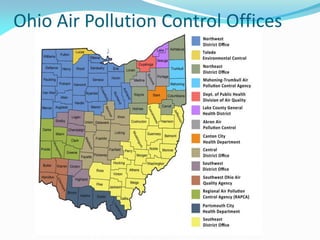
Ohio Air Pollution Control Offices
Ohio EPA’s
Air Pollution Control Program
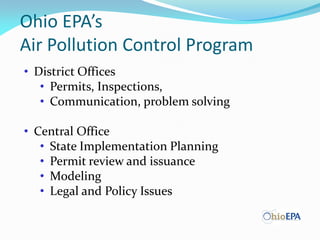
• District Offices
• Permits, Inspections,
• Communication, problem solving
• Central Office
• State Implementation Planning
• Permit review and issuance
• Modeling
• Legal and Policy Issues
What drives us?
• Consistency - statewide
• Efficiency - permit and compliance programs to
facilitate compliance of regulated community
• Prioritization – recognizing top priorities and
focusing our efforts accordingly
Permit Process: Making it Easy
• Online application preparation and tracking
• Pre-application meeting to begin process
• Periodic status calls and/or meetings with
specialists
• Review of permit before issuance– No surprises!
• Changes happen – we adapt quickly!
Permit Process: What to Expect
• Recommend early pre-meeting
• Review of application within 14 days
• Deadline driven
• Highly experienced with PSD & Synthetic Minor
permits
• 85% of new permits written within 90 days in
past 2 yrs
Success Story: Oil/Gas Expansion
ļ‚— Worked closely with Oil and Gas industry
ļ‚— Held multiple conference calls with interested parties
ļ‚— Conducted webinars
ļ‚— Guidance:
ļ‚— General Permit developed for well sites
ļ‚— General Permit developed for compressor stations
ļ‚— Developed multiple guidance documents
ļ‚— Information packets and guidance docs to industry
Success Story: Oil/Gas Expansion
ļ‚— Since development began, we have issued:
ļ‚— 500+ permits for well-site installations
(average issuance – 15 days)
ļ‚— 280 permits for mid-stream
(compressor stations, gas clean-up)
ļ‚— 40 permits for gas processing for oil/gas expansion
(separation, fractionation, stabilization facilities)
ļ‚— Still expanding!
Available Online Services
ļ‚— eBusiness Center
ļ‚— Air Services
ļ‚— Electronic Payments
ļ‚— Other Division Applications
ļ‚— Customer Support Center
ļ‚— Permit Wizard
ļ‚— FAQ
ļ‚— Training
What can you do in Air Services?
Create & Submit
ļ‚— Permit Applications
ļ‚— Emissions Reports
ļ‚— Permit Related Reporting
ļ‚— Compliance
ļ‚— Emissions Tests
ļ‚— CEM/CERMS/COMS
ļ‚— Facility Data Updates
ļ‚— Portable Source Relocation
View History & Maintain Data
ļ‚— Permit tracking
ļ‚— View submission history
ļ‚— View correspondence
Designed for Ease of Use
ļ‚— Designed to avoid duplicate data entry
ļ‚— Access to facility application and reporting history
ļ‚— Access to Word version of current permits
ļ‚— Ability to copy from previous reports or applications
within facility
Compliance and Enforcement
ļ‚— Our Goal is Compliance
ļ‚— We strive to be fair, equitable, transparent and timely.
ļ‚— Inspector Rotation
ļ‚— Discuss findings of inspections during the visit.
ļ‚— Minimize surprises and opportunity to address issues
quickly. (many times before we leave)
ļ‚— Memorialize how problems should be addressed
across the state. (via internal improvements)
Practical Advise
ļ‚— Preparing staff for inspections
ļ‚— Obvious stuff (permits, monitoring, recordkeeping,
reports, testing, etc.)
ļ‚— Inspections: Ask about inspector’s operational
knowledge and tailor conversation. Walk the plant
process start to finish
ļ‚— Big Bang Theory vs CSI vs Colombo
ļ‚— Human element
ļ‚— Build trust and a relationship
ļ‚— Honesty, integrity, no double-speak, clearly answer
questions and find information quickly.
Current Challenges
ļ‚— Federal Activity
ļ‚— Ozone
ļ‚— NAAQS
ļ‚— Startup Shutdown Malfunction SIP Call
ļ‚— Interstate Transport
ļ‚— Clean Power Plan
ļ‚— Doing More with Less…
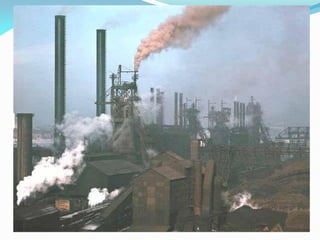
ļ‚— Photo of Republic Steel, Cleveland from
Cleveland State University, Dept. of History,
Teaching and Learning Cleveland
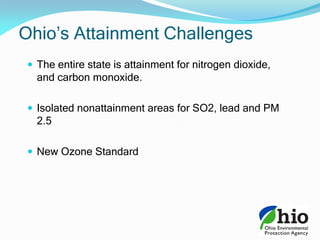
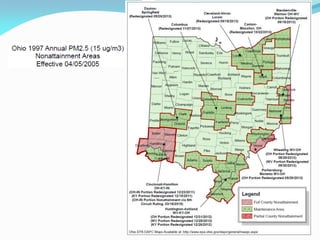
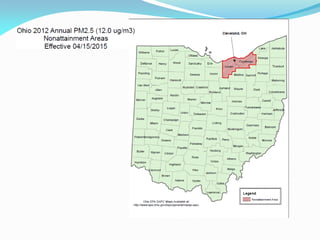
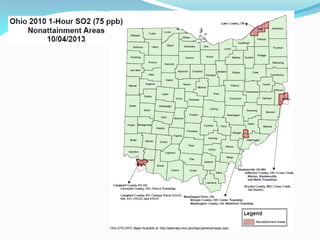
Ohio’s Attainment Challenges
ļ‚— The entire state is attainment for nitrogen dioxide,
and carbon monoxide.
ļ‚— Isolated nonattainment areas for SO2, lead and PM
2.5
ļ‚— New Ozone Standard
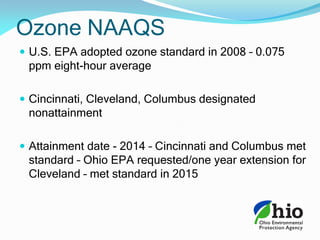
ļ‚— U.S. EPA adopted ozone standard in 2008 – 0.075
ppm eight-hour average
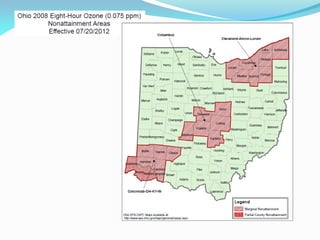
ļ‚— Cincinnati, Cleveland, Columbus designated
nonattainment
ļ‚— Attainment date - 2014 – Cincinnati and Columbus met
standard – Ohio EPA requested/one year extension for
Cleveland – met standard in 2015
Ozone NAAQS
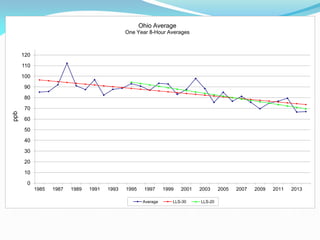
0
10
20
30
40
50
60
70
80
90
100
110
120
1985 1987 1989 1991 1993 1995 1997 1999 2001 2003 2005 2007 2009 2011 2013
ppb
Ohio Average
One Year 8-Hour Averages
Average LLS-30 LLS-20
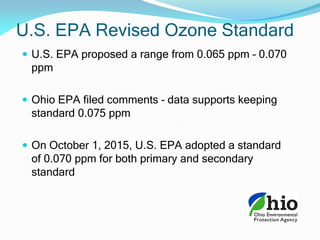
ļ‚— U.S. EPA proposed a range from 0.065 ppm – 0.070
ppm
ļ‚— Ohio EPA filed comments – data supports keeping
standard 0.075 ppm
ļ‚— On October 1, 2015, U.S. EPA adopted a standard
of 0.070 ppm for both primary and secondary
standard
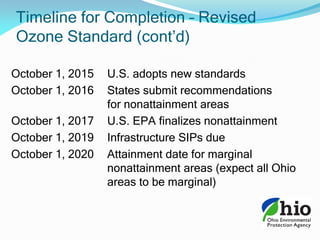
U.S. EPA Revised Ozone Standard
October 1, 2015 U.S. adopts new standards
October 1, 2016 States submit recommendations
for nonattainment areas
October 1, 2017 U.S. EPA finalizes nonattainment
October 1, 2019 Infrastructure SIPs due
October 1, 2020 Attainment date for marginal
nonattainment areas (expect all Ohio
areas to be marginal)
Timeline for Completion – Revised
Ozone Standard (cont’d)
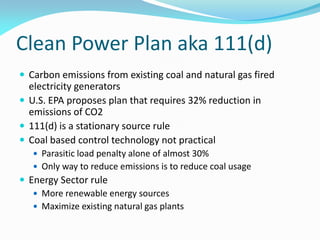
Clean Power Plan aka 111(d)
ļ‚— Carbon emissions from existing coal and natural gas fired
electricity generators
ļ‚— U.S. EPA proposes plan that requires 32% reduction in
emissions of CO2
ļ‚— 111(d) is a stationary source rule
ļ‚— Coal based control technology not practical
ļ‚— Parasitic load penalty alone of almost 30%
ļ‚— Only way to reduce emissions is to reduce coal usage
ļ‚— Energy Sector rule
ļ‚— More renewable energy sources
ļ‚— Maximize existing natural gas plants
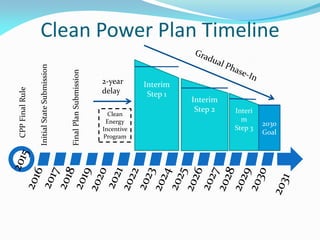
Interi
m
Step 3
Interim
Step 2
Interim
Step 1
2030
Goal
CPPFinalRule
InitialStateSubmission
FinalPlanSubmission
Clean
Energy
Incentive
Program
2-year
delay
Clean Power Plan Timeline
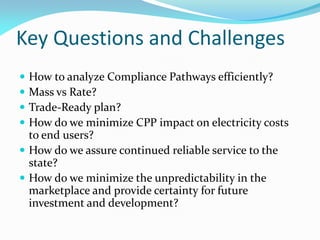
Key Questions and Challenges
ļ‚— How to analyze Compliance Pathways efficiently?
ļ‚— Mass vs Rate?
ļ‚— Trade-Ready plan?
ļ‚— How do we minimize CPP impact on electricity costs
to end users?
ļ‚— How do we assure continued reliable service to the
state?
ļ‚— How do we minimize the unpredictability in the
marketplace and provide certainty for future
investment and development?
ļ‚— Legal Challenges
ļ‚— Methodical analysis
ļ‚— Collaborate very closely with Ohio Public Utilities
Commission
ļ‚— Not an Island (awareness of other states)
ļ‚— Extension request due Sept 2016
ļ‚— Outreach and Engagement Plan
ļ‚— Remain mindful of challenges and not rush to
any decisions.
Ohio’s CPP next steps
ļ‚— Questions or concerns?
Adam Ward
Assistant Chief
Ohio Environmental Protection Agency
Division of Air Pollution Control
w 614.728.3784
c 614.546.9163
adam.ward@epa.ohio.gov

Adam Ward, Ohio EPA, Air Pollution Control Updates, Midwest Environmental Compliance Conference, Chicago, October 29-30, 2015

  • 1.
    Ohio EPA, AirPollution Control Updates
  • 2.
    Topics ļ‚— Permit andCompliance Improvements – What does this mean for you? ļ‚— Compliance Strategies for Business – Making things easy ļ‚— Emerging Air issues including Ozone, Clean Power Plan, etc.
  • 3.
    Ohio EPA’s Air PollutionControl Program ļ‚— 5 Regional (District) Offices; 9 Local Air Agencies; Central Office; Field Office ļ‚— 180 Employees across the state plus Local Air Agencies ļ‚— +72,000 sources at over 14,000 regulated facilities ļ‚— 2,000 Air permits issued annually ļ‚— +290 Ambient air monitors ļ‚— We are efficient and lean!
  • 4.
    Ohio Air PollutionControl Offices
  • 5.
    Ohio EPA’s Air PollutionControl Program • District Offices • Permits, Inspections, • Communication, problem solving • Central Office • State Implementation Planning • Permit review and issuance • Modeling • Legal and Policy Issues
  • 6.
    What drives us? •Consistency - statewide • Efficiency - permit and compliance programs to facilitate compliance of regulated community • Prioritization – recognizing top priorities and focusing our efforts accordingly
  • 7.
    Permit Process: Makingit Easy • Online application preparation and tracking • Pre-application meeting to begin process • Periodic status calls and/or meetings with specialists • Review of permit before issuance– No surprises! • Changes happen – we adapt quickly!
  • 8.
    Permit Process: Whatto Expect • Recommend early pre-meeting • Review of application within 14 days • Deadline driven • Highly experienced with PSD & Synthetic Minor permits • 85% of new permits written within 90 days in past 2 yrs
  • 9.
    Success Story: Oil/GasExpansion ļ‚— Worked closely with Oil and Gas industry ļ‚— Held multiple conference calls with interested parties ļ‚— Conducted webinars ļ‚— Guidance: ļ‚— General Permit developed for well sites ļ‚— General Permit developed for compressor stations ļ‚— Developed multiple guidance documents ļ‚— Information packets and guidance docs to industry
  • 10.
    Success Story: Oil/GasExpansion ļ‚— Since development began, we have issued: ļ‚— 500+ permits for well-site installations (average issuance – 15 days) ļ‚— 280 permits for mid-stream (compressor stations, gas clean-up) ļ‚— 40 permits for gas processing for oil/gas expansion (separation, fractionation, stabilization facilities) ļ‚— Still expanding!
  • 11.
    Available Online Services ļ‚—eBusiness Center ļ‚— Air Services ļ‚— Electronic Payments ļ‚— Other Division Applications ļ‚— Customer Support Center ļ‚— Permit Wizard ļ‚— FAQ ļ‚— Training
  • 12.
    What can youdo in Air Services? Create & Submit ļ‚— Permit Applications ļ‚— Emissions Reports ļ‚— Permit Related Reporting ļ‚— Compliance ļ‚— Emissions Tests ļ‚— CEM/CERMS/COMS ļ‚— Facility Data Updates ļ‚— Portable Source Relocation View History & Maintain Data ļ‚— Permit tracking ļ‚— View submission history ļ‚— View correspondence
  • 13.
    Designed for Easeof Use ļ‚— Designed to avoid duplicate data entry ļ‚— Access to facility application and reporting history ļ‚— Access to Word version of current permits ļ‚— Ability to copy from previous reports or applications within facility
  • 14.
    Compliance and Enforcement ļ‚—Our Goal is Compliance ļ‚— We strive to be fair, equitable, transparent and timely. ļ‚— Inspector Rotation ļ‚— Discuss findings of inspections during the visit. ļ‚— Minimize surprises and opportunity to address issues quickly. (many times before we leave) ļ‚— Memorialize how problems should be addressed across the state. (via internal improvements)
  • 15.
    Practical Advise ļ‚— Preparingstaff for inspections ļ‚— Obvious stuff (permits, monitoring, recordkeeping, reports, testing, etc.) ļ‚— Inspections: Ask about inspector’s operational knowledge and tailor conversation. Walk the plant process start to finish ļ‚— Big Bang Theory vs CSI vs Colombo ļ‚— Human element ļ‚— Build trust and a relationship ļ‚— Honesty, integrity, no double-speak, clearly answer questions and find information quickly.
  • 16.
    Current Challenges ļ‚— FederalActivity ļ‚— Ozone ļ‚— NAAQS ļ‚— Startup Shutdown Malfunction SIP Call ļ‚— Interstate Transport ļ‚— Clean Power Plan ļ‚— Doing More with Less…
  • 18.
    ļ‚— Photo ofRepublic Steel, Cleveland from Cleveland State University, Dept. of History, Teaching and Learning Cleveland
  • 19.
    Ohio’s Attainment Challenges ļ‚—The entire state is attainment for nitrogen dioxide, and carbon monoxide. ļ‚— Isolated nonattainment areas for SO2, lead and PM 2.5 ļ‚— New Ozone Standard
  • 23.
    ļ‚— U.S. EPAadopted ozone standard in 2008 – 0.075 ppm eight-hour average ļ‚— Cincinnati, Cleveland, Columbus designated nonattainment ļ‚— Attainment date - 2014 – Cincinnati and Columbus met standard – Ohio EPA requested/one year extension for Cleveland – met standard in 2015 Ozone NAAQS
  • 25.
    0 10 20 30 40 50 60 70 80 90 100 110 120 1985 1987 19891991 1993 1995 1997 1999 2001 2003 2005 2007 2009 2011 2013 ppb Ohio Average One Year 8-Hour Averages Average LLS-30 LLS-20
  • 26.
    ļ‚— U.S. EPAproposed a range from 0.065 ppm – 0.070 ppm ļ‚— Ohio EPA filed comments – data supports keeping standard 0.075 ppm ļ‚— On October 1, 2015, U.S. EPA adopted a standard of 0.070 ppm for both primary and secondary standard U.S. EPA Revised Ozone Standard
  • 27.
    October 1, 2015U.S. adopts new standards October 1, 2016 States submit recommendations for nonattainment areas October 1, 2017 U.S. EPA finalizes nonattainment October 1, 2019 Infrastructure SIPs due October 1, 2020 Attainment date for marginal nonattainment areas (expect all Ohio areas to be marginal) Timeline for Completion – Revised Ozone Standard (cont’d)
  • 28.
    Clean Power Planaka 111(d) ļ‚— Carbon emissions from existing coal and natural gas fired electricity generators ļ‚— U.S. EPA proposes plan that requires 32% reduction in emissions of CO2 ļ‚— 111(d) is a stationary source rule ļ‚— Coal based control technology not practical ļ‚— Parasitic load penalty alone of almost 30% ļ‚— Only way to reduce emissions is to reduce coal usage ļ‚— Energy Sector rule ļ‚— More renewable energy sources ļ‚— Maximize existing natural gas plants
  • 29.
    Interi m Step 3 Interim Step 2 Interim Step1 2030 Goal CPPFinalRule InitialStateSubmission FinalPlanSubmission Clean Energy Incentive Program 2-year delay Clean Power Plan Timeline
  • 30.
    Key Questions andChallenges ļ‚— How to analyze Compliance Pathways efficiently? ļ‚— Mass vs Rate? ļ‚— Trade-Ready plan? ļ‚— How do we minimize CPP impact on electricity costs to end users? ļ‚— How do we assure continued reliable service to the state? ļ‚— How do we minimize the unpredictability in the marketplace and provide certainty for future investment and development?
  • 31.
    ļ‚— Legal Challenges ļ‚—Methodical analysis ļ‚— Collaborate very closely with Ohio Public Utilities Commission ļ‚— Not an Island (awareness of other states) ļ‚— Extension request due Sept 2016 ļ‚— Outreach and Engagement Plan ļ‚— Remain mindful of challenges and not rush to any decisions. Ohio’s CPP next steps
  • 32.
    ļ‚— Questions orconcerns? Adam Ward Assistant Chief Ohio Environmental Protection Agency Division of Air Pollution Control w 614.728.3784 c 614.546.9163 adam.ward@epa.ohio.gov