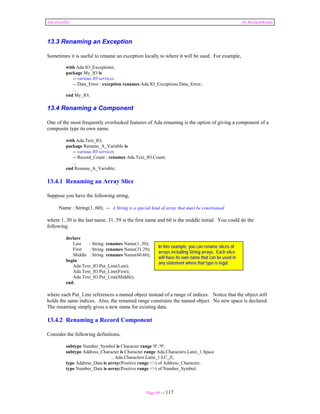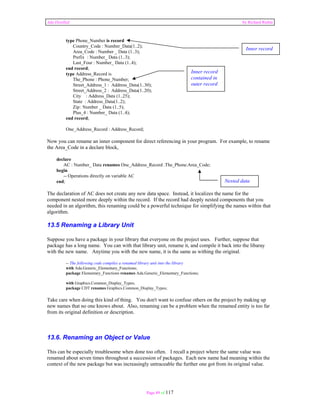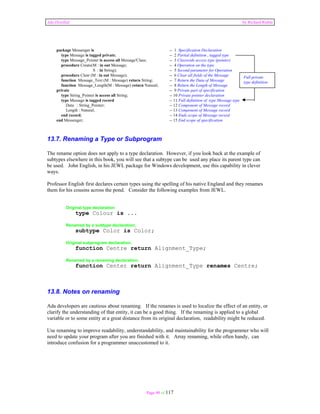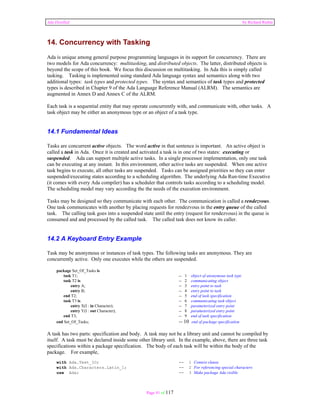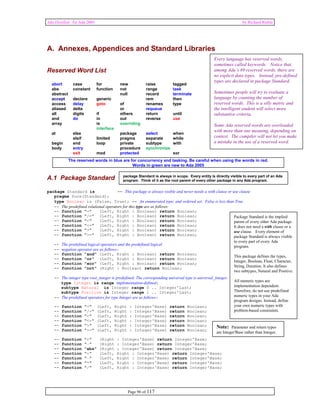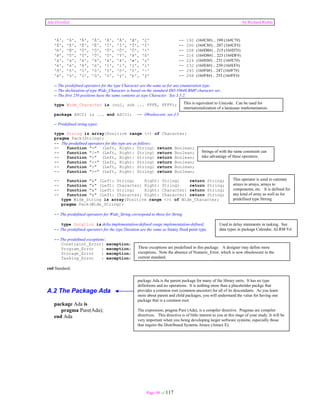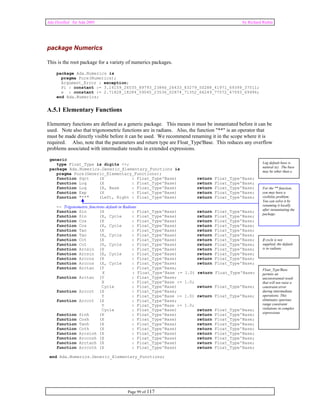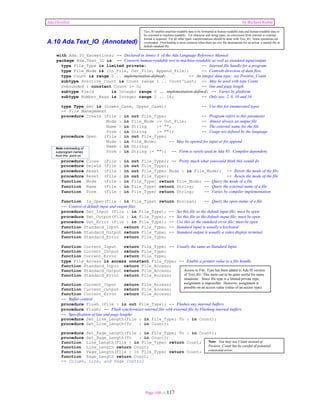
Ada Distilled for Ada 2005 by Richard Riehle 
Page 1 of 117 
for 
Ada 2005 
An Introduction to Ada Programming 
for 
Experienced Computer Programmers 
by 
Richard Riehle 
Copyright 2011 Richard Riehle 
Public Edition. Permission to copy if unmodified when copied 
Version: January 2011 
for 
Ada 2005 Standard
Ada Distilled by Richard Riehle 
Notes Programming Language Evolution 
A programming language that does not evolve to incorporate the best of the new ideas in 
software development is likely to become less expressive of new kinds of problems and 
their corresponding solutions. This has been the fate of many other languages, even 
though those languages may continue to have loyal and even militant advocates. For 
example, PL/I has never evolved to support the object model or to correct some of the 
minor problems of its original design, and this has resulted in its becoming less important 
than it could have been had such an evolution occurred. Fortran and COBOL have 
evolved. COBOL even has an object-oriented model, and has been extended to include 
some powerful features that were missing from earlier versions. 
Ada began with the Mil-Std 1983 version. In that version of the language, caution was 
an important watchword. The designers were more concerned with dependability than 
with flexibility of advanced concepts in computer science and programming. The focus 
was on designing a language that would correspond to the most stable practices in 
software at that time. That language would include a capability where errors could be 
detected as early in the development cycle as possible. It also supported a model for 
software engineering that was not typical of other languages of that era. 
In 1987 Ada became an ISO standard. There were no significant changes to the language 
at that time, but the fact that it was no longer a military language opened the door for 
major improvements for the 1995 standard. Chief among those changes was a reliable 
approach to object-oriented programming. 
There were many other important changes in the Ada 2005 standard. As usual, every 
effort was made to avoid making existing language rules obsolete. Therefore, most of the 
programs in previous versions of this book will still compile, link, and execute. There 
are some occasional problems with older programs, many of which have to do with new 
pragmas. We will note some of these where we can. 
As of this edition, (January 2011) there are more new features being proposed for the 
Ada language. Foremost among these is the addition of a more powerful approach to 
assertions than has been available in earlier versions of Ada. Because those new features 
are not yet approved as part of the ISO Standard, we do not include them in this version 
of Ada Distilled. However, when those features are approved, we will add them to the 
book. 
We expect that Ada will continue to evolve, and as it does, it will become a more sought 
after language for solutions to many new kinds of software problems. In particular, the 
advent of “massively parallel architectures” and their corresponding operating systems, 
provides an excellent opportunity for Ada to become an important player in software 
solutions for that architectural domain. 
Page 2 of 117
Ada Distilled by Richard Riehle 
Acknowledgments to Current (2008) Edition 
There are always a lot of people involved in the creation of any book, even one as 
small and modest as this one. Those who have contributed to the best features of this 
book include my students at Naval Postgraduate School, Mr. Michael Berenato of 
Computer Sciences Corporation, Mr. Ed Colbert of Absolute Software, and many 
students from Lockheed-Martin Corporation, Computer Sciences Corporation, British 
Aerospace, various branches of the uniformed services, to name a few. I also owe a 
special thanks to Dr. Ben Brosgol, Dr. Robert Dewar, Mr. Mark Gerhardt, and Dr. 
Mantak Shing for what I have learned from them. Also thanks to the contributors to 
comp.lang.ada Usenet forum and the Team_Ada Listserve. Phil Thornley deserves 
extra credit for his detailed reading of the manuscript and many corrections. 
Special thanks goes to Ed Colbert for his careful study of some of my program 
examples. He is one of those people who can spot a program error at fifty paces. 
Using this unique skill, Ed brought many errors, some big and some small, to my 
attention. Also thanks to more recent input from Phil Thornley and Adrian Hoe. 
Any other errors are strictly mine. Any mistakes in wording, spelling, or facts are 
mine and mine alone. 
I hope this book will be valuable to the intended audience. It is moderate in its intent: 
help the beginning Ada programmer get a good start with some useful examples of 
working code. More advanced books are listed in the bibliography. The serious 
student should also have one of those books at hand when starting in on a real project. 
Page 3 of 117 
Richard Riehle 
Intended Audience for this Book 
This book is aimed at experienced programmers who want to learn Ada at the programming level. 
It is not a "...for dummies" book, nor is it intended as a program design book. Instead, we 
highlight some key features of the Ada language, with coded examples, that are essential for 
getting started as an Ada programmer. 
Ada is a rich and flexibile language used for designing large-scale software systems. This book 
emphasizes syntax, control structures, subprogram rules, and how-to coding issues rather than 
design issues. There are other really fine books available that deal with design. Also, this is not a 
comprehensive treatment of the Ada language. The bibliography lists some books that can help 
you once you have finished the material in this book. 
Think of this a quick-start book, one that enables you, the experienced programmer, to get into the 
Ada language quickly and easily. The examples use text-oriented programs for simplicity of 
learning. If you prefer to do the exercises for a GUI environment, check out the sites listed for 
compilers and tools so you can download bindings for programming in a variety of windowing 
environments, including Wintel, Linux, and Unix. Of particular interest to those wanting to 
explore Window style programming are GtkAda, CLAW, GWindows, and JEWL. The last of 
these, JEWL, is especially useful if you have no prior experience writing Windows programs. 
Happy Coding, 
Richard Riehle
Ada Distilled by Richard Riehle 
Table of Contents 
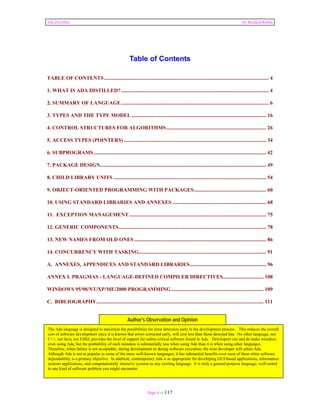
TABLE OF CONTENTS ............................................................................................................................. 4 
1. WHAT IS ADA DISTILLED? ................................................................................................................ 4 
2. SUMMARY OF LANGUAGE ................................................................................................................ 6 
3. TYPES AND THE TYPE MODEL ...................................................................................................... 16 
4. CONTROL STRUCTURES FOR ALGORITHMS ............................................................................ 26 
5. ACCESS TYPES (POINTERS) ............................................................................................................ 34 
6. SUBPROGRAMS ................................................................................................................................... 42 
7. PACKAGE DESIGN .............................................................................................................................. 49 
8. CHILD LIBRARY UNITS .................................................................................................................... 54 
9. OBJECT-ORIENTED PROGRAMMING WITH PACKAGES ....................................................... 60 
10. USING STANDARD LIBRARIES AND ANNEXES ....................................................................... 68 
11. EXCEPTION MANAGEMENT ........................................................................................................ 75 
12. GENERIC COMPONENTS ................................................................................................................ 78 
13. NEW NAMES FROM OLD ONES .................................................................................................... 86 
14. CONCURRENCY WITH TASKING................................................................................................. 91 
A. ANNEXES, APPENDICES AND STANDARD LIBRARIES .......................................................... 96 
ANNEX L PRAGMAS - LANGUAGE-DEFINED COMPILER DIRECTIVES ............................... 108 
WINDOWS 95/98/NT/XP/ME/2000 PROGRAMMING ...................................................................... 109 
C. BIBLIOGRAPHY ............................................................................................................................... 111 
Author's Observation and Opinion 
The Ada language is designed to maximize the possibilities for error detection early in the development process. This reduces the overall 
cost of software development since it is known that errors corrected early, will cost less than those detected late. No other language, not 
C++, not Java, not Eiffel, provides the level of support for safety-critical software found in Ada. Developers can and do make mistakes, 
even using Ada, but the probability of such mistakes is substantially less when using Ada than it is when using other languages. 
Therefore, when failure is not acceptable, during development or during software execution, the wise developer will select Ada. 
Although Ada is not as popular as some of the more well-known languages, it has substantial benefits over most of them when software 
dependability is a primary objective. In addition, contemporary Ada is as appropriate for developing GUI-based applications, information 
systems applications, and computationally intensive systems as any existing language. It is truly a general-purpose language, well-suited 
to any kind of software problem you might encounter. 
Page 4 of 117 
1. What is Ada Distilled?
Ada Distilled by Richard Riehle 
This book is for experienced programmers new to Ada. Heavily commented example programs help 
experienced programmer experiment with Ada. This is not a comprehensive book on the entire Ada 
language. In particular, we say very little about Ada.Finalization, Storage Pool Management, 
Representation Specifications, Concurrency, and other more advanced topics. Other books, listed in the 
bibliography, cover advanced topics. This book is an entry point to your study of Ada. 
The text is organized around example programs with line-by-line comments. Ada comments are the 
double-hyphen and continue to the end of a line. Comments might be explanatory notes and/or 
corresponding section of the Ada Language Reference Manual (ALRM) in the format of ALRM X.5.3/22. 
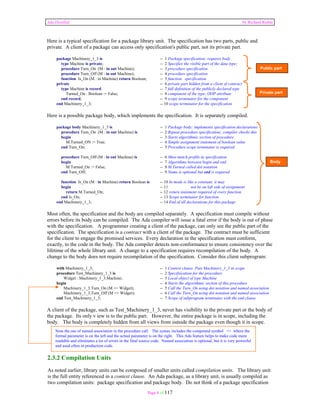
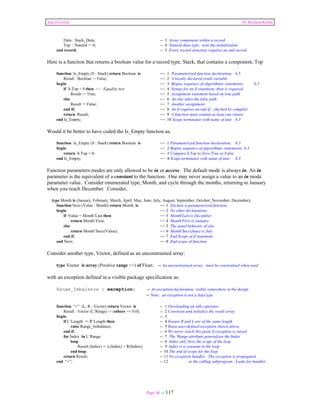
with Ada.Text_IO; -- 1 10.1.2, A.10 Context clause 
procedure Hello is -- 2 6.3 Specification with "is" 
begin -- 3 6.3 Start algorithmic code 
This will compile A hello program in Ada. 
and execute with 
any Ada compiler. 
Ada.Text_IO.Put_Line(“Hello Ada”); -- 4 A.10.6 Executable source code 
end Hello; -- 5 6.3 End of procedure scope 
where each line is numbered. The 10.1.2 and 6.3, etc. refer to ALRM Chapters 6.3, 10.1.2. A.10.6 refers to 
Annex A.10.6. There is occasional commentary by source code line number. The line numbers are not 
part of Ada, but provided on our examples for ease of commentary. Boxed notes are also included for 
some examples. The preceding example shows one of these as: 
1.1 Ada Compilers and Tools 
Ada 95 compilers support a wide range of platforms. A free, open source, compiler, GNAT, based on 
GNU technology, can be downloaded from the Web. Commercial Ada compilers and tools are available 
from: Ada Core Technologies (GNAT), DDC-I, Rational (recently acquired by IBM), RR Software, Irvine 
Compiler Corporation, Green Hills, SofCheck, Aonix, and OC Systems. Free editors, including AdaGide, 
are useful for developing small Ada programs. More information on tools, including GUI development 
tools, can be accessed using one of the URL's mentioned in the introduction and in the bibliography. 
AdaCore’s GPS development environment is a multi-language development environment. 
GUI development environments are also important. These include CLAW for Microsoft Operating 
Systems, and GtkAda for other GUI environments including Microsoft operating systems, Linux, BSD, 
OS/2, Java Virtual Machine, and every variety of Unix. AdaGide editor is available for MS Windows. 
1.2 Ada Education 
The bibliography of this book lists some of the books and educational resources available to the student of 
Ada. Some colleges and universities offer Ada courses. In addition, there are companies that provide 
classes for anyone interested in Ada software development. 
1.3 Ada Software Practice 
There is a lot of misinformation about Ada. One misconception is that it is a large, bloated language 
designed by committee. This is not true. Ada is designed around a few simple principles that provide the 
architecture for the language syntax and semantics. Once you understand these principles, Ada will be as 
easy as many other languages. We highlight some of those design principles in this book. One important 
principle is that the Ada compiler never assumes anything. Everything is explicit. Nothing in Ada is 
implicit. This helps the compiler help you write more dependable code. Oh, and you'll rarely need the 
debugger once you are experienced with Ada. Also, your Ada programs will usually compile to nearly 
any contemporary platform and execute on that platform without change. 
If the software must absolutely work without error, where a software accident could 
Page 5 of 117 
kill or maim, Ada is the correct choice.
Ada Distilled by Richard Riehle 
2. Summary of Language 
2.1 Goals and Philosophy 
Every programming language is intended to satisfy some purpose, some set of goals. Sometimes the goals 
are stated in terms of a programming paradigm. For example, a goal might be to design an object-oriented 
programming language. Another goal might call for a language that conforms to some existing 
programming model with extensions to satisfy some new notions of programming techniques. Ada's goals 
correspond to the final product of the software process. Ada is not designed to satisfy an academic notion 
of how programs should be designed and written. Ada's Goals are: 
Ada is not an acronym. It is the name of the daughter of the English Poet, Lord Byron. She 
is credited with being the "first computer programmer" because of the prescience 
demonstrated in her early writings that described Charles Babbage's Analytical Engine. She 
was honored for this contribution by having a language named after her. 
• High reliability and dependability for safety-critical environments, 
• Maintainable over a long span by someone who has never seen the code before, 
• Emphasis on program readability instead of program writeability, 
• Capability for efficient software development using reusable components 
Yes, you can hack solutions 
in Ada if you want. 
However, it is intended as a 
language for disciplined 
design and construction of 
high reliability software. 
In summary, Ada is designed to maximize the error checking a compiler can do early in the development 
process. Each syntactic construct is intended to help the compiler meet this goal. This means some Ada 
syntax may initially seem extraneous but has an important role in alerting the compiler to potential errors in 
your code. The default for every Ada construct is safe. Ada allows you to relax that default when 
necessary. Contrast Ada's default of safe with most of the C family of languages where the default is 
usually, unsafe. The safety default is one of Ada's most important contributions to engineering software. 
Another important idea is expressiveness over expressibility. Nearly any idea can be expressed in any 
programming language. That is not good enough. Ada puts emphasis on expressiveness, not just 
expressibility. In Ada, we map the solution to the problem rather than the problem to the solution. 
2.2 Elementary Syntax 
2.2.1 Identifiers 
Identifiers in Ada are not case sensitive. The identifiers Niacin, NIACIN, NiAcIn will be interpreted by 
the compiler as the same. Underbars are common in Ada source code identifiers; e.g. Down_The_Hatch. 
There is a worldwide shortage of curly braces. Consequently, Ada does not use { and }. Also, Ada does 
not use square braces such as [ and ] . Ada has sixty-nine reserved words. Reserved words will usually 
be shown in bold-face type in this book. (See Appendix A for a complete list of reserved words). 
2.2.2 Statements, Scope Resolution, Visibility 
An Ada statement is terminated with a semicolon. The entire scope of a statement is contained within the 
start of that statement and the corresponding semicolon. Compound statements are permitted. A 
compound statement has an explicit end of scope clause. A statement may be a subprogram call, a simple 
expression, or an assignment statement. Here are some sample statements: 
The syntax of Ada is actually easy to learn and use. It is only when you get further in your study that you 
will discover its full power. Just as there is "no royal road to mathematics," there is no royal road to 
software engineering. Ada can help, but much of programming still requires diligent study and practice. 
X := C * (A + B); -- 1 Simple assignment statement 
Move (X , Y); -- 2 A procedure call statement 
if A = B then -- 3 Start a compound if statement 
J := Ada.Numerics.Pi * Diameter; -- 4 Compute the circumference of a circle 
else -- 5 Part of compound if statement 
J := Ada.Numerics.Pi * Radius ** 2; -- 6 Compute area of a circle 
end if; -- 7 End of compound statement scope 
if (A and B) or ((X and T) and (P or Q)) then -- 8 Parentheses required in mixed and/or construct 
Compute(A); -- 9 Call Compute subprogram 
else -- 10 Part of compound statement 
Compute(P); -- 11 Subprogram call statement 
end if; -- 12 End of compound statement scope 
Page 6 of 117 
Ada's unique idea of visibility often causes difficulties for new Ada programmers. 
Once you understand visibility, nearly everything else about Ada will be clear to you. 
No curly braces in Ada
Ada Distilled by Richard Riehle 
Note on Line 8 that an Ada conditional statement cannot mix and and or unless the expression includes 
parentheses. This eliminates problems associated with such expressions. It also eliminates arguments 
about precedence of mixed expressions, and errors due to incorrect assumptions about precedence. 
2.2.3 Methods (Operators and Operations) 
Methods in Ada are subprograms (procedures/functions) and include both operators and operations. 
Operators include the symbols: =, /=, <, >, <=, >=, &, +, -, /, *. Other operators are the reserved words, 
and, or, xor, not, abs, rem, mod. One issue that annoys newcomers to Ada is the strictness of the 
visibility rules associated with operators. We will discuss the visibility rules and techniques for using them 
sensibly in Section 2.4 and elsewhere in this book. For detailed operator rules, see ALRM 4.5. 
All other methods are called operations. One operation, assignment uses the compound symbol: := . The 
Ada programmer may not directly overload the assignment operation. Assignment is predefined for most 
Ada types. It is prohibited for limited types. We describe limited types later in this book. 
The Ada programmer may declare type-specific methods. An experienced Ada designer uses the package 
specification for declaring such methods, and for overriding/overloading existing methods. 
The membership test, not considered an operation by the language, has important method-like properties. 
Membership test uses the reserved word in. Combine the word in with the word not (not in) for a 
negative membership test. Membership testing is permitted for every Ada type, including limited types. 
2.3 Library and Compilation Units 
2.3.1 Library Units 
An Ada program is composed of library units. A library unit is a unit that can be referred to using a with 
clause. The technical name for the with clause is context clause. A context clause is a little like a #include 
compiler directive in other languages, but with important differences. A library unit must successfully 
compile before the compiler will recognize it in a context clause. Each compiled unit is placed in a 
[sometimes virtual] library. Unlike a #include , the context clause does not make elements of a library unit 
visible. Instead, a context clause simply puts the library unit in scope, making it potentially visible. 
A library unit may be a package or a subprogram. Subprograms are either functions or procedures. 
See 4.2.2 
A single library unit may be composed of more than one compilation unit. This is 
called separate compilation. Ada ensures that separately compiled units preserve their 
continuity in relationship to related units. That is, date and time checking, library name 
resolution, and date and time checking of compiled units ensures every unit is always in 
phase with every other related complation and library unit 
1) package A collection of resources with something in common, usually a data type. 
2) procedure A simple executable series of declarations and associated algorithmic code. 
3) function An executable entity which always returns a data type result. 
4) child unit A package, procedure, or function that is a child of a package. 
An Ada library unit consists of a specification part and implementation part. The implementation is 
sometimes called a body. For a subprogram the specification part could be coded as, 
procedure Open (F : in out File); -- Procedure specification; requires body. 
function Is_Open (F : File) return Boolean; -- Function specification; requires body 
Note: Library 
units may be 
generic. See 
chapter 12. 
A package is a collection of services (public and private), usually related through some data type. Most 
Ada library units will be packages. A package specification includes type declarations, subprograms 
(procedures and functions), and exceptions. Also, a package usually consists of a specification part 
(public and private) and an implementation part. The implementation part of a package is called the 
package body. A package specification almost always (not always) requires a package body. 
Page 7 of 117 
C/C++ programmer note: An Ada 
subprogram specification is analogous to, 
but not identical to, a function prototype.
Ada Distilled by Richard Riehle 
Here is a typical specification for a package library unit. The specification has two parts, public and 
private. A client of a package can access only specification's public part, not its private part. 
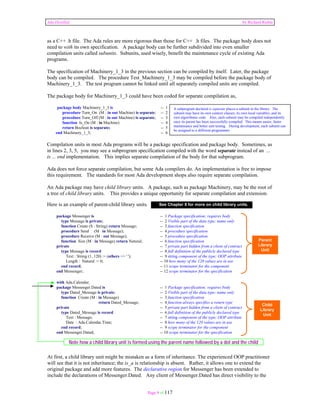
package Machinery_1_3 is -- 1 Package specification; requires body 
type Machine is private; -- 2 Specifies the visible part of the data type; 
procedure Turn_On (M : in out Machine); -- 3 procedure specification 
procedure Turn_Off (M : in out Machine); -- 4 procedure specification 
function Is_On (M : in Machine) return Boolean; -- 5 function specification 
private -- 6 private part hidden from a client of contract 
type Machine is record -- 7 full definition of the publicly declared type 
Turned_On : Boolean := False; -- 8 component of the type; OOP attribute 
end record; -- 9 scope terminator for the component 
end Machinery_1_3; -- 10 scope terminator for the specification 
Here is a possible package body, which implements the specification. It is separately compiled. 
package body Machinery_1_3 is -- 1 Package body; implements specification declarations 
procedure Turn_On (M : in out Machine) is -- 2 Repeat procedure specification; compiler checks this 
begin -- 3 Starts algorithmic section of procedure 
M.Turned_ON := True; -- 4 Simple assignment statement of boolean value 
end Turn_On; -- 5 Procedure scope terminator is required 
procedure Turn_Off (M : in out Machine) is -- 6 Must match profile in specification 
begin -- 7 Algorithms between begin and end 
M.Turned_On := False; -- 8 M.Turned called dot notation 
end Turn_Off; -- 9 Name is optional but end is required 
function Is_On (M : in Machine) return Boolean is -- 10 In mode is like a constant; it may 
begin -- 11 not be on left side of assignment 
return M.Turned_On; -- 12 return statement required of every function 
end Is_On; -- 13 Scope terminator for function 
end Machinery_1_3; -- 14 End of all declarations for this package 
Most often, the specification and the body are compiled separately. A specification must compile without 
errors before its body can be compiled. The Ada compiler will issue a fatal error if the body is out of phase 
with the specification. A programmer creating a client of the package, can only see the public part of the 
specification. The specification is a contract with a client of the package. The contract must be sufficient 
for the client to engage the promised services. Every declaration in the specification must conform, 
exactly, to the code in the body. The Ada compiler detects non-conformance to ensure consistency over the 
lifetime of the whole library unit. A change to a specification requires recompilation of the body. A 
change to the body does not require recompilation of the specification. Consider this client subprogram: 
with Machinery_1_3; -- 1 Context clause. Puts Machinery_1_3 in scope 
procedure Test_Machinery_1_3 is -- 2 Specifxication for the procedure 
Widget : Machinery_1_3.Machine; -- 3 Local object of type Machine 
begin -- 4 Starts the algorithmic section of this procedure 
Machinery_1_3.Turn_On (M => Widget); -- 5 Call the Turn_On using dot notation and named association 
Machinery_1_3.Turn_Off (M => Widget); -- 6 Call the Turn_On using dot notation and named association 
end Test_Machinery_1_3; -- 7 Scope of subprogram terminates with the end clause 
A client of the package, such as Test_Machinery_1_3, never has visibility to the private part or the body of 
the package. Its only v iew is to the public part. However, the entire package is in scope, including the 
body. The body is completely hidden from all views from outside the package even though it in scope. 
2.3.2 Compilation Units 
As noted earlier, library units can be composed of smaller units called compilation units. The library unit 
is the full entity referenced in a context clause. An Ada package, as a library unit, is usually compiled as 
two compilation units: package specification and package body. Do not think of a package specification 
Page 8 of 117 
Public part 
Private part 
Body 
Note the use of named association in the procedure call. The syntax includes the compound symbol => where the 
formal parameter is on the left and the actual parameter is on the right. This Ada feature helps to make code more 
readable and eliminates a lot of errors in the final source code. Named association is optional, but it is very powerful 
and used often in production code.
Ada Distilled by Richard Riehle 
as a C++ .h file. The Ada rules are more rigorous than those for C++ .h files. The package body does not 
need to with its own specification. A package body can be further subdivided into even smaller 
compilation units called subunits. Subunits, used wisely, benefit the maintenance cycle of existing Ada 
programs. 
The specification of Machinery_1_3 in the previous section can be compiled by itself. Later, the package 
body can be compiled. The procedure Test_Machinery_1_3 may be compiled before the package body of 
Machinery_1_3. The test program cannot be linked until all separately compiled units are compiled. 
The package body for Machinery_1_3 could have been coded for separate compilation as, 
package body Machinery_1_3 is -- 1 
procedure Turn_On (M : in out Machine) is separate; -- 2 
procedure Turn_Off (M : in out Machine) is separate; -- 3 
function Is_On (M : in Machine) -- 4 
return Boolean is separate; -- 5 
end Machinery_1_3; -- 6 
Compilation units in most Ada programs will be a package specification and package body. Sometimes, as 
in lines 2, 3, 5, you may see a subprogram specification compiled with the word separate instead of an ... 
is ... end implementation. This implies separate compilation of the body for that subprogram. 
Ada does not force separate compilation, but some Ada compilers do. An implementation is free to impose 
this requirement. The standards for most Ada development shops also require separate compilation. 
An Ada package may have child library units. A package, such as package Machinery, may be the root of 
a tree of child library units. This provides a unique opportunity for separate compilation and extension. 
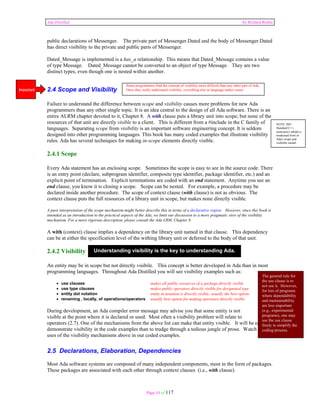
Here is an example of parent-child library units. 
package Messenger is -- 1 Package specification; requires body 
type Message is private; -- 2 Visible part of the data type; name only 
function Create (S : String) return Message; -- 3 function specification 
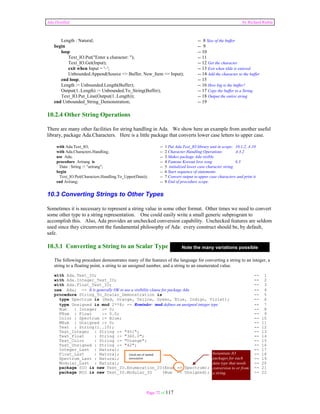
procedure Send (M in Message); -- 4 procedure specification 
procedure Receive (M : out Message); -- 5 procedure specification 
function Size (M : in Message) return Natural; -- 6 function specification 
private -- 7 private part hidden from a client of contract 
type Message is record -- 8 full definition of the publicly declared type 
Text : String (1..120) := (others => ' '); -- 9 string component of the type; OOP attribute 
Length : Natural := 0; -- 10 how many of the 120 values are in use 
end record; -- 11 scope terminator for the component 
end Messenger; -- 12 scope terminator for the specification 
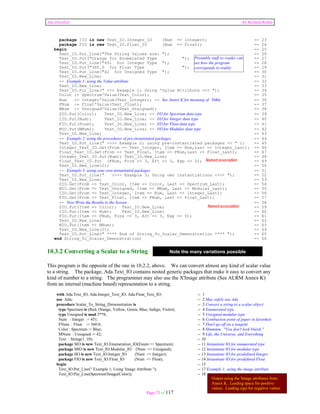
with Ada.Calendar; 
package Messenger.Dated is -- 1 Package specification; requires body 
type Dated_Message is private; -- 2 Visible part of the data type; name only 
function Create (M : in Message) -- 3 function specification 
return Dated_Message; -- 4 function always specifies a return type 
private -- 5 private part hidden from a client of contract 
type Dated_Message is record -- 6 full definition of the publicly declared type 
Text : Message; -- 7 string component of the type; OOP attribute 
Date : Ada.Calendar.Time; -- 8 how many of the 120 values are in use 
end record; -- 9 scope terminator for the component 
end Messenger.Dated; -- 10 scope terminator for the specification 
At first, a child library unit might be mistaken as a form of inheritance. The experienced OOP practitioner 
will see that it is not inheritance; the is_a is relationship is absent. Rather, it allows one to extend the 
original package and add more features. The declarative region for Messenger has been extended to 
include the declarations of Messenger.Dated. Any client of Messenger.Dated has direct visibility to the 
Page 9 of 117 
A subprogram declared is separate places a subunit in the library. The 
subunit may have its own context clauses, its own local variables, and its 
own algorithmic code. Also, each subunit may be compiled independently 
once its parent has been successfully compiled. This means easier, faster 
maintenance and better unit testing. During development, each subunit can 
be assigned to a different programmer 
Parent 
Library 
Unit 
Child 
Library 
Unit 
See Chapter 8 for more on child library units. 
Note how a child library unit is formed using the parent name followed by a dot and the child
Ada Distilled by Richard Riehle 
public declarations of Messenger. The private part of Messenger.Dated and the body of Messenger.Dated 
has direct visibility to the private and public parts of Messenger. 
Dated_Message is implemented is a has_a relationship. This means that Dated_Message contains a value 
of type Message. Dated_Message cannot be converted to an object of type Message. They are two 
distinct types, even though one is nested within another. 
Some programmers find the concept of visibility more difficult than any other part of Ada. 
Once they really understand visibility, everything else in language makes sense. 
2.4 Scope and Visibility 
Failure to understand the difference between scope and visibility causes more problems for new Ada 
programmers than any other single topic. It is an idea central to the design of all Ada software. There is an 
entire ALRM chapter devoted to it, Chapter 8. A with clause puts a library unit into scope; but none of the 
resources of that unit are directly visible to a client. This is different from a #include in the C family of 
languages. Separating scope from visibility is an important software engineering concept. It is seldom 
designed into other programming languages. This book has many coded examples that illustrate visibility 
rules. Ada has several techniques for making in-scope elements directly visible. 
2.4.1 Scope 
Every Ada statement has an enclosing scope. Sometimes the scope is easy to see in the source code. There 
is an entry point (declare, subprogram identifier, composite type identifier, package identifier, etc.) and an 
explicit point of termination. Explicit terminations are coded with an end statement. Anytime you see an 
end clause, you know it is closing a scope. Scope can be nested. For example, a procedure may be 
declared inside another procedure. The scope of context clause (with clause) is not as obvious. The 
context clause puts the full resources of a library unit in scope, but makes none directly visible. 
A pure interpretation of the scope mechanism might better describe this in terms of a declarative region. However, since this book is 
intended as an introduction to the practical aspects of the Ada, we limit our discussion to a more pragmatic view of the visibility 
mechanism. For a more rigorous description, please consult the Ada LRM, Chapter 8. 
A with (context) clause implies a dependency on the library unit named in that clause. This dependency 
can be at either the specification level of the withing library unit or deferred to the body of that unit. 
2.4.2 Visibility 
An entity may be in scope but not directly visibile. This concept is better developed in Ada than in most 
programming languages. Throughout Ada Distilled you will see visibility examples such as: 
• use clauses makes all public resources of a package directly visible 
• use type clauses makes public operators directly visible for designated type 
• entity dot notation entity in notation is directly visible; usually the best option 
• renaming , locally, of operations/operators usually best option for making operators directly visible 
During development, an Ada compiler error message may advise you that some entity is not 
visible at the point where it is declared or used. Most often a visibility problem will relate to 
operators (2.7). One of the mechanisms from the above list can make that entity visible. It will be easier to 
demonstrate visibility in the code examples than to trudge through a tedious jungle of prose. Watch for 
uses of the visibility mechanisms above in our coded examples. 
2.5 Declarations, Elaboration, Dependencies 
Most Ada software systems are composed of many independent components, most in the form of packages. 
These packages are associated with each other through context clauses (i.e., with clause). 
Page 10 of 117 
NOTE: ISO 
Standard C++ 
namespace adopts a 
weakened form of 
Ada's scope and 
visibility model. 
Understanding visibility is the key to understanding Ada. 
Important 
The general rule for 
the use clause is to 
not use it. However, 
for lots of programs 
where dependability 
and maintainability 
are less important 
(e.g., experimental 
programs), one may 
use the use clause 
freely to simplify the 
coding process.
Ada Distilled by Richard Riehle 
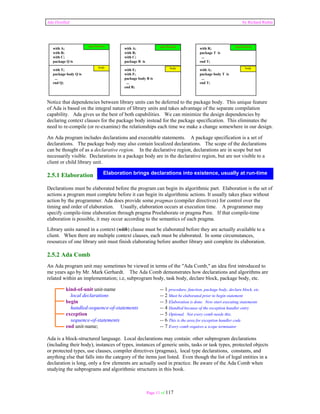
Notice that dependencies between library units can be deferred to the package body. This unique feature 
of Ada is based on the integral nature of library units and takes advantage of the separate compilation 
capability. Ada gives us the best of both capabilities. We can minimize the design dependencies by 
declaring context clauses for the package body instead for the package specification. This eliminates the 
need to re-compile (or re-examine) the relationships each time we make a change somewhere in our design. 
An Ada program includes declarations and executable statements. A package specification is a set of 
declarations. The package body may also contain localized declarations. The scope of the declarations 
can be thought of as a declarative region. In the declarative region, declarations are in scope but not 
necessarily visible. Declarations in a package body are in the declarative region, but are not visible to a 
client or child library unit. 
2.5.1 Elaboration 
Declarations must be elaborated before the program can begin its algorithmic part. Elaboration is the set of 
actions a program must complete before it can begin its algorithmic actions. It usually takes place without 
action by the programmer. Ada does provide some pragmas (compiler directives) for control over the 
timing and order of elaboration. Usually, elaboration occurs at execution time. A programmer may 
specify compile-time elaboration through pragma Preelaborate or pragma Pure. If that compile-time 
elaboration is possible, it may occur according to the semantics of each pragma. 
Library units named in a context (with) clause must be elaborated before they are actually available to a 
client. When there are multiple context clauses, each must be elaborated. In some circumstances, 
resources of one library unit must finish elaborating before another library unit complete its elaboration. 
2.5.2 Ada Comb 
An Ada program unit may sometimes be viewed in terms of the "Ada Comb," an idea first introduced to 
me years ago by Mr. Mark Gerhardt. The Ada Comb demonstrates how declarations and algorithms are 
related within an implementation; i.e, subprogram body, task body, declare block, package body, etc. 
kind-of-unit unit-name -- 1 procedure, function, package body, declare block, etc. 
local declarations -- 2 Must be elaborated prior to begin statement 
begin -- 3 Elaboration is done. Now start executing statements 
handled-sequence-of-statements -- 4 Handled because of the exception handler entry 
exception -- 5 Optional. Not every comb needs this. 
sequence-of-statements -- 6 This is the area for exception handler code 
end unit-name; -- 7 Every comb requires a scope terminator 
Ada is a block-structured language. Local declarations may contain: other subprogram declarations 
(including their body), instances of types, instances of generic units, tasks or task types, protected objects 
or protected types, use clauses, compiler directives (pragmas), local type declarations, constants, and 
anything else that falls into the category of the items just listed. Even though the list of legal entities in a 
declaration is long, only a few elements are actually used in practice. Be aware of the Ada Comb when 
studying the subprograms and algorithmic structures in this book. 
Page 11 of 117 
with A; 
with B; 
with C; 
package Q is 
... 
end Q; 
with A; 
with B; 
with C; 
package R is 
... 
ewnidth R E;; 
with F; 
package body R is 
... 
end R; 
with R; 
package T is 
... 
end T; 
with A; 
package body T is 
... 
end T; 
with T; 
package body Q is 
... 
end Q; 
specification specification specification 
body body body 
Elaboration brings declarations into existence, usually at run-time
Ada Distilled by Richard Riehle 
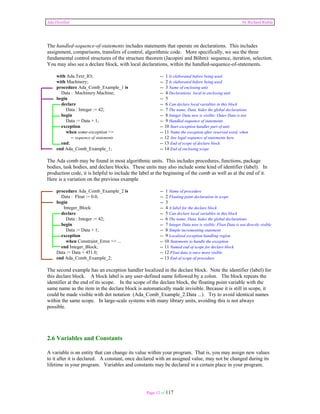
The handled-sequence-of-statements includes statements that operate on declarations. This includes 
assignment, comparisons, transfers of control, algorithmic code. More specifically, we see the three 
fundamental control structures of the structure theorem (Jacopini and Böhm): sequence, iteration, selection. 
You may also see a declare block, with local declarations, within the handled-sequence-of-statements. 
with Ada.Text_IO; -- 1 Is elaborated before being used 
with Machinery; -- 2 Is elaborated before being used 
procedure Ada_Comb_Example_1 is -- 3 Name of enclosing unit 
Data : Machinery.Machine; -- 4 Declarations local to enclosing unit 
begin -- 5 
declare -- 6 Can declare local variables in this block 
Data : Integer := 42; -- 7 The name, Data, hides the global declarations 
begin -- 8 Integer Data now is visible; Outer Data is not 
Data := Data + 1; -- 9 Handled sequence of statements 
exception -- 10 Start exception handler part of unit 
when some-exception => -- 11 Name the exception after reserved word, when 
-- sequence of statements -- 12 Any legal sequence of statements here 
end; -- 13 End of scope of declare block 
end Ada_Comb_Example_1; -- 14 End of enclosing scope 
The Ada comb may be found in most algorithmic units. This includes procedures, functions, package 
bodies, task bodies, and declare blocks. These units may also include some kind of identifier (label). In 
production code, it is helpful to include the label at the beginning of the comb as well as at the end of it. 
Here is a variation on the previous example 
procedure Ada_Comb_Example_2 is -- 1 Name of procedure 
Data : Float := 0.0; -- 2 Floating point declaration in scope 
begin -- 3 
Integer_Block: -- 4 A label for the declare block 
declare -- 5 Can declare local variables in this block 
Data : Integer := 42; -- 6 The name, Data, hides the global declarations 
begin -- 7 Integer Data now is visible; Float Data is not directly visible 
Data := Data + 1; -- 8 Simple incrementing statement 
exception -- 9 Localized exception handling region 
when Constraint_Error => ... -- 10 Statements to handle the exception 
end Integer_Block; -- 11 Named end of scope for declare block 
Data := Data + 451.0; -- 12 Float data is once more visible 
end Ada_Comb_Example_2; -- 13 End of scope of procedure 
The second example has an exception handler localized in the declare block. Note the identifier (label) for 
this declare block. A block label is any user-defined name followed by a colon. The block repeats the 
identifier at the end of its scope. In the scope of the declare block, the floating point variable with the 
same name as the item in the declare block is automatically made invisible. Because it is still in scope, it 
could be made visible with dot notation (Ada_Comb_Example_2.Data ...). Try to avoid identical names 
within the same scope. In large-scale systems with many library units, avoiding this is not always 
possible. 
2.6 Variables and Constants 
A variable is an entity that can change its value within your program. That is, you may assign new values 
to it after it is declared. A constant, once declared with an assigned value, may not be changed during its 
lifetime in your program. Variables and constants may be declared in a certain place in your program, 
Page 12 of 117
Ada Distilled by Richard Riehle 
called the declarative part. Every variable and constant must be associated with some type. The basic 
syntax for a variable declaration is, 
name_of_variable : name_of_type; -- for a scalar or constrained composite type 
name_of_variable : name_of_type(constraint) ; -- for an unconstrained composite type 
Declarations for predefined types (see package Standard in the appendices of this book) 
Value : Integer; -- see Annex A.1, package Standard 
Degrees : Float; -- see Annex A.1, package Standard 
Sentinel : Character; -- see Annex A.1, package Standard 
Result : Boolean; -- see Annex A.1, package Standard 
Text : String(1..120); -- Must always constrain a string variable 
String is defined in package Standard as an unconstrained array 
We could also initialize a variable at the time it is declared, 
Channel : Integer := 42; -- "...life, the universe, and everything." 
Pi : Float := Ada.Numerics.Pi; -- from Annex A.5, ALRM 
ESC : Character := Ada.Characters.Latin_1.ESC; -- from Annex A, ALRM 
Is_On : Boolean := True; -- from Annex A.1, ALRM 
Text : String(1..120) := (others => '*'); -- Every element initialized to asterisk 
2.7 Operations and Operators 
Ada distinguishes between operations and operators. Operators are usually the infix methods used for 
arithmetic, comparison, and logical statements. Operators present a visibility problem for a new Ada 
programmer. Watch for the discussion of operator visibility that follows in this section. 
:= 
2.7.1 Assignment Operation 
Somewhere among his published aphorisms and deprecations, Edsger Dijkstra observes that too few 
programmers really understand the complexities of the assignment statement. I have not been able to 
excavate the exact quote from those of his publications immediately at hand. It is true, however, that 
assignment is increasingly complicated as new programming languages are invented. Ada is no exception, 
and may actually have more complicated rules about assignment than some other languages. 
The Ada assignment operation, := , is a compound symbol composed of a colon symbol and equal symbol. 
It is predefined for every Ada type except limited types. It is illegal, in Ada, to directly overload, 
rename, or alias the assignment operation. In a statement such as, 
Reminder: the assignment operator is legal only on non-limited types. Also, both sides of the assignment 
operator must conform to each other. Composite types must have the same size and constraints. 
Note: Although Ada does not allow direct overloading of the assignment operator, it is sometimes useful to do that kind of overloading, and 
Ada has a facility for designing in this feature safely but indirectly, by deriving from a controlled type. 
Page 13 of 117 
A := B + C * (F / 3); 
the expression on the right side of the assignment operation is evaluated and the result of that evaluation is 
placed in the location designated by the variable on the left side. All the variables on both sides must be 
of the same type. In an expression, 
X := Y; 
X and Y must both be of the same type. If values in an assignment statement are not of the same type, the 
programmer may, under strictly defined rules, convert Y to a type corresponding to the type of X. 
type X_Type is ... -- Ellipses are not part of the Ada language; used for simplification here 
type Y_Type is ... 
X := X_Type(Y); -- When type conversion is legal between the types 
Strings in Ada have index 
values of subtype positive 
which means the lowest 
possible value for a string 
index is 1, not zero.
Ada Distilled by Richard Riehle 
Type conversion is not legal between all types. If both types are numeric, the conversion is probably legal. 
If one type is derived from another, it is legal. Otherwise, type conversion is probably not legal. 
Assignment may be more complicated if the source and target objects in the assigment statement are 
composite types. It is especially complicated if those composite types include pointers (access values) that 
reference some other object. In this case, access value components may create entertaining problems for 
the programmer. For this reason, composite types constructed from pointers should be limited types. 
For limited types, one would define a Deep Copy procedure. Ada makes it illegal to directly overload the 
assignment operator. Study an example of a deep copy in the generic Queue_Manager later in this book. 
Sometimes two types are so completely different that assignment must be performed using a special 
generic function, Ada.Unchecked_Conversion. Do not be too hasty to use this function. Often there is 
another option. Note the following example: 
with Ada.Unchecked_Conversion; -- 1 Chapter 13 or ALRM 
procedure Unchecked_Example is -- 2 Generally speaking, don't do this 
type Vector is array (1 .. 4) of Integer; -- 3 Array with four components 
for Vector'Size use 4 * Integer'Size; -- 4 Define number of bits for the array 
type Data is record -- 5 
V1, V2, V3, V4 : Integer; -- 6 A record with four components 
end record; -- 7 
for Data'Size use 4 * Integer'Size; -- 8 Same number of bits as the array 
function Convert is new Unchecked_Conversion -- 9 
(Source => Vector, Target => Data); -- 10 Convert a Vector to a Data 
The_Vector : Vector := (2, 4, 6, 8); -- 11 Intilialize a Vector with values 
The_Data : Data := (1, 3, 5, 7); -- 12 Intilialize a Record with values 
begin -- 13 
The_Data := Convert(The_Vector); -- 14 Assignment via unchecked conversion 
end Unchecked_Example; -- 15 
Even though Line 14 probably works just fine in all cases, many Ada practitioners will prefer to do the 
assignments one at a time from the components of Vector to the components of Data. There will be more 
code, but selected component assignment is guaranteed to work under all circumstances. Unchecked 
conversion may be less certain unless you are careful about what you are doing. 
2.7.2 Other Operations 
There are several reserved words that behave like operations. Most of these such as abort, delay, 
accept, select, and terminate are related to tasking. Others include raise (for exceptions), goto, 
and null. Some Ada practitioners might not agree with the notion that these are operations, however, in 
any other language they would be so considered. 
Other operations, for non-limited types, are described in Chapter Four of the Ada Language Reference 
Manual. Again, these might not be thought of as operations, but they do have functionality that leads us to 
classify them as operations. These include array slicing, type conversion, type qualification, dynamic 
allocation of access objects, and attribute modification (Annex K of ALRM). 
Because Ada supports object technology, the designer is allowed to create, overload, and override 
operations (except assignment) and operators. Subprogram (procedure and function) specifications may 
be declared in the public part of a package specification. They are implemented in the body of a package. 
For example, in a stack package, the operations might be Push, Pop, Is_Full, Is_Empty. For abstract data 
types, the operations are described as subprograms on the type. 
Page 14 of 117
Ada Distilled by Richard Riehle 
2.7.3 Operators 
Understanding visibility is the key to understanding Ada 
As mentioned in Section 3.2.2, Ada distinguishes between operators and operations. This distinction is 
useful for visibility management. Operators may be overloaded. 
Operators can be thought of as functions. For example, for a type, T, function signatures might be: 
function "=" (Left, Right : T) return Boolean; -- signature for equality operator 
function ">=" (Left, Right : T) return Boolean; -- signature for equality operator 
function "+" (Left, Right : T) return T; -- signature for addition operator 
This signature style applies to all operators. The name of the operator is named in double quotes as if it 
were a string. You may overload operators for your own types. In Ada, the return type is part of the 
signature. There is a special visibility clause that makes all the operators for a named type fully visible: 
use type typename; -- typename is the name of the type in scope. It might need to be dot qualified 
Some designers prefer to make selected operators visible using the renames clause instead of the the use 
type clause. For example, if type T is defined in package P, 
function "+" (Left, Right : P.T) return P.T renames P."+"; -- makes "+" directly visible 
The above function renames the addition operator for a specific type. It uses dot notation to reference the 
package in which the type is defined. You can code this in the declarations of a unit that has a context 
clause for (for example) P and a type P.T. This makes the plus operator directly visible in the immediately 
enclosing scope. Many Ada practitioners feel this is a better engineering solution to controlling visibility 
than any of the other options. It does have the effect of ensuring that no accidental coding of some other 
operator is possible since only this one is directly visible. 
2.8 Elementary Sequential Programs 
There is a more in-depth discussion of this topic in Chapter 6. 
Ada supports two kinds of subprograms: procedures and functions. A subprogram may be a standalone 
library unit. Often it a subprogram is declared in some other unit such as a package specification. The 
implementation part of the subprogram is called the "body." The body for Open might be coded as: 
procedure Open(F : in out File) is -- 1 Note the reserved word, is 
-- optional local declarations -- 2 Between is and begin, local declarations 
begin -- 3 Subprogram body requires a begin 
-- some sequence of statements -- 4 Some statements or reserved word null; 
end Open; -- Most standards require repeating the identifier here -- 5 End required; Identifier optional but usual 
Sometimes we code the subprogram specification and body together, as just shown. There are many cases 
of this in the example subprograms in this book. The optional local declarations on Line 2 are local to the 
subprogram. That is, they are never visible to another unit. This is one more level of visibility. When 
you fully understand the visibility rules, you will understand most of Ada. 
2.8.1 Subprogram Parameters 
Subprograms may have formal parameters. Formal parameters must have a name, a type, and a mode. A 
mode tells the compiler how a parameter will be used in a subprogram. The parameter mode may be in, 
out, in out, or access. The following table simplifies the concept of parameter mode: 
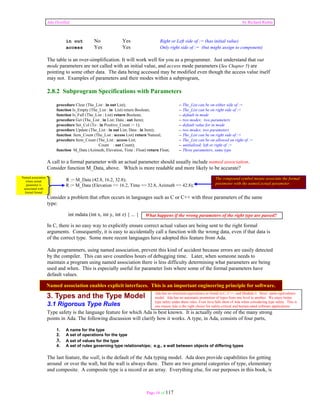
Mode Function Procedure Assigment Operator Position 
in Yes Yes Only right side of := (a constant in subprogram) 
out No Yes Right or Left side of := (but has no initial value) 
Page 15 of 117
Ada Distilled by Richard Riehle 
in out No Yes Right or Left side of := (has initial value) 
access Yes Yes Only right side of := (but might assign to component) 
The table is an over-simplification. It will work well for you as a programmer. Just understand that out 
mode parameters are not called with an initial value, and access mode parameters (See Chapter 5) are 
pointing to some other data. The data being accessed may be modified even though the access value itself 
may not. Examples of parameters and their modes within a subprogram, 
2.8.2 Subprogram Specifications with Parameters 
procedure Clear (The_List : in out List); -- The_List can be on either side of := 
function Is_Empty (The_List : in List) return Boolean; -- The_List can be on right side of := 
function Is_Full (The_List : List) return Boolean; -- default in mode 
procedure Get (The_List : in List; Data : out Item); -- two modes; two parameters 
procedure Set_Col (To : in Positive_Count := 1); -- default value for in mode 
procedure Update (The_List : in out List; Data : in Item); -- two modes; two parameters 
function Item_Count (The_List : access List) return Natural; -- The_List can be on right side of := 
procedure Item_Count (The_List : access List; -- The_List can be on allowed on right of := 
Count : out Count); -- unitialized; left or right of := 
function M_Data (Azimuth, Elevation, Time : Float) return Float; -- Three parameters, same type 
A call to a formal parameter with an actual parameter should usually include named association. 
Consider function M_Data, above. Which is more readable and more likely to be accurate? 
R := M_Data (42.8, 16.2, 32.8); 
R := M_Data (Elevation => 16.2, Time => 32.8, Azimuth => 42.8); 
The compound symbol means associate the formal 
parameter with the named actual parameter. 
Consider a problem that often occurs in languages such as C or C++ with three parameters of the same 
type: 
What happens if the wrong parameters of the right type are passed? 
Named association enables explicit interfaces. This is an important engineering principle for software. 
Ada has no structural equivalence as found in C, C++, and Modula-3. Strict name equivalence 
model. Ada has no automatic promotion of types from one level to another. We enjoy better 
type safety under these rules. Even Java falls short of Ada when considering type safety. This is 
one reason Ada is the right choice for safety-critical and human-rated software applications. 
Page 16 of 117 
int mdata (int x, int y, int z) { ... } 
In C, there is no easy way to explicitly ensure correct actual values are being sent to the right formal 
arguments. Consequently, it is easy to accidentally call a function with the wrong data, even if that data is 
of the correct type. Some more recent languages have adopted this feature from Ada. 
Ada programmers, using named association, prevent this kind of accident because errors are easily detected 
by the compiler. This can save countless hours of debugging time. Later, when someone needs to 
maintain a program using named association there is less difficulty determining what parameters are being 
used and when. This is especially useful for parameter lists where some of the formal parameters have 
default values. 
3. Types and the Type Model 
3.1 Rigorous Type Rules 
Type safety is the language feature for which Ada is best known. It is actually only one of the many strong 
points in Ada. The following discussion will clarify how it works. A type, in Ada, consists of four parts, 
1. A name for the type 
2. A set of operations for the type 
3. A set of values for the type 
4. A set of rules governing type relationships; e.g., a wall between objects of differing types 
The last feature, the wall, is the default of the Ada typing model. Ada does provide capabilities for getting 
around or over the wall, but the wall is always there. There are two general categories of type, elementary 
and composite. A composite type is a record or an array. Everything else, for our purposes in this book, is 
Named association 
where actual 
parameter is 
associated with 
formal formal
Ada Distilled by Richard Riehle 
an elementary type. (Note: there are minor exceptions to this definition when you get into more advanced 
Ada). Some types are predefined in a package Standard (see this Appendix A of this book). From the 
object-oriented viewpoint, a type has state, operations to modify state and operations to query state. 
3.2 Type Safety 
A better way to view strong typing is to think in terms of type safety. Every construct in Ada is type safe. 
For Ada, type safe is the default. For most languages, type safe is not the default. In still other languages, 
type safety is an illusion because of structural equivalence or implicit type promotion. Ada does not 
support either of those concepts because they are not type-safe. An Ada designer declares data types, 
usually in a package specification. The declared types include a constrained set of values and operations 
appropriate to the problem being solved. This ensures a rigorous contract between the client of a type and 
the promise made by the package in which the type is defined. 
3.3 Declaring and Defining Types 
3.3.1 Categories of types 
Ada types can be viewed in two broad categories: limited, and non-limited. A type with a limited view 
cannot be used with the := expression, ever. All other types can be used with := as long as that 
assignment is between compatible (or converted view of) types. Ada defines certain types as always 
limited. These include task types, protected types, and record types with access discriminants. 
Types in Ada may be considered in terms of their view. A type may be defined with a public view which 
can be seen by a client of the type, and a non-public view that is seen by the implementation of the type. 
We sometimes speak of the partial view of the type. A partial view is a public view with a corresponding 
non-public view. Partial views are usually defined as private or limited private. Also, the public view of a 
type may be limited where the implementation view of that same type may be non-limited. Ada does not 
define a protected view directly analogous to C++ or Java. However, some of the essential properties of 
that view are available as necessary. 
Another important category is private type versus non-private type. A limited type may also be private. 
A type with a private view may also have a view that is not private. Any Ada data type may have a view 
that is private with a corresponding view that is not private. The predefined operations for a non-limited 
private type include: := operation, = operator, /= operator. Any other operations for a private type must 
be declared explicitly by the package specification in which the type is publicly declared. 
3.3.2 A Package of Non-private Type Definitions 
In addition to predefined types declare in package Standard, the designer may also define types. These 
may be constrained or unconstrained, limited or non limited. Here are some sample type declarations. 
Page 17 of 117 
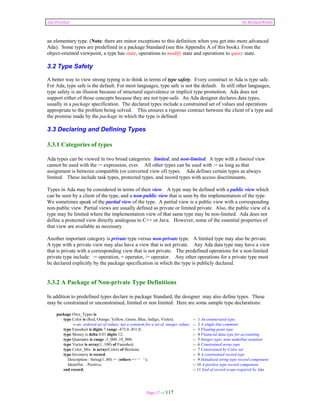
package Own_Types is 
type Color is (Red, Orange, Yellow, Green, Blue, Indigo, Violet); -- 1 An enumerated type; 
-- an ordered set of values; not a synonym for a set of integer values -- 2 A single line comment 
type Farenheit is digits 7 range -473.0..451.0; -- 3 Floating point type 
type Money is delta 0.01 digits 12; -- 4 Financial data type for accounting 
type Quarndex is range -3_000..10_000; -- 5 Integer type; note underbar notation 
type Vector is array(1..100) of Farenheit; -- 6 Constrained array type 
type Color_Mix is array(Color) of Boolean; -- 7 Constrained by Color set 
type Inventory is record -- 8 A constrained record type 
Description : String(1..80) := (others => ' '); -- 9 Initialized string type record component 
Identifier : Positive; -- 10 A positive type record component 
end record; -- 11 End of record scope required by Ada
Ada Distilled by Richard Riehle 
type Inventory_Pointer is access all Inventory; -- 12 Declaring a pointer type in Ada 
type QData is array(Positive range <>) of Quarndex; -- 13 Unconstrained array type 
type Account is tagged record -- 14 See next example: 1.5.3.3 
ID : String (1..20); -- 15 Uninitialized string type component 
Amount : Money := 0.0; -- 16 See line 4 of this package 
end record; -- 17 Required by language 
type Account_Ref is access all Account'Class; -- 19 Classwide pointer type for tagged type 
Page 18 of 117 
end Own_Types; 
3.3.3 A Private type Package 
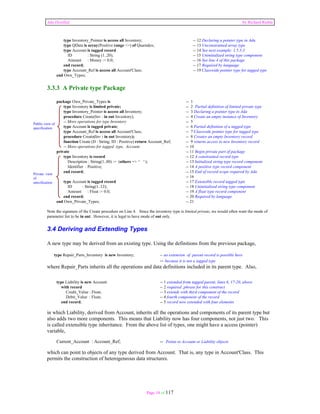
package Own_Private_Types is -- 1 
type Inventory is limited private; -- 2 Partial definition of limited private type 
type Inventory_Pointer is access all Inventory; -- 3 Declaring a pointer type in Ada 
procedure Create(Inv : in out Inventory); -- 4 Create an empty instance of Inventory 
-- More operations for type Inventory -- 5 
type Account is tagged private; -- 6 Partial definition of a tagged type 
type Account_Ref is access all Account'Class; -- 7 Classwide pointer type for tagged type 
procedure Create(Inv : in out Inventory); -- 8 Creates an empty Inventory record 
function Create (D : String; ID : Positive) return Account_Ref; -- 9 returns access to new Inventory record 
-- More operations for tagged type, Account -- 10 
private -- 11 Begin private part of package 
type Inventory is record -- 12 A constrained record type 
Description : String(1..80) := (others => ' '); -- 13 Initialized string type record component 
Identifier : Positive; -- 14 A positive type record component 
end record; -- 15 End of record scope required by Ada 
-- 16 
type Account is tagged record -- 17 Extensible record tagged type 
ID : String(1..12); -- 18 Uninitialized string type component 
Amount : Float := 0.0; -- 19 A float type record component 
end record; -- 20 Required by language 
end Own_Private_Types; -- 21 
Public view of 
specification 
Private view 
of 
specification 
Note the signature of the Create procedure on Line 4. Since the inventory type is limited private, we would often want the mode of 
parameter list to be in out. However, it is legal to have mode of out only. 
3.4 Deriving and Extending Types 
A new type may be derived from an existing type. Using the definitions from the previous package, 
type Repair_Parts_Inventory is new Inventory; -- no extension of parent record is possible here 
-- because it is not a tagged type 
where Repair_Parts inherits all the operations and data definitions included in its parent type. Also, 
type Liability is new Account -- 1 extended from tagged parent, lines 6, 17-20, above 
with record -- 2 required ;phrase for this construct 
Credit_Value : Float; -- 3 extends with third component of the record 
Debit_Value : Float; -- 4 fourth component of the record 
end record; -- 5 record now extended with four elements 
in which Liability, derived from Account, inherits all the operations and components of its parent type but 
also adds two more components. This means that Liability now has four components, not just two. This 
is called extensible type inheritance. From the above list of types, one might have a access (pointer) 
variable, 
Current_Account : Account_Ref; -- Points to Account or Liability objects 
which can point to objects of any type derived from Account. That is, any type in Account'Class. This 
permits the construction of heterogeneous data structures.
Ada Distilled by Richard Riehle 
3.5 Operations on Types 
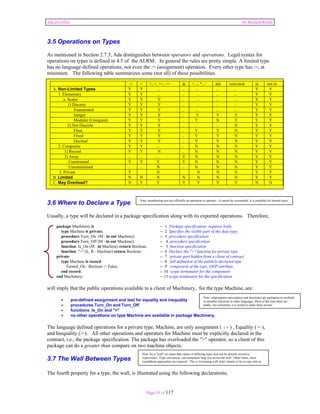
As mentioned in Section 2.7.3, Ada distinguishes between operators and operations. Legal syntax for 
operations on types is defined in 4.5 of the ALRM. In general the rules are pretty simple. A limited type 
has no language-defined operations, not even the := (assignment) operation. Every other type has :=, at 
minimum. The following table summarizes some (not all) of these possibilities. 
:= = <, >, <=, >= & +, -, *, / abs rem/mod in not in 
A. Non-Limited Types Y Y .. .. .. .. .. Y Y 
1. Elementary Y Y .. .. .. .. .. Y Y 
a. Scalar Y Y Y .. .. .. .. Y Y 
1) Discrete Y Y Y .. .. .. .. Y Y 
Enumerated Y Y Y .. .. .. .. Y Y 
Integer Y Y Y .. Y Y Y Y Y 
Modular (Unsigned) Y Y Y .. Y N Y Y Y 
2) Not Discrete Y Y Y .. .. .. N Y Y 
Float Y Y Y .. Y Y N Y Y 
Fixed Y Y Y .. Y Y N Y Y 
Decimal Y Y Y .. Y Y N Y Y 
2. Composite Y Y .. .. N N N Y Y 
1) Record Y Y N .. N N N Y Y 
2) Array .. .. .. Y N N N Y Y 
Constrained Y Y Y Y N N N Y Y 
Unconstrained .. .. N .. N N N Y Y 
3. Private Y N N N N Y Y 
B. Limited N N N N N N N Y Y 
C. May Overload? N Y Y Y Y Y Y N N 
Note: membership test not officially an operation or operator. It cannot be overloaded. It is available for limited types. 
3.6 Where to Declare a Type 
Usually, a type will be declared in a package specification along with its exported operations. Therefore, 
package Machinery is -- 1 Package specification; requires body 
type Machine is private; -- 2 Specifies the visible part of the data type; 
procedure Turn_On (M : in out Machine); -- 3 procedure specification 
procedure Turn_Off (M : in out Machine); -- 4 procedure specification 
function Is_On (M : in Machine) return Boolean; -- 5 function specification 
function ">" (L, R : Machine) return Boolean; -- 6 Declare the ">" function for private type 
private -- 7 private part hidden from a client of contract 
type Machine is record -- 8 full definition of the publicly declared type 
Turned_On : Boolean := False; -- 9 component of the type; OOP attribute 
end record; -- 10 scope terminator for the component 
end Machinery; -- 11 scope terminator for the specification 
will imply that the public operations available to a client of Machinery, for the type Machine, are: 
• pre-defined assignment and test for equality and inequality 
• procedures Turn_On and Turn_Off 
• functions Is_On and ">" 
• no other operations on type Machine are available in package Machinery. 
The language defined operations for a private type, Machine, are only assignment ( := ) , Equality ( = ), 
and Inequality (/=). All other operations and operators for Machine must be explicitly declared in the 
contract, i.e., the package specification. The package has overloaded the ">" operator, so a client of this 
package can do a greater than compare on two machine objects. 
Note: by a "wall" we mean that values of differing types may not be directly mixed in 
3.7 The Wall Between Types 
expressions. Type conversion can sometimes help you across the wall. Other times, more 
roundabout approaches are required. This is in keeping with Ada's charter to be as type safe as 
The fourth property for a type, the wall, is illustrated using the following declarations, 
Page 19 of 117 
Note: subprograms (procedures and functions) are analogous to methods 
or member functions in other languages. Most of the time these are 
public, but sometimes it is useful to make them private.
Ada Distilled by Richard Riehle 
package Some_Types is -- 1 Declare specification name 
type Channel is range 2..136; -- 2 A constrained integer 
type Signal is new Integer -- 3 Derived from Standard.Integer 
range 1..150 -- 4 with a range constraint 
type Level is digits 7; -- 5 A floating point type 
subtype Small_Signal is Signal -- 6 No wall with objects of type Signal 
range 2..14; -- 7 but smaller range than Signal 
type Color is (Red, Yellow, Green, Blue); -- 8 Enumerated type with four values 
type Light is (Red, Yellow, Green); -- 9 Another enumerated type 
type Traffic is new Color -- 10 Derived from Color but with a 
range Red..Green; -- 11 smaller range of values. 
end Some_Types; -- 12. 
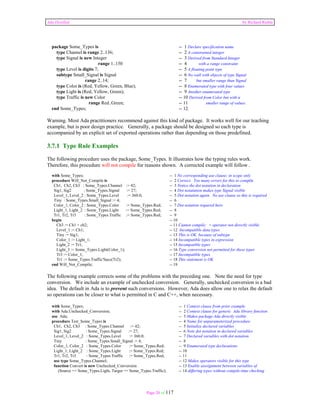
Warning. Most Ada practitioners recommend against this kind of package. It works well for our teaching 
example, but is poor design practice. Generally, a package should be designed so each type is 
accompanied by an explicit set of exported operations rather than depending on those predefined. 
3.7.1 Type Rule Examples 
The following procedure uses the package, Some_Types. It illustrates how the typing rules work. 
Therefore, this procedure will not compile for reasons shown. A corrected example will follow . 
with Some_Types; -- 1 No corresponding use clause; in scope only 
procedure Will_Not_Compile is -- 2 Correct. Too many errors for this to compile 
Ch1, Ch2, Ch3 : Some_Types.Channel := 42; -- 3 Notice the dot notation in declaration 
Sig1, Sig2 : Some_Types.Signal := 27; -- 4 Dot notatation makes type Signal visible 
Level_1, Level_2 : Some_Types.Level := 360.0; -- 5 Dot notation again. No use clause so this is required 
Tiny : Some_Types.Small_Signal := 4; -- 6 
Color_1, Color_2 : Some_Types.Color := Some_Types.Red; -- 7 Dot notation required here 
Light_1, Light_2 : Some_Types.Light := Some_Types.Red; -- 8 
Tr1, Tr2, Tr3 : Some_Types.Traffic := Some_Types.Red; -- 9 
begin -- 10 
Ch3 := Ch1 + ch2; -- 11 Cannot compile; + operator not directly visible 
Level_1 := Ch1; -- 12 Incompatible data types 
Tiny := Sig1; -- 13 This is OK because of subtype 
Color_1 := Light_1; -- 14 Incompatible types in expression 
Light_2 := Tr1; -- 15 Incompatible types 
Light_3 := Some_Types.Light(Color_1); -- 16 Type conversion not permitted for these types 
Tr3 := Color_1; -- 17 Incompatible types 
Tr1 := Some_Types.Traffic'Succ(Tr2); -- 18 This statement is OK 
end Will_Not_Compile; -- 19 
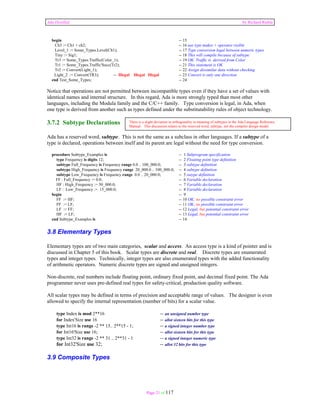
The following example corrects some of the problems with the preceding one. Note the need for type 
conversion. We include an example of unchecked conversion. Generally, unchecked conversion is a bad 
idea. The default in Ada is to prevent such conversions. However, Ada does allow one to relax the default 
so operations can be closer to what is permitted in C and C++, when necessary. 
with Some_Types; -- 1 Context clause from prior example 
with Ada.Unchecked_Conversion; -- 2 Context clause for generic Ada library function 
use Ada; -- 3 Makes package Ada directly visible 
procedure Test_Some_Types is -- 4 Name for unparameterized procedure 
Ch1, Ch2, Ch3 : Some_Types.Channel := 42; -- 5 Initialize declared variables 
Sig1, Sig2 : Some_Types.Signal := 27; -- 6 Note dot notation in declared variables 
Level_1, Level_2 : Some_Types.Level := 360.0; -- 7 Declared variables with dot notation 
Tiny : Some_Types.Small_Signal := 4; -- 8 
Color_1, Color_2 : Some_Types.Color := Some_Types.Red; -- 9 Enumerated type declarations 
Light_1, Light_2 : Some_Types.Light := Some_Types.Red; -- 10 
Tr1, Tr2, Tr3 : Some_Types.Traffic := Some_Types.Red; -- 11 
use type Some_Types.Channel; -- 12 Makes operators visible for this type 
function Convert is new Unchecked_Conversion -- 13 Enable asssignment between variables of 
(Source => Some_Types.Light, Target => Some_Types.Traffic); -- 14 differing types without compile-time checking 
Page 20 of 117
Ada Distilled by Richard Riehle 
begin -- 15 
Ch3 := Ch1 + ch2; -- 16 use type makes + operator visible 
Level_1 := Some_Types.Level(Ch1); -- 17 Type conversion legal between numeric types 
Tiny := Sig1; -- 18 This will compile because of subtype 
Tr3 := Some_Types.Traffic(Color_1); -- 19 OK. Traffic is derived from Color 
Tr1 := Some_Types.Traffic'Succ(Tr2); -- 21 This statement is OK 
Tr2 := Convert(Light_1); -- 22 Assign dissimilar data without checking 
Light_2 := Convert(TR3); -- Illegal Illegal Illegal -- 23 Convert is only one direction 
end Test_Some_Types; -- 24 
Notice that operations are not permitted between incompatible types even if they have a set of values with 
identical names and internal structure. In this regard, Ada is more strongly typed than most other 
languages, including the Modula family and the C/C++ family. Type conversion is legal, in Ada, when 
one type is derived from another such as types defined under the substitutability rules of object technology. 
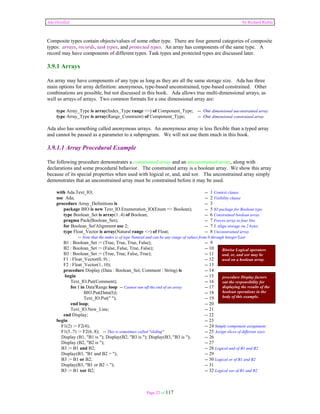
3.7.2 Subtype Declarations 
Ada has a reserved word, subtype. This is not the same as a subclass in other languages. If a subtype of a 
type is declared, operations between itself and its parent are legal without the need for type conversion. 
procedure Subtype_Examples is -- 1 Subprogram specification 
type Frequency is digits 12; -- 2 Floating point type definition 
subtype Full_Frequency is Frequency range 0.0 .. 100_000.0; -- 3 subtype definition 
subtype High_Frequency is Frequency range 20_000.0 .. 100_000.0; -- 4 subtype definition 
subtype Low_Frequency is Frequency range 0.0 .. 20_000.0; -- 5 sutype definition 
FF : Full_Frequency := 0.0; -- 6 Variable declaration 
HF : High_Frequency := 50_000.0; -- 7 Variable declaration 
LF : Low_Frequency := 15_000.0; -- 8 Variable declaration 
begin -- 9 
FF := HF; -- 10 OK; no possible constraint error 
FF := LF; -- 11 OK; no possible constraint error 
LF := FF; -- 12 Legal, but potential constraint error 
HF := LF; -- 13 Legal, but potential constraint error 
end Subtype_Examples is -- 14 
3.8 Elementary Types 
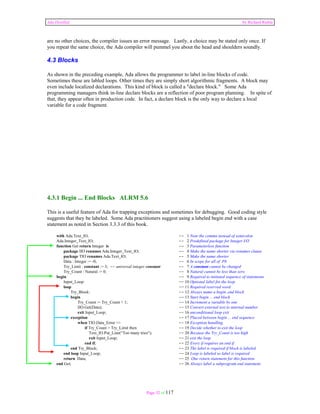
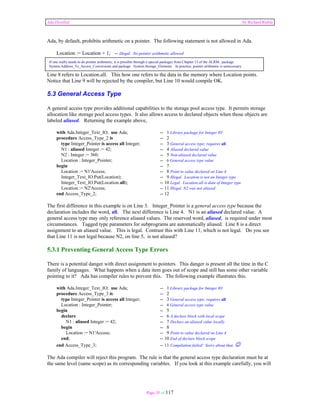
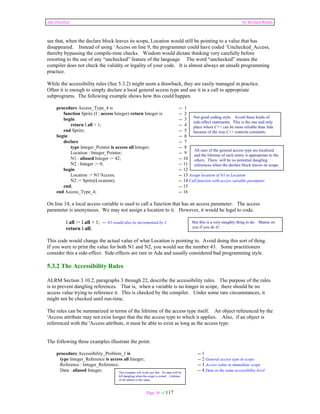
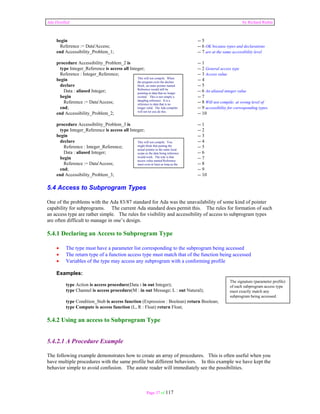
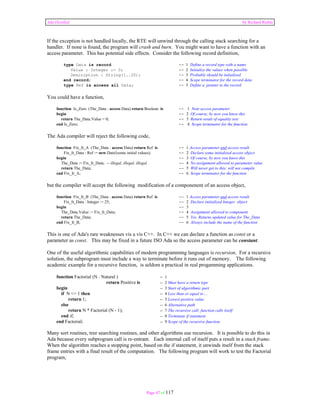
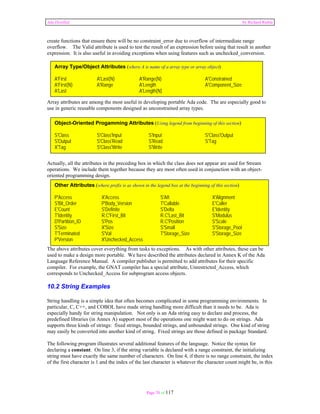
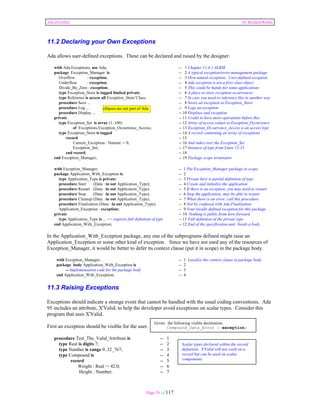
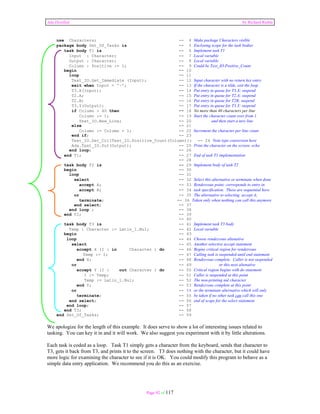
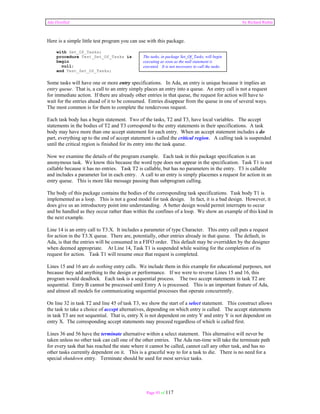
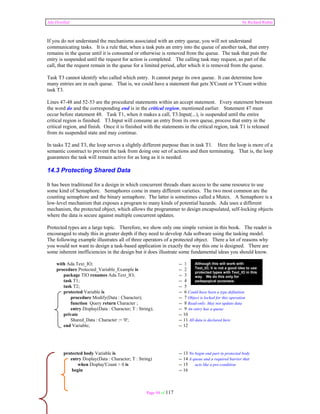
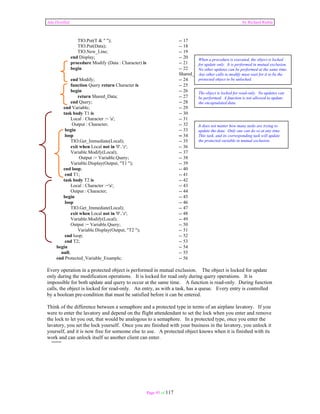
Elementary types are of two main categories, scalar and access. An access type is a kind of pointer and is 
discussed in Chapter 5 of this book. Scalar types are discrete and real. Discrete types are enumerated 
types and integer types. Technically, integer types are also enumerated types with the added functionality 
of arithmetic operators. Numeric discrete types are signed and unsigned integers. 
Non-discrete, real numbers include floating point, ordinary fixed point, and decimal fixed point. The Ada 
programmer never uses pre-defined real types for safety-critical, production quality software. 
All scalar types may be defined in terms of precision and acceptable range of values. The designer is even 
allowed to specify the internal representation (number of bits) for a scalar value. 
type Index is mod 2**16 -- an unsigned number type 
for Index'Size use 16 -- allot sixteen bits for this type 
type Int16 is range -2 ** 15.. 2**15 - 1; -- a signed integer number type 
for Int16'Size use 16; -- allot sixteen bits for this type 
type Int32 is range -2 ** 31 .. 2**31 - 1 -- a signed integer numeric type 
for Int32'Size use 32; -- allot 32 bits for this type 
Page 21 of 117 
3.9 Composite Types 
There is a slight deviation in orthogonality in meaning of subtypes in the Ada Language Reference 
Manual. This discussion relates to the reserved word, subtype, not the compiler design model.
Ada Distilled by Richard Riehle 
Composite types contain objects/values of some other type. There are four general categories of composite 
types: arrays, records, task types, and protected types. An array has components of the same type. A 
record may have components of different types. Task types and protected types are discussed later. 
3.9.1 Arrays 
An array may have components of any type as long as they are all the same storage size. Ada has three 
main options for array definition: anonymous, type-based unconstrained, type-based constrained. Other 
combinations are possible, but not discussed in this book. Ada allows true multi-dimensional arrays, as 
well as arrays of arrays. Two common formats for a one dimensional array are: 
type Array_Type is array(Index_Type range <>) of Component_Type; -- One dimensional unconstrained array 
type Array_Type is array(Range_Constraint) of Component_Type; -- One dimensional constrained array 
Ada also has something called anonymous arrays. An anonymous array is less flexible than a typed array 
and cannot be passed as a parameter to a subprogram. We will not use them much in this book. 
3.9.1.1 Array Procedural Example 
The following procedure demonstrates a constrained array and an unconstrained array, along with 
declarations and some procedural behavior. The constrained array is a boolean array. We show this array 
because of its special properties when used with logical or, and, and xor. The unconstrained array simply 
demonstrates that an unconstrained array must be constrained before it may be used. 
with Ada.Text_IO; -- 1 Context clause 
use Ada; -- 2 Visibility clause 
procedure Array_Definitions is -- 3 
package BIO is new Text_IO.Enumeration_IO(Enum => Boolean); -- 5 IO package for Boolean type 
type Boolean_Set is array(1..4) of Boolean; -- 6 Constrained boolean array 
pragma Pack(Boolean_Set); -- 7 Forces array to four bits 
for Boolean_Set'Alignment use 2; -- 7.1 Align storage on 2 bytes 
type Float_Vector is array(Natural range <>) of Float; -- 8 Unconstrained array 
-- Note that the index is of type Natural and can be any range of values from 0 through Integer'Last 
B1 : Boolean_Set := (True, True, True, False); -- 9 
B2 : Boolean_Set := (False, False, True, False); -- 10 
B3 : Boolean_Set := (True, True, False, True); -- 11 
F1 : Float_Vector(0..9) ; -- 12 
F2 : Float_Vector(1..10); -- 13 
procedure Display (Data : Boolean_Set; Comment : String) is -- 14 
begin -- 15 
Text_IO.Put(Comment); -- 16 
for I in Data'Range loop -- Cannot run off the end of an array -- 17 
BIO.Put(Data(I)); -- 18 
Text_IO.Put(" "); -- 19 
end loop; -- 20 
Text_IO.New_Line; -- 21 
end Display; -- 22 
Bitwise Logical operators 
and, or, and xor may be 
used on a boolean array. 
begin -- 23 
F1(2) := F2(4); -- 24 Simple component assignment 
F1(5..7) := F2(6..8); -- This is sometimes called "sliding" -- 25 Assign slices of different sizes 
Display (B1, "B1 is "); Display(B2, "B3 is "); Display(B3, "B3 is "); -- 26 
Display (B2, "B2 is "); -- 27 
B3 := B1 and B2; -- 28 Logical and of B1 and B2 
Display(B3, "B1 and B2 = "); -- 29 
B3 := B1 or B2; -- 30 Logical or of B1 and B2 
Display(B3, "B1 or B2 = "); -- 31 
B3 := B1 xor B2; -- 32 Logical xor of B1 and B2 
Page 22 of 117 
procedure Display factors 
out the responsibility for 
displaying the results of the 
boolean operations in the 
body of this example.
Ada Distilled by Richard Riehle 
Display(B3, "B1 xor B2 = "); -- 33 
end Array_Definitions; -- 34 
Line 8, in the previous program illustrates an unconstrained array. When an array is declared as 
unconstrained, a constrained instance of it is required before it can be used in an algorithm. Here are some 
other examples of one dimensional, arrays, constrained and unconstrained: 
type Float_Vector is array(Integer range <>) of Float; -- One dimensional unconstrained array 
type Float_Vector is array(-473..451) of Float; -- One dimensional constrained array 
type Day is (Sunday, Monday, Tuesday, Wednesday, Thursday, Friday, Saturday); 
type Float_Vector is array(Day) of Integer; -- One dimensional constrained array 
Note that an array index can be any discrete type and does not have to begin with zero. Also, type String, 
defined in package Standard is defined as an unconstrained array with a Positive index type. All the 
operations permitted on ordinary arrays are also permitted on Strings. 
3.9.1.2 Multi-dimensional Arrays 
Ada allows both multiple-dimension arrays such as those found in Fortran or arrays of arrays such as those 
in the C family of languages. There is no language defined limit of number of dimensions. For example, 
type Float_Matrix is array(Integer range <>, Positive range <>) of Float; -- Two dimensional array 
type Bool_Matrix is array ( Natural range <>, -- First dimension of three 
Positive range <>, -- Second dimension of three 
Color range <>) of Boolean; -- Third dimension of three 
type Mat_Vector is array (Positive range <>) of Float_Matrix(1..20, 5..15); -- One dimension of two dimensions 
3.9.1.3 Array Initialization 
In Ada, arrays may be initialized using a concept called an aggregate. The word aggregate is not a 
reserved word, but it is an important part of the language. An unconstrained array may include an 
aggregate at the time it is constrained. Any array may be re-initialized with a new aggregate in the 
algorithmic part of a module. The rule is that an aggregate must be complete. That is, every component 
must be included in the aggregate. Here are some examples, using the definitions already shown in this 
section (2.5.9.1). 
For one dimensional array: 
V1 : Float_Vector (1..6) := (others => 0.0); -- Instance initialized to all 0.0 
V2 : Float_Vector (1..3) := (1 => 12.3, 3 => 6.2, 2 => 9.4); -- Instance with initial values 
V3 : Float_Vector (0..120) := (0 => 2.6, 120 => 7.5, others => 9.4); -- others must appear last 
V4 : Float_Vector (12..80) := (12 => 16.3, 20 => 6.2, others => 1.5); -- Instance with initial values 
V5 : Float_Vector (-473..-1) := (others => Float'First); -- Negative index range 
In the above instances, V1 has six elements and is initialized to all 0.0, V2 has three elements and is 
initialized using named association. Named association allows the programmer to associate a component 
value with a named index. V3 has 121 elements. It is initialized using named association with an others 
option. V4 has 68 elements, starting with an index of 12. 
In Ada, an integer type index value may begin anywhere in the number range. It may even be a negative 
value, as in example V5. The value of V4'First is 12. The index bound of V4'Range is 12 through 80. 
Page 23 of 117 
For a two dimensional array: 
See unconstrained array, Float_Vector, defined in the previous section.
Ada Distilled by Richard Riehle 
M1 : Float_Matrix(1..10, 1..10) := ( 1 => (1 => 0.0, others => 1.0), -- 1 Named association for each 
10 => (10 => 0.0, others => 1.0), -- 2 dimension of the array and 
others => (others => 1.0)); -- 3 others specified last 
If you wanted to write a loop that would use Text_IO to display all of the values for M1 on a console, it 
might look like the following code, 
for I in M1'Range(1) -- 1 Range(1) specifies first dimension of array 
loop -- 2 outer loop; should have been named 
for J in M1'Range(2) -- 3 Range(2) specifies second dimension of array 
loop -- 4 Always name nested loops in production code 
Text_IO.Put(Float'Image(M1(I, J)) & " " ); -- 5 Convert component to text and print it 
end loop; -- 6 
Text_IO.New_Line; -- 7 Carriage return/Line feed on display 
end loop; -- 8 
3.9.1.4 Array Catenation 
Some prefer the word concatenation; same idea. 
One of the more useful operations on arrays is catenation. Catenation is predefined in the language using 
the ampersand (&) symbol. As with most operators, you may overload the catenator operator. The rules 
for catenation are in ALRM 4.5.3/4. Taking the Float_Vector, defined above, we can have the following: 
V10 : Float_Vector (1..10) := V1 & V2 & 42.9; -- Catenate 42.9, V1 and V2 
Often it is useful to catenate a value of a different type after converting it to an appropriate representation. 
Let's say we have a variable, 
Bango : Integer := 451; -- bango is the Japanese word for number. 
Suppose we want to display the value of Bango on the video display. We could do the following: 
Ada.Text_IO.Put_Line("Paper burns at " & Integer'Image(Bango) & " Farenheit "); 
This prints a string to the screen. The ampersand catenates the result of the image attribute (as if it were a 
built-in function) which in turn is catenated to the constant string, Farenheit, (notice the leading space to 
make formatting more readable). Attributes help to make Ada programs more portable. 
3.9.2 Records 
Ada records come in several forms, many of which are not covered in this book. Some of the record 
forms such as variant records, unconstrained records, and discriminated records, are not important to the 
novice. This book is not concerned with advanced or seldom used language features. However, we will 
include a few examples of constrained records, some records with a single discriminants , and some tagged 
records for the student's future study. The following Ada package specfication declares some record types. 
package Record_Declarations is -- 1 This specification might require a pragma Elaborate_Body 
type Library_Book is -- 2 Simple constrained record 
record -- 3 reserved word, record 
ISBN : String (1..12); -- 4 String component 
Title : String(1..30); -- 5 String component 
Author : String(1..40); -- 6 String component 
Purchase_Price : Float; -- 7 Floating point component 
Copies_Available : Natural; -- 8 Subtype natural from package Standard 
end record; -- 9 Must identify end of scope of each record 
-- 10 
type Message_1 is -- 11 Simple record with an 
Page 24 of 117
Ada Distilled by Richard Riehle 
record -- 12 unconstrained data type 
Text : Unbounded_String; -- 13 See ALRM A.4.5 
Length : Natural; -- 14 See package Standard 
end record; -- 15 
-- 16 
type Message_2 (Size : Positive) is -- 17 Record with a discriminant 
record -- 18 This must be constrained before 
Text : String(1..Size); -- 19 it may be used. Note that the Size 
Length : Natural; -- 20 has a corresponding entry in the record 
end record; -- 21 Dynamically allocated records might not 
-- 22 be as efficient as you would like. 
type Message_3 (Size : Positive := 1) is -- 23 Record with a default discriminant 
record -- 24 This may be constrained or may use 
Text : String(1..Size); -- 25 the default constraint. There are more 
Length : Natural; -- 26 rules for this, but we defer them to an 
end record; -- 27 advancd discussion of the language 
-- 28 
type Message_4 is tagged -- 29 A tagged type. This may be extended 
.record -- 30 with more components 
Text : Unbounded_String; -- 31 Unbounded String(See Ada.Fixed.Unbounded). 
Length : Natural; -- 32 
end record; -- 33 
. -- 34 
type Message_5 is new Message_4 with -- 35 Derived from a tagged type and one 
record -- 36 additional component. This record now x 
Stamp : Calendar.Time -- 37 has a total of three components, those 
end record; -- 38 it inherits and the one defined within it. 
-- 39 
type Message_6 is -- 40 Record containing another record 
record -- 41 
Message_Data : Message_1; -- 42 See line 11 
Library_Data : Library_Book; -- 43 See line 2 
end record; -- 44. 
end Record_Declarations; -- 45 This package might require a pragma Elaborate_Body 
The package, Record_Declarations, has no subprograms. Therefore, the rules of the language might 
require a special pragma (compiler directive) to advise the compiler when there is a package body. 
Note that, on line 35, the type Message_5 is derived from and extended from Message_4. This is a form 
of inheritance. We could have the following: 
M4 : Message_4; 
M5 : Message_5; 
... 
M4 := Message_4(M5); -- provide a Message_4 view of the object of derived type, Message_5 
Page 25 of 117 
or 
M5 := (M4 with Library_Book); -- extends M5 with necessary components during assignment 
In the case of the assignment to M4, the target of the assignment is provided a view of M5 that is restricted 
to components in a type Message_4. However, the tag of the object does not change and the content 
remains stable. This has important implications. Consider the following package. 
with Record_Declarations; use Record_Declarations; -- 1 
package Messenger_Processes is -- 2 
procedure Display (The_Data : Message_4); -- 3 
procedure Display (The_Data : Message_5); -- 4 
procedure Print (Print_Data : Message_4'Class); -- 5 
procedure Process (Process_Data : in out Message_4); -- 6 
end Messenger_Process; -- 7 
Note that some Ada 
practitioners believe this 
kind of record is not a 
good idea. Since the 
Size might be variable at 
run-time, each compiler 
will have a unique way 
of addressing how to 
best implement the code 
type extension
Ada Distilled by Richard Riehle 
package body Messenger_Processes is -- 1 
procedure Display (The_Data : Message_4) is -- 2 
begin -- 3 
-- display the data for Message_4 -- 4 
end Display; -- 5 
procedure Display (The_Data : Message_5) is -- 6 
begin -- 7 
-- display the data for Message_5 -- 8 
end Display; -- 9 
procedure Print (Print_Data : Message_4'Class) is -- 10 
begin -- 11 
Display (Print_Data); -- 12 
end Print; -- 13 
procedure Process (Process_Data : in out Message_4) is -- 14 
begin -- 15 
-- perform some algorithms -- 16 
Print(Process_Data); -- 17 
end Process; -- 18 
end Messenger_Process; -- 19 
Suppose we called Process with the following statement: 
Process(Message_4(M5)); -- see the immeditately preceding example 
The procedure Process does its work and then calls Print. Print has a classwide parameter. The tag of the 
object operated upon in Process corresponds to Message_5. The result is a call to the correct version of 
Display for Messsage_5 because of the tag. All information originally included in M5 is intact because a 
view conversion does not change the data or the tag. This is called re-dispatching. For a full discussion 
of inheritance and dispatching, see Chapter Nine of this book. 
4. Control Structures for Algorithms 
Even in an object-oriented language, there comes the point where we must actually code the algorithmic 
implementation. Ada has a rich set of algorithmic constructs that are easy to code and easy to read. 
4.1 Iteration Algorithms in Ada 
One of the three fundamental building blocks of every computer program is iteration. In nearly every 
serious program there is at least one loop. I realize some enthusiasts of recursion and/or functional 
programming (LISP, ML, CLOS, Haskell, etc.) may object to this statement. 
4.1.1 For Loops 
A for loop is simple in Ada. Every loop must have an end loop. The type of the index is derived from the 
type of the range variables. The scope of the index is the scope of the loop. The index is never visible 
outside the loop. Also, during each iteration of the loop, the index is a constant within the loop; that is, the 
index of a loop may not be altered via assignment. Iteration safety is fundamental to Ada. 
The famous proof in Italian by Jacopini and Bohm is important here since it is a foundation idea for program structure. From their proof, we understand the 
three fundamental control structures for imperative languages to be: sequence, iteration, and selection 
with Ada.Integer_Text_IO; -- 1 Put Library Unit in Scope; A.10.8/21 
procedure Sawatdee (Start, Stop : in Integer ) is -- 2 "Good morning" in Thailand; 6.2 
begin -- 3 Required to initiated sequence of statements 
for I in Start..Stop -- 4 I is a constant to the loop in each iteration; 5.5/9 
Page 26 of 117 
Test before loop
Ada Distilled by Richard Riehle 
loop -- 5 Reserved word loop is required; 5.5 
Ada.Integer_Text_IO.Put(I); -- 6 Note the use of “dot notation” to achieve visibility; A.10.8 
end loop; -- 7 end loop is required for every loop; 5.5 
end SaWatDee; -- Ada is not case sensitive! -- 8 Note the label for the enclosing procedure; 6 
An Ada enumerated type is an ordered set and may be used as the index of a loop. Also, the machine 
values for the enumerated type are not necessarily simple numbers as they are in C of C++. You will not 
need to do arithmetic on them. For an enumerated type, declared as: 
type Week is (Sun, Mon, Tue, Wed, Thu, Fri, Sat); -- An enumerated type is an ordered set; (Sun < Mon) 
Page 27 of 117 
consider the following loop. 
with Ada.Text_IO; -- 1 Put Library Unit in Scope; 8.2, 10.1.2 
procedure Dobroe_Uutra is -- 2 "Good morning" in Russian 
begin -- 3 Required to initiated sequence of statements 
Loop_Name: -- 4 This is a named loop; good coding style; 5.5 
for Index in Week -- 5 Loop index may be any discrete type 
loop -- 6 Reserved word loop is required; 5.5 
Ada.Text_IO.Put(Week’Image(Index)); -- 7 ‘Image converts Value to Text for printing 
end loop Loop_Name; -- 8 The name is required if the loop is named; 5.5 
end Dobroe_Uutra; -- 9 Note the label for the enclosing procedure 
Next consider an anonymous array with a range from fifteen through sixty. We can traverse this with a 
simple loop statement and a 'Range attribute. There can be no indexing off the end of the array. 
Set : array (15..60) of Integer; 
consider the following loop with a loop label, 
an anonymous array; one of a kind; no named type 
with Text_IO; -- 1 Put Library Unit in Scope 
procedure Magandang_Umaga is -- 2 "Good morning" in Tagalog (language of Phillipines) 
begin -- 3 Required to initiated sequence of statements 
Outer: -- 4 This is a named loop; good coding style 
for Index in Set’Range -- 5 Index'First = 15; Index'Last = 60 
loop -- 6 Traverse the anonymous array 
Text_IO.Put(Integer’Image(Index)); -- 7 ’Image converts Integer to Text for printing 
Text_IO.Put_Line(Integer’Image(Set(Index))); -- 8 Print the value in the array using ‘Image 
Inner: -- 9 Give the inner loop a name 
for Day in Week loop -- 10 Note how we use type name for the range 
Text_IO.Put(Week’Image(Day)); -- 11 Convert the Day to Text for printing 
end loop Inner; -- 12 The name of the loop is required 
end loop Outer; -- 13 The name is required if the loop is named 
end Magandang_Umaga; -- 14 Note the label for the enclosing procedure 
Remember, the 
apostrophe when 
used as a qualifier 
in a statment is 
pronounced "tick" 
Lines 7, 8, and 11 have code with the 'Image attribute. Check ALRM, Annex K/88 for details. Line 5 
could have been coded as, for Index in Set'First .. Set'Last loop … 
Sometimes you need to traverse a for loop in reverse. Line 5, above could have been coded as, 
for Index in reverse Set’Range -- 5 Cannot code: for Index in 60..15 loop 
A for loop might be used to traverse a two dimensional array. A nested loop will be required. Always 
label each loop when coding a nested loop. Here is the declaration of such an array. 
type Matrix is array (Positive range <>, Natural range <>) of Integer; -- an unconstrained Matrix 
procedure Process (M : in out Matrix) is -- 1 Specification for the procedure 
begin -- 2 Simple begin 
Outer: -- 3 Label for outer loop 
for I in M'Range(1) loop -- 4 M'Range(1) is first dimension of array 
Inner: -- 5 Label for nested loop 
Always label 
loops in 
production code. 
It helps with both 
maintenance and 
documentation 
Always use 
loop labels 
when coding 
nested loop 
structures
Ada Distilled by Richard Riehle 
for J in M'Range(2) loop -- 6 M'Range(2) is second dimension 
--do some actions on the matrix -- 7 Algorithmic statements 
end loop Inner; -- 8 Inner end loop 
end loop Outer; -- 9 Outer end loop 
end Process; -- 10 End of procedure scope 
4.1.2 While Loops ALRM 5.5 
A while loop is often the preferred type of loop in structured programming. 
with Text_IO; -- 1 Put a library unit in scope 
procedure Jo_Regelt is -- 2 "Good morning" in Hungarian 
The_File : Text_IO.File_Type; -- 3 Declare internal file handle 
As_Input : constant Text_IO.File_Mode := Text_IO.In_File; -- 4 Is it input or output 
External_Name : String := “C:DataMy.Txt”; -- 5 Declare the external file name 
The_Data : String (1..80); -- 6 A simple string variable; 
Line_Length : Natural; -- 7 For the input line parameter 
begin -- 8 Required to initiate a sequence of statements 
Text_IO.Open(The_File, As_Input, External_Name); -- 9 See Text_IO for the types of the parameters 
Input_Routine: -- 10 You may name any kind of loop, and should! 
while not Text_IO.End_Of_File(The_File) -- 11 Read The_File until finding the EOF mark 
loop -- 12 Reserved word loop is required 
Text_IO.Get_Line(The_File, The_Data, Line_Length); -- 13 Get a delimited string from the file 
Text_IO.Put_Line(The_Data(1..Line_Length)); -- 14 Echo the string with carriage / return line feed 
end loop Input_Routine; -- 15 end loop name is required if the loop is named 
end Jo_Regelt; -- 16 Note the label for the enclosing procedure 
The following while loop uses the Get_Immediate feature of Ada.Text_IO, ALRM A.10.1/44. 
with Ada.Text_IO; -- 1 Correct context clause 
with Ada.Characters.Latin_1; -- 2 Replaces Ada 83 package ASCII 
procedure Hello_By_Input is -- 3 Long procedure name 
ESC : Character renames Ada.Characters.Latin_1.Esc; -- 4 A.3.3/5; Ada is not case sensitive 
Input : Character := Ada.Characters.Latin_1.Space; -- 5 Initial value for Variable 
Index : Natural := 0; -- 6 package Standard, A.1/13 
Hello : String(1..80) := (others => Input); -- 7 Input is intialized as space 
begin -- 8 Normally comment this line 
Ada.Text_IO.Get_Immediate(Input); -- 9 ALRM A.101./44 
while Input /= ESC loop -- /= is Ada "not equal" symbol -- 10 Negative condition while loop 
Ada.Text_IO.Put(Input); -- Echo input -- 11 Only Echo if it is not ESC 
Index := Index + 1; -- 12 Need to maintain own index 
Hello(Index) := Input; -- 13 Assign the input to the string 
Ada.Text_IO.Get_Immediate(Input); -- 14 No need to press enter key 
end loop; -- 15 Every loop needs an end loop 
Ada.Text_IO.New_Line; -- 16 Carriage Return/ Line Feed 
Ada.Text_IO.Put_Line(Hello); -- 17 Put the string and advance one line 
end Hello_By_Input; -- 18 Must be same name as procedure 
The above loop could be coded to avoid the while condition and simply do an exit. This would eliminate 
the initial Get_Immediate on Line 9 but would require an if statement to effect the exit. 
Sometimes we want to exit a loop before we reach the pre-defined conditions. This can be used for a loop 
with no conditions or a loop in which some associated value goes abnormal. Exit can emulate the Pascal 
repeat ... until construct. There are several forms of the exit: exit when, if condition then exit, and the 
simple unconditional exit. For each form, the careful programmer will include the name of the loop. 
4.1.3 Exit Loop ALRM 5.7 
with Text_IO; -- 1 Put a library unit in scope 
procedure Salaam_Ahlay_Kham is -- 2 Parameterless declaration 
Page 28 of 117 
Test after loop
Ada Distilled by Richard Riehle 
The_File : Text_IO.File_Type; -- 3 Declare internal file handle 
As_Input : Text_IO.File_Mode := Text_IO.In_File; -- 4 Is it input or output 
External_Name : String := “C:DataMy.Txt”; -- 5 Declare the external file name 
The_Data : String(1..80) := (others => ‘ ‘); -- 6 Constrained, initialized string 
Line_Length : Natural; -- 7 For the input line parameter 
begin -- 8 Required to initiated sequence of statements 
Text_IO.Open(The_File, As_Input, External_Name); -- 9 See Text_IO for the types of the parameters 
Controlled_Input: -- 10 You may name any kind of loop, and should 
loop -- 11 Unconditional loop statement 
Text_IO.Get(The_File, The_Data, Line_Length); -- 12 Get a delimited string from the file 
exit Controlled_Input -- 13 Note the use of the label name 
when The_Data(1..2) = “##”; -- 14 A conditional exit; should always be labled 
Text_IO.Put_Line(The_Data(1..Line_Length)); -- 15 Print the string with carriage return/line feed 
end loop Controlled_Input; -- 16 The name is required if the loop is named 
end Salaam_Ahlay_Kham; -- 17 Note the label for the enclosing procedure 
Pay attention to line 10 in this example. A loop label makes this kind of loop easier to maintain. Many 
Ada practitioners suggest you never use an exit without a label. For consistency checking, the compiler 
will require the name of the loop at the end loop statement if there is a label. Here is some alternative 
syntax for lines 13 through 14 of the loop in P5, above, 
if The_Data(1..2) = "##" then -- 13 An if statement to control the exit 
exit Controlled_Input; -- 14 Exit a loop with a label name 
else -- 
... -- 
end if; -- 
The exit statement only works within a loop. The syntax and rules of the if statement are discussed in the 
next section. 
4.2 Selection Statements 
Selection comes in two flavors. There is the alternation form, usually represented as an if ...end if, and the 
multiway selection, often coded as a case ... end case. Ada allows a multiway selection with an elsif in an 
if statement. As is true of every elementary structure, there is an entry point and a well-defined end of 
scope. 
4.2.1 If Statements ALRM 5.3 
The ordinary if statement in Ada is not very complicated. The rule is that every if must have an “end if.” 
Also, unlike Pascal, an if condition may be compound. There is a reserved word, elsif, which permits a 
kind of multi-way condition selection. The following example is somewhat contrived, but it does illustrate 
the idea of the if along with the elsif. The most important thing to observe about elsif is that it might drop 
through all conditions if none are true. Therefore, you will almost always want a final else, even though it 
is not required by the language. If you fall through all possibilities in a function you may never reach a 
return statement which will cause the RTE to raise a Program_Error (ALRM, A.1/46) as an exception. 
function Select_Option (A,B,C : Float) return Float is -- 1 Parameterized function 
Result : Float := 0.0; -- 2 Local Variable for return statement. 
begin -- 3 Required to initiate sequence of statements 
if A > B then -- 4 Simple logical comparison 
Result := A ** 2; -- 5 Exponentiation of A; 4.5.6/7 
elsif A < B then -- 6 Note the spelling;4.5.2/9 
Result := B ** 2; -- 7 4.5.6/7 
elsif A <= C then -- 8 4.5.2/9 
Result := C * B; -- 9 4.5.5 
Page 29 of 117
Ada Distilled by Richard Riehle 
else -- 10 Optional else; but always include it 
Result := C * A; -- 11 4.5.5 
end if; -- 12 Try to have only one return statement. 
return Result; -- 13 If no return is found, compiler will reject the code 
end Select_Option -- 14 Always label a subprogram end statement 
The if statement is legal for nearly every Ada data type. Some types designated as limited have no 
predefined equality or relational testing but do permit membership if tests. Record types and private types 
have predefined if tests for equality and membership. The creator of a limited type may define an equality 
or relational operator. For a private type or record the designer may overload equality or define a relational 
operator. Sometimes it is better to create an entirely new operation such as Is_Equal or Is_Greater For 
example, using the data type, Inventory, defined in Section 3.3..3, Line 12. 
function "=" (L, R : Inventory) return Boolean; -- Specify an equality operator; operator overloading 
function Is_Equal (L, R : Inventory) return Boolean; -- Specify an equality operation; Could be more readable 
function ">" (L, R : Inventory) return Boolean; -- Specify an greater-than operator 
In code examples, see procedure 
Tip: This is one of those powerful Ada syntactic constructs that can make code more readable and easier to maintain. 
Page 30 of 117 
An implementation of "=" might look like this 
function "=" (L, R : Inventory) return Boolean is -- 1 Redefines (overloads) an equal operator 
begin -- 2 The usual begin statement 
return L.ID = R.ID; -- 3 Compare only the ID part. 
end "="; -- 4 Required scope terminator 
An implementation of ">" might look like this 
function ">" (L, R : Inventory) return Boolean is -- 1 Redefines (overloads) ">" operator 
begin -- 2 The usual begin statement 
return L.ID > R.ID; -- 3 Compare only the ID part. 
end "="; -- 4 Required scope terminator 
There is also a form of the if statement called short-circuit form. This takes two syntactic formats:and 
then and or else. The and then format explicitly indicates that when comparison of the first operand 
fails, ignore the second operand. The or else format says if expression in the first operand is not TRUE, 
evaluate the second operand. If it is TRUE, then don't bother to evaluate the second operand. 
4.2.2 Membership Testing 4.5.2/2 
Sometimes you want a simple membership test. The in and not in options permit testing membership of a 
value within a type or type range. Membership test is permitted for any data type. 
function Continue(Data : Item) return Boolean is -- 1 Parameterized function 
Result : Boolean := False; -- 2 Initialized return variable. 
begin -- Continue -- 3 Comment the begin statement 
if Data in 1..20 then -- 4 Simple membership test for a range 
Result := True; -- 5 Set the result 
end if; -- 6 Always need an end if 
return Result; -- 7 At least one return statement; required 
end Continue; -- 8 Always label the end statement 
or for a data type derived from another type 
type Bounded_Integer is new Integer range -473..451; -- Derived type; derived from Standard Integer 
procedure Demand -- 1 Procedure Identifier 
(Data : in out Bounded_Integer'Base) is -- 2 Parameter list for Base type 
Local : Bounded_Integer'Base := 0; -- 3 Initialized variable. 
begin -- Demand -- 4 Comment the begin statement 
Data := Data + Local; -- 5 Increment by value of Local 
if Data in Bounded_Integer then -- 6 Simple membership test for a range
Ada Distilled by Richard Riehle 
null; -- 7 Some Action 
end if; -- 8 Always need an end if. 
end Demand; -- 9 Use a label for the end statement 
4.2.3 Case Statements ALRM 5.4 
Ada case statements are easy and consistent. Unlike pathological case constructs in the C family of 
languages, Ada never requires a “break” statement. A case statement only applies to a discrete type such 
as an integer or enumerated type. When coding a case statement, all possible cases must be covered. The 
following case statement illustrates several of these ideas. Consider an enumerated type, Color defined as: 
type Color is (White, Red, Orange, Yellow, Chartreuse, Green, --The values are the names of the 
Blue, Indigo, Violet, Black, Brown); -- colors. No need for numerics 
The following function evaluates many of the alternatives. 
function Evaluate (C : Color) return Integer is -- 1 Simple function declaration 
Result : Integer := 0; -- 2 Local variable 
begin -- Evaluate -- 3 Comment the begin statement 
case C is -- 4 Start a case statement 
when Red => Result := 1; -- 5 The => is an association symbol 
when Blue =>Result := 2; -- 6 Am I blue? Set result to 2 
when Black .. Brown => Result := 3; -- 7 For black through brown ... 
when Orange | Indigo => Result := 4; -- 8 For either orange or indigo 
when others => Result := 5; -- 9 others required for unspecified cases. 
end case; -- 10 Must use others if any cases are not specified 
return Result; -- 11 Compiler will look for a return statement 
end Evaluate; -- 12 
Sometimes, when a case statement result requires a long sequence of statements, consider using a begin.. 
end block sequences (see above discussion on blocks). Always label a begin..end block. 
function Decide (C : Color) return Integer is -- 1 Simple function declaration 
Result : Integer := 0; -- 2 Local variable 
begin -- Decide -- 3 Comment the begin statement 
case C is -- 4 Start a case statement 
when Red => -- 5 One of the enumerated values 
begin -- 6 An unlabeled begin ... end sequence; see 4.4 
-- sequence-of-statements -- 7 Any sequence of Ada statements 
end; -- 8 Unlabeled end statement 
when Blue => -- 9 One of the enumerated values 
Label_1: -- 10 Better style; use a block label 
begin -- 11 Alternative: consider calling nested subprogram 
-- sequence-of-statements -- 12 A labeled begin requires label name at end 
end Label_1; -- 13 The label is required for the end statement 
when others => -- 14 Ada requires others if some choices are unmentioned 
Label_2: -- 15 Yes. Still using the label; label an embedded begin block 
begin -- 16 
-- handled-sequence-of-statements -- 17 We expect a local exception handler. 
exception -- 18 This is a good use of begin...end blocks 
-- sequence-of-statements -- 19 The exception handling statements 
end Label_2; -- 20 The compiler will look for this 
end case; -- 21 Scope terminator is required 
return Result; -- 22 Compiler will look for a return statement 
end Decide; -- 23 As usual, label the end statement 
On line 14, the when others is required when some possible choices are not explicitly stated. An Ada 
compiler checks for the label at the end of a labeled begin..end block. If there is a when others and there 
Page 31 of 117 
It is not always a good idea to 
initialize variables. You might 
get a valid result even if there is 
an error in the algorithm.
Ada Distilled by Richard Riehle 
are no other choices, the compiler issues an error message. Lastly, a choice may be stated only once. If 
you repeat the same choice, the Ada compiler will pummel you about the head and shoulders soundly. 
4.3 Blocks 
As shown in the preceding example, Ada allows the programmer to label in-line blocks of code. 
Sometimes these are labled loops. Other times they are simply short algorithmic fragments. A block may 
even include localized declarations. This kind of block is called a "declare block." Some Ada 
programming managers think in-line declare blocks are a reflection of poor program planning. In spite of 
that, they appear often in production code. In fact, a declare block is the only way to declare a local 
variable for a code fragment. 
4.3.1 Begin ... End Blocks ALRM 5.6 
This is a useful feature of Ada for trapping exceptions and sometimes for debugging. Good coding style 
suggests that they be labeled. Some Ada practitioners suggest using a labeled begin end with a case 
statement as noted in Section 3.3.3 of this book. 
with Ada.Text_IO, -- 1 Note the comma instead of semicolon 
Ada.Integer_Text_IO; -- 2 Predefined package for Integer I/O 
function Get return Integer is -- 3 Parameterless function 
package IIO renames Ada.Integer_Text_IO; -- 4 Make the name shorter via renames clause 
package TIO renames Ada.Text_IO; -- 5 Make the name shorter 
Data : Integer := -0; -- 6 In scope for all of P8 
Try_Limit : constant := 3; -- universal integer constant -- 7 A constant cannot be changed 
Try_Count : Natural := 0; -- 8 Natural cannot be less than zero 
begin -- 9 Required to initiated sequence of statements 
Input_Loop: -- 10 Optional label for the loop 
loop -- 11 Required reserved word 
Try_Block: -- 12 Always name a begin..end block 
begin -- 13 Start begin ... end block 
Try_Count := Try_Count + 1; -- 14 Increment a variable by one 
IIO.Get(Data); -- 15 Convert external text to internal number 
exit Input_Loop; -- 16 unconditional loop exit 
exception -- 17 Placed between begin ... end sequence 
when TIO.Data_Error => -- 18 Exception handling 
if Try_Count > Try_Limit then -- 19 Decide whether to exit the loop 
Text_IO.Put_Line(“Too many tries"); -- 20 Because the Try_Count is too high 
exit Input_Loop; -- 21 exit the loop 
end if; -- 22 Every if requires an end if 
end Try_Block; -- 23 The label is required if block is labeled 
end loop Input_Loop; -- 24 Loop is labeled so label is required 
return Data; -- 25 One return statement for this function 
end Get; -- 26 Always label a subprogram end statement 
Page 32 of 117
Ada Distilled by Richard Riehle 
4.3.2 Declare Blocks ALRM 5.6 
A declare block is an in-line block of code which includes some local declarations. The scope of the 
declarations ends with the end statement of the block. If any local name is the same as some other name in 
the enclosing scope, the local name is the only one directly visible. 
with Text_IO; (properly, Ada.Text_IO, but this works too) -- 1 Put a library unit in scope 
procedure Tip_A is -- 2 Parameterless declaration 
Rare_E : Float := 2.72; -- natural number, e -- 3 A rare E; see ALRM A.5 
Data : Integer := 42; -- 4 In scope for entire procedure 
begin -- 5 Required to initiate sequence of statements 
Text_IO.Put(Integer’Image(Data)); -- 6 What will print? Integer is converted to a string 
declare -- 7 begin a new scope (declarative region) 
Data : Float := 3.14; -- a short slice of pi -- 8 Hide visibility of Integer, Data; see ALRM A.5 
begin -- 9 [optionally Handled ] sequence of statements 
Text_IO.Put(Float’Image(Data)); -- 10 X‘Image is allowed for Floating Point 
end; -- 11 A scope terminator is required 
Text_IO.Put(Float'Image(Rare_E)); -- 12 A long way to tip a rare e. 
end Tip_A; -- 13 Always include a unit name 
You may want to access the Data from an outer scope within a declare block. Names in an outer scope, 
with names in conflict with those within a declare block, can be made visible with “dot notation.” It is 
sometimes observed that declare blocks can be used for ad hoc routines that someone forgot to design into 
the software. For this reason, some Ada practitioners recommend frugality when using them. Also, 
because declare blocks can be so easily sprinkled through the code, it is essential that production declare 
blocks are always labeled. The following declare block illustrates several of these points. 
with Ada.Text_IO; -- 1 Put a library unit in scope and make it directly visible 
with Ada.Integer_Text_IO, Ada.Float_Text_IO; -- 2 Predefined numeric IO packages 
with Ada.Numerics; -- 3 ALRM, Annex A.5 
procedure P7 is -- 4 Parameterless declaration 
package IIO renames Ada.Integer_Text_IO; -- 5 Make the name shorter via a renames clause 
X : Integer := 42; -- 6 In scope for entire procedure 
begin -- 7 Required to initiate sequence of statements 
IIO.Put(X); -- 8 What will print? 
Local_Block: -- 9 Always name a declare block 
declare -- 10 begin a new scope (declarative region) 
use Ada.Float_Text_IO; -- 11 controversial localization of use clause 
X : Float := Ada.Numerics.Pi; -- 12 Hide visibility of global Integer, P7.X 
begin -- 13 [optionally Handled ] sequence of statements 
Put(X); -- 14 Put is visible because of “use clause” 
IIO.Put(P7.X); -- 15 Dot qualifier makes Integer X visible 
end Local_Block; -- 16 Labeled end name required for labeled block 
end P7; -- 17 Always label a subprogram end statement 
Tip: Consider promoting a declare block to a local (nested) parameterless procedure in the declarations of the enclosing unit. This is 
more maintainable. It can be made more efficient with an inline pragma. 
Page 33 of 117
Ada Distilled for Ada 2005 by Richard Riehle 
We don't really have true pointers in Ada. The use of 
the word pointer is simply to acknowledge a 
corresponding capability via access types. The 
important thing is that the default for Ada access types 
is safe, unlike pointers in the C family of languages; no 
void pointers in Ada. 
5. Access Types (Pointers) 
5.1 Overview of Access Types 
The British computing pioneer, Maurice Wilkes, is credited with inventing indirection. Indirection is a 
generalized notion of a pointer. According to Dr. Wilkes, "There is no problem in computer programming 
that cannot be solved by not adding yet one more level of indirection." Pointers, in many languages have 
been problematic. The C family of languages encourages one to do arithmetic on pointers, thereby 
creating some really tricky errors. Ada pointers, called access types, do not have default capability for 
pointer arithmetic. Java, to its credit, adopted some of the Ada philosophy on pointers. Whenever we use 
the term pointer in Ada, we really mean access type or access object. When we refer to an access type, we 
are referring to a pointer with a default a set of safe rules and no arithmetic operators. 
There are three forms of access type. 
Access Type Form Terminology 
• Access to a value in a storage pool storage pool access type 
• Access to a declared value general access type 
• Access to a supbprogram (procedure or function) access to subprogram type 
Every access type is type specific to some designated type. 
type Reference is access Integer; -- Can only point to predefined type Integer; storage pool access type 
type Float_Reference is access all Float; -- Can only point to predefined type Float; general access type 
type Container is limited private; -- Defines a data type with limited format; ordinary limited type 
type Container_Pointer is access all Container; -- Can only point to objects of type Container; access to a limited type 
type Method is access procedure … ; -- Points to a procedure with corresponding parameter profile 
type Method is access function … ; -- Points to function with corresponding parameter profile and return type 
5.2 Storage Pool Access Type 
A storage pool access type requires an associated set of storage locations for its allocation. This might be a 
simple heap operation, or the serious Ada programmer can override the operations in System.Storage_Pool 
to enable some form of automatic garbage collection within a bounded storage space. 
with Ada.Integer_Text_IO; use Ada; -- 1 Library package for Integer IO 
procedure Access_Type_1 is -- 2 
type Integer_Pointer is access Integer; -- 3 Storage pool access type 
Number : Integer := 42; -- 4 Declared value 
Location : Integer_Pointer; -- 5 Storage pool access value 
begin -- 6 
Location := new Integer; -- 7 The word new is an allocator 
Location.all := Number; -- 8 all permits reference to the data being referenced 
Integer_Text_IO.Put(Location); -- 9 Illegal. Location is not an Integer type 
Integer_Text_IO.Put(Location.all); -- 10 Legal. Location.all is data of Integer type 
end Access_Type_1; -- 11 
Line 3 declares a type that points [only] to objects of type Integer. It cannot point to any other type. 
There is no pointer type in Ada that allows one to point to different types (except for classwide types). 
Line 4 declares an object of the pointer type. It has no value. The default initial value is null. An Ada 
pointer can never point to some undefined location in memory. Line 7 uses the reserved word new. In 
this context, new is an allocator. An allocator reserves memory, at run time, for an object of some data 
type. On Line 7, the address of that memory is assigned to the variable named Location. The pointer 
named Location is not an Integer. Instead, it points to a storage location that contains an integer. 
Page 34 of 117 
Storage pool access types will require some 
kind of storage pool management since objects 
are dynamically allocated to an area of 
memory, possibly the “Heap.” Ada does not 
require automatic garbage collection but some 
compilers may provide it. Otherwise, use the 
package System.Storage_Pools defined in 
ALRM Chapter 13.
Ada Distilled by Richard Riehle 
Ada, by default, prohibits arithmetic on a pointer. The following statement is not allowed in Ada. 
Location := Location + 1; -- illegal. No pointer arithmetic allowed 
If one really needs to do pointer arithmetic, it is possible through a special packages from Chapter 13 of the ALRM, package 
System.Address_To_Access_Conversions and package System.Storage_Elements. In practice, pointer arithmetic is unnecessary. 
Line 8 refers to Location.all. This how one refers to the data in the memory where Location points. 
Notice that Line 9 will be rejected by the compiler, but Line 10 would compile OK. 
5.3 General Access Type 
A general access type provides additional capabilities to the storage pool access type. It permits storage 
allocation like storage pool access types. It also allows access to declared objects when those objects are 
labeled aliased. Returning the example above, 
with Ada.Integer_Text_IO; use Ada; -- 1 Library package for Integer IO 
procedure Access_Type_2 is -- 2 
type Integer_Pointer is access all Integer; -- 3 General access type; requires all 
N1 : aliased Integer := 42; -- 4 Aliased declared value 
N2 : Integer := 360; -- 5 Non-aliased declared value 
Location : Integer_Pointer; -- 6 General access type value 
begin -- 7 
Location := N1'Access; -- 8 Point to value declared on Line 4 
Integer_Text_IO.Put(Location); -- 9 Illegal. Location is not an Integer type 
Integer_Text_IO.Put(Location.all); -- 10 Legal. Location.all is data of Integer type 
Location := N2'Access; -- 11 Illegal. N2 was not aliased 
end Access_Type_2; -- 12 
The first difference in this example is on Line 3. Integer_Pointer is a general access type because the 
declaration includes the word, all. The next difference is Line 4. N1 is an aliased declared value. A 
general access type may only reference aliased values. The reserved word, aliased, is required under most 
circumstances. Tagged type parameters for subprograms are automatically aliased. Line 8 is a direct 
assignment to an aliased value. This is legal. Contrast this with Line 11, which is not legal. Do you see 
that Line 11 is not legal because N2, on line 5, is not aliased? 
5.3.1 Preventing General Access Type Errors 
There is a potential danger with direct assignment to pointers. This danger is present all the time in the C 
family of languages. What happens when a data item goes out of scope and still has some other variable 
pointing to it? Ada has compiler rules to prevent this. The following example illustrates this. 
with Ada.Integer_Text_IO; use Ada; -- 1 Library package for Integer IO 
procedure Access_Type_3 is -- 2 
type Integer_Pointer is access all Integer; -- 3 General access type; requires all 
Location : Integer_Pointer; -- 4 General access type value 
begin -- 5 
declare -- 6 A declare block with local scope 
N1 : aliased Integer := 42; -- 7 Declare an aliased value locally 
begin -- 8 
Location := N1'Access; -- 9 Point to value declared on Line 4 
end; -- 10 End of declare block scope 
end Access_Type_3; -- 11 Compilation failed! Sorry about that. ☺ 
The Ada compiler will reject this program. The rule is that the general access type declaration must be at 
the same level (same scope) as its corresponding variables. If you look at this example carefully, you will 
Page 35 of 117
Ada Distilled by Richard Riehle 
see that, when the declare block leaves its scope, Location would still be pointing to a value that has 
disappeared. Instead of using ‘Access on line 9, the programmer could have coded ‘Unchecked_Access, 
thereby bypassing the compile-time checks. Wisdom would dictate thinking very carefully before 
resorting to the use of any “unchecked” feature of the language. The word “unchecked” means the 
compiler does not check the validity or legality of your code. It is almost always an unsafe programming 
practice. 
While the accessibility rules (See 5.3.2) might seem a drawback, they are easily managed in practice. 
Often it is enough to simply declare a local general access type and use it in a call to appropriate 
subprograms. The following example shows how this could happen. 
procedure Access_Type_4 is -- 1 
function Spritz (I : access Integer) return Integer is -- 2 
begin -- 3 
return I.all + 1; -- 4 
end Spritz; -- 5 
begin -- 6 
declare -- 7 
type Integer_Pointer is access all Integer; -- 8 
Location : Integer_Pointer; -- 9 
N1 : aliased Integer := 42; -- 10 
N2 : Integer := 0; -- 11 
begin -- 12 
Location := N1'Access; -- 13 Assign location of N1 to Location 
N2 := Spritz(Location); -- 14 Call function with access variable parameter 
end; -- 15 
end Access_Type_4; -- 16 
On line 14, a local access variable is used to call a function that has an access parameter. The access 
parameter is anonymous. We may not assign a location to it. However, it would be legal to code. 
I.all := I.all + 1; -- N1 would also be incremented by 1 
return I.all; 
This code would change the actual value of what Location is pointing to. Avoid doing this sort of thing. 
If you were to print the value for both N1 and N2, you would see the number 43. Some practitioners 
consider this a side-effect. Side-effects are rare in Ada and usually considered bad programming style. 
5.3.2 The Accessibility Rules 
ALRM Section 3.10.2, paragraphs 3 through 22, describe the accessibility rules. The purpose of the rules 
is to prevent dangling references. That is, when a variable is no longer in scope, there should be no 
access value trying to reference it. This is checked by the compiler. Under some rare circumstances, it 
might not be checked until run-time. 
The rules can be summarized in terms of the lifetime of the access type itself. An object referenced by the 
'Access attribute may not exist longer that the the access type to which it applies. Also, if an object is 
referenced with the 'Access attribute, it must be able to exist as long as the access type. 
The following three examples illustrate the point. 
procedure Accessibility_Problem_1 is -- 1 
type Integer_Reference is access all Integer; -- 2 General access type in scope 
Reference : Integer_Reference; -- 3 Access value in immediate scope 
Data : aliased Integer; -- 4 Data at the same accessibility level 
Page 36 of 117 
Not good coding style. Avoid these kinds of 
side-effect statements. This is the one and only 
place where C++ can be more reliable than Ada 
because of the way C++ controls constants. 
All uses of the general access type are localized 
and the lifetime of each entity is appropriate to the 
others. There will be no potential dangling 
references when the declare block leaves its scope. 
But this is a very naughty thing to do. Shame on 
you if you do it! 
This example will work just fine. No data will be 
left dangling when the scope is exited. Lifetime 
of all entities is the same.
Ada Distilled by Richard Riehle 
begin -- 5 
Reference := Data'Access; -- 6 OK because types and declarations 
end Accessibility_Problem_1; -- 7 are at the same accessibility level 
procedure Accessibility_Problem_2 is -- 1 
type Integer_Reference is access all Integer; -- 2 General access type 
Reference : Integer_Reference; -- 3 Access value 
begin -- 4 
declare -- 5 
This will not compile. When 
the program exits the declare 
block, an outer pointer named 
Reference would still be 
pointing to data that no longer 
existed. This is not simply a 
dangling reference. It is a 
reference to data that is no 
longer valid. The Ada compiler 
will not let you do this. 
Data : aliased Integer; -- 6 An aliased integer value 
begin -- 7 
Reference := Data'Access; -- 8 Will not compile; at wrong level of 
end; -- 9 accessibility for corresponding types. 
end Accessibility_Problem_2; -- 10 
procedure Accessibility_Problem_3 is -- 1 
type Integer_Reference is access all Integer; -- 2 
begin -- 3 
declare -- 4 
This will not compile. You 
might think that putting the 
actual pointer in the same local 
scope as the data being reference 
would work. The rule is that 
access value named Reference 
must exist at least as long as the 
Reference : Integer_Reference; -- 5 
Data : aliased Integer; -- 6 
begin -- 7 
Reference := Data'Access; -- 8 
end; -- 9 
end Accessibility_Problem_3; -- 10 
5.4 Access to Subprogram Types 
One of the problems with the Ada 83/87 standard for Ada was the unavailability of some kind of pointer 
capability for subprograms. The current Ada standard does permit this. The rules for formation of such 
an access type are rather simple. The rules for visibility and accessibility of access to subprogram types 
are often difficult to manage in one’s design. 
5.4.1 Declaring an Access to Subprogram Type 
• The type must have a parameter list corresponding to the subprogram being accessed 
• The return type of a function access type must match that of the function being accessed 
• Variables of the type may access any subprogram with a conforming profile 
Examples: 
type Action is access procedure(Data : in out Integer); 
type Channel is access procedure(M : in out Message; L : out Natural); 
type Condition_Stub is access function (Expression : Boolean) return Boolean; 
type Compute is access function (L, R : Float) return Float; 
5.4.2 Using an access to Subprogram Type 
5.4.2.1 A Procedure Example 
The following example demonstrates how to create an array of procedures. This is often useful when you 
have multiple procedures with the same profile but different behaviors. In this example we have kept the 
behavior simple to avoid confusion. The astute reader will immediately see the possibilities. 
Page 37 of 117 
The signature (parameter profile) 
of each subprogram access type 
must exactly match any 
subprogram being accessed.
Ada Distilled by Richard Riehle 
with Ada.Integer_Text_IO; -- 1 ALRM Annex A 
with Ada.Text_IO; -- 2 ALRM Annex A 
use Ada; -- 3 Makes Ada directly visible 
procedure Array_Of_Procedures is -- 4 Name of enclosing procedure 
type Action is access procedure (Data : in out Integer); -- 5 Access to subprogram definition 
procedure Process (D : in out Integer) is -- 6 Procedure with correct profile 
begin -- 7 
D := D + D; -- 8 Details; procedure behavior 
end Process; -- 9 end of scope of procedure 
type Process_Set is array(1..10) of Action; -- 10 Array type of access types 
Index : Positive; -- 11 Used for array index later 
Value : Integer := 0; -- 12 Used for actual parameter 
The_Process : Process_Set := (others => Process'Access); -- 13 access object array with aggregate 
begin -- 14 
loop -- 15 
Text_IO.Put("Enter Index(1..10): "); -- 16 
Integer_Text_IO.Get(Index); -- 17 
exit when Index not in 1..10; -- 18 membership test for exit 
Text_IO.New_Line; -- 19 
Text_IO.Put("Enter Integer Value: "); -- 20 
Integer_Text_IO.Get(Value); -- 21 
The_Process(Index)(Data => Value); -- 22 Named association clarifies 
Text_IO.New_Line; -- 23 
Text_IO.Put("The result for Index " & Positive'Image(Index) -- 24 
& "is" & Integer'Image(Value)); -- 25 
end loop; -- 26 
end Array_Of_Procedures; -- 27 
5.4.2.2 A function Example 
The following function example has behavior similar to the previous example. It has been altered a little 
bit to illustrate some additional capabilities. 
with Ada.Text_IO; use Ada; -- 1 
procedure Function_Access_Type is -- 2 
type Real is digits 12; -- 3 Define a floating point type 
package FIO is new Text_IO.Float_IO(Num => Real); -- 4 Instantiate IO package 
function Method (D : in Real) return Real is -- 5 function w/correct profile 
begin -- 6 
return D + D; -- 7 
end Method; -- 8 
type Compute is access function (D : in Real) return Real; -- 9 Corresponding access type 
Result, Value : Real := 0.0; -- 10 
procedure Process (Behavior : Compute; Input : in Real; -- 11 Note first parameter type 
Output : out Real) is -- 12 
begin -- 13 
Output := Behavior(Input); -- 14 Reference to a function 
end Process; -- 15 
begin -- 16 
loop -- 17 
Text_IO.New_Line; -- 18 
Text_IO.Put("Enter Real Value (0 to exit): "); -- 19 
FIO.Get(Value); -- 20 
exit when Value = 0.0; -- 21 
Process(Behavior => Method'Access, Input => Value, Output => Result); -- 22 Key statement in example 
Text_IO.New_Line; -- 23 
Text_IO.Put_Line("The result is "); -- 24 
FIO.Put(Result, Fore => 4, Aft => 3, Exp => 0); -- 25 
Page 38 of 117
Ada Distilled by Richard Riehle 
Text_IO.New_Line; -- 26 
end loop; -- 27 
end Function_Access_Type; -- 28 
5.4.2.2 A Package Example 
Many newcomers to Ada find the accessibility rules frustrating when trying to implement access to 
subprogram solutions across packages. The accessibility rule remains the same, but one must design a bit 
more carefully to ensure that access types are at the same level (have the same lifetime) as their access 
objects and vice versa. The following package specification declares some access types. 
package Reference_Types is -- 1 
type Int_32 is range -2**31..2**31 - 1; -- 2 a signed integer with range 
for Int_32'Size use 32; -- 3 use 32 bits for the integer 
type Data_Set is array (Natural range <>) of Int_32; -- 4 unconstrained array of int_32 
type Data_Set_Reference is access all Data_Set; -- 5 pointer type to the array type 
type Validate_Routine is access function(Data : Int_32) -- 6 access type that points to a 
return Boolean; -- 7 function; access to function 
type Process_Method is access Procedure(Data : Int_32); -- 8 access type points to 
procedure Process (Data : in out Data_Set; -- 9 procedure 
Method : in Process_Method); -- 10 
function Validate (Data : access Data_Set; -- 11 access parameter; in mode 
Validator : in Validate_Routine) return Boolean; -- 12 access to function parameter 
function Validate (Data : in Data_Set; -- 13 access parameter; in mode 
Validator : in Validate_Routine) return Boolean; -- 14 access to function parameter 
end Reference_Types; -- 15 
There are a few new ideas in this package. Line 2 has a signed integer type with a range that can be 
represented in thirty-two bits. On line 3 we force the representation to thirty-two bits using the 'Size 
clause. See the Annex K attributes for the definition of this clause. On lines 6 through 8 we declare 
some access to subprogram types which for parameters in lines 9 through 15. The following package 
contains declarations for functions for our final example. It depends on package Reference_Types. 
with Reference_Types; -- 1 
package Reference_Functions is -- 2 
function My_Process return Reference_Types.Process_Method; -- 3 
function My_Validator return Reference_Types.Validate_Routine; -- 4 
end Reference_Functions; -- 5 
Implementation for both packages will be presented a little later. Here is a little test procedure. 
with Reference_Types; -- 1 Put reference types in scope 
with Reference_Functions; -- 2 Reference functions in scope 
with Ada.Text_IO; -- 3 
procedure Test_Reference_Types is -- 4 
Test_Data : Reference_Types.Int_32 := 42; -- 5 
package Int_32_IO is new Ada.Text_IO. -- 6 
Integer_IO(Num => Reference_Types.Int_32); -- 7 
Test_Data_Set : Reference_Types.Data_Set(0..20) -- 8 
:= (others => Test_Data); -- 9 
begin -- 10 
Reference_Types.Process (Data => Test_Data_Set, -- 11 
Method => Reference_Functions.My_Process); -- 12 
end Test_Reference_Types; -- 13 
Line 6 simply demonstrates an instantiation of an I/O package for the Int_32 type. Line 11 calls the 
procedure, Process from Reference_Types and gives it an actual parameter of My_Process from the 
Page 39 of 117 
Note that this package is at the 
same package level as the access 
types in package Reference_Types 
Note that Lines 11 and 12 make a 
call to a procedure using a 
"pointer" to a function as the 
actual parameter.
Ada Distilled by Richard Riehle 
package containing the Reference_Functions. So far, everything is at the same level of accessibility. Here 
are the package bodies for Reference_Types and Reference_Functions. 
package body Reference_Types is -- 1 
procedure Process (Data : in out Data_Set; -- 2 
Method : in Process_Method) is -- 3 
begin -- 4 
for I in Data'Range -- 5 
loop -- 6 
Method(Data(I)); -- 7 
end loop; -- 8 
end Process; -- 9 
function Validate (Data : access Data_Set; -- 10 
Validator : in Validate_Routine) return Boolean is -- 11 
begin -- 12 
return Validate(Data.all, Validator); -- 13 
end Validate; -- 14 
Page 40 of 117 
-- 15 
function Validate (Data : in Data_Set; -- 16 
Validator : in Validate_Routine) return Boolean is -- 17 
Without_Error : Boolean := True; -- 18 
begin -- 19 
for I in Data'Range -- 20 
loop -- 21 
Without_Error := Validator(Data => Data(I)); -- 22 
exit when not Without_Error; -- 23 
end loop; -- 24 
return Without_Error; -- 25 
end Validate; -- 26 
end Reference_Types; -- 27 
Here is a package body corresponding to the specification shown above. We remind the reader that, 
unlike some languages (e.g., C++) where the separately compiled implementation code needs to be 
explicity linked to the specification using a #include statement, an Ada package is a single unit in which all 
parts are known to the underlying library mechanism. This means there will never be a body that it is out-of- 
phase with its specification. 
package body Reference_Functions is -- 1 
procedure My_Process (Data : Reference_Types.Int_32) is -- 2 
begin -- 3 
Method is an access 
value that 
references a 
procedure. 
Validate is an 
access value that 
references a 
function.
Ada Distilled by Richard Riehle 
null; -- 4 
end My_Process; -- 5 
function My_Validator (Data : Reference_Types.Int_32) return Boolean is -- 6 
begin -- 7 
return True; -- 8 
end My_Validator; -- 9 
function My_Process return Reference_Types.Process_Method is -- 10 
Test_Process : Reference_Types.Process_Method := My_Process'Access; -- 11 
begin -- 12 
return Test_Process; -- 13 
end My_Process; -- 14 
function My_Validator return Reference_Types.Validate_Routine is -- 15 
Test_Validation : Reference_Types.Validate_Routine -- 16 
:= My_Validator'Access; -- 17 
begin -- 18 
return Test_Validation; -- 19 
end My_Validator; -- 20 
end Reference_Functions; -- 21 
Study these to determine where the 'Access attribute is applied. Note how this can actually work and still 
prevent the dangling references. Accessibility rules are there to keep you from making stupid errors. 
Page 41 of 117
Ada Distilled for Ada 2005 by Richard Riehle 
6. Subprograms 
procedures and functions 
Subprograms are either functions or procedures. A subprogram may have parameters or not. Subprogram 
parameters were introduced in an earlier section. The algorithmic code in your program will almost always 
be contained within some kind of subprogram (or a task). A subprogram may have locally declared 
variables, locally declared types, and locally nested subprograms or packages. 
6.1 Procedures 
6.1.1 Procedure Format and Syntax 
A procedure in Ada may be used to implement algorithms. As shown earlier, procedure have a rich set of 
parameter types and parameter modes. The format of a procedure body is, 
procedure Ahoy_There is -- 1 Procedure declaration with no parameters; 6.3 
-- procedure declarations -- 2 Local to this procedure 
begin -- 3 Begins sequence of algorithmic statements; 6.3 
-- handled sequence of statements -- 4 Handled by exception handler on error A.10.6 
exception -- 5 An optional exception handler for the procedure 
-- a sequence of statements handling the exception -- 6 Any handling statements legal 
end Ahoy_There ; -- 4 Scope terminator with name of unit 6.3 
6.1.2 Procedure Compilation Units 
Note the four parts to the procedure. This is sometimes called the "Ada comb." You may compile a 
procedure specification as a source file separately from its implementation. 
with Ada.Text_IO; -- 1 Put Text_IO library unit in scope; 10.1.2, A.10 
procedure Simple_2; -- 2 Specification for a procedure may be compiled 6.3 
The implementation may be coded and compiled later. The implementation for Simple_2 could be, 
procedure Simple_2 is -- 1 Parameterless declaration; 6.3 
begin -- 2 Begins sequence of algorithmic statements; 6.3 
Ada.Text_IO.Put_Line(“Hello Ada”); -- 3 Dot notation makes Put_Line visible A.10.6 
end Simple_2 ; -- 4 Scope terminator with name of unit 6.3 
Another version of this might execute the Put_Line some given number of times using a for loop. A for 
loop includes an index value declared locally to the loop and a range of values for the index. The loop will 
then iterate the number of times indicated by the index range. For example, 
with Ada.Text_IO; -- 1 Put Text_IO library unit in scope; 10.1.2, A.10 
procedure Simple_3 is -- 2 Parameterless declaration; 6.3 
begin -- 3 Begins sequence of algorithmic statements; 6.3 
for Index in 1..10 loop -- 4 Specification of a for loop 
Ada.Text_IO.Put_Line(“Hello Ada”); -- 5 Dot notation makes Put_Line visible A.10.6 
end loop; -- 6 End of loop scope. End of loop index scope 
end Simple_3 ; -- 7 Scope terminator with name of unit 6.3 
A variation on the previous program uses some local declarations, a function with a parameter and a simple 
call from the main part of the procedure. 
with Ada.Text_IO; -- 1 Put Ada.Text_IO Library Unit in scope 
procedure Simple_4 is -- 2 Declaration for parameterless procedure 
function Is_Valid (S : String) -- 3 Declaration for a function with a parameter 
return Boolean is -- 4 Specify the type of the return value 
... -- 5 three dots not legal Ada 
Page 42 of 117 
with clause could 
be moved to
Ada Distilled by Richard Riehle 
end Is_Valid; -- 6 End of scope for function Is_Valid 
Text : String (1..80); -- 7 Declare a String variable with constraint 
Len : Natural; -- 8 Uninitialized variable 
begin -- 9 Begin handled-sequence-of-statments 
Ada.Text_IO.Get_Line(Text, Len); -- 10 Call to Get_Line procedure with two parameters 
if Is_Valid(Text(1..Len)) then -- 11 Call the function with string parameter 
Text_IO.Put_Line(Text(1..Len)); -- 12 Put string w/carriage return and line feed 
end if; -- 13 Ends scope of if statement 
end Simple_4 ; -- 14 Ends scope of Simple_2 
6.1.3 A Main Subprogram 
A main subprogram is not required, but most programs have one. Here is an example of a main procedure. 
Technically, a main subprogram is either a procedure or function. Most often it is a procedure. 
When it is a function, the return value is an integer to the operating system as in Unix or Linux. 
with Application; -- This could be any Application package -- 1 Put package Application in scope; 10.1.2, 
procedure Main is -- 2 Parameterless declaration; 6.3 
The_Application : Application.Application_Type; -- 3 Some kind of type for the application 
begin -- Main -- 4 Begins Main subprogram; 6.3 
Restart_Iterator: -- 5 We want a non-stop system so we 
loop -- 6 create a restart iterator as a loop. 
Application_Control: -- 7 Label the Application control block 
begin -- Application_Control -- 8 No harm in commenting every begin 
Application.Start(Data => The_Application); -- 9 Start the application code 
Application.Stop(Data => The_Application); -- 10 Stop the application code 
exit Restart_Iterator; -- 11 If all goes well, exit the loop here. 
exception -- 12 If there is an exception anywhere, do this. 
when others => -- 13 Others captures any kind of exception 
Application.Cleanup(Data => The_Application); -- 14 Start the cleanup before Restarting 
Application.Restart (Data => The_Application); -- 15 Now restart the application 
end Application_Control; -- 16 Block label required because it is labeled 
end loop Restart_Iterator; -- 17 Loop label required because it is labeled 
Application.Finalization (Data => The_Application); -- 18 The finalization routines for application 
end Main; -- 19 Scope terminator with unit name 6.3 
6.1.4 Procedure Parameters 
Any procedure or function may have parameters. The following example is a variation on the Diamond 
procedure and demonstrates the use of named association in calling formal parameters. The syntax for 
named association is (formal-parameter-name => actual-parameter-name). This example was originally designed 
and programmed by a young US Marine Corps Lance Corporal who, at the time, had a high-school 
education. Notice that he used elementary algebra to write this program with only one loop and simply 
called the inner procedure by changing the algebraic signs of the actual parameters. While this code can be 
improved , it demonstrates how this young Marine thought about the problem before coding it. 
-- ================================================== -- 1 
-- diamond.ada -- 2 
-- Solution to Diamond Problem by LCPL Mathiowetz, USMC -- 3 
-- Camp Kinser, Okinawa. June 1993. AdaWorks Intro to Ada Class -- 4 
-- ================================================== -- 5 . 
with ada.text_io; use Ada; -- Makes all of package Ada visible -- 6 Only Text_IO is required for this program 
procedure Diamond is -- 7 Specification with no parameters 
package TIO renames Text_IO; -- 8 A shortened name for Text_IO 
subtype Column is TIO.Positive_Count; -- 9 Subtype may be used with its parent type 
Center : constant := 37; -- 10 A named constant 
Left_Temp, Right_Temp : Integer := Center; -- 11 Temporary values, initialized 
Plus_2 : constant := 2; -- 12 Positve constant value 
Minus_2 : constant := -2; -- 13 Negative constant value 
procedure Draw (Left, Right, Depth : in Integer) is -- 14 Nested procedure with parameter list 
Symbol : String(1..1) := "X"; -- 15 The character we will print 
Left_Col, Right_Col : Column; -- 16 These are probably extraneous 
begin -- 17 We are in a nested procedure 
Page 43 of 117 
These first five lines illustrate a 
style for documenting an Ada source 
code unit. The author of this solution 
was a USMC Lance Corporal with a 
High School education.
Ada Distilled by Richard Riehle 
for Index in 1..Depth loop -- 18 Index declared here; type is range type 
if Left_Temp = Center then -- 19 Is it time to Put the center character? 
TIO.Set_Col(Center); -- 20 Using renamed Text_IO.Count 
TIO.Put(Symbol); -- 21 
else -- 22 
Left_Col := Column(Left_Temp); -- 23 Extraneous assignment on these two lines; 
Right_Col := Column(Right_Temp); -- 24 we could do type conversion in Set_Col 
TIO.Set_Col(Left_Col); -- 25 TIO.Set_Col(Column(Right_Temp)) 
TIO.Put(Symbol); -- 26 might be better coding on line 25 and 27 
TIO.Set_Col(Right_Col); -- 27 
TIO.Put(Symbol); -- 28 Symbol on line 15 
end if; -- 29 
TIO.New_Line; -- 30 
Left_Temp := Left_Temp + Left; -- 31 Arithmetic on Temporary values using 
Right_Temp := Right_Temp + Right; -- 32 algebraic addition on negative parameter 
end loop; -- 33 
end Draw; -- 34 End of nested procedure 
begin -- Diamond -- 35 Always comment this kind of thing 
Draw (Left => Minus_2, Right => Plus_2, Depth => 9); -- 36 Use named association for these calls. 
Draw (Left => Plus_2, Right => Minus_2, Depth => 10); -- 37 Reverse the signs to get a different shape 
end Diamond; -- 38 End of unit with named unit at end 
Sometimes we want a variable to enter the procedure with one value and exit with a new value. Here is a 
simple procedure which uses in out parameter mode. Although this example is trivially simple, it can be 
extended to a large range of other data types where one must alter that state of an object in some carefully 
controlled way. 
procedure Update (Data : in out Integer) is -- 1 in out allowed on either side of := 
begin -- 2 start algorithmic part of procedure 
Data := Data + 1; -- 3 In with one value; out with a new value 
end Update; -- 4 end of unit with unit name 
Other times, it is useful to get a variable with an in value and return some other value within a procedure 
parameter list. This is not always a good design model since it leads us to combine two ideas, modifier and 
query, into a single operation. Many OOP practitioners suggest that modifiers and queries should be kept 
separate. This example shows an update operation on an AVL Tree in which the procedure returns a 
Boolean to indicate whether the tree is now in balance. 
procedure Balance (The_Tree : in out AVL_Tree; Balanced : out Boolean) is -- 1 Dynamically, self-balancing tree 
begin -- 2 built on access types for flexibility. 
-- long, complex, dynamically self-balancing algorithm -- 3 node rotations: LL, LR, RR, RL 
Balanced := -- a boolean result from the balancing algorithm -- 4 Must be checked by caller 
end Balance; -- 5 
The problem with the above example is that, any subprogram making the call, must also be sure to check 
the Boolean result. If the Balanced parameter is not evaluated, the Boolean out parameter is of no value. 
procedure Insert (Tree : in out AVL_Tree; Value : in Item) is -- 1 From collection of AVL_Tree methods 
OK_To_Proceed : Boolean := False; -- 2 Should be initialized 
begin -- Insert -- 3 Good practice to comment a begin 
-- algorithm to insert a node in the tree -- 4 Pre-order, in-order, post-order? 
Balance(The_Tree => Tree, Balanced => OK_To_Proceed); -- 5 Named association call 
if OK_To_Proceed then -- 6 If you fail to do this check, you are 
-- some additional source code here -- 7 Making use of the out parameter of 
end if; -- 8 type Boolean. 
end Insert; -- 9 If name is supplied, compiler checks. 
Some Ada practitioners believe it is better to raise an exception in a function than to return a Boolean out 
parameter in a procedure. Their rationale for this is that an exception cannot be ignored, but an out 
parameter, is easy to overlook or ignore. 
Page 44 of 117
Ada Distilled by Richard Riehle 
6.2 Functions 
A function must return a result of the type indicated in its profile. The compiler will check this and 
disallow a wrong return type. A function may be called in an assignment statement or as an argument 
within another function or procedure call. Ada also allows pointers (access types) to functions and 
procedures. 
6.2.1 Function Format and Design 
The Is_Valid function from a previous section might be coded to look like this, 
function Is_Valid (S : String) -- 1 Default mode is in for type String 
return Boolean is -- 2 Boolean defined in package Standard 
Result : Boolean := True; -- 3 Return type named Result as local variable 
begin -- 4 Begin the handled-sequence of statements 
for I in S'Range loop -- 5 I takes the index type of String: Positive 
case S(I) is -- 6 Examine a single character from the String 
when 'a'..'z' | 'A'..'Z' => -- 7 Check both upper and lower case 
null; -- 8 No break statement is required 
when others => -- 9 others required if not all options are covered 
Result := False; -- 10 Simple assignment of Boolean value 
exit; -- 11 exit leaves the loop. all indices are reset 
end case; -- 12 Every control structure requires terminator 
end loop; -- 13 Ends the scope of the loop including, I 
return Result; -- 14 Compiler requires a return statement 
end Is_Valid; -- 15 Scope terminator for the function. Required. 
6.2.2 Function Examples 
The next program is an example of an Ada function. This function simply evaluates the greater of two 
values in a parameter list and returns it. Every function must have at least one return statement. 
function Largest (L, R : Integer) return Integer is -- 1 Parameterized function declaration; 6.3 
begin -- 2 Begins sequence of algorithmic statements; 6.3 
if L > R then -- 3 Compare L to R 
return L; -- 4 function must return a value of return type 6.3 
else -- 5 If the comparison is false 5.3 
return R; -- 6 Another return; would a single return be better? 
end if; -- 7 Every if must have a corresponding end if. 5.3 
end Largest; -- 8 Scope terminator with name of unit 6.3 
To call this function you will use an assignment statement. 
with Largest; -- 1 with is permitted for library unit function 
procedure Hrothgar (Y, Z : in Integer; X : out Integer) is -- 2 Note the modes of the parameter list 
begin -- 3 
X := Largest(L => Y, R => Z); -- 4 Named Association syntax 6.3 
end Hrothgar; -- 5 As usual, include the name with the end statement 
Line 4 shows named association syntax. In this case, L and R name the formal parameters. Y and Z name 
the actual parameters. The arrow, in the form of =>, associates the actual paramter with the formal. This is 
a powerful feature, unique to Ada, that makes source code more readable and more maintainable. 
Suppose we have a record type called Stack. It contains two components. Every type ... is record 
declaration must contain an end record statement. In the Stack record, shown below, there is also a 
component of an array type. This is a constrained array of type Stack_Data. 
type Stack_Data is array(1..1000) of Integer; -- 1 Constrained array type definition for Integers 
type Stack is record -- 2 Record type format 
Page 45 of 117
Ada Distilled by Richard Riehle 
Data : Stack_Data; -- 3 Array component within a record 
Top : Natural := 0; -- 4 Natural data type; note the initialization 
end record; -- 5 Every record structure requires an end record 
Here is a function that returns a boolean value for a record type, Stack, that contains a component, Top 
function Is_Empty (S : Stack) return Boolean is -- 1 Parameterized function declaration; 6.3 
Result : Boolean := False; -- 2 A locally declared result variable 
begin -- 3 Begins sequence of algorithmic statements; 6.3 
if S.Top = 0 then -- Equality test -- 4 Syntax for an if statement; then is required 
Result := True; -- 5 Assignment statement based on true path 
else -- 6 An else takes the false path 
Result := False; -- 7 Another assignment 
end if; -- 8 An if requires an end if; checked by compiler 
return Result; -- 9 A function must contain at least one return 
end Is_Empty; -- 10 Scope terminator with name of unit 6.3 
Would it be better to have coded the Is_Empty function as, 
function Is_Empty (S : Stack) return Boolean is -- 1 Parameterized function declaration; 6.3 
begin -- 2 Begins sequence of algorithmic statements; 6.3 
return S.Top = 0; -- 3 Compare S.Top to Zero True or False 
end Is_Empty; -- 4 Scope terminator with name of unit 6.3 
Function parameters modes are only allowed to be in or access. The default mode is always in. An in 
parameter is the equivalent of a constant to the function. One may never assign a value to an in mode 
parameter value. Consider enumerated type, Month, and cycle through the months, returning to January 
when you reach December. Consider, 
type Month is (January, February, March, April, May, June, July, August, September, October, November, December); 
function Next (Value : Month) return Month is -- 1 Declare a parameterized function 
begin -- 2 No other declarations 
if Value = Month’Last then -- 3 Month'Last is December 
return Month’First; -- 4 Month'First is January 
else -- 5 The usual behavior of else 
return Month’Succ(Value); -- 6 Month'Succ(June) is July 
end if; -- 7 End Scope of if statement 
end Next; -- 8 End scope of function 
Consider another type, Vector, defined as an unconstrained array: 
type Vector is array (Positive range <>) of Float; -- An unconstrained array; must be constrained when used 
with an exception defined in a visible package specification as: 
Range_Imbalance : exception; -- An exception declaration, visible somewhere in the design 
-- Note: an exception is not a data type 
function “+” (L, R : Vector) return Vector is -- 1 Overloading an infix operator 
Result : Vector (L’Range) := (others => 0.0); -- 2 Constrain and initialize the result array 
begin -- 3 
if L’Length /= R’Length then -- 4 Ensure R and L are of the same length 
raise Range_Imbalance; -- 5 Raise user-defined exception shown above. 
end if; -- 6 We never reach this point if exception is raised 
for Index in L’Range -- 7 The 'Range attribute generalizes the Index 
loop -- 8 Index only lives the scope of the loop 
Result (Index) := L(Index) + R(Index); -- 9 Index is a constant in the loop 
end loop; -- 10 The end of scope for the loop 
return Result; -- 11 No exception handler. The exception is propogated 
end “+”; -- 12 to the calling subprogram. Looks for handler. 
Page 46 of 117
Ada Distilled by Richard Riehle 
If the exception is not handled locally, the RTE will unwind through the calling stack searching for a 
handler. If none is found, the program will crash and burn. You might want to have a function with an 
access parameter. This has potential side effects. Consider the following record definition, 
type Data is record -- 1 Define a record type with a name 
Value : Integer := 0; -- 2 Initialize the values when possible 
Description : String(1..20); -- 3 Probably should be initialized 
end record; -- 4 Scope terminator for the record data 
type Ref is access all Data; -- 5 Define a pointer to the record 
Page 47 of 117 
You could have a function, 
function Is_Zero (The_Data : access Data) return Boolean is -- 1 Note access parameter 
begin -- 2 Of course, by now you know this 
return The_Data.Value = 0; -- 3 Return result of equality test 
end Is_Zero; -- 4 Scope terminator for the function 
The Ada compiler will reject the following code, 
function Fix_It_A (The_Data : access Data) return Ref is -- 1 Access parameter and access result 
Fix_It_Data : Ref := new Data'(some initial values); -- 2 Declare some initialized access object 
begin -- 3 Of course, by now you know this 
The_Data := Fix_It_Data; -- illegal, illegal, illegal -- 4 No assignment allowed to parameter value 
return The_Data; -- 5 Will never get to this; will not compile 
end Fix_It_A; -- 6 Scope terminator for the function 
but the compiler will accept the following modification of a componenent of an access object, 
function Fix_It_B (The_Data : access Data) return Ref is -- 1 Access parameter and access result 
Fix_It_Data : Integer := 25; -- 2 Declare initialized Integer object 
begin -- 3 
The_Data.Value := Fix_It_Data; -- 4 Assignment allowed to component 
return The_Data; -- 5 Yes. Returns updated value for The_Data 
end Fix_It_B; -- 6 Always include the name of the function 
This is one of Ada's rare weaknesses vis a vis C++. In C++ we can declare a function as const or a 
parameter as const. This may be fixed in a future ISO Ada so the access parameter can be constant. 
One of the useful algorithmic capabilities of modern programming languages is recursion. For a recursive 
solution, the subprogram must include a way to terminate before it runs out of memory. The following 
academic example for a recursive function, is seldom a practical in real progamming applications. 
function Factorial (N : Natural ) -- 1 
return Positive is -- 2 Must have a return type 
begin -- 3 Start of algorithmic part 
if N <= 1 then -- 4 Less than or equal to ... 
return 1; -- 5 Lowest positive value 
else -- 6 Alternative path 
return N * Factorial (N - 1); -- 7 The recursive call; function calls itself 
end if; -- 8 Terminate if statement 
end Factorial; -- 9 Scope of the recursive function 
Many sort routines, tree searching routines, and other algorithms use recursion. It is possible to do this in 
Ada because every subprogram call is re-entrant. Each internal call of itself puts a result in a stack frame. 
When the algorithm reaches a stopping point, based on the if statement, it unwinds itself from the stack 
frame entries with a final result of the computation. The following program will work to test the Factorial 
program,
Ada Distilled by Richard Riehle 
with Factorial; -- 1 Yes, you may with a subprogram 
with Ada.Integer_Text_IO; -- 2 I/O for Standard Integer 
with Ada.Text_IO; -- 3 Character and String I/O 
use Ada; -- 4 Make Ada visible; not a problem 
procedure Test_Factorial is -- 5 Specification with "is" 
Data : Natural := 0; -- 6 In scope up to end of procedure 
begin -- 7 You know what this means by now 
Text_IO.Put("Enter Positive Integer: "); -- 8 Display a prompt on the screen 
Integer_Text_IO.Get(Data); -- 9 Get an integer from the keyboard 
Integer_Text_IO.Put(Factorial(Data)); -- 10 Display an integer on the screen 
end Test_Factorial; -- 11 End of declarative region for procedure 
It is important to understand that recusion can result in a Storage_Error (see package Standard). Also, 
intelligent use of Ada's visibility rules can often prevent accidental, infinite recursion. 
A function can be compiled by itself in the library. Even more interesting is that a function specification 
can be compiled into the library by itself. When the specification is compiled it must be completed later 
with an implementation. This is identical to the procedure example, Simple_2, in 6.1.2 above. 
6.3 Subprograms in A Package 
An Ada package specification may group a set of subprogram declarations. No implementation code is 
permitted in the specification. The implementation will be in the package body. This is more fully 
covered in Chapter 7, below. Here is a simple package specification with a corresponding body. First the 
specification: 
package Kia_Ora is -- 1 Hello in Maori,early language of New Zealand 
procedure Kia_Menemene; -- 2 Be happy, in Maori 
function Menemene return Boolean; -- 3 Are you happy? 
end Kia_Ora; -- 4 end of pacakge specification 
Then a package body highlighting separate compilation: 
package body Kia_Ora is -- 1 Now includes the word, body 
procedure Kia_Menemene is separate; -- 2 Defer actual implementation for the subprograms 
function Menemene return Boolean is separate; -- 3 to separate compilation units. 
end Kia_Ora; -- 4 
The separately compiled procedure could be coded: 
separate (Kia_Ora) -- 1 Note absence of semicolon 
procedure Kia_Menemene is -- 2 Makes maintenance much easier in small chunks 
begin -- 3 
-- some implementation code here -- 4 Any standard Ada algorithmic code here 
end Kia_Menemene; 
Note that the separate option is useful for applications where security is important. For example, suppose 
one has a piece of code that might be classified as Secret or Top Secret, but the rest of the code is 
unclassified. The classified section of the code can be compiled separately and linked into the main body 
of code without any need to reveal the details of that code. Also, separate is a much more powerful 
approach to separate compilation than one finds in Java, C++, or most other languages. Finally, the 
separate option allows one to control dependencies in a clean, clear way. A dependency can be pushed all 
the way down to a separately compiled sub-unit thereby reducing the number of lines in a dependency 
chart. 
Page 48 of 117 
Note: Although this is the usual 
example given in textbooks to 
illustrate recursion, it is not always 
the best way to accomplish 
factorial computation.
Ada Distilled for Ada 2005 by Richard Riehle 
7. Package Design 
At the beginning of this book, we showed an example of an Ada package. Most Ada programs are 
designed using packages. In fact, a single program is usually composed of many packages. A package is 
a module for collecting related information and services. It can be thought of as a contract for services. 
The user of that contract may be thought of as a client. In this sense, a client may us some of the services 
but not want to use all of those services. Ada allows a client to indentify only those services needed, 
through its visibility rules, even though all services might be in scope and potentially visible. 
The services are in the form of type definitions, data declarations, and subprograms. A well-designed 
package will rarely have data declarations as part of the contract. Instead, references to data should be 
through a call to some subprogram. 
7.1 A Simple Package 
We revise the specification for the earlier Messenger package. 
package Messenger is -- 1 An Ada package specification 
type Message is private; -- 2 A partial definition of message 
function Null_Message return Message; -- 3 Gives a null message 
function Create (S : String) return Message; -- 4 Make a message from a String 
function Get return Message; -- 5 Get message from keyboard 
procedure Put (M : in Message); -- 6 Put Message to Screen 
procedure Clear (M : in out Message); -- 7 Set message to null message 
function Text (M : Message) return String; -- 8 The string portion of message 
function Length (M : Message) return Natural; -- 9 How many of characters 
private -- 10 Begin private part of package 
type Message is record -- 11 Full definition of message 
Data : String(1..200) := (others => ' '); -- 12 Message content; initialized 
Len : Natural := 0; -- 13 Message size; initialized 
end record; -- 14 End of message definition 
end Messenger; -- 15 End of the specification 
Notice there is no algorithmic code in a package specification. Ada lets you declare all the subprograms in 
the specification. The implementation is in another compilation unit called the package body but the 
specification and body are both part of the same library unit. The specification is a contract with a client. 
It tells what it will do, not how it will be done. Ada is forbids algorithmic code in the specification part. 
A client of package Messenger is only able to see lines 1 through 9 of the specification. The rest (lines 10 
through 14) is only in the specification to satisfy the requirements of the Ada compiler. We call lines 1 
through 9 the public part of the specification and lines 10 through 14, the private part. The private part of 
an Ada package specification is somewhat analogous to a C++ class protected part. A child library unit 
may have some visibility to private part just as C++ derived class has visibility to a protected part of its 
parent class. We examine these visibility issues later. 
The package Messenger exports some services as subprograms. The algorithmic (procedural) part of these 
subprograms must be coded someplace. Ada forbids algorithms in the package specification. Algorithms 
must be coded in the package body. Subprogram declarations in the specification require a corresponding 
implementation in the body. The package body depends on successful compilation of its fully conforming 
package specification. The Ada compiler checks this dependency through compilation unit date and time 
stamps. The package body is an integral part of the library unit. The package body never needs to with 
the package specification because both are part of the same library unit. 
Page 49 of 117 
Public Part 
Private
Ada Distilled by Richard Riehle 
7.2 Package Body 
Not every package needs a package body. In practice, only packages that declare public subprograms need 
a body. Now and then a package may require a body even if it does not export a subprogram. This would 
be the exception rather than the rule. This exception to the rule is also rigorously managed by the 
compiler. 
Here is a package body for Messenger. 
package body Messenger is -- 1 
function Create (S : String) return Message is -- 2 
begin -- 3 
-- algorithm to create object of type Message -- 4 
-- must have at least one return statement -- 5 
end Create; -- 6 
function Get return Message is -- 7 
begin -- 8 
-- algorithm to Get a message from some container or input device -- 9 
-- must have at least one return statement -- 10 
end Get ; -- 11 
procedure Put (M : in Message) is -- 12 
begin -- 13 
-- algorithm goes here -- 14 
end Put; -- 15 
procedure Clear (M : in out Message) is -- 16 
begin -- 17 
-- algorithm to clear the Message -- 18 
end Clear; -- 19 
function Text (M : Message) return String is -- 20 
begin -- 21 
-- algorithm, if necessary -- 22 
-- must have at least one return statement -- 23 
end Text; -- 24 
function Length (M : Message) return Natural is -- 25 
begin -- 26 
-- algorithm to get length of Message Text -- 27 
-- must have at least one return statement -- 28 
end Length; -- 29 
end Messenger; -- 30 
Neither a client or child of package Messenger ever has visibility to the package body. We say that the 
implementation (always in a package body) is encapsulated. 
7.3 More Simple Package Examples 
7.3.1 Monetary Conversion Package 
Here is another simple package specification. An implementation would convert currencies. 
package Conversions is -- 1 
type Money is delta 0.0001 digits 12; -- 2 a decimal fixed-point type 
type Yen is new Money; -- 3 derive from Money 
type Dollars is new Money; -- 4 derive from Money 
function Convert (Y : Yen; Rate : Money) return Dollars; -- 5 declare a function specification 
function Convert (D : Dollars; Rate : Money) return Yen; -- 6 declare a function specification 
Conversion_Error : exception; -- 7 declare an exception 
end Conversions; -- 8 
package body Conversions is -- 1 
function Convert (Y : Yen; Rate : Money) return Dollars is -- 2 
Result : Dollars := 0.0; -- 3 declare result of return type 
Page 50 of 117 
An acceptable variation on this body 
would be to code each subprogram with 
the reserved word separate. For 
example, 
procedure Put 
(M : in Message) is separate; 
This would cause a stub for a subunit to 
be created in the library for the completed 
code corresponding to procedure Put. 
This technique is useful when one wants 
to divide the implementation of a package 
over a team of several people, or preserve 
the confidentiality of a particular piece of 
source code.
Ada Distilled by Richard Riehle 
begin -- 4 stub out the function temporarily 
return Result; -- 5 after algorithm to do conversion 
end Convert; -- 6 
function Convert (D : Dollars; Rate : Money) return Yen is -- 7 
Result : Yen := 0.0; -- 8 declare result of return type 
begin -- 9 temporarily stub out the begin..end part 
return Result; -- 10 after algorithm to do conversion 
end Convert; -- 11 
end Conversions; -- 12 
The technique here is to stub out a function. Notice we must first declare a Result of the return type. Then 
we can code the return statement in the begin..end part. A procedure can be stubbed out with the reserved 
word, null. A function must have at least one return statement. This technique satisfies that requirement. 
7.3.2 Simple Statistics Package 
Here is another kind of package. This package provides a simple set of statistical services. 
package Statistics is -- 1 Specification declaration 
type Data is array (Positive range <>) of Float; -- 2 An unconstrained array. 
function Mean (The_Data : Data) return Float; -- 3 Computes the statistical Mean 
function Mode (The_Data : Data) return Float; -- 4 Computes the statistical Mode 
function Max (The_Data : Data) return Float; -- 5 Computes Maximum Value of arrray 
function Min (The_Data : Data) return Float; -- 6 Computes Minimum Value of array 
function Variance (The_Data : Data) return Float; -- 7 Computes Statistical Variance 
function StdDev (The_Data : Data) return Float; -- 8 Computes Standard Deviation 
end Statistics; -- 9 Package specification requires end 
The following procedure is a client of the Statistics package. 
with Statistics; -- 1 Put Statistics library unit in scope 
with Ada.Float_Text_IO; -- 2 Library unit for floating point I/O 
use Ada; -- 3 Makes Ada visible; discussed later 
procedure Compute_Statistics is -- 4 A stand-alone procedure 
Stat_Data : Statistics.Data(1..100); -- 5 An array of float; note the constraint 
begin -- 6 Starts the algorithmic part of procedure 
for Index in Stat_Data'Range -- 7 Specification of a for loop; more later 
loop -- 8 Every loop must have the word loop 
Float_Text_IO.Get(Stat_Data(Index)); -- 9 Fill the array with data 
end loop; -- 10 Every loop must have an end loop 
Float_Text_IO.Put(Statistics.Mean(Stat_Data)); -- 11 Call Statistics.Mean and output result 
Float_Text_IO.Put(Statistics.StdDev(Stat_Data)); -- 12 Call Statistics.StdDev and output result 
end Compute_Statistics; -- 13 End of the procedure scope 
The with statement on Line 1 puts the resources of the Statistics library package in scope. The Variance 
function may be called by referencing Statistics.Variance. Line 2 puts the language-defined library unit, 
Ada.Float_Text_IO in scope. Line 3 makes the parent of Float_Text_IO directly visible. Therefore, the 
Get operation of Float_Text_IO on Line 9 is legal. Program declarations are between the is on Line 4 and 
the begin on Line 6. On Line 5, the declaration is for data of the array type Statistics.Data. Since 
Statistics.Data is declared with no actual range in the Statistics package, the programmer must specify 
beginning and ending index values. Ada allows starting indexes other than zero. The defined index for an 
array type may even include a range of negative values. 
The expression, Stat_Data'Range in the loop specification, indicates that the loop will traverse the entire 
array, beginning with the first value through the last value. The loop index, Index, will start with the first 
value in the Range and proceed to the end. The Get operation on Line 9 is defined in the package 
Ada.Float_Text_IO. Because we have a use clause for Ada on Line 3, we may reference it as shown. 
The same is true for the Put operations on Lines 11 and 12. We call the Mean and StdDev functions from 
Statistics. These functions take a parameter of type Data and return a floating point value. 
Page 51 of 117
Ada Distilled by Richard Riehle 
7.4 Simple Mathematics Packages 
Ada has a rich set of capabilities for numeric algorithms. One of the key packages is Ada.Numerics. This 
package has some child packages. The most important are Ada.Numerics.Generic_Elementary_Functions, 
Ada.Numerics.Float_Random, and Ada.Numerics.Discrete_Random. It also defines, in Annex G, a model 
for strict and relaxed mode for floating point values. (Also see the discussion on attributes in this book.) 
7.4.1 Example without Numerics Library 
This example will compile and execute. However, it is better to use the language-defined libraries. 
with Ada.Text_IO; -- 1 Put Text_IO library unit in scope; 10.1.2, A.10 
with Ada.Float_Text_IO; -- 2 Predefined in Annex A A.10.9/33 
procedure Pi_Symbol is -- 3 Parameterless declaration; 6.3 
Pi : constant Float := 3.1415; -- 4 Should have used Ada.Numerics for this 
Radius : Float := 12.0; -- 5 Ordinary Floating point initialized 
Area : Float := 0.0; -- 6 I somtimes initialize all variables; not required here 
begin -- 7 Begins sequence of algorithmic statements; 6.3 
Area := Pi * Radius ** 2; -- 8 Pi is also pre-defined in Ada.Numerics 
Ada.Float_Text_IO.Put(Area); -- 9 Dot notation makes Put visible A.10.6 
end Pi_Symbol; -- 10 Scope terminator with name of unit 6.3 
7.4.2 Using Numerics Library 
A better approach to declaring Pi and and using Ada for number crunching is to use the language-defined 
numerics libraries. The following program illustrates some ideas from this set of libraries. 
with Ada.Text_IO; -- 1 Put Text_IO library unit in scope; 10.1.2, A.10 
with Ada.Float_Text_IO; -- 2 A.10.9/33 
with Ada.Numerics.Generic_Elementary_Functions; -- 3 A.5.1 
use Ada; -- 4 Gives direct visibility to all of package Ada 8.4 
procedure Compute_Trigs is -- 5 Parameterless declaration; 6.3 
package Compute is new Ada. -- 6 A.2 A new instance with a new name 
Numerics. -- 7 A.5 Root package for numerics 
Generic_Elementary_Functions -- 8 A.5.1 Contains Trig and other functions 
(Float_Type => Float); -- 9 A.1/25 for definition of type Float 
Pi : Float := Ada.Numerics.Pi; -- 10 Pi is defined in Ada.Numerics 
Radius : Float := 12.0; -- 11 Ordinary Floating point initialized 
Area : Float := 0.0; -- 12 Not everyone agrees that initialization is a good idea! 
SQRT_Result : Float := 0.0; -- 13 For our Square root computation 
begin -- 14 Begins sequence of algorithmic statements; 6.3 
Area := Pi* Radius ** 2; -- 15 Compute the area of the circle 
Ada.Float_Text_IO.Put(Area); -- 16 dot notation makes Put visible A.10.6 
Sqrt_Result := Compute.Sqrt(Area); -- 17 Note use of Compute with dot notation 
end Compute_Trigs; -- 18 Scope terminator with name of unit 6.3 
Note: Not everyone agrees with line 12, above. Some developers prefer not to initialize variables because they might contribute to unexpected errors during maintenance. 
Page 52 of 117 
7.4.3 Precompile Numerics Library
Ada Distilled by Richard Riehle 
Sometimes it is useful to precompile a generic library package for a frequently used data type. The math 
library is one such package, especially if you are using the same floating point type repeatedly. 
Suppose you have declared the following example somewhere in your design, 
Page 53 of 117 
package Defined_Types is 
type Real is digits 7 range -2.0 ** 32 .. 2.0 ** 32; 
end Defined_Types; 
Ada allows you to precompile the generic elementary functions package for this type so it could be brought 
into scope through a simple "with" clause. For example, 
with Ada.Numerics.Generic_Elementary_Functions; 
with Defined_Types; 
package Real_Functions is new Ada.Numerics. 
This fragment of code can actually be compiled as a new library unit that can be 
referenced in a context clause through a with clause 
Generic_Elementary_Functions(Defined_Types.Real); 
Now, you can access this package easily by "with Real_Functions" in a context clause. 
7.4.4 Mathematical Expressions 
The following examples demonstrate the use of the generic mathematics package with calls to some of the 
functions in that package. Note that the default type for trigonometric functions is in Radians. 
with Defined_Types; -- 1 
with Real_Functions; -- 2 
with Generic_Utilities; -- 3 
procedure Test_Math_Functions is -- 4 
subtype Degree is Defined_Types.Real range 1.0..360.0; -- 5 
subtype Radian is Defined_Types.Real range 0.0..2.0 * 3.14; -- 6 
function To_Degrees is new Generic_Utilities.To_Degrees(Degree => Degree, Radian => Radian); -- 7 
function To_Radians is new Generic_Utilities.To_Radians(Degree => Degree, Radian => Radian); -- 8 
R1, R2, R3, R4 : Radian := 0.0; -- 9 
D1 : Degree := 90.0; -- 10 
D2 : Degree := 360.0; -- 11 
begin -- 12 
R1 := To_Radians(D1); -- 13 
R2 := Real_Functions.Sin(X => R1); -- 14 
R2 := Real_Functions.Sin(X => R1, Cycle => D2); -- 15 
R2 := Real_Functions.ArcSinh(X => R1); -- 16 
R3 := Real_Functions.ArcCot(X => R1, Cycle => 40.0); -- 17 
R4 := Real_Functions.Cos(X => R1, Cycle => D2); -- 18 
R1 := To_Radians(D2); -- 19 
R3 := Real_Functions.Tan(X => R1); -- 20 
D2 := To_Degrees(R2); -- 21 
end Test_Math_Functions; -- 22 
The package Generic_Utilities is not described in this book. It is one the program files in the ZIP file of 
programs available with this book. For functions with no cycle parameter, assume a natural cycle of 2 Pi, 
which means all calculations are done in radians. Lines 17 shows that you can provide other parameter 
values for the cycle parameter.
Ada Distilled by Richard Riehle 
7.5 Ada 2005 - An Encryption Package 
Ada now provides some interesting capabilities for package designs. The following is a sample Encryption 
package. Note that this package is not intended to defeat experienced cryptologists. Rather, it is intended 
as an example of some of the features in the new Ada standard. 
package Encryption is -- 1 package specification name 
type Encrypted is limited private; -- 2 Ordinary limited private type 
type Encrypted_Reference is access all Encrypted; -- 3 General access type 
type String_Reference is access all String; -- 4 General access type 
type Encryption_Level is (High, Medium, Low); -- 5 Enumerated type 
procedure Encrypt (Unencrypted_Data : in String; -- 6 Create an encrypted object 
Encrypted_Data : in out Encrypted; -- 7 in out; in with one value out with another 
Level : Encryption_Level); -- 8 Able to select different algorithm 
procedure Decrypt (Encrypted_Data : in Encrypted; -- 9 Reverse of Encrypt 
Unencrypted_Data : out String); -- 10 xxxxxxxxxxxxxxxxxxxxxxxxxxxxxxxxx 
function Encrypt (Unencrypted_Data : in String; -- 11 This will compile but it can never be 
Level : Encryption_Level) return Encrypted; -- 12 called because returntype is limited 
function Decrypt (Encrypted_Data : in Encrypted) return String; -- 13 xxxxxxxxxxxxxxxxxxxxxxxxxxxxxxxxx 
function Encrypt (Unencrypted_Data : in String; -- 14 xxxxxxxxxxxxxxxxxxxxxxxxxxxxxxxxx 
Level : Encryption_Level) return access Encrypted; -- 15 xxxxxxxxxxxxxxxxxxxxxxxxxxxxxxxxx 
function Decrypt (Encrypted_Data : access Encrypted) return String; -- 16 xxxxxxxxxxxxxxxxxxxxxxxxxxxxxxxxx 
function Decrypt (Encrypted_Data : access Encrypted) return access String; -- 17 New in Ada 2005 
function Encrypt (Encryption_Algorithm : access function -- 18 Anoymous access to function. 
(The_Data : String) return access String; -- 19 xxxxxxxxxxxxxxxxxxxxxxxxxxxxxxxxx 
String_Data : String; -- 20 xxxxxxxxxxxxxxxxxxxxxxxxxxxxxxxxx 
Level : Encryption_Level) return Encrypted; -- 21 xxxxxxxxxxxxxxxxxxxxxxxxxxxxxxxxx 
private -- 22 xxxxxxxxxxxxxxxxxxxxxxxxxxxxxxxxx 
type Encrypted is record -- 23 xxxxxxxxxxxxxxxxxxxxxxxxxxxxxxxxx 
Data : access String; -- 24 Anonymous access to an array 
String_Length : Natural := 0; -- 25 xxxxxxxxxxxxxxxxxxxxxxxxxxxxxxxxx 
Level : Encryption_Level := Low; -- 26 xxxxxxxxxxxxxxxxxxxxxxxxxxxxxxxxx 
end record; -- 27 xxxxxxxxxxxxxxxxxxxxxxxxxxxxxxxxx 
end Encryption; -- 28 xxxxxxxxxxxxxxxxxxxxxxxxxxxxxxxxx 
Page 54 of 117
Ada Distilled by Richard Riehle 
8. Child Library Units 
An Ada package may have a child. The child may be another package or a subprogram. A subprogram 
may not have a child. Most of the time, design child library units as packages so they can be extended. A 
child package specification is just like any other package specification. 
package body P is 
procedure Make(X : in out T1) is ... end Make; 
function OK (X : in T1) return Boolean is ... end OK; 
end P; 
private part of child has direct visibility to private and public part of parent 
package body P.Q is 
procedure Make(X : in out T2) is ... end Make; 
function OK (X : in T2) return Boolean is ... end OK; 
end P.Q; 
There is direct upward visibility from a child to its parent. The 
private part and body of a child can see the private and public 
part of a parent or grandparent. No unit ever has direct 
visibility to a package body. A client never has direct visibility 
to any other unit. The client must use one of the visibility 
mechanisms to get direct visibility. The direct visibility of child 
units continues all through the parent child hierarchy. 
Grandchildren bodies can see grandparent private parts. 
a) Public part of child has direct visibility to public part of parent 
b) Private part of child has direct visibility to private and public part of parent. 
c) Body of child has direct visibility to private and public part of parent. 
d) Grandchild units have direct visibility that corresponds to child units. 
e) Private unit can only be with'ed by body of unit if both have same root package. 
Page 55 of 117 
P 
package P is 
type T1 is tagged private; 
procedure Make(X : in out T1); 
function OK (X : in T1) return Boolean; 
private 
type T1 is tagged record .. end record; 
end P; 
Public part of child has 
direct . 
visibility to 
public part of parent 
private part of child has 
direct visibility to private 
and public part of parent 
package P.Q is 
type T2 is new T1 with private; 
procedure Make(X : in out T2); 
function OK (X : in T2) return Boolean; 
private 
type T2 is new T1 with record .... 
end P.Q; 
P.Q 
client has no direct visibility 
to any unit referred to in a 
context clause 
with P.Q; 
procedure P_Q_Client is 
... 
begin 
... 
end P_Q_Client; 
8.1 Kinds of Child Library Units 
Child library units may be packages, functions, or procedures. A function or procedure may not have 
additional children. Ada supports both public and private child library units. A child unit is public, by 
default. The identifier of a public child may appear in any context clause anywhere in a system. A 
private child may only appear in a context clause for a body (e.g., package body) when that body is for a 
specification with the same root (parent, grandparent, etc.). It is also possible to have generic child library 
units. However, children of generic units must also be generic. 
8.2 Visibility Rules 
Visibility Rules are a little tricky 
but easy once you grok them. 
8.3 Root Packages 
Sometimes we want to design a root package that is the home node for a hierarchy or subsystem of other 
library units. A root package can vary greatly in its form. Sometimes a root package contains nothing bu 
a few exception declarations. Other times it is more complex, possibly with specialized type declarations. 
the general rule is to keep the root package as simple as possible Here is one possible root package
Ada Distilled by Richard Riehle 
package Root is -- 1 Declare a root package specification 
Bad_Bad_Bad : exception; -- 2 An exception declaration which will be 
No_No_No : exception; -- 3 visible throughout the entire hierarchy. 
type Number is private; -- 4 A partial definition for a type 
function "+" (N : Number) return Number; -- 5 Overloading equivalent to i++ 
function "-" (N : Number) return Number; -- 6 Overloading equivalent to i-- 
function Set (To : Integer) return Number; -- 7 Set number to a value 
function Integer_Is(N : Number) return Integer; -- 8 Convert number to an Integer 
private -- 9 Begin the private part of package 
type Number is range -2**31..2**31-1; -- 10 Full definition of the private type 
end Root; -- 11 End of scope for package specification 
This package illustrates a possible design for a root package. This is simply a model, not a suggested 
design approach. Here is a simple child package of the preceding Root package. 
package Root.Application is 
type Application_Type is private; -- partial definition of type 
procedure Create (A : in out Application_Type); 
function Is_Empty(A : Application_Type) return Boolean; 
-- more operations(modifier and query methods) 
Page 56 of 117 
private 
type Application_Type is ... ; -- full definition of private type 
Dot notation to signifies that Application is a 
child unit of package Root. Public part of 
Application has direct visibility to public part 
of package Root. Private part of Application 
has direct visibility to private and public part 
of package Root. 
end Root.Application; 
8.4 Classwide Child Package 
Earlier in this book we had a root package that resembled the following, 
package Abstract_Machinery is -- Package specification; requires body 
type Machine is abstract tagged private; -- Specifies the visible part of the data type; 
type Reference is access all Machine'Class; -- Tagged type should have classwide access 
function Create (Desc : String) -- Parameter for Create 
return Machine'Class; -- Tagged return type should be classwide 
procedure Turn_On (M : in out Machine); -- procedure specification; modifier method 
procedure Turn_Off (M : in out Machine); -- procedure specification; modifier method 
function Is_On (M : in Machine) return Boolean; -- function specification; query method 
private -- private part hidden from a client of contract 
type Machine is abstract tagged record -- full definition of the publicly declared type 
Turned_On : Boolean := False; -- component of the type; OOP attribute 
Description : String(1..120); -- Constrained array component 
end record; -- scope terminator for the component 
end Abstract_Machinery; -- scope terminator for the specification 
This could be a base (root) package for machines that can be turned on and off. The data type, Machine, 
is declared abstract. That means no instances of it are allowed. One could create some child packages for 
this, combining child library units and inheritance. 
package Abstract_Machinery.Classwide is -- 1 Package specification; requires body 
type FIFO_Container(Size : Positive) -- 2 Parameterized type; make it any size 
is limited private; -- 3 No assignment ever allowed for limited view of a type 
procedure Put(CM : in out FIFO_Container; -- 4 Put into the next available Container location 
Data : access Machine'Class); -- 5 Any member of class, Machine 
procedure Get(CM : in out FIFO_Container) -- 6 Get, destructively, first item, from the Container 
Data : access Machine'Class); -- 7 Any member in derivation tree for Machine'class 
private -- 8 Start hidden part of the package; never visible to a client 
type Machine_Data is array -- 9 Define an unconstrained array 
(Positive range <>) of Reference; -- 10 The array is pointers to Machine'Class 
type FIFO_Container(Size : Positive) is -- 11 Full definition of parameterized type; parameter call a discriminant 
record -- 12 in the format of a record 
Current : Natural; -- 13 What is the current item; this is an index into the array 
Data : Machine_Data(1..Size); -- 14 Pointer array to Machine derivations 
end record; -- 15 Terminate scope of the record 
end Abstract_Machinery.Classwide; -- 16 scope terminator for the child library unit specification 
Visible 
part of 
contract. 
Not 
visible 
to client 
of 
contract.
Ada Distilled by Richard Riehle 
The preceding classwide child package lets you put any object of type Machine'Class into a container. 
This is quite a handy thing to be able to do. This is a heterogeneous container for different kinds of 
machines. 
8.5 Private Child Library Unit 
Sometimes we want to promote the internals of a package to the level of a separate package. The 
following example is a simplified contrivance that is intended to show how one might refactor a design into 
better abstractions. We use the language feature called, private child units to accomplish this. 
Consider a package that has a simple specification where the public methods are implemented in package 
body. The example package, shown below, does some simple message handling, but also stores and 
retrieves each message from a fixed size array. A real application would be more designed to more robust 
standards, but we keep this simple to illustrate our central point. 
8.5.3.1 Root Package for Application 
package Application is -- 1 Declare a root package for application 
type Assertion is access function return Boolean; -- 2 A pointer (access type) to a function 
Precondition_Error : exception; -- 3 
Postcondition_Error : exception; -- 4 
Invariant_Error : exception; -- 5 
end Application; -- 6 
This style of package should be self-evident by now. It is nothing more than an access type to a 
parameterless function and few exceptions that can be raised throughout the parent-child hierarchy. 
8.5.3.2 Child of Application Root 
This is a child package of the root package in 8.1.2.1. It has direct visibility to all of the public features of 
the parent package. The pre- and post-conditions are access parameters in the procedures. This is possible 
because the functions are at the same accessibility level as the access type in package Application. 
package Application.Messenger is -- 1 A child of package Application 
type Message is tagged private; -- 2 A simple tagged type; public view 
type Reference is access all Message'Class; -- 3 Always include a classwide access 
function Require_Not_Empty return Boolean; -- 4 Pre-condition 
function Ensure_Length_Adjusted return Boolean; -- 5 Post-condition 
function Require_Not_Full return Boolean; -- 6 Pre-condition 
procedure Make(M : in out Message; S : String); -- 7 
procedure Get -- 7.1 
(M : out Message; -- 8 
Precondition : Assertion := Require_Not_Empty'Access; -- 9 Access to a subprogram 
Postcondition : Assertion := Ensure_Length_Adjusted'Access); -- 10 Access to subprogram 
procedure Put -- 10.1 
(M : in Message; -- 11 
Precondition : Assertion := Require_Not_Full'Access; -- 12 Access to subprogram 
Postcondition : Assertion := Ensure_Length_Adjusted'Access); -- 13 Access to subprogram 
function Len (M : in Message) return Natural; -- 14 
private -- 15 
type Message is tagged record -- 16 Full definition of tagged type 
Text : String(1..120); -- 17 
Length : Natural := 0; -- 18 
end record; -- 19 
end Application.Messenger; -- 20 
Page 57 of 117 
Three exceptions, each of which will be 
directly visible throughout the entire 
hierarchy of child library units.
Ada Distilled by Richard Riehle 
8.5.3.3 A Private Child Package 
Important Ada Design Feature 
A private child library unit may only be referenced by a context clause in the body of a unit rooted at the 
same level as the direct parent unit. In this case, Messenger is the parent of this private package. 
private package Application.Messenger.Storage is -- Note the word private and dot notation -- 1 
type Message_Container is private; -- 2 
procedure Insert_At_End (Into : in out Message_Container; M : in Message'Class); -- 3 
procedure Get_First_Message (From : in out Message_Container; M : out Message'Class); -- 4 
private -- 5 
type Container is array(1..500) of Reference; -- 6 
type Message_Container is -- 7 
record -- 8 
Data : Container; -- An array of 500 Message'Class access values -- 9 
Count : Natural := 0; -- 10 
end record; -- 11 
end Application.Messenger.Storage; -- 12 
8.5.3.4 The Body of Application.Messenger 
This example, by itself, is not to be taken too seriously. You will enjoy designing your own version when 
you study this feature in more depth. It does compile and execute. However, we have not defined all the 
algorithms and functionality that you might want for a robust application. 
with Application.Messenger.Storage; -- Context clause only permitted in body of sibling package -- 1 
package body Application.Messenger is -- 2 
The_Storage_Container : Application.Messenger.Storage. -- 3 
Message_Container; -- 4 
procedure Get (M : out Message; -- 5 
Precondition : Assertion := Require_Not_Empty'Access; -- 6 
Postcondition : Assertion := Ensure_Length_Adjusted'Access) is -- 7 
begin -- 8 
if Require_Not_Empty then -- 9 
Application.Messenger.Storage.Get_First_Message -- 10 
(From => The_Storage_Container, M => M); -- Note use of named association -- 11 
end if; -- 12 
if Ensure_Length_Adjusted then -- 13 
null; -- This would usually contain actual code but we stubbed it out. -- 14 
end if; -- 15 
end Get; -- 16 
function Len (M : in Message) return Natural is -- 17 
begin -- 18 
return M.Length; -- 19 
end Len; -- 20 
procedure Make (M : in out Message; S : String) is -- 21 
begin -- 22 
if S'Length > M.Text'Length then -- 23 
raise PreCondition_Error; -- 24 
else -- 25 
M.Text(1..S'Length) := S(S'Range); -- 26 
end if; -- 27 
M.Length := S'Length; -- 28 
end Make; -- 29 
procedure Put (M : in Message; -- 30 
Precondition : Assertion := Require_Not_Full'Access; -- 31 
Postcondition : Assertion := Ensure_Length_Adjusted'Access) is -- 32 
begin -- 33 
Application.Messenger.Storage.Insert_At_End(Into => The_Storage_Container, M => M); -- 34 
Page 58 of 117 
This private package 
specification is a 
child of Messenger 
which is a child of 
Application. 
Note
Ada Distilled by Richard Riehle 
end Put; -- 35 
function Require_Not_Empty return Boolean is -- 36 
Result : Boolean := False; -- 37 
begin -- 38 
return Result; -- 39 
end Require_Not_Empty; -- 40 
function Ensure_Length_Adjusted return Boolean is -- 41 
Result : Boolean := False; -- 42 
begin -- 43 
return Result; -- 44 
end Ensure_Length_Adjusted; -- 45 
function Require_Not_Full return Boolean is -- 46 
Result : Boolean := False; -- 47 
begin -- 48 
return Result; -- 49 
end Require_Not_Full; -- 50 
end Application.Messenger; -- 51 
8.5.3.5 Body for The Private Child Unit 
This example is all done except for the body of the private child unit. Notice that we have stubbed out 
some of the implementation. This also compiles and executes. You will want to expand on the 
functionality. You might even want to change the implementation of the container to something more 
generic. 
with Ada.Unchecked_Deallocation; -- 1 
package body Application.Messenger.Storage is -- 2 
procedure Free is new Ada.Unchecked_Deallocation -- 3 
(Object => Message'Class, -- 4 
Name => Reference); -- 5 
procedure Get_First_Message (From : in out Message_Container; M : out Message'Class) is -- 6 
Work_Container : Container := From.Data; -- 7 
begin -- 8 
M := From.Data(1).all; -- 9 
Free(From.Data(1)); -- 10 
From.Data(1..From.Count ) := From.Data(2..From.Data'Last); -- 11 
end Get_First_Message; -- 12 
procedure Insert_At_End (Into : in out Message_Container; M : in Message'Class) is -- 13 
begin -- 14 
if Into.Count < Container'Length then -- 15 
Into.Count := Into.Count + 1; -- 16 
Into.Data(Into.Count) := new Message'(M); -- 17 
else -- 18 
raise PreCondition_Error; -- 19 
end if; -- 20 
end Insert_At_End; -- 21 
end Application.Messenger.Storage; -- 22 
8.6 Summary 
Child library units are one of the most powerful features of the current Ada standard. When you have 
practised with them long enough, you will find many ways to use them to factor your designs into smaller, 
more compact, and more maintainable compilation units. 
Page 59 of 117
Ada Distilled for Ada 2005 by Richard Riehle 
9. Object-Oriented Programming With Packages 
Ada 95 included support for extensible inheritance, polymorphism, and dynamic binding. These are three 
key features of object-oriented programming (OOP). Ada enables this through the extensible tagged type. 
Ada 2005 adds a capability for distinguished receiver notation as well as some relaxation for the rules on 
access types and limited private types. There is also an explicit reserved word to designate when a method 
is overriding These new rules will make it even easier to create robust designs with Ada 2005. 
9.1 An Object-Oriented Type 
An Ada package is not a first-class object. You cannot 
create instances of a package, unless it is a generic package. 
Consider this package containing a tagged type. Every instance of a tagged type contains an internal tag. 
A tagged type may be extended with additional components. 
package Machinery is -- 1 An Ada Module 
type Machine is tagged private; -- 2 A tagged partial definition of message 
type Reference is access all Machine’Class; -- 3 A classwide access type 
procedure Turn_On (M : in out Machine); -- 5 Turn on the machine 
procedure Turn_Off (M : in out Machine); -- 6 Turn off the Machine 
function Is_On (M : Machine) return Boolean; -- 7 Is the Machine turned on? 
private -- 8 Begin private part of package 
type Machine is tagged record -- 9 Full tagged definition of message 
Is_On : Boolean := False; -- 10 Machine content; initialized 
end record; -- 11 End of machine definition 
end Machinery; -- 12 End of the package specification 
9.2 A Possible Client of the Type 
A client of package Messenger might be set up as, 
with Messenger; -- 1 A context clause 
procedure Messenger_Processor ... end Messenger_Processor; -- 2 Three dots are not legal Ada 
The context clause, with Messenger, makes package Messenger and all its public services available, but 
not directly visible, to Messenger_Processor. Public services can be made visible through a use clause, a 
use type clause, renaming of the operations, or simple dot notation. 
9.3 Inheritance and Extension 
The Machinery package specification, with its tagged type, Machine, illustrates some important ideas in 
Ada. A tagged type may be extended. Therefore, one could have a client package, Rotating_Machinery, 
with Machinery; -- 1 
package Rotating_Machinery is -- 2 
type Rotational is new Machinery.Machine with private; -- 3 Inherits Machine methods & data 
overriding procedure Turn_On (R : in out Rotational); -- 4 Overrides Machinery.Turn_On 
overriding procedure Turn_Off (R : in out Rotational); -- 5 Overrides Machinery.Turn_Off 
procedure Set_Speed (R : in out Rotational; S : in Positive); -- 6 New primitive operation 
private -- 7 
type Rotational is new Machinery.Machine -- 8 
with record -- 9 
RPM : Natural := 0; -- 10 New component in derivation 
end record; -- 11 
end Rotating_Machinery; -- 12 
The Rotating_Machinery package declares a data type that extends the content of the parent type. The 
type, Rotational now contains two components. It has the one originally included in Machine plus the one 
we added in the type derivation statement. Note the explicit use of overriding to prevent confusion. 
Page 60 of 117
Ada Distilled by Richard Riehle 
9.4 Dynamic Polymorphism 
9.4.1 Dispatching with Primitive Operations 
The operations Turn_On, Turn_Off, Is_On, and Set_Speed are called primitive operations. They can be 
called dynamically, depending on the tag of the object. The following procedure demonstrates one way to 
do this. Note: the actual procedure to be called cannot be determined until run-time in this example. 
Polymorphism is essential for true object-oriented programming 
with Machinery, Rotating_Machinery; -- 1 Context clause 
with Ada.Integer_Text_IO; -- 2 Enables the input of the array index 
procedure Dynamic_Binding_Example_1 is -- 3 Specification for the example procedure 
Data : array (1..2) of Machinery.Reference := -- 4 Anonymous array of access objects 
(1 => new Machinery.Machine, -- 5 Dynamically allocate new Object 
Dynamic Binding 
2 => new Rotating_Machinery.Rotational); -- 6 Dynamically allocate new Object 
Index : Natural range 1..2 := 0; -- 7 Use this to index into the array 
begin -- 8 
Ada.Integer_Text_IO.Get(Index); -- 9 Get the index for the next statement 
Machinery.Turn_On(Data(Index).all); -- 10 Dynamically call one of the Turn_On methods 
end Dynamic_Binding_Example_1; -- 11 
The next example does essentially what the previous example did. However, this example illustrates how 
to code a classwide procedure. Once again, the version of Turn_On to choose is known only at run-time. 
with Machinery, Rotating_Machinery; -- 1 With both packages; no use clause required 
with Ada.Integer_Text_IO; -- 2 Enables the input of the array index 
procedure Dynamic_Binding_Example_2 is -- 3 Specification for the example procedure 
Data : array (1..2) of Machinery.Reference := -- 4 Anonymous array of access objects 
(1 => new Machinery.Machine, -- 5 Dynamically allocate new Object 
2 => new Rotating_Machinery.Rotational); -- 6 Dynamically allocate new Object 
Index : Natural range 0..2 := 0; -- 7 Use this to index into the array 
procedure Start(M : Machine’Class) is -- 8 Procedure with classwide parameter 
begin -- 9 
Machinery.Turn_On(M); -- 10 Turn_On is dynamically determined via the tag 
end Start; -- 11 
begin -- 12 
Ada.Integer_Text_IO.Get(Index); -- 13 Get the index for the next statement 
Start(M => Data(Index).all)); -- 14 Call the classwide procedure 
end Dynamic_Binding_Example_2; -- 15 
Here is still one more example that illustrates the usefulness of a function that returns a classwide value.. 
with Machinery, Rotating_Machinery; -- 1 No use clause is required for this example 
with Ada.Integer_Text_IO; -- 2 Enables the input of the array index 
procedure Dynamic_Binding_Example_3 is -- 3 Specification for the example procedure 
Index : Natural range 0..2 := 0; -- 4 Use this to index into the array 
function Get (The_Index : Natural) return Machine’Class is -- 5 Procedure with classwide parameter 
Data : array (1..2) of Machinery.Reference := -- 6 Anoymous array of access objects 
(1 => new Machinery.Machine, -- 7 Dynamically allocate new Object 
2 => new Rotating_Machinery.Rotational); -- 8 Dynamically allocate new Object 
begin -- 9 
return Data(Index).all)); -- 10 return the data access by Data(Index) 
end Get; -- 11 
begin -- 12 
Ada.Integer_Text_IO.Get(Index); -- 13 Get the index for the next statement 
declare -- 14 Start a local declare block 
The_Machine : Machine’Class := Get(Index); -- 15 Declare and constrain classwide variable 
begin -- 16 
Turn_On(The_Machine); -- 17 Call classwide procedure 
end; -- 18 
end Dynamic_Binding_Example_3; -- 19 
Page 61 of 117 
Dynamic Binding 
Dynamic Binding
Ada Distilled by Richard Riehle 
9.4.2 Dynamic Binding with Mixed Library Units 
Ada makes the dynamic binding (dispatching) feature really easy to use in your object-oriented 
programming design. The following example shows a derivation class with a combined set of base 
packages, child units, and client units. Notice that the base type is an abstract type. This means there can 
be no instances of Machine, only of non-abstract derivations from Machine. Abstract type Machine is the 
base type of Machine'Class. 
package Machinery is -- 1 
type Machine is abstract tagged private; -- 2 
type Reference is access all Machine'Class; -- 3 
type Machine_Set is -- 4 
array (Positive range <>) of Reference; -- 5 
procedure Turn_On (M : in out Machine) is abstract; -- 6 
procedure Turn_Off (M : in out Machine) is abstract; -- 7 
function Is_On (M : in Machine) return Boolean; -- 8 
private -- 9 
type Machine is abstract tagged record -- 10 
Is_On : Boolean := False; -- 11 
end record; -- 12 
end Machinery; -- 13 
Followed by a child library unit specification with an extended type; direct visibility; dot notation unnecessary. 
package Machinery.Rotating is -- 1 
type Rotator_Type is new Machine with private; -- 2 
type Rotator_Type_Reference is access -- 3 
Rotator_Type'Class; -- 4 
overriding -- new reserved word clarifies overriding methods 
procedure Turn_On (R : in out Rotator_Type); -- 5 
overriding -- new reserved word clarifies overriding methods 
procedure Turn_Off (R : in out Rotator_Type); -- 6 
procedure Set_RPM (R : in out Rotator_Type; -- 7 
Speed : Natural); -- 8 
function RPM_Is (R : in Rotator_Type) -- 9 
return Natural; -- 10 
private -- 11 
type Rotator_Type is new Machine with record -- 12 
RPM : Natural := 0; -- 13 
end record; -- 14 
end Machinery.Rotating; -- 15 
Followed by a client library unit specification with an extended type; no direct visibility; dot notation is necessary. 
with Machinery; -- 1 
package Oscillator is -- 2 
type Oscillator_Type is -- 3 
new Machinery.Machine with private; -- 4 
type Reference is -- 5 
access all Oscillator_Type'Class; -- 6 
overriding -- new reserved word clarifies overriding methods -- 7 
procedure Turn_On (OS : in out Oscillator_Type); -- 7.1 
overriding -- new reserved word clarifies overriding methods 
procedure Turn_Off (OS : in out Oscillator_Type); -- 8 
procedure Set_Frequency(OS : in out Oscillator_Type; -- 9 
To : in Float); -- 10 
function Frequency_Is(OS : Oscillator_Type) -- 11 
return Float; -- 12 
private -- 13 
type Oscillator_Type is new Machinery.Machine -- 14 
with record -- 15 
Frequency : Float := 0.0; -- 16 
end record; -- 17 
end Oscillator; -- 18 
Page 62 of 117 
This package defines an abstrract 
type (class root) along with two 
abstract methods. Note the 
important access type Reference that 
can access any type derived from the 
abstract type. 
This is a child package of Machinery. 
It contains a derivation from the 
abstract type, Machine. Note that dot 
notation is unnecessary because the 
child unit has direct visibility to the 
public part of the parent unit. 
We inherit the Is_On function and 
override the Turn_On and Turn_Off 
methods. 
This is a client package of Machinery. 
It contains a derivation from the 
abstract type, Machine. Note that dot 
notation is required because the client 
unit has no direct visibility to the 
public part of the parent unit. 
We inherit the Is_On function and 
override the Turn_On and Turn_Off 
methods. We also add another method 
to set Frequency and one to get the 
current value of Frequency 
Followed by a client procedure; client never has direct visibility; dot notation is necessary to achieve visibility. 
important 
NEW 
Ada 2005 
NEW 
Ada 2005
Ada Distilled by Richard Riehle 
with Ada.Text_IO; -- 1 pre-defined library unit 
with Ada.Integer_Text_IO; -- 2 pre-defined library unit 
use Ada; -- 3 parent of pre-defined library units 
with Machinery.Rotating; -- 4 context clause for library unit 
with Oscillator; -- 5 client unit 
procedure Test_Machinery is -- 6 
package Rotating renames Machinery.Rotating; -- 7 shorter name with renames clause 
The_Machinery : Machinery.Machine_Set(1..2):= -- 8 array instance, constrained 
(1 => new Oscillator.Oscillator_Type, -- 9 dynamic storage allocator 
2 => new Rotating.Rotator_Type); -- 10 dynamic storage allocator 
Input : Integer; -- 11 will be used as array index 
begin -- 12 
loop -- 13 
Text_IO.Put("Enter either a 1 or a 2 "); -- 14 get the array index 
Integer_Text_IO.Get(Input); -- 15 
exit when Input not in 1..2; -- 16 Notice membership test here 
Machinery.Turn_On(The_Machinery(Input).all); -- 17 dynamic binding; Ada 95 style 
end loop; -- 18 
end Test_Machinery; -- 19 
The above version of Test_Machinery demonstrates two kinds of dynamic binding. In one case the derived 
type, Rotator_Type is declared in a child library unit. In the other, the derived type is declared in a client 
unit. There are no visibility clauses in Test_Machinery for any of the Machinery'Class types. When we 
all Machinery.Turn_On or Machinery.Turn_Off, on the abstract type, Machine, we dynamically call the 
correct version of Turn_On or Turn_Off because of the tag of the actual parameter in the call. 
Ada 2005 allows for a distinguished receiver notation. The same program show above would look like: 
-- One of the changes in Ada 2005 was the permission to use distinguished 
-- receiver notation for tagged types. Below is an example of this. 
with Ada.Text_IO; -- 1 pre-defined library unit 
with Ada.Integer_Text_IO; -- 2 pre-defined library unit 
use Ada; -- 3 parent of pre-defined library units 
with Machinery.Rotating; -- 4 context clause for library unit 
with Oscillator; -- 5 client unit 
procedure Test_Machinery_2005 is -- 6 
package Rotating renames Machinery.Rotating; -- 7 shorter name with renames clause 
The_Machinery : Machinery.Machine_Set(1..2):= -- 8 array instance, constrained 
(1 => new Oscillator.Oscillator_Type, -- 9 dynamic storage allocator 
2 => new Rotating.Rotator_Type); -- 10 dynamic storage allocator 
Input : Integer; -- 11 will be used as array index 
begin -- 12 
loop -- 13 
Text_IO.Put("Enter either a 1 or a 2 "); -- 14 get the array index 
Integer_Text_IO.Get(Input); -- 15 
exit when Input not in 1..2; -- 16 Notice membership test here 
The_Machinery(Input).all.Turn_On; -- 17 dynamic binding; distinguished receiver 
end loop; -- 19 
end Test_Machinery_2005; -- 20 
We could easily extend this design with more client packages. The dynamic dispatching model will 
remain operational regardless of how many library units are added. 
Dispatching works because of the tag. For each derivation of a tagged type the compiler creates a dispatch 
table on the primitive operations for that type. The dispatch table is linked into the combined set of library 
units so it is easily reachable from anywhere in the program. 
The tag binds each object directly to its dispatch table. Anytime a primitive operation is called, the tag 
directs the call to the dispatch table which, in -turn, references the appropriate primitive operation. This 
works well when you have the objects heterogenuously stored in a list, array, or table. This property is 
called object persistence. Ada allows object persistence even in files. 
Page 63 of 117 
NEW 
Ada 2005
Ada Distilled by Richard Riehle 
9.4.3 Parameter Lists With Multiple Tagged Types 
It is illegal to have a primitive operation with more than one definite tagged type in the parameter list. 
However, a primitive operation may have one definite type and multiple classwide tagged types. The 
following example demonstrates this. First we have the package specification. 
package Double_Tagged_Type is -- 1 
type T1 is tagged private; -- 2 
type T1_Reference is access all T1'Class; -- 3 
type T1_Class is array (Positive range <>) of T1_Reference; -- 4 
type T2 is new T1 with private; -- 5 
procedure Process(D1 : in out T1; D2 : in out T1'Class); -- 6 
procedure Process(D2 : in out T2; D1 : in out T1'Class); -- 7 
procedure Process_All(D1 : in out T1'Class; D2 : in out T1'Class); -- 8 
private -- 9 
type T1 is tagged null record; -- 10 
type T2 is new T1 with null record; -- 11 
end Double_Tagged_Type; -- 12 
primitive operation 
must be primitive 
for only one type; 
the other parameter 
may be classwide 
line 8 is not actually 
necessary; it is 
simply here to 
illustrate a point 
about classwide 
methods. 
This package contains a root type at Line 2 and a derivation at Line 5. The two procedures named Process 
are overloaded and disambiguated because of the definite tagged type as a first parameter. Both versions 
of Process are primitive methods (and will dispatch) for the named definite types. One of the types in each 
parameter list must be classwide or this would not compile. Next we look at the package body. 
with Ada.Text_IO; -- 1 
use Ada; -- 2 
package body Double_Tagged_Type is -- 3 
procedure Process (D1 : in out T1; D2 : in out T1'Class) is -- 4 
begin -- 5 
Text_IO.Put("D1 is concrete T1 and D2 is classwide" ); -- 6 
Call this with one definite 
type and another that is 
classwide. It does not 
matter which comes first 
since we have a primitive 
for both versions. 
end Process; -- 7 
procedure Process (D2 : in out T2; -- 8 definite parameter 
D1 : in out T1'Class) is -- 9 classwide parameter 
begin -- 10 
Text_IO.Put("D2 is concrete T1 and D1 is classwide" ); -- 11 
end Process; -- 12 
procedure Process_All (D1 : in out T1'Class; -- 13 classwide parameter 
D2 : in out T1'Class) is -- 14 classwide parameter 
begin -- 15 
Process(D1, D2); -- 16 
end Process_All; -- 17 
end Double_Tagged_Type; -- 18 
We could have designed this without the Process_All procedure, but including it demonstrates the power 
of a fully classwide subprogram. For example, it is often useful to have a function that returns a classwide 
type. In this package, we might have wanted to create a function such as, 
function Get (From : T1_Class; Index : Integer) return T1'Class; 
Primitive method that 
includes a classwide 
formal parameter. 
The Get function would be espcially useful if we had a lot of derivations from T1 and a large array of such 
objects. In the Double_Tagged_Type example, Get is unnecessary. Keep it in mind for future designs. 
The following client of this package demonstrates how dynamic dispatching might take form. 
with Double_Tagged_Type; -- 1 package defined above 
with Ada.Text_IO; -- 2 package from Ada Annex A 
with Ada.Integer_Text_IO; -- 3 Library instantiation 
use Ada; -- 4 OK occurrence of visibility clause 
procedure Test_Double_Tagged_Type is -- 5 
Data : Double_Tagged_Type.T1_Class (1..6) := -- 6 
(1 => new Double_Tagged_Type.T1, -- 7 
2 => new Double_Tagged_Type.T2, -- 8 
3 => new Double_Tagged_Type.T1, -- 9 
4 => new Double_Tagged_Type.T2, -- 10 dynamic allocation of instances 
Page 64 of 117 
array of access objects; dyanamically 
allocated in a ragged array
Ada Distilled by Richard Riehle 
5 => new Double_Tagged_Type.T1, -- 11 
6 => new Double_Tagged_Type.T2); -- 12 
Input_1, Input_2 : Integer := 0; -- 13 for indices into the array 
begin -- 14 
loop -- 15 
Text_IO.Put("Enter First Integer Value: "); -- 16 prompt for keyboard input 
Integer_Text_IO.Get(Input_1); -- 17 get index value for array 
exit when Input_1 not in 1..6; -- 18 early loop exit 
Text_IO.New_Line; -- 19 carriage-return/line-feed 
Text_IO.Put("Enter First Integer Value: "); -- 20 prompt for keyboard input 
Integer_Text_IO.Get(Input_2); -- 21 get index value for array 
exit when Input_2 not in 1..6; -- 22 
Double_Tagged_Type.Process_All(Data(Input_1).all, -- 23 
Data(Input_2).all); -- 24 
Text_IO.New_Line; -- 25 
end loop; -- 26 
end Test_Double_Tagged_Type; -- 27 
9.4.4 Dispatching on File Data 
If you have your Ada Language Reference Manual handy, look for a package called 
Ada.Streams.Stream_IO in Annex A. This is a special input-output package that lets you store a tagged 
type with its tag intact. You can design Stream_IO files that are sequential or using some direct access 
method. Because the tag is stored in the file, each object is virtually bound to its set of operations. We 
start with the following package of tagged types and their associated methods: 
package Machinery_For_Streams is -- 1 An Ada Module 
type Machine is abstract tagged private; -- 2 Tagged partial definition 
type Reference is access all Machine'Class; -- 3 Classwide access type 
type Machine_Set is array(Positive range <>) -- 4 Array of access values 
of Reference; -- 5 
procedure Turn_On (M : in out Machine) -- 6 Turn on the machine 
procedure Turn_Off (M : in out Machine); -- 7 Turn off the Machine 
function Is_On (M : Machine) return Boolean; -- 8 Is the Machine turned on? 
type Machine_1 is new Machine with private; -- 9 
function Create(S : String := "Machn_1") return Machine_1; -- 10 
procedure Turn_On (M1 : in out Machine_1); -- 11 Turn on the machine_1 
procedure Turn_Off (M1 : in out Machine_1); -- 12 Turn off the Machine_1 
type Machine_2 is new Machine with private; -- 13 
function Create(S : String := "Machn_2") return Machine_2; -- 14 
procedure Turn_On (M2 : in out Machine_2); -- 15 Turn on the machine_2 
procedure Turn_Off (M2 : in out Machine_2); -- 16 Turn off the Machine_2 
type Machine_3 is new Machine_1 with private; -- 17 
function Create(S : String := "Machn_3") return Machine_3; -- 18 
procedure Turn_On (M3 : in out Machine_3); -- 19 Turn on the machine_3 
procedure Turn_Off (M3 : in out Machine_3); -- 20 Turn off the Machine_3 
type Machine_4 is new Machine_3 with private; -- 21 
function Create(S : String := "Machn_4") return Machine_4; -- 22 
procedure Turn_On (M4 : in out Machine_4); -- 23 Turn on the machine_4 
procedure Turn_Off (M4 : in out Machine_4); -- 24 Turn off the Machine_4 
function Get (From : Machine_Set) -- 25 
return Machine'Class; -- 26 
private -- 27 Begin private part 
type Machine is tagged -- 28 Full tagged definition 
record -- 29 
Identifier : String(1..7) := (others => ' '); -- 30 Machine content 
Is_On : Boolean := False; -- 31 Machine content; 
end record; -- 32 End of machine definition 
type Machine_1 is new Machine with null record; -- 33 
type Machine_2 is new Machine with null record; -- 34 
type Machine_3 is new Machine_1 with null record; -- 35 
type Machine_4 is new Machine_3 with null record; -- 36 
Page 65 of 117 
dynamic dispatching on method 
Process_All; this could avoid the 
Process_All call and call Process 
directly; this will also 
dynamically dispatch.
Ada Distilled by Richard Riehle 
end Machinery_For_Streams; -- 37 End of specification 
Now we can create two procdedures using Stream_IO to store the items of type Machine'Class in a file 
along with their tags. This permits the program to dispatch automatically on each item as it is retrieved 
from the file and called by the Turn_On operation. The first procedure will output the data with its tag to 
the Stream_IO file. 
with Ada.Streams.Stream_Io; -- 1 Stream_IO from Annex A 
use Ada.Streams; -- 2 
with Ada.Text_IO; -- 3 
use Ada; -- 4 
with Machinery_For_Streams; -- 5 
procedure Stream_Output_For_Machine is -- 6 
The_File : Stream_Io.File_Type; -- 7 
Reference : Stream_Io.Stream_Access; -- 8 Access value 
Data : Machinery_For_Streams.Machine_Set(1..9) -- 9 
:= (1 => new Machinery_For_Streams.Machine_1, -- 10 Dynamic allocation of instances 
2 => new Machinery_For_Streams.Machine_2, -- 11 
3 => new Machinery_For_Streams.Machine_3, -- 12 
4 => new Machinery_For_Streams.Machine_3, -- 13 
5 => new Machinery_For_Streams.Machine_2, -- 14 
6 => new Machinery_For_Streams.Machine_1, -- 15 
7 => new Machinery_For_Streams.Machine_4, -- 16 
8 => new Machinery_For_Streams.Machine_1, -- 17 
9 => new Machinery_For_Streams.Machine_4); -- 18 End of dynamic allocation 
Allocate some data 
in an array for the 
stream file. 
File_Name : String(1..80) := (others => ' '); -- 19 External file name 
File_Name_Length : Natural; -- 20 
begin -- 21 
Create a Stream_IO output file. 
Text_IO.Put("Enter File Name: "); -- 22 
Text_IO.Get_Line(File_Name, File_Name_Length); -- 23 
Stream_Io.Create(File => The_File, -- 24 
Mode => Stream_IO.Out_File, -- 25 
Name => File_Name(1..File_Name_Length)); -- 26 
Reference := Stream_Io.Stream(The_File); -- 27 
for I in Data'Range -- 28 
loop -- 29 
Machinery_For_Streams. -- 31 
Machine'Class'Output(Reference, Data(I).all); -- 32 
end loop; -- 33 
Stream_Io.Close(The_File); -- 34 
end Stream_Output_For_Machine; -- 35 
The preceding procedure will put tagged data in the output file. The next procedure will retrieve the data 
and call, polymorphically, the Turn_On method. 
with Ada.Streams.Stream_Io; -- 1 
use Ada.Streams; -- 2 
with Ada.Text_IO; -- 3 
use Ada; -- 4 
with Machinery_For_Streams; -- 5 
procedure Stream_Input_For_Machine is -- 6 
The_File : Stream_Io.File_Type; -- 7 
Reference : Stream_Io.Stream_Access; -- 8 
File_Name : String(1..80) := (others => ' '); -- 9 
File_Name_Length : Natural; -- 10 
begin -- 11 
Text_IO.Put("Enter File Name: "); -- 12 
Text_IO.Get_Line(File_Name, File_Name_Length); -- 13 
Stream_Io.Open(File => The_File, -- 14 
Mode => Stream_IO.In_File, -- 15 
Name => File_Name(1..File_Name_Length)); -- 16 
Reference := Stream_Io.Stream(The_File); -- 17 Sequential Stream File 
Page 66 of 117 
(continued on next page) 
while not Stream_Io.End_Of_File (The_File) -- 18 
loop -- 19 
Output data 
from array to 
stream file. 
Get tagged 
data from a 
Stream file.
Ada Distilled by Richard Riehle 
declare -- 20 
Data : Machinery_For_Streams.Machine'Class -- 21 Data in a declare block 
:= Machinery_For_Streams. -- 22 so it can be dynamically 
Machine'Class'Input(Reference); -- 23 initialized as classwide 
begin -- 24 
Machinery_For_Streams.Turn_On(Data); -- 25 Dispatching Call 
end; -- 26 
end loop; -- 27 
Stream_Io.Close(The_File); -- 28 
end Stream_Input_For_Machine; -- 29 
This is a sequential Stream_IO file. It would be perfectly OK to create a random access file using some 
kind of key processing algorithm such as a B-Tree. In this case, you would be able to create a true object-oriented 
database system. People have used Ada for object-oriented database applications successfully. 
On Lines 21 through 23 we initialize the declaration Data when it is declared. A tagged object must 
always be initialized when it is declared. Initialization may be static or dynamic. In this example, the 
initialization is dynamic. This is analogous to an unconstrained array such as a type String, where the size 
of the object is not known until run-time. The earlier example of a Get function also illustrates a 
technique for dynanically constraining a tagged object declaration. 
Page 67 of 117
Ada Distilled for Ada 2005 by Richard Riehle 
10. Using Standard Libraries and Annexes 
The Ada language standard is published in two parts: Core language and Annexes. The Annexes, labled 
A through H, include some standard libary units. One library unit in Annex A, package Standard, is 
always in scope and always visible. Other libraries support special needs such as real-time system 
development, platform-specific systems programming, distributed systems, and safety and security. Still 
other units support input-output, string handling, and mathematical functions. 
The most commonly used and misused library unit is package Standard, where all the predefined types 
(Boolean, Integer, Float, Character and String) are declared. Never use Standard numeric types for 
production software. Annexes A through K constitute some implementations of the language, but never 
define new syntax or semantics. Annex K defines the equivalent of intrinsic functions, called Attributes in 
Ada, that enable portability of algorithmic design. 
Ada 2005 adds some new standard libraries. Also, there are more new libraries that are not part of the 
standard, but are useful for building a varietyof different kinds of software. The GtkAda library is 
especially useful for creating windowing applications. 
10.1 Attributes for Portability (ALRM Annex K) 
Attributes enhance your ability to create flexibile, portable, and easy to read code. Many attributes behave 
like built-in functions. The format for an attribute is a prefix of a type or object name along followed by 
an apostrophe, followed by the attribute itself. Attributes may have parameters. The format is, 
The term, attribute, was used in Ada before it became a term in OOP. 
It has a different meaning from that in the OOP communiity. 
Q'Attribute where there is no parameter for the attribute 
Q'Attribute(parameter) where there is a parameter for the attibute 
In an expression, an attribute might be coded as, 
X := Q'Attribute where there is no parameter for the attribute 
X := Q'Attribute(parameter) where there is a parameter for the attibute 
for X use Y'Attribute in a representation specification clause 
along with other kinds of attribute expressions such as conditional and declarative statements. 
The prefix Q, shown above can be replaced by any of a number of Ada entities. When the attributes are 
defined in Annex K, they are shown with a prefix that indicates what kind of prefix is required. The 
possibilities are summarized in the following table. 
Legend for Attribute Prefixes 
P Subprogram 
X an object or varible name 
S type or subtype identifier 
E entry or exception 
T task 
R record (component is R.C') 
A array 
Page 68 of 117 
Examples of attributes are: 
Integer'Last The last value in the set for predefined type Integer 
Float'Last The last value for predefined type Float 
T1'Callable Is task T1 still callable 
Vector'Last Where Vector is an array, Last is largest index value 
The apostrophe is 
pronounced, "tic." In 
this example we would 
say, Q tic Attribute
Ada Distilled by Richard Riehle 
Vector'Length Where Vector is an array, Length is the length of the array 
Byte'Size The number of bits in type Byte 
X'Valid Is instance named X a valid representation of its own type? 
Each attribute is rigorously defined for its associated entity. As mentioned above, many attibutes make 
floating point operations more precise. Other attributes allow one to generalize an algorithm so it can be 
used for any type in a given set of types. Consider the following generic function, Next. 
generic -- 1 
type Element is (<>); -- 2 
function Next (Data : Element) return Element; -- 3 
function Next (Data : Element) return Element is -- 1 
begin -- 2 
if Data = Element'Last then -- 3 
return Element'First; -- 4 
else -- 5 
return Element'Succ(Data); -- 6 
end if; -- 7 
end Next; -- 8 
Notice how we are able to use attibutes in this algorithm to generalize the code. Element can be 
instantiated with any discrete type. This is a powerful feature of Ada. It has been copied by other 
languages, but never quite as well as originally designed in Ada. 
10.1.1 Classification of Attributes 
Some attributes are unique to specific types. Others are for machine/platform representation specifications. 
Still others are specific to object-oriented programming. The following charts organize some common 
attributes according to typical usage. 
The floating-point attributes are particularly useful for numerically intensive applications such as scientific, 
engineering, and analytical programs. In particular, note the presence of both Machine number and Model 
number attributes. These can be used to create highly portable numerical software. Some of the above 
attributes also apply to fixed-point types. 
The following attributes are available for any scalar type. As a reminder, scalar types include all integers, 
enumeration types, floating-point types and fixed-point types. Scalar does not include records, arrays, 
access types, private types, task types, or protected types. 
Of special interest in this list are the attributes, S'Base and S'Valid. The 'Base attribute 
encompasses the range supported for every unconstrained object of the type. It enables the designer to 
Page 69 of 117 
Generic formal discrete type parameter 
Body of generic function; note the use 
of attributes 'Last, 'First, and 'Succ 
to generalize the algorithm. 
Floating Point Attributes (where S is name of a floating point type) 
S'Adjacent S'Fraction S'Machine_Radix S'Safe_First 
S'Ceiling S'Leading_Part S'Model S'Safe_Last 
S'Compose S'Machine S'Model_Emin S'Scaling 
S'Copy_Sign S'Machine_Emax S'Model_Epsilon S'Signed_Zeros 
S'Denorm S'Machine_Emin S'Model_Mantissa S'Unbiased_Rounding 
S'Digits S'Machine_Mantissa S'Model_Small 
S'Exponent S'Machine_Overflows S'Remainder 
S'Floor S'Machine_Radix S'Rounding 
Scalar Type Attributes (where S is name of a scalar type) 
S'Base S'Pred S'Wide_Image 
S'First S'Range S'Wide_Value 
S'Image S'Succ S'Wide_Width 
S'Last S'Valid S'Width 
S'Max S'Value 
S'Min
Ada Distilled by Richard Riehle 
create functions that ensure there will be no constraint_error due to overflow of intermediate range 
overflow. The Valid attribute is used to test the result of an expression before using that result in another 
expression. It is also useful in avoiding exceptions when using features such as unchecked_conversion. 
Array Type/Object Attributes (where A is name of a array type or array object) 
A'First A'Last(N) A'Range(N) A'Constrained 
A'First(N) A'Range A'Length A'Component_Size 
A'Last A'Length(N) 
Array attributes are among the most useful in developing portable Ada code. The are especially good to 
use in generic reusable components designed as unconstrained array types. 
Object-Oriented Progamming Attributes (Using legend from beginning of this section) 
S'Class S'Class'Input S'Input S'Class'Output 
S'Output S'Class'Read S'Read S'Tag 
X'Tag S'Class'Write S'Write 
Actually, all the attributes in the preceding box in which the class does not appear are used for Stream 
operations. We include them together because they are most often used in conjunction with an object-oriented 
Other Attributes (where prefix is as shown in the legend box at the beginning of this section) 
P'Access X'Access S'Aft X'Alignment 
S'Bit_Order P'Body_Version T'Callable E'Caller 
E'Count S'Definite S'Delta E'Identity 
T'Identity R.C'First_Bit R.C'Last_Bit S'Modulus 
D'Partition_ID S'Pos R.C'Position S'Scale 
S'Size X'Size S'Small S'Storage_Pool 
T'Terminated S'Val T'Storage_Size S'Storage_Size 
P'Version X'Unchecked_Access 
Page 70 of 117 
programming design. 
The above attributes cover everything from tasks to exceptions. As with other attributes, these can be 
used to make a design more portable. We have described the attributes declared in Annex K of the Ada 
Language Reference Manual. A compiler publisher is permitted to add attributes for their specific 
compiler. For example, the GNAT compiler has a special attribute, Unrestricted_Access, which 
corresponds to Unchecked_Access for subprogram access objects. 
10.2 String Examples 
String handling is a simple idea that often becomes complicated in some programming environments. In 
particular, C, C++, and COBOL have made string handling more difficult than it needs to be. Ada is 
especially handy for string manipulation. Not only is an Ada string easy to declare and process, the 
predefined libraries (in Annex A) support most of the operations one might want to do on strings. Ada 
supports three kinds of strings: fixed strings, bounded strings, and unbounded strings. One kind of string 
may easily be converted into another kind of string. Fixed strings are those defined in package Standard. 
The following program illustrates several additional features of the language. Notice the syntax for 
declaring a constant. On line 3, if the string variable is declared with a range constraint, the initializing 
string must have exactly the same number of characters. On line 4, if there is no range constraint, the index 
of the first character is 1 and the index of the last character is whatever the character count might be, in this
Ada Distilled by Richard Riehle 
case 9. Line 15 “slides” a string slice from one string into a slice in another string using the assignment 
operator and parenthetical notation to designate the source and target slices. 
Ada Language Reference Manual 
with Ada.Text_IO; -- 1 Put Ada.Text_IO library unit in scope; 10.1.2, A.10 
procedure Bon_Jour is -- 2 Parameterless declaration; 6.3 
Hello : String (1..5) := “Salut”; -- 3 Number of characters must match range; 4.1, A.1/37 
Howdy : String := “Howdy Joe”; -- 4 Compiler determines constraint from string; 2.6, 3.3.1/13 
Bon_Jour : constant String := “Bon Jour”; -- 5 A true constant; cannot be altered; 3.3.1/5-6 
begin -- 6 Begins sequence of algorithmic statements; 6.3 
Ada.Text_IO.Put(Hello); -- 7 Put a string with no carriage return; A.10.6 
Ada.Text_IO.Set_Col(20); -- 8 On same line, position cursor at column 20; A.10.5 
Ada.Text_IO.Put_Line(Hello); -- 9 Put a string with a carriage return / line feed; A.10.7 
Ada.Text_IO.Put(Howdy); -- 10 Put a string with no carriage return; A.10.7 
Ada.Text_IO.Set_Col (20); -- 11 Set the cursor to column 20 / line feed; A.10.5 
Ada.Text_IO.Put(Howdy); -- 12 Put a string with no carriage return / line feed; A.10.7 
Ada.Text_IO.New_Line(2); -- 13 Position cursor to a new line; double space; A.10.5 
Ada.Text_IO.Put_Line(Bon_Jour); -- 14 Put a constant to the screen with CR/LF; A.10.7 
Howdy(7..9) := Bon_Jour(1..3); -- 15 Slide (assign) one string slice into another; 4.1.2 
Ada.Text_IO.Put_Line (Howdy); -- 16 Put the modified string with CR/LF; A.10.7 
end Bon_Jour; -- 17 Note the label for the enclosing procedure; 6.3 
There are better alternatives for String handling in a set of packages in Annex A.4 Here is a simple 
example of one of the packages. This is easier than string slicing and other low-level code. 
10.2.1 Using the Fixed Strings Package 
ALRM A.4.4.4 package Ada.Strings.Fixed 
with Ada.Text_IO; -- 1 Put Ada.Text_IO library unit in scope; 10.1.2, A.10 
with Ada.Strings.Fixed; -- 2 A language defined string package A.4.1, A.4.3 
use Ada; -- 3 Makes all of package Ada visible 
procedure Ni_Hao_Ma is -- 4 Hello in Mandarin Chinese 6.3 
Greeting : String(1..80); -- 5 80 character string; String defined in package Standard ALRM A.1 
Farewell : String(1..120); -- 6 120 character string 
begin -- 7 Start sequence of statements 
Ada.Strings.Fixed.Move(Greeting, Farewell); -- 8 Move shorter string to longer string; may also move longer to shorter 
end Ni_Hao_Ma; -- 9 End of procedure scope. 
ALRM A.4.4.4 package Ada.Strings.Bounded 
10.2.2 Bounded Strings 
It is also possible to do operations on Bounded and Unbounded_Strings. Bounded strings are those with 
a fixed size at compilation time through a generic instantiation. 
10.2.3 Unbounded Strings 
ALRM A.4.4.4 package Ada.Strings.UnBounded 
Unbounded strings are those which can be of any size, mixed size, etc. Many compilers will do 
automatic garbage collection of unbounded strings. If you want to try these two features of the language, 
they are defined in Annex A.4 of the Ada Language Reference Manual. 
Consider the following program that lets you concatenate data to an unbounded string, convert that string 
to a standard fixed string, and then print it out to the screen. 
This is useful when you have a need for an input buffer of unknown size. 
with Ada.Strings.Unbounded; -- 1 
with Ada.Text_IO; -- 2 
use Ada; use Strings; -- 3 
procedure Unbounded_String_Demonstration is -- 4 
Input : Character := ' '; -- 5 Element of the buffer 
Output : String (1..80) := (others => ' '); -- 6 Fixed length output string 
Buffer : Unbounded.Unbounded_String; -- 7 An unbounded buffer of input 
Page 71 of 117 
Unbounded strings are usually 
implemented with automatic 
garbage collection. This saves 
storage but any kind of 
automatic garbage collection is 
time non-determinate.
Ada Distilled by Richard Riehle 
Length : Natural; -- 8 Size of the buffer 
begin -- 9 
loop -- 10 
Text_IO.Put("Enter a character: "); -- 11 
Text_IO.Get(Input); -- 12 Get the character 
exit when Input = '~'; -- 13 Exit when tilde is entered 
Unbounded.Append(Source => Buffer, New_Item => Input); -- 14 Add the character to the buffer 
end loop; -- 15 
Length := Unbounded.Length(Buffer); -- 16 How big is the buffer? 
Output(1..Length) := Unbounded.To_String(Buffer); -- 17 Copy the buffer to a String 
Text_IO.Put_Line(Output(1..Length)); -- 18 Output the entire string 
end Unbounded_String_Demonstration; -- 19 
10.2.4 Other String Operations 
There are many other facilities for string handling in Ada. We show here an example from another useful 
library, package Ada.Characters. Here is a little package that converts lower case letters to upper case. 
with Ada.Text_IO; -- 1 Put Ada.Text_IO library unit in scope; 10.1.2, A.10 
with Ada.Characters.Handling; -- 2 Character Handling Operations A.3.2 
use Ada; -- 3 Makes package Ada visible 
procedure Arirang is -- 4 Famous Korean love song 6.3 
Data : String := "arirang"; -- 5 initialized lower case character string 
begin -- 6 Start sequence of statements 
Text_IO.Put(Characters.Handling.To_Upper(Data)); -- 7 Convert output to upper case characters and print it 
end Arirang; -- 8 End of procedure scope. 
10.3 Converting Strings to Other Types 
Sometimes it is necessary to represent a string value in some other format. Other times we need to convert 
some other type to a string representation. One could easily write a small generic subprogram to 
accomplish this. Also, Ada provides an unchecked conversion capability. Unchecked features are seldom 
used since they circumvent the fundamental philosophy of Ada: every construct should be, by default, 
safe. 
10.3.1 Converting a String to an Scalar Type 
Note the many variations possible 
The following procedure demonstrates many of the features of the language for converting a string to an integer, a 
string to a floating point, a string to an unsigned number, and a string to an enumerated value. 
with Ada.Text_IO; -- 1 
with Ada.Integer_Text_IO; -- 2 
with Ada.Float_Text_IO; -- 3 
use Ada; -- It is generally OK to use a visibility clause for package Ada -- 4 
procedure String_To_Scalar_Demonstration is -- 5 
type Spectrum is (Red, Orange, Yellow, Green, Blue, Indigo, Violet); -- 6 
type Unsigned is mod 2**8; -- Reminder: mod defines an unsigned integer type -- 7 
Num : Integer := 0; -- 8 
FNum : Float := 0.0; -- 9 
Color : Spectrum := Blue; -- 10 
MNum : Unsigned := 0; -- 11 
Text : String(1..10); -- 12 
Text_Integer : String := "451"; -- 13 
Text_Float : String := "360.0"; -- 14 
Text_Color : String := "Orange"; -- 15 
Text_Unsigned : String := "42"; -- 16 
Integer_Last : Natural; -- 17 
Float_Last : Natural; -- 18 
Spectrum_Last : Natural; -- 19 
Modular_Last : Natural; -- 20 
package SIO is new Text_IO.Enumeration_IO(Enum => Spectrum); -- 21 
package MIO is new Text_IO.Modular_IO (Num => Unsigned); -- 22 
Page 72 of 117 
Instantiate IO 
packages for each 
data type that needs 
conversion to or from 
a string. 
Good use of named 
association
Ada Distilled by Richard Riehle 
package IIO is new Text_IO.Integer_IO (Num => Integer); -- 23 
package FIO is new Text_IO.Float_IO (Num => Float); -- 24 
begin -- 25 
Text_IO.Put_Line("The String Values are: "); -- 26 
Text_IO.Put("Orange for Enumerated Type "); Preamble stuff so reader can 
-- 27 
Text_IO.Put_Line("451 for Integer Type "); see how the program 
-- 28 
Text_IO.Put("360.0 for Float Type "); corresponds to reality 
-- 29 
Text_IO.Put_Line("42 for Unsigned Type "); -- 30 
Text_IO.New_Line; -- 31 
-- Example 1; using the Value attribute -- 32 
Text_IO.New_Line; -- 33 
Text_IO.Put_Line(" >>> Example 1; Using 'Value Attribute <<< "); -- 34 
Color := Spectrum'Value(Text_Color); -- 35 
Num := Integer'Value(Text_Integer); -- See Annex K for meaning of 'Value -- 36 
FNum := Float'Value(Text_Float); -- 37 
MNum := Unsigned'Value(Text_Unsigned); -- 38 
SIO.Put(Color); Text_IO.New_Line; -- I/O for Spectrum data type -- 39 
IIO.Put(Num); Text_IO.New_Line; -- I/O for Integer data type -- 40 
FIO.Put(Fnum); Text_IO.New_Line; -- I/O for Float data type -- 41 
MIO.Put(MNum); Text_IO.New_Line; -- I/O for Modular data type -- 42 
Text_IO.New_Line; -- 43 
-- Example 2; using the procedures of pre-instantiated packages -- 44 
Text_IO.Put_Line(" >>>> Example 2; using pre-instantiated packages << " ); -- 45 
Integer_Text_IO.Get(From => Text_Integer, Item => Num,Last => Integer_Last); -- 46 
Float_Text_IO.Get(From => Text_Float, Item => FNum,Last => Float_Last); -- 47 
Integer_Text_IO.Put(Num); Text_IO.New_Line; -- 48 
Float_Text_IO.Put (FNum, Fore => 3, Aft => 3, Exp => 0); Named association 
-- 49 
Text_IO.New_Line(2); -- 50 
-- Example 3; using your own instantiated packages -- 51 
Text_IO.Put_Line(" >>>> Example 3; Using own instantiations <<<< "); -- 52 
Text_IO.New_Line; -- 53 
SIO.Get(From => Text_Color, Item => Color, Last => Spectrum_Last); -- 54 
MIO.Get(From => Text_Unsigned, Item => MNum, Last => Modular_Last); -- 55 
IIO.Get(From => Text_Integer, Item => Num, Last => Integer_Last); -- 56 
FIO.Get(From => Text_Float, Item => FNum, Last => Float_Last); -- 57 
-- Now Write the Results to the Screen -- 58 
SIO.Put(Item => Color); Text_IO.New_Line; Named association 
-- 59 
IIO.Put(Item => Num); Text_IO.New_Line; -- 60 
FIO.Put(Item => FNum, Fore => 3, Aft => 3, Exp => 0); -- 61 
Text_IO.New_Line; -- 62 
MIO.Put(Item => MNum); -- 63 
Text_IO.New_Line(2); -- 64 
Text_IO.Put_Line(" **** End of String_To_Scalar_Demonstration **** "); -- 65 
end String_To_Scalar_Demonstration; -- 66 
10.3.2 Converting a Scalar to a String 
Note the many variations possible 
This program is the opposite of the one in 10.2.2, above. We can convert almost any kind of scalar value 
to a string. The package, Ada.Text_IO contains nested generic packages that make it easy to convert any 
kind of number to a string. The programmer may also use the X'Image attribute (See ALRM Annex K) 
from an internal (machine based) representation to a string. 
with Ada.Text_IO, Ada.Integer_Text_IO, Ada.Float_Text_IO; -- 1 
use Ada; -- 2 May safely use Ada 
procedure Scalar_To_String_Demonstration is -- 3 Convert a string to a scalar object 
type Spectrum is (Red, Orange, Yellow, Green, Blue, Indigo, Violet); -- 4 Enumerated type 
type Unsigned is mod 2**8; -- 5 Unsigned modular type 
Num : Integer := 451; -- 6 Combustion point of paper in farenheit 
FNum : Float := 360.0; -- 7 Don't go off on a tangent 
Color : Spectrum := Blue; -- 8 Hmmmm. "You don't look bluish." 
MNum : Unsigned := 42; -- 9 Life, the Universe, and Everything 
Text : String(1..10); -- 10 
package SIO is new Text_IO.Enumeration_IO(Enum => Spectrum); -- 11 Instantiate IO for enumerated type 
package MIO is new Text_IO.Modular_IO (Num => Unsigned); -- 12 Instantiate IO for modular type 
package IIO is new Text_IO.Integer_IO (Num => Integer); -- 13 Instantiate IO for predefined Integer 
package FIO is new Text_IO.Float_IO (Num => Float); -- 14 Instantiate IO for predefined Float 
begin -- 15 
Text_IO.Put_Line(" Example 1; Using 'Image Attribute "); -- 17 Example 1; using the image attribute 
Text_IO.Put_Line(Spectrum'Image(Color)); -- 18 
Page 73 of 117 
Output using the 'Image attributes from 
Annex K. Leading space for positive 
values. Leading sign for negative values.
Ada Distilled by Richard Riehle 
Text_IO.Put_Line(Unsigned'Image(MNum)); -- 19 
Text_IO.Put_Line(Integer'Image(Num)); -- 20 
Text_IO.Put_Line(Float'Image(FNum)); -- 21 
Text_IO.New_Line; -- 22 
Text_IO.Put_Line(" Example 2; using pre-instantiated packages " ); -- 24 Example 2; pre-instantiated packages 
Integer_Text_IO.Put(Num); Text_IO.New_Line; -- 25 
Float_Text_IO.Put (FNum, Fore => 3, Aft => 3, Exp => 0); -- 26 Named association for parameters 
Text_IO.New_Line(2); -- 27 Example 3; own instantiated packages 
Text_IO.Put_Line(" Example 3; Using own instantiations "); -- 29 
SIO.Put(Color); Text_IO.New_Line; -- 30 Two statements on single line 
MIO.Put(MNum); Text_IO.New_Line; -- 31 
IIO.Put(Num); Text_IO.New_Line; -- 32 
FIO.Put(FNum, Fore => 3, Aft => 3, Exp => 0); -- 33 Named association for parameters 
Text_IO.New_Line(2); -- 34 
-- Example 4; convert to text and then print -- 35 
Text_IO.Put_Line("Example 4; Convert to text, then print "); -- 36 
SIO.Put(To => Text, Item => Color); -- 37 Named association for parameters 
Text_IO.Put_Line(Text); -- 38 
MIO.Put(To => Text, Item => MNum); -- 39 
Text_IO.Put_Line(Text); -- 40 
IIO.Put(To => Text, Item => Num); -- 41 
Text_IO.Put_Line(Text); -- 42 
FIO.Put(To => Text, Item => FNum, Aft => 3, Exp => 0); -- 43 
Text_IO.Put_Line(Text); -- 44 
Text_IO.New_Line; -- 45 
Text_IO.Put_Line("End of Image_Demonstration "); -- 46 
end Scalar_To_String_Demonstration; -- 47 
10.4 Wide Strings 
Both Ada and Java are designed to support international (Unicode) character sets. Ada calls this wide-strings. 
We will add some examples of wide string processing in a future edition of Ada Distilled. 
Page 74 of 117 
Convert each value to a String 
and then print it. This is built-in 
to Ada.Text_IO. Don't write 
your own version of this.
Ada Distilled by Richard Riehle 
11. Exception Management 
Ada 83 was one of the first languages to include exception management. Nearly all modern programming 
languages now have this feature. Exceptions are an essential feature of typed-languages that support 
encapsulation. Think of an exception handler as a kind of software circuit-breaker. Just a real circuit-breaker 
prevents your house from catching fire, the software circuit-breaker can prevent your program 
from aborting at uncontrollable points during execution. 
Ada 95 has four predefined exceptions and allows the programmer to declare exceptions specific to the 
problem being solved. Predefined exceptions from package Standard (Annex A.1) are: 
Page 75 of 117 
Reminder: 
Every Ada program 
body can be viewed 
in terms of the Ada 
comb even if one 
tooth of the comb is 
not shown. 
Constraint_Error, Storage_Error, Program_Error, Tasking_Error 
Input/output errors in package IO_Exceptions (Annex A.13) are, 
Status_Error, Mode_Error, Name_Error, Use_Error, Device_Error, 
End_Error, Data_Error, Layout_Error 
Other Annex packages define other kinds of exceptions. Exceptions appear in library packages from 
various software repositories, including the many freeware packages available from Internet sources. 
11.1 Handling an Exception (ALRM 11.4) 
An exception handler must appear in a begin...end sequence. Therfore it might appear as, 
function Ohm (Volt, Amp : Float) return Float is -- 1 Parameterized function declaration; 6.3 
Result : Float := 0.0; -- 2 Initialized local variable 
begin -- 3 Begins algorithmic statements; 6.3 
Result := Volt / Amp; -- 4 Simple division; cannot divide by zero 
return Result; -- 5 
exception -- 6 If we try to divide by zero, land here. 
when Constraint_Error => -- 7 Raised on divide-by-zero; handle it here. 
Text_IO.Put_Line(“Divide by Zero”); -- 8 Display the error on the console 
raise; -- 9 Re-raises the exception after handling it. 
end Ohm; -- 10 Scope terminator with name of unit 6.3 
It is better not to return an invalid value from a function so it is useful to raise an exception. Sometimes 
you want a begin ... exception ... end sequence in-line in other code. To call the function Ohm from a 
procedure, we would want another exception handler. Since the handler re-raised the same exception (on 
line 8), we need another handler in the calling subprogram. 
with Ada.Exceptions; with Ohm; -- 1 Chapter 11.4.1 ALRM; also, see the end of this chapter 
with Ada.Text_IO; use Ada; -- 2 OK for use clause on package Ada 
procedure Electric (Amp, Volt : in Float; -- 3 In mode parameters 
Resistance : out Float) is -- 4 Out mode parameter; 6.3 
function MSG (X :.Exceptions.Exception_Occurrence) -- 5 Profile for Exception_Message function 
return String -- 6 Return type for Exception_Message 
renames Exceptions.Exception_Message; -- 7 Rename it to three character function name 
begin -- 8 Begins sequence of algorithmic statements; 6.3 
Resistance := Ohm(Amp => Amp, Volt => Volt); -- 9 Simple division operation; cannot divide by zero 
exception -- 10 If we try to divide by zero, land here. 
when Electric_Error: -- 11 data type is Ada.Exceptions.Exception_Occurrence 
Constraint_Error => -- 12 This error is raised on divide-by-zero; handle it here. 
Text_IO.Put_Line(MSG(Electric_Error)); -- 13 See lines 5-7; renamed Exception_Message function 
Exceptions.Reraise_Occurrence(Electric_Error); -- 14 Procedure for re-raising the exception by occurrence name 
end Electric; -- 15 Scope terminator with name of unit 6.3
Ada Distilled by Richard Riehle 
11.2 Declaring your Own Exceptions 
Ada allows user-defined exceptions. These can be declared and raised by the designer. 
with Ada.Exceptions; use Ada; -- 1 Chapter 11.4.1 ALRM 
package Exception_Manager is -- 2 A typical exception/error management package 
Overflow : exception; -- 3 Own named exception; User-defined exception 
Underflow : exception; -- 4 Ada exception is not a first class object 
Divide_By_Zero : exception; -- 5 This could be handy for some applications 
type Exception_Store is tagged limited private; -- 6 A place to store exception occurrences 
type Reference is access all Exception_Store’Class; -- 7 In case you need to reference this in another way 
procedure Save ... -- 8 Saves an exception to Exception_Store 
procedure Log ... -- 9 Logs an exception 
procedure Display ... -- 10 Displays and exception 
private -- 11 Useful to have more operations before this 
type Exception_Set is array (1..100) -- 12 Array of access values to Exception_Occurrence 
of Exceptions.Exception_Occurrence_Access; -- 13 Exception_Occurrence_Access is an access type 
type Exception_Store is tagged -- 14 A record containing an array of exceptions 
record -- 15 
Current_Exception : Natural := 0; -- 16 And index over the Exception_Set 
Exception_Set; -- 17 Instance of type from Lines 12-13 
end record; -- 18 
end Exception_Manager; -- 19 Package scope terminator 
with Exception_Manager; -- 1 Put Exception_Manager package in scope 
package Application_With_Exception is -- 2 
type Application_Type is private; -- 3 Private here is partial definition of type 
procedure Start (Data : in out Application_Type); -- 4 Create and initialize the application 
procedure Restart (Data : in out Application_Type); -- 5 If there is an exception, you may need to restart 
procedure Stop (Data : in out Application_Type); -- 6 Stop the application; may be able to restart 
procedure Cleanup (Data : in out Application_Type); -- 7 When there is an error, call this procedure 
procedure Finalization (Data : in out Application_Type); -- 8 Not be confused with Ada.Finalization 
Application_Exception : exception; -- 9 Your locally defined exception for this package 
private -- 10 Nothing is public from here forward 
type Application_Type is ... -- requires full definition of type -- 11 Full definition of the private type 
end Application_With_Exception; -- 12 End of the specification unit. Needs a body. 
In the Application_With_Exception package, any one of the subprograms defined might raise an 
Application_Exception or some other kind of exception. Since we have not used any of the resources of 
Exception_Manager, it would be better to defer its context clause (put it in scope) in the package body. 
with Exception_Manager; -- 1 Localize the context clause to package body 
package body Application_With_Exception is -- 2 
-- Implementation code for the package body -- 3 
end Application_With_Exception; -- 4 
11.3 Raising Exceptions 
Exceptions should indicate a strange event that cannot be handled with the usual coding conventions. Ada 
95 includes an attribute, X'Valid, to help the developer avoid exceptions on scalar types. Consider this 
program that uses X'Valid. 
First an exception should be visible for the user. 
Given: the following visible declaration: 
Compound_Data_Error : exception; 
procedure Test_The_Valid_Attribute is -- 1 
type Real is digits 7; -- 2 
type Number is range 0..32_767; -- 3 
type Compound is -- 4 
record -- 5 
Weight : Real := 42.0; -- 6 
Height : Number; -- 7 
Page 76 of 117 
Scalar types declared within the record 
definition. X'Valid will not work on a 
record but can be used on scalar 
components. 
ellipses are not part of Ada
Ada Distilled by Richard Riehle 
Width : Number; -- 8 
end record; -- 9 
Data : Compound := (80.0, 64, 97); -- 10 Record initilialized with aggregate 
begin -- 11 
if Data.Weight'Valid then -- 12 Test the Weight to see if it is valid 
null; -- 13 Usually some sequence of statements 
elsif Data.Height'Valid then -- 14 Test the Height to see if it is valid 
null; -- 15 Usually some sequence of statements 
elsif Data.Width'Valid then -- 16 Test the Widht to see if it is valid 
null; -- 17 Usually some sequence of statements 
else -- 18 An else part is usually a good idea 
raise Compound_Data_Error; -- 19 Failed all around; raise an exception 
end if; -- 20 
end Test_The_Valid_Attribute; -- 21 
Not all Ada designers agree with the above example. It is your responsibility to decide whether this 
appropriate in designing your software. The important consideration is that you may define and raise 
exceptions when you determine they are necessary. Object-oriented programming has a strong bias toward 
encapsulation. When encapsulation is strong, an exception may be the appropriate technique to notify a 
client that something has gone wrong within the software object they are using. 
11.4 Package Ada.Exceptions 
Ada 95 only 
The following language-defined can be useful for some kinds of applications. 
package Ada.Exceptions is -- This is an Ada language defined package -- 1 ALRM 11.4.1 
type Exception_Id is private; -- 2 predefined assignment 
Null_Id : constant Exception_Id; -- 3 this is called a deferred constant 
function Exception_Name(Id : Exception_Id) return String; -- 4 Associate a string with an exception 
type Exception_Occurrence is limited private; -- 5 no assignment operation 
type Exception_Occurrence_Access is access all Exception_Occurrence; -- 6 useful for a limited private type 
Null_Occurrence : constant Exception_Occurrence; -- 7 Deferred constant; no assignment 
procedure Raise_Exception(E : in Exception_Id; Message : in String := ""); -- 8 Exception_ID from line 2 
function Exception_Message(X : Exception_Occurrence) return String; -- 9 String value of exception message 
procedure Reraise_Occurrence(X : in Exception_Occurrence); -- 10 After handling, raise it again 
function Exception_Identity(X : Exception_Occurrence) return Exception_Id; -- 11 Exception_ID from line 2 
function Exception_Name(X : Exception_Occurrence) return String; -- 12 String value of Exception_Occurrence 
-- Same as Exception_Name(Exception_Identity(X)). -- 13 
function Exception_Information(X : Exception_Occurrence) return String; -- 14 Some compilers give lots of info here 
procedure Save_Occurrence(Target : out Exception_Occurrence; -- 15 A lot like a copy or assignment 
Source : in Exception_Occurrence); -- 16 
function Save_Occurrence(Source : Exception_Occurrence) -- 17 Create an access object 
return Exception_Occurrence_Access; -- 18 
private -- 19 
... -- not specified by the language -- 20 
end Ada.Exceptions; -- 21 
One can design with this package so objects of type Exception_Occurrence are stored in a volatile data 
structure (list, array, etc) and held for later processing. Any exception can be converted into a text format 
and stored as text in a log file. This feature is useful for non-stop systems that require handling exceptions 
but cannot stop executing for each processing anomaly. Even though standard Ada exceptions are not 
first-class objects, the availability of Exception_ID and Exception_Occurrence gives the designer an 
opportunity to promote them to first-class objects. This enables the efficiency associated with ordinary 
Ada exceptions with the less efficient option of designing them as objects. 
Page 77 of 117
Ada Distilled by Richard Riehle 
12. Generic Components 
12.1 Generic Subprograms 
In Ada, an algorithm or object can be designed as type-independent, and can be put in the library as a 
generic reusable component. There are huge libraries of generic Ada components already in place such as 
the Public Ada Library. Here are examples of simple generic subprograms. The first example is a 
generalization of the Next function shown earlier. First we are required to define the generic specification. 
generic -- 1 Reserved word for defining templates 
type Item is (<>); -- Any discrete type -- 2 Generic formal Parameter (GFP) 
function Next (Value : Item ) return Item; -- 3 Specification for generic subprogram 
We would not be allowed to code a generic specification with an is such as, 
generic -- 1 As in line 1, above 
type Item is (<>); -- 2 As in line 2, above 
function Next (Value : Item ) return Item is -- 3 Illegal; Specification required 
... -- 4 body of function 
end Next; -- 5 before implementation 
because any generic subprogram must be first specified as a specification. The specification may actually 
be compiled or may be declared in the specification of a package. 
Then we code the actual algorithm. Notice that the algorithm does not change at all for the earlier version 
of function Next, even though we may now use it for any discrete data type. 
function Next (Value : Item) return Item is -- 1 Item is a generic formal parameter 
begin -- 2 No local declarations for this function 
if Item’Succ(Value) = Item’Last then -- 3 A good use of attribute; see ALRM K/104 
return Item’First; -- 4 ALRM 6.3 
else -- 5 ALRM 5.3 
return Item’Succ(Value); -- 6 Note two returns; may not be good idea 
end if; -- 7 ALRM 5.3 
end Next; -- 8 Always include the function identifier 
This function can be instantiated for any discrete data type. Given the following types, write a few little 
procedures to cycle through the types, 
type Month is (January, Februrary, March, April, May, June, July, August, September, October, November, December); 
type Color is (Red, Orange, Yellow, Green, Blue, Indigo, Violet) ; -- our friend, Roy G. Biv. 
type Day is (Sunday, Monday, Tuesday, Wednesday, Thursday, Friday, Saturday); 
type Priority is (Very_Low, Low, Sorta_Medium, Medium, Getting_Higher, High, Very_High, The_Very_Top); 
The next generic subprogram is the famous, but simple Swap procedure. Recall that every non-limited 
type including a private type has the predefined operators, =, /=, and operation := (assignment). Therefore, 
we can instantiate the Swap procedure with any non-limited type in Ada. That is, a private generic formal 
parameter, as defined on line 2 below, can be associated with any non-limited type 
generic -- 1 Start the generic formal parameters 
type Element (<>) is private; -- 2 Unconstrained generic parameter 
procedure Swap (Left, Right : in out Element) ; -- 3 Usually compiled separately 
First we code the the specification then the actual implementation. Notice the algorithm in the 
implementation works for any non-limited data type. 
Page 78 of 117 
Illegal
Ada Distilled by Richard Riehle 
procedure Swap (Left, Right : in out Element) is -- 1 Compile separately in its own body file 
Temp : Element := Left; -- 2 Must be constrained in declaration 
begin -- 3 
Left := Right; -- 4 First part of exchange 
Right := Temp; -- 5 Second part of exchange 
end Swap; -- 6 
An algorithm does not get much easier than the Swap procedure. What should be clear from seeing 
generic Swap is that you can use this technique to generalize hundreds of other algorithms on your own 
projects. You can also use this technique to easily share algorithmic code with your colleagues. 
Sometimes it is useful to collect generic subprogram specifications some common properties in one 
package. For example, using those already described, 
package Utilities is -- A handy package at the project-specific level 
Page 79 of 117 
generic 
type Item is private; -- A constrained generic formal parameter 
procedure Swap(L, R : in out Item); 
generic 
type Item is (<>); -- A discrete type generic formal parameter 
function Next (Data : Item) return Item; 
generic 
type Item is (<>); -- A discrete type generic formal parameter 
function Prev (Data : Item) return Item; 
-- more generic subprograms as appropriate to your particular project needs 
end Utilities; 
Use Utilities package to collect common generic algorithms. Build new generics from existing generics. 
12.2 Other Generic Formal Parameters 
A generic formal type parameter is possible for any type; e.g., access types, derived types, array types, and 
even limited types. For limited types, the designer must include a corresponding set of generic formal 
operations. Even for other types, generic formal operations are often useful. Consider this private type. 
generic -- Start the generic formal parameters 
type Item is private; -- Predefined assignment and equality -- Generic formal type parameter 
with function ">" (L, R : Item ) return Boolean; -- Generic formal ">" operator 
with function "<" (L, R : Item) return Boolean; -- Generic formal "<" operator 
package Doubly_Linked_Ring_1 is -- Generic reusable data structure 
-- Specification of a Doubly_Linked_Ring data strructure -- 
end Doubly_Linked_Ring_1; -- 
Doubly_Linked_Ring_1 requires some operations beyond simple test for equality. Only := and = are 
predefined for a private type. We may include parameters for other operators. These "own code" 
operators are instantiated by the client of the package. Before looking at the instantiation of this example, 
study the following example that is preferred by many designers of resuable generic data structure 
components. 
generic -- 1 start a generic package specification 
type Item is private; -- 2 Predefined assignment and equality 
type Item_Reference is access all Item; -- 3 general access type formal parameter 
with function Is_Equal (L, R : Item ) return Boolean; -- 4 formal parameter for own code "=" 
with function Is_Less_Than (L, R : Item) return Boolean; -- 5 formal parameter for own code "<" 
with function Is_Greater_Than (L, R : Item) return Boolean; -- 6 formal paramter for own code ">" 
package Doubly_Linked_Ring_2 is -- 7 Generic reusable data structure 
type Ring is limited private; -- 8 limited private type for container 
-- Specification of a Doubly_Linked_Ring data strructure -- 9 more operations on limited type 
Many Ada designers 
prefer to use function 
names instead of 
function operators for 
generic formal 
subprogram 
parameters. 
Tip: 
You can create 
this kind of 
utility package 
for algorithms 
unique to your 
team's project.
Ada Distilled by Richard Riehle 
end Doubly_Linked_Ring_2; -- 10 end of package specification 
Although test for equality is predefined for a private type, the test is on the binary value of the data not on 
its selected components. If the actual parameter is a record or constrained array, a pure binary comparison 
may not give the intended result. Instead, by associating a generic actual operation with a generic formal 
operation, the client of the generic package can ensure the structure behaves according to a given record 
key definition. Also, by including an access type for the generic formal private type, the client may have 
lists of lists, trees of queues, lists of rings, etc. This example instantiates the Doubly_Linked_Ring_2. 
The Key is only one field of the record. 
Compare only the record Key, not the whole record. 
Page 80 of 117 
with Doubly_Linked_Ring_2 ; 
procedure Test_Doubly_Linked_Ring_2 is 
type Stock is record 
Stock_Key : Positive; 
Description : String (1..20); 
end record; 
type Stock_Reference is access all Stock; 
function Is_Equal (L, R : Stock) return Boolean is 
begin 
return L.Key = R.Key; 
end Is_Equal; 
function ">" ... -- Overload ">" Implement using the same rules as in function Is_Equal, above 
function "<" ... 
package Stockkeeper is new Doubly_Linked_Ring_2( Item => Stock, 
Item_Reference => Stock_Reference, 
Is_Equal => Is_Equal, 
Is_Less_Than => "<", 
Is_Greater_Than => ">"); 
The Ring : Stockkeeper.Ring; 
The_Data : Stock; 
begin 
-- Insert and remove stuff from the Ring 
end Test_Doubly_Linked_Ring_2; 
Notice the use of 
named association; 
good for readability 
and documentation 
Sometimes it is convenient to combine a set of generic formal parameters into a signature package. A 
signature package can be reused over and over to instantiate many different kinds of other generic 
packages. A signature package will often have nothing in it except the generic parameters. It must be 
instantiated before it can be used. This is an advanced topic. Here is one small oversimplified example, 
derived and extended into a fully coded program, adapted from the Ada 95 Language Rationale. 
package Mapping_Example is -- Begin the enclosing package specification -- 1 
generic -- 2 
Note the generic 
formal parameters 
for the signature 
package, Mapping. 
The package 
contains no other 
operations. This is 
legal and handy 
type Mapping_Type is private; -- 3 
type Key is limited private; -- 4 
type Value is limited private; -- 5 
with procedure Add (M : in out Mapping_Type; K : in Key; V : in Value); -- 6 
with procedure Remove (M : in out Mapping_Type; K : in Key; V : in Value); -- 7 
with procedure Apply (M : in out Mapping_Type; K : in Key; V : in Value); -- 8 
package Mapping is end Mapping; -- 9 Signature package 
-- Now declare the specification for the generic procedure in the same package -- 9.1 
generic -- 10 
with package Mapping_Operations is new Mapping (<>); -- 11 See line 9, above 
use Mapping_Operations; -- 12 Use clause OK here 
-- This is a generic formal package parameter instead of a generic formal subprogram -- 13 
procedure Do_Something(M : in out Mapping_Type; K : in Key; V : in Value); -- 14 Generic procedure 
end Mapping_Example; -- End of the enclosing package specification -- 15 
Lines 2 through 9 define the generic formal signature that will become our generic formal pacakage 
parameter for the Do_Something procedure. This model has no specification and therefore will not have a
Ada Distilled by Richard Riehle 
body. It is typical of a generic formal signature to be a set of parameters for later instantiation. The code 
on Line 11 is the syntax for a generic formal package parameter. The parenthetical box (<>) may have the 
formal parameters associated with actual parameters if any are visible at this point. 
The code beginning on Line 13 is a generic procedure declaration. By making it a simple procedure with 
its own formal parameters we keep this example simple. The package body for Mapping_Example will 
simply implement the procedure Do_Something. 
package body Mapping_Example is -- 1 Implementation of the 
procedure Do_Something(M : in out Mapping_Type; -- 2 generic formal program 
K : in Key; -- 3 
V : in Value) is -- 4 
begin -- Do_Something -- 5 
Mapping_Operations.Add(M, K, V); -- 6 
end Do_Something; -- 7 
end Mapping_Example; -- 8 
The comment the begin statement on Line 5 to emphasizes that it belongs to Do_Something. The call on 
Line 6 is to the Add procedure in the generic formal parameter list for Mapping_Operations. Dot notation 
makes clear the referencing of the formal parameter name, not the “is new” name. Here is an example of 
how to instantiate the units in Mapping_Example: 
with Mapping_Example; -- 1 
procedure Test_Mapping_Example is -- 2 
Map_Key : Integer := 0; -- 3 
Map_Data : Character := 'A'; -- 4 
Map_Value : Integer := Map_Key; -- 5 
procedure Add (M : in out Character; K : Integer; V : Integer) is -- 6 
begin -- 7 
null; -- Stubbed out; usually is the algorithmic part of the code -- 8 
end Add; -- 9 
procedure Remove (M : in out Character; K : Integer; V : Integer) is -- 10 
begin -- 11 
null; -- Stubbed out; usually is the algorithmic part of the code -- 12 
end Remove; -- 13 
procedure Apply (M : in out Character; K : Integer; V : Integer) is -- 14 
begin -- 15 
null; -- Stubbed out; usually is the algorithmic part of the code -- 16 
end Apply; -- 17 
Page 81 of 117 
-- 18 
package Character_Mapping is new Mapping_Example.Mapping -- 19 
(Mapping_Type => Character, -- 20 
Key => Integer, -- 21 
Value => Integer, -- 22 
Add => Add, -- 23 
Remove => Remove, -- 24 
Apply => Apply); -- 25 
procedure Do_Something_To_Map -- 26 
is new Mapping_Example.Do_Something -- 27 
(Mapping_Operations => Character_Mapping); -- 28 
begin -- 29 
Do_Something_To_Map(M => Map_Data, -- 30 
K => Map_Key, -- 31 
V => Map_Value); -- 32 
end Test_Mapping_Example; -- 33 
Implementation 
of procedures 
intended to be 
used as generic 
formal 
subprogram 
parameters. 
Instantiation of 
the signature 
package using 
generic actual 
parameters. 
Instantiation of 
generic package 
associating the 
generic formal 
package 
parameter with 
generic actual 
from lines 19-25.
Ada Distilled by Richard Riehle 
12.3 Longer Generic Code Example 
Just as you can create simple generic subprograms, as shown above, you can also generalize entire 
packages. This book has some examples of how to do this. Here is an example of a generic container 
package which corresponds to some of the the generic packages you will see when programming with Ada. 
This package is a managed FIFO Queue_Manager which includes an iterator. A managed data structure 
is one which includes some kind of automatic garbage collection. An iterator is a mechanism by which 
you may non-destructively visit every node of a data structure. There are two fundamental kinds of 
iterators, active and passive. A passive iterator is somewhat safer than an active iterator. Also, a passive 
iterator requires less work from the client. We show a package with an active iterator. 
with Ada.Finalization; -- 1 
use Ada; -- 2 Make package Ada visible 
generic -- 3 
type Element is tagged private; -- A more robust design might derive Element -- 4 
-- from Ada.Finalization.Controlled -- 5 
with function Is_Valid(Data : Element) return Boolean; -- 6 
package Queue_Manager_1 is -- 7 
type List is limited private; -- 8 No assignment possible 
type List_Reference is access all List; -- 9 We can assign access values 
type List_Item is new Element with private; -- 10 Inherits from Element 
type Item_Reference is access all List_Item'Class; -- 11 Classwide access type 
-- A classwide access type permitting a heterogenuous queue -- 12 
procedure Clear (L : in out List); -- 13 Empties the list 
procedure Insert_At_Head (L : in out List; I : in List_Item'Class); -- 14 Self-documenting Method 
procedure Insert_At_Head (L : access List; I : access List_Item'Class); -- 15 
-- A more complete design would include added options for the Insert operation -- 16 
procedure Copy (Source : in List; Target : in out List); -- 17 
function Remove_From_Tail (L : access List) return List_Item'Class; -- 18 Self-documenting Method 
-- A more complete design would include added options for the Remove operation -- 19 
function "=" (L, R : List) return Boolean; -- 20 Overload Equality Test 
function Node_Count (L : access List) return Natural; -- 21 Self-documenting Query 
function Is_Empty (L : access List) return Boolean; -- 22 Self-documenting Query 
-- =============== Define the Active Iterator ===================== -- 23 
type Iterator is private; -- 24 
procedure Initialize_Iterator(This : in out Iterator; The_List : access List); -- 25 
function Next(This : in Iterator) return Iterator; -- 26 
function Get (This : in Iterator) return List_Item'Class; -- 27 
function Get (This : in Iterator) return Item_Reference; -- 28 
function Is_Done(This : in Iterator) return Boolean; -- 29 
Page 82 of 117 
-- 30 
Iterator_Error : exception; -- 31 
private -- 32 
use Ada.Finalization; -- 33 Use clause OK here 
type List_Node; -- 34 Incomplete type definition 
type Link is access all List_Node; -- 35 Reference to List_Node 
type Iterator is new Link; -- 36 Derive Iterator from Link 
type List_Item is new Element with null record; -- 37 Empty tagged record 
type List_Node is new Controlled with -- Derived from a controlled type -- 38 Define a List_Node 
record -- 39 
Data : Item_Reference; -- 40 Item is a pointer 
Next : Link; -- 41 List_Node pointer 
Prev : Link; -- 42 List_Node pointer 
end record; -- 43 
type List is new Limited_Controlled with -- Derived from limited controlled type -- 44 
record -- 45 
Count : Natural := 0; -- 46 
Head : Link; -- 47 List_Node pointer 
Tail : Link; -- 48 List_Node pointer 
Current : Link; -- 49 List_Node pointer 
end record; -- 50 
procedure Finalize(One_Node : in out List_Node); -- 51 reclaim Node storage 
procedure Finalize(The_List : in out List); -- 52 reclaim List storage 
end Queue_Manager_1; -- 53
Ada Distilled by Richard Riehle 
An active iterator would require the client to write a loop which successively calls the Next function 
followed by a Get function. An active iterator is not quite as safe as a passive iterator, but it can be an 
effective building block for contructing passive iterators. Since the list is potentially heterogenuous, the 
Get returns a classwide type. This can be used in conjuction with dispatching operations. Here is an 
annotated package body for the above specification. This is a long set of source code but it should be 
useful to the student because of its near completeness. It also serves as a model for creating other data 
structures. This package body was compiled using the GNAT Ada compiler. 
with Text_IO; -- 1 
with Ada.Exceptions; -- 2 
with Unchecked_Deallocation; -- 3 
package body Queue_Manager_1 is -- 4 
-- This instantiation enables destruction of unreferenced allocated storage -- 5 
procedure Free_Node is new Unchecked_Deallocation -- 6 
(Object => List_Node, -- 7 
Name => Link); -- 8 
-- This instantiation enables destruction of unreferenced Data items -- 9 
procedure Free_Item is new Unchecked_Deallocation -- 10 
(Object => List_Item'Class, -- 11 
Name => Item_Reference); -- 12 
-- We override Ada.Finalizaion for a single node -- 13 
procedure Finalize(One_Node : in out List_Node) is -- 14 
begin -- 15 
Free_Item (One_Node.Data); -- 16 
Free_Node (One_Node.Next); -- 17 
end Finalize; -- 18 
-- When the list goes out of scope, this is called to clean up the storage -- 19 
procedure Finalize(The_List : in out List) is -- 20 
begin -- 21 
-- Use the Iterator to traverse the list and call Free_Item; add this code yourself -- 22 
Free_Node (The_List.Current); -- 23 
Free_Node (The_List.Tail); -- 24 
Free_Node (The_List.Head); -- 25 
end Finalize; -- 26 
-- The name says what it does. Note the allocation of a temp. Finalization will -- 27 
-- occur to ensure there is no left over storage. -- 28 
procedure Insert_At_Head (L : in out List; -- 29 
I : in List_Item'Class) is -- 30 
Temp_Item : Item := new List_Item'(I); -- 31 
Temp : Link := new List_Node'(Controlled with -- 32 
Data => Temp_Item, -- 33 
Next => null, -- 34 
Prev => null); -- 35 
begin -- 36 
if Is_Empty(L'Access) -- 37 
then -- 38 
L.Head := Temp; -- 39 
L.Tail := Temp; -- 40 
else -- 41 
L.Head.Prev := Temp; -- 42 
Temp.Next := L.Head; -- 43 
L.Head := Temp; -- 44 
end if; -- 45 
L.Count := L.Count + 1; -- 46 
end Insert_At_Head; -- 47 
-- This is implemented in terms of the non-access version. Simply makes it convenient -- 48 
-- to call this with access to object values, general or storage-pool access values. -- 49 
procedure Insert_At_Head (L : access List; -- 50 
I : access List_Item'Class) is -- 51 
begin -- 52 
Insert_At_Head(L => L.all, -- 53 
I => I.all); -- 54 
end Insert_At_Head; -- 55 
Page 83 of 117 
package 
body
Ada Distilled by Richard Riehle 
-- We implement this as a function instead of a procedure with in out modes -- 56 
-- because this can be used in an expression to constrain a classwide variable -- 57 
-- For example, X : List_Item’Class := Remove(L); -- 58 
function Remove_From_Tail (L : access List) -- 59 
return List_Item'Class is -- 60 
Result : Item := L.Tail.Data; -- 61 
begin -- 62 
L.Tail := L.Tail.Prev; -- 63 
L.Count := L.Count - 1; -- 64 
Free_Item(L.Tail.Next.Data); -- 65 
Free_Node(L.Tail.Next); -- 66 
return Result.all; -- 67 
end Remove_From_Tail; -- 68 
-- You might want a more robust “=“. For example, it might be better to traverse -- 69 
-- each list, node by node, to ensure that each element is the same. -- 70 
function "=" (L, R : List) return Boolean is -- 71 
begin -- 72 
return L.Count = R.Count; -- 73 
end "="; -- 74 
-- The name says it. Simply returns how many nodes in this list. -- 75 
function Node_Count (L : access List) return Natural is -- 76 
begin -- 77 
return L.Count; -- 78 
end Node_Count; -- 79 
-- This will not be correct unless you keep careful count of the inserted and deleted nodes. -- 80 
function Is_Empty(L : access List) return Boolean is -- 81 
begin -- 82 
return L.Count = 0; -- 83 
end Is_Empty; -- 84 
-- We made List a limited private to prevent automatic assignment. Instead, we design -- 85 
-- this “deep copy” procedure to ensure there will be two separate copies of the data -- 86 
procedure Copy (Source : in List; -- 87 
Target : in out List) is -- 88 
type Item_Ref is access all List_Item'Class; -- 89 
Temp : Link := Source.Tail; -- 90 
Local_Data : Item_Reference; -- 91 
begin -- 92 
Clear(Target); -- Be sure the target is initialized before copying. -- 93 
loop -- 94 
exit when Temp = null; -- 95 
Local_Data := new List_Item'(Temp.Data.all); -- 96 
declare -- 97 
Local_List_Item -- 98 
: List_Item'Class := Local_Data.all; -- 99 
begin -- 100 
Insert_At_Head(Target, Local_List_Item); -- 101 
end; -- 102 
Temp := Temp.Prev; -- 103 
end loop; -- 104 
end Copy; -- 105 
-- This is pretty simple. It is also an important part of the overall design. -- 106 
procedure Clear (L : in out List) is -- 107 
begin -- 108 
L.Head := null; Also need to free data storage in this routine 
-- 109 
L.Tail := null; -- 110 
L.Current := null; -- 111 
L.Count := 0; -- 112 
end Clear; -- 113 
procedure Initialize_Iterator(This : in out Iterator; -- 114 
The_List : access List) is -- 115 
begin -- 116 
This := Iterator(The_List.Head); -- 117 
end Initialize_Iterator; -- 118 
function Next(This : access Iterator) return Iterator is -- 119 
Page 84 of 117
Ada Distilled by Richard Riehle 
begin -- 120 
return Next(This.all); -- 121 
end Next; -- 122 
function Next (This : Iterator) return Iterator is -- 123 
begin -- 124 
return Iterator(This.Next); -- 125 
end Next; -- 126 
function Get (This : in Iterator) -- 127 
return List_Item'Class is -- 128 
begin -- 129 
return This.Data.all; -- 130 
end Get; -- 131 
function Get (This : in Iterator) return Item_Reference is -- 132 
begin -- 133 
return This.Data; -- 134 
end Get; -- 135 
function Is_Done(This : in Iterator) return Boolean is -- 136 
begin -- 137 
return This = null; -- 138 
end Is_Done; -- 139 
function Is_Done(This : access Iterator) -- 140 
return Boolean is -- 141 
begin -- 142 
return Is_Done(This.all); -- 143 
end Is_Done; -- 144 
end Queue_Manager_1; -- 145 
12.3 Generics and Software Reuse 
Be sure to let the others on your project know about generic components you might design. Watch for 
opportunities during design and code walkthroughs to promote code that is specific to one type into a 
generic component. This is a project manager's responsibility. 
Don't write code that already exists in libraries. Most data structures and common algorithms are already 
written and residing in component repositories. Some of those repositories are commercial. Others are 
open source and free. For military systems, there are libraries of classified components that can be helpful 
in building weapon systems. 
One strategy is to define, at the beginning of the project, what kinds of components are likely to be needed. 
Select a dozen or so of these from existing libraries. Require that everyone on the project, during the early 
stages of development, use the same generic linked-list, sort routine, etc. This will help you produce a 
working solution early. Later, if there is a need for refinement, you can search for components that more 
closely accomplish your needs. 
Page 85 of 117
Ada Distilled for Ada 2005 by Richard Riehle 
13. New Names from Old Ones 
Renaming is sometimes controversial. Some people like it. Others hate it. The important things to 
understand are: 
1. Renaming does not create new data space. It simply provides compiler with a new name for an existing entity. 
2. Don't rename same item over and over with new names; you will confuse colleagues -- and yourself. 
3. Use renaming to simplify your code. A new name can sometimes make the code easier to read. 
13.1 Making a Long Name Shorter 
This section demonstrates some useful ideas such as renaming long package names, commenting the begin 
statement, getting a line of data from a terminal using Get_Line, and catenating two strings. Also, note that 
a string may be initialized to all spaces using the others => aggregate notation. 
with Text_IO, Ada.Integer_Text_IO; -- 1 Put Text_IO library unit in scope; A.10.8/21 
procedure Gun_Aydin is -- 2 "Good morning" in Turkish; 6.1 
package TIO renames Text_IO; -- 3 Shorten a long name with renaming; 8.5.3 
package IIO renames Ada.Integer_Text_IO; -- 4 Shorter name is same as full name to compiler; 8.5.3 
Text_Data : String (1..80) := (others => ‘ ‘); -- 5 others => ‘ ‘ iniitalizes string to spaces; 4.3.3 
Len : Natural; -- 4 To be used as parameter in Get_Line; A.10.7 
begin -- Hello_2 -- 6 Good idea to comment every begin statement; 2.7/2 
TIO.Put(“Enter Data: “); -- 7 Put a string prompt with no carriage return; A.10 
TIO.Get_Line(Text_Data, Len); -- 8 After cursor, get a line of text with its length; A.10 
IIO.Put (Len); -- 9 Convert number to text and print it; A.10 and line 4 
TIO.Put_Line(“ “ & Text_Data(1..Len)); -- 10 Put catenated string with carriage return; 4.4.1 
end Gun_Aydin; -- 11 end Label same as procedure name; 6.3 
13.2 Renaming an Operator ALRM 8.5 
Sometimes an operator for a type declared in a with'ed package is in scope but not visible . The rules of 
Ada require that no entity in scope is directly visible to a client until it is explicitly made visible. An 
operator is one of the symbol-based operations such as "+", "/", ">", or "=". A use clause makes 
operators directly visible, but a use clause also makes too many other entities directly visible. You can 
selectively makeoperators visible through renaming as shown on lines 6 and 8 below. 
Renaming makes a specific operator visible without making all other operators visible. In the following 
procedure, which draws a text-based diamond on the screen, we rename the packages to make their names 
shorter and rename the “+” and “-” operators for Text_IO.Count to make them explicitly visible. 
with ada.text_io; -- 1 A.10; context clause. 
with ada.integer_text_Io; -- 2 A.10.8/21 
procedure diamond1 is -- 3 Parameterless procedure 
package TIO renames ada.text_io; -- 4 Rename a library unit; 8.5.3 
package IIO renames ada.integer_text_io; -- 5 Renames; 8.5.3 
function "+" (L, R : TIO.Count) return TIO.Count -- 6 Rename Operator; 8.5.4 
renames TIO."+"; -- 7 Makes the operators directly 
function "-" (L, R : TIO.Count) return TIO.Count -- 8 visible for "+" and "-" to avoid 
renames TIO."-"; -- 9 the need for a "use" clause. 
Center : constant TIO.Count := 37; -- 10 type-specific constant; named number 
Left_Col, Right_Col : TIO.Count := Center; -- 11 type-specific variables 
Symbol : constant Character := 'X'; -- 12 a character type constant 
Spacing : TIO.Count := 1; -- 13 Local variables for counting 
Increment : TIO.Count := 2; -- 14 Initialize the variable 
begin -- Diamond1 -- 15 Always declare comment at begin 
TIO.Set_Col(Center); -- 16 Set the column on the screen 
Page 86 of 117
Ada Distilled by Richard Riehle 
TIO.Put(Symbol); -- 17 Put a single character to video display 
for I in 1..8 loop -- 18 begin a for loop with constants 
TIO.New_Line(Spacing); -- 19 Advance one line at a time 
Left_Col := Left_Col - Increment; -- 20 See lines 8 & 9, above 
Right_Col := Right_Col + Increment; -- 21 Data type and operator visibility 
TIO.Set_Col(Left_Col); -- 22 
TIO.Put(Symbol); -- 23 
TIO.Set_Col(Right_Col); -- 24 
TIO.Put(Symbol); -- 25 
end loop; -- 26 
for I in 9..15 loop -- 27 
TIO.New_Line(Spacing); -- 28 
Left_Col := Left_Col + Increment; -- 29 Increment the Left Column by 1 
Right_Col := Right_Col - Increment; -- 30 Increment the Right Column by 1 
TIO.Set_Col(Left_Col); -- 31 Set the column 
TIO.Put(Symbol); -- 32 Print the symbol 
TIO.Set_Col(Right_Col); -- 33 Set the column 
TIO.Put(Symbol); -- 34 Print the symbol 
end loop; -- 35 Loop requires an end loop 
TIO.Set_Col(Center); -- 36 Set the column for final character output 
TIO.Put(Symbol); -- 37 The last character for the diamond 
end Diamond1; -- 38 End of scope and declarative region 
Always plan ahead to ease operator usage through careful package design. In the following example, the 
operators are renamed in a nested package which can be made visible with a use clause. 
package Nested is -- 1 Package specification 
type T1 is private; -- this is called a partial view of the type -- 2 Only =, /=, and := 
type Status is (Off, Low, Medium, High, Ultra_High, Dangerous); -- 3 Enumerated type; full set 
-- operations on T1 and Status -- 4 of infix operators is available 
package Operators is -- 5 A nested package specification 
function “>=“ (L, R : Status) return Boolean -- 6 Profile for a function and 
renames Nested.”>=“; -- 7 renames for the >= operator 
function “=“ (L, R : Status) return Boolean -- 8 Profile for an = function and 
renames Nested.” =“; -- 9 renames of the = operator 
end Operators; -- 10 Nested specifcation requires end 
private -- 11 Private part of package 
type T1 is ... -- 12 Full definition of type from line 2 
end Nested; -- 13 Always include the identifier 
The above package can be accessed via a “with Nested;” context clause followed by a “use 
Nested.Operators;” to make the comparison operators explicitly visible. Not everyone will approve of this 
approach, but it has been employed in many Ada designs to simplify the use of infix operators because it 
eliminates the need for localized renaming. We caution you to use this technique with discretion. 
with Nested; -- 1 Always include the identifier 
procedure Test_Nested is -- 2 A simple procedure body 
use Nested.Operators; -- 3 Use clause for nested package 
X, Y : Nested.Status := Nested.Status'First; -- 4 Declare some Status objects 
begin -- Test_Nested -- 5 Always include Identifier 
-- Get some values for X, and Y -- 6 This code is commented 
if X = Nested.Status'Last then -- 7 = is made directly visible at line 3 
-- Some statements here -- 8 
end if; -- 9 Of course. End if required 
end Test_Nested; --10 Always use identifier with end 
The code just shown illustrates a technique for letting the client make the selected operators directly visible 
via a use clause on the nested package specification. I prefer this solution to use type (ALRM 8.4/4) 
because it only makes a restricted set of operators visible. The downside of this is that it requires the 
designer to think ahead. Thinking ahead is all too rare for package designers. 
Page 87 of 117 
Could also be 
designed as a 
child package
Ada Distilled by Richard Riehle 
13.3 Renaming an Exception 
Sometimes it is useful to rename an exception locally to where it will be used. For example, 
In this example, you can rename slices of 
arrays including String arrays. Each slice 
will have its own name that can be used in 
any statement where that type is legal. 
Page 88 of 117 
with Ada.IO_Exceptions; 
package My_IO is 
-- various IO services 
-- Data_Error : exception renames Ada.IO_Exceptions.Data_Error; 
... 
end My_IO; 
13.4 Renaming a Component 
One of the most frequently overlooked features of Ada renaming is the option of giving a component of a 
composite type its own name. 
with Ada.Text_IO; 
package Rename_A_Variable is 
-- various IO services 
-- Record_Count : renames Ada.Text_IO.Count; 
... 
end Rename_A_Variable; 
13.4.1 Renaming an Array Slice 
Suppose you have the following string, 
Name : String(1..60); -- A String is a special kind of array that must be constrained 
where 1..30 is the last name, 31..59 is the first name and 60 is the middle initial. You could do the 
following. 
declare 
Last : String renames Name(1..30); 
First : String renames Name(31.29); 
Middle : String renames Name(60.60); 
begin 
Ada.Text_IO.Put_Line(Last); 
Ada.Text_IO.Put_Line(First); 
Ada.Text_IO.Put_Line(Middle); 
end; 
where each Put_Line references a named object instead of a range of indices. Notice that the object still 
holds the same indices. Also, the renamed range constrains the named object. No new space is declared. 
The renaming simply gives a new name for existing data. 
13.4.2 Renaming a Record Component 
Consider the following definitions, 
subtype Number_Symbol is Character range '0'..'9'; 
subtype Address_Character is Character range Ada.Characters.Latin_1.Space 
.. Ada.Characters.Latin_1.LC_Z; 
type Address_Data is array(Positive range <>) of Address_Character; 
type Number_Data is array(Positive range <>) of Number_Symbol;
Ada Distilled by Richard Riehle 
Page 89 of 117 
type Phone_Number is record 
Country_Code : Number_Data(1..2); 
Area_Code : Number _ Data (1..3); 
Prefix : Number_ Data (1..3); 
Last_Four : Number_ Data (1..4); 
end record; 
type Address_Record is 
The_Phone : Phone_Number; 
Street_Address_1 : Address_Data(1..30); 
Street_Address_2 : Address_Data(1..20); 
City : Address_Data (1..25); 
State : Address_Data(1..2); 
Zip : Number _ Data (1..5); 
Plus_4 : Number_ Data (1..4); 
end record; 
One_Address_Record : Address_Record; 
Inner record 
Inner record 
contained in 
outer record 
Now you can rename an inner component for direct referencing in your program. For example, to rename 
the Area_Code in a declare block, 
declare 
AC : Number_ Data renames One_Address_Record .The_Phone.Area_Code; 
begin 
-- Operations directly on variable AC 
end; 
Nested data 
The declaration of AC does not create any new data space. Instead, it localizes the name for the 
component nested more deeply within the record. If the record had deeply nested components that you 
needed in an algorithm, this renaming could be a powerful technique for simplifying the names within that 
algorithm. 
13.5 Renaming a Library Unit 
Suppose you have a package in your library that everyone on the project uses. Further, suppose that 
package has a long name. You can with that library unit, rename it, and compile it back into the libaray 
with the new name. Anytime you with the new name, it is the same as withing the original. 
-- The following code compiles a renamed library unit into the library 
with Ada.Generic_Elementary_Functions; 
package Elementary_Functions renames Ada.Generic_Elementary_Functions; 
with Graphics.Common_Display_Types; 
package CDT renames Graphics.Common_Display_Types; 
Take care when doing this kind of thing. You don't want to confuse others on the project by making up 
new names that no one knows about. Also, renaming can be a problem when the renamed entity is too far 
from its original definition or description. 
13.6. Renaming an Object or Value 
This can be especially troublesome when done too often. I recall a project where the same value was 
renamed about seven times throughout a succession of packages. Each new name had meaning within the 
context of the new package but was increasingly untraceable the further one got from its original value.
Ada Distilled by Richard Riehle 
package Messenger is -- 1 Specification Declaration 
type Message is tagged private; -- 2 Partial definition , tagged type 
type Message_Pointer is access all Message'Class; -- 3 Classwide access type (pointer) 
procedure Create(M : in out Message; -- 4 Operation on the type 
S : in String); -- 5 Second parameter for Operation 
procedure Clear (M : in out Message); -- 6 Clear all fields of the Message 
function Message_Text (M : Message) return String; -- 7 Return the Data of Message 
function Message_Length(M : Message) return Natural; -- 8 Return the Length of Message 
private -- 9 Private part of specification 
type String_Pointer is access all String; -- 10 Private pointer declaration 
type Message is tagged record -- 11 Full definition of type Message type 
Data : String_Pointer; -- 12 Component of Message record 
Length : Natural; -- 13 Component of Message record 
end record; -- 14 Ends scope of Message record 
end Messenger; -- 15 End scope of specification 
Full private 
type definition 
13.7. Renaming a Type or Subprogram 
The rename option does not apply to a type declaration. However, if you look back at the example of 
subtypes elsewhere in this book, you will see that a subtype can be used any place its parent type can 
be used. John English, in his JEWL package for Windows development, use this capability in clever 
ways. 
Professor English first declares certain types using the spelling of his native England and they renames 
them for his cousins across the pond. Consider the following examples from JEWL. 
Page 90 of 117 
Original type declaration 
type Colour is ... 
Renamed by a subtype declaration; 
subtype Color is Color; 
Original subprogram declaration. 
function Centre return Alignment_Type; 
Renamed by a renaming declaration; 
function Center return Alignment_Type renames Centre; 
13.8. Notes on renaming 
Ada developers are cautious about renaming. If the renames is used to localize the effect of an entity, or 
clarify the understanding of that entity, it can be a good thing. If the renaming is applied to a global 
variable or to some entity at a great distance from its original declaration, readability might be reduced. 
Use renaming to improve readability, understandability, and maintainability for the programmer who will 
need to update your program after you are finished with it. Array renaming, while often handy, can 
introduce confusion for a programmer unaccustomed to it.
Ada Distilled by Richard Riehle 
14. Concurrency with Tasking 
Ada is unique among general purpose programming languages in its support for concurrency. There are 
two models for Ada concurrency: multitasking, and distributed objects. The latter, distributed objects is 
beyond the scope of this book. We focus this discussion on multitasking. In Ada this is simply called 
tasking. Tasking is implemented using standard Ada language syntax and semantics along with two 
additional types: task types and protected types. The syntax and semantics of task types and protected 
types is described in Chapter 9 of the Ada Language Reference Manual (ALRM). The semantics are 
augmented in Annex D and Annex C of the ALRM. 
Each task is a sequential entity that may operate concurrently with, and communicate with, other tasks. A 
task object may be either an anonymous type or an object of a task type. 
14.1 Fundamental Ideas 
Tasks are concurrent active objects. The word active in that sentence is important. An active object is 
called a task in Ada. Once it is created and activated a task is in one of two states: executing or 
suspended. Ada can support multiple active tasks. In a single processor implementation, only one task 
can be executing at any instant. In this environment, other active tasks are suspended. When one active 
task begins to execute, all other tasks are suspended. Tasks can be assigned priorities so they can enter 
suspended/executing states according to a scheduling algorithm. The underlying Ada Run-time Executive 
(it comes with every Ada compiler) has a scheduler that controls tasks according to a scheduling model. 
The scheduling model may vary according the the needs of the execution environment. 
Tasks may be designed so they communicate with each other. The communication is called a rendezvous. 
One task communicates with another by placing requests for rendezvous in the entry queue of the called 
task. The calling task goes into a suspended state until the entry (request for rendezvous) in the queue is 
consumed and and processed by the called task. The called task does not know its caller. 
14.2 A Keyboard Entry Example 
Task may be anonymous or instances of task types. The following tasks are anonymous. They are 
concurrently active. Only one executes while the others are suspended. 
Page 91 of 117 
package Set_Of_Tasks is 
task T1; -- 1 object of anonymous task type 
task T2 is -- 2 communicating object 
entry A; -- 3 entry point to task 
entry B; -- 4 entry point to task 
end T2; -- 5 end of task specification 
task T3 is -- 6 communicating task object 
entry X(I : in Character); -- 7 parameterized entry point 
entry Y(I : out Character); -- 8 parameterized entry point 
end T3; -- 9 end of task specification 
end Set_Of_Tasks; -- 10 end of package specification 
A task has two parts: specification and body. A task may not be a library unit and cannot be compiled by 
itself. A task must be declared inside some other library unit. In the example, above, there are three task 
specifications within a package specification. The body of each task will be within the body of the 
package. For example, 
with Ada.Text_IO; -- 1 Context clause 
with Ada.Characters.Latin_1; -- 2 For referencing special characters 
use Ada; -- 3 Make package Ada visible
Ada Distilled by Richard Riehle 
use Characters; -- 4 Make package Characters visible 
package body Set_Of_Tasks is -- 5 Enclosing scope for the task bodies 
task body T1 is -- 6 Implement task T1 
Input : Character; -- 7 Local variable 
Output : Character; -- 8 Local variable 
Column : Positive := 1; -- 9 Could be Text_IO.Positive_Count 
begin -- 10 
loop -- 11 
Text_IO.Get_Immediate (Input); -- 12 Input character with no return key entry 
exit when Input = '~'; -- 13 If the character is a tilde, exit the loop 
T3.X(Input); -- 14 Put entry in queue for T3.X; suspend 
T2.A; -- 15 Put entry in queue for T2.A; suspend 
T2.B; -- 16 Put entry in queue for T2B; suspend 
T3.Y(Output); -- 17 Put entry in queue for T3.Y; suspend 
if Column > 40 then -- 18 No more than 40 characters per line 
Column := 1; -- 19 Start the character count over from 1 
Text_IO.New_Line; -- 20 and then start a new line 
else -- 21 
Column := Column + 1; -- 22 Increment the character per line count 
end if; -- 23 
Text_IO.Set_Col(Text_IO.Positive_Count(Column)); -- 24 Note type conversion here 
Ada.Text_IO.Put(Output); -- 25 Print the character on the screen; echo 
end loop; -- 26 
end T1; -- 27 End of task T1 implementation 
Page 92 of 117 
-- 28 
task body T2 is -- 29 Implement body of task T2 
begin -- 30 
loop -- 31 
select -- 32 Select this alternative or terminate when done 
accept A; -- 33 Rendezvous point; corresponds to entry in 
accept B; -- 34 task specification. These are sequential here. 
or -- 35 The alternative to selecting accept A; 
terminate; -- 36 Taken only when nothing can call this anymore 
end select; -- 37 
end loop ; -- 38 
end T2; -- 39 
-- 40 
task body T3 is -- 41 Implement task T3 body 
Temp : Character := Latin_1.Nul; -- 42 Local variable 
begin -- 43 
loop -- 44 Choose rendezvous altenative 
select -- 45 Another selective accept statement 
accept X (I : in Character ) do -- 46 Begins critical region for rendezvous 
Temp := I; -- 47 Calling task is suspended until end statement 
end X; -- 48 Rendezvous complete. Caller is not suspended 
or -- 49 or this next altenative 
accept Y (I : out Character ) do -- 50 Critical region begins with do statement 
I := Temp; -- 51 Caller is suspended at this point 
Temp := Latin_1.Nul; -- 52 The non-printing nul character 
end Y; -- 53 Rendezvous complete at this point 
or -- 54 or the terminate alternative which will only 
terminate; -- 55 be taken if no other task can call this one 
end select; -- 56 end of scope for the select statement 
end loop; -- 57 
end T3; -- 58 
end Set_Of_Tasks; -- 59 
We apologize for the length of this example. It does serve to show a lot of interesting issues related to 
tasking. You can key it in and it will work. We also suggest you experiment with it by little alterations. 
Each task is coded as a loop. Task T1 simply gets a character from the keyboard, sends that character to 
T3, gets it back from T3, and prints it to the screen. T3 does nothing with the character, but it could have 
more logic for examining the character to see if it is OK. You could modify this program to behave as a 
simple data entry application. We recommend you do this as an exercise.
Ada Distilled by Richard Riehle 
Here is a simple little test program you can use with this package. 
The tasks, in package Set_Of_Tasks, will begin 
executing as soon as the null statement is 
executed. It is not necessary to call the tasks. 
Page 93 of 117 
with Set_Of_Tasks; 
procedure Test_Set_Of_Tasks is 
begin 
null; 
end Test_Set_Of_Tasks; 
Some tasks will have one or more entry specifications. In Ada, an entry is unique because it implies an 
entry queue. That is, a call to an entry simply places an entry into a queue. An entry call is not a request 
for immediate action. If there are already other entries in that queue, the request for action will have to 
wait for the entries ahead of it to be consumed. Entries disappear from the queue in one of several ways. 
The most common is for them to complete the rendezvous request. 
Each task body has a begin statement. Two of the tasks, T2 and T3, have local variables. The accept 
statements in the bodies of T2 and T3 correspond to the entry statements in their specifications. A task 
body may have more than one accept statement for each entry. When an accept statement includes a do 
part, everything up to the end of accept statement is called the critical region. A calling task is suspended 
until the critical region is finished for its entry into the task queue. 
Now we examine the details of the program example. Each task in this package specification is an 
anonymous task. We know this because the word type does not appear in the specification. Task T1 is not 
callable because it has no entries. Task T2 is callable, but has no parameters in the entry. T3 is callable 
and includes a parameter list in each entry. A call to an entry is simply placemes a request for action in an 
entry queue. This is more like message passing than subprogram calling. 
The body of this package contains the bodies of the corresponding task specifications. Task body T1 is 
implemented as a loop. This is not a good model for task design. In fact, it is a bad design. However, it 
does give us an introductory point into understanding. A better design would permit interrupts to occur 
and be handled as they occur rather than within the confines of a loop. We show an example of this kind in 
the next example. 
Line 14 is an entry call to T3.X. It includes a parameter of type Character. This entry call puts a request 
for action in the T3.X queue. There are, potentially, other entries already in that queue. The default, in 
Ada, is that the entries will be consumed in a FIFO order. This default may be overridden by the designer 
when deemed appropriate. At Line 14, Task T1 is suspended while waiting for the completion of its 
request for action. Task T1 will resume once that request is completed. 
Lines 15 and 16 are do nothing entry calls. We include them in this example for educational purposes, not 
because they add anything to the design or performance. If we were to reverse Lines 15 and 16, this 
program would deadlock. Each task is a sequential process. The two accept statements in task T2 are 
sequential. Entry B cannot be processed until Entry A is processed. This is an important feature of Ada, 
and almost all models for communicating sequential processes that operate concurrently. 
On line 32 in task T2 and line 45 of task T3, we show the start of a select statement. This construct allows 
the task to take a choice of accept alternatives, depending on which entry is called. The accept statements 
in task T3 are not sequential. That is, entry X is not dependent on entry Y and entry Y is not dependent on 
entry X. The corresponding accept statements may proceed regardless of which is called first. 
Lines 36 and 56 have the terminate alternative within a select statement. This alternative will never be 
taken unless no other task can call one of the other entries. The Ada run-time will take the terminate path 
for every task that has reached the state where it cannot be called, cannot call any other task, and has no 
other tasks currently dependent on it. This is a graceful way to for a task to die. There is no need for a 
special shutdown entry. Terminate should be used for most service tasks.
Ada Distilled by Richard Riehle 
If you do not understand the mechanisms associated with an entry queue, you will not understand 
communicating tasks. It is a rule that, when a task puts an entry into the queue of another task, that entry 
remains in the queue until it is consumed or otherwise is removed from the queue. The task that puts the 
entry is suspended until the request for action is completed. The calling task may request, as part of the 
call, that the request remain in the queue for a limited period, after which it is removed from the queue. 
Task T3 cannot identify who called which entry. It cannot purge its own queue. It can determine how 
many entries are in each queue. That is, we could have a statement that gets X'Count or Y'Count within 
task T3. 
Lines 47-48 and 52-53 are the procedural statements within an accept statement. Every statement between 
the word do and the corresponding end is in the critical region, mentioned earlier. Statement 47 must 
occur before statement 48. Task T1, when it makes a call, T3.Input(...), is suspended until the entire 
critical region is finished. T3.Input will consume an entry from its own queue, process that entry in the 
critical region, and finish. Once it is finished with the statements in the critical region, task T1 is released 
from its suspended state and may continue. 
In tasks T2 and T3, the loop serves a slightly different purpose than in task T1. Here the loop is more of a 
semantic construct to prevent the task from doing one set of actions and then terminating. That is, the loop 
guarantees the task will remain active for as long as it is needed. 
14.3 Protecting Shared Data 
It has been traditional for a design in which concurrent threads share access to the same resource to use 
some kind of Semaphore. Semaphores come in many different varieties. The two most common are the 
counting semaphore and the binary semaphore. The latter is sometimes called a Mutex. A Semaphore is a 
low-level mechanism that exposes a program to many kinds of potential hazards. Ada uses a different 
mechanism, the protected object, which allows the programmer to design encapsulated, self-locking objects 
where the data is secure against multiple concurrent updates. 
Protected types are a large topic. Therefore, we show only one simple version in this book. The reader is 
encouraged to study this in greater depth if they need to develop Ada software using the tasking model. 
The following example illustrates all of three operators of a protected object. There a lot of reasons why 
you would not want to design a task-based application in exactly the way this one is designed. There are 
some inherent inefficiencies in the design but it does illustrate some fundamental ideas you should know. 
with Ada.Text_IO; -- 1 
procedure Protected_Variable_Example is -- 2 
package TIO renames Ada.Text_IO; -- 3 
task T1; -- 4 
task T2; -- 5 
protected Variable is -- 6 Could have been a type definition 
procedure Modify(Data : Character); -- 7 Object is locked for this operation 
function Query return Character ; -- 8 Read-only. May not update data 
entry Display(Data : Character; T : String); -- 9 An entry has a queue 
private -- 10 
Shared_Data : Character := '0'; -- 11 All data is declared here 
end Variable; -- 12 
protected body Variable is -- 13 No begin end part in protected body 
entry Display(Data : Character; T : String) -- 14 A queue and a required barrier that 
when Display'Count > 0 is -- 15 acts like a pre-condition 
begin -- 16 
Page 94 of 117 
Although this will work with 
Text_IO, it is not a good idea to use 
protected types with Text_IO in this 
way. We do this only for 
pedagogical purposes.
Ada Distilled by Richard Riehle 
TIO.Put(T & " "); -- 17 
TIO.Put(Data); -- 18 
TIO.New_Line; -- 19 
end Display; -- 20 
procedure Modify (Data : Character) is -- 21 
begin -- 22 
Page 95 of 117 
When a procedure is executed, the object is locked 
for update only. It is performed in mutual exclusion. 
No other updates can be performed at the same time. 
Any other calls to modify must wait for it to be the 
protected object to be unlocked. 
Shared_Data := Data; -- 23 
end Modify; -- 24 
function Query return Character is -- 25 
begin -- 26 
return Shared_Data; -- 27 
end Query; -- 28 
end Variable; -- 29 
task body T1 is -- 30 
Local : Character := 'a'; -- 31 
Output : Character; -- 32 
begin -- 33 
loop -- 34 
TIO.Get_Immediate(Local); -- 35 
exit when Local not in '0'..'z'; -- 36 
Variable.Modify(Local); -- 37 
Output := Variable.Query; -- 38 
Variable.Display(Output, "T1 "); -- 39 
end loop; -- 40 
end T1; -- 41 
task body T2 is -- 42 
Local : Character :='a'; -- 43 
Output : Character; -- 44 
begin -- 45 
loop -- 46 
TIO.Get_Immediate(Local); -- 47 
exit when Local not in '0'..'z'; -- 48 
Variable.Modify(Local); -- 49 
Output := Variable.Query; -- 50 
Variable.Display(Output, "T2 "); -- 51 
end loop; -- 52 
end T2; -- 53 
begin -- 54 
null; -- 55 
end Protected_Variable_Example; -- 56 
The object is locked for read-only. No updates can 
be performed. A function is not allowed to update 
the encapsulated data. 
It does not matter how many tasks are trying to 
update the data. Only one can do so at any time. 
This task, and its corresponding task will update 
the protected variable in mutual exclusion. 
Every operation in a protected object is performed in mutual exclusion. The object is locked for update 
only during the modification operations. It is locked for read only during query operations. It is 
impossible for both update and query to occur at the same time. A function is read-only. During function 
calls, the object is locked for read-only. An entry, as with a task, has a queue. Every entry is controlled 
by a boolean pre-condition that must be satisfied before it can be entered. 
Think of the difference between a semaphore and a protected type in terms of an airplane lavatory. If you 
were to enter the lavatory and depend on the flight attendendant to set the lock when you enter and remove 
the lock to let you out, that would be analogous to a semaphore. In a protected type, once you enter the 
lavatory, you set the lock yourself. Once you are finished with your business in the lavatory, you unlock it 
yourself, and it is now free for someone else to use. A protected object knows when it is finished with its 
work and can unlock itself so another client can enter.
Ada Distilled for Ada 2005 by Richard Riehle 
A. Annexes, Appendices and Standard Libraries 
The reserved words in blue are for concurrency and tasking. Be careful when using the words in red. 
package Standard is always in scope. Every entity is directly visible to every part of an Ada 
program. Think of it as the root parent of every other package in any Ada program. 
Page 96 of 117 
Reserved Word List 
abort case for new raise tagged 
abs constant function not range task 
abstract null record terminate 
accept declare generic rem then 
access delay goto of renames type 
aliased delta or requeue 
all digits if others return until 
and do in out reverse use 
array is overriding 
interface 
at else package select when 
elsif limited pragma separate while 
begin end loop private subtype with 
body entry procedure synchronize 
exit mod protected xor 
A.1 Package Standard 
Every language has reserved words, 
sometimes called keywords. Notice that, 
among Ada’s 69 reserved words, there are 
no explicit data types. Instead, pre-defined 
types are declared in package Standard. 
Sometimes people will try to evaluate a 
language by counting the number of 
reserved words. This is a silly metric and 
the intelligent student will select more 
substantive criteria. 
Some Ada reserved words are overloaded 
with more than one meaning, depending on 
context. The compiler will not let you make 
a mistake in the use of a reserved word. 
package Standard is -- This package is always visible and never needs a with clause or use clause 
pragma Pure(Standard); 
type Boolean is (False, True); -- An enumerated type; and ordered set; False is less than True 
-- The predefined relational operators for this type are as follows: 
-- function "=" (Left, Right : Boolean) return Boolean; 
-- function "/=" (Left, Right : Boolean) return Boolean; 
-- function "<" (Left, Right : Boolean) return Boolean; 
-- function "<=" (Left, Right : Boolean) return Boolean; 
-- function ">" (Left, Right : Boolean) return Boolean; 
-- function ">=" (Left, Right : Boolean) return Boolean; 
-- The predefined logical operators and the predefined logical 
-- negation operator are as follows: 
-- function "and" (Left, Right : Boolean) return Boolean; 
-- function "or" (Left, Right : Boolean) return Boolean; 
-- function "xor" (Left, Right : Boolean) return Boolean; 
-- function "not" (Right : Boolean) return Boolean; 
-- The integer type root_integer is predefined; The corresponding universal type is universal_integer. 
type Integer is range implementation-defined; 
subtype Natural is Integer range 0 .. Integer'Last; 
subtype Positive is Integer range 1 .. Integer'Last; 
-- The predefined operators for type Integer are as follows: 
-- function "=" (Left, Right : Integer'Base) return Boolean; 
-- function "/=" (Left, Right : Integer'Base) return Boolean; 
-- function "<" (Left, Right : Integer'Base) return Boolean; 
-- function "<=" (Left, Right : Integer'Base) return Boolean; 
-- function ">" (Left, Right : Integer'Base) return Boolean; 
-- function ">=" (Left, Right : Integer'Base) return Boolean; 
-- function "+" (Right : Integer'Base) return Integer'Base; 
-- function "–" (Right : Integer'Base) return Integer'Base; 
-- function "abs" (Right : Integer'Base) return Integer'Base; 
-- function "+" (Left, Right : Integer'Base) return Integer'Base; 
-- function "–" (Left, Right : Integer'Base) return Integer'Base; 
-- function "*" (Left, Right : Integer'Base) return Integer'Base; 
-- function "/" (Left, Right : Integer'Base) return Integer'Base; 
Package Standard is the implied 
parent of every other Ada package. 
It does not need a with clause or a 
use clause. Every element of 
package Standard is always visible 
to every part of every Ada 
program. 
This package defines the types, 
Integer, Boolean, Float, Character, 
String, Duration. It also defines 
two subtypes, Natural and Positive. 
All numeric types are 
implementation dependent. 
Therefore, do not use predefined 
numeric types in your Ada 
program designs. Instead, define 
your own numeric types with 
problem-based constraints. 
Note: Parameter and return types 
are Integer'Base rather than Integer. 
Words in green are new to Ada 2005
Ada Distilled by Richard Riehle 
-- function "rem" (Left, Right : Integer'Base) return Integer'Base; 
-- function "mod" (Left, Right : Integer'Base) return Integer'Base; 
-- function "**" (Left : Integer'Base; Right : Natural) return Integer'Base; 
-- The floating point type root_real is predefined; The corresponding universal type is universal_real. 
type Float is digits implementation-defined; 
-- The predefined operators for this type are as follows: 
-- function "=" (Left, Right : Float) return Boolean; 
-- function "/=" (Left, Right : Float) return Boolean; 
-- function "<" (Left, Right : Float) return Boolean; 
-- function "<=" (Left, Right : Float) return Boolean; 
-- function ">" (Left, Right : Float) return Boolean; 
-- function ">=" (Left, Right : Float) return Boolean; 
-- function "+" (Right : Float) return Float; 
-- function "–" (Right : Float) return Float; 
-- function "abs" (Right : Float) return Float; 
-- function "+" (Left, Right : Float) return Float; 
-- function "–" (Left, Right : Float) return Float; 
-- function "*" (Left, Right : Float) return Float; 
-- function "/" (Left, Right : Float) return Float; 
-- function "**" (Left : Float; Right : Integer'Base) return Float; 
Warning: 
Do not use predefined Float from 
package Standard in your production 
programs. This type is useful for 
student programs but is not well-suited 
to portable software targeted to some 
actual production application. 
-- In addition, the following operators are predefined for the root numeric types: 
function "*" (Left : root_integer; Right : root_real) return root_real; 
function "*" (Left : root_real; Right : root_integer) return root_real; 
function "/" (Left : root_real; Right : root_integer) return root_real; 
-- The type universal_fixed is predefined. 
-- The only multiplying operators defined between fixed point types are: 
function "*" (Left : universal_fixed; Right : universal_fixed) 
Page 97 of 117 
return universal_fixed; 
function "/" (Left : universal_fixed; Right : universal_fixed) 
return universal_fixed; 
-- The declaration of type Character is based on the standard ISO 8859-1 character set. 
-- There are no character literals corresponding to the positions forcontrol characters. 
-- They are indicated in italics in this definition. See 3.5.2. 
type Character is 
Note: Fixed point arithmetic on root types 
and universal fixed-point types is defined 
here. See also ALRM 4.5.5/16-20 
See also: 
package Ada.Characters 
package Ada.Characters.Latin_1 
package Ada.Characters.Handling 
(nul, soh, stx, etx, eot, enq, ack, bel, -- 0 (16#00#) .. 7 (16#07#) 
bs, ht, lf, vt, ff, cr, so, si, -- 8 (16#08#) .. 15 (16#0F#) 
dle, dc1, dc2, dc3, dc4, nak, syn, etb, -- 16 (16#10#) .. 23 (16#17#) 
can, em, sub, esc, fs, gs, rs, us, -- 24 (16#18#) .. 31 (16#1F#) 
' ', '!', '"', '#', '$', '%', '&', ''', -- 32 (16#20#) .. 39 (16#27#) 
'(', ')', '*', '+', ',' ,'-', '.', '/', -- 40 (16#28#) .. 47 (16#2F#) 
'0', '1', '2', '3', '4', '5', '6', '7', -- 48 (16#30#) .. 55 (16#37#) 
'8', '9', ':', ';', '<', '=', '>', '?', -- 56 (16#38#) .. 63 (16#3F#) 
'@', 'A', 'B', 'C', 'D', 'E', 'F', 'G', -- 64 (16#40#) .. 71 (16#47#) 
'H', 'I', 'J', 'K', 'L', 'M', 'N', 'O', -- 72 (16#48#) .. 79 (16#4F#) 
'P', 'Q', 'R', 'S', 'T', 'U', 'V', 'W', -- 80 (16#50#) .. 87 (16#57#) 
'X', 'Y', 'Z', '[', '', ']', '^', '_', -- 88 (16#58#) .. 95 (16#5F#) 
'`', 'a', 'b', 'c', 'd', 'e', 'f', 'g', -- 96 (16#60#) .. 103 (16#67#) 
'h', 'I', 'j', 'k', 'l', 'm', 'n', 'o', -- 104 (16#68#) .. 111 (16#6F#) 
'p', 'q', 'r', 's', 't', 'u', 'v', 'w', -- 112 (16#70#) .. 119 (16#77#) 
'x', 'y', 'z', '{', '|', '}', '~', del, -- 120 (16#78#) .. 127 (16#7F#) 
reserved_128, reserved_129, bph, nbh, -- 128 (16#80#) .. 131 (16#83#) 
reserved_132, nel, ssa, esa, -- 132 (16#84#) .. 135 (16#87#) 
hts, htj, vts, pld, plu, ri, ss2, ss3, -- 136 (16#88#) .. 143 (16#8F#) 
dcs, pu1, pu2, sts, cch, mw, spa, epa, -- 144 (16#90#) .. 151 (16#97#) 
sos, reserved_153, sci, csi, -- 152 (16#98#) .. 155 (16#9B#) 
st, osc, pm, apc, -- 156 (16#9C#) .. 159 (16#9F#) 
' ', '¡', '¢', '£', '¤', '¥', '¦', '§' -- 160 (16#A0#) .. 167 (16#A7#) 
'¨', '©', 'ª', '«', '¬', '-', '®', '¯' -- 168 (16#A8#) .. 175 (16#AF#) 
'°', '±', '²', '³', '´', 'μ', '¶', '·' -- 176 (16#B0#) .. 183 (16#B7#) 
'¸','¹', 'º', '»', '¼', '½', '¾', '¿' -- 184 (16#B8#) .. 191 (16#BF#) 
Characters beyond 
the normal 7 bit 
ASCII format now 
use 8 bits. Also see 
Wide-Character
Ada Distilled by Richard Riehle 
'À', 'Á', 'Â', 'Ã', 'Ä', 'Å', 'Æ', 'Ç' -- 192 (16#C0#) .. 199 (16#C7#) 
'È', 'É', 'Ê', 'Ë', 'Ì', 'Í', 'Î', 'Ï' -- 200 (16#C8#) .. 207 (16#CF#) 
'Ð', 'Ñ', 'Ò', 'Ó', 'Ô', 'Õ', 'Ö', '×' -- 208 (16#D0#) .. 215 (16#D7#) 
'Ø', 'Ù', 'Ú', 'Û', 'Ü', 'Ý', 'Þ', 'ß' -- 216 (16#D8#) .. 223 (16#DF#) 
'à', 'á', 'â', 'ã', 'ä', 'å', 'æ', 'ç' -- 224 (16#E0#) .. 231 (16#E7#) 
'è', 'é', 'ê', 'ë', 'ì', 'í', 'î', 'ï' -- 232 (16#E8#) .. 239 (16#EF#) 
'ð', 'ñ', 'ò', 'ó', 'ô', 'õ', 'ö', '÷' -- 240 (16#F0#) .. 247 (16#F7#) 
'ø', 'ù', 'ú', 'û', 'ü', 'ý', 'þ', 'ÿ' -- 248 (16#F8#) .. 255 (16#FF#) 
-- The predefined operators for the type Character are the same as for any enumeration type. 
-- The declaration of type Wide_Character is based on the standard ISO 10646 BMP character set. 
-- The first 256 positions have the same contents as type Character. See 3.5.2. 
type Wide_Character is (nul, soh ... FFFE, FFFF); 
package ASCII is ... end ASCII; -- Obsolescent; see J.5 
-- Predefined string types: 
type String is array(Positive range <>) of Character; 
pragma Pack(String); 
-- The predefined operators for this type are as follows: 
-- function "=" (Left, Right: String) return Boolean; 
-- function "/=" (Left, Right: String) return Boolean; 
-- function "<" (Left, Right: String) return Boolean; 
-- function "<=" (Left, Right: String) return Boolean; 
-- function ">" (Left, Right: String) return Boolean; 
-- function ">=" (Left, Right: String) return Boolean; 
-- function "&" (Left: String; Right: String) return String; 
-- function "&" (Left: Character; Right: String) return String; 
-- function "&" (Left: String; Right: Character) return String; 
-- function "&" (Left: Character; Right: Character) return String; 
type Wide_String is array(Positive range <>) of Wide_Character; 
pragma Pack(Wide_String); 
-- The predefined operators for Wide_String correspond to those for String 
type Duration is delta implementation-defined range implementation-defined; 
-- The predefined operators for the type Duration are the same as forany fixed point type. 
Page 98 of 117 
-- The predefined exceptions: 
Constraint_Error: exception; 
Program_Error : exception; 
Storage_Error : exception; 
Tasking_Error : exception; 
end Standard; 
A.2 The Package Ada 
package Ada is 
pragma Pure(Ada); 
end Ada 
This is equivalent to Unicode. Can be used for 
internationalization of a language implementation. 
Strings of with the same constraint can 
take advantage of these operators. 
This operator is used to catenate 
arrays to arrays, arrays to 
components, etc. It is defined for 
any kind of array as well as for 
predefined type Strring 
Used in delay statements in tasking. See 
data types in package Calendar, ALRM 9.6 
These exceptions are predefined in this package. A designer may define more 
exceptions. Note the absence of Numeric_Error, which is now obsolescent in the 
current standard. 
package Ada is the parent package for many of the library units. It has no type 
definitions and no operations. It is nothing more than a placeholder packge that 
provides a common root (common ancestor) for all of its descendants. As you learn 
more about parent and child packages, you will understand the value for having one 
package that is a common root. 
The expression, pragma Pure (Ada), is a compiler directive. Pragmas are compiler 
directives. This directive is of little interest to you at this stage of your study. It will be 
very important when you being developing larger software systems, especially those 
that require the Distributed Systems Annex (Annex E).
Ada Distilled for Ada 2005 by Richard Riehle 
package Numerics 
This is the root package for a variety of numerics packages. 
package Ada.Numerics is 
pragma Pure(Numerics); 
Argument_Error : exception; 
Pi : constant := 3.14159_26535_89793_23846_26433_83279_50288_41971_69399_37511; 
e : constant := 2.71828_18284_59045_23536_02874_71352_66249_77572_47093_69996; 
end Ada.Numerics; 
A.5.1 Elementary Functions 
Elementary functions are defined as a generic package. This means it must be instantiated before it can be 
used. Note also that trigonometric functions are in radians. Also, the function "**" is an operator that 
must be made directly visible before it can be used. We recommend renaming it in the scope where it is 
required. Also, note that the parameters and return type are Float_Type'Base. This reduces any overflow 
problems associated with intermediate results in extended expressions. 
Page 99 of 117 
generic 
type Float_Type is digits <>; 
package Ada.Numerics.Generic_Elementary_Functions is 
pragma Pure(Generic_Elementary_Functions); 
function Sqrt (X : Float_Type'Base) return Float_Type'Base; 
function Log (X : Float_Type'Base) return Float_Type'Base; 
function Log (X, Base : Float_Type'Base) return Float_Type'Base; 
function Exp (X : Float_Type'Base) return Float_Type'Base; 
function "**" (Left, Right : Float_Type'Base) return Float_Type'Base; 
-- Trigonometric functions default in Radians 
function Sin (X : Float_Type'Base) return Float_Type'Base; 
function Sin (X, Cycle : Float_Type'Base) return Float_Type'Base; 
function Cos (X : Float_Type'Base) return Float_Type'Base; 
function Cos (X, Cycle : Float_Type'Base) return Float_Type'Base; 
function Tan (X : Float_Type'Base) return Float_Type'Base; 
function Tan (X, Cycle : Float_Type'Base) return Float_Type'Base; 
function Cot (X : Float_Type'Base) return Float_Type'Base; 
function Cot (X, Cycle : Float_Type'Base) return Float_Type'Base; 
function Arcsin (X : Float_Type'Base) return Float_Type'Base; 
function Arcsin (X, Cycle : Float_Type'Base) return Float_Type'Base; 
function Arccos (X : Float_Type'Base) return Float_Type'Base; 
function Arccos (X, Cycle : Float_Type'Base) return Float_Type'Base; 
function Arctan (Y : Float_Type'Base; 
X : Float_Type'Base := 1.0) return Float_Type'Base; 
function Arctan (Y : Float_Type'Base; 
X : Float_Type'Base := 1.0; 
Cycle : Float_Type'Base) return Float_Type'Base; 
function Arccot (X : Float_Type'Base; 
Y : Float_Type'Base := 1.0) return Float_Type'Base; 
function Arccot (X : Float_Type'Base; 
Y : Float_Type'Base := 1.0; 
Cycle : Float_Type'Base) return Float_Type'Base; 
function Sinh (X : Float_Type'Base) return Float_Type'Base; 
function Cosh (X : Float_Type'Base) return Float_Type'Base; 
function Tanh (X : Float_Type'Base) return Float_Type'Base; 
function Coth (X : Float_Type'Base) return Float_Type'Base; 
function Arcsinh (X : Float_Type'Base) return Float_Type'Base; 
function Arccosh (X : Float_Type'Base) return Float_Type'Base; 
function Arctanh (X : Float_Type'Base) return Float_Type'Base; 
function Arccoth (X : Float_Type'Base) return Float_Type'Base; 
end Ada.Numerics.Generic_Elementary_Functions; 
Log default base is 
natural (e). The base 
may be other than e. 
For the ** function, 
you may have a 
visibility problem. 
You can solve it by 
renaming it locally 
after instantiating the 
package. 
If cycle is not 
supplied, the default 
is in radians. 
Float_Type'Base 
permits an 
unconstrained result 
that will not raise a 
constraint error 
during intermediate 
operations. This 
eliminates spurious 
range constraint 
violations in complex 
expressions.
Ada Distilled by Richard Riehle 
Text_IO enables machine-readable data to be formatted as human-readable data and human-readable data to 
be conveted to machine-readable. For character and string types, no conversion from internal to external 
format is required. For all other types, transformations should be done with Text_IO; Some operations are 
overloaded. Overloading is most common when there are two file destinations for an action: a named file or 
default standard file. 
Page 100 of 117 
A.10 Ada.Text_IO (Annotated) 
with Ada.IO_Exceptions; -- Declared in Annex A of the Ada Language Reference Manual 
package Ada.Text_IO is -- Converts human-readable text to machine-readable as well as standard input/output 
type File_Type is limited private; -- Internal file handle for a program 
type File_Mode is (In_File, Out_File, Append_File); -- Controls direction of data flow 
type Count is range 0 .. implementation-defined; -- An integer data type; see Positive_Count 
subtype Positive_Count is Count range 1 .. Count'Last; -- May be used with type Count 
Unbounded : constant Count := 0; -- line and page length 
subtype Field is Integer range 0 .. implementation-defined; -- Varies by platform. 
subtype Number_Base is Integer range 2 .. 16; -- Only use: 2, 8, 10 and 16 
type Type_Set is (Lower_Case, Upper_Case); -- Use this for enumerated types 
-- File Management 
procedure Create (File : in out File_Type; -- Program refers to this parameter 
Mode : in File_Mode := Out_File; -- Almost always an output file 
Name : in String := ""; -- The external name for the file 
Form : in String := ""); -- Usage not defined by the language 
procedure Open (File : in out File_Type; 
Mode : in File_Mode; -- May be opened for input or for append 
Name : in String; 
Form : in String := ""); -- Form is rarely used in Ada 95. Compiler dependent. 
procedure Close (File : in out File_Type); -- Pretty much what youwould think this would do 
procedure Delete (File : in out File_Type); 
procedure Reset (File : in out File_Type; Mode : in File_Mode); -- Resets the mode of the file 
procedure Reset (File : in out File_Type); -- Resets the mode of the file 
function Mode (File : in File_Type) return File_Mode; -- Query the mode of a file 
function Name (File : in File_Type) return String; -- Query the external name of a file 
function Form (File : in File_Type) return String; -- Varies by compiler implementation 
function Is_Open(File : in File_Type) return Boolean; -- Query the open status of a file 
-- Control of default input and output files 
procedure Set_Input (File : in File_Type); -- Set this file as the default input file; must be open 
procedure Set_Output(File : in File_Type); -- Set this file as the default ouput file; must be open 
procedure Set_Error (File : in File_Type); -- Use this as the standard error file; must be open 
function Standard_Input return File_Type; -- Standard input is usually a keyboard 
function Standard_Output return File_Type; -- Standard output is usually a video display terminal 
function Standard_Error return File_Type; 
function Current_Input return File_Type; -- Usually the same as Standard Input 
function Current_Output return File_Type; 
function Current_Error return File_Type; 
type File_Access is access constant File_Type; -- Enable a pointer value to a file handle 
function Standard_Input return File_Access; 
function Standard_Output return File_Access; 
function Standard_Error return File_Access; 
function Current_Input return File_Access; 
function Current_Output return File_Access; 
function Current_Error return File_Access; 
-- Buffer control 
procedure Flush (File : in out File_Type); -- Flushes any internal buffers 
procedure Flush; -- Flush synchronizes internal file with external file by Flushing internal buffers 
-- Specification of line and page lengths 
procedure Set_Line_Length(File : in File_Type; To : in Count); 
procedure Set_Line_Length(To : in Count); 
procedure Set_Page_Length(File : in File_Type; To : in Count); 
procedure Set_Page_Length(To : in Count); 
function Line_Length(File : in File_Type) return Count; 
function Line_Length return Count; 
function Page_Length(File : in File_Type) return Count; 
function Page_Length return Count; 
-- Column, Line, and Page Control 
Access to File_Type has been added to Ada 95 version 
of Text_IO. This turns out to be quite useful for many 
situations. Since file type is a limited private type, 
assignment is impossible. However, assignment is 
possible on an access value (value of an access type). 
Note: You may use Count instead of 
Positive_Count but be careful of potential 
constraint error. 
Note overloading of 
subprogram names 
from this point on.
Ada Distilled by Richard Riehle 
procedure New_Line (File : in File_Type; -- Carriage return/Line Feed for a File 
Spacing : in Positive_Count := 1); -- Default to 1 unless otherwise called 
procedure New_Line (Spacing : in Positive_Count := 1); -- CR/LF on the default output device 
procedure Skip_Line (File : in File_Type; -- Discard characters up to line terminator 
Spacing : in Positive_Count := 1); -- single line by default 
procedure Skip_Line (Spacing : in Positive_Count := 1); -- single line by default 
function End_Of_Line(File : in File_Type) return Boolean; -- Are we at the end of a line? 
function End_Of_Line return Boolean; -- Are we at the end of a line? 
procedure New_Page (File : in File_Type); -- Terminate current page with page terminator 
procedure New_Page; 
procedure Skip_Page (File : in File_Type); -- Discard characters to end of page 
procedure Skip_Page; 
function End_Of_Page(File : in File_Type) return Boolean; -- Is this the end of a page? 
function End_Of_Page return Boolean; 
function End_Of_File(File : in File_Type) return Boolean; -- Is this the end of file? 
function End_Of_File return Boolean; 
procedure Set_Col (File : in File_Type; To : in Positive_Count); -- Cursor to designated col 
procedure Set_Col (To : in Positive_Count); -- Do not set this to a number less than current Col 
procedure Set_Line(File : in File_Type; To : in Positive_Count); -- Cursor to designated line 
procedure Set_Line(To : in Positive_Count); -- Must be value greater than current Line 
function Col (File : in File_Type) return Positive_Count; -- What column number in file? 
function Col return Positive_Count; -- What column number? 
function Line(File : in File_Type) return Positive_Count; -- What line number in file? 
function Line return Positive_Count; -- What line number? 
function Page(File : in File_Type) return Positive_Count; -- What page number in file? 
function Page return Positive_Count; -- What page number? 
-- Character Input-Output 
procedure Get(File : in File_Type; Item : out Character); -- Gets single character from file 
procedure Get(Item : out Character); -- Gets single character from keyboard 
procedure Put(File : in File_Type; Item : in Character); -- Put single character; no CR/LF 
procedure Put(Item : in Character); -- Put never emits CR/LF 
procedure Look_Ahead (File : in File_Type; -- Item set to next character without 
Item : out Character; -- consuming it. 
End_Of_Line : out Boolean); -- True if End of Line/End of Page/End of File 
procedure Look_Ahead (Item : out Character; -- What is next character; don't get it yet 
End_Of_Line : out Boolean); 
procedure Get_Immediate(File : in File_Type; -- Get the next character without CR/LF 
Item : out Character); -- Wait until character is available 
procedure Get_Immediate(Item : out Character); -- Wait until character is available 
procedure Get_Immediate(File : in File_Type; -- Only get character if it is available 
Item : out Character; 
Available : out Boolean); -- False if character is not available 
procedure Get_Immediate(Item : out Character; 
Available : out Boolean); -- False if character is not available 
-- String Input-Output 
procedure Get(File : in File_Type; Item : out String); -- Get fixed sized string 
procedure Get(Item : out String); -- Must enter entire string of size specified 
procedure Put(File : in File_Type; Item : in String); -- Output string; no CR/LF 
procedure Put(Item : in String); -- No carriage return/line feed character 
procedure Get_Line(File : in File_Type; -- String will vary in size based on value of Last 
Item : out String; -- Must be large enough to hold all characters of input 
Last : out Natural); -- Number of characters up to line terminator (CR/LF) 
procedure Get_Line(Item : out String; Last : out Natural); 
procedure Put_Line(File : in File_Type; Item : in String); 
procedure Put_Line(Item : in String); -- Include carriage return/line feed character 
Page 101 of 117
Ada Distilled by Richard Riehle 
Following is a set of generic input/output packages nested within Ada.Text_IO 
-- Generic packages for Input-Output of any type of signed integer 
-- Consider Ada.Integer_Text_IO for standard Integer; you can with that package and get the same result for type Integer. 
generic 
type Num is range <>; -- Generic formal paramter for sikgned numeric integer type 
package Integer_IO is -- Conversion between human-readable text and internal number format. 
Default_Width : Field := Num'Width; -- How big is the number going to be? 
Default_Base : Number_Base := 10; -- See the options for number base in beginning of Text_IO 
procedure Get(File : in File_Type; 
Item : out Num; -- Corresponds to generic formal parameter, above 
Width : in Field := 0); -- May specify exact number of input characters. 
Page 102 of 117 
procedure Get(Item : out Num; 
Width : in Field := 0); -- Should usually leave this as zero 
procedure Put(File : in File_Type; -- The file type is the internal handle for the file 
Item : in Num; -- Corresponds to generic formal parameter, above 
Width : in Field := Default_Width; -- Ordinarily, don't change this 
Base : in Number_Base := Default_Base); 
procedure Put(Item : in Num; 
Width : in Field := Default_Width; 
Base : in Number_Base := Default_Base); 
procedure Get(From : in String; -- 10.2.1 of this book, line 56 for an example of this 
Item : out Num; -- The actual numeric value of the string 
Last : out Positive); -- Index value of last character in From 
procedure Put(To : out String; -- 10.2.2 of this book, line 41 for an example of this 
Item : in Num; -- Can raise a data error, or other IO_Error. Check this first. 
Base : in Number_Base := Default_Base); -- Consider output in other than base ten. 
end Integer_IO; 
generic 
type Num is mod <>; -- Generic formal paramter for unsigned numeric type. See ALRM 3.5.4/10 
package Modular_IO is 
Default_Width : Field := Num'Width; 
Default_Base : Number_Base := 10; 
procedure Get(File : in File_Type; 
Item : out Num; 
Width : in Field := 0); 
procedure Get(Item : out Num; Width : in Field := 0); 
procedure Put(File : in File_Type; 
Item : in Num; 
Width : in Field := Default_Width; 
Base : in Number_Base := Default_Base); 
procedure Put(Item : in Num; 
Width : in Field := Default_Width; 
Base : in Number_Base := Default_Base); 
procedure Get(From : in String; 
Item : out Num; 
Last : out Positive); 
procedure Put(To : out String; 
Modular_IO is new to Ada 95 and applies 
to a new Modular data type. 
A Modular type is unsigned and has 
wraparound arithmetic semantics. It is 
especially useful for array indexes instead 
of a signed integer type. 
Item : in Num; -- Get a string from an float type; convert float type to string 
Base : in Number_Base := Default_Base); 
end Modular_IO; 
-- Generic packages for Input-Output of Real Types 
generic 
type Num is digits <>; -- Generic formal paramter for floating point numeric type; ALRM 3.5.7 
package Float_IO is 
Default_Fore : Field := 2; -- Number of Positions to left of decimal point 
Default_Aft : Field := Num'Digits–1; -- Number of Positions to right of decimal point 
Default_Exp : Field := 3; -- For scientific notation; often zero is OK 
procedure Get(File : in File_Type; 
Item : out Num; 
Width : in Field := 0); -- May specify exact width; usually don't; leave as zero 
procedure Get(Item : out Num; 
Width : in Field := 0); 
procedure Put(File : in File_Type; 
Item : in Num; 
Fore : in Field := Default_Fore; -- Number of Positions to left of decimal point
Ada Distilled by Richard Riehle 
Aft : in Field := Default_Aft; -- Number of Positions to right of decimal point 
Exp : in Field := Default_Exp); -- Set this to zero if you don't want scientific notation 
Page 103 of 117 
procedure Put(Item : in Num; 
Fore : in Field := Default_Fore; -- Number of Positions to left of decimal point 
Aft : in Field := Default_Aft; -- Number of Positions to right of decimal point 
Exp : in Field := Default_Exp); -- Set this to zero if you don't want scientific notation 
-- Use these procedures to convert a floating-point value to a string or a string to a floating-point value 
procedure Get(From : in String; -- Get floating point value from a string value 
Item : out Num; -- Converts a valid floating point string to a float value 
Last : out Positive); 
procedure Put(To : out String; -- Write a floating point value into an internal string 
Item : in Num; -- Converts a floating point value to a variable of type String 
Aft : in Field := Default_Aft; -- Number of Positions to right of decimal point 
Exp : in Field := Default_Exp); -- Set this to zero if you don't want scientific notation 
end Float_IO; 
generic 
type Num is delta <>; -- Generic formal paramter for fixed point numeric types 
package Fixed_IO is -- Input/Output of fixed point numeric types 
Default_Fore : Field := Num'Fore; 
Default_Aft : Field := Num'Aft; -- Number of Positions to right of decimal point 
Default_Exp : Field := 0; 
procedure Get(File : in File_Type; 
Item : out Num; 
Width : in Field := 0); 
procedure Get(Item : out Num; 
Width : in Field := 0); 
procedure Put(File : in File_Type; 
Item : in Num; 
Fore : in Field := Default_Fore; -- Number of Positions to left of decimal point 
Aft : in Field := Default_Aft; -- Number of Positions to right of decimal point 
Exp : in Field := Default_Exp); -- Set this to zero if you don't want scientific notation 
procedure Put(Item : in Num; 
Fore : in Field := Default_Fore; -- Number of Positions to left of decimal point 
Aft : in Field := Default_Aft; -- Number of Positions to right of decimal point 
Exp : in Field := Default_Exp); -- Set this to zero if you don't want scientific notation 
-- Use these procedures to convert a fixed-point value to a string or a string to a fixed-point value 
procedure Get(From : in String; 
Item : out Num; 
Last : out Positive); 
procedure Put(To : out String; 
Item : in Num; 
Aft : in Field := Default_Aft; -- Number of Positions to right of decimal point 
Exp : in Field := Default_Exp); -- Set this to zero if you don't want scientific notation 
end Fixed_IO; 
generic 
type Num is delta <> digits <>; -- Generic formal paramter for decimal numeric type 
package Decimal_IO is -- Decimal types are used for financial computing. 
Default_Fore : Field := Num'Fore; 
Default_Aft : Field := Num'Aft; 
Default_Exp : Field := 0; 
procedure Get(File : in File_Type; 
Item : out Num; 
Width : in Field := 0); 
procedure Get(Item : out Num; 
Width : in Field := 0); 
procedure Put(File : in File_Type; 
Item : in Num; 
Fore : in Field := Default_Fore; 
Aft : in Field := Default_Aft; 
Exp : in Field := Default_Exp); 
procedure Put(Item : in Num; 
Fore : in Field := Default_Fore; 
See: ALRM Annex F 
ALRM 3.5.9/4, ALRM 3.5.9/16 
A decimal type is a special kind of fixed-point 
type in which the delta must be a power of ten. 
This is unlike a normal fixed point type where 
the granluarity is a power of two. 
Decimal types are more accurate for monetary 
applications and others that can be best served 
using power of ten decimal fractions.
Ada Distilled by Richard Riehle 
Aft : in Field := Default_Aft; 
Exp : in Field := Default_Exp); 
-- Use these procedures to convert a decimal value to a string or a string to a decimal value 
procedure Get(From : in String; 
Item : out Num; 
Last : out Positive); 
procedure Put(To : out String; 
Item : in Num; 
Aft : in Field := Default_Aft; -- see type defined above 
Exp : in Field := Default_Exp); -- see type defined above 
Page 104 of 117 
end Decimal_IO; 
-- Generic package for Input-Output of Enumeration Types 
generic 
type Enum is (<>); -- Actual must be a discrete type 
package Enumeration_IO is 
Default_Width : Field := 0; 
Default_Setting : Type_Set := Upper_Case; 
procedure Get(File : in File_Type; 
Item : out Enum); 
procedure Get(Item : out Enum); 
procedure Put(File : in File_Type; 
Item : in Enum; 
Width : in Field := Default_Width; 
Set : in Type_Set := Default_Setting); 
procedure Put(Item : in Enum; 
Width : in Field := Default_Width; 
Set : in Type_Set := Default_Setting); 
An enumerated type is an ordered set of 
values for a named type. Example: 
type Color is (Red, Yellow, Blue); 
type Month is (Jan, Feb,.., Dec) 
... is not legal Ada 
type Day is (Monday, Tuesday, ...); 
type Priority is (Low, Medium, High); 
-- Use these procedures to convert a enumerated value to a string or a string to a enumerated value 
procedure Get(From : in String; 
Item : out Enum; 
Last : out Positive); 
procedure Put(To : out String; 
Item : in Enum; 
Set : in Type_Set := Default_Setting); -- see type defined above 
end Enumeration_IO; 
-- Input-Output Exceptions 
Status_Error : exception renames IO_Exceptions.Status_Error; 
Mode_Error : exception renames IO_Exceptions.Mode_Error; 
Name_Error : exception renames IO_Exceptions.Name_Error; 
Use_Error : exception renames IO_Exceptions.Use_Error; -- from package IO_Exceptions 
Device_Error : exception renames IO_Exceptions.Device_Error; 
End_Error : exception renames IO_Exceptions.End_Error; 
Data_Error : exception renames IO_Exceptions.Data_Error; 
Layout_Error : exception renames IO_Exceptions.Layout_Error; 
private 
... -- not specified by the language 
end Ada.Text_IO;
Ada Distilled by Richard Riehle 
Page 105 of 117 
Ada.Streams.Stream_IO 
with Ada.IO_Exceptions; 
package Ada.Streams.Stream_IO is 
type Stream_Access is access all Root_Stream_Type'Class; 
type File_Type is limited private; 
type File_Mode is (In_File, Out_File, Append_File); 
type Count is range 0 .. implementation-defined; 
subtype Positive_Count is Count range 1 .. Count'Last; 
-- Index into file, in stream elements. 
procedure Create (File : in out File_Type; 
Mode : in File_Mode := Out_File; 
Name : in String := ""; 
Form : in String := ""); 
procedure Open (File : in out File_Type; 
Mode : in File_Mode; 
Name : in String; 
Form : in String := ""); 
procedure Close (File : in out File_Type); 
procedure Delete (File : in out File_Type); 
procedure Reset (File : in out File_Type; Mode : in File_Mode); 
procedure Reset (File : in out File_Type); 
function Mode (File : in File_Type) return File_Mode; 
function Name (File : in File_Type) return String; 
function Form (File : in File_Type) return String; 
function Is_Open (File : in File_Type) return Boolean; 
function End_Of_File (File : in File_Type) return Boolean; 
function Stream (File : in File_Type) return Stream_Access; 
-- Return stream access for use with T’Input and T’Output 
-- Read array of stream elements from file 
procedure Read (File : in File_Type; 
Item : out Stream_Element_Array; 
Last : out Stream_Element_Offset; 
From : in Positive_Count); 
procedure Read (File : in File_Type; 
Item : out Stream_Element_Array; 
Last : out Stream_Element_Offset); 
-- Write array of stream elements into file 
procedure Write (File : in File_Type; 
Item : in Stream_Element_Array; 
To : in Positive_Count); 
procedure Write (File : in File_Type; 
Item : in Stream_Element_Array); 
-- Operations on position within file 
procedure Set_Index(File : in File_Type; To : in Positive_Count); 
function Index(File : in File_Type) return Positive_Count; 
function Size (File : in File_Type) return Count; 
procedure Set_Mode(File : in out File_Type; Mode : in File_Mode); 
procedure Flush(File : in out File_Type); 
-- Exceptions 
Status_Error : exception renames IO_Exceptions.Status_Error; 
Mode_Error : exception renames IO_Exceptions.Mode_Error; 
Name_Error : exception renames IO_Exceptions.Name_Error; 
Use_Error : exception renames IO_Exceptions.Use_Error; 
Device_Error : exception renames IO_Exceptions.Device_Error; 
End_Error : exception renames IO_Exceptions.End_Error; 
Data_Error : exception renames IO_Exceptions.Data_Error; 
private 
... -- not specified by the language 
end Ada.Streams.Stream_IO; 
Permits input/ouput of data in terms of System.Storage_Unit. 
Use this with attributes: S'Input, S'Output, S'Read, S'Write. 
This package makes it possible to store a tag of a tagged type 
along with the rest of the data in the object. 
Note the consistency of this package 
with other input-output packages 
Supports direct_IO on 
stream items
Ada Distilled by Richard Riehle 
Ada.Calendar -- ALRM 9..6 (also See ALRM, Annex D.8 for Ada.Real-Time calendar package) 
package Ada.Calendar is -- 1 
type Time is private; -- 2 Encapsulated; use public methods 
subtype Year_Number is Integer range 1901 .. 2099; -- 3 Ada has always been Y2K compliant 
subtype Month_Number is Integer range 1 .. 12; -- 4 
subtype Day_Number is Integer range 1 .. 31; -- 5 
subtype Day_Duration is Duration range 0.0 .. 86_400.0; -- 6 Total number of seconds in one day 
function Clock return Time; -- 7 Gets the current clock time 
function Year (Date : Time) return Year_Number; -- 8 
function Month (Date : Time) return Month_Number; -- 9 
function Day (Date : Time) return Day_Number; -- 10 
function Seconds(Date : Time) return Day_Duration; -- 11 
procedure Split (Date : in Time; -- 12 
Year : out Year_Number; -- 13 
Month : out Month_Number; -- 14 
Day : out Day_Number; -- 15 
Seconds : out Day_Duration); -- 16 
function Time_Of(Year : Year_Number; -- 17 
Month : Month_Number; -- 18 
Day : Day_Number; -- 19 
Seconds : Day_Duration := 0.0) return Time; -- 20 
Page 106 of 117 
-- 21 
function "+" (Left : Time; Right : Duration) return Time; -- 22 
function "+" (Left : Duration; Right : Time) return Time; -- 23 
function "–" (Left : Time; Right : Duration) return Time; -- 24 
function "–" (Left : Time; Right : Time) return Duration; -- 25 
function "<" (Left, Right : Time) return Boolean; -- 26 
function "<="(Left, Right : Time) return Boolean; -- 27 
function ">" (Left, Right : Time) return Boolean; -- 28 
function ">="(Left, Right : Time) return Boolean; -- 29 
Time_Error : exception; -- 30 
private -- 31 
... -- not specified by the language -- 32 
end Ada.Calendar; -- 33 
type Duration is defined in 
package Standard
Ada Distilled by Richard Riehle 
Also see: System.Storage_Elements 
System.Address_To_Access_Conversion 
System.Storage Pools 
Page 107 of 117 
System Description Package 
package System is -- 1 Required for every compiler 
pragma Preelaborate(System); -- 2 Elaborate at compile time 
type Name is implementation-defined-enumeration-type; -- 3 Look this up for your compiler 
System_Name : constant Name := implementation-defined; -- 4 
-- System-Dependent Named Numbers: -- 5 
Min_Int : constant := root_integer'First; -- 6 root integer is base type 
Max_Int : constant := root_integer'Last; -- 7 for all integers in this system 
Max_Binary_Modulus : constant := implementation-defined; -- 8 
Max_Nonbinary_Modulus : constant := implementation-defined; -- 9 
Max_Base_Digits : constant := root_real'Digits; -- 10 
Max_Digits : constant := implementation-defined; -- 11 
Max_Mantissa : constant := implementation-defined; -- 12 
Fine_Delta : constant := implementation-defined; -- 13 
Tick : constant := implementation-defined; -- 14 
-- Storage-related Declarations: -- 15 
type Address is implementation-defined; -- 16 Usually a private type 
Null_Address : constant Address; -- 17 
Storage_Unit : constant := implementation-defined; -- 18 
Word_Size : constant := implementation-defined * Storage_Unit; -- 19 
Memory_Size : constant := implementation-defined; -- 20 
Address Comparison -- 21 
function "<" (Left, Right : Address) return Boolean; -- 22 
function "<="(Left, Right : Address) return Boolean; -- 23 
function ">" (Left, Right : Address) return Boolean; -- 24 
function ">="(Left, Right : Address) return Boolean; -- 25 
function "=" (Left, Right : Address) return Boolean; -- 26 
-- function "/=" (Left, Right : Address) return Boolean; -- 27 
-- "/=" is implicitly defined -- 28 
pragma Convention(Intrinsic, "<"); -- 29 
... -- and so on for all language-defined subprograms in this package -- 30 
-- Other System-Dependent Declarations: -- 31 
type Bit_Order is (High_Order_First, Low_Order_First); -- 32 Big-endian/Little-endian 
Default_Bit_Order : constant Bit_Order; -- 33 
-- Priority-related declarations (see D.1): -- 34 
subtype Any_Priority is Integer range implementation-defined; -- 35 Used for tasking 
subtype Priority is Any_Priority range Any_Priority'First .. implementation-defined; -- 36 
subtype Interrupt_Priority is Any_Priority range Priority'Last+1 .. Any_Priority'Last; -- 37 
Default_Priority : constant Priority := (Priority'First + Priority'Last)/2; -- 38 
private -- 39 
... -- not specified by the language -- 40 
end System; -- 41 
Arithmetic operators for type 
Address are defined in package 
System.Storage_Elements 
An implementation may add more specifications and declarations to this 
package to make it conformant with the underlying system platform.
Ada Distilled for Ada 2005 by Richard Riehle 
Annex L Pragmas - Language-defined Compiler Directives 
Pragmas are Ada compiler directives. The word pragma has the same root as the word, pragmatic. It orginates in a 
Greek word which, roughly translated, means “Do this.” Some pragmas affect the process of compilation. Others tell 
the compiler about what elements belong in the Run-time Environment (RTE), and others restrict or expand the role 
of of some language feature. 
pragma All_Calls_Remote[(library_unit_name)]; — See E.2.3. 
pragma Asynchronous(local_name); — See E.4.1. 
pragma Atomic(local_name); — See C.6. 
pragma Atomic_Components(array_local_name); — See C.6. 
pragma Attach_Handler(handler_name, expression); — See C.3.1. 
pragma Controlled(first_subtype_local_name); — See 13.11.3. 
pragma Convention([Convention =>] convention_identifier,[Entity =>] local_name); 
Page 108 of 117 
— See B.1. 
pragma Discard_Names[([On => ] local_name)]; — See C.5. 
pragma Elaborate(library_unit_name{, library_unit_name}); — See 10.2.1. 
pragma Elaborate_All(library_unit_name{, library_unit_name}); — See 10.2.1. 
pragma Elaborate_Body[(library_unit_name)]; — See 10.2.1. 
pragma Export( [Convention =>] convention_identifier, [Entity =>] local_name [, [External_Name =>] string_expression] 
[, [Link_Name =>] string_expression]); — See B.1. 
pragma Import( [Convention =>] convention_identifier, [Entity =>] local_name [, [External_Name =>] string_expression] 
[, [Link_Name =>] string_expression]); — See B.1. 
pragma Inline(name {, name}); — See 6.3.2. 
pragma Inspection_Point[(object_name {, object_name})]; — See H.3.2. 
pragma Interrupt_Handler(handler_name); — See C.3.1. 
pragma Interrupt_Priority[(expression)]; — See D.1. 
pragma Linker_Options(string_expression); — See B.1. 
pragma List(identifier); — See 2.8. 
pragma Locking_Policy(policy_identifier); — See D.3. 
pragma Normalize_Scalars; — See H.1. 
pragma Optimize(identifier); — See 2.8. 
pragma Pack(first_subtype_local_name); — See 13.2. 
pragma Page; — See 2.8. 
pragma Preelaborate[(library_unit_name)]; — See 10.2.1. 
pragma Priority(expression); — See D.1. 
pragma Pure[(library_unit_name)]; — See 10.2.1. 
pragma Queuing_Policy(policy_identifier); — See D.4. 
pragma Remote_Call_Interface[(library_unit_name)]; — See E.2.3. 
pragma Remote_Types[(library_unit_name)]; — See E.2.2. 
pragma Restrictions(restriction{, restriction}); — See 13.12. 
pragma Reviewable; — See H.3.1. 
pragma Shared_Passive[(library_unit_name)]; — See E.2.1. 
pragma Storage_Size(expression); — See 13.3. 
pragma Suppress(identifier [, [On =>] name]); — See 11.5. 
pragma Task_Dispatching_Policy(policy_identifier ); — See D.2.2. 
pragma Volatile(local_name); — See C.6. 
pragma Volatile_Components(array_local_name); — See C.6.
Ada Distilled for Ada 2005 by Richard Riehle 
Windows 95/98/NT/XP/ME/2000 Programming 
NT_Console Package 
This package, thanks to Jerry Van Dijk, can be used to format a window with colors, place a cursor 
wherever you wish, and create character-based graphics on a Microsoft Windows console screen. You 
can access all of the control characters, and you can print the characters defined in Annex A, 
package Ada.Characters.Latin_1. This package is required form implementing the tasking problems 
shown elsewhere in this book. 
----------------------------------------------------------------------- 
-- 
-- File: nt_console.ads 
-- Description: Win95/NT console support 
-- Rev: 0.1 
-- Date: 18-jan-1998 
-- Author: Jerry van Dijk Mail: jdijk@acm.org 
-- 
-- Copyright (c) Jerry van Dijk, 1997, 1998 
-- Billie Holidaystraat 28 2324 LK LEIDEN THE NETHERLANDS tel int + 31 71 531 43 65 
-- 
-- Permission granted to use for any purpose, provided this copyright remains attached and unmodified. 
-- 
-- THIS SOFTWARE IS PROVIDED ``AS IS'' AND WITHOUT ANY EXPRESS OR IMPLIED WARRANTIES, INCLUDING, 
-- WITHOUT LIMITATION, THE IMPLIED WARRANTIES OF MERCHANTABILITY AND FITNESS FOR A PARTICULAR 
-- PURPOSE. 
----------------------------------------------------------------------- 
Page 109 of 117 
package NT_Console is 
-- TYPE DEFINITIONS -- 
subtype X_Pos is Natural range 0 .. 79; 
subtype Y_Pos is Natural range 0 .. 24; 
type Color_Type is (Black, Blue, Green, Cyan, Red, Magenta, Brown, Gray, 
Light_Blue, Light_Green, Light_Cyan, Light_Red, 
Light_Magenta, Yellow, White); 
-- CURSOR CONTROL -- 
function Where_X return X_Pos; 
function Where_Y return Y_Pos; 
procedure Goto_XY (X : in X_Pos := X_Pos'First; 
Y : in Y_Pos := Y_Pos'First); 
-- COLOR CONTROL -- 
function Get_Foreground return Color_Type; 
function Get_Background return Color_Type; 
procedure Set_Foreground (Color : in Color_Type := Gray); 
procedure Set_Background (Color : in Color_Type := Black); 
-- SCREEN CONTROL -- 
procedure Clear_Screen (Color : in Color_Type := Black); 
-- SOUND CONTROL -- 
procedure Bleep; 
-- INPUT CONTROL -- 
Not a part of Ada, but a useful package for many 
simple programs where formatting is required.
Ada Distilled by Richard Riehle 
function Get_Key return Character; 
function Key_Available return Boolean; 
-- EXTENDED PC KEYS -- Provides access to upper eight bit scan-code on a PC 
-- Defined here is a list of special function keys available in 
-- Microsoft Operating Systems. The full list is in the package specification 
-- but we do not include here since they are seldom used. 
Each keypress on a standard PC keyboard generates a scan-code. The scan-code is contained in an eight bit format that uniquely 
identifies the format of the keystroke. The scan code is interpreted by the combination of press and release of a keystroke. The 
PC's ROM-BIOS sees an Interrupt 9 which triggers the call of an interrupt handling routine. The Interrupt handling routine reads 
Port 96 (Hex 60) to decide what keyboard action took place. The interrupt handler returns a 2 byte code to the BIO where a 
keyboard service routine examines low-order and high order bytes of a sixteen bit value. The scan code is in the high-order byte. 
Certain scan code actions are buffered in a FIFO queue for reading by some application program. Others trigger some immediate 
action such as reboot instead of inserting them into the queue. 
The special keys in this list are those that can be queued rather than those that trigger an immediate operating system action. 
Console_IO 
This package is designed by Jerry Van Dijk and Richard Riehle. The package body is written by Jerry. It 
is a more extensive and more robust version of NT_Console. It is included with the software provided 
with this book. Console_IO is excellent for doing I/O on predefined types, formatting a screen, using 
color, positioning a cursor exactly where you want it, and accessing low-level scan codes in your program. 
CLAW 
This is a powerful set of libraries for programming in Microsoft Windows. Available at: 
http://www.rrsoftware.com 
GWindows 
This is a set of freeware windows development libraries created by David Botton. You can get this from: 
http://www.adapower.com 
JEWL 
By far the easiest library for developing elementary Windows programs. This will not take you far in 
building industrial strength Windows software, but it will get you started. This library set is particularly 
useful if you are completely new to Windows programming. 
GtkAda 
A portable GUI development environment. You can target Windows, Linux, Unix, and many other 
variations on Windowing operating systems. This is not an easy product to use, but it is powerful enough 
that you can do almost anything you might want to do. However, if you are only targeting Microsoft, 
consider CLAW or GWindows. 
Page 110 of 117
Ada Distilled by Richard Riehle 
Page 111 of 117 
C. Bibliography 
Books Related to Ada 
Ada 95 - The Language Reference Manual ANSI/ISO/IEC 8652:1995 
Ada 95 Rationale, The Language and Standard Libraries, Ada Joint Program Office (with Intermetrics) 
Beidler, John, Data Structures and Algorithms, An Object-Oriented Approach Using Ada 95, 
Springer-Verlag 1997, New York, ISBN 0-387-94834-1 
Barnes, John G. P., Programming in Ada 95, Addison-Wesley, 1998, Second Edition 
Be sure you get the second edition; many improvements over the first edition 
Ben-Ari, Moti, Understanding Programming Languages, John Wiley & Sons, 1996 
Ben-Ari, Moti, Ada for Professional Software Engineers, John Wiley & Sons, 1998 
Booch, Grady, Doug Bryan, Charles Petersen, Software Engineering with Ada, Third Edition 
Benjamin/Cummings, 1994 (Ada 83 only) 
Booch, Grady, Object Solutions, Managing the Object-Oriented Project, Addison-Wesley, 1996 
Burns, Alan; Wellings, Andy; Concurrency in Ada, Cambridge University Press, 1995 
Burns, Alan; Wellings, Andy; Real-Time Systems and Programming Languages, Addison-Wesley, 1997 
Bryan, Doulass & Mendal, Geoffrey, Exploring Ada (2 vols), Prentice-Hall, 1992 
Cohen, Norman, Ada As A Second Language, , Second Edition, McGraw-Hill, 1996 
Coleman, Derek, et al Object-Oriented Development; The Fusion Method, Prentice-Hall, 1994 
Culwin, Fintan, Ada, A Developmental Approach, , Second Edition, 1997, Prentice-Hall 
English, John, Ada 95, The Craft of Object-Oriented Programming, Prentice-Hall, 1997 
(Now available for FTP download on the World Wide Web) 
Fayad, Mohammed; Schmidt, Douglas; “Object-Oriented Application Frameworks”, Communications of the ACM, 
October 1997 (Frameworks theme issue of CACM) 
Feldman, Michael, Software Construction and Data Structures with Ada 95, Addison-Wesley, 1997 
Feldman, M.B, and E.B. Koffman, Ada95: Problem Solving and Program Design, Addison-Wesley, 1996 
Finklestein A. and Fuks S. (1989) “Multi-party Specification”, Proceedings of 5th International Workshop on 
Software Specification and Design, Pittsburgh, PA , pp 185-95 
Fowler, Martin and Kendall Scott, UML Distilled, Addison-Wesley Longman, 1997 
Gamma, Erich; Helm, Richard; Johnson, Ralph; Vlissides, John; Design Patterns, Elements of Resuable Object- 
Oriented Software, Addison-Wesley, 1995 
Gonzalez, Dean , Ada Programmer’s Handbook, Benjamin/Cummings, 1993 (Ada 83 version only) 
Jacobson, Ivar, Object-Oriented Software Engineering: A Use Case Driven Approach, Addison-Wesley, 1994
Ada Distilled by Richard Riehle 
Johnston, Simon, Ada 95 for C and C++ Programmers, Addison-Wesley, 1997 
Kain, Richard Y., Computer Architecture, Prentice-Hall, 1989 (because software examples are in Ada) 
Loftus, Chris (editor), Ada Yearbook - 1994, IOS Press, 1994 
Meyer, Bertrand, Object-Oriented Software Construction, 2nd Editon, Prentice-Hall PTR, 1997 
(Not friendly to Ada, but an excellent treatment of object-oriented programming) 
Naiditch, David, Rendezvous with Ada 95, John Wiley & Sons, 1995 (0-471-01276-9) 
Rosen, Jean Pierre, ……………………….. HOOD ………………….. 
Pressman, Roger, Software Engineering, A Practitioner’s Approach, Fourth Edition, McGraw-Hill, 1997 
Salus, Peter H, Handbook of Programming Languages, Vol 1, Object-Oriented Programming Languages, 
MacMillan Technical Publishing, 1998 , ISBN 1-57870-009-4 
Sigfried, Stefan, Understanding Object-Oriented Software Engineering, IEEE Press, 1995 
Skansholm, Jan, Ada From The Beginning, , Third Edition, Addison-Wesley, 1997 
Smith, Michael A., Object-Oriented Software in Ada 95, Thomson Computer Press, 1996 
Sommerville, Ian, Software Engineering, Addison-Wesley, 1992 (an Ada friendly book on this topic) 
Stroustrop, Bjarne, The C++ Programming Language, 3rd Edition, Addison-Wesley, 1997 
Szyperski, Clemens, 
Component Software: Beyond Object-Oriented Programming, Addison-Wesley, 1998 
(Not an Ada book since it favors Java. But it is chock full of good ideas about components) 
Taylor, David A, Object-Oriented Technology; A Manager's Guide, Addison-Wesley, 1992 
Wheeler, David, A, Ada 95, The Lovelace Tutorial, Springer-Verlag, New York, 1997 
[ Other Books to be added ] 
Page 112 of 117
Ada Distilled by Richard Riehle 
Recommended Periodicals & Other Current Information 
Most popular programming periodicals are staffed by editors who have little knowledge or interest in 
software engineering. Those who do care about software engineering seem woefully ignorant about Ada. 
Some of this ignorance reflects the general ignorance in the software community about Ada. Some of the 
following sources are listed for their general interest rather than their attention to serious software issues. 
Ada Letters, A Bimonthly Publication of SIGAda, the ACM Special Interest Group on Ada 
(ISSN 1094-3641) 
A good and reliable source of accurate information regarding Ada 
JOOP, Journal of Object-Oriented Programming, SIGS Publications, (Now out of business) 
Publishes articles and columns with positive perspective on Ada 
C++ Report, (especially the Column, Obfuscated C++), SIGS Publications 
If you want to be frightened about just how dangerous C++ really is, go to this source! 
Embedded Systems Programming, Miller-Freeman Publications 
Good Ada articles from time to time. Other good articles of interest to Ada practitioners 
Page 113 of 117 
Dr. Dobbs Journal, Miller-Freeman 
Generally misinformed about Ada. Editors, however, are open-minded about learning more accurate information 
Internet Usenet Forum: comp.lang.ada 
Internet Ada Advocacy ListServe: team-ada@acm.org 
Internet AdaWorks Web Site: http://www.adaworks.com 
Internet Ada Resources Association Web Site: http://www.adapower.com and http://www.adaic.org/ 
Microsoft Windows Programming in Ada. 
There are several good options. The easiest to learn is JEWL from 
Caution: Do not depend on any information from 
www.adahome.com. It is unreliable and out-of-date. 
John English. The FTP is: ftp://ftp.brighton.ac.uk/pub/je/jewl/. 
A commercial library, for serious Windows developers is CLAW from RR Software. This has 
a price tag but is worth every penny if you need industrial strength Ada Windows programs. 
http://www.rrsoftware.com 
The adapower.com site lists other options for those who want to program in Windows 
Portable Windows and Graphics Programming 
Check out the Gtk+ and OpenGL bindings available free on the Web. The GtkAda binding is a powerful 
set of tools that allows you to build graphical user interfaces (GUI) and leverage the power of the portable 
graphics development toolset, OpenGL. With these tools, you can build Ada applications that will be 
second to none in usability, efficiency, and portability.
Ada Distilled for Ada 2005 by Richard Riehle 
Index 
A 
abs · 7, 131, 132 
abstract · 19, 78, 79, 87, 89, 131 
access · 8, 10, 18, 19, 21, 23, 24, 25, 26, 30, 45, 47, 48, 49, 50, 51, 52, 53, 54, 55, 61, 64, 65, 66, 75, 78, 
79, 80, 84, 85, 86, 87, 88, 89, 91, 101, 102, 104, 107, 108, 111, 112, 114, 115, 116, 122, 128, 131, 137, 
143, 148, 152, 154, 155, 156, 157, 158, 161, 164, 165 
Ada Core Technologies · 2, 5, 113, 168 
aliased · 48, 49, 50, 51, 131, 148, 160 
all · 9, 10, 12, 13, 18, 19, 24, 25, 26, 30, 32, 33, 40, 42, 44, 47, 48, 49, 50, 51, 54, 55, 59, 62, 65, 69, 74, 
76, 78, 80, 82, 83, 84, 85, 86, 87, 88, 89, 91, 92, 94, 100, 101, 103, 104, 105, 108, 111, 112, 114, 115, 
116, 117, 118, 122, 128, 129, 131, 139, 143, 146, 160, 161, 164 
and · 2, 3, 5, 6, 7, 8, 9, 10, 11, 12, 13, 14, 15, 16, 17, 18, 19, 20, 21, 22, 23, 25, 26, 27, 28, 29, 30, 31, 32, 
33, 34, 35, 36, 37, 38, 39, 40, 41, 42, 44, 46, 47, 49, 50, 51, 54, 55, 56, 57, 58, 59, 60, 61, 62, 63, 64, 65, 
66, 69, 70, 73, 74, 75, 77, 79, 80, 81, 82, 83, 84, 85, 87, 89, 90, 92, 93, 94, 95, 96, 98, 99, 100, 101, 102, 
103, 104, 105, 106, 107, 108, 109, 111, 113, 115, 117, 118, 119, 120, 122, 124, 125, 126, 127, 128, 129, 
130, 131, 132, 135, 136, 137, 139, 143, 146, 149, 150, 151, 152, 153, 154, 155, 156, 158, 159, 160, 162, 
164, 166, 167, 168 
array · 18, 19, 22, 24, 30, 31, 32, 33, 37, 38, 52, 54, 63, 64, 72, 73, 79, 80, 81, 85, 86, 87, 88, 89, 90, 93, 
101, 102, 104, 107, 108, 121, 131, 134, 143, 149, 151, 152, 153, 156, 162, 163 
at · 2, 5, 13, 14, 15, 16, 17, 18, 26, 32, 34, 36, 40, 43, 44, 48, 49, 51, 54, 55, 59, 60, 62, 63, 70, 71, 72, 80, 
81, 86, 90, 94, 95, 100, 105, 106, 107, 109, 118, 124, 126, 130, 131, 138, 146, 149, 151 
B 
begin · 5, 9, 10, 14, 15, 16, 18, 20, 28, 29, 31, 32, 33, 36, 37, 38, 39, 41, 42, 43, 44, 45, 46, 48, 49, 50, 51, 
52, 53, 55, 56, 57, 58, 59, 60, 61, 62, 63, 64, 65, 66, 68, 70, 71, 72, 73, 74, 75, 82, 83, 85, 86, 87, 88, 90, 
91, 93, 94, 95, 96, 97, 98, 100, 101, 103, 105, 106, 108, 109, 110, 111, 113, 114, 115, 116, 117, 118, 
119, 120, 121, 125, 126, 127, 129, 130, 131 
body · 8, 9, 10, 11, 12, 13, 14, 15, 19, 20, 26, 57, 67, 70, 71, 77, 78, 79, 81, 82, 83, 102, 105, 106, 109, 
113, 119, 125, 126, 127, 129, 131, 148, 149, 156 
C 
C++ · 10, 22, 28, 29, 36, 66, 70, 93, 167, 168 
case · 6, 18, 36, 39, 40, 42, 43, 44, 62, 63, 81, 89, 94, 95, 96, 101, 131, 148 
Child Library Units · 11, 77, 79 
COBOL · 93 
code blocks · 15, 16, 43, 44, 45, 46, 59, 112, 159 
Compilation Unit · 8, 9, 10, 11, 14, 35, 55, 56, 67, 69, 70, 71, 77, 80, 82, 83, 90, 95, 102, 110, 113, 125, 
149, 160, 162 
Compilation Units · 9, 10, 11, 14, 67, 69, 70, 83, 95, 149, 160, 162 
Compiler Publishers · 5 
constant · 9, 16, 21, 34, 36, 38, 44, 60, 64, 65, 66, 74, 94, 103, 104, 118, 131, 135, 136, 137, 146, 147, 150 
D 
declarations · 8, 9, 12, 14, 15, 16, 20, 24, 27, 29, 31, 44, 45, 51, 54, 57, 58, 64, 67, 69, 70, 73, 78, 105, 146 
declare · 7, 13, 14, 15, 16, 24, 44, 45, 46, 49, 50, 51, 54, 66, 69, 70, 71, 72, 86, 93, 100, 109, 115, 118, 
120, 121, 131 
declare block · 14, 15, 16, 44, 45, 46, 49, 86, 121 
delay · 18, 131 
delta · 24, 71, 131, 134, 141, 148, 150 
Page 114 of 117
Ada Distilled by Richard Riehle 
digits · 24, 27, 29, 53, 71, 75, 103, 131, 132, 135, 140, 141, 148, 150, 153, 154, 158 
Dynamic Binding · 87, 89, 90, 113 
E 
elaboration · 14 
else · 7, 15, 22, 40, 41, 42, 60, 62, 63, 64, 66, 82, 83, 93, 103, 105, 114, 125, 130, 131 
elsif · 40, 41, 103, 131 
end · 5, 7, 9, 10, 11, 12, 13, 15, 16, 18, 20, 24, 25, 26, 27, 28, 29, 31, 33, 34, 35, 36, 37, 38, 39, 40, 41, 42, 
43, 44, 45, 46, 48, 49, 50, 51, 52, 53, 54, 55, 56, 57, 58, 59, 60, 61, 62, 63, 64, 65, 66, 67, 68, 69, 70, 71, 
72, 73, 74, 75, 76, 78, 79, 80, 81, 82, 83, 84, 85, 86, 87, 88, 89, 90, 91, 93, 94, 95, 96, 97, 99, 100, 101, 
102, 103, 104, 105, 106, 107, 108, 109, 110, 111, 112, 113, 114, 115, 116, 117, 118, 119, 120, 121, 123, 
124, 125, 126, 127, 128, 129, 130, 131, 134, 135, 136, 138, 140, 141, 142, 144, 145, 147 
entry · 5, 12, 14, 34, 40, 124, 125, 126, 127, 128, 129, 130, 131, 149, 150 
exceptions · 8, 18, 22, 44, 80, 100, 101, 102, 103, 104, 134 
exit · 39, 40, 45, 53, 56, 59, 60, 62, 89, 91, 95, 115, 125, 129, 130, 131 
F 
for · 1, 2, 3, 5, 6, 7, 8, 9, 10, 11, 12, 13, 14, 15, 16, 17, 18, 19, 20, 21, 22, 23, 24, 25, 26, 27, 28, 29, 30, 31, 
33, 34, 35, 36, 37, 38, 39, 40, 41, 42, 43, 44, 45, 46, 47, 48, 49, 50, 51, 52, 53, 54, 55, 56, 57, 58, 59, 60, 
61, 62, 63, 64, 65, 66, 67, 69, 70, 72, 73, 74, 75, 76, 77, 78, 79, 80, 82, 83, 84, 85, 86, 89, 90, 91, 92, 93, 
94, 95, 96, 97, 98, 101, 102, 103, 104, 105, 106, 107, 108, 109, 110, 111, 112, 113, 117, 118, 119, 120, 
121, 122, 124, 125, 126, 127, 128, 129, 130, 131, 132, 133, 134, 135, 136, 138, 139, 140, 141, 142, 143, 
144, 146, 147, 148, 149, 151, 153, 154, 155, 157, 158, 159, 160, 161, 164, 166, 167, 168 
Fortran · 32 
function · 8, 9, 11, 12, 14, 18, 19, 21, 22, 25, 27, 28, 29, 34, 41, 42, 43, 44, 45, 47, 50, 51, 52, 53, 54, 55, 
56, 58, 59, 61, 62, 63, 64, 65, 66, 67, 69, 70, 71, 72, 73, 75, 77, 78, 79, 80, 81, 82, 83, 84, 86, 87, 88, 90, 
93, 100, 101, 103, 104, 105, 106, 107, 108, 111, 112, 114, 115, 116, 118, 119, 122, 129, 130, 131, 132, 
133, 134, 135, 136, 137, 138, 143, 144, 145, 146, 148, 149, 150, 151, 152, 153, 154, 155, 156, 157, 158, 
159, 160, 164, 165 
G 
generic · 15, 18, 28, 75, 77, 83, 93, 95, 96, 105, 106, 107, 108, 109, 110, 111, 131, 135, 139, 140, 141, 142 
goto · 18, 131 
GtkAda · 2, 5 
I 
Implementation · 8, 9, 10, 11, 14, 35, 55, 56, 67, 69, 70, 71, 77, 80, 82, 83, 90, 102, 110, 113, 125, 126, 
127, 129, 130 
J 
Java · 5, 47, 99, 167 
L 
Libraries · 3, 5, 7, 15, 16, 17, 18, 22, 24, 27, 28, 29, 31, 32, 33, 34, 35, 36, 37, 38, 39, 40, 42, 44, 45, 46, 
47, 48, 49, 52, 53, 55, 57, 58, 59, 60, 62, 66, 67, 72, 73, 74, 75, 83, 85, 86, 88, 90, 91, 92, 93, 94, 95, 96, 
97, 98, 99, 100, 101, 103, 104, 113, 117, 118, 120, 121, 122, 125, 126, 129, 131, 134, 135, 136, 137, 
139, 142, 146, 147, 148, 149, 158, 166 
Library Unit · 5, 7, 8, 9, 10, 11, 12, 13, 14, 15, 16, 18, 19, 20, 21, 22, 24, 25, 26, 27, 28, 29, 31, 34, 36, 37, 
38, 39, 40, 41, 42, 43, 44, 45, 46, 47, 48, 49, 50, 51, 52, 53, 54, 55, 56, 57, 58, 59, 60, 61, 62, 63, 64, 65, 
66, 67, 69, 70, 71, 72, 73, 74, 75, 77, 78, 79, 80, 81, 82, 83, 84, 85, 86, 87, 88, 89, 90, 91, 93, 94, 95, 96, 
98, 100, 101, 102, 103, 104, 105, 106, 107, 108, 109, 110, 111, 112, 113, 114, 115, 116, 117, 118, 119, 
122, 127, 129, 130, 131, 132, 133, 134, 135, 136, 137, 138, 139, 140, 141, 142, 143, 144, 145, 146, 148, 
149, 150, 151, 152, 153, 154, 155, 156, 157, 158, 159, 160, 161, 164, 165 
Library Units · 2, 7, 8, 9, 10, 11, 12, 13, 14, 15, 16, 17, 19, 20, 21, 22, 23, 24, 25, 26, 27, 28, 30, 31, 32, 
34, 35, 38, 39, 41, 43, 44, 45, 46, 47, 48, 49, 51, 52, 53, 54, 55, 56, 57, 58, 59, 61, 62, 64, 65, 66, 67, 69, 
70, 71, 72, 73, 74, 75, 76, 77, 78, 79, 80, 81, 82, 83, 84, 85, 87, 88, 89, 90, 91, 92, 93, 94, 95, 96, 97, 98, 
100, 101, 102, 103, 104, 105, 106, 107, 108, 109, 110, 111, 113, 117, 118, 119, 120, 122, 124, 125, 127, 
129, 131, 134, 135, 136, 139, 140, 141, 142, 143, 144, 146, 148, 152, 156, 157, 160, 161, 162, 163, 164, 
165, 168 
Linux Programming · 3, 5, 113, 168 
Page 115 of 117
Ada Distilled by Richard Riehle 
M methods · 7, 8, 15, 19, 20, 35, 49, 51, 57, 67, 69, 70, 90, 102, 105, 107, 111, 146 
mod · 7, 30, 96, 98, 131, 132, 140 
N 
null · 18, 20, 42, 48, 56, 62, 69, 72, 82, 90, 103, 110, 112, 113, 115, 116, 121, 127, 130, 131, 153, 160, 161 
O 
Object Modeling · 166, 167 
Object-Oriented Programming · 24, 25, 34, 35, 78, 79, 80, 81, 84, 87, 89, 90, 91, 101, 102, 111, 122, 131, 
149, 151, 159 
OC Systems · 2, 5 
P 
package · 7, 8, 9, 10, 11, 12, 13, 14, 15, 16, 17, 19, 20, 22, 23, 24, 25, 26, 27, 28, 31, 32, 34, 35, 39, 44, 46, 
47, 48, 49, 53, 54, 55, 56, 59, 62, 64, 67, 69, 70, 71, 72, 73, 74, 75, 76, 77, 78, 79, 80, 81, 82, 83, 84, 85, 
87, 88, 89, 90, 91, 92, 93, 94, 95, 96, 97, 98, 100, 101, 102, 103, 104, 105, 106, 107, 108, 109, 110, 111, 
113, 117, 118, 119, 120, 122, 124, 125, 127, 129, 131, 134, 135, 136, 139, 140, 141, 142, 143, 144, 146, 
160, 164, 165 
Package Design · 7, 8, 9, 10, 11, 12, 13, 14, 19, 20, 22, 23, 26, 27, 29, 34, 54, 57, 64, 67, 69, 70, 71, 72, 
73, 77, 78, 79, 80, 84, 89, 102, 105, 106, 108, 109, 113, 119, 120, 122, 123, 124, 125, 126, 127, 148, 
149, 150, 151, 152, 153, 154, 155, 156, 157, 158, 159, 160, 161, 165 
Parameters · 9, 10, 21, 22, 25, 30, 33, 38, 39, 47, 50, 51, 52, 53, 54, 55, 57, 58, 59, 60, 61, 62, 63, 64, 65, 
66, 73, 76, 86, 89, 90, 92, 101, 105, 106, 107, 108, 109, 110, 117, 122, 127, 136, 137, 139, 158 
pragma · 14, 15, 31, 34, 35, 131, 134, 135, 146, 162, 163 
private · 8, 9, 10, 11, 12, 23, 24, 25, 26, 27, 41, 47, 69, 70, 77, 78, 79, 80, 81, 83, 84, 85, 87, 88, 89, 90, 
101, 102, 103, 104, 106, 107, 108, 109, 111, 112, 115, 119, 122, 129, 131, 136, 142, 143, 144, 145, 146, 
147, 149 
procedure · 5, 7, 8, 9, 10, 11, 13, 14, 15, 16, 18, 19, 20, 21, 24, 25, 26, 27, 28, 29, 31, 36, 37, 38, 39, 40, 
42, 45, 46, 47, 48, 49, 50, 51, 52, 53, 54, 55, 56, 57, 58, 59, 60, 61, 63, 66, 67, 69, 70, 71, 72, 73, 74, 75, 
77, 78, 79, 81, 82, 83, 84, 85, 86, 87, 88, 89, 90, 91, 94, 95, 96, 98, 100, 101, 102, 103, 104, 106, 107, 
108, 109, 110, 111, 112, 113, 114, 115, 117, 118, 119, 122, 127, 129, 131, 136, 137, 138, 139, 140, 141, 
142, 143, 144, 155, 156, 157, 161, 165 
protected · 15, 23, 30, 70, 124, 128, 129, 130, 131, 150 
R 
raise · 18, 41, 61, 64, 82, 83, 100, 102, 103, 104, 131, 140 
rem · 7, 131, 132 
rename · 17, 117, 118, 120, 121, 122 
requeue · 131 
Reserved Words · 1, 2, 3, 5, 6, 7, 8, 9, 10, 11, 12, 13, 14, 15, 16, 17, 18, 19, 20, 21, 22, 23, 24, 25, 26, 27, 
28, 29, 30, 31, 32, 33, 34, 35, 36, 37, 38, 39, 40, 41, 42, 43, 44, 45, 46, 47, 48, 49, 50, 51, 52, 53, 54, 55, 
56, 57, 58, 59, 60, 61, 62, 63, 64, 65, 66, 67, 68, 69, 70, 71, 72, 73, 74, 75, 76, 77, 78, 79, 80, 81, 82, 83, 
84, 85, 86, 87, 88, 89, 90, 91, 92, 93, 94, 95, 96, 97, 98, 99, 100, 101, 102, 103, 104, 105, 106, 107, 108, 
109, 110, 111, 112, 113, 114, 115, 116, 117, 118, 119, 120, 121, 122, 123, 124, 125, 126, 127, 128, 129, 
130, 131, 132, 133, 134, 135, 136, 137, 138, 139, 140, 141, 142, 143, 144, 145, 146, 147, 148, 149, 150, 
151, 152, 153, 154, 155, 156, 157, 158, 159, 160, 161, 162, 163, 164, 165, 166, 167, 168 
return · 8, 9, 11, 12, 19, 21, 25, 27, 33, 38, 40, 41, 42, 43, 44, 45, 47, 50, 51, 52, 53, 54, 55, 56, 58, 61, 62, 
63, 64, 65, 66, 67, 69, 70, 71, 72, 73, 78, 79, 80, 81, 82, 83, 84, 86, 87, 88, 90, 93, 94, 100, 101, 103, 
104, 105, 107, 108, 111, 112, 114, 115, 116, 117, 118, 119, 122, 125, 129, 131, 132, 133, 134, 135, 136, 
137, 138, 139, 143, 144, 145, 146, 148, 149, 150, 151, 152, 153, 154, 155, 156, 157, 158, 159, 160, 164, 
165 
Reusable components · 15, 18, 28, 75, 77, 83, 93, 95, 96, 105, 106, 107, 108, 109, 110, 111, 131, 135, 139, 
140, 141, 142 
reverse · 37, 128, 131 
S 
Scope and Visibility · 5, 7, 8, 9, 10, 11, 12, 13, 14, 15, 16, 17, 19, 20, 24, 25, 27, 28, 34, 36, 38, 39, 40, 41, 
44, 45, 46, 49, 50, 51, 52, 55, 57, 58, 59, 62, 64, 65, 66, 67, 69, 70, 71, 72, 73, 74, 75, 78, 79, 80, 89, 92, 
94, 95, 96, 102, 113, 117, 118, 119, 123, 124, 125, 126, 135 
Page 116 of 117
Ada Distilled by Richard Riehle 
select · 18, 126, 128, 131 
separate · 11, 14, 61, 67, 80, 115, 131 
Subprogram · 2, 5, 7, 8, 9, 10, 11, 12, 13, 14, 15, 16, 18, 19, 20, 21, 22, 24, 25, 26, 27, 28, 29, 30, 31, 34, 
36, 37, 38, 39, 40, 41, 42, 43, 44, 45, 46, 47, 48, 49, 50, 51, 52, 53, 54, 55, 56, 57, 58, 59, 60, 61, 62, 63, 
64, 65, 66, 67, 69, 70, 71, 72, 73, 74, 75, 77, 78, 79, 80, 81, 82, 83, 84, 85, 86, 87, 88, 89, 90, 91, 93, 94, 
95, 96, 98, 100, 101, 102, 103, 104, 105, 106, 107, 108, 109, 110, 111, 112, 113, 114, 115, 116, 117, 
118, 119, 122, 127, 129, 130, 131, 132, 133, 134, 135, 136, 137, 138, 139, 140, 141, 142, 143, 144, 145, 
146, 148, 149, 150, 151, 152, 153, 154, 155, 156, 157, 158, 159, 160, 161, 164, 165 
subprograms · 7, 17, 61, 80, 85, 90, 144 
subtype · 27, 28, 29, 60, 75, 121, 131, 132, 136, 143, 144, 147, 148, 149, 150, 151, 152, 153, 154, 155, 
156, 157, 158, 159, 160, 161, 162, 163, 164 
Supported Operating Systems · 2, 3, 5, 164, 165, 168 
T tagged · 24, 25, 34, 35, 78, 79, 80, 81, 84, 87, 89, 90, 91, 101, 102, 111, 122, 131, 149, 151, 159 
task · 14, 15, 23, 30, 57, 93, 124, 125, 126, 127, 128, 129, 130, 131, 149, 150, 152, 158, 159 
Tasking · 5, 12, 14, 34, 40, 124, 125, 126, 127, 128, 129, 130, 131, 149, 150 
terminate · 18, 66, 126, 128, 131 
then · 7, 39, 40, 41, 42, 45, 58, 60, 61, 62, 63, 64, 66, 70, 82, 83, 93, 95, 98, 103, 105, 106, 114, 119, 125, 
128, 131, 149, 152, 156, 157 
type · 6, 8, 9, 10, 11, 12, 13, 15, 16, 17, 18, 19, 21, 22, 23, 24, 25, 26, 27, 28, 29, 30, 31, 32, 33, 34, 35, 36, 
37, 38, 41, 42, 47, 48, 49, 50, 51, 52, 53, 54, 55, 58, 59, 60, 61, 62, 63, 64, 65, 66, 69, 70, 71, 72, 73, 74, 
75, 78, 79, 80, 81, 84, 85, 87, 88, 89, 90, 91, 92, 93, 96, 98, 101, 102, 103, 104, 105, 106, 107, 108, 109, 
111, 112, 113, 115, 117, 118, 119, 120, 121, 122, 124, 126, 127, 129, 130, 131, 132, 133, 134, 135, 136, 
137, 139, 140, 141, 142, 143, 144, 146, 148, 149, 150, 151, 152, 153, 154, 155, 156, 157, 158, 159, 160, 
161, 164 
Type definitions · 9, 11, 12, 18, 19, 22, 23, 24, 25, 26, 27, 30, 31, 32, 33, 34, 35, 37, 38, 41, 52, 54, 63, 64, 
65, 69, 72, 73, 79, 80, 81, 84, 85, 86, 87, 88, 89, 90, 93, 101, 102, 103, 104, 107, 108, 112, 121, 122, 
123, 131, 134, 143, 148, 149, 151, 152, 153, 156, 158, 162, 163 
type safety · 22 
U 
until · 10, 38, 39, 50, 85, 117, 124, 126, 127, 128, 131, 138, 149 
use · 2, 6, 11, 12, 13, 15, 18, 19, 28, 29, 30, 31, 33, 35, 36, 37, 40, 43, 44, 46, 47, 48, 49, 52, 53, 54, 59, 61, 
62, 66, 67, 69, 73, 74, 75, 80, 83, 84, 86, 87, 88, 90, 91, 93, 94, 95, 96, 98, 101, 105, 106, 111, 112, 117, 
118, 119, 120, 125, 127, 128, 130, 131, 136, 143, 144, 164 
V 
Visibility Rules · 7, 9, 10, 12, 13, 17, 19, 20, 36, 45, 46, 51, 67, 69, 70, 71, 74, 80, 89, 96, 118 
W 
when · 2, 6, 15, 16, 22, 28, 29, 31, 37, 39, 40, 42, 43, 44, 45, 46, 48, 49, 50, 52, 53, 54, 56, 59, 62, 64, 65, 
77, 82, 89, 90, 91, 95, 100, 101, 103, 111, 115, 122, 124, 125, 126, 127, 128, 129, 130, 131, 149, 150, 
152, 153, 157, 158, 159 
while · 38, 39, 127, 131 
WinTel Programming · 3, 5, 164, 168 
with · 2, 3, 5, 6, 7, 8, 9, 10, 11, 12, 13, 14, 15, 16, 18, 19, 21, 22, 23, 25, 26, 27, 28, 29, 30, 31, 32, 33, 34, 
35, 36, 37, 38, 39, 40, 44, 45, 46, 47, 48, 49, 50, 51, 52, 53, 54, 55, 57, 58, 59, 60, 61, 62, 63, 64, 65, 66, 
67, 69, 70, 72, 73, 74, 75, 76, 77, 78, 82, 83, 84, 85, 86, 87, 88, 89, 90, 91, 92, 93, 94, 95, 96, 98, 100, 
101, 102, 103, 104, 105, 106, 107, 108, 109, 110, 111, 112, 113, 114, 117, 118, 119, 120, 122, 124, 125, 
126, 127, 128, 129, 130, 131, 135, 136, 137, 138, 139, 143, 148, 149, 150, 151, 152, 153, 154, 155, 156, 
157, 158, 159, 160, 161, 164, 166, 167, 168 
X 
xor · 7, 31, 131, 132 
Page 117 of 117

Ada distilled 2005 version

  • 1.
    Ada Distilled forAda 2005 by Richard Riehle Page 1 of 117 for Ada 2005 An Introduction to Ada Programming for Experienced Computer Programmers by Richard Riehle Copyright 2011 Richard Riehle Public Edition. Permission to copy if unmodified when copied Version: January 2011 for Ada 2005 Standard
  • 2.
    Ada Distilled byRichard Riehle Notes Programming Language Evolution A programming language that does not evolve to incorporate the best of the new ideas in software development is likely to become less expressive of new kinds of problems and their corresponding solutions. This has been the fate of many other languages, even though those languages may continue to have loyal and even militant advocates. For example, PL/I has never evolved to support the object model or to correct some of the minor problems of its original design, and this has resulted in its becoming less important than it could have been had such an evolution occurred. Fortran and COBOL have evolved. COBOL even has an object-oriented model, and has been extended to include some powerful features that were missing from earlier versions. Ada began with the Mil-Std 1983 version. In that version of the language, caution was an important watchword. The designers were more concerned with dependability than with flexibility of advanced concepts in computer science and programming. The focus was on designing a language that would correspond to the most stable practices in software at that time. That language would include a capability where errors could be detected as early in the development cycle as possible. It also supported a model for software engineering that was not typical of other languages of that era. In 1987 Ada became an ISO standard. There were no significant changes to the language at that time, but the fact that it was no longer a military language opened the door for major improvements for the 1995 standard. Chief among those changes was a reliable approach to object-oriented programming. There were many other important changes in the Ada 2005 standard. As usual, every effort was made to avoid making existing language rules obsolete. Therefore, most of the programs in previous versions of this book will still compile, link, and execute. There are some occasional problems with older programs, many of which have to do with new pragmas. We will note some of these where we can. As of this edition, (January 2011) there are more new features being proposed for the Ada language. Foremost among these is the addition of a more powerful approach to assertions than has been available in earlier versions of Ada. Because those new features are not yet approved as part of the ISO Standard, we do not include them in this version of Ada Distilled. However, when those features are approved, we will add them to the book. We expect that Ada will continue to evolve, and as it does, it will become a more sought after language for solutions to many new kinds of software problems. In particular, the advent of “massively parallel architectures” and their corresponding operating systems, provides an excellent opportunity for Ada to become an important player in software solutions for that architectural domain. Page 2 of 117
  • 3.
    Ada Distilled byRichard Riehle Acknowledgments to Current (2008) Edition There are always a lot of people involved in the creation of any book, even one as small and modest as this one. Those who have contributed to the best features of this book include my students at Naval Postgraduate School, Mr. Michael Berenato of Computer Sciences Corporation, Mr. Ed Colbert of Absolute Software, and many students from Lockheed-Martin Corporation, Computer Sciences Corporation, British Aerospace, various branches of the uniformed services, to name a few. I also owe a special thanks to Dr. Ben Brosgol, Dr. Robert Dewar, Mr. Mark Gerhardt, and Dr. Mantak Shing for what I have learned from them. Also thanks to the contributors to comp.lang.ada Usenet forum and the Team_Ada Listserve. Phil Thornley deserves extra credit for his detailed reading of the manuscript and many corrections. Special thanks goes to Ed Colbert for his careful study of some of my program examples. He is one of those people who can spot a program error at fifty paces. Using this unique skill, Ed brought many errors, some big and some small, to my attention. Also thanks to more recent input from Phil Thornley and Adrian Hoe. Any other errors are strictly mine. Any mistakes in wording, spelling, or facts are mine and mine alone. I hope this book will be valuable to the intended audience. It is moderate in its intent: help the beginning Ada programmer get a good start with some useful examples of working code. More advanced books are listed in the bibliography. The serious student should also have one of those books at hand when starting in on a real project. Page 3 of 117 Richard Riehle Intended Audience for this Book This book is aimed at experienced programmers who want to learn Ada at the programming level. It is not a "...for dummies" book, nor is it intended as a program design book. Instead, we highlight some key features of the Ada language, with coded examples, that are essential for getting started as an Ada programmer. Ada is a rich and flexibile language used for designing large-scale software systems. This book emphasizes syntax, control structures, subprogram rules, and how-to coding issues rather than design issues. There are other really fine books available that deal with design. Also, this is not a comprehensive treatment of the Ada language. The bibliography lists some books that can help you once you have finished the material in this book. Think of this a quick-start book, one that enables you, the experienced programmer, to get into the Ada language quickly and easily. The examples use text-oriented programs for simplicity of learning. If you prefer to do the exercises for a GUI environment, check out the sites listed for compilers and tools so you can download bindings for programming in a variety of windowing environments, including Wintel, Linux, and Unix. Of particular interest to those wanting to explore Window style programming are GtkAda, CLAW, GWindows, and JEWL. The last of these, JEWL, is especially useful if you have no prior experience writing Windows programs. Happy Coding, Richard Riehle
  • 4.
    Ada Distilled byRichard Riehle Table of Contents TABLE OF CONTENTS ............................................................................................................................. 4 1. WHAT IS ADA DISTILLED? ................................................................................................................ 4 2. SUMMARY OF LANGUAGE ................................................................................................................ 6 3. TYPES AND THE TYPE MODEL ...................................................................................................... 16 4. CONTROL STRUCTURES FOR ALGORITHMS ............................................................................ 26 5. ACCESS TYPES (POINTERS) ............................................................................................................ 34 6. SUBPROGRAMS ................................................................................................................................... 42 7. PACKAGE DESIGN .............................................................................................................................. 49 8. CHILD LIBRARY UNITS .................................................................................................................... 54 9. OBJECT-ORIENTED PROGRAMMING WITH PACKAGES ....................................................... 60 10. USING STANDARD LIBRARIES AND ANNEXES ....................................................................... 68 11. EXCEPTION MANAGEMENT ........................................................................................................ 75 12. GENERIC COMPONENTS ................................................................................................................ 78 13. NEW NAMES FROM OLD ONES .................................................................................................... 86 14. CONCURRENCY WITH TASKING................................................................................................. 91 A. ANNEXES, APPENDICES AND STANDARD LIBRARIES .......................................................... 96 ANNEX L PRAGMAS - LANGUAGE-DEFINED COMPILER DIRECTIVES ............................... 108 WINDOWS 95/98/NT/XP/ME/2000 PROGRAMMING ...................................................................... 109 C. BIBLIOGRAPHY ............................................................................................................................... 111 Author's Observation and Opinion The Ada language is designed to maximize the possibilities for error detection early in the development process. This reduces the overall cost of software development since it is known that errors corrected early, will cost less than those detected late. No other language, not C++, not Java, not Eiffel, provides the level of support for safety-critical software found in Ada. Developers can and do make mistakes, even using Ada, but the probability of such mistakes is substantially less when using Ada than it is when using other languages. Therefore, when failure is not acceptable, during development or during software execution, the wise developer will select Ada. Although Ada is not as popular as some of the more well-known languages, it has substantial benefits over most of them when software dependability is a primary objective. In addition, contemporary Ada is as appropriate for developing GUI-based applications, information systems applications, and computationally intensive systems as any existing language. It is truly a general-purpose language, well-suited to any kind of software problem you might encounter. Page 4 of 117 1. What is Ada Distilled?
  • 5.
    Ada Distilled byRichard Riehle This book is for experienced programmers new to Ada. Heavily commented example programs help experienced programmer experiment with Ada. This is not a comprehensive book on the entire Ada language. In particular, we say very little about Ada.Finalization, Storage Pool Management, Representation Specifications, Concurrency, and other more advanced topics. Other books, listed in the bibliography, cover advanced topics. This book is an entry point to your study of Ada. The text is organized around example programs with line-by-line comments. Ada comments are the double-hyphen and continue to the end of a line. Comments might be explanatory notes and/or corresponding section of the Ada Language Reference Manual (ALRM) in the format of ALRM X.5.3/22. with Ada.Text_IO; -- 1 10.1.2, A.10 Context clause procedure Hello is -- 2 6.3 Specification with "is" begin -- 3 6.3 Start algorithmic code This will compile A hello program in Ada. and execute with any Ada compiler. Ada.Text_IO.Put_Line(“Hello Ada”); -- 4 A.10.6 Executable source code end Hello; -- 5 6.3 End of procedure scope where each line is numbered. The 10.1.2 and 6.3, etc. refer to ALRM Chapters 6.3, 10.1.2. A.10.6 refers to Annex A.10.6. There is occasional commentary by source code line number. The line numbers are not part of Ada, but provided on our examples for ease of commentary. Boxed notes are also included for some examples. The preceding example shows one of these as: 1.1 Ada Compilers and Tools Ada 95 compilers support a wide range of platforms. A free, open source, compiler, GNAT, based on GNU technology, can be downloaded from the Web. Commercial Ada compilers and tools are available from: Ada Core Technologies (GNAT), DDC-I, Rational (recently acquired by IBM), RR Software, Irvine Compiler Corporation, Green Hills, SofCheck, Aonix, and OC Systems. Free editors, including AdaGide, are useful for developing small Ada programs. More information on tools, including GUI development tools, can be accessed using one of the URL's mentioned in the introduction and in the bibliography. AdaCore’s GPS development environment is a multi-language development environment. GUI development environments are also important. These include CLAW for Microsoft Operating Systems, and GtkAda for other GUI environments including Microsoft operating systems, Linux, BSD, OS/2, Java Virtual Machine, and every variety of Unix. AdaGide editor is available for MS Windows. 1.2 Ada Education The bibliography of this book lists some of the books and educational resources available to the student of Ada. Some colleges and universities offer Ada courses. In addition, there are companies that provide classes for anyone interested in Ada software development. 1.3 Ada Software Practice There is a lot of misinformation about Ada. One misconception is that it is a large, bloated language designed by committee. This is not true. Ada is designed around a few simple principles that provide the architecture for the language syntax and semantics. Once you understand these principles, Ada will be as easy as many other languages. We highlight some of those design principles in this book. One important principle is that the Ada compiler never assumes anything. Everything is explicit. Nothing in Ada is implicit. This helps the compiler help you write more dependable code. Oh, and you'll rarely need the debugger once you are experienced with Ada. Also, your Ada programs will usually compile to nearly any contemporary platform and execute on that platform without change. If the software must absolutely work without error, where a software accident could Page 5 of 117 kill or maim, Ada is the correct choice.
  • 6.
    Ada Distilled byRichard Riehle 2. Summary of Language 2.1 Goals and Philosophy Every programming language is intended to satisfy some purpose, some set of goals. Sometimes the goals are stated in terms of a programming paradigm. For example, a goal might be to design an object-oriented programming language. Another goal might call for a language that conforms to some existing programming model with extensions to satisfy some new notions of programming techniques. Ada's goals correspond to the final product of the software process. Ada is not designed to satisfy an academic notion of how programs should be designed and written. Ada's Goals are: Ada is not an acronym. It is the name of the daughter of the English Poet, Lord Byron. She is credited with being the "first computer programmer" because of the prescience demonstrated in her early writings that described Charles Babbage's Analytical Engine. She was honored for this contribution by having a language named after her. • High reliability and dependability for safety-critical environments, • Maintainable over a long span by someone who has never seen the code before, • Emphasis on program readability instead of program writeability, • Capability for efficient software development using reusable components Yes, you can hack solutions in Ada if you want. However, it is intended as a language for disciplined design and construction of high reliability software. In summary, Ada is designed to maximize the error checking a compiler can do early in the development process. Each syntactic construct is intended to help the compiler meet this goal. This means some Ada syntax may initially seem extraneous but has an important role in alerting the compiler to potential errors in your code. The default for every Ada construct is safe. Ada allows you to relax that default when necessary. Contrast Ada's default of safe with most of the C family of languages where the default is usually, unsafe. The safety default is one of Ada's most important contributions to engineering software. Another important idea is expressiveness over expressibility. Nearly any idea can be expressed in any programming language. That is not good enough. Ada puts emphasis on expressiveness, not just expressibility. In Ada, we map the solution to the problem rather than the problem to the solution. 2.2 Elementary Syntax 2.2.1 Identifiers Identifiers in Ada are not case sensitive. The identifiers Niacin, NIACIN, NiAcIn will be interpreted by the compiler as the same. Underbars are common in Ada source code identifiers; e.g. Down_The_Hatch. There is a worldwide shortage of curly braces. Consequently, Ada does not use { and }. Also, Ada does not use square braces such as [ and ] . Ada has sixty-nine reserved words. Reserved words will usually be shown in bold-face type in this book. (See Appendix A for a complete list of reserved words). 2.2.2 Statements, Scope Resolution, Visibility An Ada statement is terminated with a semicolon. The entire scope of a statement is contained within the start of that statement and the corresponding semicolon. Compound statements are permitted. A compound statement has an explicit end of scope clause. A statement may be a subprogram call, a simple expression, or an assignment statement. Here are some sample statements: The syntax of Ada is actually easy to learn and use. It is only when you get further in your study that you will discover its full power. Just as there is "no royal road to mathematics," there is no royal road to software engineering. Ada can help, but much of programming still requires diligent study and practice. X := C * (A + B); -- 1 Simple assignment statement Move (X , Y); -- 2 A procedure call statement if A = B then -- 3 Start a compound if statement J := Ada.Numerics.Pi * Diameter; -- 4 Compute the circumference of a circle else -- 5 Part of compound if statement J := Ada.Numerics.Pi * Radius ** 2; -- 6 Compute area of a circle end if; -- 7 End of compound statement scope if (A and B) or ((X and T) and (P or Q)) then -- 8 Parentheses required in mixed and/or construct Compute(A); -- 9 Call Compute subprogram else -- 10 Part of compound statement Compute(P); -- 11 Subprogram call statement end if; -- 12 End of compound statement scope Page 6 of 117 Ada's unique idea of visibility often causes difficulties for new Ada programmers. Once you understand visibility, nearly everything else about Ada will be clear to you. No curly braces in Ada
  • 7.
    Ada Distilled byRichard Riehle Note on Line 8 that an Ada conditional statement cannot mix and and or unless the expression includes parentheses. This eliminates problems associated with such expressions. It also eliminates arguments about precedence of mixed expressions, and errors due to incorrect assumptions about precedence. 2.2.3 Methods (Operators and Operations) Methods in Ada are subprograms (procedures/functions) and include both operators and operations. Operators include the symbols: =, /=, <, >, <=, >=, &, +, -, /, *. Other operators are the reserved words, and, or, xor, not, abs, rem, mod. One issue that annoys newcomers to Ada is the strictness of the visibility rules associated with operators. We will discuss the visibility rules and techniques for using them sensibly in Section 2.4 and elsewhere in this book. For detailed operator rules, see ALRM 4.5. All other methods are called operations. One operation, assignment uses the compound symbol: := . The Ada programmer may not directly overload the assignment operation. Assignment is predefined for most Ada types. It is prohibited for limited types. We describe limited types later in this book. The Ada programmer may declare type-specific methods. An experienced Ada designer uses the package specification for declaring such methods, and for overriding/overloading existing methods. The membership test, not considered an operation by the language, has important method-like properties. Membership test uses the reserved word in. Combine the word in with the word not (not in) for a negative membership test. Membership testing is permitted for every Ada type, including limited types. 2.3 Library and Compilation Units 2.3.1 Library Units An Ada program is composed of library units. A library unit is a unit that can be referred to using a with clause. The technical name for the with clause is context clause. A context clause is a little like a #include compiler directive in other languages, but with important differences. A library unit must successfully compile before the compiler will recognize it in a context clause. Each compiled unit is placed in a [sometimes virtual] library. Unlike a #include , the context clause does not make elements of a library unit visible. Instead, a context clause simply puts the library unit in scope, making it potentially visible. A library unit may be a package or a subprogram. Subprograms are either functions or procedures. See 4.2.2 A single library unit may be composed of more than one compilation unit. This is called separate compilation. Ada ensures that separately compiled units preserve their continuity in relationship to related units. That is, date and time checking, library name resolution, and date and time checking of compiled units ensures every unit is always in phase with every other related complation and library unit 1) package A collection of resources with something in common, usually a data type. 2) procedure A simple executable series of declarations and associated algorithmic code. 3) function An executable entity which always returns a data type result. 4) child unit A package, procedure, or function that is a child of a package. An Ada library unit consists of a specification part and implementation part. The implementation is sometimes called a body. For a subprogram the specification part could be coded as, procedure Open (F : in out File); -- Procedure specification; requires body. function Is_Open (F : File) return Boolean; -- Function specification; requires body Note: Library units may be generic. See chapter 12. A package is a collection of services (public and private), usually related through some data type. Most Ada library units will be packages. A package specification includes type declarations, subprograms (procedures and functions), and exceptions. Also, a package usually consists of a specification part (public and private) and an implementation part. The implementation part of a package is called the package body. A package specification almost always (not always) requires a package body. Page 7 of 117 C/C++ programmer note: An Ada subprogram specification is analogous to, but not identical to, a function prototype.
  • 8.
    Ada Distilled byRichard Riehle Here is a typical specification for a package library unit. The specification has two parts, public and private. A client of a package can access only specification's public part, not its private part. package Machinery_1_3 is -- 1 Package specification; requires body type Machine is private; -- 2 Specifies the visible part of the data type; procedure Turn_On (M : in out Machine); -- 3 procedure specification procedure Turn_Off (M : in out Machine); -- 4 procedure specification function Is_On (M : in Machine) return Boolean; -- 5 function specification private -- 6 private part hidden from a client of contract type Machine is record -- 7 full definition of the publicly declared type Turned_On : Boolean := False; -- 8 component of the type; OOP attribute end record; -- 9 scope terminator for the component end Machinery_1_3; -- 10 scope terminator for the specification Here is a possible package body, which implements the specification. It is separately compiled. package body Machinery_1_3 is -- 1 Package body; implements specification declarations procedure Turn_On (M : in out Machine) is -- 2 Repeat procedure specification; compiler checks this begin -- 3 Starts algorithmic section of procedure M.Turned_ON := True; -- 4 Simple assignment statement of boolean value end Turn_On; -- 5 Procedure scope terminator is required procedure Turn_Off (M : in out Machine) is -- 6 Must match profile in specification begin -- 7 Algorithms between begin and end M.Turned_On := False; -- 8 M.Turned called dot notation end Turn_Off; -- 9 Name is optional but end is required function Is_On (M : in Machine) return Boolean is -- 10 In mode is like a constant; it may begin -- 11 not be on left side of assignment return M.Turned_On; -- 12 return statement required of every function end Is_On; -- 13 Scope terminator for function end Machinery_1_3; -- 14 End of all declarations for this package Most often, the specification and the body are compiled separately. A specification must compile without errors before its body can be compiled. The Ada compiler will issue a fatal error if the body is out of phase with the specification. A programmer creating a client of the package, can only see the public part of the specification. The specification is a contract with a client of the package. The contract must be sufficient for the client to engage the promised services. Every declaration in the specification must conform, exactly, to the code in the body. The Ada compiler detects non-conformance to ensure consistency over the lifetime of the whole library unit. A change to a specification requires recompilation of the body. A change to the body does not require recompilation of the specification. Consider this client subprogram: with Machinery_1_3; -- 1 Context clause. Puts Machinery_1_3 in scope procedure Test_Machinery_1_3 is -- 2 Specifxication for the procedure Widget : Machinery_1_3.Machine; -- 3 Local object of type Machine begin -- 4 Starts the algorithmic section of this procedure Machinery_1_3.Turn_On (M => Widget); -- 5 Call the Turn_On using dot notation and named association Machinery_1_3.Turn_Off (M => Widget); -- 6 Call the Turn_On using dot notation and named association end Test_Machinery_1_3; -- 7 Scope of subprogram terminates with the end clause A client of the package, such as Test_Machinery_1_3, never has visibility to the private part or the body of the package. Its only v iew is to the public part. However, the entire package is in scope, including the body. The body is completely hidden from all views from outside the package even though it in scope. 2.3.2 Compilation Units As noted earlier, library units can be composed of smaller units called compilation units. The library unit is the full entity referenced in a context clause. An Ada package, as a library unit, is usually compiled as two compilation units: package specification and package body. Do not think of a package specification Page 8 of 117 Public part Private part Body Note the use of named association in the procedure call. The syntax includes the compound symbol => where the formal parameter is on the left and the actual parameter is on the right. This Ada feature helps to make code more readable and eliminates a lot of errors in the final source code. Named association is optional, but it is very powerful and used often in production code.
  • 9.
    Ada Distilled byRichard Riehle as a C++ .h file. The Ada rules are more rigorous than those for C++ .h files. The package body does not need to with its own specification. A package body can be further subdivided into even smaller compilation units called subunits. Subunits, used wisely, benefit the maintenance cycle of existing Ada programs. The specification of Machinery_1_3 in the previous section can be compiled by itself. Later, the package body can be compiled. The procedure Test_Machinery_1_3 may be compiled before the package body of Machinery_1_3. The test program cannot be linked until all separately compiled units are compiled. The package body for Machinery_1_3 could have been coded for separate compilation as, package body Machinery_1_3 is -- 1 procedure Turn_On (M : in out Machine) is separate; -- 2 procedure Turn_Off (M : in out Machine) is separate; -- 3 function Is_On (M : in Machine) -- 4 return Boolean is separate; -- 5 end Machinery_1_3; -- 6 Compilation units in most Ada programs will be a package specification and package body. Sometimes, as in lines 2, 3, 5, you may see a subprogram specification compiled with the word separate instead of an ... is ... end implementation. This implies separate compilation of the body for that subprogram. Ada does not force separate compilation, but some Ada compilers do. An implementation is free to impose this requirement. The standards for most Ada development shops also require separate compilation. An Ada package may have child library units. A package, such as package Machinery, may be the root of a tree of child library units. This provides a unique opportunity for separate compilation and extension. Here is an example of parent-child library units. package Messenger is -- 1 Package specification; requires body type Message is private; -- 2 Visible part of the data type; name only function Create (S : String) return Message; -- 3 function specification procedure Send (M in Message); -- 4 procedure specification procedure Receive (M : out Message); -- 5 procedure specification function Size (M : in Message) return Natural; -- 6 function specification private -- 7 private part hidden from a client of contract type Message is record -- 8 full definition of the publicly declared type Text : String (1..120) := (others => ' '); -- 9 string component of the type; OOP attribute Length : Natural := 0; -- 10 how many of the 120 values are in use end record; -- 11 scope terminator for the component end Messenger; -- 12 scope terminator for the specification with Ada.Calendar; package Messenger.Dated is -- 1 Package specification; requires body type Dated_Message is private; -- 2 Visible part of the data type; name only function Create (M : in Message) -- 3 function specification return Dated_Message; -- 4 function always specifies a return type private -- 5 private part hidden from a client of contract type Dated_Message is record -- 6 full definition of the publicly declared type Text : Message; -- 7 string component of the type; OOP attribute Date : Ada.Calendar.Time; -- 8 how many of the 120 values are in use end record; -- 9 scope terminator for the component end Messenger.Dated; -- 10 scope terminator for the specification At first, a child library unit might be mistaken as a form of inheritance. The experienced OOP practitioner will see that it is not inheritance; the is_a is relationship is absent. Rather, it allows one to extend the original package and add more features. The declarative region for Messenger has been extended to include the declarations of Messenger.Dated. Any client of Messenger.Dated has direct visibility to the Page 9 of 117 A subprogram declared is separate places a subunit in the library. The subunit may have its own context clauses, its own local variables, and its own algorithmic code. Also, each subunit may be compiled independently once its parent has been successfully compiled. This means easier, faster maintenance and better unit testing. During development, each subunit can be assigned to a different programmer Parent Library Unit Child Library Unit See Chapter 8 for more on child library units. Note how a child library unit is formed using the parent name followed by a dot and the child
  • 10.
    Ada Distilled byRichard Riehle public declarations of Messenger. The private part of Messenger.Dated and the body of Messenger.Dated has direct visibility to the private and public parts of Messenger. Dated_Message is implemented is a has_a relationship. This means that Dated_Message contains a value of type Message. Dated_Message cannot be converted to an object of type Message. They are two distinct types, even though one is nested within another. Some programmers find the concept of visibility more difficult than any other part of Ada. Once they really understand visibility, everything else in language makes sense. 2.4 Scope and Visibility Failure to understand the difference between scope and visibility causes more problems for new Ada programmers than any other single topic. It is an idea central to the design of all Ada software. There is an entire ALRM chapter devoted to it, Chapter 8. A with clause puts a library unit into scope; but none of the resources of that unit are directly visible to a client. This is different from a #include in the C family of languages. Separating scope from visibility is an important software engineering concept. It is seldom designed into other programming languages. This book has many coded examples that illustrate visibility rules. Ada has several techniques for making in-scope elements directly visible. 2.4.1 Scope Every Ada statement has an enclosing scope. Sometimes the scope is easy to see in the source code. There is an entry point (declare, subprogram identifier, composite type identifier, package identifier, etc.) and an explicit point of termination. Explicit terminations are coded with an end statement. Anytime you see an end clause, you know it is closing a scope. Scope can be nested. For example, a procedure may be declared inside another procedure. The scope of context clause (with clause) is not as obvious. The context clause puts the full resources of a library unit in scope, but makes none directly visible. A pure interpretation of the scope mechanism might better describe this in terms of a declarative region. However, since this book is intended as an introduction to the practical aspects of the Ada, we limit our discussion to a more pragmatic view of the visibility mechanism. For a more rigorous description, please consult the Ada LRM, Chapter 8. A with (context) clause implies a dependency on the library unit named in that clause. This dependency can be at either the specification level of the withing library unit or deferred to the body of that unit. 2.4.2 Visibility An entity may be in scope but not directly visibile. This concept is better developed in Ada than in most programming languages. Throughout Ada Distilled you will see visibility examples such as: • use clauses makes all public resources of a package directly visible • use type clauses makes public operators directly visible for designated type • entity dot notation entity in notation is directly visible; usually the best option • renaming , locally, of operations/operators usually best option for making operators directly visible During development, an Ada compiler error message may advise you that some entity is not visible at the point where it is declared or used. Most often a visibility problem will relate to operators (2.7). One of the mechanisms from the above list can make that entity visible. It will be easier to demonstrate visibility in the code examples than to trudge through a tedious jungle of prose. Watch for uses of the visibility mechanisms above in our coded examples. 2.5 Declarations, Elaboration, Dependencies Most Ada software systems are composed of many independent components, most in the form of packages. These packages are associated with each other through context clauses (i.e., with clause). Page 10 of 117 NOTE: ISO Standard C++ namespace adopts a weakened form of Ada's scope and visibility model. Understanding visibility is the key to understanding Ada. Important The general rule for the use clause is to not use it. However, for lots of programs where dependability and maintainability are less important (e.g., experimental programs), one may use the use clause freely to simplify the coding process.
  • 11.
    Ada Distilled byRichard Riehle Notice that dependencies between library units can be deferred to the package body. This unique feature of Ada is based on the integral nature of library units and takes advantage of the separate compilation capability. Ada gives us the best of both capabilities. We can minimize the design dependencies by declaring context clauses for the package body instead for the package specification. This eliminates the need to re-compile (or re-examine) the relationships each time we make a change somewhere in our design. An Ada program includes declarations and executable statements. A package specification is a set of declarations. The package body may also contain localized declarations. The scope of the declarations can be thought of as a declarative region. In the declarative region, declarations are in scope but not necessarily visible. Declarations in a package body are in the declarative region, but are not visible to a client or child library unit. 2.5.1 Elaboration Declarations must be elaborated before the program can begin its algorithmic part. Elaboration is the set of actions a program must complete before it can begin its algorithmic actions. It usually takes place without action by the programmer. Ada does provide some pragmas (compiler directives) for control over the timing and order of elaboration. Usually, elaboration occurs at execution time. A programmer may specify compile-time elaboration through pragma Preelaborate or pragma Pure. If that compile-time elaboration is possible, it may occur according to the semantics of each pragma. Library units named in a context (with) clause must be elaborated before they are actually available to a client. When there are multiple context clauses, each must be elaborated. In some circumstances, resources of one library unit must finish elaborating before another library unit complete its elaboration. 2.5.2 Ada Comb An Ada program unit may sometimes be viewed in terms of the "Ada Comb," an idea first introduced to me years ago by Mr. Mark Gerhardt. The Ada Comb demonstrates how declarations and algorithms are related within an implementation; i.e, subprogram body, task body, declare block, package body, etc. kind-of-unit unit-name -- 1 procedure, function, package body, declare block, etc. local declarations -- 2 Must be elaborated prior to begin statement begin -- 3 Elaboration is done. Now start executing statements handled-sequence-of-statements -- 4 Handled because of the exception handler entry exception -- 5 Optional. Not every comb needs this. sequence-of-statements -- 6 This is the area for exception handler code end unit-name; -- 7 Every comb requires a scope terminator Ada is a block-structured language. Local declarations may contain: other subprogram declarations (including their body), instances of types, instances of generic units, tasks or task types, protected objects or protected types, use clauses, compiler directives (pragmas), local type declarations, constants, and anything else that falls into the category of the items just listed. Even though the list of legal entities in a declaration is long, only a few elements are actually used in practice. Be aware of the Ada Comb when studying the subprograms and algorithmic structures in this book. Page 11 of 117 with A; with B; with C; package Q is ... end Q; with A; with B; with C; package R is ... ewnidth R E;; with F; package body R is ... end R; with R; package T is ... end T; with A; package body T is ... end T; with T; package body Q is ... end Q; specification specification specification body body body Elaboration brings declarations into existence, usually at run-time
  • 12.
    Ada Distilled byRichard Riehle The handled-sequence-of-statements includes statements that operate on declarations. This includes assignment, comparisons, transfers of control, algorithmic code. More specifically, we see the three fundamental control structures of the structure theorem (Jacopini and Böhm): sequence, iteration, selection. You may also see a declare block, with local declarations, within the handled-sequence-of-statements. with Ada.Text_IO; -- 1 Is elaborated before being used with Machinery; -- 2 Is elaborated before being used procedure Ada_Comb_Example_1 is -- 3 Name of enclosing unit Data : Machinery.Machine; -- 4 Declarations local to enclosing unit begin -- 5 declare -- 6 Can declare local variables in this block Data : Integer := 42; -- 7 The name, Data, hides the global declarations begin -- 8 Integer Data now is visible; Outer Data is not Data := Data + 1; -- 9 Handled sequence of statements exception -- 10 Start exception handler part of unit when some-exception => -- 11 Name the exception after reserved word, when -- sequence of statements -- 12 Any legal sequence of statements here end; -- 13 End of scope of declare block end Ada_Comb_Example_1; -- 14 End of enclosing scope The Ada comb may be found in most algorithmic units. This includes procedures, functions, package bodies, task bodies, and declare blocks. These units may also include some kind of identifier (label). In production code, it is helpful to include the label at the beginning of the comb as well as at the end of it. Here is a variation on the previous example procedure Ada_Comb_Example_2 is -- 1 Name of procedure Data : Float := 0.0; -- 2 Floating point declaration in scope begin -- 3 Integer_Block: -- 4 A label for the declare block declare -- 5 Can declare local variables in this block Data : Integer := 42; -- 6 The name, Data, hides the global declarations begin -- 7 Integer Data now is visible; Float Data is not directly visible Data := Data + 1; -- 8 Simple incrementing statement exception -- 9 Localized exception handling region when Constraint_Error => ... -- 10 Statements to handle the exception end Integer_Block; -- 11 Named end of scope for declare block Data := Data + 451.0; -- 12 Float data is once more visible end Ada_Comb_Example_2; -- 13 End of scope of procedure The second example has an exception handler localized in the declare block. Note the identifier (label) for this declare block. A block label is any user-defined name followed by a colon. The block repeats the identifier at the end of its scope. In the scope of the declare block, the floating point variable with the same name as the item in the declare block is automatically made invisible. Because it is still in scope, it could be made visible with dot notation (Ada_Comb_Example_2.Data ...). Try to avoid identical names within the same scope. In large-scale systems with many library units, avoiding this is not always possible. 2.6 Variables and Constants A variable is an entity that can change its value within your program. That is, you may assign new values to it after it is declared. A constant, once declared with an assigned value, may not be changed during its lifetime in your program. Variables and constants may be declared in a certain place in your program, Page 12 of 117
  • 13.
    Ada Distilled byRichard Riehle called the declarative part. Every variable and constant must be associated with some type. The basic syntax for a variable declaration is, name_of_variable : name_of_type; -- for a scalar or constrained composite type name_of_variable : name_of_type(constraint) ; -- for an unconstrained composite type Declarations for predefined types (see package Standard in the appendices of this book) Value : Integer; -- see Annex A.1, package Standard Degrees : Float; -- see Annex A.1, package Standard Sentinel : Character; -- see Annex A.1, package Standard Result : Boolean; -- see Annex A.1, package Standard Text : String(1..120); -- Must always constrain a string variable String is defined in package Standard as an unconstrained array We could also initialize a variable at the time it is declared, Channel : Integer := 42; -- "...life, the universe, and everything." Pi : Float := Ada.Numerics.Pi; -- from Annex A.5, ALRM ESC : Character := Ada.Characters.Latin_1.ESC; -- from Annex A, ALRM Is_On : Boolean := True; -- from Annex A.1, ALRM Text : String(1..120) := (others => '*'); -- Every element initialized to asterisk 2.7 Operations and Operators Ada distinguishes between operations and operators. Operators are usually the infix methods used for arithmetic, comparison, and logical statements. Operators present a visibility problem for a new Ada programmer. Watch for the discussion of operator visibility that follows in this section. := 2.7.1 Assignment Operation Somewhere among his published aphorisms and deprecations, Edsger Dijkstra observes that too few programmers really understand the complexities of the assignment statement. I have not been able to excavate the exact quote from those of his publications immediately at hand. It is true, however, that assignment is increasingly complicated as new programming languages are invented. Ada is no exception, and may actually have more complicated rules about assignment than some other languages. The Ada assignment operation, := , is a compound symbol composed of a colon symbol and equal symbol. It is predefined for every Ada type except limited types. It is illegal, in Ada, to directly overload, rename, or alias the assignment operation. In a statement such as, Reminder: the assignment operator is legal only on non-limited types. Also, both sides of the assignment operator must conform to each other. Composite types must have the same size and constraints. Note: Although Ada does not allow direct overloading of the assignment operator, it is sometimes useful to do that kind of overloading, and Ada has a facility for designing in this feature safely but indirectly, by deriving from a controlled type. Page 13 of 117 A := B + C * (F / 3); the expression on the right side of the assignment operation is evaluated and the result of that evaluation is placed in the location designated by the variable on the left side. All the variables on both sides must be of the same type. In an expression, X := Y; X and Y must both be of the same type. If values in an assignment statement are not of the same type, the programmer may, under strictly defined rules, convert Y to a type corresponding to the type of X. type X_Type is ... -- Ellipses are not part of the Ada language; used for simplification here type Y_Type is ... X := X_Type(Y); -- When type conversion is legal between the types Strings in Ada have index values of subtype positive which means the lowest possible value for a string index is 1, not zero.
  • 14.
    Ada Distilled byRichard Riehle Type conversion is not legal between all types. If both types are numeric, the conversion is probably legal. If one type is derived from another, it is legal. Otherwise, type conversion is probably not legal. Assignment may be more complicated if the source and target objects in the assigment statement are composite types. It is especially complicated if those composite types include pointers (access values) that reference some other object. In this case, access value components may create entertaining problems for the programmer. For this reason, composite types constructed from pointers should be limited types. For limited types, one would define a Deep Copy procedure. Ada makes it illegal to directly overload the assignment operator. Study an example of a deep copy in the generic Queue_Manager later in this book. Sometimes two types are so completely different that assignment must be performed using a special generic function, Ada.Unchecked_Conversion. Do not be too hasty to use this function. Often there is another option. Note the following example: with Ada.Unchecked_Conversion; -- 1 Chapter 13 or ALRM procedure Unchecked_Example is -- 2 Generally speaking, don't do this type Vector is array (1 .. 4) of Integer; -- 3 Array with four components for Vector'Size use 4 * Integer'Size; -- 4 Define number of bits for the array type Data is record -- 5 V1, V2, V3, V4 : Integer; -- 6 A record with four components end record; -- 7 for Data'Size use 4 * Integer'Size; -- 8 Same number of bits as the array function Convert is new Unchecked_Conversion -- 9 (Source => Vector, Target => Data); -- 10 Convert a Vector to a Data The_Vector : Vector := (2, 4, 6, 8); -- 11 Intilialize a Vector with values The_Data : Data := (1, 3, 5, 7); -- 12 Intilialize a Record with values begin -- 13 The_Data := Convert(The_Vector); -- 14 Assignment via unchecked conversion end Unchecked_Example; -- 15 Even though Line 14 probably works just fine in all cases, many Ada practitioners will prefer to do the assignments one at a time from the components of Vector to the components of Data. There will be more code, but selected component assignment is guaranteed to work under all circumstances. Unchecked conversion may be less certain unless you are careful about what you are doing. 2.7.2 Other Operations There are several reserved words that behave like operations. Most of these such as abort, delay, accept, select, and terminate are related to tasking. Others include raise (for exceptions), goto, and null. Some Ada practitioners might not agree with the notion that these are operations, however, in any other language they would be so considered. Other operations, for non-limited types, are described in Chapter Four of the Ada Language Reference Manual. Again, these might not be thought of as operations, but they do have functionality that leads us to classify them as operations. These include array slicing, type conversion, type qualification, dynamic allocation of access objects, and attribute modification (Annex K of ALRM). Because Ada supports object technology, the designer is allowed to create, overload, and override operations (except assignment) and operators. Subprogram (procedure and function) specifications may be declared in the public part of a package specification. They are implemented in the body of a package. For example, in a stack package, the operations might be Push, Pop, Is_Full, Is_Empty. For abstract data types, the operations are described as subprograms on the type. Page 14 of 117
  • 15.
    Ada Distilled byRichard Riehle 2.7.3 Operators Understanding visibility is the key to understanding Ada As mentioned in Section 3.2.2, Ada distinguishes between operators and operations. This distinction is useful for visibility management. Operators may be overloaded. Operators can be thought of as functions. For example, for a type, T, function signatures might be: function "=" (Left, Right : T) return Boolean; -- signature for equality operator function ">=" (Left, Right : T) return Boolean; -- signature for equality operator function "+" (Left, Right : T) return T; -- signature for addition operator This signature style applies to all operators. The name of the operator is named in double quotes as if it were a string. You may overload operators for your own types. In Ada, the return type is part of the signature. There is a special visibility clause that makes all the operators for a named type fully visible: use type typename; -- typename is the name of the type in scope. It might need to be dot qualified Some designers prefer to make selected operators visible using the renames clause instead of the the use type clause. For example, if type T is defined in package P, function "+" (Left, Right : P.T) return P.T renames P."+"; -- makes "+" directly visible The above function renames the addition operator for a specific type. It uses dot notation to reference the package in which the type is defined. You can code this in the declarations of a unit that has a context clause for (for example) P and a type P.T. This makes the plus operator directly visible in the immediately enclosing scope. Many Ada practitioners feel this is a better engineering solution to controlling visibility than any of the other options. It does have the effect of ensuring that no accidental coding of some other operator is possible since only this one is directly visible. 2.8 Elementary Sequential Programs There is a more in-depth discussion of this topic in Chapter 6. Ada supports two kinds of subprograms: procedures and functions. A subprogram may be a standalone library unit. Often it a subprogram is declared in some other unit such as a package specification. The implementation part of the subprogram is called the "body." The body for Open might be coded as: procedure Open(F : in out File) is -- 1 Note the reserved word, is -- optional local declarations -- 2 Between is and begin, local declarations begin -- 3 Subprogram body requires a begin -- some sequence of statements -- 4 Some statements or reserved word null; end Open; -- Most standards require repeating the identifier here -- 5 End required; Identifier optional but usual Sometimes we code the subprogram specification and body together, as just shown. There are many cases of this in the example subprograms in this book. The optional local declarations on Line 2 are local to the subprogram. That is, they are never visible to another unit. This is one more level of visibility. When you fully understand the visibility rules, you will understand most of Ada. 2.8.1 Subprogram Parameters Subprograms may have formal parameters. Formal parameters must have a name, a type, and a mode. A mode tells the compiler how a parameter will be used in a subprogram. The parameter mode may be in, out, in out, or access. The following table simplifies the concept of parameter mode: Mode Function Procedure Assigment Operator Position in Yes Yes Only right side of := (a constant in subprogram) out No Yes Right or Left side of := (but has no initial value) Page 15 of 117
  • 16.
    Ada Distilled byRichard Riehle in out No Yes Right or Left side of := (has initial value) access Yes Yes Only right side of := (but might assign to component) The table is an over-simplification. It will work well for you as a programmer. Just understand that out mode parameters are not called with an initial value, and access mode parameters (See Chapter 5) are pointing to some other data. The data being accessed may be modified even though the access value itself may not. Examples of parameters and their modes within a subprogram, 2.8.2 Subprogram Specifications with Parameters procedure Clear (The_List : in out List); -- The_List can be on either side of := function Is_Empty (The_List : in List) return Boolean; -- The_List can be on right side of := function Is_Full (The_List : List) return Boolean; -- default in mode procedure Get (The_List : in List; Data : out Item); -- two modes; two parameters procedure Set_Col (To : in Positive_Count := 1); -- default value for in mode procedure Update (The_List : in out List; Data : in Item); -- two modes; two parameters function Item_Count (The_List : access List) return Natural; -- The_List can be on right side of := procedure Item_Count (The_List : access List; -- The_List can be on allowed on right of := Count : out Count); -- unitialized; left or right of := function M_Data (Azimuth, Elevation, Time : Float) return Float; -- Three parameters, same type A call to a formal parameter with an actual parameter should usually include named association. Consider function M_Data, above. Which is more readable and more likely to be accurate? R := M_Data (42.8, 16.2, 32.8); R := M_Data (Elevation => 16.2, Time => 32.8, Azimuth => 42.8); The compound symbol means associate the formal parameter with the named actual parameter. Consider a problem that often occurs in languages such as C or C++ with three parameters of the same type: What happens if the wrong parameters of the right type are passed? Named association enables explicit interfaces. This is an important engineering principle for software. Ada has no structural equivalence as found in C, C++, and Modula-3. Strict name equivalence model. Ada has no automatic promotion of types from one level to another. We enjoy better type safety under these rules. Even Java falls short of Ada when considering type safety. This is one reason Ada is the right choice for safety-critical and human-rated software applications. Page 16 of 117 int mdata (int x, int y, int z) { ... } In C, there is no easy way to explicitly ensure correct actual values are being sent to the right formal arguments. Consequently, it is easy to accidentally call a function with the wrong data, even if that data is of the correct type. Some more recent languages have adopted this feature from Ada. Ada programmers, using named association, prevent this kind of accident because errors are easily detected by the compiler. This can save countless hours of debugging time. Later, when someone needs to maintain a program using named association there is less difficulty determining what parameters are being used and when. This is especially useful for parameter lists where some of the formal parameters have default values. 3. Types and the Type Model 3.1 Rigorous Type Rules Type safety is the language feature for which Ada is best known. It is actually only one of the many strong points in Ada. The following discussion will clarify how it works. A type, in Ada, consists of four parts, 1. A name for the type 2. A set of operations for the type 3. A set of values for the type 4. A set of rules governing type relationships; e.g., a wall between objects of differing types The last feature, the wall, is the default of the Ada typing model. Ada does provide capabilities for getting around or over the wall, but the wall is always there. There are two general categories of type, elementary and composite. A composite type is a record or an array. Everything else, for our purposes in this book, is Named association where actual parameter is associated with formal formal
  • 17.
    Ada Distilled byRichard Riehle an elementary type. (Note: there are minor exceptions to this definition when you get into more advanced Ada). Some types are predefined in a package Standard (see this Appendix A of this book). From the object-oriented viewpoint, a type has state, operations to modify state and operations to query state. 3.2 Type Safety A better way to view strong typing is to think in terms of type safety. Every construct in Ada is type safe. For Ada, type safe is the default. For most languages, type safe is not the default. In still other languages, type safety is an illusion because of structural equivalence or implicit type promotion. Ada does not support either of those concepts because they are not type-safe. An Ada designer declares data types, usually in a package specification. The declared types include a constrained set of values and operations appropriate to the problem being solved. This ensures a rigorous contract between the client of a type and the promise made by the package in which the type is defined. 3.3 Declaring and Defining Types 3.3.1 Categories of types Ada types can be viewed in two broad categories: limited, and non-limited. A type with a limited view cannot be used with the := expression, ever. All other types can be used with := as long as that assignment is between compatible (or converted view of) types. Ada defines certain types as always limited. These include task types, protected types, and record types with access discriminants. Types in Ada may be considered in terms of their view. A type may be defined with a public view which can be seen by a client of the type, and a non-public view that is seen by the implementation of the type. We sometimes speak of the partial view of the type. A partial view is a public view with a corresponding non-public view. Partial views are usually defined as private or limited private. Also, the public view of a type may be limited where the implementation view of that same type may be non-limited. Ada does not define a protected view directly analogous to C++ or Java. However, some of the essential properties of that view are available as necessary. Another important category is private type versus non-private type. A limited type may also be private. A type with a private view may also have a view that is not private. Any Ada data type may have a view that is private with a corresponding view that is not private. The predefined operations for a non-limited private type include: := operation, = operator, /= operator. Any other operations for a private type must be declared explicitly by the package specification in which the type is publicly declared. 3.3.2 A Package of Non-private Type Definitions In addition to predefined types declare in package Standard, the designer may also define types. These may be constrained or unconstrained, limited or non limited. Here are some sample type declarations. Page 17 of 117 package Own_Types is type Color is (Red, Orange, Yellow, Green, Blue, Indigo, Violet); -- 1 An enumerated type; -- an ordered set of values; not a synonym for a set of integer values -- 2 A single line comment type Farenheit is digits 7 range -473.0..451.0; -- 3 Floating point type type Money is delta 0.01 digits 12; -- 4 Financial data type for accounting type Quarndex is range -3_000..10_000; -- 5 Integer type; note underbar notation type Vector is array(1..100) of Farenheit; -- 6 Constrained array type type Color_Mix is array(Color) of Boolean; -- 7 Constrained by Color set type Inventory is record -- 8 A constrained record type Description : String(1..80) := (others => ' '); -- 9 Initialized string type record component Identifier : Positive; -- 10 A positive type record component end record; -- 11 End of record scope required by Ada
  • 18.
    Ada Distilled byRichard Riehle type Inventory_Pointer is access all Inventory; -- 12 Declaring a pointer type in Ada type QData is array(Positive range <>) of Quarndex; -- 13 Unconstrained array type type Account is tagged record -- 14 See next example: 1.5.3.3 ID : String (1..20); -- 15 Uninitialized string type component Amount : Money := 0.0; -- 16 See line 4 of this package end record; -- 17 Required by language type Account_Ref is access all Account'Class; -- 19 Classwide pointer type for tagged type Page 18 of 117 end Own_Types; 3.3.3 A Private type Package package Own_Private_Types is -- 1 type Inventory is limited private; -- 2 Partial definition of limited private type type Inventory_Pointer is access all Inventory; -- 3 Declaring a pointer type in Ada procedure Create(Inv : in out Inventory); -- 4 Create an empty instance of Inventory -- More operations for type Inventory -- 5 type Account is tagged private; -- 6 Partial definition of a tagged type type Account_Ref is access all Account'Class; -- 7 Classwide pointer type for tagged type procedure Create(Inv : in out Inventory); -- 8 Creates an empty Inventory record function Create (D : String; ID : Positive) return Account_Ref; -- 9 returns access to new Inventory record -- More operations for tagged type, Account -- 10 private -- 11 Begin private part of package type Inventory is record -- 12 A constrained record type Description : String(1..80) := (others => ' '); -- 13 Initialized string type record component Identifier : Positive; -- 14 A positive type record component end record; -- 15 End of record scope required by Ada -- 16 type Account is tagged record -- 17 Extensible record tagged type ID : String(1..12); -- 18 Uninitialized string type component Amount : Float := 0.0; -- 19 A float type record component end record; -- 20 Required by language end Own_Private_Types; -- 21 Public view of specification Private view of specification Note the signature of the Create procedure on Line 4. Since the inventory type is limited private, we would often want the mode of parameter list to be in out. However, it is legal to have mode of out only. 3.4 Deriving and Extending Types A new type may be derived from an existing type. Using the definitions from the previous package, type Repair_Parts_Inventory is new Inventory; -- no extension of parent record is possible here -- because it is not a tagged type where Repair_Parts inherits all the operations and data definitions included in its parent type. Also, type Liability is new Account -- 1 extended from tagged parent, lines 6, 17-20, above with record -- 2 required ;phrase for this construct Credit_Value : Float; -- 3 extends with third component of the record Debit_Value : Float; -- 4 fourth component of the record end record; -- 5 record now extended with four elements in which Liability, derived from Account, inherits all the operations and components of its parent type but also adds two more components. This means that Liability now has four components, not just two. This is called extensible type inheritance. From the above list of types, one might have a access (pointer) variable, Current_Account : Account_Ref; -- Points to Account or Liability objects which can point to objects of any type derived from Account. That is, any type in Account'Class. This permits the construction of heterogeneous data structures.
  • 19.
    Ada Distilled byRichard Riehle 3.5 Operations on Types As mentioned in Section 2.7.3, Ada distinguishes between operators and operations. Legal syntax for operations on types is defined in 4.5 of the ALRM. In general the rules are pretty simple. A limited type has no language-defined operations, not even the := (assignment) operation. Every other type has :=, at minimum. The following table summarizes some (not all) of these possibilities. := = <, >, <=, >= & +, -, *, / abs rem/mod in not in A. Non-Limited Types Y Y .. .. .. .. .. Y Y 1. Elementary Y Y .. .. .. .. .. Y Y a. Scalar Y Y Y .. .. .. .. Y Y 1) Discrete Y Y Y .. .. .. .. Y Y Enumerated Y Y Y .. .. .. .. Y Y Integer Y Y Y .. Y Y Y Y Y Modular (Unsigned) Y Y Y .. Y N Y Y Y 2) Not Discrete Y Y Y .. .. .. N Y Y Float Y Y Y .. Y Y N Y Y Fixed Y Y Y .. Y Y N Y Y Decimal Y Y Y .. Y Y N Y Y 2. Composite Y Y .. .. N N N Y Y 1) Record Y Y N .. N N N Y Y 2) Array .. .. .. Y N N N Y Y Constrained Y Y Y Y N N N Y Y Unconstrained .. .. N .. N N N Y Y 3. Private Y N N N N Y Y B. Limited N N N N N N N Y Y C. May Overload? N Y Y Y Y Y Y N N Note: membership test not officially an operation or operator. It cannot be overloaded. It is available for limited types. 3.6 Where to Declare a Type Usually, a type will be declared in a package specification along with its exported operations. Therefore, package Machinery is -- 1 Package specification; requires body type Machine is private; -- 2 Specifies the visible part of the data type; procedure Turn_On (M : in out Machine); -- 3 procedure specification procedure Turn_Off (M : in out Machine); -- 4 procedure specification function Is_On (M : in Machine) return Boolean; -- 5 function specification function ">" (L, R : Machine) return Boolean; -- 6 Declare the ">" function for private type private -- 7 private part hidden from a client of contract type Machine is record -- 8 full definition of the publicly declared type Turned_On : Boolean := False; -- 9 component of the type; OOP attribute end record; -- 10 scope terminator for the component end Machinery; -- 11 scope terminator for the specification will imply that the public operations available to a client of Machinery, for the type Machine, are: • pre-defined assignment and test for equality and inequality • procedures Turn_On and Turn_Off • functions Is_On and ">" • no other operations on type Machine are available in package Machinery. The language defined operations for a private type, Machine, are only assignment ( := ) , Equality ( = ), and Inequality (/=). All other operations and operators for Machine must be explicitly declared in the contract, i.e., the package specification. The package has overloaded the ">" operator, so a client of this package can do a greater than compare on two machine objects. Note: by a "wall" we mean that values of differing types may not be directly mixed in 3.7 The Wall Between Types expressions. Type conversion can sometimes help you across the wall. Other times, more roundabout approaches are required. This is in keeping with Ada's charter to be as type safe as The fourth property for a type, the wall, is illustrated using the following declarations, Page 19 of 117 Note: subprograms (procedures and functions) are analogous to methods or member functions in other languages. Most of the time these are public, but sometimes it is useful to make them private.
  • 20.
    Ada Distilled byRichard Riehle package Some_Types is -- 1 Declare specification name type Channel is range 2..136; -- 2 A constrained integer type Signal is new Integer -- 3 Derived from Standard.Integer range 1..150 -- 4 with a range constraint type Level is digits 7; -- 5 A floating point type subtype Small_Signal is Signal -- 6 No wall with objects of type Signal range 2..14; -- 7 but smaller range than Signal type Color is (Red, Yellow, Green, Blue); -- 8 Enumerated type with four values type Light is (Red, Yellow, Green); -- 9 Another enumerated type type Traffic is new Color -- 10 Derived from Color but with a range Red..Green; -- 11 smaller range of values. end Some_Types; -- 12. Warning. Most Ada practitioners recommend against this kind of package. It works well for our teaching example, but is poor design practice. Generally, a package should be designed so each type is accompanied by an explicit set of exported operations rather than depending on those predefined. 3.7.1 Type Rule Examples The following procedure uses the package, Some_Types. It illustrates how the typing rules work. Therefore, this procedure will not compile for reasons shown. A corrected example will follow . with Some_Types; -- 1 No corresponding use clause; in scope only procedure Will_Not_Compile is -- 2 Correct. Too many errors for this to compile Ch1, Ch2, Ch3 : Some_Types.Channel := 42; -- 3 Notice the dot notation in declaration Sig1, Sig2 : Some_Types.Signal := 27; -- 4 Dot notatation makes type Signal visible Level_1, Level_2 : Some_Types.Level := 360.0; -- 5 Dot notation again. No use clause so this is required Tiny : Some_Types.Small_Signal := 4; -- 6 Color_1, Color_2 : Some_Types.Color := Some_Types.Red; -- 7 Dot notation required here Light_1, Light_2 : Some_Types.Light := Some_Types.Red; -- 8 Tr1, Tr2, Tr3 : Some_Types.Traffic := Some_Types.Red; -- 9 begin -- 10 Ch3 := Ch1 + ch2; -- 11 Cannot compile; + operator not directly visible Level_1 := Ch1; -- 12 Incompatible data types Tiny := Sig1; -- 13 This is OK because of subtype Color_1 := Light_1; -- 14 Incompatible types in expression Light_2 := Tr1; -- 15 Incompatible types Light_3 := Some_Types.Light(Color_1); -- 16 Type conversion not permitted for these types Tr3 := Color_1; -- 17 Incompatible types Tr1 := Some_Types.Traffic'Succ(Tr2); -- 18 This statement is OK end Will_Not_Compile; -- 19 The following example corrects some of the problems with the preceding one. Note the need for type conversion. We include an example of unchecked conversion. Generally, unchecked conversion is a bad idea. The default in Ada is to prevent such conversions. However, Ada does allow one to relax the default so operations can be closer to what is permitted in C and C++, when necessary. with Some_Types; -- 1 Context clause from prior example with Ada.Unchecked_Conversion; -- 2 Context clause for generic Ada library function use Ada; -- 3 Makes package Ada directly visible procedure Test_Some_Types is -- 4 Name for unparameterized procedure Ch1, Ch2, Ch3 : Some_Types.Channel := 42; -- 5 Initialize declared variables Sig1, Sig2 : Some_Types.Signal := 27; -- 6 Note dot notation in declared variables Level_1, Level_2 : Some_Types.Level := 360.0; -- 7 Declared variables with dot notation Tiny : Some_Types.Small_Signal := 4; -- 8 Color_1, Color_2 : Some_Types.Color := Some_Types.Red; -- 9 Enumerated type declarations Light_1, Light_2 : Some_Types.Light := Some_Types.Red; -- 10 Tr1, Tr2, Tr3 : Some_Types.Traffic := Some_Types.Red; -- 11 use type Some_Types.Channel; -- 12 Makes operators visible for this type function Convert is new Unchecked_Conversion -- 13 Enable asssignment between variables of (Source => Some_Types.Light, Target => Some_Types.Traffic); -- 14 differing types without compile-time checking Page 20 of 117
  • 21.
    Ada Distilled byRichard Riehle begin -- 15 Ch3 := Ch1 + ch2; -- 16 use type makes + operator visible Level_1 := Some_Types.Level(Ch1); -- 17 Type conversion legal between numeric types Tiny := Sig1; -- 18 This will compile because of subtype Tr3 := Some_Types.Traffic(Color_1); -- 19 OK. Traffic is derived from Color Tr1 := Some_Types.Traffic'Succ(Tr2); -- 21 This statement is OK Tr2 := Convert(Light_1); -- 22 Assign dissimilar data without checking Light_2 := Convert(TR3); -- Illegal Illegal Illegal -- 23 Convert is only one direction end Test_Some_Types; -- 24 Notice that operations are not permitted between incompatible types even if they have a set of values with identical names and internal structure. In this regard, Ada is more strongly typed than most other languages, including the Modula family and the C/C++ family. Type conversion is legal, in Ada, when one type is derived from another such as types defined under the substitutability rules of object technology. 3.7.2 Subtype Declarations Ada has a reserved word, subtype. This is not the same as a subclass in other languages. If a subtype of a type is declared, operations between itself and its parent are legal without the need for type conversion. procedure Subtype_Examples is -- 1 Subprogram specification type Frequency is digits 12; -- 2 Floating point type definition subtype Full_Frequency is Frequency range 0.0 .. 100_000.0; -- 3 subtype definition subtype High_Frequency is Frequency range 20_000.0 .. 100_000.0; -- 4 subtype definition subtype Low_Frequency is Frequency range 0.0 .. 20_000.0; -- 5 sutype definition FF : Full_Frequency := 0.0; -- 6 Variable declaration HF : High_Frequency := 50_000.0; -- 7 Variable declaration LF : Low_Frequency := 15_000.0; -- 8 Variable declaration begin -- 9 FF := HF; -- 10 OK; no possible constraint error FF := LF; -- 11 OK; no possible constraint error LF := FF; -- 12 Legal, but potential constraint error HF := LF; -- 13 Legal, but potential constraint error end Subtype_Examples is -- 14 3.8 Elementary Types Elementary types are of two main categories, scalar and access. An access type is a kind of pointer and is discussed in Chapter 5 of this book. Scalar types are discrete and real. Discrete types are enumerated types and integer types. Technically, integer types are also enumerated types with the added functionality of arithmetic operators. Numeric discrete types are signed and unsigned integers. Non-discrete, real numbers include floating point, ordinary fixed point, and decimal fixed point. The Ada programmer never uses pre-defined real types for safety-critical, production quality software. All scalar types may be defined in terms of precision and acceptable range of values. The designer is even allowed to specify the internal representation (number of bits) for a scalar value. type Index is mod 2**16 -- an unsigned number type for Index'Size use 16 -- allot sixteen bits for this type type Int16 is range -2 ** 15.. 2**15 - 1; -- a signed integer number type for Int16'Size use 16; -- allot sixteen bits for this type type Int32 is range -2 ** 31 .. 2**31 - 1 -- a signed integer numeric type for Int32'Size use 32; -- allot 32 bits for this type Page 21 of 117 3.9 Composite Types There is a slight deviation in orthogonality in meaning of subtypes in the Ada Language Reference Manual. This discussion relates to the reserved word, subtype, not the compiler design model.
  • 22.
    Ada Distilled byRichard Riehle Composite types contain objects/values of some other type. There are four general categories of composite types: arrays, records, task types, and protected types. An array has components of the same type. A record may have components of different types. Task types and protected types are discussed later. 3.9.1 Arrays An array may have components of any type as long as they are all the same storage size. Ada has three main options for array definition: anonymous, type-based unconstrained, type-based constrained. Other combinations are possible, but not discussed in this book. Ada allows true multi-dimensional arrays, as well as arrays of arrays. Two common formats for a one dimensional array are: type Array_Type is array(Index_Type range <>) of Component_Type; -- One dimensional unconstrained array type Array_Type is array(Range_Constraint) of Component_Type; -- One dimensional constrained array Ada also has something called anonymous arrays. An anonymous array is less flexible than a typed array and cannot be passed as a parameter to a subprogram. We will not use them much in this book. 3.9.1.1 Array Procedural Example The following procedure demonstrates a constrained array and an unconstrained array, along with declarations and some procedural behavior. The constrained array is a boolean array. We show this array because of its special properties when used with logical or, and, and xor. The unconstrained array simply demonstrates that an unconstrained array must be constrained before it may be used. with Ada.Text_IO; -- 1 Context clause use Ada; -- 2 Visibility clause procedure Array_Definitions is -- 3 package BIO is new Text_IO.Enumeration_IO(Enum => Boolean); -- 5 IO package for Boolean type type Boolean_Set is array(1..4) of Boolean; -- 6 Constrained boolean array pragma Pack(Boolean_Set); -- 7 Forces array to four bits for Boolean_Set'Alignment use 2; -- 7.1 Align storage on 2 bytes type Float_Vector is array(Natural range <>) of Float; -- 8 Unconstrained array -- Note that the index is of type Natural and can be any range of values from 0 through Integer'Last B1 : Boolean_Set := (True, True, True, False); -- 9 B2 : Boolean_Set := (False, False, True, False); -- 10 B3 : Boolean_Set := (True, True, False, True); -- 11 F1 : Float_Vector(0..9) ; -- 12 F2 : Float_Vector(1..10); -- 13 procedure Display (Data : Boolean_Set; Comment : String) is -- 14 begin -- 15 Text_IO.Put(Comment); -- 16 for I in Data'Range loop -- Cannot run off the end of an array -- 17 BIO.Put(Data(I)); -- 18 Text_IO.Put(" "); -- 19 end loop; -- 20 Text_IO.New_Line; -- 21 end Display; -- 22 Bitwise Logical operators and, or, and xor may be used on a boolean array. begin -- 23 F1(2) := F2(4); -- 24 Simple component assignment F1(5..7) := F2(6..8); -- This is sometimes called "sliding" -- 25 Assign slices of different sizes Display (B1, "B1 is "); Display(B2, "B3 is "); Display(B3, "B3 is "); -- 26 Display (B2, "B2 is "); -- 27 B3 := B1 and B2; -- 28 Logical and of B1 and B2 Display(B3, "B1 and B2 = "); -- 29 B3 := B1 or B2; -- 30 Logical or of B1 and B2 Display(B3, "B1 or B2 = "); -- 31 B3 := B1 xor B2; -- 32 Logical xor of B1 and B2 Page 22 of 117 procedure Display factors out the responsibility for displaying the results of the boolean operations in the body of this example.
  • 23.
    Ada Distilled byRichard Riehle Display(B3, "B1 xor B2 = "); -- 33 end Array_Definitions; -- 34 Line 8, in the previous program illustrates an unconstrained array. When an array is declared as unconstrained, a constrained instance of it is required before it can be used in an algorithm. Here are some other examples of one dimensional, arrays, constrained and unconstrained: type Float_Vector is array(Integer range <>) of Float; -- One dimensional unconstrained array type Float_Vector is array(-473..451) of Float; -- One dimensional constrained array type Day is (Sunday, Monday, Tuesday, Wednesday, Thursday, Friday, Saturday); type Float_Vector is array(Day) of Integer; -- One dimensional constrained array Note that an array index can be any discrete type and does not have to begin with zero. Also, type String, defined in package Standard is defined as an unconstrained array with a Positive index type. All the operations permitted on ordinary arrays are also permitted on Strings. 3.9.1.2 Multi-dimensional Arrays Ada allows both multiple-dimension arrays such as those found in Fortran or arrays of arrays such as those in the C family of languages. There is no language defined limit of number of dimensions. For example, type Float_Matrix is array(Integer range <>, Positive range <>) of Float; -- Two dimensional array type Bool_Matrix is array ( Natural range <>, -- First dimension of three Positive range <>, -- Second dimension of three Color range <>) of Boolean; -- Third dimension of three type Mat_Vector is array (Positive range <>) of Float_Matrix(1..20, 5..15); -- One dimension of two dimensions 3.9.1.3 Array Initialization In Ada, arrays may be initialized using a concept called an aggregate. The word aggregate is not a reserved word, but it is an important part of the language. An unconstrained array may include an aggregate at the time it is constrained. Any array may be re-initialized with a new aggregate in the algorithmic part of a module. The rule is that an aggregate must be complete. That is, every component must be included in the aggregate. Here are some examples, using the definitions already shown in this section (2.5.9.1). For one dimensional array: V1 : Float_Vector (1..6) := (others => 0.0); -- Instance initialized to all 0.0 V2 : Float_Vector (1..3) := (1 => 12.3, 3 => 6.2, 2 => 9.4); -- Instance with initial values V3 : Float_Vector (0..120) := (0 => 2.6, 120 => 7.5, others => 9.4); -- others must appear last V4 : Float_Vector (12..80) := (12 => 16.3, 20 => 6.2, others => 1.5); -- Instance with initial values V5 : Float_Vector (-473..-1) := (others => Float'First); -- Negative index range In the above instances, V1 has six elements and is initialized to all 0.0, V2 has three elements and is initialized using named association. Named association allows the programmer to associate a component value with a named index. V3 has 121 elements. It is initialized using named association with an others option. V4 has 68 elements, starting with an index of 12. In Ada, an integer type index value may begin anywhere in the number range. It may even be a negative value, as in example V5. The value of V4'First is 12. The index bound of V4'Range is 12 through 80. Page 23 of 117 For a two dimensional array: See unconstrained array, Float_Vector, defined in the previous section.
  • 24.
    Ada Distilled byRichard Riehle M1 : Float_Matrix(1..10, 1..10) := ( 1 => (1 => 0.0, others => 1.0), -- 1 Named association for each 10 => (10 => 0.0, others => 1.0), -- 2 dimension of the array and others => (others => 1.0)); -- 3 others specified last If you wanted to write a loop that would use Text_IO to display all of the values for M1 on a console, it might look like the following code, for I in M1'Range(1) -- 1 Range(1) specifies first dimension of array loop -- 2 outer loop; should have been named for J in M1'Range(2) -- 3 Range(2) specifies second dimension of array loop -- 4 Always name nested loops in production code Text_IO.Put(Float'Image(M1(I, J)) & " " ); -- 5 Convert component to text and print it end loop; -- 6 Text_IO.New_Line; -- 7 Carriage return/Line feed on display end loop; -- 8 3.9.1.4 Array Catenation Some prefer the word concatenation; same idea. One of the more useful operations on arrays is catenation. Catenation is predefined in the language using the ampersand (&) symbol. As with most operators, you may overload the catenator operator. The rules for catenation are in ALRM 4.5.3/4. Taking the Float_Vector, defined above, we can have the following: V10 : Float_Vector (1..10) := V1 & V2 & 42.9; -- Catenate 42.9, V1 and V2 Often it is useful to catenate a value of a different type after converting it to an appropriate representation. Let's say we have a variable, Bango : Integer := 451; -- bango is the Japanese word for number. Suppose we want to display the value of Bango on the video display. We could do the following: Ada.Text_IO.Put_Line("Paper burns at " & Integer'Image(Bango) & " Farenheit "); This prints a string to the screen. The ampersand catenates the result of the image attribute (as if it were a built-in function) which in turn is catenated to the constant string, Farenheit, (notice the leading space to make formatting more readable). Attributes help to make Ada programs more portable. 3.9.2 Records Ada records come in several forms, many of which are not covered in this book. Some of the record forms such as variant records, unconstrained records, and discriminated records, are not important to the novice. This book is not concerned with advanced or seldom used language features. However, we will include a few examples of constrained records, some records with a single discriminants , and some tagged records for the student's future study. The following Ada package specfication declares some record types. package Record_Declarations is -- 1 This specification might require a pragma Elaborate_Body type Library_Book is -- 2 Simple constrained record record -- 3 reserved word, record ISBN : String (1..12); -- 4 String component Title : String(1..30); -- 5 String component Author : String(1..40); -- 6 String component Purchase_Price : Float; -- 7 Floating point component Copies_Available : Natural; -- 8 Subtype natural from package Standard end record; -- 9 Must identify end of scope of each record -- 10 type Message_1 is -- 11 Simple record with an Page 24 of 117
  • 25.
    Ada Distilled byRichard Riehle record -- 12 unconstrained data type Text : Unbounded_String; -- 13 See ALRM A.4.5 Length : Natural; -- 14 See package Standard end record; -- 15 -- 16 type Message_2 (Size : Positive) is -- 17 Record with a discriminant record -- 18 This must be constrained before Text : String(1..Size); -- 19 it may be used. Note that the Size Length : Natural; -- 20 has a corresponding entry in the record end record; -- 21 Dynamically allocated records might not -- 22 be as efficient as you would like. type Message_3 (Size : Positive := 1) is -- 23 Record with a default discriminant record -- 24 This may be constrained or may use Text : String(1..Size); -- 25 the default constraint. There are more Length : Natural; -- 26 rules for this, but we defer them to an end record; -- 27 advancd discussion of the language -- 28 type Message_4 is tagged -- 29 A tagged type. This may be extended .record -- 30 with more components Text : Unbounded_String; -- 31 Unbounded String(See Ada.Fixed.Unbounded). Length : Natural; -- 32 end record; -- 33 . -- 34 type Message_5 is new Message_4 with -- 35 Derived from a tagged type and one record -- 36 additional component. This record now x Stamp : Calendar.Time -- 37 has a total of three components, those end record; -- 38 it inherits and the one defined within it. -- 39 type Message_6 is -- 40 Record containing another record record -- 41 Message_Data : Message_1; -- 42 See line 11 Library_Data : Library_Book; -- 43 See line 2 end record; -- 44. end Record_Declarations; -- 45 This package might require a pragma Elaborate_Body The package, Record_Declarations, has no subprograms. Therefore, the rules of the language might require a special pragma (compiler directive) to advise the compiler when there is a package body. Note that, on line 35, the type Message_5 is derived from and extended from Message_4. This is a form of inheritance. We could have the following: M4 : Message_4; M5 : Message_5; ... M4 := Message_4(M5); -- provide a Message_4 view of the object of derived type, Message_5 Page 25 of 117 or M5 := (M4 with Library_Book); -- extends M5 with necessary components during assignment In the case of the assignment to M4, the target of the assignment is provided a view of M5 that is restricted to components in a type Message_4. However, the tag of the object does not change and the content remains stable. This has important implications. Consider the following package. with Record_Declarations; use Record_Declarations; -- 1 package Messenger_Processes is -- 2 procedure Display (The_Data : Message_4); -- 3 procedure Display (The_Data : Message_5); -- 4 procedure Print (Print_Data : Message_4'Class); -- 5 procedure Process (Process_Data : in out Message_4); -- 6 end Messenger_Process; -- 7 Note that some Ada practitioners believe this kind of record is not a good idea. Since the Size might be variable at run-time, each compiler will have a unique way of addressing how to best implement the code type extension
  • 26.
    Ada Distilled byRichard Riehle package body Messenger_Processes is -- 1 procedure Display (The_Data : Message_4) is -- 2 begin -- 3 -- display the data for Message_4 -- 4 end Display; -- 5 procedure Display (The_Data : Message_5) is -- 6 begin -- 7 -- display the data for Message_5 -- 8 end Display; -- 9 procedure Print (Print_Data : Message_4'Class) is -- 10 begin -- 11 Display (Print_Data); -- 12 end Print; -- 13 procedure Process (Process_Data : in out Message_4) is -- 14 begin -- 15 -- perform some algorithms -- 16 Print(Process_Data); -- 17 end Process; -- 18 end Messenger_Process; -- 19 Suppose we called Process with the following statement: Process(Message_4(M5)); -- see the immeditately preceding example The procedure Process does its work and then calls Print. Print has a classwide parameter. The tag of the object operated upon in Process corresponds to Message_5. The result is a call to the correct version of Display for Messsage_5 because of the tag. All information originally included in M5 is intact because a view conversion does not change the data or the tag. This is called re-dispatching. For a full discussion of inheritance and dispatching, see Chapter Nine of this book. 4. Control Structures for Algorithms Even in an object-oriented language, there comes the point where we must actually code the algorithmic implementation. Ada has a rich set of algorithmic constructs that are easy to code and easy to read. 4.1 Iteration Algorithms in Ada One of the three fundamental building blocks of every computer program is iteration. In nearly every serious program there is at least one loop. I realize some enthusiasts of recursion and/or functional programming (LISP, ML, CLOS, Haskell, etc.) may object to this statement. 4.1.1 For Loops A for loop is simple in Ada. Every loop must have an end loop. The type of the index is derived from the type of the range variables. The scope of the index is the scope of the loop. The index is never visible outside the loop. Also, during each iteration of the loop, the index is a constant within the loop; that is, the index of a loop may not be altered via assignment. Iteration safety is fundamental to Ada. The famous proof in Italian by Jacopini and Bohm is important here since it is a foundation idea for program structure. From their proof, we understand the three fundamental control structures for imperative languages to be: sequence, iteration, and selection with Ada.Integer_Text_IO; -- 1 Put Library Unit in Scope; A.10.8/21 procedure Sawatdee (Start, Stop : in Integer ) is -- 2 "Good morning" in Thailand; 6.2 begin -- 3 Required to initiated sequence of statements for I in Start..Stop -- 4 I is a constant to the loop in each iteration; 5.5/9 Page 26 of 117 Test before loop
  • 27.
    Ada Distilled byRichard Riehle loop -- 5 Reserved word loop is required; 5.5 Ada.Integer_Text_IO.Put(I); -- 6 Note the use of “dot notation” to achieve visibility; A.10.8 end loop; -- 7 end loop is required for every loop; 5.5 end SaWatDee; -- Ada is not case sensitive! -- 8 Note the label for the enclosing procedure; 6 An Ada enumerated type is an ordered set and may be used as the index of a loop. Also, the machine values for the enumerated type are not necessarily simple numbers as they are in C of C++. You will not need to do arithmetic on them. For an enumerated type, declared as: type Week is (Sun, Mon, Tue, Wed, Thu, Fri, Sat); -- An enumerated type is an ordered set; (Sun < Mon) Page 27 of 117 consider the following loop. with Ada.Text_IO; -- 1 Put Library Unit in Scope; 8.2, 10.1.2 procedure Dobroe_Uutra is -- 2 "Good morning" in Russian begin -- 3 Required to initiated sequence of statements Loop_Name: -- 4 This is a named loop; good coding style; 5.5 for Index in Week -- 5 Loop index may be any discrete type loop -- 6 Reserved word loop is required; 5.5 Ada.Text_IO.Put(Week’Image(Index)); -- 7 ‘Image converts Value to Text for printing end loop Loop_Name; -- 8 The name is required if the loop is named; 5.5 end Dobroe_Uutra; -- 9 Note the label for the enclosing procedure Next consider an anonymous array with a range from fifteen through sixty. We can traverse this with a simple loop statement and a 'Range attribute. There can be no indexing off the end of the array. Set : array (15..60) of Integer; consider the following loop with a loop label, an anonymous array; one of a kind; no named type with Text_IO; -- 1 Put Library Unit in Scope procedure Magandang_Umaga is -- 2 "Good morning" in Tagalog (language of Phillipines) begin -- 3 Required to initiated sequence of statements Outer: -- 4 This is a named loop; good coding style for Index in Set’Range -- 5 Index'First = 15; Index'Last = 60 loop -- 6 Traverse the anonymous array Text_IO.Put(Integer’Image(Index)); -- 7 ’Image converts Integer to Text for printing Text_IO.Put_Line(Integer’Image(Set(Index))); -- 8 Print the value in the array using ‘Image Inner: -- 9 Give the inner loop a name for Day in Week loop -- 10 Note how we use type name for the range Text_IO.Put(Week’Image(Day)); -- 11 Convert the Day to Text for printing end loop Inner; -- 12 The name of the loop is required end loop Outer; -- 13 The name is required if the loop is named end Magandang_Umaga; -- 14 Note the label for the enclosing procedure Remember, the apostrophe when used as a qualifier in a statment is pronounced "tick" Lines 7, 8, and 11 have code with the 'Image attribute. Check ALRM, Annex K/88 for details. Line 5 could have been coded as, for Index in Set'First .. Set'Last loop … Sometimes you need to traverse a for loop in reverse. Line 5, above could have been coded as, for Index in reverse Set’Range -- 5 Cannot code: for Index in 60..15 loop A for loop might be used to traverse a two dimensional array. A nested loop will be required. Always label each loop when coding a nested loop. Here is the declaration of such an array. type Matrix is array (Positive range <>, Natural range <>) of Integer; -- an unconstrained Matrix procedure Process (M : in out Matrix) is -- 1 Specification for the procedure begin -- 2 Simple begin Outer: -- 3 Label for outer loop for I in M'Range(1) loop -- 4 M'Range(1) is first dimension of array Inner: -- 5 Label for nested loop Always label loops in production code. It helps with both maintenance and documentation Always use loop labels when coding nested loop structures
  • 28.
    Ada Distilled byRichard Riehle for J in M'Range(2) loop -- 6 M'Range(2) is second dimension --do some actions on the matrix -- 7 Algorithmic statements end loop Inner; -- 8 Inner end loop end loop Outer; -- 9 Outer end loop end Process; -- 10 End of procedure scope 4.1.2 While Loops ALRM 5.5 A while loop is often the preferred type of loop in structured programming. with Text_IO; -- 1 Put a library unit in scope procedure Jo_Regelt is -- 2 "Good morning" in Hungarian The_File : Text_IO.File_Type; -- 3 Declare internal file handle As_Input : constant Text_IO.File_Mode := Text_IO.In_File; -- 4 Is it input or output External_Name : String := “C:DataMy.Txt”; -- 5 Declare the external file name The_Data : String (1..80); -- 6 A simple string variable; Line_Length : Natural; -- 7 For the input line parameter begin -- 8 Required to initiate a sequence of statements Text_IO.Open(The_File, As_Input, External_Name); -- 9 See Text_IO for the types of the parameters Input_Routine: -- 10 You may name any kind of loop, and should! while not Text_IO.End_Of_File(The_File) -- 11 Read The_File until finding the EOF mark loop -- 12 Reserved word loop is required Text_IO.Get_Line(The_File, The_Data, Line_Length); -- 13 Get a delimited string from the file Text_IO.Put_Line(The_Data(1..Line_Length)); -- 14 Echo the string with carriage / return line feed end loop Input_Routine; -- 15 end loop name is required if the loop is named end Jo_Regelt; -- 16 Note the label for the enclosing procedure The following while loop uses the Get_Immediate feature of Ada.Text_IO, ALRM A.10.1/44. with Ada.Text_IO; -- 1 Correct context clause with Ada.Characters.Latin_1; -- 2 Replaces Ada 83 package ASCII procedure Hello_By_Input is -- 3 Long procedure name ESC : Character renames Ada.Characters.Latin_1.Esc; -- 4 A.3.3/5; Ada is not case sensitive Input : Character := Ada.Characters.Latin_1.Space; -- 5 Initial value for Variable Index : Natural := 0; -- 6 package Standard, A.1/13 Hello : String(1..80) := (others => Input); -- 7 Input is intialized as space begin -- 8 Normally comment this line Ada.Text_IO.Get_Immediate(Input); -- 9 ALRM A.101./44 while Input /= ESC loop -- /= is Ada "not equal" symbol -- 10 Negative condition while loop Ada.Text_IO.Put(Input); -- Echo input -- 11 Only Echo if it is not ESC Index := Index + 1; -- 12 Need to maintain own index Hello(Index) := Input; -- 13 Assign the input to the string Ada.Text_IO.Get_Immediate(Input); -- 14 No need to press enter key end loop; -- 15 Every loop needs an end loop Ada.Text_IO.New_Line; -- 16 Carriage Return/ Line Feed Ada.Text_IO.Put_Line(Hello); -- 17 Put the string and advance one line end Hello_By_Input; -- 18 Must be same name as procedure The above loop could be coded to avoid the while condition and simply do an exit. This would eliminate the initial Get_Immediate on Line 9 but would require an if statement to effect the exit. Sometimes we want to exit a loop before we reach the pre-defined conditions. This can be used for a loop with no conditions or a loop in which some associated value goes abnormal. Exit can emulate the Pascal repeat ... until construct. There are several forms of the exit: exit when, if condition then exit, and the simple unconditional exit. For each form, the careful programmer will include the name of the loop. 4.1.3 Exit Loop ALRM 5.7 with Text_IO; -- 1 Put a library unit in scope procedure Salaam_Ahlay_Kham is -- 2 Parameterless declaration Page 28 of 117 Test after loop
  • 29.
    Ada Distilled byRichard Riehle The_File : Text_IO.File_Type; -- 3 Declare internal file handle As_Input : Text_IO.File_Mode := Text_IO.In_File; -- 4 Is it input or output External_Name : String := “C:DataMy.Txt”; -- 5 Declare the external file name The_Data : String(1..80) := (others => ‘ ‘); -- 6 Constrained, initialized string Line_Length : Natural; -- 7 For the input line parameter begin -- 8 Required to initiated sequence of statements Text_IO.Open(The_File, As_Input, External_Name); -- 9 See Text_IO for the types of the parameters Controlled_Input: -- 10 You may name any kind of loop, and should loop -- 11 Unconditional loop statement Text_IO.Get(The_File, The_Data, Line_Length); -- 12 Get a delimited string from the file exit Controlled_Input -- 13 Note the use of the label name when The_Data(1..2) = “##”; -- 14 A conditional exit; should always be labled Text_IO.Put_Line(The_Data(1..Line_Length)); -- 15 Print the string with carriage return/line feed end loop Controlled_Input; -- 16 The name is required if the loop is named end Salaam_Ahlay_Kham; -- 17 Note the label for the enclosing procedure Pay attention to line 10 in this example. A loop label makes this kind of loop easier to maintain. Many Ada practitioners suggest you never use an exit without a label. For consistency checking, the compiler will require the name of the loop at the end loop statement if there is a label. Here is some alternative syntax for lines 13 through 14 of the loop in P5, above, if The_Data(1..2) = "##" then -- 13 An if statement to control the exit exit Controlled_Input; -- 14 Exit a loop with a label name else -- ... -- end if; -- The exit statement only works within a loop. The syntax and rules of the if statement are discussed in the next section. 4.2 Selection Statements Selection comes in two flavors. There is the alternation form, usually represented as an if ...end if, and the multiway selection, often coded as a case ... end case. Ada allows a multiway selection with an elsif in an if statement. As is true of every elementary structure, there is an entry point and a well-defined end of scope. 4.2.1 If Statements ALRM 5.3 The ordinary if statement in Ada is not very complicated. The rule is that every if must have an “end if.” Also, unlike Pascal, an if condition may be compound. There is a reserved word, elsif, which permits a kind of multi-way condition selection. The following example is somewhat contrived, but it does illustrate the idea of the if along with the elsif. The most important thing to observe about elsif is that it might drop through all conditions if none are true. Therefore, you will almost always want a final else, even though it is not required by the language. If you fall through all possibilities in a function you may never reach a return statement which will cause the RTE to raise a Program_Error (ALRM, A.1/46) as an exception. function Select_Option (A,B,C : Float) return Float is -- 1 Parameterized function Result : Float := 0.0; -- 2 Local Variable for return statement. begin -- 3 Required to initiate sequence of statements if A > B then -- 4 Simple logical comparison Result := A ** 2; -- 5 Exponentiation of A; 4.5.6/7 elsif A < B then -- 6 Note the spelling;4.5.2/9 Result := B ** 2; -- 7 4.5.6/7 elsif A <= C then -- 8 4.5.2/9 Result := C * B; -- 9 4.5.5 Page 29 of 117
  • 30.
    Ada Distilled byRichard Riehle else -- 10 Optional else; but always include it Result := C * A; -- 11 4.5.5 end if; -- 12 Try to have only one return statement. return Result; -- 13 If no return is found, compiler will reject the code end Select_Option -- 14 Always label a subprogram end statement The if statement is legal for nearly every Ada data type. Some types designated as limited have no predefined equality or relational testing but do permit membership if tests. Record types and private types have predefined if tests for equality and membership. The creator of a limited type may define an equality or relational operator. For a private type or record the designer may overload equality or define a relational operator. Sometimes it is better to create an entirely new operation such as Is_Equal or Is_Greater For example, using the data type, Inventory, defined in Section 3.3..3, Line 12. function "=" (L, R : Inventory) return Boolean; -- Specify an equality operator; operator overloading function Is_Equal (L, R : Inventory) return Boolean; -- Specify an equality operation; Could be more readable function ">" (L, R : Inventory) return Boolean; -- Specify an greater-than operator In code examples, see procedure Tip: This is one of those powerful Ada syntactic constructs that can make code more readable and easier to maintain. Page 30 of 117 An implementation of "=" might look like this function "=" (L, R : Inventory) return Boolean is -- 1 Redefines (overloads) an equal operator begin -- 2 The usual begin statement return L.ID = R.ID; -- 3 Compare only the ID part. end "="; -- 4 Required scope terminator An implementation of ">" might look like this function ">" (L, R : Inventory) return Boolean is -- 1 Redefines (overloads) ">" operator begin -- 2 The usual begin statement return L.ID > R.ID; -- 3 Compare only the ID part. end "="; -- 4 Required scope terminator There is also a form of the if statement called short-circuit form. This takes two syntactic formats:and then and or else. The and then format explicitly indicates that when comparison of the first operand fails, ignore the second operand. The or else format says if expression in the first operand is not TRUE, evaluate the second operand. If it is TRUE, then don't bother to evaluate the second operand. 4.2.2 Membership Testing 4.5.2/2 Sometimes you want a simple membership test. The in and not in options permit testing membership of a value within a type or type range. Membership test is permitted for any data type. function Continue(Data : Item) return Boolean is -- 1 Parameterized function Result : Boolean := False; -- 2 Initialized return variable. begin -- Continue -- 3 Comment the begin statement if Data in 1..20 then -- 4 Simple membership test for a range Result := True; -- 5 Set the result end if; -- 6 Always need an end if return Result; -- 7 At least one return statement; required end Continue; -- 8 Always label the end statement or for a data type derived from another type type Bounded_Integer is new Integer range -473..451; -- Derived type; derived from Standard Integer procedure Demand -- 1 Procedure Identifier (Data : in out Bounded_Integer'Base) is -- 2 Parameter list for Base type Local : Bounded_Integer'Base := 0; -- 3 Initialized variable. begin -- Demand -- 4 Comment the begin statement Data := Data + Local; -- 5 Increment by value of Local if Data in Bounded_Integer then -- 6 Simple membership test for a range
  • 31.
    Ada Distilled byRichard Riehle null; -- 7 Some Action end if; -- 8 Always need an end if. end Demand; -- 9 Use a label for the end statement 4.2.3 Case Statements ALRM 5.4 Ada case statements are easy and consistent. Unlike pathological case constructs in the C family of languages, Ada never requires a “break” statement. A case statement only applies to a discrete type such as an integer or enumerated type. When coding a case statement, all possible cases must be covered. The following case statement illustrates several of these ideas. Consider an enumerated type, Color defined as: type Color is (White, Red, Orange, Yellow, Chartreuse, Green, --The values are the names of the Blue, Indigo, Violet, Black, Brown); -- colors. No need for numerics The following function evaluates many of the alternatives. function Evaluate (C : Color) return Integer is -- 1 Simple function declaration Result : Integer := 0; -- 2 Local variable begin -- Evaluate -- 3 Comment the begin statement case C is -- 4 Start a case statement when Red => Result := 1; -- 5 The => is an association symbol when Blue =>Result := 2; -- 6 Am I blue? Set result to 2 when Black .. Brown => Result := 3; -- 7 For black through brown ... when Orange | Indigo => Result := 4; -- 8 For either orange or indigo when others => Result := 5; -- 9 others required for unspecified cases. end case; -- 10 Must use others if any cases are not specified return Result; -- 11 Compiler will look for a return statement end Evaluate; -- 12 Sometimes, when a case statement result requires a long sequence of statements, consider using a begin.. end block sequences (see above discussion on blocks). Always label a begin..end block. function Decide (C : Color) return Integer is -- 1 Simple function declaration Result : Integer := 0; -- 2 Local variable begin -- Decide -- 3 Comment the begin statement case C is -- 4 Start a case statement when Red => -- 5 One of the enumerated values begin -- 6 An unlabeled begin ... end sequence; see 4.4 -- sequence-of-statements -- 7 Any sequence of Ada statements end; -- 8 Unlabeled end statement when Blue => -- 9 One of the enumerated values Label_1: -- 10 Better style; use a block label begin -- 11 Alternative: consider calling nested subprogram -- sequence-of-statements -- 12 A labeled begin requires label name at end end Label_1; -- 13 The label is required for the end statement when others => -- 14 Ada requires others if some choices are unmentioned Label_2: -- 15 Yes. Still using the label; label an embedded begin block begin -- 16 -- handled-sequence-of-statements -- 17 We expect a local exception handler. exception -- 18 This is a good use of begin...end blocks -- sequence-of-statements -- 19 The exception handling statements end Label_2; -- 20 The compiler will look for this end case; -- 21 Scope terminator is required return Result; -- 22 Compiler will look for a return statement end Decide; -- 23 As usual, label the end statement On line 14, the when others is required when some possible choices are not explicitly stated. An Ada compiler checks for the label at the end of a labeled begin..end block. If there is a when others and there Page 31 of 117 It is not always a good idea to initialize variables. You might get a valid result even if there is an error in the algorithm.
  • 32.
    Ada Distilled byRichard Riehle are no other choices, the compiler issues an error message. Lastly, a choice may be stated only once. If you repeat the same choice, the Ada compiler will pummel you about the head and shoulders soundly. 4.3 Blocks As shown in the preceding example, Ada allows the programmer to label in-line blocks of code. Sometimes these are labled loops. Other times they are simply short algorithmic fragments. A block may even include localized declarations. This kind of block is called a "declare block." Some Ada programming managers think in-line declare blocks are a reflection of poor program planning. In spite of that, they appear often in production code. In fact, a declare block is the only way to declare a local variable for a code fragment. 4.3.1 Begin ... End Blocks ALRM 5.6 This is a useful feature of Ada for trapping exceptions and sometimes for debugging. Good coding style suggests that they be labeled. Some Ada practitioners suggest using a labeled begin end with a case statement as noted in Section 3.3.3 of this book. with Ada.Text_IO, -- 1 Note the comma instead of semicolon Ada.Integer_Text_IO; -- 2 Predefined package for Integer I/O function Get return Integer is -- 3 Parameterless function package IIO renames Ada.Integer_Text_IO; -- 4 Make the name shorter via renames clause package TIO renames Ada.Text_IO; -- 5 Make the name shorter Data : Integer := -0; -- 6 In scope for all of P8 Try_Limit : constant := 3; -- universal integer constant -- 7 A constant cannot be changed Try_Count : Natural := 0; -- 8 Natural cannot be less than zero begin -- 9 Required to initiated sequence of statements Input_Loop: -- 10 Optional label for the loop loop -- 11 Required reserved word Try_Block: -- 12 Always name a begin..end block begin -- 13 Start begin ... end block Try_Count := Try_Count + 1; -- 14 Increment a variable by one IIO.Get(Data); -- 15 Convert external text to internal number exit Input_Loop; -- 16 unconditional loop exit exception -- 17 Placed between begin ... end sequence when TIO.Data_Error => -- 18 Exception handling if Try_Count > Try_Limit then -- 19 Decide whether to exit the loop Text_IO.Put_Line(“Too many tries"); -- 20 Because the Try_Count is too high exit Input_Loop; -- 21 exit the loop end if; -- 22 Every if requires an end if end Try_Block; -- 23 The label is required if block is labeled end loop Input_Loop; -- 24 Loop is labeled so label is required return Data; -- 25 One return statement for this function end Get; -- 26 Always label a subprogram end statement Page 32 of 117
  • 33.
    Ada Distilled byRichard Riehle 4.3.2 Declare Blocks ALRM 5.6 A declare block is an in-line block of code which includes some local declarations. The scope of the declarations ends with the end statement of the block. If any local name is the same as some other name in the enclosing scope, the local name is the only one directly visible. with Text_IO; (properly, Ada.Text_IO, but this works too) -- 1 Put a library unit in scope procedure Tip_A is -- 2 Parameterless declaration Rare_E : Float := 2.72; -- natural number, e -- 3 A rare E; see ALRM A.5 Data : Integer := 42; -- 4 In scope for entire procedure begin -- 5 Required to initiate sequence of statements Text_IO.Put(Integer’Image(Data)); -- 6 What will print? Integer is converted to a string declare -- 7 begin a new scope (declarative region) Data : Float := 3.14; -- a short slice of pi -- 8 Hide visibility of Integer, Data; see ALRM A.5 begin -- 9 [optionally Handled ] sequence of statements Text_IO.Put(Float’Image(Data)); -- 10 X‘Image is allowed for Floating Point end; -- 11 A scope terminator is required Text_IO.Put(Float'Image(Rare_E)); -- 12 A long way to tip a rare e. end Tip_A; -- 13 Always include a unit name You may want to access the Data from an outer scope within a declare block. Names in an outer scope, with names in conflict with those within a declare block, can be made visible with “dot notation.” It is sometimes observed that declare blocks can be used for ad hoc routines that someone forgot to design into the software. For this reason, some Ada practitioners recommend frugality when using them. Also, because declare blocks can be so easily sprinkled through the code, it is essential that production declare blocks are always labeled. The following declare block illustrates several of these points. with Ada.Text_IO; -- 1 Put a library unit in scope and make it directly visible with Ada.Integer_Text_IO, Ada.Float_Text_IO; -- 2 Predefined numeric IO packages with Ada.Numerics; -- 3 ALRM, Annex A.5 procedure P7 is -- 4 Parameterless declaration package IIO renames Ada.Integer_Text_IO; -- 5 Make the name shorter via a renames clause X : Integer := 42; -- 6 In scope for entire procedure begin -- 7 Required to initiate sequence of statements IIO.Put(X); -- 8 What will print? Local_Block: -- 9 Always name a declare block declare -- 10 begin a new scope (declarative region) use Ada.Float_Text_IO; -- 11 controversial localization of use clause X : Float := Ada.Numerics.Pi; -- 12 Hide visibility of global Integer, P7.X begin -- 13 [optionally Handled ] sequence of statements Put(X); -- 14 Put is visible because of “use clause” IIO.Put(P7.X); -- 15 Dot qualifier makes Integer X visible end Local_Block; -- 16 Labeled end name required for labeled block end P7; -- 17 Always label a subprogram end statement Tip: Consider promoting a declare block to a local (nested) parameterless procedure in the declarations of the enclosing unit. This is more maintainable. It can be made more efficient with an inline pragma. Page 33 of 117
  • 34.
    Ada Distilled forAda 2005 by Richard Riehle We don't really have true pointers in Ada. The use of the word pointer is simply to acknowledge a corresponding capability via access types. The important thing is that the default for Ada access types is safe, unlike pointers in the C family of languages; no void pointers in Ada. 5. Access Types (Pointers) 5.1 Overview of Access Types The British computing pioneer, Maurice Wilkes, is credited with inventing indirection. Indirection is a generalized notion of a pointer. According to Dr. Wilkes, "There is no problem in computer programming that cannot be solved by not adding yet one more level of indirection." Pointers, in many languages have been problematic. The C family of languages encourages one to do arithmetic on pointers, thereby creating some really tricky errors. Ada pointers, called access types, do not have default capability for pointer arithmetic. Java, to its credit, adopted some of the Ada philosophy on pointers. Whenever we use the term pointer in Ada, we really mean access type or access object. When we refer to an access type, we are referring to a pointer with a default a set of safe rules and no arithmetic operators. There are three forms of access type. Access Type Form Terminology • Access to a value in a storage pool storage pool access type • Access to a declared value general access type • Access to a supbprogram (procedure or function) access to subprogram type Every access type is type specific to some designated type. type Reference is access Integer; -- Can only point to predefined type Integer; storage pool access type type Float_Reference is access all Float; -- Can only point to predefined type Float; general access type type Container is limited private; -- Defines a data type with limited format; ordinary limited type type Container_Pointer is access all Container; -- Can only point to objects of type Container; access to a limited type type Method is access procedure … ; -- Points to a procedure with corresponding parameter profile type Method is access function … ; -- Points to function with corresponding parameter profile and return type 5.2 Storage Pool Access Type A storage pool access type requires an associated set of storage locations for its allocation. This might be a simple heap operation, or the serious Ada programmer can override the operations in System.Storage_Pool to enable some form of automatic garbage collection within a bounded storage space. with Ada.Integer_Text_IO; use Ada; -- 1 Library package for Integer IO procedure Access_Type_1 is -- 2 type Integer_Pointer is access Integer; -- 3 Storage pool access type Number : Integer := 42; -- 4 Declared value Location : Integer_Pointer; -- 5 Storage pool access value begin -- 6 Location := new Integer; -- 7 The word new is an allocator Location.all := Number; -- 8 all permits reference to the data being referenced Integer_Text_IO.Put(Location); -- 9 Illegal. Location is not an Integer type Integer_Text_IO.Put(Location.all); -- 10 Legal. Location.all is data of Integer type end Access_Type_1; -- 11 Line 3 declares a type that points [only] to objects of type Integer. It cannot point to any other type. There is no pointer type in Ada that allows one to point to different types (except for classwide types). Line 4 declares an object of the pointer type. It has no value. The default initial value is null. An Ada pointer can never point to some undefined location in memory. Line 7 uses the reserved word new. In this context, new is an allocator. An allocator reserves memory, at run time, for an object of some data type. On Line 7, the address of that memory is assigned to the variable named Location. The pointer named Location is not an Integer. Instead, it points to a storage location that contains an integer. Page 34 of 117 Storage pool access types will require some kind of storage pool management since objects are dynamically allocated to an area of memory, possibly the “Heap.” Ada does not require automatic garbage collection but some compilers may provide it. Otherwise, use the package System.Storage_Pools defined in ALRM Chapter 13.
  • 35.
    Ada Distilled byRichard Riehle Ada, by default, prohibits arithmetic on a pointer. The following statement is not allowed in Ada. Location := Location + 1; -- illegal. No pointer arithmetic allowed If one really needs to do pointer arithmetic, it is possible through a special packages from Chapter 13 of the ALRM, package System.Address_To_Access_Conversions and package System.Storage_Elements. In practice, pointer arithmetic is unnecessary. Line 8 refers to Location.all. This how one refers to the data in the memory where Location points. Notice that Line 9 will be rejected by the compiler, but Line 10 would compile OK. 5.3 General Access Type A general access type provides additional capabilities to the storage pool access type. It permits storage allocation like storage pool access types. It also allows access to declared objects when those objects are labeled aliased. Returning the example above, with Ada.Integer_Text_IO; use Ada; -- 1 Library package for Integer IO procedure Access_Type_2 is -- 2 type Integer_Pointer is access all Integer; -- 3 General access type; requires all N1 : aliased Integer := 42; -- 4 Aliased declared value N2 : Integer := 360; -- 5 Non-aliased declared value Location : Integer_Pointer; -- 6 General access type value begin -- 7 Location := N1'Access; -- 8 Point to value declared on Line 4 Integer_Text_IO.Put(Location); -- 9 Illegal. Location is not an Integer type Integer_Text_IO.Put(Location.all); -- 10 Legal. Location.all is data of Integer type Location := N2'Access; -- 11 Illegal. N2 was not aliased end Access_Type_2; -- 12 The first difference in this example is on Line 3. Integer_Pointer is a general access type because the declaration includes the word, all. The next difference is Line 4. N1 is an aliased declared value. A general access type may only reference aliased values. The reserved word, aliased, is required under most circumstances. Tagged type parameters for subprograms are automatically aliased. Line 8 is a direct assignment to an aliased value. This is legal. Contrast this with Line 11, which is not legal. Do you see that Line 11 is not legal because N2, on line 5, is not aliased? 5.3.1 Preventing General Access Type Errors There is a potential danger with direct assignment to pointers. This danger is present all the time in the C family of languages. What happens when a data item goes out of scope and still has some other variable pointing to it? Ada has compiler rules to prevent this. The following example illustrates this. with Ada.Integer_Text_IO; use Ada; -- 1 Library package for Integer IO procedure Access_Type_3 is -- 2 type Integer_Pointer is access all Integer; -- 3 General access type; requires all Location : Integer_Pointer; -- 4 General access type value begin -- 5 declare -- 6 A declare block with local scope N1 : aliased Integer := 42; -- 7 Declare an aliased value locally begin -- 8 Location := N1'Access; -- 9 Point to value declared on Line 4 end; -- 10 End of declare block scope end Access_Type_3; -- 11 Compilation failed! Sorry about that. ☺ The Ada compiler will reject this program. The rule is that the general access type declaration must be at the same level (same scope) as its corresponding variables. If you look at this example carefully, you will Page 35 of 117
  • 36.
    Ada Distilled byRichard Riehle see that, when the declare block leaves its scope, Location would still be pointing to a value that has disappeared. Instead of using ‘Access on line 9, the programmer could have coded ‘Unchecked_Access, thereby bypassing the compile-time checks. Wisdom would dictate thinking very carefully before resorting to the use of any “unchecked” feature of the language. The word “unchecked” means the compiler does not check the validity or legality of your code. It is almost always an unsafe programming practice. While the accessibility rules (See 5.3.2) might seem a drawback, they are easily managed in practice. Often it is enough to simply declare a local general access type and use it in a call to appropriate subprograms. The following example shows how this could happen. procedure Access_Type_4 is -- 1 function Spritz (I : access Integer) return Integer is -- 2 begin -- 3 return I.all + 1; -- 4 end Spritz; -- 5 begin -- 6 declare -- 7 type Integer_Pointer is access all Integer; -- 8 Location : Integer_Pointer; -- 9 N1 : aliased Integer := 42; -- 10 N2 : Integer := 0; -- 11 begin -- 12 Location := N1'Access; -- 13 Assign location of N1 to Location N2 := Spritz(Location); -- 14 Call function with access variable parameter end; -- 15 end Access_Type_4; -- 16 On line 14, a local access variable is used to call a function that has an access parameter. The access parameter is anonymous. We may not assign a location to it. However, it would be legal to code. I.all := I.all + 1; -- N1 would also be incremented by 1 return I.all; This code would change the actual value of what Location is pointing to. Avoid doing this sort of thing. If you were to print the value for both N1 and N2, you would see the number 43. Some practitioners consider this a side-effect. Side-effects are rare in Ada and usually considered bad programming style. 5.3.2 The Accessibility Rules ALRM Section 3.10.2, paragraphs 3 through 22, describe the accessibility rules. The purpose of the rules is to prevent dangling references. That is, when a variable is no longer in scope, there should be no access value trying to reference it. This is checked by the compiler. Under some rare circumstances, it might not be checked until run-time. The rules can be summarized in terms of the lifetime of the access type itself. An object referenced by the 'Access attribute may not exist longer that the the access type to which it applies. Also, if an object is referenced with the 'Access attribute, it must be able to exist as long as the access type. The following three examples illustrate the point. procedure Accessibility_Problem_1 is -- 1 type Integer_Reference is access all Integer; -- 2 General access type in scope Reference : Integer_Reference; -- 3 Access value in immediate scope Data : aliased Integer; -- 4 Data at the same accessibility level Page 36 of 117 Not good coding style. Avoid these kinds of side-effect statements. This is the one and only place where C++ can be more reliable than Ada because of the way C++ controls constants. All uses of the general access type are localized and the lifetime of each entity is appropriate to the others. There will be no potential dangling references when the declare block leaves its scope. But this is a very naughty thing to do. Shame on you if you do it! This example will work just fine. No data will be left dangling when the scope is exited. Lifetime of all entities is the same.
  • 37.
    Ada Distilled byRichard Riehle begin -- 5 Reference := Data'Access; -- 6 OK because types and declarations end Accessibility_Problem_1; -- 7 are at the same accessibility level procedure Accessibility_Problem_2 is -- 1 type Integer_Reference is access all Integer; -- 2 General access type Reference : Integer_Reference; -- 3 Access value begin -- 4 declare -- 5 This will not compile. When the program exits the declare block, an outer pointer named Reference would still be pointing to data that no longer existed. This is not simply a dangling reference. It is a reference to data that is no longer valid. The Ada compiler will not let you do this. Data : aliased Integer; -- 6 An aliased integer value begin -- 7 Reference := Data'Access; -- 8 Will not compile; at wrong level of end; -- 9 accessibility for corresponding types. end Accessibility_Problem_2; -- 10 procedure Accessibility_Problem_3 is -- 1 type Integer_Reference is access all Integer; -- 2 begin -- 3 declare -- 4 This will not compile. You might think that putting the actual pointer in the same local scope as the data being reference would work. The rule is that access value named Reference must exist at least as long as the Reference : Integer_Reference; -- 5 Data : aliased Integer; -- 6 begin -- 7 Reference := Data'Access; -- 8 end; -- 9 end Accessibility_Problem_3; -- 10 5.4 Access to Subprogram Types One of the problems with the Ada 83/87 standard for Ada was the unavailability of some kind of pointer capability for subprograms. The current Ada standard does permit this. The rules for formation of such an access type are rather simple. The rules for visibility and accessibility of access to subprogram types are often difficult to manage in one’s design. 5.4.1 Declaring an Access to Subprogram Type • The type must have a parameter list corresponding to the subprogram being accessed • The return type of a function access type must match that of the function being accessed • Variables of the type may access any subprogram with a conforming profile Examples: type Action is access procedure(Data : in out Integer); type Channel is access procedure(M : in out Message; L : out Natural); type Condition_Stub is access function (Expression : Boolean) return Boolean; type Compute is access function (L, R : Float) return Float; 5.4.2 Using an access to Subprogram Type 5.4.2.1 A Procedure Example The following example demonstrates how to create an array of procedures. This is often useful when you have multiple procedures with the same profile but different behaviors. In this example we have kept the behavior simple to avoid confusion. The astute reader will immediately see the possibilities. Page 37 of 117 The signature (parameter profile) of each subprogram access type must exactly match any subprogram being accessed.
  • 38.
    Ada Distilled byRichard Riehle with Ada.Integer_Text_IO; -- 1 ALRM Annex A with Ada.Text_IO; -- 2 ALRM Annex A use Ada; -- 3 Makes Ada directly visible procedure Array_Of_Procedures is -- 4 Name of enclosing procedure type Action is access procedure (Data : in out Integer); -- 5 Access to subprogram definition procedure Process (D : in out Integer) is -- 6 Procedure with correct profile begin -- 7 D := D + D; -- 8 Details; procedure behavior end Process; -- 9 end of scope of procedure type Process_Set is array(1..10) of Action; -- 10 Array type of access types Index : Positive; -- 11 Used for array index later Value : Integer := 0; -- 12 Used for actual parameter The_Process : Process_Set := (others => Process'Access); -- 13 access object array with aggregate begin -- 14 loop -- 15 Text_IO.Put("Enter Index(1..10): "); -- 16 Integer_Text_IO.Get(Index); -- 17 exit when Index not in 1..10; -- 18 membership test for exit Text_IO.New_Line; -- 19 Text_IO.Put("Enter Integer Value: "); -- 20 Integer_Text_IO.Get(Value); -- 21 The_Process(Index)(Data => Value); -- 22 Named association clarifies Text_IO.New_Line; -- 23 Text_IO.Put("The result for Index " & Positive'Image(Index) -- 24 & "is" & Integer'Image(Value)); -- 25 end loop; -- 26 end Array_Of_Procedures; -- 27 5.4.2.2 A function Example The following function example has behavior similar to the previous example. It has been altered a little bit to illustrate some additional capabilities. with Ada.Text_IO; use Ada; -- 1 procedure Function_Access_Type is -- 2 type Real is digits 12; -- 3 Define a floating point type package FIO is new Text_IO.Float_IO(Num => Real); -- 4 Instantiate IO package function Method (D : in Real) return Real is -- 5 function w/correct profile begin -- 6 return D + D; -- 7 end Method; -- 8 type Compute is access function (D : in Real) return Real; -- 9 Corresponding access type Result, Value : Real := 0.0; -- 10 procedure Process (Behavior : Compute; Input : in Real; -- 11 Note first parameter type Output : out Real) is -- 12 begin -- 13 Output := Behavior(Input); -- 14 Reference to a function end Process; -- 15 begin -- 16 loop -- 17 Text_IO.New_Line; -- 18 Text_IO.Put("Enter Real Value (0 to exit): "); -- 19 FIO.Get(Value); -- 20 exit when Value = 0.0; -- 21 Process(Behavior => Method'Access, Input => Value, Output => Result); -- 22 Key statement in example Text_IO.New_Line; -- 23 Text_IO.Put_Line("The result is "); -- 24 FIO.Put(Result, Fore => 4, Aft => 3, Exp => 0); -- 25 Page 38 of 117
  • 39.
    Ada Distilled byRichard Riehle Text_IO.New_Line; -- 26 end loop; -- 27 end Function_Access_Type; -- 28 5.4.2.2 A Package Example Many newcomers to Ada find the accessibility rules frustrating when trying to implement access to subprogram solutions across packages. The accessibility rule remains the same, but one must design a bit more carefully to ensure that access types are at the same level (have the same lifetime) as their access objects and vice versa. The following package specification declares some access types. package Reference_Types is -- 1 type Int_32 is range -2**31..2**31 - 1; -- 2 a signed integer with range for Int_32'Size use 32; -- 3 use 32 bits for the integer type Data_Set is array (Natural range <>) of Int_32; -- 4 unconstrained array of int_32 type Data_Set_Reference is access all Data_Set; -- 5 pointer type to the array type type Validate_Routine is access function(Data : Int_32) -- 6 access type that points to a return Boolean; -- 7 function; access to function type Process_Method is access Procedure(Data : Int_32); -- 8 access type points to procedure Process (Data : in out Data_Set; -- 9 procedure Method : in Process_Method); -- 10 function Validate (Data : access Data_Set; -- 11 access parameter; in mode Validator : in Validate_Routine) return Boolean; -- 12 access to function parameter function Validate (Data : in Data_Set; -- 13 access parameter; in mode Validator : in Validate_Routine) return Boolean; -- 14 access to function parameter end Reference_Types; -- 15 There are a few new ideas in this package. Line 2 has a signed integer type with a range that can be represented in thirty-two bits. On line 3 we force the representation to thirty-two bits using the 'Size clause. See the Annex K attributes for the definition of this clause. On lines 6 through 8 we declare some access to subprogram types which for parameters in lines 9 through 15. The following package contains declarations for functions for our final example. It depends on package Reference_Types. with Reference_Types; -- 1 package Reference_Functions is -- 2 function My_Process return Reference_Types.Process_Method; -- 3 function My_Validator return Reference_Types.Validate_Routine; -- 4 end Reference_Functions; -- 5 Implementation for both packages will be presented a little later. Here is a little test procedure. with Reference_Types; -- 1 Put reference types in scope with Reference_Functions; -- 2 Reference functions in scope with Ada.Text_IO; -- 3 procedure Test_Reference_Types is -- 4 Test_Data : Reference_Types.Int_32 := 42; -- 5 package Int_32_IO is new Ada.Text_IO. -- 6 Integer_IO(Num => Reference_Types.Int_32); -- 7 Test_Data_Set : Reference_Types.Data_Set(0..20) -- 8 := (others => Test_Data); -- 9 begin -- 10 Reference_Types.Process (Data => Test_Data_Set, -- 11 Method => Reference_Functions.My_Process); -- 12 end Test_Reference_Types; -- 13 Line 6 simply demonstrates an instantiation of an I/O package for the Int_32 type. Line 11 calls the procedure, Process from Reference_Types and gives it an actual parameter of My_Process from the Page 39 of 117 Note that this package is at the same package level as the access types in package Reference_Types Note that Lines 11 and 12 make a call to a procedure using a "pointer" to a function as the actual parameter.
  • 40.
    Ada Distilled byRichard Riehle package containing the Reference_Functions. So far, everything is at the same level of accessibility. Here are the package bodies for Reference_Types and Reference_Functions. package body Reference_Types is -- 1 procedure Process (Data : in out Data_Set; -- 2 Method : in Process_Method) is -- 3 begin -- 4 for I in Data'Range -- 5 loop -- 6 Method(Data(I)); -- 7 end loop; -- 8 end Process; -- 9 function Validate (Data : access Data_Set; -- 10 Validator : in Validate_Routine) return Boolean is -- 11 begin -- 12 return Validate(Data.all, Validator); -- 13 end Validate; -- 14 Page 40 of 117 -- 15 function Validate (Data : in Data_Set; -- 16 Validator : in Validate_Routine) return Boolean is -- 17 Without_Error : Boolean := True; -- 18 begin -- 19 for I in Data'Range -- 20 loop -- 21 Without_Error := Validator(Data => Data(I)); -- 22 exit when not Without_Error; -- 23 end loop; -- 24 return Without_Error; -- 25 end Validate; -- 26 end Reference_Types; -- 27 Here is a package body corresponding to the specification shown above. We remind the reader that, unlike some languages (e.g., C++) where the separately compiled implementation code needs to be explicity linked to the specification using a #include statement, an Ada package is a single unit in which all parts are known to the underlying library mechanism. This means there will never be a body that it is out-of- phase with its specification. package body Reference_Functions is -- 1 procedure My_Process (Data : Reference_Types.Int_32) is -- 2 begin -- 3 Method is an access value that references a procedure. Validate is an access value that references a function.
  • 41.
    Ada Distilled byRichard Riehle null; -- 4 end My_Process; -- 5 function My_Validator (Data : Reference_Types.Int_32) return Boolean is -- 6 begin -- 7 return True; -- 8 end My_Validator; -- 9 function My_Process return Reference_Types.Process_Method is -- 10 Test_Process : Reference_Types.Process_Method := My_Process'Access; -- 11 begin -- 12 return Test_Process; -- 13 end My_Process; -- 14 function My_Validator return Reference_Types.Validate_Routine is -- 15 Test_Validation : Reference_Types.Validate_Routine -- 16 := My_Validator'Access; -- 17 begin -- 18 return Test_Validation; -- 19 end My_Validator; -- 20 end Reference_Functions; -- 21 Study these to determine where the 'Access attribute is applied. Note how this can actually work and still prevent the dangling references. Accessibility rules are there to keep you from making stupid errors. Page 41 of 117
  • 42.
    Ada Distilled forAda 2005 by Richard Riehle 6. Subprograms procedures and functions Subprograms are either functions or procedures. A subprogram may have parameters or not. Subprogram parameters were introduced in an earlier section. The algorithmic code in your program will almost always be contained within some kind of subprogram (or a task). A subprogram may have locally declared variables, locally declared types, and locally nested subprograms or packages. 6.1 Procedures 6.1.1 Procedure Format and Syntax A procedure in Ada may be used to implement algorithms. As shown earlier, procedure have a rich set of parameter types and parameter modes. The format of a procedure body is, procedure Ahoy_There is -- 1 Procedure declaration with no parameters; 6.3 -- procedure declarations -- 2 Local to this procedure begin -- 3 Begins sequence of algorithmic statements; 6.3 -- handled sequence of statements -- 4 Handled by exception handler on error A.10.6 exception -- 5 An optional exception handler for the procedure -- a sequence of statements handling the exception -- 6 Any handling statements legal end Ahoy_There ; -- 4 Scope terminator with name of unit 6.3 6.1.2 Procedure Compilation Units Note the four parts to the procedure. This is sometimes called the "Ada comb." You may compile a procedure specification as a source file separately from its implementation. with Ada.Text_IO; -- 1 Put Text_IO library unit in scope; 10.1.2, A.10 procedure Simple_2; -- 2 Specification for a procedure may be compiled 6.3 The implementation may be coded and compiled later. The implementation for Simple_2 could be, procedure Simple_2 is -- 1 Parameterless declaration; 6.3 begin -- 2 Begins sequence of algorithmic statements; 6.3 Ada.Text_IO.Put_Line(“Hello Ada”); -- 3 Dot notation makes Put_Line visible A.10.6 end Simple_2 ; -- 4 Scope terminator with name of unit 6.3 Another version of this might execute the Put_Line some given number of times using a for loop. A for loop includes an index value declared locally to the loop and a range of values for the index. The loop will then iterate the number of times indicated by the index range. For example, with Ada.Text_IO; -- 1 Put Text_IO library unit in scope; 10.1.2, A.10 procedure Simple_3 is -- 2 Parameterless declaration; 6.3 begin -- 3 Begins sequence of algorithmic statements; 6.3 for Index in 1..10 loop -- 4 Specification of a for loop Ada.Text_IO.Put_Line(“Hello Ada”); -- 5 Dot notation makes Put_Line visible A.10.6 end loop; -- 6 End of loop scope. End of loop index scope end Simple_3 ; -- 7 Scope terminator with name of unit 6.3 A variation on the previous program uses some local declarations, a function with a parameter and a simple call from the main part of the procedure. with Ada.Text_IO; -- 1 Put Ada.Text_IO Library Unit in scope procedure Simple_4 is -- 2 Declaration for parameterless procedure function Is_Valid (S : String) -- 3 Declaration for a function with a parameter return Boolean is -- 4 Specify the type of the return value ... -- 5 three dots not legal Ada Page 42 of 117 with clause could be moved to
  • 43.
    Ada Distilled byRichard Riehle end Is_Valid; -- 6 End of scope for function Is_Valid Text : String (1..80); -- 7 Declare a String variable with constraint Len : Natural; -- 8 Uninitialized variable begin -- 9 Begin handled-sequence-of-statments Ada.Text_IO.Get_Line(Text, Len); -- 10 Call to Get_Line procedure with two parameters if Is_Valid(Text(1..Len)) then -- 11 Call the function with string parameter Text_IO.Put_Line(Text(1..Len)); -- 12 Put string w/carriage return and line feed end if; -- 13 Ends scope of if statement end Simple_4 ; -- 14 Ends scope of Simple_2 6.1.3 A Main Subprogram A main subprogram is not required, but most programs have one. Here is an example of a main procedure. Technically, a main subprogram is either a procedure or function. Most often it is a procedure. When it is a function, the return value is an integer to the operating system as in Unix or Linux. with Application; -- This could be any Application package -- 1 Put package Application in scope; 10.1.2, procedure Main is -- 2 Parameterless declaration; 6.3 The_Application : Application.Application_Type; -- 3 Some kind of type for the application begin -- Main -- 4 Begins Main subprogram; 6.3 Restart_Iterator: -- 5 We want a non-stop system so we loop -- 6 create a restart iterator as a loop. Application_Control: -- 7 Label the Application control block begin -- Application_Control -- 8 No harm in commenting every begin Application.Start(Data => The_Application); -- 9 Start the application code Application.Stop(Data => The_Application); -- 10 Stop the application code exit Restart_Iterator; -- 11 If all goes well, exit the loop here. exception -- 12 If there is an exception anywhere, do this. when others => -- 13 Others captures any kind of exception Application.Cleanup(Data => The_Application); -- 14 Start the cleanup before Restarting Application.Restart (Data => The_Application); -- 15 Now restart the application end Application_Control; -- 16 Block label required because it is labeled end loop Restart_Iterator; -- 17 Loop label required because it is labeled Application.Finalization (Data => The_Application); -- 18 The finalization routines for application end Main; -- 19 Scope terminator with unit name 6.3 6.1.4 Procedure Parameters Any procedure or function may have parameters. The following example is a variation on the Diamond procedure and demonstrates the use of named association in calling formal parameters. The syntax for named association is (formal-parameter-name => actual-parameter-name). This example was originally designed and programmed by a young US Marine Corps Lance Corporal who, at the time, had a high-school education. Notice that he used elementary algebra to write this program with only one loop and simply called the inner procedure by changing the algebraic signs of the actual parameters. While this code can be improved , it demonstrates how this young Marine thought about the problem before coding it. -- ================================================== -- 1 -- diamond.ada -- 2 -- Solution to Diamond Problem by LCPL Mathiowetz, USMC -- 3 -- Camp Kinser, Okinawa. June 1993. AdaWorks Intro to Ada Class -- 4 -- ================================================== -- 5 . with ada.text_io; use Ada; -- Makes all of package Ada visible -- 6 Only Text_IO is required for this program procedure Diamond is -- 7 Specification with no parameters package TIO renames Text_IO; -- 8 A shortened name for Text_IO subtype Column is TIO.Positive_Count; -- 9 Subtype may be used with its parent type Center : constant := 37; -- 10 A named constant Left_Temp, Right_Temp : Integer := Center; -- 11 Temporary values, initialized Plus_2 : constant := 2; -- 12 Positve constant value Minus_2 : constant := -2; -- 13 Negative constant value procedure Draw (Left, Right, Depth : in Integer) is -- 14 Nested procedure with parameter list Symbol : String(1..1) := "X"; -- 15 The character we will print Left_Col, Right_Col : Column; -- 16 These are probably extraneous begin -- 17 We are in a nested procedure Page 43 of 117 These first five lines illustrate a style for documenting an Ada source code unit. The author of this solution was a USMC Lance Corporal with a High School education.
  • 44.
    Ada Distilled byRichard Riehle for Index in 1..Depth loop -- 18 Index declared here; type is range type if Left_Temp = Center then -- 19 Is it time to Put the center character? TIO.Set_Col(Center); -- 20 Using renamed Text_IO.Count TIO.Put(Symbol); -- 21 else -- 22 Left_Col := Column(Left_Temp); -- 23 Extraneous assignment on these two lines; Right_Col := Column(Right_Temp); -- 24 we could do type conversion in Set_Col TIO.Set_Col(Left_Col); -- 25 TIO.Set_Col(Column(Right_Temp)) TIO.Put(Symbol); -- 26 might be better coding on line 25 and 27 TIO.Set_Col(Right_Col); -- 27 TIO.Put(Symbol); -- 28 Symbol on line 15 end if; -- 29 TIO.New_Line; -- 30 Left_Temp := Left_Temp + Left; -- 31 Arithmetic on Temporary values using Right_Temp := Right_Temp + Right; -- 32 algebraic addition on negative parameter end loop; -- 33 end Draw; -- 34 End of nested procedure begin -- Diamond -- 35 Always comment this kind of thing Draw (Left => Minus_2, Right => Plus_2, Depth => 9); -- 36 Use named association for these calls. Draw (Left => Plus_2, Right => Minus_2, Depth => 10); -- 37 Reverse the signs to get a different shape end Diamond; -- 38 End of unit with named unit at end Sometimes we want a variable to enter the procedure with one value and exit with a new value. Here is a simple procedure which uses in out parameter mode. Although this example is trivially simple, it can be extended to a large range of other data types where one must alter that state of an object in some carefully controlled way. procedure Update (Data : in out Integer) is -- 1 in out allowed on either side of := begin -- 2 start algorithmic part of procedure Data := Data + 1; -- 3 In with one value; out with a new value end Update; -- 4 end of unit with unit name Other times, it is useful to get a variable with an in value and return some other value within a procedure parameter list. This is not always a good design model since it leads us to combine two ideas, modifier and query, into a single operation. Many OOP practitioners suggest that modifiers and queries should be kept separate. This example shows an update operation on an AVL Tree in which the procedure returns a Boolean to indicate whether the tree is now in balance. procedure Balance (The_Tree : in out AVL_Tree; Balanced : out Boolean) is -- 1 Dynamically, self-balancing tree begin -- 2 built on access types for flexibility. -- long, complex, dynamically self-balancing algorithm -- 3 node rotations: LL, LR, RR, RL Balanced := -- a boolean result from the balancing algorithm -- 4 Must be checked by caller end Balance; -- 5 The problem with the above example is that, any subprogram making the call, must also be sure to check the Boolean result. If the Balanced parameter is not evaluated, the Boolean out parameter is of no value. procedure Insert (Tree : in out AVL_Tree; Value : in Item) is -- 1 From collection of AVL_Tree methods OK_To_Proceed : Boolean := False; -- 2 Should be initialized begin -- Insert -- 3 Good practice to comment a begin -- algorithm to insert a node in the tree -- 4 Pre-order, in-order, post-order? Balance(The_Tree => Tree, Balanced => OK_To_Proceed); -- 5 Named association call if OK_To_Proceed then -- 6 If you fail to do this check, you are -- some additional source code here -- 7 Making use of the out parameter of end if; -- 8 type Boolean. end Insert; -- 9 If name is supplied, compiler checks. Some Ada practitioners believe it is better to raise an exception in a function than to return a Boolean out parameter in a procedure. Their rationale for this is that an exception cannot be ignored, but an out parameter, is easy to overlook or ignore. Page 44 of 117
  • 45.
    Ada Distilled byRichard Riehle 6.2 Functions A function must return a result of the type indicated in its profile. The compiler will check this and disallow a wrong return type. A function may be called in an assignment statement or as an argument within another function or procedure call. Ada also allows pointers (access types) to functions and procedures. 6.2.1 Function Format and Design The Is_Valid function from a previous section might be coded to look like this, function Is_Valid (S : String) -- 1 Default mode is in for type String return Boolean is -- 2 Boolean defined in package Standard Result : Boolean := True; -- 3 Return type named Result as local variable begin -- 4 Begin the handled-sequence of statements for I in S'Range loop -- 5 I takes the index type of String: Positive case S(I) is -- 6 Examine a single character from the String when 'a'..'z' | 'A'..'Z' => -- 7 Check both upper and lower case null; -- 8 No break statement is required when others => -- 9 others required if not all options are covered Result := False; -- 10 Simple assignment of Boolean value exit; -- 11 exit leaves the loop. all indices are reset end case; -- 12 Every control structure requires terminator end loop; -- 13 Ends the scope of the loop including, I return Result; -- 14 Compiler requires a return statement end Is_Valid; -- 15 Scope terminator for the function. Required. 6.2.2 Function Examples The next program is an example of an Ada function. This function simply evaluates the greater of two values in a parameter list and returns it. Every function must have at least one return statement. function Largest (L, R : Integer) return Integer is -- 1 Parameterized function declaration; 6.3 begin -- 2 Begins sequence of algorithmic statements; 6.3 if L > R then -- 3 Compare L to R return L; -- 4 function must return a value of return type 6.3 else -- 5 If the comparison is false 5.3 return R; -- 6 Another return; would a single return be better? end if; -- 7 Every if must have a corresponding end if. 5.3 end Largest; -- 8 Scope terminator with name of unit 6.3 To call this function you will use an assignment statement. with Largest; -- 1 with is permitted for library unit function procedure Hrothgar (Y, Z : in Integer; X : out Integer) is -- 2 Note the modes of the parameter list begin -- 3 X := Largest(L => Y, R => Z); -- 4 Named Association syntax 6.3 end Hrothgar; -- 5 As usual, include the name with the end statement Line 4 shows named association syntax. In this case, L and R name the formal parameters. Y and Z name the actual parameters. The arrow, in the form of =>, associates the actual paramter with the formal. This is a powerful feature, unique to Ada, that makes source code more readable and more maintainable. Suppose we have a record type called Stack. It contains two components. Every type ... is record declaration must contain an end record statement. In the Stack record, shown below, there is also a component of an array type. This is a constrained array of type Stack_Data. type Stack_Data is array(1..1000) of Integer; -- 1 Constrained array type definition for Integers type Stack is record -- 2 Record type format Page 45 of 117
  • 46.
    Ada Distilled byRichard Riehle Data : Stack_Data; -- 3 Array component within a record Top : Natural := 0; -- 4 Natural data type; note the initialization end record; -- 5 Every record structure requires an end record Here is a function that returns a boolean value for a record type, Stack, that contains a component, Top function Is_Empty (S : Stack) return Boolean is -- 1 Parameterized function declaration; 6.3 Result : Boolean := False; -- 2 A locally declared result variable begin -- 3 Begins sequence of algorithmic statements; 6.3 if S.Top = 0 then -- Equality test -- 4 Syntax for an if statement; then is required Result := True; -- 5 Assignment statement based on true path else -- 6 An else takes the false path Result := False; -- 7 Another assignment end if; -- 8 An if requires an end if; checked by compiler return Result; -- 9 A function must contain at least one return end Is_Empty; -- 10 Scope terminator with name of unit 6.3 Would it be better to have coded the Is_Empty function as, function Is_Empty (S : Stack) return Boolean is -- 1 Parameterized function declaration; 6.3 begin -- 2 Begins sequence of algorithmic statements; 6.3 return S.Top = 0; -- 3 Compare S.Top to Zero True or False end Is_Empty; -- 4 Scope terminator with name of unit 6.3 Function parameters modes are only allowed to be in or access. The default mode is always in. An in parameter is the equivalent of a constant to the function. One may never assign a value to an in mode parameter value. Consider enumerated type, Month, and cycle through the months, returning to January when you reach December. Consider, type Month is (January, February, March, April, May, June, July, August, September, October, November, December); function Next (Value : Month) return Month is -- 1 Declare a parameterized function begin -- 2 No other declarations if Value = Month’Last then -- 3 Month'Last is December return Month’First; -- 4 Month'First is January else -- 5 The usual behavior of else return Month’Succ(Value); -- 6 Month'Succ(June) is July end if; -- 7 End Scope of if statement end Next; -- 8 End scope of function Consider another type, Vector, defined as an unconstrained array: type Vector is array (Positive range <>) of Float; -- An unconstrained array; must be constrained when used with an exception defined in a visible package specification as: Range_Imbalance : exception; -- An exception declaration, visible somewhere in the design -- Note: an exception is not a data type function “+” (L, R : Vector) return Vector is -- 1 Overloading an infix operator Result : Vector (L’Range) := (others => 0.0); -- 2 Constrain and initialize the result array begin -- 3 if L’Length /= R’Length then -- 4 Ensure R and L are of the same length raise Range_Imbalance; -- 5 Raise user-defined exception shown above. end if; -- 6 We never reach this point if exception is raised for Index in L’Range -- 7 The 'Range attribute generalizes the Index loop -- 8 Index only lives the scope of the loop Result (Index) := L(Index) + R(Index); -- 9 Index is a constant in the loop end loop; -- 10 The end of scope for the loop return Result; -- 11 No exception handler. The exception is propogated end “+”; -- 12 to the calling subprogram. Looks for handler. Page 46 of 117
  • 47.
    Ada Distilled byRichard Riehle If the exception is not handled locally, the RTE will unwind through the calling stack searching for a handler. If none is found, the program will crash and burn. You might want to have a function with an access parameter. This has potential side effects. Consider the following record definition, type Data is record -- 1 Define a record type with a name Value : Integer := 0; -- 2 Initialize the values when possible Description : String(1..20); -- 3 Probably should be initialized end record; -- 4 Scope terminator for the record data type Ref is access all Data; -- 5 Define a pointer to the record Page 47 of 117 You could have a function, function Is_Zero (The_Data : access Data) return Boolean is -- 1 Note access parameter begin -- 2 Of course, by now you know this return The_Data.Value = 0; -- 3 Return result of equality test end Is_Zero; -- 4 Scope terminator for the function The Ada compiler will reject the following code, function Fix_It_A (The_Data : access Data) return Ref is -- 1 Access parameter and access result Fix_It_Data : Ref := new Data'(some initial values); -- 2 Declare some initialized access object begin -- 3 Of course, by now you know this The_Data := Fix_It_Data; -- illegal, illegal, illegal -- 4 No assignment allowed to parameter value return The_Data; -- 5 Will never get to this; will not compile end Fix_It_A; -- 6 Scope terminator for the function but the compiler will accept the following modification of a componenent of an access object, function Fix_It_B (The_Data : access Data) return Ref is -- 1 Access parameter and access result Fix_It_Data : Integer := 25; -- 2 Declare initialized Integer object begin -- 3 The_Data.Value := Fix_It_Data; -- 4 Assignment allowed to component return The_Data; -- 5 Yes. Returns updated value for The_Data end Fix_It_B; -- 6 Always include the name of the function This is one of Ada's rare weaknesses vis a vis C++. In C++ we can declare a function as const or a parameter as const. This may be fixed in a future ISO Ada so the access parameter can be constant. One of the useful algorithmic capabilities of modern programming languages is recursion. For a recursive solution, the subprogram must include a way to terminate before it runs out of memory. The following academic example for a recursive function, is seldom a practical in real progamming applications. function Factorial (N : Natural ) -- 1 return Positive is -- 2 Must have a return type begin -- 3 Start of algorithmic part if N <= 1 then -- 4 Less than or equal to ... return 1; -- 5 Lowest positive value else -- 6 Alternative path return N * Factorial (N - 1); -- 7 The recursive call; function calls itself end if; -- 8 Terminate if statement end Factorial; -- 9 Scope of the recursive function Many sort routines, tree searching routines, and other algorithms use recursion. It is possible to do this in Ada because every subprogram call is re-entrant. Each internal call of itself puts a result in a stack frame. When the algorithm reaches a stopping point, based on the if statement, it unwinds itself from the stack frame entries with a final result of the computation. The following program will work to test the Factorial program,
  • 48.
    Ada Distilled byRichard Riehle with Factorial; -- 1 Yes, you may with a subprogram with Ada.Integer_Text_IO; -- 2 I/O for Standard Integer with Ada.Text_IO; -- 3 Character and String I/O use Ada; -- 4 Make Ada visible; not a problem procedure Test_Factorial is -- 5 Specification with "is" Data : Natural := 0; -- 6 In scope up to end of procedure begin -- 7 You know what this means by now Text_IO.Put("Enter Positive Integer: "); -- 8 Display a prompt on the screen Integer_Text_IO.Get(Data); -- 9 Get an integer from the keyboard Integer_Text_IO.Put(Factorial(Data)); -- 10 Display an integer on the screen end Test_Factorial; -- 11 End of declarative region for procedure It is important to understand that recusion can result in a Storage_Error (see package Standard). Also, intelligent use of Ada's visibility rules can often prevent accidental, infinite recursion. A function can be compiled by itself in the library. Even more interesting is that a function specification can be compiled into the library by itself. When the specification is compiled it must be completed later with an implementation. This is identical to the procedure example, Simple_2, in 6.1.2 above. 6.3 Subprograms in A Package An Ada package specification may group a set of subprogram declarations. No implementation code is permitted in the specification. The implementation will be in the package body. This is more fully covered in Chapter 7, below. Here is a simple package specification with a corresponding body. First the specification: package Kia_Ora is -- 1 Hello in Maori,early language of New Zealand procedure Kia_Menemene; -- 2 Be happy, in Maori function Menemene return Boolean; -- 3 Are you happy? end Kia_Ora; -- 4 end of pacakge specification Then a package body highlighting separate compilation: package body Kia_Ora is -- 1 Now includes the word, body procedure Kia_Menemene is separate; -- 2 Defer actual implementation for the subprograms function Menemene return Boolean is separate; -- 3 to separate compilation units. end Kia_Ora; -- 4 The separately compiled procedure could be coded: separate (Kia_Ora) -- 1 Note absence of semicolon procedure Kia_Menemene is -- 2 Makes maintenance much easier in small chunks begin -- 3 -- some implementation code here -- 4 Any standard Ada algorithmic code here end Kia_Menemene; Note that the separate option is useful for applications where security is important. For example, suppose one has a piece of code that might be classified as Secret or Top Secret, but the rest of the code is unclassified. The classified section of the code can be compiled separately and linked into the main body of code without any need to reveal the details of that code. Also, separate is a much more powerful approach to separate compilation than one finds in Java, C++, or most other languages. Finally, the separate option allows one to control dependencies in a clean, clear way. A dependency can be pushed all the way down to a separately compiled sub-unit thereby reducing the number of lines in a dependency chart. Page 48 of 117 Note: Although this is the usual example given in textbooks to illustrate recursion, it is not always the best way to accomplish factorial computation.
  • 49.
    Ada Distilled forAda 2005 by Richard Riehle 7. Package Design At the beginning of this book, we showed an example of an Ada package. Most Ada programs are designed using packages. In fact, a single program is usually composed of many packages. A package is a module for collecting related information and services. It can be thought of as a contract for services. The user of that contract may be thought of as a client. In this sense, a client may us some of the services but not want to use all of those services. Ada allows a client to indentify only those services needed, through its visibility rules, even though all services might be in scope and potentially visible. The services are in the form of type definitions, data declarations, and subprograms. A well-designed package will rarely have data declarations as part of the contract. Instead, references to data should be through a call to some subprogram. 7.1 A Simple Package We revise the specification for the earlier Messenger package. package Messenger is -- 1 An Ada package specification type Message is private; -- 2 A partial definition of message function Null_Message return Message; -- 3 Gives a null message function Create (S : String) return Message; -- 4 Make a message from a String function Get return Message; -- 5 Get message from keyboard procedure Put (M : in Message); -- 6 Put Message to Screen procedure Clear (M : in out Message); -- 7 Set message to null message function Text (M : Message) return String; -- 8 The string portion of message function Length (M : Message) return Natural; -- 9 How many of characters private -- 10 Begin private part of package type Message is record -- 11 Full definition of message Data : String(1..200) := (others => ' '); -- 12 Message content; initialized Len : Natural := 0; -- 13 Message size; initialized end record; -- 14 End of message definition end Messenger; -- 15 End of the specification Notice there is no algorithmic code in a package specification. Ada lets you declare all the subprograms in the specification. The implementation is in another compilation unit called the package body but the specification and body are both part of the same library unit. The specification is a contract with a client. It tells what it will do, not how it will be done. Ada is forbids algorithmic code in the specification part. A client of package Messenger is only able to see lines 1 through 9 of the specification. The rest (lines 10 through 14) is only in the specification to satisfy the requirements of the Ada compiler. We call lines 1 through 9 the public part of the specification and lines 10 through 14, the private part. The private part of an Ada package specification is somewhat analogous to a C++ class protected part. A child library unit may have some visibility to private part just as C++ derived class has visibility to a protected part of its parent class. We examine these visibility issues later. The package Messenger exports some services as subprograms. The algorithmic (procedural) part of these subprograms must be coded someplace. Ada forbids algorithms in the package specification. Algorithms must be coded in the package body. Subprogram declarations in the specification require a corresponding implementation in the body. The package body depends on successful compilation of its fully conforming package specification. The Ada compiler checks this dependency through compilation unit date and time stamps. The package body is an integral part of the library unit. The package body never needs to with the package specification because both are part of the same library unit. Page 49 of 117 Public Part Private
  • 50.
    Ada Distilled byRichard Riehle 7.2 Package Body Not every package needs a package body. In practice, only packages that declare public subprograms need a body. Now and then a package may require a body even if it does not export a subprogram. This would be the exception rather than the rule. This exception to the rule is also rigorously managed by the compiler. Here is a package body for Messenger. package body Messenger is -- 1 function Create (S : String) return Message is -- 2 begin -- 3 -- algorithm to create object of type Message -- 4 -- must have at least one return statement -- 5 end Create; -- 6 function Get return Message is -- 7 begin -- 8 -- algorithm to Get a message from some container or input device -- 9 -- must have at least one return statement -- 10 end Get ; -- 11 procedure Put (M : in Message) is -- 12 begin -- 13 -- algorithm goes here -- 14 end Put; -- 15 procedure Clear (M : in out Message) is -- 16 begin -- 17 -- algorithm to clear the Message -- 18 end Clear; -- 19 function Text (M : Message) return String is -- 20 begin -- 21 -- algorithm, if necessary -- 22 -- must have at least one return statement -- 23 end Text; -- 24 function Length (M : Message) return Natural is -- 25 begin -- 26 -- algorithm to get length of Message Text -- 27 -- must have at least one return statement -- 28 end Length; -- 29 end Messenger; -- 30 Neither a client or child of package Messenger ever has visibility to the package body. We say that the implementation (always in a package body) is encapsulated. 7.3 More Simple Package Examples 7.3.1 Monetary Conversion Package Here is another simple package specification. An implementation would convert currencies. package Conversions is -- 1 type Money is delta 0.0001 digits 12; -- 2 a decimal fixed-point type type Yen is new Money; -- 3 derive from Money type Dollars is new Money; -- 4 derive from Money function Convert (Y : Yen; Rate : Money) return Dollars; -- 5 declare a function specification function Convert (D : Dollars; Rate : Money) return Yen; -- 6 declare a function specification Conversion_Error : exception; -- 7 declare an exception end Conversions; -- 8 package body Conversions is -- 1 function Convert (Y : Yen; Rate : Money) return Dollars is -- 2 Result : Dollars := 0.0; -- 3 declare result of return type Page 50 of 117 An acceptable variation on this body would be to code each subprogram with the reserved word separate. For example, procedure Put (M : in Message) is separate; This would cause a stub for a subunit to be created in the library for the completed code corresponding to procedure Put. This technique is useful when one wants to divide the implementation of a package over a team of several people, or preserve the confidentiality of a particular piece of source code.
  • 51.
    Ada Distilled byRichard Riehle begin -- 4 stub out the function temporarily return Result; -- 5 after algorithm to do conversion end Convert; -- 6 function Convert (D : Dollars; Rate : Money) return Yen is -- 7 Result : Yen := 0.0; -- 8 declare result of return type begin -- 9 temporarily stub out the begin..end part return Result; -- 10 after algorithm to do conversion end Convert; -- 11 end Conversions; -- 12 The technique here is to stub out a function. Notice we must first declare a Result of the return type. Then we can code the return statement in the begin..end part. A procedure can be stubbed out with the reserved word, null. A function must have at least one return statement. This technique satisfies that requirement. 7.3.2 Simple Statistics Package Here is another kind of package. This package provides a simple set of statistical services. package Statistics is -- 1 Specification declaration type Data is array (Positive range <>) of Float; -- 2 An unconstrained array. function Mean (The_Data : Data) return Float; -- 3 Computes the statistical Mean function Mode (The_Data : Data) return Float; -- 4 Computes the statistical Mode function Max (The_Data : Data) return Float; -- 5 Computes Maximum Value of arrray function Min (The_Data : Data) return Float; -- 6 Computes Minimum Value of array function Variance (The_Data : Data) return Float; -- 7 Computes Statistical Variance function StdDev (The_Data : Data) return Float; -- 8 Computes Standard Deviation end Statistics; -- 9 Package specification requires end The following procedure is a client of the Statistics package. with Statistics; -- 1 Put Statistics library unit in scope with Ada.Float_Text_IO; -- 2 Library unit for floating point I/O use Ada; -- 3 Makes Ada visible; discussed later procedure Compute_Statistics is -- 4 A stand-alone procedure Stat_Data : Statistics.Data(1..100); -- 5 An array of float; note the constraint begin -- 6 Starts the algorithmic part of procedure for Index in Stat_Data'Range -- 7 Specification of a for loop; more later loop -- 8 Every loop must have the word loop Float_Text_IO.Get(Stat_Data(Index)); -- 9 Fill the array with data end loop; -- 10 Every loop must have an end loop Float_Text_IO.Put(Statistics.Mean(Stat_Data)); -- 11 Call Statistics.Mean and output result Float_Text_IO.Put(Statistics.StdDev(Stat_Data)); -- 12 Call Statistics.StdDev and output result end Compute_Statistics; -- 13 End of the procedure scope The with statement on Line 1 puts the resources of the Statistics library package in scope. The Variance function may be called by referencing Statistics.Variance. Line 2 puts the language-defined library unit, Ada.Float_Text_IO in scope. Line 3 makes the parent of Float_Text_IO directly visible. Therefore, the Get operation of Float_Text_IO on Line 9 is legal. Program declarations are between the is on Line 4 and the begin on Line 6. On Line 5, the declaration is for data of the array type Statistics.Data. Since Statistics.Data is declared with no actual range in the Statistics package, the programmer must specify beginning and ending index values. Ada allows starting indexes other than zero. The defined index for an array type may even include a range of negative values. The expression, Stat_Data'Range in the loop specification, indicates that the loop will traverse the entire array, beginning with the first value through the last value. The loop index, Index, will start with the first value in the Range and proceed to the end. The Get operation on Line 9 is defined in the package Ada.Float_Text_IO. Because we have a use clause for Ada on Line 3, we may reference it as shown. The same is true for the Put operations on Lines 11 and 12. We call the Mean and StdDev functions from Statistics. These functions take a parameter of type Data and return a floating point value. Page 51 of 117
  • 52.
    Ada Distilled byRichard Riehle 7.4 Simple Mathematics Packages Ada has a rich set of capabilities for numeric algorithms. One of the key packages is Ada.Numerics. This package has some child packages. The most important are Ada.Numerics.Generic_Elementary_Functions, Ada.Numerics.Float_Random, and Ada.Numerics.Discrete_Random. It also defines, in Annex G, a model for strict and relaxed mode for floating point values. (Also see the discussion on attributes in this book.) 7.4.1 Example without Numerics Library This example will compile and execute. However, it is better to use the language-defined libraries. with Ada.Text_IO; -- 1 Put Text_IO library unit in scope; 10.1.2, A.10 with Ada.Float_Text_IO; -- 2 Predefined in Annex A A.10.9/33 procedure Pi_Symbol is -- 3 Parameterless declaration; 6.3 Pi : constant Float := 3.1415; -- 4 Should have used Ada.Numerics for this Radius : Float := 12.0; -- 5 Ordinary Floating point initialized Area : Float := 0.0; -- 6 I somtimes initialize all variables; not required here begin -- 7 Begins sequence of algorithmic statements; 6.3 Area := Pi * Radius ** 2; -- 8 Pi is also pre-defined in Ada.Numerics Ada.Float_Text_IO.Put(Area); -- 9 Dot notation makes Put visible A.10.6 end Pi_Symbol; -- 10 Scope terminator with name of unit 6.3 7.4.2 Using Numerics Library A better approach to declaring Pi and and using Ada for number crunching is to use the language-defined numerics libraries. The following program illustrates some ideas from this set of libraries. with Ada.Text_IO; -- 1 Put Text_IO library unit in scope; 10.1.2, A.10 with Ada.Float_Text_IO; -- 2 A.10.9/33 with Ada.Numerics.Generic_Elementary_Functions; -- 3 A.5.1 use Ada; -- 4 Gives direct visibility to all of package Ada 8.4 procedure Compute_Trigs is -- 5 Parameterless declaration; 6.3 package Compute is new Ada. -- 6 A.2 A new instance with a new name Numerics. -- 7 A.5 Root package for numerics Generic_Elementary_Functions -- 8 A.5.1 Contains Trig and other functions (Float_Type => Float); -- 9 A.1/25 for definition of type Float Pi : Float := Ada.Numerics.Pi; -- 10 Pi is defined in Ada.Numerics Radius : Float := 12.0; -- 11 Ordinary Floating point initialized Area : Float := 0.0; -- 12 Not everyone agrees that initialization is a good idea! SQRT_Result : Float := 0.0; -- 13 For our Square root computation begin -- 14 Begins sequence of algorithmic statements; 6.3 Area := Pi* Radius ** 2; -- 15 Compute the area of the circle Ada.Float_Text_IO.Put(Area); -- 16 dot notation makes Put visible A.10.6 Sqrt_Result := Compute.Sqrt(Area); -- 17 Note use of Compute with dot notation end Compute_Trigs; -- 18 Scope terminator with name of unit 6.3 Note: Not everyone agrees with line 12, above. Some developers prefer not to initialize variables because they might contribute to unexpected errors during maintenance. Page 52 of 117 7.4.3 Precompile Numerics Library
  • 53.
    Ada Distilled byRichard Riehle Sometimes it is useful to precompile a generic library package for a frequently used data type. The math library is one such package, especially if you are using the same floating point type repeatedly. Suppose you have declared the following example somewhere in your design, Page 53 of 117 package Defined_Types is type Real is digits 7 range -2.0 ** 32 .. 2.0 ** 32; end Defined_Types; Ada allows you to precompile the generic elementary functions package for this type so it could be brought into scope through a simple "with" clause. For example, with Ada.Numerics.Generic_Elementary_Functions; with Defined_Types; package Real_Functions is new Ada.Numerics. This fragment of code can actually be compiled as a new library unit that can be referenced in a context clause through a with clause Generic_Elementary_Functions(Defined_Types.Real); Now, you can access this package easily by "with Real_Functions" in a context clause. 7.4.4 Mathematical Expressions The following examples demonstrate the use of the generic mathematics package with calls to some of the functions in that package. Note that the default type for trigonometric functions is in Radians. with Defined_Types; -- 1 with Real_Functions; -- 2 with Generic_Utilities; -- 3 procedure Test_Math_Functions is -- 4 subtype Degree is Defined_Types.Real range 1.0..360.0; -- 5 subtype Radian is Defined_Types.Real range 0.0..2.0 * 3.14; -- 6 function To_Degrees is new Generic_Utilities.To_Degrees(Degree => Degree, Radian => Radian); -- 7 function To_Radians is new Generic_Utilities.To_Radians(Degree => Degree, Radian => Radian); -- 8 R1, R2, R3, R4 : Radian := 0.0; -- 9 D1 : Degree := 90.0; -- 10 D2 : Degree := 360.0; -- 11 begin -- 12 R1 := To_Radians(D1); -- 13 R2 := Real_Functions.Sin(X => R1); -- 14 R2 := Real_Functions.Sin(X => R1, Cycle => D2); -- 15 R2 := Real_Functions.ArcSinh(X => R1); -- 16 R3 := Real_Functions.ArcCot(X => R1, Cycle => 40.0); -- 17 R4 := Real_Functions.Cos(X => R1, Cycle => D2); -- 18 R1 := To_Radians(D2); -- 19 R3 := Real_Functions.Tan(X => R1); -- 20 D2 := To_Degrees(R2); -- 21 end Test_Math_Functions; -- 22 The package Generic_Utilities is not described in this book. It is one the program files in the ZIP file of programs available with this book. For functions with no cycle parameter, assume a natural cycle of 2 Pi, which means all calculations are done in radians. Lines 17 shows that you can provide other parameter values for the cycle parameter.
  • 54.
    Ada Distilled byRichard Riehle 7.5 Ada 2005 - An Encryption Package Ada now provides some interesting capabilities for package designs. The following is a sample Encryption package. Note that this package is not intended to defeat experienced cryptologists. Rather, it is intended as an example of some of the features in the new Ada standard. package Encryption is -- 1 package specification name type Encrypted is limited private; -- 2 Ordinary limited private type type Encrypted_Reference is access all Encrypted; -- 3 General access type type String_Reference is access all String; -- 4 General access type type Encryption_Level is (High, Medium, Low); -- 5 Enumerated type procedure Encrypt (Unencrypted_Data : in String; -- 6 Create an encrypted object Encrypted_Data : in out Encrypted; -- 7 in out; in with one value out with another Level : Encryption_Level); -- 8 Able to select different algorithm procedure Decrypt (Encrypted_Data : in Encrypted; -- 9 Reverse of Encrypt Unencrypted_Data : out String); -- 10 xxxxxxxxxxxxxxxxxxxxxxxxxxxxxxxxx function Encrypt (Unencrypted_Data : in String; -- 11 This will compile but it can never be Level : Encryption_Level) return Encrypted; -- 12 called because returntype is limited function Decrypt (Encrypted_Data : in Encrypted) return String; -- 13 xxxxxxxxxxxxxxxxxxxxxxxxxxxxxxxxx function Encrypt (Unencrypted_Data : in String; -- 14 xxxxxxxxxxxxxxxxxxxxxxxxxxxxxxxxx Level : Encryption_Level) return access Encrypted; -- 15 xxxxxxxxxxxxxxxxxxxxxxxxxxxxxxxxx function Decrypt (Encrypted_Data : access Encrypted) return String; -- 16 xxxxxxxxxxxxxxxxxxxxxxxxxxxxxxxxx function Decrypt (Encrypted_Data : access Encrypted) return access String; -- 17 New in Ada 2005 function Encrypt (Encryption_Algorithm : access function -- 18 Anoymous access to function. (The_Data : String) return access String; -- 19 xxxxxxxxxxxxxxxxxxxxxxxxxxxxxxxxx String_Data : String; -- 20 xxxxxxxxxxxxxxxxxxxxxxxxxxxxxxxxx Level : Encryption_Level) return Encrypted; -- 21 xxxxxxxxxxxxxxxxxxxxxxxxxxxxxxxxx private -- 22 xxxxxxxxxxxxxxxxxxxxxxxxxxxxxxxxx type Encrypted is record -- 23 xxxxxxxxxxxxxxxxxxxxxxxxxxxxxxxxx Data : access String; -- 24 Anonymous access to an array String_Length : Natural := 0; -- 25 xxxxxxxxxxxxxxxxxxxxxxxxxxxxxxxxx Level : Encryption_Level := Low; -- 26 xxxxxxxxxxxxxxxxxxxxxxxxxxxxxxxxx end record; -- 27 xxxxxxxxxxxxxxxxxxxxxxxxxxxxxxxxx end Encryption; -- 28 xxxxxxxxxxxxxxxxxxxxxxxxxxxxxxxxx Page 54 of 117
  • 55.
    Ada Distilled byRichard Riehle 8. Child Library Units An Ada package may have a child. The child may be another package or a subprogram. A subprogram may not have a child. Most of the time, design child library units as packages so they can be extended. A child package specification is just like any other package specification. package body P is procedure Make(X : in out T1) is ... end Make; function OK (X : in T1) return Boolean is ... end OK; end P; private part of child has direct visibility to private and public part of parent package body P.Q is procedure Make(X : in out T2) is ... end Make; function OK (X : in T2) return Boolean is ... end OK; end P.Q; There is direct upward visibility from a child to its parent. The private part and body of a child can see the private and public part of a parent or grandparent. No unit ever has direct visibility to a package body. A client never has direct visibility to any other unit. The client must use one of the visibility mechanisms to get direct visibility. The direct visibility of child units continues all through the parent child hierarchy. Grandchildren bodies can see grandparent private parts. a) Public part of child has direct visibility to public part of parent b) Private part of child has direct visibility to private and public part of parent. c) Body of child has direct visibility to private and public part of parent. d) Grandchild units have direct visibility that corresponds to child units. e) Private unit can only be with'ed by body of unit if both have same root package. Page 55 of 117 P package P is type T1 is tagged private; procedure Make(X : in out T1); function OK (X : in T1) return Boolean; private type T1 is tagged record .. end record; end P; Public part of child has direct . visibility to public part of parent private part of child has direct visibility to private and public part of parent package P.Q is type T2 is new T1 with private; procedure Make(X : in out T2); function OK (X : in T2) return Boolean; private type T2 is new T1 with record .... end P.Q; P.Q client has no direct visibility to any unit referred to in a context clause with P.Q; procedure P_Q_Client is ... begin ... end P_Q_Client; 8.1 Kinds of Child Library Units Child library units may be packages, functions, or procedures. A function or procedure may not have additional children. Ada supports both public and private child library units. A child unit is public, by default. The identifier of a public child may appear in any context clause anywhere in a system. A private child may only appear in a context clause for a body (e.g., package body) when that body is for a specification with the same root (parent, grandparent, etc.). It is also possible to have generic child library units. However, children of generic units must also be generic. 8.2 Visibility Rules Visibility Rules are a little tricky but easy once you grok them. 8.3 Root Packages Sometimes we want to design a root package that is the home node for a hierarchy or subsystem of other library units. A root package can vary greatly in its form. Sometimes a root package contains nothing bu a few exception declarations. Other times it is more complex, possibly with specialized type declarations. the general rule is to keep the root package as simple as possible Here is one possible root package
  • 56.
    Ada Distilled byRichard Riehle package Root is -- 1 Declare a root package specification Bad_Bad_Bad : exception; -- 2 An exception declaration which will be No_No_No : exception; -- 3 visible throughout the entire hierarchy. type Number is private; -- 4 A partial definition for a type function "+" (N : Number) return Number; -- 5 Overloading equivalent to i++ function "-" (N : Number) return Number; -- 6 Overloading equivalent to i-- function Set (To : Integer) return Number; -- 7 Set number to a value function Integer_Is(N : Number) return Integer; -- 8 Convert number to an Integer private -- 9 Begin the private part of package type Number is range -2**31..2**31-1; -- 10 Full definition of the private type end Root; -- 11 End of scope for package specification This package illustrates a possible design for a root package. This is simply a model, not a suggested design approach. Here is a simple child package of the preceding Root package. package Root.Application is type Application_Type is private; -- partial definition of type procedure Create (A : in out Application_Type); function Is_Empty(A : Application_Type) return Boolean; -- more operations(modifier and query methods) Page 56 of 117 private type Application_Type is ... ; -- full definition of private type Dot notation to signifies that Application is a child unit of package Root. Public part of Application has direct visibility to public part of package Root. Private part of Application has direct visibility to private and public part of package Root. end Root.Application; 8.4 Classwide Child Package Earlier in this book we had a root package that resembled the following, package Abstract_Machinery is -- Package specification; requires body type Machine is abstract tagged private; -- Specifies the visible part of the data type; type Reference is access all Machine'Class; -- Tagged type should have classwide access function Create (Desc : String) -- Parameter for Create return Machine'Class; -- Tagged return type should be classwide procedure Turn_On (M : in out Machine); -- procedure specification; modifier method procedure Turn_Off (M : in out Machine); -- procedure specification; modifier method function Is_On (M : in Machine) return Boolean; -- function specification; query method private -- private part hidden from a client of contract type Machine is abstract tagged record -- full definition of the publicly declared type Turned_On : Boolean := False; -- component of the type; OOP attribute Description : String(1..120); -- Constrained array component end record; -- scope terminator for the component end Abstract_Machinery; -- scope terminator for the specification This could be a base (root) package for machines that can be turned on and off. The data type, Machine, is declared abstract. That means no instances of it are allowed. One could create some child packages for this, combining child library units and inheritance. package Abstract_Machinery.Classwide is -- 1 Package specification; requires body type FIFO_Container(Size : Positive) -- 2 Parameterized type; make it any size is limited private; -- 3 No assignment ever allowed for limited view of a type procedure Put(CM : in out FIFO_Container; -- 4 Put into the next available Container location Data : access Machine'Class); -- 5 Any member of class, Machine procedure Get(CM : in out FIFO_Container) -- 6 Get, destructively, first item, from the Container Data : access Machine'Class); -- 7 Any member in derivation tree for Machine'class private -- 8 Start hidden part of the package; never visible to a client type Machine_Data is array -- 9 Define an unconstrained array (Positive range <>) of Reference; -- 10 The array is pointers to Machine'Class type FIFO_Container(Size : Positive) is -- 11 Full definition of parameterized type; parameter call a discriminant record -- 12 in the format of a record Current : Natural; -- 13 What is the current item; this is an index into the array Data : Machine_Data(1..Size); -- 14 Pointer array to Machine derivations end record; -- 15 Terminate scope of the record end Abstract_Machinery.Classwide; -- 16 scope terminator for the child library unit specification Visible part of contract. Not visible to client of contract.
  • 57.
    Ada Distilled byRichard Riehle The preceding classwide child package lets you put any object of type Machine'Class into a container. This is quite a handy thing to be able to do. This is a heterogeneous container for different kinds of machines. 8.5 Private Child Library Unit Sometimes we want to promote the internals of a package to the level of a separate package. The following example is a simplified contrivance that is intended to show how one might refactor a design into better abstractions. We use the language feature called, private child units to accomplish this. Consider a package that has a simple specification where the public methods are implemented in package body. The example package, shown below, does some simple message handling, but also stores and retrieves each message from a fixed size array. A real application would be more designed to more robust standards, but we keep this simple to illustrate our central point. 8.5.3.1 Root Package for Application package Application is -- 1 Declare a root package for application type Assertion is access function return Boolean; -- 2 A pointer (access type) to a function Precondition_Error : exception; -- 3 Postcondition_Error : exception; -- 4 Invariant_Error : exception; -- 5 end Application; -- 6 This style of package should be self-evident by now. It is nothing more than an access type to a parameterless function and few exceptions that can be raised throughout the parent-child hierarchy. 8.5.3.2 Child of Application Root This is a child package of the root package in 8.1.2.1. It has direct visibility to all of the public features of the parent package. The pre- and post-conditions are access parameters in the procedures. This is possible because the functions are at the same accessibility level as the access type in package Application. package Application.Messenger is -- 1 A child of package Application type Message is tagged private; -- 2 A simple tagged type; public view type Reference is access all Message'Class; -- 3 Always include a classwide access function Require_Not_Empty return Boolean; -- 4 Pre-condition function Ensure_Length_Adjusted return Boolean; -- 5 Post-condition function Require_Not_Full return Boolean; -- 6 Pre-condition procedure Make(M : in out Message; S : String); -- 7 procedure Get -- 7.1 (M : out Message; -- 8 Precondition : Assertion := Require_Not_Empty'Access; -- 9 Access to a subprogram Postcondition : Assertion := Ensure_Length_Adjusted'Access); -- 10 Access to subprogram procedure Put -- 10.1 (M : in Message; -- 11 Precondition : Assertion := Require_Not_Full'Access; -- 12 Access to subprogram Postcondition : Assertion := Ensure_Length_Adjusted'Access); -- 13 Access to subprogram function Len (M : in Message) return Natural; -- 14 private -- 15 type Message is tagged record -- 16 Full definition of tagged type Text : String(1..120); -- 17 Length : Natural := 0; -- 18 end record; -- 19 end Application.Messenger; -- 20 Page 57 of 117 Three exceptions, each of which will be directly visible throughout the entire hierarchy of child library units.
  • 58.
    Ada Distilled byRichard Riehle 8.5.3.3 A Private Child Package Important Ada Design Feature A private child library unit may only be referenced by a context clause in the body of a unit rooted at the same level as the direct parent unit. In this case, Messenger is the parent of this private package. private package Application.Messenger.Storage is -- Note the word private and dot notation -- 1 type Message_Container is private; -- 2 procedure Insert_At_End (Into : in out Message_Container; M : in Message'Class); -- 3 procedure Get_First_Message (From : in out Message_Container; M : out Message'Class); -- 4 private -- 5 type Container is array(1..500) of Reference; -- 6 type Message_Container is -- 7 record -- 8 Data : Container; -- An array of 500 Message'Class access values -- 9 Count : Natural := 0; -- 10 end record; -- 11 end Application.Messenger.Storage; -- 12 8.5.3.4 The Body of Application.Messenger This example, by itself, is not to be taken too seriously. You will enjoy designing your own version when you study this feature in more depth. It does compile and execute. However, we have not defined all the algorithms and functionality that you might want for a robust application. with Application.Messenger.Storage; -- Context clause only permitted in body of sibling package -- 1 package body Application.Messenger is -- 2 The_Storage_Container : Application.Messenger.Storage. -- 3 Message_Container; -- 4 procedure Get (M : out Message; -- 5 Precondition : Assertion := Require_Not_Empty'Access; -- 6 Postcondition : Assertion := Ensure_Length_Adjusted'Access) is -- 7 begin -- 8 if Require_Not_Empty then -- 9 Application.Messenger.Storage.Get_First_Message -- 10 (From => The_Storage_Container, M => M); -- Note use of named association -- 11 end if; -- 12 if Ensure_Length_Adjusted then -- 13 null; -- This would usually contain actual code but we stubbed it out. -- 14 end if; -- 15 end Get; -- 16 function Len (M : in Message) return Natural is -- 17 begin -- 18 return M.Length; -- 19 end Len; -- 20 procedure Make (M : in out Message; S : String) is -- 21 begin -- 22 if S'Length > M.Text'Length then -- 23 raise PreCondition_Error; -- 24 else -- 25 M.Text(1..S'Length) := S(S'Range); -- 26 end if; -- 27 M.Length := S'Length; -- 28 end Make; -- 29 procedure Put (M : in Message; -- 30 Precondition : Assertion := Require_Not_Full'Access; -- 31 Postcondition : Assertion := Ensure_Length_Adjusted'Access) is -- 32 begin -- 33 Application.Messenger.Storage.Insert_At_End(Into => The_Storage_Container, M => M); -- 34 Page 58 of 117 This private package specification is a child of Messenger which is a child of Application. Note
  • 59.
    Ada Distilled byRichard Riehle end Put; -- 35 function Require_Not_Empty return Boolean is -- 36 Result : Boolean := False; -- 37 begin -- 38 return Result; -- 39 end Require_Not_Empty; -- 40 function Ensure_Length_Adjusted return Boolean is -- 41 Result : Boolean := False; -- 42 begin -- 43 return Result; -- 44 end Ensure_Length_Adjusted; -- 45 function Require_Not_Full return Boolean is -- 46 Result : Boolean := False; -- 47 begin -- 48 return Result; -- 49 end Require_Not_Full; -- 50 end Application.Messenger; -- 51 8.5.3.5 Body for The Private Child Unit This example is all done except for the body of the private child unit. Notice that we have stubbed out some of the implementation. This also compiles and executes. You will want to expand on the functionality. You might even want to change the implementation of the container to something more generic. with Ada.Unchecked_Deallocation; -- 1 package body Application.Messenger.Storage is -- 2 procedure Free is new Ada.Unchecked_Deallocation -- 3 (Object => Message'Class, -- 4 Name => Reference); -- 5 procedure Get_First_Message (From : in out Message_Container; M : out Message'Class) is -- 6 Work_Container : Container := From.Data; -- 7 begin -- 8 M := From.Data(1).all; -- 9 Free(From.Data(1)); -- 10 From.Data(1..From.Count ) := From.Data(2..From.Data'Last); -- 11 end Get_First_Message; -- 12 procedure Insert_At_End (Into : in out Message_Container; M : in Message'Class) is -- 13 begin -- 14 if Into.Count < Container'Length then -- 15 Into.Count := Into.Count + 1; -- 16 Into.Data(Into.Count) := new Message'(M); -- 17 else -- 18 raise PreCondition_Error; -- 19 end if; -- 20 end Insert_At_End; -- 21 end Application.Messenger.Storage; -- 22 8.6 Summary Child library units are one of the most powerful features of the current Ada standard. When you have practised with them long enough, you will find many ways to use them to factor your designs into smaller, more compact, and more maintainable compilation units. Page 59 of 117
  • 60.
    Ada Distilled forAda 2005 by Richard Riehle 9. Object-Oriented Programming With Packages Ada 95 included support for extensible inheritance, polymorphism, and dynamic binding. These are three key features of object-oriented programming (OOP). Ada enables this through the extensible tagged type. Ada 2005 adds a capability for distinguished receiver notation as well as some relaxation for the rules on access types and limited private types. There is also an explicit reserved word to designate when a method is overriding These new rules will make it even easier to create robust designs with Ada 2005. 9.1 An Object-Oriented Type An Ada package is not a first-class object. You cannot create instances of a package, unless it is a generic package. Consider this package containing a tagged type. Every instance of a tagged type contains an internal tag. A tagged type may be extended with additional components. package Machinery is -- 1 An Ada Module type Machine is tagged private; -- 2 A tagged partial definition of message type Reference is access all Machine’Class; -- 3 A classwide access type procedure Turn_On (M : in out Machine); -- 5 Turn on the machine procedure Turn_Off (M : in out Machine); -- 6 Turn off the Machine function Is_On (M : Machine) return Boolean; -- 7 Is the Machine turned on? private -- 8 Begin private part of package type Machine is tagged record -- 9 Full tagged definition of message Is_On : Boolean := False; -- 10 Machine content; initialized end record; -- 11 End of machine definition end Machinery; -- 12 End of the package specification 9.2 A Possible Client of the Type A client of package Messenger might be set up as, with Messenger; -- 1 A context clause procedure Messenger_Processor ... end Messenger_Processor; -- 2 Three dots are not legal Ada The context clause, with Messenger, makes package Messenger and all its public services available, but not directly visible, to Messenger_Processor. Public services can be made visible through a use clause, a use type clause, renaming of the operations, or simple dot notation. 9.3 Inheritance and Extension The Machinery package specification, with its tagged type, Machine, illustrates some important ideas in Ada. A tagged type may be extended. Therefore, one could have a client package, Rotating_Machinery, with Machinery; -- 1 package Rotating_Machinery is -- 2 type Rotational is new Machinery.Machine with private; -- 3 Inherits Machine methods & data overriding procedure Turn_On (R : in out Rotational); -- 4 Overrides Machinery.Turn_On overriding procedure Turn_Off (R : in out Rotational); -- 5 Overrides Machinery.Turn_Off procedure Set_Speed (R : in out Rotational; S : in Positive); -- 6 New primitive operation private -- 7 type Rotational is new Machinery.Machine -- 8 with record -- 9 RPM : Natural := 0; -- 10 New component in derivation end record; -- 11 end Rotating_Machinery; -- 12 The Rotating_Machinery package declares a data type that extends the content of the parent type. The type, Rotational now contains two components. It has the one originally included in Machine plus the one we added in the type derivation statement. Note the explicit use of overriding to prevent confusion. Page 60 of 117
  • 61.
    Ada Distilled byRichard Riehle 9.4 Dynamic Polymorphism 9.4.1 Dispatching with Primitive Operations The operations Turn_On, Turn_Off, Is_On, and Set_Speed are called primitive operations. They can be called dynamically, depending on the tag of the object. The following procedure demonstrates one way to do this. Note: the actual procedure to be called cannot be determined until run-time in this example. Polymorphism is essential for true object-oriented programming with Machinery, Rotating_Machinery; -- 1 Context clause with Ada.Integer_Text_IO; -- 2 Enables the input of the array index procedure Dynamic_Binding_Example_1 is -- 3 Specification for the example procedure Data : array (1..2) of Machinery.Reference := -- 4 Anonymous array of access objects (1 => new Machinery.Machine, -- 5 Dynamically allocate new Object Dynamic Binding 2 => new Rotating_Machinery.Rotational); -- 6 Dynamically allocate new Object Index : Natural range 1..2 := 0; -- 7 Use this to index into the array begin -- 8 Ada.Integer_Text_IO.Get(Index); -- 9 Get the index for the next statement Machinery.Turn_On(Data(Index).all); -- 10 Dynamically call one of the Turn_On methods end Dynamic_Binding_Example_1; -- 11 The next example does essentially what the previous example did. However, this example illustrates how to code a classwide procedure. Once again, the version of Turn_On to choose is known only at run-time. with Machinery, Rotating_Machinery; -- 1 With both packages; no use clause required with Ada.Integer_Text_IO; -- 2 Enables the input of the array index procedure Dynamic_Binding_Example_2 is -- 3 Specification for the example procedure Data : array (1..2) of Machinery.Reference := -- 4 Anonymous array of access objects (1 => new Machinery.Machine, -- 5 Dynamically allocate new Object 2 => new Rotating_Machinery.Rotational); -- 6 Dynamically allocate new Object Index : Natural range 0..2 := 0; -- 7 Use this to index into the array procedure Start(M : Machine’Class) is -- 8 Procedure with classwide parameter begin -- 9 Machinery.Turn_On(M); -- 10 Turn_On is dynamically determined via the tag end Start; -- 11 begin -- 12 Ada.Integer_Text_IO.Get(Index); -- 13 Get the index for the next statement Start(M => Data(Index).all)); -- 14 Call the classwide procedure end Dynamic_Binding_Example_2; -- 15 Here is still one more example that illustrates the usefulness of a function that returns a classwide value.. with Machinery, Rotating_Machinery; -- 1 No use clause is required for this example with Ada.Integer_Text_IO; -- 2 Enables the input of the array index procedure Dynamic_Binding_Example_3 is -- 3 Specification for the example procedure Index : Natural range 0..2 := 0; -- 4 Use this to index into the array function Get (The_Index : Natural) return Machine’Class is -- 5 Procedure with classwide parameter Data : array (1..2) of Machinery.Reference := -- 6 Anoymous array of access objects (1 => new Machinery.Machine, -- 7 Dynamically allocate new Object 2 => new Rotating_Machinery.Rotational); -- 8 Dynamically allocate new Object begin -- 9 return Data(Index).all)); -- 10 return the data access by Data(Index) end Get; -- 11 begin -- 12 Ada.Integer_Text_IO.Get(Index); -- 13 Get the index for the next statement declare -- 14 Start a local declare block The_Machine : Machine’Class := Get(Index); -- 15 Declare and constrain classwide variable begin -- 16 Turn_On(The_Machine); -- 17 Call classwide procedure end; -- 18 end Dynamic_Binding_Example_3; -- 19 Page 61 of 117 Dynamic Binding Dynamic Binding
  • 62.
    Ada Distilled byRichard Riehle 9.4.2 Dynamic Binding with Mixed Library Units Ada makes the dynamic binding (dispatching) feature really easy to use in your object-oriented programming design. The following example shows a derivation class with a combined set of base packages, child units, and client units. Notice that the base type is an abstract type. This means there can be no instances of Machine, only of non-abstract derivations from Machine. Abstract type Machine is the base type of Machine'Class. package Machinery is -- 1 type Machine is abstract tagged private; -- 2 type Reference is access all Machine'Class; -- 3 type Machine_Set is -- 4 array (Positive range <>) of Reference; -- 5 procedure Turn_On (M : in out Machine) is abstract; -- 6 procedure Turn_Off (M : in out Machine) is abstract; -- 7 function Is_On (M : in Machine) return Boolean; -- 8 private -- 9 type Machine is abstract tagged record -- 10 Is_On : Boolean := False; -- 11 end record; -- 12 end Machinery; -- 13 Followed by a child library unit specification with an extended type; direct visibility; dot notation unnecessary. package Machinery.Rotating is -- 1 type Rotator_Type is new Machine with private; -- 2 type Rotator_Type_Reference is access -- 3 Rotator_Type'Class; -- 4 overriding -- new reserved word clarifies overriding methods procedure Turn_On (R : in out Rotator_Type); -- 5 overriding -- new reserved word clarifies overriding methods procedure Turn_Off (R : in out Rotator_Type); -- 6 procedure Set_RPM (R : in out Rotator_Type; -- 7 Speed : Natural); -- 8 function RPM_Is (R : in Rotator_Type) -- 9 return Natural; -- 10 private -- 11 type Rotator_Type is new Machine with record -- 12 RPM : Natural := 0; -- 13 end record; -- 14 end Machinery.Rotating; -- 15 Followed by a client library unit specification with an extended type; no direct visibility; dot notation is necessary. with Machinery; -- 1 package Oscillator is -- 2 type Oscillator_Type is -- 3 new Machinery.Machine with private; -- 4 type Reference is -- 5 access all Oscillator_Type'Class; -- 6 overriding -- new reserved word clarifies overriding methods -- 7 procedure Turn_On (OS : in out Oscillator_Type); -- 7.1 overriding -- new reserved word clarifies overriding methods procedure Turn_Off (OS : in out Oscillator_Type); -- 8 procedure Set_Frequency(OS : in out Oscillator_Type; -- 9 To : in Float); -- 10 function Frequency_Is(OS : Oscillator_Type) -- 11 return Float; -- 12 private -- 13 type Oscillator_Type is new Machinery.Machine -- 14 with record -- 15 Frequency : Float := 0.0; -- 16 end record; -- 17 end Oscillator; -- 18 Page 62 of 117 This package defines an abstrract type (class root) along with two abstract methods. Note the important access type Reference that can access any type derived from the abstract type. This is a child package of Machinery. It contains a derivation from the abstract type, Machine. Note that dot notation is unnecessary because the child unit has direct visibility to the public part of the parent unit. We inherit the Is_On function and override the Turn_On and Turn_Off methods. This is a client package of Machinery. It contains a derivation from the abstract type, Machine. Note that dot notation is required because the client unit has no direct visibility to the public part of the parent unit. We inherit the Is_On function and override the Turn_On and Turn_Off methods. We also add another method to set Frequency and one to get the current value of Frequency Followed by a client procedure; client never has direct visibility; dot notation is necessary to achieve visibility. important NEW Ada 2005 NEW Ada 2005
  • 63.
    Ada Distilled byRichard Riehle with Ada.Text_IO; -- 1 pre-defined library unit with Ada.Integer_Text_IO; -- 2 pre-defined library unit use Ada; -- 3 parent of pre-defined library units with Machinery.Rotating; -- 4 context clause for library unit with Oscillator; -- 5 client unit procedure Test_Machinery is -- 6 package Rotating renames Machinery.Rotating; -- 7 shorter name with renames clause The_Machinery : Machinery.Machine_Set(1..2):= -- 8 array instance, constrained (1 => new Oscillator.Oscillator_Type, -- 9 dynamic storage allocator 2 => new Rotating.Rotator_Type); -- 10 dynamic storage allocator Input : Integer; -- 11 will be used as array index begin -- 12 loop -- 13 Text_IO.Put("Enter either a 1 or a 2 "); -- 14 get the array index Integer_Text_IO.Get(Input); -- 15 exit when Input not in 1..2; -- 16 Notice membership test here Machinery.Turn_On(The_Machinery(Input).all); -- 17 dynamic binding; Ada 95 style end loop; -- 18 end Test_Machinery; -- 19 The above version of Test_Machinery demonstrates two kinds of dynamic binding. In one case the derived type, Rotator_Type is declared in a child library unit. In the other, the derived type is declared in a client unit. There are no visibility clauses in Test_Machinery for any of the Machinery'Class types. When we all Machinery.Turn_On or Machinery.Turn_Off, on the abstract type, Machine, we dynamically call the correct version of Turn_On or Turn_Off because of the tag of the actual parameter in the call. Ada 2005 allows for a distinguished receiver notation. The same program show above would look like: -- One of the changes in Ada 2005 was the permission to use distinguished -- receiver notation for tagged types. Below is an example of this. with Ada.Text_IO; -- 1 pre-defined library unit with Ada.Integer_Text_IO; -- 2 pre-defined library unit use Ada; -- 3 parent of pre-defined library units with Machinery.Rotating; -- 4 context clause for library unit with Oscillator; -- 5 client unit procedure Test_Machinery_2005 is -- 6 package Rotating renames Machinery.Rotating; -- 7 shorter name with renames clause The_Machinery : Machinery.Machine_Set(1..2):= -- 8 array instance, constrained (1 => new Oscillator.Oscillator_Type, -- 9 dynamic storage allocator 2 => new Rotating.Rotator_Type); -- 10 dynamic storage allocator Input : Integer; -- 11 will be used as array index begin -- 12 loop -- 13 Text_IO.Put("Enter either a 1 or a 2 "); -- 14 get the array index Integer_Text_IO.Get(Input); -- 15 exit when Input not in 1..2; -- 16 Notice membership test here The_Machinery(Input).all.Turn_On; -- 17 dynamic binding; distinguished receiver end loop; -- 19 end Test_Machinery_2005; -- 20 We could easily extend this design with more client packages. The dynamic dispatching model will remain operational regardless of how many library units are added. Dispatching works because of the tag. For each derivation of a tagged type the compiler creates a dispatch table on the primitive operations for that type. The dispatch table is linked into the combined set of library units so it is easily reachable from anywhere in the program. The tag binds each object directly to its dispatch table. Anytime a primitive operation is called, the tag directs the call to the dispatch table which, in -turn, references the appropriate primitive operation. This works well when you have the objects heterogenuously stored in a list, array, or table. This property is called object persistence. Ada allows object persistence even in files. Page 63 of 117 NEW Ada 2005
  • 64.
    Ada Distilled byRichard Riehle 9.4.3 Parameter Lists With Multiple Tagged Types It is illegal to have a primitive operation with more than one definite tagged type in the parameter list. However, a primitive operation may have one definite type and multiple classwide tagged types. The following example demonstrates this. First we have the package specification. package Double_Tagged_Type is -- 1 type T1 is tagged private; -- 2 type T1_Reference is access all T1'Class; -- 3 type T1_Class is array (Positive range <>) of T1_Reference; -- 4 type T2 is new T1 with private; -- 5 procedure Process(D1 : in out T1; D2 : in out T1'Class); -- 6 procedure Process(D2 : in out T2; D1 : in out T1'Class); -- 7 procedure Process_All(D1 : in out T1'Class; D2 : in out T1'Class); -- 8 private -- 9 type T1 is tagged null record; -- 10 type T2 is new T1 with null record; -- 11 end Double_Tagged_Type; -- 12 primitive operation must be primitive for only one type; the other parameter may be classwide line 8 is not actually necessary; it is simply here to illustrate a point about classwide methods. This package contains a root type at Line 2 and a derivation at Line 5. The two procedures named Process are overloaded and disambiguated because of the definite tagged type as a first parameter. Both versions of Process are primitive methods (and will dispatch) for the named definite types. One of the types in each parameter list must be classwide or this would not compile. Next we look at the package body. with Ada.Text_IO; -- 1 use Ada; -- 2 package body Double_Tagged_Type is -- 3 procedure Process (D1 : in out T1; D2 : in out T1'Class) is -- 4 begin -- 5 Text_IO.Put("D1 is concrete T1 and D2 is classwide" ); -- 6 Call this with one definite type and another that is classwide. It does not matter which comes first since we have a primitive for both versions. end Process; -- 7 procedure Process (D2 : in out T2; -- 8 definite parameter D1 : in out T1'Class) is -- 9 classwide parameter begin -- 10 Text_IO.Put("D2 is concrete T1 and D1 is classwide" ); -- 11 end Process; -- 12 procedure Process_All (D1 : in out T1'Class; -- 13 classwide parameter D2 : in out T1'Class) is -- 14 classwide parameter begin -- 15 Process(D1, D2); -- 16 end Process_All; -- 17 end Double_Tagged_Type; -- 18 We could have designed this without the Process_All procedure, but including it demonstrates the power of a fully classwide subprogram. For example, it is often useful to have a function that returns a classwide type. In this package, we might have wanted to create a function such as, function Get (From : T1_Class; Index : Integer) return T1'Class; Primitive method that includes a classwide formal parameter. The Get function would be espcially useful if we had a lot of derivations from T1 and a large array of such objects. In the Double_Tagged_Type example, Get is unnecessary. Keep it in mind for future designs. The following client of this package demonstrates how dynamic dispatching might take form. with Double_Tagged_Type; -- 1 package defined above with Ada.Text_IO; -- 2 package from Ada Annex A with Ada.Integer_Text_IO; -- 3 Library instantiation use Ada; -- 4 OK occurrence of visibility clause procedure Test_Double_Tagged_Type is -- 5 Data : Double_Tagged_Type.T1_Class (1..6) := -- 6 (1 => new Double_Tagged_Type.T1, -- 7 2 => new Double_Tagged_Type.T2, -- 8 3 => new Double_Tagged_Type.T1, -- 9 4 => new Double_Tagged_Type.T2, -- 10 dynamic allocation of instances Page 64 of 117 array of access objects; dyanamically allocated in a ragged array
  • 65.
    Ada Distilled byRichard Riehle 5 => new Double_Tagged_Type.T1, -- 11 6 => new Double_Tagged_Type.T2); -- 12 Input_1, Input_2 : Integer := 0; -- 13 for indices into the array begin -- 14 loop -- 15 Text_IO.Put("Enter First Integer Value: "); -- 16 prompt for keyboard input Integer_Text_IO.Get(Input_1); -- 17 get index value for array exit when Input_1 not in 1..6; -- 18 early loop exit Text_IO.New_Line; -- 19 carriage-return/line-feed Text_IO.Put("Enter First Integer Value: "); -- 20 prompt for keyboard input Integer_Text_IO.Get(Input_2); -- 21 get index value for array exit when Input_2 not in 1..6; -- 22 Double_Tagged_Type.Process_All(Data(Input_1).all, -- 23 Data(Input_2).all); -- 24 Text_IO.New_Line; -- 25 end loop; -- 26 end Test_Double_Tagged_Type; -- 27 9.4.4 Dispatching on File Data If you have your Ada Language Reference Manual handy, look for a package called Ada.Streams.Stream_IO in Annex A. This is a special input-output package that lets you store a tagged type with its tag intact. You can design Stream_IO files that are sequential or using some direct access method. Because the tag is stored in the file, each object is virtually bound to its set of operations. We start with the following package of tagged types and their associated methods: package Machinery_For_Streams is -- 1 An Ada Module type Machine is abstract tagged private; -- 2 Tagged partial definition type Reference is access all Machine'Class; -- 3 Classwide access type type Machine_Set is array(Positive range <>) -- 4 Array of access values of Reference; -- 5 procedure Turn_On (M : in out Machine) -- 6 Turn on the machine procedure Turn_Off (M : in out Machine); -- 7 Turn off the Machine function Is_On (M : Machine) return Boolean; -- 8 Is the Machine turned on? type Machine_1 is new Machine with private; -- 9 function Create(S : String := "Machn_1") return Machine_1; -- 10 procedure Turn_On (M1 : in out Machine_1); -- 11 Turn on the machine_1 procedure Turn_Off (M1 : in out Machine_1); -- 12 Turn off the Machine_1 type Machine_2 is new Machine with private; -- 13 function Create(S : String := "Machn_2") return Machine_2; -- 14 procedure Turn_On (M2 : in out Machine_2); -- 15 Turn on the machine_2 procedure Turn_Off (M2 : in out Machine_2); -- 16 Turn off the Machine_2 type Machine_3 is new Machine_1 with private; -- 17 function Create(S : String := "Machn_3") return Machine_3; -- 18 procedure Turn_On (M3 : in out Machine_3); -- 19 Turn on the machine_3 procedure Turn_Off (M3 : in out Machine_3); -- 20 Turn off the Machine_3 type Machine_4 is new Machine_3 with private; -- 21 function Create(S : String := "Machn_4") return Machine_4; -- 22 procedure Turn_On (M4 : in out Machine_4); -- 23 Turn on the machine_4 procedure Turn_Off (M4 : in out Machine_4); -- 24 Turn off the Machine_4 function Get (From : Machine_Set) -- 25 return Machine'Class; -- 26 private -- 27 Begin private part type Machine is tagged -- 28 Full tagged definition record -- 29 Identifier : String(1..7) := (others => ' '); -- 30 Machine content Is_On : Boolean := False; -- 31 Machine content; end record; -- 32 End of machine definition type Machine_1 is new Machine with null record; -- 33 type Machine_2 is new Machine with null record; -- 34 type Machine_3 is new Machine_1 with null record; -- 35 type Machine_4 is new Machine_3 with null record; -- 36 Page 65 of 117 dynamic dispatching on method Process_All; this could avoid the Process_All call and call Process directly; this will also dynamically dispatch.
  • 66.
    Ada Distilled byRichard Riehle end Machinery_For_Streams; -- 37 End of specification Now we can create two procdedures using Stream_IO to store the items of type Machine'Class in a file along with their tags. This permits the program to dispatch automatically on each item as it is retrieved from the file and called by the Turn_On operation. The first procedure will output the data with its tag to the Stream_IO file. with Ada.Streams.Stream_Io; -- 1 Stream_IO from Annex A use Ada.Streams; -- 2 with Ada.Text_IO; -- 3 use Ada; -- 4 with Machinery_For_Streams; -- 5 procedure Stream_Output_For_Machine is -- 6 The_File : Stream_Io.File_Type; -- 7 Reference : Stream_Io.Stream_Access; -- 8 Access value Data : Machinery_For_Streams.Machine_Set(1..9) -- 9 := (1 => new Machinery_For_Streams.Machine_1, -- 10 Dynamic allocation of instances 2 => new Machinery_For_Streams.Machine_2, -- 11 3 => new Machinery_For_Streams.Machine_3, -- 12 4 => new Machinery_For_Streams.Machine_3, -- 13 5 => new Machinery_For_Streams.Machine_2, -- 14 6 => new Machinery_For_Streams.Machine_1, -- 15 7 => new Machinery_For_Streams.Machine_4, -- 16 8 => new Machinery_For_Streams.Machine_1, -- 17 9 => new Machinery_For_Streams.Machine_4); -- 18 End of dynamic allocation Allocate some data in an array for the stream file. File_Name : String(1..80) := (others => ' '); -- 19 External file name File_Name_Length : Natural; -- 20 begin -- 21 Create a Stream_IO output file. Text_IO.Put("Enter File Name: "); -- 22 Text_IO.Get_Line(File_Name, File_Name_Length); -- 23 Stream_Io.Create(File => The_File, -- 24 Mode => Stream_IO.Out_File, -- 25 Name => File_Name(1..File_Name_Length)); -- 26 Reference := Stream_Io.Stream(The_File); -- 27 for I in Data'Range -- 28 loop -- 29 Machinery_For_Streams. -- 31 Machine'Class'Output(Reference, Data(I).all); -- 32 end loop; -- 33 Stream_Io.Close(The_File); -- 34 end Stream_Output_For_Machine; -- 35 The preceding procedure will put tagged data in the output file. The next procedure will retrieve the data and call, polymorphically, the Turn_On method. with Ada.Streams.Stream_Io; -- 1 use Ada.Streams; -- 2 with Ada.Text_IO; -- 3 use Ada; -- 4 with Machinery_For_Streams; -- 5 procedure Stream_Input_For_Machine is -- 6 The_File : Stream_Io.File_Type; -- 7 Reference : Stream_Io.Stream_Access; -- 8 File_Name : String(1..80) := (others => ' '); -- 9 File_Name_Length : Natural; -- 10 begin -- 11 Text_IO.Put("Enter File Name: "); -- 12 Text_IO.Get_Line(File_Name, File_Name_Length); -- 13 Stream_Io.Open(File => The_File, -- 14 Mode => Stream_IO.In_File, -- 15 Name => File_Name(1..File_Name_Length)); -- 16 Reference := Stream_Io.Stream(The_File); -- 17 Sequential Stream File Page 66 of 117 (continued on next page) while not Stream_Io.End_Of_File (The_File) -- 18 loop -- 19 Output data from array to stream file. Get tagged data from a Stream file.
  • 67.
    Ada Distilled byRichard Riehle declare -- 20 Data : Machinery_For_Streams.Machine'Class -- 21 Data in a declare block := Machinery_For_Streams. -- 22 so it can be dynamically Machine'Class'Input(Reference); -- 23 initialized as classwide begin -- 24 Machinery_For_Streams.Turn_On(Data); -- 25 Dispatching Call end; -- 26 end loop; -- 27 Stream_Io.Close(The_File); -- 28 end Stream_Input_For_Machine; -- 29 This is a sequential Stream_IO file. It would be perfectly OK to create a random access file using some kind of key processing algorithm such as a B-Tree. In this case, you would be able to create a true object-oriented database system. People have used Ada for object-oriented database applications successfully. On Lines 21 through 23 we initialize the declaration Data when it is declared. A tagged object must always be initialized when it is declared. Initialization may be static or dynamic. In this example, the initialization is dynamic. This is analogous to an unconstrained array such as a type String, where the size of the object is not known until run-time. The earlier example of a Get function also illustrates a technique for dynanically constraining a tagged object declaration. Page 67 of 117
  • 68.
    Ada Distilled forAda 2005 by Richard Riehle 10. Using Standard Libraries and Annexes The Ada language standard is published in two parts: Core language and Annexes. The Annexes, labled A through H, include some standard libary units. One library unit in Annex A, package Standard, is always in scope and always visible. Other libraries support special needs such as real-time system development, platform-specific systems programming, distributed systems, and safety and security. Still other units support input-output, string handling, and mathematical functions. The most commonly used and misused library unit is package Standard, where all the predefined types (Boolean, Integer, Float, Character and String) are declared. Never use Standard numeric types for production software. Annexes A through K constitute some implementations of the language, but never define new syntax or semantics. Annex K defines the equivalent of intrinsic functions, called Attributes in Ada, that enable portability of algorithmic design. Ada 2005 adds some new standard libraries. Also, there are more new libraries that are not part of the standard, but are useful for building a varietyof different kinds of software. The GtkAda library is especially useful for creating windowing applications. 10.1 Attributes for Portability (ALRM Annex K) Attributes enhance your ability to create flexibile, portable, and easy to read code. Many attributes behave like built-in functions. The format for an attribute is a prefix of a type or object name along followed by an apostrophe, followed by the attribute itself. Attributes may have parameters. The format is, The term, attribute, was used in Ada before it became a term in OOP. It has a different meaning from that in the OOP communiity. Q'Attribute where there is no parameter for the attribute Q'Attribute(parameter) where there is a parameter for the attibute In an expression, an attribute might be coded as, X := Q'Attribute where there is no parameter for the attribute X := Q'Attribute(parameter) where there is a parameter for the attibute for X use Y'Attribute in a representation specification clause along with other kinds of attribute expressions such as conditional and declarative statements. The prefix Q, shown above can be replaced by any of a number of Ada entities. When the attributes are defined in Annex K, they are shown with a prefix that indicates what kind of prefix is required. The possibilities are summarized in the following table. Legend for Attribute Prefixes P Subprogram X an object or varible name S type or subtype identifier E entry or exception T task R record (component is R.C') A array Page 68 of 117 Examples of attributes are: Integer'Last The last value in the set for predefined type Integer Float'Last The last value for predefined type Float T1'Callable Is task T1 still callable Vector'Last Where Vector is an array, Last is largest index value The apostrophe is pronounced, "tic." In this example we would say, Q tic Attribute
  • 69.
    Ada Distilled byRichard Riehle Vector'Length Where Vector is an array, Length is the length of the array Byte'Size The number of bits in type Byte X'Valid Is instance named X a valid representation of its own type? Each attribute is rigorously defined for its associated entity. As mentioned above, many attibutes make floating point operations more precise. Other attributes allow one to generalize an algorithm so it can be used for any type in a given set of types. Consider the following generic function, Next. generic -- 1 type Element is (<>); -- 2 function Next (Data : Element) return Element; -- 3 function Next (Data : Element) return Element is -- 1 begin -- 2 if Data = Element'Last then -- 3 return Element'First; -- 4 else -- 5 return Element'Succ(Data); -- 6 end if; -- 7 end Next; -- 8 Notice how we are able to use attibutes in this algorithm to generalize the code. Element can be instantiated with any discrete type. This is a powerful feature of Ada. It has been copied by other languages, but never quite as well as originally designed in Ada. 10.1.1 Classification of Attributes Some attributes are unique to specific types. Others are for machine/platform representation specifications. Still others are specific to object-oriented programming. The following charts organize some common attributes according to typical usage. The floating-point attributes are particularly useful for numerically intensive applications such as scientific, engineering, and analytical programs. In particular, note the presence of both Machine number and Model number attributes. These can be used to create highly portable numerical software. Some of the above attributes also apply to fixed-point types. The following attributes are available for any scalar type. As a reminder, scalar types include all integers, enumeration types, floating-point types and fixed-point types. Scalar does not include records, arrays, access types, private types, task types, or protected types. Of special interest in this list are the attributes, S'Base and S'Valid. The 'Base attribute encompasses the range supported for every unconstrained object of the type. It enables the designer to Page 69 of 117 Generic formal discrete type parameter Body of generic function; note the use of attributes 'Last, 'First, and 'Succ to generalize the algorithm. Floating Point Attributes (where S is name of a floating point type) S'Adjacent S'Fraction S'Machine_Radix S'Safe_First S'Ceiling S'Leading_Part S'Model S'Safe_Last S'Compose S'Machine S'Model_Emin S'Scaling S'Copy_Sign S'Machine_Emax S'Model_Epsilon S'Signed_Zeros S'Denorm S'Machine_Emin S'Model_Mantissa S'Unbiased_Rounding S'Digits S'Machine_Mantissa S'Model_Small S'Exponent S'Machine_Overflows S'Remainder S'Floor S'Machine_Radix S'Rounding Scalar Type Attributes (where S is name of a scalar type) S'Base S'Pred S'Wide_Image S'First S'Range S'Wide_Value S'Image S'Succ S'Wide_Width S'Last S'Valid S'Width S'Max S'Value S'Min
  • 70.
    Ada Distilled byRichard Riehle create functions that ensure there will be no constraint_error due to overflow of intermediate range overflow. The Valid attribute is used to test the result of an expression before using that result in another expression. It is also useful in avoiding exceptions when using features such as unchecked_conversion. Array Type/Object Attributes (where A is name of a array type or array object) A'First A'Last(N) A'Range(N) A'Constrained A'First(N) A'Range A'Length A'Component_Size A'Last A'Length(N) Array attributes are among the most useful in developing portable Ada code. The are especially good to use in generic reusable components designed as unconstrained array types. Object-Oriented Progamming Attributes (Using legend from beginning of this section) S'Class S'Class'Input S'Input S'Class'Output S'Output S'Class'Read S'Read S'Tag X'Tag S'Class'Write S'Write Actually, all the attributes in the preceding box in which the class does not appear are used for Stream operations. We include them together because they are most often used in conjunction with an object-oriented Other Attributes (where prefix is as shown in the legend box at the beginning of this section) P'Access X'Access S'Aft X'Alignment S'Bit_Order P'Body_Version T'Callable E'Caller E'Count S'Definite S'Delta E'Identity T'Identity R.C'First_Bit R.C'Last_Bit S'Modulus D'Partition_ID S'Pos R.C'Position S'Scale S'Size X'Size S'Small S'Storage_Pool T'Terminated S'Val T'Storage_Size S'Storage_Size P'Version X'Unchecked_Access Page 70 of 117 programming design. The above attributes cover everything from tasks to exceptions. As with other attributes, these can be used to make a design more portable. We have described the attributes declared in Annex K of the Ada Language Reference Manual. A compiler publisher is permitted to add attributes for their specific compiler. For example, the GNAT compiler has a special attribute, Unrestricted_Access, which corresponds to Unchecked_Access for subprogram access objects. 10.2 String Examples String handling is a simple idea that often becomes complicated in some programming environments. In particular, C, C++, and COBOL have made string handling more difficult than it needs to be. Ada is especially handy for string manipulation. Not only is an Ada string easy to declare and process, the predefined libraries (in Annex A) support most of the operations one might want to do on strings. Ada supports three kinds of strings: fixed strings, bounded strings, and unbounded strings. One kind of string may easily be converted into another kind of string. Fixed strings are those defined in package Standard. The following program illustrates several additional features of the language. Notice the syntax for declaring a constant. On line 3, if the string variable is declared with a range constraint, the initializing string must have exactly the same number of characters. On line 4, if there is no range constraint, the index of the first character is 1 and the index of the last character is whatever the character count might be, in this
  • 71.
    Ada Distilled byRichard Riehle case 9. Line 15 “slides” a string slice from one string into a slice in another string using the assignment operator and parenthetical notation to designate the source and target slices. Ada Language Reference Manual with Ada.Text_IO; -- 1 Put Ada.Text_IO library unit in scope; 10.1.2, A.10 procedure Bon_Jour is -- 2 Parameterless declaration; 6.3 Hello : String (1..5) := “Salut”; -- 3 Number of characters must match range; 4.1, A.1/37 Howdy : String := “Howdy Joe”; -- 4 Compiler determines constraint from string; 2.6, 3.3.1/13 Bon_Jour : constant String := “Bon Jour”; -- 5 A true constant; cannot be altered; 3.3.1/5-6 begin -- 6 Begins sequence of algorithmic statements; 6.3 Ada.Text_IO.Put(Hello); -- 7 Put a string with no carriage return; A.10.6 Ada.Text_IO.Set_Col(20); -- 8 On same line, position cursor at column 20; A.10.5 Ada.Text_IO.Put_Line(Hello); -- 9 Put a string with a carriage return / line feed; A.10.7 Ada.Text_IO.Put(Howdy); -- 10 Put a string with no carriage return; A.10.7 Ada.Text_IO.Set_Col (20); -- 11 Set the cursor to column 20 / line feed; A.10.5 Ada.Text_IO.Put(Howdy); -- 12 Put a string with no carriage return / line feed; A.10.7 Ada.Text_IO.New_Line(2); -- 13 Position cursor to a new line; double space; A.10.5 Ada.Text_IO.Put_Line(Bon_Jour); -- 14 Put a constant to the screen with CR/LF; A.10.7 Howdy(7..9) := Bon_Jour(1..3); -- 15 Slide (assign) one string slice into another; 4.1.2 Ada.Text_IO.Put_Line (Howdy); -- 16 Put the modified string with CR/LF; A.10.7 end Bon_Jour; -- 17 Note the label for the enclosing procedure; 6.3 There are better alternatives for String handling in a set of packages in Annex A.4 Here is a simple example of one of the packages. This is easier than string slicing and other low-level code. 10.2.1 Using the Fixed Strings Package ALRM A.4.4.4 package Ada.Strings.Fixed with Ada.Text_IO; -- 1 Put Ada.Text_IO library unit in scope; 10.1.2, A.10 with Ada.Strings.Fixed; -- 2 A language defined string package A.4.1, A.4.3 use Ada; -- 3 Makes all of package Ada visible procedure Ni_Hao_Ma is -- 4 Hello in Mandarin Chinese 6.3 Greeting : String(1..80); -- 5 80 character string; String defined in package Standard ALRM A.1 Farewell : String(1..120); -- 6 120 character string begin -- 7 Start sequence of statements Ada.Strings.Fixed.Move(Greeting, Farewell); -- 8 Move shorter string to longer string; may also move longer to shorter end Ni_Hao_Ma; -- 9 End of procedure scope. ALRM A.4.4.4 package Ada.Strings.Bounded 10.2.2 Bounded Strings It is also possible to do operations on Bounded and Unbounded_Strings. Bounded strings are those with a fixed size at compilation time through a generic instantiation. 10.2.3 Unbounded Strings ALRM A.4.4.4 package Ada.Strings.UnBounded Unbounded strings are those which can be of any size, mixed size, etc. Many compilers will do automatic garbage collection of unbounded strings. If you want to try these two features of the language, they are defined in Annex A.4 of the Ada Language Reference Manual. Consider the following program that lets you concatenate data to an unbounded string, convert that string to a standard fixed string, and then print it out to the screen. This is useful when you have a need for an input buffer of unknown size. with Ada.Strings.Unbounded; -- 1 with Ada.Text_IO; -- 2 use Ada; use Strings; -- 3 procedure Unbounded_String_Demonstration is -- 4 Input : Character := ' '; -- 5 Element of the buffer Output : String (1..80) := (others => ' '); -- 6 Fixed length output string Buffer : Unbounded.Unbounded_String; -- 7 An unbounded buffer of input Page 71 of 117 Unbounded strings are usually implemented with automatic garbage collection. This saves storage but any kind of automatic garbage collection is time non-determinate.
  • 72.
    Ada Distilled byRichard Riehle Length : Natural; -- 8 Size of the buffer begin -- 9 loop -- 10 Text_IO.Put("Enter a character: "); -- 11 Text_IO.Get(Input); -- 12 Get the character exit when Input = '~'; -- 13 Exit when tilde is entered Unbounded.Append(Source => Buffer, New_Item => Input); -- 14 Add the character to the buffer end loop; -- 15 Length := Unbounded.Length(Buffer); -- 16 How big is the buffer? Output(1..Length) := Unbounded.To_String(Buffer); -- 17 Copy the buffer to a String Text_IO.Put_Line(Output(1..Length)); -- 18 Output the entire string end Unbounded_String_Demonstration; -- 19 10.2.4 Other String Operations There are many other facilities for string handling in Ada. We show here an example from another useful library, package Ada.Characters. Here is a little package that converts lower case letters to upper case. with Ada.Text_IO; -- 1 Put Ada.Text_IO library unit in scope; 10.1.2, A.10 with Ada.Characters.Handling; -- 2 Character Handling Operations A.3.2 use Ada; -- 3 Makes package Ada visible procedure Arirang is -- 4 Famous Korean love song 6.3 Data : String := "arirang"; -- 5 initialized lower case character string begin -- 6 Start sequence of statements Text_IO.Put(Characters.Handling.To_Upper(Data)); -- 7 Convert output to upper case characters and print it end Arirang; -- 8 End of procedure scope. 10.3 Converting Strings to Other Types Sometimes it is necessary to represent a string value in some other format. Other times we need to convert some other type to a string representation. One could easily write a small generic subprogram to accomplish this. Also, Ada provides an unchecked conversion capability. Unchecked features are seldom used since they circumvent the fundamental philosophy of Ada: every construct should be, by default, safe. 10.3.1 Converting a String to an Scalar Type Note the many variations possible The following procedure demonstrates many of the features of the language for converting a string to an integer, a string to a floating point, a string to an unsigned number, and a string to an enumerated value. with Ada.Text_IO; -- 1 with Ada.Integer_Text_IO; -- 2 with Ada.Float_Text_IO; -- 3 use Ada; -- It is generally OK to use a visibility clause for package Ada -- 4 procedure String_To_Scalar_Demonstration is -- 5 type Spectrum is (Red, Orange, Yellow, Green, Blue, Indigo, Violet); -- 6 type Unsigned is mod 2**8; -- Reminder: mod defines an unsigned integer type -- 7 Num : Integer := 0; -- 8 FNum : Float := 0.0; -- 9 Color : Spectrum := Blue; -- 10 MNum : Unsigned := 0; -- 11 Text : String(1..10); -- 12 Text_Integer : String := "451"; -- 13 Text_Float : String := "360.0"; -- 14 Text_Color : String := "Orange"; -- 15 Text_Unsigned : String := "42"; -- 16 Integer_Last : Natural; -- 17 Float_Last : Natural; -- 18 Spectrum_Last : Natural; -- 19 Modular_Last : Natural; -- 20 package SIO is new Text_IO.Enumeration_IO(Enum => Spectrum); -- 21 package MIO is new Text_IO.Modular_IO (Num => Unsigned); -- 22 Page 72 of 117 Instantiate IO packages for each data type that needs conversion to or from a string. Good use of named association
  • 73.
    Ada Distilled byRichard Riehle package IIO is new Text_IO.Integer_IO (Num => Integer); -- 23 package FIO is new Text_IO.Float_IO (Num => Float); -- 24 begin -- 25 Text_IO.Put_Line("The String Values are: "); -- 26 Text_IO.Put("Orange for Enumerated Type "); Preamble stuff so reader can -- 27 Text_IO.Put_Line("451 for Integer Type "); see how the program -- 28 Text_IO.Put("360.0 for Float Type "); corresponds to reality -- 29 Text_IO.Put_Line("42 for Unsigned Type "); -- 30 Text_IO.New_Line; -- 31 -- Example 1; using the Value attribute -- 32 Text_IO.New_Line; -- 33 Text_IO.Put_Line(" >>> Example 1; Using 'Value Attribute <<< "); -- 34 Color := Spectrum'Value(Text_Color); -- 35 Num := Integer'Value(Text_Integer); -- See Annex K for meaning of 'Value -- 36 FNum := Float'Value(Text_Float); -- 37 MNum := Unsigned'Value(Text_Unsigned); -- 38 SIO.Put(Color); Text_IO.New_Line; -- I/O for Spectrum data type -- 39 IIO.Put(Num); Text_IO.New_Line; -- I/O for Integer data type -- 40 FIO.Put(Fnum); Text_IO.New_Line; -- I/O for Float data type -- 41 MIO.Put(MNum); Text_IO.New_Line; -- I/O for Modular data type -- 42 Text_IO.New_Line; -- 43 -- Example 2; using the procedures of pre-instantiated packages -- 44 Text_IO.Put_Line(" >>>> Example 2; using pre-instantiated packages << " ); -- 45 Integer_Text_IO.Get(From => Text_Integer, Item => Num,Last => Integer_Last); -- 46 Float_Text_IO.Get(From => Text_Float, Item => FNum,Last => Float_Last); -- 47 Integer_Text_IO.Put(Num); Text_IO.New_Line; -- 48 Float_Text_IO.Put (FNum, Fore => 3, Aft => 3, Exp => 0); Named association -- 49 Text_IO.New_Line(2); -- 50 -- Example 3; using your own instantiated packages -- 51 Text_IO.Put_Line(" >>>> Example 3; Using own instantiations <<<< "); -- 52 Text_IO.New_Line; -- 53 SIO.Get(From => Text_Color, Item => Color, Last => Spectrum_Last); -- 54 MIO.Get(From => Text_Unsigned, Item => MNum, Last => Modular_Last); -- 55 IIO.Get(From => Text_Integer, Item => Num, Last => Integer_Last); -- 56 FIO.Get(From => Text_Float, Item => FNum, Last => Float_Last); -- 57 -- Now Write the Results to the Screen -- 58 SIO.Put(Item => Color); Text_IO.New_Line; Named association -- 59 IIO.Put(Item => Num); Text_IO.New_Line; -- 60 FIO.Put(Item => FNum, Fore => 3, Aft => 3, Exp => 0); -- 61 Text_IO.New_Line; -- 62 MIO.Put(Item => MNum); -- 63 Text_IO.New_Line(2); -- 64 Text_IO.Put_Line(" **** End of String_To_Scalar_Demonstration **** "); -- 65 end String_To_Scalar_Demonstration; -- 66 10.3.2 Converting a Scalar to a String Note the many variations possible This program is the opposite of the one in 10.2.2, above. We can convert almost any kind of scalar value to a string. The package, Ada.Text_IO contains nested generic packages that make it easy to convert any kind of number to a string. The programmer may also use the X'Image attribute (See ALRM Annex K) from an internal (machine based) representation to a string. with Ada.Text_IO, Ada.Integer_Text_IO, Ada.Float_Text_IO; -- 1 use Ada; -- 2 May safely use Ada procedure Scalar_To_String_Demonstration is -- 3 Convert a string to a scalar object type Spectrum is (Red, Orange, Yellow, Green, Blue, Indigo, Violet); -- 4 Enumerated type type Unsigned is mod 2**8; -- 5 Unsigned modular type Num : Integer := 451; -- 6 Combustion point of paper in farenheit FNum : Float := 360.0; -- 7 Don't go off on a tangent Color : Spectrum := Blue; -- 8 Hmmmm. "You don't look bluish." MNum : Unsigned := 42; -- 9 Life, the Universe, and Everything Text : String(1..10); -- 10 package SIO is new Text_IO.Enumeration_IO(Enum => Spectrum); -- 11 Instantiate IO for enumerated type package MIO is new Text_IO.Modular_IO (Num => Unsigned); -- 12 Instantiate IO for modular type package IIO is new Text_IO.Integer_IO (Num => Integer); -- 13 Instantiate IO for predefined Integer package FIO is new Text_IO.Float_IO (Num => Float); -- 14 Instantiate IO for predefined Float begin -- 15 Text_IO.Put_Line(" Example 1; Using 'Image Attribute "); -- 17 Example 1; using the image attribute Text_IO.Put_Line(Spectrum'Image(Color)); -- 18 Page 73 of 117 Output using the 'Image attributes from Annex K. Leading space for positive values. Leading sign for negative values.
  • 74.
    Ada Distilled byRichard Riehle Text_IO.Put_Line(Unsigned'Image(MNum)); -- 19 Text_IO.Put_Line(Integer'Image(Num)); -- 20 Text_IO.Put_Line(Float'Image(FNum)); -- 21 Text_IO.New_Line; -- 22 Text_IO.Put_Line(" Example 2; using pre-instantiated packages " ); -- 24 Example 2; pre-instantiated packages Integer_Text_IO.Put(Num); Text_IO.New_Line; -- 25 Float_Text_IO.Put (FNum, Fore => 3, Aft => 3, Exp => 0); -- 26 Named association for parameters Text_IO.New_Line(2); -- 27 Example 3; own instantiated packages Text_IO.Put_Line(" Example 3; Using own instantiations "); -- 29 SIO.Put(Color); Text_IO.New_Line; -- 30 Two statements on single line MIO.Put(MNum); Text_IO.New_Line; -- 31 IIO.Put(Num); Text_IO.New_Line; -- 32 FIO.Put(FNum, Fore => 3, Aft => 3, Exp => 0); -- 33 Named association for parameters Text_IO.New_Line(2); -- 34 -- Example 4; convert to text and then print -- 35 Text_IO.Put_Line("Example 4; Convert to text, then print "); -- 36 SIO.Put(To => Text, Item => Color); -- 37 Named association for parameters Text_IO.Put_Line(Text); -- 38 MIO.Put(To => Text, Item => MNum); -- 39 Text_IO.Put_Line(Text); -- 40 IIO.Put(To => Text, Item => Num); -- 41 Text_IO.Put_Line(Text); -- 42 FIO.Put(To => Text, Item => FNum, Aft => 3, Exp => 0); -- 43 Text_IO.Put_Line(Text); -- 44 Text_IO.New_Line; -- 45 Text_IO.Put_Line("End of Image_Demonstration "); -- 46 end Scalar_To_String_Demonstration; -- 47 10.4 Wide Strings Both Ada and Java are designed to support international (Unicode) character sets. Ada calls this wide-strings. We will add some examples of wide string processing in a future edition of Ada Distilled. Page 74 of 117 Convert each value to a String and then print it. This is built-in to Ada.Text_IO. Don't write your own version of this.
  • 75.
    Ada Distilled byRichard Riehle 11. Exception Management Ada 83 was one of the first languages to include exception management. Nearly all modern programming languages now have this feature. Exceptions are an essential feature of typed-languages that support encapsulation. Think of an exception handler as a kind of software circuit-breaker. Just a real circuit-breaker prevents your house from catching fire, the software circuit-breaker can prevent your program from aborting at uncontrollable points during execution. Ada 95 has four predefined exceptions and allows the programmer to declare exceptions specific to the problem being solved. Predefined exceptions from package Standard (Annex A.1) are: Page 75 of 117 Reminder: Every Ada program body can be viewed in terms of the Ada comb even if one tooth of the comb is not shown. Constraint_Error, Storage_Error, Program_Error, Tasking_Error Input/output errors in package IO_Exceptions (Annex A.13) are, Status_Error, Mode_Error, Name_Error, Use_Error, Device_Error, End_Error, Data_Error, Layout_Error Other Annex packages define other kinds of exceptions. Exceptions appear in library packages from various software repositories, including the many freeware packages available from Internet sources. 11.1 Handling an Exception (ALRM 11.4) An exception handler must appear in a begin...end sequence. Therfore it might appear as, function Ohm (Volt, Amp : Float) return Float is -- 1 Parameterized function declaration; 6.3 Result : Float := 0.0; -- 2 Initialized local variable begin -- 3 Begins algorithmic statements; 6.3 Result := Volt / Amp; -- 4 Simple division; cannot divide by zero return Result; -- 5 exception -- 6 If we try to divide by zero, land here. when Constraint_Error => -- 7 Raised on divide-by-zero; handle it here. Text_IO.Put_Line(“Divide by Zero”); -- 8 Display the error on the console raise; -- 9 Re-raises the exception after handling it. end Ohm; -- 10 Scope terminator with name of unit 6.3 It is better not to return an invalid value from a function so it is useful to raise an exception. Sometimes you want a begin ... exception ... end sequence in-line in other code. To call the function Ohm from a procedure, we would want another exception handler. Since the handler re-raised the same exception (on line 8), we need another handler in the calling subprogram. with Ada.Exceptions; with Ohm; -- 1 Chapter 11.4.1 ALRM; also, see the end of this chapter with Ada.Text_IO; use Ada; -- 2 OK for use clause on package Ada procedure Electric (Amp, Volt : in Float; -- 3 In mode parameters Resistance : out Float) is -- 4 Out mode parameter; 6.3 function MSG (X :.Exceptions.Exception_Occurrence) -- 5 Profile for Exception_Message function return String -- 6 Return type for Exception_Message renames Exceptions.Exception_Message; -- 7 Rename it to three character function name begin -- 8 Begins sequence of algorithmic statements; 6.3 Resistance := Ohm(Amp => Amp, Volt => Volt); -- 9 Simple division operation; cannot divide by zero exception -- 10 If we try to divide by zero, land here. when Electric_Error: -- 11 data type is Ada.Exceptions.Exception_Occurrence Constraint_Error => -- 12 This error is raised on divide-by-zero; handle it here. Text_IO.Put_Line(MSG(Electric_Error)); -- 13 See lines 5-7; renamed Exception_Message function Exceptions.Reraise_Occurrence(Electric_Error); -- 14 Procedure for re-raising the exception by occurrence name end Electric; -- 15 Scope terminator with name of unit 6.3
  • 76.
    Ada Distilled byRichard Riehle 11.2 Declaring your Own Exceptions Ada allows user-defined exceptions. These can be declared and raised by the designer. with Ada.Exceptions; use Ada; -- 1 Chapter 11.4.1 ALRM package Exception_Manager is -- 2 A typical exception/error management package Overflow : exception; -- 3 Own named exception; User-defined exception Underflow : exception; -- 4 Ada exception is not a first class object Divide_By_Zero : exception; -- 5 This could be handy for some applications type Exception_Store is tagged limited private; -- 6 A place to store exception occurrences type Reference is access all Exception_Store’Class; -- 7 In case you need to reference this in another way procedure Save ... -- 8 Saves an exception to Exception_Store procedure Log ... -- 9 Logs an exception procedure Display ... -- 10 Displays and exception private -- 11 Useful to have more operations before this type Exception_Set is array (1..100) -- 12 Array of access values to Exception_Occurrence of Exceptions.Exception_Occurrence_Access; -- 13 Exception_Occurrence_Access is an access type type Exception_Store is tagged -- 14 A record containing an array of exceptions record -- 15 Current_Exception : Natural := 0; -- 16 And index over the Exception_Set Exception_Set; -- 17 Instance of type from Lines 12-13 end record; -- 18 end Exception_Manager; -- 19 Package scope terminator with Exception_Manager; -- 1 Put Exception_Manager package in scope package Application_With_Exception is -- 2 type Application_Type is private; -- 3 Private here is partial definition of type procedure Start (Data : in out Application_Type); -- 4 Create and initialize the application procedure Restart (Data : in out Application_Type); -- 5 If there is an exception, you may need to restart procedure Stop (Data : in out Application_Type); -- 6 Stop the application; may be able to restart procedure Cleanup (Data : in out Application_Type); -- 7 When there is an error, call this procedure procedure Finalization (Data : in out Application_Type); -- 8 Not be confused with Ada.Finalization Application_Exception : exception; -- 9 Your locally defined exception for this package private -- 10 Nothing is public from here forward type Application_Type is ... -- requires full definition of type -- 11 Full definition of the private type end Application_With_Exception; -- 12 End of the specification unit. Needs a body. In the Application_With_Exception package, any one of the subprograms defined might raise an Application_Exception or some other kind of exception. Since we have not used any of the resources of Exception_Manager, it would be better to defer its context clause (put it in scope) in the package body. with Exception_Manager; -- 1 Localize the context clause to package body package body Application_With_Exception is -- 2 -- Implementation code for the package body -- 3 end Application_With_Exception; -- 4 11.3 Raising Exceptions Exceptions should indicate a strange event that cannot be handled with the usual coding conventions. Ada 95 includes an attribute, X'Valid, to help the developer avoid exceptions on scalar types. Consider this program that uses X'Valid. First an exception should be visible for the user. Given: the following visible declaration: Compound_Data_Error : exception; procedure Test_The_Valid_Attribute is -- 1 type Real is digits 7; -- 2 type Number is range 0..32_767; -- 3 type Compound is -- 4 record -- 5 Weight : Real := 42.0; -- 6 Height : Number; -- 7 Page 76 of 117 Scalar types declared within the record definition. X'Valid will not work on a record but can be used on scalar components. ellipses are not part of Ada
  • 77.
    Ada Distilled byRichard Riehle Width : Number; -- 8 end record; -- 9 Data : Compound := (80.0, 64, 97); -- 10 Record initilialized with aggregate begin -- 11 if Data.Weight'Valid then -- 12 Test the Weight to see if it is valid null; -- 13 Usually some sequence of statements elsif Data.Height'Valid then -- 14 Test the Height to see if it is valid null; -- 15 Usually some sequence of statements elsif Data.Width'Valid then -- 16 Test the Widht to see if it is valid null; -- 17 Usually some sequence of statements else -- 18 An else part is usually a good idea raise Compound_Data_Error; -- 19 Failed all around; raise an exception end if; -- 20 end Test_The_Valid_Attribute; -- 21 Not all Ada designers agree with the above example. It is your responsibility to decide whether this appropriate in designing your software. The important consideration is that you may define and raise exceptions when you determine they are necessary. Object-oriented programming has a strong bias toward encapsulation. When encapsulation is strong, an exception may be the appropriate technique to notify a client that something has gone wrong within the software object they are using. 11.4 Package Ada.Exceptions Ada 95 only The following language-defined can be useful for some kinds of applications. package Ada.Exceptions is -- This is an Ada language defined package -- 1 ALRM 11.4.1 type Exception_Id is private; -- 2 predefined assignment Null_Id : constant Exception_Id; -- 3 this is called a deferred constant function Exception_Name(Id : Exception_Id) return String; -- 4 Associate a string with an exception type Exception_Occurrence is limited private; -- 5 no assignment operation type Exception_Occurrence_Access is access all Exception_Occurrence; -- 6 useful for a limited private type Null_Occurrence : constant Exception_Occurrence; -- 7 Deferred constant; no assignment procedure Raise_Exception(E : in Exception_Id; Message : in String := ""); -- 8 Exception_ID from line 2 function Exception_Message(X : Exception_Occurrence) return String; -- 9 String value of exception message procedure Reraise_Occurrence(X : in Exception_Occurrence); -- 10 After handling, raise it again function Exception_Identity(X : Exception_Occurrence) return Exception_Id; -- 11 Exception_ID from line 2 function Exception_Name(X : Exception_Occurrence) return String; -- 12 String value of Exception_Occurrence -- Same as Exception_Name(Exception_Identity(X)). -- 13 function Exception_Information(X : Exception_Occurrence) return String; -- 14 Some compilers give lots of info here procedure Save_Occurrence(Target : out Exception_Occurrence; -- 15 A lot like a copy or assignment Source : in Exception_Occurrence); -- 16 function Save_Occurrence(Source : Exception_Occurrence) -- 17 Create an access object return Exception_Occurrence_Access; -- 18 private -- 19 ... -- not specified by the language -- 20 end Ada.Exceptions; -- 21 One can design with this package so objects of type Exception_Occurrence are stored in a volatile data structure (list, array, etc) and held for later processing. Any exception can be converted into a text format and stored as text in a log file. This feature is useful for non-stop systems that require handling exceptions but cannot stop executing for each processing anomaly. Even though standard Ada exceptions are not first-class objects, the availability of Exception_ID and Exception_Occurrence gives the designer an opportunity to promote them to first-class objects. This enables the efficiency associated with ordinary Ada exceptions with the less efficient option of designing them as objects. Page 77 of 117
  • 78.
    Ada Distilled byRichard Riehle 12. Generic Components 12.1 Generic Subprograms In Ada, an algorithm or object can be designed as type-independent, and can be put in the library as a generic reusable component. There are huge libraries of generic Ada components already in place such as the Public Ada Library. Here are examples of simple generic subprograms. The first example is a generalization of the Next function shown earlier. First we are required to define the generic specification. generic -- 1 Reserved word for defining templates type Item is (<>); -- Any discrete type -- 2 Generic formal Parameter (GFP) function Next (Value : Item ) return Item; -- 3 Specification for generic subprogram We would not be allowed to code a generic specification with an is such as, generic -- 1 As in line 1, above type Item is (<>); -- 2 As in line 2, above function Next (Value : Item ) return Item is -- 3 Illegal; Specification required ... -- 4 body of function end Next; -- 5 before implementation because any generic subprogram must be first specified as a specification. The specification may actually be compiled or may be declared in the specification of a package. Then we code the actual algorithm. Notice that the algorithm does not change at all for the earlier version of function Next, even though we may now use it for any discrete data type. function Next (Value : Item) return Item is -- 1 Item is a generic formal parameter begin -- 2 No local declarations for this function if Item’Succ(Value) = Item’Last then -- 3 A good use of attribute; see ALRM K/104 return Item’First; -- 4 ALRM 6.3 else -- 5 ALRM 5.3 return Item’Succ(Value); -- 6 Note two returns; may not be good idea end if; -- 7 ALRM 5.3 end Next; -- 8 Always include the function identifier This function can be instantiated for any discrete data type. Given the following types, write a few little procedures to cycle through the types, type Month is (January, Februrary, March, April, May, June, July, August, September, October, November, December); type Color is (Red, Orange, Yellow, Green, Blue, Indigo, Violet) ; -- our friend, Roy G. Biv. type Day is (Sunday, Monday, Tuesday, Wednesday, Thursday, Friday, Saturday); type Priority is (Very_Low, Low, Sorta_Medium, Medium, Getting_Higher, High, Very_High, The_Very_Top); The next generic subprogram is the famous, but simple Swap procedure. Recall that every non-limited type including a private type has the predefined operators, =, /=, and operation := (assignment). Therefore, we can instantiate the Swap procedure with any non-limited type in Ada. That is, a private generic formal parameter, as defined on line 2 below, can be associated with any non-limited type generic -- 1 Start the generic formal parameters type Element (<>) is private; -- 2 Unconstrained generic parameter procedure Swap (Left, Right : in out Element) ; -- 3 Usually compiled separately First we code the the specification then the actual implementation. Notice the algorithm in the implementation works for any non-limited data type. Page 78 of 117 Illegal
  • 79.
    Ada Distilled byRichard Riehle procedure Swap (Left, Right : in out Element) is -- 1 Compile separately in its own body file Temp : Element := Left; -- 2 Must be constrained in declaration begin -- 3 Left := Right; -- 4 First part of exchange Right := Temp; -- 5 Second part of exchange end Swap; -- 6 An algorithm does not get much easier than the Swap procedure. What should be clear from seeing generic Swap is that you can use this technique to generalize hundreds of other algorithms on your own projects. You can also use this technique to easily share algorithmic code with your colleagues. Sometimes it is useful to collect generic subprogram specifications some common properties in one package. For example, using those already described, package Utilities is -- A handy package at the project-specific level Page 79 of 117 generic type Item is private; -- A constrained generic formal parameter procedure Swap(L, R : in out Item); generic type Item is (<>); -- A discrete type generic formal parameter function Next (Data : Item) return Item; generic type Item is (<>); -- A discrete type generic formal parameter function Prev (Data : Item) return Item; -- more generic subprograms as appropriate to your particular project needs end Utilities; Use Utilities package to collect common generic algorithms. Build new generics from existing generics. 12.2 Other Generic Formal Parameters A generic formal type parameter is possible for any type; e.g., access types, derived types, array types, and even limited types. For limited types, the designer must include a corresponding set of generic formal operations. Even for other types, generic formal operations are often useful. Consider this private type. generic -- Start the generic formal parameters type Item is private; -- Predefined assignment and equality -- Generic formal type parameter with function ">" (L, R : Item ) return Boolean; -- Generic formal ">" operator with function "<" (L, R : Item) return Boolean; -- Generic formal "<" operator package Doubly_Linked_Ring_1 is -- Generic reusable data structure -- Specification of a Doubly_Linked_Ring data strructure -- end Doubly_Linked_Ring_1; -- Doubly_Linked_Ring_1 requires some operations beyond simple test for equality. Only := and = are predefined for a private type. We may include parameters for other operators. These "own code" operators are instantiated by the client of the package. Before looking at the instantiation of this example, study the following example that is preferred by many designers of resuable generic data structure components. generic -- 1 start a generic package specification type Item is private; -- 2 Predefined assignment and equality type Item_Reference is access all Item; -- 3 general access type formal parameter with function Is_Equal (L, R : Item ) return Boolean; -- 4 formal parameter for own code "=" with function Is_Less_Than (L, R : Item) return Boolean; -- 5 formal parameter for own code "<" with function Is_Greater_Than (L, R : Item) return Boolean; -- 6 formal paramter for own code ">" package Doubly_Linked_Ring_2 is -- 7 Generic reusable data structure type Ring is limited private; -- 8 limited private type for container -- Specification of a Doubly_Linked_Ring data strructure -- 9 more operations on limited type Many Ada designers prefer to use function names instead of function operators for generic formal subprogram parameters. Tip: You can create this kind of utility package for algorithms unique to your team's project.
  • 80.
    Ada Distilled byRichard Riehle end Doubly_Linked_Ring_2; -- 10 end of package specification Although test for equality is predefined for a private type, the test is on the binary value of the data not on its selected components. If the actual parameter is a record or constrained array, a pure binary comparison may not give the intended result. Instead, by associating a generic actual operation with a generic formal operation, the client of the generic package can ensure the structure behaves according to a given record key definition. Also, by including an access type for the generic formal private type, the client may have lists of lists, trees of queues, lists of rings, etc. This example instantiates the Doubly_Linked_Ring_2. The Key is only one field of the record. Compare only the record Key, not the whole record. Page 80 of 117 with Doubly_Linked_Ring_2 ; procedure Test_Doubly_Linked_Ring_2 is type Stock is record Stock_Key : Positive; Description : String (1..20); end record; type Stock_Reference is access all Stock; function Is_Equal (L, R : Stock) return Boolean is begin return L.Key = R.Key; end Is_Equal; function ">" ... -- Overload ">" Implement using the same rules as in function Is_Equal, above function "<" ... package Stockkeeper is new Doubly_Linked_Ring_2( Item => Stock, Item_Reference => Stock_Reference, Is_Equal => Is_Equal, Is_Less_Than => "<", Is_Greater_Than => ">"); The Ring : Stockkeeper.Ring; The_Data : Stock; begin -- Insert and remove stuff from the Ring end Test_Doubly_Linked_Ring_2; Notice the use of named association; good for readability and documentation Sometimes it is convenient to combine a set of generic formal parameters into a signature package. A signature package can be reused over and over to instantiate many different kinds of other generic packages. A signature package will often have nothing in it except the generic parameters. It must be instantiated before it can be used. This is an advanced topic. Here is one small oversimplified example, derived and extended into a fully coded program, adapted from the Ada 95 Language Rationale. package Mapping_Example is -- Begin the enclosing package specification -- 1 generic -- 2 Note the generic formal parameters for the signature package, Mapping. The package contains no other operations. This is legal and handy type Mapping_Type is private; -- 3 type Key is limited private; -- 4 type Value is limited private; -- 5 with procedure Add (M : in out Mapping_Type; K : in Key; V : in Value); -- 6 with procedure Remove (M : in out Mapping_Type; K : in Key; V : in Value); -- 7 with procedure Apply (M : in out Mapping_Type; K : in Key; V : in Value); -- 8 package Mapping is end Mapping; -- 9 Signature package -- Now declare the specification for the generic procedure in the same package -- 9.1 generic -- 10 with package Mapping_Operations is new Mapping (<>); -- 11 See line 9, above use Mapping_Operations; -- 12 Use clause OK here -- This is a generic formal package parameter instead of a generic formal subprogram -- 13 procedure Do_Something(M : in out Mapping_Type; K : in Key; V : in Value); -- 14 Generic procedure end Mapping_Example; -- End of the enclosing package specification -- 15 Lines 2 through 9 define the generic formal signature that will become our generic formal pacakage parameter for the Do_Something procedure. This model has no specification and therefore will not have a
  • 81.
    Ada Distilled byRichard Riehle body. It is typical of a generic formal signature to be a set of parameters for later instantiation. The code on Line 11 is the syntax for a generic formal package parameter. The parenthetical box (<>) may have the formal parameters associated with actual parameters if any are visible at this point. The code beginning on Line 13 is a generic procedure declaration. By making it a simple procedure with its own formal parameters we keep this example simple. The package body for Mapping_Example will simply implement the procedure Do_Something. package body Mapping_Example is -- 1 Implementation of the procedure Do_Something(M : in out Mapping_Type; -- 2 generic formal program K : in Key; -- 3 V : in Value) is -- 4 begin -- Do_Something -- 5 Mapping_Operations.Add(M, K, V); -- 6 end Do_Something; -- 7 end Mapping_Example; -- 8 The comment the begin statement on Line 5 to emphasizes that it belongs to Do_Something. The call on Line 6 is to the Add procedure in the generic formal parameter list for Mapping_Operations. Dot notation makes clear the referencing of the formal parameter name, not the “is new” name. Here is an example of how to instantiate the units in Mapping_Example: with Mapping_Example; -- 1 procedure Test_Mapping_Example is -- 2 Map_Key : Integer := 0; -- 3 Map_Data : Character := 'A'; -- 4 Map_Value : Integer := Map_Key; -- 5 procedure Add (M : in out Character; K : Integer; V : Integer) is -- 6 begin -- 7 null; -- Stubbed out; usually is the algorithmic part of the code -- 8 end Add; -- 9 procedure Remove (M : in out Character; K : Integer; V : Integer) is -- 10 begin -- 11 null; -- Stubbed out; usually is the algorithmic part of the code -- 12 end Remove; -- 13 procedure Apply (M : in out Character; K : Integer; V : Integer) is -- 14 begin -- 15 null; -- Stubbed out; usually is the algorithmic part of the code -- 16 end Apply; -- 17 Page 81 of 117 -- 18 package Character_Mapping is new Mapping_Example.Mapping -- 19 (Mapping_Type => Character, -- 20 Key => Integer, -- 21 Value => Integer, -- 22 Add => Add, -- 23 Remove => Remove, -- 24 Apply => Apply); -- 25 procedure Do_Something_To_Map -- 26 is new Mapping_Example.Do_Something -- 27 (Mapping_Operations => Character_Mapping); -- 28 begin -- 29 Do_Something_To_Map(M => Map_Data, -- 30 K => Map_Key, -- 31 V => Map_Value); -- 32 end Test_Mapping_Example; -- 33 Implementation of procedures intended to be used as generic formal subprogram parameters. Instantiation of the signature package using generic actual parameters. Instantiation of generic package associating the generic formal package parameter with generic actual from lines 19-25.
  • 82.
    Ada Distilled byRichard Riehle 12.3 Longer Generic Code Example Just as you can create simple generic subprograms, as shown above, you can also generalize entire packages. This book has some examples of how to do this. Here is an example of a generic container package which corresponds to some of the the generic packages you will see when programming with Ada. This package is a managed FIFO Queue_Manager which includes an iterator. A managed data structure is one which includes some kind of automatic garbage collection. An iterator is a mechanism by which you may non-destructively visit every node of a data structure. There are two fundamental kinds of iterators, active and passive. A passive iterator is somewhat safer than an active iterator. Also, a passive iterator requires less work from the client. We show a package with an active iterator. with Ada.Finalization; -- 1 use Ada; -- 2 Make package Ada visible generic -- 3 type Element is tagged private; -- A more robust design might derive Element -- 4 -- from Ada.Finalization.Controlled -- 5 with function Is_Valid(Data : Element) return Boolean; -- 6 package Queue_Manager_1 is -- 7 type List is limited private; -- 8 No assignment possible type List_Reference is access all List; -- 9 We can assign access values type List_Item is new Element with private; -- 10 Inherits from Element type Item_Reference is access all List_Item'Class; -- 11 Classwide access type -- A classwide access type permitting a heterogenuous queue -- 12 procedure Clear (L : in out List); -- 13 Empties the list procedure Insert_At_Head (L : in out List; I : in List_Item'Class); -- 14 Self-documenting Method procedure Insert_At_Head (L : access List; I : access List_Item'Class); -- 15 -- A more complete design would include added options for the Insert operation -- 16 procedure Copy (Source : in List; Target : in out List); -- 17 function Remove_From_Tail (L : access List) return List_Item'Class; -- 18 Self-documenting Method -- A more complete design would include added options for the Remove operation -- 19 function "=" (L, R : List) return Boolean; -- 20 Overload Equality Test function Node_Count (L : access List) return Natural; -- 21 Self-documenting Query function Is_Empty (L : access List) return Boolean; -- 22 Self-documenting Query -- =============== Define the Active Iterator ===================== -- 23 type Iterator is private; -- 24 procedure Initialize_Iterator(This : in out Iterator; The_List : access List); -- 25 function Next(This : in Iterator) return Iterator; -- 26 function Get (This : in Iterator) return List_Item'Class; -- 27 function Get (This : in Iterator) return Item_Reference; -- 28 function Is_Done(This : in Iterator) return Boolean; -- 29 Page 82 of 117 -- 30 Iterator_Error : exception; -- 31 private -- 32 use Ada.Finalization; -- 33 Use clause OK here type List_Node; -- 34 Incomplete type definition type Link is access all List_Node; -- 35 Reference to List_Node type Iterator is new Link; -- 36 Derive Iterator from Link type List_Item is new Element with null record; -- 37 Empty tagged record type List_Node is new Controlled with -- Derived from a controlled type -- 38 Define a List_Node record -- 39 Data : Item_Reference; -- 40 Item is a pointer Next : Link; -- 41 List_Node pointer Prev : Link; -- 42 List_Node pointer end record; -- 43 type List is new Limited_Controlled with -- Derived from limited controlled type -- 44 record -- 45 Count : Natural := 0; -- 46 Head : Link; -- 47 List_Node pointer Tail : Link; -- 48 List_Node pointer Current : Link; -- 49 List_Node pointer end record; -- 50 procedure Finalize(One_Node : in out List_Node); -- 51 reclaim Node storage procedure Finalize(The_List : in out List); -- 52 reclaim List storage end Queue_Manager_1; -- 53
  • 83.
    Ada Distilled byRichard Riehle An active iterator would require the client to write a loop which successively calls the Next function followed by a Get function. An active iterator is not quite as safe as a passive iterator, but it can be an effective building block for contructing passive iterators. Since the list is potentially heterogenuous, the Get returns a classwide type. This can be used in conjuction with dispatching operations. Here is an annotated package body for the above specification. This is a long set of source code but it should be useful to the student because of its near completeness. It also serves as a model for creating other data structures. This package body was compiled using the GNAT Ada compiler. with Text_IO; -- 1 with Ada.Exceptions; -- 2 with Unchecked_Deallocation; -- 3 package body Queue_Manager_1 is -- 4 -- This instantiation enables destruction of unreferenced allocated storage -- 5 procedure Free_Node is new Unchecked_Deallocation -- 6 (Object => List_Node, -- 7 Name => Link); -- 8 -- This instantiation enables destruction of unreferenced Data items -- 9 procedure Free_Item is new Unchecked_Deallocation -- 10 (Object => List_Item'Class, -- 11 Name => Item_Reference); -- 12 -- We override Ada.Finalizaion for a single node -- 13 procedure Finalize(One_Node : in out List_Node) is -- 14 begin -- 15 Free_Item (One_Node.Data); -- 16 Free_Node (One_Node.Next); -- 17 end Finalize; -- 18 -- When the list goes out of scope, this is called to clean up the storage -- 19 procedure Finalize(The_List : in out List) is -- 20 begin -- 21 -- Use the Iterator to traverse the list and call Free_Item; add this code yourself -- 22 Free_Node (The_List.Current); -- 23 Free_Node (The_List.Tail); -- 24 Free_Node (The_List.Head); -- 25 end Finalize; -- 26 -- The name says what it does. Note the allocation of a temp. Finalization will -- 27 -- occur to ensure there is no left over storage. -- 28 procedure Insert_At_Head (L : in out List; -- 29 I : in List_Item'Class) is -- 30 Temp_Item : Item := new List_Item'(I); -- 31 Temp : Link := new List_Node'(Controlled with -- 32 Data => Temp_Item, -- 33 Next => null, -- 34 Prev => null); -- 35 begin -- 36 if Is_Empty(L'Access) -- 37 then -- 38 L.Head := Temp; -- 39 L.Tail := Temp; -- 40 else -- 41 L.Head.Prev := Temp; -- 42 Temp.Next := L.Head; -- 43 L.Head := Temp; -- 44 end if; -- 45 L.Count := L.Count + 1; -- 46 end Insert_At_Head; -- 47 -- This is implemented in terms of the non-access version. Simply makes it convenient -- 48 -- to call this with access to object values, general or storage-pool access values. -- 49 procedure Insert_At_Head (L : access List; -- 50 I : access List_Item'Class) is -- 51 begin -- 52 Insert_At_Head(L => L.all, -- 53 I => I.all); -- 54 end Insert_At_Head; -- 55 Page 83 of 117 package body
  • 84.
    Ada Distilled byRichard Riehle -- We implement this as a function instead of a procedure with in out modes -- 56 -- because this can be used in an expression to constrain a classwide variable -- 57 -- For example, X : List_Item’Class := Remove(L); -- 58 function Remove_From_Tail (L : access List) -- 59 return List_Item'Class is -- 60 Result : Item := L.Tail.Data; -- 61 begin -- 62 L.Tail := L.Tail.Prev; -- 63 L.Count := L.Count - 1; -- 64 Free_Item(L.Tail.Next.Data); -- 65 Free_Node(L.Tail.Next); -- 66 return Result.all; -- 67 end Remove_From_Tail; -- 68 -- You might want a more robust “=“. For example, it might be better to traverse -- 69 -- each list, node by node, to ensure that each element is the same. -- 70 function "=" (L, R : List) return Boolean is -- 71 begin -- 72 return L.Count = R.Count; -- 73 end "="; -- 74 -- The name says it. Simply returns how many nodes in this list. -- 75 function Node_Count (L : access List) return Natural is -- 76 begin -- 77 return L.Count; -- 78 end Node_Count; -- 79 -- This will not be correct unless you keep careful count of the inserted and deleted nodes. -- 80 function Is_Empty(L : access List) return Boolean is -- 81 begin -- 82 return L.Count = 0; -- 83 end Is_Empty; -- 84 -- We made List a limited private to prevent automatic assignment. Instead, we design -- 85 -- this “deep copy” procedure to ensure there will be two separate copies of the data -- 86 procedure Copy (Source : in List; -- 87 Target : in out List) is -- 88 type Item_Ref is access all List_Item'Class; -- 89 Temp : Link := Source.Tail; -- 90 Local_Data : Item_Reference; -- 91 begin -- 92 Clear(Target); -- Be sure the target is initialized before copying. -- 93 loop -- 94 exit when Temp = null; -- 95 Local_Data := new List_Item'(Temp.Data.all); -- 96 declare -- 97 Local_List_Item -- 98 : List_Item'Class := Local_Data.all; -- 99 begin -- 100 Insert_At_Head(Target, Local_List_Item); -- 101 end; -- 102 Temp := Temp.Prev; -- 103 end loop; -- 104 end Copy; -- 105 -- This is pretty simple. It is also an important part of the overall design. -- 106 procedure Clear (L : in out List) is -- 107 begin -- 108 L.Head := null; Also need to free data storage in this routine -- 109 L.Tail := null; -- 110 L.Current := null; -- 111 L.Count := 0; -- 112 end Clear; -- 113 procedure Initialize_Iterator(This : in out Iterator; -- 114 The_List : access List) is -- 115 begin -- 116 This := Iterator(The_List.Head); -- 117 end Initialize_Iterator; -- 118 function Next(This : access Iterator) return Iterator is -- 119 Page 84 of 117
  • 85.
    Ada Distilled byRichard Riehle begin -- 120 return Next(This.all); -- 121 end Next; -- 122 function Next (This : Iterator) return Iterator is -- 123 begin -- 124 return Iterator(This.Next); -- 125 end Next; -- 126 function Get (This : in Iterator) -- 127 return List_Item'Class is -- 128 begin -- 129 return This.Data.all; -- 130 end Get; -- 131 function Get (This : in Iterator) return Item_Reference is -- 132 begin -- 133 return This.Data; -- 134 end Get; -- 135 function Is_Done(This : in Iterator) return Boolean is -- 136 begin -- 137 return This = null; -- 138 end Is_Done; -- 139 function Is_Done(This : access Iterator) -- 140 return Boolean is -- 141 begin -- 142 return Is_Done(This.all); -- 143 end Is_Done; -- 144 end Queue_Manager_1; -- 145 12.3 Generics and Software Reuse Be sure to let the others on your project know about generic components you might design. Watch for opportunities during design and code walkthroughs to promote code that is specific to one type into a generic component. This is a project manager's responsibility. Don't write code that already exists in libraries. Most data structures and common algorithms are already written and residing in component repositories. Some of those repositories are commercial. Others are open source and free. For military systems, there are libraries of classified components that can be helpful in building weapon systems. One strategy is to define, at the beginning of the project, what kinds of components are likely to be needed. Select a dozen or so of these from existing libraries. Require that everyone on the project, during the early stages of development, use the same generic linked-list, sort routine, etc. This will help you produce a working solution early. Later, if there is a need for refinement, you can search for components that more closely accomplish your needs. Page 85 of 117
  • 86.
    Ada Distilled forAda 2005 by Richard Riehle 13. New Names from Old Ones Renaming is sometimes controversial. Some people like it. Others hate it. The important things to understand are: 1. Renaming does not create new data space. It simply provides compiler with a new name for an existing entity. 2. Don't rename same item over and over with new names; you will confuse colleagues -- and yourself. 3. Use renaming to simplify your code. A new name can sometimes make the code easier to read. 13.1 Making a Long Name Shorter This section demonstrates some useful ideas such as renaming long package names, commenting the begin statement, getting a line of data from a terminal using Get_Line, and catenating two strings. Also, note that a string may be initialized to all spaces using the others => aggregate notation. with Text_IO, Ada.Integer_Text_IO; -- 1 Put Text_IO library unit in scope; A.10.8/21 procedure Gun_Aydin is -- 2 "Good morning" in Turkish; 6.1 package TIO renames Text_IO; -- 3 Shorten a long name with renaming; 8.5.3 package IIO renames Ada.Integer_Text_IO; -- 4 Shorter name is same as full name to compiler; 8.5.3 Text_Data : String (1..80) := (others => ‘ ‘); -- 5 others => ‘ ‘ iniitalizes string to spaces; 4.3.3 Len : Natural; -- 4 To be used as parameter in Get_Line; A.10.7 begin -- Hello_2 -- 6 Good idea to comment every begin statement; 2.7/2 TIO.Put(“Enter Data: “); -- 7 Put a string prompt with no carriage return; A.10 TIO.Get_Line(Text_Data, Len); -- 8 After cursor, get a line of text with its length; A.10 IIO.Put (Len); -- 9 Convert number to text and print it; A.10 and line 4 TIO.Put_Line(“ “ & Text_Data(1..Len)); -- 10 Put catenated string with carriage return; 4.4.1 end Gun_Aydin; -- 11 end Label same as procedure name; 6.3 13.2 Renaming an Operator ALRM 8.5 Sometimes an operator for a type declared in a with'ed package is in scope but not visible . The rules of Ada require that no entity in scope is directly visible to a client until it is explicitly made visible. An operator is one of the symbol-based operations such as "+", "/", ">", or "=". A use clause makes operators directly visible, but a use clause also makes too many other entities directly visible. You can selectively makeoperators visible through renaming as shown on lines 6 and 8 below. Renaming makes a specific operator visible without making all other operators visible. In the following procedure, which draws a text-based diamond on the screen, we rename the packages to make their names shorter and rename the “+” and “-” operators for Text_IO.Count to make them explicitly visible. with ada.text_io; -- 1 A.10; context clause. with ada.integer_text_Io; -- 2 A.10.8/21 procedure diamond1 is -- 3 Parameterless procedure package TIO renames ada.text_io; -- 4 Rename a library unit; 8.5.3 package IIO renames ada.integer_text_io; -- 5 Renames; 8.5.3 function "+" (L, R : TIO.Count) return TIO.Count -- 6 Rename Operator; 8.5.4 renames TIO."+"; -- 7 Makes the operators directly function "-" (L, R : TIO.Count) return TIO.Count -- 8 visible for "+" and "-" to avoid renames TIO."-"; -- 9 the need for a "use" clause. Center : constant TIO.Count := 37; -- 10 type-specific constant; named number Left_Col, Right_Col : TIO.Count := Center; -- 11 type-specific variables Symbol : constant Character := 'X'; -- 12 a character type constant Spacing : TIO.Count := 1; -- 13 Local variables for counting Increment : TIO.Count := 2; -- 14 Initialize the variable begin -- Diamond1 -- 15 Always declare comment at begin TIO.Set_Col(Center); -- 16 Set the column on the screen Page 86 of 117
  • 87.
    Ada Distilled byRichard Riehle TIO.Put(Symbol); -- 17 Put a single character to video display for I in 1..8 loop -- 18 begin a for loop with constants TIO.New_Line(Spacing); -- 19 Advance one line at a time Left_Col := Left_Col - Increment; -- 20 See lines 8 & 9, above Right_Col := Right_Col + Increment; -- 21 Data type and operator visibility TIO.Set_Col(Left_Col); -- 22 TIO.Put(Symbol); -- 23 TIO.Set_Col(Right_Col); -- 24 TIO.Put(Symbol); -- 25 end loop; -- 26 for I in 9..15 loop -- 27 TIO.New_Line(Spacing); -- 28 Left_Col := Left_Col + Increment; -- 29 Increment the Left Column by 1 Right_Col := Right_Col - Increment; -- 30 Increment the Right Column by 1 TIO.Set_Col(Left_Col); -- 31 Set the column TIO.Put(Symbol); -- 32 Print the symbol TIO.Set_Col(Right_Col); -- 33 Set the column TIO.Put(Symbol); -- 34 Print the symbol end loop; -- 35 Loop requires an end loop TIO.Set_Col(Center); -- 36 Set the column for final character output TIO.Put(Symbol); -- 37 The last character for the diamond end Diamond1; -- 38 End of scope and declarative region Always plan ahead to ease operator usage through careful package design. In the following example, the operators are renamed in a nested package which can be made visible with a use clause. package Nested is -- 1 Package specification type T1 is private; -- this is called a partial view of the type -- 2 Only =, /=, and := type Status is (Off, Low, Medium, High, Ultra_High, Dangerous); -- 3 Enumerated type; full set -- operations on T1 and Status -- 4 of infix operators is available package Operators is -- 5 A nested package specification function “>=“ (L, R : Status) return Boolean -- 6 Profile for a function and renames Nested.”>=“; -- 7 renames for the >= operator function “=“ (L, R : Status) return Boolean -- 8 Profile for an = function and renames Nested.” =“; -- 9 renames of the = operator end Operators; -- 10 Nested specifcation requires end private -- 11 Private part of package type T1 is ... -- 12 Full definition of type from line 2 end Nested; -- 13 Always include the identifier The above package can be accessed via a “with Nested;” context clause followed by a “use Nested.Operators;” to make the comparison operators explicitly visible. Not everyone will approve of this approach, but it has been employed in many Ada designs to simplify the use of infix operators because it eliminates the need for localized renaming. We caution you to use this technique with discretion. with Nested; -- 1 Always include the identifier procedure Test_Nested is -- 2 A simple procedure body use Nested.Operators; -- 3 Use clause for nested package X, Y : Nested.Status := Nested.Status'First; -- 4 Declare some Status objects begin -- Test_Nested -- 5 Always include Identifier -- Get some values for X, and Y -- 6 This code is commented if X = Nested.Status'Last then -- 7 = is made directly visible at line 3 -- Some statements here -- 8 end if; -- 9 Of course. End if required end Test_Nested; --10 Always use identifier with end The code just shown illustrates a technique for letting the client make the selected operators directly visible via a use clause on the nested package specification. I prefer this solution to use type (ALRM 8.4/4) because it only makes a restricted set of operators visible. The downside of this is that it requires the designer to think ahead. Thinking ahead is all too rare for package designers. Page 87 of 117 Could also be designed as a child package
  • 88.
    Ada Distilled byRichard Riehle 13.3 Renaming an Exception Sometimes it is useful to rename an exception locally to where it will be used. For example, In this example, you can rename slices of arrays including String arrays. Each slice will have its own name that can be used in any statement where that type is legal. Page 88 of 117 with Ada.IO_Exceptions; package My_IO is -- various IO services -- Data_Error : exception renames Ada.IO_Exceptions.Data_Error; ... end My_IO; 13.4 Renaming a Component One of the most frequently overlooked features of Ada renaming is the option of giving a component of a composite type its own name. with Ada.Text_IO; package Rename_A_Variable is -- various IO services -- Record_Count : renames Ada.Text_IO.Count; ... end Rename_A_Variable; 13.4.1 Renaming an Array Slice Suppose you have the following string, Name : String(1..60); -- A String is a special kind of array that must be constrained where 1..30 is the last name, 31..59 is the first name and 60 is the middle initial. You could do the following. declare Last : String renames Name(1..30); First : String renames Name(31.29); Middle : String renames Name(60.60); begin Ada.Text_IO.Put_Line(Last); Ada.Text_IO.Put_Line(First); Ada.Text_IO.Put_Line(Middle); end; where each Put_Line references a named object instead of a range of indices. Notice that the object still holds the same indices. Also, the renamed range constrains the named object. No new space is declared. The renaming simply gives a new name for existing data. 13.4.2 Renaming a Record Component Consider the following definitions, subtype Number_Symbol is Character range '0'..'9'; subtype Address_Character is Character range Ada.Characters.Latin_1.Space .. Ada.Characters.Latin_1.LC_Z; type Address_Data is array(Positive range <>) of Address_Character; type Number_Data is array(Positive range <>) of Number_Symbol;
  • 89.
    Ada Distilled byRichard Riehle Page 89 of 117 type Phone_Number is record Country_Code : Number_Data(1..2); Area_Code : Number _ Data (1..3); Prefix : Number_ Data (1..3); Last_Four : Number_ Data (1..4); end record; type Address_Record is The_Phone : Phone_Number; Street_Address_1 : Address_Data(1..30); Street_Address_2 : Address_Data(1..20); City : Address_Data (1..25); State : Address_Data(1..2); Zip : Number _ Data (1..5); Plus_4 : Number_ Data (1..4); end record; One_Address_Record : Address_Record; Inner record Inner record contained in outer record Now you can rename an inner component for direct referencing in your program. For example, to rename the Area_Code in a declare block, declare AC : Number_ Data renames One_Address_Record .The_Phone.Area_Code; begin -- Operations directly on variable AC end; Nested data The declaration of AC does not create any new data space. Instead, it localizes the name for the component nested more deeply within the record. If the record had deeply nested components that you needed in an algorithm, this renaming could be a powerful technique for simplifying the names within that algorithm. 13.5 Renaming a Library Unit Suppose you have a package in your library that everyone on the project uses. Further, suppose that package has a long name. You can with that library unit, rename it, and compile it back into the libaray with the new name. Anytime you with the new name, it is the same as withing the original. -- The following code compiles a renamed library unit into the library with Ada.Generic_Elementary_Functions; package Elementary_Functions renames Ada.Generic_Elementary_Functions; with Graphics.Common_Display_Types; package CDT renames Graphics.Common_Display_Types; Take care when doing this kind of thing. You don't want to confuse others on the project by making up new names that no one knows about. Also, renaming can be a problem when the renamed entity is too far from its original definition or description. 13.6. Renaming an Object or Value This can be especially troublesome when done too often. I recall a project where the same value was renamed about seven times throughout a succession of packages. Each new name had meaning within the context of the new package but was increasingly untraceable the further one got from its original value.
  • 90.
    Ada Distilled byRichard Riehle package Messenger is -- 1 Specification Declaration type Message is tagged private; -- 2 Partial definition , tagged type type Message_Pointer is access all Message'Class; -- 3 Classwide access type (pointer) procedure Create(M : in out Message; -- 4 Operation on the type S : in String); -- 5 Second parameter for Operation procedure Clear (M : in out Message); -- 6 Clear all fields of the Message function Message_Text (M : Message) return String; -- 7 Return the Data of Message function Message_Length(M : Message) return Natural; -- 8 Return the Length of Message private -- 9 Private part of specification type String_Pointer is access all String; -- 10 Private pointer declaration type Message is tagged record -- 11 Full definition of type Message type Data : String_Pointer; -- 12 Component of Message record Length : Natural; -- 13 Component of Message record end record; -- 14 Ends scope of Message record end Messenger; -- 15 End scope of specification Full private type definition 13.7. Renaming a Type or Subprogram The rename option does not apply to a type declaration. However, if you look back at the example of subtypes elsewhere in this book, you will see that a subtype can be used any place its parent type can be used. John English, in his JEWL package for Windows development, use this capability in clever ways. Professor English first declares certain types using the spelling of his native England and they renames them for his cousins across the pond. Consider the following examples from JEWL. Page 90 of 117 Original type declaration type Colour is ... Renamed by a subtype declaration; subtype Color is Color; Original subprogram declaration. function Centre return Alignment_Type; Renamed by a renaming declaration; function Center return Alignment_Type renames Centre; 13.8. Notes on renaming Ada developers are cautious about renaming. If the renames is used to localize the effect of an entity, or clarify the understanding of that entity, it can be a good thing. If the renaming is applied to a global variable or to some entity at a great distance from its original declaration, readability might be reduced. Use renaming to improve readability, understandability, and maintainability for the programmer who will need to update your program after you are finished with it. Array renaming, while often handy, can introduce confusion for a programmer unaccustomed to it.
  • 91.
    Ada Distilled byRichard Riehle 14. Concurrency with Tasking Ada is unique among general purpose programming languages in its support for concurrency. There are two models for Ada concurrency: multitasking, and distributed objects. The latter, distributed objects is beyond the scope of this book. We focus this discussion on multitasking. In Ada this is simply called tasking. Tasking is implemented using standard Ada language syntax and semantics along with two additional types: task types and protected types. The syntax and semantics of task types and protected types is described in Chapter 9 of the Ada Language Reference Manual (ALRM). The semantics are augmented in Annex D and Annex C of the ALRM. Each task is a sequential entity that may operate concurrently with, and communicate with, other tasks. A task object may be either an anonymous type or an object of a task type. 14.1 Fundamental Ideas Tasks are concurrent active objects. The word active in that sentence is important. An active object is called a task in Ada. Once it is created and activated a task is in one of two states: executing or suspended. Ada can support multiple active tasks. In a single processor implementation, only one task can be executing at any instant. In this environment, other active tasks are suspended. When one active task begins to execute, all other tasks are suspended. Tasks can be assigned priorities so they can enter suspended/executing states according to a scheduling algorithm. The underlying Ada Run-time Executive (it comes with every Ada compiler) has a scheduler that controls tasks according to a scheduling model. The scheduling model may vary according the the needs of the execution environment. Tasks may be designed so they communicate with each other. The communication is called a rendezvous. One task communicates with another by placing requests for rendezvous in the entry queue of the called task. The calling task goes into a suspended state until the entry (request for rendezvous) in the queue is consumed and and processed by the called task. The called task does not know its caller. 14.2 A Keyboard Entry Example Task may be anonymous or instances of task types. The following tasks are anonymous. They are concurrently active. Only one executes while the others are suspended. Page 91 of 117 package Set_Of_Tasks is task T1; -- 1 object of anonymous task type task T2 is -- 2 communicating object entry A; -- 3 entry point to task entry B; -- 4 entry point to task end T2; -- 5 end of task specification task T3 is -- 6 communicating task object entry X(I : in Character); -- 7 parameterized entry point entry Y(I : out Character); -- 8 parameterized entry point end T3; -- 9 end of task specification end Set_Of_Tasks; -- 10 end of package specification A task has two parts: specification and body. A task may not be a library unit and cannot be compiled by itself. A task must be declared inside some other library unit. In the example, above, there are three task specifications within a package specification. The body of each task will be within the body of the package. For example, with Ada.Text_IO; -- 1 Context clause with Ada.Characters.Latin_1; -- 2 For referencing special characters use Ada; -- 3 Make package Ada visible
  • 92.
    Ada Distilled byRichard Riehle use Characters; -- 4 Make package Characters visible package body Set_Of_Tasks is -- 5 Enclosing scope for the task bodies task body T1 is -- 6 Implement task T1 Input : Character; -- 7 Local variable Output : Character; -- 8 Local variable Column : Positive := 1; -- 9 Could be Text_IO.Positive_Count begin -- 10 loop -- 11 Text_IO.Get_Immediate (Input); -- 12 Input character with no return key entry exit when Input = '~'; -- 13 If the character is a tilde, exit the loop T3.X(Input); -- 14 Put entry in queue for T3.X; suspend T2.A; -- 15 Put entry in queue for T2.A; suspend T2.B; -- 16 Put entry in queue for T2B; suspend T3.Y(Output); -- 17 Put entry in queue for T3.Y; suspend if Column > 40 then -- 18 No more than 40 characters per line Column := 1; -- 19 Start the character count over from 1 Text_IO.New_Line; -- 20 and then start a new line else -- 21 Column := Column + 1; -- 22 Increment the character per line count end if; -- 23 Text_IO.Set_Col(Text_IO.Positive_Count(Column)); -- 24 Note type conversion here Ada.Text_IO.Put(Output); -- 25 Print the character on the screen; echo end loop; -- 26 end T1; -- 27 End of task T1 implementation Page 92 of 117 -- 28 task body T2 is -- 29 Implement body of task T2 begin -- 30 loop -- 31 select -- 32 Select this alternative or terminate when done accept A; -- 33 Rendezvous point; corresponds to entry in accept B; -- 34 task specification. These are sequential here. or -- 35 The alternative to selecting accept A; terminate; -- 36 Taken only when nothing can call this anymore end select; -- 37 end loop ; -- 38 end T2; -- 39 -- 40 task body T3 is -- 41 Implement task T3 body Temp : Character := Latin_1.Nul; -- 42 Local variable begin -- 43 loop -- 44 Choose rendezvous altenative select -- 45 Another selective accept statement accept X (I : in Character ) do -- 46 Begins critical region for rendezvous Temp := I; -- 47 Calling task is suspended until end statement end X; -- 48 Rendezvous complete. Caller is not suspended or -- 49 or this next altenative accept Y (I : out Character ) do -- 50 Critical region begins with do statement I := Temp; -- 51 Caller is suspended at this point Temp := Latin_1.Nul; -- 52 The non-printing nul character end Y; -- 53 Rendezvous complete at this point or -- 54 or the terminate alternative which will only terminate; -- 55 be taken if no other task can call this one end select; -- 56 end of scope for the select statement end loop; -- 57 end T3; -- 58 end Set_Of_Tasks; -- 59 We apologize for the length of this example. It does serve to show a lot of interesting issues related to tasking. You can key it in and it will work. We also suggest you experiment with it by little alterations. Each task is coded as a loop. Task T1 simply gets a character from the keyboard, sends that character to T3, gets it back from T3, and prints it to the screen. T3 does nothing with the character, but it could have more logic for examining the character to see if it is OK. You could modify this program to behave as a simple data entry application. We recommend you do this as an exercise.
  • 93.
    Ada Distilled byRichard Riehle Here is a simple little test program you can use with this package. The tasks, in package Set_Of_Tasks, will begin executing as soon as the null statement is executed. It is not necessary to call the tasks. Page 93 of 117 with Set_Of_Tasks; procedure Test_Set_Of_Tasks is begin null; end Test_Set_Of_Tasks; Some tasks will have one or more entry specifications. In Ada, an entry is unique because it implies an entry queue. That is, a call to an entry simply places an entry into a queue. An entry call is not a request for immediate action. If there are already other entries in that queue, the request for action will have to wait for the entries ahead of it to be consumed. Entries disappear from the queue in one of several ways. The most common is for them to complete the rendezvous request. Each task body has a begin statement. Two of the tasks, T2 and T3, have local variables. The accept statements in the bodies of T2 and T3 correspond to the entry statements in their specifications. A task body may have more than one accept statement for each entry. When an accept statement includes a do part, everything up to the end of accept statement is called the critical region. A calling task is suspended until the critical region is finished for its entry into the task queue. Now we examine the details of the program example. Each task in this package specification is an anonymous task. We know this because the word type does not appear in the specification. Task T1 is not callable because it has no entries. Task T2 is callable, but has no parameters in the entry. T3 is callable and includes a parameter list in each entry. A call to an entry is simply placemes a request for action in an entry queue. This is more like message passing than subprogram calling. The body of this package contains the bodies of the corresponding task specifications. Task body T1 is implemented as a loop. This is not a good model for task design. In fact, it is a bad design. However, it does give us an introductory point into understanding. A better design would permit interrupts to occur and be handled as they occur rather than within the confines of a loop. We show an example of this kind in the next example. Line 14 is an entry call to T3.X. It includes a parameter of type Character. This entry call puts a request for action in the T3.X queue. There are, potentially, other entries already in that queue. The default, in Ada, is that the entries will be consumed in a FIFO order. This default may be overridden by the designer when deemed appropriate. At Line 14, Task T1 is suspended while waiting for the completion of its request for action. Task T1 will resume once that request is completed. Lines 15 and 16 are do nothing entry calls. We include them in this example for educational purposes, not because they add anything to the design or performance. If we were to reverse Lines 15 and 16, this program would deadlock. Each task is a sequential process. The two accept statements in task T2 are sequential. Entry B cannot be processed until Entry A is processed. This is an important feature of Ada, and almost all models for communicating sequential processes that operate concurrently. On line 32 in task T2 and line 45 of task T3, we show the start of a select statement. This construct allows the task to take a choice of accept alternatives, depending on which entry is called. The accept statements in task T3 are not sequential. That is, entry X is not dependent on entry Y and entry Y is not dependent on entry X. The corresponding accept statements may proceed regardless of which is called first. Lines 36 and 56 have the terminate alternative within a select statement. This alternative will never be taken unless no other task can call one of the other entries. The Ada run-time will take the terminate path for every task that has reached the state where it cannot be called, cannot call any other task, and has no other tasks currently dependent on it. This is a graceful way to for a task to die. There is no need for a special shutdown entry. Terminate should be used for most service tasks.
  • 94.
    Ada Distilled byRichard Riehle If you do not understand the mechanisms associated with an entry queue, you will not understand communicating tasks. It is a rule that, when a task puts an entry into the queue of another task, that entry remains in the queue until it is consumed or otherwise is removed from the queue. The task that puts the entry is suspended until the request for action is completed. The calling task may request, as part of the call, that the request remain in the queue for a limited period, after which it is removed from the queue. Task T3 cannot identify who called which entry. It cannot purge its own queue. It can determine how many entries are in each queue. That is, we could have a statement that gets X'Count or Y'Count within task T3. Lines 47-48 and 52-53 are the procedural statements within an accept statement. Every statement between the word do and the corresponding end is in the critical region, mentioned earlier. Statement 47 must occur before statement 48. Task T1, when it makes a call, T3.Input(...), is suspended until the entire critical region is finished. T3.Input will consume an entry from its own queue, process that entry in the critical region, and finish. Once it is finished with the statements in the critical region, task T1 is released from its suspended state and may continue. In tasks T2 and T3, the loop serves a slightly different purpose than in task T1. Here the loop is more of a semantic construct to prevent the task from doing one set of actions and then terminating. That is, the loop guarantees the task will remain active for as long as it is needed. 14.3 Protecting Shared Data It has been traditional for a design in which concurrent threads share access to the same resource to use some kind of Semaphore. Semaphores come in many different varieties. The two most common are the counting semaphore and the binary semaphore. The latter is sometimes called a Mutex. A Semaphore is a low-level mechanism that exposes a program to many kinds of potential hazards. Ada uses a different mechanism, the protected object, which allows the programmer to design encapsulated, self-locking objects where the data is secure against multiple concurrent updates. Protected types are a large topic. Therefore, we show only one simple version in this book. The reader is encouraged to study this in greater depth if they need to develop Ada software using the tasking model. The following example illustrates all of three operators of a protected object. There a lot of reasons why you would not want to design a task-based application in exactly the way this one is designed. There are some inherent inefficiencies in the design but it does illustrate some fundamental ideas you should know. with Ada.Text_IO; -- 1 procedure Protected_Variable_Example is -- 2 package TIO renames Ada.Text_IO; -- 3 task T1; -- 4 task T2; -- 5 protected Variable is -- 6 Could have been a type definition procedure Modify(Data : Character); -- 7 Object is locked for this operation function Query return Character ; -- 8 Read-only. May not update data entry Display(Data : Character; T : String); -- 9 An entry has a queue private -- 10 Shared_Data : Character := '0'; -- 11 All data is declared here end Variable; -- 12 protected body Variable is -- 13 No begin end part in protected body entry Display(Data : Character; T : String) -- 14 A queue and a required barrier that when Display'Count > 0 is -- 15 acts like a pre-condition begin -- 16 Page 94 of 117 Although this will work with Text_IO, it is not a good idea to use protected types with Text_IO in this way. We do this only for pedagogical purposes.
  • 95.
    Ada Distilled byRichard Riehle TIO.Put(T & " "); -- 17 TIO.Put(Data); -- 18 TIO.New_Line; -- 19 end Display; -- 20 procedure Modify (Data : Character) is -- 21 begin -- 22 Page 95 of 117 When a procedure is executed, the object is locked for update only. It is performed in mutual exclusion. No other updates can be performed at the same time. Any other calls to modify must wait for it to be the protected object to be unlocked. Shared_Data := Data; -- 23 end Modify; -- 24 function Query return Character is -- 25 begin -- 26 return Shared_Data; -- 27 end Query; -- 28 end Variable; -- 29 task body T1 is -- 30 Local : Character := 'a'; -- 31 Output : Character; -- 32 begin -- 33 loop -- 34 TIO.Get_Immediate(Local); -- 35 exit when Local not in '0'..'z'; -- 36 Variable.Modify(Local); -- 37 Output := Variable.Query; -- 38 Variable.Display(Output, "T1 "); -- 39 end loop; -- 40 end T1; -- 41 task body T2 is -- 42 Local : Character :='a'; -- 43 Output : Character; -- 44 begin -- 45 loop -- 46 TIO.Get_Immediate(Local); -- 47 exit when Local not in '0'..'z'; -- 48 Variable.Modify(Local); -- 49 Output := Variable.Query; -- 50 Variable.Display(Output, "T2 "); -- 51 end loop; -- 52 end T2; -- 53 begin -- 54 null; -- 55 end Protected_Variable_Example; -- 56 The object is locked for read-only. No updates can be performed. A function is not allowed to update the encapsulated data. It does not matter how many tasks are trying to update the data. Only one can do so at any time. This task, and its corresponding task will update the protected variable in mutual exclusion. Every operation in a protected object is performed in mutual exclusion. The object is locked for update only during the modification operations. It is locked for read only during query operations. It is impossible for both update and query to occur at the same time. A function is read-only. During function calls, the object is locked for read-only. An entry, as with a task, has a queue. Every entry is controlled by a boolean pre-condition that must be satisfied before it can be entered. Think of the difference between a semaphore and a protected type in terms of an airplane lavatory. If you were to enter the lavatory and depend on the flight attendendant to set the lock when you enter and remove the lock to let you out, that would be analogous to a semaphore. In a protected type, once you enter the lavatory, you set the lock yourself. Once you are finished with your business in the lavatory, you unlock it yourself, and it is now free for someone else to use. A protected object knows when it is finished with its work and can unlock itself so another client can enter.
  • 96.
    Ada Distilled forAda 2005 by Richard Riehle A. Annexes, Appendices and Standard Libraries The reserved words in blue are for concurrency and tasking. Be careful when using the words in red. package Standard is always in scope. Every entity is directly visible to every part of an Ada program. Think of it as the root parent of every other package in any Ada program. Page 96 of 117 Reserved Word List abort case for new raise tagged abs constant function not range task abstract null record terminate accept declare generic rem then access delay goto of renames type aliased delta or requeue all digits if others return until and do in out reverse use array is overriding interface at else package select when elsif limited pragma separate while begin end loop private subtype with body entry procedure synchronize exit mod protected xor A.1 Package Standard Every language has reserved words, sometimes called keywords. Notice that, among Ada’s 69 reserved words, there are no explicit data types. Instead, pre-defined types are declared in package Standard. Sometimes people will try to evaluate a language by counting the number of reserved words. This is a silly metric and the intelligent student will select more substantive criteria. Some Ada reserved words are overloaded with more than one meaning, depending on context. The compiler will not let you make a mistake in the use of a reserved word. package Standard is -- This package is always visible and never needs a with clause or use clause pragma Pure(Standard); type Boolean is (False, True); -- An enumerated type; and ordered set; False is less than True -- The predefined relational operators for this type are as follows: -- function "=" (Left, Right : Boolean) return Boolean; -- function "/=" (Left, Right : Boolean) return Boolean; -- function "<" (Left, Right : Boolean) return Boolean; -- function "<=" (Left, Right : Boolean) return Boolean; -- function ">" (Left, Right : Boolean) return Boolean; -- function ">=" (Left, Right : Boolean) return Boolean; -- The predefined logical operators and the predefined logical -- negation operator are as follows: -- function "and" (Left, Right : Boolean) return Boolean; -- function "or" (Left, Right : Boolean) return Boolean; -- function "xor" (Left, Right : Boolean) return Boolean; -- function "not" (Right : Boolean) return Boolean; -- The integer type root_integer is predefined; The corresponding universal type is universal_integer. type Integer is range implementation-defined; subtype Natural is Integer range 0 .. Integer'Last; subtype Positive is Integer range 1 .. Integer'Last; -- The predefined operators for type Integer are as follows: -- function "=" (Left, Right : Integer'Base) return Boolean; -- function "/=" (Left, Right : Integer'Base) return Boolean; -- function "<" (Left, Right : Integer'Base) return Boolean; -- function "<=" (Left, Right : Integer'Base) return Boolean; -- function ">" (Left, Right : Integer'Base) return Boolean; -- function ">=" (Left, Right : Integer'Base) return Boolean; -- function "+" (Right : Integer'Base) return Integer'Base; -- function "–" (Right : Integer'Base) return Integer'Base; -- function "abs" (Right : Integer'Base) return Integer'Base; -- function "+" (Left, Right : Integer'Base) return Integer'Base; -- function "–" (Left, Right : Integer'Base) return Integer'Base; -- function "*" (Left, Right : Integer'Base) return Integer'Base; -- function "/" (Left, Right : Integer'Base) return Integer'Base; Package Standard is the implied parent of every other Ada package. It does not need a with clause or a use clause. Every element of package Standard is always visible to every part of every Ada program. This package defines the types, Integer, Boolean, Float, Character, String, Duration. It also defines two subtypes, Natural and Positive. All numeric types are implementation dependent. Therefore, do not use predefined numeric types in your Ada program designs. Instead, define your own numeric types with problem-based constraints. Note: Parameter and return types are Integer'Base rather than Integer. Words in green are new to Ada 2005
  • 97.
    Ada Distilled byRichard Riehle -- function "rem" (Left, Right : Integer'Base) return Integer'Base; -- function "mod" (Left, Right : Integer'Base) return Integer'Base; -- function "**" (Left : Integer'Base; Right : Natural) return Integer'Base; -- The floating point type root_real is predefined; The corresponding universal type is universal_real. type Float is digits implementation-defined; -- The predefined operators for this type are as follows: -- function "=" (Left, Right : Float) return Boolean; -- function "/=" (Left, Right : Float) return Boolean; -- function "<" (Left, Right : Float) return Boolean; -- function "<=" (Left, Right : Float) return Boolean; -- function ">" (Left, Right : Float) return Boolean; -- function ">=" (Left, Right : Float) return Boolean; -- function "+" (Right : Float) return Float; -- function "–" (Right : Float) return Float; -- function "abs" (Right : Float) return Float; -- function "+" (Left, Right : Float) return Float; -- function "–" (Left, Right : Float) return Float; -- function "*" (Left, Right : Float) return Float; -- function "/" (Left, Right : Float) return Float; -- function "**" (Left : Float; Right : Integer'Base) return Float; Warning: Do not use predefined Float from package Standard in your production programs. This type is useful for student programs but is not well-suited to portable software targeted to some actual production application. -- In addition, the following operators are predefined for the root numeric types: function "*" (Left : root_integer; Right : root_real) return root_real; function "*" (Left : root_real; Right : root_integer) return root_real; function "/" (Left : root_real; Right : root_integer) return root_real; -- The type universal_fixed is predefined. -- The only multiplying operators defined between fixed point types are: function "*" (Left : universal_fixed; Right : universal_fixed) Page 97 of 117 return universal_fixed; function "/" (Left : universal_fixed; Right : universal_fixed) return universal_fixed; -- The declaration of type Character is based on the standard ISO 8859-1 character set. -- There are no character literals corresponding to the positions forcontrol characters. -- They are indicated in italics in this definition. See 3.5.2. type Character is Note: Fixed point arithmetic on root types and universal fixed-point types is defined here. See also ALRM 4.5.5/16-20 See also: package Ada.Characters package Ada.Characters.Latin_1 package Ada.Characters.Handling (nul, soh, stx, etx, eot, enq, ack, bel, -- 0 (16#00#) .. 7 (16#07#) bs, ht, lf, vt, ff, cr, so, si, -- 8 (16#08#) .. 15 (16#0F#) dle, dc1, dc2, dc3, dc4, nak, syn, etb, -- 16 (16#10#) .. 23 (16#17#) can, em, sub, esc, fs, gs, rs, us, -- 24 (16#18#) .. 31 (16#1F#) ' ', '!', '"', '#', '$', '%', '&', ''', -- 32 (16#20#) .. 39 (16#27#) '(', ')', '*', '+', ',' ,'-', '.', '/', -- 40 (16#28#) .. 47 (16#2F#) '0', '1', '2', '3', '4', '5', '6', '7', -- 48 (16#30#) .. 55 (16#37#) '8', '9', ':', ';', '<', '=', '>', '?', -- 56 (16#38#) .. 63 (16#3F#) '@', 'A', 'B', 'C', 'D', 'E', 'F', 'G', -- 64 (16#40#) .. 71 (16#47#) 'H', 'I', 'J', 'K', 'L', 'M', 'N', 'O', -- 72 (16#48#) .. 79 (16#4F#) 'P', 'Q', 'R', 'S', 'T', 'U', 'V', 'W', -- 80 (16#50#) .. 87 (16#57#) 'X', 'Y', 'Z', '[', '', ']', '^', '_', -- 88 (16#58#) .. 95 (16#5F#) '`', 'a', 'b', 'c', 'd', 'e', 'f', 'g', -- 96 (16#60#) .. 103 (16#67#) 'h', 'I', 'j', 'k', 'l', 'm', 'n', 'o', -- 104 (16#68#) .. 111 (16#6F#) 'p', 'q', 'r', 's', 't', 'u', 'v', 'w', -- 112 (16#70#) .. 119 (16#77#) 'x', 'y', 'z', '{', '|', '}', '~', del, -- 120 (16#78#) .. 127 (16#7F#) reserved_128, reserved_129, bph, nbh, -- 128 (16#80#) .. 131 (16#83#) reserved_132, nel, ssa, esa, -- 132 (16#84#) .. 135 (16#87#) hts, htj, vts, pld, plu, ri, ss2, ss3, -- 136 (16#88#) .. 143 (16#8F#) dcs, pu1, pu2, sts, cch, mw, spa, epa, -- 144 (16#90#) .. 151 (16#97#) sos, reserved_153, sci, csi, -- 152 (16#98#) .. 155 (16#9B#) st, osc, pm, apc, -- 156 (16#9C#) .. 159 (16#9F#) ' ', '¡', '¢', '£', '¤', '¥', '¦', '§' -- 160 (16#A0#) .. 167 (16#A7#) '¨', '©', 'ª', '«', '¬', '-', '®', '¯' -- 168 (16#A8#) .. 175 (16#AF#) '°', '±', '²', '³', '´', 'μ', '¶', '·' -- 176 (16#B0#) .. 183 (16#B7#) '¸','¹', 'º', '»', '¼', '½', '¾', '¿' -- 184 (16#B8#) .. 191 (16#BF#) Characters beyond the normal 7 bit ASCII format now use 8 bits. Also see Wide-Character
  • 98.
    Ada Distilled byRichard Riehle 'À', 'Á', 'Â', 'Ã', 'Ä', 'Å', 'Æ', 'Ç' -- 192 (16#C0#) .. 199 (16#C7#) 'È', 'É', 'Ê', 'Ë', 'Ì', 'Í', 'Î', 'Ï' -- 200 (16#C8#) .. 207 (16#CF#) 'Ð', 'Ñ', 'Ò', 'Ó', 'Ô', 'Õ', 'Ö', '×' -- 208 (16#D0#) .. 215 (16#D7#) 'Ø', 'Ù', 'Ú', 'Û', 'Ü', 'Ý', 'Þ', 'ß' -- 216 (16#D8#) .. 223 (16#DF#) 'à', 'á', 'â', 'ã', 'ä', 'å', 'æ', 'ç' -- 224 (16#E0#) .. 231 (16#E7#) 'è', 'é', 'ê', 'ë', 'ì', 'í', 'î', 'ï' -- 232 (16#E8#) .. 239 (16#EF#) 'ð', 'ñ', 'ò', 'ó', 'ô', 'õ', 'ö', '÷' -- 240 (16#F0#) .. 247 (16#F7#) 'ø', 'ù', 'ú', 'û', 'ü', 'ý', 'þ', 'ÿ' -- 248 (16#F8#) .. 255 (16#FF#) -- The predefined operators for the type Character are the same as for any enumeration type. -- The declaration of type Wide_Character is based on the standard ISO 10646 BMP character set. -- The first 256 positions have the same contents as type Character. See 3.5.2. type Wide_Character is (nul, soh ... FFFE, FFFF); package ASCII is ... end ASCII; -- Obsolescent; see J.5 -- Predefined string types: type String is array(Positive range <>) of Character; pragma Pack(String); -- The predefined operators for this type are as follows: -- function "=" (Left, Right: String) return Boolean; -- function "/=" (Left, Right: String) return Boolean; -- function "<" (Left, Right: String) return Boolean; -- function "<=" (Left, Right: String) return Boolean; -- function ">" (Left, Right: String) return Boolean; -- function ">=" (Left, Right: String) return Boolean; -- function "&" (Left: String; Right: String) return String; -- function "&" (Left: Character; Right: String) return String; -- function "&" (Left: String; Right: Character) return String; -- function "&" (Left: Character; Right: Character) return String; type Wide_String is array(Positive range <>) of Wide_Character; pragma Pack(Wide_String); -- The predefined operators for Wide_String correspond to those for String type Duration is delta implementation-defined range implementation-defined; -- The predefined operators for the type Duration are the same as forany fixed point type. Page 98 of 117 -- The predefined exceptions: Constraint_Error: exception; Program_Error : exception; Storage_Error : exception; Tasking_Error : exception; end Standard; A.2 The Package Ada package Ada is pragma Pure(Ada); end Ada This is equivalent to Unicode. Can be used for internationalization of a language implementation. Strings of with the same constraint can take advantage of these operators. This operator is used to catenate arrays to arrays, arrays to components, etc. It is defined for any kind of array as well as for predefined type Strring Used in delay statements in tasking. See data types in package Calendar, ALRM 9.6 These exceptions are predefined in this package. A designer may define more exceptions. Note the absence of Numeric_Error, which is now obsolescent in the current standard. package Ada is the parent package for many of the library units. It has no type definitions and no operations. It is nothing more than a placeholder packge that provides a common root (common ancestor) for all of its descendants. As you learn more about parent and child packages, you will understand the value for having one package that is a common root. The expression, pragma Pure (Ada), is a compiler directive. Pragmas are compiler directives. This directive is of little interest to you at this stage of your study. It will be very important when you being developing larger software systems, especially those that require the Distributed Systems Annex (Annex E).
  • 99.
    Ada Distilled forAda 2005 by Richard Riehle package Numerics This is the root package for a variety of numerics packages. package Ada.Numerics is pragma Pure(Numerics); Argument_Error : exception; Pi : constant := 3.14159_26535_89793_23846_26433_83279_50288_41971_69399_37511; e : constant := 2.71828_18284_59045_23536_02874_71352_66249_77572_47093_69996; end Ada.Numerics; A.5.1 Elementary Functions Elementary functions are defined as a generic package. This means it must be instantiated before it can be used. Note also that trigonometric functions are in radians. Also, the function "**" is an operator that must be made directly visible before it can be used. We recommend renaming it in the scope where it is required. Also, note that the parameters and return type are Float_Type'Base. This reduces any overflow problems associated with intermediate results in extended expressions. Page 99 of 117 generic type Float_Type is digits <>; package Ada.Numerics.Generic_Elementary_Functions is pragma Pure(Generic_Elementary_Functions); function Sqrt (X : Float_Type'Base) return Float_Type'Base; function Log (X : Float_Type'Base) return Float_Type'Base; function Log (X, Base : Float_Type'Base) return Float_Type'Base; function Exp (X : Float_Type'Base) return Float_Type'Base; function "**" (Left, Right : Float_Type'Base) return Float_Type'Base; -- Trigonometric functions default in Radians function Sin (X : Float_Type'Base) return Float_Type'Base; function Sin (X, Cycle : Float_Type'Base) return Float_Type'Base; function Cos (X : Float_Type'Base) return Float_Type'Base; function Cos (X, Cycle : Float_Type'Base) return Float_Type'Base; function Tan (X : Float_Type'Base) return Float_Type'Base; function Tan (X, Cycle : Float_Type'Base) return Float_Type'Base; function Cot (X : Float_Type'Base) return Float_Type'Base; function Cot (X, Cycle : Float_Type'Base) return Float_Type'Base; function Arcsin (X : Float_Type'Base) return Float_Type'Base; function Arcsin (X, Cycle : Float_Type'Base) return Float_Type'Base; function Arccos (X : Float_Type'Base) return Float_Type'Base; function Arccos (X, Cycle : Float_Type'Base) return Float_Type'Base; function Arctan (Y : Float_Type'Base; X : Float_Type'Base := 1.0) return Float_Type'Base; function Arctan (Y : Float_Type'Base; X : Float_Type'Base := 1.0; Cycle : Float_Type'Base) return Float_Type'Base; function Arccot (X : Float_Type'Base; Y : Float_Type'Base := 1.0) return Float_Type'Base; function Arccot (X : Float_Type'Base; Y : Float_Type'Base := 1.0; Cycle : Float_Type'Base) return Float_Type'Base; function Sinh (X : Float_Type'Base) return Float_Type'Base; function Cosh (X : Float_Type'Base) return Float_Type'Base; function Tanh (X : Float_Type'Base) return Float_Type'Base; function Coth (X : Float_Type'Base) return Float_Type'Base; function Arcsinh (X : Float_Type'Base) return Float_Type'Base; function Arccosh (X : Float_Type'Base) return Float_Type'Base; function Arctanh (X : Float_Type'Base) return Float_Type'Base; function Arccoth (X : Float_Type'Base) return Float_Type'Base; end Ada.Numerics.Generic_Elementary_Functions; Log default base is natural (e). The base may be other than e. For the ** function, you may have a visibility problem. You can solve it by renaming it locally after instantiating the package. If cycle is not supplied, the default is in radians. Float_Type'Base permits an unconstrained result that will not raise a constraint error during intermediate operations. This eliminates spurious range constraint violations in complex expressions.
  • 100.
    Ada Distilled byRichard Riehle Text_IO enables machine-readable data to be formatted as human-readable data and human-readable data to be conveted to machine-readable. For character and string types, no conversion from internal to external format is required. For all other types, transformations should be done with Text_IO; Some operations are overloaded. Overloading is most common when there are two file destinations for an action: a named file or default standard file. Page 100 of 117 A.10 Ada.Text_IO (Annotated) with Ada.IO_Exceptions; -- Declared in Annex A of the Ada Language Reference Manual package Ada.Text_IO is -- Converts human-readable text to machine-readable as well as standard input/output type File_Type is limited private; -- Internal file handle for a program type File_Mode is (In_File, Out_File, Append_File); -- Controls direction of data flow type Count is range 0 .. implementation-defined; -- An integer data type; see Positive_Count subtype Positive_Count is Count range 1 .. Count'Last; -- May be used with type Count Unbounded : constant Count := 0; -- line and page length subtype Field is Integer range 0 .. implementation-defined; -- Varies by platform. subtype Number_Base is Integer range 2 .. 16; -- Only use: 2, 8, 10 and 16 type Type_Set is (Lower_Case, Upper_Case); -- Use this for enumerated types -- File Management procedure Create (File : in out File_Type; -- Program refers to this parameter Mode : in File_Mode := Out_File; -- Almost always an output file Name : in String := ""; -- The external name for the file Form : in String := ""); -- Usage not defined by the language procedure Open (File : in out File_Type; Mode : in File_Mode; -- May be opened for input or for append Name : in String; Form : in String := ""); -- Form is rarely used in Ada 95. Compiler dependent. procedure Close (File : in out File_Type); -- Pretty much what youwould think this would do procedure Delete (File : in out File_Type); procedure Reset (File : in out File_Type; Mode : in File_Mode); -- Resets the mode of the file procedure Reset (File : in out File_Type); -- Resets the mode of the file function Mode (File : in File_Type) return File_Mode; -- Query the mode of a file function Name (File : in File_Type) return String; -- Query the external name of a file function Form (File : in File_Type) return String; -- Varies by compiler implementation function Is_Open(File : in File_Type) return Boolean; -- Query the open status of a file -- Control of default input and output files procedure Set_Input (File : in File_Type); -- Set this file as the default input file; must be open procedure Set_Output(File : in File_Type); -- Set this file as the default ouput file; must be open procedure Set_Error (File : in File_Type); -- Use this as the standard error file; must be open function Standard_Input return File_Type; -- Standard input is usually a keyboard function Standard_Output return File_Type; -- Standard output is usually a video display terminal function Standard_Error return File_Type; function Current_Input return File_Type; -- Usually the same as Standard Input function Current_Output return File_Type; function Current_Error return File_Type; type File_Access is access constant File_Type; -- Enable a pointer value to a file handle function Standard_Input return File_Access; function Standard_Output return File_Access; function Standard_Error return File_Access; function Current_Input return File_Access; function Current_Output return File_Access; function Current_Error return File_Access; -- Buffer control procedure Flush (File : in out File_Type); -- Flushes any internal buffers procedure Flush; -- Flush synchronizes internal file with external file by Flushing internal buffers -- Specification of line and page lengths procedure Set_Line_Length(File : in File_Type; To : in Count); procedure Set_Line_Length(To : in Count); procedure Set_Page_Length(File : in File_Type; To : in Count); procedure Set_Page_Length(To : in Count); function Line_Length(File : in File_Type) return Count; function Line_Length return Count; function Page_Length(File : in File_Type) return Count; function Page_Length return Count; -- Column, Line, and Page Control Access to File_Type has been added to Ada 95 version of Text_IO. This turns out to be quite useful for many situations. Since file type is a limited private type, assignment is impossible. However, assignment is possible on an access value (value of an access type). Note: You may use Count instead of Positive_Count but be careful of potential constraint error. Note overloading of subprogram names from this point on.
  • 101.
    Ada Distilled byRichard Riehle procedure New_Line (File : in File_Type; -- Carriage return/Line Feed for a File Spacing : in Positive_Count := 1); -- Default to 1 unless otherwise called procedure New_Line (Spacing : in Positive_Count := 1); -- CR/LF on the default output device procedure Skip_Line (File : in File_Type; -- Discard characters up to line terminator Spacing : in Positive_Count := 1); -- single line by default procedure Skip_Line (Spacing : in Positive_Count := 1); -- single line by default function End_Of_Line(File : in File_Type) return Boolean; -- Are we at the end of a line? function End_Of_Line return Boolean; -- Are we at the end of a line? procedure New_Page (File : in File_Type); -- Terminate current page with page terminator procedure New_Page; procedure Skip_Page (File : in File_Type); -- Discard characters to end of page procedure Skip_Page; function End_Of_Page(File : in File_Type) return Boolean; -- Is this the end of a page? function End_Of_Page return Boolean; function End_Of_File(File : in File_Type) return Boolean; -- Is this the end of file? function End_Of_File return Boolean; procedure Set_Col (File : in File_Type; To : in Positive_Count); -- Cursor to designated col procedure Set_Col (To : in Positive_Count); -- Do not set this to a number less than current Col procedure Set_Line(File : in File_Type; To : in Positive_Count); -- Cursor to designated line procedure Set_Line(To : in Positive_Count); -- Must be value greater than current Line function Col (File : in File_Type) return Positive_Count; -- What column number in file? function Col return Positive_Count; -- What column number? function Line(File : in File_Type) return Positive_Count; -- What line number in file? function Line return Positive_Count; -- What line number? function Page(File : in File_Type) return Positive_Count; -- What page number in file? function Page return Positive_Count; -- What page number? -- Character Input-Output procedure Get(File : in File_Type; Item : out Character); -- Gets single character from file procedure Get(Item : out Character); -- Gets single character from keyboard procedure Put(File : in File_Type; Item : in Character); -- Put single character; no CR/LF procedure Put(Item : in Character); -- Put never emits CR/LF procedure Look_Ahead (File : in File_Type; -- Item set to next character without Item : out Character; -- consuming it. End_Of_Line : out Boolean); -- True if End of Line/End of Page/End of File procedure Look_Ahead (Item : out Character; -- What is next character; don't get it yet End_Of_Line : out Boolean); procedure Get_Immediate(File : in File_Type; -- Get the next character without CR/LF Item : out Character); -- Wait until character is available procedure Get_Immediate(Item : out Character); -- Wait until character is available procedure Get_Immediate(File : in File_Type; -- Only get character if it is available Item : out Character; Available : out Boolean); -- False if character is not available procedure Get_Immediate(Item : out Character; Available : out Boolean); -- False if character is not available -- String Input-Output procedure Get(File : in File_Type; Item : out String); -- Get fixed sized string procedure Get(Item : out String); -- Must enter entire string of size specified procedure Put(File : in File_Type; Item : in String); -- Output string; no CR/LF procedure Put(Item : in String); -- No carriage return/line feed character procedure Get_Line(File : in File_Type; -- String will vary in size based on value of Last Item : out String; -- Must be large enough to hold all characters of input Last : out Natural); -- Number of characters up to line terminator (CR/LF) procedure Get_Line(Item : out String; Last : out Natural); procedure Put_Line(File : in File_Type; Item : in String); procedure Put_Line(Item : in String); -- Include carriage return/line feed character Page 101 of 117
  • 102.
    Ada Distilled byRichard Riehle Following is a set of generic input/output packages nested within Ada.Text_IO -- Generic packages for Input-Output of any type of signed integer -- Consider Ada.Integer_Text_IO for standard Integer; you can with that package and get the same result for type Integer. generic type Num is range <>; -- Generic formal paramter for sikgned numeric integer type package Integer_IO is -- Conversion between human-readable text and internal number format. Default_Width : Field := Num'Width; -- How big is the number going to be? Default_Base : Number_Base := 10; -- See the options for number base in beginning of Text_IO procedure Get(File : in File_Type; Item : out Num; -- Corresponds to generic formal parameter, above Width : in Field := 0); -- May specify exact number of input characters. Page 102 of 117 procedure Get(Item : out Num; Width : in Field := 0); -- Should usually leave this as zero procedure Put(File : in File_Type; -- The file type is the internal handle for the file Item : in Num; -- Corresponds to generic formal parameter, above Width : in Field := Default_Width; -- Ordinarily, don't change this Base : in Number_Base := Default_Base); procedure Put(Item : in Num; Width : in Field := Default_Width; Base : in Number_Base := Default_Base); procedure Get(From : in String; -- 10.2.1 of this book, line 56 for an example of this Item : out Num; -- The actual numeric value of the string Last : out Positive); -- Index value of last character in From procedure Put(To : out String; -- 10.2.2 of this book, line 41 for an example of this Item : in Num; -- Can raise a data error, or other IO_Error. Check this first. Base : in Number_Base := Default_Base); -- Consider output in other than base ten. end Integer_IO; generic type Num is mod <>; -- Generic formal paramter for unsigned numeric type. See ALRM 3.5.4/10 package Modular_IO is Default_Width : Field := Num'Width; Default_Base : Number_Base := 10; procedure Get(File : in File_Type; Item : out Num; Width : in Field := 0); procedure Get(Item : out Num; Width : in Field := 0); procedure Put(File : in File_Type; Item : in Num; Width : in Field := Default_Width; Base : in Number_Base := Default_Base); procedure Put(Item : in Num; Width : in Field := Default_Width; Base : in Number_Base := Default_Base); procedure Get(From : in String; Item : out Num; Last : out Positive); procedure Put(To : out String; Modular_IO is new to Ada 95 and applies to a new Modular data type. A Modular type is unsigned and has wraparound arithmetic semantics. It is especially useful for array indexes instead of a signed integer type. Item : in Num; -- Get a string from an float type; convert float type to string Base : in Number_Base := Default_Base); end Modular_IO; -- Generic packages for Input-Output of Real Types generic type Num is digits <>; -- Generic formal paramter for floating point numeric type; ALRM 3.5.7 package Float_IO is Default_Fore : Field := 2; -- Number of Positions to left of decimal point Default_Aft : Field := Num'Digits–1; -- Number of Positions to right of decimal point Default_Exp : Field := 3; -- For scientific notation; often zero is OK procedure Get(File : in File_Type; Item : out Num; Width : in Field := 0); -- May specify exact width; usually don't; leave as zero procedure Get(Item : out Num; Width : in Field := 0); procedure Put(File : in File_Type; Item : in Num; Fore : in Field := Default_Fore; -- Number of Positions to left of decimal point
  • 103.
    Ada Distilled byRichard Riehle Aft : in Field := Default_Aft; -- Number of Positions to right of decimal point Exp : in Field := Default_Exp); -- Set this to zero if you don't want scientific notation Page 103 of 117 procedure Put(Item : in Num; Fore : in Field := Default_Fore; -- Number of Positions to left of decimal point Aft : in Field := Default_Aft; -- Number of Positions to right of decimal point Exp : in Field := Default_Exp); -- Set this to zero if you don't want scientific notation -- Use these procedures to convert a floating-point value to a string or a string to a floating-point value procedure Get(From : in String; -- Get floating point value from a string value Item : out Num; -- Converts a valid floating point string to a float value Last : out Positive); procedure Put(To : out String; -- Write a floating point value into an internal string Item : in Num; -- Converts a floating point value to a variable of type String Aft : in Field := Default_Aft; -- Number of Positions to right of decimal point Exp : in Field := Default_Exp); -- Set this to zero if you don't want scientific notation end Float_IO; generic type Num is delta <>; -- Generic formal paramter for fixed point numeric types package Fixed_IO is -- Input/Output of fixed point numeric types Default_Fore : Field := Num'Fore; Default_Aft : Field := Num'Aft; -- Number of Positions to right of decimal point Default_Exp : Field := 0; procedure Get(File : in File_Type; Item : out Num; Width : in Field := 0); procedure Get(Item : out Num; Width : in Field := 0); procedure Put(File : in File_Type; Item : in Num; Fore : in Field := Default_Fore; -- Number of Positions to left of decimal point Aft : in Field := Default_Aft; -- Number of Positions to right of decimal point Exp : in Field := Default_Exp); -- Set this to zero if you don't want scientific notation procedure Put(Item : in Num; Fore : in Field := Default_Fore; -- Number of Positions to left of decimal point Aft : in Field := Default_Aft; -- Number of Positions to right of decimal point Exp : in Field := Default_Exp); -- Set this to zero if you don't want scientific notation -- Use these procedures to convert a fixed-point value to a string or a string to a fixed-point value procedure Get(From : in String; Item : out Num; Last : out Positive); procedure Put(To : out String; Item : in Num; Aft : in Field := Default_Aft; -- Number of Positions to right of decimal point Exp : in Field := Default_Exp); -- Set this to zero if you don't want scientific notation end Fixed_IO; generic type Num is delta <> digits <>; -- Generic formal paramter for decimal numeric type package Decimal_IO is -- Decimal types are used for financial computing. Default_Fore : Field := Num'Fore; Default_Aft : Field := Num'Aft; Default_Exp : Field := 0; procedure Get(File : in File_Type; Item : out Num; Width : in Field := 0); procedure Get(Item : out Num; Width : in Field := 0); procedure Put(File : in File_Type; Item : in Num; Fore : in Field := Default_Fore; Aft : in Field := Default_Aft; Exp : in Field := Default_Exp); procedure Put(Item : in Num; Fore : in Field := Default_Fore; See: ALRM Annex F ALRM 3.5.9/4, ALRM 3.5.9/16 A decimal type is a special kind of fixed-point type in which the delta must be a power of ten. This is unlike a normal fixed point type where the granluarity is a power of two. Decimal types are more accurate for monetary applications and others that can be best served using power of ten decimal fractions.
  • 104.
    Ada Distilled byRichard Riehle Aft : in Field := Default_Aft; Exp : in Field := Default_Exp); -- Use these procedures to convert a decimal value to a string or a string to a decimal value procedure Get(From : in String; Item : out Num; Last : out Positive); procedure Put(To : out String; Item : in Num; Aft : in Field := Default_Aft; -- see type defined above Exp : in Field := Default_Exp); -- see type defined above Page 104 of 117 end Decimal_IO; -- Generic package for Input-Output of Enumeration Types generic type Enum is (<>); -- Actual must be a discrete type package Enumeration_IO is Default_Width : Field := 0; Default_Setting : Type_Set := Upper_Case; procedure Get(File : in File_Type; Item : out Enum); procedure Get(Item : out Enum); procedure Put(File : in File_Type; Item : in Enum; Width : in Field := Default_Width; Set : in Type_Set := Default_Setting); procedure Put(Item : in Enum; Width : in Field := Default_Width; Set : in Type_Set := Default_Setting); An enumerated type is an ordered set of values for a named type. Example: type Color is (Red, Yellow, Blue); type Month is (Jan, Feb,.., Dec) ... is not legal Ada type Day is (Monday, Tuesday, ...); type Priority is (Low, Medium, High); -- Use these procedures to convert a enumerated value to a string or a string to a enumerated value procedure Get(From : in String; Item : out Enum; Last : out Positive); procedure Put(To : out String; Item : in Enum; Set : in Type_Set := Default_Setting); -- see type defined above end Enumeration_IO; -- Input-Output Exceptions Status_Error : exception renames IO_Exceptions.Status_Error; Mode_Error : exception renames IO_Exceptions.Mode_Error; Name_Error : exception renames IO_Exceptions.Name_Error; Use_Error : exception renames IO_Exceptions.Use_Error; -- from package IO_Exceptions Device_Error : exception renames IO_Exceptions.Device_Error; End_Error : exception renames IO_Exceptions.End_Error; Data_Error : exception renames IO_Exceptions.Data_Error; Layout_Error : exception renames IO_Exceptions.Layout_Error; private ... -- not specified by the language end Ada.Text_IO;
  • 105.
    Ada Distilled byRichard Riehle Page 105 of 117 Ada.Streams.Stream_IO with Ada.IO_Exceptions; package Ada.Streams.Stream_IO is type Stream_Access is access all Root_Stream_Type'Class; type File_Type is limited private; type File_Mode is (In_File, Out_File, Append_File); type Count is range 0 .. implementation-defined; subtype Positive_Count is Count range 1 .. Count'Last; -- Index into file, in stream elements. procedure Create (File : in out File_Type; Mode : in File_Mode := Out_File; Name : in String := ""; Form : in String := ""); procedure Open (File : in out File_Type; Mode : in File_Mode; Name : in String; Form : in String := ""); procedure Close (File : in out File_Type); procedure Delete (File : in out File_Type); procedure Reset (File : in out File_Type; Mode : in File_Mode); procedure Reset (File : in out File_Type); function Mode (File : in File_Type) return File_Mode; function Name (File : in File_Type) return String; function Form (File : in File_Type) return String; function Is_Open (File : in File_Type) return Boolean; function End_Of_File (File : in File_Type) return Boolean; function Stream (File : in File_Type) return Stream_Access; -- Return stream access for use with T’Input and T’Output -- Read array of stream elements from file procedure Read (File : in File_Type; Item : out Stream_Element_Array; Last : out Stream_Element_Offset; From : in Positive_Count); procedure Read (File : in File_Type; Item : out Stream_Element_Array; Last : out Stream_Element_Offset); -- Write array of stream elements into file procedure Write (File : in File_Type; Item : in Stream_Element_Array; To : in Positive_Count); procedure Write (File : in File_Type; Item : in Stream_Element_Array); -- Operations on position within file procedure Set_Index(File : in File_Type; To : in Positive_Count); function Index(File : in File_Type) return Positive_Count; function Size (File : in File_Type) return Count; procedure Set_Mode(File : in out File_Type; Mode : in File_Mode); procedure Flush(File : in out File_Type); -- Exceptions Status_Error : exception renames IO_Exceptions.Status_Error; Mode_Error : exception renames IO_Exceptions.Mode_Error; Name_Error : exception renames IO_Exceptions.Name_Error; Use_Error : exception renames IO_Exceptions.Use_Error; Device_Error : exception renames IO_Exceptions.Device_Error; End_Error : exception renames IO_Exceptions.End_Error; Data_Error : exception renames IO_Exceptions.Data_Error; private ... -- not specified by the language end Ada.Streams.Stream_IO; Permits input/ouput of data in terms of System.Storage_Unit. Use this with attributes: S'Input, S'Output, S'Read, S'Write. This package makes it possible to store a tag of a tagged type along with the rest of the data in the object. Note the consistency of this package with other input-output packages Supports direct_IO on stream items
  • 106.
    Ada Distilled byRichard Riehle Ada.Calendar -- ALRM 9..6 (also See ALRM, Annex D.8 for Ada.Real-Time calendar package) package Ada.Calendar is -- 1 type Time is private; -- 2 Encapsulated; use public methods subtype Year_Number is Integer range 1901 .. 2099; -- 3 Ada has always been Y2K compliant subtype Month_Number is Integer range 1 .. 12; -- 4 subtype Day_Number is Integer range 1 .. 31; -- 5 subtype Day_Duration is Duration range 0.0 .. 86_400.0; -- 6 Total number of seconds in one day function Clock return Time; -- 7 Gets the current clock time function Year (Date : Time) return Year_Number; -- 8 function Month (Date : Time) return Month_Number; -- 9 function Day (Date : Time) return Day_Number; -- 10 function Seconds(Date : Time) return Day_Duration; -- 11 procedure Split (Date : in Time; -- 12 Year : out Year_Number; -- 13 Month : out Month_Number; -- 14 Day : out Day_Number; -- 15 Seconds : out Day_Duration); -- 16 function Time_Of(Year : Year_Number; -- 17 Month : Month_Number; -- 18 Day : Day_Number; -- 19 Seconds : Day_Duration := 0.0) return Time; -- 20 Page 106 of 117 -- 21 function "+" (Left : Time; Right : Duration) return Time; -- 22 function "+" (Left : Duration; Right : Time) return Time; -- 23 function "–" (Left : Time; Right : Duration) return Time; -- 24 function "–" (Left : Time; Right : Time) return Duration; -- 25 function "<" (Left, Right : Time) return Boolean; -- 26 function "<="(Left, Right : Time) return Boolean; -- 27 function ">" (Left, Right : Time) return Boolean; -- 28 function ">="(Left, Right : Time) return Boolean; -- 29 Time_Error : exception; -- 30 private -- 31 ... -- not specified by the language -- 32 end Ada.Calendar; -- 33 type Duration is defined in package Standard
  • 107.
    Ada Distilled byRichard Riehle Also see: System.Storage_Elements System.Address_To_Access_Conversion System.Storage Pools Page 107 of 117 System Description Package package System is -- 1 Required for every compiler pragma Preelaborate(System); -- 2 Elaborate at compile time type Name is implementation-defined-enumeration-type; -- 3 Look this up for your compiler System_Name : constant Name := implementation-defined; -- 4 -- System-Dependent Named Numbers: -- 5 Min_Int : constant := root_integer'First; -- 6 root integer is base type Max_Int : constant := root_integer'Last; -- 7 for all integers in this system Max_Binary_Modulus : constant := implementation-defined; -- 8 Max_Nonbinary_Modulus : constant := implementation-defined; -- 9 Max_Base_Digits : constant := root_real'Digits; -- 10 Max_Digits : constant := implementation-defined; -- 11 Max_Mantissa : constant := implementation-defined; -- 12 Fine_Delta : constant := implementation-defined; -- 13 Tick : constant := implementation-defined; -- 14 -- Storage-related Declarations: -- 15 type Address is implementation-defined; -- 16 Usually a private type Null_Address : constant Address; -- 17 Storage_Unit : constant := implementation-defined; -- 18 Word_Size : constant := implementation-defined * Storage_Unit; -- 19 Memory_Size : constant := implementation-defined; -- 20 Address Comparison -- 21 function "<" (Left, Right : Address) return Boolean; -- 22 function "<="(Left, Right : Address) return Boolean; -- 23 function ">" (Left, Right : Address) return Boolean; -- 24 function ">="(Left, Right : Address) return Boolean; -- 25 function "=" (Left, Right : Address) return Boolean; -- 26 -- function "/=" (Left, Right : Address) return Boolean; -- 27 -- "/=" is implicitly defined -- 28 pragma Convention(Intrinsic, "<"); -- 29 ... -- and so on for all language-defined subprograms in this package -- 30 -- Other System-Dependent Declarations: -- 31 type Bit_Order is (High_Order_First, Low_Order_First); -- 32 Big-endian/Little-endian Default_Bit_Order : constant Bit_Order; -- 33 -- Priority-related declarations (see D.1): -- 34 subtype Any_Priority is Integer range implementation-defined; -- 35 Used for tasking subtype Priority is Any_Priority range Any_Priority'First .. implementation-defined; -- 36 subtype Interrupt_Priority is Any_Priority range Priority'Last+1 .. Any_Priority'Last; -- 37 Default_Priority : constant Priority := (Priority'First + Priority'Last)/2; -- 38 private -- 39 ... -- not specified by the language -- 40 end System; -- 41 Arithmetic operators for type Address are defined in package System.Storage_Elements An implementation may add more specifications and declarations to this package to make it conformant with the underlying system platform.
  • 108.
    Ada Distilled forAda 2005 by Richard Riehle Annex L Pragmas - Language-defined Compiler Directives Pragmas are Ada compiler directives. The word pragma has the same root as the word, pragmatic. It orginates in a Greek word which, roughly translated, means “Do this.” Some pragmas affect the process of compilation. Others tell the compiler about what elements belong in the Run-time Environment (RTE), and others restrict or expand the role of of some language feature. pragma All_Calls_Remote[(library_unit_name)]; — See E.2.3. pragma Asynchronous(local_name); — See E.4.1. pragma Atomic(local_name); — See C.6. pragma Atomic_Components(array_local_name); — See C.6. pragma Attach_Handler(handler_name, expression); — See C.3.1. pragma Controlled(first_subtype_local_name); — See 13.11.3. pragma Convention([Convention =>] convention_identifier,[Entity =>] local_name); Page 108 of 117 — See B.1. pragma Discard_Names[([On => ] local_name)]; — See C.5. pragma Elaborate(library_unit_name{, library_unit_name}); — See 10.2.1. pragma Elaborate_All(library_unit_name{, library_unit_name}); — See 10.2.1. pragma Elaborate_Body[(library_unit_name)]; — See 10.2.1. pragma Export( [Convention =>] convention_identifier, [Entity =>] local_name [, [External_Name =>] string_expression] [, [Link_Name =>] string_expression]); — See B.1. pragma Import( [Convention =>] convention_identifier, [Entity =>] local_name [, [External_Name =>] string_expression] [, [Link_Name =>] string_expression]); — See B.1. pragma Inline(name {, name}); — See 6.3.2. pragma Inspection_Point[(object_name {, object_name})]; — See H.3.2. pragma Interrupt_Handler(handler_name); — See C.3.1. pragma Interrupt_Priority[(expression)]; — See D.1. pragma Linker_Options(string_expression); — See B.1. pragma List(identifier); — See 2.8. pragma Locking_Policy(policy_identifier); — See D.3. pragma Normalize_Scalars; — See H.1. pragma Optimize(identifier); — See 2.8. pragma Pack(first_subtype_local_name); — See 13.2. pragma Page; — See 2.8. pragma Preelaborate[(library_unit_name)]; — See 10.2.1. pragma Priority(expression); — See D.1. pragma Pure[(library_unit_name)]; — See 10.2.1. pragma Queuing_Policy(policy_identifier); — See D.4. pragma Remote_Call_Interface[(library_unit_name)]; — See E.2.3. pragma Remote_Types[(library_unit_name)]; — See E.2.2. pragma Restrictions(restriction{, restriction}); — See 13.12. pragma Reviewable; — See H.3.1. pragma Shared_Passive[(library_unit_name)]; — See E.2.1. pragma Storage_Size(expression); — See 13.3. pragma Suppress(identifier [, [On =>] name]); — See 11.5. pragma Task_Dispatching_Policy(policy_identifier ); — See D.2.2. pragma Volatile(local_name); — See C.6. pragma Volatile_Components(array_local_name); — See C.6.
  • 109.
    Ada Distilled forAda 2005 by Richard Riehle Windows 95/98/NT/XP/ME/2000 Programming NT_Console Package This package, thanks to Jerry Van Dijk, can be used to format a window with colors, place a cursor wherever you wish, and create character-based graphics on a Microsoft Windows console screen. You can access all of the control characters, and you can print the characters defined in Annex A, package Ada.Characters.Latin_1. This package is required form implementing the tasking problems shown elsewhere in this book. ----------------------------------------------------------------------- -- -- File: nt_console.ads -- Description: Win95/NT console support -- Rev: 0.1 -- Date: 18-jan-1998 -- Author: Jerry van Dijk Mail: jdijk@acm.org -- -- Copyright (c) Jerry van Dijk, 1997, 1998 -- Billie Holidaystraat 28 2324 LK LEIDEN THE NETHERLANDS tel int + 31 71 531 43 65 -- -- Permission granted to use for any purpose, provided this copyright remains attached and unmodified. -- -- THIS SOFTWARE IS PROVIDED ``AS IS'' AND WITHOUT ANY EXPRESS OR IMPLIED WARRANTIES, INCLUDING, -- WITHOUT LIMITATION, THE IMPLIED WARRANTIES OF MERCHANTABILITY AND FITNESS FOR A PARTICULAR -- PURPOSE. ----------------------------------------------------------------------- Page 109 of 117 package NT_Console is -- TYPE DEFINITIONS -- subtype X_Pos is Natural range 0 .. 79; subtype Y_Pos is Natural range 0 .. 24; type Color_Type is (Black, Blue, Green, Cyan, Red, Magenta, Brown, Gray, Light_Blue, Light_Green, Light_Cyan, Light_Red, Light_Magenta, Yellow, White); -- CURSOR CONTROL -- function Where_X return X_Pos; function Where_Y return Y_Pos; procedure Goto_XY (X : in X_Pos := X_Pos'First; Y : in Y_Pos := Y_Pos'First); -- COLOR CONTROL -- function Get_Foreground return Color_Type; function Get_Background return Color_Type; procedure Set_Foreground (Color : in Color_Type := Gray); procedure Set_Background (Color : in Color_Type := Black); -- SCREEN CONTROL -- procedure Clear_Screen (Color : in Color_Type := Black); -- SOUND CONTROL -- procedure Bleep; -- INPUT CONTROL -- Not a part of Ada, but a useful package for many simple programs where formatting is required.
  • 110.
    Ada Distilled byRichard Riehle function Get_Key return Character; function Key_Available return Boolean; -- EXTENDED PC KEYS -- Provides access to upper eight bit scan-code on a PC -- Defined here is a list of special function keys available in -- Microsoft Operating Systems. The full list is in the package specification -- but we do not include here since they are seldom used. Each keypress on a standard PC keyboard generates a scan-code. The scan-code is contained in an eight bit format that uniquely identifies the format of the keystroke. The scan code is interpreted by the combination of press and release of a keystroke. The PC's ROM-BIOS sees an Interrupt 9 which triggers the call of an interrupt handling routine. The Interrupt handling routine reads Port 96 (Hex 60) to decide what keyboard action took place. The interrupt handler returns a 2 byte code to the BIO where a keyboard service routine examines low-order and high order bytes of a sixteen bit value. The scan code is in the high-order byte. Certain scan code actions are buffered in a FIFO queue for reading by some application program. Others trigger some immediate action such as reboot instead of inserting them into the queue. The special keys in this list are those that can be queued rather than those that trigger an immediate operating system action. Console_IO This package is designed by Jerry Van Dijk and Richard Riehle. The package body is written by Jerry. It is a more extensive and more robust version of NT_Console. It is included with the software provided with this book. Console_IO is excellent for doing I/O on predefined types, formatting a screen, using color, positioning a cursor exactly where you want it, and accessing low-level scan codes in your program. CLAW This is a powerful set of libraries for programming in Microsoft Windows. Available at: http://www.rrsoftware.com GWindows This is a set of freeware windows development libraries created by David Botton. You can get this from: http://www.adapower.com JEWL By far the easiest library for developing elementary Windows programs. This will not take you far in building industrial strength Windows software, but it will get you started. This library set is particularly useful if you are completely new to Windows programming. GtkAda A portable GUI development environment. You can target Windows, Linux, Unix, and many other variations on Windowing operating systems. This is not an easy product to use, but it is powerful enough that you can do almost anything you might want to do. However, if you are only targeting Microsoft, consider CLAW or GWindows. Page 110 of 117
  • 111.
    Ada Distilled byRichard Riehle Page 111 of 117 C. Bibliography Books Related to Ada Ada 95 - The Language Reference Manual ANSI/ISO/IEC 8652:1995 Ada 95 Rationale, The Language and Standard Libraries, Ada Joint Program Office (with Intermetrics) Beidler, John, Data Structures and Algorithms, An Object-Oriented Approach Using Ada 95, Springer-Verlag 1997, New York, ISBN 0-387-94834-1 Barnes, John G. P., Programming in Ada 95, Addison-Wesley, 1998, Second Edition Be sure you get the second edition; many improvements over the first edition Ben-Ari, Moti, Understanding Programming Languages, John Wiley & Sons, 1996 Ben-Ari, Moti, Ada for Professional Software Engineers, John Wiley & Sons, 1998 Booch, Grady, Doug Bryan, Charles Petersen, Software Engineering with Ada, Third Edition Benjamin/Cummings, 1994 (Ada 83 only) Booch, Grady, Object Solutions, Managing the Object-Oriented Project, Addison-Wesley, 1996 Burns, Alan; Wellings, Andy; Concurrency in Ada, Cambridge University Press, 1995 Burns, Alan; Wellings, Andy; Real-Time Systems and Programming Languages, Addison-Wesley, 1997 Bryan, Doulass & Mendal, Geoffrey, Exploring Ada (2 vols), Prentice-Hall, 1992 Cohen, Norman, Ada As A Second Language, , Second Edition, McGraw-Hill, 1996 Coleman, Derek, et al Object-Oriented Development; The Fusion Method, Prentice-Hall, 1994 Culwin, Fintan, Ada, A Developmental Approach, , Second Edition, 1997, Prentice-Hall English, John, Ada 95, The Craft of Object-Oriented Programming, Prentice-Hall, 1997 (Now available for FTP download on the World Wide Web) Fayad, Mohammed; Schmidt, Douglas; “Object-Oriented Application Frameworks”, Communications of the ACM, October 1997 (Frameworks theme issue of CACM) Feldman, Michael, Software Construction and Data Structures with Ada 95, Addison-Wesley, 1997 Feldman, M.B, and E.B. Koffman, Ada95: Problem Solving and Program Design, Addison-Wesley, 1996 Finklestein A. and Fuks S. (1989) “Multi-party Specification”, Proceedings of 5th International Workshop on Software Specification and Design, Pittsburgh, PA , pp 185-95 Fowler, Martin and Kendall Scott, UML Distilled, Addison-Wesley Longman, 1997 Gamma, Erich; Helm, Richard; Johnson, Ralph; Vlissides, John; Design Patterns, Elements of Resuable Object- Oriented Software, Addison-Wesley, 1995 Gonzalez, Dean , Ada Programmer’s Handbook, Benjamin/Cummings, 1993 (Ada 83 version only) Jacobson, Ivar, Object-Oriented Software Engineering: A Use Case Driven Approach, Addison-Wesley, 1994
  • 112.
    Ada Distilled byRichard Riehle Johnston, Simon, Ada 95 for C and C++ Programmers, Addison-Wesley, 1997 Kain, Richard Y., Computer Architecture, Prentice-Hall, 1989 (because software examples are in Ada) Loftus, Chris (editor), Ada Yearbook - 1994, IOS Press, 1994 Meyer, Bertrand, Object-Oriented Software Construction, 2nd Editon, Prentice-Hall PTR, 1997 (Not friendly to Ada, but an excellent treatment of object-oriented programming) Naiditch, David, Rendezvous with Ada 95, John Wiley & Sons, 1995 (0-471-01276-9) Rosen, Jean Pierre, ……………………….. HOOD ………………….. Pressman, Roger, Software Engineering, A Practitioner’s Approach, Fourth Edition, McGraw-Hill, 1997 Salus, Peter H, Handbook of Programming Languages, Vol 1, Object-Oriented Programming Languages, MacMillan Technical Publishing, 1998 , ISBN 1-57870-009-4 Sigfried, Stefan, Understanding Object-Oriented Software Engineering, IEEE Press, 1995 Skansholm, Jan, Ada From The Beginning, , Third Edition, Addison-Wesley, 1997 Smith, Michael A., Object-Oriented Software in Ada 95, Thomson Computer Press, 1996 Sommerville, Ian, Software Engineering, Addison-Wesley, 1992 (an Ada friendly book on this topic) Stroustrop, Bjarne, The C++ Programming Language, 3rd Edition, Addison-Wesley, 1997 Szyperski, Clemens, Component Software: Beyond Object-Oriented Programming, Addison-Wesley, 1998 (Not an Ada book since it favors Java. But it is chock full of good ideas about components) Taylor, David A, Object-Oriented Technology; A Manager's Guide, Addison-Wesley, 1992 Wheeler, David, A, Ada 95, The Lovelace Tutorial, Springer-Verlag, New York, 1997 [ Other Books to be added ] Page 112 of 117
  • 113.
    Ada Distilled byRichard Riehle Recommended Periodicals & Other Current Information Most popular programming periodicals are staffed by editors who have little knowledge or interest in software engineering. Those who do care about software engineering seem woefully ignorant about Ada. Some of this ignorance reflects the general ignorance in the software community about Ada. Some of the following sources are listed for their general interest rather than their attention to serious software issues. Ada Letters, A Bimonthly Publication of SIGAda, the ACM Special Interest Group on Ada (ISSN 1094-3641) A good and reliable source of accurate information regarding Ada JOOP, Journal of Object-Oriented Programming, SIGS Publications, (Now out of business) Publishes articles and columns with positive perspective on Ada C++ Report, (especially the Column, Obfuscated C++), SIGS Publications If you want to be frightened about just how dangerous C++ really is, go to this source! Embedded Systems Programming, Miller-Freeman Publications Good Ada articles from time to time. Other good articles of interest to Ada practitioners Page 113 of 117 Dr. Dobbs Journal, Miller-Freeman Generally misinformed about Ada. Editors, however, are open-minded about learning more accurate information Internet Usenet Forum: comp.lang.ada Internet Ada Advocacy ListServe: team-ada@acm.org Internet AdaWorks Web Site: http://www.adaworks.com Internet Ada Resources Association Web Site: http://www.adapower.com and http://www.adaic.org/ Microsoft Windows Programming in Ada. There are several good options. The easiest to learn is JEWL from Caution: Do not depend on any information from www.adahome.com. It is unreliable and out-of-date. John English. The FTP is: ftp://ftp.brighton.ac.uk/pub/je/jewl/. A commercial library, for serious Windows developers is CLAW from RR Software. This has a price tag but is worth every penny if you need industrial strength Ada Windows programs. http://www.rrsoftware.com The adapower.com site lists other options for those who want to program in Windows Portable Windows and Graphics Programming Check out the Gtk+ and OpenGL bindings available free on the Web. The GtkAda binding is a powerful set of tools that allows you to build graphical user interfaces (GUI) and leverage the power of the portable graphics development toolset, OpenGL. With these tools, you can build Ada applications that will be second to none in usability, efficiency, and portability.
  • 114.
    Ada Distilled forAda 2005 by Richard Riehle Index A abs · 7, 131, 132 abstract · 19, 78, 79, 87, 89, 131 access · 8, 10, 18, 19, 21, 23, 24, 25, 26, 30, 45, 47, 48, 49, 50, 51, 52, 53, 54, 55, 61, 64, 65, 66, 75, 78, 79, 80, 84, 85, 86, 87, 88, 89, 91, 101, 102, 104, 107, 108, 111, 112, 114, 115, 116, 122, 128, 131, 137, 143, 148, 152, 154, 155, 156, 157, 158, 161, 164, 165 Ada Core Technologies · 2, 5, 113, 168 aliased · 48, 49, 50, 51, 131, 148, 160 all · 9, 10, 12, 13, 18, 19, 24, 25, 26, 30, 32, 33, 40, 42, 44, 47, 48, 49, 50, 51, 54, 55, 59, 62, 65, 69, 74, 76, 78, 80, 82, 83, 84, 85, 86, 87, 88, 89, 91, 92, 94, 100, 101, 103, 104, 105, 108, 111, 112, 114, 115, 116, 117, 118, 122, 128, 129, 131, 139, 143, 146, 160, 161, 164 and · 2, 3, 5, 6, 7, 8, 9, 10, 11, 12, 13, 14, 15, 16, 17, 18, 19, 20, 21, 22, 23, 25, 26, 27, 28, 29, 30, 31, 32, 33, 34, 35, 36, 37, 38, 39, 40, 41, 42, 44, 46, 47, 49, 50, 51, 54, 55, 56, 57, 58, 59, 60, 61, 62, 63, 64, 65, 66, 69, 70, 73, 74, 75, 77, 79, 80, 81, 82, 83, 84, 85, 87, 89, 90, 92, 93, 94, 95, 96, 98, 99, 100, 101, 102, 103, 104, 105, 106, 107, 108, 109, 111, 113, 115, 117, 118, 119, 120, 122, 124, 125, 126, 127, 128, 129, 130, 131, 132, 135, 136, 137, 139, 143, 146, 149, 150, 151, 152, 153, 154, 155, 156, 158, 159, 160, 162, 164, 166, 167, 168 array · 18, 19, 22, 24, 30, 31, 32, 33, 37, 38, 52, 54, 63, 64, 72, 73, 79, 80, 81, 85, 86, 87, 88, 89, 90, 93, 101, 102, 104, 107, 108, 121, 131, 134, 143, 149, 151, 152, 153, 156, 162, 163 at · 2, 5, 13, 14, 15, 16, 17, 18, 26, 32, 34, 36, 40, 43, 44, 48, 49, 51, 54, 55, 59, 60, 62, 63, 70, 71, 72, 80, 81, 86, 90, 94, 95, 100, 105, 106, 107, 109, 118, 124, 126, 130, 131, 138, 146, 149, 151 B begin · 5, 9, 10, 14, 15, 16, 18, 20, 28, 29, 31, 32, 33, 36, 37, 38, 39, 41, 42, 43, 44, 45, 46, 48, 49, 50, 51, 52, 53, 55, 56, 57, 58, 59, 60, 61, 62, 63, 64, 65, 66, 68, 70, 71, 72, 73, 74, 75, 82, 83, 85, 86, 87, 88, 90, 91, 93, 94, 95, 96, 97, 98, 100, 101, 103, 105, 106, 108, 109, 110, 111, 113, 114, 115, 116, 117, 118, 119, 120, 121, 125, 126, 127, 129, 130, 131 body · 8, 9, 10, 11, 12, 13, 14, 15, 19, 20, 26, 57, 67, 70, 71, 77, 78, 79, 81, 82, 83, 102, 105, 106, 109, 113, 119, 125, 126, 127, 129, 131, 148, 149, 156 C C++ · 10, 22, 28, 29, 36, 66, 70, 93, 167, 168 case · 6, 18, 36, 39, 40, 42, 43, 44, 62, 63, 81, 89, 94, 95, 96, 101, 131, 148 Child Library Units · 11, 77, 79 COBOL · 93 code blocks · 15, 16, 43, 44, 45, 46, 59, 112, 159 Compilation Unit · 8, 9, 10, 11, 14, 35, 55, 56, 67, 69, 70, 71, 77, 80, 82, 83, 90, 95, 102, 110, 113, 125, 149, 160, 162 Compilation Units · 9, 10, 11, 14, 67, 69, 70, 83, 95, 149, 160, 162 Compiler Publishers · 5 constant · 9, 16, 21, 34, 36, 38, 44, 60, 64, 65, 66, 74, 94, 103, 104, 118, 131, 135, 136, 137, 146, 147, 150 D declarations · 8, 9, 12, 14, 15, 16, 20, 24, 27, 29, 31, 44, 45, 51, 54, 57, 58, 64, 67, 69, 70, 73, 78, 105, 146 declare · 7, 13, 14, 15, 16, 24, 44, 45, 46, 49, 50, 51, 54, 66, 69, 70, 71, 72, 86, 93, 100, 109, 115, 118, 120, 121, 131 declare block · 14, 15, 16, 44, 45, 46, 49, 86, 121 delay · 18, 131 delta · 24, 71, 131, 134, 141, 148, 150 Page 114 of 117
  • 115.
    Ada Distilled byRichard Riehle digits · 24, 27, 29, 53, 71, 75, 103, 131, 132, 135, 140, 141, 148, 150, 153, 154, 158 Dynamic Binding · 87, 89, 90, 113 E elaboration · 14 else · 7, 15, 22, 40, 41, 42, 60, 62, 63, 64, 66, 82, 83, 93, 103, 105, 114, 125, 130, 131 elsif · 40, 41, 103, 131 end · 5, 7, 9, 10, 11, 12, 13, 15, 16, 18, 20, 24, 25, 26, 27, 28, 29, 31, 33, 34, 35, 36, 37, 38, 39, 40, 41, 42, 43, 44, 45, 46, 48, 49, 50, 51, 52, 53, 54, 55, 56, 57, 58, 59, 60, 61, 62, 63, 64, 65, 66, 67, 68, 69, 70, 71, 72, 73, 74, 75, 76, 78, 79, 80, 81, 82, 83, 84, 85, 86, 87, 88, 89, 90, 91, 93, 94, 95, 96, 97, 99, 100, 101, 102, 103, 104, 105, 106, 107, 108, 109, 110, 111, 112, 113, 114, 115, 116, 117, 118, 119, 120, 121, 123, 124, 125, 126, 127, 128, 129, 130, 131, 134, 135, 136, 138, 140, 141, 142, 144, 145, 147 entry · 5, 12, 14, 34, 40, 124, 125, 126, 127, 128, 129, 130, 131, 149, 150 exceptions · 8, 18, 22, 44, 80, 100, 101, 102, 103, 104, 134 exit · 39, 40, 45, 53, 56, 59, 60, 62, 89, 91, 95, 115, 125, 129, 130, 131 F for · 1, 2, 3, 5, 6, 7, 8, 9, 10, 11, 12, 13, 14, 15, 16, 17, 18, 19, 20, 21, 22, 23, 24, 25, 26, 27, 28, 29, 30, 31, 33, 34, 35, 36, 37, 38, 39, 40, 41, 42, 43, 44, 45, 46, 47, 48, 49, 50, 51, 52, 53, 54, 55, 56, 57, 58, 59, 60, 61, 62, 63, 64, 65, 66, 67, 69, 70, 72, 73, 74, 75, 76, 77, 78, 79, 80, 82, 83, 84, 85, 86, 89, 90, 91, 92, 93, 94, 95, 96, 97, 98, 101, 102, 103, 104, 105, 106, 107, 108, 109, 110, 111, 112, 113, 117, 118, 119, 120, 121, 122, 124, 125, 126, 127, 128, 129, 130, 131, 132, 133, 134, 135, 136, 138, 139, 140, 141, 142, 143, 144, 146, 147, 148, 149, 151, 153, 154, 155, 157, 158, 159, 160, 161, 164, 166, 167, 168 Fortran · 32 function · 8, 9, 11, 12, 14, 18, 19, 21, 22, 25, 27, 28, 29, 34, 41, 42, 43, 44, 45, 47, 50, 51, 52, 53, 54, 55, 56, 58, 59, 61, 62, 63, 64, 65, 66, 67, 69, 70, 71, 72, 73, 75, 77, 78, 79, 80, 81, 82, 83, 84, 86, 87, 88, 90, 93, 100, 101, 103, 104, 105, 106, 107, 108, 111, 112, 114, 115, 116, 118, 119, 122, 129, 130, 131, 132, 133, 134, 135, 136, 137, 138, 143, 144, 145, 146, 148, 149, 150, 151, 152, 153, 154, 155, 156, 157, 158, 159, 160, 164, 165 G generic · 15, 18, 28, 75, 77, 83, 93, 95, 96, 105, 106, 107, 108, 109, 110, 111, 131, 135, 139, 140, 141, 142 goto · 18, 131 GtkAda · 2, 5 I Implementation · 8, 9, 10, 11, 14, 35, 55, 56, 67, 69, 70, 71, 77, 80, 82, 83, 90, 102, 110, 113, 125, 126, 127, 129, 130 J Java · 5, 47, 99, 167 L Libraries · 3, 5, 7, 15, 16, 17, 18, 22, 24, 27, 28, 29, 31, 32, 33, 34, 35, 36, 37, 38, 39, 40, 42, 44, 45, 46, 47, 48, 49, 52, 53, 55, 57, 58, 59, 60, 62, 66, 67, 72, 73, 74, 75, 83, 85, 86, 88, 90, 91, 92, 93, 94, 95, 96, 97, 98, 99, 100, 101, 103, 104, 113, 117, 118, 120, 121, 122, 125, 126, 129, 131, 134, 135, 136, 137, 139, 142, 146, 147, 148, 149, 158, 166 Library Unit · 5, 7, 8, 9, 10, 11, 12, 13, 14, 15, 16, 18, 19, 20, 21, 22, 24, 25, 26, 27, 28, 29, 31, 34, 36, 37, 38, 39, 40, 41, 42, 43, 44, 45, 46, 47, 48, 49, 50, 51, 52, 53, 54, 55, 56, 57, 58, 59, 60, 61, 62, 63, 64, 65, 66, 67, 69, 70, 71, 72, 73, 74, 75, 77, 78, 79, 80, 81, 82, 83, 84, 85, 86, 87, 88, 89, 90, 91, 93, 94, 95, 96, 98, 100, 101, 102, 103, 104, 105, 106, 107, 108, 109, 110, 111, 112, 113, 114, 115, 116, 117, 118, 119, 122, 127, 129, 130, 131, 132, 133, 134, 135, 136, 137, 138, 139, 140, 141, 142, 143, 144, 145, 146, 148, 149, 150, 151, 152, 153, 154, 155, 156, 157, 158, 159, 160, 161, 164, 165 Library Units · 2, 7, 8, 9, 10, 11, 12, 13, 14, 15, 16, 17, 19, 20, 21, 22, 23, 24, 25, 26, 27, 28, 30, 31, 32, 34, 35, 38, 39, 41, 43, 44, 45, 46, 47, 48, 49, 51, 52, 53, 54, 55, 56, 57, 58, 59, 61, 62, 64, 65, 66, 67, 69, 70, 71, 72, 73, 74, 75, 76, 77, 78, 79, 80, 81, 82, 83, 84, 85, 87, 88, 89, 90, 91, 92, 93, 94, 95, 96, 97, 98, 100, 101, 102, 103, 104, 105, 106, 107, 108, 109, 110, 111, 113, 117, 118, 119, 120, 122, 124, 125, 127, 129, 131, 134, 135, 136, 139, 140, 141, 142, 143, 144, 146, 148, 152, 156, 157, 160, 161, 162, 163, 164, 165, 168 Linux Programming · 3, 5, 113, 168 Page 115 of 117
  • 116.
    Ada Distilled byRichard Riehle M methods · 7, 8, 15, 19, 20, 35, 49, 51, 57, 67, 69, 70, 90, 102, 105, 107, 111, 146 mod · 7, 30, 96, 98, 131, 132, 140 N null · 18, 20, 42, 48, 56, 62, 69, 72, 82, 90, 103, 110, 112, 113, 115, 116, 121, 127, 130, 131, 153, 160, 161 O Object Modeling · 166, 167 Object-Oriented Programming · 24, 25, 34, 35, 78, 79, 80, 81, 84, 87, 89, 90, 91, 101, 102, 111, 122, 131, 149, 151, 159 OC Systems · 2, 5 P package · 7, 8, 9, 10, 11, 12, 13, 14, 15, 16, 17, 19, 20, 22, 23, 24, 25, 26, 27, 28, 31, 32, 34, 35, 39, 44, 46, 47, 48, 49, 53, 54, 55, 56, 59, 62, 64, 67, 69, 70, 71, 72, 73, 74, 75, 76, 77, 78, 79, 80, 81, 82, 83, 84, 85, 87, 88, 89, 90, 91, 92, 93, 94, 95, 96, 97, 98, 100, 101, 102, 103, 104, 105, 106, 107, 108, 109, 110, 111, 113, 117, 118, 119, 120, 122, 124, 125, 127, 129, 131, 134, 135, 136, 139, 140, 141, 142, 143, 144, 146, 160, 164, 165 Package Design · 7, 8, 9, 10, 11, 12, 13, 14, 19, 20, 22, 23, 26, 27, 29, 34, 54, 57, 64, 67, 69, 70, 71, 72, 73, 77, 78, 79, 80, 84, 89, 102, 105, 106, 108, 109, 113, 119, 120, 122, 123, 124, 125, 126, 127, 148, 149, 150, 151, 152, 153, 154, 155, 156, 157, 158, 159, 160, 161, 165 Parameters · 9, 10, 21, 22, 25, 30, 33, 38, 39, 47, 50, 51, 52, 53, 54, 55, 57, 58, 59, 60, 61, 62, 63, 64, 65, 66, 73, 76, 86, 89, 90, 92, 101, 105, 106, 107, 108, 109, 110, 117, 122, 127, 136, 137, 139, 158 pragma · 14, 15, 31, 34, 35, 131, 134, 135, 146, 162, 163 private · 8, 9, 10, 11, 12, 23, 24, 25, 26, 27, 41, 47, 69, 70, 77, 78, 79, 80, 81, 83, 84, 85, 87, 88, 89, 90, 101, 102, 103, 104, 106, 107, 108, 109, 111, 112, 115, 119, 122, 129, 131, 136, 142, 143, 144, 145, 146, 147, 149 procedure · 5, 7, 8, 9, 10, 11, 13, 14, 15, 16, 18, 19, 20, 21, 24, 25, 26, 27, 28, 29, 31, 36, 37, 38, 39, 40, 42, 45, 46, 47, 48, 49, 50, 51, 52, 53, 54, 55, 56, 57, 58, 59, 60, 61, 63, 66, 67, 69, 70, 71, 72, 73, 74, 75, 77, 78, 79, 81, 82, 83, 84, 85, 86, 87, 88, 89, 90, 91, 94, 95, 96, 98, 100, 101, 102, 103, 104, 106, 107, 108, 109, 110, 111, 112, 113, 114, 115, 117, 118, 119, 122, 127, 129, 131, 136, 137, 138, 139, 140, 141, 142, 143, 144, 155, 156, 157, 161, 165 protected · 15, 23, 30, 70, 124, 128, 129, 130, 131, 150 R raise · 18, 41, 61, 64, 82, 83, 100, 102, 103, 104, 131, 140 rem · 7, 131, 132 rename · 17, 117, 118, 120, 121, 122 requeue · 131 Reserved Words · 1, 2, 3, 5, 6, 7, 8, 9, 10, 11, 12, 13, 14, 15, 16, 17, 18, 19, 20, 21, 22, 23, 24, 25, 26, 27, 28, 29, 30, 31, 32, 33, 34, 35, 36, 37, 38, 39, 40, 41, 42, 43, 44, 45, 46, 47, 48, 49, 50, 51, 52, 53, 54, 55, 56, 57, 58, 59, 60, 61, 62, 63, 64, 65, 66, 67, 68, 69, 70, 71, 72, 73, 74, 75, 76, 77, 78, 79, 80, 81, 82, 83, 84, 85, 86, 87, 88, 89, 90, 91, 92, 93, 94, 95, 96, 97, 98, 99, 100, 101, 102, 103, 104, 105, 106, 107, 108, 109, 110, 111, 112, 113, 114, 115, 116, 117, 118, 119, 120, 121, 122, 123, 124, 125, 126, 127, 128, 129, 130, 131, 132, 133, 134, 135, 136, 137, 138, 139, 140, 141, 142, 143, 144, 145, 146, 147, 148, 149, 150, 151, 152, 153, 154, 155, 156, 157, 158, 159, 160, 161, 162, 163, 164, 165, 166, 167, 168 return · 8, 9, 11, 12, 19, 21, 25, 27, 33, 38, 40, 41, 42, 43, 44, 45, 47, 50, 51, 52, 53, 54, 55, 56, 58, 61, 62, 63, 64, 65, 66, 67, 69, 70, 71, 72, 73, 78, 79, 80, 81, 82, 83, 84, 86, 87, 88, 90, 93, 94, 100, 101, 103, 104, 105, 107, 108, 111, 112, 114, 115, 116, 117, 118, 119, 122, 125, 129, 131, 132, 133, 134, 135, 136, 137, 138, 139, 143, 144, 145, 146, 148, 149, 150, 151, 152, 153, 154, 155, 156, 157, 158, 159, 160, 164, 165 Reusable components · 15, 18, 28, 75, 77, 83, 93, 95, 96, 105, 106, 107, 108, 109, 110, 111, 131, 135, 139, 140, 141, 142 reverse · 37, 128, 131 S Scope and Visibility · 5, 7, 8, 9, 10, 11, 12, 13, 14, 15, 16, 17, 19, 20, 24, 25, 27, 28, 34, 36, 38, 39, 40, 41, 44, 45, 46, 49, 50, 51, 52, 55, 57, 58, 59, 62, 64, 65, 66, 67, 69, 70, 71, 72, 73, 74, 75, 78, 79, 80, 89, 92, 94, 95, 96, 102, 113, 117, 118, 119, 123, 124, 125, 126, 135 Page 116 of 117
  • 117.
    Ada Distilled byRichard Riehle select · 18, 126, 128, 131 separate · 11, 14, 61, 67, 80, 115, 131 Subprogram · 2, 5, 7, 8, 9, 10, 11, 12, 13, 14, 15, 16, 18, 19, 20, 21, 22, 24, 25, 26, 27, 28, 29, 30, 31, 34, 36, 37, 38, 39, 40, 41, 42, 43, 44, 45, 46, 47, 48, 49, 50, 51, 52, 53, 54, 55, 56, 57, 58, 59, 60, 61, 62, 63, 64, 65, 66, 67, 69, 70, 71, 72, 73, 74, 75, 77, 78, 79, 80, 81, 82, 83, 84, 85, 86, 87, 88, 89, 90, 91, 93, 94, 95, 96, 98, 100, 101, 102, 103, 104, 105, 106, 107, 108, 109, 110, 111, 112, 113, 114, 115, 116, 117, 118, 119, 122, 127, 129, 130, 131, 132, 133, 134, 135, 136, 137, 138, 139, 140, 141, 142, 143, 144, 145, 146, 148, 149, 150, 151, 152, 153, 154, 155, 156, 157, 158, 159, 160, 161, 164, 165 subprograms · 7, 17, 61, 80, 85, 90, 144 subtype · 27, 28, 29, 60, 75, 121, 131, 132, 136, 143, 144, 147, 148, 149, 150, 151, 152, 153, 154, 155, 156, 157, 158, 159, 160, 161, 162, 163, 164 Supported Operating Systems · 2, 3, 5, 164, 165, 168 T tagged · 24, 25, 34, 35, 78, 79, 80, 81, 84, 87, 89, 90, 91, 101, 102, 111, 122, 131, 149, 151, 159 task · 14, 15, 23, 30, 57, 93, 124, 125, 126, 127, 128, 129, 130, 131, 149, 150, 152, 158, 159 Tasking · 5, 12, 14, 34, 40, 124, 125, 126, 127, 128, 129, 130, 131, 149, 150 terminate · 18, 66, 126, 128, 131 then · 7, 39, 40, 41, 42, 45, 58, 60, 61, 62, 63, 64, 66, 70, 82, 83, 93, 95, 98, 103, 105, 106, 114, 119, 125, 128, 131, 149, 152, 156, 157 type · 6, 8, 9, 10, 11, 12, 13, 15, 16, 17, 18, 19, 21, 22, 23, 24, 25, 26, 27, 28, 29, 30, 31, 32, 33, 34, 35, 36, 37, 38, 41, 42, 47, 48, 49, 50, 51, 52, 53, 54, 55, 58, 59, 60, 61, 62, 63, 64, 65, 66, 69, 70, 71, 72, 73, 74, 75, 78, 79, 80, 81, 84, 85, 87, 88, 89, 90, 91, 92, 93, 96, 98, 101, 102, 103, 104, 105, 106, 107, 108, 109, 111, 112, 113, 115, 117, 118, 119, 120, 121, 122, 124, 126, 127, 129, 130, 131, 132, 133, 134, 135, 136, 137, 139, 140, 141, 142, 143, 144, 146, 148, 149, 150, 151, 152, 153, 154, 155, 156, 157, 158, 159, 160, 161, 164 Type definitions · 9, 11, 12, 18, 19, 22, 23, 24, 25, 26, 27, 30, 31, 32, 33, 34, 35, 37, 38, 41, 52, 54, 63, 64, 65, 69, 72, 73, 79, 80, 81, 84, 85, 86, 87, 88, 89, 90, 93, 101, 102, 103, 104, 107, 108, 112, 121, 122, 123, 131, 134, 143, 148, 149, 151, 152, 153, 156, 158, 162, 163 type safety · 22 U until · 10, 38, 39, 50, 85, 117, 124, 126, 127, 128, 131, 138, 149 use · 2, 6, 11, 12, 13, 15, 18, 19, 28, 29, 30, 31, 33, 35, 36, 37, 40, 43, 44, 46, 47, 48, 49, 52, 53, 54, 59, 61, 62, 66, 67, 69, 73, 74, 75, 80, 83, 84, 86, 87, 88, 90, 91, 93, 94, 95, 96, 98, 101, 105, 106, 111, 112, 117, 118, 119, 120, 125, 127, 128, 130, 131, 136, 143, 144, 164 V Visibility Rules · 7, 9, 10, 12, 13, 17, 19, 20, 36, 45, 46, 51, 67, 69, 70, 71, 74, 80, 89, 96, 118 W when · 2, 6, 15, 16, 22, 28, 29, 31, 37, 39, 40, 42, 43, 44, 45, 46, 48, 49, 50, 52, 53, 54, 56, 59, 62, 64, 65, 77, 82, 89, 90, 91, 95, 100, 101, 103, 111, 115, 122, 124, 125, 126, 127, 128, 129, 130, 131, 149, 150, 152, 153, 157, 158, 159 while · 38, 39, 127, 131 WinTel Programming · 3, 5, 164, 168 with · 2, 3, 5, 6, 7, 8, 9, 10, 11, 12, 13, 14, 15, 16, 18, 19, 21, 22, 23, 25, 26, 27, 28, 29, 30, 31, 32, 33, 34, 35, 36, 37, 38, 39, 40, 44, 45, 46, 47, 48, 49, 50, 51, 52, 53, 54, 55, 57, 58, 59, 60, 61, 62, 63, 64, 65, 66, 67, 69, 70, 72, 73, 74, 75, 76, 77, 78, 82, 83, 84, 85, 86, 87, 88, 89, 90, 91, 92, 93, 94, 95, 96, 98, 100, 101, 102, 103, 104, 105, 106, 107, 108, 109, 110, 111, 112, 113, 114, 117, 118, 119, 120, 122, 124, 125, 126, 127, 128, 129, 130, 131, 135, 136, 137, 138, 139, 143, 148, 149, 150, 151, 152, 153, 154, 155, 156, 157, 158, 159, 160, 161, 164, 166, 167, 168 X xor · 7, 31, 131, 132 Page 117 of 117