Active Digital Twins for
Critical Infrastructure: What & Why?
Digital Twin Definitions
All digital twins represent physical spaces / entities & data. They
differ in the kinds of data and levels of interaction.
Digital Twin (Observation / Simulation): Static / Semi-Static
representation of a physical entity. Can include simulated data.
Dynamic Digital Twin (Real-Time Observation / Orientation):
Continuously updates based on real-time data from physical
counterpart.
Active Digital Twin (Decision/ Action): Updates in real-time &
provides access to control mechanics (messaging, access
control, & start/stop, etc.) for decision making. These can include
some automation and prediction using AI / ML.
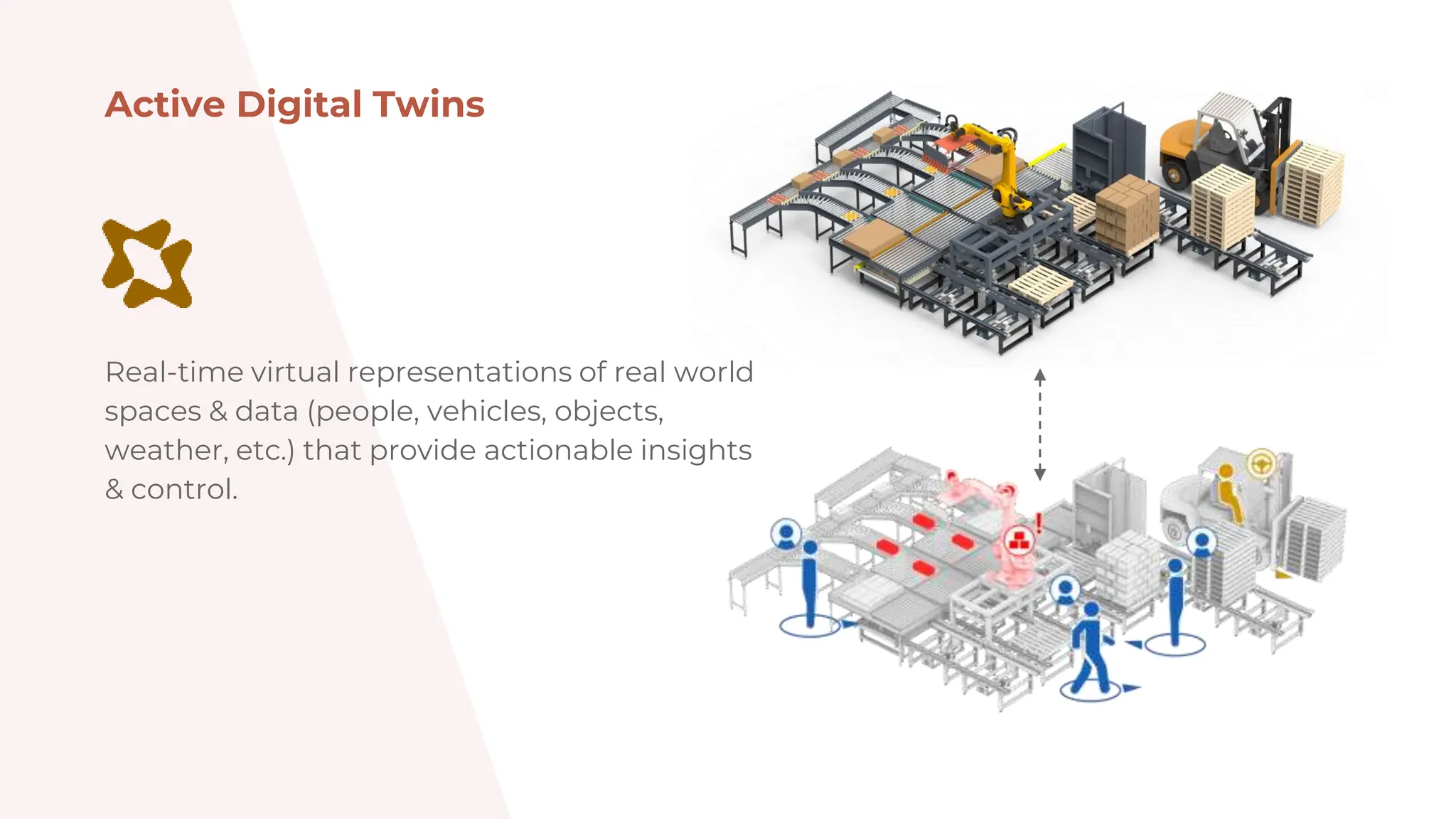
Real-time virtual representations of real world
spaces & data (people, vehicles, objects,
weather, etc.) that provide actionable insights
& control.
Active Digital Twins
Real world representations are easier to process than dashboards.
We evolved to process data that looks like the real world.
Why Active Digital Twins? Faster Context.
Why Active Digital Twins? Lower Cognitive Load.
Traditional Tools: as data increases, cognitive load increases & assessment slows.
Digital Twins: as data increases, cognitive load decreases & assessment speeds up.
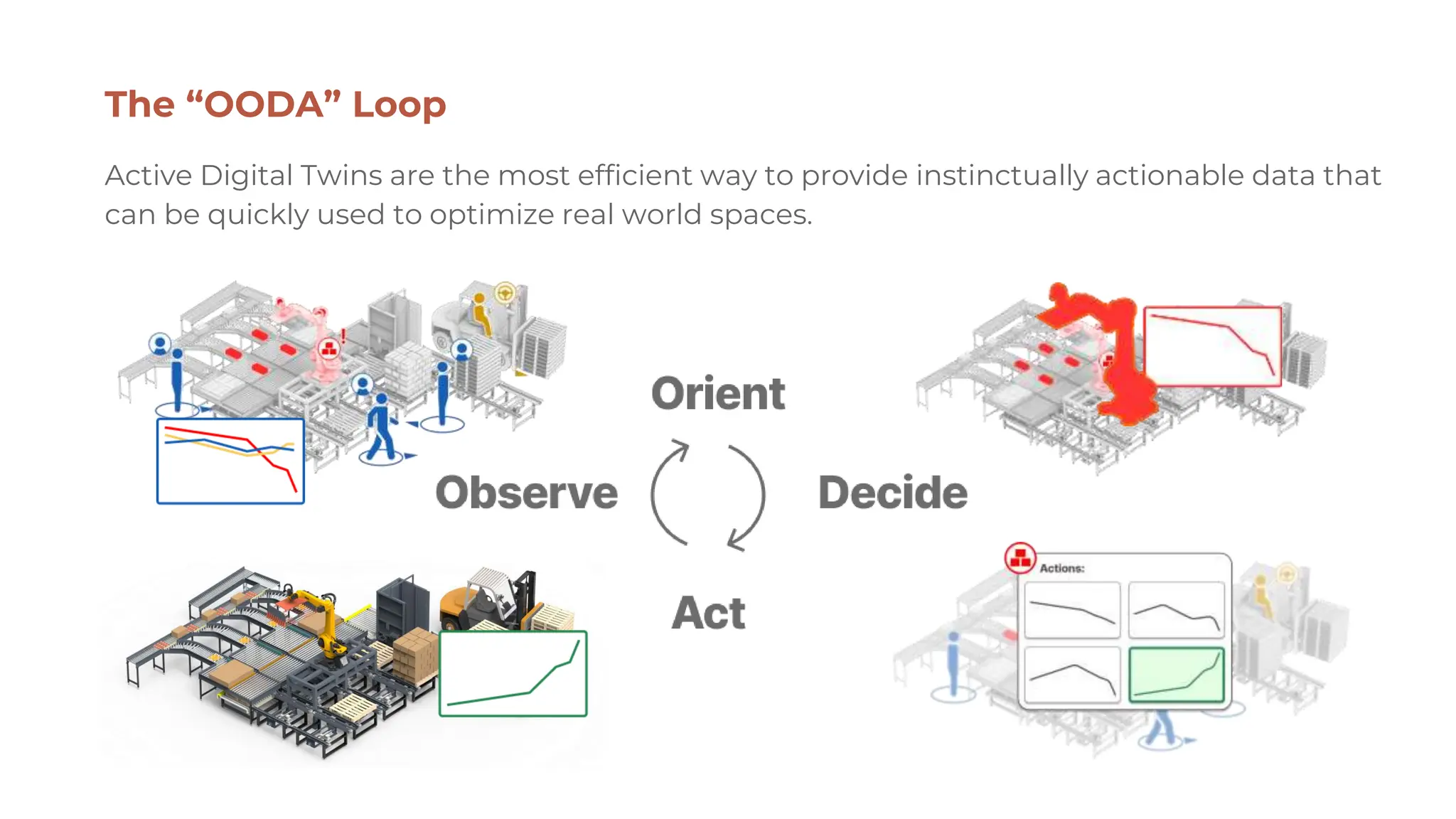
Active Digital Twins are the most efficient way to provide instinctually actionable data that
can be quickly used to optimize real world spaces.
The “OODA” Loop
Active Digital Twins provide data that is
instinctively easier to observe and orient
around because it mimics the real world.
Observe & Orient
Operators use the Active Digital Twin to
take actions to optimize the real world
counterpart to the Digital Twin.
Decide & Act
The Real World counterpart to the Active Digital Twin operates at higher efficiencies
due to the actions taken.
Real World Optimization
Ports, Military Bases, Airports, Utilities, Arenas, Highways,
Autonomous Regions, Flight Paths, Vertiports, & more.
Active Digital Twins are incredibly powerful at multiple scales and solutions ranging
from nursing homes, factories, hotels, & cities.
Multiple Scales & Solutions
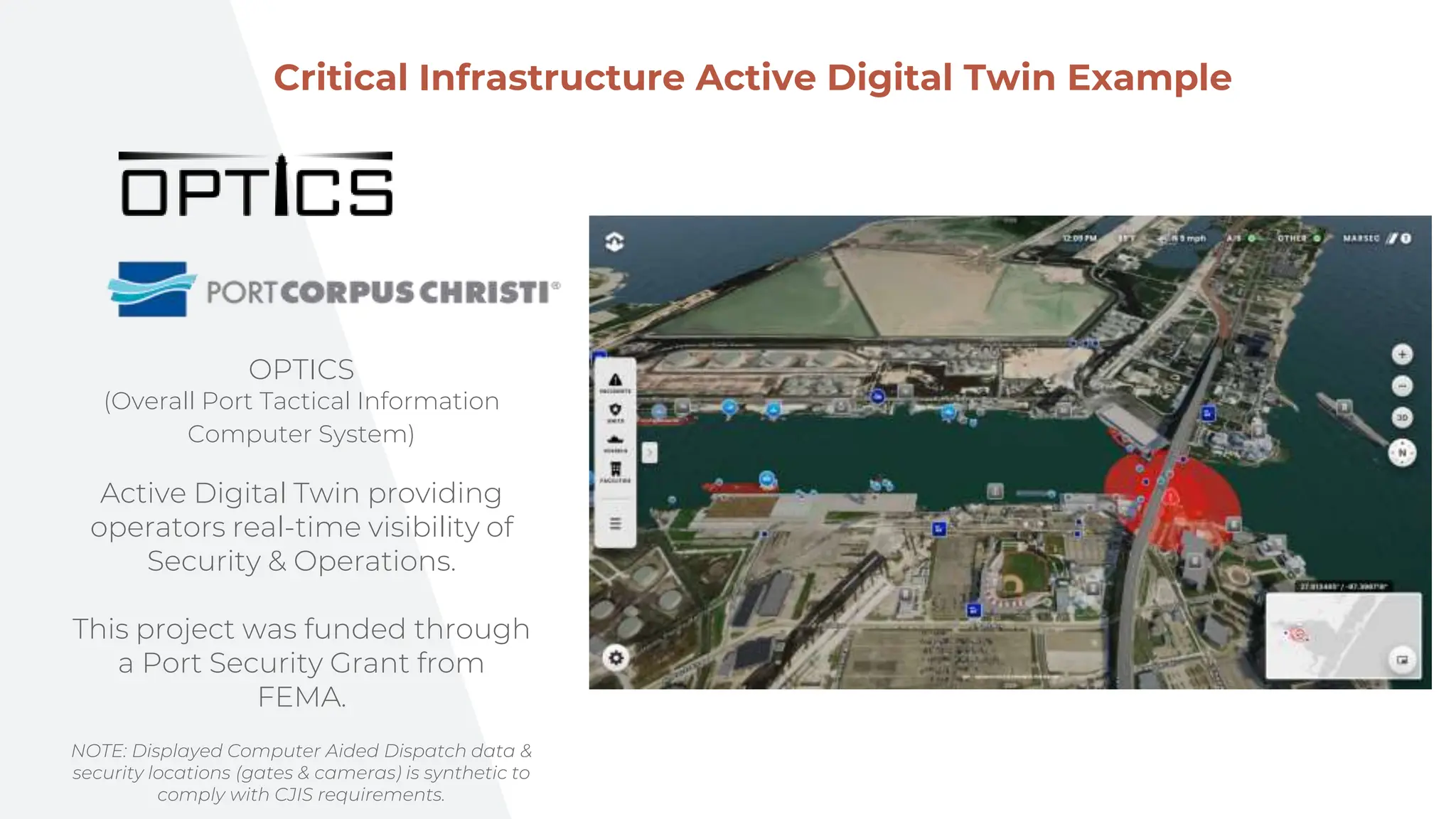
OPTICS
(Overall Port Tactical Information
Computer System)
Active Digital Twin providing
operators real-time visibility of
Security & Operations.
This project was funded through
a Port Security Grant from
FEMA.
NOTE: Displayed Computer Aided Dispatch data &
security locations (gates & cameras) is synthetic to
comply with CJIS requirements.
Critical Infrastructure Active Digital Twin Example
● 1926 Operations Start
● Largest Port in US in Total Revenue Tonnage
● 5th Largest in Total Tonnage
● Nation’s Largest Energy Export Gateway
● Direct Docks, Refineries, Rail, & Highway Access
● 54’ Deep Channel (in process)
Port Stats
Why Active Digital Twin?
● Faster Context Assessment
● Optimizing Cargo Flow
● Optimizing Security Event
Handling
● Single Pane: Merging
Multiple Systems
NOTE: Displayed Computer Aided Dispatch data &
security locations (gates & cameras) is synthetic to
comply with CJIS requirements
Scale
● 50+ Square Miles
● 300+ Vessels
● 20 Security Event Types
● 100+ Facilities
● Expandable to More Data
Map
50 square miles are
displayed using a
combination of ArcGIS
base layers, 3D
buildings, & an ocean
layer to present a highly
detailed & realistic view.
Vessels
AIS transponder data
(names, types, size,
heading, configurations for
tug + barges, etc.) is used
to display 3D models,
movement (ML
predicted) & information
for all vessels.
Vessels
Vessels can be searched,
sorted & filtered in list
view by type, identifiers, &
name.
Security
CJIS Security Compliant
Computer Aided
Dispatch data is used to
display locations & status
of active security
incidents & security units
(vehicles & vessels).
NOTE: Displayed Computer Aided
Dispatch data & security locations
(gates & cameras) is synthetic to
comply with CJIS requirements
Security
NOTE: Displayed
Computer Aided Dispatch
data & security locations
(gates & cameras) is
synthetic to comply with
CJIS requirements
Facilities
All Key Port Facility
Locations (Oil Docks,
Cargo Docks, Admin
Buildings, Security
Cameras, Security Gates,
etc. ) are displayed.
NOTE: Displayed security locations
(gates & cameras) is synthetic data to
comply with CJIS requirements
Current
Features
● ArcGIS Custom Elevation Data: Coastlines & Water Display
● esri / ArcGIS 3D Building Layer: Docks, Buildings,
Refineries, etc.
● esri / ArcGIS Feature Layers: 3 Types
● esri / ArcGIS Maps Base Layers: 6 Types
● esri / ArcGIS Maps SDK for Unity
● Facility Information: Name, Location, Type, Description
● AIS: Vessel Locations, Types, Sizes, Headings, Images
● NOAA Ports: Aid to Navigation Sensor Data
● CAD: Computer Aided Dispatch System
● USCG Marsec level
● Weather.gov: Current Weather & Forecasts
Future
Phases
● AI/ML Ship Traffic Optimization (path projections & safety
zones)
● Cargo Management & Barge Tracking
● Security Cameras & Security Access
● Port Vehicles: Locations / Telemetry
● City & County Boundaries
● Automated Rules, Alerts & Notifications
● Fog, Wave, Wake & Weather Visualizations
● Historical Incident Playback, Simulations & Training
● Infrastructure: Pipelines, Hydrants, Power, etc.
July 2024 Video
NOTE: Displayed Computer Aided
Dispatch data & security locations
(gates & cameras) is synthetic to
comply with CJIS requirements
Active Digital Twins merge multiple systems into a single pane of glass & therefore provide
faster & better overall context assessment.
Active Digital Twins are different from simulation based Digital Twins in that they
present real-time data. Active Digital Twins reduce the cognitive load it takes to
process data while decreasing the amount of time to assess the context.
Summary
Contacts ● The Acceleration Agency:
○ Starr Long: starr@taa.io
● Port of Corpus Christi:
○ Darrell Keach: dkeach@pocca.com
Active Digital Twins: What & Why?

Active Digital Twins for Critical Infrastructure_ What & Why_.pptx

  • 1.
    Active Digital Twinsfor Critical Infrastructure: What & Why?
  • 2.
    Digital Twin Definitions Alldigital twins represent physical spaces / entities & data. They differ in the kinds of data and levels of interaction. Digital Twin (Observation / Simulation): Static / Semi-Static representation of a physical entity. Can include simulated data. Dynamic Digital Twin (Real-Time Observation / Orientation): Continuously updates based on real-time data from physical counterpart. Active Digital Twin (Decision/ Action): Updates in real-time & provides access to control mechanics (messaging, access control, & start/stop, etc.) for decision making. These can include some automation and prediction using AI / ML.
  • 3.
    Real-time virtual representationsof real world spaces & data (people, vehicles, objects, weather, etc.) that provide actionable insights & control. Active Digital Twins
  • 4.
    Real world representationsare easier to process than dashboards. We evolved to process data that looks like the real world. Why Active Digital Twins? Faster Context.
  • 5.
    Why Active DigitalTwins? Lower Cognitive Load. Traditional Tools: as data increases, cognitive load increases & assessment slows. Digital Twins: as data increases, cognitive load decreases & assessment speeds up.
  • 6.
    Active Digital Twinsare the most efficient way to provide instinctually actionable data that can be quickly used to optimize real world spaces. The “OODA” Loop
  • 7.
    Active Digital Twinsprovide data that is instinctively easier to observe and orient around because it mimics the real world. Observe & Orient Operators use the Active Digital Twin to take actions to optimize the real world counterpart to the Digital Twin. Decide & Act
  • 8.
    The Real Worldcounterpart to the Active Digital Twin operates at higher efficiencies due to the actions taken. Real World Optimization
  • 9.
    Ports, Military Bases,Airports, Utilities, Arenas, Highways, Autonomous Regions, Flight Paths, Vertiports, & more. Active Digital Twins are incredibly powerful at multiple scales and solutions ranging from nursing homes, factories, hotels, & cities. Multiple Scales & Solutions
  • 10.
    OPTICS (Overall Port TacticalInformation Computer System) Active Digital Twin providing operators real-time visibility of Security & Operations. This project was funded through a Port Security Grant from FEMA. NOTE: Displayed Computer Aided Dispatch data & security locations (gates & cameras) is synthetic to comply with CJIS requirements. Critical Infrastructure Active Digital Twin Example
  • 11.
    ● 1926 OperationsStart ● Largest Port in US in Total Revenue Tonnage ● 5th Largest in Total Tonnage ● Nation’s Largest Energy Export Gateway ● Direct Docks, Refineries, Rail, & Highway Access ● 54’ Deep Channel (in process) Port Stats
  • 12.
    Why Active DigitalTwin? ● Faster Context Assessment ● Optimizing Cargo Flow ● Optimizing Security Event Handling ● Single Pane: Merging Multiple Systems NOTE: Displayed Computer Aided Dispatch data & security locations (gates & cameras) is synthetic to comply with CJIS requirements
  • 13.
    Scale ● 50+ SquareMiles ● 300+ Vessels ● 20 Security Event Types ● 100+ Facilities ● Expandable to More Data
  • 14.
    Map 50 square milesare displayed using a combination of ArcGIS base layers, 3D buildings, & an ocean layer to present a highly detailed & realistic view.
  • 15.
    Vessels AIS transponder data (names,types, size, heading, configurations for tug + barges, etc.) is used to display 3D models, movement (ML predicted) & information for all vessels.
  • 16.
    Vessels Vessels can besearched, sorted & filtered in list view by type, identifiers, & name.
  • 17.
    Security CJIS Security Compliant ComputerAided Dispatch data is used to display locations & status of active security incidents & security units (vehicles & vessels). NOTE: Displayed Computer Aided Dispatch data & security locations (gates & cameras) is synthetic to comply with CJIS requirements
  • 18.
    Security NOTE: Displayed Computer AidedDispatch data & security locations (gates & cameras) is synthetic to comply with CJIS requirements
  • 19.
    Facilities All Key PortFacility Locations (Oil Docks, Cargo Docks, Admin Buildings, Security Cameras, Security Gates, etc. ) are displayed. NOTE: Displayed security locations (gates & cameras) is synthetic data to comply with CJIS requirements
  • 20.
    Current Features ● ArcGIS CustomElevation Data: Coastlines & Water Display ● esri / ArcGIS 3D Building Layer: Docks, Buildings, Refineries, etc. ● esri / ArcGIS Feature Layers: 3 Types ● esri / ArcGIS Maps Base Layers: 6 Types ● esri / ArcGIS Maps SDK for Unity ● Facility Information: Name, Location, Type, Description ● AIS: Vessel Locations, Types, Sizes, Headings, Images ● NOAA Ports: Aid to Navigation Sensor Data ● CAD: Computer Aided Dispatch System ● USCG Marsec level ● Weather.gov: Current Weather & Forecasts
  • 21.
    Future Phases ● AI/ML ShipTraffic Optimization (path projections & safety zones) ● Cargo Management & Barge Tracking ● Security Cameras & Security Access ● Port Vehicles: Locations / Telemetry ● City & County Boundaries ● Automated Rules, Alerts & Notifications ● Fog, Wave, Wake & Weather Visualizations ● Historical Incident Playback, Simulations & Training ● Infrastructure: Pipelines, Hydrants, Power, etc.
  • 22.
    July 2024 Video NOTE:Displayed Computer Aided Dispatch data & security locations (gates & cameras) is synthetic to comply with CJIS requirements
  • 23.
    Active Digital Twinsmerge multiple systems into a single pane of glass & therefore provide faster & better overall context assessment. Active Digital Twins are different from simulation based Digital Twins in that they present real-time data. Active Digital Twins reduce the cognitive load it takes to process data while decreasing the amount of time to assess the context. Summary
  • 24.
    Contacts ● TheAcceleration Agency: ○ Starr Long: starr@taa.io ● Port of Corpus Christi: ○ Darrell Keach: dkeach@pocca.com Active Digital Twins: What & Why?