Objective: To further our knowledge of genetics using punnet squares.
Specialised Cells
PICTURE TITLE PAGE
New technology : Genetics
Objective: To further our knowledge of genetics using punnet squares.
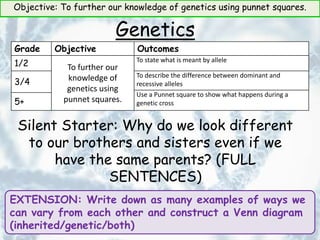
Genetics
Silent Starter: Why do we look different
to our brothers and sisters even if we
have the same parents? (FULL
SENTENCES)
Grade Objective Outcomes
1/2 To further our
knowledge of
genetics using
punnet squares.
To state what is meant by allele
3/4
To describe the difference between dominant and
recessive alleles
Use a Punnet square to show what happens during a
genetic cross
5+
EXTENSION: Write down as many examples of ways we
can vary from each other and construct a Venn diagram
(inherited/genetic/both)
Objective: To further our knowledge of genetics using punnet squares.
What is a gene?
What is an allele?
Objective: To further our knowledge of genetics using punnet squares.
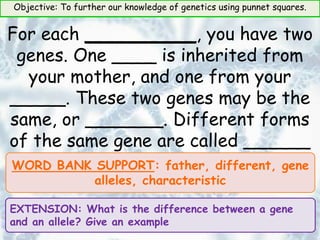
For each __________, you have two
genes. One ____ is inherited from
your mother, and one from your
_____. These two genes may be the
same, or _______. Different forms
of the same gene are called ______
WORD BANK SUPPORT: father, different, gene
alleles, characteristic
EXTENSION: What is the difference between a gene
and an allele? Give an example
Objective: To further our knowledge of genetics using punnet squares.
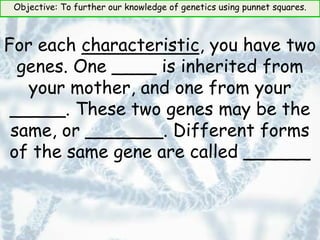
For each characteristic, you have two
genes. One ____ is inherited from
your mother, and one from your
_____. These two genes may be the
same, or _______. Different forms
of the same gene are called ______
Objective: To further our knowledge of genetics using punnet squares.
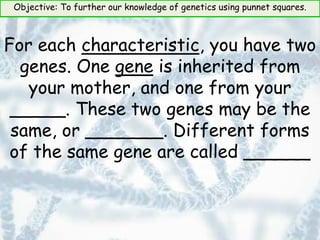
For each characteristic, you have two
genes. One gene is inherited from
your mother, and one from your
_____. These two genes may be the
same, or _______. Different forms
of the same gene are called ______
Objective: To further our knowledge of genetics using punnet squares.
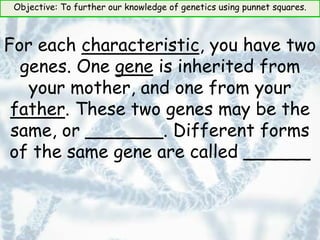
For each characteristic, you have two
genes. One gene is inherited from
your mother, and one from your
father. These two genes may be the
same, or _______. Different forms
of the same gene are called ______
Objective: To further our knowledge of genetics using punnet squares.
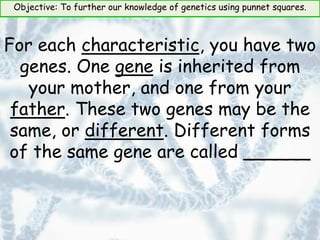
For each characteristic, you have two
genes. One gene is inherited from
your mother, and one from your
father. These two genes may be the
same, or different. Different forms
of the same gene are called ______
Objective: To further our knowledge of genetics using punnet squares.
For each characteristic, you have two
genes. One gene is inherited from
your mother, and one from your
father. These two genes may be the
same, or different. Different forms
of the same gene are called alleles
Objective: To further our knowledge of genetics using punnet squares.
What is the difference between dominant and
recessive?
Answer the video task questions on your sheet
Objective: To further our knowledge of genetics using punnet squares.
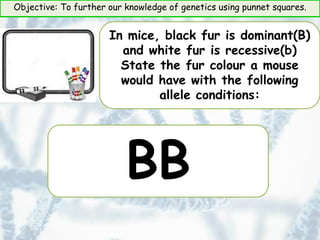
In mice, black fur is dominant(B)
and white fur is recessive(b)
State the fur colour a mouse
would have with the following
allele conditions:
BB
Objective: To further our knowledge of genetics using punnet squares.
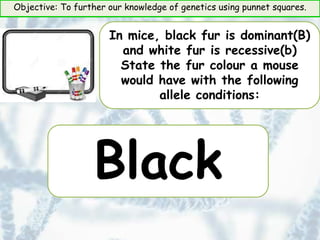
In mice, black fur is dominant(B)
and white fur is recessive(b)
State the fur colour a mouse
would have with the following
allele conditions:
Black
Objective: To further our knowledge of genetics using punnet squares.
In mice, black fur is dominant(B)
and white fur is recessive(b)
State the fur colour a mouse
would have with the following
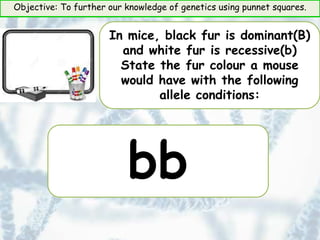
allele conditions:
bb
Objective: To further our knowledge of genetics using punnet squares.
In mice, black fur is dominant(B)
and white fur is recessive(b)
State the fur colour a mouse
would have with the following
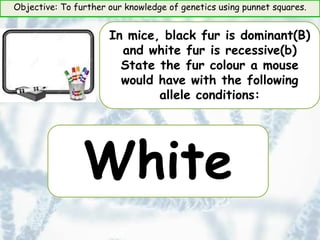
allele conditions:
White
Objective: To further our knowledge of genetics using punnet squares.
In mice, black fur is dominant(B)
and white fur is recessive(b)
State the fur colour a mouse
would have with the following
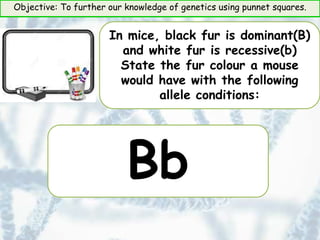
allele conditions:
Bb
Objective: To further our knowledge of genetics using punnet squares.
In mice, black fur is dominant(B)
and white fur is recessive(b)
State the fur colour a mouse
would have with the following
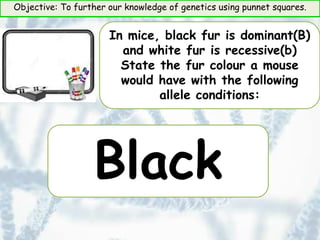
allele conditions:
Black
Objective: To further our knowledge of genetics using punnet squares.
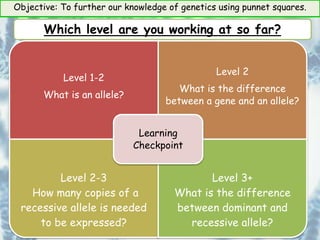
Level 1-2
What is an allele?
Level 2
What is the difference
between a gene and an allele?
Level 2-3
How many copies of a
recessive allele is needed
to be expressed?
Level 3+
What is the difference
between dominant and
recessive allele?
Learning
Checkpoint
Which level are you working at so far?
Objective: To further our knowledge of genetics using punnet squares.
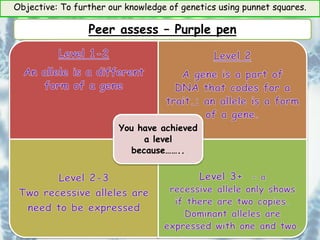
You have achieved
a level
because……..
Peer assess – Purple pen
Objective: To further our knowledge of genetics using punnet squares.
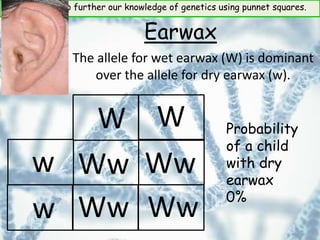
Earwax
The allele for wet earwax (W) is dominant
over the allele for dry earwax (w).
W
w
w
Ww Ww
Ww Ww
Probability
of a child
with dry
earwax
0%
W
Objective: To further our knowledge of genetics using punnet squares.
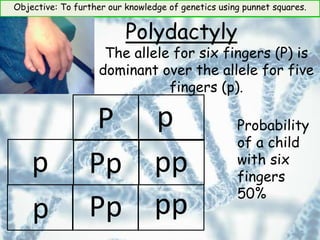
Polydactyly
The allele for six fingers (P) is
dominant over the allele for five
fingers (p).
P
p
p
Pp pp
Pp pp
Probability
of a child
with six
fingers
50%
p
Objective: To further our knowledge of genetics using punnet squares.
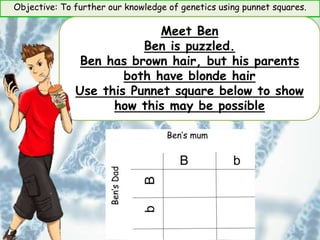
Meet Ben
Ben is puzzled.
Ben has brown hair, but his parents
both have blonde hair
Use this Punnet square below to show
how this may be possible
Objective: To further our knowledge of genetics using punnet squares.
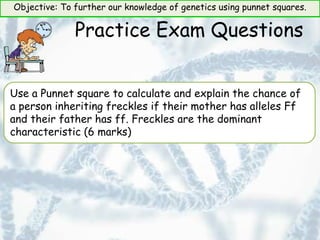
Practice Exam Questions
Use a Punnet square to calculate and explain the chance of
a person inheriting freckles if their mother has alleles Ff
and their father has ff. Freckles are the dominant
characteristic (6 marks)
Objective: To further our knowledge of genetics using punnet squares.
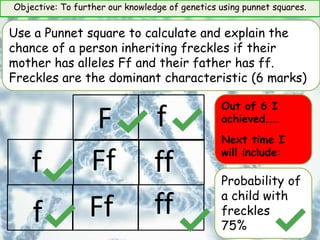
F
f ff
Ff ff
f
Use a Punnet square to calculate and explain the
chance of a person inheriting freckles if their
mother has alleles Ff and their father has ff.
Freckles are the dominant characteristic (6 marks)
f
Ff Probability of
a child with
freckles
75%
Out of 6 I
achieved……
Next time I
will include:
Objective: To further our knowledge of genetics using punnet squares.
Resources
Objective: To further our knowledge of genetics using punnet squares.
Learning
Checkpoint
Objective: To further our knowledge of genetics using punnet squares.
1.
How
many
alleles
are
there
for
every
gene?
2.
Name
two
examples
of
traits,
genes
code
for
3.
What
are
the
different
types
of
allele?
4.
What
is
used
to
represent
to
different
alleles?
5.
If
“F”
is
orange
fur,
list
the
different
allele
pairing
for
orange
or
grey
fur
1.
How
many
alleles
are
there
for
every
gene?
2.
Name
two
examples
of
traits,
genes
code
for
3.
What
are
the
different
types
of
allele?
4.
What
is
used
to
represent
to
different
alleles?
5.
If
“F”
is
orange
fur,
list
the
different
allele
pairing
for
orange
or
grey
fur

Activate-3-B1-Genetics.pptx

  • 1.
    Objective: To furtherour knowledge of genetics using punnet squares. Specialised Cells PICTURE TITLE PAGE New technology : Genetics
  • 2.
    Objective: To furtherour knowledge of genetics using punnet squares. Genetics Silent Starter: Why do we look different to our brothers and sisters even if we have the same parents? (FULL SENTENCES) Grade Objective Outcomes 1/2 To further our knowledge of genetics using punnet squares. To state what is meant by allele 3/4 To describe the difference between dominant and recessive alleles Use a Punnet square to show what happens during a genetic cross 5+ EXTENSION: Write down as many examples of ways we can vary from each other and construct a Venn diagram (inherited/genetic/both)
  • 3.
    Objective: To furtherour knowledge of genetics using punnet squares. What is a gene? What is an allele?
  • 4.
    Objective: To furtherour knowledge of genetics using punnet squares. For each __________, you have two genes. One ____ is inherited from your mother, and one from your _____. These two genes may be the same, or _______. Different forms of the same gene are called ______ WORD BANK SUPPORT: father, different, gene alleles, characteristic EXTENSION: What is the difference between a gene and an allele? Give an example
  • 5.
    Objective: To furtherour knowledge of genetics using punnet squares. For each characteristic, you have two genes. One ____ is inherited from your mother, and one from your _____. These two genes may be the same, or _______. Different forms of the same gene are called ______
  • 6.
    Objective: To furtherour knowledge of genetics using punnet squares. For each characteristic, you have two genes. One gene is inherited from your mother, and one from your _____. These two genes may be the same, or _______. Different forms of the same gene are called ______
  • 7.
    Objective: To furtherour knowledge of genetics using punnet squares. For each characteristic, you have two genes. One gene is inherited from your mother, and one from your father. These two genes may be the same, or _______. Different forms of the same gene are called ______
  • 8.
    Objective: To furtherour knowledge of genetics using punnet squares. For each characteristic, you have two genes. One gene is inherited from your mother, and one from your father. These two genes may be the same, or different. Different forms of the same gene are called ______
  • 9.
    Objective: To furtherour knowledge of genetics using punnet squares. For each characteristic, you have two genes. One gene is inherited from your mother, and one from your father. These two genes may be the same, or different. Different forms of the same gene are called alleles
  • 10.
    Objective: To furtherour knowledge of genetics using punnet squares. What is the difference between dominant and recessive? Answer the video task questions on your sheet
  • 11.
    Objective: To furtherour knowledge of genetics using punnet squares. In mice, black fur is dominant(B) and white fur is recessive(b) State the fur colour a mouse would have with the following allele conditions: BB
  • 12.
    Objective: To furtherour knowledge of genetics using punnet squares. In mice, black fur is dominant(B) and white fur is recessive(b) State the fur colour a mouse would have with the following allele conditions: Black
  • 13.
    Objective: To furtherour knowledge of genetics using punnet squares. In mice, black fur is dominant(B) and white fur is recessive(b) State the fur colour a mouse would have with the following allele conditions: bb
  • 14.
    Objective: To furtherour knowledge of genetics using punnet squares. In mice, black fur is dominant(B) and white fur is recessive(b) State the fur colour a mouse would have with the following allele conditions: White
  • 15.
    Objective: To furtherour knowledge of genetics using punnet squares. In mice, black fur is dominant(B) and white fur is recessive(b) State the fur colour a mouse would have with the following allele conditions: Bb
  • 16.
    Objective: To furtherour knowledge of genetics using punnet squares. In mice, black fur is dominant(B) and white fur is recessive(b) State the fur colour a mouse would have with the following allele conditions: Black
  • 17.
    Objective: To furtherour knowledge of genetics using punnet squares. Level 1-2 What is an allele? Level 2 What is the difference between a gene and an allele? Level 2-3 How many copies of a recessive allele is needed to be expressed? Level 3+ What is the difference between dominant and recessive allele? Learning Checkpoint Which level are you working at so far?
  • 18.
    Objective: To furtherour knowledge of genetics using punnet squares. You have achieved a level because…….. Peer assess – Purple pen
  • 19.
    Objective: To furtherour knowledge of genetics using punnet squares. Earwax The allele for wet earwax (W) is dominant over the allele for dry earwax (w). W w w Ww Ww Ww Ww Probability of a child with dry earwax 0% W
  • 20.
    Objective: To furtherour knowledge of genetics using punnet squares. Polydactyly The allele for six fingers (P) is dominant over the allele for five fingers (p). P p p Pp pp Pp pp Probability of a child with six fingers 50% p
  • 21.
    Objective: To furtherour knowledge of genetics using punnet squares. Meet Ben Ben is puzzled. Ben has brown hair, but his parents both have blonde hair Use this Punnet square below to show how this may be possible
  • 22.
    Objective: To furtherour knowledge of genetics using punnet squares. Practice Exam Questions Use a Punnet square to calculate and explain the chance of a person inheriting freckles if their mother has alleles Ff and their father has ff. Freckles are the dominant characteristic (6 marks)
  • 23.
    Objective: To furtherour knowledge of genetics using punnet squares. F f ff Ff ff f Use a Punnet square to calculate and explain the chance of a person inheriting freckles if their mother has alleles Ff and their father has ff. Freckles are the dominant characteristic (6 marks) f Ff Probability of a child with freckles 75% Out of 6 I achieved…… Next time I will include:
  • 24.
    Objective: To furtherour knowledge of genetics using punnet squares. Resources
  • 25.
    Objective: To furtherour knowledge of genetics using punnet squares. Learning Checkpoint
  • 26.
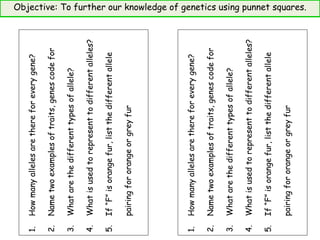
    Objective: To furtherour knowledge of genetics using punnet squares. 1. How many alleles are there for every gene? 2. Name two examples of traits, genes code for 3. What are the different types of allele? 4. What is used to represent to different alleles? 5. If “F” is orange fur, list the different allele pairing for orange or grey fur 1. How many alleles are there for every gene? 2. Name two examples of traits, genes code for 3. What are the different types of allele? 4. What is used to represent to different alleles? 5. If “F” is orange fur, list the different allele pairing for orange or grey fur