#StatLit #ACRL2017
"This roundtable aims to transform existing notions about
statistical literacy in library instruction. We will facilitate an in-
person and real-time virtual dialogue via Twitter and Periscope
about teaching students concepts such as mean vs. median,
and the real implications of "statistical significance." Special
emphasis will be placed on how data is contextualized within
the journal literature. The goal is to inspire transformational
thinking for teaching basic statistical reasoning to students
within a library context."
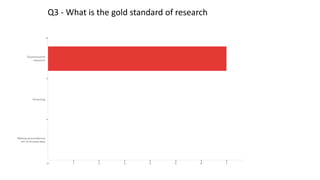
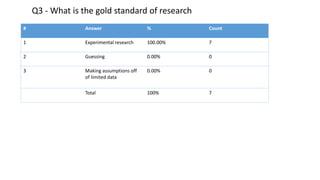
Q3 - What is the gold standard of research
# Answer % Count
1 Experimental research 100.00% 7
2 Guessing 0.00% 0
3 Making assumptions off
of limited data
0.00% 0
Total 100% 7
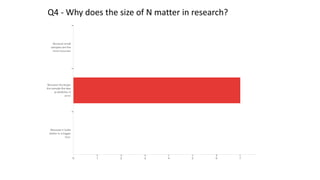
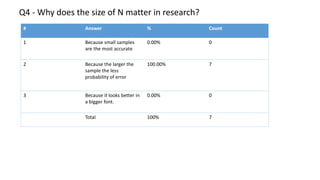
Q4 - Why does the size of N matter in research?
# Answer % Count
1 Because small samples
are the most accurate
0.00% 0
2 Because the larger the
sample the less
probability of error
100.00% 7
3 Because it looks better in
a bigger font.
0.00% 0
Total 100% 7
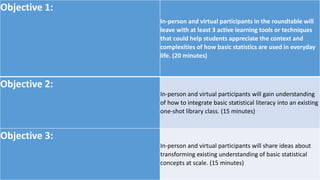
Objective 1:
In-person and virtual participants in the roundtable will
leave with at least 3 active learning tools or techniques
that could help students appreciate the context and
complexities of how basic statistics are used in everyday
life. (20 minutes)
Objective 2:
In-person and virtual participants will gain understanding
of how to integrate basic statistical literacy into an existing
one-shot library class. (15 minutes)
Objective 3:
In-person and virtual participants will share ideas about
transforming existing understanding of basic statistical
concepts at scale. (15 minutes)
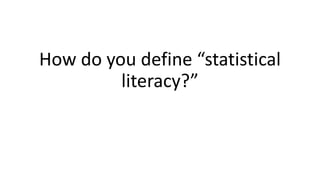
How do you define “statistical
literacy?”
What tools and techniques have you
employed in the classroom to help
student appreciate the context and
complexities of how basic statistics are
used in everyday life?
What are efficient tactics to
integrate basic statistical literacy
into a 50 minute one-shot
instruction session?
Research suggests that statistical
literacy is a problem across the
country How can we integrate stat lit
into our existing information literacy
framework and scale up across an
entire institution? Nationally?

ACRL statistical literacy

  • 1.
    #StatLit #ACRL2017 "This roundtableaims to transform existing notions about statistical literacy in library instruction. We will facilitate an in- person and real-time virtual dialogue via Twitter and Periscope about teaching students concepts such as mean vs. median, and the real implications of "statistical significance." Special emphasis will be placed on how data is contextualized within the journal literature. The goal is to inspire transformational thinking for teaching basic statistical reasoning to students within a library context."
  • 6.
    Q3 - Whatis the gold standard of research
  • 7.
    Q3 - Whatis the gold standard of research # Answer % Count 1 Experimental research 100.00% 7 2 Guessing 0.00% 0 3 Making assumptions off of limited data 0.00% 0 Total 100% 7
  • 8.
    Q4 - Whydoes the size of N matter in research?
  • 9.
    Q4 - Whydoes the size of N matter in research? # Answer % Count 1 Because small samples are the most accurate 0.00% 0 2 Because the larger the sample the less probability of error 100.00% 7 3 Because it looks better in a bigger font. 0.00% 0 Total 100% 7
  • 10.
    Objective 1: In-person andvirtual participants in the roundtable will leave with at least 3 active learning tools or techniques that could help students appreciate the context and complexities of how basic statistics are used in everyday life. (20 minutes) Objective 2: In-person and virtual participants will gain understanding of how to integrate basic statistical literacy into an existing one-shot library class. (15 minutes) Objective 3: In-person and virtual participants will share ideas about transforming existing understanding of basic statistical concepts at scale. (15 minutes)
  • 12.
    How do youdefine “statistical literacy?”
  • 13.
    What tools andtechniques have you employed in the classroom to help student appreciate the context and complexities of how basic statistics are used in everyday life?
  • 14.
    What are efficienttactics to integrate basic statistical literacy into a 50 minute one-shot instruction session?
  • 15.
    Research suggests thatstatistical literacy is a problem across the country How can we integrate stat lit into our existing information literacy framework and scale up across an entire institution? Nationally?

Editor's Notes

  • #3 https://www.sciencedaily.com/releases/2012/06/120619225941.htm Resveratrol, an antioxidant found in red wine, has beneficial effects on cardiac and skeletal muscle function, similar to the effects of endurance exercise training.• Combining resveratrol supplementation with exercise training augments the beneficial effects of exercise alone.• We show that endurance capacity is enhanced in rats whose diet includes resveratrol during a 12 week endurance-training programme.• Increased endurance was associated with increases in skeletal muscle force, cardiac function, and oxidative metabolism.• Our results establish that resveratrol is an effective ergogenic aid that enhances exercise performance over exercise alone. But now this is immediately generalized without looking at sampel
  • #4 Money ball uses data and statistical inference to analyze inefficiency in the game. Substituted the eye test for OBP.
  • #5 The NBA has gamed the math and realized that it is 3’s and layups. They also realize that statistics can help forecasting, and find effective underused players.
  • #7 Just a start of what we are doing, ignore data size, not generalizing
  • #10 Small sample size but we are starting to see our students are retaining this.
  • #13 How do you define it in librarianship.
  • #14 Reference baseball, money ball, and politics. Lots of students are in medical studies, e.g., reflect on limitations in replication of studies.
  • #15 Compare two articles One s low quality, low N Vs high quality statistical inference Think pair share.
  • #16 Potential ideas: Statistical literacy conference. Potentially a journal. A core section of the framework.