Shaping the Future
HOWCAN
TO ACHIEVEHIGHERPROFITSNOW?
YOURBUSINESSUSE AI
As the technologies behind artificial intelligence (AI) become
increasingly affordable, the time for companies to capitalize on
AI has arrived. AI will add an estimated $13 trillion to the global
economy over the next decade, according to Harvard Business
Review (HBR).[X]
Research suggests that next-generation
enterprise IT systems that include AI components — called
“future systems” — will grow revenues among leading
companies by as much as 33% over the next five years.[X]
INTRODUCTION
www.fingent.com Copyright © Fingent
2
Moving from data-driven to AI-driven
digital environments is the next
evolutionary phase in business. As the
applications for AI span dozens of
industries, 75% of global companies
today are driven to AI by a fear of
disruption from their data-driven
competitors.[X]
By embracing AI into their
workflows in strategic ways, business
leaders will transform how data adds
value to the business. They will introduce
new ways for humans to contribute as
well.
As of 2019, 80% of large companies have
adopted machine learning and other
forms of AI into their core business
processes — up from 10% just five years
before.[X]
But company leaders must
understand the basics of AI and what
value it can offer in the context of their
own organizations before they consider
adoption. What’s more, business leaders
must outline a clear strategy and break
down sizable cultural and organizational
barriers for their AI initiatives to succeed.
www.fingent.com Copyright © Fingent
3
IBM defines artificial intelligence (AI)
simply as “a program that can sense,
reason, act, and adopt.”[X]
As opposed
to machine learning, which improves
how it performs specific tasks over
time, it is the algorithms associated
with AI that improve their performance
as they are exposed to more and more
data. AI features multi-layered neural
networks, which make learning from
data and adapting their responses
possible.
Despite concerns about replacing
human beings, AI solutions are
designed to work alongside diverse,
decision-making employees in their
own interests. Humans can use AI to
make decisions alongside other
contextual factors, such as their
experiences or cultural norms.
Humans can interface with AI to easily
perceive and understand its decision
processes so that they can
successfully collaborate and drive
desirable outcomes.
UNDERSTANDING
THEBASICSOF AI
As AI adoption grows in the business
world, the barriers to AI adoption have
fallen among a wide range of products,
services, and applications — and more
and more uses continue to emerge.
www.fingent.com Copyright © Fingent
4
As business leaders consider AI
for their organizations, the top
question is no longer “What is
AI?” or “How does it work?” but
“What can it do for us?”
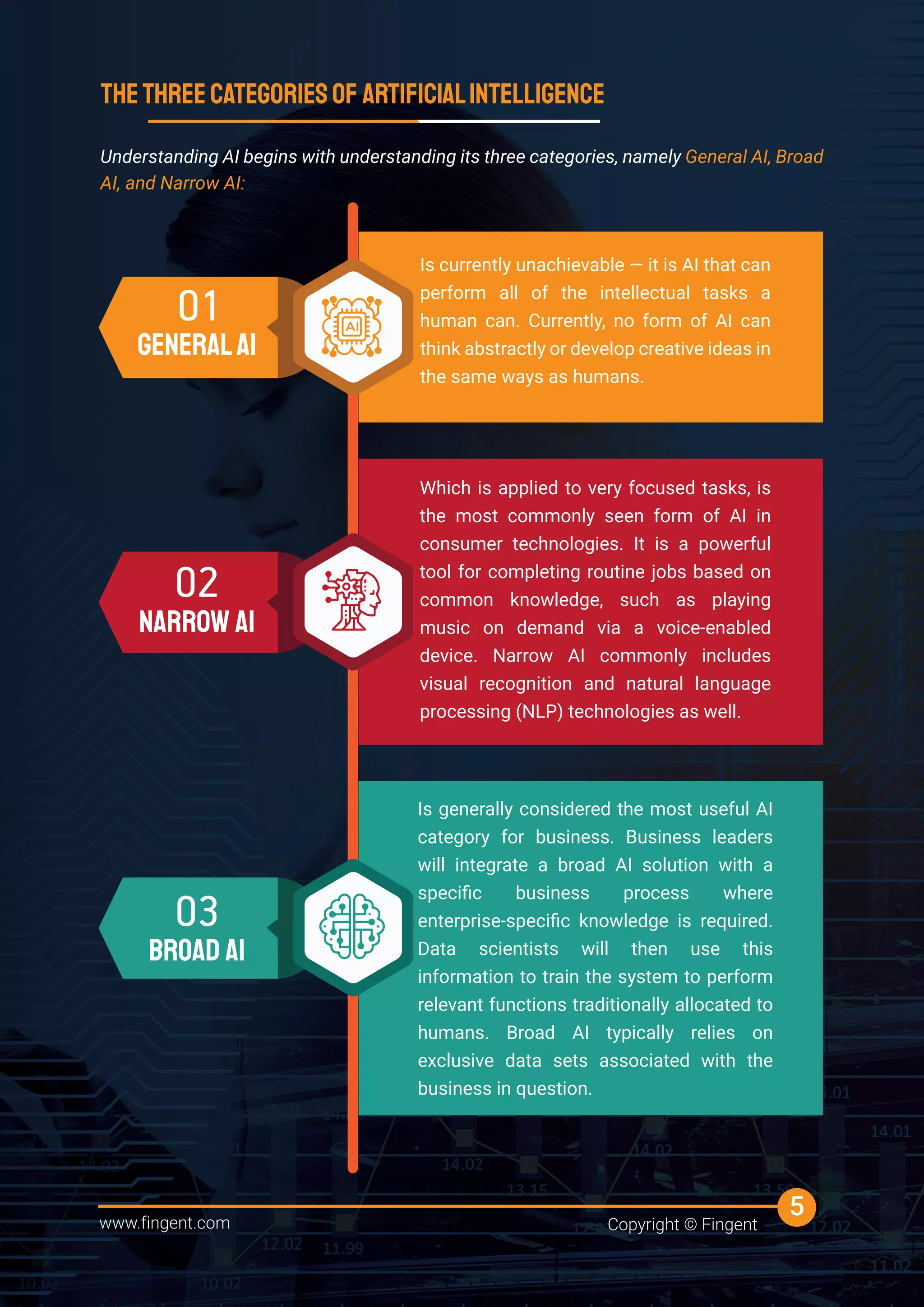
Understanding AI begins with understanding its three categories, namely General AI, Broad
AI, and Narrow AI:
www.fingent.com Copyright © Fingent
5
THETHREECATEGORIESOF ARTIFICIALINTELLIGENCE
GENERALAI
Is currently unachievable — it is AI that can
perform all of the intellectual tasks a
human can. Currently, no form of AI can
think abstractly or develop creative ideas in
the same ways as humans.
NARROW AI
Which is applied to very focused tasks, is
the most commonly seen form of AI in
consumer technologies. It is a powerful
tool for completing routine jobs based on
common knowledge, such as playing
music on demand via a voice-enabled
device. Narrow AI commonly includes
visual recognition and natural language
processing (NLP) technologies as well.
Is generally considered the most useful AI
category for business. Business leaders
will integrate a broad AI solution with a
specific business process where
enterprise-specific knowledge is required.
Data scientists will then use this
information to train the system to perform
relevant functions traditionally allocated to
humans. Broad AI typically relies on
exclusive data sets associated with the
business in question.
BROAD AI
AI has already exceeded human intelligence in
specific areas, which has led to our current
paradigm for AI in business — that of “deployed
AI.” Deployed AI is the automation of a major
business component that solves real problems
for customers, employees, or both, in new, better,
and more efficient ways.
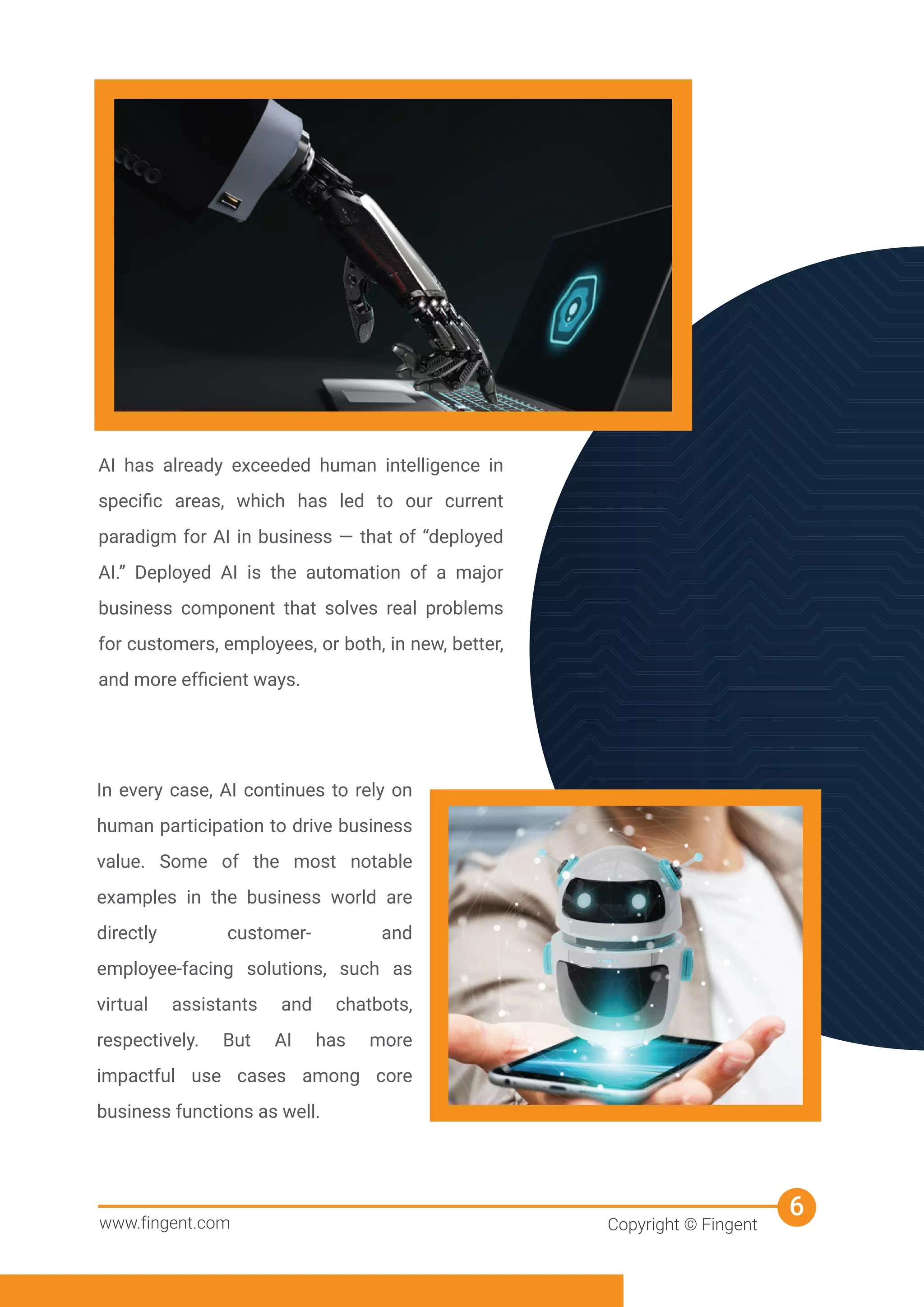
In every case, AI continues to rely on
human participation to drive business
value. Some of the most notable
examples in the business world are
directly customer- and
employee-facing solutions, such as
virtual assistants and chatbots,
respectively. But AI has more
impactful use cases among core
business functions as well.
www.fingent.com Copyright © Fingent
6
IDENTIFYINGBUSINESSCAPABILITIES
ANDOPPORTUNITIESWITH AI
Organizations currently working with AI
or machine learning already have four
projects in place on average, according
to Gartner; they expect to add six more
projects within the next 12 months.[X]
That’s because as AI’s computing
power grows, the number of use cases
for AI grows with it.
Now, companies are moving quickly to
implement their own AI solutions, to
realize its high potential value, and to
achieve a competitive edge. Unlike
other automated solutions,
organizations building AI-powered
future systems are doing so in a
systematic way — they are capturing
growth today, but anticipating changes
for tomorrow with an adaptable IT
architecture. As HBR reports — and
unlike traditional business
technologies — these companies are
preparing technology to empower
future workers with easier and
natural-feeling activities:
IDENTIFYINGBUSINESSCAPABILITIES
www.fingent.com Copyright © Fingent
7
The leading companies in our
research recognize that AI
now allows them to build
systems that talk, listen, see,
and understand much the way
we do. They know that
tomorrow’s advantage will go
to those who design systems
that adjust to people — not
those who continue to expect
people to adjust to systems.[X]
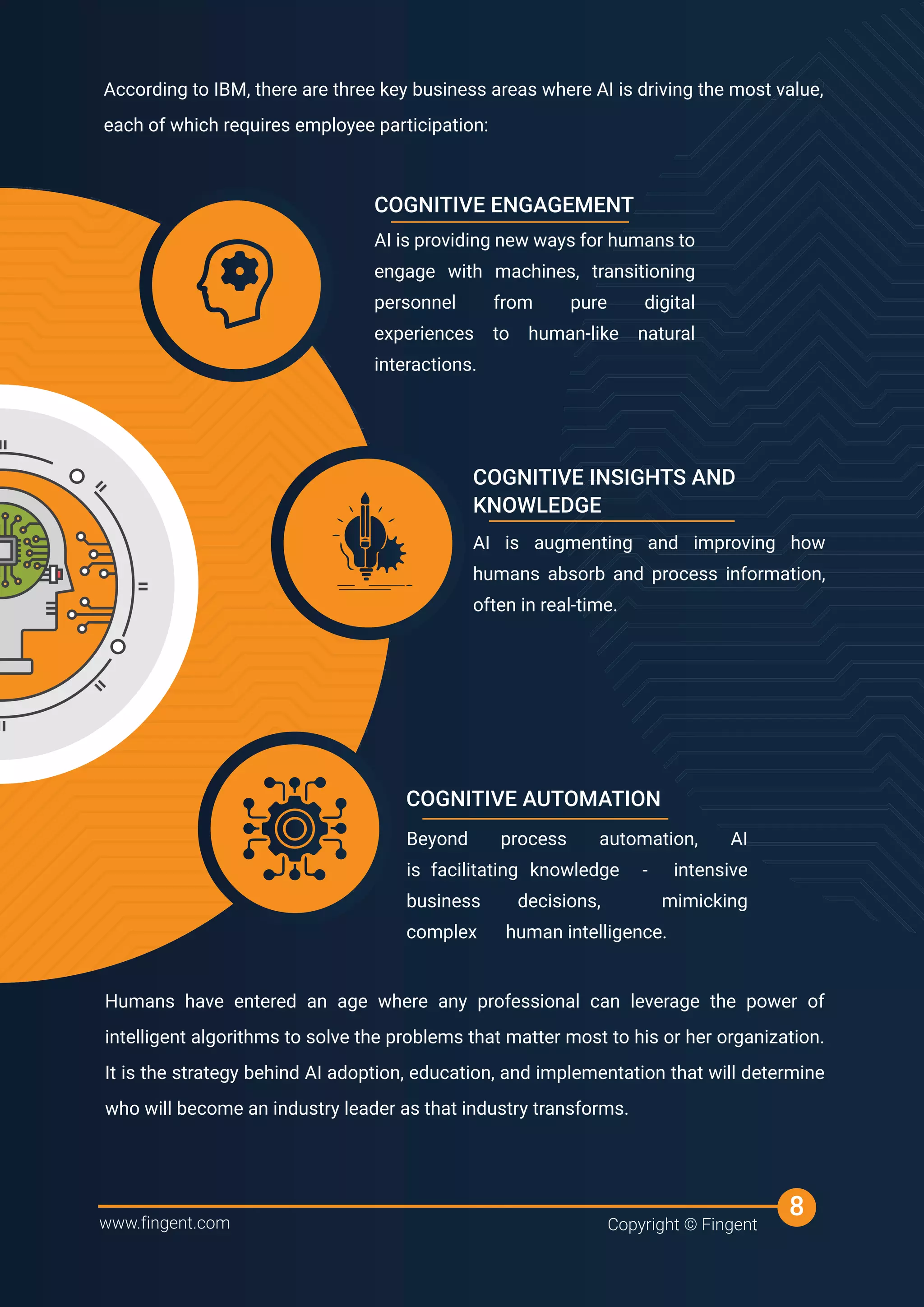
According to IBM, there are three key business areas where AI is driving the most value,
each of which requires employee participation:
According to IBM, there are three key business areas where AI is driving the most value,
Humans have entered an age where any professional can leverage the power of
intelligent algorithms to solve the problems that matter most to his or her organization.
It is the strategy behind AI adoption, education, and implementation that will determine
who will become an industry leader as that industry transforms.
AI is providing new ways for humans to
engage with machines, transitioning
personnel from pure digital
experiences to human-like natural
interactions.
COGNITIVE ENGAGEMENT
AI is augmenting and improving how
humans absorb and process information,
often in real-time.
COGNITIVE INSIGHTS AND
KNOWLEDGE
Beyond process automation, AI
is facilitating knowledge - intensive
business decisions, mimicking
complex human intelligence.
COGNITIVE AUTOMATION
www.fingent.com Copyright © Fingent
8
HOWTOBUILD A
SUCCESSFULAISTRATEGY
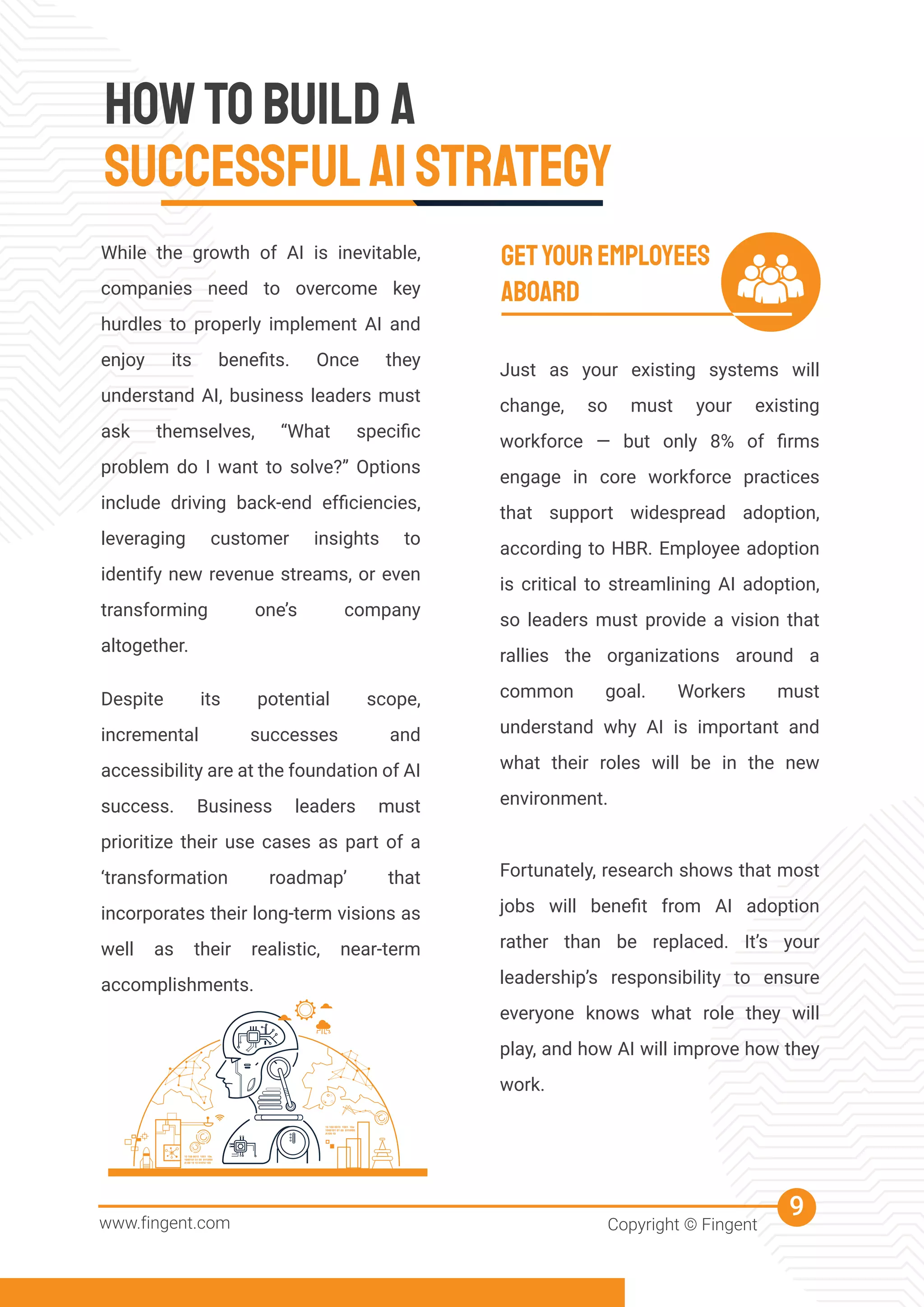
While the growth of AI is inevitable,
companies need to overcome key
hurdles to properly implement AI and
enjoy its benefits. Once they
understand AI, business leaders must
ask themselves, “What specific
problem do I want to solve?” Options
include driving back-end efficiencies,
leveraging customer insights to
identify new revenue streams, or even
transforming one’s company
altogether.
Just as your existing systems will
change, so must your existing
workforce — but only 8% of firms
engage in core workforce practices
that support widespread adoption,
according to HBR. Employee adoption
is critical to streamlining AI adoption,
so leaders must provide a vision that
rallies the organizations around a
common goal. Workers must
understand why AI is important and
what their roles will be in the new
environment.
Fortunately, research shows that most
jobs will benefit from AI adoption
rather than be replaced. It’s your
leadership’s responsibility to ensure
everyone knows what role they will
play, and how AI will improve how they
work.
Despite its potential scope,
incremental successes and
accessibility are at the foundation of AI
success. Business leaders must
prioritize their use cases as part of a
‘transformation roadmap’ that
incorporates their long-term visions as
well as their realistic, near-term
accomplishments.
GETYOUREMPLOYEES
ABOARD
www.fingent.com Copyright © Fingent
9
Employees at all levels of your organization must understand how AI will impact the
business. This includes business leaders, who need a high-level understanding of how
your AI solutions will work and the means to identify and prioritize opportunities for
future solutions. If non- technical users will interface with AI in some way, they must
receive a general introduction to those tools alongside training, where necessary.
Meanwhile, those in technical roles must understand all the relevant features and
functionalities of your new solutions. You may need to task some technical users with
translating these features and benefits to others. Even your customers may benefit from
knowing something about the value they can expect as a result of AI adoption.
EDUCATE ALLTEAMMEMBERS
BEREALISTIC—FOCUSONINCREMENTALVALUE
BUDGET APPROPRIATELY—NOTJUSTFORTHE
TECHNOLOGYITSELF
HBR found that 90% of companies that engaged in successful scaling of AI had spent
more than half of their analytics budgets on activities that drove adoption, including
workforce redesign, communication, and training.[X]
Companies may face additional
delays and costs associated with overcoming cultural barriers within the organization as
well. Anticipate costs well in excess of the technology investment itself before
implementing.
Your ‘roadmap’ should include a portfolio of near-term and long-term initiatives, all of
themaligned to meet a unified long-term goal. Start with initiatives that will deliver
returns in months,rather than years, and that require the least amount of human
involvement. These willencounter the least amount of resistance and deliver a
successful use case for yourorganization in a shorter time frame. You can leverage initial
successes internally as you look todeliver on the rest of your AI investments.
www.fingent.com Copyright © Fingent
10
THESIMPLESTWAYTO
INTEGRATE AIFORYOURBUSINESS
Now that you’ve cultivated the right support and created a
strategy for AI adoption, you can begin implementing AI
within your organization. Here are the key steps to getting
started with your first initiative, including tips on how to
scale future projects.
As indicated, avoid starting with large-scale, complex AI
projects that pose substantial risk. Begin with a single
project or set of projects for which you expect to see
results in the first two to three months. Partner with an AI
implementation expert to develop your first solutions in a
timely way.
INTEGRATE AIFORYOURBUSINESS
DEVELOPYOURFIRST,SMALL-SCALE
SOLUTION
01
For your first project, define KPIs that are easy for relevant
employees and stakeholders to recognize. These KPIs
should indicate real business value so that all parties can
determine if the solution is successful.
SET ACHIEVABLE AND
UNDERSTANDABLEPERFORMANCE
METRICS
02
www.fingent.com Copyright © Fingent
11
Now that you’ve formalized the success of your first
project, share your success with the entire organization —
especially departments for which you will roll out AI
solutions in the future. You can begin transforming your
company culture as you prepare your next launch.
TRANSMITYOURSUCCESS
03
Now that employees are responding to the success of
your first solution, prepare them for a culture in which
interdisciplinary communication and insights-driven
decision making are the norm. You will transition away
from a top-down, hierarchical culture to ensure data
scientists, technical users, and regular business users
can coordinate and ensure your solutions succeed.
REPRIORITIZECOLLABORATION AND
DATA-DRIVENDECISIONMAKING
04
As you begin scaling out additional projects, ensure your
teams adopt a test mentality, one in which team members
act upon insights independently. In time, every employee
in your organization will interface with AI in some way —
be sure they’re prepared to collaborate with their new AI
‘colleagues.’
CREATE AN AI-ADAPTABLEWORK
ENVIRONMENT
05
www.fingent.com Copyright © Fingent
12
CONCLUSION:GETTING
LEADERSHIPBEHIND AI ADOPTION
Although AI is far from widespread adoption, over half of technology executives in 2019
claim they intend to employ AI before the end of 2020.[X]
Business leaders who fail to
consider how AI will transform their industries will fall behind.
In a world where smart machines augment human work, board members and C-suite
executives need a working understanding of AI before they define how they will
implement it successfully within their organizations. Fingent provides technology
solutions that ensure that the technical implementation and strategic adoption of AI
builds toward their long-term goals. Connect with our AI experts today to start a
conversation about your first initiative.
www.fingent.com Copyright © Fingent
12
develop scalable, secure and
easy-to-use web applications that
work across multiple devices. We
believe that the judicious use of
technology, together with a good
design can reduce complexity,
connect individuals, and provide
valuable insights, all of which
ultimately help businesses succeed.
ABOUTFINGENT
We are a global IT company providing
strategic IT business solutions and
services for complex business
problems, in multiple industry sectors
including retail, healthcare, finance,
education and more. Our vast
technology and industry expertise
enable us to focus on cutting-edge
internet technologies with the aim to

Achieve higher-business-growth-profits-with-artificial-intelligence

  • 1.
    Shaping the Future HOWCAN TOACHIEVEHIGHERPROFITSNOW? YOURBUSINESSUSE AI
  • 2.
    As the technologiesbehind artificial intelligence (AI) become increasingly affordable, the time for companies to capitalize on AI has arrived. AI will add an estimated $13 trillion to the global economy over the next decade, according to Harvard Business Review (HBR).[X] Research suggests that next-generation enterprise IT systems that include AI components — called “future systems” — will grow revenues among leading companies by as much as 33% over the next five years.[X] INTRODUCTION www.fingent.com Copyright © Fingent 2
  • 3.
    Moving from data-drivento AI-driven digital environments is the next evolutionary phase in business. As the applications for AI span dozens of industries, 75% of global companies today are driven to AI by a fear of disruption from their data-driven competitors.[X] By embracing AI into their workflows in strategic ways, business leaders will transform how data adds value to the business. They will introduce new ways for humans to contribute as well. As of 2019, 80% of large companies have adopted machine learning and other forms of AI into their core business processes — up from 10% just five years before.[X] But company leaders must understand the basics of AI and what value it can offer in the context of their own organizations before they consider adoption. What’s more, business leaders must outline a clear strategy and break down sizable cultural and organizational barriers for their AI initiatives to succeed. www.fingent.com Copyright © Fingent 3
  • 4.
    IBM defines artificialintelligence (AI) simply as “a program that can sense, reason, act, and adopt.”[X] As opposed to machine learning, which improves how it performs specific tasks over time, it is the algorithms associated with AI that improve their performance as they are exposed to more and more data. AI features multi-layered neural networks, which make learning from data and adapting their responses possible. Despite concerns about replacing human beings, AI solutions are designed to work alongside diverse, decision-making employees in their own interests. Humans can use AI to make decisions alongside other contextual factors, such as their experiences or cultural norms. Humans can interface with AI to easily perceive and understand its decision processes so that they can successfully collaborate and drive desirable outcomes. UNDERSTANDING THEBASICSOF AI As AI adoption grows in the business world, the barriers to AI adoption have fallen among a wide range of products, services, and applications — and more and more uses continue to emerge. www.fingent.com Copyright © Fingent 4 As business leaders consider AI for their organizations, the top question is no longer “What is AI?” or “How does it work?” but “What can it do for us?”
  • 5.
    Understanding AI beginswith understanding its three categories, namely General AI, Broad AI, and Narrow AI: www.fingent.com Copyright © Fingent 5 THETHREECATEGORIESOF ARTIFICIALINTELLIGENCE GENERALAI Is currently unachievable — it is AI that can perform all of the intellectual tasks a human can. Currently, no form of AI can think abstractly or develop creative ideas in the same ways as humans. NARROW AI Which is applied to very focused tasks, is the most commonly seen form of AI in consumer technologies. It is a powerful tool for completing routine jobs based on common knowledge, such as playing music on demand via a voice-enabled device. Narrow AI commonly includes visual recognition and natural language processing (NLP) technologies as well. Is generally considered the most useful AI category for business. Business leaders will integrate a broad AI solution with a specific business process where enterprise-specific knowledge is required. Data scientists will then use this information to train the system to perform relevant functions traditionally allocated to humans. Broad AI typically relies on exclusive data sets associated with the business in question. BROAD AI
  • 6.
    AI has alreadyexceeded human intelligence in specific areas, which has led to our current paradigm for AI in business — that of “deployed AI.” Deployed AI is the automation of a major business component that solves real problems for customers, employees, or both, in new, better, and more efficient ways. In every case, AI continues to rely on human participation to drive business value. Some of the most notable examples in the business world are directly customer- and employee-facing solutions, such as virtual assistants and chatbots, respectively. But AI has more impactful use cases among core business functions as well. www.fingent.com Copyright © Fingent 6
  • 7.
    IDENTIFYINGBUSINESSCAPABILITIES ANDOPPORTUNITIESWITH AI Organizations currentlyworking with AI or machine learning already have four projects in place on average, according to Gartner; they expect to add six more projects within the next 12 months.[X] That’s because as AI’s computing power grows, the number of use cases for AI grows with it. Now, companies are moving quickly to implement their own AI solutions, to realize its high potential value, and to achieve a competitive edge. Unlike other automated solutions, organizations building AI-powered future systems are doing so in a systematic way — they are capturing growth today, but anticipating changes for tomorrow with an adaptable IT architecture. As HBR reports — and unlike traditional business technologies — these companies are preparing technology to empower future workers with easier and natural-feeling activities: natural-feeling activities: IDENTIFYINGBUSINESSCAPABILITIES IDENTIFYINGBUSINESSCAPABILITIES IDENTIFYINGBUSINESSCAPABILITIES IDENTIFYINGBUSINESSCAPABILITIES IDENTIFYINGBUSINESSCAPABILITIES www.fingent.com Copyright © Fingent 7 The leading companies in our research recognize that AI now allows them to build systems that talk, listen, see, and understand much the way we do. They know that tomorrow’s advantage will go to those who design systems that adjust to people — not those who continue to expect people to adjust to systems.[X]
  • 8.
    According to IBM,there are three key business areas where AI is driving the most value, each of which requires employee participation: According to IBM, there are three key business areas where AI is driving the most value, According to IBM, there are three key business areas where AI is driving the most value, According to IBM, there are three key business areas where AI is driving the most value, Humans have entered an age where any professional can leverage the power of intelligent algorithms to solve the problems that matter most to his or her organization. It is the strategy behind AI adoption, education, and implementation that will determine who will become an industry leader as that industry transforms. AI is providing new ways for humans to engage with machines, transitioning personnel from pure digital experiences to human-like natural interactions. COGNITIVE ENGAGEMENT AI is augmenting and improving how humans absorb and process information, often in real-time. COGNITIVE INSIGHTS AND KNOWLEDGE Beyond process automation, AI is facilitating knowledge - intensive business decisions, mimicking complex human intelligence. COGNITIVE AUTOMATION www.fingent.com Copyright © Fingent 8
  • 9.
    HOWTOBUILD A SUCCESSFULAISTRATEGY While thegrowth of AI is inevitable, companies need to overcome key hurdles to properly implement AI and enjoy its benefits. Once they understand AI, business leaders must ask themselves, “What specific problem do I want to solve?” Options include driving back-end efficiencies, leveraging customer insights to identify new revenue streams, or even transforming one’s company altogether. Just as your existing systems will change, so must your existing workforce — but only 8% of firms engage in core workforce practices that support widespread adoption, according to HBR. Employee adoption is critical to streamlining AI adoption, so leaders must provide a vision that rallies the organizations around a common goal. Workers must understand why AI is important and what their roles will be in the new environment. Fortunately, research shows that most jobs will benefit from AI adoption rather than be replaced. It’s your leadership’s responsibility to ensure everyone knows what role they will play, and how AI will improve how they work. Despite its potential scope, incremental successes and accessibility are at the foundation of AI success. Business leaders must prioritize their use cases as part of a ‘transformation roadmap’ that incorporates their long-term visions as well as their realistic, near-term accomplishments. GETYOUREMPLOYEES ABOARD www.fingent.com Copyright © Fingent 9
  • 10.
    Employees at alllevels of your organization must understand how AI will impact the business. This includes business leaders, who need a high-level understanding of how your AI solutions will work and the means to identify and prioritize opportunities for future solutions. If non- technical users will interface with AI in some way, they must receive a general introduction to those tools alongside training, where necessary. Meanwhile, those in technical roles must understand all the relevant features and functionalities of your new solutions. You may need to task some technical users with translating these features and benefits to others. Even your customers may benefit from knowing something about the value they can expect as a result of AI adoption. EDUCATE ALLTEAMMEMBERS BEREALISTIC—FOCUSONINCREMENTALVALUE BUDGET APPROPRIATELY—NOTJUSTFORTHE TECHNOLOGYITSELF HBR found that 90% of companies that engaged in successful scaling of AI had spent more than half of their analytics budgets on activities that drove adoption, including workforce redesign, communication, and training.[X] Companies may face additional delays and costs associated with overcoming cultural barriers within the organization as well. Anticipate costs well in excess of the technology investment itself before implementing. Your ‘roadmap’ should include a portfolio of near-term and long-term initiatives, all of themaligned to meet a unified long-term goal. Start with initiatives that will deliver returns in months,rather than years, and that require the least amount of human involvement. These willencounter the least amount of resistance and deliver a successful use case for yourorganization in a shorter time frame. You can leverage initial successes internally as you look todeliver on the rest of your AI investments. www.fingent.com Copyright © Fingent 10
  • 11.
    THESIMPLESTWAYTO INTEGRATE AIFORYOURBUSINESS Now thatyou’ve cultivated the right support and created a strategy for AI adoption, you can begin implementing AI within your organization. Here are the key steps to getting started with your first initiative, including tips on how to scale future projects. As indicated, avoid starting with large-scale, complex AI projects that pose substantial risk. Begin with a single project or set of projects for which you expect to see results in the first two to three months. Partner with an AI implementation expert to develop your first solutions in a timely way. INTEGRATE AIFORYOURBUSINESS INTEGRATE AIFORYOURBUSINESS INTEGRATE AIFORYOURBUSINESS INTEGRATE AIFORYOURBUSINESS DEVELOPYOURFIRST,SMALL-SCALE SOLUTION 01 For your first project, define KPIs that are easy for relevant employees and stakeholders to recognize. These KPIs should indicate real business value so that all parties can determine if the solution is successful. SET ACHIEVABLE AND UNDERSTANDABLEPERFORMANCE METRICS 02 www.fingent.com Copyright © Fingent 11
  • 12.
    Now that you’veformalized the success of your first project, share your success with the entire organization — especially departments for which you will roll out AI solutions in the future. You can begin transforming your company culture as you prepare your next launch. TRANSMITYOURSUCCESS 03 Now that employees are responding to the success of your first solution, prepare them for a culture in which interdisciplinary communication and insights-driven decision making are the norm. You will transition away from a top-down, hierarchical culture to ensure data scientists, technical users, and regular business users can coordinate and ensure your solutions succeed. REPRIORITIZECOLLABORATION AND DATA-DRIVENDECISIONMAKING 04 As you begin scaling out additional projects, ensure your teams adopt a test mentality, one in which team members act upon insights independently. In time, every employee in your organization will interface with AI in some way — be sure they’re prepared to collaborate with their new AI ‘colleagues.’ CREATE AN AI-ADAPTABLEWORK ENVIRONMENT 05 www.fingent.com Copyright © Fingent 12
  • 13.
    CONCLUSION:GETTING LEADERSHIPBEHIND AI ADOPTION AlthoughAI is far from widespread adoption, over half of technology executives in 2019 claim they intend to employ AI before the end of 2020.[X] Business leaders who fail to consider how AI will transform their industries will fall behind. In a world where smart machines augment human work, board members and C-suite executives need a working understanding of AI before they define how they will implement it successfully within their organizations. Fingent provides technology solutions that ensure that the technical implementation and strategic adoption of AI builds toward their long-term goals. Connect with our AI experts today to start a conversation about your first initiative. www.fingent.com Copyright © Fingent 12
  • 14.
    develop scalable, secureand easy-to-use web applications that work across multiple devices. We believe that the judicious use of technology, together with a good design can reduce complexity, connect individuals, and provide valuable insights, all of which ultimately help businesses succeed. ABOUTFINGENT We are a global IT company providing strategic IT business solutions and services for complex business problems, in multiple industry sectors including retail, healthcare, finance, education and more. Our vast technology and industry expertise enable us to focus on cutting-edge internet technologies with the aim to