NGINX Controller
API Management
23-Jan-2019
Agenda
1. Introducing NGINX
2. NGINX Controller
3. The need for API
Management
4. How NGINX does
API Management
5. Live demo
6. Q&A
3
“... when I started NGINX,
I focused on a very specific
problem – how to handle more
customers per a single server.”
- Igor Sysoev, NGINX creator and founder
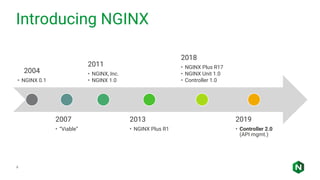
Introducing NGINX
4
2004
• NGINX 0.1
2007
• “Viable”
2011
• NGINX, Inc.
• NGINX 1.0
2013
• NGINX Plus R1
2018
• NGINX Plus R17
• NGINX Unit 1.0
• Controller 1.0
2019
• Controller 2.0
(API mgmt.)
• Offices in San Francisco, Cork, Cambridge, Moscow,
Singapore and Sydney
• 400M websites
• 1,500+ commercial customers
• 250 employees
Source: W3Techs Web server ranking, 07-Jan-2019
#1for the busiest sites
The busiest sites choose NGINX
49%
60%
66%
Top 1M Top 100K Top 10K
40%NGINX Plus deployed as an API gateway
Source: NGINX User survey 2017, 2018
NGINX
Application
Platform
The industry’s only
solution that drives
10x simplification and
80% cost savings by
combining load
balancers, API
gateway, and service
mesh into a single,
modular platform
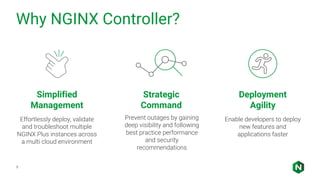
Why NGINX Controller?
9
Simplified
Management
Strategic
Command
Deployment
Agility
Effortlessly deploy, validate
and troubleshoot multiple
NGINX Plus instances across
a multi cloud environment
Enable developers to deploy
new features and
applications faster
Prevent outages by gaining
deep visibility and following
best practice performance
and security
recommendations
NGINX Controller
Mission control for your
applications
NGINX Controller
Mission control for your
applications
Full lifecycle management
for your APIs
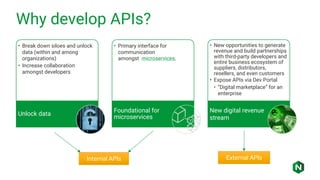
Why develop APIs?
• Break down siloes and unlock
data (within and among
organizations)
• Increase collaboration
amongst developers
Unlock data
• Primary interface for
communication
amongst microservices.
Foundational for
microservices
• New opportunities to generate
revenue and build partnerships
with third-party developers and
entire business ecosystem of
suppliers, distributors,
resellers, and even customers
• Expose APIs via Dev Portal
• “Digital marketplace” for an
enterprise
New digital revenue
stream
External APIsInternal APIs
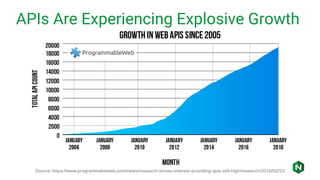
APIs Are Experiencing Explosive Growth
Source: https://www.programmableweb.com/news/research-shows-interest-providing-apis-still-high/research/2018/02/23
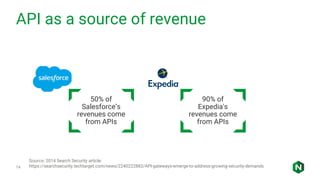
API as a source of revenue
14
Source: 2014 Search Security article:
https://searchsecurity.techtarget.com/news/2240222882/API-gateways-emerge-to-address-growing-security-demands
50% of
Salesforce’s
revenues come
from APIs
90% of
Expedia's
revenues come
from APIs
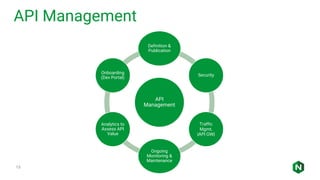
API Management
API
Management
Definition &
Publication
Security
Traffic
Mgmt.
(API GW)
Ongoing
Monitoring &
Maintenance
Analytics to
Assess API
Value
Onboarding
(Dev Portal)
15
How NGINX does API Management
16
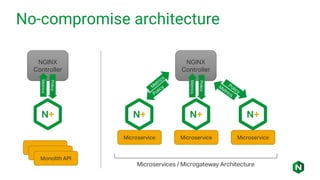
NGINX
Controller
No-compromise architecture
Monolith API
Microservice Microservice Microservice
Monolith API
Monolith API
NGINX
Controller
Microservices / Microgateway Architecture
Policy
Policy
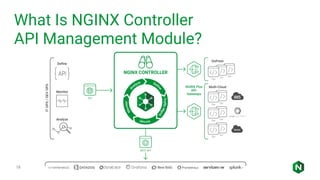
What Is NGINX Controller
API Management Module?
18
Data plane (NGINX Plus) does not require runtime
connectivity to control plane (NGINX Controller)
Reduce Complexity with NGINX
19
API Management including definition, monitoring and analytics is decoupled
from API GW resulting in high performance. Results:
• Reduces average response time to serve API calls
• Minimizes footprint and complexity of API GW
• Same high performance regardless of where API GW is deployed
(whether to handle N/S traffic or E/W traffic)
• No need for additional software components
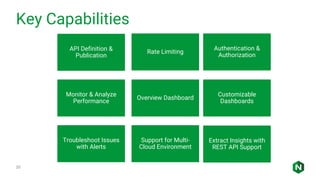
Key Capabilities
20
API Definition &
Publication
Monitor & Analyze
Performance
Overview Dashboard
Customizable
Dashboards
Troubleshoot Issues
with Alerts
Extract Insights with
REST API Support
Support for Multi-
Cloud Environment
Rate Limiting
Authentication &
Authorization
Support for Multi-Cloud Environment
21
NGINX Controller is a Docker package
Can be deployed on any public
or private cloud
Can manage NGINX Plus instances
on any public or private cloud
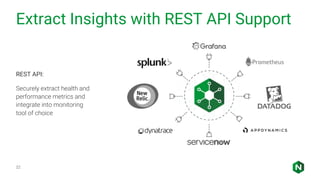
Extract Insights with REST API Support
22
REST API:
Securely extract health and
performance metrics and
integrate into monitoring
tool of choice
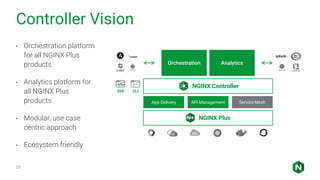
Controller Vision
23
• Orchestration platform
for all NGINX Plus
products
• Analytics platform for
all NGINX Plus
products
• Modular, use case
centric approach
• Ecosystem friendly
CLIGUI
App Delivery API Management
NGINX Controller
Orchestration Analytics
NGINX Plus
Service Mesh
API Definition & Publication
• Create multiple API definitions using an
intuitive interface
◦ Create upstream groups and backend servers
◦ Create API definitions and resources
◦ Route resources to upstream groups
◦ Publish resulting config to NGINX Plus
instances (API gateway)
◦ Configures NGINX Plus as an API gateway
based on best practices
25
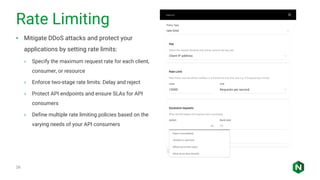
Rate Limiting
• Mitigate DDoS attacks and protect your
applications by setting rate limits:
◦ Specify the maximum request rate for each client,
consumer, or resource
◦ Enforce two-stage rate limits: Delay and reject
◦ Protect API endpoints and ensure SLAs for API
consumers
◦ Define multiple rate limiting policies based on the
varying needs of your API consumers
26
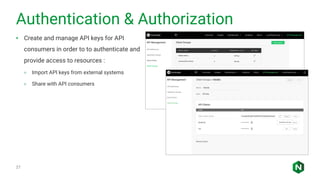
Authentication & Authorization
• Create and manage API keys for API
consumers in order to to authenticate and
provide access to resources :
◦ Import API keys from external systems
◦ Share with API consumers
27
Monitor & Analyze Performance
28
• Is any API GW unavailable?
• When do we see a slowdown?
• Where are HTTP errors occurring?
Deep visibility and insights into KPIs (per
API GW basis) using an agent:
• Visualize real time traffic and system
stats
• Analyze usage & performance trends
including for 200 metrics:
• System (OS )
• NGINX Plus instance
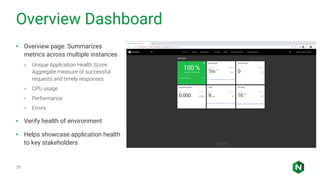
Overview Dashboard
29
• Overview page: Summarizes
metrics across multiple instances
◦ Unique Application Health Score:
Aggregate measure of successful
requests and timely responses
◦ CPU usage
◦ Performance
◦ Errors
• Verify health of environment
• Helps showcase application health
to key stakeholders
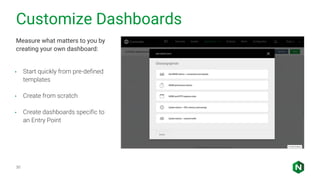
Customize Dashboards
30
Measure what matters to you by
creating your own dashboard:
• Start quickly from pre-defined
templates
• Create from scratch
• Create dashboards specific to
an Entry Point
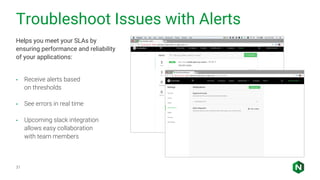
Troubleshoot Issues with Alerts
31
Helps you meet your SLAs by
ensuring performance and reliability
of your applications:
• Receive alerts based
on thresholds
• See errors in real time
• Upcoming slack integration
allows easy collaboration
with team members
33
Getting
Started
• Request a free trial
from our website
• Set up Controller in
a few minutes
• Start managing your
APIs immediately
Liam Crilly | liam@nginx.com
Q&A

Achieve Full API Lifecycle Management Using NGINX Controller – EMEA

  • 1.
  • 2.
    Agenda 1. Introducing NGINX 2.NGINX Controller 3. The need for API Management 4. How NGINX does API Management 5. Live demo 6. Q&A
  • 3.
    3 “... when Istarted NGINX, I focused on a very specific problem – how to handle more customers per a single server.” - Igor Sysoev, NGINX creator and founder
  • 4.
    Introducing NGINX 4 2004 • NGINX0.1 2007 • “Viable” 2011 • NGINX, Inc. • NGINX 1.0 2013 • NGINX Plus R1 2018 • NGINX Plus R17 • NGINX Unit 1.0 • Controller 1.0 2019 • Controller 2.0 (API mgmt.)
  • 5.
    • Offices inSan Francisco, Cork, Cambridge, Moscow, Singapore and Sydney • 400M websites • 1,500+ commercial customers • 250 employees
  • 6.
    Source: W3Techs Webserver ranking, 07-Jan-2019 #1for the busiest sites The busiest sites choose NGINX 49% 60% 66% Top 1M Top 100K Top 10K
  • 7.
    40%NGINX Plus deployedas an API gateway Source: NGINX User survey 2017, 2018
  • 8.
    NGINX Application Platform The industry’s only solutionthat drives 10x simplification and 80% cost savings by combining load balancers, API gateway, and service mesh into a single, modular platform
  • 9.
    Why NGINX Controller? 9 Simplified Management Strategic Command Deployment Agility Effortlesslydeploy, validate and troubleshoot multiple NGINX Plus instances across a multi cloud environment Enable developers to deploy new features and applications faster Prevent outages by gaining deep visibility and following best practice performance and security recommendations
  • 10.
    NGINX Controller Mission controlfor your applications
  • 11.
    NGINX Controller Mission controlfor your applications Full lifecycle management for your APIs
  • 12.
    Why develop APIs? •Break down siloes and unlock data (within and among organizations) • Increase collaboration amongst developers Unlock data • Primary interface for communication amongst microservices. Foundational for microservices • New opportunities to generate revenue and build partnerships with third-party developers and entire business ecosystem of suppliers, distributors, resellers, and even customers • Expose APIs via Dev Portal • “Digital marketplace” for an enterprise New digital revenue stream External APIsInternal APIs
  • 13.
    APIs Are ExperiencingExplosive Growth Source: https://www.programmableweb.com/news/research-shows-interest-providing-apis-still-high/research/2018/02/23
  • 14.
    API as asource of revenue 14 Source: 2014 Search Security article: https://searchsecurity.techtarget.com/news/2240222882/API-gateways-emerge-to-address-growing-security-demands 50% of Salesforce’s revenues come from APIs 90% of Expedia's revenues come from APIs
  • 15.
    API Management API Management Definition & Publication Security Traffic Mgmt. (APIGW) Ongoing Monitoring & Maintenance Analytics to Assess API Value Onboarding (Dev Portal) 15
  • 16.
    How NGINX doesAPI Management 16
  • 17.
    NGINX Controller No-compromise architecture Monolith API MicroserviceMicroservice Microservice Monolith API Monolith API NGINX Controller Microservices / Microgateway Architecture Policy Policy
  • 18.
    What Is NGINXController API Management Module? 18
  • 19.
    Data plane (NGINXPlus) does not require runtime connectivity to control plane (NGINX Controller) Reduce Complexity with NGINX 19 API Management including definition, monitoring and analytics is decoupled from API GW resulting in high performance. Results: • Reduces average response time to serve API calls • Minimizes footprint and complexity of API GW • Same high performance regardless of where API GW is deployed (whether to handle N/S traffic or E/W traffic) • No need for additional software components
  • 20.
    Key Capabilities 20 API Definition& Publication Monitor & Analyze Performance Overview Dashboard Customizable Dashboards Troubleshoot Issues with Alerts Extract Insights with REST API Support Support for Multi- Cloud Environment Rate Limiting Authentication & Authorization
  • 21.
    Support for Multi-CloudEnvironment 21 NGINX Controller is a Docker package Can be deployed on any public or private cloud Can manage NGINX Plus instances on any public or private cloud
  • 22.
    Extract Insights withREST API Support 22 REST API: Securely extract health and performance metrics and integrate into monitoring tool of choice
  • 23.
    Controller Vision 23 • Orchestrationplatform for all NGINX Plus products • Analytics platform for all NGINX Plus products • Modular, use case centric approach • Ecosystem friendly CLIGUI App Delivery API Management NGINX Controller Orchestration Analytics NGINX Plus Service Mesh
  • 25.
    API Definition &Publication • Create multiple API definitions using an intuitive interface ◦ Create upstream groups and backend servers ◦ Create API definitions and resources ◦ Route resources to upstream groups ◦ Publish resulting config to NGINX Plus instances (API gateway) ◦ Configures NGINX Plus as an API gateway based on best practices 25
  • 26.
    Rate Limiting • MitigateDDoS attacks and protect your applications by setting rate limits: ◦ Specify the maximum request rate for each client, consumer, or resource ◦ Enforce two-stage rate limits: Delay and reject ◦ Protect API endpoints and ensure SLAs for API consumers ◦ Define multiple rate limiting policies based on the varying needs of your API consumers 26
  • 27.
    Authentication & Authorization •Create and manage API keys for API consumers in order to to authenticate and provide access to resources : ◦ Import API keys from external systems ◦ Share with API consumers 27
  • 28.
    Monitor & AnalyzePerformance 28 • Is any API GW unavailable? • When do we see a slowdown? • Where are HTTP errors occurring? Deep visibility and insights into KPIs (per API GW basis) using an agent: • Visualize real time traffic and system stats • Analyze usage & performance trends including for 200 metrics: • System (OS ) • NGINX Plus instance
  • 29.
    Overview Dashboard 29 • Overviewpage: Summarizes metrics across multiple instances ◦ Unique Application Health Score: Aggregate measure of successful requests and timely responses ◦ CPU usage ◦ Performance ◦ Errors • Verify health of environment • Helps showcase application health to key stakeholders
  • 30.
    Customize Dashboards 30 Measure whatmatters to you by creating your own dashboard: • Start quickly from pre-defined templates • Create from scratch • Create dashboards specific to an Entry Point
  • 31.
    Troubleshoot Issues withAlerts 31 Helps you meet your SLAs by ensuring performance and reliability of your applications: • Receive alerts based on thresholds • See errors in real time • Upcoming slack integration allows easy collaboration with team members
  • 32.
    33 Getting Started • Request afree trial from our website • Set up Controller in a few minutes • Start managing your APIs immediately
  • 33.
    Liam Crilly |liam@nginx.com Q&A