2
Table of contents
Introduction..................................................................................................................3
Financialservices build for the future on AWS.....................................................5
Business imperatives
Increase operational efficiency and agility......................................................6
Accelerate innovation and speed-to-market...................................................7
Deliver frictionless and personalized experiences..........................................8
Enable security, compliance, and operational resilience at scale................9
Reduce the environmental impact of business operations....................... 11
Explore the potential of generative AI........................................................... 12
Best practices to accelerate cloud transformation........................................... 13
Move faster and more confidently with AWS..................................................... 14
3.
3
Introduction
Financial services institutionsare leveraging the cloud as
they seek more effective ways to increase efficiency, grow
revenue, expand market share, and easily embrace new
business models.
After significant success with moving discrete workloads
and applications that needed little or no refactoring or
rearchitecting to the cloud, financial services institutions are
now migrating business-critical applications at scale as well
as developing new cloud-native applications that
drive innovation.
Institutions at all stages of their cloud journey seek strategies
and partners with industry experience and proven results
to help them run mission-critical workloads on the cloud
and innovate for their business while complying with ever-
changing regulations.
Introduction
Financial services
build for the
future on AWS
Accelerate
innovation and
speed-to-market
Deliver frictionless
and personalized
experiences
Enable security,
compliance,
and operational
resilience at scale
Reduce the
environmental
impact of business
operations
Best practices to
accelerate cloud
transformation
Move faster and
more confidently
with AWS
Increase operational
efficiency and agility
Explore the potential
of generative AI
3
4.
4
Looking to thecloud
Over the last decade, the financial services industry has
experienced change at an unprecedented velocity. Rapidly
evolving customer expectations, new market entrants,
powerful emerging technologies, and expanding regulations
have converged to create a transformed landscape and
reality. Environmental, social, and governance (ESG) initiatives
have also become a focal point for financial services
institutions as they look to mitigate the risks of climate
change, define corporate ESG goals and strategies, take
advantage of the demand for socially responsible investing,
and respond to new ESG-focused regulations.
As customer expectations continue to evolve, financial
services institutions remain focused on delivering frictionless
digital experiences, enhanced by hyper-personalization.
They’re also focused on supporting new business models—
everything from embedded finance to usage-based insurance
to cryptocurrency exchanges. Cloud plays a growing role
in helping financial services institutions move from idea to
innovation faster.
At the same time, institutions are confronting growing
margin pressure and market volatility and seeking new ways
to reduce operating costs. They’re also facing expanded
regulatory requirements—including new mandates around
data protection, privacy, and even operational resilience.
Automation can and must play a critical role in surmounting
these challenges, and cloud-based technology can help
financial services institutions accelerate innovation and
respond to challenges quickly.
In fact, McKinsey projects that Fortune 500 financial
institutions alone could generate between $60 billion and
$80 billion in run-rate EBITDA in 2030 by making the most
of the cost-optimization levers and business use cases
unlocked by cloud.1
Further, in the last 18 months, we’ve seen the rapid
emergence of generative artificial intelligence (AI).
Financial services organizations are eager to explore how
this new technology can help them drive new levels of
service, efficiency, and security across their organizations.
Cloud is the natural home of AI and machine learning
(ML) technology, cost-effectively delivering the massive
compute power and scale needed to train and run
increasingly complex models.
As financial services firms navigate this new landscape,
they’re no longer evaluating if they should move to the
cloud. Instead, they’re seeking solutions and partners to
accelerate and scale their cloud adoption. Amazon Web
Services (AWS) is paving the way.
Introduction
Financial services
build for the
future on AWS
Accelerate
innovation and
speed-to-market
Deliver frictionless
and personalized
experiences
Enable security,
compliance,
and operational
resilience at scale
Reduce the
environmental
impact of business
operations
Best practices to
accelerate cloud
transformation
Move faster and
more confidently
with AWS
Increase operational
efficiency and agility
Explore the potential
of generative AI
5.
5
Financial services build
forthe future on AWS
AWS has been a pioneer and leader in delivering the benefits
of the cloud to financial services institutions for over a
decade. We began working with several globally systemically
important financial institutions (G-SIFIs), helping them
migrate their on-premises workloads to a cloud environment
for greater efficiency and agility at a global scale. Today,
we help tens of thousands of financial services customers
around the globe—from the largest banks to the fastest
growing fintechs—with use cases ranging from core system
modernization to fraud detection to open banking.
We help financial institutions build the future by taking action
today—enabling them to seize the advantage of choice, move
with speed and agility, and leverage the power of trust and
unparalleled experience. These competencies are the difference
between idea and action when it comes to navigating
change successfully.
Today, financial institutions are leveraging AWS Cloud
to advance several important business imperatives:
• Increase operational efficiency and agility
• Accelerate innovation and speed-to-market
• Deliver frictionless and personalized experiences
• Enable security, compliance, and operational
resilience at scale
• Reduce the environmental impact of business operations
• Explore the potential of generative AI
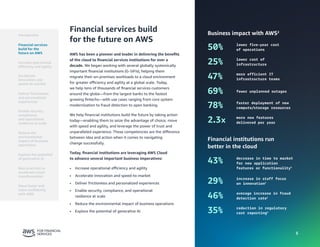
Business impact with AWS2
Financial institutions run
better in the cloud
50% lower five-year cost
of operations
25% lower cost of
infrastructure
47% more efficient IT
infrastructure teams
43% decrease in time to market
for new application
features or functionality3
29% increase in staff focus
on innovation3
69% fewer unplanned outages
78% faster deployment of new
compute/storage resources
2.3x more new features
delivered per year
46% average increase in fraud
detection rate4
35% reduction in regulatory
cost reporting4
Introduction
Financial services
build for the
future on AWS
Accelerate
innovation and
speed-to-market
Deliver frictionless
and personalized
experiences
Enable security,
compliance,
and operational
resilience at scale
Reduce the
environmental
impact of business
operations
Best practices to
accelerate cloud
transformation
Move faster and
more confidently
with AWS
Increase operational
efficiency and agility
Explore the potential
of generative AI
6.
6
6
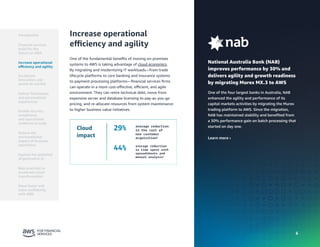
National Australia Bank(NAB)
improves performance by 30% and
delivers agility and growth readiness
by migrating Murex MX.3 to AWS
One of the four largest banks in Australia, NAB
enhanced the agility and performance of its
capital markets activities by migrating the Murex
trading platform to AWS. Since the migration,
NAB has maintained stability and benefited from
a 30% performance gain on batch processing that
started on day one.
Learn more ›
Increase operational
efficiency and agility
One of the fundamental benefits of moving on-premises
systems to AWS is taking advantage of cloud economics.
By migrating and modernizing IT workloads—from trade
lifecycle platforms to core banking and insurance systems
to payment processing platforms—financial services firms
can operate in a more cost-effective, efficient, and agile
environment. They can retire technical debt, move from
expensive server and database licensing to pay-as-you-go
pricing, and re-allocate resources from system maintenance
to higher business value initiatives.
Cloud
impact
29% average reduction
in the cost of
new customer
acquisition4
44% average reduction
in time spent with
spreadsheets and
manual analysis4
Introduction
Financial services
build for the
future on AWS
Accelerate
innovation and
speed-to-market
Deliver frictionless
and personalized
experiences
Enable security,
compliance,
and operational
resilience at scale
Reduce the
environmental
impact of business
operations
Best practices to
accelerate cloud
transformation
Move faster and
more confidently
with AWS
Increase operational
efficiency and agility
Explore the potential
of generative AI
7.
7
7
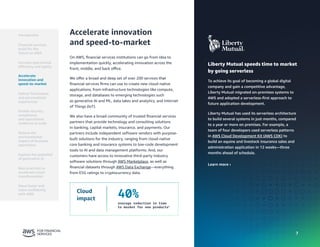
Liberty Mutual speedstime to market
by going serverless
To achieve its goal of becoming a global digital
company and gain a competitive advantage,
Liberty Mutual migrated on-premises systems to
AWS and adopted a serverless-first approach to
future application development.
Liberty Mutual has used its serverless architecture
to build several systems in just months, compared
to a year or more on premises. For example, a
team of four developers used serverless patterns
in AWS Cloud Development Kit (AWS CDK) to
build an equine and livestock insurance sales and
administration application in 12 weeks—three
months ahead of schedule.
Learn more ›
Accelerate innovation
and speed-to-market
On AWS, financial services institutions can go from idea to
implementation quickly, accelerating innovation across the
front, middle, and back office.
We offer a broad and deep set of over 200 services that
financial services firms can use to create new cloud-native
applications, from infrastructure technologies like compute,
storage, and databases to emerging technologies such
as generative AI and ML, data lakes and analytics, and Internet
of Things (IoT).
We also have a broad community of trusted financial services
partners that provide technology and consulting solutions
in banking, capital markets, insurance, and payments. Our
partners include independent software vendors with purpose-
built solutions for the industry, ranging from cloud-native
core banking and insurance systems to low-code development
tools to AI and data management platforms. And, our
customers have access to innovative third-party industry
software solutions through AWS Marketplace, as well as
financial datasets through AWS Data Exchange—everything
from ESG ratings to cryptocurrency data.
Cloud
impact 40%
average reduction in time
to market for new products4
Introduction
Financial services
build for the
future on AWS
Accelerate
innovation and
speed-to-market
Deliver frictionless
and personalized
experiences
Enable security,
compliance,
and operational
resilience at scale
Reduce the
environmental
impact of business
operations
Best practices to
accelerate cloud
transformation
Move faster and
more confidently
with AWS
Increase operational
efficiency and agility
Explore the potential
of generative AI
8.
8
8
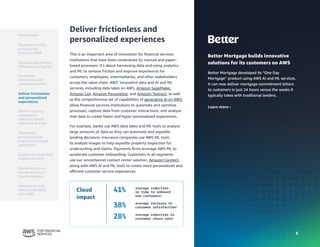
Better Mortgage buildsinnovative
solutions for its customers on AWS
Better Mortgage developed its “One Day
Mortgage” product using AWS AI and ML services.
It can now deliver mortgage commitment letters
to customers in just 24 hours versus the weeks it
typically takes with traditional lenders.
Learn more ›
Deliver frictionless and
personalized experiences
This is an important area of innovation for financial services
institutions that have been constrained by manual and paper-
based processes. It’s about harnessing data and using analytics
and ML to remove friction and improve experiences for
customers, employees, intermediaries, and other stakeholders
across the value chain. AWS’ innovative data and AI and ML
services, including data lakes on AWS, Amazon SageMaker,
Amazon Lex, Amazon Personalize, and Amazon Textract, as well
as the comprehensive set of capabilities of generative AI on AWS,
allow financial services institutions to automate and optimize
processes, capture data from customer interactions, and analyze
that data to create faster and hyper-personalized experiences.
For example, banks use AWS data lakes and ML tools to analyze
large amounts of data so they can automate and expedite
lending decisions. Insurance companies use AWS ML tools
to analyze images to help expedite property inspection for
underwriting and claims. Payments firms leverage AWS ML to
accelerate customer onboarding. Customers in all segments
use our omnichannel contact center solution, Amazon Connect,
along with AWS AI and ML tools to create more personalized and
efficient customer service experiences.
Cloud
impact
41% average reduction
in time to onboard
new customers4
38% average increase in
customer satisfaction4
28% average reduction in
customer churn rate4
Introduction
Financial services
build for the
future on AWS
Accelerate
innovation and
speed-to-market
Deliver frictionless
and personalized
experiences
Enable security,
compliance,
and operational
resilience at scale
Reduce the
environmental
impact of business
operations
Best practices to
accelerate cloud
transformation
Move faster and
more confidently
with AWS
Increase operational
efficiency and agility
Explore the potential
of generative AI
9.
9
9
Enable security, compliance,
andoperational resilience
at scale
AWS enables customers to deploy new applications globally
in minutes on the most extensive and secure cloud platform
available today. Our core infrastructure is built to satisfy the
security and operational resilience requirements of the military,
global banks, and other high-sensitivity organizations.
AWS has the largest footprint of any cloud provider, spanning
105 Availability Zones within 33 geographic regions (with
announced plans for 18 more Availability Zones and six more
AWS Regions in Malaysia, Mexico, New Zealand, the Kingdom
of Saudi Arabia, Thailand, and the AWS European Sovereign
Cloud). AWS Global Infrastructure delivers the highest network
availability of any cloud provider, and the AWS Region and
Availability Zone model has been recognized by Gartner as the
recommended approach for running enterprise applications that
require high availability.
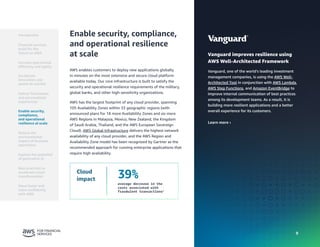
Cloud
impact 39%
average decrease in the
costs associated with
fraudulent transactions4
Vanguard improves resilience using
AWS Well-Architected Framework
Vanguard, one of the world’s leading investment
management companies, is using the AWS Well-
Architected Tool in conjunction with AWS Lambda,
AWS Step Functions, and Amazon EventBridge to
improve internal communication of best practices
among its development teams. As a result, it is
building more resilient applications and a better
overall experience for its customers.
Learn more ›
Introduction
Financial services
build for the
future on AWS
Accelerate
innovation and
speed-to-market
Deliver frictionless
and personalized
experiences
Enable security,
compliance,
and operational
resilience at scale
Reduce the
environmental
impact of business
operations
Best practices to
accelerate cloud
transformation
Move faster and
more confidently
with AWS
Increase operational
efficiency and agility
Explore the potential
of generative AI
10.
10
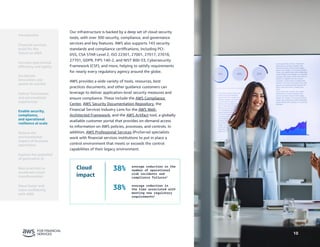
Our infrastructure isbacked by a deep set of cloud security
tools, with over 300 security, compliance, and governance
services and key features. AWS also supports 143 security
standards and compliance certifications, including PCI-
DSS, CSA STAR Level 2, ISO 22301, 27001, 27017, 27018,
27701, GDPR, FIPS 140-2, and NIST 800-53, Cybersecurity
Framework (CSF), and more, helping to satisfy requirements
for nearly every regulatory agency around the globe.
AWS provides a wide variety of tools, resources, best
practices documents, and other guidance customers can
leverage to deliver application-level security measures and
ensure compliance. These include the AWS Compliance
Center, AWS Security Documentation Repository, the
Financial Services Industry Lens for the AWS Well-
Architected Framework, and the AWS Artifact tool, a globally
available customer portal that provides on-demand access
to information on AWS policies, processes, and controls. In
addition, AWS Professional Services (ProServe) specialists
work with financial services institutions to put in place a
control environment that meets or exceeds the control
capabilities of their legacy environment.
Cloud
impact
38% average reduction in the
number of operational
risk incidents and
compliance failures4
38% average reduction in
the time associated with
meeting new regulatory
requirements4
10
Introduction
Financial services
build for the
future on AWS
Accelerate
innovation and
speed-to-market
Deliver frictionless
and personalized
experiences
Enable security,
compliance,
and operational
resilience at scale
Reduce the
environmental
impact of business
operations
Best practices to
accelerate cloud
transformation
Move faster and
more confidently
with AWS
Increase operational
efficiency and agility
Explore the potential
of generative AI
11.
11
11
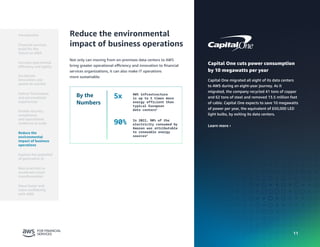
Capital One cutspower consumption
by 10 megawatts per year
Capital One migrated all eight of its data centers
to AWS during an eight-year journey. As it
migrated, the company recycled 41 tons of copper
and 62 tons of steel and removed 13.5 million feet
of cable. Capital One expects to save 10 megawatts
of power per year, the equivalent of 650,000 LED
light bulbs, by exiting its data centers.
Learn more ›
Reduce the environmental
impact of business operations
Not only can moving from on-premises data centers to AWS
bring greater operational efficiency and innovation to financial
services organizations, it can also make IT operations
more sustainable.
By the
Numbers
5x AWS infrastructure
is up to 5 times more
energy efficient than
typical European
data centers5
90% In 2022, 90% of the
electricity consumed by
Amazon was attributable
to renewable energy
sources5
Introduction
Financial services
build for the
future on AWS
Accelerate
innovation and
speed-to-market
Deliver frictionless
and personalized
experiences
Enable security,
compliance,
and operational
resilience at scale
Reduce the
environmental
impact of business
operations
Best practices to
accelerate cloud
transformation
Move faster and
more confidently
with AWS
Increase operational
efficiency and agility
Explore the potential
of generative AI
12.
12
Explore the potentialof generative AI
While financial services institutions have been using AI
and ML for years, generative AI brings new possibilities
to improve customer experiences, boost employee
productivity, enhance creativity and content creation,
and accelerate process optimization. From creating highly
tailored investment strategies and portfolios aligned to
responsive financial goals to developing new tools for end-
users, AWS enables institutions to leverage generative AI
across three layers of the ML stack: infrastructure, tools,
and purpose-built AI services.
The easiest way to build with leading foundation models
With AWS, financial services institutions can build and
scale generative AI applications with security, privacy,
and responsible AI built in from day one. Using Amazon
Bedrock, organizations can access leading foundational
models (FMs), customize with their own data, and use
industry-leading security and access control features
from AWS.
We offer financial services institutions the flexibility
to choose how they want to build with generative AI.
They can work with a broad range of high-performing
FMs from leading AI companies like Amazon, AI21 Labs,
Anthropic, Cohere, Meta, and Stability AI. Users can quickly
experiment with a variety of FMs, and use a single API for
inference regardless of the models they choose, giving
them the flexibility to use FMs from different providers
and keep up to date with the latest model versions with
minimal code changes.
The most performant, low-cost infrastructure
Whether a financial services organization chooses to train its own
models, customize models, or run ML applications, AWS is the
best place to train and run inference at scale with infrastructure
purpose-built for ML. From the highest performance GPU-based
Amazon EC2 P5 instances to continued investments in our
purpose-built accelerators—AWS Trainium and AWS Inferentia—
customers get the most performant and low-cost infrastructure
for generative AI/ML.
Generative AI-powered applications to transform
user experiences
AWS provides powerful applications, such as Amazon
CodeWhisperer and Amazon Q, our generative AI assistant
built specifically for business, that can help financial services
institutions boost productivity, streamline coding, and simplify
business intelligence. With security and privacy built in, easy
customization, and seamless data integration, organizations can
quickly take advantage of generative AI adapted to the specific
needs of their organization.
The ability to leverage data as a differentiator
With the most comprehensive set of data and AI services, financial
services institutions can customize generative AI applications and
models to build more differentiated experiences using features
like the customization capability in Amazon CodeWhisperer. Data
is the difference between a general generative AI application and
one that truly knows an organization and its customers. With the
most comprehensive set of data and AI services, organizations
can securely customize an FM on AWS with their own data or
use other built-in tools like Agents for Amazon Bedrock to build
applications that know their business, data, and customers.
Introduction
Financial services
build for the
future on AWS
Accelerate
innovation and
speed-to-market
Deliver frictionless
and personalized
experiences
Enable security,
compliance,
and operational
resilience at scale
Reduce the
environmental
impact of business
operations
Best practices to
accelerate cloud
transformation
Move faster and
more confidently
with AWS
Increase operational
efficiency and agility
Explore the potential
of generative AI
13.
13
Best practices toaccelerate
cloud transformation
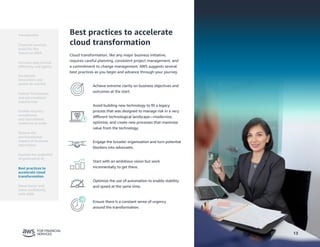
Cloud transformation, like any major business initiative,
requires careful planning, consistent project management, and
a commitment to change management. AWS suggests several
best practices as you begin and advance through your journey.
Achieve extreme clarity on business objectives and
outcomes at the start.
Avoid building new technology to fit a legacy
process that was designed to manage risk in a very
different technological landscape—modernize,
optimize, and create new processes that maximize
value from the technology.
Engage the broader organization and turn potential
blockers into advocates.
Start with an ambitious vision but work
incrementally to get there.
Optimize the use of automation to enable stability
and speed at the same time.
Ensure there is a constant sense of urgency
around the transformation.
13
Introduction
Financial services
build for the
future on AWS
Accelerate
innovation and
speed-to-market
Deliver frictionless
and personalized
experiences
Enable security,
compliance,
and operational
resilience at scale
Reduce the
environmental
impact of business
operations
Best practices to
accelerate cloud
transformation
Move faster and
more confidently
with AWS
Increase operational
efficiency and agility
Explore the potential
of generative AI