UNSW CAREERS AND EMPLOYMENT

         A c e the
       In t e r v ie w !
        E f f e c t iv e
       In t e r v ie w
     P r e p a r a t io n
         J ill M c A lis t e r
         C a re e rs a nd
         E m p lo y m e n t

                   www.careers.unsw.edu.
UNSW CAREERS AND EMPLOYMENT


      A c t iv it y : F ir s t
   Im p r e s s io n s C o u n t !
S t e p 1: In t r o d u c e y o u r s e lf t o
s ome body - s ha ke ha nds
S te p 2 :    F o r 1 m in u t e , e x p la in . . .
          Key information about yourself
          Your career goals


                               www.careers.unsw.edu.
UNSW CAREERS AND EMPLOYMENT


F ir s t Im p r e s s io n s
         C o unt!
            •   Tone of Voice
            •   Start the interview confidently
            •   Opening lines
            •   Handshake
            •   Body language


                     www.careers.unsw.edu.
UNSW CAREERS AND EMPLOYMENT


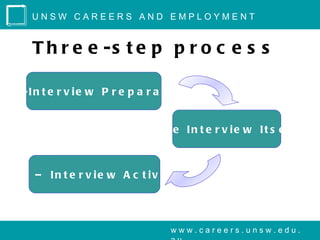
       T h r e e -s t e p p r o c e s s

P r e -In t e r v ie w P r e p a r a t io n


                                   T h e In t e r v ie w It s e lf


P o s t – In t e r v ie w A c t iv it ie s


                                       www.careers.unsw.edu.
UNSW CAREERS AND EMPLOYMENT

     P r e -In t e r v ie w
     P r e p a r a t io n s
       K no w the J o b a nd
         O r g a n is a t io n
          – Organisation: structure, culture, values,
            recent developments
          – Job: purpose, criteria, daily duties,
            terminology

       K n o w a n d C r it iq u e
         Yo u r s e l f
          – Why do you want the job, & why in that
            organisation?
          – Familiarise yourself with your resume, cover
            letter / application form
          – What do you have to offer?
          – Prepare answers w . typicale r s . u n s w . e d u .
                           w w to c a r e questions
UNSW CAREERS AND EMPLOYMENT


     P r e -In t e r v ie w
     P r e p a r a t io n s
       K no w Wha t to E x p e c t
         – Structured v.s. unstructured
         – One to one, panel, group
         – Who is interviewing you? Names and
           roles?
         – Face to Face / Telephone / Online / On
           Campus


                         www.careers.unsw.edu.
UNSW CAREERS AND EMPLOYMENT

      P urp o s e o f the
         In t e r v ie w
F o r t h e in t e r v ie w e r
   – Can you do the job?
   – Will you do the job?
   – Do you fit?
   Confirmation of their impressions


F o r t h e in t e r v ie w e e
   – To present your abilities, knowledge, aspirations and
     experience
   – To gain a further insight into the position, employer and
     organisation

                                    www.careers.unsw.edu.
UNSW CAREERS AND EMPLOYMENT

In t e r v ie w Q u e s t io n
            Ty p e s
 S t a n d a r d ( O p e n -e n d e d )
    q u e s t io n s


 S it u a t io n a l q u e s t io n s


 B e h a v io u r a l q u e s t io n s


                                www.careers.unsw.edu.
UNSW CAREERS AND EMPLOYMENT


 S ta nd a rd ( O p e n-
e n d e d ) Q u e s t io n s
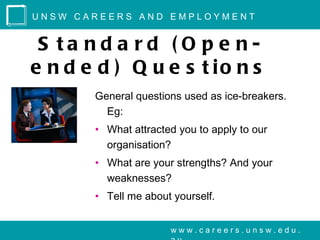
       General questions used as ice-breakers.
         Eg:
       • What attracted you to apply to our
         organisation?
       • What are your strengths? And your
         weaknesses?
       • Tell me about yourself.


                      www.careers.unsw.edu.
UNSW CAREERS AND EMPLOYMENT


   S ta nd a rd ( O p e n-
  e n d e d ) Q u e s t io n s
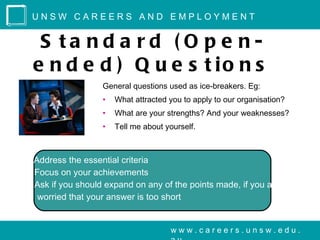
                    General questions used as ice-breakers. Eg:
                    •   What attracted you to apply to our organisation?
                    •   What are your strengths? And your weaknesses?
                    •   Tell me about yourself.


 Address the essential criteria
 Focus on your achievements
 Ask if you should expand on any of the points made, if you are
   worried that your answer is too short


                                       www.careers.unsw.edu.
UNSW CAREERS AND EMPLOYMENT

          S it u a t io n a l
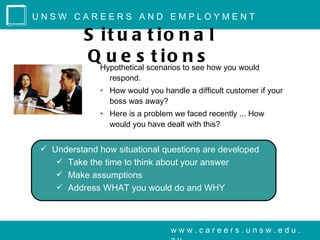
          QHypothetical scenarios to see how you would
             u e s t io n s
                respond.
              • How would you handle a difficult customer if your
                boss was away?
              • Here is a problem we faced recently ... How
                would you have dealt with this?


 Understand how situational questions are developed
    Take the time to think about your answer
    Make assumptions
    Address WHAT you would do and WHY


                                 www.careers.unsw.edu.
UNSW CAREERS AND EMPLOYMENT

      B e h a v io u r a l
       QQuestions s youitoo n sprevious experiences
         u e for t describe
            •   Describe a complex problem you have solved
                recently.
            •   Have you been in any situations where you were
                required to perform as part of a team? What was
                the situation, what part did you play in the team
                and what was the outcome of the exercise?
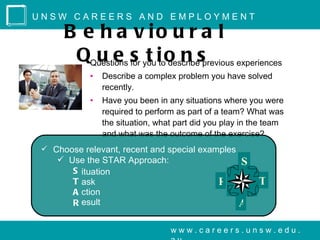
  Choose relevant, recent and special examples
     Use the STAR Approach:                         S
       S ituation
       T ask                                   R          T
       A ction
       R esult                                      A

                                  www.careers.unsw.edu.
UNSW CAREERS AND EMPLOYMENT

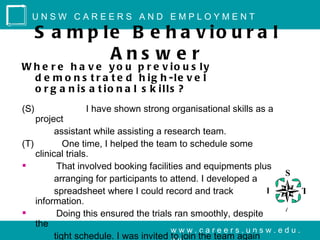
      S a m p le B e h a v io u r a l
               Ans w e r
W h e r e h a v e y o u p r e v io u s ly
  d e m o n s t r a t e d h ig h -le v e l
  o r g a n is a t io n a l s k ills ?
(S)            I have shown strong organisational skills as a
    project
          assistant while assisting a research team.
(T)          One time, I helped the team to schedule some
    clinical trials.
          That involved booking facilities and equipments plus
                                                                 S
          arranging for participants to attend. I developed a
          spreadsheet where I could record and track           R   T
    information.
                                                                 A
          Doing this ensured the trials ran smoothly, despite
    the
                                        www.careers.unsw.edu.
          tight schedule. I was invited to join the team again
UNSW CAREERS AND EMPLOYMENT

     S a m p le In t e r v ie w
          Q u e s t io n s
1)    What would you do if you disagree with your
      supervisor in a meeting?
2)    Have you ever been responsible for the
      generation of a new idea or suggestion?
      Describe and explain.
3)    What do you see yourself doing five years from
      now?
4)    Describe how you have coped with a new or
      difficult situation.
                              www.careers.unsw.edu.
UNSW CAREERS AND EMPLOYMENT


      A c t iv it y -
      P r a c t ic e
       ma ke s
    p e rfe c t . . .


                www.careers.unsw.edu.
UNSW CAREERS AND EMPLOYMENT

 Q u e s t i o n s F o r Yo u
              To A s k
• How much scope will there be for …?
• What are some of the current projects being
  undertaken? What could my first project be?
• What do you see as the immediate goals of the
  position? How will you measure performance?
• What do you see as the future for the position?
• Daily routine, specific demands and challenges for a
  graduate employee (day in the life)?
• How does this position relate to the others within the
  organisation?
• Opportunities for career progression, training and
  advancement?
• Growth plans for the organisation?

                                 www.careers.unsw.edu.
UNSW CAREERS AND EMPLOYMENT

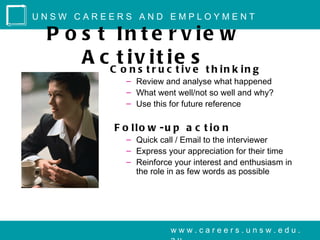
 P o s t In t e r v ie w
     A c C to inv tir t c ei v s t h i n k i n g
                s     u
                        it e
                  – Review and analyse what happened
                  – What went well/not so well and why?
                  – Use this for future reference

               F o llo w -u p a c t io n
                  – Quick call / Email to the interviewer
                  – Express your appreciation for their time
                  – Reinforce your interest and enthusiasm in
                    the role in as few words as possible


                             www.careers.unsw.edu.
UNSW CAREERS AND EMPLOYMENT

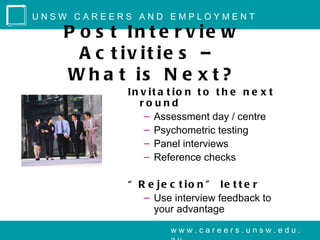
   P o s t In t e r v ie w
     A c t iv it ie s –
   W h a t is N e x t ?
           In v it a t io n t o t h e n e x t
              round
               – Assessment day / centre
               – Psychometric testing
               – Panel interviews
               – Reference checks

           “ R e je c t io n ” le t t e r
              – Use interview feedback to
                your advantage
                     www.careers.unsw.edu.
UNSW CAREERS AND EMPLOYMENT


          ?     www.careers.unsw.edu.
UNSW CAREERS AND EMPLOYMENT


                Le ve l 2 , E a s t
                W in g ,
                Q u a d r a n g le
                B u ild in g .
                P h: 9 3 8 5
                5429
w w w .c a re e rs .u ns
      w .e d u .a u

                 www.careers.unsw.edu.

Ace the interview!_jill_2007

  • 1.
    UNSW CAREERS ANDEMPLOYMENT A c e the In t e r v ie w ! E f f e c t iv e In t e r v ie w P r e p a r a t io n J ill M c A lis t e r C a re e rs a nd E m p lo y m e n t www.careers.unsw.edu.
  • 2.
    UNSW CAREERS ANDEMPLOYMENT A c t iv it y : F ir s t Im p r e s s io n s C o u n t ! S t e p 1: In t r o d u c e y o u r s e lf t o s ome body - s ha ke ha nds S te p 2 : F o r 1 m in u t e , e x p la in . . . Key information about yourself Your career goals www.careers.unsw.edu.
  • 3.
    UNSW CAREERS ANDEMPLOYMENT F ir s t Im p r e s s io n s C o unt! • Tone of Voice • Start the interview confidently • Opening lines • Handshake • Body language www.careers.unsw.edu.
  • 4.
    UNSW CAREERS ANDEMPLOYMENT T h r e e -s t e p p r o c e s s P r e -In t e r v ie w P r e p a r a t io n T h e In t e r v ie w It s e lf P o s t – In t e r v ie w A c t iv it ie s www.careers.unsw.edu.
  • 5.
    UNSW CAREERS ANDEMPLOYMENT P r e -In t e r v ie w P r e p a r a t io n s K no w the J o b a nd O r g a n is a t io n – Organisation: structure, culture, values, recent developments – Job: purpose, criteria, daily duties, terminology K n o w a n d C r it iq u e Yo u r s e l f – Why do you want the job, & why in that organisation? – Familiarise yourself with your resume, cover letter / application form – What do you have to offer? – Prepare answers w . typicale r s . u n s w . e d u . w w to c a r e questions
  • 6.
    UNSW CAREERS ANDEMPLOYMENT P r e -In t e r v ie w P r e p a r a t io n s K no w Wha t to E x p e c t – Structured v.s. unstructured – One to one, panel, group – Who is interviewing you? Names and roles? – Face to Face / Telephone / Online / On Campus www.careers.unsw.edu.
  • 7.
    UNSW CAREERS ANDEMPLOYMENT P urp o s e o f the In t e r v ie w F o r t h e in t e r v ie w e r – Can you do the job? – Will you do the job? – Do you fit? Confirmation of their impressions F o r t h e in t e r v ie w e e – To present your abilities, knowledge, aspirations and experience – To gain a further insight into the position, employer and organisation www.careers.unsw.edu.
  • 8.
    UNSW CAREERS ANDEMPLOYMENT In t e r v ie w Q u e s t io n Ty p e s S t a n d a r d ( O p e n -e n d e d ) q u e s t io n s S it u a t io n a l q u e s t io n s B e h a v io u r a l q u e s t io n s www.careers.unsw.edu.
  • 9.
    UNSW CAREERS ANDEMPLOYMENT S ta nd a rd ( O p e n- e n d e d ) Q u e s t io n s General questions used as ice-breakers. Eg: • What attracted you to apply to our organisation? • What are your strengths? And your weaknesses? • Tell me about yourself. www.careers.unsw.edu.
  • 10.
    UNSW CAREERS ANDEMPLOYMENT S ta nd a rd ( O p e n- e n d e d ) Q u e s t io n s General questions used as ice-breakers. Eg: • What attracted you to apply to our organisation? • What are your strengths? And your weaknesses? • Tell me about yourself.  Address the essential criteria  Focus on your achievements  Ask if you should expand on any of the points made, if you are worried that your answer is too short www.careers.unsw.edu.
  • 11.
    UNSW CAREERS ANDEMPLOYMENT S it u a t io n a l QHypothetical scenarios to see how you would u e s t io n s respond. • How would you handle a difficult customer if your boss was away? • Here is a problem we faced recently ... How would you have dealt with this?  Understand how situational questions are developed  Take the time to think about your answer  Make assumptions  Address WHAT you would do and WHY www.careers.unsw.edu.
  • 12.
    UNSW CAREERS ANDEMPLOYMENT B e h a v io u r a l QQuestions s youitoo n sprevious experiences u e for t describe • Describe a complex problem you have solved recently. • Have you been in any situations where you were required to perform as part of a team? What was the situation, what part did you play in the team and what was the outcome of the exercise?  Choose relevant, recent and special examples  Use the STAR Approach: S S ituation T ask R T A ction R esult A www.careers.unsw.edu.
  • 13.
    UNSW CAREERS ANDEMPLOYMENT S a m p le B e h a v io u r a l Ans w e r W h e r e h a v e y o u p r e v io u s ly d e m o n s t r a t e d h ig h -le v e l o r g a n is a t io n a l s k ills ? (S) I have shown strong organisational skills as a project assistant while assisting a research team. (T) One time, I helped the team to schedule some clinical trials.  That involved booking facilities and equipments plus S arranging for participants to attend. I developed a spreadsheet where I could record and track R T information. A  Doing this ensured the trials ran smoothly, despite the www.careers.unsw.edu. tight schedule. I was invited to join the team again
  • 14.
    UNSW CAREERS ANDEMPLOYMENT S a m p le In t e r v ie w Q u e s t io n s 1) What would you do if you disagree with your supervisor in a meeting? 2) Have you ever been responsible for the generation of a new idea or suggestion? Describe and explain. 3) What do you see yourself doing five years from now? 4) Describe how you have coped with a new or difficult situation. www.careers.unsw.edu.
  • 15.
    UNSW CAREERS ANDEMPLOYMENT A c t iv it y - P r a c t ic e ma ke s p e rfe c t . . . www.careers.unsw.edu.
  • 16.
    UNSW CAREERS ANDEMPLOYMENT Q u e s t i o n s F o r Yo u To A s k • How much scope will there be for …? • What are some of the current projects being undertaken? What could my first project be? • What do you see as the immediate goals of the position? How will you measure performance? • What do you see as the future for the position? • Daily routine, specific demands and challenges for a graduate employee (day in the life)? • How does this position relate to the others within the organisation? • Opportunities for career progression, training and advancement? • Growth plans for the organisation? www.careers.unsw.edu.
  • 17.
    UNSW CAREERS ANDEMPLOYMENT P o s t In t e r v ie w A c C to inv tir t c ei v s t h i n k i n g s u it e – Review and analyse what happened – What went well/not so well and why? – Use this for future reference F o llo w -u p a c t io n – Quick call / Email to the interviewer – Express your appreciation for their time – Reinforce your interest and enthusiasm in the role in as few words as possible www.careers.unsw.edu.
  • 18.
    UNSW CAREERS ANDEMPLOYMENT P o s t In t e r v ie w A c t iv it ie s – W h a t is N e x t ? In v it a t io n t o t h e n e x t round – Assessment day / centre – Psychometric testing – Panel interviews – Reference checks “ R e je c t io n ” le t t e r – Use interview feedback to your advantage www.careers.unsw.edu.
  • 19.
    UNSW CAREERS ANDEMPLOYMENT ? www.careers.unsw.edu.
  • 20.
    UNSW CAREERS ANDEMPLOYMENT Le ve l 2 , E a s t W in g , Q u a d r a n g le B u ild in g . P h: 9 3 8 5 5429 w w w .c a re e rs .u ns w .e d u .a u www.careers.unsw.edu.

Editor's Notes

  • #4 Think of 3 works that describe the impression you would like to make Show those words in your eyes, body and face