• Salt consumption during regeneration and the resulting waste
brine have important environmental and economic impacts, thus
requiring a better understanding of chloride use in SIX system
Investigation of Regeneration in Suspended Ion Exchange –
Sustainable Alternative to Conventional Coagulation
Jihyon Im and Dr. James Malley, University of New Hampshire - Erik Koreman, PWN Technologies, Netherlands
Objectives
Background Information
1) Resin Blinding & Its Effects on Removal Performance
Conclusions
1) Evaluate current regeneration efficiency by quantifying resin
blinding and studying its effects on removal performance
2) Investigate optimization of the regeneration process by testing
the effects of salt concentration and contact time
Treatment: anion contaminants are
adsorbed on resin and take the
place of chloride on exchange sites
Regeneration: anions are desorbed
and chloride is forced on resin by a
high salt concentration solution
Resin
Water
DOC, NO3
-
SO4
2-, HCO3
-Cl-
2) Effects of Salt Concentration & Contact Time on Desorption
Future Work
• This research was conducted at and is being applied to a 32 mgd
SIX WTP: Andijk III, PWN Water Company, the Netherlands
• Suspended ion exchange (SIX) can achieve desirable removal of
organic precursors (NOM) and nitrate and thus provide an
alternative to sludge-producing coagulants
• Resin blinding is caused by accumulation of organics and colloidal
matter on resin and can lead to slower removal kinetics and
clogging of the pores
SIX pilot (left); Bench Scale Jar Test & Column Set-ups (right)
SIX Reactors
Lamella
Separator
Regeneration
Vessels
36.2%
0%
10%
20%
30%
40%
50%
60%
70%
80%
90%
100%
0
0.2
0.4
0.6
0.8
1
1.2
1.4
1.6
1.8
0 1 2 3 4 5 6 7 8 9 10111213
%Desorption
TotalDesorbedConcentration(g/L)
Regeneration Cycle
DOC Desorption
-10%
0%
10%
20%
30%
40%
50%
60%
70%
80%
90%
100%
12 g/L 16 g/L 20 g/L
Nitrate %Removal Efficiency
85.3%
0%
10%
20%
30%
40%
50%
60%
70%
80%
90%
100%
0
0.8
1.6
2.4
3.2
4
4.8
0 1 2 3 4 5 6 7 8 9 10111213
%Desorption
TotalDesorbedConcentration(g/L)
Regeneration Cycle
Sulfate Desorption
0%
10%
20%
30%
40%
50%
60%
70%
80%
90%
100%
12 g/L 16 g/L 20 g/L
DOC %Removal Efficiency
Virgin Pilot Optimized
0.0
0.2
0.4
0.6
0.8
1.0
1.2
1.4
1.6
1.8
2.0
0 30 60 90 120 150 180
Desorbed(g-DOC/L)
week 1-2
0 30 60 90 120 150 180
week 3-4
0 30 60 90 120 150 180
week 5-6
0
10
20
30
40
50
60
70
80
90
100
0 10 20 30
UVT%
Time (minute)
DOC Desorption vs. Time
16 g Cl-/L (KCl)
16 g Cl-/L (NaCl)
31 g Cl-/L (KCl)
31 g Cl-/L (NaCl)
62 g Cl-/L (KCl)
63 g Cl-/L (NaCl)
DOC Desorption vs. Salt Concentrations
Initial Cl- Concentration (g/L)
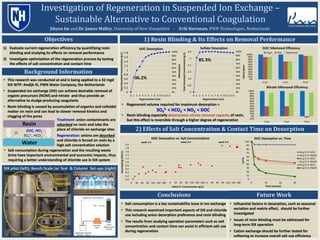
• Regenerant volume required for maximum desorption =
SO4
2- < HCO3
- < NO3
- < DOC
• Resin blinding especially deteriorates nitrate removal capacity of resin,
but this effect is reversible through a higher degree of regeneration
• Salt consumption is a key sustainability issue in ion exchange
• This research examined important aspects of SIX and chloride
use including anion desorption preference and resin blinding
• The results from studying operation parameters such as salt
concentration and contact time can assist in efficient salt use
during regeneration
• Influential factors in desorption, such as seasonal
variation and matrix effect, should be further
investigated
• Issues of resin blinding must be addressed for
long-term SIX operation
• Cation exchange should be further tested for
softening to increase overall salt use efficiency

ACE Poster

  • 1.
    • Salt consumptionduring regeneration and the resulting waste brine have important environmental and economic impacts, thus requiring a better understanding of chloride use in SIX system Investigation of Regeneration in Suspended Ion Exchange – Sustainable Alternative to Conventional Coagulation Jihyon Im and Dr. James Malley, University of New Hampshire - Erik Koreman, PWN Technologies, Netherlands Objectives Background Information 1) Resin Blinding & Its Effects on Removal Performance Conclusions 1) Evaluate current regeneration efficiency by quantifying resin blinding and studying its effects on removal performance 2) Investigate optimization of the regeneration process by testing the effects of salt concentration and contact time Treatment: anion contaminants are adsorbed on resin and take the place of chloride on exchange sites Regeneration: anions are desorbed and chloride is forced on resin by a high salt concentration solution Resin Water DOC, NO3 - SO4 2-, HCO3 -Cl- 2) Effects of Salt Concentration & Contact Time on Desorption Future Work • This research was conducted at and is being applied to a 32 mgd SIX WTP: Andijk III, PWN Water Company, the Netherlands • Suspended ion exchange (SIX) can achieve desirable removal of organic precursors (NOM) and nitrate and thus provide an alternative to sludge-producing coagulants • Resin blinding is caused by accumulation of organics and colloidal matter on resin and can lead to slower removal kinetics and clogging of the pores SIX pilot (left); Bench Scale Jar Test & Column Set-ups (right) SIX Reactors Lamella Separator Regeneration Vessels 36.2% 0% 10% 20% 30% 40% 50% 60% 70% 80% 90% 100% 0 0.2 0.4 0.6 0.8 1 1.2 1.4 1.6 1.8 0 1 2 3 4 5 6 7 8 9 10111213 %Desorption TotalDesorbedConcentration(g/L) Regeneration Cycle DOC Desorption -10% 0% 10% 20% 30% 40% 50% 60% 70% 80% 90% 100% 12 g/L 16 g/L 20 g/L Nitrate %Removal Efficiency 85.3% 0% 10% 20% 30% 40% 50% 60% 70% 80% 90% 100% 0 0.8 1.6 2.4 3.2 4 4.8 0 1 2 3 4 5 6 7 8 9 10111213 %Desorption TotalDesorbedConcentration(g/L) Regeneration Cycle Sulfate Desorption 0% 10% 20% 30% 40% 50% 60% 70% 80% 90% 100% 12 g/L 16 g/L 20 g/L DOC %Removal Efficiency Virgin Pilot Optimized 0.0 0.2 0.4 0.6 0.8 1.0 1.2 1.4 1.6 1.8 2.0 0 30 60 90 120 150 180 Desorbed(g-DOC/L) week 1-2 0 30 60 90 120 150 180 week 3-4 0 30 60 90 120 150 180 week 5-6 0 10 20 30 40 50 60 70 80 90 100 0 10 20 30 UVT% Time (minute) DOC Desorption vs. Time 16 g Cl-/L (KCl) 16 g Cl-/L (NaCl) 31 g Cl-/L (KCl) 31 g Cl-/L (NaCl) 62 g Cl-/L (KCl) 63 g Cl-/L (NaCl) DOC Desorption vs. Salt Concentrations Initial Cl- Concentration (g/L) • Regenerant volume required for maximum desorption = SO4 2- < HCO3 - < NO3 - < DOC • Resin blinding especially deteriorates nitrate removal capacity of resin, but this effect is reversible through a higher degree of regeneration • Salt consumption is a key sustainability issue in ion exchange • This research examined important aspects of SIX and chloride use including anion desorption preference and resin blinding • The results from studying operation parameters such as salt concentration and contact time can assist in efficient salt use during regeneration • Influential factors in desorption, such as seasonal variation and matrix effect, should be further investigated • Issues of resin blinding must be addressed for long-term SIX operation • Cation exchange should be further tested for softening to increase overall salt use efficiency