ACCOUNTING FOR FIXED
ASSETS: -
COST ACCUMULATION,
APPRAISALS,
DISPOSALS AND TAX OFF-SETS
OUTLINE:
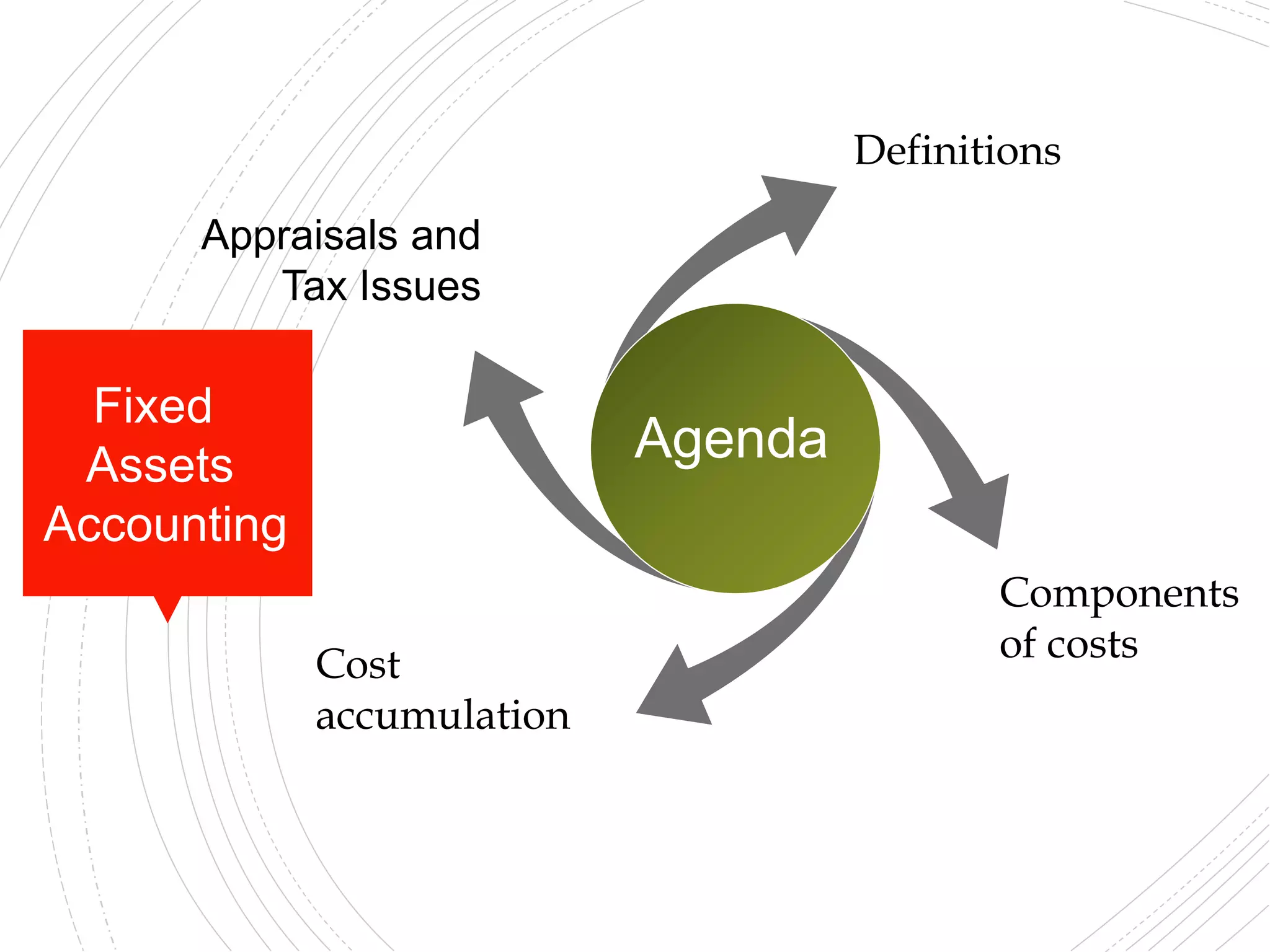
Definitions
Components
of costs
Cost
accumulation
Appraisals and
Tax Issues
Agenda
Fixed
Assets
Accounting
INTRODUCTION
Fixed
Assets
Accounting—
Overview
Fixed assets
are resources
which an
organization
acquired to use
in the
generation of
income over a
period known
as the useful
life span
Every fixed
asset has a
limited useful
economic life
during which it
can be
profitably used
in the operation
of the
organization.
Fixed
Assets
Accounting
FixedAsset
Classifications
—Overview
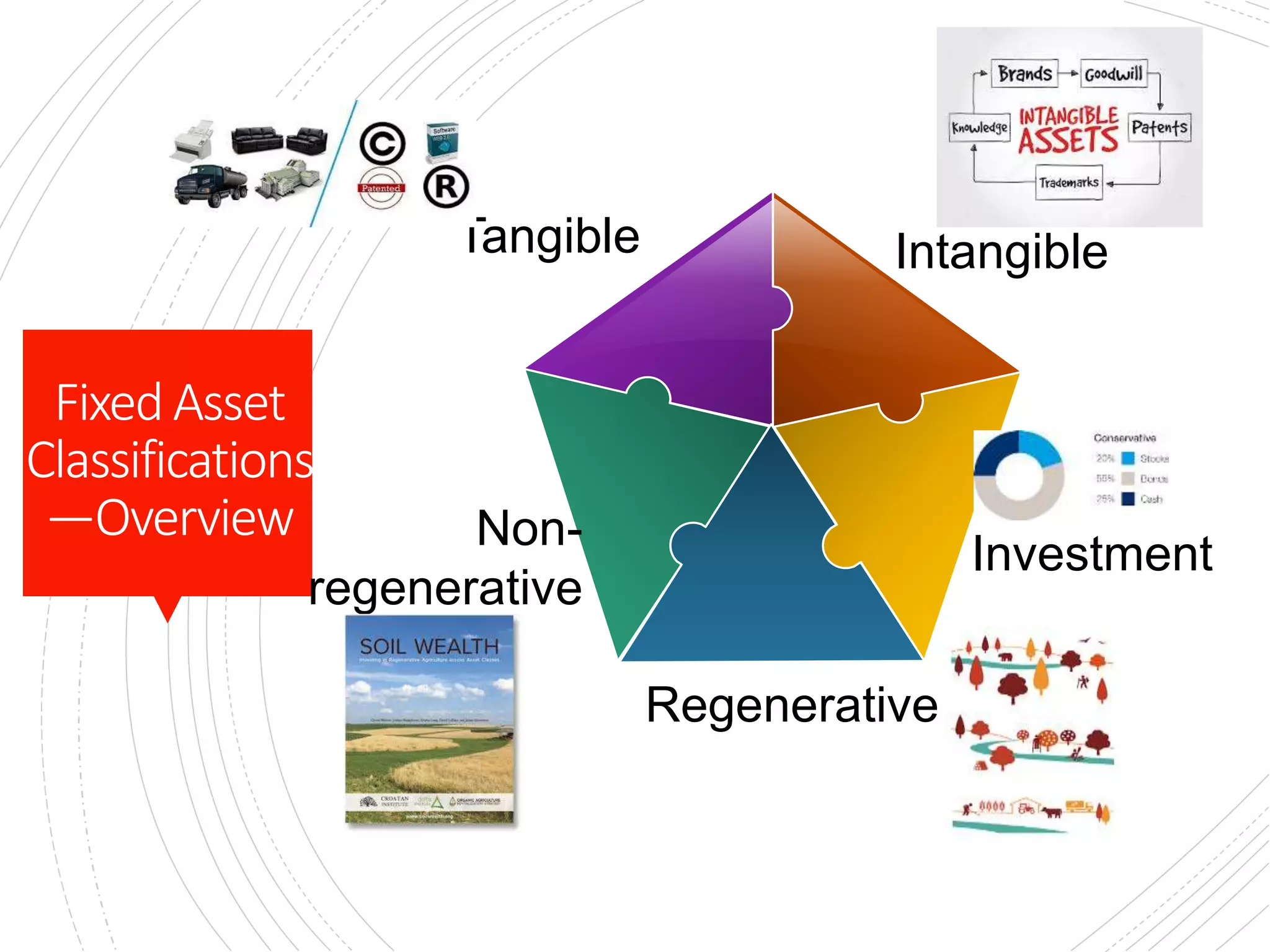
Intangible
Investment
Regenerative
Non-
regenerative
Tangible
FixedAsset
Cost
Ascertainment
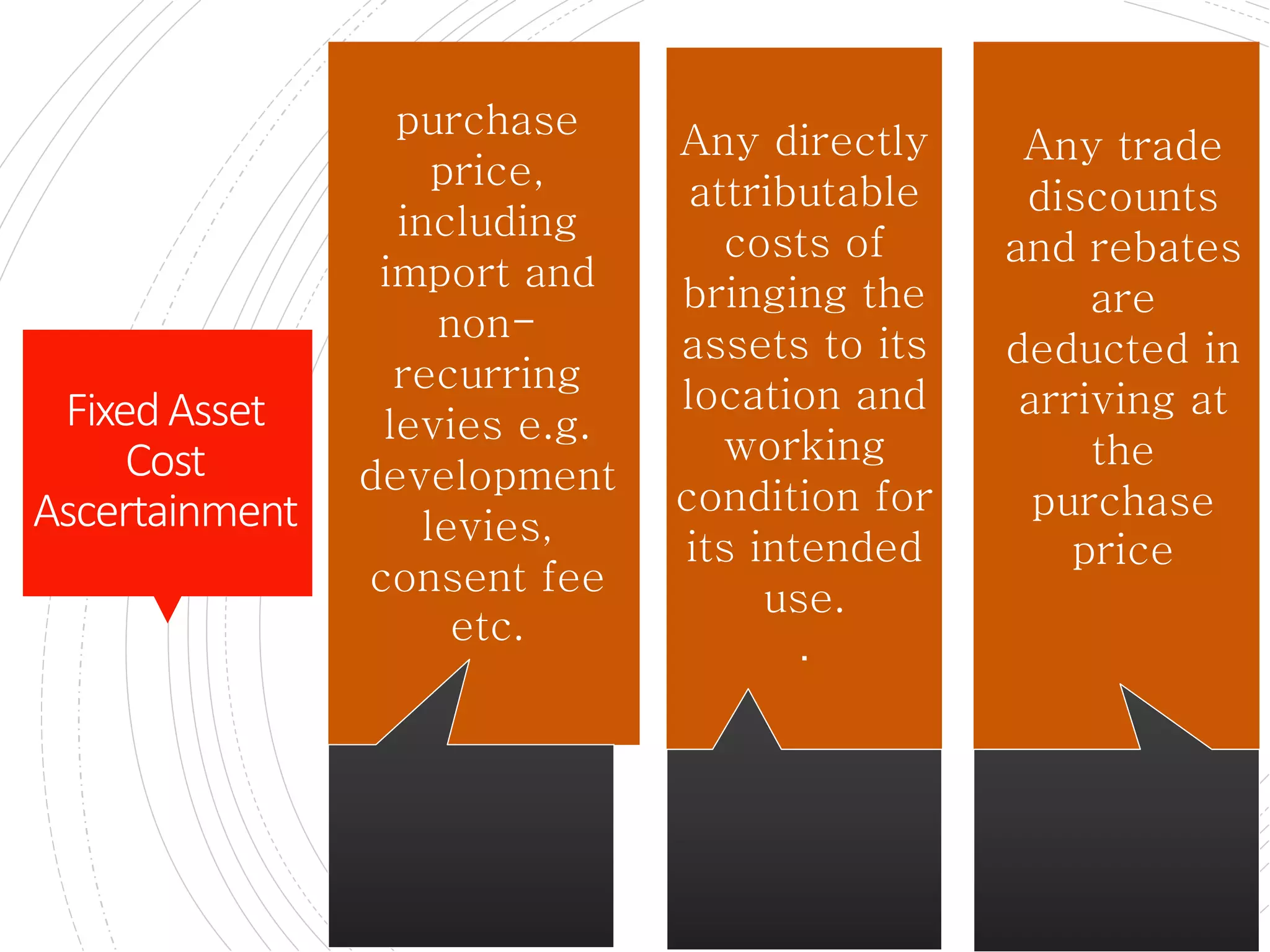
purchase
price,
including
import and
non-
recurring
levies e.g.
development
levies,
consent fee
etc.
Any directly
attributable
costs of
bringing the
assets to its
location and
working
condition for
its intended
use.
.
Any trade
discounts
and rebates
are
deducted in
arriving at
the
purchase
price
COST ACCUMULATION
FixedAsset
Cost
Ascertainment
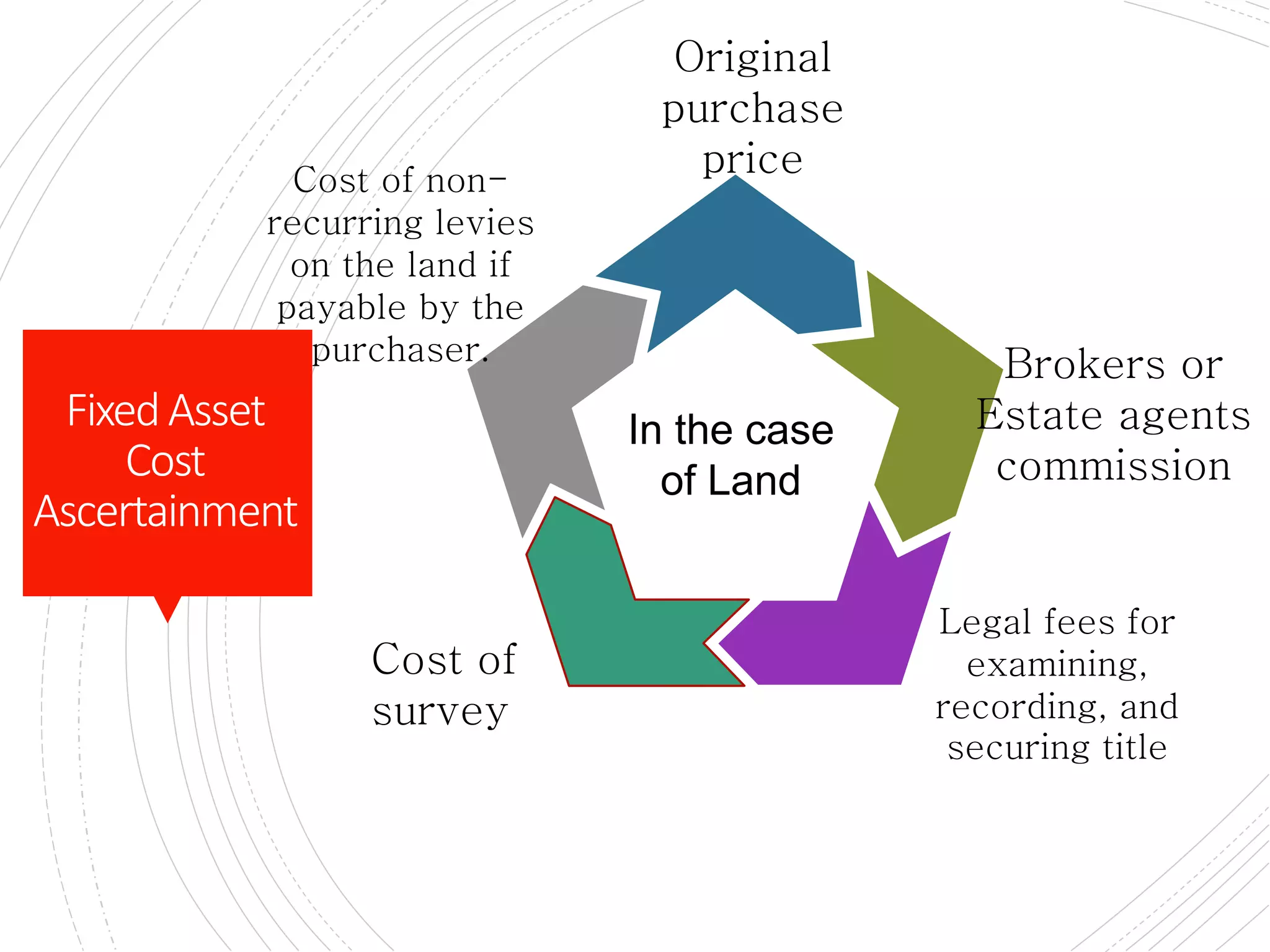
Brokers or
Estate agents
commission
Legal fees for
examining,
recording, and
securing title
Cost of
survey
Cost of non-
recurring levies
on the land if
payable by the
purchaser.
Original
purchase
price
In the case
of Land
FixedAsset
Cost
Ascertainment—
OtherElementsof
Costs
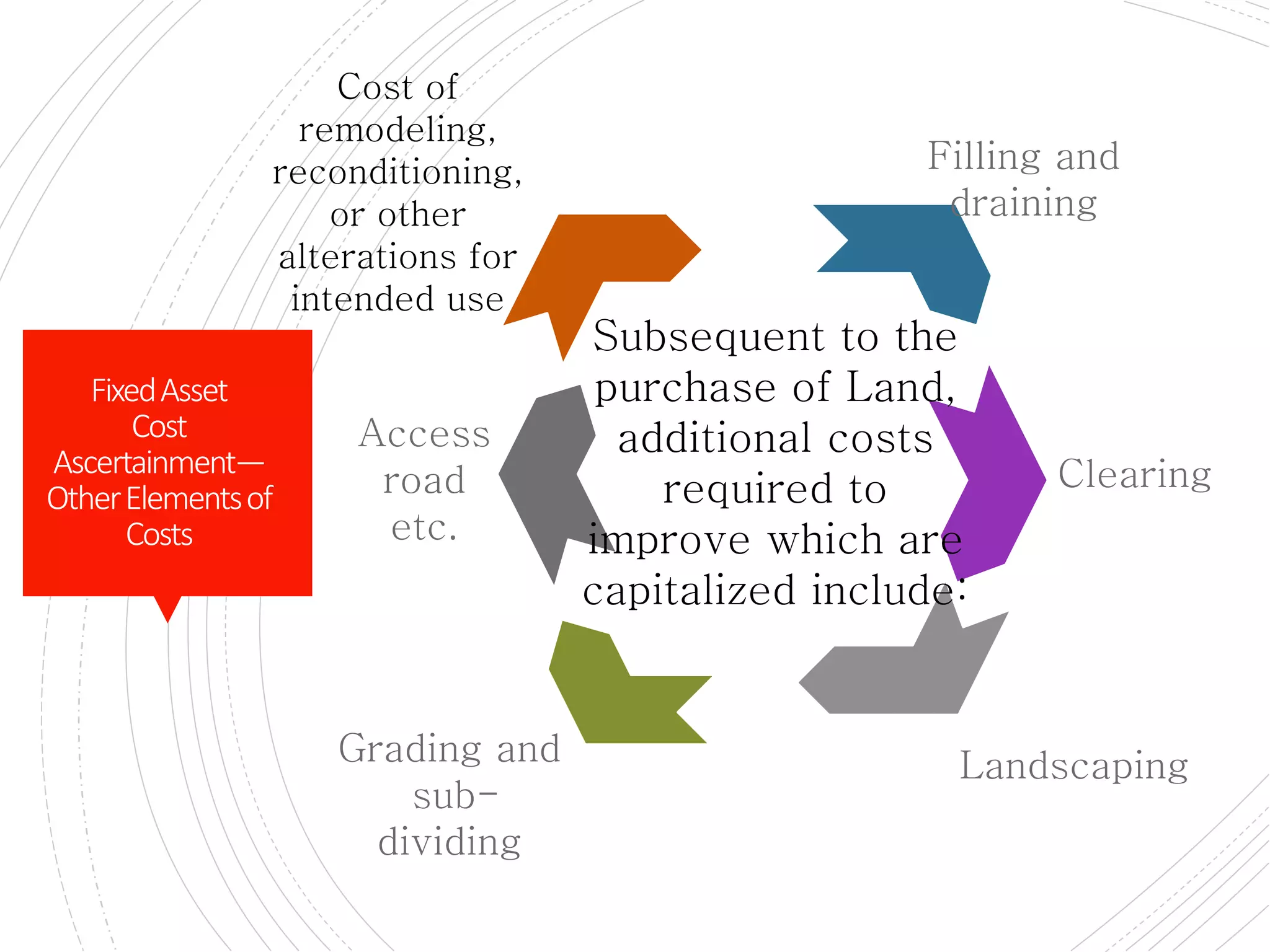
Subsequent to the
purchase of Land,
additional costs
required to
improve which are
capitalized include:
Filling and
draining
Clearing
Landscaping
Grading and
sub-
dividing
Access
road
etc.
Cost of
remodeling,
reconditioning,
or other
alterations for
intended use
CONTD
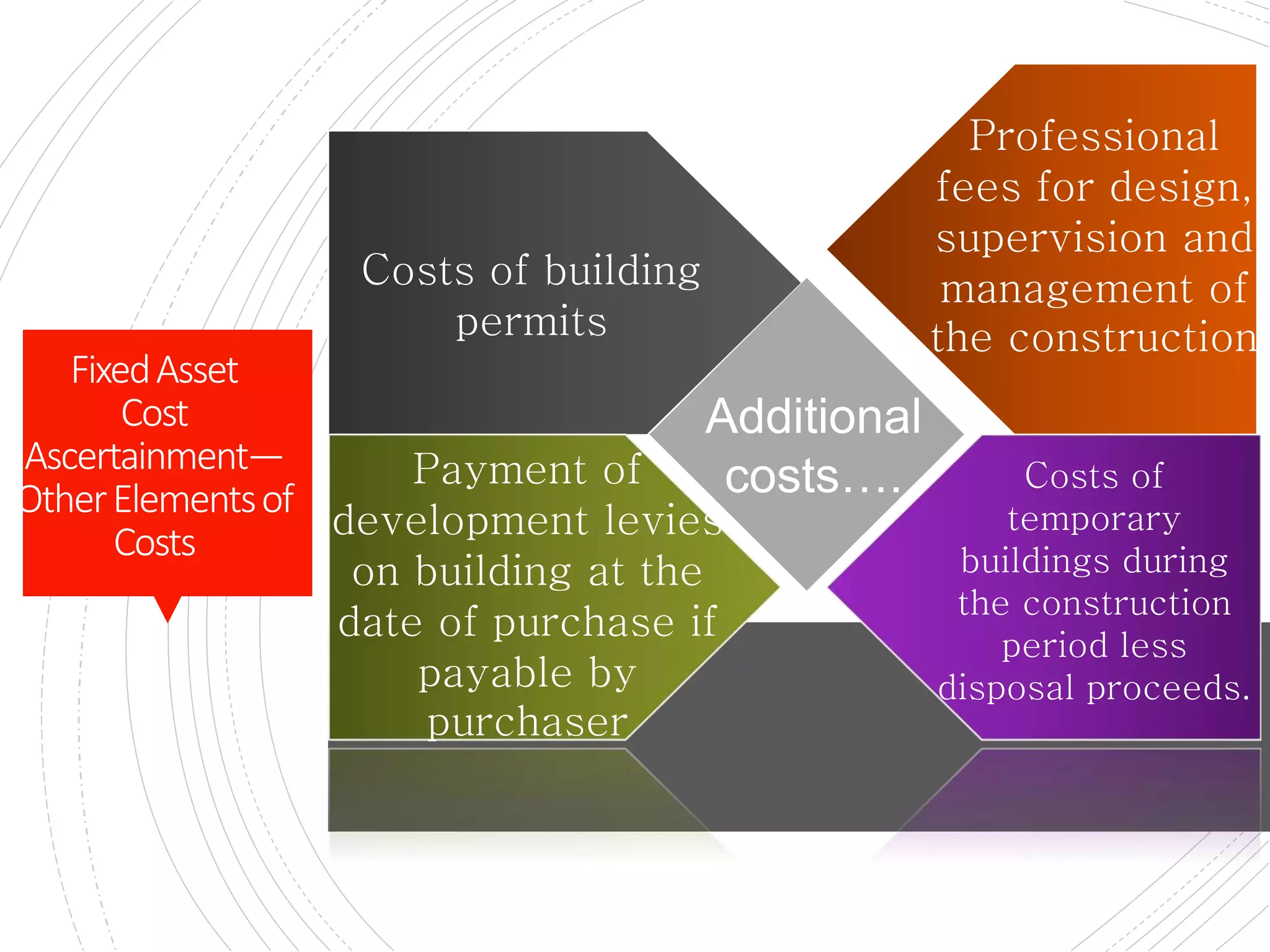
Costs of building
permits
Payment of
development levies
on building at the
date of purchase if
payable by
purchaser
Professional
fees for design,
supervision and
management of
the construction
Costs of
temporary
buildings during
the construction
period less
disposal proceeds.
Additional
costs….
FixedAsset
Cost
Ascertainment—
OtherElementsof
Costs
PLANT AND EQUIPMENT
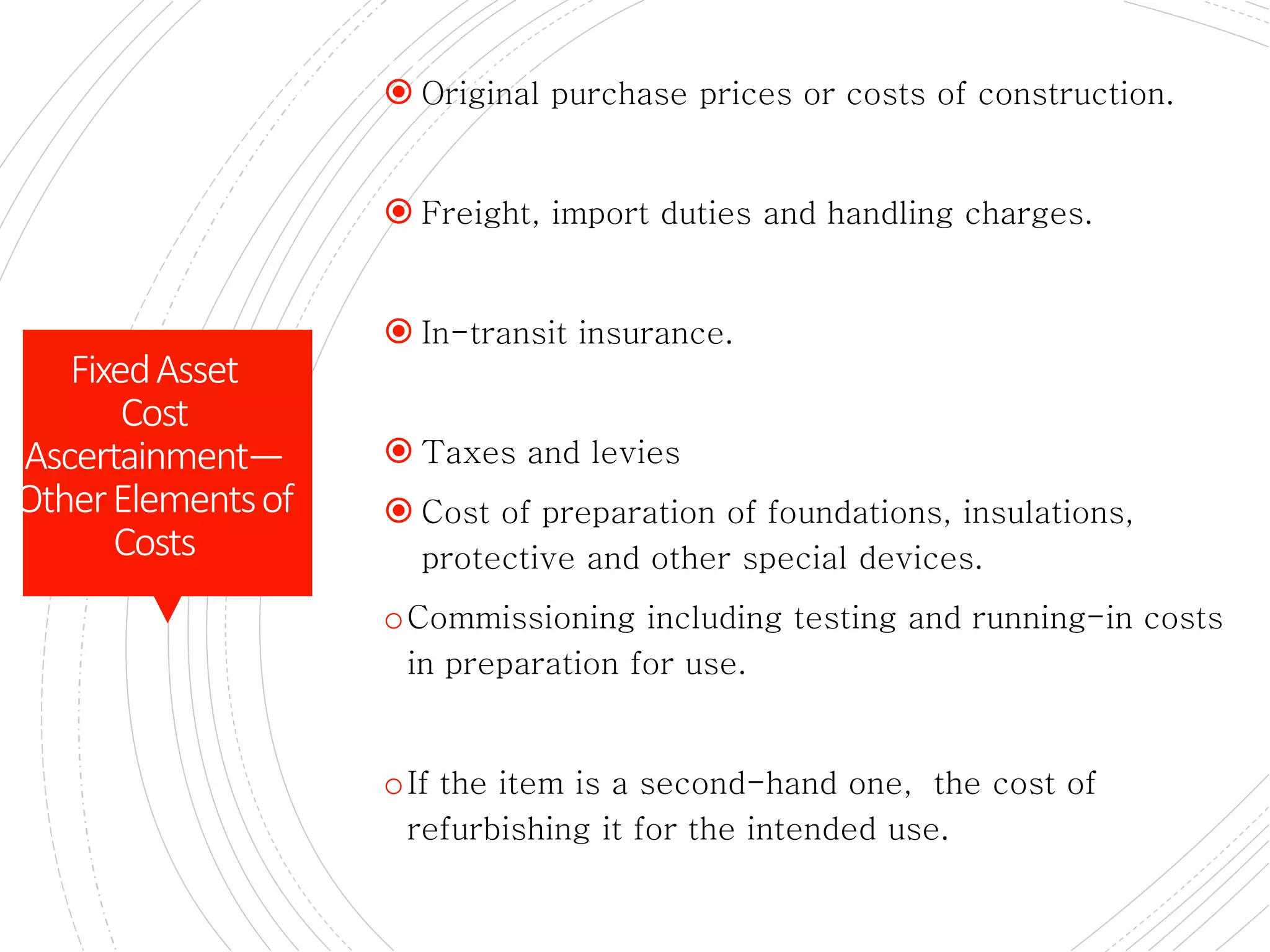
 Original purchase prices or costs of construction.
 Freight, import duties and handling charges.
 In-transit insurance.
 Taxes and levies
 Cost of preparation of foundations, insulations,
protective and other special devices.
oCommissioning including testing and running-in costs
in preparation for use.
oIf the item is a second-hand one, the cost of
refurbishing it for the intended use.
FixedAsset
Cost
Ascertainment—
OtherElementsof
Costs
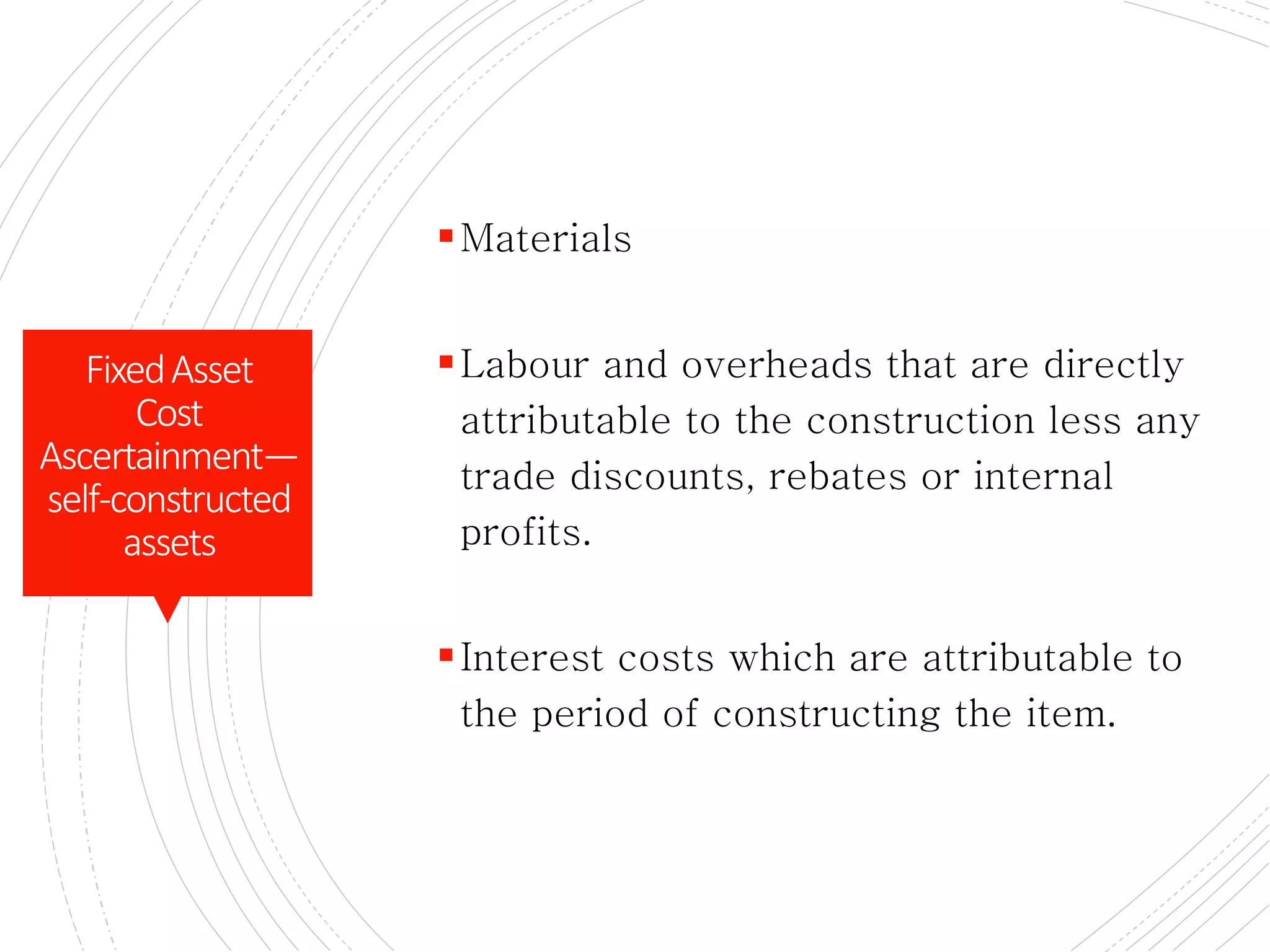
Cost of self – constructed assts
Materials
Labour and overheads that are directly
attributable to the construction less any
trade discounts, rebates or internal
profits.
Interest costs which are attributable to
the period of constructing the item.
FixedAsset
Cost
Ascertainment—
self-constructed
assets
Revaluation of assets
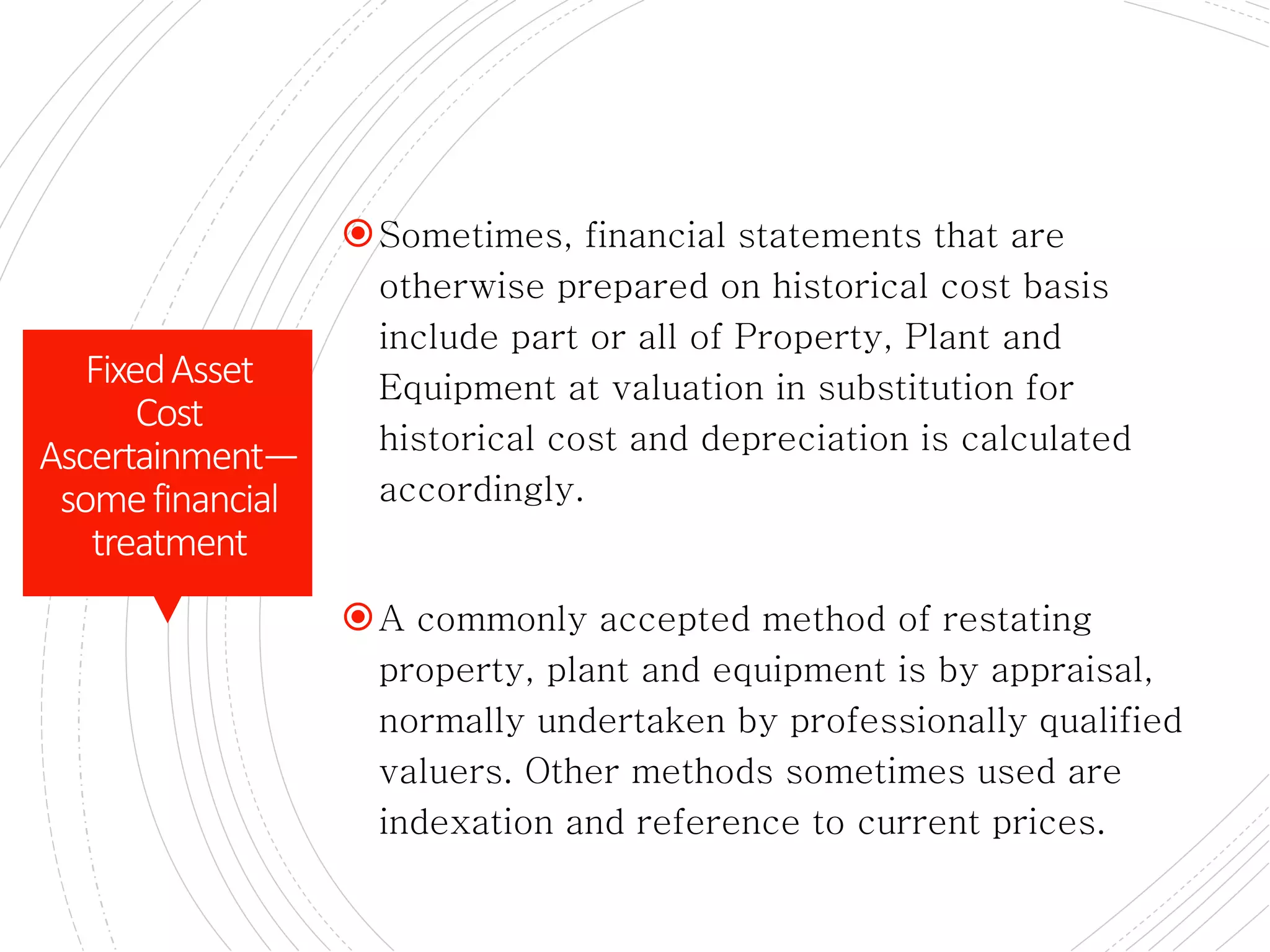
Sometimes, financial statements that are
otherwise prepared on historical cost basis
include part or all of Property, Plant and
Equipment at valuation in substitution for
historical cost and depreciation is calculated
accordingly.
A commonly accepted method of restating
property, plant and equipment is by appraisal,
normally undertaken by professionally qualified
valuers. Other methods sometimes used are
indexation and reference to current prices.
FixedAsset
Cost
Ascertainment—
somefinancial
treatment
DISOSALS OF ASSETS
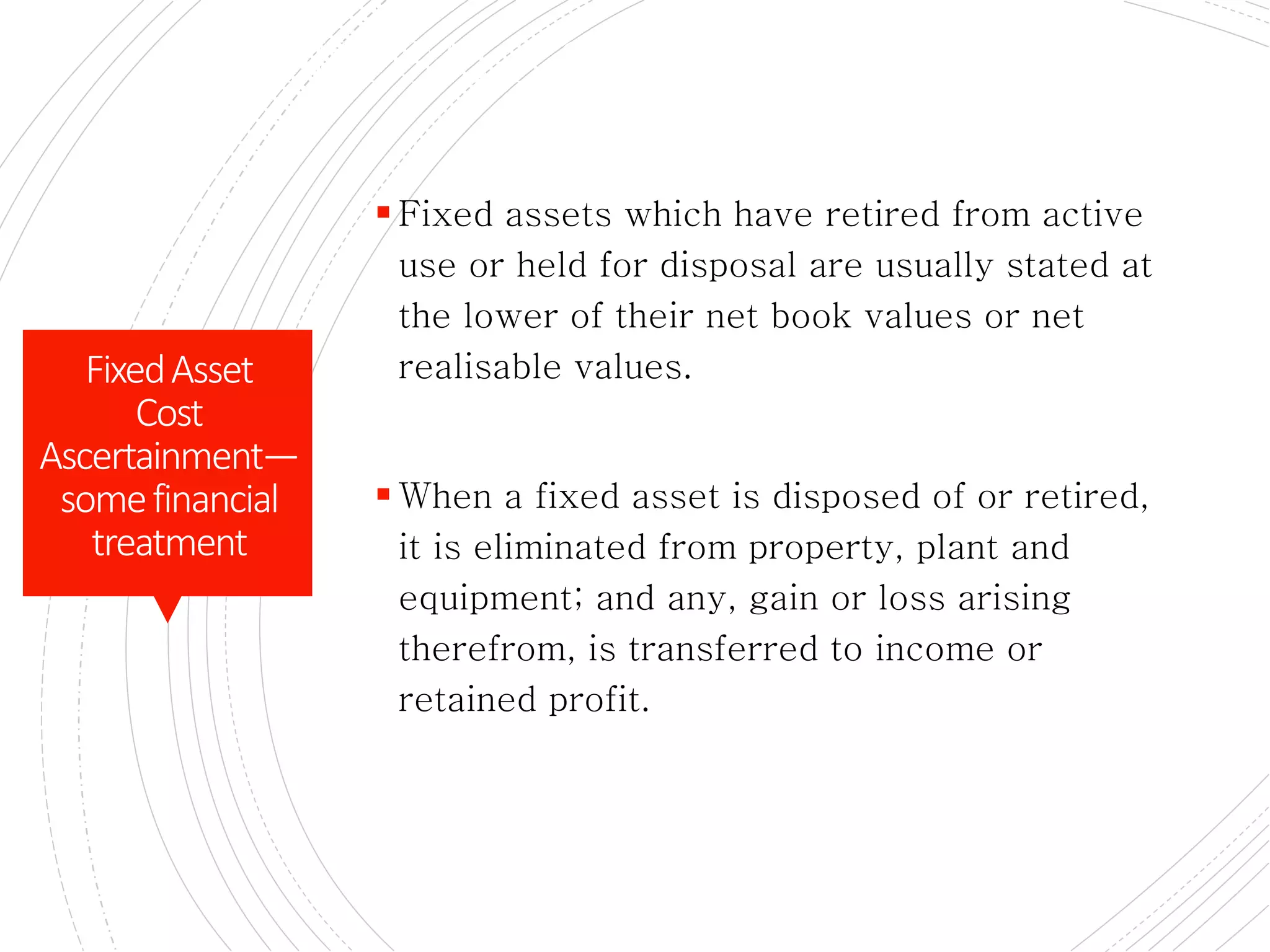
 Fixed assets which have retired from active
use or held for disposal are usually stated at
the lower of their net book values or net
realisable values.
 When a fixed asset is disposed of or retired,
it is eliminated from property, plant and
equipment; and any, gain or loss arising
therefrom, is transferred to income or
retained profit.
FixedAsset
Cost
Ascertainment—
somefinancial
treatment
CONTD.
Upon disposal of a previously revalued
assets, the difference between the net
proceeds from disposal and the net book
value is normally charged or credited to
income. Any related valuation surplus is
transferred to income or retained profit.
Where the usefulness of an item or group of
items of assets is impaired, in which case,
the recoverable amounts is less than the net
book value, the net book value is usually
reduced to recoverable amount and the
difference is charged to income immediately.
FixedAsset
Cost
Ascertainment—
self-constructed
assets
At the date of acquisition, items of property,
plant and equipment should be recorded at
their initial cost including directly
attributable expenses incurred in order to
bring them into operation for their intended
use.
The cost of self –constructed item of
property, plant and equipment should
comprise those costs that relate directly and
those expenses attributable to the
construction of the item.
Costs of inefficiencies in the construction of
the item should not form part of its cost.
FixedAsset
Cost
Ascertainment—
somefinancial
treatment
CONTD.
On revaluation of property,
plant and equipment, an
increase in the net book value
should be credited to a
revaluation surplus account.
A decrease in the net book
value should be reduced by the
amount of any existing
revaluation surplus on the same
item before it is charged to
income.
FixedAsset
Cost
Ascertainment—
somefinancial
treatment
DISCLOSURE :
The following disclosures should be made:
 The bases for determining the book value of
property, pant and equipment.
 When more than one basis has been used,
book value determined under each basis in
each category of property, plant and
equipment.
 Where property, plant and equipment are
stated at revalued amounts, the methods
adopted to compute these amounts should be
disclosed, including the policy with regard to
the frequency of revaluations, the nature of
indices used and whether external valuers are
involved.
FixedAsset
Cost
Ascertainment—
somefinancial
treatment
CONTD.
 Movements in each category of property,
plant and equipment (i.e. additions and
disposals) during the year.
 Contingent capital gains tax and deferred
income tax liabilities attributable to any
revaluation surplus incorporated in or referred
to in financial statements
FixedAsset
Cost
Ascertainment—
somefinancial
treatment
Cost
Accumulation….
Cost
Accumulation….

ACCOUNTING FOR FIXED ASSETS -COST, ACCUMULATION.ppt

  • 1.
    ACCOUNTING FOR FIXED ASSETS:- COST ACCUMULATION, APPRAISALS, DISPOSALS AND TAX OFF-SETS
  • 2.
  • 3.
    INTRODUCTION Fixed Assets Accounting— Overview Fixed assets are resources whichan organization acquired to use in the generation of income over a period known as the useful life span Every fixed asset has a limited useful economic life during which it can be profitably used in the operation of the organization. Fixed Assets Accounting
  • 4.
  • 5.
    FixedAsset Cost Ascertainment purchase price, including import and non- recurring levies e.g. development levies, consentfee etc. Any directly attributable costs of bringing the assets to its location and working condition for its intended use. . Any trade discounts and rebates are deducted in arriving at the purchase price
  • 6.
    COST ACCUMULATION FixedAsset Cost Ascertainment Brokers or Estateagents commission Legal fees for examining, recording, and securing title Cost of survey Cost of non- recurring levies on the land if payable by the purchaser. Original purchase price In the case of Land
  • 7.
    FixedAsset Cost Ascertainment— OtherElementsof Costs Subsequent to the purchaseof Land, additional costs required to improve which are capitalized include: Filling and draining Clearing Landscaping Grading and sub- dividing Access road etc. Cost of remodeling, reconditioning, or other alterations for intended use
  • 8.
    CONTD Costs of building permits Paymentof development levies on building at the date of purchase if payable by purchaser Professional fees for design, supervision and management of the construction Costs of temporary buildings during the construction period less disposal proceeds. Additional costs…. FixedAsset Cost Ascertainment— OtherElementsof Costs
  • 9.
    PLANT AND EQUIPMENT Original purchase prices or costs of construction.  Freight, import duties and handling charges.  In-transit insurance.  Taxes and levies  Cost of preparation of foundations, insulations, protective and other special devices. oCommissioning including testing and running-in costs in preparation for use. oIf the item is a second-hand one, the cost of refurbishing it for the intended use. FixedAsset Cost Ascertainment— OtherElementsof Costs
  • 10.
    Cost of self– constructed assts Materials Labour and overheads that are directly attributable to the construction less any trade discounts, rebates or internal profits. Interest costs which are attributable to the period of constructing the item. FixedAsset Cost Ascertainment— self-constructed assets
  • 11.
    Revaluation of assets Sometimes,financial statements that are otherwise prepared on historical cost basis include part or all of Property, Plant and Equipment at valuation in substitution for historical cost and depreciation is calculated accordingly. A commonly accepted method of restating property, plant and equipment is by appraisal, normally undertaken by professionally qualified valuers. Other methods sometimes used are indexation and reference to current prices. FixedAsset Cost Ascertainment— somefinancial treatment
  • 12.
    DISOSALS OF ASSETS Fixed assets which have retired from active use or held for disposal are usually stated at the lower of their net book values or net realisable values.  When a fixed asset is disposed of or retired, it is eliminated from property, plant and equipment; and any, gain or loss arising therefrom, is transferred to income or retained profit. FixedAsset Cost Ascertainment— somefinancial treatment
  • 13.
    CONTD. Upon disposal ofa previously revalued assets, the difference between the net proceeds from disposal and the net book value is normally charged or credited to income. Any related valuation surplus is transferred to income or retained profit. Where the usefulness of an item or group of items of assets is impaired, in which case, the recoverable amounts is less than the net book value, the net book value is usually reduced to recoverable amount and the difference is charged to income immediately. FixedAsset Cost Ascertainment— self-constructed assets
  • 14.
    At the dateof acquisition, items of property, plant and equipment should be recorded at their initial cost including directly attributable expenses incurred in order to bring them into operation for their intended use. The cost of self –constructed item of property, plant and equipment should comprise those costs that relate directly and those expenses attributable to the construction of the item. Costs of inefficiencies in the construction of the item should not form part of its cost. FixedAsset Cost Ascertainment— somefinancial treatment
  • 15.
    CONTD. On revaluation ofproperty, plant and equipment, an increase in the net book value should be credited to a revaluation surplus account. A decrease in the net book value should be reduced by the amount of any existing revaluation surplus on the same item before it is charged to income. FixedAsset Cost Ascertainment— somefinancial treatment
  • 16.
    DISCLOSURE : The followingdisclosures should be made:  The bases for determining the book value of property, pant and equipment.  When more than one basis has been used, book value determined under each basis in each category of property, plant and equipment.  Where property, plant and equipment are stated at revalued amounts, the methods adopted to compute these amounts should be disclosed, including the policy with regard to the frequency of revaluations, the nature of indices used and whether external valuers are involved. FixedAsset Cost Ascertainment— somefinancial treatment
  • 17.
    CONTD.  Movements ineach category of property, plant and equipment (i.e. additions and disposals) during the year.  Contingent capital gains tax and deferred income tax liabilities attributable to any revaluation surplus incorporated in or referred to in financial statements FixedAsset Cost Ascertainment— somefinancial treatment
  • 18.
  • 19.