3
Accounting Cycle Overview
Definition:The accounting cycle refers to the series of
steps taken in recording financial transactions and
producing financial statements for a specific period.
🞭Importance: Provides a systematic approach to maintain
accurate financial records and ensure compliance with
accounting principles.
4.
4
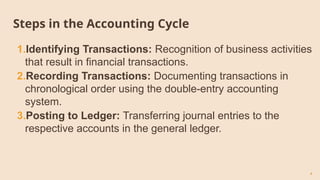
Steps in theAccounting Cycle
1.Identifying Transactions: Recognition of business activities
that result in financial transactions.
2.Recording Transactions: Documenting transactions in
chronological order using the double-entry accounting
system.
3.Posting to Ledger: Transferring journal entries to the
respective accounts in the general ledger.
5.
5
Steps in theAccounting Cycle
4.Trial Balance: Preparing a trial balance to ensure debits
equal credits and to detect any errors.
5.Adjusting Entries: Making adjustments for accrued
revenues, expenses, prepayments, and depreciation.
6.Adjusted Trial Balance: Creating a trial balance after
adjusting entries to ensure accuracy before preparing
financial statements.
6.
6
Steps in theAccounting Cycle
7. Financial Statements: Generating financial statements
(income statement, balance sheet, statement of cash
flows).
8.Closing Entries: Closing temporary accounts (revenue,
expense, and dividend accounts) to retained earnings.
9.Post-Closing Trial Balance: Verifying that all temporary
accounts have been closed properly.
7.
7
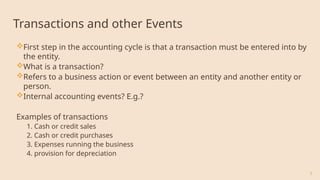
Transactions and otherEvents
First step in the accounting cycle is that a transaction must be entered into by
the entity.
What is a transaction?
Refers to a business action or event between an entity and another entity or
person.
Internal accounting events? E.g.?
Examples of transactions
1. Cash or credit sales
2. Cash or credit purchases
3. Expenses running the business
4. provision for depreciation
8.
8
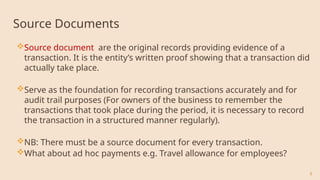
Source Documents
Source documentare the original records providing evidence of a
transaction. It is the entity’s written proof showing that a transaction did
actually take place.
Serve as the foundation for recording transactions accurately and for
audit trail purposes (For owners of the business to remember the
transactions that took place during the period, it is necessary to record
the transaction in a structured manner regularly).
NB: There must be a source document for every transaction.
What about ad hoc payments e.g. Travel allowance for employees?
9.
9
Source Documents
Source Documentsshould contain:
Serial number of the source document
Nature of the transaction or the name of source document
The amount of the transaction
The date of the transaction
The identity of the parties involved in the transaction
Description
VAT
The source documents should be in duplicate, the Entity issuing the document retains the copy
and the Customer receives the original document.
The source data needs to be complete and correct to ensure that accounting records are correct.
10.
10
Common Source Documents
Sales Invoice: Document issued to customers for goods or services sold, including details such as date,
quantity, price, and terms.
Purchase Invoice: Received from suppliers for goods or services purchased on credit, containing similar
details to sales invoices.
Receipts: Acknowledgment of cash received, specifying the date, amount, and purpose of the payment.
Cheques: Written orders to pay a specified sum to a person or entity, including details of the payee, date,
amount, and purpose.
Bank Statements: Records provided by the bank showing all transactions, including deposits, withdrawals,
and charges.
Payroll Records: Documents detailing employee compensation, deductions, and taxes withheld for each pay
period.






![What Is Blockchain Technology A Simple Beginner’s Guide [2026]](https://cdn.slidesharecdn.com/ss_thumbnails/whatisblockchaintechnologyasimplebeginnersguide2026-260101112141-cf432b44-thumbnail.jpg?width=640&height=640&fit=bounds)