ACCIDENTS & DANGEROUS OCCURANCE
REPORTING PROCEDURES
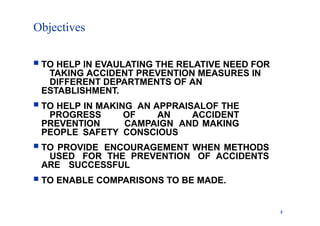
Objectives
2
 TO HELP IN EVAULATING THE RELATIVE NEED FOR
TAKING ACCIDENT PREVENTION MEASURES IN
DIFFERENT DEPARTMENTS OF AN
ESTABLISHMENT.
 TO HELP IN MAKING AN APPRAISALOF THE
PROGRESS OF AN ACCIDENT
PREVENTION CAMPAIGN AND MAKING
PEOPLE SAFETY CONSCIOUS
 TO PROVIDE ENCOURAGEMENT WHEN METHODS
USED FOR THE PREVENTION OF ACCIDENTS
ARE SUCCESSFUL
 TO ENABLE COMPARISONS TO BE MADE.
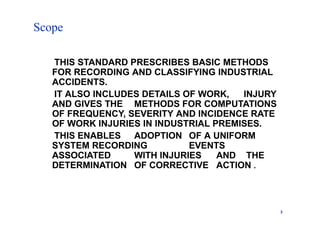
Scope
3
THIS STANDARD PRESCRIBES BASIC METHODS
FOR RECORDING AND CLASSIFYING INDUSTRIAL
ACCIDENTS.
IT ALSO INCLUDES DETAILS OF WORK, INJURY
AND GIVES THE METHODS FOR COMPUTATIONS
OF FREQUENCY, SEVERITY AND INCIDENCE RATE
OF WORK INJURIES IN INDUSTRIAL PREMISES.
THIS ENABLES ADOPTION OF A UNIFORM
SYSTEM RECORDING EVENTS
ASSOCIATED WITH INJURIES AND THE
DETERMINATION OF CORRECTIVE ACTION .
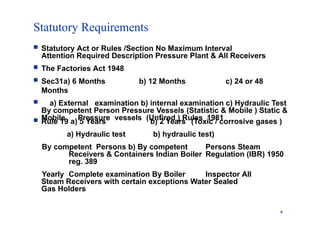
Statutory Requirements
4
 Statutory Act or Rules /Section No Maximum Interval
Attention Required Description Pressure Plant & All Receivers
 The Factories Act 1948
 Sec31a) 6 Months b) 12 Months c) 24 or 48
Months
 a) External examination b) internal examination c) Hydraulic Test
By competent Person Pressure Vessels (Statistic & Mobile ) Static &
Mobile Pressure vessels (Unfired ) Rules 1981
 Rule 19 a) 5 Years
a) Hydraulic test
b) 2 Years (Toxic / corrosive gases )
b) hydraulic test)
By competent Persons b) By competent Persons Steam
Receivers & Containers Indian Boiler Regulation (IBR) 1950
reg. 389
Yearly Complete examination By Boiler Inspector All
Steam Receivers with certain exceptions Water Sealed
Gas Holders
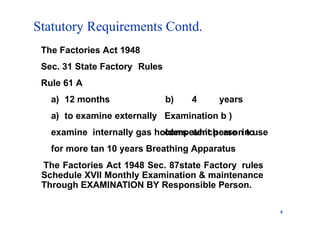
Statutory Requirements Contd.
5
The Factories Act 1948
Sec. 31 State Factory Rules
Rule 61 A
a) 12 months
a) to examine externally
b) 4 years
Examination b )
competent person to
examine internally gas holders which are in use
for more tan 10 years Breathing Apparatus
The Factories Act 1948 Sec. 87state Factory rules
Schedule XVII Monthly Examination & maintenance
Through EXAMINATION BY Responsible Person.
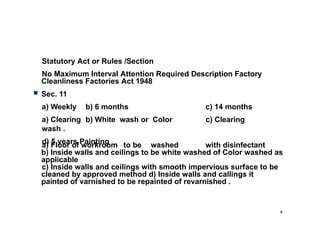
Statutory Act or Rules /Section
No Maximum Interval Attention Required Description Factory
Cleanliness Factories Act 1948
 Sec. 11
6
c) 14 months
c) Clearing
a) Weekly b) 6 months
a) Clearing b) White wash or Color
wash .
d) 5 years Painting
a) Floor of workroom to be washed with disinfectant
b) Inside walls and ceilings to be white washed of Color washed as
applicable
c) Inside walls and ceilings with smooth impervious surface to be
cleaned by approved method d) Inside walls and callings it
painted of varnished to be repainted of revarnished .
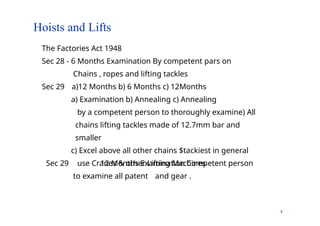
Hoists and Lifts
7
The Factories Act 1948
Sec 28 - 6 Months Examination By competent pars on
Chains , ropes and lifting tackles
Sec 29 a)12 Months b) 6 Months c) 12Months
a) Examination b) Annealing c) Annealing
by a competent person to thoroughly examine) All
chains lifting tackles made of 12.7mm bar and
smaller
c) Excel above all other chains $tackiest in general
use Cranes & other Lifting Machines
Sec 29 12 Months Examination Competent person
to examine all patent and gear .
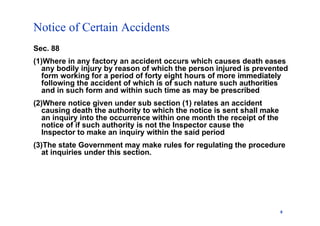
Notice of Certain Accidents
8
Sec. 88
(1)Where in any factory an accident occurs which causes death eases
any bodily injury by reason of which the person injured is prevented
form working for a period of forty eight hours of more immediately
following the accident of which is of such nature such authorities
and in such form and within such time as may be prescribed
(2)Where notice given under sub section (1) relates an accident
causing death the authority to which the notice is sent shall make
an inquiry into the occurrence within one month the receipt of the
notice of if such authority is not the Inspector cause the
Inspector to make an inquiry within the said period
(3)The state Government may make rules for regulating the procedure
at inquiries under this section.
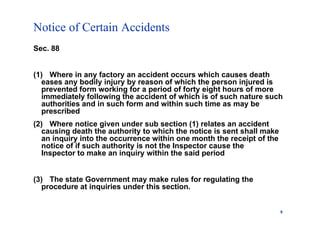
Notice of Certain Accidents
9
Sec. 88
(1) Where in any factory an accident occurs which causes death
eases any bodily injury by reason of which the person injured is
prevented form working for a period of forty eight hours of more
immediately following the accident of which is of such nature such
authorities and in such form and within such time as may be
prescribed
(2) Where notice given under sub section (1) relates an accident
causing death the authority to which the notice is sent shall make
an inquiry into the occurrence within one month the receipt of the
notice of if such authority is not the Inspector cause the
Inspector to make an inquiry within the said period
(3) The state Government may make rules for regulating the
procedure at inquiries under this section.
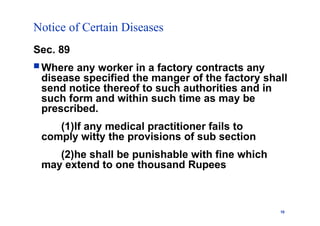
Notice of Certain Diseases
10
Sec. 89
 Where any worker in a factory contracts any
disease specified the manger of the factory shall
send notice thereof to such authorities and in
such form and within such time as may be
prescribed.
(1)If any medical practitioner fails to
comply witty the provisions of sub section
(2)he shall be punishable with fine which
may extend to one thousand Rupees
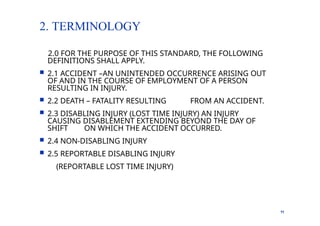
2. TERMINOLOGY
11
2.0 FOR THE PURPOSE OF THIS STANDARD, THE FOLLOWING
DEFINITIONS SHALL APPLY.
 2.1 ACCIDENT –AN UNINTENDED OCCURRENCE ARISING OUT
OF AND IN THE COURSE OF EMPLOYMENT OF A PERSON
RESULTING IN INJURY.
 2.2 DEATH – FATALITY RESULTING FROM AN ACCIDENT.
 2.3 DISABLING INJURY (LOST TIME INJURY) AN INJURY
CAUSING DISABLEMENT EXTENDING BEYOND THE DAY OF
SHIFT ON WHICH THE ACCIDENT OCCURRED.
 2.4 NON-DISABLING INJURY
 2.5 REPORTABLE DISABLING INJURY
(REPORTABLE LOST TIME INJURY)
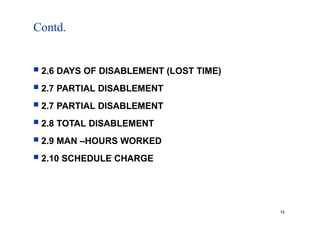
Contd.
12
 2.6 DAYS OF DISABLEMENT (LOST TIME)
 2.7 PARTIAL DISABLEMENT
 2.8 TOTAL DISABLEMENT
 2.9 MAN –HOURS WORKED
 2.10 SCHEDULE CHARGE
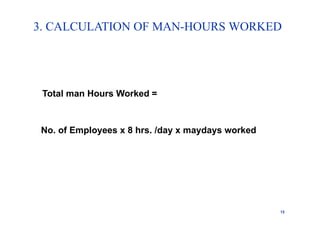
3. CALCULATION OF MAN-HOURS WORKED
13
Total man Hours Worked =
No. of Employees x 8 hrs. /day x maydays worked
4. CLASSIFICATION
14
OF ACCIDENTS
 AGENCY
 UNSAFE MECHANICAL OR PHYSICAL
CONDITION
 UNSAFE ACT.
 UNSAFE PERSONAL FACTOR
 TYPE OF ACCIDENTS
 NATURE OF INJURY ,AND
 LOCATION IN INJURY
5. ASSESSMENT OF WORK INJURY
15
5.1 GENERAL
 THROUGH INVESTIGATION OF ALL FACTORS
RELATING TO THE OCCURRENCE OF EACH REPORTED
INJURY IS ESSENTIAL. DETERMINATION AS TO
WHETHER OR NOT THE INJURY SHOULD BE
CONSIDERED A WORK INJURY UNDER THE
PROVISIONS OF THIS STANDARD SHALL BE BASED ON
THE EVIDENCE COLLECTIVE DURING
INVESTIGATIONS.
5.2 Evidence
THE EVIDENCE TO BE CONSIDERED IN
DETERMINING WHETHER OR NOT THE REPORTED
INJURY SHOULD BE CONSIDERED A WORK INJURY MAY
INCLUDE , BUT NO NECESSARILY BE
LIMITED TO , THE FOLLOWING.
A) FACTS RESULTING FROM INVESTIGATIONS OF THE
INJURED EMPLOYEE’S WORK ACTIVITIES AND WORKING
ENVIRONMENT TO WHICH THE INJURY MIGHT BE
RELATED;
B)STATEMENTS (WRITTEN IF POSSIBLE) OF
INJURED EMPLOYEE,
C) FOLLOW EMPLOYEES, WITNESSES AND
SUPERVISORS;
D) MEDICAL REPORTS ACCEPTABLE TO THE
AUTHORITY CLASSIFYING
THE WOK INJURY, AND
D) FACTS CONCERNING THE INJURED EMPLOYEE’S WORK
ACTIVITY FOR OTHER EMPLOYERS AND OTHER OFF THE JOB
ACTIVITIES, INJURIESAND ILLNESSES.`
16
5.2 ASSESSMENT OF SPECIAL CASES
17
 5.2.1
GENERAL – BEFORE INCLUSION IN THE RECORD SPECIAL
CASES SHOULD BE ASSESSED.
 5.2.2 TO 5.2.15
ARE INTENDED TO ASSIST IN SUCH ASSESSMENT BUT THESE
PROVISIONS RULES SHOULD NOT BE USED TO EXCLUDE A
GENUINE WORK INJURY FROM THE RECORD
 5.2.2
INGUINAL HERNIA - AN INGUINAL HERNIA SHALL BE
CONSIDERED A WORK INJURY ONLY IF IT IS
PRECIPITATED BY IN IMPACT, SUDDEN EFFORT, OR
SERVE STRAIN, MEETS, AFTER INVESTIGATIONS, ALL OF
THE FOLLOWING CONDITIONS:-
A) THERE IS CLEAR EVIDENCE OF AND ACCIDENTAL
EVENT OR AN INCIDENT SUCH AS A SLIP, TRIP OR FALL, SUDDEN
EFFORT OR OVER EXERTION.
18
B) THERE WAS ACTUAL PAIN IN THE HERNIA REGION AT THE
TIME OF THE ACCIDENT OR INCIDENT AND
C) THE IMMEDIATE PAIN WAS SO ACUTE THAT THE INJURED
EMPLOYEE WAS FORCED TO STOP WORK LONG ENOUGH
TO DRAW THE ATTENTION OF HIS FOREMEN PR FOLLOW
EMPLOYEE, OR THE ATTENTION OF PHYSICIAN WAS
SECURED WITHIN 12 HOURS.
5.2.3
BACK INJURY – A BACK INJURY OR STRAIN SHALL
AFTER INVESTIGATION, BE CONSIDERED A WORK INJURY
IF:
A) THERE IS CLEAR EVIDENCE OF AN ACCIDENT EVENT
OR AN ACCIDENT SUCH A SLIP, TRIP AND FALL, SUDDEN
EFFORT OR OVER EXECRATION OR BELOW ON THE
BACK
5.2.6
CARDIOVASCULAR DISEASES - THIS TERM IS USED TO COVER
THE FOLLOWING GROUPS:-
A MEDICAL PRACTITIONER, AUTHORIZED TO TREAT THE CASE,
SATISFIED AFTER A COMPLETE REVIEW OF THE
CIRCUMSTANCES OF THE ACCIDENT OR INCIDENT THAT
THE INJURY COULD HAVE ARISEN OUT OF THE ACCIDENT OR
INCIDENT.
19
 5.2.4
AGGRAVATION OF PRE-EXISTING
CONDITION- IF AGGRAVATION OF PRE-
EXISTING PHYSICAL DEFIANCE ARISE
OUT OF OR IN THE COURSE OF
EMPLOYMENT , THE RESULTING DISABILITY
SHALL BE CONSIDERED A WORK INJURY
AND SHALL BE CLASSIFIED ACCORDING TO
THE ULTIMATE EXTENT OF THE INJURY
EXCEPT THAT IF THE INJURY IS AND
INGUINAL HERNIA OR A BLACK
INJURY THE REQUIREMENT OF 5.2.2 OR 5.2.3
SHALL APPLY.
20
5.2.5
AGGRESSION OF MINOR INJURY- IF A MINOR
IS AGGRAVATED BECAUSE
OR DIAGNOSIS OR TREATMENT , EITHER
PROFESSIONAL OR NON- PROFESSIONAL, OR IF
INFECTION OR OTHER SYMPTOMS DEVELOP
LATER , EITHER ON THE JOB OR
OFF-THE JOB OF THE INJURY
CLASSIFIED ACCORDING TO ITS ULTIMATE
EXTENT.
 RHEUMATIC HEART DISEASE
 HYPERTENSIVE DISEASE
 ISCHEMIC DISEASE
 HEART DISEASE SECONDARY TO PRELIMINARY
DISEASE
 CAREBTOVASCULAR DISEASE
 DISEASE OF ARTERIES , ARTERIOLES AND
CAPILLARIES AND
 DISEASE OF VEINS AND LYMPH VESSELS
21
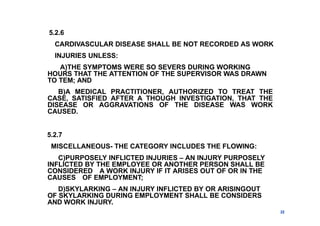
5.2.6
CARDIVASCULAR DISEASE SHALL BE NOT RECORDED AS WORK
INJURIES UNLESS:
A)THE SYMPTOMS WERE SO SEVERS DURING WORKING
HOURS THAT THE ATTENTION OF THE SUPERVISOR WAS DRAWN
TO TEM; AND
B)A MEDICAL PRACTITIONER, AUTHORIZED TO TREAT THE
CASE, SATISFIED AFTER A THOUGH INVESTIGATION, THAT THE
DISEASE OR AGGRAVATIONS OF THE DISEASE WAS WORK
CAUSED.
5.2.7
MISCELLANEOUS- THE CATEGORY INCLUDES THE FLOWING:
C)PURPOSELY INFLICTED INJURIES – AN INJURY PURPOSELY
INFLICTED BY THE EMPLOYEE OR ANOTHER PERSON SHALL BE
CONSIDERED A WORK INJURY IF IT ARISES OUT OF OR IN THE
CAUSES OF EMPLOYMENT;
D)SKYLARKING – AN INJURY INFLICTED BY OR ARISINGOUT
OF SKYLARKING DURING EMPLOYMENT SHALL BE CONSIDERS
AND WORK INJURY.
22
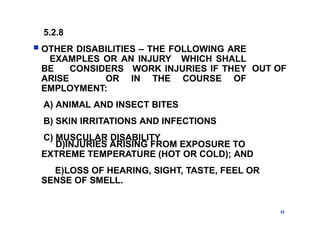
5.2.8
 OTHER DISABILITIES – THE FOLLOWING ARE
EXAMPLES OR AN INJURY WHICH SHALL
BE CONSIDERS WORK INJURIES IF THEY
ARISE OR IN THE COURSE OF
EMPLOYMENT:
A) ANIMAL AND INSECT BITES
B) SKIN IRRITATIONS AND INFECTIONS
C) MUSCULAR DISABILITY
23
OUT OF
D)INJURIES ARISING FROM EXPOSURE TO
EXTREME TEMPERATURE (HOT OR COLD); AND
E)LOSS OF HEARING, SIGHT, TASTE, FEEL OR
SENSE OF SMELL.
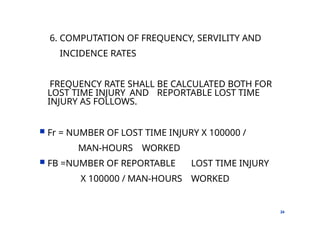
6. COMPUTATION OF FREQUENCY, SERVILITY AND
INCIDENCE RATES
24
FREQUENCY RATE SHALL BE CALCULATED BOTH FOR
LOST TIME INJURY AND REPORTABLE LOST TIME
INJURY AS FOLLOWS.
 Fr = NUMBER OF LOST TIME INJURY X 100000 /
MAN-HOURS WORKED
 FB =NUMBER OF REPORTABLE LOST TIME INJURY
X 100000 / MAN-HOURS WORKED
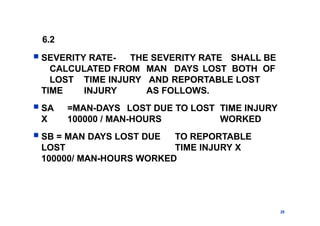
6.2
 SEVERITY RATE- THE SEVERITY RATE SHALL BE
CALCULATED FROM MAN DAYS LOST BOTH OF
LOST TIME INJURY AND REPORTABLE LOST
TIME INJURY AS FOLLOWS.
 SA =MAN-DAYS LOST DUE TO LOST TIME INJURY
X 100000 / MAN-HOURS WORKED
 SB = MAN DAYS LOST DUE TO REPORTABLE
LOST TIME INJURY X
100000/ MAN-HOURS WORKED
25
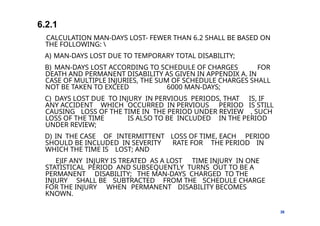
6.2.1
26
CALCULATION MAN-DAYS LOST- FEWER THAN 6.2 SHALL BE BASED ON
THE FOLLOWING: 
A) MAN-DAYS LOST DUE TO TEMPORARY TOTAL DISABILITY;
B) MAN-DAYS LOST ACCORDING TO SCHEDULE OF CHARGES FOR
DEATH AND PERMANENT DISABILITY AS GIVEN IN APPENDIX A. IN
CASE OF MULTIPLE INJURIES, THE SUM OF SCHEDULE CHARGES SHALL
NOT BE TAKEN TO EXCEED 6000 MAN-DAYS;
C) DAYS LOST DUE TO INJURY IN PERVIOUS PERIODS, THAT IS, IF
ANY ACCIDENT WHICH OCCURRED IN PERVIOUS PERIOD IS STILL
CAUSING LOSS OF THE TIME IN THE PERIOD UNDER REVIEW , SUCH
LOSS OF THE TIME IS ALSO TO BE INCLUDED IN THE PERIOD
UNDER REVIEW;
D) IN THE CASE OF INTERMITTENT LOSS OF TIME, EACH PERIOD
SHOULD BE INCLUDED IN SEVERITY RATE FOR THE PERIOD IN
WHICH THE TIME IS LOST; AND
E)IF ANY INJURY IS TREATED AS A LOST TIME INJURY IN ONE
STATISTICAL PERIOD AND SUBSEQUENTLY TURNS OUT TO BE A
PERMANENT DISABILITY; THE MAN-DAYS CHARGED TO THE
INJURY SHALL BE SUBTRACTED FROM THE SCHEDULE CHARGE
FOR THE INJURY WHEN PERMANENT DISABILITY BECOMES
KNOWN.
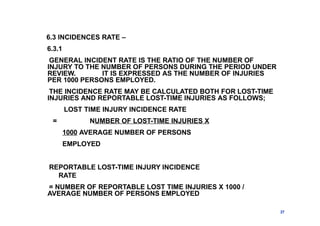
6.3 INCIDENCES RATE –
6.3.1
GENERAL INCIDENT RATE IS THE RATIO OF THE NUMBER OF
INJURY TO THE NUMBER OF PERSONS DURING THE PERIOD UNDER
REVIEW. IT IS EXPRESSED AS THE NUMBER OF INJURIES
PER 1000 PERSONS EMPLOYED.
THE INCIDENCE RATE MAY BE CALCULATED BOTH FOR LOST-TIME
INJURIES AND REPORTABLE LOST-TIME INJURIES AS FOLLOWS;
LOST TIME INJURY INCIDENCE RATE
= NUMBER OF LOST-TIME INJURIES X
1000 AVERAGE NUMBER OF PERSONS
EMPLOYED
REPORTABLE LOST-TIME INJURY INCIDENCE
RATE
= NUMBER OF REPORTABLE LOST TIME INJURIES X 1000 /
AVERAGE NUMBER OF PERSONS EMPLOYED
27
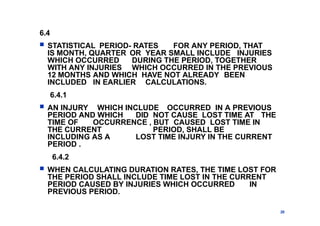
6.4
 STATISTICAL PERIOD- RATES FOR ANY PERIOD, THAT
IS MONTH, QUARTER OR YEAR SMALL INCLUDE INJURIES
WHICH OCCURRED DURING THE PERIOD, TOGETHER
WITH ANY INJURIES WHICH OCCURRED IN THE PREVIOUS
12 MONTHS AND WHICH HAVE NOT ALREADY BEEN
INCLUDED IN EARLIER CALCULATIONS.
6.4.1
 AN INJURY WHICH INCLUDE OCCURRED IN A PREVIOUS
PERIOD AND WHICH DID NOT CAUSE LOST TIME AT THE
TIME OF OCCURRENCE , BUT CAUSED LOST TIME IN
THE CURRENT PERIOD, SHALL BE
INCLUDING AS A LOST TIME INJURY IN THE CURRENT
PERIOD .
6.4.2
 WHEN CALCULATING DURATION RATES, THE TIME LOST FOR
THE PERIOD SHALL INCLUDE TIME LOST IN THE CURRENT
PERIOD CAUSED BY INJURIES WHICH OCCURRED IN
PREVIOUS PERIOD.
28
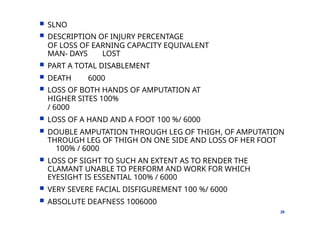
 SLNO
 DESCRIPTION OF INJURY PERCENTAGE
OF LOSS OF EARNING CAPACITY EQUIVALENT
MAN- DAYS LOST
 PART A TOTAL DISABLEMENT
 DEATH 6000
 LOSS OF BOTH HANDS OF AMPUTATION AT
HIGHER SITES 100%
/ 6000
 LOSS OF A HAND AND A FOOT 100 %/ 6000
 DOUBLE AMPUTATION THROUGH LEG OF THIGH, OF AMPUTATION
THROUGH LEG OF THIGH ON ONE SIDE AND LOSS OF HER FOOT
100% / 6000
 LOSS OF SIGHT TO SUCH AN EXTENT AS TO RENDER THE
CLAMANT UNABLE TO PERFORM AND WORK FOR WHICH
EYESIGHT IS ESSENTIAL 100% / 6000
 VERY SEVERE FACIAL DISFIGUREMENT 100 %/ 6000
 ABSOLUTE DEAFNESS 1006000
29
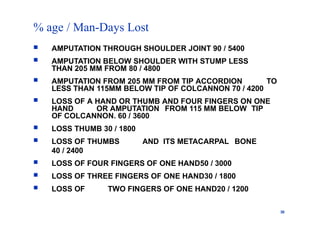
% age / Man-Days Lost
30
 AMPUTATION THROUGH SHOULDER JOINT 90 / 5400
 AMPUTATION BELOW SHOULDER WITH STUMP LESS
THAN 205 MM FROM 80 / 4800
 AMPUTATION FROM 205 MM FROM TIP ACCORDION TO
LESS THAN 115MM BELOW TIP OF COLCANNON 70 / 4200
 LOSS OF A HAND OR THUMB AND FOUR FINGERS ON ONE
HAND OR AMPUTATION FROM 115 MM BELOW TIP
OF COLCANNON. 60 / 3600
 LOSS THUMB 30 / 1800
 LOSS OF THUMBS AND ITS METACARPAL BONE
40 / 2400
 LOSS OF FOUR FINGERS OF ONE HAND50 / 3000
 LOSS OF THREE FINGERS OF ONE HAND30 / 1800
 LOSS OF TWO FINGERS OF ONE HAND20 / 1200
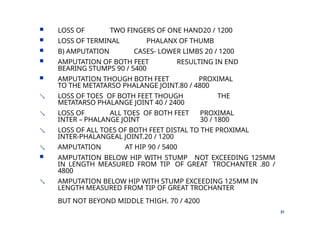
 LOSS OF TERMINAL PHALANX OF THUMB
 B) AMPUTATION CASES- LOWER LIMBS 20 / 1200
 AMPUTATION OF BOTH FEET RESULTING IN END
BEARING STUMPS 90 / 5400
31



 AMPUTATION THOUGH BOTH FEET PROXIMAL
TO THE METATARSO PHALANGE JOINT.80 / 4800
LOSS OF TOES OF BOTH FEET THOUGH THE
METATARSO PHALANGE JOINT 40 / 2400
LOSS OF ALL TOES OF BOTH FEET PROXIMAL
INTER – PHALANGE JOINT 30 / 1800
LOSS OF ALL TOES OF BOTH FEET DISTAL TO THE PROXIMAL
INTER-PHALANGEAL JOINT.20 / 1200
AMPUTATION AT HIP 90 / 5400


 AMPUTATION BELOW HIP WITH STUMP NOT EXCEEDING 125MM
IN LENGTH MEASURED FROM TIP OF GREAT TROCHANTER .80 /
4800
AMPUTATION BELOW HIP WITH STUMP EXCEEDING 125MM IN
LENGTH MEASURED FROM TIP OF GREAT TROCHANTER
BUT NOT BEYOND MIDDLE THIGH. 70 / 4200
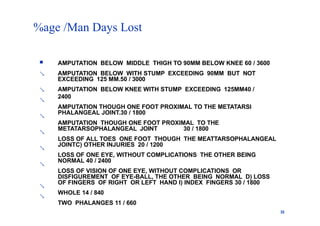
%age /Man Days Lost
32









 AMPUTATION BELOW MIDDLE THIGH TO 90MM BELOW KNEE 60 / 3600
AMPUTATION BELOW WITH STUMP EXCEEDING 90MM BUT NOT
EXCEEDING 125 MM.50 / 3000
AMPUTATION BELOW KNEE WITH STUMP EXCEEDING 125MM40 /
2400
AMPUTATION THOUGH ONE FOOT PROXIMAL TO THE METATARSI
PHALANGEAL JOINT.30 / 1800
AMPUTATION THOUGH ONE FOOT PROXIMAL TO THE
METATARSOPHALANGEAL JOINT 30 / 1800
LOSS OF ALL TOES ONE FOOT THOUGH THE MEATTARSOPHALANGEAL
JOINTC) OTHER INJURIES 20 / 1200
LOSS OF ONE EYE, WITHOUT COMPLICATIONS THE OTHER BEING
NORMAL 40 / 2400
LOSS OF VISION OF ONE EYE, WITHOUT COMPLICATIONS OR
DISFIGUREMENT OF EYE-BALL, THE OTHER BEING NORMAL D) LOSS
OF FINGERS OF RIGHT OR LEFT HAND I) INDEX FINGERS 30 / 1800
WHOLE 14 / 840
TWO PHALANGES 11 / 660
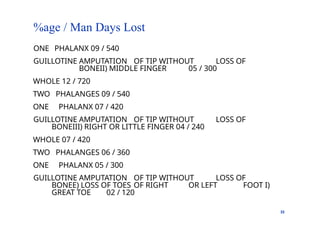
%age / Man Days Lost
33
ONE PHALANX 09 / 540
GUILLOTINE AMPUTATION OF TIP WITHOUT LOSS OF
BONEII) MIDDLE FINGER 05 / 300
WHOLE 12 / 720
TWO PHALANGES 09 / 540
ONE PHALANX 07 / 420
GUILLOTINE AMPUTATION OF TIP WITHOUT LOSS OF
BONEIII) RIGHT OR LITTLE FINGER 04 / 240
WHOLE 07 / 420
TWO PHALANGES 06 / 360
ONE PHALANX 05 / 300
GUILLOTINE AMPUTATION OF TIP WITHOUT LOSS OF
BONEE) LOSS OF TOES OF RIGHT OR LEFT FOOT I)
GREAT TOE 02 / 120
%age /Man Days Lost
34
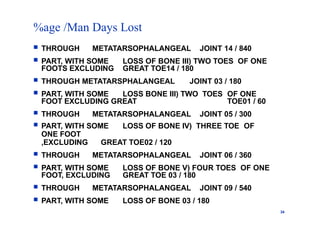
 THROUGH METATARSOPHALANGEAL JOINT 14 / 840
 PART, WITH SOME LOSS OF BONE III) TWO TOES OF ONE
FOOTS EXCLUDING GREAT TOE14 / 180
 THROUGH METATARSPHALANGEAL JOINT 03 / 180
 PART, WITH SOME LOSS BONE III) TWO TOES OF ONE
FOOT EXCLUDING GREAT TOE01 / 60
 THROUGH METATARSOPHALANGEAL JOINT 05 / 300
 PART, WITH SOME LOSS OF BONE IV) THREE TOE OF
ONE FOOT
,EXCLUDING GREAT TOE02 / 120
 THROUGH METATARSOPHALANGEAL JOINT 06 / 360
 PART, WITH SOME LOSS OF BONE V) FOUR TOES OF ONE
FOOT, EXCLUDING GREAT TOE 03 / 180
 THROUGH METATARSOPHALANGEAL JOINT 09 / 540
 PART, WITH SOME LOSS OF BONE 03 / 180
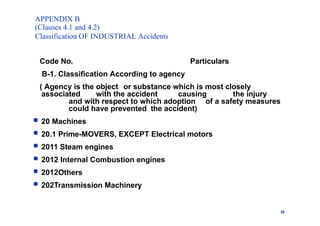
APPENDIX B
(Clauses 4.1 and 4.2)
Classification OF INDUSTRIAL Accidents
35
Code No.
B-1. Classification According to agency
Particulars
( Agency is the object or substance which is most closely
associated with the accident causing the injury
and with respect to which adoption of a safety measures
could have prevented the accident)
 20 Machines
 20.1 Prime-MOVERS, EXCEPT Electrical motors
 2011 Steam engines
 2012 Internal Combustion engines
 2012Others
 202Transmission Machinery
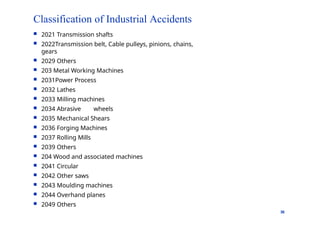
Classification of Industrial Accidents
36
 2021 Transmission shafts
 2022Transmission belt, Cable pulleys, pinions, chains,
gears
 2029 Others
 203 Metal Working Machines
 2031Power Process
 2032 Lathes
 2033 Milling machines
 2034 Abrasive wheels
 2035 Mechanical Shears
 2036 Forging Machines
 2037 Rolling Mills
 2039 Others
 204 Wood and associated machines
 2041 Circular
 2042 Other saws
 2043 Moulding machines
 2044 Overhand planes
 2049 Others
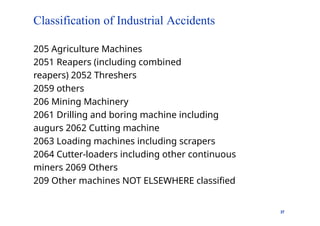
Classification of Industrial Accidents
37
205 Agriculture Machines
2051 Reapers (including combined
reapers) 2052 Threshers
2059 others
206 Mining Machinery
2061 Drilling and boring machine including
augurs 2062 Cutting machine
2063 Loading machines including scrapers
2064 Cutter-loaders including other continuous
miners 2069 Others
209 Other machines NOT ELSEWHERE classified
Classification of Industrial Accidents
38
209 Other machines NOT ELSEWHERE classified
2091 Earth-Moving machines
2092 Spinning, weaving and other textile
machines
2093 Machines for the manufacture of food stuffs and
beverages
2094 Machine for the manufacture of the paper and leather
2095 Printing machines
2099 Others
 209 Other machines NOT ELSEWHERE classified
 2091 Earth-Moving machines
 2092 Spinning, weaving and other textile machines
 2093 Machines for the manufacture of food stuffs and beverages
 2094 Machine for the manufacture of the paper and leather
 2095 Printing machines
 2099 Others 2129 Others
 213 OTHER wheeled means of transportations, excluding Ra
Transportation
 2131Ttractors
 2132 Lorries
39
Classification of Industrial Accidents
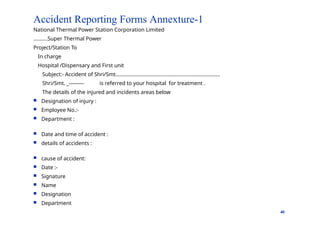
Accident Reporting Forms Annexture-1
40
National Thermal Power Station Corporation Limited
……….Super Thermal Power
Project/Station To
In charge
Hospital /Dispensary and First unit
Subject:- Accident of Shri/Smt……………………………………………………...............
Shri/Smt. _--------- is referred to your hospital for treatment .
The details of the injured and incidents areas below
 Designation of injury :
 Employee No.:-
 Department :
 Date and time of accident :
 details of accidents :
 cause of accident:
 Date :-
 Signature
 Name
 Designation
 Department
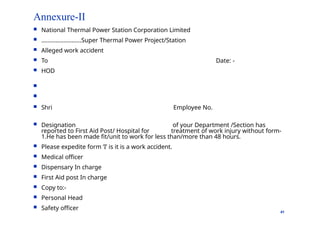
Annexure-II
41
 National Thermal Power Station Corporation Limited
 …………………….Super Thermal Power Project/Station
 Alleged work accident
 To
 HOD

Date: -

 Shri Employee No.
 Designation of your Department /Section has
reported to First Aid Post/ Hospital for treatment of work injury without form-
1.He has been made fit/unit to work for less than/more than 48 hours.
 Please expedite form ‘I’ is it is a work accident.
 Medical officer
 Dispensary In charge
 First Aid post In charge
 Copy to:-
 Personal Head
 Safety officer
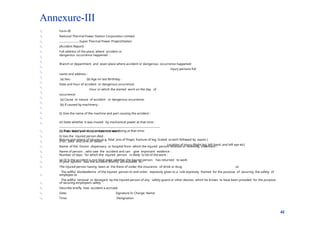
Annexure-III


Form-III
National Thermal Power Station Corporation Limited
…………………….Super Thermal Power Project/Station
(Accident Report)
Full address of the place, where accident or
dangerous occurrence happened :
Branch or department and exact place where accident or dangerous occurrence happened:
injury persons full
name and address :
(a) Sex:- (b) Age on last Birthday :
Date and hour of accident or dangerous occurrence:
Hour or which the started work on the day of
occurrence:
(a) Cause or nature of accident or dangerous occurrence:
(b) if caused by machinery :
(i) Give the name of the machine and part causing the accident :
(ii) State whether it was moved by mechanical power at that time :
(c) State exactly what injured person was doing at that time:
Nature and extent of injuries (e.g. fatal ,loss of finger, fracture of leg; Scaled scratch followed by sepsis )
Location of injury (Right leg; left hand ;and left eye etc)
Number of days for which the injured person in likely to be of the work :
(a) (I) Is the accident is non fatal state whether the injured person has returned to work


















42
(ii) if so , date and hour or return to work
(i) Has the injured person died
If so , date and time of death
Name of the Doctor ,dispensary or hospital from which the injured person received or receiving treatment :
Name of person , who saw the accident and can give important evidence :
In your opinion was the accident directly attributable to:
The injured person having been at the there of under the insurance of drink or drug ,or
The willful disobedience of the injured person to and order expressly given to a rule expressly framed for the purpose of securing the safety of
employee or.
The willful removal or disregard by the injured person of any safety guard or other devices which he knows to have been provided for the purpose
of securing employee’s safety











Describe briefly how accident a accrued:
Date: Signature In Charge: Name:
Time: Designation


Accident Reporting Accident Reporting Accident Reporting

  • 1.
    ACCIDENTS & DANGEROUSOCCURANCE REPORTING PROCEDURES
  • 2.
    Objectives 2  TO HELPIN EVAULATING THE RELATIVE NEED FOR TAKING ACCIDENT PREVENTION MEASURES IN DIFFERENT DEPARTMENTS OF AN ESTABLISHMENT.  TO HELP IN MAKING AN APPRAISALOF THE PROGRESS OF AN ACCIDENT PREVENTION CAMPAIGN AND MAKING PEOPLE SAFETY CONSCIOUS  TO PROVIDE ENCOURAGEMENT WHEN METHODS USED FOR THE PREVENTION OF ACCIDENTS ARE SUCCESSFUL  TO ENABLE COMPARISONS TO BE MADE.
  • 3.
    Scope 3 THIS STANDARD PRESCRIBESBASIC METHODS FOR RECORDING AND CLASSIFYING INDUSTRIAL ACCIDENTS. IT ALSO INCLUDES DETAILS OF WORK, INJURY AND GIVES THE METHODS FOR COMPUTATIONS OF FREQUENCY, SEVERITY AND INCIDENCE RATE OF WORK INJURIES IN INDUSTRIAL PREMISES. THIS ENABLES ADOPTION OF A UNIFORM SYSTEM RECORDING EVENTS ASSOCIATED WITH INJURIES AND THE DETERMINATION OF CORRECTIVE ACTION .
  • 4.
    Statutory Requirements 4  StatutoryAct or Rules /Section No Maximum Interval Attention Required Description Pressure Plant & All Receivers  The Factories Act 1948  Sec31a) 6 Months b) 12 Months c) 24 or 48 Months  a) External examination b) internal examination c) Hydraulic Test By competent Person Pressure Vessels (Statistic & Mobile ) Static & Mobile Pressure vessels (Unfired ) Rules 1981  Rule 19 a) 5 Years a) Hydraulic test b) 2 Years (Toxic / corrosive gases ) b) hydraulic test) By competent Persons b) By competent Persons Steam Receivers & Containers Indian Boiler Regulation (IBR) 1950 reg. 389 Yearly Complete examination By Boiler Inspector All Steam Receivers with certain exceptions Water Sealed Gas Holders
  • 5.
    Statutory Requirements Contd. 5 TheFactories Act 1948 Sec. 31 State Factory Rules Rule 61 A a) 12 months a) to examine externally b) 4 years Examination b ) competent person to examine internally gas holders which are in use for more tan 10 years Breathing Apparatus The Factories Act 1948 Sec. 87state Factory rules Schedule XVII Monthly Examination & maintenance Through EXAMINATION BY Responsible Person.
  • 6.
    Statutory Act orRules /Section No Maximum Interval Attention Required Description Factory Cleanliness Factories Act 1948  Sec. 11 6 c) 14 months c) Clearing a) Weekly b) 6 months a) Clearing b) White wash or Color wash . d) 5 years Painting a) Floor of workroom to be washed with disinfectant b) Inside walls and ceilings to be white washed of Color washed as applicable c) Inside walls and ceilings with smooth impervious surface to be cleaned by approved method d) Inside walls and callings it painted of varnished to be repainted of revarnished .
  • 7.
    Hoists and Lifts 7 TheFactories Act 1948 Sec 28 - 6 Months Examination By competent pars on Chains , ropes and lifting tackles Sec 29 a)12 Months b) 6 Months c) 12Months a) Examination b) Annealing c) Annealing by a competent person to thoroughly examine) All chains lifting tackles made of 12.7mm bar and smaller c) Excel above all other chains $tackiest in general use Cranes & other Lifting Machines Sec 29 12 Months Examination Competent person to examine all patent and gear .
  • 8.
    Notice of CertainAccidents 8 Sec. 88 (1)Where in any factory an accident occurs which causes death eases any bodily injury by reason of which the person injured is prevented form working for a period of forty eight hours of more immediately following the accident of which is of such nature such authorities and in such form and within such time as may be prescribed (2)Where notice given under sub section (1) relates an accident causing death the authority to which the notice is sent shall make an inquiry into the occurrence within one month the receipt of the notice of if such authority is not the Inspector cause the Inspector to make an inquiry within the said period (3)The state Government may make rules for regulating the procedure at inquiries under this section.
  • 9.
    Notice of CertainAccidents 9 Sec. 88 (1) Where in any factory an accident occurs which causes death eases any bodily injury by reason of which the person injured is prevented form working for a period of forty eight hours of more immediately following the accident of which is of such nature such authorities and in such form and within such time as may be prescribed (2) Where notice given under sub section (1) relates an accident causing death the authority to which the notice is sent shall make an inquiry into the occurrence within one month the receipt of the notice of if such authority is not the Inspector cause the Inspector to make an inquiry within the said period (3) The state Government may make rules for regulating the procedure at inquiries under this section.
  • 10.
    Notice of CertainDiseases 10 Sec. 89  Where any worker in a factory contracts any disease specified the manger of the factory shall send notice thereof to such authorities and in such form and within such time as may be prescribed. (1)If any medical practitioner fails to comply witty the provisions of sub section (2)he shall be punishable with fine which may extend to one thousand Rupees
  • 11.
    2. TERMINOLOGY 11 2.0 FORTHE PURPOSE OF THIS STANDARD, THE FOLLOWING DEFINITIONS SHALL APPLY.  2.1 ACCIDENT –AN UNINTENDED OCCURRENCE ARISING OUT OF AND IN THE COURSE OF EMPLOYMENT OF A PERSON RESULTING IN INJURY.  2.2 DEATH – FATALITY RESULTING FROM AN ACCIDENT.  2.3 DISABLING INJURY (LOST TIME INJURY) AN INJURY CAUSING DISABLEMENT EXTENDING BEYOND THE DAY OF SHIFT ON WHICH THE ACCIDENT OCCURRED.  2.4 NON-DISABLING INJURY  2.5 REPORTABLE DISABLING INJURY (REPORTABLE LOST TIME INJURY)
  • 12.
    Contd. 12  2.6 DAYSOF DISABLEMENT (LOST TIME)  2.7 PARTIAL DISABLEMENT  2.7 PARTIAL DISABLEMENT  2.8 TOTAL DISABLEMENT  2.9 MAN –HOURS WORKED  2.10 SCHEDULE CHARGE
  • 13.
    3. CALCULATION OFMAN-HOURS WORKED 13 Total man Hours Worked = No. of Employees x 8 hrs. /day x maydays worked
  • 14.
    4. CLASSIFICATION 14 OF ACCIDENTS AGENCY  UNSAFE MECHANICAL OR PHYSICAL CONDITION  UNSAFE ACT.  UNSAFE PERSONAL FACTOR  TYPE OF ACCIDENTS  NATURE OF INJURY ,AND  LOCATION IN INJURY
  • 15.
    5. ASSESSMENT OFWORK INJURY 15 5.1 GENERAL  THROUGH INVESTIGATION OF ALL FACTORS RELATING TO THE OCCURRENCE OF EACH REPORTED INJURY IS ESSENTIAL. DETERMINATION AS TO WHETHER OR NOT THE INJURY SHOULD BE CONSIDERED A WORK INJURY UNDER THE PROVISIONS OF THIS STANDARD SHALL BE BASED ON THE EVIDENCE COLLECTIVE DURING INVESTIGATIONS.
  • 16.
    5.2 Evidence THE EVIDENCETO BE CONSIDERED IN DETERMINING WHETHER OR NOT THE REPORTED INJURY SHOULD BE CONSIDERED A WORK INJURY MAY INCLUDE , BUT NO NECESSARILY BE LIMITED TO , THE FOLLOWING. A) FACTS RESULTING FROM INVESTIGATIONS OF THE INJURED EMPLOYEE’S WORK ACTIVITIES AND WORKING ENVIRONMENT TO WHICH THE INJURY MIGHT BE RELATED; B)STATEMENTS (WRITTEN IF POSSIBLE) OF INJURED EMPLOYEE, C) FOLLOW EMPLOYEES, WITNESSES AND SUPERVISORS; D) MEDICAL REPORTS ACCEPTABLE TO THE AUTHORITY CLASSIFYING THE WOK INJURY, AND D) FACTS CONCERNING THE INJURED EMPLOYEE’S WORK ACTIVITY FOR OTHER EMPLOYERS AND OTHER OFF THE JOB ACTIVITIES, INJURIESAND ILLNESSES.` 16
  • 17.
    5.2 ASSESSMENT OFSPECIAL CASES 17  5.2.1 GENERAL – BEFORE INCLUSION IN THE RECORD SPECIAL CASES SHOULD BE ASSESSED.  5.2.2 TO 5.2.15 ARE INTENDED TO ASSIST IN SUCH ASSESSMENT BUT THESE PROVISIONS RULES SHOULD NOT BE USED TO EXCLUDE A GENUINE WORK INJURY FROM THE RECORD  5.2.2 INGUINAL HERNIA - AN INGUINAL HERNIA SHALL BE CONSIDERED A WORK INJURY ONLY IF IT IS PRECIPITATED BY IN IMPACT, SUDDEN EFFORT, OR SERVE STRAIN, MEETS, AFTER INVESTIGATIONS, ALL OF THE FOLLOWING CONDITIONS:-
  • 18.
    A) THERE ISCLEAR EVIDENCE OF AND ACCIDENTAL EVENT OR AN INCIDENT SUCH AS A SLIP, TRIP OR FALL, SUDDEN EFFORT OR OVER EXERTION. 18 B) THERE WAS ACTUAL PAIN IN THE HERNIA REGION AT THE TIME OF THE ACCIDENT OR INCIDENT AND C) THE IMMEDIATE PAIN WAS SO ACUTE THAT THE INJURED EMPLOYEE WAS FORCED TO STOP WORK LONG ENOUGH TO DRAW THE ATTENTION OF HIS FOREMEN PR FOLLOW EMPLOYEE, OR THE ATTENTION OF PHYSICIAN WAS SECURED WITHIN 12 HOURS.
  • 19.
    5.2.3 BACK INJURY –A BACK INJURY OR STRAIN SHALL AFTER INVESTIGATION, BE CONSIDERED A WORK INJURY IF: A) THERE IS CLEAR EVIDENCE OF AN ACCIDENT EVENT OR AN ACCIDENT SUCH A SLIP, TRIP AND FALL, SUDDEN EFFORT OR OVER EXECRATION OR BELOW ON THE BACK 5.2.6 CARDIOVASCULAR DISEASES - THIS TERM IS USED TO COVER THE FOLLOWING GROUPS:- A MEDICAL PRACTITIONER, AUTHORIZED TO TREAT THE CASE, SATISFIED AFTER A COMPLETE REVIEW OF THE CIRCUMSTANCES OF THE ACCIDENT OR INCIDENT THAT THE INJURY COULD HAVE ARISEN OUT OF THE ACCIDENT OR INCIDENT. 19
  • 20.
     5.2.4 AGGRAVATION OFPRE-EXISTING CONDITION- IF AGGRAVATION OF PRE- EXISTING PHYSICAL DEFIANCE ARISE OUT OF OR IN THE COURSE OF EMPLOYMENT , THE RESULTING DISABILITY SHALL BE CONSIDERED A WORK INJURY AND SHALL BE CLASSIFIED ACCORDING TO THE ULTIMATE EXTENT OF THE INJURY EXCEPT THAT IF THE INJURY IS AND INGUINAL HERNIA OR A BLACK INJURY THE REQUIREMENT OF 5.2.2 OR 5.2.3 SHALL APPLY. 20
  • 21.
    5.2.5 AGGRESSION OF MINORINJURY- IF A MINOR IS AGGRAVATED BECAUSE OR DIAGNOSIS OR TREATMENT , EITHER PROFESSIONAL OR NON- PROFESSIONAL, OR IF INFECTION OR OTHER SYMPTOMS DEVELOP LATER , EITHER ON THE JOB OR OFF-THE JOB OF THE INJURY CLASSIFIED ACCORDING TO ITS ULTIMATE EXTENT.  RHEUMATIC HEART DISEASE  HYPERTENSIVE DISEASE  ISCHEMIC DISEASE  HEART DISEASE SECONDARY TO PRELIMINARY DISEASE  CAREBTOVASCULAR DISEASE  DISEASE OF ARTERIES , ARTERIOLES AND CAPILLARIES AND  DISEASE OF VEINS AND LYMPH VESSELS 21
  • 22.
    5.2.6 CARDIVASCULAR DISEASE SHALLBE NOT RECORDED AS WORK INJURIES UNLESS: A)THE SYMPTOMS WERE SO SEVERS DURING WORKING HOURS THAT THE ATTENTION OF THE SUPERVISOR WAS DRAWN TO TEM; AND B)A MEDICAL PRACTITIONER, AUTHORIZED TO TREAT THE CASE, SATISFIED AFTER A THOUGH INVESTIGATION, THAT THE DISEASE OR AGGRAVATIONS OF THE DISEASE WAS WORK CAUSED. 5.2.7 MISCELLANEOUS- THE CATEGORY INCLUDES THE FLOWING: C)PURPOSELY INFLICTED INJURIES – AN INJURY PURPOSELY INFLICTED BY THE EMPLOYEE OR ANOTHER PERSON SHALL BE CONSIDERED A WORK INJURY IF IT ARISES OUT OF OR IN THE CAUSES OF EMPLOYMENT; D)SKYLARKING – AN INJURY INFLICTED BY OR ARISINGOUT OF SKYLARKING DURING EMPLOYMENT SHALL BE CONSIDERS AND WORK INJURY. 22
  • 23.
    5.2.8  OTHER DISABILITIES– THE FOLLOWING ARE EXAMPLES OR AN INJURY WHICH SHALL BE CONSIDERS WORK INJURIES IF THEY ARISE OR IN THE COURSE OF EMPLOYMENT: A) ANIMAL AND INSECT BITES B) SKIN IRRITATIONS AND INFECTIONS C) MUSCULAR DISABILITY 23 OUT OF D)INJURIES ARISING FROM EXPOSURE TO EXTREME TEMPERATURE (HOT OR COLD); AND E)LOSS OF HEARING, SIGHT, TASTE, FEEL OR SENSE OF SMELL.
  • 24.
    6. COMPUTATION OFFREQUENCY, SERVILITY AND INCIDENCE RATES 24 FREQUENCY RATE SHALL BE CALCULATED BOTH FOR LOST TIME INJURY AND REPORTABLE LOST TIME INJURY AS FOLLOWS.  Fr = NUMBER OF LOST TIME INJURY X 100000 / MAN-HOURS WORKED  FB =NUMBER OF REPORTABLE LOST TIME INJURY X 100000 / MAN-HOURS WORKED
  • 25.
    6.2  SEVERITY RATE-THE SEVERITY RATE SHALL BE CALCULATED FROM MAN DAYS LOST BOTH OF LOST TIME INJURY AND REPORTABLE LOST TIME INJURY AS FOLLOWS.  SA =MAN-DAYS LOST DUE TO LOST TIME INJURY X 100000 / MAN-HOURS WORKED  SB = MAN DAYS LOST DUE TO REPORTABLE LOST TIME INJURY X 100000/ MAN-HOURS WORKED 25
  • 26.
    6.2.1 26 CALCULATION MAN-DAYS LOST-FEWER THAN 6.2 SHALL BE BASED ON THE FOLLOWING: A) MAN-DAYS LOST DUE TO TEMPORARY TOTAL DISABILITY; B) MAN-DAYS LOST ACCORDING TO SCHEDULE OF CHARGES FOR DEATH AND PERMANENT DISABILITY AS GIVEN IN APPENDIX A. IN CASE OF MULTIPLE INJURIES, THE SUM OF SCHEDULE CHARGES SHALL NOT BE TAKEN TO EXCEED 6000 MAN-DAYS; C) DAYS LOST DUE TO INJURY IN PERVIOUS PERIODS, THAT IS, IF ANY ACCIDENT WHICH OCCURRED IN PERVIOUS PERIOD IS STILL CAUSING LOSS OF THE TIME IN THE PERIOD UNDER REVIEW , SUCH LOSS OF THE TIME IS ALSO TO BE INCLUDED IN THE PERIOD UNDER REVIEW; D) IN THE CASE OF INTERMITTENT LOSS OF TIME, EACH PERIOD SHOULD BE INCLUDED IN SEVERITY RATE FOR THE PERIOD IN WHICH THE TIME IS LOST; AND E)IF ANY INJURY IS TREATED AS A LOST TIME INJURY IN ONE STATISTICAL PERIOD AND SUBSEQUENTLY TURNS OUT TO BE A PERMANENT DISABILITY; THE MAN-DAYS CHARGED TO THE INJURY SHALL BE SUBTRACTED FROM THE SCHEDULE CHARGE FOR THE INJURY WHEN PERMANENT DISABILITY BECOMES KNOWN.
  • 27.
    6.3 INCIDENCES RATE– 6.3.1 GENERAL INCIDENT RATE IS THE RATIO OF THE NUMBER OF INJURY TO THE NUMBER OF PERSONS DURING THE PERIOD UNDER REVIEW. IT IS EXPRESSED AS THE NUMBER OF INJURIES PER 1000 PERSONS EMPLOYED. THE INCIDENCE RATE MAY BE CALCULATED BOTH FOR LOST-TIME INJURIES AND REPORTABLE LOST-TIME INJURIES AS FOLLOWS; LOST TIME INJURY INCIDENCE RATE = NUMBER OF LOST-TIME INJURIES X 1000 AVERAGE NUMBER OF PERSONS EMPLOYED REPORTABLE LOST-TIME INJURY INCIDENCE RATE = NUMBER OF REPORTABLE LOST TIME INJURIES X 1000 / AVERAGE NUMBER OF PERSONS EMPLOYED 27
  • 28.
    6.4  STATISTICAL PERIOD-RATES FOR ANY PERIOD, THAT IS MONTH, QUARTER OR YEAR SMALL INCLUDE INJURIES WHICH OCCURRED DURING THE PERIOD, TOGETHER WITH ANY INJURIES WHICH OCCURRED IN THE PREVIOUS 12 MONTHS AND WHICH HAVE NOT ALREADY BEEN INCLUDED IN EARLIER CALCULATIONS. 6.4.1  AN INJURY WHICH INCLUDE OCCURRED IN A PREVIOUS PERIOD AND WHICH DID NOT CAUSE LOST TIME AT THE TIME OF OCCURRENCE , BUT CAUSED LOST TIME IN THE CURRENT PERIOD, SHALL BE INCLUDING AS A LOST TIME INJURY IN THE CURRENT PERIOD . 6.4.2  WHEN CALCULATING DURATION RATES, THE TIME LOST FOR THE PERIOD SHALL INCLUDE TIME LOST IN THE CURRENT PERIOD CAUSED BY INJURIES WHICH OCCURRED IN PREVIOUS PERIOD. 28
  • 29.
     SLNO  DESCRIPTIONOF INJURY PERCENTAGE OF LOSS OF EARNING CAPACITY EQUIVALENT MAN- DAYS LOST  PART A TOTAL DISABLEMENT  DEATH 6000  LOSS OF BOTH HANDS OF AMPUTATION AT HIGHER SITES 100% / 6000  LOSS OF A HAND AND A FOOT 100 %/ 6000  DOUBLE AMPUTATION THROUGH LEG OF THIGH, OF AMPUTATION THROUGH LEG OF THIGH ON ONE SIDE AND LOSS OF HER FOOT 100% / 6000  LOSS OF SIGHT TO SUCH AN EXTENT AS TO RENDER THE CLAMANT UNABLE TO PERFORM AND WORK FOR WHICH EYESIGHT IS ESSENTIAL 100% / 6000  VERY SEVERE FACIAL DISFIGUREMENT 100 %/ 6000  ABSOLUTE DEAFNESS 1006000 29
  • 30.
    % age /Man-Days Lost 30  AMPUTATION THROUGH SHOULDER JOINT 90 / 5400  AMPUTATION BELOW SHOULDER WITH STUMP LESS THAN 205 MM FROM 80 / 4800  AMPUTATION FROM 205 MM FROM TIP ACCORDION TO LESS THAN 115MM BELOW TIP OF COLCANNON 70 / 4200  LOSS OF A HAND OR THUMB AND FOUR FINGERS ON ONE HAND OR AMPUTATION FROM 115 MM BELOW TIP OF COLCANNON. 60 / 3600  LOSS THUMB 30 / 1800  LOSS OF THUMBS AND ITS METACARPAL BONE 40 / 2400  LOSS OF FOUR FINGERS OF ONE HAND50 / 3000  LOSS OF THREE FINGERS OF ONE HAND30 / 1800  LOSS OF TWO FINGERS OF ONE HAND20 / 1200
  • 31.
     LOSS OFTWO FINGERS OF ONE HAND20 / 1200  LOSS OF TERMINAL PHALANX OF THUMB  B) AMPUTATION CASES- LOWER LIMBS 20 / 1200  AMPUTATION OF BOTH FEET RESULTING IN END BEARING STUMPS 90 / 5400 31     AMPUTATION THOUGH BOTH FEET PROXIMAL TO THE METATARSO PHALANGE JOINT.80 / 4800 LOSS OF TOES OF BOTH FEET THOUGH THE METATARSO PHALANGE JOINT 40 / 2400 LOSS OF ALL TOES OF BOTH FEET PROXIMAL INTER – PHALANGE JOINT 30 / 1800 LOSS OF ALL TOES OF BOTH FEET DISTAL TO THE PROXIMAL INTER-PHALANGEAL JOINT.20 / 1200 AMPUTATION AT HIP 90 / 5400    AMPUTATION BELOW HIP WITH STUMP NOT EXCEEDING 125MM IN LENGTH MEASURED FROM TIP OF GREAT TROCHANTER .80 / 4800 AMPUTATION BELOW HIP WITH STUMP EXCEEDING 125MM IN LENGTH MEASURED FROM TIP OF GREAT TROCHANTER BUT NOT BEYOND MIDDLE THIGH. 70 / 4200
  • 32.
    %age /Man DaysLost 32           AMPUTATION BELOW MIDDLE THIGH TO 90MM BELOW KNEE 60 / 3600 AMPUTATION BELOW WITH STUMP EXCEEDING 90MM BUT NOT EXCEEDING 125 MM.50 / 3000 AMPUTATION BELOW KNEE WITH STUMP EXCEEDING 125MM40 / 2400 AMPUTATION THOUGH ONE FOOT PROXIMAL TO THE METATARSI PHALANGEAL JOINT.30 / 1800 AMPUTATION THOUGH ONE FOOT PROXIMAL TO THE METATARSOPHALANGEAL JOINT 30 / 1800 LOSS OF ALL TOES ONE FOOT THOUGH THE MEATTARSOPHALANGEAL JOINTC) OTHER INJURIES 20 / 1200 LOSS OF ONE EYE, WITHOUT COMPLICATIONS THE OTHER BEING NORMAL 40 / 2400 LOSS OF VISION OF ONE EYE, WITHOUT COMPLICATIONS OR DISFIGUREMENT OF EYE-BALL, THE OTHER BEING NORMAL D) LOSS OF FINGERS OF RIGHT OR LEFT HAND I) INDEX FINGERS 30 / 1800 WHOLE 14 / 840 TWO PHALANGES 11 / 660
  • 33.
    %age / ManDays Lost 33 ONE PHALANX 09 / 540 GUILLOTINE AMPUTATION OF TIP WITHOUT LOSS OF BONEII) MIDDLE FINGER 05 / 300 WHOLE 12 / 720 TWO PHALANGES 09 / 540 ONE PHALANX 07 / 420 GUILLOTINE AMPUTATION OF TIP WITHOUT LOSS OF BONEIII) RIGHT OR LITTLE FINGER 04 / 240 WHOLE 07 / 420 TWO PHALANGES 06 / 360 ONE PHALANX 05 / 300 GUILLOTINE AMPUTATION OF TIP WITHOUT LOSS OF BONEE) LOSS OF TOES OF RIGHT OR LEFT FOOT I) GREAT TOE 02 / 120
  • 34.
    %age /Man DaysLost 34  THROUGH METATARSOPHALANGEAL JOINT 14 / 840  PART, WITH SOME LOSS OF BONE III) TWO TOES OF ONE FOOTS EXCLUDING GREAT TOE14 / 180  THROUGH METATARSPHALANGEAL JOINT 03 / 180  PART, WITH SOME LOSS BONE III) TWO TOES OF ONE FOOT EXCLUDING GREAT TOE01 / 60  THROUGH METATARSOPHALANGEAL JOINT 05 / 300  PART, WITH SOME LOSS OF BONE IV) THREE TOE OF ONE FOOT ,EXCLUDING GREAT TOE02 / 120  THROUGH METATARSOPHALANGEAL JOINT 06 / 360  PART, WITH SOME LOSS OF BONE V) FOUR TOES OF ONE FOOT, EXCLUDING GREAT TOE 03 / 180  THROUGH METATARSOPHALANGEAL JOINT 09 / 540  PART, WITH SOME LOSS OF BONE 03 / 180
  • 35.
    APPENDIX B (Clauses 4.1and 4.2) Classification OF INDUSTRIAL Accidents 35 Code No. B-1. Classification According to agency Particulars ( Agency is the object or substance which is most closely associated with the accident causing the injury and with respect to which adoption of a safety measures could have prevented the accident)  20 Machines  20.1 Prime-MOVERS, EXCEPT Electrical motors  2011 Steam engines  2012 Internal Combustion engines  2012Others  202Transmission Machinery
  • 36.
    Classification of IndustrialAccidents 36  2021 Transmission shafts  2022Transmission belt, Cable pulleys, pinions, chains, gears  2029 Others  203 Metal Working Machines  2031Power Process  2032 Lathes  2033 Milling machines  2034 Abrasive wheels  2035 Mechanical Shears  2036 Forging Machines  2037 Rolling Mills  2039 Others  204 Wood and associated machines  2041 Circular  2042 Other saws  2043 Moulding machines  2044 Overhand planes  2049 Others
  • 37.
    Classification of IndustrialAccidents 37 205 Agriculture Machines 2051 Reapers (including combined reapers) 2052 Threshers 2059 others 206 Mining Machinery 2061 Drilling and boring machine including augurs 2062 Cutting machine 2063 Loading machines including scrapers 2064 Cutter-loaders including other continuous miners 2069 Others 209 Other machines NOT ELSEWHERE classified
  • 38.
    Classification of IndustrialAccidents 38 209 Other machines NOT ELSEWHERE classified 2091 Earth-Moving machines 2092 Spinning, weaving and other textile machines 2093 Machines for the manufacture of food stuffs and beverages 2094 Machine for the manufacture of the paper and leather 2095 Printing machines 2099 Others
  • 39.
     209 Othermachines NOT ELSEWHERE classified  2091 Earth-Moving machines  2092 Spinning, weaving and other textile machines  2093 Machines for the manufacture of food stuffs and beverages  2094 Machine for the manufacture of the paper and leather  2095 Printing machines  2099 Others 2129 Others  213 OTHER wheeled means of transportations, excluding Ra Transportation  2131Ttractors  2132 Lorries 39 Classification of Industrial Accidents
  • 40.
    Accident Reporting FormsAnnexture-1 40 National Thermal Power Station Corporation Limited ……….Super Thermal Power Project/Station To In charge Hospital /Dispensary and First unit Subject:- Accident of Shri/Smt……………………………………………………............... Shri/Smt. _--------- is referred to your hospital for treatment . The details of the injured and incidents areas below  Designation of injury :  Employee No.:-  Department :  Date and time of accident :  details of accidents :  cause of accident:  Date :-  Signature  Name  Designation  Department
  • 41.
    Annexure-II 41  National ThermalPower Station Corporation Limited  …………………….Super Thermal Power Project/Station  Alleged work accident  To  HOD  Date: -   Shri Employee No.  Designation of your Department /Section has reported to First Aid Post/ Hospital for treatment of work injury without form- 1.He has been made fit/unit to work for less than/more than 48 hours.  Please expedite form ‘I’ is it is a work accident.  Medical officer  Dispensary In charge  First Aid post In charge  Copy to:-  Personal Head  Safety officer
  • 42.
    Annexure-III   Form-III National Thermal PowerStation Corporation Limited …………………….Super Thermal Power Project/Station (Accident Report) Full address of the place, where accident or dangerous occurrence happened : Branch or department and exact place where accident or dangerous occurrence happened: injury persons full name and address : (a) Sex:- (b) Age on last Birthday : Date and hour of accident or dangerous occurrence: Hour or which the started work on the day of occurrence: (a) Cause or nature of accident or dangerous occurrence: (b) if caused by machinery : (i) Give the name of the machine and part causing the accident : (ii) State whether it was moved by mechanical power at that time : (c) State exactly what injured person was doing at that time: Nature and extent of injuries (e.g. fatal ,loss of finger, fracture of leg; Scaled scratch followed by sepsis ) Location of injury (Right leg; left hand ;and left eye etc) Number of days for which the injured person in likely to be of the work : (a) (I) Is the accident is non fatal state whether the injured person has returned to work                   42 (ii) if so , date and hour or return to work (i) Has the injured person died If so , date and time of death Name of the Doctor ,dispensary or hospital from which the injured person received or receiving treatment : Name of person , who saw the accident and can give important evidence : In your opinion was the accident directly attributable to: The injured person having been at the there of under the insurance of drink or drug ,or The willful disobedience of the injured person to and order expressly given to a rule expressly framed for the purpose of securing the safety of employee or. The willful removal or disregard by the injured person of any safety guard or other devices which he knows to have been provided for the purpose of securing employee’s safety            Describe briefly how accident a accrued: Date: Signature In Charge: Name: Time: Designation 