Accessing Capital
Gener8! Business Ready in 8 Weeks
Before Seeking Capital
Note: Existing Businesses will most likely need to show they are
profitable or have collateral to secure loans
Accessing Capital 2
• One-time charges
• Recurring costs
• Hidden costs & contingencies
Determine your start up costs
• What’s your “Skin in the Game”
Determine your personal equity
• Ensure you have included all items and contingencies
Estimate monthly expenses
What is the Anticipated Revenue?
• Determine what you expect your annual
sales to be in year one by:
– How much traffic do you anticipate monthly?
– How much will be spent on average by each
customer?
– What will it cost for you to serve that customer?
– Cost of goods sold (inventory, shipping,
marketing, etc.)
3Accessing Capital
Various Sources For Accessing Financing
– Personal savings/Individual assets
– Current Sales and/or income
– Bank/Credit Union small biz loans and SBA loan
guarantees
– Micro lenders
– Existing credit lines
– Refinancing debt
– Retirement accounts
– Investor(s) and/or partners
– Family and friends
– Grants
– Vendor Financing
– Credit cards (not recommended)
4Accessing Capital
Debt Financing
• Is borrowed money which the
entrepreneur must pay back to the
lending institution
• Typically for well-established businesses
• Requires good credit history (borrower)
• Obtained through credit unions and/or
banks
5Accessing Capital
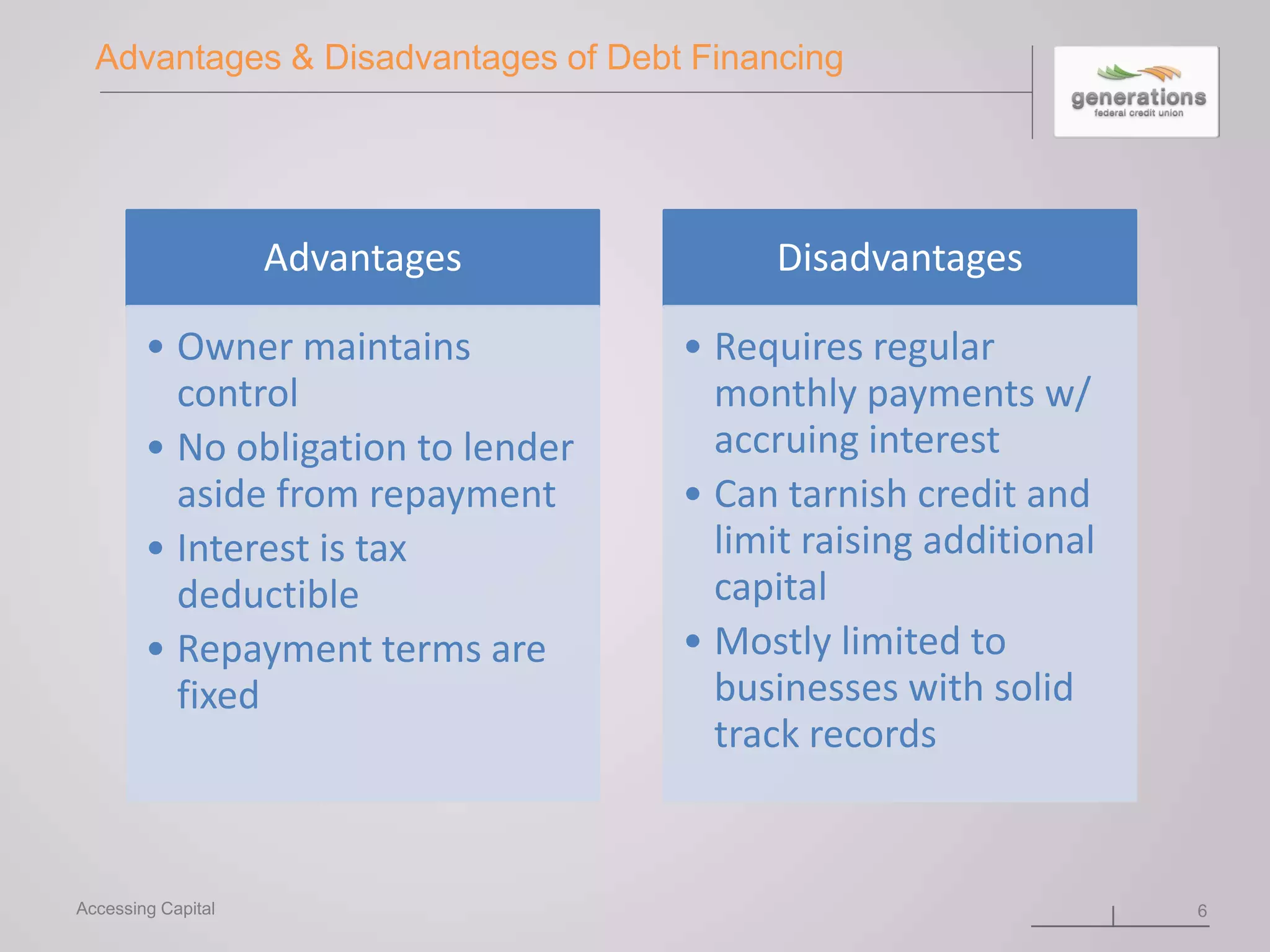
Advantages & Disadvantages of Debt Financing
6Accessing Capital
Advantages
• Owner maintains
control
• No obligation to lender
aside from repayment
• Interest is tax
deductible
• Repayment terms are
fixed
Disadvantages
• Requires regular
monthly payments w/
accruing interest
• Can tarnish credit and
limit raising additional
capital
• Mostly limited to
businesses with solid
track records
Equity Financing
7Accessing Capital
• Is borrowed money given in exchange for
ownership in business
• Used primarily by startups, new
businesses and those with poor credit
ratings
• Obtained using:
– Personal funds (savings, retirement, etc.)
– Friends/Family
– Investors/Venture capitalists/banking firms
– Large corporations
Advantages & Disadvantages Of Equity Financing
8Accessing Capital
Advantages
• Owner obtains funds
without incurring debt
(more cash flow)
• Owners focus on making
products profitable
• Can develop long term
relationships
• Ability to invest more
than towards debt
• Friends and family can be
a quick way to capital
Disadvantages
• Dilution of ownership
• Investors may feel
inclined to have a say
• Strain may occur with
family and friends
• Personal finances may be
maxed
• Reporting is often
required by investors
Know Your Personal Credit
• Your personal credit will impact your
ability to secure loans
• Review your most recent credit profile
– www.annualcreditreport.com
9Accessing Capital
Securing Loans Through a Credit Union/Bank
• Most require you to produce at least
10% in cash needed for start-up
• Commonly referred to as your “owner
equity/investment” or “your skin in the
game”
– Do you have this money?
– Some but not all?
– No money to invest?
10Accessing Capital
Other Considerations For Financing
11Accessing Capital
• Ability to repay loan
• Ensure a diverse revenue sources
and/or customer base
• Insurance to protect your business
• Incorporating for protection and tax
purposes
• Trigger points and other safeguards
• Contingencies
Get Connected & Learn More
www. mygenfcu.org
Email: smallbiz@mygenfcu.org
Sign Up for our business classes
Connect with us via social where we talk personal and small
business tips to help you reach your money goals

Accessing capital

  • 1.
  • 2.
    Before Seeking Capital Note:Existing Businesses will most likely need to show they are profitable or have collateral to secure loans Accessing Capital 2 • One-time charges • Recurring costs • Hidden costs & contingencies Determine your start up costs • What’s your “Skin in the Game” Determine your personal equity • Ensure you have included all items and contingencies Estimate monthly expenses
  • 3.
    What is theAnticipated Revenue? • Determine what you expect your annual sales to be in year one by: – How much traffic do you anticipate monthly? – How much will be spent on average by each customer? – What will it cost for you to serve that customer? – Cost of goods sold (inventory, shipping, marketing, etc.) 3Accessing Capital
  • 4.
    Various Sources ForAccessing Financing – Personal savings/Individual assets – Current Sales and/or income – Bank/Credit Union small biz loans and SBA loan guarantees – Micro lenders – Existing credit lines – Refinancing debt – Retirement accounts – Investor(s) and/or partners – Family and friends – Grants – Vendor Financing – Credit cards (not recommended) 4Accessing Capital
  • 5.
    Debt Financing • Isborrowed money which the entrepreneur must pay back to the lending institution • Typically for well-established businesses • Requires good credit history (borrower) • Obtained through credit unions and/or banks 5Accessing Capital
  • 6.
    Advantages & Disadvantagesof Debt Financing 6Accessing Capital Advantages • Owner maintains control • No obligation to lender aside from repayment • Interest is tax deductible • Repayment terms are fixed Disadvantages • Requires regular monthly payments w/ accruing interest • Can tarnish credit and limit raising additional capital • Mostly limited to businesses with solid track records
  • 7.
    Equity Financing 7Accessing Capital •Is borrowed money given in exchange for ownership in business • Used primarily by startups, new businesses and those with poor credit ratings • Obtained using: – Personal funds (savings, retirement, etc.) – Friends/Family – Investors/Venture capitalists/banking firms – Large corporations
  • 8.
    Advantages & DisadvantagesOf Equity Financing 8Accessing Capital Advantages • Owner obtains funds without incurring debt (more cash flow) • Owners focus on making products profitable • Can develop long term relationships • Ability to invest more than towards debt • Friends and family can be a quick way to capital Disadvantages • Dilution of ownership • Investors may feel inclined to have a say • Strain may occur with family and friends • Personal finances may be maxed • Reporting is often required by investors
  • 9.
    Know Your PersonalCredit • Your personal credit will impact your ability to secure loans • Review your most recent credit profile – www.annualcreditreport.com 9Accessing Capital
  • 10.
    Securing Loans Througha Credit Union/Bank • Most require you to produce at least 10% in cash needed for start-up • Commonly referred to as your “owner equity/investment” or “your skin in the game” – Do you have this money? – Some but not all? – No money to invest? 10Accessing Capital
  • 11.
    Other Considerations ForFinancing 11Accessing Capital • Ability to repay loan • Ensure a diverse revenue sources and/or customer base • Insurance to protect your business • Incorporating for protection and tax purposes • Trigger points and other safeguards • Contingencies
  • 12.
    Get Connected &Learn More www. mygenfcu.org Email: smallbiz@mygenfcu.org Sign Up for our business classes Connect with us via social where we talk personal and small business tips to help you reach your money goals