Office of the Undersecretary for
Regional Operations
Presentation Outline
1. ACCESs as Touchstone of Reforms
2. BESRA and ACCESs Connection
3. Defining ACCESs
4. Operationalizing ACCESs
– SBM & PASBE
– Re-engineering Planning and M&E Systems
5. Next Steps
ACCESs: A Community- and Child (Learner)-Centered Education System (June 2012)
ACCESs as Touchstone of Reforms
 It started from a need of a harmonizing
policy or statement that will guide reform
initiatives
 Then, a necessity to flesh-out a paradigm
that will drive behavior and performance
measures
 Ultimately, a demand to operationalize and
bring to reality the aspirations of RA 9155
ACCESs: A Community- and Child (Learner)-Centered Education System (June 2012)
Rationale for ACCESs
• Articulate the mandate of RA 9155
• Clarify roles and accountabilities per level of
governance
• Broaden the role of community in education
management and delivery to emphasize
“stewardship”
• Emphasize centrality of learners and learner’s
outcome
• Guide program development and evaluation
ACCESs: A Community- and Child (Learner)-Centered Education System (June 2012)
BESRA and ACCESs Connection
• BESRA must be synchronized by a clear
philosophy and value statement
• ACCESs provides clarity for BESRA to
streamline and identify priorities
• BESRA is the package of policy reforms;
ACCESs is a policy or statement that
concretize/operationalize the policy reforms
ACCESs: A Community- and Child (Learner)-Centered Education System (June 2012)
Defining ACCESs
Philosophy
• Belief and value that the
Department espouses
• Concept of an ideal
state
• Guide to strategic and
day-to-day affairs
• Culture among
stakeholders
Approach
• Method or process of
service delivery
• Measure to examine
consistency of policy,
program, project or
activity vis-à-vis thrust &
mandate
• Guide to examine
relevance & value of all
other policies, programs,
projects
ACCESs: A Community- and Child (Learner)-Centered Education System (June 2012)
ACCESs is about being child(learner)- and
community-centered
Community-Centered
• Mandate derived from RA9155, EFA National Plan and BESRA
• Community as source of strategic thrust, crucial resources for
learning, curriculum development
• Community as “rights-bearer” of rights to education
Child(Learner)-Centered
• A concept derived from the framework of rights-based
education that is characterized as: “inclusive, healthy and
protective for all children, effective with children, and involved
with families and communities - and children" (Shaeffer, 1999).
ACCESs: A Community- and Child (Learner)-Centered Education System (June 2012)
Features of ACCESs
Community-Centered
• Shared vision & mission
• Shared decision-making &
governance
• Collaboration
• Community ownership
• Autonomy,
• Accountability
• Transparency
Child(Learner)-Centered
• Learning-focused
• Developmental-stage
appropriate
• Gender- & culture-sensitive
• Environmentally (physical,
emotional, psychosocial)
safe
• Accessible regardless of
gender, race, culture, social
& economic status
ACCESs: A Community- and Child (Learner)-Centered Education System (June 2012)
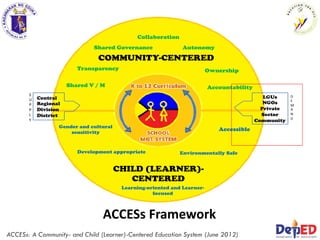
CHILD (LEARNER)-
CENTERED
COMMUNITY-CENTERED
Collaboration
Shared Governance
Transparency
Shared V / M
Autonomy
Ownership
Accountability
Gender and cultural
sensitivity
Development appropriate
Learning-oriented and Learner-
focused
Environmentally Safe
Accessible
LGUs
NGOs
Private
Sector
Community
D
E
M
A
N
D
Central
Regional
Division
District
S
U
P
P
L
Y
ACCESs Framework
ACCESs: A Community- and Child (Learner)-Centered Education System (June 2012)
In sum, ACCESs provides..
A framework to advance the philosophy
of shared governance of education and
to ensure a strong culture of effective
leadership & management in the provision
of basic education
ACCESs: A Community- and Child (Learner)-Centered Education System (June 2012)
ACCESs is about an education system…
• Network of leadership
• Learner-centered and context-based learning
systems and processes
• Transparent and community developed
accountability system
• Mutually reinforcing and harnessing education
targeted resource management
ACCESs: A Community- and Child (Learner)-Centered Education System (June 2012)
Operationalizing ACCESs
1. Re-creating school (learning community) systems into
community-based and learner-centered
2. Re-engineering the system through participatory
planning and “demand-driven” monitoring and
evaluation
3. Linking planning and budget processes with
appropriate LGU and other local participation
platforms at each governance level
4. Strengthening accountability system by leveraging on
the involvement of the “demand-side” of education
ACCESs: A Community- and Child (Learner)-Centered Education System (June 2012)
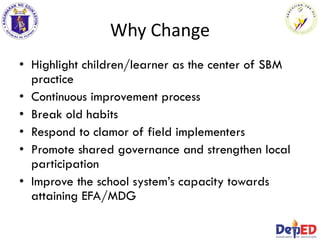
Why Change
• Highlight children/learner as the center of SBM
practice
• Continuous improvement process
• Break old habits
• Respond to clamor of field implementers
• Promote shared governance and strengthen local
participation
• Improve the school system’s capacity towards
attaining EFA/MDG
Type of Change
 Homeostatic change - band aid- just to close gap in
performance, firefighting if there’s fire
 Incremental change – gradual, progressive, slow
when there’s little information about the subject /
object of change
 Neo-mobilistic – innovative, to introduce a different
/ much better formula, e.g. pole vaulting
 Metamorphic – revolutionary, to change the whole
system [Mao Tze Tung]
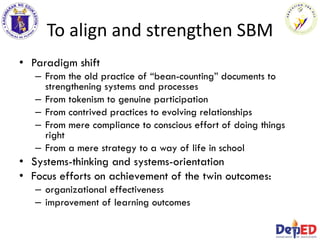
To align and strengthen SBM
• Paradigm shift
– From the old practice of “bean-counting” documents to
strengthening systems and processes
– From tokenism to genuine participation
– From contrived practices to evolving relationships
– From mere compliance to conscious effort of doing things
right
– From a mere strategy to a way of life in school
• Systems-thinking and systems-orientation
• Focus efforts on achievement of the twin outcomes:
– organizational effectiveness
– improvement of learning outcomes
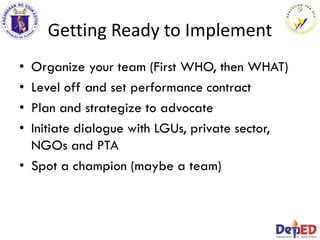
Getting Ready to Implement
• Organize your team (First WHO, then WHAT)
• Level off and set performance contract
• Plan and strategize to advocate
• Initiate dialogue with LGUs, private sector,
NGOs and PTA
• Spot a champion (maybe a team)
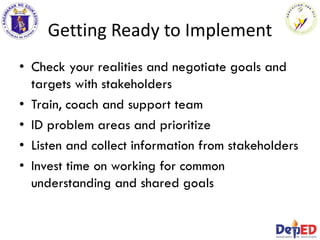
Getting Ready to Implement
• Check your realities and negotiate goals and
targets with stakeholders
• Train, coach and support team
• ID problem areas and prioritize
• Listen and collect information from stakeholders
• Invest time on working for common
understanding and shared goals
Office of the Undersecretary for
Regional Operations

access-and-the-revised-sbm.pdf

  • 1.
    Office of theUndersecretary for Regional Operations
  • 2.
    Presentation Outline 1. ACCESsas Touchstone of Reforms 2. BESRA and ACCESs Connection 3. Defining ACCESs 4. Operationalizing ACCESs – SBM & PASBE – Re-engineering Planning and M&E Systems 5. Next Steps ACCESs: A Community- and Child (Learner)-Centered Education System (June 2012)
  • 3.
    ACCESs as Touchstoneof Reforms  It started from a need of a harmonizing policy or statement that will guide reform initiatives  Then, a necessity to flesh-out a paradigm that will drive behavior and performance measures  Ultimately, a demand to operationalize and bring to reality the aspirations of RA 9155 ACCESs: A Community- and Child (Learner)-Centered Education System (June 2012)
  • 4.
    Rationale for ACCESs •Articulate the mandate of RA 9155 • Clarify roles and accountabilities per level of governance • Broaden the role of community in education management and delivery to emphasize “stewardship” • Emphasize centrality of learners and learner’s outcome • Guide program development and evaluation ACCESs: A Community- and Child (Learner)-Centered Education System (June 2012)
  • 5.
    BESRA and ACCESsConnection • BESRA must be synchronized by a clear philosophy and value statement • ACCESs provides clarity for BESRA to streamline and identify priorities • BESRA is the package of policy reforms; ACCESs is a policy or statement that concretize/operationalize the policy reforms ACCESs: A Community- and Child (Learner)-Centered Education System (June 2012)
  • 6.
    Defining ACCESs Philosophy • Beliefand value that the Department espouses • Concept of an ideal state • Guide to strategic and day-to-day affairs • Culture among stakeholders Approach • Method or process of service delivery • Measure to examine consistency of policy, program, project or activity vis-à-vis thrust & mandate • Guide to examine relevance & value of all other policies, programs, projects ACCESs: A Community- and Child (Learner)-Centered Education System (June 2012)
  • 7.
    ACCESs is aboutbeing child(learner)- and community-centered Community-Centered • Mandate derived from RA9155, EFA National Plan and BESRA • Community as source of strategic thrust, crucial resources for learning, curriculum development • Community as “rights-bearer” of rights to education Child(Learner)-Centered • A concept derived from the framework of rights-based education that is characterized as: “inclusive, healthy and protective for all children, effective with children, and involved with families and communities - and children" (Shaeffer, 1999). ACCESs: A Community- and Child (Learner)-Centered Education System (June 2012)
  • 8.
    Features of ACCESs Community-Centered •Shared vision & mission • Shared decision-making & governance • Collaboration • Community ownership • Autonomy, • Accountability • Transparency Child(Learner)-Centered • Learning-focused • Developmental-stage appropriate • Gender- & culture-sensitive • Environmentally (physical, emotional, psychosocial) safe • Accessible regardless of gender, race, culture, social & economic status ACCESs: A Community- and Child (Learner)-Centered Education System (June 2012)
  • 9.
    CHILD (LEARNER)- CENTERED COMMUNITY-CENTERED Collaboration Shared Governance Transparency SharedV / M Autonomy Ownership Accountability Gender and cultural sensitivity Development appropriate Learning-oriented and Learner- focused Environmentally Safe Accessible LGUs NGOs Private Sector Community D E M A N D Central Regional Division District S U P P L Y ACCESs Framework ACCESs: A Community- and Child (Learner)-Centered Education System (June 2012)
  • 10.
    In sum, ACCESsprovides.. A framework to advance the philosophy of shared governance of education and to ensure a strong culture of effective leadership & management in the provision of basic education ACCESs: A Community- and Child (Learner)-Centered Education System (June 2012)
  • 11.
    ACCESs is aboutan education system… • Network of leadership • Learner-centered and context-based learning systems and processes • Transparent and community developed accountability system • Mutually reinforcing and harnessing education targeted resource management ACCESs: A Community- and Child (Learner)-Centered Education System (June 2012)
  • 12.
    Operationalizing ACCESs 1. Re-creatingschool (learning community) systems into community-based and learner-centered 2. Re-engineering the system through participatory planning and “demand-driven” monitoring and evaluation 3. Linking planning and budget processes with appropriate LGU and other local participation platforms at each governance level 4. Strengthening accountability system by leveraging on the involvement of the “demand-side” of education ACCESs: A Community- and Child (Learner)-Centered Education System (June 2012)
  • 13.
    Why Change • Highlightchildren/learner as the center of SBM practice • Continuous improvement process • Break old habits • Respond to clamor of field implementers • Promote shared governance and strengthen local participation • Improve the school system’s capacity towards attaining EFA/MDG
  • 14.
    Type of Change Homeostatic change - band aid- just to close gap in performance, firefighting if there’s fire  Incremental change – gradual, progressive, slow when there’s little information about the subject / object of change  Neo-mobilistic – innovative, to introduce a different / much better formula, e.g. pole vaulting  Metamorphic – revolutionary, to change the whole system [Mao Tze Tung]
  • 15.
    To align andstrengthen SBM • Paradigm shift – From the old practice of “bean-counting” documents to strengthening systems and processes – From tokenism to genuine participation – From contrived practices to evolving relationships – From mere compliance to conscious effort of doing things right – From a mere strategy to a way of life in school • Systems-thinking and systems-orientation • Focus efforts on achievement of the twin outcomes: – organizational effectiveness – improvement of learning outcomes
  • 16.
    Getting Ready toImplement • Organize your team (First WHO, then WHAT) • Level off and set performance contract • Plan and strategize to advocate • Initiate dialogue with LGUs, private sector, NGOs and PTA • Spot a champion (maybe a team)
  • 17.
    Getting Ready toImplement • Check your realities and negotiate goals and targets with stakeholders • Train, coach and support team • ID problem areas and prioritize • Listen and collect information from stakeholders • Invest time on working for common understanding and shared goals
  • 18.
    Office of theUndersecretary for Regional Operations