1
Defining and
understanding
academic writing
Introduction • The iterative, continuous nature of academic writing •
Exploring the paradoxes of academic writing • Tackling writing time frames
• Writing exercises • Guidance for defining your own writing challenges
Introduction
This chapter provides a framework for exploring the dynamics and paradoxes
of academic writing. It presents guidelines that can help you to analyse your
academic writing processes, but also emphasizes that no amount of theorizing
and intellectualizing of writing is going to make more successful writing pat-
terns unless accompanied by an undertaking to engage in practical strategies
and to plan effective writing tactics. Equally, though, in order to generate
practical approaches to writing, we have found that academic writers can
benefit from exploring some of the contradictions and paradoxes associated
with the academic writing process. Academics who have taken the time to
participate on our writing programmes have often reported that examining
what writing means to them, and analysing its paradoxes and contradictions,
helps them to gain more control over how, when and what they write. You
may find it useful too. Also once you have examined more closely the things
that bring you to a writing task and the things that take you away from it, you
may simply be in a better position to write productively and well.
Exploring writing complexities and paradoxes might help you to make more
sense of your experiences of writing and gain more control over its associated
processes. Writing has often been described as a demanding and sometimes
troublesome dimension of academic life. Analysing its complexities and para-
doxes may help to shed more light on why this is the case for many academics
in many different contexts.
In order to explore and highlight the complexities and paradoxes that are
associated with writing, we first explore its iterative, continuous nature,
emphasizing how important we think it is to treat academic writing in a recur-
sive way. We explore writing paradoxes in an effort to explicate the ups and
downs of the academic writing process, and we provide a more practical
framework within which to manage those paradoxes by introducing the idea
of outlining and designing short bursts of effective writing into busy academic
life as well as availing of opportunities for longer periods of writing, if such
opportunities arise.
The iterative, continuous nature of academic writing
However difficult and complicated it may be, the process of becoming a
writer is an important journey. It is a journey that leads us to many new
discoveries about ourselves, about our ideas, about the world in which we live,
and about our professional identities as academics, teachers, researchers and
scholars.
Choosing not to write in academia should not be seen as a principled stand
to resist the increasing demands of the academy (though we can understand
why people would make that choice for those reasons). Rather, choosing not
to write can be conceptualized as an implicit acceptance of an academic half-
life in which one’s legitimate scholarly voice has not been sufficiently exer-
cised, or respected. To put it more positively, choosing to write in one’s area of
academic expertise is an affirmative choice that announces both your courage
and active engagement in the world you have chosen to occupy.
There are many ways in which you can avoid pitfalls and false starts in your
writing. There are practical and positive ways in which it can integrate with
the other activities in your life. Academic writing can be conceptualized less
as ‘jumping through hoops’ and more as the proactive positioning of your
academic voice. By actively addressing questions about your writing – ‘How is
writing learned?’ ‘How do people organize themselves in order to write?’
‘What are the common difficulties that people encounter, and why?’ ‘And how
can you develop a workable orientation towards academic writing that allows
you to fit it into the context of your busy professional and personal life?’ –
you can help to position it as a controllable and achievable part of your
professional development.
4 DEFINING AND UNDERSTANDING ACADEMIC WRITING
Essential to addressing such questions is the recognition that writing is not a
single, homogenous, linear achievement towards which you strive and at
which you one day arrive. Rather, it is the manifestation of your professional
learning journey and it is (or at least it should be) a continuous process involv-
ing reflection, improvement, development, progress and fulfilment of various
types and in varying measures. It contains different processes and phases, and
it is an activity that can help to grease the wheels of your professional life of all
sorts of ways. It is not something that needs to interfere with other goals or
be psychologically daunting even (or perhaps especially) when you’re not
doing it.
Focusing on the necessary stages and phases of your writing and what hap-
pens to you at different parts of the process may provide you with important
learning milestones from which you can benefit just as much as you can from
a final, polished written product. If you consider that writing is an iterative
process with phases of progression and phases of regression, you might allow
yourself to conceptualize your own writing challenges more fruitfully. Reflect-
ing on what many researchers and theorists suggest is the iterative nature of
writing may also help you to devise realistic, appropriate and ultimately pro-
ductive writing strategies. If you have already developed strategies that work
for you, then reflecting on the process of writing may help you to enhance and
refine them even more.
Your writing can be a companion to your learning rather than an imposing
enemy that constantly needs either to be agonizingly wrestled or artfully
avoided. There are pleasurable, positive possibilities embedded in every
writing task, no matter how onerous such tasks may sometimes feel.
Many commentators have hinted at the paradoxes associated with academic
writing. Giving these paradoxes some explicit attention may help you to
know what to expect about the contradictions and complexities that writing
sometimes contains.
The ebbs and flows, and highs and lows of writing are things that you may
already be familiar with, or they may be discoveries that are lurking just
around the corner. Whether you are an experienced writer or someone grap-
pling with academic writing for the first time, we believe that it is important
for you to be able to recognize many of the conundrums the experience of
writing may contain.
Academic writing is not the printed display of one’s fully formed thoughts. It
starts with flawed, incomplete, vague hunches, ideas and concepts. But, if you
exploit its inherent ‘revisability’, it allows you to come full circle, to revisit ideas
long after you first thought of them, to explore the same things in different
ways, to experiment, to revise, to repeat and to reconceptualize – all of these are
arguably central to the essence of scholarship which you exercise every day in
other academic tasks like teaching, supervision and guiding students.
Even if your goal is to produce a perfect piece of writing (an imposing target
that may prohibit initial attempts at writing, but one that many writers pursue
nonetheless), then surely it is the imperfections, discoveries and serendipitous
THE ITERATIVE, CONTINUOUS NATURE OF ACADEMIC WRITING 5
loops in which you must engage to reach that goal that are at least as interest-
ing as your final destination?
As a starting point, we often encourage academic writers to try to enjoy their
writing journeys a bit more than they often say they normally do. Many col-
leagues find this idea immediately appealing – a sort of antidote to the notion
that writing is part of the drudgery of academic work. When invited to con-
sider the enjoyable, positive, creative, empowering aspects of academic writ-
ing, many of them respond by saying that even simply associating these words
with their writing makes them feel more positively orientated than they might
otherwise have been.
But not everyone responds in this way, and perhaps you don’t either. In any
session that focuses on this orientation, some people tell us that our
encouragement is unrealistic. They say it sounds evangelical and not reflective
of the realities in which they work. They say that academic writing is neither a
positive nor an empowering experience for them, and no amount of trying to
convince them that it can be will change that.
These are reactions that we have reflected upon and explored in our work as
writing developers. Suggesting that writing, even that which is extremely
scholarly, does not actually have to be a fearsome grind and that for many
writers can become just the opposite, is something that seems to confront a
relatively common view among academics, many of whom see writing as an
unpleasant but necessary activity. This idea exists across many different col-
lege and university settings. Our response is this: if writing is something that
you have to do, but something that you dislike, perhaps it is worth exploring
alternative perspectives. Perhaps it is worth analysing your negative associ-
ations in order to understand them better. And even if you don’t particularly
dislike the writing process, you may still have encountered problems and
pitfalls that a more thorough analysis of writing and of its processes and
paradoxes might help to address.
Exploring the paradoxes of academic writing
Writing involves starting, progressing and finishing a complicated, chal-
lenging combination of tasks. It requires you to activate lots of different skills
and orientations, sometimes at different stages and phases in the process,
sometimes all at the same time. Some researchers have claimed that writing
can be experienced as one of the most difficult of all skills, requiring an intri-
cate combination of neurological, physical, cognitive and affective competen-
cies (see, for example, Levine, 2004). Others (perhaps most notably Elbow and
Belanoff, 2000) claim that even if writing makes complicated demands on
your skills and abilities, it is possible to make writing easy, or at least easy
enough for it to feel worth tackling regularly and with good effect.
6 DEFINING AND UNDERSTANDING ACADEMIC WRITING
We share Peter Elbow’s optimism that all academics can write and that they
can all write well. But this does not take away from the need to recognize the
different and contradictory pushes and pulls associated with the writing
process.
Writing involves starting and finishing, both requiring very different kinds
of orientation. Writing requires listening to and being guided by the voices of
others, but also it demands your confidence and your willingness to present
your own voice, your own perspectives and your own interpretations. Writing
often involves an intimate familiarity with the minute details of a specific
piece of work, but it also demands that we position these minutiae on a
broader stage, identifying and explaining connections and comparisons in a
wider theoretical context. Writing is not just influenced by what we know and
what we have discovered about a particular phenomenon, it is also influenced
by what we feel, and more particularly, what we feel about ourselves (Boice,
1988). The creative part of writing requires chaos, serendipity and coincidence;
but in order to shape and craft our writing effectively, it needs the imposition
of at least some order and discipline. The implications of these paradoxes are
important and worth exploring in some more detail.
Paradox 1: The starting versus finishing paradox
Many lecturers, professors and academics sit guiltily on a store of unfinished
business. They have writing projects that they started once, perhaps long ago,
projects that may have had magnificent initial momentum, but for a variety
of reasons, the excitement and energy of the early ideas fizzled out and came
to nothing. Of course some unfinished doctorates, research papers, journal
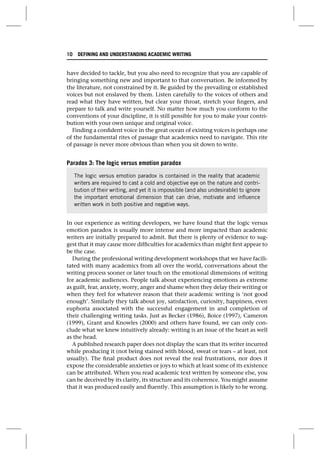
The paradoxes of academic writing
Paradox 1: The starting versus finishing paradox
Paradox 2: The originality versus convention paradox
Paradox 3: The logic versus emotion paradox
Paradox 4: The easy versus difficult paradox
Paradox 5: The public versus private paradox
The starting versus finishing paradox exists by virtue of the fact that the
skills associated with starting a writing project are qualitatively and radically
different from the skills you need to activate in order to progress and to com-
plete it. Starting a writing project is very different from persisting and finish-
ing, and this fact is often the cause of writing obstacles as the demands of
moving from starting to finishing become difficult to overcome.
EXPLORING THE PARADOXES OF ACADEMIC WRITING 7
articles and book chapters out there were terminated for the right reasons, but
very many merited a completion that never materialized.
Many of us start our writing projects with at least some enthusiasm and self-
belief, but the good intentions and animated beginnings don’t always trans-
late into a finished product, and as a result, a lot of the work that went into the
early stages of a project does not bear fruit, at least not in any explicit or
satisfactory way.
Why do many of us have projects that we start but don’t finish? Academic
writing often leads people into a zone that can be psychologically dangerous –
a zone that human nature impels us to avoid. These dangers are not necessarily
apparent initially, but can become very obvious once a writing project is under
way. Unless we rise above our initial fears and reactions by building in our own
‘safety mechanisms’ to guide our writing projects, things can happen that lead
us to abandon some of our most promising work.
And indeed it is easy to become overwhelmed by criticism at a crucial stage
in the process. This can be precipitated by things like bad reviews or by
suddenly being challenged to answer a critical or fundamental question
that you hadn’t previously considered. As you become more familiar with the
field in which you are writing, it is possible to develop a disillusionment
about the added value of your work that causes you to cast aside a project
altogether when a simple re-orientation could have turned it around. A lack
of clarity about the conventions of the genre can set you back, and often
it is difficult not to separate your writing from other dimensions of your
academic or professional life, making it feel disjointed from the rest of your
work.
At certain points in the writing process, you might be too hard on yourself
by aiming higher than is appropriate for your stage of development or pre-
maturely exposing your work to highly critical readers. Conversely, in order to
protect yourself from excessive criticism, you can become timid and unwilling
to expose your work to scrutiny that might help to improve it. Other reasons
for stagnant, unfinished work relate to the common and inevitable distrac-
tions of life that take you away from your writing projects for longer than you
had expected, only to discover on returning that you have lost whatever spark
it was that originally encouraged you to get going.
In addition, some academics regularly say that they have become very dis-
enchanted with the requirements and conventions of academic writing, feel-
ing that it is somehow strangling their ‘true’ voices in so far as it seems to
require a stilted and constrained way of expressing ideas, and that conforming
to the conventional requirements of ‘genre’ somehow undermines integrity.
Writing for academia may be conceived as a game that some simply choose
not to play. If, however, you feel that academic writing is important to you,
either for pragmatic or idealistic reasons (or both), it is vital to realize that
these obstructions can be navigated, negotiated and overcome. A starting
point may simply be to make writing safe, or at least safe enough for you to
keep doing it.
8 DEFINING AND UNDERSTANDING ACADEMIC WRITING
Perhaps initially, the most important dynamics for you to conquer are those
that get you started, whatever those initial, sometimes chaotic, sometimes
stumbling efforts require. But it is also worth remembering at those initial
stages that the maintenance and final closure of your writing tasks require a
different set of dynamics that will involve rewriting, editing, revisiting and
reconceptualizing. Starting is one thing, but finishing is entirely another. You
need to orientate your approaches to writing in ways that will help you to do
both successfully.
Paradox 2: The originality versus convention paradox
You do need to recognize the genres and conventions of your discipline in aca-
demic writing (see Murray, 2004). However, you need also to guard against
being ‘terrorised by the literature’ (Becker, 1986) in ways that rob you of your
own ideas or that make you less confident about the things that you are trying
to say in your own words. The paradox of originality and convention suggests
that all academics risk becoming engaged in an endless, defensive trawl of the
‘literature’ in order to demonstrate that what you’re saying is completely new
or that it fills the elusive ‘gap’ that is often the intimidating holy grail of
academic pursuit. This dynamic can create an insurmountable writing block
that stands imposingly between you and your efforts to write.
On one side of this paradox is the reality that if you are too detached from
the literature or half-hearted in your efforts to familiarize yourself with it, then
you run the risk of ‘reinventing the wheel’ and, more importantly, of exposing
yourself to the unnecessary criticism of more informed counterparts. On the
other is the fact that if you are too concerned about the conventions of your
discipline and the voices of those who have contributed most convincingly to
it, then you run the risk of aligning your work so closely to prevailing giants or
popular names in your field that there is really no room left for the fresh voice
or the interesting angle that you might otherwise have adopted.
Of course you need to pay attention to the existing literature in the field you
The originality versus convention paradox reflects the differences and tensions
between taking in information and putting forward or articulating ideas of your
own. When writing you need to find your own individual voice in the midst of
other voices, many of which seem more expert and more knowledgeable than
your own. Of course other academic voices do need to be invoked when you
write and they do inform and nourish your writing, but they should not drown,
smother or sideline the essence of your own contributions. It is perhaps the
quest to ‘fill a gap’ in the literature that makes academic writing sometimes
feel so daunting, especially in a context where conventional ways of expressing
ideas sometimes appear to be rigid and unyielding. How can fresh ideas and
new insights be incorporated into a writing style that tends to demand so much
conformity?
EXPLORING THE PARADOXES OF ACADEMIC WRITING 9
have decided to tackle, but you also need to recognize that you are capable of
bringing something new and important to that conversation. Be informed by
the literature, not constrained by it. Be guided by the prevailing or established
voices but not enslaved by them. Listen carefully to the voices of others and
read what they have written, but clear your throat, stretch your fingers, and
prepare to talk and write yourself. No matter how much you conform to the
conventions of your discipline, it is still possible for you to make your contri-
bution with your own unique and original voice.
Finding a confident voice in the great ocean of existing voices is perhaps one
of the fundamental rites of passage that academics need to navigate. This rite
of passage is never more obvious than when you sit down to write.
Paradox 3: The logic versus emotion paradox
In our experience as writing developers, we have found that the logic versus
emotion paradox is usually more intense and more impacted than academic
writers are initially prepared to admit. But there is plenty of evidence to sug-
gest that it may cause more difficulties for academics than might first appear to
be the case.
During the professional writing development workshops that we have facili-
tated with many academics from all over the world, conversations about the
writing process sooner or later touch on the emotional dimensions of writing
for academic audiences. People talk about experiencing emotions as extreme
as guilt, fear, anxiety, worry, anger and shame when they delay their writing or
when they feel for whatever reason that their academic writing is ‘not good
enough’. Similarly they talk about joy, satisfaction, curiosity, happiness, even
euphoria associated with the successful engagement in and completion of
their challenging writing tasks. Just as Becker (1986), Boice (1997), Cameron
(1999), Grant and Knowles (2000) and others have found, we can only con-
clude what we knew intuitively already: writing is an issue of the heart as well
as the head.
A published research paper does not display the scars that its writer incurred
while producing it (not being stained with blood, sweat or tears – at least, not
usually). The final product does not reveal the real frustrations, nor does it
expose the considerable anxieties or joys to which at least some of its existence
can be attributed. When you read academic text written by someone else, you
can be deceived by its clarity, its structure and its coherence. You might assume
that it was produced easily and fluently. This assumption is likely to be wrong.
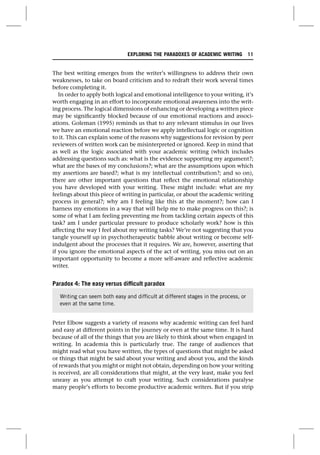
The logic versus emotion paradox is contained in the reality that academic
writers are required to cast a cold and objective eye on the nature and contri-
bution of their writing, and yet it is impossible (and also undesirable) to ignore
the important emotional dimension that can drive, motivate and influence
written work in both positive and negative ways.
10 DEFINING AND UNDERSTANDING ACADEMIC WRITING
The best writing emerges from the writer’s willingness to address their own
weaknesses, to take on board criticism and to redraft their work several times
before completing it.
In order to apply both logical and emotional intelligence to your writing, it’s
worth engaging in an effort to incorporate emotional awareness into the writ-
ing process. The logical dimensions of enhancing or developing a written piece
may be significantly blocked because of our emotional reactions and associ-
ations. Goleman (1995) reminds us that to any relevant stimulus in our lives
we have an emotional reaction before we apply intellectual logic or cognition
to it. This can explain some of the reasons why suggestions for revision by peer
reviewers of written work can be misinterpreted or ignored. Keep in mind that
as well as the logic associated with your academic writing (which includes
addressing questions such as: what is the evidence supporting my argument?;
what are the bases of my conclusions?; what are the assumptions upon which
my assertions are based?; what is my intellectual contribution?; and so on),
there are other important questions that reflect the emotional relationship
you have developed with your writing. These might include: what are my
feelings about this piece of writing in particular, or about the academic writing
process in general?; why am I feeling like this at the moment?; how can I
harness my emotions in a way that will help me to make progress on this?; is
some of what I am feeling preventing me from tackling certain aspects of this
task? am I under particular pressure to produce scholarly work? how is this
affecting the way I feel about my writing tasks? We’re not suggesting that you
tangle yourself up in psychotherapeutic babble about writing or become self-
indulgent about the processes that it requires. We are, however, asserting that
if you ignore the emotional aspects of the act of writing, you miss out on an
important opportunity to become a more self-aware and reflective academic
writer.
Paradox 4: The easy versus difficult paradox
Peter Elbow suggests a variety of reasons why academic writing can feel hard
and easy at different points in the journey or even at the same time. It is hard
because of all of the things that you are likely to think about when engaged in
writing. In academia this is particularly true. The range of audiences that
might read what you have written, the types of questions that might be asked
or things that might be said about your writing and about you, and the kinds
of rewards that you might or might not obtain, depending on how your writing
is received, are all considerations that might, at the very least, make you feel
uneasy as you attempt to craft your writing. Such considerations paralyse
many people’s efforts to become productive academic writers. But if you strip
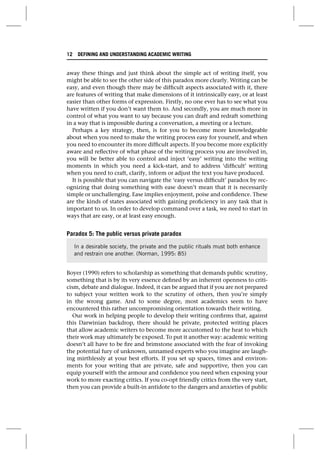
Writing can seem both easy and difficult at different stages in the process, or
even at the same time.
EXPLORING THE PARADOXES OF ACADEMIC WRITING 11
away these things and just think about the simple act of writing itself, you
might be able to see the other side of this paradox more clearly. Writing can be
easy, and even though there may be difficult aspects associated with it, there
are features of writing that make dimensions of it intrinsically easy, or at least
easier than other forms of expression. Firstly, no one ever has to see what you
have written if you don’t want them to. And secondly, you are much more in
control of what you want to say because you can draft and redraft something
in a way that is impossible during a conversation, a meeting or a lecture.
Perhaps a key strategy, then, is for you to become more knowledgeable
about when you need to make the writing process easy for yourself, and when
you need to encounter its more difficult aspects. If you become more explicitly
aware and reflective of what phase of the writing process you are involved in,
you will be better able to control and inject ‘easy’ writing into the writing
moments in which you need a kick-start, and to address ‘difficult’ writing
when you need to craft, clarify, inform or adjust the text you have produced.
It is possible that you can navigate the ‘easy versus difficult’ paradox by rec-
ognizing that doing something with ease doesn’t mean that it is necessarily
simple or unchallenging. Ease implies enjoyment, poise and confidence. These
are the kinds of states associated with gaining proficiency in any task that is
important to us. In order to develop command over a task, we need to start in
ways that are easy, or at least easy enough.
Paradox 5: The public versus private paradox
Boyer (1990) refers to scholarship as something that demands public scrutiny,
something that is by its very essence defined by an inherent openness to criti-
cism, debate and dialogue. Indeed, it can be argued that if you are not prepared
to subject your written work to the scrutiny of others, then you’re simply
in the wrong game. And to some degree, most academics seem to have
encountered this rather uncompromising orientation towards their writing.
Our work in helping people to develop their writing confirms that, against
this Darwinian backdrop, there should be private, protected writing places
that allow academic writers to become more accustomed to the heat to which
their work may ultimately be exposed. To put it another way: academic writing
doesn’t all have to be fire and brimstone associated with the fear of invoking
the potential fury of unknown, unnamed experts who you imagine are laugh-
ing mirthlessly at your best efforts. If you set up spaces, times and environ-
ments for your writing that are private, safe and supportive, then you can
equip yourself with the armour and confidence you need when exposing your
work to more exacting critics. If you co-opt friendly critics from the very start,
then you can provide a built-in antidote to the dangers and anxieties of public
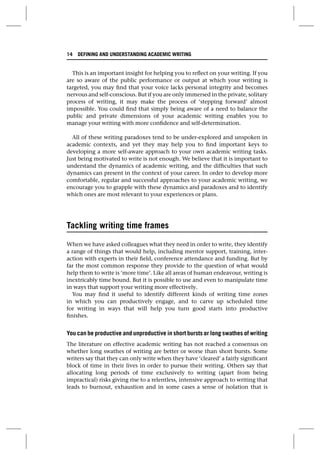
In a desirable society, the private and the public rituals must both enhance
and restrain one another. (Norman, 1995: 85)
12 DEFINING AND UNDERSTANDING ACADEMIC WRITING
scrutiny. Public scrutiny only feels dangerous if you are not equipped to
respond to it. If you are, then it can become an exhilarating part of the process
of scholarship.
By recognizing that you have at least some control over the privacy that can
protect your early writing efforts, you can contain your fragile early drafts,
while also building your own self-belief that allows you to consider ‘going
public’ at some specified point in the future (Cameron, 1999). One way of
doing this is to identify times when private writing can feed the process more
productively than writing for a public audience would. Freewriting, a tech-
nique popularized by writing experts such as Flower and Hayes (1977), Elbow
and Belanoff (2000), and Murray (2004), is a strategy that can get your writing
juices flowing, and involves short private writing sessions (5 to 10 minutes in
duration) in which you respond in writing to your own prompts as continu-
ously as possible in order simply to get your ideas down on paper. This type of
writing ignores structures, genres, and conventions in order to give rise to a
more fluent approach to any writing task. Once you get used to setting up
private spaces for your writing, in which you may be freer to play around with
ideas and to have a dialogue with yourself about your perspectives on a sub-
ject, you can then make advances by picking which nuggets in your private
writing world can travel into a more public domain. As one writer puts it:
The first time I write a draft of a paper . . . I totally let go and rant and rave
and say unprofessional things, including swear words. Later I go back and
change it to something more acceptable for my academic audience. My
theory is that the new, more professional words will still carry the original
energy of the first draft, and so even my final ‘academised’ version will
have more oomph than if I tried too hard to control my initial reactions
the first time round.
(Cassity via Elbow and Belanoff, 2000: 387)
Remember also that the benefits of keeping your writing to yourself have
been underestimated in academic settings. While it is often useful to show
your work to people who can help you to improve it, we also know that there
are times when such exposure can feel dangerous and problematic, and can
lead to blocks that might not have occurred if you had kept it private even for a
little longer. It is important sometimes to let yourself write in a private space
where any kind of scrutiny is not a consideration or a cause of concern. As
Ralph Norman (1995) puts it:
[Sometimes] we want to be able to hide the precious information under
the jacket, or to read it in whispers to the beloved, or to bury it for a while
in the vegetable garden. Part of what free people mean by the freedom of
appearance is having the power to turn away betimes from where all the
others are.
(Norman, 1995: 85)
EXPLORING THE PARADOXES OF ACADEMIC WRITING 13
This is an important insight for helping you to reflect on your writing. If you
are so aware of the public performance or output at which your writing is
targeted, you may find that your voice lacks personal integrity and becomes
nervous and self-conscious. But if you are only immersed in the private, solitary
process of writing, it may make the process of ‘stepping forward’ almost
impossible. You could find that simply being aware of a need to balance the
public and private dimensions of your academic writing enables you to
manage your writing with more confidence and self-determination.
All of these writing paradoxes tend to be under-explored and unspoken in
academic contexts, and yet they may help you to find important keys to
developing a more self-aware approach to your own academic writing tasks.
Just being motivated to write is not enough. We believe that it is important to
understand the dynamics of academic writing, and the difficulties that such
dynamics can present in the context of your career. In order to develop more
comfortable, regular and successful approaches to your academic writing, we
encourage you to grapple with these dynamics and paradoxes and to identify
which ones are most relevant to your experiences or plans.
Tackling writing time frames
When we have asked colleagues what they need in order to write, they identify
a range of things that would help, including mentor support, training, inter-
action with experts in their field, conference attendance and funding. But by
far the most common response they provide to the question of what would
help them to write is ‘more time’. Like all areas of human endeavour, writing is
inextricably time bound. But it is possible to use and even to manipulate time
in ways that support your writing more effectively.
You may find it useful to identify different kinds of writing time zones
in which you can productively engage, and to carve up scheduled time
for writing in ways that will help you turn good starts into productive
finishes.
You can be productive and unproductive in short bursts or long swathes of writing
The literature on effective academic writing has not reached a consensus on
whether long swathes of writing are better or worse than short bursts. Some
writers say that they can only write when they have ‘cleared’ a fairly significant
block of time in their lives in order to pursue their writing. Others say that
allocating long periods of time exclusively to writing (apart from being
impractical) risks giving rise to a relentless, intensive approach to writing that
leads to burnout, exhaustion and in some cases a sense of isolation that is
14 DEFINING AND UNDERSTANDING ACADEMIC WRITING
difficult to climb out of once it is over. Boice (1990), Murray (2004) and others
have often highlighted the benefits of ‘snack’ writing, arguing that long
swathes of writing have been shown to be less productive and more psycho-
logically destabilizing than short bursts. However, there are models from the
creative writing world that suggest that time away from normal schedules and
rhythms of life may be necessary to make progress on certain kinds of writing
tasks (see Chapter 5 for an operational example). Zerubavel (1999) encourages
academics to find a balance between excessively short and excessively long
writing sessions. He suggests that:
When trying to establish the optimal length of your writing sessions, be
sure to take into account two major ergonomic factors; the approximate
amount of time it usually takes you to get into a creative mode and the
approximate amount of time you can effectively sustain such a mode and
be productive. Considering the first factor, of course, ought to help you
avoid scheduling writing sessions that are too short. Considering the
second should likewise help preclude ones that are too long.
(Zerubavel, 1999: 18)
Writing in short bursts or long swathes often depends on the rest of your
schedule at different times in the year. Whether or not you can put aside
days, weeks or months exclusively for writing is something that depends
on the realities and responsibilities associated with the rest of your life. For
practical, work-based reasons, most academics find it very difficult to identify
blocks of time in which they can write to the exclusion of everything else.
They usually have to deal with a huge range of different activities on a day-to-
day basis. The multiple roles played by academics mean that, increasingly,
finding time for writing becomes a difficult task in itself (Chandler, Barry and
Clark, 2002).
We argue that instead of insisting that short writing snacks are necessarily
‘better’ than long writing tracts, we can move from one mode to another
in effective ways if and when the possibilities for doing so present
themselves.
Short writing bursts can be potentially unproductive, but if organized and
planned well can form an essential part of an integrated writing strategy. Simi-
larly, longer dedicated periods of writing time can be ultimately unproductive
if undertaken without necessary supports and strategies, but planned intensive
periods of writing can nourish, develop, accelerate, complete or otherwise
sustain essential writing tasks.
Short, unproductive bursts of writing occur when:
• You make insignificant changes to something that has already been written,
perhaps borne of a reluctance to let it go, or a lack of confidence about what
you’re attempting to say. (See, for example, Hjortshoj’s (2001) description
of the ‘endless introduction’.)
TACKLING WRITING TIME FRAMES 15
• You do little bits of potentially excellent writing that you don’t integrate
or capture in a way that is organized enough for you to exploit or
develop.
• You identify the kernel of a great idea and write it down somewhere, but
never revisit it.
Essentially this kind of writing occurs when you make trivial changes without
making progress, or identify important potential writing activity without pur-
suing or integrating it. We have found that many academics engage in writing
that can be described in this way.
Long, unproductive bursts of writing occur when:
• You engage in a lot of endless, feverish writing that takes up time and
energy, but may not be well paced, structured or reflected upon.
• You write without breaks, through mealtimes and to the exclusion of other
aspects of your life.
• You produce large tracts of text on your own and without at least some
advice or observation from others (making you vulnerable to a subsequent
writing block).
• You ‘write yourself into a corner’ and don’t know how to get out of it.
The energy and intellectual focus that writing requires can mean that people
become too intense in their efforts to write, less likely to share the writing
content or process with others and less likely to see reasonable options for
changing, redirecting or developing our writing in ways that could make it
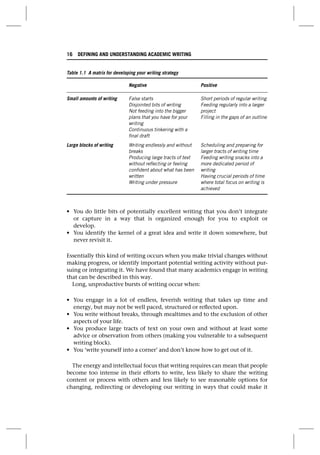
Table 1.1 A matrix for developing your writing strategy
Negative Positive
Small amounts of writing False starts
Disjointed bits of writing
Not feeding into the bigger
plans that you have for your
writing
Continuous tinkering with a
final draft
Short periods of regular writing
Feeding regularly into a larger
project
Filling in the gaps of an outline
Large blocks of writing Writing endlessly and without
breaks
Producing large tracts of text
without reflecting or feeling
confident about what has been
written
Writing under pressure
Scheduling and preparing for
larger tracts of writing time
Feeding writing snacks into a
more dedicated period of
writing
Having crucial periods of time
where total focus on writing is
achieved
16 DEFINING AND UNDERSTANDING ACADEMIC WRITING
better. We have encountered many examples of this kind of writing among
academics and believe that such an approach can be transformed into more
effective and ultimately productive orientations.
Enhanced writing orientations
Short bursts of productive writing
This is an organized, planned approach to writing. It facilitates fitting short,
healthy blasts of writing into your daily academic life without feeling that you
have to cordon off large tracts of time in order to make progress. It’s not
productive to do short bursts in random, disorganized ways. In order to
become a successful ‘short burst writer’, you need to spend preparatory time
outlining and organizing your work, creating headings, sub-headings and sec-
tions, and then working in a deliberate way to fill in the gaps during small
specified periods of time. These sessions can be as brief as 20 minutes and may
be no longer than an hour each day. If you practise and learn to engage in
planned writing bursts, you’ll find that your ideas and energy will be less likely
to go to waste, that you’re more likely to feed your academic writing strategy in
a way that pays off for you, generates more coherence in your life, and is
simply more effective and efficient.
Long swathes of productive writing
Occasional large tracts of writing time can complement the short burst
approach in an integrated way. There may be times in a particular writing
project when it will be very helpful to cordon off a larger block of time in order
to achieve focus and to make significant progress. Chapter 5 outlines a formal
institutional intervention that can facilitate extended, focused writing time in
a collaborative setting, but even without the availability of such an interven-
tion, individual academics can benefit from scheduling time out for the pro-
gression, acceleration or completion of a writing task. It is often during these
scheduled times that crucial breakthroughs can be achieved and opportunities
for developing or extending the work can be identified.
Writing exercises
1 To explore the iterative nature of writing, write a summary of your writing
project four different times according to these instructions:
a. A brief, broad outline that might include words, bullet points, ideas.
Complete an outline sketch of your writing project that might simply be
a series of headings, words or concepts.
WRITING EXERCISES 17
b. A 250-word summary that begins with the following words: ‘this piece of
writing does not. . .’ and that focuses on what your writing will not do or
will not achieve.
c. A 250-word summary that begins with the following words: ‘this piece of
writing aims to achieve the following objectives’, and continues, ‘it does
this in the following ways . . .’
d. A flowery exposition: a very wordy, elaborate and ornate piece that is
about four times as long as the ones you wrote for summaries b and c.
Expand the number of words you need to explain or discuss your ideas.
Indulge yourself by making your writing as wordy and lengthy as pos-
sible. Don’t worry if your sentences are too long – this exercise is about
elaborating and extending your ideas. Then trawl through this wordy
piece to see if there are any new nuggets or ideas from which your writing
could benefit.
Reflect briefly on the writing exercises you have just completed: which of the
four did you find the most difficult? Which was the easiest? Where did you get
‘stuck’, and where did you find yourself writing most fluently and with most
comfort? When we ask writers to do these exercises, they often report that it
helps them to diagnose their difficulties and to highlight the areas in which
they are most confident. If you find it difficult to say what your writing is not
about, then you may still need to set clearer boundaries around your work. If
you find it difficult to specify how your writing achieves its objectives, then
you may need to do more work in sequencing and linking your work. If you
particularly liked writing exercise d, then you may benefit from exploring
more alternatives and possibilities associated with your work.
2 Recognizing the emotional and logical dimensions of your writing: again,
think about a writing project in which you are currently involved or on
which you are considering embarking:
a. On one sheet of paper, write down all the things you feel about this
writing project: the positive and the negative.
b. On another sheet of paper, imagine yourself as your own supportive
reviewer or supervisor, and write down all the things you think logically
about this writing project (for example, do you still need to gather more
data?; do you have a good idea about what other literature guides your
thinking on this?; are you knowledgeable about research and opinion in
other areas?). What are the main conclusions you think you are likely
to be able to articulate at this stage in the writing project? Logically
speaking, what needs to be done in order to progress and finish this
work?
c. Now revisit the ‘emotional’ page and see if your ‘logical brainstorm’
invokes or changes any of your negative emotions by implying positive
action or next steps. Write a brief plan and schedule that will help you to
take those steps.
18 DEFINING AND UNDERSTANDING ACADEMIC WRITING
3. Invoking your own writing paradoxes: perhaps the discussion in this chap-
ter on writing paradoxes has prompted you to identify other paradoxes
inherent in the writing process. We have selected only a few for detailed
discussion, but of course there are many others that overlap and extend the
paradoxes that we have identified: generate a list of other paradoxes that
might be relevant as you tackle writing projects. They might include some
of the following:
a. cloning versus creativity (Murray, 2004);
b. discipline and flexibility; ideals and constraints (Zerubavel, 1999);
c. product and process (Hjortshoj, 2001);
d. order and chaos (Csikszentmihalyi, 1990);
e. safety and danger (Cameron, 1999).
Guidance for defining your own writing challenges
• We have often observed that different writers find certain paradoxes more
evocative than others. Reflect briefly on which paradoxes are most mean-
ingful for you and think about how this insight might help you to start
developing or enhancing your own academic writing strategy.
• Once you have identified writing paradoxes that are most relevant to your
own writing experiences, you may be in a better position to design your
own approach to writing in a way that suits your needs more appropriately.
• If a sense of safety or danger in writing is most evocative for you, then
perhaps these are the features that you need to address most crucially in
your writing by creating safer spaces, recruiting a supportive mentor and
doing more private, contained writing. Perhaps also you need to examine
critically how helpful your current writing mentors are.
• If striking a balance between discipline and flexibility is more of a struggle,
then issues like time management and the ordering and structuring of your
work may need more attention.
• Analyse the writing paradoxes identified in this chapter to help develop
more effective writing strategies for yourself, recognizing that you may need
to adopt a different approach than the ones you see other people using.
GUIDANCE FOR DEFINING YOUR OWN WRITING CHALLENGES 19

Academic writing.pdf

  • 1.
    1 Defining and understanding academic writing Introduction• The iterative, continuous nature of academic writing • Exploring the paradoxes of academic writing • Tackling writing time frames • Writing exercises • Guidance for defining your own writing challenges Introduction This chapter provides a framework for exploring the dynamics and paradoxes of academic writing. It presents guidelines that can help you to analyse your academic writing processes, but also emphasizes that no amount of theorizing and intellectualizing of writing is going to make more successful writing pat- terns unless accompanied by an undertaking to engage in practical strategies and to plan effective writing tactics. Equally, though, in order to generate practical approaches to writing, we have found that academic writers can benefit from exploring some of the contradictions and paradoxes associated with the academic writing process. Academics who have taken the time to participate on our writing programmes have often reported that examining what writing means to them, and analysing its paradoxes and contradictions, helps them to gain more control over how, when and what they write. You may find it useful too. Also once you have examined more closely the things that bring you to a writing task and the things that take you away from it, you may simply be in a better position to write productively and well.
  • 2.
    Exploring writing complexitiesand paradoxes might help you to make more sense of your experiences of writing and gain more control over its associated processes. Writing has often been described as a demanding and sometimes troublesome dimension of academic life. Analysing its complexities and para- doxes may help to shed more light on why this is the case for many academics in many different contexts. In order to explore and highlight the complexities and paradoxes that are associated with writing, we first explore its iterative, continuous nature, emphasizing how important we think it is to treat academic writing in a recur- sive way. We explore writing paradoxes in an effort to explicate the ups and downs of the academic writing process, and we provide a more practical framework within which to manage those paradoxes by introducing the idea of outlining and designing short bursts of effective writing into busy academic life as well as availing of opportunities for longer periods of writing, if such opportunities arise. The iterative, continuous nature of academic writing However difficult and complicated it may be, the process of becoming a writer is an important journey. It is a journey that leads us to many new discoveries about ourselves, about our ideas, about the world in which we live, and about our professional identities as academics, teachers, researchers and scholars. Choosing not to write in academia should not be seen as a principled stand to resist the increasing demands of the academy (though we can understand why people would make that choice for those reasons). Rather, choosing not to write can be conceptualized as an implicit acceptance of an academic half- life in which one’s legitimate scholarly voice has not been sufficiently exer- cised, or respected. To put it more positively, choosing to write in one’s area of academic expertise is an affirmative choice that announces both your courage and active engagement in the world you have chosen to occupy. There are many ways in which you can avoid pitfalls and false starts in your writing. There are practical and positive ways in which it can integrate with the other activities in your life. Academic writing can be conceptualized less as ‘jumping through hoops’ and more as the proactive positioning of your academic voice. By actively addressing questions about your writing – ‘How is writing learned?’ ‘How do people organize themselves in order to write?’ ‘What are the common difficulties that people encounter, and why?’ ‘And how can you develop a workable orientation towards academic writing that allows you to fit it into the context of your busy professional and personal life?’ – you can help to position it as a controllable and achievable part of your professional development. 4 DEFINING AND UNDERSTANDING ACADEMIC WRITING
  • 3.
    Essential to addressingsuch questions is the recognition that writing is not a single, homogenous, linear achievement towards which you strive and at which you one day arrive. Rather, it is the manifestation of your professional learning journey and it is (or at least it should be) a continuous process involv- ing reflection, improvement, development, progress and fulfilment of various types and in varying measures. It contains different processes and phases, and it is an activity that can help to grease the wheels of your professional life of all sorts of ways. It is not something that needs to interfere with other goals or be psychologically daunting even (or perhaps especially) when you’re not doing it. Focusing on the necessary stages and phases of your writing and what hap- pens to you at different parts of the process may provide you with important learning milestones from which you can benefit just as much as you can from a final, polished written product. If you consider that writing is an iterative process with phases of progression and phases of regression, you might allow yourself to conceptualize your own writing challenges more fruitfully. Reflect- ing on what many researchers and theorists suggest is the iterative nature of writing may also help you to devise realistic, appropriate and ultimately pro- ductive writing strategies. If you have already developed strategies that work for you, then reflecting on the process of writing may help you to enhance and refine them even more. Your writing can be a companion to your learning rather than an imposing enemy that constantly needs either to be agonizingly wrestled or artfully avoided. There are pleasurable, positive possibilities embedded in every writing task, no matter how onerous such tasks may sometimes feel. Many commentators have hinted at the paradoxes associated with academic writing. Giving these paradoxes some explicit attention may help you to know what to expect about the contradictions and complexities that writing sometimes contains. The ebbs and flows, and highs and lows of writing are things that you may already be familiar with, or they may be discoveries that are lurking just around the corner. Whether you are an experienced writer or someone grap- pling with academic writing for the first time, we believe that it is important for you to be able to recognize many of the conundrums the experience of writing may contain. Academic writing is not the printed display of one’s fully formed thoughts. It starts with flawed, incomplete, vague hunches, ideas and concepts. But, if you exploit its inherent ‘revisability’, it allows you to come full circle, to revisit ideas long after you first thought of them, to explore the same things in different ways, to experiment, to revise, to repeat and to reconceptualize – all of these are arguably central to the essence of scholarship which you exercise every day in other academic tasks like teaching, supervision and guiding students. Even if your goal is to produce a perfect piece of writing (an imposing target that may prohibit initial attempts at writing, but one that many writers pursue nonetheless), then surely it is the imperfections, discoveries and serendipitous THE ITERATIVE, CONTINUOUS NATURE OF ACADEMIC WRITING 5
  • 4.
    loops in whichyou must engage to reach that goal that are at least as interest- ing as your final destination? As a starting point, we often encourage academic writers to try to enjoy their writing journeys a bit more than they often say they normally do. Many col- leagues find this idea immediately appealing – a sort of antidote to the notion that writing is part of the drudgery of academic work. When invited to con- sider the enjoyable, positive, creative, empowering aspects of academic writ- ing, many of them respond by saying that even simply associating these words with their writing makes them feel more positively orientated than they might otherwise have been. But not everyone responds in this way, and perhaps you don’t either. In any session that focuses on this orientation, some people tell us that our encouragement is unrealistic. They say it sounds evangelical and not reflective of the realities in which they work. They say that academic writing is neither a positive nor an empowering experience for them, and no amount of trying to convince them that it can be will change that. These are reactions that we have reflected upon and explored in our work as writing developers. Suggesting that writing, even that which is extremely scholarly, does not actually have to be a fearsome grind and that for many writers can become just the opposite, is something that seems to confront a relatively common view among academics, many of whom see writing as an unpleasant but necessary activity. This idea exists across many different col- lege and university settings. Our response is this: if writing is something that you have to do, but something that you dislike, perhaps it is worth exploring alternative perspectives. Perhaps it is worth analysing your negative associ- ations in order to understand them better. And even if you don’t particularly dislike the writing process, you may still have encountered problems and pitfalls that a more thorough analysis of writing and of its processes and paradoxes might help to address. Exploring the paradoxes of academic writing Writing involves starting, progressing and finishing a complicated, chal- lenging combination of tasks. It requires you to activate lots of different skills and orientations, sometimes at different stages and phases in the process, sometimes all at the same time. Some researchers have claimed that writing can be experienced as one of the most difficult of all skills, requiring an intri- cate combination of neurological, physical, cognitive and affective competen- cies (see, for example, Levine, 2004). Others (perhaps most notably Elbow and Belanoff, 2000) claim that even if writing makes complicated demands on your skills and abilities, it is possible to make writing easy, or at least easy enough for it to feel worth tackling regularly and with good effect. 6 DEFINING AND UNDERSTANDING ACADEMIC WRITING
  • 5.
    We share PeterElbow’s optimism that all academics can write and that they can all write well. But this does not take away from the need to recognize the different and contradictory pushes and pulls associated with the writing process. Writing involves starting and finishing, both requiring very different kinds of orientation. Writing requires listening to and being guided by the voices of others, but also it demands your confidence and your willingness to present your own voice, your own perspectives and your own interpretations. Writing often involves an intimate familiarity with the minute details of a specific piece of work, but it also demands that we position these minutiae on a broader stage, identifying and explaining connections and comparisons in a wider theoretical context. Writing is not just influenced by what we know and what we have discovered about a particular phenomenon, it is also influenced by what we feel, and more particularly, what we feel about ourselves (Boice, 1988). The creative part of writing requires chaos, serendipity and coincidence; but in order to shape and craft our writing effectively, it needs the imposition of at least some order and discipline. The implications of these paradoxes are important and worth exploring in some more detail. Paradox 1: The starting versus finishing paradox Many lecturers, professors and academics sit guiltily on a store of unfinished business. They have writing projects that they started once, perhaps long ago, projects that may have had magnificent initial momentum, but for a variety of reasons, the excitement and energy of the early ideas fizzled out and came to nothing. Of course some unfinished doctorates, research papers, journal The paradoxes of academic writing Paradox 1: The starting versus finishing paradox Paradox 2: The originality versus convention paradox Paradox 3: The logic versus emotion paradox Paradox 4: The easy versus difficult paradox Paradox 5: The public versus private paradox The starting versus finishing paradox exists by virtue of the fact that the skills associated with starting a writing project are qualitatively and radically different from the skills you need to activate in order to progress and to com- plete it. Starting a writing project is very different from persisting and finish- ing, and this fact is often the cause of writing obstacles as the demands of moving from starting to finishing become difficult to overcome. EXPLORING THE PARADOXES OF ACADEMIC WRITING 7
  • 6.
    articles and bookchapters out there were terminated for the right reasons, but very many merited a completion that never materialized. Many of us start our writing projects with at least some enthusiasm and self- belief, but the good intentions and animated beginnings don’t always trans- late into a finished product, and as a result, a lot of the work that went into the early stages of a project does not bear fruit, at least not in any explicit or satisfactory way. Why do many of us have projects that we start but don’t finish? Academic writing often leads people into a zone that can be psychologically dangerous – a zone that human nature impels us to avoid. These dangers are not necessarily apparent initially, but can become very obvious once a writing project is under way. Unless we rise above our initial fears and reactions by building in our own ‘safety mechanisms’ to guide our writing projects, things can happen that lead us to abandon some of our most promising work. And indeed it is easy to become overwhelmed by criticism at a crucial stage in the process. This can be precipitated by things like bad reviews or by suddenly being challenged to answer a critical or fundamental question that you hadn’t previously considered. As you become more familiar with the field in which you are writing, it is possible to develop a disillusionment about the added value of your work that causes you to cast aside a project altogether when a simple re-orientation could have turned it around. A lack of clarity about the conventions of the genre can set you back, and often it is difficult not to separate your writing from other dimensions of your academic or professional life, making it feel disjointed from the rest of your work. At certain points in the writing process, you might be too hard on yourself by aiming higher than is appropriate for your stage of development or pre- maturely exposing your work to highly critical readers. Conversely, in order to protect yourself from excessive criticism, you can become timid and unwilling to expose your work to scrutiny that might help to improve it. Other reasons for stagnant, unfinished work relate to the common and inevitable distrac- tions of life that take you away from your writing projects for longer than you had expected, only to discover on returning that you have lost whatever spark it was that originally encouraged you to get going. In addition, some academics regularly say that they have become very dis- enchanted with the requirements and conventions of academic writing, feel- ing that it is somehow strangling their ‘true’ voices in so far as it seems to require a stilted and constrained way of expressing ideas, and that conforming to the conventional requirements of ‘genre’ somehow undermines integrity. Writing for academia may be conceived as a game that some simply choose not to play. If, however, you feel that academic writing is important to you, either for pragmatic or idealistic reasons (or both), it is vital to realize that these obstructions can be navigated, negotiated and overcome. A starting point may simply be to make writing safe, or at least safe enough for you to keep doing it. 8 DEFINING AND UNDERSTANDING ACADEMIC WRITING
  • 7.
    Perhaps initially, themost important dynamics for you to conquer are those that get you started, whatever those initial, sometimes chaotic, sometimes stumbling efforts require. But it is also worth remembering at those initial stages that the maintenance and final closure of your writing tasks require a different set of dynamics that will involve rewriting, editing, revisiting and reconceptualizing. Starting is one thing, but finishing is entirely another. You need to orientate your approaches to writing in ways that will help you to do both successfully. Paradox 2: The originality versus convention paradox You do need to recognize the genres and conventions of your discipline in aca- demic writing (see Murray, 2004). However, you need also to guard against being ‘terrorised by the literature’ (Becker, 1986) in ways that rob you of your own ideas or that make you less confident about the things that you are trying to say in your own words. The paradox of originality and convention suggests that all academics risk becoming engaged in an endless, defensive trawl of the ‘literature’ in order to demonstrate that what you’re saying is completely new or that it fills the elusive ‘gap’ that is often the intimidating holy grail of academic pursuit. This dynamic can create an insurmountable writing block that stands imposingly between you and your efforts to write. On one side of this paradox is the reality that if you are too detached from the literature or half-hearted in your efforts to familiarize yourself with it, then you run the risk of ‘reinventing the wheel’ and, more importantly, of exposing yourself to the unnecessary criticism of more informed counterparts. On the other is the fact that if you are too concerned about the conventions of your discipline and the voices of those who have contributed most convincingly to it, then you run the risk of aligning your work so closely to prevailing giants or popular names in your field that there is really no room left for the fresh voice or the interesting angle that you might otherwise have adopted. Of course you need to pay attention to the existing literature in the field you The originality versus convention paradox reflects the differences and tensions between taking in information and putting forward or articulating ideas of your own. When writing you need to find your own individual voice in the midst of other voices, many of which seem more expert and more knowledgeable than your own. Of course other academic voices do need to be invoked when you write and they do inform and nourish your writing, but they should not drown, smother or sideline the essence of your own contributions. It is perhaps the quest to ‘fill a gap’ in the literature that makes academic writing sometimes feel so daunting, especially in a context where conventional ways of expressing ideas sometimes appear to be rigid and unyielding. How can fresh ideas and new insights be incorporated into a writing style that tends to demand so much conformity? EXPLORING THE PARADOXES OF ACADEMIC WRITING 9
  • 8.
    have decided totackle, but you also need to recognize that you are capable of bringing something new and important to that conversation. Be informed by the literature, not constrained by it. Be guided by the prevailing or established voices but not enslaved by them. Listen carefully to the voices of others and read what they have written, but clear your throat, stretch your fingers, and prepare to talk and write yourself. No matter how much you conform to the conventions of your discipline, it is still possible for you to make your contri- bution with your own unique and original voice. Finding a confident voice in the great ocean of existing voices is perhaps one of the fundamental rites of passage that academics need to navigate. This rite of passage is never more obvious than when you sit down to write. Paradox 3: The logic versus emotion paradox In our experience as writing developers, we have found that the logic versus emotion paradox is usually more intense and more impacted than academic writers are initially prepared to admit. But there is plenty of evidence to sug- gest that it may cause more difficulties for academics than might first appear to be the case. During the professional writing development workshops that we have facili- tated with many academics from all over the world, conversations about the writing process sooner or later touch on the emotional dimensions of writing for academic audiences. People talk about experiencing emotions as extreme as guilt, fear, anxiety, worry, anger and shame when they delay their writing or when they feel for whatever reason that their academic writing is ‘not good enough’. Similarly they talk about joy, satisfaction, curiosity, happiness, even euphoria associated with the successful engagement in and completion of their challenging writing tasks. Just as Becker (1986), Boice (1997), Cameron (1999), Grant and Knowles (2000) and others have found, we can only con- clude what we knew intuitively already: writing is an issue of the heart as well as the head. A published research paper does not display the scars that its writer incurred while producing it (not being stained with blood, sweat or tears – at least, not usually). The final product does not reveal the real frustrations, nor does it expose the considerable anxieties or joys to which at least some of its existence can be attributed. When you read academic text written by someone else, you can be deceived by its clarity, its structure and its coherence. You might assume that it was produced easily and fluently. This assumption is likely to be wrong. The logic versus emotion paradox is contained in the reality that academic writers are required to cast a cold and objective eye on the nature and contri- bution of their writing, and yet it is impossible (and also undesirable) to ignore the important emotional dimension that can drive, motivate and influence written work in both positive and negative ways. 10 DEFINING AND UNDERSTANDING ACADEMIC WRITING
  • 9.
    The best writingemerges from the writer’s willingness to address their own weaknesses, to take on board criticism and to redraft their work several times before completing it. In order to apply both logical and emotional intelligence to your writing, it’s worth engaging in an effort to incorporate emotional awareness into the writ- ing process. The logical dimensions of enhancing or developing a written piece may be significantly blocked because of our emotional reactions and associ- ations. Goleman (1995) reminds us that to any relevant stimulus in our lives we have an emotional reaction before we apply intellectual logic or cognition to it. This can explain some of the reasons why suggestions for revision by peer reviewers of written work can be misinterpreted or ignored. Keep in mind that as well as the logic associated with your academic writing (which includes addressing questions such as: what is the evidence supporting my argument?; what are the bases of my conclusions?; what are the assumptions upon which my assertions are based?; what is my intellectual contribution?; and so on), there are other important questions that reflect the emotional relationship you have developed with your writing. These might include: what are my feelings about this piece of writing in particular, or about the academic writing process in general?; why am I feeling like this at the moment?; how can I harness my emotions in a way that will help me to make progress on this?; is some of what I am feeling preventing me from tackling certain aspects of this task? am I under particular pressure to produce scholarly work? how is this affecting the way I feel about my writing tasks? We’re not suggesting that you tangle yourself up in psychotherapeutic babble about writing or become self- indulgent about the processes that it requires. We are, however, asserting that if you ignore the emotional aspects of the act of writing, you miss out on an important opportunity to become a more self-aware and reflective academic writer. Paradox 4: The easy versus difficult paradox Peter Elbow suggests a variety of reasons why academic writing can feel hard and easy at different points in the journey or even at the same time. It is hard because of all of the things that you are likely to think about when engaged in writing. In academia this is particularly true. The range of audiences that might read what you have written, the types of questions that might be asked or things that might be said about your writing and about you, and the kinds of rewards that you might or might not obtain, depending on how your writing is received, are all considerations that might, at the very least, make you feel uneasy as you attempt to craft your writing. Such considerations paralyse many people’s efforts to become productive academic writers. But if you strip Writing can seem both easy and difficult at different stages in the process, or even at the same time. EXPLORING THE PARADOXES OF ACADEMIC WRITING 11
  • 10.
    away these thingsand just think about the simple act of writing itself, you might be able to see the other side of this paradox more clearly. Writing can be easy, and even though there may be difficult aspects associated with it, there are features of writing that make dimensions of it intrinsically easy, or at least easier than other forms of expression. Firstly, no one ever has to see what you have written if you don’t want them to. And secondly, you are much more in control of what you want to say because you can draft and redraft something in a way that is impossible during a conversation, a meeting or a lecture. Perhaps a key strategy, then, is for you to become more knowledgeable about when you need to make the writing process easy for yourself, and when you need to encounter its more difficult aspects. If you become more explicitly aware and reflective of what phase of the writing process you are involved in, you will be better able to control and inject ‘easy’ writing into the writing moments in which you need a kick-start, and to address ‘difficult’ writing when you need to craft, clarify, inform or adjust the text you have produced. It is possible that you can navigate the ‘easy versus difficult’ paradox by rec- ognizing that doing something with ease doesn’t mean that it is necessarily simple or unchallenging. Ease implies enjoyment, poise and confidence. These are the kinds of states associated with gaining proficiency in any task that is important to us. In order to develop command over a task, we need to start in ways that are easy, or at least easy enough. Paradox 5: The public versus private paradox Boyer (1990) refers to scholarship as something that demands public scrutiny, something that is by its very essence defined by an inherent openness to criti- cism, debate and dialogue. Indeed, it can be argued that if you are not prepared to subject your written work to the scrutiny of others, then you’re simply in the wrong game. And to some degree, most academics seem to have encountered this rather uncompromising orientation towards their writing. Our work in helping people to develop their writing confirms that, against this Darwinian backdrop, there should be private, protected writing places that allow academic writers to become more accustomed to the heat to which their work may ultimately be exposed. To put it another way: academic writing doesn’t all have to be fire and brimstone associated with the fear of invoking the potential fury of unknown, unnamed experts who you imagine are laugh- ing mirthlessly at your best efforts. If you set up spaces, times and environ- ments for your writing that are private, safe and supportive, then you can equip yourself with the armour and confidence you need when exposing your work to more exacting critics. If you co-opt friendly critics from the very start, then you can provide a built-in antidote to the dangers and anxieties of public In a desirable society, the private and the public rituals must both enhance and restrain one another. (Norman, 1995: 85) 12 DEFINING AND UNDERSTANDING ACADEMIC WRITING
  • 11.
    scrutiny. Public scrutinyonly feels dangerous if you are not equipped to respond to it. If you are, then it can become an exhilarating part of the process of scholarship. By recognizing that you have at least some control over the privacy that can protect your early writing efforts, you can contain your fragile early drafts, while also building your own self-belief that allows you to consider ‘going public’ at some specified point in the future (Cameron, 1999). One way of doing this is to identify times when private writing can feed the process more productively than writing for a public audience would. Freewriting, a tech- nique popularized by writing experts such as Flower and Hayes (1977), Elbow and Belanoff (2000), and Murray (2004), is a strategy that can get your writing juices flowing, and involves short private writing sessions (5 to 10 minutes in duration) in which you respond in writing to your own prompts as continu- ously as possible in order simply to get your ideas down on paper. This type of writing ignores structures, genres, and conventions in order to give rise to a more fluent approach to any writing task. Once you get used to setting up private spaces for your writing, in which you may be freer to play around with ideas and to have a dialogue with yourself about your perspectives on a sub- ject, you can then make advances by picking which nuggets in your private writing world can travel into a more public domain. As one writer puts it: The first time I write a draft of a paper . . . I totally let go and rant and rave and say unprofessional things, including swear words. Later I go back and change it to something more acceptable for my academic audience. My theory is that the new, more professional words will still carry the original energy of the first draft, and so even my final ‘academised’ version will have more oomph than if I tried too hard to control my initial reactions the first time round. (Cassity via Elbow and Belanoff, 2000: 387) Remember also that the benefits of keeping your writing to yourself have been underestimated in academic settings. While it is often useful to show your work to people who can help you to improve it, we also know that there are times when such exposure can feel dangerous and problematic, and can lead to blocks that might not have occurred if you had kept it private even for a little longer. It is important sometimes to let yourself write in a private space where any kind of scrutiny is not a consideration or a cause of concern. As Ralph Norman (1995) puts it: [Sometimes] we want to be able to hide the precious information under the jacket, or to read it in whispers to the beloved, or to bury it for a while in the vegetable garden. Part of what free people mean by the freedom of appearance is having the power to turn away betimes from where all the others are. (Norman, 1995: 85) EXPLORING THE PARADOXES OF ACADEMIC WRITING 13
  • 12.
    This is animportant insight for helping you to reflect on your writing. If you are so aware of the public performance or output at which your writing is targeted, you may find that your voice lacks personal integrity and becomes nervous and self-conscious. But if you are only immersed in the private, solitary process of writing, it may make the process of ‘stepping forward’ almost impossible. You could find that simply being aware of a need to balance the public and private dimensions of your academic writing enables you to manage your writing with more confidence and self-determination. All of these writing paradoxes tend to be under-explored and unspoken in academic contexts, and yet they may help you to find important keys to developing a more self-aware approach to your own academic writing tasks. Just being motivated to write is not enough. We believe that it is important to understand the dynamics of academic writing, and the difficulties that such dynamics can present in the context of your career. In order to develop more comfortable, regular and successful approaches to your academic writing, we encourage you to grapple with these dynamics and paradoxes and to identify which ones are most relevant to your experiences or plans. Tackling writing time frames When we have asked colleagues what they need in order to write, they identify a range of things that would help, including mentor support, training, inter- action with experts in their field, conference attendance and funding. But by far the most common response they provide to the question of what would help them to write is ‘more time’. Like all areas of human endeavour, writing is inextricably time bound. But it is possible to use and even to manipulate time in ways that support your writing more effectively. You may find it useful to identify different kinds of writing time zones in which you can productively engage, and to carve up scheduled time for writing in ways that will help you turn good starts into productive finishes. You can be productive and unproductive in short bursts or long swathes of writing The literature on effective academic writing has not reached a consensus on whether long swathes of writing are better or worse than short bursts. Some writers say that they can only write when they have ‘cleared’ a fairly significant block of time in their lives in order to pursue their writing. Others say that allocating long periods of time exclusively to writing (apart from being impractical) risks giving rise to a relentless, intensive approach to writing that leads to burnout, exhaustion and in some cases a sense of isolation that is 14 DEFINING AND UNDERSTANDING ACADEMIC WRITING
  • 13.
    difficult to climbout of once it is over. Boice (1990), Murray (2004) and others have often highlighted the benefits of ‘snack’ writing, arguing that long swathes of writing have been shown to be less productive and more psycho- logically destabilizing than short bursts. However, there are models from the creative writing world that suggest that time away from normal schedules and rhythms of life may be necessary to make progress on certain kinds of writing tasks (see Chapter 5 for an operational example). Zerubavel (1999) encourages academics to find a balance between excessively short and excessively long writing sessions. He suggests that: When trying to establish the optimal length of your writing sessions, be sure to take into account two major ergonomic factors; the approximate amount of time it usually takes you to get into a creative mode and the approximate amount of time you can effectively sustain such a mode and be productive. Considering the first factor, of course, ought to help you avoid scheduling writing sessions that are too short. Considering the second should likewise help preclude ones that are too long. (Zerubavel, 1999: 18) Writing in short bursts or long swathes often depends on the rest of your schedule at different times in the year. Whether or not you can put aside days, weeks or months exclusively for writing is something that depends on the realities and responsibilities associated with the rest of your life. For practical, work-based reasons, most academics find it very difficult to identify blocks of time in which they can write to the exclusion of everything else. They usually have to deal with a huge range of different activities on a day-to- day basis. The multiple roles played by academics mean that, increasingly, finding time for writing becomes a difficult task in itself (Chandler, Barry and Clark, 2002). We argue that instead of insisting that short writing snacks are necessarily ‘better’ than long writing tracts, we can move from one mode to another in effective ways if and when the possibilities for doing so present themselves. Short writing bursts can be potentially unproductive, but if organized and planned well can form an essential part of an integrated writing strategy. Simi- larly, longer dedicated periods of writing time can be ultimately unproductive if undertaken without necessary supports and strategies, but planned intensive periods of writing can nourish, develop, accelerate, complete or otherwise sustain essential writing tasks. Short, unproductive bursts of writing occur when: • You make insignificant changes to something that has already been written, perhaps borne of a reluctance to let it go, or a lack of confidence about what you’re attempting to say. (See, for example, Hjortshoj’s (2001) description of the ‘endless introduction’.) TACKLING WRITING TIME FRAMES 15
  • 14.
    • You dolittle bits of potentially excellent writing that you don’t integrate or capture in a way that is organized enough for you to exploit or develop. • You identify the kernel of a great idea and write it down somewhere, but never revisit it. Essentially this kind of writing occurs when you make trivial changes without making progress, or identify important potential writing activity without pur- suing or integrating it. We have found that many academics engage in writing that can be described in this way. Long, unproductive bursts of writing occur when: • You engage in a lot of endless, feverish writing that takes up time and energy, but may not be well paced, structured or reflected upon. • You write without breaks, through mealtimes and to the exclusion of other aspects of your life. • You produce large tracts of text on your own and without at least some advice or observation from others (making you vulnerable to a subsequent writing block). • You ‘write yourself into a corner’ and don’t know how to get out of it. The energy and intellectual focus that writing requires can mean that people become too intense in their efforts to write, less likely to share the writing content or process with others and less likely to see reasonable options for changing, redirecting or developing our writing in ways that could make it Table 1.1 A matrix for developing your writing strategy Negative Positive Small amounts of writing False starts Disjointed bits of writing Not feeding into the bigger plans that you have for your writing Continuous tinkering with a final draft Short periods of regular writing Feeding regularly into a larger project Filling in the gaps of an outline Large blocks of writing Writing endlessly and without breaks Producing large tracts of text without reflecting or feeling confident about what has been written Writing under pressure Scheduling and preparing for larger tracts of writing time Feeding writing snacks into a more dedicated period of writing Having crucial periods of time where total focus on writing is achieved 16 DEFINING AND UNDERSTANDING ACADEMIC WRITING
  • 15.
    better. We haveencountered many examples of this kind of writing among academics and believe that such an approach can be transformed into more effective and ultimately productive orientations. Enhanced writing orientations Short bursts of productive writing This is an organized, planned approach to writing. It facilitates fitting short, healthy blasts of writing into your daily academic life without feeling that you have to cordon off large tracts of time in order to make progress. It’s not productive to do short bursts in random, disorganized ways. In order to become a successful ‘short burst writer’, you need to spend preparatory time outlining and organizing your work, creating headings, sub-headings and sec- tions, and then working in a deliberate way to fill in the gaps during small specified periods of time. These sessions can be as brief as 20 minutes and may be no longer than an hour each day. If you practise and learn to engage in planned writing bursts, you’ll find that your ideas and energy will be less likely to go to waste, that you’re more likely to feed your academic writing strategy in a way that pays off for you, generates more coherence in your life, and is simply more effective and efficient. Long swathes of productive writing Occasional large tracts of writing time can complement the short burst approach in an integrated way. There may be times in a particular writing project when it will be very helpful to cordon off a larger block of time in order to achieve focus and to make significant progress. Chapter 5 outlines a formal institutional intervention that can facilitate extended, focused writing time in a collaborative setting, but even without the availability of such an interven- tion, individual academics can benefit from scheduling time out for the pro- gression, acceleration or completion of a writing task. It is often during these scheduled times that crucial breakthroughs can be achieved and opportunities for developing or extending the work can be identified. Writing exercises 1 To explore the iterative nature of writing, write a summary of your writing project four different times according to these instructions: a. A brief, broad outline that might include words, bullet points, ideas. Complete an outline sketch of your writing project that might simply be a series of headings, words or concepts. WRITING EXERCISES 17
  • 16.
    b. A 250-wordsummary that begins with the following words: ‘this piece of writing does not. . .’ and that focuses on what your writing will not do or will not achieve. c. A 250-word summary that begins with the following words: ‘this piece of writing aims to achieve the following objectives’, and continues, ‘it does this in the following ways . . .’ d. A flowery exposition: a very wordy, elaborate and ornate piece that is about four times as long as the ones you wrote for summaries b and c. Expand the number of words you need to explain or discuss your ideas. Indulge yourself by making your writing as wordy and lengthy as pos- sible. Don’t worry if your sentences are too long – this exercise is about elaborating and extending your ideas. Then trawl through this wordy piece to see if there are any new nuggets or ideas from which your writing could benefit. Reflect briefly on the writing exercises you have just completed: which of the four did you find the most difficult? Which was the easiest? Where did you get ‘stuck’, and where did you find yourself writing most fluently and with most comfort? When we ask writers to do these exercises, they often report that it helps them to diagnose their difficulties and to highlight the areas in which they are most confident. If you find it difficult to say what your writing is not about, then you may still need to set clearer boundaries around your work. If you find it difficult to specify how your writing achieves its objectives, then you may need to do more work in sequencing and linking your work. If you particularly liked writing exercise d, then you may benefit from exploring more alternatives and possibilities associated with your work. 2 Recognizing the emotional and logical dimensions of your writing: again, think about a writing project in which you are currently involved or on which you are considering embarking: a. On one sheet of paper, write down all the things you feel about this writing project: the positive and the negative. b. On another sheet of paper, imagine yourself as your own supportive reviewer or supervisor, and write down all the things you think logically about this writing project (for example, do you still need to gather more data?; do you have a good idea about what other literature guides your thinking on this?; are you knowledgeable about research and opinion in other areas?). What are the main conclusions you think you are likely to be able to articulate at this stage in the writing project? Logically speaking, what needs to be done in order to progress and finish this work? c. Now revisit the ‘emotional’ page and see if your ‘logical brainstorm’ invokes or changes any of your negative emotions by implying positive action or next steps. Write a brief plan and schedule that will help you to take those steps. 18 DEFINING AND UNDERSTANDING ACADEMIC WRITING
  • 17.
    3. Invoking yourown writing paradoxes: perhaps the discussion in this chap- ter on writing paradoxes has prompted you to identify other paradoxes inherent in the writing process. We have selected only a few for detailed discussion, but of course there are many others that overlap and extend the paradoxes that we have identified: generate a list of other paradoxes that might be relevant as you tackle writing projects. They might include some of the following: a. cloning versus creativity (Murray, 2004); b. discipline and flexibility; ideals and constraints (Zerubavel, 1999); c. product and process (Hjortshoj, 2001); d. order and chaos (Csikszentmihalyi, 1990); e. safety and danger (Cameron, 1999). Guidance for defining your own writing challenges • We have often observed that different writers find certain paradoxes more evocative than others. Reflect briefly on which paradoxes are most mean- ingful for you and think about how this insight might help you to start developing or enhancing your own academic writing strategy. • Once you have identified writing paradoxes that are most relevant to your own writing experiences, you may be in a better position to design your own approach to writing in a way that suits your needs more appropriately. • If a sense of safety or danger in writing is most evocative for you, then perhaps these are the features that you need to address most crucially in your writing by creating safer spaces, recruiting a supportive mentor and doing more private, contained writing. Perhaps also you need to examine critically how helpful your current writing mentors are. • If striking a balance between discipline and flexibility is more of a struggle, then issues like time management and the ordering and structuring of your work may need more attention. • Analyse the writing paradoxes identified in this chapter to help develop more effective writing strategies for yourself, recognizing that you may need to adopt a different approach than the ones you see other people using. GUIDANCE FOR DEFINING YOUR OWN WRITING CHALLENGES 19