Academic Integrity: Reducing Bias
in Language
Academic Writing
Atma Ram Bhattarai
Nepal Open University
Mphil II Semester
12th April 2020
• Understanding Academic Integrity
• Tips of ensuring academic integrity
• General guidelines / principles for
reducing bias
• Reducing bias by topics
• Conclusion
• References
Presentation Structure and Objectives
• Describe the ideas to
avoid bias in
language
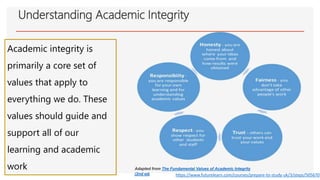
Academic integrity is
primarily a core set of
values that apply to
everything we do. These
values should guide and
support all of our
learning and academic
work
Understanding Academic Integrity
Adapted from The Fundamental Values of Academic Integrity
(2nd ed) https://www.futurelearn.com/courses/prepare-to-study-uk/3/steps/505670
• Make certain you fully understand what you read, so you can use it
accurately and appropriately.
• Take clear, accurate notes during your reading and research (
• Summarize and paraphrase ideas where possible (but always reference
them)
• Be sure to acknowledge other work every time you use ideas,
information or words from it.
• Develop your own voice and style in your writing
• Develop your own ideas
• Give plenty of time to complete your assignment
• Ask for help from a tutor or advisor if you need it.
https://www.futurelearn.com/courses/prepare-to-study-uk/3/steps/505670
Tips of Ensuring Academic Integrity
1. Describe at the Appropriate Level of Specificity
2. Focus on Relevant Characteristics
3. Acknowledge Relevant Differences That Do Exist
4. Be Appropriately Specific
5. Be Sensitive to Labels
6. Provide Operational Definitions and Labels
7. Acknowledge People's Humanity
8. Avoid False Hierarchies
General Guidelines / Principles for Reducing Bias
1. Age
a. Terms for different age groups:
Reducing Bias by Topic
Age Group Preferred
Individual of any age “person,” “individual,” and so on. Avoid using “males” and “females”
(in general)
an individual aged 12 years
and younger
“infant” (for a very young child), “child,” “girl,” “boy,” “transgender
girl,” “transgender boy,” “gender-fluid child,” and so on.
an individual aged 13 to 17
years
“adolescent,” “young person,” “youth,” “young woman,” “young man,”
“female adolescent,” “male adolescent,” “agender adolescent,” and so
on.
an individual aged 18 years
and older
“adult,” “woman,” “man,” “transgender man,” “trans man,”
“transgender woman,” “trans woman,” “genderqueer adult,”
“cisgender adult,” and so on.
1. Age
b. Terms for older adults:
Reducing Bias by Topic
Age Group Problematic Preferred
Older Adults the elderly, elders, elderly people,
the aged, aging dependents,
seniors, senior citizens
older adults, older people,
persons 65 years and older,
the older population
Specific age old old men older men, men between the ages
of 65 and 75, octogenarians
social security and Medicare social security recipients
social security beneficiaries
Medicare recipients (unless study
about Medicare specifically)
Medicare beneficiaries (unless
study about Medicare specifically)
- people who are receiving social
security or Medicare benefits
and are over the age of 62 (or
another age that was included in
the study)
- people who are receiving social
security or Medicare benefits
2. Disability
a. First Person Language:
In person-first language, the person is emphasized, not the individual’s
disabling or chronic condition
- e.g., use “a person with paraplegia” and “a youth with epilepsy” rather
than “a paraplegic” or “an epileptic
This principle applies to groups of people as well
- e.g., use “people with substance use disorders” or “people with
intellectual disabilities” rather than “substance abusers” or “the
mentally retarded
Reducing Bias by Topic
2. Disability
b. Identity-First Language
- The disability becomes the focus, which allows the individual to claim the
disability and choose their identity rather than permitting others to name
it or to select terms with negative implications
- Identity-first language is often used as an expression of cultural pride and
a reclamation of a disability that once conferred a negative identity -E.g -
“blind person,” “autistic person
c. Relevance of Mentioning a Disability
The nature of a disability should be indicated when it is relevant
- different levels of spinal cord injury, different symptom severities of
autism spectrum disorder
Reducing Bias by Topic
2. Disability
d. Negative and Condescending Terminology
Avoid language that uses pictorial metaphors or negativistic terms that
imply restriction - e.g., “wheelchair bound” or “confined to a wheelchair”;
use the term “wheelchair user” instead
Avoid language that uses excessive and negative labels - e.g., “AIDS
victim,” “brain damaged”; use the terms “person with AIDS” or “person
with a traumatic brain injury” instead.
Avoid terms that can be regarded as slurs - e.g., “cripple,” “invalid,” “nuts,”
“alcoholic,” “meth addict”;
Use terms like “person with a physical disability,” “person with a mental
illness,” “person with alcohol use disorder,” or “person with substance use
disorder”
Reducing Bias by Topic
3. Gender
a. Gender Vs Sex
Gender refers to the attitudes, feelings, and behaviors that a given
culture associates with a person's biological sex. Gender is a social
construct and a social identity. Use the term “gender” when referring to
people as social groups.
Sex refers to biological sex assignment; use the term “sex” when the
biological distinction of sex assignment (e.g., sex assigned at birth) is
predominant. Using “gender” instead of “sex” also avoids ambiguity over
whether “sex” means “sexual behavior.”
Reducing Bias by Topic
3. Gender
b. Gender Identity
Gender identity is a component of gender that describes a person's
psychological sense of their gender. Many people describe gender
identity as a deeply felt, inherent sense of being a boy, a man, or male; a
girl.
Gender identity applies to all individuals and is not a characteristic only
of transgender or gender-nonconforming individuals.
Gender identity is distinct from sexual orientation; thus, the two must not
be conflated - e.g., a gay transgender man has a masculine gender
identity and a gay sexual orientation, a straight cisgender woman has a
feminine gender identity and a straight sexual orientation.
Reducing Bias by Topic
3. Gender
c. Reporting of Gender
Strongly encouraged to explicitly designate information about the
gender identities of the participants making up their samples (e.g.,
whether participants are transgender, cisgender, or other gender
identities) rather than assuming cisgender identities.
d. Transgender and Gender-Nonconforming People (TGNP)
• Transgender is used as an adjective to refer to persons whose gender
identity, expression, and/or role does not conform to what is culturally
associated with their sex assigned at birth.
• Some transgender people hold a binary gender, such as man or
woman, but others have a gender outside of this binary, such as
Reducing Bias by Topic
3. Gender
f. Sex Assignment
• The terms “birth sex,” “natal sex,” “tranny,” and “transvestite” are considered disparaging
by scholars. These disparaging terms should be avoided.
• Additionally, “birth sex” and “natal sex” imply that sex is an immutable characteristic
without sociocultural influence. It is more appropriate to use “assigned sex” or “sex
assigned at birth,”
g. Gender and Noun Usage
- Use specific nouns to identify people or groups of people (e.g., women, men,
transgender men, trans men, transgender women, trans women, etc) - Use “male” and
“female” as adjectives (e.g., a male participant, a female experimenter)
- Use “male” and “female” as nouns only when the age range is broad or ambiguous or
to identify a transgender person's sex assignment at birth
- Otherwise, avoid using “male” and “female” as nouns and instead use the specific
nouns for people of different ages (e.g., women).
Reducing Bias by Topic
4. Participation in Research
People participate in research in a variety of settings, including laboratories,
homes, schools, businesses, clinics, and hospitals. When writing about
people who participate in research - “college students,” “children,” or
“respondents” as well as the more general terms “participants” and
“subjects” are acceptable.
Use the term “patient” to describe an individual diagnosed with a mental
health, behavioral health, and/or medical disease, disorder, or problem who
is receiving services from a health care provider
Acknowledge their contributions and agency. Use the active voice to
describe your actions and the actions of participants; the passive voice
suggests individuals are acted upon instead of being actors
Reducing Bias by Topic
5. Racial and Ethnic Identity
• Spelling and Capitalization of Racial and Ethnic Terms – White instead
of white; Capitalize “Indigenous” and “Aboriginal”
• Terms for Specific Groups
• Parallel Comparisons Among Groups – Use Black and White instead of
African American and White
• Writing About “Minorities” – minority groups
Reducing Bias by Topic
6. Sexual Orientation
Reducing Bias by Topic
Category Problematic Preferred
homosexual The sample consisted of 200
adolescent homosexuals
he sample consisted of 200 gay male adolescents.
The sample consisted of 100 gay male adolescents and 100
adolescent lesbian girls.
homosexuality Participants were asked about
their homosexuality
Participants were asked about the experience of being a
lesbian woman or a gay man.
Participants were asked about their experience of their
sexual orientation.
sexual
orientation from
sexual behavior
The women reported lesbian
sexual fantasies
The women reported female–female sexual fantasies
marital status Ten participants were married,
and five were single
Ten participants were married and living together, four were
unmarried and living with partners, and one was unmarried
and living alone.
7. Socio-Economic Status
Reducing Bias by Topic
Category Problematic Preferred
Legal status the undocumented
illegal aliens
illegal immigrants
-Individuals who are undocumented, people who are undocumented
- undocumented Bulgarians
-undocumented workers
income the poor
low-class people
poor people
- people whose incomes are below the federal poverty threshold
- people whose self-reported income were in the lowest income
bracket
housing status the homeless
the projects,, the inner
city
• people experiencing homelessness, youth experiencing
homelessness
• people who are homeless
• people who are living in a place not meant for human habitation,
in emergency shelter, or in transitional housing
• low-income housing, low-income areas of the city
educational
attainment
high-school dropouts
achievement gap
• people who have completed 10th grade
people with less than a high-school education
opportunity gap
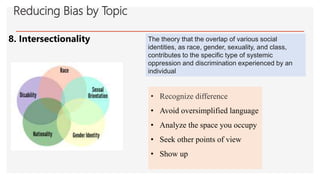
8. Intersectionality
Reducing Bias by Topic
The theory that the overlap of various social
identities, as race, gender, sexuality, and class,
contributes to the specific type of systemic
oppression and discrimination experienced by an
individual
• Recognize difference
• Avoid oversimplified language
• Analyze the space you occupy
• Seek other points of view
• Show up
Conclusion
• Please visit the link:
• https://apastyle.apa.org/style-grammar-guidelines/bias-free-language/
References
• https://apastyle.apa.org/style-grammar-guidelines/bias-free-language/
• https://www.dictionary.com/
• https://www.ywboston.org/2017/03/what-is-intersectionality-and-what-does-it-have-to-do-with-me/
• https://www.futurelearn.com/courses/prepare-to-study-uk/3/steps/505670
• APA Mannual (7th ed.). (2020). Mannual of the American Psychological Association.
https://doi.org/10.7591/9781501729980-001
Thank you
You are welcome for the constructive feedback

Academic integrity

  • 1.
    Academic Integrity: ReducingBias in Language Academic Writing Atma Ram Bhattarai Nepal Open University Mphil II Semester 12th April 2020
  • 2.
    • Understanding AcademicIntegrity • Tips of ensuring academic integrity • General guidelines / principles for reducing bias • Reducing bias by topics • Conclusion • References Presentation Structure and Objectives • Describe the ideas to avoid bias in language
  • 3.
    Academic integrity is primarilya core set of values that apply to everything we do. These values should guide and support all of our learning and academic work Understanding Academic Integrity Adapted from The Fundamental Values of Academic Integrity (2nd ed) https://www.futurelearn.com/courses/prepare-to-study-uk/3/steps/505670
  • 4.
    • Make certainyou fully understand what you read, so you can use it accurately and appropriately. • Take clear, accurate notes during your reading and research ( • Summarize and paraphrase ideas where possible (but always reference them) • Be sure to acknowledge other work every time you use ideas, information or words from it. • Develop your own voice and style in your writing • Develop your own ideas • Give plenty of time to complete your assignment • Ask for help from a tutor or advisor if you need it. https://www.futurelearn.com/courses/prepare-to-study-uk/3/steps/505670 Tips of Ensuring Academic Integrity
  • 5.
    1. Describe atthe Appropriate Level of Specificity 2. Focus on Relevant Characteristics 3. Acknowledge Relevant Differences That Do Exist 4. Be Appropriately Specific 5. Be Sensitive to Labels 6. Provide Operational Definitions and Labels 7. Acknowledge People's Humanity 8. Avoid False Hierarchies General Guidelines / Principles for Reducing Bias
  • 6.
    1. Age a. Termsfor different age groups: Reducing Bias by Topic Age Group Preferred Individual of any age “person,” “individual,” and so on. Avoid using “males” and “females” (in general) an individual aged 12 years and younger “infant” (for a very young child), “child,” “girl,” “boy,” “transgender girl,” “transgender boy,” “gender-fluid child,” and so on. an individual aged 13 to 17 years “adolescent,” “young person,” “youth,” “young woman,” “young man,” “female adolescent,” “male adolescent,” “agender adolescent,” and so on. an individual aged 18 years and older “adult,” “woman,” “man,” “transgender man,” “trans man,” “transgender woman,” “trans woman,” “genderqueer adult,” “cisgender adult,” and so on.
  • 7.
    1. Age b. Termsfor older adults: Reducing Bias by Topic Age Group Problematic Preferred Older Adults the elderly, elders, elderly people, the aged, aging dependents, seniors, senior citizens older adults, older people, persons 65 years and older, the older population Specific age old old men older men, men between the ages of 65 and 75, octogenarians social security and Medicare social security recipients social security beneficiaries Medicare recipients (unless study about Medicare specifically) Medicare beneficiaries (unless study about Medicare specifically) - people who are receiving social security or Medicare benefits and are over the age of 62 (or another age that was included in the study) - people who are receiving social security or Medicare benefits
  • 8.
    2. Disability a. FirstPerson Language: In person-first language, the person is emphasized, not the individual’s disabling or chronic condition - e.g., use “a person with paraplegia” and “a youth with epilepsy” rather than “a paraplegic” or “an epileptic This principle applies to groups of people as well - e.g., use “people with substance use disorders” or “people with intellectual disabilities” rather than “substance abusers” or “the mentally retarded Reducing Bias by Topic
  • 9.
    2. Disability b. Identity-FirstLanguage - The disability becomes the focus, which allows the individual to claim the disability and choose their identity rather than permitting others to name it or to select terms with negative implications - Identity-first language is often used as an expression of cultural pride and a reclamation of a disability that once conferred a negative identity -E.g - “blind person,” “autistic person c. Relevance of Mentioning a Disability The nature of a disability should be indicated when it is relevant - different levels of spinal cord injury, different symptom severities of autism spectrum disorder Reducing Bias by Topic
  • 10.
    2. Disability d. Negativeand Condescending Terminology Avoid language that uses pictorial metaphors or negativistic terms that imply restriction - e.g., “wheelchair bound” or “confined to a wheelchair”; use the term “wheelchair user” instead Avoid language that uses excessive and negative labels - e.g., “AIDS victim,” “brain damaged”; use the terms “person with AIDS” or “person with a traumatic brain injury” instead. Avoid terms that can be regarded as slurs - e.g., “cripple,” “invalid,” “nuts,” “alcoholic,” “meth addict”; Use terms like “person with a physical disability,” “person with a mental illness,” “person with alcohol use disorder,” or “person with substance use disorder” Reducing Bias by Topic
  • 11.
    3. Gender a. GenderVs Sex Gender refers to the attitudes, feelings, and behaviors that a given culture associates with a person's biological sex. Gender is a social construct and a social identity. Use the term “gender” when referring to people as social groups. Sex refers to biological sex assignment; use the term “sex” when the biological distinction of sex assignment (e.g., sex assigned at birth) is predominant. Using “gender” instead of “sex” also avoids ambiguity over whether “sex” means “sexual behavior.” Reducing Bias by Topic
  • 12.
    3. Gender b. GenderIdentity Gender identity is a component of gender that describes a person's psychological sense of their gender. Many people describe gender identity as a deeply felt, inherent sense of being a boy, a man, or male; a girl. Gender identity applies to all individuals and is not a characteristic only of transgender or gender-nonconforming individuals. Gender identity is distinct from sexual orientation; thus, the two must not be conflated - e.g., a gay transgender man has a masculine gender identity and a gay sexual orientation, a straight cisgender woman has a feminine gender identity and a straight sexual orientation. Reducing Bias by Topic
  • 13.
    3. Gender c. Reportingof Gender Strongly encouraged to explicitly designate information about the gender identities of the participants making up their samples (e.g., whether participants are transgender, cisgender, or other gender identities) rather than assuming cisgender identities. d. Transgender and Gender-Nonconforming People (TGNP) • Transgender is used as an adjective to refer to persons whose gender identity, expression, and/or role does not conform to what is culturally associated with their sex assigned at birth. • Some transgender people hold a binary gender, such as man or woman, but others have a gender outside of this binary, such as Reducing Bias by Topic
  • 14.
    3. Gender f. SexAssignment • The terms “birth sex,” “natal sex,” “tranny,” and “transvestite” are considered disparaging by scholars. These disparaging terms should be avoided. • Additionally, “birth sex” and “natal sex” imply that sex is an immutable characteristic without sociocultural influence. It is more appropriate to use “assigned sex” or “sex assigned at birth,” g. Gender and Noun Usage - Use specific nouns to identify people or groups of people (e.g., women, men, transgender men, trans men, transgender women, trans women, etc) - Use “male” and “female” as adjectives (e.g., a male participant, a female experimenter) - Use “male” and “female” as nouns only when the age range is broad or ambiguous or to identify a transgender person's sex assignment at birth - Otherwise, avoid using “male” and “female” as nouns and instead use the specific nouns for people of different ages (e.g., women). Reducing Bias by Topic
  • 15.
    4. Participation inResearch People participate in research in a variety of settings, including laboratories, homes, schools, businesses, clinics, and hospitals. When writing about people who participate in research - “college students,” “children,” or “respondents” as well as the more general terms “participants” and “subjects” are acceptable. Use the term “patient” to describe an individual diagnosed with a mental health, behavioral health, and/or medical disease, disorder, or problem who is receiving services from a health care provider Acknowledge their contributions and agency. Use the active voice to describe your actions and the actions of participants; the passive voice suggests individuals are acted upon instead of being actors Reducing Bias by Topic
  • 16.
    5. Racial andEthnic Identity • Spelling and Capitalization of Racial and Ethnic Terms – White instead of white; Capitalize “Indigenous” and “Aboriginal” • Terms for Specific Groups • Parallel Comparisons Among Groups – Use Black and White instead of African American and White • Writing About “Minorities” – minority groups Reducing Bias by Topic
  • 17.
    6. Sexual Orientation ReducingBias by Topic Category Problematic Preferred homosexual The sample consisted of 200 adolescent homosexuals he sample consisted of 200 gay male adolescents. The sample consisted of 100 gay male adolescents and 100 adolescent lesbian girls. homosexuality Participants were asked about their homosexuality Participants were asked about the experience of being a lesbian woman or a gay man. Participants were asked about their experience of their sexual orientation. sexual orientation from sexual behavior The women reported lesbian sexual fantasies The women reported female–female sexual fantasies marital status Ten participants were married, and five were single Ten participants were married and living together, four were unmarried and living with partners, and one was unmarried and living alone.
  • 18.
    7. Socio-Economic Status ReducingBias by Topic Category Problematic Preferred Legal status the undocumented illegal aliens illegal immigrants -Individuals who are undocumented, people who are undocumented - undocumented Bulgarians -undocumented workers income the poor low-class people poor people - people whose incomes are below the federal poverty threshold - people whose self-reported income were in the lowest income bracket housing status the homeless the projects,, the inner city • people experiencing homelessness, youth experiencing homelessness • people who are homeless • people who are living in a place not meant for human habitation, in emergency shelter, or in transitional housing • low-income housing, low-income areas of the city educational attainment high-school dropouts achievement gap • people who have completed 10th grade people with less than a high-school education opportunity gap
  • 19.
    8. Intersectionality Reducing Biasby Topic The theory that the overlap of various social identities, as race, gender, sexuality, and class, contributes to the specific type of systemic oppression and discrimination experienced by an individual • Recognize difference • Avoid oversimplified language • Analyze the space you occupy • Seek other points of view • Show up
  • 20.
    Conclusion • Please visitthe link: • https://apastyle.apa.org/style-grammar-guidelines/bias-free-language/
  • 21.
    References • https://apastyle.apa.org/style-grammar-guidelines/bias-free-language/ • https://www.dictionary.com/ •https://www.ywboston.org/2017/03/what-is-intersectionality-and-what-does-it-have-to-do-with-me/ • https://www.futurelearn.com/courses/prepare-to-study-uk/3/steps/505670 • APA Mannual (7th ed.). (2020). Mannual of the American Psychological Association. https://doi.org/10.7591/9781501729980-001
  • 22.
    Thank you You arewelcome for the constructive feedback