Step One: Observe theText
“What does it say?”
Observation asks questions of the text!
“I keep six honest serving-men
(They taught me all I knew);
Their names areWhat andWhy andWhen
And How andWhere andWho.”
— Rudyard Kipling
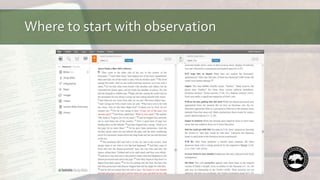
Where to start with observation
• Read the background material related to the book
• Read the whole book straight through to get an overview
• Identify the author, audience, date, location, and main
theme
• Identify the genre (exposition, narrative, poetry, wisdom,
prophecy, apocalyptic)
Where to start with observation
• Read and summarize each paragraph; make a general
outline of the book
• Read each paragraph slowly and carefully; record any
important facts
• Look for things that are emphasized, repeated, related, alike,
unlike, true to life
• Notice the key terms, basic grammatical structure of each
sentence
Questions to ask of a text
• Background questions
• Fact questions
• Meaning questions
• Application questions
How to study a section of text
• Read the entire section completely.
• Identify the paragraphs, and put a label or title on each paragraph.
• Evaluate each paragraph in light of the other paragraphs (look for
relationships).
• Evaluate how the section as a whole relates to the rest of the book.
• Identify the MIT (main idea of the text).
How to study a section of text
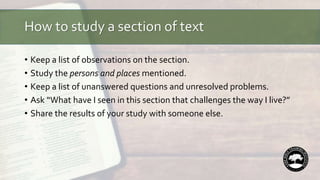
• Keep a list of observations on the section.
• Study the persons and places mentioned.
• Keep a list of unanswered questions and unresolved problems.
• Ask “What have I seen in this section that challenges the way I live?”
• Share the results of your study with someone else.
Six things to look for
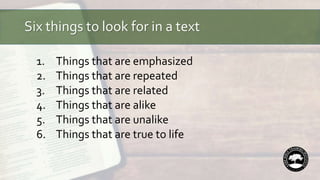
Six things to look for in a text
1. Things that are emphasized
2. Things that are repeated
3. Things that are related
4. Things that are alike
5. Things that are unalike
6. Things that are true to life
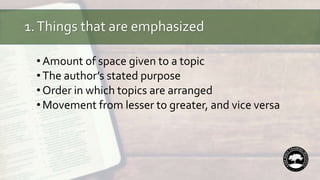
1.Things that are emphasized
•Amount of space given to a topic
•The author’s stated purpose
•Order in which topics are arranged
•Movement from lesser to greater, and vice versa
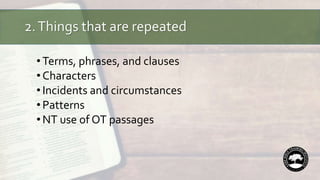
2.Things that are repeated
•Terms, phrases, and clauses
•Characters
•Incidents and circumstances
•Patterns
•NT use of OT passages
3.Things that are related
•Movement from the general to the specific
•Questions and answers
•Cause and effect
4.Things that are alike
•Similes
•Metaphors
5.Things that are unalike
•Use of but
•Metaphor
•Irony
6.Things that are true to life
•What about this passage is true today?
•What about this passage is true for anyone,
anywhere, in any time, and under any
circumstances?
Other things to look for
•Look for “hinges” in the text, where a phrase
connects what comes before it with what comes
after it (therefore, and, but).
•Pay close attention to lists of words. Look them
up!
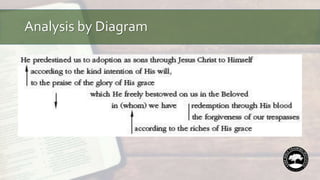
Analysis by Diagram
Visualize the relationships between words in a passage
Analysis by Diagram
There are two primary types of diagrams used in
studying a text of the Bible:
1. Grammatical diagram
2. Mechanical layout or block diagram
Analysis by Diagram
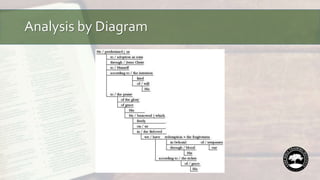
Analysis by Diagram
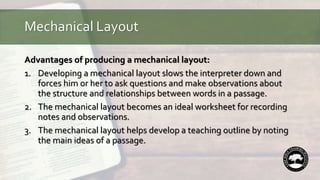
Mechanical Layout
Advantages of producing a mechanical layout:
1. Developing a mechanical layout slows the interpreter down and
forces him or her to ask questions and make observations about
the structure and relationships between words in a passage.
2. The mechanical layout becomes an ideal worksheet for recording
notes and observations.
3. The mechanical layout helps develop a teaching outline by noting
the main ideas of a passage.
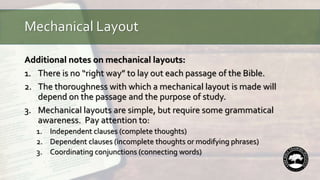
Mechanical Layout
Additional notes on mechanical layouts:
1. There is no “right way” to lay out each passage of the Bible.
2. The thoroughness with which a mechanical layout is made will
depend on the passage and the purpose of study.
3. Mechanical layouts are simple, but require some grammatical
awareness. Pay attention to:
1. Independent clauses (complete thoughts)
2. Dependent clauses (incomplete thoughts or modifying phrases)
3. Coordinating conjunctions (connecting words)
Work with a text
1 Peter 2:9-10
Work with a paragraph
“The paragraph is the basic unit of study—not the
verse, not the chapter… It is a group of related
sentences and statements that deal with one main
topic or idea. That makes it ideal for observational
study.”
1 Peter 2:9-10—what do we see?
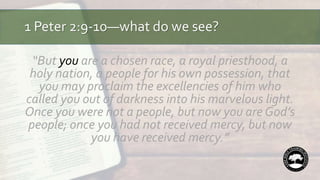
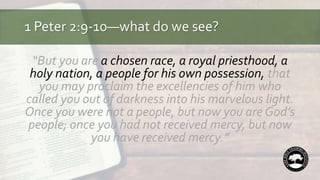
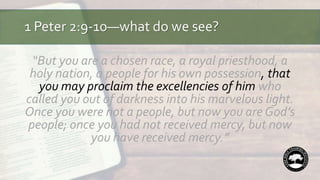
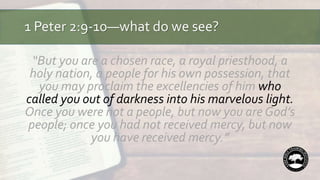
“But you are a chosen race, a royal priesthood, a
holy nation, a people for his own possession, that
you may proclaim the excellencies of him who
called you out of darkness into his marvelous light.
Once you were not a people, but now you are God’s
people; once you had not received mercy, but now
you have received mercy.”
What is the background of 1 Peter?
•Audience: the “elect exiles” of the Dispersion in
Pontus, Galatia, Cappadocia, Asia, and Bithynia.
•Purpose:To encourage Jewish Christians
scattered around Asia Minor to stand firm in
their faith in the midst of persecution.
1 Peter 2:9-10—what do we see?
“But you are a chosen race, a royal priesthood, a
holy nation, a people for his own possession, that
you may proclaim the excellencies of him who
called you out of darkness into his marvelous light.
Once you were not a people, but now you are God’s
people; once you had not received mercy, but now
you have received mercy.”
1 Peter 2:9-10—what do we see?
“But you are a chosen race, a royal priesthood, a
holy nation, a people for his own possession, that
you may proclaim the excellencies of him who
called you out of darkness into his marvelous light.
Once you were not a people, but now you are God’s
people; once you had not received mercy, but now
you have received mercy.”
1 Peter 2:9-10—what do we see?
“But you are a chosen race, a royal priesthood, a
holy nation, a people for his own possession, that
you may proclaim the excellencies of him who
called you out of darkness into his marvelous light.
Once you were not a people, but now you are God’s
people; once you had not received mercy, but now
you have received mercy.”
1 Peter 2:9-10—what do we see?
“But you are a chosen race, a royal priesthood, a
holy nation, a people for his own possession, that
you may proclaim the excellencies of him who
called you out of darkness into his marvelous light.
Once you were not a people, but now you are God’s
people; once you had not received mercy, but now
you have received mercy.”
1 Peter 2:9-10—what do we see?
“But you are a chosen race, a royal priesthood, a
holy nation, a people for his own possession, that
you may proclaim the excellencies of him who
called you out of darkness into his marvelous light.
Once you were not a people, but now you are God’s
people; once you had not received mercy, but now
you have received mercy.”
1 Peter 2:9-10—what do we see?
“But you are a chosen race, a royal priesthood, a
holy nation, a people for his own possession, that
you may proclaim the excellencies of him who
called you out of darkness into his marvelous light.
Once you were not a people, but now you are God’s
people; once you had not received mercy, but now
you have received mercy.”
1 Peter 2:9-10—what do we see?
“But you are a chosen race, a royal priesthood, a
holy nation, a people for his own possession, that
you may proclaim the excellencies of him who
called you out of darkness into his marvelous light.
Once you were not a people, but now you are God’s
people; once you had not received mercy, but now
you have received mercy.”
1 Peter 2:9-10—what do we see?
“But you are a chosen race, a royal priesthood, a
holy nation, a people for his own possession, that
you may proclaim the excellencies of him who
called you out of darkness into his marvelous light.
Once you were not a people, but now you are God’s
people; once you had not received mercy, but now
you have received mercy.”
1 Peter 2:9-10—what do we see?
“But you are a chosen race, a royal priesthood, a
holy nation, a people for his own possession, that
you may proclaim the excellencies of him who
called you out of darkness into his marvelous light.
Once you were not a people, but now you are God’s
people; once you had not received mercy, but now
you have received mercy.”
1 Peter 2:9-10—what do we see?
• Peter contrasts you (his readers) with unbelievers.
• Peter says believers were once like nonbelievers (in
darkness, separated from God, without mercy).
• Peter says believers are now chosen by God as His people,
receiving mercy.
• God chose believers to proclaim His excellencies.
1 Peter 2:9-10—what is the main idea?
“God delivers and unites his
people so they may glorify Him
by telling others what He has
done.”
1 Peter 2:9-10—what do we do?
“Because God has saved me and
uniting me with His people, I
should join others in proclaiming
His greatness by sharing with
others what He has done in my
life.”
Next Step: Interpretation
“What does it mean?”

ABTI Hermeneutics 5 - Observation

  • 2.
    Step One: ObservetheText “What does it say?”
  • 3.
    Observation asks questionsof the text! “I keep six honest serving-men (They taught me all I knew); Their names areWhat andWhy andWhen And How andWhere andWho.” — Rudyard Kipling
  • 4.
    Where to startwith observation • Read the background material related to the book • Read the whole book straight through to get an overview • Identify the author, audience, date, location, and main theme • Identify the genre (exposition, narrative, poetry, wisdom, prophecy, apocalyptic)
  • 5.
    Where to startwith observation
  • 6.
    Where to startwith observation • Read and summarize each paragraph; make a general outline of the book • Read each paragraph slowly and carefully; record any important facts • Look for things that are emphasized, repeated, related, alike, unlike, true to life • Notice the key terms, basic grammatical structure of each sentence
  • 7.
    Questions to askof a text • Background questions • Fact questions • Meaning questions • Application questions
  • 8.
    How to studya section of text • Read the entire section completely. • Identify the paragraphs, and put a label or title on each paragraph. • Evaluate each paragraph in light of the other paragraphs (look for relationships). • Evaluate how the section as a whole relates to the rest of the book. • Identify the MIT (main idea of the text).
  • 9.
    How to studya section of text • Keep a list of observations on the section. • Study the persons and places mentioned. • Keep a list of unanswered questions and unresolved problems. • Ask “What have I seen in this section that challenges the way I live?” • Share the results of your study with someone else.
  • 10.
    Six things tolook for
  • 11.
    Six things tolook for in a text 1. Things that are emphasized 2. Things that are repeated 3. Things that are related 4. Things that are alike 5. Things that are unalike 6. Things that are true to life
  • 12.
    1.Things that areemphasized •Amount of space given to a topic •The author’s stated purpose •Order in which topics are arranged •Movement from lesser to greater, and vice versa
  • 13.
    2.Things that arerepeated •Terms, phrases, and clauses •Characters •Incidents and circumstances •Patterns •NT use of OT passages
  • 14.
    3.Things that arerelated •Movement from the general to the specific •Questions and answers •Cause and effect
  • 15.
    4.Things that arealike •Similes •Metaphors
  • 16.
    5.Things that areunalike •Use of but •Metaphor •Irony
  • 17.
    6.Things that aretrue to life •What about this passage is true today? •What about this passage is true for anyone, anywhere, in any time, and under any circumstances?
  • 18.
    Other things tolook for •Look for “hinges” in the text, where a phrase connects what comes before it with what comes after it (therefore, and, but). •Pay close attention to lists of words. Look them up!
  • 19.
    Analysis by Diagram Visualizethe relationships between words in a passage
  • 20.
    Analysis by Diagram Thereare two primary types of diagrams used in studying a text of the Bible: 1. Grammatical diagram 2. Mechanical layout or block diagram
  • 21.
  • 22.
  • 23.
    Mechanical Layout Advantages ofproducing a mechanical layout: 1. Developing a mechanical layout slows the interpreter down and forces him or her to ask questions and make observations about the structure and relationships between words in a passage. 2. The mechanical layout becomes an ideal worksheet for recording notes and observations. 3. The mechanical layout helps develop a teaching outline by noting the main ideas of a passage.
  • 24.
    Mechanical Layout Additional noteson mechanical layouts: 1. There is no “right way” to lay out each passage of the Bible. 2. The thoroughness with which a mechanical layout is made will depend on the passage and the purpose of study. 3. Mechanical layouts are simple, but require some grammatical awareness. Pay attention to: 1. Independent clauses (complete thoughts) 2. Dependent clauses (incomplete thoughts or modifying phrases) 3. Coordinating conjunctions (connecting words)
  • 25.
    Work with atext 1 Peter 2:9-10
  • 26.
    Work with aparagraph “The paragraph is the basic unit of study—not the verse, not the chapter… It is a group of related sentences and statements that deal with one main topic or idea. That makes it ideal for observational study.”
  • 27.
    1 Peter 2:9-10—whatdo we see? “But you are a chosen race, a royal priesthood, a holy nation, a people for his own possession, that you may proclaim the excellencies of him who called you out of darkness into his marvelous light. Once you were not a people, but now you are God’s people; once you had not received mercy, but now you have received mercy.”
  • 28.
    What is thebackground of 1 Peter? •Audience: the “elect exiles” of the Dispersion in Pontus, Galatia, Cappadocia, Asia, and Bithynia. •Purpose:To encourage Jewish Christians scattered around Asia Minor to stand firm in their faith in the midst of persecution.
  • 29.
    1 Peter 2:9-10—whatdo we see? “But you are a chosen race, a royal priesthood, a holy nation, a people for his own possession, that you may proclaim the excellencies of him who called you out of darkness into his marvelous light. Once you were not a people, but now you are God’s people; once you had not received mercy, but now you have received mercy.”
  • 30.
    1 Peter 2:9-10—whatdo we see? “But you are a chosen race, a royal priesthood, a holy nation, a people for his own possession, that you may proclaim the excellencies of him who called you out of darkness into his marvelous light. Once you were not a people, but now you are God’s people; once you had not received mercy, but now you have received mercy.”
  • 31.
    1 Peter 2:9-10—whatdo we see? “But you are a chosen race, a royal priesthood, a holy nation, a people for his own possession, that you may proclaim the excellencies of him who called you out of darkness into his marvelous light. Once you were not a people, but now you are God’s people; once you had not received mercy, but now you have received mercy.”
  • 32.
    1 Peter 2:9-10—whatdo we see? “But you are a chosen race, a royal priesthood, a holy nation, a people for his own possession, that you may proclaim the excellencies of him who called you out of darkness into his marvelous light. Once you were not a people, but now you are God’s people; once you had not received mercy, but now you have received mercy.”
  • 33.
    1 Peter 2:9-10—whatdo we see? “But you are a chosen race, a royal priesthood, a holy nation, a people for his own possession, that you may proclaim the excellencies of him who called you out of darkness into his marvelous light. Once you were not a people, but now you are God’s people; once you had not received mercy, but now you have received mercy.”
  • 34.
    1 Peter 2:9-10—whatdo we see? “But you are a chosen race, a royal priesthood, a holy nation, a people for his own possession, that you may proclaim the excellencies of him who called you out of darkness into his marvelous light. Once you were not a people, but now you are God’s people; once you had not received mercy, but now you have received mercy.”
  • 35.
    1 Peter 2:9-10—whatdo we see? “But you are a chosen race, a royal priesthood, a holy nation, a people for his own possession, that you may proclaim the excellencies of him who called you out of darkness into his marvelous light. Once you were not a people, but now you are God’s people; once you had not received mercy, but now you have received mercy.”
  • 36.
    1 Peter 2:9-10—whatdo we see? “But you are a chosen race, a royal priesthood, a holy nation, a people for his own possession, that you may proclaim the excellencies of him who called you out of darkness into his marvelous light. Once you were not a people, but now you are God’s people; once you had not received mercy, but now you have received mercy.”
  • 37.
    1 Peter 2:9-10—whatdo we see? “But you are a chosen race, a royal priesthood, a holy nation, a people for his own possession, that you may proclaim the excellencies of him who called you out of darkness into his marvelous light. Once you were not a people, but now you are God’s people; once you had not received mercy, but now you have received mercy.”
  • 38.
    1 Peter 2:9-10—whatdo we see? • Peter contrasts you (his readers) with unbelievers. • Peter says believers were once like nonbelievers (in darkness, separated from God, without mercy). • Peter says believers are now chosen by God as His people, receiving mercy. • God chose believers to proclaim His excellencies.
  • 39.
    1 Peter 2:9-10—whatis the main idea? “God delivers and unites his people so they may glorify Him by telling others what He has done.”
  • 40.
    1 Peter 2:9-10—whatdo we do? “Because God has saved me and uniting me with His people, I should join others in proclaiming His greatness by sharing with others what He has done in my life.”
  • 41.

Editor's Notes

  • #12 Note: the original text of the bible was not divided into chapters, paragraphs, and verses and those features are not inspired.  
  • #13 Note: the original text of the bible was not divided into chapters, paragraphs, and verses and those features are not inspired.  
  • #14 Note: the original text of the bible was not divided into chapters, paragraphs, and verses and those features are not inspired.  
  • #15 Note: the original text of the bible was not divided into chapters, paragraphs, and verses and those features are not inspired.  
  • #16 Note: the original text of the bible was not divided into chapters, paragraphs, and verses and those features are not inspired.  
  • #17 Note: the original text of the bible was not divided into chapters, paragraphs, and verses and those features are not inspired.  
  • #18 Note: the original text of the bible was not divided into chapters, paragraphs, and verses and those features are not inspired.  
  • #19 Note: the original text of the bible was not divided into chapters, paragraphs, and verses and those features are not inspired.  
  • #22 Grammatical diagrams help the exegete rearrange the words of a passage in such a way that he or she can see the relationships of words, clauses, and sentences.
  • #23 A simplified kind of diagram is a mechanical layout or block diagram, in which the words are left in the same order, but emphasizes the relationships between clauses and phrases more than the grammatical function of those words.
  • #25 Historical narratives may require little or no layout. Other passages become clear with a simple layout. But many passages, in the epistles, for example, are very complex. For diagramming text, it is best to use a formally equivalent translation (NASB, ESV) since they tend to better represent the grammar of the original languages.
  • #27 Note: the original text of the bible was not divided into chapters, paragraphs, and verses and those features are not inspired.  
  • #28 Note: the original text of the bible was not divided into chapters, paragraphs, and verses and those features are not inspired.  
  • #30 When we see connecting words, like “but” or “therefore,” we need to look back at the context. Look at verse 7. This passage contrasts believers with unbelievers.
  • #31 Who is “you?” Individual? Plural?
  • #32 List of words! Also a pattern of adjective/noun pairs. Chosen race. The word used for “race” here can also be translated “people” or “family.”  We, as a people, as Christ’s Church, have been chosen by Him.   Royal priesthood. Royal = “of a king,” ruler. Priesthood, the role of the “priesthood” in the Old Testament was to offer intercession between God and the people. Holy nation. “Holy” means “completely separate,” “distinctive,” or “set apart.” Nation is a group of people of one nationality. People for his own possession. Possession, c.f. kinsman/redeemer from Ruth.
  • #33 Why did He choose the church? Cause/effect.
  • #34 Another comparison and contrast.
  • #35 Cause and effect, comparison/contrast.
  • #36 Cause and effect, comparison/contrast.
  • #37 Cause and effect, comparison/contrast.
  • #38 Cause and effect, comparison/contrast.
  • #39 We’ll spend more time in interpretation, but for now, let’s look at some patterns in this text to try to discover the main idea of the text.
  • #40 We’ll spend more time in interpretation, but for now, let’s look at some patterns in this text to try to discover the main idea of the text.
  • #41 We’ll spend more time in interpretation, but for now, let’s look at some patterns in this text to try to discover the main idea of the text.