Java History 1991  - Green Team started by Sun Microsystems to study future trends. *7  Hand-held device to control multiple home entertainment devices.  *7  created a need for a programming language  that could be used by all the devices that it controlled. Java  (first named  Oak ) was developed for this purpose. Java  enabled web browser ( HotJava ) demonstrated at 1995 Sun World conference. Java  incorporated into Netscape shortly after. Java  is “cross platform”, meaning that it can run on various computer operating systems. Java  programs can be of two types: Applications:  Stand-alone programs that run without the aid of a web browser . Applets:  Small applications that require the use of a Java enabled web browser to run.
Sample Program - HelloWorld public class HelloWorld {   public static void main(String[] args)   {   String message = “Hello World”;   System.out.println(message);   }   } Key words  are lower case (Java is a  case   sensitive   language). Semi-colons  are used to end Java statements; however, not all lines of a Java program end a statement. Java key words are: public class static void String   String is not really a key word but is the name of predefined class in Java.
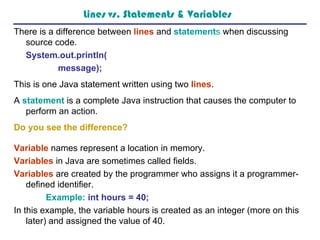
There is a difference between  lines  and  statement s  when discussing source code. System.out.println( message); This is one Java statement written using two  lines .  A  statement  is a complete Java instruction that causes the computer to perform an action.  Do you see the difference? Variable  names represent a location in memory. Variables  in Java are sometimes called fields. Variables   are created by the programmer who assigns it a programmer-defined identifier. Example:   int hours = 40; In this example, the variable hours is created as an integer (more on this later) and assigned the value of 40. Lines vs. Statements & Variables
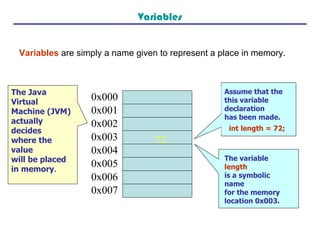
Variables Variables  are simply a name given to represent a place in memory. 72 The Java Virtual Machine (JVM) actually decides where the value will be placed in memory . 0x000 0x001 0x002 0x003 0x004 0x005 0x006 0x007 Assume that the this variable declaration has been made. int length = 72; The variable  length is a symbolic name for the memory location 0x003.
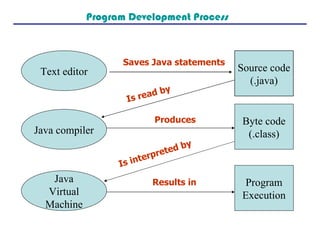
Compiler A programmer writes  Java  programming statements for a program. These statements are known as  source code . A  text editor  is used to edit and save a Java  source code  file. Source code  files have a  .java  file extension. A  compiler  is executed using a  source code  file as input. The  compiler  creates another file that holds the translated instructions which has a  .class  file extension.  Most  compilers  translate  source code  into  executable  files containing  machine code . The  Java   compiler  translates a  Java   source  file into a file that contains  byte code   instructions. Byte code  instructions are the machine language of the  Java Virtual Machine  ( JVM )  and cannot be directly executed directly by the CPU. Byte code  files end with the  . class  file extension. The  JVM  executes instructions as they are read and is often called an interpreter.
Program Development Process Text editor Source code (.java) Saves Java statements Java compiler Is read by Byte code (.class) Produces Java Virtual Machine Is interpreted by Program Execution Results in
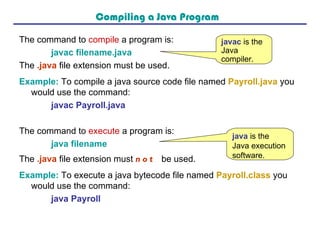
Compiling a Java Program The command to  compile  a program is: javac filename.java     The  .java  file extension must be used. Example:  To compile a java source code file named  Payroll.java  you would use the command: javac Payroll.java The command to  execute  a program is: java filename The  .java  file extension must  not   be used. Example:  To execute a java bytecode file named  Payroll.class  you would use the command: java Payroll javac  is the Java compiler. java  is the Java execution software.

About java

  • 1.
    Java History 1991 - Green Team started by Sun Microsystems to study future trends. *7 Hand-held device to control multiple home entertainment devices. *7 created a need for a programming language that could be used by all the devices that it controlled. Java (first named Oak ) was developed for this purpose. Java enabled web browser ( HotJava ) demonstrated at 1995 Sun World conference. Java incorporated into Netscape shortly after. Java is “cross platform”, meaning that it can run on various computer operating systems. Java programs can be of two types: Applications: Stand-alone programs that run without the aid of a web browser . Applets: Small applications that require the use of a Java enabled web browser to run.
  • 2.
    Sample Program -HelloWorld public class HelloWorld { public static void main(String[] args) { String message = “Hello World”; System.out.println(message); } } Key words are lower case (Java is a case sensitive language). Semi-colons are used to end Java statements; however, not all lines of a Java program end a statement. Java key words are: public class static void String String is not really a key word but is the name of predefined class in Java.
  • 3.
    There is adifference between lines and statement s when discussing source code. System.out.println( message); This is one Java statement written using two lines . A statement is a complete Java instruction that causes the computer to perform an action. Do you see the difference? Variable names represent a location in memory. Variables in Java are sometimes called fields. Variables are created by the programmer who assigns it a programmer-defined identifier. Example: int hours = 40; In this example, the variable hours is created as an integer (more on this later) and assigned the value of 40. Lines vs. Statements & Variables
  • 4.
    Variables Variables are simply a name given to represent a place in memory. 72 The Java Virtual Machine (JVM) actually decides where the value will be placed in memory . 0x000 0x001 0x002 0x003 0x004 0x005 0x006 0x007 Assume that the this variable declaration has been made. int length = 72; The variable length is a symbolic name for the memory location 0x003.
  • 5.
    Compiler A programmerwrites Java programming statements for a program. These statements are known as source code . A text editor is used to edit and save a Java source code file. Source code files have a .java file extension. A compiler is executed using a source code file as input. The compiler creates another file that holds the translated instructions which has a .class file extension. Most compilers translate source code into executable files containing machine code . The Java compiler translates a Java source file into a file that contains byte code instructions. Byte code instructions are the machine language of the Java Virtual Machine ( JVM ) and cannot be directly executed directly by the CPU. Byte code files end with the . class file extension. The JVM executes instructions as they are read and is often called an interpreter.
  • 6.
    Program Development ProcessText editor Source code (.java) Saves Java statements Java compiler Is read by Byte code (.class) Produces Java Virtual Machine Is interpreted by Program Execution Results in
  • 7.
    Compiling a JavaProgram The command to compile a program is: javac filename.java The .java file extension must be used. Example: To compile a java source code file named Payroll.java you would use the command: javac Payroll.java The command to execute a program is: java filename The .java file extension must not be used. Example: To execute a java bytecode file named Payroll.class you would use the command: java Payroll javac is the Java compiler. java is the Java execution software.