Abnormal Labour
CHN
Definition
Any deviation in normal progress of labour, either in
cervical
dilatation or descent of the presenting part, despite the
presence
of uterine contraction.
Dystocia refers to abnormal or difficult labour.
Etiology
a. Power: dysfunctional uterine activity
– Malfunction in the myogenic, neurogenic, or hormonal mechanisms of uterine
activity.
b. Passenger: issues with the fetus
– Malpresentation, malposition, fetal anomalies
c. Passage: shape and size of the pelvis. A small pelvis may be inadequate
for successful vaginal delivery.
– Uterine malformations, pelvic tumors, uterine over distension
– CPD
d. Patient(mother)
– Psychological condition, pain, hydration, bladder, patient’s position, other
comorbidities.
Diagnosis ???
Partogram
Classification
1. Prolonged latent phase
2. Protraction disorders
a. Protracted active phase
b. Protracted descent
3. Arrest disorders
a. Secondary arrest of cervical dilatation
b. Prolonged deceleration phase
c. Arrest of descent
d. Failure of descent
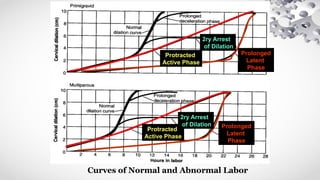
Curves of Normal and Abnormal Labor
Prolonged
Latent
Phase
Protracted
Active Phase
2ry Arrest
of Dilation
Prolonged
Latent
Phase
Protracted
Active Phase
2ry Arrest
of Dilation
Prolonged latent phase
• The presence of intact membranes and a normal fetal heart rate
pattern, poses no risk to either the mother or fetus
• More than 20 hr in PG, >14 hrs in MG from the onset of labour.
• Incidence; 4 and 1 percent in prim and multig respectively.
• Etiology
 Wrong diagnosis of labour
 Excess sedation
 An abnormal or high presenting part
 PROM
 Idiopathic
Risks
If membranes are intact, no risk but maternal anxiety
Risks are created by aggressive interventions.
Primary dysfunctional labour
• Cervical dilatation less than 1 cm per hr before normal active phase has
been established.
• Cervical dilatation of less than 1 cm per hr for two consecutive hrs in
the active phase.
• Etiology
 Poor contractions
 CPD
Fetal: malposition, malformation, macrosomia.
Maternal: small stature, contracted pelvis
Both
 Malpresentation
 Maternal abnormalities
Risks
1. Fetal distress
2. Maternal fear and anxiety, dehydration
3. Obstructed labour; chorioamnionitis, uterine rupture
and PPH.
Management
• Exclude CPD ARM and oxytocin drip
• CS if there is no progress after 4 hours
Malpresentation
• Breech presentation.
• Face presentation.
• Brow presentation .
• Shoulder presentation .
o Common in multipara
o Increased risk of uterine rupture if labour becomes obstructed
Abnormal_Labour power point presentation

Abnormal_Labour power point presentation

  • 1.
  • 2.
    Definition Any deviation innormal progress of labour, either in cervical dilatation or descent of the presenting part, despite the presence of uterine contraction. Dystocia refers to abnormal or difficult labour.
  • 3.
    Etiology a. Power: dysfunctionaluterine activity – Malfunction in the myogenic, neurogenic, or hormonal mechanisms of uterine activity. b. Passenger: issues with the fetus – Malpresentation, malposition, fetal anomalies c. Passage: shape and size of the pelvis. A small pelvis may be inadequate for successful vaginal delivery. – Uterine malformations, pelvic tumors, uterine over distension – CPD d. Patient(mother) – Psychological condition, pain, hydration, bladder, patient’s position, other comorbidities.
  • 4.
  • 5.
    Classification 1. Prolonged latentphase 2. Protraction disorders a. Protracted active phase b. Protracted descent 3. Arrest disorders a. Secondary arrest of cervical dilatation b. Prolonged deceleration phase c. Arrest of descent d. Failure of descent
  • 6.
    Curves of Normaland Abnormal Labor Prolonged Latent Phase Protracted Active Phase 2ry Arrest of Dilation Prolonged Latent Phase Protracted Active Phase 2ry Arrest of Dilation
  • 7.
    Prolonged latent phase •The presence of intact membranes and a normal fetal heart rate pattern, poses no risk to either the mother or fetus • More than 20 hr in PG, >14 hrs in MG from the onset of labour. • Incidence; 4 and 1 percent in prim and multig respectively. • Etiology  Wrong diagnosis of labour  Excess sedation  An abnormal or high presenting part  PROM  Idiopathic
  • 8.
    Risks If membranes areintact, no risk but maternal anxiety Risks are created by aggressive interventions.
  • 9.
    Primary dysfunctional labour •Cervical dilatation less than 1 cm per hr before normal active phase has been established. • Cervical dilatation of less than 1 cm per hr for two consecutive hrs in the active phase. • Etiology  Poor contractions  CPD Fetal: malposition, malformation, macrosomia. Maternal: small stature, contracted pelvis Both  Malpresentation  Maternal abnormalities
  • 10.
    Risks 1. Fetal distress 2.Maternal fear and anxiety, dehydration 3. Obstructed labour; chorioamnionitis, uterine rupture and PPH.
  • 11.
    Management • Exclude CPDARM and oxytocin drip • CS if there is no progress after 4 hours
  • 12.
    Malpresentation • Breech presentation. •Face presentation. • Brow presentation . • Shoulder presentation . o Common in multipara o Increased risk of uterine rupture if labour becomes obstructed

Editor's Notes

  • #5 Arrest-complete cessation, occur bothe in first and second stage, problem with arrest of labour is obstruction-fetus cannot pass through the pelvis. Usually the fetal head is too large to pass or the pelvis is too small, Malpresentation(OP, brow, mentum posterior position) or an abnormal lie---CS