Management of Abnormal
uterine bleeding
Dr.Hla Hla Yi
Central Women’Hospital
Mandalay
Causes
Classification
Title
AUB
ORGANIC
LOCAL CAUSE
SYSTEMIC CAUSES
PREGNANCY-RELATED
NONORGANIC DUB
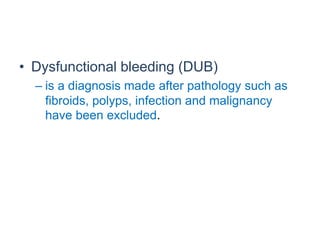
• Dysfunctional bleeding (DUB)
– is a diagnosis made after pathology such as
fibroids, polyps, infection and malignancy
have been excluded.
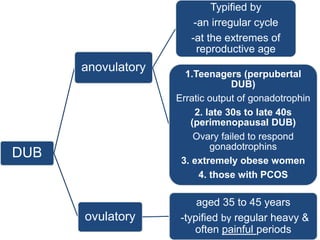
DUB
anovulatory
Typified by
-an irregular cycle
-at the extremes of
reproductive age
1.Teenagers (perpubertal
DUB)
Erratic output of gonadotrophin
2. late 30s to late 40s
(perimenopausal DUB)
Ovary failed to respond
gonadotrophins
3. extremely obese women
4. those with PCOS
ovulatory
aged 35 to 45 years
-typified by regular heavy &
often painful periods
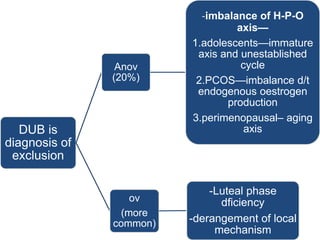
DUB is
diagnosis of
exclusion
Anov
(20%)
-imbalance of H-P-O
axis—
1.adolescents—immature
axis and unestablished
cycle
2.PCOS—imbalance d/t
endogenous oestrogen
production
3.perimenopausal– aging
axis
ov
(more
common)
-Luteal phase
dficiency
-derangement of local
mechanism
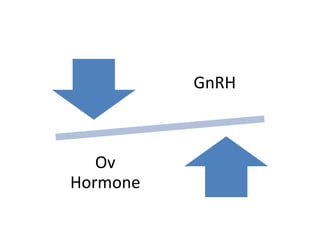
GnRH
Ov
Hormone
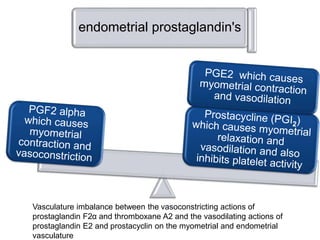
endometrial prostaglandin's
Vasculature imbalance between the vasoconstricting actions of
prostaglandin F2α and thromboxane A2 and the vasodilating actions of
prostaglandin E2 and prostacyclin on the myometrial and endometrial
vasculature
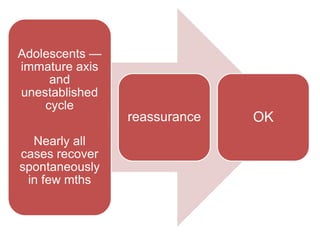
Adolescents —
immature axis
and
unestablished
cycle
Nearly all
cases recover
spontaneously
in few mths
reassurance OK
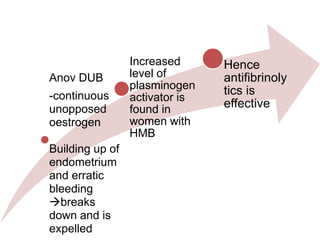
Anov DUB
-continuous
unopposed
oestrogen
Building up of
endometrium
and erratic
bleeding
breaks
down and is
expelled
Increased
level of
plasminogen
activator is
found in
women with
HMB
Hence
antifibrinoly
tics is
effective
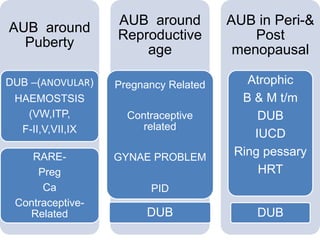
AUB around
Puberty
DUB –(ANOVULAR)
HAEMOSTSIS
(VW,ITP,
F-II,V,VII,IX
RARE-
Preg
Ca
Contraceptive-
Related
AUB around
Reproductive
age
Pregnancy Related
Contraceptive
related
GYNAE PROBLEM
PID
DUB
AUB in Peri-&
Post
menopausal
Atrophic
B & M t/m
DUB
IUCD
Ring pessary
HRT
DUB
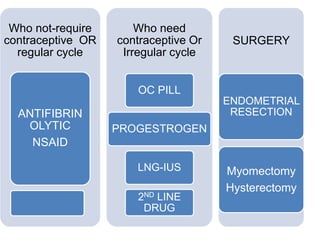
Who not-require
contraceptive OR
regular cycle
ANTIFIBRIN
OLYTIC
NSAID
Who need
contraceptive Or
Irregular cycle
OC PILL
PROGESTROGEN
LNG-IUS
2ND LINE
DRUG
SURGERY
ENDOMETRIAL
RESECTION
Myomectomy
Hysterectomy
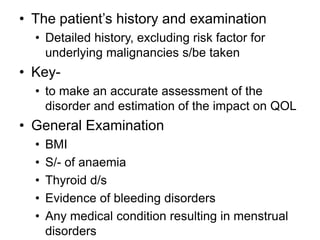
• The patient’s history and examination
• Detailed history, excluding risk factor for
underlying malignancies s/be taken
• Key-
• to make an accurate assessment of the
disorder and estimation of the impact on QOL
• General Examination
• BMI
• S/- of anaemia
• Thyroid d/s
• Evidence of bleeding disorders
• Any medical condition resulting in menstrual
disorders
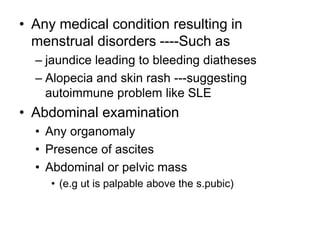
• Any medical condition resulting in
menstrual disorders ----Such as
– jaundice leading to bleeding diatheses
– Alopecia and skin rash ---suggesting
autoimmune problem like SLE
• Abdominal examination
• Any organomaly
• Presence of ascites
• Abdominal or pelvic mass
• (e.g ut is palpable above the s.pubic)
• Speculum examination
– Vg Cx
– Cervical smear
– Endometrial biopsy
– Vaginal swab
• Bimanual examination
– Reinforced finding
Confirmatory Investigations
• The patient’s history and examination
• will guide the selection of various tests
• Then lead to a diagnosis and management
• FBC is an essential investigation
• serum or urine beta-hCG
(s/b request if any possibility of pregnancy exits)
• Hormonal assays
• Coagulation screen—
• Renal/liver function tests
• Blood glucose
• TVS (with saline infusion sonohysterography),
• TAS
• Endometrial sampling
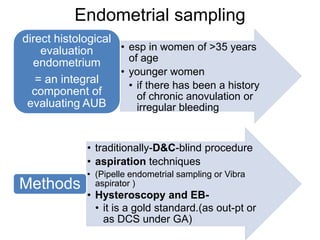
Endometrial sampling
• esp in women of >35 years
of age
• younger women
• if there has been a history
of chronic anovulation or
irregular bleeding
direct histological
evaluation
endometrium
= an integral
component of
evaluating AUB
• traditionally-D&C-blind procedure
• aspiration techniques
• (Pipelle endometrial sampling or Vibra
aspirator )
• Hysteroscopy and EB-
• it is a gold standard.(as out-pt or
as DCS under GA)
Methods
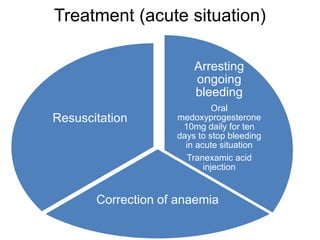
Treatment (acute situation)
Arresting
ongoing
bleeding
Oral
medoxyprogesterone
10mg daily for ten
days to stop bleeding
in acute situation
Tranexamic acid
injection
Correction of anaemia
Resuscitation
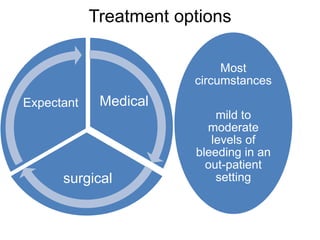
Treatment options
Medical
surgical
Expectant
Most
circumstances
mild to
moderate
levels of
bleeding in an
out-patient
setting
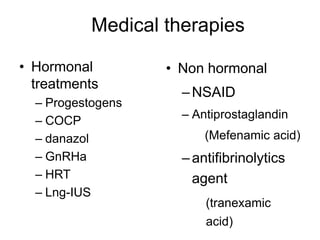
Medical therapies
• Hormonal
treatments
– Progestogens
– COCP
– danazol
– GnRHa
– HRT
– Lng-IUS
• Non hormonal
–NSAID
– Antiprostaglandin
(Mefenamic acid)
–antifibrinolytics
agent
(tranexamic
acid)
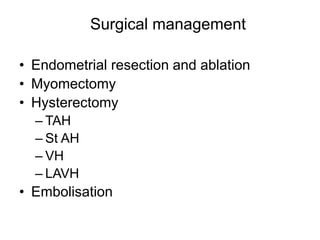
Surgical management
• Endometrial resection and ablation
• Myomectomy
• Hysterectomy
– TAH
– St AH
– VH
– LAVH
• Embolisation
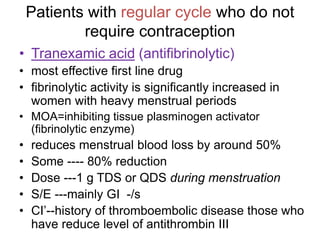
Patients with regular cycle who do not
require contraception
• Tranexamic acid (antifibrinolytic)
• most effective first line drug
• fibrinolytic activity is significantly increased in
women with heavy menstrual periods
• MOA=inhibiting tissue plasminogen activator
(fibrinolytic enzyme)
• reduces menstrual blood loss by around 50%
• Some ---- 80% reduction
• Dose ---1 g TDS or QDS during menstruation
• S/E ---mainly GI -/s
• CI’--history of thromboembolic disease those who
have reduce level of antithrombin III
• NSAID (such as mefenamic acid)
• effective, well tested, and tolerated
• MOA—inhibiting cyclo-oxygenase reducing
local Pg levels block myometrial PE2 receptors.
(Women with heavy flow have higher levels of
PgE2 and F2-ά-Their MOA not clear)
• Reduce menstrual blood flow by 25-30%
• also a analgesic drugs—
therefore often use as a first line treatment for
women with dysmenorrhoea and menorrhagia
• Dose –500 mg TDS * 5Days during mens
• S/E---GI irritation (CI’---PU and GU pts)
Patients with irregular cycle or who
need contraception
• COCP
– commonly used esp in the younger age gp
– it reduces MBL by 50%
– helps to regulate periods and
– provides contraception
– MOA
• inhibition of ovulation
• production of inactive endometrium
• Sequential combined HRT
– regulate the cycle
– reduce mean blood loss in perimenopausal
age group
• Progestogens
– e.g. norethi- sterone 5 mg 8 hourly
• from day 12-26 or day 5-26
• the most popular drugs in GP
• but minimal or no effect on MBL
• can be of value in regulating an irregular cycle
• s/e
–weight gain, Bloating
–androgenic side effect ---- such as acnes
• mainly indicated in anovulatory bleeding
• to reverse the effect of oestrogen-mediated
endometrial proliferation induce endometrial
maturation
• a minimal role in ovulatory bleeding
• Depo-provera (contraception)
– reduced MBL
– amenorrhoea in some women
• Levonogestrel-releasing intrauterine
contraceptive device (Mirena)
– releases 20ug of levonogestral/24 hrs >5 yrs
– act locally on the endometrium
– MOA—
• a reduction in endometrial prostaglandin synthesis
• the production of inactive endometrium
• a reduction in endometrial fibrinolytic activity
• it reduces MBL by 86% after 3 mths (95% by 1 yr)
• current devices are active for up to seven yr
• If a Cu IUCD is already in situ
– either treat with tranexamic acid or NSAIDs
change to Lng-IUS
– be warned --irregular bleeding is common
during the first 3 months after insertion
• Second line treatment
• Danazol(100 mg 6-24 hrly)
– =a synthetic steroid (derivative of testosterone)
– inhibits steroid synthesis
– blocks the androgen and progesterone receptors
– inhibits pituitary gonadotrophins
– combine to inhibit endometrial growth
– its use is limited by the androgenic s-ef & high
cost (acnes, hirsutism, breast atrophy, and weight
gain, voice changes)
– it reduces blood loss by 60%
• Gestinone
• GnRH -a
Surgical therapies
• completed their family
• failed medical management
– Endometrial resection/ ablation
– Myomectomy
– Hysterectomy
• Management is determined on an
individual case-by-case basis according to
– age,
– reproductive status,
– hormonal profile,
– family planning intentions,
– ultrasound findings,
– diagnosis and
– ultimately patient choice.
• A variety of medical options and recently
developed minimally invasive surgical
techniques have revolutionized the
treatment of menstrual irregularities.
• A 14-year-old nulligravid girl
• Menarche- 13 yrs; 4/45-50ds cycle
• She is not sexually active.
• Her physical examination is unremarkable,
and her serum pregnancy test is negative.
• The next best step in management is:
– A. Low-dose birth control pills
– B. Reassurance
– C. NSAIDs
– D. Hysteroscopy and dilation and curettage
– E. Coagulation profile
• The answer is------------------
• B
• The pattern of bleeding demonstrated by
this patient is
– characteristic of the menstrual pattern seen
following menarche.
• Unless it is prolonged and very heavy (not
the case in this patient),
– it should evolve into a pattern of regular
estrogen-progesterone withdrawal bleeding
with time (usually by 2 years from menarche).
• The chance that an anatomic lesion such
as a polyp or a fibroid would be the cause
of her bleeding
– is unlikely
• given her age and pattern of bleeding.
– Therefore, hysteroscopy with dilation and
curettage would not help.
• Oral contraception and NSAIDs are not
indicated at this point unless she desires
contraception.
• Coagulopathy is an unlikely cause of her
bleeding because the timing, not the
volume, is problematic for this patient
• A 32-year-old woman, para 2+0,
• c/o - bleeding between her periods and
lengthening of the time between her
periods to more than 40 days
• Systems Review
• 70-lb weight gain since her pregnancy (2
years ago)
• No medical problems.
• She is 5’ 4’’ tall and weighs 230 lb.
• Her physical examination is otherwise
unremarkable.
• The most likely explanation for her
bleeding is:
– A. Increased endogenous progesterone
– B. Increased exogenous progesterone
– C. Increased endogenous estrogen
– D. Increased exogenous estrogen
– E. Increased prolactin
• The answer is
• C
• This patient is obese
– therefore likely has increased endogenous
production of estrogen from adipose tissue
– which can lead to suppression of FSH and
anovulation
• leading to menstrual irregularity.
• With estrogen production unopposed by
progesterone,
– the endometrium experiences excessive
glandular proliferation without stromal
support.
– As a result, the endometrium sloughs in
isolated locations, leading to unpredictable
and prolonged bleeding.
• There is no history of exogenous hormone
intake.
• Progesterone is not being produced.
• High prolactin typically results in
amenorrhea and galactorrhea.
• An 18-year-old nulligravid girl
• Arrived to the A&E by ambulance
– because she passed out on the floor of her
house and is covered in blood.
– She is now conscious.
– She has been bleeding off and on for the past
5 months. Her BP = 98/48, P = 120, RR = 16,
and T = 96.2.
• VE
– Speculum examination reveals blood trickling
from the cervical os. There are no lesions in
the vagina or cervix.
– The bimanual examination is unremarkable.
– Pelvic ultrasound is also unremarkable.
– Serum human chorionic gonadotropin (hCG)
is negative, and
– her hemoglobin is 7 g/dL.
• The next best step in management of this
patient is:
– A. Depot-medroxyprogesterone acetate
– B. Oral conjugated estrogen
– C. Intravenous estrogen
– D. Low-dose combination oral contraceptive
pills
– E. GnRH agonist therapy
• The answer is
• -------------------D
– A low-dose oral contraceptive given as three
pills a day with taper over 3 to 4 days is an
effective way to stop dysfunctional bleeding
fairly quickly.
– Intravenous estrogen is indicated when the
bleeding is profuse and the patient unstable.
Estrogen (25 mg) is administered i.vly every 4
hours until the bleeding lessens.
– This patient does not have profuse bleeding,
and therefore does not warrant using
intravenous estrogen, but she has been
bleeding for a long time and is anemic, so a
quick method to stop the bleeding would be
appropriate.
– Since this patient has been bleeding for 5
months and is young, she is probably
anovulatory.(normal peripubertal anovulation )
– Causes other than normal peripubertal
anovulation should be looked for (thyroid
disease, bleeding disorder).
– Just giving estrogen would not help because
she is already bleeding due to unopposed
estrogen.
– Depomedroxyprogesterone acetate and a
GnRH agonist can both be used to treat
anovulation, but they both take a while to
work so would not be ideal.
• A 38-year-old
• c/o -heavy menst: flow 9/32 days x 2 yrs
– with occasional episodes of soaking her
clothes and bedsheets with menstrual blood.
– no bleeding between menses.
– history of hypertension controlled with a
diuretic.
• The next step in evaluation would be:
– A. Obtain a coagulation profile
– B. Obtain a pregnancy test
– C. Perform an endometrial biopsy
– D. Obtain a pelvic ultrasound
– E. Obtain a TSH level
• The answer is
• ------------------- D
• This woman has a history of regular cyclic
menstrual flow, but with men-orrhagia.
– regular pattern ------so, she does not have an
ovulation disorder
– that the bleeding is most likely from a
structural problem.
– The next best step would be to obtain a
pelvic ultrasound to look for the presence of
fibroids, endometrial polyps, or adenomyosis.
– ? Endometrial biopsy
• An endometrial biopsy
– to look for endometrial hyperplasia or cancer
– is not warranted
• bleeding is regular and cyclic
• no bleeding between menses, making this
diagnosis unlikely.
• A coagulation profile
– unlikely to be abnormal since this problem is
relatively new.
• A pregnancy test is also not indicated.
• ?TFT
• ?TFT
– It is unlikely that hypothyroid abnormalities
would cause this regular but heavy menstrual
flow.
– Extreme hypo-or hyperthyroidism can cause
irregular menses and anovulation, but not
menorrhagia.
• A 50-year-old, G3, P2+1(spontaneous abortions 1),
• c/o - abnormal vaginal bleeding.
• Cycles –usually regular 3-4/30 ds
– She now has periods 6-7ds/every 15 to 22 ds
• no past medical or surgical history.
• Systems review-negative
• No light -headedness.
• VE
– speculum examination is unremarkable.
– BE- slightly enlarged, regular contour, AV ut
• nontender to palpation.
• The next best step in management is:
– A. Low-dose oral contraceptive pills
– B. Endometrial biopsy
– C. Dilation and curettage
– D. Endometrial ablation
– E. Levonorgestrel IUD
• The answer is
• ----------------------------B
• The risk of endometrial carcinoma
– increases with age and
– should be ruled out in patients with abnormal
bleeding who are over age 40 years.
– In addition, endometrial hyperplasia often
develops in women with a history of chronic
anovulation and unopposed estrogen
stimulation of the endometrium (most likely in
this perimenopausal patient).
• If histology revealed---endometrial
hyperplasia with atypia
– she has an increased risk for endometrial ca.
• Simple Endometrial Hyperplasia without
atypia
– can be treated with progestin therapy.
• A perimenopausal women
– have erratic bleeding
• because of the transition from regular ovarian
folliculogenesis and hormone production to relative
ovarian quiescence.
– An office endometrial biopsy is the must.
– Birth control pills will regulate her bleeding but
will not tell you about the endometrium.
– Dilation and curettage is the next step
• after an endometrial biopsy if the results are not
satisfactory (e.g., cervical stenosis and inability to
obtain biopsy in the office or no tissue obtained on
biopsy) or if the patient is refractory to agents
aimed at stopping the bleeding.
– ? Endometrial ablation
• Endometrial ablation should not be done until you
know the endometrium is completely normal.
– Levonorgestrel IUD is a good treatment option
after biopsy of the endometrium.
• A 24-year-old women with P1+0 (aged 5)
– planning another pregnancy next 6-12 mths.
– She is in a 2-year stable relationship using the
OCP.
• c/o intermenstrual bleeding, usually at
mid-cycle, for 6 months.
– She has Normal menstruation–3-7/21-35ds
• (IMB)
– refers to vaginal bleeding (other than post-
coital) at any time during the menstrual cycle
other than during normal menstruation.
• IMB can be predictable
– (e.g. always premenstrual or mid-cycle), or
• unpredictable
– (i.e. occurs any time of the cycle).
• Predictable IMB is
– usually endometrial in origin secondary to
hormonal changes.
– Mid-cycle (ovulatory) blding lasts for 12-72 h
– thought to be caused by sudden fluctuations
in oestr: levels destabilizing the endometrium.
• Unpredictable IMB
– arise from anywhere in the genital tract.
• Premenstrual bleeding is
– blding for up to 10 days prior to menstrution.
– This occurs when the endometrium is shed
early due to lack of progesterone support.
– This is often termed luteal phase deficiency.
• Aetiology of intermenstrual bleeding
• 1 Pregnancy related e.g. gestational trophoblastic disease
• 2 Physiological: 1-2% spotting at time of ovulation
• 3 Iatrogenic
– COCP - either in too low dose on in combination with an enzyme
inducing drug
– Progesterone-only pill (30% risk of IMB or irregular bleeds)
– Contraceptive depot injections (Depo Provera) or implants
– (Implanon): 30% risk of IMB
– Mirena IUS
– Emergency contraception
– Tamoxifen
– Following smear or treatment to cervix
– Drugs altering clotting parameters e.g. anticoagulant, SSRIs,
– corticosteroids
– Alternative remedies e.g. ginseng, ginkgo, soy supplements,
– St Johns Wort
• 4 Vaginal causes
– Infection e.g. Chlamydia
– Tumours e.g. polyps, carcinoma
• 5 Cervical causes
– HPV infection
– Cancer (however, bleeding most often post-coital, can have irregular
bleeds þ/ foul discharge
– Polyps
– Ectropion
– Cervicitis
– Condylomata accuminata of the cervix
• 6 Uterine causes
– Polyps
– Adenocarcinoma/adenosarcoma
– Leiomyosarcoma
– Adenomyosis (usually only symptomatic in later reproductive life)
– Fibroids
• Management
– In the presence of pathology removal of the
cause is likely to be curative.
• Foreign bodies, cervical or endometrial polyps
should be removed,
• infection eradicated with appropriate antibiotics
• neoplastic lesions treated according to site, type,
grade and stage.
• In the absence of physical pathology
– cyclical menstrual control can be achieved
using the COCP or cyclical progestogen.
– In this case, breakthrough blding on COCP
• can be treated by changing the current COCP to
another with a different progestogen or alteration
of the progestogen/oestrogen ratio.
Abnormal uterine bleeding- Prof.HHY.pptx

Abnormal uterine bleeding- Prof.HHY.pptx

  • 1.
    Management of Abnormal uterinebleeding Dr.Hla Hla Yi Central Women’Hospital Mandalay
  • 2.
  • 3.
    • Dysfunctional bleeding(DUB) – is a diagnosis made after pathology such as fibroids, polyps, infection and malignancy have been excluded.
  • 4.
    DUB anovulatory Typified by -an irregularcycle -at the extremes of reproductive age 1.Teenagers (perpubertal DUB) Erratic output of gonadotrophin 2. late 30s to late 40s (perimenopausal DUB) Ovary failed to respond gonadotrophins 3. extremely obese women 4. those with PCOS ovulatory aged 35 to 45 years -typified by regular heavy & often painful periods
  • 5.
    DUB is diagnosis of exclusion Anov (20%) -imbalanceof H-P-O axis— 1.adolescents—immature axis and unestablished cycle 2.PCOS—imbalance d/t endogenous oestrogen production 3.perimenopausal– aging axis ov (more common) -Luteal phase dficiency -derangement of local mechanism
  • 6.
  • 7.
    endometrial prostaglandin's Vasculature imbalancebetween the vasoconstricting actions of prostaglandin F2α and thromboxane A2 and the vasodilating actions of prostaglandin E2 and prostacyclin on the myometrial and endometrial vasculature
  • 8.
    Adolescents — immature axis and unestablished cycle Nearlyall cases recover spontaneously in few mths reassurance OK
  • 9.
    Anov DUB -continuous unopposed oestrogen Building upof endometrium and erratic bleeding breaks down and is expelled Increased level of plasminogen activator is found in women with HMB Hence antifibrinoly tics is effective
  • 10.
    AUB around Puberty DUB –(ANOVULAR) HAEMOSTSIS (VW,ITP, F-II,V,VII,IX RARE- Preg Ca Contraceptive- Related AUBaround Reproductive age Pregnancy Related Contraceptive related GYNAE PROBLEM PID DUB AUB in Peri-& Post menopausal Atrophic B & M t/m DUB IUCD Ring pessary HRT DUB
  • 11.
    Who not-require contraceptive OR regularcycle ANTIFIBRIN OLYTIC NSAID Who need contraceptive Or Irregular cycle OC PILL PROGESTROGEN LNG-IUS 2ND LINE DRUG SURGERY ENDOMETRIAL RESECTION Myomectomy Hysterectomy
  • 12.
    • The patient’shistory and examination • Detailed history, excluding risk factor for underlying malignancies s/be taken • Key- • to make an accurate assessment of the disorder and estimation of the impact on QOL • General Examination • BMI • S/- of anaemia • Thyroid d/s • Evidence of bleeding disorders • Any medical condition resulting in menstrual disorders
  • 13.
    • Any medicalcondition resulting in menstrual disorders ----Such as – jaundice leading to bleeding diatheses – Alopecia and skin rash ---suggesting autoimmune problem like SLE • Abdominal examination • Any organomaly • Presence of ascites • Abdominal or pelvic mass • (e.g ut is palpable above the s.pubic)
  • 14.
    • Speculum examination –Vg Cx – Cervical smear – Endometrial biopsy – Vaginal swab • Bimanual examination – Reinforced finding
  • 15.
    Confirmatory Investigations • Thepatient’s history and examination • will guide the selection of various tests • Then lead to a diagnosis and management • FBC is an essential investigation • serum or urine beta-hCG (s/b request if any possibility of pregnancy exits) • Hormonal assays • Coagulation screen— • Renal/liver function tests • Blood glucose • TVS (with saline infusion sonohysterography), • TAS • Endometrial sampling
  • 16.
    Endometrial sampling • espin women of >35 years of age • younger women • if there has been a history of chronic anovulation or irregular bleeding direct histological evaluation endometrium = an integral component of evaluating AUB • traditionally-D&C-blind procedure • aspiration techniques • (Pipelle endometrial sampling or Vibra aspirator ) • Hysteroscopy and EB- • it is a gold standard.(as out-pt or as DCS under GA) Methods
  • 17.
    Treatment (acute situation) Arresting ongoing bleeding Oral medoxyprogesterone 10mgdaily for ten days to stop bleeding in acute situation Tranexamic acid injection Correction of anaemia Resuscitation
  • 18.
  • 19.
    Medical therapies • Hormonal treatments –Progestogens – COCP – danazol – GnRHa – HRT – Lng-IUS • Non hormonal –NSAID – Antiprostaglandin (Mefenamic acid) –antifibrinolytics agent (tranexamic acid)
  • 20.
    Surgical management • Endometrialresection and ablation • Myomectomy • Hysterectomy – TAH – St AH – VH – LAVH • Embolisation
  • 21.
    Patients with regularcycle who do not require contraception • Tranexamic acid (antifibrinolytic) • most effective first line drug • fibrinolytic activity is significantly increased in women with heavy menstrual periods • MOA=inhibiting tissue plasminogen activator (fibrinolytic enzyme) • reduces menstrual blood loss by around 50% • Some ---- 80% reduction • Dose ---1 g TDS or QDS during menstruation • S/E ---mainly GI -/s • CI’--history of thromboembolic disease those who have reduce level of antithrombin III
  • 22.
    • NSAID (suchas mefenamic acid) • effective, well tested, and tolerated • MOA—inhibiting cyclo-oxygenase reducing local Pg levels block myometrial PE2 receptors. (Women with heavy flow have higher levels of PgE2 and F2-ά-Their MOA not clear) • Reduce menstrual blood flow by 25-30% • also a analgesic drugs— therefore often use as a first line treatment for women with dysmenorrhoea and menorrhagia • Dose –500 mg TDS * 5Days during mens • S/E---GI irritation (CI’---PU and GU pts)
  • 23.
    Patients with irregularcycle or who need contraception • COCP – commonly used esp in the younger age gp – it reduces MBL by 50% – helps to regulate periods and – provides contraception – MOA • inhibition of ovulation • production of inactive endometrium • Sequential combined HRT – regulate the cycle – reduce mean blood loss in perimenopausal age group
  • 24.
    • Progestogens – e.g.norethi- sterone 5 mg 8 hourly • from day 12-26 or day 5-26 • the most popular drugs in GP • but minimal or no effect on MBL • can be of value in regulating an irregular cycle • s/e –weight gain, Bloating –androgenic side effect ---- such as acnes • mainly indicated in anovulatory bleeding • to reverse the effect of oestrogen-mediated endometrial proliferation induce endometrial maturation • a minimal role in ovulatory bleeding
  • 25.
    • Depo-provera (contraception) –reduced MBL – amenorrhoea in some women • Levonogestrel-releasing intrauterine contraceptive device (Mirena) – releases 20ug of levonogestral/24 hrs >5 yrs – act locally on the endometrium – MOA— • a reduction in endometrial prostaglandin synthesis • the production of inactive endometrium • a reduction in endometrial fibrinolytic activity • it reduces MBL by 86% after 3 mths (95% by 1 yr) • current devices are active for up to seven yr
  • 26.
    • If aCu IUCD is already in situ – either treat with tranexamic acid or NSAIDs change to Lng-IUS – be warned --irregular bleeding is common during the first 3 months after insertion
  • 27.
    • Second linetreatment • Danazol(100 mg 6-24 hrly) – =a synthetic steroid (derivative of testosterone) – inhibits steroid synthesis – blocks the androgen and progesterone receptors – inhibits pituitary gonadotrophins – combine to inhibit endometrial growth – its use is limited by the androgenic s-ef & high cost (acnes, hirsutism, breast atrophy, and weight gain, voice changes) – it reduces blood loss by 60% • Gestinone • GnRH -a
  • 28.
    Surgical therapies • completedtheir family • failed medical management – Endometrial resection/ ablation – Myomectomy – Hysterectomy
  • 30.
    • Management isdetermined on an individual case-by-case basis according to – age, – reproductive status, – hormonal profile, – family planning intentions, – ultrasound findings, – diagnosis and – ultimately patient choice. • A variety of medical options and recently developed minimally invasive surgical techniques have revolutionized the treatment of menstrual irregularities.
  • 31.
    • A 14-year-oldnulligravid girl • Menarche- 13 yrs; 4/45-50ds cycle • She is not sexually active. • Her physical examination is unremarkable, and her serum pregnancy test is negative. • The next best step in management is: – A. Low-dose birth control pills – B. Reassurance – C. NSAIDs – D. Hysteroscopy and dilation and curettage – E. Coagulation profile
  • 32.
    • The answeris------------------ • B • The pattern of bleeding demonstrated by this patient is – characteristic of the menstrual pattern seen following menarche. • Unless it is prolonged and very heavy (not the case in this patient), – it should evolve into a pattern of regular estrogen-progesterone withdrawal bleeding with time (usually by 2 years from menarche).
  • 33.
    • The chancethat an anatomic lesion such as a polyp or a fibroid would be the cause of her bleeding – is unlikely • given her age and pattern of bleeding. – Therefore, hysteroscopy with dilation and curettage would not help. • Oral contraception and NSAIDs are not indicated at this point unless she desires contraception. • Coagulopathy is an unlikely cause of her bleeding because the timing, not the volume, is problematic for this patient
  • 35.
    • A 32-year-oldwoman, para 2+0, • c/o - bleeding between her periods and lengthening of the time between her periods to more than 40 days • Systems Review • 70-lb weight gain since her pregnancy (2 years ago) • No medical problems. • She is 5’ 4’’ tall and weighs 230 lb. • Her physical examination is otherwise unremarkable.
  • 36.
    • The mostlikely explanation for her bleeding is: – A. Increased endogenous progesterone – B. Increased exogenous progesterone – C. Increased endogenous estrogen – D. Increased exogenous estrogen – E. Increased prolactin • The answer is • C
  • 37.
    • This patientis obese – therefore likely has increased endogenous production of estrogen from adipose tissue – which can lead to suppression of FSH and anovulation • leading to menstrual irregularity. • With estrogen production unopposed by progesterone, – the endometrium experiences excessive glandular proliferation without stromal support. – As a result, the endometrium sloughs in isolated locations, leading to unpredictable and prolonged bleeding.
  • 38.
    • There isno history of exogenous hormone intake. • Progesterone is not being produced. • High prolactin typically results in amenorrhea and galactorrhea.
  • 40.
    • An 18-year-oldnulligravid girl • Arrived to the A&E by ambulance – because she passed out on the floor of her house and is covered in blood. – She is now conscious. – She has been bleeding off and on for the past 5 months. Her BP = 98/48, P = 120, RR = 16, and T = 96.2. • VE – Speculum examination reveals blood trickling from the cervical os. There are no lesions in the vagina or cervix. – The bimanual examination is unremarkable.
  • 41.
    – Pelvic ultrasoundis also unremarkable. – Serum human chorionic gonadotropin (hCG) is negative, and – her hemoglobin is 7 g/dL. • The next best step in management of this patient is: – A. Depot-medroxyprogesterone acetate – B. Oral conjugated estrogen – C. Intravenous estrogen – D. Low-dose combination oral contraceptive pills – E. GnRH agonist therapy
  • 42.
    • The answeris • -------------------D – A low-dose oral contraceptive given as three pills a day with taper over 3 to 4 days is an effective way to stop dysfunctional bleeding fairly quickly. – Intravenous estrogen is indicated when the bleeding is profuse and the patient unstable. Estrogen (25 mg) is administered i.vly every 4 hours until the bleeding lessens.
  • 43.
    – This patientdoes not have profuse bleeding, and therefore does not warrant using intravenous estrogen, but she has been bleeding for a long time and is anemic, so a quick method to stop the bleeding would be appropriate. – Since this patient has been bleeding for 5 months and is young, she is probably anovulatory.(normal peripubertal anovulation ) – Causes other than normal peripubertal anovulation should be looked for (thyroid disease, bleeding disorder). – Just giving estrogen would not help because she is already bleeding due to unopposed estrogen.
  • 44.
    – Depomedroxyprogesterone acetateand a GnRH agonist can both be used to treat anovulation, but they both take a while to work so would not be ideal.
  • 46.
    • A 38-year-old •c/o -heavy menst: flow 9/32 days x 2 yrs – with occasional episodes of soaking her clothes and bedsheets with menstrual blood. – no bleeding between menses. – history of hypertension controlled with a diuretic. • The next step in evaluation would be: – A. Obtain a coagulation profile – B. Obtain a pregnancy test – C. Perform an endometrial biopsy – D. Obtain a pelvic ultrasound – E. Obtain a TSH level
  • 47.
    • The answeris • ------------------- D • This woman has a history of regular cyclic menstrual flow, but with men-orrhagia. – regular pattern ------so, she does not have an ovulation disorder – that the bleeding is most likely from a structural problem. – The next best step would be to obtain a pelvic ultrasound to look for the presence of fibroids, endometrial polyps, or adenomyosis. – ? Endometrial biopsy
  • 48.
    • An endometrialbiopsy – to look for endometrial hyperplasia or cancer – is not warranted • bleeding is regular and cyclic • no bleeding between menses, making this diagnosis unlikely. • A coagulation profile – unlikely to be abnormal since this problem is relatively new. • A pregnancy test is also not indicated. • ?TFT
  • 49.
    • ?TFT – Itis unlikely that hypothyroid abnormalities would cause this regular but heavy menstrual flow. – Extreme hypo-or hyperthyroidism can cause irregular menses and anovulation, but not menorrhagia.
  • 51.
    • A 50-year-old,G3, P2+1(spontaneous abortions 1), • c/o - abnormal vaginal bleeding. • Cycles –usually regular 3-4/30 ds – She now has periods 6-7ds/every 15 to 22 ds • no past medical or surgical history. • Systems review-negative • No light -headedness. • VE – speculum examination is unremarkable. – BE- slightly enlarged, regular contour, AV ut • nontender to palpation. • The next best step in management is:
  • 52.
    • The nextbest step in management is: – A. Low-dose oral contraceptive pills – B. Endometrial biopsy – C. Dilation and curettage – D. Endometrial ablation – E. Levonorgestrel IUD • The answer is • ----------------------------B
  • 53.
    • The riskof endometrial carcinoma – increases with age and – should be ruled out in patients with abnormal bleeding who are over age 40 years. – In addition, endometrial hyperplasia often develops in women with a history of chronic anovulation and unopposed estrogen stimulation of the endometrium (most likely in this perimenopausal patient). • If histology revealed---endometrial hyperplasia with atypia – she has an increased risk for endometrial ca.
  • 54.
    • Simple EndometrialHyperplasia without atypia – can be treated with progestin therapy. • A perimenopausal women – have erratic bleeding • because of the transition from regular ovarian folliculogenesis and hormone production to relative ovarian quiescence. – An office endometrial biopsy is the must. – Birth control pills will regulate her bleeding but will not tell you about the endometrium.
  • 55.
    – Dilation andcurettage is the next step • after an endometrial biopsy if the results are not satisfactory (e.g., cervical stenosis and inability to obtain biopsy in the office or no tissue obtained on biopsy) or if the patient is refractory to agents aimed at stopping the bleeding. – ? Endometrial ablation • Endometrial ablation should not be done until you know the endometrium is completely normal. – Levonorgestrel IUD is a good treatment option after biopsy of the endometrium.
  • 57.
    • A 24-year-oldwomen with P1+0 (aged 5) – planning another pregnancy next 6-12 mths. – She is in a 2-year stable relationship using the OCP. • c/o intermenstrual bleeding, usually at mid-cycle, for 6 months. – She has Normal menstruation–3-7/21-35ds • (IMB) – refers to vaginal bleeding (other than post- coital) at any time during the menstrual cycle other than during normal menstruation.
  • 58.
    • IMB canbe predictable – (e.g. always premenstrual or mid-cycle), or • unpredictable – (i.e. occurs any time of the cycle). • Predictable IMB is – usually endometrial in origin secondary to hormonal changes. – Mid-cycle (ovulatory) blding lasts for 12-72 h – thought to be caused by sudden fluctuations in oestr: levels destabilizing the endometrium. • Unpredictable IMB – arise from anywhere in the genital tract.
  • 59.
    • Premenstrual bleedingis – blding for up to 10 days prior to menstrution. – This occurs when the endometrium is shed early due to lack of progesterone support. – This is often termed luteal phase deficiency.
  • 60.
    • Aetiology ofintermenstrual bleeding • 1 Pregnancy related e.g. gestational trophoblastic disease • 2 Physiological: 1-2% spotting at time of ovulation • 3 Iatrogenic – COCP - either in too low dose on in combination with an enzyme inducing drug – Progesterone-only pill (30% risk of IMB or irregular bleeds) – Contraceptive depot injections (Depo Provera) or implants – (Implanon): 30% risk of IMB – Mirena IUS – Emergency contraception – Tamoxifen – Following smear or treatment to cervix – Drugs altering clotting parameters e.g. anticoagulant, SSRIs, – corticosteroids – Alternative remedies e.g. ginseng, ginkgo, soy supplements, – St Johns Wort • 4 Vaginal causes – Infection e.g. Chlamydia – Tumours e.g. polyps, carcinoma
  • 61.
    • 5 Cervicalcauses – HPV infection – Cancer (however, bleeding most often post-coital, can have irregular bleeds þ/ foul discharge – Polyps – Ectropion – Cervicitis – Condylomata accuminata of the cervix • 6 Uterine causes – Polyps – Adenocarcinoma/adenosarcoma – Leiomyosarcoma – Adenomyosis (usually only symptomatic in later reproductive life) – Fibroids
  • 62.
    • Management – Inthe presence of pathology removal of the cause is likely to be curative. • Foreign bodies, cervical or endometrial polyps should be removed, • infection eradicated with appropriate antibiotics • neoplastic lesions treated according to site, type, grade and stage. • In the absence of physical pathology – cyclical menstrual control can be achieved using the COCP or cyclical progestogen. – In this case, breakthrough blding on COCP • can be treated by changing the current COCP to another with a different progestogen or alteration of the progestogen/oestrogen ratio.