NAMUBIRU AISHA
ABNORMALITIES OF THE PUERPERIUM
• Puerperal Pyrexia.
• Puerperal Sepsis.
• Subinvolution.
• Urinary complications: UTI, Urinary Retention,
Urinary Incontinence, Urinary Suppression
• Breast Complications: Breast Engorgement,
Cracked & Retracted Nipples, Acute Mastitis
• Puerperal Venous Thrombosis & pulmonary
embolism.
• Puerperal emergencies, obstetric palsies,
Psychiatric disorders during puerperium.
PUERPERAL PYREXIA
• “ A rise of temperature reaching
100.4 degree F or more (Measured
orally) on two separate occasions
24 hours apart (excluding first 24
hours) within the first 10 days
following delivery is called
Puerperal pyrexia”
• In some countries postabortal fever
is also included.
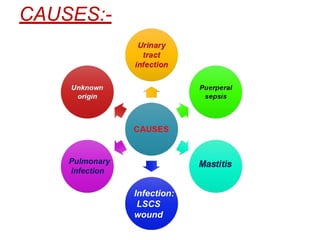
CAUSES:-
Infection:
LSCS
wound
Pulmonary
infection
PUERPERAL SEPSIS
• “An infection of the genital tract
which occurs as a complication of
delivery is termed puerperal
sepsis.”
• Puerperal pyrexia is considered to
be due to genital tract infection
unless proved otherwise.
INCEDENCE
• There is a marked decline in puerperal
sepsis during the past few years due
to:-
• Improved obstetric care
• Availability of wider range of
antibiotics
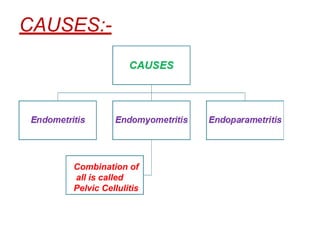
CAUSES:-
Combination of
all is called
Pelvic Cellulitis
PREDISPOSING FACTORS
• Damage of Cervicovaginal mucous
membrane
• Large placental wound surface area
• Blood clots presents at placental site
ANTEPARTUM FACTORS:
• Malnutrition and anaemia
• Preterm labour
• PROM
• Chronic illness
• Prolonged rupture of membrane >18
hours
INTRAPARTUM FACTORS:
• Repeated vaginal examinations
• Prolonged rupture of membranes
• Dehydration and keto- acidosis
during labour
• Traumatic operative delivery
• Haemorrhage
• Retained bits of placenta or
membranes
• Placenta previa
• Caesarean Section delivery
MICRO-ORGANISMS RESPONSIBLE
FOR PUERPERL SEPSIS
•AEROBIC:-
•Streptococcus hemolytic group- A
•Streptococcus hemolytic group - B
•Others: Streptococcus pyogenus, aureus, E coli,
Pseudomonas, chlamydia
•ANAEROBIC:-
•Streptococcus, peptococcus, bacteriodes
MODE OF INFECTION
• Puerperal sepsis is essentially a wound
infection
• Placental site, lacerations of the genital
tract or cesarean section wounds
• It may get infected by ENDOGENOUS or
EXOGENOUS organisms.
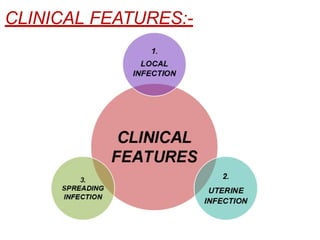
CLINICAL FEATURES:-
1. LOCAL INFECTION
• Slight temperature rise
• Generalized malaise
• Headache
• Redness and swelling to local
wound
• Pus formation
2. UTERINE INFECTION
MILD:-
• Rise in temperature and pulse rate
• Offensive and copious lochial
discharge
• Subinvoluted and tender uterus
• SEVERE:-
• Acute onset with high grade
temperature with chills and rigor
• Rapid pulse rate
• Scanty and orderless lochia
3. SPREADING INFECTION
• Parametritis
• Pelvic pritonitis
• General
peritonitis
• Thrombophlebit
is
• Septicemia
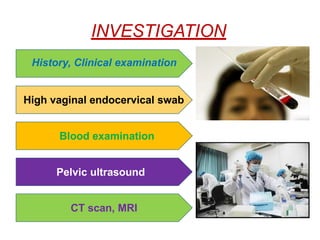
INVESTIGATION
History, Clinical examination
High vaginal endocervical swab
Blood examination
Pelvic ultrasound
CT scan, MRI
PROPHYLAXIS
ANTENATAL:
• Improvement of nutritional status
• Eradication of any septic status
• INTRANATAL:
• Full surgical asepsis during labour
• Prophylactic antibiotics: Cefriaxone 1g
IV immediate after cord clamping and
second dose: after 8 hour is
recommended
POSTNATAL:
• Aseptic precautions atleast one
week following delivery
• Too many visitors are restricted
• Sterilized senitory pads are to be
used
• Infected babies and mothers should
be in isolated room
GENERAL CARE:-
• Isolation of the patient.
• Adequate fluid and calorie (IV).
• Corrected anaemia.
• Progress chart should be
maintained.
TREATMENT
ANTIBIOTICS
• Gentamicin, 2 mg/kg IV loading
dose followed by 1.5 mg/kg IV
every 8 hours
• Ampicillin, 1g IV every 6 hours
• Clindamycin 900 mg, IV every 8
hours
• Cefotaxime 1 g, 8 hourly IV is an
alternative
• Metronidazole 0.5 g IV, 8 hourly
PERINEAL WOUND:-
• Stiches of perineal wound may have
to be removed to facilitate drainage
of pus and relieve pain.
• Wound has to be cleaned with sitz
bath several times per day and
dressed with antiseptic ointment or
powder.
• After the infection is controlled,
secondary wound closure may be
done on later date.
SURGICAL TREATMENT
RETAINED UTERINE PRODUCTS:-
• With diameter of 3 cm or less may be
disregarded or left alone
• Other wise surgical evacuation after
antibiotic coverage for 24 hours should be
done to avoid risk of septicemia
• SEPTIC THROMBOPHLEBITIS:-
• IV Heparin for 7-10 days
PELVIC ABCESS:-
• Drainage by colpotomy under
ultrasound guidance
WOUND DEHISCENCE:
• Dehiscence of episiotomy or abdominal
wound following caesarean section:-
• Scrubbing the wound
• Debridement of all necrotic tissues
• Secondary suture
• LAPAROTOMY:
• Has got limited indications
• IV fluids and antibiotics usually
controls the peritonitis
• When the peritonitis is unresponsible
to antibiotics laprotomy is indicated
• HYSTERECTOMY:
• In case of uterine rupture or
perforation
• Multiple abcess, gangrenous uterus
• Ruptured tubo-ovarian abcess
NECROTYSING FASCITIS:
• Wound scrubbing
• Debridement of all necrotic tissues
• Use of effective antimicrobial agents
• BACTEREMIC OR SEPTIC SHOCK:
• Fluid and electrolyte balance
• Respiratory supports
• Circulatory support (dopamine/
dobutamine)
• Infection control
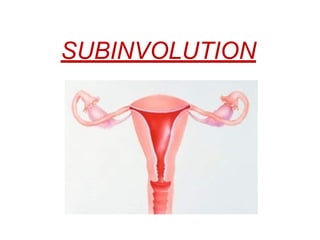
SUBINVOLUTION
DEFINITION
• “When the involution is impaired
or retarded it is called
subinvolution”
• The uterus is the most common
organ
CAUSES
PREDISPOSING FACTORS:
• Grand multipara
• Over distention of
uterus
• Maternal ill health
• Caesarean section
• Prolapse of the uterus
• Retroversion
• Uterine fibroid
CAUSES
AGGRAVATING FACTORS:-
• Retained products of
conception
• Uterine sepsis (Endometritis)
SYMPTOMS
• May be asymptomatic sometimes
• Abnormal lochial discharge : excessive or
prolonged
• Irregular at times excessive uterine
bleeding
• Irregular cramp like pain
• Rise of temperature in case of sepsis
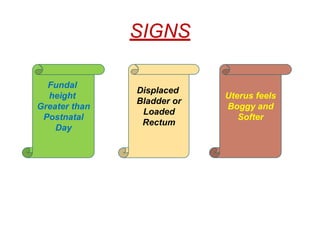
SIGNS
Fundal
height
Greater than
Postnatal
Day
Uterus feels
Boggy and
Softer
Displaced
Bladder or
Loaded
Rectum
MANAGEMENT
• Antibiotics in case of infection
• Exploration of uterus for
retained products
• Pessary in prolapse or
retroversion
• Methergine to enhance
involution process
URINARY
COMPLICATIONS IN
PUERPERIUM
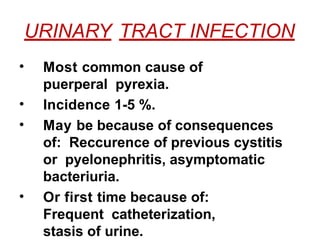
URINARY TRACT INFECTION
• Most common cause of
puerperal pyrexia.
• Incidence 1-5 %.
• May be because of consequences
of: Reccurence of previous cystitis
or pyelonephritis, asymptomatic
bacteriuria.
• Or first time because of:
Frequent catheterization,
stasis of urine.
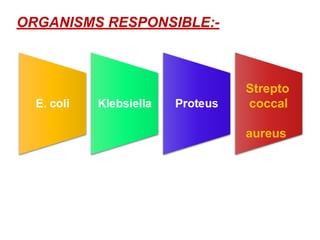
ORGANISMS RESPONSIBLE:-
Strepto
coccal
aureus
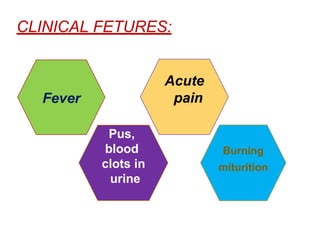
CLINICAL FETURES:
Fever
Pus,
blood
clots in
urine
Acute
pain
Burning
miturition
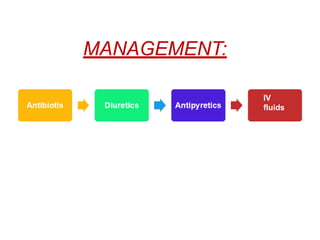
MANAGEMENT:
IV
fluids
RETENTION OF URINE
Common complication in early
puerperium.
CAUSES:
• Bruising
• Edema of bladder neck
• Reflex from the perineal
injury
• An accustomised position
TREATMENT
• Indwelling catheter for 48 hours
• Following removal of a catheter
recidual urine is to be measured
• If it is more than 100 ml
drainage is resumed
• Appropriate urinary antiseptics up to
5-7 days
INCONTENENCE OF URINE
• Not a common symptom following
birth
• It may be:-
• Stress incontenence (late
puerperium)
• Overflow incontenence
( following retention of urine)
• True incontenence (soon
SUPRESSION OF URINE
• “If the 24 hours urine excretion is
less than 400 ml or less, supression
of urine is diagnosed.”
• The cause is to be sought for and
appropriate management is
instituted.
BREAST
COMPLICATIONS
COMMON COMPLICATIONS
Breast engorgement
Cracked and inverted nipples
Mastitis and breast abscess
Lactation failure
BREAST ENGORGEMENT
• Breast engorgement is due to
exaggerated normal venous and
lymphatic engorgement of the breasts
which precedes lactation.
• This in turn prevents escape of milk
from the lacteal system
• The primiparous patient and the
patient with inelastic breasts are
more likely develop breast
engorgement
• Engorgement is an indication that
the baby is not in step with stage
of lactation
ONSET:
• It usually manifests after the milk
secretion starts ( 3r
dand 4t
hday
postpartm)
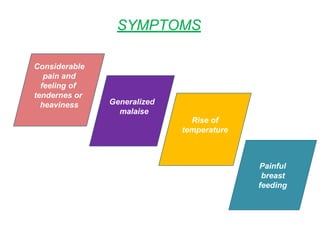
SYMPTOMS
Considerable
pain and
feeling of
tendernes or
heaviness Generalized
malaise
Painful
breast
feeding
Rise of
temperature
PREVENTION:
• Avoid prelecteal feeds
• Initiate early breast feeding
• Exclusive breast feeding on
demand
• Feeding in correct position
TREATMENT:
• Support with the binders
• Mannual expression of milk
• Administer analgesics for pain
• Frequently and regular feeding
the baby
• In severe cases gentle use of
breast
• Warm compression
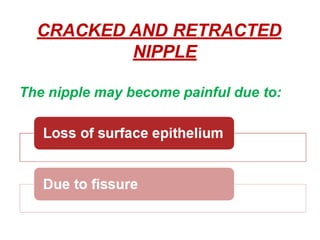
CRACKED AND RETRACTED
NIPPLE
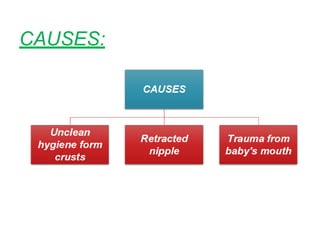
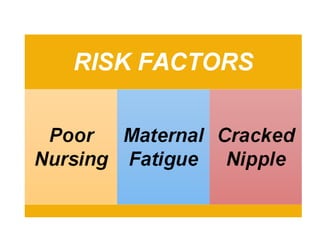
The nipple may become painful due to:
CAUSES:
SYMPTOMS
• Condition may remain
asymptomatic
• Sometimes painful when feeding
the baby
• When infected, the infection may
spread to the deeper tissue
proceding mastitis
PROPHYLAXIS
• Local cleanliness during
pregnancy and puerperium
• Clean the crusts before and
after feeding
• Application of lotion to soothen
the epithelium
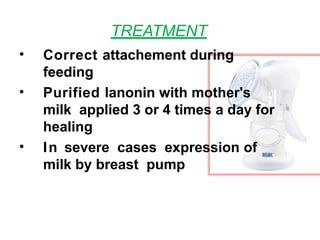
TREATMENT
• Correct attachement during
feeding
• Purified lanonin with mother's
milk applied 3 or 4 times a day for
healing
• In severe cases expression of
milk by breast pump
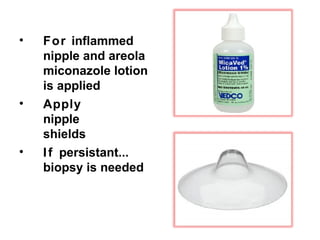
• For inflammed
nipple and areola
miconazole lotion
is applied
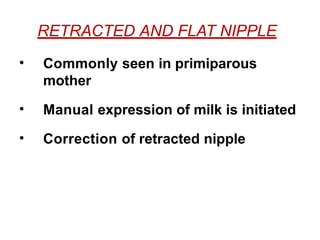
• Apply
nipple
shields
• If persistant...
biopsy is needed
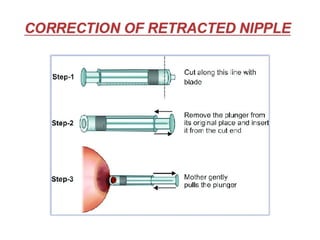
RETRACTED AND FLAT NIPPLE
• Commonly seen in primiparous
mother
• Manual expression of milk is initiated
• Correction of retracted nipple
ACUTE MASTITIS
• Incidence of mastitis is 2-5 %
in lactating women
• Less than 1% in nonlactating.
• Organisms involved are...
• Streptococcus aureus,
• S. epidermidis and
• Streptococci viridans
Mode of infection:
Two different types of mastitis based on
location of infection.
• Infection that involves the breast
paranchymal tissues leading to
cellulitis. (lacteal system remains
unaffected)
• Infection up to lactefarous
ducts...leads to development of
primary mammary adenitis
• Source of infection : infant's
nose/mouth
• Noninfected mastitis is due to
milk stasis.
• Feeding from the affected breast
can solve the problem
• ONSET:
• In superficial cellulitis, onset is
acute during first 2-4 weeks
postpartum
• However it may occur after
several weeks also
CLINICAL FEATURES
SYMPTOMS INCLUDE:
• Generalized malaise
and headache
• Fever ( 102 degree
F)
• Severe pain and tender
swelling
CLINICAL FEATURES
SIGNS INCLUDE:
• Presence of toxic features
• Redness of overlying skin and
swelling
• Warm and flushy
COMPLICATION
• Due to variable distruction of
breast tissues, it leads to the
formation of a breast abcess.
PROPHYLAXIS
• Hand washing before and after each feed,
maintaing hygiene, keep the breast and
nipple dry
MANAGEMENT
• Support by binders
• Plenty of oral fluids
• Good attachment when feeding the
baby
• Initiate feeding from uninfected breast
first to establish let down
• The infected site is emptied manually
with each feed
• Penicillins like flucloxacillin are is the
drugs of choice. 500 mg 6 hourly.
erythromycin is alternative
• Antibiotic therapy is to continue up to 7
days
• Analgesics
• Milk flow is maintained by feeding the
baby
• It will prevent proliferation of
staphylococcus in the stagnant milk
• The ingested staphylococcus will
be digested without any harm
BREAST ABCESS
FEATURES ARE:
• Flushed breasts not responding
to antibiotics
• Browny edema on the overlying
skin
• Marked tenderness with
fluctuation
• Swinging temperature
MANAGEMENT
• Incision and drainage under
general anaesthesia
• Deep radial incision extending
from near the areolar margin to
prevent injury of the lacteferous
ducts
• Incision perpendicular to the
lactiferous duct can increase the risk
of fistula formation and ductal
occlusion
• Finger exploration has to be done
to break the walls of loculi.
• The cavilty is loosely packed with
gause which should be replaced
after 24 hours by a smaller pack
• Continue till it heals up
• Abscess can also be drained by
serial percutaneous niddle
aspiration under ultrasound
guidance
• Surgical draiange is commonly
done
• Breast feeding is continued
at uninvolved side
• The infected side is mechanically
expressed by pump every two
hours and with every let down
• Recurrence risk is about 10 %
• Once cellulitis has resolved breast
feeding from the involved side may
be resumed
BREAST PAIN
May be due to....
• Engorgement
• Infection ( candida albicans)
• Nipple trauma
• Mastitis
• Occasionally on latching-on or
let down reflex
MANAGEMENT
• Appropriate nursing technique
• Positioning
• Breast care
• Use of myconazole oral lotion or gel
on the nipples and in infant's mouth
thrice daily for two weeks are helpful
LACTATION FAILURE
CAUSES ARE:
• Infrequent suckling
• Depression or anxiety state in
puerperium
• Unwilling to nursing
• Ill development of nipples
• Endogenous supression of prolactin
• Prolactin inhibition
MANAGEMENT
ANTENATAL:
• Counsell mother regading benefits
of nursing her baby
• To take care of any breast
abnormality.. breast engorgement
• Maintaining adequate breast
hygiene especially in the last two
months of pregnancy
PUERPERIUM:
• Encourage adequate fluid intake
• To nurse the baby regularly
• Treat the painfull local lesions to
prevent nursing phobia
• Metoclopramide 10 mg thrice daily,
intranasal oxytocin and sulpiride
( selective dopamine intagonist) has
been found to increase milk production.
• They act by stimulating prolactin
secretion
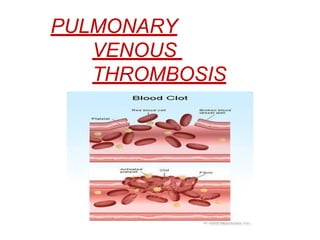
PULMONARY
VENOUS
THROMBOSIS
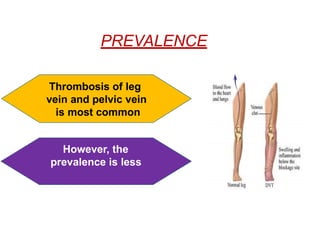
PREVALENCE
Thrombosis of leg
vein and pelvic vein
is most common
However, the
prevalence is less
RISK FACTORS
•Vascular stasis
Hypercoagulopathy of blood
Vascular endothelial trauma
•Other pregnancy related factors
•Venous thrombo-embolic disease like.. deep
vein thrombosis, thrombophlebitis, pulmonary
embolism
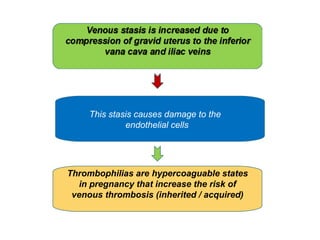
This stasis causes damage to the
endothelial cells
Thrombophilias are hypercoaguable states
in pregnancy that increase the risk of
venous thrombosis (inherited / acquired)
DEEP VEIN THROMBOSIS
• Clinical diagnosis is unreliable.
• In majority it remains
asymptomatic
• SYMPTOMS INCLUDE:
• Pain in the caff muscles
• On examination asymmentric
leg edema
• A positive Homan's sign
INVESTIGATIONS
• Doppler utrasound
• VUS- venous
utrasonography
• Venography
• MRI
PELVIC THROMBOPHLEBITIS
• Originates in the thrombosed veins
at placental site by organisms such
as an anaerobic streptococci or
bacteriosides
• When localised in the pelvis its
called pelvic thrombophlebitis.
• There is specific features but it
is suspected when there is
constatnt fever inspite of
antibiotics administration.
EXTRA PELVIC SPREAD
• Through the right ovarian vein to
inferior vana cava and hence to the
lungs
• Through left ovarian vein to left renal
vein and hence to the left kidney
• Retrograde extension to iliofemoral
veins to produce the clinical pathological
entity called “phlegmasia alba dolens”
( adjacent cellulitis in femoral vein)
CLINICAL FEATURES:
• Usually develops in second week of
puerperium
• Mild pyrexia
• High grade fever with chills and rigor
• Constitutional disturbances like...
headache, malaise, rising pulse rate
• Swelling, pain, white , cold over
affected leg
PROPHYLAXIS
• PREVENTIVE MEASURES:
• Prevention of trauma, sepsis,
anemia, dehydration
• Use of elastic compression
stocking
• Leg exercise, Early ambulation
MANAGEMENT
• Bed rest with foot end kept higher
to heart level
• Pain management
• Antibiotics
• Anticoagulants- Heparin- 15000 units
IV followed by 10,000 units 6-8 hourly
for 4 to 6 injections. up to 7 to 10
days
• Administration of fibrinolytic agents
• Venous thrombectomy
PULMONARY EMBOLISM
• Classical symptoms of massive
pulmonary embolism are...
• Sudden collapse
• Acute chest pain
• Air hunger
• Death usually occurs within short time
from shock and vagal inhibition
Important signs...
• Tachypnea
• Dyspnoea
• Pleuritis- chest pain
• Cough
• Tachycardia
• Haemoptysis
• Rise in temperature
DIAGNOSIS
• ECG
• Arterial blood gas
• D-Dimer: value (More than 500 ng/ mL)
• Doppler utrasound
• Lung scans
• Pulmonary CT angiography
• MRA: Magnetic resonance angiography
MANAGEMENT
• Prophylactic measures
• Active treatment:
• Resuscitation: cardiac massage, oxygen
therapy, heparin bolus IV of 5000 units and
morphine 15 mg
• IV fluids
• Incase of recurrent.. embolectomy,
placement of caval filters, ligation of inferior
vana cava and ovarian veins
OBSTETRIC PALSIES
(Syn.POSTPARTUM TRAUMATIC NEURITIS)
• The commonest form of obstetric
palsy encountered in puerperium
is...
“FOOT DROP”
• Usually unilateral
• Appears shortly after delivery/ first
day postpartum
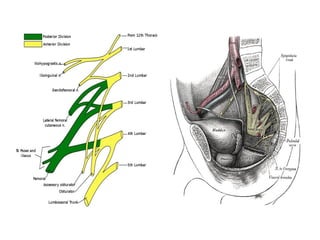
• It is due to stretching of the
lumbosacral trunk by the
prolapsed intervertebral disc
between L5 and S1
• Backward rotation of the
sacrum during labour may
also be a contributory factor
• Direct pressure either by fetal head
or forcep blade on the lumbosacral
cord or sacral plexus
• Condition is usually mild
• May pass unnoticed
• Neurological examination reveals
lower motor neurone type of lesions
with placcidity and wasting of
muscles in areas supplied by femoral
nerve or lumbosacral plexus
• Secondary loss is always present
• Management of damaged
lumbosacral nerve roots is same as
that of the proplapsed
intervertebral disc in consultation
with an orthopaedic surgeon.
• Paraplegia due to epidural
haematoma or abcess is rare.
PUERPERAL
EMERGENCIES
• There are many acute
complications
• Majority of them are
alarming complications
• Arises immediately after
delivery
• Except pulmonary
embolism
Common complications are;
IMMEDIATE:
• Postpartum haemorrhage
• Shock
• Postpartum pre/eclampsia
• Pulmonary embolism
• Uterine inversion.
EARLY (WITHIN A WEEK).
• Acute retention of urine
• Urinary tract infection
• Puerperal sepsis
• Breast engorgement
• Mastitis and breast abscess
• Pulmonary infection
• Anuria due to AKI following
abruptio placentae, mismatched
boold transfusion or
pre/eclampsia
DELAYED:
• Secondary postpartum
haemorrhage
• Thrombo-embolic manifestation
• Psychosis
• Postpartum cardiomyopathy
• Postpartum haemolytic
uremic syndrome
PSYCHIATRIC DISORDERS
DURING PUERPERIUM
INTRODUCTION
• In the first 3 months after delivery,
the incidence of mental illness is
high.
• Overall incidence is about 15-20%.
• Sleep deprivation, hormone
elevation near the end of gestation
and massive postpartum
withdrawal contribute to the high
risk
HIGH RISK FACTORS
PAST HISTORY:
• Psychiatric illness
• Puerperal psychiatric
illness
FAMILY HISTORY:
• Major psychiatric illness
• Marital conflicts
• Lack of social support
PRESENT PREGNANCY:
• Young age
• Caesarean delivery
• Difficult labour
• Neonatal complications
OTHERS:
• Unmet expectations
PUERPERAL BLUES
• It is transient state of mental
illness observed 4-5 days after
delivery
• Lasts for few days
• Incidence is 50 %
MANIFESTATIONS ARE:
• Depression
• Anxiety
• Tearfulness
• Insomnia
• Helplessness
• Negative feelings towards the infant
• No specific metabolic or endocrine
abnormalities detected
• But lowered troptophan (neurotransmitor
serotonin) level is observed. it indicats
altered neurotransmitter function
TREATMENT:
• Reassurance
• Psychological support by the
family members
POSTPARTUM DEPRESSION
• Observed in 10-20 % of
mothers
• More gradual in onset over the
first 4-6 months following
delivery or abortion
• Changes in the hypothalamo-
pitutary- adrenal axis may be
a cause
MANIFESTED BY:
• Loss of energy
• Loss of appetite
• Insomnia
• Social withdrawal
• Irritability
• Suicidal ideation
• Risk of reccurence is 50-100% in
subsequence pregnancies
TREATMENT:
• Is started early
• Fluoxetine or paroxetine
(Selective serotonin reuptake
inhibitors)
• General supportive measures
POSTPARTUM PSYCHOSIS
• Observed in 0.14-0.26 % of
mothers
• Commonly seen in women with
past history and family history
• Onset is relatively sudden
• Lasts for 4 days
MANIFESTED BY:
• Fear
• Restlessness
• Confusion followed by
hallucinations, delusions and
disorientation
• Suicidal, infanticidal ideation
• Temporary seperation and
clinical supervision is needed
• Risk for reccurence 20-25%
MANAGEMENT
• A psychiatrist must be consulted urgently
• Hospitalization is needed
• Chlopramazine 150 mg stat and 50-150
mg three time /day is started
• Sublingual estradiol 1 mg TDS
causes significant improvement
• Electro convulsive therapy if remains
unresponsive or in depressive psychosis
• Lithium in manic depressive psychosis
• Breast feeding is restricted in case of
lithium administration
PSYCHOLOGICAL RESPONSES TO THE
PERINATAL DEATHS AND MANAGEMENT
• Most perinatal events are joyful
• But when a fetal /neonatal death
occurs, social attention must be given
to grieving parents and family
• It may also be because of
unexcpected hysterectomy, birth of
malformed or chronically ill infant
• Prolonged seperation from chronically
ill infant can also cause grief
Physician, nurse and attending staff
must understand patient's reaction
The common maternal somatic
symptoms are;
• Insomnia
• Fatigue
• Sighing respiration
• Feeling of guilt
• Anger
• Hostility ( feeling of
opposition)
MANAGEMENT OF PERINATAL
GRIEVING
• Facilitating grieving process with
consolation (comfort), support,
sympathy
• Others are:
• Supporting the couple in seeing/ holding/
taking photographs of infant
• Autopsy requests
• Planning investigations
• Follow up visits
• Plan for subsequent pregnancy
THANK YOU

ABNORMAL PUERPERIUM PRESENTATION. 6 weeks

  • 1.
  • 2.
    ABNORMALITIES OF THEPUERPERIUM • Puerperal Pyrexia. • Puerperal Sepsis. • Subinvolution. • Urinary complications: UTI, Urinary Retention, Urinary Incontinence, Urinary Suppression • Breast Complications: Breast Engorgement, Cracked & Retracted Nipples, Acute Mastitis • Puerperal Venous Thrombosis & pulmonary embolism. • Puerperal emergencies, obstetric palsies, Psychiatric disorders during puerperium.
  • 3.
    PUERPERAL PYREXIA • “A rise of temperature reaching 100.4 degree F or more (Measured orally) on two separate occasions 24 hours apart (excluding first 24 hours) within the first 10 days following delivery is called Puerperal pyrexia” • In some countries postabortal fever is also included.
  • 4.
  • 5.
    PUERPERAL SEPSIS • “Aninfection of the genital tract which occurs as a complication of delivery is termed puerperal sepsis.” • Puerperal pyrexia is considered to be due to genital tract infection unless proved otherwise.
  • 6.
    INCEDENCE • There isa marked decline in puerperal sepsis during the past few years due to:- • Improved obstetric care • Availability of wider range of antibiotics
  • 7.
    CAUSES:- Combination of all iscalled Pelvic Cellulitis
  • 8.
    PREDISPOSING FACTORS • Damageof Cervicovaginal mucous membrane • Large placental wound surface area • Blood clots presents at placental site ANTEPARTUM FACTORS: • Malnutrition and anaemia • Preterm labour • PROM • Chronic illness • Prolonged rupture of membrane >18 hours
  • 9.
    INTRAPARTUM FACTORS: • Repeatedvaginal examinations • Prolonged rupture of membranes • Dehydration and keto- acidosis during labour • Traumatic operative delivery • Haemorrhage • Retained bits of placenta or membranes • Placenta previa • Caesarean Section delivery
  • 10.
    MICRO-ORGANISMS RESPONSIBLE FOR PUERPERLSEPSIS •AEROBIC:- •Streptococcus hemolytic group- A •Streptococcus hemolytic group - B •Others: Streptococcus pyogenus, aureus, E coli, Pseudomonas, chlamydia •ANAEROBIC:- •Streptococcus, peptococcus, bacteriodes
  • 11.
    MODE OF INFECTION •Puerperal sepsis is essentially a wound infection • Placental site, lacerations of the genital tract or cesarean section wounds • It may get infected by ENDOGENOUS or EXOGENOUS organisms.
  • 12.
  • 13.
    1. LOCAL INFECTION •Slight temperature rise • Generalized malaise • Headache • Redness and swelling to local wound • Pus formation
  • 14.
    2. UTERINE INFECTION MILD:- •Rise in temperature and pulse rate • Offensive and copious lochial discharge • Subinvoluted and tender uterus • SEVERE:- • Acute onset with high grade temperature with chills and rigor • Rapid pulse rate • Scanty and orderless lochia
  • 15.
    3. SPREADING INFECTION •Parametritis • Pelvic pritonitis • General peritonitis • Thrombophlebit is • Septicemia
  • 16.
    INVESTIGATION History, Clinical examination Highvaginal endocervical swab Blood examination Pelvic ultrasound CT scan, MRI
  • 17.
    PROPHYLAXIS ANTENATAL: • Improvement ofnutritional status • Eradication of any septic status • INTRANATAL: • Full surgical asepsis during labour • Prophylactic antibiotics: Cefriaxone 1g IV immediate after cord clamping and second dose: after 8 hour is recommended
  • 18.
    POSTNATAL: • Aseptic precautionsatleast one week following delivery • Too many visitors are restricted • Sterilized senitory pads are to be used • Infected babies and mothers should be in isolated room
  • 19.
    GENERAL CARE:- • Isolationof the patient. • Adequate fluid and calorie (IV). • Corrected anaemia. • Progress chart should be maintained. TREATMENT
  • 20.
    ANTIBIOTICS • Gentamicin, 2mg/kg IV loading dose followed by 1.5 mg/kg IV every 8 hours • Ampicillin, 1g IV every 6 hours • Clindamycin 900 mg, IV every 8 hours • Cefotaxime 1 g, 8 hourly IV is an alternative • Metronidazole 0.5 g IV, 8 hourly
  • 21.
    PERINEAL WOUND:- • Stichesof perineal wound may have to be removed to facilitate drainage of pus and relieve pain. • Wound has to be cleaned with sitz bath several times per day and dressed with antiseptic ointment or powder. • After the infection is controlled, secondary wound closure may be done on later date. SURGICAL TREATMENT
  • 22.
    RETAINED UTERINE PRODUCTS:- •With diameter of 3 cm or less may be disregarded or left alone • Other wise surgical evacuation after antibiotic coverage for 24 hours should be done to avoid risk of septicemia • SEPTIC THROMBOPHLEBITIS:- • IV Heparin for 7-10 days
  • 23.
    PELVIC ABCESS:- • Drainageby colpotomy under ultrasound guidance WOUND DEHISCENCE: • Dehiscence of episiotomy or abdominal wound following caesarean section:- • Scrubbing the wound • Debridement of all necrotic tissues • Secondary suture
  • 24.
    • LAPAROTOMY: • Hasgot limited indications • IV fluids and antibiotics usually controls the peritonitis • When the peritonitis is unresponsible to antibiotics laprotomy is indicated • HYSTERECTOMY: • In case of uterine rupture or perforation • Multiple abcess, gangrenous uterus • Ruptured tubo-ovarian abcess
  • 25.
    NECROTYSING FASCITIS: • Woundscrubbing • Debridement of all necrotic tissues • Use of effective antimicrobial agents • BACTEREMIC OR SEPTIC SHOCK: • Fluid and electrolyte balance • Respiratory supports • Circulatory support (dopamine/ dobutamine) • Infection control
  • 26.
  • 27.
    DEFINITION • “When theinvolution is impaired or retarded it is called subinvolution” • The uterus is the most common organ
  • 28.
    CAUSES PREDISPOSING FACTORS: • Grandmultipara • Over distention of uterus • Maternal ill health • Caesarean section • Prolapse of the uterus • Retroversion • Uterine fibroid
  • 29.
    CAUSES AGGRAVATING FACTORS:- • Retainedproducts of conception • Uterine sepsis (Endometritis)
  • 30.
    SYMPTOMS • May beasymptomatic sometimes • Abnormal lochial discharge : excessive or prolonged • Irregular at times excessive uterine bleeding • Irregular cramp like pain • Rise of temperature in case of sepsis
  • 31.
    SIGNS Fundal height Greater than Postnatal Day Uterus feels Boggyand Softer Displaced Bladder or Loaded Rectum
  • 32.
    MANAGEMENT • Antibiotics incase of infection • Exploration of uterus for retained products • Pessary in prolapse or retroversion • Methergine to enhance involution process
  • 33.
  • 34.
    URINARY TRACT INFECTION •Most common cause of puerperal pyrexia. • Incidence 1-5 %. • May be because of consequences of: Reccurence of previous cystitis or pyelonephritis, asymptomatic bacteriuria. • Or first time because of: Frequent catheterization, stasis of urine.
  • 35.
  • 36.
  • 37.
  • 38.
    RETENTION OF URINE Commoncomplication in early puerperium. CAUSES: • Bruising • Edema of bladder neck • Reflex from the perineal injury • An accustomised position
  • 39.
    TREATMENT • Indwelling catheterfor 48 hours • Following removal of a catheter recidual urine is to be measured • If it is more than 100 ml drainage is resumed • Appropriate urinary antiseptics up to 5-7 days
  • 40.
    INCONTENENCE OF URINE •Not a common symptom following birth • It may be:- • Stress incontenence (late puerperium) • Overflow incontenence ( following retention of urine) • True incontenence (soon
  • 41.
    SUPRESSION OF URINE •“If the 24 hours urine excretion is less than 400 ml or less, supression of urine is diagnosed.” • The cause is to be sought for and appropriate management is instituted.
  • 42.
  • 43.
    COMMON COMPLICATIONS Breast engorgement Crackedand inverted nipples Mastitis and breast abscess Lactation failure
  • 44.
    BREAST ENGORGEMENT • Breastengorgement is due to exaggerated normal venous and lymphatic engorgement of the breasts which precedes lactation. • This in turn prevents escape of milk from the lacteal system
  • 45.
    • The primiparouspatient and the patient with inelastic breasts are more likely develop breast engorgement • Engorgement is an indication that the baby is not in step with stage of lactation ONSET: • It usually manifests after the milk secretion starts ( 3r dand 4t hday postpartm)
  • 46.
    SYMPTOMS Considerable pain and feeling of tendernesor heaviness Generalized malaise Painful breast feeding Rise of temperature
  • 47.
    PREVENTION: • Avoid prelectealfeeds • Initiate early breast feeding • Exclusive breast feeding on demand • Feeding in correct position
  • 48.
    TREATMENT: • Support withthe binders • Mannual expression of milk • Administer analgesics for pain • Frequently and regular feeding the baby • In severe cases gentle use of breast • Warm compression
  • 49.
    CRACKED AND RETRACTED NIPPLE Thenipple may become painful due to:
  • 50.
  • 51.
    SYMPTOMS • Condition mayremain asymptomatic • Sometimes painful when feeding the baby • When infected, the infection may spread to the deeper tissue proceding mastitis
  • 52.
    PROPHYLAXIS • Local cleanlinessduring pregnancy and puerperium • Clean the crusts before and after feeding • Application of lotion to soothen the epithelium
  • 53.
    TREATMENT • Correct attachementduring feeding • Purified lanonin with mother's milk applied 3 or 4 times a day for healing • In severe cases expression of milk by breast pump
  • 54.
    • For inflammed nippleand areola miconazole lotion is applied • Apply nipple shields • If persistant... biopsy is needed
  • 55.
    RETRACTED AND FLATNIPPLE • Commonly seen in primiparous mother • Manual expression of milk is initiated • Correction of retracted nipple
  • 57.
    ACUTE MASTITIS • Incidenceof mastitis is 2-5 % in lactating women • Less than 1% in nonlactating. • Organisms involved are... • Streptococcus aureus, • S. epidermidis and • Streptococci viridans
  • 59.
    Mode of infection: Twodifferent types of mastitis based on location of infection. • Infection that involves the breast paranchymal tissues leading to cellulitis. (lacteal system remains unaffected) • Infection up to lactefarous ducts...leads to development of primary mammary adenitis
  • 60.
    • Source ofinfection : infant's nose/mouth • Noninfected mastitis is due to milk stasis. • Feeding from the affected breast can solve the problem • ONSET: • In superficial cellulitis, onset is acute during first 2-4 weeks postpartum • However it may occur after several weeks also
  • 61.
    CLINICAL FEATURES SYMPTOMS INCLUDE: •Generalized malaise and headache • Fever ( 102 degree F) • Severe pain and tender swelling
  • 62.
    CLINICAL FEATURES SIGNS INCLUDE: •Presence of toxic features • Redness of overlying skin and swelling • Warm and flushy
  • 63.
    COMPLICATION • Due tovariable distruction of breast tissues, it leads to the formation of a breast abcess.
  • 64.
    PROPHYLAXIS • Hand washingbefore and after each feed, maintaing hygiene, keep the breast and nipple dry
  • 65.
    MANAGEMENT • Support bybinders • Plenty of oral fluids • Good attachment when feeding the baby • Initiate feeding from uninfected breast first to establish let down • The infected site is emptied manually with each feed • Penicillins like flucloxacillin are is the drugs of choice. 500 mg 6 hourly. erythromycin is alternative
  • 66.
    • Antibiotic therapyis to continue up to 7 days • Analgesics • Milk flow is maintained by feeding the baby • It will prevent proliferation of staphylococcus in the stagnant milk • The ingested staphylococcus will be digested without any harm
  • 67.
    BREAST ABCESS FEATURES ARE: •Flushed breasts not responding to antibiotics • Browny edema on the overlying skin • Marked tenderness with fluctuation • Swinging temperature
  • 68.
    MANAGEMENT • Incision anddrainage under general anaesthesia • Deep radial incision extending from near the areolar margin to prevent injury of the lacteferous ducts • Incision perpendicular to the lactiferous duct can increase the risk of fistula formation and ductal occlusion
  • 69.
    • Finger explorationhas to be done to break the walls of loculi. • The cavilty is loosely packed with gause which should be replaced after 24 hours by a smaller pack • Continue till it heals up • Abscess can also be drained by serial percutaneous niddle aspiration under ultrasound guidance • Surgical draiange is commonly done
  • 70.
    • Breast feedingis continued at uninvolved side • The infected side is mechanically expressed by pump every two hours and with every let down • Recurrence risk is about 10 % • Once cellulitis has resolved breast feeding from the involved side may be resumed
  • 71.
    BREAST PAIN May bedue to.... • Engorgement • Infection ( candida albicans) • Nipple trauma • Mastitis • Occasionally on latching-on or let down reflex
  • 72.
    MANAGEMENT • Appropriate nursingtechnique • Positioning • Breast care • Use of myconazole oral lotion or gel on the nipples and in infant's mouth thrice daily for two weeks are helpful
  • 73.
    LACTATION FAILURE CAUSES ARE: •Infrequent suckling • Depression or anxiety state in puerperium • Unwilling to nursing • Ill development of nipples • Endogenous supression of prolactin • Prolactin inhibition
  • 74.
    MANAGEMENT ANTENATAL: • Counsell motherregading benefits of nursing her baby • To take care of any breast abnormality.. breast engorgement • Maintaining adequate breast hygiene especially in the last two months of pregnancy
  • 75.
    PUERPERIUM: • Encourage adequatefluid intake • To nurse the baby regularly • Treat the painfull local lesions to prevent nursing phobia • Metoclopramide 10 mg thrice daily, intranasal oxytocin and sulpiride ( selective dopamine intagonist) has been found to increase milk production. • They act by stimulating prolactin secretion
  • 76.
  • 77.
    PREVALENCE Thrombosis of leg veinand pelvic vein is most common However, the prevalence is less
  • 78.
    RISK FACTORS •Vascular stasis Hypercoagulopathyof blood Vascular endothelial trauma •Other pregnancy related factors •Venous thrombo-embolic disease like.. deep vein thrombosis, thrombophlebitis, pulmonary embolism
  • 79.
    This stasis causesdamage to the endothelial cells Thrombophilias are hypercoaguable states in pregnancy that increase the risk of venous thrombosis (inherited / acquired)
  • 80.
    DEEP VEIN THROMBOSIS •Clinical diagnosis is unreliable. • In majority it remains asymptomatic • SYMPTOMS INCLUDE: • Pain in the caff muscles • On examination asymmentric leg edema • A positive Homan's sign
  • 81.
    INVESTIGATIONS • Doppler utrasound •VUS- venous utrasonography • Venography • MRI
  • 82.
    PELVIC THROMBOPHLEBITIS • Originatesin the thrombosed veins at placental site by organisms such as an anaerobic streptococci or bacteriosides • When localised in the pelvis its called pelvic thrombophlebitis. • There is specific features but it is suspected when there is constatnt fever inspite of antibiotics administration.
  • 83.
    EXTRA PELVIC SPREAD •Through the right ovarian vein to inferior vana cava and hence to the lungs • Through left ovarian vein to left renal vein and hence to the left kidney • Retrograde extension to iliofemoral veins to produce the clinical pathological entity called “phlegmasia alba dolens” ( adjacent cellulitis in femoral vein)
  • 84.
    CLINICAL FEATURES: • Usuallydevelops in second week of puerperium • Mild pyrexia • High grade fever with chills and rigor • Constitutional disturbances like... headache, malaise, rising pulse rate • Swelling, pain, white , cold over affected leg
  • 85.
    PROPHYLAXIS • PREVENTIVE MEASURES: •Prevention of trauma, sepsis, anemia, dehydration • Use of elastic compression stocking • Leg exercise, Early ambulation
  • 86.
    MANAGEMENT • Bed restwith foot end kept higher to heart level • Pain management • Antibiotics • Anticoagulants- Heparin- 15000 units IV followed by 10,000 units 6-8 hourly for 4 to 6 injections. up to 7 to 10 days • Administration of fibrinolytic agents • Venous thrombectomy
  • 87.
    PULMONARY EMBOLISM • Classicalsymptoms of massive pulmonary embolism are... • Sudden collapse • Acute chest pain • Air hunger • Death usually occurs within short time from shock and vagal inhibition
  • 88.
    Important signs... • Tachypnea •Dyspnoea • Pleuritis- chest pain • Cough • Tachycardia • Haemoptysis • Rise in temperature
  • 89.
    DIAGNOSIS • ECG • Arterialblood gas • D-Dimer: value (More than 500 ng/ mL) • Doppler utrasound • Lung scans • Pulmonary CT angiography • MRA: Magnetic resonance angiography
  • 90.
    MANAGEMENT • Prophylactic measures •Active treatment: • Resuscitation: cardiac massage, oxygen therapy, heparin bolus IV of 5000 units and morphine 15 mg • IV fluids • Incase of recurrent.. embolectomy, placement of caval filters, ligation of inferior vana cava and ovarian veins
  • 91.
    OBSTETRIC PALSIES (Syn.POSTPARTUM TRAUMATICNEURITIS) • The commonest form of obstetric palsy encountered in puerperium is... “FOOT DROP” • Usually unilateral • Appears shortly after delivery/ first day postpartum
  • 92.
    • It isdue to stretching of the lumbosacral trunk by the prolapsed intervertebral disc between L5 and S1 • Backward rotation of the sacrum during labour may also be a contributory factor • Direct pressure either by fetal head or forcep blade on the lumbosacral cord or sacral plexus
  • 94.
    • Condition isusually mild • May pass unnoticed • Neurological examination reveals lower motor neurone type of lesions with placcidity and wasting of muscles in areas supplied by femoral nerve or lumbosacral plexus • Secondary loss is always present
  • 95.
    • Management ofdamaged lumbosacral nerve roots is same as that of the proplapsed intervertebral disc in consultation with an orthopaedic surgeon. • Paraplegia due to epidural haematoma or abcess is rare.
  • 96.
  • 97.
    • There aremany acute complications • Majority of them are alarming complications • Arises immediately after delivery • Except pulmonary embolism
  • 98.
    Common complications are; IMMEDIATE: •Postpartum haemorrhage • Shock • Postpartum pre/eclampsia • Pulmonary embolism • Uterine inversion.
  • 99.
    EARLY (WITHIN AWEEK). • Acute retention of urine • Urinary tract infection • Puerperal sepsis • Breast engorgement • Mastitis and breast abscess • Pulmonary infection • Anuria due to AKI following abruptio placentae, mismatched boold transfusion or pre/eclampsia
  • 100.
    DELAYED: • Secondary postpartum haemorrhage •Thrombo-embolic manifestation • Psychosis • Postpartum cardiomyopathy • Postpartum haemolytic uremic syndrome
  • 101.
  • 102.
    INTRODUCTION • In thefirst 3 months after delivery, the incidence of mental illness is high. • Overall incidence is about 15-20%. • Sleep deprivation, hormone elevation near the end of gestation and massive postpartum withdrawal contribute to the high risk
  • 103.
    HIGH RISK FACTORS PASTHISTORY: • Psychiatric illness • Puerperal psychiatric illness FAMILY HISTORY: • Major psychiatric illness • Marital conflicts • Lack of social support
  • 104.
    PRESENT PREGNANCY: • Youngage • Caesarean delivery • Difficult labour • Neonatal complications OTHERS: • Unmet expectations
  • 105.
    PUERPERAL BLUES • Itis transient state of mental illness observed 4-5 days after delivery • Lasts for few days • Incidence is 50 %
  • 106.
    MANIFESTATIONS ARE: • Depression •Anxiety • Tearfulness • Insomnia • Helplessness • Negative feelings towards the infant • No specific metabolic or endocrine abnormalities detected • But lowered troptophan (neurotransmitor serotonin) level is observed. it indicats altered neurotransmitter function
  • 107.
    TREATMENT: • Reassurance • Psychologicalsupport by the family members
  • 108.
    POSTPARTUM DEPRESSION • Observedin 10-20 % of mothers • More gradual in onset over the first 4-6 months following delivery or abortion • Changes in the hypothalamo- pitutary- adrenal axis may be a cause
  • 109.
    MANIFESTED BY: • Lossof energy • Loss of appetite • Insomnia • Social withdrawal • Irritability • Suicidal ideation • Risk of reccurence is 50-100% in subsequence pregnancies
  • 110.
    TREATMENT: • Is startedearly • Fluoxetine or paroxetine (Selective serotonin reuptake inhibitors) • General supportive measures
  • 111.
    POSTPARTUM PSYCHOSIS • Observedin 0.14-0.26 % of mothers • Commonly seen in women with past history and family history • Onset is relatively sudden • Lasts for 4 days
  • 112.
    MANIFESTED BY: • Fear •Restlessness • Confusion followed by hallucinations, delusions and disorientation • Suicidal, infanticidal ideation • Temporary seperation and clinical supervision is needed • Risk for reccurence 20-25%
  • 113.
    MANAGEMENT • A psychiatristmust be consulted urgently • Hospitalization is needed • Chlopramazine 150 mg stat and 50-150 mg three time /day is started • Sublingual estradiol 1 mg TDS causes significant improvement • Electro convulsive therapy if remains unresponsive or in depressive psychosis • Lithium in manic depressive psychosis • Breast feeding is restricted in case of lithium administration
  • 114.
    PSYCHOLOGICAL RESPONSES TOTHE PERINATAL DEATHS AND MANAGEMENT • Most perinatal events are joyful • But when a fetal /neonatal death occurs, social attention must be given to grieving parents and family • It may also be because of unexcpected hysterectomy, birth of malformed or chronically ill infant • Prolonged seperation from chronically ill infant can also cause grief
  • 115.
    Physician, nurse andattending staff must understand patient's reaction The common maternal somatic symptoms are; • Insomnia • Fatigue • Sighing respiration • Feeling of guilt • Anger • Hostility ( feeling of opposition)
  • 116.
    MANAGEMENT OF PERINATAL GRIEVING •Facilitating grieving process with consolation (comfort), support, sympathy • Others are: • Supporting the couple in seeing/ holding/ taking photographs of infant • Autopsy requests • Planning investigations • Follow up visits • Plan for subsequent pregnancy
  • 117.