Sathvika Abinaya
Dr. Chamundeeswari Kuppuswamy
07.01.2016
Presentation at Government Music School, Salem – 302
From the perspective of a Bharathanatyam dancer
Structure of Lecture
 Aspects of Abinaya
 How to approach Abinaya in a Margham
 How to approach Abinaya in a creative piece
 Abinaya in other dance forms
 Essence of Abinaya
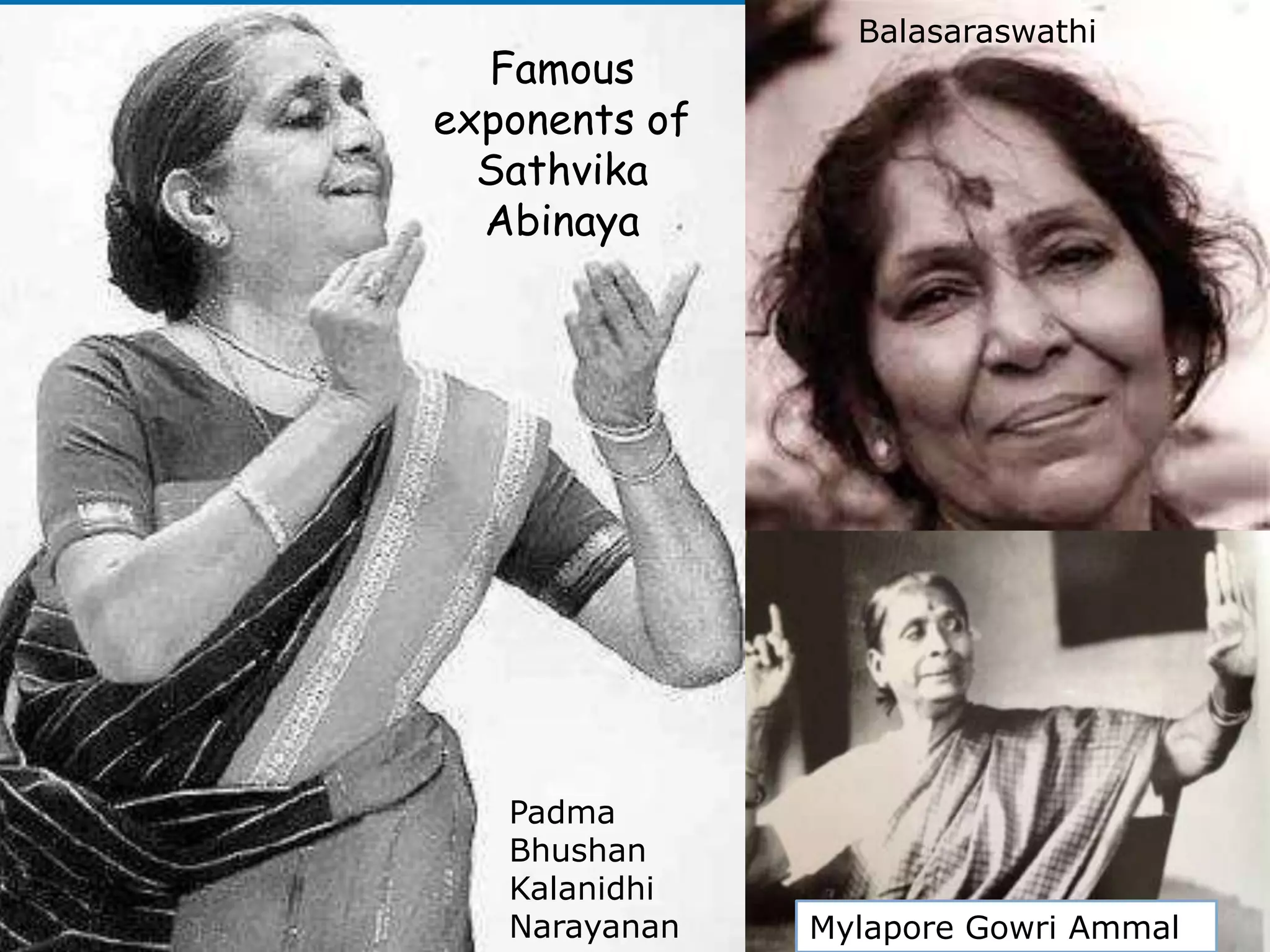
Famous
exponents of
Sathvika
Abinaya
Padma
Bhushan
Kalanidhi
Narayanan
Balasaraswathi
Mylapore Gowri Ammal
Aspects of Abinaya
 What is Abinaya?
Abinaya is central to Bharatanatyam
In fact, Bharatanatyam's earliest form, as mentioned in
the Natyashastra can be traced back to abinaya.
- Actor as Narrator ‘ Instead of many actors presenting a
dramatic story, the solo actor presents, through the four
types of abinaya, the particular dominant state
(sthayibhava)
- Kapila Vatsyayan, Indian Classical Dance, Ministry of
Information and Broadcasting Publication, New Delhi, 2nd ed.
1992, pg.21
 Many centuries later, during 1910-1930, when temple
dancing was banned, Bharatanatyam's revival was based
on the strength of abinaya.
 Balasaraswathi, Rukmini Devi and Kalanidhi Narayanan
gave a number of performances, which marked the
revival of Dasiattam. Balasaraswathi and Kalanidhi
Narayanan put abinaya on the highest pedestal in their
practice
What is excellence in Abhinaya?
 Most excellent poetry was that which was suggestive (Vyanjana)
and one in which sense ‘reverberated’ from the sound–
Anandavardana
 In excellent dancing ‘Reticence and economy are the hallmarks of
abhinaya’ - S. Guhan, Bala on Bharathanatyam, The Sruti
Foundation, Madras, 1991, pg.7
 Four aspects of economy in an excellent dancer’s abhinaya
– she limits the delineation to the highlights of the symbolic narration
- Abhinaya is emotion-oriented and not action-oriented
- The suggestions are brief
- She never lingers on a gesture and passes on to the next , never
allowing the abhinaya to sag by over-indulging any single symbol
(mudra), but presenting a kaleidoscopic variation from one to
another that shows the richness of her imagination
- S.Y. Krishnaswamy Bala: An Anniversary Tribute, Sruti Feb-March
1985)
 Types of Abhinaya
1. Anghika abinaya – expression by the body that is by hastas and movements of the
head, body, feet etc.
2. Sathvika abinaya – the expression of ideas of the inner feeling through the face
3. Aaharya abinaya – through the dress and make-up which is not adopted in
Bharatanatyam as the dancer does not change dress or make-up to suit the
character
4. Vachika abinaya – this is dealt with by vocal musician and nattuvanar
 Abinaya devoid of sathvika is like food without salt – Smt. Kalanidhi Narayanan
(mami), Abhinaya and Character Study, Source: From Mami’s collection of
papers
 Fundamental principles of Abhinaya
 Use of Mudras
 Music for dance
Indendhu Vachithivi ra - Navarasas
 Main mood – sarcasm
 Navarasas
- Adbhutham – Good gracious, how have you come here? This is not the street on
which she lives
- Shantam – Why have you come here? Your absent-mindedness has brought you
here
- Sringaram – Have you really come to the wrong house, her house is not here.
- Karuna – Poor thing! You have come to the wrong house, her house is just
down the street.
- Hasyam – Are you drunk? Have you lost your way this is nor that fat woman’s
house
- Bheebatsam – Keep away, I don’t want to even see your face which is smeared
with her kumkum
- Veeram – What do you take me for, I come from a noble family, I can live quite
independent of you. The door is there.
- Roudram – Don’t you dare show your face here again. Get out.
- Bhayam – Oh you are really angry, please forgive me, but this is not the house
you are searching for
Ashta nayikas
1. Vipralabdha – Feels cheated as her nayaka is not at the meeting place as promised (Netru varen
endru; vadarakha pove; mamiyam; sakhi prana)
2. Swaadeenapathikha or Bhartruka– One who is separated from her nayaka and is yearning for
reunion (Enta chakkani vade; smara sundaranguni)
3. Abisarikha – is one who boldly does out to meet her nayaka (Choodare; yarukhahilum bhayamen)
4. Kalahantharitha – is one who is repenting her hastiness is quarrelling with her nayaka, which has
resulted in their separation (manini vinave)
5. Kanditha – is one who is angry with her nayaka for causing disappointment (Muttavaddhu ra;
Idaivida Innum; Yahi Madhava; Ini enna pechchu; Indendhu vachchithivi ra; sake nimma snega;
varattum sami; ariven ayya; idai vida innum veru vendumo sakhi; vagaladi bodanalaku; edukanum
indha chaturya vaartaigal; saramaina maata; ellam ariven poomaiyya; inimel avarukkum enakkum;
ennilum aval enna stagiyamo; vanipendu chalu; chalu chalu vani nestanu; vakka kaina; kondagadu;
kopametula raka undunura; kadir kadippu iduven induvenno; ette irundhu pesum)
6. Virahothkanditha – is one who is separated from her nayaka and is yearning for reunion (Adi oka
yugamu; paiyadha; koi kahiyore; valapu thaala; sunthasepu; aligite adiyoka yugamu; mora
thopuseyaka; eppadi manam thunindhadho)
7. Proshitapathikha or Bhartrikha– is one suffering in the absence of her nayaka, who is away on a long
journey (Ninoo joochu; bamaro ooriki; emani thelupudu; enni dhalachu kondu namma)
8. Vasakasajja – is one who is preparing for the arrival of her beloved, by decoration herself and her
surroundings, to provide a pleasant welcome for her nayaka. (Theruvil varano; Daree joochu; naan
ange)
 Sweeya (married and loyal, like Sita) - ethanai arumaigal;
thalasukonte; eppadi manam thunindhadho;
 Parakeeya (married, but longs for another, like gopis) –
mogudochi pilachedu; varuvaranal vara chol; samayamidhe
ra ra; samayamidhi kadu ra; yavvade vadu yevvade
 Samanya ( takes many nayakas) – kodi koose; ichchina
manchide; kadavai sathadi; nee matalu emi ayanura;
 Uthama, madhyama, adhama, (character classification)
padkintiki (madhya) (high in self control to lacking self
control)
 Mughdhha, madhya, pragalbha (age/maturity classification)
 Jyeshta, Kanishta (more and less favoured by Nayaka)
Fundamental principles for
abinaya
‘the sthayi should never be forgotten as it is like a mother
whom you never forget’
 Smt. Kalanidhi Narayanan, What is it to be a good
Bharathanatyam dancer, Lecture at Kalamandalam, Calcutta,
1.12.1991
 Internalisation
 Sanchari Bhava
 Sthayi Bhava
Music for abinaya
 Some of the songs written for abinaya represent the high
watermark of South Indian musical effort.
 Notes on Natya, The Madras Mail, 1939
 Dance composers : Kshetrayya, Subbarama Iyer, Sarangapani,
Annamacharya; Arunachala Kavi; Chittoor Subramaya Pillai;
Dharmapuri Subbaraya Iyer; Kasi nathaiyya; Ghanam Krishna Iyer;
Ghanam Sennaiyya; Gopalakrishna Bharathi; Kavi Kunjara Bharathi;
Madurai Kavi; Mari mootha Pillai; Muthu Natesar; Muthu Thandavar;
Moovaloor Sabha pathy; Tirupathy Narayanasamy Naidu;
Ooothukadu Venkata Subbaiyar; Patnam Subramanya Iyer; Peddha
Tirumalachar; Purandarasar; Tanjavur Quartet; Thirupanandhal
Pattabhi ramaaiyya; Vaideeswaram Koil Subbarama Iyer; Jayadeva;
vidyapathi
 Padams and javalis are popular abinaya compositions
 Keerthanams, astapathis, slokas, viruttams and padhyas are all
abinaya compositions
 Ragabhava is the very essence of padams.
 ‘You think you are being transported by the dance but it
is the music that is deceiving you’ – Balasaraswathi
(Bala)
 ‘I have asked to preside over a meeting of musicians
because of my music and I feel that by doing so I
endorse and acknowledge the paramount importance of
music in South Indian dance’ – Bala
Navarasas and music
 Sringara : Kamas – Apudu, Kalyani – Etuvanti
 Veera : Abogi – Entachakkani, Paras - Smarasundara
 Karunanyam : Kurunji – Varugalamo, Sivaranjani – Konji
 Bibatsam : Saveri – Idai vida, Kapi – Vakkam
 Hasyam : Behag – Vadaladi, Sourasthram – Aduvum Sol
 Roudram: Atana – Meragadui, Mohanam - Muzhudrum
 Bhayanakham : Useni – Aligithe
 Adbhutham : Arabi – Girisha Charitha
 Shantam : Sama – Sandhamudika, Purvikalyani – Ekka
How to approach Abhinaya in a Margham
 Margham is a format for a solo dancer that has
crystallised through the contribution of the Tanjore
Quarter (Chinnaya, Ponnayya, Vadivelu and
Sivanandam)
 Shabdham – Simple abhinaya, straightforward hands, no
sanchari, restricted themes and bhavas
 ‘The miming is deliberately elementary and only the literal
illustration of the word is presented through movement’
- Kapila Vatsyayan, Indian Classical Dance, Ministry of
Information and Broadcasting Publication, New Delhi, 2nd ed.
1992, pg.31
 Varnam – Sancharis
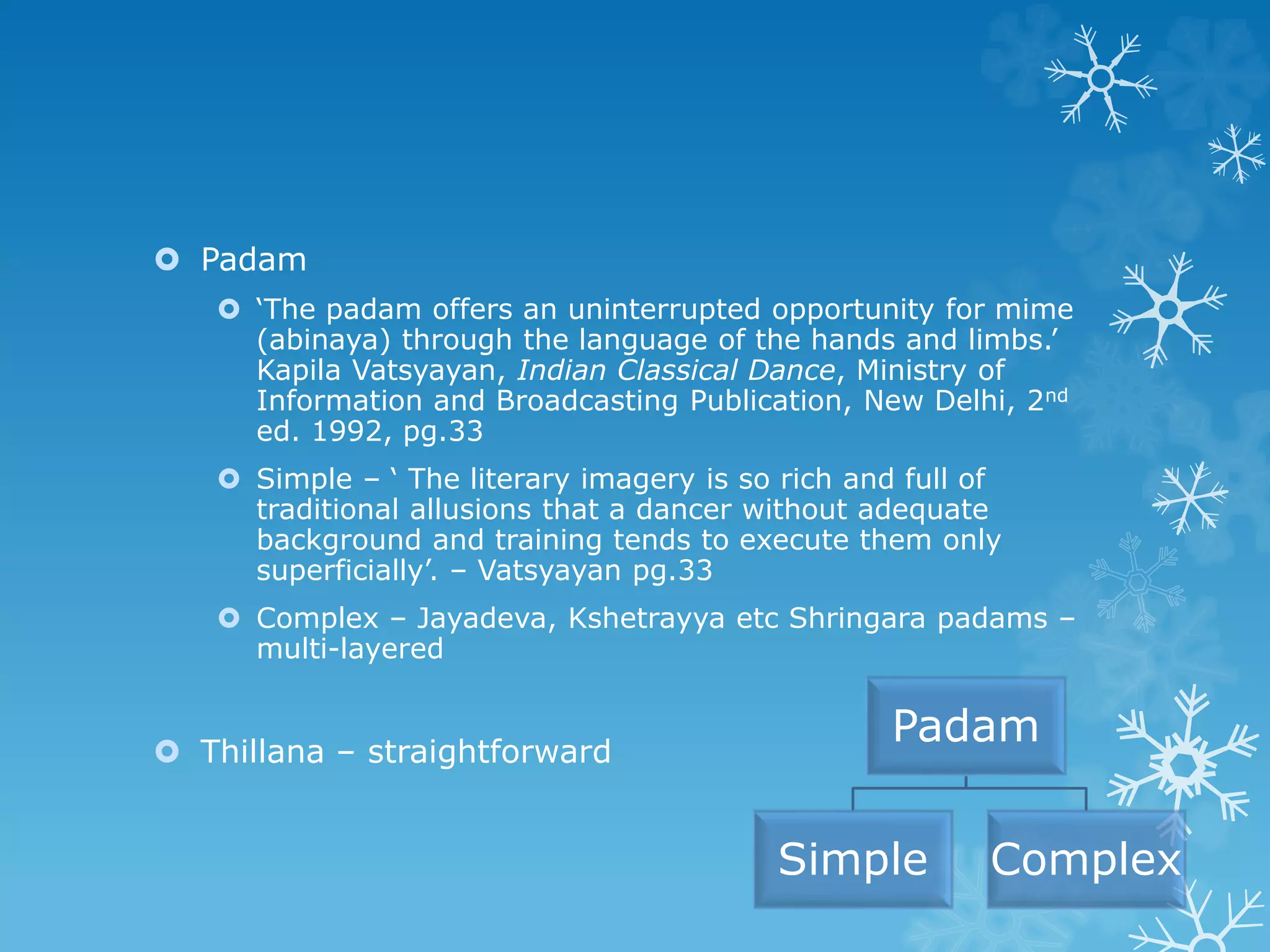
 Padam
 ‘The padam offers an uninterrupted opportunity for mime
(abinaya) through the language of the hands and limbs.’
Kapila Vatsyayan, Indian Classical Dance, Ministry of
Information and Broadcasting Publication, New Delhi, 2nd
ed. 1992, pg.33
 Simple – ‘ The literary imagery is so rich and full of
traditional allusions that a dancer without adequate
background and training tends to execute them only
superficially’. – Vatsyayan pg.33
 Complex – Jayadeva, Kshetrayya etc Shringara padams –
multi-layered
 Thillana – straightforward
Padam
Simple Complex
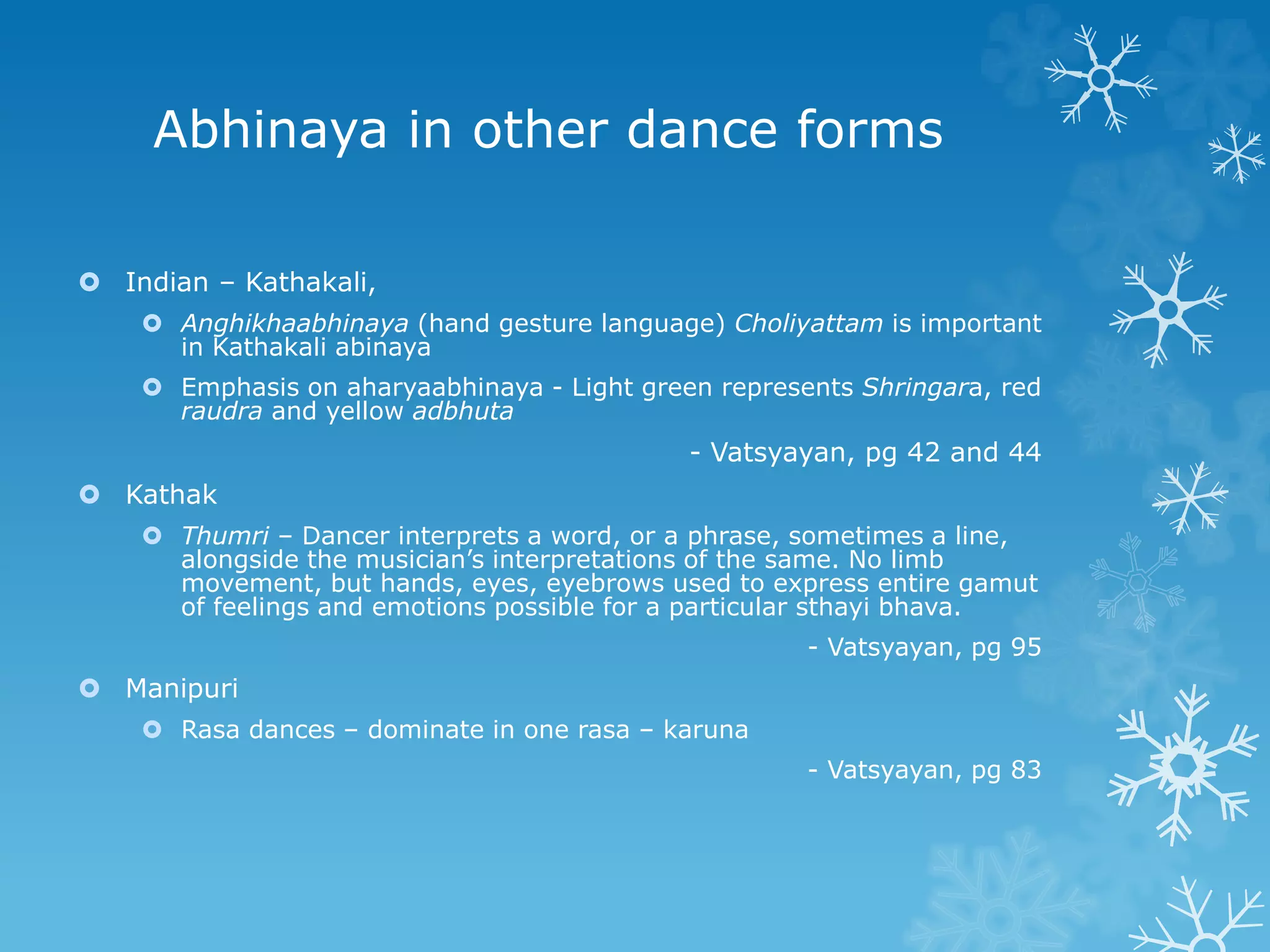
How to approach Abhinaya in a creative piece
Do not confuse ‘arid historicity with living value’ – Bala
 Dancing to a song - Allows flexibility outside of the
Margham format. Mix nrittha and abhinaya. Tableaus.
Pure abhinaya approach may not be suitable
 Dancing without a song – eg ‘ In search of an exit in a
dark room
there is a quest.. But with trust..hope..yearning…
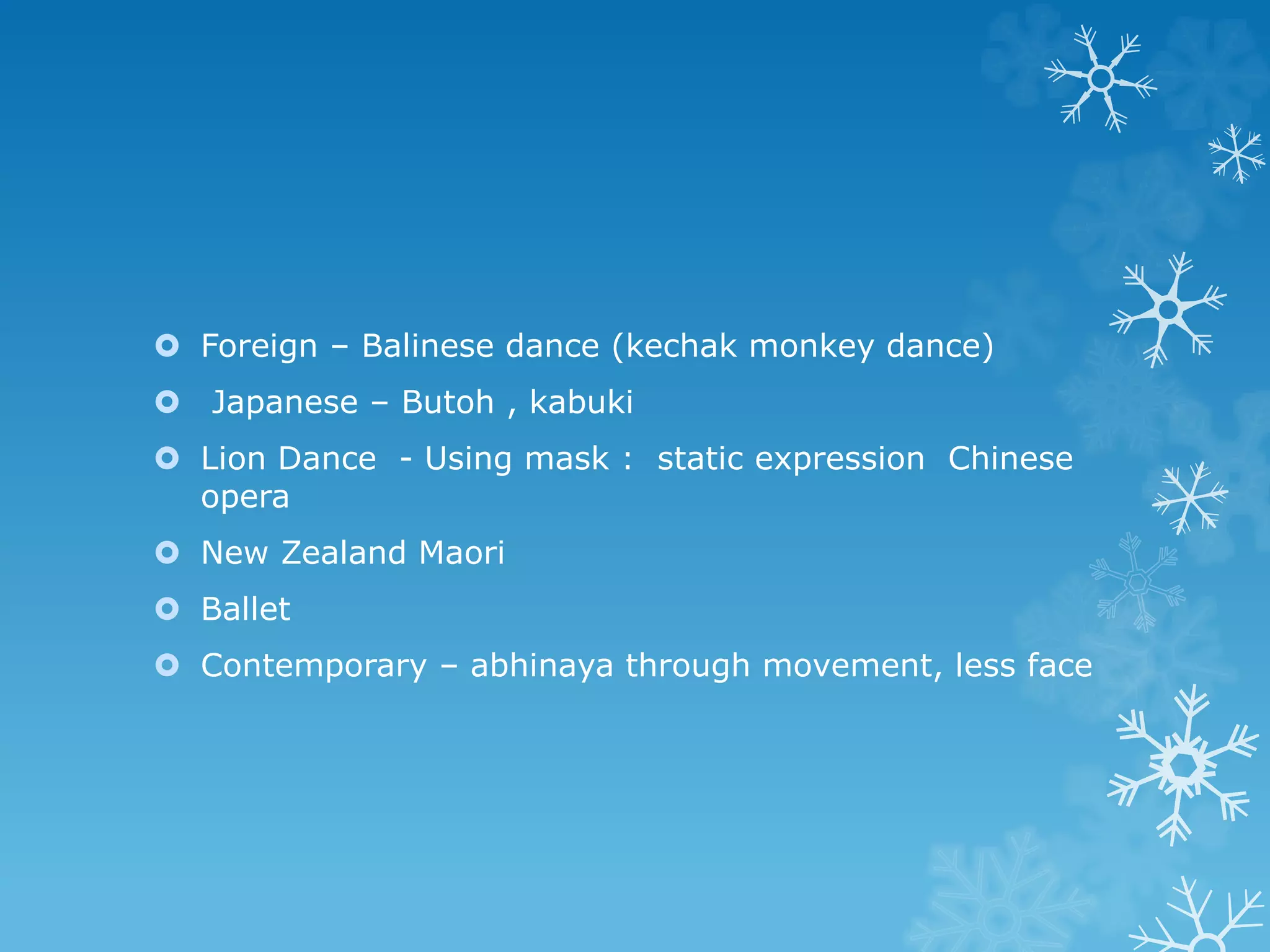
Abhinaya in other dance forms
 Indian – Kathakali,
 Anghikhaabhinaya (hand gesture language) Choliyattam is important
in Kathakali abinaya
 Emphasis on aharyaabhinaya - Light green represents Shringara, red
raudra and yellow adbhuta
- Vatsyayan, pg 42 and 44
 Kathak
 Thumri – Dancer interprets a word, or a phrase, sometimes a line,
alongside the musician’s interpretations of the same. No limb
movement, but hands, eyes, eyebrows used to express entire gamut
of feelings and emotions possible for a particular sthayi bhava.
- Vatsyayan, pg 95
 Manipuri
 Rasa dances – dominate in one rasa – karuna
- Vatsyayan, pg 83
Choliyattam
Pachai
Vesham
Thumri
Rasa Dance
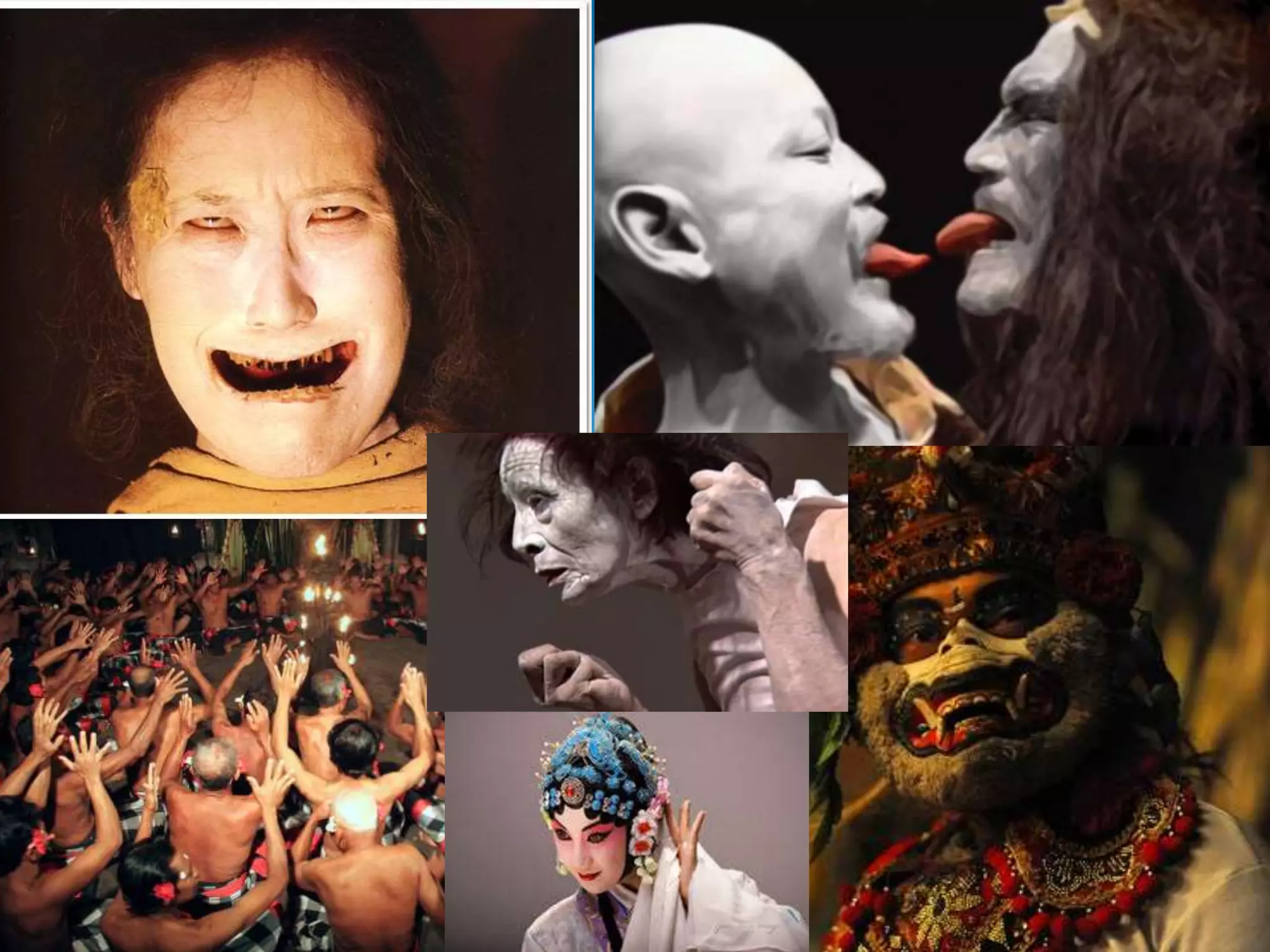
 Foreign – Balinese dance (kechak monkey dance)
 Japanese – Butoh , kabuki
 Lion Dance - Using mask : static expression Chinese
opera
 New Zealand Maori
 Ballet
 Contemporary – abhinaya through movement, less face
Essence of Abhinaya
 Fear
 Anger
 Love
 Sorrow
 Consciously creating emotions that originates from us
helps us realise the meaning of the action and observer,
and acting as a observer to life.
 Abhinaya as a way of realising the divine
 Abhinaya as a way of realising the nature of Self
 The end-state of the dance, conceived as yoga for the artist
as well as the audience, is to still the mind and to achieve,
at least temporarily, an ego-less, thought-free, sense of
complete joy and well-being.
- S. Guhan, Bala on Bharathanatyam, The Sruti Foundation,
Madras, 1991, pg.5
- The Bharathanatyamm recital is structured like a great
temple. After having entered the temple through its outer
precincts, starting with the Alarippu, by the time dancer
devotee traverses the margham and comes to the padam,
she is in the inner sanctum. ‘ Dancing to the padam is akin
to the juncture when the cascading lights of worship are
withdrawn and the drum beats die down to the simple and
solemn chanting of scared verses in the loseness of God.
- T. Balasaraswati, ‘ On Bharathanyma’, Sangeet Natak, Jounral of
the Sangeet Natak Akademi, 72-73, Aprl- Septmber 1984, New
Delhi, pg.10
 Thank you
Workshop
 Yetu vanti vade vadu? O YAMMA
 (Kshetrayya, Kalyani, Mishra chapu) Voice 0011
Task: How many variations can you think of? (Sanchari)
1. What sort of a man is he (interrogatively)
2. What sort of a man is he (in surprise)
3. What sort of a man is he (lovingly)
4. What sort of a man could he be (thoughtfully)
5. What sort of a man could he be (curiosity)
6. How would that man be? (questioning, wonder and curiosity, all
together)
7. Is he really handsome?
8. How handsome is he?
9. I suppose he is the most handsome
10. I hear he is a wonderful man
11. How could he really be so handsome?
12. Is he human or God?
13. The cupid will feel shy at his beauty
14. Oh, I feel his eyes are like lotus
15. How does his face look? Like the full moon?
16. His lips of course, tender and red like coral, isn't it?
1. Then he should be having a broad chest
2. Oh, he adorns his chest with tulasi mala and kousthubha?
3. He must be very rich as you say he always clads in Benaras silk
4. Oh, he is a very generous man. Is he?
5. When I hear all these, I start to love him
6. Please describe him fully
7. How can he be beautiful if he is dark like a cloud?
8. Oh, his dark hue has a special sparkle, is it?
9. I cannot imagine all those said about one man
10. Is he intelligent?
11. His curly hair looks like a bunch of bees, hovering around a lotus which is his
face!

Abhinaya in dance

  • 1.
    Sathvika Abinaya Dr. ChamundeeswariKuppuswamy 07.01.2016 Presentation at Government Music School, Salem – 302 From the perspective of a Bharathanatyam dancer
  • 2.
    Structure of Lecture Aspects of Abinaya  How to approach Abinaya in a Margham  How to approach Abinaya in a creative piece  Abinaya in other dance forms  Essence of Abinaya
  • 3.
  • 5.
    Aspects of Abinaya What is Abinaya? Abinaya is central to Bharatanatyam In fact, Bharatanatyam's earliest form, as mentioned in the Natyashastra can be traced back to abinaya. - Actor as Narrator ‘ Instead of many actors presenting a dramatic story, the solo actor presents, through the four types of abinaya, the particular dominant state (sthayibhava) - Kapila Vatsyayan, Indian Classical Dance, Ministry of Information and Broadcasting Publication, New Delhi, 2nd ed. 1992, pg.21
  • 6.
     Many centurieslater, during 1910-1930, when temple dancing was banned, Bharatanatyam's revival was based on the strength of abinaya.  Balasaraswathi, Rukmini Devi and Kalanidhi Narayanan gave a number of performances, which marked the revival of Dasiattam. Balasaraswathi and Kalanidhi Narayanan put abinaya on the highest pedestal in their practice
  • 7.
    What is excellencein Abhinaya?  Most excellent poetry was that which was suggestive (Vyanjana) and one in which sense ‘reverberated’ from the sound– Anandavardana  In excellent dancing ‘Reticence and economy are the hallmarks of abhinaya’ - S. Guhan, Bala on Bharathanatyam, The Sruti Foundation, Madras, 1991, pg.7  Four aspects of economy in an excellent dancer’s abhinaya – she limits the delineation to the highlights of the symbolic narration - Abhinaya is emotion-oriented and not action-oriented - The suggestions are brief - She never lingers on a gesture and passes on to the next , never allowing the abhinaya to sag by over-indulging any single symbol (mudra), but presenting a kaleidoscopic variation from one to another that shows the richness of her imagination - S.Y. Krishnaswamy Bala: An Anniversary Tribute, Sruti Feb-March 1985)
  • 8.
     Types ofAbhinaya 1. Anghika abinaya – expression by the body that is by hastas and movements of the head, body, feet etc. 2. Sathvika abinaya – the expression of ideas of the inner feeling through the face 3. Aaharya abinaya – through the dress and make-up which is not adopted in Bharatanatyam as the dancer does not change dress or make-up to suit the character 4. Vachika abinaya – this is dealt with by vocal musician and nattuvanar  Abinaya devoid of sathvika is like food without salt – Smt. Kalanidhi Narayanan (mami), Abhinaya and Character Study, Source: From Mami’s collection of papers  Fundamental principles of Abhinaya  Use of Mudras  Music for dance
  • 9.
    Indendhu Vachithivi ra- Navarasas  Main mood – sarcasm  Navarasas - Adbhutham – Good gracious, how have you come here? This is not the street on which she lives - Shantam – Why have you come here? Your absent-mindedness has brought you here - Sringaram – Have you really come to the wrong house, her house is not here. - Karuna – Poor thing! You have come to the wrong house, her house is just down the street. - Hasyam – Are you drunk? Have you lost your way this is nor that fat woman’s house - Bheebatsam – Keep away, I don’t want to even see your face which is smeared with her kumkum - Veeram – What do you take me for, I come from a noble family, I can live quite independent of you. The door is there. - Roudram – Don’t you dare show your face here again. Get out. - Bhayam – Oh you are really angry, please forgive me, but this is not the house you are searching for
  • 10.
    Ashta nayikas 1. Vipralabdha– Feels cheated as her nayaka is not at the meeting place as promised (Netru varen endru; vadarakha pove; mamiyam; sakhi prana) 2. Swaadeenapathikha or Bhartruka– One who is separated from her nayaka and is yearning for reunion (Enta chakkani vade; smara sundaranguni) 3. Abisarikha – is one who boldly does out to meet her nayaka (Choodare; yarukhahilum bhayamen) 4. Kalahantharitha – is one who is repenting her hastiness is quarrelling with her nayaka, which has resulted in their separation (manini vinave) 5. Kanditha – is one who is angry with her nayaka for causing disappointment (Muttavaddhu ra; Idaivida Innum; Yahi Madhava; Ini enna pechchu; Indendhu vachchithivi ra; sake nimma snega; varattum sami; ariven ayya; idai vida innum veru vendumo sakhi; vagaladi bodanalaku; edukanum indha chaturya vaartaigal; saramaina maata; ellam ariven poomaiyya; inimel avarukkum enakkum; ennilum aval enna stagiyamo; vanipendu chalu; chalu chalu vani nestanu; vakka kaina; kondagadu; kopametula raka undunura; kadir kadippu iduven induvenno; ette irundhu pesum) 6. Virahothkanditha – is one who is separated from her nayaka and is yearning for reunion (Adi oka yugamu; paiyadha; koi kahiyore; valapu thaala; sunthasepu; aligite adiyoka yugamu; mora thopuseyaka; eppadi manam thunindhadho) 7. Proshitapathikha or Bhartrikha– is one suffering in the absence of her nayaka, who is away on a long journey (Ninoo joochu; bamaro ooriki; emani thelupudu; enni dhalachu kondu namma) 8. Vasakasajja – is one who is preparing for the arrival of her beloved, by decoration herself and her surroundings, to provide a pleasant welcome for her nayaka. (Theruvil varano; Daree joochu; naan ange)
  • 11.
     Sweeya (marriedand loyal, like Sita) - ethanai arumaigal; thalasukonte; eppadi manam thunindhadho;  Parakeeya (married, but longs for another, like gopis) – mogudochi pilachedu; varuvaranal vara chol; samayamidhe ra ra; samayamidhi kadu ra; yavvade vadu yevvade  Samanya ( takes many nayakas) – kodi koose; ichchina manchide; kadavai sathadi; nee matalu emi ayanura;  Uthama, madhyama, adhama, (character classification) padkintiki (madhya) (high in self control to lacking self control)  Mughdhha, madhya, pragalbha (age/maturity classification)  Jyeshta, Kanishta (more and less favoured by Nayaka)
  • 12.
    Fundamental principles for abinaya ‘thesthayi should never be forgotten as it is like a mother whom you never forget’  Smt. Kalanidhi Narayanan, What is it to be a good Bharathanatyam dancer, Lecture at Kalamandalam, Calcutta, 1.12.1991  Internalisation  Sanchari Bhava  Sthayi Bhava
  • 13.
    Music for abinaya Some of the songs written for abinaya represent the high watermark of South Indian musical effort.  Notes on Natya, The Madras Mail, 1939  Dance composers : Kshetrayya, Subbarama Iyer, Sarangapani, Annamacharya; Arunachala Kavi; Chittoor Subramaya Pillai; Dharmapuri Subbaraya Iyer; Kasi nathaiyya; Ghanam Krishna Iyer; Ghanam Sennaiyya; Gopalakrishna Bharathi; Kavi Kunjara Bharathi; Madurai Kavi; Mari mootha Pillai; Muthu Natesar; Muthu Thandavar; Moovaloor Sabha pathy; Tirupathy Narayanasamy Naidu; Ooothukadu Venkata Subbaiyar; Patnam Subramanya Iyer; Peddha Tirumalachar; Purandarasar; Tanjavur Quartet; Thirupanandhal Pattabhi ramaaiyya; Vaideeswaram Koil Subbarama Iyer; Jayadeva; vidyapathi  Padams and javalis are popular abinaya compositions  Keerthanams, astapathis, slokas, viruttams and padhyas are all abinaya compositions  Ragabhava is the very essence of padams.
  • 14.
     ‘You thinkyou are being transported by the dance but it is the music that is deceiving you’ – Balasaraswathi (Bala)  ‘I have asked to preside over a meeting of musicians because of my music and I feel that by doing so I endorse and acknowledge the paramount importance of music in South Indian dance’ – Bala
  • 15.
    Navarasas and music Sringara : Kamas – Apudu, Kalyani – Etuvanti  Veera : Abogi – Entachakkani, Paras - Smarasundara  Karunanyam : Kurunji – Varugalamo, Sivaranjani – Konji  Bibatsam : Saveri – Idai vida, Kapi – Vakkam  Hasyam : Behag – Vadaladi, Sourasthram – Aduvum Sol  Roudram: Atana – Meragadui, Mohanam - Muzhudrum  Bhayanakham : Useni – Aligithe  Adbhutham : Arabi – Girisha Charitha  Shantam : Sama – Sandhamudika, Purvikalyani – Ekka
  • 16.
    How to approachAbhinaya in a Margham  Margham is a format for a solo dancer that has crystallised through the contribution of the Tanjore Quarter (Chinnaya, Ponnayya, Vadivelu and Sivanandam)  Shabdham – Simple abhinaya, straightforward hands, no sanchari, restricted themes and bhavas  ‘The miming is deliberately elementary and only the literal illustration of the word is presented through movement’ - Kapila Vatsyayan, Indian Classical Dance, Ministry of Information and Broadcasting Publication, New Delhi, 2nd ed. 1992, pg.31  Varnam – Sancharis
  • 17.
     Padam  ‘Thepadam offers an uninterrupted opportunity for mime (abinaya) through the language of the hands and limbs.’ Kapila Vatsyayan, Indian Classical Dance, Ministry of Information and Broadcasting Publication, New Delhi, 2nd ed. 1992, pg.33  Simple – ‘ The literary imagery is so rich and full of traditional allusions that a dancer without adequate background and training tends to execute them only superficially’. – Vatsyayan pg.33  Complex – Jayadeva, Kshetrayya etc Shringara padams – multi-layered  Thillana – straightforward Padam Simple Complex
  • 18.
    How to approachAbhinaya in a creative piece Do not confuse ‘arid historicity with living value’ – Bala  Dancing to a song - Allows flexibility outside of the Margham format. Mix nrittha and abhinaya. Tableaus. Pure abhinaya approach may not be suitable  Dancing without a song – eg ‘ In search of an exit in a dark room there is a quest.. But with trust..hope..yearning…
  • 19.
    Abhinaya in otherdance forms  Indian – Kathakali,  Anghikhaabhinaya (hand gesture language) Choliyattam is important in Kathakali abinaya  Emphasis on aharyaabhinaya - Light green represents Shringara, red raudra and yellow adbhuta - Vatsyayan, pg 42 and 44  Kathak  Thumri – Dancer interprets a word, or a phrase, sometimes a line, alongside the musician’s interpretations of the same. No limb movement, but hands, eyes, eyebrows used to express entire gamut of feelings and emotions possible for a particular sthayi bhava. - Vatsyayan, pg 95  Manipuri  Rasa dances – dominate in one rasa – karuna - Vatsyayan, pg 83
  • 20.
  • 21.
     Foreign –Balinese dance (kechak monkey dance)  Japanese – Butoh , kabuki  Lion Dance - Using mask : static expression Chinese opera  New Zealand Maori  Ballet  Contemporary – abhinaya through movement, less face
  • 24.
    Essence of Abhinaya Fear  Anger  Love  Sorrow  Consciously creating emotions that originates from us helps us realise the meaning of the action and observer, and acting as a observer to life.  Abhinaya as a way of realising the divine  Abhinaya as a way of realising the nature of Self
  • 25.
     The end-stateof the dance, conceived as yoga for the artist as well as the audience, is to still the mind and to achieve, at least temporarily, an ego-less, thought-free, sense of complete joy and well-being. - S. Guhan, Bala on Bharathanatyam, The Sruti Foundation, Madras, 1991, pg.5 - The Bharathanatyamm recital is structured like a great temple. After having entered the temple through its outer precincts, starting with the Alarippu, by the time dancer devotee traverses the margham and comes to the padam, she is in the inner sanctum. ‘ Dancing to the padam is akin to the juncture when the cascading lights of worship are withdrawn and the drum beats die down to the simple and solemn chanting of scared verses in the loseness of God. - T. Balasaraswati, ‘ On Bharathanyma’, Sangeet Natak, Jounral of the Sangeet Natak Akademi, 72-73, Aprl- Septmber 1984, New Delhi, pg.10
  • 26.
  • 27.
  • 28.
     Yetu vantivade vadu? O YAMMA  (Kshetrayya, Kalyani, Mishra chapu) Voice 0011 Task: How many variations can you think of? (Sanchari)
  • 29.
    1. What sortof a man is he (interrogatively) 2. What sort of a man is he (in surprise) 3. What sort of a man is he (lovingly) 4. What sort of a man could he be (thoughtfully) 5. What sort of a man could he be (curiosity) 6. How would that man be? (questioning, wonder and curiosity, all together) 7. Is he really handsome? 8. How handsome is he? 9. I suppose he is the most handsome 10. I hear he is a wonderful man 11. How could he really be so handsome? 12. Is he human or God? 13. The cupid will feel shy at his beauty
  • 30.
    14. Oh, Ifeel his eyes are like lotus 15. How does his face look? Like the full moon? 16. His lips of course, tender and red like coral, isn't it? 1. Then he should be having a broad chest 2. Oh, he adorns his chest with tulasi mala and kousthubha? 3. He must be very rich as you say he always clads in Benaras silk 4. Oh, he is a very generous man. Is he? 5. When I hear all these, I start to love him 6. Please describe him fully 7. How can he be beautiful if he is dark like a cloud? 8. Oh, his dark hue has a special sparkle, is it? 9. I cannot imagine all those said about one man 10. Is he intelligent? 11. His curly hair looks like a bunch of bees, hovering around a lotus which is his face!