“Life is a struggle, not against sin, not
against the Money Power, not against
malicious animal magnetism, but against
hydrogen ions.”
H.L. MENCKEN
ABG IN ICU
METABOLIC
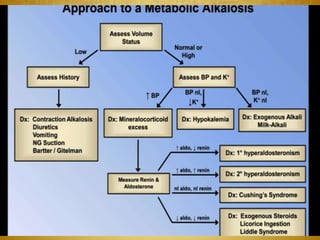
ALKALOSIS
Etiology of Metabolic Alkalosis
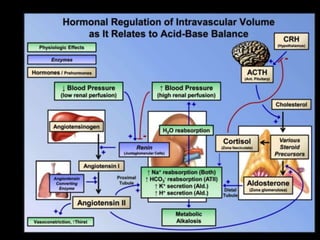
Pathways Leading to Metabolic
Alkalosis
Maintenance Factors for Metabolic Alkalosis
compensation
 Predicted PCO2 = (0.7 × HCO3–) + 21
 Lower PCO2 values than predicted indicate the
presence of a coexisting respiratory alkalosis.
Higher CO2 values than predicted indicate a
coexisting respiratory acidosis.
Chloride-depletion alkalosis
 “saline responsive”. It is the most common type of
metabolic alkalosis.
 Hypokalemia and/or hypochloremia may be present.
 Urinary Cl– <20 mEq/L (Often, urine Cl– is<10
mEq/L).
 Chloride depletion states:
 GI tract: Vomiting or nasogastric aspiration, villous
adenoma, chloridorrhea, gastrocystoplasty Kidney:
Chloruretic diuretics, severe K+ depletion,
posthypercapnia; Skin: Cystic fibrosis.
Potassium-depletion alkalosis
 Also known as chloride-resistant alkalosis: it is actually
exacerbated when Cl– is administered without K+ (e.g., NaCl
infusion: “saline unresponsive”).
 Urinary Cl– >20 mEq/L.
 A high urinary chloride suggests:
 Ongoing diuretic therapy: Decreased chloride absorption
 Bartter’s or Gitelman’s syndrome Severe hypokalemia (<2
mEq/L) in potassium depletion states:
 Gut: laxative abuse
 Kidney: hyperaldosteronism, primary and secondary, other
hypokalemic hypertensive syndrome, Bartter and Gitelman
syndrome.
Diagnostic Utility of Urinary Chloride
Effects of metabolic alkalosis
 salicylate intoxication - metabolic acidosis and respiratory
alkalosis
 renal failure and vomiting – metabolic acidosis and
metabolic alkalosis
 hyperemesis during pregnancy – metabolic alkalosis and
respiratory alkalosis
 COPD and vomiting – metabolic alkalosis and respiratory
acidosis
 respiratory acidosis and respiratory alkalosis cannot co-
exist
Case 1
 A 72 year old COPD patient was brought to the EMD.
During transport, Mr. G had been given oxygen
supplementation by a partial rebreathing mask at 12 l/min.
 At reception, Mr. G was drowsy and was breathing at only
5–6 breaths/min.
 An ABG performed on arrival showed
pH 7.19,
PaO2 66 mmHg,
PaCO2 92 mmHg
 Treatment options would include:
 (a) Administering FIO2 at 0.28 by ventimask
 (b)Making the patient breathe room air to augment the
his hypoxic ventilatory drive
 (c)Increasing FIO2 by administering O2 through a
non-rebreathing mask
PAO2 ={(Patm -Pw )*FIO2}- {(PaCO2 /RQ)}
PAO2 ={(760-47)́*0.6-(92/0.8)=312.8mmHg
PAO2 =(760-47)* 0.21-(92/0.8)=34mmHg
Case 2
 A 20 year old woman is under evaluation in the ER for
acute shortness of breath. Her chest X-ray is interpreted as
normal:
 pH: 7.55,
 HCO −: 22 mEq/L,
 PCO : 27 mmHg,
 PO : 93 mmHg on room air.
 Anion gap is normal.
 PAO2 = FiO2 (Pb – Pw) – PaCO2/R
 Assuming a barometric pressure of 760 mmHg (sea
level), and a respiratory quotient of 0.8:
 PAO2 = [0.21(760 − 47)] − (27/0.8) = 116
 PAO −PaO = 116 − 93 = 23.22
 A-aDO2 = 23 (normally 7 − 14 on room air): The A-
aDO2 is widened.
Case 3
 A 45-year-old woman is S/P thyroid surgery 2 weeks
ago. She presents with painful spasms of her legs and
arms. She has a positive Chvostek’s sign on exam.
 Na+ = 142
 K+ = 4.0
 Cl- = 100 HCO3 = 24 Glu = 100 BUN= 10
 Why is her Anion Gap 18?
 This is an unusual cause of an elevated anion gap.
Because this patient just had neck surgery, the natural
worry is the function of her parathyroid glands, which
leaves her at risk for hypocalcemia and
hypomagnesemia. There is no evidence of an ongoing
metabolic acidosis, so one must consider a decrease
in unmeasured cations. She can have severe hypo-
calcemia and magnesemia, and her gap normalized
with cation replacement.
Case 4
 An elderly woman CHF on diuretics with severe
arthritis is found in her apartment lethargic and
confused.
 Na+ = 137 K+=3.6
 Cl-=95 HCO3 = 20
 Glu = 126 BUN= 9
 pH = 7.60 pCO2 = 25 pO2=80 HCO3 = 20
 metabolic acidosis due to lactate, respiratory alkalosis
due to sepsis, and the metabolic alkalosis secondary
to the diuretics.
Case 5
 An alcoholic presents with vomiting.
 pH 7.20;
 pCO2 25
Na 130;
 Cl 80;
 HCO3 10
 Primary AGMA (alcoholic ketoacidosis), metabolic
alkalosis (vomiting)
Case 6
 A man with arthritis presents with confusion, shortness
of breath, and diaphoresis.
 pH 7.30;
 pCO2 18
 Na 147;
 Cl 108;
 HCO3 16
 Primary AGMA and respiratory alkalosis (Salicylate
toxicity)
Case 7
 A patient with COPD presents with shortness of
breath.
 pH 7.18;
 pCO2 80
 Na 135;
 Cl 93;
 HCO3 30
Case 8
 A woman with Crohn’s disease presents with fever,
vomiting, and diarrhea.
 pH 7.36;
 pCO2 22
 Na 147;
 Cl 121;
 HCO3 14
 Primary NAGMA (diarrhea), respiratory alkalosis (fever), metabolic
alkalosis (vomiting)
 If metabolic acidosis, is there another concomitant metabolic
disturbance?
If AGMA, then calculate ∆Gap = ∆AG – ∆ HCO3 = (AG -12) – (24 –
HCO3)
 If the ∆Gap is > 6, there is a combined AGMA and metabolic
alkalosis.
 If the ∆Gap is < -6, there is a combined AGMA and NAGMA.
If NAGMA, for every 1 mEq/L ↑Cl, there should be a 1 mEq/L ↓
HCO3 (±5).
 If HCO3 decrease is less than predicted, then NAGMA and
metabolic alkalosis
Corrected bicarbonate
 If anion gap is increased, assess the corrected
bicarbonate
 Hco3 + (measured anion gap -12)
 If it is < 24 –hidden non anion gap met acidosis
 If it is >24 – hidden metabolic alkalosis
Case 9
 A 58-year-old man (heavy smoker) admitted to the
ICU with sepsis.
 He is not intubated yet but has an NG tube.
 His ABG showed pH (6.88), PaCO2 (40), HCO3 (7), Na+
(142), Cl− 100.
 What type of acid–base disturbance does this patient
have?
 Combined AGMA, metabolic alkalosis, and respiratory
acidosis. This patient’s metabolic acidosis is most
likely related to sepsis. His respiratory acidosis is
likely due to respiratory failure (COPD ± aspiration)
and the metabolic alkalosis is due to gastric suction.
Case 10
 A noncompliant patient with diabetes and cirrhosis
presents with vomiting.
 pH 7.46;
 pCO2 17
Na 133
 Cl 84
 HCO3 15
 Primary chronic respiratory alkalosis (cirrhosis), AGMA
(DKA), metabolic alkalosis (vomiting)

abg icu.pptx

  • 1.
    “Life is astruggle, not against sin, not against the Money Power, not against malicious animal magnetism, but against hydrogen ions.” H.L. MENCKEN ABG IN ICU
  • 2.
  • 3.
  • 4.
  • 5.
    Pathways Leading toMetabolic Alkalosis
  • 6.
    Maintenance Factors forMetabolic Alkalosis
  • 7.
    compensation  Predicted PCO2= (0.7 × HCO3–) + 21  Lower PCO2 values than predicted indicate the presence of a coexisting respiratory alkalosis. Higher CO2 values than predicted indicate a coexisting respiratory acidosis.
  • 8.
    Chloride-depletion alkalosis  “salineresponsive”. It is the most common type of metabolic alkalosis.  Hypokalemia and/or hypochloremia may be present.  Urinary Cl– <20 mEq/L (Often, urine Cl– is<10 mEq/L).  Chloride depletion states:  GI tract: Vomiting or nasogastric aspiration, villous adenoma, chloridorrhea, gastrocystoplasty Kidney: Chloruretic diuretics, severe K+ depletion, posthypercapnia; Skin: Cystic fibrosis.
  • 9.
    Potassium-depletion alkalosis  Alsoknown as chloride-resistant alkalosis: it is actually exacerbated when Cl– is administered without K+ (e.g., NaCl infusion: “saline unresponsive”).  Urinary Cl– >20 mEq/L.  A high urinary chloride suggests:  Ongoing diuretic therapy: Decreased chloride absorption  Bartter’s or Gitelman’s syndrome Severe hypokalemia (<2 mEq/L) in potassium depletion states:  Gut: laxative abuse  Kidney: hyperaldosteronism, primary and secondary, other hypokalemic hypertensive syndrome, Bartter and Gitelman syndrome.
  • 19.
    Diagnostic Utility ofUrinary Chloride
  • 20.
  • 21.
     salicylate intoxication- metabolic acidosis and respiratory alkalosis  renal failure and vomiting – metabolic acidosis and metabolic alkalosis  hyperemesis during pregnancy – metabolic alkalosis and respiratory alkalosis  COPD and vomiting – metabolic alkalosis and respiratory acidosis  respiratory acidosis and respiratory alkalosis cannot co- exist
  • 22.
    Case 1  A72 year old COPD patient was brought to the EMD. During transport, Mr. G had been given oxygen supplementation by a partial rebreathing mask at 12 l/min.  At reception, Mr. G was drowsy and was breathing at only 5–6 breaths/min.  An ABG performed on arrival showed pH 7.19, PaO2 66 mmHg, PaCO2 92 mmHg
  • 23.
     Treatment optionswould include:  (a) Administering FIO2 at 0.28 by ventimask  (b)Making the patient breathe room air to augment the his hypoxic ventilatory drive  (c)Increasing FIO2 by administering O2 through a non-rebreathing mask
  • 24.
    PAO2 ={(Patm -Pw)*FIO2}- {(PaCO2 /RQ)} PAO2 ={(760-47)́*0.6-(92/0.8)=312.8mmHg PAO2 =(760-47)* 0.21-(92/0.8)=34mmHg
  • 25.
    Case 2  A20 year old woman is under evaluation in the ER for acute shortness of breath. Her chest X-ray is interpreted as normal:  pH: 7.55,  HCO −: 22 mEq/L,  PCO : 27 mmHg,  PO : 93 mmHg on room air.  Anion gap is normal.
  • 26.
     PAO2 =FiO2 (Pb – Pw) – PaCO2/R  Assuming a barometric pressure of 760 mmHg (sea level), and a respiratory quotient of 0.8:  PAO2 = [0.21(760 − 47)] − (27/0.8) = 116  PAO −PaO = 116 − 93 = 23.22  A-aDO2 = 23 (normally 7 − 14 on room air): The A- aDO2 is widened.
  • 27.
    Case 3  A45-year-old woman is S/P thyroid surgery 2 weeks ago. She presents with painful spasms of her legs and arms. She has a positive Chvostek’s sign on exam.  Na+ = 142  K+ = 4.0  Cl- = 100 HCO3 = 24 Glu = 100 BUN= 10  Why is her Anion Gap 18?
  • 28.
     This isan unusual cause of an elevated anion gap. Because this patient just had neck surgery, the natural worry is the function of her parathyroid glands, which leaves her at risk for hypocalcemia and hypomagnesemia. There is no evidence of an ongoing metabolic acidosis, so one must consider a decrease in unmeasured cations. She can have severe hypo- calcemia and magnesemia, and her gap normalized with cation replacement.
  • 29.
    Case 4  Anelderly woman CHF on diuretics with severe arthritis is found in her apartment lethargic and confused.  Na+ = 137 K+=3.6  Cl-=95 HCO3 = 20  Glu = 126 BUN= 9  pH = 7.60 pCO2 = 25 pO2=80 HCO3 = 20
  • 30.
     metabolic acidosisdue to lactate, respiratory alkalosis due to sepsis, and the metabolic alkalosis secondary to the diuretics.
  • 31.
    Case 5  Analcoholic presents with vomiting.  pH 7.20;  pCO2 25 Na 130;  Cl 80;  HCO3 10
  • 32.
     Primary AGMA(alcoholic ketoacidosis), metabolic alkalosis (vomiting)
  • 33.
    Case 6  Aman with arthritis presents with confusion, shortness of breath, and diaphoresis.  pH 7.30;  pCO2 18  Na 147;  Cl 108;  HCO3 16
  • 34.
     Primary AGMAand respiratory alkalosis (Salicylate toxicity)
  • 35.
    Case 7  Apatient with COPD presents with shortness of breath.  pH 7.18;  pCO2 80  Na 135;  Cl 93;  HCO3 30
  • 37.
    Case 8  Awoman with Crohn’s disease presents with fever, vomiting, and diarrhea.  pH 7.36;  pCO2 22  Na 147;  Cl 121;  HCO3 14
  • 38.
     Primary NAGMA(diarrhea), respiratory alkalosis (fever), metabolic alkalosis (vomiting)  If metabolic acidosis, is there another concomitant metabolic disturbance? If AGMA, then calculate ∆Gap = ∆AG – ∆ HCO3 = (AG -12) – (24 – HCO3)  If the ∆Gap is > 6, there is a combined AGMA and metabolic alkalosis.  If the ∆Gap is < -6, there is a combined AGMA and NAGMA. If NAGMA, for every 1 mEq/L ↑Cl, there should be a 1 mEq/L ↓ HCO3 (±5).  If HCO3 decrease is less than predicted, then NAGMA and metabolic alkalosis
  • 39.
    Corrected bicarbonate  Ifanion gap is increased, assess the corrected bicarbonate  Hco3 + (measured anion gap -12)  If it is < 24 –hidden non anion gap met acidosis  If it is >24 – hidden metabolic alkalosis
  • 40.
    Case 9  A58-year-old man (heavy smoker) admitted to the ICU with sepsis.  He is not intubated yet but has an NG tube.  His ABG showed pH (6.88), PaCO2 (40), HCO3 (7), Na+ (142), Cl− 100.  What type of acid–base disturbance does this patient have?
  • 41.
     Combined AGMA,metabolic alkalosis, and respiratory acidosis. This patient’s metabolic acidosis is most likely related to sepsis. His respiratory acidosis is likely due to respiratory failure (COPD ± aspiration) and the metabolic alkalosis is due to gastric suction.
  • 42.
    Case 10  Anoncompliant patient with diabetes and cirrhosis presents with vomiting.  pH 7.46;  pCO2 17 Na 133  Cl 84  HCO3 15
  • 43.
     Primary chronicrespiratory alkalosis (cirrhosis), AGMA (DKA), metabolic alkalosis (vomiting)