Towards Sustainable Mountain Development
A not –for-profit organization, founded in
1992, with the aim of creating
development opportunities for the
rural Himalayan communities.
Working primarily in the Kumaon region of
Uttarakhand, Aarohi reaches 141 villages
in the remote mountain districts of Nainital and
Almora through its varied development initiatives,
covering a population of 65,606.
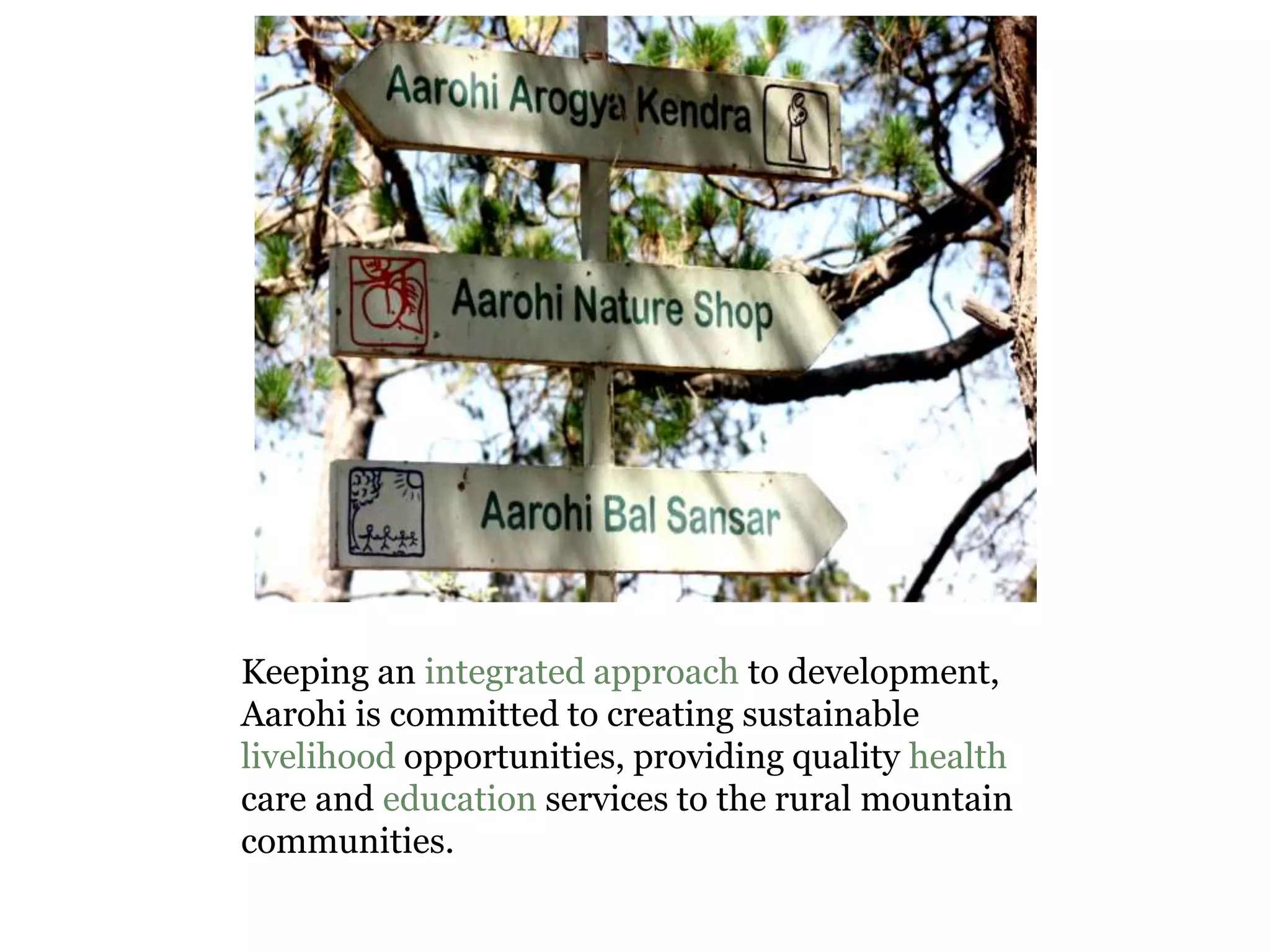
Keeping an integrated approach to
development, Aarohi is committed to creating
sustainable livelihood opportunities, providing
quality healthcare and education services to
the rural mountain communities.
Keeping an integrated approach to development,
Aarohi is committed to creating sustainable
livelihood opportunities, providing quality health
care and education services to the rural mountain
communities.
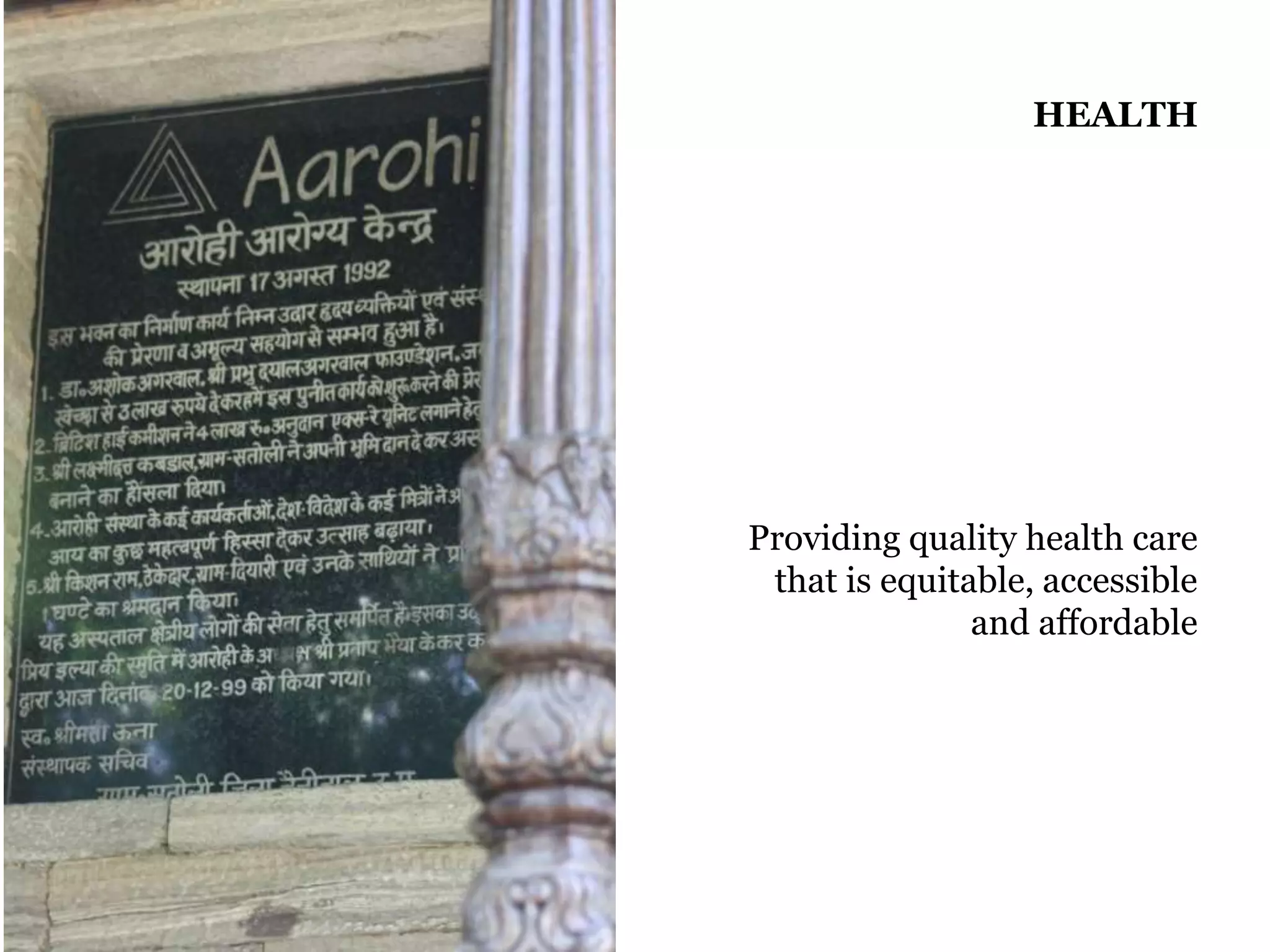
HEALTH
Providing quality health care
that is equitable, accessible
and affordable
The Problem- Health
• Accessibility to primary, secondary and tertiary
healthcare services.
• Accessibility to health information.
• Maternal deaths – 101/1 lakh deliveries. (SRS, 2018 -
2019)
• Infant deaths – 24/1000 live births (SRS, 2020)
• Malnutrition among children – 23.2 % (NFHS 5, 2019 –
2021)
• Anaemia among women – 34.5 % (NFHS 5, 2019 – 2021)
Aarohi – healthcare services
Aarohi Arogya
Kendra (AAK)
• OPD and
emergency
services
• Dental services
• School health
services
• Surgical camps
Mobile
Medical Unit
• Provide
primary
healthcare
services.
• Identify HRP
and surgical
needs
• Referral.
Community
health
• Reduce maternal
and newborn
mortalities and
morbidities.
• Reduce
malnutrition
among 0 – 5 year
children.
• Breaking gender
barriers.
Aarohi Arogya Kendra (AAK)
Aarohi Arogya Kendra – services
• Out-patient Department
• In-Patient Department
• Emergency services
• Comprehensive Dental services
• X-Ray and Ultrasound
• Advanced Pathological Laboratory
• Surgical treatment
• Physiotherapy
• Outreach camps and Home visits
Dental
Surgical camps
Mobile Medical Unit
• The Aarohi Arogya Kendra MMU started in June 2014 .
• Services to 105 villages in Ramgarh, Dhari and
Okhalkhanda blocks of Nainital district.
• Camps are being conducted each month from 1st to 8th.
• Human Resource: Physician (1), Gynaecologist (1),
Radiologist (1), ANM (2), Lab technician (1), Pharmacist
(1), support staff (2) and Driver (2).
• Services provided: Maternal health, Child health,
Adolescent health, adult health and geriatric health.
• To provide the above mentioned services, the MMU is
equipped with a laboratory, a pharmacy and advanced
diagnostic equipments like ultrasound, E.C.G and X-ray
machines.
Mobile Medical Unit Bus
Community Health
• The programme helps to fulfil the goals of the government-run
NHM by reducing maternal and child morbidity and mortality in the
Okhalkanda, Dhari & Ramghard block of Nainital District in
Uttarakhand.
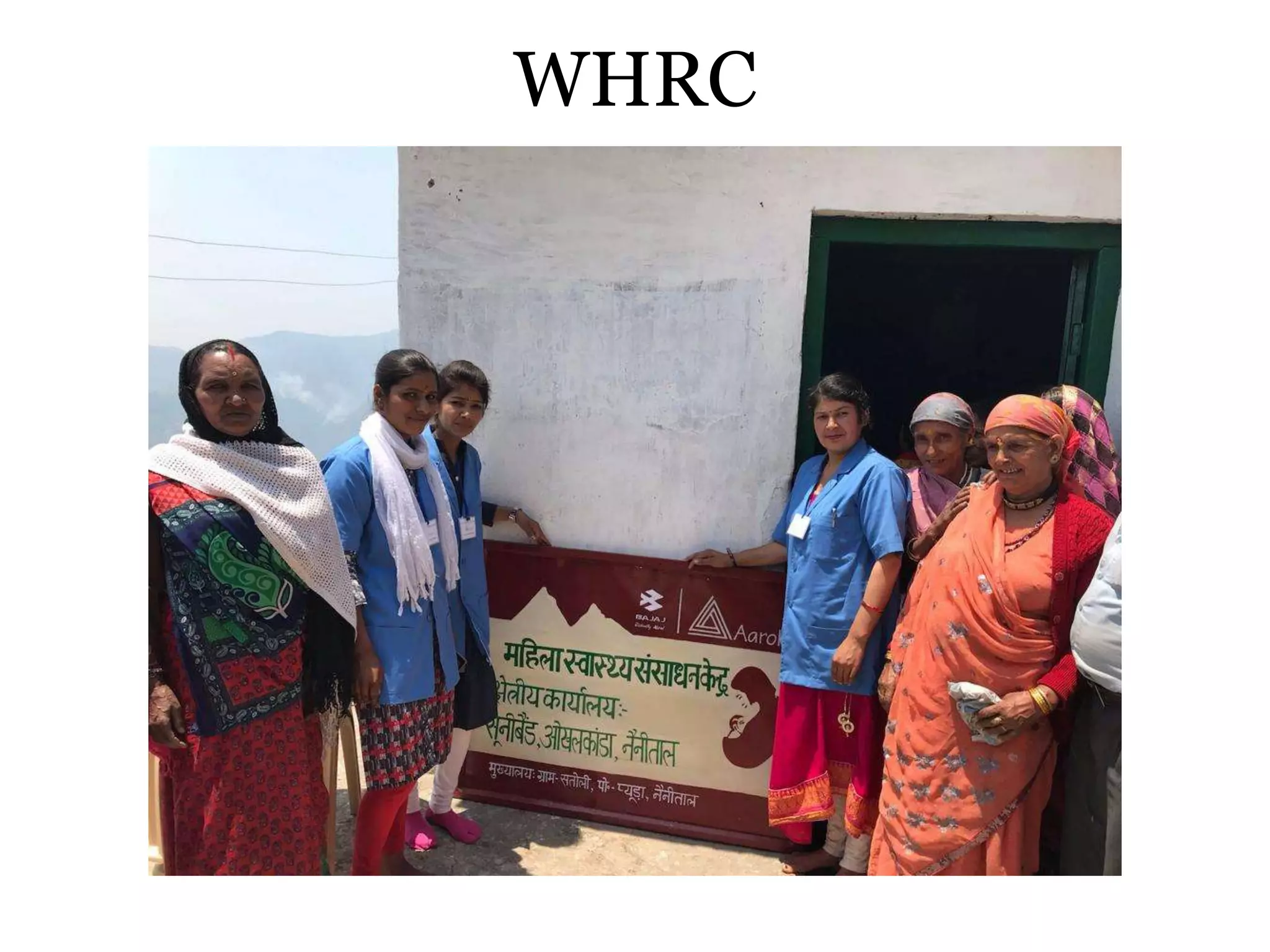
• To make accessible basic health services and health information to
the rural women from the remote villages of Okhalkhanda block in
Nainital district of Uttarakhand, Aarohi has developed the concept
of Women Health Resource Centre (WHRC).
• A Resource Centre can support a wide range of activities by
collecting and organizing materials that are useful for the
community and frontline workers.
• Women’s Health Resource Centre is envisioned as a space for
women which caters to all their health needs; from providing
primary health care, medical services to health information and
health counselling. It is a space for women where they can discuss
without fear or inhibition, their health concerns and access
affordable health services.
WHRC
WHRC
• On the basis of rigorous evidence of effectiveness and the
need for increased coverage and utilization of
intervention, a set of core interventions have been
identified. The core interventions include maternal care,
new born care, nutrition and family planning.
• The WHRC adopts WHO provided “continuum of care
services” approach for reproductive, maternal, newborn
& child health interventions.
• One WHRC covers 10 villages just like Level 1 centre
(Health sub centre). Each WHRC has one Community
health Nurse and 4 Village Health Workers supported by
co-ordinators and Program Manager.
WHRC activities
• Home visits – all EC, ANC, PNC, children <5 and
other illness.
• Action groups – Mother’s group and adolescent
group.
• Linkage with MMU for primary health care.
• Awareness – Swasthya mela or health fair.
• Capacity building of Frontline workers – every
month.
• Surveillance – monthly data collection and
surveys.
Mother’s group meeting
Swasthya mela
Thank you!

Aarohi Health.ppt

  • 1.
  • 2.
    A not –for-profitorganization, founded in 1992, with the aim of creating development opportunities for the rural Himalayan communities.
  • 3.
    Working primarily inthe Kumaon region of Uttarakhand, Aarohi reaches 141 villages in the remote mountain districts of Nainital and Almora through its varied development initiatives, covering a population of 65,606.
  • 4.
    Keeping an integratedapproach to development, Aarohi is committed to creating sustainable livelihood opportunities, providing quality healthcare and education services to the rural mountain communities.
  • 5.
    Keeping an integratedapproach to development, Aarohi is committed to creating sustainable livelihood opportunities, providing quality health care and education services to the rural mountain communities.
  • 6.
    HEALTH Providing quality healthcare that is equitable, accessible and affordable
  • 7.
    The Problem- Health •Accessibility to primary, secondary and tertiary healthcare services. • Accessibility to health information. • Maternal deaths – 101/1 lakh deliveries. (SRS, 2018 - 2019) • Infant deaths – 24/1000 live births (SRS, 2020) • Malnutrition among children – 23.2 % (NFHS 5, 2019 – 2021) • Anaemia among women – 34.5 % (NFHS 5, 2019 – 2021)
  • 8.
    Aarohi – healthcareservices Aarohi Arogya Kendra (AAK) • OPD and emergency services • Dental services • School health services • Surgical camps Mobile Medical Unit • Provide primary healthcare services. • Identify HRP and surgical needs • Referral. Community health • Reduce maternal and newborn mortalities and morbidities. • Reduce malnutrition among 0 – 5 year children. • Breaking gender barriers.
  • 9.
  • 10.
    Aarohi Arogya Kendra– services • Out-patient Department • In-Patient Department • Emergency services • Comprehensive Dental services • X-Ray and Ultrasound • Advanced Pathological Laboratory • Surgical treatment • Physiotherapy • Outreach camps and Home visits
  • 11.
  • 12.
  • 13.
    Mobile Medical Unit •The Aarohi Arogya Kendra MMU started in June 2014 . • Services to 105 villages in Ramgarh, Dhari and Okhalkhanda blocks of Nainital district. • Camps are being conducted each month from 1st to 8th. • Human Resource: Physician (1), Gynaecologist (1), Radiologist (1), ANM (2), Lab technician (1), Pharmacist (1), support staff (2) and Driver (2). • Services provided: Maternal health, Child health, Adolescent health, adult health and geriatric health. • To provide the above mentioned services, the MMU is equipped with a laboratory, a pharmacy and advanced diagnostic equipments like ultrasound, E.C.G and X-ray machines.
  • 14.
  • 15.
    Community Health • Theprogramme helps to fulfil the goals of the government-run NHM by reducing maternal and child morbidity and mortality in the Okhalkanda, Dhari & Ramghard block of Nainital District in Uttarakhand. • To make accessible basic health services and health information to the rural women from the remote villages of Okhalkhanda block in Nainital district of Uttarakhand, Aarohi has developed the concept of Women Health Resource Centre (WHRC). • A Resource Centre can support a wide range of activities by collecting and organizing materials that are useful for the community and frontline workers. • Women’s Health Resource Centre is envisioned as a space for women which caters to all their health needs; from providing primary health care, medical services to health information and health counselling. It is a space for women where they can discuss without fear or inhibition, their health concerns and access affordable health services.
  • 16.
  • 17.
    WHRC • On thebasis of rigorous evidence of effectiveness and the need for increased coverage and utilization of intervention, a set of core interventions have been identified. The core interventions include maternal care, new born care, nutrition and family planning. • The WHRC adopts WHO provided “continuum of care services” approach for reproductive, maternal, newborn & child health interventions. • One WHRC covers 10 villages just like Level 1 centre (Health sub centre). Each WHRC has one Community health Nurse and 4 Village Health Workers supported by co-ordinators and Program Manager.
  • 18.
    WHRC activities • Homevisits – all EC, ANC, PNC, children <5 and other illness. • Action groups – Mother’s group and adolescent group. • Linkage with MMU for primary health care. • Awareness – Swasthya mela or health fair. • Capacity building of Frontline workers – every month. • Surveillance – monthly data collection and surveys.
  • 19.
  • 20.
  • 21.