COPYRIGHT © 2020 AACE | MAY NOT BE REPRODUCED IN ANY FORM WITHOUT EXPRESS WRITTEN PERMISSION FROM AACE. WWW.AACE.COM/PUBLICATIONS/JOURNAL-REPRINTS-COPYRIGHTS-PERMISSIONS | DOI 10.4158/CS-2019-0472
2 0
2 0
AMERICAN ASSOCIATION OF CLINICAL ENDOCRINOLOGY
AACE COMPREHENSIVE
TYPE 2 DIABETES
MANAGEMENT ALGORITHM
COPYRIGHT © 2020 AACE | MAY NOT BE REPRODUCED IN ANY FORM WITHOUT EXPRESS WRITTEN PERMISSION FROM AACE.
WWW.AACE.COM/PUBLICATIONS/JOURNAL-REPRINTS-COPYRIGHTS-PERMISSIONS | DOI 10.4158/CS-2019-0472
COPYRIGHT © 2020 AACE | MAY NOT BE REPRODUCED IN ANY FORM WITHOUT EXPRESS WRITTEN PERMISSION FROM AACE. WWW.AACE.COM/PUBLICATIONS/JOURNAL-REPRINTS-COPYRIGHTS-PERMISSIONS | DOI 10.4158/CS-2019-0472
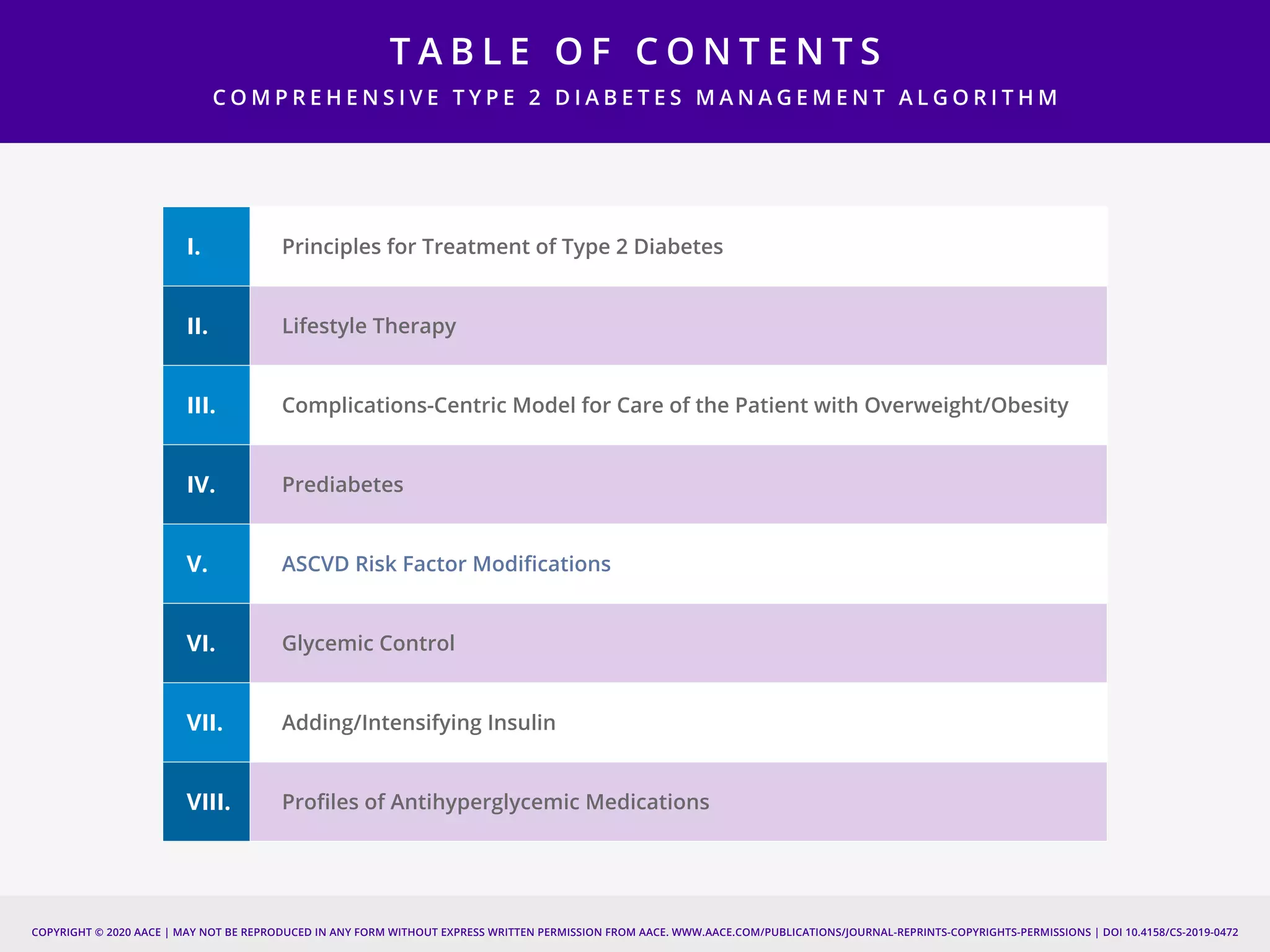
I. Principles for Treatment of Type 2 Diabetes
II. Lifestyle Therapy
III. Complications-Centric Model for Care of the Patient with Overweight/Obesity
IV. Prediabetes
V. ASCVD Risk Factor Modifications
VI. Glycemic Control
VII. Adding/Intensifying Insulin
VIII. Profiles of Antihyperglycemic Medications
T A B L E O F C O N T E N T S
C O M P R E H E N S I V E T Y P E 2 D I A B E T E S M A N A G E M E N T A L G O R I T H M
COPYRIGHT © 2020 AACE | MAY NOT BE REPRODUCED IN ANY FORM WITHOUT EXPRESS WRITTEN PERMISSION FROM AACE. WWW.AACE.COM/PUBLICATIONS/JOURNAL-REPRINTS-COPYRIGHTS-PERMISSIONS | DOI 10.4158/CS-2019-0472
P R I N C I P L E S O F T H E A A C E / A C E C O M P R E H E N S I V E
T Y P E 2 D I A B E T E S M A N A G E M E N T A L G O R I T H M
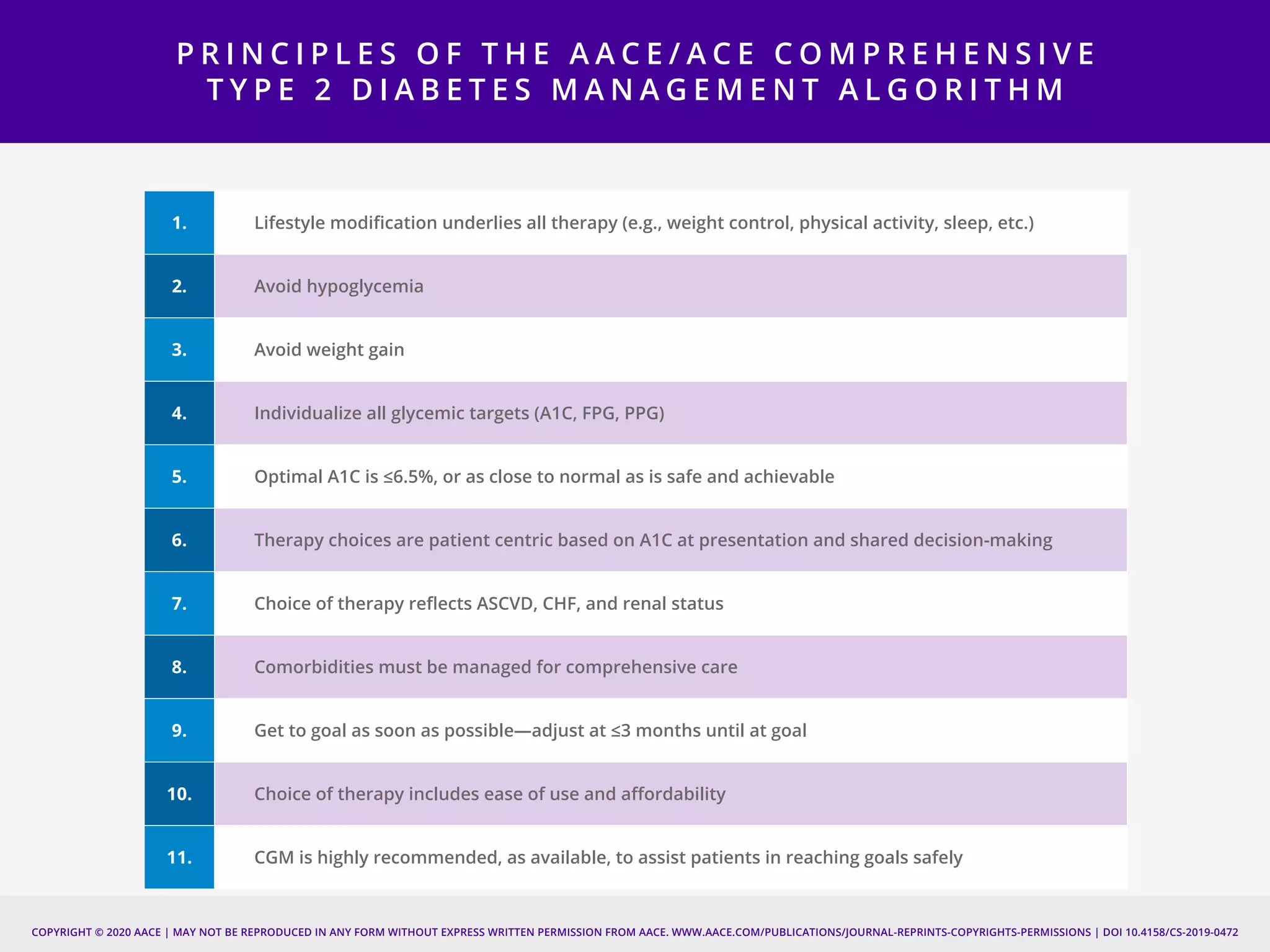
1. Lifestyle modification underlies all therapy (e.g., weight control, physical activity, sleep, etc.)
2. Avoid hypoglycemia
3. Avoid weight gain
4. Individualize all glycemic targets (A1C, FPG, PPG)
5. Optimal A1C is ≤6.5%, or as close to normal as is safe and achievable
6. Therapy choices are patient centric based on A1C at presentation and shared decision-making
7. Choice of therapy reflects ASCVD, CHF, and renal status
8. Comorbidities must be managed for comprehensive care
9. Get to goal as soon as possible—adjust at ≤3 months until at goal
10. Choice of therapy includes ease of use and affordability
11. CGM is highly recommended, as available, to assist patients in reaching goals safely
COPYRIGHT © 2020 AACE | MAY NOT BE REPRODUCED IN ANY FORM WITHOUT EXPRESS WRITTEN PERMISSION FROM AACE. WWW.AACE.COM/PUBLICATIONS/JOURNAL-REPRINTS-COPYRIGHTS-PERMISSIONS | DOI 10.4158/CS-2019-0472
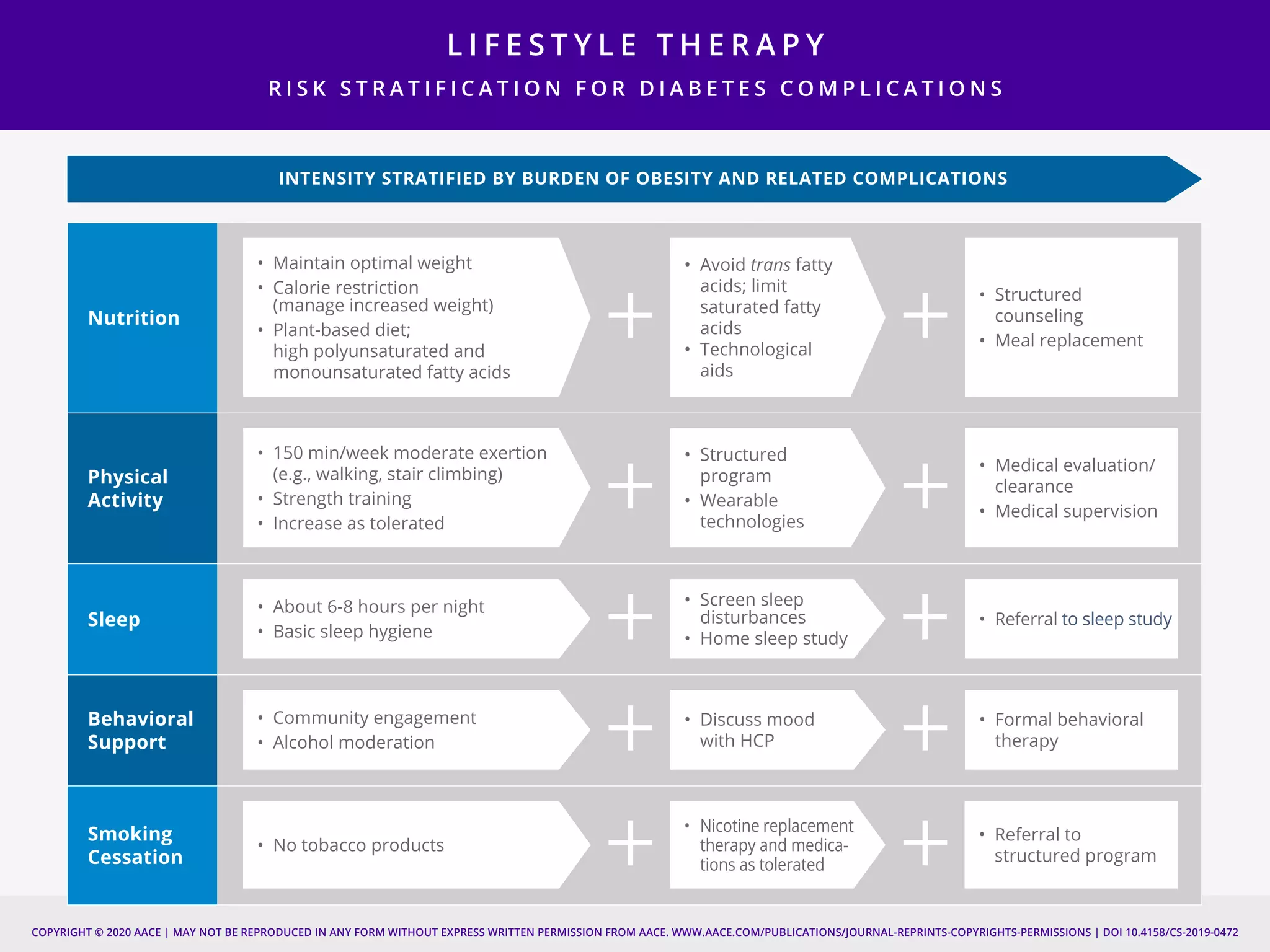
L I F E S T Y L E T H E R A P Y
R I S K S T R A T I F I C A T I O N F O R D I A B E T E S C O M P L I C A T I O N S
Nutrition
Physical
Activity
Sleep
Behavioral
Support
Smoking
Cessation
• Structured
counseling
• Meal replacement
+
• Medical evaluation/
clearance
• Medical supervision
• Referral to sleep study
• Formal behavioral
therapy
• Referral to
structured program
+
+
+
+
+
+
+
+
+
INTENSITY STRATIFIED BY BURDEN OF OBESITY AND RELATED COMPLICATIONS
• Avoid trans fatty
acids; limit
saturated fatty
acids
• Technological
aids
• Structured
program
• Wearable
technologies
• Screen sleep
disturbances
• Home sleep study
• Discuss mood
with HCP
• Nicotine replacement
therapy and medica-
tions as tolerated
• Maintain optimal weight
• Calorie restriction
(manage increased weight)
• Plant-based diet;
high polyunsaturated and
monounsaturated fatty acids
• 150 min/week moderate exertion
(e.g., walking, stair climbing)
• Strength training
• Increase as tolerated
• About 6-8 hours per night
• Basic sleep hygiene
• Community engagement
• Alcohol moderation
• No tobacco products
COPYRIGHT © 2020 AACE | MAY NOT BE REPRODUCED IN ANY FORM WITHOUT EXPRESS WRITTEN PERMISSION FROM AACE. WWW.AACE.COM/PUBLICATIONS/JOURNAL-REPRINTS-COPYRIGHTS-PERMISSIONS | DOI 10.4158/CS-2019-0472
STEP 1 EVALUATION FOR COMPLICATIONS AND STAGING
Physician/RD counseling, web/remote program, structured multidisciplinary program
Lifestyle Therapy:
Medical
Therapy
(BMI ≥27):
Endoscopic procedures, gastric banding, sleeve, or bypass
Surgical Therapy (BMI ≥35):
STEP 3
CARDIOMETABOLIC DISEASE | BIOMECHANICAL COMPLICATIONS
Therapeutic targets for
improvement in complications
STEP 2
Treatment
modality
Treatment intensity based
on staging
+ +
Individualize care by selecting one of the following based on efficacy, safety,
and patients’ clinical profile: phentermine, orlistat, lorcaserin,
phentermine/topiramate ER, naltrexone/bupropion, liraglutide 3 mg
If therapeutic targets for complications not met, intensify lifestyle, medical, and/or surgical treatment
modalities for greater weight loss. Obesity is a chronic progressive disease and requires commitment to
long-term therapy and follow-up.
STAGE 0
SEVERE
BMI ≥25
STAGE 2
STAGE 1
MILD TO MODERATE
OVERWEIGHT OR OBESITY
NO COMPLICATIONS COMPLICATIONS
NO OVERWEIGHT
OR OBESITY
BMI ≥25
SELECT:
BMI <25
C O M P L I C A T I O N S - C E N T R I C M O D E L F O R C A R E O F T H E P A T I E N T W I T H
O V E R W E I G H T / O B E S I T Y ( A D I P O S I T Y - B A S E D C H R O N I C D I S E A S E )
COPYRIGHT © 2020 AACE | MAY NOT BE REPRODUCED IN ANY FORM WITHOUT EXPRESS WRITTEN PERMISSION FROM AACE. WWW.AACE.COM/PUBLICATIONS/JOURNAL-REPRINTS-COPYRIGHTS-PERMISSIONS | DOI 10.4158/CS-2019-0472
NORMAL
GLYCEMIA
Intensify
Weight
Loss
Therapies
TZD
GLP-1RA
Progression
OVERT
DIABETES
Consider with
Caution
TREAT HYPERGLYCEMIA
FPG >100 | 2-hour PG >140
TREAT ASCVD
RISK FACTORS
Orlistat, lorcaserin,
phentermine/topiramate ER,
naltrexone/bupropion, liraglutide 3 mg,
or bariatric surgery as indicated
for obesity treatment
LEGEND
MULTIPLE PRE-DM
CRITERIA
Low-risk
Medications
Metformin
Acarbose
WEIGHT LOSS
THERAPIES
ASCVD RISK FACTOR
MODIFICATIONS ALGORITHM
1 PRE-DM
CRITERION
L I F E S T Y L E T H E R A P Y
(Including Medically Assisted Weight Loss)
PROCEED TO
GLYCEMIC CONTROL
ALGORITHM
HYPERTENSION
ROUTE
DYSLIPIDEMIA
ROUTE
If hyperglycemia persists
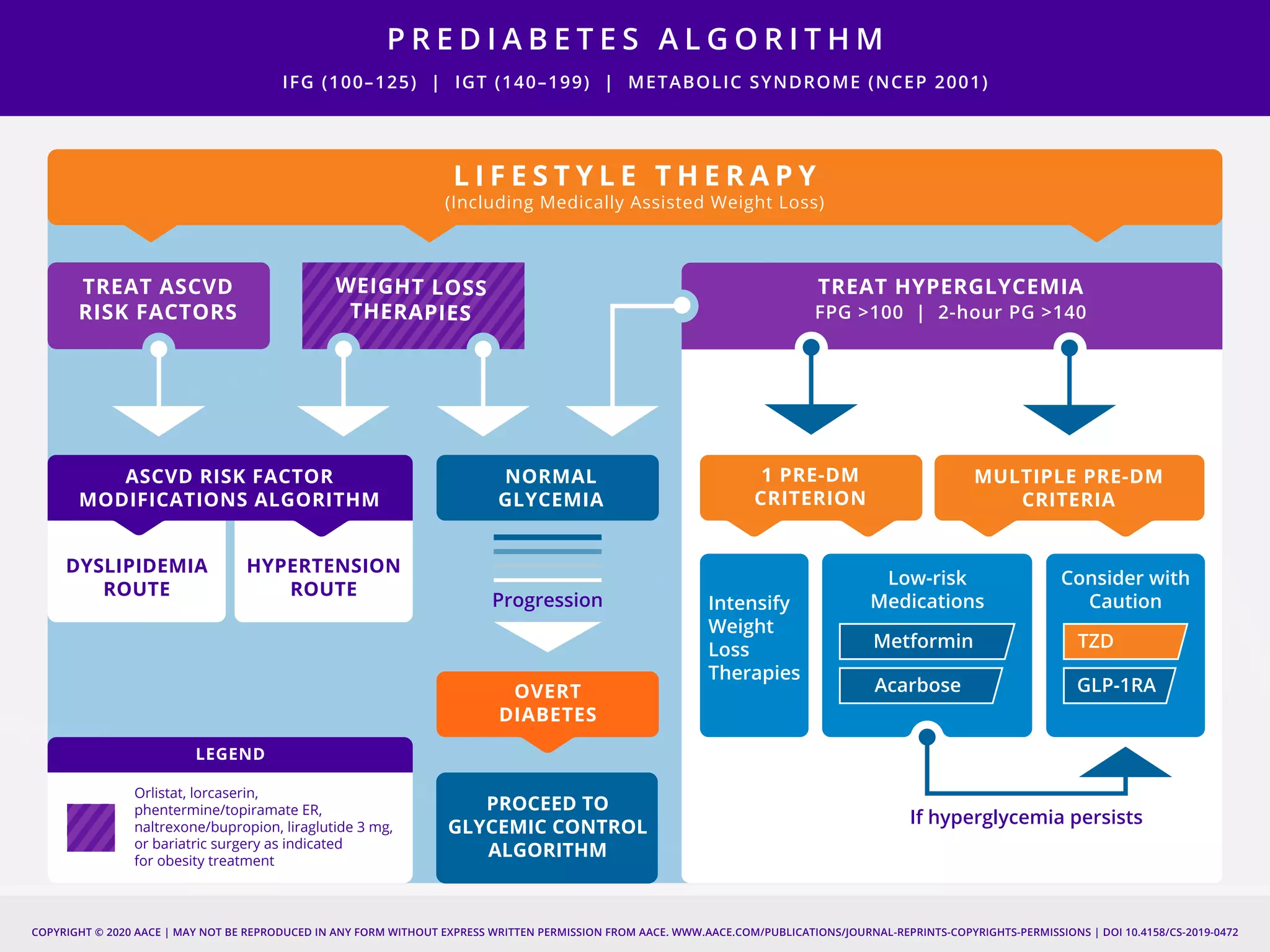
P R E D I A B E T E S A L G O R I T H M
IFG (100–125) | IGT (140–199) | METABOLIC SYNDROME (NCEP 2001)
COPYRIGHT © 2020 AACE | MAY NOT BE REPRODUCED IN ANY FORM WITHOUT EXPRESS WRITTEN PERMISSION FROM AACE. WWW.AACE.COM/PUBLICATIONS/JOURNAL-REPRINTS-COPYRIGHTS-PERMISSIONS | DOI 10.4158/CS-2019-0472
DYSLIPIDEMIA
If statin-intolerant
Intensify therapies to
attain goals according
to risk levels
Assess adequacy & tolerance of therapy with focused laboratory evaluations and patient follow-up
HYPERTENSION
Intensify lifestyle therapy (weight loss, physical activity, dietary
changes) and glycemic control; consider additional therapy
To lower LDL-C: Intensify statin, add ezetimibe, PCSK9i, colesevelam, or niacin
To lower Non-HDL-C, TG: Intensify statin and/or add Rx-grade OM3 fatty acid, fibrate, and/or niacin
To lower Apo B, LDL-P: Intensify statin and/or add ezetimibe, PCSK9i, colesevelam, and/or niacin
To lower LDL-C in FH:** Statin + PCSK9i Additional choices (α-blockers,
central agents, vasodilators,
aldosterone antagonist)
GOAL: SYSTOLIC <130,
DIASTOLIC <80 mm Hg
ACEi
or
ARB
Calcium
Channel
Blocker
ß-blocker
Thiazide
ACEi
or
ARB
If not at goal (2–3 months)
* EVEN MORE INTENSIVE THERAPY MIGHT BE WARRANTED ** FAMILIAL HYPERCHOLESTEROLEMIA
LIPID PANEL: Assess ASCVD Risk
Achievement of target blood
pressure is critical
Add next agent from the above
group, repeat
STATIN THERAPY
If TG >500 mg/dL, fibrates, Rx-grade OM-3 fatty acids, niacin
L I F E S T Y L E T H E R A P Y (Including Medically Assisted Weight Loss)
If not at desirable levels:
Add icosapent ethyl 4 g/day if high ASCVD risk on maximally tolerated statins
If TG 135-499:
Add calcium channel blocker,
ß-blocker or thiazide diuretic
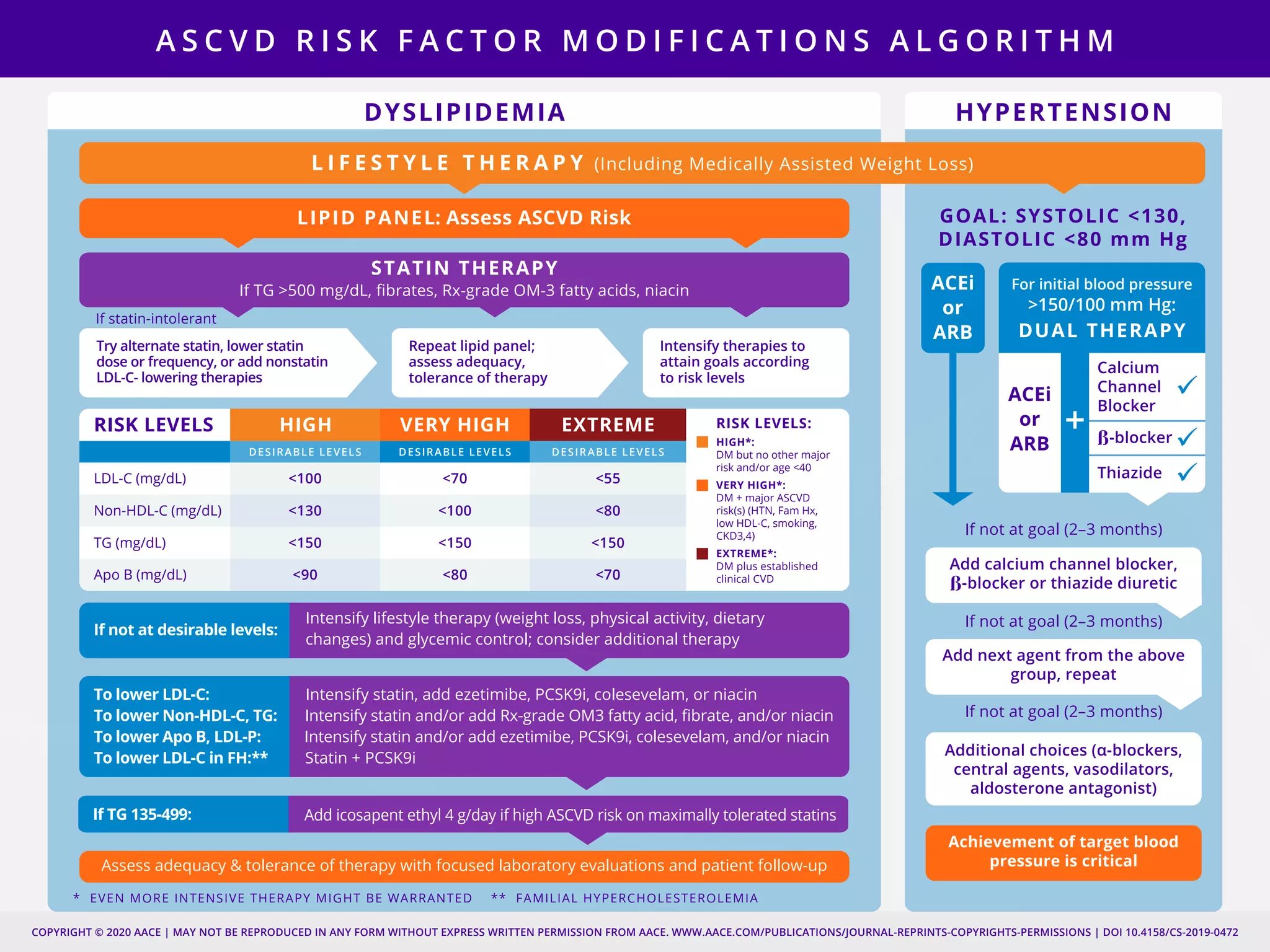
A S C V D R I S K F A C T O R M O D I F I C A T I O N S A L G O R I T H M
RISK LEVELS HIGH VERY HIGH EXTREME
DESIRABLE LEVELS DESIRABLE LEVELS DESIRABLE LEVELS
LDL-C (mg/dL) <100 <70 <55
Non-HDL-C (mg/dL) <130 <100 <80
TG (mg/dL) <150 <150 <150
Apo B (mg/dL) <90 <80 <70
RISK LEVELS:
HIGH*:
DM but no other major
risk and/or age <40
VERY HIGH*:
DM + major ASCVD
risk(s) (HTN, Fam Hx,
low HDL-C, smoking,
CKD3,4)
EXTREME*:
DM plus established
clinical CVD
Try alternate statin, lower statin
dose or frequency, or add nonstatin
LDL-C- lowering therapies
Repeat lipid panel;
assess adequacy,
tolerance of therapy
For initial blood pressure
>150/100 mm Hg:
DUAL THERAPY
COPYRIGHT © 2020 AACE | MAY NOT BE REPRODUCED IN ANY FORM WITHOUT EXPRESS WRITTEN PERMISSION FROM AACE. WWW.AACE.COM/PUBLICATIONS/JOURNAL-REPRINTS-COPYRIGHTS-PERMISSIONS | DOI 10.4158/CS-2019-0472
DUAL
Therapy
TRIPLE
Therapy
OR
INSULIN
±
Other
Agents
ADD OR INTENSIFY
INSULIN
Refer to Insulin Algorithm
LEGEND
Few adverse events and/or
possible benefits
Use with caution
Entry A1C >9.0%
1 Order of medications represents a suggested hierarchy of usage; length of line reflects strength of recommendation
2 If not at goal in 3 months, proceed to next level therapy
*CKD 3: canagliflozin; HFrEF: dapagliflozin
CKD 3 = stage 3 chronic kidney disease; HFrEF = heart failure with reduced ejection fraction; LA = long-acting (≥24 hour duration)
A1C ≤6.5% For patients without concurrent serious
illness and at low hypoglycemic risk A1C >6.5% For patients with concurrent serious
illness and at risk for hypoglycemia
INDIVIDUALIZE
GOALS
Entry A1C ≥7.5% - 9.0%
LIFEST Y L E T H ERA P Y AND ONG OING G LU COSE MONITORING (CGM preferred)
INDEPENDENT OF GLYCEMIC CONTROL, IF ESTABLISHED OR HIGH ASCVD RISK AND/OR CKD, RECOMMEND SGLT2i AND/OR LA GLP1-RA
P R O G R E S S I O N O F D I S E A S E
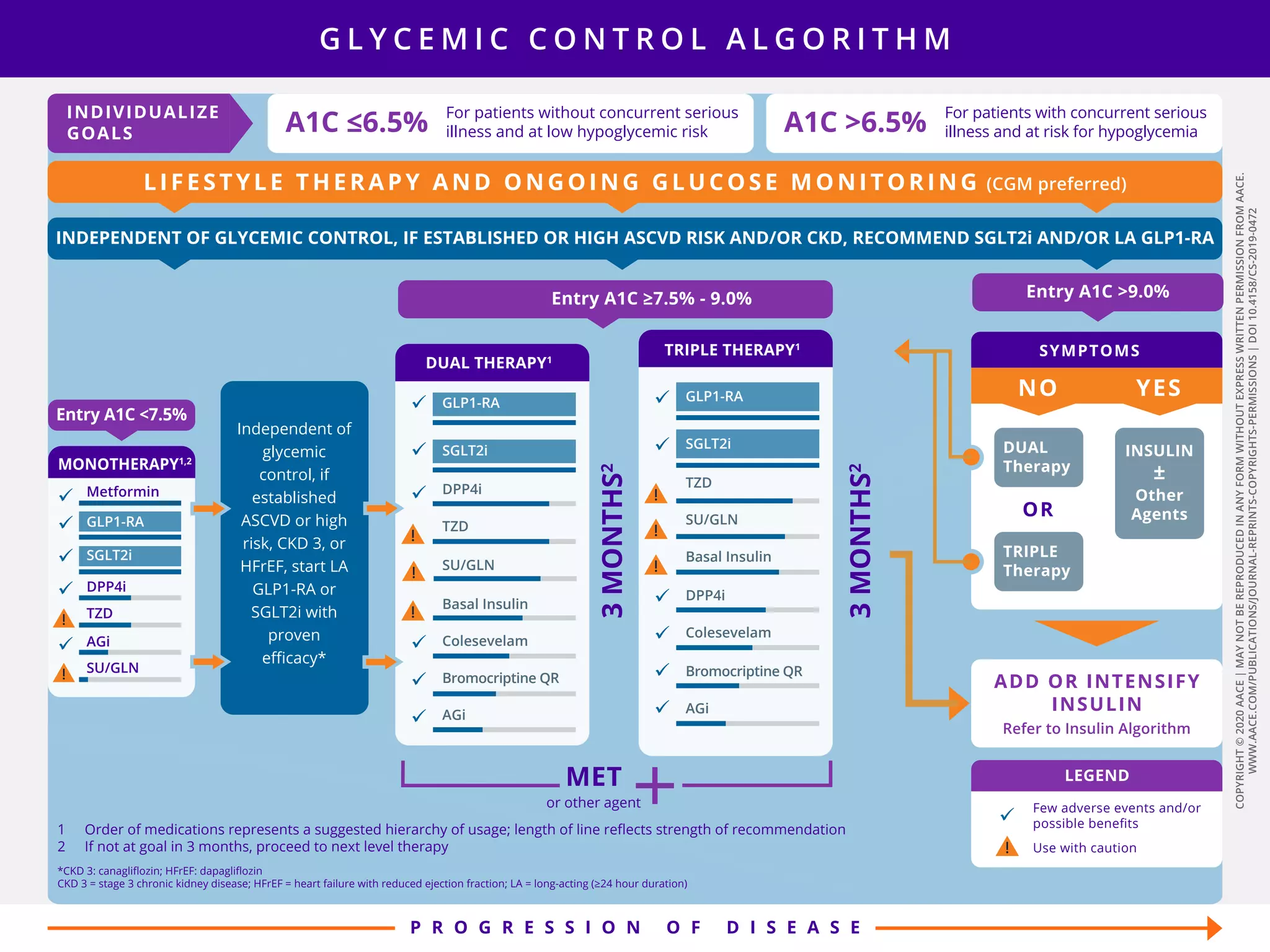
G L Y C E M I C C O N T R O L A L G O R I T H M
MET
or other agent
DUAL THERAPY1
GLP1-RA
SGLT2i
DPP4i
TZD
SU/GLN
Basal Insulin
Colesevelam
Bromocriptine QR
AGi
NO YES
SYMPTOMS
Entry A1C <7.5%
MONOTHERAPY1,2
Metformin
GLP1-RA
SGLT2i
DPP4i
TZD
AGi
SU/GLN
GLP1-RA
SGLT2i
TZD
SU/GLN
Basal Insulin
DPP4i
Colesevelam
Bromocriptine QR
AGi
TRIPLE THERAPY1
+
3
MONTHS
2
3
MONTHS
2
Independent of
glycemic
control, if
established
ASCVD or high
risk, CKD 3, or
HFrEF, start LA
GLP1-RA or
SGLT2i with
proven
efficacy*
COPYRIGHT
©
2020
AACE
|
MAY
NOT
BE
REPRODUCED
IN
ANY
FORM
WITHOUT
EXPRESS
WRITTEN
PERMISSION
FROM
AACE.
WWW.AACE.COM/PUBLICATIONS/JOURNAL-REPRINTS-COPYRIGHTS-PERMISSIONS
|
DOI
10.4158/CS-2019-0472
COPYRIGHT © 2020 AACE | MAY NOT BE REPRODUCED IN ANY FORM WITHOUT EXPRESS WRITTEN PERMISSION FROM AACE. WWW.AACE.COM/PUBLICATIONS/JOURNAL-REPRINTS-COPYRIGHTS-PERMISSIONS | DOI 10.4158/CS-2019-0472
• <7% for most patients with T2D; fasting and premeal
BG <110 mg/dL; absence of hypoglycemia
• A1C and FBG targets may be adjusted based on patient’s age,
duration of diabetes, presence of comorbidities, diabetic
complications, and hypoglycemia risk
• Fixed regimen: Increase TDD by 2 U
• Adjustable regimen:
• FBG >180 mg/dL: add 20% of TDD
• FBG 140–180 mg/dL: add 10% of TDD
• FBG 110–139 mg/dL: add 1 unit
• If hypoglycemia, reduce TDD by:
• BG <70 mg/dL: 10% – 20%
• BG <40 mg/dL: 20% – 40%
*Glycemic Goal:
A1C <8% A1C >8%
START BASAL (Long-Acting Insulin)
Consider discontinuing or reducing sulfonylurea after
starting basal insulin (basal analogs preferred to NPH)
0.1–0.2 U/kg 0.2–0.3 U/kg
Insulin titration every 2–3 days
to reach glycemic goal:
Glycemic
Control Not
at Goal*
Basal Plus 1,
Plus 2, Plus 3
Basal Bolus
Add Prandial Insulin
• Begin prandial
insulin before
largest meal
• If not at goal,
progress to
injections before
2 or 3 meals
• Start: 10% of
basal dose or
5 units
• Start: 50% of TDD
in three doses
before meals
• Begin prandial
insulin before
each meal
• 50% Basal /
50% Prandial
TDD 0.3–0.5 U/kg
Insulin titration every 2–3 days to reach glycemic goal:
• Increase prandial dose by 10% or 1-2 units if 2-h postprandial
or next premeal glucose consistently >140 mg/dL
• If hypoglycemia, reduce TDD basal and/or prandial insulin by:
• BG consistently <70 mg/dL: 10% - 20%
• Severe hypoglycemia (requiring assistance from another
person) or BG <40 mg/dL: 20% - 40%
Add
GLP1-RA
Or SGLT2i
Or DPP4i
TDD TDD
INTENSIFY (Prandial Control)
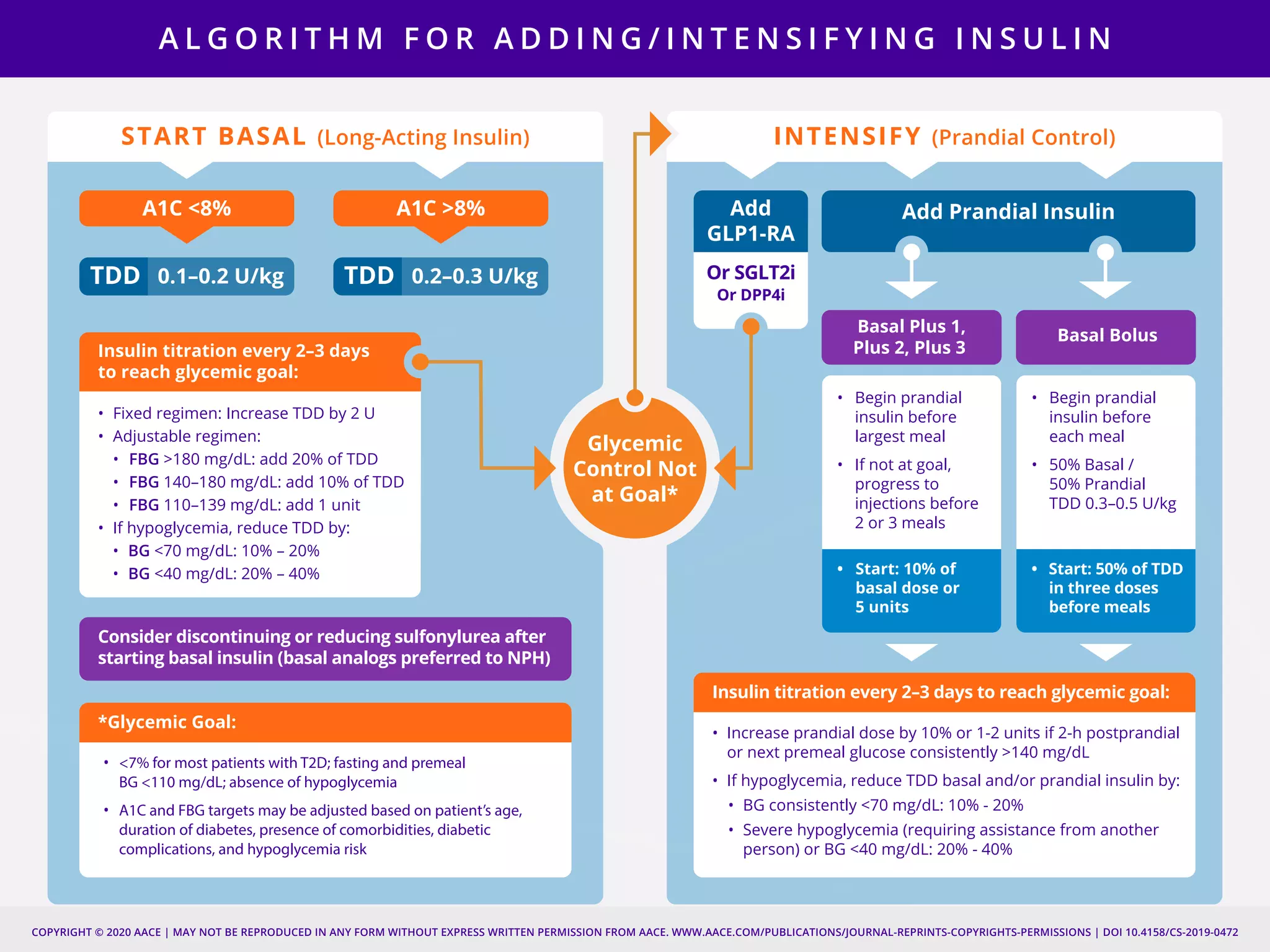
A L G O R I T H M F O R A D D I N G / I N T E N S I F Y I N G I N S U L I N
COPYRIGHT © 2020 AACE | MAY NOT BE REPRODUCED IN ANY FORM WITHOUT EXPRESS WRITTEN PERMISSION FROM AACE. WWW.AACE.COM/PUBLICATIONS/JOURNAL-REPRINTS-COPYRIGHTS-PERMISSIONS | DOI 10.4158/CS-2019-0472
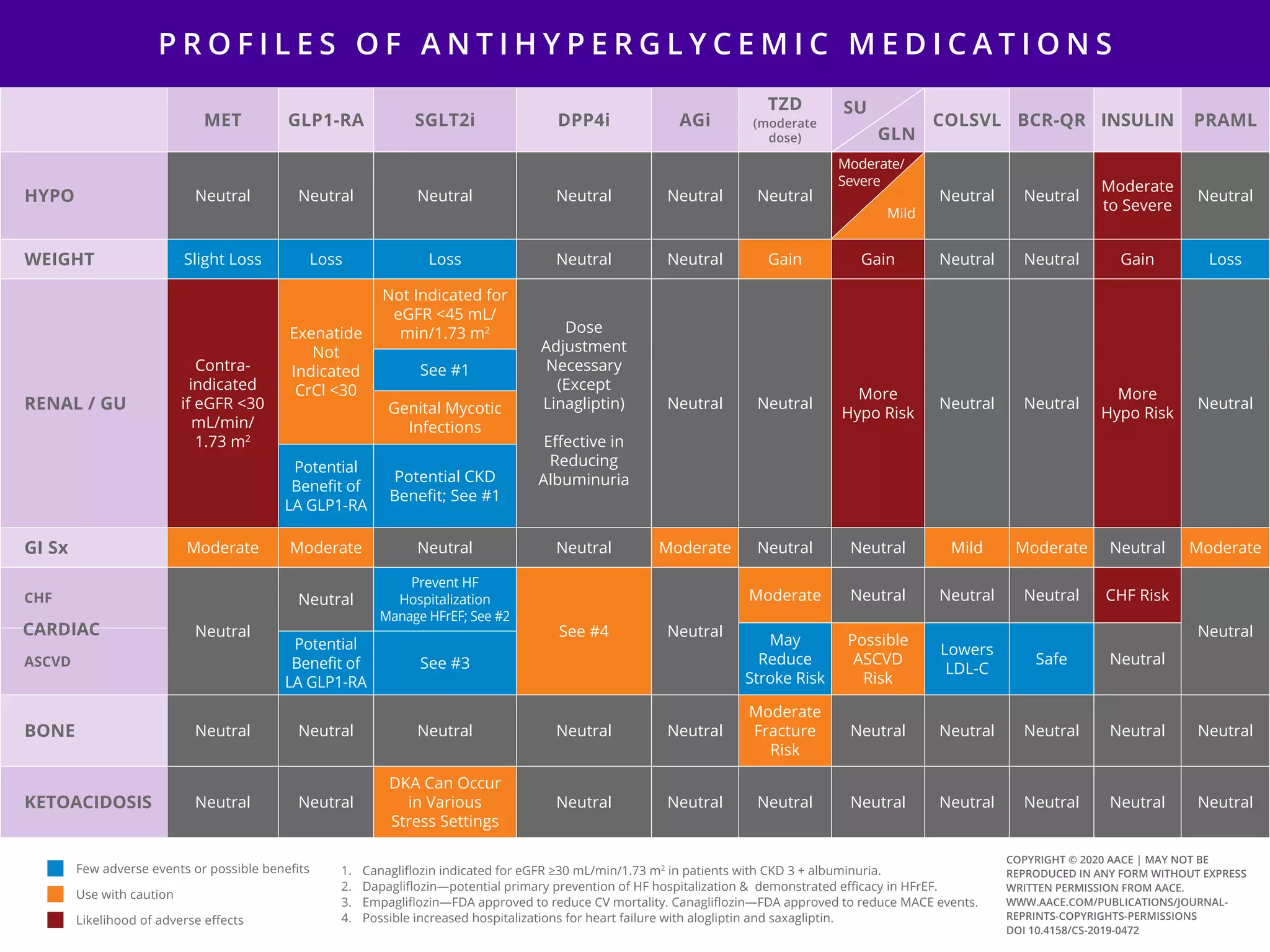
MET GLP1-RA SGLT2i DPP4i AGi
TZD
(moderate
dose)
COLSVL BCR-QR INSULIN PRAML
HYPO Neutral Neutral Neutral Neutral Neutral Neutral Neutral Neutral
Moderate
to Severe
Neutral
WEIGHT Slight Loss Loss Loss Neutral Neutral Gain Gain Neutral Neutral Gain Loss
RENAL / GU
Contra-
indicated
if eGFR <30
mL/min/
1.73 m2
Exenatide
Not
Indicated
CrCl <30
Not Indicated for
eGFR <45 mL/
min/1.73 m2 Dose
Adjustment
Necessary
(Except
Linagliptin)
Effective in
Reducing
Albuminuria
Neutral Neutral
More
Hypo Risk
Neutral Neutral
More
Hypo Risk
Neutral
See #1
Genital Mycotic
Infections
Potential
Benefit of
LA GLP1-RA
Potential CKD
Benefit; See #1
GI Sx Moderate Moderate Neutral Neutral Moderate Neutral Neutral Mild Moderate Neutral Moderate
CHF
Neutral
Neutral
Prevent HF
Hospitalization
Manage HFrEF; See #2
See #4 Neutral
Moderate Neutral Neutral Neutral CHF Risk
Neutral
May
Reduce
Stroke Risk
Possible
ASCVD
Risk
Lowers
LDL-C
Safe Neutral
ASCVD
Potential
Benefit of
LA GLP1-RA
See #3
BONE Neutral Neutral Neutral Neutral Neutral
Moderate
Fracture
Risk
Neutral Neutral Neutral Neutral Neutral
KETOACIDOSIS Neutral Neutral
DKA Can Occur
in Various
Stress Settings
Neutral Neutral Neutral Neutral Neutral Neutral Neutral Neutral
P R O F I L E S O F A N T I H Y P E R G L Y C E M I C M E D I C A T I O N S
SU
Mild
Few adverse events or possible benefits
Use with caution
Likelihood of adverse effects
GLN
Moderate/
Severe
CARDIAC
1. Canagliflozin indicated for eGFR ≥30 mL/min/1.73 m2
in patients with CKD 3 + albuminuria.
2. Dapagliflozin—potential primary prevention of HF hospitalization & demonstrated efficacy in HFrEF.
3. Empagliflozin—FDA approved to reduce CV mortality. Canagliflozin—FDA approved to reduce MACE events.
4. Possible increased hospitalizations for heart failure with alogliptin and saxagliptin.
COPYRIGHT © 2020 AACE | MAY NOT BE
REPRODUCED IN ANY FORM WITHOUT EXPRESS
WRITTEN PERMISSION FROM AACE.
WWW.AACE.COM/PUBLICATIONS/JOURNAL-
REPRINTS-COPYRIGHTS-PERMISSIONS
DOI 10.4158/CS-2019-0472

AACE_2019_Diabetes_Algorithm_03.2021.pdf

  • 1.
    COPYRIGHT © 2020AACE | MAY NOT BE REPRODUCED IN ANY FORM WITHOUT EXPRESS WRITTEN PERMISSION FROM AACE. WWW.AACE.COM/PUBLICATIONS/JOURNAL-REPRINTS-COPYRIGHTS-PERMISSIONS | DOI 10.4158/CS-2019-0472 2 0 2 0 AMERICAN ASSOCIATION OF CLINICAL ENDOCRINOLOGY AACE COMPREHENSIVE TYPE 2 DIABETES MANAGEMENT ALGORITHM COPYRIGHT © 2020 AACE | MAY NOT BE REPRODUCED IN ANY FORM WITHOUT EXPRESS WRITTEN PERMISSION FROM AACE. WWW.AACE.COM/PUBLICATIONS/JOURNAL-REPRINTS-COPYRIGHTS-PERMISSIONS | DOI 10.4158/CS-2019-0472
  • 2.
    COPYRIGHT © 2020AACE | MAY NOT BE REPRODUCED IN ANY FORM WITHOUT EXPRESS WRITTEN PERMISSION FROM AACE. WWW.AACE.COM/PUBLICATIONS/JOURNAL-REPRINTS-COPYRIGHTS-PERMISSIONS | DOI 10.4158/CS-2019-0472 I. Principles for Treatment of Type 2 Diabetes II. Lifestyle Therapy III. Complications-Centric Model for Care of the Patient with Overweight/Obesity IV. Prediabetes V. ASCVD Risk Factor Modifications VI. Glycemic Control VII. Adding/Intensifying Insulin VIII. Profiles of Antihyperglycemic Medications T A B L E O F C O N T E N T S C O M P R E H E N S I V E T Y P E 2 D I A B E T E S M A N A G E M E N T A L G O R I T H M
  • 3.
    COPYRIGHT © 2020AACE | MAY NOT BE REPRODUCED IN ANY FORM WITHOUT EXPRESS WRITTEN PERMISSION FROM AACE. WWW.AACE.COM/PUBLICATIONS/JOURNAL-REPRINTS-COPYRIGHTS-PERMISSIONS | DOI 10.4158/CS-2019-0472 P R I N C I P L E S O F T H E A A C E / A C E C O M P R E H E N S I V E T Y P E 2 D I A B E T E S M A N A G E M E N T A L G O R I T H M 1. Lifestyle modification underlies all therapy (e.g., weight control, physical activity, sleep, etc.) 2. Avoid hypoglycemia 3. Avoid weight gain 4. Individualize all glycemic targets (A1C, FPG, PPG) 5. Optimal A1C is ≤6.5%, or as close to normal as is safe and achievable 6. Therapy choices are patient centric based on A1C at presentation and shared decision-making 7. Choice of therapy reflects ASCVD, CHF, and renal status 8. Comorbidities must be managed for comprehensive care 9. Get to goal as soon as possible—adjust at ≤3 months until at goal 10. Choice of therapy includes ease of use and affordability 11. CGM is highly recommended, as available, to assist patients in reaching goals safely
  • 4.
    COPYRIGHT © 2020AACE | MAY NOT BE REPRODUCED IN ANY FORM WITHOUT EXPRESS WRITTEN PERMISSION FROM AACE. WWW.AACE.COM/PUBLICATIONS/JOURNAL-REPRINTS-COPYRIGHTS-PERMISSIONS | DOI 10.4158/CS-2019-0472 L I F E S T Y L E T H E R A P Y R I S K S T R A T I F I C A T I O N F O R D I A B E T E S C O M P L I C A T I O N S Nutrition Physical Activity Sleep Behavioral Support Smoking Cessation • Structured counseling • Meal replacement + • Medical evaluation/ clearance • Medical supervision • Referral to sleep study • Formal behavioral therapy • Referral to structured program + + + + + + + + + INTENSITY STRATIFIED BY BURDEN OF OBESITY AND RELATED COMPLICATIONS • Avoid trans fatty acids; limit saturated fatty acids • Technological aids • Structured program • Wearable technologies • Screen sleep disturbances • Home sleep study • Discuss mood with HCP • Nicotine replacement therapy and medica- tions as tolerated • Maintain optimal weight • Calorie restriction (manage increased weight) • Plant-based diet; high polyunsaturated and monounsaturated fatty acids • 150 min/week moderate exertion (e.g., walking, stair climbing) • Strength training • Increase as tolerated • About 6-8 hours per night • Basic sleep hygiene • Community engagement • Alcohol moderation • No tobacco products
  • 5.
    COPYRIGHT © 2020AACE | MAY NOT BE REPRODUCED IN ANY FORM WITHOUT EXPRESS WRITTEN PERMISSION FROM AACE. WWW.AACE.COM/PUBLICATIONS/JOURNAL-REPRINTS-COPYRIGHTS-PERMISSIONS | DOI 10.4158/CS-2019-0472 STEP 1 EVALUATION FOR COMPLICATIONS AND STAGING Physician/RD counseling, web/remote program, structured multidisciplinary program Lifestyle Therapy: Medical Therapy (BMI ≥27): Endoscopic procedures, gastric banding, sleeve, or bypass Surgical Therapy (BMI ≥35): STEP 3 CARDIOMETABOLIC DISEASE | BIOMECHANICAL COMPLICATIONS Therapeutic targets for improvement in complications STEP 2 Treatment modality Treatment intensity based on staging + + Individualize care by selecting one of the following based on efficacy, safety, and patients’ clinical profile: phentermine, orlistat, lorcaserin, phentermine/topiramate ER, naltrexone/bupropion, liraglutide 3 mg If therapeutic targets for complications not met, intensify lifestyle, medical, and/or surgical treatment modalities for greater weight loss. Obesity is a chronic progressive disease and requires commitment to long-term therapy and follow-up. STAGE 0 SEVERE BMI ≥25 STAGE 2 STAGE 1 MILD TO MODERATE OVERWEIGHT OR OBESITY NO COMPLICATIONS COMPLICATIONS NO OVERWEIGHT OR OBESITY BMI ≥25 SELECT: BMI <25 C O M P L I C A T I O N S - C E N T R I C M O D E L F O R C A R E O F T H E P A T I E N T W I T H O V E R W E I G H T / O B E S I T Y ( A D I P O S I T Y - B A S E D C H R O N I C D I S E A S E )
  • 6.
    COPYRIGHT © 2020AACE | MAY NOT BE REPRODUCED IN ANY FORM WITHOUT EXPRESS WRITTEN PERMISSION FROM AACE. WWW.AACE.COM/PUBLICATIONS/JOURNAL-REPRINTS-COPYRIGHTS-PERMISSIONS | DOI 10.4158/CS-2019-0472 NORMAL GLYCEMIA Intensify Weight Loss Therapies TZD GLP-1RA Progression OVERT DIABETES Consider with Caution TREAT HYPERGLYCEMIA FPG >100 | 2-hour PG >140 TREAT ASCVD RISK FACTORS Orlistat, lorcaserin, phentermine/topiramate ER, naltrexone/bupropion, liraglutide 3 mg, or bariatric surgery as indicated for obesity treatment LEGEND MULTIPLE PRE-DM CRITERIA Low-risk Medications Metformin Acarbose WEIGHT LOSS THERAPIES ASCVD RISK FACTOR MODIFICATIONS ALGORITHM 1 PRE-DM CRITERION L I F E S T Y L E T H E R A P Y (Including Medically Assisted Weight Loss) PROCEED TO GLYCEMIC CONTROL ALGORITHM HYPERTENSION ROUTE DYSLIPIDEMIA ROUTE If hyperglycemia persists P R E D I A B E T E S A L G O R I T H M IFG (100–125) | IGT (140–199) | METABOLIC SYNDROME (NCEP 2001)
  • 7.
    COPYRIGHT © 2020AACE | MAY NOT BE REPRODUCED IN ANY FORM WITHOUT EXPRESS WRITTEN PERMISSION FROM AACE. WWW.AACE.COM/PUBLICATIONS/JOURNAL-REPRINTS-COPYRIGHTS-PERMISSIONS | DOI 10.4158/CS-2019-0472 DYSLIPIDEMIA If statin-intolerant Intensify therapies to attain goals according to risk levels Assess adequacy & tolerance of therapy with focused laboratory evaluations and patient follow-up HYPERTENSION Intensify lifestyle therapy (weight loss, physical activity, dietary changes) and glycemic control; consider additional therapy To lower LDL-C: Intensify statin, add ezetimibe, PCSK9i, colesevelam, or niacin To lower Non-HDL-C, TG: Intensify statin and/or add Rx-grade OM3 fatty acid, fibrate, and/or niacin To lower Apo B, LDL-P: Intensify statin and/or add ezetimibe, PCSK9i, colesevelam, and/or niacin To lower LDL-C in FH:** Statin + PCSK9i Additional choices (α-blockers, central agents, vasodilators, aldosterone antagonist) GOAL: SYSTOLIC <130, DIASTOLIC <80 mm Hg ACEi or ARB Calcium Channel Blocker ß-blocker Thiazide ACEi or ARB If not at goal (2–3 months) If not at goal (2–3 months) If not at goal (2–3 months) * EVEN MORE INTENSIVE THERAPY MIGHT BE WARRANTED ** FAMILIAL HYPERCHOLESTEROLEMIA LIPID PANEL: Assess ASCVD Risk Achievement of target blood pressure is critical Add next agent from the above group, repeat STATIN THERAPY If TG >500 mg/dL, fibrates, Rx-grade OM-3 fatty acids, niacin L I F E S T Y L E T H E R A P Y (Including Medically Assisted Weight Loss) If not at desirable levels: Add icosapent ethyl 4 g/day if high ASCVD risk on maximally tolerated statins If TG 135-499: Add calcium channel blocker, ß-blocker or thiazide diuretic A S C V D R I S K F A C T O R M O D I F I C A T I O N S A L G O R I T H M RISK LEVELS HIGH VERY HIGH EXTREME DESIRABLE LEVELS DESIRABLE LEVELS DESIRABLE LEVELS LDL-C (mg/dL) <100 <70 <55 Non-HDL-C (mg/dL) <130 <100 <80 TG (mg/dL) <150 <150 <150 Apo B (mg/dL) <90 <80 <70 RISK LEVELS: HIGH*: DM but no other major risk and/or age <40 VERY HIGH*: DM + major ASCVD risk(s) (HTN, Fam Hx, low HDL-C, smoking, CKD3,4) EXTREME*: DM plus established clinical CVD Try alternate statin, lower statin dose or frequency, or add nonstatin LDL-C- lowering therapies Repeat lipid panel; assess adequacy, tolerance of therapy For initial blood pressure >150/100 mm Hg: DUAL THERAPY
  • 8.
    COPYRIGHT © 2020AACE | MAY NOT BE REPRODUCED IN ANY FORM WITHOUT EXPRESS WRITTEN PERMISSION FROM AACE. WWW.AACE.COM/PUBLICATIONS/JOURNAL-REPRINTS-COPYRIGHTS-PERMISSIONS | DOI 10.4158/CS-2019-0472 DUAL Therapy TRIPLE Therapy OR INSULIN ± Other Agents ADD OR INTENSIFY INSULIN Refer to Insulin Algorithm LEGEND Few adverse events and/or possible benefits Use with caution Entry A1C >9.0% 1 Order of medications represents a suggested hierarchy of usage; length of line reflects strength of recommendation 2 If not at goal in 3 months, proceed to next level therapy *CKD 3: canagliflozin; HFrEF: dapagliflozin CKD 3 = stage 3 chronic kidney disease; HFrEF = heart failure with reduced ejection fraction; LA = long-acting (≥24 hour duration) A1C ≤6.5% For patients without concurrent serious illness and at low hypoglycemic risk A1C >6.5% For patients with concurrent serious illness and at risk for hypoglycemia INDIVIDUALIZE GOALS Entry A1C ≥7.5% - 9.0% LIFEST Y L E T H ERA P Y AND ONG OING G LU COSE MONITORING (CGM preferred) INDEPENDENT OF GLYCEMIC CONTROL, IF ESTABLISHED OR HIGH ASCVD RISK AND/OR CKD, RECOMMEND SGLT2i AND/OR LA GLP1-RA P R O G R E S S I O N O F D I S E A S E G L Y C E M I C C O N T R O L A L G O R I T H M MET or other agent DUAL THERAPY1 GLP1-RA SGLT2i DPP4i TZD SU/GLN Basal Insulin Colesevelam Bromocriptine QR AGi NO YES SYMPTOMS Entry A1C <7.5% MONOTHERAPY1,2 Metformin GLP1-RA SGLT2i DPP4i TZD AGi SU/GLN GLP1-RA SGLT2i TZD SU/GLN Basal Insulin DPP4i Colesevelam Bromocriptine QR AGi TRIPLE THERAPY1 + 3 MONTHS 2 3 MONTHS 2 Independent of glycemic control, if established ASCVD or high risk, CKD 3, or HFrEF, start LA GLP1-RA or SGLT2i with proven efficacy* COPYRIGHT © 2020 AACE | MAY NOT BE REPRODUCED IN ANY FORM WITHOUT EXPRESS WRITTEN PERMISSION FROM AACE. WWW.AACE.COM/PUBLICATIONS/JOURNAL-REPRINTS-COPYRIGHTS-PERMISSIONS | DOI 10.4158/CS-2019-0472
  • 9.
    COPYRIGHT © 2020AACE | MAY NOT BE REPRODUCED IN ANY FORM WITHOUT EXPRESS WRITTEN PERMISSION FROM AACE. WWW.AACE.COM/PUBLICATIONS/JOURNAL-REPRINTS-COPYRIGHTS-PERMISSIONS | DOI 10.4158/CS-2019-0472 • <7% for most patients with T2D; fasting and premeal BG <110 mg/dL; absence of hypoglycemia • A1C and FBG targets may be adjusted based on patient’s age, duration of diabetes, presence of comorbidities, diabetic complications, and hypoglycemia risk • Fixed regimen: Increase TDD by 2 U • Adjustable regimen: • FBG >180 mg/dL: add 20% of TDD • FBG 140–180 mg/dL: add 10% of TDD • FBG 110–139 mg/dL: add 1 unit • If hypoglycemia, reduce TDD by: • BG <70 mg/dL: 10% – 20% • BG <40 mg/dL: 20% – 40% *Glycemic Goal: A1C <8% A1C >8% START BASAL (Long-Acting Insulin) Consider discontinuing or reducing sulfonylurea after starting basal insulin (basal analogs preferred to NPH) 0.1–0.2 U/kg 0.2–0.3 U/kg Insulin titration every 2–3 days to reach glycemic goal: Glycemic Control Not at Goal* Basal Plus 1, Plus 2, Plus 3 Basal Bolus Add Prandial Insulin • Begin prandial insulin before largest meal • If not at goal, progress to injections before 2 or 3 meals • Start: 10% of basal dose or 5 units • Start: 50% of TDD in three doses before meals • Begin prandial insulin before each meal • 50% Basal / 50% Prandial TDD 0.3–0.5 U/kg Insulin titration every 2–3 days to reach glycemic goal: • Increase prandial dose by 10% or 1-2 units if 2-h postprandial or next premeal glucose consistently >140 mg/dL • If hypoglycemia, reduce TDD basal and/or prandial insulin by: • BG consistently <70 mg/dL: 10% - 20% • Severe hypoglycemia (requiring assistance from another person) or BG <40 mg/dL: 20% - 40% Add GLP1-RA Or SGLT2i Or DPP4i TDD TDD INTENSIFY (Prandial Control) A L G O R I T H M F O R A D D I N G / I N T E N S I F Y I N G I N S U L I N
  • 10.
    COPYRIGHT © 2020AACE | MAY NOT BE REPRODUCED IN ANY FORM WITHOUT EXPRESS WRITTEN PERMISSION FROM AACE. WWW.AACE.COM/PUBLICATIONS/JOURNAL-REPRINTS-COPYRIGHTS-PERMISSIONS | DOI 10.4158/CS-2019-0472 MET GLP1-RA SGLT2i DPP4i AGi TZD (moderate dose) COLSVL BCR-QR INSULIN PRAML HYPO Neutral Neutral Neutral Neutral Neutral Neutral Neutral Neutral Moderate to Severe Neutral WEIGHT Slight Loss Loss Loss Neutral Neutral Gain Gain Neutral Neutral Gain Loss RENAL / GU Contra- indicated if eGFR <30 mL/min/ 1.73 m2 Exenatide Not Indicated CrCl <30 Not Indicated for eGFR <45 mL/ min/1.73 m2 Dose Adjustment Necessary (Except Linagliptin) Effective in Reducing Albuminuria Neutral Neutral More Hypo Risk Neutral Neutral More Hypo Risk Neutral See #1 Genital Mycotic Infections Potential Benefit of LA GLP1-RA Potential CKD Benefit; See #1 GI Sx Moderate Moderate Neutral Neutral Moderate Neutral Neutral Mild Moderate Neutral Moderate CHF Neutral Neutral Prevent HF Hospitalization Manage HFrEF; See #2 See #4 Neutral Moderate Neutral Neutral Neutral CHF Risk Neutral May Reduce Stroke Risk Possible ASCVD Risk Lowers LDL-C Safe Neutral ASCVD Potential Benefit of LA GLP1-RA See #3 BONE Neutral Neutral Neutral Neutral Neutral Moderate Fracture Risk Neutral Neutral Neutral Neutral Neutral KETOACIDOSIS Neutral Neutral DKA Can Occur in Various Stress Settings Neutral Neutral Neutral Neutral Neutral Neutral Neutral Neutral P R O F I L E S O F A N T I H Y P E R G L Y C E M I C M E D I C A T I O N S SU Mild Few adverse events or possible benefits Use with caution Likelihood of adverse effects GLN Moderate/ Severe CARDIAC 1. Canagliflozin indicated for eGFR ≥30 mL/min/1.73 m2 in patients with CKD 3 + albuminuria. 2. Dapagliflozin—potential primary prevention of HF hospitalization & demonstrated efficacy in HFrEF. 3. Empagliflozin—FDA approved to reduce CV mortality. Canagliflozin—FDA approved to reduce MACE events. 4. Possible increased hospitalizations for heart failure with alogliptin and saxagliptin. COPYRIGHT © 2020 AACE | MAY NOT BE REPRODUCED IN ANY FORM WITHOUT EXPRESS WRITTEN PERMISSION FROM AACE. WWW.AACE.COM/PUBLICATIONS/JOURNAL- REPRINTS-COPYRIGHTS-PERMISSIONS DOI 10.4158/CS-2019-0472