The Waves
Waves can be typified according to the
direction of motion of the vibrating particles
with respect to the direction in which the
waves travel. The types of waves according to
the direction of motion of the vibrating
particles with respect to the direction in
which the waves travel are transverse,
longitudinal and surface waves.
Types of waves
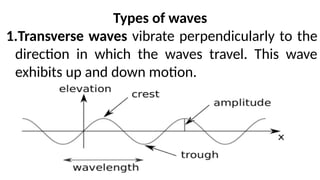
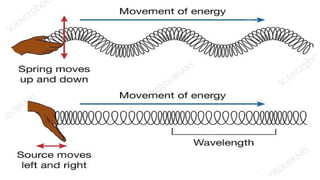
1.Transverse waves vibrate perpendicularly to the
direction in which the waves travel. This wave
exhibits up and down motion.
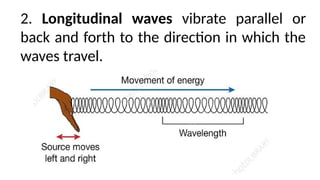
2. Longitudinal waves vibrate parallel or
back and forth to the direction in which the
waves travel.
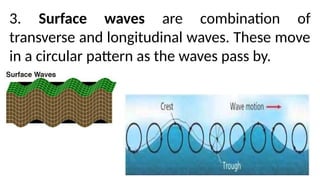
3. Surface waves are combination of
transverse and longitudinal waves. These move
in a circular pattern as the waves pass by.
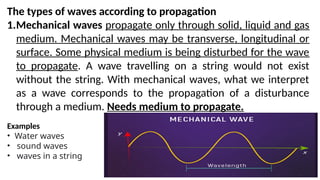
The types of waves according to propagation
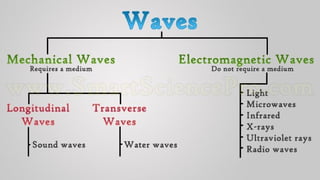
1.Mechanical waves propagate only through solid, liquid and gas
medium. Mechanical waves may be transverse, longitudinal or
surface. Some physical medium is being disturbed for the wave
to propagate. A wave travelling on a string would not exist
without the string. With mechanical waves, what we interpret
as a wave corresponds to the propagation of a disturbance
through a medium. Needs medium to propagate.
Examples
• Water waves
• sound waves
• waves in a string
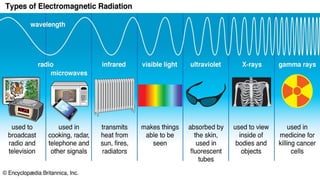
Electromagnetic waves do not need medium to propagate. Radio
waves, ultraviolet, microwaves, x-rays, infrared, and gamma rays
are examples of electromagnetic waves. The sun is an important
source of electromagnetic radiation for the earth. Energy from the
sun is important to sustain the life of the earth. Another example of
the electromagnetic waves from the sun are ultraviolet (UV) waves,
which is the main cause of sunburn. Sunscreen lotions are
transparent to the visible light but absorb most of UV light. The
higher a sunscreen’s solar protection factor (SPF), the greater the
percentage of UV light absorbed
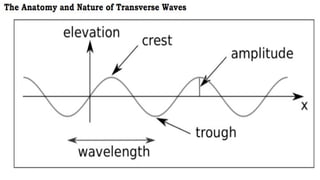
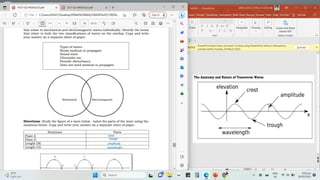
• The crest and trough refer to the highest point and lowest point of a
wave pattern.
• The amplitude of a wave is the maximum displacement of a particle of
the medium on either side of its normal position when the wave passes
• The frequency (measured in Hertz)of periodic waves is the number of
waves that pass a particular point for every unit of time such as one
second.
• The wavelength(measured in meters) is the distance between adjacent
crests or troughs.
• The period is the time (measured in seconds) required for one complete
wave to pass a particular point.
• The speed of the wave refers to the distance the wave travels per unit
time
• wave speed= frequency x wavelength
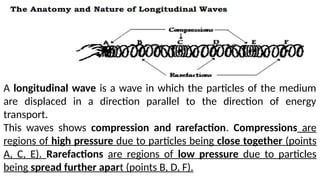
A longitudinal wave is a wave in which the particles of the medium
are displaced in a direction parallel to the direction of energy
transport.
This waves shows compression and rarefaction. Compressions are
regions of high pressure due to particles being close together (points
A, C, E). Rarefactions are regions of low pressure due to particles
being spread further apart (points B, D, F).
Remember this: Wave speed, wavelength
and frequency are related by the equation:
Wave speed = frequency x wavelength. The
frequency of a wave is inversely proportional
to the wavelength. When a wave has a high
frequency, it has a short wavelength and
when a wave has low frequency, it has a long
wavelength
physics to move through, cause to move through, or
transmit, esp in the form of a waveto propagate
sound.
Propagates in Physics it is the way waves travel or
move.
Wave Propagation Medium
These mediums can be solids, liquids, or gases.
However, not all waves need a medium to propagate or
travel. Mechanical waves are vibrations or
disturbances that require a medium to propagate.
Water waves, sound waves, and waves in a string are
examples of mechanical wave
The types of waves according to propagation
1. Mechanical waves propagate only through solid, liquid and gas medium. Mechanical waves may be transverse,
longitudinal or surface. Some physical medium is being disturbed for the wave to propagate. A wave travelling on a
string would not exist without the string. With mechanical waves, what we interpret as a wave corresponds to the
propagation of a disturbance through a medium.
2. Electromagnetic waves do not need medium to propagate. Radio waves, ultraviolet, microwaves, x-rays, infrared, and
gamma rays are examples of electromagnetic waves. The sun is an important source of electromagnetic radiation for the
earth. Energy from the sun is important to sustain the life of the earth. Another example of the electromagnetic waves from
the sun are ultraviolet (UV) waves, which is the main cause of sunburn. Sunscreen lotions are transparent to the visible light
but absorb most of UV light. The higher a sunscreen’s solar protection factor (SPF), the greater the percentage of UV light
absorbed.

a WAVES lesson for grade 7 students.pptx

  • 1.
  • 2.
    Waves can betypified according to the direction of motion of the vibrating particles with respect to the direction in which the waves travel. The types of waves according to the direction of motion of the vibrating particles with respect to the direction in which the waves travel are transverse, longitudinal and surface waves.
  • 3.
    Types of waves 1.Transversewaves vibrate perpendicularly to the direction in which the waves travel. This wave exhibits up and down motion.
  • 4.
    2. Longitudinal wavesvibrate parallel or back and forth to the direction in which the waves travel.
  • 6.
    3. Surface wavesare combination of transverse and longitudinal waves. These move in a circular pattern as the waves pass by.
  • 7.
    The types ofwaves according to propagation 1.Mechanical waves propagate only through solid, liquid and gas medium. Mechanical waves may be transverse, longitudinal or surface. Some physical medium is being disturbed for the wave to propagate. A wave travelling on a string would not exist without the string. With mechanical waves, what we interpret as a wave corresponds to the propagation of a disturbance through a medium. Needs medium to propagate. Examples • Water waves • sound waves • waves in a string
  • 8.
    Electromagnetic waves donot need medium to propagate. Radio waves, ultraviolet, microwaves, x-rays, infrared, and gamma rays are examples of electromagnetic waves. The sun is an important source of electromagnetic radiation for the earth. Energy from the sun is important to sustain the life of the earth. Another example of the electromagnetic waves from the sun are ultraviolet (UV) waves, which is the main cause of sunburn. Sunscreen lotions are transparent to the visible light but absorb most of UV light. The higher a sunscreen’s solar protection factor (SPF), the greater the percentage of UV light absorbed
  • 12.
    • The crestand trough refer to the highest point and lowest point of a wave pattern. • The amplitude of a wave is the maximum displacement of a particle of the medium on either side of its normal position when the wave passes • The frequency (measured in Hertz)of periodic waves is the number of waves that pass a particular point for every unit of time such as one second. • The wavelength(measured in meters) is the distance between adjacent crests or troughs. • The period is the time (measured in seconds) required for one complete wave to pass a particular point. • The speed of the wave refers to the distance the wave travels per unit time • wave speed= frequency x wavelength
  • 13.
    A longitudinal waveis a wave in which the particles of the medium are displaced in a direction parallel to the direction of energy transport. This waves shows compression and rarefaction. Compressions are regions of high pressure due to particles being close together (points A, C, E). Rarefactions are regions of low pressure due to particles being spread further apart (points B, D, F).
  • 14.
    Remember this: Wavespeed, wavelength and frequency are related by the equation: Wave speed = frequency x wavelength. The frequency of a wave is inversely proportional to the wavelength. When a wave has a high frequency, it has a short wavelength and when a wave has low frequency, it has a long wavelength
  • 15.
    physics to movethrough, cause to move through, or transmit, esp in the form of a waveto propagate sound. Propagates in Physics it is the way waves travel or move. Wave Propagation Medium These mediums can be solids, liquids, or gases. However, not all waves need a medium to propagate or travel. Mechanical waves are vibrations or disturbances that require a medium to propagate. Water waves, sound waves, and waves in a string are examples of mechanical wave
  • 19.
    The types ofwaves according to propagation 1. Mechanical waves propagate only through solid, liquid and gas medium. Mechanical waves may be transverse, longitudinal or surface. Some physical medium is being disturbed for the wave to propagate. A wave travelling on a string would not exist without the string. With mechanical waves, what we interpret as a wave corresponds to the propagation of a disturbance through a medium. 2. Electromagnetic waves do not need medium to propagate. Radio waves, ultraviolet, microwaves, x-rays, infrared, and gamma rays are examples of electromagnetic waves. The sun is an important source of electromagnetic radiation for the earth. Energy from the sun is important to sustain the life of the earth. Another example of the electromagnetic waves from the sun are ultraviolet (UV) waves, which is the main cause of sunburn. Sunscreen lotions are transparent to the visible light but absorb most of UV light. The higher a sunscreen’s solar protection factor (SPF), the greater the percentage of UV light absorbed.