A Theory For
Motion Primitive
Adaptation
A Theory For
Motion Primitive
Adaptation
Richard Southern
National Centre for
Computer Animation
Richard Southern
National Centre for
Computer Animation
Liu, F.; Southern, R.; Guo, S.; Yang, X.; Zhang, J. J.; , "Motion
Adaptation With Motor Invariant Theory," Systems, Man, and
Cybernetics, Part B: Cybernetics, IEEE Transactions on, 2013
Talk StructureTalk Structure
●
Background
●
Overview
●
Theory for Motion Adaptation
●
Entrainment for Structural Stability
●
Local Controllers for State Stability
●
Walking model
●
Results
●
Background
●
Overview
●
Theory for Motion Adaptation
●
Entrainment for Structural Stability
●
Local Controllers for State Stability
●
Walking model
●
Results
Motivation: Character AnimationMotivation: Character Animation
●
Still lots of problems in game character animation
– Handling lots of character collisions (crowds)
– Repetition of pre-recorded animations
– Sliding when running into walls
●
Still lots of problems in game character animation
– Handling lots of character collisions (crowds)
– Repetition of pre-recorded animations
– Sliding when running into walls
The following clips thanks to David Greer @ NaturalMotion
Motivation: RoboticsMotivation: Robotics
“At present there is no accepted theory of how animals can, or
robots might, be energy-stingy, robust, versatile and adaptable.
Finding plausible schemes for the organization of a controller
that has these features is, I think, the key problem in
locomotion research today."
Andy Ruina, Cornell Robotics Group
“At present there is no accepted theory of how animals can, or
robots might, be energy-stingy, robust, versatile and adaptable.
Finding plausible schemes for the organization of a controller
that has these features is, I think, the key problem in
locomotion research today."
Andy Ruina, Cornell Robotics Group
Basic Assumptions of Low Level Motor ControlBasic Assumptions of Low Level Motor Control
●
Brain not used much in low level locomotion
●
Motion Primitives: building blocks of complex motion (e.g. frog
wave)
●
Body+Environment=Motion – animals don't move the way they
want, but the way they can (e.g. whale vs fish)
●
The central nervous system (CNS) only controls final motion
result, not process (equilibrium point hypothesis)
●
Brain not used much in low level locomotion
●
Motion Primitives: building blocks of complex motion (e.g. frog
wave)
●
Body+Environment=Motion – animals don't move the way they
want, but the way they can (e.g. whale vs fish)
●
The central nervous system (CNS) only controls final motion
result, not process (equilibrium point hypothesis)
M. Latash, Neurophysiological Basis of Movement. Champaign, IL: Human Kinetics Publ., 2008.
E. Bizzi, S. Giszter, E. Loeb, F. Mussa-Ivaldi, and P. Saltiel, “Modular organization of motor behavior in the frog’s spinal cord,” Trends
Neurosci.,vol. 18, no. 10, pp. 442–446, Oct. 1995.
A. G. Feldman, “Once more on the equilibrium-point hypothesis (λ model) for motor control,” J. Motor Behav., vol. 18(1), 17–54, Mar. 1986.
Basic Assumptions cont.Basic Assumptions cont.
●
All interesting motion is periodic
●
Motion adaptation: CNS “tweaks” these primitives to adapt
to environmental changes
●
We're going to describe “tweaking” mathematically
●
All interesting motion is periodic
●
Motion adaptation: CNS “tweaks” these primitives to adapt
to environmental changes
●
We're going to describe “tweaking” mathematically
What we don't do (yet)What we don't do (yet)
●
High level motion planning
– Computer vision
– Adaptation selection
●
Use complex biomechanical models (no ankles, muscles,
running)
●
Build robots
●
Rigorously test hypothesis on humans subjects
●
High level motion planning
– Computer vision
– Adaptation selection
●
Use complex biomechanical models (no ankles, muscles,
running)
●
Build robots
●
Rigorously test hypothesis on humans subjects
State (Dynamic) StabilityState (Dynamic) Stability
●
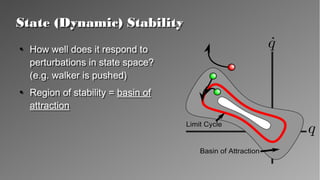
How well does it respond
to perturbations in state
space? (e.g. walker is
pushed)
●
Region of stability = basin
of attraction
●
How well does it respond
to perturbations in state
space? (e.g. walker is
pushed)
●
Region of stability = basin
of attraction
Structural StabilityStructural Stability
●
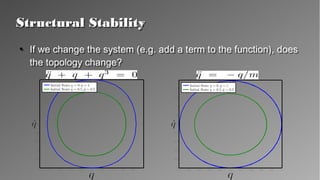
If we change the system (e.g. add a term to the function),
does the topology change?
●
If we change the system (e.g. add a term to the function),
does the topology change?
Talk StructureTalk Structure
●
Background
●
Overview
●
Theory for Motion Adaptation
●
Entrainment for Structural Stability
●
Local Controllers for State Stability
●
Walking model
●
Results
●
Background
●
Overview
●
Theory for Motion Adaptation
●
Entrainment for Structural Stability
●
Local Controllers for State Stability
●
Walking model
●
Results
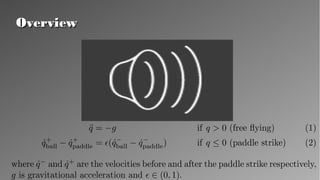
OverviewOverview
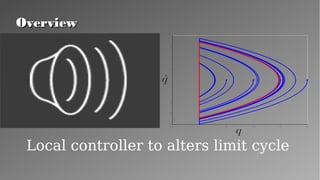
OverviewOverview
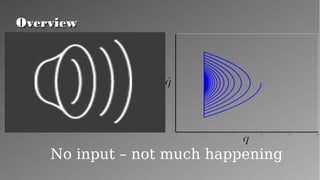
No input – not much happening
OverviewOverview
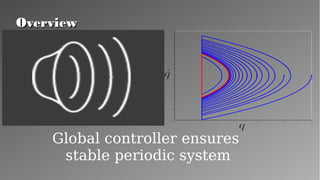
Global controller ensures
stable periodic system
OverviewOverview
Local controller to alters limit cycle
Talk StructureTalk Structure
●
Background
●
Overview
●
Theory for Motion Adaptation
●
Entrainment for Structural Stability
●
Local Controllers for State Stability
●
Walking model
●
Results
●
Background
●
Overview
●
Theory for Motion Adaptation
●
Entrainment for Structural Stability
●
Local Controllers for State Stability
●
Walking model
●
Results
The Motor InvariantThe Motor Invariant
●
The motor invariant we want to preserve is the topology of
the dynamic system.
●
Type and Number of attractors do not change.
●
Shape of attractor and basin may change.
●
The motor invariant we want to preserve is the topology of
the dynamic system.
●
Type and Number of attractors do not change.
●
Shape of attractor and basin may change.
Theory of Valid Motion AdaptationTheory of Valid Motion Adaptation
●
For example: walker continues to walk, ball keeps bouncing
●
Evidence: motion capture analysis, handwriting
adaptation*
●
Realised through Lie group symmetry
●
For example: walker continues to walk, ball keeps bouncing
●
Evidence: motion capture analysis, handwriting
adaptation*
●
Realised through Lie group symmetry
*Affine differential geometry analysis of human arm movements
Tamar Flash and Amir A. Handzel, Biol Cybern. 2007 June; 96(6): 577–601.
A valid motion adaptation is one which
preserves the motor invariant

What does this mean?What does this mean?
●
These are validity conditions for motion adaptation
●
We can construct energy efficient controllers to make a
system more stable under certain environmental
conditions
●
These are validity conditions for motion adaptation
●
We can construct energy efficient controllers to make a
system more stable under certain environmental
conditions
Talk StructureTalk Structure
●
Background
●
Overview
●
Theory for Motion Adaptation
●
Entrainment for Structural Stability
●
Local Controllers for State Stability
●
Walking model
●
Results
●
Background
●
Overview
●
Theory for Motion Adaptation
●
Entrainment for Structural Stability
●
Local Controllers for State Stability
●
Walking model
●
Results
Application 1: Global ControllerApplication 1: Global Controller
●
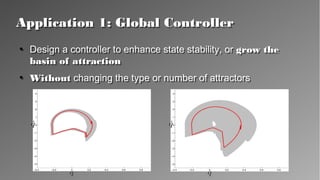
Design a controller to enhance state stability, or grow the
basin of attraction
●
Without changing the type or number of attractors
●
Design a controller to enhance state stability, or grow the
basin of attraction
●
Without changing the type or number of attractors
EntrainmentEntrainment
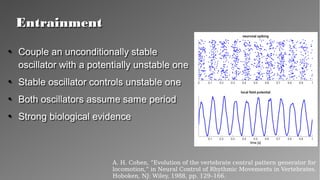
●
Couple an unconditionally stable
oscillator with a potentially unstable
one
●
Stable oscillator controls unstable one
●
Both oscillators assume same period
●
Strong biological evidence
●
Couple an unconditionally stable
oscillator with a potentially unstable
one
●
Stable oscillator controls unstable one
●
Both oscillators assume same period
●
Strong biological evidence
A. H. Cohen, “Evolution of the vertebrate central pattern generator for
locomotion,” in Neural Control of Rhythmic Movements in Vertebrates.
Hoboken, NJ: Wiley, 1988, pp. 129–166.
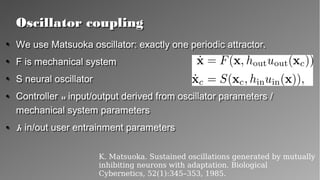
Oscillator couplingOscillator coupling
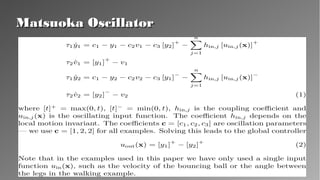
●
We use Matsuoka oscillator: exactly one periodic attractor.
●
F is mechanical system
●
S neural oscillator
●
Controller u input/output derived from oscillator
parameters / mechanical system parameters
●
h in/out user entrainment parameters
●
We use Matsuoka oscillator: exactly one periodic attractor.
●
F is mechanical system
●
S neural oscillator
●
Controller u input/output derived from oscillator
parameters / mechanical system parameters
●
h in/out user entrainment parameters
K. Matsuoka. Sustained oscillations generated by mutually
inhibiting neurons with adaptation. Biological
Cybernetics, 52(1):345–353, 1985.
Results: greater structural stabilityResults: greater structural stability
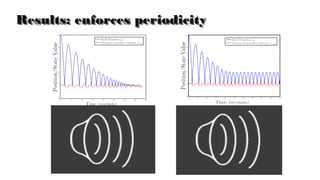
Results: enforces periodicityResults: enforces periodicity
Talk StructureTalk Structure
●
Background
●
Overview
●
Theory for Motion Adaptation
●
Entrainment for Structural Stability
●
Local Controllers for State Stability
●
Walking model
●
Results
●
Background
●
Overview
●
Theory for Motion Adaptation
●
Entrainment for Structural Stability
●
Local Controllers for State Stability
●
Walking model
●
Results
Application 2: Local ControllerApplication 2: Local Controller
●
Reasons to transform the dynamic system:
– Move system so current state is within basin of attraction,
accounting for terrain variation
– Change frequency of system (walk faster, bounce ball faster)
– Change style of motion (more energetic, bounce ball higher)
●
Effectively realised as a local affine transform to the state
space.
●
Reasons to transform the dynamic system:
– Move system so current state is within basin of attraction,
accounting for terrain variation
– Change frequency of system (walk faster, bounce ball faster)
– Change style of motion (more energetic, bounce ball higher)
●
Effectively realised as a local affine transform to the state
space.
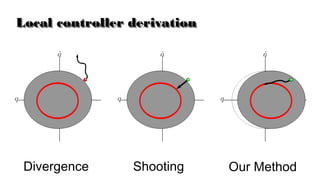
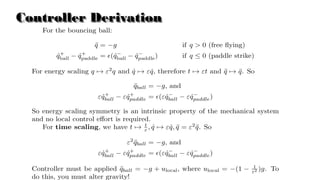
Local controller derivationLocal controller derivation
Divergence Shooting Our Method
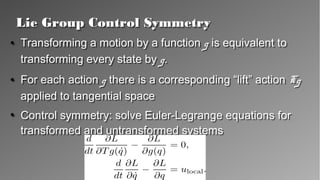
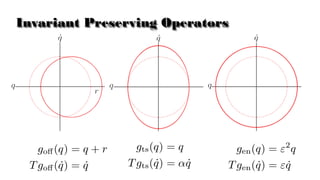
Lie Group Control SymmetryLie Group Control Symmetry
●
Transforming a motion by a function g is equivalent
to transforming every state by g.
●
For each action g there is a corresponding “lift”
action Tg applied to tangential space
●
Control symmetry: solve Euler-Legrange equations
for transformed and untransformed systems
●
Transforming a motion by a function g is equivalent
to transforming every state by g.
●
For each action g there is a corresponding “lift”
action Tg applied to tangential space
●
Control symmetry: solve Euler-Legrange equations
for transformed and untransformed systems
Invariant Preserving OperatorsInvariant Preserving Operators
Controller DerivationController Derivation
Talk StructureTalk Structure
●
Background
●
Overview
●
Theory for Motion Adaptation
●
Entrainment for Structural Stability
●
Local Controllers for State Stability
●
Walking model
●
Results
●
Background
●
Overview
●
Theory for Motion Adaptation
●
Entrainment for Structural Stability
●
Local Controllers for State Stability
●
Walking model
●
Results
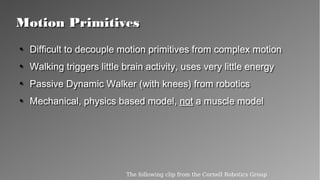
Motion PrimitivesMotion Primitives
●
Difficult to decouple motion primitives from complex
motion
●
Walking triggers little brain activity, uses very little energy
●
Passive Dynamic Walker (with knees) from robotics
●
Mechanical, physics based model, not a muscle model
●
Difficult to decouple motion primitives from complex
motion
●
Walking triggers little brain activity, uses very little energy
●
Passive Dynamic Walker (with knees) from robotics
●
Mechanical, physics based model, not a muscle model
The following clip from the Cornell Robotics Group
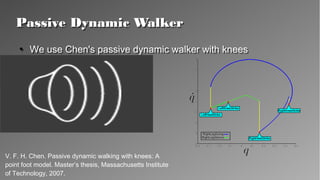
Passive Dynamic WalkerPassive Dynamic Walker
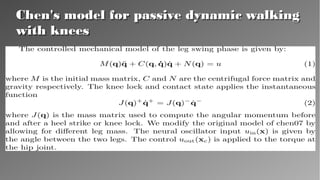
●
We use Chen's passive dynamic walker with knees●
We use Chen's passive dynamic walker with knees
V. F. H. Chen. Passive dynamic walking with knees: A
point foot model. Master’s thesis, Massachusetts Institute
of Technology, 2007.
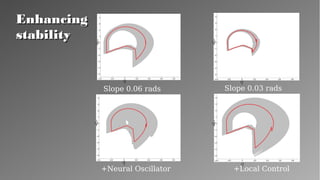
Enhancing
stability
Enhancing
stability
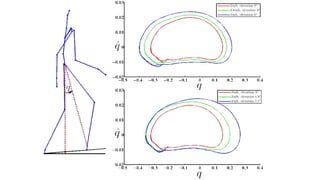
Slope 0.03 radsSlope 0.06 rads
+Neural Oscillator +Local Control
Motion AdaptationMotion Adaptation
Talk StructureTalk Structure
●
Background
●
Overview
●
Theory for Motion Adaptation
●
Entrainment for Structural Stability
●
Local Controllers for State Stability
●
Walking model
●
Results
●
Background
●
Overview
●
Theory for Motion Adaptation
●
Entrainment for Structural Stability
●
Local Controllers for State Stability
●
Walking model
●
Results
ResultsResults
●
Controller design choice influences state stability while
maintaining structure
●
Computationally trivial – a couple of matrix multiplications
at each time step
●
Very energy efficient – cost of transport 0.02 (half of
Cornell Ranger, tenth of a human)
●
Controller design choice influences state stability while
maintaining structure
●
Computationally trivial – a couple of matrix multiplications
at each time step
●
Very energy efficient – cost of transport 0.02 (half of
Cornell Ranger, tenth of a human)
ApplicationsApplications
●
Robot controller design
●
Rehabilitation: understanding human motion adaptation
●
One day: in character synthesis for games
●
Robot controller design
●
Rehabilitation: understanding human motion adaptation
●
One day: in character synthesis for games
ChallengesChallenges
●
Describing complex mechanical systems with solvable
dynamic models (ankles, running and muscles)
●
More complex (not affine transform) local controllers
●
Isolating motion primitives
●
Describing complex mechanical systems with solvable
dynamic models (ankles, running and muscles)
●
More complex (not affine transform) local controllers
●
Isolating motion primitives
Questions?Questions?
AppendicesAppendices
Why Periodic Motion?Why Periodic Motion?
Using Degallier and Ijspeert 2010 as a reference, we
argued that most motion is probably periodic, on a
biological level at least.
Of the three types of attractors, chaos is not applicable to
motion control problems, and fxed point attractors can
be easily modeled using a traditional proportional
derivative controller,which in many cases is a trivial
problem.
For these reasons, periodic motion is of most interest to
biology and robotics researchers, and are the most
difficult to explain.
Using Degallier and Ijspeert 2010 as a reference, we
argued that most motion is probably periodic, on a
biological level at least.
Of the three types of attractors, chaos is not applicable to
motion control problems, and fxed point attractors can
be easily modeled using a traditional proportional
derivative controller,which in many cases is a trivial
problem.
For these reasons, periodic motion is of most interest to
biology and robotics researchers, and are the most
difficult to explain.
Matsuoka OscillatorMatsuoka Oscillator
Chen's model for passive dynamic walking
with knees
Chen's model for passive dynamic walking
with knees
PD Controllers for Periodic MotionPD Controllers for Periodic Motion
●
Problems with methods from Van De Panne et al.:
– High gain (leading to stiffness)
– Reference trajectory
– Overshooting
●
Problems with methods from Van De Panne et al.:
– High gain (leading to stiffness)
– Reference trajectory
– Overshooting

A Theory for Motion Primitive Adaptation

  • 1.
    A Theory For MotionPrimitive Adaptation A Theory For Motion Primitive Adaptation Richard Southern National Centre for Computer Animation Richard Southern National Centre for Computer Animation Liu, F.; Southern, R.; Guo, S.; Yang, X.; Zhang, J. J.; , "Motion Adaptation With Motor Invariant Theory," Systems, Man, and Cybernetics, Part B: Cybernetics, IEEE Transactions on, 2013
  • 2.
    Talk StructureTalk Structure ● Background ● Overview ● Theoryfor Motion Adaptation ● Entrainment for Structural Stability ● Local Controllers for State Stability ● Walking model ● Results ● Background ● Overview ● Theory for Motion Adaptation ● Entrainment for Structural Stability ● Local Controllers for State Stability ● Walking model ● Results
  • 3.
    Motivation: Character AnimationMotivation:Character Animation ● Still lots of problems in game character animation – Handling lots of character collisions (crowds) – Repetition of pre-recorded animations – Sliding when running into walls ● Still lots of problems in game character animation – Handling lots of character collisions (crowds) – Repetition of pre-recorded animations – Sliding when running into walls The following clips thanks to David Greer @ NaturalMotion
  • 7.
    Motivation: RoboticsMotivation: Robotics “Atpresent there is no accepted theory of how animals can, or robots might, be energy-stingy, robust, versatile and adaptable. Finding plausible schemes for the organization of a controller that has these features is, I think, the key problem in locomotion research today." Andy Ruina, Cornell Robotics Group “At present there is no accepted theory of how animals can, or robots might, be energy-stingy, robust, versatile and adaptable. Finding plausible schemes for the organization of a controller that has these features is, I think, the key problem in locomotion research today." Andy Ruina, Cornell Robotics Group
  • 9.
    Basic Assumptions ofLow Level Motor ControlBasic Assumptions of Low Level Motor Control ● Brain not used much in low level locomotion ● Motion Primitives: building blocks of complex motion (e.g. frog wave) ● Body+Environment=Motion – animals don't move the way they want, but the way they can (e.g. whale vs fish) ● The central nervous system (CNS) only controls final motion result, not process (equilibrium point hypothesis) ● Brain not used much in low level locomotion ● Motion Primitives: building blocks of complex motion (e.g. frog wave) ● Body+Environment=Motion – animals don't move the way they want, but the way they can (e.g. whale vs fish) ● The central nervous system (CNS) only controls final motion result, not process (equilibrium point hypothesis) M. Latash, Neurophysiological Basis of Movement. Champaign, IL: Human Kinetics Publ., 2008. E. Bizzi, S. Giszter, E. Loeb, F. Mussa-Ivaldi, and P. Saltiel, “Modular organization of motor behavior in the frog’s spinal cord,” Trends Neurosci.,vol. 18, no. 10, pp. 442–446, Oct. 1995. A. G. Feldman, “Once more on the equilibrium-point hypothesis (λ model) for motor control,” J. Motor Behav., vol. 18(1), 17–54, Mar. 1986.
  • 10.
    Basic Assumptions cont.BasicAssumptions cont. ● All interesting motion is periodic ● Motion adaptation: CNS “tweaks” these primitives to adapt to environmental changes ● We're going to describe “tweaking” mathematically ● All interesting motion is periodic ● Motion adaptation: CNS “tweaks” these primitives to adapt to environmental changes ● We're going to describe “tweaking” mathematically
  • 11.
    What we don'tdo (yet)What we don't do (yet) ● High level motion planning – Computer vision – Adaptation selection ● Use complex biomechanical models (no ankles, muscles, running) ● Build robots ● Rigorously test hypothesis on humans subjects ● High level motion planning – Computer vision – Adaptation selection ● Use complex biomechanical models (no ankles, muscles, running) ● Build robots ● Rigorously test hypothesis on humans subjects
  • 12.
    State (Dynamic) StabilityState(Dynamic) Stability ● How well does it respond to perturbations in state space? (e.g. walker is pushed) ● Region of stability = basin of attraction ● How well does it respond to perturbations in state space? (e.g. walker is pushed) ● Region of stability = basin of attraction
  • 13.
    Structural StabilityStructural Stability ● Ifwe change the system (e.g. add a term to the function), does the topology change? ● If we change the system (e.g. add a term to the function), does the topology change?
  • 14.
    Talk StructureTalk Structure ● Background ● Overview ● Theoryfor Motion Adaptation ● Entrainment for Structural Stability ● Local Controllers for State Stability ● Walking model ● Results ● Background ● Overview ● Theory for Motion Adaptation ● Entrainment for Structural Stability ● Local Controllers for State Stability ● Walking model ● Results
  • 15.
  • 16.
  • 17.
  • 18.
  • 19.
    Talk StructureTalk Structure ● Background ● Overview ● Theoryfor Motion Adaptation ● Entrainment for Structural Stability ● Local Controllers for State Stability ● Walking model ● Results ● Background ● Overview ● Theory for Motion Adaptation ● Entrainment for Structural Stability ● Local Controllers for State Stability ● Walking model ● Results
  • 20.
    The Motor InvariantTheMotor Invariant ● The motor invariant we want to preserve is the topology of the dynamic system. ● Type and Number of attractors do not change. ● Shape of attractor and basin may change. ● The motor invariant we want to preserve is the topology of the dynamic system. ● Type and Number of attractors do not change. ● Shape of attractor and basin may change.
  • 21.
    Theory of ValidMotion AdaptationTheory of Valid Motion Adaptation ● For example: walker continues to walk, ball keeps bouncing ● Evidence: motion capture analysis, handwriting adaptation* ● Realised through Lie group symmetry ● For example: walker continues to walk, ball keeps bouncing ● Evidence: motion capture analysis, handwriting adaptation* ● Realised through Lie group symmetry *Affine differential geometry analysis of human arm movements Tamar Flash and Amir A. Handzel, Biol Cybern. 2007 June; 96(6): 577–601. A valid motion adaptation is one which preserves the motor invariant
  • 23.
    What does thismean?What does this mean? ● These are validity conditions for motion adaptation ● We can construct energy efficient controllers to make a system more stable under certain environmental conditions ● These are validity conditions for motion adaptation ● We can construct energy efficient controllers to make a system more stable under certain environmental conditions
  • 24.
    Talk StructureTalk Structure ● Background ● Overview ● Theoryfor Motion Adaptation ● Entrainment for Structural Stability ● Local Controllers for State Stability ● Walking model ● Results ● Background ● Overview ● Theory for Motion Adaptation ● Entrainment for Structural Stability ● Local Controllers for State Stability ● Walking model ● Results
  • 25.
    Application 1: GlobalControllerApplication 1: Global Controller ● Design a controller to enhance state stability, or grow the basin of attraction ● Without changing the type or number of attractors ● Design a controller to enhance state stability, or grow the basin of attraction ● Without changing the type or number of attractors
  • 27.
    EntrainmentEntrainment ● Couple an unconditionallystable oscillator with a potentially unstable one ● Stable oscillator controls unstable one ● Both oscillators assume same period ● Strong biological evidence ● Couple an unconditionally stable oscillator with a potentially unstable one ● Stable oscillator controls unstable one ● Both oscillators assume same period ● Strong biological evidence A. H. Cohen, “Evolution of the vertebrate central pattern generator for locomotion,” in Neural Control of Rhythmic Movements in Vertebrates. Hoboken, NJ: Wiley, 1988, pp. 129–166.
  • 28.
    Oscillator couplingOscillator coupling ● Weuse Matsuoka oscillator: exactly one periodic attractor. ● F is mechanical system ● S neural oscillator ● Controller u input/output derived from oscillator parameters / mechanical system parameters ● h in/out user entrainment parameters ● We use Matsuoka oscillator: exactly one periodic attractor. ● F is mechanical system ● S neural oscillator ● Controller u input/output derived from oscillator parameters / mechanical system parameters ● h in/out user entrainment parameters K. Matsuoka. Sustained oscillations generated by mutually inhibiting neurons with adaptation. Biological Cybernetics, 52(1):345–353, 1985.
  • 29.
    Results: greater structuralstabilityResults: greater structural stability
  • 30.
  • 31.
    Talk StructureTalk Structure ● Background ● Overview ● Theoryfor Motion Adaptation ● Entrainment for Structural Stability ● Local Controllers for State Stability ● Walking model ● Results ● Background ● Overview ● Theory for Motion Adaptation ● Entrainment for Structural Stability ● Local Controllers for State Stability ● Walking model ● Results
  • 32.
    Application 2: LocalControllerApplication 2: Local Controller ● Reasons to transform the dynamic system: – Move system so current state is within basin of attraction, accounting for terrain variation – Change frequency of system (walk faster, bounce ball faster) – Change style of motion (more energetic, bounce ball higher) ● Effectively realised as a local affine transform to the state space. ● Reasons to transform the dynamic system: – Move system so current state is within basin of attraction, accounting for terrain variation – Change frequency of system (walk faster, bounce ball faster) – Change style of motion (more energetic, bounce ball higher) ● Effectively realised as a local affine transform to the state space.
  • 33.
    Local controller derivationLocalcontroller derivation Divergence Shooting Our Method
  • 34.
    Lie Group ControlSymmetryLie Group Control Symmetry ● Transforming a motion by a function g is equivalent to transforming every state by g. ● For each action g there is a corresponding “lift” action Tg applied to tangential space ● Control symmetry: solve Euler-Legrange equations for transformed and untransformed systems ● Transforming a motion by a function g is equivalent to transforming every state by g. ● For each action g there is a corresponding “lift” action Tg applied to tangential space ● Control symmetry: solve Euler-Legrange equations for transformed and untransformed systems
  • 35.
  • 36.
  • 37.
    Talk StructureTalk Structure ● Background ● Overview ● Theoryfor Motion Adaptation ● Entrainment for Structural Stability ● Local Controllers for State Stability ● Walking model ● Results ● Background ● Overview ● Theory for Motion Adaptation ● Entrainment for Structural Stability ● Local Controllers for State Stability ● Walking model ● Results
  • 38.
    Motion PrimitivesMotion Primitives ● Difficultto decouple motion primitives from complex motion ● Walking triggers little brain activity, uses very little energy ● Passive Dynamic Walker (with knees) from robotics ● Mechanical, physics based model, not a muscle model ● Difficult to decouple motion primitives from complex motion ● Walking triggers little brain activity, uses very little energy ● Passive Dynamic Walker (with knees) from robotics ● Mechanical, physics based model, not a muscle model The following clip from the Cornell Robotics Group
  • 40.
    Passive Dynamic WalkerPassiveDynamic Walker ● We use Chen's passive dynamic walker with knees● We use Chen's passive dynamic walker with knees V. F. H. Chen. Passive dynamic walking with knees: A point foot model. Master’s thesis, Massachusetts Institute of Technology, 2007.
  • 41.
    Enhancing stability Enhancing stability Slope 0.03 radsSlope0.06 rads +Neural Oscillator +Local Control
  • 42.
  • 43.
    Talk StructureTalk Structure ● Background ● Overview ● Theoryfor Motion Adaptation ● Entrainment for Structural Stability ● Local Controllers for State Stability ● Walking model ● Results ● Background ● Overview ● Theory for Motion Adaptation ● Entrainment for Structural Stability ● Local Controllers for State Stability ● Walking model ● Results
  • 44.
    ResultsResults ● Controller design choiceinfluences state stability while maintaining structure ● Computationally trivial – a couple of matrix multiplications at each time step ● Very energy efficient – cost of transport 0.02 (half of Cornell Ranger, tenth of a human) ● Controller design choice influences state stability while maintaining structure ● Computationally trivial – a couple of matrix multiplications at each time step ● Very energy efficient – cost of transport 0.02 (half of Cornell Ranger, tenth of a human)
  • 45.
    ApplicationsApplications ● Robot controller design ● Rehabilitation:understanding human motion adaptation ● One day: in character synthesis for games ● Robot controller design ● Rehabilitation: understanding human motion adaptation ● One day: in character synthesis for games
  • 46.
    ChallengesChallenges ● Describing complex mechanicalsystems with solvable dynamic models (ankles, running and muscles) ● More complex (not affine transform) local controllers ● Isolating motion primitives ● Describing complex mechanical systems with solvable dynamic models (ankles, running and muscles) ● More complex (not affine transform) local controllers ● Isolating motion primitives
  • 47.
  • 48.
  • 49.
    Why Periodic Motion?WhyPeriodic Motion? Using Degallier and Ijspeert 2010 as a reference, we argued that most motion is probably periodic, on a biological level at least. Of the three types of attractors, chaos is not applicable to motion control problems, and fxed point attractors can be easily modeled using a traditional proportional derivative controller,which in many cases is a trivial problem. For these reasons, periodic motion is of most interest to biology and robotics researchers, and are the most difficult to explain. Using Degallier and Ijspeert 2010 as a reference, we argued that most motion is probably periodic, on a biological level at least. Of the three types of attractors, chaos is not applicable to motion control problems, and fxed point attractors can be easily modeled using a traditional proportional derivative controller,which in many cases is a trivial problem. For these reasons, periodic motion is of most interest to biology and robotics researchers, and are the most difficult to explain.
  • 50.
  • 51.
    Chen's model forpassive dynamic walking with knees Chen's model for passive dynamic walking with knees
  • 52.
    PD Controllers forPeriodic MotionPD Controllers for Periodic Motion ● Problems with methods from Van De Panne et al.: – High gain (leading to stiffness) – Reference trajectory – Overshooting ● Problems with methods from Van De Panne et al.: – High gain (leading to stiffness) – Reference trajectory – Overshooting

Editor's Notes

  • #2 Even though we are capable of complex locomotion shortly after birth, human motion is still a little understood phenomenon. Our sophisticated anatomy and the unclear level of cognitive involvement in motor control makes defining a model for locomotion difficult. Contemporary advances in robotics, neurobiology and motor control suggests the existence of motion primitives - abstract building blocks which are used to construct complex motion in the same manner as an alphabet forms a sentence. In this talk I present a mathematical theory governing the process by which these primitives adapt to changes to the body or the environment, providing the framework for understanding the basic processes governing biological motion. It allows us to describe adaptation by a sequence of simple operators, resulting in motion that is naturally stable, energy efficient and biologically justified. These findings have potential applications in several scientific and medical disciplines, including realistic virtual character animation, robotics, gait analysis and rehabilitation robotics.
  • #9 Energy efficiency in level-ground transport is quantified in terms of the dimensionless "specific cost of transport", which is the amount of energy required to carry a unit weight a unit distance. BigDog CoT = 80
  • #10 It is unlikely that conscious planning plays much part in motor control. Animals (including humans) exhibit complex motion behaviours shortly after birth, for example breathing, heart beating and child bearing. Experiments have shown that motor control can occur even without brain input: Bizzi et al. [4] were able to trigger a complete sweeping motion simply by artificially stimulating a single spinal afferent nerve fibre This evidence gives rise to the motion primitive conjecture: that motor ability is inborn and organized in blocks called motion primitives [5]. The evidence also suggests that the number of motion primitives is limited, and complex motions result from combinations of these building blocks in the same manner as an alphabet is used to construct sentences. We can observe that motion style does not appear to have evolved with the neural system — a whale moves more like a fish than other mammals. This demonstrates that what is actually important to motor control is the body and the environment [36]. A consequence of this theory is that animals don’t move the way they want, but rather the way they can. The body and the environment play the most important role in motor control, as they form the basic pattern of motion [36]. We memorize a repertoire of these basic patterns [40], and the neural system only tunes or tweaks the basic pattern to ensure the desired goal is reached. Complex motions are constructed by combining these basic patterns. Actually neural networks self-organize - something that happens during rehabilitation training or practising for Wimbledon. Not only is this approach easy to compute, it also leads to a theory of human motion perception: humans are familiar with a limited number of basic patterns [17]. If a motion does not conform with one of these patterns, this causes a noticeable motion artefact [20].