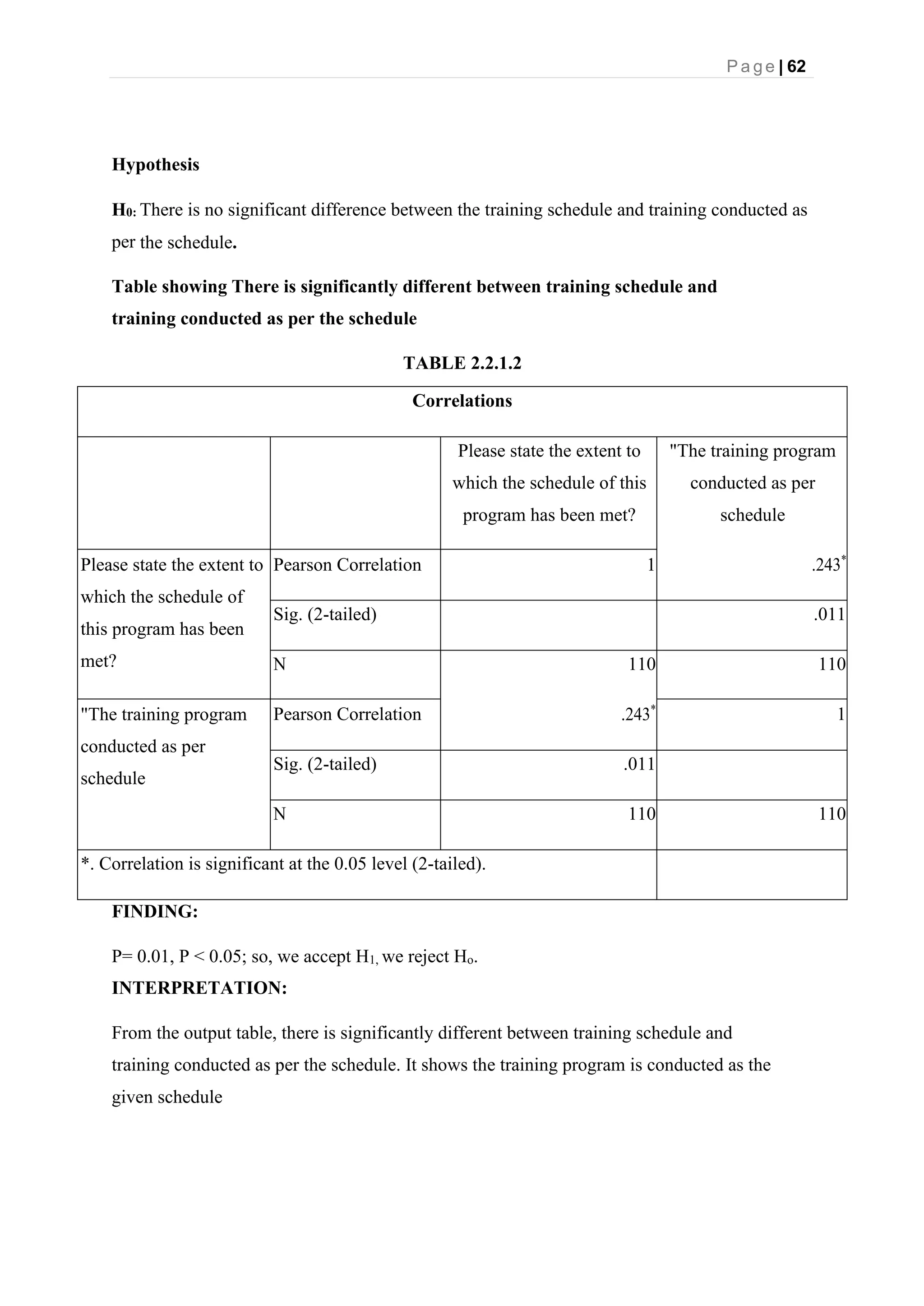
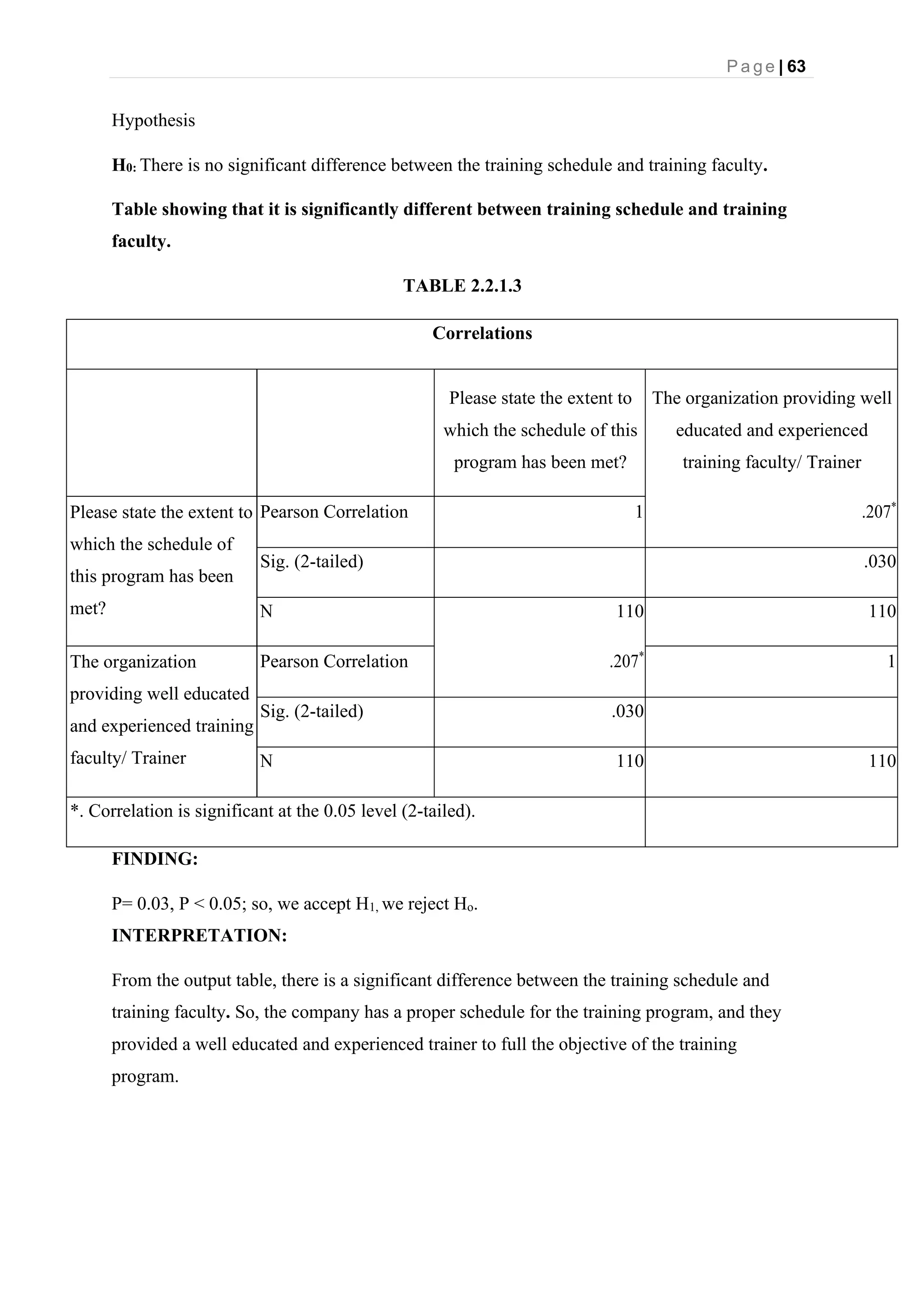
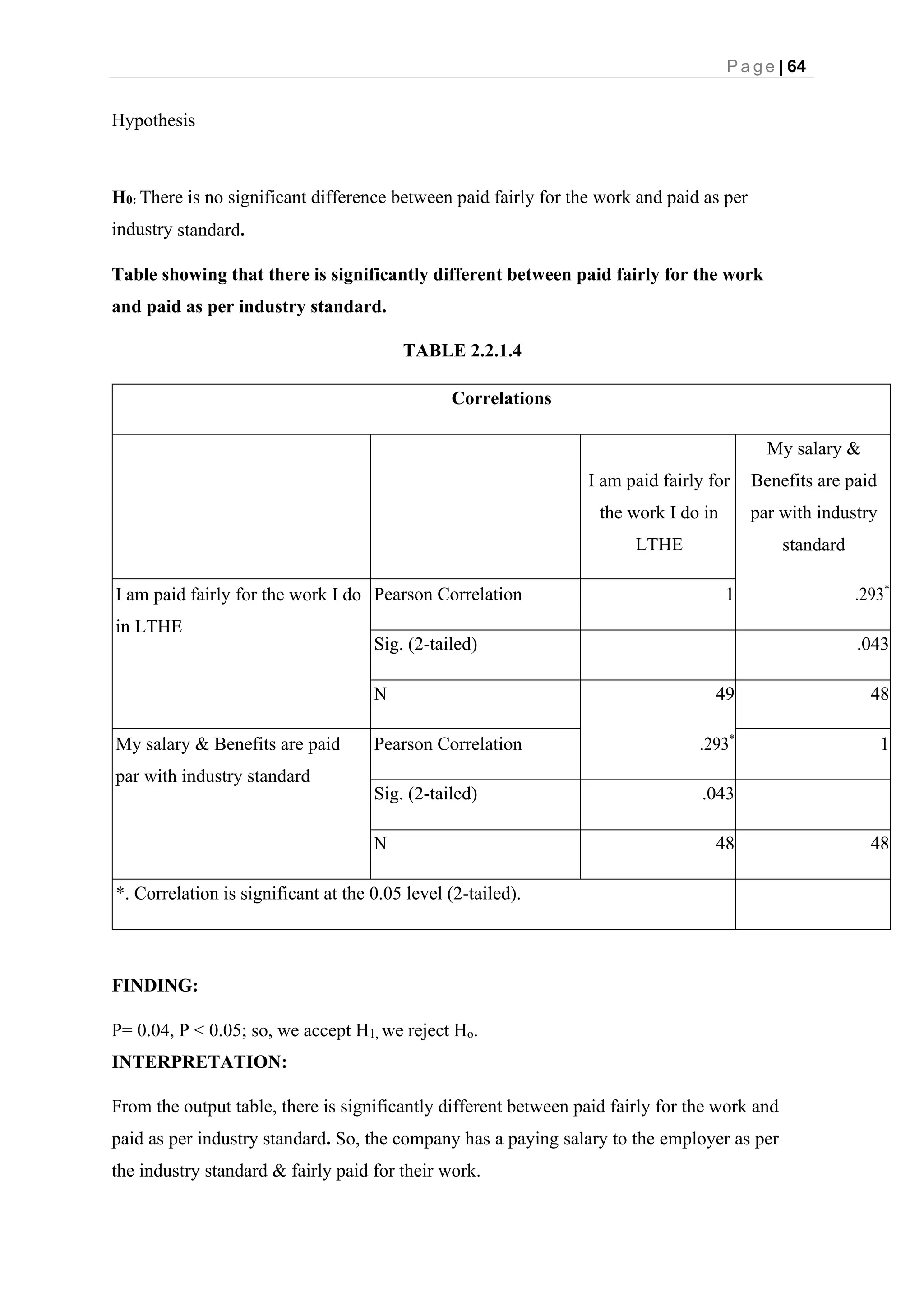
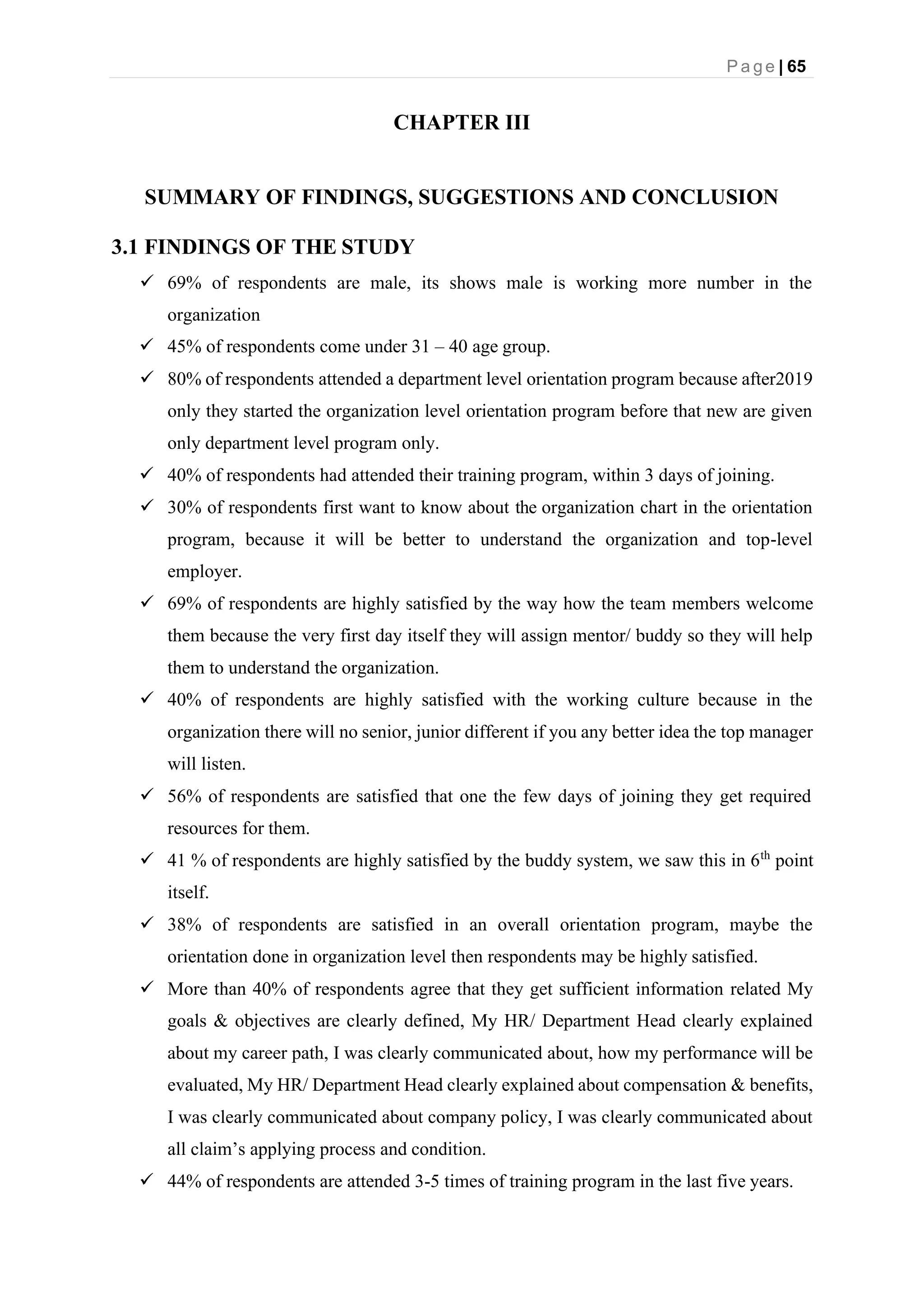
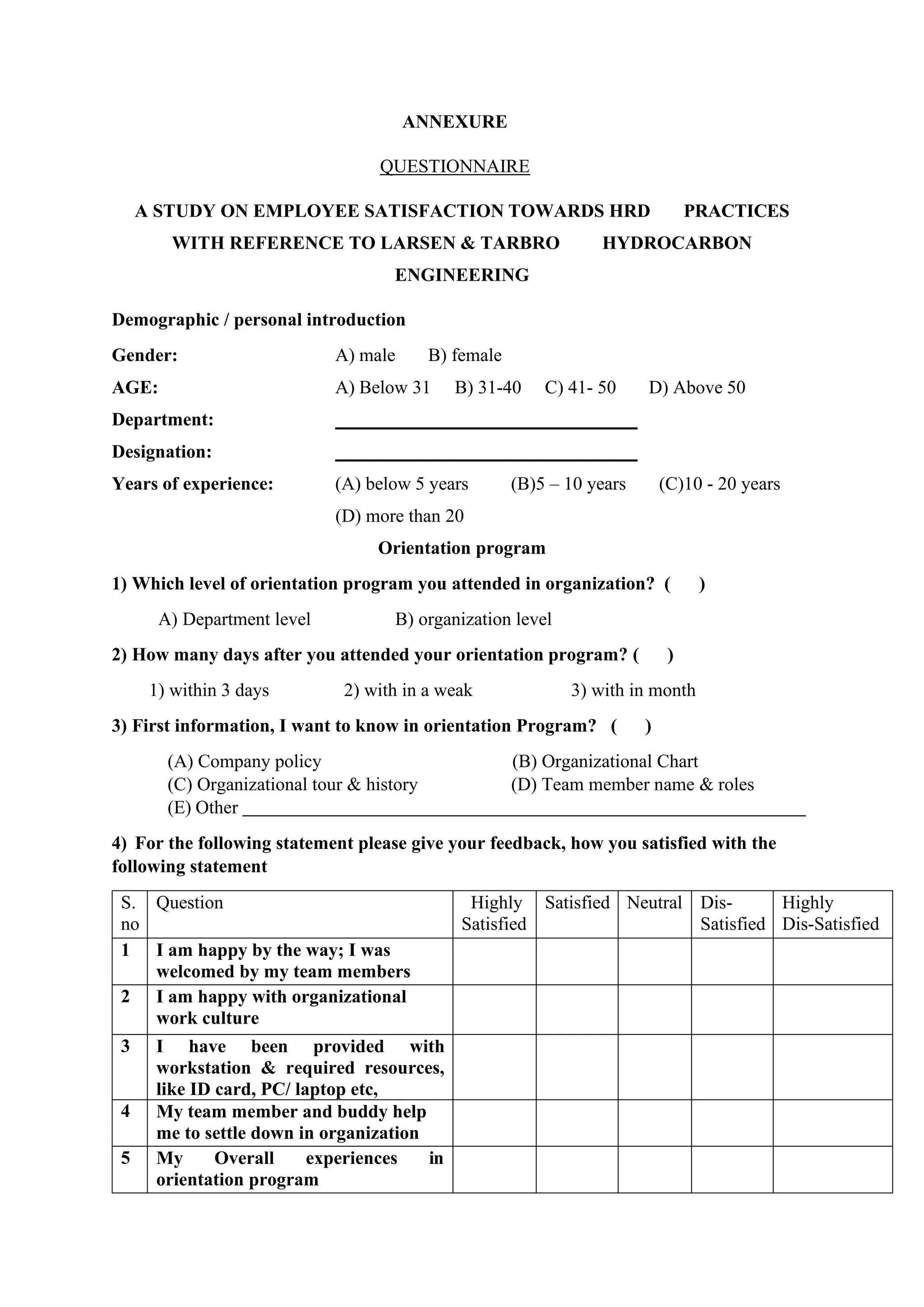
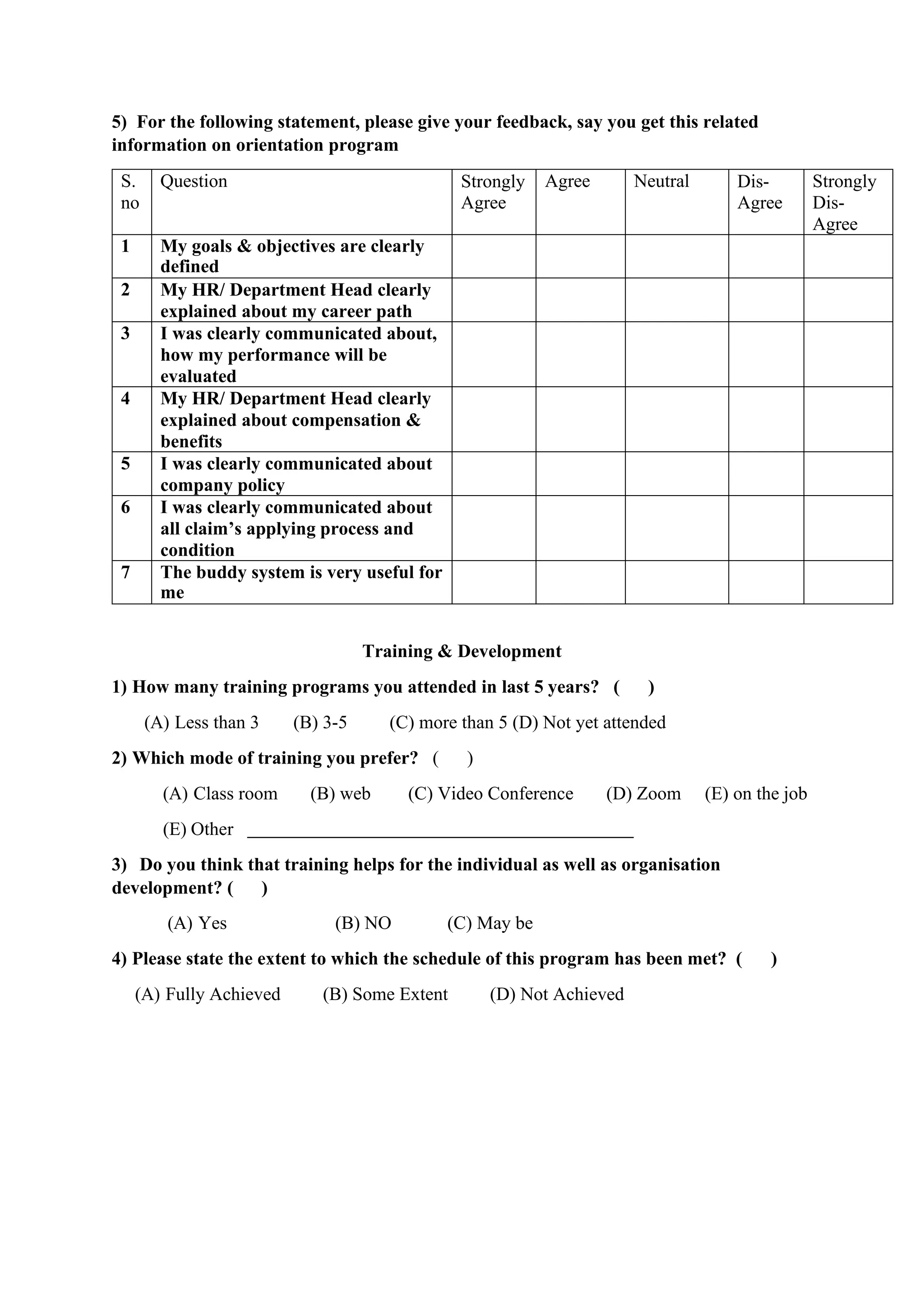
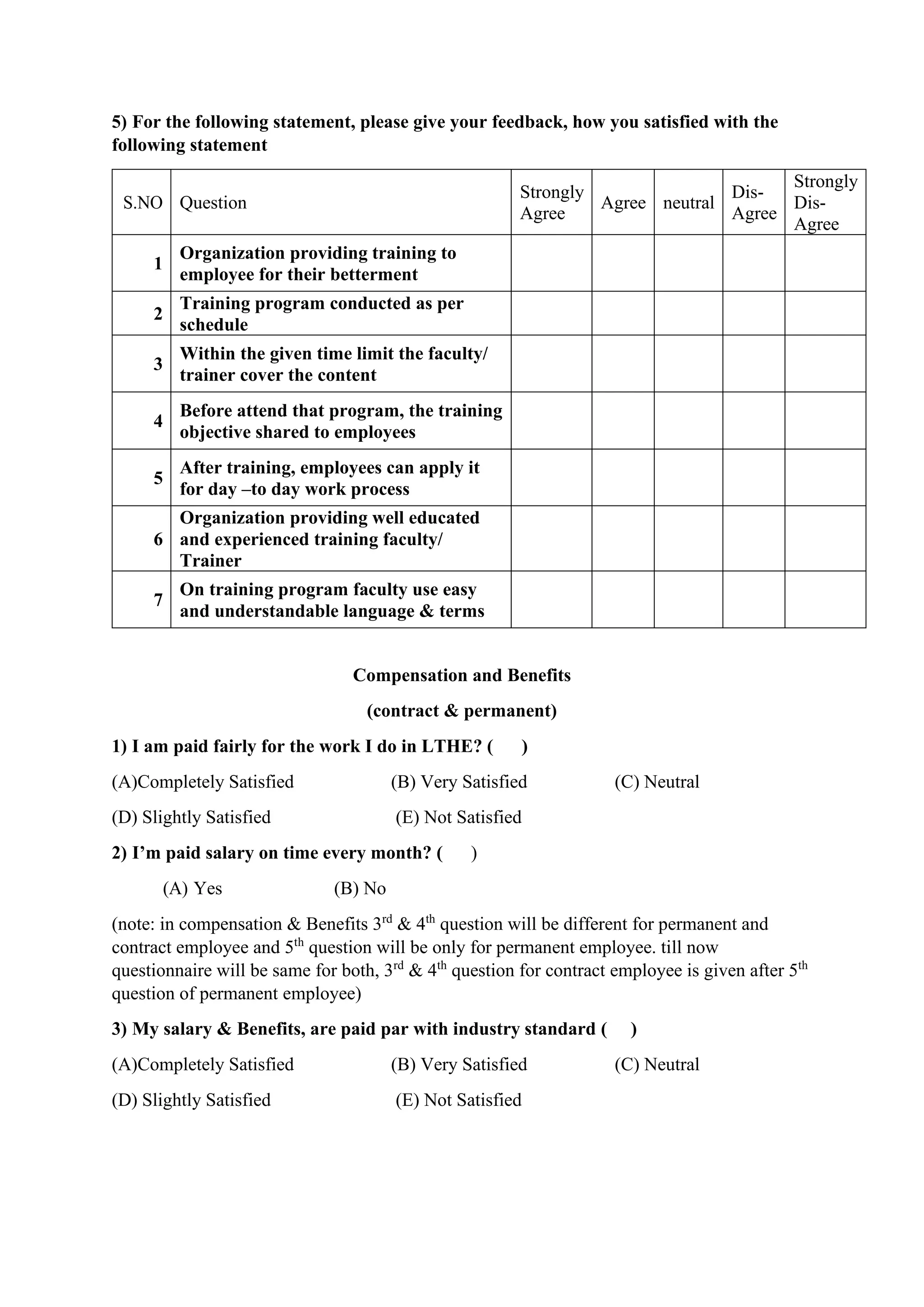
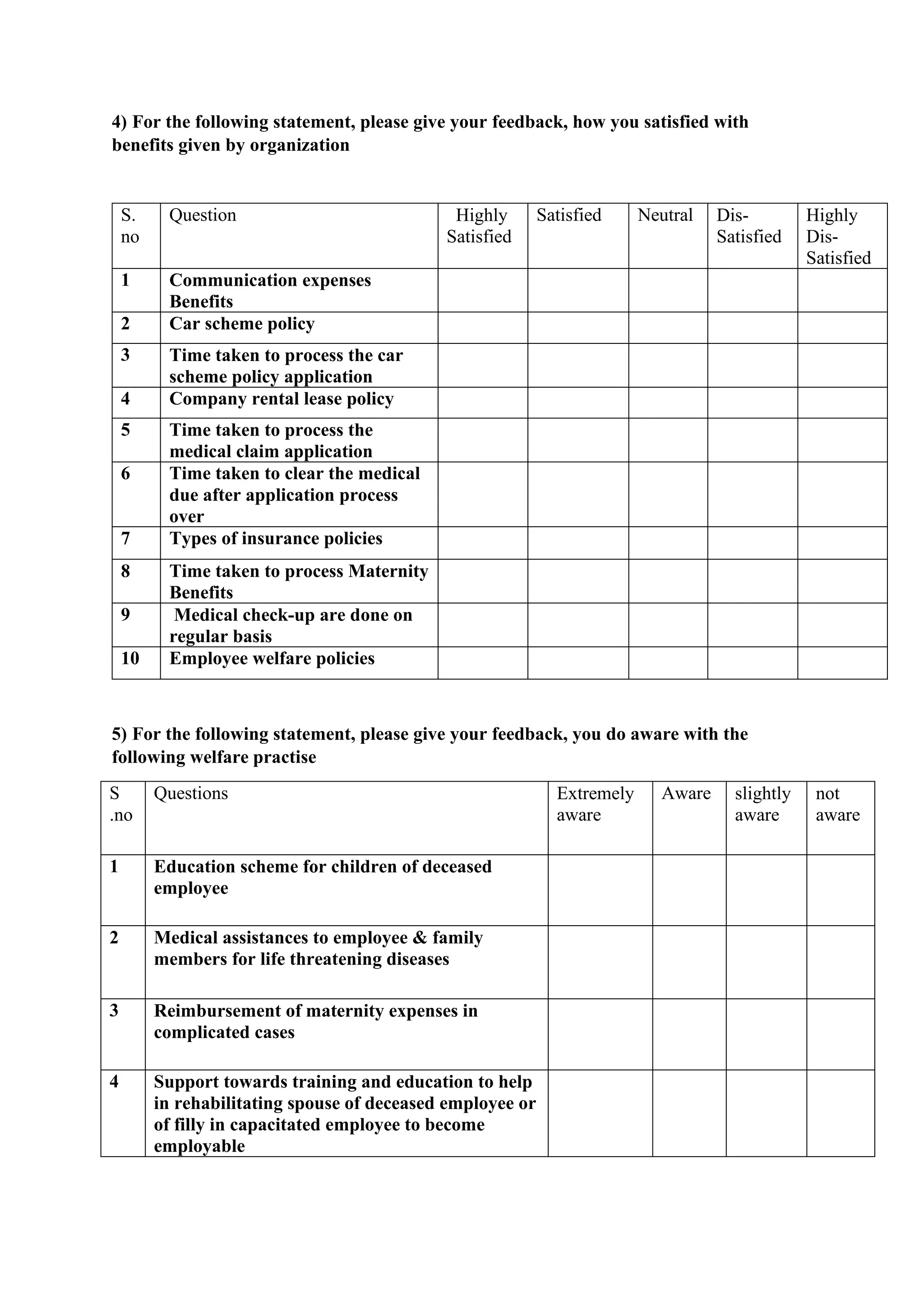
A STUDY ON EMPLOYEE SATISFACTION TOWARDS HRD
PRACTICES WITH REFERENCE TO L&T
HYDROCARBON ENGINEERING
By
AJEETHKUMAR S S
Register No. 412518631005
Of
SRI SAI RAM ENGINEERING COLLEGE
A PROJECT REPORT
Submitted to the
FACULTY OF MANAGEMENT SCIENCES
In partial fulfilment of the requirements
For the award of the degree
Of
MASTER OF BUSINESS ADMINISTRATION
ANNA UNIVERSITY
CHENNAI – 600 025
JULY 2020
BONAFIDE CERTIFICATE
This is to certify that this project report titled “A STUDY ON EMPLOYEE SATISFACTION
TOWARDS HRD PRACTICES WITH REFERENCE TO L&T HYDROCARBON
ENGINEERING” is the bonafide work of Mr. AJEETHKUMAR S S (Reg. No:
412518631005) who carried out the work under my supervision. Certified further, that to the
best of my knowledge the work reported herein does not form part of any other project report
or dissertation based on which a degree or award was conferred on an earlier occasion on a this
or any othercandidate.
Dr. B VENKATESWARA PRASAD Dr. K. MARAN
Signature of the Guide Signature of the Director
INTERNAL EXAMINER EXTERNAL EXAMINER
L8 T hydrocarbon fngineering f.imited
Corctrvctlon 5ewlces
3rd Floor, Technology Centre - 3
Tower 'A’, Manapakkam Campus
Mount Poonamallee Road, Rost Box No. 979
Chennai - 600 089, Tamil Nadu, INDIA
Tel: +9l 44 22Sz 6ooo y 8ooo
Fax: +9 T 44 2249 33 T 7
www. Lnthydrocarbon.com
September 18, 2020
TO WHOMSOEVER IT MAY CONCERN
This is to certify that Mr. S S Ajeethkumar, Reg No: 412518631005, student from Sri Sai Ram
Engineering College has undergone Internship in our Human Resources Department of L&T
Hydrocarbon Engineering Limited on “A Study on Employee Satisfaction towards HRD
Practices”.
Duration of the Internship is from January 2020 to March 2020.
His conduct and performance during the internship were good.
For L&THydrocarbon Engineerin imited
(S SHYAMAPRASAD)
HEAD - HR (CONSTRUCTION SERVICES)
Registered Office. L&T House, N. M. Marg, Ballard Estate, Mumbai -40000f. INDIA
CIN : UI I200MH2009PL C191426
Sensitivity: LN W5‹ ne/r@ §@ oF £anen 8 Toubro Limited
DECLARATION
I, AJEETHKUMAR S S, hereby declare that the project report, entitled “A STUDY
ON EMPLOYEE SATISFACTION TOWARDS HRD PRACTICES
WITH REFERENCE TO L&T HYDROCARBON ENGINEERING”
submitted to the Anna University Chennai in partial fulfilment of the requirement for the award
of the degree of MASTER OF BUSINESS ADMINISTRATION is a record of original and
independent research work done by me during July 2020 under the supervision of Dr B
VENKATESWARA PRASAD Associate Professor, Department of Management studies, and
it has not formed the basis or other similar title to any candidate of any university.
Place: Chennai
Date
(AJEETHKUMAR S S)
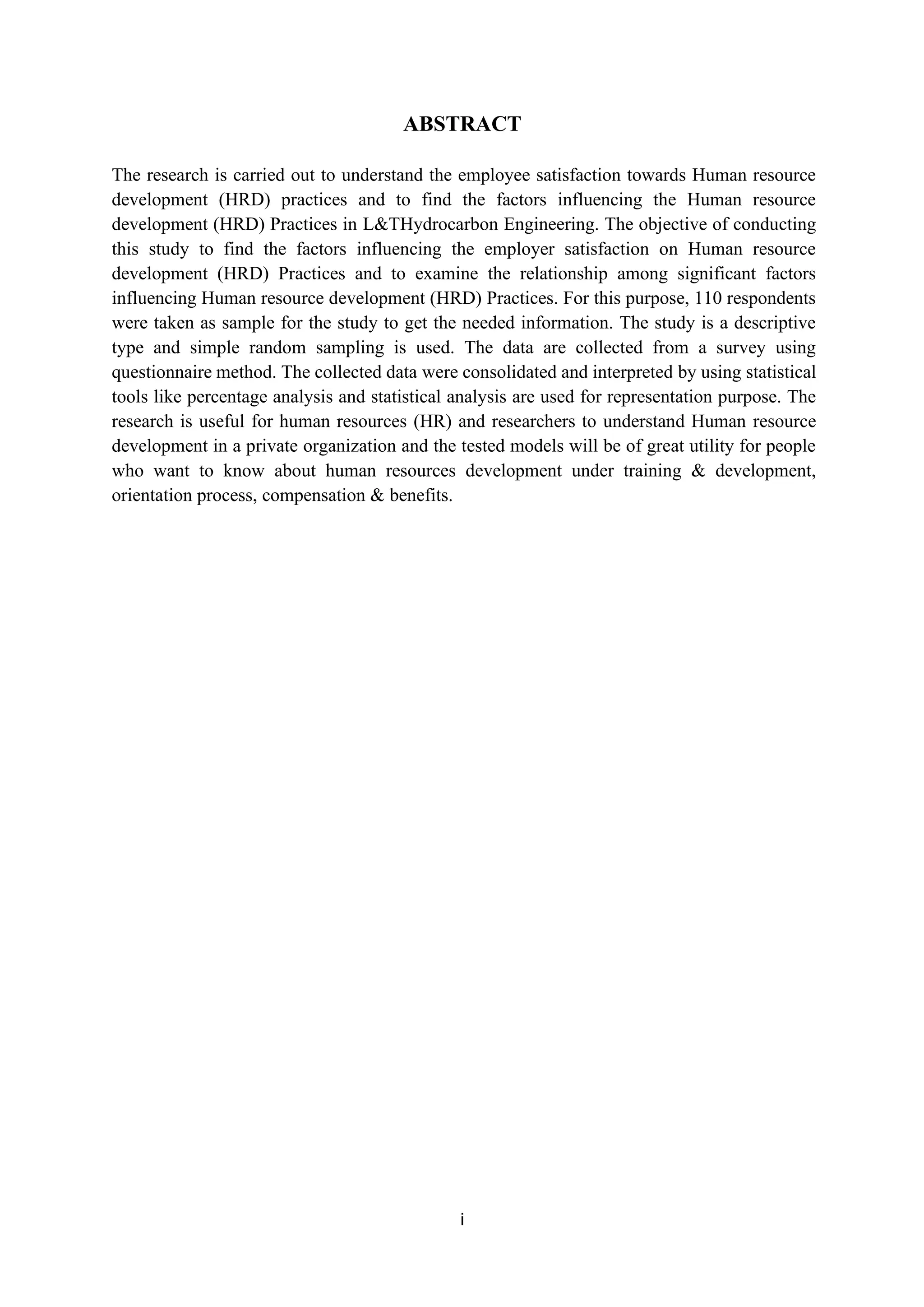
ABSTRACT
The research is carried out to understand the employee satisfaction towards Human resource
development (HRD) practices and to find the factors influencing the Human resource
development (HRD) Practices in L&THydrocarbon Engineering. The objective of conducting
this study to find the factors influencing the employer satisfaction on Human resource
development (HRD) Practices and to examine the relationship among significant factors
influencing Human resource development (HRD) Practices. For this purpose, 110 respondents
were taken as sample for the study to get the needed information. The study is a descriptive
type and simple random sampling is used. The data are collected from a survey using
questionnaire method. The collected data were consolidated and interpreted by using statistical
tools like percentage analysis and statistical analysis are used for representation purpose. The
research is useful for human resources (HR) and researchers to understand Human resource
development in a private organization and the tested models will be of great utility for people
who want to know about human resources development under training & development,
orientation process, compensation & benefits.
i
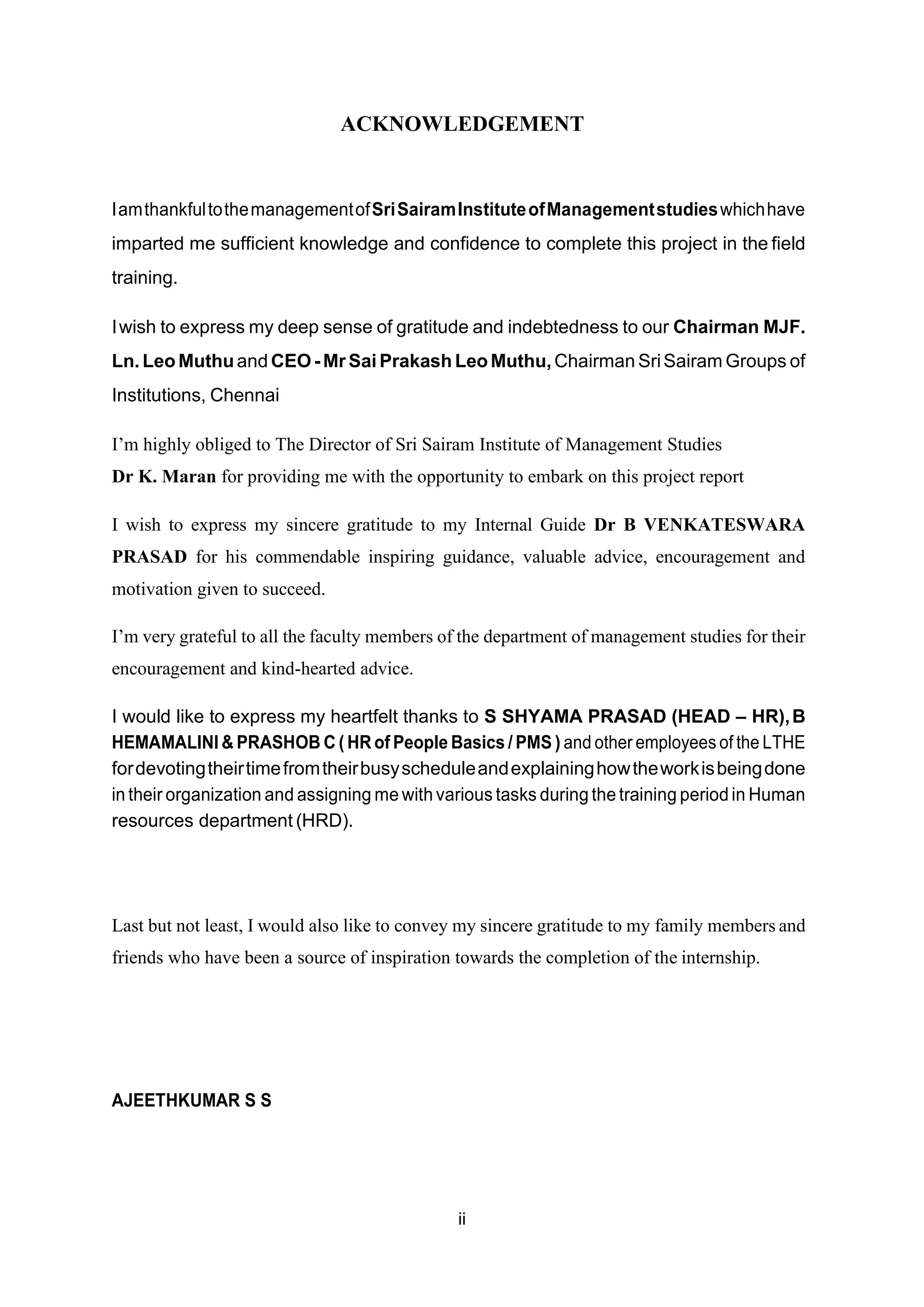
ACKNOWLEDGEMENT
IamthankfultothemanagementofSriSairamInstituteofManagementstudieswhichhave
imparted me sufficient knowledge and confidence to complete this project in the field
training.
Iwish to express my deep sense of gratitude and indebtedness to our Chairman MJF.
Ln. LeoMuthuand CEO -Mr Sai Prakash LeoMuthu, Chairman SriSairam Groups of
Institutions, Chennai
I’m highly obliged to The Director of Sri Sairam Institute of Management Studies
Dr K. Maran for providing me with the opportunity to embark on this project report
I wish to express my sincere gratitude to my Internal Guide Dr B VENKATESWARA
PRASAD for his commendable inspiring guidance, valuable advice, encouragement and
motivation given to succeed.
I’m very grateful to all the faculty members of the department of management studies for their
encouragement and kind-hearted advice.
I would like to express my heartfelt thanks to S SHYAMA PRASAD (HEAD – HR),B
HEMAMALINI & PRASHOB C ( HR of People Basics / PMS ) and other employees of the LTHE
fordevotingtheirtimefromtheirbusyscheduleandexplaininghowtheworkisbeingdone
in their organization and assigning me with various tasks during the training period in Human
resources department (HRD).
Last but not least, I would also like to convey my sincere gratitude to my family members and
friends who have been a source of inspiration towards the completion of the internship.
AJEETHKUMAR S S
ii
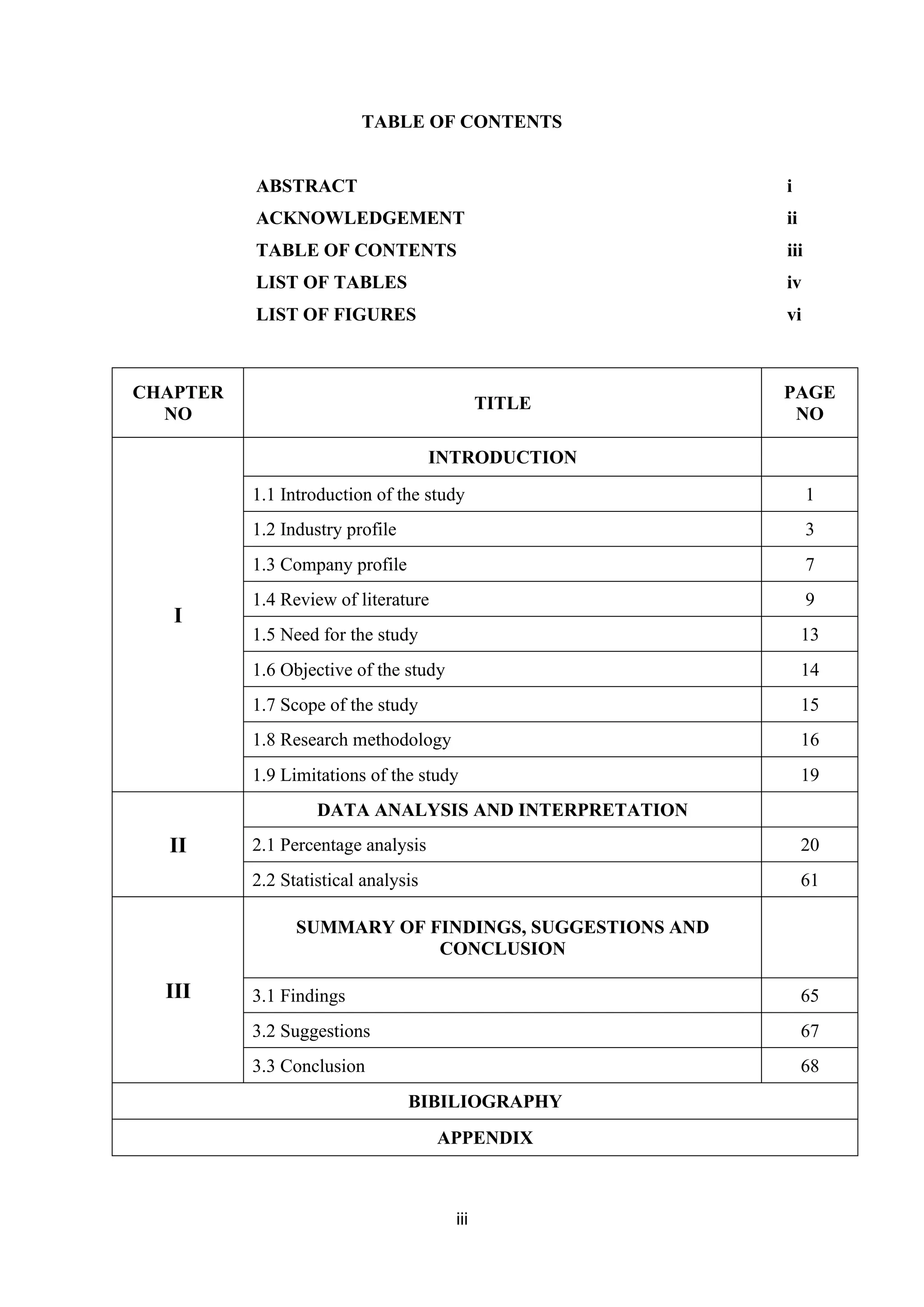
TABLE OF CONTENTS
ABSTRACT i
ACKNOWLEDGEMENT ii
TABLE OF CONTENTS iii
LIST OF TABLES iv
LIST OF FIGURES vi
CHAPTER
NO
TITLE
PAGE
NO
I
INTRODUCTION
1.1 Introduction of the study 1
1.2 Industry profile 3
1.3 Company profile 7
1.4 Review of literature 9
1.5 Need for the study 13
1.6 Objective of the study 14
1.7 Scope of the study 15
1.8 Research methodology 16
1.9 Limitations of the study 19
II
DATA ANALYSIS AND INTERPRETATION
2.1 Percentage analysis 20
2.2 Statistical analysis 61
III
SUMMARY OF FINDINGS, SUGGESTIONS AND
CONCLUSION
3.1 Findings 65
3.2 Suggestions 67
3.3 Conclusion 68
BIBILIOGRAPHY
APPENDIX
iii
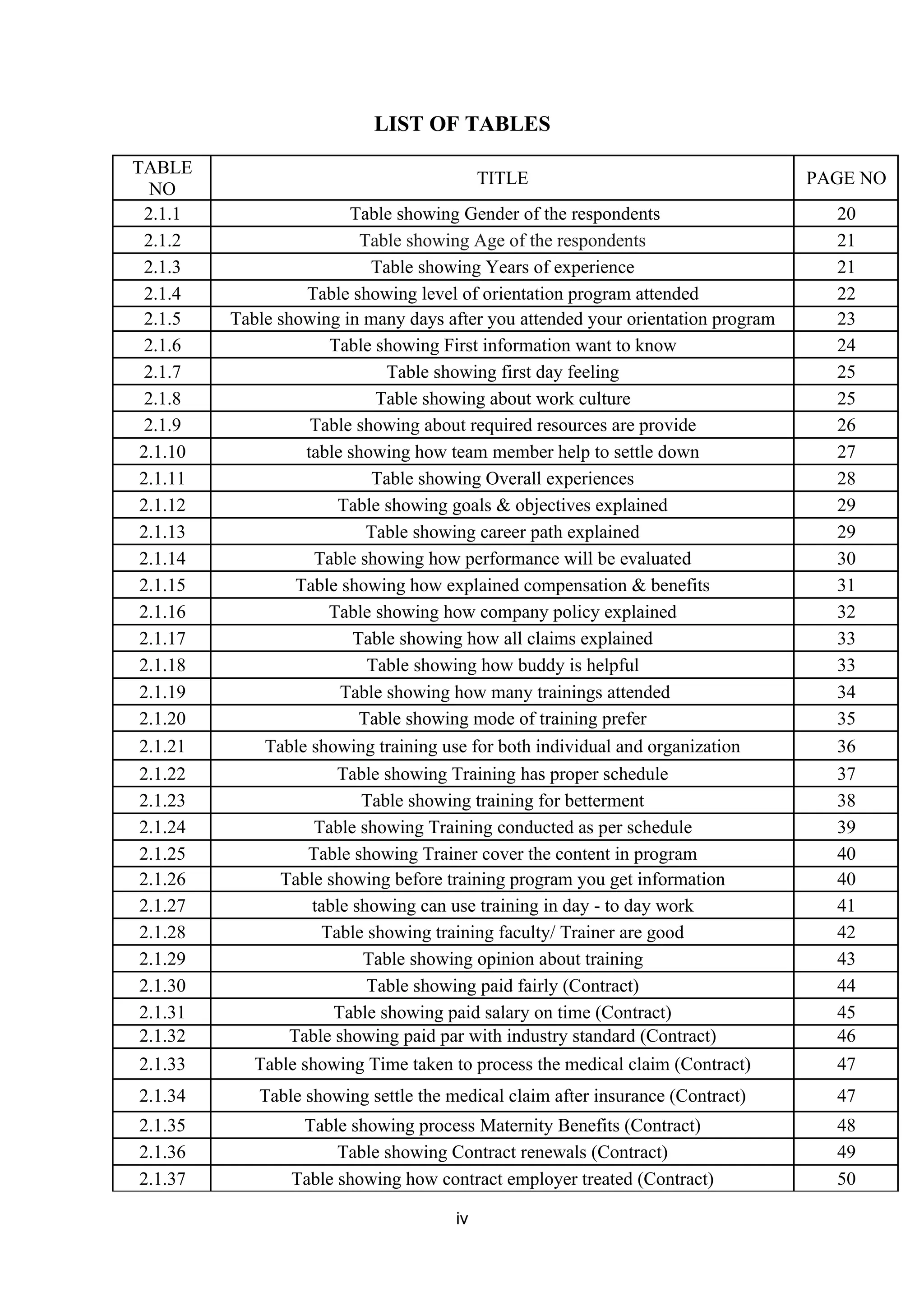
LIST OF TABLES
TABLE
NO
TITLE PAGE NO
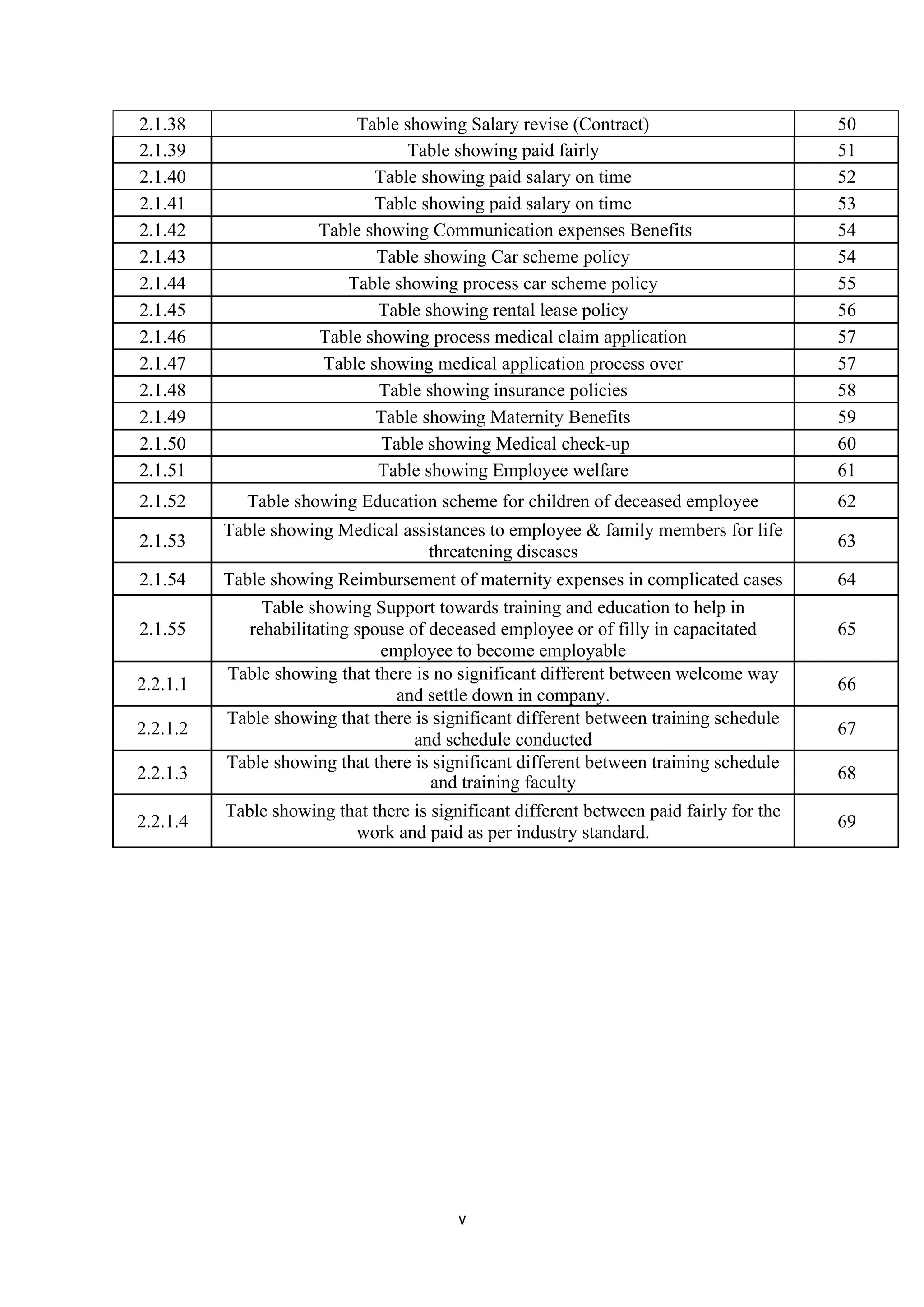
2.1.1 Table showing Gender of the respondents 20
2.1.2 Table showing Age of the respondents 21
2.1.3 Table showing Years of experience 21
2.1.4 Table showing level of orientation program attended 22
2.1.5 Table showing in many days after you attended your orientation program 23
2.1.6 Table showing First information want to know 24
2.1.7 Table showing first day feeling 25
2.1.8 Table showing about work culture 25
2.1.9 Table showing about required resources are provide 26
2.1.10 table showing how team member help to settle down 27
2.1.11 Table showing Overall experiences 28
2.1.12 Table showing goals & objectives explained 29
2.1.13 Table showing career path explained 29
2.1.14 Table showing how performance will be evaluated 30
2.1.15 Table showing how explained compensation & benefits 31
2.1.16 Table showing how company policy explained 32
2.1.17 Table showing how all claims explained 33
2.1.18 Table showing how buddy is helpful 33
2.1.19 Table showing how many trainings attended 34
2.1.20 Table showing mode of training prefer 35
2.1.21 Table showing training use for both individual and organization 36
2.1.22 Table showing Training has proper schedule 37
2.1.23 Table showing training for betterment 38
2.1.24 Table showing Training conducted as per schedule 39
2.1.25 Table showing Trainer cover the content in program 40
2.1.26 Table showing before training program you get information 40
2.1.27 table showing can use training in day - to day work 41
2.1.28 Table showing training faculty/ Trainer are good 42
2.1.29 Table showing opinion about training 43
2.1.30 Table showing paid fairly (Contract) 44
2.1.31 Table showing paid salary on time (Contract) 45
2.1.32 Table showing paid par with industry standard (Contract) 46
2.1.33 Table showing Time taken to process the medical claim (Contract) 47
2.1.34 Table showing settle the medical claim after insurance (Contract) 47
2.1.35 Table showing process Maternity Benefits (Contract) 48
2.1.36 Table showing Contract renewals (Contract) 49
2.1.37 Table showing how contract employer treated (Contract) 50
iv
2.1.38 Table showing Salary revise (Contract) 50
2.1.39 Table showing paid fairly 51
2.1.40 Table showing paid salary on time 52
2.1.41 Table showing paid salary on time 53
2.1.42 Table showing Communication expenses Benefits 54
2.1.43 Table showing Car scheme policy 54
2.1.44 Table showing process car scheme policy 55
2.1.45 Table showing rental lease policy 56
2.1.46 Table showing process medical claim application 57
2.1.47 Table showing medical application process over 57
2.1.48 Table showing insurance policies 58
2.1.49 Table showing Maternity Benefits 59
2.1.50 Table showing Medical check-up 60
2.1.51 Table showing Employee welfare 61
2.1.52 Table showing Education scheme for children of deceased employee 62
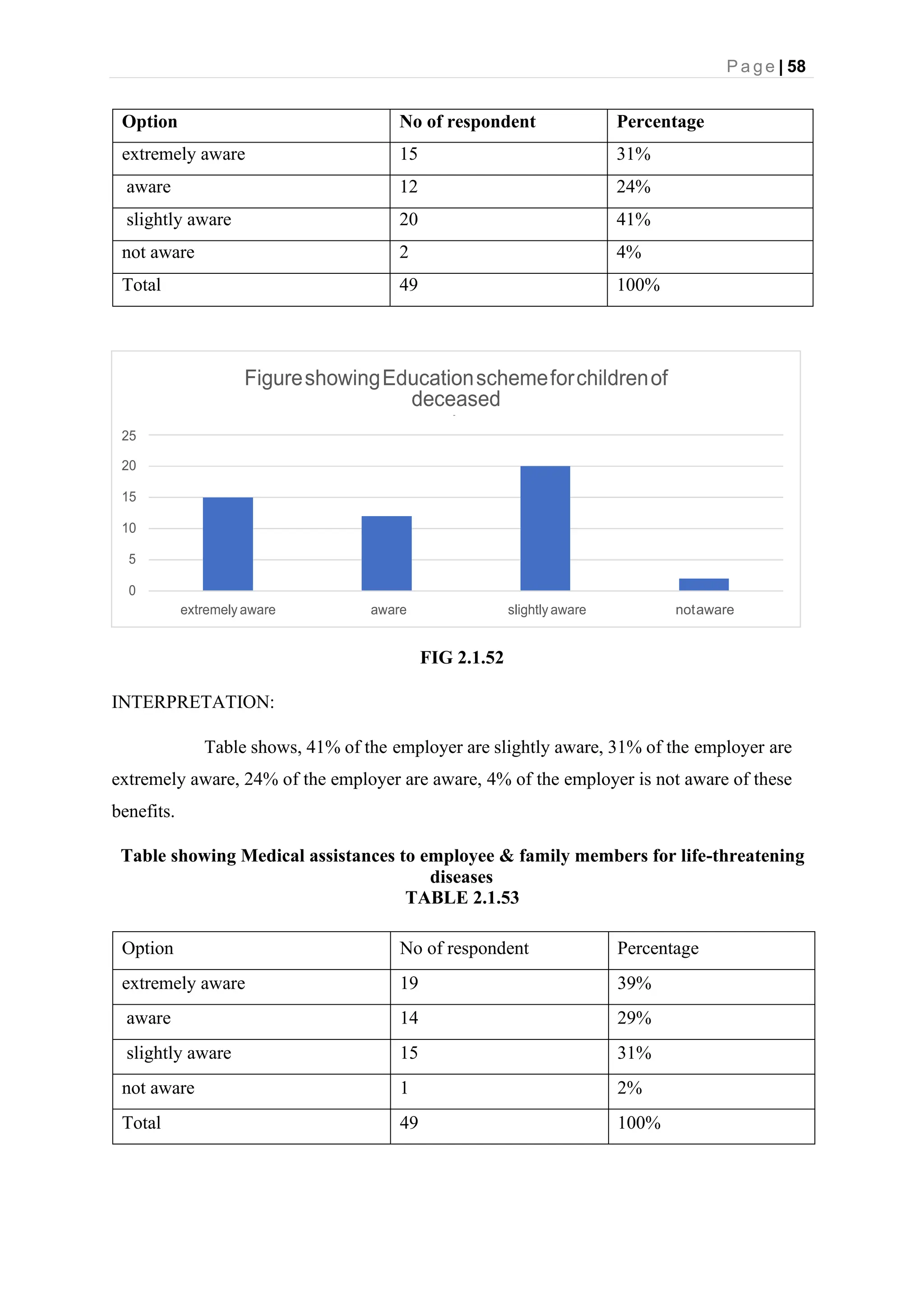
2.1.53
Table showing Medical assistances to employee & family members for life
threatening diseases
63
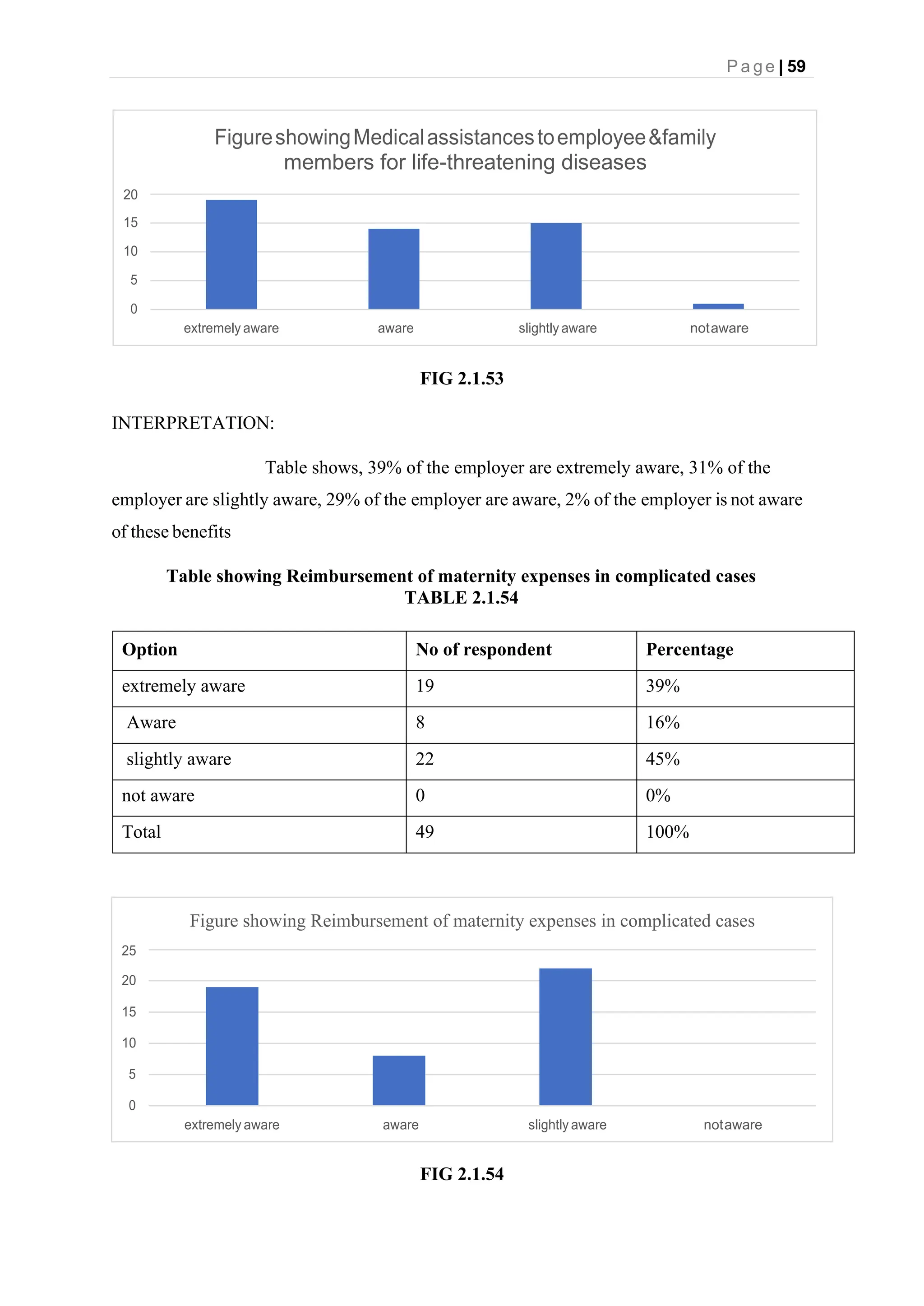
2.1.54 Table showing Reimbursement of maternity expenses in complicated cases 64
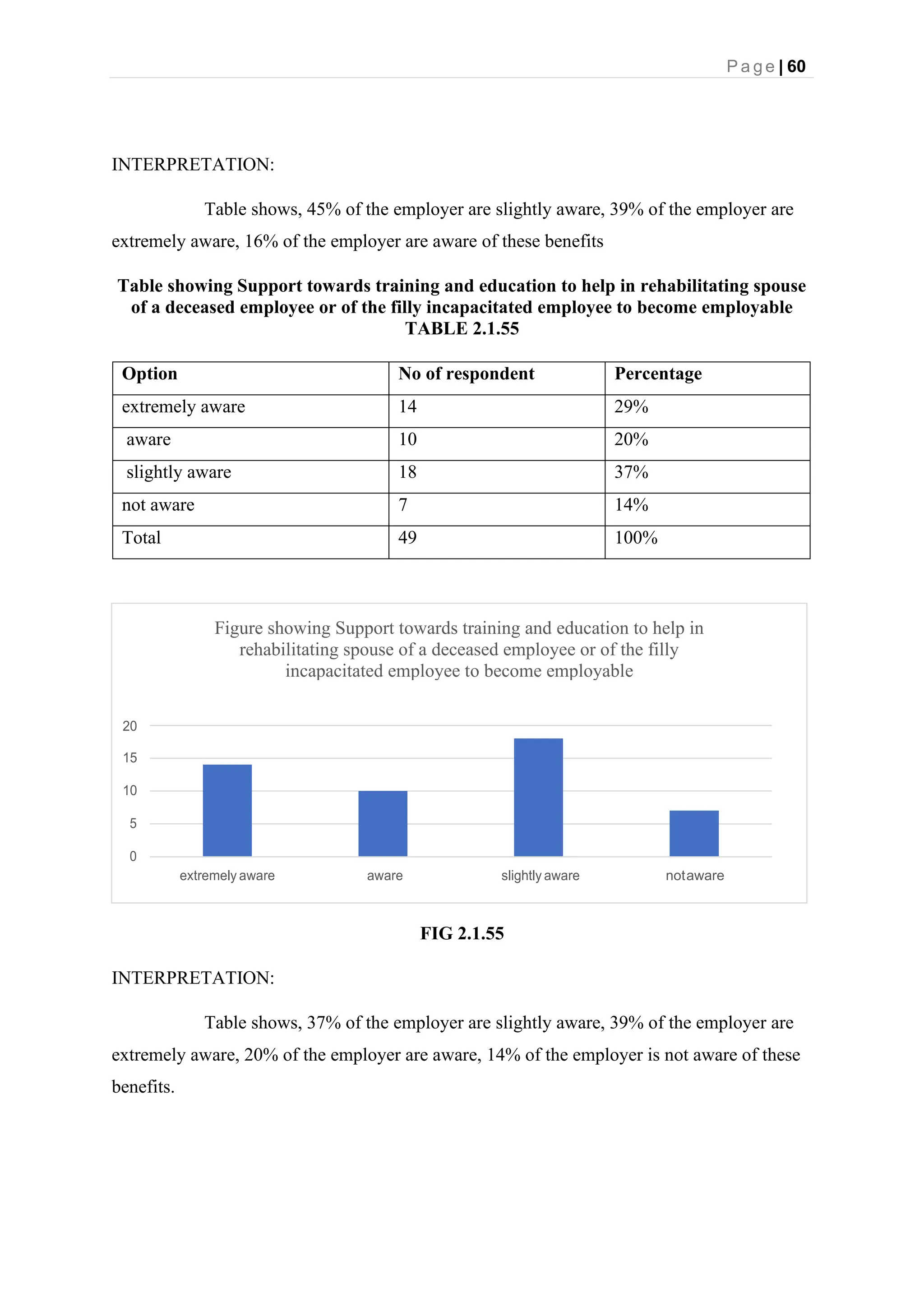
2.1.55
Table showing Support towards training and education to help in
rehabilitating spouse of deceased employee or of filly in capacitated
employee to become employable
65
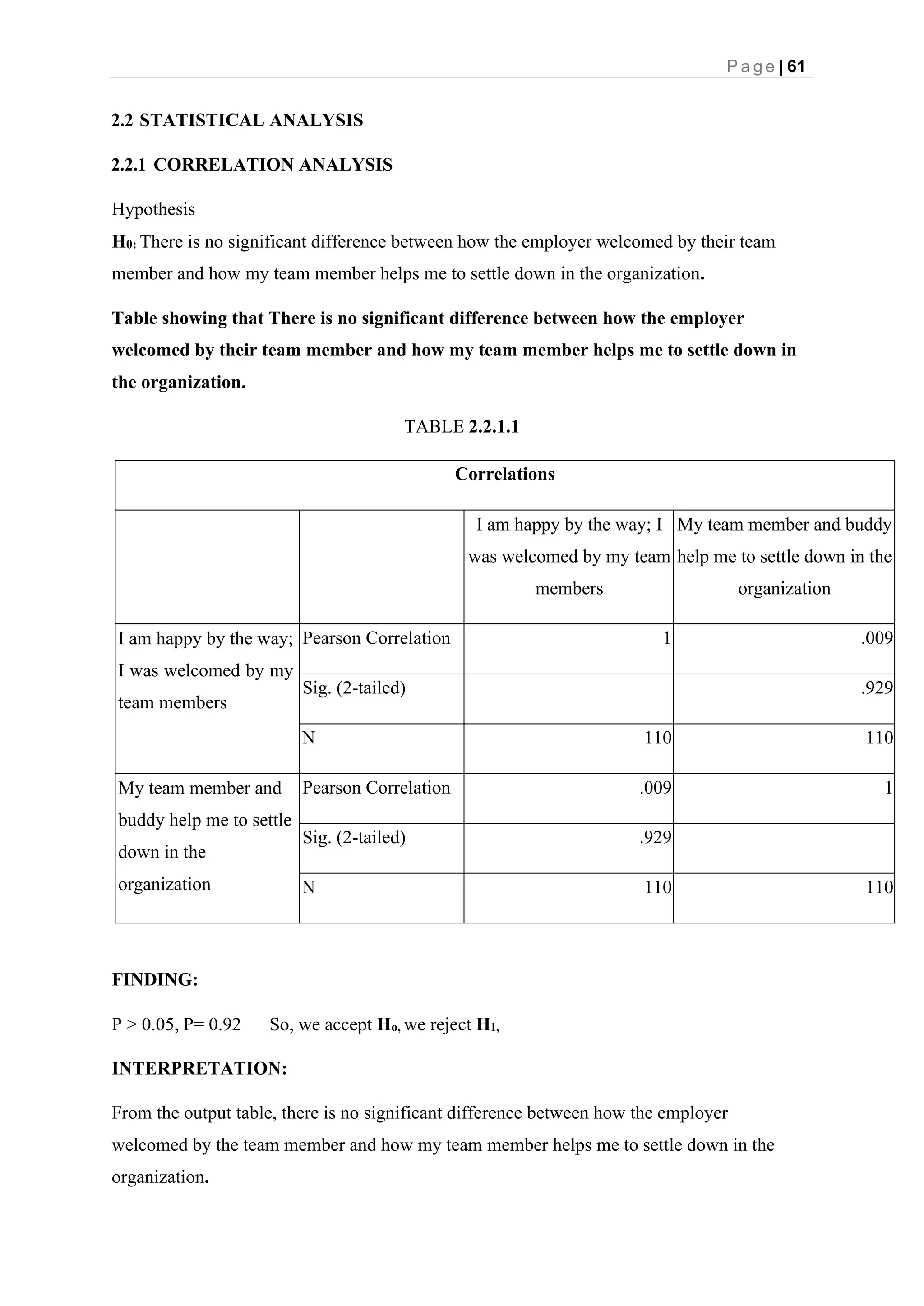
2.2.1.1
Table showing that there is no significant different between welcome way
and settle down in company.
66
2.2.1.2
Table showing that there is significant different between training schedule
and schedule conducted
67
2.2.1.3
Table showing that there is significant different between training schedule
and training faculty
68
2.2.1.4
Table showing that there is significant different between paid fairly for the
work and paid as per industry standard.
69
v
LIST OF FIGURES
FIGURE
NO
TITLE PAGE NO
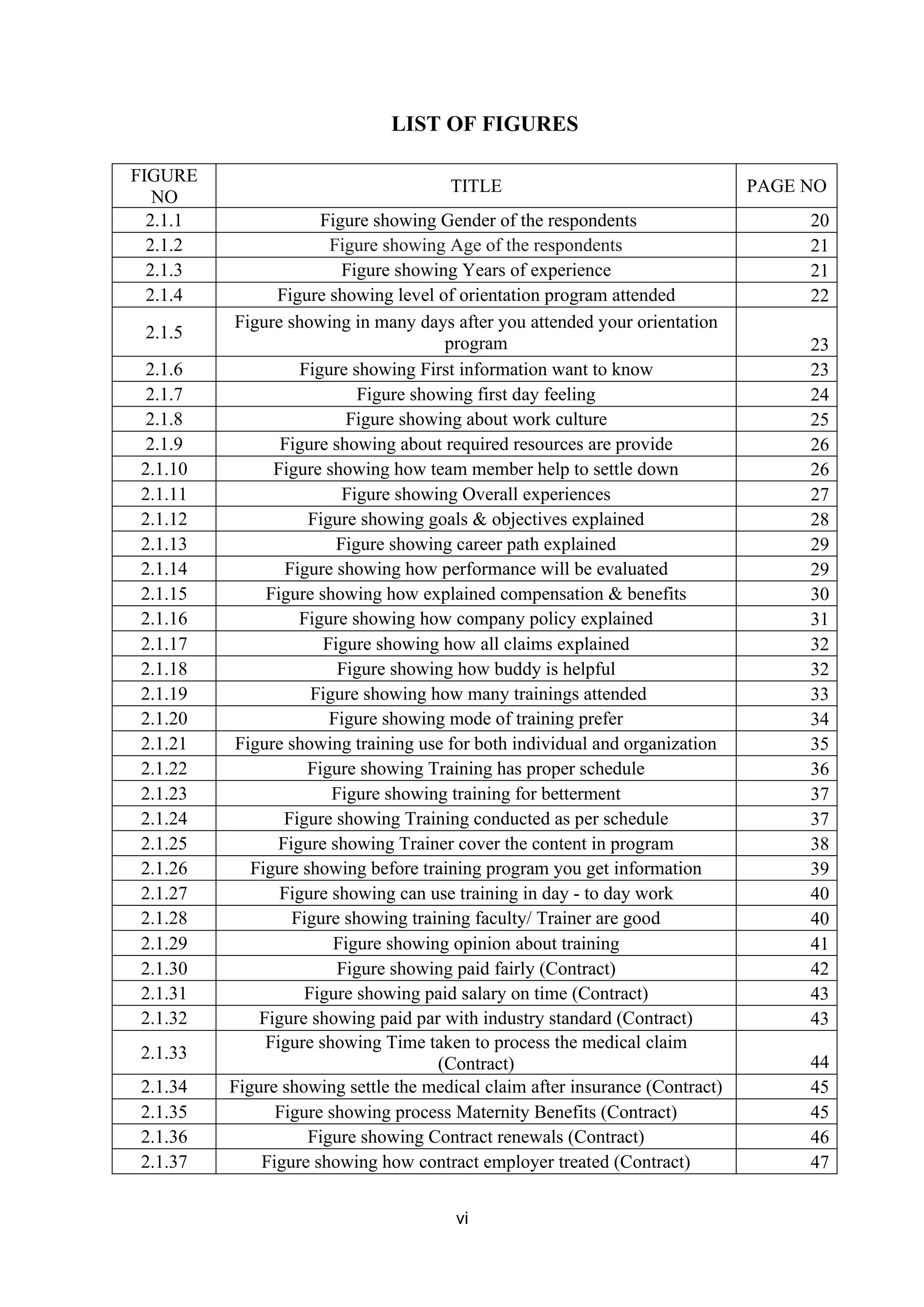
2.1.1 Figure showing Gender of the respondents 20
2.1.2 Figure showing Age of the respondents 21
2.1.3 Figure showing Years of experience 21
2.1.4 Figure showing level of orientation program attended 22
2.1.5
Figure showing in many days after you attended your orientation
program 23
2.1.6 Figure showing First information want to know 23
2.1.7 Figure showing first day feeling 24
2.1.8 Figure showing about work culture 25
2.1.9 Figure showing about required resources are provide 26
2.1.10 Figure showing how team member help to settle down 26
2.1.11 Figure showing Overall experiences 27
2.1.12 Figure showing goals & objectives explained 28
2.1.13 Figure showing career path explained 29
2.1.14 Figure showing how performance will be evaluated 29
2.1.15 Figure showing how explained compensation & benefits 30
2.1.16 Figure showing how company policy explained 31
2.1.17 Figure showing how all claims explained 32
2.1.18 Figure showing how buddy is helpful 32
2.1.19 Figure showing how many trainings attended 33
2.1.20 Figure showing mode of training prefer 34
2.1.21 Figure showing training use for both individual and organization 35
2.1.22 Figure showing Training has proper schedule 36
2.1.23 Figure showing training for betterment 37
2.1.24 Figure showing Training conducted as per schedule 37
2.1.25 Figure showing Trainer cover the content in program 38
2.1.26 Figure showing before training program you get information 39
2.1.27 Figure showing can use training in day - to day work 40
2.1.28 Figure showing training faculty/ Trainer are good 40
2.1.29 Figure showing opinion about training 41
2.1.30 Figure showing paid fairly (Contract) 42
2.1.31 Figure showing paid salary on time (Contract) 43
2.1.32 Figure showing paid par with industry standard (Contract) 43
2.1.33
Figure showing Time taken to process the medical claim
(Contract) 44
2.1.34 Figure showing settle the medical claim after insurance (Contract) 45
2.1.35 Figure showing process Maternity Benefits (Contract) 45
2.1.36 Figure showing Contract renewals (Contract) 46
2.1.37 Figure showing how contract employer treated (Contract) 47
vi
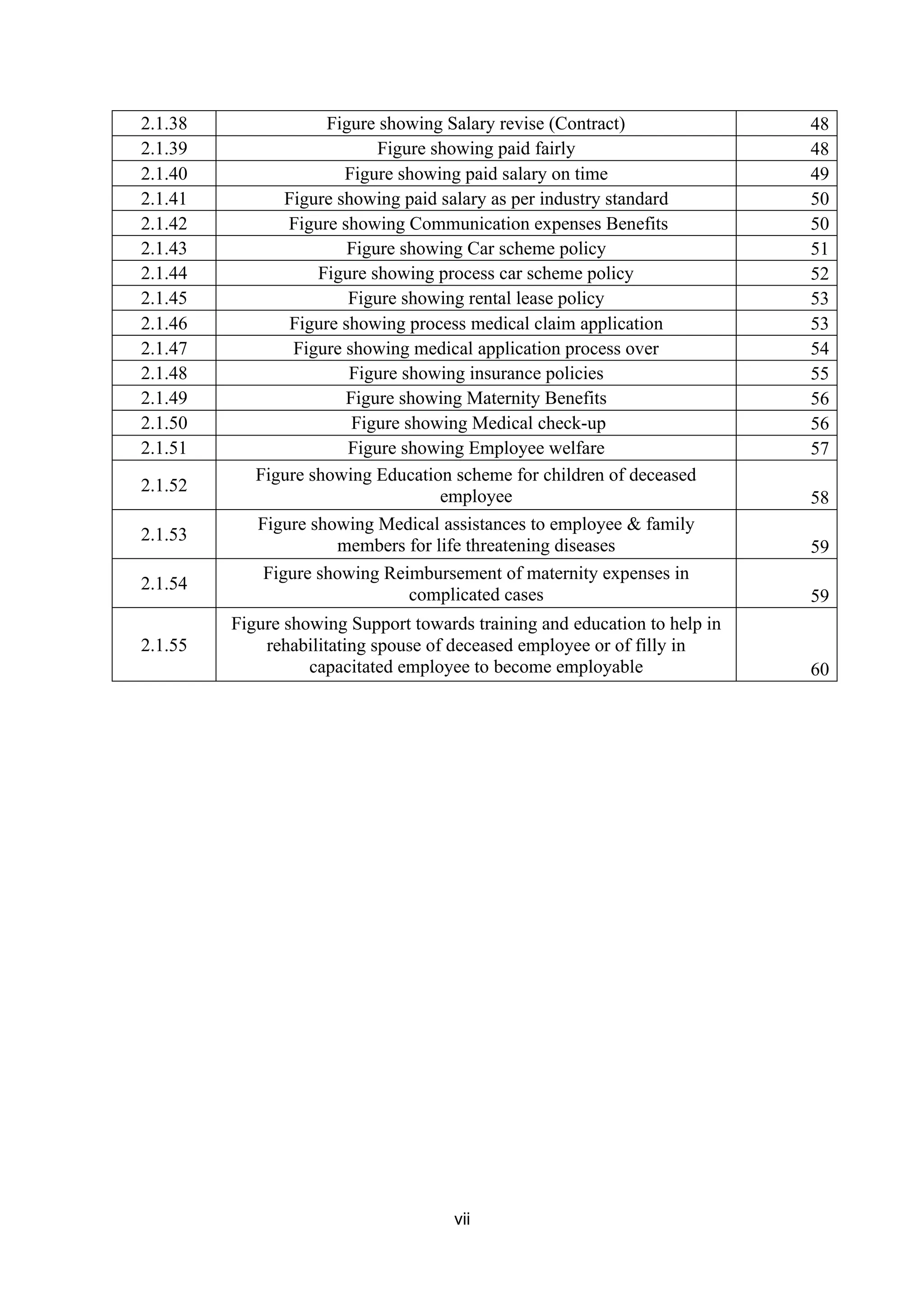
2.1.38 Figure showing Salary revise (Contract) 48
2.1.39 Figure showing paid fairly 48
2.1.40 Figure showing paid salary on time 49
2.1.41 Figure showing paid salary as per industry standard 50
2.1.42 Figure showing Communication expenses Benefits 50
2.1.43 Figure showing Car scheme policy 51
2.1.44 Figure showing process car scheme policy 52
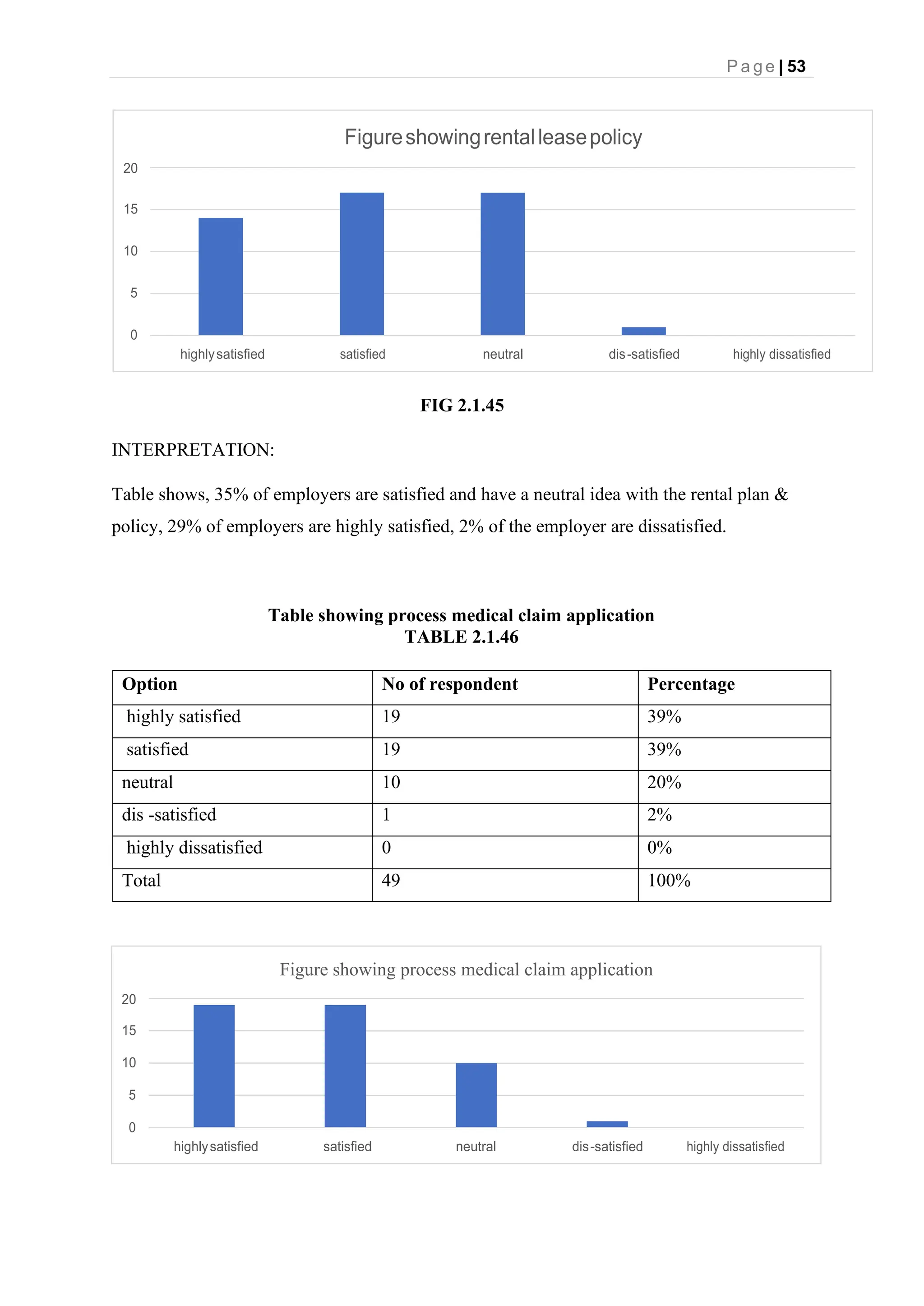
2.1.45 Figure showing rental lease policy 53
2.1.46 Figure showing process medical claim application 53
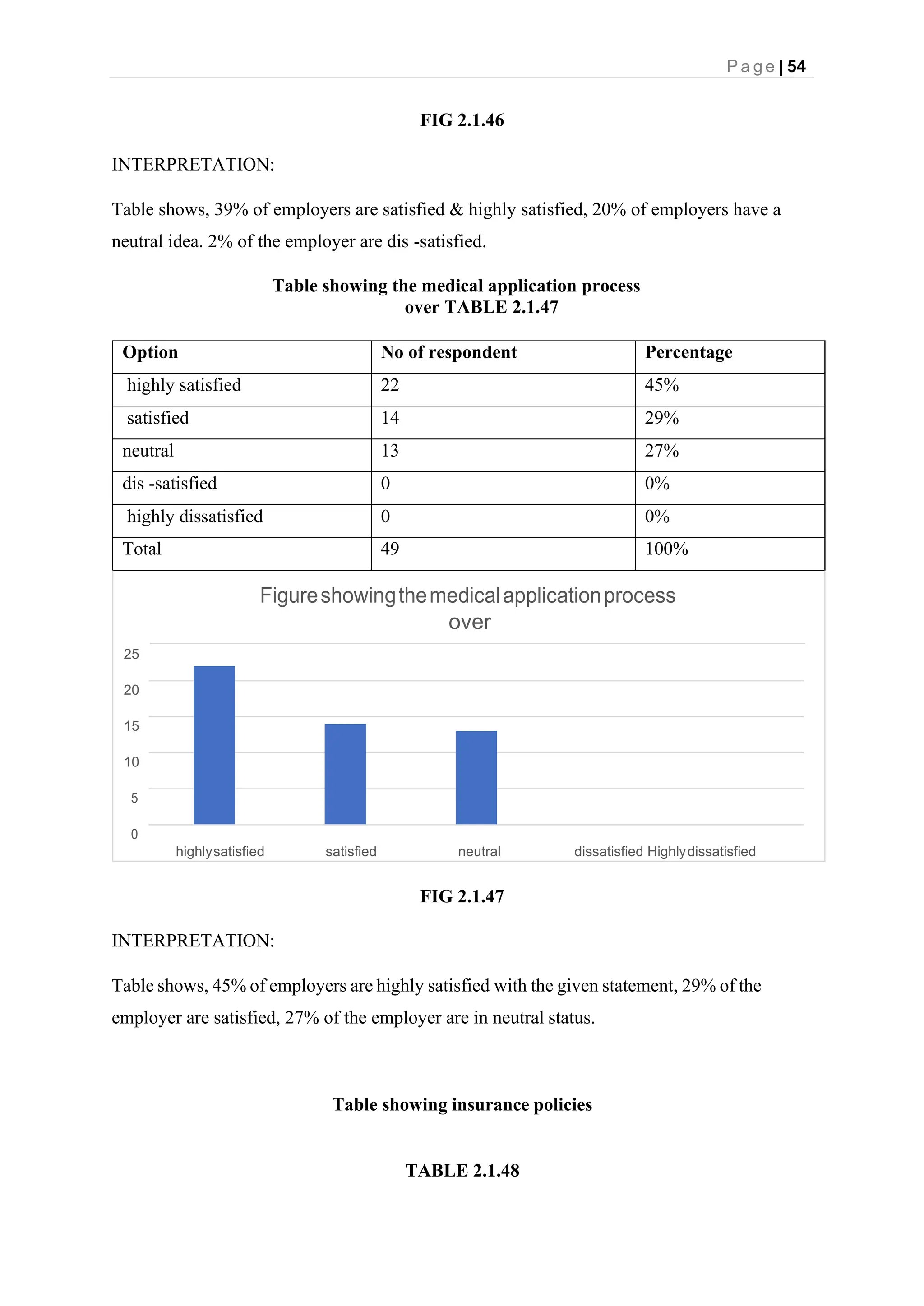
2.1.47 Figure showing medical application process over 54
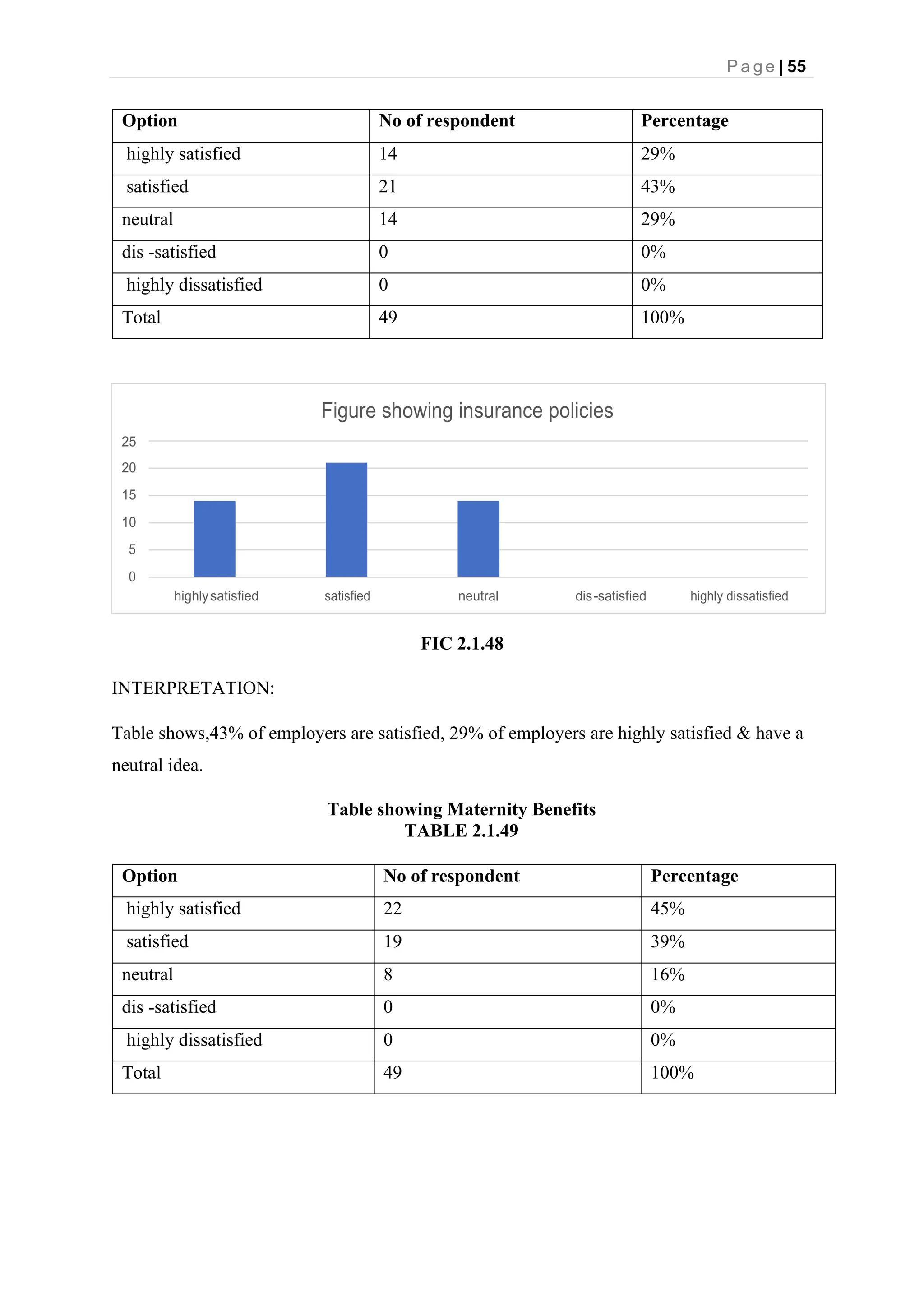
2.1.48 Figure showing insurance policies 55
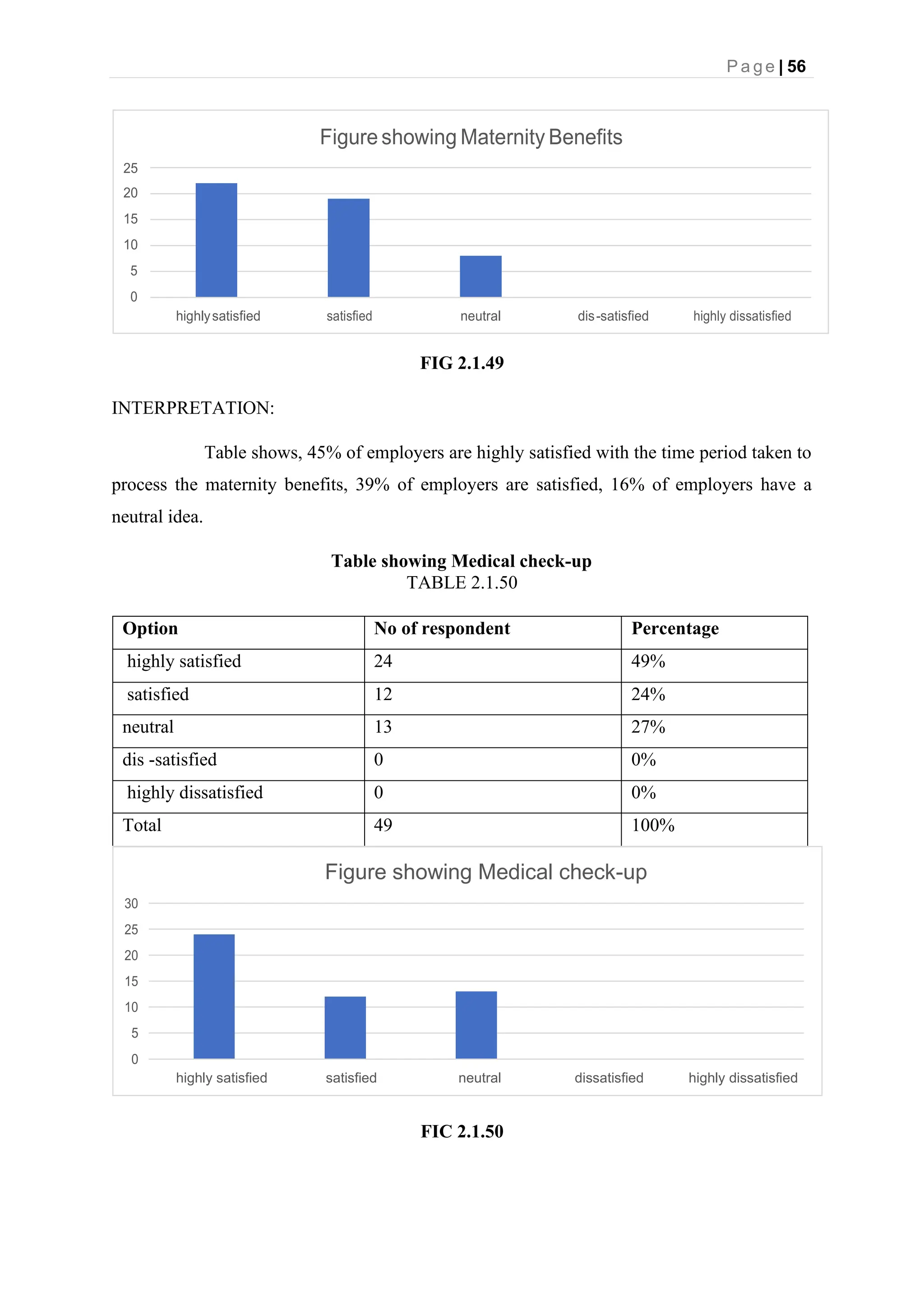
2.1.49 Figure showing Maternity Benefits 56
2.1.50 Figure showing Medical check-up 56
2.1.51 Figure showing Employee welfare 57
2.1.52
Figure showing Education scheme for children of deceased
employee 58
2.1.53
Figure showing Medical assistances to employee & family
members for life threatening diseases 59
2.1.54
Figure showing Reimbursement of maternity expenses in
complicated cases 59
2.1.55
Figure showing Support towards training and education to help in
rehabilitating spouse of deceased employee or of filly in
capacitated employee to become employable 60
vii
P a g e | 1
CHAPTER I
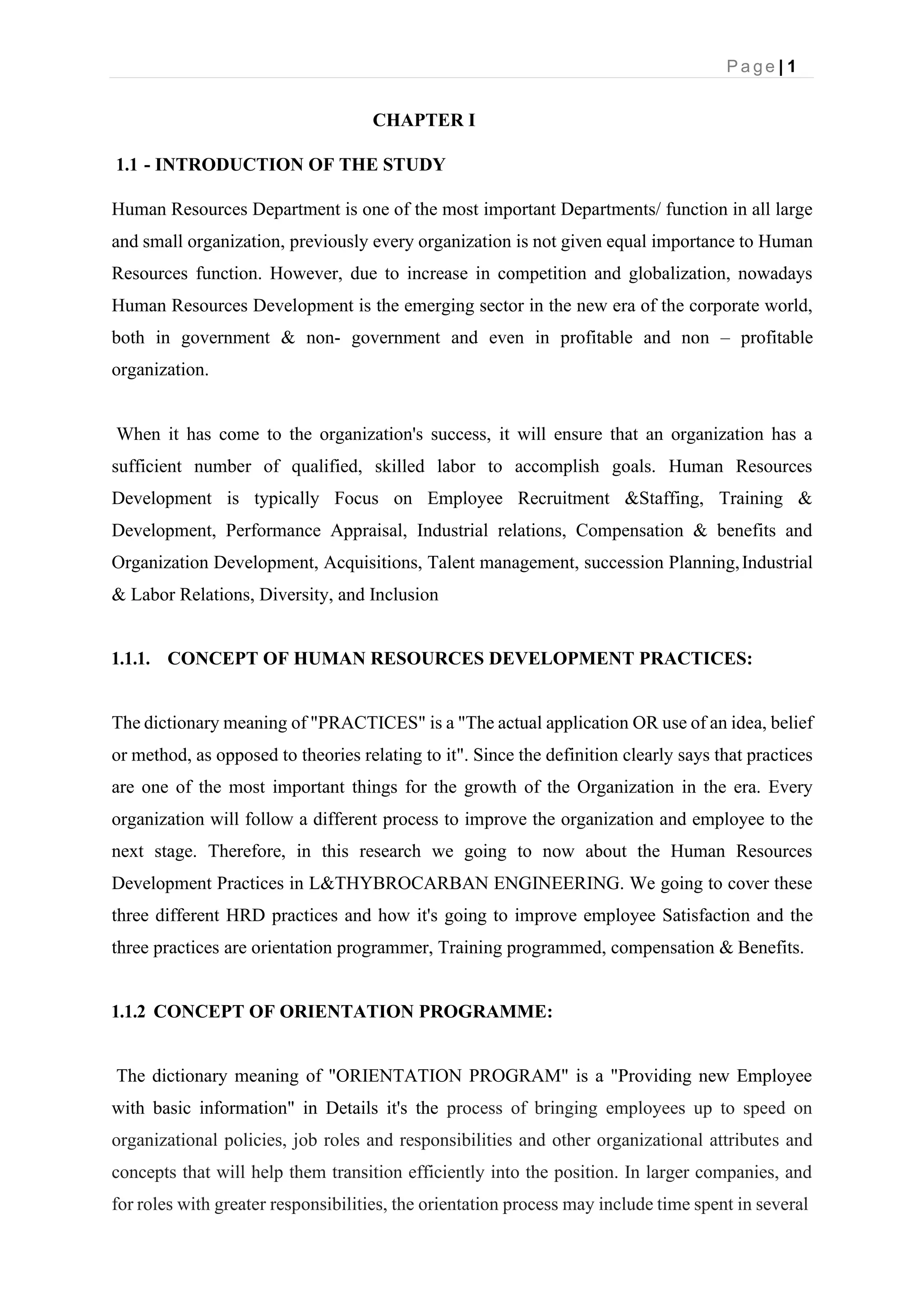
1.1 - INTRODUCTION OF THE STUDY
Human Resources Department is one of the most important Departments/ function in all large
and small organization, previously every organization is not given equal importance to Human
Resources function. However, due to increase in competition and globalization, nowadays
Human Resources Development is the emerging sector in the new era of the corporate world,
both in government & non- government and even in profitable and non – profitable
organization.
When it has come to the organization's success, it will ensure that an organization has a
sufficient number of qualified, skilled labor to accomplish goals. Human Resources
Development is typically Focus on Employee Recruitment &Staffing, Training &
Development, Performance Appraisal, Industrial relations, Compensation & benefits and
Organization Development, Acquisitions, Talent management, succession Planning,Industrial
& Labor Relations, Diversity, and Inclusion
1.1.1. CONCEPT OF HUMAN RESOURCES DEVELOPMENT PRACTICES:
The dictionary meaning of "PRACTICES" is a "The actual application OR use of an idea, belief
or method, as opposed to theories relating to it". Since the definition clearly says that practices
are one of the most important things for the growth of the Organization in the era. Every
organization will follow a different process to improve the organization and employee to the
next stage. Therefore, in this research we going to now about the Human Resources
Development Practices in L&THYBROCARBAN ENGINEERING. We going to cover these
three different HRD practices and how it's going to improve employee Satisfaction and the
three practices are orientation programmer, Training programmed, compensation & Benefits.
1.1.2 CONCEPT OF ORIENTATION PROGRAMME:
The dictionary meaning of "ORIENTATION PROGRAM" is a "Providing new Employee
with basic information" in Details it's the process of bringing employees up to speed on
organizational policies, job roles and responsibilities and other organizational attributes and
concepts that will help them transition efficiently into the position. In larger companies, and
for roles with greater responsibilities, the orientation process may include time spent in several
P a g e | 2
departments as well as specialist learning programmers. Some of the orientation programmers
are Tour the Facility, Introduction to Co-Worker, Review Employee Handbook, Review goal
and Job, etc……
1.1.3 CONCEPT OF TRAINING PROGRAMME:
The Training program is one the most important process, because in an organizational which
emphasize on the improvement of the performance of individuals & Groups. Training an
Educational process, which helps to sharping of skills, concepts.
1.1.4. CONCEPT OF COMPENSATION & BENEFITS:
Compensation & Benefits are most needed part to improve the job satisfaction of the employee
compensation &Benefits cover Salary, and other Monetary and Non – Monetary Benefits
passed by a firm to its employee. Its help the employee to motivated and it will improve the
individual and origination performance. And some C&B guaranteed pay, Variable pay, equity
pay, accommodation, insurance and medical.
P a g e | 3
1.2 INDUSTRY PROFILE
Construction is the process of constructing a building or infrastructure. Construction differs
from manufacturing in that manufacturing typically involves mass production of similar items
without a designated purchaser, while construction typically takes place on location for a
known client.[2]
Construction as an industry comprises six to nine per cent of the gross domestic
product of developed countries. Construction starts with planning, design, and financing; it
continues until the project is built and ready for use.
Large-scale construction requires collaboration across multiple disciplines. A project manager
normally manages the budget on the job, and a construction manager, design engineer,
construction engineer or architect supervises it. Those involved with the design and execution
must consider zoning requirements, the environmental impact of the job, scheduling,
budgeting, construction-site safety, availability and transportation of building materials,
logistics, inconvenience to the public caused by construction delays and bidding. Large
construction projects are sometimes referred to as megaprojects.
Industry sectors
Engineering News-Record (ENR), a trade magazine for the construction industry, each year
compiles and reports data about the size of design and construction companies. In 2014, ENR
compiled the data in nine market segments divided as transportation, petroleum, buildings,
power, industrial, water, manufacturing, sewer/waste, telecom, hazardous waste and a tenth
category for other projects. In their reporting, they used data on transportation, sewer,
hazardous waste and water to rank firms as heavy contractors.
1.2.1 Building construction
Building construction is the process of adding structure to real property or construction of
buildings. The majority of building construction jobs are small renovations, such as the addition
of a room, or renovation of a bathroom. Often, the owner of the property acts as a labourer,
paymaster, and design team for the entire project. Although building construction projects
consist of common elements such as design, financial, estimating and legal considerations,
projects of varying sizes may reach undesirable results, such as structural collapse, cost
overruns, and/or litigation. For this reason, those with experience in the field make detailed
plans and maintain careful oversight during the project to ensure a positive outcome.
P a g e | 4
Commercial building construction is procured privately or publicly utilizing various delivery
methodologies, including cost estimating, hard bid, negotiated price, traditional, management
contracting, construction management-at-risk, design & build and design-build bridging.
Residential construction practices, technologies, and resources
must conform to local building authority regulations and codes of practice. Materials readily
available in the area generally dictate the construction materials used (e.g. brick versus stone,
versus timber). Cost of construction on a per square meter (or per square foot) basis for
houses can vary dramatically based on site conditions, local regulations, economies of scale
(custom designed homes are often more expensive to build) and the availability of skilled
tradesmen. Residential construction, as well as other types of construction, can generate waste
such that planning is required.
According to McKinsey research, productivity growth per
worker in construction has lagged behind many other industries across different countries
including in the United States and European countries. In the United States, construction
productivity per worker has declined by half since the 1960s.
Design team
In the industrialized world, construction usually involves the translation of designs into reality.
A formal design team may be assembled to plan the physical proceedings and to integrate those
proceedings with the other parts. The design usually consists of drawings and specifications,
usually prepared by a design team including architects, civil engineers, mechanical engineers,
electrical engineers, structural engineers, fire protection engineers, planning consultants,
architectural consultants, and archaeological consultants. The design team is most commonly
employed by (i.e. in contract with) the property owner. Under this system, once the design is
completed by the design team, several construction companies or construction management
companies may then be asked to make a bid for the work, either based directly on the design or
based on drawings and a bill of quantities provided by a quantity surveyor. Following the
evaluation of bids, the owner typically awards a contract to the most cost-efficient bidder.
Financial advisors
construction projects can suffer from preventable financial problems. Underbids happen when
builders ask for too little money to complete the project. Cash flow problems exist when the
present amount of funding cannot cover the current costs for labor and materials, and because
P a g e | 5
they are a matter of having sufficient funds at a specific time, it can arise even when the overall
total is enough. Fraud is a problem in many fields but is notoriously prevalent in the
construction field. Financial planning for the project is intended to ensure that a solid plan with
adequate safeguards and contingency plans are in place before the project is started and is
required to ensure that the plan is properly executed over the life of the project.
Legal aspects
A construction project must fit into the legal framework governing the property. These include
governmental regulations on the use of property and obligations that are created in theprocess
of construction. When applicable, the project must adhere to zoning and building code
requirements. Constructing a project that fails to adhere to codes does not benefit the owner.
Some legal requirements come from malum in se considerations, or the desire to prevent
indisputably bad phenomena.
Interaction of expertise
Design, finance, and legal aspects overlap and interrelate. The design must be not only
structurally sound and appropriate for the use and location, but must also be financially possible
to build, and legal to use. The financial structure must accommodate the need for building the
design provided and must pay amounts that are legally owed. The legal structure must integrate
the design into the surrounding legal framework, and enforce the financial consequences of the
construction process.
Procurement
Procurement describes the merging of activities undertaken by the client to obtain a building.
There are many different methods of construction procurement; however, the three most
common types of procurement are traditional (design–bid–build), design-build and
management contracting.
Design-build
It his approach has become more common in recent years and also involves the client
contracting a single entity that both provides a design and builds it. In some cases, the design-
build package can also include finding the site, arranging to fund and applying for all necessary
statutory consents.
P a g e | 6
Management procurement systems
In this arrangement, the client plays an active role in the procurement system by entering into
separate contracts with the designer (architect or engineer), the construction manager, and
individual trade contractors. The client takes on the contractual role, while the construction or
project manager provides the active role of managing the separate trade contracts, and ensuring
that they complete all work smoothly and effectively together.
Sustainability in construction
Sustainability during the construction phase is one of the aspects of “green building," defined
by the United States Environmental Protection Agency (EPA) as "the practice of creating
structures and using processes that are environmentally responsible and resource-efficient
throughout a building's life-cycle from siting to design, construction, operation, maintenance,
renovation, and deconstruction.
Safety
Construction is one of the most dangerous occupations in the world, incurring more
occupational fatalities than any other sector in both the United States and in the European
Union. In 2009, the fatal occupational injury rate among construction workers in the United
States was nearly three times that for all workers, with Falls being one of the most common
causes of fatal and non-fatal injuries among construction workers.
Proper safety equipment such as harnesses, hard hats and guardrails and procedures
such as securing ladders and inspecting scaffolding can curtail the risk of occupational injuries
in the construction industry.]
Other major causes of fatalities in the construction industry
include electrocution, transportation accidents, and trench cave-ins. Other safety risks for
workers in construction include hearing loss due to high noise exposure, musculoskeletal
injury, chemical exposure, and high levels of stress.
P a g e | 7
1.3 – COMPANY PROFILE
L&THYDROCARBON ENGINEERING
1.3.1. ABOUT L&T Hydrocarbon Engineering:
L&T Hydrocarbon Engineering (LTHE) is an Engineering, Procurement Fabrication,
Construction and Project Management company providing "design to build" solutions to the
entire Hydrocarbon Industry. The company is a Wholly-owned Subsidiary of L&T(L&T)
Limited, a USD 20+ Billion technology, engineering, construction, projects, manufacturing,
and financial services conglomerate.
LTHE brings with itself more than 3 decades of proven experience and extensive capabilities
backed by digitization. The company adheres to global quality norms and health, safety, and
Environment (HSE) standards, ensuring reliability and on-time delivery.
LTHE Business was structured into the following verticals:
✓ Onshore
✓ Offshore
✓ Construction services
✓ Modular Fabrication
✓ AdVENT (Advanced Value
Engineer & Technology)
1.3.2 ABOUT LTHE CONSTRUCTION SERVICES:
L&T Hydrocarbon Engineering Construction Services they provide Construction services for
domestic and also in international, they are excellent in Construction and servicing innovative
and best technology offering for large and sophistication plant and machinery asset base.
State of the art piping automation shops is equipped with aided surveys, fully automated
welding for pipelines and PUF insulated joint Coating for pipeline projects.
1.3.3 : The company offers:
Our company provides Turnkey construction of a refinery, Petrochemical, Chemical and
Fertilizer Projects, Gas gathering stations, Crude oil & gas terminals, and Underground cavern
storage system for covering civil, Structural, Piping, Equipment, Heavy lift, Electrical &
instrumentation works, to improve India to next level
1.3.4 The Company doing their project in:
Our Company doing the business in different place outside India like
India, UAE, Oman, Qatar, Saudi Arabia, Kuwait, Malaysia, Kenya, Tanzania,
P a g e | 8
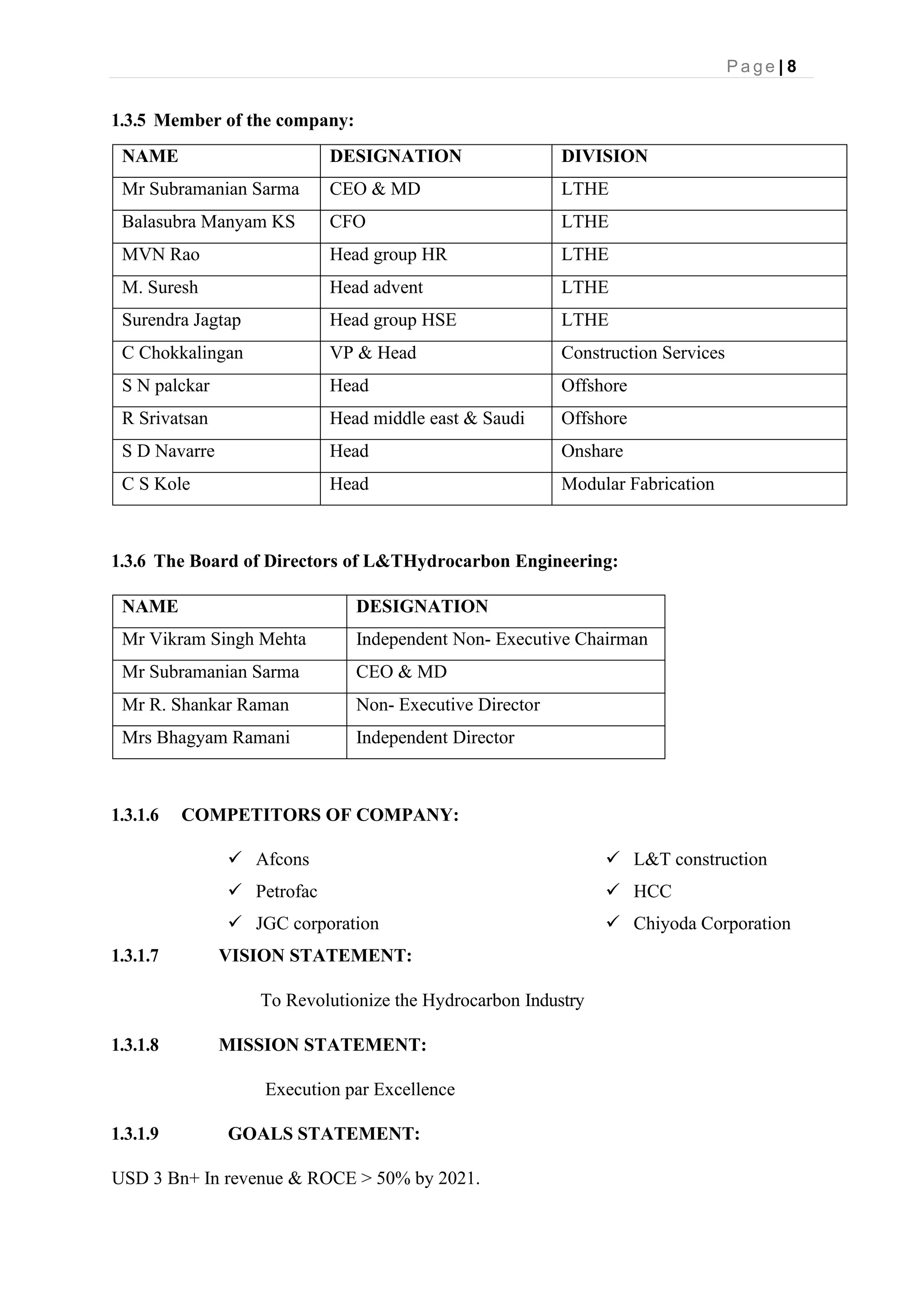
1.3.5 Member of the company:
NAME DESIGNATION DIVISION
Mr Subramanian Sarma CEO & MD LTHE
Balasubra Manyam KS CFO LTHE
MVN Rao Head group HR LTHE
M. Suresh Head advent LTHE
Surendra Jagtap Head group HSE LTHE
C Chokkalingan VP & Head Construction Services
S N palckar Head Offshore
R Srivatsan Head middle east & Saudi Offshore
S D Navarre Head Onshare
C S Kole Head Modular Fabrication
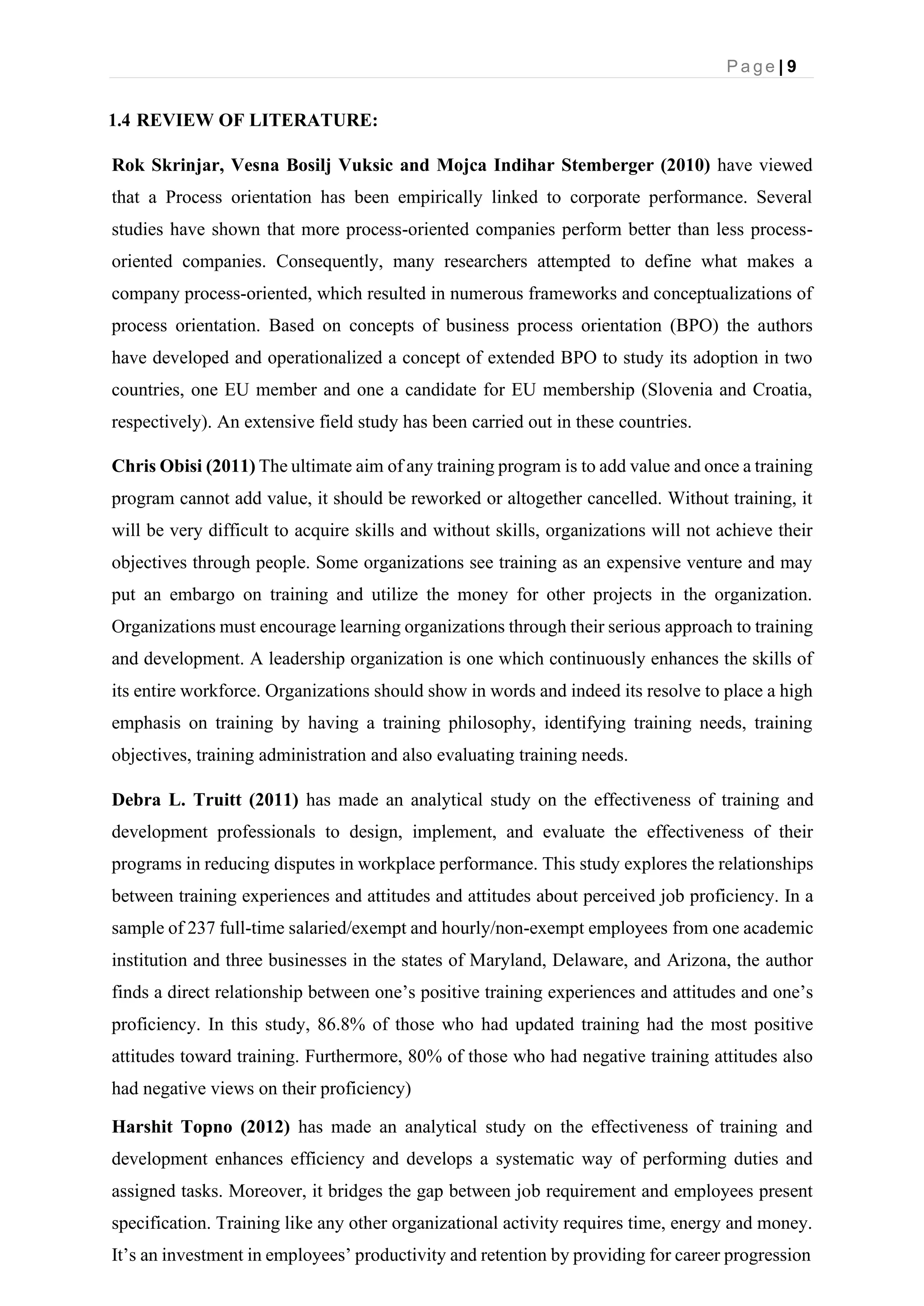
1.3.6 The Board of Directors of L&THydrocarbon Engineering:
NAME DESIGNATION
Mr Vikram Singh Mehta Independent Non- Executive Chairman
Mr Subramanian Sarma CEO & MD
Mr R. Shankar Raman Non- Executive Director
Mrs Bhagyam Ramani Independent Director
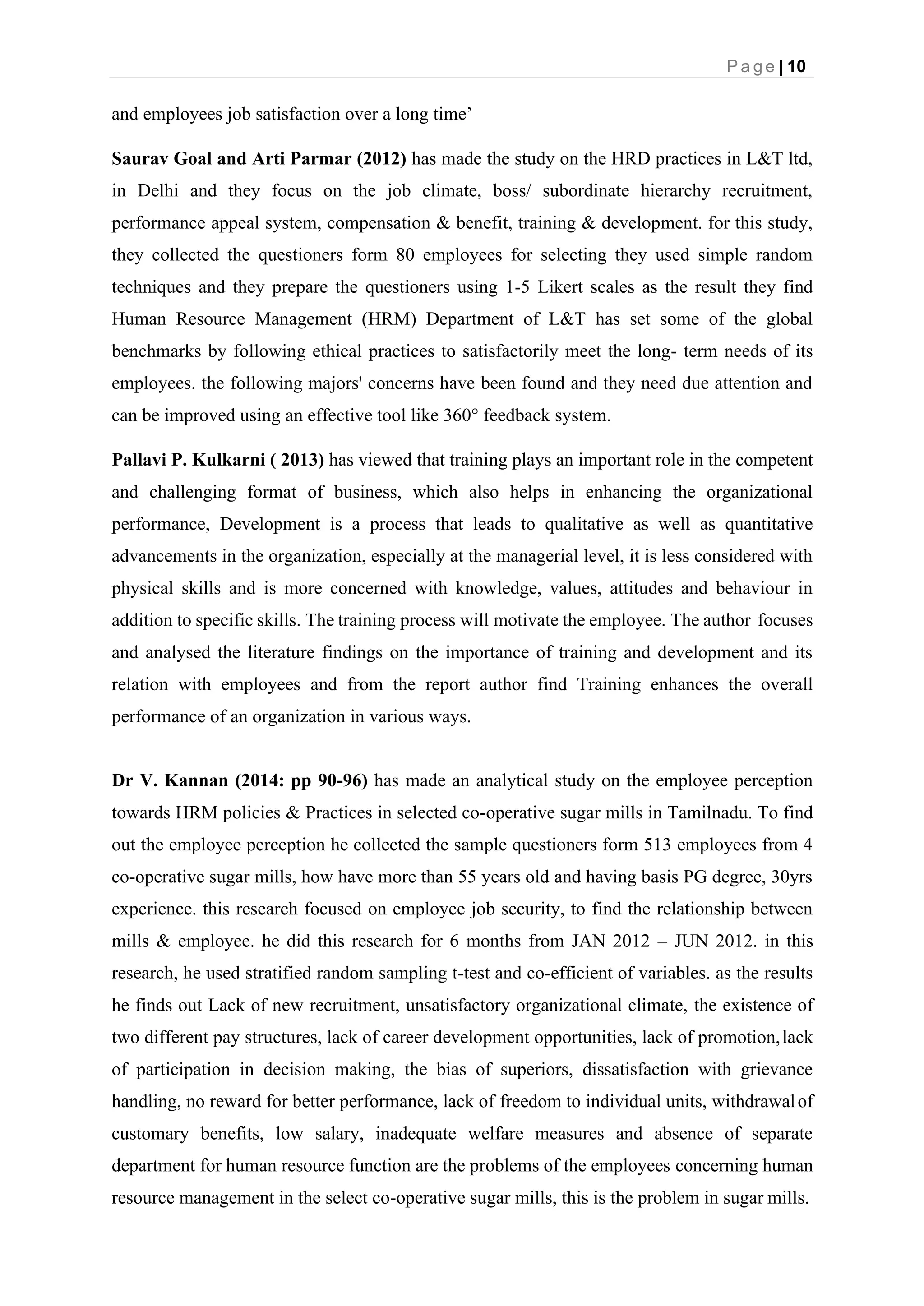
1.3.1.6 COMPETITORS OF COMPANY:
✓ Afcons
✓ Petrofac
✓ JGC corporation
1.3.1.7 VISION STATEMENT:
To Revolutionize the Hydrocarbon Industry
1.3.1.8 MISSION STATEMENT:
Execution par Excellence
1.3.1.9 GOALS STATEMENT:
USD 3 Bn+ In revenue & ROCE > 50% by 2021.
✓ L&T construction
✓ HCC
✓ Chiyoda Corporation
P a g e | 9
1.4 REVIEW OF LITERATURE:
Rok Skrinjar, Vesna Bosilj Vuksic and Mojca Indihar Stemberger (2010) have viewed
that a Process orientation has been empirically linked to corporate performance. Several
studies have shown that more process-oriented companies perform better than less process-
oriented companies. Consequently, many researchers attempted to define what makes a
company process-oriented, which resulted in numerous frameworks and conceptualizations of
process orientation. Based on concepts of business process orientation (BPO) the authors
have developed and operationalized a concept of extended BPO to study its adoption in two
countries, one EU member and one a candidate for EU membership (Slovenia and Croatia,
respectively). An extensive field study has been carried out in these countries.
Chris Obisi (2011) The ultimate aim of any training program is to add value and once a training
program cannot add value, it should be reworked or altogether cancelled. Without training, it
will be very difficult to acquire skills and without skills, organizations will not achieve their
objectives through people. Some organizations see training as an expensive venture and may
put an embargo on training and utilize the money for other projects in the organization.
Organizations must encourage learning organizations through their serious approach to training
and development. A leadership organization is one which continuously enhances the skills of
its entire workforce. Organizations should show in words and indeed its resolve to place a high
emphasis on training by having a training philosophy, identifying training needs, training
objectives, training administration and also evaluating training needs.
Debra L. Truitt (2011) has made an analytical study on the effectiveness of training and
development professionals to design, implement, and evaluate the effectiveness of their
programs in reducing disputes in workplace performance. This study explores the relationships
between training experiences and attitudes and attitudes about perceived job proficiency. In a
sample of 237 full-time salaried/exempt and hourly/non-exempt employees from one academic
institution and three businesses in the states of Maryland, Delaware, and Arizona, the author
finds a direct relationship between one’s positive training experiences and attitudes and one’s
proficiency. In this study, 86.8% of those who had updated training had the most positive
attitudes toward training. Furthermore, 80% of those who had negative training attitudes also
had negative views on their proficiency)
Harshit Topno (2012) has made an analytical study on the effectiveness of training and
development enhances efficiency and develops a systematic way of performing duties and
assigned tasks. Moreover, it bridges the gap between job requirement and employees present
specification. Training like any other organizational activity requires time, energy and money.
It’s an investment in employees’ productivity and retention by providing for career progression
P a g e | 10
and employees job satisfaction over a long time’
Saurav Goal and Arti Parmar (2012) has made the study on the HRD practices in L&T ltd,
in Delhi and they focus on the job climate, boss/ subordinate hierarchy recruitment,
performance appeal system, compensation & benefit, training & development. for this study,
they collected the questioners form 80 employees for selecting they used simple random
techniques and they prepare the questioners using 1-5 Likert scales as the result they find
Human Resource Management (HRM) Department of L&T has set some of the global
benchmarks by following ethical practices to satisfactorily meet the long- term needs of its
employees. the following majors' concerns have been found and they need due attention and
can be improved using an effective tool like 360° feedback system.
Pallavi P. Kulkarni ( 2013) has viewed that training plays an important role in the competent
and challenging format of business, which also helps in enhancing the organizational
performance, Development is a process that leads to qualitative as well as quantitative
advancements in the organization, especially at the managerial level, it is less considered with
physical skills and is more concerned with knowledge, values, attitudes and behaviour in
addition to specific skills. The training process will motivate the employee. The author focuses
and analysed the literature findings on the importance of training and development and its
relation with employees and from the report author find Training enhances the overall
performance of an organization in various ways.
Dr V. Kannan (2014: pp 90-96) has made an analytical study on the employee perception
towards HRM policies & Practices in selected co-operative sugar mills in Tamilnadu. To find
out the employee perception he collected the sample questioners form 513 employees from 4
co-operative sugar mills, how have more than 55 years old and having basis PG degree, 30yrs
experience. this research focused on employee job security, to find the relationship between
mills & employee. he did this research for 6 months from JAN 2012 – JUN 2012. in this
research, he used stratified random sampling t-test and co-efficient of variables. as the results
he finds out Lack of new recruitment, unsatisfactory organizational climate, the existence of
two different pay structures, lack of career development opportunities, lack of promotion,lack
of participation in decision making, the bias of superiors, dissatisfaction with grievance
handling, no reward for better performance, lack of freedom to individual units, withdrawalof
customary benefits, low salary, inadequate welfare measures and absence of separate
department for human resource function are the problems of the employees concerning human
resource management in the select co-operative sugar mills, this is the problem in sugar mills.
P a g e | 11
Pinto and Thalgaspitiya (2017) have made a study on examining the impact of HR practices
on employee engagement among machine operators in the large apparel industry in Sri Lanka.
The purpose of the study is to find the HR practices affect employee engagement among
machine operators in the large apparel industry. For this they have collected the sample form
384 employees and make the analysis they used correlation and regression as the result they
find that there is a positive impact of HR practices on employee engagement among machine
operators in the large apparel industry in Sri Lanka.
Worlu Rowland, Mugri Ruth and Akpakip Christiana Ekot (2017) has made ananalytical
study on "Effect of Employee orientation in creating employee satisfaction with work, using
United Bank for Africa (UBA), Plc, as the case". The continuous quest for training pervades
all levels of industry, from the national level to individual companies' level. Thus, from national
wellbeing to individual company productivity. An organization that wants to maintain a
sustainable level of success and development and be able to stand in the face of competition,
must be able to have a workforce, where people are willing to learn and developcontinuously.
The data required for this study was gathered through the instrument of the questionnaire.
Arshad Mahmood, Muhammad Naseer Akhtar, Usman Talat, Chuanmin Shuai and
James C. Hyatt (2018) had analysis was done to increase understanding of the influence
mechanisms of specific HR practices variables – salary, job stability and job enrichment – upon
employee commitment, through the mediating role of job satisfaction, in a developing country
context. For the study, they analysed three specific HR practices with a sample of 263
employees in the banking industry of Pakistan. The findings indicate that remuneration
strategies were positively related to job satisfaction and employee commitment. Regardingthe
intervening impact of job satisfaction, this study found that it mediates only for non-monetary
strategies between job satisfaction and employee commitment.
Sainath Maliseet, Malathi Narayanan and CH. Bala Nageswara Rao (2018) they have
made an analytical study is to evaluate the impact of Human Resource Practices on Workplace
Deviance. Given the paucity of existing research on the role of HR practices in shaping
workplace deviance, analyses were done to find the link between Organization HR Practices
and Employee workplace deviance. For that, a survey was carried out among 372 IT employees
in the Southern region of India. Based on HR practices like a job description, employment
security, internal career opportunities, and result-oriented appraisal. Deviant workplace
behaviour resulted in one dimension only, i.e. interpersonal deviance. Multiple regression
analysis shows that all dimensions of HR practices but result-oriented appraisal were found to
influence negatively organizational deviance.
P a g e | 12
Ata Can Bertay and Burak R. Uras (2019) has they analysed and find that the empirical
relationship between financial structure and employee compensation in the banking industry.
Using an international panel of banks, we show that well-capitalized banks pay higher wages
to their employees. Our results are robust to changes in measurement, model specification and
estimation methods. To account for the positive association between bank capital and employee
compensation, we illustrate a stylized 3-period model.
Anoop Patiara and Ying Wang (2020) has they made an analysis on hotels strive toimprove
their management practices, managers' leadership style has been recognized for its influence
on hotel departments' performance. Focusing on the practice of transformational and
transactional leadership, this study investigates the role of compensation and benefits in the
relationship between leadership style and hotel performance at the department level. Results of
a self-administrated questionnaire survey of hotel department managers ‘
Shahzad Akbar and Fayia Khanfar (2020) has the research used Coca Cola company
benefits and compensation practices to understand how companies currently carry out their
remuneration and rewards programs. Initially, we analysed the company profile, the HR
department and the administration to understand how the company functioned. Several
employees were interviewed and their responses are documented in this report.
Ying Wang, Sunghoon Kim (2020) highlighted that the policies and practices relating to
designing new employee orientation programs incorporate companies in India, based on the
information collected from 46 organizations, the study found that organizations define the role
of the orientation program, link it with their business strategy and company culture. They assess
orientation needs and design the program considering their organizational values and culture.
The program design features predominantly teambuilding activities and plant/workplace visits.
It incorporates multiple methods of delivery such as group orientation, buddy program, one-to-
one interaction and online modules.
P a g e | 13
1.5 NEED FOR THE STUDY
Nowadays, the Human Resources
Department is one of the most important Departments/ function in all large and small
organization. However, due to the increase in competition and globalization. Every company
should have to focus on the employer's job satisfaction. Employer job satisfaction and
performance have a great significance in the company growth. So, a study on employers'
satisfaction towards Lansen & Toubro Hydrocarbon engineering may understand current the
HRD practices in LTHE. And find what are the various factors that influencing the HRD
practices in LTHE. Provides information about Orientation Program, Training Program, and
Compensation & Benefits. How to improve thesis HRD practices from current level to the next
level.
P a g e | 14
1.6 OBJECTIVE OF THE STUDY
Primary Objective:
➢ To find employee satisfaction towards Human Resources development practices
Secondary Objective:
➢ To know employee satisfaction towards the Orientation programme
➢ To know employee satisfaction towards the training programme
➢ To know employee satisfaction towards Compensation & Benefits.
➢ To Measure the extent of the links between the individual HRD practices and
Organizational performance.
P a g e | 15
1.7 SCOPE OF THE STUDY
This study aims to find the HRD Practices in LTHE and the factors that
affect the job satisfaction due to HRD practices, how it will affect the perception of the
employee towards the organizational growth and to find what are the problems area in the HRD
practices in LTHE. How to improve the HRD practices in future. The HRD practices are huge
as the ocean we can't cover all the topic so in the research we will cover the orientation process,
training & development, compensation & benefits.
As for a company benefit is concerned, this project helps the company to know employer
opinion towards orientation process, training & development, compensation & benefits. Also,
to create awareness for the top-level employer in Human Resources about there HRD practices.
P a g e | 16
1.8 RESEARCH METHODOLOGY
The research methodology is a way to systematically solve the research problem. It is a science
of studying how research is done scientifically. The various steps that are generally adopted by
a researcher in studying the research problem along with the logic behind them are studied. The
researcher should know the research techniques, the research methodology, how to develop
certain tests, how to calculate the mean, median, mode or chi-square, how to apply a particular
research technique, which methods are relevant and which are not, what would they mean and
indicate and why. Hence, research methodology has various dimensions and research
methods constitute a part of the research methodology.
1.8.1 RESEARCH DESIGN
Research design is the decision regarding what, where, when, how much, by what means
concerning an inquiry or a research study constitute a research design. It can be defined as the
arrangement of conditions for collection and analysis of data in a manner that aims to combine
the relevance to the research purpose to the economy procedure. Research design is needed
because it facilitates the smooth sailing of the various research operations, thereby making
research as efficient as possible yielding maximal information with minimal expenditure of
effort, time and money. Research design has a great bearing on the reliability of the results
arrived at the end as such constitutes the firm foundation of the entire edifice of the research
work.
1.8.2 DATA COLLECTION:
There are two types of data which are primary and secondary.
● PRIMARY DATA are those which are collected afresh and for the first time and thus
happen to be original in character.
● SECONDARY DATA, on the other hand, are those which have already been collected
by someone else and which have already been passed through the statistical process.
The methods of collecting primary and secondary data differ since; primary data are to
be originally collected, while in the case of secondary data, the nature of data collection
work is merely that of compilation.
P a g e | 17
FOR THIS STUDY:
In this study, primary data has been collected directly from the respondents using a
questionnaire.
SOURCES OF DATA
• Primary Data: Primary data will be collected using a structured questionnaire. Data is
collected from 110 respondents from Chennai city. A personal interview method will
be adopted with the help of a questionnaire.
1.8.3 SAMPLE UNIT:
✓ HR
✓ Planning & Operations
✓ Quality
✓ IT
✓ Bidding & Proposal
✓ Safety (EHS)
1.8.4 SAMPLING TECHNIQUE:
Simple Random sampling techniques are used in this study. It is the basic sampling technique
where we select a group of subjects (a sample) for study from a larger group (a population).
Each individual is chosen entirely by chance and each member of the population has an equal
chance of being included in the sample. Every possible sample of a given size has the same
chance of selection.
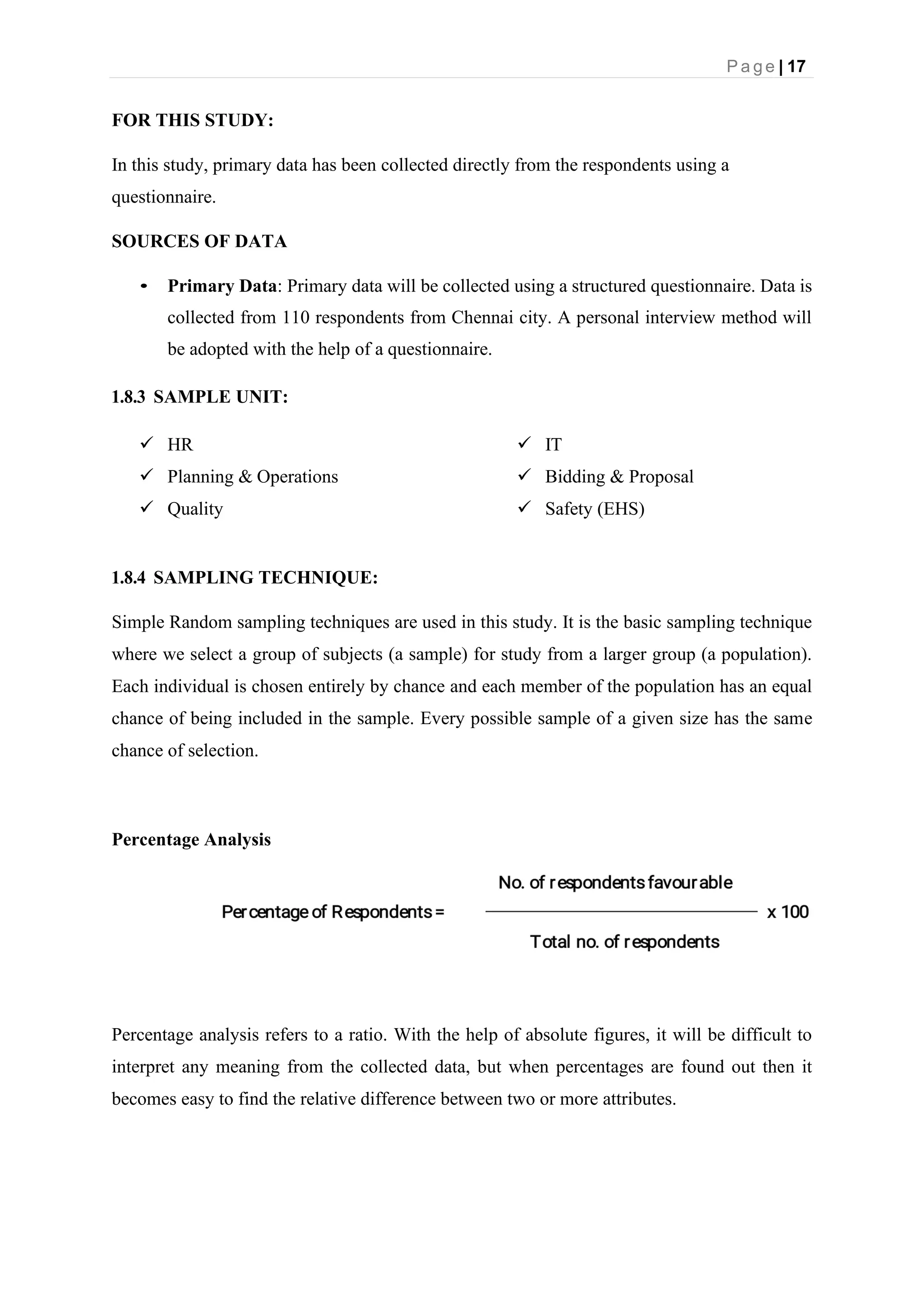
Percentage Analysis
Percentage analysis refers to a ratio. With the help of absolute figures, it will be difficult to
interpret any meaning from the collected data, but when percentages are found out then it
becomes easy to find the relative difference between two or more attributes.
P a g e | 18
STATISTICAL TOOLS AND TECHNIQUES:
Correlation analysis:
Correlation analysis is a statistical method used to evaluate the strength of the relationship
between two quantitative variables. A high correlation means that two or more variables have
a strong relationship with each other, while a weak correlation means that the variables are
hardly related. In other words, it is the process of studying the strength of that relationship with
available statistical data.
In this Pearson correlation has been used.
Pearson correlation measures a linear dependence between two variables (x and y). It’s also
known as a parametric correlation test because it depends on the distribution of the data. The
plot of y = f(x) is named the linear regression curve.
The Pearson correlation formula is:
r = n(∑xy) −(∑x) (∑y)
√[n∑x2−(∑x)2] [n∑y2−(∑y)2]
Where,
r = Pearson correlation coefficient
x = Values in the first set of data
y = Values in the second set of data
n = Total number of values.
P a g e | 19
1.9 LIMITATION OF THE STUDY:
✓ The study was done for a short period because of time constraint.
✓ It was assumed that all response given by respondents are true and unbiased
✓ Some respondent refused to participate in the survey and that affected the study
✓ By the busy schedule of the respondents, it is difficult to extract more information
from them.
✓ The study topic is too vast to make a complete study.
✓ Respondents sometimes refuse to give information.
✓ Respondents may not give clear cut data.
✓ Every organization has its policy so, we can't get permission to ask all the questions
✓ Preparing the questionnaire with limited by organization policies.
P a g e | 20
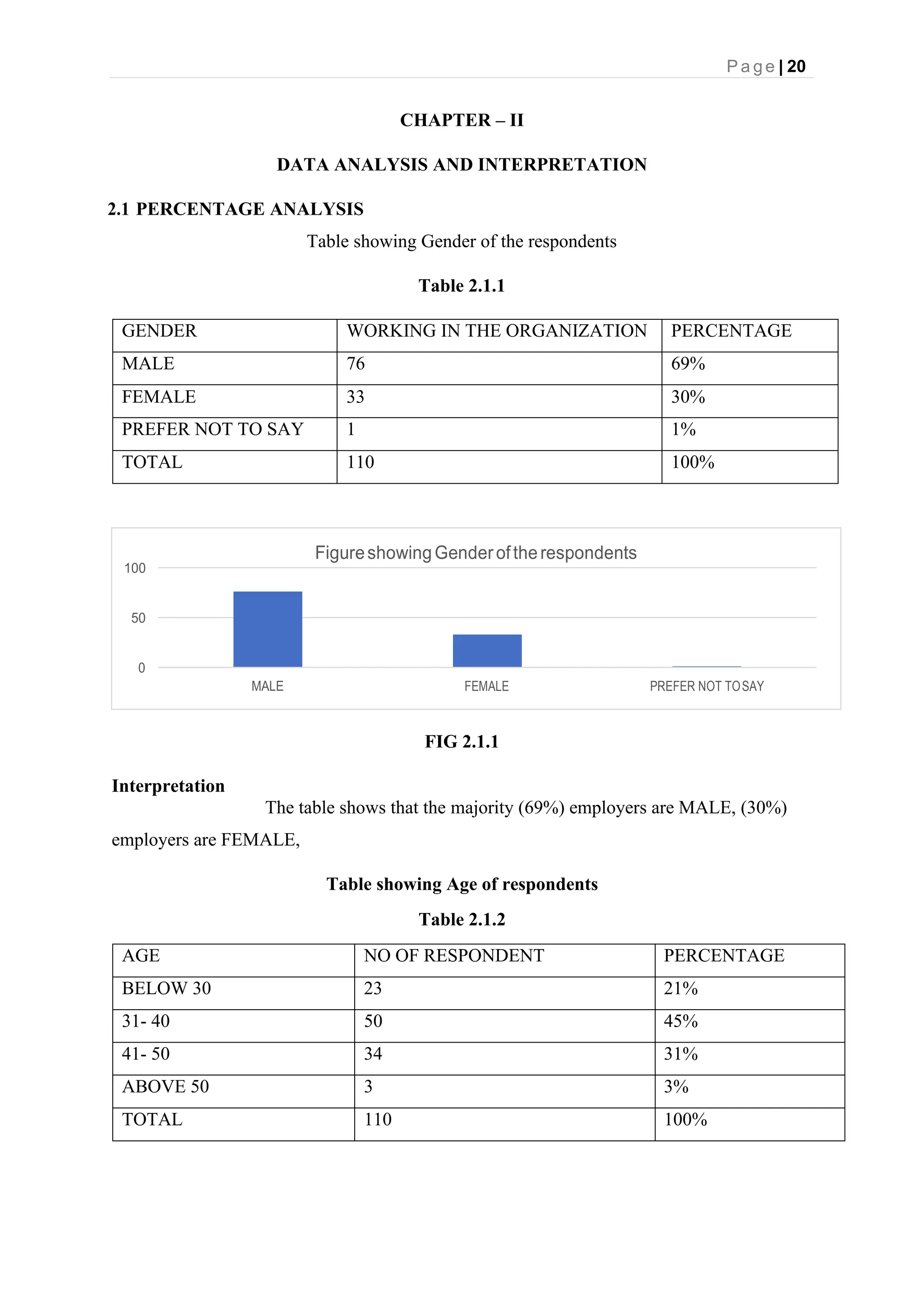
FigureshowingGenderoftherespondents
100
50
0
MALE FEMALE PREFER NOT TOSAY
CHAPTER – II
DATA ANALYSIS AND INTERPRETATION
2.1 PERCENTAGE ANALYSIS
Table showing Gender of the respondents
Table 2.1.1
GENDER WORKING IN THE ORGANIZATION PERCENTAGE
MALE 76 69%
FEMALE 33 30%
PREFER NOT TO SAY 1 1%
TOTAL 110 100%
FIG 2.1.1
Interpretation
The table shows that the majority (69%) employers are MALE, (30%)
employers are FEMALE,
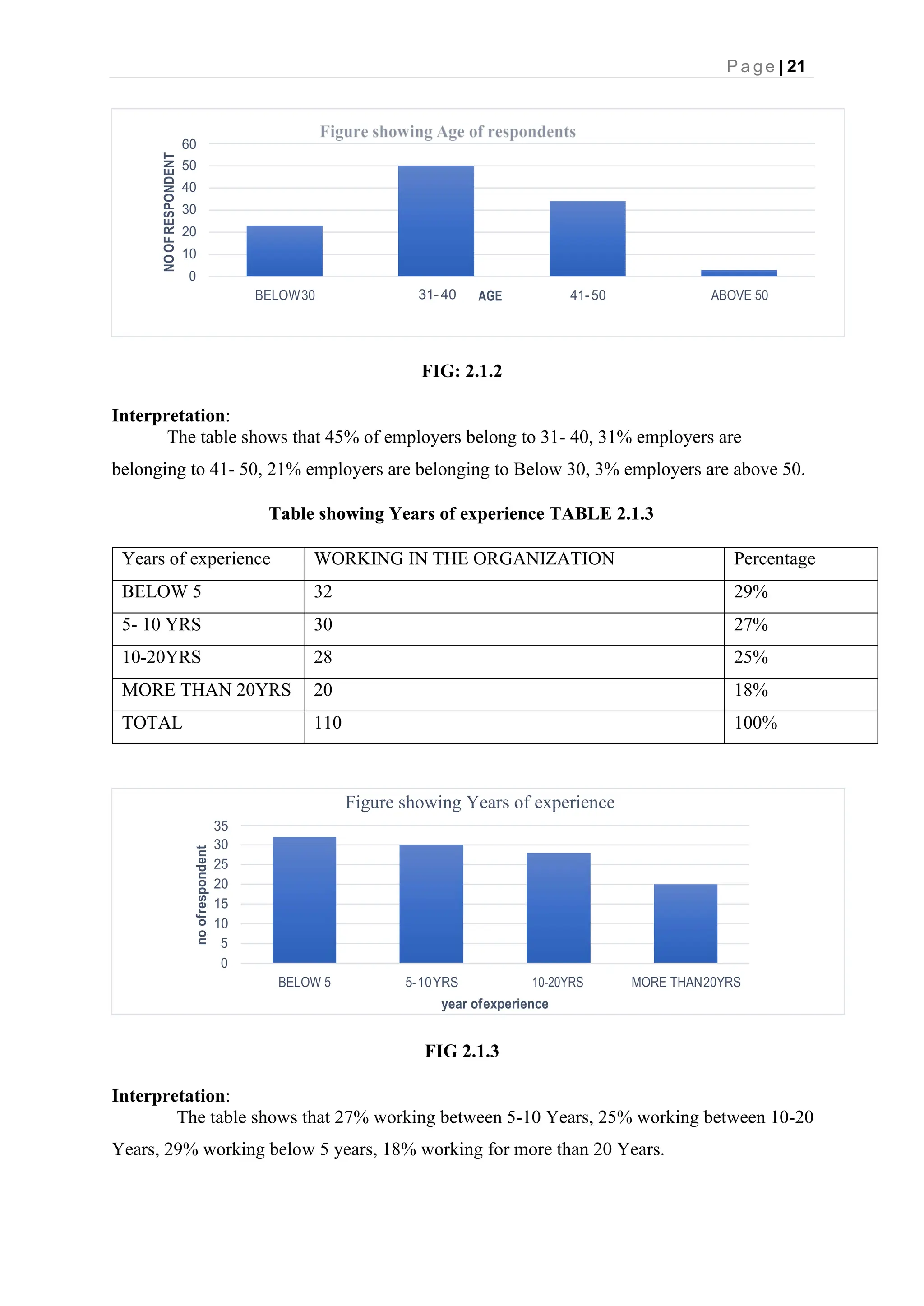
Table showing Age of respondents
Table 2.1.2
AGE NO OF RESPONDENT PERCENTAGE
BELOW 30 23 21%
31- 40 50 45%
41- 50 34 31%
ABOVE 50 3 3%
TOTAL 110 100%
P a g e | 21
FIG: 2.1.2
Interpretation:
The table shows that 45% of employers belong to 31- 40, 31% employers are
belonging to 41- 50, 21% employers are belonging to Below 30, 3% employers are above 50.
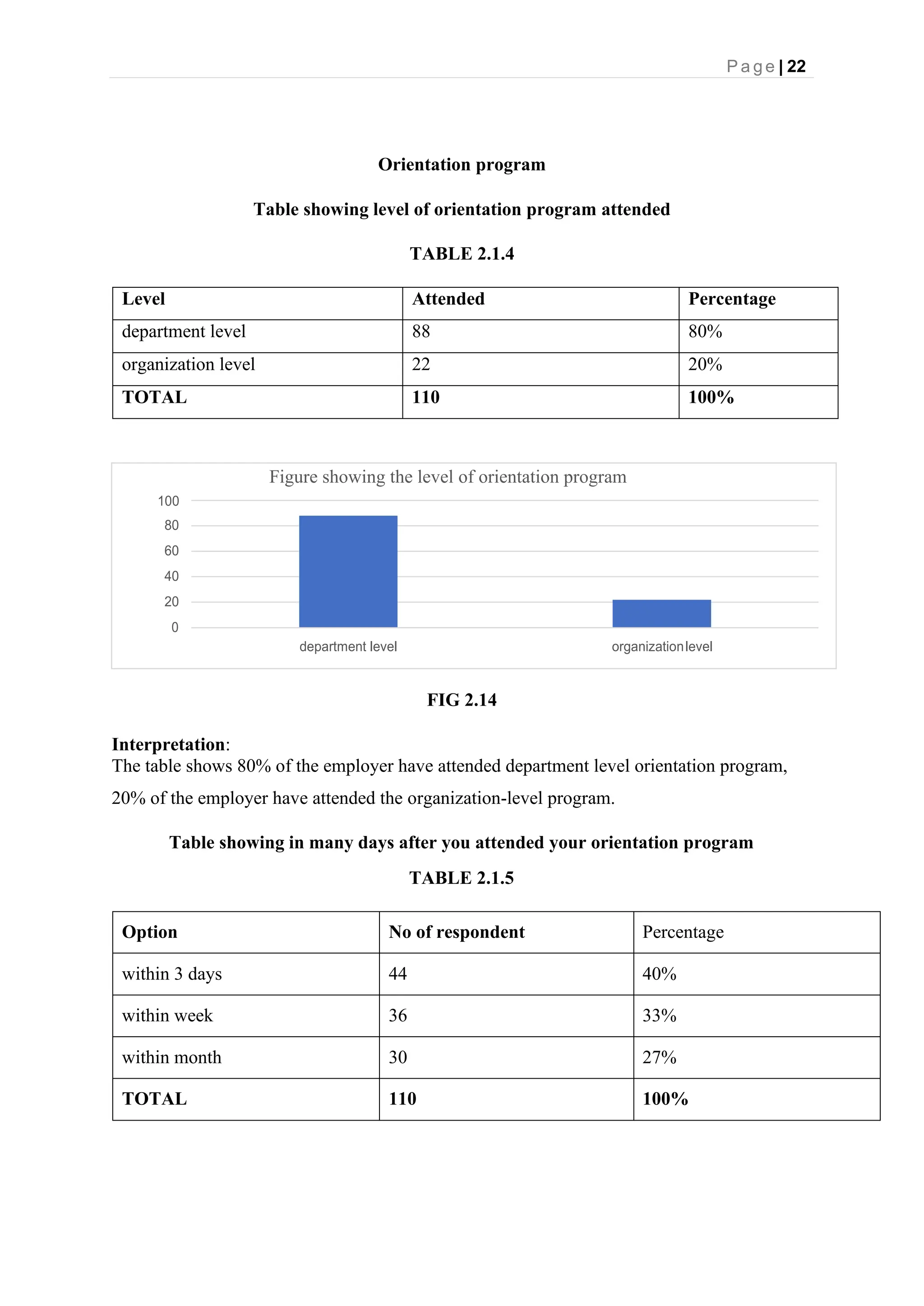
Table showing Years of experience TABLE 2.1.3
Years of experience WORKING IN THE ORGANIZATION Percentage
BELOW 5 32 29%
5- 10 YRS 30 27%
10-20YRS 28 25%
MORE THAN 20YRS 20 18%
TOTAL 110 100%
FIG 2.1.3
Interpretation:
The table shows that 27% working between 5-10 Years, 25% working between 10-20
Years, 29% working below 5 years, 18% working for more than 20 Years.
60
50
40
30
20
10
0
BELOW30 31-40 AGE 41-50 ABOVE 50
Figure showing Years of experience
35
30
25
20
15
10
5
0
BELOW 5 5-10YRS 10-20YRS MORE THAN20YRS
year ofexperience
NO
OF
RESPONDENT
no
of
respondent
P a g e | 22
Figure showing the level of orientation program
100
80
60
40
20
0
department level organizationlevel
Orientation program
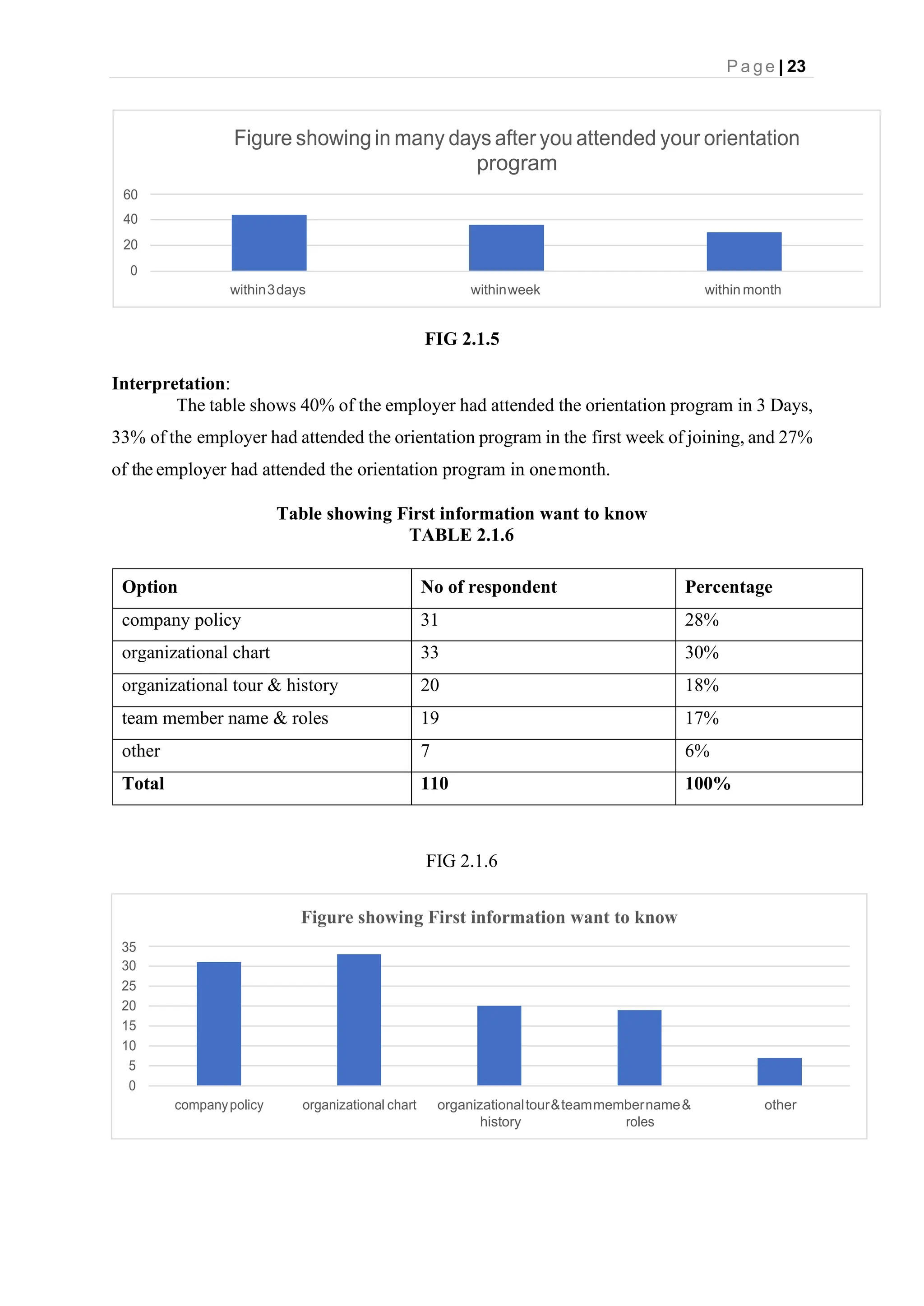
Table showing level of orientation program attended
TABLE 2.1.4
Level Attended Percentage
department level 88 80%
organization level 22 20%
TOTAL 110 100%
FIG 2.14
Interpretation:
The table shows 80% of the employer have attended department level orientation program,
20% of the employer have attended the organization-level program.
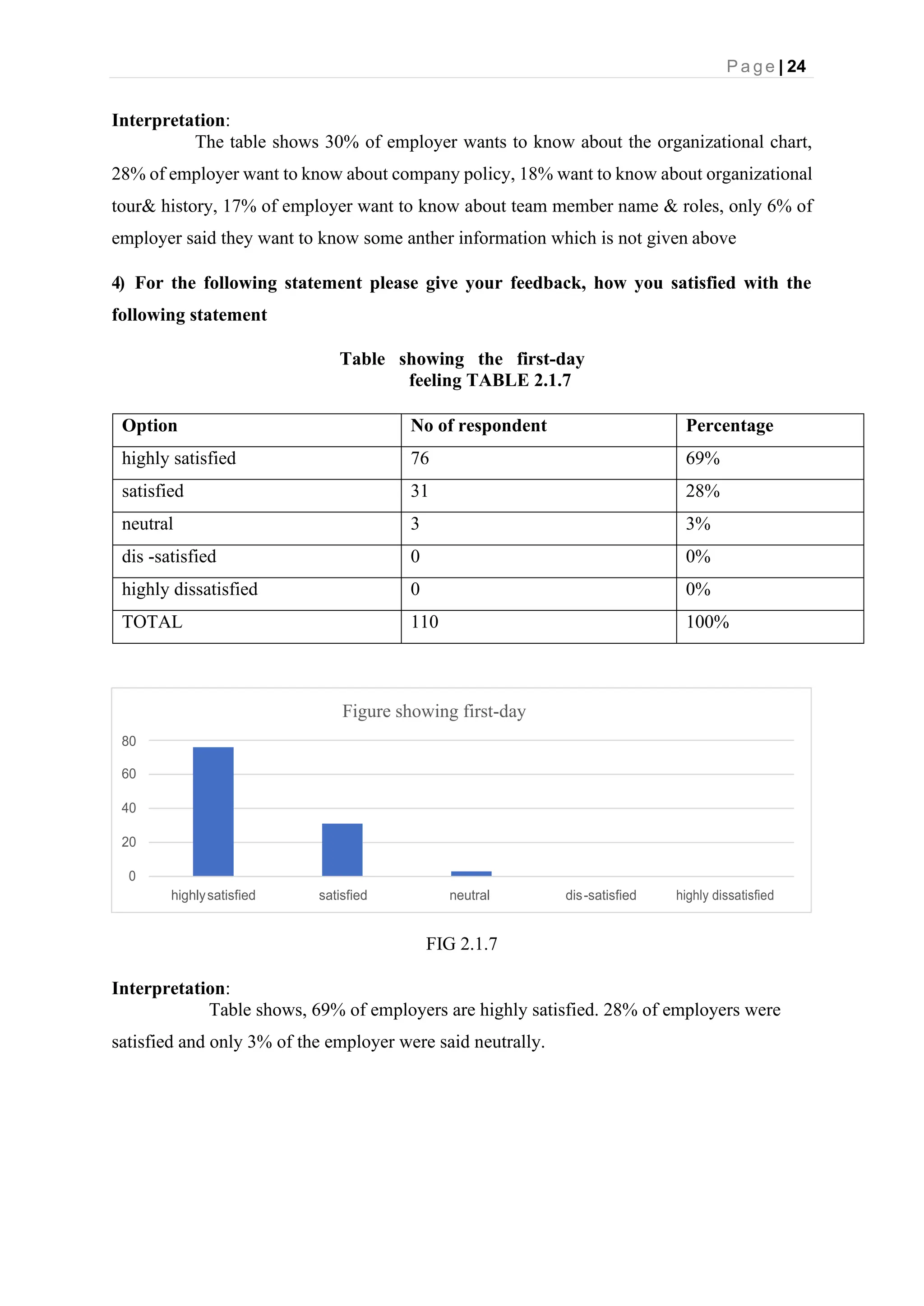
Table showing in many days after you attended your orientation program
TABLE 2.1.5
Option No of respondent Percentage
within 3 days 44 40%
within week 36 33%
within month 30 27%
TOTAL 110 100%
P a g e | 23
Figure showing First information want to know
35
30
25
20
15
10
5
0
companypolicy organizational chart organizationaltour&teammembername& other
history roles
FIG 2.1.5
Interpretation:
The table shows 40% of the employer had attended the orientation program in 3 Days,
33% of the employer had attended the orientation program in the first week of joining, and 27%
of the employer had attended the orientation program in onemonth.
Table showing First information want to know
TABLE 2.1.6
Option No of respondent Percentage
company policy 31 28%
organizational chart 33 30%
organizational tour & history 20 18%
team member name & roles 19 17%
other 7 6%
Total 110 100%
FIG 2.1.6
Figure showing in many days after you attended your orientation
program
60
40
20
0
within3days withinweek within month
P a g e | 24
Figure showing first-day
80
60
40
20
0
highlysatisfied satisfied neutral dis-satisfied highly dissatisfied
Interpretation:
The table shows 30% of employer wants to know about the organizational chart,
28% of employer want to know about company policy, 18% want to know about organizational
tour& history, 17% of employer want to know about team member name & roles, only 6% of
employer said they want to know some anther information which is not given above
4) For the following statement please give your feedback, how you satisfied with the
following statement
Table showing the first-day
feeling TABLE 2.1.7
Option No of respondent Percentage
highly satisfied 76 69%
satisfied 31 28%
neutral 3 3%
dis -satisfied 0 0%
highly dissatisfied 0 0%
TOTAL 110 100%
FIG 2.1.7
Interpretation:
Table shows, 69% of employers are highly satisfied. 28% of employers were
satisfied and only 3% of the employer were said neutrally.
P a g e | 25
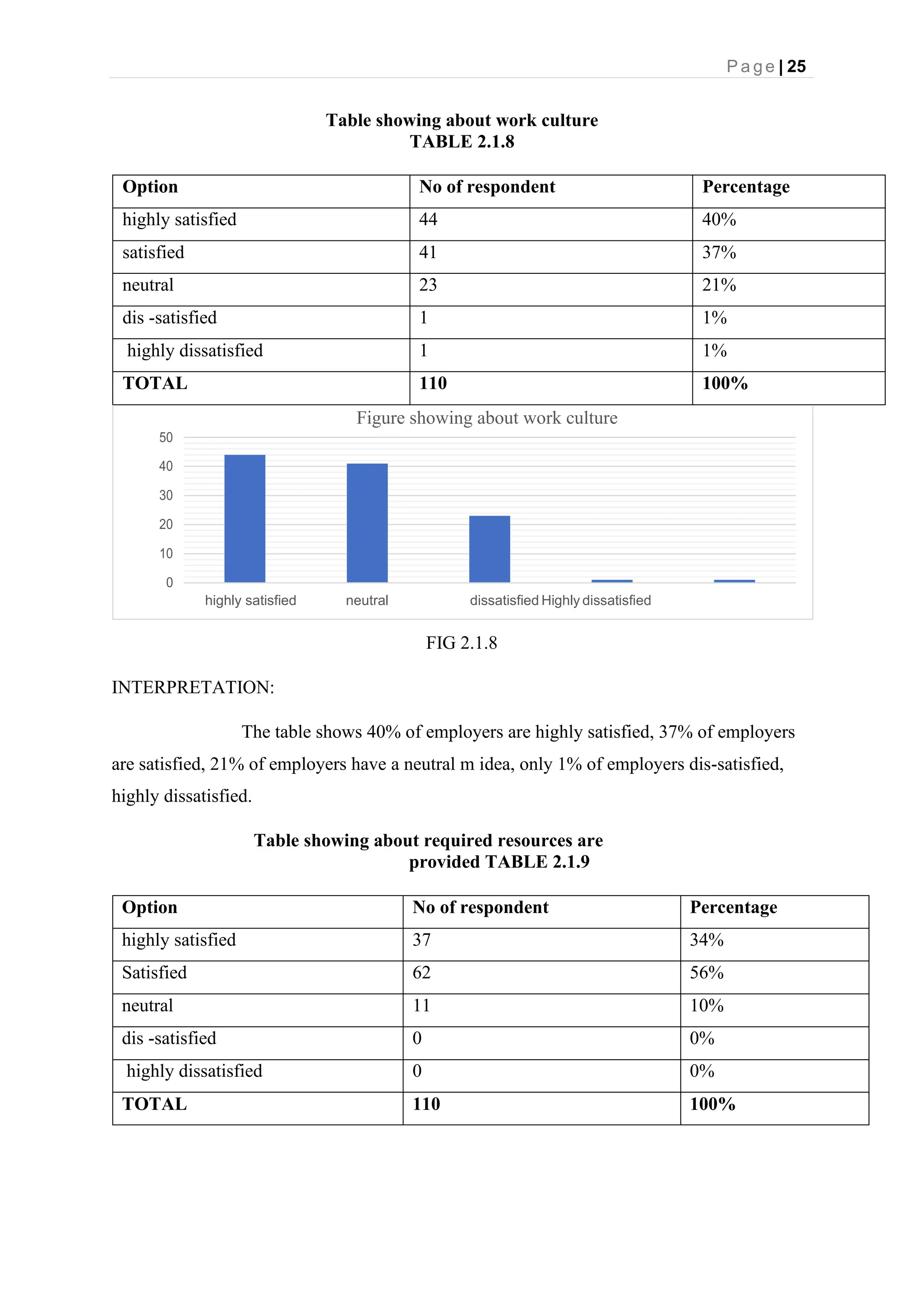
Table showing about work culture
TABLE 2.1.8
Option No of respondent Percentage
highly satisfied 44 40%
satisfied 41 37%
neutral 23 21%
dis -satisfied 1 1%
highly dissatisfied 1 1%
TOTAL 110 100%
Figure showing about work culture
50
40
30
20
10
0
highly satisfied neutral dissatisfied Highly dissatisfied
FIG 2.1.8
INTERPRETATION:
The table shows 40% of employers are highly satisfied, 37% of employers
are satisfied, 21% of employers have a neutral m idea, only 1% of employers dis-satisfied,
highly dissatisfied.
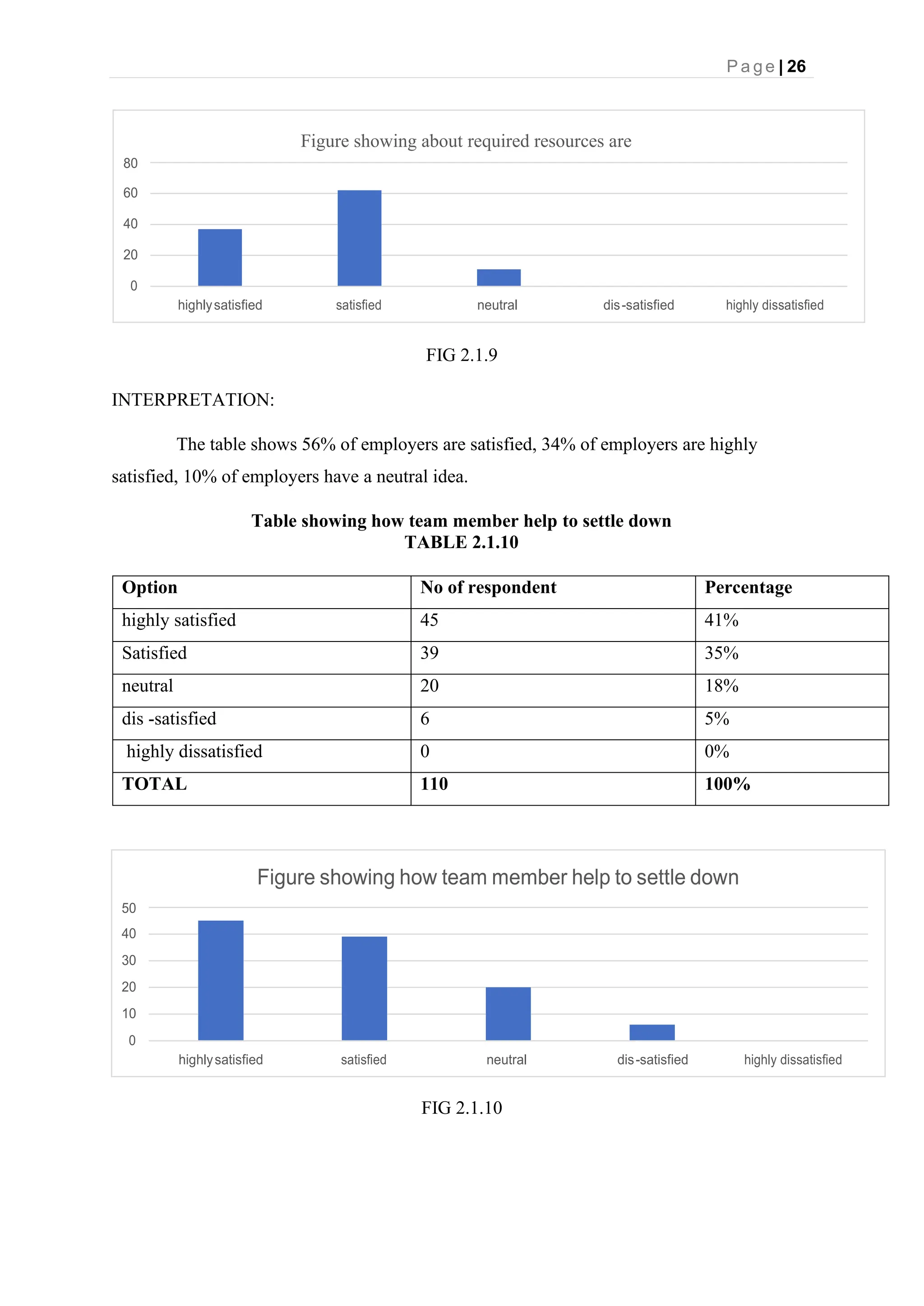
Table showing about required resources are
provided TABLE 2.1.9
Option No of respondent Percentage
highly satisfied 37 34%
Satisfied 62 56%
neutral 11 10%
dis -satisfied 0 0%
highly dissatisfied 0 0%
TOTAL 110 100%
P a g e | 26
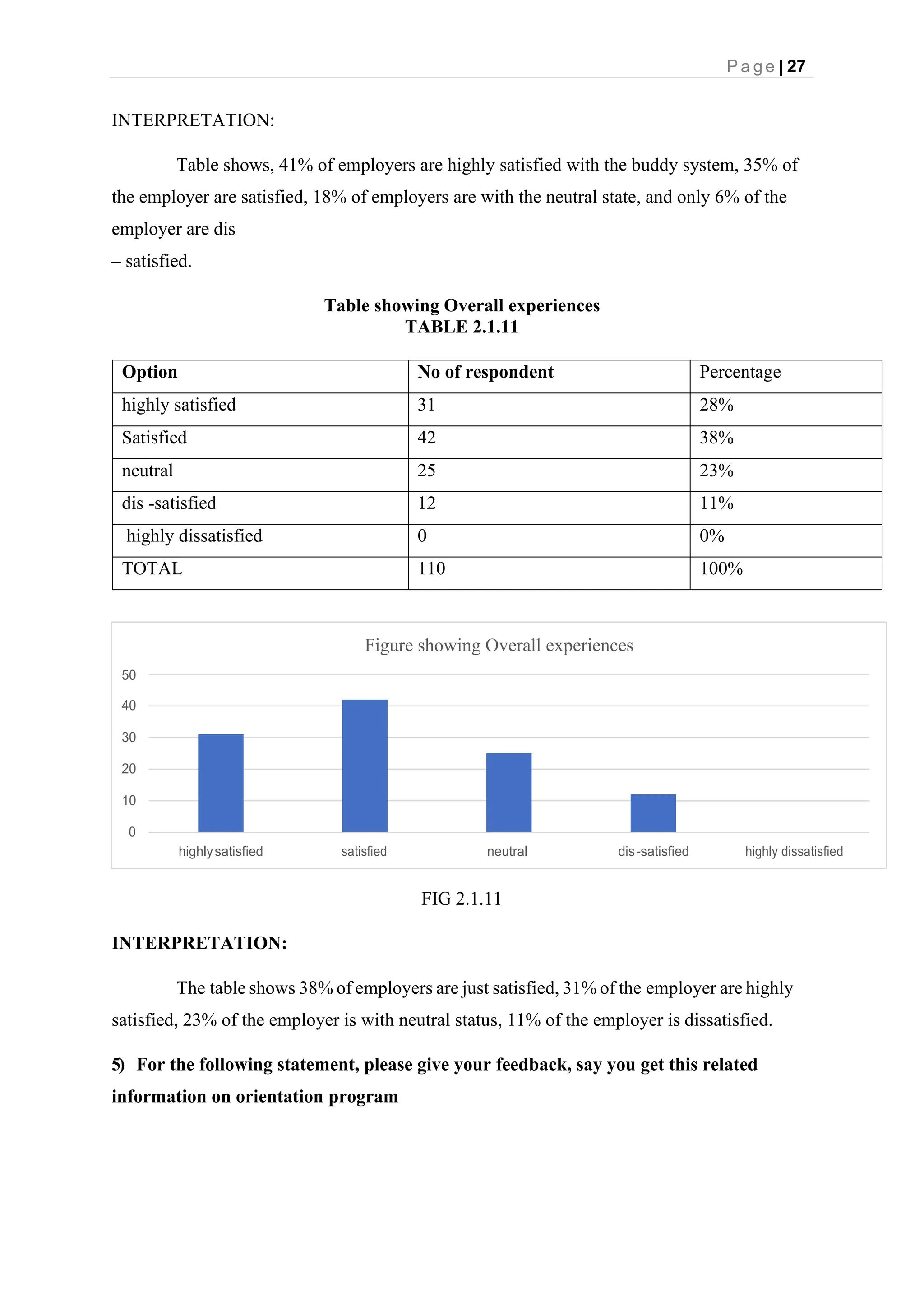
Figure showing how team member help to settle down
50
40
30
20
10
0
highlysatisfied satisfied neutral dis-satisfied highly dissatisfied
FIG 2.1.9
INTERPRETATION:
The table shows 56% of employers are satisfied, 34% of employers are highly
satisfied, 10% of employers have a neutral idea.
Table showing how team member help to settle down
TABLE 2.1.10
Option No of respondent Percentage
highly satisfied 45 41%
Satisfied 39 35%
neutral 20 18%
dis -satisfied 6 5%
highly dissatisfied 0 0%
TOTAL 110 100%
FIG 2.1.10
Figure showing about required resources are
80
60
40
20
0
highlysatisfied satisfied neutral dis-satisfied highly dissatisfied
P a g e | 27
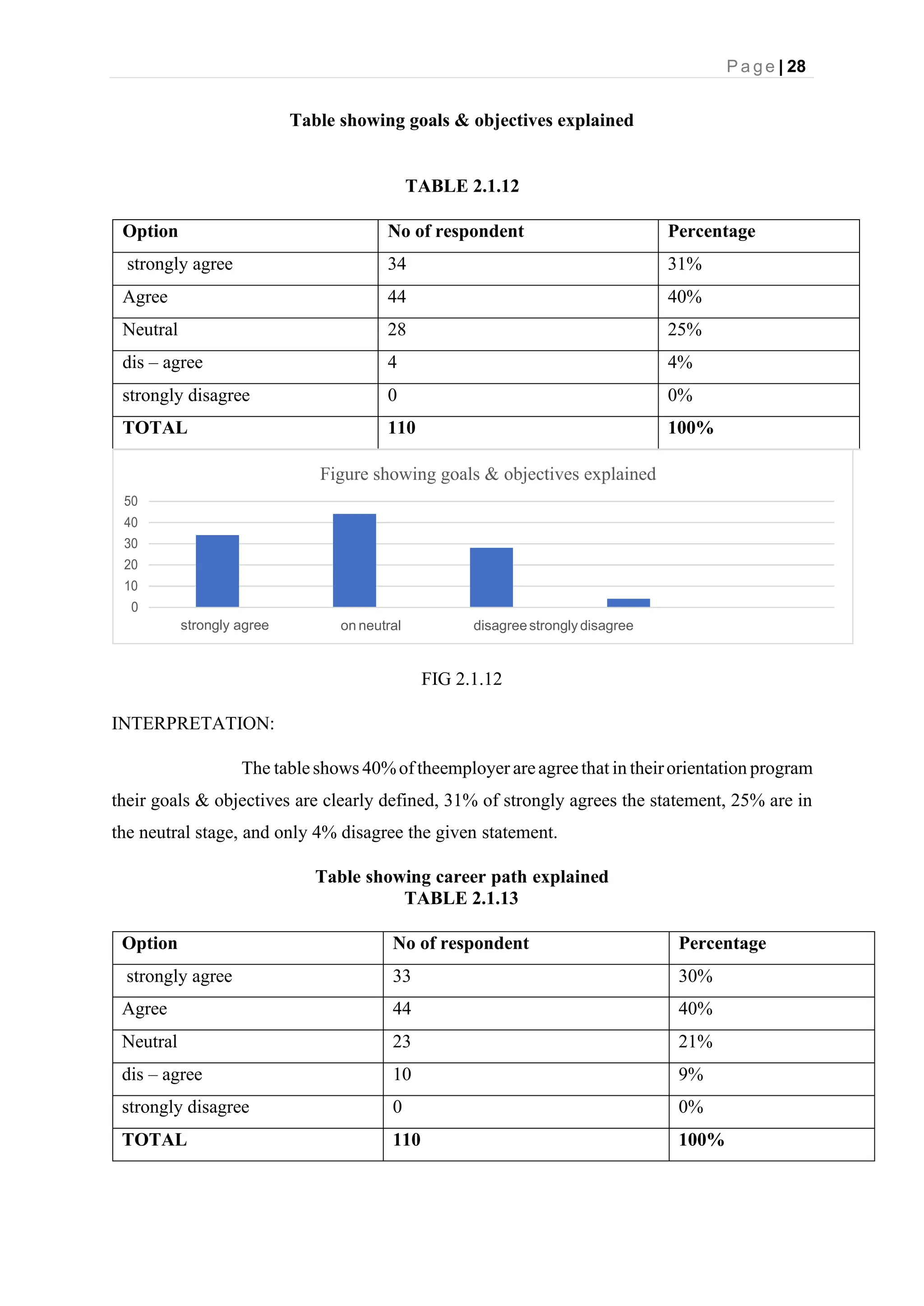
Figure showing Overall experiences
50
40
30
20
10
0
highlysatisfied satisfied neutral dis-satisfied highly dissatisfied
INTERPRETATION:
Table shows, 41% of employers are highly satisfied with the buddy system, 35% of
the employer are satisfied, 18% of employers are with the neutral state, and only 6% of the
employer are dis
– satisfied.
Table showing Overall experiences
TABLE 2.1.11
Option No of respondent Percentage
highly satisfied 31 28%
Satisfied 42 38%
neutral 25 23%
dis -satisfied 12 11%
highly dissatisfied 0 0%
TOTAL 110 100%
FIG 2.1.11
INTERPRETATION:
The table shows 38% of employers are just satisfied, 31% of the employer are highly
satisfied, 23% of the employer is with neutral status, 11% of the employer is dissatisfied.
5) For the following statement, please give your feedback, say you get this related
information on orientation program
P a g e | 28
Table showing goals & objectives explained
TABLE 2.1.12
Option No of respondent Percentage
strongly agree 34 31%
Agree 44 40%
Neutral 28 25%
dis – agree 4 4%
strongly disagree 0 0%
TOTAL 110 100%
50
Figure showing goals & objectives explained
on neutral disagreestrongly disagree
40
30
20
10
0
strongly agree
FIG 2.1.12
INTERPRETATION:
The tableshows 40%oftheemployer areagreethat in theirorientation program
their goals & objectives are clearly defined, 31% of strongly agrees the statement, 25% are in
the neutral stage, and only 4% disagree the given statement.
Table showing career path explained
TABLE 2.1.13
Option No of respondent Percentage
strongly agree 33 30%
Agree 44 40%
Neutral 23 21%
dis – agree 10 9%
strongly disagree 0 0%
TOTAL 110 100%
P a g e | 29
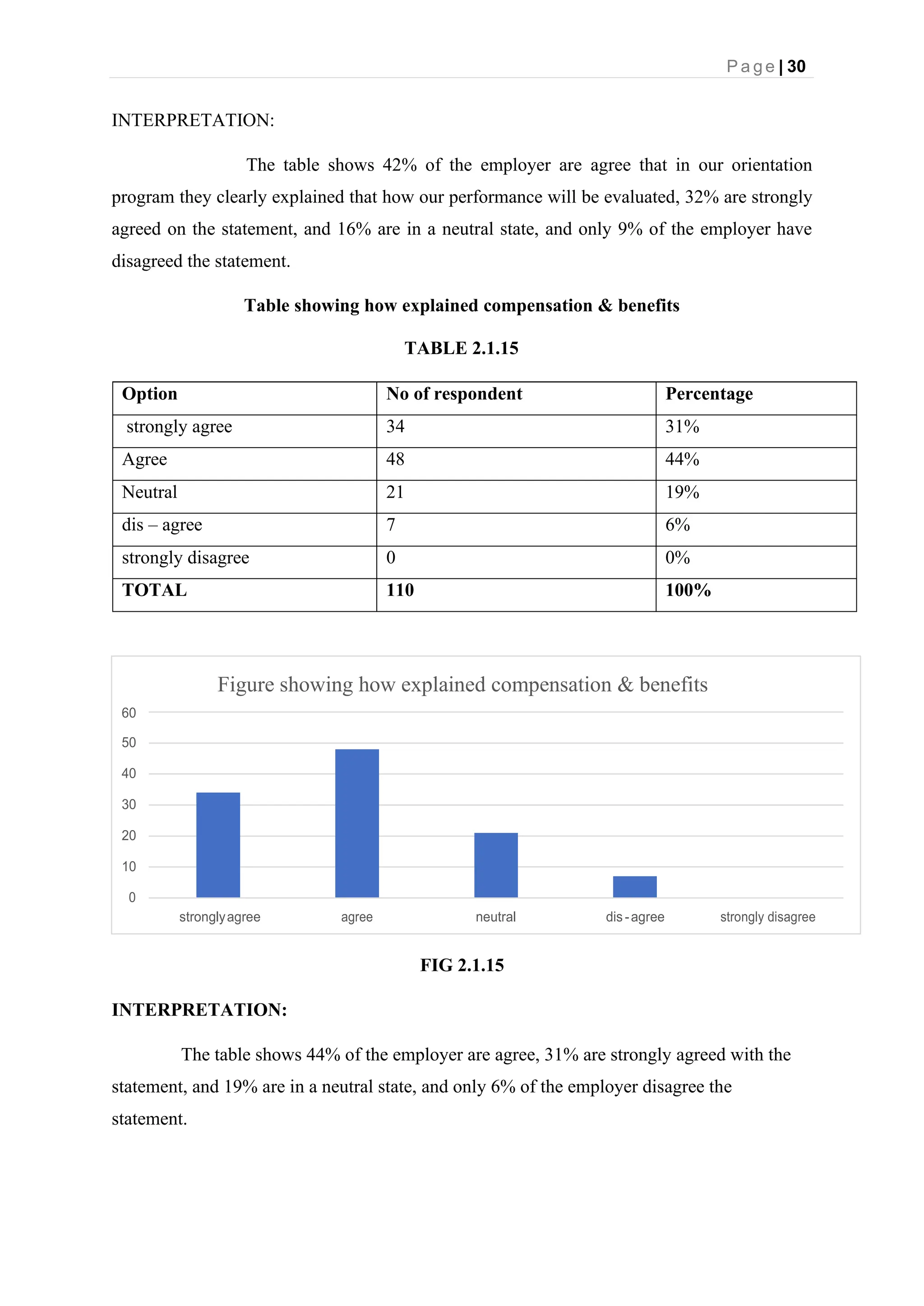
Figure showing how performance will be evaluated
50
40
30
20
10
0
stronglyagree agree neutral dis-agree strongly disagree
FIG 2.1.13
INTERPRETATION:
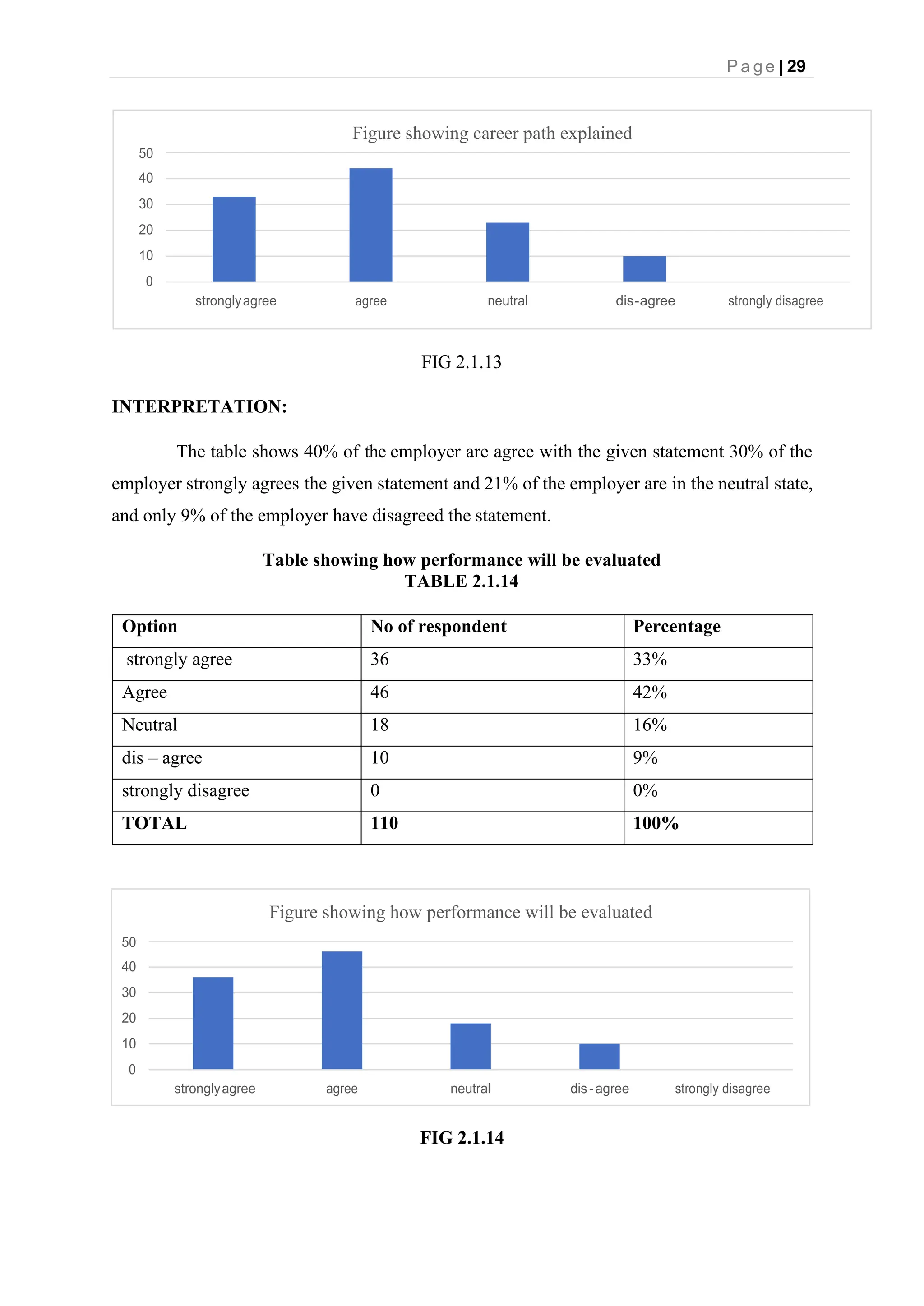
The table shows 40% of the employer are agree with the given statement 30% of the
employer strongly agrees the given statement and 21% of the employer are in the neutral state,
and only 9% of the employer have disagreed the statement.
Table showing how performance will be evaluated
TABLE 2.1.14
Option No of respondent Percentage
strongly agree 36 33%
Agree 46 42%
Neutral 18 16%
dis – agree 10 9%
strongly disagree 0 0%
TOTAL 110 100%
FIG 2.1.14
Figure showing career path explained
50
40
30
20
10
0
stronglyagree agree neutral dis-agree strongly disagree
P a g e | 30
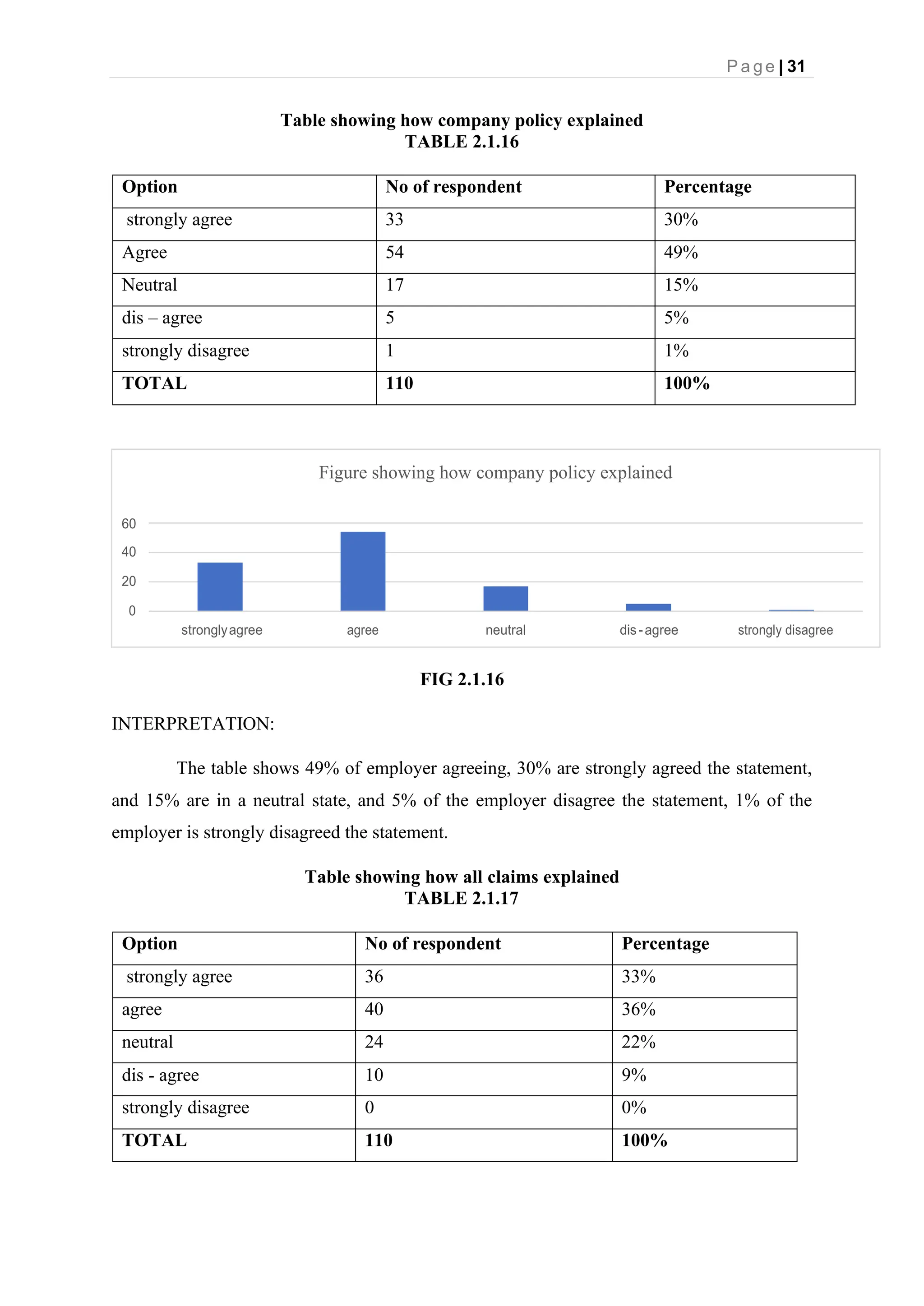
Figure showing how explained compensation & benefits
60
50
40
30
20
10
0
stronglyagree agree neutral dis-agree strongly disagree
INTERPRETATION:
The table shows 42% of the employer are agree that in our orientation
program they clearly explained that how our performance will be evaluated, 32% are strongly
agreed on the statement, and 16% are in a neutral state, and only 9% of the employer have
disagreed the statement.
Table showing how explained compensation & benefits
TABLE 2.1.15
Option No of respondent Percentage
strongly agree 34 31%
Agree 48 44%
Neutral 21 19%
dis – agree 7 6%
strongly disagree 0 0%
TOTAL 110 100%
FIG 2.1.15
INTERPRETATION:
The table shows 44% of the employer are agree, 31% are strongly agreed with the
statement, and 19% are in a neutral state, and only 6% of the employer disagree the
statement.
P a g e | 31
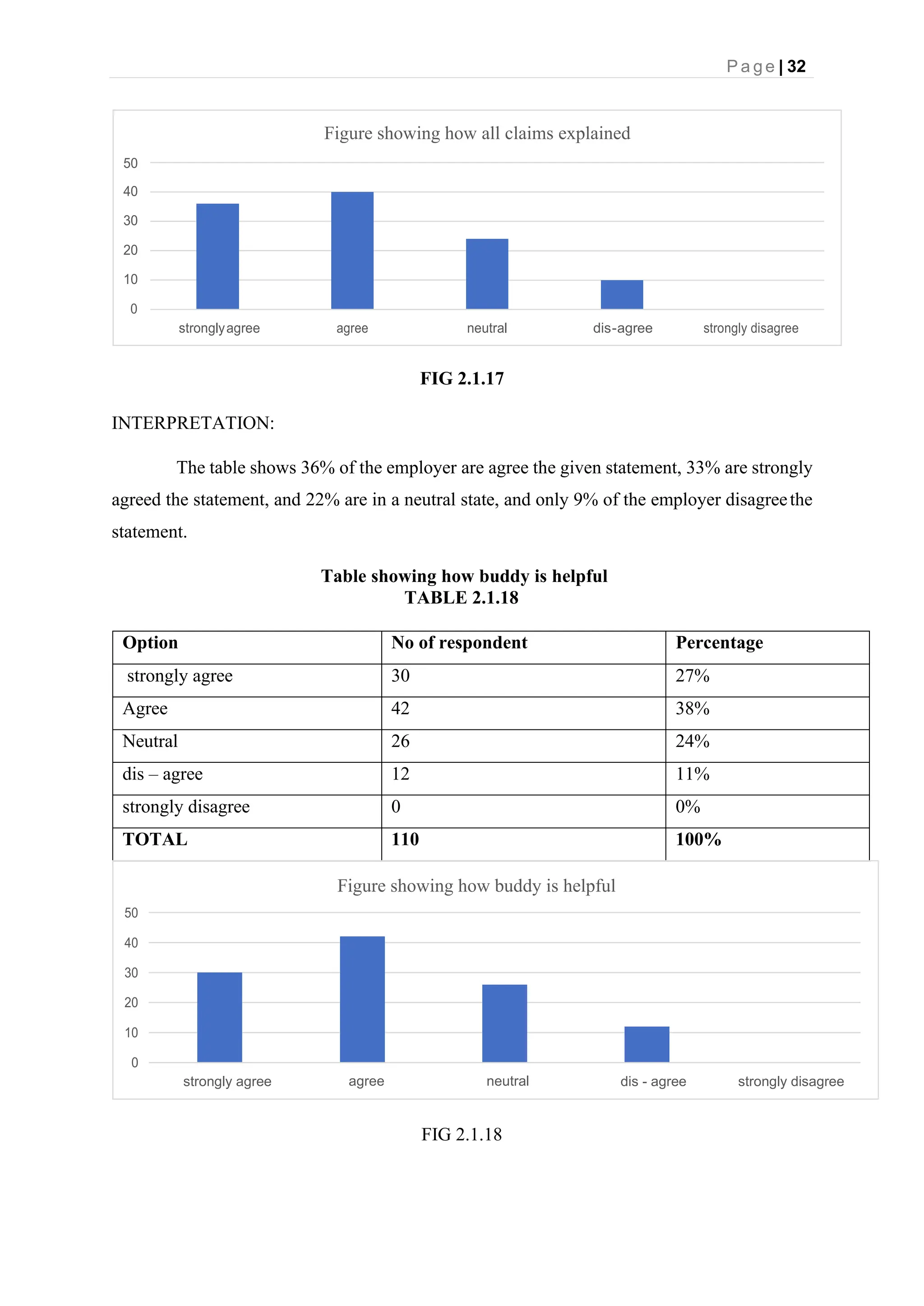
Figure showing how company policy explained
60
40
20
0
stronglyagree agree neutral dis-agree strongly disagree
Table showing how company policy explained
TABLE 2.1.16
Option No of respondent Percentage
strongly agree 33 30%
Agree 54 49%
Neutral 17 15%
dis – agree 5 5%
strongly disagree 1 1%
TOTAL 110 100%
FIG 2.1.16
INTERPRETATION:
The table shows 49% of employer agreeing, 30% are strongly agreed the statement,
and 15% are in a neutral state, and 5% of the employer disagree the statement, 1% of the
employer is strongly disagreed the statement.
Table showing how all claims explained
TABLE 2.1.17
Option No of respondent Percentage
strongly agree 36 33%
agree 40 36%
neutral 24 22%
dis - agree 10 9%
strongly disagree 0 0%
TOTAL 110 100%
P a g e | 32
FIG 2.1.17
INTERPRETATION:
The table shows 36% of the employer are agree the given statement, 33% are strongly
agreed the statement, and 22% are in a neutral state, and only 9% of the employer disagreethe
statement.
Table showing how buddy is helpful
TABLE 2.1.18
Option No of respondent Percentage
strongly agree 30 27%
Agree 42 38%
Neutral 26 24%
dis – agree 12 11%
strongly disagree 0 0%
TOTAL 110 100%
50
Figure showing how buddy is helpful
agree neutral
40
30
20
10
0
strongly agree dis - agree strongly disagree
FIG 2.1.18
Figure showing how all claims explained
50
40
30
20
10
0
stronglyagree agree neutral dis-agree strongly disagree
P a g e | 33
Figure showing how many training
60
50
40
30
20
10
0
less thanthree 3 -5 times morethan5 notyetattended
INTERPRETATION:
The table shows 38% of the employer are agree, 27% are strongly agreed, and 24% are in a
neutral state, and only 11% of the employer disagrees with the statement.
2.1.1 Training & Development
Table showing how many training programmes attended
TABLE 2.1.19
Option No of respondent Percentage
less than three 31 28%
3 - 5 times 48 44%
more than 5 20 18%
not yet attended 11 10%
total 110 100%
FIG 2.1.19
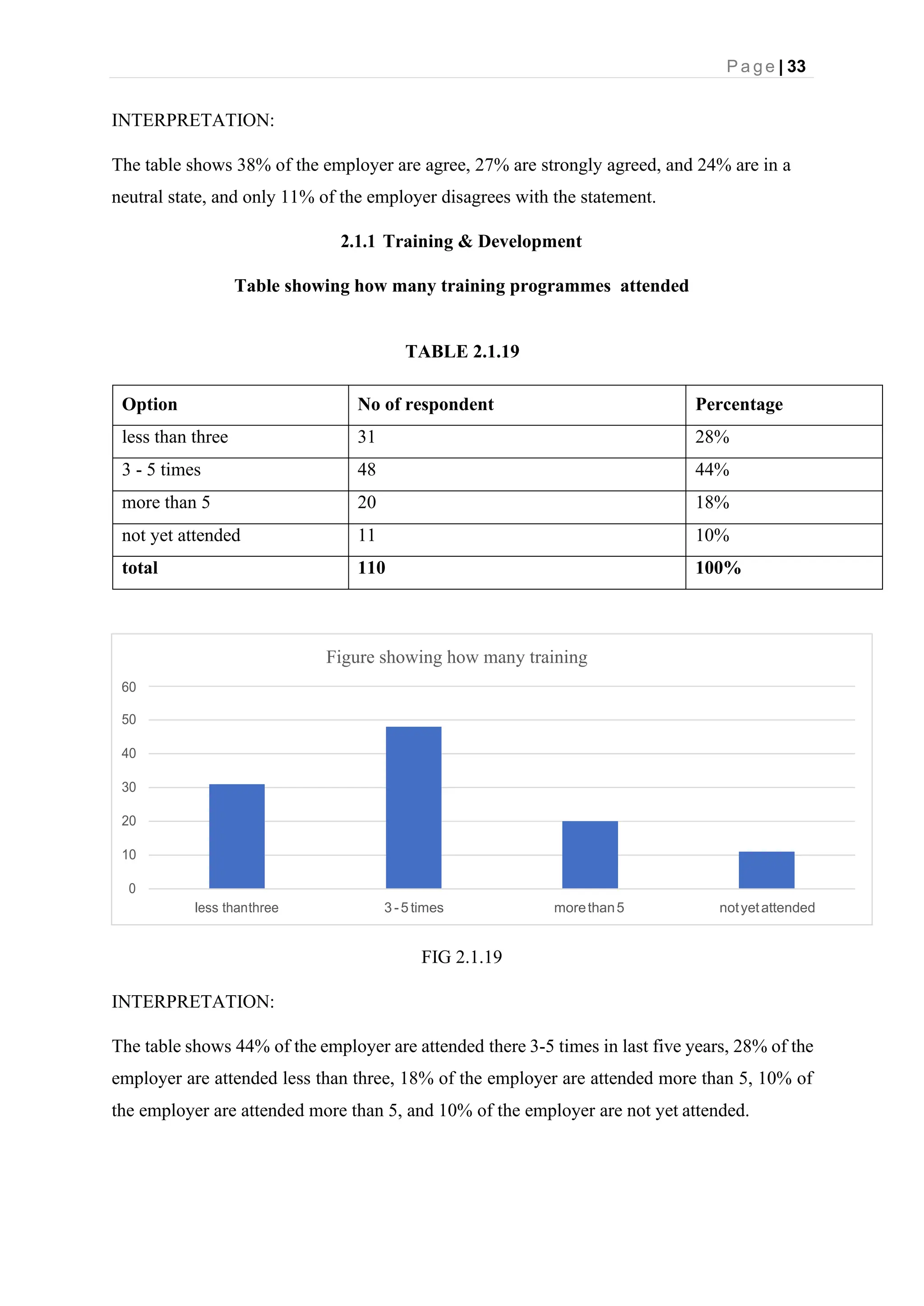
INTERPRETATION:
The table shows 44% of the employer are attended there 3-5 times in last five years, 28% of the
employer are attended less than three, 18% of the employer are attended more than 5, 10% of
the employer are attended more than 5, and 10% of the employer are not yet attended.
P a g e | 34
Figure showing the mode of training
40
35
30
25
20
15
10
5
0
classroom web videoconference zoom on the job other
Table showing mode of training prefer
TABLE 2.1.20
Option No of respondent Percentage
classroom 34 31%
web 19 17%
video conference 18 16%
zoom 5 5%
on the job 34 31%
other 0 0%
total 110 100%
FIG 2.1.20
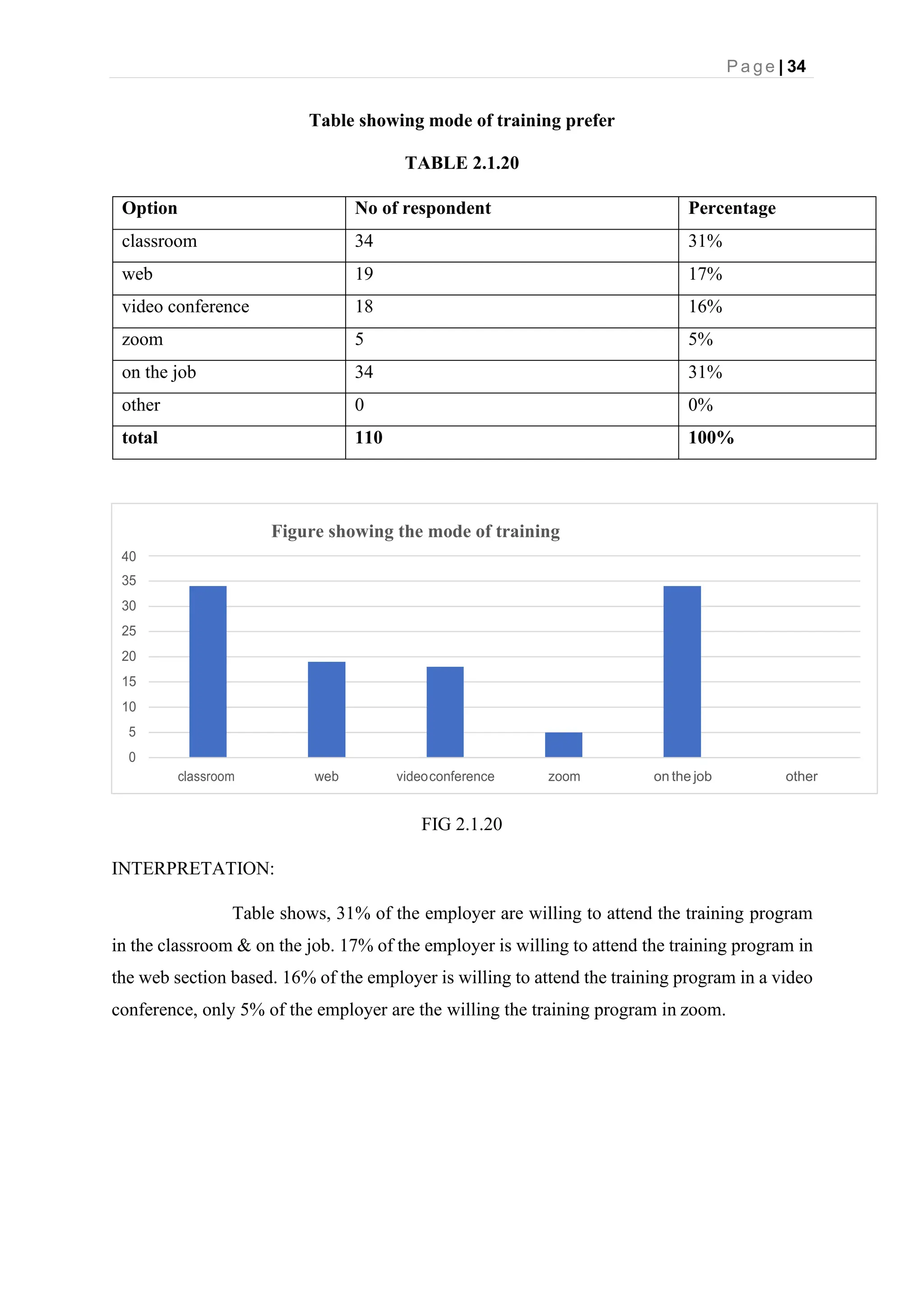
INTERPRETATION:
Table shows, 31% of the employer are willing to attend the training program
in the classroom & on the job. 17% of the employer is willing to attend the training program in
the web section based. 16% of the employer is willing to attend the training program in a video
conference, only 5% of the employer are the willing the training program in zoom.
P a g e | 35
Figure showingtraining use forboth individual and organization
80
60
40
20
0
yes no maybe
Table showing training use for both individual and organization
TABLE 2.1.21
Option No of respondent Percentage
yes 71 65%
no 19 17%
maybe 20 18%
total 110 100%
FIG 2.1.21
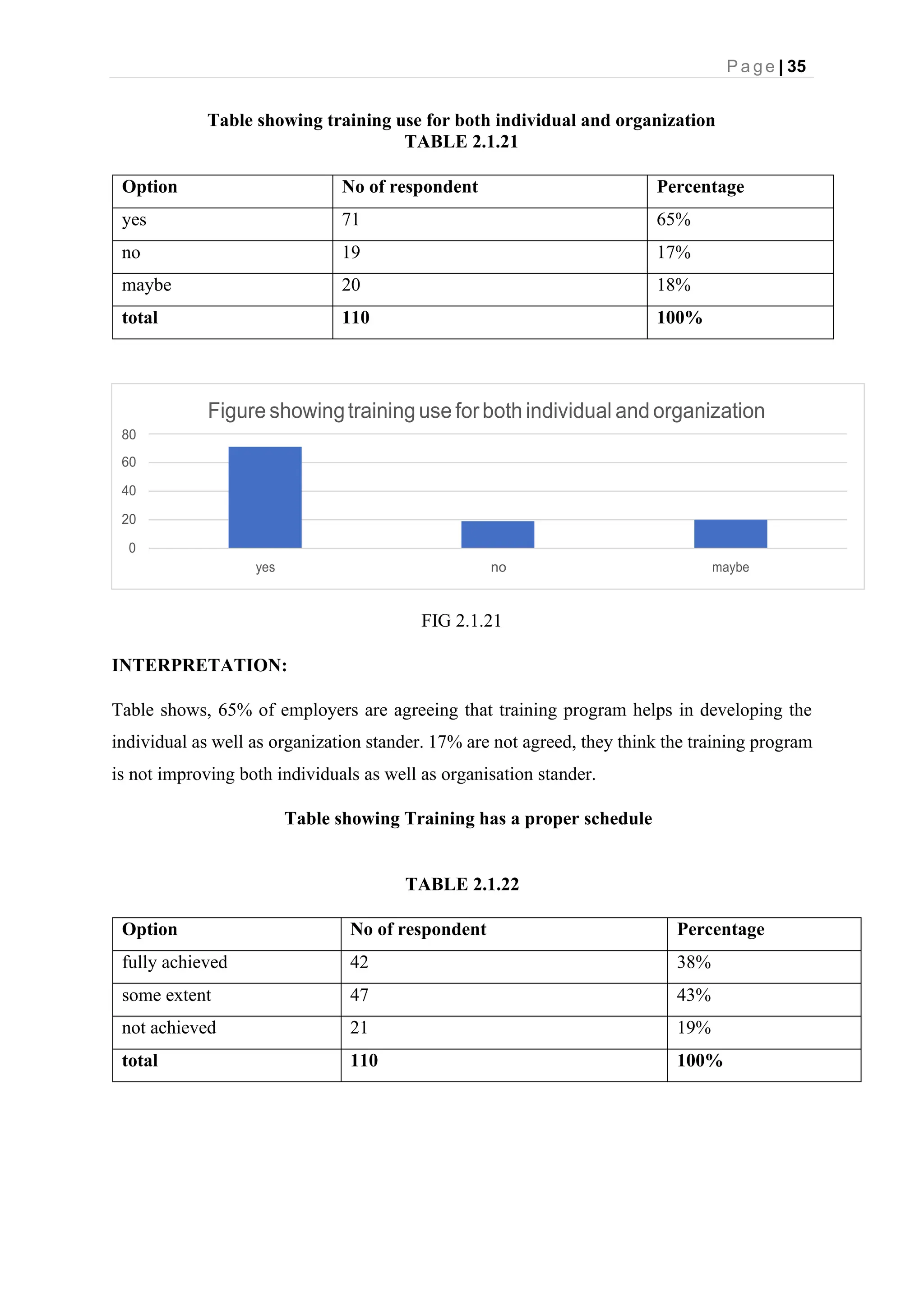
INTERPRETATION:
Table shows, 65% of employers are agreeing that training program helps in developing the
individual as well as organization stander. 17% are not agreed, they think the training program
is not improving both individuals as well as organisation stander.
Table showing Training has a proper schedule
TABLE 2.1.22
Option No of respondent Percentage
fully achieved 42 38%
some extent 47 43%
not achieved 21 19%
total 110 100%
P a g e | 36
FIG 2.1.22
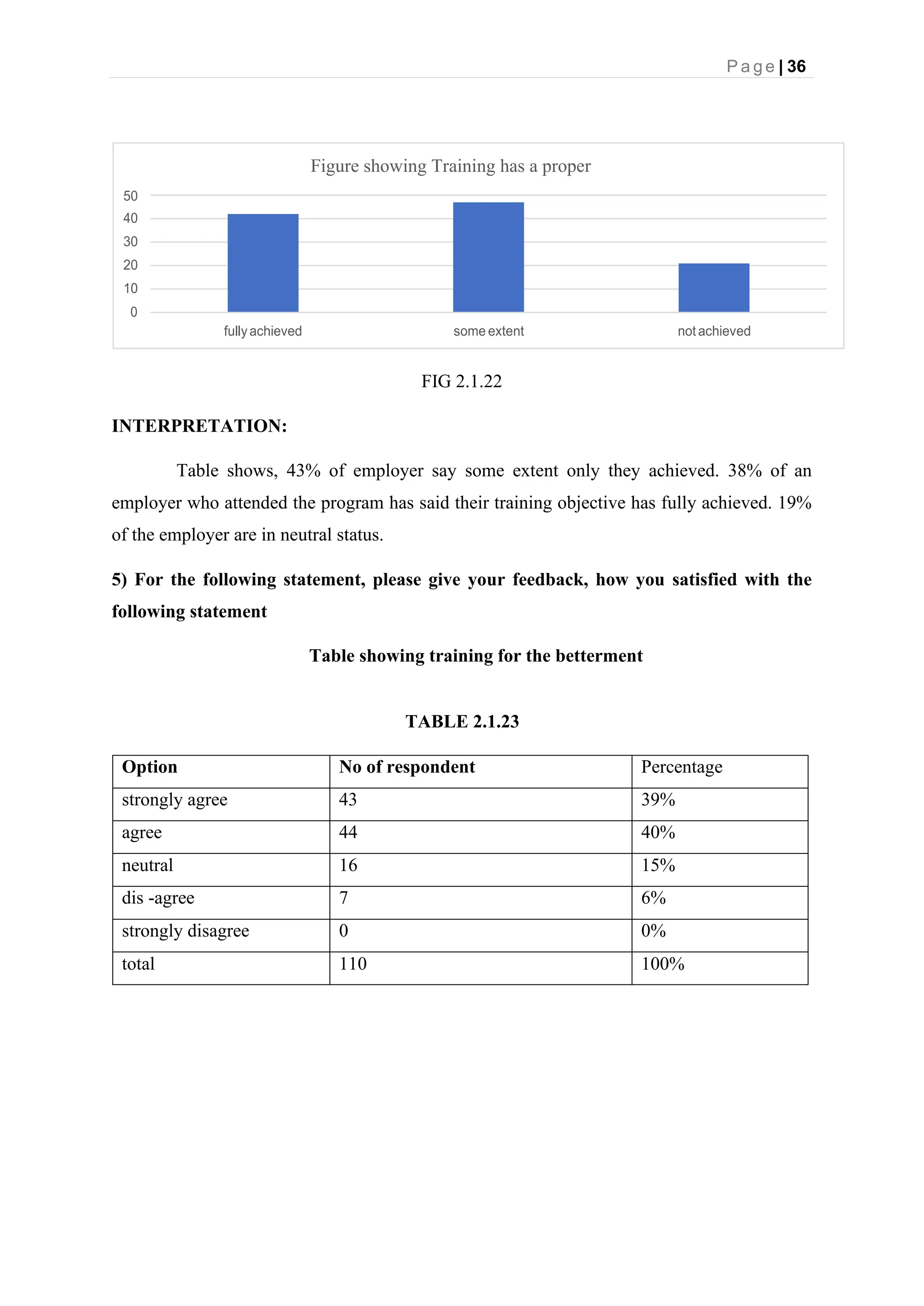
INTERPRETATION:
Table shows, 43% of employer say some extent only they achieved. 38% of an
employer who attended the program has said their training objective has fully achieved. 19%
of the employer are in neutral status.
5) For the following statement, please give your feedback, how you satisfied with the
following statement
Table showing training for the betterment
TABLE 2.1.23
Option No of respondent Percentage
strongly agree 43 39%
agree 44 40%
neutral 16 15%
dis -agree 7 6%
strongly disagree 0 0%
total 110 100%
Figure showing Training has a proper
50
40
30
20
10
0
fullyachieved some extent not achieved
P a g e | 37
FIG 2.1.
INTERPRETATION:
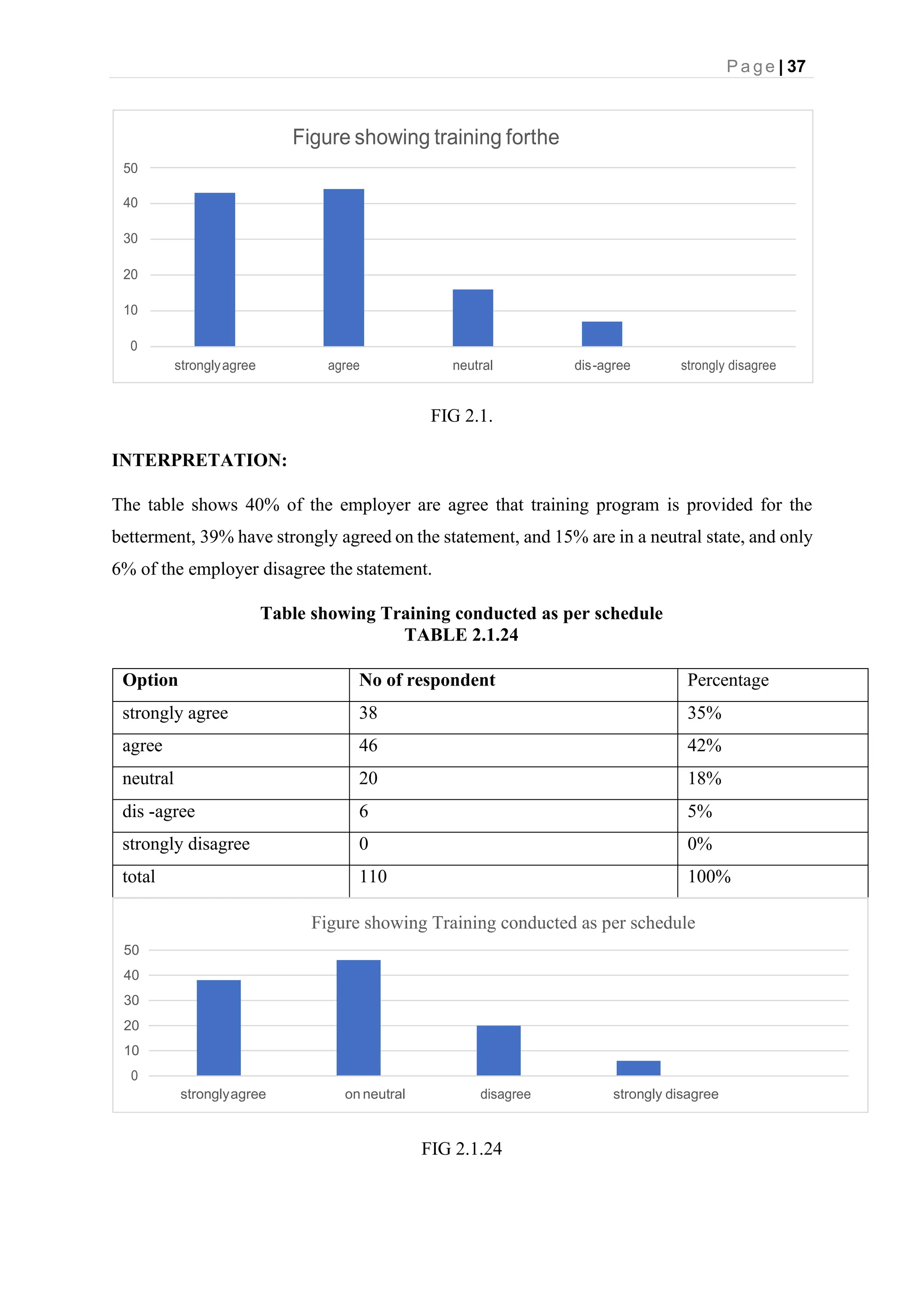
The table shows 40% of the employer are agree that training program is provided for the
betterment, 39% have strongly agreed on the statement, and 15% are in a neutral state, and only
6% of the employer disagree the statement.
Table showing Training conducted as per schedule
TABLE 2.1.24
Option No of respondent Percentage
strongly agree 38 35%
agree 46 42%
neutral 20 18%
dis -agree 6 5%
strongly disagree 0 0%
total 110 100%
Figure showing Training conducted as per schedule
50
40
30
20
10
0
stronglyagree on neutral disagree strongly disagree
FIG 2.1.24
Figure showing training forthe
50
40
30
20
10
0
stronglyagree agree neutral dis-agree strongly disagree
P a g e | 38
Figure showing Trainer covers the content in the
50
40
30
20
10
0
stronglyagree agree neutral dis-agree strongly disagree
INTERPRETATION:
The table shows 42% of the employer are agree that training program is conducted as
per schedule, 35% have strongly agreed on the statement, and 18% are in a neutral state, and
only 5% of the employer disagree the statement.
Table showing Trainer covers the content in program
TABLE 2.1.25
Option No of respondent Percentage
strongly agree 41 37%
agree 42 38%
neutral 22 20%
dis -agree 4 4%
strongly disagree 1 1%
total 110 100%
FIG 2.1.25
INTERPRETATION:
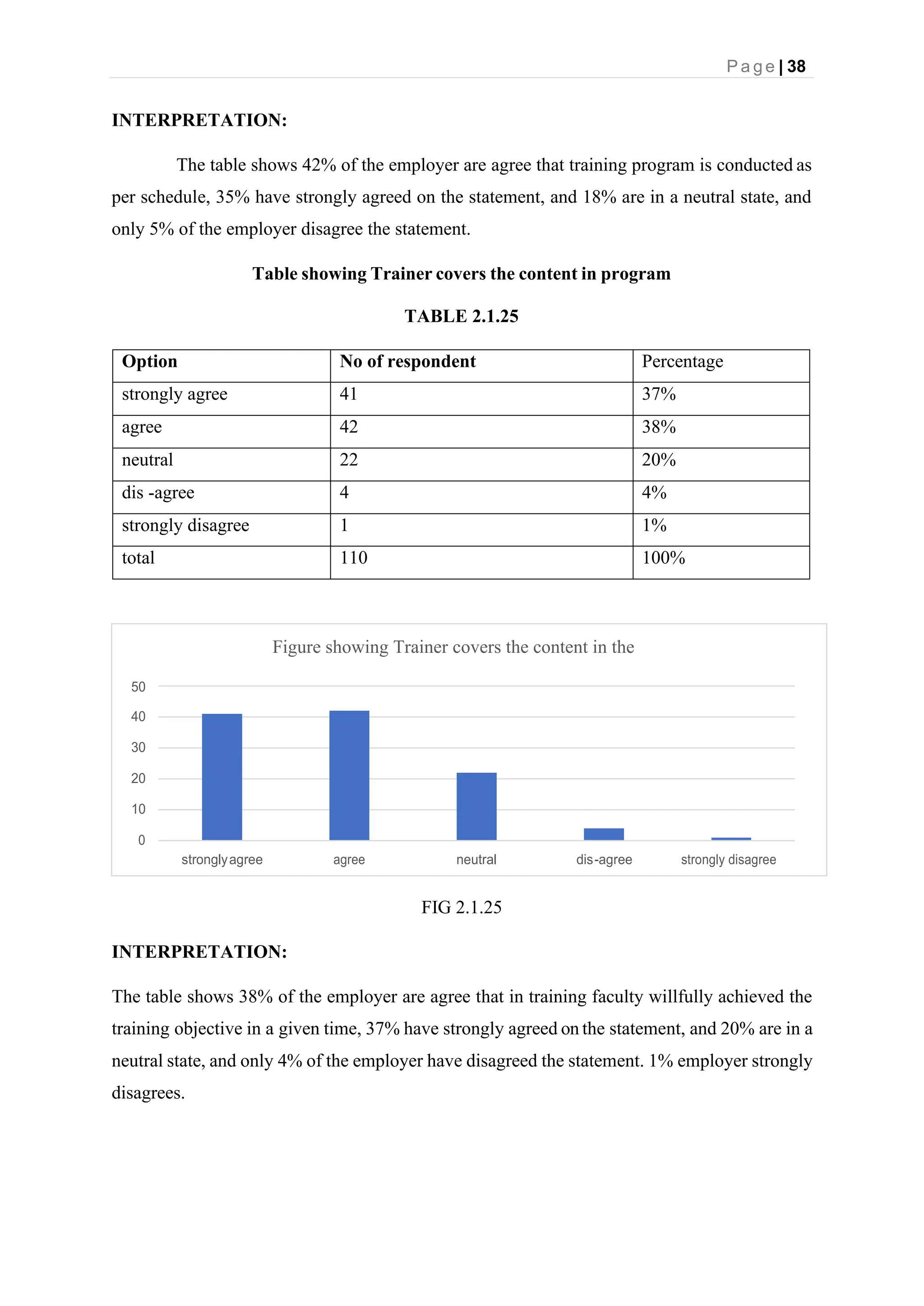
The table shows 38% of the employer are agree that in training faculty willfully achieved the
training objective in a given time, 37% have strongly agreed on the statement, and 20% are in a
neutral state, and only 4% of the employer have disagreed the statement. 1% employer strongly
disagrees.
P a g e | 39
Table showing before training program you get information
TABLE 2.1.26
Option No of respondent Percentage
strongly agree 35 32%
agree 44 40%
neutral 20 18%
dis -agree 11 10%
strongly disagree 0 0%
total 110 100%
50
Figure showing before the training program you get
information
40
30
20
10
0
FIG 2.1.26
INTERPRETATION:
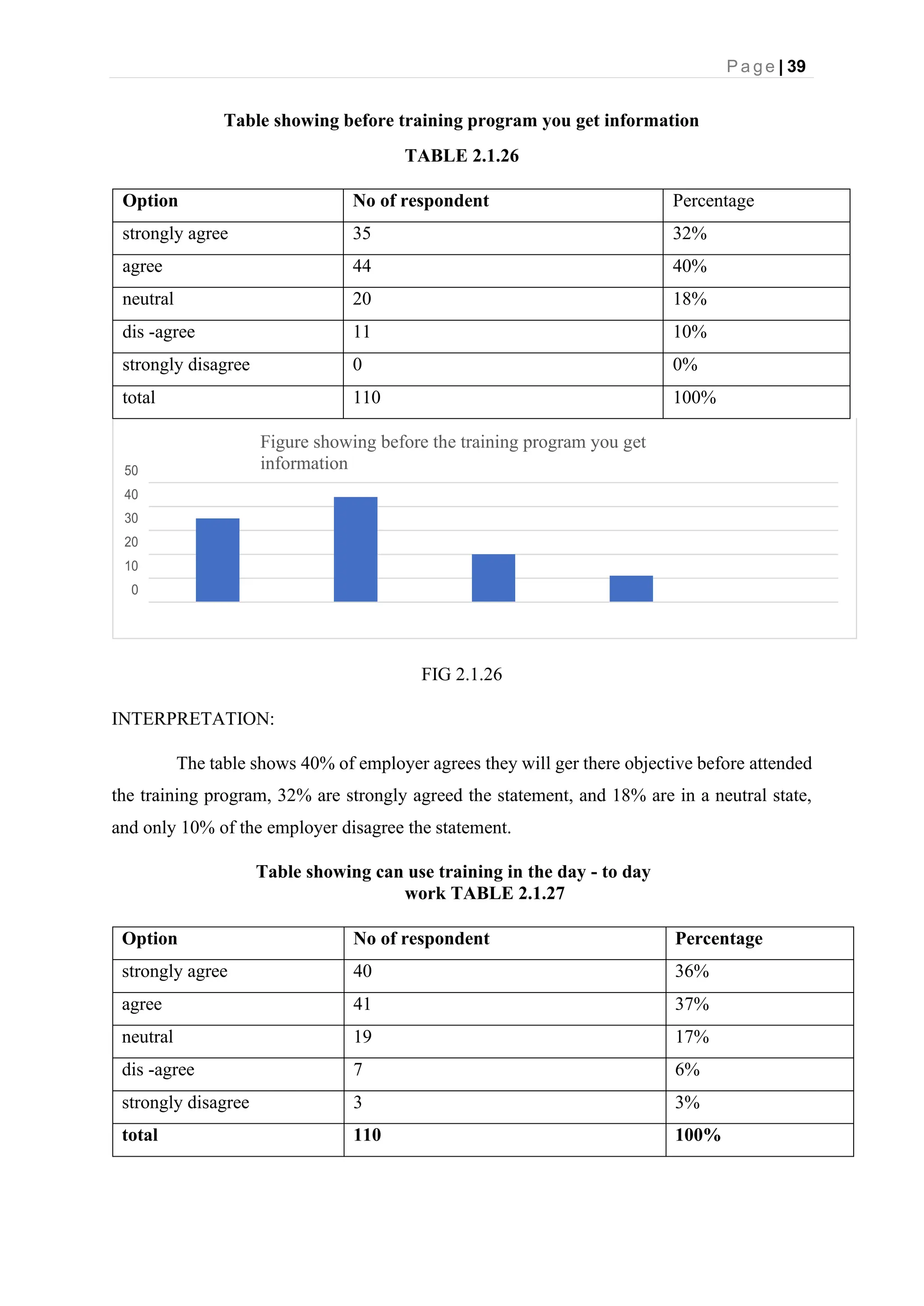
The table shows 40% of employer agrees they will ger there objective before attended
the training program, 32% are strongly agreed the statement, and 18% are in a neutral state,
and only 10% of the employer disagree the statement.
Table showing can use training in the day - to day
work TABLE 2.1.27
Option No of respondent Percentage
strongly agree 40 36%
agree 41 37%
neutral 19 17%
dis -agree 7 6%
strongly disagree 3 3%
total 110 100%
P a g e | 40
FIG 2.1.27
INTERPRETATION:
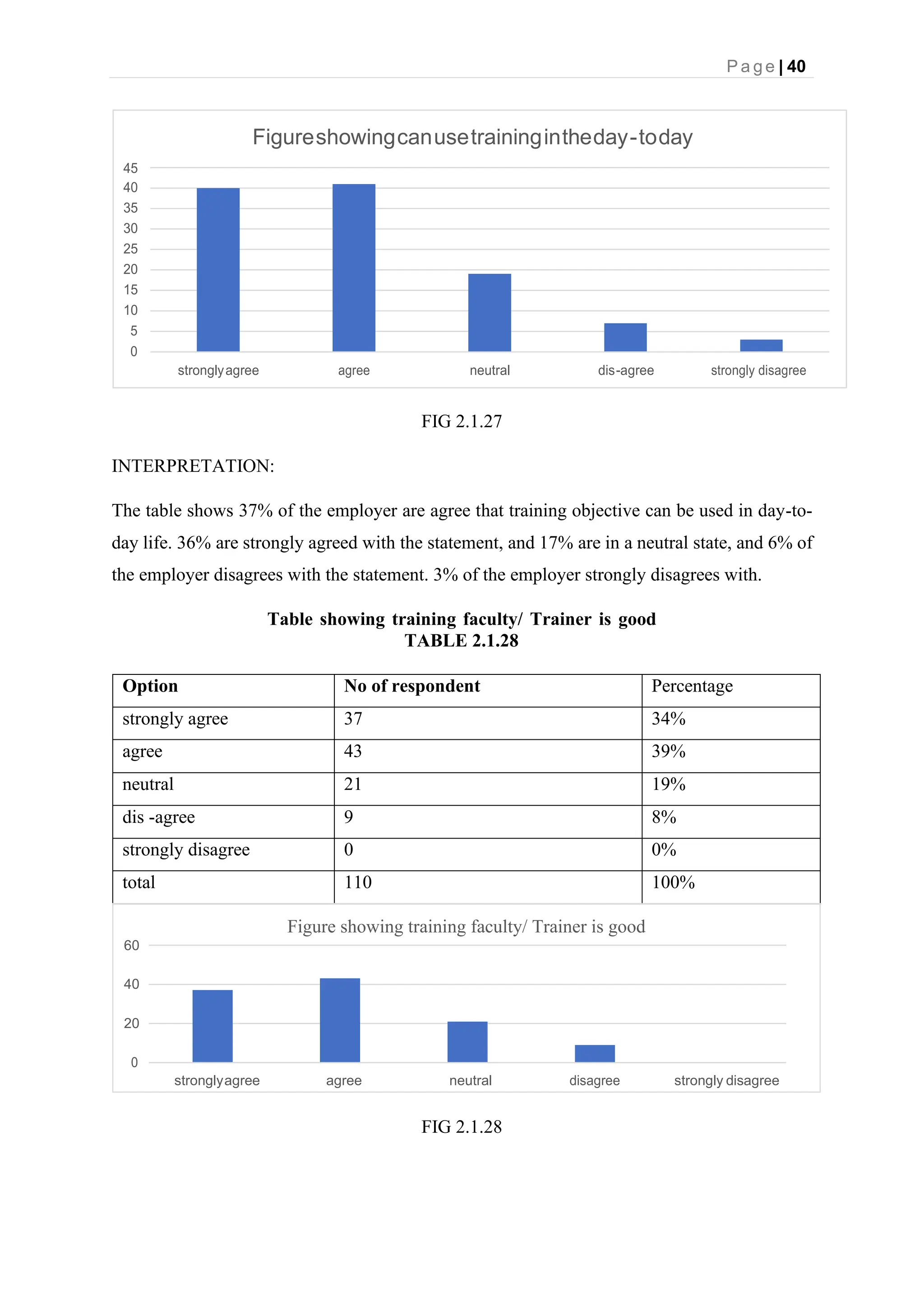
The table shows 37% of the employer are agree that training objective can be used in day-to-
day life. 36% are strongly agreed with the statement, and 17% are in a neutral state, and 6% of
the employer disagrees with the statement. 3% of the employer strongly disagrees with.
Table showing training faculty/ Trainer is good
TABLE 2.1.28
Option No of respondent Percentage
strongly agree 37 34%
agree 43 39%
neutral 21 19%
dis -agree 9 8%
strongly disagree 0 0%
total 110 100%
Figure showing training faculty/ Trainer is good
60
40
20
0
stronglyagree agree neutral disagree strongly disagree
FIG 2.1.28
Figureshowingcanusetrainingintheday-today
45
40
35
30
25
20
15
10
5
0
stronglyagree agree neutral dis-agree strongly disagree
P a g e | 41
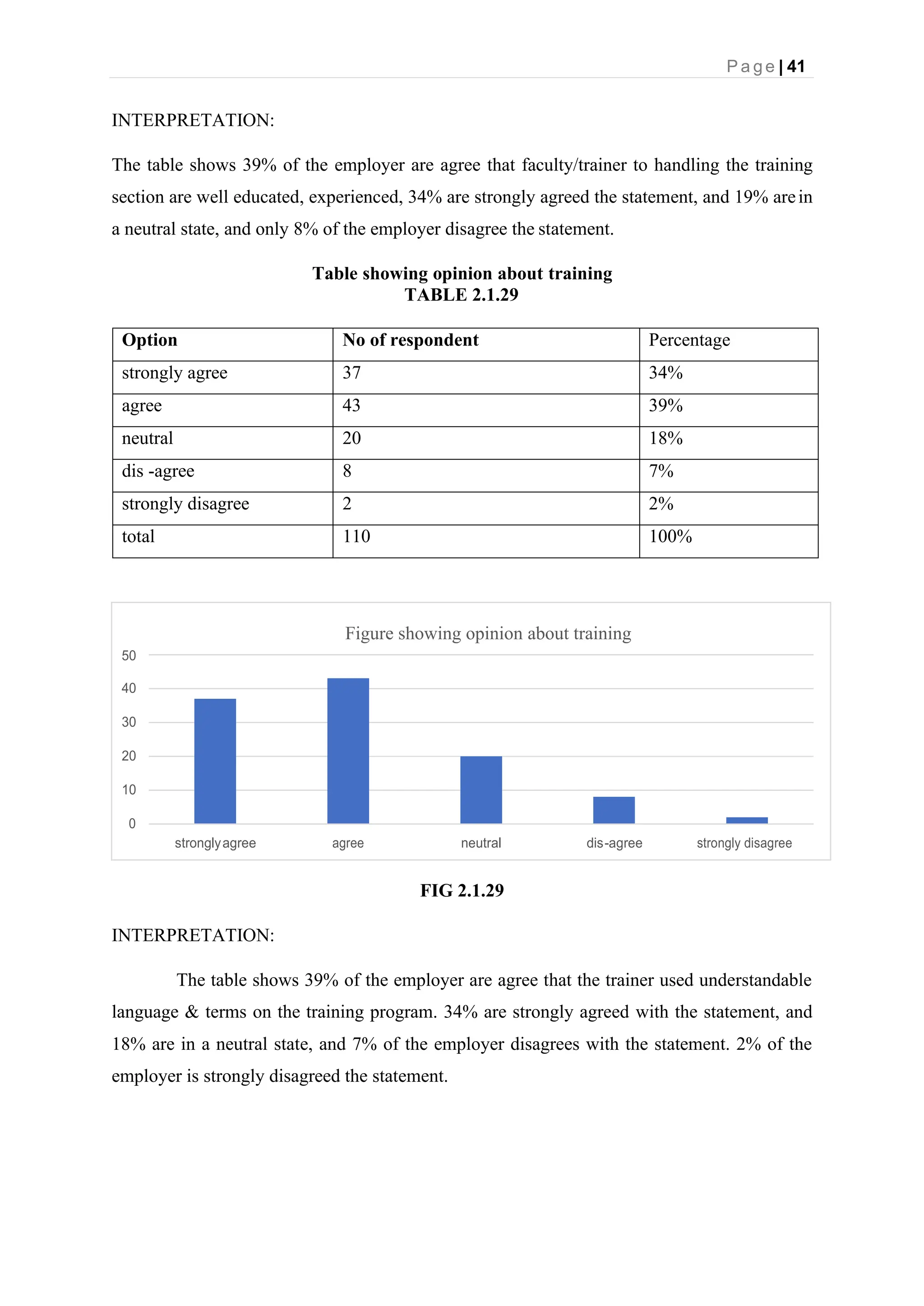
Figure showing opinion about training
50
40
30
20
10
0
stronglyagree agree neutral dis-agree strongly disagree
INTERPRETATION:
The table shows 39% of the employer are agree that faculty/trainer to handling the training
section are well educated, experienced, 34% are strongly agreed the statement, and 19% arein
a neutral state, and only 8% of the employer disagree the statement.
Table showing opinion about training
TABLE 2.1.29
Option No of respondent Percentage
strongly agree 37 34%
agree 43 39%
neutral 20 18%
dis -agree 8 7%
strongly disagree 2 2%
total 110 100%
FIG 2.1.29
INTERPRETATION:
The table shows 39% of the employer are agree that the trainer used understandable
language & terms on the training program. 34% are strongly agreed with the statement, and
18% are in a neutral state, and 7% of the employer disagrees with the statement. 2% of the
employer is strongly disagreed the statement.
P a g e | 42
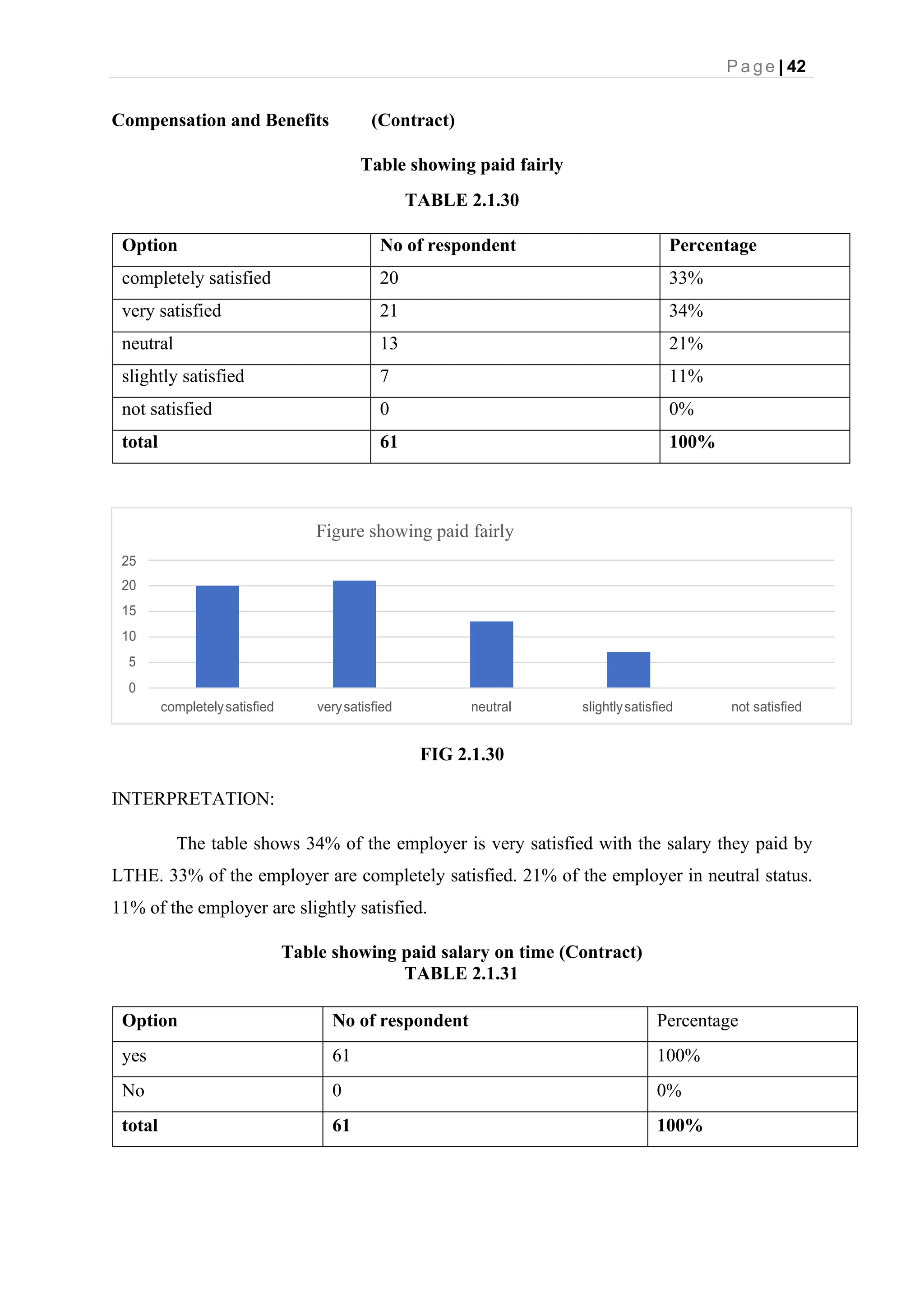
Figure showing paid fairly
25
20
15
10
5
0
completelysatisfied verysatisfied neutral slightlysatisfied not satisfied
Compensation and Benefits (Contract)
Table showing paid fairly
TABLE 2.1.30
Option No of respondent Percentage
completely satisfied 20 33%
very satisfied 21 34%
neutral 13 21%
slightly satisfied 7 11%
not satisfied 0 0%
total 61 100%
FIG 2.1.30
INTERPRETATION:
The table shows 34% of the employer is very satisfied with the salary they paid by
LTHE. 33% of the employer are completely satisfied. 21% of the employer in neutral status.
11% of the employer are slightly satisfied.
Table showing paid salary on time (Contract)
TABLE 2.1.31
Option No of respondent Percentage
yes 61 100%
No 0 0%
total 61 100%
P a g e | 43
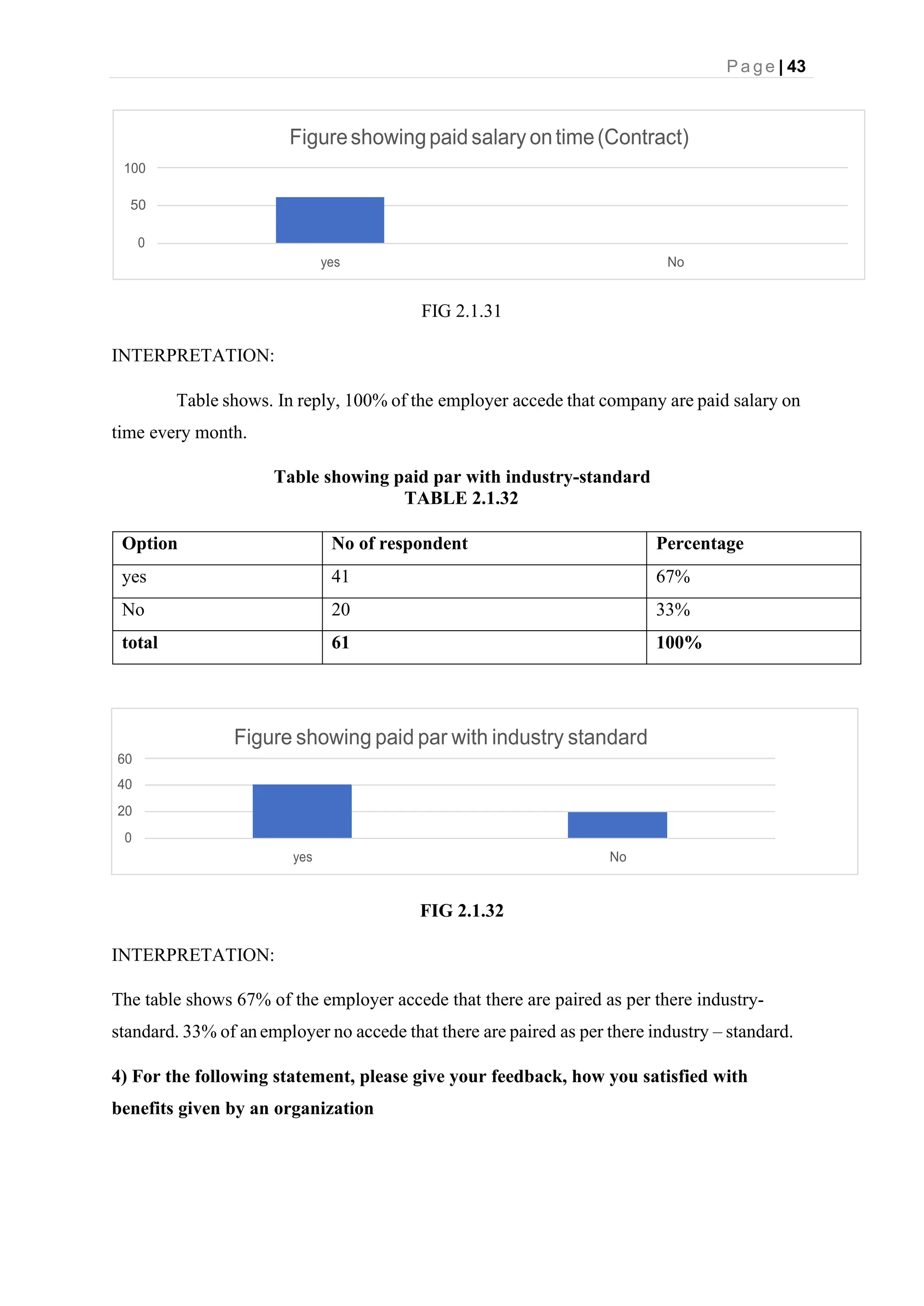
Figure showing paid par with industry standard
60
40
20
0
yes No
FIG 2.1.31
INTERPRETATION:
Table shows. In reply, 100% of the employer accede that company are paid salary on
time every month.
Table showing paid par with industry-standard
TABLE 2.1.32
Option No of respondent Percentage
yes 41 67%
No 20 33%
total 61 100%
FIG 2.1.32
INTERPRETATION:
The table shows 67% of the employer accede that there are paired as per there industry-
standard. 33% of anemployer no accede that there are paired as per there industry – standard.
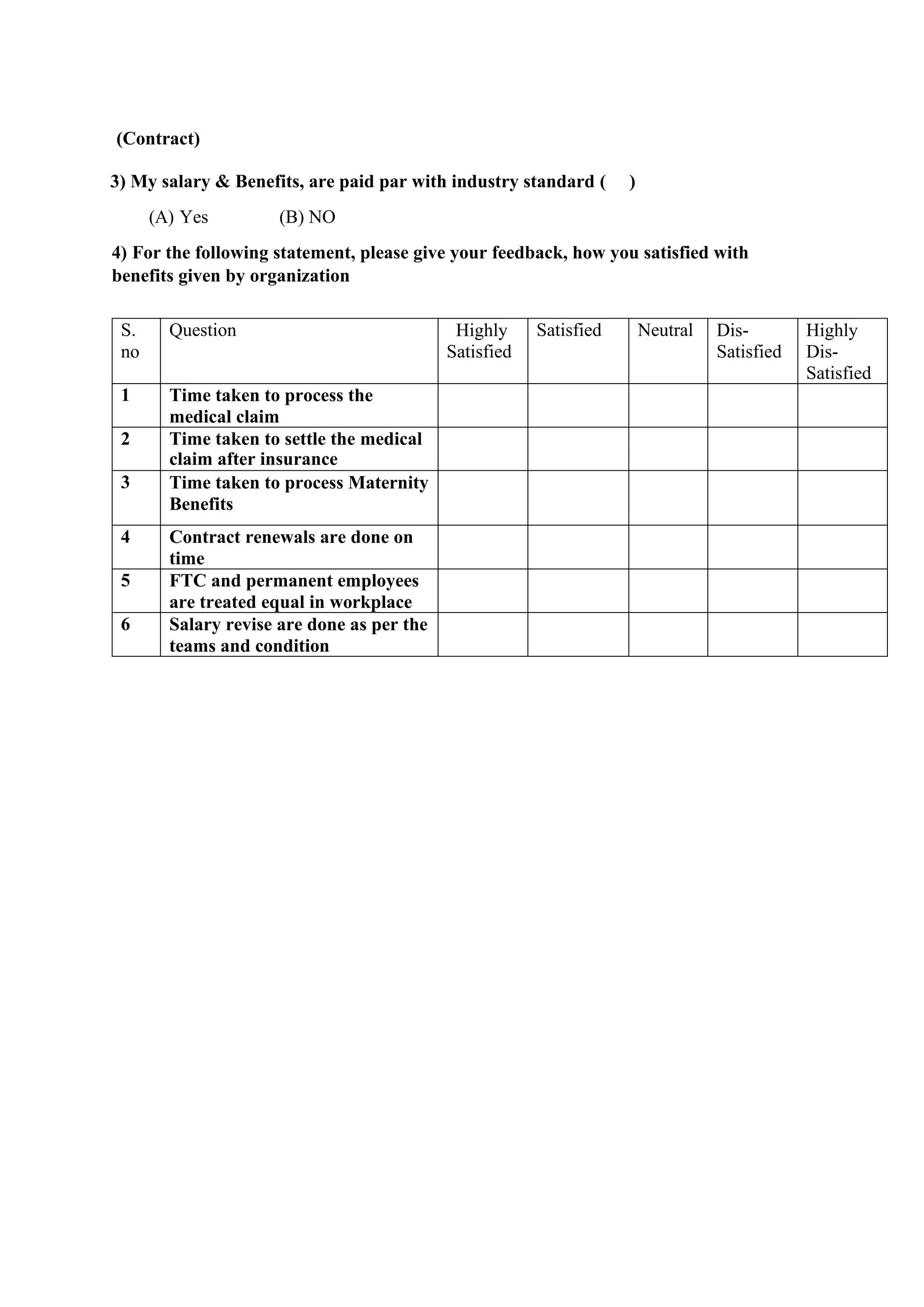
4) For the following statement, please give your feedback, how you satisfied with
benefits given by an organization
Figureshowingpaid salary ontime(Contract)
100
50
0
yes No
P a g e | 44
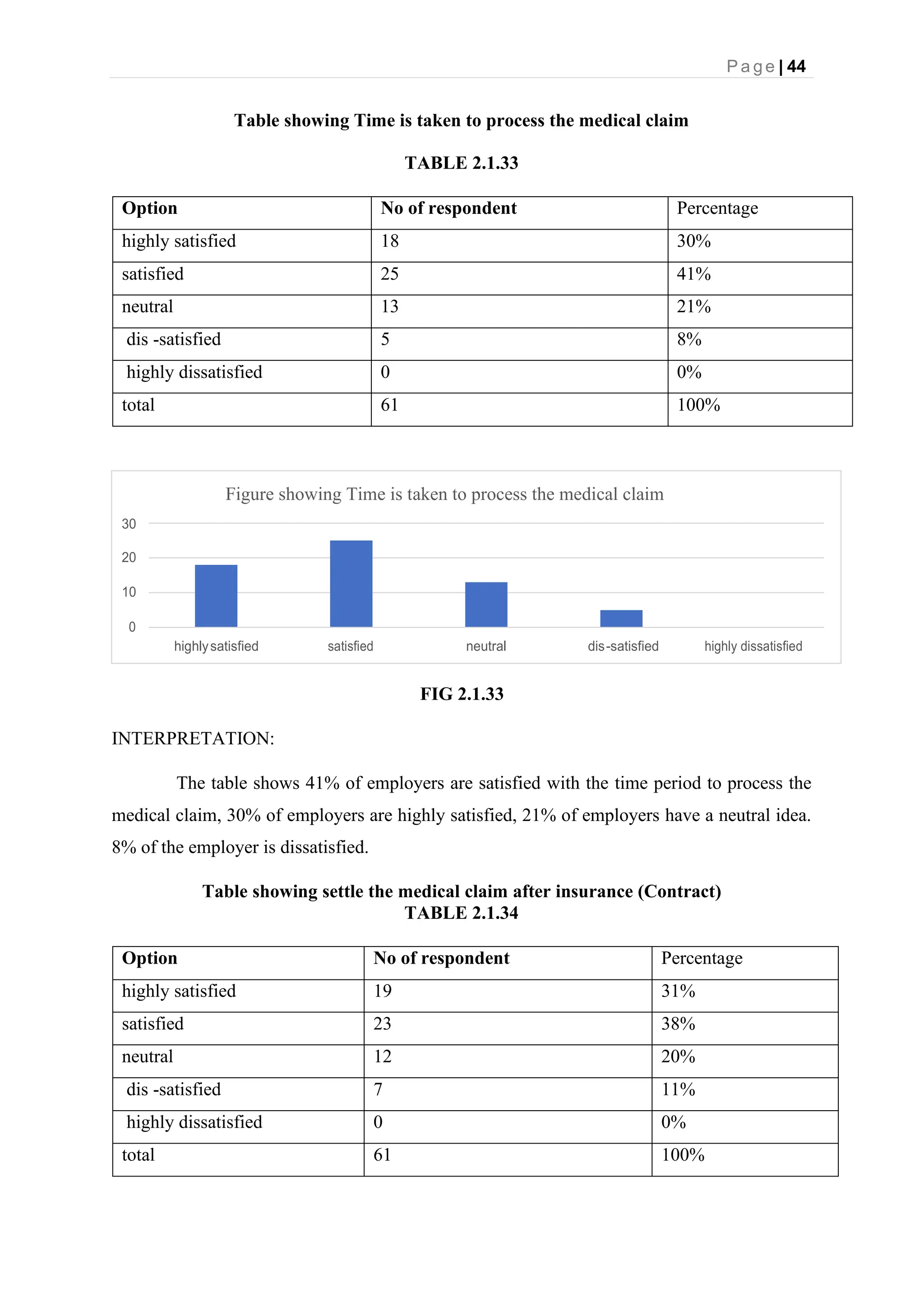
Figure showing Time is taken to process the medical claim
30
20
10
0
highlysatisfied satisfied neutral dis-satisfied highly dissatisfied
Table showing Time is taken to process the medical claim
TABLE 2.1.33
Option No of respondent Percentage
highly satisfied 18 30%
satisfied 25 41%
neutral 13 21%
dis -satisfied 5 8%
highly dissatisfied 0 0%
total 61 100%
FIG 2.1.33
INTERPRETATION:
The table shows 41% of employers are satisfied with the time period to process the
medical claim, 30% of employers are highly satisfied, 21% of employers have a neutral idea.
8% of the employer is dissatisfied.
Table showing settle the medical claim after insurance (Contract)
TABLE 2.1.34
Option No of respondent Percentage
highly satisfied 19 31%
satisfied 23 38%
neutral 12 20%
dis -satisfied 7 11%
highly dissatisfied 0 0%
total 61 100%
P a g e | 45
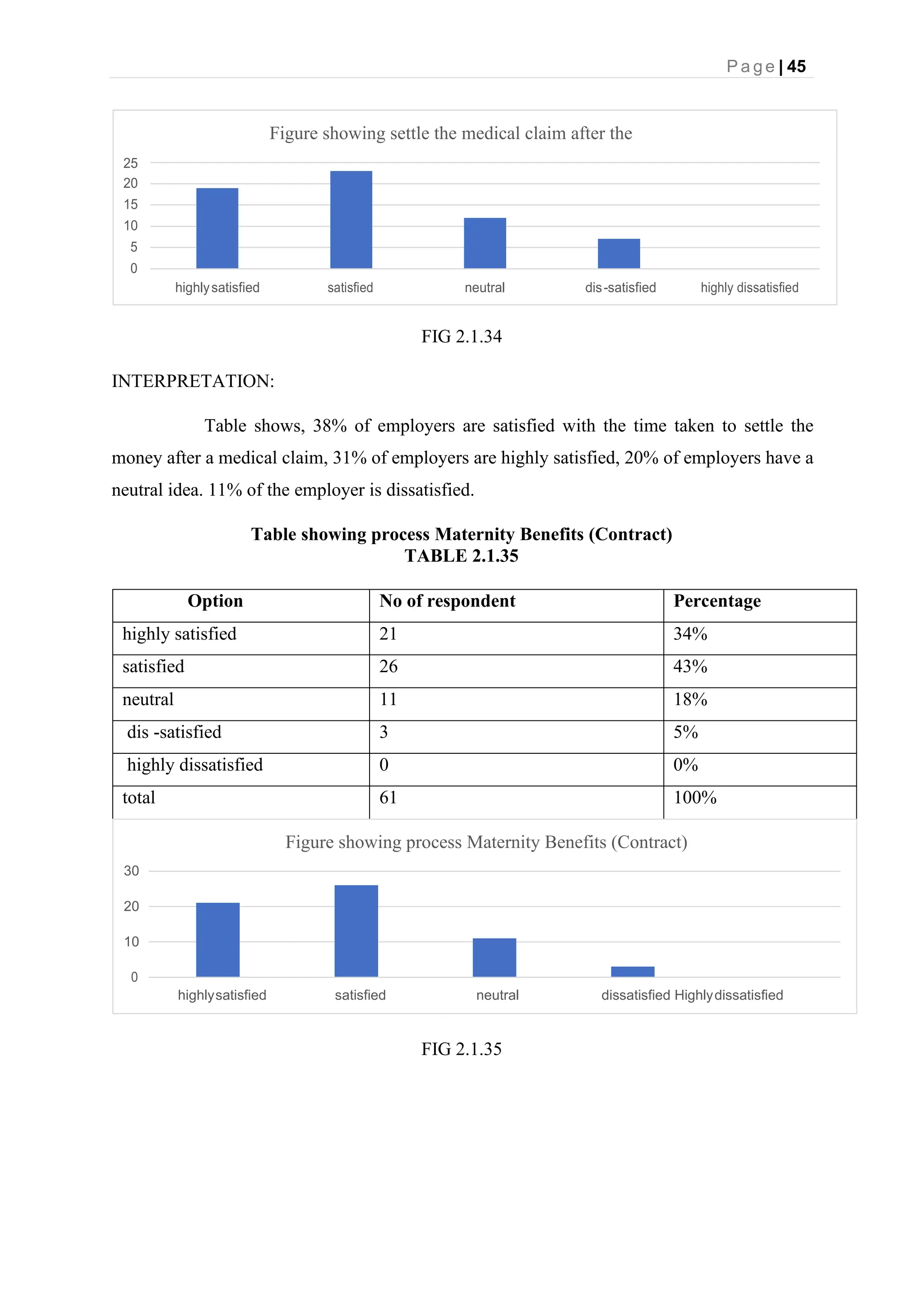
FIG 2.1.34
INTERPRETATION:
Table shows, 38% of employers are satisfied with the time taken to settle the
money after a medical claim, 31% of employers are highly satisfied, 20% of employers have a
neutral idea. 11% of the employer is dissatisfied.
Table showing process Maternity Benefits (Contract)
TABLE 2.1.35
Option No of respondent Percentage
highly satisfied 21 34%
satisfied 26 43%
neutral 11 18%
dis -satisfied 3 5%
highly dissatisfied 0 0%
total 61 100%
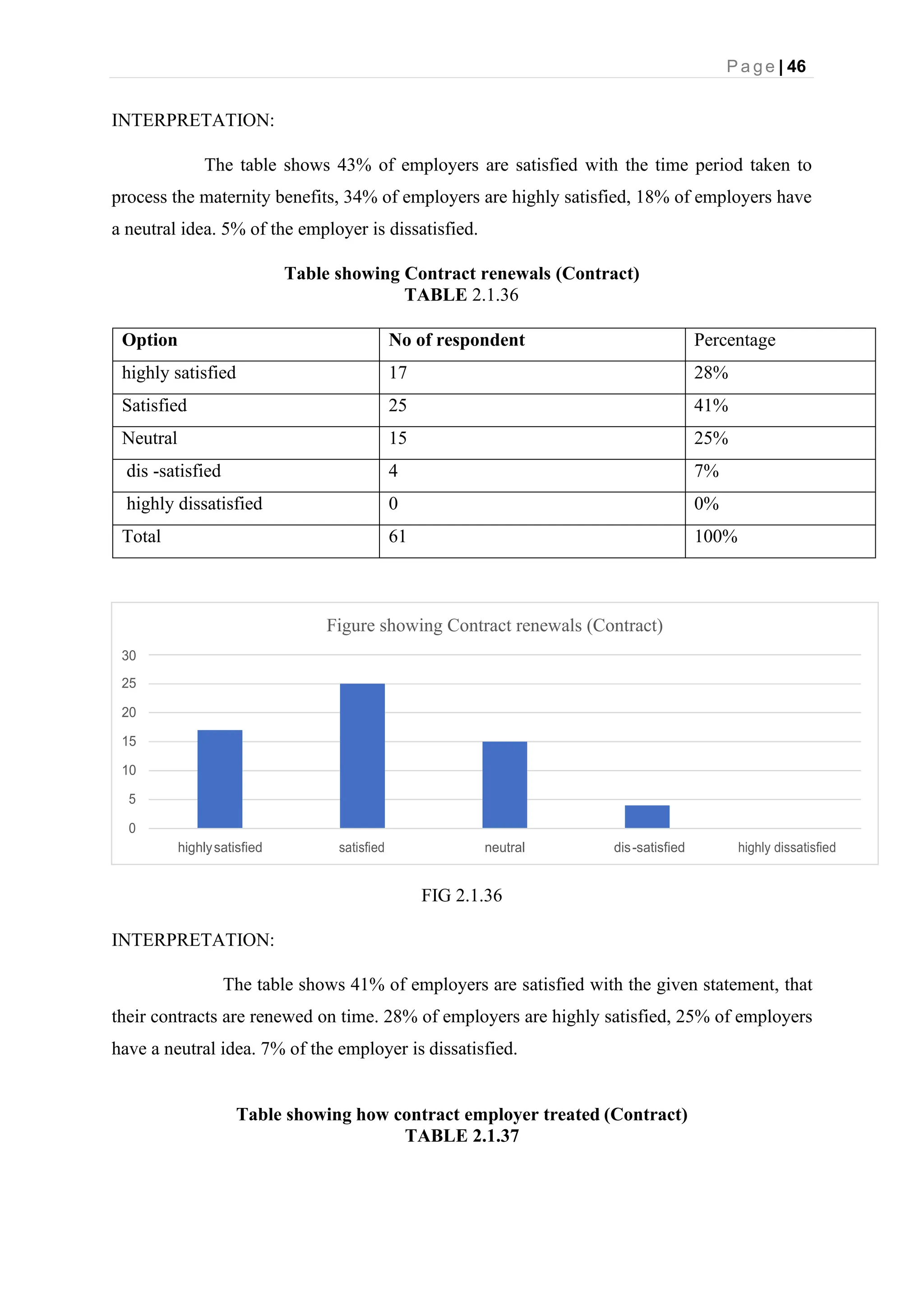
Figure showing process Maternity Benefits (Contract)
30
20
10
0
highlysatisfied satisfied neutral dissatisfied Highlydissatisfied
FIG 2.1.35
Figure showing settle the medical claim after the
25
20
15
10
5
0
highlysatisfied satisfied neutral dis-satisfied highly dissatisfied
P a g e | 46
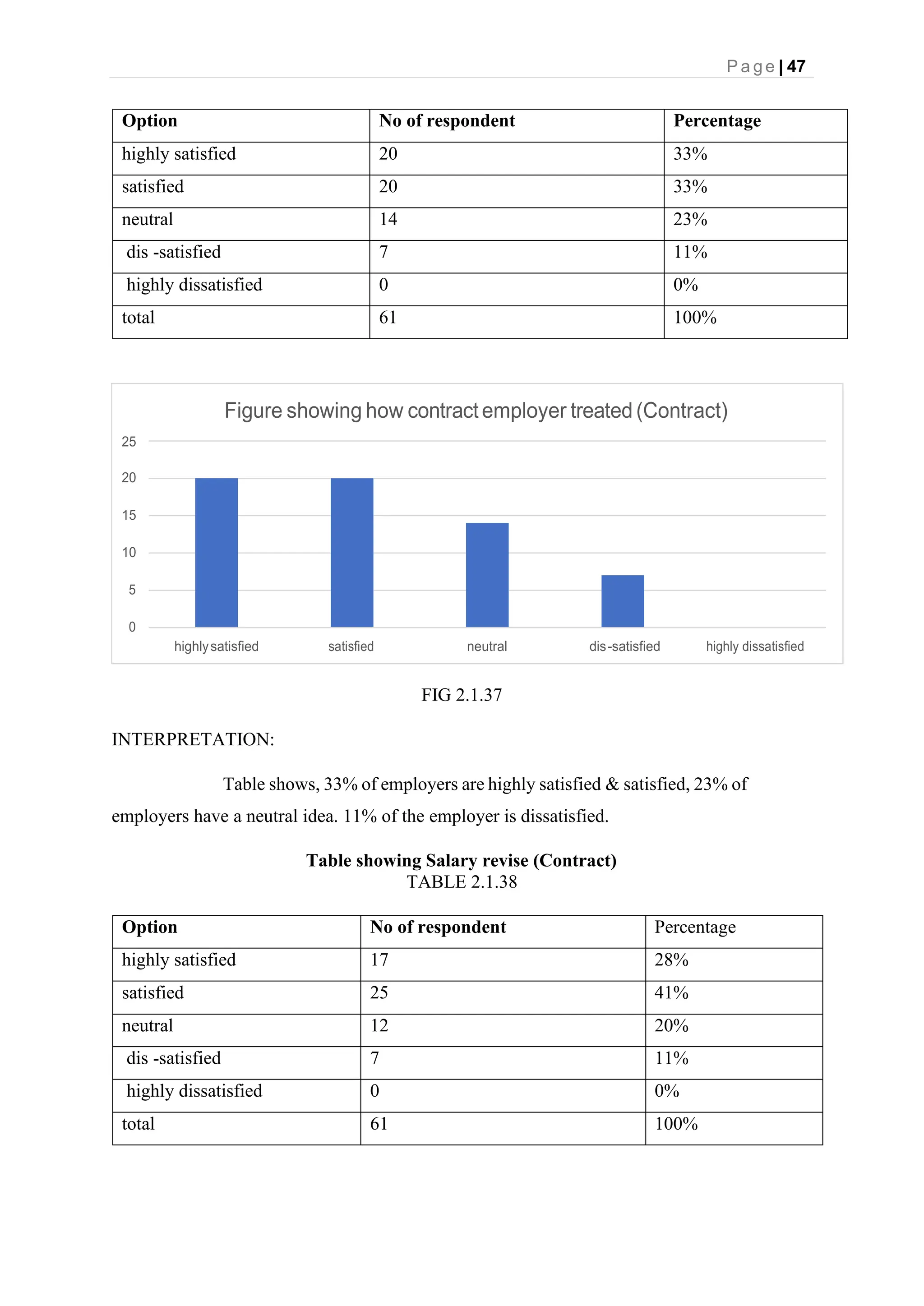
Figure showing Contract renewals (Contract)
30
25
20
15
10
5
0
highlysatisfied satisfied neutral dis-satisfied highly dissatisfied
INTERPRETATION:
The table shows 43% of employers are satisfied with the time period taken to
process the maternity benefits, 34% of employers are highly satisfied, 18% of employers have
a neutral idea. 5% of the employer is dissatisfied.
Table showing Contract renewals (Contract)
TABLE 2.1.36
Option No of respondent Percentage
highly satisfied 17 28%
Satisfied 25 41%
Neutral 15 25%
dis -satisfied 4 7%
highly dissatisfied 0 0%
Total 61 100%
FIG 2.1.36
INTERPRETATION:
The table shows 41% of employers are satisfied with the given statement, that
their contracts are renewed on time. 28% of employers are highly satisfied, 25% of employers
have a neutral idea. 7% of the employer is dissatisfied.
Table showing how contract employer treated (Contract)
TABLE 2.1.37
P a g e | 47
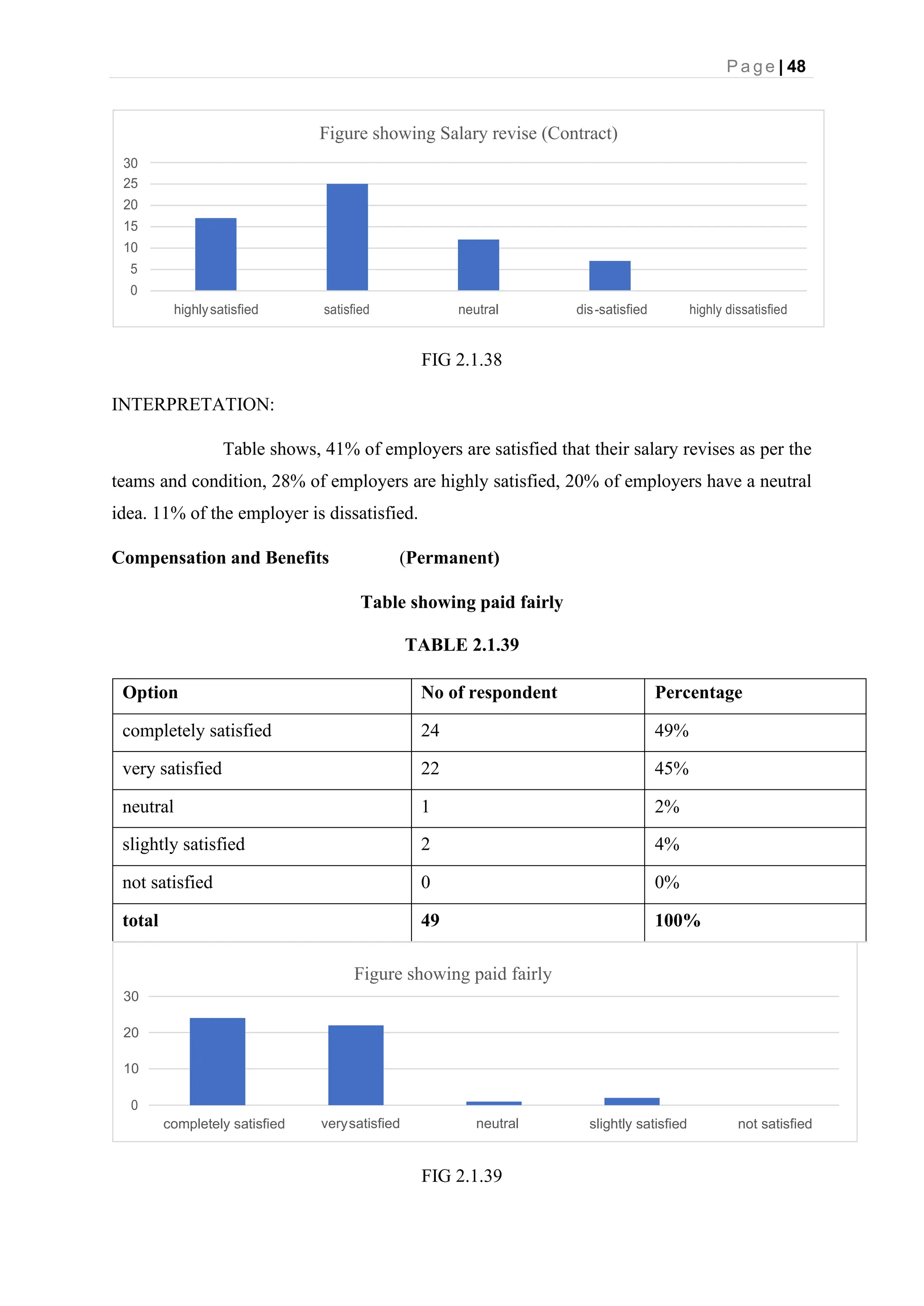
Figure showing how contractemployer treated (Contract)
25
20
15
10
5
0
highlysatisfied satisfied neutral dis-satisfied highly dissatisfied
Option No of respondent Percentage
highly satisfied 20 33%
satisfied 20 33%
neutral 14 23%
dis -satisfied 7 11%
highly dissatisfied 0 0%
total 61 100%
FIG 2.1.37
INTERPRETATION:
Table shows, 33% of employers are highly satisfied & satisfied, 23% of
employers have a neutral idea. 11% of the employer is dissatisfied.
Table showing Salary revise (Contract)
TABLE 2.1.38
Option No of respondent Percentage
highly satisfied 17 28%
satisfied 25 41%
neutral 12 20%
dis -satisfied 7 11%
highly dissatisfied 0 0%
total 61 100%
P a g e | 48
FIG 2.1.38
INTERPRETATION:
Table shows, 41% of employers are satisfied that their salary revises as per the
teams and condition, 28% of employers are highly satisfied, 20% of employers have a neutral
idea. 11% of the employer is dissatisfied.
Compensation and Benefits (Permanent)
Table showing paid fairly
TABLE 2.1.39
Option No of respondent Percentage
completely satisfied 24 49%
very satisfied 22 45%
neutral 1 2%
slightly satisfied 2 4%
not satisfied 0 0%
total 49 100%
30
Figure showing paid fairly
verysatisfied neutral
20
10
0
completely satisfied slightly satisfied not satisfied
FIG 2.1.39
Figure showing Salary revise (Contract)
30
25
20
15
10
5
0
highlysatisfied satisfied neutral dis-satisfied highly dissatisfied
P a g e | 49
INTERPRETATION:
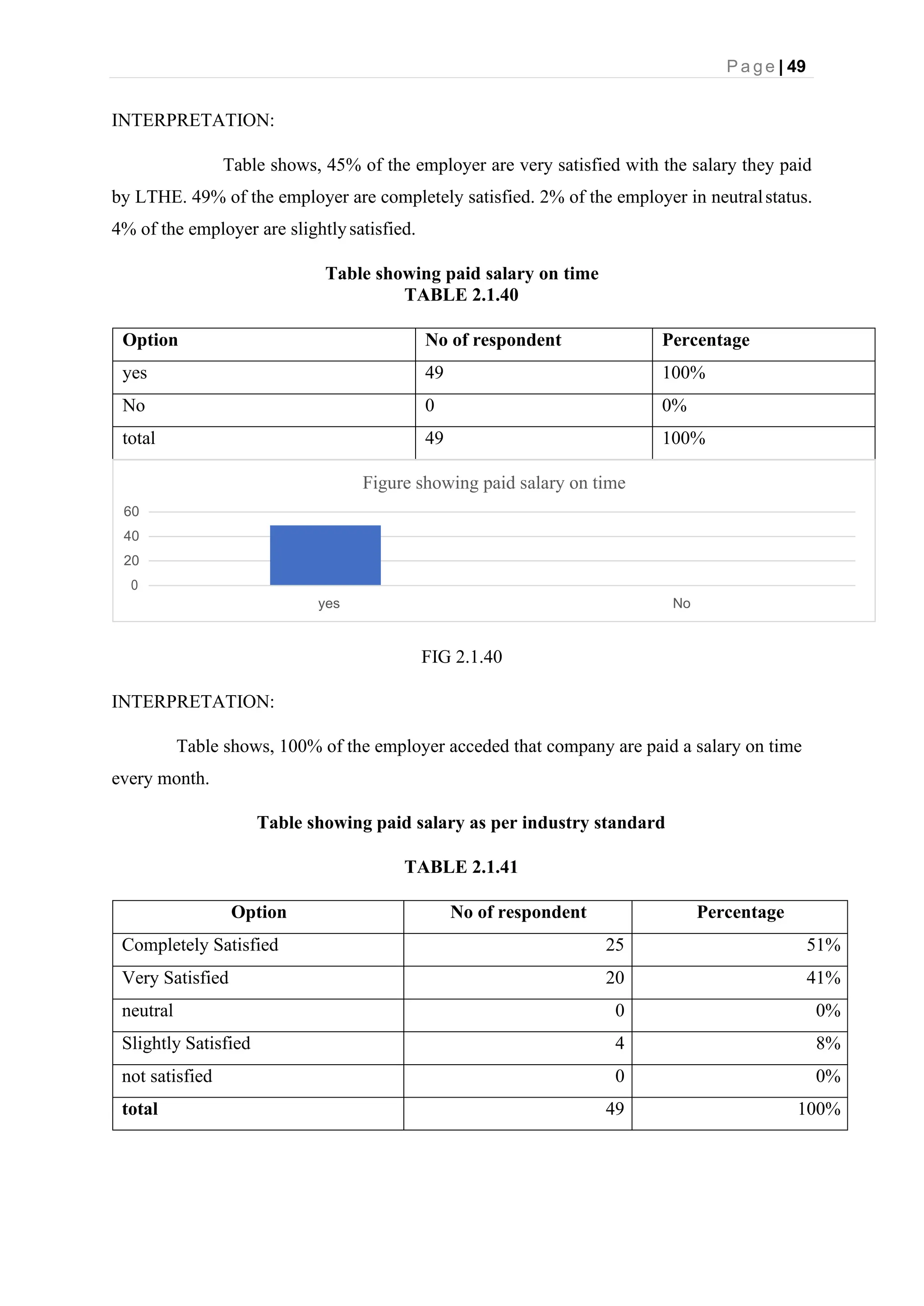
Table shows, 45% of the employer are very satisfied with the salary they paid
by LTHE. 49% of the employer are completely satisfied. 2% of the employer in neutralstatus.
4% of the employer are slightlysatisfied.
Table showing paid salary on time
TABLE 2.1.40
Option No of respondent Percentage
yes 49 100%
No 0 0%
total 49 100%
Figure showing paid salary on time
60
40
20
0
yes No
FIG 2.1.40
INTERPRETATION:
Table shows, 100% of the employer acceded that company are paid a salary on time
every month.
Table showing paid salary as per industry standard
TABLE 2.1.41
Option No of respondent Percentage
Completely Satisfied 25 51%
Very Satisfied 20 41%
neutral 0 0%
Slightly Satisfied 4 8%
not satisfied 0 0%
total 49 100%
P a g e | 50
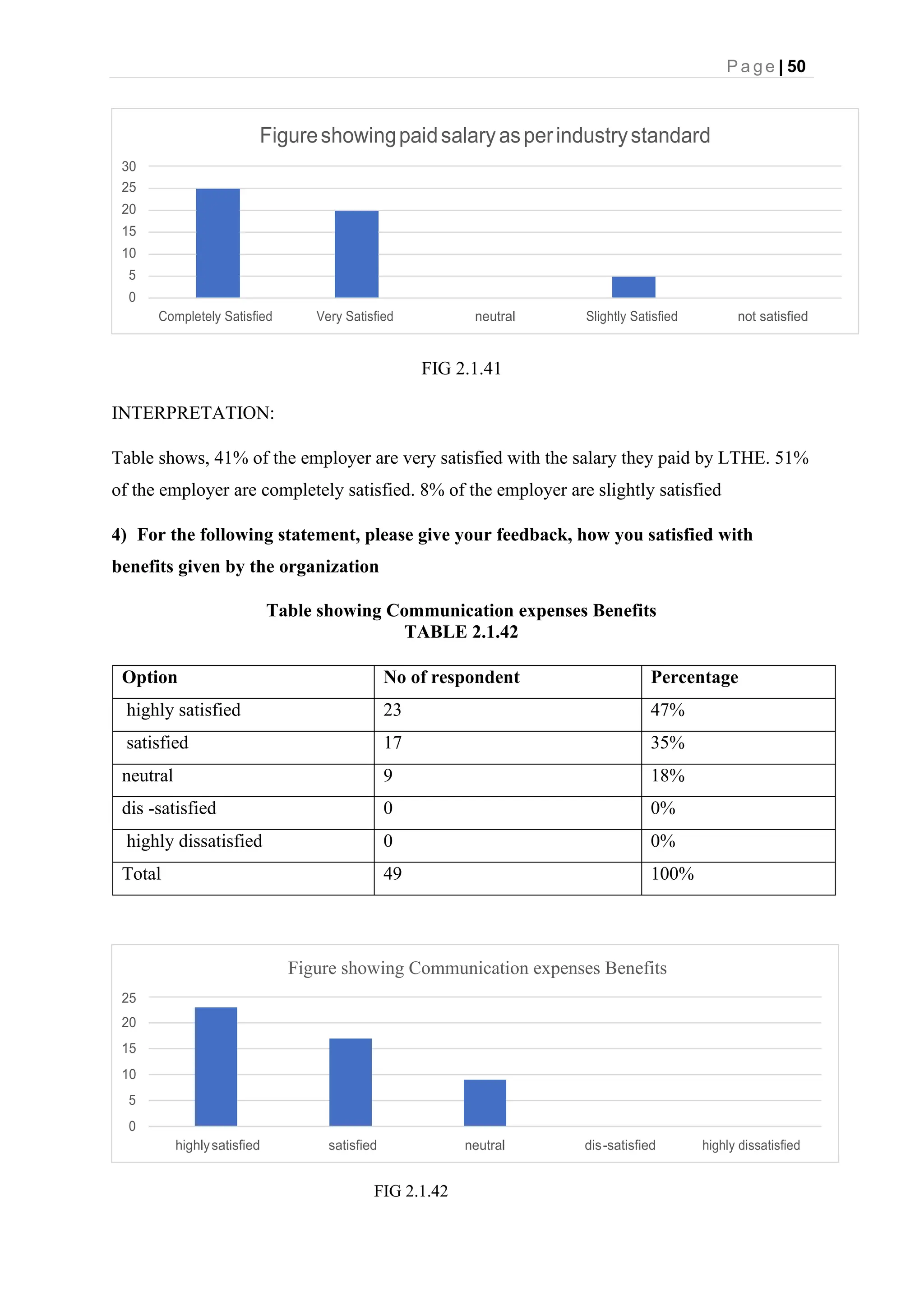
Figureshowingpaidsalaryasperindustrystandard
30
25
20
15
10
5
0
Completely Satisfied Very Satisfied neutral Slightly Satisfied not satisfied
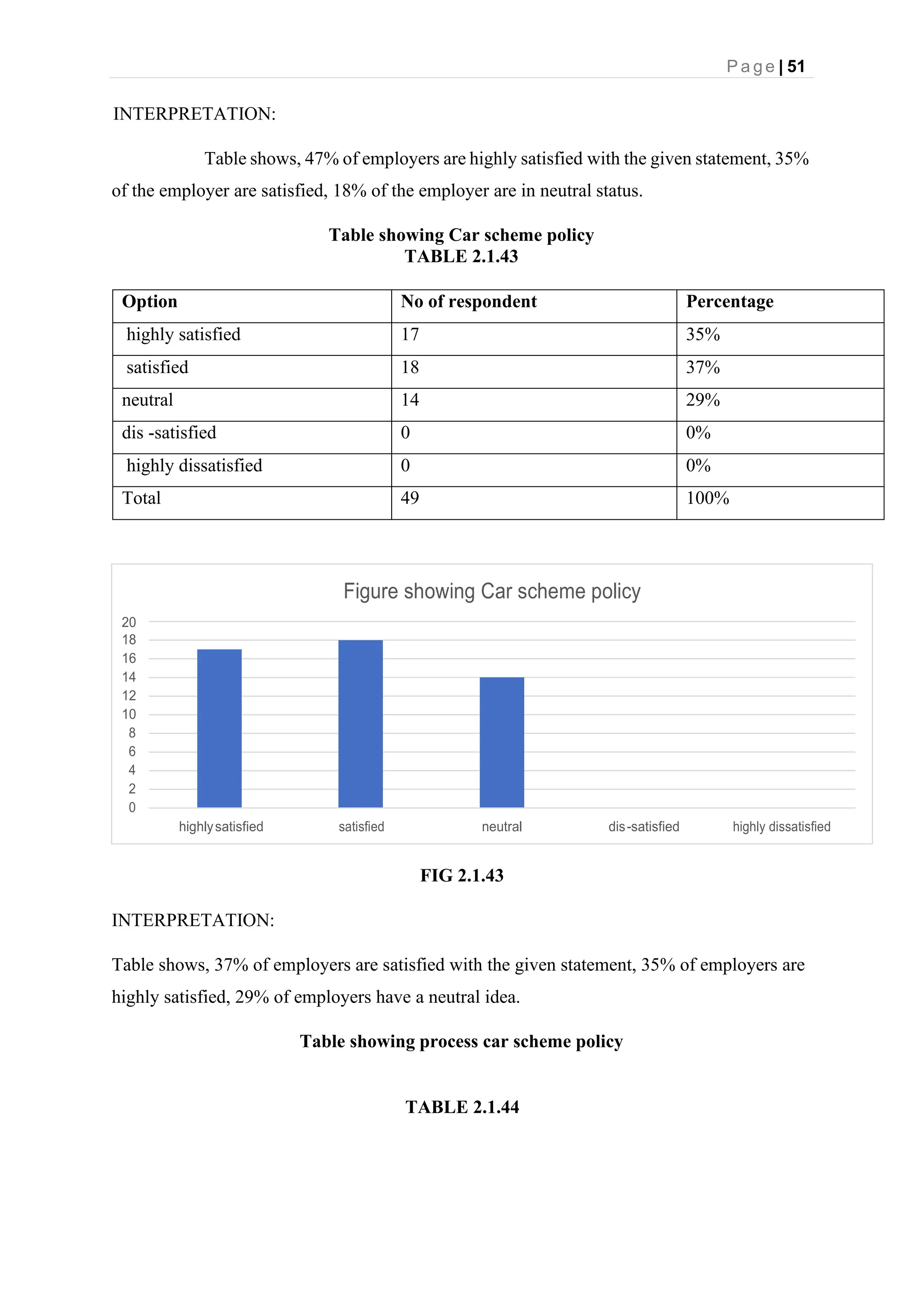
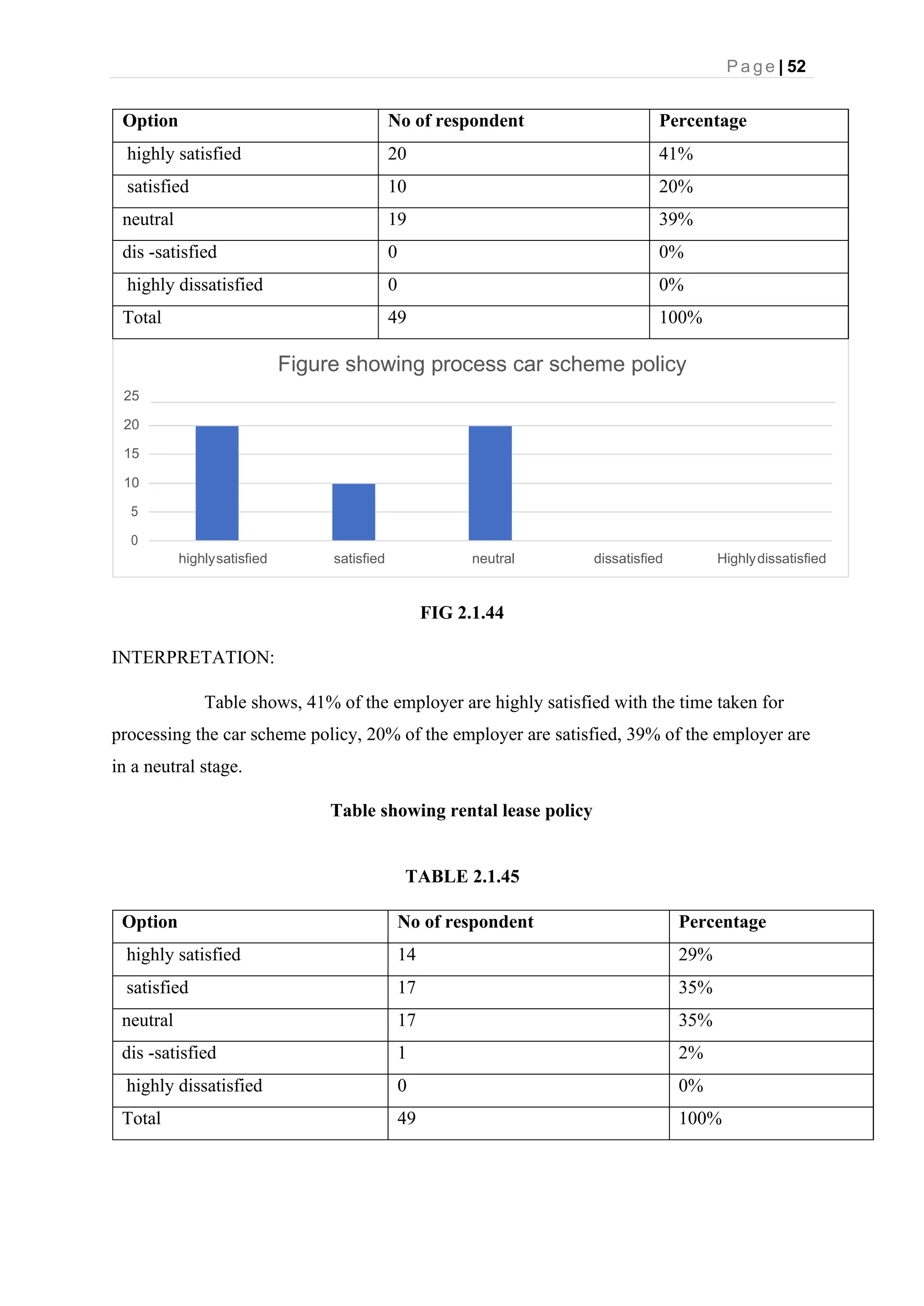
Figure showing Communication expenses Benefits
25
20
15
10
5
0
highlysatisfied satisfied neutral dis-satisfied highly dissatisfied
FIG 2.1.41
INTERPRETATION:
Table shows, 41% of the employer are very satisfied with the salary they paid by LTHE. 51%
of the employer are completely satisfied. 8% of the employer are slightly satisfied
4) For the following statement, please give your feedback, how you satisfied with
benefits given by the organization
Table showing Communication expenses Benefits
TABLE 2.1.42
Option No of respondent Percentage
highly satisfied 23 47%
satisfied 17 35%
neutral 9 18%
dis -satisfied 0 0%
highly dissatisfied 0 0%
Total 49 100%
FIG 2.1.42
P a g e | 51
Figure showing Car scheme policy
20
18
16
14
12
10
8
6
4
2
0
highlysatisfied satisfied neutral dis-satisfied highly dissatisfied
INTERPRETATION:
Table shows, 47% of employers are highly satisfied with the given statement, 35%
of the employer are satisfied, 18% of the employer are in neutral status.
Table showing Car scheme policy
TABLE 2.1.43
Option No of respondent Percentage
highly satisfied 17 35%
satisfied 18 37%
neutral 14 29%
dis -satisfied 0 0%
highly dissatisfied 0 0%
Total 49 100%
FIG 2.1.43
INTERPRETATION:
Table shows, 37% of employers are satisfied with the given statement, 35% of employers are
highly satisfied, 29% of employers have a neutral idea.
Table showing process car scheme policy
TABLE 2.1.44
P a g e | 52
Option No of respondent Percentage
highly satisfied 20 41%
satisfied 10 20%
neutral 19 39%
dis -satisfied 0 0%
highly dissatisfied 0 0%
Total 49 100%
Figure showing process car scheme policy
25
20
15
10
5
0
highlysatisfied satisfied neutral dissatisfied Highlydissatisfied
FIG 2.1.44
INTERPRETATION:
Table shows, 41% of the employer are highly satisfied with the time taken for
processing the car scheme policy, 20% of the employer are satisfied, 39% of the employer are
in a neutral stage.
Table showing rental lease policy
TABLE 2.1.45
Option No of respondent Percentage
highly satisfied 14 29%
satisfied 17 35%
neutral 17 35%
dis -satisfied 1 2%
highly dissatisfied 0 0%
Total 49 100%
P a g e | 53
Figure showing process medical claim application
20
15
10
5
0
highlysatisfied satisfied neutral dis-satisfied highly dissatisfied
FIG 2.1.45
INTERPRETATION:
Table shows, 35% of employers are satisfied and have a neutral idea with the rental plan &
policy, 29% of employers are highly satisfied, 2% of the employer are dissatisfied.
Table showing process medical claim application
TABLE 2.1.46
Option No of respondent Percentage
highly satisfied 19 39%
satisfied 19 39%
neutral 10 20%
dis -satisfied 1 2%
highly dissatisfied 0 0%
Total 49 100%
Figureshowingrentalleasepolicy
20
15
10
5
0
highlysatisfied satisfied neutral dis-satisfied highly dissatisfied
P a g e | 54
FIG 2.1.46
INTERPRETATION:
Table shows, 39% of employers are satisfied & highly satisfied, 20% of employers have a
neutral idea. 2% of the employer are dis -satisfied.
Table showing the medical application process
over TABLE 2.1.47
Option No of respondent Percentage
highly satisfied 22 45%
satisfied 14 29%
neutral 13 27%
dis -satisfied 0 0%
highly dissatisfied 0 0%
Total 49 100%
Figureshowingthemedicalapplicationprocess
over
25
20
15
10
5
0
highlysatisfied satisfied neutral dissatisfied Highlydissatisfied
FIG 2.1.47
INTERPRETATION:
Table shows, 45% of employers are highly satisfied with the given statement, 29% of the
employer are satisfied, 27% of the employer are in neutral status.
Table showing insurance policies
TABLE 2.1.48
P a g e | 55
Figure showing insurance policies
25
20
15
10
5
0
highlysatisfied satisfied neutral dis-satisfied highly dissatisfied
Option No of respondent Percentage
highly satisfied 14 29%
satisfied 21 43%
neutral 14 29%
dis -satisfied 0 0%
highly dissatisfied 0 0%
Total 49 100%
FIC 2.1.48
INTERPRETATION:
Table shows,43% of employers are satisfied, 29% of employers are highly satisfied & have a
neutral idea.
Table showing Maternity Benefits
TABLE 2.1.49
Option No of respondent Percentage
highly satisfied 22 45%
satisfied 19 39%
neutral 8 16%
dis -satisfied 0 0%
highly dissatisfied 0 0%
Total 49 100%
P a g e | 56
FIG 2.1.49
INTERPRETATION:
Table shows, 45% of employers are highly satisfied with the time period taken to
process the maternity benefits, 39% of employers are satisfied, 16% of employers have a
neutral idea.
Table showing Medical check-up
TABLE 2.1.50
Option No of respondent Percentage
highly satisfied 24 49%
satisfied 12 24%
neutral 13 27%
dis -satisfied 0 0%
highly dissatisfied 0 0%
Total 49 100%
Figure showing Medical check-up
30
25
20
15
10
5
0
highly satisfied satisfied neutral dissatisfied highly dissatisfied
FIC 2.1.50
Figure showing Maternity Benefits
25
20
15
10
5
0
highlysatisfied satisfied neutral dis-satisfied highly dissatisfied
P a g e | 57
FigureshowingEmployeewelfare
20
18
16
14
12
10
8
6
4
2
0
highlysatisfied satisfied neutral dis-satisfied highly dissatisfied
INTERPRETATION:
Table shows, 49% of employers are highly satisfied, 24% of employers are
satisfied, 27% of employers have a neutral idea.
Table showing Employee welfare
TABLE 2.1.51
Option No of respondent Percentage
highly satisfied 15 31%
satisfied 15 31%
neutral 18 37%
dis -satisfied 1 2%
highly dissatisfied 0 0%
Total 49 100%
FIG 2.1.51
INTERPRETATION:
Table shows, 31% of employers are satisfied & highly satisfied, 37 % of
employers have a neutral idea. 2% of the employer are dis -satisfied.
5) For the following statement, please give your feedback, you do aware ofthe following
welfare practice
Table showing Education scheme for children of deceased employee
TABLE 2.1.52
P a g e | 58
FigureshowingEducationschemeforchildrenof
deceased
employee
25
20
15
10
5
0
extremely aware aware slightly aware notaware
Option No of respondent Percentage
extremely aware 15 31%
aware 12 24%
slightly aware 20 41%
not aware 2 4%
Total 49 100%
FIG 2.1.52
INTERPRETATION:
Table shows, 41% of the employer are slightly aware, 31% of the employer are
extremely aware, 24% of the employer are aware, 4% of the employer is not aware of these
benefits.
Table showing Medical assistances to employee & family members for life-threatening
diseases
TABLE 2.1.53
Option No of respondent Percentage
extremely aware 19 39%
aware 14 29%
slightly aware 15 31%
not aware 1 2%
Total 49 100%
P a g e | 59
Figure showing Reimbursement of maternity expenses in complicated cases
25
20
15
10
5
0
extremely aware aware slightly aware notaware
FIG 2.1.53
INTERPRETATION:
Table shows, 39% of the employer are extremely aware, 31% of the
employer are slightly aware, 29% of the employer are aware, 2% of the employer is not aware
of these benefits
Table showing Reimbursement of maternity expenses in complicated cases
TABLE 2.1.54
Option No of respondent Percentage
extremely aware 19 39%
Aware 8 16%
slightly aware 22 45%
not aware 0 0%
Total 49 100%
FIG 2.1.54
FigureshowingMedicalassistancestoemployee&family
members for life-threatening diseases
20
15
10
5
0
extremely aware aware slightly aware notaware
P a g e | 60
Figure showing Support towards training and education to help in
rehabilitating spouse of a deceased employee or of the filly
incapacitated employee to become employable
20
15
10
5
0
extremely aware aware slightly aware notaware
INTERPRETATION:
Table shows, 45% of the employer are slightly aware, 39% of the employer are
extremely aware, 16% of the employer are aware of these benefits
Table showing Support towards training and education to help in rehabilitating spouse
of a deceased employee or of the filly incapacitated employee to become employable
TABLE 2.1.55
Option No of respondent Percentage
extremely aware 14 29%
aware 10 20%
slightly aware 18 37%
not aware 7 14%
Total 49 100%
FIG 2.1.55
INTERPRETATION:
Table shows, 37% of the employer are slightly aware, 39% of the employer are
extremely aware, 20% of the employer are aware, 14% of the employer is not aware of these
benefits.
P a g e | 61
2.2 STATISTICAL ANALYSIS
2.2.1 CORRELATION ANALYSIS
Hypothesis
H0: There is no significant difference between how the employer welcomed by their team
member and how my team member helps me to settle down in the organization.
Table showing that There is no significant difference between how the employer
welcomed by their team member and how my team member helps me to settle down in
the organization.
TABLE 2.2.1.1
Correlations
I am happy by the way; I
was welcomed by my team
members
My team member and buddy
help me to settle down in the
organization
I am happy by the way;
I was welcomed by my
team members
Pearson Correlation 1 .009
Sig. (2-tailed) .929
N 110 110
My team member and
buddy help me to settle
down in the
organization
Pearson Correlation .009 1
Sig. (2-tailed) .929
N 110 110
FINDING:
P > 0.05, P= 0.92 So, we accept Ho, we reject H1,
INTERPRETATION:
From the output table, there is no significant difference between how the employer
welcomed by the team member and how my team member helps me to settle down in the
organization.
P a g e | 62
Hypothesis
H0: There is no significant difference between the training schedule and training conducted as
per the schedule.
Table showing There is significantly different between training schedule and
training conducted as per the schedule
TABLE 2.2.1.2
Correlations
Please state the extent to
which the schedule of this
program has been met?
"The training program
conducted as per
schedule
.243*
Please state the extent to
which the schedule of
this program has been
met?
Pearson Correlation 1
Sig. (2-tailed) .011
N 110
.243*
110
"The training program
conducted as per
schedule
Pearson Correlation 1
Sig. (2-tailed) .011
N 110 110
*. Correlation is significant at the 0.05 level (2-tailed).
FINDING:
P= 0.01, P < 0.05; so, we accept H1, we reject Ho.
INTERPRETATION:
From the output table, there is significantly different between training schedule and
training conducted as per the schedule. It shows the training program is conducted as the
given schedule
P a g e | 63
Hypothesis
H0: There is no significant difference between the training schedule and training faculty.
Table showing that it is significantly different between training schedule and training
faculty.
TABLE 2.2.1.3
Correlations
Please state the extent to
which the schedule of this
program has been met?
The organization providing well
educated and experienced
training faculty/ Trainer
.207*
Please state the extent to
which the schedule of
this program has been
met?
Pearson Correlation 1
Sig. (2-tailed) .030
N 110
.207*
110
The organization
providing well educated
and experienced training
faculty/ Trainer
Pearson Correlation 1
Sig. (2-tailed) .030
N 110 110
*. Correlation is significant at the 0.05 level (2-tailed).
FINDING:
P= 0.03, P < 0.05; so, we accept H1, we reject Ho.
INTERPRETATION:
From the output table, there is a significant difference between the training schedule and
training faculty. So, the company has a proper schedule for the training program, and they
provided a well educated and experienced trainer to full the objective of the training
program.
P a g e | 64
Hypothesis
H0: There is no significant difference between paid fairly for the work and paid as per
industry standard.
Table showing that there is significantly different between paid fairly for the work
and paid as per industry standard.
TABLE 2.2.1.4
Correlations
I am paid fairly for
the work I do in
LTHE
My salary &
Benefits are paid
par with industry
standard
I am paid fairly for the work I do
in LTHE
Pearson Correlation 1 .293*
Sig. (2-tailed) .043
N 49 48
My salary & Benefits are paid
par with industry standard
Pearson Correlation .293*
1
Sig. (2-tailed) .043
N 48 48
*. Correlation is significant at the 0.05 level (2-tailed).
FINDING:
P= 0.04, P < 0.05; so, we accept H1, we reject Ho.
INTERPRETATION:
From the output table, there is significantly different between paid fairly for the work and
paid as per industry standard. So, the company has a paying salary to the employer as per
the industry standard & fairly paid for their work.
P a g e | 65
CHAPTER III
SUMMARY OF FINDINGS, SUGGESTIONS AND CONCLUSION
3.1 FINDINGS OF THE STUDY
✓ 69% of respondents are male, its shows male is working more number in the
organization
✓ 45% of respondents come under 31 – 40 age group.
✓ 80% of respondents attended a department level orientation program because after2019
only they started the organization level orientation program before that new are given
only department level program only.
✓ 40% of respondents had attended their training program, within 3 days of joining.
✓ 30% of respondents first want to know about the organization chart in the orientation
program, because it will be better to understand the organization and top-level
employer.
✓ 69% of respondents are highly satisfied by the way how the team members welcome
them because the very first day itself they will assign mentor/ buddy so they will help
them to understand the organization.
✓ 40% of respondents are highly satisfied with the working culture because in the
organization there will no senior, junior different if you any better idea the top manager
will listen.
✓ 56% of respondents are satisfied that one the few days of joining they get required
resources for them.
✓ 41 % of respondents are highly satisfied by the buddy system, we saw this in 6th
point
itself.
✓ 38% of respondents are satisfied in an overall orientation program, maybe the
orientation done in organization level then respondents may be highly satisfied.
✓ More than 40% of respondents agree that they get sufficient information related My
goals & objectives are clearly defined, My HR/ Department Head clearly explained
about my career path, I was clearly communicated about, how my performance will be
evaluated, My HR/ Department Head clearly explained about compensation & benefits,
I was clearly communicated about company policy, I was clearly communicated about
all claim’s applying process and condition.
✓ 44% of respondents are attended 3-5 times of training program in the last five years.
P a g e | 66
✓ 31% of respondents are will to attend the training program in the classroom, on the job
✓ 65% of respondents are saying yes that organization provide training for the
betterment of both individual and organization.
✓ 43% of respondents are said to some extent only training schedule has been met,
training schedule has not achieved fully.
✓ 42% of respondents agree that training conducted as per the schedule, in the previous
point also said same, some extent only achieved.
✓ 38% of respondents agree that trainer is completing the objective of the training
within the given time limit.
✓ 40% of respondents agree that before attended the training program, training objective
is given to them.
✓ 37% of respondents agree that they can use the training skills in a day- to- day work
✓ 39% of respondents agree that organization provide experience and educated trainer for
the program.
✓ 40% of respondents are completely satisfied, with the salary they get for their work.
✓ 100 % of respondents are said they pay salary on time, without any delay.
✓ More than 40% of respondents agreed that the organization paid salary as per industry
stander.
✓ 35% - 40% of (permanent) respondents are highly satisfied with the given
compensation & benefits by the organization.
✓ 38% - 45% of (contract) respondents are satisfied with the given compensation &
benefits by the organization.
P a g e | 67
3.3 SUGGESTIONS
✓ LTHE can try to give orientation program to a new employer in organization level
because it will help the employer to understand the organization and it will help the
employee to have a friendly relationship with another department in an organization.
✓ In the orientation program, HR/ Department Head are explained about policy,
compensations & benefits but most of the employer are in satisfied. Try to explain in
brief or ask the feedback form attended employer and try to improve it.
✓ Most than 40% of the employer are said training schedule was some extended only
achieved, so try to put the schedule and make a committee/team than HR trainer. So
that team can check how the training program has going no what are pro and cons of the
training program.
✓ Most of the Benefits like Education scheme for children of a deceased employee,
Medical assistances to employee & family members for life-threatening diseases,
Reimbursement of maternity expenses in complicated cases, Support towards
training and education to help in rehabilitating spouse of a deceased employee or
of the filly incapacitated employee to become employable, all the mention benefits
arenot aware by most of the employer.
✓ Try to share benefits details to every employee and make sure that each and every
employee are aware of the benefits they can apply.
P a g e | 68
3.4 CONCLUSION
At last, I want to say that the orientation program has a good idea and the company has to
follow that idea to implement at the organization level, but not at the department level. and
your 90days of orientation with three laps is really good, it will motivate the employer to settle
down faster. and finally, the buddy system is really impressive, that help the new employer to
understand the organization.
In the training program, every employer is getting training for what skills they want, at least
one training had given to employer in the last 5 years. Company has many modes of the training
program, it's really good. So, the employer can take training with their comfort. Trainer using
easy and understanding words in training. So, its show that company provide well educated &
experienced training faculty.
In compensation & benefits, the first thing I was impressed that employer is paired their salary
two days before the month starting. The company has given more benefits to the employer I
was impressive with annual health check-up, Company rental lease policy, Car scheme policy,
ext. is really helpful to many employers.
BIBILIOGRAPHY
REFERENCES:
✓ Arshad Mahmood, Muhammad Naseer Akhtar (2018), “Specific HR practices and
employee commitment: the mediating role of job satisfaction”. “Emerald Insigh”,
www.emeraldinsight.com/ 0142-5455.htm
✓ Ata Can Bertay, Burak R. Uras (2019), “ Leverage, Bank Employee Compensation and
Institutions”, “Journal of Banking and Finance”,
https://doi.org/10.1016/j.jbankfin.2019.105701.
✓ Anoop Patiara, Ying Wangb, (2020) Managers' leadership, compensation and benefits,
and departments’ performance: Evidence from upscale hotels in Australia, Journal of
Hospitality and Tourism Management, Volume 42, March 2020,
https://www.elsevier.com. PG(29-39).
✓ Debra L. Truitt, (2011) The Effect of Training and Development on Employee Attitude
as it Relates to Training and Work Proficiency, Sage Open.
✓ Harshit Topno, (2012) Evaluation of Training and Development: An Analysis of
Various Models, IOSR Journal of Business and Management (IOSR-JBM) ISSN: 2278-
487X. Volume 5, Issue 2, PP 16-22.
✓ Dr. V. Kannan,(2014) Employees’ Perception towards Human Resource Management
Policies and Practices, International Journal of Engineering and Management Research,
Volume-4, Issue-6, ISSN No.: 2250-0758, PP: 90-96.
✓ Ms. Pallavi P. Kulkarni,(2013), A LITERATURE REVIEW ON TRAINING &
DEVELOPMENT AND QUALITY OF WORK LIFE Researchers World -Journal of
Arts, Science & Commerce, ISSN 2231-4172 ,E-ISSN 2229-4686.
✓ Pinto & HPASU (2017), Impact of HR Practices on Employee Engagement among
Machine Operators in the Large Apparel Industry in Sri Lanka, Human Resource
Management Journal, Vol. 5, No. 1 ISSN: 2012-7227, pp – 49.
✓ Rok Škrinjar, Vesna Bosilj Vukšić (2010) Adoption of Business Process Orientation
Practices: Slovenian and Croatian Survey, Versita.
✓ Saurav Goel and Arti Parmar, (2012), An Investigation on the Colossal Success of
Larsen and Toubro Limited: Human Resource Management Perspective, Pertanika
Journal of Social Science and Humanities.
✓ Sainath Malisetty, Malathi Narayanan (2018), Evaluating the Impact of HR Practices
on Employee Deviant Behavior: An Exploratory Study on Employees of IT Industry,
Indian Journal of Public Health Research & Development, Vol. 9, No. 11.
✓ M. Shahzad Akbar and Fayia Khanfar (2020), Benefits and Compensations in
Employees’ Motivation, Asian Journal of Economics and Business.
✓ Chris Obisi (2011), Employee Training and Development in Nigerian Organisaitons:
Some Observations and Agenda for Research, Australian Journal of Business and
Management Research. Vol.1 No.9 [82-91].
✓ Ying Wang, Sunghoon Kim (2020), Employee perceptions of HR practices: A critical
review and future directions, The International Journal of Human Resource
Management. VOL. 31, NO. 1, 128–173.
✓ Worlu Rowland & Mugri Ruth (2017), Effect of employee orientation in creating
satisfaction with work, The Business and Management Review, Volume 9 Number 2.
ANNEXURE
QUESTIONNAIRE
A STUDY ON EMPLOYEE SATISFACTION TOWARDS HRD PRACTICES
WITH REFERENCE TO LARSEN & TARBRO HYDROCARBON
ENGINEERING
Demographic / personal introduction
Gender: A) male B) female
AGE: A) Below 31 B) 31-40 C) 41- 50 D) Above 50
Department:
Designation:
Years of experience: (A) below 5 years (B)5 – 10 years (C)10 - 20 years
(D) more than 20
Orientation program
1) Which level of orientation program you attended in organization? ( )
A) Department level B) organization level
2) How many days after you attended your orientation program? ( )
1) within 3 days 2) with in a weak 3) with in month
3) First information, I want to know in orientation Program? ( )
(A) Company policy (B) Organizational Chart
(C) Organizational tour & history (D) Team member name & roles
(E) Other
4) For the following statement please give your feedback, how you satisfied with the
following statement
S.
no
Question Highly
Satisfied
Satisfied Neutral Dis-
Satisfied
Highly
Dis-Satisfied
1 I am happy by the way; I was
welcomed by my team members
2 I am happy with organizational
work culture
3 I have been provided with
workstation & required resources,
like ID card, PC/ laptop etc,
4 My team member and buddy help
me to settle down in organization
5 My Overall experiences in
orientation program
5) For the following statement, please give your feedback, say you get this related
information on orientation program
S.
no
Question Strongly
Agree
Agree Neutral Dis-
Agree
Strongly
Dis-
Agree
1 My goals & objectives are clearly
defined
2 My HR/ Department Head clearly
explained about my career path
3 I was clearly communicated about,
how my performance will be
evaluated
4 My HR/ Department Head clearly
explained about compensation &
benefits
5 I was clearly communicated about
company policy
6 I was clearly communicated about
all claim’s applying process and
condition
7 The buddy system is very useful for
me
Training & Development
1) How many training programs you attended in last 5 years? ( )
(A) Less than 3 (B) 3-5 (C) more than 5 (D) Not yet attended
2) Which mode of training you prefer? ( )
(A) Class room (B) web (C) Video Conference (D) Zoom (E) on the job
(E) Other
3) Do you think that training helps for the individual as well as organisation
development? ( )
(A) Yes (B) NO (C) May be
4) Please state the extent to which the schedule of this program has been met? ( )
(A) Fully Achieved (B) Some Extent (D) Not Achieved
5) For the following statement, please give your feedback, how you satisfied with the
following statement
S.NO Question
Strongly
Agree
Agree neutral
Dis-
Agree
Strongly
Dis-
Agree
1
Organization providing training to
employee for their betterment
2
Training program conducted as per
schedule
3
Within the given time limit the faculty/
trainer cover the content
4
Before attend that program, the training
objective shared to employees
5
After training, employees can apply it
for day –to day work process
6
Organization providing well educated
and experienced training faculty/
Trainer
7
On training program faculty use easy
and understandable language & terms
Compensation and Benefits
(contract & permanent)
1) I am paid fairly for the work I do in LTHE? ( )
(A)Completely Satisfied (B) Very Satisfied (C) Neutral
(D) Slightly Satisfied (E) Not Satisfied
2) I’m paid salary on time every month? ( )
(A) Yes (B) No
(note: in compensation & Benefits 3rd
& 4th
question will be different for permanent and
contract employee and 5th
question will be only for permanent employee. till now
questionnaire will be same for both, 3rd
& 4th
question for contract employee is given after 5th
question of permanent employee)
3) My salary & Benefits, are paid par with industry standard ( )
(A)Completely Satisfied (B) Very Satisfied (C) Neutral
(D) Slightly Satisfied (E) Not Satisfied
4) For the following statement, please give your feedback, how you satisfied with
benefits given by organization
S.
no
Question Highly
Satisfied
Satisfied Neutral Dis-
Satisfied
Highly
Dis-
Satisfied
1 Communication expenses
Benefits
2 Car scheme policy
3 Time taken to process the car
scheme policy application
4 Company rental lease policy
5 Time taken to process the
medical claim application
6 Time taken to clear the medical
due after application process
over
7 Types of insurance policies
8 Time taken to process Maternity
Benefits
9 Medical check-up are done on
regular basis
10 Employee welfare policies
5) For the following statement, please give your feedback, you do aware with the
following welfare practise
S
.no
Questions Extremely
aware
Aware slightly
aware
not
aware
1 Education scheme for children of deceased
employee
2 Medical assistances to employee & family
members for life threatening diseases
3 Reimbursement of maternity expenses in
complicated cases
4 Support towards training and education to help
in rehabilitating spouse of deceased employee or
of filly in capacitated employee to become
employable
(Contract)
3) My salary & Benefits, are paid par with industry standard ( )
(A) Yes (B) NO
4) For the following statement, please give your feedback, how you satisfied with
benefits given by organization
S.
no
Question Highly
Satisfied
Satisfied Neutral Dis-
Satisfied
Highly
Dis-
Satisfied
1 Time taken to process the
medical claim
2 Time taken to settle the medical
claim after insurance
3 Time taken to process Maternity
Benefits
4 Contract renewals are done on
time
5 FTC and permanent employees
are treated equal in workplace
6 Salary revise are done as per the
teams and condition

A STUDY ON EMPLOYEE SATISFACTION TOWARDS HRD PRACTICES WITH REFERENCE

  • 1.
    A STUDY ONEMPLOYEE SATISFACTION TOWARDS HRD PRACTICES WITH REFERENCE TO L&T HYDROCARBON ENGINEERING By AJEETHKUMAR S S Register No. 412518631005 Of SRI SAI RAM ENGINEERING COLLEGE A PROJECT REPORT Submitted to the FACULTY OF MANAGEMENT SCIENCES In partial fulfilment of the requirements For the award of the degree Of MASTER OF BUSINESS ADMINISTRATION ANNA UNIVERSITY CHENNAI – 600 025 JULY 2020
  • 2.
    BONAFIDE CERTIFICATE This isto certify that this project report titled “A STUDY ON EMPLOYEE SATISFACTION TOWARDS HRD PRACTICES WITH REFERENCE TO L&T HYDROCARBON ENGINEERING” is the bonafide work of Mr. AJEETHKUMAR S S (Reg. No: 412518631005) who carried out the work under my supervision. Certified further, that to the best of my knowledge the work reported herein does not form part of any other project report or dissertation based on which a degree or award was conferred on an earlier occasion on a this or any othercandidate. Dr. B VENKATESWARA PRASAD Dr. K. MARAN Signature of the Guide Signature of the Director INTERNAL EXAMINER EXTERNAL EXAMINER
  • 3.
    L8 T hydrocarbonfngineering f.imited Corctrvctlon 5ewlces 3rd Floor, Technology Centre - 3 Tower 'A’, Manapakkam Campus Mount Poonamallee Road, Rost Box No. 979 Chennai - 600 089, Tamil Nadu, INDIA Tel: +9l 44 22Sz 6ooo y 8ooo Fax: +9 T 44 2249 33 T 7 www. Lnthydrocarbon.com September 18, 2020 TO WHOMSOEVER IT MAY CONCERN This is to certify that Mr. S S Ajeethkumar, Reg No: 412518631005, student from Sri Sai Ram Engineering College has undergone Internship in our Human Resources Department of L&T Hydrocarbon Engineering Limited on “A Study on Employee Satisfaction towards HRD Practices”. Duration of the Internship is from January 2020 to March 2020. His conduct and performance during the internship were good. For L&THydrocarbon Engineerin imited (S SHYAMAPRASAD) HEAD - HR (CONSTRUCTION SERVICES) Registered Office. L&T House, N. M. Marg, Ballard Estate, Mumbai -40000f. INDIA CIN : UI I200MH2009PL C191426 Sensitivity: LN W5‹ ne/r@ §@ oF £anen 8 Toubro Limited
  • 4.
    DECLARATION I, AJEETHKUMAR SS, hereby declare that the project report, entitled “A STUDY ON EMPLOYEE SATISFACTION TOWARDS HRD PRACTICES WITH REFERENCE TO L&T HYDROCARBON ENGINEERING” submitted to the Anna University Chennai in partial fulfilment of the requirement for the award of the degree of MASTER OF BUSINESS ADMINISTRATION is a record of original and independent research work done by me during July 2020 under the supervision of Dr B VENKATESWARA PRASAD Associate Professor, Department of Management studies, and it has not formed the basis or other similar title to any candidate of any university. Place: Chennai Date (AJEETHKUMAR S S)
  • 5.
    ABSTRACT The research iscarried out to understand the employee satisfaction towards Human resource development (HRD) practices and to find the factors influencing the Human resource development (HRD) Practices in L&THydrocarbon Engineering. The objective of conducting this study to find the factors influencing the employer satisfaction on Human resource development (HRD) Practices and to examine the relationship among significant factors influencing Human resource development (HRD) Practices. For this purpose, 110 respondents were taken as sample for the study to get the needed information. The study is a descriptive type and simple random sampling is used. The data are collected from a survey using questionnaire method. The collected data were consolidated and interpreted by using statistical tools like percentage analysis and statistical analysis are used for representation purpose. The research is useful for human resources (HR) and researchers to understand Human resource development in a private organization and the tested models will be of great utility for people who want to know about human resources development under training & development, orientation process, compensation & benefits. i
  • 6.
    ACKNOWLEDGEMENT IamthankfultothemanagementofSriSairamInstituteofManagementstudieswhichhave imparted me sufficientknowledge and confidence to complete this project in the field training. Iwish to express my deep sense of gratitude and indebtedness to our Chairman MJF. Ln. LeoMuthuand CEO -Mr Sai Prakash LeoMuthu, Chairman SriSairam Groups of Institutions, Chennai I’m highly obliged to The Director of Sri Sairam Institute of Management Studies Dr K. Maran for providing me with the opportunity to embark on this project report I wish to express my sincere gratitude to my Internal Guide Dr B VENKATESWARA PRASAD for his commendable inspiring guidance, valuable advice, encouragement and motivation given to succeed. I’m very grateful to all the faculty members of the department of management studies for their encouragement and kind-hearted advice. I would like to express my heartfelt thanks to S SHYAMA PRASAD (HEAD – HR),B HEMAMALINI & PRASHOB C ( HR of People Basics / PMS ) and other employees of the LTHE fordevotingtheirtimefromtheirbusyscheduleandexplaininghowtheworkisbeingdone in their organization and assigning me with various tasks during the training period in Human resources department (HRD). Last but not least, I would also like to convey my sincere gratitude to my family members and friends who have been a source of inspiration towards the completion of the internship. AJEETHKUMAR S S ii
  • 7.
    TABLE OF CONTENTS ABSTRACTi ACKNOWLEDGEMENT ii TABLE OF CONTENTS iii LIST OF TABLES iv LIST OF FIGURES vi CHAPTER NO TITLE PAGE NO I INTRODUCTION 1.1 Introduction of the study 1 1.2 Industry profile 3 1.3 Company profile 7 1.4 Review of literature 9 1.5 Need for the study 13 1.6 Objective of the study 14 1.7 Scope of the study 15 1.8 Research methodology 16 1.9 Limitations of the study 19 II DATA ANALYSIS AND INTERPRETATION 2.1 Percentage analysis 20 2.2 Statistical analysis 61 III SUMMARY OF FINDINGS, SUGGESTIONS AND CONCLUSION 3.1 Findings 65 3.2 Suggestions 67 3.3 Conclusion 68 BIBILIOGRAPHY APPENDIX iii
  • 8.
    LIST OF TABLES TABLE NO TITLEPAGE NO 2.1.1 Table showing Gender of the respondents 20 2.1.2 Table showing Age of the respondents 21 2.1.3 Table showing Years of experience 21 2.1.4 Table showing level of orientation program attended 22 2.1.5 Table showing in many days after you attended your orientation program 23 2.1.6 Table showing First information want to know 24 2.1.7 Table showing first day feeling 25 2.1.8 Table showing about work culture 25 2.1.9 Table showing about required resources are provide 26 2.1.10 table showing how team member help to settle down 27 2.1.11 Table showing Overall experiences 28 2.1.12 Table showing goals & objectives explained 29 2.1.13 Table showing career path explained 29 2.1.14 Table showing how performance will be evaluated 30 2.1.15 Table showing how explained compensation & benefits 31 2.1.16 Table showing how company policy explained 32 2.1.17 Table showing how all claims explained 33 2.1.18 Table showing how buddy is helpful 33 2.1.19 Table showing how many trainings attended 34 2.1.20 Table showing mode of training prefer 35 2.1.21 Table showing training use for both individual and organization 36 2.1.22 Table showing Training has proper schedule 37 2.1.23 Table showing training for betterment 38 2.1.24 Table showing Training conducted as per schedule 39 2.1.25 Table showing Trainer cover the content in program 40 2.1.26 Table showing before training program you get information 40 2.1.27 table showing can use training in day - to day work 41 2.1.28 Table showing training faculty/ Trainer are good 42 2.1.29 Table showing opinion about training 43 2.1.30 Table showing paid fairly (Contract) 44 2.1.31 Table showing paid salary on time (Contract) 45 2.1.32 Table showing paid par with industry standard (Contract) 46 2.1.33 Table showing Time taken to process the medical claim (Contract) 47 2.1.34 Table showing settle the medical claim after insurance (Contract) 47 2.1.35 Table showing process Maternity Benefits (Contract) 48 2.1.36 Table showing Contract renewals (Contract) 49 2.1.37 Table showing how contract employer treated (Contract) 50 iv
  • 9.
    2.1.38 Table showingSalary revise (Contract) 50 2.1.39 Table showing paid fairly 51 2.1.40 Table showing paid salary on time 52 2.1.41 Table showing paid salary on time 53 2.1.42 Table showing Communication expenses Benefits 54 2.1.43 Table showing Car scheme policy 54 2.1.44 Table showing process car scheme policy 55 2.1.45 Table showing rental lease policy 56 2.1.46 Table showing process medical claim application 57 2.1.47 Table showing medical application process over 57 2.1.48 Table showing insurance policies 58 2.1.49 Table showing Maternity Benefits 59 2.1.50 Table showing Medical check-up 60 2.1.51 Table showing Employee welfare 61 2.1.52 Table showing Education scheme for children of deceased employee 62 2.1.53 Table showing Medical assistances to employee & family members for life threatening diseases 63 2.1.54 Table showing Reimbursement of maternity expenses in complicated cases 64 2.1.55 Table showing Support towards training and education to help in rehabilitating spouse of deceased employee or of filly in capacitated employee to become employable 65 2.2.1.1 Table showing that there is no significant different between welcome way and settle down in company. 66 2.2.1.2 Table showing that there is significant different between training schedule and schedule conducted 67 2.2.1.3 Table showing that there is significant different between training schedule and training faculty 68 2.2.1.4 Table showing that there is significant different between paid fairly for the work and paid as per industry standard. 69 v
  • 10.
    LIST OF FIGURES FIGURE NO TITLEPAGE NO 2.1.1 Figure showing Gender of the respondents 20 2.1.2 Figure showing Age of the respondents 21 2.1.3 Figure showing Years of experience 21 2.1.4 Figure showing level of orientation program attended 22 2.1.5 Figure showing in many days after you attended your orientation program 23 2.1.6 Figure showing First information want to know 23 2.1.7 Figure showing first day feeling 24 2.1.8 Figure showing about work culture 25 2.1.9 Figure showing about required resources are provide 26 2.1.10 Figure showing how team member help to settle down 26 2.1.11 Figure showing Overall experiences 27 2.1.12 Figure showing goals & objectives explained 28 2.1.13 Figure showing career path explained 29 2.1.14 Figure showing how performance will be evaluated 29 2.1.15 Figure showing how explained compensation & benefits 30 2.1.16 Figure showing how company policy explained 31 2.1.17 Figure showing how all claims explained 32 2.1.18 Figure showing how buddy is helpful 32 2.1.19 Figure showing how many trainings attended 33 2.1.20 Figure showing mode of training prefer 34 2.1.21 Figure showing training use for both individual and organization 35 2.1.22 Figure showing Training has proper schedule 36 2.1.23 Figure showing training for betterment 37 2.1.24 Figure showing Training conducted as per schedule 37 2.1.25 Figure showing Trainer cover the content in program 38 2.1.26 Figure showing before training program you get information 39 2.1.27 Figure showing can use training in day - to day work 40 2.1.28 Figure showing training faculty/ Trainer are good 40 2.1.29 Figure showing opinion about training 41 2.1.30 Figure showing paid fairly (Contract) 42 2.1.31 Figure showing paid salary on time (Contract) 43 2.1.32 Figure showing paid par with industry standard (Contract) 43 2.1.33 Figure showing Time taken to process the medical claim (Contract) 44 2.1.34 Figure showing settle the medical claim after insurance (Contract) 45 2.1.35 Figure showing process Maternity Benefits (Contract) 45 2.1.36 Figure showing Contract renewals (Contract) 46 2.1.37 Figure showing how contract employer treated (Contract) 47 vi
  • 11.
    2.1.38 Figure showingSalary revise (Contract) 48 2.1.39 Figure showing paid fairly 48 2.1.40 Figure showing paid salary on time 49 2.1.41 Figure showing paid salary as per industry standard 50 2.1.42 Figure showing Communication expenses Benefits 50 2.1.43 Figure showing Car scheme policy 51 2.1.44 Figure showing process car scheme policy 52 2.1.45 Figure showing rental lease policy 53 2.1.46 Figure showing process medical claim application 53 2.1.47 Figure showing medical application process over 54 2.1.48 Figure showing insurance policies 55 2.1.49 Figure showing Maternity Benefits 56 2.1.50 Figure showing Medical check-up 56 2.1.51 Figure showing Employee welfare 57 2.1.52 Figure showing Education scheme for children of deceased employee 58 2.1.53 Figure showing Medical assistances to employee & family members for life threatening diseases 59 2.1.54 Figure showing Reimbursement of maternity expenses in complicated cases 59 2.1.55 Figure showing Support towards training and education to help in rehabilitating spouse of deceased employee or of filly in capacitated employee to become employable 60 vii
  • 12.
    P a ge | 1 CHAPTER I 1.1 - INTRODUCTION OF THE STUDY Human Resources Department is one of the most important Departments/ function in all large and small organization, previously every organization is not given equal importance to Human Resources function. However, due to increase in competition and globalization, nowadays Human Resources Development is the emerging sector in the new era of the corporate world, both in government & non- government and even in profitable and non – profitable organization. When it has come to the organization's success, it will ensure that an organization has a sufficient number of qualified, skilled labor to accomplish goals. Human Resources Development is typically Focus on Employee Recruitment &Staffing, Training & Development, Performance Appraisal, Industrial relations, Compensation & benefits and Organization Development, Acquisitions, Talent management, succession Planning,Industrial & Labor Relations, Diversity, and Inclusion 1.1.1. CONCEPT OF HUMAN RESOURCES DEVELOPMENT PRACTICES: The dictionary meaning of "PRACTICES" is a "The actual application OR use of an idea, belief or method, as opposed to theories relating to it". Since the definition clearly says that practices are one of the most important things for the growth of the Organization in the era. Every organization will follow a different process to improve the organization and employee to the next stage. Therefore, in this research we going to now about the Human Resources Development Practices in L&THYBROCARBAN ENGINEERING. We going to cover these three different HRD practices and how it's going to improve employee Satisfaction and the three practices are orientation programmer, Training programmed, compensation & Benefits. 1.1.2 CONCEPT OF ORIENTATION PROGRAMME: The dictionary meaning of "ORIENTATION PROGRAM" is a "Providing new Employee with basic information" in Details it's the process of bringing employees up to speed on organizational policies, job roles and responsibilities and other organizational attributes and concepts that will help them transition efficiently into the position. In larger companies, and for roles with greater responsibilities, the orientation process may include time spent in several
  • 13.
    P a ge | 2 departments as well as specialist learning programmers. Some of the orientation programmers are Tour the Facility, Introduction to Co-Worker, Review Employee Handbook, Review goal and Job, etc…… 1.1.3 CONCEPT OF TRAINING PROGRAMME: The Training program is one the most important process, because in an organizational which emphasize on the improvement of the performance of individuals & Groups. Training an Educational process, which helps to sharping of skills, concepts. 1.1.4. CONCEPT OF COMPENSATION & BENEFITS: Compensation & Benefits are most needed part to improve the job satisfaction of the employee compensation &Benefits cover Salary, and other Monetary and Non – Monetary Benefits passed by a firm to its employee. Its help the employee to motivated and it will improve the individual and origination performance. And some C&B guaranteed pay, Variable pay, equity pay, accommodation, insurance and medical.
  • 14.
    P a ge | 3 1.2 INDUSTRY PROFILE Construction is the process of constructing a building or infrastructure. Construction differs from manufacturing in that manufacturing typically involves mass production of similar items without a designated purchaser, while construction typically takes place on location for a known client.[2] Construction as an industry comprises six to nine per cent of the gross domestic product of developed countries. Construction starts with planning, design, and financing; it continues until the project is built and ready for use. Large-scale construction requires collaboration across multiple disciplines. A project manager normally manages the budget on the job, and a construction manager, design engineer, construction engineer or architect supervises it. Those involved with the design and execution must consider zoning requirements, the environmental impact of the job, scheduling, budgeting, construction-site safety, availability and transportation of building materials, logistics, inconvenience to the public caused by construction delays and bidding. Large construction projects are sometimes referred to as megaprojects. Industry sectors Engineering News-Record (ENR), a trade magazine for the construction industry, each year compiles and reports data about the size of design and construction companies. In 2014, ENR compiled the data in nine market segments divided as transportation, petroleum, buildings, power, industrial, water, manufacturing, sewer/waste, telecom, hazardous waste and a tenth category for other projects. In their reporting, they used data on transportation, sewer, hazardous waste and water to rank firms as heavy contractors. 1.2.1 Building construction Building construction is the process of adding structure to real property or construction of buildings. The majority of building construction jobs are small renovations, such as the addition of a room, or renovation of a bathroom. Often, the owner of the property acts as a labourer, paymaster, and design team for the entire project. Although building construction projects consist of common elements such as design, financial, estimating and legal considerations, projects of varying sizes may reach undesirable results, such as structural collapse, cost overruns, and/or litigation. For this reason, those with experience in the field make detailed plans and maintain careful oversight during the project to ensure a positive outcome.
  • 15.
    P a ge | 4 Commercial building construction is procured privately or publicly utilizing various delivery methodologies, including cost estimating, hard bid, negotiated price, traditional, management contracting, construction management-at-risk, design & build and design-build bridging. Residential construction practices, technologies, and resources must conform to local building authority regulations and codes of practice. Materials readily available in the area generally dictate the construction materials used (e.g. brick versus stone, versus timber). Cost of construction on a per square meter (or per square foot) basis for houses can vary dramatically based on site conditions, local regulations, economies of scale (custom designed homes are often more expensive to build) and the availability of skilled tradesmen. Residential construction, as well as other types of construction, can generate waste such that planning is required. According to McKinsey research, productivity growth per worker in construction has lagged behind many other industries across different countries including in the United States and European countries. In the United States, construction productivity per worker has declined by half since the 1960s. Design team In the industrialized world, construction usually involves the translation of designs into reality. A formal design team may be assembled to plan the physical proceedings and to integrate those proceedings with the other parts. The design usually consists of drawings and specifications, usually prepared by a design team including architects, civil engineers, mechanical engineers, electrical engineers, structural engineers, fire protection engineers, planning consultants, architectural consultants, and archaeological consultants. The design team is most commonly employed by (i.e. in contract with) the property owner. Under this system, once the design is completed by the design team, several construction companies or construction management companies may then be asked to make a bid for the work, either based directly on the design or based on drawings and a bill of quantities provided by a quantity surveyor. Following the evaluation of bids, the owner typically awards a contract to the most cost-efficient bidder. Financial advisors construction projects can suffer from preventable financial problems. Underbids happen when builders ask for too little money to complete the project. Cash flow problems exist when the present amount of funding cannot cover the current costs for labor and materials, and because
  • 16.
    P a ge | 5 they are a matter of having sufficient funds at a specific time, it can arise even when the overall total is enough. Fraud is a problem in many fields but is notoriously prevalent in the construction field. Financial planning for the project is intended to ensure that a solid plan with adequate safeguards and contingency plans are in place before the project is started and is required to ensure that the plan is properly executed over the life of the project. Legal aspects A construction project must fit into the legal framework governing the property. These include governmental regulations on the use of property and obligations that are created in theprocess of construction. When applicable, the project must adhere to zoning and building code requirements. Constructing a project that fails to adhere to codes does not benefit the owner. Some legal requirements come from malum in se considerations, or the desire to prevent indisputably bad phenomena. Interaction of expertise Design, finance, and legal aspects overlap and interrelate. The design must be not only structurally sound and appropriate for the use and location, but must also be financially possible to build, and legal to use. The financial structure must accommodate the need for building the design provided and must pay amounts that are legally owed. The legal structure must integrate the design into the surrounding legal framework, and enforce the financial consequences of the construction process. Procurement Procurement describes the merging of activities undertaken by the client to obtain a building. There are many different methods of construction procurement; however, the three most common types of procurement are traditional (design–bid–build), design-build and management contracting. Design-build It his approach has become more common in recent years and also involves the client contracting a single entity that both provides a design and builds it. In some cases, the design- build package can also include finding the site, arranging to fund and applying for all necessary statutory consents.
  • 17.
    P a ge | 6 Management procurement systems In this arrangement, the client plays an active role in the procurement system by entering into separate contracts with the designer (architect or engineer), the construction manager, and individual trade contractors. The client takes on the contractual role, while the construction or project manager provides the active role of managing the separate trade contracts, and ensuring that they complete all work smoothly and effectively together. Sustainability in construction Sustainability during the construction phase is one of the aspects of “green building," defined by the United States Environmental Protection Agency (EPA) as "the practice of creating structures and using processes that are environmentally responsible and resource-efficient throughout a building's life-cycle from siting to design, construction, operation, maintenance, renovation, and deconstruction. Safety Construction is one of the most dangerous occupations in the world, incurring more occupational fatalities than any other sector in both the United States and in the European Union. In 2009, the fatal occupational injury rate among construction workers in the United States was nearly three times that for all workers, with Falls being one of the most common causes of fatal and non-fatal injuries among construction workers. Proper safety equipment such as harnesses, hard hats and guardrails and procedures such as securing ladders and inspecting scaffolding can curtail the risk of occupational injuries in the construction industry.] Other major causes of fatalities in the construction industry include electrocution, transportation accidents, and trench cave-ins. Other safety risks for workers in construction include hearing loss due to high noise exposure, musculoskeletal injury, chemical exposure, and high levels of stress.
  • 18.
    P a ge | 7 1.3 – COMPANY PROFILE L&THYDROCARBON ENGINEERING 1.3.1. ABOUT L&T Hydrocarbon Engineering: L&T Hydrocarbon Engineering (LTHE) is an Engineering, Procurement Fabrication, Construction and Project Management company providing "design to build" solutions to the entire Hydrocarbon Industry. The company is a Wholly-owned Subsidiary of L&T(L&T) Limited, a USD 20+ Billion technology, engineering, construction, projects, manufacturing, and financial services conglomerate. LTHE brings with itself more than 3 decades of proven experience and extensive capabilities backed by digitization. The company adheres to global quality norms and health, safety, and Environment (HSE) standards, ensuring reliability and on-time delivery. LTHE Business was structured into the following verticals: ✓ Onshore ✓ Offshore ✓ Construction services ✓ Modular Fabrication ✓ AdVENT (Advanced Value Engineer & Technology) 1.3.2 ABOUT LTHE CONSTRUCTION SERVICES: L&T Hydrocarbon Engineering Construction Services they provide Construction services for domestic and also in international, they are excellent in Construction and servicing innovative and best technology offering for large and sophistication plant and machinery asset base. State of the art piping automation shops is equipped with aided surveys, fully automated welding for pipelines and PUF insulated joint Coating for pipeline projects. 1.3.3 : The company offers: Our company provides Turnkey construction of a refinery, Petrochemical, Chemical and Fertilizer Projects, Gas gathering stations, Crude oil & gas terminals, and Underground cavern storage system for covering civil, Structural, Piping, Equipment, Heavy lift, Electrical & instrumentation works, to improve India to next level 1.3.4 The Company doing their project in: Our Company doing the business in different place outside India like India, UAE, Oman, Qatar, Saudi Arabia, Kuwait, Malaysia, Kenya, Tanzania,
  • 19.
    P a ge | 8 1.3.5 Member of the company: NAME DESIGNATION DIVISION Mr Subramanian Sarma CEO & MD LTHE Balasubra Manyam KS CFO LTHE MVN Rao Head group HR LTHE M. Suresh Head advent LTHE Surendra Jagtap Head group HSE LTHE C Chokkalingan VP & Head Construction Services S N palckar Head Offshore R Srivatsan Head middle east & Saudi Offshore S D Navarre Head Onshare C S Kole Head Modular Fabrication 1.3.6 The Board of Directors of L&THydrocarbon Engineering: NAME DESIGNATION Mr Vikram Singh Mehta Independent Non- Executive Chairman Mr Subramanian Sarma CEO & MD Mr R. Shankar Raman Non- Executive Director Mrs Bhagyam Ramani Independent Director 1.3.1.6 COMPETITORS OF COMPANY: ✓ Afcons ✓ Petrofac ✓ JGC corporation 1.3.1.7 VISION STATEMENT: To Revolutionize the Hydrocarbon Industry 1.3.1.8 MISSION STATEMENT: Execution par Excellence 1.3.1.9 GOALS STATEMENT: USD 3 Bn+ In revenue & ROCE > 50% by 2021. ✓ L&T construction ✓ HCC ✓ Chiyoda Corporation
  • 20.
    P a ge | 9 1.4 REVIEW OF LITERATURE: Rok Skrinjar, Vesna Bosilj Vuksic and Mojca Indihar Stemberger (2010) have viewed that a Process orientation has been empirically linked to corporate performance. Several studies have shown that more process-oriented companies perform better than less process- oriented companies. Consequently, many researchers attempted to define what makes a company process-oriented, which resulted in numerous frameworks and conceptualizations of process orientation. Based on concepts of business process orientation (BPO) the authors have developed and operationalized a concept of extended BPO to study its adoption in two countries, one EU member and one a candidate for EU membership (Slovenia and Croatia, respectively). An extensive field study has been carried out in these countries. Chris Obisi (2011) The ultimate aim of any training program is to add value and once a training program cannot add value, it should be reworked or altogether cancelled. Without training, it will be very difficult to acquire skills and without skills, organizations will not achieve their objectives through people. Some organizations see training as an expensive venture and may put an embargo on training and utilize the money for other projects in the organization. Organizations must encourage learning organizations through their serious approach to training and development. A leadership organization is one which continuously enhances the skills of its entire workforce. Organizations should show in words and indeed its resolve to place a high emphasis on training by having a training philosophy, identifying training needs, training objectives, training administration and also evaluating training needs. Debra L. Truitt (2011) has made an analytical study on the effectiveness of training and development professionals to design, implement, and evaluate the effectiveness of their programs in reducing disputes in workplace performance. This study explores the relationships between training experiences and attitudes and attitudes about perceived job proficiency. In a sample of 237 full-time salaried/exempt and hourly/non-exempt employees from one academic institution and three businesses in the states of Maryland, Delaware, and Arizona, the author finds a direct relationship between one’s positive training experiences and attitudes and one’s proficiency. In this study, 86.8% of those who had updated training had the most positive attitudes toward training. Furthermore, 80% of those who had negative training attitudes also had negative views on their proficiency) Harshit Topno (2012) has made an analytical study on the effectiveness of training and development enhances efficiency and develops a systematic way of performing duties and assigned tasks. Moreover, it bridges the gap between job requirement and employees present specification. Training like any other organizational activity requires time, energy and money. It’s an investment in employees’ productivity and retention by providing for career progression
  • 21.
    P a ge | 10 and employees job satisfaction over a long time’ Saurav Goal and Arti Parmar (2012) has made the study on the HRD practices in L&T ltd, in Delhi and they focus on the job climate, boss/ subordinate hierarchy recruitment, performance appeal system, compensation & benefit, training & development. for this study, they collected the questioners form 80 employees for selecting they used simple random techniques and they prepare the questioners using 1-5 Likert scales as the result they find Human Resource Management (HRM) Department of L&T has set some of the global benchmarks by following ethical practices to satisfactorily meet the long- term needs of its employees. the following majors' concerns have been found and they need due attention and can be improved using an effective tool like 360° feedback system. Pallavi P. Kulkarni ( 2013) has viewed that training plays an important role in the competent and challenging format of business, which also helps in enhancing the organizational performance, Development is a process that leads to qualitative as well as quantitative advancements in the organization, especially at the managerial level, it is less considered with physical skills and is more concerned with knowledge, values, attitudes and behaviour in addition to specific skills. The training process will motivate the employee. The author focuses and analysed the literature findings on the importance of training and development and its relation with employees and from the report author find Training enhances the overall performance of an organization in various ways. Dr V. Kannan (2014: pp 90-96) has made an analytical study on the employee perception towards HRM policies & Practices in selected co-operative sugar mills in Tamilnadu. To find out the employee perception he collected the sample questioners form 513 employees from 4 co-operative sugar mills, how have more than 55 years old and having basis PG degree, 30yrs experience. this research focused on employee job security, to find the relationship between mills & employee. he did this research for 6 months from JAN 2012 – JUN 2012. in this research, he used stratified random sampling t-test and co-efficient of variables. as the results he finds out Lack of new recruitment, unsatisfactory organizational climate, the existence of two different pay structures, lack of career development opportunities, lack of promotion,lack of participation in decision making, the bias of superiors, dissatisfaction with grievance handling, no reward for better performance, lack of freedom to individual units, withdrawalof customary benefits, low salary, inadequate welfare measures and absence of separate department for human resource function are the problems of the employees concerning human resource management in the select co-operative sugar mills, this is the problem in sugar mills.
  • 22.
    P a ge | 11 Pinto and Thalgaspitiya (2017) have made a study on examining the impact of HR practices on employee engagement among machine operators in the large apparel industry in Sri Lanka. The purpose of the study is to find the HR practices affect employee engagement among machine operators in the large apparel industry. For this they have collected the sample form 384 employees and make the analysis they used correlation and regression as the result they find that there is a positive impact of HR practices on employee engagement among machine operators in the large apparel industry in Sri Lanka. Worlu Rowland, Mugri Ruth and Akpakip Christiana Ekot (2017) has made ananalytical study on "Effect of Employee orientation in creating employee satisfaction with work, using United Bank for Africa (UBA), Plc, as the case". The continuous quest for training pervades all levels of industry, from the national level to individual companies' level. Thus, from national wellbeing to individual company productivity. An organization that wants to maintain a sustainable level of success and development and be able to stand in the face of competition, must be able to have a workforce, where people are willing to learn and developcontinuously. The data required for this study was gathered through the instrument of the questionnaire. Arshad Mahmood, Muhammad Naseer Akhtar, Usman Talat, Chuanmin Shuai and James C. Hyatt (2018) had analysis was done to increase understanding of the influence mechanisms of specific HR practices variables – salary, job stability and job enrichment – upon employee commitment, through the mediating role of job satisfaction, in a developing country context. For the study, they analysed three specific HR practices with a sample of 263 employees in the banking industry of Pakistan. The findings indicate that remuneration strategies were positively related to job satisfaction and employee commitment. Regardingthe intervening impact of job satisfaction, this study found that it mediates only for non-monetary strategies between job satisfaction and employee commitment. Sainath Maliseet, Malathi Narayanan and CH. Bala Nageswara Rao (2018) they have made an analytical study is to evaluate the impact of Human Resource Practices on Workplace Deviance. Given the paucity of existing research on the role of HR practices in shaping workplace deviance, analyses were done to find the link between Organization HR Practices and Employee workplace deviance. For that, a survey was carried out among 372 IT employees in the Southern region of India. Based on HR practices like a job description, employment security, internal career opportunities, and result-oriented appraisal. Deviant workplace behaviour resulted in one dimension only, i.e. interpersonal deviance. Multiple regression analysis shows that all dimensions of HR practices but result-oriented appraisal were found to influence negatively organizational deviance.
  • 23.
    P a ge | 12 Ata Can Bertay and Burak R. Uras (2019) has they analysed and find that the empirical relationship between financial structure and employee compensation in the banking industry. Using an international panel of banks, we show that well-capitalized banks pay higher wages to their employees. Our results are robust to changes in measurement, model specification and estimation methods. To account for the positive association between bank capital and employee compensation, we illustrate a stylized 3-period model. Anoop Patiara and Ying Wang (2020) has they made an analysis on hotels strive toimprove their management practices, managers' leadership style has been recognized for its influence on hotel departments' performance. Focusing on the practice of transformational and transactional leadership, this study investigates the role of compensation and benefits in the relationship between leadership style and hotel performance at the department level. Results of a self-administrated questionnaire survey of hotel department managers ‘ Shahzad Akbar and Fayia Khanfar (2020) has the research used Coca Cola company benefits and compensation practices to understand how companies currently carry out their remuneration and rewards programs. Initially, we analysed the company profile, the HR department and the administration to understand how the company functioned. Several employees were interviewed and their responses are documented in this report. Ying Wang, Sunghoon Kim (2020) highlighted that the policies and practices relating to designing new employee orientation programs incorporate companies in India, based on the information collected from 46 organizations, the study found that organizations define the role of the orientation program, link it with their business strategy and company culture. They assess orientation needs and design the program considering their organizational values and culture. The program design features predominantly teambuilding activities and plant/workplace visits. It incorporates multiple methods of delivery such as group orientation, buddy program, one-to- one interaction and online modules.
  • 24.
    P a ge | 13 1.5 NEED FOR THE STUDY Nowadays, the Human Resources Department is one of the most important Departments/ function in all large and small organization. However, due to the increase in competition and globalization. Every company should have to focus on the employer's job satisfaction. Employer job satisfaction and performance have a great significance in the company growth. So, a study on employers' satisfaction towards Lansen & Toubro Hydrocarbon engineering may understand current the HRD practices in LTHE. And find what are the various factors that influencing the HRD practices in LTHE. Provides information about Orientation Program, Training Program, and Compensation & Benefits. How to improve thesis HRD practices from current level to the next level.
  • 25.
    P a ge | 14 1.6 OBJECTIVE OF THE STUDY Primary Objective: ➢ To find employee satisfaction towards Human Resources development practices Secondary Objective: ➢ To know employee satisfaction towards the Orientation programme ➢ To know employee satisfaction towards the training programme ➢ To know employee satisfaction towards Compensation & Benefits. ➢ To Measure the extent of the links between the individual HRD practices and Organizational performance.
  • 26.
    P a ge | 15 1.7 SCOPE OF THE STUDY This study aims to find the HRD Practices in LTHE and the factors that affect the job satisfaction due to HRD practices, how it will affect the perception of the employee towards the organizational growth and to find what are the problems area in the HRD practices in LTHE. How to improve the HRD practices in future. The HRD practices are huge as the ocean we can't cover all the topic so in the research we will cover the orientation process, training & development, compensation & benefits. As for a company benefit is concerned, this project helps the company to know employer opinion towards orientation process, training & development, compensation & benefits. Also, to create awareness for the top-level employer in Human Resources about there HRD practices.
  • 27.
    P a ge | 16 1.8 RESEARCH METHODOLOGY The research methodology is a way to systematically solve the research problem. It is a science of studying how research is done scientifically. The various steps that are generally adopted by a researcher in studying the research problem along with the logic behind them are studied. The researcher should know the research techniques, the research methodology, how to develop certain tests, how to calculate the mean, median, mode or chi-square, how to apply a particular research technique, which methods are relevant and which are not, what would they mean and indicate and why. Hence, research methodology has various dimensions and research methods constitute a part of the research methodology. 1.8.1 RESEARCH DESIGN Research design is the decision regarding what, where, when, how much, by what means concerning an inquiry or a research study constitute a research design. It can be defined as the arrangement of conditions for collection and analysis of data in a manner that aims to combine the relevance to the research purpose to the economy procedure. Research design is needed because it facilitates the smooth sailing of the various research operations, thereby making research as efficient as possible yielding maximal information with minimal expenditure of effort, time and money. Research design has a great bearing on the reliability of the results arrived at the end as such constitutes the firm foundation of the entire edifice of the research work. 1.8.2 DATA COLLECTION: There are two types of data which are primary and secondary. ● PRIMARY DATA are those which are collected afresh and for the first time and thus happen to be original in character. ● SECONDARY DATA, on the other hand, are those which have already been collected by someone else and which have already been passed through the statistical process. The methods of collecting primary and secondary data differ since; primary data are to be originally collected, while in the case of secondary data, the nature of data collection work is merely that of compilation.
  • 28.
    P a ge | 17 FOR THIS STUDY: In this study, primary data has been collected directly from the respondents using a questionnaire. SOURCES OF DATA • Primary Data: Primary data will be collected using a structured questionnaire. Data is collected from 110 respondents from Chennai city. A personal interview method will be adopted with the help of a questionnaire. 1.8.3 SAMPLE UNIT: ✓ HR ✓ Planning & Operations ✓ Quality ✓ IT ✓ Bidding & Proposal ✓ Safety (EHS) 1.8.4 SAMPLING TECHNIQUE: Simple Random sampling techniques are used in this study. It is the basic sampling technique where we select a group of subjects (a sample) for study from a larger group (a population). Each individual is chosen entirely by chance and each member of the population has an equal chance of being included in the sample. Every possible sample of a given size has the same chance of selection. Percentage Analysis Percentage analysis refers to a ratio. With the help of absolute figures, it will be difficult to interpret any meaning from the collected data, but when percentages are found out then it becomes easy to find the relative difference between two or more attributes.
  • 29.
    P a ge | 18 STATISTICAL TOOLS AND TECHNIQUES: Correlation analysis: Correlation analysis is a statistical method used to evaluate the strength of the relationship between two quantitative variables. A high correlation means that two or more variables have a strong relationship with each other, while a weak correlation means that the variables are hardly related. In other words, it is the process of studying the strength of that relationship with available statistical data. In this Pearson correlation has been used. Pearson correlation measures a linear dependence between two variables (x and y). It’s also known as a parametric correlation test because it depends on the distribution of the data. The plot of y = f(x) is named the linear regression curve. The Pearson correlation formula is: r = n(∑xy) −(∑x) (∑y) √[n∑x2−(∑x)2] [n∑y2−(∑y)2] Where, r = Pearson correlation coefficient x = Values in the first set of data y = Values in the second set of data n = Total number of values.
  • 30.
    P a ge | 19 1.9 LIMITATION OF THE STUDY: ✓ The study was done for a short period because of time constraint. ✓ It was assumed that all response given by respondents are true and unbiased ✓ Some respondent refused to participate in the survey and that affected the study ✓ By the busy schedule of the respondents, it is difficult to extract more information from them. ✓ The study topic is too vast to make a complete study. ✓ Respondents sometimes refuse to give information. ✓ Respondents may not give clear cut data. ✓ Every organization has its policy so, we can't get permission to ask all the questions ✓ Preparing the questionnaire with limited by organization policies.
  • 31.
    P a ge | 20 FigureshowingGenderoftherespondents 100 50 0 MALE FEMALE PREFER NOT TOSAY CHAPTER – II DATA ANALYSIS AND INTERPRETATION 2.1 PERCENTAGE ANALYSIS Table showing Gender of the respondents Table 2.1.1 GENDER WORKING IN THE ORGANIZATION PERCENTAGE MALE 76 69% FEMALE 33 30% PREFER NOT TO SAY 1 1% TOTAL 110 100% FIG 2.1.1 Interpretation The table shows that the majority (69%) employers are MALE, (30%) employers are FEMALE, Table showing Age of respondents Table 2.1.2 AGE NO OF RESPONDENT PERCENTAGE BELOW 30 23 21% 31- 40 50 45% 41- 50 34 31% ABOVE 50 3 3% TOTAL 110 100%
  • 32.
    P a ge | 21 FIG: 2.1.2 Interpretation: The table shows that 45% of employers belong to 31- 40, 31% employers are belonging to 41- 50, 21% employers are belonging to Below 30, 3% employers are above 50. Table showing Years of experience TABLE 2.1.3 Years of experience WORKING IN THE ORGANIZATION Percentage BELOW 5 32 29% 5- 10 YRS 30 27% 10-20YRS 28 25% MORE THAN 20YRS 20 18% TOTAL 110 100% FIG 2.1.3 Interpretation: The table shows that 27% working between 5-10 Years, 25% working between 10-20 Years, 29% working below 5 years, 18% working for more than 20 Years. 60 50 40 30 20 10 0 BELOW30 31-40 AGE 41-50 ABOVE 50 Figure showing Years of experience 35 30 25 20 15 10 5 0 BELOW 5 5-10YRS 10-20YRS MORE THAN20YRS year ofexperience NO OF RESPONDENT no of respondent
  • 33.
    P a ge | 22 Figure showing the level of orientation program 100 80 60 40 20 0 department level organizationlevel Orientation program Table showing level of orientation program attended TABLE 2.1.4 Level Attended Percentage department level 88 80% organization level 22 20% TOTAL 110 100% FIG 2.14 Interpretation: The table shows 80% of the employer have attended department level orientation program, 20% of the employer have attended the organization-level program. Table showing in many days after you attended your orientation program TABLE 2.1.5 Option No of respondent Percentage within 3 days 44 40% within week 36 33% within month 30 27% TOTAL 110 100%
  • 34.
    P a ge | 23 Figure showing First information want to know 35 30 25 20 15 10 5 0 companypolicy organizational chart organizationaltour&teammembername& other history roles FIG 2.1.5 Interpretation: The table shows 40% of the employer had attended the orientation program in 3 Days, 33% of the employer had attended the orientation program in the first week of joining, and 27% of the employer had attended the orientation program in onemonth. Table showing First information want to know TABLE 2.1.6 Option No of respondent Percentage company policy 31 28% organizational chart 33 30% organizational tour & history 20 18% team member name & roles 19 17% other 7 6% Total 110 100% FIG 2.1.6 Figure showing in many days after you attended your orientation program 60 40 20 0 within3days withinweek within month
  • 35.
    P a ge | 24 Figure showing first-day 80 60 40 20 0 highlysatisfied satisfied neutral dis-satisfied highly dissatisfied Interpretation: The table shows 30% of employer wants to know about the organizational chart, 28% of employer want to know about company policy, 18% want to know about organizational tour& history, 17% of employer want to know about team member name & roles, only 6% of employer said they want to know some anther information which is not given above 4) For the following statement please give your feedback, how you satisfied with the following statement Table showing the first-day feeling TABLE 2.1.7 Option No of respondent Percentage highly satisfied 76 69% satisfied 31 28% neutral 3 3% dis -satisfied 0 0% highly dissatisfied 0 0% TOTAL 110 100% FIG 2.1.7 Interpretation: Table shows, 69% of employers are highly satisfied. 28% of employers were satisfied and only 3% of the employer were said neutrally.
  • 36.
    P a ge | 25 Table showing about work culture TABLE 2.1.8 Option No of respondent Percentage highly satisfied 44 40% satisfied 41 37% neutral 23 21% dis -satisfied 1 1% highly dissatisfied 1 1% TOTAL 110 100% Figure showing about work culture 50 40 30 20 10 0 highly satisfied neutral dissatisfied Highly dissatisfied FIG 2.1.8 INTERPRETATION: The table shows 40% of employers are highly satisfied, 37% of employers are satisfied, 21% of employers have a neutral m idea, only 1% of employers dis-satisfied, highly dissatisfied. Table showing about required resources are provided TABLE 2.1.9 Option No of respondent Percentage highly satisfied 37 34% Satisfied 62 56% neutral 11 10% dis -satisfied 0 0% highly dissatisfied 0 0% TOTAL 110 100%
  • 37.
    P a ge | 26 Figure showing how team member help to settle down 50 40 30 20 10 0 highlysatisfied satisfied neutral dis-satisfied highly dissatisfied FIG 2.1.9 INTERPRETATION: The table shows 56% of employers are satisfied, 34% of employers are highly satisfied, 10% of employers have a neutral idea. Table showing how team member help to settle down TABLE 2.1.10 Option No of respondent Percentage highly satisfied 45 41% Satisfied 39 35% neutral 20 18% dis -satisfied 6 5% highly dissatisfied 0 0% TOTAL 110 100% FIG 2.1.10 Figure showing about required resources are 80 60 40 20 0 highlysatisfied satisfied neutral dis-satisfied highly dissatisfied
  • 38.
    P a ge | 27 Figure showing Overall experiences 50 40 30 20 10 0 highlysatisfied satisfied neutral dis-satisfied highly dissatisfied INTERPRETATION: Table shows, 41% of employers are highly satisfied with the buddy system, 35% of the employer are satisfied, 18% of employers are with the neutral state, and only 6% of the employer are dis – satisfied. Table showing Overall experiences TABLE 2.1.11 Option No of respondent Percentage highly satisfied 31 28% Satisfied 42 38% neutral 25 23% dis -satisfied 12 11% highly dissatisfied 0 0% TOTAL 110 100% FIG 2.1.11 INTERPRETATION: The table shows 38% of employers are just satisfied, 31% of the employer are highly satisfied, 23% of the employer is with neutral status, 11% of the employer is dissatisfied. 5) For the following statement, please give your feedback, say you get this related information on orientation program
  • 39.
    P a ge | 28 Table showing goals & objectives explained TABLE 2.1.12 Option No of respondent Percentage strongly agree 34 31% Agree 44 40% Neutral 28 25% dis – agree 4 4% strongly disagree 0 0% TOTAL 110 100% 50 Figure showing goals & objectives explained on neutral disagreestrongly disagree 40 30 20 10 0 strongly agree FIG 2.1.12 INTERPRETATION: The tableshows 40%oftheemployer areagreethat in theirorientation program their goals & objectives are clearly defined, 31% of strongly agrees the statement, 25% are in the neutral stage, and only 4% disagree the given statement. Table showing career path explained TABLE 2.1.13 Option No of respondent Percentage strongly agree 33 30% Agree 44 40% Neutral 23 21% dis – agree 10 9% strongly disagree 0 0% TOTAL 110 100%
  • 40.
    P a ge | 29 Figure showing how performance will be evaluated 50 40 30 20 10 0 stronglyagree agree neutral dis-agree strongly disagree FIG 2.1.13 INTERPRETATION: The table shows 40% of the employer are agree with the given statement 30% of the employer strongly agrees the given statement and 21% of the employer are in the neutral state, and only 9% of the employer have disagreed the statement. Table showing how performance will be evaluated TABLE 2.1.14 Option No of respondent Percentage strongly agree 36 33% Agree 46 42% Neutral 18 16% dis – agree 10 9% strongly disagree 0 0% TOTAL 110 100% FIG 2.1.14 Figure showing career path explained 50 40 30 20 10 0 stronglyagree agree neutral dis-agree strongly disagree
  • 41.
    P a ge | 30 Figure showing how explained compensation & benefits 60 50 40 30 20 10 0 stronglyagree agree neutral dis-agree strongly disagree INTERPRETATION: The table shows 42% of the employer are agree that in our orientation program they clearly explained that how our performance will be evaluated, 32% are strongly agreed on the statement, and 16% are in a neutral state, and only 9% of the employer have disagreed the statement. Table showing how explained compensation & benefits TABLE 2.1.15 Option No of respondent Percentage strongly agree 34 31% Agree 48 44% Neutral 21 19% dis – agree 7 6% strongly disagree 0 0% TOTAL 110 100% FIG 2.1.15 INTERPRETATION: The table shows 44% of the employer are agree, 31% are strongly agreed with the statement, and 19% are in a neutral state, and only 6% of the employer disagree the statement.
  • 42.
    P a ge | 31 Figure showing how company policy explained 60 40 20 0 stronglyagree agree neutral dis-agree strongly disagree Table showing how company policy explained TABLE 2.1.16 Option No of respondent Percentage strongly agree 33 30% Agree 54 49% Neutral 17 15% dis – agree 5 5% strongly disagree 1 1% TOTAL 110 100% FIG 2.1.16 INTERPRETATION: The table shows 49% of employer agreeing, 30% are strongly agreed the statement, and 15% are in a neutral state, and 5% of the employer disagree the statement, 1% of the employer is strongly disagreed the statement. Table showing how all claims explained TABLE 2.1.17 Option No of respondent Percentage strongly agree 36 33% agree 40 36% neutral 24 22% dis - agree 10 9% strongly disagree 0 0% TOTAL 110 100%
  • 43.
    P a ge | 32 FIG 2.1.17 INTERPRETATION: The table shows 36% of the employer are agree the given statement, 33% are strongly agreed the statement, and 22% are in a neutral state, and only 9% of the employer disagreethe statement. Table showing how buddy is helpful TABLE 2.1.18 Option No of respondent Percentage strongly agree 30 27% Agree 42 38% Neutral 26 24% dis – agree 12 11% strongly disagree 0 0% TOTAL 110 100% 50 Figure showing how buddy is helpful agree neutral 40 30 20 10 0 strongly agree dis - agree strongly disagree FIG 2.1.18 Figure showing how all claims explained 50 40 30 20 10 0 stronglyagree agree neutral dis-agree strongly disagree
  • 44.
    P a ge | 33 Figure showing how many training 60 50 40 30 20 10 0 less thanthree 3 -5 times morethan5 notyetattended INTERPRETATION: The table shows 38% of the employer are agree, 27% are strongly agreed, and 24% are in a neutral state, and only 11% of the employer disagrees with the statement. 2.1.1 Training & Development Table showing how many training programmes attended TABLE 2.1.19 Option No of respondent Percentage less than three 31 28% 3 - 5 times 48 44% more than 5 20 18% not yet attended 11 10% total 110 100% FIG 2.1.19 INTERPRETATION: The table shows 44% of the employer are attended there 3-5 times in last five years, 28% of the employer are attended less than three, 18% of the employer are attended more than 5, 10% of the employer are attended more than 5, and 10% of the employer are not yet attended.
  • 45.
    P a ge | 34 Figure showing the mode of training 40 35 30 25 20 15 10 5 0 classroom web videoconference zoom on the job other Table showing mode of training prefer TABLE 2.1.20 Option No of respondent Percentage classroom 34 31% web 19 17% video conference 18 16% zoom 5 5% on the job 34 31% other 0 0% total 110 100% FIG 2.1.20 INTERPRETATION: Table shows, 31% of the employer are willing to attend the training program in the classroom & on the job. 17% of the employer is willing to attend the training program in the web section based. 16% of the employer is willing to attend the training program in a video conference, only 5% of the employer are the willing the training program in zoom.
  • 46.
    P a ge | 35 Figure showingtraining use forboth individual and organization 80 60 40 20 0 yes no maybe Table showing training use for both individual and organization TABLE 2.1.21 Option No of respondent Percentage yes 71 65% no 19 17% maybe 20 18% total 110 100% FIG 2.1.21 INTERPRETATION: Table shows, 65% of employers are agreeing that training program helps in developing the individual as well as organization stander. 17% are not agreed, they think the training program is not improving both individuals as well as organisation stander. Table showing Training has a proper schedule TABLE 2.1.22 Option No of respondent Percentage fully achieved 42 38% some extent 47 43% not achieved 21 19% total 110 100%
  • 47.
    P a ge | 36 FIG 2.1.22 INTERPRETATION: Table shows, 43% of employer say some extent only they achieved. 38% of an employer who attended the program has said their training objective has fully achieved. 19% of the employer are in neutral status. 5) For the following statement, please give your feedback, how you satisfied with the following statement Table showing training for the betterment TABLE 2.1.23 Option No of respondent Percentage strongly agree 43 39% agree 44 40% neutral 16 15% dis -agree 7 6% strongly disagree 0 0% total 110 100% Figure showing Training has a proper 50 40 30 20 10 0 fullyachieved some extent not achieved
  • 48.
    P a ge | 37 FIG 2.1. INTERPRETATION: The table shows 40% of the employer are agree that training program is provided for the betterment, 39% have strongly agreed on the statement, and 15% are in a neutral state, and only 6% of the employer disagree the statement. Table showing Training conducted as per schedule TABLE 2.1.24 Option No of respondent Percentage strongly agree 38 35% agree 46 42% neutral 20 18% dis -agree 6 5% strongly disagree 0 0% total 110 100% Figure showing Training conducted as per schedule 50 40 30 20 10 0 stronglyagree on neutral disagree strongly disagree FIG 2.1.24 Figure showing training forthe 50 40 30 20 10 0 stronglyagree agree neutral dis-agree strongly disagree
  • 49.
    P a ge | 38 Figure showing Trainer covers the content in the 50 40 30 20 10 0 stronglyagree agree neutral dis-agree strongly disagree INTERPRETATION: The table shows 42% of the employer are agree that training program is conducted as per schedule, 35% have strongly agreed on the statement, and 18% are in a neutral state, and only 5% of the employer disagree the statement. Table showing Trainer covers the content in program TABLE 2.1.25 Option No of respondent Percentage strongly agree 41 37% agree 42 38% neutral 22 20% dis -agree 4 4% strongly disagree 1 1% total 110 100% FIG 2.1.25 INTERPRETATION: The table shows 38% of the employer are agree that in training faculty willfully achieved the training objective in a given time, 37% have strongly agreed on the statement, and 20% are in a neutral state, and only 4% of the employer have disagreed the statement. 1% employer strongly disagrees.
  • 50.
    P a ge | 39 Table showing before training program you get information TABLE 2.1.26 Option No of respondent Percentage strongly agree 35 32% agree 44 40% neutral 20 18% dis -agree 11 10% strongly disagree 0 0% total 110 100% 50 Figure showing before the training program you get information 40 30 20 10 0 FIG 2.1.26 INTERPRETATION: The table shows 40% of employer agrees they will ger there objective before attended the training program, 32% are strongly agreed the statement, and 18% are in a neutral state, and only 10% of the employer disagree the statement. Table showing can use training in the day - to day work TABLE 2.1.27 Option No of respondent Percentage strongly agree 40 36% agree 41 37% neutral 19 17% dis -agree 7 6% strongly disagree 3 3% total 110 100%
  • 51.
    P a ge | 40 FIG 2.1.27 INTERPRETATION: The table shows 37% of the employer are agree that training objective can be used in day-to- day life. 36% are strongly agreed with the statement, and 17% are in a neutral state, and 6% of the employer disagrees with the statement. 3% of the employer strongly disagrees with. Table showing training faculty/ Trainer is good TABLE 2.1.28 Option No of respondent Percentage strongly agree 37 34% agree 43 39% neutral 21 19% dis -agree 9 8% strongly disagree 0 0% total 110 100% Figure showing training faculty/ Trainer is good 60 40 20 0 stronglyagree agree neutral disagree strongly disagree FIG 2.1.28 Figureshowingcanusetrainingintheday-today 45 40 35 30 25 20 15 10 5 0 stronglyagree agree neutral dis-agree strongly disagree
  • 52.
    P a ge | 41 Figure showing opinion about training 50 40 30 20 10 0 stronglyagree agree neutral dis-agree strongly disagree INTERPRETATION: The table shows 39% of the employer are agree that faculty/trainer to handling the training section are well educated, experienced, 34% are strongly agreed the statement, and 19% arein a neutral state, and only 8% of the employer disagree the statement. Table showing opinion about training TABLE 2.1.29 Option No of respondent Percentage strongly agree 37 34% agree 43 39% neutral 20 18% dis -agree 8 7% strongly disagree 2 2% total 110 100% FIG 2.1.29 INTERPRETATION: The table shows 39% of the employer are agree that the trainer used understandable language & terms on the training program. 34% are strongly agreed with the statement, and 18% are in a neutral state, and 7% of the employer disagrees with the statement. 2% of the employer is strongly disagreed the statement.
  • 53.
    P a ge | 42 Figure showing paid fairly 25 20 15 10 5 0 completelysatisfied verysatisfied neutral slightlysatisfied not satisfied Compensation and Benefits (Contract) Table showing paid fairly TABLE 2.1.30 Option No of respondent Percentage completely satisfied 20 33% very satisfied 21 34% neutral 13 21% slightly satisfied 7 11% not satisfied 0 0% total 61 100% FIG 2.1.30 INTERPRETATION: The table shows 34% of the employer is very satisfied with the salary they paid by LTHE. 33% of the employer are completely satisfied. 21% of the employer in neutral status. 11% of the employer are slightly satisfied. Table showing paid salary on time (Contract) TABLE 2.1.31 Option No of respondent Percentage yes 61 100% No 0 0% total 61 100%
  • 54.
    P a ge | 43 Figure showing paid par with industry standard 60 40 20 0 yes No FIG 2.1.31 INTERPRETATION: Table shows. In reply, 100% of the employer accede that company are paid salary on time every month. Table showing paid par with industry-standard TABLE 2.1.32 Option No of respondent Percentage yes 41 67% No 20 33% total 61 100% FIG 2.1.32 INTERPRETATION: The table shows 67% of the employer accede that there are paired as per there industry- standard. 33% of anemployer no accede that there are paired as per there industry – standard. 4) For the following statement, please give your feedback, how you satisfied with benefits given by an organization Figureshowingpaid salary ontime(Contract) 100 50 0 yes No
  • 55.
    P a ge | 44 Figure showing Time is taken to process the medical claim 30 20 10 0 highlysatisfied satisfied neutral dis-satisfied highly dissatisfied Table showing Time is taken to process the medical claim TABLE 2.1.33 Option No of respondent Percentage highly satisfied 18 30% satisfied 25 41% neutral 13 21% dis -satisfied 5 8% highly dissatisfied 0 0% total 61 100% FIG 2.1.33 INTERPRETATION: The table shows 41% of employers are satisfied with the time period to process the medical claim, 30% of employers are highly satisfied, 21% of employers have a neutral idea. 8% of the employer is dissatisfied. Table showing settle the medical claim after insurance (Contract) TABLE 2.1.34 Option No of respondent Percentage highly satisfied 19 31% satisfied 23 38% neutral 12 20% dis -satisfied 7 11% highly dissatisfied 0 0% total 61 100%
  • 56.
    P a ge | 45 FIG 2.1.34 INTERPRETATION: Table shows, 38% of employers are satisfied with the time taken to settle the money after a medical claim, 31% of employers are highly satisfied, 20% of employers have a neutral idea. 11% of the employer is dissatisfied. Table showing process Maternity Benefits (Contract) TABLE 2.1.35 Option No of respondent Percentage highly satisfied 21 34% satisfied 26 43% neutral 11 18% dis -satisfied 3 5% highly dissatisfied 0 0% total 61 100% Figure showing process Maternity Benefits (Contract) 30 20 10 0 highlysatisfied satisfied neutral dissatisfied Highlydissatisfied FIG 2.1.35 Figure showing settle the medical claim after the 25 20 15 10 5 0 highlysatisfied satisfied neutral dis-satisfied highly dissatisfied
  • 57.
    P a ge | 46 Figure showing Contract renewals (Contract) 30 25 20 15 10 5 0 highlysatisfied satisfied neutral dis-satisfied highly dissatisfied INTERPRETATION: The table shows 43% of employers are satisfied with the time period taken to process the maternity benefits, 34% of employers are highly satisfied, 18% of employers have a neutral idea. 5% of the employer is dissatisfied. Table showing Contract renewals (Contract) TABLE 2.1.36 Option No of respondent Percentage highly satisfied 17 28% Satisfied 25 41% Neutral 15 25% dis -satisfied 4 7% highly dissatisfied 0 0% Total 61 100% FIG 2.1.36 INTERPRETATION: The table shows 41% of employers are satisfied with the given statement, that their contracts are renewed on time. 28% of employers are highly satisfied, 25% of employers have a neutral idea. 7% of the employer is dissatisfied. Table showing how contract employer treated (Contract) TABLE 2.1.37
  • 58.
    P a ge | 47 Figure showing how contractemployer treated (Contract) 25 20 15 10 5 0 highlysatisfied satisfied neutral dis-satisfied highly dissatisfied Option No of respondent Percentage highly satisfied 20 33% satisfied 20 33% neutral 14 23% dis -satisfied 7 11% highly dissatisfied 0 0% total 61 100% FIG 2.1.37 INTERPRETATION: Table shows, 33% of employers are highly satisfied & satisfied, 23% of employers have a neutral idea. 11% of the employer is dissatisfied. Table showing Salary revise (Contract) TABLE 2.1.38 Option No of respondent Percentage highly satisfied 17 28% satisfied 25 41% neutral 12 20% dis -satisfied 7 11% highly dissatisfied 0 0% total 61 100%
  • 59.
    P a ge | 48 FIG 2.1.38 INTERPRETATION: Table shows, 41% of employers are satisfied that their salary revises as per the teams and condition, 28% of employers are highly satisfied, 20% of employers have a neutral idea. 11% of the employer is dissatisfied. Compensation and Benefits (Permanent) Table showing paid fairly TABLE 2.1.39 Option No of respondent Percentage completely satisfied 24 49% very satisfied 22 45% neutral 1 2% slightly satisfied 2 4% not satisfied 0 0% total 49 100% 30 Figure showing paid fairly verysatisfied neutral 20 10 0 completely satisfied slightly satisfied not satisfied FIG 2.1.39 Figure showing Salary revise (Contract) 30 25 20 15 10 5 0 highlysatisfied satisfied neutral dis-satisfied highly dissatisfied
  • 60.
    P a ge | 49 INTERPRETATION: Table shows, 45% of the employer are very satisfied with the salary they paid by LTHE. 49% of the employer are completely satisfied. 2% of the employer in neutralstatus. 4% of the employer are slightlysatisfied. Table showing paid salary on time TABLE 2.1.40 Option No of respondent Percentage yes 49 100% No 0 0% total 49 100% Figure showing paid salary on time 60 40 20 0 yes No FIG 2.1.40 INTERPRETATION: Table shows, 100% of the employer acceded that company are paid a salary on time every month. Table showing paid salary as per industry standard TABLE 2.1.41 Option No of respondent Percentage Completely Satisfied 25 51% Very Satisfied 20 41% neutral 0 0% Slightly Satisfied 4 8% not satisfied 0 0% total 49 100%
  • 61.
    P a ge | 50 Figureshowingpaidsalaryasperindustrystandard 30 25 20 15 10 5 0 Completely Satisfied Very Satisfied neutral Slightly Satisfied not satisfied Figure showing Communication expenses Benefits 25 20 15 10 5 0 highlysatisfied satisfied neutral dis-satisfied highly dissatisfied FIG 2.1.41 INTERPRETATION: Table shows, 41% of the employer are very satisfied with the salary they paid by LTHE. 51% of the employer are completely satisfied. 8% of the employer are slightly satisfied 4) For the following statement, please give your feedback, how you satisfied with benefits given by the organization Table showing Communication expenses Benefits TABLE 2.1.42 Option No of respondent Percentage highly satisfied 23 47% satisfied 17 35% neutral 9 18% dis -satisfied 0 0% highly dissatisfied 0 0% Total 49 100% FIG 2.1.42
  • 62.
    P a ge | 51 Figure showing Car scheme policy 20 18 16 14 12 10 8 6 4 2 0 highlysatisfied satisfied neutral dis-satisfied highly dissatisfied INTERPRETATION: Table shows, 47% of employers are highly satisfied with the given statement, 35% of the employer are satisfied, 18% of the employer are in neutral status. Table showing Car scheme policy TABLE 2.1.43 Option No of respondent Percentage highly satisfied 17 35% satisfied 18 37% neutral 14 29% dis -satisfied 0 0% highly dissatisfied 0 0% Total 49 100% FIG 2.1.43 INTERPRETATION: Table shows, 37% of employers are satisfied with the given statement, 35% of employers are highly satisfied, 29% of employers have a neutral idea. Table showing process car scheme policy TABLE 2.1.44
  • 63.
    P a ge | 52 Option No of respondent Percentage highly satisfied 20 41% satisfied 10 20% neutral 19 39% dis -satisfied 0 0% highly dissatisfied 0 0% Total 49 100% Figure showing process car scheme policy 25 20 15 10 5 0 highlysatisfied satisfied neutral dissatisfied Highlydissatisfied FIG 2.1.44 INTERPRETATION: Table shows, 41% of the employer are highly satisfied with the time taken for processing the car scheme policy, 20% of the employer are satisfied, 39% of the employer are in a neutral stage. Table showing rental lease policy TABLE 2.1.45 Option No of respondent Percentage highly satisfied 14 29% satisfied 17 35% neutral 17 35% dis -satisfied 1 2% highly dissatisfied 0 0% Total 49 100%
  • 64.
    P a ge | 53 Figure showing process medical claim application 20 15 10 5 0 highlysatisfied satisfied neutral dis-satisfied highly dissatisfied FIG 2.1.45 INTERPRETATION: Table shows, 35% of employers are satisfied and have a neutral idea with the rental plan & policy, 29% of employers are highly satisfied, 2% of the employer are dissatisfied. Table showing process medical claim application TABLE 2.1.46 Option No of respondent Percentage highly satisfied 19 39% satisfied 19 39% neutral 10 20% dis -satisfied 1 2% highly dissatisfied 0 0% Total 49 100% Figureshowingrentalleasepolicy 20 15 10 5 0 highlysatisfied satisfied neutral dis-satisfied highly dissatisfied
  • 65.
    P a ge | 54 FIG 2.1.46 INTERPRETATION: Table shows, 39% of employers are satisfied & highly satisfied, 20% of employers have a neutral idea. 2% of the employer are dis -satisfied. Table showing the medical application process over TABLE 2.1.47 Option No of respondent Percentage highly satisfied 22 45% satisfied 14 29% neutral 13 27% dis -satisfied 0 0% highly dissatisfied 0 0% Total 49 100% Figureshowingthemedicalapplicationprocess over 25 20 15 10 5 0 highlysatisfied satisfied neutral dissatisfied Highlydissatisfied FIG 2.1.47 INTERPRETATION: Table shows, 45% of employers are highly satisfied with the given statement, 29% of the employer are satisfied, 27% of the employer are in neutral status. Table showing insurance policies TABLE 2.1.48
  • 66.
    P a ge | 55 Figure showing insurance policies 25 20 15 10 5 0 highlysatisfied satisfied neutral dis-satisfied highly dissatisfied Option No of respondent Percentage highly satisfied 14 29% satisfied 21 43% neutral 14 29% dis -satisfied 0 0% highly dissatisfied 0 0% Total 49 100% FIC 2.1.48 INTERPRETATION: Table shows,43% of employers are satisfied, 29% of employers are highly satisfied & have a neutral idea. Table showing Maternity Benefits TABLE 2.1.49 Option No of respondent Percentage highly satisfied 22 45% satisfied 19 39% neutral 8 16% dis -satisfied 0 0% highly dissatisfied 0 0% Total 49 100%
  • 67.
    P a ge | 56 FIG 2.1.49 INTERPRETATION: Table shows, 45% of employers are highly satisfied with the time period taken to process the maternity benefits, 39% of employers are satisfied, 16% of employers have a neutral idea. Table showing Medical check-up TABLE 2.1.50 Option No of respondent Percentage highly satisfied 24 49% satisfied 12 24% neutral 13 27% dis -satisfied 0 0% highly dissatisfied 0 0% Total 49 100% Figure showing Medical check-up 30 25 20 15 10 5 0 highly satisfied satisfied neutral dissatisfied highly dissatisfied FIC 2.1.50 Figure showing Maternity Benefits 25 20 15 10 5 0 highlysatisfied satisfied neutral dis-satisfied highly dissatisfied
  • 68.
    P a ge | 57 FigureshowingEmployeewelfare 20 18 16 14 12 10 8 6 4 2 0 highlysatisfied satisfied neutral dis-satisfied highly dissatisfied INTERPRETATION: Table shows, 49% of employers are highly satisfied, 24% of employers are satisfied, 27% of employers have a neutral idea. Table showing Employee welfare TABLE 2.1.51 Option No of respondent Percentage highly satisfied 15 31% satisfied 15 31% neutral 18 37% dis -satisfied 1 2% highly dissatisfied 0 0% Total 49 100% FIG 2.1.51 INTERPRETATION: Table shows, 31% of employers are satisfied & highly satisfied, 37 % of employers have a neutral idea. 2% of the employer are dis -satisfied. 5) For the following statement, please give your feedback, you do aware ofthe following welfare practice Table showing Education scheme for children of deceased employee TABLE 2.1.52
  • 69.
    P a ge | 58 FigureshowingEducationschemeforchildrenof deceased employee 25 20 15 10 5 0 extremely aware aware slightly aware notaware Option No of respondent Percentage extremely aware 15 31% aware 12 24% slightly aware 20 41% not aware 2 4% Total 49 100% FIG 2.1.52 INTERPRETATION: Table shows, 41% of the employer are slightly aware, 31% of the employer are extremely aware, 24% of the employer are aware, 4% of the employer is not aware of these benefits. Table showing Medical assistances to employee & family members for life-threatening diseases TABLE 2.1.53 Option No of respondent Percentage extremely aware 19 39% aware 14 29% slightly aware 15 31% not aware 1 2% Total 49 100%
  • 70.
    P a ge | 59 Figure showing Reimbursement of maternity expenses in complicated cases 25 20 15 10 5 0 extremely aware aware slightly aware notaware FIG 2.1.53 INTERPRETATION: Table shows, 39% of the employer are extremely aware, 31% of the employer are slightly aware, 29% of the employer are aware, 2% of the employer is not aware of these benefits Table showing Reimbursement of maternity expenses in complicated cases TABLE 2.1.54 Option No of respondent Percentage extremely aware 19 39% Aware 8 16% slightly aware 22 45% not aware 0 0% Total 49 100% FIG 2.1.54 FigureshowingMedicalassistancestoemployee&family members for life-threatening diseases 20 15 10 5 0 extremely aware aware slightly aware notaware
  • 71.
    P a ge | 60 Figure showing Support towards training and education to help in rehabilitating spouse of a deceased employee or of the filly incapacitated employee to become employable 20 15 10 5 0 extremely aware aware slightly aware notaware INTERPRETATION: Table shows, 45% of the employer are slightly aware, 39% of the employer are extremely aware, 16% of the employer are aware of these benefits Table showing Support towards training and education to help in rehabilitating spouse of a deceased employee or of the filly incapacitated employee to become employable TABLE 2.1.55 Option No of respondent Percentage extremely aware 14 29% aware 10 20% slightly aware 18 37% not aware 7 14% Total 49 100% FIG 2.1.55 INTERPRETATION: Table shows, 37% of the employer are slightly aware, 39% of the employer are extremely aware, 20% of the employer are aware, 14% of the employer is not aware of these benefits.
  • 72.
    P a ge | 61 2.2 STATISTICAL ANALYSIS 2.2.1 CORRELATION ANALYSIS Hypothesis H0: There is no significant difference between how the employer welcomed by their team member and how my team member helps me to settle down in the organization. Table showing that There is no significant difference between how the employer welcomed by their team member and how my team member helps me to settle down in the organization. TABLE 2.2.1.1 Correlations I am happy by the way; I was welcomed by my team members My team member and buddy help me to settle down in the organization I am happy by the way; I was welcomed by my team members Pearson Correlation 1 .009 Sig. (2-tailed) .929 N 110 110 My team member and buddy help me to settle down in the organization Pearson Correlation .009 1 Sig. (2-tailed) .929 N 110 110 FINDING: P > 0.05, P= 0.92 So, we accept Ho, we reject H1, INTERPRETATION: From the output table, there is no significant difference between how the employer welcomed by the team member and how my team member helps me to settle down in the organization.
  • 73.
    P a ge | 62 Hypothesis H0: There is no significant difference between the training schedule and training conducted as per the schedule. Table showing There is significantly different between training schedule and training conducted as per the schedule TABLE 2.2.1.2 Correlations Please state the extent to which the schedule of this program has been met? "The training program conducted as per schedule .243* Please state the extent to which the schedule of this program has been met? Pearson Correlation 1 Sig. (2-tailed) .011 N 110 .243* 110 "The training program conducted as per schedule Pearson Correlation 1 Sig. (2-tailed) .011 N 110 110 *. Correlation is significant at the 0.05 level (2-tailed). FINDING: P= 0.01, P < 0.05; so, we accept H1, we reject Ho. INTERPRETATION: From the output table, there is significantly different between training schedule and training conducted as per the schedule. It shows the training program is conducted as the given schedule
  • 74.
    P a ge | 63 Hypothesis H0: There is no significant difference between the training schedule and training faculty. Table showing that it is significantly different between training schedule and training faculty. TABLE 2.2.1.3 Correlations Please state the extent to which the schedule of this program has been met? The organization providing well educated and experienced training faculty/ Trainer .207* Please state the extent to which the schedule of this program has been met? Pearson Correlation 1 Sig. (2-tailed) .030 N 110 .207* 110 The organization providing well educated and experienced training faculty/ Trainer Pearson Correlation 1 Sig. (2-tailed) .030 N 110 110 *. Correlation is significant at the 0.05 level (2-tailed). FINDING: P= 0.03, P < 0.05; so, we accept H1, we reject Ho. INTERPRETATION: From the output table, there is a significant difference between the training schedule and training faculty. So, the company has a proper schedule for the training program, and they provided a well educated and experienced trainer to full the objective of the training program.
  • 75.
    P a ge | 64 Hypothesis H0: There is no significant difference between paid fairly for the work and paid as per industry standard. Table showing that there is significantly different between paid fairly for the work and paid as per industry standard. TABLE 2.2.1.4 Correlations I am paid fairly for the work I do in LTHE My salary & Benefits are paid par with industry standard I am paid fairly for the work I do in LTHE Pearson Correlation 1 .293* Sig. (2-tailed) .043 N 49 48 My salary & Benefits are paid par with industry standard Pearson Correlation .293* 1 Sig. (2-tailed) .043 N 48 48 *. Correlation is significant at the 0.05 level (2-tailed). FINDING: P= 0.04, P < 0.05; so, we accept H1, we reject Ho. INTERPRETATION: From the output table, there is significantly different between paid fairly for the work and paid as per industry standard. So, the company has a paying salary to the employer as per the industry standard & fairly paid for their work.
  • 76.
    P a ge | 65 CHAPTER III SUMMARY OF FINDINGS, SUGGESTIONS AND CONCLUSION 3.1 FINDINGS OF THE STUDY ✓ 69% of respondents are male, its shows male is working more number in the organization ✓ 45% of respondents come under 31 – 40 age group. ✓ 80% of respondents attended a department level orientation program because after2019 only they started the organization level orientation program before that new are given only department level program only. ✓ 40% of respondents had attended their training program, within 3 days of joining. ✓ 30% of respondents first want to know about the organization chart in the orientation program, because it will be better to understand the organization and top-level employer. ✓ 69% of respondents are highly satisfied by the way how the team members welcome them because the very first day itself they will assign mentor/ buddy so they will help them to understand the organization. ✓ 40% of respondents are highly satisfied with the working culture because in the organization there will no senior, junior different if you any better idea the top manager will listen. ✓ 56% of respondents are satisfied that one the few days of joining they get required resources for them. ✓ 41 % of respondents are highly satisfied by the buddy system, we saw this in 6th point itself. ✓ 38% of respondents are satisfied in an overall orientation program, maybe the orientation done in organization level then respondents may be highly satisfied. ✓ More than 40% of respondents agree that they get sufficient information related My goals & objectives are clearly defined, My HR/ Department Head clearly explained about my career path, I was clearly communicated about, how my performance will be evaluated, My HR/ Department Head clearly explained about compensation & benefits, I was clearly communicated about company policy, I was clearly communicated about all claim’s applying process and condition. ✓ 44% of respondents are attended 3-5 times of training program in the last five years.
  • 77.
    P a ge | 66 ✓ 31% of respondents are will to attend the training program in the classroom, on the job ✓ 65% of respondents are saying yes that organization provide training for the betterment of both individual and organization. ✓ 43% of respondents are said to some extent only training schedule has been met, training schedule has not achieved fully. ✓ 42% of respondents agree that training conducted as per the schedule, in the previous point also said same, some extent only achieved. ✓ 38% of respondents agree that trainer is completing the objective of the training within the given time limit. ✓ 40% of respondents agree that before attended the training program, training objective is given to them. ✓ 37% of respondents agree that they can use the training skills in a day- to- day work ✓ 39% of respondents agree that organization provide experience and educated trainer for the program. ✓ 40% of respondents are completely satisfied, with the salary they get for their work. ✓ 100 % of respondents are said they pay salary on time, without any delay. ✓ More than 40% of respondents agreed that the organization paid salary as per industry stander. ✓ 35% - 40% of (permanent) respondents are highly satisfied with the given compensation & benefits by the organization. ✓ 38% - 45% of (contract) respondents are satisfied with the given compensation & benefits by the organization.
  • 78.
    P a ge | 67 3.3 SUGGESTIONS ✓ LTHE can try to give orientation program to a new employer in organization level because it will help the employer to understand the organization and it will help the employee to have a friendly relationship with another department in an organization. ✓ In the orientation program, HR/ Department Head are explained about policy, compensations & benefits but most of the employer are in satisfied. Try to explain in brief or ask the feedback form attended employer and try to improve it. ✓ Most than 40% of the employer are said training schedule was some extended only achieved, so try to put the schedule and make a committee/team than HR trainer. So that team can check how the training program has going no what are pro and cons of the training program. ✓ Most of the Benefits like Education scheme for children of a deceased employee, Medical assistances to employee & family members for life-threatening diseases, Reimbursement of maternity expenses in complicated cases, Support towards training and education to help in rehabilitating spouse of a deceased employee or of the filly incapacitated employee to become employable, all the mention benefits arenot aware by most of the employer. ✓ Try to share benefits details to every employee and make sure that each and every employee are aware of the benefits they can apply.
  • 79.
    P a ge | 68 3.4 CONCLUSION At last, I want to say that the orientation program has a good idea and the company has to follow that idea to implement at the organization level, but not at the department level. and your 90days of orientation with three laps is really good, it will motivate the employer to settle down faster. and finally, the buddy system is really impressive, that help the new employer to understand the organization. In the training program, every employer is getting training for what skills they want, at least one training had given to employer in the last 5 years. Company has many modes of the training program, it's really good. So, the employer can take training with their comfort. Trainer using easy and understanding words in training. So, its show that company provide well educated & experienced training faculty. In compensation & benefits, the first thing I was impressed that employer is paired their salary two days before the month starting. The company has given more benefits to the employer I was impressive with annual health check-up, Company rental lease policy, Car scheme policy, ext. is really helpful to many employers.
  • 80.
    BIBILIOGRAPHY REFERENCES: ✓ Arshad Mahmood,Muhammad Naseer Akhtar (2018), “Specific HR practices and employee commitment: the mediating role of job satisfaction”. “Emerald Insigh”, www.emeraldinsight.com/ 0142-5455.htm ✓ Ata Can Bertay, Burak R. Uras (2019), “ Leverage, Bank Employee Compensation and Institutions”, “Journal of Banking and Finance”, https://doi.org/10.1016/j.jbankfin.2019.105701. ✓ Anoop Patiara, Ying Wangb, (2020) Managers' leadership, compensation and benefits, and departments’ performance: Evidence from upscale hotels in Australia, Journal of Hospitality and Tourism Management, Volume 42, March 2020, https://www.elsevier.com. PG(29-39). ✓ Debra L. Truitt, (2011) The Effect of Training and Development on Employee Attitude as it Relates to Training and Work Proficiency, Sage Open. ✓ Harshit Topno, (2012) Evaluation of Training and Development: An Analysis of Various Models, IOSR Journal of Business and Management (IOSR-JBM) ISSN: 2278- 487X. Volume 5, Issue 2, PP 16-22. ✓ Dr. V. Kannan,(2014) Employees’ Perception towards Human Resource Management Policies and Practices, International Journal of Engineering and Management Research, Volume-4, Issue-6, ISSN No.: 2250-0758, PP: 90-96. ✓ Ms. Pallavi P. Kulkarni,(2013), A LITERATURE REVIEW ON TRAINING & DEVELOPMENT AND QUALITY OF WORK LIFE Researchers World -Journal of Arts, Science & Commerce, ISSN 2231-4172 ,E-ISSN 2229-4686. ✓ Pinto & HPASU (2017), Impact of HR Practices on Employee Engagement among Machine Operators in the Large Apparel Industry in Sri Lanka, Human Resource Management Journal, Vol. 5, No. 1 ISSN: 2012-7227, pp – 49. ✓ Rok Škrinjar, Vesna Bosilj Vukšić (2010) Adoption of Business Process Orientation Practices: Slovenian and Croatian Survey, Versita. ✓ Saurav Goel and Arti Parmar, (2012), An Investigation on the Colossal Success of Larsen and Toubro Limited: Human Resource Management Perspective, Pertanika Journal of Social Science and Humanities.
  • 81.
    ✓ Sainath Malisetty,Malathi Narayanan (2018), Evaluating the Impact of HR Practices on Employee Deviant Behavior: An Exploratory Study on Employees of IT Industry, Indian Journal of Public Health Research & Development, Vol. 9, No. 11. ✓ M. Shahzad Akbar and Fayia Khanfar (2020), Benefits and Compensations in Employees’ Motivation, Asian Journal of Economics and Business. ✓ Chris Obisi (2011), Employee Training and Development in Nigerian Organisaitons: Some Observations and Agenda for Research, Australian Journal of Business and Management Research. Vol.1 No.9 [82-91]. ✓ Ying Wang, Sunghoon Kim (2020), Employee perceptions of HR practices: A critical review and future directions, The International Journal of Human Resource Management. VOL. 31, NO. 1, 128–173. ✓ Worlu Rowland & Mugri Ruth (2017), Effect of employee orientation in creating satisfaction with work, The Business and Management Review, Volume 9 Number 2.
  • 82.
    ANNEXURE QUESTIONNAIRE A STUDY ONEMPLOYEE SATISFACTION TOWARDS HRD PRACTICES WITH REFERENCE TO LARSEN & TARBRO HYDROCARBON ENGINEERING Demographic / personal introduction Gender: A) male B) female AGE: A) Below 31 B) 31-40 C) 41- 50 D) Above 50 Department: Designation: Years of experience: (A) below 5 years (B)5 – 10 years (C)10 - 20 years (D) more than 20 Orientation program 1) Which level of orientation program you attended in organization? ( ) A) Department level B) organization level 2) How many days after you attended your orientation program? ( ) 1) within 3 days 2) with in a weak 3) with in month 3) First information, I want to know in orientation Program? ( ) (A) Company policy (B) Organizational Chart (C) Organizational tour & history (D) Team member name & roles (E) Other 4) For the following statement please give your feedback, how you satisfied with the following statement S. no Question Highly Satisfied Satisfied Neutral Dis- Satisfied Highly Dis-Satisfied 1 I am happy by the way; I was welcomed by my team members 2 I am happy with organizational work culture 3 I have been provided with workstation & required resources, like ID card, PC/ laptop etc, 4 My team member and buddy help me to settle down in organization 5 My Overall experiences in orientation program
  • 83.
    5) For thefollowing statement, please give your feedback, say you get this related information on orientation program S. no Question Strongly Agree Agree Neutral Dis- Agree Strongly Dis- Agree 1 My goals & objectives are clearly defined 2 My HR/ Department Head clearly explained about my career path 3 I was clearly communicated about, how my performance will be evaluated 4 My HR/ Department Head clearly explained about compensation & benefits 5 I was clearly communicated about company policy 6 I was clearly communicated about all claim’s applying process and condition 7 The buddy system is very useful for me Training & Development 1) How many training programs you attended in last 5 years? ( ) (A) Less than 3 (B) 3-5 (C) more than 5 (D) Not yet attended 2) Which mode of training you prefer? ( ) (A) Class room (B) web (C) Video Conference (D) Zoom (E) on the job (E) Other 3) Do you think that training helps for the individual as well as organisation development? ( ) (A) Yes (B) NO (C) May be 4) Please state the extent to which the schedule of this program has been met? ( ) (A) Fully Achieved (B) Some Extent (D) Not Achieved
  • 84.
    5) For thefollowing statement, please give your feedback, how you satisfied with the following statement S.NO Question Strongly Agree Agree neutral Dis- Agree Strongly Dis- Agree 1 Organization providing training to employee for their betterment 2 Training program conducted as per schedule 3 Within the given time limit the faculty/ trainer cover the content 4 Before attend that program, the training objective shared to employees 5 After training, employees can apply it for day –to day work process 6 Organization providing well educated and experienced training faculty/ Trainer 7 On training program faculty use easy and understandable language & terms Compensation and Benefits (contract & permanent) 1) I am paid fairly for the work I do in LTHE? ( ) (A)Completely Satisfied (B) Very Satisfied (C) Neutral (D) Slightly Satisfied (E) Not Satisfied 2) I’m paid salary on time every month? ( ) (A) Yes (B) No (note: in compensation & Benefits 3rd & 4th question will be different for permanent and contract employee and 5th question will be only for permanent employee. till now questionnaire will be same for both, 3rd & 4th question for contract employee is given after 5th question of permanent employee) 3) My salary & Benefits, are paid par with industry standard ( ) (A)Completely Satisfied (B) Very Satisfied (C) Neutral (D) Slightly Satisfied (E) Not Satisfied
  • 85.
    4) For thefollowing statement, please give your feedback, how you satisfied with benefits given by organization S. no Question Highly Satisfied Satisfied Neutral Dis- Satisfied Highly Dis- Satisfied 1 Communication expenses Benefits 2 Car scheme policy 3 Time taken to process the car scheme policy application 4 Company rental lease policy 5 Time taken to process the medical claim application 6 Time taken to clear the medical due after application process over 7 Types of insurance policies 8 Time taken to process Maternity Benefits 9 Medical check-up are done on regular basis 10 Employee welfare policies 5) For the following statement, please give your feedback, you do aware with the following welfare practise S .no Questions Extremely aware Aware slightly aware not aware 1 Education scheme for children of deceased employee 2 Medical assistances to employee & family members for life threatening diseases 3 Reimbursement of maternity expenses in complicated cases 4 Support towards training and education to help in rehabilitating spouse of deceased employee or of filly in capacitated employee to become employable
  • 86.
    (Contract) 3) My salary& Benefits, are paid par with industry standard ( ) (A) Yes (B) NO 4) For the following statement, please give your feedback, how you satisfied with benefits given by organization S. no Question Highly Satisfied Satisfied Neutral Dis- Satisfied Highly Dis- Satisfied 1 Time taken to process the medical claim 2 Time taken to settle the medical claim after insurance 3 Time taken to process Maternity Benefits 4 Contract renewals are done on time 5 FTC and permanent employees are treated equal in workplace 6 Salary revise are done as per the teams and condition