A Short Guide to Writing about Art 11th Edition Sylvan Barnet
A Short Guide to Writing about Art 11th Edition Sylvan Barnet
A Short Guide to Writing about Art 11th Edition Sylvan Barnet
A Short Guide to Writing about Art 11th Edition Sylvan Barnet
A Short Guide to Writing about Art 11th Edition Sylvan Barnet
1.
Read Anytime AnywhereEasy Ebook Downloads at ebookmeta.com
A Short Guide to Writing about Art 11th Edition
Sylvan Barnet
https://ebookmeta.com/product/a-short-guide-to-writing-
about-art-11th-edition-sylvan-barnet/
OR CLICK HERE
DOWLOAD EBOOK
Visit and Get More Ebook Downloads Instantly at https://ebookmeta.com
2.
Recommended digital products(PDF, EPUB, MOBI) that
you can download immediately if you are interested.
A Short Happy Guide to Networking Short Happy Guides 2nd
Edition Desiree Jaeger-Fine
https://ebookmeta.com/product/a-short-happy-guide-to-networking-short-
happy-guides-2nd-edition-desiree-jaeger-fine/
ebookmeta.com
How Writing Works A Field Guide To Effective Writing 2nd
Edition Roslyn Petelin
https://ebookmeta.com/product/how-writing-works-a-field-guide-to-
effective-writing-2nd-edition-roslyn-petelin-2/
ebookmeta.com
How Writing Works A Field Guide to Effective Writing 2nd
Edition Roslyn Petelin
https://ebookmeta.com/product/how-writing-works-a-field-guide-to-
effective-writing-2nd-edition-roslyn-petelin/
ebookmeta.com
3D Printing Made Simple Exciting and Innovative Technology
1st Edition Avikshit Saras
https://ebookmeta.com/product/3d-printing-made-simple-exciting-and-
innovative-technology-1st-edition-avikshit-saras/
ebookmeta.com
3.
Psychosocial Health andWell being in High Level Athletes
1st Edition Nick Galli
https://ebookmeta.com/product/psychosocial-health-and-well-being-in-
high-level-athletes-1st-edition-nick-galli/
ebookmeta.com
Deadly Protector Federal Paranormal Unit 1st Edition
Taiden Milly
https://ebookmeta.com/product/deadly-protector-federal-paranormal-
unit-1st-edition-taiden-milly/
ebookmeta.com
CNC Programming for Machining 1st Edition Kaushik Kumar
https://ebookmeta.com/product/cnc-programming-for-machining-1st-
edition-kaushik-kumar/
ebookmeta.com
Deploy Container Applications Using Kubernetes:
Implementations with microk8s and AWS EKS 1st Edition
Shiva Subramanian
https://ebookmeta.com/product/deploy-container-applications-using-
kubernetes-implementations-with-microk8s-and-aws-eks-1st-edition-
shiva-subramanian/
ebookmeta.com
Seduced by the Mountain Man: A Mountain Man/Curvy Woman
Short Instalove Romance (Men of Big Horn Ridge Book 4) 1st
Edition Carly Keene
https://ebookmeta.com/product/seduced-by-the-mountain-man-a-mountain-
man-curvy-woman-short-instalove-romance-men-of-big-horn-ridge-
book-4-1st-edition-carly-keene/
ebookmeta.com
4.
Encounters The HarrowedHearts Club Jon Black
https://ebookmeta.com/product/encounters-the-harrowed-hearts-club-jon-
black/
ebookmeta.com
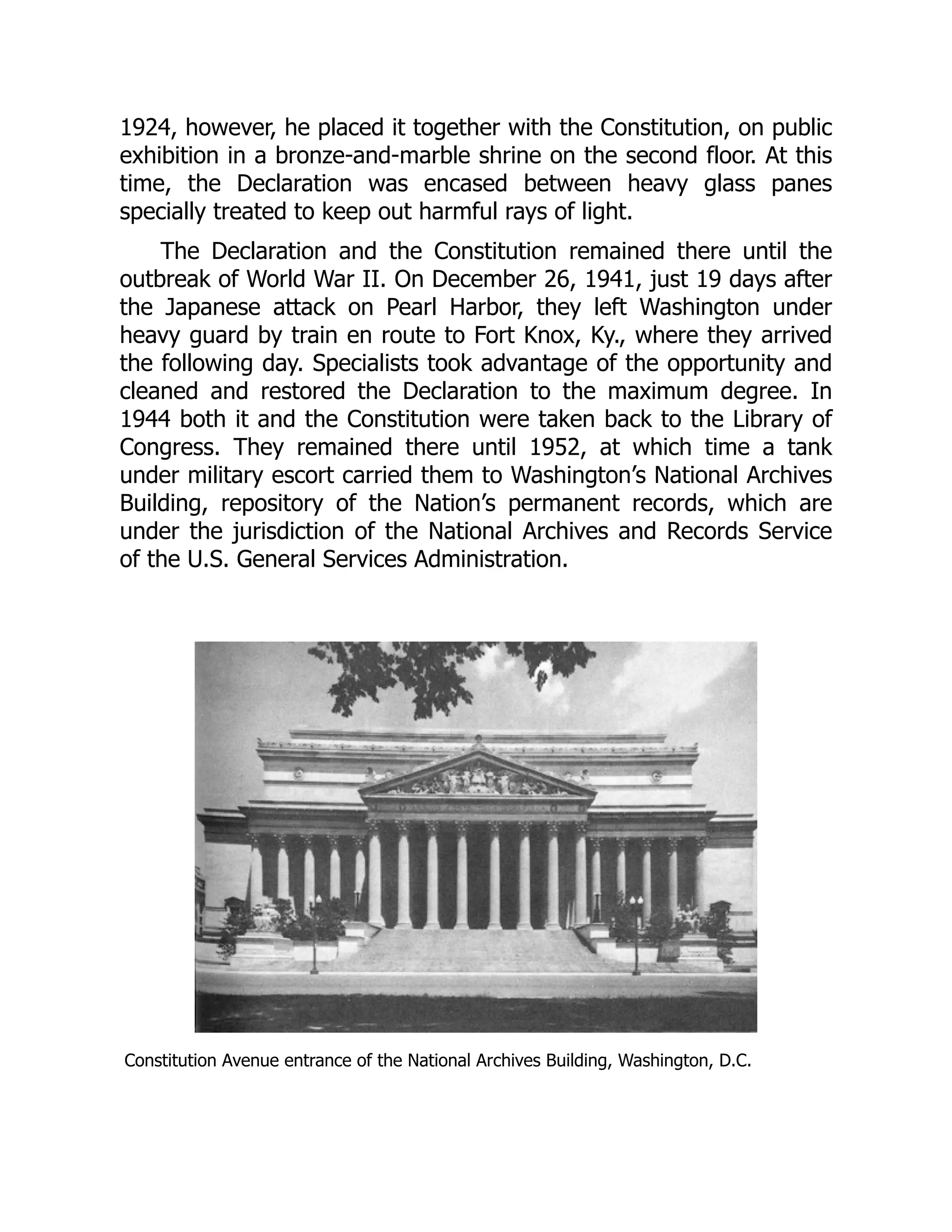
1924, however, heplaced it together with the Constitution, on public
exhibition in a bronze-and-marble shrine on the second floor. At this
time, the Declaration was encased between heavy glass panes
specially treated to keep out harmful rays of light.
The Declaration and the Constitution remained there until the
outbreak of World War II. On December 26, 1941, just 19 days after
the Japanese attack on Pearl Harbor, they left Washington under
heavy guard by train en route to Fort Knox, Ky., where they arrived
the following day. Specialists took advantage of the opportunity and
cleaned and restored the Declaration to the maximum degree. In
1944 both it and the Constitution were taken back to the Library of
Congress. They remained there until 1952, at which time a tank
under military escort carried them to Washington’s National Archives
Building, repository of the Nation’s permanent records, which are
under the jurisdiction of the National Archives and Records Service
of the U.S. General Services Administration.
Constitution Avenue entrance of the National Archives Building, Washington, D.C.
47.
This marble shrineat the rear center of Exhibition Hall, National Archives Building,
contains the Declaration of Independence, the Constitution, and the Bill of Rights.
* * * * *
Still enshrined there today, along with thousands of other priceless
national records, is the parchment copy of the Declaration. The
massive bronze doors at the Constitution Avenue entrance to the
building lead to the circular Exhibition Hall. At its rear center stands
48.
a marble shrinecontaining the Declaration of Independence, the
Constitution, and the Bill of Rights. They are sealed in helium-filled
bronze and glass cases, screened from harmful light rays by special
filters, and can be lowered within seconds into a large fireproof,
shockproof, and bombproof vault.
The hall also features a “Formation of the Union” exhibit, a
collection of documents illustrating the evolution of the U.S.
Government from 1774 until 1791. They include the Articles of
Association (1774), the Articles of Confederation (1777), the Treaty
of Paris (1783), and Washington’s inaugural address (1789). Above
the exhibits are two murals. In one, Jefferson is presenting the
Declaration to John Hancock, President of the Continental Congress;
in the other, James Madison is submitting the Constitution to George
Washington, President of the Constitutional Convention.
49.
Suggested Reading
BECKER, CARLL. The Declaration of Independence: A Study
in the History of Political Ideas. New York: rev. ed.,
Harcourt, Brace, 1942. A classic and scholarly study,
originally published in 1922, that analyzes the
Declaration in terms of its political background,
philosophical origins, and literary merit, and discusses
subsequent reaction to it.
BOYD, JULIAN P. The Declaration of Independence: The
Evolution of the Text as Shown in Facsimiles of Various
Drafts by Its Author, Thomas Jefferson. Princeton, N.J.:
Princeton University Press, 1945. This valuable work is
a revised edition of a study published by the Library of
Congress in 1943 in connection with the bicentennial
celebration of Jefferson’s birth. Examines the nature
and evolution of the various drafts.
BURNETT, EDMUND C. The Continental Congress. New York:
Macmillan, 1941. Although written in a cumbersome
style, this book remains one of the best on its subject.
Includes chapters dealing with the events surrounding
adoption of the Declaration.
DUMBAULD, EDWARD. The Declaration of Independence and
What It Means Today. Norman, Okla.: University of
Oklahoma Press, 1950. Phrase-by-phrase study of the
contents of the document and differences in the
several drafts. Also treats the underlying intellectual
and political influences.
50.
MALONE, DUMAS. TheStory of the Declaration of
Independence. New York: Oxford University Press,
1954. Enhancing this readable account of the early
phases of the Revolution and biographical sketches of
the signers is a fine collection of illustrations
assembled by Hirst Milhollen and Milton Kaplan.
McGEE, DOROTHY H. Famous Signers of the Declaration. New
York: Dodd, Mead, 1955. One of a series oriented to
young readers, this volume presents biographies of
selected signers.
NATIONAL ARCHIVES. The Formation of the Union.
Washington: National Archives and Records Service
(Pub. No. 70-13), 1970. A handsome but moderately
priced brochure that consists of a brief history of the
period 1774–91 and facsimiles of key documents.
WHITNEY, DAVID C. Founders of Freedom in America: Lives
of the Men Who Signed the Declaration of
Independence and So Helped to Establish the United
States of America. Chicago: J. G. Ferguson, 1964. This
superbly illustrated work is one of the best popular
versions of the events of the Revolutionary period and
those associated with the signing. Includes biographies
of the signers and patriots Patrick Henry and James
Otis.
51.
Criteria for Selectionof Historic
Sites of National Significance
A. National significance is ascribed to buildings, sites, objects, or
districts which possess exceptional value or quality in illustrating or
interpreting the historical (history and archeology) heritage of our
Nation, such as:
1. Structures or sites at which events occurred that have made a
significant contribution to, and are identified prominently with, or
which outstandingly represent, the broad cultural, political,
economic, military, or social history of the Nation, and from which an
understanding and appreciation of the larger patterns of our
American heritage may be gained.
2. Structures or sites associated importantly with the lives of
persons nationally significant in the history of the United States.
3. Structures or sites associated significantly with an important
event that outstandingly represents some great idea or ideal of the
American people.
4. Structures that embody the distinguishing characteristics of an
architectural type specimen, exceptionally valuable for a study of a
period, style, or method of construction; or a notable structure
representing the work of a master builder, designer, or architect.
5. Objects that figured prominently in nationally significant
events; or that were prominently associated with nationally
significant persons; or that outstandingly represent some great idea
or ideal of the American people; or that embody distinguishing
characteristics of a type specimen, exceptionally valuable for a study
52.
of a period,style, or method of construction; or that are notable as
representations of the work of master workers or designers.
6. Archeological sites that have produced information of a major
scientific importance by revealing new cultures, or by shedding light
upon periods of occupation over large areas of the United States.
Such sites are those which have produced, or which may reasonably
be expected to produce, data affecting theories, concepts, and ideas
to a major degree.
7. When preserved or restored as integral parts of the
environment, historic buildings not sufficiently significant individually
by reason of historical association or architectural merit to warrant
recognition may collectively compose a “historic district” that is of
historical significance to the Nation in commemorating or illustrating
a way of life in its developing culture.
B. To possess national significance, a historic or prehistoric
structure, district, site, or object must possess integrity. For a
historic or prehistoric site, integrity requires original location and
intangible elements of feeling and association. The site of a structure
no longer standing may possess national significance if the person or
event associated with the structure was of transcendent importance
in the Nation’s history and the association consequential.
For a historic or prehistoric structure, integrity is a composite
quality derived from original workmanship, original location, and
intangible elements of feeling and association. A structure no longer
on the original site may possess national significance if the person or
event associated with it was of transcendent importance in the
Nation’s history and the association consequential.
For a historic district, integrity is a composite quality derived
from original workmanship, original location, and intangible elements
of feeling and association inherent in an ensemble of historic
buildings having visual architectural unity.
For a historic object, integrity requires basic original
workmanship.
53.
C. Structures orsites which are primarily of significance in the
field of religion or to religious bodies but are not of national
importance in other fields of the history of the United States, such as
political, military, or architectural history, will not be eligible for
consideration.
D. Birthplaces, graves, burials, and cemeteries, as a general
rule, are not eligible for consideration and recognition except in
cases of historical figures of transcendent importance. Historic sites
associated with the actual careers and contributions of outstanding
historical personages usually are more important than their
birthplaces and burial places.
E. Structures, sites, and objects achieving historical importance
within the past 50 years will not as a general rule be considered
unless associated with persons or events of transcendent
significance.
54.
Acknowledgments
Advisory Board onNational Parks, Historic Sites,
Buildings, and Monuments (1971)
Durward L. Allen, Purdue University.
Hon. E. Y. Berry, Rapid City, S. Dak.
Anthony A. Buford, Clayton, Mo.
Loren C. Eiseley, University of Pennsylvania.
Mrs. Lyndon B. Johnson, Stonewall, Tex.
Peter C. Murphy, Jr., Springfield, Oreg.
Nathaniel A. Owings, San Francisco, Calif.
Melvin M. Payne, National Geographic Society.
Linden C. Pettys, Ann Arbor, Mich.
Steven Rose, Arcadia, Calif.
William G. Shade, Lehigh University.
Elisha Walker, Jr., New York, N.Y.
James W. Whittaker, Seattle, Wash.
National Park Service
Edwin C. Bearss, Historian, Historic Preservation Project (East),
Denver Service Center.
S. Sydney Bradford, Chief, Plans and Grants, National Register of
Historic Places.
George S. Cattanach, Jr., Program Coordinator, National Register of
Historic Places.
Henry A. Judd, Chief, Park Historic Architecture, Division of Historic
Architecture.
55.
Herbert E. Kahler,Chief (retired), Division of History and Archeology.
Ronald F. Lee, Special Assistant to the Director.
John Luzader, Historian, Historic Preservation Project (East), Denver
Service Center.
Warren A. McCullough, Management Assistant, Independence
National Historical Park, Pa.
John D. McDermott, Assistant Executive Secretary, Advisory Council
on Historic Preservation.
Thomas W. Mullen, Student Research Assistant (Northeastern
University), Division of History.
Denys Peter Myers, Architectural Historian, Division of History.
John D. R. Platt, Historian, Independence National Historical Park,
Pa.
Charles W. Porter III, Chief Historian (retired), Division of History.
Charles W. Snell, Historian, Division of History.
Martin I. Yoelson, Supervisory Interpretive Specialist, Independence
National Historical Park, Pa.
Other Individuals
Roland A. Block, Regional Director, Taconic State Park Commission,
Staatsburg, N.Y.
Jerry M. Bloomer, Secretary-Registrar, R. W. Norton Art Gallery,
Shreveport.
Edwin Cox, President, Virginia Historical Society, Richmond.
Alonzo T. Dill, West Point, Va.
Educational Programs Staff, National Archives and Records Service,
U.S. General Services Administration.
56.
Ms. Constance M.Greiff, Vice President, Historical Society of
Princeton, N.J.
Ms. Virginia Gunter, Curator, New Hampshire Historical Society,
Concord.
Edgar R. Lafferty, Jr., Elsing Green, King William, Va.
Charles H. McCormick, Assistant Professor of History, Fairmont State
College, Fairmont, W. Va.
Ms. Mildred Steinbach, Librarian, Frick Art Reference Library, New
York.
E. Berkeley Tompkins, Director, Division of Historical and Cultural
Affairs, Department of State, State of Delaware, Dover.
57.
Art and PictureCredits
The National Park Service gratefully acknowledges the assistance
of agencies and individuals furnishing illustrations and granting
permission to reproduce them.
Page
ii Oil (1817) by John Trumbull, after his earlier painting of the
same name (1786–95). Color separations courtesy United States
Capitol Historical Society and Eastern National Park and
Monument Association. Of the 48 individuals in the painting, 44
are signers. The likenesses were the basis for many later
portraits by other artists.
4 Oil (date unknown) by Allan Ramsay. Library of Congress.
5 Engraving (1770) by Paul Revere. Library of Congress.
6 Lithograph (1830) by either William or John Pendleton, after a
cartoon (1774) published in London. Library of Congress.
7 Lithograph (1846) by Nathaniel Currier. Library of Congress.
8 Engraving (1775) by Amos Doolittle. National Park Service.
9 Detail from broadside, publisher unknown. National Park
Service.
10 Engraving (ca. 1776) by an unknown artist. Library of Congress.
11 Library of Congress.
12 Oil (ca. 1858) by Bass Otis, after George Romney.
Independence National Historical Park.
58.
13 Mezzotint (1778)by an unknown artist, after Corbutt. Library of
Congress.
14 Oil (ca. 1782) by Charles Willson Peale. Independence National
Historical Park.
17 Library of Congress.
19 Engraving (1823) by William Stone. Library of Congress.
21 Library of Congress.
22 Engraving (1859) by John C. McRae, after Johannes A. S.
Oertel. Library of Congress.
23 Oil (date unknown) by Xavier D. Gratta. Valley Forge (Pa.)
Historical Society.
28 Oil (before 1897) by an unknown artist, after Thomas Sully.
Independence National Historical Park.
29 Oil (date unknown) by W. Trego. Valley Forge (Pa.) Historical
Society.
30 Engraving (ca. 1725–26) by William Burgis. Library of Congress.
33 Oil (ca. 1791–94) by Charles Willson Peale. Independence
National Historical Park.
36 Oil (1873) by Nahum B. Onthank, after John S. Copley.
Independence National Historical Park.
39 Oil (1871) by Caroline Weeks, after John Trumbull.
Independence National Historical Park.
41 Oil (1901) by Albert Rosenthal, after a miniature by an
unknown artist. Independence National Historical Park. In 1913
Charles H. Hart, an authority on historical portraits, maintained
that this likeness was not Carter Braxton but was that of his
brother George.
43 Oil (1823) by Charles Willson Peale, after Rembrandt Peale.
Independence National Historical Park.
59.
45 Oil (1819)by Charles Willson Peale, after his 1773 painting.
Independence National Historical Park.
47 Oil (1873) by James R. Lambdin, after John Trumbull.
Independence National Historical Park.
48 Wood engraving by an unknown artist, after F. O. C. Darley,
from Henry Howe, Life and Death on the Ocean (1855). Library
of Congress.
49 Oil (1872) by Edward D. Marchant, after Charles Willson Peale.
Independence National Historical Park.
50 Pen and ink drawing by an unknown artist, from Magazine of
American History (September 1880). Library of Congress.
51 Oil (1876) by Samuel B. Waugh, after John Trumbull.
Independence National Historical Park.
53 Oil (1874) by Edward L. Henry, after Ralph Earl (Earle).
Independence National Historical Park.
55 Oil (date unknown) by David Martin. Pennsylvania Academy of
Fine Arts, Philadelphia.
57 Engraving (1859) by Robert Whitechurch, after Christian
Schussele. Library of Congress.
59 Oil (1861) by James Bogle, after John Vanderlyn. Independence
National Historical Park.
62 Detail from the lithograph “Signers of the Declaration of
Independence,” published in 1876 by Ole Erekson. Library of
Congress. The detail is a conjectural representation; no portrait
or reliable likeness of Button Gwinnett is known to exist.
63 Lithograph, probably by an artist named Ferris, from William
Brotherhead, The Book of the Signers (1861). Library of
Congress.
65 Detail from the lithograph “Signers of the Declaration of
Independence,” published in 1876 by Ole Erekson. Library of
60.
Congress.
67 Oil (1816)by Samuel F. B. Morse, after John S. Copley.
Independence National Historical Park.
70 Oil (1873) by James R. Lambdin, after John Trumbull.
Independence National Historical Park.
71 Oil (ca. 1884) by Herman F. Deigendisch, after Henry Bryan, Jr.
Independence National Historical Park. Some authorities have
questioned the authenticity of this likeness.
73 Oil (before 1893) by an unknown artist, after Charles Willson
Peale. Independence National Historical Park.
74 Engraving by James B. Longacre, after Charles Willson Peale,
from James Herring and James B. Longacre, The National
Portrait Gallery of Distinguished Americans (1836). Library of
Congress.
75 Oil (before 1851) by Charles Fraser, after Jeremiah Theus.
Independence National Historical Park.
77 Oil (1873) by James R. Lambdin, after John Trumbull.
Independence National Historical Park.
79 Oil (1873) by James R. Lambdin, after John Trumbull.
Independence National Historical Park. According to one
authority, Trumbull based his likeness on the features of
Hopkins’ eldest son, Rufus, who bore a close resemblance to his
father.
81 Oil (before 1854) by Dubois (probably Samuel T.), after Robert
E. Pine. Historical Society of Pennsylvania and Independence
National Historical Park.
83 Oil (1783) by Charles Willson Peale. Independence National
Historical Park.
85 Oil (1791) by Charles Willson Peale. Independence National
Historical Park.
61.
87 Library ofCongress.
89 Engraving (1826) by Benjamin Tanner. Library of Congress.
90 Detail from the lithograph “Signers of the Declaration of
Independence,” published in 1876 by Ole Erekson. Library of
Congress.
92 Oil (1784) by Charles Willson Peale. Independence National
Historical Park.
94 Oil (1906) by Albert Rosenthal, after an engraving from John
Sanderson, Biography of the Signers to the Declaration of
Independence (1824). Independence National Historical Park.
96 Oil (ca. 1770) probably by Abraham Delanoy, Jr. Frick Art
Reference Library, New York City, and Taconic State Park
Commission, Staatsburg, N.Y.
97 Pen and ink drawing by an unknown artist, from Magazine of
American History (December 1885). Library of Congress.
99 Oil (1875) by Anna Lea, after John Trumbull. Independence
National Historical Park.
100 Oil (1797) by Charles Willson Peale. Independence National
Historical Park.
103 Oil (1872) by Philip F. Wharton, after Benjamin West.
Independence National Historical Park.
104 Oil (1873) by Charles N. Flagg, after John Trumbull.
Independence National Historical Park.
106 Oil (ca. 1872) by Charles Willson Peale. Independence National
Historical Park.
107 Engraving by William Birch, from The City of Philadelphia
(1800). Independence National Historical Park.
109 Watercolor (ca. 1765) by Pierre Eugene Du Simitière. The R. W.
Norton Art Gallery, Shreveport, La.
62.
110 Oil (ca.1876) by William L. Sheppard, after Mason Chamberlin.
Independence National Historical Park.
112 Oil (date unknown) by Louis E. Lami. Hangs in the Virginia
State Capitol. National Park Service.
113 Oil (date unknown) by Francis B. Mayer, after Charles Willson
Peale. Independence National Historical Park.
115 Oil (1876) by Richard M. Staigg, after Edward Savage.
Independence National Historical Park.
116 Detail from the lithograph “Signers of the Declaration of
Independence,” published in 1876 by Ole Erekson. Library of
Congress.
118 Oil (1860) by Thomas Sully, after Robert E. Pine. Independence
National Historical Park.
120 Detail from the lithograph “Signers of the Declaration of
Independence,” published in 1876 by Ole Erekson. Library of
Congress.
122 Oil (1873) by Philip F. Wharton, after Benjamin West.
Independence National Historical Park.
123 Oil (1783) by Charles Willson Peale. The Henry Francis du Pont
Winterthur Museum, Winterthur, Del. Gift of Mrs. Julia B. Henry.
125 Engraving (1799) by William Birch & Son. Library of Congress.
127 Oil (1873) by Philip F. Wharton, after James Earl (Earle).
Independence National Historical Park.
129 Oil (1874–75) by Thomas Hicks, after Ralph Earl (Earle).
Independence National Historical Park.
130 Lithograph by an unknown artist, from William Brotherhead,
The Book of the Signers (1861). Library of Congress.
132 Watercolor (ca. 1760) by an unknown artist. The R. W. Norton
Art Gallery, Shreveport, La.
63.
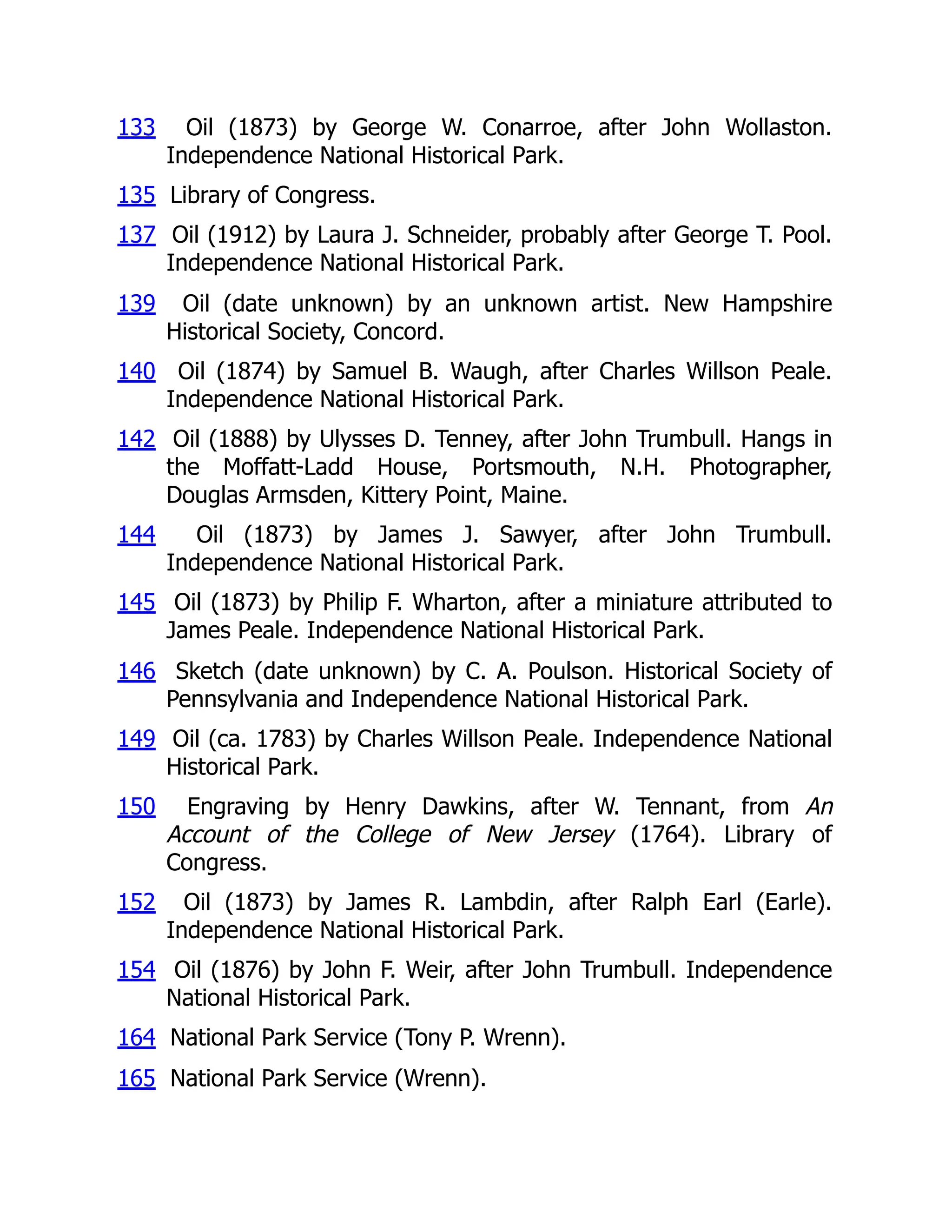
133 Oil (1873)by George W. Conarroe, after John Wollaston.
Independence National Historical Park.
135 Library of Congress.
137 Oil (1912) by Laura J. Schneider, probably after George T. Pool.
Independence National Historical Park.
139 Oil (date unknown) by an unknown artist. New Hampshire
Historical Society, Concord.
140 Oil (1874) by Samuel B. Waugh, after Charles Willson Peale.
Independence National Historical Park.
142 Oil (1888) by Ulysses D. Tenney, after John Trumbull. Hangs in
the Moffatt-Ladd House, Portsmouth, N.H. Photographer,
Douglas Armsden, Kittery Point, Maine.
144 Oil (1873) by James J. Sawyer, after John Trumbull.
Independence National Historical Park.
145 Oil (1873) by Philip F. Wharton, after a miniature attributed to
James Peale. Independence National Historical Park.
146 Sketch (date unknown) by C. A. Poulson. Historical Society of
Pennsylvania and Independence National Historical Park.
149 Oil (ca. 1783) by Charles Willson Peale. Independence National
Historical Park.
150 Engraving by Henry Dawkins, after W. Tennant, from An
Account of the College of New Jersey (1764). Library of
Congress.
152 Oil (1873) by James R. Lambdin, after Ralph Earl (Earle).
Independence National Historical Park.
154 Oil (1876) by John F. Weir, after John Trumbull. Independence
National Historical Park.
164 National Park Service (Tony P. Wrenn).
165 National Park Service (Wrenn).
64.
167 National ParkService (Wrenn).
168 National Park Service (Wrenn).
169 National Park Service (Wrenn).
171 National Park Service (Abbie Rowe).
172 Aquatint by an unknown artist, from Charles W. Janson, The
Stranger in America (1807). Library of Congress.
174 National Park Service (Charles W. Snell).
175 National Park Service (John O. Littleton).
178 National Park Service (Wrenn).
179 National Park Service (Littleton).
181 National Park Service (Snell).
182 National Park Service (Littleton).
184 National Park Service (Snell).
185 National Park Service (Snell).
187 Photographer, William L. Klender.
188 National Park Service (Littleton).
190 National Park Service (Littleton).
192 Engraving (date unknown) probably by Stephen A. Schouff.
Library of Congress.
194 National Park Service (Joseph L. Winn, Jr.).
196 National Park Service (Wrenn).
197 National Park Service (Wrenn).
198 National Park Service (Snell).
200 National Park Service (Wrenn).
201 National Park Service (Wrenn).
203 National Park Service (Snell).
65.
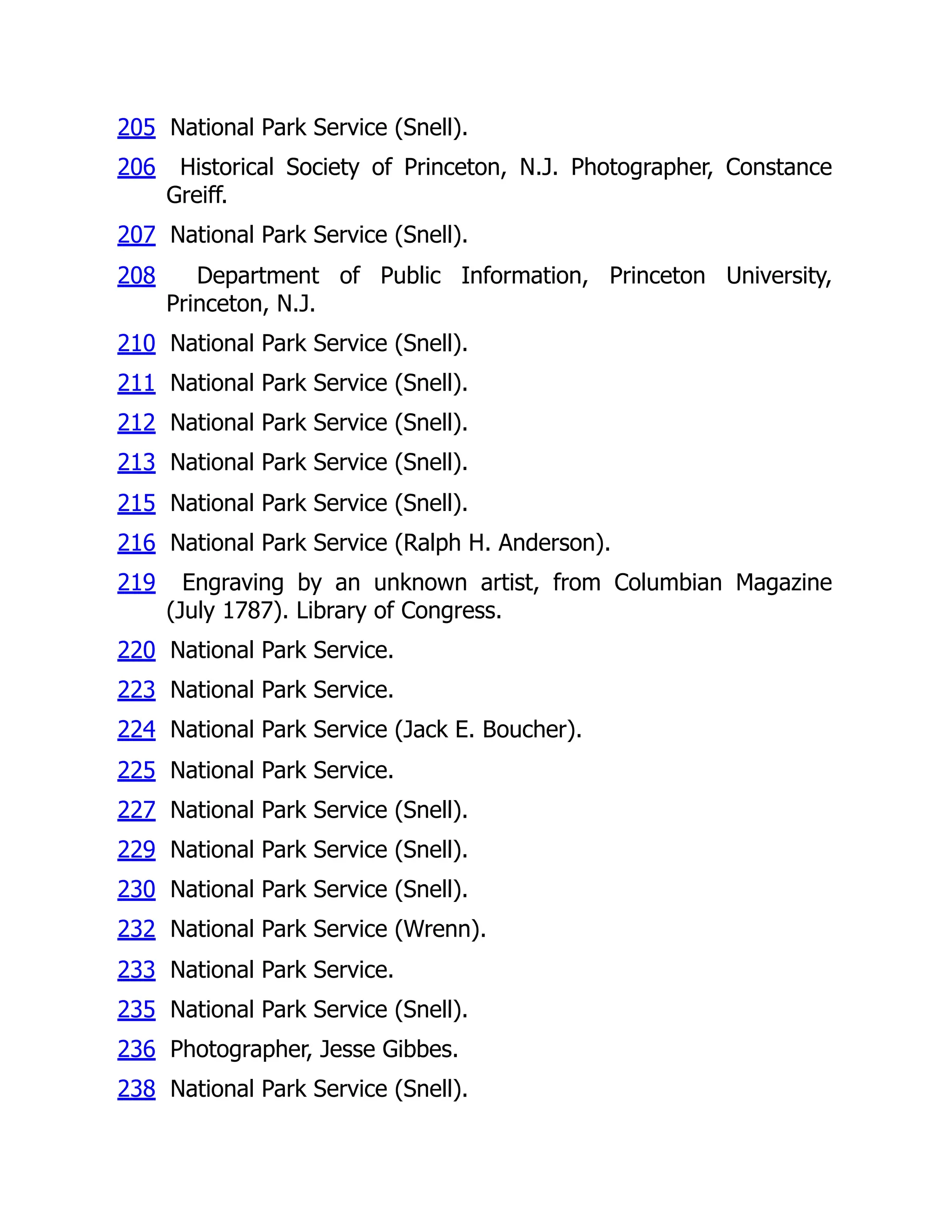
205 National ParkService (Snell).
206 Historical Society of Princeton, N.J. Photographer, Constance
Greiff.
207 National Park Service (Snell).
208 Department of Public Information, Princeton University,
Princeton, N.J.
210 National Park Service (Snell).
211 National Park Service (Snell).
212 National Park Service (Snell).
213 National Park Service (Snell).
215 National Park Service (Snell).
216 National Park Service (Ralph H. Anderson).
219 Engraving by an unknown artist, from Columbian Magazine
(July 1787). Library of Congress.
220 National Park Service.
223 National Park Service.
224 National Park Service (Jack E. Boucher).
225 National Park Service.
227 National Park Service (Snell).
229 National Park Service (Snell).
230 National Park Service (Snell).
232 National Park Service (Wrenn).
233 National Park Service.
235 National Park Service (Snell).
236 Photographer, Jesse Gibbes.
238 National Park Service (Snell).
66.
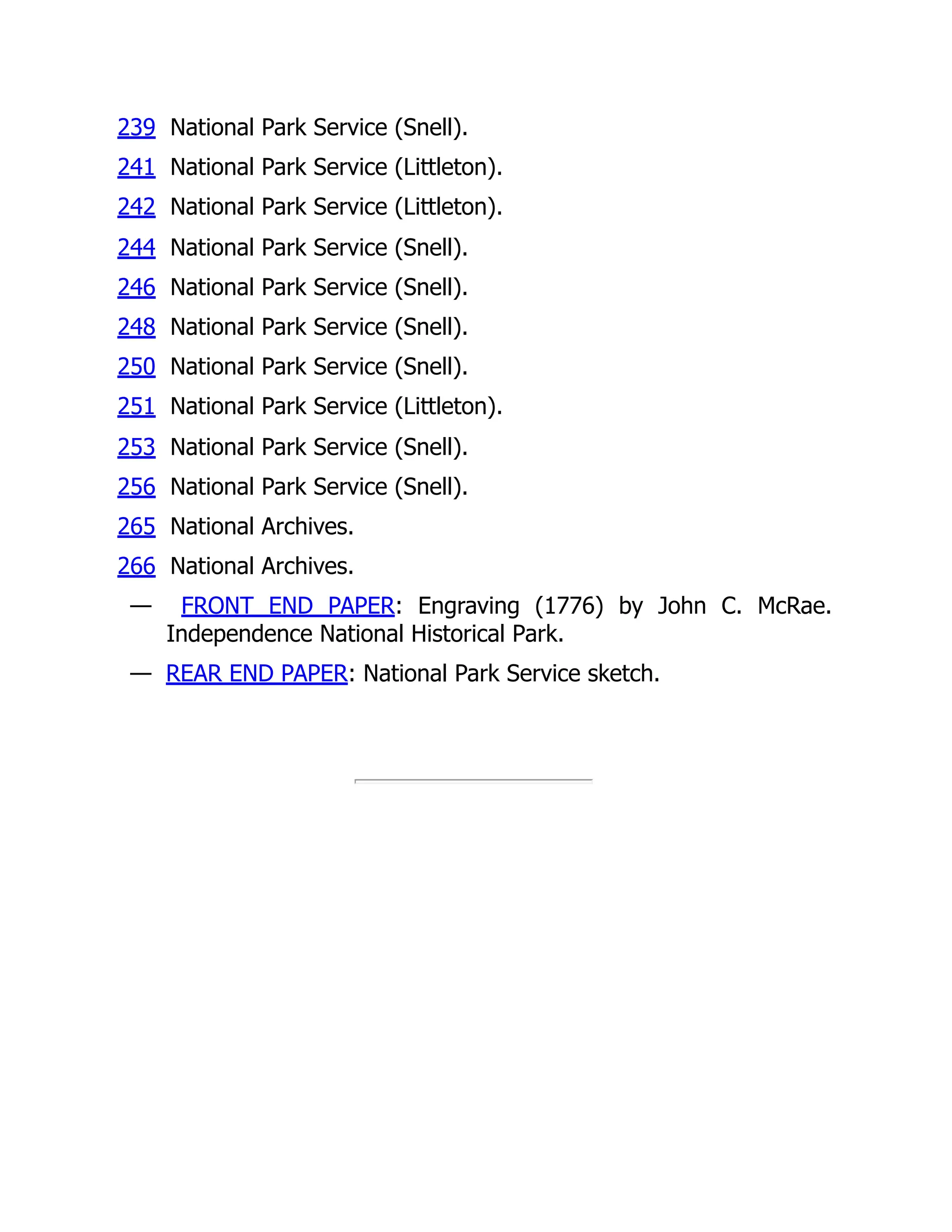
239 National ParkService (Snell).
241 National Park Service (Littleton).
242 National Park Service (Littleton).
244 National Park Service (Snell).
246 National Park Service (Snell).
248 National Park Service (Snell).
250 National Park Service (Snell).
251 National Park Service (Littleton).
253 National Park Service (Snell).
256 National Park Service (Snell).
265 National Archives.
266 National Archives.
— FRONT END PAPER: Engraving (1776) by John C. McRae.
Independence National Historical Park.
— REAR END PAPER: National Park Service sketch.