Firma convenzione
Politecnico di Milano e Veneranda Fabbrica
del Duomo di Milano
Aula Magna – Rettorato
Mercoledì 27 maggio 2015
A formulation for the unsteady aerodynamics of
floating wind turbines, with focus on the global
system dynamics
I. Bayati, M. Belloli, L. Bernini, A. Zasso
Politecnico di Milano, Department of Mechanical Engineering
I. Bayati, M. Belloli, L. Bernini, A. Zasso
• Motivations and goals
• The proposed formulation
• Observations on unsteady aerodynamics
• Experimental results form imposed motion tests
• Conclusions
Presentation outline
I. Bayati, M. Belloli, L. Bernini, A. Zasso
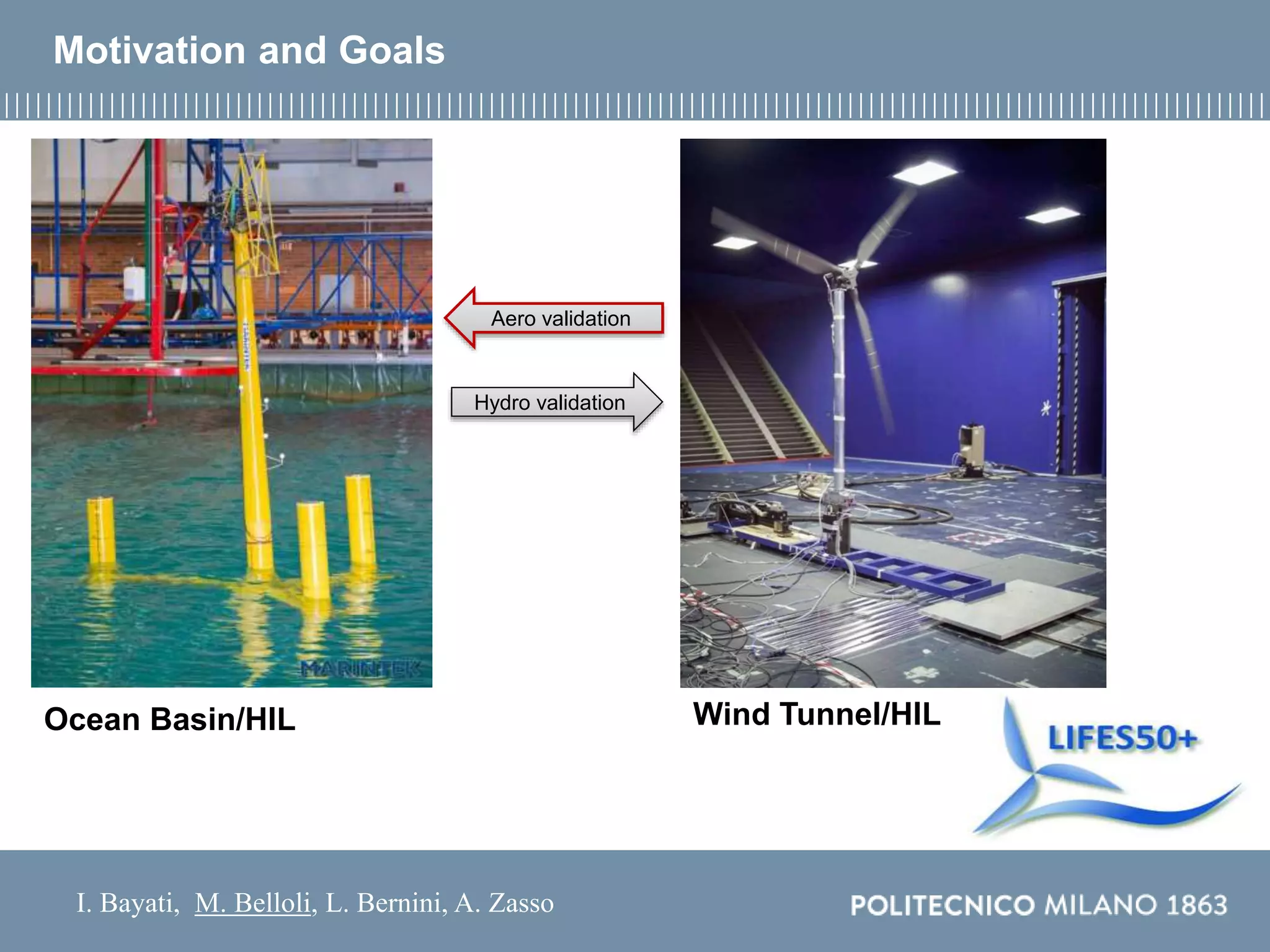
Ocean Basin/HIL Wind Tunnel/HIL
Hydro validation
Aero validation
Motivation and Goals
I. Bayati, M. Belloli, L. Bernini, A. Zasso
• FOWT are subjected to large motion induced by the interaction with
the waves
• A calibration of the numerical model in strong unsteady conditions
is needed for FOWT modelling
• Imposed motion tests represent a good solution to understand how
the wind turbine aerodynamics is influenced by these large motion
• Our focus is on the dynamics of the whole mechanical system
Motivation and goals
I. Bayati, M. Belloli, L. Bernini, A. Zasso
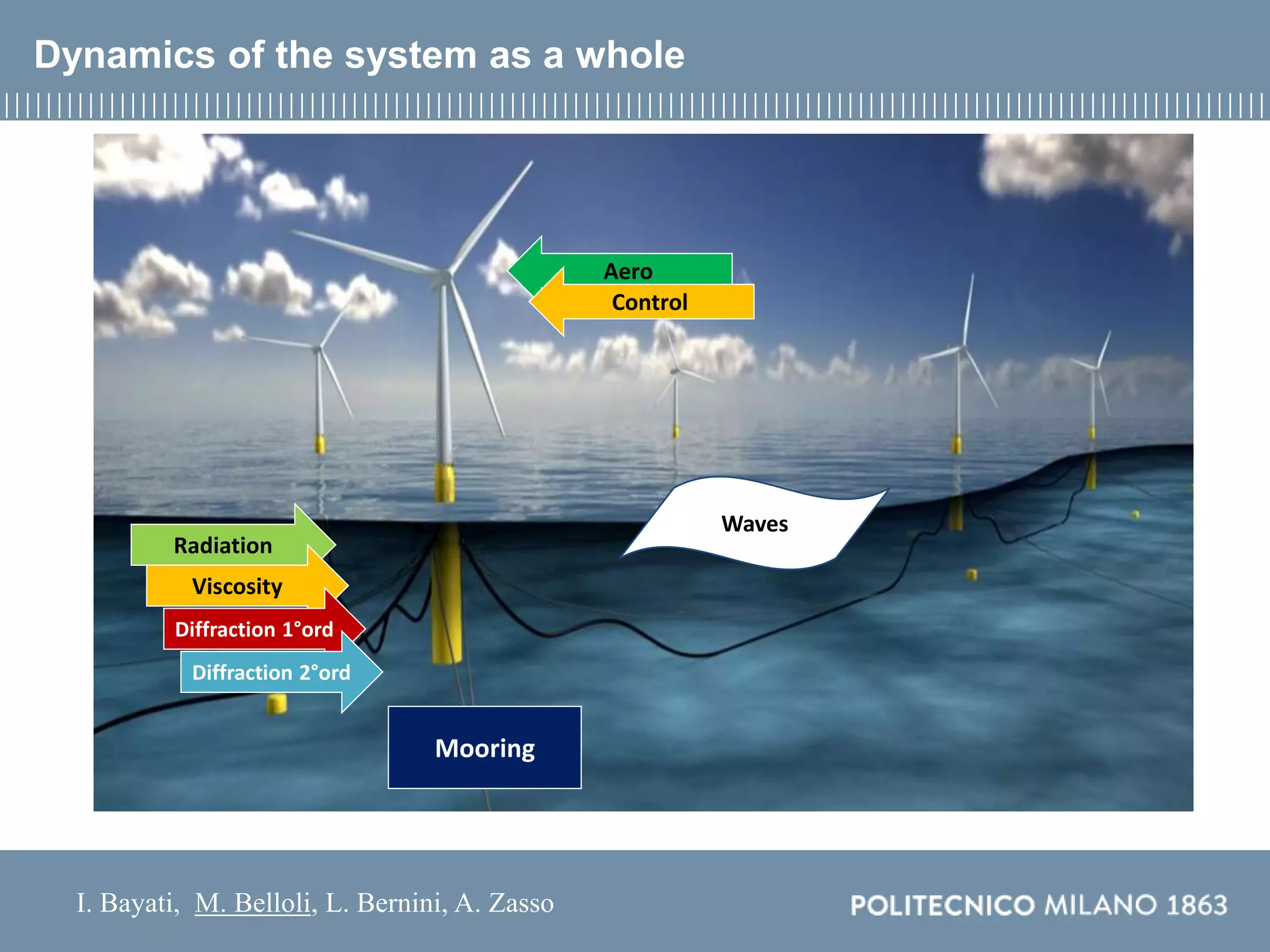
Dynamics of the system as a whole
Mooring
Waves
Radiation
Viscosity
Diffraction 1°ord
Diffraction 2°ord
Aero
Control
I. Bayati, M. Belloli, L. Bernini, A. Zasso
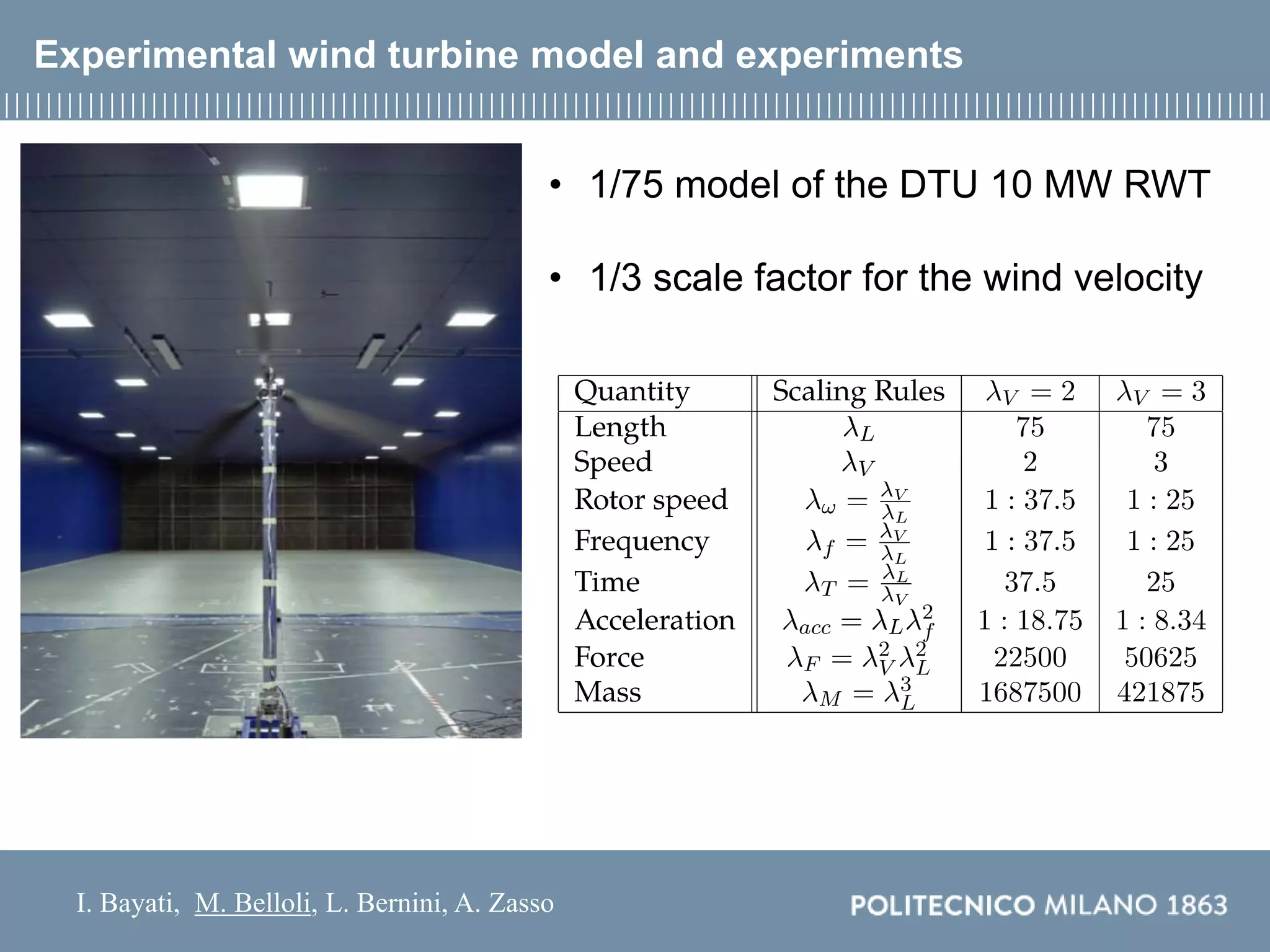
Experimental wind turbine model and experiments
• 1/75 model of the DTU 10 MW RWT
• 1/3 scale factor for the wind velocity
I. Bayati, M. Belloli, L. Bernini, A. Zasso
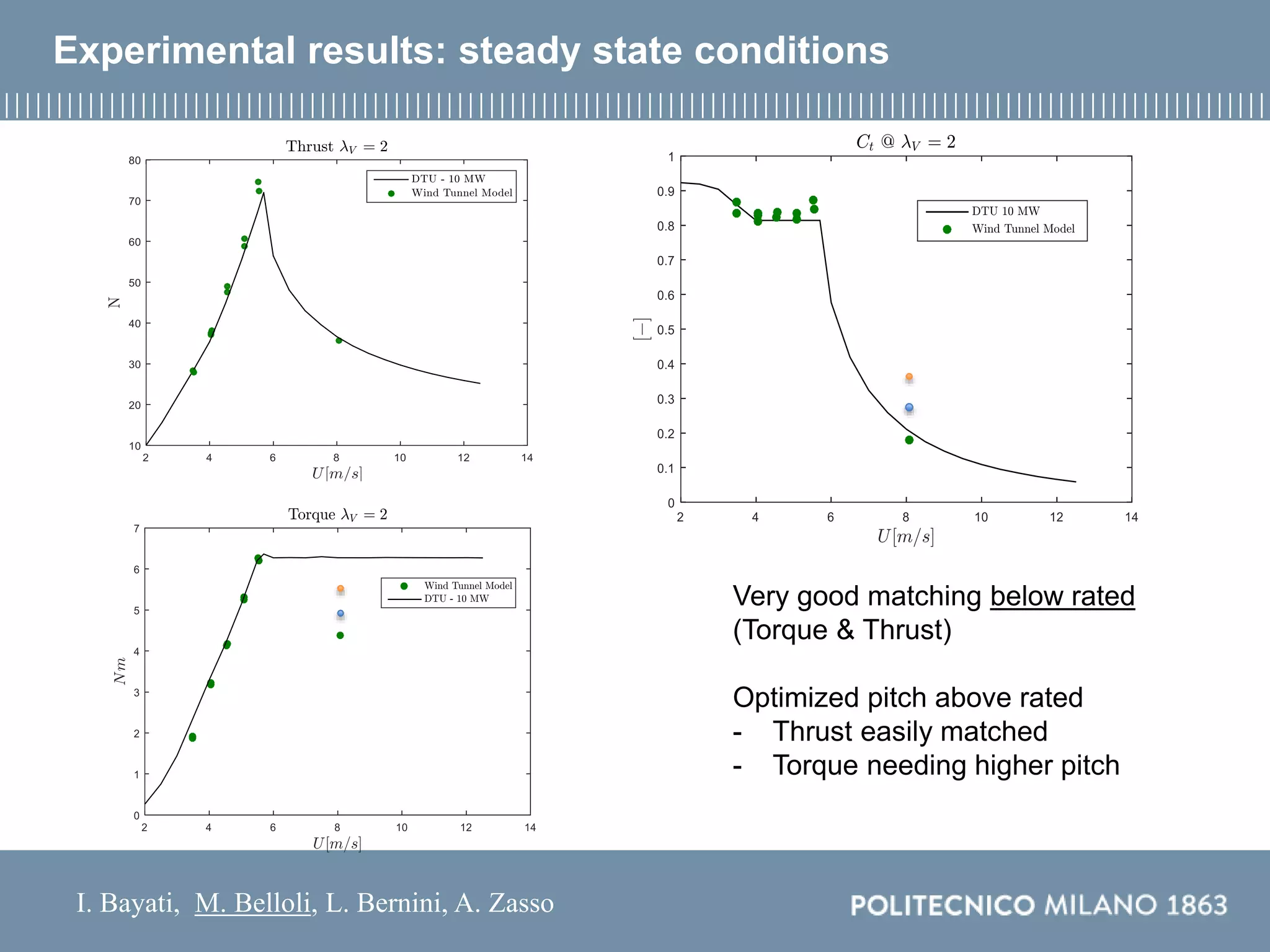
Very good matching below rated
(Torque & Thrust)
Optimized pitch above rated
- Thrust easily matched
- Torque needing higher pitch
Experimental results: steady state conditions
I. Bayati, M. Belloli, L. Bernini, A. Zasso
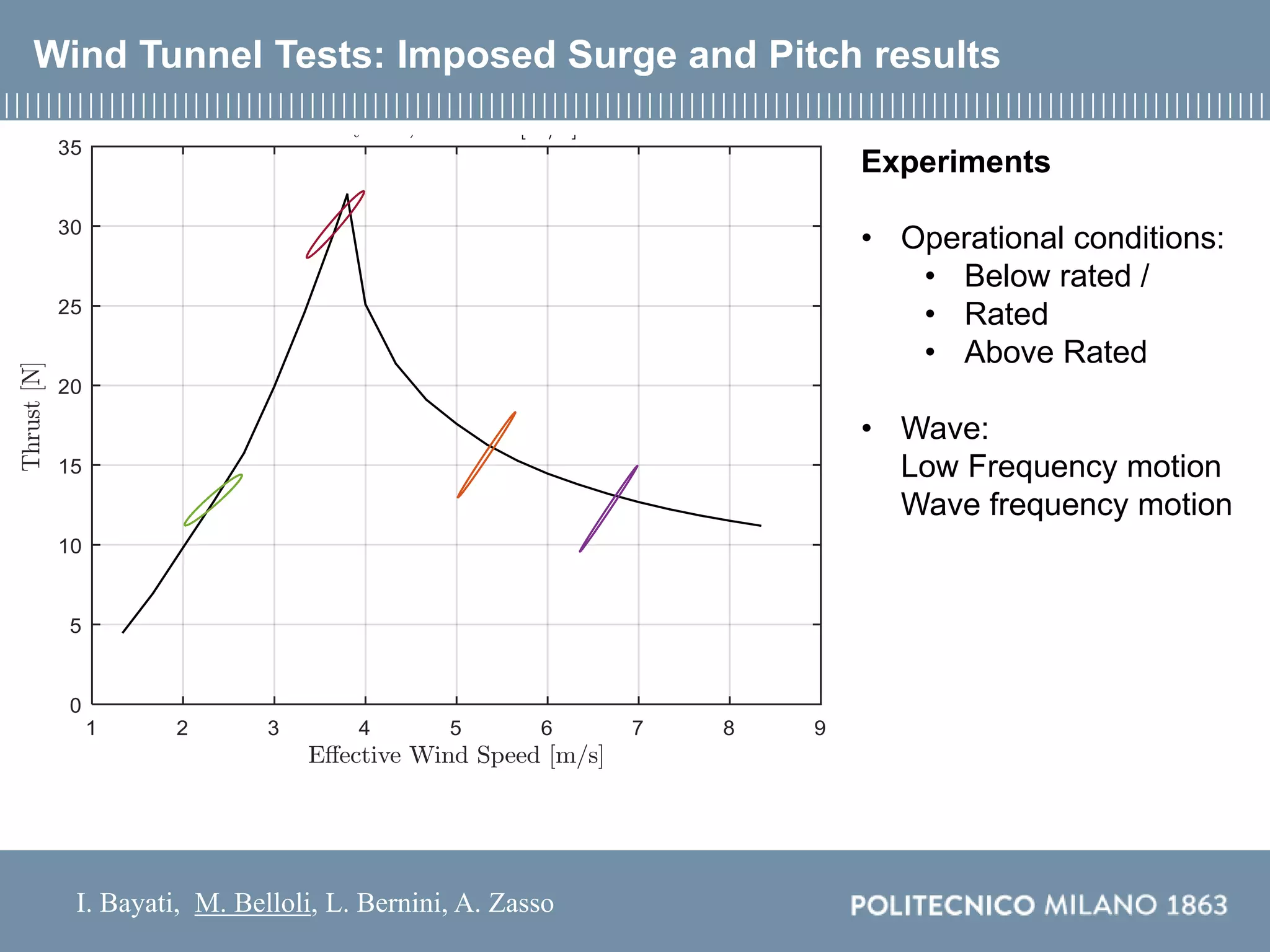
Wind Tunnel Tests: Imposed Surge and Pitch results
Experiments
• Operational conditions:
• Below rated /
• Rated
• Above Rated
• Wave:
Low Frequency motion
Wave frequency motion
I. Bayati, M. Belloli, L. Bernini, A. Zasso
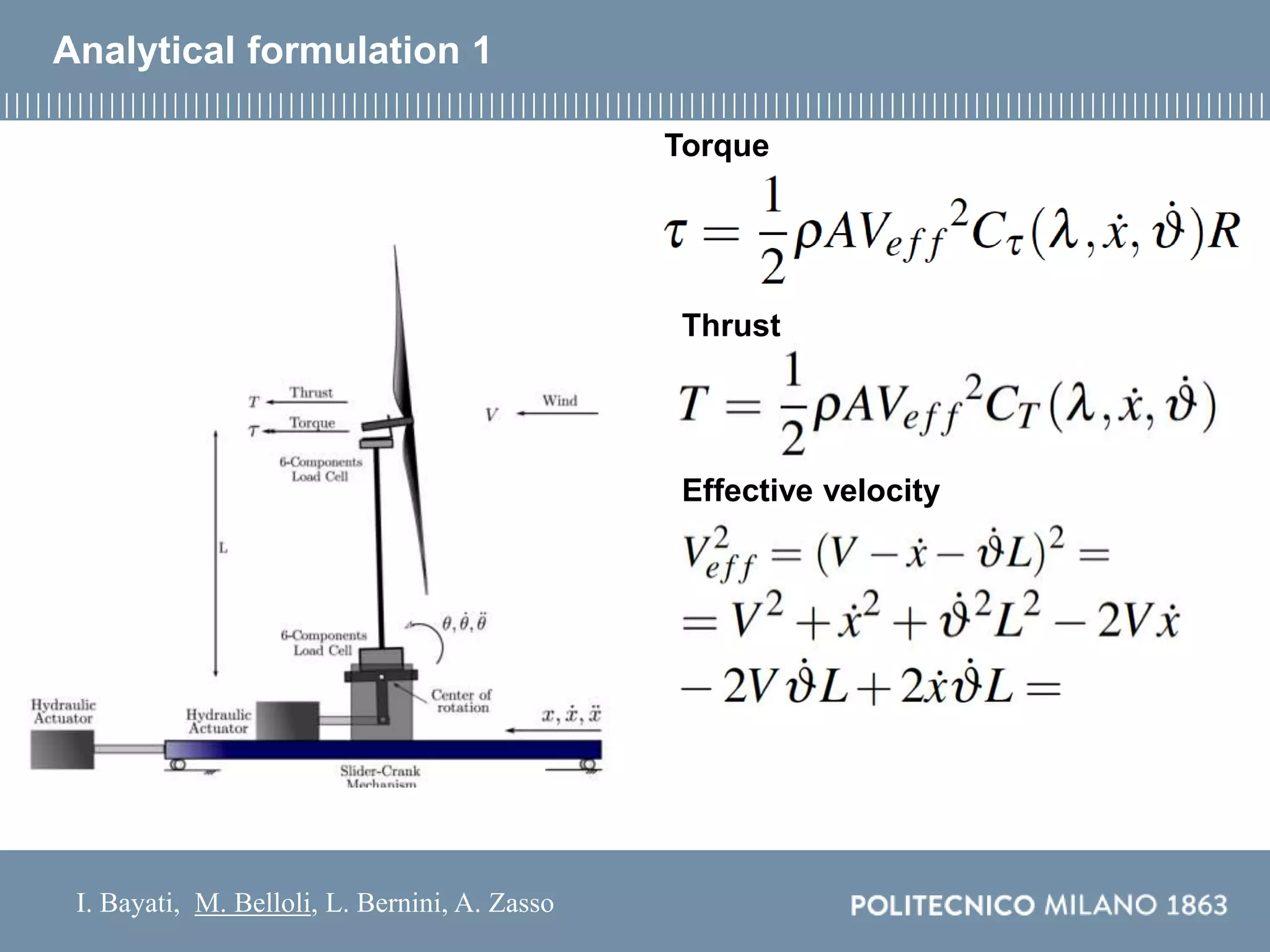
Analytical formulation 1
Torque
Thrust
Effective velocity
I. Bayati, M. Belloli, L. Bernini, A. Zasso
Analytical formulation 2
Our focus is on the dynamic behaviour of the whole system and we want to describe
the forces as function of the state space
Let’s try to linearize at fixed TSR and hence and fixed pitch angle
@
Unsteady coefficients
I. Bayati, M. Belloli, L. Bernini, A. Zasso
Analytical formulation 3
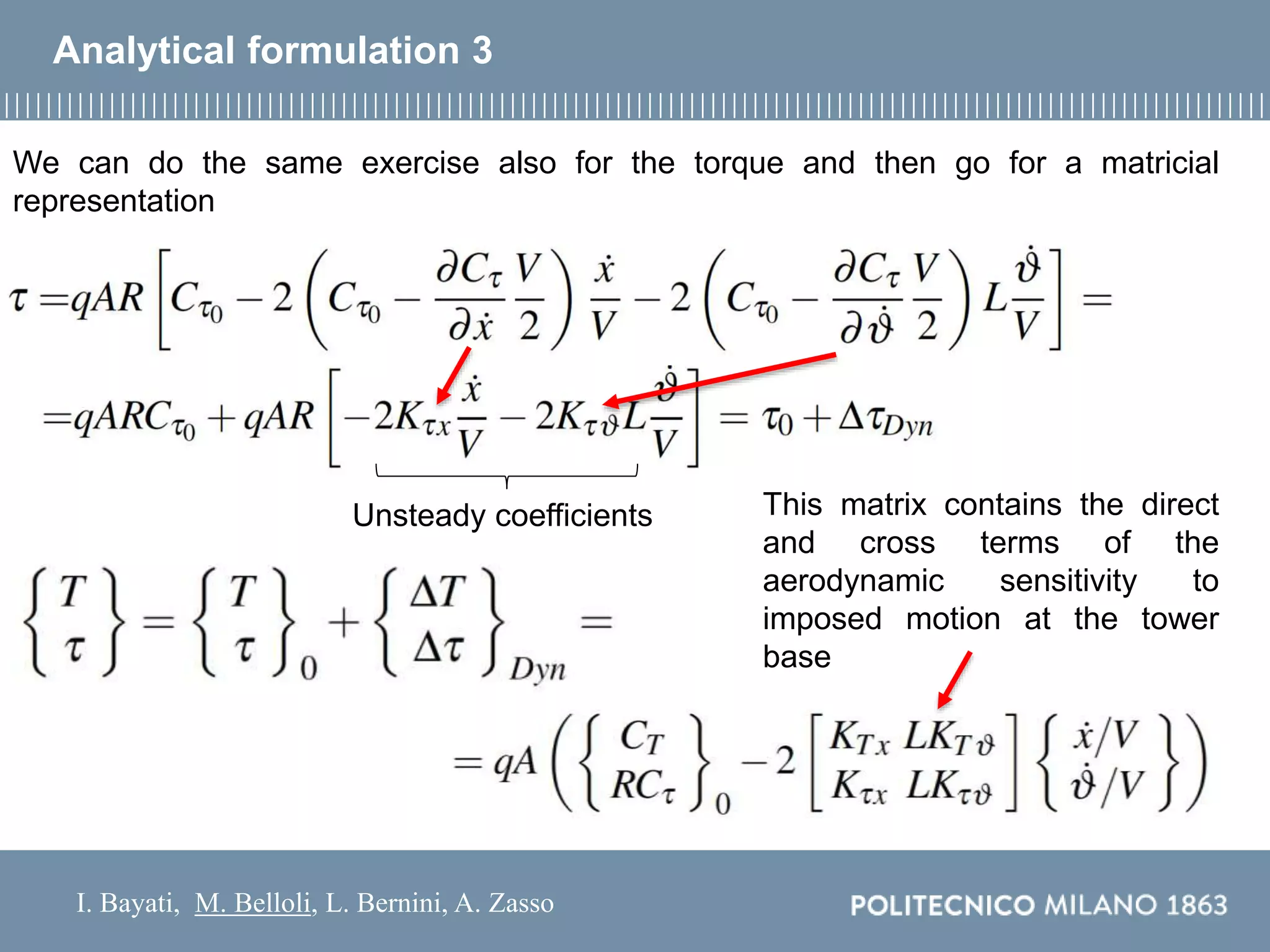
We can do the same exercise also for the torque and then go for a matricial
representation
Unsteady coefficients This matrix contains the direct
and cross terms of the
aerodynamic sensitivity to
imposed motion at the tower
base
I. Bayati, M. Belloli, L. Bernini, A. Zasso
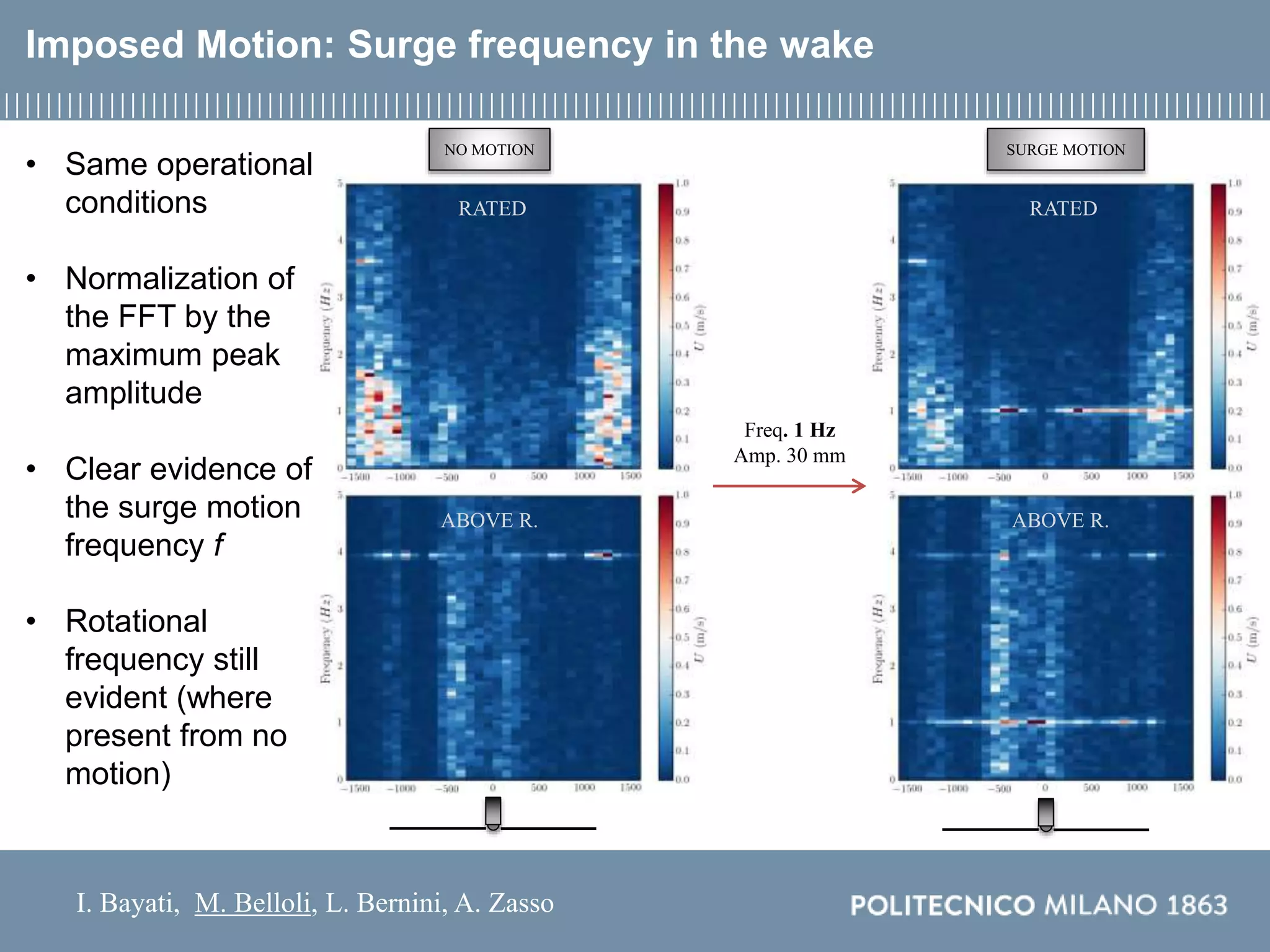
Imposed Motion: Surge frequency in the wake
Freq. 1 Hz
Amp. 30 mm
• Same operational
conditions
• Normalization of
the FFT by the
maximum peak
amplitude
• Clear evidence of
the surge motion
frequency f
• Rotational
frequency still
evident (where
present from no
motion)
NO MOTION SURGE MOTION
RATED
ABOVE R.
RATED
ABOVE R.
I. Bayati, M. Belloli, L. Bernini, A. Zasso
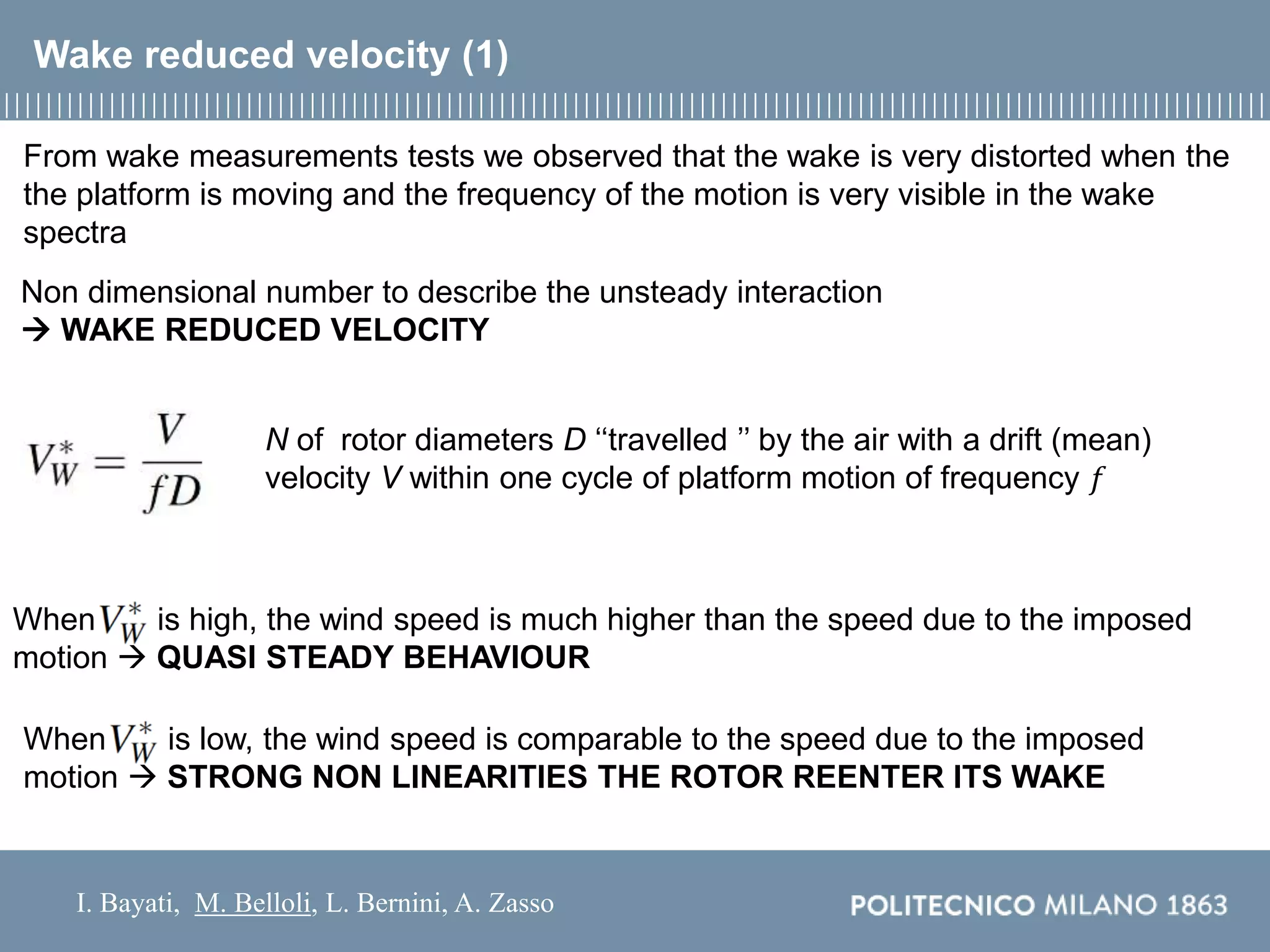
Wake reduced velocity (1)
Non dimensional number to describe the unsteady interaction
 WAKE REDUCED VELOCITY
N of rotor diameters D ‘‘travelled ’’ by the air with a drift (mean)
velocity V within one cycle of platform motion of frequency 𝑓
From wake measurements tests we observed that the wake is very distorted when the
the platform is moving and the frequency of the motion is very visible in the wake
spectra
When is high, the wind speed is much higher than the speed due to the imposed
motion  QUASI STEADY BEHAVIOUR
When is low, the wind speed is comparable to the speed due to the imposed
motion  STRONG NON LINEARITIES THE ROTOR REENTER ITS WAKE
I. Bayati, M. Belloli, L. Bernini, A. Zasso
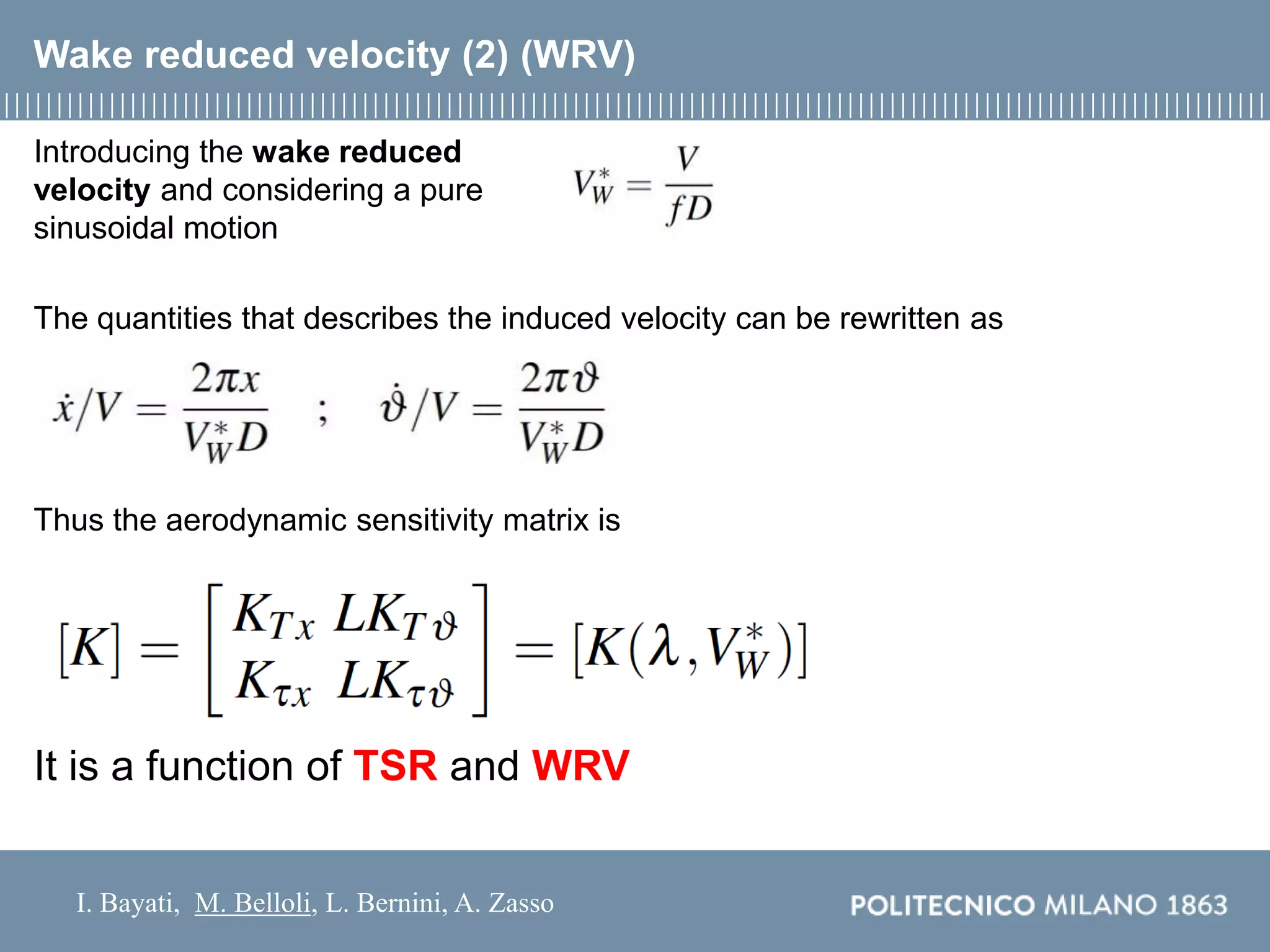
Wake reduced velocity (2) (WRV)
Introducing the wake reduced
velocity and considering a pure
sinusoidal motion
The quantities that describes the induced velocity can be rewritten as
Thus the aerodynamic sensitivity matrix is
It is a function of TSR and WRV
I. Bayati, M. Belloli, L. Bernini, A. Zasso
Physical meaning of a direct term of the matrix
_x [m /s]
-0.4 -0.3 -0.2 -0.1 0 0.1 0.2 0.3 0.4
"T[N]
-4
-3
-2
-1
0
1
2
3
4
Im posed Surge,6v = 3,U = 2:33[m =s]
I. Bayati, M. Belloli, L. Bernini, A. Zasso
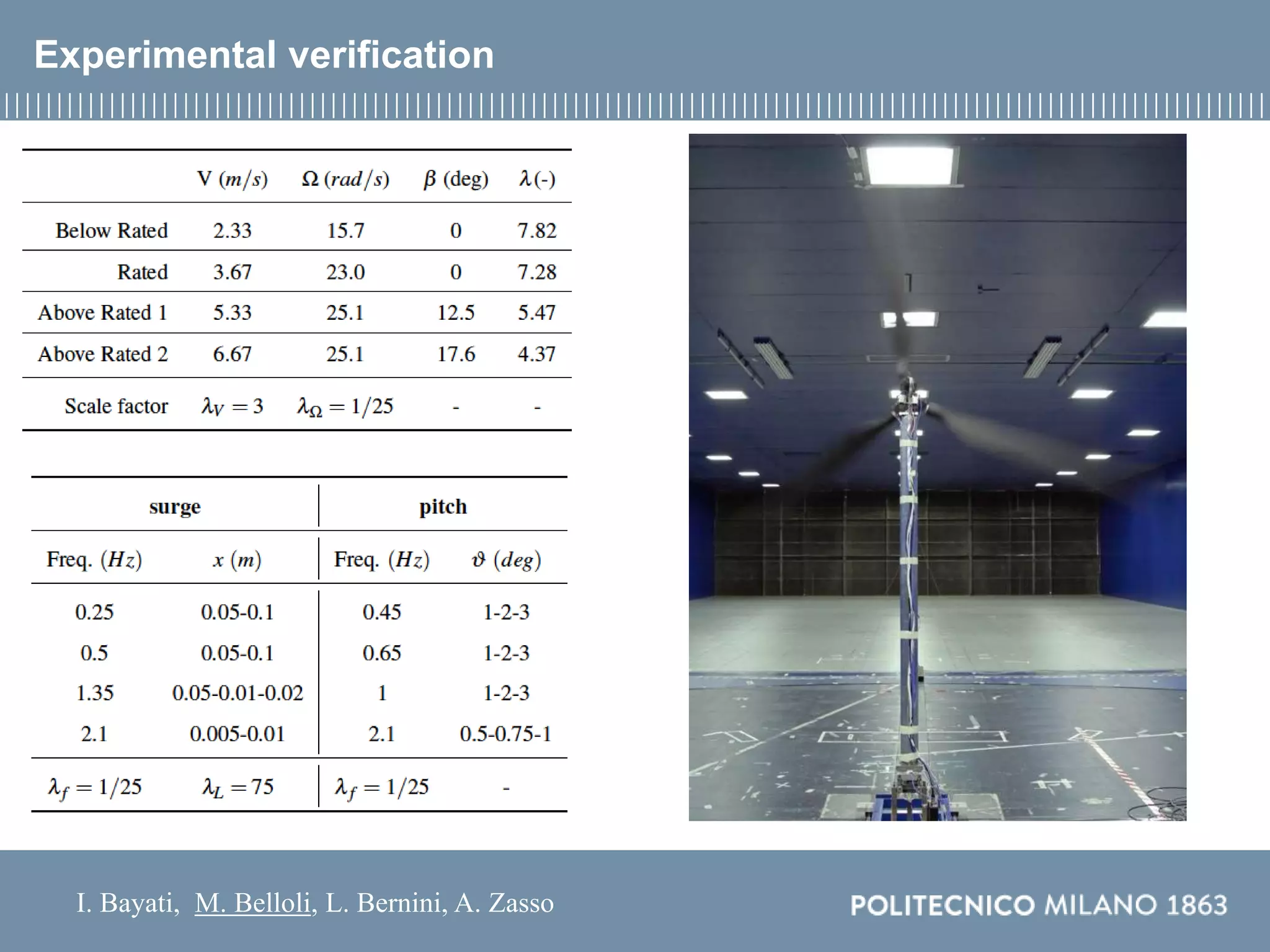
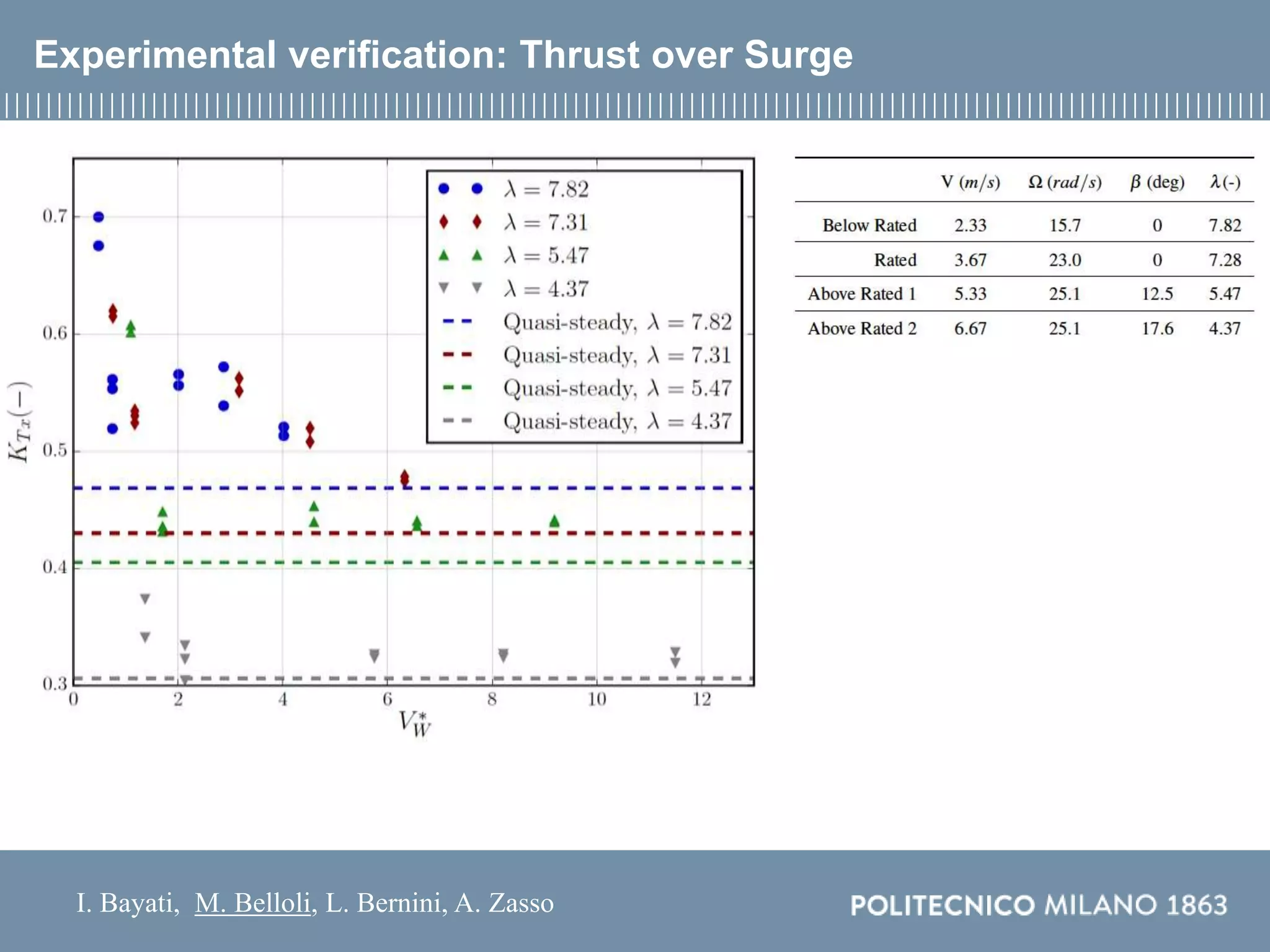
Experimental verification
I. Bayati, M. Belloli, L. Bernini, A. Zasso
Experimental verification: Thrust over Surge
I. Bayati, M. Belloli, L. Bernini, A. Zasso
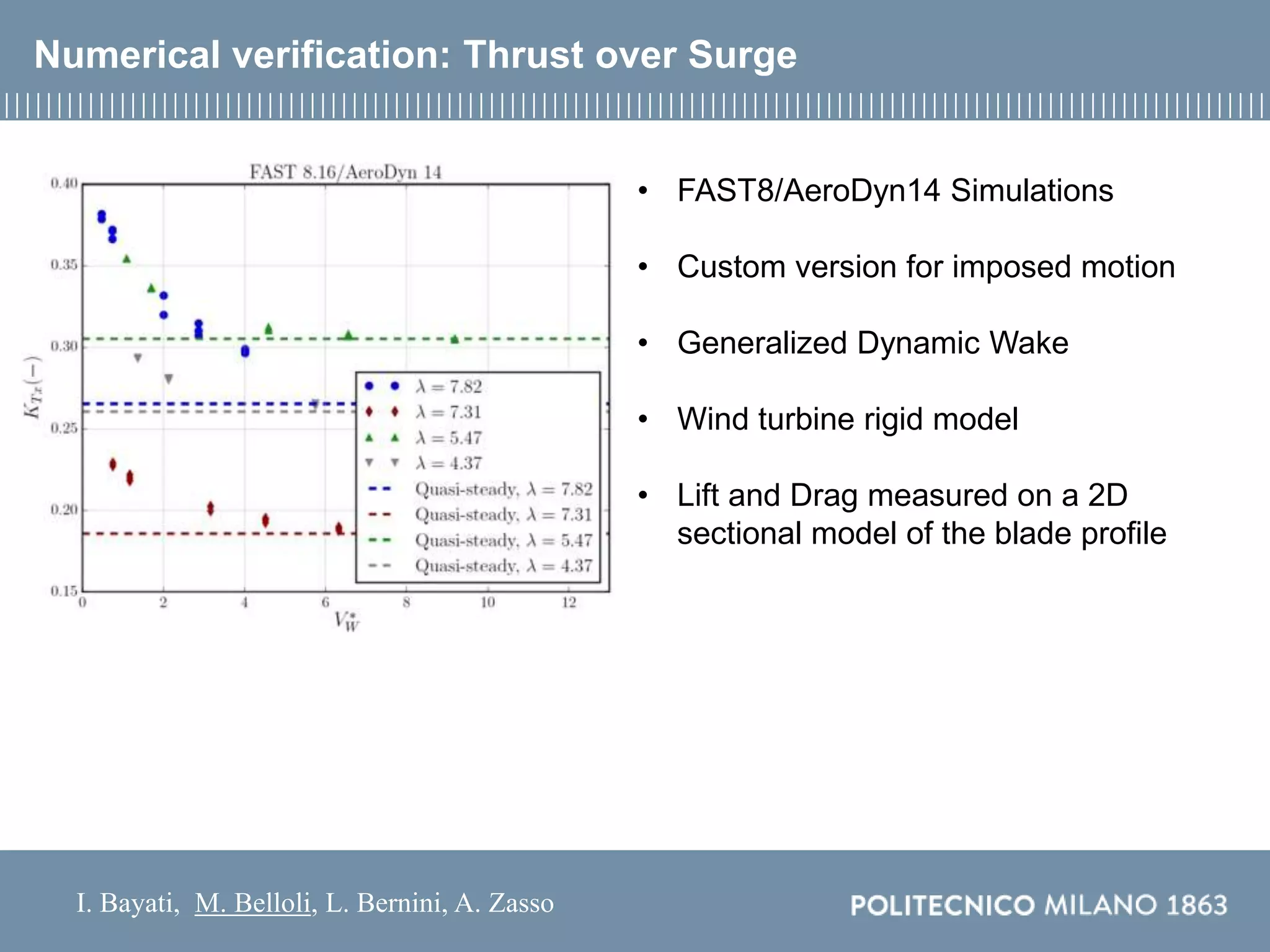
Numerical verification: Thrust over Surge
• FAST8/AeroDyn14 Simulations
• Custom version for imposed motion
• Generalized Dynamic Wake
• Wind turbine rigid model
• Lift and Drag measured on a 2D
sectional model of the blade profile
I. Bayati, M. Belloli, L. Bernini, A. Zasso
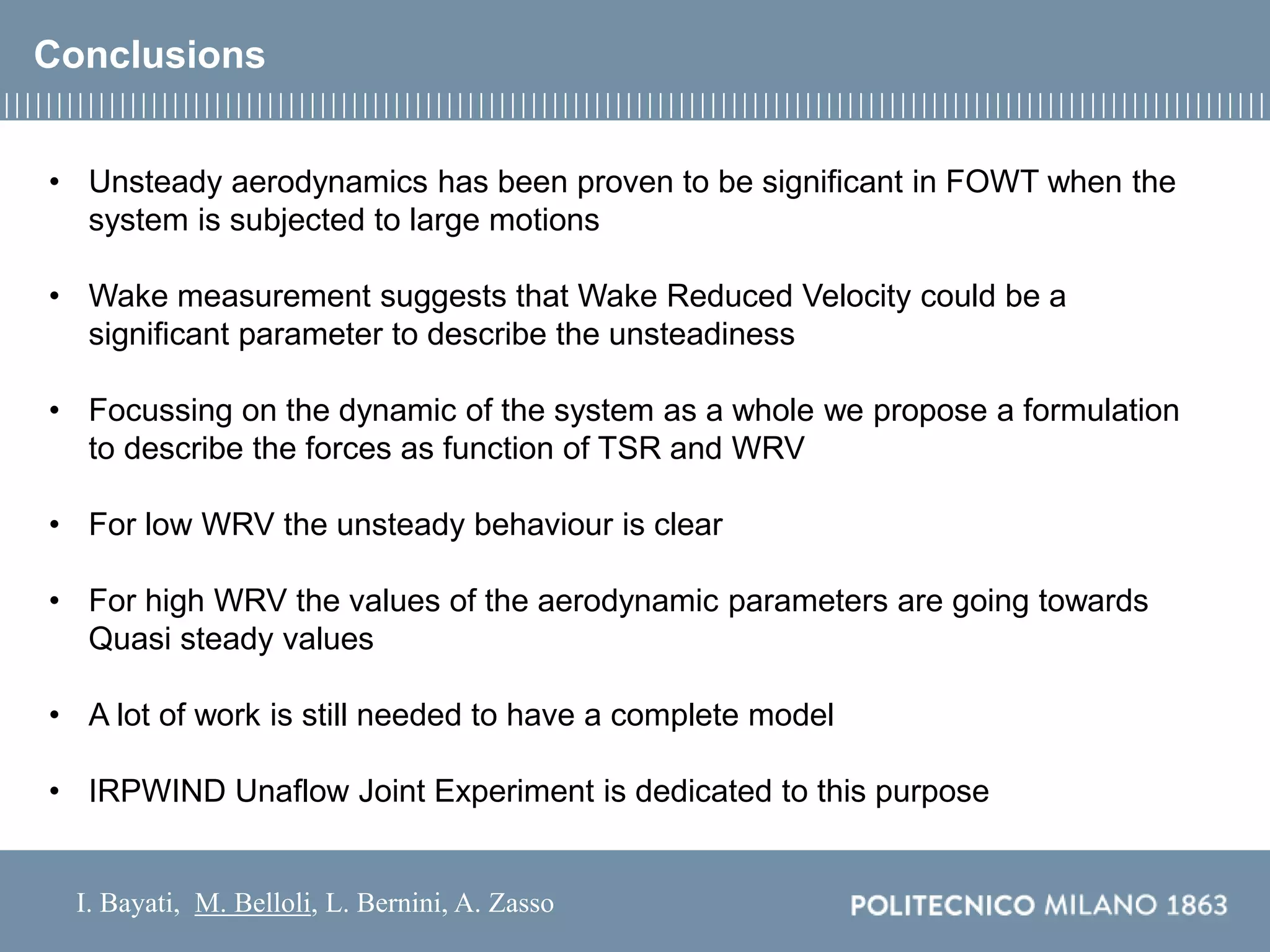
Conclusions
• Unsteady aerodynamics has been proven to be significant in FOWT when the
system is subjected to large motions
• Wake measurement suggests that Wake Reduced Velocity could be a
significant parameter to describe the unsteadiness
• Focussing on the dynamic of the system as a whole we propose a formulation
to describe the forces as function of TSR and WRV
• For low WRV the unsteady behaviour is clear
• For high WRV the values of the aerodynamic parameters are going towards
Quasi steady values
• A lot of work is still needed to have a complete model
• IRPWIND Unaflow Joint Experiment is dedicated to this purpose
I. Bayati, M. Belloli, L. Bernini, A. Zasso
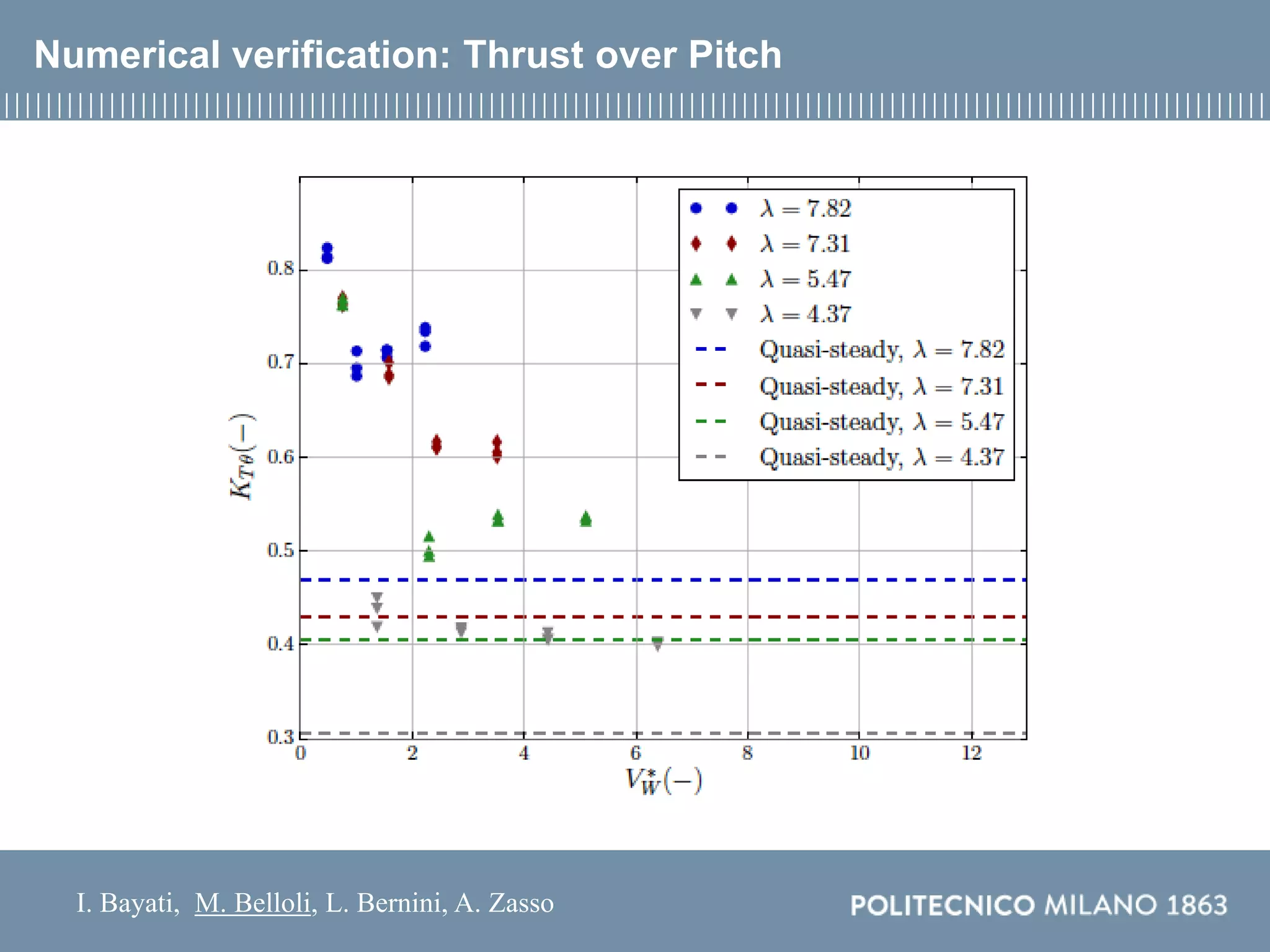
Numerical verification: Thrust over Pitch

A formulation for the unsteady aerodynamics of floating wind turbines, with focus on the global system dynamics

  • 1.
    Firma convenzione Politecnico diMilano e Veneranda Fabbrica del Duomo di Milano Aula Magna – Rettorato Mercoledì 27 maggio 2015 A formulation for the unsteady aerodynamics of floating wind turbines, with focus on the global system dynamics I. Bayati, M. Belloli, L. Bernini, A. Zasso Politecnico di Milano, Department of Mechanical Engineering
  • 2.
    I. Bayati, M.Belloli, L. Bernini, A. Zasso • Motivations and goals • The proposed formulation • Observations on unsteady aerodynamics • Experimental results form imposed motion tests • Conclusions Presentation outline
  • 3.
    I. Bayati, M.Belloli, L. Bernini, A. Zasso Ocean Basin/HIL Wind Tunnel/HIL Hydro validation Aero validation Motivation and Goals
  • 4.
    I. Bayati, M.Belloli, L. Bernini, A. Zasso • FOWT are subjected to large motion induced by the interaction with the waves • A calibration of the numerical model in strong unsteady conditions is needed for FOWT modelling • Imposed motion tests represent a good solution to understand how the wind turbine aerodynamics is influenced by these large motion • Our focus is on the dynamics of the whole mechanical system Motivation and goals
  • 5.
    I. Bayati, M.Belloli, L. Bernini, A. Zasso Dynamics of the system as a whole Mooring Waves Radiation Viscosity Diffraction 1°ord Diffraction 2°ord Aero Control
  • 6.
    I. Bayati, M.Belloli, L. Bernini, A. Zasso Experimental wind turbine model and experiments • 1/75 model of the DTU 10 MW RWT • 1/3 scale factor for the wind velocity
  • 7.
    I. Bayati, M.Belloli, L. Bernini, A. Zasso Very good matching below rated (Torque & Thrust) Optimized pitch above rated - Thrust easily matched - Torque needing higher pitch Experimental results: steady state conditions
  • 8.
    I. Bayati, M.Belloli, L. Bernini, A. Zasso Wind Tunnel Tests: Imposed Surge and Pitch results Experiments • Operational conditions: • Below rated / • Rated • Above Rated • Wave: Low Frequency motion Wave frequency motion
  • 9.
    I. Bayati, M.Belloli, L. Bernini, A. Zasso Analytical formulation 1 Torque Thrust Effective velocity
  • 10.
    I. Bayati, M.Belloli, L. Bernini, A. Zasso Analytical formulation 2 Our focus is on the dynamic behaviour of the whole system and we want to describe the forces as function of the state space Let’s try to linearize at fixed TSR and hence and fixed pitch angle @ Unsteady coefficients
  • 11.
    I. Bayati, M.Belloli, L. Bernini, A. Zasso Analytical formulation 3 We can do the same exercise also for the torque and then go for a matricial representation Unsteady coefficients This matrix contains the direct and cross terms of the aerodynamic sensitivity to imposed motion at the tower base
  • 12.
    I. Bayati, M.Belloli, L. Bernini, A. Zasso Imposed Motion: Surge frequency in the wake Freq. 1 Hz Amp. 30 mm • Same operational conditions • Normalization of the FFT by the maximum peak amplitude • Clear evidence of the surge motion frequency f • Rotational frequency still evident (where present from no motion) NO MOTION SURGE MOTION RATED ABOVE R. RATED ABOVE R.
  • 13.
    I. Bayati, M.Belloli, L. Bernini, A. Zasso Wake reduced velocity (1) Non dimensional number to describe the unsteady interaction  WAKE REDUCED VELOCITY N of rotor diameters D ‘‘travelled ’’ by the air with a drift (mean) velocity V within one cycle of platform motion of frequency 𝑓 From wake measurements tests we observed that the wake is very distorted when the the platform is moving and the frequency of the motion is very visible in the wake spectra When is high, the wind speed is much higher than the speed due to the imposed motion  QUASI STEADY BEHAVIOUR When is low, the wind speed is comparable to the speed due to the imposed motion  STRONG NON LINEARITIES THE ROTOR REENTER ITS WAKE
  • 14.
    I. Bayati, M.Belloli, L. Bernini, A. Zasso Wake reduced velocity (2) (WRV) Introducing the wake reduced velocity and considering a pure sinusoidal motion The quantities that describes the induced velocity can be rewritten as Thus the aerodynamic sensitivity matrix is It is a function of TSR and WRV
  • 15.
    I. Bayati, M.Belloli, L. Bernini, A. Zasso Physical meaning of a direct term of the matrix _x [m /s] -0.4 -0.3 -0.2 -0.1 0 0.1 0.2 0.3 0.4 "T[N] -4 -3 -2 -1 0 1 2 3 4 Im posed Surge,6v = 3,U = 2:33[m =s]
  • 16.
    I. Bayati, M.Belloli, L. Bernini, A. Zasso Experimental verification
  • 17.
    I. Bayati, M.Belloli, L. Bernini, A. Zasso Experimental verification: Thrust over Surge
  • 18.
    I. Bayati, M.Belloli, L. Bernini, A. Zasso Numerical verification: Thrust over Surge • FAST8/AeroDyn14 Simulations • Custom version for imposed motion • Generalized Dynamic Wake • Wind turbine rigid model • Lift and Drag measured on a 2D sectional model of the blade profile
  • 19.
    I. Bayati, M.Belloli, L. Bernini, A. Zasso Conclusions • Unsteady aerodynamics has been proven to be significant in FOWT when the system is subjected to large motions • Wake measurement suggests that Wake Reduced Velocity could be a significant parameter to describe the unsteadiness • Focussing on the dynamic of the system as a whole we propose a formulation to describe the forces as function of TSR and WRV • For low WRV the unsteady behaviour is clear • For high WRV the values of the aerodynamic parameters are going towards Quasi steady values • A lot of work is still needed to have a complete model • IRPWIND Unaflow Joint Experiment is dedicated to this purpose
  • 20.
    I. Bayati, M.Belloli, L. Bernini, A. Zasso Numerical verification: Thrust over Pitch

Editor's Notes

  • #4 With this idea Lifes50+ project is developing advanced experimental techiniques with the combined employment of wind tunnel and ocean basin. As siad the testing approach is what is called hybrid appraoch or hardware in the loop, so that in the ocean basin… Whereas in the wind tunnel… The results communicate one each other in the sense that numerical model running in real time are validated complementarily
  • #8 Steady wind tunnel tests demostrated an excellent maching of the thrust, which was the target, in the whole range of wind speed and a good matching also for the torque with a need of changing a bit the angle of attack above rated with respect to the nominal pitch angle. However the goal of the project was, in a floating offshore scenario, the thrust
  • #9 On top of this a set of surge and pitch amplitude and frequency in the low and wave ranges were chosen for investigating the effect of single harmonic motion on the aerodynamics, and the same cases were simulated in Fast/Aerodyn with these simulation parameters. So by the first run no dynamic stall was implemented.
  • #17 To be conclude
  • #18 To be conclude
  • #19 To be conclude
  • #20 To be conclude
  • #21 To be conclude