Sexy async code without
await?
A first look into Project Loom in Java
What is this talk about?
● Blocking vs. non-blocking APIs
● Thread per request vs. event loop
● Callbacks and Futures?
● What is async/await?
● What is the blue/red world
problem?
● Project Loom = async/await in
Java?
About
Lukas Steinbrecher
Developer @ Senacor
lukstei.com
github.com/lukstei
lukas.steinbrecher@senacor.com
Chapter 1
Threads and what is a
blocking call?
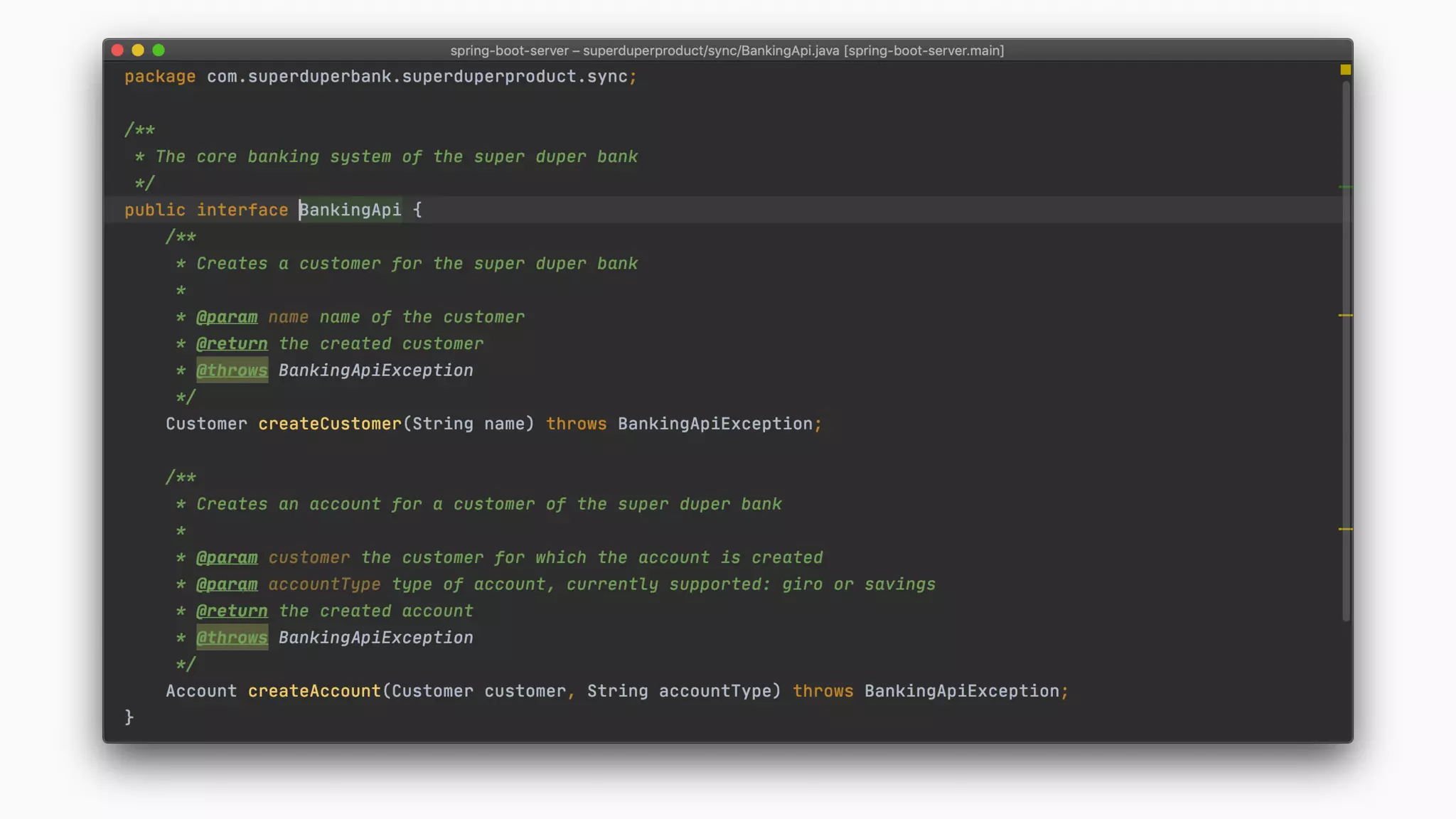
Super Duper Bank
“super duper product“:
• Giro account
• Savings account
Boss B. “The Boss” Bossy
>
You
Super Duper Core
Banking System
Super Duper Bank
Super Duper
Product
Service
You
HTTP/REST
<fill in>
HTTP/REST
Super Duper Bank
Boss B. “The Boss” Bossy
>
You
How many customers
can we serve?
I won’t fall!
Super Duper Core
Banking System
!
Simulation of 100 requests in Spring Web
The thread
● Mechanism to provide multitasking in one process
● OS1 threads must support all use cases and programming
languages à not very optimized
● Context-switching slow
● Relatively heavy (> 2kb metadata, > 1mb stack size)
à OS Threads are a limited resource, ~up to a few 1000
threads on a normal computer
1 OS: Operating System
Threads in Java
● java.lang.Thread wraps native OS threads
● To create a thread, create an instance of
the Thread class and call the start()
method
● java.util.concurrent.Executors for a higher
level API (thread pools, etc.)
Source: https://www.d.umn.edu/~gshute/os/processes-and-threads.xhtml
Thread per request model
Super Duper Core
Banking System
Super Duper Product Service
Thread 1
Request
Response
Thread 100
Request
Response
…
Networking 101
● OS responsible for coordinating access to
external devices, e.g. network card
● OS provides primitives and functions
(syscalls) to access those resources
● à Sockets as the primitive to access the
network
● Every programming language uses this
primitives under the hood
Source: https://www.cs.dartmouth.edu/~campbell/cs60/socketprogramming.html
What happens inside a blocking syscall?
Source:
https://cfsamson.github.io/book-exploring-async-basics/4_interrupts_firmware_io.html
https://medium.com/martinomburajr/rxjava2-schedulers-2-breaking-down-the-i-o-scheduler-7e83160df2ed
Source: https://twitter.com/piscisaureus/status/776709749584826369
Blocking syscalls – what’s the problem?
● OS suspends thread until result of
operation is available
● To do n blocking calls at the same time
you need n threads
● The longer a call blocks the more
threads you need to serve more
requests à Network calls are slow
Avg. # of customers in system = arrival rate *
average time in system
For our case:
Avg. # threads needed = requests rate * response
time of external system
e.g.:
100 requests/s, 10s response time from CBS
Þ 1000 threads on avg. needed
Þ 1000 threads * ~1MB = 1000 MB memory
Example – Little’s law
But Simple and linear…but synchronous
calls are natural and
easy! :-/
Super Duper Bank
Boss B. “The Boss” Bossy
>
You
I think the bottleneck is
the thread count, Sir.
Super Duper Bank
Boss B. “The Boss” Bossy
>
You
We cannot accept this!
How can we fully utilize
our machine?
Chapter 2
Let’s fully utilize
our machine
Non-blocking syscalls as a solution for the
thread bottleneck problem
● Non-blocking syscalls do not suspend your thread à handle more than
one primitive per thread
● Different styles for non-blocking IO
○ Polling, Multiplexed Block, …
● epoll (Linux), kqueue (Mac), IOCP (Windows) popular APIs for non-blocking
networking – but all with different semantics
● libuv (Node.JS), mio (Tokio, Rust), Java NIO/Netty for Java: provide OS
independent abstractions for non-blocking IO
Asynchronous !=
non-blocking
Event based execution model
● Relies on async base –
“Don’t block the event loop”
e.g. Node.JS, Eclipse Vert.x,
Project Reactor/Spring
WebFlux
Source: https://howtodoinjava.com/spring-webflux/spring-webflux-tutorial/
def eventloop_main():
forever:
e = wait for next event
if there is a callback associated with e in our list:
call the callback
def read_from_socket_async(socket s, callback):
tell OS we are interested in events from socket s
save callback in our list
How do we handle the asynchronous
operations?
Recap: Synchronous style:
The callback
● Idea: For every asynchronous operation, pass a
function which is called when the operation is
complete
● Functions as “first class object”, in Java: Function
object
● Hollywood principle: ”Don’t call us, we’ll call you”
● Hard to compose à callback hell
The Future1 abstraction
● Explicit abstraction for an asynchronous operation
● Future represents the result of an asynchronous
computation (which may not yet be completed) and
can have three states: Pending, Error, Done
● Better composability than callbacks
● Semantic superset of Future: Reactive extensions
1 called Promise in JavaScript
Super Duper Bank
B. Boss Bossy
>
You
Make my service more
scalable!!!!!!!
(until tomorrow)
Let’s use non-blocking
I/O, Sir!
Super Duper Bank
You
🤩
Simulation of 100 requests in Spring WebFlux
Super Duper Bank
You
Not that easy…
async/await
● “Syntactic sugar” for writing asynchronous functions that look like
synchronous code
● Under the hood async/await syntax is converted to Future/Promise chains
● Still implicitly (or explicitly) return an asynchronous result
● Recently arrived in C#, Rust, JavaScript, Python, …
How async/await could look like in Java (hypothetical)
About blue and red worlds
● Going into asynchronous world break your old interfaces and you have to
decide beforehand which world you want
● Hard to go from synchronous world to asynchronous world
● Often, we anyway just want a synchronous programming model but are
forced to use asynchronous abstractions because of the underlying
execution model
● async/await can make it look like synchronous, but we are still in the
asynchronous world
Source: http://journal.stuffwithstuff.com/2015/02/01/what-color-is-your-function/
Chapter 3
I want my blocking
code back :-/
Choose between:
Synchronous style
• Simple
• Language integration (Exceptions,
control flow)
• Not very efficient (OS Thread per
request -> limited resource)
• Advanced stuff is more complex
(e.g. do two things in parallel)
Asynchronous style
• Hard to read (without
async/await), complex, hard
to debug
• Blue and red worlds, virality
• Rewrite your Application
• Efficient
😃
🙂‍
😏‍
😣
😣
😣
😣
😃
Is my website up in go? – Synchronous
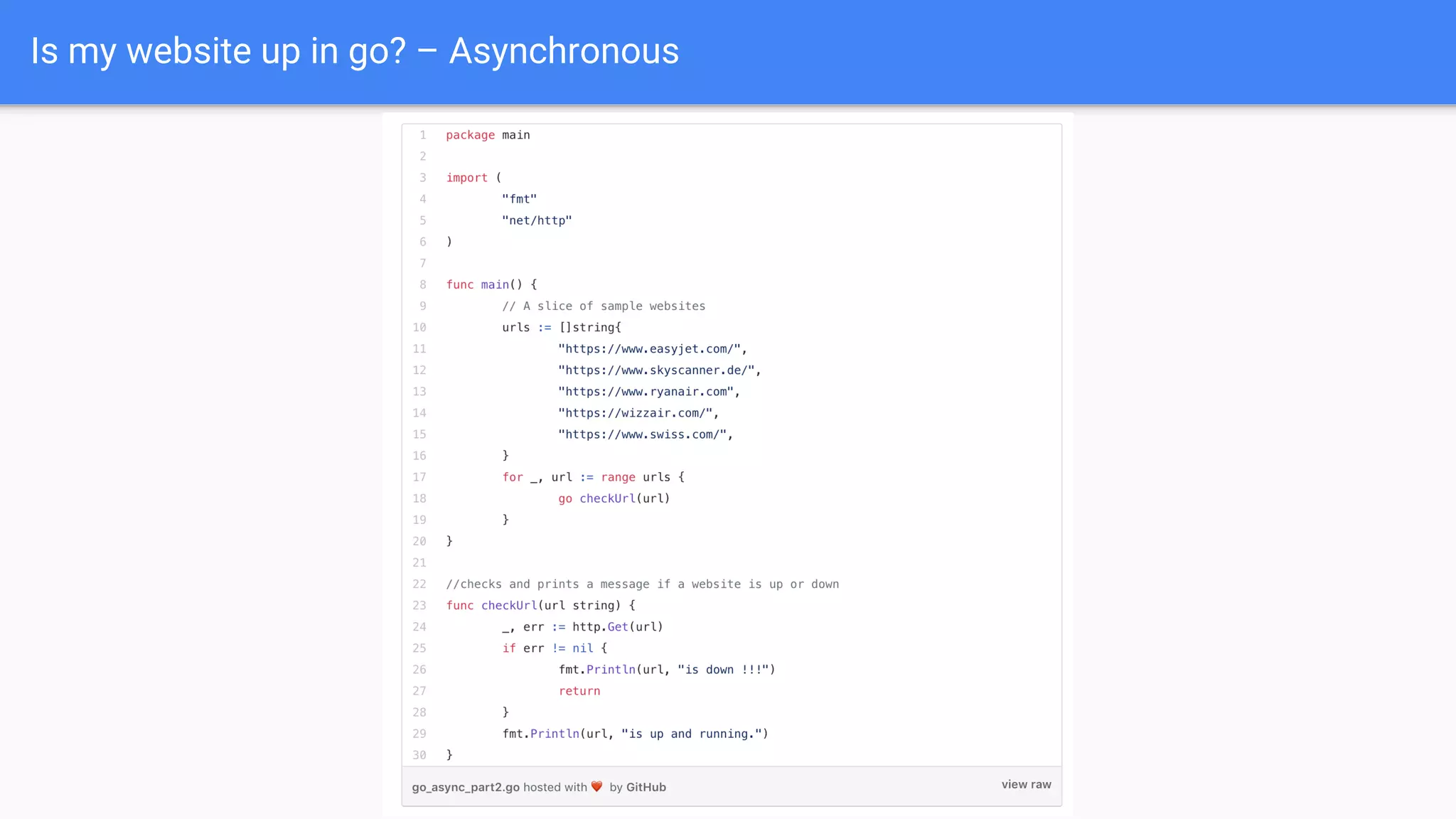
Is my website up in go? – Asynchronous
Is my website up in go?
Virtual thread
aka lightweight thread
aka fiber
aka green thread
aka user-mode thread
Project Loom
● Official OpenJDK Project to
implement virtual threads on the
Java platform (JVM)
● Currently in development
● Can be tried out by using a preview
build JDK
What is a virtual thread in Java?
● Like OS threads but
○ Lightweight – have as many as you want
○ Fast – context switches are cheap
● Managed by the Java Runtime
● Use existing APIs (Thread, Executors, …)
● No timeslice-based preemption (by default)
virtual thread =
Representation of the state of a computation
Something which can control the execution of the computation
+
virtual thread =
Continuation
Scheduler
+
Continuation (coroutine)
● Piece of sequential code that can
suspend itself and may be continued at a
later point
● Low level API, not to be used directly
package java.lang;
public class Continuation implements Runnable {
public Continuation(ContinuationScope scope, Runnable target);
public final void run() ;
public static void yield(ContinuationScope scope) ;
public boolean isDone();
}
Scheduler
● Scheduler schedules the continuations onto
real worker OS threads (carrier thread)
● By default ForkJoinPool Scheduler is used
which distributes work among all CPU cores
● Possible to change scheduler (e.g. choose to
have only one carrier thread -> Node.JS like)
Why virtual threads instead of asynchronous
abstractions?
● Enables non-blocking code to be (virtual-thread)-synchronous
○ Normal language constructs for conditional logic, error handling, …
○ Easy debugging
● No need to break your interfaces, no forced blue world for non-blocking IO
○ Libraries that use the JDK primitives will also automatically play well
with virtual threads (e.g. Spring Web, JDBC, …)
○ Works with legacy code without changes (in the best case)
● For advanced stuff, e.g. do two things in parallel
○ à use asynchronous abstractions (Future, Reactive) or structured
concurrency on the consumer side
Operating systemJava API / JVMApplication
Non-
blocking
APIRegister event
OS
Thread-
pool
Blocking
API
Event callback
…
Synchronous
function call
OSThread
Suspended
Hardware
drivers
Blocking
API
“Event loop”
Virtualthreadsuspended
Virtual threads allow to translate
asynchronous to synchronous APIs
carrier
thread
Virtual threadOS thread
Example: New Socket API implementation ready for virtual threads
Limitations
Temporary
● Limited debugging support
○ Dealing with a large number of virtual
threads, Setting local variables,
Suspending or resuming a virtual thread,
Stack traces for fibers will include
scheduler related frames
● Not all Java APIs virtual thread
ready as of now
Permanent
● Semantic differences to threads
à not all legacy code will work
without changes
● Native frames not supported
Super Duper Bank
B. Boss Bossy
>
You
How will the SDPS look
like with virtual
threads?
Sneak peek: Structured concurrency
● Threads normally “float around” in application
● Idea: Bind thread lifetimes to code blocks
● Currently implemented with try-with-resources syntax
● Final design still in discussion
Cool! How can I try it out?
https://wiki.openjdk.java.net/display/loom
● Download preview build https://jdk.java.net/loom/
● Configure new JDK in Intellij (or Eclipse 🙈)
● Spawn 100k Virtual Threads
● Wait for release in Java 1X
Key takeaways
● Blocking OS calls forces you to have one thread per ”program” (e.g. request)
● Non-Blocking I/O calls are complex
● Event-based libraries (libuv, Netty) wrap non-blocking OS calls and provide asynchronous
abstractions
○ Callback: simple, not composable, Futures: composable but “unnatural” usage
○ Async/await: Syntax to make working with Futures more natural
● Project Loom implements lightweight virtual threads in the Java platform
○ No blue/red world problem, just write synchronous code as usual, use your favorite
(synchronous-style) libraries and enjoy more efficiency (e.g. Spring Web, JDBC)
○ Virtual threads are cheap – have millions of them
○ Still uses non blocking IO under the hood – but wraps them in existing synchronous APIs
à Final question: Is the virtual thread approach superior to the event-loop model?
I want to learn more!
In depth article about Project Loom and it’s current
state (May 2020)
https://cr.openjdk.java.net/~rpressler/loom/loom/s
ol1_part1.html
Blue/red world problem http://journal.stuffwithstuff.com/2015/02/01/what-
color-is-your-function/
Build an event loop in Rust https://cfsamson.github.io/book-exploring-async-
basics/1_concurrent_vs_parallel.html
Implement green threads in Rust in 200 lines https://cfsamson.gitbook.io/green-threads-
explained-in-200-lines-of-rust/
Thank you! Questions?
Lukas Steinbrecher
Developer @ Senacor
lukstei.com
github.com/lukstei
lukas.steinbrecher@senacor.com

A first look into the Project Loom in Java

  • 1.
    Sexy async codewithout await? A first look into Project Loom in Java
  • 2.
    What is thistalk about? ● Blocking vs. non-blocking APIs ● Thread per request vs. event loop ● Callbacks and Futures? ● What is async/await? ● What is the blue/red world problem? ● Project Loom = async/await in Java?
  • 3.
    About Lukas Steinbrecher Developer @Senacor lukstei.com github.com/lukstei lukas.steinbrecher@senacor.com
  • 4.
    Chapter 1 Threads andwhat is a blocking call?
  • 5.
    Super Duper Bank “superduper product“: • Giro account • Savings account Boss B. “The Boss” Bossy > You
  • 6.
    Super Duper Core BankingSystem Super Duper Bank Super Duper Product Service You HTTP/REST <fill in> HTTP/REST
  • 11.
    Super Duper Bank BossB. “The Boss” Bossy > You How many customers can we serve? I won’t fall! Super Duper Core Banking System !
  • 12.
    Simulation of 100requests in Spring Web
  • 13.
    Simulation of 100requests in Spring Web
  • 14.
    The thread ● Mechanismto provide multitasking in one process ● OS1 threads must support all use cases and programming languages à not very optimized ● Context-switching slow ● Relatively heavy (> 2kb metadata, > 1mb stack size) à OS Threads are a limited resource, ~up to a few 1000 threads on a normal computer 1 OS: Operating System
  • 15.
    Threads in Java ●java.lang.Thread wraps native OS threads ● To create a thread, create an instance of the Thread class and call the start() method ● java.util.concurrent.Executors for a higher level API (thread pools, etc.) Source: https://www.d.umn.edu/~gshute/os/processes-and-threads.xhtml
  • 16.
    Thread per requestmodel Super Duper Core Banking System Super Duper Product Service Thread 1 Request Response Thread 100 Request Response …
  • 17.
    Networking 101 ● OSresponsible for coordinating access to external devices, e.g. network card ● OS provides primitives and functions (syscalls) to access those resources ● à Sockets as the primitive to access the network ● Every programming language uses this primitives under the hood Source: https://www.cs.dartmouth.edu/~campbell/cs60/socketprogramming.html
  • 18.
    What happens insidea blocking syscall? Source: https://cfsamson.github.io/book-exploring-async-basics/4_interrupts_firmware_io.html https://medium.com/martinomburajr/rxjava2-schedulers-2-breaking-down-the-i-o-scheduler-7e83160df2ed
  • 19.
  • 20.
    Blocking syscalls –what’s the problem? ● OS suspends thread until result of operation is available ● To do n blocking calls at the same time you need n threads ● The longer a call blocks the more threads you need to serve more requests à Network calls are slow Avg. # of customers in system = arrival rate * average time in system For our case: Avg. # threads needed = requests rate * response time of external system e.g.: 100 requests/s, 10s response time from CBS Þ 1000 threads on avg. needed Þ 1000 threads * ~1MB = 1000 MB memory Example – Little’s law But Simple and linear…but synchronous calls are natural and easy! :-/
  • 21.
    Super Duper Bank BossB. “The Boss” Bossy > You I think the bottleneck is the thread count, Sir.
  • 22.
    Super Duper Bank BossB. “The Boss” Bossy > You We cannot accept this! How can we fully utilize our machine?
  • 23.
    Chapter 2 Let’s fullyutilize our machine
  • 24.
    Non-blocking syscalls asa solution for the thread bottleneck problem ● Non-blocking syscalls do not suspend your thread à handle more than one primitive per thread ● Different styles for non-blocking IO ○ Polling, Multiplexed Block, … ● epoll (Linux), kqueue (Mac), IOCP (Windows) popular APIs for non-blocking networking – but all with different semantics ● libuv (Node.JS), mio (Tokio, Rust), Java NIO/Netty for Java: provide OS independent abstractions for non-blocking IO
  • 25.
  • 26.
    Event based executionmodel ● Relies on async base – “Don’t block the event loop” e.g. Node.JS, Eclipse Vert.x, Project Reactor/Spring WebFlux Source: https://howtodoinjava.com/spring-webflux/spring-webflux-tutorial/ def eventloop_main(): forever: e = wait for next event if there is a callback associated with e in our list: call the callback def read_from_socket_async(socket s, callback): tell OS we are interested in events from socket s save callback in our list
  • 27.
    How do wehandle the asynchronous operations? Recap: Synchronous style:
  • 28.
    The callback ● Idea:For every asynchronous operation, pass a function which is called when the operation is complete ● Functions as “first class object”, in Java: Function object ● Hollywood principle: ”Don’t call us, we’ll call you” ● Hard to compose à callback hell
  • 31.
    The Future1 abstraction ●Explicit abstraction for an asynchronous operation ● Future represents the result of an asynchronous computation (which may not yet be completed) and can have three states: Pending, Error, Done ● Better composability than callbacks ● Semantic superset of Future: Reactive extensions 1 called Promise in JavaScript
  • 32.
    Super Duper Bank B.Boss Bossy > You Make my service more scalable!!!!!!! (until tomorrow) Let’s use non-blocking I/O, Sir!
  • 33.
  • 37.
    Simulation of 100requests in Spring WebFlux
  • 38.
  • 39.
    async/await ● “Syntactic sugar”for writing asynchronous functions that look like synchronous code ● Under the hood async/await syntax is converted to Future/Promise chains ● Still implicitly (or explicitly) return an asynchronous result ● Recently arrived in C#, Rust, JavaScript, Python, …
  • 40.
    How async/await couldlook like in Java (hypothetical)
  • 41.
    About blue andred worlds
  • 42.
    About blue andred worlds ● Going into asynchronous world break your old interfaces and you have to decide beforehand which world you want ● Hard to go from synchronous world to asynchronous world ● Often, we anyway just want a synchronous programming model but are forced to use asynchronous abstractions because of the underlying execution model ● async/await can make it look like synchronous, but we are still in the asynchronous world Source: http://journal.stuffwithstuff.com/2015/02/01/what-color-is-your-function/
  • 45.
    Chapter 3 I wantmy blocking code back :-/
  • 46.
    Choose between: Synchronous style •Simple • Language integration (Exceptions, control flow) • Not very efficient (OS Thread per request -> limited resource) • Advanced stuff is more complex (e.g. do two things in parallel) Asynchronous style • Hard to read (without async/await), complex, hard to debug • Blue and red worlds, virality • Rewrite your Application • Efficient 😃 🙂‍ 😏‍ 😣 😣 😣 😣 😃
  • 48.
    Is my websiteup in go? – Synchronous
  • 49.
    Is my websiteup in go? – Asynchronous
  • 50.
    Is my websiteup in go?
  • 51.
    Is my websiteup in go?
  • 52.
    Virtual thread aka lightweightthread aka fiber aka green thread aka user-mode thread
  • 53.
    Project Loom ● OfficialOpenJDK Project to implement virtual threads on the Java platform (JVM) ● Currently in development ● Can be tried out by using a preview build JDK
  • 54.
    What is avirtual thread in Java? ● Like OS threads but ○ Lightweight – have as many as you want ○ Fast – context switches are cheap ● Managed by the Java Runtime ● Use existing APIs (Thread, Executors, …) ● No timeslice-based preemption (by default)
  • 55.
    virtual thread = Representationof the state of a computation Something which can control the execution of the computation +
  • 56.
  • 57.
    Continuation (coroutine) ● Pieceof sequential code that can suspend itself and may be continued at a later point ● Low level API, not to be used directly package java.lang; public class Continuation implements Runnable { public Continuation(ContinuationScope scope, Runnable target); public final void run() ; public static void yield(ContinuationScope scope) ; public boolean isDone(); }
  • 58.
    Scheduler ● Scheduler schedulesthe continuations onto real worker OS threads (carrier thread) ● By default ForkJoinPool Scheduler is used which distributes work among all CPU cores ● Possible to change scheduler (e.g. choose to have only one carrier thread -> Node.JS like)
  • 59.
    Why virtual threadsinstead of asynchronous abstractions? ● Enables non-blocking code to be (virtual-thread)-synchronous ○ Normal language constructs for conditional logic, error handling, … ○ Easy debugging ● No need to break your interfaces, no forced blue world for non-blocking IO ○ Libraries that use the JDK primitives will also automatically play well with virtual threads (e.g. Spring Web, JDBC, …) ○ Works with legacy code without changes (in the best case) ● For advanced stuff, e.g. do two things in parallel ○ à use asynchronous abstractions (Future, Reactive) or structured concurrency on the consumer side
  • 60.
    Operating systemJava API/ JVMApplication Non- blocking APIRegister event OS Thread- pool Blocking API Event callback … Synchronous function call OSThread Suspended Hardware drivers Blocking API “Event loop” Virtualthreadsuspended Virtual threads allow to translate asynchronous to synchronous APIs carrier thread Virtual threadOS thread
  • 61.
    Example: New SocketAPI implementation ready for virtual threads
  • 62.
    Example: New SocketAPI implementation ready for virtual threads
  • 63.
    Limitations Temporary ● Limited debuggingsupport ○ Dealing with a large number of virtual threads, Setting local variables, Suspending or resuming a virtual thread, Stack traces for fibers will include scheduler related frames ● Not all Java APIs virtual thread ready as of now Permanent ● Semantic differences to threads à not all legacy code will work without changes ● Native frames not supported
  • 64.
    Super Duper Bank B.Boss Bossy > You How will the SDPS look like with virtual threads?
  • 67.
    Sneak peek: Structuredconcurrency ● Threads normally “float around” in application ● Idea: Bind thread lifetimes to code blocks ● Currently implemented with try-with-resources syntax ● Final design still in discussion
  • 68.
    Cool! How canI try it out? https://wiki.openjdk.java.net/display/loom ● Download preview build https://jdk.java.net/loom/ ● Configure new JDK in Intellij (or Eclipse 🙈) ● Spawn 100k Virtual Threads ● Wait for release in Java 1X
  • 69.
    Key takeaways ● BlockingOS calls forces you to have one thread per ”program” (e.g. request) ● Non-Blocking I/O calls are complex ● Event-based libraries (libuv, Netty) wrap non-blocking OS calls and provide asynchronous abstractions ○ Callback: simple, not composable, Futures: composable but “unnatural” usage ○ Async/await: Syntax to make working with Futures more natural ● Project Loom implements lightweight virtual threads in the Java platform ○ No blue/red world problem, just write synchronous code as usual, use your favorite (synchronous-style) libraries and enjoy more efficiency (e.g. Spring Web, JDBC) ○ Virtual threads are cheap – have millions of them ○ Still uses non blocking IO under the hood – but wraps them in existing synchronous APIs à Final question: Is the virtual thread approach superior to the event-loop model?
  • 70.
    I want tolearn more! In depth article about Project Loom and it’s current state (May 2020) https://cr.openjdk.java.net/~rpressler/loom/loom/s ol1_part1.html Blue/red world problem http://journal.stuffwithstuff.com/2015/02/01/what- color-is-your-function/ Build an event loop in Rust https://cfsamson.github.io/book-exploring-async- basics/1_concurrent_vs_parallel.html Implement green threads in Rust in 200 lines https://cfsamson.gitbook.io/green-threads- explained-in-200-lines-of-rust/
  • 71.
    Thank you! Questions? LukasSteinbrecher Developer @ Senacor lukstei.com github.com/lukstei lukas.steinbrecher@senacor.com