Structured Concurrency And
Project Loom
Srinivasan Raghavan
Principal Software Engineer
Veracode
Safe Harbor Statement
The following is for information purposes only and not an endorsement from the company I work for
❖ Little's law
❖ Constrains and benefits of request pre thread model
❖ Asynchronous models benefits and pit falls
❖ Need for Structured Concurrency
❖ Project Loom
❖ Q and A
Program Agenda
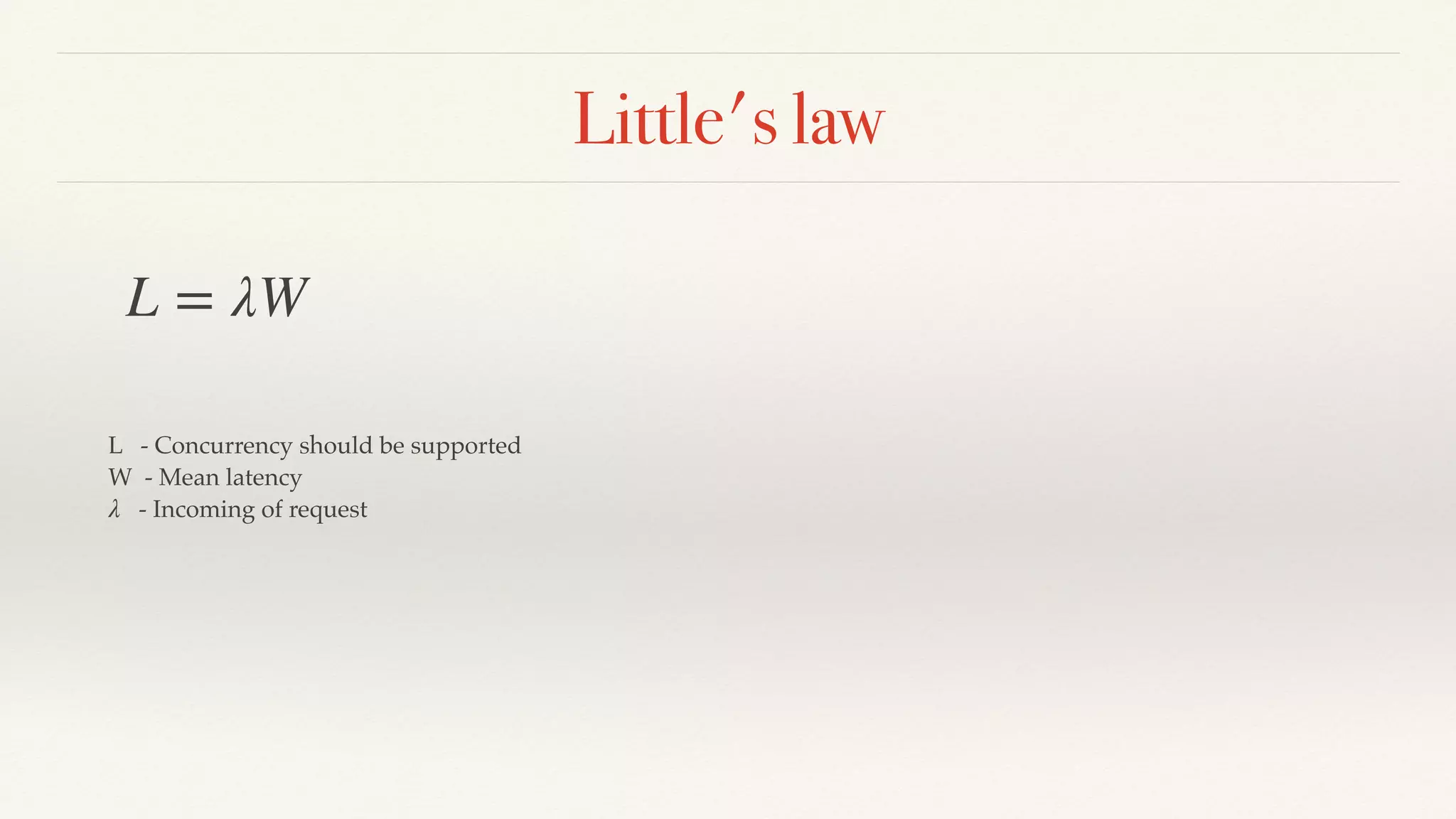
Little's law
L = λW
L - Concurrency should be supported
W - Mean latency
- Incoming of requestλ
Little's law
❖ There are various factors affecting the capacity of the servers L
❖ TCP sessions the os can make and handling of IO
❖ The number of threads T which the VM, OS can handle
❖ How much of each thread T is blocking which impacts W
❖ If L >>> T and W is high the we have un-responsiveness
❖ Then we should up extra resources to scale more
Request Per Thread
❖ The usual programming model is Request per thread model.
❖ Where incoming request are sent to thread and there serial step by step execution of the code
with in the thread
❖ Very easy to reason this code as its synchronous code and imperative
❖ But this uses the hardware badly
❖ There is no parallel use of cpu for computation related problem
❖ And lets the code depends on some external IO then its blocked util the entire operation is
finished
❖ And the this leads to bad performance
Asynchronous non blocking model
❖ Asynchronous frameworks came where one defines the list of tasks in a form
steps and the steps can execute at different point of time and threads
❖ The steps are given in domain specific way and so framework specific
❖ Good for the hardware
❖ Hard to maintain code and hard to reason code and profile it
❖ Throws out all effective abstraction of imperative programming built over
decades
Moving away from Request per Thread model
Imperative and Blocking
double placeDeposit(final double value) {
var result = compute("SGD->USD", value);
result = compute("addInterest", result);
result = compute("subtractCharges", result);
return result;
}
double compute(String op, double x) {
switch (op) {
case "SGD->USD":
return getSgdUsd() * x;
case "addInterest":
return getFederalFundsRate() * x + x;
case "subtractCharges":
return x - getChargeCalculator(x);
default:
}
throw new UnsupportedOperationException();
}
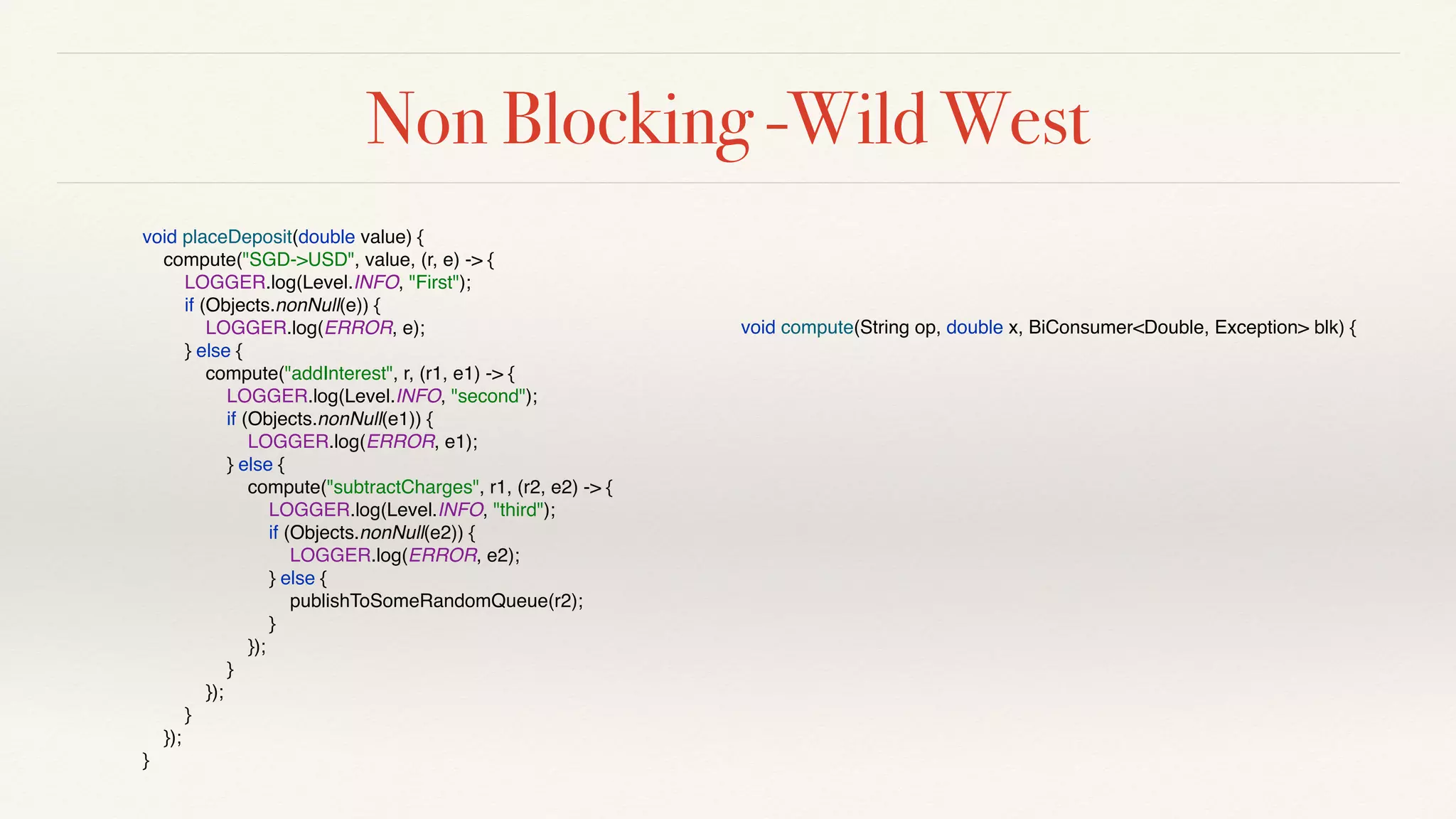
Non Blocking -Wild West
void placeDeposit(double value) {
compute("SGD->USD", value, (r, e) -> {
LOGGER.log(Level.INFO, "First");
if (Objects.nonNull(e)) {
LOGGER.log(ERROR, e);
} else {
compute("addInterest", r, (r1, e1) -> {
LOGGER.log(Level.INFO, "second");
if (Objects.nonNull(e1)) {
LOGGER.log(ERROR, e1);
} else {
compute("subtractCharges", r1, (r2, e2) -> {
LOGGER.log(Level.INFO, "third");
if (Objects.nonNull(e2)) {
LOGGER.log(ERROR, e2);
} else {
publishToSomeRandomQueue(r2);
}
});
}
});
}
});
}
void compute(String op, double x, BiConsumer<Double, Exception> blk) {
Monads
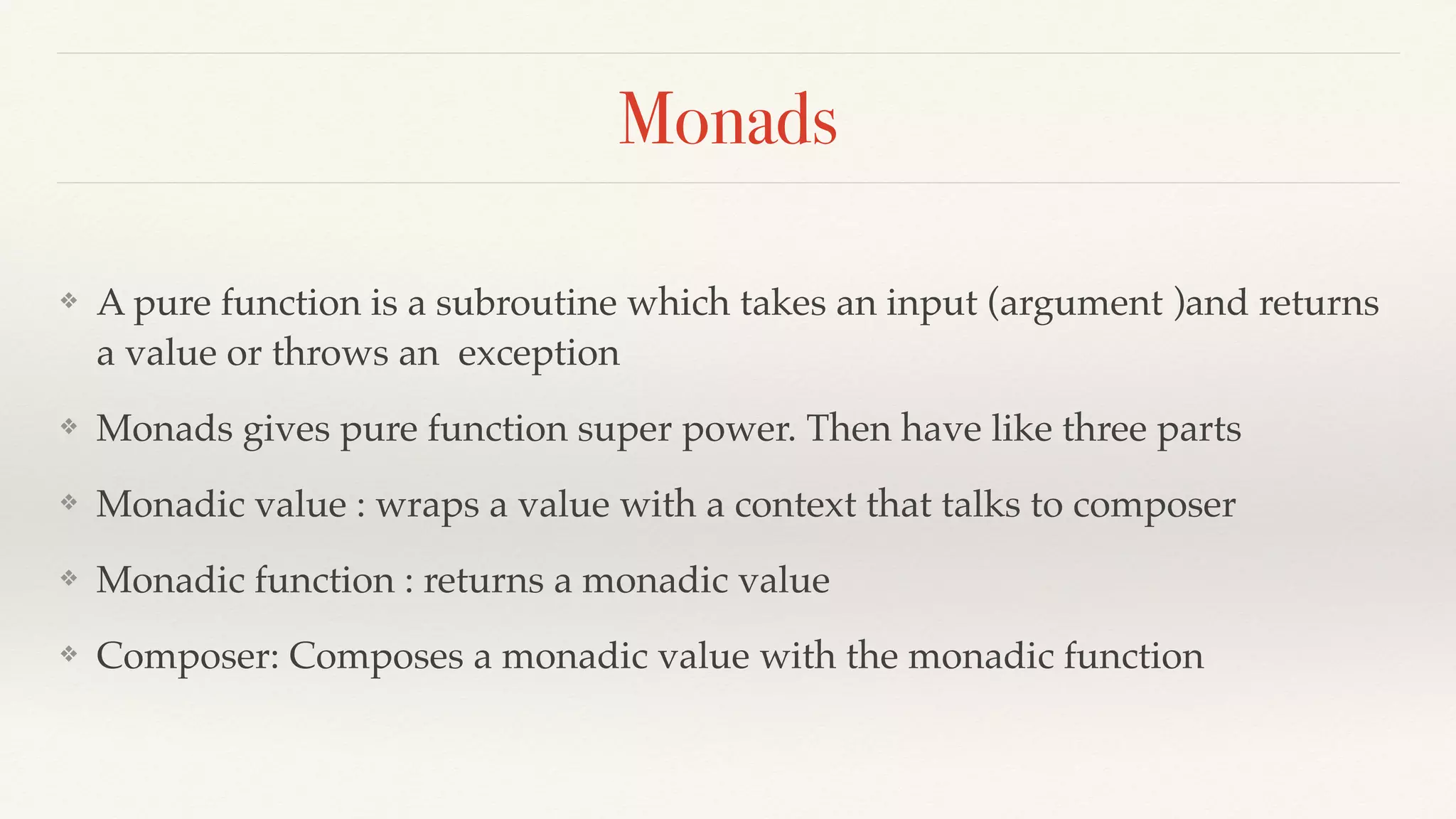
❖ A pure function is a subroutine which takes an input (argument )and returns
a value or throws an exception
❖ Monads gives pure function super power. Then have like three parts
❖ Monadic value : wraps a value with a context that talks to composer
❖ Monadic function : returns a monadic value
❖ Composer: Composes a monadic value with the monadic function
Monads in JDK
public <R> Stream<R> flatMap(Function<? super T, ? extends Stream<? extends R>> mapper)
public <U> Optional<U> flatMap(Function<? super T, ? extends Optional<? extends U>> mapper)
public <U> CompletableFuture<U> thenCompose( Function<? super T, ? extends CompletionStage<U>> fn)
Non Blocking -Tamed
/**
* @implNote Hope this would scale things up.
*/
public void placeDeposit(final double value) {
compute("SGD->USD", value)
.thenCompose(r -> compute("addInterest", r))
.thenCompose(r -> compute("subtractCharges", r))
.whenComplete((r, e) -> {
if (Objects.nonNull(e)) Non
LOGGER.log(Level.ERROR, e);
} else {
publishToRandomPlace(r);
}
});
}
CompletableFuture<Double> compute(String op, double x) {
switch (op) {
case "SGD->USD":
return supplyAsync(() -> getSgdUsd() * x);
case "addInterest":
return supplyAsync(() -> getFederalFundsRate() * x +
case "subtractCharges":
return supplyAsync(() -> x - getChargeCalculator(x));
}
throw new UnsupportedOperationException();
}
Non Blocking -Simplified
/**
* @implNote Hope this would scale things up.
*/
public void placeDeposit(final double value) {
CompletableFuture.supplyAsync(() -> compute("SGD->USD", value))
.thenApplyAsync((r) -> compute("addInterest", r))
.thenApplyAsync((r) -> compute("subtractCharges", r))
.whenComplete((r, e) -> {
if (Objects.nonNull(e)) {
LOGGER.log(Level.ERROR, e);
} else {
publishToRandomPlace(r);
}
});
}
double compute(String op, double x) {
switch (op) {
case "SGD->USD":
return getSgdUsd() * x;
case "addInterest":
return getFederalFundsRate() * x + x;
case "subtractCharges":
return x - getChargeCalculator(x);
}
throw new UnsupportedOperationException();
}
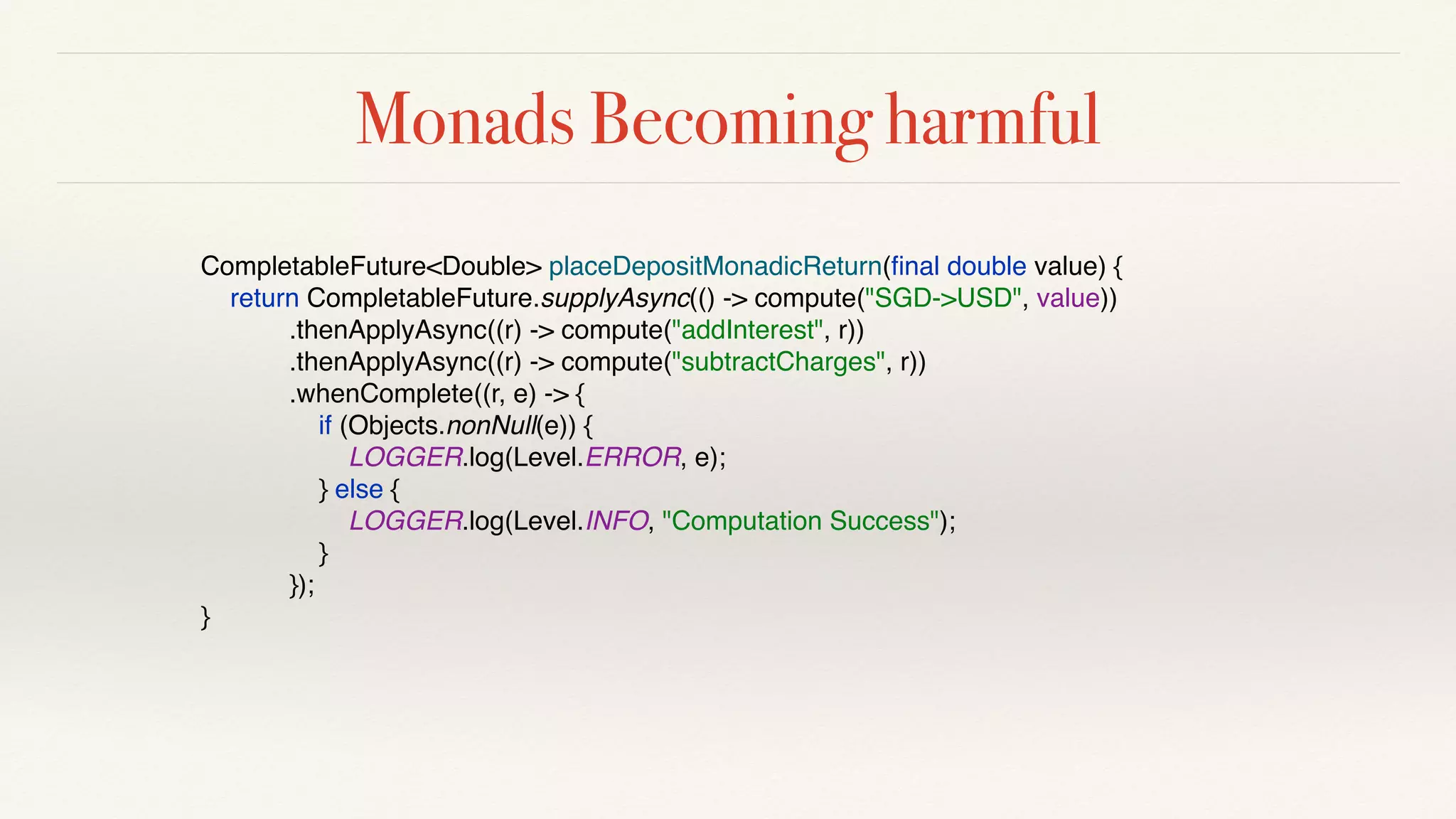
Monads Becoming harmful
CompletableFuture<Double> placeDepositMonadicReturn(final double value) {
return CompletableFuture.supplyAsync(() -> compute("SGD->USD", value))
.thenApplyAsync((r) -> compute("addInterest", r))
.thenApplyAsync((r) -> compute("subtractCharges", r))
.whenComplete((r, e) -> {
if (Objects.nonNull(e)) {
LOGGER.log(Level.ERROR, e);
} else {
LOGGER.log(Level.INFO, "Computation Success");
}
});
}
Structured Programming
Notes on Structured Programming
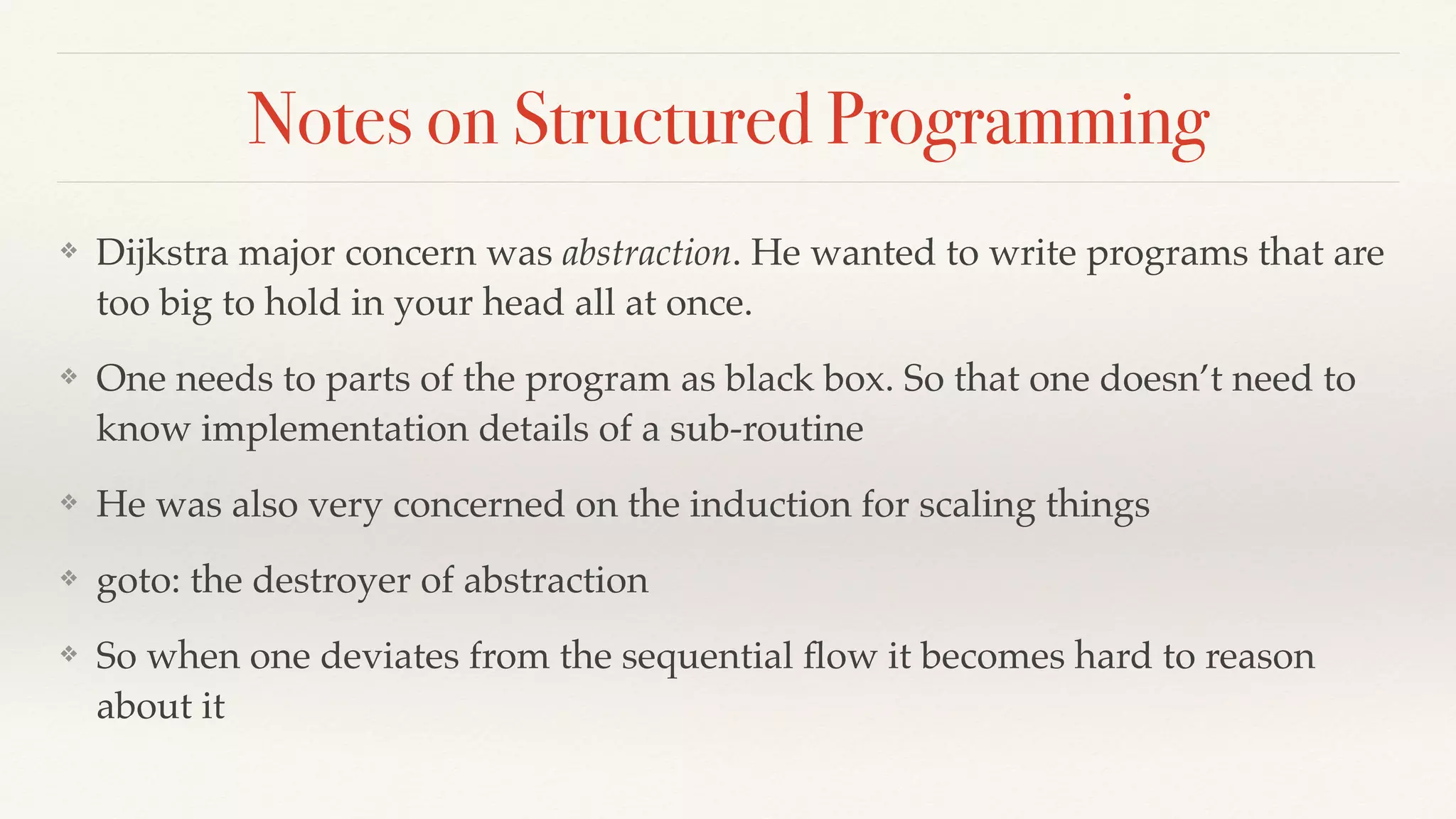
❖ Dijkstra major concern was abstraction. He wanted to write programs that are
too big to hold in your head all at once.
❖ One needs to parts of the program as black box. So that one doesn’t need to
know implementation details of a sub-routine
❖ He was also very concerned on the induction for scaling things
❖ goto: the destroyer of abstraction
❖ So when one deviates from the sequential flow it becomes hard to reason
about it
Unstructured
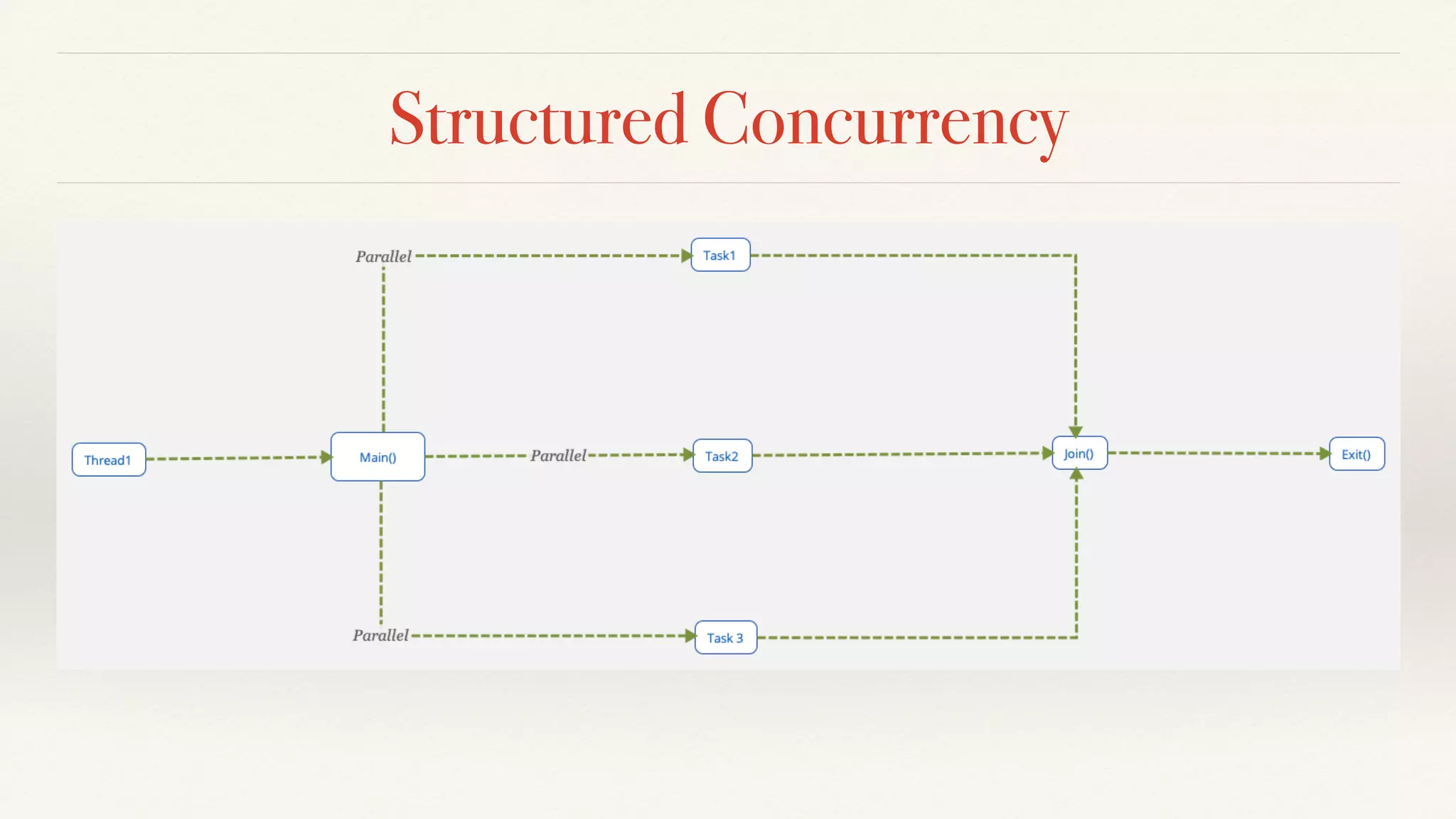
Structured Concurrency
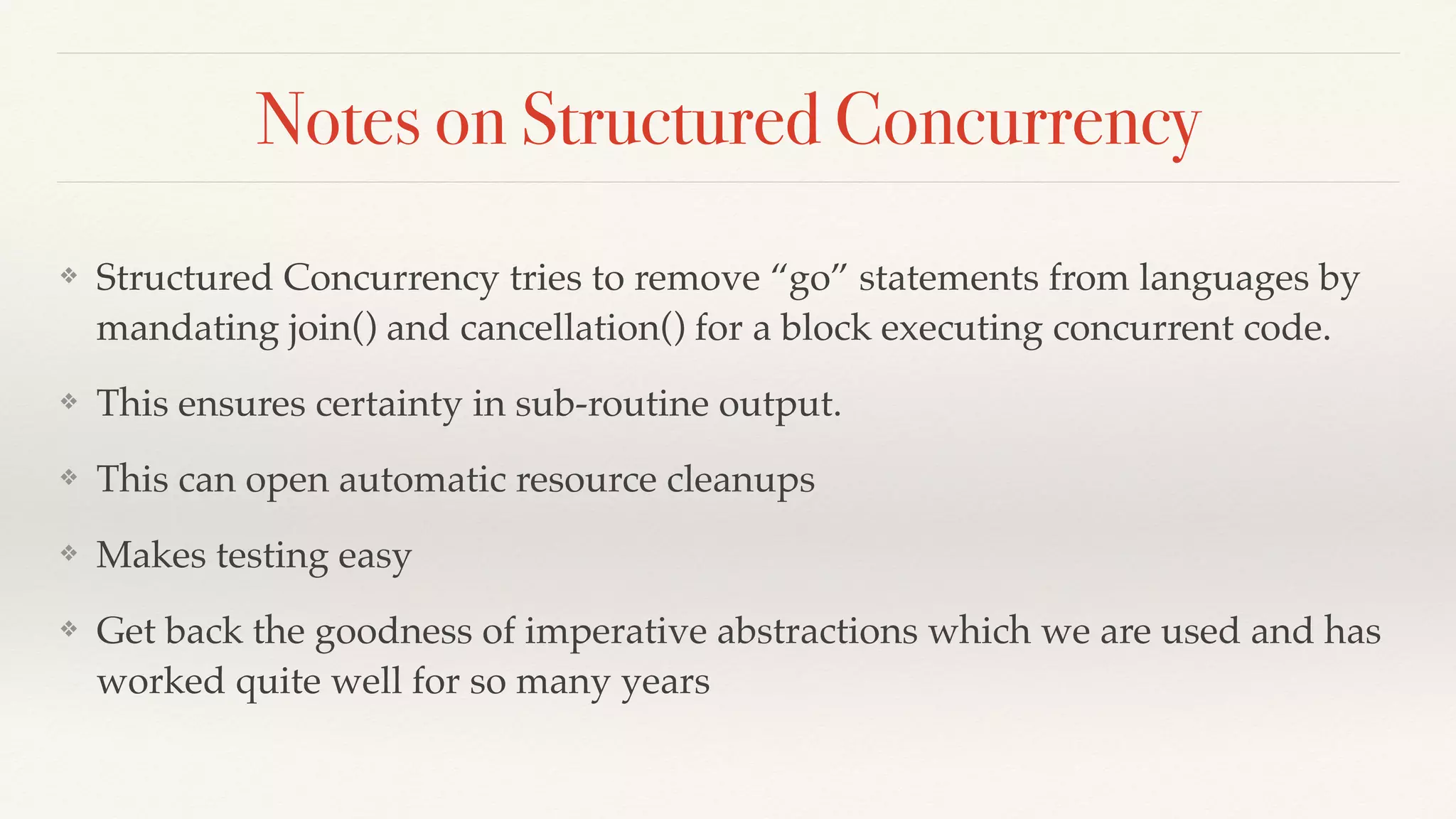
Notes on Structured Concurrency
❖ Structured Concurrency tries to remove “go” statements from languages by
mandating join() and cancellation() for a block executing concurrent code.
❖ This ensures certainty in sub-routine output.
❖ This can open automatic resource cleanups
❖ Makes testing easy
❖ Get back the goodness of imperative abstractions which we are used and has
worked quite well for so many years
Project Loom
J.l.Thread
❖ 25 year old idea
❖ Threads are always mapped to os threads
❖ OS thread are more generic and designed for the variety different tasks
❖ Os thread memory can grow but not shrink
❖ In general the Thread can take KB to MB of memory
❖ Bounded executers help manage these more efficiently
Virtual Threads
❖ Virtual Threads which handled completely in VM and are lightweight
❖ They are scheduled and multiplexed on a carrier thread
❖ Virtual Threads can be suspended and resumed
❖ So we can create millions of Virtual Threads and be safe that memory doesn’t
run out
Continuation
public static void main(String[] args) {
final var scope = new ContinuationScope("Test");
final var continuation = new java.lang.Continuation(scope, () -> {
System.out.println("Before");
java.lang.Continuation.yield(scope);
System.out.println("After");
});
continuation.run();
System.out.println(continuation.isDone());
continuation.run();
System.out.println(continuation.isDone());
}
Before
false
After
true
Process finished with exit code 0
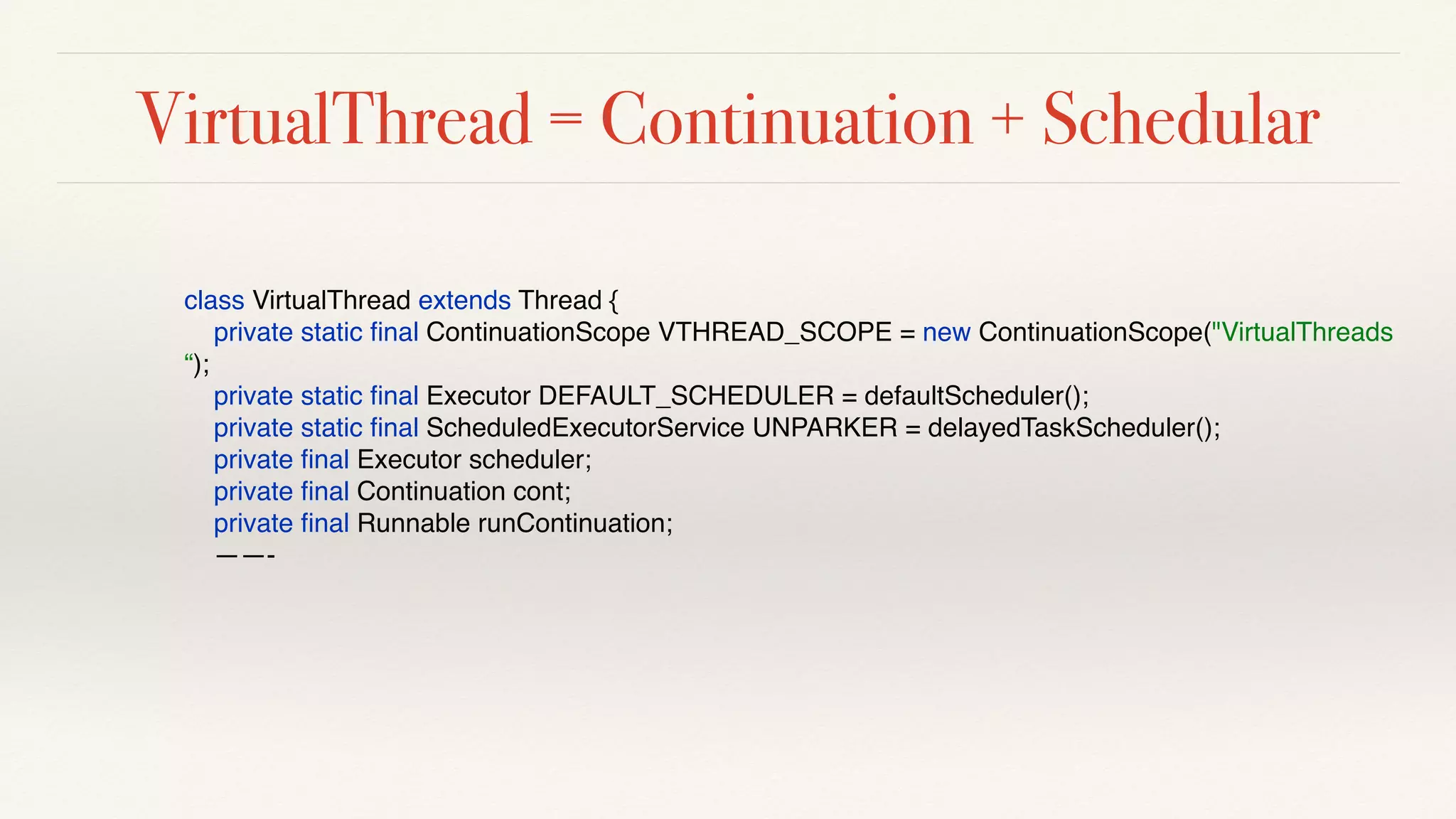
VirtualThread = Continuation + Schedular
class VirtualThread extends Thread {
private static final ContinuationScope VTHREAD_SCOPE = new ContinuationScope("VirtualThreads
“);
private static final Executor DEFAULT_SCHEDULER = defaultScheduler();
private static final ScheduledExecutorService UNPARKER = delayedTaskScheduler();
private final Executor scheduler;
private final Continuation cont;
private final Runnable runContinuation;
——-
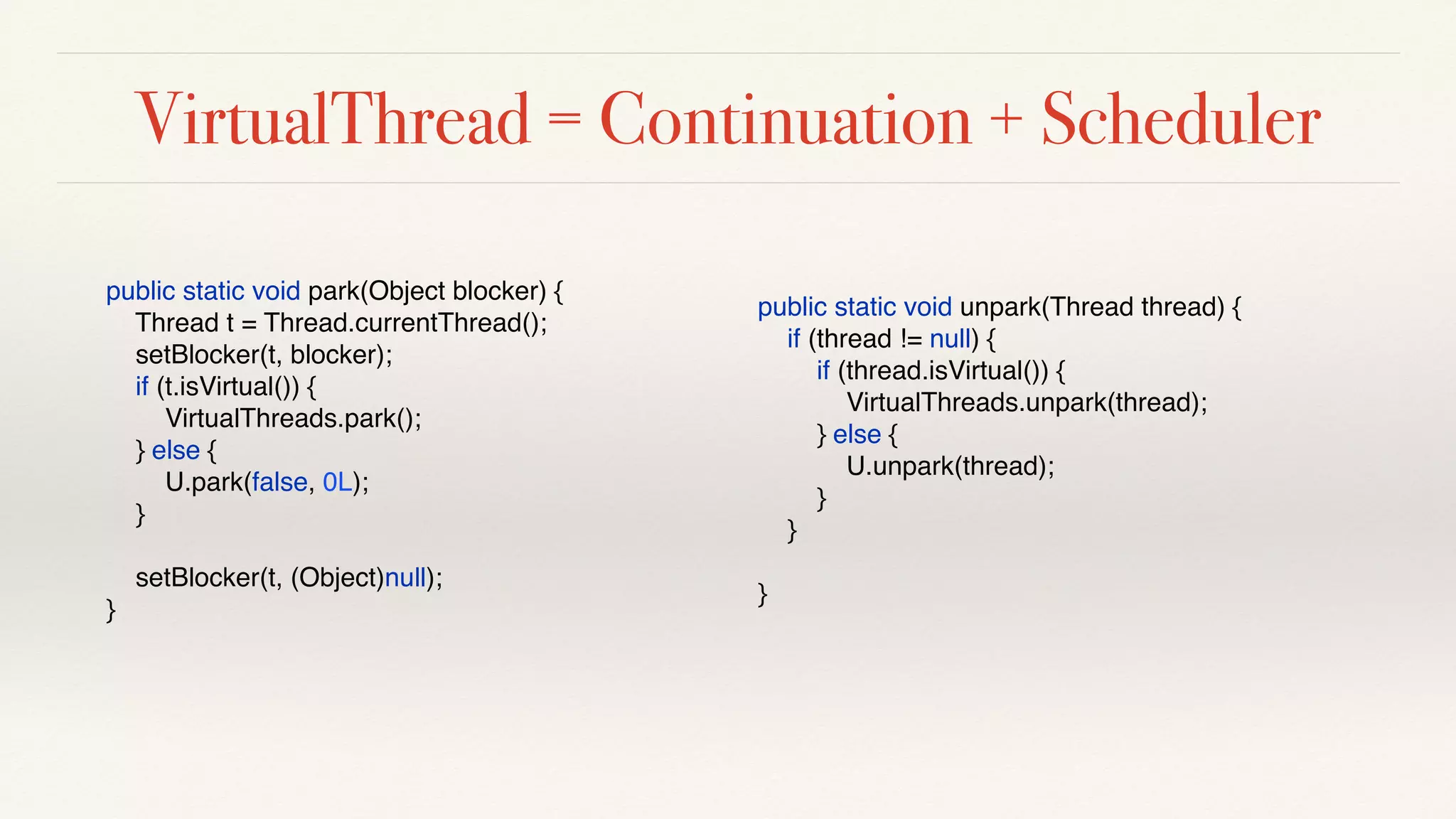
VirtualThread = Continuation + Scheduler
public static void park(Object blocker) {
Thread t = Thread.currentThread();
setBlocker(t, blocker);
if (t.isVirtual()) {
VirtualThreads.park();
} else {
U.park(false, 0L);
}
setBlocker(t, (Object)null);
}
public static void unpark(Thread thread) {
if (thread != null) {
if (thread.isVirtual()) {
VirtualThreads.unpark(thread);
} else {
U.unpark(thread);
}
}
}
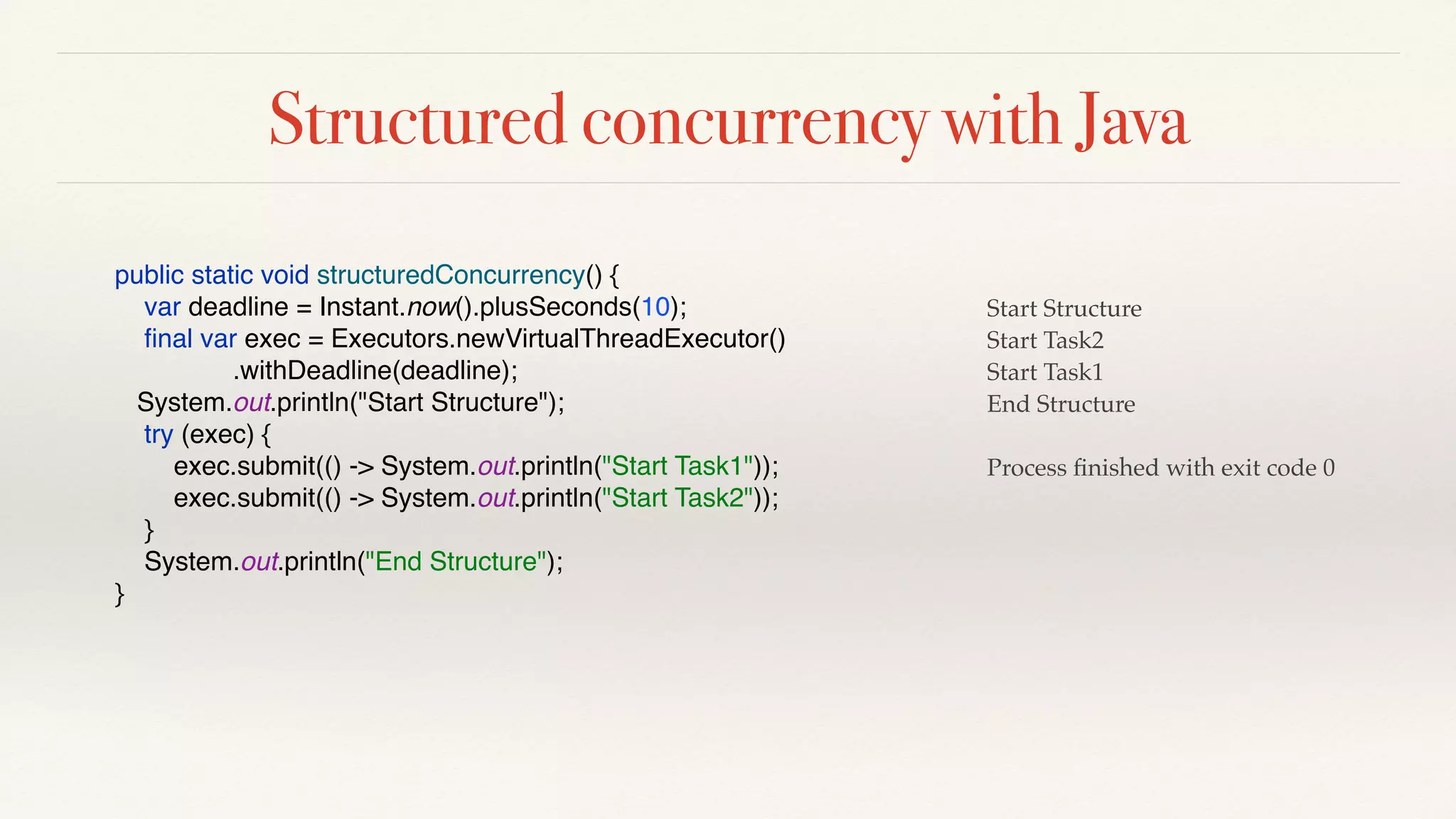
Structured concurrency with Java
public static void structuredConcurrency() {
var deadline = Instant.now().plusSeconds(10);
final var exec = Executors.newVirtualThreadExecutor()
.withDeadline(deadline);
System.out.println("Start Structure");
try (exec) {
exec.submit(() -> System.out.println("Start Task1"));
exec.submit(() -> System.out.println("Start Task2"));
}
System.out.println("End Structure");
}
Start Structure
Start Task2
Start Task1
End Structure
Process finished with exit code 0
placeDeposit() with Structured Concurrency
public static Double placeDeposit(final double value) {
var deadline = Instant.now().plusSeconds(10);
final var exec = Executors.newVirtualThreadExecutor().withDeadline(deadline);
try (exec) {
return compute("SGD->USD", value, exec)
.thenCompose(r -> compute("addInterest", r, exec))
.thenCompose(r -> compute("subtractCharges", r, exec)).join();
} catch (CompletionException ex) {
throw new RuntimeException(ex.getCause());
}
}
Exploiting parallelism
public int sumAccumulatorPattern() {
var sum = 0;
for (int i = 0; i < 100; i++) {
sum = sum + i;
}
return sum;
}
public int sumInParallel() {
return IntStream.range(0, 100)
.parallel().sum();
}
Accumulator
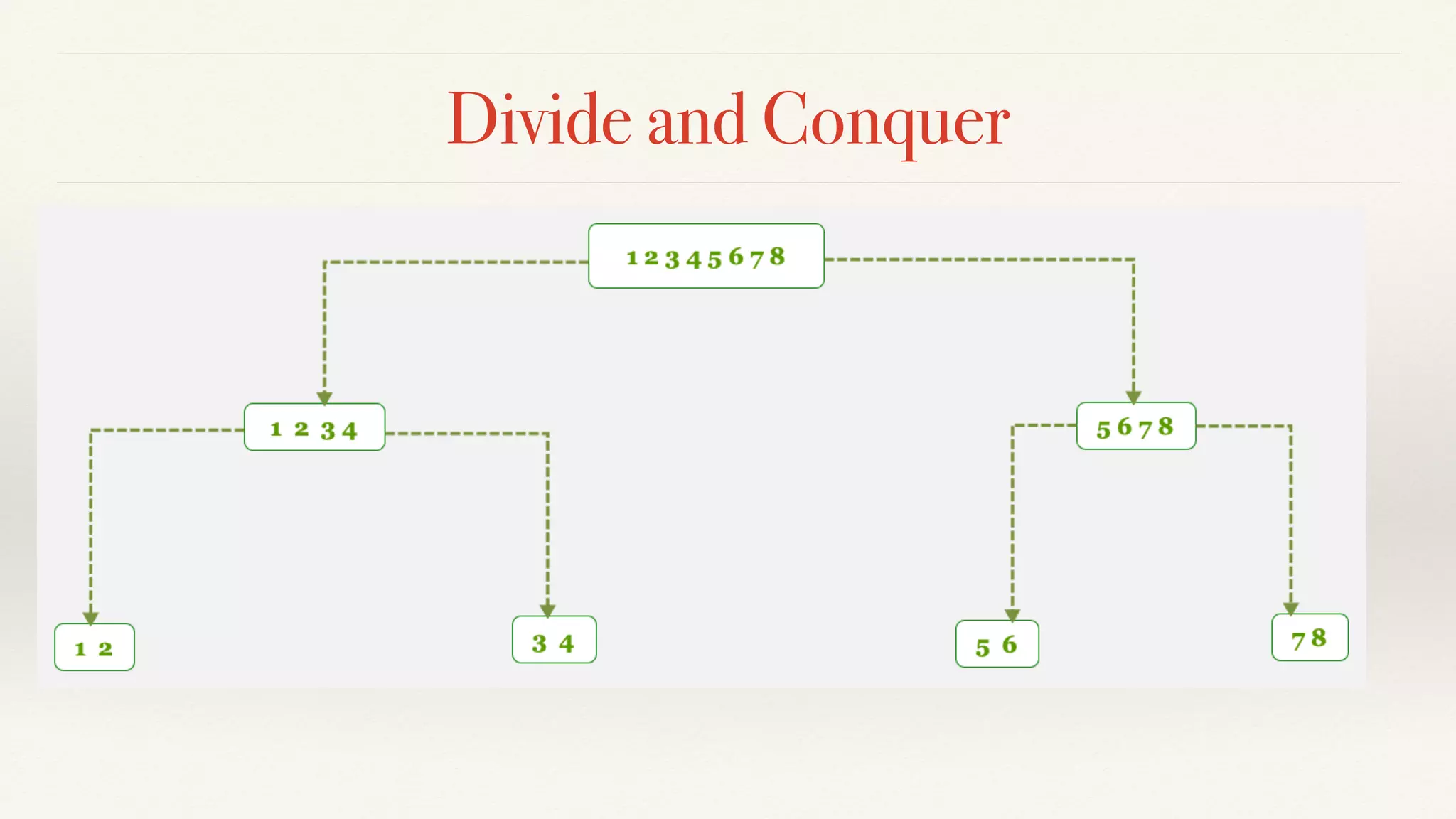
Divide and Conquer
public static void downloadParallel() {
final var urls = List.of("https://www.google.com", "https://edition.cnn.com");
final var factory = Thread.builder().virtual().factory();
var deadline = Instant.now().plusSeconds(100);
final var exec = Executors.newUnboundedExecutor(factory).withDeadline(deadline);
final var httpClient = HttpClient.newBuilder()
.connectTimeout(Duration.ofSeconds(5))
.executor(exec)
.build();
try (exec) {
final var tasks = new ArrayList<CompletableFuture<String>>();
for (final var url : urls) {
final var request = HttpRequest.newBuilder()
.GET()
.uri(URI.create(url))
.build();
LOGGER.log(DEBUG, "Downloading the content for the url " + url);
tasks.add(httpClient.sendAsync(request, BodyHandlers.ofString())
.thenApply(r -> handleResponse(r, url)));
}
tasks.stream().map(CompletableFuture::join).forEach(System.out::println);
} catch (CompletionException ex) {
throw new RuntimeException(ex.getCause());
}
}
Limitations of Virtual Thread
❖ Currently doesn’t work well with synchronized block. Can’t yield while
holding a lock
❖ Object.wait() inside the synchronized block the carrier thread
❖ Continuation doesn’t work with native frames
❖ Java.util.concurrent retuning is needed
References
❖ https://wiki.openjdk.java.net/display/loom/Structured+Concurrency
❖ https://vorpus.org/blog/notes-on-structured-concurrency-or-go-statement-
considered-harmful/
❖ https://www.cs.utexas.edu/~EWD/ewd02xx/EWD249.PDF
❖ https://scholar.google.com/scholar?
cluster=15335993203437612903&hl=en&as_sdt=0,5
❖ https://wiki.openjdk.java.net/display/loom/Main
❖ http://cr.openjdk.java.net/~rpressler/loom/loom/sol1_part1.html
Thank you
❖ Q n A

Loom and concurrency latest

  • 1.
    Structured Concurrency And ProjectLoom Srinivasan Raghavan Principal Software Engineer Veracode
  • 2.
    Safe Harbor Statement Thefollowing is for information purposes only and not an endorsement from the company I work for
  • 3.
    ❖ Little's law ❖Constrains and benefits of request pre thread model ❖ Asynchronous models benefits and pit falls ❖ Need for Structured Concurrency ❖ Project Loom ❖ Q and A Program Agenda
  • 4.
    Little's law L =λW L - Concurrency should be supported W - Mean latency - Incoming of requestλ
  • 5.
    Little's law ❖ Thereare various factors affecting the capacity of the servers L ❖ TCP sessions the os can make and handling of IO ❖ The number of threads T which the VM, OS can handle ❖ How much of each thread T is blocking which impacts W ❖ If L >>> T and W is high the we have un-responsiveness ❖ Then we should up extra resources to scale more
  • 6.
    Request Per Thread ❖The usual programming model is Request per thread model. ❖ Where incoming request are sent to thread and there serial step by step execution of the code with in the thread ❖ Very easy to reason this code as its synchronous code and imperative ❖ But this uses the hardware badly ❖ There is no parallel use of cpu for computation related problem ❖ And lets the code depends on some external IO then its blocked util the entire operation is finished ❖ And the this leads to bad performance
  • 7.
    Asynchronous non blockingmodel ❖ Asynchronous frameworks came where one defines the list of tasks in a form steps and the steps can execute at different point of time and threads ❖ The steps are given in domain specific way and so framework specific ❖ Good for the hardware ❖ Hard to maintain code and hard to reason code and profile it ❖ Throws out all effective abstraction of imperative programming built over decades
  • 8.
    Moving away fromRequest per Thread model
  • 9.
    Imperative and Blocking doubleplaceDeposit(final double value) { var result = compute("SGD->USD", value); result = compute("addInterest", result); result = compute("subtractCharges", result); return result; } double compute(String op, double x) { switch (op) { case "SGD->USD": return getSgdUsd() * x; case "addInterest": return getFederalFundsRate() * x + x; case "subtractCharges": return x - getChargeCalculator(x); default: } throw new UnsupportedOperationException(); }
  • 10.
    Non Blocking -WildWest void placeDeposit(double value) { compute("SGD->USD", value, (r, e) -> { LOGGER.log(Level.INFO, "First"); if (Objects.nonNull(e)) { LOGGER.log(ERROR, e); } else { compute("addInterest", r, (r1, e1) -> { LOGGER.log(Level.INFO, "second"); if (Objects.nonNull(e1)) { LOGGER.log(ERROR, e1); } else { compute("subtractCharges", r1, (r2, e2) -> { LOGGER.log(Level.INFO, "third"); if (Objects.nonNull(e2)) { LOGGER.log(ERROR, e2); } else { publishToSomeRandomQueue(r2); } }); } }); } }); } void compute(String op, double x, BiConsumer<Double, Exception> blk) {
  • 11.
    Monads ❖ A purefunction is a subroutine which takes an input (argument )and returns a value or throws an exception ❖ Monads gives pure function super power. Then have like three parts ❖ Monadic value : wraps a value with a context that talks to composer ❖ Monadic function : returns a monadic value ❖ Composer: Composes a monadic value with the monadic function
  • 12.
    Monads in JDK public<R> Stream<R> flatMap(Function<? super T, ? extends Stream<? extends R>> mapper) public <U> Optional<U> flatMap(Function<? super T, ? extends Optional<? extends U>> mapper) public <U> CompletableFuture<U> thenCompose( Function<? super T, ? extends CompletionStage<U>> fn)
  • 13.
    Non Blocking -Tamed /** *@implNote Hope this would scale things up. */ public void placeDeposit(final double value) { compute("SGD->USD", value) .thenCompose(r -> compute("addInterest", r)) .thenCompose(r -> compute("subtractCharges", r)) .whenComplete((r, e) -> { if (Objects.nonNull(e)) Non LOGGER.log(Level.ERROR, e); } else { publishToRandomPlace(r); } }); } CompletableFuture<Double> compute(String op, double x) { switch (op) { case "SGD->USD": return supplyAsync(() -> getSgdUsd() * x); case "addInterest": return supplyAsync(() -> getFederalFundsRate() * x + case "subtractCharges": return supplyAsync(() -> x - getChargeCalculator(x)); } throw new UnsupportedOperationException(); }
  • 14.
    Non Blocking -Simplified /** *@implNote Hope this would scale things up. */ public void placeDeposit(final double value) { CompletableFuture.supplyAsync(() -> compute("SGD->USD", value)) .thenApplyAsync((r) -> compute("addInterest", r)) .thenApplyAsync((r) -> compute("subtractCharges", r)) .whenComplete((r, e) -> { if (Objects.nonNull(e)) { LOGGER.log(Level.ERROR, e); } else { publishToRandomPlace(r); } }); } double compute(String op, double x) { switch (op) { case "SGD->USD": return getSgdUsd() * x; case "addInterest": return getFederalFundsRate() * x + x; case "subtractCharges": return x - getChargeCalculator(x); } throw new UnsupportedOperationException(); }
  • 15.
    Monads Becoming harmful CompletableFuture<Double>placeDepositMonadicReturn(final double value) { return CompletableFuture.supplyAsync(() -> compute("SGD->USD", value)) .thenApplyAsync((r) -> compute("addInterest", r)) .thenApplyAsync((r) -> compute("subtractCharges", r)) .whenComplete((r, e) -> { if (Objects.nonNull(e)) { LOGGER.log(Level.ERROR, e); } else { LOGGER.log(Level.INFO, "Computation Success"); } }); }
  • 16.
  • 17.
    Notes on StructuredProgramming ❖ Dijkstra major concern was abstraction. He wanted to write programs that are too big to hold in your head all at once. ❖ One needs to parts of the program as black box. So that one doesn’t need to know implementation details of a sub-routine ❖ He was also very concerned on the induction for scaling things ❖ goto: the destroyer of abstraction ❖ So when one deviates from the sequential flow it becomes hard to reason about it
  • 18.
  • 19.
  • 20.
    Notes on StructuredConcurrency ❖ Structured Concurrency tries to remove “go” statements from languages by mandating join() and cancellation() for a block executing concurrent code. ❖ This ensures certainty in sub-routine output. ❖ This can open automatic resource cleanups ❖ Makes testing easy ❖ Get back the goodness of imperative abstractions which we are used and has worked quite well for so many years
  • 21.
  • 22.
    J.l.Thread ❖ 25 yearold idea ❖ Threads are always mapped to os threads ❖ OS thread are more generic and designed for the variety different tasks ❖ Os thread memory can grow but not shrink ❖ In general the Thread can take KB to MB of memory ❖ Bounded executers help manage these more efficiently
  • 23.
    Virtual Threads ❖ VirtualThreads which handled completely in VM and are lightweight ❖ They are scheduled and multiplexed on a carrier thread ❖ Virtual Threads can be suspended and resumed ❖ So we can create millions of Virtual Threads and be safe that memory doesn’t run out
  • 24.
    Continuation public static voidmain(String[] args) { final var scope = new ContinuationScope("Test"); final var continuation = new java.lang.Continuation(scope, () -> { System.out.println("Before"); java.lang.Continuation.yield(scope); System.out.println("After"); }); continuation.run(); System.out.println(continuation.isDone()); continuation.run(); System.out.println(continuation.isDone()); } Before false After true Process finished with exit code 0
  • 25.
    VirtualThread = Continuation+ Schedular class VirtualThread extends Thread { private static final ContinuationScope VTHREAD_SCOPE = new ContinuationScope("VirtualThreads “); private static final Executor DEFAULT_SCHEDULER = defaultScheduler(); private static final ScheduledExecutorService UNPARKER = delayedTaskScheduler(); private final Executor scheduler; private final Continuation cont; private final Runnable runContinuation; ——-
  • 26.
    VirtualThread = Continuation+ Scheduler public static void park(Object blocker) { Thread t = Thread.currentThread(); setBlocker(t, blocker); if (t.isVirtual()) { VirtualThreads.park(); } else { U.park(false, 0L); } setBlocker(t, (Object)null); } public static void unpark(Thread thread) { if (thread != null) { if (thread.isVirtual()) { VirtualThreads.unpark(thread); } else { U.unpark(thread); } } }
  • 27.
    Structured concurrency withJava public static void structuredConcurrency() { var deadline = Instant.now().plusSeconds(10); final var exec = Executors.newVirtualThreadExecutor() .withDeadline(deadline); System.out.println("Start Structure"); try (exec) { exec.submit(() -> System.out.println("Start Task1")); exec.submit(() -> System.out.println("Start Task2")); } System.out.println("End Structure"); } Start Structure Start Task2 Start Task1 End Structure Process finished with exit code 0
  • 28.
    placeDeposit() with StructuredConcurrency public static Double placeDeposit(final double value) { var deadline = Instant.now().plusSeconds(10); final var exec = Executors.newVirtualThreadExecutor().withDeadline(deadline); try (exec) { return compute("SGD->USD", value, exec) .thenCompose(r -> compute("addInterest", r, exec)) .thenCompose(r -> compute("subtractCharges", r, exec)).join(); } catch (CompletionException ex) { throw new RuntimeException(ex.getCause()); } }
  • 29.
    Exploiting parallelism public intsumAccumulatorPattern() { var sum = 0; for (int i = 0; i < 100; i++) { sum = sum + i; } return sum; } public int sumInParallel() { return IntStream.range(0, 100) .parallel().sum(); }
  • 30.
  • 31.
  • 32.
    public static voiddownloadParallel() { final var urls = List.of("https://www.google.com", "https://edition.cnn.com"); final var factory = Thread.builder().virtual().factory(); var deadline = Instant.now().plusSeconds(100); final var exec = Executors.newUnboundedExecutor(factory).withDeadline(deadline); final var httpClient = HttpClient.newBuilder() .connectTimeout(Duration.ofSeconds(5)) .executor(exec) .build(); try (exec) { final var tasks = new ArrayList<CompletableFuture<String>>(); for (final var url : urls) { final var request = HttpRequest.newBuilder() .GET() .uri(URI.create(url)) .build(); LOGGER.log(DEBUG, "Downloading the content for the url " + url); tasks.add(httpClient.sendAsync(request, BodyHandlers.ofString()) .thenApply(r -> handleResponse(r, url))); } tasks.stream().map(CompletableFuture::join).forEach(System.out::println); } catch (CompletionException ex) { throw new RuntimeException(ex.getCause()); } }
  • 33.
    Limitations of VirtualThread ❖ Currently doesn’t work well with synchronized block. Can’t yield while holding a lock ❖ Object.wait() inside the synchronized block the carrier thread ❖ Continuation doesn’t work with native frames ❖ Java.util.concurrent retuning is needed
  • 34.
    References ❖ https://wiki.openjdk.java.net/display/loom/Structured+Concurrency ❖ https://vorpus.org/blog/notes-on-structured-concurrency-or-go-statement- considered-harmful/ ❖https://www.cs.utexas.edu/~EWD/ewd02xx/EWD249.PDF ❖ https://scholar.google.com/scholar? cluster=15335993203437612903&hl=en&as_sdt=0,5 ❖ https://wiki.openjdk.java.net/display/loom/Main ❖ http://cr.openjdk.java.net/~rpressler/loom/loom/sol1_part1.html
  • 35.