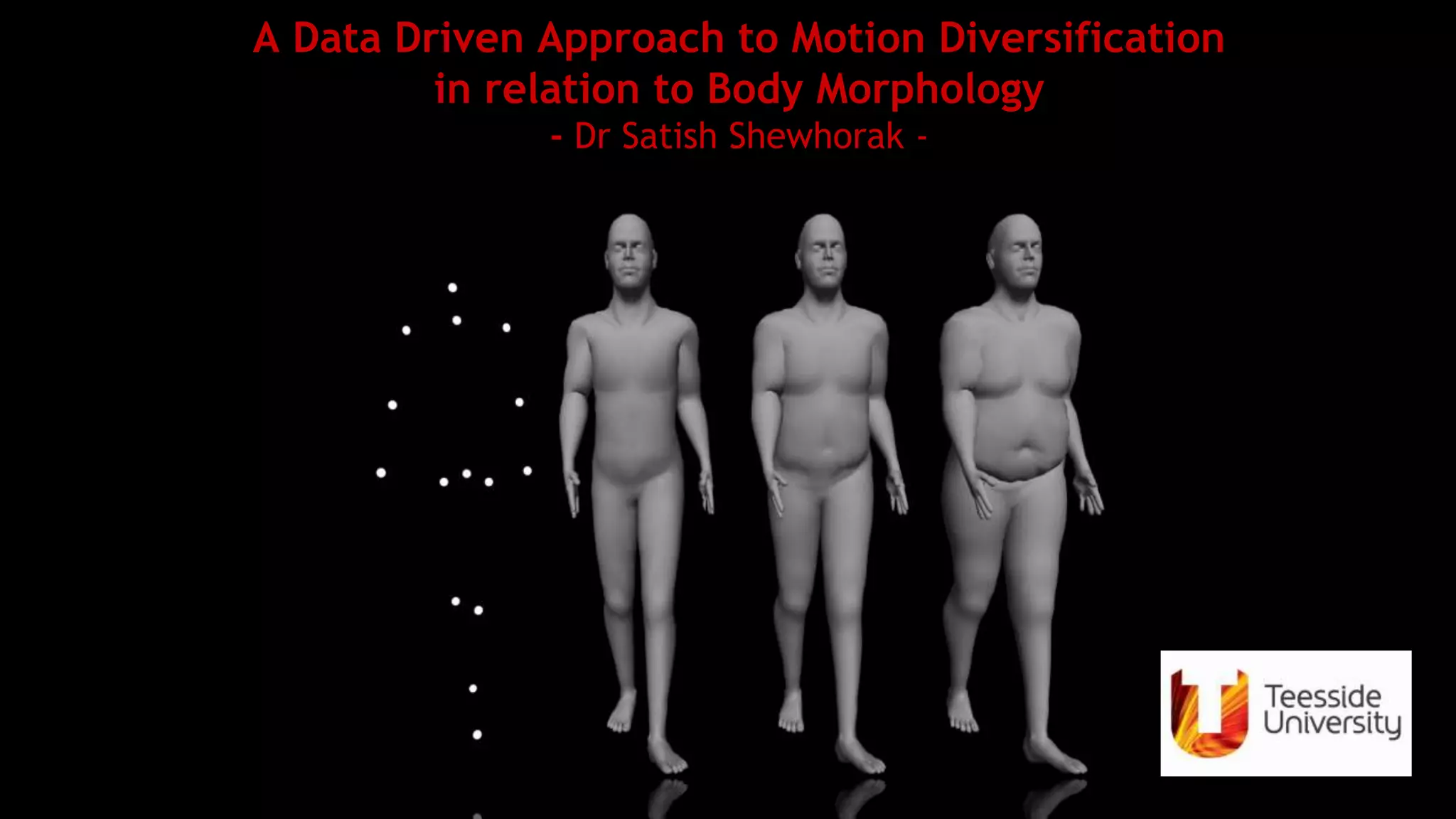
A Data Driven Approach to Motion Diversification
in relation to Body Morphology
- Dr Satish Shewhorak -
Research Problem
'Future challenges in Animation Variety [include] the adaptation of animation
clips to the various morphologies. This means for example the adaptation of
walking to tall people, to fat people.'
(Thalmann et al. [2009])
Aims
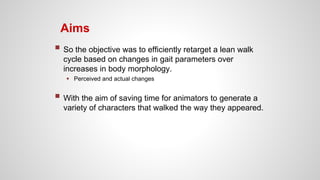
 So the objective was to efficiently retarget a lean walk
cycle based on changes in gait parameters over
increases in body morphology.
 Perceived and actual changes
 With the aim of saving time for animators to generate a
variety of characters that walked the way they appeared.
Methodology
Motion capture a base lean subject
Use scripted modifier to exaggerate 5
motion parameters at 5 strengths
STAGE A
Deploy video survey 1 isolating
motion to Point-Light Displays
Analyse preliminary results to
refine motion parameters
STAGE B
Deploy video survey 2
with character meshes
Analyse results to determine
dominant motion parameters
STAGE C
Motion capture 28 subjects to
analyse actual changes in gait
Compare actual motion parameters
to perceived motion parameters,
to script into final Animation Tool
STAGE D
Deploy final video survey
Assess framework and tools
effectiveness
Analyse Literature for Appearance
to Motion Correlations
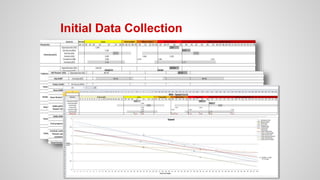
Initial Data Collection
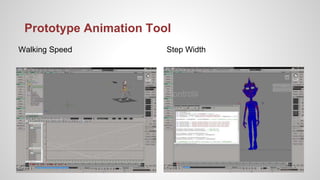
Prototype Animation Tool
Walking Speed Step Width
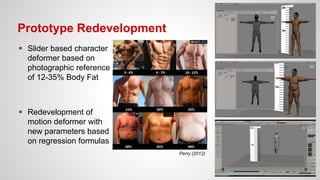
Prototype Redevelopment
 Slider based character
deformer based on
photographic reference
of 12-35% Body Fat
 Redevelopment of
motion deformer with
new parameters based
on regression formulas
Perry (2012)
Perceptual Surveys
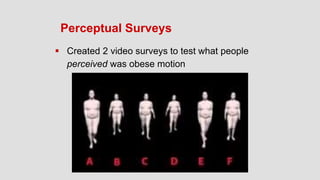
 Created 2 video surveys to test what people
perceived was obese motion
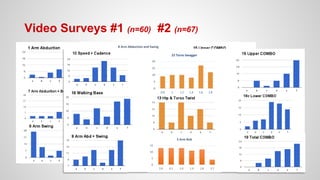
Video Surveys #1 (n=60) #2 (n=67)
0
5
10
15
20
0.5% 12% 23.5% 35% 46.5% 58%
8 Arm Abduction and Swing
0
5
10
15
20
0.8 1 1.2 1.4 1.6 1.8
22 Torso Swagger
0
5
10
15
2.0 0.1 1.0 1.9 2.8 3.7
5 Arm Bob
Results
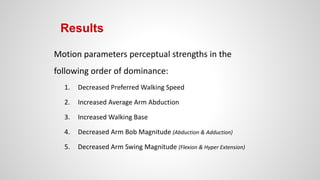
Motion parameters perceptual strengths in the
following order of dominance:
1. Decreased Preferred Walking Speed
2. Increased Average Arm Abduction
3. Increased Walking Base
4. Decreased Arm Bob Magnitude (Abduction & Adduction)
5. Decreased Arm Swing Magnitude (Flexion & Hyper Extension)
Appearance Capture
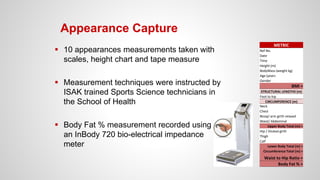
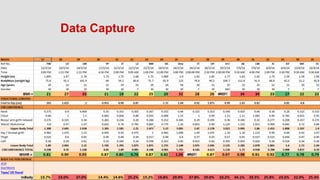
 10 appearances measurements taken with
scales, height chart and tape measure
 Measurement techniques were instructed by
ISAK trained Sports Science technicians in
the School of Health
 Body Fat % measurement recorded using
an InBody 720 bio-electrical impedance
meter
METRIC
Ref No.
Date
Time
Height (m)
BodyMass (weight kg)
Age (years
Gender
BMI =
STRUCTURAL LENGTHS (m)
Foot to hip
CIRCUMFERENCE (m)
Neck
Chest
Bicep/ arm girth relaxed
Waist/ Abdominal
Upper Body Total (m) =
Hip / Gluteal girth
Thigh
Calf
Lower Body Total (m) =
Circumference Total (m) =
Waist to Hip Ratio =
Body Fat % =
Data Capture
Range of Participants
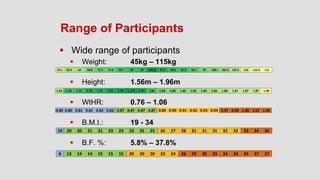
 Wide range of participants
 Weight: 45kg – 115kg
 Height: 1.56m – 1.96m
 WtHR: 0.76 – 1.06
 B.M.I.: 19 - 34
 B.F. %: 5.8% – 37.8%
6 13 14 14 15 15 15 20 20 20 23 24 26 29 30 33 34 34 34 37 37
19 20 20 21 21 23 23 23 25 25 26 27 28 31 31 31 32 32 33 34 34
0.80 0.80 0.81 0.81 0.82 0.82 0.87 0.87 0.87 0.87 0.89 0.90 0.91 0.92 0.93 0.94 0.97 0.98 1.00 1.02 1.06
1.65 1.73 1.73 1.75 1.75 1.76 1.76 1.77 1.77 1.81 1.83 1.84 1.85 1.85 1.85 1.85 1.86 1.87 1.87 1.87 1.90
59.1 63.9 64 68.8 71.5 71.6 75.7 78 79 84.9 87.2 90.5 91.9 95.1 99 100.7 101.9 105.5 110 112.4 115
Motion Capture
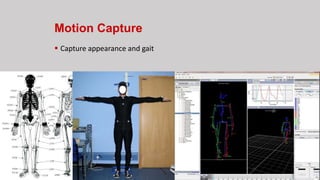
 Capture appearance and gait
Motion capture editing
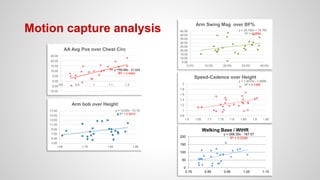
Motion capture analysis
y = 39.98x - 31.424
R² = 0.4864
-10.00
-5.00
0.00
5.00
10.00
15.00
20.00
25.00
0.8 0.9 1 1.1 1.2
AA Avg Pos over Chest Circ
y = 12.03x - 13.18
R² = 0.0819
3.00
5.00
7.00
9.00
11.00
13.00
15.00
17.00
1.64 1.74 1.84 1.94
Arm bob over Height
y = 28.782x + 18.765
R² = 0.0886
5.00
10.00
15.00
20.00
25.00
30.00
35.00
40.00
45.00
0.0% 10.0% 20.0% 30.0% 40.0%
Arm Swing Mag over BF%
y = 1.3015x - 1.0699
R² = 0.1486
0.8
1
1.2
1.4
1.6
1.8
2
1.6 1.65 1.7 1.75 1.8 1.85 1.9 1.95
Speed-Cadence over Height
y = 268.35x - 167.57
R² = 0.2349
0
50
100
150
200
0.75 0.85 0.95 1.05 1.15
Walking Base / WtHR
Video 1
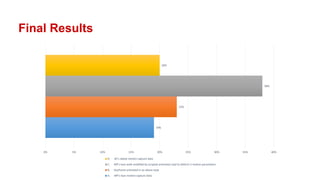
Final Results
19%
23%
38%
20%
0% 5% 10% 15% 20% 25% 30% 35% 40%
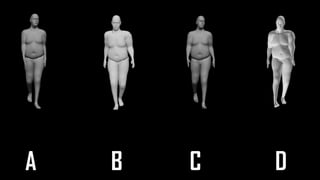
D. AE’s obese motion capture data
C. MP’s lean walk modified by scripted animation tool to deform 5 motion parameters
B. Keyframe animated in an obese style
A. MP’s lean motion capture data
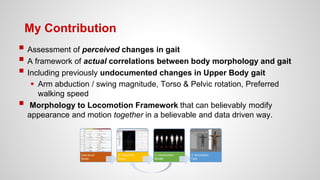
My Contribution
 Assessment of perceived changes in gait
 A framework of actual correlations between body morphology and gait
 Including previously undocumented changes in Upper Body gait
 Arm abduction / swing magnitude, Torso & Pelvic rotation, Preferred
walking speed
 Morphology to Locomotion Framework that can believably modify
appearance and motion together in a believable and data driven way.
Literature
Study
1. Empirical
Study
2. Locomotion
Model
3. Animation
Tool
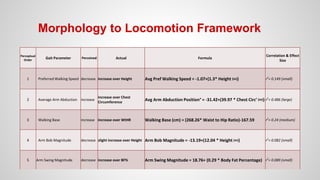
Morphology to Locomotion Framework
Perceptual
Order
Gait Parameter Perceived Actual Formula
Correlation & Effect
Size
1 Preferred Walking Speed decrease increase over Height Avg Pref Walking Speed = -1.07+(1.3* Height (m)) r2
= 0.149 (small)
2 Average Arm Abduction increase
increase over Chest
Circumference
Avg Arm Abduction Position° = -31.42+(39.97 * Chest Circ’ (m)) r2
= 0.486 (large)
3 Walking Base increase increase over WtHR Walking Base (cm) = (268.26* Waist to Hip Ratio)-167.59 r2
= 0.24 (medium)
4 Arm Bob Magnitude decrease slight increase over Height Arm Bob Magnitude = -13.19+(12.04 * Height (m)) r2
= 0.082 (small)
5 Arm Swing Magnitude decrease increase over BF% Arm Swing Magnitude = 18.76+ (0.29 * Body Fat Percentage) r2
= 0.089 (small)
Thanks for listening
Dr. Satish Shewhorak
S.Shewhorak@tees.ac.uk
@asianastroboy
Feel free to attend:
Diversity & Representation in Animation & Games
Wed 29th June, 1.30pm
The Curve (TG.02)

A Data Driven Approach to Motion Diversification in relation to Body Morphology

  • 1.
    A Data DrivenApproach to Motion Diversification in relation to Body Morphology - Dr Satish Shewhorak -
  • 3.
    Research Problem 'Future challengesin Animation Variety [include] the adaptation of animation clips to the various morphologies. This means for example the adaptation of walking to tall people, to fat people.' (Thalmann et al. [2009])
  • 5.
    Aims  So theobjective was to efficiently retarget a lean walk cycle based on changes in gait parameters over increases in body morphology.  Perceived and actual changes  With the aim of saving time for animators to generate a variety of characters that walked the way they appeared.
  • 6.
    Methodology Motion capture abase lean subject Use scripted modifier to exaggerate 5 motion parameters at 5 strengths STAGE A Deploy video survey 1 isolating motion to Point-Light Displays Analyse preliminary results to refine motion parameters STAGE B Deploy video survey 2 with character meshes Analyse results to determine dominant motion parameters STAGE C Motion capture 28 subjects to analyse actual changes in gait Compare actual motion parameters to perceived motion parameters, to script into final Animation Tool STAGE D Deploy final video survey Assess framework and tools effectiveness Analyse Literature for Appearance to Motion Correlations
  • 7.
  • 8.
  • 9.
    Prototype Redevelopment  Sliderbased character deformer based on photographic reference of 12-35% Body Fat  Redevelopment of motion deformer with new parameters based on regression formulas Perry (2012)
  • 10.
    Perceptual Surveys  Created2 video surveys to test what people perceived was obese motion
  • 11.
    Video Surveys #1(n=60) #2 (n=67) 0 5 10 15 20 0.5% 12% 23.5% 35% 46.5% 58% 8 Arm Abduction and Swing 0 5 10 15 20 0.8 1 1.2 1.4 1.6 1.8 22 Torso Swagger 0 5 10 15 2.0 0.1 1.0 1.9 2.8 3.7 5 Arm Bob
  • 12.
    Results Motion parameters perceptualstrengths in the following order of dominance: 1. Decreased Preferred Walking Speed 2. Increased Average Arm Abduction 3. Increased Walking Base 4. Decreased Arm Bob Magnitude (Abduction & Adduction) 5. Decreased Arm Swing Magnitude (Flexion & Hyper Extension)
  • 13.
    Appearance Capture  10appearances measurements taken with scales, height chart and tape measure  Measurement techniques were instructed by ISAK trained Sports Science technicians in the School of Health  Body Fat % measurement recorded using an InBody 720 bio-electrical impedance meter METRIC Ref No. Date Time Height (m) BodyMass (weight kg) Age (years Gender BMI = STRUCTURAL LENGTHS (m) Foot to hip CIRCUMFERENCE (m) Neck Chest Bicep/ arm girth relaxed Waist/ Abdominal Upper Body Total (m) = Hip / Gluteal girth Thigh Calf Lower Body Total (m) = Circumference Total (m) = Waist to Hip Ratio = Body Fat % =
  • 14.
  • 15.
    Range of Participants Wide range of participants  Weight: 45kg – 115kg  Height: 1.56m – 1.96m  WtHR: 0.76 – 1.06  B.M.I.: 19 - 34  B.F. %: 5.8% – 37.8% 6 13 14 14 15 15 15 20 20 20 23 24 26 29 30 33 34 34 34 37 37 19 20 20 21 21 23 23 23 25 25 26 27 28 31 31 31 32 32 33 34 34 0.80 0.80 0.81 0.81 0.82 0.82 0.87 0.87 0.87 0.87 0.89 0.90 0.91 0.92 0.93 0.94 0.97 0.98 1.00 1.02 1.06 1.65 1.73 1.73 1.75 1.75 1.76 1.76 1.77 1.77 1.81 1.83 1.84 1.85 1.85 1.85 1.85 1.86 1.87 1.87 1.87 1.90 59.1 63.9 64 68.8 71.5 71.6 75.7 78 79 84.9 87.2 90.5 91.9 95.1 99 100.7 101.9 105.5 110 112.4 115
  • 16.
    Motion Capture  Captureappearance and gait
  • 17.
  • 18.
    Motion capture analysis y= 39.98x - 31.424 R² = 0.4864 -10.00 -5.00 0.00 5.00 10.00 15.00 20.00 25.00 0.8 0.9 1 1.1 1.2 AA Avg Pos over Chest Circ y = 12.03x - 13.18 R² = 0.0819 3.00 5.00 7.00 9.00 11.00 13.00 15.00 17.00 1.64 1.74 1.84 1.94 Arm bob over Height y = 28.782x + 18.765 R² = 0.0886 5.00 10.00 15.00 20.00 25.00 30.00 35.00 40.00 45.00 0.0% 10.0% 20.0% 30.0% 40.0% Arm Swing Mag over BF% y = 1.3015x - 1.0699 R² = 0.1486 0.8 1 1.2 1.4 1.6 1.8 2 1.6 1.65 1.7 1.75 1.8 1.85 1.9 1.95 Speed-Cadence over Height y = 268.35x - 167.57 R² = 0.2349 0 50 100 150 200 0.75 0.85 0.95 1.05 1.15 Walking Base / WtHR
  • 19.
  • 20.
    Final Results 19% 23% 38% 20% 0% 5%10% 15% 20% 25% 30% 35% 40% D. AE’s obese motion capture data C. MP’s lean walk modified by scripted animation tool to deform 5 motion parameters B. Keyframe animated in an obese style A. MP’s lean motion capture data
  • 21.
    My Contribution  Assessmentof perceived changes in gait  A framework of actual correlations between body morphology and gait  Including previously undocumented changes in Upper Body gait  Arm abduction / swing magnitude, Torso & Pelvic rotation, Preferred walking speed  Morphology to Locomotion Framework that can believably modify appearance and motion together in a believable and data driven way. Literature Study 1. Empirical Study 2. Locomotion Model 3. Animation Tool
  • 22.
    Morphology to LocomotionFramework Perceptual Order Gait Parameter Perceived Actual Formula Correlation & Effect Size 1 Preferred Walking Speed decrease increase over Height Avg Pref Walking Speed = -1.07+(1.3* Height (m)) r2 = 0.149 (small) 2 Average Arm Abduction increase increase over Chest Circumference Avg Arm Abduction Position° = -31.42+(39.97 * Chest Circ’ (m)) r2 = 0.486 (large) 3 Walking Base increase increase over WtHR Walking Base (cm) = (268.26* Waist to Hip Ratio)-167.59 r2 = 0.24 (medium) 4 Arm Bob Magnitude decrease slight increase over Height Arm Bob Magnitude = -13.19+(12.04 * Height (m)) r2 = 0.082 (small) 5 Arm Swing Magnitude decrease increase over BF% Arm Swing Magnitude = 18.76+ (0.29 * Body Fat Percentage) r2 = 0.089 (small)
  • 23.
    Thanks for listening Dr.Satish Shewhorak S.Shewhorak@tees.ac.uk @asianastroboy Feel free to attend: Diversity & Representation in Animation & Games Wed 29th June, 1.30pm The Curve (TG.02)

Editor's Notes

  • #2 Hi, my name is Dr Satish Shewhorak and I’m presenting a Data Driven Approach to Motion Diversification in relation to Body Morphology
  • #3 There are already a plethora of tools and techniques to that let you modify a characters appearance, clothing, hair, gender, skin colour right down to someone like this!
  • #4 It is possible to create a variety of characters with different body shapes and even different gaits. The problem lies in diversifying walk cycles in relation to those changes in body shape.
  • #5 Understanding that is important as humans are adept at identifying virtual clones and the naturalness of human motion. For example in Naughty Dog’s Uncharted 2 they included a Donut Drake mode that retargeted the playable character’s lean locomotion to an obese character model with somewhat unnatural results
  • #6 So the objective was to efficiently retarget a lean walk cycle based on perceived and observed changes in gait parameters. With the aim of saving time for animators to generate a variety of characters that walked the way they appeared.
  • #7 To do this my methodology: 1- First reviewed a range of biomedical research on gait changes over weight gain / loss 2- As a basis to develop a prototype animation tool and test what gait parameters people perceived to relate to changes in body morphology. 3- A range of subjects were then captured by appearance measurements and motion capture walk cycles. 4- The strongest gait to appearance correlations were analysed using linear regression and ordered by perceptual dominance 5- These formed an efficient and believable framework that was tested and validated using a scripted animation tool Reviewed a range of biomedical research that tracked changes in mostly lower body gait over changes in weight loss Input this secondary research into a prototype animation tool focussing on 5 gait parameter at 5 strengths The perceptual dominance of these gait parameters were tested in 2 successive video surveys 25 subjects of varying height and body shape were then appearance and motion captures Correlations were then analysed between appearance metrics and gait parameters These were then implemented into the final version of the animation tool And tested in a final video survey
  • #8 Initially quantitative data was collected from 8 existing and cited datasets to analyse. These are changes in motion parameters across increases in BMI. Using published data however had challenges. The data used mean values (with SD), was differently normalised, variations in age and gender, used different capture methods and lacked upper body data.
  • #9 Here you can see 2 gait parameters from the secondary research tested in the prototype animation tool DON’T PLAY Skip to 30sec
  • #10 Redeveloping the tool took a more human approach as opposed to cartoonified, Whilst BMI was used as a morphology metric for medical studies, there are many critics of this so Body Fat % was used as it was independent of height. Unfortunately as far as the literature shows there isn’t really a linear or categorical way that people gain weight so this photographic reference was our closest solution for a overall morphology metric. Skip to 1;44
  • #11 Individual and combinations of gait parameter changes over obesity were then modified over 5 strengths of exaggeration from lean mocap and tested to see which were perceptually the most dominant in communicating obese motion.
  • #12 HALFWAY POINT From theses 2 video surveys we could deduct gait parameters perceptual strengths in the following order of dominance
  • #13 As people increase body shape viewers perceive a
  • #14 With this preliminary research tested, the main primary research began with 21 male participants recruited. 10 appearance measurements were taken using scales, height charts, tape measure and a bio-electrical impedance meter to test BF% Participants receive a free Body Composition Report
  • #15 Appearance and motion captured 34 participants, -5 females and omitted some unusable samples 21Male participants Also 5 Females but too small sample size to analyse so an avenue for future research.
  • #16 These 21 participants were largely recruited from campus so were similar in age but represented a good spread across the averages of different metrics.
  • #17 After appearance measurements had been recorded subjects were motion captured walking at 5 different speeds slow, fast, 1.2ms , pref speed and faster.
  • #18 Mocap raw data was manually analysed by angular magnitude, average positions and duration of loops. It was then correlated against all appearance metrics and those with the strongest regression fit were identified. Admittedly these are linear regressions so in future this dataset could be analysed for bivariate relationship (chest circ & biceps – arm abd), use non-linear curve fitting or event machine learning. But we managed to identify 5 perceptually dominant gait parameters that had significant correlations with changes over body morphology Average Arm Abduction increases with BF% as perceived, largely related to size of chest not just biceps Arm Bob Magnitude doesn’t reduce over BF% as perceived but varies with little correlation apart from a slight increase over height Arm Swing Magnitude doesn’t reduce but increase over BF% Speed-Cadence doesn’t seem to reduce with BF% but primarily determined by height (and leg length) Walking Base Width does increase over BF% as perceived, however WtHR is strongest correlation. Model of balance. BMI is more closely related to morphology circumference than BF%
  • #19 Mocap raw data was manually analysed by angular magnitude, average positions and duration of loops. It was then correlated against all appearance metrics and those with the strongest regression fit were identified. Admittedly these are linear regressions so in future this dataset could be analysed for bivariate relationship (chest circ & biceps – arm abd), use non-linear curve fitting or event machine learning. But we managed to identify 5 perceptually dominant gait parameters that had significant correlations with changes over body morphology Average Arm Abduction increases with BF% as perceived, largely related to size of chest not just biceps Arm Bob Magnitude doesn’t reduce over BF% as perceived but varies with little correlation apart from a slight increase over height Arm Swing Magnitude doesn’t reduce but increase over BF% Speed-Cadence doesn’t seem to reduce with BF% but primarily determined by height (and leg length) Walking Base Width does increase over BF% as perceived, however WtHR is strongest correlation. Model of balance. BMI is more closely related to morphology circumference than BF%
  • #20 Once we had those 5 gait parameters they were reimplemented into the scripted animation tool and tests a final time in an obese character mesh against Original unchanged lean locomotion Actual obese motion capture locomotion Keyframe animation of a perceived ‘obese’ animation Final Test LOOP 3-6 TIMES!
  • #21 And surprisingly our framework modifying lean mocap proved more believable than the obese motion capture locomotion
  • #22 Assessment of the appearance metrics that most effectively correlate with gait BMI / Body Fat Percentage / Body Circumferences / Ratios / Height
  • #23 Speed-Cadence doesn’t seem to reduce with BF% but primarily determined by height (and leg length) Average Arm Abduction increases with BF% as perceived, largely related to size of chest not just biceps Walking Base Width does increase over BF% as perceived, however WtHR is strongest correlation. Model of balance. Arm Bob Magnitude doesn’t reduce over BF% as perceived but varies with little correlation apart from a slight increase over height Arm Swing Magnitude doesn’t reduce but increase over BF% decrease over Height BMI is more closely related to morphology circumference than BF%