MANAGE YOURSELF
TO
MANAGE YOUR TIME
L&D | Corporate HR 2
You have INR 86,400. How are
you going to spend it? Make a
DETAILED PLAN.
Let’s make some plans…
* You cannot bank any money.
* If you do not use any money, you will lose it.
Go to Page 2 of Hand
out
L&D | Corporate HR 3
Ice Breaker
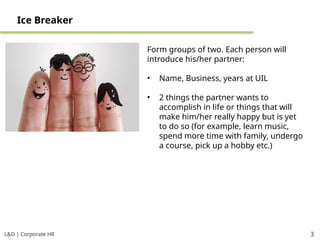
Form groups of two. Each person will
introduce his/her partner:
• Name, Business, years at UIL
• 2 things the partner wants to
accomplish in life or things that will
make him/her really happy but is yet
to do so (for example, learn music,
spend more time with family, undergo
a course, pick up a hobby etc.)
L&D | Corporate HR 4
Some Facts about Time!
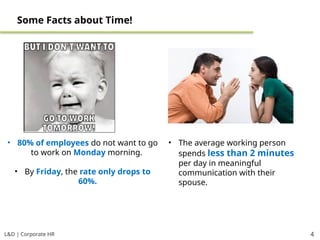
• 80% of employees do not want to go
to work on Monday morning.
• By Friday, the rate only drops to
60%.
• The average working person
spends less than 2 minutes
per day in meaningful
communication with their
spouse.
L&D | Corporate HR 5
Some Facts about Time! (contd.)
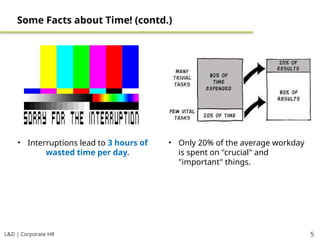
• Interruptions lead to 3 hours of
wasted time per day.
• Only 20% of the average workday
is spent on "crucial" and
"important" things.
L&D | Corporate HR 6
Activity: Fact or Myth
Time flies.
No one else manages
my time but me.
We save time.
Time is against us.
L&D | Corporate HR 7
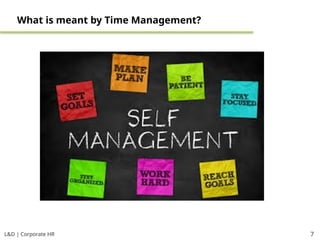
What is meant by Time Management?
L&D | Corporate HR 8
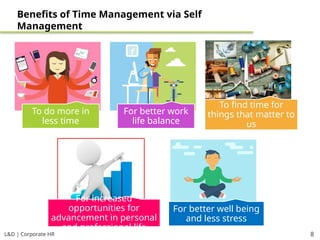
Benefits of Time Management via Self
Management
To do more in
less time
For better work
life balance
To find time for
things that matter to
us
For increased
opportunities for
advancement in personal
and professional life
For better well being
and less stress
HOW TO MANAGE ONESELF TO
MANAGE TIME?
L&D | Corporate HR 10
Activity
How can you manage yourself
to manage your time?
L&D | Corporate HR 11
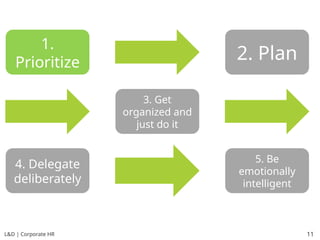
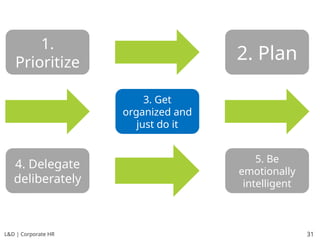
1.
Prioritize
2. Plan
3. Get
organized and
just do it
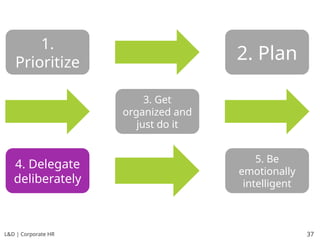
4. Delegate
deliberately
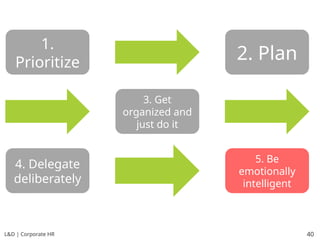
5. Be
emotionally
intelligent
L&D | Corporate HR 12
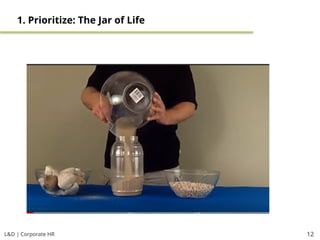
1. Prioritize: The Jar of Life
L&D | Corporate HR 13
The Urgency Addiction
Differentiate between Urgent
and Important!
L&D | Corporate HR 14
Activity: Let’s Check Your Urgency Addiction
Index
Would you like to understand, how powerfully do you get
ruled by the urgency in our lives?
As you read each statement, write the number in the
second column that closely represents your normal
behaviours or attitudes regarding the statements at the
left.
0 = Never, 2 = Sometimes, 4 = Always
Go to Page 3 of Hand
out
L&D | Corporate HR 15
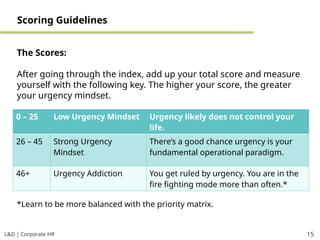
Scoring Guidelines
The Scores:
After going through the index, add up your total score and measure
yourself with the following key. The higher your score, the greater
your urgency mindset.
0 – 25 Low Urgency Mindset Urgency likely does not control your
life.
26 – 45 Strong Urgency
Mindset
There’s a good chance urgency is your
fundamental operational paradigm.
46+ Urgency Addiction You get ruled by urgency. You are in the
fire fighting mode more than often.*
*Learn to be more balanced with the priority matrix.
L&D | Corporate HR 16
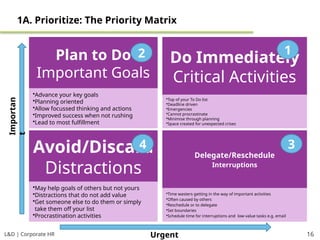
1A. Prioritize: The Priority Matrix
Plan to Do
Important Goals
•Advance your key goals
•Planning oriented
•Allow focussed thinking and actions
•Improved success when not rushing
•Lead to most fulfillment
Do Immediately
Critical Activities
•Top of your To Do list
•Deadline driven
•Emergencies
•Cannot procrastinate
•Minimise through planning
•Space created for unexpected crises
Avoid/Discard
Distractions
•May help goals of others but not yours
•Distractions that do not add value
•Get someone else to do them or simply
take them off your list
•Procrastination activities
Delegate/Reschedule
Interruptions
•Time wasters getting in the way of important activities
•Often caused by others
•Reschedule or to delegate
•Set boundaries
•Schedule time for interruptions and low value tasks e.g. email
Importan
t
Urgent
1
2
3
4
L&D | Corporate HR 17
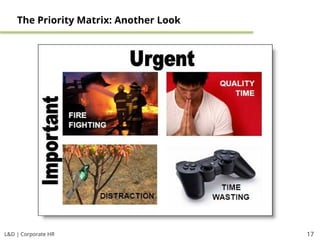
The Priority Matrix: Another Look
L&D | Corporate HR 18
Activity
Create a list of things you did last week. Put
them in the urgent-important matrix.
What quadrant majority of these activities
fall?
Go to Page 4 of Hand
out
L&D | Corporate HR 19
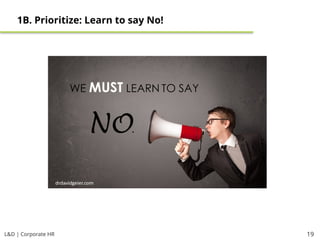
1B. Prioritize: Learn to say No!
L&D | Corporate HR 20
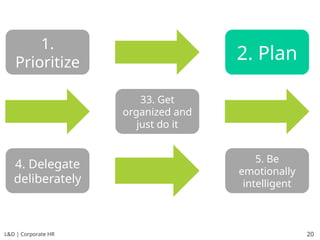
1.
Prioritize
2. Plan
33. Get
organized and
just do it
4. Delegate
deliberately
5. Be
emotionally
intelligent
L&D | Corporate HR 21
2. Plan
Failing to Plan =
Planning to Fail
L&D | Corporate HR 22
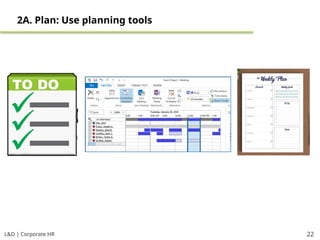
2A. Plan: Use planning tools
L&D | Corporate HR 23
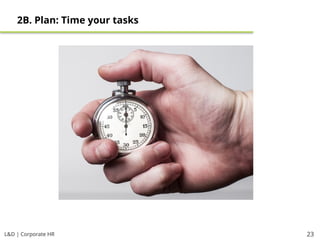
2B. Plan: Time your tasks
L&D | Corporate HR 24
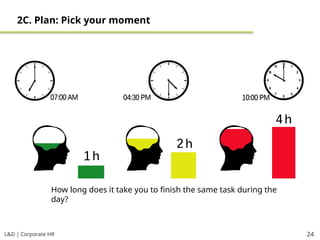
2C. Plan: Pick your moment
How long does it take you to finish the same task during the
day?
L&D | Corporate HR 25
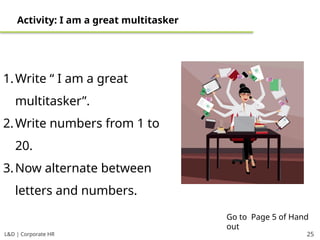
Activity: I am a great multitasker
1.Write “ I am a great
multitasker”.
2.Write numbers from 1 to
20.
3.Now alternate between
letters and numbers.
Go to Page 5 of Hand
out
L&D | Corporate HR 26
The Challenges of Multitasking
L&D | Corporate HR 27
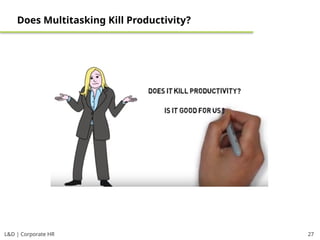
Does Multitasking Kill Productivity?
L&D | Corporate HR 28
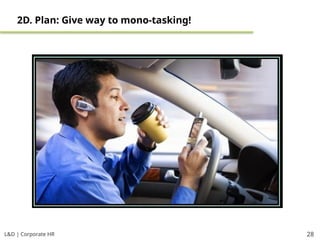
2D. Plan: Give way to mono-tasking!
L&D | Corporate HR 29
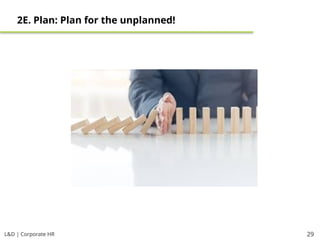
2E. Plan: Plan for the unplanned!
L&D | Corporate HR 30
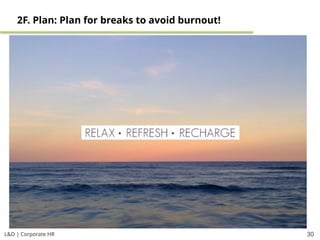
2F. Plan: Plan for breaks to avoid burnout!
L&D | Corporate HR 31
1.
Prioritize
2. Plan
3. Get
organized and
just do it
4. Delegate
deliberately
5. Be
emotionally
intelligent
L&D | Corporate HR 32
Activity: Are you well organized?
Are you well organized?
Answer YES or No to the following questions
Are You Well
Organized?
Go to Page 6 of Hand
out
L&D | Corporate HR 33
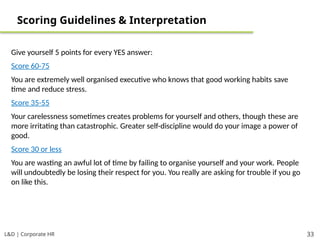
Scoring Guidelines & Interpretation
Give yourself 5 points for every YES answer:
Score 60-75
You are extremely well organised executive who knows that good working habits save
time and reduce stress.
Score 35-55
Your carelessness sometimes creates problems for yourself and others, though these are
more irritating than catastrophic. Greater self-discipline would do your image a power of
good.
Score 30 or less
You are wasting an awful lot of time by failing to organise yourself and your work. People
will undoubtedly be losing their respect for you. You really are asking for trouble if you go
on like this.
L&D | Corporate HR 34
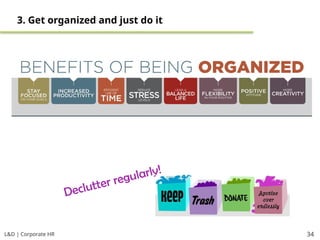
3. Get organized and just do it
Declutter regularly!
L&D | Corporate HR 35
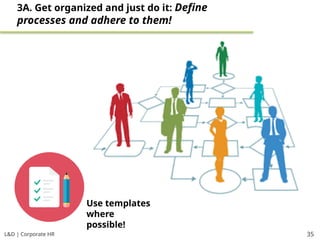
3A. Get organized and just do it: Define
processes and adhere to them!
Use templates
where
possible!
L&D | Corporate HR 36
3B. Get organized and just do it: Aim for
excellence
L&D | Corporate HR 37
1.
Prioritize
2. Plan
3. Get
organized and
just do it
4. Delegate
deliberately
5. Be
emotionally
intelligent
L&D | Corporate HR 38
Activity
Time: 25 minutes
Things Required: 4 decks of playing cards, stop watch
Arrange the cards in the sequence given
below:
L&D | Corporate HR 39
4. Delegate Deliberately
L&D | Corporate HR 40
1.
Prioritize
2. Plan
3. Get
organized and
just do it
4. Delegate
deliberately
5. Be
emotionally
intelligent
L&D | Corporate HR 41
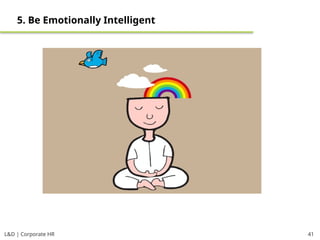
5. Be Emotionally Intelligent
L&D | Corporate HR 42
L&D | Corporate HR 43
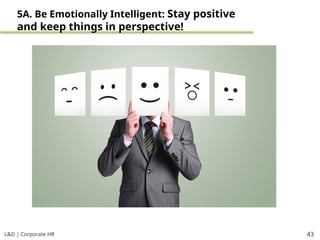
5A. Be Emotionally Intelligent: Stay positive
and keep things in perspective!
L&D | Corporate HR 44
5B. Be Emotionally Intelligent: Know your
time stealers and limit them!
L&D | Corporate HR 45
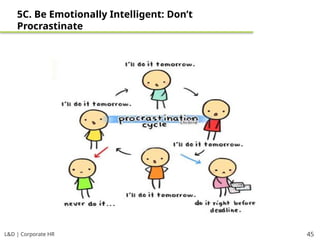
5C. Be Emotionally Intelligent: Don’t
Procrastinate
L&D | Corporate HR 46
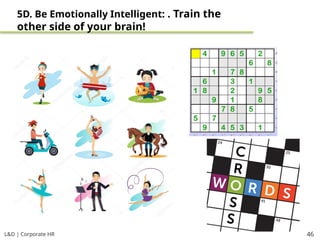
5D. Be Emotionally Intelligent: . Train the
other side of your brain!
L&D | Corporate HR 47
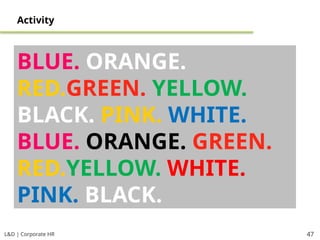
Activity
BLUE. ORANGE.
RED.GREEN. YELLOW.
BLACK. PINK. WHITE.
BLUE. ORANGE. GREEN.
RED.YELLOW. WHITE.
PINK. BLACK.
L&D | Corporate HR 48
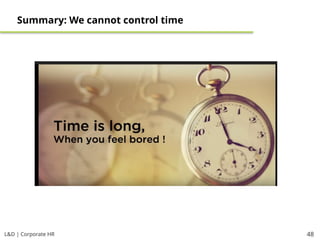
Summary: We cannot control time
L&D | Corporate HR 49
Action Planning
State two things that you are going to do
differently at work.
State two things that you are going to
find time for in your personal lives.
Go to Page 7 of Hand
out
L&D | Corporate HR 50
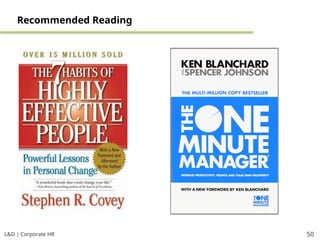
Recommended Reading
A Corporate Presentation on Time Management

A Corporate Presentation on Time Management

  • 1.
  • 2.
    L&D | CorporateHR 2 You have INR 86,400. How are you going to spend it? Make a DETAILED PLAN. Let’s make some plans… * You cannot bank any money. * If you do not use any money, you will lose it. Go to Page 2 of Hand out
  • 3.
    L&D | CorporateHR 3 Ice Breaker Form groups of two. Each person will introduce his/her partner: • Name, Business, years at UIL • 2 things the partner wants to accomplish in life or things that will make him/her really happy but is yet to do so (for example, learn music, spend more time with family, undergo a course, pick up a hobby etc.)
  • 4.
    L&D | CorporateHR 4 Some Facts about Time! • 80% of employees do not want to go to work on Monday morning. • By Friday, the rate only drops to 60%. • The average working person spends less than 2 minutes per day in meaningful communication with their spouse.
  • 5.
    L&D | CorporateHR 5 Some Facts about Time! (contd.) • Interruptions lead to 3 hours of wasted time per day. • Only 20% of the average workday is spent on "crucial" and "important" things.
  • 6.
    L&D | CorporateHR 6 Activity: Fact or Myth Time flies. No one else manages my time but me. We save time. Time is against us.
  • 7.
    L&D | CorporateHR 7 What is meant by Time Management?
  • 8.
    L&D | CorporateHR 8 Benefits of Time Management via Self Management To do more in less time For better work life balance To find time for things that matter to us For increased opportunities for advancement in personal and professional life For better well being and less stress
  • 9.
    HOW TO MANAGEONESELF TO MANAGE TIME?
  • 10.
    L&D | CorporateHR 10 Activity How can you manage yourself to manage your time?
  • 11.
    L&D | CorporateHR 11 1. Prioritize 2. Plan 3. Get organized and just do it 4. Delegate deliberately 5. Be emotionally intelligent
  • 12.
    L&D | CorporateHR 12 1. Prioritize: The Jar of Life
  • 13.
    L&D | CorporateHR 13 The Urgency Addiction Differentiate between Urgent and Important!
  • 14.
    L&D | CorporateHR 14 Activity: Let’s Check Your Urgency Addiction Index Would you like to understand, how powerfully do you get ruled by the urgency in our lives? As you read each statement, write the number in the second column that closely represents your normal behaviours or attitudes regarding the statements at the left. 0 = Never, 2 = Sometimes, 4 = Always Go to Page 3 of Hand out
  • 15.
    L&D | CorporateHR 15 Scoring Guidelines The Scores: After going through the index, add up your total score and measure yourself with the following key. The higher your score, the greater your urgency mindset. 0 – 25 Low Urgency Mindset Urgency likely does not control your life. 26 – 45 Strong Urgency Mindset There’s a good chance urgency is your fundamental operational paradigm. 46+ Urgency Addiction You get ruled by urgency. You are in the fire fighting mode more than often.* *Learn to be more balanced with the priority matrix.
  • 16.
    L&D | CorporateHR 16 1A. Prioritize: The Priority Matrix Plan to Do Important Goals •Advance your key goals •Planning oriented •Allow focussed thinking and actions •Improved success when not rushing •Lead to most fulfillment Do Immediately Critical Activities •Top of your To Do list •Deadline driven •Emergencies •Cannot procrastinate •Minimise through planning •Space created for unexpected crises Avoid/Discard Distractions •May help goals of others but not yours •Distractions that do not add value •Get someone else to do them or simply take them off your list •Procrastination activities Delegate/Reschedule Interruptions •Time wasters getting in the way of important activities •Often caused by others •Reschedule or to delegate •Set boundaries •Schedule time for interruptions and low value tasks e.g. email Importan t Urgent 1 2 3 4
  • 17.
    L&D | CorporateHR 17 The Priority Matrix: Another Look
  • 18.
    L&D | CorporateHR 18 Activity Create a list of things you did last week. Put them in the urgent-important matrix. What quadrant majority of these activities fall? Go to Page 4 of Hand out
  • 19.
    L&D | CorporateHR 19 1B. Prioritize: Learn to say No!
  • 20.
    L&D | CorporateHR 20 1. Prioritize 2. Plan 33. Get organized and just do it 4. Delegate deliberately 5. Be emotionally intelligent
  • 21.
    L&D | CorporateHR 21 2. Plan Failing to Plan = Planning to Fail
  • 22.
    L&D | CorporateHR 22 2A. Plan: Use planning tools
  • 23.
    L&D | CorporateHR 23 2B. Plan: Time your tasks
  • 24.
    L&D | CorporateHR 24 2C. Plan: Pick your moment How long does it take you to finish the same task during the day?
  • 25.
    L&D | CorporateHR 25 Activity: I am a great multitasker 1.Write “ I am a great multitasker”. 2.Write numbers from 1 to 20. 3.Now alternate between letters and numbers. Go to Page 5 of Hand out
  • 26.
    L&D | CorporateHR 26 The Challenges of Multitasking
  • 27.
    L&D | CorporateHR 27 Does Multitasking Kill Productivity?
  • 28.
    L&D | CorporateHR 28 2D. Plan: Give way to mono-tasking!
  • 29.
    L&D | CorporateHR 29 2E. Plan: Plan for the unplanned!
  • 30.
    L&D | CorporateHR 30 2F. Plan: Plan for breaks to avoid burnout!
  • 31.
    L&D | CorporateHR 31 1. Prioritize 2. Plan 3. Get organized and just do it 4. Delegate deliberately 5. Be emotionally intelligent
  • 32.
    L&D | CorporateHR 32 Activity: Are you well organized? Are you well organized? Answer YES or No to the following questions Are You Well Organized? Go to Page 6 of Hand out
  • 33.
    L&D | CorporateHR 33 Scoring Guidelines & Interpretation Give yourself 5 points for every YES answer: Score 60-75 You are extremely well organised executive who knows that good working habits save time and reduce stress. Score 35-55 Your carelessness sometimes creates problems for yourself and others, though these are more irritating than catastrophic. Greater self-discipline would do your image a power of good. Score 30 or less You are wasting an awful lot of time by failing to organise yourself and your work. People will undoubtedly be losing their respect for you. You really are asking for trouble if you go on like this.
  • 34.
    L&D | CorporateHR 34 3. Get organized and just do it Declutter regularly!
  • 35.
    L&D | CorporateHR 35 3A. Get organized and just do it: Define processes and adhere to them! Use templates where possible!
  • 36.
    L&D | CorporateHR 36 3B. Get organized and just do it: Aim for excellence
  • 37.
    L&D | CorporateHR 37 1. Prioritize 2. Plan 3. Get organized and just do it 4. Delegate deliberately 5. Be emotionally intelligent
  • 38.
    L&D | CorporateHR 38 Activity Time: 25 minutes Things Required: 4 decks of playing cards, stop watch Arrange the cards in the sequence given below:
  • 39.
    L&D | CorporateHR 39 4. Delegate Deliberately
  • 40.
    L&D | CorporateHR 40 1. Prioritize 2. Plan 3. Get organized and just do it 4. Delegate deliberately 5. Be emotionally intelligent
  • 41.
    L&D | CorporateHR 41 5. Be Emotionally Intelligent
  • 42.
  • 43.
    L&D | CorporateHR 43 5A. Be Emotionally Intelligent: Stay positive and keep things in perspective!
  • 44.
    L&D | CorporateHR 44 5B. Be Emotionally Intelligent: Know your time stealers and limit them!
  • 45.
    L&D | CorporateHR 45 5C. Be Emotionally Intelligent: Don’t Procrastinate
  • 46.
    L&D | CorporateHR 46 5D. Be Emotionally Intelligent: . Train the other side of your brain!
  • 47.
    L&D | CorporateHR 47 Activity BLUE. ORANGE. RED.GREEN. YELLOW. BLACK. PINK. WHITE. BLUE. ORANGE. GREEN. RED.YELLOW. WHITE. PINK. BLACK.
  • 48.
    L&D | CorporateHR 48 Summary: We cannot control time
  • 49.
    L&D | CorporateHR 49 Action Planning State two things that you are going to do differently at work. State two things that you are going to find time for in your personal lives. Go to Page 7 of Hand out
  • 50.
    L&D | CorporateHR 50 Recommended Reading

Editor's Notes

  • #1 Total time: 4.5 hrs
  • #2 15 minutes Everyone has to create a detailed expenditure plan along with the logic of how they will spend every paisa. Ask 3-4 participants to present their plan and the logic. Then, praise everyone for doing a great job of planning how they will spend their money. Draw out the point that they spent money on the things they considered really important and then came to other trivial expenses. Then, calculate on a flip board how 86,400 was derived. 24 hours * 60 minutes * 60 seconds = 86, 400 seconds. Then state that 86400 are the number of seconds we have each day and to achieve their personal/professional goals that each of them desires to achieve, they should consider planning and spending their time on things that are important to them as they did with their money.
  • #3 15 mins Go ahead with the introductions only if required. Else skip to the last para. The purpose of this ice-breaker is to: Break ice and get the group to know each other Get everyone to reflect on 2 key things they have always wanted to do but so far have not been able to do. This will help the participants refresh in their mind their own goals/vision for themselves and how much they have been able to devote their time to goals/visions/things that make them truly happy.
  • #4 2 minutes 80% of employees do not want to go to work on Monday morning. By Friday, the rate only drops to 60%. The average working person spends less than 2 minutes per day in meaningful communication with their spouse.
  • #5 2 minutes The average person gets 1 interruption every 8 minutes, or approximately 7 an hour, or 50-60 per day. The average interruption takes 5 minutes, totaling about 4 hours or 50% of the average workday. 80% of those interruptions are typically rated as "little value" or "no value" creating approximately 3 hours of wasted time per day.  20% of the average workday is spent on "crucial" and "important" things, while 80% of the average workday is spent on things that have "little value" or "no value“
  • #6 5 minutes Present the following statements and let the participants ascertain whether these are facts or myth. Time Flies: Myth – Time actually moves at a predetermined fixed rate. No one else manages my time but me. Myth - We let others influence our decisions about time and schedule. We save time. Myth – One cannot put time in the bank, postpone it or overspend it. Time is against us. Myth - Time is on our side once we organize it. Time is constant and moves at a predetermined rate, therefore we cannot mange/control time. What we can do is manage ourselves to make the most of the available time.
  • #7 2 minutes Since, number of hours in a day are fixed, we can only manage time by managing ourselves to achieve more in the given time.
  • #8 5 minutes
  • #9 2 minutes Now that we have established that we can’t actually manage time as the number of hours and days are fixed, we can only change our behaviour to make the most of the available time. Since time management is about managing oneself, behavioral changes are required to achieve the same. We need to keep aligning ourselves to reach where we want to go. Or else we will keep on doing something or the other but it would never add up.
  • #10 On a flipchart keep noting the responses and categorize them as given below: 1. Prioritize 2. Plan 3. Get organized and just do it 4. Delegate deliberately 5. Be emotionally intelligent
  • #11 Time-consuming, but relatively unimportant tasks can consume a lot of your day. Prioritizing tasks, in accordance with your goals will ensure that you spend your time and energy on tasks and things that are truly important to you.
  • #12 10 minutes Prioritization is essential to do time management. Before I explain what prioritization is, let me tell you a small story. from 0:42 to 5:18 (forward where applicable). The video is too long and slow, will need to keep skipping. The essence of the story is given below: Here is a teaching story which encapsulates the essence of time management: Mulla Nasruddin was asked to give a talk on time management and how to fit spiritual practice into a busy life schedule.   “Dear Friends, instead of giving a sermon I will demonstrate the art of time management, so let us conduct an experiment,” Mulla Nasrudin said. Nasrudin began by reaching under the table and pulling out a one-gallon, wide-mouthed glass jar. He placed the jar on a table in front of him. Then Mulla Nasrudin produced about a dozen big fist-sized stones and carefully placed them, one at a time, into the jar. As usual, people began to whisper and wonder why the Mulla was doing something strange, as they had come to expect of him, instead of giving a talk like normal spiritual gurus and teachers did. When the jar was filled to the top and no more stones would fit inside, Mulla Nasrudin asked the audience, “Tell me, is this jar full...?” The crowd in unison said, “Yes, the jar is full.” “Really...?” snarled Nasrudin.  He reached under the table and pulled out a bucket of gravel, small pebbles. Then he poured some gravel in and shook the jar, causing pieces of gravel to work themselves down into the spaces between the big rocks, and kept filling the jar with gravel till it reached the brim. Mulla Nasrudin then asked the audience once more, “Tell me, is the jar full now...?” By this time the class was wizening up to him, suspicious of his intentions, so one person from the audience cautiously answered, “Probably not.” “Good...! Now you are begining to learn...” replied Mulla Nasrudin.   Now Mulla Nasrudin reached under the table and brought out a bucket of sand. He started carefully pouring the sand into the jar till the sand filled up the spaces between the stones and the gravel. Once more he asked the question, “Is the jar full now...?” “No...!” the crowd shouted in unison. “Excellent...!” Mulla Nasrudin said, full of praise for the intelligent audience. Then he grabbed a pitcher of water and began to pour it into the jar of stones, gravel and sand until the jar was filled to the brim, absolutely full. Then he looked up at the audience and asked, “Now tell me, what is the point of this illustration, what have you deduced from this experiment...?" One eager beaver raised his hand and said, “The point is that all things, even though they seem full, are inherently empty of self.” “No...!” snarled Nasruddin. “This is a Mulla Nasrudin story, not a Zen story...! Anyone else want to try...?” Another eager beaver raised her hand and suggested, “I presume that the inference is that no matter how busy your schedule is, if you try really hard, use your intelligence, you can always fit some more tasks into your schedule and make maximum use of your time.” “No...” Mulla Nasrudin replied, “That's not the point either. The great truth this experiment teaches us is that if we don't get our values straight and attend to the biggest things of value in life first, we will never be able to fit them in at all.” In other words, the essence of time management, or even life management, is PRIORITIZATION – Prioritization in accordance with your Values. So, in a nutshell here is the essence of time management: 1. First make room for what is most important to you, things that you value the most. Those are your stones.  2. Other things, in descending order of value or importance, like the gravel, sand and water, can then be fitted around the stones. Think, reflect, introspect…what are the “Large Stones” in your Life…? What are your Cardinal Values … things most important to you … things that really matter ...?  Once you identify them, be sure to put them first in your “Jar of Life”.  So set your priorities and take care of your “large stones”.  Remember, everything else is like the small pebbles, gravel, sand and water. If you put all these into the jar first, there will be no room left for the large stones. The same goes for your life. If you spend all your energy and time on the small stuff, you will never have room for things that are truly most important.You must pay attention to the things that are critical in your life. Sometimes the less important things in life can distract us, filling up our time and keeping us away from what really matters ... such trivial things waste our time and sap our spirit and dissipate our energy. Is your jar of life full of sand and gravel or is it filled with “large stones”...? 
  • #13 5 minutes We will all agree that there are only two factors that drive our choices in the utilisation of our time. Urgency and Importance. While all of us consider both these factors while managing our time, one of these two becomes the basic paradigm through which we look at managing our time.   ‘Urgent’ tasks demand your immediate attention, but whether you actually give them that attention may or may not matter. 'Important' tasks matter, and not doing them may have serious consequences for you or others. This distinction between urgent and important is the key to prioritising your time and your workload, whether at work or at home. As you are going through this programme, we are sure that you would be eager to get an insight into your own paradigm. Whether you operate from the paradigm of urgency or importance has a profound effect on the results you get in your life.
  • #14 15 minutes
  • #15 The higher your score, the greater your urgency mindset. Here’s a scale to help measure your score:
  • #16 10 minutes Link the story in the previous slide with urgent-important matrix. The urgent-important matrix is a great technique for prioritizing your tasks. It allows you to deal with the truly important and work toward your goals. It allows you to plan properly and execute those plans effectively.  It also allows you to challenge activities that are a waste of time and effort – for example habitual tasks, or tasks that were handed down from above (think pointless reports and so on). Just because that’s the way things have been done for a long time doesn’t mean it’s still appropriate or there isn’t a better way. The urgent-important matrix allows you to objectively judge your time management and adjust it accordingly.  Quadrant 1: Urgent/Important This quadrant is for the highest priority tasks. They need to get done now.  Try to keep as few tasks as possible here, with the aim to eliminate. If you spend too much of your time in this quadrant, you are working solely as a trouble shooter, and never finding time to work on longer-term plans.  If two or more tasks in this quadrant appear to be equally urgent, you might want to re-asses these tasks with the team members who originated the tasks, or who depend on them. This will help you reprioritize these tasks accordingly.  Also, if you’re met with unplanned demands from others that fall into the urgent/important category, you might want to acknowledge the task and respond with a commitment to complete it a later date. This way, you’ll be able to resume with your planned tasks, while managing their expectations.  Quadrant 2: Not Urgent/Important This is where you want to spend most of your time. This quadrant allows you to work on something important and have the time to do it properly. This will help you produce high quality work in an efficient manner.  The tasks in this quadrant are probably the most neglected ones, but also the most crucial ones for success. You need to plan time for these activities, so that the tasks from quadrant 1 and 3 don’t take over your whole schedule. If necessary, also plan where you will do these tasks, so that you’re free from interruptions.  The tasks in this quadrant can include strategic thinking, deciding on goals or general direction and planning – all vital parts of running a successful business.  Quadrant 3: Urgent/Not Important Quadrant You also want to minimize the tasks that you have in this quadrant. This is where you are busy but not productive.  These tasks are often mistaken to be important, when they’re most often busywork. These tasks are usually demands originated by team members. You need to scrutinize and question them, and then help those who made the demands re-assess the importance of these tasks.  It’s important to make a decision about these tasks as soon as you’re confronted with them. If you can avoid these tasks as they are assigned to you, do it! This way, you’ll be able to manage people’s expectations. But don’t just shut down the person who came to you with the task; help them find another way of achieving what they need, whether it involves delegation to another person or taking a more strategic approach to the task.  This quadrant may also include tasks that exist simply because “we’ve always done it this way.” You want to identify, question and challenge these. The way it’s always been done doesn’t cut it if there isn’t a real purpose behind why things are done the way they are.  Quadrant 4: Not Urgent/Not Important Quadrant You want to minimize the tasks in this quadrant. This is where we go to escape after spending too much time in quadrants 1 and 3. But this may cause quadrant 2 activities to get postponed until they become urgent and move to quadrant 1 – when it becomes too late to get them done effectively.  In fact, this quadrant doesn’t really include tasks, but rather habits that provide comfort, and a refuge from being disciplined and rigorous with your time management. They may often be stress-related activities, so you might want to take some time to understand if there’s a root cause for these habits.  To reduce these activities and remove the temptation to go back to them, it helps to create a clear structure for your day by focusing on the tasks in quadrant 2.  Don’t get me wrong – leisure activities should definitely be part of your daily schedule! They just need to be deliberately scheduled. 
  • #18 10 minutes Think back and evaluate your activities in the last week. Which quadrant majority of these activities fall in? Which quadrants do you think majority of your honest answers fall in? Now that you have got an assignment to analyse the activities that you have performed during last week. I would suggest that you keep on doing this time management activity for the next week, then break it down day-wise, and see how effective tool it is.
  • #19 5 minutes Your time is precious. Don’t waste it on people and projects that don’t align with your mission and goals. Instead of automatically accepting invitations and offers, say, ‘I’ll check my schedule and get back to you’. This simple phrase will buy you time to evaluate offers and make smart decisions.
  • #21 2 minutes Planning your day can help you accomplish more and feel more in control of your life. Plan your da, tasks as well as long and short time goals in life.
  • #22 5 minutes Planning your day can help you accomplish more and feel more in control of your life. Plan your da, tasks as well as long and short time goals in life. *Use planning tools: # TO DO list. The list will keep on changing as the day progresses but this list would at least make it easier for you to deal with all that needs to be done. # You can also use outlook to schedule meetings and set reminders for tasks. Flag mails that need to be responded too. # Keep a planner handy. Make some time for phone calls.
  • #23 2 minutes Set time limits for your tasks and try to abide by them. Remember Parkinson’s Law – Work expands to fill the time available to completion. To waste less time, give yourself less time.
  • #24 2 minutes Every one is more productive at certain time of the day. The “most productive hour” differs for each individual. Do your most important task at this time. Find your dead time and schedule your meetings, phone calls, and mundane stuff during it.
  • #25 10 minutes Start by asking questions like: How many of you can multitask? Give some examples of multitasking. Do you think you can be more productive by multitasking? Now do this activity. Establish that multitasking leads to better productivity is a myth. Time that the brain takes to switch between tasks should also be counted. Establish that multitasking should be avoided at all costs.
  • #26 10 minutes
  • #27 5 minutes
  • #28 2 minutes The task list might be overwhelming on most days. This might lead to the temptation of multitasking. But often monotasking gets more work done in given time. Again, this decision will need to be taken consciously on case to case basis. Sometimes it might be imperative to multitask, in which case do that. But as a rule, try to monotask, wherever possible.
  • #29 2 minutes Most of our days are governed by adhoc things that are beyond our control. We should plan for them so that there is minimum disruption to our plans and we manage our energy better.
  • #30 2 minutes Too much stress can derail your attempts at getting organized. When you need a break, take one. Take a walk. Do some quick stretches at your workstation. Plan for family time and vacations too.
  • #32 15 minutes Before beginning the test ask participants to reflect and ascertain how organized to they believe themselves to be? Circulate the printouts. This is a self-scored analysis. The scoring guidelines are on the next slide. Is the analysis the same as they believed before taking the test? Give them time for some reflection.
  • #34 10 minutes Be organized, file your belongings, papers. Organize data logically and declutter regularly. Define processes and adhere to them to allow consistency in output, efficiency and skill & knowledge transfer. Save time by not re-inventing the wheel for repetitive tasks. Templatize frequently sent mails. Don't strive for perfection or wait for inspiration! Aim for excellence: Get things done and rolling. Don't wait for inspiration. Begin. Inspiration will find you. Don't Procrastinate.
  • #35 5 minutes Define processes and adhere to them to allow consistency in output, efficiency and to ease skill & knowledge transfer. Save time by not re-inventing the wheel for repetitive tasks. Templatize frequently sent mails. Don't strive for perfection or wait for inspiration! Aim for excellence: Get things done and rolling. Don't wait for inspiration. Begin. Inspiration will find you. Don't Procrastinate.
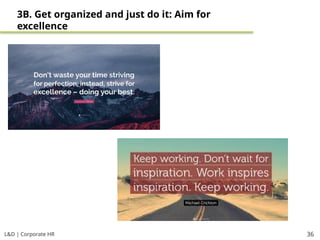
  • #36 5 minutes Don't strive for perfection or wait for inspiration! Aim for excellence: Get things done and rolling. Don't wait for inspiration. Begin. Inspiration will find you. Set realistic expectations, targets and plans!
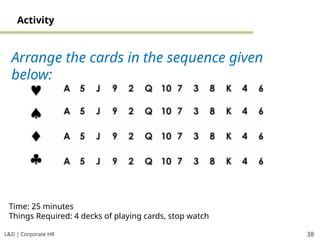
  • #38 25 minutes Set up :  Split the class into 4 groups, give each group a deck of playing cards.  Tell the groups that the purpose of this exercise is to work as effectively as possible in your teams to complete the following task (See rules below) and that each team is competing with other teams and the winning team is the one that can finish the task in the shortest possible time. Rules :  You need to lay out the cards exactly as outlined below.  All cards must be in neat tidy rows with no cards touching.  The aim is to complete this task in the fastest possible time – you are directly in competition with the other teams in the room! You have 5 minutes to prepare your strategy and undertake any practice runs.  You may use any resources in the room to assist you in your task.  At the end of 5 minutes you will be asked to submit an estimate time in which you will complete the task.  You will then be asked to complete the task against the clock. Good Luck!! There will be 3 rounds to the game, the idea is that each team improves their time throughout the successive rounds of the game. What's the point from this activity ? : The main learning point from this activity is to make the participants practice and experience the importance of planning and delegating/dividing  work among them  to properly manage their time and achieve the required task in the shortest time possible. Discussion & Debrief :  What usually happens when running this activity is that participants don't usually come up with a good strategy during the first practice runs so they end up taking a very long time to get the task done. But what happens on the following runs is that once they start making a good strategy and divide the work among themselves, each group's timing significantly improves on the next run and the more they improve their strategy and their plan the better time they make on each of the following runs. And this is the main take away from this fun activity that once we have a good plan in advance  we will be able to get the required tasks in the shortest possible time versus having no plan at all and ending up confused and put a lot of unnecessary effort  and time in a task that should have taken much less effort and time if we had a good plan in advance.
  • #39 5 minutes Train people at work, at home. If you don’t develop mechanisms with your secretaries, with the extended office, with everybody around you, it cannot work. Play from 2:22 to 3: 45. https://www.youtube.com/watch?v=72Me8z8BOmM You cannot do everything on your own. There is just so much that you can do. Delegate or outsource wherever and whenever possible. Delegation doesn’t have to be downwards only, delegate to other people capable in your team for the job, delegate to your family members too. While delegating, don't dump but grant authority with responsibility.
  • #41 5 minutes If everything in life was easy, time management would be completely unnecessary. In real life bad things happen and even with best plans something can go wrong big time. It is very important to not loose the attitude. We have to learn to deal with anger and disappointment which are the inevitable part of life. If we manage to keep smile in bad situations, we’ll improve our chances to get help from other, because everybody prefers to help people with smiles on their faces. We’ll also stop wasting time on complaints and rather use it on solving the situations, which often seem much worse on first look then after few minutes or evaluating with positive attitude. The power of belief is widely known. It can definitely work miracles – even in serious health conditions!
  • #42 2 minutes
  • #43 5 minutes Stay positive, it is the only way to move ahead in life. If you keep dwelling in the past, you will only waste your energy.
  • #44 5 minutes Social media Games Chit chatting…what’s your poison? Know and limit it. Taking breaks is fine, learn to time it.
  • #45 5 minutes
  • #46 5 minutes Engage in hobbies to engage the parts of your brain that you don’t use at work. You’ll solve problems faster and have more creativity at your disposal. Try stimulating activities like learning a foreign language or mastering a musical instrument. If you are in a creative job, try to improve your analytical skills (for e.g. with Sudoku). Alternately, if you are in analytics, try something more creative such as painting.
  • #47 10 minutes Get 3-4 people to do this activity. Here’s an activity to challenge your left as well as right brain! Read what is written rather than the color it suggests. Now, instead of reading the words that are written, state the color. Your right brain sees the color, but your left brain must engage to remember not to read the word.
  • #48 5 minutes
  • #49 5 minutes