Backend Development: Key Concepts and Best
Practices
Backend development is at the heart of every reliable website and mobile app. The work
happening in the backend controls data, powers user features, and keeps platforms running
smoothly. Companies depend on strong backend development services to support everything
from customer accounts to order processing. If you want to understand what makes web apps
and mobile apps work, learning about backend development gives you a clear view of the
engine behind the scenes.
What Is Backend Development?
Backend development covers everything users do not see on a website or app. It includes all
logic, data storage, and system processes that run in the background. While users interact with
the design and buttons on the frontend, the backend handles requests, checks permissions, and
manages information. A strong backend helps businesses deliver fast and secure services
every day.
Core Concepts of Backend Development
Backend development relies on several core concepts to keep apps and websites running.
Understanding these ideas helps both beginners and professionals build systems that are
reliable, secure, and ready to handle growth.
1. Servers and Hosting
A server stores files and responds to user requests. When someone opens a site or app, the
server returns the right data. Hosting is the service that keeps these servers working and
accessible online. Good hosting reduces downtime and keeps users happy.
2. Databases
Databases organize and store all the information needed for an app. For example, an
eCommerce website needs to store product details, user profiles, and order records. There are
two main types of databases:
● Relational Databases: Use tables to keep data organized. Examples are MySQL and
PostgreSQL.
● NoSQL Databases: Use flexible formats, like documents or key-value pairs. Examples
are MongoDB and Redis.
A well-designed database makes backend development more efficient and helps prevent data
loss.
3. APIs (Application Programming Interfaces)
APIs connect different parts of an app or allow third-party tools to work with your platform. For
instance, a payment API lets customers pay without leaving the site. With the help of backend
development services, businesses can offer APIs that link their products with other tools or apps.
4. Server-Side Languages
Backend development projects use programming languages built for server work. Popular
choices include Node.js, Python, PHP, Java, and Ruby. Each language brings its strengths,
from rapid development to high performance for large data sets.
5. Frameworks and Libraries
Frameworks provide structure for backend development, helping developers build apps faster
and more reliably. Libraries offer extra features that make the backend even more powerful.
Together, they support quick development and help maintain code quality.
6. Authentication and Authorization
Authentication checks a user’s identity. Authorization decides what actions a user can take.
Both are key for privacy and data protection. Good authentication systems prevent unauthorized
access and keep sensitive information safe.
Backend Architecture Patterns
Backend architecture describes how the backend is set up and how its parts interact. Two main
patterns are used:
Monolithic Architecture
A monolithic backend puts all features and services into a single unit. This style is simple to start
and easy to test at first. However, as the project grows, it can become harder to manage
changes and updates.
Microservices Architecture
A microservices setup breaks the backend into small, independent services. Each service does
a specific job, such as handling user accounts or payments. This structure allows teams to
update and scale different parts without affecting the whole system. Many large platforms use
microservices for flexibility.
Best Practices for Backend Development
Backend development must follow certain best practices to produce secure, fast, and reliable
systems. These habits reduce errors and make maintenance easier.
1. Keep Code Organized
Write code that is easy to read and grouped by purpose. Organized code is simpler to update
and less likely to cause bugs. Use folders, clear names, and avoid repeating yourself.
2. Secure Your Application
Security should always come first. Use strong passwords, encrypt sensitive data, and protect
your servers. Never expose database credentials or secret keys in public files. Regularly update
your system to patch security gaps. Validating user input also helps stop threats like SQL
injection.
3. Focus on Performance
A slow backend creates a poor user experience. To speed things up, use caching for data that
changes rarely and balance traffic across servers during busy periods. Compress large files
before sending them to users.
4. Manage Databases Well
Keep databases tidy and backed up. Use indexing for fast searches and remove outdated
records to keep things running smoothly. Make sure the data is checked before being saved.
5. Test and Debug
Testing finds problems early. Write unit tests for each function and integration tests for the full
system. Debugging tools help fix issues before users notice them.
6. Write Good Documentation
Clear documentation explains how each part of the backend works. This is vital when other
developers join or when it’s time to update the system. Document APIs, data structures, and key
features.
Tools and Technologies for Backend Development
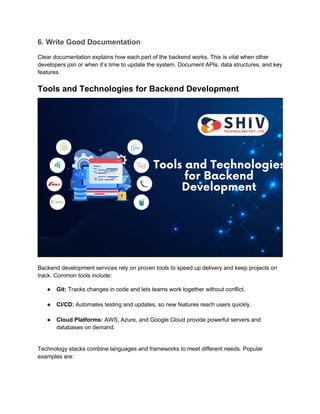
Backend development services rely on proven tools to speed up delivery and keep projects on
track. Common tools include:
● Git: Tracks changes in code and lets teams work together without conflict.
● CI/CD: Automates testing and updates, so new features reach users quickly.
● Cloud Platforms: AWS, Azure, and Google Cloud provide powerful servers and
databases on demand.
Technology stacks combine languages and frameworks to meet different needs. Popular
examples are:
● LAMP: Linux, Apache, MySQL, PHP.
● MERN: MongoDB, Express.js, React, Node.js.
● MEAN: MongoDB, Express.js, Angular, Node.js.
The best stack depends on project size, speed requirements, and team experience.
How Backend Development Services Add Value
Backend development services let companies focus on growth while experts handle technical
challenges. A skilled backend team takes care of setup, scaling, and security, so businesses
can launch new products or update existing ones without worry. With the right backend for
growth, companies can adapt to new needs, process more users, and gather useful insights
from data.
Future Trends in Backend Development
Backend development keeps changing as new technologies appear. Here are a few trends
shaping the future:
● Serverless Architecture: Let developers run code without managing servers. Cloud
providers take care of everything behind the scenes.
● Cloud-Native Solutions: Build apps to run anywhere, making scaling and moving apps
easier.
● AI and Automation: Add smart features and automate tasks like data processing or
user recommendations.
● GraphQL APIs: Give clients more control over the data they get, reducing unnecessary
requests.
Staying up to date with new trends helps businesses deliver features users expect.
Also read: How to Build an eCommerce Backend – Breaking It Down
Why Choose Shiv Technolabs for Backend Development?
Shiv Technolabs provides reliable backend development services for all types of businesses.
Our team builds secure and high-performing backends for websites, apps, and custom
platforms. We listen to your business goals and deliver solutions that fit your needs, from small
startups to large companies. Our experts take care of databases, APIs, security, and
maintenance. Partner with Shiv Technolabs to get a backend that supports your vision and
helps your business grow.
Conclusion
Backend development forms the foundation of every high-quality web and mobile application. It
controls everything users do not see, from data handling to system security. By following best
practices and using the right tools, developers create backends that are fast, secure, and ready
for growth. Businesses count on backend development services to keep their platforms
reliable and to add new features with confidence. If you want a backend built for success,
contact us for custom solutions that match your business goals.

A Comprehensive Guide to Top Backend Frameworks for Modern Web Apps

  • 1.
    Backend Development: KeyConcepts and Best Practices Backend development is at the heart of every reliable website and mobile app. The work happening in the backend controls data, powers user features, and keeps platforms running smoothly. Companies depend on strong backend development services to support everything from customer accounts to order processing. If you want to understand what makes web apps and mobile apps work, learning about backend development gives you a clear view of the engine behind the scenes. What Is Backend Development? Backend development covers everything users do not see on a website or app. It includes all logic, data storage, and system processes that run in the background. While users interact with the design and buttons on the frontend, the backend handles requests, checks permissions, and manages information. A strong backend helps businesses deliver fast and secure services every day.
  • 2.
    Core Concepts ofBackend Development Backend development relies on several core concepts to keep apps and websites running. Understanding these ideas helps both beginners and professionals build systems that are reliable, secure, and ready to handle growth. 1. Servers and Hosting A server stores files and responds to user requests. When someone opens a site or app, the server returns the right data. Hosting is the service that keeps these servers working and accessible online. Good hosting reduces downtime and keeps users happy. 2. Databases Databases organize and store all the information needed for an app. For example, an eCommerce website needs to store product details, user profiles, and order records. There are two main types of databases: ● Relational Databases: Use tables to keep data organized. Examples are MySQL and PostgreSQL.
  • 3.
    ● NoSQL Databases:Use flexible formats, like documents or key-value pairs. Examples are MongoDB and Redis. A well-designed database makes backend development more efficient and helps prevent data loss. 3. APIs (Application Programming Interfaces) APIs connect different parts of an app or allow third-party tools to work with your platform. For instance, a payment API lets customers pay without leaving the site. With the help of backend development services, businesses can offer APIs that link their products with other tools or apps. 4. Server-Side Languages Backend development projects use programming languages built for server work. Popular choices include Node.js, Python, PHP, Java, and Ruby. Each language brings its strengths, from rapid development to high performance for large data sets. 5. Frameworks and Libraries Frameworks provide structure for backend development, helping developers build apps faster and more reliably. Libraries offer extra features that make the backend even more powerful. Together, they support quick development and help maintain code quality. 6. Authentication and Authorization Authentication checks a user’s identity. Authorization decides what actions a user can take. Both are key for privacy and data protection. Good authentication systems prevent unauthorized access and keep sensitive information safe. Backend Architecture Patterns Backend architecture describes how the backend is set up and how its parts interact. Two main patterns are used: Monolithic Architecture A monolithic backend puts all features and services into a single unit. This style is simple to start and easy to test at first. However, as the project grows, it can become harder to manage changes and updates.
  • 4.
    Microservices Architecture A microservicessetup breaks the backend into small, independent services. Each service does a specific job, such as handling user accounts or payments. This structure allows teams to update and scale different parts without affecting the whole system. Many large platforms use microservices for flexibility. Best Practices for Backend Development Backend development must follow certain best practices to produce secure, fast, and reliable systems. These habits reduce errors and make maintenance easier. 1. Keep Code Organized Write code that is easy to read and grouped by purpose. Organized code is simpler to update and less likely to cause bugs. Use folders, clear names, and avoid repeating yourself. 2. Secure Your Application Security should always come first. Use strong passwords, encrypt sensitive data, and protect your servers. Never expose database credentials or secret keys in public files. Regularly update your system to patch security gaps. Validating user input also helps stop threats like SQL injection. 3. Focus on Performance A slow backend creates a poor user experience. To speed things up, use caching for data that changes rarely and balance traffic across servers during busy periods. Compress large files before sending them to users. 4. Manage Databases Well Keep databases tidy and backed up. Use indexing for fast searches and remove outdated records to keep things running smoothly. Make sure the data is checked before being saved. 5. Test and Debug Testing finds problems early. Write unit tests for each function and integration tests for the full system. Debugging tools help fix issues before users notice them.
  • 5.
    6. Write GoodDocumentation Clear documentation explains how each part of the backend works. This is vital when other developers join or when it’s time to update the system. Document APIs, data structures, and key features. Tools and Technologies for Backend Development Backend development services rely on proven tools to speed up delivery and keep projects on track. Common tools include: ● Git: Tracks changes in code and lets teams work together without conflict. ● CI/CD: Automates testing and updates, so new features reach users quickly. ● Cloud Platforms: AWS, Azure, and Google Cloud provide powerful servers and databases on demand. Technology stacks combine languages and frameworks to meet different needs. Popular examples are:
  • 6.
    ● LAMP: Linux,Apache, MySQL, PHP. ● MERN: MongoDB, Express.js, React, Node.js. ● MEAN: MongoDB, Express.js, Angular, Node.js. The best stack depends on project size, speed requirements, and team experience. How Backend Development Services Add Value Backend development services let companies focus on growth while experts handle technical challenges. A skilled backend team takes care of setup, scaling, and security, so businesses can launch new products or update existing ones without worry. With the right backend for growth, companies can adapt to new needs, process more users, and gather useful insights from data. Future Trends in Backend Development Backend development keeps changing as new technologies appear. Here are a few trends shaping the future: ● Serverless Architecture: Let developers run code without managing servers. Cloud providers take care of everything behind the scenes. ● Cloud-Native Solutions: Build apps to run anywhere, making scaling and moving apps easier. ● AI and Automation: Add smart features and automate tasks like data processing or user recommendations. ● GraphQL APIs: Give clients more control over the data they get, reducing unnecessary requests. Staying up to date with new trends helps businesses deliver features users expect. Also read: How to Build an eCommerce Backend – Breaking It Down
  • 7.
    Why Choose ShivTechnolabs for Backend Development? Shiv Technolabs provides reliable backend development services for all types of businesses. Our team builds secure and high-performing backends for websites, apps, and custom platforms. We listen to your business goals and deliver solutions that fit your needs, from small startups to large companies. Our experts take care of databases, APIs, security, and maintenance. Partner with Shiv Technolabs to get a backend that supports your vision and helps your business grow. Conclusion Backend development forms the foundation of every high-quality web and mobile application. It controls everything users do not see, from data handling to system security. By following best practices and using the right tools, developers create backends that are fast, secure, and ready for growth. Businesses count on backend development services to keep their platforms reliable and to add new features with confidence. If you want a backend built for success, contact us for custom solutions that match your business goals.